
Article

Layered Iron Vanadate as a High-Capacity Cathode Material for Nonaqueous Calcium-Ion Batteries
1
Department of Energy Science and Engineering, DGIST (Daegu Gyeongbuk Institute of Science and Technology), Daegu 42988, Korea
2
Energy Science and Engineering Research Center, DGIST (Daegu Gyeongbuk Institute of Science and Technology), Daegu 42988, Korea
*
Author to whom correspondence should be addressed.
Batteries 2021, 7(3), 54; https://doi.org/10.3390/batteries7030054

Submission received: 25 April 2021 / Revised: 22 July 2021 / Accepted: 22 July 2021 / Published: 9 August 2021

Abstract

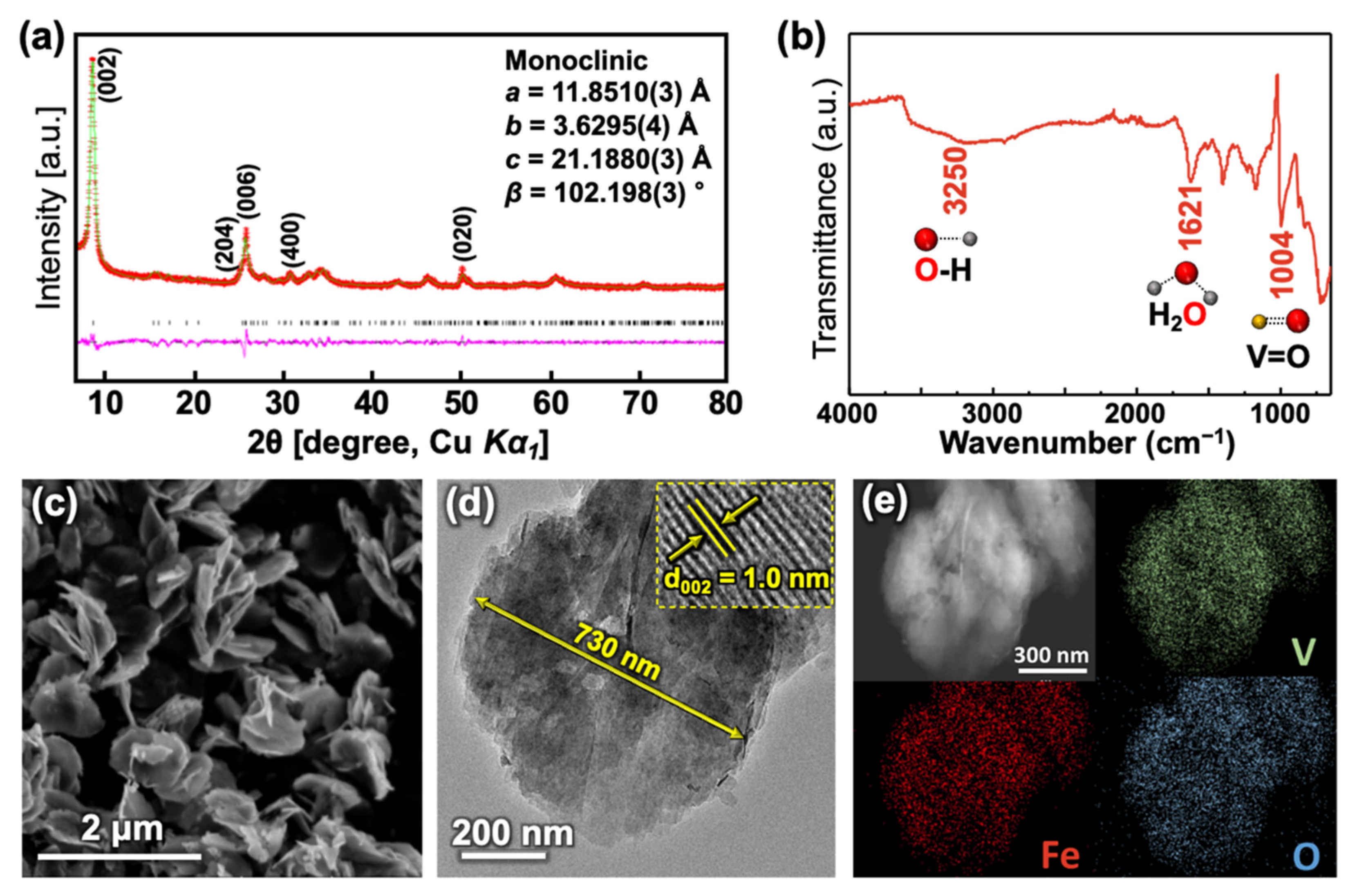
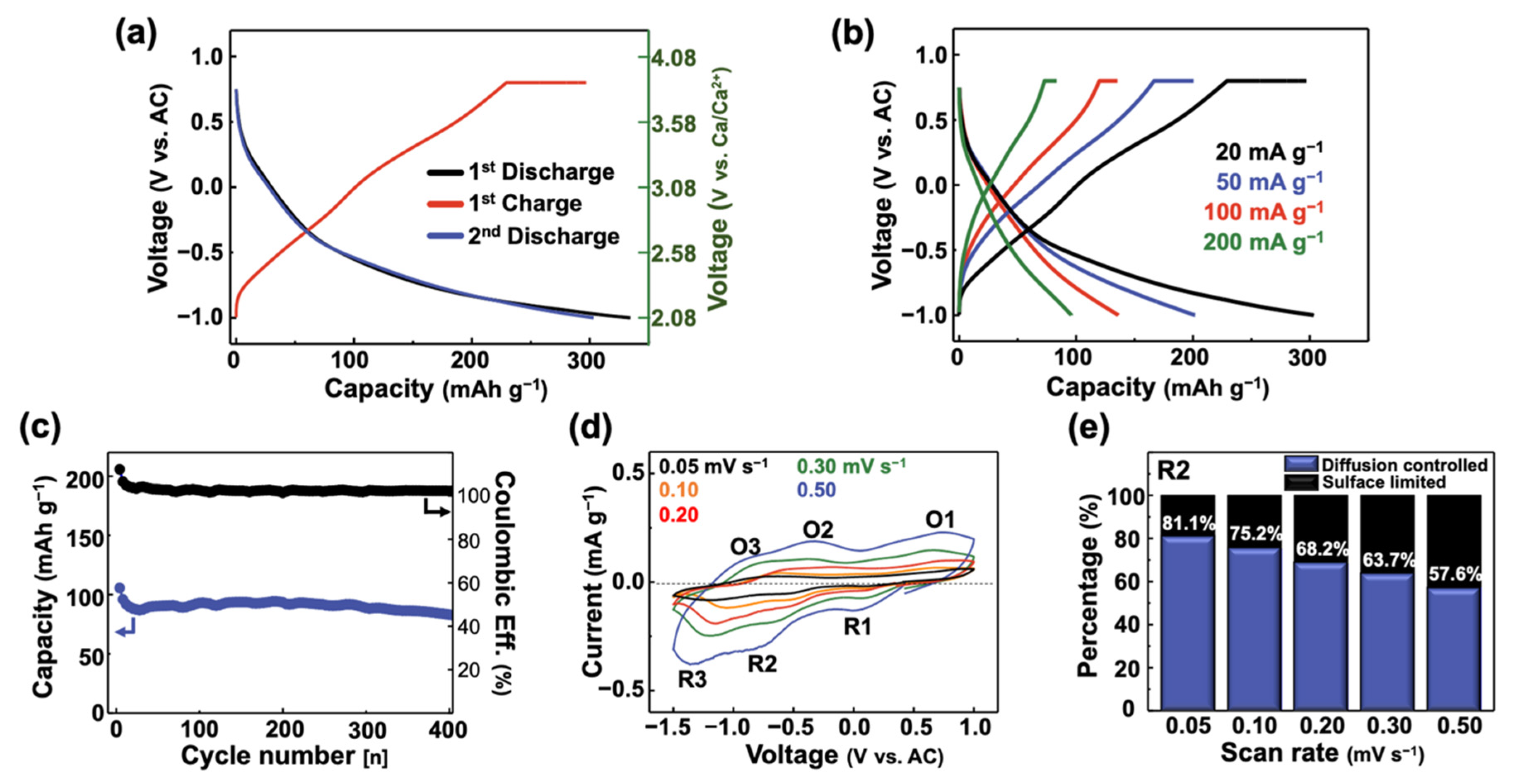
Calcium-ion batteries represent a promising alternative to the current lithium-ion batteries. Nevertheless, calcium-ion intercalating materials in nonaqueous electrolytes are scarce, probably due to the difficulties in finding suitable host materials. Considering that research into calcium-ion batteries is in its infancy, discovering and characterizing new host materials would be critical to further development. Here, we demonstrate FeV3O9∙1.2H2O as a high-performance calcium-ion battery cathode material that delivers a reversible discharge capacity of 303 mAh g−1 with a good cycling stability and an average discharge voltage of ~2.6 V (vs. Ca/Ca2+). The material was synthesized via a facile co-precipitation method. Its reversible capacity is the highest among calcium-ion battery materials, and it is the first example of a material with a capacity much larger than that of conventional lithium-ion battery cathode materials. Bulk intercalation of calcium into the host lattice contributed predominantly to the total capacity at a lower rate, but became comparable to that due to surface adsorption at a higher rate. This stimulating discovery will lead to the development of new strategies for obtaining high energy density calcium-ion batteries.
Keywords: calcium-ion battery; cathode material; kazakhstanite; post-lithium-ion battery; layered iron vanadate calcium-ion battery; cathode material; kazakhstanite; post-lithium-ion battery; layered iron vanadate