Review

Rechargeable Batteries for Grid-Scale Energy Storage: Technologies, Performance, and Emerging Directions

Department of Mechanical Engineering, University of Nevada-Reno, Reno, NV 89557, USA
*
Author to whom correspondence should be addressed.
Batteries 2026, 12(7), 264; https://doi.org/10.3390/batteries12070264
Submission received: 22 June 2026 / Revised: 14 July 2026 / Accepted: 15 July 2026 / Published: 20 July 2026

Abstract

The accelerating transition toward renewable electricity generation has elevated grid-scale electrochemical energy storage from an ancillary grid service to a foundational infrastructure requirement. This review provides a comprehensive account of rechargeable battery technologies for stationary grid applications, spanning advanced lithium-ion systems, sodium-ion and post-lithium multivalent chemistries, vanadium and organic flow batteries, solid-state architectures, and high-energy-density future systems such as lithium-sulfur and metal-air cells. The techno-economic context of grid-scale storage is systematically examined, including performance metrics, market drivers, and regulatory frameworks. Each battery chemistry is analyzed with respect to electrochemical mechanism, cycle life, energy density, safety profile, material availability, and commercial readiness. Non-electrochemical storage technologies are discussed as system-level alternatives. Battery safety engineering, thermal management system design, thermal runaway mechanisms and prevention, and failure containment strategies are examined in depth, followed by analysis of critical material supply-chain vulnerabilities, life-cycle assessment, and recycling pathways. The expanding role of artificial intelligence, machine learning, and digital twin frameworks in optimizing performance and enabling predictive maintenance is reviewed. Key challenges, including material bottlenecks, manufacturing scalability, long-duration storage gaps, and the absence of harmonized performance standards, are identified, and the review concludes with a techno-economic roadmap toward cost-competitive, resilient, and low-carbon grid storage.

Graphical Abstract

1. Introduction

1.1. The Imperative for Grid-Scale Energy Storage

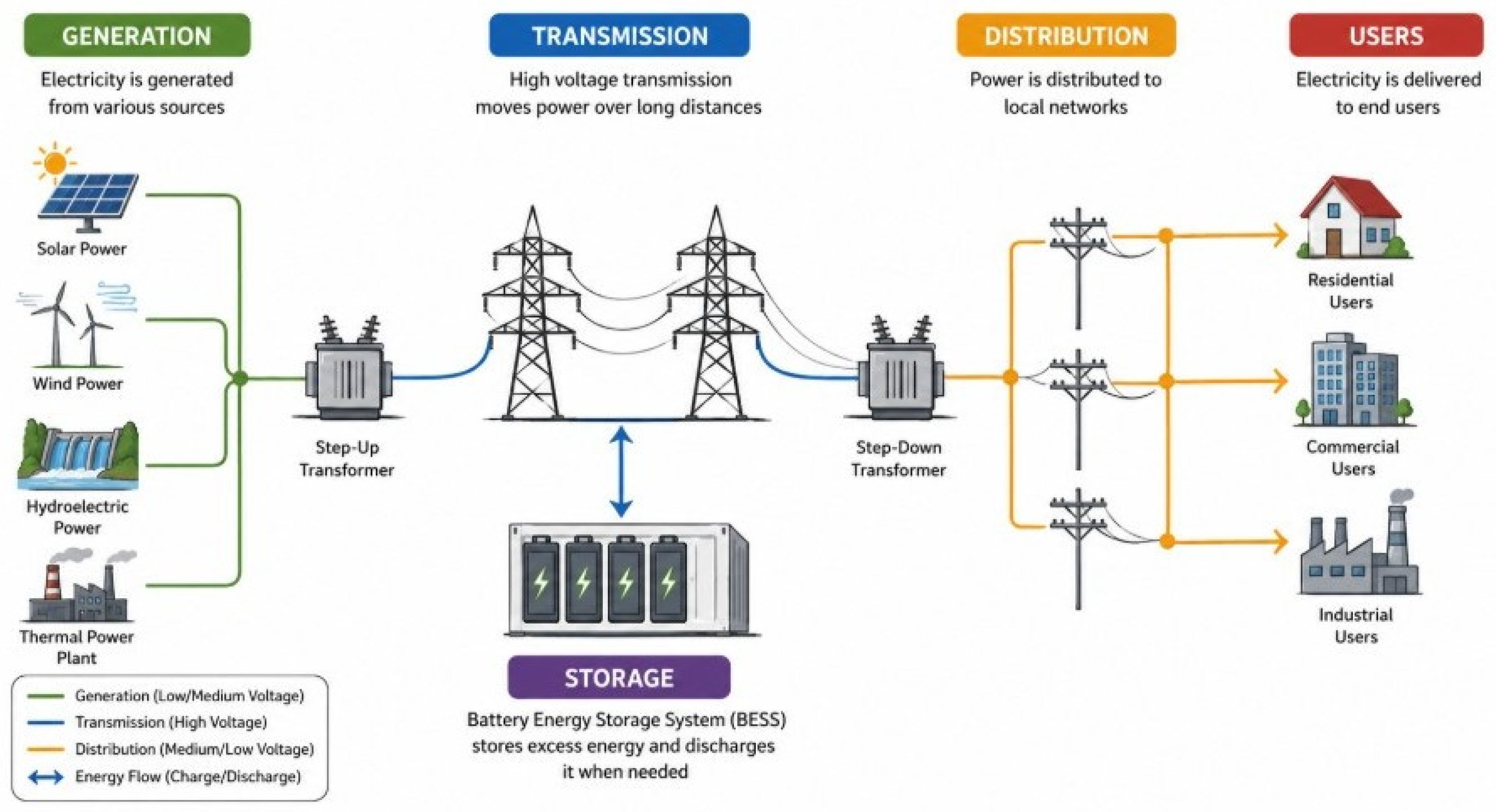
The global electricity system is undergoing the most consequential structural transformation since the electrification of industry in the early twentieth century. Achieving deep decarbonization of the power sector, a prerequisite for meeting climate targets, requires large-scale integration of variable renewable energy sources whose output fluctuates on timescales from seconds to seasons, creating a fundamental need for dispatchable energy storage that can absorb excess generation, maintain grid frequency and voltage stability, and supply power during periods of renewable shortfall [1,2,3]. Figure 1 illustrates how grid-level energy storage is implemented, by connecting to the transmission network grid-scale battery systems can absorb power from generation sources and provide extra power during peak demand by users. The International Energy Agency projects that global electricity demand will increase by approximately 40% by 2035, driven by the electrification of transport, industry, and heating, with artificial intelligence infrastructure emerging as a fast-growing additional demand [4]. The global grid-scale battery storage market is projected to reach approximately USD 108.6 billion in 2026 and is projected to expand to USD 315.8 billion by 2031, corresponding to a CAGR of 23.85% according to an industry report [5]. The fast growth can be attributed to renewable integration mandates, grid resilience policy, and continuing reductions in battery manufacturing cost [6]. Lithium-ion technology dominates current deployments but faces fundamental limitations. A practical storage duration ceiling of approximately four hours, dependence on geographically concentrated critical mineral supply chains, and inherent thermal runaway risk motivate the intensive research effort into alternative and complementary battery chemistries surveyed in this paper [7,8].

1.2. Grid Requirements, Performance Metrics, and the Technology Landscape

Batteries deployed for grid applications serve services with distinct performance requirements spanning multiple time domains. Frequency regulation requires sub-second response times and high-power density, favoring high-power chemistries with low internal impedance. Peak shaving and load shifting require two to four hours of storage at moderate power density. Seasonal energy storage demands very long discharge durations at which currently available batteries are economically non-competitive with alternative approaches. No single battery chemistry optimally satisfies all requirements simultaneously, motivating a diverse portfolio of electrochemical storage technologies, each better suited to grid services [8,9]. Table 1 summarizes the principal performance metrics used to evaluate grid-scale storage technologies.

1.3. Scope and Organization of the Review

This review provides a comprehensive assessment of rechargeable battery technologies for grid-scale energy storage by examining the relationships between battery chemistry, performance metrics, system-level operation, economic feasibility, and long-term sustainability. Unlike reviews focused primarily on individual battery chemistries, this work integrates perspectives from electrochemistry, grid engineering, battery management, artificial intelligence, safety, and life-cycle considerations to provide an evaluation of the role of battery storage in future power systems. The review further identifies current limitations, emerging technological directions, and research priorities required to improve reliability, affordability, and large-scale deployment in support of a decarbonized electrical grid.

2. Market, Policy, and Techno-Economic Context

2.1. Grid Performance Requirements and Standards

Performance requirements for grid-scale energy storage derive from the operational characteristics of modern electricity networks. Reliability in resource adequacy terms is conventionally targeted against a loss-of-load probability standard of no more than one day of unserved energy per ten years, typically achieved by maintaining a capacity reserve margin of approximately 15% above expected peak demand [18]. Battery storage directly reduces the required reserve margin because of its fast response, which enables it to absorb short-duration generation shortfalls without requiring standing spinning reserves from conventional generators. Round-trip efficiency is the primary operational efficiency metric, with modern lithium-ion systems achieving 90–97% RTE [19]. The relevant installation and testing standard is IEEE 2030.3-2016 [17], which defines the test procedures for electric energy storage equipment in power system applications, establishing a framework for safety, performance, and interoperability evaluation. Thermal energy storage using phase change materials has demonstrated power outputs comparable to molten salt systems at a competitive cost in concentrated solar power applications, illustrating the viability of thermal storage as a complement to battery-based systems [20].

2.2. Market Size, Drivers, and Restraints

The grid-scale battery storage market is experiencing exceptional growth, driven by the simultaneous pressure of renewable energy integration mandates, falling battery costs, and policy commitments to electricity sector decarbonization. Market growth drivers include the need to balance intermittent wind and solar generation, energy security motivations, and continuous advances in battery materials and manufacturing [14,21]. Restraints include the concentration of critical material supply chains, particularly lithium, cobalt, and vanadium, in a small number of countries; current limitations in energy density and duration capability that restrict batteries to short-duration grid services, and the environmental impact of raw material extraction [21]. Among non-battery technologies, pumped hydro will remain the backbone of long-duration storage in suitable locations, but site constraints and construction timelines prevent sufficiently rapid expansion [14,22]. Compressed air energy storage requires geological cavern development taking one to two years [23], while liquid air energy storage offers geography-independent long-duration storage at approximately 60% standalone efficiency using commercially proven cryogenics [24]. Table 2 provides an overview of installation requirements and technology readiness levels of various large-scale grid-level storage technologies.

2.3. Regulatory Frameworks and Policy Drivers

Grid-scale battery deployment occurs within a rapidly evolving regulatory environment. In the United States, FERC Orders 755, 841, and 2222 have progressively opened wholesale electricity markets to storage participation, establishing revenue streams for frequency regulation, capacity, and energy arbitrage [4,7]. The U.S. Department of Energy’s Energy Storage Grand Challenge Roadmap set a target of USD $0.05 per kWh levelized cost of storage for long-duration stationary applications by 2030, approximately a 90% reduction from 2020 levels, as the economic threshold for broad commercial viability [7]. On safety, UL 9540A [31] establishes the test method for evaluating thermal runaway fire propagation in BESS, a standard that has required four successive revisions following high-profile BESS fires, reflecting the evolving understanding of safety requirements for large battery installations [32].

3. Major Battery Chemistries for Grid-Scale Applications

The electrochemical storage landscape relevant to grid-scale deployment encompasses a chemically diverse portfolio spanning intercalation-based, conversion-reaction, and plating-based systems. Table 3 provides a structured comparison of the principal chemistries.

3.1. Advanced Lithium-Ion Systems

Lithium-ion batteries (LIBs) constitute the dominant technology for grid-scale electrochemical energy storage, accounting for approximately 90% of new stationary battery installations, a position underpinned by decades of optimization that has driven dramatic reductions in cost and improvements in performance [2,45]. The commercial lithium-ion family encompasses five primary cathode chemistries: LFP, LMO, LTO, NCA, and NMC, each representing a distinct trade-space between energy density, power capability, cycle life, thermal stability, and material cost [25]. For grid-scale stationary storage, LFP has emerged as the chemistry of choice, balancing energy density (90–160 Wh kg−1), an industry-leading cycle life of 3000–7000 full cycles before reaching 80% capacity threshold, and superior thermal stability relative to NMC and NCA owing to the strong covalent Fe-O bond in the olivine structure that resists oxygen release under thermal abuse conditions [25]. NMC chemistry offers higher energy density (150–250 Wh kg−1) at reduced cycle life (1000–2000 cycles) and higher thermal runaway risk, finding application in shorter-duration high-energy-density grid storage. NCA offers the highest energy density but with self-discharge rates up to 10% per month and the most demanding thermal management requirements [25]. Despite market dominance, lithium-ion faces structural constraints, for example, a practical storage duration ceiling of approximately four hours, supply-chain concentration in three countries supplying approximately 73% of global lithium production in 2024, and inherent thermal runaway risk requiring expensive safety management systems [7,46,47].

3.2. Sodium-Ion, Potassium-Ion, and Post-Lithium Intercalation Systems

Sodium-ion batteries (SIBs) represent the most commercially advanced alternative to lithium-ion, substituting sodium (abundant, geographically distributed, and far less expensive than lithium) as the charge carrier while sharing the same intercalation mechanism [28,48]. The larger ionic radius of Na+ (1.02 A) relative to Li+ (0.76 A) results in slower solid-state diffusion kinetics and requires more porous electrode structures, historically limiting practical energy density to approximately 100–160 Wh kg−1 compared to 150–250 Wh kg−1 for commercial NMC [34]. Liang et al. demonstrated that mesoporous titanium niobium oxide electrodes sustain high-rate sodium-ion insertion at temperatures as low as −40 °C in lab conditions [34]. This advancement could substantially expand the operating envelope for grid storage in cold climates. Chinese grid operators have already deployed aqueous sodium-ion battery systems in grid support applications, and cost parity with LFP is projected for 2028–2030 [27,28]. Potassium-ion batteries suffer from the large ionic radius of K+ (1.38 A), causing high volumetric expansion stresses, sluggish diffusion kinetics, and aggressive electrolyte decomposition [44]. Phosphorus-based anodes demonstrate a theoretical capacity of approximately 2596 mAh g−1, but practical realization at competitive cycle life remains an open research challenge.

3.3. Multivalent Metal-Ion Batteries: Zinc, Aluminum, and Magnesium

Multivalent metal-ion chemistries offer potentially higher volumetric energy densities than monovalent systems because two or three electrons are transferred per ion. Table 4 compares these chemistries systematically.
Zinc is the most technologically mature multivalent chemistry, benefiting from aqueous compatibility and low cost. Non-homogeneous zinc re-deposition during charging creates dendritic structures causing internal short circuits and progressive electrode and electrolyte degradation [49]. Zinc-air batteries offer a theoretical energy density of 1086 Wh/kg−1 but are limited by cycle life, electrolyte carbonation, and sluggish air cathode kinetics [49]. Aluminum-ion batteries hold the highest theoretical volumetric capacity (8035 mAh cm−3) but the high charge density of Al3+ creates poor cycle life, typically under 60 cycles [51]. Researchers at Nankai University developed calix-(4) quinone cathodes capable of accommodating Al3+ without structural collapse [51], while tellurium nanowire electrodes deliver 1026 mAh g−1 with improved conductivity [50]. Magnesium-ion batteries offer volumetric capacity approximately twice that of lithium-ion but are hindered by rapid electrolyte corrosion and sluggish Mg2+ kinetics that limit cycle life to below 500 cycles [50]. Titanium dioxide nanoflakes with engineered surface defects provide additional active storage sites for Mg2+ and improve both kinetics and cycle retention [53].

4. Flow Batteries and Solid-State Systems

4.1. Flow-Battery Operating Principles and Design

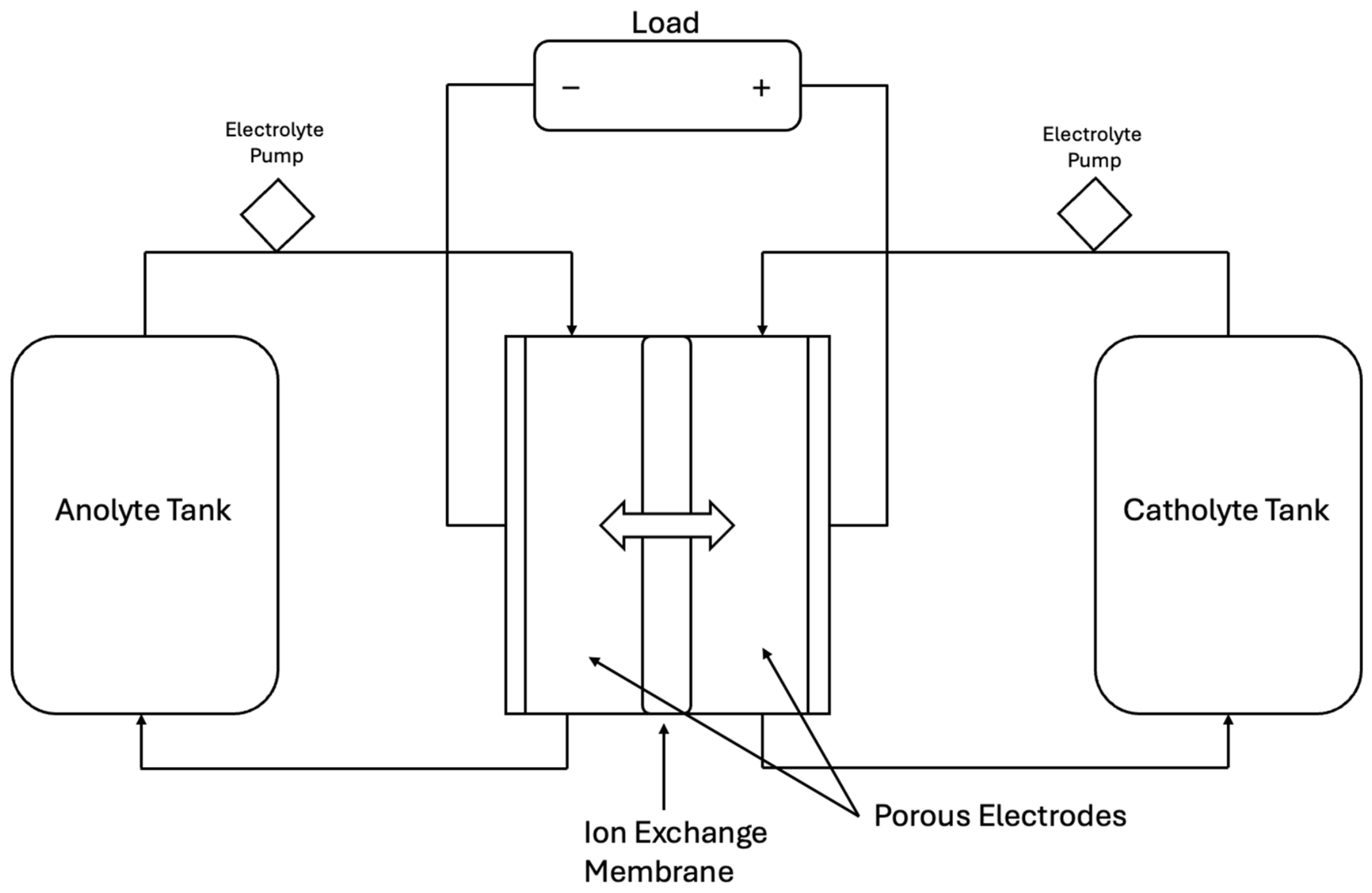
Flow batteries store energy in dissolved electroactive species in external liquid electrolyte reservoirs, called anolyte and catholyte, that are pumped through a central electrochemical cell stack where redox reactions occur at inert electrodes separated by an ion-selective membrane [54]. This architecture physically decouples power (cell stack) from energy (electrolyte volume and concentration), enabling independent scaling of power and energy capacity. Figure 2 shows a schematic of a flow-battery operating principle, showing two electrolyte tanks, the ion exchange membrane, and electrolyte pumps. Flow batteries offer effectively unlimited cycle life because electroactive species dissolved in solution are not subject to the solid-state mechanical degradation that limits intercalation batteries, and inherent safety because aqueous electrolytes are non-flammable [10,54]. Full state-of-charge determination by electrolyte sampling enables more accurate health monitoring than solid-state systems.

4.2. Vanadium Redox Flow Batteries

Vanadium redox flow batteries (VRFBs) are the most commercially mature flow-battery system, exploiting all four oxidation states of vanadium to achieve a nominal cell voltage of approximately 1.26 V and effectively unlimited cycle life [10,26]. Cross-contamination is eliminated because vanadium species on both sides of the membrane are simply rebalanced by charging. The principal challenges are limited electrolyte energy density (approximately 15–25 Wh L−1 system-level) and high capital cost of vanadium and circulation infrastructure [10]. In 2025, Du et al. synthesized vanadium trioxide electrolyte additives demonstrating energy efficiency exceeding 82% [55], and Botling et al. demonstrated Mo2TiC2Tx MXene-coated carbon electrodes delivering stable efficiency and excellent capacity retention over 150 cycles [56]. A significant supply-chain constraint is that approximately 75% of global vanadium production is a steel manufacturing byproduct, with 90% of that returning to steel alloying, severely limiting vanadium available for battery applications.

4.3. Zinc-Iron and Organic Flow Batteries

Zinc-iron flow batteries (ZFBs) attracted attention as a low-cost alternative capable of meeting the DOE USD 150 kWh−1 system cost target, relying on inexpensive zinc and iron sulfate commodity electrolytes [36]. Progress was constrained by electrode durability and zinc dendrite formation challenges. Renewed research in 2024 demonstrated that boron-doped carbon felt electrodes homogenize zinc deposition and suppress side reactions, improving electrochemical performance and cycle stability [35]. The boron-doped carbon felt promoted uniform zinc deposition and suppressed parasitic reactions, enabling stable operation over 300 cycles at 40 mA cm−2 while maintaining an average Coulombic efficiency of approximately 99.85% and an energy efficiency of 88% [35]. Organic flow batteries avoid geographically concentrated transition metals by employing organic electroactive species operating at or near neutral pH, reducing the need for corrosive acid electrolytes [57]. Ferrocene derivatives, TEMPO nitroxide radicals, anthraquinones, and potassium ferricyanide are candidate electrolytes. The primary challenges are limited aqueous solubility and tendency to reach viscosity limits before the solubility limit, restricting practical energy density [57]. Li et al. [58] demonstrated that insoluble ferrocene derivatives can be solubilized through beta-cyclodextrin host-guest complexation, expanding the accessible electrolyte library.

4.4. Solid-State Batteries

All-solid-state batteries (ASSBs) replace liquid electrolyte with a solid ionic conductor, eliminating flammable electrolyte and enabling high-capacity lithium metal anodes that cannot be safely paired with liquid electrolytes [29,37,59]. Sulfide-based solid electrolytes in the Li2S-P2S5 system achieve ionic conductivities approaching 10−2 S cm−1, comparable to liquid electrolytes, but their electrochemical stability window is narrower than oxide-based electrolytes [37,60]. The principal barriers are mechanical and electrochemical interface instabilities: uneven lithium deposition nucleates dendrites capable of penetrating the electrolyte, and cyclic volume changes in silicon and graphite anodes delaminate the rigid electrode–electrolyte contact [38]. Polymer electrolyte interlayers can suppress dendrite growth but sacrifice ionic conductivity and thermal stability. Ceramic nanoparticle additives and complex gel–polymer composite electrolytes providing both compliance and conductive channels are active research strategies [38]. Solid-state batteries remain approximately four to eight times more expensive per kWh than lithium-ion today, and mass production is not projected until 2028–2032 [30,61].

4.5. Lithium-Sulfur and Metal-Air Batteries

Lithium-sulfur (Li-S) batteries offer a theoretical specific capacity of approximately 1675 mAh g−1 and cell-level theoretical energy density of approximately 2600 Wh kg−1, roughly five to six times that of conventional NMC [48,62]. Sulfur is abundant and inexpensive as a petroleum-refining byproduct. The dominant failure mechanism is the polysulfide shuttle: long-chain lithium polysulfide intermediates dissolve into the electrolyte, migrate to the lithium anode, and are reduced to shorter-chain species, causing progressive active sulfur loss, electrolyte decomposition, and anode passivation [39,48]. This limits practical cycle life to under 500 cycles in current devices. Metal-air batteries represent the theoretical energy density limit for practical battery systems, using ambient oxygen as the cathode active material [42,63]. Lithium-air batteries with theoretical specific energy of approximately 11,429 Wh kg−1 have been investigated since Abraham and Jiang (1996) [64] but suffer from large overpotentials, lithium dendrite growth, and sensitivity to atmospheric contamination [41,42]. Solid-state electrolytes stabilize the lithium anode interface but impede gas transport between cathode and electrolyte. The NASICON solid-state electrolyte demonstrates promising ionic conductivity with stability to both sodium metal and air, providing a potential pathway for sodium-air cell development [41].

5. System Integration, Battery Management, and Grid Services

5.1. Thermal and Mechanical Properties

Grid-scale BESS must maintain thermal stability, structural integrity, and consistent electrochemical performance over operational lifetimes spanning 10–20 years and hundreds of thousands of charge–discharge events. Cyclic volumetric expansion and contraction of electrode active materials accumulate fatigue damage in electrode microstructure and the solid electrolyte interface (SEI) layer, progressively degrading ionic transport [9]. Thermal gradients within large battery packs, from resistive heating and finite electrode thermal conductivity, create non-uniform aging rates, with thermally isolated cells aging faster [65]. Advanced heat transfer modeling has shown that incorrect entropy generation models can significantly overestimate usable energy output, underscoring the importance of accurate multi-physics thermal modeling [66]. Dunn et al. identified high round-trip efficiency, terminal stamina under sustained cycling, and multi-decade operational lifetime as the critical technical requirements that grid storage batteries must satisfy [9].

5.2. Power Electronics, Battery Management Systems, and Control

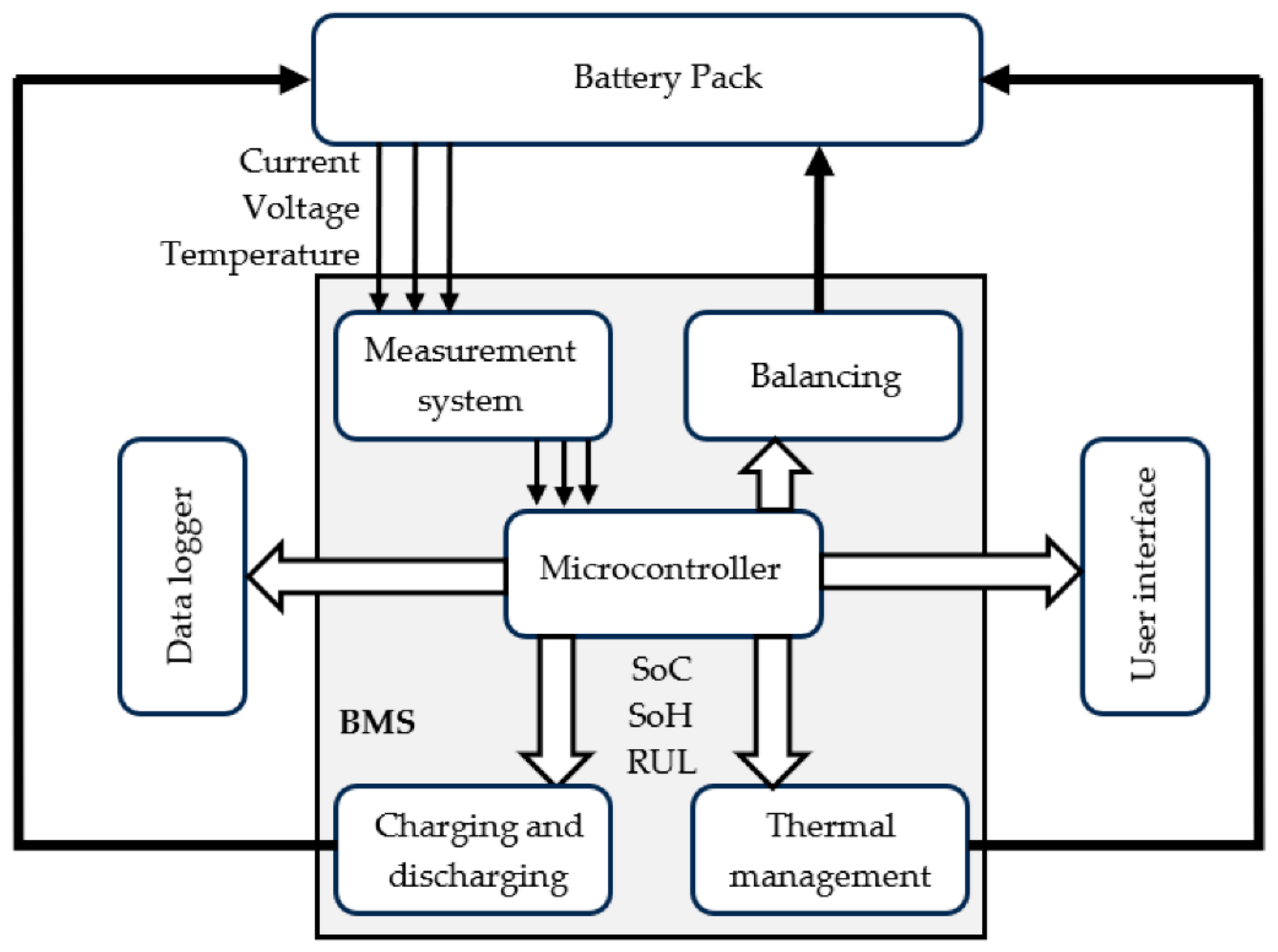
The battery storage system interface with the power grid is mediated by bidirectional DC-AC inverters and associated control systems whose performance characteristics determine the speed, accuracy, and efficiency of the storage system response to grid control signals. Battery management systems (BMS) continuously monitor individual cell voltages, temperatures, and state-of-charge estimates across the entire battery pack, enforcing charge–discharge limits, balancing state-of-charge across cells, and communicating with power electronics and grid operator dispatch systems [9]. Figure 3 shows a diagram of a common BMS system; grid-level battery systems use a similar BMS but may monitor different parameters based on the battery technology used. Studies on hybrid energy management systems combining fuel cells with thermoelectric devices have demonstrated that advanced predictive control algorithms improve system efficiency by up to 5% compared to conventional control while reducing start-up times, with the key enabling principle being energy-flow balancing between components to prevent overloading or underutilization [67]. Hybrid battery-supercapacitor systems leverage the complementary characteristics of both technologies, with batteries providing sustained energy storage and supercapacitors supplying rapid power response, thereby enhancing peak-shaving capability, frequency regulation, and overall system longevity in grid-scale applications [68].

5.3. Grid Service Applications

Battery energy storage systems deliver value across multiple distinct service categories. Frequency regulation (the continuous balancing of generation and load to maintain nominal grid frequency) is the highest-value service for fast-responding storage, requiring response times of seconds to minutes and discharge durations of 15–60 min [13]. The fast and accurate power response of modern lithium-ion BESS makes them particularly well-suited to frequency regulation, and multiple grid-scale projects have demonstrated measurable reduction in frequency deviation events [11,13]. Peak shaving for commercial and industrial customers requires two to four hours of storage duration and has become the most common economic use case for distribution-connected battery storage [70]. Backup power for critical infrastructure requires hours to days of storage duration, prioritizing reliability and availability over cost optimization [2,71].

5.4. Integration with Renewable Energy

Battery storage enables higher rates of adoption of various renewable energy technologies by absorbing excess generation during periods of high supply and low demand and releasing stored energy when renewable output falls short [71,72]. The operational benefit increases non-linearly with renewable adoption: at low renewable fractions, conventional generation flexibility is sufficient, but as penetration approaches 50–80%, storage becomes increasingly essential to prevent both renewable curtailment and involuntary load shedding [1]. Ocean-based renewable energy resources, such as tidal current, wave energy, and offshore wind, offer more predictable generation profiles that complement onshore wind and solar variability, with high potential for grid-scale tidal generation demonstrated in Korea and other coastal nations [73]. Long-term analysis of renewable consumption trends across multiple countries confirms that fluctuations in renewable generation share are largely transient rather than structural, driven by short-term demand and policy changes, reinforcing the requirement for adaptable storage systems capable of responding to both short-term variability and longer-term demand evolution [74].

6. Artificial Intelligence, Machine Learning, and Data-Driven Innovation

6.1. AI for Materials Discovery and Manufacturing Optimization

Machine learning is transforming battery materials discovery and manufacturing optimization by enabling rapid, high-throughput screening of candidate materials and formulations from structural descriptors, without requiring synthesis of all screened materials [75,76]. Butler et al. [75] demonstrated that machine learning applied to molecular and materials science databases can discover previously unrecognized structure–property relationships and accelerate identification of novel materials with target properties. At the manufacturing level, AI-driven process optimization addresses the critical quality control challenge of gigawatt-hour-scale battery production. Machine learning algorithms correlating in-process sensor data with final cell performance metrics enable early detection of manufacturing deviations, reducing scrap rates and improving consistency across production lines [77]. Sendek et al. [76] applied computational screening combined with machine learning to evaluate more than 12,000 candidate solid lithium-ion conductor materials, identifying high-conductivity candidates at a rate impossible through purely experimental approaches.

6.2. Predictive Models for Degradation, Lifetime, and Safety

Machine learning models trained on charge–discharge cycle data have been demonstrated to predict battery cycle life with high accuracy from data collected in the first few cycles (before any measurable capacity fade), enabling early identification of substandard cells and optimization of charging protocols to maximize long-term performance [11]. At the material level, Ding et al. characterized phase transitions, volume changes, and microcrack formation in nickel-rich sodium oxide cathodes during high-voltage cycling, providing mechanistic design rules for cycle life improvement [78]. Huang et al. demonstrated that titanium substitution into Mg-Ni alloys stabilizes the amorphous electrode phase and improves capacity retention from 24.0% to 55.7% after 30 cycles, an example of targeted element substitution guided by degradation mechanism understanding [79]. Advanced AI models can be used to optimize battery recycling and improve material recovery rates [80]. For safety prediction, machine learning models monitoring voltage behavior, temperature evolution, and impedance changes during cycling provide early warning of incipient thermal runaway events before catastrophic failure occurs [13,70].

6.3. Digital Twins and Smart Battery Management

A digital twin is a continuously updated virtual replica of physical systems receiving real-time sensor data; this is emerging as a transformative tool for managing large grid-scale battery installations [81]. Digital twins of BESS capture three-dimensional spatial distribution of cell temperatures, voltages, and state-of-charge, enabling state estimation with greater accuracy than sparse physical sensor arrays and allowing simulation of future operating scenarios to optimize dispatch and identify aging cells proactively [81]. Asadi et al. demonstrated AI-powered digital twin frameworks for smart grid optimization, integrating real-time sensor data with predictive models for both operational optimization and proactive maintenance [82]. The DOE Office of Electricity smart grid initiative (incorporating phasor measurement units (PMUs), advanced metering infrastructure (AMI), and fault-sensing relay systems) creates the data infrastructure needed to realize the full potential of machine-learning-based grid management [83]. Integration of machine learning with conventional protection and control systems enables fault detection and isolation at speeds and accuracy levels that exceed rule-based approaches alone [84]. Despite these advantages, deploying real-time digital twins at gigawatt-hour-scale BESS facilities presents substantial technical and infrastructural challenges. Continuous processing of high-frequency measurements from thousands of cells or modules can impose significant computational, communication-bandwidth, and data-storage requirements, particularly when electrochemical, thermal, and degradation models must be updated in real time [81]. Implementation also requires reliable and accurately calibrated sensors for cell or module voltage, current, temperature, impedance, and environmental conditions, together with robust communication networks and edge- or cloud-computing infrastructure. Moreover, the increased connectivity between sensors, battery management systems, digital-twin platforms, and grid-control systems expands the potential cybersecurity attack surface, creating risks of unauthorized access, data manipulation, and false state estimates. Therefore, practical deployment will require scalable reduced-order models, hierarchical sensing architectures, secure communication protocols, access controls, data encryption, and continuous validation of both sensor measurements and model predictions [82].

7. Safety, Supply Chain, and Life-Cycle Management

7.1. Thermal Runaway Mechanisms, Propagation, and Prevention

Thermal runaway is the most severe safety risk associated with lithium-ion BESS, arising from a self-reinforcing cycle of exothermic chemical reactions that, once initiated, releases heat faster than it can be dissipated [32,85]. The sequence begins at approximately 80 °C, when the SEI decomposes, and lithium metal reacts exothermically with organic electrolyte solvents, generating flammable gases including carbon monoxide, methane, and ethylene [85]. At 130–150 °C, the separator melts or ruptures, enabling direct electrochemical reaction between cathode and anode and releasing oxygen from transition metal oxide cathodes in a dramatically exothermic reaction [86]. At higher temperatures, ignition of electrolyte solvents and generated gases occurs, and if gases are sufficiently concentrated, they can form an explosive vapor cloud [86,87]. Thermal runaway in one cell propagates to adjacent cells through heat transfer, potentially consuming the entire battery pack. LFP chemistry exhibits substantially greater thermal stability than NMC or NCA due to the stronger Fe-O bonds that resist oxygen release [32].

7.2. Battery Thermal Management Systems

Battery thermal management systems (BTMS) are the primary engineering defense against thermal runaway and the primary determinant of operating temperature uniformity. Table 5 provides a comparative summary of principal BTMS approaches.
Passive systems exploit natural physical phenomena, convective air circulation, heat spreading to high-thermal-mass materials, heat pipes, and phase-change material latent heat absorption without powered components [65,88]. While energy-free and mechanically simple, passive systems alone are generally insufficient for high-capacity grid BESS under high C-rate cycling or high ambient temperatures [90]. Active cooling employs powered devices: air cooling is simple but limited in capacity; liquid cooling using water-glycol or dielectric fluid provides greater, more uniform heat removal; thermoelectric cooling based on the Peltier effect offers precision control for small modules but has prohibitive energy consumption at grid scale [65,88,90]. Mdachi and Choong-koo [88] identified hybrid air-plus-liquid cooling as the most effective BTMS architecture for grid-scale BESS, offering versatility for high continuous load and variable ambient temperature conditions. Where thermal management fails to prevent thermal runaway, large stationary BESS can implement advanced containment strategies including cell-level fire suppression, physical inter-module barriers, forced gas venting, and automated failsafe disconnects options unavailable to weight-constrained electric vehicles [90].

7.3. Critical Material Supply Chains and Lithium Extraction

The sustainability and security of critical material supply chains underpinning lithium-ion battery manufacturing is among the most significant strategic challenges facing the grid storage industry. In 2024, approximately 73% of global lithium production came from three countries, and 87% of extracted lithium went to battery manufacturing, creating a high-concentration supply chain with limited geographic redundancy [46,47]. Conventional lithium extraction (solar evaporation of brine (12–18 months per cycle) or energy-intensive hard rock mining) is slow and environmentally impactful [46,47,91]. Direct lithium extraction (DLE) processes geothermal or brine water through selective adsorption media, extracting lithium in approximately two hours compared to the 12-month evaporation pond cycle, while returning depleted brine with a substantially lower environmental footprint [47,92]. Lithium recovery from oilfield-produced water represents an additional emerging source, though current extraction costs are not competitive at commercial scale without further technology development [93,94]. Cobalt and graphite face analogous supply concentration risks, with both projected to experience critical shortages by 2050 at current extraction rate versus demand trajectories [95].

7.4. Sodium-Ion as a Supply-Chain Alternative

Sodium-ion batteries present a strategically attractive supply-chain alternative, with active materials that are orders of magnitude more geographically distributed and less expensive than lithium-ion counterparts. Sodium-ion batteries also offer a broader operating temperature range (−20 °C to 60 °C versus 0 °C to 50 °C for lithium-ion) and are significantly less prone to thermal runaway due to the lower reactivity of sodium metal under abuse conditions [48]. Operating temperature range should be interpreted cautiously, with typical commercial cells offering rated capacity near the −20 °C temperature floor, and some research cells claiming performance in temperatures as low as −40 °C [34]. The primary current disadvantages are approximately 40% lower gravimetric energy density and shorter cycle life in current commercial-generation cells, along with the absence of the manufacturing infrastructure and supply-chain depth that characterizes lithium-ion [96]. For stationary grid storage, where weight and volume penalties of lower energy density are less constraining than in mobile applications, and where stable temperature environments may extend cycle life, sodium-ion may offer the best near-term combination of cost, safety, and supply-chain security once manufacturing scale is achieved [27].

7.5. Life-Cycle Assessment, Recycling, and Second-Life Applications

The manufacturing carbon footprint of batteries is dominated by the electricity consumed in cathode material synthesis and electrode drying, and is therefore highly sensitive to the carbon intensity of the manufacturing electricity grid [91]. Given that China currently dominates global battery manufacturing at approximately 80% coal-based electricity, the life-cycle carbon intensity of currently manufactured batteries is substantially higher than would be the case with low-carbon manufacturing electricity. Guo et al. [97] compared sodium-ion and LFP batteries and found that while sodium-ion generates a higher manufacturing carbon footprint due to rare metal cathode content and manufacturing electricity, hydrometallurgical recycling of sodium-ion produces substantially lower ecotoxicity than equivalent lithium-ion recycling. Although it has lower potential ecotoxicity, hydrometallurgical recycling of sodium-ion batteries is not yet deployed at the same scale as established lithium-ion recycling. Current barriers include limited end-of-life feedstock, inconsistent battery chemistries, complex pack disassembly, and the need to achieve battery-grade purity through multiple leaching, separation, and precipitation stages [91,97]. Economic viability is particularly challenging because sodium-ion batteries generally contain fewer high-value metals, reducing the revenue available to offset collection, transportation, reagents, energy, wastewater treatment, and facility costs. Consequently, scaling these processes for future grid-battery waste will depend not only on recovery efficiency, but also on sufficiently large and consistent material flows and favorable process economics [94]. This finding suggests that as sodium-ion cathode chemistry evolves toward lower rare metal content and as recycling infrastructure matures, the life-cycle environmental case for sodium-ion will strengthen. The emerging second-life battery market offers a significant opportunity to extend the economic value of batteries whose capacity has fallen below the 80% threshold for primary use but retains substantial capacity for less demanding grid services [98].

8. Key Challenges and Research Gaps

8.1. Performance, Cost, and Safety Trade-Offs

Advanced safety systems, such as cell-level fire suppression, phase-change material thermal buffers, sophisticated active cooling, and redundant containment structures, add cost and complexity that must be weighed against the consequences of inadequate protection. Solid-state batteries offer transformative safety improvements through elimination of flammable liquid electrolytes but at a current cost four to eight times that of LFP per kWh, which cannot currently be justified for cost-sensitive grid storage procurement [61]. LFP dominates current deployments because its combination of cycle life, cost, and safety represents the best balance across all grid-relevant dimensions. Sodium-ion is the most promising near-term alternative on cost and safety grounds, but awaits a manufacturing scale that may not provide economic competitiveness until 2028–2030 [96]. Table 6 provides a technology readiness and cost roadmap for the principal battery chemistries.

8.2. Material Bottlenecks and Manufacturing Scalability

Beyond lithium, cobalt and graphite face critical shortage projections by 2050 at current extraction rates versus growing demand from stationary storage and electric vehicles [95]. Vanadium faces a structural supply constraint because approximately 75% of global production is a steel byproduct with 90% returning to steelmaking, limiting availability for batteries and making VRFB scale-up partially dependent on steel production growth. At the manufacturing level, the sensitivity of lithium-ion cell performance to microscopic defects in electrode coating, separator alignment, and electrolyte distribution means that defects introduced at any point in multi-step manufacturing can cause catastrophic failure or premature aging [99]. CT scanning provides effective defect detection but becomes impractically slow at gigawatt-hour production volumes. Scrap rates at newly established battery manufacturing facilities have reached 90% during production ramp-up, with improvement requiring months to years of process optimization [15]. Advanced in-line inspection technologies, AI-based process control, and standardized manufacturing protocols are needed to achieve quality and throughput targets required for cost-competitive grid-scale supply.

8.3. Standardization, Duration Gaps, and Benchmarking

The rapidly evolving grid-scale battery industry has developed with insufficient standardization in manufacturing specifications, performance testing protocols, and safety certification requirements. The absence of a universally accepted definition for battery cycle life (with different actors applying different depth-of-discharge assumptions, temperature conditions, and capacity fade thresholds) prevents meaningful performance comparisons between products or the establishment of reliable replacement schedules for specific deployment contexts [100]. Only a single U.S. fire prevention standard exists for BESS thermal runaway testing (UL 9540A [31]), which has already required four updates following new BESS fire incidents [32]. The practical storage duration limitation of commercial lithium-ion BESS at approximately four hours represents a fundamental gap between current storage technology and the multi-day storage required as renewable penetration approaches 80–100% of annual generation [7]. Experts broadly agree that LDES begins where lithium-ion becomes non-competitive at approximately 8–12 h duration, and that different technologies will likely dominate at different duration ranges, flow batteries for 8–24 h, and pumped hydro, compressed air, or future electrochemical systems for longer durations [12].

9. Emerging Directions and Future Roadmap

9.1. Pathways to Long-Duration Energy Storage

Developing cost-competitive long-duration energy storage is one of the most critical technology gaps in the transition to a deeply decarbonized electricity system [14]. VRFBs are currently the most commercially advanced long-duration option, with demonstrated cycle life in the tens of thousands and independent power-energy scaling [10,26]. ZFBs offer lower material costs if electrode durability challenges are resolved, potentially approaching the DOE LCOS target faster than vanadium systems for 8–12 h storage [35,36]. Pumped hydro will continue to dominate very-long-duration storage by virtue of unmatched energy density at suitable sites and demonstrated operational reliability, but geographic constraints and construction timelines mean that other technologies must fill the gap where PHES is unavailable [14]. Metal-air batteries would, if fundamental reversibility challenges are addressed, provide a transformative LDES option with energy densities approaching those of hydrocarbon fuels [16,41,42]. The gap between the DOE target of $0.05 kWh−1 and the higher projected LCOS values for VRFBs and sodium-ion batteries is primarily caused by high system capital costs, incomplete manufacturing scale-up, balance-of-system expenses, financing costs, and uncertainty in long-term utilization [21,95]. VRFB costs are strongly influenced by vanadium electrolyte, stack, pumping, and tank requirements, while sodium-ion systems remain affected by lower energy density, emerging supply chains, and limited commercial deployment experience. These factors keep projected 2030 costs above the DOE benchmark and demonstrate the difficulty of achieving the required cost reductions within the available timeframe [98].

9.2. Smart Grid Integration and Autonomous Systems

The growing complexity of electricity grids incorporating high proportions of variable renewable generation, distributed energy resources, and grid-scale battery storage creates both a need and an opportunity for intelligent automation and data-driven optimization at a scale that human operators cannot achieve [82,84]. The smart grid vision encompasses deployment of phasor measurement units for synchronized real-time grid state estimation, advanced metering infrastructure enabling two-way communication with consumers and demand response programs, and machine learning systems capable of detecting emerging grid faults and initiating protective actions before cascading system-wide disturbances [83]. The maturation of battery digital twins from research demonstrators to industrial-grade operational tools is an important near-term priority. A production-quality digital twin must integrate accurate electrochemical aging models, thermal models calibrated to the specific cell chemistry and pack configuration, signal-processing pipelines for real-time sensor data ingestion, and predictive analytics for remaining useful life estimation [82]. The growing installed base of grid-scale BESS will increasingly enable training of data-driven aging models with accuracy levels not previously achievable, creating a positive feedback between deployment scale and model accuracy [81].

9.3. Roadmap for a Cost-Effective, Resilient, and Decarbonized Grid

The decarbonization of the electricity sector requires coordinated development of renewable generation, transmission infrastructure, and energy storage on a timeline aligned with 2030 and 2050 climate commitments. The NREL 2022 Standard Scenarios analysis projects that 95% electricity sector decarbonization by 2050 is achievable along a linear emissions reduction pathway, requiring rapid simultaneous scaling of wind, solar, storage, and transmission [4]. The IEA World Energy Outlook 2022 projects that low-emission electricity sources will overtake fossil fuels globally by 2030, and that demand for critical minerals linked to electricity sector batteries and networks will increase to 11 Mt by 2030 and 13 Mt by 2050 [4]. The DOE National Transmission Needs Study identified clean energy transmission corridor development as a bottleneck, noting that simultaneous progress on generation, transmission, and storage is required to achieve both affordability and reliability targets [101]. Grid-scale energy storage, including batteries across the duration spectrum from minutes to days, pumped hydro for long-duration reliability, and emerging flow and thermal storage technologies, is a foundational component of this transition, serving as the enabling technology that converts variable renewable energy into fully dispatchable generation. The convergence of falling battery costs, improved manufacturing quality, AI-enabled grid management, harmonized standards, and supportive policy will collectively determine the pace at which grid-scale storage scales to the terawatt-hour levels that a fully decarbonized grid requires.

10. Conclusions

This review has examined the full landscape of rechargeable battery technologies for grid-scale energy storage, from the dominant lithium-ion platform and its near-term alternatives through longer-horizon flow batteries, solid-state cells, and high-energy-density future chemistries. Lithium-ion batteries based on LFP chemistry dominate current grid deployments and will continue to do so through the remainder of the 2020s by virtue of established manufacturing, favorable cycle life, and improving cost structure, but are structurally limited to approximately four hours of storage duration and face lithium supply-chain concentration and safety management requirements that increase system cost. Sodium-ion batteries represent the most credible near-term alternative, offering lower material cost, broader operating temperature range, and improved safety at the cost of reduced energy density and manufacturing infrastructure still being built out.
For long-duration storage, the critical gap that lithium-ion cannot address, vanadium redox flow batteries are the most commercially mature option, offering effectively unlimited cycle life and independent power-energy scaling. Zinc-iron flow batteries offer potential for lower costs if electrode durability challenges are resolved. Solid-state batteries will not reach grid-scale deployment in meaningful volumes before the early 2030s due to manufacturing barriers and cost premiums, but represent a transformative improvement in safety and energy density for both grid and transportation applications once those barriers are overcome. Lithium-sulfur and metal-air systems remain research-stage technologies with fundamental barriers requiring resolution.
The outstanding challenges of material supply-chain concentration, manufacturing quality at gigawatt-hour scale, the absence of harmonized performance and safety standards, and the long-duration storage gap represent the most important near-term research, policies, and industrial priorities. Addressing them in a coordinated manner, guided by the DOE Energy Storage Grand Challenge cost targets and aligned with the IEA Net Zero Emissions pathway, provides a credible roadmap for a grid storage sector that is simultaneously cost-effective, safe, technologically diverse, and supportive of a fully decarbonized electricity system. The enabling infrastructure of AI-driven grid management, digital twin frameworks, smart battery management systems, and predictive maintenance, evolving rapidly in parallel with battery chemistry, is increasingly recognized as a co-equal determinant of system value alongside the electrochemical performance of the battery cells themselves.

Author Contributions

Conceptualization, L.P. and P.L.M.; investigation, L.P., B.L., D.M., T.J., A.D.L.R. and B.H.; writing—original draft preparation, L.P., B.L., D.M., T.J., A.D.L.R. and B.H.; writing—review and editing, L.P. and P.L.M.; visualization, L.P. All authors have read and agreed to the published version of the manuscript.

Funding

This research received no external funding.

Data Availability Statement

The original contributions presented in this study are included in the article. Further inquiries can be directed to the corresponding author.

Conflicts of Interest

The authors declare no conflicts of interest.

References

  1. Smith, O.; Cattell, O.; Farcot, E.; O’Dea, R.D.; Hopcraft, K.I. The Effect of Renewable Energy Incorporation on Power Grid Stability and Resilience. Sci. Adv. 2022, 8, eabj6734. [Google Scholar] [CrossRef] [PubMed]
  2. Calero, F.; Cañizares, C.A.; Bhattacharya, K.; Anierobi, C.; Calero, I.; De Souza, M.F.Z.; Farrokhabadi, M.; Guzman, N.S.; Mendieta, W.; Peralta, D.; et al. A Review of Modeling and Applications of Energy Storage Systems in Power Grids. Proc. IEEE 2023, 111, 806–831. [Google Scholar] [CrossRef]
  3. Li, L.; Cai, Z.; Tang, W.; Zhang, Y.; Zhang, J.; Wu, Z.; Yang, L.; Han, Y.; Guan, L. Theoretical Framework and Key Technologies of Transparent Power Grid. Chin. J. Eng. Sci. 2022, 24, 32. [Google Scholar] [CrossRef]
  4. USDOE Office of Energy Efficiency and Renewable Energy (EERE), Strategic Programs Office; National Renewable Energy Laboratory (NREL); Gagnon, P.; Pham, A.; Cole, W.; Hamilton, A.; Awara, S.; Barlas, A.; Brown, M.; Brown, P.; et al. 2024 Standard Scenarios Report: A U.S. Electricity Sector Outlook; UUID:cc0dd220-2411-4144-8511-087; National Renewable Energy Laboratory (NREL): Golden, CO, USA, 2024.
  5. Mordor Intelligence Grid-Scale Battery Market Size & Share Analysis—Growth Trends and Forecast (2026–2031). Available online: https://www.mordorintelligence.com/industry-reports/grid-scale-battery-market (accessed on 1 April 2026).
  6. Dong, Z.; Tao, Y.; Lai, S.; Wang, T.; Zhang, Z. Powering Future Advancements and Applications of Battery Energy Storage Systems Across Different Scales. Energy Storage Appl. 2025, 2, 1. [Google Scholar] [CrossRef]
  7. Luo, X.; Wang, J.; Dooner, M.; Clarke, J. Overview of Current Development in Electrical Energy Storage Technologies and the Application Potential in Power System Operation. Appl. Energy 2015, 137, 511–536. [Google Scholar] [CrossRef]
  8. Zhu, Z.; Jiang, T.; Ali, M.; Meng, Y.; Jin, Y.; Cui, Y.; Chen, W. Rechargeable Batteries for Grid Scale Energy Storage. Chem. Rev. 2022, 122, 16610–16751. [Google Scholar] [CrossRef] [PubMed]
  9. Dunn, B.; Kamath, H.; Tarascon, J.-M. Electrical Energy Storage for the Grid: A Battery of Choices. Science 2011, 334, 928–935. [Google Scholar] [CrossRef] [PubMed]
  10. Lu, W.; Li, X.; Zhang, H. The next Generation Vanadium Flow Batteries with High Power Density—A Perspective. Phys. Chem. Chem. Phys. 2018, 20, 23–35. [Google Scholar] [CrossRef] [PubMed]
  11. Severson, K.A.; Attia, P.M.; Jin, N.; Perkins, N.; Jiang, B.; Yang, Z.; Chen, M.H.; Aykol, M.; Herring, P.K.; Fraggedakis, D.; et al. Data-Driven Prediction of Battery Cycle Life before Capacity Degradation. Nat. Energy 2019, 4, 383–391. [Google Scholar] [CrossRef]
  12. Han, M.; Zheng, K.; Hu, H.; Liu, J.; Zou, Z.; Yu, F.; Mu, Y.; Li, W.; Wei, L.; Zeng, L.; et al. Long-Duration Energy-Storage Technologies: A Stabilizer for New Power Systems. Innov. Energy 2025, 2, 100077. [Google Scholar] [CrossRef]
  13. Li, S.; Xu, Q.; Huang, J. Research on the Integrated Application of Battery Energy Storage Systems in Grid Peak and Frequency Regulation. J. Energy Storage 2023, 59, 106459. [Google Scholar] [CrossRef]
  14. Zeng, Y.; Zhou, T.; Wang, T.; Zhang, M.; Zhang, S.; Yang, H. Long-Duration Energy Storage: A Critical Enabler for Renewable Integration and Decarbonization. Energies 2025, 18, 466. [Google Scholar] [CrossRef]
  15. Liu, Y.; Zhang, R.; Wang, J.; Wang, Y. Current and Future Lithium-Ion Battery Manufacturing. iScience 2021, 24, 102332. [Google Scholar] [CrossRef] [PubMed]
  16. Olabi, A.G.; Abbas, Q.; Shinde, P.A.; Abdelkareem, M.A. Rechargeable Batteries: Technological Advancement, Challenges, Current and Emerging Applications. Energy 2023, 266, 126408. [Google Scholar] [CrossRef]
  17. IEEE Std 2030.3-2016; IEEE Standard Test Procedures for Electric Energy Storage Equipment and Systems for Electric Power Systems Applications. IEEE Standards Association: Piscataway, NJ, USA, 2016. [CrossRef]
  18. Keane, A.; Milligan, M.; Dent, C.J.; Hasche, B.; D’Annunzio, C.; Dragoon, K.; Holttinen, H.; Samaan, N.; Soder, L.; O’Malley, M. Capacity Value of Wind Power. IEEE Trans. Power Syst. 2011, 26, 564–572. [Google Scholar] [CrossRef]
  19. Cavus, M. Advancing Power Systems with Renewable Energy and Intelligent Technologies: A Comprehensive Review on Grid Transformation and Integration. Electronics 2025, 14, 1159. [Google Scholar] [CrossRef]
  20. Prieto, C.; Cabeza, L.F. Thermal Energy Storage (TES) with Phase Change Materials (PCM) in Solar Power Plants (CSP). Concept and Plant Performance. Appl. Energy 2019, 254, 113646. [Google Scholar] [CrossRef]
  21. Schleifer, A.H.; Cohen, S.M.; Cole, W.; Denholm, P.; Blair, N. Exploring the Future Energy Value of Long-Duration Energy Storage. Energies 2025, 18, 1751. [Google Scholar] [CrossRef]
  22. Mirletz, B.; Vimmerstedt, L.; Stehly, T.; Stright, D.; Cohen, S.; Cole, W.; Duffy, P.; Feldman, D.; Kurup, P.; Ramasamy, V.; et al. 2024 Annual Technology Baseline (ATB) Cost and Performance Data for Electricity Generation Technologies; National Renewable Energy Laboratory (NREL): Golden, CO, USA, 2024.
  23. Rabi, A.; Radulovic, J.; Buick, J. Comprehensive Review of Compressed Air Energy Storage (CAES) Technologies. Thermo 2023, 3, 104–126. [Google Scholar] [CrossRef]
  24. Agyekum, E.B.; Odoi-Yorke, F. Liquid Air Energy Storage (LAES)—Systematic Review of Two Decades of Research and Future Perspectives. J. Energy Storage 2024, 102, 114022. [Google Scholar] [CrossRef]
  25. Warner, J. Handbook of Lithium-Ion Battery Pack Design: Chemistry, Components, Types, and Terminology, 2nd ed.; Elsevier: Amsterdam, The Netherlands, 2024. [Google Scholar]
  26. Leba Akman, A.; Arslan, M.Z.; Farsak, M. The Rise of Vanadium Redox Flow Batteries: A Game-Changer in Energy Storage. J. Alloys Compd. 2025, 1038, 182869. [Google Scholar] [CrossRef]
  27. Zhang, S.; Wang, C.; Guo, Z. Batteries for Grid-Scale Energy Storage Applications. Adv. Mater. 2025, 37, e16590. [Google Scholar] [CrossRef] [PubMed]
  28. Yu, Y. Sodium-Ion Batteries: Energy Storage Materials and Technologies, 1st ed.; Wiley: Hoboken, NJ, USA, 2022. [Google Scholar]
  29. Boorboor Ajdari, F.; Asghari, P.; Molaei Aghdam, A.; Abbasi, F.; Rao, R.P.; Abbasi, A.; Ghasemi, F.; Ramakrishna, S.; Mikaeili Chahartagh, N. Silicon Solid State Battery: The Solid-State Compatibility, Particle Size, and Carbon Compositing for High Energy Density. Adv. Funct. Mater. 2024, 34, 2314822. [Google Scholar] [CrossRef]
  30. Alkhalidi, A.; Khawaja, M.K.; Ismail, S.M. Solid-State Batteries, Their Future in the Energy Storage and Electric Vehicles Market. Sci. Talks 2024, 11, 100382. [Google Scholar] [CrossRef]
  31. Underwriters Laboratories. Test Method for Evaluating Thermal Runaway Fire Propagation in Battery Energy Storage Systems; UL 9540A. Available online: https://shopulstandard.com/product/ul-9540/?gad_source=1&gad_campaignid=24037696261&gbraid=0AAAABCvmpgSIdHyLHPQenCITue8W2Ofx3&gclid=Cj0KCQjw6_HSBhCpARIsANvVltaAmrzC_mIpNAIUyb8eo1_nAgzIwdVTh4cQDCbVWMx5IwlR_dZNXbMaAuR5EALw_wcB (accessed on 1 April 2026).
  32. Feng, X.; Ouyang, M.; Liu, X.; Lu, L.; Xia, Y.; He, X. Thermal Runaway Mechanism of Lithium Ion Battery for Electric Vehicles: A Review. Energy Storage Mater. 2018, 10, 246–267. [Google Scholar] [CrossRef]
  33. Suzuki, S.; Miyayama, M. Microstructural Controls of Titanate Nanosheet Composites Using Carbon Fibers and High-Rate Electrode Properties for Lithium Ion Secondary Batteries. J. Power Sources 2011, 196, 2269–2273. [Google Scholar] [CrossRef]
  34. Liang, H.; Liu, L.; Wang, N.; Zhang, W.; Hung, C.; Zhang, X.; Zhang, Z.; Duan, L.; Chao, D.; Wang, F.; et al. Unusual Mesoporous Titanium Niobium Oxides Realizing Sodium-Ion Batteries Operated at −40 °C. Adv. Mater. 2022, 34, 2202873. [Google Scholar] [CrossRef] [PubMed]
  35. Zhu, F.; Hu, Z.; Guo, W.; Fu, Y. Electron-Deficient Sites Constructed by Boron Doping Induce Homogenous Zn Deposition in Alkaline Zinc–Iron Flow Batteries. Adv. Funct. Mater. 2024, 34, 2405815. [Google Scholar] [CrossRef]
  36. Gong, K.; Ma, X.; Conforti, K.M.; Kuttler, K.J.; Grunewald, J.B.; Yeager, K.L.; Bazant, M.Z.; Gu, S.; Yan, Y. A Zinc–Iron Redox-Flow Battery under $100 per kW h of System Capital Cost. Energy Environ. Sci. 2015, 8, 2941–2945. [Google Scholar] [CrossRef]
  37. Mangani, L.R.; Villevieille, C. Mechanical vs. Chemical Stability of Sulphide-Based Solid-State Batteries. Which One Is the Biggest Challenge to Tackle? Overview of Solid-State Batteries and Hybrid Solid State Batteries. J. Mater. Chem. A 2020, 8, 10150–10167. [Google Scholar] [CrossRef]
  38. Zhang, Z.; Shao, Y.; Lotsch, B.; Hu, Y.-S.; Li, H.; Janek, J.; Nazar, L.F.; Nan, C.-W.; Maier, J.; Armand, M.; et al. New Horizons for Inorganic Solid State Ion Conductors. Energy Environ. Sci. 2018, 11, 1945–1976. [Google Scholar] [CrossRef]
  39. Wild, M.; Offer, G.J. Lithium-Sulfur Batteries; Wiley: Hoboken, NJ, USA, 2019. [Google Scholar]
  40. Shen, Y.; Ding, K.; Zhong, M.; Xia, K.; Yuan, S. Recent Progress on the Self-Discharge of Lithium–Sulfur Batteries. ACS Appl. Energy Mater. 2025, 8, 4048–4064. [Google Scholar] [CrossRef]
  41. Sun, Q.; Dai, L.; Luo, T.; Wang, L.; Liang, F.; Liu, S. Recent Advances in Solid-state Metal–Air Batteries. Carbon Energy 2023, 5, e276. [Google Scholar] [CrossRef]
  42. Li, Y.; Lu, J. Metal–Air Batteries: Will They Be the Future Electrochemical Energy Storage Device of Choice? ACS Energy Lett. 2017, 2, 1370–1377. [Google Scholar] [CrossRef]
  43. Jeong, B.J.; Jo, Y.N. A Study on the Self-Discharge Behavior of Zinc-Air Batteries with CuO Additives. Appl. Sci. 2021, 11, 11675. [Google Scholar] [CrossRef]
  44. Inamuddin; Boddula, R.; Asiri, A.M. (Eds.) Potassium-Ion Batteries: Materials and Applications, 1st ed.; Wiley: Hoboken, NJ, USA, 2020. [Google Scholar]
  45. Ralls, A.M.; Leong, K.; Clayton, J.; Fuelling, P.; Mercer, C.; Navarro, V.; Menezes, P.L. The Role of Lithium-Ion Batteries in the Growing Trend of Electric Vehicles. Materials 2023, 16, 6063. [Google Scholar] [CrossRef] [PubMed]
  46. US Department of Interior. Mineral Commodity Summaries 2025; USGS: Reston, VA, USA, 2025. [CrossRef]
  47. Flexer, V.; Baspineiro, C.F.; Galli, C.I. Lithium Recovery from Brines: A Vital Raw Material for Green Energies with a Potential Environmental Impact in Its Mining and Processing. Sci. Total Environ. 2018, 639, 1188–1204. [Google Scholar] [CrossRef] [PubMed]
  48. Antony Jose, S.; Latos, B.; Hurtado, A.; Hurtado, J.; Jenkins, J.; Menezes, P.L. Sodium-Ion Batteries: Materials, Performance, and Application in Engineering Systems. Batteries 2026, 12, 180. [Google Scholar] [CrossRef]
  49. Boddula, R.; Inamuddin; Asiri, A.M. (Eds.) Zinc Batteries: Basics, Developments, and Applications, 1st ed.; Wiley: Hoboken, NJ, USA, 2020. [Google Scholar]
  50. Zhang, X.; Jiao, S.; Tu, J.; Song, W.-L.; Xiao, X.; Li, S.; Wang, M.; Lei, H.; Tian, D.; Chen, H.; et al. Rechargeable Ultrahigh-Capacity Tellurium–Aluminum Batteries. Energy Environ. Sci. 2019, 12, 1918–1927. [Google Scholar] [CrossRef]
  51. Li, Y.; Liu, L.; Lu, Y.; Shi, R.; Ma, Y.; Yan, Z.; Zhang, K.; Chen, J. High-Energy-Density Quinone-Based Electrodes with [Al(OTF)]2+ Storage Mechanism for Rechargeable Aqueous Aluminum Batteries. Adv. Funct. Mater. 2021, 31, 2102063. [Google Scholar] [CrossRef]
  52. Zhang, Z.; Cui, Z.; Qiao, L.; Guan, J.; Xu, H.; Wang, X.; Hu, P.; Du, H.; Li, S.; Zhou, X.; et al. Novel Design Concepts of Efficient Mg-Ion Electrolytes toward High-Performance Magnesium–Selenium and Magnesium–Sulfur Batteries. Adv. Energy Mater. 2017, 7, 1602055. [Google Scholar] [CrossRef]
  53. Wang, Y.; Xue, X.; Liu, P.; Wang, C.; Yi, X.; Hu, Y.; Ma, L.; Zhu, G.; Chen, R.; Chen, T.; et al. Atomic Substitution Enabled Synthesis of Vacancy-Rich Two-Dimensional Black TiO2−x Nanoflakes for High-Performance Rechargeable Magnesium Batteries. ACS Nano 2018, 12, 12492–12502. [Google Scholar] [CrossRef] [PubMed]
  54. Sharmoukh, W. Redox Flow Batteries as Energy Storage Systems: Materials, Viability, and Industrial Applications. RSC Adv. 2025, 15, 10106–10143. [Google Scholar] [CrossRef] [PubMed]
  55. Du, J.; Lin, H.; Zhai, R.; Liu, X.; Cui, X.; Wang, D.; Wang, B.; Zhu, J.; Zuo, H.; Li, Q.; et al. Preparation of Vanadium Trioxide from Ammonium Metavanadate and Application in Vanadium Redox Flow Battery Electrolyte. JOM 2025, 77, 7737–7747. [Google Scholar] [CrossRef]
  56. Botling, E.; Gond, R.; Thakur, A.; Anasori, B.; Khataee, A. Molybdenum Titanium Carbide (Mo2TiC2Tx) MXene Coated Carbon Electrodes for Vanadium Redox Flow Batteries. RSC Adv. 2025, 15, 13744–13752. [Google Scholar] [CrossRef] [PubMed]
  57. Chen, Q.; Lv, Y.; Yuan, Z.; Li, X.; Yu, G.; Yang, Z.; Xu, T. Organic Electrolytes for pH-Neutral Aqueous Organic Redox Flow Batteries. Adv. Funct. Mater. 2022, 32, 2108777. [Google Scholar] [CrossRef]
  58. Li, Y.; Xu, Z.; Liu, Y.; Jin, S.; Fell, E.M.; Wang, B.; Gordon, R.G.; Aziz, M.J.; Yang, Z.; Xu, T. Functioning Water-Insoluble Ferrocenes for Aqueous Organic Flow Battery via Host–Guest Inclusion. ChemSusChem 2021, 14, 745–752. [Google Scholar] [CrossRef] [PubMed]
  59. Antony Jose, S.; Gallant, A.; Gomez, P.L.; Jaggers, Z.; Johansson, E.; LaPierre, Z.; Menezes, P.L. Solid-State Lithium Batteries: Advances, Challenges, and Future Perspectives. Batteries 2025, 11, 90. [Google Scholar] [CrossRef]
  60. Kudu, Ö.U.; Famprikis, T.; Fleutot, B.; Braida, M.-D.; Le Mercier, T.; Islam, M.S.; Masquelier, C. A Review of Structural Properties and Synthesis Methods of Solid Electrolyte Materials in the Li2S − P2S5 Binary System. J. Power Sources 2018, 407, 31–43. [Google Scholar] [CrossRef]
  61. Janek, J.; Zeier, W.G. A Solid Future for Battery Development. Nat. Energy 2016, 1, 16141. [Google Scholar] [CrossRef]
  62. Meeks, J.; Lawley, M.; Ly, N.; Maxson, R.; Mayberry, N.; Antony Jose, S.; Menezes, P.L. A Comprehensive Analysis of Lithium–Sulfur Batteries: Properties, Challenges, and Applications. Batteries 2026, 12, 104. [Google Scholar] [CrossRef]
  63. Antony Jose, S.; Doering, E.; Klein, N.; Mena, E.I.; Owens, C.; Pronk, S.; Menezes, P.L. Magnesium–Air Batteries: Manufacturing, Processing, Performance, and Applications. Processes 2025, 13, 607. [Google Scholar] [CrossRef]
  64. Abraham, K.M.; Jiang, Z. A Polymer Electrolyte-Based Rechargeable Lithium/Oxygen Battery. J. Electrochem. Soc. 1996, 143, 1. [Google Scholar] [CrossRef]
  65. Wen, T.; Zhou, Z.; Zhang, Y.; Xu, X. Advances and Challenges in the Battery Thermal Management Systems of Electric Vehicles. Materials 2025, 18, 4718. [Google Scholar] [CrossRef] [PubMed]
  66. Torabi, M.; Zhang, K.; Yang, G.; Wang, J.; Wu, P. Heat Transfer and Entropy Generation Analyses in a Channel Partially Filled with Porous Media Using Local Thermal Non-Equilibrium Model. Energy 2015, 82, 922–938. [Google Scholar] [CrossRef]
  67. Kwan, T.H.; Shen, Y.; Yao, Q. An Energy Management Strategy for Supplying Combined Heat and Power by the Fuel Cell Thermoelectric Hybrid System. Appl. Energy 2019, 251, 113318. [Google Scholar] [CrossRef]
  68. Pinoski, L.; Antony Jose, S.; Dowling, J.; Eastwood, N.; Farthing, C.; Fisher, G.; Menezes, P.L. Supercapacitor Materials: Structure, Properties, and Applications for Energy Storage in Engineering Systems. Materials 2026, 19, 2454. [Google Scholar] [CrossRef] [PubMed]
  69. Kurkin, A.; Chivenkov, A.; Aleshin, D.; Trofimov, I.; Shalukho, A.; Vilkov, D. Battery Management System for Electric Vehicles: Comprehensive Review of Circuitry Configuration and Algorithms. World Electr. Veh. J. 2025, 16, 451. [Google Scholar] [CrossRef]
  70. Peng, F.; Zhao, Y.; Li, X.; Liu, Z.; Chen, W.; Liu, Y.; Zhou, D. Development of Master-Slave Energy Management Strategy Based on Fuzzy Logic Hysteresis State Machine and Differential Power Processing Compensation for a PEMFC-LIB-SC Hybrid Tramway. Appl. Energy 2017, 206, 346–363. [Google Scholar] [CrossRef]
  71. Aneke, M.; Wang, M. Energy Storage Technologies and Real Life Applications—A State of the Art Review. Appl. Energy 2016, 179, 350–377. [Google Scholar] [CrossRef]
  72. Attia, P.M.; Grover, A.; Jin, N.; Severson, K.A.; Markov, T.M.; Liao, Y.-H.; Chen, M.H.; Cheong, B.; Perkins, N.; Yang, Z.; et al. Closed-Loop Optimization of Fast-Charging Protocols for Batteries with Machine Learning. Nature 2020, 578, 397–402. [Google Scholar] [CrossRef] [PubMed]
  73. Kim, G.; Lee, M.E.; Lee, K.S.; Park, J.-S.; Jeong, W.M.; Kang, S.K.; Soh, J.-G.; Kim, H. An Overview of Ocean Renewable Energy Resources in Korea. Renew. Sustain. Energy Rev. 2012, 16, 2278–2288. [Google Scholar] [CrossRef]
  74. Tiwari, A.K.; Albulescu, C.T. Renewable-to-Total Electricity Consumption Ratio: Estimating the Permanent or Transitory Fluctuations Based on Flexible Fourier Stationarity and Unit Root Tests. Renew. Sustain. Energy Rev. 2016, 57, 1409–1427. [Google Scholar] [CrossRef]
  75. Butler, K.T.; Davies, D.W.; Cartwright, H.; Isayev, O.; Walsh, A. Machine Learning for Molecular and Materials Science. Nature 2018, 559, 547–555. [Google Scholar] [CrossRef] [PubMed]
  76. Sendek, A.D.; Yang, Q.; Cubuk, E.D.; Duerloo, K.-A.N.; Cui, Y.; Reed, E.J. Holistic Computational Structure Screening of More than 12,000 Candidates for Solid Lithium-Ion Conductor Materials. Energy Environ. Sci. 2017, 10, 306–320. [Google Scholar] [CrossRef]
  77. Attia, P.M.; Moch, E.; Herring, P.K. Challenges and Opportunities for High-Quality Battery Production at Scale. Nat. Commun. 2025, 16, 611. [Google Scholar] [CrossRef] [PubMed]
  78. Ding, F.; Zhao, C.; Zhou, D.; Meng, Q.; Xiao, D.; Zhang, Q.; Niu, Y.; Li, Y.; Rong, X.; Lu, Y.; et al. A Novel Ni-Rich O3-Na[Ni0.60Fe0.25Mn0.15]O2 Cathode for Na-Ion Batteries. Energy Storage Mater. 2020, 30, 420–430. [Google Scholar] [CrossRef]
  79. Huang, J.; Wang, H.; Ouyang, L.; Liu, J.; Zhu, M. Reducing the Electrochemical Capacity Decay of Milled Mg–Ni Alloys: The Role of Stabilizing Amorphous Phase by Ti-Substitution. J. Power Sources 2019, 438, 226984. [Google Scholar] [CrossRef]
  80. Antony Jose, S.; Cook, C.A.D.; Palacios, J.; Seo, H.; Torres Ramirez, C.E.; Wu, J.; Menezes, P.L. Recent Advancements in Artificial Intelligence in Battery Recycling. Batteries 2024, 10, 440. [Google Scholar] [CrossRef]
  81. Fuller, A.; Fan, Z.; Day, C.; Barlow, C. Digital Twin: Enabling Technologies, Challenges and Open Research. IEEE Access 2020, 8, 108952–108971. [Google Scholar] [CrossRef]
  82. Asadi, S.; Naeini, H.K.; Hassanlou, D.; Pishahang, A.; Najafabadi, S.A.; Sharifi, A.; Ahmadi, M. AI-Powered Digital Twin Frameworks for Smart Grid Optimization and Real-Time Energy Management in Smart Buildings: A Survey. Comput. Model. Eng. Sci. 2025, 145, 1259–1301. [Google Scholar] [CrossRef]
  83. Tuballa, M.L.; Abundo, M.L. A Review of the Development of Smart Grid Technologies. Renew. Sustain. Energy Rev. 2016, 59, 710–725. [Google Scholar] [CrossRef]
  84. Porawagamage, G.; Dharmapala, K.; Chaves, J.S.; Villegas, D.; Rajapakse, A. A Review of Machine Learning Applications in Power System Protection and Emergency Control: Opportunities, Challenges, and Future Directions. Front. Smart Grids 2024, 3, 1371153. [Google Scholar] [CrossRef]
  85. Agubra, V.A.; Fergus, J.W. The Formation and Stability of the Solid Electrolyte Interface on the Graphite Anode. J. Power Sources 2014, 268, 153–162. [Google Scholar] [CrossRef]
  86. Dsoke, S.; Fuchs, B.; Gucciardi, E.; Wohlfahrt-Mehrens, M. The Importance of the Electrode Mass Ratio in a Li-Ion Capacitor Based on Activated Carbon and Li4Ti5O12. J. Power Sources 2015, 282, 385–393. [Google Scholar] [CrossRef]
  87. Goldsmith, V. Introduction to GRID-SCALE Battery Energy Storage System Concepts and Fire Hazards. Process Saf. Prog. 2024, 43, 357–363. [Google Scholar] [CrossRef]
  88. Mdachi, N.K.; Choong-koo, C. Comparative Review of Thermal Management Systems for BESS. Batteries 2024, 10, 224. [Google Scholar] [CrossRef]
  89. Rosen, M.; Farsi, A. Battery Technology: From Fundamentals to Thermal Behavior and Management; Academic Press: Amsterdam, The Netherlands, 2023. [Google Scholar]
  90. Yu, B.; Li, N.; Ji, J. Performance Analysis of a Purified Trombe Wall with Ventilation Blinds Based on Photo-Thermal Driven Purification. Appl. Energy 2019, 255, 113846. [Google Scholar] [CrossRef]
  91. Antony Jose, S.; Dworkin, L.; Montano, S.; Noack, W.C.; Rusche, N.; Williams, D.; Menezes, P.L. Pathways to Circular Economy for Electric Vehicle Batteries. Recycling 2024, 9, 76. [Google Scholar] [CrossRef]
  92. Duman, O.; Cengiz, C.; Özcan Diker, C.; Cengiz, U.; Güreşir, S.M.; Tunç, S. Effect of Alkoxysilane Chain Length on the Surface, Stability, Sorption and Oil–Water Separation Properties of Novel Superhydrophobic Porous Sorbent Materials Produced Using Innovative Drainage Technique in scCO2 Atmosphere. Sep. Purif. Technol. 2024, 345, 127354. [Google Scholar] [CrossRef]
  93. Karuppasamy, K.; Mayyas, A.; Alhseinat, E.; Hassan-Beck, H.; Alfantazi, A. Exploring Lithium Extraction Technologies in Oil and Gas Field-Produced Waters: From Waste to Valuable Resource. Chem. Eng. J. Adv. 2024, 20, 100680. [Google Scholar] [CrossRef]
  94. Jose, S.A.; Stoll, J.L.; Smith, T.; Jackson, C.; Dieleman, T.; Leath, E.; Eastwood, N.; Menezes, P.L. Critical Review of Lithium Recovery Methods: Advancements, Challenges, and Future Directions. Processes 2024, 12, 2203. [Google Scholar] [CrossRef]
  95. Söltzer, L.; Wortmann, B.; Stolten, D.; Linßen, J.; Heinrichs, H. Material Bottlenecks of Batteries within the Energy Transition. Resour. Conserv. Recycl. 2026, 227, 108745. [Google Scholar] [CrossRef]
  96. Han, M.H.; Gonzalo, E.; Singh, G.; Rojo, T. A Comprehensive Review of Sodium Layered Oxides: Powerful Cathodes for Na-Ion Batteries. Energy Environ. Sci. 2015, 8, 81–102. [Google Scholar] [CrossRef]
  97. Guo, W.; Feng, T.; Li, W.; Hua, L.; Meng, Z.; Li, K. Comparative Life Cycle Assessment of Sodium-Ion and Lithium Iron Phosphate Batteries in the Context of Carbon Neutrality. J. Energy Storage 2023, 72, 108589. [Google Scholar] [CrossRef]
  98. Hunter, C.A.; Penev, M.M.; Reznicek, E.P.; Eichman, J.; Rustagi, N.; Baldwin, S.F. Techno-Economic Analysis of Long-Duration Energy Storage and Flexible Power Generation Technologies to Support High-Variable Renewable Energy Grids. Joule 2021, 5, 2077–2101. [Google Scholar] [CrossRef]
  99. Kwade, A.; Haselrieder, W.; Leithoff, R.; Modlinger, A.; Dietrich, F.; Droeder, K. Current Status and Challenges for Automotive Battery Production Technologies. Nat. Energy 2018, 3, 290–300. [Google Scholar] [CrossRef]
  100. Billinton, R.; Allan, R.N. Reliability Evaluation of Power Systems; Springer: Boston, MA, USA, 1996. [Google Scholar]
  101. U.S. Department of Energy. National Transmission Needs Study; U.S. Department of Energy: Washington, DC, USA, 2023. Available online: https://www.energy.gov/sites/default/files/2023-12/National%20Transmission%20Needs%20Study%20-%20Final_2023.12.1.pdf (accessed on 1 April 2026).
Figure 1. Implementation of grid-level battery storage, showing generation methods’ power transmission, local distribution and end users, and storage.
Batteries 12 00264 g001
Figure 2. Schematic of a vanadium redox flow battery illustrating the decoupled energy storage (external electrolyte tanks) and power generation (electrochemical cell stack) architecture. Drawn by author.
Batteries 12 00264 g002
Figure 3. Diagram of a typical BMS system, including thermal management, cell balancing, charging and discharging control, and data logging for battery health. Reproduced from [69] World Electric Vehicle Journal, MDPI, 2025.
Batteries 12 00264 g003
Table 1. Key performance metrics for grid-scale energy storage technologies, with typical benchmark values and relevance to battery-based systems.
MetricDefinitionTypical Benchmark/TargetRelevance to Battery StorageReference
Round-trip efficiency (RTE)Ratio of energy discharged to energy stored over a complete charge–discharge cycle90–97% (lithium-ion); ~80% (flow batteries)Higher RTE reduces operational cost; key differentiator between chemistries[8,10]
Cycle lifeNumber of full charge–discharge cycles before capacity falls to 80% of nominal3000–7000 (LFP); 10,000–20,000 (flow batteries)Determines replacement frequency and total cost of ownership over asset life[8,11]
Energy density (gravimetric)Usable energy per unit mass (Wh kg−1) or volume (Wh L−1)100–250 Wh kg−1 (Li-ion); 20–70 Wh kg−1 (vanadium flow)Less critical for stationary storage than for mobile; footprint constraints still apply[8,12]
Power densityMaximum power output per unit mass or volume (W kg−1)Seconds to minutes for frequency regulation; hours for energy arbitrageDetermines suitability for fast-response vs. long-duration service[10,13]
Self-discharge ratePassive energy loss over time under open-circuit conditions<3% per month (lithium iron phosphate (LFP)); ~0% (flow batteries with drained stack)Critical for seasonal storage and stand-by backup applications[10,14]
Resource adequacyProbability that generation and storage capacity meets demand at all hoursStandard: ≤1 loss-of-load day per 10 yearsStorage allows reduction in excess capacity reserves (~15%) needed for reliability[15,16]
Levelized cost of storage (LCOS)Total lifetime cost per unit of energy delivered, including capital, O&M, and replacementU.S. Department of Energy target: $0.05 kWh−1 for long-duration stationary storage (2030 goal)Primary economic metric for investment decisions and policy design[15,17]
Table 2. Comparative overview of major grid-scale energy storage technologies: storage duration, efficiency, maturity, geographic constraints, and key advantages and limitations.
TechnologyStorage DurationRound-Trip EfficiencyMaturity LevelGeographic ConstraintPrimary AdvantagePrimary LimitationRef.
Pumped hydro (PHES)Hours–days70–85%Commercial (mature)High elevation differential requiredVery large capacity; 96% of global installed storageLocation-limited; long construction lead time[14,22]
Compressed air (CAES)Hours–days42–70%Limited commercialHigh (geological cavern)Low marginal cost; large scale possibleSite-specific; thermal losses without heat recovery[23]
Liquid air (LAES)Hours–days~60%Early commercialNoneTechnology-agnostic; existing componentsLower RTE than competing technologies[24]
Li-ion (LFP/NMC)Minutes–4 h90–97%Commercial (dominant)NoneHigh RTE; falling costs; established supply chain~4 h duration ceiling; lithium supply constraints[2,25]
Vanadium flow (VRFB)4–12+ h75–85%Commercial at limited scaleNoneScalable; unlimited cycle life; low degradationHigh capital cost; low energy density; vanadium supply[10,26]
Sodium-ion (SIB)Hours88–92%Early commercialNoneAbundant materials; broad operating temperature range~40% lower energy density than LFP; manufacturing infancy[27,28]
Solid-state batteryHours90–95% (projected)Pre-commercialNoneHigh energy density; superior safety; long cycle life4–8× cost premium over Li-ion; manufacturing barriers[29,30]
Thermal (PCM/molten salt)Hours–days40–60%Commercial (CSP)Moderate (solar integration)Low material cost; long lifetimeLow power density; limited standalone deployment[20]
CAES: compressed air energy storage; LAES: liquid air energy storage; PCM: phase change material; CSP: concentrated solar power.
Table 3. Comparative performance characteristics of major rechargeable battery chemistries for grid-scale energy storage.
ChemistryNominal Cell Voltage (V)Energy Density (Wh kg−1)Cycle LifeSelf-Discharge RateSafety HazardMaterial CostKey Grid ApplicationRef.
LFP (LiFePO4)3.290–1603000–70001–5% per monthModerateModeratePeak shaving, renewable integration[25,33]
NMC (LiNiMnCoO2)3.6–3.7150–2501000–20002–10% per month HighModerateShort-duration energy arbitrage[25]
NCA (LiNiCoAlO2)3.6200–260500–1000Up to 10% per monthHighHighHigh-energy density applications[25]
Sodium-ion (SIB)3.1–3.5100–1602000–40003–10% per monthLow–ModerateLowGrid storage in sodium-abundant regions[27,28,34]
Vanadium flow (VRFB)~1.2615–25 (system)10,000–20,000+0% with drained stackVery LowHigh (capital)Long-duration storage (4–12+ hours)[10,26]
Zinc-iron flow (ZFB)~1.43~20–35 (system)~10,0000% with drained stackVery LowVery LowLow-cost long-duration storage[35,36]
Solid-state (Li-based)3.2–4.0300–400 (projected)8000–10,0001–3% per month estimatedVery LowVery HighFuture grid and EV applications[29,37]
Lithium-sulfur (Li-S)~2.1400–600 (projected)200–500 (current)1–11% per monthModerateLow (sulfur)High-energy future applications[38,39,40]
Metal-air (Li/Zn/Na)Varies based on chemistryUp to 1000+ (theoretical)<200 (Li-air)0–3% per month when sealed, up to 90% when exposed to airVariableLow (Zn, Na)Future ultra-long-duration storage[41,42,43]
Potassium-ion (K+)3.0–4.0100–160500–2000 cycles2–10% depending on electrode and electrolyte chemistryModerate; flammable organic electrolytes Low–moderateRenewable-energy buffering, peak shifting, and stationary short-to-medium-duration storage[44]
Table 4. Comparative analysis of multivalent post-lithium metal-ion battery chemistries: theoretical capacity, key advantages, primary challenges, and recent research progress.
Metal/ChemistryTheoretical Capacity (mAh g−1 or Wh kg−1)Volumetric CapacityKey AdvantagePrimary ChallengeRecent ProgressRef.
Zinc (Zn2+)820 mAh g−1 (Zn)5855 mAh cm−3Abundant (70 ppm crust); aqueous-compatible; low costNon-homogeneous Zn re-deposition causes electrode and electrolyte degradationElectrolyte and electrode additives reduce dendrite growth; Zn-air theoretical 1086 Wh kg−1[49]
Aluminum (Al3+)2980 mAh g−1 (Al)8035 mAh cm−3Third most abundant element; high theoretical volumetric capacityHigh charge density of Al3+ causes poor cycle life (<60 cycles); cathode instabilityCalix-(4)quinone cathodes at Nankai University; Te nanowire electrodes yield 1026 mAh g−1[50,51]
Magnesium (Mg2+)~2200 mAh g−1 (Mg)~3800 mAh cm−3~2× volumetric capacity of Li-ion; safe; abundantElectrolyte corrosion; sluggish Mg2+ kinetics; <500 cycle lifeTiO2 nanoflake electrodes (ACS) improve kinetics; defect engineering increases active storage sites[49,52,53]
Potassium (K+)~2596 mAh g−1 (phosphorus anode)Lower than Li/NaAbundant; K+ has weaker Lewis acidity than Li+/Na+Sluggish kinetics; high volumetric expansion; aggressive electrolyte decompositionPhosphorus-based anodes demonstrate large theoretical capacity despite large ionic radius[44]
Table 5. Comparative assessment of battery thermal management system (BTMS) approaches for grid-scale battery energy storage systems.
BTMS CategoryMechanismPerformance CharacteristicsSuitable BESS ScaleKey LimitationRef.
Passive—natural convectionHeat dissipation through natural air circulationSimple; zero energy cost; low maintenanceSmall-scale or low C-rate systemsInsufficient for high C-rate or high ambient temperature scenarios[65]
Passive—PCM (phase change material)Latent heat absorption during phase transition buffers temperature spikesHigh energy density thermal buffer; low weightMedium-scale; useful for load-levelingCannot sustain cooling under prolonged high-load fluctuations alone[65,88]
Active—air coolingFans or blowers increase convective heat transfer over cell surfacesModerate effectiveness; low cost and maintenanceSmall-to-medium stationary BESSLimited cooling capacity at high C-rates; noise and dust ingress[65]
Active—liquid coolingCoolant (water-glycol or dielectric fluid) circulates through channels adjacent to cellsSuperior heat removal capacity; uniform temperature distributionLarge-scale grid BESS (MW-class)Pump and plumbing complexity; leak risk; higher capital cost[65,89]
Active—thermoelectric (Peltier)Solid-state semiconductor devices transfer heat via applied current (Peltier effect)Precise localized control; no moving parts; compactPrecision electronics; small battery modulesLow COP; high electricity consumption; costly at scale[65,90]
Hybrid (air + liquid cooling)Combined passive/active layers for multi-mode thermal controlMost versatile; handles high load fluctuations; climate-adaptableGrid-scale BESS in variable climatesHigher system complexity and capital cost[88]
C-rate = charge/discharge rate relative to nominal capacity; COP = coefficient of performance. BESS = battery energy storage system.
Table 6. Technology readiness and cost roadmap for principal grid-scale battery chemistries: current technology readiness level (TRL) (1–9 scale), projected levelized cost of storage (LCOS) (2030), duration capability, critical barrier, and deployment timeline.
TechnologyCurrent TRLProjected LCOS (2030)Duration CapabilityCritical BarrierTimeline to Commercial Grid DeploymentRef.
Lithium iron phosphate (LFP) Li-ion9 (deployed)$0.10–0.18 kWh−1≤4 hLithium and cobalt supply constraints; ~4 h duration ceilingDominant today; supply-chain diversification ongoing to 2030+[2,8]
Sodium-ion (SIB)7–8$0.09–0.16 kWh−1 (projected)2–8 hManufacturing infrastructure; ~40% lower energy density than LFPFirst grid installations 2025–2027; cost parity with LFP projected 2028–2030[27,28]
Vanadium flow (VRFB)8–9$0.08–0.15 kWh−1 (12 h)4–12+ hHigh capital cost; vanadium supply (~75% from steel byproduct)Commercial today at limited scale; cost reduction pathway requires vanadium supply reform[10,26]
Zinc-iron flow (ZFB)5–7<$0.10 kWh−1 (projected)4–12+ hElectrode durability; dendrite control; limited track recordPromising near-term (2027–2030) if durability validated; very low material cost[35,36]
Solid-state (Li-based)4–6$0.20–0.35 kWh−1 (2030 est.)Hours4–8× cost premium; interface stability; dendrite formation at Li anodeMass production projected 2028–2032; grid deployment likely post-2032[29,30,37]
Lithium-sulfur (Li-S)3–5<$0.10 kWh−1 (theoretical)HoursPolysulfide shuttle; cycle life <500; electrolyte degradationResearch stage; grid deployment not expected before 2035[38,39]
Metal-air (Li/Zn)2–4<$0.05 kWh−1 (theoretical)Days–weeksDendritic Li growth; O2 cathode stability; environmental sensitivityLong-term (post-2035); requires fundamental breakthroughs[41,42]
Disclaimer/Publisher’s Note: The statements, opinions and data contained in all publications are solely those of the individual author(s) and contributor(s) and not of MDPI and/or the editor(s). MDPI and/or the editor(s) disclaim responsibility for any injury to people or property resulting from any ideas, methods, instructions or products referred to in the content.