Review

A Review of Graphite Anode Recycling in Lithium-Ion Batteries: Technical Challenges and Geopolitical and Economic Implications


Department of Chemical and Materials Engineering, Concordia University, 1455 De Maisonneuve Blvd, West, Montreal, QC H3G 1M8, Canada
*
Author to whom correspondence should be addressed.
Batteries 2026, 12(7), 259; https://doi.org/10.3390/batteries12070259

Submission received: 1 May 2026 / Revised: 1 July 2026 / Accepted: 2 July 2026 / Published: 17 July 2026
(This article belongs to the Section Sustainable Manufacturing and Circular Economy)

Abstract

The rapid expansion of lithium-ion battery (LIB) use in electric vehicles and large-scale energy storage systems has intensified the need for sustainable end-of-life management. While most research and industrial efforts have focused on recovering valuable metals, graphite anodes, despite constituting a significant portion of battery mass, remain relatively overlooked. This review evaluates current progress in graphite anode recycling, emphasizing technical challenges, scalability, and economic and geopolitical considerations. Conventional recycling methods, including hydrometallurgical, pyrometallurgical, and direct recycling processes, offer viable routes for material recovery but are often constrained by high energy demands, chemical consumption, and degradation of graphite quality. Regenerated graphite exhibits competitive electrochemical performance, with initial Coulombic efficiencies above 90% and reversible capacities comparable to those of commercial materials. In addition, strategies such as surface modification and defect engineering have proven effective in restoring structural integrity and enhancing cycling stability. Despite these advances, major challenges persist in achieving cost-effective, large-scale implementation and consistent material quality suitable for reuse in battery manufacturing. Given increasing supply risks and rapidly rising global demand for graphite, advancing sustainable recycling technologies has become essential. This review emphasizes the need for integrated technological innovation and supportive policy frameworks to enable the development of a circular economy for graphite.

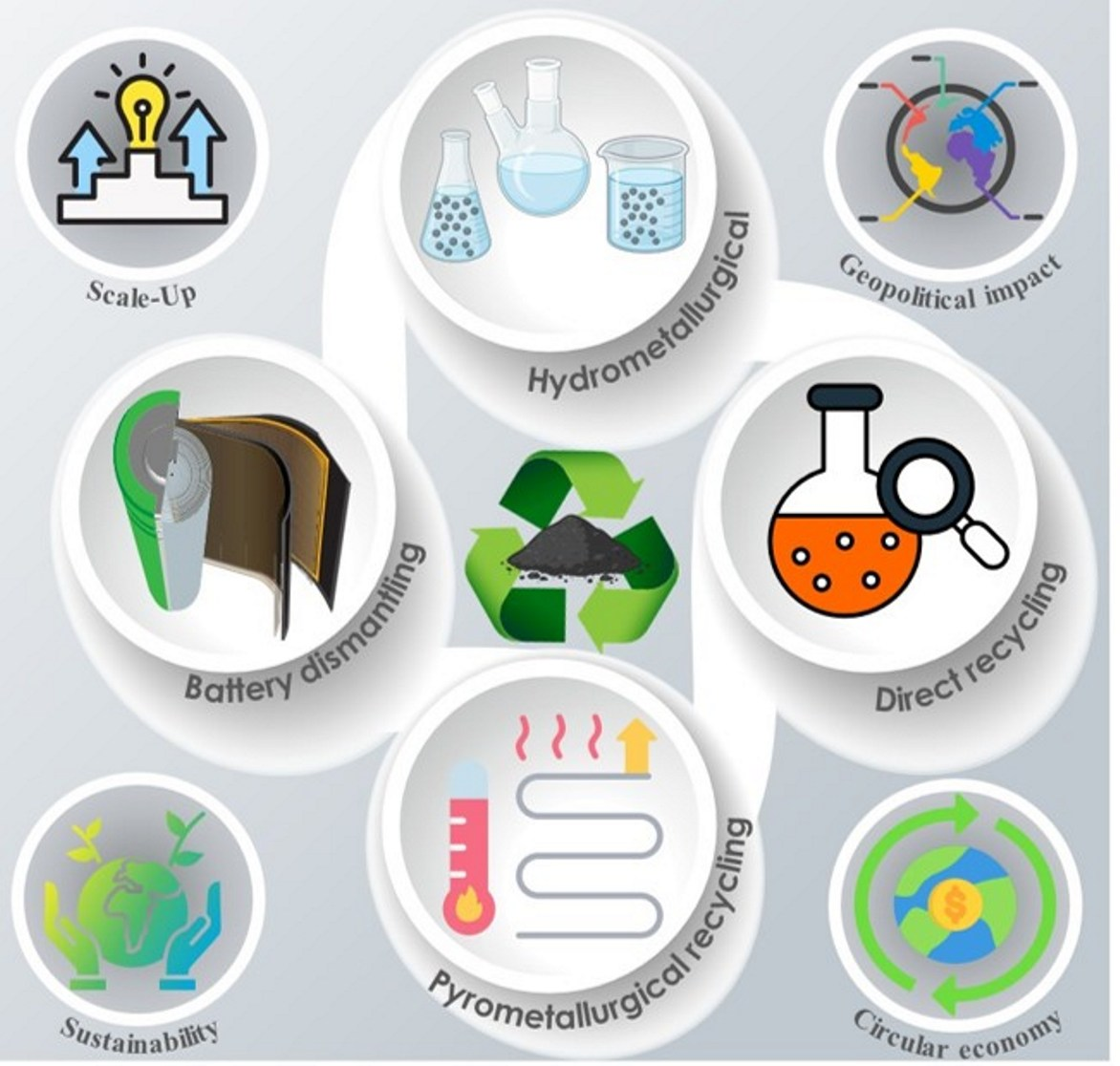
Graphical Abstract

1. Introduction

The clean energy transition requires urgent climate action, relying on critical minerals for renewable technologies and electric vehicles, while the COP28 push to move away from fossil fuels has accelerated transportation electrification and increased demand for lithium-ion batteries [1,2,3,4]. By 2030, global Li-ion battery capacity, as forecast by numerous Institutions, will range from 2200 to 6000 GWh across various scenarios [5]. Graphite is widely recognized as a strategic resource essential for advancing 21st-century high-technology applications because it combines several exceptional material properties: unparalleled electrical conductivity, outstanding thermal conductivity, excellent lubricity, strong resistance to high temperatures and thermal shock, notable chemical stability, and useful plasticity [6]. Graphite (Gr) is the most common naturally occurring polymorph of crystalline carbon, typically found as black crystal flakes or masses, and its inherent properties make it suitable for a wide range of applications depending on its form [7]. Graphite constitutes approximately 10–20 wt.% of lithium-ion batteries, which is several times the lithium content, underscoring its critical role in battery material recovery [8]. Recycling anode scraps offers valuable benefits: graphite can be recovered in battery-grade quality without additional energy-intensive purification, supporting the domestic supply chain, while recovering copper current collectors is economically viable and reduces SOx and greenhouse gas emissions that would otherwise arise from copper production from ores. Spent graphite (SG) anodes contain not only significant amounts of valuable materials such as graphite and lithium but also hazardous contaminants, including organic compounds [5,9,10]. Recycling spent lithium-ion batteries (LIBs) is essential because improper disposal poses serious safety and environmental hazards. Urban mining provides a sustainable solution by treating urban waste as a renewable resource, closing material lifecycles through reuse and recycling. This approach reduces the high economic and environmental burdens of traditional mining while improving resource security by supplying critical materials from local sources. As an anthropogenic mineral recovery strategy, urban mining therefore offers a long-term, sustainable pathway to ensure continued resource availability [11].
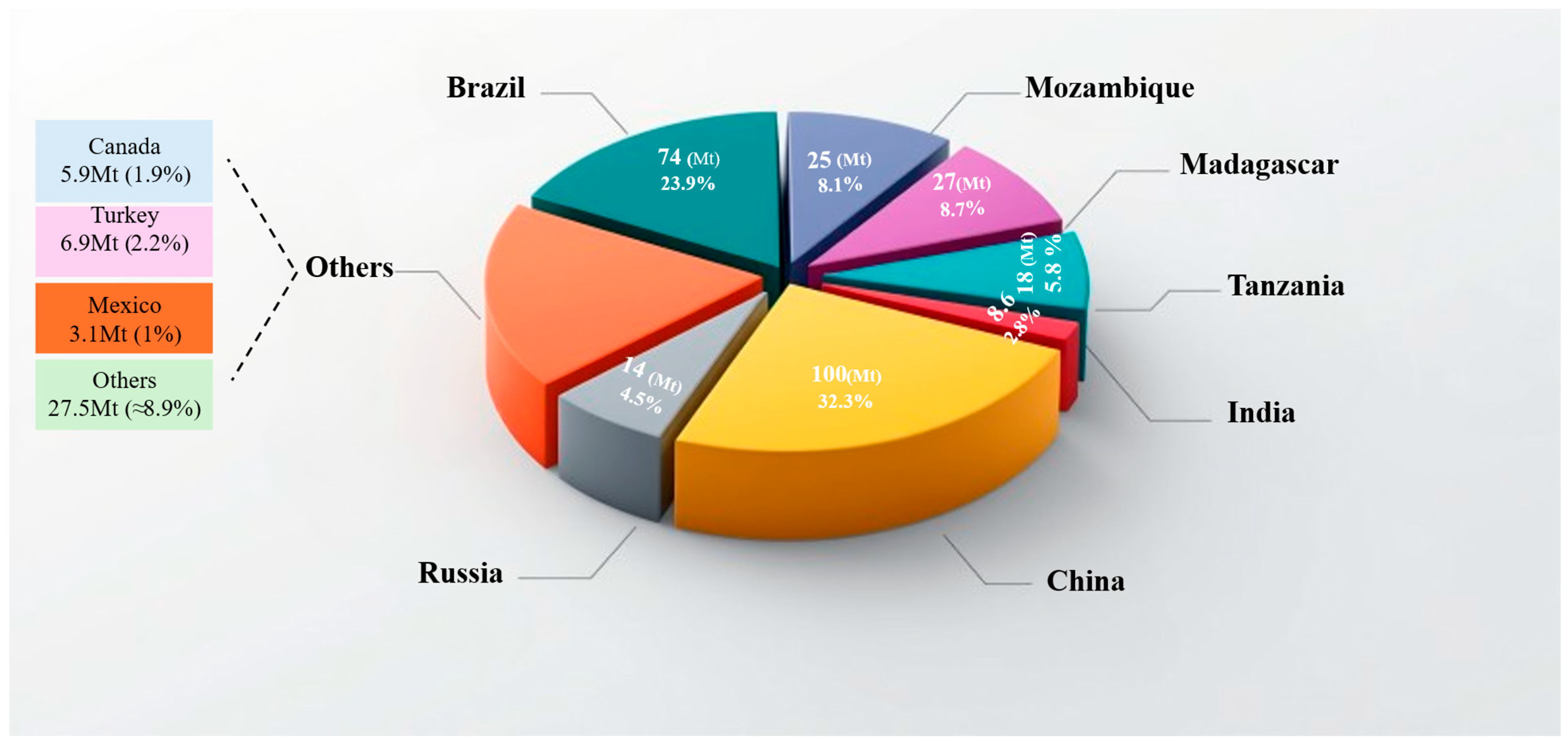
In addition to its environmental and economic benefits, graphite recycling has important geopolitical implications related to critical-material security and supply-chain resilience, which are discussed in Section 1.1. Graphite is produced in many countries worldwide, with China holding the largest reserves, primarily flake graphite (85%) and some amorphous graphite (15%). Within China, 47% of flake graphite is located in Heilongjiang and 19% in Inner Mongolia. Brazil, Mozambique, and Madagascar follow China in reserve size. At the same time, African countries such as Madagascar, Mozambique, and Tanzania also hold significant flake graphite reserves, with production in these regions expected to rise due to growing global demand. In 2023, global graphite mine production reached 1.6 million tonnes, a 23% increase over 2022, with China accounting for 77% of total production [12,13]. Figure 1 illustrates the geographical distribution of global natural graphite reserves, highlighting their concentration in China, Brazil, Madagascar, Mozambique, and Tanzania. According to the U.S. Geological Survey (USGS) Mineral Commodity Summaries 2026, global natural graphite reserves are estimated at approximately 310 million tonnes, while identified graphite resources exceed 800 million tonnes worldwide [14]. As graphite becomes more important as a key battery material, developing efficient recycling technologies is essential for resource sustainability, lowering environmental impacts, and supporting circular battery supply chains. This review examines the technical challenges of recycling graphite anodes from used lithium-ion batteries and explores the economic and geopolitical factors that will shape future recycling methods.

1.1. Global Graphite-Supply-Chain Concentration

The geopolitical landscape surrounding graphite has become a major driver of investment in battery recycling and circular supply chains. China currently dominates global graphite processing and anode-material production, creating significant supply-chain vulnerabilities for battery manufacturers outside the country. In October 2023, China announced export permit requirements for several graphite products, including high-purity synthetic graphite and key natural graphite materials used in lithium-ion battery anodes, citing national security concerns [15]. Given that China refines more than 90% of the graphite used in EV battery anodes, these restrictions raised concerns regarding supply security and accelerated efforts to diversify supply sources in North America and Europe. The resulting uncertainty has strengthened the strategic importance of graphite recycling as a means of reducing dependence on primary graphite imports while improving supply-chain resilience [16,17].

1.2. Policy and Regulatory Drivers

At the same time, regulatory developments in major battery markets are reshaping the economics of recycled battery materials. The European Union Battery Regulation (EU) 2023/1542 introduces mandatory sustainability requirements, including battery passports, carbon-footprint declarations, due-diligence obligations, recycling efficiency targets, material recovery requirements, and minimum-recycled-content provisions for industrial and electric-vehicle batteries [16]. The EU regulatory framework promotes recycling and circularity. The EU Critical Raw Materials (CRM) Act aims to strengthen all stages of the strategic raw-material value chain and specifically encourages recycling and circularity. The regulation establishes a target for at least 15% of strategic raw-material demand to be met through recycling by 2030. The regulation sets recycling efficiency and material recovery targets for key battery materials, including lithium, cobalt, nickel, copper, and lead. This increases demand for secondary raw materials and encourages investment in recycling infrastructure [18]. These policy measures are anticipated to increase demand for secondary raw materials and stimulate investment in battery recycling infrastructure. Similarly, the United States Inflation Reduction Act (IRA) links electric-vehicle tax incentives to critical-mineral sourcing, favoring materials and components sourced domestically or from free-trade partners. The IRA also promotes domestic extraction, processing, recycling, and advanced resource-recovery technologies to reduce reliance on foreign supply chains and strengthen critical-mineral security. Together, these policies are driving investment in circular battery supply chains and highlighting the strategic role of graphite recycling in improving resource security, regulatory compliance, and supply-chain resilience [18,19]. However, despite the existence of graphite resources in several countries, the global supply chain for battery-grade graphite remains highly concentrated, particularly in graphite refining, graphitization, and anode-material processing. This concentration creates significant geopolitical and economic risks for emerging battery industries and raises concerns regarding long-term supply security. Therefore, recycling spent graphite from lithium-ion batteries is increasingly considered not only an environmental strategy but also a critical pathway for improving regional supply-chain resilience, reducing import dependence, and supporting the development of localized and circular battery-material ecosystems [20,21,22].

2. Graphite Anodes: Natural vs. Synthetic (Market View)

Currently, graphite holds a significant market share as the base material for anodes in commercial lithium-ion batteries (89%). In contrast, other materials, such as lithium titanate (LTO) and silicon-based anodes, are used much less frequently [13]. According to the recent review on advanced anode materials for lithium-ion batteries, silicon-based anodes offer significantly higher theoretical capacity than conventional graphite; however, severe volume expansion, structural instability, and rapid capacity fading remain major barriers to their full commercialization. As a result, many next-generation battery systems are expected to employ silicon–graphite composite anodes rather than a complete graphite replacement [23]. Therefore, although emerging anode technologies may reduce the relative graphite fraction in batteries, graphite is expected to remain an essential component in advanced lithium-ion battery systems. This suggests that graphite recycling will likely continue to play an important role in future battery supply chains, although evolving anode chemistries may influence the long-term design and economic optimization of recycling infrastructure [24]. Graphite used in lithium-ion batteries comes from natural graphite from flake deposits and synthetic graphite produced from petroleum coke at high temperatures, with the former being cheaper and more environmentally friendly but requiring extensive purification and the latter offering higher purity and stability but incurring greater energy and cost burdens. Despite its essential function, graphite has long been undervalued because its low price and its limited applications outside batteries provide little incentive for upstream investment. For example, although the anode represents a significant portion of a battery’s weight, graphite accounts for only about 12% of the total cost. However, as battery demand continues to rise, this economic dynamic is beginning to change [25,26]. In 2022, global graphite demand reached approximately 1.3 million metric tons, with a market value of $23.73 billion. More than half of this demand, valued at $11.90 billion, was driven by the lithium-ion battery (LIB) sector, which is expected to remain a major growth driver in the coming decades. Despite increasing demand, graphite production remains challenging because it relies on either natural graphite mining or energy-intensive synthetic graphite manufacturing, both of which are associated with significant environmental impacts. It is important to distinguish among graphite demand, natural graphite mine production, and total graphite supply, as these metrics represent different segments of the graphite value chain [27,28]. China remains the dominant player across all stages of graphite production, accounting for approximately 66.7% of global natural graphite production, 69% of synthetic graphite production, and 69% of refined battery-grade graphite supply. Total graphite supply, including both natural and synthetic graphite, is projected to increase from approximately 3 million tonnes in 2024 to nearly 10 million tonnes by 2040. Although production is expected to expand in Africa, North America, Europe, and other regions, the graphite supply chain remains highly concentrated, leaving battery manufacturing vulnerable to geopolitical and trade-related disruptions [8].
According to FN Media Group, the demand for spherical graphite (i.e., battery-grade graphite) in China was 200,000 tons in 2019 and increased to 240,000 tons in 2020, with demand expected to reach 1.9 million tons by 2028. The International Energy Agency (IEA) forecasts that the mobility sector will require a significant increase in graphite supply by 2040, while the World Bank projects a substantial rise in graphite demand between 2018 and 2050. In addition, electric-vehicle uptake is expected to further accelerate graphite demand growth in the short-to-medium term, with projections indicating rapid increases by 2025. Together, these reports highlight a consistent trend of strong and sustained growth in graphite demand driven by electrification [29,30,31].

2.1. Processes to Produce Battery-Grade Graphite Powder

The production of battery-grade graphite powder involves two distinct pathways: natural graphite and synthetic graphite, each with unique processing steps and cost structures. Natural graphite undergoes mining, flotation, purification, spheroidization, and heat treatment to achieve battery-grade quality (>99.95% C), but this process is notably wasteful, as up to 70% of feedstock is lost during conversion to spherical form [32]. According to research from the institute in Germany, anode material made from natural graphite is priced between $4 and $8 kg−1, while synthetic graphite-based anode material costs $12–$13 kg−1 [33]. On a per-kWh basis, given graphite’s specific capacity (~360 mAh/g), this equates to an energy-material cost of approximately $8–$12 per kWh for natural graphite and higher for synthetic. However, the precise values can vary depending on process efficiencies and regional energy costs. Notably, synthetic graphite’s higher carbon footprint (up to 20 kg CO2e/kg) makes natural graphite more environmentally favorable, offering a 60–90% reduction in emissions [34]. The production of graphite used in LIBs requires a significant amount of energy, ranging from 230 to 260 MJ kg−1 of graphite. Studies have been carried out to lower the energy consumption involved in producing synthetic graphite through electrochemical graphitization [13,35].

2.2. Motivation for Recycling, Sustainability, and Industry Growth

The rising demand for graphite, propelled by the rapid expansion of electric vehicles (EVs) and energy storage systems, underscores the urgent need for sustainable resource management, as graphite accounts for roughly 10–20% by weight of a lithium-ion battery (LIB) cell and represents a significant material component in each EV battery [32]. Rather than landfilling or incinerating this material, implementing the 3R approach, recycling, recovering, and reusing, offers substantial economic, environmental, and health benefits. Recovered graphite (RG) can be reused directly or further processed into high-value materials such as graphene, thereby maximizing resource efficiency and supporting a circular economy. Since natural graphite mining causes environmental harm such as deforestation, soil erosion, and water pollution, recycling graphite reduces the need for mining, lowers costs, and supports a circular economy by reintroducing materials into the supply chain [36,37]. Recycling graphite from spent batteries has an environmental impact of 0.5–9.8 kg CO2 equivalent per kilogram (kg CO2e/kg). This emission is comparable to the production of natural graphite, which emits between 2.3 and 7.8 kg CO2e/kg. Synthetic graphite used in LIBs is produced through high-temperature processing of fossil fuel feedstocks. The process includes calcining, graphitizing, purifying, and transporting the graphite to its point of use. The greenhouse gas (GHG) emissions from the graphitization process alone range from 0.5 to 4.9 kg CO2e/kg. Overall, the total GHG emissions associated with synthetic graphite production can be as high as 20.6 kg CO2e/kg [38]. Despite its essential role in lithium-ion batteries, graphite had a near-zero recycling rate until recently. Recovering graphite from spent batteries helps secure future supply, reduce reliance on imported primary sources, and lower both environmental and economic costs. However, current recycling techniques remain inadequate, with most spent graphite still being incinerated rather than reclaimed [39]. As documented in benchmark mineral data, an auto-industrialist has invested $300 billion in EV growth. Additionally, more than 100 LIB mega-factories are operating at a production capacity of 2000 GWh, which equates to 800 k tonnes of graphite required by 2023 and 1.4 million tonnes by 2028 [40]. According to the World Bank’s report, the energy revolution of battery-grade graphite has garnered extraordinary praise. Meanwhile, the predicted demand for graphite is steadily increasing, resulting in an annual production of 4.8 million tonnes by 2050. The battery industry is expected to be the most significant driver of graphite demand [34]. Recycling helps meet this growing demand sustainably, thereby supporting market expansion. According to market analyses, the global graphite recycling market is projected to reach approximately USD 127.3 million by 2033, with a compound annual growth rate (CAGR) of 9.1% during the forecast period [41]. Recycling can help reduce pressure on primary graphite resources while contributing to the growing demand for battery-grade materials. In a recent graphite supply–demand assessment, secondary graphite availability was estimated to account for approximately 6% of demand in 2023 and was projected to increase to approximately 14% by 2030 [42]. Comparatively, the cost of graphite recycling includes the price of black mass ($300 per tonne, containing approximately 22 wt.% graphite) and processing costs ($100–$120 per tonne) [43]. Meanwhile, modern recycling practices require approaches that are not only efficient and low-cost but also environmentally sustainable and capable of recovering all battery components with minimal complexity [44]. Several companies and start-ups are scaling-up graphite recycling using innovative hydrometallurgical and mechanical processes to produce high-purity, battery-grade material. Notable examples include Altilium (Plymouth, UK) and Tozero (Munich, Germany), which achieve recovery rates of 80–99% from end-of-life batteries [45,46,47]. Collaborations such as Talga Group (West Perth, WA, Australia), Nouveau Monde Graphite (Saint-Michel-des-Saints, QC, Canada), Lithion (Montreal, QC, Canada), etc., aim to increase the share of recycled graphite in anode production [48,49,50]. These initiatives are supported by significant investments and government funding, with a focus on reducing carbon footprints, promoting sustainable domestic supply, and aligning with circular economy principles. Detailed process types, recovery efficiencies, and production scales are summarized in Table 1.
Recent studies have highlighted the importance of graphite recycling not only for recovering valuable carbon materials but also for reducing dependence on critical raw-material supplies and supporting a circular battery economy [6]. Therefore, this review first discusses the global graphite market, resource distribution, and the production of natural and synthetic graphite for battery-grade anodes, together with their material properties and growing strategic importance in the electrification transition. The manuscript then examines current recycling and regeneration technologies and compares the electrochemical performance of regenerated graphite materials reported in recent studies. Finally, the review addresses the challenges associated with industrial scale-up, sustainability, economic and environmental considerations, and the geopolitical implications related to graphite-supply security and sustainable battery manufacturing.

3. Carbonaceous Anode Materials

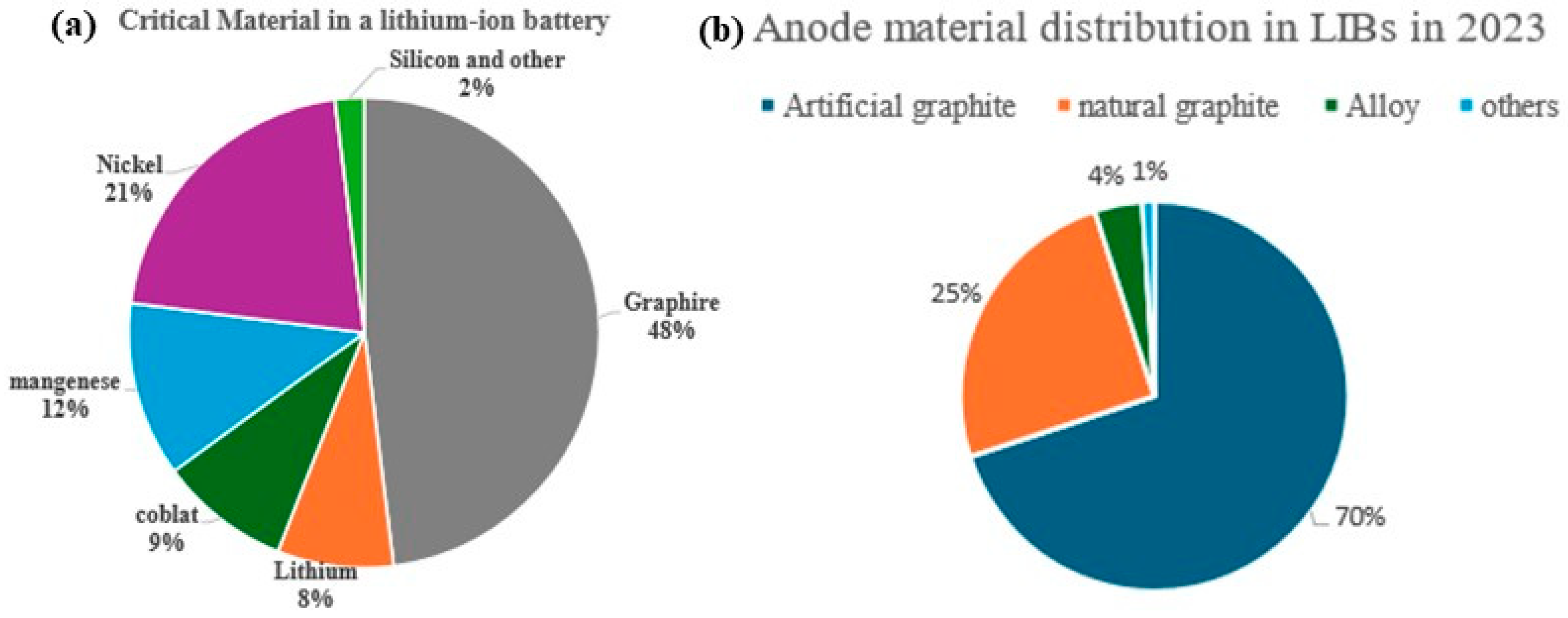
The anode is one of the most important components of a battery because its properties strongly influence both efficiency and overall performance. To function effectively, anode materials must be capable of storing lithium ions in large amounts to provide high capacity, while also maintaining structural stability throughout repeated charging and discharging cycles [61]. Carbon-based materials (including graphite) have become particularly attractive for battery applications due to their low cost, high electrical conductivity, and chemical stability. They are extensively investigated as electrode materials because they are abundant and generally non-toxic. This group includes graphite, soft carbon, hard carbon, graphene, carbon nanotubes (CNTs), and various alloy-based materials (Figure 2a). Their structural arrangement is highly dependent on the processing and manufacturing conditions, which lead to different forms, hybridization states, and production costs (Figure 2b) [2]. Among these materials, natural graphite (NG) is the dominant anode material in LIBs due to its excellent electrochemical performance and relatively low cost. Nevertheless, its larger particle size can create thermodynamic instability, which may lead to exfoliation and restrict electrochemical intercalation; in such cases, hard carbon may offer better performance [62].

3.1. Graphite

Graphite has remained the dominant commercial anode material for lithium-ion batteries because of its high reversibility, low operating potential, long cycle life, and well-established manufacturing process. Since the commercialization of lithium-ion batteries by Sony in the early 1990s, global demand for graphite has increased substantially. This growth has accelerated with the rapid expansion of the electric vehicle industry, driving worldwide graphite consumption from approximately 1.1 million tonnes in 2010 to nearly 4.6 million tonnes in 2023 [64]. Table 2 presents the major graphite-producing countries during the past five years. It is also worth noting that, over the same period, graphite remained one of the most commonly used anode materials in LIBs, as illustrated by the contribution of anode materials to LIB performance in Figure 2a,b. Note that the values in this table refer exclusively to natural graphite mine production. Other statistics discussed in the manuscript may refer to graphite demand, synthetic graphite production, refined battery-grade graphite supply, or total graphite supply.
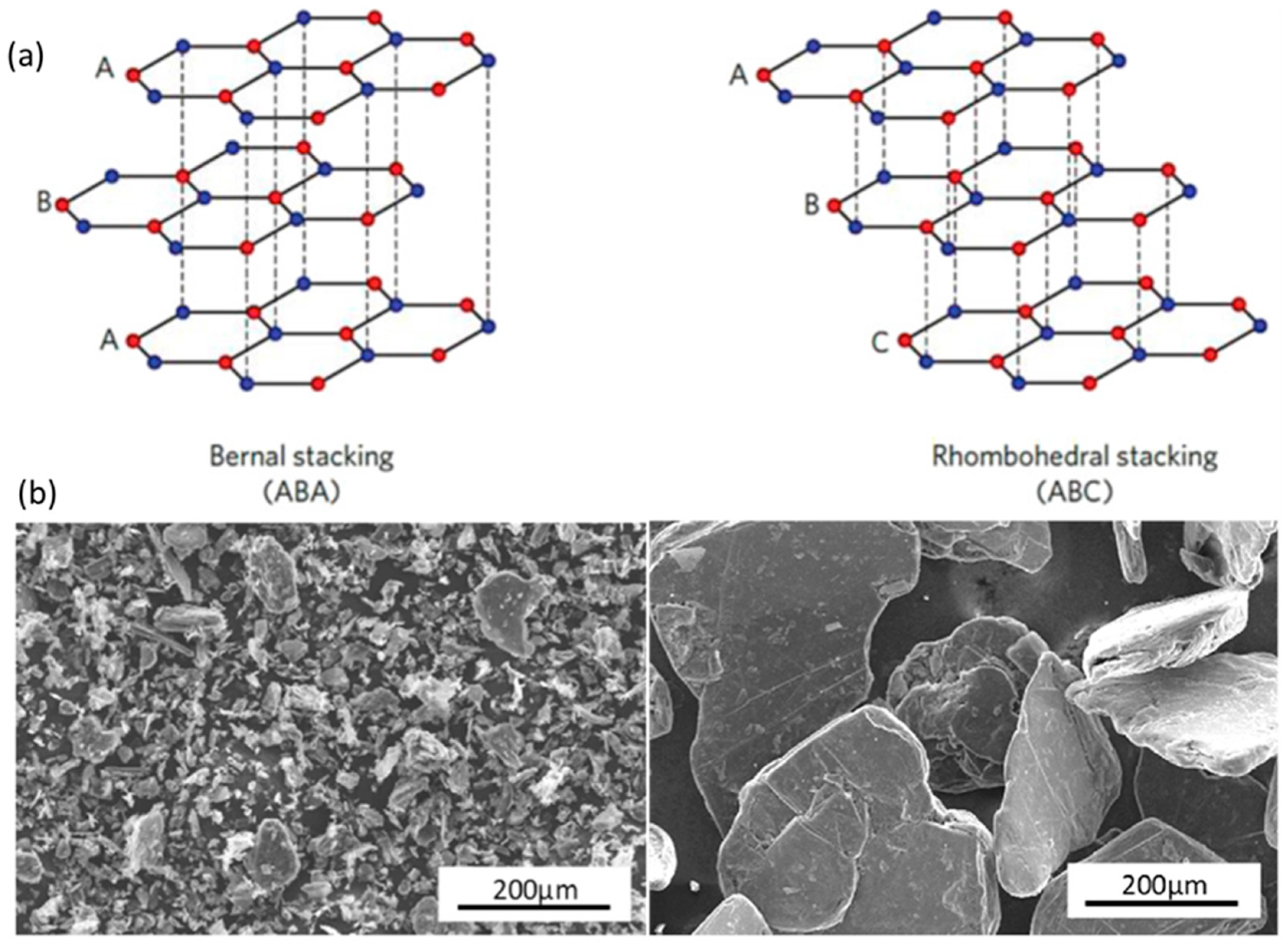
Graphite provides a high theoretical specific capacity of 372 mAh/g, with a low-potential plateau at 0.1 V vs. Li+/Li that enhances the final battery voltage. Additionally, the initial Coulombic efficiency (ICE) of graphite exceeds that of amorphous carbon because a thinner SEI layer forms on its surface [65,66]. Its highly crystalline, hexagonal layered structure is stabilized by van der Waals forces [67], with layers typically stacked in ABAB (Bernal stacking) or ABC (rhombohedral stacking) arrangements. This stacking pattern results from pi–pi interactions among sp2 carbon atoms [68]. The electronic properties of graphite are strongly influenced by this stacking, with ABC-stacked graphite demonstrating significantly better performance than other forms [69].

3.2. Natural Graphite

Graphite intercalation compounds (GICs) are produced when atomic or molecular species, referred to as intercalates, are inserted between adjacent graphite layers. These compounds are known for their highly ordered structure, and their properties are commonly described in terms of the staging phenomenon [70]. Staging develops during the intercalation process and results in distinct phases within the anode that can affect battery behavior. The stage number, represented by n, refers to the number of graphene layers located between two neighboring intercalate layers. In graphite, the aromatic carbon rings contain conjugated π-electron systems that are delocalized above and below the carbon planes, enabling them to either accept or donate electrons. When an alkali metal such as lithium transfers an electron to this π-electron network, the increased ionic concentration enhances Coulombic repulsion, which may weaken interlayer interactions in graphite and thereby promote the stabilization of GICs. The intercalation mechanism in graphite is presented in Equation (1) [71,72].
C x + A   C x + . A
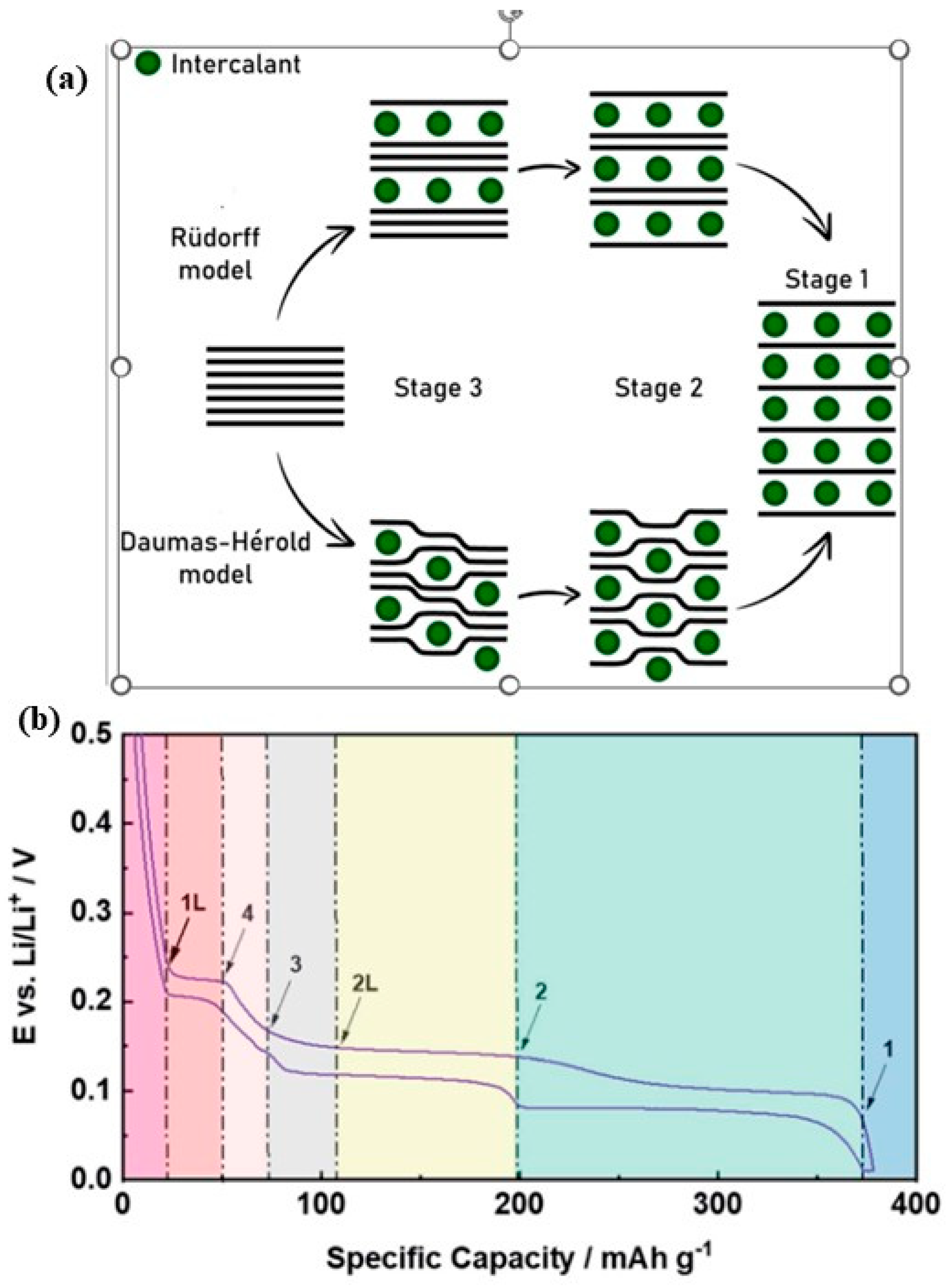
Graphite is categorized into natural graphite (NG) and artificial graphite (AG) based on its production process [73,74]. The most prevalent form of NG is flake graphite, obtained from deposits and processed through mining and purification to serve as an anode material [75]. This method is generally more cost-effective and less energy-intensive compared to AG [61]. However, flake graphite produced under extreme conditions often displays notable anisotropy and structural defects, which can compromise its durability during charge and discharge cycles and may lead to extensive SEI formation and exfoliation [76]. Various techniques, including surface carbon coating and catalytic treatments [77], high-shear exfoliation and temperature regulation have been developed to reduce exfoliation and improve cycle life [78]. The intercalation process described by Daumas and Hérold involves a staged mechanism where the intercalant rearranges within the graphite lattice without fully disrupting the layers. In their model, carbon monoxide prompts a new crystallographic phase during lithium insertion, preventing alkaline-metal ions from migrating between layers [79]. As the lithium content increases, higher-order compounds transform into lower-order ones, resulting in a decreasing voltage plateau until the graphite becomes fully saturated with lithium (LiC6), as illustrated in Figure 3a,b [80].

3.3. Artificial Graphite

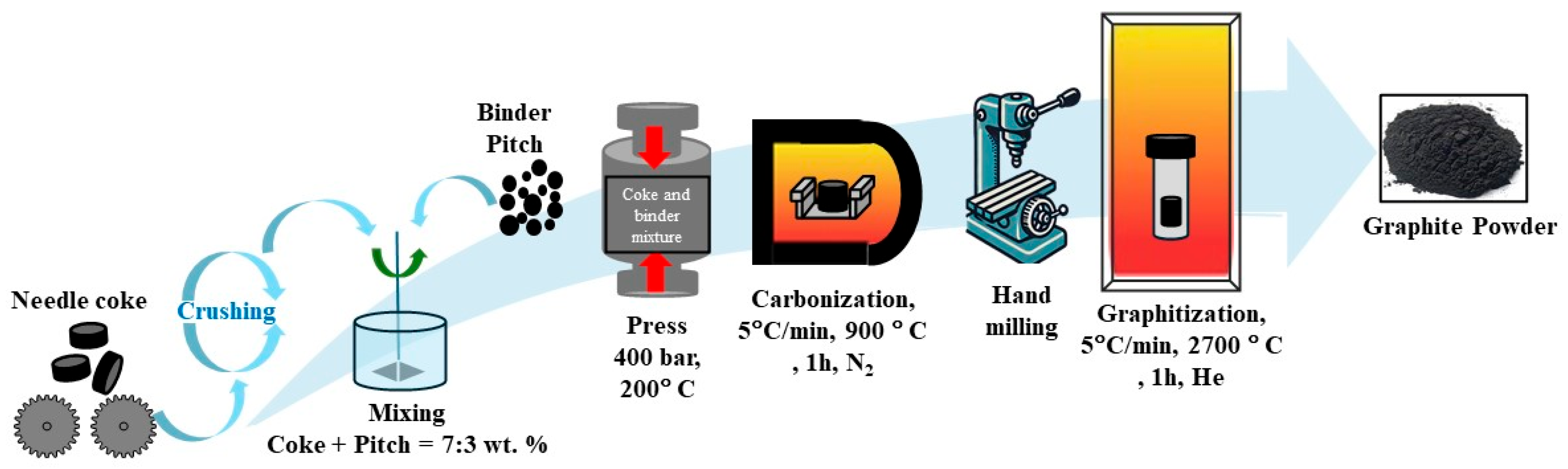
Artificial graphite (AG), also known as synthetic graphite, is a widely used anode material in batteries. In 2023, approximately 70% of lithium-ion battery anodes were made of AG, mainly produced by Chinese factories. AG was first invented in 1898 by Acheson, who produced pure graphite by heating Silicon Carbide (SiC2), a highly crystalline compound. Since then, the Acheson process has been employed to convert carbon-rich materials such as meso-carbon microbeads (MCMBs) [83], petroleum precursors [84], needle coke, and pitch by heating them to around 2800 °C over extended periods. Hwang et al. produced AG using needle coke of varying sizes, which was crushed, mixed with a binder, molded at high temperature, carbonized at 900 °C in a nitrogen atmosphere, and finally graphitized at 2700 °C in a helium atmosphere to improve crystallinity and electrochemical performance (see Figure 4) [85].
A number of tactics have been proposed to lower production costs and energy demand. Among these is catalytic graphitization, which reduces the graphitization temperature but often results in a discernible drop in the final material’s purity [86]. Electrochemical graphitization, a relatively new and effective method applicable to a variety of amorphous carbons, including those typically considered non-graphitizable, is another promising technique. This process produces graphite nanosheets with high purity and crystallinity by inducing a phase transformation in the precursor under cathodic polarization in molten CaCl2 at roughly 820 °C (1100 K) [87]. Table 3 lists alternative methods for preparing AG and examines the electrochemical properties of the resulting anodes. High-temperature graphitization, suitable for various carbon-based materials, produces the most crystalline and high-performance AG, ideal for applications demanding long cycle life and high capacity. Catalytic reactions are also commonly used to cut costs by lowering the required temperature. Another approach, electrochemical graphitization, operates at much lower temperatures (around 800 °C), offering a more sustainable and cost-effective option that balances performance with reduced energy use, making it highly suitable for fast-charging anodes.

3.4. Comparative Analysis of Natural and Artificial Graphite

Natural graphite (NG) and artificial graphite (AG) are both widely used as anode materials in lithium-ion batteries (LIBs), yet they differ substantially in their origins, microstructures, impurity content, and degrees of graphitization. Graphite consists of layered carbon sheets held together by weak van der Waals forces, as illustrated in Figure 5a, which facilitates the reversible intercalation and deintercalation of lithium ions during battery operation. Artificial graphite is synthesized by graphitizing carbonaceous precursors at elevated temperatures, which produces a more uniform structure and a higher degree of graphitization. In contrast, natural graphite is extracted from deposits and typically contains higher concentrations of mineral impurities. These distinctions affect electrode density, electrochemical performance, purification requirements, and recycling strategies. Therefore, differentiating between NG and AG is essential when assessing graphite recovery and regeneration processes [93]. However, the comparatively small number of defect sites in AG may restrict ion transport, thereby lowering C-rate performance and making fast charging less desirable. However, its reduced surface area reduces internal resistance and increases efficiency by limiting the formation of a thick solid electrolyte interphase (SEI) and suppressing side reactions [94]. In contrast, natural graphite has a more disordered, porous structure with a higher defect concentration and can occur in both ABA and ABC stacking configurations (Figure 5a). These structural characteristics increase the available surface area, enhance lithium-ion diffusion, and can contribute to higher capacity. They also encourage the formation of a thicker SEI layer, making NG suitable for a wide range of applications [95].
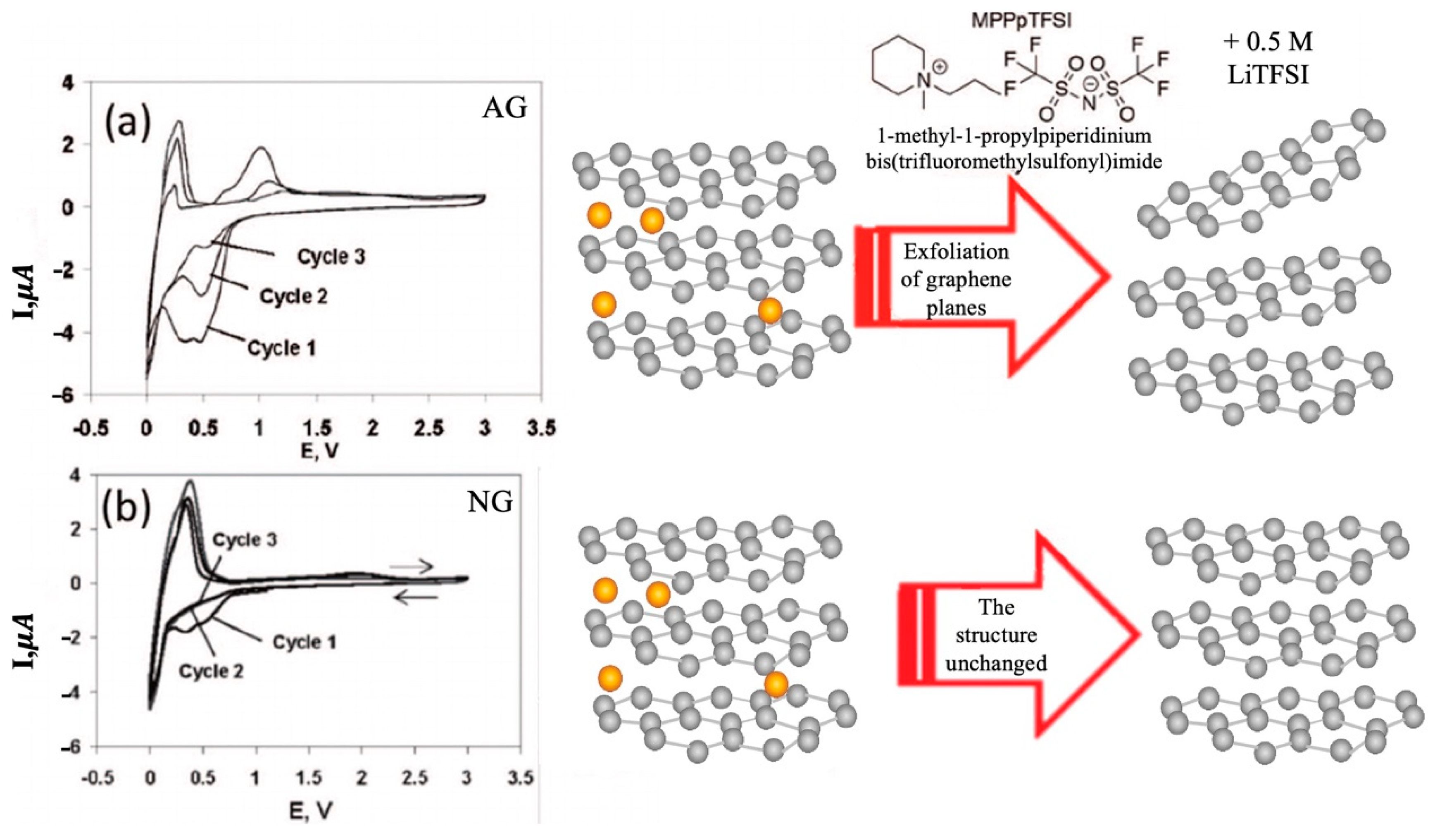
One major advantage of natural graphite (NG) over artificial graphite (AG) is its lower susceptibility to degradation during intercalation. Figure 6 illustrates the electrochemical behavior of both AG and NG in lithium-ion batteries using ionic liquid electrolytes. The results show that AG exhibits a peak near 1 V vs. Li/Li+, suggesting unwanted cation intercalation and subsequent structural damage. In contrast, NG demonstrates more favorable metal-ion intercalation behavior and better long-term electrochemical performance [98,99]. In addition, the extraction of NG requires less energy and is less costly than the production of AG. Because NG is also naturally abundant, it is generally more economical and widely available. However, due to its greater number of defect sites, NG often contains more metal impurities than AG, which increases the cost of purification, recovery, and recycling, and may also raise environmental concerns [100]. By comparison, AG is more expensive because its production requires energy-intensive, high-temperature treatment to achieve the desired crystallinity and purity. Even so, AG offers a more stable structure, improved safety, and a longer cycle life, making it particularly suitable for electric-vehicle applications.
The structure of artificial graphite (AG) is strongly influenced by the type of carbon precursor used and the conditions applied during graphitization. This final structure plays a critical role in determining the electrochemical behavior of the resulting anode material. Xing et al. investigated five AG samples produced under varying preparation conditions and graphitization temperatures and evaluated their electrochemical performance as electrode materials. Their findings showed that the interlayer spacing changed only slightly among the samples. In contrast, graphitization temperature had a major effect on the microstructure: increasing the temperature to as high as 2800 °C led to a more ordered layered arrangement, a higher degree of graphitization, and better-developed mesoporous features. These structural changes contributed to improved electrochemical performance [10]. Liu et al. also examined the influence of precursor crystal structure and electronic properties on lithium storage in AG for lithium-ion batteries. They found that graphite with longer crystallite planes and fewer stacked layers exhibited higher electronic conductivity. This type of graphite also delivered higher specific capacity at low charging and discharging rates, whereas graphite with shorter crystal planes and more stacked layers showed superior performance at high rates [101]. In addition, Herrin presented Table 4 to compare AG derived from different precursors, outlining their major advantages, limitations, and key electrochemical characteristics.

4. Recycling of Graphite: Current Landscape

Interest in recycling graphite has been growing, but most methods still do not meet commercial standards. These standards require high purity, scalability, good battery performance, and cost-effectiveness [105]. The process faces numerous technical, environmental, and economic challenges. Effective recycling may require combined or hybrid processes, tailored to battery type and graphite condition [106]. The main challenges in recycling graphite from spent Li-ion batteries stem from the complex, contaminated mixed feedstock. The optimal graphite recycling method depends on the feedstock type. The primary categories are production scrap from electrode and cell manufacturing, end-of-life (EOL) batteries, and black mass from dismantled batteries and mechanical processing [107]. Production scrap is generally clean and uniform, making it suitable for direct reuse or regeneration. EOL batteries contain graphite with surface wear, residual electrolyte, and impurities, often requiring further cleaning or regeneration. Black mass presents the greatest challenge, as graphite is combined with cathode materials, binders, conductive carbon, and metals, which require physical separation, chemical purification, or a combination of recycling methods. It is important to select recycling technologies that are appropriate for the specific feedstock [6,108,109]. Graphite for lithium-ion battery applications must meet stringent requirements, including high purity, high degree of graphitization, low surface area, high density, and a narrow particle-size distribution [93,110]. Recent studies reported that battery-grade recycled graphite should exhibit controlled particle-size distributions with D50 values around 18–20 μm, tap densities generally exceeding 700 g L−1, high carbon purity (>99.5 wt.%), low ash/moisture contents, and minimized metallic impurities (Fe, Cu, Al, Ni, Co, and Mn). In addition, the degree of graphitization, BET surface area, reversible capacity (~330–360 mAh g−1), first-cycle Coulombic efficiency (>90%), and long-term cycling retention are considered key quality metrics for evaluating the suitability of recycled graphite for LIB anodes [111]. A study emphasizes that suitable graphite should possess a controlled particle-size distribution (D10/D50/D90), a moderate BET surface area (~4–10 m2 g−1), high tap density, a preserved graphitic structure with low lattice distortion, and appropriate defect engineering to enhance Li-ion diffusion. Electrochemically, acceptable battery-grade graphite should deliver reversible capacities near the theoretical value (~350–370 mAh g−1), first-cycle Coulombic efficiency above 90%, and long-term cycling stability with ≥80% capacity retention after several hundred cycles under practical loading conditions (>3 mAh cm−2). These parameters are essential for evaluating whether recycled graphite can realistically replace commercial graphite in industrial LIB applications [106].

4.1. Methods of Recycling

The recovery of graphite from spent lithium-ion batteries (LIBs) involves a systematic approach that progresses from safety stabilization to advanced purification. The initial pre-treatment typically consists of discharging the batteries by immersing them in aqueous solutions, such as sodium chloride (NaCl) [112] or acidic/alkaline baths [113]. This is followed by mechanical crushing and sieving to liberate the electrode materials. Subsequently, graphite is separated from copper current collectors using methods such as pyrolysis or solvent dissolution. For instance, solvents like N-Methyl-2-pyrrolidone (NMP) are employed to dissolve PVDF binders, facilitating electrode delamination [114]. In addition, pulsed discharge (electrohydraulic fragmentation) has been reported to physically detach graphite from copper foil with high separation efficiency (>95%) and low copper contamination [115,116]. The purified graphite is then processed by acid leaching using reagents such as hydrochloric acid (HCl), sulfuric acid (H2SO4), or nitric acid (HNO3) [117] After separation, the recovered graphite undergoes further purification through acid leaching [106] to remove residual metallic impurities and lithium salts [118]. The overarching objective of these steps is to regenerate graphite with electrochemical performance suitable for reintegration into the battery supply chain or other high-value applications [7,63,119]. Current recycling approaches, namely hydrometallurgical, pyrometallurgical, and direct recycling, form the foundation of modern industrial infrastructures; however, they often require substantial energy input and excessive consumption of acids and alkalis, raising environmental concerns and limiting their compatibility with stringent sustainability regulations. In this context, alternative process configurations have been explored, such as recycling schemes employing dense media separation (DMS) to initially separate cathode and anode materials, followed by selective leaching and purification of both streams. This approach enables the recovery of battery-grade cathode materials alongside purified graphite [120]. Overall, LIB recycling generally comprises four primary stages: pre-processing, mechanical treatment, hydrometallurgy, and pyrometallurgy, with varying configurations across industrial and research-scale implementations [119].

4.2. Pyrometallurgy Recycling (Thermal-/Heat-Treatment Regeneration of Graphite)

Pyrometallurgical treatment, commonly referred to as graphitization, is widely applied in graphite recycling to remove impurities and restore the crystalline structure, thereby enhancing electrochemical performance. Heat treatment at 2600 °C under argon has been shown to result in uniform graphitization with a slight increase in interlayer spacing [121]. To further elucidate the mechanism of structural reorganization, semi-in situ XRD has been combined with electron and Raman spectroscopy. By optimizing parameters such as inert gas type, temperature, and duration, it was determined that treatment at 3000 °C for 6 h in nitrogen provides optimal conditions for achieving a high degree of structural reconstruction [122]. Despite these advantages, pyrometallurgical recycling of LIBs often results in significant graphite loss, as calcination at 500–900 °C can burn a substantial portion of the carbon and transfer lithium-rich residues into the slag. However, maintaining temperatures below 600 °C can mitigate this loss. Even when electrodes are pre-separated, graphite recovery is rarely emphasized. Nevertheless, thermal treatment remains essential for purification, as calcination at around 600 °C in nitrogen effectively decomposes binders and SEI-derived organic impurities, leaving chemically stable graphite after cooling. Typically, most impurities are removed below 1000 °C [31]. At higher temperatures, up to 2800 °C, impurity removal is further enhanced through accelerated bond breaking and vapor-driven dissipation, while lattice defects are repaired and crystallinity improves. This structural restoration yields cleaner, more ordered graphite, resulting in excellent electrochemical performance, including high initial capacity, high Coulombic efficiency, and stable cycling behavior. Overall, increasing temperature directly improves both material purity and battery performance [28]. In contrast to simple recovery strategies, advanced recycling approaches aim not only to extract graphite from spent anodes but also to restore and enhance its electrochemical properties. Carbon coating has emerged as a cost-effective and efficient strategy for improving the performance of recycled graphite. For example, carbon-coated graphite has been successfully prepared by carbonizing carboxymethyl cellulose and glucose at 800 °C for 5 h, thereby improving capacity [28]. Other carbon sources, including pitch [123,124], polyethylene glycol monooleate [125], and phenolic resin [126], have also been explored. Typically, spent graphite undergoes leaching and pre-sintering to remove residual salts and lithium, followed by high-temperature treatment with carbon precursors to achieve structural reconstruction and surface coating. Furthermore, heteroatom doping, particularly nitrogen doping, has been investigated to enhance graphite performance further. A gas-phase exfoliation process using acid-treated graphite and urea facilitated N-doping, in which ammonia generated during urea decomposition etched, exfoliated, and intercalated into the graphite layers [117]. Additionally, at 800 °C, the decomposition of g-C3N4 provides an extra nitrogen source for effective doping. In conventional pyrometallurgical processes, spent graphite (SG) is often used as a reducing agent for cathode metals or as a fuel, thereby limiting resource utilization. However, the lithium content in anode-derived SG (>3.007 wt.%) is significantly higher than the Earth’s crust average (0.0017 wt.%), highlighting its strong recycling potential. Therefore, recovering lithium, copper, current collectors, and graphite from decommissioned batteries is essential for extending material lifetimes and supporting green chemistry and circular economy principles [127]. Recent advancements have introduced more efficient recovery techniques. For instance, rapid shock heating at 1500 °C for 1 s enables the instantaneous separation of anode graphite from the copper foil, achieving a recovery efficiency of 98.7% while preserving the copper’s integrity [128]. Similarly, ultrafast flash evaporation at 2850 K has been applied to remove resistive impurities in the solid electrolyte interphase (SEI), followed by dilute-acid leaching to obtain high-purity graphite [128]. Additionally, low-temperature roasting with polyvinyl chloride (PVC) converts metal impurities into water-soluble chlorides, enabling purification to over 99.9% graphite purity, followed by thermal treatment at 1000 °C to restore structure and electrochemical performance.

4.3. Hydrometallurgy (Wet Purification) Recycling

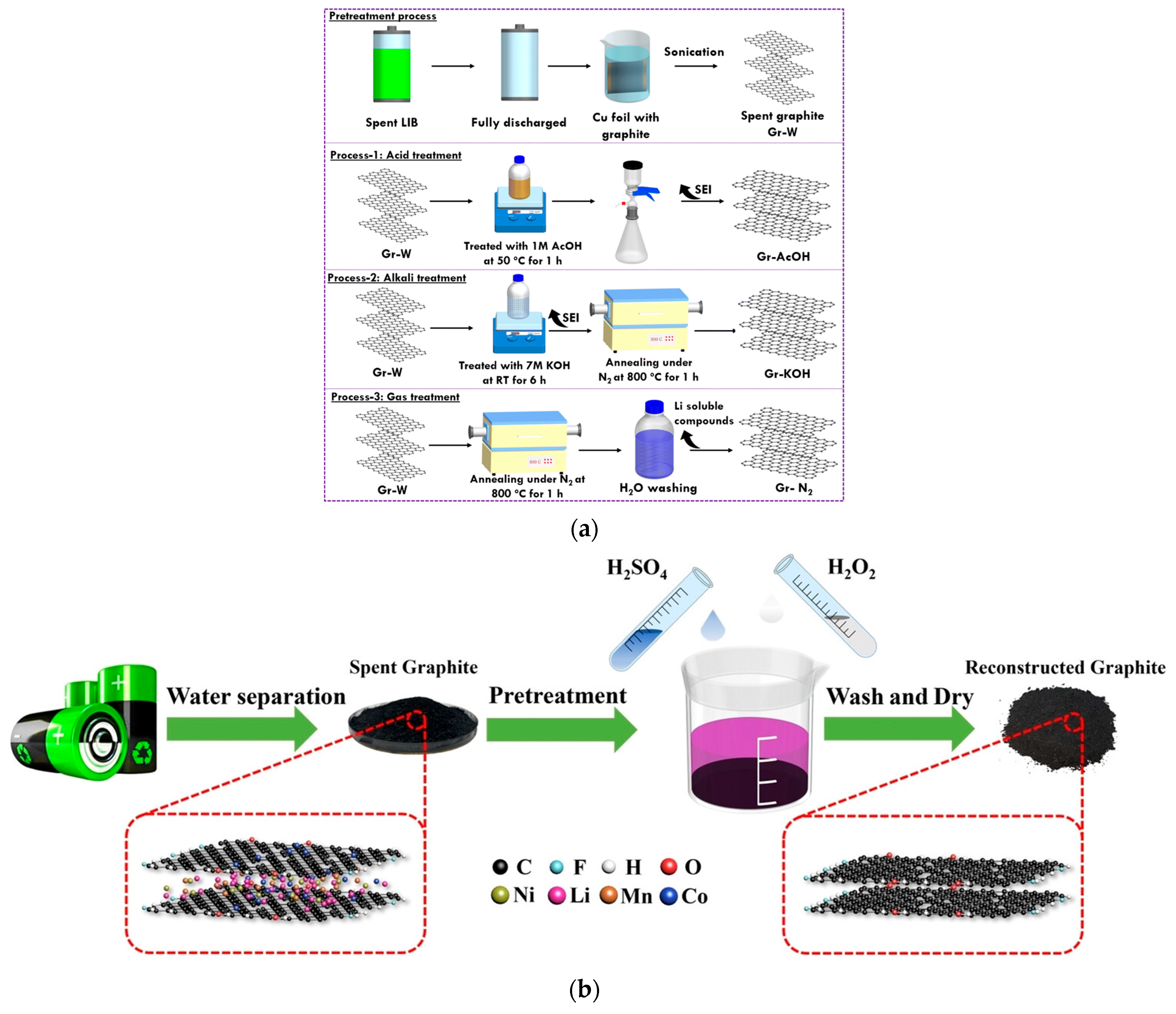
Current research on lithium-ion battery (LIB) recycling primarily focuses on cathode recovery, with pyrometallurgy and hydrometallurgy as the dominant approaches. Hydrometallurgical processes typically involve leaching, solvent extraction, and precipitation [129]. Efficient metal recovery depends strongly on the effective liberation and enrichment of electrode materials. However, conventional physical pre-treatment methods, including discharging, dismantling, crushing, and sieving [126,130], often fail to achieve high liberation efficiency due to the strong adhesion of polymeric binders. In addition, residual organic electrolytes present significant safety and environmental concerns, as they are flammable and thermally unstable during mechanical processing, potentially leading to fires and the release of toxic gases [131]. Alternative strategies, such as calcination or solvent dissolution using N-methyl-2-pyrrolidone, can enhance binder removal and material separation [132]. Nevertheless, these methods are associated with high energy consumption, the use of expensive solvents, and toxic emissions, underscoring the urgent need for safer, more sustainable pre-treatment technologies. Several studies have attempted to address these challenges through combined thermal and chemical treatments a thermal treatment at 500 °C, followed by leaching with hydrochloric acid and hydrogen peroxide to purify graphite [133]. Similarly, they employed physical shredding and sieving, followed by leaching with sulfuric acid and hydrogen peroxide and high-temperature sintering with sodium hydroxide [134]. Despite their effectiveness, these approaches are complex and time-consuming and suffer from issues such as hydrogen peroxide volatilization, necessitating corrosion-resistant equipment. Moreover, their high energy demand and operational costs limit their use in large-scale industrial applications. To overcome these limitations, more sustainable and simplified methods have been explored. In the study, a green water-leaching strategy was developed for recovering materials from spent anode material (SAM). This method dissolves water-soluble binders (SBR/CMC), achieving complete exfoliation of graphite from copper foil under optimal conditions (80 °C, 60 min, 300 rpm). The complete removal of binders enables the recovery of purified graphite without the use of strong acids or oxidizing agents [135]. More recently, advanced regeneration strategies have focused on restoring graphite’s structural and electrochemical properties. In one study, three reconstruction routes:acid (Gr-AcOH), alkali (Gr-KOH), and gas treatment (Gr-N2), as illustrated in Figure 7a. These treatments effectively removed impurities and repaired surface defects, enabling the regenerated graphite to achieve high delithiation capacities (325–338 mAh g−1 after 150 cycles) and excellent Coulombic efficiency (~99.9%), comparable to commercial graphite [136]. Similarly, researchers introduced a straightforward acid-leaching method for reconstructing graphite, as shown in Figure 7b. After complete discharge in 1 M NaCl, the batteries were dismantled, and the graphite anode was collected. The material was sequentially treated with ammonium persulfate, followed by an H2SO4-H2O2 solution, then washed and dried, yielding reconstructed graphite with improved properties [137].

4.4. Direct (Regeneration) Recycling

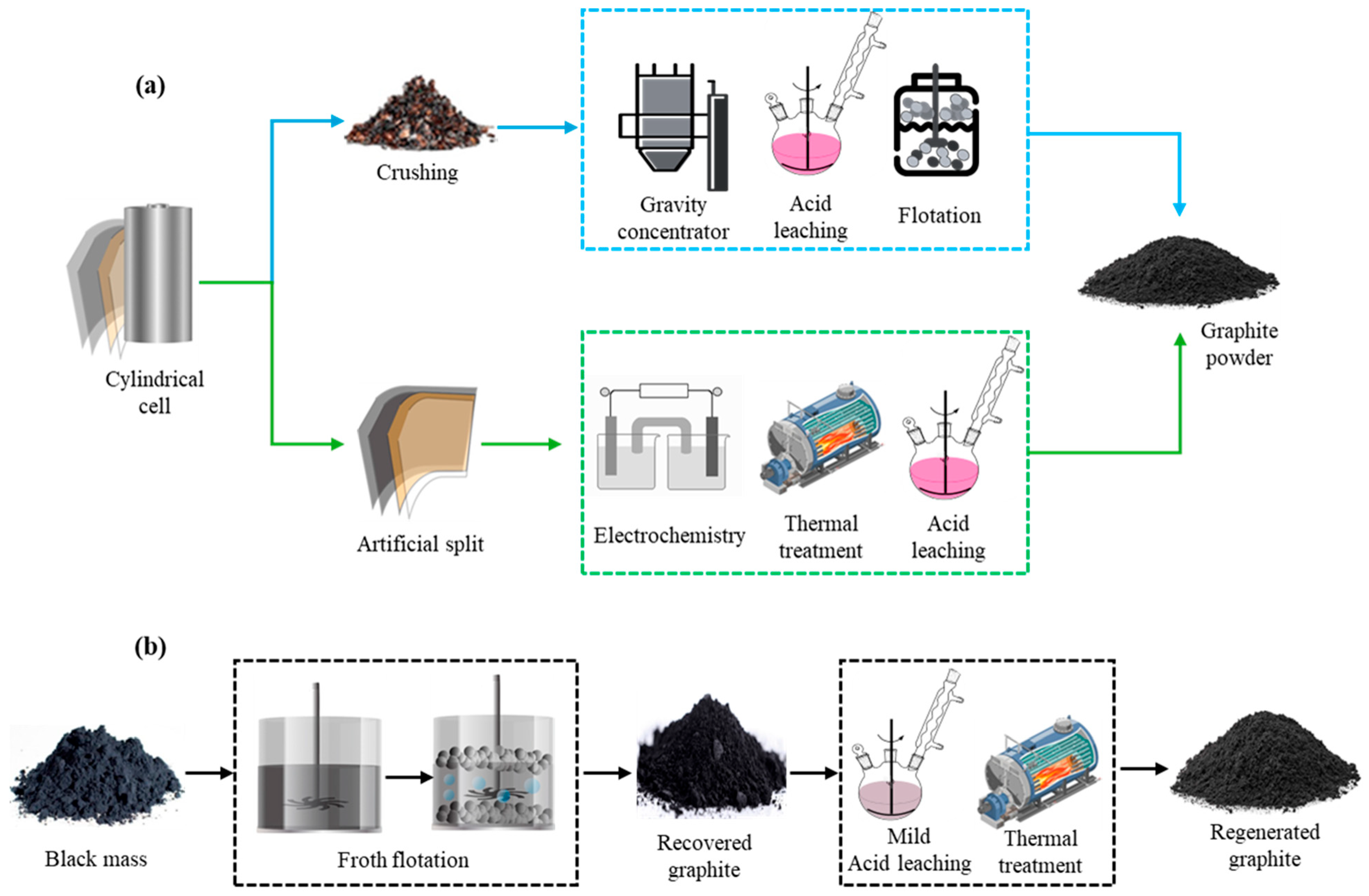
Direct recycling technology has emerged as an attractive alternative to conventional recycling methods, offering a more environmentally friendly and less aggressive approach [138]. Unlike traditional processes, direct recycling aims to preserve the structure and functionality of electrode materials, reducing energy consumption and chemical usage. Several industrial players are advancing this approach for graphite anodes with minimal structural degradation. For instance, the American Battery Technology Company (ABTC) has developed a DOE-supported process for graphite separation and purification. At the same time, Ascend Elements employs its Hydro-to-Anode method to produce high-purity (~99.9%) recycled graphite. Similarly, Princeton Nu Energy (PNE) operates a pilot-scale facility that recovers graphite from copper foils through mechanical and thermal delamination. These developments demonstrate the growing industrial feasibility of energy-efficient, closed-loop graphite recycling systems [63]. Recent studies have shown that recycling and upcycling represent two important pathways for sustainable utilization of spent graphite from lithium-ion batteries. Direct recycling mainly focuses on recovering high-purity regenerated graphite through separation, purification, structural repair, and surface reconditioning to restore battery-grade electrochemical performance. In contrast, upcycling strategies aim to further increase the value of spent graphite by converting it into advanced carbon materials or modified functional anodes with enhanced electrochemical properties and broader industrial applications. Recent research has demonstrated that structural reconstruction, defect engineering, doping, and surface-film modification can significantly improve Li-ion diffusion kinetics, cycling stability, and fast-charging performance of regenerated graphite materials. These approaches highlight the growing importance of graphite recycling and upcycling for achieving high-efficiency, sustainable, and circular lithium-ion battery manufacturing [139]. Beyond direct recovery, recent research has explored upcycling spent graphite into high-value carbon materials, such as graphene, for advanced electrochemical applications. One study proposed a sustainable method for recovering both graphite and lithium from spent anodes. In this process, graphite is first calcined at 450 °C under argon to remove organic components and detach it from the copper current collector. The recovered material is then annealed at 800 °C in a CO2/N2 atmosphere and washed at 70 °C, converting insoluble lithium compounds into soluble Li2CO3, which is subsequently recovered through evaporation [140]. Despite these advancements, graphite recycling has historically received less attention than cathode material recovery, even as it faces growing demand and supply challenges. The authors emphasized the importance of integrating graphite recycling into the waste management hierarchy to maximize economic and environmental benefits. Typically, spent graphite is recovered either through direct crushing followed by separation or via manual dismantling before separation. Their study provides a comprehensive overview of these approaches, as illustrated in Figure 8a [141]. More sustainable and targeted recovery strategies have also been developed. One such approach involves directly recovering and regenerating high-quality graphite from end-of-life battery black mass using environmentally benign chemicals. This process includes two key steps: froth flotation, using paraffin as a collector and pine oil as a bio-based frother to effectively concentrate graphite, followed by mild leaching with natural organic acids such as citric acid for purification [142]. A sustainable method for reclaiming graphite from end-of-life lithium-ion batteries (LIBs) is proposed, utilizing low-impact froth flotation with eco-friendly chemicals, followed by mild purification and thermal treatment. This process produces high-quality graphite, as shown in Figure 8b.
Fortunately, in recent years, graphite recovery has received increasing attention, leading to the development of several innovative techniques. The Xu group pioneered a magnetic separation method that restored graphite purity to 91.05%. Meanwhile, the Nowak group applied subcritical carbon dioxide treatment, achieving an initial Coulombic efficiency (ICE) of 85 [143]. Additionally, the Guo group demonstrated direct recovery of graphite from copper foil using N-methyl-2-pyrrolidone (NMP) as a solvent [144]. The current standard procedure for graphite regeneration typically involves mild acid leaching to remove polymers used in electrode fabrication, followed by calcination to restore structural order. Different acid systems and thermal conditions can significantly influence the quality of regenerated graphite. For example, experts [145] performed calcination at 500 °C under an argon atmosphere and compared leaching using deionized water and 3 M HCl to identify optimal recovery conditions. Similarly, in another study [126] employed a mixture of H2SO4 and H2O2 before calcination in air, followed by phenolic resin coating, resulting in regenerated graphite with electrochemical performance exceeding that of pristine material. Sustainable process optimization has also been explored to reduce environmental impact. A. Muguruza-Sánchez et al. proposed a direct recycling strategy combining mild chemical purification with thermal treatment. The process involves leaching with H2SO4 and H2O2 to remove copper and SBR binders, followed by calcination at 400 °C to eliminate CMC and further purify the graphite structure. This approach achieved a 36% reduction in acid consumption and a 14% decrease in water usage, demonstrating a more environmentally sustainable pathway for recycling both production scrap and end-of-life anodes [145]. A major challenge in spent graphite (SG) recycling remains the effective removal of impurities, including metal contaminants, residual electrolytes, and binders, as incomplete purification and structural defects can significantly reduce battery cycle life [146]. To address this, researchers developed a composite alkali etching method that removes aluminum and iron to very low concentrations (~10 ppm), compared to several hundred ppm typically observed after conventional acid treatments, thereby improving the suitability of recycled graphite for high-performance applications [123]. Thermal treatment plays a critical role in enhancing both purity and structural quality. Treatment at 600 °C and 2300 °C significantly improves graphite properties, increasing carbon content from 98.4% in untreated samples to 99.7% at 600 °C and approaching ~100% at 2300 °C. Raman spectroscopy reveals the disappearance of disorder-related peaks (D3, D4) and lower ID/IG ratios, indicating defect healing and re-graphitization. Electrochemical testing further confirms improved Li–graphite intercalation behavior, reduced irreversible capacity loss, and Coulombic efficiency comparable to that of commercial graphite after graphitization at temperatures above 2000 °C. Even under practical electrode loadings and high-rate conditions, the regenerated graphite demonstrates stable and competitive performance [147]. Despite these advancements, graphite recycling still faces significant technical and economic challenges across all major approaches. In pyrometallurgical processes, graphite is often lost due to high-temperature oxidation, reducing recovery efficiency while increasing energy consumption and emissions. Hydrometallurgical methods require large volumes of acid, generate wastewater, and have difficulty achieving complete purification. Direct recycling, although promising, is limited by structural degradation, complex separation from black mass, and the need for precise regeneration processes and has yet to reach full commercial scale. Overall, high costs, environmental concerns, quality-control challenges, and limited scalability remain key barriers to widespread industrial adoption [38,148,149]. Table 5 highlights strong progress in restoring the electrochemical performance of recycled graphite, but it also shows significant gaps in the research. Many studies omit important details such as electrode mass loading, areal capacity, electrolyte composition, and formation protocols. Without these details, it is difficult to know if the results will work for industry, since lab tests with low loadings may not reflect what is needed for real battery production. This shows a wider problem: there is no standard way to test or report results for recycled graphite. Future research should include full cell-level information and test recycled graphite in ways that align with real-world needs, so that results can be compared and used by industry.

5. Recycling Challenges and Limitations

According to a report based on interviews with 13 stakeholders across Europe’s battery value chain, current lithium-ion battery recycling faces significant economic and structural challenges. These processes are often not economically viable due to low battery return volumes, high transportation costs (which account for up to 70% of total expenses), and the capital- and labor-intensive nature of hydrometallurgical operations. Recycling plants frequently operate at only 5–10% capacity, limiting economies of scale, while the diversity in battery design complicates automation and standardization. In addition, regulatory inconsistencies, complex logistics, and unclear battery ownership further hinder the development of efficient recycling systems [154]. From a commercial perspective, two critical factors govern graphite recovery: cost and quality. Compared to high-value metals such as lithium, nickel, and cobalt, graphite has a relatively low market price, making its recovery less economically attractive. At the same time, recycled graphite must meet stringent purity and surface-quality requirements to be reused in battery anodes. Regenerating graphite from black mass requires the removal of multiple impurities, including polyvinylidene fluoride binders, lithium salts, aluminum and copper current collectors, and mixed anode–cathode materials. Furthermore, the recovered graphite is often a natural–synthetic blend, necessitating careful adjustment to satisfy Original Equipment Manufacturer (OEM) specifications [149]. Technologically, no single method currently enables efficient and sustainable recovery of high-purity graphite across all LIB types, highlighting the need for integrated, environmentally friendly, and cost-effective processes. Although leaching is widely used due to its simplicity and minimal equipment requirements, it has limitations in removing persistent organic contaminants such as PVDF and the solid electrolyte interphase (SEI) layer, as well as poorly soluble inorganic compounds like Li3PO4 and Co3+ salts. Moreover, strong inorganic acids (H2SO4, HF, HCl) pose corrosion, safety, and environmental risks. Alternative approaches using organic acids and green solvents, such as deep eutectic solvents (DESs), offer safer options but still require optimization for effectiveness across diverse battery chemistries. Thermal treatments can restore graphitic structure and improve electrochemical performance; however, they involve high energy consumption, carbon loss, and increased operational costs [44]. Similarly, flotation-derived graphite often exhibits low purity and incomplete delamination from the copper foil, further complicating downstream processing [155]. Maintaining the quality of spent graphite (SG) is essential for its effective reuse, particularly preserving its crystallinity and layered structure, which are critical for anode performance. However, these properties degrade over time due to chemical, morphological, and surface changes induced by battery operation and repeated charge–discharge cycles. Degradation begins early in the battery lifecycle with the formation of the solid electrolyte interphase, resulting from reactions between lithium, electrolyte components, and the graphite surface. Despite these challenges, degraded SG still holds value, as its altered surface may provide active sites for developing high-performance, functionalized graphitic materials [125,156,157].

Economic and Environmental Considerations

The production of 1 GWh of lithium-ion batteries (LIBs) requires approximately 1300 tonnes of anode material, embedding a substantial amount of graphite within the global supply chain. With LIB shipments reaching 957.7 GWh in 2022 and having an average lifespan of eight years, a comparable volume is expected to reach the end-of-life stage by 2030. This is projected to generate approximately 3354.39 kt of waste graphite between 2022 and 2030 [26]. Assuming a recycling rate of 35%, around 1174 kt of graphite could be recovered, including approximately 470 kt suitable for reuse in secondary LIB production. These projections highlight the growing importance and economic potential of recycled graphite as an alternative to virgin materials. Recovered graphite is expected to be utilized across a range of applications, reflecting increasing diversification in its end uses. Approximately 30% may be reused in electrode materials, 10% in graphene production, 9% each in sealing materials and refractories, and about 2% in catalyst carriers [6]. This distribution underscores a broader shift toward sustainable and value-added applications for waste graphite. From a market perspective, battery-grade graphite prices in North America ranged between $8700 and $10,900 per tonne in May 2023, while imported natural and synthetic graphite were priced at approximately $2135 and $5464 per tonne, respectively. In contrast, the cost of recycling graphite is significantly lower, with black mass priced around $300 per tonne (containing ~22 wt.% graphite) and processing costs estimated at $100–120 per tonne. Recycled graphite can be further upgraded through processes such as ball milling or spheroidization, and it typically costs around 20% of virgin natural graphite. Additionally, recycling processes enable the recovery of valuable secondary metals, including cobalt, nickel, and manganese, thereby further improving overall economic viability [26]. A lifecycle cost analysis comparing cold, hot, and wet recycling processes reveals important trade-offs between cost and product quality. The cold process is the most cost-effective (≈−$40 per kg unit mass of graphite) due to its low energy requirements, although it produces lower-quality graphite. In contrast, the hot ($158.72 per kg) and wet ($419.37 per kg) processes are more expensive but yield higher-quality graphite suitable for reuse in battery anodes. Overall, while cold processing is advantageous for general applications, hot and wet methods are better suited for high-performance uses, making recycled graphite competitive with virgin materials across different market segments [158]. Recycling graphite from spent lithium-ion batteries (LIBs) is essential for reducing environmental pollution, decreasing dependence on virgin raw materials, and advancing a circular economy. According to the International Energy Agency (IEA), achieving net-zero emissions by 2050 will require global graphite demand to reach approximately 16 million tons by 2040 [8]. Recent high-quality research highlights the environmental implications of graphite recycling through lifecycle assessment (LCA) studies [38]. More broadly, demand for natural and synthetic graphite is expected to rise significantly, driven by applications in energy storage systems, sustainable mobility, steel production, and digitalization. In particular, the use of graphite in energy storage technologies is projected to increase by a factor of 5 by 2050 under a 2 °C climate scenario [159,160]. However, SG is preferred due to the limited availability of natural graphite for LIB applications [35]. Despite this growing demand, supply constraints and environmental concerns remain critical. Synthetic graphite (SG), widely used in LIBs, has a substantially higher carbon footprint (4.86–13.8 kg CO2-eq per kg) compared to natural graphite (2.1–7.75 kg CO2-eq per kg), primarily due to its energy-intensive production. With increasing reliance on synthetic graphite, reaching up to 90% of battery applications in 2023, and the long development timelines for natural graphite mining, concerns over supply security have intensified, leading to its classification as a strategic raw material by the European Commission [7,13]. Due to growing concerns about the supply of synthetic graphite, the European Commission (2023a) has recently included it on the list of strategic raw materials [161]. Beyond greenhouse gas emissions, graphite production also contributes to particulate pollution, water consumption, the use of toxic chemicals, and resource depletion, underscoring the need for more comprehensive environmental assessments [34]. Lifecycle assessment (LCA) studies have provided valuable insights into the environmental impacts of graphite recycling. A pilot-scale study processing 100 kg of spent graphite evaluated nine recycling routes combining pyrometallurgical and hydrometallurgical techniques. The results showed that global warming potential (GWP) ranged from 0.53 to 9.76 kg CO2-eq per kg of graphite, largely influenced by energy consumption and acid usage. Hydrometallurgical routes, such as leaching with filtration (2.49 kg CO2-eq kg−1) and H2SO4 curing–leaching (2.89 kg CO2-eq kg−1), demonstrated relatively low environmental impact due to high recovery efficiencies (~90 wt.%). Similarly, pyrometallurgical processes, including pyrolysis with flotation (0.53 kg CO2-eq kg−1) and calcination followed by leaching (1.08 kg CO2-eq kg−1), achieved competitive recovery rates (80.8–95 wt.%). Integrated approaches that combine both methods generally performed better, improving resource efficiency. Sensitivity analysis further showed that reducing sulfuric acid consumption significantly lowers environmental impact, with optimized conditions achieving up to a 31.1% reduction in GWP [6,38]. Comparative assessments of regeneration strategies also reveal important differences in environmental performance. Among acid (Gr-AcOH), alkali (Gr-KOH), and gas (Gr-N2) treatments, the gas method exhibited the lowest energy and water consumption, with a GWP of 0.27 kg CO2-eq per kg. The acid method showed a moderate impact (0.49 kg CO2-eq per kg), whereas the alkali method had the highest environmental burden (3.53 kg CO2-eq per kg) due to higher energy and chemical requirements [136]. These findings highlight the importance of selecting optimized regeneration pathways for sustainable recycling. The environmental burden of graphite production further underscores the importance of recycling. Recent work reported that producing battery anode active material (BAAM) from synthetic graphite generates approximately 29.7 kg CO2-eq per kg, with graphitization identified as the primary contributor due to its high energy demand (~580 MJ kg−1). Conventional graphitization processes, such as the Acheson method, require temperatures up to 3200 °C, prompting efforts to develop alternative approaches, such as electrochemical graphitization, to reduce energy consumption [35,162,163]. In addition, the presence of the solid electrolyte interphase (SEI) layer on spent graphite introduces both challenges and opportunities. This layer, composed of lithium salts and decomposition products such as Li2CO3, LiOR, and Li2O, can be removed through regeneration strategies including acid, alkali, and gas treatments. These methods have demonstrated delithiation capacities of 325–338 mAh per g after 150 cycles, with Coulombic efficiencies of approximately 99.9%, approaching the performance of commercial graphite. Importantly, LCA results for these advanced regeneration techniques show GWP values ranging from 0.27 to 3.53 kg CO2-eq per kg, significantly lower than those of earlier recycling methods, indicating their potential to reduce the environmental footprint while maintaining high material performance [136].

6. Conclusions and Outlooks

This review offers a comprehensive and integrated analysis of graphite recycling from spent lithium-ion batteries, advancing beyond traditional process-centric discussions to interlink technological advancements with broader considerations, including global graphite demand, the distinctions between natural and synthetic graphite production, emerging recycling strategies, industrial trends, and environmental implications. The study places particular emphasis on the electrochemical performance of recycled graphite, highlighting recent advancements in regeneration and modification techniques to restore battery-grade quality. By intertwining the technical, environmental, and industrial dimensions, this work highlights the increasingly strategic significance of graphite recycling in the circular economy for lithium-ion batteries.
Despite the growing focus on lithium-ion battery recycling, graphite recovery remains relatively underdeveloped, even though graphite accounts for a substantial portion of battery mass and is a valuable secondary resource. Future research efforts should prioritize advanced regeneration strategies to restore the structural integrity and electrochemical performance of spent artificial graphite. Key challenges in this domain encompass effective binder removal, elimination of surface impurities, defect repair, and reconstruction of the solid electrolyte interphase. Promising methodologies, including thermal purification, chemical treatment, surface modification, and electrochemical activation, display considerable potential to elevate recycled graphite to meet battery-grade standards.
At an industrial level, recycling strategies are expected to shift from a focus on metal recovery to more integrated systems that simultaneously recycle cathode and anode materials. In this framework, the development of cost-effective and environmentally sustainable graphite recycling technologies will be imperative for reducing dependence on primary resources and enhancing supply-chain resilience. Future research should focus on developing standardized battery-grade qualification criteria for recycled graphite, including purity, particle morphology, tap density, and long-term electrochemical stability under commercially relevant conditions. Greater attention is also needed toward scalable regeneration technologies, industrial-scale process validation, harmonized lifecycle assessment methodologies, and the optimization of direct recycling approaches with lower environmental impact. In addition, future studies should evaluate how emerging anode systems, such as silicon-rich and lithium-metal batteries, may influence the long-term demand, economics, and infrastructure requirements of graphite recycling.

Author Contributions

M.R. wrote the review manuscript, conceptualization, and produced the graphics. A.K.M.R. review and editing, J.I.G.D. and T.M.G.S. review and editing, K.Z. Supervision, conceptualizing, designing the structure of the review, collecting the papers related to the topic of the evaluation, and completing the language corrections, with all authors contributing equally. All authors have read and agreed to the published version of the manuscript.

Funding

This research was funded by Concordia University.

Data Availability Statement

No new data were created or analyzed in this study. Data sharing is not applicable to this article.

Acknowledgments

We extend our heartfelt gratitude to Moguel AI, Innovee, and the CNRC Alliance program for their generous support, which was crucial to completing this work. Additionally, we would like to offer special thanks to Sarah Sadjedi for her significant contributions to the graphic design elements, which greatly enhanced the quality and presentation of our project.

Conflicts of Interest

The authors declare no conflicts of interest.

References

  1. International Energy Agency. World Energy Outlook 2024; International Energy Agency: Paris, France, 2024. [Google Scholar]
  2. International Energy Agency. Renewables 2024; International Energy Agency: Paris, France, 2024. [Google Scholar]
  3. Tiwari, A. IAAM’s Pledge for Global Climate Resilience at COP 28. Adv. Mater. Lett. 2024, 15, 2402-1745. [Google Scholar] [CrossRef]
  4. International Energy Agency. Global EV Outlook 2023: Catching up with Climate Ambitions; International Energy Agency: Paris, France, 2023. [Google Scholar]
  5. Bai, Y.; Li, M.; Jafta, C.J.; Dai, Q.; Essehli, R.; Polzin, B.J.; Belharouak, I. Direct recycling and remanufacturing of anode scraps. Sustain. Mater. Technol. 2023, 35, e00542. [Google Scholar] [CrossRef]
  6. Tian, H.; Graczyk-Zajac, M.; Kessler, A.; Weidenkaff, A.; Riedel, R. Recycling and Reusing of Graphite from Retired Lithium-ion Batteries: A Review. Adv. Mater. 2024, 36, e2308494. [Google Scholar] [CrossRef] [PubMed]
  7. Abdollahifar, M.; Doose, S.; Cavers, H.; Kwade, A. Graphite Recycling from End-of-Life Lithium-Ion Batteries: Processes and Applications. Adv. Mater. Technol. 2023, 8, 2200368. [Google Scholar] [CrossRef]
  8. International Energy Agency. Global Critical Minerals Outlook 2025; International Energy Agency: Paris, France, 2025. [Google Scholar]
  9. Zhao, L.; Ding, B.; Qin, X.; Wang, Z.; Lv, W.; He, Y.; Yang, Q.-H.; Kang, F.Y. Revisiting the Roles of Natural Graphite in Ongoing Lithium-Ion Batteries. Adv. Mater. 2022, 34, 2106704. [Google Scholar] [CrossRef] [PubMed]
  10. Nikgoftar, K.; Madikere Raghunatha Reddy, A.K.; Reddy, M.V.; Zaghib, K. Carbonaceous Materials as Anodes for Lithium-Ion and Sodium-Ion Batteries. Batteries 2025, 11, 123. [Google Scholar] [CrossRef]
  11. Kosenko, A.; Pushnitsa, K.; Pavlovskii, A.A.; Novikov, P.; Popovich, A.A. The Review of Existing Strategies of End-of-Life Graphite Anode Processing Using 3Rs Approach: Recovery, Recycle, Reuse. Batteries 2023, 9, 579. [Google Scholar] [CrossRef]
  12. Cheng, Q.; Marchetti, B.; Chen, X.; Xu, S.; Zhou, X.D. Separation, purification, regeneration and utilization of graphite recovered from spent lithium-ion batteries—A review. J. Environ. Chem. Eng. 2022, 10, 107312. [Google Scholar] [CrossRef]
  13. Engels, P.; Cerdas, F.; Dettmer, T.; Frey, C.; Hentschel, J.; Herrmann, C.; Mirfabrikikar, T.; Schueler, M. Life cycle assessment of natural graphite production for lithium-ion battery anodes based on industrial primary data. J. Clean. Prod. 2022, 336, 130474. [Google Scholar] [CrossRef]
  14. Geological Survey. Mineral Commodity Summaries 2026; U.S. Geological Survey: Reston, VA, USA, 2026.
  15. Emily Benson, T.D. China’s New Graphite Restrictions; Center for Strategic and International Studies: Washington, DC, USA, 2023. [Google Scholar]
  16. European Parliament. CELEX_32023R1542_EN_TXT; Regulation (EU) 2023/1542 of the European Parliament and of the Council; European Parliament: Brussel, Belgium, 2023. [Google Scholar]
  17. Bhuwalka, K.; Ramachandran, H.; Narasimhan, S.; Yao, A.; Frohmann, J.; Peiseler, L.; Chueh, C.; Boies, A.; Davis, S.J.; Benson, S. Securing the supply of graphite for batteries. arXiv 2025, arXiv:2503.21521. [Google Scholar]
  18. Camuamba, E.; Damásio, B.; Mendonça, S. Assessing critical mineral occurrence in battery technologies. Resour. Policy 2025, 111, 105755. [Google Scholar] [CrossRef]
  19. U.S. Department of the Treasury; Internal Revenue Service. Clean Vehicle Credits under Sections 25E and 30D; Transfer of Credits; Critical Minerals and Battery Components; Foreign Entities of Concern. T.D. 9995. Fed. Regist. 2024, 89, 37706–37775. Available online: https://www.govinfo.gov/content/pkg/FR-2024-05-06/pdf/2024-09094.pdf (accessed on 1 July 2026).
  20. International Energy Agency. Critical Minerals Data Explorer Methodological Notes; International Energy Agency: Paris, France, 2023. [Google Scholar]
  21. International Energy Agency. Critical Minerals Market Review 2023; International Energy Agency: Paris, France, 2023. [Google Scholar]
  22. Chenitz, R.; Pajootan, E.; Mokrini, A. Future of Battery Grade Graphite Recycling from Spent Batteries. ACS Sustain. Resour. Manag. 2025, 2, 1337–1339. [Google Scholar] [CrossRef]
  23. Yi, X.; Qi, G.; Liu, X.; Depcik, C.; Liu, L. Challenges and strategies toward anode materials with different lithium storage mechanisms for rechargeable lithium batteries. J. Energy Storage 2024, 95, 112480. [Google Scholar] [CrossRef]
  24. Hamzelui, N.; Kin, L.; Köhler, J.; Astakhov, O.; Liu, Z.; Kirchartz, T.; Rau, U.; Gebresilassie Eshetu, G.; Merdzhanova, T.; Figgemeier, E. Toward the Integration of a Silicon/Graphite Anode-Based Lithium-Ion Battery in Photovoltaic Charging Battery Systems. ACS Omega 2022, 7, 27532–27541. [Google Scholar] [CrossRef] [PubMed]
  25. Park, J.; Cho, S.J.; Shin, S.; Kim, R.; Shin, D.; Shin, Y. Overview of graphite supply chain and its challenges. Geosci. J. 2025, 29, 329–341. [Google Scholar] [CrossRef]
  26. Nouveau Monde Graphite Inc. Graphite 101: Powering the Clean Energy Transition—Introduction to the Graphite Market and Associated Opportunities; Corporate Presentation, Q2 2023; Nouveau Monde Graphite Inc.: Montréal, QC, Canada, 2023. [Google Scholar]
  27. Zhang, L.; Zhang, Y.; Xu, Z.; Zhu, P. The Foreseeable Future of Spent Lithium-Ion Batteries: Advanced Upcycling for Toxic Electrolyte, Cathode, and Anode from Environmental and Technological Perspectives. Environ. Sci. Technol. 2023, 57, 13270–13291. [Google Scholar] [CrossRef] [PubMed]
  28. Yu, G.Q.; Xie, M.Z.; Zheng, Z.H.; Wu, Z.G.; Zhao, H.L.; Liu, F.Q. Efficiently regenerating spent lithium battery graphite anode materials through heat treatment processes for impurity dissipation and crystal structure repair. Resour. Conserv. Recycl. 2023, 199, 107267. [Google Scholar] [CrossRef]
  29. Natural Graphite: The Material for a Green Economy. Available online: https://elements.visualcapitalist.com/natural-graphite-the-material-for-a-green-economy/ (accessed on 3 June 2025).
  30. Yan, Y.; Nashath, F.Z.; Chen, S.; Manickam, S.; Lim, S.S.; Zhao, H.; Lester, E.; Wu, T.; Pang, C.H. Synthesis of graphene: Potential carbon precursors and approaches. Nanotechnol. Rev. 2020, 9, 1284–1314. [Google Scholar] [CrossRef]
  31. Abhilash Maheswari, M.U.; Raghava Reddy, K.; Aminabhavi, T.M.; Aravindan, V.; Meshram, P. Recycling strategies for renewable graphite and other carbon nanomaterials from used batteries: A review. J. Clean. Prod. 2025, 493, 144871. [Google Scholar] [CrossRef]
  32. Vegh, G.; Sarah, S.; Kantor, I.; Amine, K.; Srivastava, M.; Rezayi, M.; Madikere Raghunatha Reddy, A.K.; Zaghib, K. Toward Sustainable Anode Materials: LCA of Natural Graphite Processing in Québec. Batteries 2026, 12, 68. [Google Scholar] [CrossRef]
  33. Graphite Facts—Natural Resources Canada. Available online: https://natural-resources.canada.ca/minerals-mining/mining-data-statistics-analysis/minerals-metals-facts/graphite-facts (accessed on 5 August 2025).
  34. Zhang, J.; Liang, C.; Dunn, J.B. Graphite Flows in the U.S.: Insights into a Key Ingredient of Energy Transition. Environ. Sci. Technol. 2023, 57, 3402–3414. [Google Scholar] [CrossRef] [PubMed]
  35. Kulkarni, S.; Huang, T.-Y.; Thapaliya, B.P.; Luo, H.; Dai, S. Prospective Life Cycle Assessment of Synthetic Graphite Manufactured via Electrochemical Graphitization. ACS Sustain. Chem. Eng. 2022, 10, 13607–13618. [Google Scholar] [CrossRef]
  36. Natarajan, S.; Divya, M.L.; Aravindan, V. Should we recycle the graphite from spent lithium-ion batteries? The untold story of graphite with the importance of recycling. J. Energy Chem. 2022, 71, 351–369. [Google Scholar] [CrossRef]
  37. How Graphite in Batteries Fuels the EV Revolution. Available online: https://navprakriti.com/graphite-batteries-evs-energy-storage/ (accessed on 7 August 2025).
  38. Rey, I.; Vallejo, C.; Santiago, G.; Iturrondobeitia, M.; Lizundia, E. Environmental Impacts of Graphite Recycling from Spent Lithium-Ion Batteries Based on Life Cycle Assessment. ACS Sustain. Chem. Eng. 2021, 9, 14488–14501. [Google Scholar] [CrossRef]
  39. Dasgupta, A.; Buisson, E.; Dhir, S.; Hegarty, A.; Hwang, G.; Kim, Y.Y.; Michaels, K.C.; de Oliveira Bredariol, T.; Pospiech, R.; Raboca, J. Recycling of Critical Minerals Strategies to Scale Up Recycling and Urban Mining. A World Energy Outlook Special Report; International Energy Agency: Paris, France, 2024. [Google Scholar]
  40. Perumal, P.; Andersen, S.M.; Nikoloski, A.; Basu, S.; Mohapatra, M. Leading strategies and research advances for the restoration of graphite from expired Li+ energy storage devices. J. Environ. Chem. Eng. 2021, 9, 106455. [Google Scholar] [CrossRef]
  41. Graphite Recycling Market to Reach $127.3 Million. Available online: https://www.globenewswire.com/news-release/2025/02/19/3028612/0/en/Graphite-Recycling-Market-to-Reach-127-3-Million-Globally-by-2033-at-9-1-CAGR-Allied-Market-Research.html (accessed on 7 August 2025).
  42. Gorman, S.; Hitt, C.; Kesler, S.; Keoleian, G.; Kim, H.C.; De Kleine, R.; Anderson, J.E. US graphite sourcing for electric vehicle battery applications. J. Ind. Ecol. 2025, 29, 2162–2181. [Google Scholar] [CrossRef]
  43. Peng, J.; Maslek, S.; Sharma, N. Spent graphite from lithium-ion batteries: Re-use and the impact of ball milling for re-use. RSC Sustain. 2024, 2, 1418–1430. [Google Scholar] [CrossRef]
  44. Islam, S.; Kushwaha, A.K.; Misra, M. Review on the recycling of anode graphite from waste lithium-ion batteries. J. Mater. Cycles Waste Manag. 2024, 26, 3341–3369. [Google Scholar] [CrossRef]
  45. Altilium Demonstrates Technology for Graphite Recycling Under UK Govt Smart Grant—Altilium. Available online: https://altilium.tech/2024/04/12/altilium-demonstrates-technology-for-graphite-recycling-under-uk-govt-smart-grant/ (accessed on 27 July 2025).
  46. Altilium. Altilium Signs MOU to Supply Talga with Recycled Graphite. Available online: https://altilium.tech/2025/02/27/altilium-signs-mou-to-supply-talga-with-recycled-graphite/ (accessed on 1 July 2026).
  47. tozero Achieves Industrial-Scale Graphite Recovery, Successfully Qualifies for Lithium-Ion Batteries. 2025. Available online: https://www.tozero.solutions/press-release-graphite (accessed on 1 July 2026).
  48. Nouveau Monde and Lithion Recycling Sign a Collaboration Agreement to Recycle Graphite for Reuse as Anode Material for Batteries—Showing Commitment to Full Life Cycle of Materials—Nouveau Monde Graphite. Available online: https://nmg.com/lithion-agreement/ (accessed on 13 August 2025).
  49. Nouveau Monde Graphite Solutions Zéro-CarboneTM. Available online: https://nmg.com/ (accessed on 27 July 2025).
  50. Aurubis, Talga to Develop Process for Battery-Grade Recycled Graphite—Recycling Today. Available online: https://www.aurubis.com/en/media/press-releases/press-releases-2024/aurubis-and-talga-partner-to-develop-first-of-its-kind-process-for-battery-grade-recycled-graphite (accessed on 1 July 2026).
  51. Building the Most Sustainable (and Scalable) Battery Materials Process. Available online: https://www.redwoodmaterials.com/news/sustainable-battery-materials-process/ (accessed on 13 August 2025).
  52. Electra Battery Materials|Latest News. Available online: https://www.electrabmc.com/news-releases/news/electra-and-three-fires-group-advance-canadas-first-indigenous-led-battery-recycling-venture (accessed on 12 August 2025).
  53. Eco-Responsibile Graphite Company, Recycles Graphite Elements. Available online: https://www.semcocarbon.com/blog/graphite-recycling (accessed on 17 August 2025).
  54. Recycling Graphite Waste into Usable Graphite Material. Available online: https://www.semcocarbon.com/blog/recycling-graphite-waste-into-usable-graphite-material (accessed on 17 August 2025).
  55. Graphite One Announces Termination of Memorandum of Understanding with Lithium-Ion Battery Anode Producer—Graphite One. Available online: https://www.graphiteoneinc.com/graphite-one-announces-termination-of-memorandum-of-understanding-with-lithium-ion-battery-anode-producer/ (accessed on 12 August 2025).
  56. Fortum Battery Recycling and Vianode Join Forces to Recycle Graphite from End-of-Life EV Batteries. Available online: https://www.fortum.com/services/battery-recycling/news-and-releases/fortum-battery-recycling-and-vianode-join-forces-recycle-graphite-end-life-ev-batteries (accessed on 17 August 2025).
  57. Transforming Old into New: Volkswagen Group Components Commences Battery Recycling. Available online: https://www.volkswagen-group.com/en/press-releases/transforming-old-into-new-volkswagen-group-components-commences-battery-recycling-17122 (accessed on 13 August 2025).
  58. Volkswagen Will Use Hydrometallurgy to Recycle 95 Percent of a Cell. Available online: https://insideevs.com/news/494955/volkswagen-hydrometallurgy-recycle-95-percent-cells/ (accessed on 13 August 2025).
  59. PRESS RELEASE—Battery X Metals Inc. Available online: https://www.batteryxmetals.com/battery-recycling-technologies (accessed on 1 July 2026).
  60. Vianode AS. Sustainability Report 2024: Pioneering a Cleaner EV and Battery Industry; Vianode AS: Oslo, Norway, 2025; Available online: https://vianode.fra1.digitaloceanspaces.com/documents/Vianode-Sustainability-Report-2024.pdf (accessed on 1 July 2026).
  61. Raza, H.; Bai, S.; Cheng, J.; Majumder, S.; Zhu, H.; Liu, Q.; Zheng, G.; Li, X.; Chen, G. Li-S Batteries: Challenges, Achievements and Opportunities. Electrochem. Energy Rev. 2023, 6, 29. [Google Scholar] [CrossRef]
  62. Scrosati, B. History of lithium batteries. J. Solid State Electrochem. 2011, 15, 1623–1630. [Google Scholar] [CrossRef]
  63. Mao, Z.; Chai, J.; Wang, R. Toward Sustainable Lithium-Ion Batteries: Recycling and Reuse Strategies for Spent Graphite Anodes. Small 2026, 22, e09952. [Google Scholar] [CrossRef] [PubMed]
  64. Qiao, Y.; Zhao, H.; Shen, Y.; Li, L.; Rao, Z.; Shao, G.; Lei, Y. Recycling of graphite anode from spent lithium-ion batteries: Advances and perspectives. EcoMat 2023, 5, e12321. [Google Scholar] [CrossRef]
  65. Seroka, N.S.; Modibedi, M.; Zheng, H.; Khotseng, L.; Luo, H. Recent advancement and prospects of graphite nanocomposites as anode materials for lithium-ion batteries. Renew. Sustain. Energy Rev. 2026, 238, 117066. [Google Scholar] [CrossRef]
  66. Nikgoftar, K.; Vishweswariah, K.; Ningappa, N.G.; Kumar, M.A.; Zaghib, K. Advanced additive engineering for high-electrochemical-performance lithium-ion batteries. Nano Energy 2026, 152, 111887. [Google Scholar] [CrossRef]
  67. Deng, D. Li-ion batteries: Basics, progress, and challenges. Energy Sci. Eng. 2015, 3, 385–418. [Google Scholar] [CrossRef]
  68. Jan, W.; Khan, A.D.; Iftikhar, F.J.; Ali, G. Recent advancements and challenges in deploying lithium sulfur batteries as economical energy storage devices. J. Energy Storage 2023, 72, 108559. [Google Scholar] [CrossRef]
  69. Li, Z.; Huang, Y.; Yuan, L.; Hao, Z.; Huang, Y. Status and prospects in sulfur–carbon composites as cathode materials for rechargeable lithium–sulfur batteries. Carbon 2015, 92, 41–63. [Google Scholar] [CrossRef]
  70. Esteve-Adell, I.; Porcel-Valenzuela, M.; Zubizarreta, L.; Gil-Agustí, M.; García-Pellicer, M.; Quijano-Lopez, A. Influence of the Specific Surface Area of Graphene Nanoplatelets on the Capacity of Lithium-Ion Batteries. Front. Chem. 2022, 10, 807980. [Google Scholar] [CrossRef] [PubMed]
  71. Li, Y.; Lu, Y.; Adelhelm, P.; Titirici, M.-M.; Hu, Y.-S. Intercalation chemistry of graphite: Alkali metal ions and beyond. Chem. Soc. Rev. 2019, 48, 4655–4687. [Google Scholar] [CrossRef] [PubMed]
  72. Zhao, W.; Zhao, C.; Wu, H.; Li, L.; Zhang, C. Progress, challenge and perspective of graphite-based anode materials for lithium batteries: A review. J. Energy Storage 2024, 81, 110409. [Google Scholar] [CrossRef]
  73. Xu, J.; Cai, X.; Cai, S.; Shao, Y.; Hu, C.; Lu, S.; Ding, S. High-Energy Lithium-Ion Batteries: Recent Progress and a Promising Future in Applications. Energy Environ. Mater. 2023, 6, e12450. [Google Scholar] [CrossRef]
  74. Erickson, E.M.; Markevich, E.; Salitra, G.; Sharon, D.; Hirshberg, D.; de la Llave, E.; Shterenberg, I.; Rosenman, A.; Frimer, A.; Aurbach, D. Review—Development of Advanced Rechargeable Batteries: A Continuous Challenge in the Choice of Suitable Electrolyte Solutions. J. Electrochem. Soc. 2015, 162, A2424–A2438. [Google Scholar] [CrossRef]
  75. Pesaran, A.A. Lithium-Ion Battery Technologies for Electric Vehicles: Progress and challenges. IEEE Electrif. Mag. 2023, 11, 35–43. [Google Scholar] [CrossRef]
  76. Kühn, S.P.; Edström, K.; Winter, M.; Cekic-Laskovic, I. Face to Face at the Cathode Electrolyte Interphase: From Interface Features to Interphase Formation and Dynamics. Adv. Mater. Interfaces 2022, 9, 2102078. [Google Scholar] [CrossRef]
  77. Stampatori, D.; Raimondi, P.P.; Noussan, M. Li-Ion Batteries: A Review of a Key Technology for Transport Decarbonization. Energies 2020, 13, 2638. [Google Scholar] [CrossRef]
  78. Miao, Q.; Jin, X.; Zhu, T.; Fang, C.; Huang, D.; Tong, W.; Liu, G. Enhancing the cycle life of recycled graphite materials from spent lithium-ion batteries via conductive polymer coating. J. Power Sources 2024, 629, 235864. [Google Scholar] [CrossRef]
  79. Criscione, J.M.; Reddy, R.L.; Fulgenzi, C.F.; Page, D.J.; Fisher, F.F.; Dzermejko, A.J.; Hedge, J.B. Graphite, Applications of Artificial. Kirk-Othmer Encyclopedia of Chemical Technology; Wiley: Hoboken, NJ, USA, 2000. [Google Scholar] [CrossRef]
  80. Yuan, Y.; Chen, Z.; Yu, H.; Zhang, X.; Liu, T.; Xia, M.; Zheng, R.; Shui, M.; Shu, J. Heteroatom-doped carbon-based materials for lithium and sodium ion batteries. Energy Storage Mater. 2020, 32, 65–90. [Google Scholar] [CrossRef]
  81. Xu, J.; Dou, Y.; Wei, Z.; Ma, J.; Deng, Y.; Li, Y.; Liu, H.; Dou, S. Recent Progress in Graphite Intercalation Compounds for Rechargeable Metal (Li, Na, K, Al)-Ion Batteries. Adv. Sci. 2017, 4, 1700146. [Google Scholar] [CrossRef] [PubMed]
  82. Chen, B.; Hope-Glenn, N.; Wright, A.; Messinger, R.J.; Couzis, A. Mechanistic Understanding of Lithium-Ion Adsorption, Intercalation, and Plating during Charging of Graphite Electrodes. ACS Electrochem. 2025, 1, 574–587. [Google Scholar] [CrossRef] [PubMed]
  83. Gong, X.; Guo, S.; Ding, Y.; Lou, B.; Shi, N.; Wen, F.; Yang, X.; Li, G.; Wu, B.; Zhu, W.; et al. Preparation of mesocarbon microbeads as anode material for lithium-ion battery by co-carbonization of FCC decant oil and conductive carbon black. Fuel Process. Technol. 2022, 227, 107110. [Google Scholar] [CrossRef]
  84. Kim, B.-H.; Kim, J.-H.; Kim, J.-G.; Bae, M.-J.; Im, J.S.; Lee, C.W.; Kim, S. Electrochemical and structural properties of lithium battery anode materials by using a molecular weight controlled pitch derived from petroleum residue. J. Ind. Eng. Chem. 2016, 41, 1–9. [Google Scholar] [CrossRef]
  85. Gao, Y.; Pan, Z.; Sun, J.; Liu, Z.; Wang, J. High-Energy Batteries: Beyond Lithium-Ion and Their Long Road to Commercialisation. Nano-Micro Lett. 2022, 14, 94. [Google Scholar] [CrossRef] [PubMed]
  86. Derbyshire, F.; Presland, A.; Trimm, D. Graphite formation by the dissolution—Precipitation of carbon in cobalt, nickel and iron. Carbon 1975, 13, 111–113. [Google Scholar] [CrossRef]
  87. Zaikov, Y.P.; Batukhtin, V.P.; Shurov, N.I.; Suzdaltsev, A.V. High-temperature electrochemistry of calcium. Electrochem. Mater. Technol. 2022, 1, 20221007. [Google Scholar] [CrossRef]
  88. Mohamed, A.; Dong, S.; Elhefnawey, M.; Dong, G.; Gao, Y.; Zhu, K.; Cao, D. A comparison of the electrochemical performance of graphitized coal prepared by high-temperature heating and flash Joule heating as an anode material for lithium and potassium ion batteries. Chem. Phys. Lett. 2023, 815, 140362. [Google Scholar] [CrossRef]
  89. Xing, B.; Zhang, C.; Cao, Y.; Huang, G.; Liu, Q.; Zhang, C.; Chen, Z.; Yi, G.; Chen, L.; Yu, J. Preparation of synthetic graphite from bituminous coal as anode materials for high performance lithium-ion batteries. Fuel Process. Technol. 2018, 172, 162–171. [Google Scholar] [CrossRef]
  90. Shi, M.; Song, C.; Tai, Z.; Zou, K.; Duan, Y.; Dai, X.; Sun, J.; Chen, Y.; Liu, Y. Coal-derived synthetic graphite with high specific capacity and excellent cyclic stability as anode material for lithium-ion batteries. Fuel 2021, 292, 120250. [Google Scholar] [CrossRef]
  91. Wang, T.; Wang, Y.; Cheng, G.; Ma, C.; Liu, X.; Wang, J.; Qiao, W.; Ling, L. Catalytic Graphitization of Anthracite as an Anode for Lithium-Ion Batteries. Energy Fuels 2020, 34, 8911–8918. [Google Scholar] [CrossRef]
  92. Thapaliya, B.P.; Luo, H.; Halstenberg, P.; Meyer, H.M.; Dunlap, J.R.; Dai, S. Low-Cost Transformation of Biomass-Derived Carbon to High-Performing Nano-graphite via Low-Temperature Electrochemical Graphitization. ACS Appl. Mater. Interfaces 2021, 13, 4393–4401. [Google Scholar] [CrossRef] [PubMed]
  93. Asenbauer, J.; Eisenmann, T.; Kuenzel, M.; Kazzazi, A.; Chen, Z.; Bresser, D. The success story of graphite as a lithium-ion anode material—Fundamentals, remaining challenges, and recent developments including silicon (oxide) composites. Sustain. Energy Fuels 2020, 4, 5387–5416. [Google Scholar] [CrossRef]
  94. Dong, Y.; Liu, C.; Rui, M.; Zhang, X.; Guan, Y.; Chen, L.; Huang, Q.; Wang, M.; Su, Y.; Wu, F.; et al. Review on Graphite Anodes for Fast-Charging Lithium-Ion Batteries: Mechanism, Modification and Characterizations. Adv. Funct. Mater. 2025, 35, 2506190. [Google Scholar] [CrossRef]
  95. Kwiecińska, B.; Petersen, H. Graphite, semi-graphite, natural coke, and natural char classification—ICCP system. Int. J. Coal Geol. 2004, 57, 99–116. [Google Scholar] [CrossRef]
  96. Pérez, B.; Echeberria, J. Influence of abrasives and graphite on processing and properties of sintered metallic friction materials. Heliyon 2019, 5, e02311. [Google Scholar] [CrossRef] [PubMed]
  97. Park, J.; Xu, Z.-L.; Kang, K. Solvated Ion Intercalation in Graphite: Sodium and Beyond. Front. Chem. 2020, 8, 432. [Google Scholar] [CrossRef] [PubMed]
  98. Dahn, J.R. Phase diagram of Li x C 6 . Phys. Rev. B 1991, 44, 9170–9177. [Google Scholar] [CrossRef] [PubMed]
  99. Levi, M.D.; Aurbach, D. The mechanism of lithium intercalation in graphite film electrodes in aprotic media. Part 1. High resolution slow scan rate cyclic voltammetric studies and modeling. J. Electroanal. Chem. 1997, 421, 79–88. [Google Scholar] [CrossRef]
  100. Fendt, S.; Buttler, A.; Gaderer, M.; Spliethoff, H. Comparison of synthetic natural gas production pathways for the storage of renewable energy. WIREs Energy Environ. 2016, 5, 327–350. [Google Scholar] [CrossRef]
  101. Liu, Z.; Shi, Y.; Yang, Q.; Shen, H.; Fan, Q.; Nie, H. Effects of crystal structure and electronic properties on lithium storage performance of artificial graphite. RSC Adv. 2023, 13, 29923–29930. [Google Scholar] [CrossRef] [PubMed]
  102. Pati, S.K.; Hwang, Y.; Lee, H.-M.; Kim, B.-J.; Park, S. Porous activated carbon derived from petroleum coke as a high-performance anodic electrode material for supercapacitors. Carbon Lett. 2024, 34, 153–162. [Google Scholar] [CrossRef]
  103. Yue, J.; Zhu, Y.; Lv, J.; Wang, Y.; Cheng, J.; Zhao, X. Application and research progress of coating pitch in anode materials for lithium-ion batteries. Chem. Eng. Sci. 2024, 297, 120302. [Google Scholar] [CrossRef]
  104. Liang, C.; Chen, Y.; Wu, M.; Wang, K.; Zhang, W.; Gan, Y.; Huang, H.; Chen, J.; Xia, Y.; Zhang, J.; et al. Green synthesis of graphite from CO2 without graphitization process of amorphous carbon. Nat. Commun. 2021, 12, 119. [Google Scholar] [CrossRef] [PubMed]
  105. Yi, C.; Yang, Y.; Zhang, T.; Wu, X.; Sun, W.; Yi, L. A green and facile approach for regeneration of graphite from spent lithium ion battery. J. Clean. Prod. 2020, 277, 123585. [Google Scholar] [CrossRef]
  106. Yao, Z.; Ma, X.; Wang, R.; Hou, J.; Fu, J.; Meng, Z.; Thanwisai, P.; Yang, Z.; Wang, Y. Recycled graphite enabled superior performance for lithium ion batteries. J. Power Sources 2025, 625, 235738. [Google Scholar] [CrossRef]
  107. Shang, Z.; Yu, W.; Zhou, J.; Zhou, X.; Zeng, Z.; Tursun, R.; Liu, X.; Xu, S. Recycling of spent lithium-ion batteries in view of graphite recovery: A review. eTransportation 2024, 20, 100320. [Google Scholar] [CrossRef]
  108. Biswal, B.K.; Zhang, B.; Tran, P.T.M.; Zhang, J.; Balasubramanian, R. Recycling of spent lithium-ion batteries for a sustainable future: Recent advancements. Chem. Soc. Rev. 2024, 53, 5552–5592. [Google Scholar] [CrossRef] [PubMed]
  109. Bondoc, M.J.C.; Jorolan, J.H.; Eom, H.-S.; Lee, G.-G.; Alorro, R.D. Advances in Graphite Recycling from Spent Lithium-Ion Batteries: Towards Sustainable Resource Utilization. Minerals 2025, 15, 832. [Google Scholar] [CrossRef]
  110. Martin, J.; Axmann, P.; Wohlfahrt-Mehrens, M.; Mancini, M. Lithium Intercalation Kinetics and Fast-Charging Lithium-Ion Batteries: Rational Design of Graphite Particles Via Spheroidization. Energy Technol. 2023, 11, 2201469. [Google Scholar] [CrossRef]
  111. Martin, J.P.; Oneli, M.F.; Axmann, P.; Wohlfahrt-Mehrens, M.; Mancini, M. Battery-grade graphite from direct recycling: Effect of the thermal treatment on the properties of the regenerated anode material. J. Power Sources Adv. 2026, 38, 100204. [Google Scholar] [CrossRef]
  112. Hayagan, N.; Aymonier, C.; Croguennec, L.; Morcrette, M.; Dedryvère, R.; Olchowka, J.; Philippot, G. A holistic review on the direct recycling of lithium-ion batteries from electrolytes to electrodes. J. Mater. Chem. A 2024, 12, 31685–31716. [Google Scholar] [CrossRef]
  113. Shaw-Stewart, J.; Alvarez-Reguera, A.; Greszta, A.; Marco, J.; Masood, M.; Sommerville, R.; Kendrick, E. Aqueous solution discharge of cylindrical lithium-ion cells. Sustain. Mater. Technol. 2019, 22, e00110. [Google Scholar] [CrossRef]
  114. Grandjean, T.R.; Groenewald, J.; Marco, J. The experimental evaluation of lithium ion batteries after flash cryogenic freezing. J. Energy Storage 2019, 21, 202–215. [Google Scholar] [CrossRef]
  115. Koita, T.; Imaizumi, Y.; Narita, A.; Takaya, Y.; Kita, Y.; Akashi, H.; Namihira, T.; Tokoro, C. Separation and recovery of the active material from Cu foils in lithium-ion battery anodes by electrohydraulic fragmentation using pulsed discharge. Waste Manag. 2025, 198, 46–54. [Google Scholar] [CrossRef] [PubMed]
  116. Tokoro, C.; Horiuchi, M.; Narita, A.; Kubota, A.; Takaya, Y. Optimization of graphite anode delamination and contaminant separation via electrical pulsed discharge for direct recycling. Adv. Powder Technol. 2025, 36, 105066. [Google Scholar] [CrossRef]
  117. Wei, X.; Guo, Z.; Zhao, Y.; Sun, Y.; Hankin, A.; Titirici, M. Recovery of graphite from industrial lithium-ion battery black mass. RSC Sustain. 2025, 3, 264–274. [Google Scholar] [CrossRef]
  118. Wang, X.-T.; Ma, H.; He, X.-J.; Wang, J.-X.; Han, J.-F.; Wang, Y. Fabrication of interconnected mesoporous carbon sheets for use in high-performance supercapacitors. New Carbon Mater. 2017, 32, 213–220. [Google Scholar] [CrossRef]
  119. Yu, H.; Huang, M.; Li, Y.; Chen, L.; Lv, H.; Yang, L.; Luo, X. Toward Joule heating recycling of spent lithium-ion batteries: A rising direct regeneration method. J. Energy Chem. 2025, 105, 501–513. [Google Scholar] [CrossRef]
  120. Velázquez-Martínez, O.; Valio, J.; Santasalo-Aarnio, A.; Reuter, M.; Serna-Guerrero, R. A Critical Review of Lithium-Ion Battery Recycling Processes from a Circular Economy Perspective. Batteries 2019, 5, 68. [Google Scholar] [CrossRef]
  121. Yang, K.; Zhao, Z.; Xin, X.; Tian, Z.; Peng, K.; Lai, Y. Graphitic carbon materials extracted from spent carbon cathode of aluminium reduction cell as anodes for lithium ion batteries: Converting the hazardous wastes into value-added materials. J. Taiwan Inst. Chem. Eng. 2019, 104, 201–209. [Google Scholar] [CrossRef]
  122. Yu, H.; Dai, H.; Zhu, Y.; Hu, H.; Zhao, R.; Wu, B.; Chen, D. Mechanistic insights into the lattice reconfiguration of the anode graphite recycled from spent high-power lithium-ion batteries. J. Power Sources 2021, 481, 229159. [Google Scholar] [CrossRef]
  123. Da, H.; Gan, M.; Jiang, D.; Xing, C.; Zhang, Z.; Fei, L.; Cai, Y.; Zhang, H.; Zhang, S. Epitaxial Regeneration of Spent Graphite Anode Material by an Eco-friendly In-Depth Purification Route. ACS Sustain. Chem. Eng. 2021, 9, 16192–16202. [Google Scholar] [CrossRef]
  124. Ruan, D.; Wu, L.; Wang, F.; Du, K.; Zhang, Z.; Zou, K.; Wu, X.; Hu, G. A low-cost silicon-graphite anode made from recycled graphite of spent lithium-ion batteries. J. Electroanal. Chem. 2021, 884, 115073. [Google Scholar] [CrossRef]
  125. Ma, Z.; Zhuang, Y.; Deng, Y.; Song, X.; Zuo, X.; Xiao, X.; Nan, J. From spent graphite to amorphous sp 2 +sp 3 carbon-coated sp 2 graphite for high-performance lithium ion batteries. J. Power Sources 2018, 376, 91–99. [Google Scholar] [CrossRef]
  126. Zhang, J.; Li, X.; Song, D.; Miao, Y.; Song, J.; Zhang, L. Effective regeneration of anode material recycled from scrapped Li-ion batteries. J. Power Sources 2018, 390, 38–44. [Google Scholar] [CrossRef]
  127. Song, D.; Zhang, B.; Du, H.; Wu, J.; Yu, J.; Li, J. Flash recovery of lithium from spent anode graphite by carbothermal shock and water leaching. Green Chem. 2025, 27, 6595–6606. [Google Scholar] [CrossRef]
  128. Chen, W.; Salvatierra, R.V.; Li, J.T.; Kittrell, C.; Beckham, J.L.; Wyss, K.M.; La, N.; Savas, P.E.; Ge, C.; Advincula, P.A.; et al. Flash Recycling of Graphite Anodes. Adv. Mater. 2023, 35, e2207303. [Google Scholar] [CrossRef] [PubMed]
  129. Wang, C.; Wang, S.; Yan, F.; Zhang, Z.; Shen, X.; Zhang, Z. Recycling of spent lithium-ion batteries: Selective ammonia leaching of valuable metals and simultaneous synthesis of high-purity manganese carbonate. Waste Manag. 2020, 114, 253–262. [Google Scholar] [CrossRef] [PubMed]
  130. Wang, H.; Huang, Y.; Huang, C.; Wang, X.; Wang, K.; Chen, H.; Liu, S.; Wu, Y.; Xu, K.; Li, W. Reclaiming graphite from spent lithium-ion batteries ecologically and economically. Electrochim. Acta 2019, 313, 423–431. [Google Scholar] [CrossRef]
  131. Diaz, F.; Wang, Y.; Weyhe, R.; Friedrich, B. Gas generation measurement and evaluation during mechanical processing and thermal treatment of spent Li-ion batteries. Waste Manag. 2019, 84, 102–111. [Google Scholar] [CrossRef] [PubMed]
  132. Fu, Y.; He, Y.; Chen, H.; Ye, C.; Lu, Q.; Li, R.; Xie, W.; Wang, J. Effective leaching and extraction of valuable metals from electrode material of spent lithium-ion batteries using mixed organic acids leachant. J. Ind. Eng. Chem. 2019, 79, 154–162. [Google Scholar] [CrossRef]
  133. Yang, Y.; Song, S.; Lei, S.; Sun, W.; Hou, H.; Jiang, F.; Ji, X.; Zhao, W.; Hu, Y. A process for combination of recycling lithium and regenerating graphite from spent lithium-ion battery. Waste Manag. 2019, 85, 529–537. [Google Scholar] [CrossRef] [PubMed]
  134. Ma, X.; Chen, M.; Chen, B.; Meng, Z.; Wang, Y. High-Performance Graphite Recovered from Spent Lithium-Ion Batteries. ACS Sustain. Chem. Eng. 2019, 7, 19732–19738. [Google Scholar] [CrossRef]
  135. Li, J.; He, Y.; Fu, Y.; Xie, W.; Feng, Y.; Alejandro, K. Hydrometallurgical enhanced liberation and recovery of anode material from spent lithium-ion batteries. Waste Manag. 2021, 126, 517–526. [Google Scholar] [CrossRef] [PubMed]
  136. Natarajan, S.; Mae, T.; Teah, H.Y.; Sakurai, H.; Noda, S. Environmentally friendly regeneration of graphite from spent lithium-ion batteries for sustainable anode material reuse. J. Mater. Chem. A 2025, 13, 4984–4993. [Google Scholar] [CrossRef]
  137. Han, S.; Xu, L.; Liu, P.; Wu, J.; Labiadh, L.; Fu, M.; Yuan, B. Recycling Graphite from Spent Lithium Batteries for Efficient Solar-Driven Interfacial Evaporation to Obtain Clean Water. ChemSusChem 2023, 16, e202300845. [Google Scholar] [CrossRef] [PubMed]
  138. Xu, P.; Dai, Q.; Gao, H.; Liu, H.; Zhang, M.; Li, M.; Chen, Y.; An, K.; Meng, Y.S.; Liu, P.; et al. Efficient Direct Recycling of Lithium-Ion Battery Cathodes by Targeted Healing. Joule 2020, 4, 2609–2626. [Google Scholar] [CrossRef]
  139. Li, X.; Deng, C.; Liu, M.; Xiong, J.; Zhang, X.; Yan, Q.; Lin, J.; Chen, C.; Wu, F.; Zhao, Y.; et al. Reutilization and upcycling of spent graphite for sustainable lithium-ion batteries: Progress and perspectives. eScience 2025, 5, 100394. [Google Scholar] [CrossRef]
  140. Li, X.; Wu, B.; Sun, H.; Zhu, K.; Gao, Y.; Bao, T.; Wu, H.; Cao, D. Direct regeneration of spent graphite anode material via a simple thermal treatment method. Sustain. Energy Fuels 2024, 8, 1438–1447. [Google Scholar] [CrossRef]
  141. Liu, J.; Shi, H.; Hu, X.; Geng, Y.; Yang, L.; Shao, P.; Luo, X. Critical strategies for recycling process of graphite from spent lithium-ion batteries: A review. Sci. Total Environ. 2022, 816, 151621. [Google Scholar] [CrossRef] [PubMed]
  142. De Vita, L.; Callegari, D.; Bianchi, A.; Tealdi, C.; Zucca, N.; Galinetto, P.; Colledani, M.; Quartarone, E. A Green Process for Effective Direct Recycling and Reuse of Graphite from End-of-Life Li-Ion Batteries Black Mass. ChemSusChem 2025, 18, e202500550. [Google Scholar] [CrossRef] [PubMed]
  143. Rothermel, S.; Evertz, M.; Kasnatscheew, J.; Qi, X.; Grützke, M.; Winter, M.; Nowak, S. Graphite Recycling from Spent Lithium-Ion Batteries. ChemSusChem 2016, 9, 3473–3484. [Google Scholar] [CrossRef] [PubMed]
  144. Xu, Q.; Wang, Y.; Shi, X.; Zhong, Y.; Wu, Z.; Song, Y.; Wang, G.; Liu, Y.; Zhong, B.; Guo, X. The direct application of spent graphite as a functional interlayer with enhanced polysulfide trapping and catalytic performance for Li–S batteries. Green Chem. 2021, 23, 942–950. [Google Scholar] [CrossRef]
  145. Muguruza-Sánchez, A.; Sananes-Israel, S.; Moliner, E.; Contreras, E.; Landa-Medrano, I.; Palomares, V.; de Meatza, I. Direct recycling of graphite from spent batteries and production scraps for the development of a circular and sustainable economy. J. Power Sources Adv. 2025, 36, 100191. [Google Scholar] [CrossRef]
  146. Sethuraman, V.A.; Hardwick, L.J.; Srinivasan, V.; Kostecki, R. Surface structural disordering in graphite upon lithium intercalation/deintercalation. J. Power Sources 2010, 195, 3655–3660. [Google Scholar] [CrossRef]
  147. Mancini, M.; Hoffmann, M.F.; Martin, J.; Weirather-Köstner, D.; Axmann, P.; Wohlfahrt-Mehrens, M. A proof-of-concept of direct recycling of anode and cathode active materials: From spent batteries to performance in new Li-ion cells. J. Power Sources 2024, 595, 233997. [Google Scholar] [CrossRef]
  148. Pražanová, A.; Plachý, Z.; Kočí, J.; Fridrich, M.; Knap, V. Direct Recycling Technology for Spent Lithium-Ion Batteries: Limitations of Current Implementation. Batteries 2024, 10, 81. [Google Scholar] [CrossRef]
  149. Benchmark Mineral Intelligence. What Are the Challenges and Opportunities of Graphite Recycling? Benchmark Source; Benchmark Mineral Intelligence: London, UK, 2024. [Google Scholar]
  150. Huang, H.; Xie, D.; Zheng, Z.; Zeng, Y.; Xie, S.; Liu, P.; Zhang, M.; Wang, S.; Cheng, F. Recycled Graphite from Spent Lithium-Ion Batteries as a Conductive Framework Directly Applied in Red Phosphorus-Based Anodes. ACS Appl. Mater. Interfaces 2023, 15, 52686–52695. [Google Scholar] [CrossRef] [PubMed]
  151. Liu, P.; Peng, J.; He, L.; Yang, J.; Tang, Y.; Zhou, K.; Xie, Z.; Wang, X. Amorphous Carbon Coating Enabling Waste Graphite to Reuse as High-Performance Anode of Lithium-Ion Battery. ACS Appl. Energy Mater. 2025, 8, 442–451. [Google Scholar] [CrossRef]
  152. Yu, R.; Zhou, C.; Zhou, X.; Yang, J.; Tang, J.; Zhang, Y. Efficient Regeneration of Graphite from Spent Lithium-Ion Batteries through Combination of Thermal and Wet Metallurgical Approaches. Materials 2024, 17, 3883. [Google Scholar] [CrossRef] [PubMed]
  153. Gong, H.; Xiao, H.; Ye, L.; Ou, X. High-performance expanded graphite regenerated from spent lithium-ion batteries by integrated oxidation and purification method. Waste Manag. 2023, 171, 292–302. [Google Scholar] [CrossRef] [PubMed]
  154. Cattani, N.S.; Weinert, C.; Mussehl, V.; Frieges, M.; Kampker, A. Economic and structural challenges of lithium-ion battery recycling in Europe: A stakeholder-based assessment. Waste Manag. 2025, 205, 114962. [Google Scholar] [CrossRef] [PubMed]
  155. Cao, N.; Zhang, Y.; Chen, L.; Chu, W.; Huang, Y.; Jia, Y.; Wang, M. An innovative approach to recover anode from spent lithium-ion battery. J. Power Sources 2021, 483, 229163. [Google Scholar] [CrossRef]
  156. Lu, Q.; Wang, M.; Peng, Z. Innovative Method to Recover Graphite from Spent Lithium-Ion Batteries. ACS Sustain. Chem. Eng. 2024, 12, 6157–6168. [Google Scholar] [CrossRef]
  157. Yu, J.; Lin, M.; Tan, Q.; Li, J. High-value utilization of graphite electrodes in spent lithium-ion batteries: From 3D waste graphite to 2D graphene oxide. J. Hazard. Mater. 2021, 401, 123715. [Google Scholar] [CrossRef] [PubMed]
  158. Premathilake, D.S.; Illankoon, W.A.M.A.N.; Junior, A.B.B.; Milanese, C.; Tenório, J.A.S.; Espinosa, D.C.R.; Vaccari, M. Comparative Analysis of Facile and Novel Graphite Recovery Methods from Spent Lithium-Ion Batteries: Environmental and Economic Implications. ACS Sustain. Chem. Eng. 2025, 13, 1737–1753. [Google Scholar] [CrossRef]
  159. European Carbon and Graphite Association (ECGA). Towards CO2 Neutrality Due to Carbon and Graphite; ECGA: Brussels, Belgium, 2019. [Google Scholar]
  160. Hund, K.; La Porta, D.; Fabregas, T.P.; Laing, T.; Drexhage, J. Climate-Smart Mining Facility Minerals for Climate Action: The Mineral Intensity of the Clean Energy Transition; The World Bank: Washington, DC, USA, 2020. [Google Scholar]
  161. Commission Welcomes Political Agreement on the CRMA. Available online: https://ec.europa.eu/commission/presscorner/detail/en/ip_23_5733 (accessed on 4 August 2025).
  162. Pandey, R.; Gracida-Alvarez, U.R.; Iyer, R.K.; Kelly, J.C. Energy, greenhouse gas, and water life cycle analysis of synthetic graphite anode production in the United States. Environ. Sci. Adv. 2025, 4, 2055–2068. [Google Scholar] [CrossRef]
  163. Zhang, Q.Q.; Gong, X.Z.; Meng, X.C. Environment Impact Analysis of Natural Graphite Anode Material Production. Mater. Sci. Forum 2018, 913, 1011–1017. [Google Scholar] [CrossRef]
Figure 1. Distribution of global natural graphite reserves by country (million tonnes, Mt) according to the U.S. Geological Survey (USGS) Mineral Commodity Summaries 2026 (Version 1.3, May 2026). Percentages were calculated based on the reported global reserve total of 310 Mt. Reproduced from the reference [14].
Batteries 12 00259 g001
Figure 2. (a) Distribution of anode materials for LIBs and (b) criticality of battery material in LIBs, based on data collected from Web of Science [63].
Batteries 12 00259 g002
Figure 3. (a) Schematic illustration of lithium intercalation mechanisms in graphite, comparing the Rüdorff model and the Daumas–Hérold model [81], (b) plateaus correspond to phase transitions between different graphite intercalation compounds during lithiation [82].
Batteries 12 00259 g003
Figure 4. Synthesis of AG via the graphitization process using needle coke as precursor, reproduced with permission [10].
Batteries 12 00259 g004
Figure 5. (a) Stacking structure comparison of NG and AG. (b) Scanning electron microscope (SEM) image of NG [96,97].
Batteries 12 00259 g005
Figure 6. AG and NG intercalate (a) synthetic graphite, IL cation intercalation occurs with Li-ion intercalation. (b) For NG, electrode surface passivation occurs upon Li-ion intercalation, leading to Li+ desolvation without co-intercalation of IL cations. CVs in (a,b) reproduced from the reference [74].
Batteries 12 00259 g006
Figure 7. (a) Schematic representation of the graphite regeneration process by three different techniques. Reproduced from the reference [136]. (b) Scheme of the recycling process of spent graphite. Reproduced from the reference [137].
Batteries 12 00259 g007
Figure 8. (a) Two methods for recovering graphite from exhausted lithium-ion batteries: the top shows direct separation after crushing, the bottom shows separation post artificial splitting. (b) Direct recycling is validated through a closed-loop approach that repurposes end-of-life materials into new cells as regenerated anodes.
Batteries 12 00259 g008
Table 1. Summary of graphite recycling companies, processes, and production scales.
CompanyCountryProcess TypeCO2 Emission ReductionScale and StatusRef.
Redwood Materials, Inc.USA (Carson City, NV, USA)Hydro−40%Processing ~30,000 t/yr now; ramping to 60,000 t/yr (≈15–20 GWh)[51]
Altilium(Plymouth, UK)Hydro−77%Over 99% graphite recovery[45]
Aurubis/TalgaGerman/AustraliaHydro-Graphite concentrate >90% carbon grade, 16,000 metric tons of recycled graphite up to 2026[46,50]
Electra (Aki) Battery Materials(Toronto, ON, Canada)Hydro-Planned[52]
Lithion/NMGCanadaHydro-Focus on upstream production: 103,328 tpa of graphite concentrate + 42.6 ktpa active anode material [48]
TozeroGermanHydro-2000 t/yr of recycled graphite up to 2027, scale-up to 10,000 tonnes by 2030.[47]
Semco CarbonUSAHydro, Pyro-~1800 t/yr[53,54]
Graphite OneUSAHydro- [55]
Fortum Battery RecyclingFinlandHydro−90% CO2 footprintOperational[56]
American Battery Technology Company ABTC(Reno, NV, USA)Hydro-Planned[6]
Volkswagen GroupGermanHydro-71 kg of graphite per ~400 kg battery pack[57,58]
Battery X Metals(Vancouver, BC, Canada)Flotation-Planned to patent graphite recovery (~52%) and purity (~55%)[59]
Vianode(Oslo, Norway)HydroTarget of 1.0 kg CO2e per kg graphite by 2030-[60]
Table 2. Natural graphite mine production by leading producing countries (in 1000s of metric tons) [14].
20232022202120202019
China13001000820820780
Mozambique9616677120150
Brazil7373829290
Canada3.513424035
India11.511101039
South Korea272411
Russia1616161616
Norway107121010
Table 3. Comparison of AG synthesis methods and their electrochemical performance [10].
MethodGraphitization Temp (°C)Voltage Range (V)Specific Capacity (mAh/g)Cycle LifeICERef.
Graphitization of needle coke27000.05–1.3~325 at 0.1 C98.7 after 100 cycles at 0.1 C>90%[88]
Graphitization of bituminous coal2000–28000.001–2.0 V310 at 0.1 C95.3% retention after 100 cycles at 0.1 C~87%[89]
Graphitization of anthracite coupled with boron oxide27000.001–2.0~320 at 0.5 C98 after 500 cycles at 0.5 C~81%[90]
Graphitization of activated carbon from coconut waste in molten salts8500.01–3.00282 mAh/g at 1 C~200 mAh/g at 5 C92% after 1000 cycles at 5 C~65[91]
Graphitization of CO2-derived carbon28000.01–2.0 V297–378.1 mAh/g at 50 mA/g~100 after 300 cycles at 1 Ag−172.6–80.5%[92]
Table 4. Comparison of AG precursors.
Carbon PrecursorAdvantagesDisadvantagesReversible Capacity (mAh/g)Cycling StabilityPrice (USD/kg)Ref.
Needle coke (10–15 mm)Superior crystallinity, remarkable structural integrity, and extensive layering.High cost, limited pathways. Lower rate capability360–37092.6% after 100 cycles15–30[101]
Needle coke (2–5 mm)Short ion diffusion distance, high charge/discharge capabilityLow volumetric density, high porosity380–40098.7 after 100 cycles15–30[101]
Porous activated carbon (PAC) from petroleum cokePromising graphitization capacity, economical, large surface area, excellent stability Lower conductivity compared to needle coke330–350~98% after 15,000 cycles-[102]
Coal tar pitchHigh graphitization potentialImpurities require removal330–360~95% after 100 cycles10–20[103]
Biomass-derived carbonEco-friendly, renewableLow graphitization degree150–200~90 after 150 cycles-[104]
Table 5. Electrochemical performance of new cells fabricated using recovered graphite.
Ref.Cell ConfigurationCathode/Counter ElectrodeCarbon Sources (Anode)Recycling Treatment MethodMass Loading/Areal CapacityElectrolyteFormation and Test ConditionsReversibility Capacity (mAhg−1)Voltage Range (V)Cycling RateIndustrial Relevance/Remarks
[43]Half-cell
Half-cell
Li metalGraphiteBall-milling treatmentNot clearly reported1 M LiPF6 in 1:1 EC/DMCTested at low current density3130.099–0.14410.5% after 100 cyclesLimited industrial relevance due to insufficient cycling stability and the lack of practical cell-level performance data
Li metalNot reportedNot clearly reportedLong-term cycling at low voltage window2420.081–0.09120.25% after 100 cyclesExtremely high capacity originates from the phosphorus composite rather than graphite alone; therefore, it is not representative of commercial graphite anodes
[150]Half-cell
and Full-cell
Li metalCarbon/red, phosphorus compositeHeat treatment + milled with red phosphorus to form C/red P compositeNot clearly reportedNot reported0.1 C formation and cycling721.70.01 to 0.2after 500 cyclesPromising cycling stability, but practical loading and full-cell validation not discussed
Li metal/NMC622 full-cell~10 mg cm−2; >3 mAh cm−21 M LiPF6 in EC/EMC (3:7)Commercially relevant evaluation conditions276.2One of the few studies using practical areal loading and full-cell validation under industrially relevant conditions
[151]Half-cellLi metalAmorphous carbonCalcination + leaching + graphite regenerationNot reportedNot reportedTested at 0.1 C367.900.01−20.1 C
83% after 350 cycles at 0.5 C
High reversible capacity, but absence of full-cell and loading data limits industrial assessment
[106]Half-cellLi metalGraphiteAcid leaching + mild pyrolysisNot clearly reportedNot reportedCycling at 1 C387.440.0–2.50.1 CExcellent long-term stability, but the absence of full-cell validation and industrial loading reduces applicability assessment
[152]Half-cellCathode/Counter ElectrodeGraphite from NMC batteriesHeat treatmentMass loading/areal capacityElectrolyteFormation and test conditions345.70.0–20.1 C
88.8% after 100 cycles
Industrial relevance/remarks
[153]Half-cellLi metalGraphite from NMC batteriesOne-step oxidation and purificationNot clearly reported1 M LiPF6 in 1:1 EC/DMCTested at low current density435.80.0–20.1 CLimited industrial relevance due to insufficient cycling stability and the lack of practical cell-level performance data
Note: Assessments of industrial relevance are based on the availability of practical electrode parameters commonly considered important for commercial battery manufacturing, including areal loading, electrode formulation, electrolyte composition, cell configuration, formation protocol, and long-term cycling performance. Several studies do not report key parameters such as mass loading or formation conditions, limiting the ability to evaluate the industrial applicability and scalability of the reported results.
Disclaimer/Publisher’s Note: The statements, opinions and data contained in all publications are solely those of the individual author(s) and contributor(s) and not of MDPI and/or the editor(s). MDPI and/or the editor(s) disclaim responsibility for any injury to people or property resulting from any ideas, methods, instructions or products referred to in the content.