Article

Single-Walled Carbon Nanotube Templated Three-Dimensional Porous Si/SiO2 Core–Shell Cylindrical Hybrid Anode Material for Lithium-Ion Batteries

1
St. Johnsbury Academy Jeju, 10, Global edu-ro 304 beon-gil, Daejeong-eup, Seogwuipo-si 63644, Republic of Korea
2
Invest Seoul, Seoul Global Center, 38, Jong-ro, Jongno-gu, Seoul 03188, Republic of Korea
*
Author to whom correspondence should be addressed.
Batteries 2026, 12(6), 220; https://doi.org/10.3390/batteries12060220
Submission received: 18 May 2026 / Revised: 15 June 2026 / Accepted: 16 June 2026 / Published: 18 June 2026

Abstract

Silicon (Si) is a leading anode candidate for next-generation lithium-ion batteries owing to its high theoretical capacity (~4200 mAh/g), but its >300% volumetric expansion during lithiation causes particle pulverization, loss of electrical contact, and continuous solid electrolyte interphase (SEI) reformation, resulting in rapid capacity fade. Here, we report a single-walled carbon nanotube (SWNT)-templated porous Si/SiO2 core–shell cylindrical hybrid anode synthesized by combining block copolymer-directed sol–gel assembly with controlled magnesiothermic reduction. SWNT bundles act as a three-dimensional structural template that directs the formation of a continuously interconnected cylindrical porous network, a geometry difficult to obtain by conventional particle-based compositing. The controlled, partial magnesiothermic reduction intentionally preserves residual amorphous SiO2 within the porous shell as an electrochemically inactive mechanical buffer that suppresses Si volume expansion and stabilizes the electrode. A side-by-side comparison with a fully reduced, SiO2-free counterpart of identical architecture isolates the role of the SiO2 buffer in achieving long-term cycling stability. The SWNT-porous Si/SiO2 hybrid delivers a reversible capacity of 1133 mAh/g in the first cycle and retains 90% of its initial capacity after 200 cycles at 1 C with 99.7% Coulombic efficiency, together with a rate capability of 482 mAh/g at 5 C. Post-cycling cross-sectional analysis confirms minimal electrode-level swelling (~2 μm) after 200 cycles, demonstrating the structural efficacy of the SWNT-templated porous architecture combined with the SiO2 buffer for structurally stable Si anodes.

Graphical Abstract

1. Introduction

The rapid expansion of electric vehicles, portable electronics, and grid-scale storage has intensified the demand for lithium-ion batteries (LIBs) with substantially higher energy density than current systems based on graphite anodes (372 mAh/g) [1,2]. Silicon (Si) remains the most widely investigated candidate for next-generation anodes, offering a theoretical specific capacity of ~4200 mAh/g (based on Li22Si4), a moderate lithiation potential (~0.4 V vs. Li/Li+), and natural abundance [3,4]. Although low-percentage Si additions have been adopted in premium electric vehicle batteries, the mechanical instability arising from Si’s large volumetric change during lithiation continues to limit the maximum Si content that can be reliably incorporated into practical electrodes [5,6,7].
The practical implementation of Si anodes is severely constrained by a >300% volumetric expansion during lithiation, which triggers interconnected failure mechanisms: mechanical pulverization of Si particles that disrupts electrical continuity [8], and continuous fracture and reformation of the solid electrolyte interphase (SEI) that irreversibly consumes active lithium with each cycle [9,10]. In situ and operando studies have revealed that these failure modes propagate through the electrode as coupled mechanical–chemical instabilities spanning multiple length scales, motivating architectural solutions that integrate strain management and interfacial stabilization within a single material design [6,7,11].
Three broad strategies have emerged to address these challenges, and current research increasingly focuses on their rational integration rather than individual optimization [6,7]. The first is geometric engineering of Si itself into nanostructured forms, including nanowires, nanotubes, hollow nanospheres, and three-dimensional (3D) porous networks, which reduce absolute strain per particle and provide internal void space to accommodate volumetric change [12,13,14]. The second strategy employs carbonaceous materials as a mechanically flexible and electronically conductive matrix. Si/carbon composites incorporating graphene, carbon nanotubes (CNTs), and amorphous carbon coatings have demonstrated markedly improved cycling stability by buffering mechanical stress and maintaining electronic connectivity throughout the electrode [11,15,16,17]. Recent studies have further expanded the design space of CNT-assisted Si and SiOx composite anodes, showing that interconnected CNT frameworks, self-assembled conductive films, and hierarchical dual-carbon architectures can improve electrical connectivity, mitigate electrode expansion, and enhance cycling stability under practically relevant conditions [18,19,20,21,22]. In these systems, CNTs primarily function as high-aspect-ratio conductive additives and mechanically resilient scaffolds that reinforce electrode integrity and provide buffer space for Si volume changes, rather than as structural templates that define the overall active-material morphology. In contrast to previous reported CNT/Si or CNT/SiOx composites, the present work uses SWNT bundles not only as a conductive component but also as a structural template that directs the formation of a continuously interconnected porous Si/SiO2 core–shell cylindrical architecture.
The third strategy introduces electrochemically inactive buffer materials, most notably amorphous SiO2, to constrain Si expansion through mechanical coupling. The SiO2 component absorbs volumetric stress while presenting a chemically stable surface toward the electrolyte, thereby suppressing uncontrolled SEI growth [23,24]. Each strategy offers distinct advantages, yet a consensus has emerged in recent studies in the literature that no single approach is individually sufficient to simultaneously resolve the mechanical, electronic, and interfacial instabilities of Si anodes [6,7].
Among these strategies, the combination of porous Si architectures with residual SiO2 as an intrinsic buffer has drawn particular attention, because both components can be generated in a single synthesis step via magnesiothermic reduction of mesoporous silica [25,26,27]. This approach (SiO2 + 2Mg → Si + 2MgO) is scalable, occurs at moderate temperatures (650~900 °C), and uniquely permits tuning of the Si:SiO2 ratio through the Mg stoichiometry and reaction conditions [23,24,25]. Deliberately retaining a fraction of unreacted SiO2 within the porous Si framework yields substantially improved cycling stability, because the residual amorphous SiO2 acts as a nanoscale mechanical buffer that locally constrains Si volumetric expansion and stabilizes the SEI [23,24,28,29]. A persistent limitation, however, is that porous structures obtained from particle- or aerogel-based silica precursors tend to exhibit high, heterogeneously distributed specific surface areas, which increase first-cycle irreversible loss and complicate electrode-level integration [25,30]. Addressing this limitation requires templating strategies that yield geometrically uniform, continuously interconnected porous architectures.
Single-walled carbon nanotubes (SWNTs) are uniquely suited to serve as such a template. Their high aspect ratio and strong tendency to form continuously interconnected bundle networks in solution [31,32,33] enable SWNTs to function as three-dimensional scaffolds that direct the assembly of porous oxide shells with controlled cylindrical geometry, a structural role distinct from their well-known function as electronic conductors in Si-CNT composites [34,35]. Block copolymer-directed sol–gel chemistry provides a well-established route to deposit ordered mesoporous SiO2 around such nanotube templates [36,37,38,39], and subsequent magnesiothermic reduction allows controlled partial conversion of the SiO2 shell to crystalline Si nanoparticles, with the degree of conversion governed by the Mg:SiO2 molar ratio and reaction temperature [23,24,25]. In the present work, we exploit this design space to combine, within a single continuously interconnected cylindrical nanoarchitecture, a 3D porous SWNT-templated network (geometric) with an intentionally preserved SiO2 buffer phase (mechanical). A direct electrochemical comparison with a fully reduced, SiO2-free counterpart of otherwise identical architecture isolates the contribution of the SiO2 buffer to long-term cycling stability.
Here, we report the synthesis and electrochemical characterization of an SWNT-templated porous Si/SiO2 core–shell cylindrical hybrid anode material for long-stable cycling LIBs. SWNTs dispersed with Pluronic F127 block copolymer serve as the structural template for the assembly of an ordered mesoporous SiO2 shell via an acid-catalyzed sol–gel process. Controlled magnesiothermic reduction then generates Si nanocrystallites (~10 nm) embedded within the residual SiO2 matrix, preserving the cylindrical porous architecture established by the SWNT template. The resulting hybrid material delivers 90% capacity retention after 200 cycles at 1 C with 99.7% Coulombic efficiency, a rate capability of 482 mAh/g at 5 C, and minimal electrode-level swelling of ~2 μm after extended cycling. A side-by-side comparison with a SiO2-free fully reduced counterpart of identical SWNT-templated architecture directly demonstrates that the residual SiO2 buffer, rather than the porous geometry alone, is the decisive factor in achieving long-term stability.

2. Materials and Methods

2.1. Synthesis of SWNT-Porous SiO2

0.014 g of as-purchased SWNTs were dispersed in 20 g of 5 wt% Pluronic F127 (PEO100-PPO70-PEO100) aqueous solution by tip-sonication for 1 h to disaggregate SWNT bundles and achieve a stable small-bundle dispersion (SWNT-F127 solution; SWNT:F127 = 1:71.4, mass ratio). The SWNT-F127 solution was mixed with 5 g of distilled H2O and 6.7 g of 8 M HCl solution. Tetraethyl orthosilicate (TEOS) was then added (SWNT-F127 solution:TEOS:8 M HCl solution = 1:0.11:2.9, mass ratio) under mild stirring at room temperature for 10 min, after which stirring was discontinued and the mixture was aged at room temperature for 24 h. The mixture was subsequently transferred to an 80 °C water bath for 48 h to promote condensation and ordering of the mesoporous silica network. The precipitate was collected by filtration, washed repeatedly with distilled H2O to remove residual polymer, and dried. The dried product was calcined at 550 °C for 6 h in air to remove residual organic species, yielding SWNT-porous SiO2.

2.2. Synthesis of SWNT-Porous Si/SiO2

SWNT-porous SiO2 (100 mg) and magnesium powder (80 mg; SiO2:Mg = 1:2, molar ratio) were thoroughly mixed and loaded into a ceramic crucible. The crucible was placed in a tube furnace and heated at 750 °C for 3 h under a flowing Ar atmosphere to carry out magnesiothermic reduction (SiO2(s) + 2Mg(g) → Si(s) + 2MgO(s)). After cooling, the product was stirred in 1 M HCl solution for 5 h at room temperature to selectively dissolve MgO, then filtered, washed, and dried, yielding SWNT-porous Si/SiO2. For carbon coating, the SWNT-porous Si/SiO2 powder was placed in a tube furnace and subjected to CVD at 700 °C for 5 min under a mixture of acetylene (100 mL/min) and Ar (150 mL/min) to deposit a thin conformal carbon layer.

2.3. Material Characterization

UV-vis-NIR spectra were recorded on a PerkinElmer Lambda 750 spectrometer (PerkinElmer Inc., Waltham, MA, USA) using quartz cells with a 2 mm path length. X-ray diffraction (XRD) patterns were collected on a Rigaku D/MAX-2500 diffractometer (Rigaku Corporation, Tokyo, Japan) (18 kW) using Cu Kα radiation (λ = 1.5418 Å). Crystallite sizes were estimated using the Scherrer equation applied to the Si (220) reflection. High-resolution transmission electron microscopy (HR-TEM) and energy-dispersive X-ray spectroscopy (EDS) were performed on an FEI Tecnai G2 F30 instrument (FEI Company, Hillsboro, OR, USA). Field-emission scanning electron microscopy (FE-SEM) was performed on HITACHI S-4800 microscope (Hitachi High-Tech Corporation, Tokyo, Japan) and FEI Magellan 400 instruments (FEI Company, Hillsboro, OR, USA). To prevent air exposure of cycled electrodes, coin cells were disassembled inside an Ar-filled glove box, electrodes were rinsed with acetonitrile, and samples were transferred to the SEM chamber with air exposure limited to <30 s. X-ray photoelectron spectroscopy (XPS) was performed using a monochromatic Al Kα source; binding energies were referenced to the C 1 s peak at 284.6 eV. Nitrogen adsorption–desorption isotherms were measured at 77 K on a Micromeritics ASAP 2010 instrument (Micromeritics Instrument Corp., Norcross, GA, USA) after degassing at 383 K for 5 h; BET surface areas and BJH pore size distributions were calculated from the resulting data. Small-angle X-ray scattering (SAXS) measurements were conducted at beamline 4C of the Pohang Accelerator Laboratory (Pohang Accelerator Laboratory(PAL), Pohang-si, Republic of Korea) using monochromatic X-rays (λ = 0.6754 Å; Δλ/λ = 2 × 10⁻⁴) and a SX165 2D CCD detector (Mar USA, Evanston, IL, USA). A sample-to-detector distance of 2 m covered a q-range of 0.085–2.1 nm−1; q values were calibrated using silver behenate.

2.4. Electrochemical Measurements

Electrode slurries were prepared by mixing carbon-coated SWNT-porous Si/SiO2 (60 wt%), Super P carbon black (20 wt%), and poly(acrylic acid) binder (PAA, Mr = 3,000,000; 20 wt%) in N-methyl-2-pyrrolidone (NMP) (Sigma-Aldrich, St. Louis, MO, USA). Slurries were cast onto 18 μm-thick Cu foil current collectors using a doctor blade and dried at 70 °C for 10 h. Electrodes were punched into circular discs with an active material loading of ~0.6 mg/cm2. CR2032 coin cells were assembled in an Ar-filled glove box (dew point < −60 °C) using the Si composite as the working electrode, lithium metal foil (Honjo Metal, Osaka, Japan) as the counter/reference electrode, and a polypropylene separator Celgard 2400 (Celgard, Charlotte, NC, USA). The electrolyte was 1 M LiPF6 in ethylene carbonate/diethyl carbonate (EC:DEC = 1:1, v/v) with 5 wt% fluoroethylene carbonate (FEC; PANAX E-TEC) as an additive. Galvanostatic cycling was performed between 0.015 and 1.5 V vs. Li/Li+ using a PNE Solution cycle tester; the first cycle was conducted at 0.1 A/g, and subsequent cycles at the indicated C-rates (1 C = 1 A/g).

2.5. Data Analysis and Plotting

All graphs were generated using OriginPro 8.0 (OriginLab Corporation, Northampton, MA, USA) and Igor Pro 8.0 (WaveMetrics, Inc., Portland, OR, USA).

3. Results and Discussion

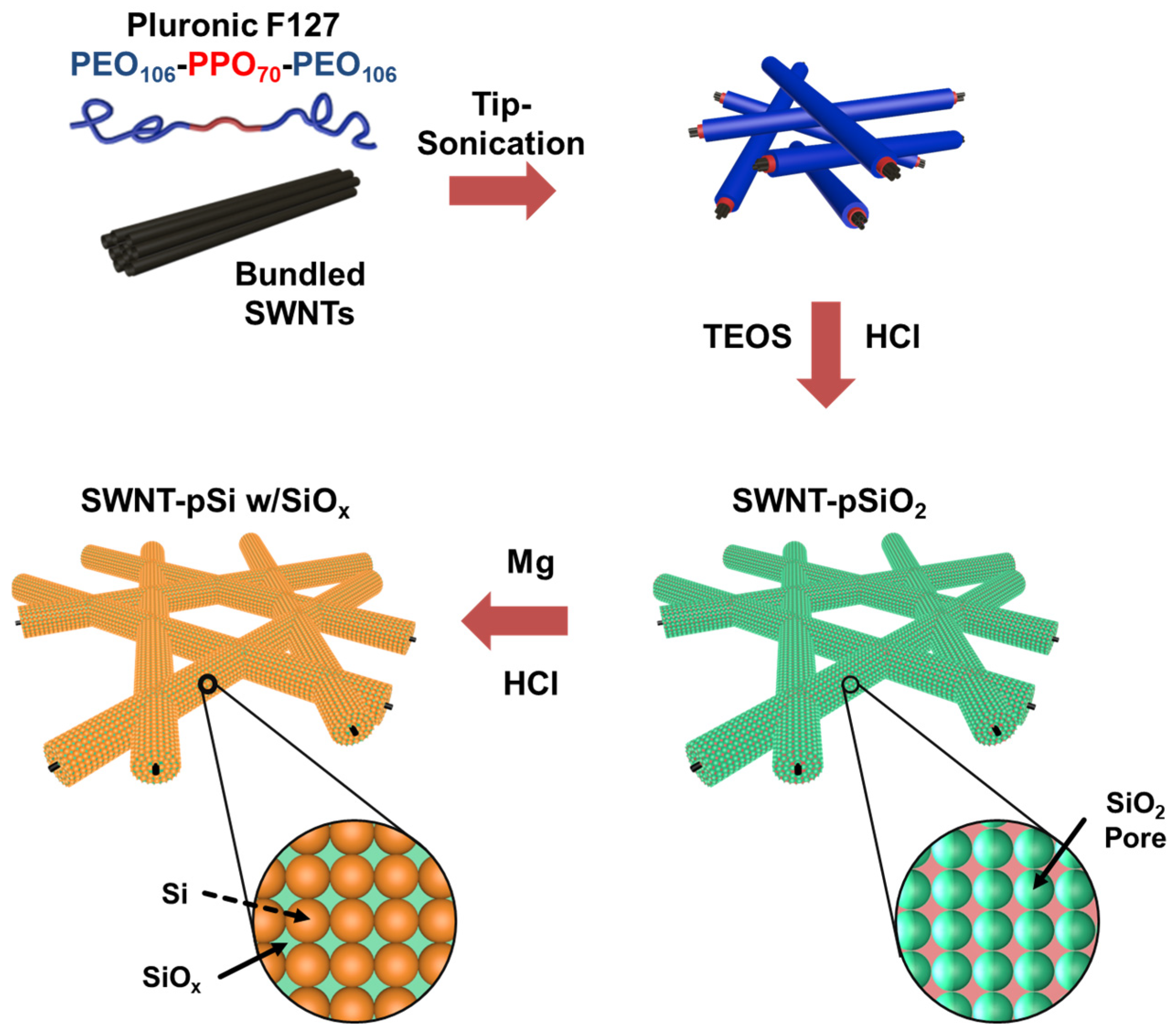
The synthesis procedure is illustrated in Figure 1. SWNTs were first dispersed in an aqueous Pluronic F127 (PEO100-PPO70-PEO100) solution via tip-sonication. In this process, the hydrophobic PPO block of F127 adsorbs onto the SWNT surface through hydrophobic interactions, while the hydrophilic PEO blocks extend into the aqueous phase, enabling stable dispersion of small SWNT bundles [40,41]. UV-vis-NIR spectroscopy confirmed that SWNTs in the SWNT-F127 solution were dispersed in a small-bundle state, as evidenced by the van Hove transition peaks characteristic of individualized or lightly bundled SWNTs (Figure S1) [40]. The concentrations of SWNTs and F127 in the dispersion were 0.07 wt% and 5 wt%, respectively.
Ordered mesoporous SiO2 was subsequently deposited around the SWNT-F127 bundles via an acid-catalyzed sol–gel process using tetraethyl orthosilicate (TEOS) as the silica precursor. Under acidic conditions (8 M HCl), the PEO blocks of F127 interact with protonated silicate species through a double-layer hydrogen bonding mechanism (S0H+XI+ pathway), directing the cooperative self-assembly of F127 spherical micelles and silicate oligomers around the SWNT bundles [36,37,38]. This process yields a cylindrical core–shell architecture in which SWNT bundles occupy the core and an ordered mesoporous SiO2 network constitutes the shell. The as-prepared SWNT-porous SiO2 was calcined at 550 °C to remove residual block copolymer, yielding a clean mesoporous silica shell.
Magnesiothermic reduction was then performed at 750 °C under Ar atmosphere (SiO2:Mg molar ratio = 1:2) to partially convert the SiO2 shell to Si nanocrystallites: SiO2(s) + 2Mg(g) → Si(s) + 2MgO(s). The reaction was deliberately carried out under conditions that favor partial, rather than complete, reduction, preserving a significant fraction of amorphous SiO2 as a structural buffer phase within the shell. MgO byproduct was subsequently removed by HCl etching, and a thin carbon layer was deposited by chemical vapor deposition (CVD) using acetylene to improve the electronic conductivity of the final electrode material.
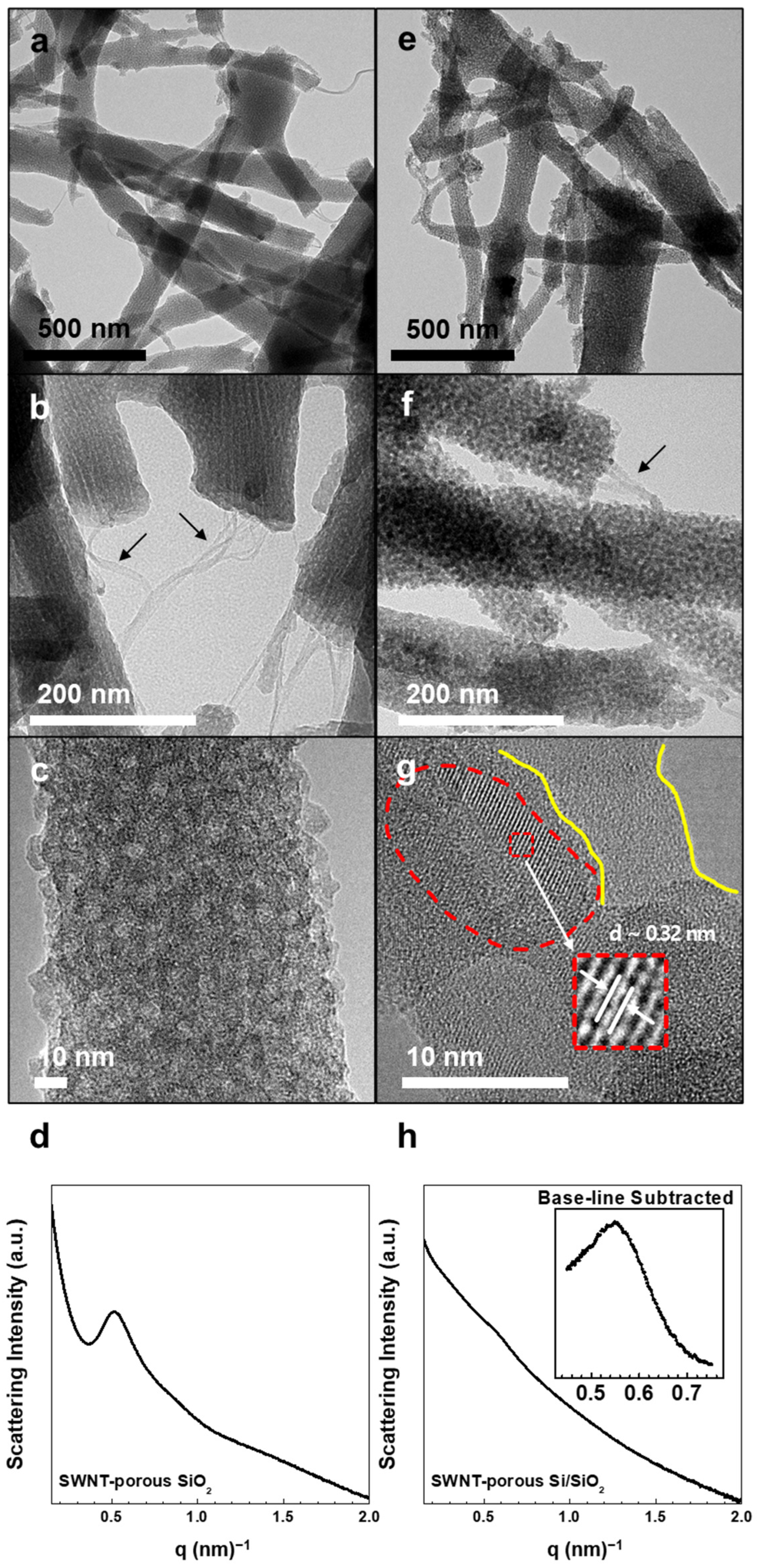
Transmission electron microscopy (TEM) confirmed the core–shell cylindrical morphology of the SWNT-porous SiO2 intermediate (Figure 2a–c). The shell thickness was 80–120 nm, and SWNTs were clearly visible within the core (arrows in Figure 2b). High-magnification imaging revealed a uniform mesoporous structure with a pore diameter of approximately 4–5 nm (Figure 2c), consistent with the PPO block diameter of F127 micelles at 5 wt% in aqueous solution. Small-angle X-ray scattering (SAXS) confirmed the ordered mesoporous structure, exhibiting a correlation peak at q = 0.52 nm−1, corresponding to a pore-to-pore distance (d_(p-p)) of 12 nm (Figure 2d).
After magnesiothermic reduction and MgO etching, the cylindrical core–shell morphology was well maintained, with shell thickness remaining in the 80–120 nm range (Figure 2e–g). High-magnification TEM images revealed Si nanocrystallites of approximately 10 nm (red dashed circles, Figure 2g) embedded within a residual amorphous SiO2 matrix (yellow solid line), confirming successful partial reduction. Direct measurement of the lattice fringes in Figure 2g yields an interplanar spacing of approximately 0.32 nm, consistent with the d-spacing of the Si (111) plane (JCPDS no. 27-1402), in agreement with the XRD analysis (Figure 3a). SAXS analysis of the SWNT-porous Si/SiO2 product showed a peak at q = 0.55 nm−1 (d_(p-p) = 11.4 nm), close to that of the precursor, but with substantially reduced peak intensity (Figure 2h). This reduction in peak intensity indicates partial loss of long-range pore ordering upon conversion of SiO2 to Si nanocrystallites, while the persistence of the correlation peak confirms that the mesoporous architecture is largely retained.
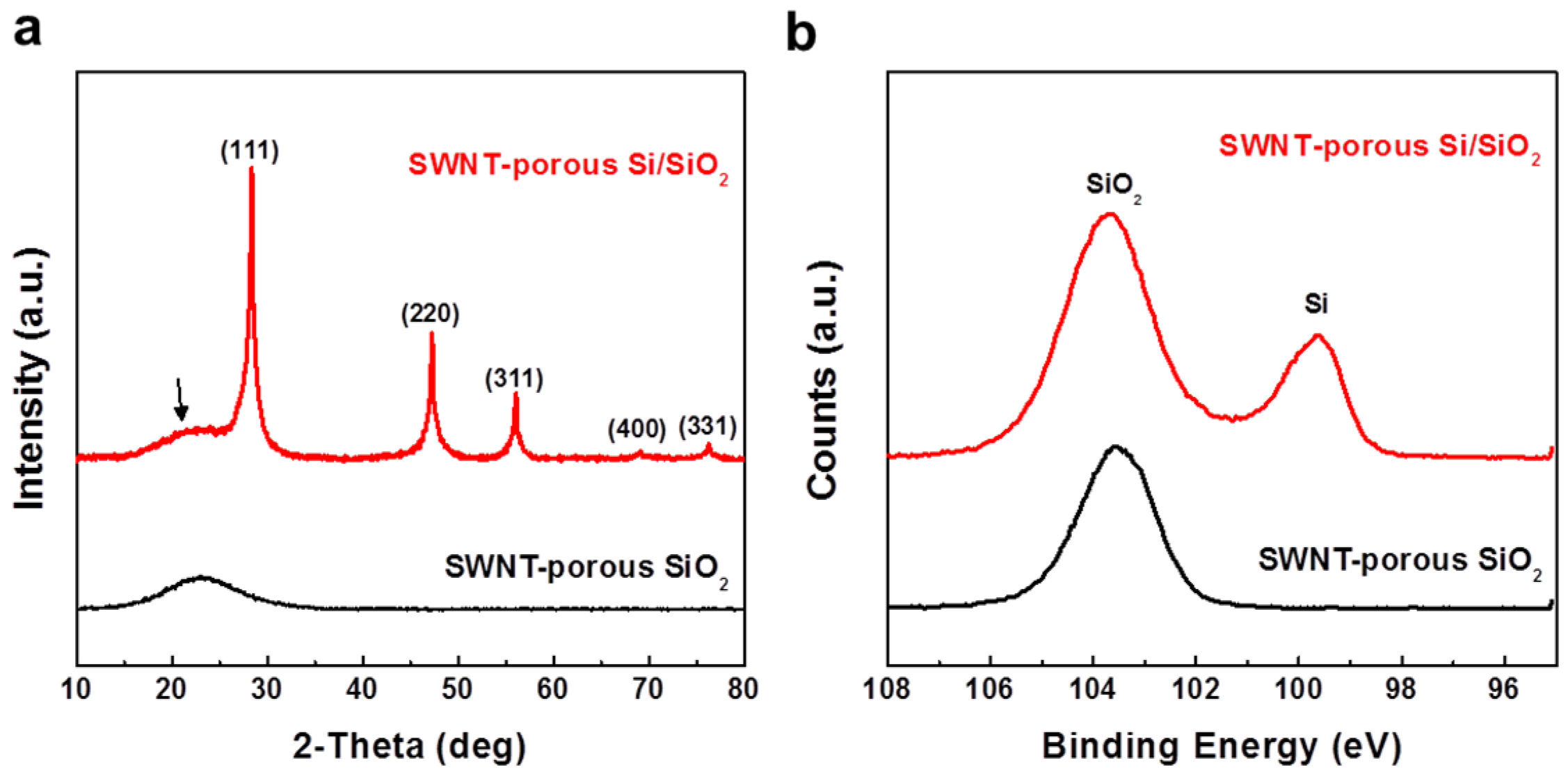
X-ray diffraction (XRD) confirmed the phase composition of the materials (Figure 3a). SWNT-porous SiO2 exhibited a single broad diffraction peak at 2θ ≈ 22.5°, characteristic of amorphous SiO2. The SWNT-porous Si/SiO2 product displayed sharp diffraction peaks corresponding to crystalline Si, indexed to the (111), (220), (311), (400), and (331) planes, superimposed on the broad amorphous SiO2 background, confirming the coexistence of crystalline Si nanoparticles and residual amorphous SiO2. The average Si crystallite size estimated from the Scherrer equation applied to the (220) peak was approximately 10 nm, consistent with TEM observations.
X-ray photoelectron spectroscopy (XPS) of the Si 2p region provided quantitative information on the Si/SiO2 composition (Figure 3b). The SWNT-porous SiO2 precursor exhibited a single peak at 103.5 eV, corresponding exclusively to Si4+ in SiO2. After magnesiothermic reduction, the Si 2p spectrum of SWNT-porous Si/SiO2 showed two peaks: one at 99.5 eV assigned to elemental Si0 (14.3 wt%) and one at 103.5 eV assigned to residual SiO2 (85.7 wt%). The predominance of unreacted SiO2 (85.7 wt%) reflects the intentionally partial nature of the magnesiothermic reduction, which was designed to preserve the SiO2 matrix as a mechanical buffer phase while generating a controlled quantity of electrochemically active Si nanocrystallites.
The overall mass composition of the SWNT-porous Si/SiO2 hybrid was further quantified by combining thermogravimetric analysis (TGA) of the SWNT-porous SiO2 precursor with the XPS-derived Si:SiO2 ratio. TGA of the precursor indicated a SWNT mass fraction of approximately 4.7 wt% (Figure S3), and since magnesiothermic reduction selectively converts SiO2 without affecting the SWNT framework, the absolute mass of SWNT is preserved through the reduction step. The final SWNT-porous Si/SiO2 hybrid is estimated to consist of approximately 5 wt% SWNT, 14 wt% crystalline Si nanocrystallites, and 81 wt% residual amorphous SiO2.
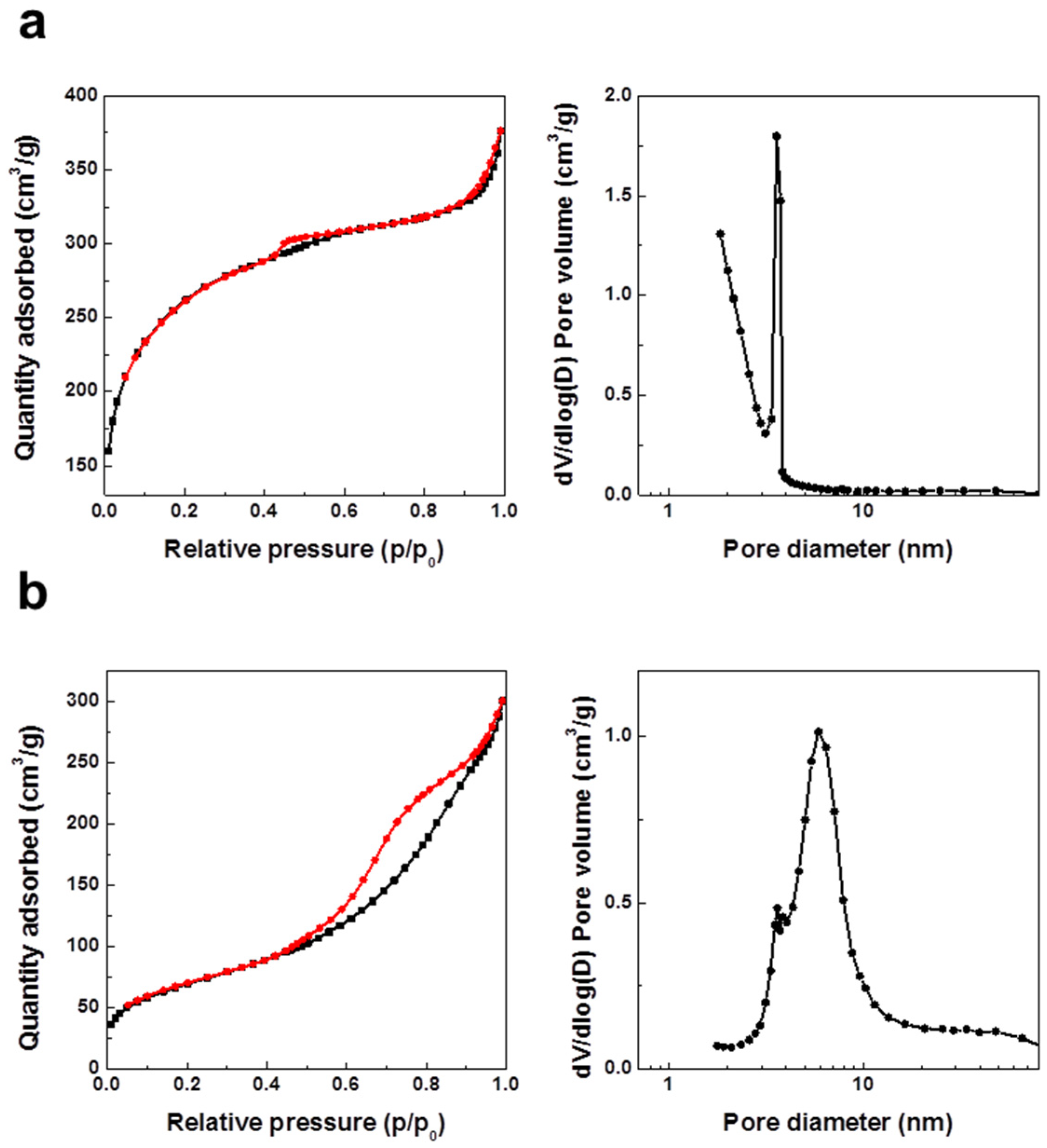
Nitrogen adsorption–desorption analysis further characterized the porous structure before and after reduction (Figure 4). SWNT-porous SiO2 exhibited a Type IV isotherm with a distinct hysteresis loop, a BET specific surface area of 978 m2/g, and a BJH pore size distribution centered at 4 nm (Figure 4a). This pore diameter is in close agreement with the 4~5 nm mesopore size directly observed by high-magnification TEM (Figure 2c), and is consistent with the known PPO block diameter of F127 micelles at 5 wt% in aqueous solution. The quantitative agreement between TEM and BET pore size measurements confirms that the mesopore channels in SWNT-porous SiO2 are predominantly templated by the PPO cores of F127 micelles assembled around the SWNT bundles, rather than arising from interparticle voids or other secondary porosity. In addition to the dominant mesopore population, a significant micropore contribution was observed, attributed to void spaces between SiO2 walls that form upon calcination and removal of the PEO corona of F127.
After magnesiothermic reduction, the BET surface area decreased to 253 m2/g, and the dominant pore size shifted from 4 to 6 nm (Figure 4b). The reduction in surface area is consistent with the conversion of the low-density amorphous SiO2 matrix to denser crystalline Si nanocrystallites, which partially infill the mesopore walls. The pore size increase from 4 to 6 nm is explained by the same process: as Si nanocrystallites (~10 nm, confirmed by both TEM and the Scherrer equation applied to XRD data) nucleate and grow within the SiO2 walls, they locally reorganize the pore wall structure, enlarging the effective pore diameter while preserving the overall cylindrical mesopore connectivity. The disappearance of micropores after reduction further supports this mechanism, as the microporous interwall voids collapse when the surrounding SiO2 is consumed by the magnesiothermic reaction. Importantly, the Type IV character of the isotherm and the BJH peak at 6 nm confirm that the ordered mesoporous architecture established by the SWNT template is substantially retained through the reduction step, ensuring that the electrochemically active Si nanocrystallites remain accessible to electrolyte throughout the porous shell.
Electrochemical performance of the SWNT-porous Si/SiO2 material was evaluated in coin-type half-cells using carbon-coated SWNT-porous Si/SiO2 as the working electrode and lithium metal as the counter/reference electrode. Carbon coating was applied by CVD to improve the intrinsic electronic conductivity of the Si/SiO2 composite.
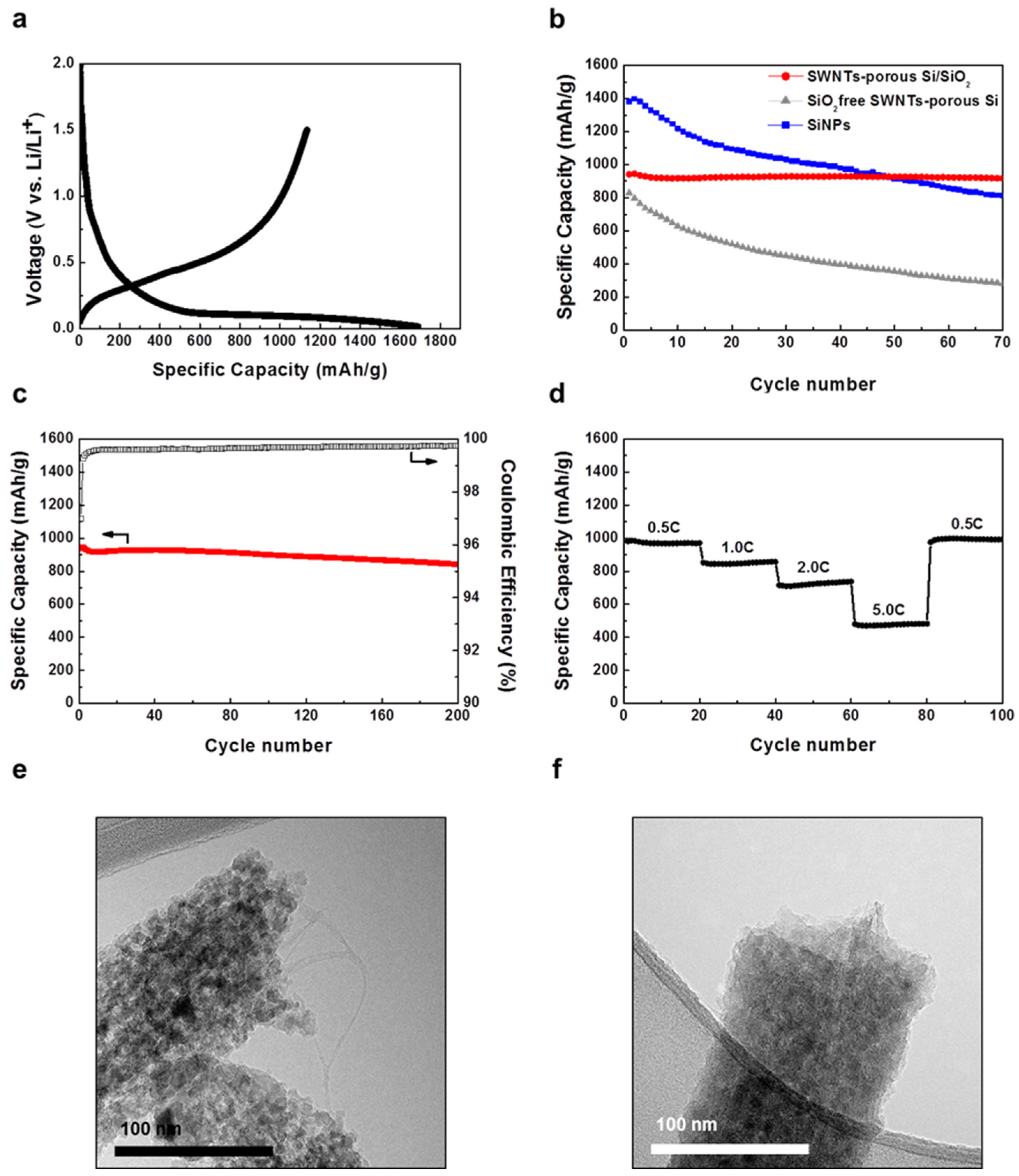
The galvanostatic voltage profile for the first cycle at 100 mA/g showed a characteristic Si lithiation plateau, with a reversible (delithiation) capacity of 1133 mAh/g (0.68 mAh/cm2) and an initial Coulombic efficiency (ICE) of 67% (Figure 5a). The relatively low ICE is primarily attributed to two factors: the large fraction of electrochemically inactive SiO2 (85.7 wt%), which contributes to irreversible capacity in the first cycle through side reactions with Li, and the formation of the SEI layer on the high-surface-area mesoporous electrode. The relatively low active Si content (14.3 wt%) also accounts for the modest reversible capacity compared to the theoretical maximum of pure Si.
The electrochemical mechanism of the carbon-coated SWNT-porous Si/SiO2 hybrid was further verified by cyclic voltammetry (Figure S5). The first-cycle CV profile, measured at 0.05 mV/s in the potential range of 0.01–2.6 V vs. Li/Li+, exhibits a distinct anodic peak at approximately 0.5 V, corresponding to the delithiation of LixSi alloy phases, and a cathodic response below 0.2 V attributable to the lithiation of Si nanocrystallites. These voltammetric features are characteristic of crystalline Si-based electrodes and corroborate the presence of Si nanocrystallites identified through XRD (Figure 4a) and HR-TEM (Figure 2g) analyses, confirming that the partial magnesiothermic reduction successfully produces electrochemically active crystalline Si within the porous SiO2 matrix.
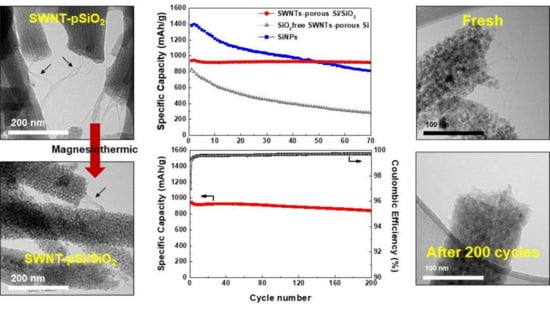
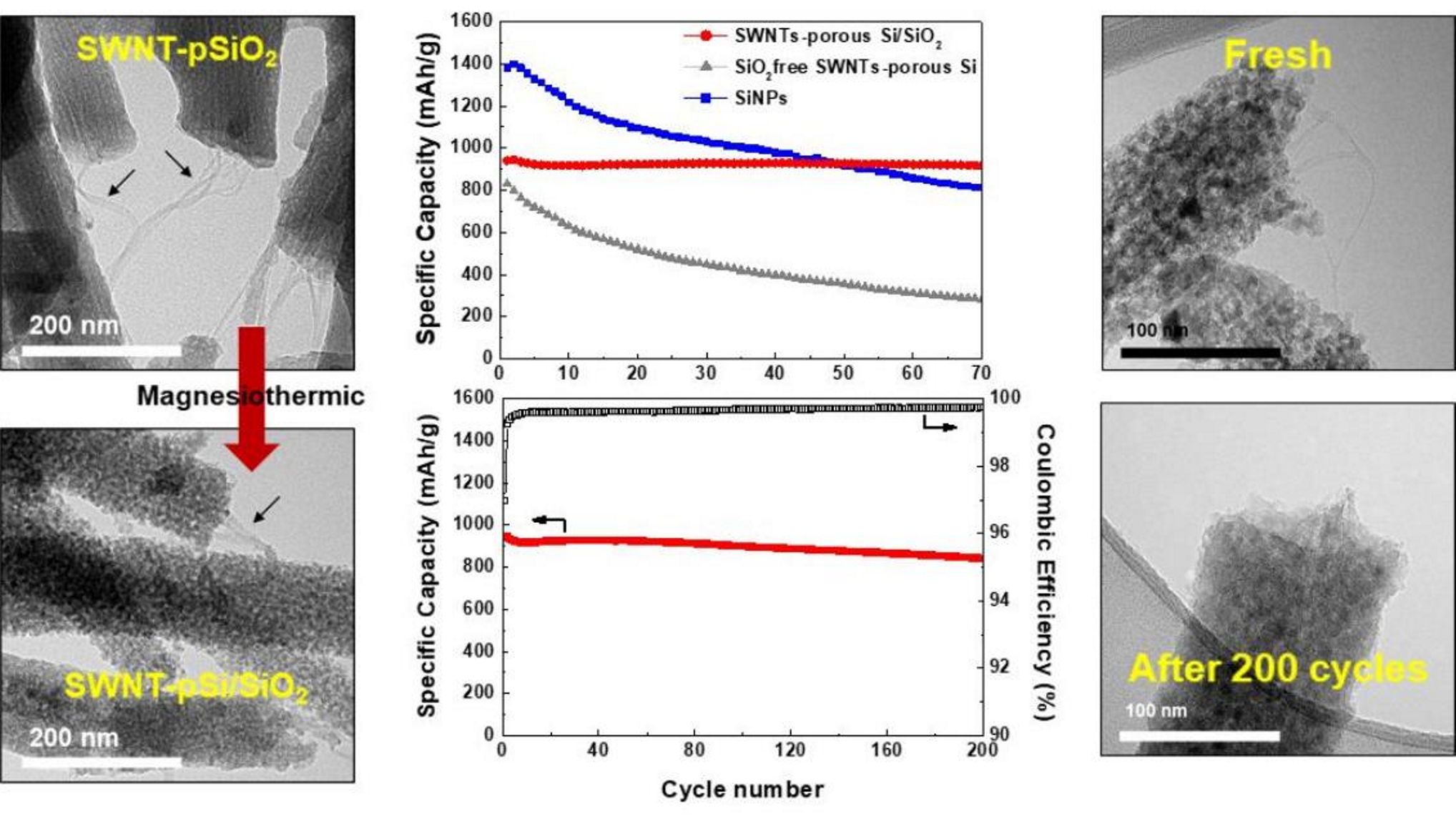
Cycling performance was evaluated by comparing SWNT-porous Si/SiO2 against two control materials: SiO2-free SWNT-porous Si (fully reduced counterpart) and bare Si nanoparticles (SiNPs) (Figure 5b). After 70 cycles at 1 C, SWNT-porous Si/SiO2 retained 97% of its initial capacity, while SiNPs and SiO2-free SWNT-porous Si retained only 59% and 34%, respectively. The markedly inferior performance of the fully reduced SiO2-free SWNT-porous Si compared to the partially reduced SWNT-porous Si/SiO2 directly demonstrates the critical role of the residual SiO2 buffer phase in preserving electrode integrity during cycling. Without SiO2, the unconstrained volumetric expansion of Si leads to rapid structural degradation despite the presence of the SWNT-templated porous architecture.
Upon extended cycling, the carbon-coated SWNT-porous Si/SiO2 electrode retained 90% of its initial capacity after 200 cycles at 1 C, with a stable Coulombic efficiency of 99.7% (Figure 5c). Rate capability was evaluated by varying the discharge rate from 0.5 C to 5 C (Figure 5d). Even at 5 C, a tenfold increase over 0.5 C, the electrode delivered a capacity of 482 mAh/g, substantially exceeding the theoretical capacity of graphite (~372 mAh/g). Full capacity recovery was observed upon returning to lower C-rates after 100 cycles of variable-rate testing, confirming the structural robustness of the electrode under demanding conditions. The favorable rate performance is ascribed to the mesoporous architecture, which reduces effective Li+ diffusion lengths and maintains open electrolyte access throughout the electrode.
Post-cycling TEM images confirmed that the cylindrical porous morphology and shell thickness were well preserved after 200 cycles (Figure 5e,f). Cross-sectional SEM analysis of the full electrode (Figure S7) revealed an expansion of only ~2 μm (from 43 to 45 μm) after 200 cycles at 1 C, demonstrating the electrode-level structural stability enabled by the SWNT-templated Si/SiO2 architecture.
The superior cycling stability of SWNT-porous Si/SiO2 relative to both SiNPs and SiO2-free SWNT-porous Si (Figure 5b) isolates two key structural contributions that merit discussion. The first is the role of the SWNT-templated three-dimensional porous network itself. Unlike particle-based Si composites, in which Si active material and buffer components are mixed at the microscale with inherently discontinuous contact, the SWNT-templated cylindrical architecture enforces nanoscale co-organization of all functional components along a continuous 3D scaffold.
This geometry ensures that every region of the Si/SiO2 shell is spatially connected to the surrounding pore network, providing unobstructed and uniform electrolyte access throughout the electrode volume. The interconnected pore channels simultaneously serve as expansion reservoirs that locally accommodate the volumetric strain of each Si nanocrystallite during lithiation, preventing the strain from accumulating into macroscopic crack propagation. This is structurally distinct from simple porous Si particles, where porosity may be distributed heterogeneously or may collapse upon repeated cycling. The continuous cylindrical network geometry, directed by the SWNT template, therefore provides a more robust and geometrically uniform framework for strain management than conventional particle-based architectures.
The second critical contribution is the deliberate preservation of residual amorphous SiO2 through controlled partial magnesiothermic reduction. The direct comparison between SWNT-porous Si/SiO2 (90% capacity retention after 200 cycles) and SiO2-free SWNT-porous Si (34% retention after 70 cycles), two materials sharing the same SWNT-templated porous architecture but differing only in SiO2 content, provides unambiguous experimental evidence that the residual SiO2 matrix is the decisive factor in long-term cycling stability. This result demonstrates that the porous network geometry alone, without the SiO2 buffer, is insufficient to prevent electrode degradation under the full stress of Si lithiation.
The mechanism by which residual SiO2 stabilizes the electrode operates on two complementary levels. At the nanoscale, the amorphous SiO2 matrix physically encapsulates and constrains individual Si nanocrystallites (~10 nm), providing a rigid mechanical shell that limits the absolute displacement of each particle during expansion. Because SiO2 does not undergo significant lithiation under the cycling conditions used here (0.015–1.5 V vs. Li/Li+), it maintains its structural integrity throughout cycling and continuously exerts a constraining force on the expanding Si. At the electrode level, this nanoscale constraint collectively suppresses the macroscopic volume change of the composite electrode, as confirmed by the cross-sectional SEM data showing only ~2 μm of total electrode expansion after 200 cycles. This electrode-level dimensional stability prevents delamination from the Cu current collector and maintains the integrity of the conductive network established by Super P and the CVD carbon coating.
Taken together, these results establish that the performance of the SWNT-porous Si/SiO2 system arises from the rational combination of two independently validated design principles: the SWNT-directed 3D porous architecture for geometric strain management and electrolyte accessibility, and the intentionally preserved SiO2 buffer for nanoscale mechanical constraint of Si nanocrystallites. Neither principle alone produces the observed level of stability; their co-organization within a single nanoarchitecture is what enables both the 90% capacity retention and the minimal electrode swelling demonstrated here.
A quantitative comparison with representative CNT-assisted Si and SiOx composite anodes is provided in Table S2. As shown in that comparison, many recent CNT-based systems improve cycling stability through conductive CNT frameworks or dual-carbon reinforcement strategies, often together with graphene, carbon coatings, or SiOx containing buffering phases, and often at higher active-material fractions or under more practically relevant loading conditions. In this context, the present SWNT-templated porous Si/SiO2 system should be interpreted primarily as a structure-validation study: its main contribution is to demonstrate that the combination of an SWNT-directed porous cylindrical network and a preserved SiO2 buffer can effectively minimize electrode-level swelling while sustaining long-term cycling stability.


4. Conclusions

An SWNT-templated porous Si/SiO2 core–shell cylindrical hybrid anode material for long-cycling lithium-ion batteries with stable electrode integrity was successfully synthesized via a combination of Pluronic F127 block copolymer-directed sol–gel assembly and controlled magnesiothermic reduction. In this architecture, SWNT bundles serve as a three-dimensional structural template that directs the formation of a continuously interconnected cylindrical mesoporous network, providing the geometric framework for the active Si/SiO2 composite shell. Partial magnesiothermic reduction deliberately preserves residual amorphous SiO2 (85.7 wt%) within the shell as a mechanically inactive buffer phase, which constrains Si volumetric expansion and stabilizes the electrode structure during repeated lithiation–delithiation cycling. The synergistic combination of the SWNT-templated 3D porous architecture, the residual SiO2 buffer, and the CVD carbon coating yields outstanding electrochemical performance: 90% capacity retention over 200 cycles at 1 C with 99.7% Coulombic efficiency, a rate capability of 482 mAh/g at 5 C, and minimal electrode-level swelling of ~2 μm after extended cycling. The direct comparison with a SiO2-free fully reduced counterpart unambiguously establishes the critical role of the preserved SiO2 buffer in achieving long-term cycling stability. These results demonstrate that rational control of the magnesiothermic reduction extent, using the SiO2-to-Mg ratio and reaction conditions to tune the Si/SiO2 balance, is a powerful and scalable design strategy for Si-based anode materials. The facile synthesis route and the design principles established here provide a transferable framework for the development of next-generation high-energy-density LIB anodes.
Supplementary Materials

The following supporting information can be downloaded at: https://www.mdpi.com/article/10.3390/batteries12060220/s1, Figure S1: UV-vis-NIR spectra of bundled SWNTs as-purchased and dispersed SWNTs in aqueous solution by Pluronic F127; Figure S2: TEM images and SAED patterns of SWNT-porous SiO2 and SWNT-porous Si/SiO2 with different SiO2:Mg molar ratios; Figure S3: Thermogravimetric analysis (TGA) curve of the SWNT-porous SiO2; Figure S4: High-resolution TEM image of the carbon-coated SWNT-porous Si/SiO2 hybrid material; Figure S5: First-cycle cyclic voltammogram (CV) of the carbon-coated SWNT-porous Si/SiO2 hybrid electrode; Figure S6: Normalized capacity retention rate; Table S1: calculated values for each electrode material; Table S2: Comparison of representative CNT-assisted Si composite anodes reported in the recent literature and the present work; Figure S7: Cross-sectional SEM images of SWNT-pSi w/SiO2 on Cu-foil before and after 200 cycles.

Author Contributions

J.-K.L. conceived of and designed the experiments. J.-K.L. and S.K. performed the experiments. J.-K.L. and S.K. analyzed the data. J.-K.L. and S.K. prepared the samples. J.-K.L. and S.K. wrote the paper. All authors have read and agreed to the published version of the manuscript.

Funding

This research received no external funding.

Data Availability Statement

The original contributions presented in this study are included in the article/Supplementary Materials. Further inquiries can be directed to the corresponding author.

Acknowledgments

The authors thank the Pohang Accelerator Laboratory (PAL) for providing access to beamline 4C for SAXS measurements.

Conflicts of Interest

Jun-Ki Lee is employed by Invest Seoul. The other author declares no conflicts of interest.

References

  1. Tarascon, J.-M.; Armand, M. Issues and challenges facing rechargeable lithium batteries. Nature 2001, 414, 359–367. [Google Scholar] [CrossRef] [PubMed]
  2. Goodenough, J.B.; Park, K.-S. The Li-ion rechargeable battery: A perspective. J. Am. Chem. Soc. 2013, 135, 1167–1176. [Google Scholar] [CrossRef] [PubMed]
  3. Boukamp, B.A.; Lesh, G.C.; Huggins, R.A. All-solid lithium electrodes with mixed-conductor matrix. J. Electrochem. Soc. 1981, 128, 725–729. [Google Scholar] [CrossRef]
  4. Obrovac, M.N.; Christensen, L. Structural changes in lithium insertion electrodes. Electrochem. Solid-State Lett. 2004, 7, A93–A96. [Google Scholar] [CrossRef]
  5. Naseer, M.N.; Serrano-Sevillano, J.; Fehse, M. Silicon anodes in lithium-ion batteries: A deep dive into research trends and global collaborations. J. Energy Storage 2025, 106, 114733. [Google Scholar]
  6. Toki, G.F.I.; Hossain, M.K.; Rehman, W.U.; Manjunath, R.S.; Mohammed, S.Z.; Darwish, M.A. Recent progress and challenges in silicon-based anode materials for lithium-ion batteries. Ind. Chem. Mater. 2024, 2, 226–269. [Google Scholar] [CrossRef]
  7. Zhang, Z.; Wu, Y.; Mo, Z.; Lei, X.; Xie, X.; Xue, X.; Qin, H.; Jiang, H. Research progress of silicon-based anode materials for lithium-ion batteries. RSC Adv. 2025, 15, 10731–10753. [Google Scholar] [CrossRef] [PubMed]
  8. Beaulieu, L.Y.; Eberman, K.W.; Turner, R.L.; Krause, L.J.; Dahn, J.R. Colossal reversible volume changes in lithium alloys. Electrochem. Solid-State Lett. 2001, 4, A137–A140. [Google Scholar] [CrossRef]
  9. Peled, E. The electrochemical behavior of alkali and alkaline earth metals in nonaqueous battery systems. J. Electrochem. Soc. 1979, 126, 2047–2051. [Google Scholar] [CrossRef]
  10. Chan, C.K.; Peng, H.; Liu, G.; McIlwrath, K.; Zhang, X.F.; Huggins, R.A.; Cui, Y. High-performance lithium battery anodes using silicon nanowires. Nat. Nanotechnol. 2008, 3, 31–35. [Google Scholar] [PubMed]
  11. Zhang, Z.; Wang, Y.; Ning, Y.; Li, X.; Guo, J.; Wang, X.; Wang, L.; Wu, C.; Pan, J.H. Engineering nanostructure, interface, and prelithiation of advanced silicon-based lithium-ion battery anodes. Energy Mater. Adv. 2024, 5, 0175. [Google Scholar]
  12. Park, M.-H.; Kim, M.G.; Joo, J.; Kim, K.; Kim, J.; Ahn, S.; Cui, Y.; Cho, J. Silicon nanotube battery anodes. Nano Lett. 2009, 9, 3844–3847. [Google Scholar] [CrossRef] [PubMed]
  13. Kim, H.; Han, B.; Choo, J.; Cho, J. Three-dimensional porous silicon particles for use in high-performance lithium secondary batteries. Angew. Chem. Int. Ed. 2008, 47, 10151–10154. [Google Scholar] [CrossRef] [PubMed]
  14. Liu, N.; Wu, H.; McDowell, M.T.; Yao, Y.; Wang, C.; Cui, Y. A yolk-shell design for stabilized and scalable Li-ion battery alloy anodes. Nano Lett. 2012, 12, 3315–3321. [Google Scholar] [CrossRef] [PubMed]
  15. Cui, L.-F.; Ruffo, R.; Chan, C.K.; Peng, H.; Cui, Y. Crystalline-amorphous core-shell silicon nanowires for high capacity and high current battery electrodes. Nano Lett. 2009, 9, 491–495. [Google Scholar] [CrossRef] [PubMed]
  16. Zhou, X.; Yin, Y.-X.; Wan, L.-J.; Guo, Y.-G. Self-assembled nanocomposite of silicon nanoparticles encapsulated in graphene through electrostatic attraction for lithium-ion batteries. Adv. Energy Mater. 2012, 2, 1086–1090. [Google Scholar] [CrossRef]
  17. Guan, X.; Zhang, Y.; Kinloch, I.A.; Bissett, M.A. “Nanoskeleton” Si–SiOx/C anodes toward highly stable lithium-ion batteries. ACS Appl. Mater. Interfaces 2025, 17, 10580–10592. [Google Scholar] [CrossRef] [PubMed]
  18. Kim, Y.; Kim, M.; Kim, N.; Cha, H.; Kim, S.; Sung, J.; Cho, J. Unraveling the impact of CNT on electrode expansion in silicon-based lithium-ion batteries. Energy Storage Mater. 2025, 74, 103983. [Google Scholar] [CrossRef]
  19. Nguyen, T.; Su, Y.-S. A self-assembled carbon nanotube–silicon composite battery anode stabilized with chemically reduced graphene oxide sheets. Mater. Des. 2024, 240, 112861. [Google Scholar] [CrossRef]
  20. Dong, H.; Hou, J.; Ma, Y.; Xin, J.; Wei, M.; Li, S. Dual carbon-network armored silicon anode: Graphene-CNT reinforced pomegranate architecture enabling long-cycle lithium-ion battery. J. Energy Storage 2025, 132, 117726. [Google Scholar] [CrossRef]
  21. Nguyen, T.; Yang, C.-M.; Su, Y.-S. NiO/Ni-catalyzed silicon nanowires embedded in a 3D composite anode to improve cyclability in Li-ion batteries. J. Alloys Compd. 2025, 1022, 179886. [Google Scholar] [CrossRef]
  22. Hao, Y.; Yang, X.; Gao, Y.; Saleem, M.H.; Li, J.; Wu, C.; Liu, G. High-toughness design of micron-sized silicon/carbon composite as practical anode for lithium-ion batteries. Chem. Eng. J. 2025, 515, 163258. [Google Scholar] [CrossRef]
  23. Szczech, J.R.; Jin, S. Nanostructured silicon for high capacity lithium battery anodes. Energy Environ. Sci. 2011, 4, 56–72. [Google Scholar] [CrossRef]
  24. Favors, Z.; Wang, W.; Bay, H.H.; Mutlu, Z.; Ahmed, K.; Liu, C.; Ozkan, M.; Ozkan, C.S. Scalable synthesis of nano-silicon from beach sand for long cycle life Li-ion batteries. Sci. Rep. 2014, 4, 5623. [Google Scholar] [CrossRef] [PubMed]
  25. Entwistle, J.; Rennie, A.; Patwardhan, S. A review of magnesiothermic reduction of silica to porous silicon for lithium-ion battery applications and beyond. J. Mater. Chem. A 2018, 6, 18344–18356. [Google Scholar] [CrossRef]
  26. Bao, Z.; Weatherspoon, M.R.; Shian, S.; Cai, Y.; Graham, P.D.; Allan, S.M.; Ahmad, G.; Dickerson, M.B.; Church, B.C.; Kang, Z.; et al. Chemical reduction of three-dimensional silica micro-assemblies into microporous silicon replicas. Nature 2007, 446, 172–175. [Google Scholar] [CrossRef] [PubMed]
  27. Richman, E.K.; Kang, C.B.; Brezesinski, T.; Tolbert, S.H. Ordered mesoporous silicon through magnesium reduction of polymer templated silica thin films. Nano Lett. 2008, 8, 3075–3079. [Google Scholar] [CrossRef] [PubMed]
  28. Zeng, W.; Li, B.; Qin, J.; Liang, Q.; Zhang, F.; Liu, S.; Li, B.; Kang, F. A combination of hierarchical pore and buffering layer construction for ultrastable nanocluster Si/SiOx anode. Nano Res. 2020, 13, 2104–2112. [Google Scholar] [CrossRef]
  29. Kapadnis, R.S.; Bhujbal, P.K.; Suryawanshi, S.R.; Pathan, H.M.; Sapkal, R.T. Development of porous silicon (Si) anode through magnesiothermic reduction of mesoporous silica (SiO2) aerogel for all-solid-state lithium-ion batteries. Gels 2025, 11, 304. [Google Scholar] [CrossRef] [PubMed]
  30. Osmanpour, M.; Poen, D.; Ruiz, M.; Tariq, K.; Kalisvaart, P. Stable, scalable micron-sized porous silicon for high energy density Li-ion batteries. Batter. Supercaps 2025, 8, e202500500. [Google Scholar] [CrossRef]
  31. Dresselhaus, M.S.; Dresselhaus, G.; Saito, R.; Jorio, A. Raman spectroscopy of carbon nanotubes. Phys. Rep. 2005, 409, 47–99. [Google Scholar] [CrossRef]
  32. Yu, M.-F.; Files, B.S.; Arepalli, S.; Ruoff, R.S. Tensile loading of ropes of single wall carbon nanotubes and their mechanical properties. Phys. Rev. Lett. 2000, 84, 5552–5555. [Google Scholar] [CrossRef] [PubMed]
  33. Vigolo, B.; Pénicaud, A.; Coulon, C.; Sauder, C.; Pailler, R.; Journet, C.; Bernier, P.; Poulin, P. Macroscopic fibers and ribbons of oriented carbon nanotubes. Science 2000, 290, 1331–1334. [Google Scholar] [CrossRef] [PubMed]
  34. Correa-Duarte, M.A.; Wagner, N.; Rojas-Chapana, J.; Morsczeck, C.; Thie, M.; Giersig, M. Fabrication and biocompatibility of carbon nanotube-based 3D networks as scaffolds for cell seeding and growth. Nano Lett. 2004, 4, 2233–2236. [Google Scholar] [CrossRef]
  35. Wang, Y.; Wang, Y.; Xu, K.; Chen, L.; Zhang, Y.; Chen, X.; Chen, Y.; Yu, J.; Wang, Y. Enhancing lithium-ion batteries with a 3D conductive network silicon–carbon nanotube composite anode. ACS Appl. Mater. Interfaces 2024, 16, 67791–67802. [Google Scholar] [CrossRef] [PubMed]
  36. Zhao, D.; Feng, J.; Huo, Q.; Melosh, N.; Fredrickson, G.H.; Chmelka, B.F.; Stucky, G.D. Triblock copolymer syntheses of mesoporous silica with periodic 50 to 300 angstrom pores. Science 1998, 279, 548–552. [Google Scholar] [CrossRef] [PubMed]
  37. Melosh, N.A.; Lipic, P.; Bates, F.S.; Wudl, F.; Stucky, G.D.; Fredrickson, G.H.; Chmelka, B.F. Molecular and mesoscopic structures of transparent block copolymer–silica monoliths. Macromolecules 1999, 32, 4332–4342. [Google Scholar] [CrossRef]
  38. Kerkhofs, S.; Willhammar, T.; Van Den Noortgate, H.; Kirschhock, C.E.A.; Breynaert, E.; Van Tendeloo, G.; Bals, S.; Martens, J.A. Self-assembly of Pluronic F127–silica spherical core–shell nanoparticles in cubic close-packed structures. Chem. Mater. 2015, 27, 5666–5675. [Google Scholar] [CrossRef] [PubMed]
  39. Kimizuka, O.; Tanaike, O.; Yamashita, J.; Hiraoka, T.; Futaba, D.N.; Hata, K.; Machida, K.; Suematsu, S.; Tamamitsu, K.; Saeki, S.; et al. Electrochemical doping of pure single-walled carbon nanotubes used as supercapacitor electrodes. Carbon 2008, 46, 1999–2001. [Google Scholar] [CrossRef]
  40. Moore, V.C.; Strano, M.S.; Haroz, E.H.; Hauge, R.H.; Smalley, R.E.; Schmidt, J.; Talmon, Y. Individually suspended single-walled carbon nanotubes in various surfactants. Nano Lett. 2003, 3, 1379–1382. [Google Scholar] [CrossRef]
  41. Nativ-Roth, E.; Shvartzman-Cohen, R.; Bounioux, C.; Florent, M.; Zhang, D.; Szleifer, I.; Yerushalmi-Rozen, R. Physical adsorption of block copolymers to SWNT and MWNT: A nonwrapping mechanism. Macromolecules 2007, 40, 3676–3685. [Google Scholar] [CrossRef]
Figure 1. Schematic illustration of the synthesis process.
Batteries 12 00220 g001
Figure 2. Transmission electron microscopy (TEM) images and small-angle X-ray scattering (SAXS) patterns of (ad) SWNT-porous SiO2, and (eh) SWNT-porous Si/SiO2 core–shell cylindrical structure. (a) Overall morphology of materials. (b) SWNTs are included in porous SiO2 shells (arrow indicates SWNT). (c) High magnification image of porous-SiO2 shell, which shows pore structure. (d) SAXS pattern of SWNT-porous SiO2 with peak at 0.52 nm−1 q-value. (e) Overall morphology of materials. (f) SWNTs are maintained, and components of shells are changed to Si after Mg reduction (arrow indicates SWNT). (g) High-magnification image of porous Si/SiO2 shell (red dashed circles and yellow solid line indicate Si nanoparticles embedded in amorphous SiO2). Lattice fringes with an interplanar spacing of 0.32 nm correspond to the Si (111) plane. (h) SAXS pattern of SWNT-porous Si/SiO2 with peak at 0.55 nm−1 q-value (inset: baseline subtracted to find more accurate q-value).
Batteries 12 00220 g002
Figure 3. XRD patterns (a) of the SWNT-porous SiO2, and SWNT-porous Si/SiO2. The major lattice orientations of SWNT-porous Si/SiO2 denoted with JCPDS #27-1402. The arrow indicates amorphous SiO2 originated from SWNT-porous SiO2. Si2p XPS spectra (b) of SWNT-porous SiO2, and SWNT-porous Si/SiO2.
Batteries 12 00220 g003
Figure 4. Nitrogen adsorption and desorption isotherms and pore size distributions of (a) SWNT-porous SiO2, and (b) SWNT-porous Si/SiO2. Red lines denote the adsorption branch and black lines denote the desorption branch of the N2 isotherms.
Batteries 12 00220 g004
Figure 5. (a) Voltage profiles in the first cycle measured at 100 mA/g of the carbon-coated SWNT-porous Si/SiO2 electrode. (b) Discharge capacities of SWNT-porous Si/SiO2, SiO2-free SWNT-porous Si, and bare SiNPs over cycling. (c) Discharge capacities and CEs of carbon-coated SWNT-porous Si/SiO2, cycles between 0.015 and 1.5 V vs. Li/Li+. The red curve (left y-axis) shows the specific capacity, and the black curve (right y-axis) shows the Coulombic efficiency. In (b,c), both charge and discharge were measured at a rate of 1 C. (d) Discharge capacities of carbon-coated SWNT-porous Si/SiO2 at various discharge rates from 0.5 C to 5 C. TEM images of SWNT-porous Si/SiO2 (e) before and (f) after 200 cycles.
Batteries 12 00220 g005
Disclaimer/Publisher’s Note: The statements, opinions and data contained in all publications are solely those of the individual author(s) and contributor(s) and not of MDPI and/or the editor(s). MDPI and/or the editor(s) disclaim responsibility for any injury to people or property resulting from any ideas, methods, instructions or products referred to in the content.