Perspective

Beyond Conventional Systems: How Solid-State Batteries Empower Energy Storage and Microgrid Development in Extraterrestrial Extreme Environments


1
State Grid Heilongjiang Electric Power Co., Ltd., Electric Power Research Institute, Harbin 150001, China
2
MOE Engineering Research Center for Electrochemical Energy Storage and Carbon Neutrality in Cold Regions, School of Chemistry and Chemical Engineering, Harbin Institute of Technology, Harbin 150001, China
*
Authors to whom correspondence should be addressed.
Batteries 2026, 12(5), 173; https://doi.org/10.3390/batteries12050173 (registering DOI)
Submission received: 20 April 2026 / Revised: 3 May 2026 / Accepted: 9 May 2026 / Published: 16 May 2026

Abstract

The burgeoning commercial space sector demands next-generation energy systems that offer ultra-high specific energy, wide operational temperature ranges, intrinsic safety, and vacuum compatibility. These requirements severely challenge conventional lithium-ion batteries due to issues like electrolyte leakage and thermal instability. This perspective examines solid-state batteries (SSBs) as a potential solution, leveraging their inherent leak-proof design, superior thermal tolerance, and robust solid electrolytes. We suggest that SSBs could become a key technology for applications such as lunar surface operations, deep-space probes, and high-speed vehicles. By addressing certain limitations of current power sources, SSB technology may help shape the energy architecture for future space exploration and commercialization.

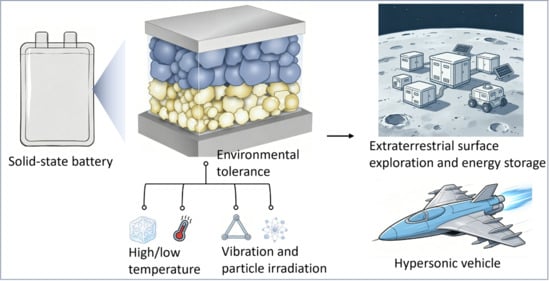
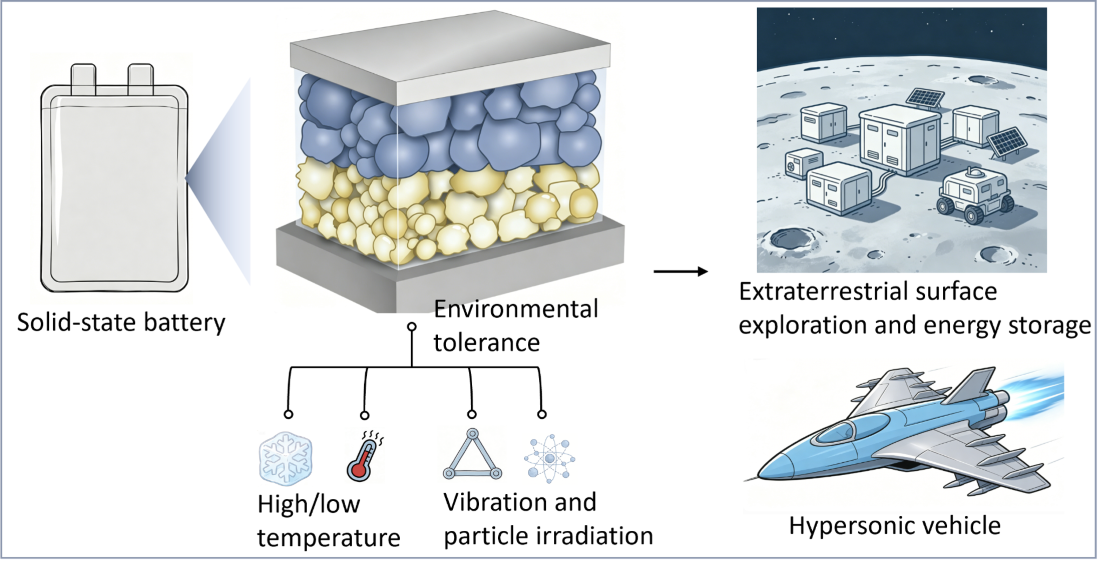
Graphical Abstract

1. Introduction

The dawn of the space age, encompassing ventures from low-earth orbit constellations to lunar exploration and deep-space missions, imposes unprecedented demands on onboard energy systems. These applications operate in environments characterized by extreme conditions, including high vacuum (approximately 10−5 to 10−6 Pa), intense temperature fluctuations from −200 °C to over 130 °C, and high-energy particle radiation [1,2]. Consequently, the required energy storage solutions must simultaneously achieve ultra-high specific energy, a wide operational temperature range, absolute safety, and intrinsic vacuum compatibility. Currently, lithium-ion (Li-ion) batteries, with a typical specific energy of up to 250 Wh kg−1, dominate aerospace power systems [3,4]. However, their liquid organic electrolytes present fundamental limitations: a constrained operational window commonly −20 °C to 60 °C risks of leakage and outgassing in vacuum, and a high flammability that poses severe thermal runaway hazards [5,6]. These shortcomings necessitate complex, heavy, and power-consuming thermal management and containment systems, directly counteracting the imperative for mass and volume efficiency in spacecraft design.
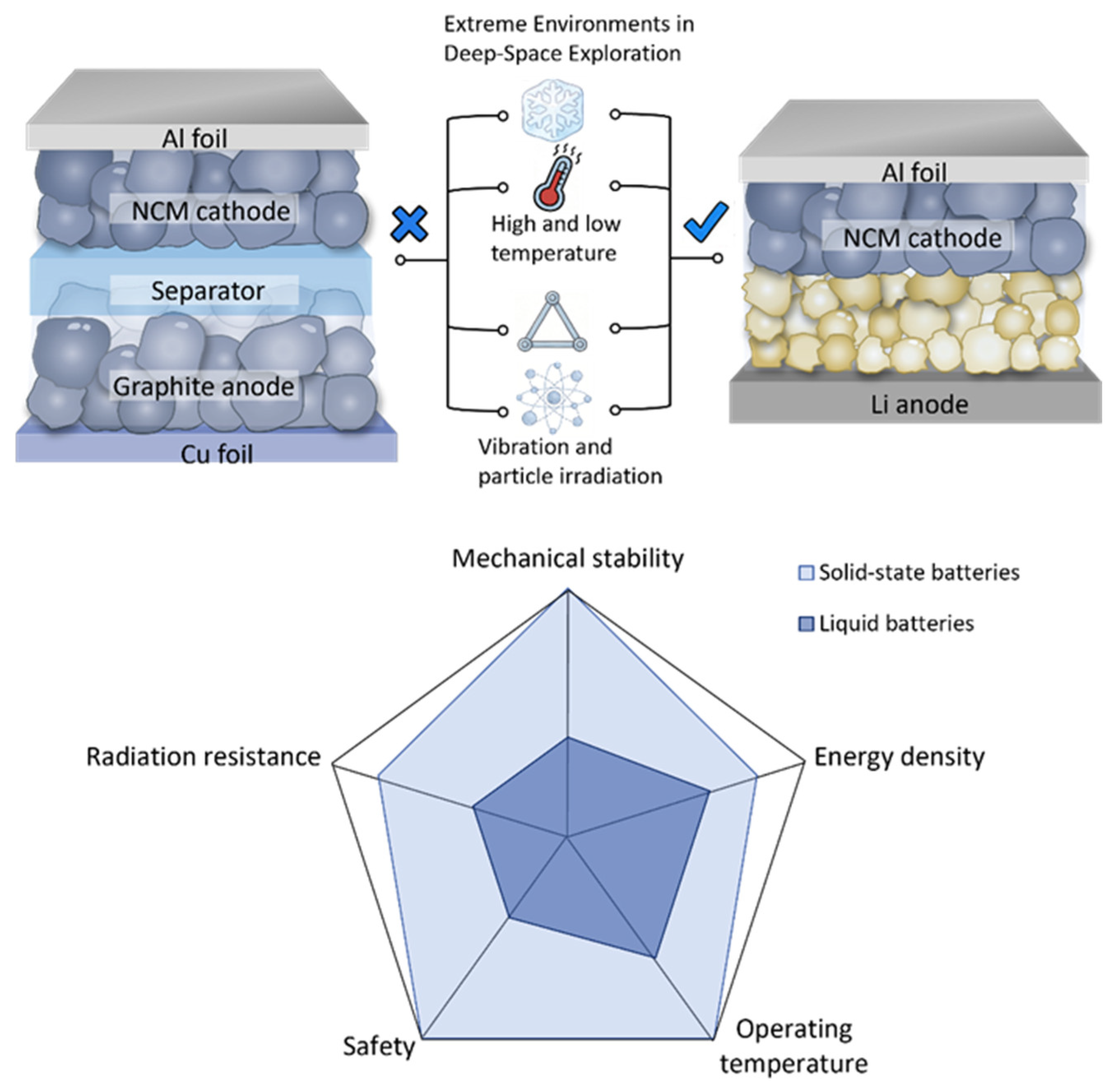
Solid-state batteries (SSBs), which replace liquid electrolytes with solid ion conductors, emerge as a transformative technological pathway to overcome these barriers. Their inherent leak-proof nature and the absence of volatile organic solvents directly address the safety and vacuum compatibility challenges. Research initiatives like SABERS project of NASA have demonstrated prototype SSBs with target specific energies exceeding 500 Wh·kg−1 and operational temperatures up to 150 °C, effectively doubling key performance metrics compared to state-of-the-art Li-ion cells [7,8,9]. Recent industrial progress underscores this potential, with companies (Gotion) announcing prototype cells offering specific energies of 350–400 Wh·kg−1 and exceptional functionality across a −40 °C to 100 °C temperature range [10,11]. Critically, their solid architecture enhances safety, as evidenced by cells passing stringent nail penetration tests without thermal runaway (as described in Figure 1).
This perspective argues that solid-state batteries are not merely an incremental improvement but a critical enabling technology poised to unlock a new chapter in commercial space exploration. By providing a combination of high energy density, inherent safety, and extreme environmental tolerance, SSBs can fundamentally reshape power system design for next-generation platforms. This includes enabling long-duration lunar and deep-space missions, powering high-performance electric propulsion aircraft for intra-planetary travel, and forming the backbone of resilient, decentralized microgrids on extraterrestrial surfaces. The following sections will elaborate on the application-driven requirements, analyze the material and design innovations in SSBs that meet these needs, and discuss the pathway toward their integration into future space infrastructure.

2. Future Needs and Prospects

2.1. Deep Space and Extraterrestrial Bases: A Case Study of Lunar Bases

Establishing a sustainable lunar base, a core objective of the Artemis program and international deep-space exploration, presents unprecedented challenges for energy storage. The lunar environment is defined by extremes. Beyond the familiar challenge of extreme cold (as low as −223 °C in permanent shadow), the high-temperature demand is equally critical. Surface temperatures in sunlit regions can exceed 127 °C (≈260 °F) [12,13]. While managing extreme temperatures can be addressed through thermal management systems (at a significant mass and power cost), mitigating extreme heat is far more demanding. Conventional Li-ion batteries have a narrow operational window, typically between −20 °C and 60 °C [14]. Exceeding this range, especially towards high temperatures, drastically accelerates degradation and poses severe thermal runaway risks, necessitating complex, heavy, and power-consuming active cooling systems that are a severe penalty for mass-constrained spacecraft. This is compounded by high vacuum, which can cause liquid electrolyte evaporation and cell swelling, and by constant cosmic radiation, which degrades materials over time.
Solid-state batteries (SSBs) are uniquely positioned to overcome this multi-faceted challenge through their intrinsic material properties. A key demonstration comes from the Japan Aerospace Exploration Agency (JAXA). In 2022, JAXA and Hitachi Zosen conducted the first successful charge–discharge experiment of an all-solid-state lithium-ion battery on the International Space Station (ISS) [9]. The battery, measuring 65 × 52 × 2.7 mm and weighing 25 g, operates stably from −40 °C to 120 °C. Its solid electrolyte is non-flammable, eliminates leakage concerns, and its minimized volatile components prevent significant swelling in a vacuum. This directly addresses the vacuum compatibility and safety issues that plague liquid electrolytes.
Regarding long-term cosmic radiation exposure, emerging evidence suggests that SSBs exhibit distinct advantages over conventional liquid electrolyte systems. The absence of volatile organic solvents eliminates radiation-induced gas evolution and electrolyte decomposition, a common failure mode in Li-ion batteries under prolonged space missions. Recent in-orbit validation by Galactic Energy (February 2026) demonstrated that a 380 Wh kg−1 SSB module successfully completed 72 h of continuous operation on a commercial satellite, enduring high vacuum, large thermal cycling, and space radiation with no measurable capacity decay or performance anomaly. Furthermore, comparative Geant4 simulations revealed that neutron irradiation results in higher non-ionizing energy loss than gamma rays in SSB materials, with the solid electrolyte LLZTO exhibiting a pronounced directional leakage current under gamma-ray exposure, a phenomenon that could potentially alter electrode/electrolyte interfaces [15]. A separate Geant4 study confirmed that LATP-type solid electrolytes hold good resistance to irradiation at absorbed doses of 1 and 2 MGy with negligible performance degradation. While multi-year behavior under galactic cosmic ray doses remains an active area of investigation, the existing body of evidence indicates that SSBs are inherently more radiation tolerant than their liquid-filled counterparts.
Development programs of NASA provide a clear path for integrating such technology into lunar infrastructure. The “Watts on the Moon” challenge, concluded in September 2024, specifically sought breakthrough power transmission and storage technologies capable of withstanding the lunar environment’s extreme cold and low pressure, highlighting the agency’s focused effort on survivable energy solutions [16]. More directly relevant to high-temperature performance is SABERS (Solid-state Architecture Batteries for Enhanced Rechargeability and Safety) project. This research aims to develop a fully solid-state battery with an operational temperature up to 150 °C and a specific energy target exceeding 400 Wh kg−1. This combination of high temperature tolerance and high energy density is precisely what is needed for lunar surface power.
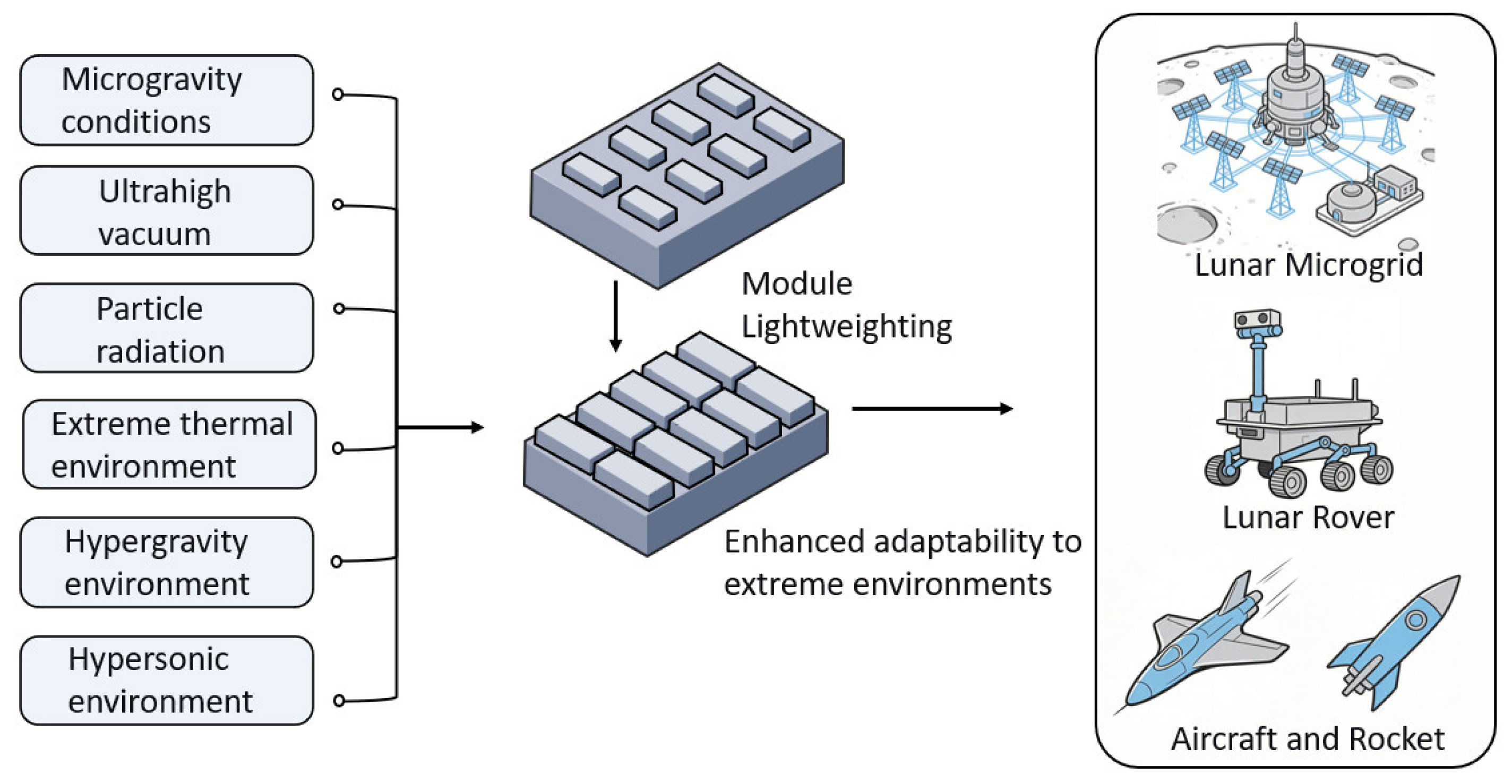
The application prospects for SSBs in lunar exploration are transformative (as described in Figure 2). For rovers and mobile platforms (e.g., the planned PRIME-1 payload), wide temperature tolerance of SSBs allows operations across sunlit and shadowed regions without prohibitive thermal management overhead. Their inherent safety and leak-proof design reduce system mass. For a permanent lunar base, SSBs are the ideal candidate for modular, distributed energy storage nodes. They can be embedded within habitat modules, scientific stations (like the planned Artemis IV Lunar Seismic Package), or construction robots, providing compact, reliable backup power during the 14-day lunar night or in localized high-temperature zones. By enabling resilient, decentralized microgrids that minimize single-point failures, SSB technology is not just an incremental improvement but a critical enabler for the long-duration, human-tended operations envisioned under the Artemis program and beyond [17].

2.2. New-Generation Aircraft: eVTOL and Hypersonic Platforms

Transitioning from the extreme environmental challenges of space to the dynamic regimes within Earth atmosphere, solid-state batteries (SSBs) confront a distinct and equally demanding frontier: next-generation aircraft. This domain, encompassing electric vertical take-off and landing (eVTOL) vehicles and hypersonic platforms, is defined by a critical and non-negotiable dual mandate: achieving a stringent “energy density lifeline” while guaranteeing aviation-grade intrinsic safety under severe mechanical and thermal stress.
The commercial feasibility of eVTOLs hinges directly on surpassing a specific energy threshold. Regulatory frameworks, such as the DO-311A standard, outline ambitious targets including a pack-level energy density of at least 350 Wh kg−1, over 1000 life cycles, and the ability to pass a 10 min thermal propagation test [18]. Conventional lithium-ion batteries, typically capped at around 250 Wh kg−1 at the cell level, strain against this limit [19]. More critically, their liquid electrolytes pose a fundamental safety risk under the intense vibrations, high-G maneuvers, and potential impact scenarios inherent to flight. Liquid sloshing or internal short circuits under such dynamic loads can precipitate catastrophic failure. In contrast, the solid electrolyte in an SSB provides inherent mechanical integrity [20,21]. This immobile, non-flowable structure eliminates sloshing, resists deformation, and maintains stable internal interfaces during vibration and shock, a core safety advantage validated by SABERS project batteries which withstood extreme abuse testing without thermal runaway.
Concrete technical progress underscores this potential. SABERS project of NASA has reported prototype sulfur-selenium solid-state cells achieving remarkable energy densities of 500 Wh·kg−1. This performance is transitioning from lab to flight. For instance, EH216-S eVTOL of EHang has demonstrated a nearly 50 min flight using an advanced battery boasting 480 Wh·kg−1, directly translating to a 60–90% increase in endurance over previous configurations [22]. This leap in specific energy is pivotal for viable payload and range.
The synergy of high energy density and inherent mechanical stability unlocks transformative systemic benefits, chiefly through radical weight reduction and design simplification. First, the elimination of volatile liquid electrolytes allows for the removal or dramatic downsizing of heavy active liquid cooling systems, which can constitute 12–18% of a battery pack mass [23,24]. Second, the solid-state form factor enables more compact and robust cell-to-pack integration. Innovations like the modular “honeycomb stacking” architecture pursued by NASA have demonstrated up to a 40% reduction in structural battery weight. This mass saving creates a virtuous cycle; for example, integrating such SSBs into an aircraft like Archer Aviation’s Midnight could reduce powertrain volume by an estimated 35%, potentially increasing payload capacity from 500 kg to 850 kg and enabling cabin reconfigurations.
For hypersonic aircraft, where mass efficiency is paramount and aerodynamic heating imposes extreme thermal loads, these advantages are critical. The capability of SSBs to operate reliably at elevated temperatures (with research targets extending to 150 °C) and withstand intense vibration without the risk of electrolyte leakage provides a fundamental safety and performance enabler. The weight saved from simplified thermal management directly translates into extended range or enhanced mission capability.
In summary, for new-generation aircraft, SSBs are not just an alternative power source but a foundational technology that simultaneously solves the dual, often contradictory, mandates of high energy and absolute safety under dynamic flight conditions. Their intrinsic stability under mechanical stress unlocks a virtuous cycle of weight savings, design efficiency, and enhanced operational capability, paving the way for a new era of electric and high-speed aviation.

2.3. Structural Power: Solid-State Batteries as the Satellite Bus

A transformative application of solid-state battery (SSB) technology in space lies beyond its role as a mere energy storage device. Its potential is fully realized in the concept of structural power systems, where the battery itself becomes a multi-functional component of the satellite’s primary structure: its bus or panels. This paradigm shift addresses the fundamental constraint of mass and volume efficiency in spacecraft design.
The key enabler is the intrinsic mechanical robustness of solid-state electrolytes. Unlike liquid or gel electrolytes, advanced solid electrolytes (e.g., sulfide-based ceramics or reinforced polymers) can exhibit high tensile strength and modulus. This allows the SSB cell to bear mechanical loads. In a structural battery design, the battery’s electrodes and solid electrolyte are integrated into composite materials, such as carbon fiber laminates, creating a panel that is both an energy store and a load-bearing element: a “massless” battery. This integration can directly replace conventional structural panels and the separate battery pack they house, leading to significant system-level mass savings and volume compaction [25]. For instance, the battery housing is eliminated, and internal spacecraft layout is simplified, freeing critical space for additional payload or instrumentation.
This structural power unit operates in perfect synergy with other onboard energy generation and management systems [26]. It forms the core of an optimized, multi-source power architecture. Solar panels can be directly mounted onto or interconnected with these structural battery panels, with the solid-state system safely and efficiently storing excess energy during sunlit orbits. Its wide operational temperature tolerance reduces the complexity of thermal management for the entire power subsystem. For missions relying on Radioisotope Thermoelectric Generators (RTGs) or future fission power, the structural SSB acts as an exceptionally reliable buffer for peak power demands and a stable backup during source dormancy or eclipses. Its leak-proof nature ensures absolute safety in proximity to delicate power conditioning and distribution electronics.
In conclusion, by evolving from a packaged component to a structural element, solid-state batteries offer a path toward radical satellite miniaturization and capability enhancement (as described in Table 1). This integration creates a more resilient, compact, and mass-efficient spacecraft bus, directly enabling next-generation small satellite constellations, high-agility mission platforms, and extended deep-space probes where every gram and cubic centimeter is paramount. Nevertheless, this concept is still in its infancy; significant challenges in co-optimizing mechanical and electrochemical properties, along with manufacturing scalability, must be overcome before any practical spaceflight application can be realized.
Table 1. Projected Performance Targets of Solid-State Batteries for Key Aerospace Applications.
Application DomainSpecific Energy (Wh kg−1)Operating Temperature (°C)Key Benefits Enabled by SSBs
Lunar/Deep-Space Missions>400 (target)−80 to 150Leak-proof, vacuum compatible, wide thermal tolerance, radiation resilient
eVTOL/Hypersonic Aircraft350–500 (demonstrated)−40 to 100High energy density, intrinsic safety, mechanical robustness, simplified thermal management
Satellite Structural Power300–400 (concept)−60 to 80Load-bearing multifunction, mass and volume saving, enhanced system integration

3. Current Limitations and Unresolved Challenges for Aerospace SSBs

Despite their promising advantages, several critical challenges must be addressed before solid-state batteries can be reliably deployed in deep-space and commercial aerospace applications.
First, solid–solid interfacial instability remains a fundamental hurdle. As reviewed by Xu and his research group, NASICON-type solid electrolytes suffer from severe interfacial failure and dendrite penetration [27]. Under the extreme thermal cycling of lunar surfaces (from −223 °C to over 127 °C), mismatched thermal expansion between electrolyte and electrode accelerates void formation and crack propagation. Vacuum and mechanical vibration further exacerbate contact loss, making local current hotspots and dendrite nucleation far more likely than in terrestrial applications [28]. Second, low-temperature performance is insufficient for missions targeting permanently shadowed lunar craters. Most solid electrolytes exhibit a sharp drop in ionic conductivity below −40 °C, far above the −200 °C encountered in such environments. Third, long-term space qualification data are scarce. While short-duration in-orbit validations exist, multi-year reliability under galactic cosmic radiation and micro-meteoroid impacts remains unproven.
Addressing these limitations requires concerted efforts in materials design, interfacial engineering, and extended flight demonstrations.

4. Conclusions

Solid-state battery technology represents a foundational breakthrough for commercial aerospace, uniquely meeting the extreme demands of both deep-space and next-generation aviation applications. For missions to the Moon and beyond, these batteries offer inherent resistance to extreme temperature swings, vacuum, and radiation, enabling reliable power where traditional systems would fail. For advanced aircraft like eVTOLs, they deliver the essential combination of high energy density and intrinsic mechanical safety under dynamic flight conditions, which leads to significant system-wide weight reduction and new design possibilities.
To fully realize this potential, focused efforts are needed. Key research must advance solid electrolytes that operate across wider temperature ranges, develop packaging that survives long-term space exposure, and create scalable manufacturing. In parallel, establishing industry-specific standards, supportive policies, and strong partnerships between research institutions and aerospace companies is crucial to accelerate testing and integration.
Ultimately, mature solid-state batteries will serve as the critical power backbone for a new era of commercial space activity. They will enable persistent lunar outposts, high-performance electric flight, and more ambitious deep-space exploration, making space operations safer, more efficient, and routine.

Author Contributions

Conceptualization, Y.W. and H.A.; methodology, D.P.; software, P.Z.; validation, J.L. and S.Y.; formal analysis, Y.W.; investigation, D.P.; resources, H.A.; data curation, Y.W.; writing—original draft preparation, Y.W.; writing—review and editing, J.W.; visualization, P.Z.; supervision, H.A.; project administration, J.W.; funding acquisition, H.A. All authors have read and agreed to the published version of the manuscript.

Funding

This study is funded by the project “Research and Application of Key Technologies for Solid-State Electrochemical Energy Storage in Cold Regions of Remote Forest Areas” (522437240011) from State Grid Heilongjiang Electric Power Co., Ltd. The authors would like to thank IONEX Solid Energy Tech., Ltd. for financial assistance, which helped cover the article processing charges (APC) of this paper.

Data Availability Statement

Data sharing is not applicable to this article as no new data were created or analyzed in this study.

Conflicts of Interest

Authors Yue Wang, Peng Zhang and Jianquan Liang were employed by the company State Grid Heilongjiang Electric Power Co., Ltd. The remaining authors declare that the research was conducted in the absence of any commercial or financial relationships that could be construed as a potential conflict of interest. The authors declare that this study received funding from State Grid Heilongjiang Electric Power Co., Ltd. The funder was not involved in the study design, collection, analysis, interpretation of data, the writing of this article or the decision to submit it for publication.

References

  1. Ma, L.; Li, N.; Zhou, S.; Zhang, X.; Xie, K. Lithium Battery-Powered Extreme Environments Exploring: Principle, Progress, and Perspective. Adv. Energy Mater. 2024, 14, 2401157. [Google Scholar] [CrossRef]
  2. Vasudeva, K.; Emami, M.R.; Dickinson, C. Lunar construction: A state-of-the-art survey. Prog. Aerosp. Sci. 2026, 161, 101159. [Google Scholar] [CrossRef]
  3. A Ravi, A.; Prasad, A.E.; Weston, N.R.; Liu, Z.; Mavris, D.N. Life Cycle Assessment and Risk Analysis of Lithium for Battery Systems in Aerospace Applications. In AIAA SCITECH 2024 Forum; AIAA: Reston, VI, USA, 2024. [Google Scholar]
  4. Du, H.; Zhang, X.; Yu, H. Design of high-energy-density lithium batteries: Liquid to all solid state. eTransportation 2025, 23, 100382. [Google Scholar] [CrossRef]
  5. Zhou, X.; Yang, C.; Hu, W.; Han, J.; You, Y. Assessment of Thermal Safety for Organic Electrolytes: From Material to Cell Level. ACS Energy Lett. 2025, 10, 3143–3150. [Google Scholar] [CrossRef]
  6. Shang, Y.; Huang, Y.; Li, L.; Wu, F.; Chen, R. Electrochemical Energy Storage toward Extreme Conditions: Driving Human Exploration beyond Current Boundaries. Chem. Rev. 2025, 125, 5674–5744. [Google Scholar] [CrossRef]
  7. Guo, D.; Shi, Z.; El-Demellawi, J.K.; Wahyudi, W.; Arsalan, M.; Zhang, H.; Alshareef, H.N. Lithium Metal Batteries for High Temperature Environments. Adv. Energy Mater. 2025, 15, e02943. [Google Scholar] [CrossRef]
  8. Raman, A.S.; Johnson, B.R.; Jhulki, S.; Chandra, V.; Leisen, J.; Avis, M.; Dong, S.; Butcher, R.; Narla, A.; Lee, H.; et al. Solid-State Lithium Batteries with In Situ Polymerized Acrylate-Based Electrolytes Capable of Electrochemically Stable Operation at 100 °C. ACS Appl. Mater. Interfaces 2024, 16, 58506–58519. [Google Scholar] [CrossRef]
  9. Viggiano, R.; Dornbusch, D.; Lin, Y.; Yamakov, V. Solid-State Architecture Batteries for Enhanced Rechargeability and Safety (SABERS) Beyond Li-Ion: Technology to Enable Next-Generation Sustainable Electric Aircraft [Technical Report]; NASA: Washington, DC, USA, 2025. [Google Scholar]
  10. Song, Y.; Zhou, Z.; Cui, B.; Sun, X.; Wang, H.; Ji, P.; Liu, Q.; An, H.; Zhao, W.; Deng, B.; et al. High-Temperature Long-Term Cycling Capability of Lithium Batteries Enabled by Releasing Local Constriction. Angew. Chem. Int. Ed. 2025, 64, e202510172. [Google Scholar] [CrossRef]
  11. Li, Y.; Yang, J.; Zhu, K.; Pan, Q. Improving thermal stability and kinetical properties through polymer brushes towards wide-temperature solid-state lithium metal batteries. Compos. Part B Eng. 2025, 297, 112328. [Google Scholar] [CrossRef]
  12. Xiong, G.; Guo, X.; Yuan, S.; Xia, M.; Wang, Z. The mechanical and structural properties of lunar regolith simulant based geopolymer under extreme temperature environment on the moon through experimental and simulation methods. Constr. Build. Mater. 2022, 325, 126679. [Google Scholar] [CrossRef]
  13. Zhang, R.; Zhou, S.; Li, F. Preparation of geopolymer based on lunar regolith simulant at in-situ lunar temperature and its durability under lunar high and cryogenic temperature. Constr. Build. Mater. 2022, 318, 126033. [Google Scholar] [CrossRef]
  14. Marri, G.K.; Ee, Y.J.; He, Z.; Ho, J.Y. Recent advancements in internal and external thermoregulation strategies for lithium-ion batteries. Renew. Sustain. Energy Rev. 2026, 225, 116127. [Google Scholar] [CrossRef]
  15. Lan, R.; Wang, H.; Guo, Q.; Zhao, J.; Du, X.; Sun, J.; Dai, J.; Chen, K. A preliminary assessment of a solid-state lithium-ion battery in radiation environment by Geant4 simulations. J. Appl. Phys. 2024, 136, 215901. [Google Scholar] [CrossRef]
  16. SatNews. NASA’s Watts on the Moon Challenge Concludes with Final Innovations for Lunar Power Solutions; SatNews: Sonoma, CA, USA, 2024. [Google Scholar]
  17. Miyazawa, Y.; Shimada, T.; Fuse, T.; Shimada, S.; Nishiura, S.; Okamoto, H.; Okawa, T.; Hoshino, T.; Kawasaki, O.; Naito, H. Space Demonstration of All-Solid-State Lithium-Ion Batteries Aboard the International Space Station. Aerospace 2025, 12, 514. [Google Scholar] [CrossRef]
  18. RTCA. DO-311A: Minimum Operational Performance Standards for Rechargeable Lithium Batteries and Battery Systems Permanently Installed on Aircraft; RTCA, Inc.: Washington, DC, USA, 2017. [Google Scholar]
  19. Yeganeh, A.; Taghipour, H.; Zolfigol, F.; Akhtari, A.; Mollayousefizadeh, M.; Alizadeh, M.H.; Jérôme, C.; Alvani, A.A.S.; Askarian-abyaneh, H.; Hosseinpour, M.; et al. A comprehensive review on state-of-the-art energy storage methods & materials in microgrids. J. Energy Storage 2026, 141, 119330. [Google Scholar]
  20. Xu, C.; Peng, B.; Yang, W.; Tian, J.; Zhou, H. High energy density lithium battery systems: From key cathode materials to pouch cell design. Chem. Soc. Rev. 2025, 54, 10245–10303. [Google Scholar] [CrossRef]
  21. Shang, R.; Nelson, T.; Nguyen, T.V.; Nelson, C.; Antony, H.; Abaoag, B.; Ozkan, M.; Ozkan, C.S. A comprehensive review of solid-state lithium batteries: Fast Charging characteristics and in-operando diagnostics. Nano Energy 2025, 142, 111232. [Google Scholar] [CrossRef]
  22. Carbon Free Aviation. EHang Shares Production Expansion Plan; Carbon Free Aviation: Miami, FL, USA, 2025. [Google Scholar]
  23. Zhou, Y.; Wei, L.; Guo, X. Polymer-based electrolytes with high mechanical strength for multifunctional structural batteries. EnergyChem 2025, 7, 100154. [Google Scholar] [CrossRef]
  24. Li, Z.; Sang, Y.; Tang, R.; Meng, F.; Lan, X.; Hu, R. Challenges and advances in low-temperature solid-state batteries. Energy Storage Mater. 2025, 75, 104077. [Google Scholar] [CrossRef]
  25. Liu, L.; Li, Y.; Su, T.; Li, C.; Hao, Z.; Yang, G.; Ma, J. Sandwich-Model Cathode Electrolyte Interphase Facilitating All-Climate High-Voltage Nickel-Rich Cathode-Based Lithium Metal Batteries with LiBF4-Based Electrolyte. Adv. Mater. 2025, 37, 2508595. [Google Scholar] [CrossRef]
  26. Costa, C.M.; Salado, M.; Ferrara, C.; Ruffo, R.; Mustarelli, P.; Mao, R.; Feng, S.; Shang, Y.; Wang, X.; Lei, Z.; et al. The wide range of battery systems: From micro- to structural batteries, from biodegradable to high performance batteries. Prog. Mater. Sci. 2025, 154, 101506. [Google Scholar] [CrossRef]
  27. Mei, Y.; Hu, X.; Wang, H.; Huang, Y.; Li, L.; Wu, F.; Chen, R. Structural designs toward performance-balanced multifunctional batteries. Matter 2025, 8, 102469. [Google Scholar] [CrossRef]
  28. Xu, J.; Li, T.; Wang, Y.; Qiao, R.; Qiao, Q.; Chen, Y.; Yu, Z.; Zhi, C.; Shi, C. Decoding NASICON and Its Metal Interface for Solid-State Batteries. Adv. Mater. 2026, 38, e20270. [Google Scholar] [CrossRef]
Figure 1. Key Performance Comparison: Solid-State vs. Conventional Batteries for Deep-Space Applications.
Batteries 12 00173 g001
Figure 2. Solid-State Battery-Powered Blueprint for Future Commercial Space Applications.
Batteries 12 00173 g002
Disclaimer/Publisher’s Note: The statements, opinions and data contained in all publications are solely those of the individual author(s) and contributor(s) and not of MDPI and/or the editor(s). MDPI and/or the editor(s) disclaim responsibility for any injury to people or property resulting from any ideas, methods, instructions or products referred to in the content.