Review

A Review of Thermal Safety and Management of Second-Life Batteries: Cell Screening, Pack Configuration and Health Estimation

1
School of Electrical and Data Engineering, University of Technology Sydney, Sydney, NSW 2007, Australia
2
School of Electrical Engineering and Telecommunications, University of New South Wales, Sydney, NSW 2052, Australia
*
Author to whom correspondence should be addressed.
Batteries 2026, 12(3), 99; https://doi.org/10.3390/batteries12030099
Submission received: 9 February 2026 / Revised: 6 March 2026 / Accepted: 11 March 2026 / Published: 15 March 2026

Abstract

Electric vehicle (EV) adoption is generating a rapidly increasing stream of retired lithium-ion batteries for second-life deployment. However, thermal safety concerns continue to limit their reuse. This paper reviews second-life battery (SLB) thermal safety and management and organizes existing work through a mechanism-to-deployment framework linking four domains: degradation mechanisms, cell screening, pack configuration, and monitoring. Evidence indicates that thermal risk depends on the degradation pathway rather than capacity fade. In fact, cells with comparable capacity can exhibit substantially different trigger temperatures depending on whether lithium plating or solid-electrolyte interphase (SEI) growth dominates. Therefore, capacity-based screening is insufficient because cells that satisfy capacity thresholds may still remain thermally unstable. The four domains are tightly coupled: the degradation pathway determines screening requirements; screening outcomes constrain pack design; pack topology influences fault escalation; and together these factors determine what monitoring can reliably detect. This review highlights three gaps and outlines future research directions in the field of SLB thermal safety and management: limited aged-cell thermal characterization by degradation pathway, insufficient diagnostic validation under industrial-throughput conditions, and the incomplete translation of screening outputs into design rules.

1. Introduction

1.1. Second-Life Battery Markets and Applications

Global EV adoption is accelerating rapidly, with the worldwide EV fleet reaching approximately 58 million vehicles by the end of 2024 and projected to grow to 250 million by 2030 [1]. As EV batteries are typically retired at 70–80% of their original capacity, this growth will generate an increasing stream of retired packs with diverse chemistries and degradation histories. Based on a scenario analysis by the International Council on Clean Transportation (ICCT), in which 50% of end-of-life EV batteries are reused for stationary energy storage, the retired battery capacity available for second-life applications could reach ∼96 GWh by 2030, increase to ∼3000 GWh by 2040, and exceed ∼12,000 GWh by 2050 [2]. Second-life battery energy storage systems (SL-BESSs) can reduce investment costs by up to 25% compared to new batteries while contributing to decarbonization goals and increasing power system flexibility [3]. However, large-scale adoption is constrained by safety concerns arising from unknown first-life usage histories and the resulting uncertainty in degradation state, performance, and reliability [4]. Thermal runaway (TR) remains a primary technical barrier, as aged cells can exhibit reduced thermal stability margins that vary with degradation pathway [5,6]. Ensuring safe reuse therefore requires thermal safety evaluation and management methods specifically adapted to retired battery characteristics.

1.2. Thermal Safety Evaluation Methods for Second-Life Batteries

Thermal safety evaluation for SLBs commonly combines state estimation and screening diagnostics to assess battery condition and identify cells with elevated risk. In practice, this includes estimation of the state of charge (SOC), state of health (SOH), and remaining useful life (RUL) using model-based, feature-based, and data-driven approaches [7,8]. In this review, SOH is defined as the percentage of discharge capacity remaining relative to the initial discharge capacity, SOH = ( Q / Q 0 ) × 100 % , where Q is the current discharge capacity and Q 0 is the initial discharge capacity; capacity loss is 100 % SOH . Capacity-based SOH is used throughout for consistency with published thermal-safety reporting [6]; however, energy-based metrics (usable kWh) may consider more informative for grid applications where discharge profiles vary. SOC estimation supports safe operating boundaries, SOH quantifies degradation severity, and RUL forecasts the remaining window for safe operation [7]. Screening diagnostics further support high-throughput qualification by using capacity, resistance/impedance, and voltage-response features to capture aging-related changes that influence heat generation and thermal margins [9,10]. However, retired batteries exhibit substantial heterogeneity in degradation pathways, and capacity-based SOH alone may not reliably indicate TR initiation sensitivity, particularly when lithium plating or other heterogeneous aging pathways are present [6,11]. A cell that passes capacity-based screening may therefore remain electrically functional yet thermally unstable, creating latent hazards in SL-BESS.

1.3. Thermal Management Methods for Second-Life Batteries

Thermal management systems (TMSs) maintain battery temperature within safe operating limits and minimize cell-to-cell thermal gradients. Common approaches include air cooling, liquid cooling, phase change materials (PCMs), and hybrid designs. Selection depends on heat rejection capability, cost, packaging constraints, and temperature uniformity requirements [12]. Battery management systems (BMSs) complement TMSs by providing real-time monitoring through voltage, current, and temperature measurements, supporting state estimation, and by enforcing protection actions to maintain safe operating boundaries [13]. Digital twin approaches integrate operational data with physics-based or data-driven models to enable online assessment, adaptive control, and decision support [14]. For SLBs, such methods have been proposed for suitability assessment and regrouping decisions by combining operational history with model predictions [15]. Compared with new batteries, SLB packs exhibit higher heat generation rates and substantially larger cell-to-cell variability, requiring TMS and BMS designs that account for evolving thermal loads and heterogeneous degradation states [6,16].

1.4. Related Reviews and Contributions of This Paper

Several reviews address SLB assessment, deployment, and safety. Table 1 compares representative works, ordered by publication year, in terms of primary focus, scope level, and treatment of key topics relevant to thermal safety.
As shown in Table 1, existing reviews primarily address either techno-economic feasibility or thermal runaway mechanisms and mitigation strategies, with limited integration between these domains. Domain-specific reviews offer valuable insights into state estimation, diagnostics, characterization, or prognosis but treat screening, topology selection, and monitoring as independent problems rather than coupled stages in a safety workflow.
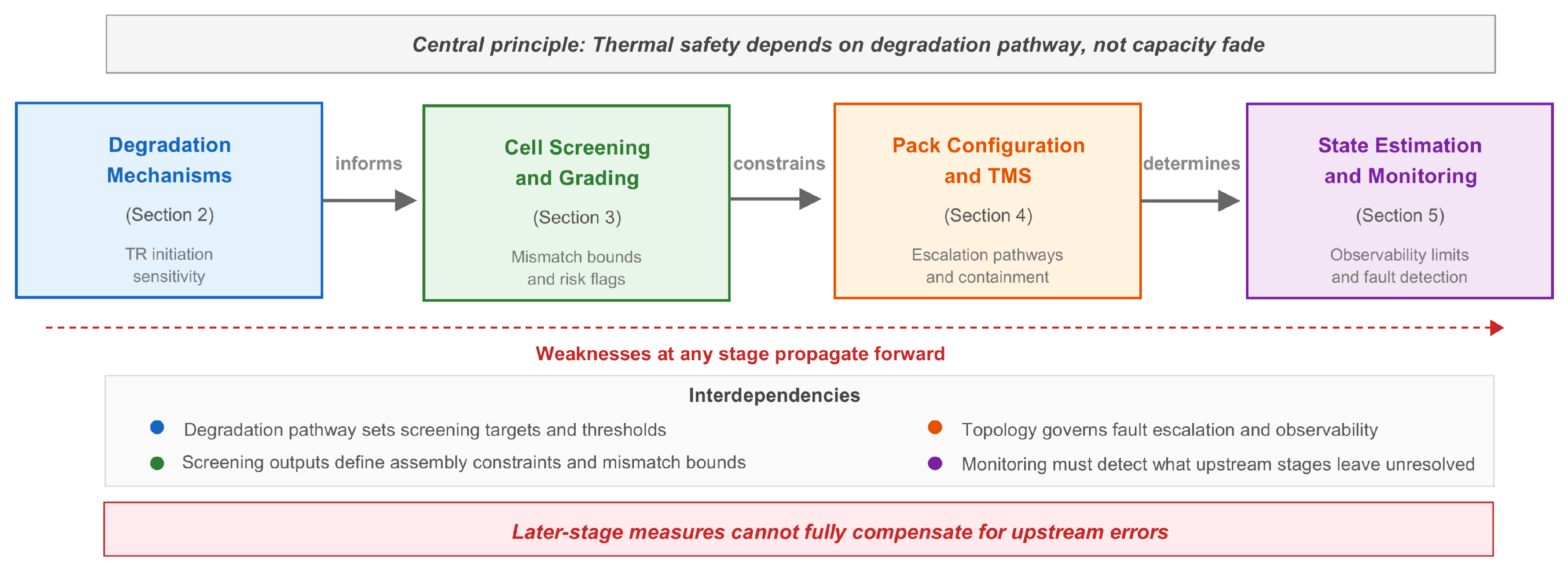
This review addresses this integration need by organizing the literature around four interdependent areas: (1) degradation mechanisms and their effects on thermal runaway initiation; (2) screening methods that detect thermal hazards before reuse; (3) pack configuration and thermal management that constrain fault escalation; and (4) state estimation and monitoring that track safety margins during operation. Figure 1 illustrates this coupled framework, where each stage constrains the next and weaknesses propagate forward. If degradation mechanisms are not considered (Section 2), screening may apply inappropriate criteria (Section 3). If screening fails to flag a hazardous cell, neither pack design (Section 4) nor monitoring strategies (Section 5) can eliminate the underlying risk. In practice, the degradation mode informs screening needs, screening outputs constrain pack design, topology governs fault escalation, and these architectural choices collectively determine what aspects of cell behavior can be observed or inferred during operation. Consequently, ensuring second-life safety depends on identifying and managing the prevailing degradation pathway rather than relying solely on capacity-based measurements.
The paper is organized as follows. Section 2 discusses degradation mechanisms and their effects on TR initiation and severity. Section 3 reviews screening methods for detecting thermal hazards. Section 4 addresses pack configuration, including cell matching, topology, propagation mitigation, and thermal management. Section 5 covers state estimation and fault detection. Section 6 discusses the key findings, identifies knowledge gaps, and outlines future directions. Section 7 presents the conclusions.

2. Degradation Mechanisms and Thermal Safety

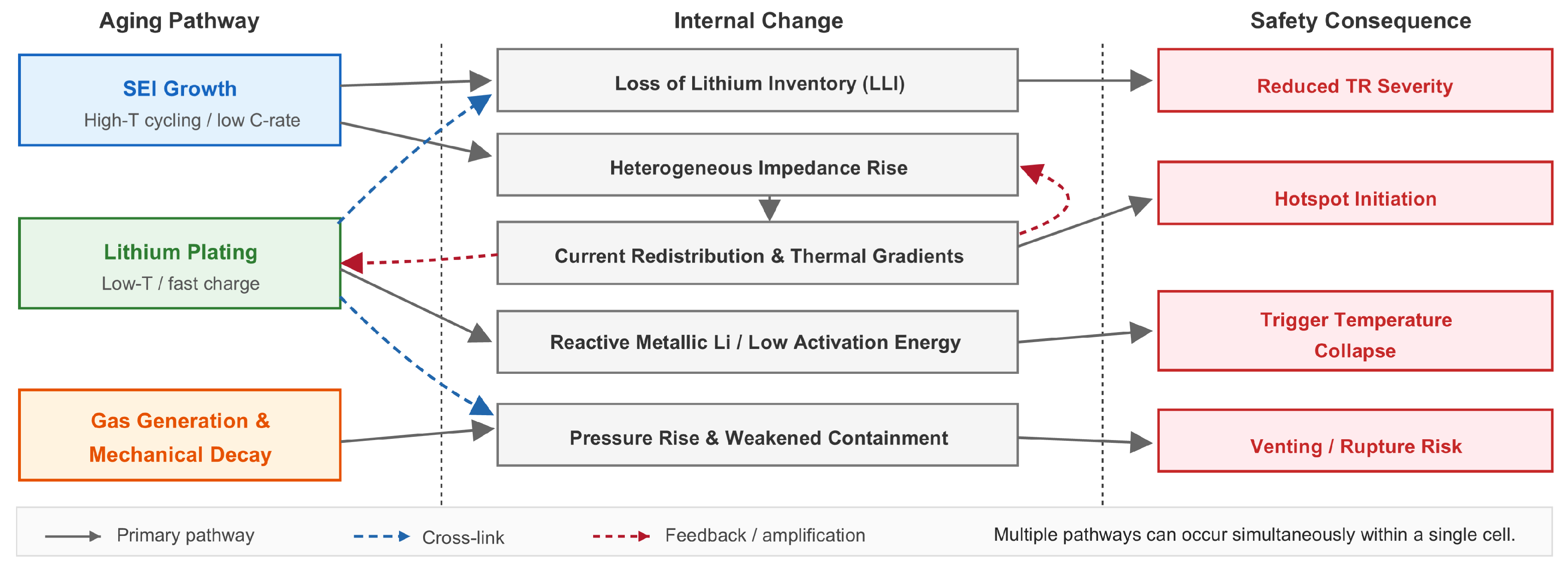
TR behavior is commonly characterized by initiation sensitivity metrics such as self-heating onset temperature ( T onset ) and trigger temperature ( T trigger ), and by severity metrics such as peak temperature ( T max ), total heat release, and peak heat-release rate. For SLB, these metrics vary with degradation pathway in ways that capacity or resistance alone cannot predict. Figure 2 maps the primary mechanism-to-consequence pathways. Multiple pathways can operate simultaneously, and cross-links between them mean that aging rarely follows a single isolated route as discussed throughout this section.
This section first reviews how aging affects TR severity and initiation sensitivity, then discusses three mechanisms, resistive heating, lithium plating, and gas–mechanical coupling, that differentially impact these metrics. Each mechanism produces distinct observable indicators through different internal pathways.

2.1. Aging Effects on TR Severity and Initiation Sensitivity

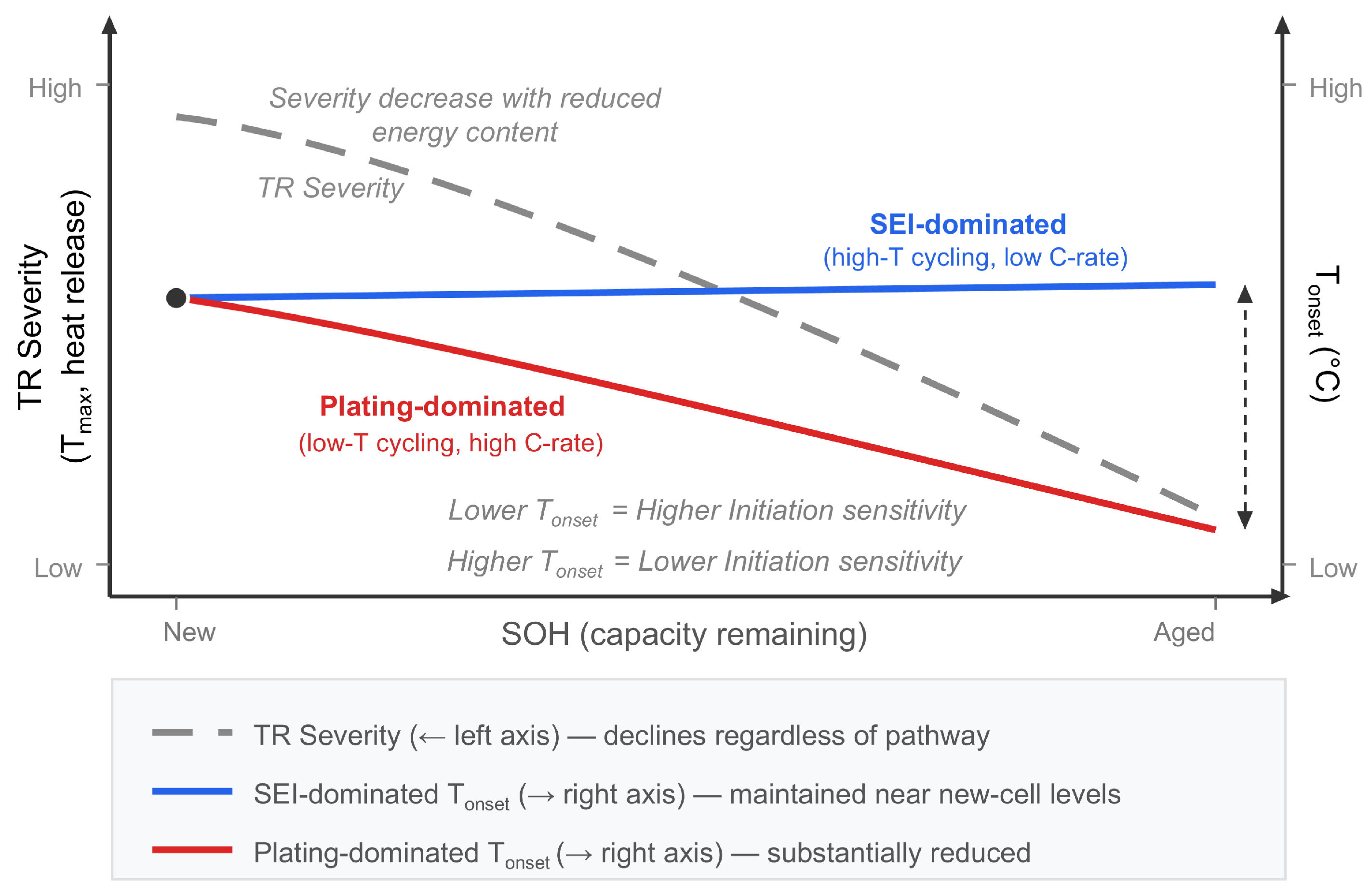
Severity refers to how destructive a thermal-runaway event is, typically characterized by peak temperature and total heat release. Initiation sensitivity describes how easily thermal runaway begins, commonly assessed by the temperature at which self-heating or runaway first initiates. Figure 3 shows the central relationship reviewed in this section; while TR severity generally decreases with capacity loss, initiation sensitivity diverges depending on the dominant degradation mechanism. Several studies have reported that aging reduces TR severity. Deeply aged cells exhibit lower T max and reduced peak heat-release rates compared with new batteries. First-life operation consumes active lithium and electrolyte, decreasing stored energy; this reduction in severity is consistent with lower total energy available for release during failure [21,22]. This decline is reflected in the severity trend in Figure 3.
Capacity fade in retired cells arises through two principal degradation modes that affect thermal stability differently: loss of lithium inventory (LLI) and loss of active material (LAM). LLI results from cyclable lithium permanently consumed during SEI growth or immobilized as metallic deposits during plating. LAM is driven by structural and mechanical failures, such as electrode particle cracking, binder degradation, or the structural isolation of active regions, reducing the electrodes ability to host lithium [23,24,25]. Their thermal consequences differ. LLI through SEI growth consumes lithium in a stable passivation layer, whereas LLI through plating deposits reactive metallic lithium that lowers exothermic reaction barriers (Section 2.3). LAM reduces electrode structural integrity but does not introduce the low-temperature reactivity of metallic lithium. Capacity fade alone therefore cannot distinguish thermally benign from thermally hazardous degradation states.
Initiation sensitivity, however, does not follow the same trend and instead varies with the dominant degradation pathway. SEI-growth-dominated aging (high-temperature cycling and extended storage) consumes the lithium inventory and can partially suppress early-stage exothermic reactions, maintaining T trigger near new-cell levels [11,26]. In 18650 NCA cells tested under identical protocols, SEI-growth-aged cells showed self-heating onset rising from 80 ± 5 °C to 98 ± 5 °C, with thermal runaway onset and venting temperatures unchanged; across NCA, NMC, and LFP chemistries, SEI-growth-aged cells exhibited similar or improved safety [27]. This corresponds to the flat SEI-dominated curve in Figure 3. In contrast, plating-dominated aging (low-temperature cycling, fast charging) deposits metallic lithium that lowers kinetic barriers for parasitic reactions [28]. Using the same cell type and protocols, plating-aged cells showed self-heating onset dropping from approximately 80 °C to 35 °C, with consistently higher self-heating rates and elevated European Council for Automotive R&D (EUCAR) hazard levels across all test methods including overcharge, overcurrent, and nail penetration [29]. These results reflect accelerated aging with substantial plating deposits; the critical amount of deposited lithium required to alter safety in field-aged cells remains unknown [29]. This sharp increase in sensitivity corresponds to the rising plating-dominated curve in Figure 3. Absolute onset values vary with cell type and chemistry; the relative shift within each study is the relevant safety indicator. Plating shifts thermal thresholds at multiple stages as summarized in Table 2. In 18650 cells aged under low-temperature cycling, self-heating onset drops from 102 °C to 82 °C [6]. In pouch cells subjected to fast-charge aging, self-heating onset falls from 116.5 °C to 54.5 °C and thermal runaway trigger temperature from 217.6 °C to 95.8 °C at 50% SOH [30]. In automotive pouch cells, the venting temperature decreases from 130 °C to 112 °C when lithium plating is present [31]. Venting and gas–mechanical behavior also differ between new and aged cells as discussed in Section 2.4.
Plated lithium is not always permanent. Resting cells at room temperature after low-temperature cycling can allow reversibly plated lithium to re-intercalate, which shifts self-heating onset temperatures toward values observed in fresh cells [19]. In contrast, tests conducted immediately after plating–promoting cycling have reported onset temperatures as low as 35 °C [29], compared with 98 °C for SEI-growth-aged cells of the same type [27]. Both the degradation pathway and the interval between retirement and testing therefore affect screening outcomes. Capacity-based SOH alone cannot distinguish thermally benign from hazardous degradation states [32,33] as reflected in the shifts summarized in Table 2.

2.2. Resistive Heating: Localized Joule Heating from Heterogeneous Impedance

Internal resistance in retired cells increases heterogeneously rather than uniformly. While ohmic resistance contributes to power fade, aging is often dominated by non-uniform SEI thickening and the associated rise in charge-transfer resistance. These dgradation mechanisms accelerate once SOH falls below approximately 40% [34]. Morphological analysis of one cell type indicated SEI thickening from 23 nm (new) to 57.5 nm (82% SOH), accompanied by increased anode stiffness and irreversible mechanical swelling [35]. The growing SEI layer also reduces electrode porosity and effective ionic diffusion coefficients [23]. In large-format cells, degradation can initiate near current-collection regions and propagate toward the electrode interior, producing localized high-impedance zones that distort the internal current-density distribution [24]. These spatial gradients promote current constriction and localized Joule heating, as the effective reaction area decreases and current is forced through narrower conductive pathways.
As non-uniform SEI raises the local charge-transfer resistance, the current shifts toward lower-impedance regions, increasing local overpotentials and concentrating both ohmic and kinetic heat generation. This creates a self-reinforcing cycle: localized heating accelerates side reactions and SEI alteration in hot-spot regions, further increasing impedance heterogeneity [24]. The resulting internal temperature gradients compound the problem. Modeling studies showed that interelectrode thermal gradients shift electrode potentials and redistribute plating severity, with through-plane gradients being particularly critical [36]. Experimentally, even a temperature difference of only ±2 °C between electrodes has been shown to cause rapid degradation in cells operated at 35 °C and C/5, conditions that are otherwise considered safe under uniform thermal environments [37]. When the cathode was slightly warmer, lithium plating formed at the anode. When the anode was slightly warmer, degradation occurred at the cathode instead [37]. In retired cells, heterogeneous impedance growth naturally leads to these small internal thermal gradients, providing a direct mechanism that links impedance non-uniformity to the initiation of plating.
Cells with internal resistance exceeding 130% of fresh-cell values show increased heat generation during operation, driven primarily by amplified I 2 R losses [25]. This current redistribution produces internal temperature gradients in which core regions reach higher temperatures than the cell surface, a disparity often missed by external sensors but critical for hotspot initiation [38]. Heterogeneous impedance can also promote lithium plating, further reducing TR initiation thresholds.

2.3. Trigger Temperature Collapse: Lithium Plating and Kinetic Acceleration

Lithium plating in retired cells involves the deposition of metallic lithium on the anode surface. These deposits are typically porous with high surface area; they may become electronically isolated and electrochemically irreversible [39,40,41]. Unlike intercalated lithium, metallic lithium remains chemically reactive and is not effectively passivated by a stable SEI [42].
Its heightened reactivity arises from both morphology and surface state: plated lithium forms high-surface-area structures ranging from needle-like dendrites to porous crystals and mossy layers depending on temperature and cycling conditions [41,42], and residual lithium on the anode surface exists as highly reactive nanoclusters rather than in an ordered intercalated state [40]. This increased surface area amplifies the kinetic contact area for parasitic reactions with the electrolyte. The kinetic consequence is direct: exothermic decomposition rates follow Arrhenius-type temperature dependence, and cells aged near 0 °C showed activation energy of 0.813 eV compared with 0.856 eV for cells aged at 25 °C [28]. Thermokinetic analysis of Accelerating Rate Calorimeter (ARC) data showed that activation energy decreases linearly with the total plating energy, and onset temperature for adiabatic self-heating shows a strong inverse correlation with plating quantity [41]. This means that greater plating deposits systematically lower the thermal barrier, and the resulting heat generation can exceed passive dissipation at temperatures well below conventional thresholds.
The practical consequence is early-stage self-heating, with onset occurring at temperatures well below new-cell stability thresholds. As shown in Table 2, plating-dominated aging reduces self-heating onset from 80–116 °C (new) to 35–82 °C depending on cell format and aging conditions [6,29,30]. This early heat release arises from rapid reactions between electrolyte and non-intercalated lithium that can outpace passive heat dissipation [43]. In situ observations further indicated that residual lithium nanoclusters react with polymer binders (e.g., PVDF) to generate flammable hydrogen, elevating hazard during abuse or failure progression [40]. Trigger temperature also collapses, falling from approximately 218 °C (fresh) to 96 °C under plating-dominated aging (Table 2). Lithium plating therefore makes conventional stability benchmarks (e.g., separator melting temperature) insufficient for bounding TR initiation in retired cells [30,31]. Concurrent gas generation and mechanical degradation, discussed in Section 2.4, further narrow the safety margin between pressure buildup and structural failure.

2.4. Gas Generation and Mechanical Degradation

Gas-generation mechanisms differ between new and aged cells. New cells generate gas primarily during early SEI formation, whereas aged cells experience cathode destabilization that releases transition metals. This dissolution accelerates cathode decomposition and promotes oxygen release [44]. Concurrently, transition metal dissolution reduces thermal runaway trigger temperatures, while lithium plating and proton reduction side reactions generate reductive gases such as hydrogen and methane [45]. The accumulation of decomposition products (including PF5) further intensifies this process by reducing activation barriers for solvent ring-opening reactions and increasing gas-generation rates [46]. Real-time measurements in cylindrical formats showed internal gas pressure rising to approximately 20 bar at venting onset, with secondary peaks reaching 28.7 bar during later failure stages [47].
The mechanical integrity of retired cells degrades due to fatigue accumulated during first-life cycling. Cells aged under conditions promoting lithium plating showed casing stiffness reductions of approximately 16% relative to new counterparts, along with irreversible thickness swelling of approximately 9.1% [42]. This swelling generates persistent internal stress within the jellyroll and lowers resistance to deformation under elevated pressure [35]. The relationship between stiffness loss and burst-pressure reduction across different SOH values has not been systematically studied in the literature.
Together, accelerated gas generation and mechanically weakened containment narrow the margin between pressure buildup and structural failure in aged cells. Each mechanism reviewed in this section produces distinct observable indicators (Table 2) that inform the screening methods discussed in Section 3.

3. Cell Screening and Grading: Detecting Thermal Hazards

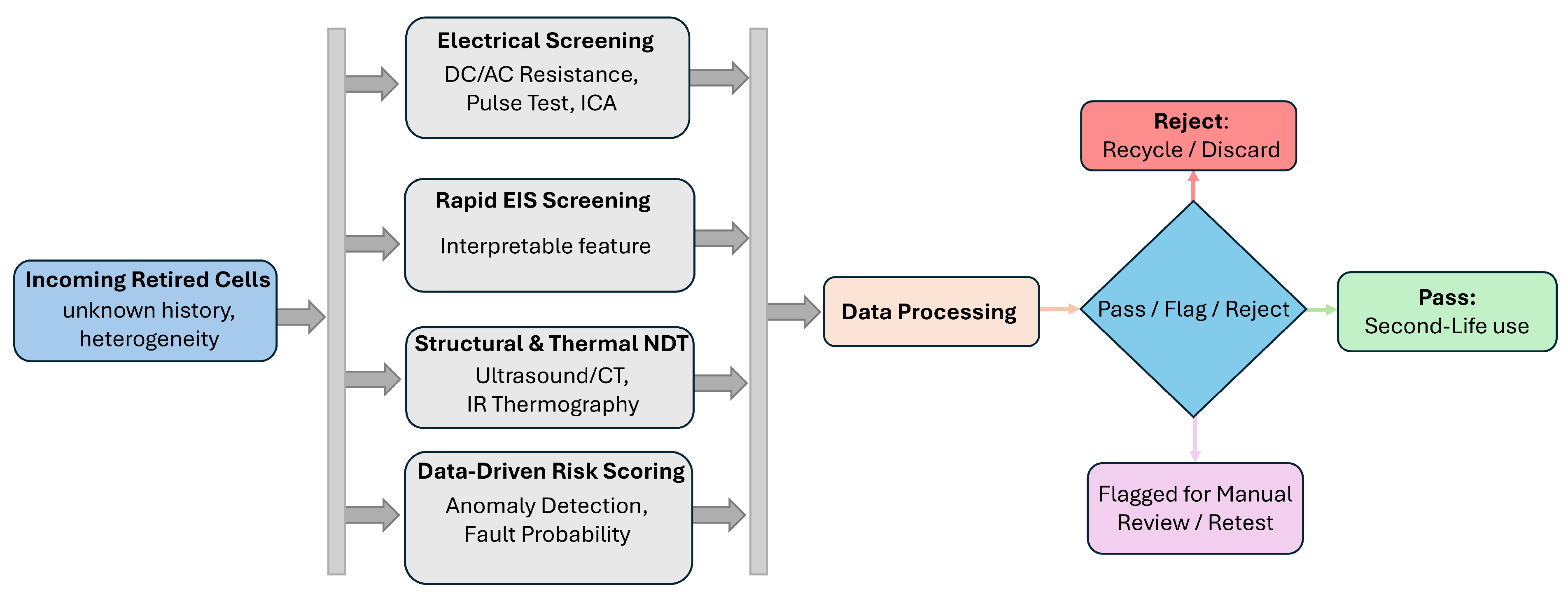
Screening and grading form the first line of defense for safe second-life battery deployment. Four diagnostic layers address different aspects of thermal risk, each targeting distinct hazards but also carrying limitations. Figure 4 maps this progressive filtering workflow: incoming retired cells with unknown histories pass through electrical screening, impedance-based assessment, structural and thermal testing, and data-driven risk scoring. At each stage, cells are passed, flagged for manual review, or rejected. Screening outputs directly constrain pack assembly and operational monitoring decisions (Section 4 and Section 5).

3.1. Electrical Screening: Proxies for Heat and Instability

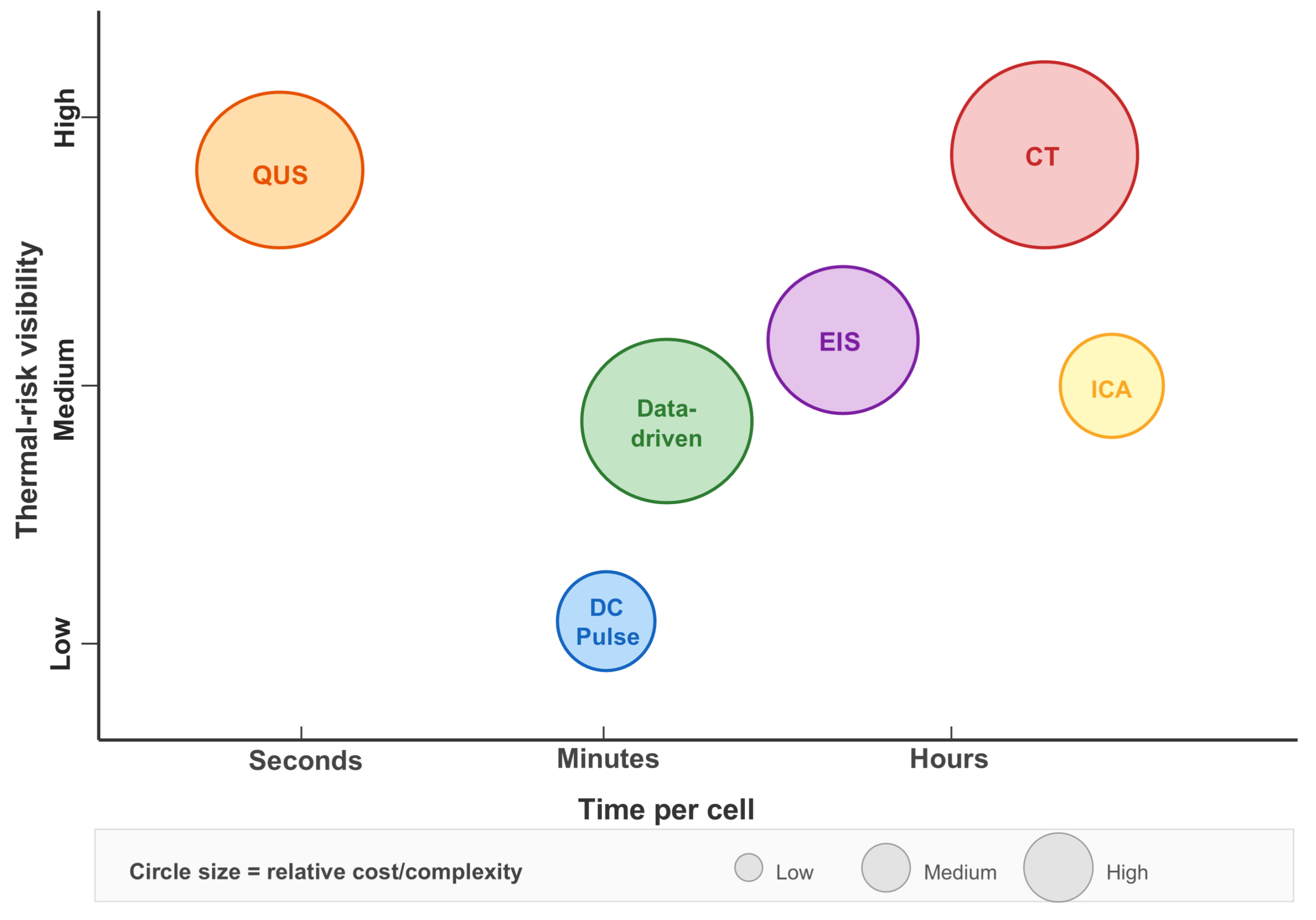
Figure 5 maps the trade-off between screening throughput and thermal-hazard detection capability across the methods reviewed in this section. Faster methods such as electrical DC pulse resistance offer high throughput at low cost but limited thermal-risk visibility, while methods such as ultrasound spectroscopy and computed tomography (CT) can provide higher hazard detection at greater time and expense. The following sections discuss each method, starting with electrical screening.
DC pulse tests and voltage-curve analysis detect where heat generates and whether cells show electrochemical instability. For thermal safety, the objective extends beyond SOH estimation to identifying proxies of initiation sensitivity that capacity metrics alone would miss [6,48]. Heterogeneous impedance growth in aged packs creates current constriction and concentrated Joule losses, while interconnect resistance in retired modules increases due to busbar and weld degradation. Module-level measurements indicate that interconnects can contribute approximately 20% more heat than standalone cells at high current [49]. Module-level assessment therefore captures resistive heat sources that cell-level testing alone would miss.
Traditional characterization relies on full charge–discharge cycles at low C-rates, requiring approximately 1400 min (24 h) per cell; resistance-based approaches reduce this to approximately 2 min per cell [10]. Charge-interrupt (CI) resistance correlates well with SOH without requiring precise SOC information [48]. The electrode polarization coefficient ( α ) has been proposed as a reliability indicator, with cells exhibiting high initial polarization reported to degrade more rapidly and develop interfacial instability [50]. As discussed in Section 2, plating-dominated aging reduces thermal thresholds significantly (Table 2). Incremental Capacity Analysis (ICA) detects LLI, an indirect indicator of lithium plating, and can therefore identify chemically unstable cells that may otherwise pass capacity-based screening. However, ICA accuracy depends on collecting voltage-capacity data at relatively low C-rates (for example, C/6 as a practical compromise for time resolution), which increases test duration compared with simple capacity-based screening [51]. ICA correlates strongly with SOH for LFP cells but is less robust for NMC chemistries due to overlapping voltage features; in such cases, impedance-based methods are often favored in practice [52].
However, many rapid methods compress resistance or polarization into single scalar values that remain insensitive to the physical source of resistance growth [11,48]. DC measurements can hide the true cause of degradation by collapsing different physical processes into a single number [53]. Cells with plating-dominated versus SEI-growth-dominated aging can exhibit similar DC resistance yet vastly different thermal margins (Section 2). This limitation motivates impedance-resolved characterization. Figure 5 maps the trade-off between screening throughput and thermal-hazard detection capability across representative methods in this section.

3.2. Electrochemical Impedance Spectroscopy (EIS) Screening

DC-based methods provide a single measure of lumped resistance. Electrochemical Impedance Spectroscopy (EIS) resolves internal resistive and kinetic processes across the frequency domain, separating ohmic, interfacial, and diffusion contributions. EIS can act as a second-stage screening tool after rapid DC checks when higher mechanism sensitivity is required. Interfacial and diffusion impedances contribute to irreversible heat generation [54] and capture degradation features that DC resistance alone obscures [55,56]. Growth of the SEI layer during first-life operation leads to gradual impedance increase, raising the likelihood of localized heat accumulation. Separating bulk resistance ( R b ) from SEI resistance ( R SEI ) provides a clearer and more physically meaningful indicator of interface stability than DC resistance alone [55]. Low-frequency impedance behavior, including Warburg impedance, has been correlated with capacity loss and indicates transport limitation [55,56]. Such impedance heterogeneity can amplify localized heat generation under load [57]. EIS was long considered impractical for large-scale screening due to long measurement times, specialized equipment, and interpretative complexity.
Recent advances have made EIS more practical for large-scale screening. Feature-attribution methods identify the frequency regions most strongly linked to battery health, reducing measurement time to under 100 s while maintaining high predictive accuracy [58]. Neural-network-assisted EIS enables rapid SOH diagnosis of retired batteries without historical usage data, completing per-cell assessment in under eight minutes [59]. Comparative studies indicate that although charge-interrupt techniques are faster, EIS is more sensitive to subtle aging mechanisms, making it preferable when reliability and thermal safety are prioritized [60].
EIS features are sensitive to state of charge and temperature, and contact or fixture impedances can distort high-frequency responses. Controlled conditions and standardized protocols are therefore required for consistent large-scale grading [53,61]. Impedance features may not capture hidden physical defects or structural precursors to internal short circuits, underscoring the need for complementary structural diagnostics that provide direct defect visibility.

3.3. Thermal and Structural Characterization

DC and impedance-based screening improve mechanism sensitivity, but hidden mechanical damage and gas-related defects can remain electrically subtle yet strongly elevate internal short-circuit risk. Thermal and structural characterization targets physical precursors to failure, including deformation, delamination, and gas pockets, that can remain invisible to electrical and impedance-based methods. Internal deformations such as jellyroll collapse and electrode delamination are well-established precursors to internal short circuits [62,63].
A CT-derived “CT score” has been proposed for grading structural integrity, with findings indicating that cells scoring below 0.55 exhibit severe internal damage and should be removed from further use [62]. While conventional CT remains slow and resource intensive, recent rapid-XCT developments have reduced scan times from hours to minutes per cell, with production-scale targets of less than 10 s per cell [64,65]. It remains uncertain whether these throughput improvements can be reliably extended to the larger form factors and heterogeneous aging states characteristic of second-life cells.
Quantitative ultrasound spectroscopy (QUS) offers a faster, non-invasive alternative that has been validated on field-recovered second-life batteries, showing sensitivity to delamination and gas pockets that electrical screening can miss. QUS reduces per-cell data acquisition from hours to seconds, supporting high-throughput sorting when integrated into practical handling workflows [63]. These methods provide direct visibility of physical defects that electrical and impedance-based tests cannot access, but they remain challenging to deploy at industrial scale due to high equipment cost, long acquisition times, and the need for specialized interpretation. Data-driven methods offer a complementary pathway by detecting rare fault signatures in operational data without requiring direct physical inspection of every cell.

3.4. Data-Driven Fault Prediction

Data-driven methods address heterogeneity and unknown usage history in retired cells by detecting safety-critical fault signatures that are difficult to capture with fixed thresholds alone. In screening contexts, they primarily support offline, high-throughput sorting and chemistry verification before second-life deployment, flagging high-risk outliers for deeper diagnostic checks [66,67].
Truly hazardous cells represent rare anomalies in retired stocks, leading to strongly imbalanced datasets that can bias learning toward healthy cells. Combining the Synthetic Minority Oversampling Technique (SMOTE) with Transformer-based networks reduces this bias and improves the identification of high-risk batteries, working best as an offline layer that prioritizes suspicious cells for deeper checks [66].
Fast pulse testing combined with machine learning accelerates large-scale sorting. Unlike linear regression-based approaches, pulse-test feature learning can capture the nonlinear aging characteristics embedded in transient responses. A Random Forest-based framework achieves high diagnostic accuracy (SOH error 1.79%) even for highly heterogeneous batches, reducing data acquisition time from approximately 150 min to 125 s per cell [67].
The correct identification of cell chemistry is a prerequisite for safe second-life deployment, particularly because mixed-chemistry batches can occur in battery waste streams. Machine learning methods based on partial voltage-curve features distinguish thermally stable lithium iron phosphate (LFP) cells from more reactive nickel manganese cobalt (NMC) cells, helping prevent hazardous chemistry mixing during pack assembly [68].
Data-driven methods enhance screening throughput and early fault visibility under uncertainty, but deployment is constrained by data representativeness, labeling quality, and domain shift across heterogeneous retired stocks.
Diagnostic applicability depends on cell format and scale. DC resistance and pulse methods scale readily across geometries. EIS becomes increasingly difficult with larger cell formats [4,58], and these challenges compound at the module and pack levels due to equipment complexity and limited impedance data for large formats. ICA accuracy depends on voltage resolution, which is harder to achieve in large-format cells with low internal resistance. Structural methods face geometry-dependent constraints: QUS requires specialized analysis for cylindrical cells [63], while the CT scan time, computational burden, and cost can increase significantly with cell sizes [62].
Screening outputs, including resistance distributions, capacity spreads, structural defect flags, and chemistry classifications, define acceptable mismatch and assembly constraints for second-life packs. Electrical tests provide high-throughput filtering, impedance spectroscopy enables mechanism discrimination, structural methods detect physical damage precursors, and data-driven approaches enable rapid sorting when failure examples are scarce. Table 3 links diagnostic indicators to thermal-safety relevance and deployment constraints. These screening outputs translate into the pack-level design requirements discussed in Section 4.
Table 3. Screening method classes, representative safety indicators, and practical limitations for second-life cells.
MethodSafety IndicatorThermal RelevanceLimitations
Electrical (DC)Resistance, pulse responseResistive heating, plating detection; ∼2 min/cell [10]Misses structural defects
ICALLI peaks, phase transitionsPlating detection; ∼hours/cell [51]Chemistry-dependent; slow
EIS R SEI , charge-transfer, WarburgMechanism-specific risk separation; ∼2–8 min/cell [58,59]Higher cost; SOC/temperature sensitive
Structural (CT/QUS)CT score, ultrasound attenuationDirect defect visibility; seconds (QUS) to hours (CT) [62,63]High equipment cost, hard to automate
Data-DrivenAnomaly score, chemistry classifierRare fault detection, chemistry verification; ∼125 s/cell [67]Needs labeled data; domain shift

4. Pack-Level Design for Safe Second-Life Operation

Screening establishes cell-level health and safety indicators; this section reviews how these constraints translate into four pack-level design domains: cell matching, electrical topology, mechanical propagation mitigation, and thermal management. Each domain interacts with the others—topology choices shape fault escalation pathways, which in turn determine the requirements for mechanical barriers and thermal control.

4.1. Compatibility and Cell Matching for Pack Assembly

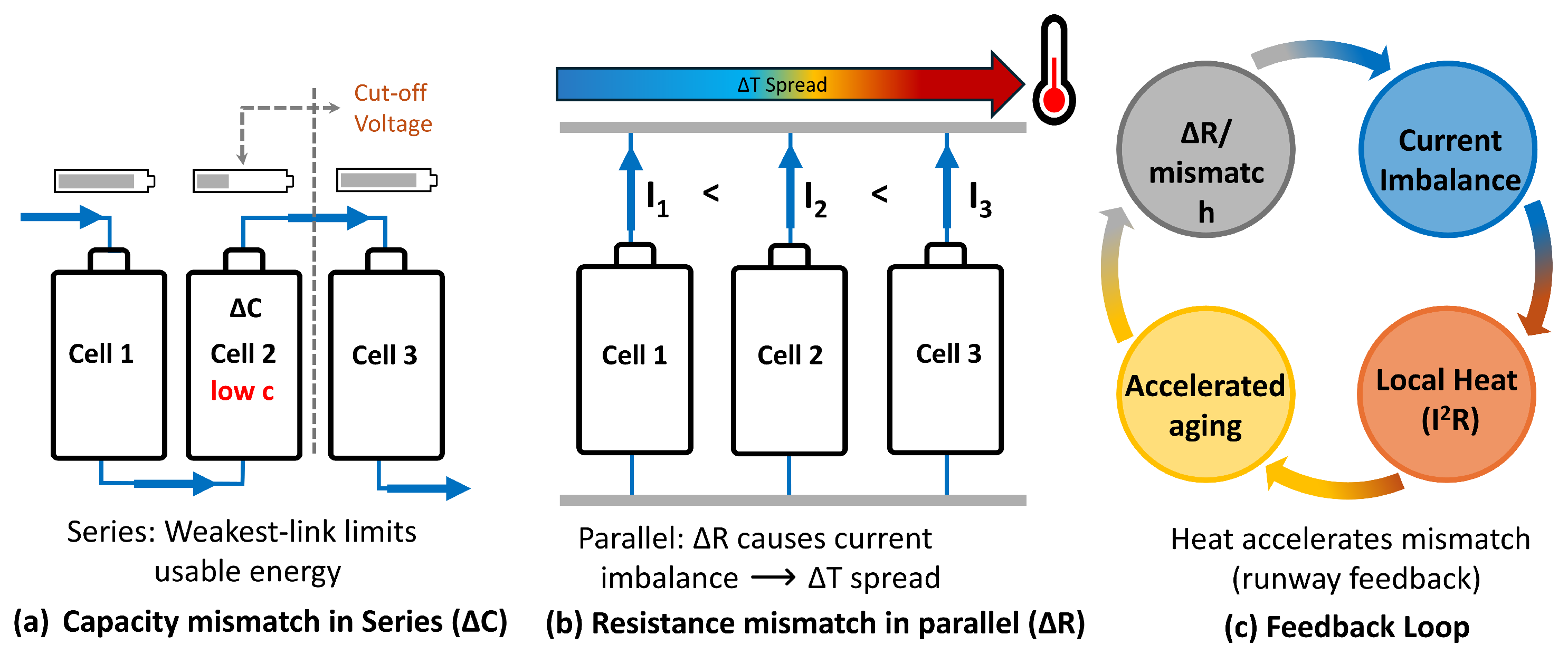
Two mismatch dimensions constrain second-life pack assembly: capacity dispersion ( Δ C ) and resistance dispersion ( Δ R ). Both metrics are quantified during screening (Section 3); this section reviews how they translate into topology-specific assembly constraints. Figure 6 illustrates these mechanisms: series voltage divergence from capacity mismatch (Figure 6a), parallel current redistribution from impedance dispersion (Figure 6b), and the resulting electro-thermal feedback loop (Figure 6c).
In series strings, the lowest-capacity cell limits usable energy through early voltage cut-off, with unmitigated mismatch reducing discharge capacity by 20–25% or more [69]. Capacity matching is therefore essential for series utilization. Bilevel equalizers can partially recover capacity when Δ C bounds cannot be met through sorting alone, though at the cost of added hardware complexity. In repurposed packs, Δ C matching remains the preferred first-line strategy, with equalization treated as mitigation when residual mismatch is unavoidable [69,70]. In parallel blocks, capacity variance is partially buffered: a 9% difference produces only 4.3% current variation [71], though time-resolved measurements show capacity becomes the dominant load-imbalance driver mid-discharge [72]. Parallel-then-Series topologies deliver higher initial capacities than Series-then-Parallel when cells equalize total capacity across parallel modules [73].
Resistance mismatch drives current imbalance and localized Joule heating in parallel groupings. A 20% Δ R can reduce cycle life by approximately 40% [74], and 30% mismatch can increase peak cell currents by up to 60%, with branch currents exceeding rated limits by 53%, elevating lithium-plating risk [75,76]. This sensitivity is chemistry dependent: NMC cells exhibit current deviations up to 80% under pulsed loads, compared with approximately 40% for LFP [77], requiring stricter impedance tolerances for NMC to manage thermal gradient sensitivity. Chemistry-dependent Δ R thresholds across cell formats and aging states lack standardization, complicating universal screening criteria for parallel-connected second-life assemblies [74,77]. In highly parallel configurations, interconnect resistance can dominate over internal cell resistance in driving current redistribution [71,78], making strict resistance matching indispensable. Table 4 summarizes these mismatch effects across series and parallel topologies.
Beyond enforcing Δ C and Δ R bounds, second-life pack assembly increasingly relies on multi-parameter grouping. Screening outputs from Section 3—electrochemical features, structural integrity scores, and remaining useful life estimates—serve as inputs to grouping algorithms that minimize dispersion across multiple dimensions [79]. Support Vector Machine (SVM)-based grouping using high-rate IC-curve features reduces current inconsistency after regrouping [80], “Equal-number” Support Vector Clustering (SVC) with RUL as a grouping feature reduces within-cluster RUL dispersion [81], and two-stage frameworks combining Density-Based Spatial Clustering of Applications with Noise (DBSCAN) with Principal Component Analysis-Self-Organizing Map (PCA-SOM) improve grouping outcomes relative to single-stage schemes [79]. Structural indicators from non-destructive CT imaging further support assembly decisions; a Structural Similarity Index Measure (SSIM) above 0.65 supports reuse, whereas scores below 0.55 indicate scrapping [62].
Cell matching and grouping establish mismatch bounds for pack assembly. Topology then determines whether residual mismatch manifests primarily as voltage divergence (series) or current redistribution (parallel), shaping both utilization and fault escalation pathways.

4.2. Electrical Topology and Thermal Safety

The mismatch effects described in Section 4.1 manifest differently depending on electrical topology, which also determines fault escalation severity.

4.2.1. Series and Parallel Connections

In series strings, current continuity enforces identical charge throughput, so heterogeneity manifests as voltage and SOC divergence rather than branch-current imbalance [69,82]. This divergence accumulates with cycling due to coulombic efficiency differences and initial SOC offsets [82,83], with aged modules reporting end-of-discharge voltage spreads approaching 0.9 V that force the weakest cell into disproportionately deep discharge [84]. These conditions promote localized heat generation and accelerate degradation. The BMS cut-off effectiveness depends on accurate voltage prediction. Widely used equivalent-circuit models can produce errors exceeding 0.76 V when BMS constraints such as minimum SOC limits are not accounted for in pack-level representations [85]. These models further struggle to capture nonlinear aged-cell behavior, as degradation trends become polynomial near the aging knee and first-life parameterizations lose validity for second-life applications [86]. Series voltage sensitivity can, however, support fault detection, as incipient failure may appear as a distinct terminal-voltage drop [70].
Parallel topologies promote SOC equalization through voltage clamping, but in heterogeneous assemblies the dominant risk shifts toward current-sharing imbalance and thermally coupled feedback [82,83]. Layout choices shape branch-current distribution: common-end designs produce charge disparities up to 21.5%, compared with 7.8% in opposite-end configurations [87]. High interconnect resistance ratios can produce temperature spreads up to 47.7 °C within a module [88], triggering a destabilizing feedback loop in which warmer cells draw more current and heat further [57,89]. Concealed re-balancing currents up to 3.5 A circulate after load removal, sustaining ohmic heating that standard BMS strategies may not detect [87]. Parallel architectures also enable hazardous failure escalation: during internal short circuits, healthy cells discharge into the faulty cell, and transferring only 2.56 Ah (about 4.6% of the cell’s total capacity) can lower the thermal runaway onset temperature from 221.7 °C to below 170 °C [90]. Parallel-connected modules show the most severe failure characteristics among common topologies, including peak temperatures approaching 720 °C [91].

4.2.2. Combined Architectures and Propagation Pathways

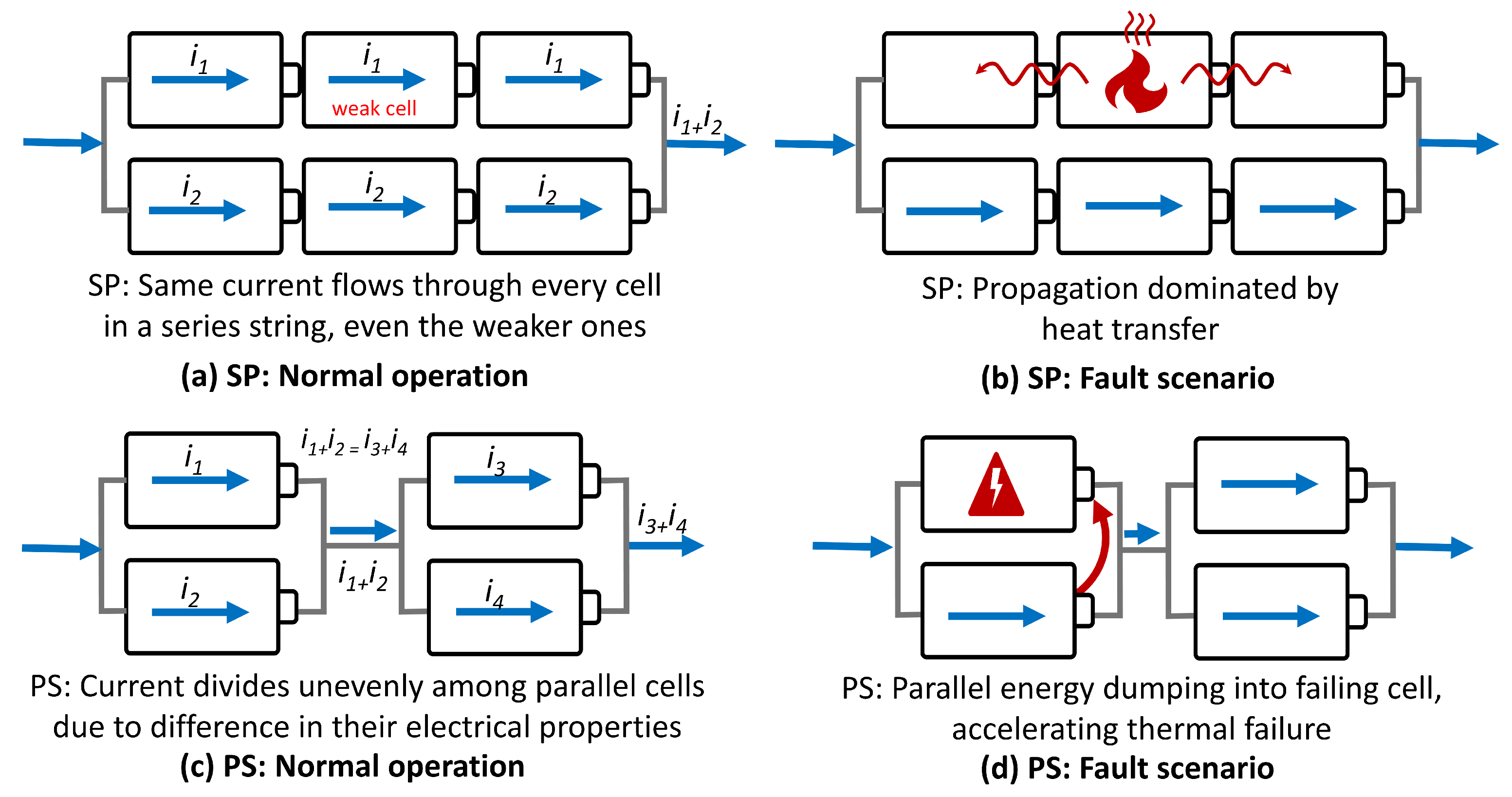
Combining series and parallel connections into Series-Parallel (SP, series-first) or Parallel-Series (PS, parallel-first) architectures introduces a trade-off between capacity utilization and electro-thermal safety. Figure 7 contrasts SP and PS architectures: SP enforces uniform series current (Figure 7a) with heat-transfer-governed fault propagation (Figure 7b), while PS divides current by impedance (Figure 7c) and enables parallel neighbors to discharge into failing cells (Figure 7d).
PS designs are often favored in repurposing because capacity averaging partially mitigates variability and improves cell utilization [73,92], achieving about 10% higher energy throughput over 400 cycles [84]. However, PS topologies are more sensitive to parameter deviations and develop larger intra-module current imbalances than SP designs [82,93]. In aged modules, 2P2S yields the greatest mass loss (55.7 g) and highest average heat transfer (20.16 kJ) during thermal runaway [91], and current inhomogeneity grows with the interconnect-to-cell impedance ratio [57]. Whether the increased internal resistance of retired cells attenuates fault-energy transfer or whether aging-induced dispersion instead intensifies localized heating remains unresolved [88,90]. Table 5 compares SP and PS topologies across six performance dimensions.
Topology determines how mismatch manifests as current and thermal redistribution; mechanical design determines whether single-cell thermal runaway remains isolated or cascades through the module.

4.3. Mechanical Design and Propagation Mitigation

Passive mechanical strategies, including cell spacing, thermal barriers, and venting management, delay propagation after a cell enters thermal runaway, while active thermal management (Section 4.4) targets prevention during normal operation. These strategies must account for aged-cell characteristics (Section 2.4): swelling reduces effective spacing, altered gas generation changes venting dynamics, and structural weakening narrows the margin between pressure buildup and failure.

4.3.1. Cell Spacing and Thermal Barriers

Spacing alone is generally insufficient in enclosed modules. For cylindrical 18,650 cells, horizontal gaps exceeding 2 mm in open air typically stop propagation, whereas vertical arrangements require spacing greater than 8 mm regardless of enclosure. In closed packs, horizontal spacing must exceed 4 mm [94]. Even with increased spacing, convection and radiation dominate in tight enclosures: 0 mm to 2 mm extends the propagation window from 32 s to 165 s [95] but can fail to prevent full-module failure [95,96]. Under high-density packing, a failing cell transfers 35.3% to 72% of its total heat to neighbors, and high SOC drives peak temperature more strongly than geometry can offset [97]. Widening the gaps from 0.3 mm to 0.9 mm delays propagation but is insufficient without additional mitigation [98].
Interstitial thermal barriers address these limitations, with effectiveness scaling predictably with thickness. Nanofiber aerogels show this clearly: 2.0 mm stops propagation, 0.5 mm doubles time to failure, and 1.0 mm extends it sixfold [99]. A 2 mm flame-retardant polypropylene layer prevented propagation where air gaps were ineffective [95], and a 3 mm epoxy composite maintained neighboring-cell temperatures below 100 °C [100]. Thinner insulation (e.g., 1 mm aerogel) offers measurable delay but can remain insufficient in large-format pouch configurations [101].
Phase change materials (PCMs) buffer transient heat release rather than providing sustained rejection. Submerging cells in PCM delayed runaway onset from 160 s to 330 s, yet subsequent ignition led to rapid failure [102]. Hybrid approaches therefore combine PCMs with structural constituents: graphite–wax composites reduced neighboring-cell temperatures to 109 °C versus 189 °C under air cooling [103], and trifunctional barriers combining nano-ceramics, PCM, and mica tolerated 4 MPa with <20% deformation [104]. Additional concepts use vaporization or radiant shielding, including hydrogel layers and zirconia-aerogel composites [105,106]. Vent jets (high-velocity hot gas discharge) and ejecta (expelled particles and fragments) can bypass conduction- and radiation-dominated isolation, requiring barrier selection to consider vent-path management.

4.3.2. Venting Pathways and Ejecta Management

For cylindrical cells, sidewall rupture is more thermally severe than top-cap rupture, with average maximum surface temperatures of 919 °C versus 653 °C, motivating directional containment [107]. Aging alters venting behavior: cells at 70% SOH produce the largest total gas volume, shifting toward more carbon monoxide and hydrocarbons, and exhibit a two-step violent jet fire in which the second jet has a larger diffusion area but lower intensity than the first [21]. These characteristics can exceed the capacity of pressure-relief valves and exhaust paths sized for new-cell behavior [21,95]. If vent gases are not routed through dedicated channels, jet-driven convection can become the main driver of propagation even in modules with air gaps [95].
Aged-cell venting characteristics—particularly multi-stage ejection and elevated gas production near intermediate SOH—are not yet incorporated into second-life design guidelines or safety standards. Propagation risk is also SOC-dependent: thermal runaway propagation is highest within 40–60% SOC [108], indicating that second-life deployment may require operational constraints avoiding this window for packs with elevated heterogeneity.

4.4. Thermal Management Systems (TMS) for Aged Batteries

Aged cells generate more heat and distribute it less uniformly than new cells due to irreversible resistance growth and impedance dispersion (Section 2.2). This uneven heat generation reinforces the electro-thermal feedback described in Section 4.1, and thermal gradients alone can increase degradation by 5.2% relative to uniform-temperature operation [109]. Second-life TMS design must therefore prioritize temperature uniformity ( Δ T ) over average temperature reduction [74,109].
Forced-air cooling remains attractive for its simplicity but may be insufficient to suppress gradients in dense, heterogeneous modules. Air cooling is most defensible for low-power stationary duty when mismatch has been tightly controlled through screening [110]. Liquid-based approaches offer substantially higher heat-rejection capability: single-phase immersion cooling can increase heat transfer coefficients by up to 1000 times relative to passive air, rising to 10,000 times for two-phase systems, and can maintain cell temperatures near 35 °C even under 10C cycling [111]. Counterflow liquid-cooling arrangements reduce thermal gradients further, with Δ T max   =   2.70   ° C at discharge rates up to 2C [112]. In TMS applications, MXene-doped PCM limits maximum temperature to 57.03 °C at 3C-rate (current normalized to capacity; 1C = full discharge in 1 h) discharge, while hybrid PCM-based approaches improve uniformity compared with air cooling alone [113,114]. Higher-power duty or larger health variation typically motivates active liquid or hybrid systems to constrain Δ T and suppress hotspot-driven degradation [111,112]. A remaining gap is life-consistent thermal sizing: designs derived from new-cell heat generation can under-predict demand as internal resistance increases over second life, and whether oversizing at the design stage or adaptive control is the more robust pathway remains unclear [74,115,116]. Table 6 summarizes the recommended strategies across these four design domains.
These four design layers form an integrated safety system in which weaknesses at one stage propagate forward. Pack-level design choices establish the physical risk envelope and observability constraints that motivate the state-estimation frameworks discussed in Section 5.

5. Thermally Coupled State Estimation

The physical safeguards established in Section 4 require real-time monitoring to detect incipient faults and track battery health. This challenge is acute for second-life packs: heterogeneous aging limits observability, low-cost BMS hardware constrains computation, and conventional state estimators assume stable parameters and uniform cells—assumptions that often fail for retired packs. We address these requirements across five domains. Section 5.1 discusses why conventional estimation fails under heterogeneity and unknown aging histories. Section 5.2 reviews adaptive electrical state estimation that tracks time-varying parameters. Section 5.3 reframes prognostics around time-to-unsafe boundaries rather than capacity retention. Section 5.4 discusses fault detection under topology-driven observability constraints, particularly parallel masking. Section 5.5 surveys data-driven strategies for rare-event monitoring under domain shift and sensor uncertainty.

5.1. Second-Life Estimation Challenges

SLB deployment confronts three operational constraints: unknown first-life degradation histories that limit parameter initialization, pronounced cell-to-cell heterogeneity that invalidates uniform-cell assumptions, and low-cost BMS hardware that constrains real-time computation. The coefficient of variation in capacity across second-life packs is approximately four times higher (11.3%) than in new counterparts (3.0%) [86,117]. Cells with similar SOH can exhibit distinct degradation pathways—lithium plating, SEI growth, or gas generation—that produce vastly different thermal margins [16,118]. Although extensive characterization could reduce this uncertainty, conventional testing requires days per cell, making mass screening impractical [10].
Most state-estimation algorithms were developed for new cells with slowly varying parameters, which creates three fundamental limitations for aged batteries. First, Coulomb counting accumulates initial offsets and becomes increasingly biased as coulombic efficiency changes with aging, leading to SOC drift [119,120]. Second, Equivalent Circuit Models with fixed parameters cannot track nonlinear resistance evolution and polarization changes, producing voltage prediction errors that degrade estimator consistency [121,122]. Third, separating capacity fade from resistance growth can yield inaccurate SOC estimates by neglecting coupled electro-thermal interactions in degraded cells [123]. At the pack level, these errors are amplified by architecture-dependent aggregation. Approximating parallel-connected groups as single voltage nodes can introduce errors of up to 5%, masking cell-level anomalies that become critical during fault progression [85].
These estimator limitations become safety critical because thermal stability depends on degradation mode rather than capacity alone—a divergence that Section 5.3 quantifies in detail [11,31,124]. Parallel configurations are particularly vulnerable: impedance dispersion drives current maldistribution and localized heating, while fault escalation pathways may not be captured by single-cell assumptions [87,90]. Despite these risks, many standards and BMS protocols still treat cells as uniform units, limiting adaptation of thresholds to the governing aging mechanism [125]. Data-driven estimators face an additional constraint: performance degrades significantly once cells enter the nonlinear aging knee, where trajectories depart from training data [126]. Rapid, non-invasive methods that can infer degradation-mode fingerprints without historical data remain needed [127].

5.2. SOC Estimation for Aged Cells

Adaptive co-estimation frameworks address parameter drift by separating fast electrical dynamics from slower aging evolution [119,121]. Adaptive ECM identification using Recursive Least Squares (RLS) enables online tracking of ohmic resistance and polarization elements, and when coupled with nonlinear observers such as Unscented Kalman Filters, updates SOC relative to the cell’s actual impedance state rather than assuming new-cell behavior [121,123]. Enhanced Coulomb counting with periodic calibration of coulombic efficiency provides a lower-complexity alternative [120], and data-driven approaches including cluster-based learning can represent nonlinear behaviors that fixed-structure models struggle to capture [128]. However, safety-critical deployment remains constrained by training-data requirements and generalization across heterogeneous aging pathways [129]. Hybrid physics-informed strategies that retain interpretability while adapting key parameters online are therefore preferable for second-life operation [119].
Computational feasibility constrains pack-level estimation for second-life modules with low-cost BMS hardware. For series-connected packs, simplified aggregation strategies such as Cell Mean Models combined with adaptive filtering provide a practical compromise between fidelity and embedded feasibility [82,130].
Adaptive frameworks improve SOC tracking but do not account for the thermal consequences of resistance evolution. Thermally coupled estimation addresses this gap by integrating temperature dependence into electrical state estimation [121]. Internal core temperature can exceed surface temperature by approximately 4 °C during discharge, and this gradient widens with aging due to degraded thermal conductivity [131]. Temperature-assisted estimators that treat surface temperature as an auxiliary input can reduce electrical-state error under dynamic conditions [132]. Thermally coupled co-estimation enables the real-time inference of localized Joule heating ( I 2 R ) through jointly estimated resistance parameters, allowing the BMS to implement adaptive current limits—derating—that prevent hotspot formation in high-resistance cells [122].
Most thermally coupled frameworks remain validated at the single-cell level. Scaling to large heterogeneous second-life packs is constrained by embedded computation, sensing availability, and the need to run multiple adaptive filters in parallel [7,133]. Full thermal estimation on every cell is computationally infeasible for low-cost BMS hardware, motivating hierarchical implementations in which thermally informed estimation and derating are prioritized for higher-risk strings or modules, while lightweight pack-level observers maintain real-time feasibility.

5.3. From SOH/RUL to Time-to-Unsafe

Capacity-based SOH is an incomplete proxy for thermal safety. Capacity fade reduces the total chemical energy available during a failure event. However, resistance growth can occur in parallel and increase Joule heating ( I 2 R ), thereby elevating thermal stress even at reduced capacity [122,124]. As a result, two cells with similar SOH (e.g., 80%) can have substantially different safety margins when their dominant degradation modes differ [11]. In particular, lithium-plating-dominated aging degrades thermal stability across multiple stages of failure progression, as quantified in Section 2.1 [6,30,31]. These safety-relevant distinctions cannot be resolved using capacity-based metrics alone. Mechanical abuse tests reinforce this point: aged cells may appear mechanically stiffer yet exhibit larger voltage drops and faster energy release once an internal short initiates [134]. Safety evolution can also be non-monotonic across SOH. As discussed in Section 4.3, combustible gas generation peaks near 70% SOH in NCA cells—aligning with typical second-life entry points—and aged cells exhibit a two-step violent jet-fire behavior that produces a larger diffusion area than new-cell failure modes [21]. These observations motivate prognostic targets that extend beyond end-of-capacity to a time-to-unsafe boundary.
For second-life deployment, RUL estimation is safety relevant only if it can forecast a transition to an unsafe state, not solely an end-of-capacity threshold. A practical formulation is time-to-unsafe, where the unsafe boundary is associated with the onset of the aging knee—a nonlinear acceleration in degradation reflecting processes such as lithium plating saturation or electrode pore clogging [135]. One approach fits a linear trend using the previous 500 cycles and flags the knee when measured capacity deviates by more than 3% or DCIR by more than 6% from the prediction [86]. Non-invasive diagnostics such as Differential Thermal Voltammetry (DTV) and ICA can track internal degradation states including Loss of Lithium Inventory [136,137], and predictive models can estimate knee-point timing using early-cycle features such as capacity-variance evolution [138]. Translating these outputs into real-time BMS safety logic remains underdeveloped; dynamic derating or operational constraint policies that respond to evolving probabilities of plating or hazardous gas generation are not yet integrated into standard BMS architectures [139].

5.4. Early Fault Detection in Packs

Observability limitations constrain early thermal-fault detection in second-life packs, particularly in parallel architectures where busbar averaging masks cell-level anomalies. Conventional BMS implementations often treat each parallel block as a single voltage node, concealing the severe current imbalance arising from parameter mismatch [140]. The current redistribution and charge disparities quantified in Section 4.1 and Section 4.2 [75,76,87] can exceed typical BMS detection thresholds based on block-level voltage alone.
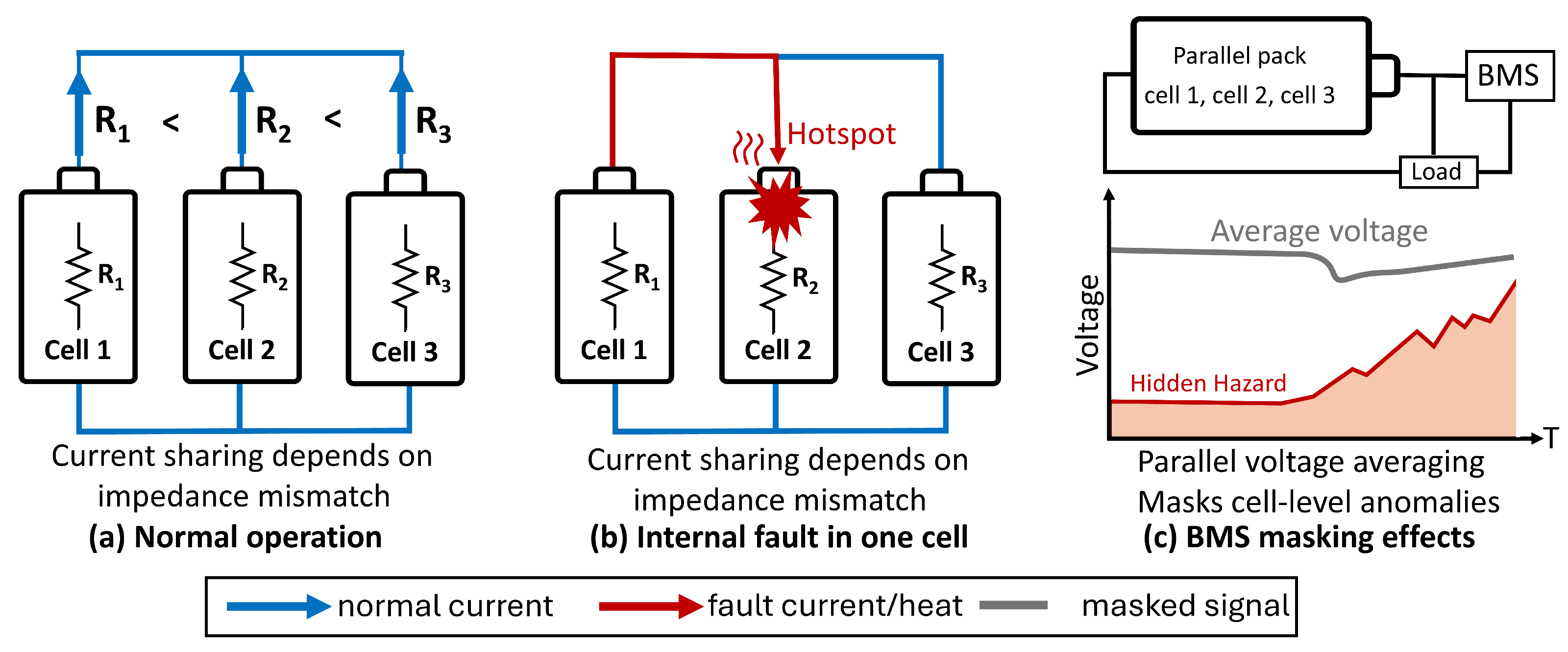
Figure 8 illustrates these masking effects. During normal operation (Figure 8a), branch currents redistribute according to impedance mismatch while terminal voltage remains clamped. During an internal fault (Figure 8b), parallel neighbors supply current to the failing cell, concentrating heat while pack-level voltage remains relatively stable. From the BMS perspective (Figure 8c), voltage averaging obscures cell-level anomalies: an apparently normal pack voltage can mask a growing hazard.
Fault escalation can also be topology enabled in ways that are difficult to infer from terminal measurements. During internal short-circuit events, transferred electricity from parallel neighbors can concentrate heating near tabs, lowering thermal-runaway onset temperature (Section 4.2.1) [90]. Interconnect–resistance ratios further compound the detection challenge: increasing these ratios raises current inhomogeneity logarithmically and reduces usable capacity by up to 42% [88].
Surface temperature sensing exhibits latency, and aging widens internal–surface thermal gradients (Section 5.2), motivating alternative precursors. Mechanical expansion monitoring provides earlier warning than temperature during low-rate external heating, and combining thermal and mechanical signals further improves early-warning performance [141]. The Connectivity-Based Outlier Factor (COF) method has detected high-resistance internal short circuits (100 Ω ) within 207 s by amplifying subtle voltage deviations [142]. Multi-physics fusion—combining electrical, thermal, and mechanical indicators—can improve detection under these observability constraints, but practical BMS implementations lack integrated frameworks that remain robust to sensor noise and distinguish benign aging from incipient thermal runaway [141,143].

5.5. Data-Driven Safety Monitoring Under Uncertainty

Thermal runaway and related safety faults represent rare but high-consequence events, creating a class-imbalance problem in which failure samples are scarce relative to normal-operation data [66,144]. Reconstruction-error methods address this by learning healthy baselines and flagging departures without requiring dense failure labels [142,144]. A Bi-LSTM with attention achieved warning accuracy 14.3 percentage points higher than K-means clustering for thermal runaway events [144], autoencoder-based monitoring achieved zero false alarms with an average detection delay of 108.2 s for oil-leakage faults [145], and optimized Random Forest classifiers achieved strong anomaly-detection accuracy with zero false negatives under embedded resource constraints [146].
Second-life packs exhibit evolving baselines as degradation progresses, making conservative threshold selection essential to balance missed detections against false alarms [6,142,144]. Sensor corruption further compounds the challenge: under noise-corrupted thermal imaging, autoencoder-based denoising improved fault-recognition accuracy by up to 32% while achieving segmentation performance of mean Average Precision (mAP) >97% [143].
Resilience to domain shift is critical given diverse first-life histories. Models trained on one population may degrade when deployed to another because normal-behavior baselines vary with chemistry, aging mode, and operating context. Maximum Mean Discrepancy (MMD)-based adaptation reduced estimation error by more than 47% relative to non-adaptive methods [136], though generalization can deteriorate near aging-knee transitions [126]. Handling spatiotemporal dependency is equally essential in parallel assemblies where voltage clamping conceals cell-level anomalies [87,140]. A Transformer-based multimodal framework reported a 28.3% reduction in missed pre-runaway cases alongside 93.5% spatial degradation localization accuracy, with a 37% reduction in sensing power consumption via reinforcement-learning-based adaptive sensing [147]. Such deep architectures can exceed low-cost BMS resources without compression or offloading [129].
Balancing detection fidelity against computation cost motivates hierarchical monitoring: lightweight edge models provide continuous anomaly scoring [146], while more intensive diagnostics are triggered selectively or offloaded to cloud-assisted digital-twin infrastructures [148].
Low-overhead implementations have reported approximately 1% CPU and 49.3% memory usage for optimized ensemble inference on embedded hardware [146]. Physics-based frameworks have also demonstrated rapid processing, completing per-test analysis in 2.9 s on a Raspberry Pi [149]. In practice, these constraints compound: parameter drift introduces bias, resistance growth creates gradients surface sensors miss, parallel topology masks divergence, aging-knee transitions depart from training baselines, and all estimates must run on low-cost hardware. Their combination requires integrated solutions that coordinate adaptive estimation, multi-physics sensing, and hierarchical architectures. Table 7 maps these strategies to operational constraints and BMS-actionable outputs.
Combined with mechanism-aware screening and topology-constrained pack design, these monitoring capabilities complete the integrated safety framework for second-life deployment.

6. Discussion, Challenges and Future Directions

6.1. Key Findings and Knowledge Gaps

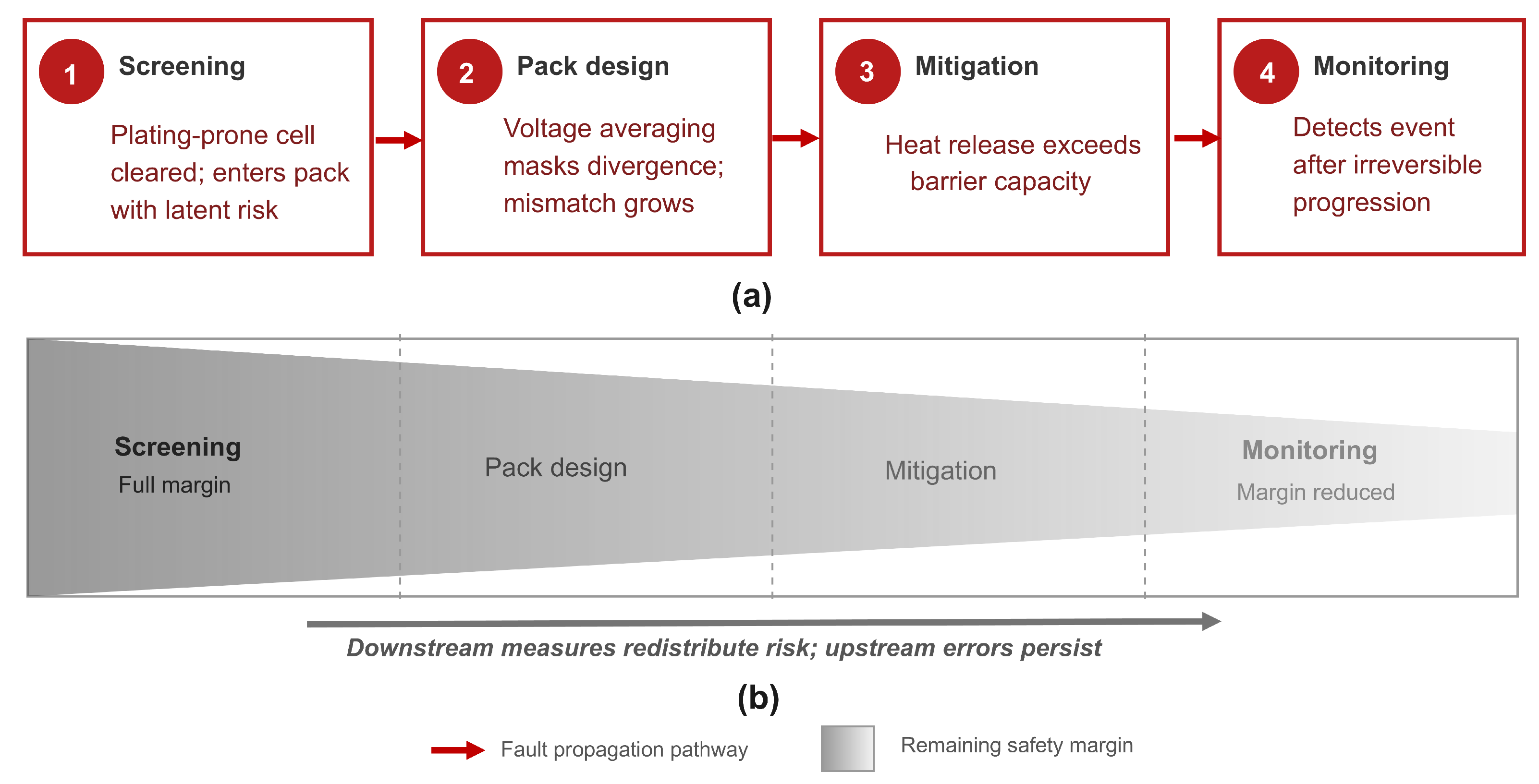
Section 1 framed second-life thermal safety around four interdependent areas and highlighted that thermal risk follows the degradation pathway rather than capacity fade. Evidence across Section 2, Section 3, Section 4 and Section 5 supports this and shows the tight coupling among these areas: degradation mechanisms shape screening outputs, which in turn constrain pack-level design and monitoring effectiveness. Plating-dominated aging substantially reduces thermal runaway trigger temperatures, even at SOH levels comparable to those of SEI-growth-dominated cells that retain near-new-cell stability. Capacity-based screening cannot resolve this distinction, creating the possibility that electrically functional cells enter packs with latent initiation risk. Weaknesses introduced at any stage propagate forward and reduce safety margins cumulatively as illustrated in Figure 9. In a representative scenario, a plating-prone cell cleared by capacity-only screening enters a parallel module where voltage averaging masks divergence. Under fault conditions, neighboring cells discharge into the failing cell; heat release exceeds barrier capacity. Module-level monitoring detects the event only after irreversible progression has begun. Downstream measures redistribute this risk but do not correct upstream errors.
Despite progress in understanding degradation mechanisms and integrating screening into pack-level controls, three knowledge gaps continue to limit confident second-life deployment.
Thermal characterization: Systematic thermal-safety baselines for cells at 70–80% SOH remain scarce in the published literature. Trigger temperatures, venting characteristics, gas evolution, and heat release profiles organized by degradation pathway are needed to distinguish plating-dominated from SEI-growth-dominated aging across different battery chemistries. Heat-generation evolution with SOH has not yet been mapped systematically across degradation pathways, creating the risk that thermal management sized from new-cell data is inadequate for aged populations.
Diagnostic validation: High-throughput screening approaches (capacity and resistance) do not resolve the degradation-mode differences that determine initiation sensitivity. More informative diagnostics (EIS, ICA, and partial pulse tests) show promise but remain insufficiently validated at industrial throughput across mixed chemistries and formats. Structural methods (CT and QUS) provide direct defect visibility but lack standardized acceptance thresholds, and their correlation with thermal-safety metrics such as trigger temperature has not been established. At the system level, detecting faults within parallel assemblies requires multi-signal sensing (voltage, temperature and expansion), yet current BMS implementations often lack this observability.
Translation: Standardized procedures to convert screening outputs into pack-level design rules remain limited. Validated Δ R limits for parallel modules, Δ C tolerances for series strings, and structural damage rejection thresholds have not been established. Mismatch tolerances vary by chemistry and format but lack standardized bounds. Pack models often assume constant interconnect resistance, whereas aging can increase this resistance, potentially shifting failure modes toward connector-related faults.
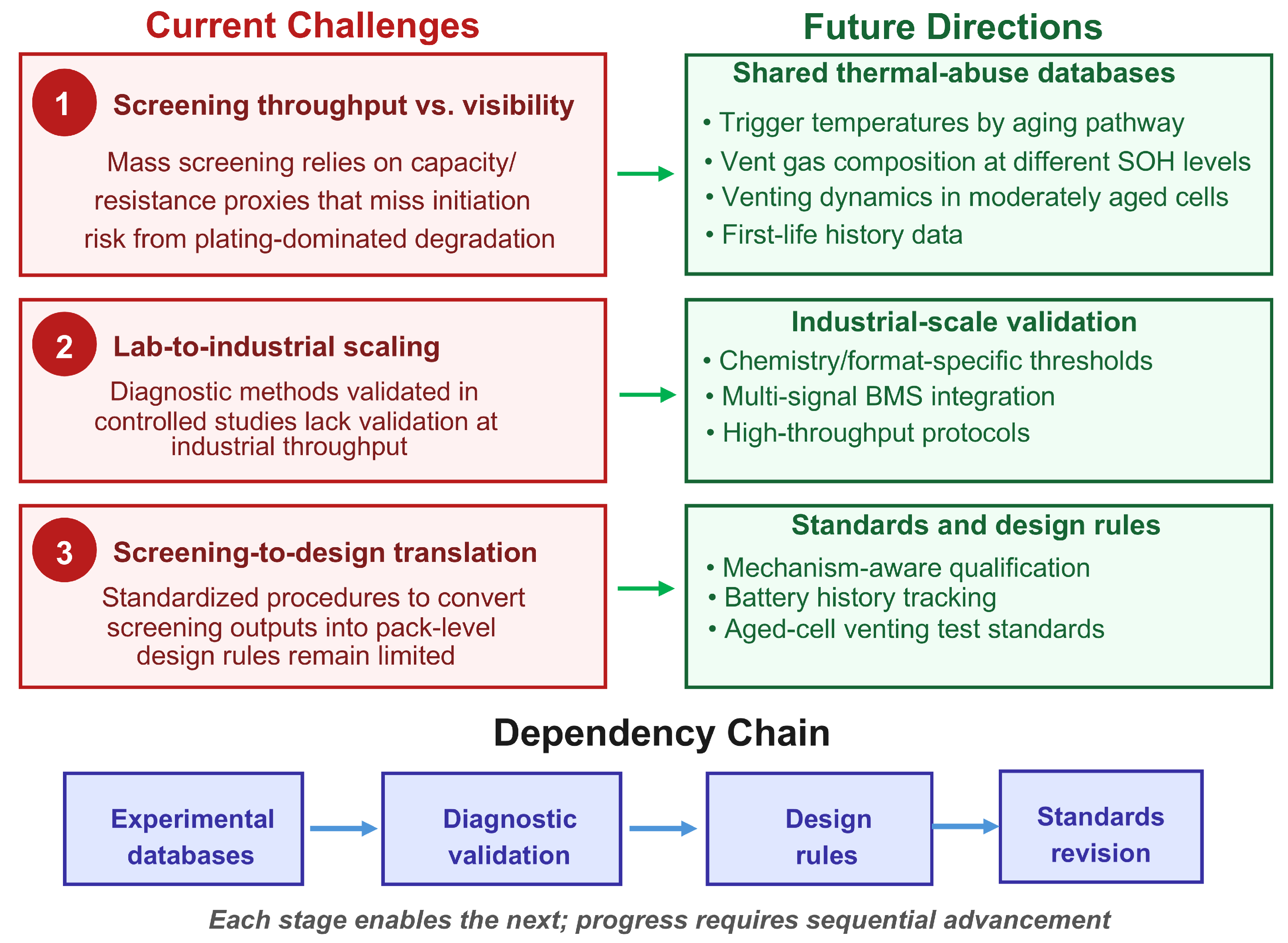
Collectively, these gaps translate into three engineering challenges that define the near-term research agenda, alongside the corresponding research directions summarized in Figure 10.

6.2. Challenges and Future Directions

Progress follows a dependency chain (Figure 10, bottom): experimental databases enable diagnostic validation, validated diagnostics inform design rules, and established rules support standards revision.
Balancing screening throughput against mechanism-level visibility: Mass screening still relies on capacity and resistance proxies that miss initiation risk. Resolving this requires shared thermal-abuse databases for cells at typical second-life entry points under controlled aging pathways. Priority measurements include trigger temperature and heat-release profiles across aging modes, vent gas composition at different SOH levels, and venting dynamics in moderately degraded cells. First-life history data (cycling conditions, thermal exposure, and fast-charge events) would further improve screening reliability. Pack-relevant data on current redistribution, temperature gradients, and fault-energy transfer as functions of resistance dispersion and interconnect condition are also needed.
Scaling diagnostics from laboratory to industrial deployment: Laboratory validation typically uses uniform cells under controlled conditions, whereas industrial screening faces heterogeneous stocks with unknown histories at much higher throughput. Methods proven in controlled studies must therefore be tested under conditions representative of heterogeneous retired stocks. Chemistry and format-specific thresholds are needed for resistance mismatch (parallel), capacity spread (series), and structural damage rejection. Integrating multi-signal monitoring into BMS would improve fault detectability in parallel architectures where voltage averaging masks cell-level anomalies.
Translating screening outputs into defensible design rules: Second-life qualification protocols should incorporate mechanism-aware screening and topology-specific safety assessment. Battery history tracking that captures thermal exposure and fast-charging events, not only cycle count, would improve risk classification. Safety testing protocols reflecting aged-cell venting behavior, including multi-stage gas ejection, remain underdeveloped. Without shared characterization databases organized by degradation pathway, diagnostic validation and standards development will likely remain fragmented.

7. Conclusions

This review surveyed thermal safety and management across four coupled domains for second-life lithium-ion batteries: degradation mechanisms (Section 2), cell screening (Section 3), pack configuration (Section 4), and state estimation and monitoring (Section 5), organized through the mechanism-to-deployment framework introduced in Section 1. The central finding is that thermal safety follows the degradation pathway rather than capacity fade: cells with comparable capacity can exhibit substantially different trigger temperatures depending on whether lithium plating or SEI growth dominates. This mechanism dependence shapes all downstream decisions: degradation pathway sets the screening requirements, screening outcomes constrain pack design, topology affects fault escalation, and together these determine the observability limits that monitoring must address. Three gaps—thermal characterization, diagnostic validation, and screening-to-design translation—must be addressed in sequence, as each enables the next. Coordinated effort from research, industry, and regulatory communities will be required to close these gaps and ensure safety keeps pace with second-life deployment.

Author Contributions

Conceptualization, M.I.H., G.L. and D.L.; methodology, M.I.H.; writing—original draft preparation, M.I.H.; writing—review and editing, M.I.H., G.L., D.L. and P.P.D.; visualization, M.I.H. and G.L.; supervision, G.L., D.L. and P.P.D. All authors have read and agreed to the published version of the manuscript.

Funding

This research was funded by the Australian Research Council (ARC) Discovery Projects, grant number DP240102646.

Data Availability Statement

No new data were created or analyzed in this study. Data sharing is not applicable to this article.

Acknowledgments

During the preparation of this manuscript, the authors used Microsoft 365 Copilot (GPT-5.2) to assist with language editing and improving clarity. All content was reviewed and edited by the authors, who take full responsibility for the final manuscript.

Conflicts of Interest

The authors declare no conflicts of interest.

References

  1. International Energy Agency (IEA). Global EV Outlook 2025: Driving Ambition for Electric Mobility; Technical Report; IEA Publications: Paris, France, 2025. [Google Scholar]
  2. Tankou, A.; Bieker, G.; Hall, D. Scaling Up Reuse and Recycling of Electric Vehicle Batteries: Assessing Challenges and Policy Approaches; Technical Report; International Council on Clean Transportation: Washington, DC, USA, 2023; Available online: https://theicct.org/publication/recycling-electric-vehicle-batteries-feb-23/ (accessed on 1 January 2026).
  3. Nováková, K.; Pražanová, A.; Stroe, D.I.; Knap, V. Second-Life of Lithium-Ion Batteries from Electric Vehicles: Concept, Aging, Testing, and Applications. Energies 2023, 16, 2345. [Google Scholar] [CrossRef]
  4. Azizighalehsari, S.; Venugopal, P.; Pratap Singh, D.; Batista Soeiro, T.; Rietveld, G. Empowering Electric Vehicles Batteries: A Comprehensive Look at the Application and Challenges of Second-Life Batteries. Batteries 2024, 10, 161. [Google Scholar] [CrossRef]
  5. Chen, Y.; Kang, Y.; Zhao, Y.; Wang, L.; Liu, J.; Li, Y.; Liang, Z.; He, X.; Li, X.; Tavajohi, N.; et al. A review of lithium-ion battery safety concerns: The issues, strategies, and testing standards. J. Energy Chem. 2021, 59, 83–99. [Google Scholar] [CrossRef]
  6. Zhang, L.; Liu, L.; Terekhov, A.; Warnberg, D.; Zhao, P. Thermal runaway of Li-ion battery with different aging histories. Process Saf. Environ. Prot. 2024, 185, 910–917. [Google Scholar] [CrossRef]
  7. Ekberg, J.; Sridharan, N.V.; Karim, R.; Atta, K.T. State estimation and remaining useful life prediction for lithium-ion batteries. Cell Rep. Phys. Sci. 2025, 6, 102854. [Google Scholar] [CrossRef]
  8. Vignesh, S.; Che, H.S.; Selvaraj, J.; Tey, K.S.; Lee, J.W.; Shareef, H.; Errouissi, R. State of Health (SoH) estimation methods for second life lithium-ion battery—Review and challenges. Appl. Energy 2024, 369, 123542. [Google Scholar] [CrossRef]
  9. Kostenko, G.; Zaporozhets, A. Transition from Electric Vehicles to Energy Storage: Review on Targeted Lithium-Ion Battery Diagnostics. Energies 2024, 17, 5132. [Google Scholar] [CrossRef]
  10. Braco, E.; San Martín, I.; Sanchis, P.; Ursúa, A. Fast capacity and internal resistance estimation method for second-life batteries from electric vehicles. Appl. Energy 2023, 329, 120235. [Google Scholar] [CrossRef]
  11. Waldmann, T.; Quinn, J.B.; Richter, K.; Kasper, M.; Tost, A.; Klein, A.; Wohlfahrt-Mehrens, M. Electrochemical, Post-Mortem, and ARC Analysis of Li-Ion Cell Safety in Second-Life Applications. J. Electrochem. Soc. 2017, 164, A3154–A3162. [Google Scholar] [CrossRef]
  12. Lin, J.; Liu, X.; Li, S.; Zhang, C.; Yang, S. A review on recent progress, challenges and perspective of battery thermal management system. Int. J. Heat Mass Transf. 2021, 167, 120834. [Google Scholar] [CrossRef]
  13. Hassan, A.; Khan, S.; Li, R.; Su, W.; Zhou, X.; Wang, M.; Wang, B. Second-Life Batteries: A Review on Power Grid Applications, Degradation Mechanisms, and Power Electronics Interface Architectures. Batteries 2023, 9, 571. [Google Scholar] [CrossRef]
  14. Wu, B.; Widanage, W.D.; Yang, S.; Liu, X. Battery digital twins: Perspectives on the fusion of models, data and artificial intelligence for smart battery management systems. Energy AI 2020, 1, 100016. [Google Scholar] [CrossRef]
  15. Piombo, G.; Faraji Niri, M.; Marco, J. A novel application-aware retired lithium-ion batteries regrouping approach to enable improved second life. J. Clean. Prod. 2025, 489, 144526. [Google Scholar] [CrossRef]
  16. El Khatib, A.R.; Hoblos, G.; Langueh, K.; Duviella, E. From First Life to Second Life: Advances and Research Gaps in Prognosis Techniques for Lithium-Ion Batteries. Appl. Sci. 2025, 15, 12171. [Google Scholar] [CrossRef]
  17. Al-Alawi, M.K.; Cugley, J.; Hassanin, H. Techno-economic feasibility of retired electric-vehicle batteries repurpose/reuse in second-life applications: A systematic review. Energy Clim. Change 2022, 3, 100086. [Google Scholar] [CrossRef]
  18. Shahid, S.; Agelin-Chaab, M. A review of thermal runaway prevention and mitigation strategies for lithium-ion batteries. Energy Convers. Manag. X 2022, 16, 100310. [Google Scholar] [CrossRef]
  19. Preger, Y.; Torres-Castro, L.; Rauhala, T.; Jeevarajan, J. Perspective—On the Safety of Aged Lithium-Ion Batteries. J. Electrochem. Soc. 2022, 169, 030507. [Google Scholar] [CrossRef]
  20. Gu, X.; Bai, H.; Cui, X.; Zhu, J.; Zhuang, W.; Li, Z.; Hu, X.; Song, Z. Challenges and opportunities for second-life batteries: Key technologies and economy. Renew. Sustain. Energy Rev. 2024, 192, 114191. [Google Scholar] [CrossRef]
  21. Wang, H.; Wu, S.; Shao, C.; Luan, W.; Chen, H. Thermal runaway and gas generation dynamics in aged Lithium-ion batteries under low temperatures. J. Energy Storage 2025, 124, 116852. [Google Scholar] [CrossRef]
  22. Zhang, G.; Wei, X.; Chen, S.; Wei, G.; Zhu, J.; Wang, X.; Han, G.; Dai, H. Research on the impact of high-temperature aging on the thermal safety of lithium-ion batteries. J. Energy Chem. 2023, 87, 378–389. [Google Scholar] [CrossRef]
  23. Liu, Y.; Liu, C.; Liu, Y.; Sun, F.; Qiao, J.; Xu, T. Review on degradation mechanism and health state estimation methods of lithium-ion batteries. J. Traffic Transp. Eng. (Engl. Ed.) 2023, 10, 578–610. [Google Scholar] [CrossRef]
  24. Rufino Júnior, C.A.; Sanseverino, E.R.; Gallo, P.; Amaral, M.M.; Koch, D.; Kotak, Y.; Diel, S.; Walter, G.; Schweiger, H.G.; Zanin, H. Unraveling the Degradation Mechanisms of Lithium-Ion Batteries. Energies 2024, 17, 3372. [Google Scholar] [CrossRef]
  25. Wu, W.; Ma, R.; Liu, J.; Liu, M.; Wang, W.; Wang, Q. Impact of low temperature and charge profile on the aging of lithium-ion battery: Non-invasive and post-mortem analysis. Int. J. Heat Mass Transf. 2021, 170, 121024. [Google Scholar] [CrossRef]
  26. Pastor, J.V.; García, A.; Monsalve-Serrano, J.; Golke, D. Analysis of the aging effects on the thermal runaway characteristics of Lithium-Ion cells through stepwise reactions. Appl. Therm. Eng. 2023, 230, 120685. [Google Scholar] [CrossRef]
  27. Preger, Y.; Feinauer, M.; Torres-Castro, L.; Hogrefe, C.; Gray, L.; Gerosa, G.; Langendorf, J.; Häfele, S.; Wittman, R.M.; Wörz, M.; et al. Impact of Testing Method on Safety Assessment of Aged Li-Ion Cells: Part II—Aged Cells Without Li Plating. J. Electrochem. Soc. 2025, 172, 080503. [Google Scholar] [CrossRef]
  28. Bai, J.; Gao, T.; Bai, W.; Wang, J.; Wang, Z. Effect of low temperature aging on thermal stability of lithium-ion batteries. Therm. Sci. Eng. Prog. 2025, 68, 104291. [Google Scholar] [CrossRef]
  29. Gerosa, G.G.; Feinauer, M.; Hogrefe, C.; Häfele, S.; Bischof, K.; Wörz, M.; Böse, O.; Wohlfahrt-Mehrens, M.; Hölzle, M.; Waldmann, T. Impact of Testing Method on Safety Assessment of Aged Li-ion Cells: Part I—Li Plating as Main Aging Mechanism. J. Electrochem. Soc. 2025, 172, 030502. [Google Scholar] [CrossRef]
  30. Zhang, G.; Wei, X.; Chen, S.; Zhu, J.; Han, G.; Wang, X.; Dai, H. Revealing the Impact of Fast Charge Cycling on the Thermal Safety of Lithium-Ion Batteries. ACS Appl. Energy Mater. 2022, 5, 7056–7068. [Google Scholar] [CrossRef]
  31. Abbas, S.M.; Gstrein, G.; Golubkov, A.W.; Korak, O.; Erker, S.; Ellersdorfer, C. Influence of Lithium Plating on the Thermal Properties of Automotive High Energy Pouch Batteries. Batteries 2025, 11, 338. [Google Scholar] [CrossRef]
  32. Börner, M.; Friesen, A.; Grützke, M.; Stenzel, Y.; Brunklaus, G.; Haetge, J.; Nowak, S.; Schappacher, F.; Winter, M. Correlation of aging and thermal stability of commercial 18650-type lithium ion batteries. J. Power Sources 2017, 342, 382–392. [Google Scholar] [CrossRef]
  33. Wang, M.; Wu, S.; Chen, Y.; Luan, W. The snowball effect in electrochemical degradation and safety evolution of lithium-ion batteries during long-term cycling. Appl. Energy 2025, 378, 124909. [Google Scholar] [CrossRef]
  34. Teliz, E.; Zinola, C.F.; Díaz, V. Identification and quantification of ageing mechanisms in Li-ion batteries by Electrochemical impedance spectroscopy. Electrochim. Acta 2022, 426, 140801. [Google Scholar] [CrossRef]
  35. Wang, H.; Wu, Y.; Cao, Y.; Liu, M.; Liu, X.; Liu, Y.; Liu, B. Investigate the changes of aged lithium iron phosphate batteries from a mechanical perspective. iScience 2024, 27, 111300. [Google Scholar] [CrossRef] [PubMed]
  36. Fear, C.; Parmananda, M.; Kabra, V.; Carter, R.; Love, C.T.; Mukherjee, P.P. Mechanistic underpinnings of thermal gradient induced inhomogeneity in lithium plating. Energy Storage Mater. 2021, 35, 500–511. [Google Scholar] [CrossRef]
  37. Carter, R.; Kingston, T.A.; Atkinson, R.W.; Parmananda, M.; Dubarry, M.; Fear, C.; Mukherjee, P.P.; Love, C.T. Directionality of thermal gradients in lithium-ion batteries dictates diverging degradation modes. Cell Rep. Phys. Sci. 2021, 2, 100351. [Google Scholar] [CrossRef]
  38. Jones, C.M.; Sudarshan, M.; García, R.E.; Tomar, V. Direct measurement of internal temperatures of commercially-available 18650 lithium-ion batteries. Sci. Rep. 2023, 13, 14421. [Google Scholar] [CrossRef]
  39. Liu, J.; Zhang, Y.; Bai, J.; Zhou, L.; Wang, Z. Influence of lithium plating on lithium-ion battery aging at high temperature. Electrochim. Acta 2023, 454, 142362. [Google Scholar] [CrossRef]
  40. Liu, X.; Yin, L.; Ren, D.; Wang, L.; Ren, Y.; Xu, W.; Lapidus, S.; Wang, H.; He, X.; Chen, Z.; et al. In situ observation of thermal-driven degradation and safety concerns of lithiated graphite anode. Nat. Commun. 2021, 12, 4235. [Google Scholar] [CrossRef]
  41. Zhou, H.; Fear, C.; Carter, R.E.; Love, C.T.; Mukherjee, P.P. Correlating lithium plating quantification with thermal safety characteristics of lithium-ion batteries. Energy Storage Mater. 2024, 66, 103214. [Google Scholar] [CrossRef]
  42. Abbas, S.M.; Gstrein, G.; Jauernig, A.D.; Schmid, A.; Michelini, E.; Hinterberger, M.; Ellersdorfer, C. Influence of Lithium Plating on the Mechanical Properties of Automotive High-Energy Pouch Batteries. Batteries 2025, 11, 330. [Google Scholar] [CrossRef]
  43. Zhao, L.; Zheng, M.; Zhang, J.; Liu, H.; Li, W.; Chen, M. Numerical modeling of thermal runaway for low temperature cycling lithium-ion batteries. J. Energy Storage 2023, 63, 107053. [Google Scholar] [CrossRef]
  44. Liu, J.; Zhou, L.; Zhang, Y.; He, T.; Wang, Z. Thermal stability of lithium-ion battery subjected to inhomogeneous aging. Process Saf. Environ. Prot. 2023, 180, 992–1002. [Google Scholar] [CrossRef]
  45. Zhang, G.; Shen, W.; Wei, X. Lithium-ion battery thermal safety evolution during high-temperature nonlinear aging. Fuel 2024, 362, 130845. [Google Scholar] [CrossRef]
  46. Tian, Y.; Zhan, X.; Zhang, Y.; Qiao, Z.; Lu, Y.; Xia, Q.; Lu, J.; Zhang, X.; Chen, Z. Thermal Decomposition Mechanism of PF5 and POF3 with Carbonate-Based Electrolytes During Lithium-Ion Batteries’ Thermal Runaway. Fire 2025, 8, 370. [Google Scholar] [CrossRef]
  47. Gulsoy, B.; Chen, H.; Briggs, C.; Vincent, T.; Sansom, J.; Marco, J. Real-time simultaneous monitoring of internal temperature and gas pressure in cylindrical cells during thermal runaway. J. Power Sources 2024, 617, 235147. [Google Scholar] [CrossRef]
  48. Drallmeier, J.A.; Wong, C.; Solbrig, C.E.; Siegel, J.B.; Stefanopoulou, A.G. Challenges of a Fast Diagnostic to Inform Screening of Retired Batteries. IFAC-PapersOnLine 2022, 55, 185–190. [Google Scholar] [CrossRef]
  49. Saxon, A.; Yang, C.; Santhanagopalan, S.; Keyser, M.; Colclasure, A. Li-Ion Battery Thermal Characterization for Thermal Management Design. Batteries 2024, 10, 136. [Google Scholar] [CrossRef]
  50. Tan, C.M.; Yang, Y.; Kumar, K.J.M.; Mishra, D.D.; Liu, T.Y. Addressing practical challenges of LiB cells in their pack applications. Sci. Rep. 2024, 14, 10126. [Google Scholar] [CrossRef]
  51. Albuquerque, L.; Lacressonnière, F.; Roboam, X.; Forgez, C. Incremental Capacity Analysis as a Diagnostic Method Applied to Second Life Li-ion Batteries. In ELECTRIMACS 2022; Pierfederici, S., Martin, J.P., Eds.; Lecture Notes in Electrical Engineering; Springer International Publishing: Cham, Switzerland, 2023; Volume 993, pp. 451–463. [Google Scholar] [CrossRef]
  52. Vásquez, F.; Sara Gaitán, P.; Calderón, J.A. Comparative study of methodologies for SOH diagnosis and forecast of LFP and NMC lithium batteries used in electric vehicles. J. Energy Storage 2025, 105, 114725. [Google Scholar] [CrossRef]
  53. Sheraz, M.; Choi, W. A Novel Technique for Fast Ohmic Resistance Measurement to Evaluate the Aging of Lithium-Ion xEVs Batteries. Energies 2023, 16, 1416. [Google Scholar] [CrossRef]
  54. Shen, W.; Wang, N.; Zhang, J.; Wang, F.; Zhang, G. Heat Generation and Degradation Mechanism of Lithium-Ion Batteries during High-Temperature Aging. ACS Omega 2022, 7, 44733–44742. [Google Scholar] [CrossRef]
  55. Choi, W.; Shin, H.C.; Kim, J.M.; Choi, J.Y.; Yoon, W.S. Modeling and Applications of Electrochemical Impedance Spectroscopy (EIS) for Lithium-ion Batteries. J. Electrochem. Sci. Technol. 2020, 11, 1–13. [Google Scholar] [CrossRef]
  56. Liao, Q.; Mu, M.; Zhao, S.; Zhang, L.; Jiang, T.; Ye, J.; Shen, X.; Zhou, G. Performance assessment and classification of retired lithium ion battery from electric vehicles for energy storage. Int. J. Hydrogen Energy 2017, 42, 18817–18823. [Google Scholar] [CrossRef]
  57. Wu, B.; Yufit, V.; Marinescu, M.; Offer, G.J.; Martinez-Botas, R.F.; Brandon, N.P. Coupled thermal–electrochemical modelling of uneven heat generation in lithium-ion battery packs. J. Power Sources 2013, 243, 544–554. [Google Scholar] [CrossRef]
  58. Xia, B.; Qin, Z.; Fu, H. Rapid estimation of battery state of health using partial electrochemical impedance spectra and interpretable machine learning. J. Power Sources 2024, 603, 234413. [Google Scholar] [CrossRef]
  59. Zhu, X.; Han, W.; Dong, J.; Geng, G.; Jiang, Q. Rapid Health Diagnosis Method for Retired Lithium-ion Batteries based on Electrochemical Impedance Spectroscopy. In Proceedings of the 2025 10th Asia Conference on Power and Electrical Engineering (ACPEE), Beijing, China, 15–19 April 2025; pp. 2505–2510. [Google Scholar] [CrossRef]
  60. Kehl, D.; Jennert, T.; Lienesch, F.; Kurrat, M. Electrical Characterization of Li-Ion Battery Modules for Second-Life Applications. Batteries 2021, 7, 32. [Google Scholar] [CrossRef]
  61. Faraji-Niri, M.; Rashid, M.; Sansom, J.; Sheikh, M.; Widanage, D.; Marco, J. Accelerated state of health estimation of second life lithium-ion batteries via electrochemical impedance spectroscopy tests and machine learning techniques. J. Energy Storage 2023, 58, 106295. [Google Scholar] [CrossRef]
  62. Ran, A.; Chen, S.; Zhang, S.; Liu, S.; Zhou, Z.; Nie, P.; Qian, K.; Fang, L.; Zhao, S.X.; Li, B.; et al. A gradient screening approach for retired lithium-ion batteries based on X-ray computed tomography images. RSC Adv. 2020, 10, 19117–19123. [Google Scholar] [CrossRef] [PubMed]
  63. Montoya-Bedoya, S.; Garcia-Tamayo, E.; Rohrbach, D.; Gaviria-Cardona, J.P.; Martinez-Tejada, H.V.; Planden, B.; Howey, D.A.; Florez, W.F.; Valencia, R.A.; Bernal, M. Quantitative Ultrasound Spectroscopy for Screening Cylindrical Lithium-Ion Batteries for Second-Life Applications. Batter. Supercaps 2024, 7, e202400002. [Google Scholar] [CrossRef]
  64. Attia, P.M.; Moch, E.; Herring, P.K. Challenges and opportunities for high-quality battery production at scale. Nat. Commun. 2025, 16, 611. [Google Scholar] [CrossRef] [PubMed]
  65. Condon, A.; Buscarino, B.; Moch, E.; Sehnert, W.J.; Miles, O.; Herring, P.K.; Attia, P.M. A dataset of over one thousand computed tomography scans of battery cells. Data Brief 2024, 55, 110614. [Google Scholar] [CrossRef]
  66. Lin, M.; Zhang, Z.; Meng, J.; Wu, J. Retired Lithium-Ion Batteries Screening via Feature Tokeniser-Transformer Considering Data Imbalance. IEEE Trans. Ind. Inform. 2025, 21, 6345–6354. [Google Scholar] [CrossRef]
  67. Tao, S.; Ma, R.; Chen, Y.; Liang, Z.; Ji, H.; Han, Z.; Wei, G.; Zhang, X.; Zhou, G. Rapid and sustainable battery health diagnosis for recycling pretreatment using fast pulse test and random forest machine learning. J. Power Sources 2024, 597, 234156. [Google Scholar] [CrossRef]
  68. Wett, C.; Lampe, J.; Görick, D.; Seeger, T.; Turan, B. Identification of cell chemistries in lithium-ion batteries: Improving the assessment for recycling and second-life. Energy AI 2025, 19, 100468. [Google Scholar] [CrossRef]
  69. Mubenga, N.S.; Sharma, K.; Stuart, T. A Bilevel Equalizer to Boost the Capacity of Second Life Li Ion Batteries. Batteries 2019, 5, 55. [Google Scholar] [CrossRef]
  70. Wang, Y.; Zhao, Y.; Zhou, S.; Yan, Q.; Zhan, H.; Cheng, Y.; Yin, W. Impact of Individual Cell Parameter Difference on the Performance of Series–Parallel Battery Packs. ACS Omega 2023, 8, 10512–10524. [Google Scholar] [CrossRef]
  71. Hosseinzadeh, E.; Arias, S.; Krishna, M.; Worwood, D.; Barai, A.; Widanalage, D.; Marco, J. Quantifying cell-to-cell variations of a parallel battery module for different pack configurations. Appl. Energy 2021, 282, 115859. [Google Scholar] [CrossRef]
  72. Piombo, G.; Fasolato, S.; Heymer, R.; Hidalgo, M.; Faraji Niri, M.; Onori, S.; Marco, J. Unveiling the performance impact of module level features on parallel-connected lithium-ion cells via explainable machine learning techniques on a full factorial design of experiments. J. Energy Storage 2024, 84, 110783. [Google Scholar] [CrossRef]
  73. Ye, M.; Song, X.; Xiong, R.; Sun, F. A Novel Dynamic Performance Analysis and Evaluation Model of Series-Parallel Connected Battery Pack for Electric Vehicles. IEEE Access 2019, 7, 14256–14265. [Google Scholar] [CrossRef]
  74. Gogoana, R.; Pinson, M.B.; Bazant, M.Z.; Sarma, S.E. Internal resistance matching for parallel-connected lithium-ion cells and impacts on battery pack cycle life. J. Power Sources 2014, 252, 8–13. [Google Scholar] [CrossRef]
  75. Bruen, T.; Marco, J. Modelling and experimental evaluation of parallel connected lithium ion cells for an electric vehicle battery system. J. Power Sources 2016, 310, 91–101. [Google Scholar] [CrossRef]
  76. Al-Amin, M.; Barai, A.; Ashwin, T.; Marco, J. An Insight to the Degradation Behaviour of the Parallel Connected Lithium-Ion Battery Cells. Energies 2021, 14, 4716. [Google Scholar] [CrossRef]
  77. Klein, M.P.; Park, J.W. Current Distribution Measurements in Parallel-Connected Lithium-Ion Cylindrical Cells under Non-Uniform Temperature Conditions. J. Electrochem. Soc. 2017, 164, A1893–A1906. [Google Scholar] [CrossRef]
  78. Frank, A.; Schaeffler, S.; Kirst, C.; Roehrer, F.; Kücher, S.; Durdel, A.; Scheller, M.; Jossen, A. Modeling Inhomogeneities during Parallel-Connected Fast Charging of Lithium-Ion Battery Systems. J. Electrochem. Soc. 2025, 172, 040505. [Google Scholar] [CrossRef]
  79. Hong, H.; Chen, X.; d’Apolito, L.; Ye, Y.; Shen, S. A Two-Stage Multi-Parameter-Based Sorting Method for Ensuring Consistency Between Parallel-Connected Lithium-Ion Batteries. World Electr. Veh. J. 2025, 16, 125. [Google Scholar] [CrossRef]
  80. Zhou, Z.; Duan, B.; Kang, Y.; Shang, Y.; Cui, N.; Chang, L.; Zhang, C. An efficient screening method for retired lithium-ion batteries based on support vector machine. J. Clean. Prod. 2020, 267, 121882. [Google Scholar] [CrossRef]
  81. Li, C.; Wang, N.; Li, W.; Li, Y.; Zhang, J. Regrouping and Echelon Utilization of Retired Lithium-Ion Batteries Based on a Novel Support Vector Clustering Approach. IEEE Trans. Transp. Electrif. 2022, 8, 3648–3658. [Google Scholar] [CrossRef]
  82. Liu, X.; Qu, F.; Luo, Q.; Liang, H.; Sun, P.; Du, X. A Model-Based Research on Performance Evaluation and Topology Optimization of Series-Parallel Lithium-Ion Battery Packs. IEEE Trans. Intell. Transp. Syst. 2024, 25, 13264–13276. [Google Scholar] [CrossRef]
  83. Duan, Y.; Ye, W.; Zhang, Q.; Wang, J.; Lu, J. Decoupling Analysis of Parameter Inconsistencies in Lithium-Ion Battery Packs Guiding Balancing System Design. Energies 2025, 18, 3439. [Google Scholar] [CrossRef]
  84. Preger, Y.; Mueller, J.; Fresquez, A.; Allu, S.; Rich, C. Impact of Module Configuration on Lithium-Ion Battery Performance and Degradation: Part I. Energy Throughput, Voltage Spread, and Current Distribution. J. Electrochem. Soc. 2025, 172, 050540. [Google Scholar] [CrossRef]
  85. Castano-Solis, S.; Serrano-Jimenez, D.; Gauchia, L.; Sanz, J. The Influence of BMSs on the Characterization and Modeling of Series and Parallel Li-Ion Packs. Energies 2017, 10, 273. [Google Scholar] [CrossRef]
  86. Braco, E.; San Martín, I.; Berrueta, A.; Sanchis, P.; Ursúa, A. Experimental assessment of cycling ageing of lithium-ion second-life batteries from electric vehicles. J. Energy Storage 2020, 32, 101695. [Google Scholar] [CrossRef]
  87. Luca, R.; Whiteley, M.; Neville, T.; Tranter, T.; Weaving, J.; Marco, J.; Shearing, P.R.; Brett, D.J.L. Current Imbalance in Parallel Battery Strings Measured Using a Hall-Effect Sensor Array. Energy Technol. 2021, 9, 2001014. [Google Scholar] [CrossRef]
  88. Hosseinzadeh, E.; Marco, J.; Jennings, P. Combined electrical and electrochemical-thermal model of parallel connected large format pouch cells. J. Energy Storage 2019, 22, 194–207. [Google Scholar] [CrossRef]
  89. Fill, A.; Birke, K.P. Interaction of Temperature and Current Differences among parallel-connected Lithium-Ion Cells in Dependency of the thermal Battery Design. In Proceedings of the 2022 IEEE 21st Mediterranean Electrotechnical Conference (MELECON), Palermo, Italy, 14–16 June 2022; pp. 195–200. [Google Scholar] [CrossRef]
  90. Zhou, Z.; Li, M.; Zhou, X.; Ju, X.; Yang, L. Investigating thermal runaway characteristics and trigger mechanism of the parallel lithium-ion battery. Appl. Energy 2023, 349, 121690. [Google Scholar] [CrossRef]
  91. Zhao, L.; Han, Z.; Guo, W.; Qiao, Z.; Qiu, H.; Liu, H.; Chen, M. An experimental study on thermal runaway propagation over cyclic aging lithium-ion battery modules with different electrical connections. J. Energy Storage 2024, 89, 111823. [Google Scholar] [CrossRef]
  92. Luan, C.; Ma, C.; Wang, C.; Chang, L.; Xiao, L.; Yu, Z.; Li, H. Influence of the connection topology on the performance of lithium-ion battery pack under cell-to-cell parameters variations. J. Energy Storage 2021, 41, 102896. [Google Scholar] [CrossRef]
  93. Porpora, F.; D’Arpino, M.; Cheng, Y.; Rizzoni, G.; Tomasso, G. Reduced Order Model of Common Battery Pack Architectures for Assessment of Cell Parameter Variation Propagation. IEEE Access 2023, 11, 96693–96709. [Google Scholar] [CrossRef]
  94. Wang, Z.; Mao, N.; Jiang, F. Study on the effect of spacing on thermal runaway propagation for lithium-ion batteries. J. Therm. Anal. Calorim. 2020, 140, 2849–2863. [Google Scholar] [CrossRef]
  95. Chen, L.; Pereira, C.; Pannala, S.; Munjurulimana, D.; Goossens, H. Mitigation of cylindrical lithium ion battery thermal runaway propagation with a flame retardant polypropylene thermal barrier. J. Energy Storage 2025, 108, 115042. [Google Scholar] [CrossRef]
  96. Lopez, C.F.; Jeevarajan, J.A.; Mukherjee, P.P. Experimental Analysis of Thermal Runaway and Propagation in Lithium-Ion Battery Modules. J. Electrochem. Soc. 2015, 162, A1905–A1915. [Google Scholar] [CrossRef]
  97. Zhu, M.; Zhang, S.; Chen, Y.; Zhao, L.; Chen, M. Experimental and analytical investigation on the thermal runaway propagation characteristics of lithium-ion battery module with NCM pouch cells under various state of charge and spacing. J. Energy Storage 2023, 72, 108380. [Google Scholar] [CrossRef]
  98. Xiao, H.; E, J.; Tian, S.; Huang, Y.; Song, X. Effect of composite cooling strategy including phase change material and liquid cooling on the thermal safety performance of a lithium-ion battery pack under thermal runaway propagation. Energy 2024, 295, 131093. [Google Scholar] [CrossRef]
  99. Wong, S.K.; Li, K.; Rui, X.; Fan, L.; Ouyang, M.; Feng, X. Mitigating thermal runaway propagation in high specific energy lithium-ion battery modules through nanofiber aerogel composite material. Energy 2024, 307, 132353. [Google Scholar] [CrossRef]
  100. Wang, J.; Zhou, Y.; Wang, Z.; He, C.; Zhao, Y.; Huang, X.; Richard, Y.K.K. Fire-resistant and mechanically-robust phosphorus-doped MoS2/epoxy composite as barrier of the thermal runaway propagation of lithium-ion batteries. Chem. Eng. J. 2024, 497, 154866. [Google Scholar] [CrossRef]
  101. Zou, K.; Xu, J.; Zhao, M.; Lu, S. Effects and mechanism of thermal insulation materials on thermal runaway propagation in large-format pouch lithium-ion batteries. Process Saf. Environ. Prot. 2024, 185, 1352–1361. [Google Scholar] [CrossRef]
  102. Talele, V.; Patil, M.S.; Panchal, S.; Fraser, R.; Fowler, M. Battery thermal runaway propagation time delay strategy using phase change material integrated with pyro block lining: Dual functionality battery thermal design. J. Energy Storage 2023, 65, 107253. [Google Scholar] [CrossRef]
  103. Wilke, S.; Schweitzer, B.; Khateeb, S.; Al-Hallaj, S. Preventing thermal runaway propagation in lithium ion battery packs using a phase change composite material: An experimental study. J. Power Sources 2017, 340, 51–59. [Google Scholar] [CrossRef]
  104. Li, R.; Liu, Z.; Zheng, S.; Xu, C.; Sun, J.; Chen, S.; Wang, H.; Lu, L.; Deng, T.; Feng, X. Trifunctional composite thermal barrier mitigates the thermal runaway propagation of large-format prismatic lithium-ion batteries. J. Energy Storage 2023, 73, 109178. [Google Scholar] [CrossRef]
  105. Bausch, B.; Frankl, S.; Becher, D.; Menz, F.; Baier, T.; Bauer, M.; Böse, O.; Hölzle, M. Naturally-derived thermal barrier based on fiber-reinforced hydrogel for the prevention of thermal runaway propagation in high-energetic lithium-ion battery packs. J. Energy Storage 2023, 61, 106841. [Google Scholar] [CrossRef]
  106. Mao, Y.; Ye, Y.; Zhao, L.; Chen, Y.; Chen, M. Suppression of lithium-ion battery thermal runaway propagation by zirconia ceramics and aerogel felt in confined space. Process Saf. Environ. Prot. 2024, 189, 1258–1273. [Google Scholar] [CrossRef]
  107. Read, E.; Mathew, J.; Charmer, S.; Dowson, M.; Lorincz, D.; Örökös Tóth, I.; Dobson, M.; Marco, J. Performance of interstitial thermal barrier materials on containing sidewall rupture and thermal runaway propagation in a lithium-ion battery module. J. Energy Storage 2024, 95, 112491. [Google Scholar] [CrossRef]
  108. Wang, Z.; He, T.; Bian, H.; Jiang, F.; Yang, Y. Characteristics of and factors influencing thermal runaway propagation in lithium-ion battery packs. J. Energy Storage 2021, 41, 102956. [Google Scholar] [CrossRef]
  109. Liu, X.; Ai, W.; Naylor Marlow, M.; Patel, Y.; Wu, B. The effect of cell-to-cell variations and thermal gradients on the performance and degradation of lithium-ion battery packs. Appl. Energy 2019, 248, 489–499. [Google Scholar] [CrossRef]
  110. Hasan, H.A.; Togun, H.; Abed, A.M.; Biswas, N.; Mohammed, H.I. Thermal performance assessment for an array of cylindrical Lithium-Ion battery cells using an Air-Cooling system. Appl. Energy 2023, 346, 121354. [Google Scholar] [CrossRef]
  111. Roe, C.; Feng, X.; White, G.; Li, R.; Wang, H.; Rui, X.; Li, C.; Zhang, F.; Null, V.; Parkes, M.; et al. Immersion cooling for lithium-ion batteries—A review. J. Power Sources 2022, 525, 231094. [Google Scholar] [CrossRef]
  112. Zhang, R.; Wang, K.; Ji, Y.; Zhao, G. Impact of thermal management on the performance of the series-parallel battery pack. In Proceedings of the 2025 7th International Conference on Information Science, Electrical and Automation Engineering (ISEAE), Harbin, China, 18–20 April 2025; pp. 255–259. [Google Scholar] [CrossRef]
  113. Wang, Y.; Zhao, L.; Zhan, W.; Chen, Y.; Chen, M. Flame retardant composite phase change materials with MXene for lithium-ion battery thermal management systems. J. Energy Storage 2024, 86, 111293. [Google Scholar] [CrossRef]
  114. Ling, Z.; Wang, F.; Fang, X.; Gao, X.; Zhang, Z. A hybrid thermal management system for lithium ion batteries combining phase change materials with forced-air cooling. Appl. Energy 2015, 148, 403–409. [Google Scholar] [CrossRef]
  115. Connor, W.D.; Advani, S.G.; Prasad, A.K. Adaptive Thermal Control of Cell Groups to Extend Cycle Life of Lithium-Ion Battery Packs. Appl. Sci. 2023, 13, 4681. [Google Scholar] [CrossRef]
  116. Ye, J.; Aldaher, A.Y.M.; Tan, G. Thermal performance analysis of 18,650 battery thermal management system integrated with liquid-cooling and air-cooling. J. Energy Storage 2023, 72, 108766. [Google Scholar] [CrossRef]
  117. Braco, E.; San Martin, I.; Berrueta, A.; Sanchis, P.; Ursua, A. Experimental Assessment of First- and Second-Life Electric Vehicle Batteries: Performance, Capacity Dispersion, and Aging. IEEE Trans. Ind. Appl. 2021, 57, 4107–4117. [Google Scholar] [CrossRef]
  118. Zhu, R.; Hu, J.; Peng, W. Bayesian calibrated physics-informed neural networks for second-life battery SOH estimation. Reliab. Eng. Syst. Saf. 2025, 264, 111432. [Google Scholar] [CrossRef]
  119. Natella, D.; Onori, S.; Vasca, F. A Co-Estimation Framework for State of Charge and Parameters of Lithium-Ion Battery With Robustness to Aging and Usage Conditions. IEEE Trans. Ind. Electron. 2023, 70, 5760–5770. [Google Scholar] [CrossRef]
  120. Lee, J.; Won, J. Enhanced Coulomb Counting Method for SoC and SoH Estimation Based on Coulombic Efficiency. IEEE Access 2023, 11, 15449–15459. [Google Scholar] [CrossRef]
  121. Lai, X.; Yuan, M.; Tang, X.; Yao, Y.; Weng, J.; Gao, F.; Ma, W.; Zheng, Y. Co-Estimation of State-of-Charge and State-of-Health for Lithium-Ion Batteries Considering Temperature and Ageing. Energies 2022, 15, 7416. [Google Scholar] [CrossRef]
  122. Tulabi, M.; Bubbico, R. Electrochemical–Thermal Modeling of Lithium-Ion Batteries: An Analysis of Thermal Runaway with Observation on Aging Effects. Batteries 2025, 11, 178. [Google Scholar] [CrossRef]
  123. Vennam, G.; Sahoo, A. A Dynamic SOH-Coupled Lithium-Ion Cell Model for State and Parameter Estimation. IEEE Trans. Energy Convers. 2023, 38, 1186–1196. [Google Scholar] [CrossRef]
  124. Ren, D.; Hsu, H.; Li, R.; Feng, X.; Guo, D.; Han, X.; Lu, L.; He, X.; Gao, S.; Hou, J.; et al. A comparative investigation of aging effects on thermal runaway behavior of lithium-ion batteries. eTransportation 2019, 2, 100034. [Google Scholar] [CrossRef]
  125. Michelini, E.; Höschele, P.; Ellersdorfer, C.; Moser, J. Impact of Prolonged Electrochemical Cycling on Health Indicators of Aged Lithium-Ion Batteries for a Second-Life Use. IEEE Access 2024, 12, 193707–193716. [Google Scholar] [CrossRef]
  126. Gao, Z.; Xie, H.; Liu, Z.; Wang, B.; Akoto, J.D.; Tan, R.; Chen, S. A data-driven methodology for early-stage estimation and second-life applicability assessment toward lifecycle refined management of power batteries. Energy 2025, 335, 138281. [Google Scholar] [CrossRef]
  127. Rasheed, M.; Hassan, R.; Kamel, M.; Wang, H.; Zane, R.; Tong, S.; Smith, K. Active Reconditioning of Retired Lithium-Ion Battery Packs From Electric Vehicles for Second-Life Applications. IEEE J. Emerg. Sel. Top. Power Electron. 2024, 12, 388–404. [Google Scholar] [CrossRef]
  128. Al-Alawi, M.K.; Jaddoa, A.; Cugley, J.; Hassanin, H. A novel enhanced SOC estimation method for lithium-ion battery cells using cluster-based LSTM models and centroid proximity selection. J. Energy Storage 2024, 97, 112866. [Google Scholar] [CrossRef]
  129. Fan, C.; Liu, K.; Gu, C.; Yu, Q.; Wang, R.; Fang, J.; Peng, Q. Battery Pack State of Charge Estimation Toward Transportation Electrification: Challenges and Opportunities. IEEE J. Emerg. Sel. Top. Ind. Electron. 2025, 6, 1231–1246. [Google Scholar] [CrossRef]
  130. Zhang, Y.; Liu, B.; Zhang, H.; Kuang, R.; Xu, Y.; Zhang, J.; Yang, F.; Wang, S. Joint estimation of SOC and peak power capability for series reused battery pack based on screening process method. Energy 2024, 313, 133940. [Google Scholar] [CrossRef]
  131. Gulsoy, B.; Vincent, T.; Sansom, J.; Marco, J. In-situ temperature monitoring of a lithium-ion battery using an embedded thermocouple for smart battery applications. J. Energy Storage 2022, 54, 105260. [Google Scholar] [CrossRef]
  132. Xu, L.; Han, W.; Dong, J.; Chen, K.; Li, Y.; Geng, G. Surface Temperature Assisted State of Charge Estimation for Retired Power Batteries. Sensors 2025, 25, 4863. [Google Scholar] [CrossRef] [PubMed]
  133. Zhao, J.; Zhu, Y.; Zhang, B.; Liu, M.; Wang, J.; Liu, C.; Hao, X. Review of State Estimation and Remaining Useful Life Prediction Methods for Lithium–Ion Batteries. Sustainability 2023, 15, 5014. [Google Scholar] [CrossRef]
  134. Liu, Y.; Xia, Y.; Zhou, Q. Effect of low-temperature aging on the safety performance of lithium-ion pouch cells under mechanical abuse condition: A comprehensive experimental investigation. Energy Storage Mater. 2021, 40, 268–281. [Google Scholar] [CrossRef]
  135. Luo, G.; Zhang, Y.; Tang, A. Capacity Degradation and Aging Mechanisms Evolution of Lithium-Ion Batteries under Different Operation Conditions. Energies 2023, 16, 4232. [Google Scholar] [CrossRef]
  136. Che, Y.; Vilsen, S.B.; Meng, J.; Sui, X.; Teodorescu, R. Battery health prognostic with sensor-free differential temperature voltammetry reconstruction and capacity estimation based on multi-domain adaptation. eTransportation 2023, 17, 100245. [Google Scholar] [CrossRef]
  137. Braco, E.; Martin, I.S.; Ursua, A.; Sanchis, P. Incremental capacity analysis of lithium-ion second-life batteries from electric vehicles under cycling ageing. In Proceedings of the 2021 IEEE International Conference on Environment and Electrical Engineering and 2021 IEEE Industrial and Commercial Power Systems Europe (EEEIC/I&CPS Europe), Bari, Italy, 7–10 September 2021; pp. 1–6. [Google Scholar] [CrossRef]
  138. Severson, K.A.; Attia, P.M.; Jin, N.; Perkins, N.; Jiang, B.; Yang, Z.; Chen, M.H.; Aykol, M.; Herring, P.K.; Fraggedakis, D.; et al. Data-driven prediction of battery cycle life before capacity degradation. Nat. Energy 2019, 4, 383–391. [Google Scholar] [CrossRef]
  139. Yu, J.; Guo, Y.; Zhang, W. Quantitative Analysis Method for Full Lifecycle Aging Pathways of Lithium-Ion Battery Systems Based on Equilibrium Potential Reconstruction. Appl. Sci. 2025, 15, 10079. [Google Scholar] [CrossRef]
  140. Cui, Z.; Cui, N.; Rao, J.; Li, C.; Zhang, C. Current Distribution Estimation of Parallel-Connected Batteries for Inconsistency Diagnosis Using Long Short-Term Memory Networks. IEEE Trans. Transp. Electrif. 2022, 8, 1013–1025. [Google Scholar] [CrossRef]
  141. Han, C.; Qian, Y.; Wei, Y.; Wang, Z.; Wang, J. Research on the Early Warning Characteristics of Thermal Runaway in Large Capacity Lithium-Ion Batteries Based on the Coupling Parameters of Mechanical–Electrical–Thermal. Int. J. Energy Res. 2025, 2025, 6945609. [Google Scholar] [CrossRef]
  142. Dong, Z.; Li, G.; Xie, F.; Zhao, S.; Ji, X.; Tian, M.; Liu, K. A Connectivity-Based Outlier Factor Method for Rapid Battery Internal Short-Circuit Diagnosis. Sustainability 2025, 17, 5147. [Google Scholar] [CrossRef]
  143. Tian, L.; Dong, C.; Wang, R.; Mu, Y.; Jia, H. Anti-interference lithium-ion battery intelligent perception for thermal fault detection and localization. IET Energy Syst. Integr. 2024, 6, 593–605. [Google Scholar] [CrossRef]
  144. Chen, F.; Chen, X.; Jin, J.; Qin, Y.; Chen, Y. A data-driven early warning method for thermal runaway of energy storage batteries and its application in retired lithium batteries. Front. Energy Res. 2024, 11, 1334558. [Google Scholar] [CrossRef]
  145. Wójcik, G.; Przystałka, P. Towards Safer Electric Vehicles: Autoencoder-Based Fault Detection Method for High-Voltage Lithium-Ion Battery Packs. Sensors 2025, 25, 1369. [Google Scholar] [CrossRef] [PubMed]
  146. Kumar, R.S.; Singh, A.R.; Narayana, P.L.; Chandrika, V.S.; Bajaj, M.; Zaitsev, I. Hybrid machine learning framework for predictive maintenance and anomaly detection in lithium-ion batteries using enhanced random forest. Sci. Rep. 2025, 15, 6243. [Google Scholar] [CrossRef] [PubMed]
  147. Gajghate, S.S.; Noor, M.M.; Kumar, S.; Bansod, P.J.; Shelare, S.D.; Nikam, K.C.; Jathar, L.D.; Dennison, M.S. A transformer guided multi modal learning framework for predictive and causal assessment of thermal runaway in high energy batteries. Sci. Rep. 2025, 15, 37054. [Google Scholar] [CrossRef] [PubMed]
  148. Ma, B.; Yang, S.; Zhang, L.; Wang, W.; Chen, S.; Yang, X.; Xie, H.; Yu, H.; Wang, H.; Liu, X. Remaining useful life and state of health prediction for lithium batteries based on differential thermal voltammetry and a deep-learning model. J. Power Sources 2022, 548, 232030. [Google Scholar] [CrossRef]
  149. Pereira, E.L.; Ogun, D.; Soares, D.M. Comprehensive Real-Time Insights for State of Health Prediction: A Comprehensive Framework for Online State of Health Assessment in Commercial Lithium-Ion Batteries. ChemElectroChem 2025, 12, e202400708. [Google Scholar] [CrossRef]
Figure 1. Mechanism-to-deployment framework for SLB thermal safety. Section 2 covers degradation mechanisms, Section 3 screening methods, Section 4 pack configuration, and Section 5 state estimation and monitoring.
Batteries 12 00099 g001
Figure 2. Mechanism-to-consequence pathways in SLB thermal degradation. Multiple pathways can occur simultaneously within a single cell.
Batteries 12 00099 g002
Figure 3. TR severity and initiation sensitivity as a function of aging pathway. Curves show qualitative trends.
Batteries 12 00099 g003
Figure 4. Multi-stage screening workflow for second-life battery qualification, showing progressive diagnostic layers and pass, flag, or reject decisions as screening depth increases with inferred risk.
Batteries 12 00099 g004
Figure 5. Trade-off between screening throughput and thermal-hazard detection capability for representative methods. Circle size indicates relative cost and complexity. Approximate test durations are listed in Table 3.
Batteries 12 00099 g005
Figure 6. Mismatch mechanisms and electro-thermal feedback in SLB packs.
Batteries 12 00099 g006
Figure 7. Topology-dependent current distribution and fault escalation for SP and PS architectures.
Batteries 12 00099 g007
Figure 8. Parallel masking effects in SLB packs. The orange shaded region in (Figure 8c) indicates the progressively growing hidden hazard interval.
Batteries 12 00099 g008
Figure 9. Interdependence of safety pipeline stages for second-life batteries. (a) Cascade example showing how a screening false-negative propagates through pack design, mitigation, and monitoring. (b) Cumulative safety-margin erosion across pipeline stages.
Batteries 12 00099 g009
Figure 10. Challenges, future research directions, and their dependency chain for SLB thermal safety.
Batteries 12 00099 g010
Table 1. Recent reviews relevant to SLB and thermal safety.
Ref.YearFocusLevelSLB Thermal SafetyScope/Key Notes
[17]2022SLB techno-economicsGrid/ESSLimitedEconomic viability and grid services; thermal safety outside scope.
[18]2022Li-ion TR mitigationModule/PackPartialTR initiation, propagation; emphasis on new-cell contexts.
[19]2022Aged Li-ion safetCellPartialExtensive aged-cell thermal data compilation; SLB-specific deployment not treated.
[13]2023SLB grid integrationGrid/ESSLimitedPower-electronics interfaces; thermal safety not treated in detail.
[9]2024SLB diagnosticsESSLimitedSOH diagnostics for repurposing; thermal safety not primary focus.
[20]2024SLB technologiesESSPartialDegradation modeling and techno-economics; compares plating vs SEI, but TR evidence not central.
[4]2024SLB characterizationESSPartialDiscusses aging-related risk indicators; pack-level propagation not treated.
[16]2025SLB prognosisESSLimitedPrognosis and RUL under data scarcity; thermal safety not addressed.
This reviewSLB thermal safetyCell–PackFullAging-dependent TR by pathway; screening-to-pack linkage; topology and fault escalation; venting behavior; SLB-oriented monitoring.
SLB thermal-safety coverage: Limited = thermal safety or TR not explicitly treated; Partial = TR discussed but does not connect SLB aging to TR behavior or omits pack-level aspects; Full = integrates aging-linked TR mechanisms with screening-to-pack linkage and pack-level propagation, venting, and monitoring.
Table 2. Aging-related changes in thermal behavior and safety-relevant indicators.
MechanismNew-Cell BehaviorAged/Second-Life BehaviorObservable Indicators
Impedance heterogeneityUniform current distributionLocalized Joule heating, hotspotsInternal temperature gradients
Lithium platingLithium intercalated;  
T onset 80–116 °C [6,29,30];
T trigger 218   ° C [30]
Metallic Li reactive; 
T onset 35–82 °C [6,29,30];
T trigger 96   ° C [30]
 
T onset drops 20–62 °C;
T trigger drops ∼ 122   ° C
VentingVenting at ∼130 °C [31]Venting at ∼112 °C (plating) [31]Earlier gas release (∼ 18   ° C shift)
Gas + mechanicalSEI-formation gas; intact casingAccelerated gas; weakened casingReduced margin to rupture
Table 4. Mismatch impacts and matching priorities for second-life pack assembly.
Mismatch TypeSeries ImpactParallel ImpactMatching Priority
Capacity ( Δ C )Weakest-cell constraint; 20–25% energy reduction if unmitigated [69]Partially buffered; 9% Δ C → 4.3% current variation [71] Δ C for series utilization; capacity-balanced parallel grouping
Resistance ( Δ R )Increased string impedance; distorted voltage monitoringCurrent maldistribution; 20% Δ R → ∼40% life reduction [74]; hotspot and plating risk. Chemistry-dependent: NMC up to 80% deviation, LFP ∼40% [77]Strict Δ R for parallel safety; tighter than new-cell standards; stricter for NMC
Interconnect contributionAging contacts distort voltage readingsDominates current redistribution in high-parallel assembliesInclude interconnect resistance in total mismatch budget
Table 5. SP and PS topology comparison for second-life modules.
Performance MetricSeries-Parallel (SP)Parallel-Series (PS)Second-Life Takeaway
Energy UtilizationWeakest-cell limitedCapacity averaging; ∼10% higher throughput [84]PS maximizes utilization; needs robust screening
Current DistributionEqual current enforcedImpedance-dependent splitting; prone to maldistributionSP stable; PS vulnerable to dispersion
Voltage ConsistencyDivergence up to 0.9 V; deep-discharge ris [84]Voltage clamping; self-balancingSP divergence aids detection; PS masks faults
TR Initiation and PropagationHeat-transfer governed; limited energy transferNeighbor-to-fault energy transfer; TR onset lowered >50 °C [90]; peak ∼720 °C [91]PS more severe escalation
Interconnect SensitivityAging contacts distort voltage monitoringHigher impedance ratios worsen Δ T (up to 47.7 °C) [88]PS depends on assembly quality
Monitoring and BMSCell-level voltage visibilityReduced observability; faulty cells maskedSP preferable for diagnostics
Table 6. Integrated pack-level design recommendations for SLB safety.
Design DomainRecommended StrategySafety RationalePrimary Engineering Objective
Cell MatchingMulti-parameter matching; tight Δ R (parallel), Δ C (series)Resistance dispersion drives hotspots; capacity dispersion limits usable energyDefine mismatch bounds; prioritize Δ R for parallel safety
Electrical TopologyPS with fault protection for utilization; SP for observabilityPS enables fault energy transfer, reducing TR onset >50 °C; SP maintains voltage visibilityBalance utilization against fault-escalation risk
Propagation Mitigation2–4 mm spacing + barriers (≥2 mm) + directional vent routingSpacing alone fails enclosed; barriers block conduction/radiation; venting prevents convection bypassContain propagation across all transport modes
Thermal ManagementLiquid/hybrid for high-power or large SOH variation; air/passive for low-rate (<0.5C-rate)Non-uniform I 2 R heating in mismatched cells; Δ T suppression more critical than average TMaintain temperature uniformity under evolving SOH
Table 7. Monitoring strategies mapped to second-life operational constraints.
Estimation ChallengeMethod ClassBMS-Actionable Output
Parameter drift under unknown aging historiesAdaptive co-estimation; thermally coupled observers; temperature-assisted estimationRobust SOC tracking; resistance-informed derating; adaptive current limits
Safety-oriented prognostics beyond capacity fadeTime-to-unsafe estimation; DTV/ICA diagnostics; knee-point detectionDynamic operational constraints; retirement triggers; degradation-mode-aware thresholds
Parallel masking and interconnect-driven imbalanceMulti-physics fusion; anomaly scoring; virtual sensing; mechanical expansion monitoringEarly fault detection; at-risk group localization; multi-signal early warning
Rare-event detection under domain shift and compute constraintsUnsupervised anomaly detection; domain adaptation; hierarchical edge–cloud monitoringContinuous low-overhead scoring; selective high-fidelity diagnostics; noise-tolerant warning
Disclaimer/Publisher’s Note: The statements, opinions and data contained in all publications are solely those of the individual author(s) and contributor(s) and not of MDPI and/or the editor(s). MDPI and/or the editor(s) disclaim responsibility for any injury to people or property resulting from any ideas, methods, instructions or products referred to in the content.