


Abstract
Thermal management plays a critical role in maintaining the safety and reliability of lithium-ion batteries by limiting excessive temperature rise and reducing non-uniform temperature distribution within battery packs. This study proposes a geometry-driven multi-objective optimization framework for a serpentine liquid-cooling channel to enhance the thermal behavior of a battery module under fixed operating conditions. A three-dimensional computational fluid dynamics (CFD) model was developed for a 40-cell battery module, and Latin hypercube sampling was employed to generate training data for Gaussian Process Regression (GPR) surrogate models. Three geometric design variables, namely, channel thickness (tc), wall thickness (tw), and contact surface angle (θ), were considered, while the maximum battery temperature (Tmax) and the maximum temperature difference within the battery pack (ΔTmax) were selected as optimization objectives. Sensitivity analysis showed that wall thickness was the dominant parameter, contributing 65.41% and 64.77% to the variations in Tmax and ΔTmax, respectively, followed by channel thickness, whereas the influence of the contact surface angle was comparatively limited. The trained GPR models were then coupled with the non-dominated sorting genetic algorithm (NSGA-II) to identify the optimal channel geometry. The optimal design was obtained at tc = 2.95 mm, tw = 0.949 mm, and θ = 60°. CFD validation confirmed that the optimized design reduced Tmax from 307.639 K to 306.653 K, corresponding to a temperature drop of 0.986 K, while ΔTmax decreased from 8.752 K to 7.887 K, representing a reduction of 9.88%. Although the reduction in Tmax is modest, the improvement in temperature uniformity is meaningful, which benefits cell consistency and long-term reliability. These results demonstrate that geometric optimization of cooling channels can provide an effective and energy-efficient approach to improving thermal uniformity in lithium-ion battery systems.
1. Introduction
Replacing traditional vehicles powered by internal combustion engines with electric vehicles is an inevitable trend for environmental protection [1]. Lithium-ion (Li-ion) batteries are one of the most popular energy storage systems for electric vehicles due to their high energy density, long cycle life, low self-discharge rate, and superior efficiency compared to other battery types [2]. Battery aging critically undermines the performance, reliability, and lifespan of electric vehicles. Among the various factors influencing battery degradation, temperature plays a decisive role. High operating temperatures accelerate degradation by promoting the formation of undesirable byproducts, damaging electrode materials, and increasing the risk of thermal runaway, which may result in fire or explosion [3,4]. Conversely, at low temperatures, the diffusion of Li+ in the electrolyte, across interfaces, and within the electrodes is slowed, constraining the performance of Li-ion batteries [5].
Maintaining temperature uniformity within individual battery cells or across cells in a pack is equally critical. Variations in temperature across the battery pack can lead to disparities in electrochemical behavior, reduced energy efficiency, and inconsistent cell aging. Such problems become more pronounced in battery configurations where cells are connected in series or parallel [6], affecting thermal balance and overall system reliability. Numerous studies have demonstrated that the optimal operating temperature range for Li-ion batteries is 20 °C to 40 °C [7,8], and ideally, the temperature difference between cells in a pack should be kept below 5 °C [8]. As a result, creating a robust and consistent battery thermal management system (BTMS) is crucial to safeguarding the performance and safety of Li-ion batteries in electric vehicles [9].
Currently, BTMSs can be classified into four types based on cooling medium [10,11,12]: air cooling, liquid cooling, phase change material (PCM), and heat pipes (HPs). Among these, air cooling systems exhibit limited effectiveness and are unsuitable for long-range EVs or hybrid electric vehicles [13]. Phase change materials (PCMs) have also demonstrated significant advantages in battery cooling applications [14,15]. However, their practical applications are limited by additional weight and cost. Likewise, although heat pipe-based cooling solutions offer excellent thermal control, their higher cost remains a barrier to broader industrial implementation [16,17]. In comparison, liquid cooling systems offer a more practical and scalable solution and have therefore been widely applied in the thermal management of lithium-ion batteries.
Recent studies have explored various strategies to improve the thermal performance of liquid-cooled battery systems, including structural design optimization and data-driven modeling approaches. For instance, Zhang et al. [18] studied a Tesla valve-based direct-cooling plate for battery thermal management. They reported improved temperature uniformity, reducing the maximum temperature by up to 0.76 °C compared to conventional channel designs, with further improvements after structural optimization. Zhang et al. [19] proposed a SHAP-assisted physics-guided neural network for identifying dominant factors and optimizing Carnot batteries. Their results showed that the proposed method reduced optimization time by 99.3% while maintaining high prediction accuracy. Li et al. [20] investigated the influence of heat storage temperature on the performance of an ORC-based Carnot battery under various operating conditions. Their results showed that the optimal temperature depends strongly on the working fluid and the heat source, with a maximum efficiency of 1.09. In addition, machine learning techniques have been increasingly applied to battery thermal analysis and safety-related prediction. For example, Shi et al. [21] proposed a transfer-learning approach to predict heat release during thermal runaway, thereby reducing the experimental effort required for thermal-risk assessment.
Earlier studies have also employed surrogate-assisted multi-objective optimization techniques, such as Gaussian Process (GP)-based models combined with NSGA-II, to improve cooling efficiency and temperature uniformity [22,23,24,25,26,27,28]. Xie et al. [29] conducted a study on designing and optimizing a liquid cooling pad for lithium-ion battery packs used in electric vehicles. The findings indicated that, compared to single-objective optimization, the peak temperature increased by 10.9%, whereas the mass of the cooling pad was reduced by 82.4%. Li et al. [30] studied optimization of a liquid-cooling cylindrical battery thermal management system using a Gaussian Process (GP)-based surrogate model with NSGA-II. Their results showed that the velocity of the cooling water and the pressure drop in the cooling channel decreased by 26.67% and 24.18%, respectively. Nie et al. [31] studied a multi-objective optimization framework for a liquid-cooled battery thermal management system with asymmetric channels, employing surrogate modeling, global sensitivity analysis, and NSGA-II. Results showed that the optimal design reduced Tmax, ΔTmax and ΔP by 5.90%, −0.78%, and 7.20% respectively.
Despite these advances, several limitations remain in the existing literature. Many studies optimize both geometric parameters and operating conditions (e.g., coolant temperature and flow velocity), making it difficult to isolate the intrinsic effects of structural design variables on thermal performance. In addition, some optimization frameworks focus primarily on a single objective or report optimal solutions without providing sufficient physical interpretation of the trade-off between competing thermal objectives. To address these limitations, this study develops a geometry-driven multi-objective optimization framework for a serpentine liquid cooling channel applied to a lithium-ion battery module. In contrast to previous works, the proposed approach focuses exclusively on geometric parameters, namely, channel thickness (tc), wall thickness (tw), and contact surface angle (θ), while keeping all operating conditions strictly constant. This enables a clear and isolated assessment of the influence of structural design on thermal behavior.
Furthermore, both the maximum temperature (Tmax) and the maximum temperature difference (ΔTmax) are optimized simultaneously, allowing the trade-off between cooling efficiency and temperature uniformity to be systematically explored and physically interpreted. An additional contribution of this study is the integration of a Gaussian Process Regression (GPR)-based surrogate model with an iterative CFD validation loop, ensuring both computational efficiency and physical reliability of the obtained Pareto-optimal solutions. Therefore, the main novelty of this work lies not in the individual optimization tools employed, but in the structured combination of (i) geometry-focused design variables, (ii) controlled operating conditions, and (iii) physically interpretable multi-objective optimization, which together provide clearer design insights for liquid-cooled battery systems.
2. Problem Definition and Design Variables
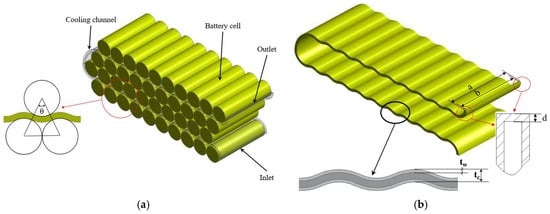
This study optimizes a serpentine liquid cooling system for 18,650 lithium-ion battery cells. The lithium-ion battery considered in this study is a cylindrical 18,650 cell, whose specifications are adopted from the literature [25]. As shown in Figure 1, the system comprises 40 symmetrically arranged cells cooled by a serpentine channel. The detailed cell specifications are summarized in Table 1, and the geometric parameters of the cooling channel are listed in Table 2. The channel geometry is defined by three key design variables:
Figure 1.
3D computational model of Li-ion battery pack with serpentine cooling channel. (a) 3D view with partial enlargement view of contact surface angle (θ). (b) Serpentine cooling channel.
Table 1.
The 18,650 cylindrical LiFePO4 lithium–ion cell specifications.
Table 2.
The values geometry of the serpentine cooling channel.
- –
- Channel thickness (tc [mm]);
- –
- Wall thickness (tw [mm]);
- –
- Contact angle (θ [°]).
Two objectives evaluate the liquid cooling system:
- −
- Maximum temperature (Tmax): Peak temperature in the battery module;
- −
- Maximum temperature difference (ΔTmax): Temperature spread between the hottest and coolest cells.
As illustrated in Figure 1b, the parameters a and b represent the outer and inner heights of the channel, respectively, where the outer height a is equal to the battery height (65 mm). A constant wall thickness d = 0.7 mm is used to define the channel geometry, leading to the relationship b = a − 2d.
The multi-objective optimization problem is formulated as:
subject to bounds: , , (see Table 3).
Table 3.
Design variable and output performance metrics.
The ranges of the design variables were selected based on both practical engineering constraints and previous studies on liquid-cooled battery systems. In particular, the bounds on channel and wall thickness are consistent with those reported in the literature [25], ensuring realistic geometries that balance manufacturability, structural integrity, and cooling performance. Therefore, the optimization is intentionally confined to a feasible design space relevant to real-world applications. Here, Tmax reflects cooling efficiency, while ΔTmax ensures temperature uniformity. CFD simulations map each design x to F(x), enabling optimization via surrogate modeling and NSGA-II (detailed in the following sections).
3. Optimization Process
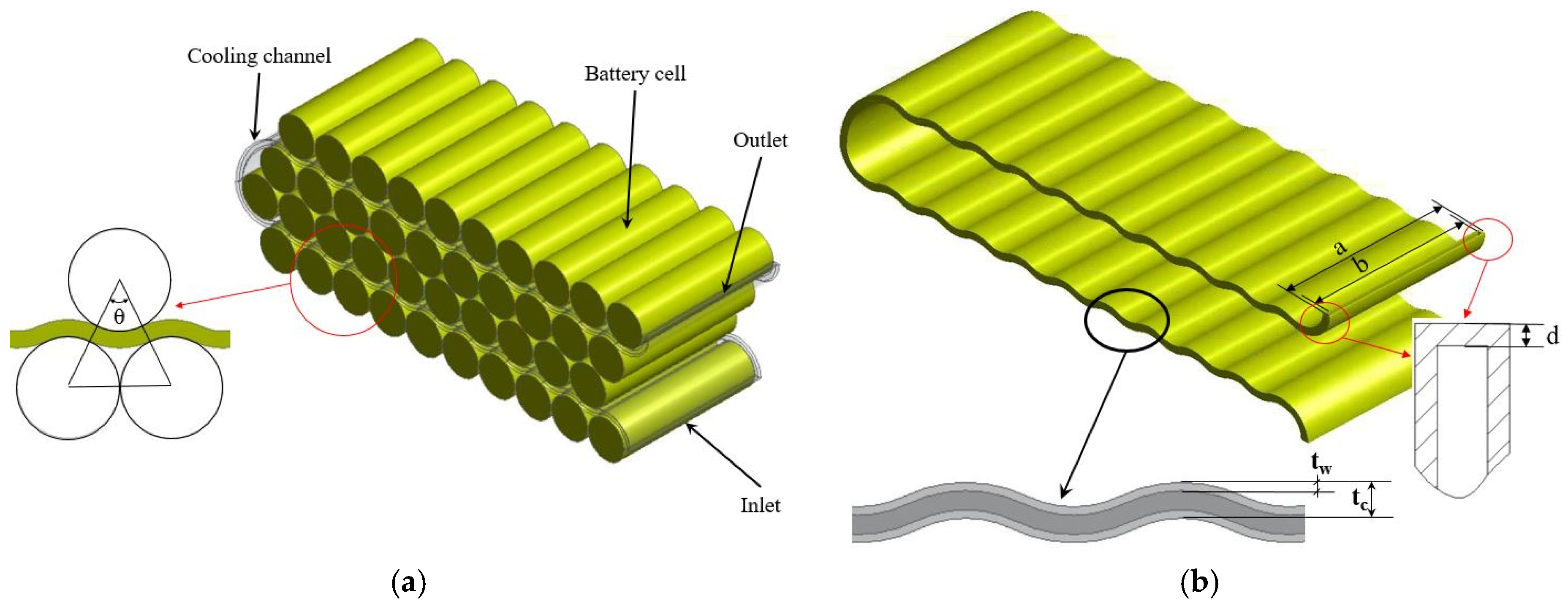
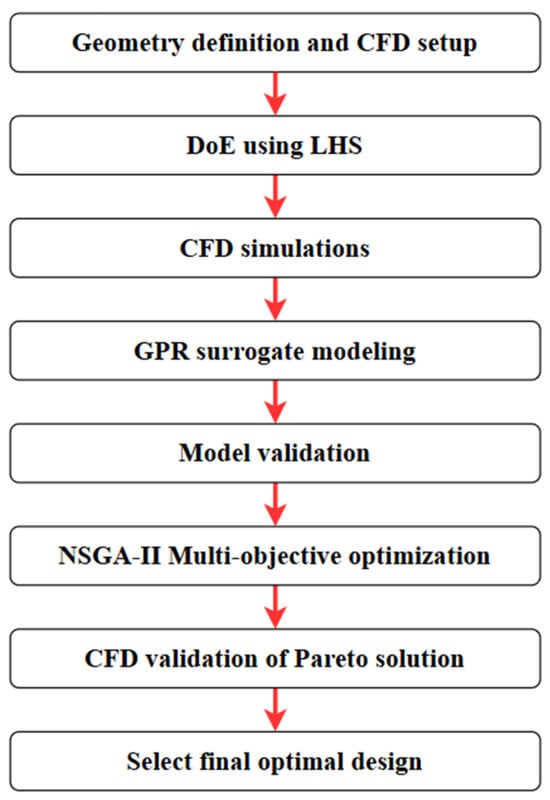
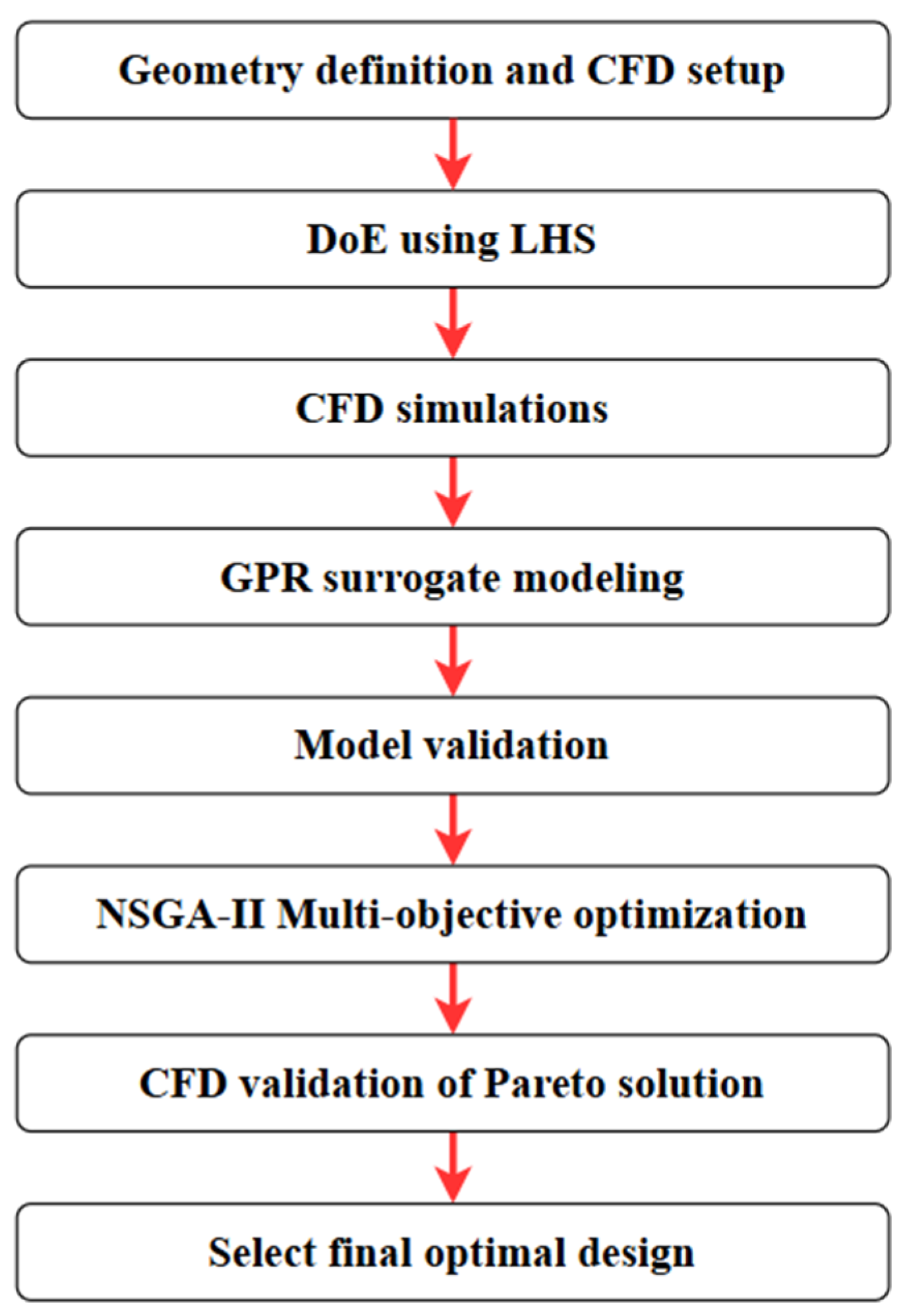
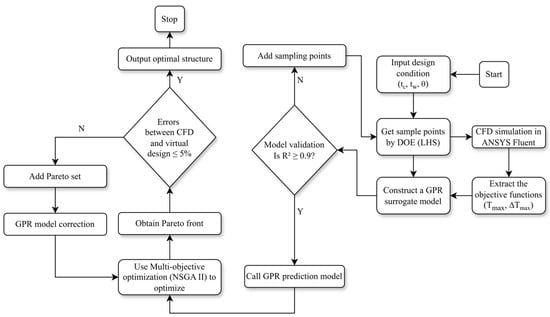
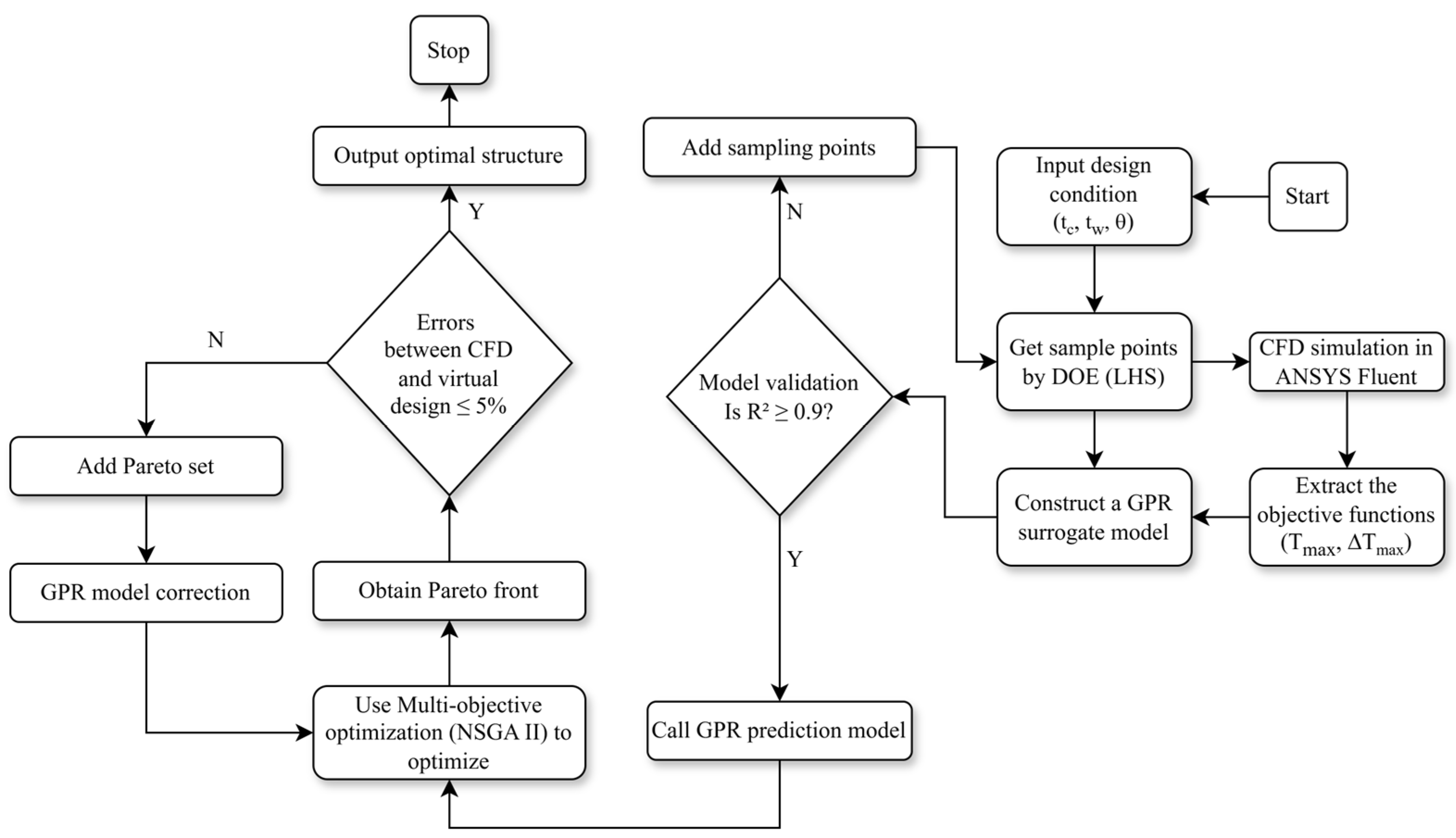
Figure 2 illustrates the research methodology in block diagram form. The process begins by defining the geometric configuration of the liquid cooling system, creating a 3D model of the fluid domains, lithium-ion battery cells, and a serpentine cooling channel, and then setting up boundary conditions—such as velocity, temperature, and pressure—for the CFD simulation. Based on the defined design space, 45 design points are generated using the LHS technique within the Design of Experiment (DOE) framework. These 45 points are then analyzed using CFD to accurately predict Tmax and ΔTmax, providing critical metrics for assessing thermal performance. Subsequently, a GPR surrogate model is developed to map geometric design variables to objective functions, providing accurate nonlinear predictions and efficient, uncertainty-aware optimization. GPR employs probabilistic mathematical functions to model prediction uncertainty based on an input–output dataset from CFD simulations. The model is validated using cross-validation to ensure predictive accuracy. Once the surrogate model achieves an acceptable level of accuracy, multi-objective optimization is performed using NSGA-II. NSGA-II is an improved version of the original NSGA algorithm proposed in [32]. It is built on two algorithms: an evolutionary algorithm for selecting and evolving optimal points (also known as individuals), and a crowding-distance algorithm to ensure a reasonable distribution of optimal points along the Pareto front. To ensure the reliability of the optimization results, selected Pareto-optimal solutions are re-evaluated through CFD simulations. A solution is deemed valid only if the relative error between the surrogate prediction and the CFD result is less than 5% for both objective functions. This integrated methodology significantly reduces computational cost while maintaining high optimization accuracy and robustness.
Figure 2.
Flowchart of the multi-objective process.
4. Numerical Simulation
To evaluate the thermal performance of the battery cooling system, CFD simulations are conducted using the FLUENT solver in ANSYS 19.2. The procedure involves several key stages, as outlined below.
4.1. Geometry and Mesh
The 3D geometry of the serpentine cooling channel integrated with the lithium-ion battery pack is constructed in ANSYS Workbench (Figure 1). Cooling water enters through the inlet, flows through the channel surrounding the battery cells, and exits through the outlet, thereby extracting heat from the battery module. As shown in Figure 1b, the cooling channel is assumed to be in direct contact with the battery cells. The channel (tc) and wall (tw) thicknesses are set to 3 mm and 0.7 mm, respectively. The material used for the channel is aluminium due to its high thermal conductivity.
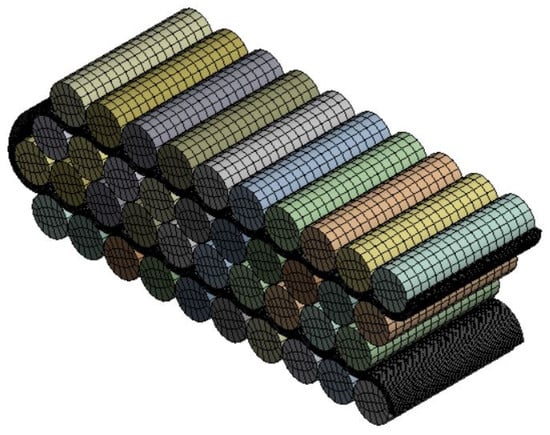
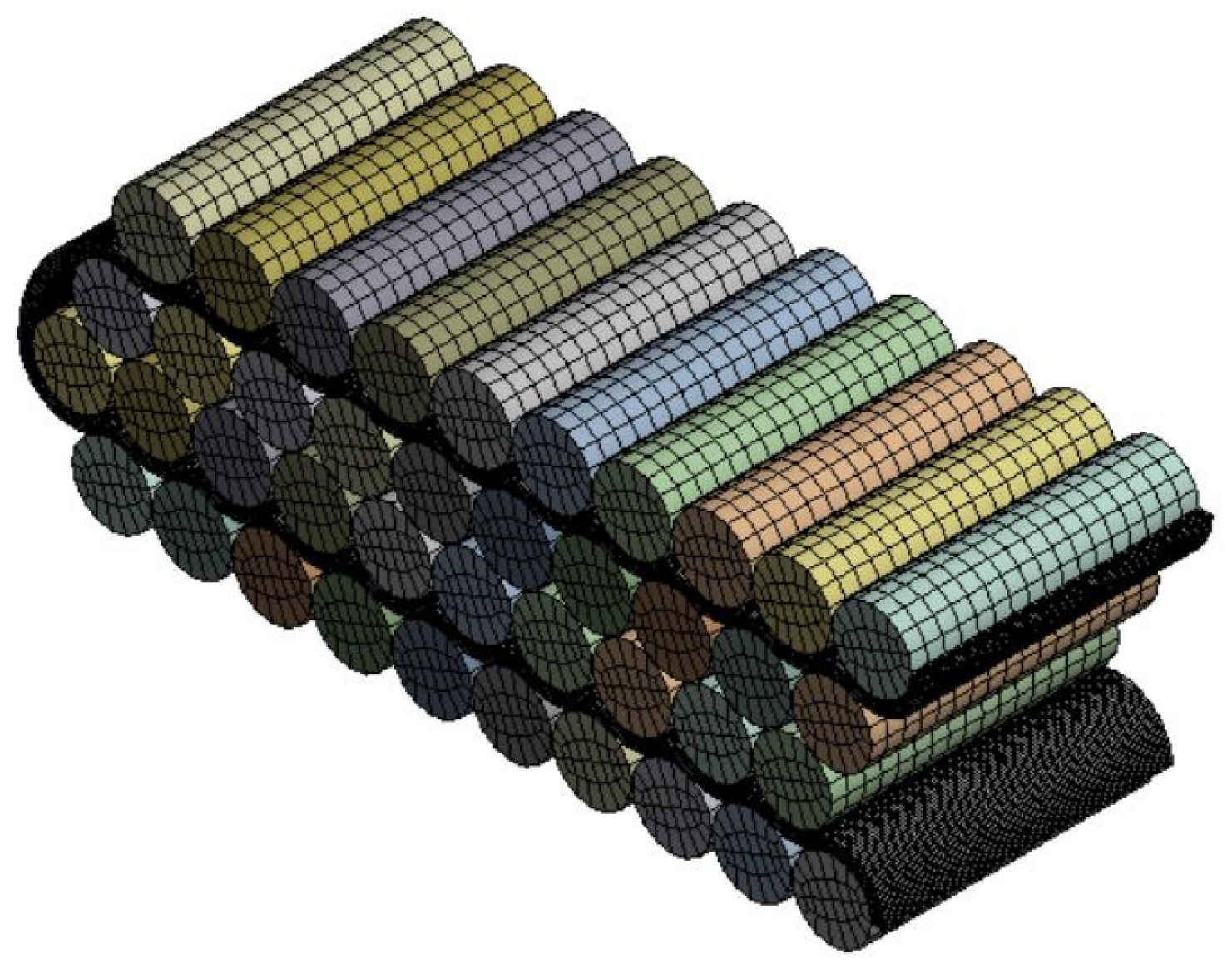
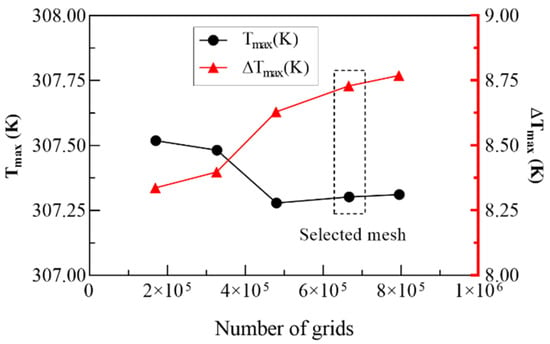
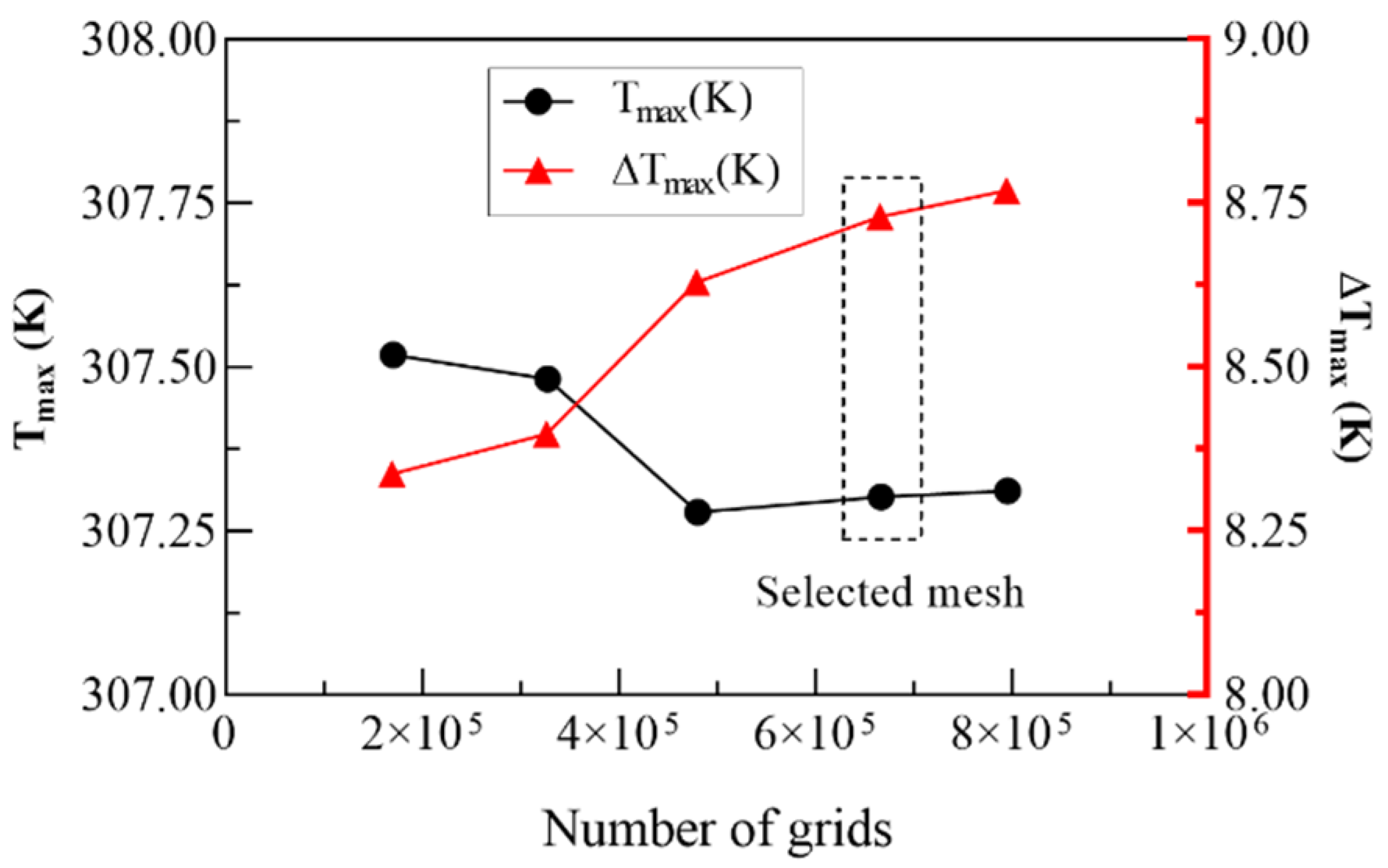
The computational domain is discretized using a structured hexahedral mesh (Figure 3). Mesh quality is assessed using the skewness criterion, with a maximum skewness value of 0.70, which falls within the acceptable “good” range for CFD simulations. To study mesh independence, Tmax and ΔTmax of the battery pack were monitored at different mesh densities (Figure 4). Five mesh sizes, yielding 170,445, 327,734, 480,518, 666,898, and 795,796 elements, were tested. The temperature differences for both evaluation criteria (Tmax and ΔTmax) across different grid numbers are slightly different, and the maximum is less than 0.05 K when the number of elements exceeds 480,518. To balance efficiency and accuracy, the fourth one (666,898 elements) was selected and used for all simulations in this work.
Figure 3.
Mesh of the battery pack.
Figure 4.
Mesh independence analysis.
4.2. Governing Equation
This study considers 40 lithium-ion cells in the module as a uniform volumetric heat source to reduce computational complexity. The following assumptions are made before the numerical study of the model:
- –
- Multiple mechanisms, including conduction, convection, and radiation, govern heat transfer within lithium-ion batteries. However, during battery operation, the electrolyte does not exhibit bulk motion, rendering internal convection negligible [23]. In addition, within the typical operating temperature range of −20 to 60 °C, radiative heat transfer is insignificant compared to conduction. Therefore, heat conduction is considered the dominant mode of heat transfer inside the battery. Based on this physical understanding, convective and radiative heat transfer within each cell are neglected in the present study.
- –
- Thermal conduction between adjacent cells is also neglected due to the loose physical contact between cylindrical batteries. As reported in [33], the thermal contact conductance between neighboring cells can be lower than 10−4 W/K, indicating that inter-cell heat transfer is negligible. Consequently, the heat generated within the battery module is assumed to be primarily dissipated through the cooling system.
- –
- The specific heat capacity of the cell is treated as constant and time-invariant.
The governing equations used in the simulation, based on the above assumptions, are shown below.
Battery energy conservation equation (Zhao et al., 2019 [33]):
where ρb, Cb, and Tb are the density, heat capacity and temperature of the lithium battery, respectively; kb is the thermal conductivity. Q is the heat generation rate in the battery. In this paper, the heat generated by the battery during discharge primarily occurs in the battery core. The battery is assumed to be a stable, uniform heat source, and the heat generation rate can be calculated theoretically using the empirical formula by Bernardi et al. [34].
where Q, I, R, Tb, and Vb represent the heat generation rate of the battery, the charge and discharge current of the battery, the internal ohmic resistance, the temperature of the battery, and the volume of the battery, respectively. I2R is the irreversible heat generated by the internal resistance of the LIB, and R is set to 0.04 Ω [35]. Uocv is the battery open-circuit voltage. is reversible heat, that is, the heat generated by the electrochemical reaction of LIB, and is set to 0.01116 V [35]. However, this heat-generation model does not account for the side-reaction heat and polarization heat of the battery. Combined with Table 1, the battery heat generation rate can be calculated. After the calculation, we can obtain the thermophysical parameters of the single battery, as shown in Table 4.
Table 4.
Volumetric heat generation rates of lithium-ion batteries at different discharge rates.
Cooling channel energy conservation equation:
where ρc, Cc, Tc, kc are the density, heat capacity, temperature and thermal conductivity of the cooling channel, respectively.
The energy conservation equation of water is given as follows:
where ρw, Cw, Tw, kw, v are the density, heat capacity, temperature, thermal conductivity and velocity of the water, respectively.
The heat (Qw) generated by convection between the water and the channel wall (solid–liquid interface) can be calculated from Newton’s law of cooling. Qw = hwA(Tc − Tw) where Qw is the heat dissipated by convection; Tw is the temperature of water; Tc is the temperature of the channel wall; hw is the convection heat transfer coefficient; and A is the convection heat transfer area.
For liquid flow in the cooling channel, the Reynolds number (Re) is [25]
where D is the equivalent diameter of the inlet channel, and the unit is m. In this study, μ is equal to 1.01 × 10⁻³ Pa▪s, ρw is 998.2 kg/m3, D is equal to 3.12 × 10⁻³ m, and v is equal to 0.3 m/s. The Reynolds number was calculated to be Re = 931.96, which is significantly lower than the critical value of 2300. Therefore, the laminar model is used throughout the study.
Assuming incompressible and steady-state flow (i.e., the density ρ does not change over time), the fluid motion is governed by the following equations:
Continuity equation:
Momentum conservation equation (Navier–Stokes):
where P and μ are the static pressure and dynamic viscosity of the water, respectively.
4.3. Boundary Condition
To simplify the calculation, the following assumptions and boundary conditions are applied.
- The heat generation rate of lithium-ion batteries is calculated using Bernardi’s model under simplified assumptions, with a discharge rate of 3C, resulting in a volumetric heat generation rate of 42,400 W/m3 (see Table 4 for other discharge rates).
- The inlet is prescribed as the velocity inlet with an inlet velocity of 0.3 m/s, and the coolant inlet temperature is set to 298.15 K. The outlet is set as a pressure outlet with 0 Pa gauge pressure. The Reynolds number varies with the inlet cross-sectional area for different design points. The maximum Reynolds number among all cases is 931.96, which is lower than the critical value of 2300; therefore, laminar flow is assumed for all simulations. A no-slip boundary condition is applied at all channel walls.
- The airflow inside the battery module is not considered in the present model. Therefore, all external surfaces are treated as adiabatic boundaries, with zero heat flux to the surroundings.
- Water is used as the coolant, and the serpentine cooling channel is made of aluminium. The thermophysical properties of water, aluminium, and the lithium-ion cell are listed in Table 5. Each lithium-ion cell is modeled as a simplified solid domain.Table 5. The thermal and physical properties of the water, cooling channel and battery.
- The SIMPLE approach is chosen as a solver. The solution is considered converged when the scaled residuals of the continuity, momentum, and energy equations fall below 10−6.
4.4. Simulation Model Verification
To ensure the accuracy of the CFD model before its application in this study, a validation was performed by reproducing the benchmark serpentine-channel cooling case for lithium-ion battery packs reported by Xu et al. [25]. All physical parameters and boundary conditions, including battery type (18,650 cylindrical cell with LiFePO4 chemistry), discharge rate (3C, corresponding to a volumetric heat generation rate of 42,400 W/m3), coolant properties (pure water at 298.15 K), and inlet velocity (0.3 m/s), were adopted directly from the reference work.
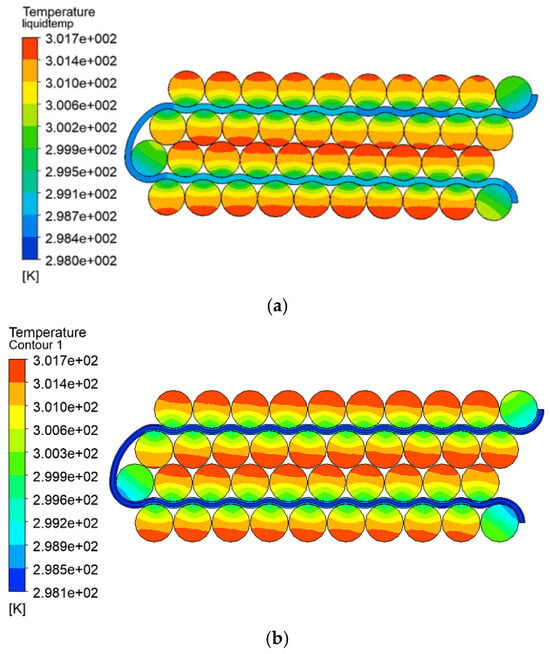
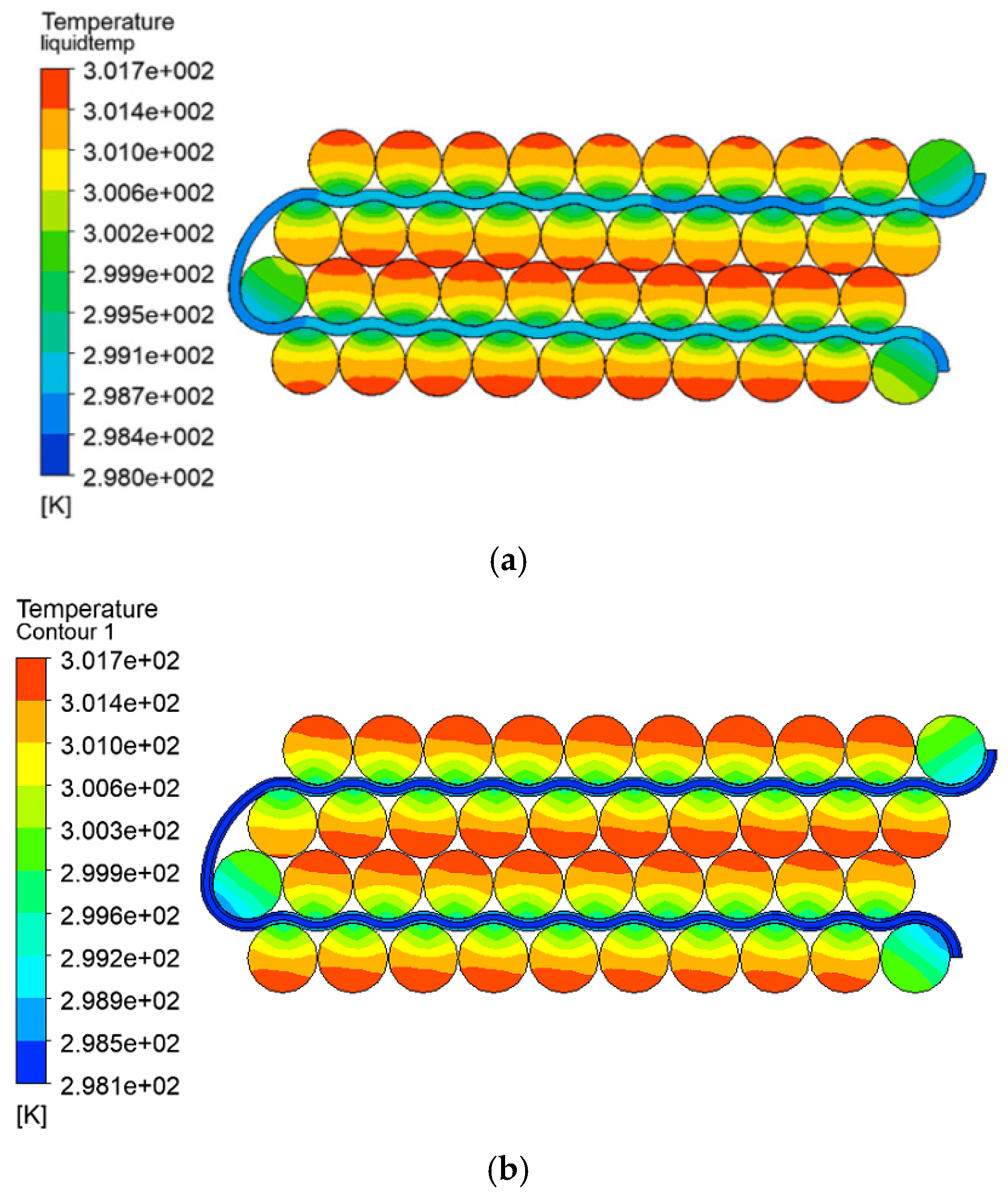
The simulation was conducted using the same numerical framework as that used in the present study. The resulting Tmax was 301.706 K (Figure 5), and ΔTmax was 3.556 K, which agrees closely with the values reported by Xu et al. (301.73 K and 3.74 K, respectively). The relative errors are only 0.008% for Tmax and 4.9% for ΔTmax, confirming that the numerical model is sufficiently accurate for further parametric and optimization studies.
Figure 5.
Comparison of the temperature distribution contours between the present study and Xu et al. [25]. (a) Xu et al. [25]. (b) Present study.
5. Multi-Objective Design Optimization
5.1. Design of Experiment
This study systematically examined the influence of geometric design parameters on the thermal performance of the battery cooling system, employing a DOE approach. For this purpose, Latin Hypercube Sampling (LHS) was implemented to create an optimized sampling scheme that provides uniform coverage of the parameter space. LHS is a space-filling design method that stratifies the range of each input variable into n equiprobable intervals, where n is the predetermined sample size. Unlike random sampling, LHS ensures uniform coverage by selecting exactly one point per interval for each variable, thereby minimizing clustering and efficiently exploring the multidimensional design space [36,37]. The lower and upper bounds of three design variables were determined based on engineering feasibility and are listed in Table 3.
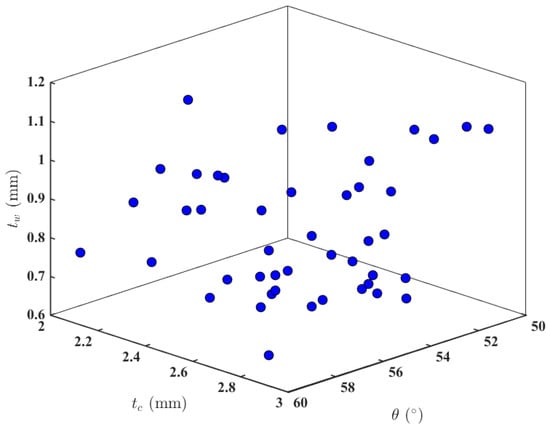
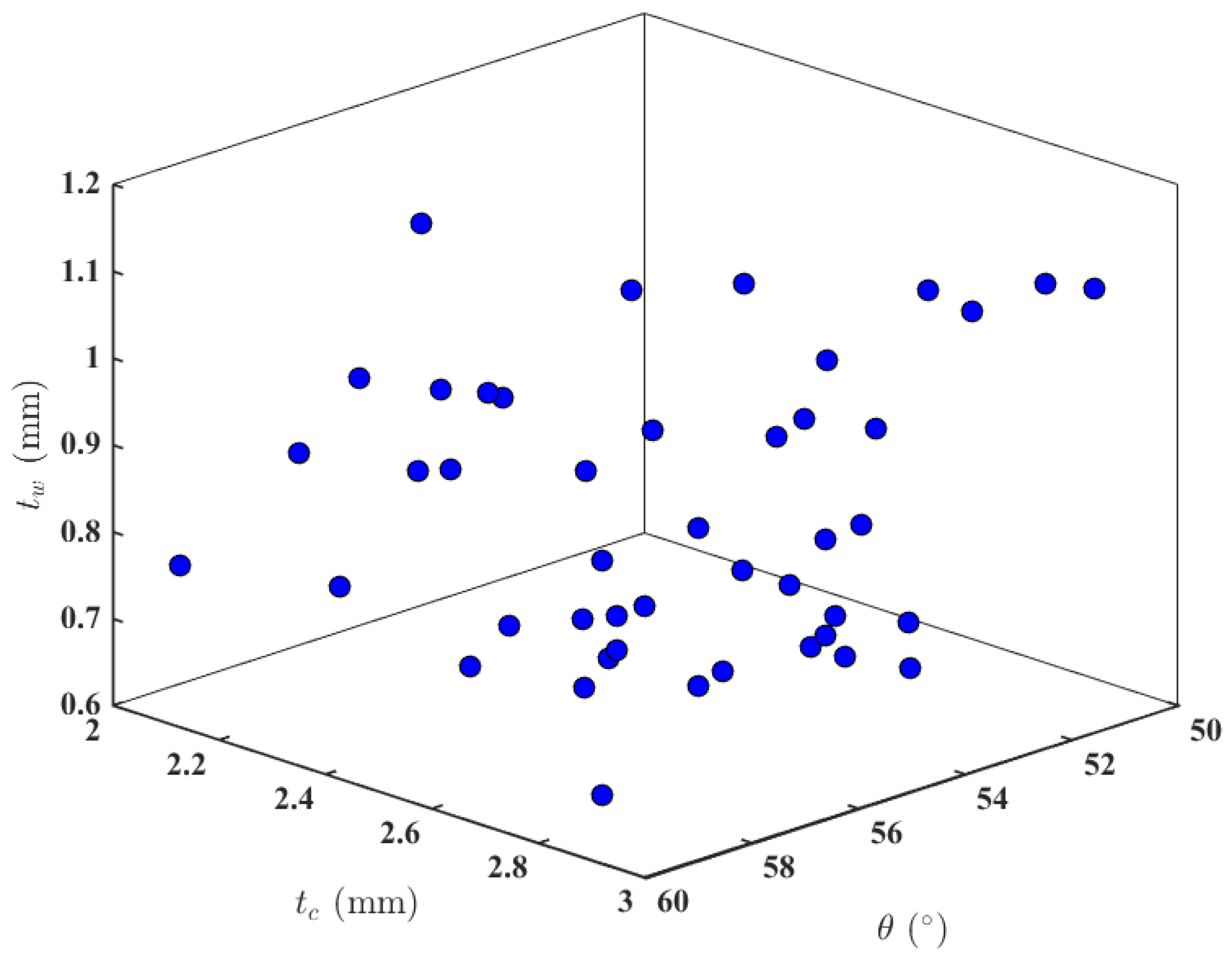
A total of 45 design points were generated using the LHS technique. These points uniformly span the three-dimensional design space, as visualized in Figure 6. At each design point, a CFD simulation was conducted to compute two thermal performance indicators: Tmax and ΔTmax. The resulting dataset was then used to train a GPR surrogate model, which subsequently facilitated multi-objective optimization. Using LHS ensures that the surrogate model captures the system’s nonlinear response over the full range of input parameters, thereby improving the reliability and generalisation capability of the optimization results.
Figure 6.
Distribution of design points through LHS method.
5.2. Surrogate Modeling with Gaussian Process Regression
Gaussian process regression (GPR) has emerged as a powerful machine learning approach for engineering design applications involving computationally expensive simulations [38,39]. As a nonparametric Bayesian method, GPR fundamentally differs from conventional parametric regression techniques, such as polynomial regression, by avoiding predefined functional forms. The method characterizes the unknown system response by distributing possible functions refined via Bayesian updating as new data becomes available. The practical value of GPR in thermal system design stems from its dual output capability, providing both predicted mean values and their associated uncertainty estimates. This feature proves particularly valuable when working with CFD-based design optimization, where the method’s uncertainty quantification guides efficient sampling of the design space.
In this study, GPR is adopted to construct surrogate models that approximate the mapping between three geometric design variables and two thermal performance metrics of the battery pack. A set of 45 design points was generated using LHS during the DOE stage, and the corresponding outputs were obtained from CFD simulations (Table 6). Two separate GPR models were developed, one for each output metric. Both models use the Automatic Relevance Determination Squared Exponential (ARD-SE) kernel, which enables the model to learn different length scales for each input, thus implicitly revealing the relative importance of design variables. All input data were standardized before training, and a constant basis function was used to model the prior mean. This setup ensures a flexible yet robust surrogate capable of capturing the nonlinear, multidimensional relationships inherent in the battery cooling system.
Table 6.
Design points and corresponding CFD results.
In addition to its predictive capability, the GPR model with ARD kernel helps reveal the relative influence of the design variables through the learned length-scale parameters. This allows the surrogate model not only to approximate the nonlinear relationships in the system but also to support a physically informed interpretation of how the geometric parameters affect thermal behavior.
5.3. Multi-Objective Optimization Using NSGA-II
This study combined three computational approaches: (1) computational fluid dynamics for thermal performance evaluation, (2) Gaussian process regression for surrogate modeling, and (3) the NSGA-II multi-objective optimization algorithm to optimize the geometry of the serpentine cooling channel. The process begins with the design space defined in Section 2, where three geometric parameters (tc, tw, and θ) govern the thermal performance characterized by two objectives: Tmax and ΔTmax.
Figure 7 outlines the iterative optimization workflow. An initial set of 45 design points was generated using Latin Hypercube Sampling (LHS) and evaluated through CFD simulations in ANSYS Fluent. To establish reliable surrogate models, we trained two distinct Gaussian Process Regression (GPR) predictors using the CFD-derived Tmax and ΔTmax data. Each model incorporated an Automatic Relevance Determination Squared Exponential (ARD-SE) kernel, automatically identifying and weighting each input variable’s importance via optimized length-scale parameters.
Figure 7.
Multi-objective optimization algorithm flow.
Model accuracy was checked in two steps:
- The coefficient of determination (R2) must exceed 0.9 for both Tmax and ΔTmax predictions;
- CFD validation of surrogate predictions requires ≤5% error for Pareto solutions;
- Failed validation triggers additional LHS and model retraining.
For multi-objective optimization, the NSGA-II algorithm was implemented using MATLAB’s gamultiobj function (MATLAB R2016b, MathWorks, Natick, MA, USA). A population size of 200 was selected to ensure sufficient diversity of candidate solutions while maintaining computational efficiency. The maximum number of generations was set to 300 to allow adequate exploration of the design space.
These parameters were selected based on commonly adopted practices in evolutionary optimization and were further verified through preliminary numerical experiments. A convergence assessment was conducted by comparing the stability of the obtained Pareto fronts under different generation settings. The results indicated that the Pareto front becomes stable beyond a certain number of generations, confirming that the selected parameters are sufficient to ensure convergence.
The default genetic operators in gamultiobj were employed, including crossover and mutation, which provide a balance between exploration and exploitation. In addition, key mechanisms of NSGA-II were utilised to handle the conflicting objectives:
- Non-dominated sorting preserves elite solutions;
- Crowding distance metrics maintain front diversity;
- Tournament selection drives population improvement.
Post-optimization, all Pareto-optimal solutions undergo CFD verification.
Solutions with a prediction error above 5% are added to the training data, and the model is updated in the next iteration. This iterative process continues until the results stabilize. In this study, the initial LHS was sufficient to achieve the required surrogate accuracy, and no additional sampling or retraining iterations were necessary. In the end, it helps identify channel designs that offer a good balance between Tmax and ΔTmax.
6. Results and Discussion
6.1. Precision Analysis of GPR Model
Two commonly used statistical metrics were employed to assess the predictive accuracy of the GPR models developed in this study: the coefficient of determination (R2) and the Root Mean Square Error (RMSE). These metrics were computed by comparing the predicted values from the GPR models and the observed outputs from the CFD simulations on the training dataset. The coefficient of determination indicates how well the surrogate model captures the variability in the original dataset; a value of R2 close to 1 implies high predictive accuracy. RMSE quantifies the average magnitude of prediction error. A lower RMSE shows a closer fit between the surrogate model and the CFD data.
where is the actual CFD output, denotes the GPR predicted output for the i-th sample, and indicates the mean of all observed outputs.
Two GPR models were constructed in this study: one for Tmax and one for ΔTmax. Both models were trained using the ARD Squared Exponential kernel, a popular choice for capturing nonlinear relationships with automatic relevance determination. Standardization of input features was also applied to enhance training convergence. The performance of the GPR models is summarized in Table 7.
Table 7.
Performance metrics of GPR surrogate models.
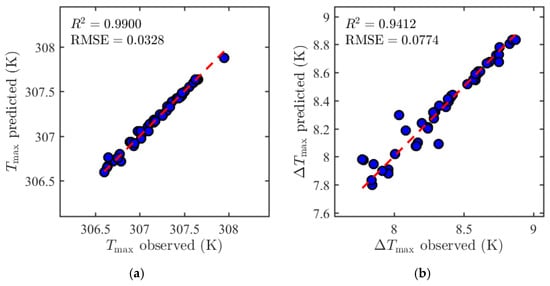
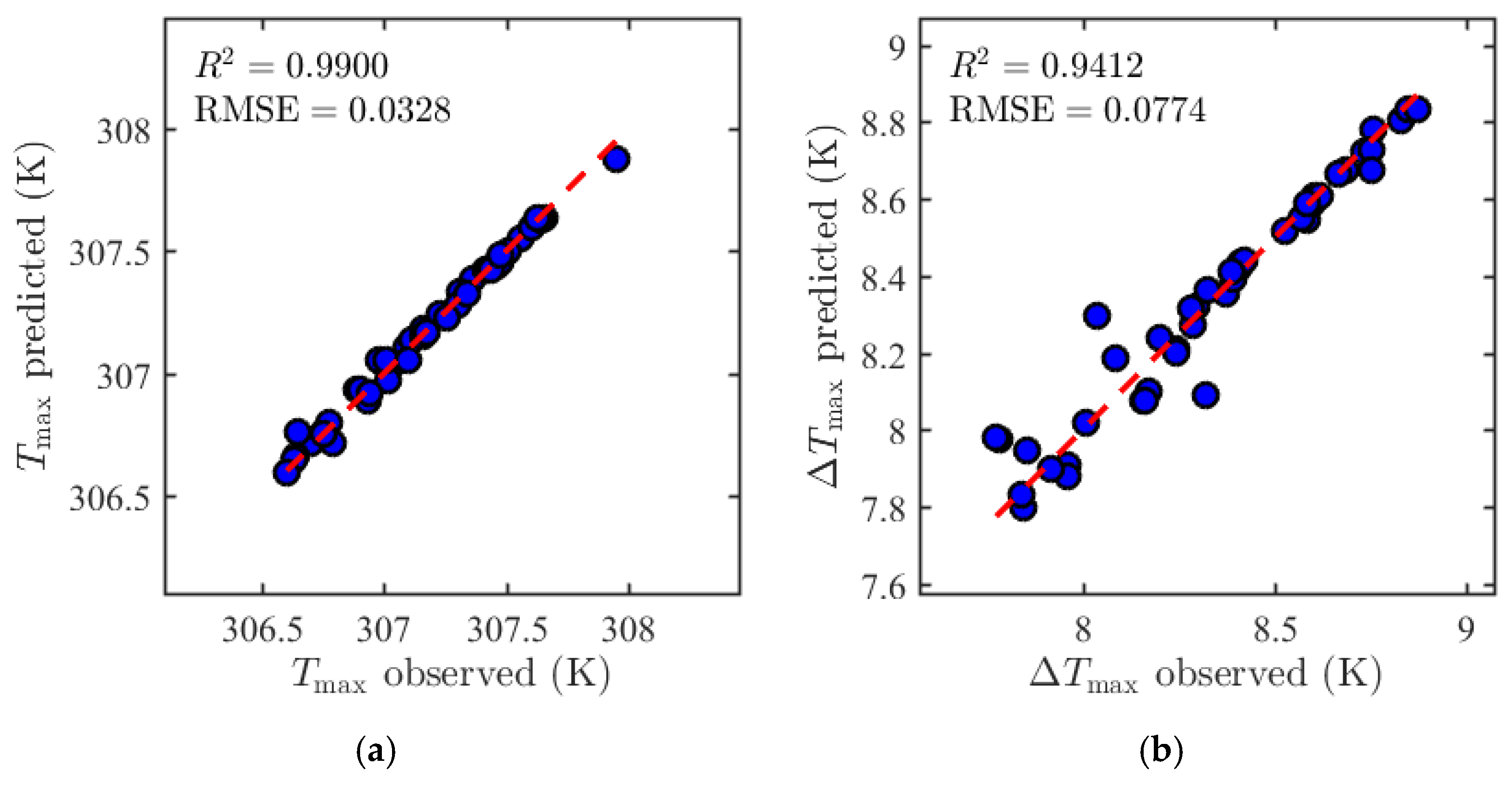
The GPR model for Tmax exhibited superior performance compared to the model for ΔTmax, as indicated by the higher R2 and lower RMSE (Table 7). The ΔTmax model shows slightly lower accuracy but remains acceptable for surrogate-based optimization. Despite slightly lower accuracy in predicting ΔTmax, the surrogate model still provides reliable estimations with acceptable error margins, making it suitable for optimizing the process. In addition, Figure 8 shows how well the GPR model predicted the actual value.
Figure 8.
Comparison between GPR model predictions and CFD results. (a) Tmax. (b) ΔTmax.
As shown in Figure 8a, the predicted Tmax values agree well with the observed data, with an R2 of 0.9990 and an RMSE of 0.0328 K. The most frequently predicted points are tightly clustered around the 45-degree reference line (shown in red), indicating that the GPR model accurately captures the nonlinear relationship between the design variables and the maximum battery pack temperature across the entire range. No significant systematic overestimation or underestimation is observed, even at higher temperatures, confirming the model’s robustness.
As shown in Figure 8b, the ΔTmax prediction exhibits slightly lower accuracy than Tmax, with an R2 of 0.9412 and an RMSE of 0.0774 K. Although the scatter of the predicted values around the diagonal line is more pronounced than in the Tmax case, the overall trend is still well preserved. This indicates that the GPR model remains effective in predicting thermal non-uniformity among battery cells.
6.2. Sensitivity Analysis of Design Variables
We conducted a sensitivity analysis to evaluate the relative influence of the geometric design variables-channel thickness (tc), wall thickness (tw), and contact surface angle (θ)-on the thermal performance of the battery module, specifically the Tmax and the ΔTmax. The sensitivity indices summarized in Table 8 are normalized measures of parameter influence derived from the trained GPR surrogate models. These indices were computed using a Morris-type one-at-a-time (OAT) global sensitivity analysis, in which the mean absolute elementary effects were normalized to yield relative influence percentages.
Table 8.
Multi-objective design optimization results.
As shown in Table 8, the most dominant factor is tw, with sensitivities of 65.41% for Tmax and 64.77% for ΔTmax. These results underline the critical influence of tw on reducing both Tmax and ΔTmax. Physically, the wall thickness directly controls the thermal resistance between the coolant and the battery cells. A thinner wall reduces this resistance, thereby enhancing conductive heat transfer and facilitating more efficient heat dissipation.
Channel thickness (tc) is the second most influential parameter, with sensitivities of 35.95% for Tmax and 31.05% for ΔTmax. This can be attributed to its effect on the coolant flow area, where an increase in tc allows higher coolant flow and improves convective heat transfer performance. Therefore, optimizing tc will also improve cooling performance, especially by reducing Tmax. In contrast, the contact surface angle (θ) shows a relatively small contribution, with sensitivities of 2.64% for Tmax and 4.17% for ΔTmax. Physically, θ primarily modifies the local contact configuration rather than the dominant heat transfer pathways, which explains its limited influence on overall thermal performance. Although its influence on thermal performance is noticeably lower than that of tc and tw, the slightly higher contribution to ΔTmax suggests that θ may have a secondary effect on temperature uniformity. However, the overall results show the importance of focusing on tw and tc when optimizing serpentine cooling channel for thermal control. The influence of θ may be more relevant to other performance metrics, such as pressure drop or flow distribution, rather than temperature control alone.
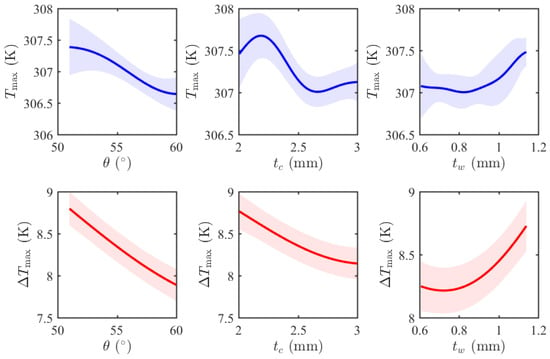
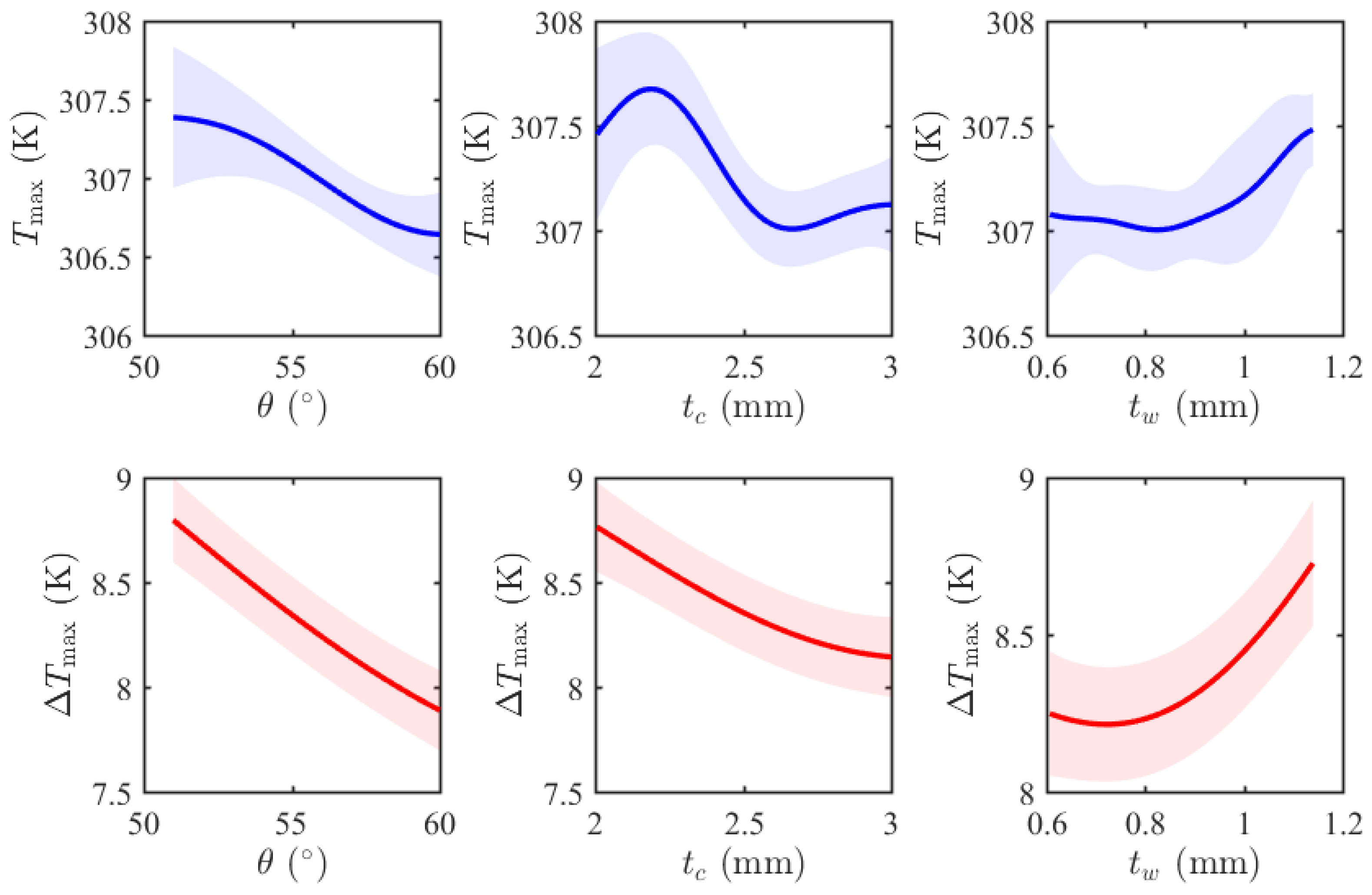
Figure 9 presents the GPR-predicted response curves for each design variable. The solid lines represent the mean prediction, while the shaded areas indicate the 95% confidence intervals. The top-left plot indicates that the contact surface angle (θ) has a limited influence on Tmax, with only slight variations observed across the investigated range. In contrast, a more pronounced decreasing trend is observed for ΔTmax as θ increases, suggesting that θ has a secondary, but non-negligible, effect on temperature uniformity rather than on peak temperature. Nevertheless, the overall sensitivity of θ remains significantly lower than that of the other two design variables, which is consistent with its contribution remaining below 5% in the variance-based sensitivity analysis.
Figure 9.
Sensitivity analysis results for various design parameters. The solid lines represent the mean predictions, while the shaded regions indicate the corresponding 95% confidence intervals.
The central plots reveal a nonlinear, weakly non-monotonic relationship between tc and Tmax. As tc increases from 2.0 to approximately 2.2 mm, a slight increase in Tmax is observed; however, the magnitude of this variation is marginal (within 0.2 K). Beyond this range, Tmax decreases markedly with increasing tc and gradually approaches a plateau at larger channel thicknesses. This behavior indicates a saturation effect, in which further increases in tc yield diminishing thermal benefits, resulting in an almost constant peak temperature.
In contrast, ΔTmax exhibits a more pronounced, nearly monotonic decrease with increasing tc across the investigated range. This indicates that larger channel thickness promotes more uniform temperature distribution within the battery module, likely due to improved coolant flow capacity and reduced local thermal gradients. Unlike Tmax, no evident deterioration in ΔTmax is observed at higher tc values within the considered design space.
The right-column plots show that wall thickness (tw) strongly influences thermal performance, particularly ΔTmax. An increase in tw leads to a pronounced rise in temperature non-uniformity, while Tmax also exhibits an increasing trend, though with a milder gradient. This confirms that thicker walls introduce additional thermal resistance, hindering effective heat dissipation and exacerbating temperature gradients within the battery module.
From both numerical and graphical analyses, it is evident that tw and tc dominate the thermal response of the cooling channel, with tw having the most critical impact. Optimizing these two parameters is essential to minimise peak temperatures and achieve thermal uniformity. In contrast, θ plays a secondary role and may be deprioritised in early-stage optimization, thereby allowing greater flexibility in layout design.
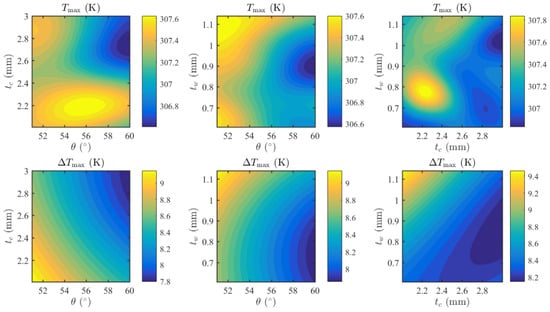
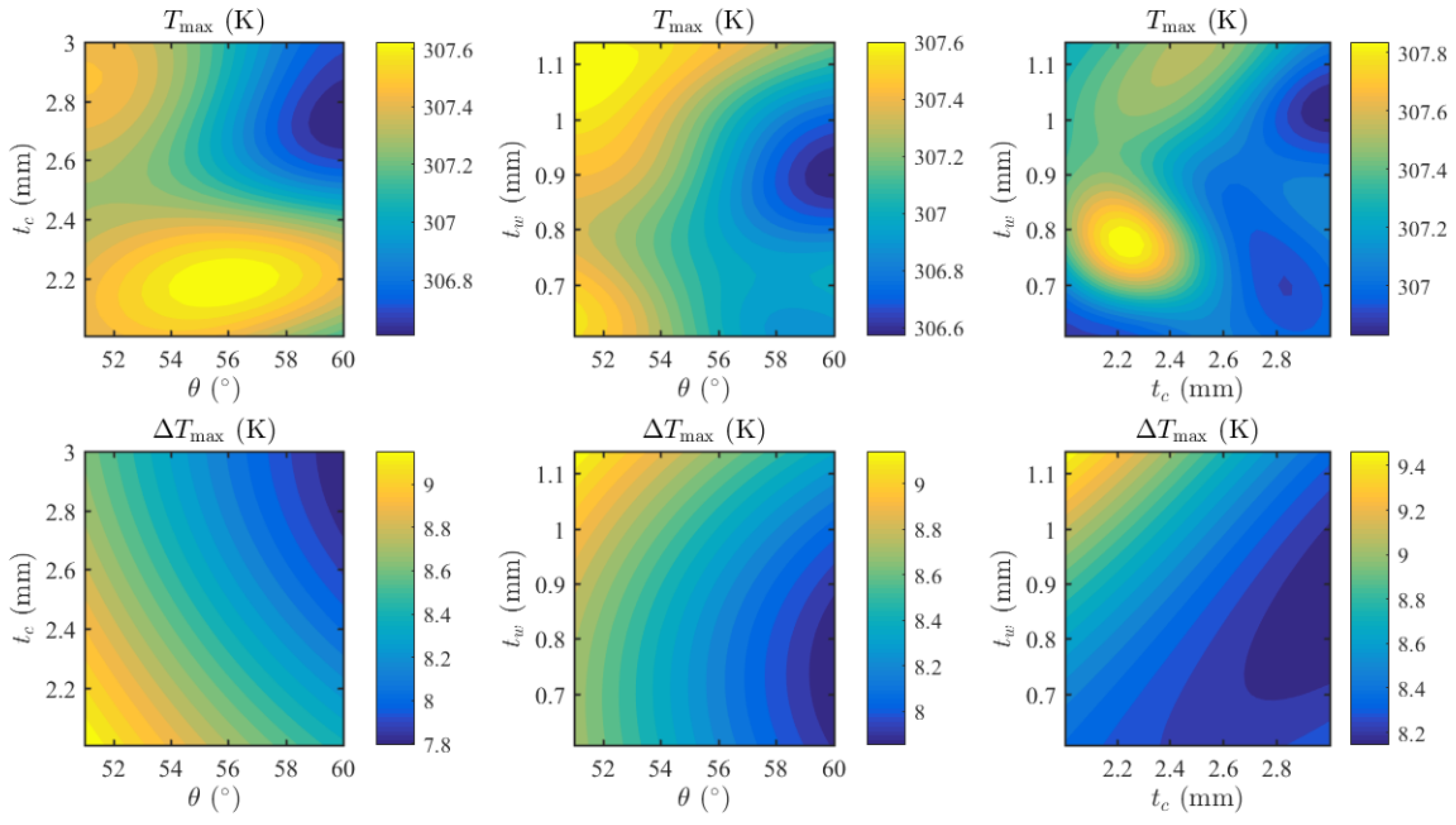
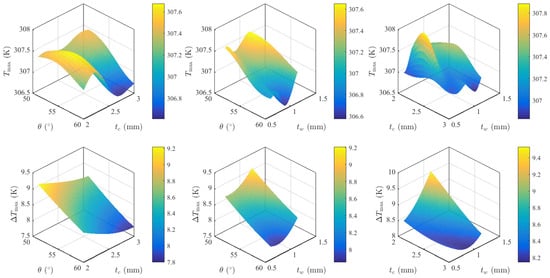
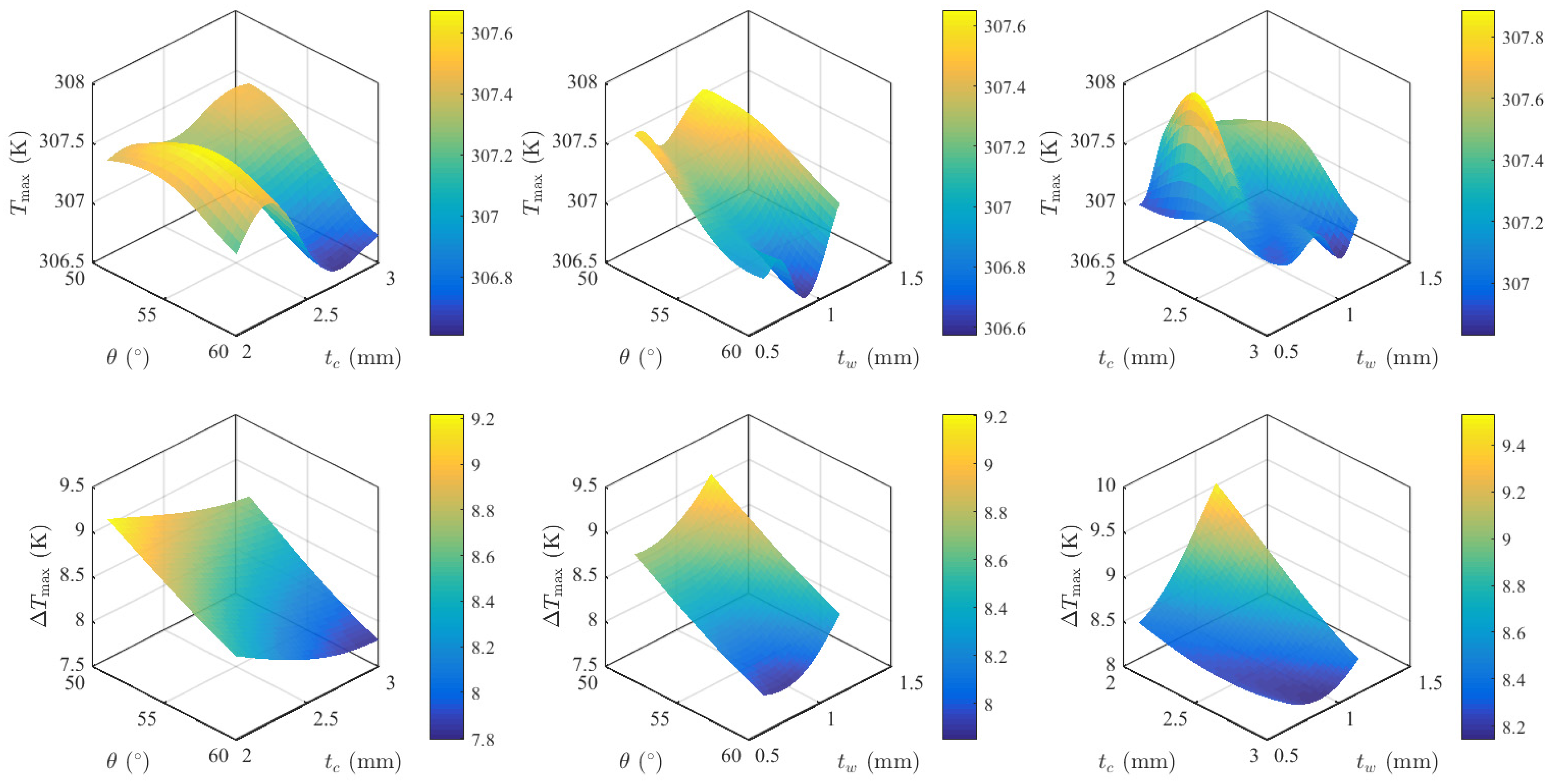
Figure 10 and Figure 11 illustrate the combined effects of the three design variables—tc, tw, and θ—on Tmax and ΔTmax using 2D contour plots and 3D response surface visualisations. These plots provide insight into both individual parameter influence and interaction effects on the thermal behavior of the battery cooling system.
Figure 10.
Contour plot of the interaction effects on Tmax and ΔTmax.
Figure 11.
3D surface plot of the interaction effects on Tmax and ΔTmax.
From the Tmax contour and surface plots (top rows), tw emerges as the most influential parameter. Tmax consistently increases with increasing tw across the investigated range, indicating that thicker channel walls introduce greater thermal resistance and hinder heat dissipation. Channel thickness (tc) exhibits a secondary but noticeable influence, with Tmax showing a nonlinear response and an optimal intermediate range where the maximum temperature is minimised. In contrast, variations in the contact surface angle (θ) lead to relatively mild changes in Tmax, suggesting that θ primarily affects temperature distribution rather than the peak temperature level.
The interaction plots further reveal that the combined effects of tc and tw are critical in determining Tmax. A balanced combination of moderate channel thickness and thin channel walls forms a clear optimal region with reduced Tmax, while extreme values of either parameter result in elevated temperatures.
The bottom rows of Figure 10 and Figure 11 show the response of ΔTmax to the design variables. Compared to Tmax, ΔTmax is more sensitive to variations in both tw and θ. An increase in wall thickness leads to a pronounced rise in temperature non-uniformity, confirming its dominant role in governing thermal gradients within the battery module. Increasing θ generally reduces ΔTmax, indicating that a larger contact surface angle promotes more uniform cooling across the cells. The influence of tc on ΔTmax is comparatively moderate and exhibits a nonlinear trend, with excessive or insufficient channel thickness leading to higher temperature differences.
Overall, the contour and surface plots demonstrate that tw and tc are the primary parameters controlling the thermal performance of the serpentine cooling channel, with tw being the most critical. The contact surface angle (θ) plays a secondary role, mainly affecting temperature uniformity rather than absolute temperature levels. These findings highlight the necessity of multi-variable optimization, with priority given to tc and tw to minimise Tmax and ΔTmax, while θ may be adjusted with greater flexibility during layout and structural design.
6.3. Multi-Objective Optimization Result
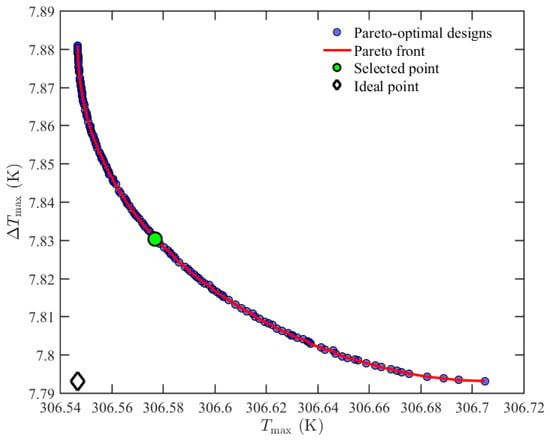
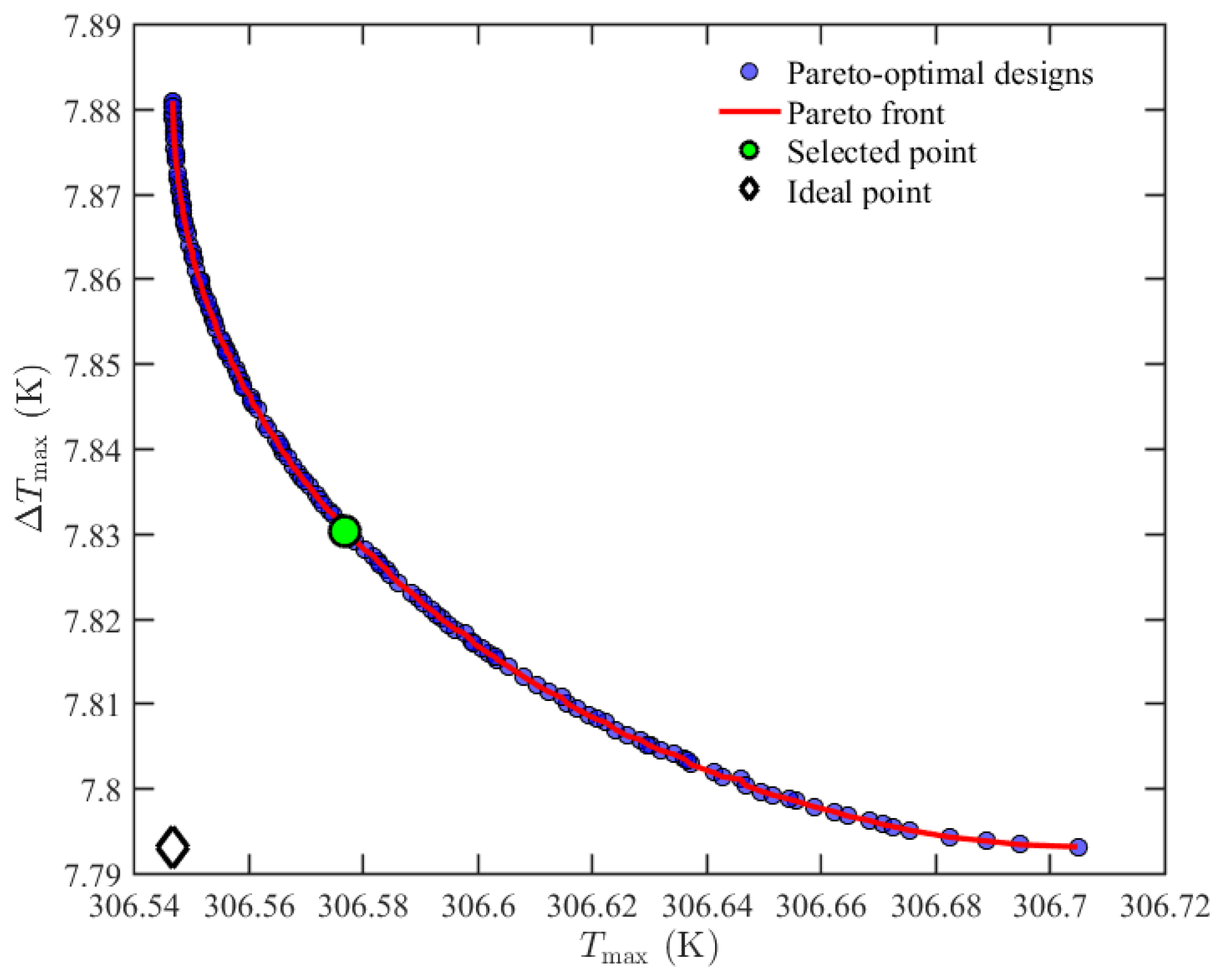
The Pareto front resulting from the NSGA-II multi-objective optimization is shown in Figure 12. Each blue point represents a non-dominated solution obtained during the optimization process, balancing the trade-off between the two conflicting objectives: minimising Tmax and ΔTmax. The trade-off curve shows a downward-sloping trend: reducing Tmax typically increases ΔTmax, and vice versa. This inverse relationship confirms the multi-objective nature of the thermal design problem. The red line represents a smooth curve fitted through the Pareto-optimal points, serving as a visual guide to the frontier.
Figure 12.
Pareto solution.
Compared with representative recent surrogate-assisted optimization studies on battery thermal management, the present work adopts a more geometry-focused setting under fixed operating conditions. This allows the intrinsic effects of the geometric variables on Tmax and ΔTmax to be interpreted more clearly. From this perspective, the study contributes not only by identifying an improved design but also by providing clearer physical insight into the Pareto trade-off observed in liquid-cooled battery systems.
The observed trade-off can be explained by the underlying heat transfer mechanisms governed by the geometric design parameters. As demonstrated in the sensitivity analysis (Table 8), wall thickness (tw) is the most influential parameter, accounting for approximately 65% of both Tmax and ΔTmax. Physically, tw controls the thermal resistance between the battery cells and the coolant. A reduction in tw decreases this resistance, thereby enhancing conductive heat transfer and lowering Tmax. However, this intensified heat removal tends to be spatially nonuniform along the serpentine flow path, with upstream regions experiencing stronger cooling than downstream regions. As a result, temperature gradients increase, leading to higher ΔTmax.
The channel thickness (tw), identified as the second-most-influential parameter, primarily affects coolant flow capacity and convective heat transfer. Increasing tc increases coolant flow rate and improves overall heat dissipation, thereby reducing Tmax. At the same time, it promotes more uniform cooling distribution, which helps reduce ΔTmax. However, this effect is nonlinear and exhibits diminishing returns at higher tc values, as observed in the response surface analysis (Figure 10 and Figure 11).
In contrast, the contact surface angle (θ) has a relatively minor influence on Tmax but a more noticeable effect on temperature uniformity. Increasing θ enlarges the contact area between the cooling channel and the battery cells, facilitating a more even distribution of heat transfer and thereby reducing ΔTmax, while having only a limited impact on Tmax.
Overall, these results indicate that Tmax is primarily governed by the intensity of heat removal, dominated by tw and tc. In contrast, ΔTmax is controlled by the spatial uniformity of heat transfer, influenced by flow distribution and geometric configuration. The inherent competition between these two mechanisms explains the formation of the Pareto front.
Among the obtained Pareto-optimal solutions, the selected design (green point in Figure 12) corresponds to the minimum Euclidean distance from the ideal point, representing a balanced compromise between the two objectives. This criterion was adopted to ensure simultaneous, unbiased consideration of Tmax and ΔTmax without introducing subjective weighting factors. This solution achieves a low peak temperature while maintaining acceptable temperature uniformity, which is critical for preventing thermal degradation and ensuring consistent performance and battery cell aging. The relatively narrow spread of the Pareto front further indicates that the optimization converges to a high-performance design region. This demonstrates the effectiveness of the surrogate-assisted optimization framework based on Gaussian Process Regression in efficiently exploring the design space and identifying optimal solutions.
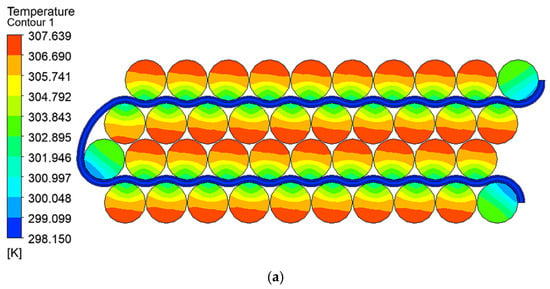
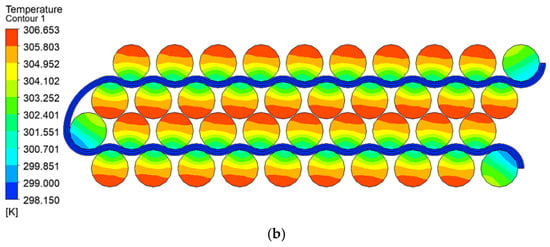
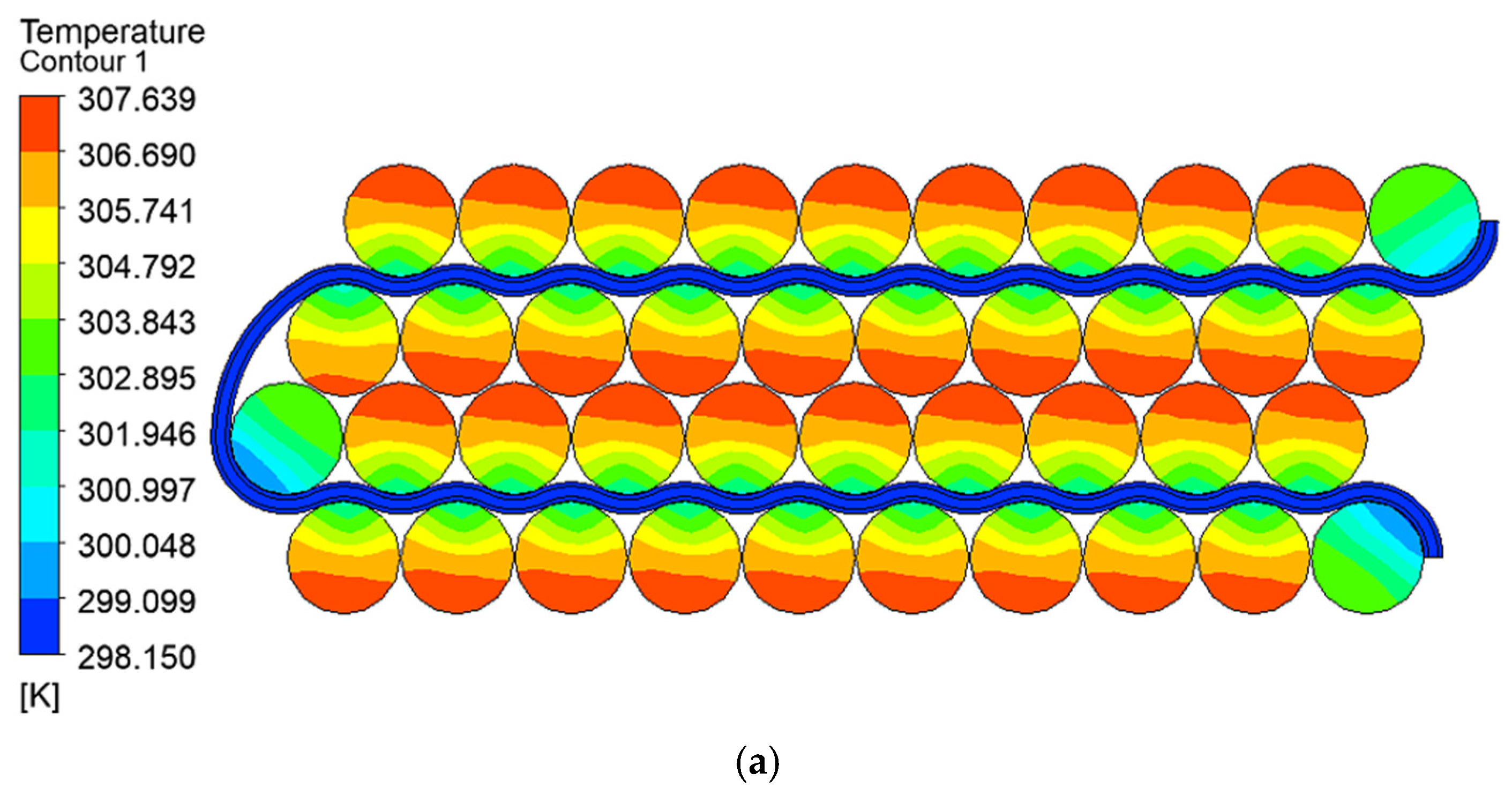
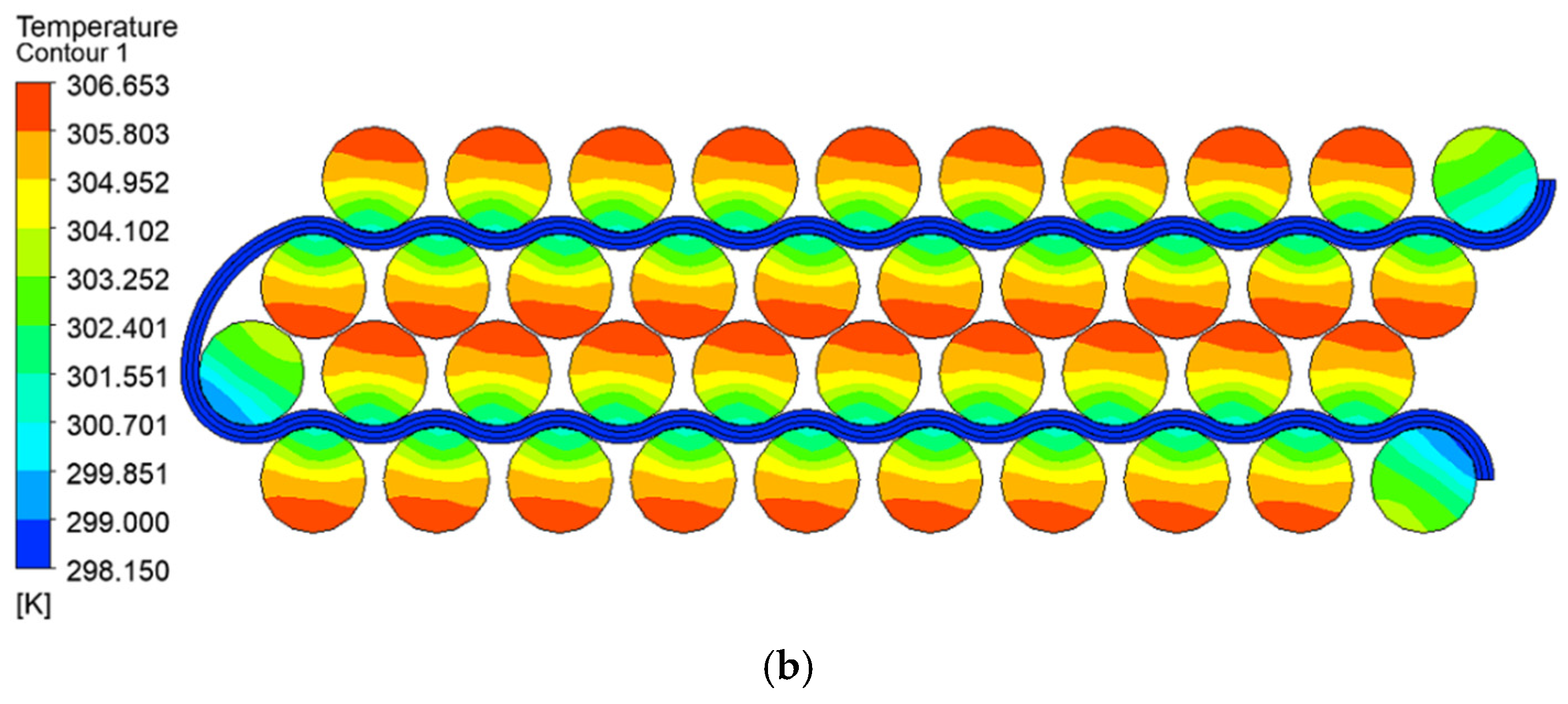
To assess the performance of the proposed optimization framework, the initial cooling channel configuration and the optimal design obtained from the NSGA-II algorithm were compared, as summarized in Table 9. The initial model used a conservative geometry with θ = 51°, tc = 3 mm, and tw = 0.7 mm, resulting in a Tmax of 307.639 K and an ΔTmax of 8.752 K. The optimal configuration was found at θ = 60 °, tc = 2.95 mm, and tw = 0.949 mm. According to the GPR surrogate model predictions, this new design reduced Tmax to 306.575 K (a 1.064 K reduction) and ΔTmax to 7.832 K (a 0.92 K reduction). The optimal geometry was re-evaluated using a full CFD simulation to validate the surrogate model. As shown in Figure 13b, the CFD results yielded Tmax = 306.653 K and ΔTmax = 7.887 K. These results are very close to the surrogate model predictions, with relative errors of less than 1%, confirming the high accuracy and robustness of the GPR-based approach.
Table 9.
Comparison between the initial and optimal design results (predicted and CFD-validated).
Figure 13.
The temperature contour of initial model and after optimization. (a) Initial model. (b) after optimization.
To quantify the effectiveness of the proposed optimization framework, the results of the optimal design (obtained via NSGA-II and validated by CFD) are compared with the baseline configuration, as summarized in Table 9. The optimized serpentine cooling channel improved both thermal performance indicators compared with the initial design. Specifically, Tmax decreased from 307.639 K to 306.653 K, corresponding to a temperature drop of 0.986 K. More importantly, ΔTmax was reduced from 8.752 K to 7.887 K, representing a 9.88% reduction. This result indicates a clear enhancement in temperature uniformity across the battery module. From a thermal management perspective, the reduction in ΔTmax is particularly meaningful because improved temperature uniformity helps alleviate local hot-spot formation and contributes to more stable and reliable battery operation. Although the reduction in Tmax is moderate in absolute magnitude, it still reflects a beneficial improvement in thermal control under the fixed operating conditions considered in this study. In addition, the close agreement between the GPR-predicted and CFD-validated results, with relative errors below 1%, further confirms the accuracy and reliability of the proposed surrogate-assisted optimization framework.
Although pressure drop was not included as an optimization objective in this paper, the optimized configuration results in a pressure drop (ΔP) of 1456.817 Pa. At the considered inlet velocity of 0.3 m/s, this corresponds to a pumping power (Pp) of approximately 0.0111 W for the studied 40-cell battery module, which can be neglected compared with the system’s total thermal load. It should be noted that Pp can be calculated as follows:
where b = 0.0636 m, tc = 0.00295 m, tw = 0.000949 m, v = 0.3 m/s, and ΔP = 1456.817 Pa.
Figure 13 shows the temperature contours of the initial lithium-ion battery pack and the optimized battery pack. It can be seen that the maximum temperature of the optimized battery pack was reduced to 306.653 K, and more importantly, the temperature distribution became more uniform. Specifically, the isotherms within each battery cell are more symmetrical and flatter (less steep), and the color transition across the entire battery pack is smoother. These visual observations provide concrete evidence of improvements in both Tmax and ΔTmax, as predicted by the GPR model and verified by CFD simulations. Overall, these results demonstrate the effectiveness of the GPR-NSGA-II framework in improving both key thermal metrics. The optimal geometry, characterized by an increased channel angle and wall thickness together with a slightly reduced channel thickness, is associated with improved coolant flow distribution and more uniform heat removal across the battery pack.
Although the absolute reduction in Tmax is relatively small (≈1 K), this improvement remains meaningful in battery thermal management, where operating temperatures are tightly constrained, and even small reductions can enhance thermal stability and reduce degradation risk. More importantly, the reduction in ΔTmax (≈9.88%) represents a meaningful improvement in temperature uniformity, critical for mitigating uneven aging and ensuring consistent performance across battery cells.
From a practical standpoint, the required geometric modifications are relatively minor, indicating that the improved thermal performance can be achieved without significant design complexity or additional energy consumption. Therefore, the optimization results are practically relevant for battery thermal management applications.
Compared with representative recent studies on battery thermal management, the present work differs mainly in its geometry-focused optimization setting under fixed operating conditions. For example, Su et al. [23] employed NSGA-II combined with a GP-based surrogate model and considered both thermal and hydraulic performance. Because the compared studies do not share identical optimization variables and constraints, the comparison should be interpreted primarily in terms of design focus and result interpretation rather than direct superiority. From this perspective, the present study contributes not only by achieving competitive thermal performance but also by providing clearer physics-based insight into the Pareto trade-off for geometry-driven battery thermal design.
However, the reported improvements in thermal metrics in that work were relatively modest, with only marginal reductions in maximum temperature and temperature variation. In contrast, the revised discussion clarifies that the present study differs mainly in its optimization scope and interpretive emphasis, rather than claiming universal superiority over previous approaches, particularly in temperature uniformity, with ΔTmax reduced by approximately 9.88%, together with a modest reduction in Tmax under the studied conditions.
The differences can be attributed to both the design focus and modeling approach. While Su et al. incorporated multiple operating parameters such as inlet temperature and coolant velocity, the present study concentrates on the geometric optimization of the serpentine cooling channel, which directly governs the dominant heat transfer pathways, including conductive resistance and convective heat removal. As demonstrated in the sensitivity analysis, wall thickness (tw) and channel thickness (tc) play a critical role in controlling thermal resistance and coolant flow capacity, thereby strongly influencing both Tmax and ΔTmax.
Furthermore, although Pareto-based optimization is adopted in both studies, the present work provides a more detailed interpretation of the trade-off mechanism between peak temperature and temperature uniformity by linking the Pareto front behavior with the underlying heat transfer processes. This enables a clearer physical understanding of why improvements in Tmax may be accompanied by changes in ΔTmax, which is essential for practical thermal design.
Overall, the comparison indicates that the contribution of the present work lies not only in achieving competitive thermal performance but also in providing a clearer physics-based interpretation of the Pareto trade-off for geometry-driven battery thermal design.
7. Conclusions
This study developed a surrogate-assisted multi-objective optimization framework for a serpentine liquid-cooling channel in a battery thermal management system. A three-dimensional CFD model was established for the battery module, and GPR surrogate models were trained to describe the relationships between the channel geometric parameters and the thermal performance indicators. Based on the trained models, sensitivity and interaction analyses were conducted, and NSGA-II was employed to simultaneously minimize the maximum battery temperature (Tmax) and the maximum temperature difference within the battery pack (ΔTmax). The main conclusions are summarized as follows:
- (1)
- Sensitivity analysis indicates that the wall thickness of the cooling channel is the most influential design parameter affecting the thermal behavior of the battery module, contributing 65.41% and 64.77% to the variations in Tmax and ΔTmax, respectively.
- (2)
- Channel thickness (tc) is the second most influential parameter, with sensitivities of 35.95% for Tmax and 31.05% for ΔTmax, indicating that adjusting tc can effectively improve the cooling capability of the serpentine channel.
- (3)
- The contact surface angle between the cooling channel and the battery cells has a relatively minor influence on the temperature-related objectives. However, it may still contribute to temperature uniformity through secondary effects.
- (4)
- The optimal design was obtained at θ = 60°, tc = 2.95 mm, and tw = 0.949 mm. Under these conditions, Tmax decreased from 307.639 K to 306.653 K, corresponding to a temperature drop of 0.986 K, while ΔTmax decreased from 8.752 K to 7.887 K, representing a 9.88% reduction. These results confirm that the optimized channel geometry improves temperature uniformity and thermal performance of the battery module under the studied operating conditions.
- (5)
- CFD validation agrees well with the surrogate model predictions, with relative errors below 1%, confirming the accuracy and reliability of the proposed GPR-based optimization framework.
Although pressure drop was not explicitly included as an optimization objective in the present study, this choice was made to isolate the effects of geometric design parameters on thermal performance under fixed operating conditions. This approach enables a clearer interpretation of the trade-off between Tmax and ΔTmax. Nevertheless, the pressure drop of the optimal configuration was also evaluated and found to be sufficiently small, indicating that the proposed design does not introduce significant hydraulic losses.
The proposed framework therefore provides a reliable basis for geometry-driven thermal design at the module level. Future work will incorporate hydraulic performance metrics and multi-flow-path channel configurations to further improve the practicality and scalability of liquid-cooled battery thermal management systems. In addition, the present study validates the proposed surrogate model against CFD simulations rather than experimental data. Although the CFD model is based on well-established heat-transfer principles and is widely used in battery thermal analysis, experimental validation is still required to confirm the practical applicability of the present results. This aspect will be addressed in future work.
Author Contributions
N.M.C.: Conceptualization (equal), Methodology, Software, Formal analysis, Validation, Writing—original draft, Writing—review & editing, Visualization, Supervision (equal), and Project administration. L.V.Q.: Conceptualization (equal) and Supervision (equal). N.M.Q.: Software support. N.T.H.N.: Investigation and Software support. N.T.C.: Investigation and Software support. N.T.H.: Investigation and Software support. All authors have read and agreed to the published version of the manuscript.
Funding
This research was funded by the Ministry of Education and Training of Vietnam (MOET), grant number B2024-TNA-16.
Data Availability Statement
The data presented in this study are available from the corresponding author upon reasonable request.
Conflicts of Interest
The authors declare no conflicts of interest.
Nomenclature
| Battery Thermal Management System | |
| Computational Fluid Dynamics | |
| Design of experiment | |
| Electric vehicles | |
| Gaussian Process Regression | |
| Latin hypercube sampling | |
| Non-dominated sorting genetic algorithm–II | |
| Semi-implicit method for pressure-linked equations | |
| Cooling channel height (mm) | |
| Inlet/outlet height (mm) | |
| Heat capacity of lithium battery (J.kg−1 K−1) | |
| Heat capacity of cooling channel (J.kg−1 K−1) | |
| Heat capacity of water (J.kg−1 K−1) | |
| Thermal conductivity (W m−1 K−1) | |
| Thermal conductivity cooling channel (W m−1 K−1) | |
| Thermal conductivity water (W m−1 K−1) | |
| Static pressure (Pa) | |
| Heat generation rate (W/m3) | |
| Temperature of lithium battery (K) | |
| Temperature of cooling channel (K) | |
| Tmax | Peak temperature in the battery module (K) |
| ΔTmax | Temperature spread between the hottest and coolest cells. |
| Channel thickness (mm) | |
| Wall thickness (mm) | |
| Contact surface angle (o) | |
| Mass density (kg/m3) | |
| Mass density of cooling channel (kg/m3) | |
| Mass density of water (kg/m3) | |
| Viscosity (kg m−1 s−1) |
References
- Abo-Khalil, A.G.; Abdelkareem, M.A.; Sayed, E.T.; Maghrabie, H.M.; Radwan, A.; Rezk, H.; Olabi, A. Electric Vehicle Impact on Energy Industry, Policy, Technical Barriers, and Power Systems. Int. J. Thermofluids 2022, 13, 100134. [Google Scholar] [CrossRef] [Scilit]
- Ngoy, K.R.; Lukong, V.T.; Yoro, K.O.; Makambo, J.B.; Chukwuati, N.C.; Ibegbulam, C.; Eterigho-Ikelegbe, O.; Ukoba, K.; Jen, T.-C. Lithium-Ion Batteries and the Future of Sustainable Energy: A Comprehensive Review. Renew. Sustain. Energy Rev. 2025, 223, 115971. [Google Scholar] [CrossRef] [Scilit]
- Liu, X.; Xu, D.; Meng, X.; Lu, Z.; Chen, Y.; Liu, C.; Huang, Q. Thermal Runaway Suppression Effect of Water Mist on 18650-Cylinder Lithium-Ion Batteries with Different Cathode Materials. Case Stud. Therm. Eng. 2022, 35, 102155. [Google Scholar] [CrossRef] [Scilit]
- Mahdy, O.S.; Ali, A.B.M.; Mostafa, L.; Agarwal, D.; Dhawan, A.; Mabrouk, A.; Kolsi, L.; Ben Said, L. Quantitative Evaluation of Thermal Runaway in Lithium-Ion Batteries Under Critical Heating Conditions to Enhance Safety. Sci. Rep. 2025, 15, 24004. [Google Scholar] [CrossRef] [Scilit]
- Liu, C.; Sheng, L.; Jiang, L. Research on Performance Constraints and Electrolyte Optimization Strategies for Lithium-Ion Batteries at Low Temperatures. RSC Adv. 2025, 15, 7995–8018. [Google Scholar] [CrossRef] [Scilit]
- Wu, B.; Yufit, V.; Marinescu, M.; Offer, G.J.; Martinez-Botas, R.F.; Brandon, N.P. Coupled Thermal–Electrochemical Modelling of Uneven Heat Generation in Lithium-Ion Battery Packs. J. Power Sources 2013, 243, 544–554. [Google Scholar] [CrossRef] [Scilit]
- Bao, J.; Mao, Y.; Zhang, Y.; Xu, H.; Jiang, Y.; Yang, Y. Critical Review of Temperature Prediction for Lithium-Ion Batteries in Electric Vehicles. Batteries 2024, 10, 421. [Google Scholar] [CrossRef] [Scilit]
- Behi, H.; Karimi, D.; Behi, M.; Jaguemont, J.; Ghanbarpour, M.; Behnia, M.; Berecibar, M.; Van Mierlo, J. Thermal Management Analysis Using Heat Pipe in the High Current Discharging of Lithium-Ion Battery in Electric Vehicles. J. Energy Storage 2020, 32, 101893. [Google Scholar] [CrossRef] [Scilit]
- Hofmann, A.; Uhlmann, N.; Ziebert, C.; Wiegand, O.; Schmidt, A.; Hanemann, T. Preventing Li-Ion Cell Explosion During Thermal Runaway with Reduced Pressure. Appl. Therm. Eng. 2017, 124, 539–544. [Google Scholar] [CrossRef] [Scilit]
- Akbarzadeh, M.; Jaguemont, J.; Kalogiannis, T.; Karimi, D.; He, J.; Jin, L.; Xie, P.; Van Mierlo, J.; Berecibar, M. A Novel Liquid Cooling Plate Concept for Thermal Management of Lithium-Ion Batteries in Electric Vehicles. Energy Convers. Manag. 2021, 231, 113862. [Google Scholar] [CrossRef] [Scilit]
- Wang, H.; Tao, T.; Xu, J.; Mei, X.; Liu, X.; Gou, P. Cooling Capacity of a Novel Modular Liquid-Cooled Battery Thermal Management System for Cylindrical Lithium Ion Batteries. Appl. Therm. Eng. 2020, 178, 115591. [Google Scholar] [CrossRef] [Scilit]
- Zichen, W.; Changqing, D. A Comprehensive Review on Thermal Management Systems for Power Lithium-Ion Batteries. Renew. Sustain. Energy Rev. 2021, 139, 110685. [Google Scholar] [CrossRef] [Scilit]
- Hwang, F.S.; Confrey, T.; Reidy, C.; Picovici, D.; Callaghan, D.; Culliton, D.; Nolan, C. Review of Battery Thermal Management Systems in Electric Vehicles. Renew. Sustain. Energy Rev. 2024, 192, 114171. [Google Scholar] [CrossRef] [Scilit]
- Gu, X.; Lei, W.; Xi, J.; Song, M. Structural Optimization and Battery Temperature Prediction of Battery Thermal Management System Based on Machine Learning. Case Stud. Therm. Eng. 2024, 62, 105207. [Google Scholar] [CrossRef] [Scilit]
- Talebizadehsardari, P.; Hosseinzadeh, K.; Mohammed, H.I.; Maarof, H.A.; Rashid, F.L.; Togun, H.; Biswas, N.; Al Miaari, A.; Ali, H.M.; La Rocca, A.; et al. Phase Change Materials in Thermal Management of Li-Ion Batteries: A State-of-the-Art Review. J. Energy Storage 2026, 145, 119782. [Google Scholar] [CrossRef] [Scilit]
- Shah, K.; McKee, C.; Chalise, D.; Jain, A. Experimental and Numerical Investigation of Core Cooling of Li-Ion Cells Using Heat Pipes. Energy 2016, 113, 852–860. [Google Scholar] [CrossRef] [Scilit]
- Yuan, X.; Tang, A.; Shan, C.; Liu, Z.; Li, J. Experimental Investigation on Thermal Performance of a Battery Liquid Cooling Structure Coupled with Heat Pipe. J. Energy Storage 2020, 32, 101984. [Google Scholar] [CrossRef] [Scilit]
- Zhang, Y.; Song, J.; He, L.; Deng, X.; Zhao, Z.; Wu, L. Performance Study of Tesla Valve-Based Direct Cooling Thermal Management System for Batteries. Appl. Therm. Eng. 2025, 278, 127207. [Google Scholar] [CrossRef] [Scilit]
- Zhang, Y.; Li, J.; Yu, M.; Chen, X.; Chen, X.; Shen, J. Dominant Factor Identification and Fast Optimization of Carnot Battery by Integrating SHAP and Physics-Guided Neural Network. Appl. Energy 2025, 401, 126641. [Google Scholar] [CrossRef] [Scilit]
- Li, J.; Chen, X.; Shen, J.; Zhang, Y.; Liu, D. Optimal Heat Storage Temperature and Performance of ORC-Based Carnot Battery at Various Application Scenarios. Energy Convers. Manag. 2024, 318, 118906. [Google Scholar] [CrossRef] [Scilit]
- Shi, C.; Zhu, D.; Zhang, L.; Song, S.; Sheldon, B.W. Transfer Learning Prediction on Lithium-Ion Battery Heat Release Under Thermal Runaway Condition. Nano Res. Energy 2024, 3, e9120147. [Google Scholar] [CrossRef] [Scilit]
- Wang, Y.; Zhang, G.; Yang, X. Optimization of Liquid Cooling Technology for Cylindrical Power Battery Module. Appl. Therm. Eng. 2019, 162, 114200. [Google Scholar] [CrossRef] [Scilit]
- Su, S.; Li, W.; Li, Y.; Garg, A.; Gao, L.; Zhou, Q. Multi-Objective Design Optimization of Battery Thermal Management System for Electric Vehicles. Appl. Therm. Eng. 2021, 196, 117235. [Google Scholar] [CrossRef] [Scilit]
- Fan, Y.; Wang, Z.; Fu, T. Multi-Objective Optimization Design of Lithium-Ion Battery Liquid Cooling Plate with Double-Layered Dendritic Channels. Appl. Therm. Eng. 2021, 199, 117541. [Google Scholar] [CrossRef] [Scilit]
- Xu, H.; Zhang, X.; Xiang, G.; Li, H. Optimization of Liquid Cooling and Heat Dissipation System of Lithium-Ion Battery Packs of Automobile. Case Stud. Therm. Eng. 2021, 26, 101012. [Google Scholar] [CrossRef] [Scilit]
- Shrinet, E.S.; Akula, R.; Kumar, L. Improvement in Serpentine Channel Based Battery Thermal Management System Geometry Using Variable Contact Area and Its Multi-Objective Design Optimization. J. Energy Storage 2024, 96, 112726. [Google Scholar] [CrossRef] [Scilit]
- Liu, Z.; Zhang, X.; Qi, N. Performance Analysis and Multi-Objective Optimization of a Hybrid Thermal Management System for Lithium-Ion Batteries Based on PCM and Liquid Cooling. J. Energy Storage 2025, 135, 118264. [Google Scholar] [CrossRef] [Scilit]
- Jiang, Q.; Zhang, Y.; Liu, Y.; Xu, R.; Zhu, J.; Wang, J. Structural Optimization of Serpentine Channel Water-Cooled Plate for Lithium-Ion Battery Modules Based on Multi-Objective Bayesian Optimization Algorithm. J. Energy Storage 2024, 91, 112136. [Google Scholar] [CrossRef] [Scilit]
- Xie, J.; Zang, M.; Wang, S.; Ge, Z. Optimization Investigation on the Liquid Cooling Heat Dissipation Structure for Lithium-Ion Battery Package in Electric Vehicles. Proc. Inst. Mech. Eng. Part D J. Automob. Eng. 2017, 231, 1735–1750. [Google Scholar] [CrossRef] [Scilit]
- Li, W.; Garg, A.; Xiao, M.; Gao, L. Optimization for Liquid Cooling Cylindrical Battery Thermal Management System Based on Gaussian Process Model. J. Therm. Sci. Eng. Appl. 2021, 13, 021015. [Google Scholar] [CrossRef] [Scilit]
- Nie, J.; Liu, Z.; Su, J.; Zhang, C.; Li, Y. Multi-Objective Optimization of Liquid Cooling System for Lithium-Ion Battery. J. Energy Storage 2024, 103, 114380. [Google Scholar] [CrossRef] [Scilit]
- Deb, K.; Pratap, A.; Agarwal, S.; Meyarivan, T. A Fast and Elitist Multiobjective Genetic Algorithm: NSGA-II. IEEE Trans. Evol. Comput. 2002, 6, 182–197. [Google Scholar] [CrossRef] [Scilit]
- Zhao, C.; Sousa, A.C.; Jiang, F. Minimization of Thermal Non-Uniformity in Lithium-Ion Battery Pack Cooled by Channeled Liquid Flow. Int. J. Heat Mass Transf. 2019, 129, 660–670. [Google Scholar] [CrossRef] [Scilit]
- Bernardi, D.; Pawlikowski, E.; Newman, J. A General Energy Balance for Battery Systems. J. Electrochem. Soc. 1985, 132, 5–12. [Google Scholar] [CrossRef] [Scilit]
- Huang, Y.; Lu, Y.; Huang, R.; Chen, J.; Chen, F.; Liu, Z.; Yu, X.; Roskilly, A.P. Study on the Thermal Interaction and Heat Dissipation of Cylindrical Lithium-Ion Battery Cells. Energy Procedia 2017, 142, 4029–4036. [Google Scholar] [CrossRef] [Scilit]
- Stein, M. Large Sample Properties of Simulations Using Latin Hypercube Sampling. Technometrics 1987, 29, 143–151. [Google Scholar] [CrossRef]
- Viana, F.A.C. A Tutorial on Latin Hypercube Design of Experiments. Qual. Reliab. Eng. Int. 2016, 32, 1975–1985. [Google Scholar] [CrossRef] [Scilit]
- Duan, Y.; Cooling, C.; Ahn, J.S.; Jackson, C.; Flint, A.; Eaton, M.D.; Bluck, M.J. Using a Gaussian Process Regression Inspired Method to Measure Agreement Between the Experiment and CFD Simulations. Int. J. Heat Fluid Flow 2019, 80, 108497. [Google Scholar] [CrossRef] [Scilit]
- Liu, K.; Li, Y.; Hu, X.; Lucu, M.; Widanage, W.D. Gaussian Process Regression with Automatic Relevance Determination Kernel for Calendar Aging Prediction of Lithium-Ion Batteries. IEEE Trans. Ind. Inform. 2020, 16, 3767–3777. [Google Scholar] [CrossRef] [Scilit]

Disclaimer/Publisher’s Note: The statements, opinions and data contained in all publications are solely those of the individual author(s) and contributor(s) and not of MDPI and/or the editor(s). MDPI and/or the editor(s) disclaim responsibility for any injury to people or property resulting from any ideas, methods, instructions or products referred to in the content. |
© 2026 by the authors. Licensee MDPI, Basel, Switzerland. This article is an open access article distributed under the terms and conditions of the Creative Commons Attribution (CC BY) license.