Article

Gradient Flow Field Designing to Enhance Mass and Heat Transfer for Air-Cooled Proton Exchange Membrane Fuel Cell Using the Modeling Frame

1
School of Mechanical and Electrical Engineering, Guilin University of Electronic Technology, Guilin 541004, China
2
School of Undergraduate Education, Shenzhen Polytechnic University, Shenzhen 518055, China
3
School of Electrical Engineering, University of South China, Hengyang 421001, China
4
Shenzhen Institute for Advanced Study, University of Electronic Science and Technology of China (UESTC), Shenzhen 518055, China
*
Authors to whom correspondence should be addressed.
Batteries 2026, 12(3), 105; https://doi.org/10.3390/batteries12030105
Submission received: 8 February 2026 / Revised: 2 March 2026 / Accepted: 16 March 2026 / Published: 19 March 2026
(This article belongs to the Special Issue Fuel Cell for Portal and Stationary Applications)

Abstract

Structural optimization of the cathode flow field is a viable approach to homogenize multi-physical field distributions and boost the output of air-cooled proton exchange membrane fuel cells (PEMFCs). This work develops a three-dimensional non-isothermal model to systematically evaluate the performance of graded flow channel designs. The results indicate that the graded structure promotes fluid transport in the central zone, thereby improving oxygen distribution uniformity at the gas diffusion layer/catalyst layer (GDL/CL) interface. Compared to the traditional parallel flow channel (with an average oxygen mass fraction of 0.051% and a uniformity index of 0.779), this configuration yields a 6.4% increase in the average oxygen mass fraction and a 0.96% enhancement in distribution uniformity. However, increased gradient flow reduces the flow velocity within the channels and raises the operating temperature, posing challenges for water and thermal management. The curved channel design, featuring longer channels at the ends and shorter channels in the center, compensates for the uneven air supply caused by the fan, thus balancing the flow distribution. Among the tested configurations, the 10° curved structure exhibits optimal performance, achieving the best compromise between gas distribution and liquid water removal. It effectively promotes oxygen diffusion and uniform water distribution, significantly alleviating mass transfer polarization and yielding a more uniform interface temperature distribution due to evaporative cooling. Both excessively small and large curvature angles lead to performance degradation, primarily due to inadequate water removal and flow separation, accompanied by excessive pressure drop, respectively. In contrast, the 10° curved channel strikes an optimal balance, offering significant advantages in overall cell performance and water–thermal management, which provides critical guidance for optimizing PEMFC flow field designs.

1. Introduction

Hydrogen, as a renewable and environmentally sustainable energy carrier, is widely regarded as a key solution to meet growing global energy demands and mitigate environmental pollution. Its clean and renewable characteristics position hydrogen energy as crucial for advancing toward a net-zero carbon emission society. As a prominent application of hydrogen energy, the proton exchange membrane fuel cell (PEMFC) offers advantages such as a compact structure, high energy conversion efficiency, zero emissions, and rapid start-up, making it a sustainable energy technology. PEMFCs are extensively used in passenger vehicles, unmanned aerial vehicles, robots, and other portable power equipment. Hydrogen is a renewable and clean energy carrier, pivotal in addressing growing global energy demands and environmental pollution [1,2]. As a key enabler for a net-zero carbon society, hydrogen energy finds a prominent application in the proton exchange membrane fuel cell (PEMFC). PEMFCs are sustainable energy technologies known for their compact structure, high energy conversion efficiency, zero emissions, and rapid start-up, making them suitable for passenger vehicles, unmanned aerial vehicles, robots, and other portable equipment [3,4].
Cooling methods define two primary categories of PEMFCs: air-cooled (AO-PEMFC) and liquid-cooled (LC-PEMFC). Air-cooled PEMFCs, with their simple structure, elimination of additional air supply systems, and high volumetric power density, show significant promise for portable power sources, small UAVs, and backup power supplies [5,6,7]. These cells typically employ an open-cathode design, where the cathode is directly exposed to ambient air, relying on natural convection or fan-forced convection to supply oxygen, remove reaction products, and dissipate waste heat.
The bipolar plate (BP) in PEMFC systems integrates individual cells to enhance stack power output while performing critical functions: reactant (H2 and O2) supply, product water (H2O) removal, current collection, and mechanical support for the MEA. A uniform reactant distribution, ensured by the BP, is key to achieving homogeneous reaction rates and, consequently, uniform profiles of current density, temperature, and liquid water on the membrane surface [8]. Consequently, the optimal design of BP channel dimensions, shape, assembly method, and flow direction has garnered increasing attention. For AO-PEMFCs, the low oxygen concentration in air and slow cathode oxygen reduction kinetics result in significantly higher mass transfer and activation polarization on the cathode side, making it the performance bottleneck. It is therefore critical to optimize the flow channel design, with a focus on the cathode, to enhance oxygen transport, reaction uniformity, and water–thermal management, as this is an effective route to advance AO-PEMFC performance [9,10,11].
Recent years have seen extensive research on PEMFC flow channel structures through experiments and simulations. For example, Thomas et al. conducted a systematic investigation into the synergistic effects of various parameters on mass transfer, including channel width, depth, pin arrangement [12], backside slot form, rib and channel dimensions [13,14], as well as fan power, temperature, and hydrogen concentration. Separately, Yin et al. developed a 3D multi-physics model, revealing that counter-flow operation yields superior performance to co-flow by enhancing both output and thermal management consistency under different conditions [15]. Furthermore, studies by Yin et al. and Wang et al. [16,17] demonstrated that the integration of baffles and distribution pins into the flow field enhances convective oxygen transport to the porous electrode and facilitates liquid water removal. Professor Jiao Kui’s team [18,19] conducted research on the partially narrowed flow field of a large-sized PEMFC (245.76 cm2), and found that the staggered partial narrowing (SPN) design could significantly increase the net power density and improve the uniformity of species distribution. At the same time, it was pointed out that blindly increasing the number of narrowed areas would have a negative impact due to a sharp increase in pressure drop. However, recent studies have revealed that while baffles enhance mass transfer, they can also cause adverse effects such as increased pressure drop and localized flow recirculation, which may offset the performance gains if not properly optimized [20]. Addressing these issues requires improving flow field distribution uniformity and reducing pressure drop.
Originating from Honda’s pioneering work, the wave-like channel structure is engineered to improve gas distribution by intensifying convective transport [21]. Rahmani et al. [22] verified via 3D numerical simulation that this flow field offers superior gas uniformity and water removal capability at high current densities, though its fabrication is limited by manufacturing precision, with rib widths typically between 0.5 and 0.8 mm. To address the challenge of flow maldistribution, Wang et al. [23]. proposed a three-dimensional porous flow field with gradient porosity (3D-GP), which significantly improves gas velocity uniformity compared to conventional parallel and uniform porous designs, with the standard deviation of gas velocity reduced from 0.687 m/s to 0.343 m/s. Their study demonstrates that optimizing flow field topology can effectively enhance reactant distribution uniformity and mitigate concentration losses. However, this design also increases the pressure drop across the flow field, incurring a higher pumping power requirement. Therefore, pressure drop control is a critical factor in flow field design. In micro-PEMFC research, however, most studies use total power output as the performance metric, as the pressure drop in such cells is negligible compared to the overall system pressure drop.
Overall, existing research primarily focuses on optimizing flow channel structural parameters such as width, depth, and rib size [24,25]. Some studies have explored bio-inspired [26,27,28] and 3D flow field designs [29,30], which improve performance but face challenges in complex processing, high cost, and limited universality. Locally narrowed flow field structures can improve reactant distribution and enhance oxygen transport through convection, significantly boosting cell performance while offering simpler processing and lower cost [31,32]. While preliminary studies have explored parameter influences for such flow fields, most remain limited to 2D or unidirectional changes and lack systematic investigation of three-dimensional structural regulation. Therefore, further flow field structure optimization remains key to improving PEMFC energy conversion efficiency. Beyond component-level optimization, system-level dynamic simulations such as those by Manfo [33] reveal that integrating thermal and fluid management via active cooling and purge control is essential for minimizing hydrogen loss under transient conditions and achieving stable high performance, with a reported peak power of 95 kW and power density of 1.116 W cm−2.
To address inlet unevenness in air-cooled fuel cells, this study proposes two novel flow channel optimization schemes: graded flow channels and curved inlet channels. A two-phase 3D numerical model is established, with the anode side fixed as a four-channel serpentine flow field, while the cathode channel gradient and inlet curvature are varied to examine their effects on overall cell performance. By incorporating experimentally measured data as boundary conditions, the model accurately captures the effects of various design parameters on gas transport and diffusion. A comprehensive analysis was conducted on the distributions of key parameters, including temperature, current density, oxygen mass fraction, and pressure. The findings provide a scientific basis and robust data to support the optimization of bipolar plate structures and the engineering application of AO-PEMFCs.

2. Numerical Model and Methodology

2.1. Model Geometry and Computational Domain

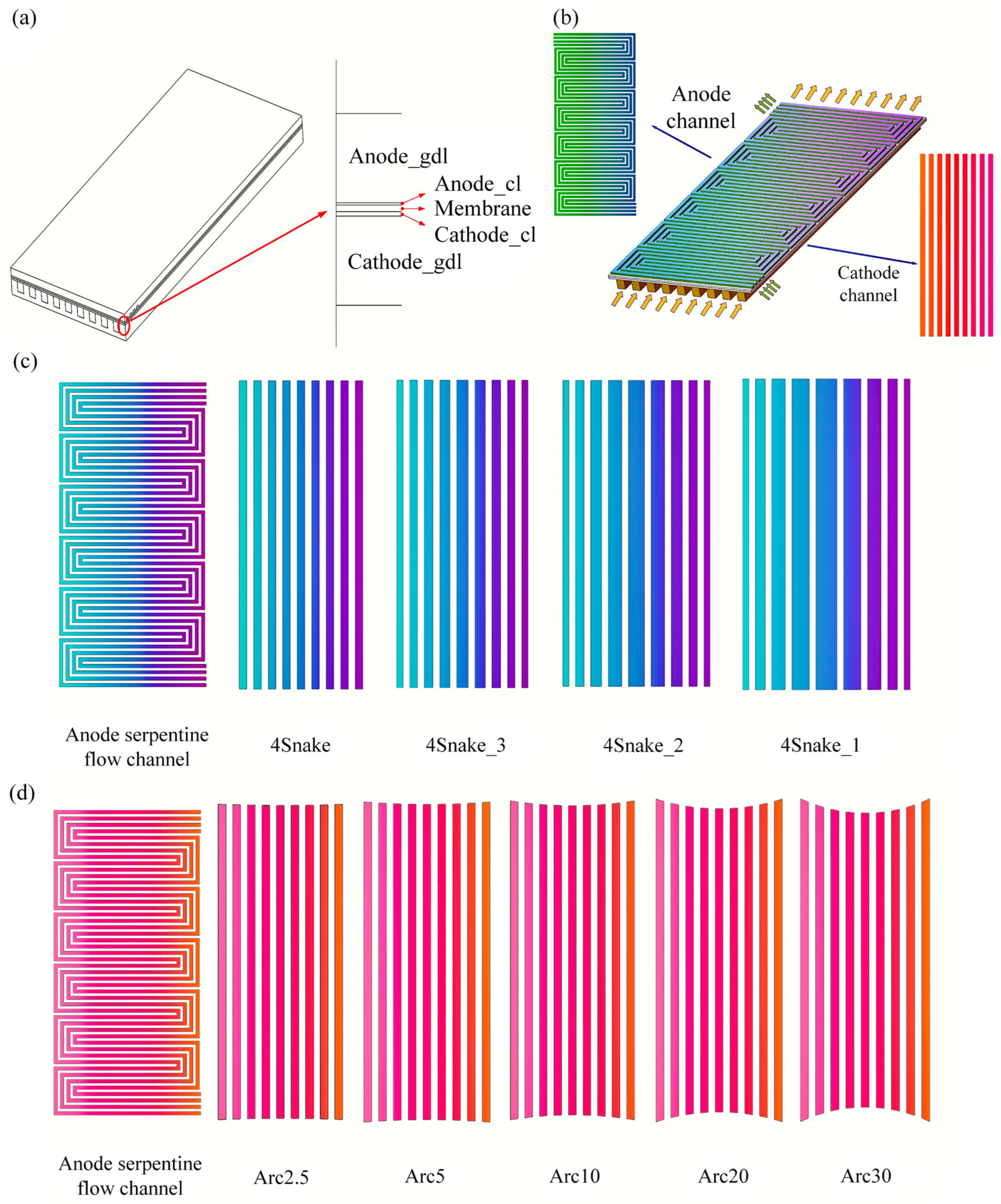
The core components of the PEMFC include the bipolar plate (BP), gas diffusion layer (GDL), catalyst layer (CL), and proton exchange membrane (PEM), as illustrated in Figure 1a. The flow channels are machined into the bipolar plates (Figure 1b). Following the work of Zhao et al. [34], the baseline model features a four-channel serpentine flow field at the anode and a parallel straight channel at the cathode. The key geometric parameters are summarized in Table 1. The arrows in Figure 1a briefly indicate the direction of fluid flow as well as the inlet and outlet positions of the cathode (air) and the anode (hydrogen gas). In the subsequent cloud chart analysis, detailed inlet/outlet markings are also provided. This paper constructs two new types of models by modifying the cathode parallel straight channels of the baseline model: graded-width channels and curved channels. The distribution characteristic of the graded-width channels is: maximum at the center, symmetrically decreasing towards both sides, as shown in Figure 1c. The width of the graded-width channel model is fixed at 47.2 mm, and the model length is calculated from the single channel width. In Figure 1c, 4Snake is the original baseline model. In the three models 4Snake_3, 4Snake_2, and 4Snake_1, the maximum widths of the central channel are 1.7 mm, 2.5 mm, and 3.3 mm, respectively, with the channel widths on both sides decreasing by 0.2 mm, 0.4 mm, and 0.6 mm, respectively.
As shown in Figure 1d, the curved channel must maintain a constant model length, and the model width is changed to ensure the active area is consistent with the original model, at 9.8648 cm2. This channel uses the model length as the chord to create an inscribed arc, making the cathode inlet and outlet curved. In Figure 1d, the chord-tangent angles α for Arc2.5, Arc5, Arc10, Arc20, and Arc30 are 2.5°, 5°, 10°, 20° and 30°respectively. Additionally, during simulation, to reduce the impact of backflow on the model, extended pipes were added at the inlets and outlets of the models with α = 10°, 20° and 30°, incorporating inlet/outlet ramps.

2.2. Model Assumptions

This study employs a three-dimensional, multi-physics AO-PEMFC model to analyze the effect of flow channel shape on performance. To reduce computational complexity, the model incorporates the following key assumptions:
(1)
Reactant gases (hydrogen and air) are treated as incompressible ideal gases.
(2)
Gas flow is assumed laminar within the channels.
(3)
The GDL, CL, and PEM are defined as isotropic and homogeneous porous media.
(4)
Gravity and contact thermal resistance are neglected.
(5)
All water in the system exists in vapor form, and phase change processes are not considered.
(6)
Steady-state operation is assumed for the cell.
The above assumptions simplify the calculation process but also introduce certain limitations. The incompressible flow assumption is applicable to the low Mach number flows typical of PEMFC operation, though it may become less accurate under high-pressure or high-flow-rate conditions. Given the moderate operating pressure and low flow velocity in this study, the associated error is negligible. The steady-state assumption precludes the analysis of transient processes such as startup, shutdown, or load changes. However, as this study focuses on the performance comparison of flow channel designs under steady-state conditions and does not involve dynamic responses, this assumption does not compromise the validity of the main conclusions. Treating the GDL, CL, and PEM as homogeneous, isotropic porous media neglects their inherent anisotropic microstructures. Nevertheless, because the present work emphasizes the comparative evaluation of flow channel geometries and the effects of anisotropy are consistent across different designs, this simplification does not alter the relative performance ranking among the considered schemes. Ignoring gravity and contact thermal resistance is generally acceptable in single-cell simulations. At the single-cell scale, the influence of gravity on gas distribution is negligible, and contact thermal resistance is insensitive under isothermal boundary conditions, thereby justifying these simplifications. The single-phase assumption excludes liquid water formation, which limits model applicability under high-humidity or cold-start conditions. However, the specified operating conditions in this study involve low-humidity intake, where liquid water generation is negligible, rendering this assumption reasonable within the investigated range. Despite these limitations, the model effectively captures the key physical trends under the specified conditions and is suitable for the comparative evaluation of different flow channel designs. All simplifications are made without compromising the relative performance comparison among flow channel structures, thereby ensuring the reliability of the study’s conclusions.

2.3. Governing Equations and Electrochemical Kinetics

Mass conservation equation for the gas mixture:
t ε ( 1 s ) ρ g + · ( ρ g u g ) = S m .
These terms denote the transient, convective, and mass source contributions, respectively, with the left-hand side comprising the first two. Based on the above assumptions, the fuel cell operates at steady state, so the first term on the left is 0. ρ g , ε , u g , S m represent density, porosity, velocity vector, and mass source term, respectively. For the anode and cathode channels and diffusion layers, S m is 0, while for the anode and cathode catalyst layers, S m is
S m = S H 2 = M H 2 2 F i a ,
S m = S H 2 O + S O 2 = M H 2 O 2 F i c M O 2 4 F i c .
Momentum conservation equation for the gas mixture:
( ε ρ u ) t + · ( ε ρ u u ) = ε p + · ( ε μ u ) + S u .
In the equation, p , μ , S u represent fluid pressure, dynamic viscosity of the mixture, and momentum source term, respectively. In the flow channels, S u is 0. In the catalyst layers and gas diffusion layers, S u is
S u = ( μ D u + 0.5 ρ U F u ) U .
In the equation, D u and F u are the viscous resistance coefficient and the viscous inertia coefficient, respectively. If the nonlinear term is not considered, F u is 0. Here, D u is related to the pore diameter d p o r e and porosity ε :
D n = 150 ( 1 ε ) 2 d p o r e 2 ε 3 .
Species conservation equation for the gas mixture:
( ρ Y i ) t + · ( ρ U Y i ) = · J i + S i , i = H 2 , O 2 , H 2 O .
The first term on the right represents Fickian diffusion of the species in the porous medium, hence J i is calculated by Fick’s law of diffusion:
J i = ρ D i , g a s Y i
where D i , g a s is the mass diffusion coefficient of species i in the gas mixture.
Energy conservation equation for the gas mixture:
t ε ρ c p T + · ε ρ c p u T = · k e f f T + S Q .
In the equation, c p , k e f f , T , S Q represent specific heat capacity at constant pressure, effective thermal conductivity, temperature, and energy source term, respectively. The energy source term considers Joule heating, chemical reaction heat, heat release or absorption during phase change, and heat generated by overpotential, namely
S Q = I 2 R o h m + β S H 2 O h r e a c t i o n + r w h L + S a , c η .
In the equation, I , R o h m , β , S H 2 O , h r e a c t i o n , r w , h L , S a , c , η represent current, resistance, ratio of chemical energy converted to internal energy, generation rate of water vapor, enthalpy value, water phase change rate, latent heat of water phase change, exchange current density at the anode and cathode, and overpotential, respectively.
Charge conservation equations:
For electronic current:
· ( k s e f f φ s ) = S φ s .
For ionic current:
· ( k m e f f φ m ) = S φ m .
In the equations, k s e f f , k m e f f , φ s , φ m , S φ are the effective electronic conductivity, effective ionic conductivity of the ionomer phase, solid phase potential, electrolyte phase potential, and electronic/ionic charge source terms, respectively. In any control volume within the anode or cathode, the generated electronic current and ionic current are equal, i.e.,:
S φ s = S φ m .
The electrochemical kinetics in the anode and cathode catalyst layers are described by the Butler-Volmer equation, respectively:
S a = j a , r e f C H 2 C H 2 , r e f γ a exp α a F η a R T exp α c F η c R T ,
S c = j c , r e f C O 2 C O 2 , r e f γ c exp α a F η c R T exp α c F η a R T .
In the equations, η is the overpotential; j r e f is the reference exchange current density; C i is the molar concentration of species i , i = H 2 , O 2 ; C i , r e f is the reference molar concentration of species i ; γ is the concentration exponent, for the anode γ = 0.5 , for the cathode γ = 1 ; α is the transfer coefficient.

2.4. Boundary Conditions and Numerical Setup

After completing the 3D modeling using SolidWorks2023, the commercial CFD software Fluent2024R1 was used for computational analysis of the 3D model. Before the calculation, boundary conditions need to be set. The voltage was set to 0.9 V, 0.85 V, 0.8 V, 0.75 V, 0.7 V, 0.65 V, 0.6 V, 0.55 V, 0.537 V to calculate the current density sequentially. Mass flow inlet and pressure outlet settings were used. Specific relevant parameters are shown in Table 2. The operational parameters in the table, including the temperatures of the anode and cathode (303.15 K/293.15 K), the relative humidity of the anode and cathode (0%/40%), and the stoichiometric ratio of the anode and cathode (1.8/2), are based on the typical operating conditions of PEMFC as described in references [34,35].

2.5. Model Validation

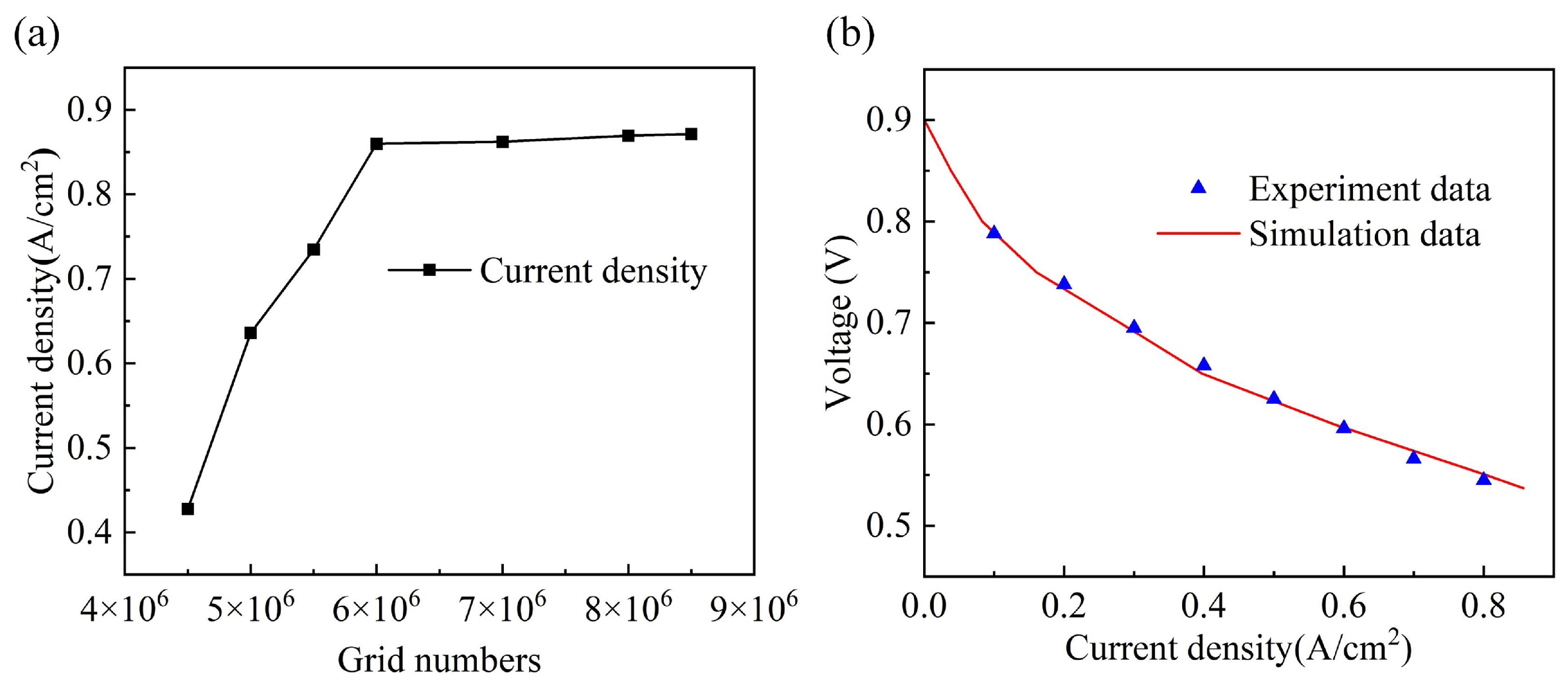
As shown in Figure 2a, to verify grid independence, models with mesh numbers of 4,069,062; 4,514,267; 5,026,748; 5,614,623; 6,139,045; 7,086,722; and 8,126,723 were calculated sequentially. A grid independence study ensured solution accuracy, with a negligible current density variation of less than 0.25% observed beyond 5.61 million cells. The simulations utilized the SIMPLE algorithm for iterative coupling, a first-order upwind scheme for discretization, and the algebraic multigrid method to enhance convergence speed.
The AO-PEMFC model was developed in SolidWorks2023 and analyzed using the finite element software Fluent2024R1. The geometric parameters of the baseline model, which are consistent with the experimental setup of Zhao et al. [34], are listed in Table 1. All subsequent model variants were developed based on this baseline. As shown in Figure 2b, the close agreement between the simulated and experimental polarization curves validates the model accuracy. This validated model was then employed to systematically investigate the effects of graded-width and curved channels on cell performance.

3. Results and Discussion

The AO-PEMFC is a highly coupled multi-physics system, whose performance and durability are determined by multiple factors. This study conducts a comprehensive analysis of oxygen, water–thermal, pressure, and polarization distributions in the AO-PEMFC simulation, deeply revealing the underlying mechanisms. The distributions of key physical parameters govern the cell’s operational state: oxygen concentration directly dictates reactant transport and pinpoints mass transfer limitations; the water–thermal profile balances membrane proton conductivity against gas transport resistance while critically influencing thermal stress; and pressure controls the driving force and uniformity of gas flow, thereby linking macroscopic operating conditions to microscopic transport phenomena. Polarization distribution, as the final output manifestation of the system, is a comprehensive reflection of the combined effects of multiple physical fields. Therefore, a systematic, correlative analysis of these distributions will be conducted to elucidate how different flow channel structures influence the heat and mass transfer characteristics in the AO-PEMFC.

3.1. Graded-Width Channels

3.1.1. Pressure Distribution

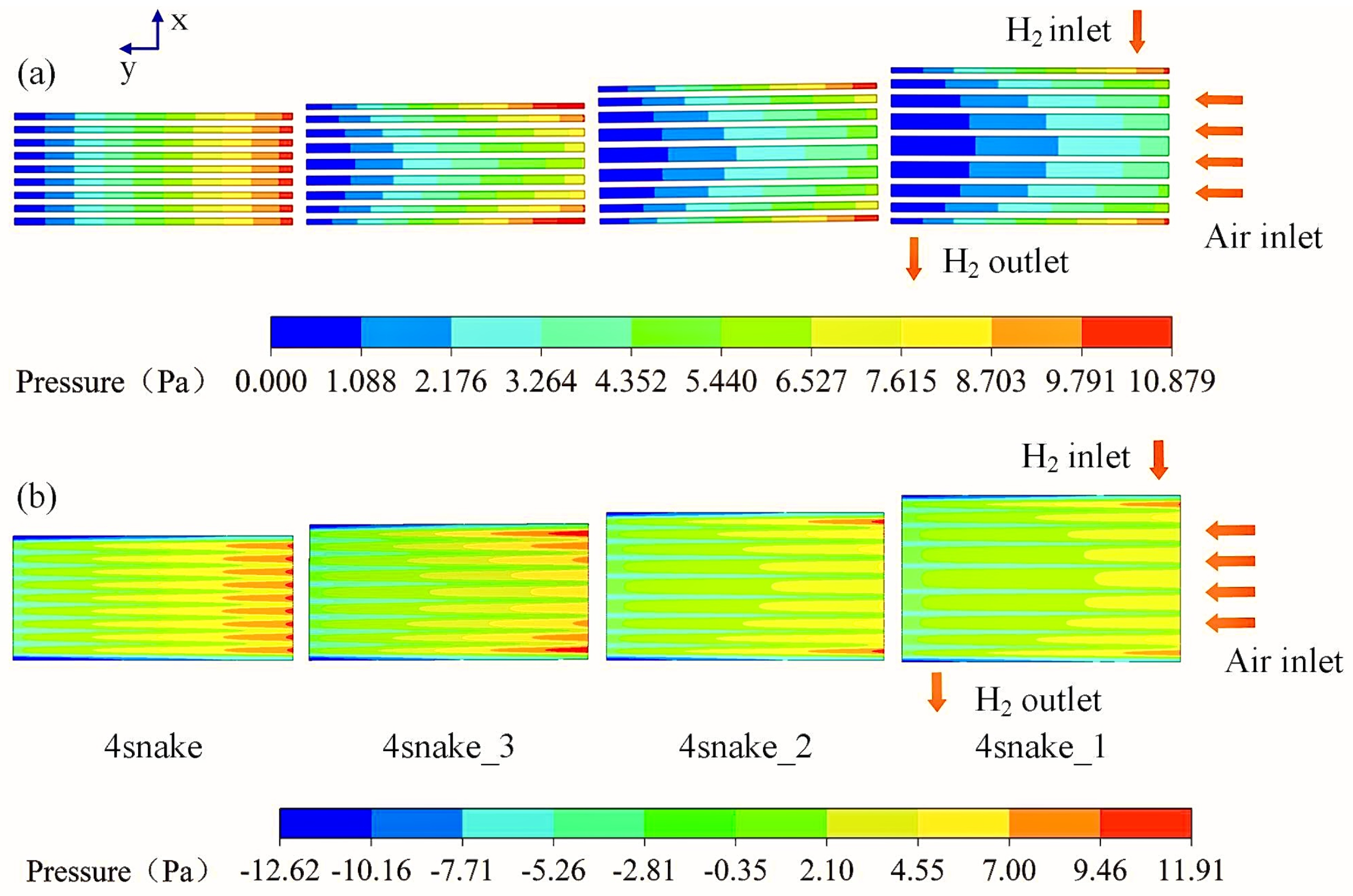
The cathode pressure drop is a key parameter influencing the efficiency of AO-PEMFCs. Figure 3a compares the pressure distribution on the central plane for four models with varying cathode channel porosities. A consistent trend is observed where the inlet-outlet pressure difference diminishes with increasing porosity, which is attributed to the reduced flow resistance in the more open channel structure. Specifically, the main reason for the decrease in total pressure difference is that increasing the porosity increases the overall flow area of the channels, leading to a decrease in gas flow velocity. This reduction in flow resistance, consistent with the Darcy-Weisbach equation where pressure loss is proportional to the square of velocity, consequently, lowers the parasitic power required by the cathode air supply system.
Figure 3a further indicates a nearly uniform pressure drop across each channel in the parallel 4snake design. In contrast, the graded channels exhibit a smaller pressure drop in the wider central channel and a significantly larger one in the narrower side channels, respectively, establishing a pronounced transverse pressure gradient. This is due to the difference in hydraulic diameter of channels with different widths. The narrow side channels have higher flow resistance, while the wide central channel has lower flow resistance. This variation in channel resistance produces a transverse pressure gradient.
As shown in Figure 3b, the pressure at the GDL/CL interface is universally lower than in the channels due to porous media resistance, yet it maintains a distribution pattern similar to Figure 3a. A key distinction is the higher pressure under the channels compared to under the ribs, which is fundamentally caused by the difference in transmission path length and resistance for gas molecules traveling to the reaction sites. This phenomenon is fundamentally attributed to the differing transport path lengths and corresponding resistances for gas molecules traveling from the channel to the active reaction sites. The vertical path under the channel has lower resistance, smaller pressure drop, and higher pressure; the long-range transverse diffusion path under the ribs has higher resistance, larger pressure drop, and lower pressure.
This pressure distribution characteristic is closely related to cell performance. The transverse pressure gradient becomes the main driving force for the transverse diffusion of reactant gas from the central channel to the side channels and the areas under the ribs. This is the physical essence of how this design improves the uniformity of reactant distribution. However, the non-uniformity of pressure distribution can also lead to complex changes in local mass transfer and water–thermal management. In summary, the graded-width channel design strategically tailors the internal pressure distribution, simultaneously achieving reduced flow resistance and enhanced reactant uniformity. This dual functionality underscores its considerable practical relevance for engineering applications.

3.1.2. Oxygen Distribution

Efficient oxygen transport is fundamental to achieving high performance in AO-PEMFCs. This process, which involves oxygen moving from the flow channel through the GDL to the catalyst layer, is paramount for maintaining high voltage and efficiency. This is especially critical at high current densities, where the oxygen mass fraction at the reaction site becomes rate-limiting.
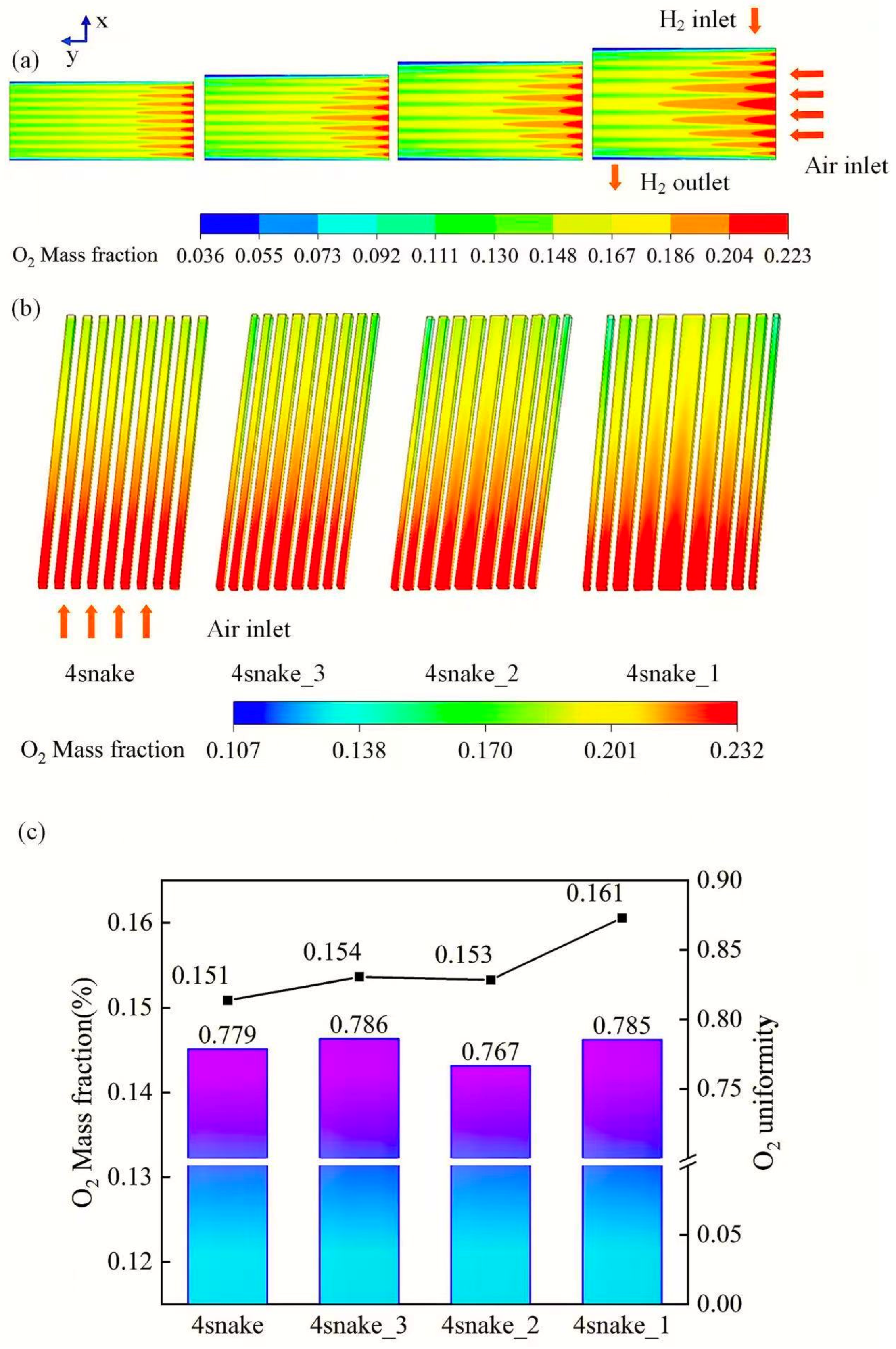
Figure 4a illustrates the oxygen mass fraction at the GDL/CL interface, showing a recurring pattern of higher concentration under the channels and lower under the ribs across the graded-width designs. This occurs due to the direct oxygen access under the channels, in contrast to the rib areas, which rely on transverse diffusion over longer path lengths, incurring greater resistance and oxygen depletion. The oxygen mass fraction in the graded-width channels shows a symmetric distribution of high in the center and low on the sides, which is consistent with the model’s channel-width distribution characteristics.
A comparison of different porosity models indicates that increased porosity enhances oxygen diffusion, widening its distribution range and raising the oxygen mass fraction at the outlet. As shown in Figure 4b, a similar trend is observed within the cathode channels, because regions of higher oxygen concentration in the channel provide a stronger driving force for diffusion to the catalyst layer.
To quantify the influence of oxygen distribution on current uniformity at the GDL/CL interface, we introduce an oxygen concentration uniformity index, defined as
U O 2 = 1 1 Y O 2 , ave 1 A M E A ( Y O 2 Y O 2 , ave ) 2 d A ,
where Y O 2 , ave denotes the average oxygen mass fraction over the GDL/CL surface.
Quantitative results in Figure 4c show that the average oxygen mass fractions for models 4snake, 4snake_3, 4snake_2, and 4snake_1 are 0.151%, 0.154%, 0.153%, and 0.161%, respectively. This indicates that increasing the cathode channel porosity generally enhances the average oxygen mass fraction. Specifically, model 4snake_1 achieves the highest value, exceeding the baseline by 6.4%, a finding consistent with the distribution patterns in Figure 4a,b. Regarding uniformity, all models exceed a value of 0.75, with 4snake_3 exhibiting the most uniform oxygen distribution.

3.1.3. Water–Thermal Distribution

Since AO-PEMFCs rely on natural convection and diffusion to obtain oxygen from the environment, their performance and durability highly depend on the internal water–thermal management state. Water is exclusively generated on the cathode side, where excessive accumulation can block gas transport in the porous electrode, hindering oxygen access to active sites. This water-induced transport loss causes voltage instability, ultimately degrading cell performance and durability. To this end, this work provides a systematic analysis of the water–thermal distribution to elucidate the associated heat and mass transfer characteristics in graded-width models.
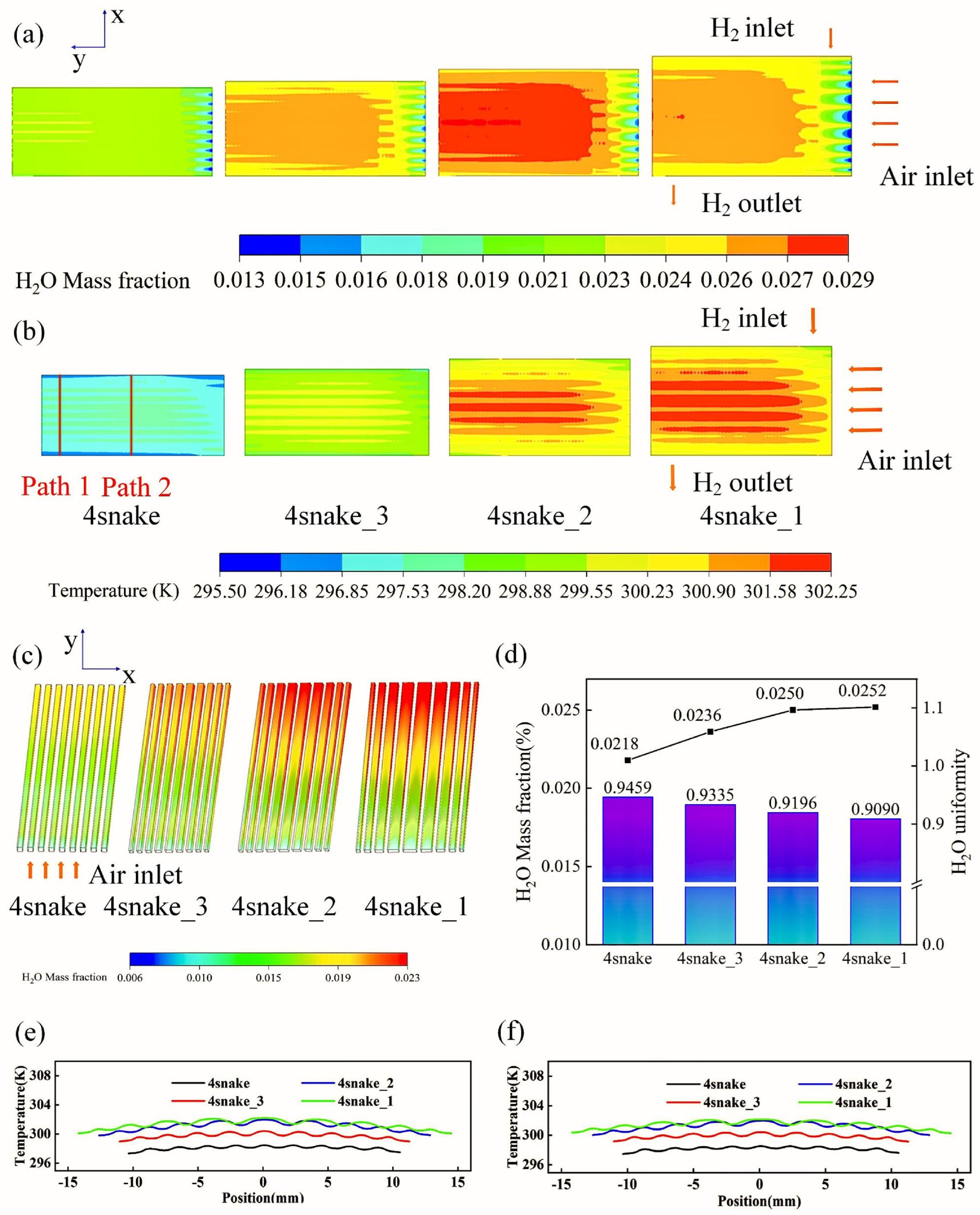
As depicted in Figure 5a, water distribution at the GDL/CL interface follows a common trend of increasing accumulation toward the outlet, especially under the ribs where diffusion paths converge. The uniform-channel 4snake model achieves the most homogeneous water removal, benefiting from sustained high gas velocity. Conversely, graded-width models exhibit systematically higher water mass fractions under the wider central channels, attributed to improved oxygen supply that locally accelerates reaction rates and water generation.
In model 4snake_1, the widened central channel significantly improves transverse oxygen diffusion, enabling a uniform oxygen distribution across the GDL/CL interface near the inlet. However, as oxygen is consumed along the flow path, its concentration declines downstream. Concurrently, the reduced airflow velocity in the widened channel leads to a rapid increase in water vapor partial pressure. This results in elevated water vapor concentration at the GDL/CL interface, ultimately causing significant water vapor accumulation near the outlet.
While the gradient design of model 4snake_2 directs oxygen preferentially to the central flow field, elevating the local reaction rate above surrounding areas, it also creates a water management issue. The inadequate convective removal in this central region allows the water vapor partial pressure to rise significantly, leading to substantial water vapor buildup at the central GDL/CL interface.
Model 4snake_3 has narrower channels and higher airflow velocity, which can effectively maintain low water vapor partial pressure within the channels, providing a stronger driving force for water vapor diffusion from the GDL to the channels. Meanwhile, the model’s smaller porosity gradient has a limited effect on improving oxygen distribution, and the oxygen distribution is close to that of the traditional parallel channels.
Figure 5c shows the water mass fraction distribution contour in the cathode channels. It can be seen that the water mass fraction in the cathode channels shows a distribution trend where the outlet is significantly higher than the inlet. This is because the reaction-generated water, after diffusing into the cathode straight channels, will gradually accumulate and be discharged along the channel direction driven by the airflow.
Figure 5d presents the average water mass fraction and its distribution uniformity at the cathode GDL/CL interface for the graded-width models. The average water mass fractions corresponding to 4snake, 4snake_3, 4snake_2, and 4snake_1 are 0.0218%, 0.0236%, 0.0250%, and 0.0252%, respectively, and the water mass fraction uniformities are 0.9459, 0.9335, 0.9196, and 0.9090, respectively. The average water mass fraction increases with the channel width, while the water mass fraction uniformity decreases. This also indicates that the graded-width design optimizes reactant distribution by enhancing transverse diffusion, but simultaneously, due to the widening of the channels, leading to a decrease in the axial pressure gradient, weakens the driving force for removing water vapor.
As shown in Figure 5b, higher porosity improves oxygen distribution uniformity, which intensifies the electrochemical reaction and its associated heat release. All models show smooth spatial temperature transitions. Among them, the high-porosity model 4snake_3 exhibits a pronounced temperature gradient, indicating enhanced heat exchange, efficient dissipation, and a stabilized electrochemical reaction.
Monitoring the temperature distribution corresponding to Path1 and Path2 on the cathode reaction interface, as shown in Figure 5e,f, it can be seen from the figures that the temperature distribution phenomenon matches the cathode channel groove-rib structure quite well, with peaks appearing in the cathode groove areas and valleys appearing in the cathode rib areas. Figure 5 also shows that as the porosity increases, the overall temperature level of the catalyst layer systematically increases. Furthermore, Figure 5f shows that the average temperatures along the y-axis center for models 4snake, 4snake_3, 4snake_2, and 4snake_1 are 297 K, 298 K, 300 K, and 302 K, respectively. The results demonstrate that elevating the cathode channel porosity raises the average operating temperature, reaching a maximum of 302 K.

3.1.4. Polarization and Current Density

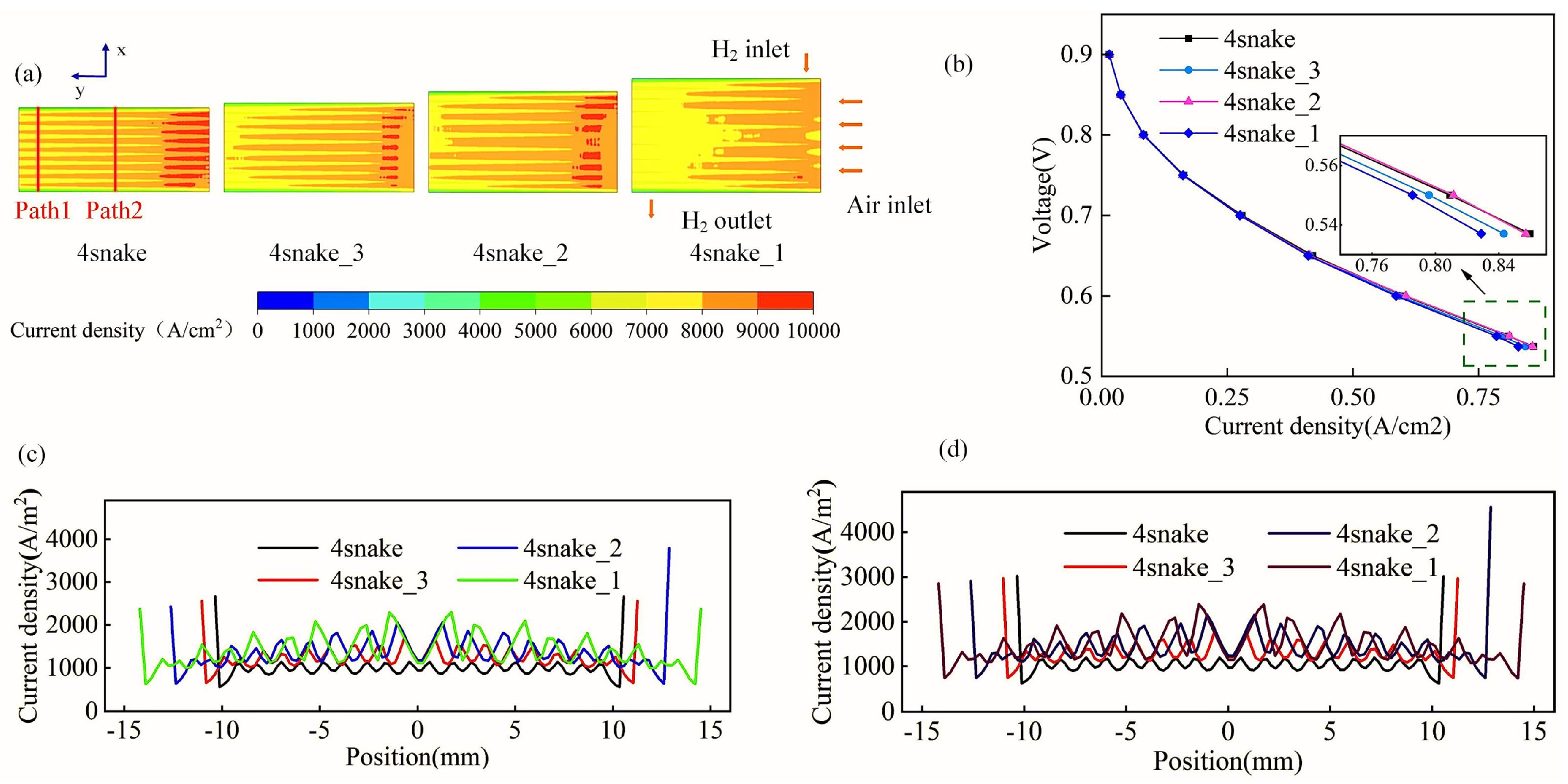
As shown in Figure 6b, the polarization curves of the graded-width models coincide at low current densities. This indicates that performance is governed by reaction kinetics and ohmic resistance, and the improved mass transfer from the structural modifications is not yet a limiting factor in this operating range. The mass transfer capacity enhanced by the flow channel structure improvement has not yet become the key factor constraining the overall performance, thus failing to cause significant performance differentiation.
The preceding analysis of oxygen distribution at the cathode GDL/CL interface confirms that the graded-width design improves reactant transport. With increasing channel porosity, both the average mass fraction and distribution uniformity of oxygen are enhanced. This demonstrates that the graded channels effectively direct reactants deeper into the diffusion layer, thereby promoting more uniform oxygen diffusion to the catalyst sites and increasing overall reactant utilization efficiency.
To prove the influence of graded-width channels on the spatial distribution of electrochemical reactions, the current density profile at the cathode GDL/CL interface under 0.537 V is presented in Figure 6a. This profile reflects the coupled effects of electrochemical activity and ohmic resistance. All models exhibit a characteristic decay in current density along the flow path, consistent with reactant depletion, and show higher values under channels than under ribs, aligning with oxygen transport pathways. The 4snake_1 model achieves the most uniform current distribution, as its graded design mitigates flow maldistribution caused by the fan, with the widened central channel augmenting local supply and thereby enhancing overall reactant uniformity at the catalyst layer.
Figure 6c,d shows the current density curves corresponding to the line segments Path1 and Path2 on the interface in Figure 6a. It can be seen from the figures that the fluctuation trend of the curves highly corresponds to the graded channel structure design, i.e., the peaks of the current density correspond to the channel positions, and the troughs correspond to the rib positions. This distribution directly results from the oxygen transport path: regions under channels benefit from more direct access, leading to ample supply and higher reaction rates; whereas areas under ribs rely on longer lateral diffusion through the porous GDL, resulting in oxygen depletion and thus lower current density. The current density curve of the model with the highest porosity, 4snake_1, exhibits the largest fluctuation, while the curve of the model with smaller porosity, 4snake_3, is relatively flat. This is because the high porosity central channel is wider and has a larger gradient with the side channels, increasing the flow in the central channel and improving the problem of small flow in the central channel and poor overall flow field uniformity caused by the fan supply characteristics.

3.2. Curved Channels

3.2.1. Pressure Distribution

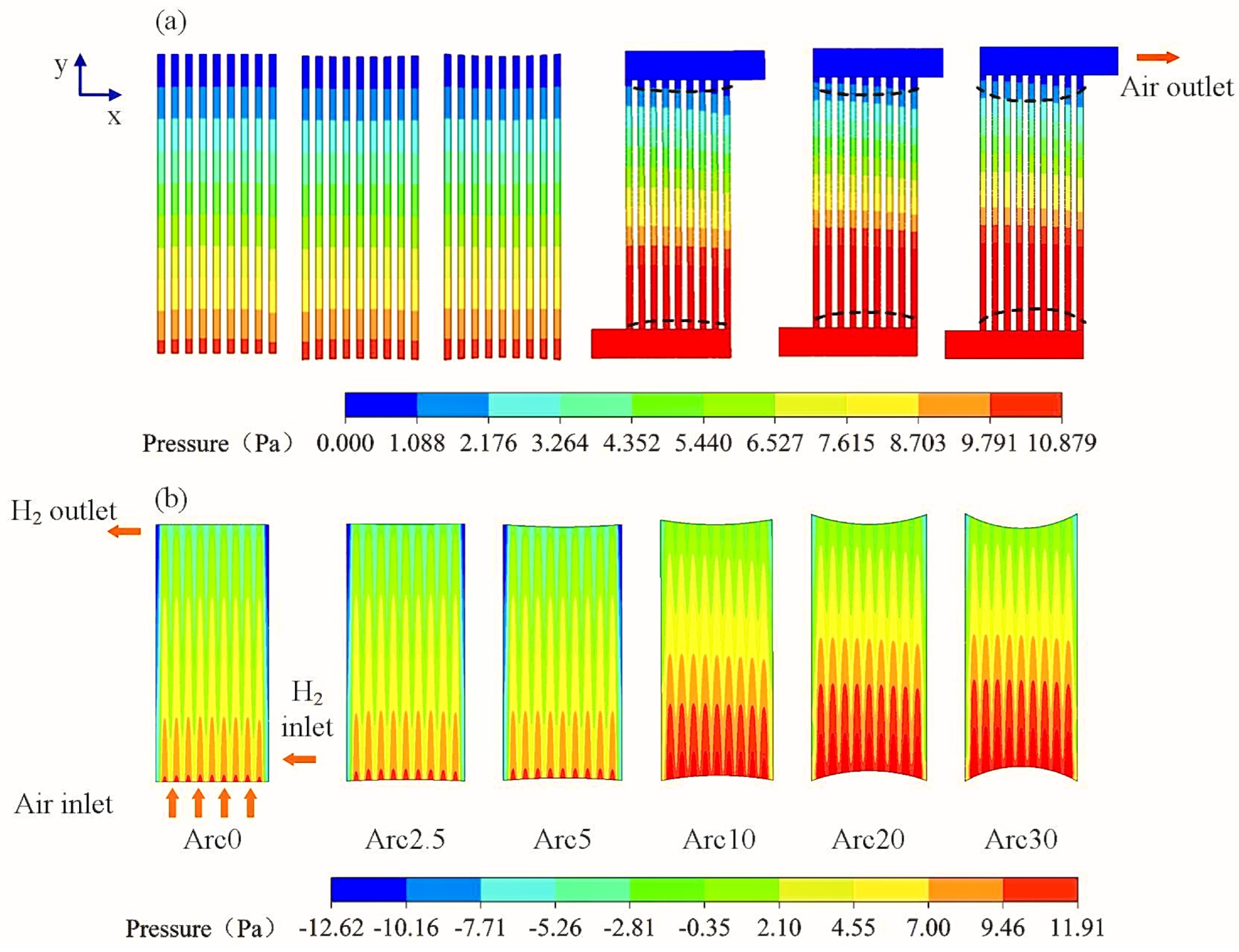
As shown in Figure 7a, the cathode channel pressure distribution indicates that a larger curved inlet angle increases the inlet-outlet pressure difference. This results from the heightened local flow resistance induced by the sharper flow direction change. Notably, the curved inlet also ensures relatively uniform pressure drops across individual channels, thereby effectively promoting airflow distribution uniformity and establishing a foundation for consistent reactant supply to the catalyst layer.
The increase in pressure difference implies an increase in the average gas velocity within the flow field. A higher velocity enhances the shear stripping effect of the airflow on liquid water, thereby improving liquid water removal efficiency. However, excessively large curvature angles also cause unnecessary flow energy loss, increasing the system’s parasitic power.
Figure 7b shows the interfacial pressure distribution for the curved channels, providing key insights into the transverse transport characteristics. Overall, as the curvature angle increases, the inlet-outlet pressure difference increases, consistent with Figure 7a. The pressure under the channels is greater than that under the ribs for all six models, but as the curvature angle increases, the pressure gradient between the channel and the area under the ribs tends to flatten, indicating that the curved design enhances the transverse diffusion capability of oxygen from the channel to the area under the ribs. This characteristic, together with the increased pressure difference caused by the larger curvature angle, constitutes an optimized balance for gas transport: a moderately increased pressure difference enhances the driving force for axial gas flow, while the reduced transverse pressure drop significantly lowers the resistance for oxygen diffusion to the reaction sites.

3.2.2. Oxygen Distribution

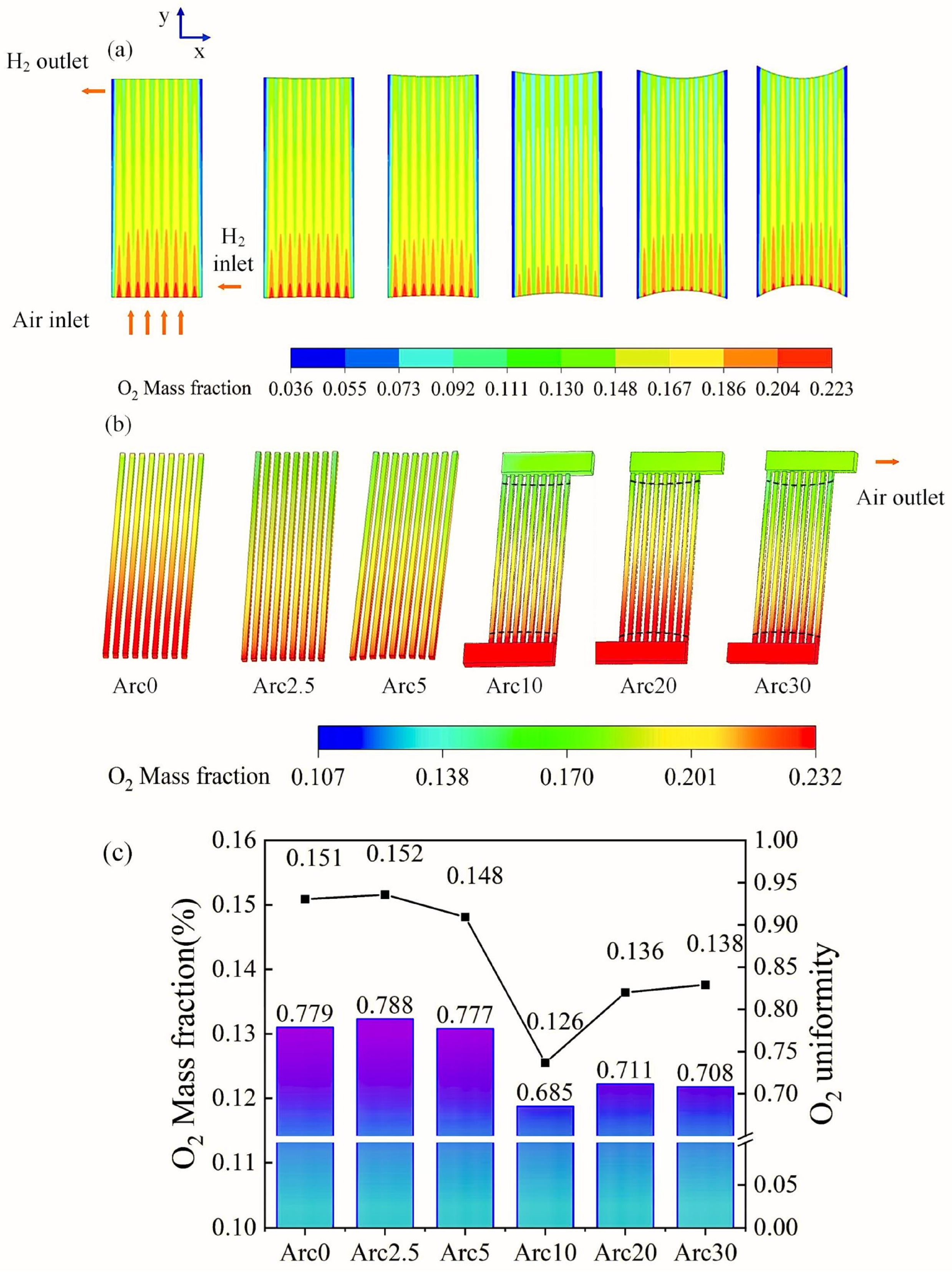
As shown in Figure 8a, the curved channel models exhibit the characteristic oxygen distribution pattern, namely a higher oxygen mass fraction under the channels than under the ribs. Additionally, the central channels show a slightly elevated oxygen level compared to the side channels. This is also because the concave curved part shortens the gas travel distance, so oxygen in the central channel region can diffuse further. The same pattern is observed at the outlet.
Analysis of Figure 8b reveals a clear influence of the curved inlet angle on the oxygen distribution pattern. While the 2.5°, 5°, 20°, and 30° configurations exhibit oxygen enrichment in the central channels, the 10° model, in contrast, demonstrates a lower overall oxygen mass fraction.
Figure 8b shows the average oxygen mass fraction and oxygen distribution uniformity at the cathode GDL and CL interface for the curved channels. The average oxygen mass fractions corresponding to Arc0, Arc2.5, Arc5, Arc10, Arc20, and Arc30 are 0.15088%, 0.15158%, 0.14814%, 0.12551%, 0.13642%, 0.13763%. Among them, the oxygen mass fraction and uniformity corresponding to Arc10 are relatively low, being 16.8% and 11.1% lower than those of Arc0, respectively. This is consistent with the contour phenomena described above.
Based on the pressure contour analysis in Figure 7, for Arc2.5 and Arc5, the mild curvature introduces only a slight flow perturbation, maintaining a relatively stable flow field and thus preserving effective convective transport efficiency. As the angle increases to 10°, the local flow resistance at the curved inlet becomes significantly more pronounced. Although the overall pressure drop continues to rise (as shown in Figure 7), the kinetic energy dissipation in the local region is more intense, which may reduce the effective convective intensity entering the downstream straight channels. Consequently, the actual convective flux driving oxygen transport toward the GDL/CL interface does not increase proportionally with the pressure drop, but instead decreases, leading to a drop in the average oxygen mass fraction from 0.14814% for Arc5 to 0.12551% for Arc10, exhibiting a distinct performance trough.
It is worth noting that Arc10 resides in a transitional flow regime: its curvature is too large to maintain the undisturbed convection-dominated flow characteristic of smaller angles, yet too small to induce significant secondary flows that would promote lateral mixing. This intermediate flow state, situated between convection-dominated and diffusion-dominated transport, results in the locally minimal oxygen delivery efficiency. This interpretation is consistent with the observed 11.1% reduction in the uniformity index—the lack of effective lateral mixing allows oxygen to accumulate preferentially in the main channel regions, hindering its uniform diffusion to the regions beneath the ribs.
In summary, the design of the curved inlet angle exhibits a non-monotonic optimization window. A moderate curvature (2.5°) can slightly improve transport performance without significantly disturbing the flow field, whereas excessively large angles (20°, 30°) rely on turbulent mixing to enhance uniformity, albeit at the cost of a higher-pressure drop. The 10° case represents a critical transition point where the flow structure shifts from convection-dominated to mixing-dominated transport, leading to a local minimum in oxygen delivery performance.

3.2.3. Water–Thermal Distribution

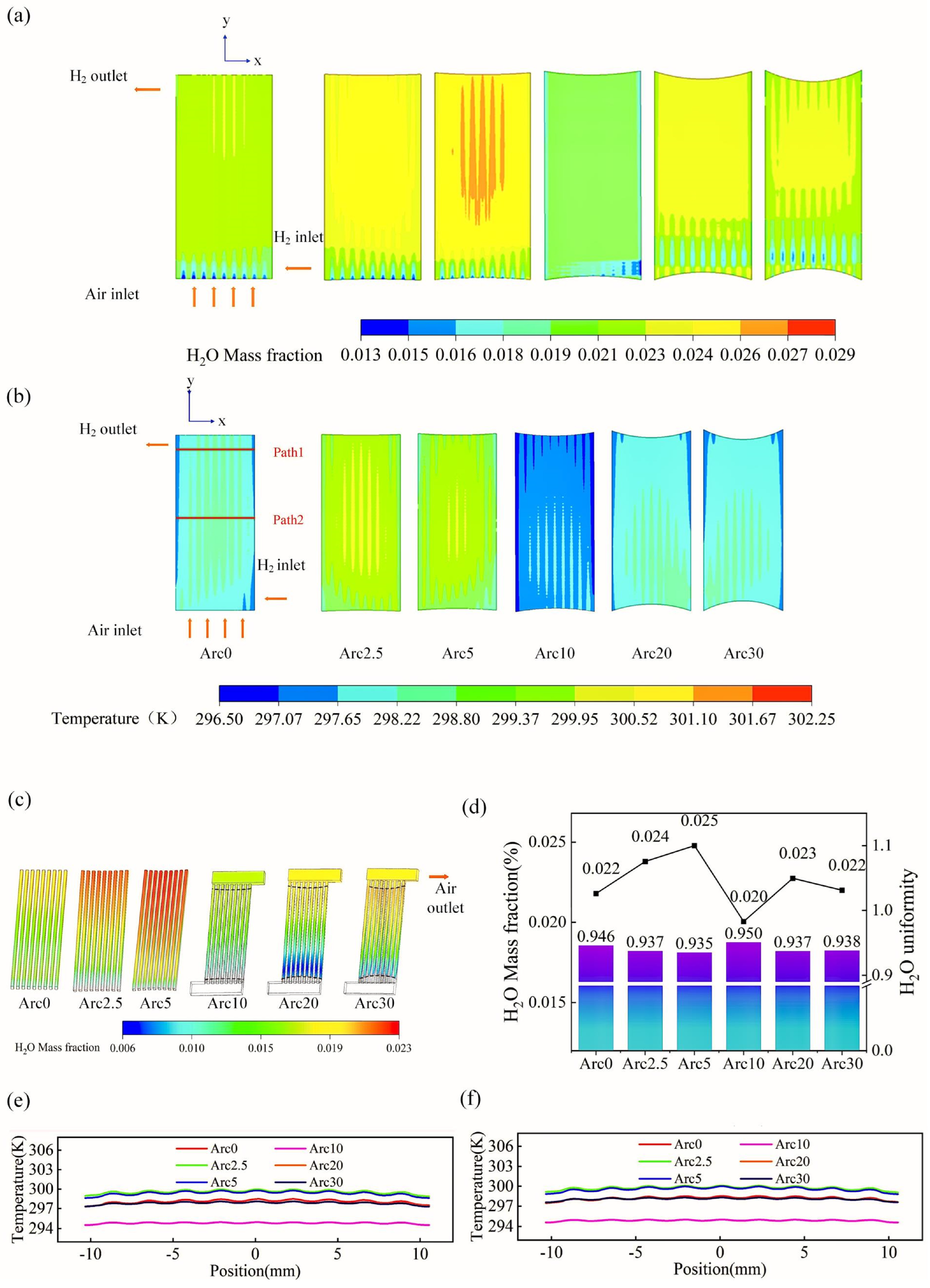
The water mass fraction distributions at the cathode GDL/CL interface and within the channels are shown in Figure 9a and Figure 9c, respectively. Like the graded-width models, water content in the curved channels increases from inlet to outlet. Notably, the inlet region exhibits a lower water mass fraction under the channels than under the ribs. This is attributed to the greater capillary pressure difference across the GDL beneath the channels, which drives water vapor more effectively from the reaction sites through the GDL and into the channels, thereby reducing local accumulation.
Models Arc2.5 and Arc5 have low water content at the inlet, but water accumulation occurs from the middle to the outlet region of the channel, with model Arc5 showing more obvious water accumulation, indicating its poor water vapor removal capability, leading to local mass transfer blockage. Models Arc10, Arc20, and Arc30 have lower overall water content and more uniform distribution, with water vapor removal performance superior to the small-angle models. This is because the curved channel design makes the central channels shorter, resulting in a reduction in the total amount of reaction-generated water, alleviating the water accumulation problem in that location.
From Figure 9d, the average water mass fractions at the GDL and CL interface corresponding to Arc0, Arc2.5, Arc5, Arc10, Arc20, and Arc30 are 0.022%, 0.024%, 0.025%, 0.020%, 0.023%, and 0.022%, respectively. Model Arc10 has the smallest average water mass fraction, 8% smaller than the original model Arc0. This is because the curved angle in model Arc10 generates a reasonable pressure gradient within the channel, creating larger shear forces on the channel walls and GDL surface, which can continuously and effectively remove water vapor, thereby preventing excessive water vapor accumulation and pore blockage. At the same time, the reasonable pressure gradient allows the airflow to more smoothly convey water vapor from the inlet to the outlet for discharge, avoiding local water vapor retention. If the angle is too small, the shear force and pressure difference are insufficient, easily leading to water vapor accumulation; if the angle is too large, vortices and other ineffective dissipation occur, energy is used to overcome resistance rather than for effective water vapor removal, leading to water vapor accumulation at the outlet.
Figure 9b depicts the temperature distribution at the cathode GDL/CL interface for the curved channel configurations. It can be seen that the interface temperatures of models Arc2.5 and Arc5 are generally high, while the interface of model Arc10 has the lowest overall temperature and uniform distribution. This is due to the efficient evaporation process continuously absorbing reaction heat, thereby significantly reducing the system operating temperature. Although the large-angle models Arc20 and Arc30 improve drainage to some extent, their cooling effect is still inferior to that of Arc10.
Monitoring the temperature distribution corresponding to Path1 and Path2 on the cathode reaction interface, as shown in Figure 9e,f, similar to the graded-width models, the temperature distribution phenomenon matches the cathode channel groove-rib structure quite well, with peaks appearing in the cathode groove areas and valleys appearing in the cathode rib areas. However, the curves are overall smooth with small fluctuations, consistent with the observation from the contour, indicating a uniform overall temperature distribution. The average y-direction temperatures at the interface reveal distinct thermal performance: models Arc2.5 and Arc5 operate near 299 K, while Arc10 achieves the most effective cooling at approximately 295 K. In contrast, models Arc20, Arc30, and the baseline Arc0 maintain an intermediate level around 297 K.

3.2.4. Polarization and Current Density

A comparison of the polarization curves across different curved inlet angles elucidates the significant impact of flow channel geometry on overall cell performance, revealing a distinct non-monotonic dependence.
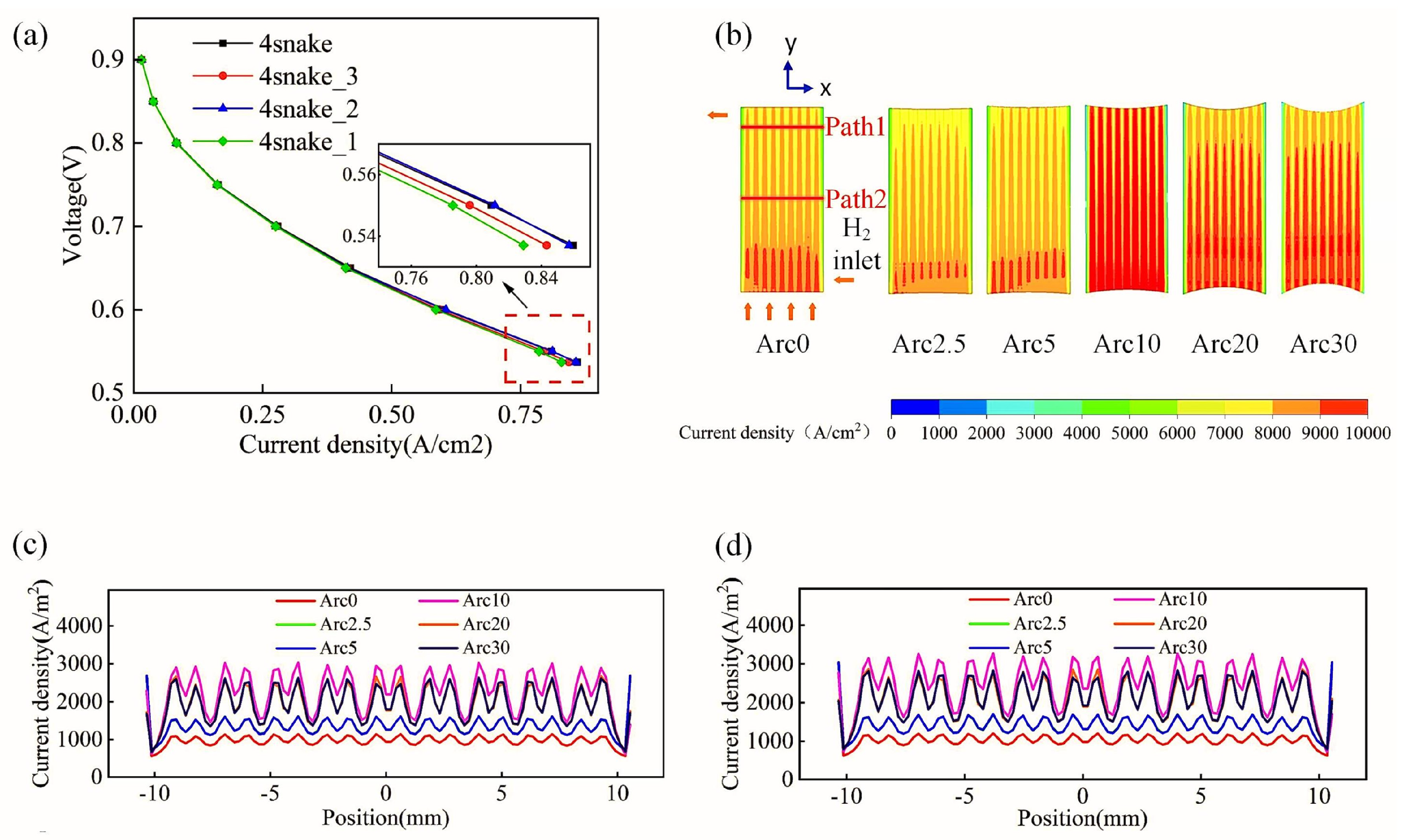
The polarization curves of the curved channels are presented in Figure 10a. In the low current density region dominated by activation polarization, all models perform similarly to the baseline (Arc0), indicating minimal impact of channel curvature on intrinsic catalyst kinetics. As the operation shifts to the medium-low voltage region, where ohmic and mass transfer losses prevail, the influence of geometry becomes pronounced. The smaller-angle models (Arc2.5, Arc5) underperform the baseline due to the trade-off between improved flow distribution and the added flow resistance, which collectively impair convective diffusion and overall mass transfer. Although the larger-angle models (Arc10, Arc20, Arc30) show performance gains over Arc0, the improvement is constrained by flow maldistribution and increased parasitic energy dissipation.
Figure 10b presents the current density distribution at the cathode GDL/CL interface (0.537 V) for the curved channels, including profiles at specific locations. A common characteristic is the current density decay from inlet to outlet along the channel axis. Notably, the decay rate is influenced by the curvature angle, with larger angles generally mitigating the decrease by sustaining reactant supply in downstream sections, thereby alleviating concentration polarization. The 10° curved channel (Arc10) achieves the highest current density across most of the interface, correlating with its superior performance on the polarization curve, and also exhibits the best distribution uniformity. Near the inlet, the current density under the ribs nearly matches that under the channels, attributable to enhanced oxygen transverse diffusion, which improves catalyst utilization and contributes to Arc10’s efficient water management.
As shown in Figure 10c,d, the current density profiles near the outlet and at the center are highly consistent. The Arc10 model yields the highest current density, followed by the nearly overlapping curves of Arc20 and Arc30, with Arc20 marginally higher at some points. The Arc5 model performs intermediately, surpassing the baseline Arc0 but falling short of the larger-angle models. This suggests that for smaller angles, the benefit of improved flow distribution is offset by the added flow resistance. The overlapping of Arc20 and Arc30 curves indicates a performance plateau beyond a certain angle, where convective gains are counterbalanced by flow non-uniformity. The overall current density of model Arc10 is the largest, consistent with the results on the contour.

4. Conclusions

Utilizing a 3D non-isothermal model, this study assessed the performance of graded-width and curved-channel designs in PEMFCs. The key findings are summarized below:
(1)
The graded-width design, featuring wide central and narrow side channels, compensates for fan-induced flow maldistribution, improving reactant uniformity. Increased porosity enhances oxygen distribution homogeneity and rib-area supply, supporting high-current-density performance. However, it also reduces flow velocity and raises operating temperature due to enhanced vapor condensation.
(2)
This design markedly lowers the total channel pressure drop, reducing parasitic power. Nevertheless, high-porosity configurations face water–thermal management trade-offs, necessitating further optimization to balance mass transfer and liquid removal.
(3)
Curved channels nonlinearly affect performance. An appropriate curvature balances gas distribution and water removal, enhances oxygen diffusion toward rib areas, and utilizes shear forces to alleviate flooding, thus mitigating concentration losses.
(4)
Larger curvature shortens central channels, alleviating downstream water accumulation and improving distributions of water, heat, oxygen, and current. This improves compatibility with real-world air supply non-uniformity.
From a practical application perspective, the two designs exhibit distinct applicable scenarios. The graded-width design is particularly advantageous under high-current-density operations where reactant distribution uniformity is critical, as it effectively mitigates the maldistribution caused by non-uniform inlet flow. Its low-pressure drop characteristic also makes it suitable for systems prioritizing parasitic power reduction, such as air-breathing or low-pressure operation fuel cells. In contrast, the curved channel design demonstrates superior performance in longer flow channel configurations, where axial reactant depletion becomes more pronounced. By shortening the effective transport distance in central channels, this design enhances oxygen delivery to downstream regions and improves overall species uniformity. Furthermore, the curved configuration is better suited for applications requiring enhanced transverse diffusion toward rib areas, such as electrodes with limited in-plane permeability.
Overall, the graded-width design strengthens transverse diffusion, raising the average oxygen mass fraction by 6.4% and uniformity by 0.96%. The curved channel configuration improves thermal-water management, promoting uniform temperature and stable current output.

Author Contributions

Conceptualization, C.Z.; Methodology, Y.W. and C.Z.; Software, B.C., Z.D. and Y.W.; Validation, Y.W.; Investigation, B.C.; Resources, Z.D. and Y.W.; Data curation, B.C.; Writing—original draft, B.C.; Writing—review & editing, B.C., F.W. and C.Z.; Visualization, B.C. and F.W.; Supervision, X.L., Z.D. and C.Z.; Project administration, C.Z.; Funding acquisition, C.Z. All authors have read and agreed to the published version of the manuscript.

Funding

This work was financially supported by Shenzhen Science and Technology Program (JCYJ20250604135805007), the National Natural Science Foundation of China (No. 22409083), Shenzhen Science and Technology Innovation Program (No. JCYJ20220818103200001), Project supported by the Natural Science Foundation of Hunan Province, China (No. 2023JJ40535).

Data Availability Statement

The datasets generated and/or analysed during the current study are not publicly available due to privacy but are available from the corresponding author on reasonable request.

Conflicts of Interest

The authors declare there are no competing interests.

Nomenclature

PEMFCProton exchange membrane fuel cell
GDLGas diffusion layer
CLCatalyst layer
BPBipolar plate
MEAMembrane electrode assembly
CHChannel
aAnode
cCathode
ρ g Density
ε Porosity
u g Velocity vector
S m Mass source term
p Fluid pressure
μ Dynamic viscosity of the mixture
S u Momentum source term
D u The viscous resistance coefficient
F u The viscous inertia coefficient
d p o r e The pore diameter
D i , g a s The mass diffusion coefficient of species i in the gas mixture.
c p Specific heat capacity at constant pressure
k e f f Effective thermal conductivity
T Temperature
S Q Energy source term
R o h m Resistance
β Ratio of chemical energy converted to internal energy
S H 2 O Generation rate of water vapor
h r e a c t i o n Enthalpy value
r w Water phase change rate
h L Latent heat of water phase change
S a , c Exchange current density at the anode and cathode
η Overpotential
k s e f f Effective electronic conductivity
k m e f f Effective ionic conductivity of the ionomer phase
φ s Solid phase potential
φ m Electrolyte phase potential
S φ Electronic/ionic charge source terms
j r e f Reference exchange current density
C i The molar concentration of species i
C i , r e f The reference molar concentration of species i
γ The concentration exponent
α The transfer coefficient
O 2 , ave The average oxygen mass fraction over the GDL/CL surface

References

  1. Zhang, F.; Wang, B.; Gong, Z.; Zhang, X.; Qin, Z.; Jiao, K. Development of Photovoltaic-Electrolyzer-Fuel Cell System for Hydrogen Production and Power Generation. Energy 2023, 263, 125566. [Google Scholar] [CrossRef]
  2. Wang, Z.; Liu, Z.; Fan, L.; Du, Q.; Jiao, K. Application Progress of Small-Scale Proton Exchange Membrane Fuel Cell. Energy Rev. 2023, 2, 100017. [Google Scholar] [CrossRef]
  3. Toudret, P.; Chenneviere, A.; Blachot, J.-F.; Gebel, G.; Guetaz, L.; Heitzmann, M.; Morin, A. Evidence of Well-Dispersed Ionomer in the Cathode Catalyst Layer of a PEMFC by Small Angle Scattering and the Effect of Its Content on Performance. J. Electrochem. Soc. 2025, 172, 034515. [Google Scholar] [CrossRef]
  4. Meyer, Q.; Zeng, Y.; Zhao, C. In Situ and Operando Characterization of Proton Exchange Membrane Fuel Cells. Adv. Mater. 2019, 31, 1901900. [Google Scholar] [CrossRef]
  5. Wu, X.; Xing, S.; Luo, J.; Wang, H.; Huang, F.; Zhao, C. Progress and Challenges on Air-Cooled Open-Cathode Proton Exchange Membrane Fuel Cells: Materials, Structures, and Systems. Energy Rev. 2025, 4, 100130. [Google Scholar] [CrossRef]
  6. Lee, N.; Lee, J.; Lee, S.W.; Jang, S.S.; Ju, H. Parametric Study of Passive Air-Cooled Polymer Electrolyte Membrane Fuel Cell Stacks. Int. J. Heat Mass Transf. 2020, 156, 119886. [Google Scholar] [CrossRef]
  7. Li, Y.; Liu, Y.; Han, L.; Liang, Q.; Wan, N.; Guo, Z. Preparation and Application of a kW-Level Air-Cooled PEMFC Stack with Titanium Bipolar Plates for UAVs. Int. J. Hydrogen Energy 2025, 139, 396–402. [Google Scholar] [CrossRef]
  8. Sevinc, H.; Hazar, H. A Novel Approach to Bipolar Plate Design in Fuel Cells with Unique Flow Field Geometries. Energy Convers. Manag. 2025, 343, 120237. [Google Scholar] [CrossRef]
  9. Ebrahimi, F.; Kermani, M.J. Generalization of the Method of Flow Channel Blocking in PEM Fuel Cells; Extensions from Straight-Parallel to Parallel-Serpentine Flow Fields. Int. J. Hydrogen Energy 2025, 142, 937–953. [Google Scholar] [CrossRef]
  10. Cheng, X.; He, C.; Wen, Q.; Jiang, Y.; Li, W.; Huang, J.; Huang, W.; Zhu, X.; Chu, X.; Ning, F. Easily Accessible 3D Flow Fields through 3D-Patterned GDL to Enhance PEMFC Performance via Excellent Water–Gas Separation Transport. J. Mater. Chem. A 2025, 13, 31013–31022. [Google Scholar] [CrossRef]
  11. Cai, Y.; Liu, X.; Wei, F.; Luo, Z.; Chen, B. Numerical and Experimental Study on Mass Transfer and Performance of Proton Exchange Membrane Fuel Cell with a Gradient 3D Flow Field. Appl. Energy 2024, 361, 122982. [Google Scholar] [CrossRef]
  12. Thomas, S.; Bates, A.; Park, S.; Sahu, A.K.; Lee, S.C.; Son, B.R.; Kim, J.G.; Lee, D.-H. An Experimental and Simulation Study of Novel Channel Designs for Open-Cathode High-Temperature Polymer Electrolyte Membrane Fuel Cells. Appl. Energy 2016, 165, 765–776. [Google Scholar] [CrossRef]
  13. Baik, K.D.; Yang, S.H. Improving Open-Cathode Polymer Electrolyte Membrane Fuel Cell Performance Using Multi-Hole Separators. Int. J. Hydrogen Energy 2020, 45, 9004–9009. [Google Scholar] [CrossRef]
  14. Qiu, D.; Peng, L.; Tang, J.; Lai, X. Numerical Analysis of Air-Cooled Proton Exchange Membrane Fuel Cells with Various Cathode Flow Channels. Energy 2020, 198, 117334. [Google Scholar] [CrossRef]
  15. Yin, C.; Gao, Y.; Li, K.; Wu, D.; Song, Y.; Tang, H. Design and Numerical Analysis of Air-Cooled Proton Exchange Membrane Fuel Cell Stack for Performance Optimization. Energy Convers. Manag. 2021, 245, 114604. [Google Scholar] [CrossRef]
  16. Wang, Y.; Guan, C.; Zhang, P.; Zhu, T.; Wang, S.; Zhu, Y.; Wang, X. Optimal Design of a Cathode Flow Field with a New Arrangement of Baffle Plates for a High Clean Power Generation of a Polymer Electrolyte Membrane Fuel Cell. J. Clean. Prod. 2022, 375, 134187. [Google Scholar] [CrossRef]
  17. Yin, Y.; Wu, S.; Qin, Y.; Otoo, O.N.; Zhang, J. Quantitative Analysis of Trapezoid Baffle Block Sloping Angles on Oxygen Transport and Performance of Proton Exchange Membrane Fuel Cell. Appl. Energy 2020, 271, 115257. [Google Scholar] [CrossRef]
  18. Wu, L.; Zhang, G.; Shi, X.; Pan, Z.; Xie, B.; Huo, W.; Jiao, K.; An, L. All-Scale Investigation of a Commercial Proton Exchange Membrane Fuel Cell with Partially Narrow Channels. J. Power Sources 2024, 589, 233779. [Google Scholar] [CrossRef]
  19. Liu, Y.; Bao, Z.; Chen, J.; Lv, F.; Jiao, K. Design of a Partially Narrowed Flow Channel with a Sub-Distribution Zone for the Water Management of Large-Size Proton Exchange Membrane Fuel Cells. Energy 2024, 310, 133292. [Google Scholar] [CrossRef]
  20. Kuang, J.; Fu, J.; Zhou, P.; Zhang, G.; Sun, X. Triangular Baffle Design for Proton Exchange Membrane Fuel Cell Bipolar-Plate Channels Evaluated by Decoupled Multi-Physics Analysis. Energy 2025, 340, 139278. [Google Scholar] [CrossRef]
  21. He, L.; Hou, M.; Gao, Y.; Sun, X.; Song, W.; Zheng, L.; Ai, J.; Zhang, H.; Shao, Z. Experimental Study of the S-Shaped Flow Fields in Proton Exchange Membrane Fuel Cells. Energy Convers. Manag. 2020, 223, 113292. [Google Scholar] [CrossRef]
  22. Rahmani, E.; Moradi, T.; Ghandehariun, S.; Naterer, G.F.; Ranjbar, A. Enhanced Mass Transfer and Water Discharge in a Proton Exchange Membrane Fuel Cell with a Raccoon Channel Flow Field. Energy 2023, 264, 126115. [Google Scholar] [CrossRef]
  23. Wang, X.; Wu, Y.; Cheng, Y.; Lu, G.; Tan, C. Collective Improvements in Flow Maldistribution and Interface Contact Resistance of Flow Field in Proton Exchange Membrane Fuel Cells via Coupling Manipulation of Gradient Porosity and Unit Cell Topology. J. Power Sources 2025, 653, 237711. [Google Scholar] [CrossRef]
  24. Kim, C.; Na, Y. Enhancing Power Density of PEMFC with Narrow Distribution Zone Using Parallel Serpentine Hybrid Flow Field. Renew. Energy 2025, 241, 122315. [Google Scholar] [CrossRef]
  25. Park, R.; Lim, K.; Choi, J.; Park, Y.; Moon, S.; Ju, H. Multi-Objective Optimization of Orifice-Shaped Cathode Flow Field Design in Polymer Electrolyte Membrane Fuel Cells. Renew. Energy 2026, 256, 123952. [Google Scholar] [CrossRef]
  26. Zhou, Y.; Miao, Z.; Li, H.; Meng, K.; Chen, B.; Chen, M.; Luo, H.; Guan, Y.; Duan, Y.; Ding, Q. Synergistic Multi-Physics Catalysis Enabled by Lotus-Root-Inspired Flow Fields in Proton Exchange Membrane Fuel Cells. J. Mater. Chem. A 2025, 13, 40821–40830. [Google Scholar] [CrossRef]
  27. Suárez, C.; Iranzo, A.; Toharias, B.; Rosa, F. Experimental and Numerical Investigation on the Design of a Bioinspired PEM Fuel Cell. Energy 2022, 257, 124799. [Google Scholar] [CrossRef]
  28. Miao, W.; Fan, F.; Fang, H.; Zhang, Y.; Liu, Q. Characteristics of Electrochemical Reaction Process in the Proton Exchange Membrane Fuel Cell Considering the Bio-Inspired Crescent-Shaped Dot Matrix Substrate Flow Field Structure. Fuel 2026, 404, 136231. [Google Scholar] [CrossRef]
  29. Sevinc, H.; Hazar, H. Performance Enhancement of PEM Fuel Cells Using Novel Porous Flow Field Designs. Energy Convers. Manag. 2026, 353, 121201. [Google Scholar] [CrossRef]
  30. Fu, L.; Tang, Y.; Liu, J.; Li, M.; Qiu, N. Design and Optimization of Triply Periodic Minimal Surface Structure Flow Channels in Proton Exchange Membrane Fuel Cells Based on Genetic Algorithm. Fuel 2026, 405, 136583. [Google Scholar] [CrossRef]
  31. Shen, J.; Du, C.; Yan, F.; Chen, B.; Tu, Z. Enhancement Effects of the Side Blockage Arrangement in the Flow Channel on the Performance of a Proton Exchange Membrane Fuel Cell. Int. J. Energy Res. 2022, 46, 16777–16790. [Google Scholar] [CrossRef]
  32. Hu, K.; Zhao, P.; Wang, S.; Wang, Y. Three-Dimensional Multiphase Simulation of a Partially Narrowed Flow Field Configuration for a High-Performance Polymer Electrolyte Membrane Fuel Cell. Appl. Therm. Eng. 2023, 223, 119986. [Google Scholar] [CrossRef]
  33. Manfo, T.A. Dynamic Simulation of a PEM Fuel Cell: Insights into Efficiency, Thermal, and Fluid Management. Next Energy 2026, 10, 100489. [Google Scholar] [CrossRef]
  34. Zhao, C.; Xing, S.; Chen, M.; Liu, W.; Wang, H. Optimal Design of Cathode Flow Channel for Air-Cooled PEMFC with Open Cathode. Int. J. Hydrogen Energy 2020, 45, 17771–17781. [Google Scholar] [CrossRef]
  35. Geng, Q.; Han, Y.; Li, B.; Wu, X.; Zhao, C.; Song, H. Optimal and Modeling Study of Air-Cooled Proton Exchange Membrane Fuel Cell with Various Length-Width Ratio and Numbers. Int. Commun. Heat Mass Transf. 2023, 142, 106668. [Google Scholar] [CrossRef]
Figure 1. (a) Schematic of the AO-PEMFC structure. (b) Bipolar plate configuration of the baseline model, showing both anode and cathode sides. (c) Anode and cathode channel layouts for the graded-width model. (d) Anode and cathode channel layouts for the curved model.
Batteries 12 00105 g001
Figure 2. (a) Model validation and grid independence study; (b) comparison between the simulated and experimental polarization curves.
Batteries 12 00105 g002
Figure 3. Snake cathode (a) Channel pressure distribution contour; (b) GDL and CL interface pressure distribution contour.
Batteries 12 00105 g003
Figure 4. Oxygen mass fraction analysis of Snake-type channels (a) GDL/CL interface distribution; (b) In-channel distribution; (c) Average value and uniformity at the interface.
Batteries 12 00105 g004
Figure 5. (a) Snake cathode water mass fraction distribution at the GDL and CL interface; (b) temperature distribution at the snake cathode GDL and CL interface; (c) snake cathode water mass fraction distribution in the channels; (d) average water mass fraction and water distribution uniformity at the snake cathode GDL and CL interface; temperature at the snake cathode GDL and CL interface in the y-direction (e) 5 mm from the cathode side outlet; (f) at the center.
Batteries 12 00105 g005
Figure 6. Snake model (a) GDL/CL interface current density; (b) Polarization curves; (c) Y-direction current density 5 mm from outlet; (d) Y-direction current density at center.
Batteries 12 00105 g006
Figure 7. Arc cathode (a) Channel, (b) GDL and CL interface pressure distribution contours.
Batteries 12 00105 g007
Figure 8. Oxygen analysis of Arc-type channels (a) GDL/CL interface distribution; (b) In-channel distribution; (c) Average value and uniformity at the interface.
Batteries 12 00105 g008
Figure 9. Water–thermal management characteristics of the curved (Arc) cathode channels. (a) Water mass fraction distribution at the GDL/CL interface; (b) temperature distribution contour at the GDL/CL interface; (c) water mass fraction distribution in the flow channels; (d) quantitative analysis of average water mass fraction and distribution uniformity at the GDL/CL interface; (e) temperature profile along the y-direction at 5 mm from the cathode outlet; (f) temperature profile along the y-direction at the channel center.
Batteries 12 00105 g009
Figure 10. Electrochemical performance and current density distribution of curved (Arc) channel designs: (a) Polarization curves; (b) Current density distribution contour at the cathode GDL/CL interface; (c) Current density profile along the y-direction at 5 mm from the cathode outlet; (d) Current density profile along the y-direction at the channel centerline.
Batteries 12 00105 g010
Table 1. AO-PEMFC Geometric Parameters.
ParameterValue
Anode BP thickness1 mm
Cathode BP thickness2 mm
GDL thickness0.2 mm
Anode CL thickness5 μm
Cathode CL thickness10 μm
Membrane thickness15 μm
Anode channel width/depth0.45 mm/0.3 mm
Cathode channel width/depth1.1 mm/1.3 mm
Table 2. AO-PEMFC Simulation Parameters.
ParameterValue (Unit)
Reference current density1 A/cm2
Anode Temperature303.15 K
Anode Relative Humidity0%
Anode H2 Stoichiometry1.8
Cathode Temperature293.15 K
Cathode Relative Humidity40%
Cathode O2 Stoichiometry2
Operating pressure1 atm
Anode reference current density10,000 A/m2
Cathode reference current density0.5 A/m2
Hydrogen reference concentration54.6 mol/m3
Oxygen reference concentration3.39 mol/m3
Disclaimer/Publisher’s Note: The statements, opinions and data contained in all publications are solely those of the individual author(s) and contributor(s) and not of MDPI and/or the editor(s). MDPI and/or the editor(s) disclaim responsibility for any injury to people or property resulting from any ideas, methods, instructions or products referred to in the content.