3.1. Structural Design of Prismatic Aluminum Shell Lithium Battery Module
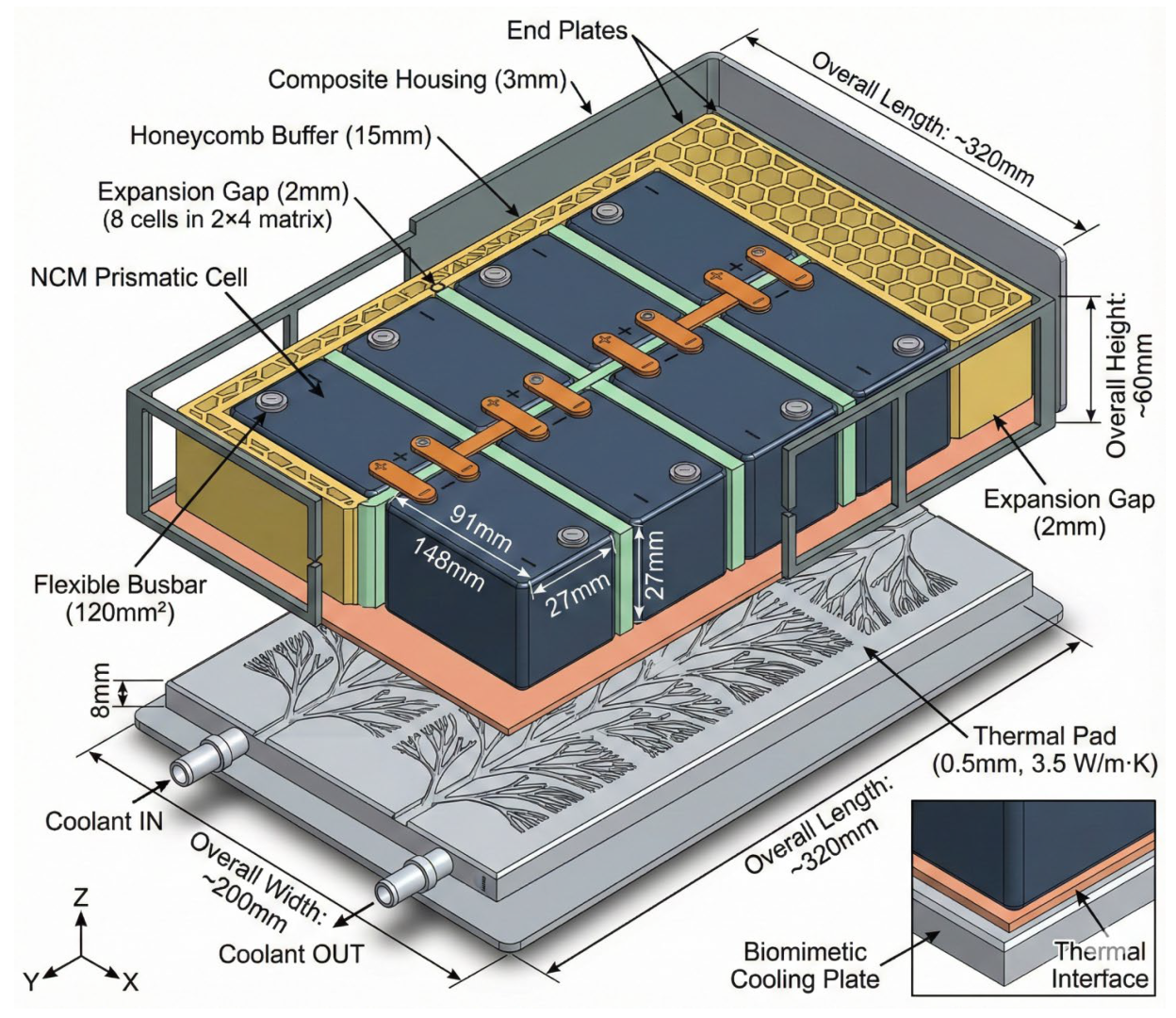
Addressing the practical application requirements of electric vehicle power battery systems, this study designed a prismatic aluminum shell lithium battery module structure with an integrated biomimetic liquid cooling plate. The module adopts 8 NCM (Nickel–Cobalt–Manganese) prismatic aluminum shell lithium-ion battery cells arranged in a 2 × 4 matrix configuration. Individual cell specifications are 148 mm × 91 mm × 27 mm with a rated capacity of 50 Ah and nominal voltage of 3.7 V. Cells are interconnected through high-strength aluminum alloy connecting pieces to achieve a series–parallel configuration, forming a 296 V/100 Ah module assembly that meets the power density requirements of passenger vehicle power systems.
As shown in
Figure 1, the overall structure of the battery module includes core components such as a battery cell array, integrated biomimetic liquid cooling plate, upper and lower end plates, side plates, and electrical connection system. The biomimetic liquid cooling plate adopts an embedded design concept, directly integrated at the bottom of the battery cells. The cooling plate thickness is set at 8 mm with an internal channel height of 4 mm. The cooling plate material uses 6061-T6 aluminum alloy with a thermal conductivity of 237 W/(m·K), achieving structural lightweighting while ensuring excellent heat transfer performance. High-thermal-conductivity silicone pads with a thickness of 0.5 mm and thermal conductivity of 3.5 W/(m·K) are filled between the battery cells and cooling plate, providing good thermal conduction paths while acting to buffer vibration and compensate for assembly tolerances. The module housing is manufactured from glass-fiber-reinforced composite material with a wall thickness of 3 mm, effectively reducing overall weight while meeting structural strength requirements.
To ensure the safety and reliability of the battery module during vehicle operation, the structural design fully considers factors such as thermal expansion compensation, vibration buffering, and collision protection. Expansion gaps of 2 mm are reserved between battery cells and filled with elastic polyurethane foam material with a compression modulus of 0.8 MPa, which can effectively absorb volume changes during battery charge–discharge processes. Honeycomb aluminum buffer structures with a thickness of 15 mm are installed around the module with a crush strength reaching 12 MPa. In the event of side collisions, they can absorb impact energy through progressive crushing to protect internal battery cells from damage. The electrical connection section adopts a flexible copper busbar design with a cross-sectional area of 120 mm2. Surface nickel plating treatment reduces contact resistance, and a laser welding process at connections ensures long-term reliability.
3.2. Topology Structure Optimization Design of Biomimetic Liquid Cooling Plate
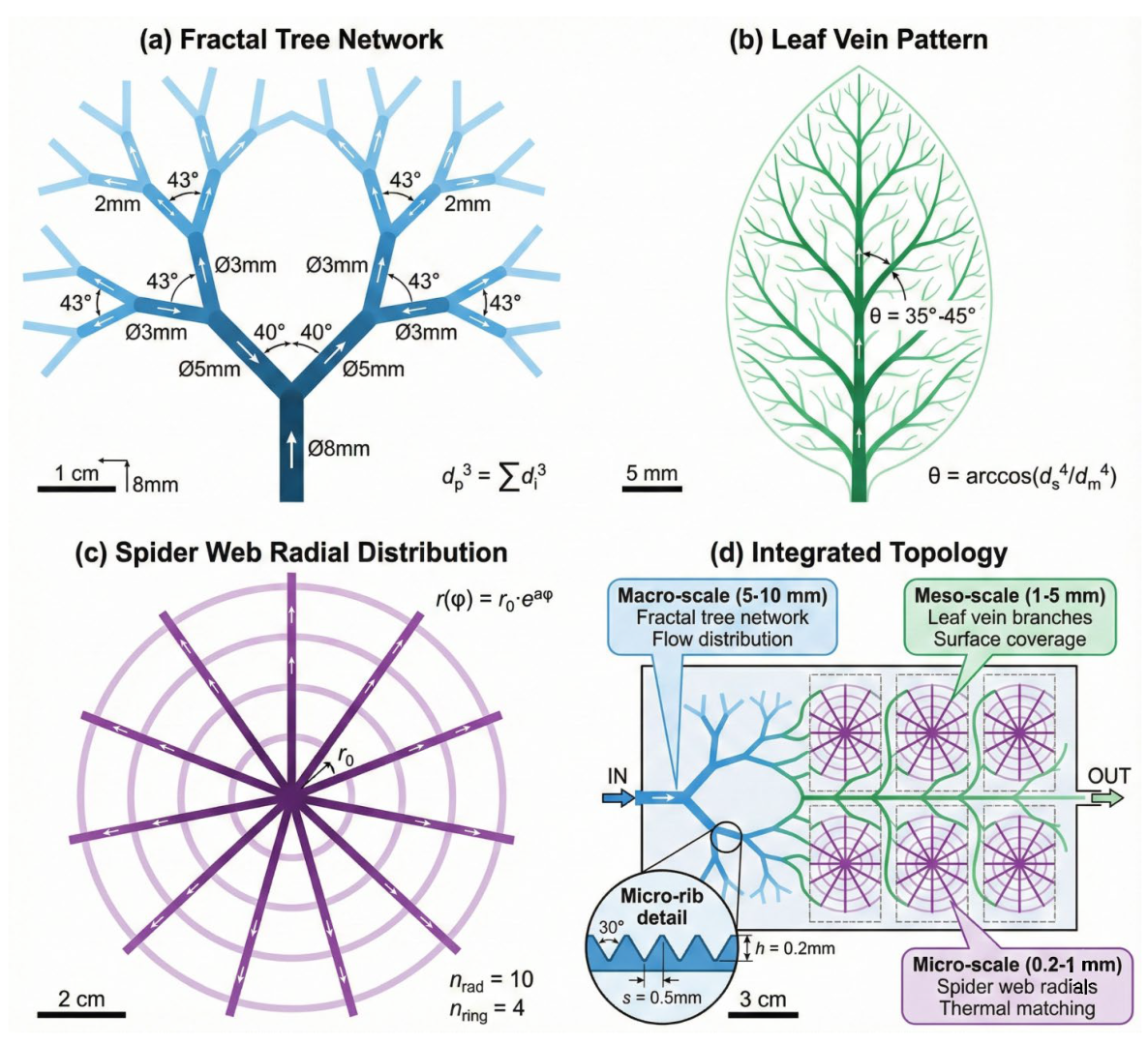
The channel topology design of the biomimetic liquid cooling plate integrates multiple natural high-efficiency heat and mass transfer structural features, including fractal tree-like networks, leaf vein branching systems, and spider web radial distribution. As shown in
Figure 2, the cooling channels adopt a three-level fractal-tree-like main trunk structure, successively branching from the inlet main pipe into first-level, second-level, and third-level channels. Pipe diameters follow Murray’s law for optimized configuration, where the relationship between parent pipe and child pipe diameters satisfies the following:
where
is the parent pipe diameter,
is the
-th child pipe diameter, and
is the number of branches. This design principle can minimize flow resistance and pumping power while ensuring uniform flow distribution.
Based on the fractal main trunk network, the leaf-vein-shaped secondary branch network further enhances coolant coverage at the battery bottom. The branch angles of the leaf vein network are determined according to the minimum resistance principle, with the angle between main vein and lateral vein set as follows:
where
is the branch angle,
is the lateral vein diameter, and
is the main vein diameter. This angular configuration minimizes energy loss when fluid diverts from the main vein to the lateral vein. Experimental validation shows that the optimal branch angle range is 35–45°.
The spider-web-shaped radial channels serve as the third-level enhanced heat transfer structure, forming annular interconnected networks directly below battery cells. The radial channel spacing follows isothermal line distribution patterns for optimization. The radial distribution of annular channels satisfies the following logarithmic spiral equation:
where
is the radius function in polar coordinates,
is the initial radius,
is the spiral coefficient, and
is the polar angle. This design enables high-temperature regions to obtain denser channel distribution, achieving self-adaptive matching of heat flux density with cooling capacity.
The channel cross-section adopts a biomimetic shark skin micro-rib structure design, with V-shaped micro-ribs with a height of 0.2 mm, spacing of 0.5 mm, and inclination angle of 30° arranged on the inner channel wall. The presence of micro-rib structures disrupts boundary layer development and promotes turbulent mixing of fluid. According to the Nusselt number correlation, the enhanced heat transfer coefficient can be expressed as follows:
where
is the Nusselt number,
is the Reynolds number,
is the Prandtl number, and
is the micro-rib enhancement factor with a value range of 0.15–0.25. The enhancement factor
, ranging from 0.15 to 0.25, was derived from experimental correlations for V-shaped micro-rib structures reported in turbulent heat transfer studies [
36,
37]. Specifically, investigations on miniature structured ribs by Luo et al. [
36] demonstrated that V-shaped ribs with height-to-spacing ratios of 0.3–0.5 (corresponding to the present design with h/s = 0.2/0.5 = 0.4) achieve thermal enhancement factors in the range of 1.15–1.25 for Reynolds numbers between 800 and 5000. Han et al. further confirmed that the micro-rib enhancement effect varies with Reynolds number: for the turbulent regime (Re > 2300), the enhancement factor reaches 0.20–0.25 due to effective boundary layer disruption and vortex generation, while for the laminar-to-transition regime (Re < 2300), the enhancement factor decreases to 0.08–0.15 as turbulence promotion becomes less effective [
37].
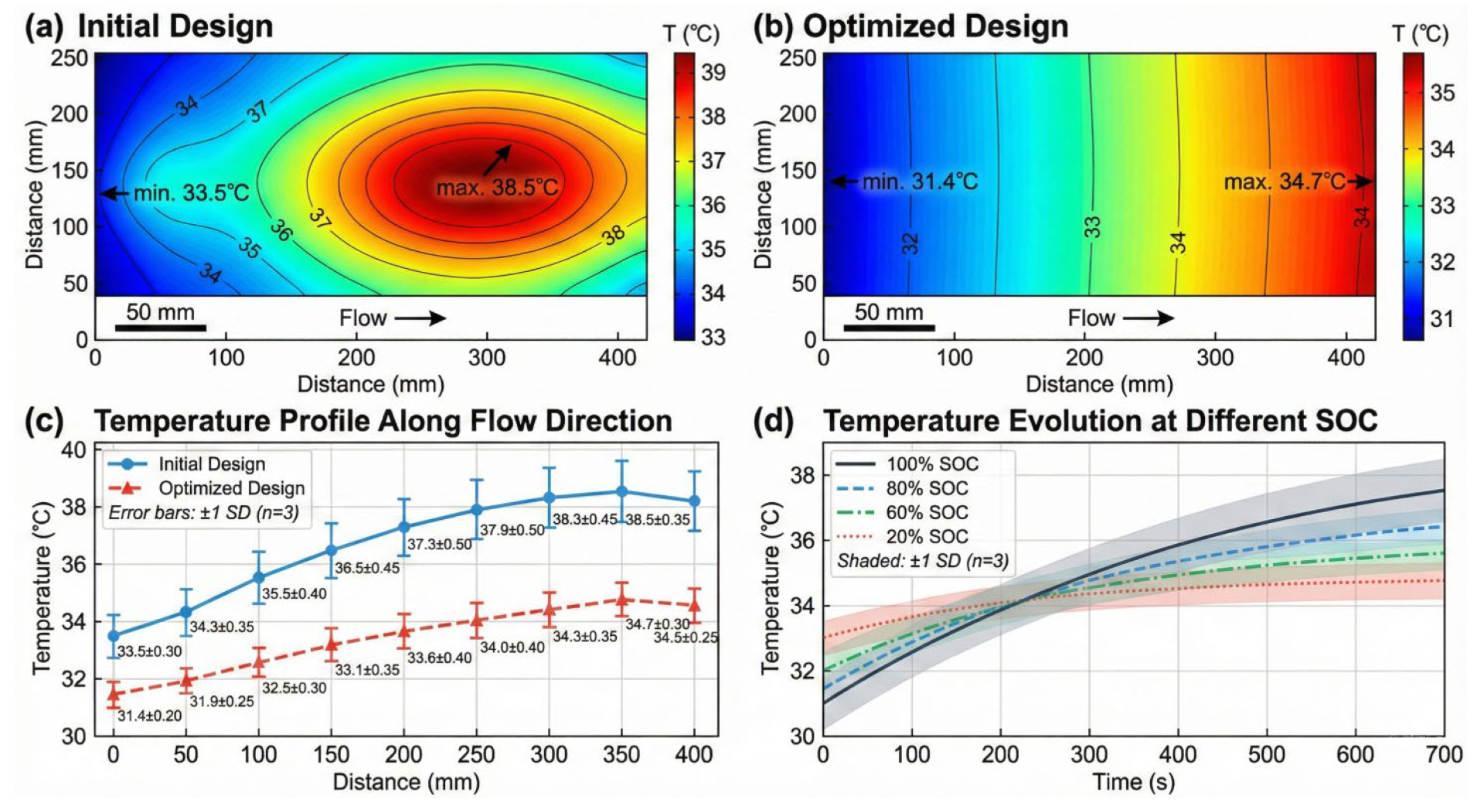
It should be noted that the proposed fractal channel geometry exhibits a wide Reynolds number range across different channel levels. Based on the numerical simulation results presented in
Section 4.5, the Reynolds number in the main channel reaches approximately 4200 (turbulent flow regime), while it decreases to approximately 800 in the terminal capillary channels (laminar flow regime). To account for this flow regime variation, the present study adopts a level-dependent enhancement factor approach: for the main channels and first-level branches operating in the turbulent regime (Re > 2300),
= 0.20–0.25 is applied; for the second-level branches in the transition regime (1000 < Re < 2300),
= 0.15–0.20 is used; and for the terminal capillary channels in the laminar regime (Re < 1000), a reduced value of
= 0.08–0.12 is implemented to reflect the diminished turbulence promotion effect. This hierarchical treatment ensures accurate prediction of heat transfer performance across the entire fractal channel network.
The synergistic advantages of integrating these three biomimetic structures arise from their complementary functions operating at different characteristic length scales, as illustrated in
Figure 2d. At the macro-scale (channel length scale of 5–10 mm), the fractal tree network provides primary flow distribution following Murray’s law, minimizing total hydraulic resistance while ensuring that each branch receives proportional coolant flow according to the thermal load of the underlying battery region. At the meso-scale (channel length scale of 1–5 mm), the leaf vein branching system extends from the fractal network to enhance surface coverage, effectively eliminating thermal dead zones that would otherwise exist between major fractal branches. The leaf vein secondary channels increase the effective heat exchange area by approximately 40% compared to pure fractal designs. At the micro-scale (channel length scale of 0.2–1 mm), the spider web radial distribution creates localized cooling intensification directly beneath each battery cell, where heat flux density is highest. The annular interconnections of the spider web structure also provide flow redistribution capability, automatically compensating for local flow imbalances caused by manufacturing tolerances or partial blockages. This hierarchical multi-scale architecture fundamentally differs from single-structure biomimetic designs, which can only optimize heat transfer at one characteristic length scale. The integrated approach enables simultaneous achievement of uniform flow distribution (from fractal networks), comprehensive surface coverage (from leaf vein branches), and localized thermal matching (from spider web radials), resulting in synergistic performance improvements that exceed the sum of individual contributions.
3.3. Establishment of Thermal–Force–Flow Multi-Physics Coupled Numerical Model
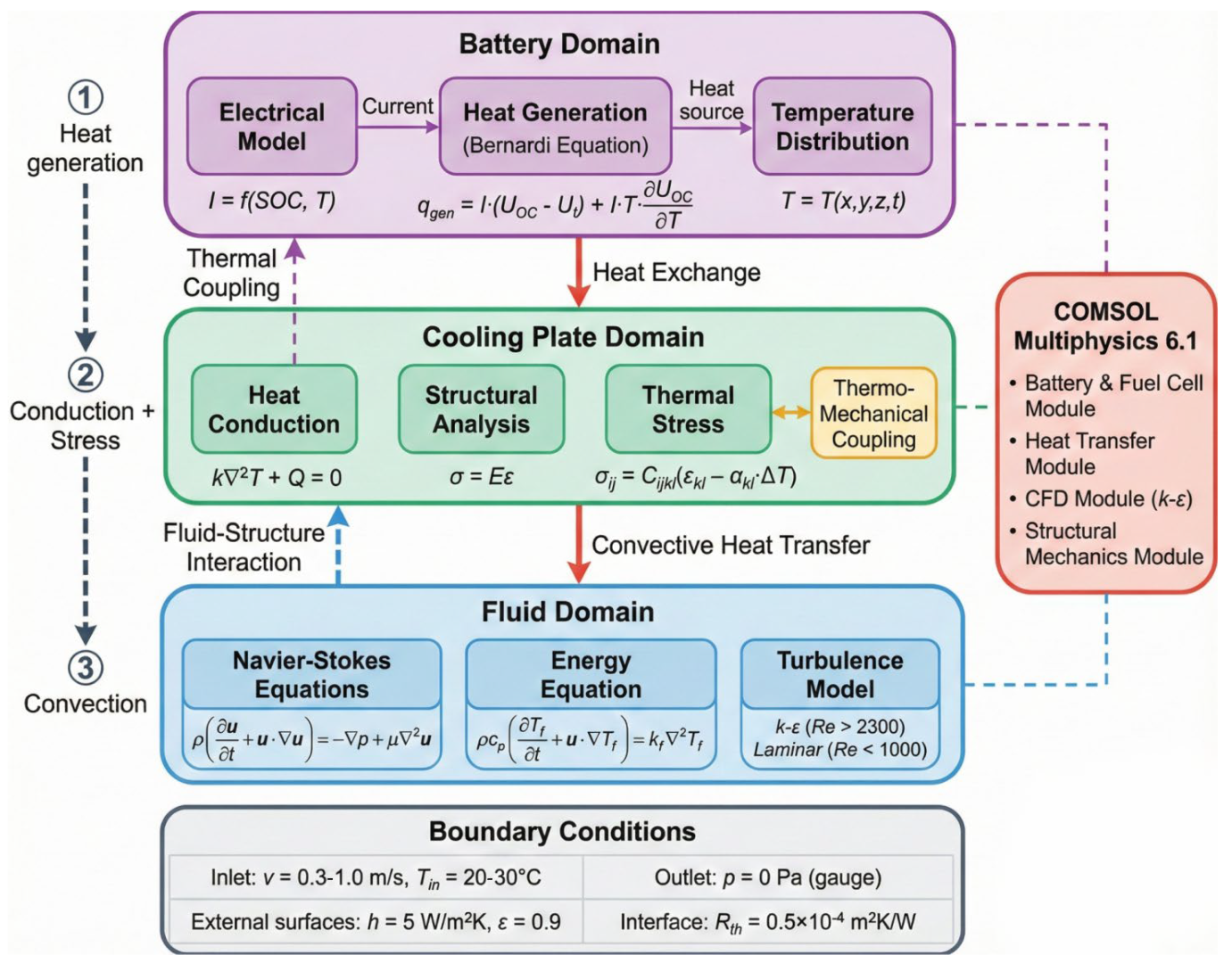
Thermal management performance analysis of battery modules requires establishing an accurate multi-physics coupled numerical model comprehensively considering complex physical processes such as electrochemical reaction heat generation, thermal conduction, convective heat transfer, thermal stress deformation, and flow pressure drop, along with their mutual interactions. As shown in
Figure 3, the numerical model adopts a layered coupled solution strategy, dividing the entire solution domain into the following three sub-domains: battery domain, cooling plate domain, and fluid domain, achieving information transfer between different physical fields through interface boundary conditions.
The multi-physics coupled numerical model was implemented using the COMSOL Multiphysics 6.1 software platform, which provides robust capabilities for handling the complex interactions between thermal, fluid, and structural physics. The model architecture integrates the following four primary physics modules: (1) the Battery and Fuel Cell Module for electrochemical heat generation calculation based on the Bernardi equation with state-of-charge-dependent parameters; (2) the Heat Transfer Module for conjugate heat transfer analysis in both the solid domain (battery cells, cooling plate, and thermal interface materials) and fluid domain (coolant); (3) the CFD Module employing the k-ε turbulence model for Reynolds numbers exceeding 2300 in main channels, with automatic switching to laminar flow formulation for terminal channels where Re < 1000; and (4) the Structural Mechanics Module for thermal stress and deformation analysis using linear elastic material models. The coupling between modules is achieved through COMSOL’s built-in multi-physics coupling features, with bidirectional data exchange at each time step to capture the thermal–mechanical–fluidic interactions accurately.
The heat generation model of battery cells is established based on the Bernardi equation, comprehensively considering both reversible entropy change heat generation and irreversible Joule heat, as follows:
where
is the volumetric heat generation rate (W/m
3),
is the current density (A/m
2),
is the open-circuit voltage (V),
is the terminal voltage (V),
is the temperature (K), and
is the entropy change coefficient (V/K). This heat generation model established a complete heat generation characteristic database by experimentally measuring battery internal resistance and entropy change coefficients under different state of charge (SOC) and temperature conditions.
Thermal conduction in the solid domain follows Fourier’s law. Considering the anisotropic thermal conductivity characteristics inside the battery, the energy conservation equation is expressed as follows:
where
is density (kg/m
3),
is specific heat capacity (J/(kg·K)),
,
, and
are thermal conductivity in three directions (W/(m·K)), and
is time (s). Battery radial and axial thermal conductivities are set at 1.5 W/(m·K) and 25 W/(m·K), respectively, reflecting the thermal conductivity anisotropy of the laminated structure.
Flow and heat transfer in the fluid domain are solved jointly using Navier–Stokes equations and energy equations. Considering the temperature-dependent physical property parameters of coolant, the continuity equation, momentum equation, and energy equation are, respectively, expressed as follows:
where
is fluid density,
is velocity vector,
is pressure,
is dynamic viscosity,
is fluid temperature,
is fluid specific heat capacity, and
is fluid thermal conductivity. The coolant uses a 50% volume fraction ethylene glycol–water mixture solution, with physical property parameters as functions of temperature obtained through polynomial fitting.
Thermal–force coupling analysis adopts thermoelastic theory. Thermal stress and deformation caused by temperature changes are described through the following constitutive equations:
where
is the stress tensor,
is the stiffness tensor,
is the strain tensor,
is the thermal expansion coefficient tensor, and
is the temperature change. This model can accurately predict thermal stress distribution and structural deformation caused by temperature gradients, providing a theoretical basis for mechanical performance optimization.
The boundary conditions for the multi-physics model were specified as follows. For the fluid domain: inlet boundary condition with a velocity magnitude ranging from 0.3 to 1.0 m/s (corresponding to the design variable range) and coolant temperature of 20–30 °C; outlet boundary condition with gauge pressure set to 0 Pa (atmospheric pressure reference); and no-slip wall condition applied to all channel surfaces with automatic wall function treatment for turbulent boundary layers. For the thermal domain: conjugate heat transfer interfaces between solid and fluid domains with continuous temperature and heat flux conditions; natural convection boundary condition (h = 5 W/m2K) and surface radiation (emissivity ε = 0.9) applied to external module surfaces exposed to ambient air; and thermal interface resistance of 0.5 × 10⁻⁴ m2K/W specified between battery cell surfaces and the cooling plate to account for the thermal pad contact resistance. For the structural domain: fixed constraint applied to module mounting points; frictionless contact between battery cells and cooling plate, allowing thermal expansion; and symmetry boundary conditions applied where applicable to reduce the computational domain. The 12 design variables were parameterized using COMSOL’s built-in parametric sweep functionality integrated with LiveLink for MATLAB R2023b, enabling automated execution of the NSGA-II optimization algorithm with direct access to the simulation results. Material properties for the 6061-T6 aluminum alloy (density of 2700 kg/m3, Young’s modulus of 69 GPa, Poisson’s ratio of 0.33, and thermal expansion coefficient of 23.6 × 10⁻⁶ K−1) and NCM battery cells (density of 2500 kg/m3 and specific heat of 1100 J/kg·K) were obtained from manufacturer datasheets and the published literature.
3.4. Model Validation and Mesh Independence Analysis
Reliability of the numerical model is ensured through comparison and validation with experimental data and mesh independence analysis. Validation experiments were conducted in a constant temperature environmental chamber, using eight thermocouples to monitor battery surface temperature distribution, two pressure sensors to measure cooling plate inlet–outlet pressure drop, and an infrared thermal imager to record module surface temperature field evolution. Experimental conditions were set as a 3C constant current discharge, ambient temperature of 25 °C, coolant inlet temperature of 20 °C, and flow rate range of 0.5–2.0 L/min.
Mesh independence analysis employed three sets of meshes with different densities for comparative calculations, with mesh numbers of 1.2 million, 2.4 million, and 4.8 million, respectively. As shown in
Table 3, when the mesh number increased from 2.4 million to 4.8 million, the relative deviation of the maximum temperature was less than 0.5% and the pressure drop relative deviation was less than 1.2%, indicating that 2.4 million meshes already meet the calculation accuracy requirements. The finally selected mesh scheme conducted local refinement near channel walls with first layer mesh height set at 0.01 mm to accurately capture velocity and temperature gradients within the boundary layer.
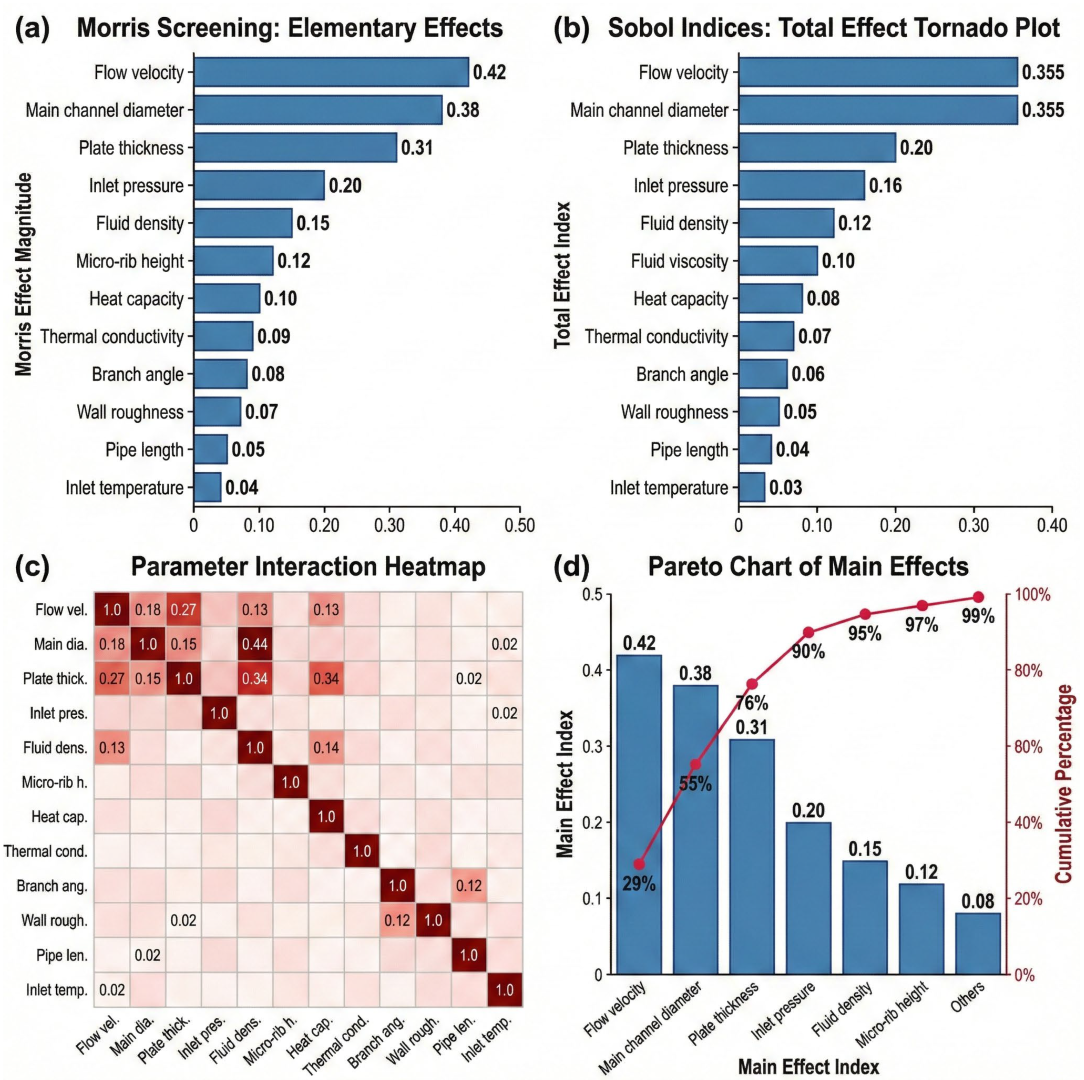
The model validation results show that the deviation between the numerically predicted maximum temperature and experimentally measured values is within ±1.5 °C, temperature distribution trends agree well, and the pressure drop prediction error is less than 8%, proving that the established multi-physics coupled model has a high prediction accuracy and can be used for subsequent optimization design research. Parameter sensitivity analysis finds that coolant flow rate, inlet temperature, and channel structure parameters show strong nonlinear characteristics in their effects on thermal management performance. Single parameter optimization struggles to achieve overall performance optimization, further highlighting the necessity of multi-objective optimization methods.
To further validate the long-term reliability and durability of the thermal management system, comprehensive cycling performance tests were conducted following a standardized protocol. The long-term cycling test protocol was designed as follows: ambient temperature was maintained at 25 ± 1 °C in a temperature-controlled environmental chamber (ESPEC PU-3KP); charge–discharge cycles were conducted at a 1C/1C rate (50 A charge current and 50 A discharge current) with voltage limits of 2.75–4.2V per cell; rest periods of 10 min were applied between charge and discharge phases to allow temperature equilibration and avoid cumulative thermal effects; and capacity retention was measured every 100 cycles under standard 0.5C (25 A) discharge conditions at 25 °C to ensure consistent measurement conditions. The total test duration spanned approximately 4 months to complete 1000 full charge–discharge cycles. Temperature data were recorded at 1 s intervals throughout the cycling process using the eight calibrated K-type thermocouples (accuracy ±0.5 °C) positioned at representative locations on the battery module surface. Pressure drop across the cooling plate was monitored continuously using differential pressure sensors (Honeywell PX2, accuracy ±0.1% FS) to detect any degradation in flow characteristics due to potential fouling or channel blockage. The thermal management system maintained continuous operation during all cycling tests with the coolant inlet temperature controlled at 20 ± 0.5 °C and flow rate maintained at the optimized value of 0.68 m/s. The results from these long-term cycling tests, presented in detail in
Section 4.5, demonstrate that the optimized biomimetic cooling plate design maintained an excellent thermal management performance with capacity retention of 92.3% after 1000 cycles, validating the durability and reliability of the proposed design for practical electric vehicle applications.