Article

Research on Three-Dimensional Localization of Pressure Relief Sound Source of Energy Storage Battery Pack Based on BP Neural Networks

1
Planning and Design Center, China Power Construction Engineering Consulting Corporation, Beijing 100120, China
2
Carbon Neutrality Development Research Institute, China Power Engineering Consulting Group CO., LTD, Beijing 100029, China
3
Energy Storage Technology Research Institute, China Power Engineering Consulting Group CO., LTD, Shanghai 200333, China
4
Energy Storage Department of Integrated Energy Engineering Company, China Energy Engineering Group Anhui Electric Power Design Institute CO., LTD., Hefei 230601, China
5
School of New Energy, North China Electric Power University, Beijing 102206, China
6
Institute of Energy Power Innovation, North China Electric Power University, Beijing 102206, China
*
Authors to whom correspondence should be addressed.
These authors contributed equally to this work.
Batteries 2026, 12(2), 66; https://doi.org/10.3390/batteries12020066
Submission received: 28 December 2025 / Revised: 7 February 2026 / Accepted: 12 February 2026 / Published: 14 February 2026
(This article belongs to the Section Energy Storage System Aging, Diagnosis and Safety)

Abstract

Thermal runaway events in energy storage power stations exhibit distinct acoustic characteristic signals. Three-dimensional localization of the sound source is of significant importance for achieving precise firefighting interventions. This study proposes an internal fault localization method for power stations based on the acoustic signals from pressure relief valves of energy storage battery packs. By deploying four microphones to capture the acoustic signals from the battery pack pressure relief valves, the spatial location of the faulty pack can be calculated using a three-dimensional localization model trained on a Back Propagation (BP) neural network. The localization accuracy of this model is better than 0.5 m, with the majority of measurement points achieving an accuracy of less than 0.3 m, meeting the requirements for battery pack-level localization. A key advantage of this method is its low sensitivity to time delay measurement errors caused by reverberation and reflections in enclosed spaces. Reliable and stable localization of pressure relief sound sources can be achieved through multiple training sessions within the battery cabin, which facilitates practical deployment.

1. Introduction

Lithium-ion batteries have emerged as the core energy storage component for electric vehicles and large-scale energy storage systems owing to their advantages such as high energy density, cost-effectiveness, and long cycle life [1]. To meet the capacity requirements of megawatt-level (MW-level) battery energy storage systems (BESS), hundreds to thousands of individual cells are typically connected in series and parallel configurations to form battery modules, which are further integrated into battery clusters. However, under long-term operational conditions, the inherent issue of cell-to-cell inconsistency becomes increasingly prominent [2,3]. This inconsistency not only significantly degrades the overall performance and cycle life of the system but may also trigger cascading failures such as thermal runaway [4,5], posing serious challenges to the safety and reliability of BESS [6]. Recent frequent safety incidents highlight the inadequacy of existing safety monitoring and early warning mechanisms [7]. Consequently, developing efficient and accurate safety early warning technologies for energy storage systems has become a key research focus in this field. However, effective early warning not only needs to find the fault but also needs to accurately identify its location in order to carry out targeted containment. Therefore, the development of efficient and accurate safety early warning technology, especially focusing on accurate positioning methods, is a key research focus in this field.
Existing studies have shown that the thermal runaway process of lithium-ion batteries involves the evolution of multiple physical signals such as electrical, thermal, acoustic, and gaseous ones, providing multidimensional monitoring means for early fault warning [8]. Among these, acoustic signals have garnered significant attention due to their potential for remote sensing and localization [9,10,11,12]. Abusive conditions such as overcharging, over-discharging, or overheating can induce internal short circuits in batteries, leading to a rapid temperature rise and heat generation from side reactions [13]. When the rate of internal heat accumulation far exceeds the heat dissipation capability, thermal decomposition of the electrolyte occurs, producing a large amount of gas. Once the internal pressure exceeds the limit, the battery casing ruptures and releases the gas, generating acoustic signals [14]. In energy storage power stations, multiple battery cells are often enclosed within sealed battery packs, which are also equipped with pressure relief valves [15]. These valves open when thermal runaway occurs inside the pack, producing distinctive acoustic signals. Although detecting the valve opening indicates the existence of a fault event, it is important to determine the specific three-dimensional location of the exhaust source to identify the faulty battery pack. If the fault is not suppressed in time, the released high-temperature flammable gas can easily ignite adjacent battery packs, triggering a chain reaction and ultimately threatening the safety of the entire energy storage system. Conversely, if the opening of the pressure relief valve can be detected promptly, pack-level fire suppression measures, such as aerosol flooding, can be immediately activated to suppress combustion and prevent the propagation of thermal runaway.
In response to this need, researchers propose a novel acoustic signal-based method for battery fault warning and localization [16]. This method requires deploying an acoustic sensor array only at the four corners of the energy storage container. By capturing and analyzing the venting acoustic signature generated during a single cell fault, the method enables the three-dimensional spatial localization of the fault source.
Sound source localization technology has developed over a long period, forming a relatively comprehensive theoretical framework. Traditional methods primarily include beamforming based on Steered Response Power (SRP), subspace methods based on high-resolution spectral estimation, and localization algorithms based on Time Difference of Arrival (TDOA) [17,18,19]. Due to the varying distances between each microphone in an array and the sound source, the sound signals arrive at each microphone at slightly different times. TDOA-based localization algorithms estimate the coordinates of the sound source by calculating the time delay differences of the signals received by the microphone array, in conjunction with the speed of sound propagation in air and the known geometric configuration of the array [20].
A TDOA-based localization algorithm primarily involves two steps. The first step is time delay estimation. Due to the varying distances between the sound source and each microphone in the array, the signals received by the microphones exhibit temporal differences. The core of time delay estimation is to calculate the signal arrival time differences between different pairs of microphones within the array using specialized algorithms [21]. Subsequently, in the second step, the calculated time delay differences from the first step are utilized, along with the known geometric configuration of the microphone array, to mathematically solve for the coordinates of the sound source. Commonly used position estimation algorithms can be primarily categorized into geometric analytical methods and spatial search methods based on objective function optimization [22].
Traditional position estimation algorithms, such as the geometric localization method, calculate the three-dimensional coordinates of the sound source by solving a system of equations derived from the three sets of time delay differences among four microphones. The localization accuracy of this method is directly dependent on the measurement precision of these three time delays. Under ideal, interference-free conditions, achieving high time delay measurement accuracy is relatively straightforward. However, in the battery cabin environment of an energy storage power station, challenges such as strong power frequency noise, enclosed space, severe reflections and reverberation, and the broad frequency distribution of venting valve acoustic signatures across 0–50 kHz all contribute to difficulties in accurately determining time delays. When time delay measurements contain errors, traditional geometric localization methods can produce unacceptably large errors—even misidentifying an internal event as an external anomaly—thus failing to meet the reliability requirements for safety monitoring.
Fortunately, extensive repeated experimental results indicate that the time delay measurement errors induced by the environment are not entirely random but rather exhibit repeatable patterns. This is attributed to the fixed internal structure of the cabin, where reflections and reverberations of venting acoustic waves from different locations maintain time-invariant characteristics. This provides an opportunity for data-driven approaches. Unlike TDOA-based methods, which rely on precise analytical models, neural networks, as data-driven modeling tools, can directly learn an end-to-end mapping relationship from input signals to the sound source location. Their key feature lies in their ability to implicitly learn and compensate for both array geometry and environmental acoustic characteristics solely by utilizing training datasets with position labels [23]. In other words, as long as the time delay error remains consistent, neural network algorithms can establish accurate positional mappings through extensive data ingestion, thereby circumventing the dependency on highly precise time delay signals required by traditional geometric localization methods.
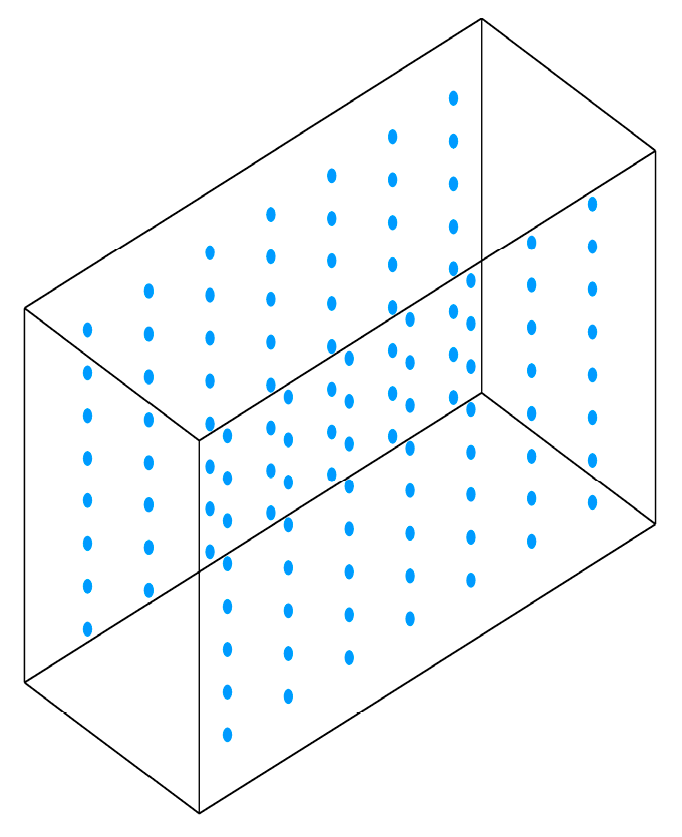
Moreover, practical engineering requirements also determine the method selection. The core task of safety monitoring in energy storage systems is not global continuous localization, but rather the precise identification of a limited number of discrete risk points. Specifically, a standard 2.5 MWh energy storage battery cabin is typically arranged in an array configuration of 2 stacks, each comprising 7 clusters, with each cluster containing 8 battery packs. Each battery pack is equipped with only one pressure relief valve as the key monitoring point, resulting in a total of 112 discrete monitoring points within the container, as illustrated in Figure 1. Thus, the localization requirement essentially involves accurately mapping the sound source to a specific battery pack, rather than pursuing centimeter-level continuous coordinate accuracy. In such a classification-type task, the advantage of TDOA-based methods in achieving global continuous localization cannot be fully leveraged, whereas the classification capability of Back Propagation (BP) neural networks aligns well with this demand.
Based on this, this study proposes a BP neural network-based method for venting acoustic source localization. It employs a robust time delay estimation algorithm to extract TDOA as the core feature and utilizes a BP neural network to perform the final sound source position calculation. This method aims to integrate the physical interpretability of signal processing with the powerful nonlinear fitting capability of neural networks. Through training, the BP network learns to tolerate the inherent, repeatable errors within the TDOA features. As long as the error pattern remains consistent, the network can compel the mapping toward the correct battery pack location. This renders the overall system insensitive to time delay calculation errors, with the goal of achieving more robust and easier-to-deploy thermal runaway acoustic source localization in complex environments.

2. Methodology

2.1. TDOA Measurement Principle

TDOA is obtained through correlation analysis. The principle involves using a set of microphones placed at different locations to receive the sound signal emitted from the same source. By analyzing the correlation degree between the signals received by two microphones in the time domain, the time difference corresponding to the maximum correlation between the two signals is determined. Assuming the two microphone signals are unaffected by reverberation in the indoor environment, the received sound signals can be expressed as:
x i ( t ) = a i s ( t τ i ) + n i ( t )
x j ( t ) = a j s ( t τ j ) + n j ( t )
where ai and aj are the attenuation coefficients of sound propagation to microphones mi and mj, respectively, s(t) is the original signal emitted by the sound source, ni(t) and nj(t) are noise signals, xi(t) and xj(t) are the signals received by the two microphones, and τi and τj are the propagation times from the sound source to the two microphones.
Accordingly, the cross-correlation function Rij(τ) between the two signals can be calculated as:
R i j ( τ ) = E [ ( x i ( t ) x j ( t + τ ) ) ]
substituting the above expression yields:
R i j ( τ ) = a i a j E [ s ( t τ i ) s ( t τ j + τ ) ] + a i E [ s ( t τ i ) n j ( t + τ ) ] + a j E [ s ( t + τ τ j ) n i ( t ) ] + E [ n i ( t ) n j ( t + τ ) ]
Environmental noise consists of two categories. One is power frequency noise, such as the sound from system cooling fans, which is independent of the source signal. The other is the superposition of reflection and reverberation from cabin walls and between battery stacks, which is related to the internal structure of the cabin. Reflection and reverberation can introduce a certain degree of correlation. Fortunately, the reflection and reverberation characteristics of a sound source at a specific location within the cabin remain constant, meaning that the resulting error C in the calculated time delay remains stable.
R i j ( τ ) = a i a j E [ s ( t τ i ) s ( t τ j + τ ) ] + C
Since the two microphones receive signals emitted from the same sound source, the cross-correlation function can be transformed into an autocorrelation function. By setting τij = τiτj, the expression can be simplified as follows:
R i j ( τ ) = a i a j R s ( τ + τ i j ) + C
According to the property of the autocorrelation function Rij(τ) ≤ Rij(0), it can be derived that Rij(τ) reaches its maximum value when τ = −τij. At this point, the correlation between the two microphones is the highest, and the obtained τij corresponds to the time delay difference between them. Thus, the time delay difference can be expressed as:
τ i j = arg   max R i j ( τ )
Traditional time delay estimation methods (such as the cross-correlation method) are typically conducted under ideal assumptions and overlook interference from reverberation and noise in real-world environments. Such interference can lead to significant deviations in time delay estimation and may even hinder accurate identification of the peak in the cross-correlation function. To address this challenge, Knapp and Carter proposed the Generalized Cross-Correlation (GCC) algorithm in 1976 [24].
R i j = + ϕ i j ( ω ) G i j e j 2 π f τ d f
This algorithm introduces a weighting function in the frequency domain, aiming to suppress the impact of reverberation and environmental noise on the accuracy of time delay estimation. However, although the GCC algorithm improves performance to some extent, it still fails to completely eliminate errors caused by reverberation and noise. Therefore, the inherent uncertainty in time delay estimation remains, which justifies the necessity of subsequently employing powerful mapping methods such as BP. This paper aims to leverage the strong nonlinear mapping capability of the BP network to further process the cross-correlation function output by the GCC algorithm, in order to estimate the time delay difference more accurately and thereby compensate for the shortcomings of traditional methods.

2.2. Principles of BP Neural Network

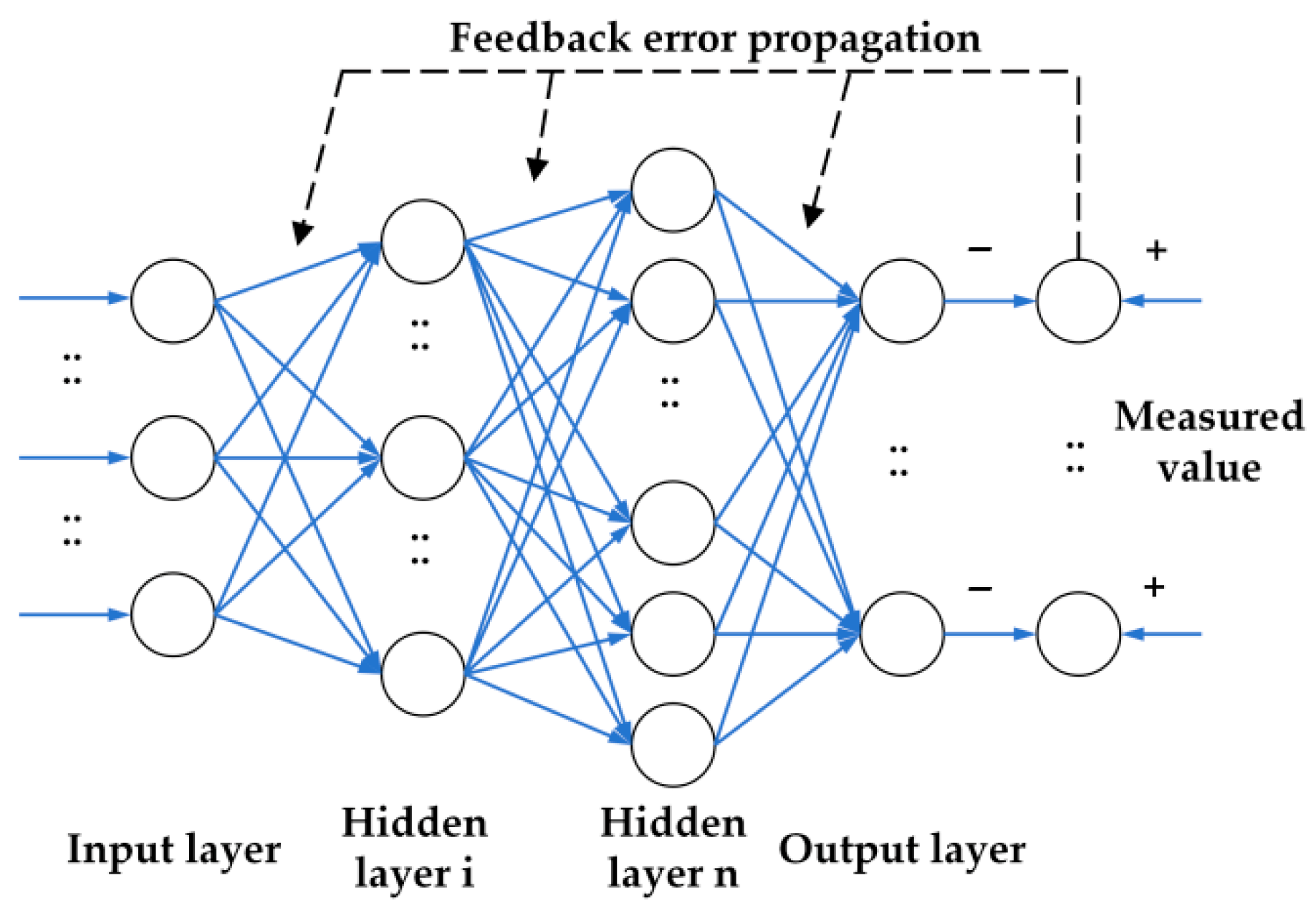
The BP neural network is a neural network learning method that employs forward propagation to generate predictions and backpropagation to adjust errors [25]. The BP neural network uses the sum of squared errors of the network as its objective function. During backpropagation, it continuously adjusts the thresholds and weights to approximate the expected results. Currently, BP neural networks are widely applied in areas such as signal processing and data fitting. They are well-suited for nonlinear fitting with a relatively small number of input features and exhibit low computational cost. Considering that the number of input features in this study is small—specifically, only three time delays—yet the presence of time delay errors introduces significant nonlinearity, the BP neural network is adopted [26]. A schematic diagram illustrating the principle of the BP neural network is shown in Figure 2.
The core advantages of the BP neural network lie in its powerful nonlinear mapping capability and adaptability. By constructing a multi-layer network architecture and incorporating nonlinear activation functions, the BP network can approximate complex functional relationships with arbitrary precision. This makes it highly effective in tackling complex engineering problems characterized by intricate mechanisms and multivariable coupling, such as effectively learning the highly nonlinear relationship between battery venting acoustic signatures and fault states. More importantly, the BP network adopts a data-driven learning paradigm. Through the error backpropagation mechanism, it automatically adjusts network weights without relying on precise physical models or labor-intensive manual feature extraction. It can thereby uncover deep, latent fault features directly from raw signals and demonstrate strong generalization performance. Additionally, its flexible model structure allows adjustments based on problem complexity, and its well-established theory and relatively straightforward implementation further contribute to its suitability. These characteristics collectively underpin the unique strengths and application potential of the BP neural network in solving complex pattern recognition problems such as battery fault acoustic signature-based early warning.

3. Experiment and Results

3.1. Experimental Setup

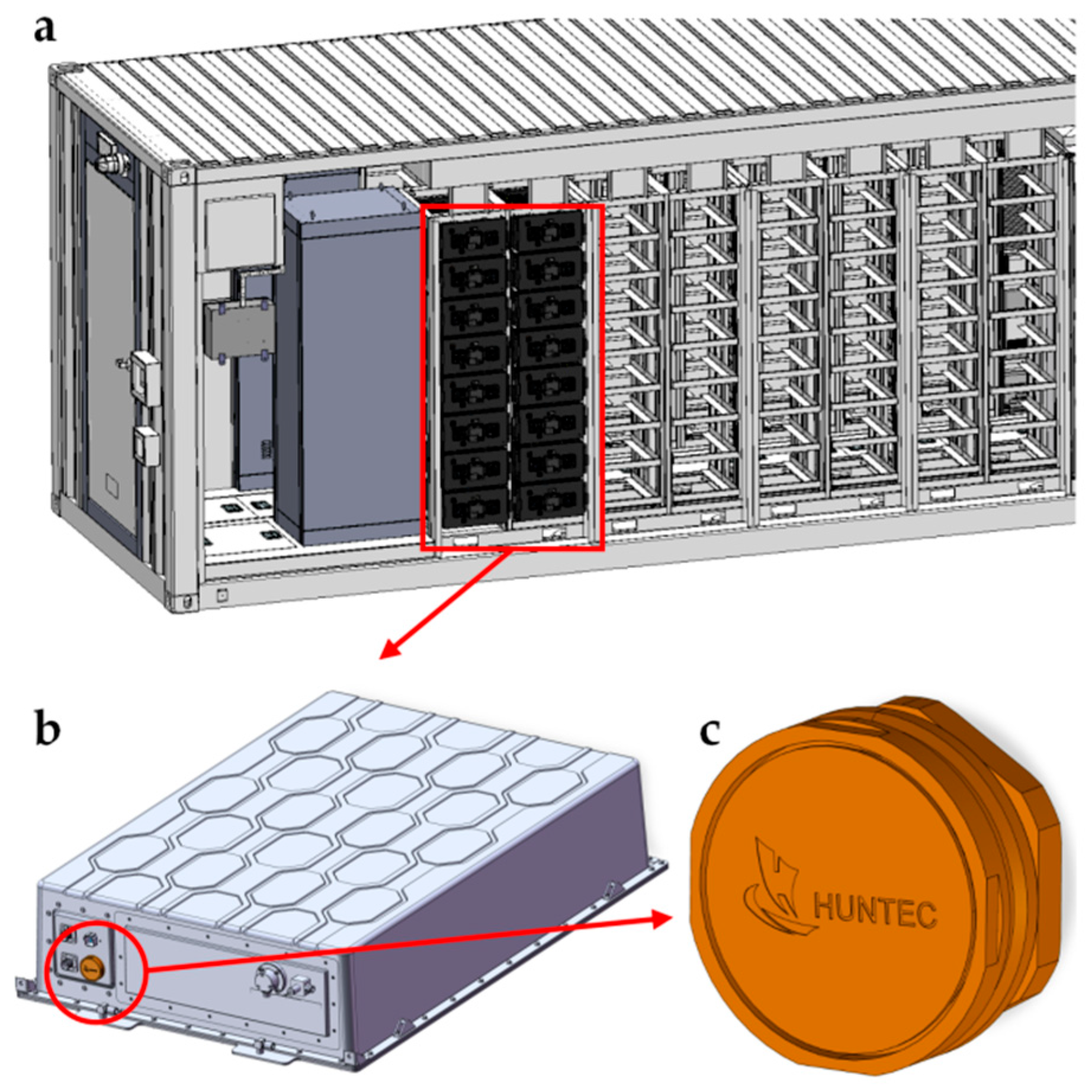
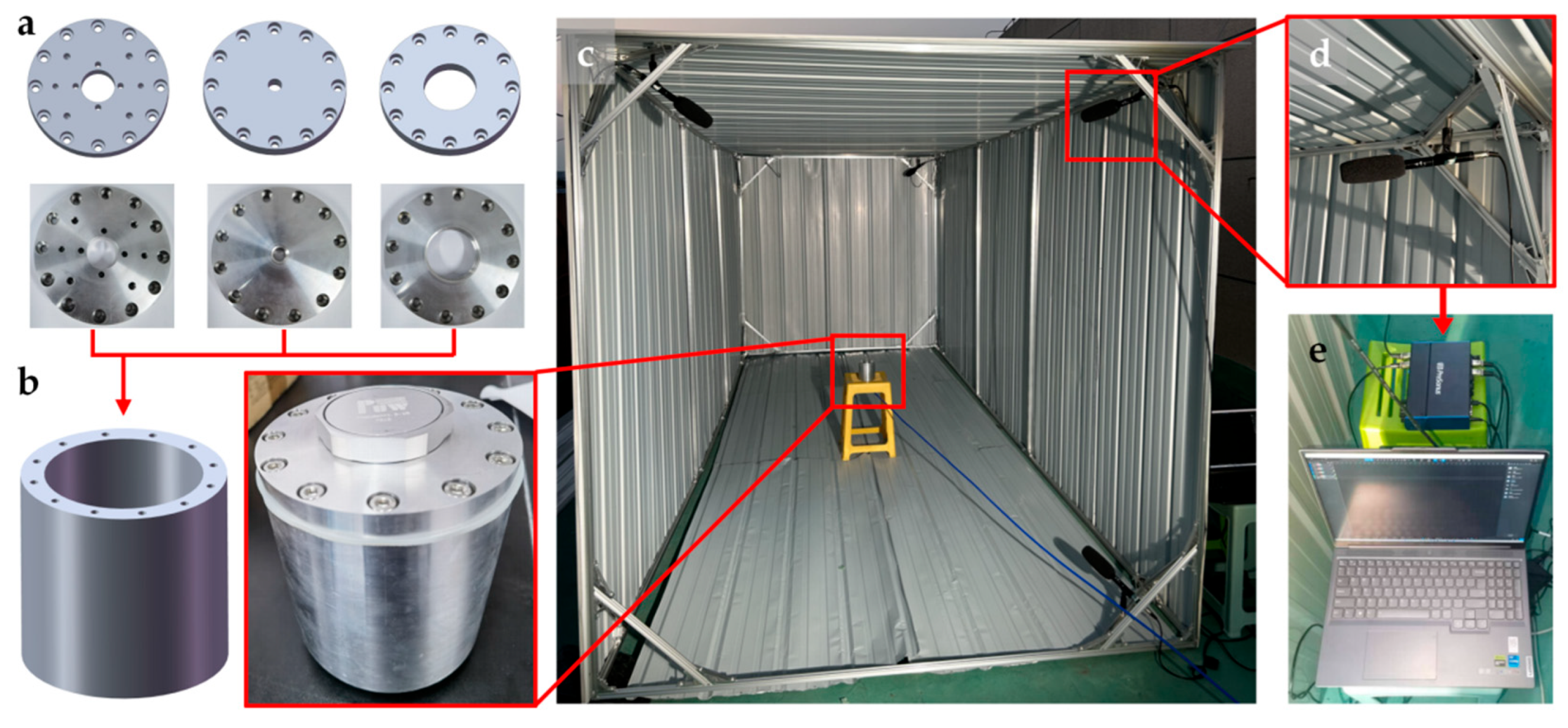
As shown in Figure 3a, in current energy storage systems, each battery pack is positioned at a fixed location, and every battery pack is equipped with a pressure relief valve (highlighted in orange in Figure 3b) to release gas when internal pressure exceeds safe limits. The sound produced during this process is easily detectable. Therefore, in this study, a simulated environment based on a standard 20-foot prefabricated energy storage container was constructed—a 6 m × 2.5 m × 2.5 m container (Figure 4c)—with microphones installed at the four corners for sound recording (Figure 4d). The specifications of the microphones are listed in Table 1. As illustrated in Figure 4e, to ensure highly stable and consistent acquisition of acoustic signals, a Presound audio interface was used to connect the four microphones, with signals then transmitted to a host computer. The sound characteristics of the pressure relief valve depend on its opening pressure and physical geometry.
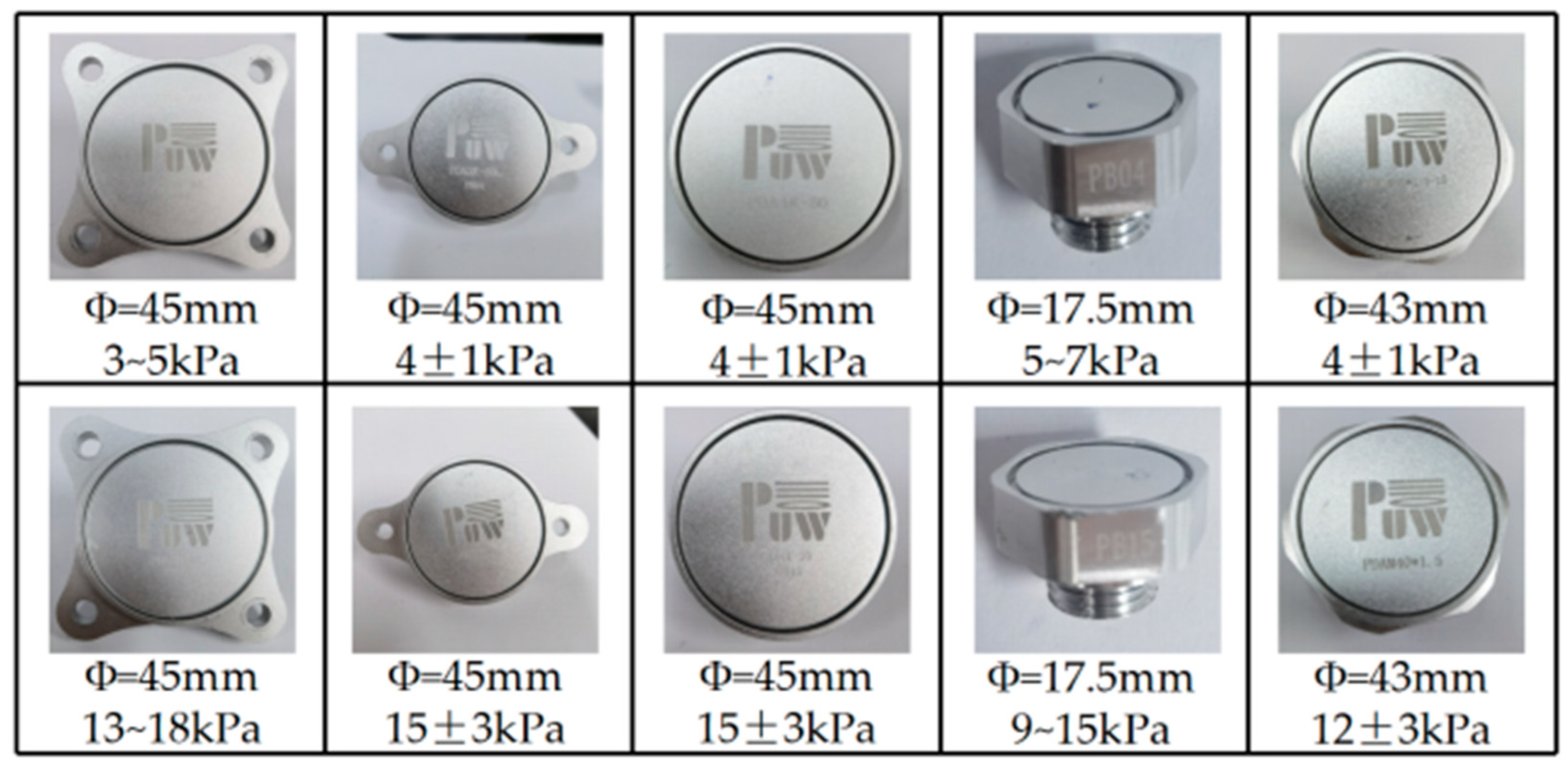
For the experiment, ten different types of pressure relief valves with varying opening pressures and diameters were selected, as shown in Figure 5. Different opening pressures and diameters mean that each valve possesses its own unique acoustic signature characteristics. To verify the generalizability of the localization method, comprehensive testing across all valve types was necessary. Figure 4 illustrates the experimental setup for generating venting sounds. During the experiment, an external gas source was used to pressurize a sealed venting tank, and the resulting sounds were recorded. The tank was then moved to a new position for the next recording. For each pressure relief valve, tests were conducted at nine different positions, with ten repetitions per position. Each trial recorded audio data from four microphones, from which three time delay values were measured. In total, 10 × 9 × 10 = 900 datasets were collected. Further analysis of these sounds shows that their dominant frequency is about 20 kHz, and the signal duration is approximately 1.5 s, which shows that the voiceprint characteristics of all data are very similar and that they have high data stability for subsequent model training, enhancing the robustness of the model.

3.2. Experimental Results

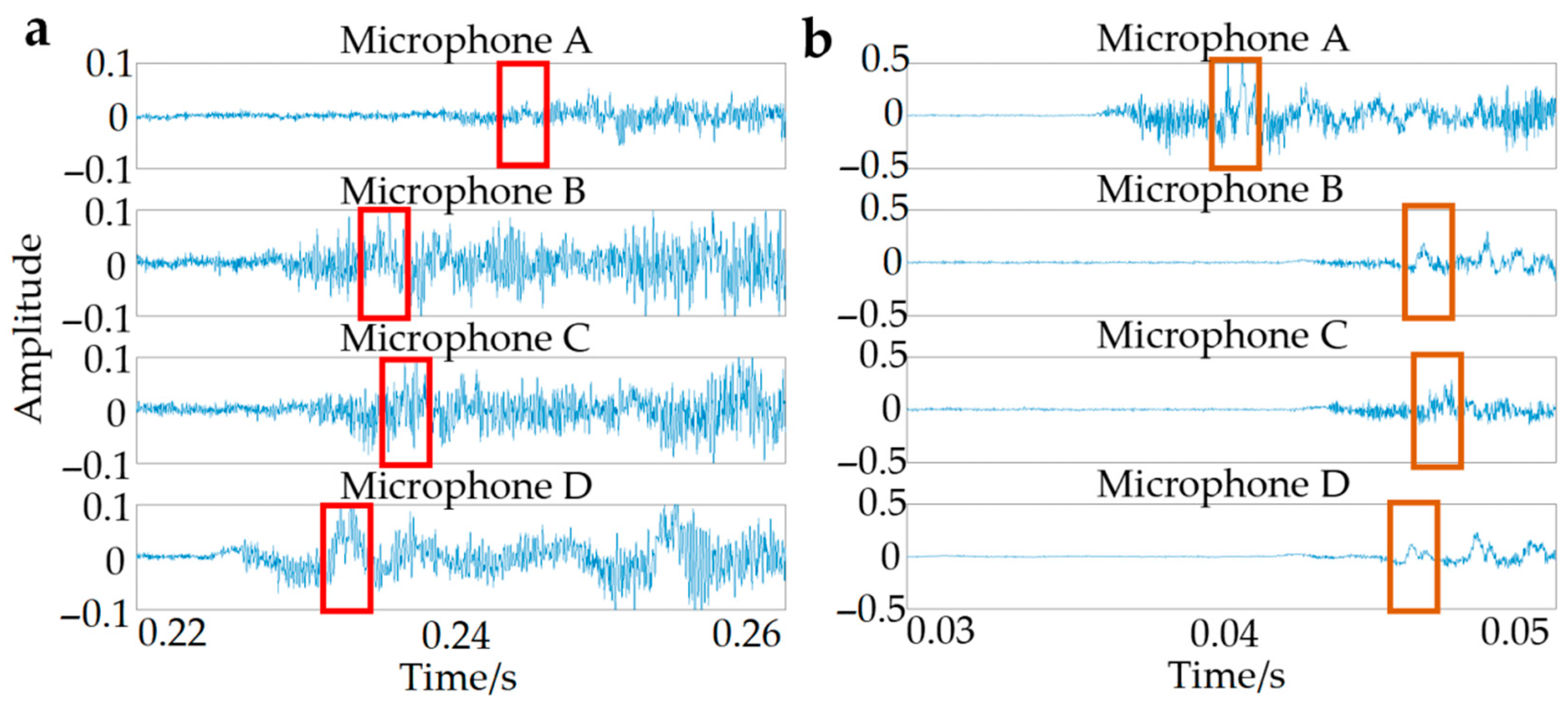
For each specification of the pressure relief valve, inflation tests were conducted using different external gas pressures at various locations. The acoustic signals captured by the four microphones, as shown in the corresponding figure, exhibit noticeable differences in their arrival times in the time domain. Figure 6a displays the acoustic signals from the four microphones for the first experimental set. The arrival times of the first wave peaks are marked by red boxes, clearly indicating that the sound source was farther from microphone A and at relatively similar distances from microphones B, C, and D. Assuming a speed of sound of 340 m/s, the theoretical distance difference between microphones A and B is calculated to be approximately 6 m, which aligns with the actual experimental setup. Figure 6b presents the four-channel acoustic signals for the 84th experimental set. The wave peaks highlighted by brown boxes show that the sound source was closer to microphone A and farther from the other three microphones. However, it is evident that the correlation among the acoustic signals from the different microphones is not ideal, which is attributed to reflections and reverberation from the cabin walls. This implies that the time delays calculated using correlation-based methods will contain inherent errors.
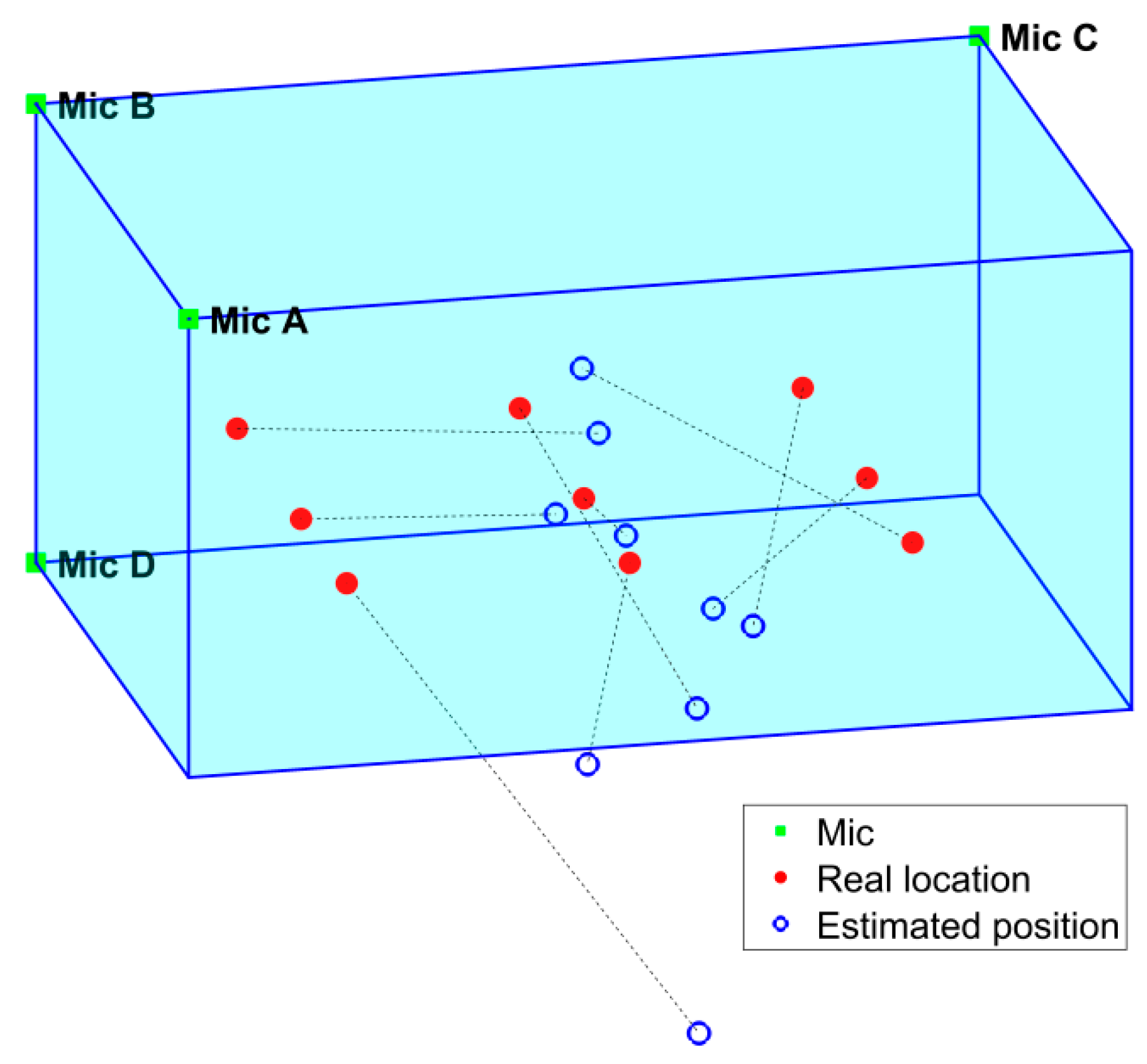
If the time delays obtained directly from correlation calculations are used as input variables to compute the sound source location based on geometric relationships, the resulting positioning outcomes are illustrated in Figure 7.
Geometric-based localization methods impose stringent requirements on the accuracy of time delay estimation, and their positioning results exhibit high sensitivity to time delay errors. While such sensitivity might be acceptable in an ideal free-field acoustic environment, under the complex acoustic conditions of a battery cabin—as illustrated in Figure 7—multipath effects and reverberation interference introduce significant errors into time delay estimation. Since TDOA localization is essentially a geometric solving process, any error in time delay is directly propagated into the final spatial coordinate calculations.
When time delay errors are substantial, the resulting localization errors become unacceptable. If the estimated location deviates significantly from the actual sound source position, it fails to provide actionable information for fire suppression systems. In extreme cases, excessively large errors may even produce physically implausible or absurd outputs. As shown in the figure, when the computed source location lies outside the predefined spatial boundary defined by the microphone array (i.e., beyond the light-blue cuboid), it indicates a complete algorithmic failure. This “outside-cabin anomaly” not only demonstrates the fragility of the TDOA method in complex acoustic environments but also renders it entirely inadequate for meeting the fundamental engineering requirement of reliably localizing faulty battery packs. Therefore, there is a clear need to develop localization methods that are insensitive to time delay errors and exhibit stronger robustness, thereby accommodating the practical constraints of confined and enclosed operational spaces.

4. Sound Source Localization Based on BP Neural Network

In this study, the input is three groups of TDOA values obtained from four groups of microphones through generalized cross-correlation calculation, and the output is the three-dimensional coordinates of the sound source. The input and output dimensions are not high, and the amount of data is not large. For training tasks with a limited amount of data in this paper, deep neural networks, such as CNN and LSTM, involve a large amount of computation and are prone to overfitting. The traditional neural network reduces the amount of calculation and operation time while ensuring accuracy, which is more suitable for the practical application problems in this paper, and is conducive to meeting the real-time and low-cost demands of the fire protection system for positioning.

4.1. BP Neural Network Model

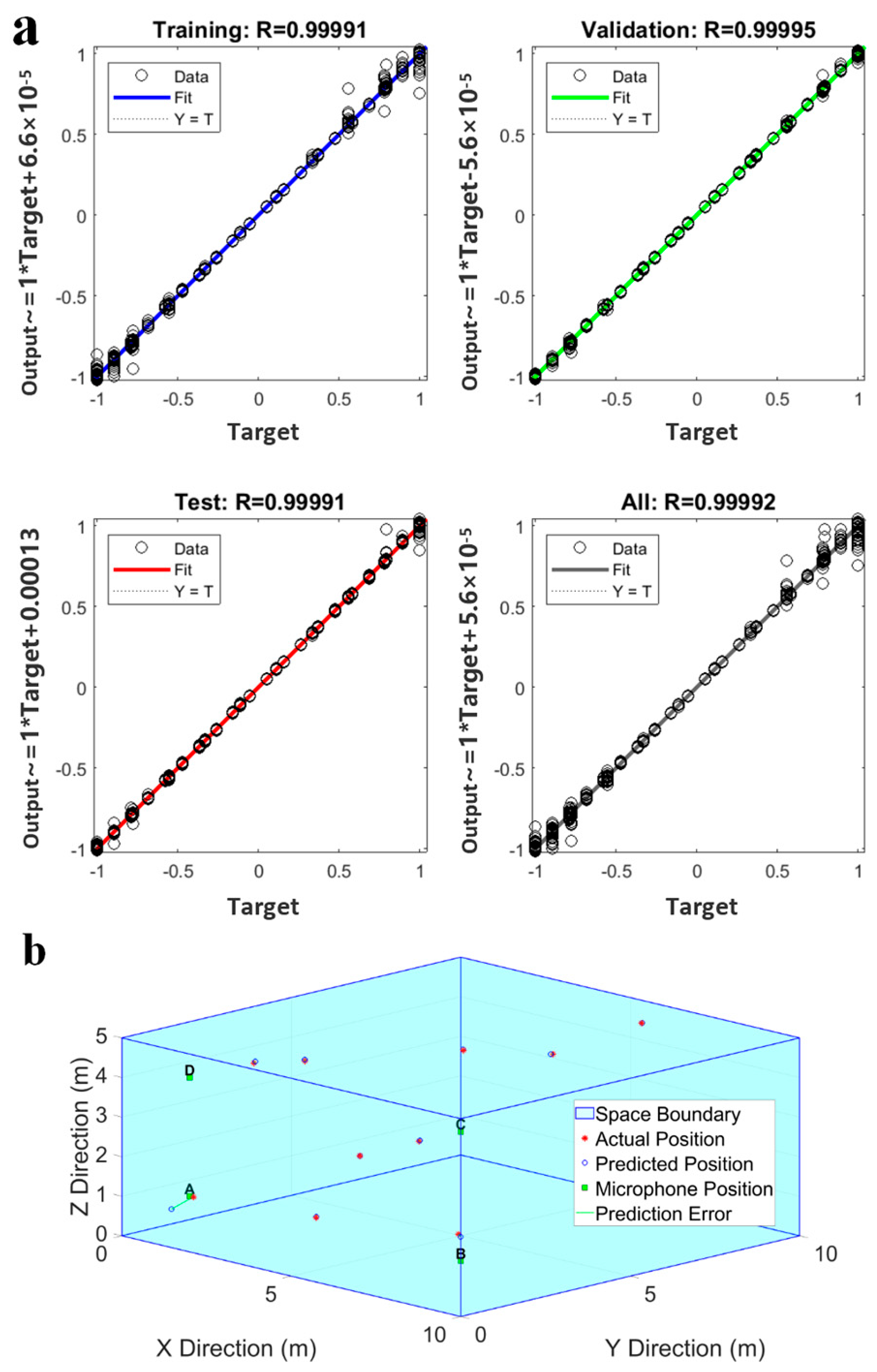
Before training the BP neural network-based sound source localization model, the network architecture, such as the number of hidden layers and the number of nodes per layer, must be determined. An insufficient number of hidden layers or nodes may lead to inadequate mapping capability, while an excessive number can result in increased computational time and overfitting. The selection of these model parameters is determined through training with simulated sound sources. The reverberation time and background noise level of the simulation experiment are calibrated based on the value of the actual battery compartment to ensure the reliability of the simulation. As shown in Figure 8b, a rectangular prism space measuring 10 m × 10 m × 5 m is established. Four microphones are simulated at spatial coordinates A(1, 1, 1), B(9, 1, 1), C(1, 9, 1), and D(1, 1, 4). The total volume of this space is 500 m3. This volume is subdivided into small 1 m3 cubes, and a sound source is simulated at the center point of each small cube. The four sets of sound signals recorded by the microphones are used to calculate three sets of time differences, as given by Formula (9).
Δ t A B = t A t B Δ t B C = t B t C Δ t C D = t C t D
where Δt represents the time difference between two microphones, and t denotes the time at which the sound arrives at a microphone.
Δ t i A B Δ t i B C Δ t i C D x i , y i , z i
where xi, yi, and zi represent the three-dimensional coordinate values of the simulated sound source, respectively. The microphone array selected in this section is orthogonal. When the microphone at the origin is taken as the reference, the four microphones can obtain three sets of time delay differences. Therefore, this study sets the number of nodes in the input layer to 3. The output consists of the three coordinate components in the spatial Cartesian coordinate system, so the number of nodes in the output layer is also set to 3.
The number of nodes and layers in the hidden layer is critical to the accuracy and computational speed of the algorithm for different network models. Research indicates that the selection of the number of hidden layer nodes is related to factors such as the number of input nodes, the size of the training dataset, the complexity of the network, and error tolerance. If the number of nodes is too small, the network’s fault tolerance becomes poor and its effectiveness may be limited; conversely, too many nodes can easily lead to local optima and prolonged training times. Extensive practical experience suggests that the principle for selecting the number of nodes is to minimize the node count as much as possible while ensuring that the required accuracy is met.
After performing machine learning on these 500 sets of training data using the BP neural network algorithm, localization testing is conducted. A random spatial coordinate is simulated by the computer, and based on the speed of sound, the time differences at which each microphone first receives the sound can be calculated. This set of time differences is used as the input data for localization testing. The trained BP neural network is then employed to make predictions, yielding estimated coordinates. Finally, the error between the predicted location and the true location is analyzed.
Through extensive experimentation, this study determined that a BP neural network with two hidden layers, each containing 10 nodes, yields the most accurate localization results. After repeated adjustments and optimization, the neural network structure was finalized with two hidden layers of 10 neurons each. Figure 8a presents the fitting regression results of this model, where a value of R closer to 1 indicates better fitting performance and higher model accuracy. As visualized in Figure 8b, for randomly generated sound source locations, the average prediction error of the BP neural network was below 0.1 m, demonstrating its feasibility for three-dimensional sound source localization.

4.2. Results

For the finalized BP neural network, this study randomly selected 90% of the actually recorded sound source data, i.e., 810 sets, as training samples, while the remaining 10% were used as test samples to evaluate the localization performance. For a multi-input multi-output network structure, a substantial number of training samples is essential to prevent significant errors between predicted and actual values. To evaluate the model’s performance, the Euclidean distance is adopted as the metric for single-point localization error. Its calculation formula is as follows:
E i = ( x p r e , i x r e a l , i ) 2 + ( y p r e , i y r e a l , i ) 2 + ( z p r e , i z r e a l , i ) 2
where xpre, ypre, zpre are the predicted coordinates, and xreal, yreal, zreal are the actual coordinates. Additionally, the average localization error across all test samples is calculated to assess the model’s overall accuracy throughout the entire test space.
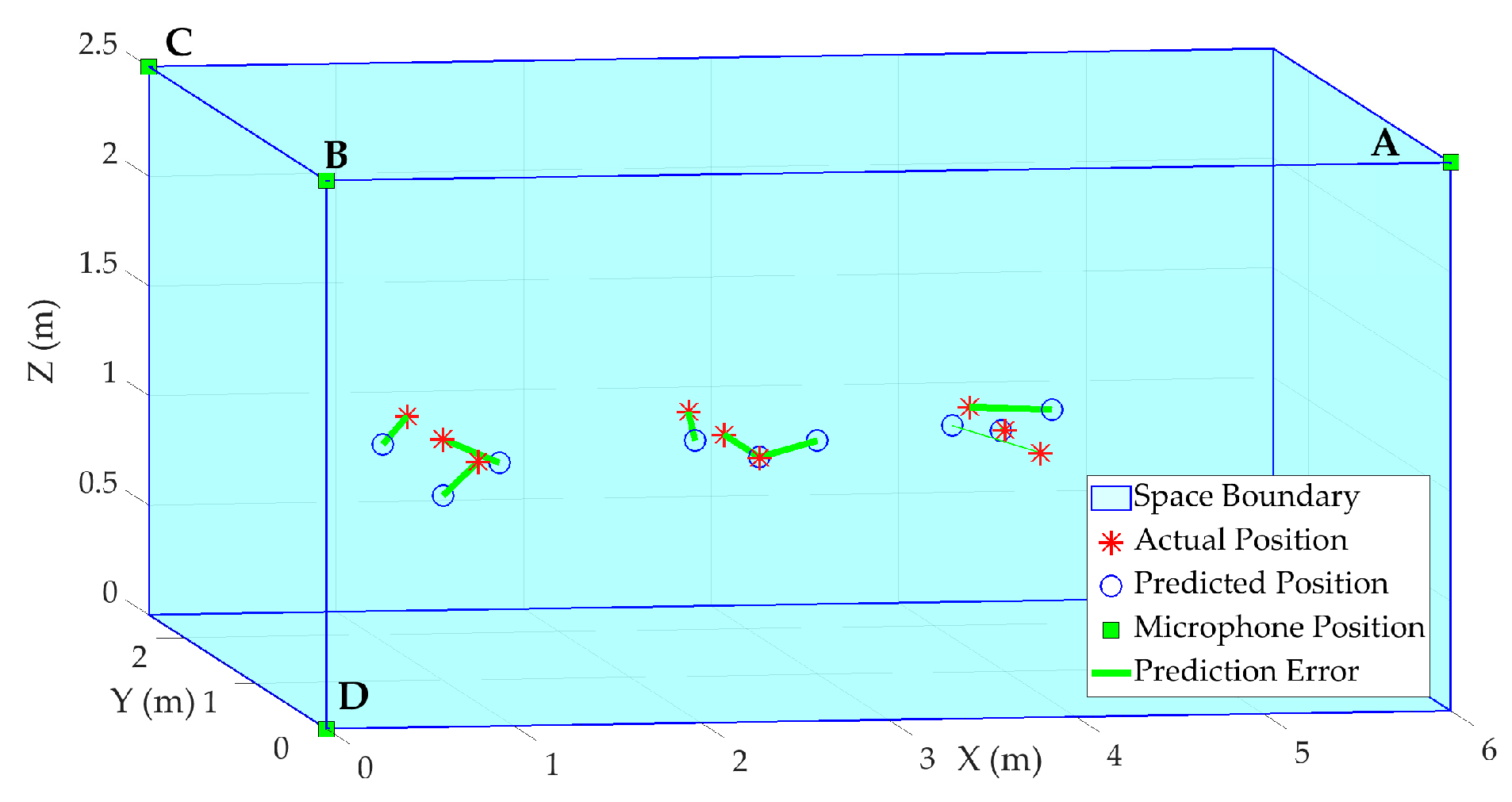
The actual and predicted coordinates of the sound source and their error values are shown in Table 2. To visualize the performance, three-dimensional scatter plots are used to compare the true and predicted positions of sound sources. In Figure 9, the spatial overlap between true and predicted locations, as well as the length of error lines connecting corresponding points, provides an intuitive assessment of the model’s localization effectiveness.
Experimental results demonstrate that the proposed BP neural network model can effectively achieve three-dimensional localization of the sound source, with an average localization error of 0.46 m—a value less than 0.5 m. This value is different from the accuracy in Section 4.1 because the complex reflection and time-varying background noise in the actual environment are not modeled when simulating the sound source, and the sound source may not reach the microphone immediately after it emits sound, which is difficult to simulate well. In order to quantitatively evaluate the positioning accuracy, the Gaussian distribution model is used to fit the error. The results show that the positioning error follows a normal distribution with μ = 0.37 m and σ = 0.18 m. The probability that the error is less than 0.56 m is 84.13%. Considering that the size of the energy storage battery pack is 0.8 × 0.5 × 0.3 m, the error is significantly less than the length, width and height of the module, which is enough to meet the effective identification requirements of the battery pack. Another significant advantage of the model is that it does not require explicit input of microphone position information; the model can infer microphone locations autonomously from the training data. This is particularly important for energy storage systems, where internal layouts are complex and vary due to differing arrangements of electrical equipment, potentially leading to installation errors or even preventing microphones from being placed at predetermined positions. The model proposed here bypasses the need for precise microphone positioning, enabling direct training and localization. This simplifies the application process and grants the method broad adaptability.

4.3. Validation Experiment

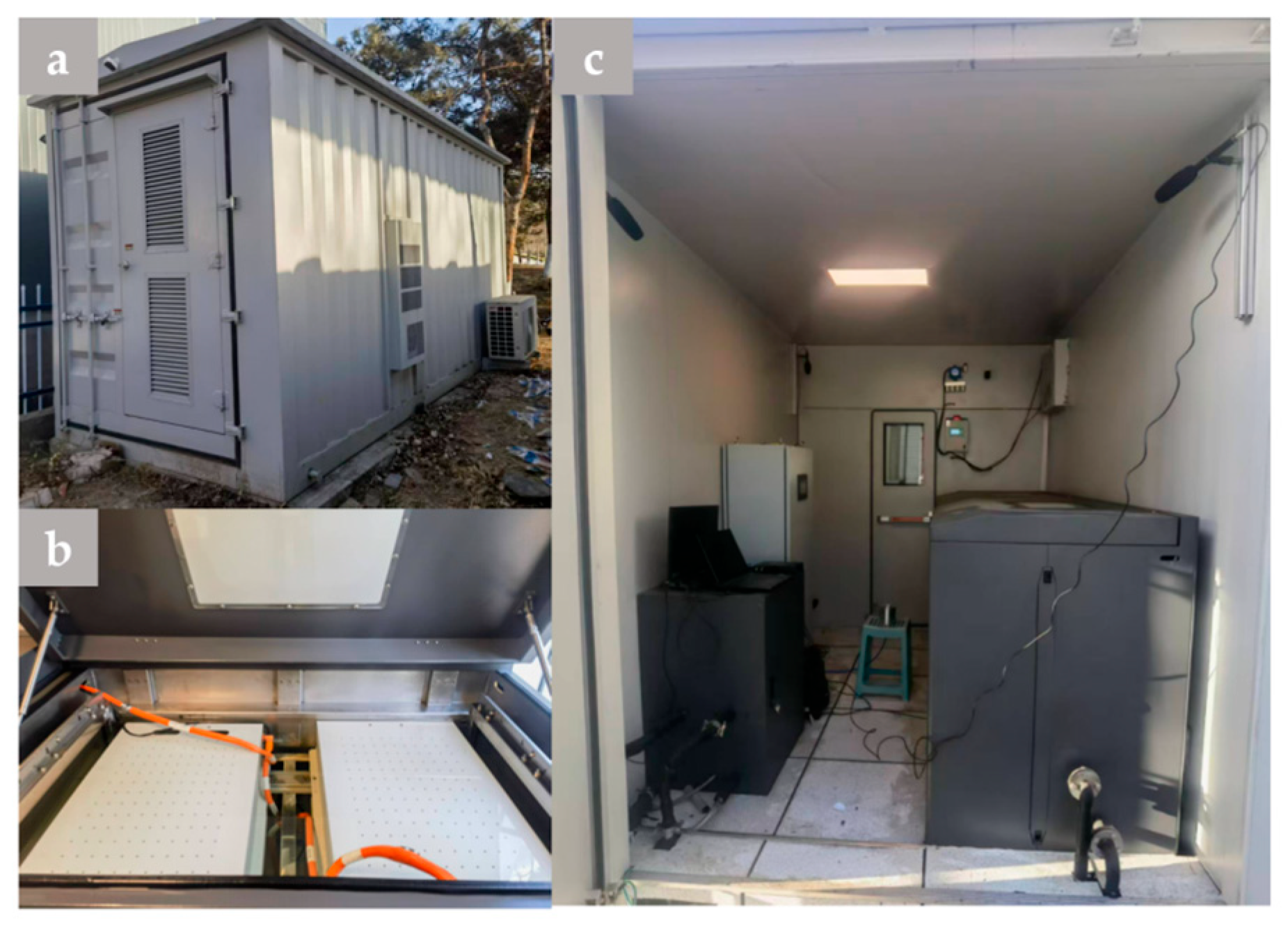
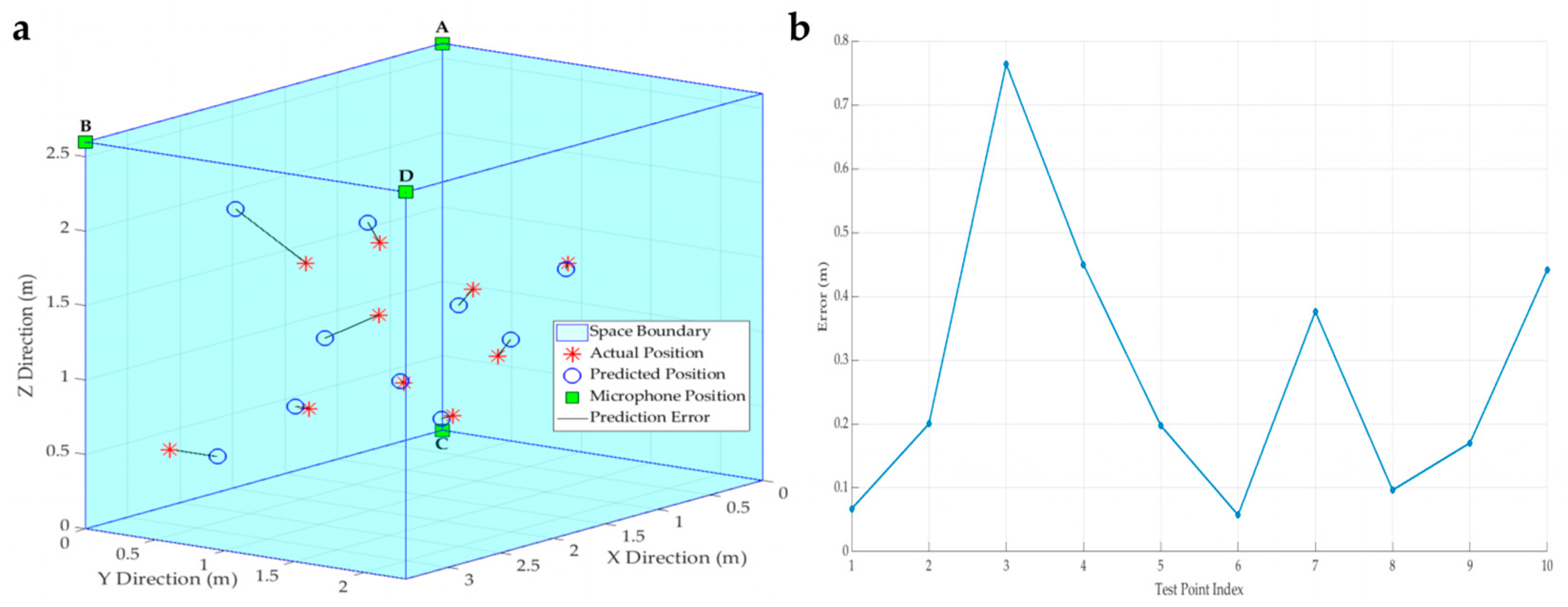
In order to verify the practical application of the model used in this paper, the actual verification was carried out in a real liquid-cooled energy storage container. Figure 10 shows the inner and outer ring mirrors of the container and the experimental site.
The internal space of the container is 3.4 m × 2.3 m × 2.6 m. This experiment still uses the microphones from the previous experiment, installed in four obvious corners, which is more conducive to capturing sound. In the experiment, the same pressure relief valve as in the original experiment is also used as the sound source, and 10 × 10 = 100 groups of data are generated. Based on these data, we used the BP neural network from the original experiment to train and obtain the verification results, as shown in Figure 11 and Table 3. Points 3 and 4 are intended to capture their signals after being occluded and reflected. The results show that the overall positioning accuracy is higher, and the average positioning accuracy is less than 0.3 m, but the accuracy of the sound source will be greatly reduced when it is seriously disturbed. We hypothesize that this is because the actual experimental site is smaller than the original open container, and the spatial entity is stronger, which makes the signal of both the first-arrival sound and the reflected sound clearer and less volatile. This experiment demonstrates that in an actual energy storage power station, the BP neural network-based sound source localization algorithm still has strong applicability and robustness, but it still needs to consider that the sound field between the sound source and the microphone will not have a large area of occlusion or reflection effect, which will lead to its localization deviation. This is also a key research direction of this work in the future.

4.4. Discussion

By conducting an in-depth analysis of the error distribution across various test points, we observed a notable phenomenon: the model demonstrates higher localization accuracy in the central regions where training data is densely concentrated, with errors generally below 0.3 m. In contrast, in regions with relatively sparse training data and in corner areas farther from the microphones, localization errors increase significantly, with some points even exceeding 0.5 m. This phenomenon reveals the model’s inherent strength in interpolation but relative weakness in extrapolation.
Inspired by this, in order to continue improving the positioning accuracy in future research, increasing the number of microphones in the rectangular cabin structure—for example, deploying 6 to 8 microphones—is a feasible option. By introducing redundant microphones, better interpolation performance of the neural network model can be achieved. With the increase of input parameters, the overall positioning result offset caused by the error of a single microphone will be suppressed, so as to improve the positioning accuracy of the network. For neural networks, more data contributes to fault-tolerant training and enhances mapping performance, which helps minimize localization deviations. Given the low cost of microphones, increasing their number has an acceptable impact on deployment costs.


5. Conclusions

This paper proposes a BP neural network-based method for localizing the venting sounds from pressure relief valves in energy storage battery packs. The method employs a network with two hidden layers, each containing ten nodes, and uses three sets of time differences calculated from sounds captured by four microphones as input. The trained network model achieved an average localization error of less than 0.5 m in practical tests, with errors at most measurement points being below 0.3 m. This performance meets the requirements for three-dimensional localization of venting signals at the battery pack level within prefabricated, standardized energy storage containers. The results confirm that the method is insensitive to repeatable errors in time delay calculation, thereby avoiding precision degradation or localization failures caused by such errors. The findings also demonstrate that this method is well-suited for discrete localization tasks, which is significant for practical deployment in battery cabins characterized by compact space, high noise levels, and strong reverberation and reflections.

Author Contributions

Conceptualization, S.J. and C.Z.; methodology, Q.L.; software, X.L.; validation, Y.W. (Yangjun Wang), S.J. and C.Z.; formal analysis, S.J.; investigation, Z.W.; resources, Y.W. (Yindi Wang) and J.Z.; data curation, Z.Y.; writing—original draft preparation, S.J.; writing—review and editing, C.Z.; visualization, Q.L.; supervision, T.L. and J.S.; project administration, T.L. and J.S.; funding acquisition, T.L. All authors have read and agreed to the published version of the manuscript.

Funding

This work is grateful for the financial support provided by the science and technology project of China Power Engineering Consulting Group CO., LTD., “Development of patrol inspection and safety early warning platform for electrochemical energy storage power station” (Project No.: DG2-K02-2024).

Data Availability Statement

The original contributions presented in this study are included in the article. Further inquiries can be directed to the corresponding authors.

Conflicts of Interest

Authors Shan Jiang, Xingtong Li, Zhikuan Wang, Yindi Wang, and Tianying Liu are employed by the China Power Construction Engineering Consulting Corporation. Authors Chen Zhang, Qili Lin and Jian Zhao are employed by the China Power Engineering Consulting Group CO., LTD. Author Yangjun Wang is employed by the China Energy Engineering Group Anhui Electric Power Design Institute CO., LTD. Authors Shan Jiang, Xingtong Li, Zhikuan Wang, Yindi Wang, Tianying Liu, Chen Zhang, Qili Lin, Yangjun Wang and Jian Zhao have received research grants from China Power Engineering Consulting Group CO., LTD. The remaining authors declare that the research was conducted in the absence of any commercial or financial relationships that could be construed as a potential conflict of interest.

References

  1. Hasan, M.M.; Haque, R.; Jahirul, M.I.; Rasul, M.G.; Fattah, I.M.R.; Hassan, N.M.S.; Mofijur, M. Advancing energy storage: The future trajectory of lithium-ion battery technologies. J. Energy Storage 2025, 120, 116511. [Google Scholar] [CrossRef]
  2. Zeng, Y.; Wu, K.; Wang, D.; Wang, Z.; Chen, L. Overcharge investigation of lithium-ion polymer batteries. J. Power Sources 2006, 160, 1302–1307. [Google Scholar] [CrossRef]
  3. Xu, F.; He, H.; Liu, Y.; Dun, C.; Ren, Y.; Liu, Q.; Wang, M.-X.; Xie, J. Failure Investigation of LiFePO4 Cells under Overcharge Conditions. J. Electrochem. Soc. 2012, 159, A678. [Google Scholar] [CrossRef]
  4. Sepasiahooyi, S.; Abdollahi, F. Fault detection of new and aged lithium-ion battery cells in electric vehicles. Green Energy Intell. Transp. 2024, 3, 100165. [Google Scholar] [CrossRef]
  5. Chen, W.; Han, X.; Pan, Y.; Yuan, Y.; Kong, X.; Liu, L.; Sun, Y.; Shen, W.; Xiong, R. Defects in lithium-ion batteries: From origins to safety risks. Green Energy Intell. Transp. 2025, 4, 100235. [Google Scholar] [CrossRef]
  6. Jindal, P.; Bhattacharya, J. Review—Understanding the Thermal Runaway Behavior of Li-Ion Batteries through Experimental Techniques. J. Electrochem. Soc. 2019, 166, A2165. [Google Scholar] [CrossRef]
  7. Wang, Q.; Mao, B.; Stoliarov, S.I.; Sun, J. A review of lithium ion battery failure mechanisms and fire prevention strategies. Prog. Energy Combust. Sci. 2019, 73, 95–131. [Google Scholar] [CrossRef]
  8. Zhang, Y.; Jiang, M.; Zhou, Y.; Zhao, S.; Yuan, Y. Towards High-Safety Lithium-Ion Battery Diagnosis Methods. Batteries 2023, 9, 63. [Google Scholar] [CrossRef]
  9. Leithoff, R.; Dilger, N.; Duckhorn, F.; Blume, S.; Lembcke, D.; Tschöpe, C.; Herrmann, C.; Dröder, K. Inline Monitoring of Battery Electrode Lamination Processes Based on Acoustic Measurements. Batteries 2021, 7, 19. [Google Scholar] [CrossRef]
  10. Sedláčková, E.; Pražanová, A.; Plachý, Z.; Klusoňová, N.; Knap, V.; Dušek, K. Acoustic Emission Technique for Battery Health Monitoring: Comprehensive Literature Review. Batteries 2025, 11, 14. [Google Scholar] [CrossRef]
  11. Zhang, R.; Li, X.; Sun, C.; Yang, S.; Tian, Y.; Tian, J. State of Charge and Temperature Joint Estimation Based on Ultrasonic Reflection Waves for Lithium-Ion Battery Applications. Batteries 2023, 9, 335. [Google Scholar] [CrossRef]
  12. Hwang, Y.-I.; Park, J.; Munir, N.; Kim, H.-J.; Song, S.-J.; Kim, K.-B. Discrimination of Poor Electrode Junctions within Lithium-Ion Batteries by Ultrasonic Measurement and Deep Learning. Batteries 2022, 8, 21. [Google Scholar] [CrossRef]
  13. Kirchev, A.; Guillet, N.; Lonardoni, L.; Dumenil, S. Li-Ion Cell Safety Monitoring Using Mechanical Parameters, Part 3: Battery Behaviour during Abusive Overcharge. Batteries 2023, 9, 338. [Google Scholar] [CrossRef]
  14. Fernandes, Y.; Bry, A.; de Persis, S. Identification and quantification of gases emitted during abuse tests by overcharge of a commercial Li-ion battery. J. Power Sources 2018, 389, 106–119. [Google Scholar] [CrossRef]
  15. Wang, Z.; Yang, H.; Li, Y.; Wang, G.; Wang, J. Thermal runaway and fire behaviors of large-scale lithium ion batteries with different heating methods. J. Hazard. Mater. 2019, 379, 120730. [Google Scholar] [CrossRef]
  16. Lyu, N.; Jin, Y.; Miao, S.; Xiong, R.; Xu, H.; Gao, J.; Liu, H.; Li, Y.; Han, X. Fault Warning and Location in Battery Energy Storage Systems via Venting Acoustic Signal. IEEE J. Emerg. Sel. Top. Power Electron. 2023, 11, 100–108. [Google Scholar] [CrossRef]
  17. Pu, H.; Cai, C.; Hu, M.; Deng, T.; Zheng, R.; Luo, J. Towards Robust Multiple Blind Source Localization Using Source Separation and Beamforming. Sensors 2021, 21, 532. [Google Scholar] [CrossRef] [PubMed]
  18. Ma, B.; Tong, C.; Zou, L.; Tian, M. A TDOA localization method for complex environment localization. J. Phys. Conf. Ser. 2021, 2004, 012003. [Google Scholar] [CrossRef]
  19. Kocur, G.K.; Thaler, D.; Markert, B. Acoustic source localization by deep-learning attention-based modulation of microphone array data. NDT E Int. 2024, 148, 103233. [Google Scholar] [CrossRef]
  20. Tao, R.; Li, X.-M.; Li, Y.-L.; Wang, Y. Time-Delay Estimation of Chirp Signals in the Fractional Fourier Domain. IEEE Trans. Signal Process. 2009, 57, 2852–2855. [Google Scholar] [CrossRef]
  21. Brandstein, M.S.; Silverman, H.F. A practical methodology for speech source localization with microphone arrays. Comput. Speech Lang. 1997, 11, 91–126. [Google Scholar] [CrossRef]
  22. Erbes, V.; Spors, S. Localisation Properties of Wave Field Synthesis in a Listening Room. IEEE/ACM Trans. Audio Speech Lang. Process. 2020, 28, 1016–1024. [Google Scholar] [CrossRef]
  23. LeCun, Y.; Bengio, Y.; Hinton, G. Deep learning. Nature 2015, 521, 436–444. [Google Scholar] [CrossRef]
  24. Knapp, C.; Carter, G. The generalized correlation method for estimation of time delay. IEEE Trans. Acoust. Speech Signal Process. 1976, 24, 320–327. [Google Scholar] [CrossRef]
  25. Yang, Z.; Chen, D.; Wang, Q.; Li, S.; Wang, F.; Chen, S.; Zhang, W.; Yao, D.; Wang, Y.; Wang, H. A Novel Method for Predicting Oil and Gas Resource Potential Based on Ensemble Learning BP-Neural Network: Application to Dongpu Depression, Bohai Bay Basin, China. Energies 2025, 18, 5562. [Google Scholar] [CrossRef]
  26. Xu, Y.; Zeng, X.; Han, L.; Yang, J. A supervised multi-spike learning algorithm based on gradient descent for spiking neural networks. Neural Netw. 2013, 43, 99–113. [Google Scholar] [CrossRef] [PubMed]
Figure 1. Schematic diagram of discrete monitoring points of the energy storage container.
Batteries 12 00066 g001
Figure 2. Schematic diagram of BP neural network.
Batteries 12 00066 g002
Figure 3. (a) Topology of the energy storage power station. (b) Model diagram of the battery pack. (c) Pressure relief valve on the battery pack.
Batteries 12 00066 g003
Figure 4. Experimental equipment diagram. (a) Three types of top covers for different pressure relief valves. (b) Pressure relief tank. (c) Experimental scenario. (d) Microphone. (e) Sound card and Host computer.
Batteries 12 00066 g004
Figure 5. Size and opening pressure of pressure relief valve used in the experiment.
Batteries 12 00066 g005
Figure 6. Waveform diagram of pressure relief acoustic signal (a) Group 1 experiment (b) Group 84 experiment.
Batteries 12 00066 g006
Figure 7. Positioning results based on analytic TDOA model.
Batteries 12 00066 g007
Figure 8. (a) Fitting linear regression diagram (b) 3D BP Network Sound Source Localization.
Batteries 12 00066 g008
Figure 9. Three-dimensional positioning results of pressure relief signal by BP neural network.
Batteries 12 00066 g009
Figure 10. Field diagram of validation experiment. (a) External view of the energy storage battery compartment. (b) Internal structure diagram of the energy storage battery compartment. (c) Experimental site map.
Batteries 12 00066 g010
Figure 11. Verification the experimental results. (a) 3D schematic diagram of positioning effect. (b) Positioning result line chart.
Batteries 12 00066 g011
Table 1. Microphone parameter table.
ParametersValue
Energy exchange modeCapacitive type
frequency response100–16,000 Hz
Sampling frequency44,100 Hz
DirectivityCardioid pointing
Output impedanceShort distance 1 K Ω
long distance 2.3 k Ω
SensitivityClose range 5–10 mv/pa
Long distance 10–15 mv/pa
Table 2. Position estimation and absolute error of sound source localization system.
Test FactorActual Position of Sound SourcePredicted Position of Sound SourceDistance Error (m)
1(1.00, 0.50, 1.10)(0.95, 0.87, 0.87)0.4356
2(2.50, 0.50, 1.10)(2.98, 0.94, 1.08)0.6521
3(4.00, 1.50, 1.10)(4.29, 1.10, 1.17)0.4991
4(4.00, 1.00, 1.10)(4.00, 1.06, 1.08)0.0672
5(2.50, 1.00, 1.10)(2.66, 0.92, 1.01)0.1986
6(1.00, 1.00, 1.10)(1.32, 1.06, 0.97)0.3522
7(1.00, 1.50, 1.10)(0.85, 1.45, 0.98)0.1938
8(2.50, 1.50, 1.10)(2.38, 1.09, 1.05)0.4295
9(4.00, 0.50, 1.10)(3.68, 0.91, 1.14)0.5171
Mean 0.4617
Table 3. Results of validation experiments.
Test FactorActual Position of Sound SourcePredicted Position of Sound SourceDistance Error (m)
1(0.30, 0.30, 0.20)(0.34, 0.25, 0.18)0.081
2(1.00, 0.30, 1.50)(1.12, 0.31, 1.66)0.200
3(1.70, 0.30, 1.50)(2.30, 0.25, 1.97)0.621
4(3.00, 0.30, 0.50)(2.57, 0.32, 0.37)0.449
5(0.80, 1.00, 0.80)(0.85, 1.13, 0.94)0.197
6(1.70, 1.00, 0.80)(1.75, 1.02, 0.82)0.057
7(2.60, 1.00, 0.80)(2.93, 1.15, 0.90)0.376
8(0.80, 1.50, 1.50)(0.88, 1.55, 1.48)0.096
9(1.70, 1.50, 1.50)(1.85, 1.51, 1.42)0.170
10(2.60, 1.50, 1.50)(3.03, 1.44, 1.42)0.441
Mean 0.269
Disclaimer/Publisher’s Note: The statements, opinions and data contained in all publications are solely those of the individual author(s) and contributor(s) and not of MDPI and/or the editor(s). MDPI and/or the editor(s) disclaim responsibility for any injury to people or property resulting from any ideas, methods, instructions or products referred to in the content.