
Article

A Reusable Framework for Dynamic Simulation of Grid-Scale Lithium-Ion Battery Energy Storage

by
Renos Rotas
1,2,
Panagiotis Karafotis
1,
Petros Iliadis
1,3,
Nikolaos Nikolopoulos
1,
Dimitrios Rakopoulos
1,* and
Ananias Tomboulides
2
1
Chemical Process and Energy Resources Institute, Centre for Research and Technology Hellas, Egialeias 52, 11525 Maroussi, Greece
2
Laboratory of Applied Thermodynamics, Department of Mechanical Engineering, Aristotle University of Thessaloniki, 54124 Thessaloniki, Greece
3
Department of Electrical and Computer Engineering, Democritus University of Thrace, 67100 Xanthi, Greece
*
Author to whom correspondence should be addressed.
Batteries 2026, 12(2), 63; https://doi.org/10.3390/batteries12020063
Submission received: 22 December 2025 / Revised: 26 January 2026 / Accepted: 9 February 2026 / Published: 14 February 2026

Abstract

This paper presents a modeling framework for large-capacity lithium-ion battery energy storage systems (BESSs), developed within the Modelica LIBSystems library and focused on system-level integration. The framework builds on a combined analysis of the electrical, thermal and degradation behavior at the cell level to model the BESS interconnection to the electrical grid. A semi-empirical aging model was incorporated following its validation at the cell level against capacity loss experimental measurements. Two case studies were conducted for a 10.5 MW/15 MWh BESS installed in the isolated power system of Terceira Island. The first analyzed the short-term response to a 5% load step decrease under 60% and 80% renewable penetration scenarios, yielding a frequency nadir improvement of 3 mHz and 21 mHz, respectively. The second projected long-term degradation under two dispatch strategies: one derived from historical time series, and another synthetically constructed to induce more frequent and deeper cycling. After 1000 days of operation, the state of health declined to 95.2% in the historical-based case and to 93.5% under the aggressive profile. The proposed framework establishes a unified, cross-domain modeling workbench for Li-ion BESS applications, enabling evaluation of the system design, control strategies, operation conditions, and system-level performance across both dynamic and long-term horizons.

1. Introduction

Grid-scale lithium-ion (Li-ion) battery energy storage systems (BESSs) can be considered as a key element of modern and future power systems. The benefits from their use include an increase in renewable energy utilization and critical grid-support services, such as frequency regulation, load balancing and voltage control. Given their size relative to smaller storage applications, dynamic simulation is essential for planning and operation assessments of their interconnection with electrical grids. Stable operation requires verification of the system adequacy and dynamic stability following perturbations, tasks that rely on time-domain simulations with accurate, computationally efficient representations of all grid components, including the storage subsystem.
A number of works address broader modeling challenges of grid-connected BESSs. Rancilio et al. [1] modeled the broader BESS configuration, including the pack, power converters and auxiliary systems. Their approach tracked the state of charge (SoC), power exchange and control output power via a droop controller for a 250 kW/570 kWh NMC BESS connected to a low-voltage (LV) network. Amini et al. [2] presented a dispatch optimization approach that is not suitable for coupling behaviors within multi-domain simulations. Biroon et al. [3] examined, for a large-scale system, the linearization of a dynamic inverter and battery circuit model in the d-q axes, suitable for studies of power system dynamics. Qu et al. [4] modeled the BESS with emphasis on the power converter representation through a dq transformation, while Krishnamoorthy et al. [5] suggested a hybrid transmission/distribution co-simulation framework to identify the optimal BESS integration for frequency regulation—though without analyzing the BESS dynamics. Other studies have focused solely on the AC-side integration of BESSs via inverter models and associated control blocks [6,7].
Complementary efforts analyze field operation and degradation of stationary systems. Grimaldi et al. [8] conducted measurements on a utility-scale Li-ion BESS integrated with a multi-MW PV plant and connected to a medium-voltage (MV) network. They developed a data-driven model that estimated a 4.1% drop in the state of health (SoH) after three years of operation and concluded that primary frequency regulation is the service with a lower aging effect. Their analysis applied the Rainflow Counting algorithm to SoC time series to estimate calendar and cycle stress factors of empirical relationships in the literature. Yet, only power exchange and the SoC were considered, without a model of the electrical or thermal behavior. Reiter et al. [9] analyzed a 14s2p module of 64 Ah NMC cells, accounting for electrical cell-to-cell variation (CtCV), a dimension often neglected in previous BESS studies, and showed that leveraging statistical distributions of the capacity and internal resistance can reduce the computational effort by a factor of 27 compared to the original model.
Despite these contributions, the literature on equivalent circuit model (ECM) applications for grid-scale BESSs remains limited, especially for studies considering degradation effects [10,11]. In [12], a simplification of the first-order ECM was proposed, reducing it to a single open-circuit voltage (OCV) source and a series resistance for BESSs dedicated to a grid frequency response. In [13], an ECM was utilized for the dynamic simulation of a BESS with 50 kW peak power, along with its power conversion and control systems, in MATLAB/Simulink, although the analysis was restricted to a very short 35 s simulation window. Another study [14] presented an MV network model comprising wind power, photovoltaics (PVs) and a 388.5 kWh BESS, without modeling the battery’s electrical, thermal or aging behavior. The authors included a second-order ECM and the associated power electronics in [15], while in [16], they examined the same system using a second-order ECM, a monitoring SoC, terminal voltage and temperature trajectories, but the focus remained on the power exchange defined by the energy management system (EMS). The authors further extended their work in [17] by introducing an active network management algorithm incorporating an aging-aware P-control layer, though only the number of completed cycles was considered. In [18], a BESS was integrated into a distribution network (DN) using Modelica, focusing on the power converter, controller and transformer, but without a battery model, while in [19], the authors propose a generalized ECM for studying CtCV, which, however, was of the zeroth order. Lucaferri et al. [20] studied the effect of the C-rate in the parameter extraction of ECMs developed for small BESS units (2.4, 4 and 40 kWh). Namor et al. [21] experimentally investigated the accuracy of assessing second-order ECM parameters with measurements retrieved from the terminals of a 720 kVA/560 kWh BESS, achieving a root mean squared error (RMSE) below 0.55%. In [22], a negative resistive RC branch was added to the topology of a first-order ECM to capture the polarization enhancement during grid inertia support, while Misyris et al. [23] proposed a first-order ECM for online SoH estimation applications for two medium-sized battery packs (54 kWh and 63.4 kWh). However, most of these studies do not link the ECM to dynamic thermal or aging mechanisms.
Research addressing aging in utility-scale BESS remains comparatively sparse. Gwayi et al. [24] reviewed aging models suitable for off-grid renewable energy source (RES) applications and emphasized the limited availability of experimental measurements and case studies. A recent study [25] conducted experiments on eight 220 Ah, 25.6 V LFP battery modules over 16 months and fitted a semi-empirical capacity fade model, though only the cycle aging term was considered, expressed as a linear expression between the charge throughput and capacity loss. Swierczynski et al. [26] presented field tests from a 1.6 MW/0.4 MWh BESS installation, including degradation trajectory of the available capacity and internal resistance. Ref. [27] discusses practical challenges in scaling aging models from the cell level to the BESS scale. Although some studies have focused on incorporating the increase in the ECM resistance value due to aging, these are limited to cell-level analyses [28,29,30].
Broader challenges specific to grid-scale BESSs are summarized in [31], including the presence of auxiliary systems (e.g., thermal management systems, power converters) that follow their own degradation behaviors, a large number of packs rather than a single electric vehicle (EV) pack, and the inherently stochastic nature of BESS charge/discharge patterns. The authors argued that degradation models derived for EV applications should not be directly applied to utility-scale BESSs and that new experimental measurements coming from grid-scale BESS operations are needed. However, even this is challenging, since rapid charging and discharging experimental campaigns for large and expensive BESSs are not cost-effective. Other works [32,33] have attempted to integrate Li-ion battery (LIB) degradation effects in equation-based modeling languages such as Modelica, though without coupling to a full system-level BESS representation.
Only few studies have followed a holistic approach. In [34], Barcellona et al. presented a pack model coupling electrical and thermal behavior, considering Joule heat generation and internal thermal distribution in a pack of 10 Ah NMC pouch cells, demonstrating a modular and reusable approach. However, the electrical domain model focuses on a steady-state response through a simplified topology of an OCV and a series resistance. A comprehensive system-level analysis was performed by Reniers et al. [35], who developed a coupled electrical, thermal and degradation model for a 1.12 MWh BESS to investigate the CtCV under varied degradation parameters and non-uniform temperature fields. Despite covering the most important aspects, the study relied on the single-particle model (SPM), which neglects electrolyte dynamics and can accumulate significant errors under dynamic conditions. In [36], Petit et al. presented an empirical capacity fade model coupled with an electrothermal model for two Li-ion chemistry types, introducing dynamic expressions for calendar and cycle degradation terms. This model switches between calendar and cycle aging modes, but relies on a quasi-static ECM and is applied for studying vehicle-to-grid (V2G) synergies, demonstrating a chemistry-dependent reduction in the capacity loss for NCA compared to LFP, between 20 and 63%. Wang et al. [37] introduced a lifecycle aging model combining decoupled calendar and cycle aging terms as functions of temperature, time, charge throughput and C-rate, which is widely used in dynamic BESS studies. Najera et al. [38] extended this model by introducing dynamic calendar and cycle aging expressions, validating the cycle term against experimental data for a 2.8 kWh pack under constant operating conditions, i.e., temperature, charging and discharging C-rates and SoC window (20% to 80%), achieving a maximum error below 5% after 545 equivalent full cycles (EFCs). Although this variation in aging models is highly promising, it has not yet been integrated in a grid-scale BESS study.
To address these gaps, the present work introduces LIBSystems library, a modular ECM framework for grid-scale Li-ion BESS dynamic simulations, developed using the Modelica language. The following approach incorporated a semi-empirical aging model along with an electrical and thermal domain analysis. Two complementary case studies demonstrate the framework’s capabilities in the 30 kV isolated power system of Terceira Island in Azores. First, a short-term disturbance analysis examined the advantages offered by BESSs to support dynamic frequency responses under varying renewable penetration levels. Second, a long-term operational analysis was conducted over 1000 days that captured degradation trajectories under realistic and aggressive duty profiles. Overall, the proposed approach provides a unified and reproducible environment for analyzing the electrical, thermal and aging behavior of utility-scale BESSs across multiple temporal scales.
The proposed approach offers the following contributions:
  • Development of a unified BESS model that couples electrical, thermal, and aging behavior using configurable ECM topologies, a semi-empirical degradation model, and thermal calculations accounting for temperature dynamics and thermal loads.
  • Incorporation of grid-relevant system components, including dynamic models of power conversion systems and open-source parameter datasets representative of industrial BESS diversity, supporting reproducibility and adaptation to various deployment contexts.
  • Validation of a semi-empirical aging model utilizing a wide range of test conditions, namely 16 calendar and 16 cycle aging tests.
  • Quantitative assessment of system-level benefits through application of the developed framework to the isolated power system of Terceira Island, demonstrating improvements of up to 21 mHz (17%) in the frequency nadir and reduced settling times with the integration of a 10.5 MW/15 MWh BESS unit.
  • Evaluation of long-term degradation under two operating strategies; a realistic profile based on historical data and a more aggressive constructed profile, highlighting the effectiveness of current dispatch strategies in limiting aging rates over 1000 days of continuous operation.
The paper is organized as follows. Section 2 presents the modeling methodology of LIBSystems, including the integrated aging and thermal models, and the inverter interface. Section 3 validates the aging model against experimental data. Section 4 focuses on a short-term dynamic disturbance analysis and explores long-term degradation trends in the power system of Terceira. Finally, Section 5 summarizes the key findings and outlines perspectives for future development and applications.

2. Modeling Framework

The LIBSystems library was developed in Modelica as a unified and extensible framework for the dynamic simulation of LIBs as part of broader systems of multiple scales. It consolidates and generalizes the modeling approaches that were previously applied by the authors in domains such as electric mobility [39,40], V2G applications in distribution grids [41], and behind-the-meter storage in microgrids [42]. These earlier studies employed customized battery and converter models integrated into the broader INTEMA.grid simulation framework [43,44]; the present work introduces LIBSystems as a modular, reusable and standalone library.
Implemented using a Modelica object-oriented and acausal paradigm, the library enables hierarchical model composition and cross-domain coupling. Its architecture separates the electrical, thermal, and aging domains into dedicated submodels, which communicate through structured interfaces. This modular design supports independent development and validation of subsystems, while enabling integration into larger power system studies. The approach ensures transparency, scalability, and adaptability across both short-term electrothermal dynamics and long-term degradation analyses, from cell-level behavior to utility-scale BESS operation.

2.1. Power System

Accurate models that minimize complexity and computational requirements are essential for analyzing large-scale power system dynamics. Time-varying phasor models are commonly employed [45,46,47,48], relying on the assumption that voltage and current waveforms remain nearly sinusoidal. Under this assumption, slow variations in the amplitude and phase can be represented effectively, making these models suitable for stability studies and for capturing relatively slow transient responses. Their applicability, however, is limited to cases where the amplitude and phase evolve gradually. An alternative is the dq0 transformation, which maps three-phase sinusoidal quantities into constant values in a rotating reference frame. Although conceptually similar to phasor representations, the dq0 approach introduces no approximations because its mapping is exact. This allows for a more accurate analysis of fast transient phenomena and supports advanced control strategies such as field-oriented control. The dq0 framework is also widely used in modeling the dynamic behavior of synchronous machines.
Through dq0 transformations, quantities expressed in the abc reference frame are converted into equivalent variables in the rotating dq0 reference frame. The forward and inverse forms of the transformation are defined as follows [49]:
T θ   =   2 3 cos   ( θ ) cos   ( θ 2 π 3 ) cos   ( θ + 2 π 3 ) sin   ( θ ) sin   ( θ 2 π 3 ) sin   ( θ + 2 π 3 ) 1 2 1 2 1 2
T θ 1 = 2 3 cos   ( θ ) sin   ( θ ) 1 cos   ( θ 2 π 3 ) sin   ( θ 2 π 3 ) 1 cos   ( θ + 2 π 3 ) sin   ( θ + 2 π 3 ) 1
where the angle θ is the reference angle or the reference phase.
For x a b c = x a , x b , x c T and x d q 0 = x d , x q , x 0 T :
x d q 0 = T θ x a b c
x a b c = T θ 1 x d q 0
where the subscripts d , q , and 0 represent the direct, quadrature, and zero components, respectively.

2.2. Power Conversion System

Another key component of the system model is the power converter, which couples the DC side of the EV battery with the AC side of the grid. From a modeling perspective, the operation of a BESS is primarily determined by the control strategy of its power converter. BESS operation control is typically classified into grid-connected, off-grid, and dual-mode (on/off-grid) configurations. For stationary applications, the inverter may operate in either a voltage-controlled (V/f) mode or a current-controlled (P/Q) mode, depending on whether the system functions in a grid-forming or grid-following role. An overarching requirement is that the converter model must integrate seamlessly with the full power system representation, and therefore must remain consistent with the dq0 framework introduced in Section 2.1.
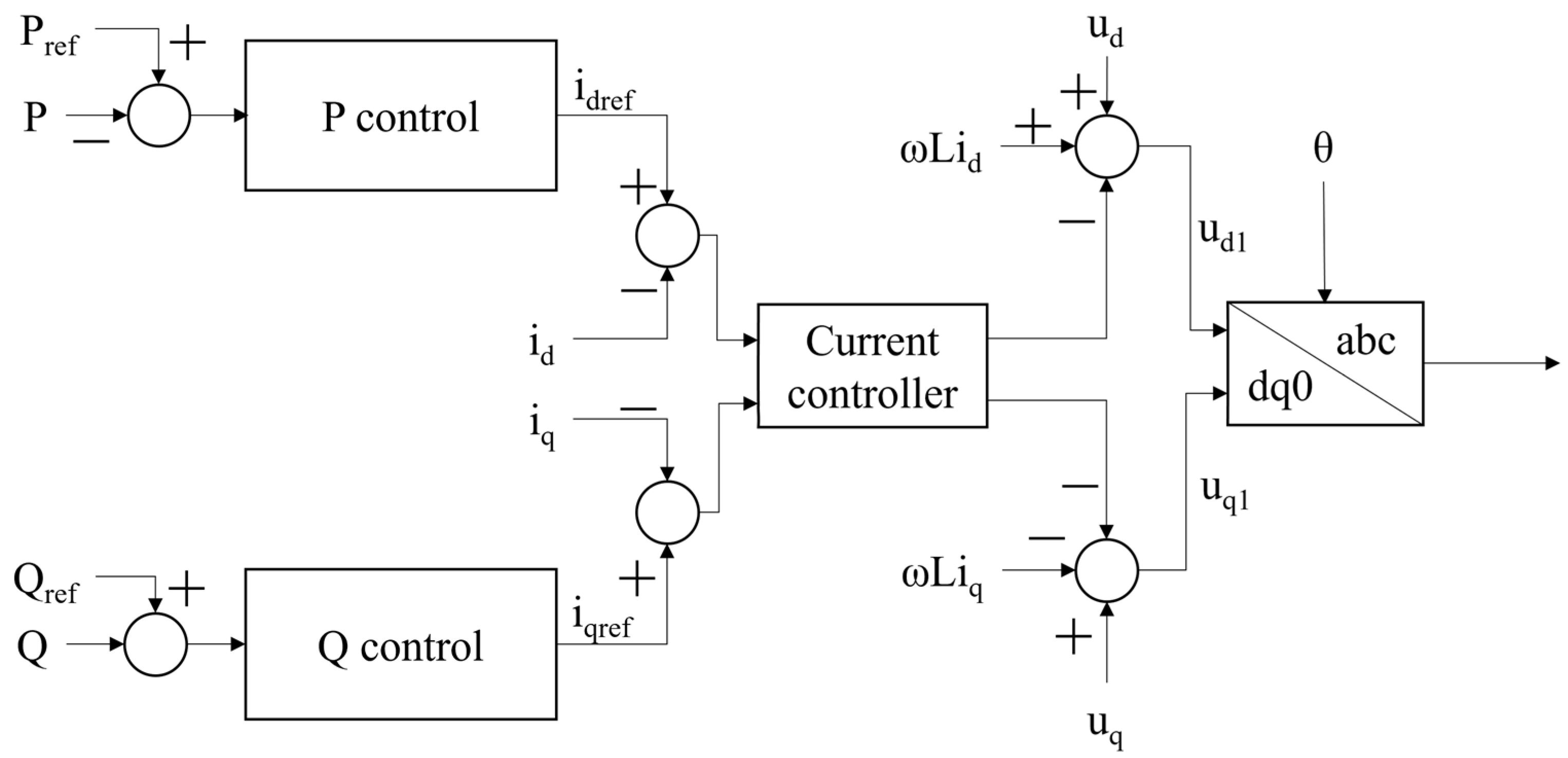
In this work, the P/Q control described in [50] and shown in Figure 1 was developed using Modelica. A closed-loop proportional–integral (PI) modulation strategy was used, consisting of two nested loops. The outer loop maintains system stability, while the inner loop improves the dynamic performance and enforces the current limits for protection purposes. The output of the outer loop provides the reference input current for the inner loop. The error signal, representing the mismatch in the electrical current, is calculated and regulated using a PI controller. Once the voltage components are obtained in the dq0 frame, the inverse transformation is applied to convert them back to the abc coordinate system. This control strategy maintains the active (P) and reactive (Q) power of the BESS close to their respective reference values.
P r e f and Q r e f denote the reference active and reactive power values, while P and Q represent the corresponding measured values during the simulations. i d r e f and i q r e f are the reference dq0-axis components of the AC-side current and i d and i q are their measured counterparts. u d and u q denote the measured values of the dq0-axis inverter output voltages and u d 1 and u q 1 are the inverter output reference values, following the notation adopted in the reference source. L is the AC-side coupling inductance and θ is the initial phase angle of the voltage.
The decoupled equations for the inverter power output are:
P   =   u d i d   +   u q i q
Q = u d i q u q i d
The model follows the detailed guidelines in [50] for representing power converters in energy storage systems, ensuring an appropriate dynamic response.

2.3. Battery Cell Model

The foundation of the developed library lies in the accurate and modular representation of Li-ion cell behavior, suitable for integration in broader energy systems. The cell-level model was structured around three interacting subdomains:
  • Electrical performance, capturing the voltage response and SoC.
  • Thermal dynamics describing the heat generation, temperature evolution, and heat exchange.
  • Degradation effects, representing the capacity fade and resistance growth.
These domains are interconnected through acausal equations and cross-domain physical connectors.
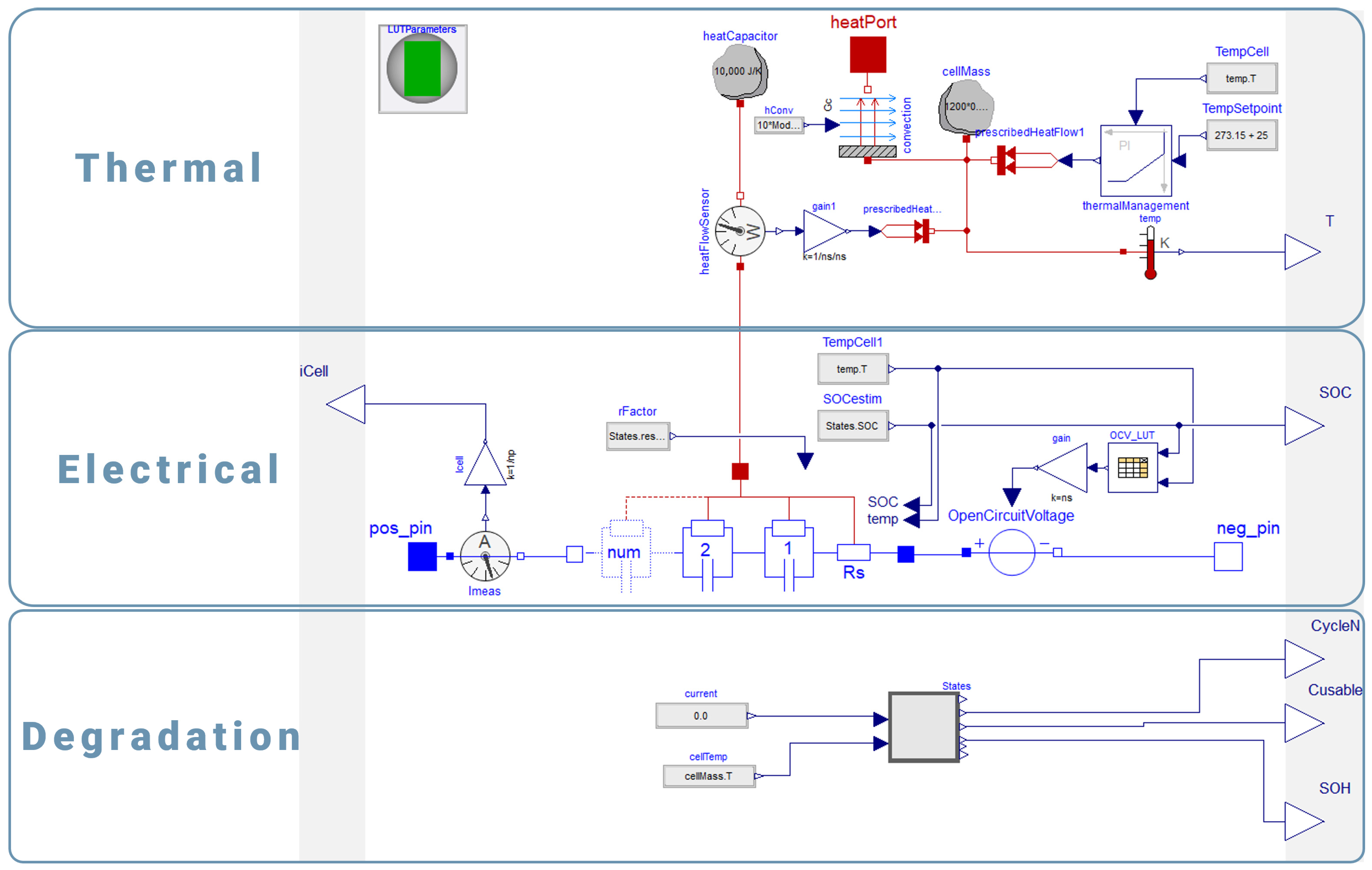
An overview of the integrated structure is shown in Figure 2. The electrical submodel, in the middle, is represented by an equivalent circuit with SoC- and temperature-dependent parameter lookup tables (LUTs). The thermal submodel (top) describes heat flow and thermal management operation. The aging submodel (bottom) computes the capacity and resistance evolution as functions of the operating conditions. This architecture allows refinement of individual domains (for example, replacing the thermal model or introducing a more detailed degradation formulation) without modifying the main electrical model. Each of the following subsections presents the corresponding domain model and discusses its structure, assumptions, and coupling strategy.

2.3.1. Electrical Domain

The electrical behavior of the Li-ion cell is represented using an ECM of a configurable order that captures both the steady-state and transient voltage response. This approach offers balance between the computational efficiency, accuracy, and physical interpretability, making it well suited for system-level applications. The topology of the generalized ECM implemented in the LIBSystems library consists of the following elements:
  • An OCV source, reflecting the cell equilibrium electrochemical potential;
  • A series resistance (Rs) representing instantaneous ohmic losses;
  • A variable number of RC branches, capturing transient voltage dynamics delays due to charge transfer and internal diffusion effects.
The number of RC branches is reconfigurable following the concept introduced in [51], using a loop-based component. Each RC pair is parameterized in the form of LUTs of varying temperature and SoC. The SoC is computed via Coulomb counting:
S o C   =   S o C 0     0 t I dt C a v a i l a b l e
where C a v a i l a b l e incorporates the aging-related capacity loss and I is the current, positive for discharge. The coulombic efficiency was assumed to be at unity, which is consistent with Li-ion cells under typical operating conditions. Temperature- and SoC-dependent LUTs are imported through external records, allowing for straightforward switching between cell chemistry types or sizes.

2.3.2. Thermal Domain

The thermal domain models heat generation and temperature evolution at the cell level. Heat flows are considered from the electrical elements through dedicated heat ports attached to all resistive elements. Joule losses are computed at the cell level as:
Q ˙ l o s s = I 2 · R t o t a l ( T , S o C )
Reversible heat effects associated with entropy changes during electrochemical reactions are not explicitly modeled in the present framework, although this contribution may be significant at certain SoC ranges or cell chemistry types. The thermal model consists of a heat capacitor representing the cell’s thermal mass, a heating and cooling flow input connector linked to the thermal management unit, a convective heat transfer component, a temperature sensor providing feedback to other domains, and a PI controller that regulates the temperature based on a defined setpoint and calculates thermal or cooling loads, acting as a simplified thermal management system. The thermal parameters, including the geometric properties, heat capacities, convection coefficients, and environmental conditions, are defined in the Modelica record class.

2.3.3. Degradation Domain

Li-ion battery aging effects can be modeled using physics-based or semi-empirical approaches. Extended work has been carried out in the first category, focusing on the degradation mechanisms in high detail, spatially and temporally [52]. The focus of the LIBSystems library is to efficiently capture long-term trends in the capacity and resistance evolution, and therefore, a semi-empirical approach was followed. These models are validated against experimental data in Section 3.
The semi-empirical dynamic model that was utilized accounts for calendar and cycling degradation. The structure is modular, allowing for standalone SoH estimation or dynamic coupling with thermal and electrical domains. Dependencies on key operating variables were considered, as introduced in detail in [37,53]. The total capacity loss is expressed in % as:
Q l o s s , t o t a l   =   Q l o s s , c a l e n d a r + Q l o s s , c y c l i n g
with the cycle aging term as:
Q l o s s , c y c l i n g   =   ( a · T 2 + b · T +   c ) · e ( d T + e ) · C - r a t e · A h t h r o u g h p u t
and the calendar aging term as:
Q l o s s , c a l e n d a r   =   f · e g · S o C · e h T · t z
where t is the time in days, T is the temperature in K, the S o C was considered in %, z was commonly assumed as 0.5 to express the time square-root dependence, the C - r a t e is the average of the charging and discharging rates, A h t h r o u g h p u t denotes the total throughput charge, and a , b , c , d , e , f , g , and h are the model fitting parameters.
For dynamic simulations, the differential form of both degradation terms was adopted [36]. Under the assumption that the temperature- and C-rate-dependent stress factors evolve slowly compared to the charge throughput and time variables, they can be treated as locally constant within each simulation time step. Considering this time-scale separation and noting that the differential of the charge throughput is equal to the absolute value of the current multiplied by the time differential, the application of the chain rule yields the following differential expressions for the calendar and cycling degradation components:
d Q l o s s , c y c = ( a · T t 2 + b · T ( t ) + c ) · e d T t + e · C - r a t e t · I t · d t
d Q l o s s , c a l = f · e g · S o C ( t ) · e h T ( t ) · z · t z 1 · d t
and the total accumulated capacity loss is:
Q l o s s , t o t a l = 0 t d Q l o s s , c y c + d Q l o s s , c a l d t
This quasi-dynamic formulation captures the influence of variable operating conditions more effectively than static lookup models. Resistance growth was also considered, reflecting solid electrolyte interphase (SEI) formation, contact degradation, and other mechanisms. Two options are supported within LIBSystems: an empirical formulation based on temperature, time, and SoC, and a simpler adaptation to SoH evolution. For the purposes of this study, the first method was utilized with the relationship extracted in [54]. Overall, the degradation block, developed in Modelica, calculates the calendar and cycle aging terms, the SoH, and the resistance increase factor.

2.4. Cell-to-BESS-Level Configuration

At the pack or higher level, the LIBSystems framework provides a flexible configuration environment that supports various series–parallel topologies. Two main modeling strategies are supported:
  • Simple upscaling represents the pack behavior by scaling a single cell model and assuming uniform temperature and aging trajectories across the entire battery system. This approach significantly reduces the computational cost and is therefore widely adopted in system-level studies, digital twin applications, and design-phase analyses, where fast simulations and numerical robustness are required [9]. However, simple upscaling inherently neglects CtCV in the capacity, internal resistance, thermal conditions, and aging behavior, which are known to arise even among cells from the same production batch. Such variations can lead to current and voltage imbalances, a reduced usable energy, and accelerated degradation in large battery systems, particularly under stressed operating conditions [35].
  • A dynamic-size array instantiates a configurable array of individual cell models, enabling an explicit analysis of CtCV effects in the SoC, thermal distribution and SoH. This approach allows for a more detailed and physically accurate representation of pack-level behavior, especially when thermal gradients, aging heterogeneity, or imbalance effects are of interest. Nevertheless, the computational burden associated with simulating large numbers of individual cells limits its applicability to small- or medium-scale systems, or to studies where a detailed cell-level resolution is essential [19].
Both strategies remain compatible with the electrical, thermal, and aging domains defined at the cell level, ensuring physically consistent behavior across scales. This hierarchical composition (from cell- to pack- and up to system-level integration) maintains the modularity and interpretability of LIBSystems while enabling scalability toward grid-scale BESSs through an appropriate trade-off between computational efficiency and modeling fidelity.

2.5. Parameter Records

To ensure compatibility with a wide range of Li-ion cell types and applications, the library includes a set of parameter records providing literature-based data for various chemistry types and capacities. Each dataset contains LUTs and scalar values describing the electrical parameters required for ECM operation, while thermal properties are included only when reported in the original sources; parameters for the aging model selected in this study are not available and must therefore be obtained through separate calibration using aging measurements for each cell.
Parameter datasets are stored using Modelica record classes for each case, allowing the same modeling approach to be reused across multiple cells without modification. Each cell type is characterized by a distinct parameter set derived from experimental data. Open-access datasets are therefore essential for reproducible battery modeling and comparative analyses. Table 1 summarizes the main characteristics and data sources for each parameter set currently included in the library.

3. Aging Model Validation

3.1. Dataset Description

To validate the aging model presented in Section 2.3.3, the extensive dataset published by Luh et al. [69] was employed because it provides long-term degradation trajectories under a wide range of controlled temperature, SoC, and cycling conditions. The dataset contains aging measurements for 228 commercial Li-ion cells aged over a period exceeding one year under a wide variety of conditions, and, more specifically, comprises 64 distinct test configurations: 16 for calendar aging and 48 for cycle aging. Each configuration involved three identical cells, offering statistical reliability and enabling model fitting and validation across a wide set of test conditions.
The tested cells were LG INR18650HG2 cylindrical cells, with a nominal capacity of 3000 mAh and a nominal voltage of 3.6 V. They feature a graphite–silicon oxide (SiO) composite anode and an NMC cathode. The dataset provides detailed aging trajectories across varying temperatures, SoC levels, C-rates, and the depth of discharge (DoD), enabling robust model calibration. The aged capacity is reported at regular intervals for all cells, allowing for the extraction of SoH trends over time. A summary of the test conditions is presented in Table 2 and Table 3. The following subsections present the calibration of the semi-empirical aging model to these data, followed by the validation results.

3.2. Model Validation

3.2.1. Pre-Processing and Parameter-Fitting Procedure

As a first step, the raw dataset was pre-processed to extract SoH degradation trajectories in terms of the capacity loss as a function of time and EFCs. The calendar and cycling contributions were then identified following the sequential fitting methodology adopted in [38,70,71], consistent with the degradation model described in Section 2.3.3. The calendar aging parameters were calibrated first using storage tests, and the resulting contribution was subsequently removed from the total degradation to isolate the cycling-induced capacity loss.

3.2.2. Calendar Aging Fit

The calendar aging parameters were identified using the 16 storage tests listed in Table 3, each repeated across three identical cells. The fitting procedure aimed to identify a single triplet of coefficients ( f , g , h ) that minimized the prediction error across all test conditions. For this purpose, nonlinear least-squares minimization was applied, implemented in Python (version 3.10.8) using the scipy.optimize.least_squares solver [71]. The objective function was the sum of the squared residuals between the measured and modeled values of Q l o s s across all 16 calendar aging trajectories.
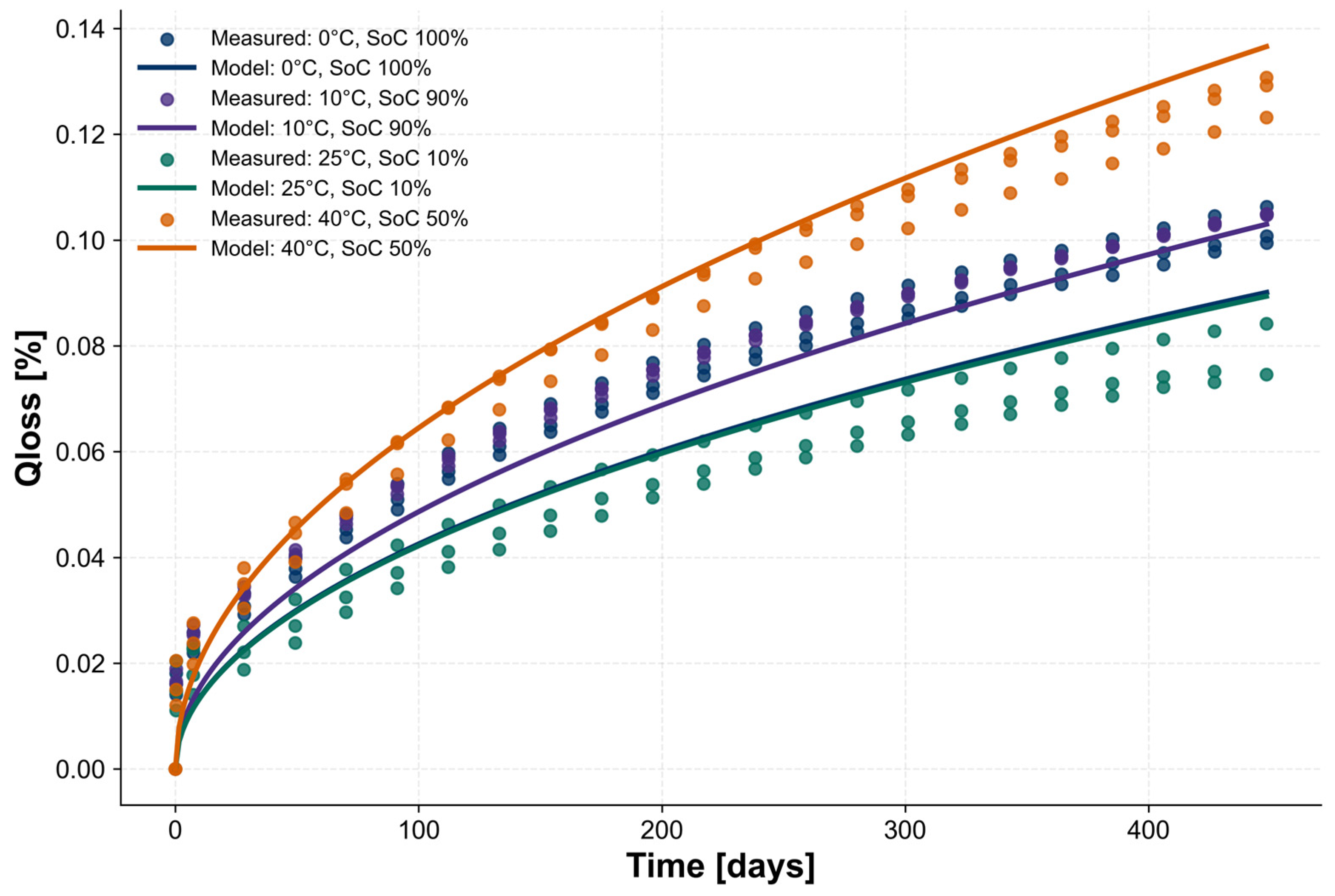
Figure 3 presents the fitted model curves against measured data across the selected calendar aging conditions. The model reproduces the dominant time-dependent degradation trend across the examined operating range, capturing both the relative influence of temperature and the separation between different SoC levels. Deviations between the measured and predicted trajectories increase at an elevated temperature and a higher SoC, particularly at longer storage times, reflecting the inherent limitations of a semi-empirical formulation under conditions where aging mechanisms may evolve. The resulting optimal coefficients were:
  • f = 4.634⋅10−1 [1/day1/2].
  • g = 4.917⋅10−1 [-].
  • h = −1.416⋅103 [1/K].
To quantitatively assess the global quality of the calendar aging fit, standard error metrics were computed over all the storage trajectories. The resulting coefficient of determination was R2 = 0.88, indicating that the model explains the dominant variance of the measured degradation data. The corresponding normalized root mean squared error (NRMSE), computed with respect to the data range, was below 6%, confirming that the identified formulation provides an adequate representation of the calendar-induced capacity loss across the investigated temperature and SoC conditions.

3.2.3. Cycling Aging Fit

In the next step, the cycling aging term of Equation (10) was fitted to the experimental data. To isolate cycling-induced degradation, the calendar aging contribution predicted by the model calibrated in the previous subsection was subtracted from the total measured capacity loss. This procedure follows the methodology proposed by Wang et al. [37], in which the total degradation is treated as the additive sum of the decoupled calendar and cycling components.
For each cycling test, the calendar degradation term was computed based on the elapsed time and the test temperature. As time-resolved SoC profiles were not available for each test, a constant, average SoC value was assumed. Based on a sensitivity analysis performed, an average SoC of 100% was adopted. The estimated calendar contribution was then removed from the measured capacity loss to obtain the cycling-related degradation component, expressed as a function of the ampere-hour throughput.
To ensure consistency across the operating conditions and compatibility with the assumptions of the adopted model formulation, only cycling tests corresponding to a full 0–100% SoC window were retained in the fitting procedure. Cycling cases with different SoC windows were excluded, as they would require the explicit modeling of additional dependencies. Furthermore, data points corresponding to advanced aging stages, i.e., SoH values below 80%, were filtered out, since nonlinear degradation behavior becomes dominant at such levels and the assumed linear dependence of the cycling-induced capacity loss on the charge throughput is no longer valid. The investigation of this late-life operating regime is considered outside the scope of the present work.
The remaining cycling degradation data were fitted using the semi-empirical relation introduced in Section 2.3.3, following the parameter identification strategy proposed by Wang et al. [37]. For each temperature and C-rate combination, the cycling-induced capacity loss was assumed to scale linearly with the ampere-hour throughput, and the corresponding degradation rate was extracted. The dependence of this rate on the C-rate was subsequently modeled using an exponential relation, yielding temperature-dependent pre-exponential and exponential coefficients. Finally, the temperature dependence of these coefficients was captured using a second-order polynomial and a linear fit, respectively. This resulted in a compact global expression for cycling aging as a function of the temperature, C-rate, and charge throughput. The resulting coefficients were:
  • a = 1.398 · 10−8 [1/(Ah·K2)]
  • b = −1.131 · 10−5 [1/(Ah·K)]
  • c = 2.239 · 10−3 [1/Ah]
  • d = −2.033 · 10−2 [1/(K·C-rate)]
  • e = 7.106 [1/C-rate]
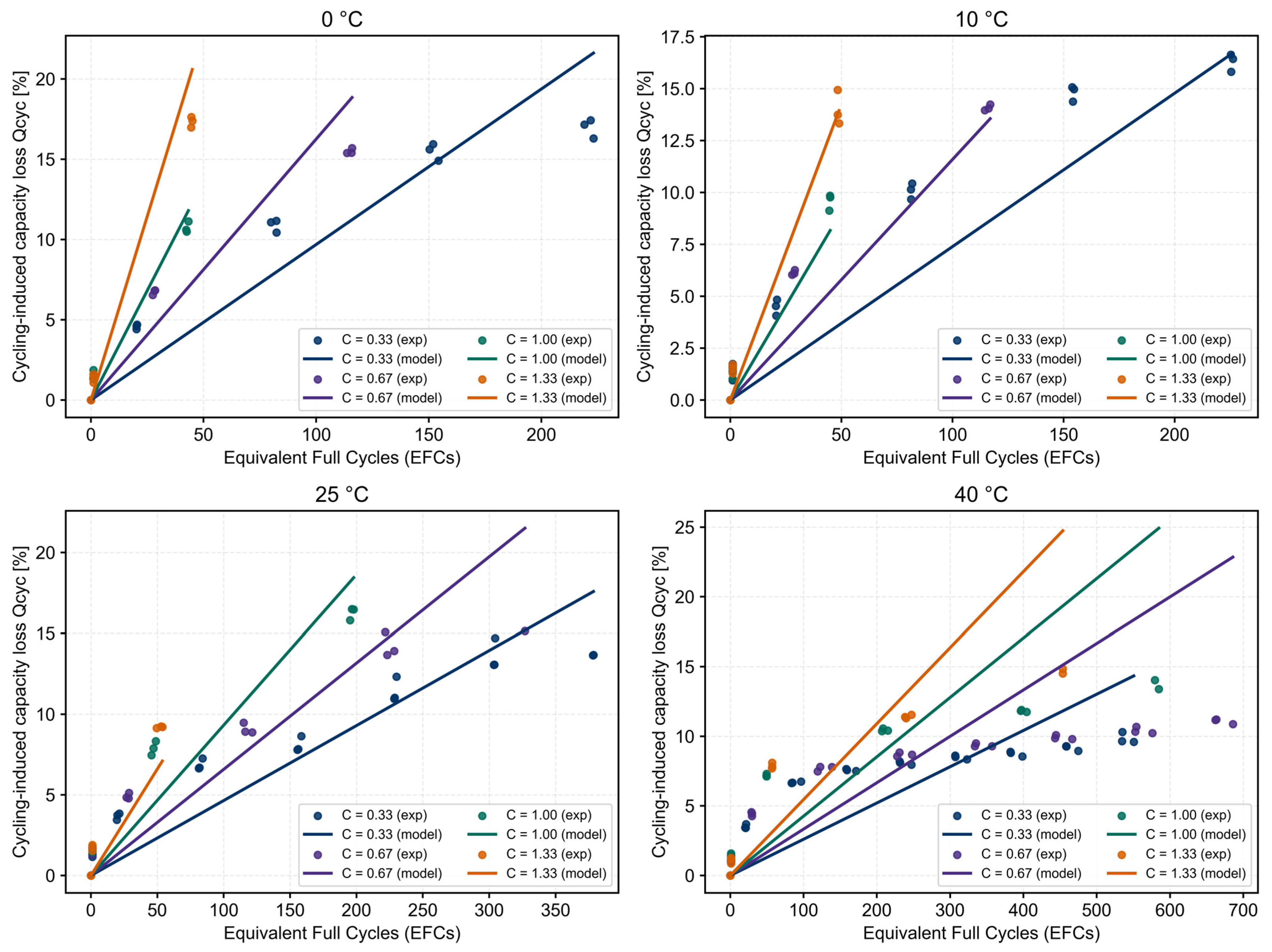
Figure 4 presents a comparison between the measured and model-predicted cycling-induced capacity loss for a selected subset of experimental tests, grouped by temperature. For each temperature level (0 °C, 10 °C, 25 °C, and 40 °C), four representative cycling conditions corresponding to different C-rates are shown within the same subplot. Experimental data points denote the cycling-related capacity loss extracted after removal of the calendar aging contribution, while solid lines indicate the predictions of the proposed cycling aging model. The figure illustrates that, across all temperatures, the model reproduces the approximately linear dependence of the cycling-induced capacity loss on equivalent full cycles within the investigated aging range. In addition, the relative impact of the C-rate is consistently captured, with steeper degradation trends observed at higher current rates. The agreement between the measurements and model predictions was particularly strong at low to moderate EFC values.
Quantitative goodness-of-fit metrics were also evaluated for the cycling-induced degradation component. For temperatures up to 25 °C, the proposed formulation achieved coefficients of determination exceeding R2 = 0.85, indicating a good agreement between the measured and predicted cycling-induced capacity loss within the calibrated operating domain. At 40 °C, the extracted cycling degradation exhibited increased dispersion and a reduced variance relative to lower temperatures, leading to lower statistical fit indicators. In particular, a negative R2 value was observed for the isolated cycling component at this temperature. This behavior does not indicate model divergence, but rather reflects that the residual error exceeds the variance of the extracted cycling-only signal, which was obtained after subtraction of the calendar aging contribution. Under thermally stressed conditions, error propagation from the calendar term and transitions in the dominant degradation mechanisms amplified the deviation in the isolated cycling component. These effects are inherent to the adopted sequential decomposition methodology and highlight the limitations of linear-throughput cycling formulations at elevated temperatures.
The observed deviations at 40 °C can be attributed to three distinct factors. First, high-temperature operation accelerates temperature-activated degradation mechanisms and may induce transitions in the dominant aging mode, leading to nonlinear behavior that cannot be fully captured by a simplified semi-empirical formulation with a single global parameter set. Second, the sequential separation of calendar and cycling aging introduces additional uncertainty under thermally stressed conditions. Although the calendar contribution was modeled using a square-root-of-time dependency, the residual degradation after subtraction still exhibited nonlinear characteristics at 40 °C, whereas the cycling aging formulation assumed a linear dependence on the charge throughput. Third, the use of a unified parameter set fitted across all temperatures and operating conditions involved an inherent trade-off between global consistency and local accuracy, limiting the model’s ability to precisely reproduce extreme operating conditions.

3.2.4. Total Degradation Model

Following the independent calibration of the calendar and cycling aging components, the two contributions were combined into a unified model for predicting the total capacity loss. The resulting formulation estimates the cumulative degradation as the additive superposition of calendar- and cycling-induced losses, expressed as a function of the operating temperature, C-rate, charge throughput, elapsed time, and assumed average SoC. The performance of the integrated model was evaluated by comparing the model predictions against the measured total capacity loss for a selected subset of cyclic aging tests. For consistency with the cycling aging calibration, only tests conducted over a 0–100% SoC window and data points corresponding to SoH values above 80% were retained.
The predictive performance of the combined degradation model was further quantified using standard statistical indicators. Across all temperatures, the total degradation model achieved coefficients of determination exceeding R2 = 0.83, with normalized root mean squared errors below 15% when evaluated with respect to the data range. These results confirm that, despite local deviations in the isolated cycling component at elevated temperatures, the combined calendar-cycling formulation provides a robust and coherent representation of the total capacity loss over the investigated operating envelope.
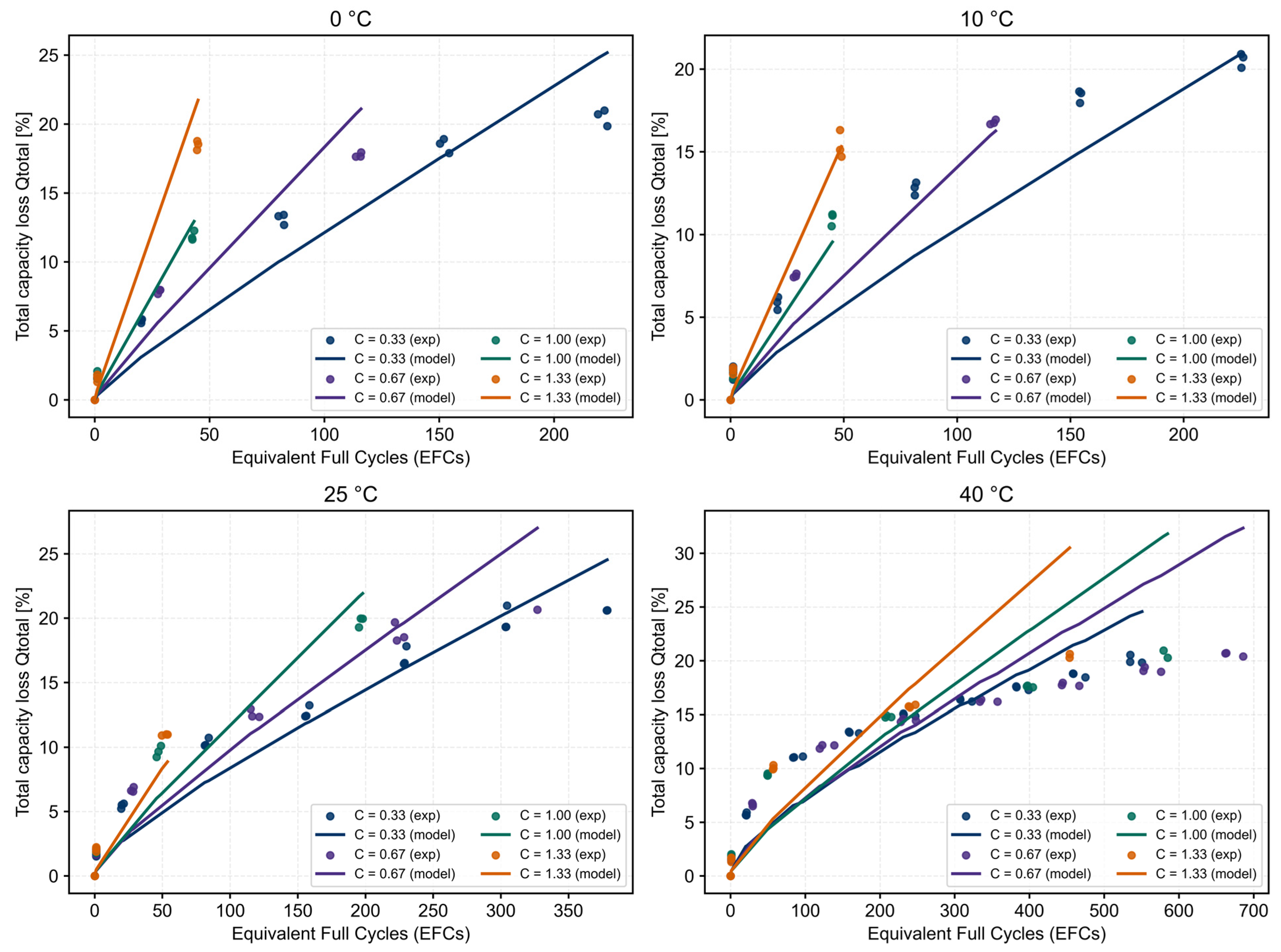
Figure 5 presents representative results grouped by temperature (0 °C, 10 °C, 25 °C, and 40 °C), where each subplot includes four cycling conditions at different C-rates. The measured total capacity loss is shown as a function of EFCs, together with the corresponding model predictions obtained by combining the calibrated calendar and cycling terms.
At low and intermediate temperatures (0 °C and 10 °C), the model reproduced the overall degradation trends with a good accuracy across the examined C-rates. Both the slope and relative separation of the degradation curves were well captured, indicating that the superposition of the calendar and cycling effects provides a consistent description of the total aging behavior within this operating range. Minor deviations appeared at higher EFC values, but the predicted trajectories remained aligned with the measured evolution.
At 25 °C, which represents a typical reference operating condition, the agreement between the measured and predicted total capacity loss remained strong for most cases. The model accurately reflected the combined influence of the cycling intensity and the accumulated throughput, with deviations remaining limited across the investigated degradation range. These results confirm that the calibrated aging formulation preserves predictive consistency when both degradation mechanisms contribute comparably.
At 40 °C, the impact of an elevated temperature became more pronounced, leading to steeper degradation curves and increased dispersion between operating conditions. While the model continued to capture the dominant degradation trends and relative ordering of C-rates, larger discrepancies emerged at higher EFC values for some cases. This behavior reflects the increasing influence of temperature-driven nonlinear aging mechanisms and possible interactions between calendar and cycling effects, which were not explicitly resolved within a single-parameter semi-empirical formulation. In addition, small instantaneous modeling errors may accumulate over extended operation under thermally stressed conditions, leading to larger deviations in the estimated SoH. Nevertheless, within the defined validity domain, the integrated model provides a physically consistent and computationally efficient representation of the total capacity loss suitable for system-level analyses.
Despite the overall good agreement between the measured and predicted degradation trends, some deviations were inevitably observed when comparing the model predictions against individual experimental trajectories. Even under identical operating conditions, Li-ion cells may exhibit substantial dispersion in their aging behavior, particularly at advanced cycling stages. Such variability reflects the intrinsic stochasticity of battery degradation processes, which can arise from manufacturing tolerances, local material heterogeneities, or the early activation of nonlinear aging mechanisms in specific cells. As a result, the proposed semi-empirical formulation is not expected to reproduce every individual degradation path with a high fidelity, but rather to capture representative average trends across a given operating envelope.
At the same time, the empirical nature of the cycling aging formulation implies that parameter identification must be carried out for each specific cell type. When extended to large-scale BESS applications involving thousands of cells, this calibration effort can become costly and time-consuming, especially if the cell-to-cell variability is to be explicitly considered. Moreover, while the present work validates the aging formulation under static operating conditions, no dedicated validation of the model under fully dynamic operating profiles was performed.
In this context, it should be noted that the aging formulation was calibrated using constant C-rate experiments, whereas grid-scale BESS operation typically involves highly dynamic power profiles. Although the degradation model is expressed in differential form and can therefore be evaluated under time-varying operating conditions, the use of parameters identified under static regimes may introduce small instantaneous errors when applied to strongly dynamic profiles. Over long-term operation, such local deviations may accumulate and result in an increased uncertainty in the estimated SoH. Physics-based aging models are better suited to explicitly capture condition-dependent degradation mechanisms under dynamic operation, but their significantly higher computational cost limits their applicability for large-scale BESS simulations. Within this context, the adopted semi-empirical formulation represents a cost-efficient compromise that provides adequate degradation trend estimation for system-level analyses.
Within these limitations, the integrated aging model demonstrates a strong capability to reproduce the dominant degradation trends across a wide range of temperatures and C-rates. For many operating conditions, the agreement between the measured and predicted capacity loss is high, indicating that the model formulation is sufficiently accurate for system-level simulations, where aggregate behavior and relative performance differences are of primary interest. The model provides consistent and physically meaningful degradation estimates across a broad operating space, capturing average degradation trends rather than exact cell-specific trajectories. This balance between interpretability, numerical efficiency, and predictive robustness makes the proposed approach well suited for integration into dynamic energy system studies, grid-scale BESS assessments, and control-oriented simulations, where reliable average trends and degradation envelopes are required rather than an exact reproduction of individual cell trajectories.

4. Application to the Terceira Isolated Power System

4.1. System Description and Model Setup

The modeling framework was applied in a real-world power transmission network (TN). The system under study is located on Terceira Island, part of the Azores complex and Portugal. The power system operates in an isolated mode at 30 kV (medium voltage—MV). Table 4 lists key specifications of the available generation plants. The network also included five substations, five common buses, aerial and underground lines, and five loads, one at each substation. Recently, a large-scale BESS (10.5 MW/15 MWh) was installed. All the required technical and network topology information, including the single-line diagram, were retrieved from [72].
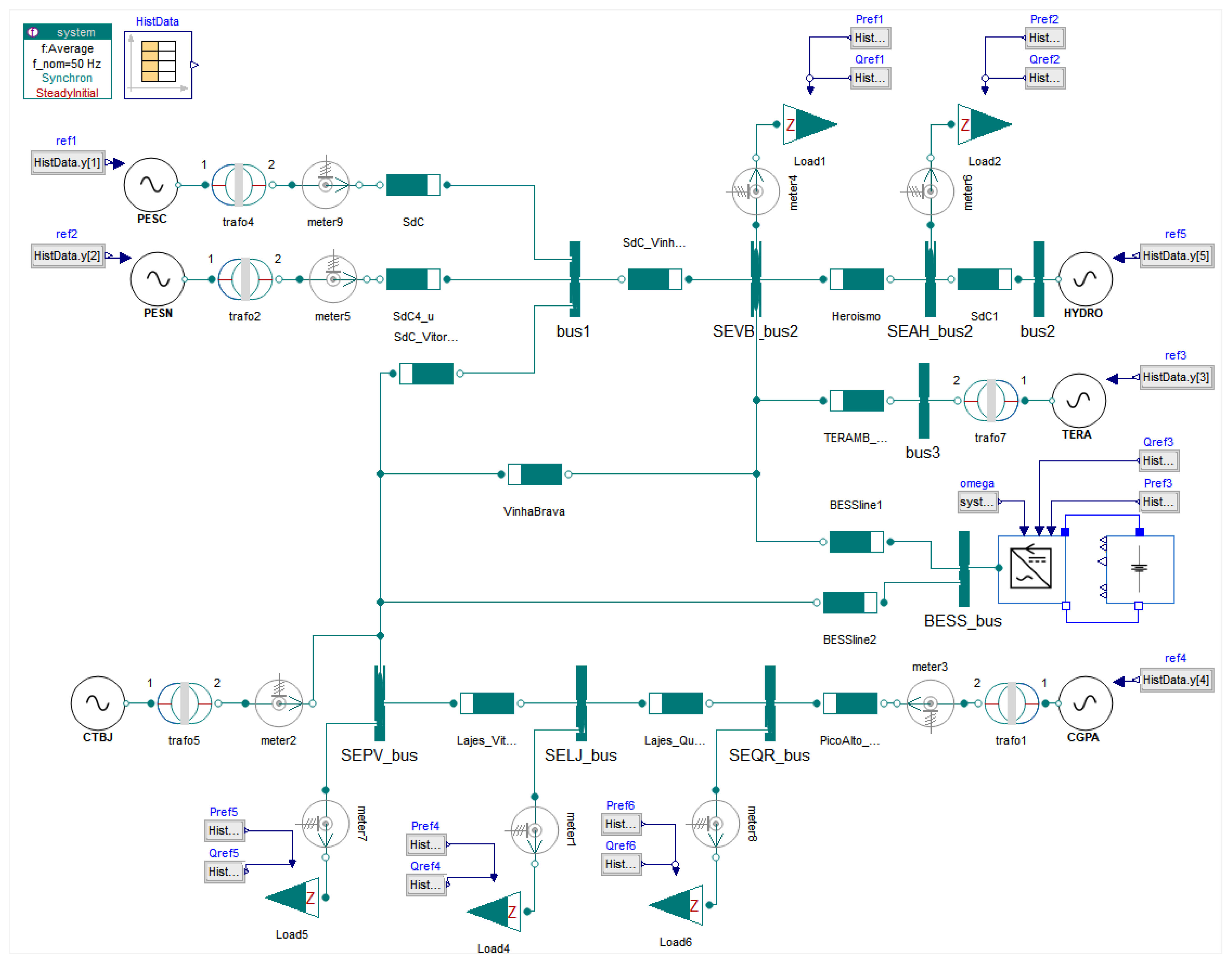
The system model within the Dymola graphical user interface is presented in Figure 6. The main attributes of the developed network model include the generation plants, the substations and the common buses, the transmission lines and the loads at each substation. The electricity production system consists of six power plants, a thermoelectric plant, a geothermal one, an urban waste plant, and two wind farms, whereas the hydro power plant is considered a single cluster. The five substations are included in the model, as well as five other common buses. All of them were at 30 kV. Aerial lines and cables were all modeled as concentrated RX-impedances with varied resistance (Xs) and reactance (Xm) parameters. There were five loads in total, one at each substation. Their specified power demand can vary dynamically and is determined by signal inputs (time series). Regarding the BESS unit, an LFP chemistry type was considered based on information and technical specifications provided by the local system operator for the installed BESS. The parameters for the degradation model of the LFP cells were retrieved from [38]. A cell with a 3.0 Ah and 3.2 V nominal capacity and voltage, respectively, was considered to build an equivalent 15 MWh capacity through a configuration of 300s5210p.
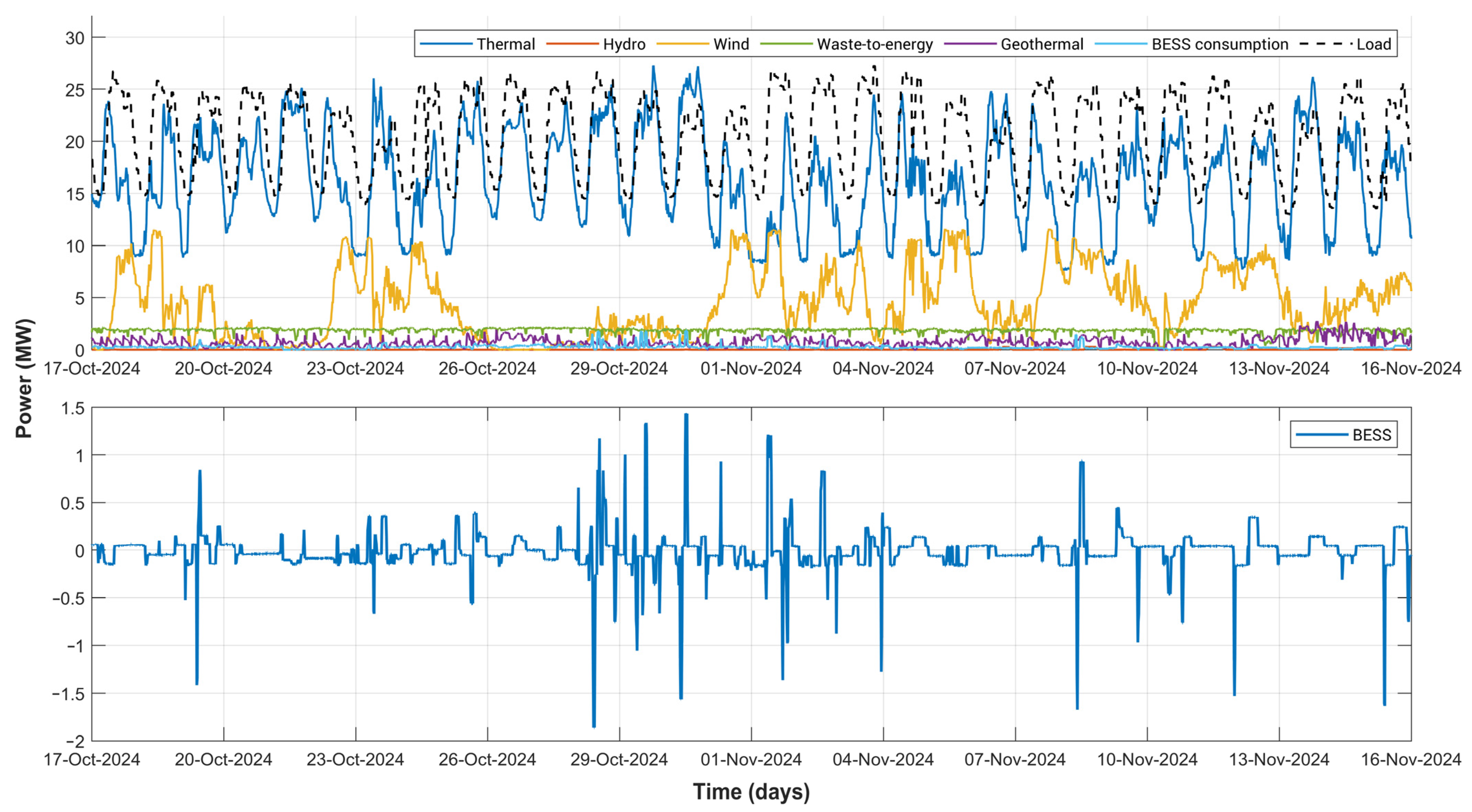
Time series data measured during 2024 and provided by the site operator are plotted in Figure 7 for a 30-day period, from 17 October to 15 November. The contribution of each generation asset is shown in the upper subplot, overlaid with the system load. BESS data refer to the aggregate power exchange of six physically distributed units, here represented as a single equivalent system. The bottom subplot displays the net BESS power (filtered), with positive values indicating charging. While most assets operate continuously or seasonally, BESS activity is characterized by intermittent spikes and long idle periods. The combined dataset, including the hourly load and 15 min generation records, was used to construct a representative operational profile. This profile formed the basis for subsequent dispatch simulations and a long-term degradation analysis.

4.2. Short-Term Operation: Ancillary Services Under Disturbance

This section presents the dynamic simulation results assessing the capability of the BESS to support frequency stability under a sudden load disturbance in the Terceira isolated power system. Two renewable penetration levels were considered:
  • High-RES (approximately 60%);
  • Very high-RES (approximately 80%).
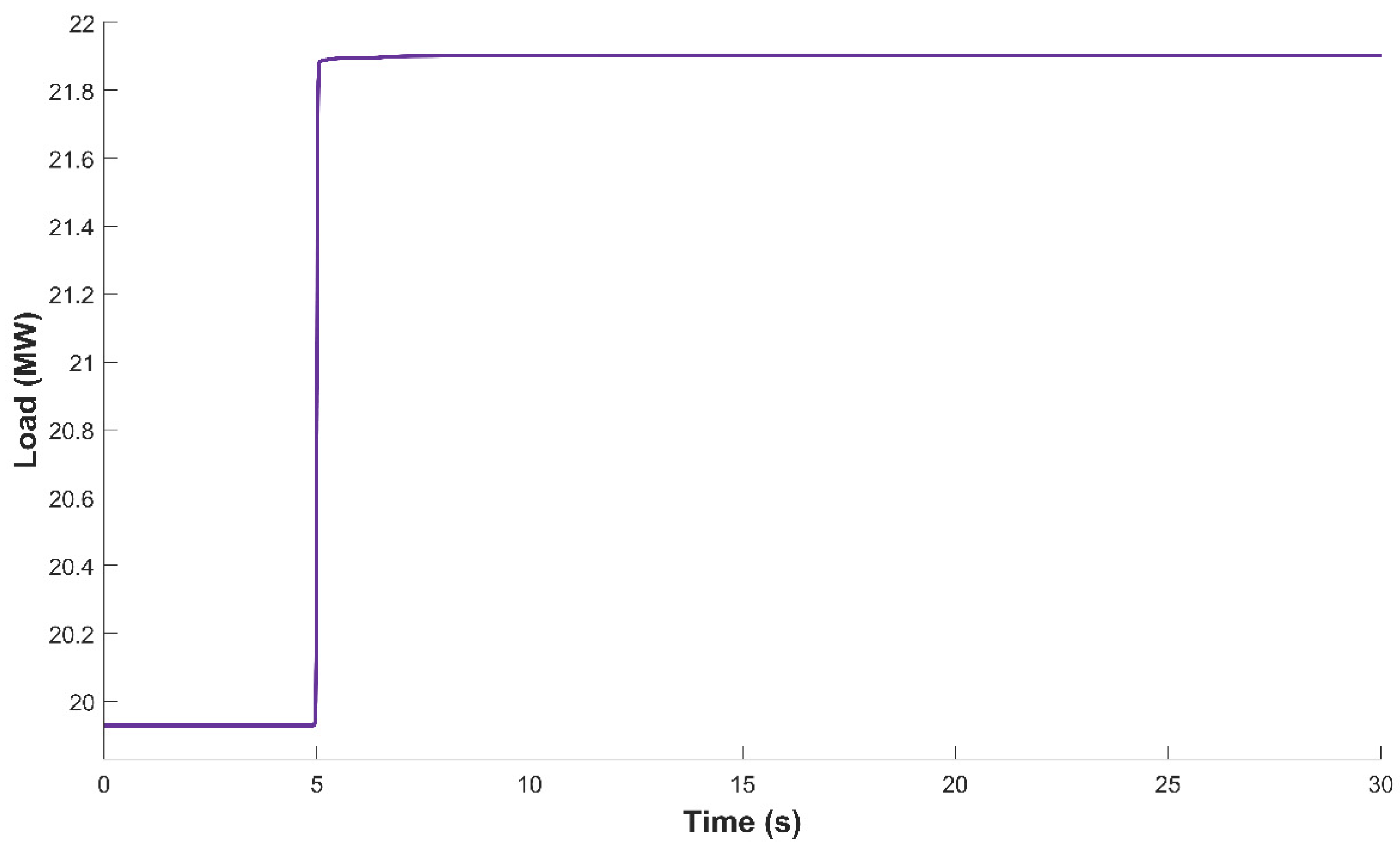
The system was subjected to a 10% step increase in the aggregated load at t = 5 s. The pre-disturbance load value was set to 19.95 MW, a typical operating point sampled from the measured load time series. This disturbance mimics a realistic event such as a sharp load ramp or renewable generation drop. In both cases, the BESS is initially fully charged and idle, ready to respond under P–Q control. Figure 8 illustrates the applied disturbance. The simulations tracked the response over 30 s, capturing the frequency dynamics, BESS participation, and interaction with the thermal unit acting as a grid-forming generator. It was noted that the aging states were not evolved on the sub-minute time scale shown here; however, the dynamic electrical response was indirectly influenced by aging through degradation-dependent parameters that reflect the long-term operational history of the BESS.
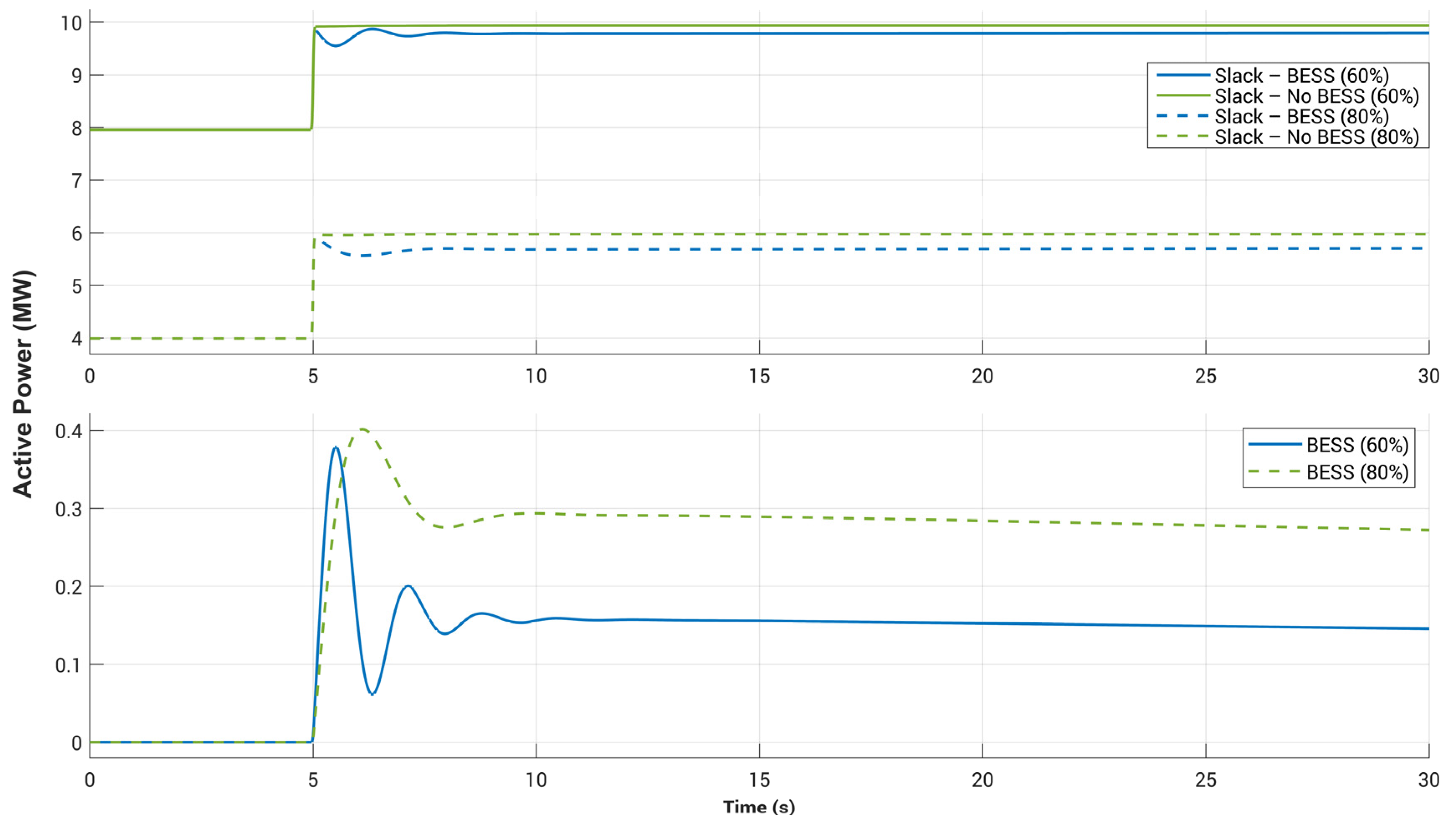
Figure 9 presents the power output of the thermal unit (top) and BESS (bottom) for both RES penetration levels, comparing cases with and without battery support. In the high-RES scenario, the BESS delivered a peak injection of 380 kW, improving the frequency nadir by 3 mHz (14%) and reducing the settling time by approximately 3 s. In the very-high-RES scenario, due to lower system inertia, the BESS injection rose to 400 kW and was sustained for longer, reflecting the increased role of energy storage under high renewable conditions. These results demonstrate that, even with a moderate power output, a well-sized BESS can significantly enhance the frequency resilience in low-inertia isolated grids. The benefits are more pronounced under higher renewable shares, where conventional synchronous units offer limited support for short-term disturbances.
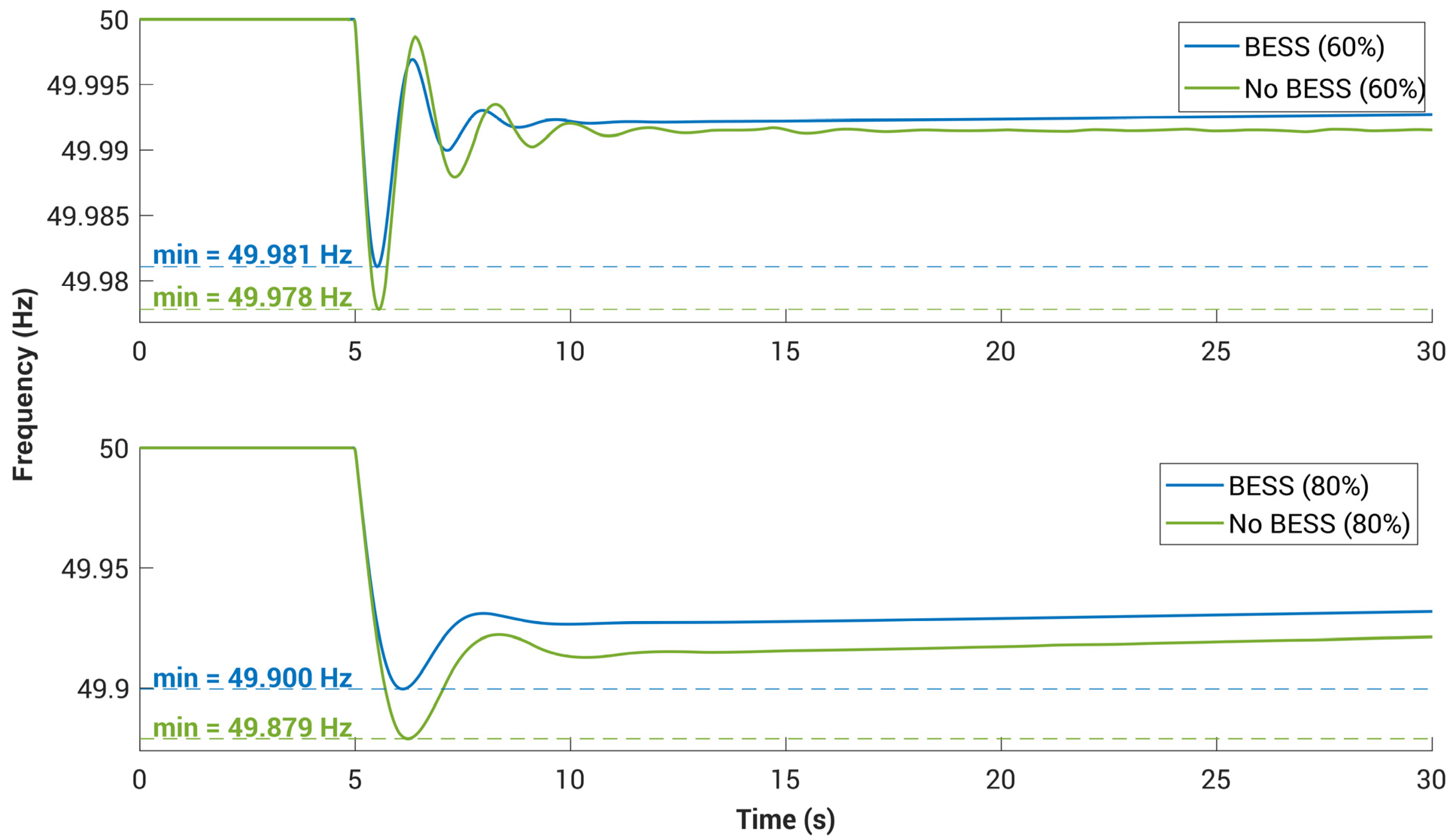
The resulting system frequency evolution presented in Figure 10 following the load disturbance for both renewable penetration levels. The inclusion of the BESS resulted in a noticeable improvement in the frequency nadir and settling behavior. In the 60% RES case, the frequency nadir improved from 49.978 Hz (without BESS) to 49.981 Hz (with BESS), while in the 80% RES case, it improved more significantly, from 49.879 Hz to 49.900 Hz. This demonstrates the increasing role and necessity of fast-acting storage systems as the system inertia decreases. The improvement was more pronounced under very-high-RES conditions, where traditional synchronous inertia was limited, underscoring the value of BESS in maintaining frequency stability.

4.3. Long-Term Operation: Degradation Under Extended Cycling

To evaluate long-term battery degradation, a 1000-day simulation was performed using two distinct operational profiles:
  • A historical profile, built by repeating a representative annual dispatch synthesized from a measured three-month dataset of the Terceira power system (as described in Section 4.1). This profile reflects typical battery usage under current operating conditions.
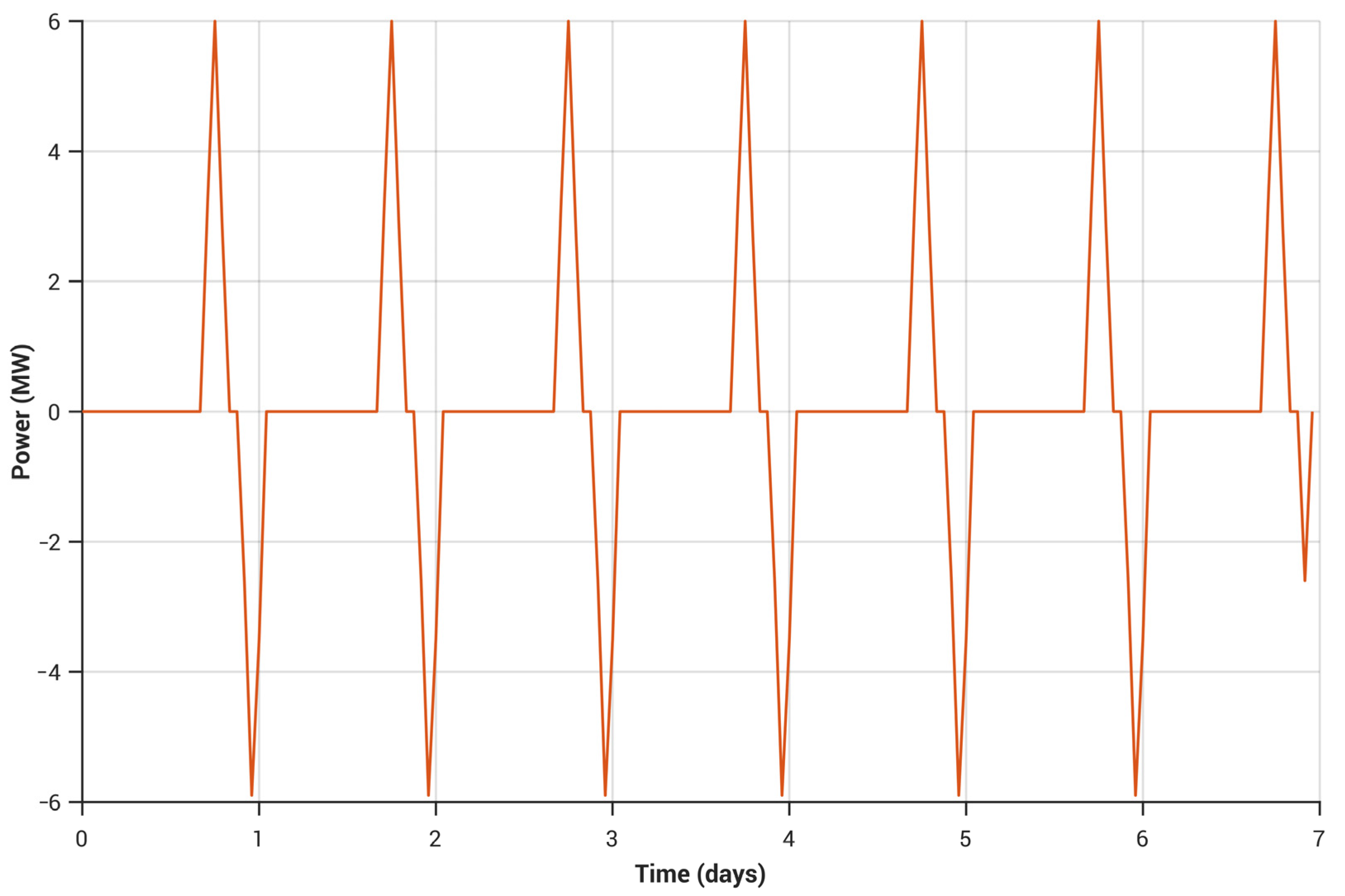
  • An aggressive profile, created to emulate intensified cycling conditions with deeper and more frequent charge/discharge events, representing a future scenario with heavier reliance on the BESS for grid services.
Both profiles were applied to a semi-empirical battery aging model that accounts for calendar aging and cycle-related degradation. This approach enabled an assessment of the SoH decline over prolonged use, under contrasting operational stress levels. Figure 11 illustrates the weekly dispatch behavior of the aggressive profile. The pattern was fully periodic and designed to maintain continuity in power and SoC across weekly boundaries, making it suitable for extended simulations.
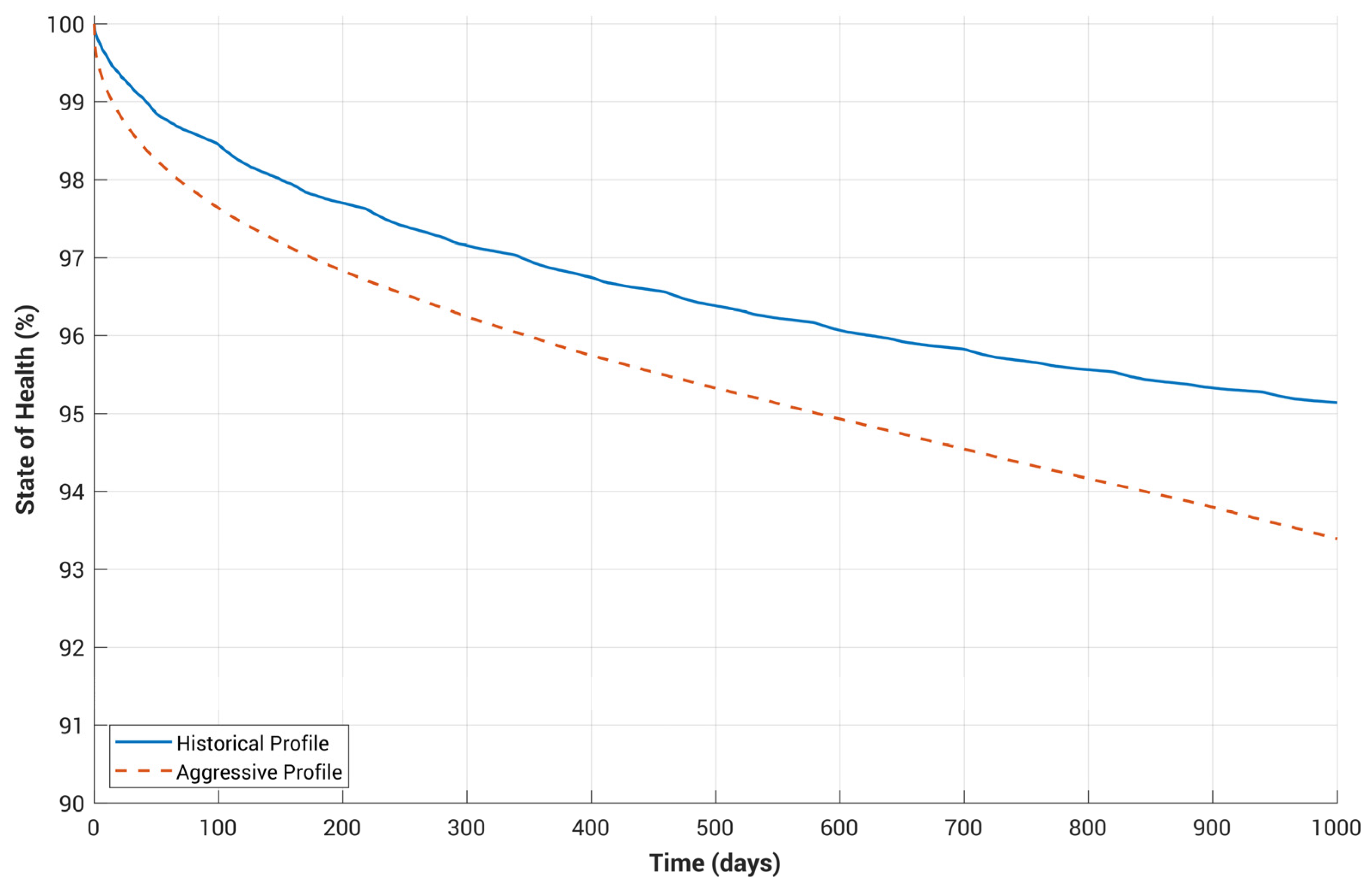
Figure 12 presents the evolution of SoH under both scenarios. After 1000 days, the aggressive profile resulted in a greater capacity fade, dropping to 93.5% SoH, compared to 95.2% under the historical profile. This highlights the sensitivity of degradation to the cycling depth and frequency, and reinforces the need to balance operational benefits with asset longevity.

5. Conclusions

This work presented the LIBSystems library, a modular and extensible modeling framework developed in Modelica for the dynamic simulation of grid-scale Li-ion BESSs. The framework integrates electrical, thermal, and degradation behavior within a unified structure, supporting analyses across both fast transients and long-term operation. Its capabilities were demonstrated through application to the isolated power system of Terceira Island, where a 10.5 MW/15 MWh Li-ion BESS was evaluated under realistic disturbance and operational conditions. The study included short-term frequency support under varying RES scenarios and degradation modeling over a 1000-day horizon using two distinct cycling profiles.
The results highlight the technical value of BESS integration in low-inertia islanded systems. Under a 10% load disturbance, the BESS improved the frequency nadir from 49.978 Hz to 49.981 Hz in the high-RES case (60%) and from 49.879 Hz to 49.900 Hz in the very-high-RES case (80%), while reducing the settling time by approximately 3 s. In the long-term simulation, the aggressive cycling scenario led to a faster capacity fade (to 93.5% SoH), compared to 95.2% under the historical-based dispatch. These findings confirm that both the dynamic and aging performance of the BESS depend critically on system-level usage, and underscore the need for integrated modeling approaches that account for the cycling cost and thermal behavior.
To support these simulations, the aging model was independently validated using 32 controlled tests across calendar and cycling conditions. This step strengthens the credibility of the long-term degradation results and highlights the importance of linking experimental data with system-level models.
The proposed framework supports cell-level dynamics and degradation-aware simulations, making it suitable for large-scale systems where thermal effects and aging carry an even greater economic impact than in small-format applications. Its modular structure enables future extensions to more detailed thermal modeling, CtCV and equalization strategies. Expanding the validation of the aging model under variable operating scenarios is also a key direction for future work.

Author Contributions

Conceptualization, R.R. and P.K.; methodology, R.R.; software, R.R.; validation, R.R. and P.K.; data curation, P.K.; writing—original draft preparation, R.R., P.K., P.I., N.N. and D.R.; writing—review and editing, R.R., P.K., P.I., N.N. and D.R.; visualization, R.R. and P.I.; supervision, N.N., D.R. and A.T.; funding acquisition, N.N. and D.R. All authors have read and agreed to the published version of the manuscript.

Funding

This work was carried out in the framework of the European Union’s Horizon 2020 research and innovation program under grant agreement No. 957810 (IANOS project).

Data Availability Statement

The raw data supporting the conclusions of this article will be made available by the authors upon request.

Acknowledgments

The authors gratefully acknowledge the contributions of Electricidade dos Açores, S.A. (EDA), to the provision of specifications and data for the grid under study.

Conflicts of Interest

The authors declare no conflicts of interest.

Abbreviations

The following abbreviations are used in this manuscript:
BESSBattery Energy Storage System
CtCVCell-to-Cell Variation
DoDDepth of Discharge
DNDistribution Network
ECMEquivalent Circuit Model
EMSEnergy Management System
EVElectric Vehicle
LIBLi-Ion Battery
LCOLithium Cobalt Oxide
LFPLithium Iron Phosphate
LMOLithium Manganese Oxide
LUTLookup Table
LVLow Voltage
MVMedium Voltage
NCALithium Nickel Cobalt Aluminum Oxide
NMCLithium Nickel Manganese Cobalt Oxide
OCVOpen-Circuit Voltage
RESRenewable Energy Sources
RMSERoot Mean Squared Error
SEISolid Electrolyte Interphase
SoCState of Charge
SoHState of Health
SPMSingle-Particle Model
TNTransmission Network

References

  1. Rancilio, G.; Lucas, A.; Kotsakis, E.; Fulli, G.; Merlo, M.; Delfanti, M.; Masera, M. Modeling a Large-Scale Battery Energy Storage System for Power Grid Application Analysis. Energies 2019, 12, 3312. [Google Scholar] [CrossRef]
  2. Amini, M.; Nazari, M.H.; Hosseinian, S.H. Predictive Energy Management Strategy for Battery Energy Storage Considering Battery Degradation Cost. IET Renew. Power Gener. 2023, 17, 1119–1138. [Google Scholar] [CrossRef]
  3. Biroon, R.A.; Pisu, P.; Schoenwald, D. Large-Scale Battery Energy Storage System Dynamic Model for Power System Stability Analysis. In Proceedings of the 2020 IEEE Texas Power and Energy Conference (TPEC), College Station, TX, USA, 6–7 February 2020; pp. 1–5. [Google Scholar]
  4. Qu, X.; Li, X. A Dynamic Model of Battery Energy Storage System Based on the External Characteristic Equivalent. MATEC Web Conf. 2018, 160, 03004. [Google Scholar] [CrossRef][Green Version]
  5. Krishnamoorthy, G.; Dubey, A. Hybrid Transmission Distribution Co-Simulation: Frequency Regulation Using Battery Energy Storage. arXiv 2019, arXiv:1912.07204. [Google Scholar] [CrossRef]
  6. Pourbeik, P.; Petter, J.K. Modeling and Validation of Battery Energy Storage Systems Using Simple Generic Models for Power System Stability Studies. Cigre Sci. Eng. 2017, 9, 63–72. [Google Scholar]
  7. Chang, C.-M.; Chang, H.-C.; Hung, C.-C.; Kuo, C.-C. The Impact of Energy Storage System Control Parameters on Frequency Regulation Strategies. IEEE Access 2025, 13, 34010–34022. [Google Scholar] [CrossRef]
  8. Grimaldi, A.; Minuto, F.D.; Perol, A.; Casagrande, S.; Lanzini, A. Ageing and Energy Performance Analysis of a Utility-Scale Lithium-Ion Battery for Power Grid Applications through a Data-Driven Empirical Modelling Approach. J. Energy Storage 2023, 65, 107232. [Google Scholar] [CrossRef]
  9. Reiter, A.; Lehner, S.; Bohlen, O.; Sauer, D.U. Electrical Cell-to-Cell Variations within Large-Scale Battery Systems—A Novel Characterization and Modeling Approach. J. Energy Storage 2023, 57, 106152. [Google Scholar] [CrossRef]
  10. Shamarova, N.; Suslov, K.; Ilyushin, P.; Shushpanov, I. Review of Battery Energy Storage Systems Modeling in Microgrids with Renewables Considering Battery Degradation. Energies 2022, 15, 6967. [Google Scholar] [CrossRef]
  11. Zheng, S.; Teh, J.; Alharbi, B.; Lai, C.-M. A Review of Equivalent-Circuit Model, Degradation Characteristics and Economics of Li-Ion Battery Energy Storage System for Grid Applications. J. Energy Storage 2024, 101, 113908. [Google Scholar] [CrossRef]
  12. Sitompul, S.; Hatakeyama, T.; Nakatani, M. Simplified Equivalent Circuit Model for Battery Energy Storage System Used for Grid Frequency Response. In Proceedings of the 2024 13th International Conference on Renewable Energy Research and Appliations (ICRERA), Nagasaki, Japan, 9 November 2024; pp. 432–437. [Google Scholar]
  13. Arifujjaman, M.; Avendano, M. Dynamic Simulation and Control of a Battery Energy Storage System. In Proceedings of the 2019 IEEE Green Energy and Smart Systems Conference (IGESSC), Long Beach, CA, USA, 4–5 November 2019; pp. 1–5. [Google Scholar]
  14. Parthasarathy, C.; Hafezi, H.; Laaksonen, H.; Kauhaniemi, K. Modelling and Simulation of Hybrid PV & BES Systems as Flexible Resources in Smartgrids—Sundom Smart Grid Case. In Proceedings of the 2019 IEEE Milan PowerTech, Milan, Italy, 23–27 June 2019; pp. 1–6. [Google Scholar]
  15. Parthasarathy, C.; Hafezi, H.; Laaksonen, H. Lithium-Ion BESS Integration for Smart Grid Applications—ECM Modelling Approach. In Proceedings of the 2020 IEEE Power & Energy Society Innovative Smart Grid Technologies Conference (ISGT), Washington, DC, USA, 17–20 February 2020; pp. 1–5. [Google Scholar]
  16. Parthasarathy, C.; Sirviö, K.; Hafezi, H.; Laaksonen, H. Modelling Battery Energy Storage Systems for Active Network Management—Coordinated Control Design and Validation. IET Renew. Power Gener. 2021, 15, 2426–2437. [Google Scholar] [CrossRef]
  17. Parthasarathy, C.; Laaksonen, H.; Redondo-Iglesias, E.; Pelissier, S. Aging Aware Adaptive Control of Li-Ion Battery Energy Storage System for Flexibility Services Provision. J. Energy Storage 2023, 57, 106268. [Google Scholar] [CrossRef]
  18. De Cassias Strobel, F.; Poubel, R.P.B.; Cupertino, A.F.; Do Couto Boaventura, W. Integration of a Battery Energy Storage System in the Distribution Networks: A Computational Model in OpenModelica. In Proceedings of the 2023 IEEE 8th Southern Power Electronics Conference and 17th Brazilian Power Electronics Conference (SPEC/COBEP), Florianopolis, Brazil, 26–29 November 2023; pp. 1–6. [Google Scholar]
  19. Cai, Y.; Cancian, M.; D’Arpino, M.; Rizzoni, G. A Generalized Equivalent Circuit Model for Large-Scale Battery Packs with Cell-o-Cell Variation. In Proceedings of the 2019 IEEE National Aerospace and Electronics Conference (NAECON), Dayton, OH, USA, 15–19 July 2019; pp. 24–30. [Google Scholar]
  20. Lucaferri, V.; Valentini, M.; De Lia, F.; Laudani, A.; Presti, R.L.; Schioppo, R.; Riganti Fulginei, F. Modeling and Optimization Method for Battery Energy Storage Systems Operating at Variable C-Rate: A Comparative Study of Lithium Technologies. J. Energy Storage 2023, 73, 109232. [Google Scholar] [CrossRef]
  21. Namor, E.; Sossan, F.; Scolari, E.; Cherkaoui, R.; Paolone, M. Experimental Assessment of the Prediction Performance of Dynamic Equivalent Circuit Models of Grid-Connected Battery Energy Storage Systems. In Proceedings of the 2018 IEEE PES Innovative Smart Grid Technologies Conference Europe (ISGT-Europe), Sarajevo, Bosnia and Herzegovina, 21–25 October 2018; IEEE: New York, NY, USA; pp. 1–6.
  22. Dai, Y.; Peng, Q.; Liu, T.; Meng, J.; Gao, F.; Blaabjerg, F. Negative Resistor-Based Equivalent Circuit Model of Lithium-Ion Batery Energy Storage System for Grid Inertia Support. IEEE Trans. Power Electron. 2024, 39, 15217–15230. [Google Scholar] [CrossRef]
  23. Misyris, G.S.; Tengner, T.; Marinopoulos, A.G.; Doukas, D.I.; Labridis, D.P. Battery Energy Storage Systems Modeling for Online Applications. In Proceedings of the 2017 IEEE Manchester PowerTech, Manchester, UK, 18–22 June 2017; pp. 1–6. [Google Scholar]
  24. Gwayi, I.; Ayeng’o, S.P.; Kimambo, C.Z.M. A Review of Lithium-Ion Battery Empirical and Semi-Empirical Aging Models for Off-Grid Renewable Energy Systems Application. Eng. Rep. 2025, 7, e70169. [Google Scholar] [CrossRef]
  25. Xu, J.; Li, H.; Hua, S.; Wang, H. Experimental Investigation of Grid Storage Modes Effect on Aging of LiFePO4 Battery Modules. Front. Energy Res. 2025, 13, 1528691. [Google Scholar] [CrossRef]
  26. Swierczynski, M.; Stroe, D.-I.; Stan, A.-I.; Teodorescu, R.; Laerke, R.; Kjaer, P.C. Field Tests Experience from 1.6MW/400kWh Li-on Battery Energy Storage System Providing Primary Frequency Regulation Service. In Proceedings of the IEEE PES ISGT Europe 2013, Lyngby, Denmark, 6–9 October 2013; pp. 1–5. [Google Scholar]
  27. Jafari, M.; Khan, K.; Gauchia, L. Deterministic Models of Li-Ion Battery Aging: It Is a Matter of Scale. J. Energy Storage 2018, 20, 67–77. [Google Scholar] [CrossRef]
  28. Li, X.; Wang, Q.; Yang, Y.; Kang, J. Correlation between Capacity Loss and Measurable Parameters of Lithium-Ion Batteries. Int. J. Electr. Power Energy Syst. 2019, 110, 819–826. [Google Scholar] [CrossRef]
  29. Barcellona, S.; Colnago, S.; Dotelli, G.; Latorrata, S.; Piegari, L. Aging Effect on the Variation of Li-Ion Battery Resistance as Function of Temperature and State of Charge. J. Energy Storage 2022, 50, 104658. [Google Scholar] [CrossRef]
  30. Motapon, S.N.; Lachance, E.; Dessaint, L.-A.; Al-Haddad, K. A Generic Cycle Life Model for Lithium-Ion Batteries Based on Fatigue Theory and Equivalent Cycle Counting. IEEE Open J. Ind. Electron. Soc. 2020, 1, 207–217. [Google Scholar] [CrossRef]
  31. Pakjoo, M.; Piegari, L.; Rancilio, G.; Colnago, S.; Mengou, J.E.; Bresciani, F.; Gorni, G.; Mandelli, S.; Merlo, M. A Review on Testing of Electrochemical Cells for Aging Models in BESS. Energies 2023, 16, 6887. [Google Scholar] [CrossRef]
  32. Gerl, J.; Janczyk, L.; Krüger, I.; Modrow, N. A Modelica Based Lithium Ion Battery Model. In Proceedings of the 10th International Modelica Conference, Lund, Sweden, 10–12 March 2014; pp. 335–341. [Google Scholar]
  33. Milishchuk, R.; Bogodorova, T. Thevenin-Based Battery Model with Ageing Effects in Modelica. In Proceedings of the 2022 IEEE 21st Mediterranean Electrotechnical Conference (MELECON), Palermo, Italy, 14–16 June 2022; pp. 243–248. [Google Scholar]
  34. Barcellona, S.; Colnago, S.; Montrasio, P.; Piegari, L. Integrated Electro-Thermal Model for Li-Ion Battery Packs. Electronics 2022, 11, 1537. [Google Scholar] [CrossRef]
  35. Reniers, J.M.; Howey, D.A. Digital Twin of a MWh-Scale Grid Battery System for Efficiency and Degradation Analysis. Appl. Energy 2023, 336, 120774. [Google Scholar] [CrossRef]
  36. Petit, M.; Prada, E.; Sauvant-Moynot, V. Development of an Empirical Aging Model for Li-Ion Batteries and Application to Assess the Impact of Vehicle-to-Grid Strategies on Battery Lifetime. Appl. Energy 2016, 172, 398–407. [Google Scholar] [CrossRef]
  37. Wang, J.; Purewal, J.; Liu, P.; Hicks-Garner, J.; Soukazian, S.; Sherman, E.; Sorenson, A.; Vu, L.; Tataria, H.; Verbrugge, M.W. Degradation of Lithium Ion Batteries Employing Graphite Negatives and Nickel–Cobalt–Manganese Oxide + Spinel Manganese Oxide Positives: Part 1, Aging Mechanisms and Life Estimation. J. Power Sources 2014, 269, 937–948. [Google Scholar] [CrossRef]
  38. Nájera, J.; Arribas, J.R.; De Castro, R.M.; Núñez, C.S. Semi-Empirical Ageing Model for LFP and NMC Li-Ion Battery Chemistries. J. Energy Storage 2023, 72, 108016. [Google Scholar] [CrossRef]
  39. Rotas, R.; Iliadis, P.; Nikolopoulos, N.; Rakopoulos, D.; Tomboulides, A. Dynamic Battery Modeling for Electric Vehicle Applications. Batteries 2024, 10, 188. [Google Scholar] [CrossRef]
  40. Rotas, R.; Iliadis, P.; Nikolopoulos, N.; Tomboulides, A. Evaluating Synergies between Electric Vehicles and Photovoltaics: A Comparative Study of Urban Environments. World Electr. Veh. J. 2024, 15, 397. [Google Scholar] [CrossRef]
  41. Rotas, R.; Iliadis, P.; Nikolopoulos, N.; Gkaidatzis, P.A.; Grigoropoulos, K.; Ioannidis, D.; Tzovaras, D.; Tamvakos, A.; Panou, M. Vehicle-to-Grid Dynamic Modeling in a Neighborhood of Utrecht Municipality. In Proceedings of the 2024 IEEE PES Innovative Smart Grid Technologies Europe (ISGT EUROPE), Dubrovnik, Croatia, 14–17 October 2024; pp. 1–5. [Google Scholar]
  42. Rotas, R.; Iliadis, P.; Nikolopoulos, N.; Tomboulides, A.; Kosmatopoulos, E. Dynamic Simulation and Performance Enhancement Analysis of a Renewable Driven Trigeneration System. Energies 2022, 15, 3688. [Google Scholar] [CrossRef]
  43. Ntomalis, S.; Iliadis, P.; Atsonios, K.; Nesiadis, A.; Nikolopoulos, N.; Grammelis, P. Dynamic Modeling and Simulation of Non-nterconnected Systems under High-RES Penetration: The Madeira Island Case. Energies 2020, 13, 5786. [Google Scholar] [CrossRef]
  44. Iliadis, P.; Ntomalis, S.; Atsonios, K.; Nesiadis, A.; Nikolopoulos, N.; Grammelis, P. Energy Management and Techno-economic Assessment of a Predictive Battery Storage System Applying a Load Levelling Operational Strategy in Island Systems. Int. J. Energy Res. 2021, 45, 2709–2727. [Google Scholar] [CrossRef]
  45. Kundur, P.; Paserba, J.; Ajjarapu, V.; Andersson, G.; Bose, A.; Canizares, C.; Hatziargyriou, N.; Hill, D.; Stankovic, A.; Taylor, C.; et al. Definition and Classification of Power System Stability IEEE/CIGRE Joint Task Force on Stability Terms and Definitions. IEEE Trans. Power Syst. 2004, 19, 1387–1401. [Google Scholar] [CrossRef]
  46. Machowski, J.; Lubosny, Z.; Bialek, J.W.; Bumby, J.R. Power System Dynamics: Stability and Control, 3rd ed.; John Wiley and Sons: Hoboken, NJ, USA, 2020; ISBN 978-1-119-52634-6. [Google Scholar]
  47. Cutsem, T.; Vournas, C. Voltage Stability of Electric Power Systems; Springer US: Boston, MA, USA, 1998; ISBN 978-0-387-75535-9. [Google Scholar]
  48. Wood, A.J.; Wollenberg, B.F.; Sheblé, G.B. Power Generation, Operation, and Control, 3rd ed.; John Wiley and Sons: Hoboken, NJ, USA, 2014; ISBN 978-0-471-79055-6. [Google Scholar]
  49. Levron, Y.; Belikov, J. Modeling Power Networks Using Dynamic Phasors in the Dq0 Reference Frame. Electr. Power Syst. Res. 2017, 144, 233–242. [Google Scholar] [CrossRef]
  50. Wu, F.-B.; Yang, B.; Ye, J.-L. (Eds.) Grid-Scale Energy Storage Systems and Applications; Academic Press: Cambridge, MA, USA, 2019; ISBN 978-0-12-815292-8. [Google Scholar]
  51. ElectricalEnergyStorage. Available online: https://github.com/modelica-3rdparty/ElectricalEnergyStorage (accessed on 15 July 2025).
  52. Koltsakis, G.; Koutsokeras, O.; Lampropoulos, Z.; Besinas, D.; Spyridopoulos, S.; Kanatas, A. Multi-Dimensional Simulation of Battery Degradation during Fast-Charging with Active Thermal Management. In SAE Technical Paper Series; SAE International: Capri, Italy, 2023. [Google Scholar]
  53. Stroe, D.-I.; Swierczynski, M.; Kar, S.K.; Teodorescu, R. Degradation Behavior of Lithium-Ion Batteries During Calendar Ageing—The Case of the Internal Resistance Increase. IEEE Trans. Ind. Appl. 2018, 54, 517–525. [Google Scholar] [CrossRef]
  54. Sarasketa-Zabala, E.; Gandiaga, I.; Rodriguez-Martinez, L.M.; Villarreal, I. Calendar Ageing Analysis of a LiFePO4/Graphite Cell with Dynamic Model Validations: Towards Realistic Lifetime Predictions. J. Power Sources 2014, 272, 45–57. [Google Scholar] [CrossRef]
  55. Tran, M.-K.; DaCosta, A.; Mevawalla, A.; Panchal, S.; Fowler, M. Comparative Study of Equivalent Circuit Models Performance in Four Common Lithium-Ion Batteries: LFP, NMC, LMO, NCA. Batteries 2021, 7, 51. [Google Scholar] [CrossRef]
  56. Rukavina, F.; Leko, D.; Matijašić, M.; Bralić, I.; Ugalde, J.M.; Vašak, M. Identification of Equivalent Circuit Model Parameters for a Li-Ion Battery Cell. In Proceedings of the 2023 IEEE 11th International Conference on Systems and Control (ICSC), Sousse, Tunisia, 18–20 December 2023; pp. 671–676. [Google Scholar]
  57. Lekouaghet, B.; Merrouche, W.; Bouguenna, E.; Himeur, Y. Identifying the Unknown Parameters of Equivalent Circuit Model for Li-Ion Battery Using Rao-1 Algorithm. In Proceedings of the 4th International Electronic Conference on Applied Sciences, Online, 26 October–10 November 2023; p. 228. [Google Scholar]
  58. Hamida, M.A.; El-Sehiemy, R.A.; Ginidi, A.R.; Elattar, E.; Shaheen, A.M. Parameter Identification and State of Charge Estimation of Li-Ion Batteries Used in Electric Vehicles Using Artificial Hummingbird Optimizer. J. Energy Storage 2022, 51, 104535. [Google Scholar] [CrossRef]
  59. Rotas, R.P. Lithium Ion Battery for Electric Vehicle Characteristics Analysis and Simulation Model Development. IFAC PapersOnLine 2020, 53, 14230–14235. [Google Scholar]
  60. Von Hohendorff Seger, P.; Redondo-Iglesias, E. Electrical Model Parameters of LFP 105Ah Cells. Recherche Data Gouv, Version V1. Engineering 2024. [Google Scholar] [CrossRef]
  61. Hassini, M.; Redondo-Iglesias, E.; Venet, P. Second-Life Batteries Modeling for Performance Tracking in a Mobile Charging Station. World Electr. Veh. J. 2023, 14, 94. [Google Scholar] [CrossRef]
  62. Sun, B.; He, X.; Zhang, W.; Ruan, H.; Su, X.; Jiang, J. Study of Parameters Identification Method of Li-Ion Battery Model for EV Power Profile Based on Transient Characteristics Data. IEEE Trans. Intell. Transp. Syst. 2021, 22, 661–672. [Google Scholar] [CrossRef]
  63. Wu, Y.; Chen, H.; Cao, L.; Duan, J.; Chen, X.; Zhai, J. Research on Online Identification of Lithium-Ion Battery Equivalent Circuit Model Parameters. In Proceedings of the 2022 9th International Forum on Electrical Engineering and Automation (IFEEA), Zhuhai, China, 4 November 2022; pp. 130–136. [Google Scholar]
  64. Beltran, H.; Ayuso, P.; Vicente, N.; Beltrán-Pitarch, B.; García-Cañadas, J.; Pérez, E. Equivalent Circuit Definition and Calendar Aging Analysis of Commercial Li(NiMnCo)O2/Graphite Pouch Cells. J. Energy Storage 2022, 52, 104747. [Google Scholar] [CrossRef]
  65. Zatta, N.; De Cesaro, B.; Dal Cin, E.; Carraro, G.; Cristofoli, G.; Trovò, A.; Lazzaretto, A.; Guarnieri, M. Holistic Testing and Characterization of Commercial 18650 Lithium-Ion Cells. Batteries 2024, 10, 248. [Google Scholar] [CrossRef]
  66. Shamsi, M.H. Analysis of an Electric Equivalent Circuit Model of a Li-Ion Battery to Develop Algorithms for Battery States Estimation. Master’s Thesis, Uppsala University, Uppsala, Sweden, 2016. [Google Scholar]
  67. Ceraolo, M.; Lutzemberger, G.; Poli, D.; Scarpelli, C. Model Parameters Evaluation for NMC Cells. In Proceedings of the 2019 IEEE International Conference on Environment and Electrical Engineering and 2019 IEEE Industrial and Commercial Power Systems Europe (EEEIC/I&CPS Europe), Genova, Italy, 11–14 June 2019; pp. 1–6. [Google Scholar]
  68. Pasquali, L. State of Charge and Parameter Estimation for a 48V Lithium-Ion Battery Based on Temperature Dependent Second-Order RC Model. Master’s Thesis, Politecnico di Torino, Torino, Italy, 2022. [Google Scholar]
  69. Kochrona, P. Development of an Algorithm for the Experimental Determination of Lithium Polymer Battery Parameters. Diploma Thesis, Aristotle University of Thessaloniki, Thessaloniki, Greece, 2018. [Google Scholar]
  70. Luh, M.; Blank, T. Comprehensive Battery Aging Dataset: Capacity and Impedance Fade Measurements of a Lithium-Ion NMC/C-SiO Cell. Sci. Data 2024, 11, 1004. [Google Scholar] [CrossRef]
  71. Nájera Álvarez, J. Study and Analysis of the Behavior of LFP and NMC Electric Vehicle Batteries Concerning Their Ageing and Their Integration into the Power Grid. Ph.D. Thesis, Universidad Politécnica de Madrid, Madrid, Spain, 2020. [Google Scholar]
  72. Virtanen, P.; Gommers, R.; Oliphant, T.E.; Haberland, M.; Reddy, T.; Cournapeau, D.; Burovski, E.; Peterson, P.; Weckesser, W.; Bright, J.; et al. SciPy 1.0: Fundamental Algorithms for Scientific Computing in Python. Nat. Methods 2020, 17, 261–272. [Google Scholar] [CrossRef] [PubMed]
Figure 1. Block diagram of the power converter P/Q control.
Batteries 12 00063 g001
Figure 2. Integrated cell model schematic showing the interaction between the electrical (middle), thermal (top), and degradation (bottom) subdomains. The signals of the electrical, thermal and degradation quantities and metrics are exchanged between domains.
Batteries 12 00063 g002
Figure 3. Calendar aging model term fit to selected cell-level degradation trajectories. Data points show measured capacity fade for three cells for each condition, and solid lines show the fitted model. Each color corresponds to a unique (T, SoC) combination, as indicated in the legend.
Batteries 12 00063 g003
Figure 4. Measured vs. predicted cycling capacity loss for selected representative test cases. Each plot shows capacity fade as a function of equivalent full cycles (EFCs) after removal of the calendar aging contribution. Markers denote experimental data, while solid lines correspond to predictions of the identified global cycling aging model.
Batteries 12 00063 g004
Figure 5. Comparison of the measured and predicted total capacity loss for selected cycling tests at 0 °C, 10 °C, 25 °C, and 40 °C. The total capacity loss is shown as a function of equivalent full cycles (EFCs) for different C-rates, considering only 0–100% SoC window tests. Filled circles denote experimental measurements, while solid lines correspond to model predictions obtained from the combined calendar and cycling aging formulation.
Batteries 12 00063 g005
Figure 6. System model of Terceira power system.
Batteries 12 00063 g006
Figure 7. Power time series during 30 days of system operation (17 October–15 November 2024). Top: generation assets and system load. Bottom: net BESS power (positive and negative correspond to charging and discharging, respectively).
Batteries 12 00063 g007
Figure 8. Step increase in Terceira’s aggregated load at t = 5 s.
Batteries 12 00063 g008
Figure 9. Active power output of the thermal unit (top) and BESS (bottom) during a 10% load disturbance at t = 5 s, under two renewable scenarios: high-RES (60%) and very-high-RES (80%). The presence of the BESS reduces the response burden on the thermal plant and provides immediate active power support, with larger and more sustained injections under higher RES conditions.
Batteries 12 00063 g009
Figure 10. Frequency response of the Terceira system to a 10% load step at t = 5 s for two renewable penetration scenarios: 60% (top) and 80% (bottom).
Batteries 12 00063 g010
Figure 11. Weekly BESS power profile in the aggressive scenario used as a periodic dispatch cycle for long-term simulations.
Batteries 12 00063 g011
Figure 12. Battery state of health (SoH) over 1000 days for historical (blue) and aggressive (orange dashed) usage.
Batteries 12 00063 g012
Table 1. Summary of cell electrical parameter datasets included in the LIBSystems library.
ReferenceChemistryCapacity [Ah]Nominal Voltage [V]Voltage Range [V]
[53]NMC3.23.62.5–4.2
[53]LFP2.63.22.0–3.65
[53]NCA3.23.62.5–4.2
[53]LMO2.63.72.5–4.2
[55]NCA483.62.5–4.2
[56]NCA3.43.62.5–4.2
[57]NMC403.72.7–4.2
[58]LFP2.33.32.0–4.2
[59]LFP1053.22.0–3.65
[60]NMC3.03.682.7–4.15
[61]NMC2.753.62.5–4.2
[62]NMC2.53.62.5–4.2
[63]NMC633.73.0–4.2
[64]NMC (4 cells)2.8 and 33.62.5–4.2
[21]Unknown (large BESS)810690510–810
[65]NMC203.72.5–4.15
[66]NCA3.353.62.5–4.2
[67]LFP143.32.0–3.6
[66]LFP2551.240–59.2
[68]LCO83.72.5–4.2
Table 2. Summary of calendar aging test conditions defined in [69]. Each configuration corresponds to a unique combination of the storage SoC (idle) and temperature. The number 3 in each cell indicates that three identical cells were tested under each condition to ensure statistical consistency.
SoC (Idle)10%50%90%100%
Temperature0 °C3333
10 °C3333
25 °C3333
40 °C3333
Table 3. Summary of cyclic aging test conditions defined in [69]. Each test condition corresponds to a unique combination of the charging C-rate, discharging C-rate, SoC window, and temperature. The numbers in the table indicate the number of cells tested under each condition (i.e., 3 cells per configuration), enabling statistical consistency.
Charging Rate1/3 C1 C5/3 C
Discharging Rate−1/3 C−1 C
SoC Lower Limit10%10%0%10%10%0%10%10%0%10%10%0%
SoC Upper Limit90%100%100%90%100%100%90%100%100%90%100%100%
Temperature0 °C333333333333
10 °C333333333333
25 °C333333333333
40 °C333333333333
Table 4. Generation plants of Terceira power system.
NameTypeRated Capacity (MW)
Belo Jardim (CTBJ)Thermoelectric58.1
Pico Alto (CGPA)Geothermal4.7
Tera Waste Plant (TERA)Waste-to-energy2.6
Serra do Cume (PESC)Wind9.0
Serra do Cume Norte (PESN)3.6
City Water Power Plants (CHCD)Hydro0.3
Nasce d’Água (CHNA)0.7
São João (CHSJ)0.5
Disclaimer/Publisher’s Note: The statements, opinions and data contained in all publications are solely those of the individual author(s) and contributor(s) and not of MDPI and/or the editor(s). MDPI and/or the editor(s) disclaim responsibility for any injury to people or property resulting from any ideas, methods, instructions or products referred to in the content.