Article

Macro Economic and Ecological Aspects of Cell Production in Europe 2030

1
Fraunhofer Institute for Systems and Innovation Research ISI, 76139 Karlsruhe, Germany
2
Institute of Mechanical Process Engineering and Mechanics (MVM), Karlsruhe Institute of Technology, 76131 Karlsruhe, Germany
3
Fraunhofer Research Institution for Battery Cell Production FFB, 48165 Münster, Germany
4
Fraunhofer Institute for Chemical Technology ICT, 76327 Pfinztal, Germany
*
Author to whom correspondence should be addressed.
Batteries 2025, 11(12), 457; https://doi.org/10.3390/batteries11120457
Submission received: 12 November 2025 / Revised: 4 December 2025 / Accepted: 6 December 2025 / Published: 12 December 2025
(This article belongs to the Section Battery Processing, Manufacturing and Recycling)

Abstract

Factory announcements for battery production are increasing in number as European demand for battery cells grows. Using a Monte Carlo simulation (108 projects as of October 2025) with risk factors for individual projects, the predicted theoretical production capacity for lithium-ion batteries in Europe will rise to 1.1–1.5 TWh, enabling a real production output of 0.8–1.0 TWh by 2030. Our analysis suggests necessary cumulative investments in battery cell gigafactories of 36–139 billion euros by 2030. The industrial output of LIB cells in 2030 will have a value of 35–99 billion euros, of which the market size of battery production is around 6–17 billion euros. Furthermore, 43,000–174,000 direct jobs could be created, with the strongest impacts seen in Eastern Europe by the end of the decade. The raw material demand generated by this industry rises steeply: lithium will rise from 14 kt in 2025 to 47–133 kt, and nickel from 83 kt to 226–640 kt by 2030, implying continued import dependencies. The energy demand of European cell production will be 8.4–19.9 TWh in 2030. Furthermore, CO2 emissions of cell production will be 1.6 to 3.7 Mt CO2-eq in 2030. The volume of production scrap is estimated at 160–398 kt in 2030, creating near-term demand for recycling capacities.

1. Introduction

Due to its large automotive industry and the transition towards electromobility, Europe’s industry demand for battery cells is currently around 25% of the global demand [1]. The increasing desire for technological sovereignty and the goal of detaching from one-sided dependencies on China reinforce European battery production [2].
To ensure security of supply, European companies with GWh-scale cell demand, such as car manufacturers, are partly betting on their own battery cell production. European demand also allows foreign cell manufacturers and new players (like start-ups) to set up production in Europe. This leads to a dynamic expansion of production capacity in Europe and numerous announcements for future projects. As a result, the share of planned global production capacity located in Asia will decrease from 75% in 2025 to around 52% in 2030, while Europe’s share will rise from 11% to 20% [3]. Nevertheless, the European battery industry is currently facing several challenges that have led to the cancellation of planned projects. Reasons are, among other things, market dynamics and high price pressure caused by global overcapacity [4]. Therefore, announced battery production projects were critically evaluated in a previous publication [5]. Calculated accordingly, the theoretical production capacity in Europe was estimated at around 1.2 to 1.7 TWh by 2030. The production output could be between 0.8 and 1.1 TWh. This analysis is limited to the supply side and excludes the demand side. Building on this, we analysed several economic and ecological indicators that result from the scale-up plans of this industry in Europe. The purposes are varied and part of ongoing discussions.
Due to recurring discussions about Europe’s supply of raw materials, the raw material demand for the planned cell production was analysed based on the available data on the individual cell chemistries possibly produced in Europe.
The aspect of green battery production is a common argument used in favour of establishing local production in Europe. For this reason, energy demand as well as CO2 emissions were analysed in more detail. The quantities of scrap generated during production, e.g., with high shares in the initial phase during ramp-up, also influence sustainability and can simultaneously enable recycling of material flows.
Moreover, in this study, we calculated the investment required for the anticipated European gigafactories as well as the possible market size of the battery industry.
The switch from fossil-fuel vehicles to electromobility repeatedly triggers debates about the loss of industry. However, in contrast to, for example, the jobs lost in automotive production [6], this change towards e-mobility also offers the opportunity to create new jobs in cell production. The specific number of potential jobs in the cell industry, depending on the size of the factory, is calculated in this paper as well.
Meanwhile, Europe is actively preparing for the growth of the battery industry. For example, EIT has launched initiatives to train skilled workers [7]. In addition, major funding programmes have been launched, targeting the subsidisation of production facilities [8]. The forecasting model, presented in the previous paper [5], in combination with the macro-economic and ecological indicators, quantifies the local effects of this industrial growth.

2. Materials and Methods

This work continues a previous study by Wicke et al. [5]. In the study, a risk-factor-based forecast was made for future European production capacities of lithium-ion batteries. These were calculated from different realisation likelihoods for the individual production projects announced for Europe. For the modelling of potential production capacities, individual announcements were evaluated using eleven different risk factors. The eleven factors capture company capabilities (e.g., experience in battery production), country conditions (e.g., energy prices), and the announcement’s maturity (e.g., a specific indication of the location). Each project was analysed individually. The corresponding conditions were classified and thus assigned to various realisation likelihoods. This resulted in probabilistic capacity estimates and scenario analyses. Therefore, the likelihoods were varied using a PERT distribution. A Monte Carlo simulation was then executed to calculate 1000 different scenarios. These were sorted and categorised into quantiles. The 10% and 90% quantiles serve as minimum and maximum scenarios in our analysis. Together, these two scenarios cover the possible range of future economic and ecological development. The 50% quantile, i.e., the median, serves as the trend value. Detailed descriptions of the data sources and the method to calculate and model production capacities can be found in the previous publication [5]. As the data in the previous study were from November 2024, an update has been made for the analysis in this study. Due to some cancellations (see Section 3.1), the most recent data available as of October 2025 now contain 108 active projects (compared to 126 active projects in November 2024).
We used the data from this forecast and derived various macro-economic and ecological parameters for a growing European battery cell industry.

2.1. Modelling

The various economic and environmental indicators Y i , j are analysed by country ( i ) and year ( j ). This means that country-specific evaluations ( Y i , j ) or pan-European evaluations ( i Y i , j ) can be carried out, particularly for the future. In addition, cumulative evaluations can be carried out over the years ( j Y i , j ) and up to 2030.
Different base values B (all a measure for the size of the European cell production industry) were used in combination with multipliers M (conversion factors to translate into economic or ecological quantities) for the desired indicators:
Y i , j = B i , j M i , j .
Base values B i , j are taken from the previous study by Wicke et al. [5]. They are specified by country i and year j . In addition, there are different starting values depending on whether, for example, the theoretical capacity or production output (see Section 2.2) is taken or different chemistries are considered. The respective minimum and maximum scenarios of the base values B are calculated using the 10% and 90% quantiles of the Monte Carlo iterations. The multipliers M i , j described below are taken from the literature or databases. They are country-specific ( i ) and time-resolved ( j ). Time dependencies for M were either taken from the literature or based on our assumptions.
The indicators Y , describing the cell production industry, were compared with indicators C , describing the general economic and ecological situation at the country or European level, to estimate the relevance R of the battery industry in different countries:
R i , j = Y i , j C i , j
The model was implemented using Python 3.10.5. All calculations were run on a standard Lenovo notebook with an i7-8565U processor running at 1.8 GHz, and 16 GB of RAM (Lenovo, Beijing, China).

2.2. Definition

Different base values are relevant depending on the research question. There are three different base values:
  • “Theoretical production capacity” refers to the theoretical machine capacity of a factory, assuming zero downtime.
  • “Production output” refers to the actual quantity of high-quality (successful end-of-line test) battery cells.
  • “Production input” refers to the total quantity of materials processed by a factory in units of GWh, regardless of whether high-quality or inferior (scrap) products are produced.
The difference between theoretical production capacity and production input is influenced by various factors, such as downtime (i.e., maintenance work, utilisation lower than 100%) and ramp-up delays. For the production output, production rejects and scrap also need to be subtracted.

2.3. Modelling of Raw Material Demand

Depending on the cell chemistry produced, the cells require different amounts of materials. For this reason, the cell chemistries, combined with the expected production input ( B ), were used as the basis for estimating raw material consumption.
The planned cell chemistry is usually not described in detail (e.g., exact nickel content) in production announcements. Therefore, the three general categories, mid-Ni, high-Ni, and LFP, were used to evaluate the raw material demand, country-independent and constant over time. Mid-Ni includes NMC and NCA chemistries with a maximum nickel content of 70%. For the calculations, we chose a stoichiometry of LiNi0.65Mn0.27Co0.08O2. We further assumed an advanced single-crystal mid-Ni [9,10] with a high capacity of 185 mAh/g and a voltage of 3.76 V vs. graphite. High-Ni describes materials from 70% Ni upwards. We chose a stoichiometry of LiNi0.83Mn0.11Co0.06O2 and assumed a capacity of 200 mAh/g [11] and a voltage of 3.66 V vs. a graphite/silicon composite. For LFP, we chose LiFePO4 and assumed a capacity of 156 mAh/g and a voltage of 3.2 V vs. graphite. The raw material requirements ( M ) for the three chemistry groups are shown in Table 1.
If only the manufacturer’s general intention to produce NMC cells is known, a 50:50 ratio of mid-Ni to high-Ni was assumed. If no information on the planned cell chemistry was available, a ratio of one-third mid-Ni, high-Ni, and LFP each was assumed.
To calculate the demand for anode materials, it was assumed that LFP and mid-Ni cathodes would be combined with pure graphite anodes (350 mAh/g), and high-Ni cathodes with a mixture of graphite and 5% silicon (430 mAh/g). For all chemistries, we assumed an electrode capacity balancing of N/P = 1.1.
The chemistry and stoichiometry of cathode (and also anode) materials are not static, but will change over the years. Presumably, this is in the sense of an increase in energy density and thus material efficiency, or a reduction in costs and an increase in cost efficiency. The assumptions we have made cover the status quo and are likely to remain valid for many manufacturers until 2030 (the period covered by the study). However, changes in the choice of chemistry are certainly possible, especially for projects that are still in the development stage.

2.4. Modelling of Energy Demand and CO2 Emissions

Several papers have calculated energy consumption in cell production either from real data or from theoretical models. We chose Degen et al. [12] as a basis for the energy consumption of cell production. Degen et al. [12] analysed different minimum and maximum values, differentiated between cell chemistries, and integrated a forecast. We used the allocation of production projects to cell chemistries as described in Section 2.3. The multipliers are, therefore, chemistry-specific and time-resolved ( M j ). Minimum, maximum, and trend values from Degen et al. were used statistically in the Monte Carlo simulation using the PERT distribution. The energy demand ws multiplied by the production input ( B ) for the individual cell chemistries in individual countries in specific years.
To calculate the emissions resulting from the energy consumption of European cell production, we used country-specific, time-resolved emission factors ( M i , j ) to convert energy consumption into CO2 emissions. To do so, values from the EU [13] were used. EU targets were taken into account for a forecast of the values. The EU target is a 50% reduction in CO2 emissions for electricity between 2020 and 2030. With the quotas achieved so far, a remaining average annual reduction of over 7.5% is yet to be achieved [14].
Country-specific and time-resolved values ( C i , j ) were used to compare the energy consumption and CO2 emissions of cell production, resulting in relevance indicators ( R i , j ).
Evaluations for the share of the total energy demand as well as electricity and natural gas needed for cell production compared with the total country-specific demand can be calculated based on historical datasets from Eurostat [15,16,17]. Data gaps for individual countries were filled using data from Ember [18] and the Energy Institute [19]. A forecast of each country’s total energy consumption was based on the EU Energy Efficiency Directive. Total energy consumption is set to fall by 18% between 2023 and 2030 [20]. If we assume a linear development towards these targets, a 2.5% reduction per year has to be achieved. In line with an IEA short-term forecast [21], an increase in electrical energy consumption of 2% per year was assumed. This value was extrapolated to 2030. In addition, a study by Deloitte predicts that natural gas demand will fall by 25% between 2018 and 2030 [22]. Therefore, it is assumed that there will be an average reduction of almost 2.5% per year until 2030.
To compare country-specific CO2 emissions with the emissions from cell production, values from the EDGAR [13] and from Ember [18] were used. The EU has set a target for CO2 reduction in 2021 (Fit for 55) to reduce emissions by 55% from 1990 levels until 2030 [23]. A reduction of 34% has already been achieved by 2023 [13]. If the reduction continues linearly, it corresponds to a reduction of approximately 3% per year. This target value was assumed as the forecast.

2.5. Modelling of Production Scrap Quantities

At present, production scrap in gigafactories remains the major source of materials for recycling [24]. Especially, the ramp-up of new gigafactories generates large quantities of scrap that need to be sent for recycling. For this reason, the scrap quantity and the potential value of the black mass have been estimated. The scrap quantities were calculated as described in the study by Wicke et al. [5]. The quantity is also represented as the difference between production input and production output.
The approximate monetary value of scrap can be estimated using material prices for black mass as a multiplier ( M ). Current average prices for LFP black mass and for black mass from cells with ternary cathodes were used. The allocation of production projects to cell chemistries was made similar to Section 2.3, unless mid-Ni and high-Ni were not separated. Prices for LFP black mass are around 725 USD/t, and for black mass containing ternary cathode battery materials, around 4925 USD/t [25]. Raw material costs are subject to extreme fluctuations. Due to the uncertain development of future raw material prices, these values were kept constant over time. No country dependence was assumed. It was also assumed that 400 kg of black mass could be produced from one tonne of battery material [26].

2.6. Modelling of Investment Volumes and Market Size

Expected costs are often communicated when new gigafactories are announced, allowing for direct quantification of CAPEX.
The global data on announced gigafactories have been fitted with a cumulative learning curve [27,28] extended by a linear term to account for investment shares with no or low scaling effects f x = a x 1 b + c x , with 0 < b < 1 , to obtain generalised estimates on the required investments. To obtain curves for the minimum (maximum) boundaries for the PERT distribution, additional fits of the points below (above) the trend curve were made.
In addition to the pure investment costs, the impact of battery production on the economy was elaborated. An estimation of the turnover was made for local battery production, based on the present and future cost estimates from Roland Berger (Table 2) [29].
Again, the allocation of production projects to cell chemistries was made identical to Section 2.3. The share of production costs (operating costs, depreciation, depletion, amortisation, and profit) compared with cell costs decreases over the years. The ratios were taken from Goldman Sachs [30]. The production costs ( M j ) were multiplied by the predicted country-specific production outputs of the individual cell chemistries ( B i , j ).
To compare those values with the country’s overall economy, country-specific GDP values were used ( C i , j ). GDP figures for European countries were taken from Eurostat [31] and for the UK from the IMF [32] for the past. For country-specific GDP forecasts, data from the OECD [33] and IMF [34] were used.

2.7. Modelling of Job Effects

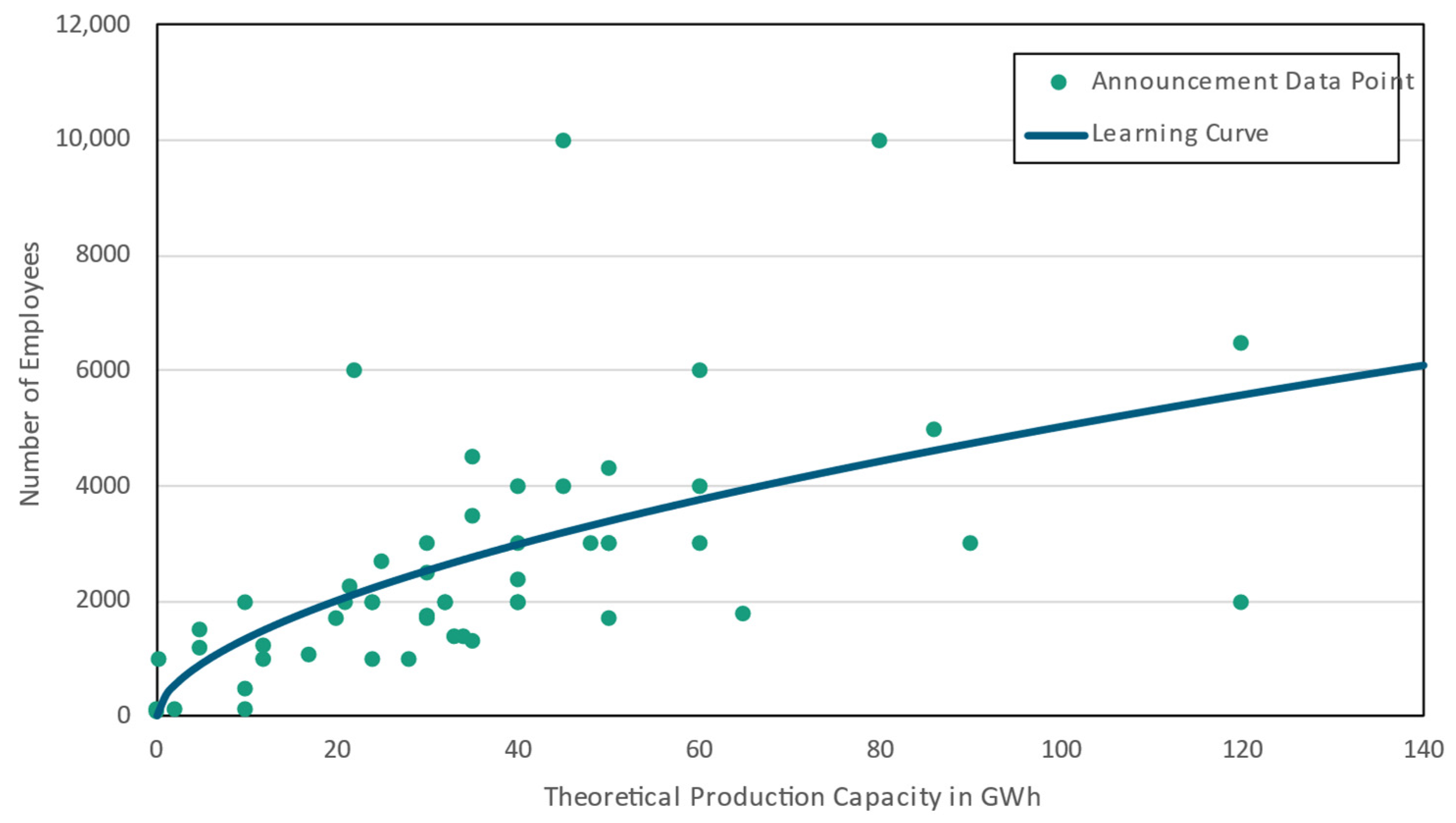
As with the investment costs, data on the number of expected employees in the gigafactories were collected from company announcements and press articles. The employment figures relate to theoretical production capacity predictions ( B i , j ), regardless of the cell chemistry produced. Furthermore, the values for expected employees from announcements are usually mentioned in the context of theoretical anticipated capacities. The fit of the learning curve has been performed analogously to the investment but without the linear term, i.e., c = 0 (see Section 2.6).
To measure the national employment effects ( R i , j ), historic country-specific total numbers of employees ( C i , j ) were taken from Eurostat [35], and for the UK, from the Office for National Statistics [36]. The values were combined with a country-specific forecast by Cedefop for the future employment growth until 2035 [37].

3. Results and Discussion

3.1. European Production Capacity

The base values of the dataset by Wicke et al. [5] have been updated as of October 2025, as there have been further changes in the announcements in the meantime (e.g., the bankruptcy of Northvolt [38] and the discontinuation of Cellforce’s production plans [39]). The new production targets for Lyten and the corresponding assessment of the projects using risk factors were added. In addition, several announcements that were already considered highly unlikely (e.g., Eurocell in the Netherlands or Anodox in Latvia) were removed from the database. The update estimates a theoretical production capacity of 1.1 to 1.5 TWh and a production output of around 0.8 to 1.0 TWh. This range reflects the high uncertainty in the coming years regarding the finalisation of cell production projects across Europe. When analysing different countries or chemistries, the quantiles are a non-linear operation; the resulting minimum and maximum scenarios are, therefore, more extreme than taking the 10% and 90% quantiles of the overall distribution of pan-European production capacities.
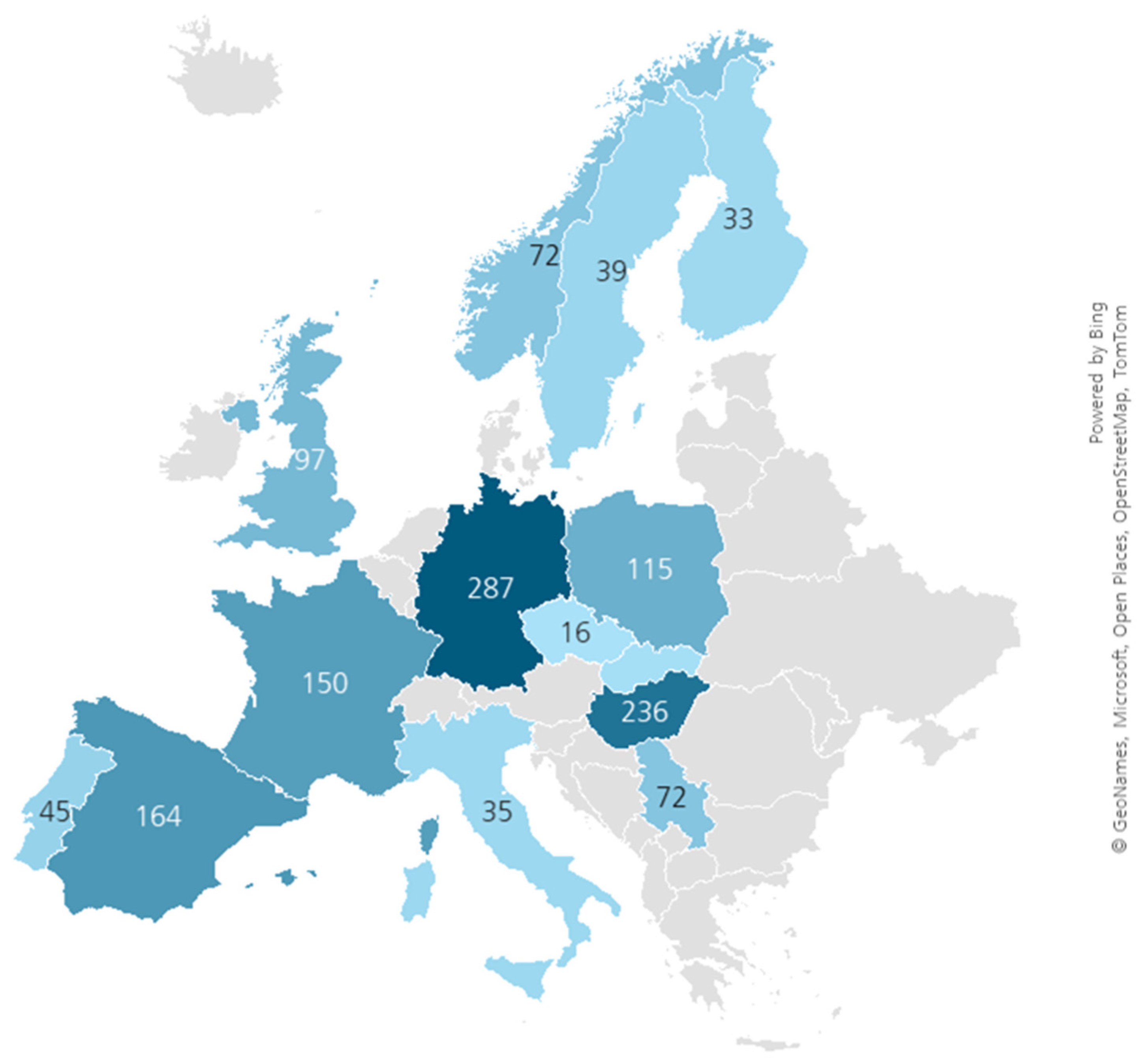
Europe is facing the construction of several gigafactories, with Germany, France, Spain, Scandinavia, and Eastern Europe emerging as hotspots. These regions benefit from strong automotive production (Germany, France, Spain), sustainable energy supply (Scandinavia, Spain), and lower production costs (Eastern Europe, but also Spain). The distribution of corresponding theoretical production capacities in 2030 is shown in Figure 1.
However, challenges for the European battery industry are emerging. In recent years, numerous gigafactory projects have not been implemented as planned. The most prominent example is the European battery manufacturer, Northvolt. For various reasons, often related to financial difficulties (either due to high investment costs or a delayed market ramp-up), production issues, and strategic considerations (e.g., regarding the choice of cell chemistry), more than 700 GWh have already been cancelled or delayed in Europe [40].
It is still uncertain as to what extent the European cell industry will establish itself, albeit likely not to the extent that was originally planned.
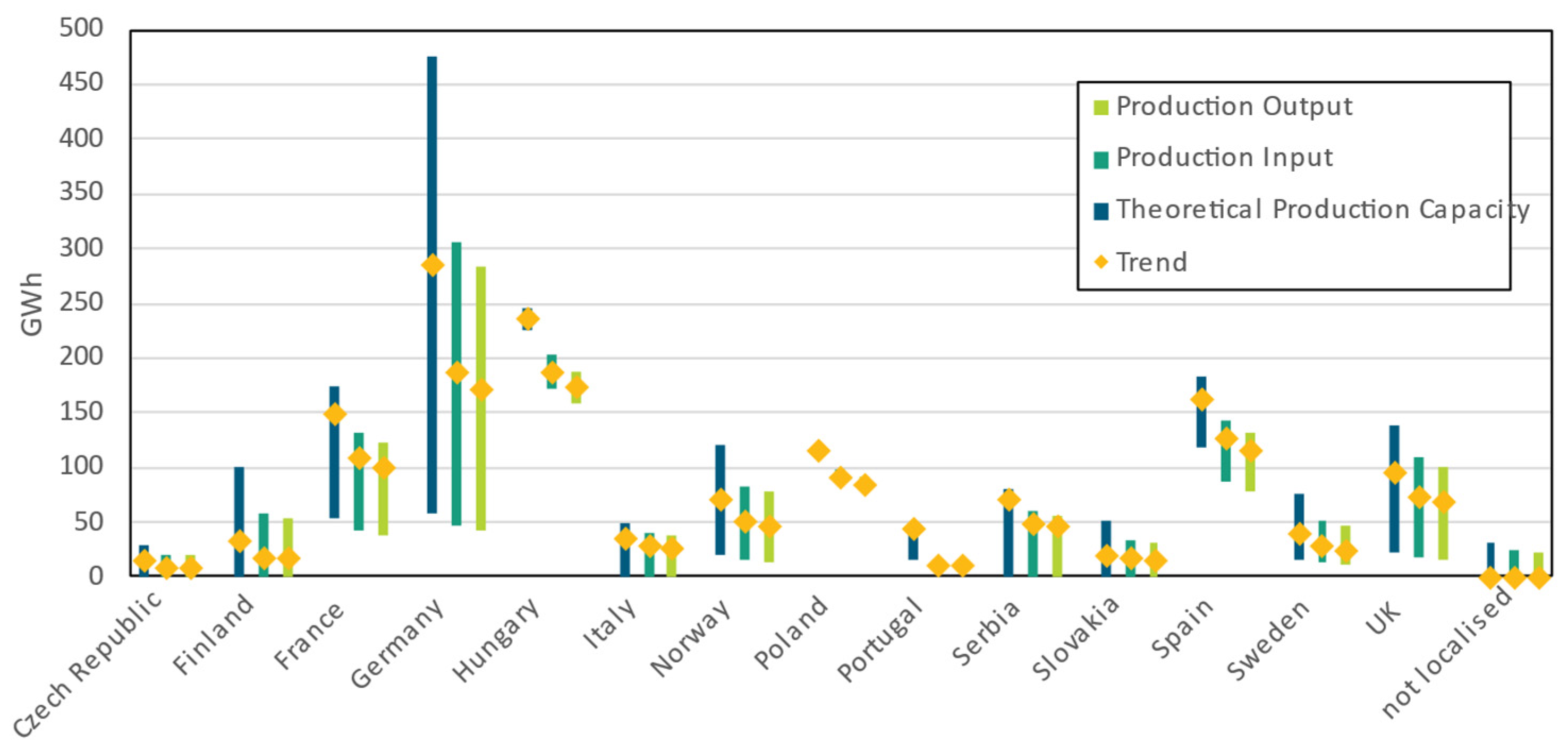
In addition to the theoretical production capacities, shown in Figure 1 for 2030, the production input and the production output (see definition in Section 2.2) are required as a basis for further macro-economic and ecological analyses. The three corresponding values for 2030 for individual countries are shown in Figure 2. The broad scenario range in Germany reflects the uncertainty of many projects, while the very narrow distribution in Hungary and Poland shows the concrete plans of established companies in the country (some of which have already been completed).

3.2. Raw Materials

A large number of raw materials are required for battery production. Due to the geographical distribution of raw materials and the associated discussions about reliable access, critical raw materials such as nickel, cobalt, lithium, and graphite are repeatedly the focus of attention. This is one reason why regulations governing the origin of such materials have also been introduced at the European level [41].
As a result of the forecasting model, the raw material demand for battery cell production in Europe is expected to increase nearly sixfold between 2025 and 2030. The demand for lithium and graphite is increasing over the years, almost proportionally to the forecast production input volume, from 14 kt (lithium, or 74 kt LCE) and 106 kt (graphite) in 2025 to 47–133 kt (lithium, or 249–705 kt LCE) and 386–1080 kt (graphite) in 2030. Compared to the 105 to 325 kt of European LCE production forecast in Xia et al. [42] for 2030, this means that dependence on imports for this raw material will remain high.
The situation for manganese, cobalt, nickel, iron, and phosphate is somewhat more decoupled from the growth of projected production input. On the one hand, demand is shifting between the materials due to a transition between different NMC chemistries, and on the other hand, due to an overall transition from NMC to LFP production. Nickel demand will rise from 83 kt to 223–640 kt until 2030. With only limited European LFP cell production in 2025, demand for phosphate will be 6 kt. By 2030, it will rise to 50–139 kt. Demand for cobalt in 2025 will be 7 kt. By 2030, it will rise to around 20–57 kt. Again, although there are some activities for European cobalt mining underway [43,44], the projected outputs will stay below demand.
There are differences between countries, which also result from the choice of cell chemistry and the overall scale of cell production capacities. In Germany, NMC projects are predominantly planned or in operation, meaning that demand is particularly high for nickel. The situation is similar in Poland with the factories of Korean manufacturers, which primarily produce high-Ni cells. In Hungary, the focus has been on NMC so far, but from 2025 onwards, more and more LFP cells are likely to be produced. The situation is similar in Spain, where, for example, the joint venture between Stellantis and CATL is planning larger capacities for LFP. Based on Northvolt’s technology stack to date, NMC cells are likely to continue to be produced there even after the takeover by Lyten. In neighbouring Norway, several start-ups are planning to produce sustainable batteries with a focus on LFP. Due to the risk estimation associated with scaling by start-ups, the difference between the minimum and maximum scenarios is rather pronounced.
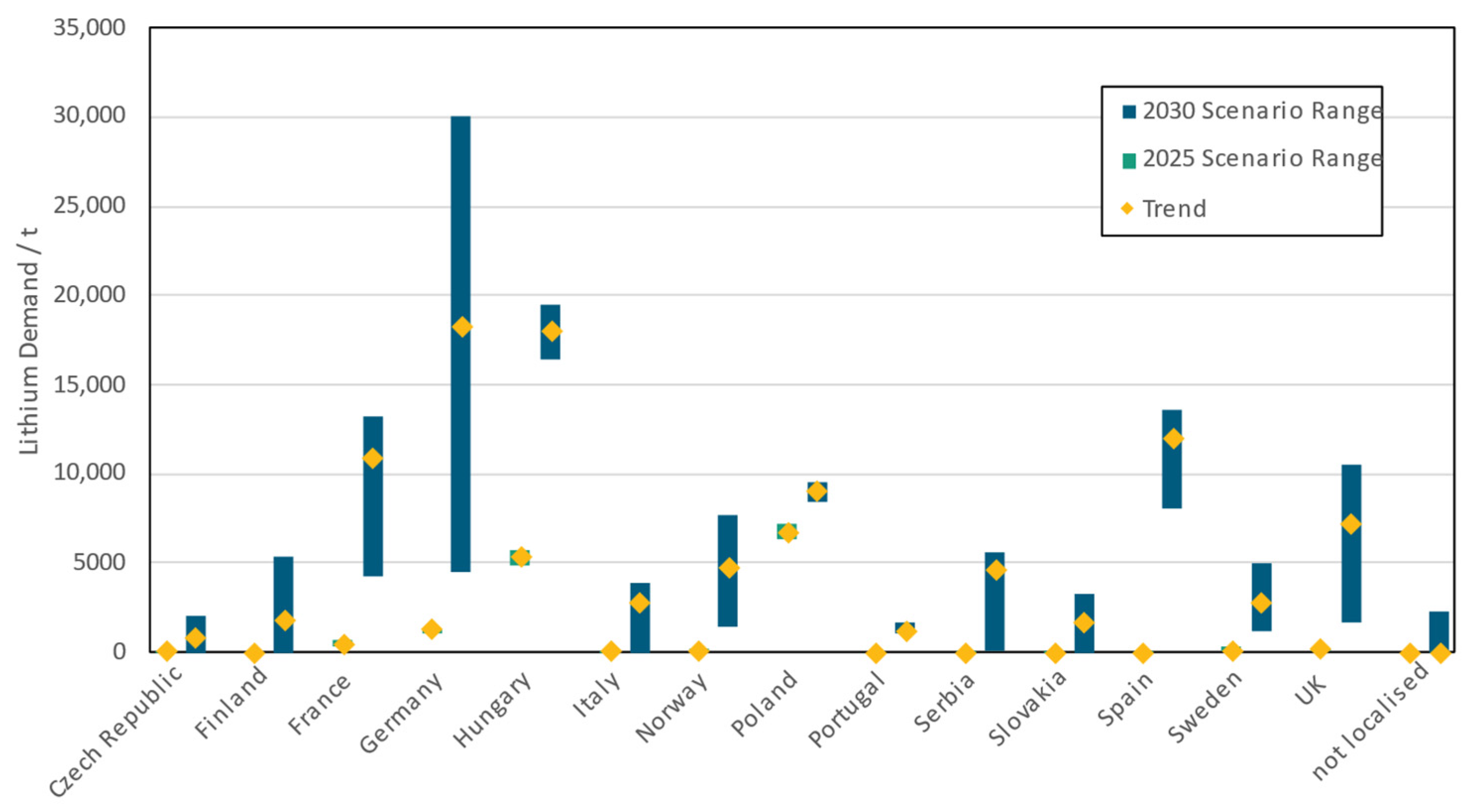
The demand for lithium by country of cell production project is shown in Figure 3. In the maximum scenario, Germany continues to stand out (up to 30 kt in 2030), while in the minimum scenario, Hungary (16 kt in 2030) is likely to take the lead due to projects already underway and further announcements with a high probability of implementation, followed by Spain (12 kt) and Poland (9 kt). Lithium mining projects have been announced in Spain and Germany in particular, but also in France, Serbia, Portugal, and the United Kingdom, among others [42]. Depending on the speed at which mining (optimistic/fast) and cell production (minimum, slow) are expanded, the countries mentioned could achieve self-sufficiency in lithium by 2030, at least if we look solely at the unrefined raw material.
The range of scenarios shown results solely from the volume of the “production input” (base values B). Uncertainties in the choice of cell chemistry are not modelled. Since many of the cathode materials used today have a similarly high energy density per Li atom used, changes in cell chemistry are likely to have only a minor impact on the predicted Li demand. The situation is different for the demand for Ni, Co, and Mn, for example. The uncertainty is particularly high for Co, as the Co content in NMC varies between 20% and 5% in mid-Ni, high-Ni, and ultra-high-Ni (>90%) variants, i.e., by a factor of four. These chemistry-related uncertainties should be taken into account when interpreting our results for the Co demand of European projects.
The demand forecast for other battery raw materials can be found in the Supplementary Materials (Figures S1–S4).

3.3. Energy Demand and CO2 Emissions

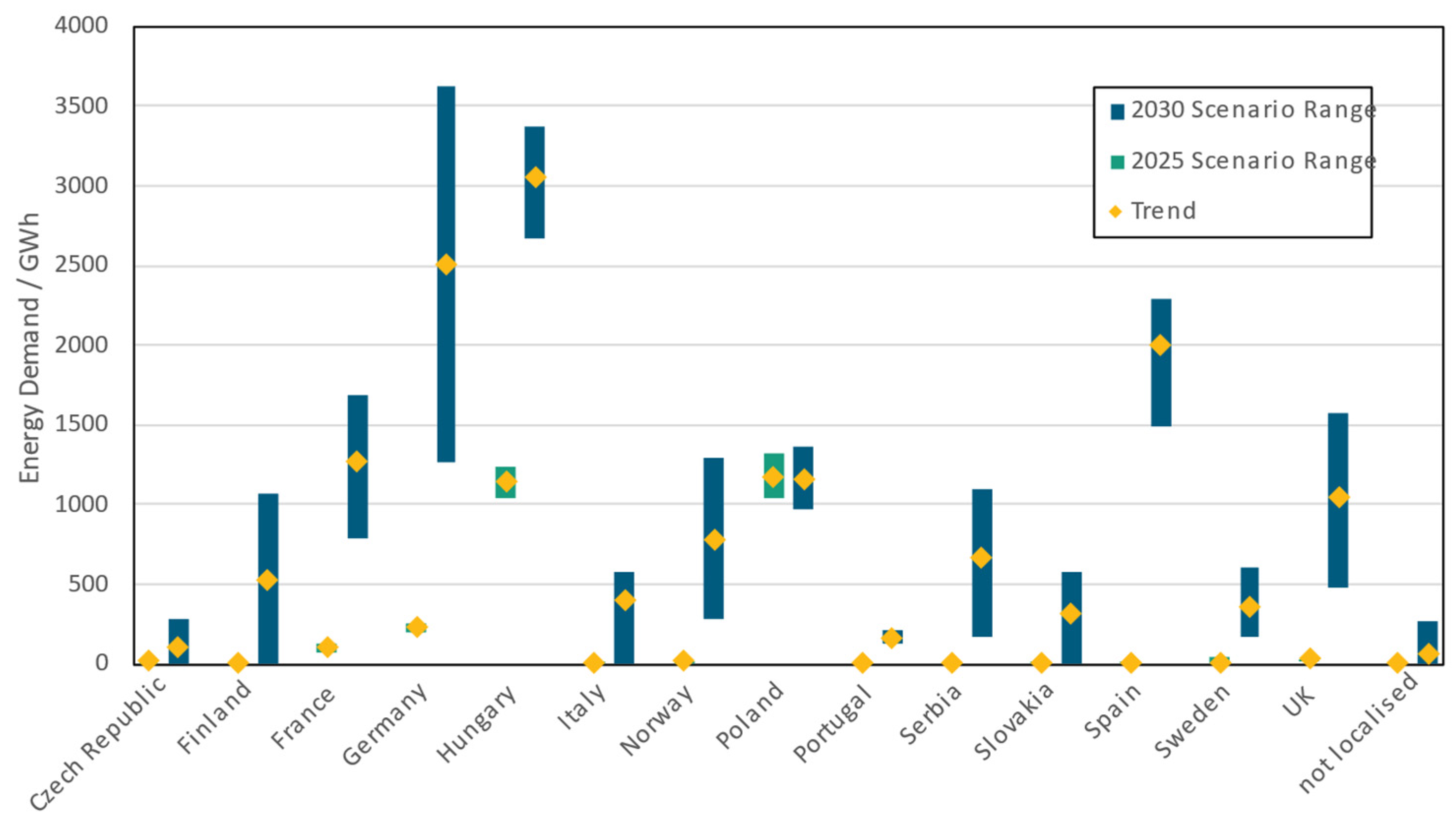
Based on the energy consumption figures from Degen et al. [12] in combination with the ramp-up figures for production input from the risk assessment, an average energy demand of 20.7 kWh will be required per kWh battery produced in Europe in 2025. By 2030, the value will decrease by more than 20% to around 15.6 kWh/kWh. The decrease is caused by the energy savings of the production process, higher energy densities of battery cells, and scaling [12], but is slightly slowed down by the increasing expansion of LFP production capacities. The energy consumption per kWh produced differs between European countries because of the different mix of cell chemistries produced. It varies by over 40% between Norway and Poland in 2030, with Norway as an LFP production hotspot and Poland with an established large-scale battery cell production with (still) high nickel content. However, it is uncertain whether LFP will also be produced in the future in the LGES gigafactory in Poland. In Europe, around 8.4 to 19.9 TWh of energy is potentially required with the predicted production input in 2030. Due to the production capacities, a lot of energy could be consumed by cell production in Hungary (2.7 to 3.4 TWh by 2030) as well as in Germany (approximately 1.3 to 3.6 TWh in 2030).
Compared to the total national energy consumption, however, energy consumption for cell production will be below 0.2 percent for most European countries (Figure 4). This is particularly the case in the larger industrialised nations such as Germany, France, the UK, Italy, and Spain. Hungary (1.4% by 2030), Serbia (0.4% by 2030), and Norway (0.3% by 2030) have somewhat higher shares. The figure is provided in the Supplementary Materials, Figure S5. In Hungary in particular, the trend scenario shows a significant increase from around 0.5% in 2025. This can be explained by the combination of increased cell production and simultaneous country-level reduction targets for total energy consumption.
In some cell production process steps, both natural gas and electricity can be used to generate heat. Due to the increasing use of heat pumps, for example, the proportion of natural gas use may decrease over the coming years [12]. By 2030, the share of electricity as an energy carrier used in cell production will be around 60%, rising from about 53% in 2025. For this reason, a total of around 5.0 to 12.0 TWh of electricity will be required for the cells potentially produced in 2030. In addition to that, 3.4 to 7.9 TWh of energy could be generated from natural gas. The corresponding electricity and gas demand account for different proportions of the total demand in the individual countries.
Electricity consumption in Hungary will be particularly high in 2030 (3.1–4.0% of the country’s total electricity consumption). In addition, the maximum scenario in Serbia (1.7%) and Slovakia (1.3%) reaches values over 1%. For other European countries, this value is well below 1%. Scandinavian countries in particular stand out in terms of gas consumption. Cell production in Sweden would account for approximately 0.9 to 3.3% of the country’s total gas demand in 2030. Additionally, countries such as Finland (maximum 3.0%) and Norway (maximum 1.0%) have high shares—much higher than the corresponding share of electricity consumption. A country-specific chart with absolute numbers as well as shares of national demand can be found in the Supplementary Materials (Figures S6–S9).
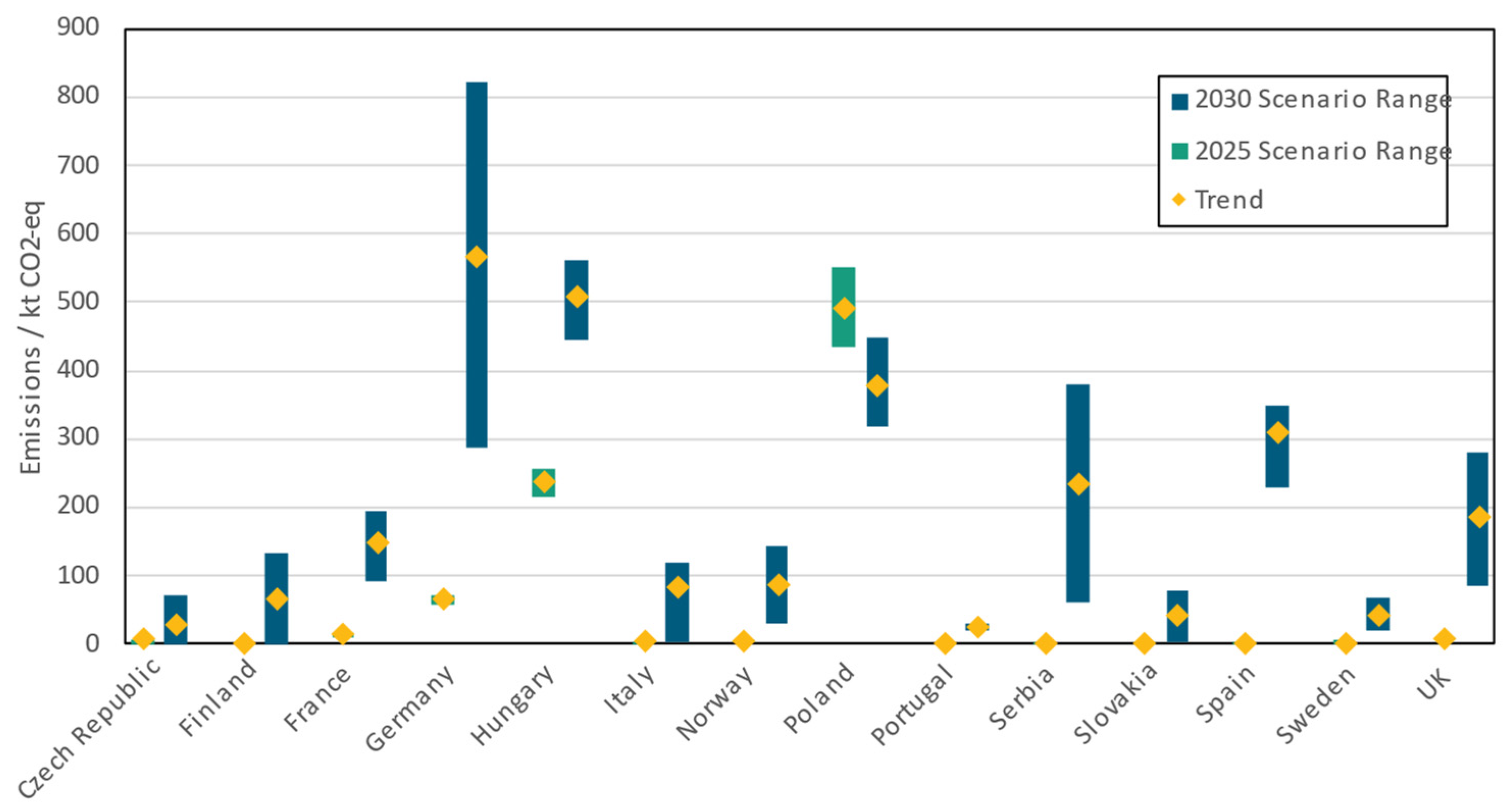
European CO2 emissions from cell production could reach 1.6 to 3.7 million tonnes (Mt) of CO2-eq until 2030. The average CO2 emissions from cell production vary between countries due to the country-specific emissions of the electricity production. For example, they are low in Scandinavia due to the high share of renewable electricity, and in France, due to electricity from nuclear power. Emissions per kWh produced are higher in Eastern Europe due to large shares of coal in the energy mix. Differences in 2030 amount to up to a factor of four in some cases, e.g., between Sweden (1.4 kg CO2-eq/kWh) and Serbia (6.2 kg CO2-eq/kWh). Poland, currently a very important production location in Europe, will also have relatively high emission factors in 2030 (4.1 kg CO2-eq/kWh). On average, around 2.8 kg CO2-eq/kWh emissions can arise from the energy consumption of cell production in Europe in 2030. Emissions of cell production can be reduced by over 50% in some countries by the end of the decade by optimising energy consumption, scaling, and reducing the CO2 emissions for electricity production.
The emission multiplier for electricity generation in Germany is in the European mid-range. With the comparatively large forecast for cell production input in Germany, the projected emissions are between 287 to 822 kt of CO2-eq in 2030. In line with EU targets for a reduction in CO2 emissions in electricity production in general [14], the emission multiplier for electricity in Poland is expected to fall in the coming years. Due to the low projected expansion of cell production, the total emissions of the battery cell industry could even decline by 2030 (488 kt to 376 kt in the trend scenario). The emission shares of cell production in the total national emissions are low in the largest European countries (Germany, France, and the UK). In Hungary, this share of cell production may reach around 1.0%, the highest value achieved in Europe. Country-specific absolute numbers of CO2 emissions are shown in Figure 5. The projected relative emissions can be found in the Supplementary Materials (Figure S10).

3.4. Production Scrap

Production scrap not only limits the high-quality production output and results in high costs, especially during the ramp-up of production facilities [45], but it also causes unnecessary energy consumption and emissions. Following our projections, the amount of scrap generated in Europe may accumulate to between 52 and 59 kt in 2025 and around 160 to 398 kt of production waste in 2030. Scrap is temporarily of high relevance, especially when a large production begins ramping up. However, it can be assumed that with increasing production experience, fewer rejects and less waste will be generated in the future.
The projected production rejects and scrap account for 0.7 to 1.6 TWh of the total energy demand in 2030, with between 128 and 298 kt CO2-eq in 2030.
The recycling of scrap has an impact on the circular economy and offers economic potential for the recycling industry. The reprocessing reduces the environmental impact of the battery and provides critical raw materials [46]. However, scrap values are in the single-digit percentage range, material losses occur during recycling [47], and there is a time delay until the material is recovered. With simultaneous capacity expansion, the supply of secondary raw materials from scrap in a closed material loop would be in the low single-digit percentage range. Partially deviating quotas may occur due to changes in cell chemistry. Due to the longer product life cycle, return quantities from used batteries will only increase significantly after 2030 [26].
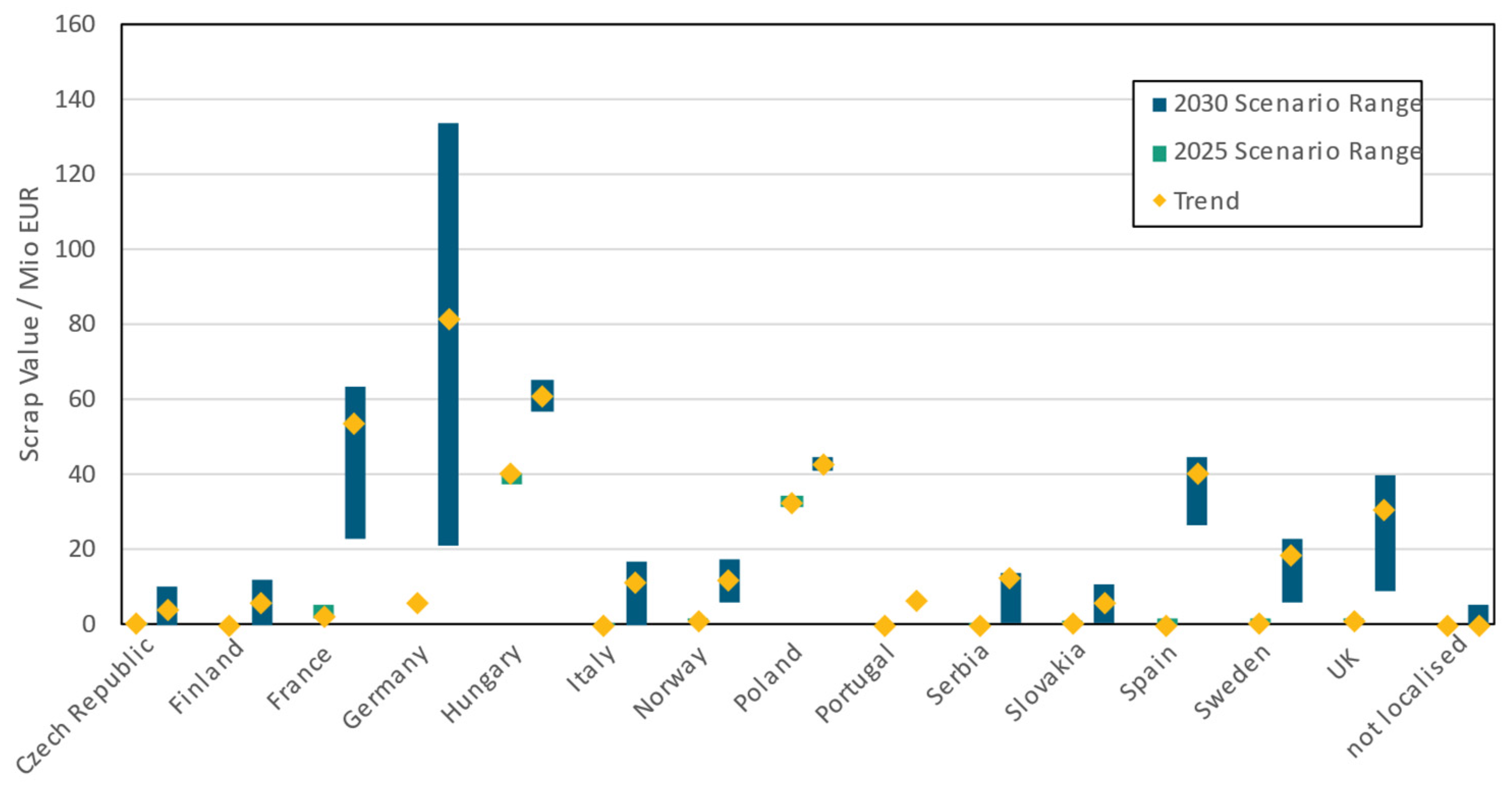
The monetary value of scrap, depending on whether it contains costly ternary cathode materials, can lead to significant revenue in the recycling industry, which we considered in terms of the economic value of black mass. Assuming today’s prices for black mass, the European black mass market may reach approximately 197 to 508 million euros in 2030. Rather than increasing linearly, the value of black mass for the various European countries depends on the timelines of the ramp-ups, as shown in Figure 6 for 2025 and 2030. While black mass material streams are currently still mainly exported [48], in the medium term, profitable black mass processing could, due to the increasing amount of production scrap, become established in Europe [26].

3.5. Investments and Battery Market Size

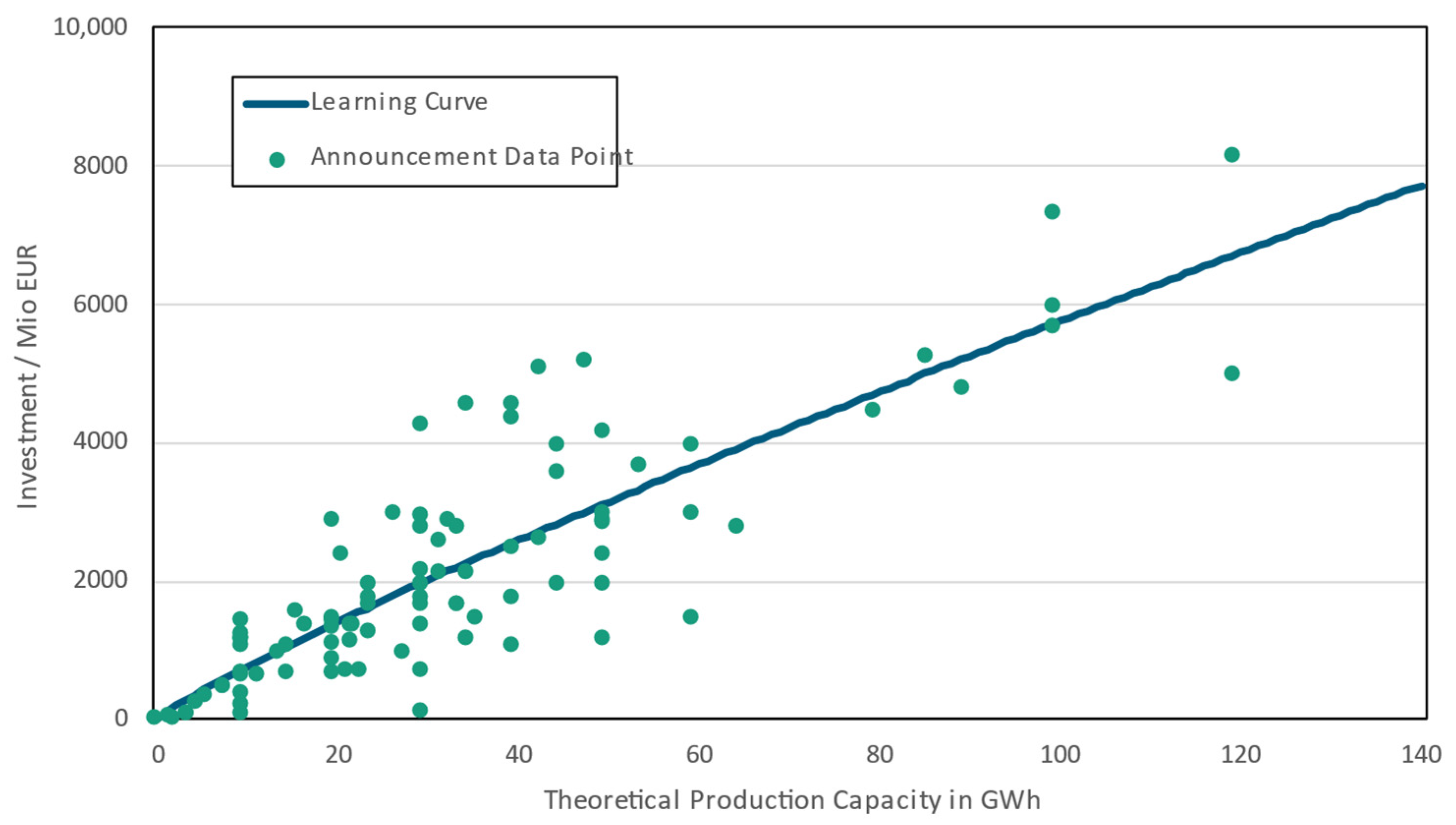
Establishing battery cell production requires high capital investment, not only for the local construction of gigafactories but also in the upstream and downstream infrastructure. The cost of erecting a gigafactory scales with its size, i.e., the production capacity achieved. The investment, with respect to the size of the gigafactory, follows the extended learning curve (see Section 2.6), with parameters a t r e n d = 95.85 ,     b t r e n d = 0.17 ,   a n d   c t r e n d = 13.14 (see Figure 7). The resulting R 2 value is 73%, indicating that the simple learning curve successfully captures the central scaling effect for the required investment with respect to the anticipated production capacity. However, numerous other parameters influence the investment cost, resulting in a significant variation among individual values.
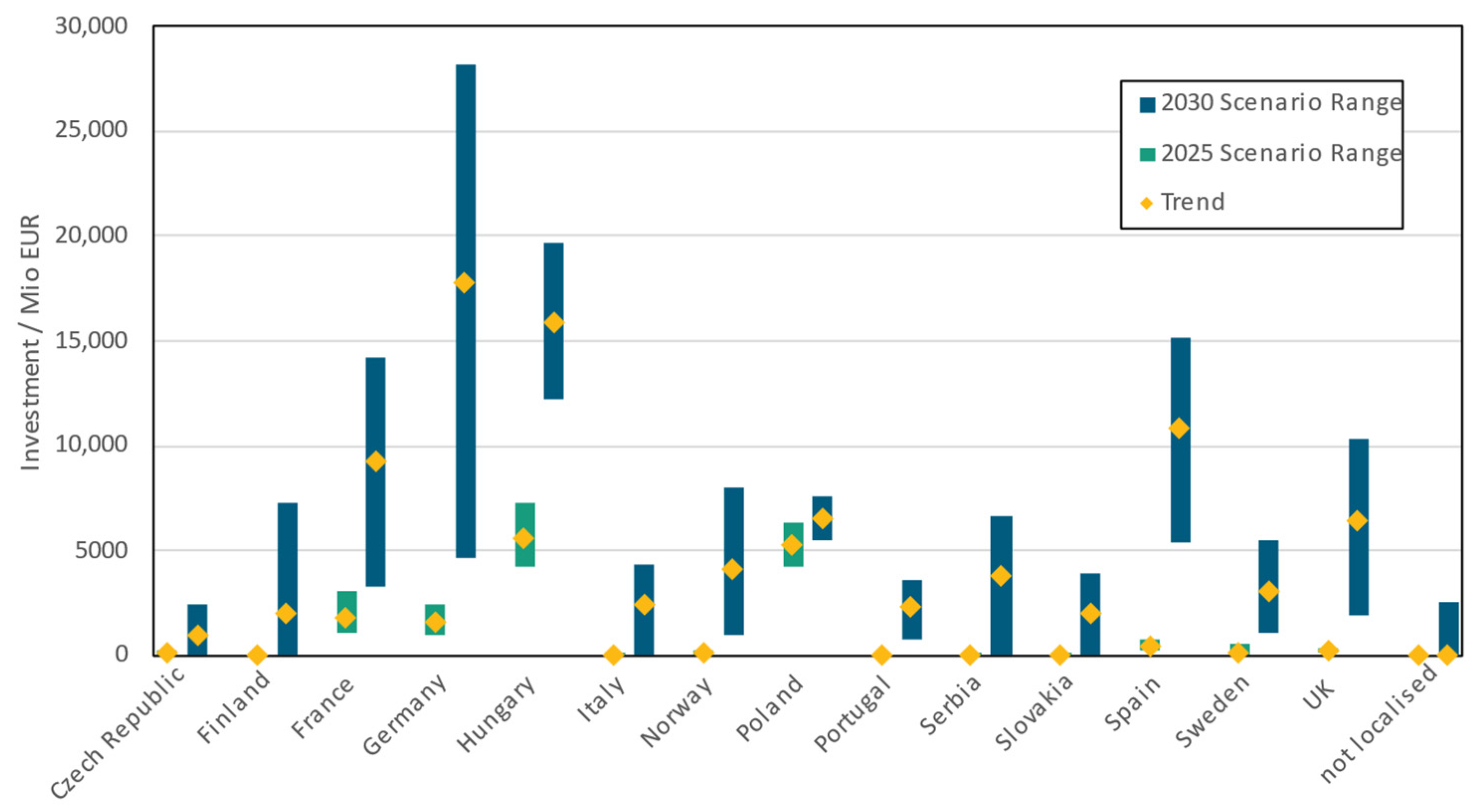
The direct investment costs in gigafactories per country vary due to the production capacity of the individual plants built in the country, e.g., in Poland, the required investment costs are relatively low compared with the theoretical production capacity, as there is only one large production facility from LGES (see Figure 8). In Germany, for example, 5 to 28 billion euros have to be invested in production facilities by 2030 according to the current forecast. In Hungary, this value is at least 12 billion euros. The total investment in European gigafactories will amount to a total of 11–22 billion euros by 2025 and around 36–139 billion euros by 2030.
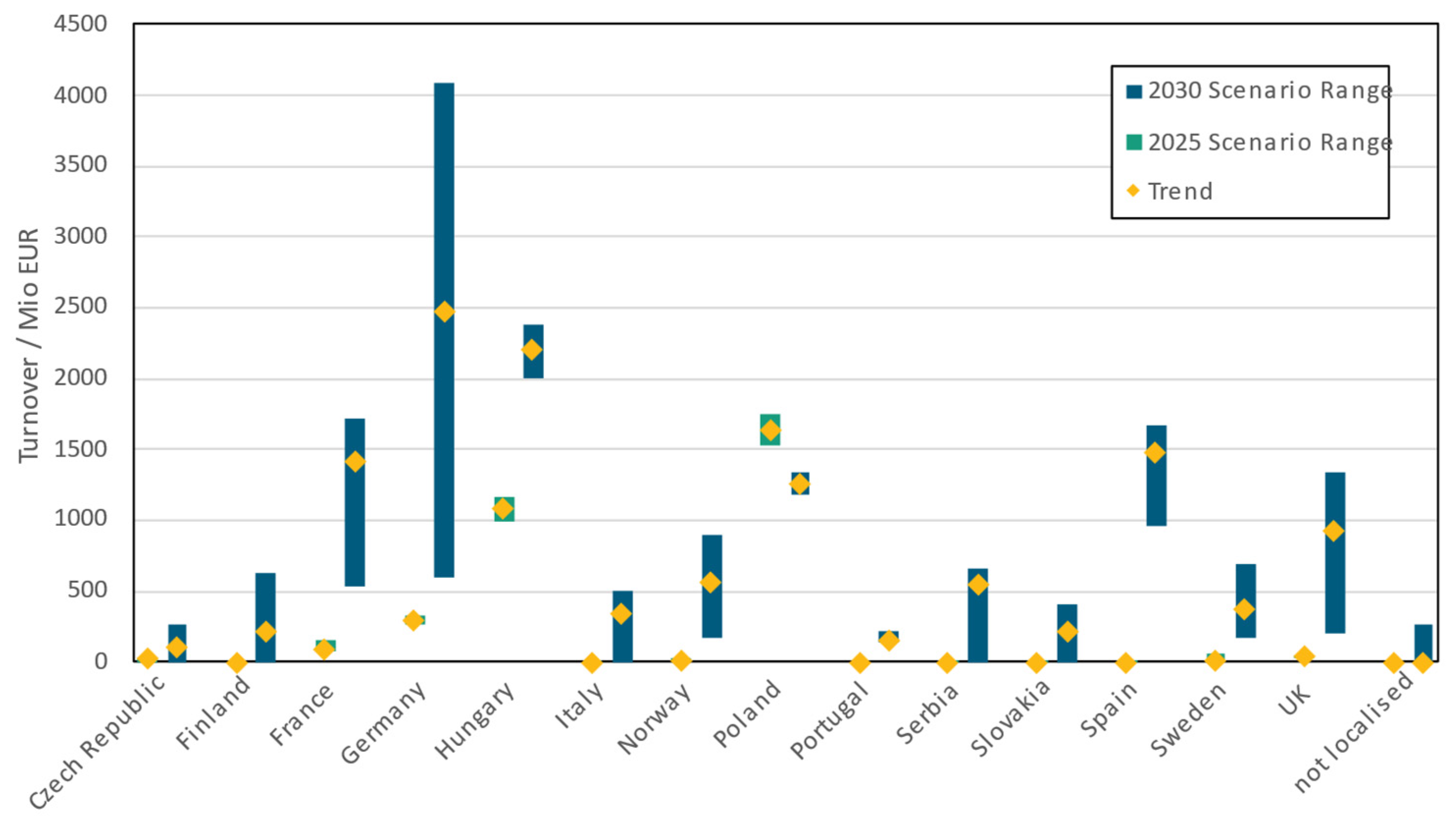
When the production capacity is multiplied by the chemistry-specific production costs, a total potential market volume of 2.9–3.6 billion euros in 2025 and 6–17 billion euros in 2030 is obtained for Europe. The corresponding market value of the cells is 11–13 billion euros in 2025 and 35–99 billion euros in 2030. The country-specific market size of the production is shown in Figure 9. Cell production revenues can be a relevant economic sector in Hungary (0.9% compared with GDP) and Serbia (around 0.4% compared with GDP) in particular. In Europe’s largest economies, such as Germany, the UK, or France, the market size compared with the GDP is below 0.1%. A country-specific chart can be found in the Supplementary Materials (Figure S11).

3.6. Job Effects

Building a battery cell industry in Europe creates a significant number of new jobs in the producing countries. The number of direct jobs created by running a gigafactory scales with its size according to the learning curve (see Section 2.7), with the fitting parameters a t r e n d = 364.07 ,   a n d   b t r e n d = 0.43 (Figure 10). The resulting R 2 value is 35%, indicating that the simple learning curve only captures the basic shape of the scaling effect for the required direct jobs. This low value and the large variation among individual values are likely due to different depths of value creation and different degrees of on-site R&D.
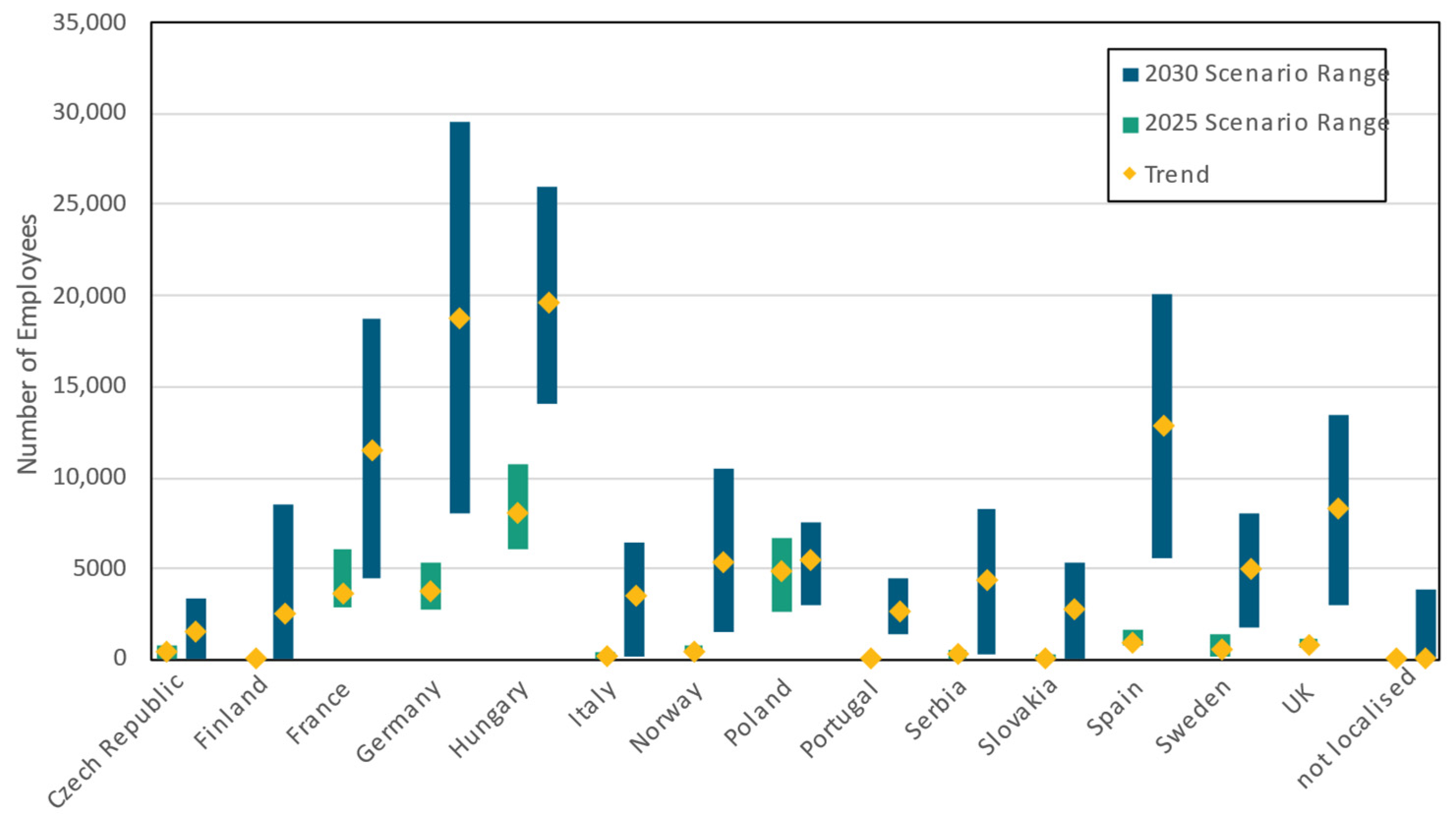
By 2025, between 16,000 and 36,000 jobs could be created directly in cell production in Europe. This figure will rise from 43,000 to 174,000 by 2030. The country-specific number of direct jobs in battery production is shown in Figure 11. The greatest worker demand may arise in Germany (approximately 8000–30,000) and Hungary (approximately 14,000–26,000). Measured against the absolute number of employees in European countries, however, the quotas for the battery industry are low and are mostly less than 0.1% of the nationwide employment. The maximum value could be reached in Hungary (up to 0.4%), followed by the Scandinavian countries, such as Norway, Finland, and Sweden (Figure S12 in the Supplementary Materials).

3.7. Literature Benchmarking

As described in the study by Wicke et al. [5], the forecast values for theoretical production capacity and production output are in line with the expectations of various analysts. The difficult framework conditions for establishing European battery production reduced the forecast for ramp-up, as described in Section 3.1. Older literature, therefore, tends to overestimate production capacity. The calculated ecological and economic indicators are, anyhow, based on literature values for conversion (see Section 2). However, there are differences in the values of different studies, especially for the energy consumption. The literature values range from over 250 kWh/kWh [49] to less than 50 kWh/kWh [12,50,51]. There are also differences in the assumed scrap values (which were already discussed in the previous study [5]). Due to the conversion based on known cell chemistries already available on the market, the evaluations for European raw material requirements are more in line and coincide with assumptions from this study [52,53]. The same applies to cell prices [4,29,30]. The literature values for investment costs in gigafactories of around EUR 100 million per GWh of annual production capacity are slightly above the announcement-based data points from the study [54,55]. The announcement-based direct job effects (Section 3.6) are within the range of 40–180 employees per GWh production per year, as calculated by Thielmann et al. [56].

3.8. Future Research Directions

The increasing trend towards cheaper LFP cell chemistries has the leverage to change the results of our study regarding resource consumption (especially energy and raw materials). Thus, the available information on the announced production projects needs to be continuously monitored and updated. This will allow for a future validation and refinement of the assumptions made.
The use of risk factors presented in the study by Wicke et al. [5] and the further development in this study serve as a framework for the estimation of economic and ecological indicators. It can be continually optimised and extended. One possible extension is to link the likelihood of implementation, and especially the upscaling for different production projects, to the battery demand. Demand ultimately acts as a powerful lever for the actual realisation of production projects. Cross-referencing the anticipated supply with the estimated future battery demand, as, for example, discussed in the study by Link et al. [57], would be a valuable future extension of this framework. In addition, the risk assessment for the ramp-up of production capacities can be transferred to the up- and downstream battery value chain or to other comparable industries (e.g., the manufacture of fuel cells).
At present, our analysis is limited to Europe. Since both the risk factors and the indicators were chosen to be universally applicable, they can be extended to other regions or globally. In addition to the project-related risk factors considered in our previous study [5], location factors such as (industrial) policy framework factors are particularly interesting when comparing regions such as Europe, the US, or China. Although there are differences in the policy frameworks of European countries, which form the basis of our study’s findings, the fundamental mechanisms are very similar. For all EU countries, the rules of the CISAF (Clean Industrial Deal State Aid Framework, successor to the TCTF) [58] apply as the main instrument for government CAPEX support for battery projects. Similarly, all projects on EU soil are eligible for funding from the EU Innovation Fund [59], which was equipped with EUR 1 billion in the last round. In addition, there are national or regional programmes that create differentiation between countries. Significantly greater differences exist in terms of both the mechanism and the programme volumes when looking at other regions of the world. Tax credits in the US provide billions of dollars in funding for both CAPEX and OPEX [60]. Although restricted by the current administration, the main instrument for promoting industry in the battery sector is loans from the US DOE budget [61]. In addition, there are local content regulations and tariffs, which represent further powerful industrial policy levers. In China, the white book-controlled market access regulations, among other things, are yet another approach [62]. As recent years have shown, changes in the political framework, such as the introduction of the Inflation Reduction Act in 2022 [63], can lead to massive shifts in investment flows and thus in the development of production capacities. When applying our methodology on a supraregional basis, the weighting of policy indicators in the risk assessment must certainly be increased. Likewise, logic must be implemented in the method whereby the failure of projects in one region may lead to the success of projects in others, and vice versa.

4. Conclusions

The growing European battery industry will have a significant influence on the country-specific industry landscape, particularly on Eastern European countries, such as Hungary, Serbia, and, in some indicators, Poland. In addition, individual economic and ecological indicators (such as natural gas consumption) could become significant in Scandinavia. In large industrial nations such as Germany, France, or Spain, the relative impact of the planned battery cell industry is slightly smaller. The calculations shown can provide valuable figures for important political and economically relevant topics currently under discussion. Often, they are related to, for example, sustainability and technological sovereignty.
Depending on the cell chemistries to be produced, the demand for raw materials scales with production input. Around 47–133 kt of lithium, 223–640 kt of nickel, and 386–1080 kt of graphite will be consumed in cell production in 2030. Phosphate (50–139 kt) might see a sharp future rise in demand due to the trend towards LFP. By contrast, demand for cobalt is rising much less significantly, to only 20–57 kt. A large proportion of this material will have to be imported, as significantly less of it is produced in Europe itself [64].
The energy demand of the battery industry based in Europe will increase to 8.4–19.9 TWh per year in 2030. Broken down to individual countries, this represents up to 1.4% of country-specific energy consumption. If there is no above-average substitution by heat pumps, natural gas consumption will increase due to cell production, particularly in Scandinavia. In terms of electrical energy consumption, the cell industry will add to the total energy demand, which is particularly noticeable in Hungary. Overall, the energy consumption required for cell production will be significantly lower than other branches of industry, such as the chemical industry [15].
The CO2 emissions emitted during production vary depending on the composition of the electricity mix. The CO2 emissions per kWh produced capacity in Scandinavian countries with a high proportion of renewable energies are only one-quarter of the Eastern European countries, where a lot of coal-fired electricity is still in the mix.
Production scrap has a relevant impact on the cost and environmental aspects during the ramp-up of cell manufacturing. We estimate 52–59 kt of scrap in 2025, rising to 160–398 kt of scraped material by 2030. In 2030, related impacts are 0.7–1.6 TWh of energy use and 128–298 kt CO2-eq. The economic value of scrap reaches hundreds of millions in several European countries and about 197–508 million euros across Europe by 2030.
Following our methodology, around 36–149 billion euros will be needed to build up the planned production projects until 2030. The cell production industry could reach a market size of 6 to 17 billion euros in 2030 and employ between 43,000 to 174,000 skilled workers. In comparison, this is only a fraction of the total number of people potentially working in the whole battery value chain with different upstream and downstream industries [56]. In larger industrial countries such as Germany, France, and Spain, the share of economic output and investment is low despite high production capacities in some cases. In contrast, the economic indicators have a reasonable impact in Hungary, in particular, and also in Serbia, at the end of the decade. The comparatively largest impact on the labour market is expected in Hungary, although cell production can also have a visible influence in Scandinavian countries. The impact on the labour market ranges up to 0.4% of total employment. In terms of the total GDP, it can reach lower single-digit percentages in individual cases, which again, is especially true in Hungary and Serbia.

Supplementary Materials

The following supporting information can be downloaded at: https://www.mdpi.com/article/10.3390/batteries11120457/s1, Figure S1: Projected nickel demand in the different scenarios in 2025 (green) and 2030 (blue); Figure S2: Projected phosphate demand in the different scenarios in 2025 (green) and 2030 (blue); Figure S3: Projected cobalt demand in the different scenarios in 2025 (green) and 2030 (blue); Figure S4: Projected graphite demand in the different scenarios in 2025 (green) and 2030 (blue); Figure S5: Share of primary energy demand for cell production compared to the primary energy demand of individual countries for 2025 (green) and 2030 (blue); Figure S6: Potential electric energy demand for 2025 (green) and 2030 (blue); Figure S7: Share of electric energy demand for cell production compared to the total electrical energy demand of individual countries for 2025 (green) and 2030 (blue); Figure S8: Potential natural gas energy demand for 2025 (green) and 2030 (blue); Figure S9: Share of natural gas demand for cell production compared to the natural gas demand of individual countries for 2025 (green) and 2030 (blue); Figure S10: Share of CO2 emissions for cell production compared to the total CO2 emissions of individual countries for 2025 (green) and 2030 (blue); Figure S11: Market size of cell production compared to the GDP of different countries for 2025 (green) and 2030 (blue); Figure S12: Share of workplaces for battery cells manufacturing compared to total number of employees of different countries for 2025 (green) and 2030 (blue).

Author Contributions

Conceptualization and methodology, T.W. and L.W.; programming and data analysis, L.W. and T.W.; writing—original draft preparation, T.W., L.W. and C.N.; writing—review and editing, L.W., C.N. and J.T.; visualization, T.W.; supervision, J.T. All authors have read and agreed to the published version of the manuscript.

Funding

This research was funded by the German Federal Ministry of Research, Technology, and Space (BMFTR), grant number 03XP0621A.

Data Availability Statement

The data presented in this study are partially available on request from the corresponding author. The data included in the databases are taken from public and non-public/commercial sources, restricting their publication.

Conflicts of Interest

The authors declare no conflicts of interest.

References

  1. Hettesheimer, T.; Neef, C.; Rosellón Inclán, I.; Link, S.; Schmaltz, T.; Schuckert, F.; Stephan, A.; Stephan, M.; Thielmann, A.; Weymann, L.; et al. Lithium-Ion Battery Roadmap—Industrialization Perspectives Toward 2030. 2023. Available online: https://www.isi.fraunhofer.de/content/dam/isi/dokumente/cct/2023/Fraunhofer-ISI_LIB-Roadmap-2023.pdf (accessed on 2 November 2025).
  2. Regulation (EU) 2024/1735 of the European Parliament and of the Council of 13 June 2024 on Establishing a Framework of Measures for Strengthening Europe’s Net-Zero Technology Manufacturing Ecosystem and Amending Regulation (EU) 2018/1724: Net Zero Industry Act (NZIA). 2024. Available online: https://eur-lex.europa.eu/eli/reg/2024/1735/oj/eng (accessed on 2 November 2025).
  3. Fraunhofer ISI. Meta-Markt-Monitoring. Available online: https://metamarketmonitoring.de/ (accessed on 2 November 2024).
  4. Möhrke, M.; Heiler, R.; Wirth, S.; Ross, H.; Wenhold, F.; Michaelis, S.; Rothhagen, B.; Wicke, T.; Blenk, T.; Pohlkamp, E. Battery Manufacturing 2030+: From Hype to Hard Truths. 2025. Available online: https://www.porsche-consulting.com/international/en/publication/battery-manufacturing-2030-hype-hard-truths (accessed on 30 November 2025).
  5. Wicke, T.; Weymann, L.; Neef, C.; Tübke, J. Forecasting Battery Cell Production in Europe: A Risk Assessment Model. Batteries 2025, 11, 76. [Google Scholar] [CrossRef]
  6. Mönning, A.; Schneemann, C.; Weber, E.; Zika, G.; Helmrich, R. Electromobility 2035: Economic and Labour Market Effects Through the Electrification of Powertrains in Passenger Cars. 2019. Available online: https://hdl.handle.net/10419/204855 (accessed on 2 November 2025).
  7. European Institute of Innovation & Technology. TÜV SÜD and EIT InnoEnergy Launch Partnership to Combat Skills Shortage in Battery Sector. Available online: https://www.eit.europa.eu/news-events/news/tuv-sud-and-eit-innoenergy-launch-partnership-combat-skills-shortage-battery (accessed on 2 November 2025).
  8. European Comission. Important Projects of Common European Interest (IPCEI). Available online: https://competition-policy.ec.europa.eu/state-aid/ipcei_en (accessed on 2 November 2025).
  9. Park, J.B.; Yu, J.Y.; Choi, M.H. Positive Electrode Active Material and Lithium Secondary Battery Comprising the Same. JP2022064841A, 10 August 2021. [Google Scholar]
  10. Zhao, J.; Zhu, W.; Zhang, L.; Wang, Y.; Liu, Y. High-Capacity Single Crystal Ternary Cathode Material and Preparation Method Thereof. CN114695875A, 29 December 2020. [Google Scholar]
  11. Blangero, M.; Jung, K.; Yun, B.-N.; Karakulina, O. Lithium Nickel Manganese Cobalt Composite Oxide as a Positive Electrode Active Material for Rechargeable Lithium Ion Batteries. WO2021001496A1, 2 July 2020. [Google Scholar]
  12. Degen, F.; Winter, M.; Bendig, D.; Tübke, J. Energy consumption of current and future production of lithium-ion and post lithium-ion battery cells. Nat. Energy 2023, 8, 1284–1295. [Google Scholar] [CrossRef]
  13. European Commission. EDGAR (Emissions Database for Global Atmospheric Research) Community GHG Database (A Collaboration Between the European Commission, Joint Research Centre (JRC), the International Energy Agency (IEA), and Comprising IEA-EDGAR CO2, EDGAR CH4, EDGAR N2O, EDGAR F-GASES version EDGAR_2024_GHG (2024); European Commission: Brussels, Belgium, 2024. [Google Scholar]
  14. European Environment Agency. Greenhouse Gas Emission Intensity of Electricity Generation in Europe. Available online: https://www.eea.europa.eu/en/analysis/indicators/greenhouse-gas-emission-intensity-of-1 (accessed on 2 November 2025).
  15. Eurostat. Simplified Energy Balances. 2025. Available online: https://doi.org/10.2908/NRG_BAL_S (accessed on 2 November 2025).
  16. Eurostat. Supply, Transformation and Consumption of Electricity. 2025. Available online: https://doi.org/10.2908/NRG_CB_E (accessed on 2 November 2025).
  17. Eurostat. Supply, Transformation and Consumption of Gas. 2025. Available online: https://doi.org/10.2908/NRG_CB_GAS (accessed on 2 November 2025).
  18. EMBER. Yearly Electricity Data. 2025. Available online: https://ember-energy.org/data/yearly-electricity-data/ (accessed on 2 November 2025).
  19. Energy Institute. Statistical Review of World Energy. 2025. Available online: https://www.energyinst.org/statistical-review (accessed on 2 November 2025).
  20. European Environment Agency. Primary and Final Energy Consumption in the European Union. Available online: https://www.eea.europa.eu/en/analysis/indicators/primary-and-final-energy-consumption (accessed on 2 November 2025).
  21. International Energy Agency. Electricity 2024: Analysis and Forecast to 2026. 2024. Available online: https://www.iea.org/reports/electricity-2024/executive-summary (accessed on 2 November 2025).
  22. Matthes, F.C.; Rausch, L. Natural Gas Demand Outlook to 2050. 2023. Available online: https://www.deloitte.com/content/dam/assets-zone2/de/de/docs/about/2024/Natural_Gas_Demand_Outlook_to_2050_Deloitte_%C3%96ko-Institut.pdf (accessed on 2 November 2025).
  23. European Council. ‘Fit for 55’: Council Adopts Key Pieces of Legislation Delivering on 2030 Climate Targets. Available online: https://www.consilium.europa.eu/en/press/press-releases/2023/04/25/fit-for-55-council-adopts-key-pieces-of-legislation-delivering-on-2030-climate-targets/ (accessed on 2 November 2025).
  24. Schmaltz, T. Recycling of Lithium-Ion Batteries Will Increase Strongly in Europe: Quantity Scenarios of Lithium-Ion Batteries for Recycling and Their Origin. Available online: https://www.isi.fraunhofer.de/en/blog/themen/batterie-update/recycling-lithium-ionen-batterien-europa-starke-zunahme-2030-2040.html (accessed on 3 November 2025).
  25. Shanghai Metal Market. Used Lithium-Ion Battery Prices. Available online: https://www.metal.com/en/markets/45 (accessed on 16 October 2025).
  26. Stephan, M. Recycling Capacities for Lithium-Ion Batteries Will Exceed Demand in Europe for the Time Being. Available online: https://www.isi.fraunhofer.de/en/blog/themen/batterie-update/batterie-recycling_europa_kapazitaeten_bedarf_update_2025.html (accessed on 3 November 2025).
  27. Wright, T.P. Factors Affecting the Cost of Airplanes. J. Aeronaut. Sci. 1936, 3, 122–128. [Google Scholar] [CrossRef]
  28. Arrow, K.J. The Economic Implications of Learning by Doing. Rev. Econ. Stud. 1962, 29, 155. [Google Scholar] [CrossRef]
  29. Bernhart, W. Battery Cost Reduction: A Crucial Strategy for Automotive OEMs Facing Profitability Challenges and Rising Chinese Competition. In Proceedings of the AABC Europe, Mainz, Germany, 26 June 2025. [Google Scholar]
  30. Goldman Sachs. Electric Vehicle Battery Prices are Expected to Fall Almost 50% by 2026. Available online: https://www.goldmansachs.com/insights/articles/electric-vehicle-battery-prices-are-expected-to-fall-almost-50-percent-by-2025 (accessed on 12 November 2025).
  31. Eurostat. Investment by Institutional Sectors. 2025. Available online: https://doi.org/10.2908/TEC00132 (accessed on 29 May 2025).
  32. International Monetary Fund. GDP, Current Prices. Available online: https://www.imf.org/external/datamapper/NGDPD@WEO/GBR?zoom=GBR&highlight=GBR (accessed on 14 July 2025).
  33. OECD. Real GDP Long-Term Forecast. Available online: https://www.oecd.org/en/data/indicators/real-gdp-long-term-forecast.html (accessed on 29 July 2025).
  34. International Monetary Fund. World Economic Outlook Database. 2024. Available online: https://www.imf.org/en/Publications/WEO/weo-database/2024/October (accessed on 25 July 2025).
  35. Eurostat. Employment, Domestic Concept—Total. 2025. Available online: https://doi.org/10.2908/TEC00112 (accessed on 2 November 2025).
  36. Office for National Statistics. Number of People in Employment (Aged 16 and Over, Seasonally Adjusted). Available online: https://www.ons.gov.uk/employmentandlabourmarket/peopleinwork/employmentandemployeetypes/timeseries/mgrz/lms (accessed on 25 July 2025).
  37. Cedefop. Future Employment Growth. Available online: https://www.cedefop.europa.eu/en/tools/skills-intelligence/future-employment-growth?country=EU27&year=2022-2035#1 (accessed on 26 July 2025).
  38. Northvolt. Northvolt Files for Bankruptcy in Sweden. Available online: https://northvolt.com/articles/northvolt-files-for-bankruptcy-in-sweden/ (accessed on 3 November 2025).
  39. Amann, C. Porsche Scraps Battery Production Plans at Cellforce Unit. Available online: https://www.reuters.com/business/autos-transportation/porsche-scraps-battery-production-plans-cellforce-unit-2025-08-25/ (accessed on 3 November 2025).
  40. Wicke, T.; Weymann, L.; Neef, C. Forecasting the Ramp-Up of Battery Cell Production in Europe: A Risk Assessment Model. Available online: https://www.isi.fraunhofer.de/en/blog/themen/batterie-update/batterie-zell-produktion-europa-hochlauf-risiko-bewertung-gescheiterte-projekte.html (accessed on 3 November 2025).
  41. European Comission. Critical Raw Materials. Available online: https://single-market-economy.ec.europa.eu/sectors/raw-materials/areas-specific-interest/critical-raw-materials_en (accessed on 3 November 2025).
  42. Xia, Q.; Månberger, A.; Du, D. Long on expectations, short on supply: Regional lithium imbalances and the effects of trade allocations by China, the EU, and the USA. Cell Rep. Sustain. 2025, 2, 100404. [Google Scholar] [CrossRef]
  43. Konnunaho, J.; Eilu, P.; Törmänen, T.; Karinen, T.; Ranta, J.-P.; Rasilainen, K.; Nykänen, V.; Pokki, J.; Dehaine, Q. A mining industry overview of cobalt in Finland: Exploration, deposits and utilization. Geoenergy 2023, 1. [Google Scholar] [CrossRef]
  44. Finncobalt. Hautalampi Cu-Ni-Co-Mine Project, Finland. Available online: https://www.finncobalt.com/wp-content/uploads/2024/09/FinnCobalt_September_2024_EN.pdf (accessed on 2 November 2025).
  45. Dahmen, C.; Degen, F.; Eckstein, M.C.; Pouls, K.B.; Walter, H.; Ludwigs, R.; Scheibe, A. Mastering Ramp-Up of Battery Production; Fraunhofer Research Institution for Battery Cell Production FFB: Münster, Germany, 2024. [Google Scholar]
  46. Yu, L.; Bai, Y.; Polzin, B.; Belharouak, I. Unlocking the value of recycling scrap from Li-ion battery manufacturing: Challenges and outlook. J. Power Sources 2024, 593, 233955. [Google Scholar] [CrossRef]
  47. Ma, X.; Meng, Z.; Bellonia, M.V.; Spangenberger, J.; Harper, G.; Gratz, E.; Olivetti, E.; Arsenault, R.; Wang, Y. The evolution of lithium-ion battery recycling. Nat. Rev. Clean Technol. 2025, 1, 75–94. [Google Scholar] [CrossRef]
  48. Gherasim, D.-P.; Michel, T. Europe’s Black Mass Evasion: From Black Box to Strategic Recycling. 2024. Available online: https://www.ifri.org/sites/default/files/2024-12/ifri_gherasim_et_michel_black_mass_december24.pdf (accessed on 3 November 2025).
  49. Ellingsen, L.A.-W.; Majeau-Bettez, G.; Singh, B.; Srivastava, A.K.; Valøen, L.O.; Strømman, A.H. Life Cycle Assessment of a Lithium-Ion Battery Vehicle Pack. J. Ind. Ecol. 2014, 18, 113–124. [Google Scholar] [CrossRef]
  50. Knehr, K.; Kubal, J.; Nelson, P.; Ahmed, S. Battery Performance and Cost Modeling for Electric-Drive Vehicles (A Manual for BatPaC v5.0); Argonne National Lab.: Argonne, IL, USA, 2022. [Google Scholar]
  51. Degen, F.; Schütte, M. Life cycle assessment of the energy consumption and GHG emissions of state-of-the-art automotive battery cell production. J. Clean. Prod. 2022, 330, 129798. [Google Scholar] [CrossRef]
  52. Di Vincenzo, J.; Bornamehr, B.; Baur, C.; Ferstl, F.; Hackmann, M. Localised Battery Value Chains in Europe—How Strong Is the Announced Political Support? 2025. Available online: https://www.p3-group.com/wp-content/uploads/2024/06/P3-Whitepaper-Battery-Value-Chains-Europe.pdf (accessed on 3 December 2025).
  53. Bünting, A.; Sprung, C.; Dietrich, F.; Bierau-Delpont, F.; Vorholt, F.; Gieschen, J.-H.; Kowal, J.; Marscheider, J.; Zehbe, K.; Trunk, M.; et al. Resilient Supply Chains in the Battery Industry. 2023. Available online: https://www.ipcei-batteries.eu/fileadmin/Images/accompanying-research/publications/2023-03-BZF_Studie_Lieferketten-ENG.pdf (accessed on 3 December 2025).
  54. Racu, A.; Polisconva, J. An Industrial Blueprint for Batteries in Europe: How Europe Can Successfully Build a Sustainable Battery Value Chain. 2024. Available online: https://www.transportenvironment.org/uploads/files/An-industrial-blueprint-for-batteries-in-Europe-How-Europe-can-successfully-build-a-sustainable-battery-value-chain.pdf (accessed on 3 December 2025).
  55. Kampker, A.; Heimes, H.; Dorn, B.; Offermans, C.; Frieges, M.; Wennemar, S.; Neb, D.; Kisseler, N.; Drescher, M.; Gorsch, J.; et al. Battery Monitor 2023: The Value Chain Between Economy and Ecology; Roland Berger GmbH: Munich, Germany, 2023. [Google Scholar]
  56. Thielmann, A.; Neef, C.; Hettesheimer, T.; Ahlbrecht, K.; Ebert, S. Future Expert Needs in the Battery Sector; EIT RawMaterials GmbH: Berlin, Germany, 2021. [Google Scholar]
  57. Link, S.; Schneider, L.; Stephan, A.; Weymann, L.; Plötz, P. Feasibility of meeting future battery demand via domestic cell production in Europe. Nat. Energy 2025, 10, 526–534. [Google Scholar] [CrossRef]
  58. Communication from the Commission: Framework for State Aid Measures to Support the Clean Industrial Deal (Clean Industrial Deal State Aid Framework). 2025. Available online: https://eur-lex.europa.eu/eli/C/2025/3602/oj/eng (accessed on 2 November 2025).
  59. IF24 Battery Cell. 2024. Available online: https://climate.ec.europa.eu/eu-action/eu-funding-climate-action/innovation-fund/calls-proposals/if24-battery-call_en (accessed on 2 November 2025).
  60. Section 45X Advanced Manufacturing Production Credit. 2023. Available online: https://www.federalregister.gov/documents/2023/12/15/2023-27498/section-45x-advanced-manufacturing-production-credit (accessed on 2 November 2025).
  61. Beams, M.; Subrahmanian, A. Congress’s “One Big Beautiful Bill” Will Shrink Renewable Energy Investments—Yet Some Technologies Are Preserved. Available online: https://www.cfr.org/article/congresss-one-big-beautiful-bill-will-shrink-renewable-energy-investments-yet-some (accessed on 3 December 2025).
  62. Gong, H.; Hansen, T. The rise of China’s new energy vehicle lithium-ion battery industry: The coevolution of battery technological innovation systems and policies. Environ. Innov. Soc. Transit. 2023, 46, 100689. [Google Scholar] [CrossRef]
  63. Public Law 117–169, 2022. Available online: https://www.congress.gov/117/plaws/publ169/PLAW-117publ169.pdf (accessed on 3 November 2025).
  64. Dietert, J.; Mussehl, V.; Heiner, H. Available online: https://battery-news.de/en/europe-active-material/ (accessed on 3 November 2025).
Figure 1. Heatmap of country-specific theoretical production capacities in GWh until 2030. The darker the colour, the higher the theoretical production capacity.
Batteries 11 00457 g001
Figure 2. Theoretical production capacity (blue), production input (dark green), and production output (light green) for individual countries in Europe by 2030.
Batteries 11 00457 g002
Figure 3. Projected lithium demand in the different scenarios in 2025 (green) and 2030 (blue).
Batteries 11 00457 g003
Figure 4. Total energy demand for Europe’s battery production in 2025 (green) and 2030 (blue).
Batteries 11 00457 g004
Figure 5. CO2 emissions during cell production for 2025 (green) and 2030 (blue).
Batteries 11 00457 g005
Figure 6. Scrap value during the ramp-up and production for 2025 (green) as well as 2030 (blue).
Batteries 11 00457 g006
Figure 7. Scaling of the investment required for constructing battery cell production factories with respect to their size according to global announcements.
Batteries 11 00457 g007
Figure 8. Cumulative investment required for battery cell production facilities in individual countries, until 2025 (green) and 2030 (blue).
Batteries 11 00457 g008
Figure 9. Turnover of battery production for 2025 (green) and 2030 (blue).
Batteries 11 00457 g009
Figure 10. The scaling of the employees required for running a battery cell production factory with respect to its size, according to global announcements.
Batteries 11 00457 g010
Figure 11. Number of direct employees in gigafactories for 2025 (green) and 2030 (blue).
Batteries 11 00457 g011
Table 1. Mass fractions of different elements in three different cell chemistries.
Anode ED (Wh/kg)Cathode ED (Wh/kg)Li (g/kWh)Si (g/kWh)P (g/kWh)Mn (g/kWh)Co (g/kWh)Ni (g/kWh)Graphite (g/kWh)
Mid-Ni1195700103--21970473837
High-Ni14307329835-8550685664
LFP101750088-393---983
Table 2. Cell prices from European production of three cell chemistries.
2025 (EUR/kWh)2030 (EUR/kWh)
Mid-Ni8577
High-Ni9586
LFP6961
Disclaimer/Publisher’s Note: The statements, opinions and data contained in all publications are solely those of the individual author(s) and contributor(s) and not of MDPI and/or the editor(s). MDPI and/or the editor(s) disclaim responsibility for any injury to people or property resulting from any ideas, methods, instructions or products referred to in the content.