


Li-Ion Battery Recycling via High-Intensity Milling Followed by Organic Acid Leaching for Preferential Lithium Extraction

 ,
, 
Abstract
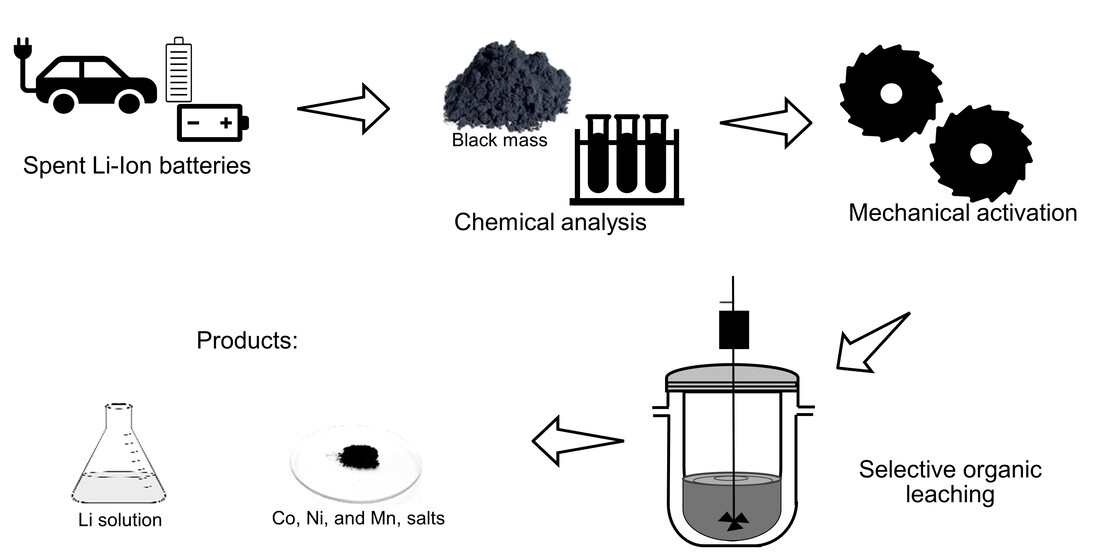
Share and Cite
Segura-Bailón, B.; Rouquette, L.; Vieceli, N.; Bogusz, K.; Moreau, C.; Petranikova, M. Li-Ion Battery Recycling via High-Intensity Milling Followed by Organic Acid Leaching for Preferential Lithium Extraction. Batteries 2025, 11, 458. https://doi.org/10.3390/batteries11120458
Segura-Bailón B, Rouquette L, Vieceli N, Bogusz K, Moreau C, Petranikova M. Li-Ion Battery Recycling via High-Intensity Milling Followed by Organic Acid Leaching for Preferential Lithium Extraction. Batteries. 2025; 11(12):458. https://doi.org/10.3390/batteries11120458
Chicago/Turabian StyleSegura-Bailón, Brenda, Léa Rouquette, Nathália Vieceli, Karolina Bogusz, Cécile Moreau, and Martina Petranikova. 2025. "Li-Ion Battery Recycling via High-Intensity Milling Followed by Organic Acid Leaching for Preferential Lithium Extraction" Batteries 11, no. 12: 458. https://doi.org/10.3390/batteries11120458
APA StyleSegura-Bailón, B., Rouquette, L., Vieceli, N., Bogusz, K., Moreau, C., & Petranikova, M. (2025). Li-Ion Battery Recycling via High-Intensity Milling Followed by Organic Acid Leaching for Preferential Lithium Extraction. Batteries, 11(12), 458. https://doi.org/10.3390/batteries11120458
