Abstract
While we are pursuing a fully electrified society, high-energy rechargeable batteries are undergoing intensive investigation. In this respect, atomic and molecular layer deposition (ALD and MLD) have been drawing increasing interest, due to their unmatched capabilities to precisely modify electrodes’ surfaces for better electrochemical performance. In this work, we reviewed the recent studies using ALD/MLD for interface engineering of several important electrode materials, including nickel (Ni)-rich metal oxide cathodes, silicon (Si), and lithium (Li) anodes in lithium-ion and lithium metal batteries. We particularly discussed the most promising coatings from these studies and explored the underlying mechanisms based on experiments and modeling. We anticipate that this work will inspire more studies using ALD/MLD as an important technique for securing new solutions for batteries.
1. Introduction
In an operating lithium-ion battery (LIB) cell, chemical and electrochemical interfaces play an important role in dictating the cell’s performance. Despite the tremendous progress and the state-of-the-art development made to date in the LIB industry, it is still necessary to advance our fundamental understanding of battery interfaces located between an electrode (anode or cathode) and an electrolyte, wherein the electrode/electrolyte interfaces are chemically and electrochemically active zones. On the cathode side, transition metal oxides (e.g., LiCoO2) often undergo electrolyte-driven surface reactions, including transition metal dissolution, oxygen release, oxidization of the electrolyte, and the formation of a cathode electrolyte interphase (CEI). On the anode (e.g., graphite and silicon) side, electrolytes are prone to being reduced with the formation of solid electrolyte interphase (SEI) with the consumption of Li inventory and the rapid increase in cell impedance. Without proper control over these interfaces, the cycling performance of LIBs will be limited, and the battery safety will eventually be compromised due to the out-of-control thermal runaway.
In the last few decades, it has been recognized that engineering interfaces with protective coatings can form stable artificial SEI and CEI layers on anodes and cathodes, respectively. As a result, the coatings could stabilize these interfaces through separating active electrodes from electrolytes, improve thermal stability, suppress uncontrolled exothermic thermal decomposition pathways of electrolytes, and thereby make LIBs safer under abuse, degraded, or fault conditions. Therefore, the surface coating has become an important strategy to apply a protective layer over anodes or cathodes for taming the unwanted parasitic reactions at an electrified interface between an electrode (an anode or a cathode) and an electrolyte. Thus, multiple methods have been investigated, e.g., wet chemistry, physical vapor deposition (PVD), and chemical vapor deposition (CVD). Their practices did generate lots of compelling outcomes, but also exposed their limitations. They all commonly lacked the capability to control surface coatings accurately. This is often critical for pursuing the best cell performance. In this context, atomic layer deposition (ALD) became a new tool for the surface coating of batteries and greatly advanced our fundamental knowledge and technical innovations in the past decade. As a novel thin-film synthesis technique, ALD has its unrivaled capabilities in multiple aspects: (1) high precision in film growth at the atomic level [], (2) extremely uniform film coverage over large-scale flat substrates [], (3) unmatched conformal coating over high-aspect-ratio substrates [], (4) moderate process temperature even down to room temperature [,]. So far, ALD is the only method that has been able to provide coatings over prefabricated electrodes while also can coat powder-based electrode materials []. All these unique features make ALD an irreplaceable tool for tackling the interfaces of LIBs and systems beyond LIBs. ALD is known for the growth of inorganic materials. As a supplement to ALD, furthermore, molecular layer deposition (MLD) is designed for organic materials and organic–inorganic hybrid materials growth []. ALD and MLD are based on the same operational principle but bear two different names. Recently, many more studies have used MLD methods to investigate battery interfaces. Inorganic coatings via ALD have been widely investigated as documented in the literature [,,]. Compared to inorganic coatings, organic coatings via MLD provide some extra benefits, such as their excellent elasticity and flexibility. They have a better ability to accommodate volume changes. In this respect, organic coatings show great potential to tackle issues facing Si and Li anodes, as will be discussed in this article. Through the deposition of coatings on anodes, cathodes, solid electrolytes, or separators, ALD and MLD offer precise control over interface engineering in LIBs and beyond. In contrast to conventional coatings that often yield non-uniform thickness or incomplete surface coverage, ALD/MLD coatings are highly controllable in their thickness while highly tunable in their composition. These benefits could minimize the interfacial impedance growth while protecting electrolytes from decomposition. These unique features make ALD/MLD particularly attractive in seeking new solutions to a series of promising electrode materials, such as nickel-rich oxide cathodes, lithium metal anodes, and Si-based anodes, where interfacial stability is critical.
In addition to providing a passivating protective coating at the electrode/electrolyte interface, ALD/MLD are also known to enable the design of functional interfaces. Based on well-selected precursors, for instance, ALD has deposited Li-conductive films [], such as LiNbO3 [], Li3PO4 [], LiAlO2 [], and LixAlyS []. Recently, we have developed several novel Li-conducting lithicones, including LiGL (GL = glycerol) [,], LiTEA (TEA = triethanolamine) [], and LiHQ (HQ = hydroquinone) []. These functional interfaces form artificial SEIs on Li-metal anodes, enhance mechanical robustness, provide an electronic insulation region, and facilitate Li-ion conductivity across the electrode’s interfaces. According to the reported literature, the tunability of ALD/MLD is far more versatile than conventional coating techniques. Moreover, ALD/MLD are now being scaled up through spatial and roll-to-roll technologies, bringing atomic/molecular precision to industrial electrode sheets. This scalability bridges the gap between laboratory breakthroughs and factory production, making ALD/MLD not only superior in improving battery performance but also increasingly feasible for commercial adoption. Thus, in recent years, the stability of ALD/MLD coatings at electrode/electrolyte interfaces has become an important strategy in the tunable engineered interface that helps in delivering the longer-lived and safer rechargeable lithium batteries.
The previous literature has found that the benefits of ALD/MLD coatings lie in multiple aspects [,]: (1) protecting electrolytes from decomposition, (2) mitigating transition metal dissolution of cathodes, (3) inhibiting SEI and CEI formation, (4) suppressing Li dendrite growth of Li anodes. Despite many advancements made to date, a comprehensive understanding and a systematic analysis remain lacking. To highlight these issues, the purpose of this work is to give an overview of the importance of ALD/MLD’s roles in two main categories: (1) ALD/MLD coatings over anodes and (2) ALD/MLD coatings over cathodes. To address the important basic science related to these unique interfaces, the fundamental studies and insights will be addressed based on the ALD/MLD growth, experimental characterization, and computational simulation. Following this section, in this review, we will present a brief discussion on ALD/MLD growth. In a subsequent section, we focus on discussing interface engineering via ALD/MLD. In the last section, we conclude this review by providing perspectives on future research directions.
2. The Principle and Growth Mechanism of ALD and MLD
2.1. The Basics of ALD and MLD
Very distinctly, ALD and MLD are vapor-phase processes proceeding film growth in a layer-by-layer mode. They divide an overall reaction into two or more gas–solid surface reactions, while each surface reaction is self-limiting. To better explain the operation principle and growth mechanism of both ALD and MLD, we illustrate their processes in Figure 1. Figure 1a illustrates the widely used ALD process of Al2O3 (alumina) using trimethylaluminum (TMA, Al(CH3)3) and H2O as precursors. The overall reaction between TMA and H2O can be described as follows:
Al(CH3)3 + 3H2O → Al2O3 + 3CH4(g)
Figure 1.
Schematic illustrations of ALD and MLD processes. (a) ALD process, which is exemplified by the ALD Al2O3 using TMA and water as precursors [] and MLD processes of (b) pure polymers using two homobifunctional precursors and (c) organic–inorganic hybrid materials using an ALD precursor and an MLD precursor []. Reprinted with permission from Ref. []. Copyright (2012) John Wiley & Sons. Reprinted with permission from Ref. []. Copyright (2024) Royal Society of Chemistry.
In the ALD process, however, the Al2O3 film is achieved via two half gas–solid surface reactions as follows:
where “|” indicates substrate surfaces while “(g)” signifies gas phases. The surface chemistry of the ALD Al2O3 is mainly based on ligand exchanges between –OH and –CH3 to arrange atoms accurately in a layer-by-layer mechanism. As illustrated in Figure 1a, the ALD Al2O3 operates with four repeatable steps, i.e., Pulse A/Purge A/Pulse B/Purge B. The Pulse A (i.e., TMA) causes a self-limiting gas–solid reaction on the substrate surface, as shown in Equation (2). The following Purge A removes all the over-supplied precursor A (i.e., TMA) and byproducts (e.g., CH4). Then, the Pulse B (i.e., H2O) causes another self-limiting gas–solid surface reaction on the substrate surface, as shown in Equation (3). Thereafter, there is a Purge B to remove all the oversupplied precursor B (H2O) and byproduct (CH4). These four steps form one ALD cycle with the deposition of a layer of Al2O3, while their continuous repetition increases the Al2O3 film linearly to a desirable thickness. Through varying precursors, in principle, ALD can grow any inorganic materials [,], such as elements, oxides, sulfides, nitrides, fluorides, and so on.
|-OH + Al(CH3)3(g) → |-O-Al(CH3)2 + CH4(g)
|-O-Al(CH3)2 + 2H2O(g) → |-OAl(OH)2 + 2CH4(g)
MLD follows the same working principle as that of ALD but takes different precursors for growing pure organic materials or organic–inorganic hybrid materials. Through adopting two homobifunctional precursors, as shown in Figure 1b, MLD grows thin films of pure polymers. Coupling one ALD precursor and one MLD precursor, additionally, MLD is able to produce hybrid organic–inorganic films (as illustrated in Figure 1c). To date, MLD has deposited a variety of polymers (e.g., nylon [,], polyazomethines [,,,], polyureas [,,,,], polyamides [,], poly(3,4-ethylenedioxythiophene) [,], polyimide-polyamides [], polythioureas [], and polyethylene terephthalate []) and many hybrid materials [,,,,]. Furthermore, ALD and MLD processes can be integrated into a super-process for growing laminated materials with highly tunable layer thickness and layer number of both inorganic and organic components. Such a combination makes ALD and MLD unparalleled in searching for novel materials. In short, ALD and MLD feature their unrivaled capabilities for creating new materials in a controllable way as well as their incredible tunability for desired properties.
Owing to these unmatched merits of ALD and MLD as thin film techniques, they were investigated for modifying interfaces of LIBs and other emerging battery systems in the past decades. The first study was reported in 2007, in which an ALD TiN film was applied on Li4Ti5O12 (LTO) powders, while the electrode made from the resultant TiN-coated LTO powders exhibited improved conductivity []. Thereafter, there were no other studies using the ALD technique to modify battery components until 2010, when there were two studies [,] that unveiled a new area using ALD as well as MLD for engineering battery interfaces accurately. These two studies demonstrated that sub-nano Al2O3 coatings (<1 nm) could be grown on either electrode powders or prefabricated electrodes using ALD. Specifically, Jung et al. [] demonstrated that the 2-ALD-cycle (~0.2 nm) Al2O3 coating on LiCoO2 powders or prefabricated electrodes could dramatically improve the resultant electrodes’ performance, showing a comparable capacity retention of 89% after 120 charge/discharge cycles in the voltage range of 3.3–4.5 V. In contrast, the bare LiCoO2 electrodes could only sustain a capacity retention of 45% after 120 charge/discharge cycles []. At the same time, Jung et al. [] also demonstrated that a 5-ALD-cycle (~0.5 nm) Al2O3 coating over prefabricated graphite electrodes can remarkably boost the resultant graphite electrodes’ performance, which was tested at 50 °C, accounting for a capacity retention of 98% vs. 26% of bare graphite electrode after 200 charge/discharge cycles. They believed that the excellent performance of ALD-coated electrodes was due to the coatings’ protection effects, including inhibiting uncontrolled SEI/CEI generation, improving mechanical integrity, and minimizing interfacial reactions. To date, a long list of surface coatings via ALD has been formed, including nitrides [] and oxides [,,,,] to fluorides [,], sulfides [], phosphates [], and oxynitrides []. In addition to LIBs, ALD has also been used for addressing interfacial issues in emerging battery systems, including Li-S [,], Li-O2 [], Na-based [], K-based [], Zn-based [], and Al-based batteries []. Along with the efforts of ALD, there have also been efforts using MLD for modifying the interfaces of various types of batteries since 2013. Leobl et al. [] made the first attempt to modify LIBs with an alucone coating via MLD. So far, a variety of MLD polymeric coatings have been reported for battery interface engineering [], such as Li-metal anodes [,,,,], Na metal anodes [], and cathodes of Na-ion batteries [].
2.2. Theoretical Studies
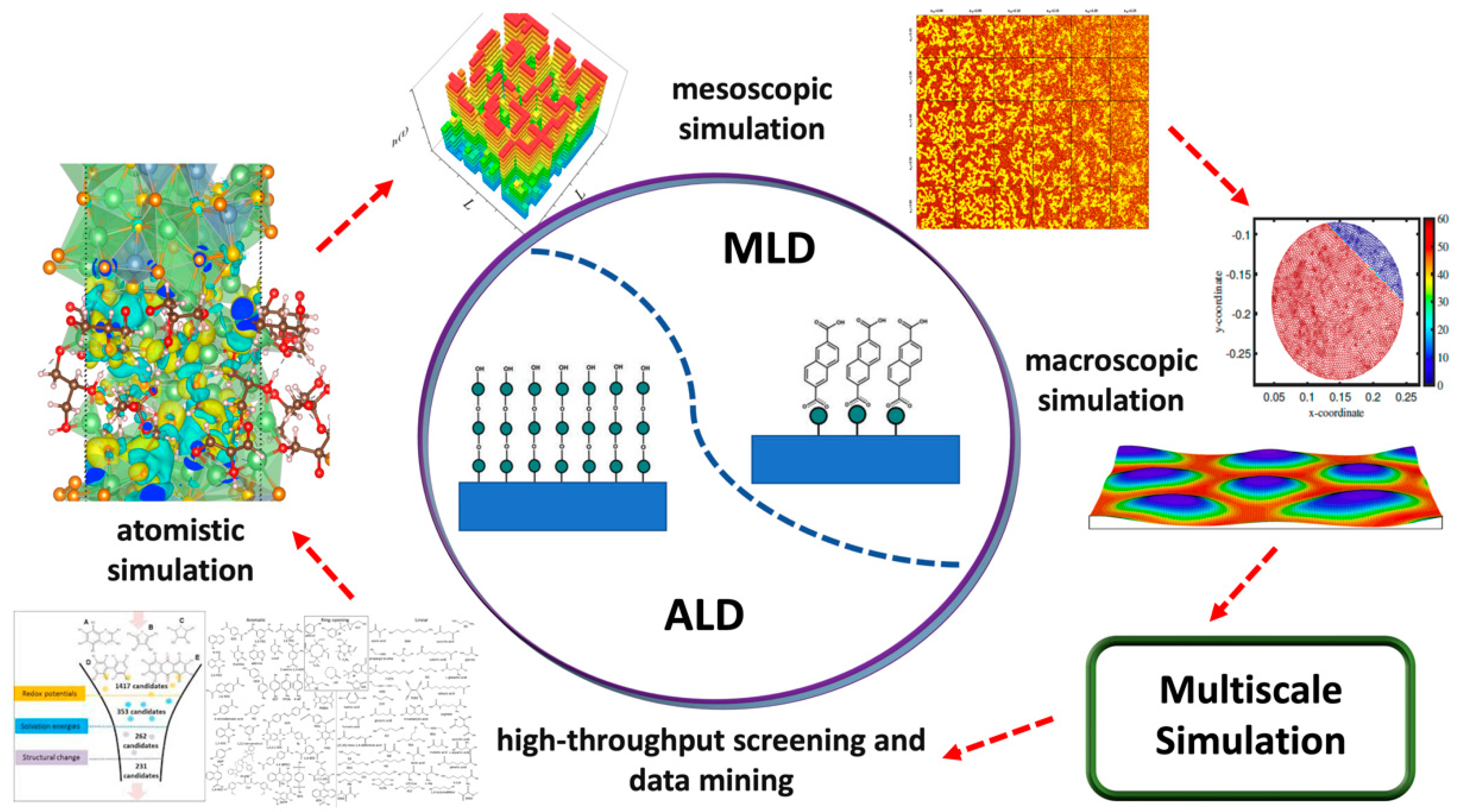
To date, ALD is a key technique in modern materials synthesis, enabling the fabrication of high-quality, conformal inorganic thin films. Whereas for MLD, it is a relatively unexplored counterpart for organic thin films synthesis techniques, despite various studies reported in recent years. To further advance these two synthesis methods, i.e., ALD/MLD as a new advanced gas-phase route for novel metal–organic or inorganic–organic thin films growth [,] for next-generation battery applications, a systematic study in multiscale simulation [,] of both ALD and MLD could be useful (Figure 2). With the support of high-throughput data mining, accurate atomistic simulation, mesoscale simulation, and advanced continuum modeling at the macroscale level, the exploration of various engineered surfaces/interfaces (e.g., crystalline coordination-polymer, crystalline-amorphous boundaries, metal–organic-framework-like structures) that are useful in battery applications could potentially be achieved using ALD/MLD techniques. These would enable the synthesis of fundamentally new materials, which are unattainable through conventional synthesis methods. As highlighted in Figure 2, the proposed multiscale simulation workflow could possibly accelerate the rational design of electrochemically stable, low-resistance, and mechanically robust ALD/MLD-coated interfaces, which is crucial for next-generation high-performance batteries. For example, by using a high-throughput data mining method, it is possible to help in identifying a set of oxide coatings that are predicted to be stable against Li metal (Section 3). Using atomistic simulation (e.g., Density Functional Theory (DFT) calculations), we can quantify the useful interfacial adhesion energies, electronic properties, and Li-ion diffusion for these coatings, which are selected by data mining. With the support of DFT simulation and experimental data, mesoscale phase-field modeling can predict the morphological evolution of coated interfaces and determine whether those coatings can help to suppress interfacial void formation or lithium dendrite growth. Then, by using macroscale continuum level simulation, it is possible for us to evaluate the overall battery performance improvements (e.g., cell resistance, overpotential reduction) based on these new coatings.
Figure 2.
Schematic illustrations of multiscale simulation methods (i.e., high-throughput screening and data mining, atomistic simulation, mesoscopic simulation, and macroscopic simulation for continuum modeling) that are useful to improve the materials design and fabrication in ALD and MLD for battery applications.
For ALD/MLD applications in batteries, ideally, a bottom-up cell fabrication and nanopatterning technique (e.g., area-selective ALD/MLD) [] could be used, as a well-tuned functional technique, as inspired by the semiconductor industry. To achieve this new bottom-up paradigm in electrode patterning and cell fabrication, an exhaustive basic understanding of materials properties and synthesis processes from an atomistic to macroscopic scale is needed [,]. To aid the experimental studies, computational studies using multiscale simulation (Figure 2) address the issues while simultaneously examining the materials properties, surface kinetics, and precursor gas flow in reactors during the ALD/MLD synthesis is timely and necessary [,,,,,]. Therefore, alongside advancements in experimental methods and characterization techniques, developing multiscale simulations (Figure 2) is essential for providing high-fidelity, robust design guidelines to optimize the process operation and control during ALD/MLD synthesis in real-world applications.
As stated in Section 2.1, the synthesis processes involved in ALD and MLD can be very complicated, yet versatile. In principle, ALD/MLD can be utilized to deposit various types of inorganic or organic materials on virtually any substrates with a differing nature of surface and geometries (e.g., nanoparticles, layered structures, nanotubes, and porous media) [,,] for surface/interface engineering in various battery applications. Depending on the conditions during synthesis, the design rationale for ALD/MLD processes are generally dictated by fine-tuning in operating temperature, pressure, precursor molecular structures, precursor surface chemistry, exposure time, etc. to control the reaction steps and the self-limiting deposition process that are governed by thermodynamics and kinetics during the synthesis processes [,,] A common misapprehension about ALD/MLD is that it delivers a complete monolayer (ML) in each cycle. However, there are studies that suggest that these synthesis processes deposit less than a single ML of materials in each cycle [], and this could be problematic in actual applications. To achieve the optimum growth per cycle (GPC) to improve the performance of any given engineered interface, a systematic study, supported by multiscale simulation (Figure 2), could be useful. For example, in a recent work by Tezsevin et al. [] based on DFT simulation and mesoscale stochastic lattice modeling, it was found that the influence of the random sequential adsorption (RSA) mechanism, where precursor molecules arrive one-by-one randomly and adsorb at surface sites on a substrate, is an essential and important factor in determining the surface packing and ML coverage. According to Tezsevin et al. [], the RSA mechanism yields a ~22% to 40% lower ML coverage relative to the ordered packing, with estimated GPC values of ~0.05Å relative to experimental data, considering a variation in the precursor shape and size. Therefore, this suggests that a systematic study based on mesoscale simulation can offer a precise prediction of the GPC of the ALD/MLD synthesis process and offer valuable predictions regarding potential variations in ALD/MLD films deposited experimentally when different precursors are used [,,,].
For both ALD and MLD, the film properties and growth characteristics are uniquely derived from different precursor gas pulses (Figure 1). To assist the gas-surface reactions during the growth process, the metal and organic precursor in ALD and MLD synthesis with proper reactive counterparts (e.g., halogenide ions, organic ligands, functional groups) needs to be well-chosen [,,,]. To optimize the design interface for any specific battery application, fine-tuning and a well-chosen precursor molecule from a vast selection of molecular candidates in inorganic and organic precursors is not trivial. To aid the experimental design and preliminary selection of the appropriate precursor [,,,,], a high-throughput screening and data mining study based on accurate DFT calculations and prediction of structure-property relationship on a vast precursor molecules dataset (Figure 2) could be a useful strategy to guide precursor selection in experimental synthesis. Complementary to the modeling of the deposition processes using the aforementioned mesoscale simulation, the unique structures and material properties (e.g., electronic, chemical, mechanical properties, and ion diffusion in bulk or interfaces) of thin films obtained using ALD/MLD have been widely studied using atomistic simulation [,,,,], and this has been proven to be extremely useful for improving the basic understanding and material design that utilizes ALD/MLD. Thus, with the improved understanding of the material properties obtained from atomistic simulation and mesoscale modeling (Figure 2), a reliable macroscopic modeling of area-selective ALD/MLD (ASALD/ASMLD) [,,,,] is obtained. As an accurate bottom-up nanopatterning technique in device manufacturing, the model could possibly be applied in future battery cell design.
3. Accurately Engineering Interfaces of LIBs and Beyond
3.1. The Cathode/Electrolyte Interfaces
Cathodes are taking a critical role in rechargeable batteries, for they are closely related to cell voltage, capacity, energy and power density, lifetime, and safety. At present, multiple LIB cathodes are commercialized, including spinel LiMn2O4 (LMO), olivine LiFePO4 (LFP), layered LiCoO2 (LCO), layered LiNi0.8Co0.15Al0.05O2 (NCA), layered LiNixMnyCozO2 (NMCs, x + y + z = 1), and lithium- and manganese-rich (LMR) layer-structured cathode materials (commonly described as xLi2MnO3∙(1 − x)LiTMO2, TM = Ni, Co, Mn, etc., 0 < x < 1). Among these cathodes, NMCs are an important type of cathode with less Co but higher capacity. The Ni-Mn-Co composition can be varied and therefore result in different NMCs, such as NMC111 (LiNi1/3Mn1/3Co1/3O2), NMC442 (LiNi0.4Mn0.4Co0.2O2), NMC532 (LiNi0.5Mn0.3Co0.2O2), NMC622 (LiNi0.6Mn0.2Co0.2O2), NMC811 (LiNi0.8Mn0.1Co0.1O2), and others with even higher Ni contents. In these NMC cathode materials, each transition metal ion plays its particular role. Specifically, Ni ions are mainly responsible for capacity through the Ni2+/Ni3+ and Ni3+/Ni4+ redox couples, Co ions can inhibit Ni/Li cationic mixing during the synthesis and cycling processes while enhancing rate capability, and Mn ions can improve the structural and thermal stability. Thus, an increased Ni content enables higher capacity and lower weight in NMCs. To date, NMCs of x ≤ 0.6 have been commercialized, but it is particularly challenging to commercialize NMC811 or the ones with an even higher Ni content. To this end, it is imperative to address a series of interfacial and structural issues, including the undesirable reactions at the interface, dissolution of TM ions, irreversible phase transition, microcracking, and lattice oxygen release. In this article, we discuss the latest development of ALD and MLD coating on Ni-rich NMCs (x ≥ 0.6).
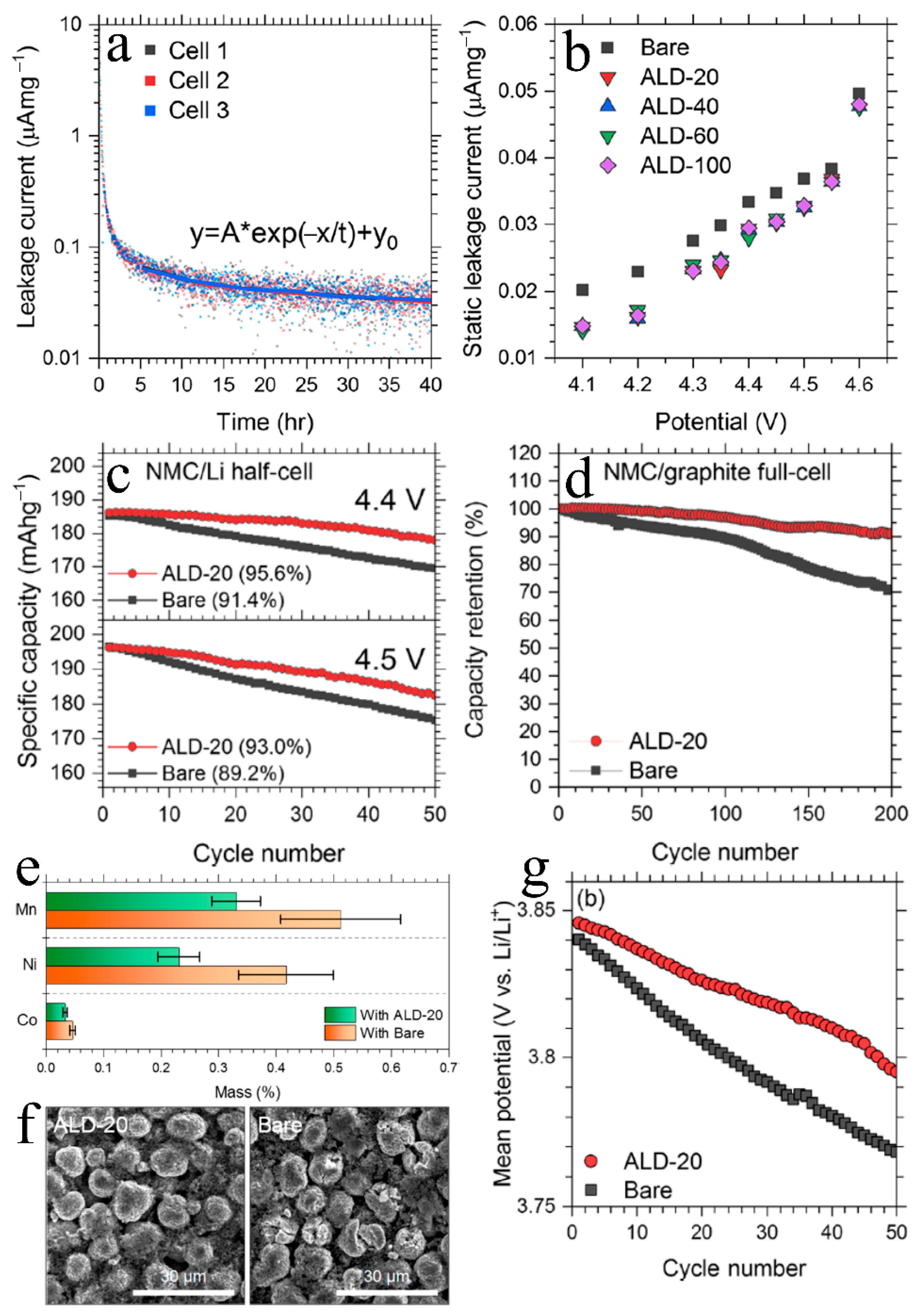
Metal oxides are the most studied ALD coatings for NMCs [], such as Al2O3 [], ZrO2 [,], and TiO2 []. In addition, a few studies have also investigated fluorides, nitrides, and phosphates as the surface coatings of NMC cathodes, e.g., AlF3 [], AlWxFy [], TiN [], and AlPO4 [,]. These materials are inert to electrolytes and can constitute a protective layer between NMC cathodes and electrolytes. They could reduce undesirable interfacial reactions, suppressing dissolutions of TM ions, inhibiting oxygen release from NMC lattices, and thereby sustaining the interfacial and structural stability. In this respect, our recent work on TiO2 ALD coatings on NMC622 is one of the representative case studies []. In the study, we studied the effects of different thicknesses of ALD TiO2 on prefabricated NMC622 electrodes directly. The ALD TiO2 film thickness was varied by adjusting ALD cycles (20, 40, 60, and 100). We noticed an island growth of the ALD TiO2 on NMC powders, which implied that the ALD TiO2 grew preferentially on certain locations, such as defective sites. The ALD TiO2-coated NMC622 electrodes were tested in NMC/Li half-cells. We found that the cells with an ALD-coated electrode have a lower static leakage current, compared to the cells with a bare electrode. The static leakage current is an indicator of interfacial parasitic reactions. We measured the static leakage current using a home-built high-precision leakage current measurement system to quantify the rate of solvent oxidation at different potentials. Figure 3a shows examples of the obtained current relaxation curves of three exemplary NMC/Li half cells. The cells were held at a constant potential of 4.4 V vs. Li/Li+ for 40 h so that the state of charge (SoC) or lithium concentration in the working electrode remained unchanged. The initial high current is due to the charging of the double-layer capacitor and/or the working electrode, while the relatively flat region was related to any gain of electrons from the oxidation of the electrolyte solvent. An exponential decay function (inset of Figure 3a) is used to extract the static leakage current (y0) from the current relaxation curves. The resultant static leakage current value is used as a quantitative indicator of the rate of the solvent oxidation reaction. We found that, by performing a series of potentiostatic hold experiments from 4.1 to 4.6 V vs. Li/Li+, we found that the static leakage current values (y0) increase with increased potentials, indicating the severe electrochemical oxidation of electrolyte components at the surface of the NMC (Figure 3b). Compared to bare NMC, all the ALD-modified NMC samples have smaller static leakage currents. Particularly, we found that a coating of 20 ALD TiO2 cycles could effectively alleviate the electrolyte oxidation, while a thicker coating was not helpful for further reducing static leakage currents. We also investigated NMC/Li half cells and demonstrated that the 20-cycle ALD TiO2 coating (i.e., ALD-20) evidently improved the cell capacity retention at both 4.4 and 4.5 V versus Li/Li+ (Figure 3c). Furthermore, we also confirmed the beneficial effects of the ALD-20 electrodes in the NMC/graphite full cells (Figure 3d). To address the benefits of the ALD TiO2 coating, we measured the amounts of TMs (i.e., Ni, Mn, and Co) on the graphite anodes after cycling and noticed that there were much fewer TMs on the graphite side in the cells using an ALD-coated NMC electrode (Figure 3e). This should be attributed to the reduced dissolution of TMs by the ALD coating. Furthermore, we also witnessed that the ALD coating inhibits microcracking by improving the mechanical properties of the coated electrodes (Figure 3f). Furthermore, we found that the ALD coating could suppress the decay of the average discharge voltage (Figure 3g). These findings reflect that the ALD coating boosts the structural stability of the NMC622 electrodes. In the previous work, it was clearly demonstrated that the ALD technique provides a useful pathway to achieve accurate interface engineering, while the ALD TiO2 coating exhibits multiple benefits through forming a protective oxide layer between the NMC cathode and the electrolyte, including inhibiting interfacial parasitic reaction, boosting the NMC cathode’s mechanical integrity, suppressing dissolution of TM ions, and reducing microcracking of cathode.
Figure 3.
Effects of ALD TiO2 coating on NMC622 cathode [] (a) The typical current relaxation curves collected from NMC/Li half-cells during a potentiostatic hold at 4.4 V vs. Li/Li+. (b) The variations in the static leakage current (y0) as a function of potential with and without surface modification of ALD TiO2. (c) The NMC/Li half-cells’ cycling performance when 20 ALD cycle-treated and bare NMC electrodes at 4.4 and 4.5 V versus Li/Li+ under a C/10 current density. (d) The NMC/graphite full cells’ cycling performance due to 20 ALD cycle-treated and bare NMC electrodes at 4.45 V versus Li/Li+ under a C/3 current density. (e) The amount of Mn, Ni, and Co detected on the graphite electrodes in NMC/graphite full cells after cycling. (f) SEM images of the NMC cathodes with and without surface modification from the cycled NMC/graphite full cell. (g) The evolution of the average discharge potential of NMC cathodes with and without surface modifications cycled at 4.4 V versus Li/Li+ (C-rate = 0.1). Reprinted with permission from Ref. []. Copyright (2019) American Chemical Society.
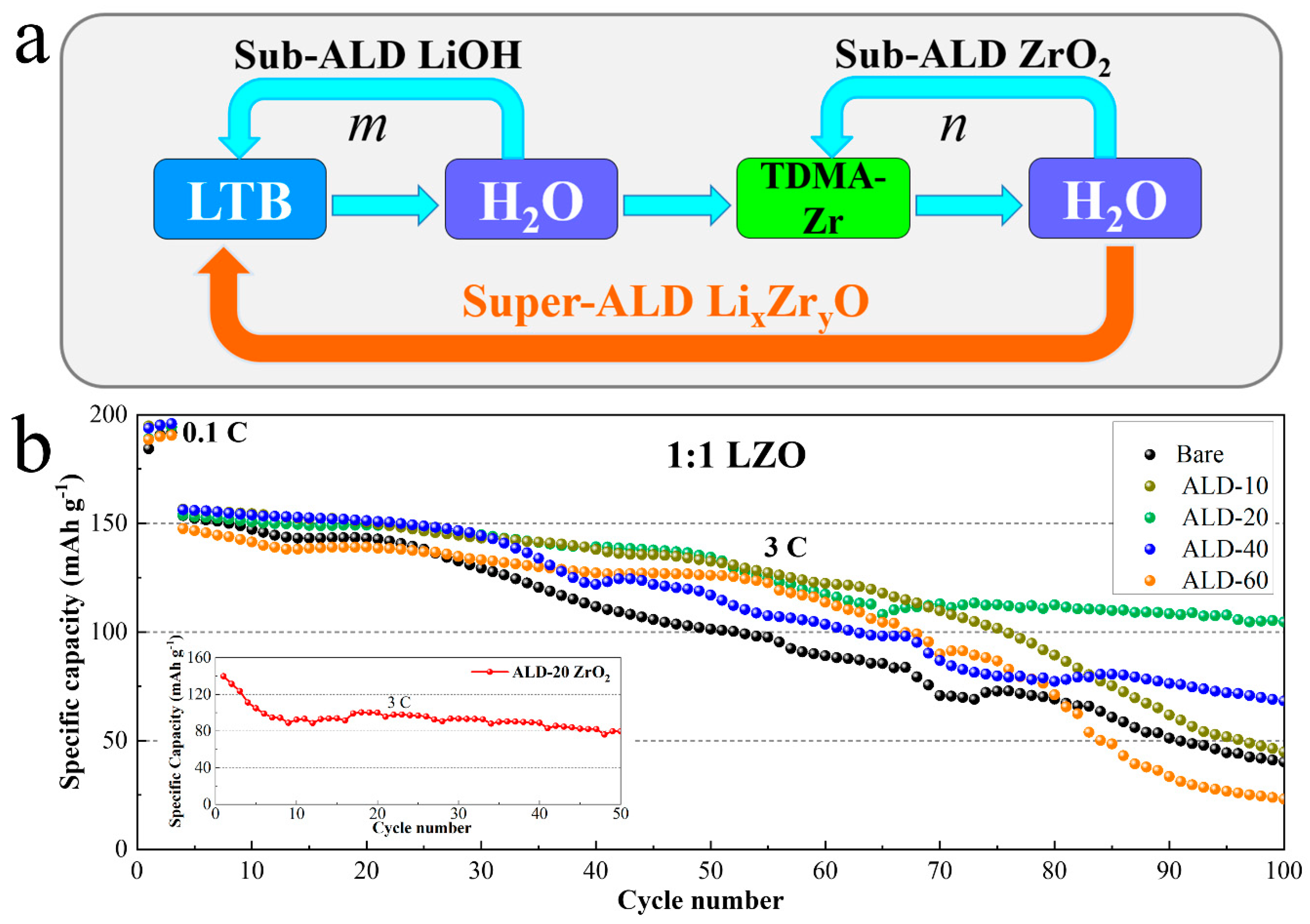
While the aforementioned coatings did help improve the performance of NMC cathodes, they were also exposed to their limited conductivity. The low ionic conductivity of ALD surface coatings could slow the diffusion of Li ions out/in the cathode during charge/discharge processes [,]. To this end, there has been an increasing interest in developing Li-ion conductors as surface coatings of NMCs, such as Li3PO4 [,], LiTaO3 [], LixZryO [], and LiAlF4 []. Particularly, computational calculations have revealed that, compared to binary oxides, Li-containing counterparts could enable better ionic conductivity []. To illustrate the benefits of these Li-containing coatings, we have conducted two studies on the ALD ZrO2 [] and LixZryO [] coatings recently. To produce LixZryO coatings, we developed a super-ALD process through combining two sub-ALD processes of LiOH and ZrO2, as illustrated in Figure 4a. The LiOH sub-ALD [] adopted lithium tert-butoxide (LTB) and H2O, while the ZrO2 sub-ALD [] used tetrakis(dimethylamido)zircominum (TDMA-Zr) and H2O as the precursors. In experiments, the LiOH and ZrO2 sub-ALD processes could be tuned in their sub-ALD cycles, m and n, respectively. The different m/n ratios could result in different LixZryO in composition. To study the effects of different LixZryO in composition, we investigated 1:1 and 1:2 LixZryO (i.e., 1:1 and 1:2 LZO) as the coatings of prefabricated NMC622 electrodes. We found that the 1:1 ALD-LZO coating could remarkably improve the insertion and extraction rates of Li ions across the cathodes. We further found that the 20-cycle 1:1 LZO could lead to the best performance, as shown in Figure 4b. Compared to the results of the ALD ZrO2 coatings of different thicknesses [], the 20-cycle 1:1 LZO coating exhibited a much better performance, in terms of rate capability and long-term cyclability. As illustrated by Figure 4b, specifically, the NMC622 electrode coated by 20-cycle 1:1 LZO could sustain a capacity of >100 mAh g−1 after 100 charge/discharge cycles (Figure 4b), while the NMC622 electrodes coated by ZrO2 could only sustain a capacity of ~80 mAh g−1 after 50 charge/discharge cycles (Inset of Figure 4b). Thus, this confirmed that Li-conductive ALD coatings are more favorable than the ALD coatings with low ionic conductivity, such as ALD ZrO2.
Figure 4.
The ALD strategy and effects of ternary LixZryO coatings on NMC622. (a) Illustration of the super-ALD strategy for producing LixZryO and (b) cyclability of the ALD 1:1 LZO coated NMC622 electrodes at 3 C in the range of 3.0–4.5 V (1 C = 180 mAh g−1), and the inset shows the performance of NMC622 electrodes coated by ALD ZrO2 tested at 3 C in the voltage windows of 3.0–4.5 V [,]. Reprinted with permission from Ref. []. Copyright (2020) Elsevier. Reprinted with permission from Ref. []. Copyright (2022) Royal Society of Chemistry.
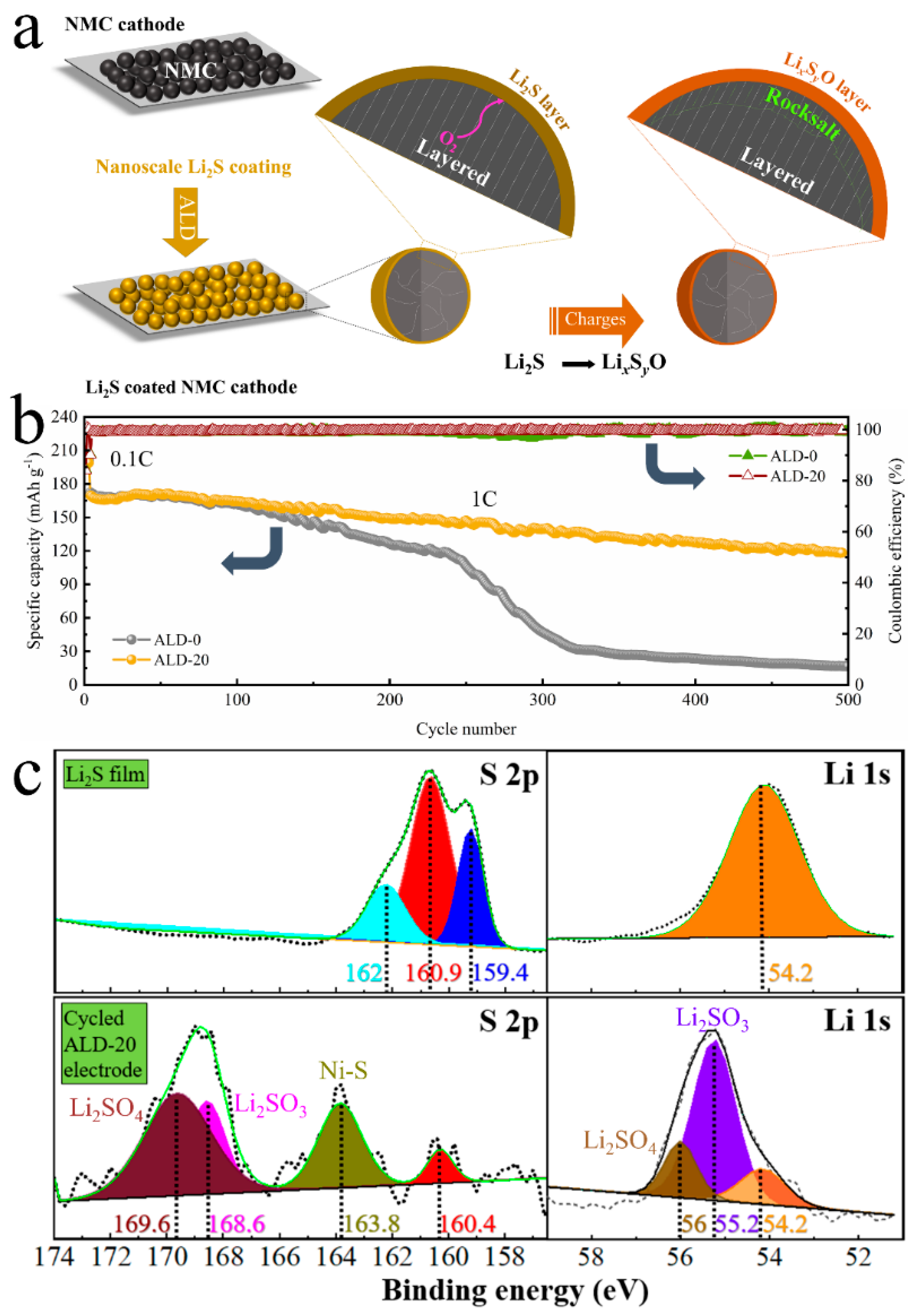
In addition to all the previously discussed oxide coatings, we recently discovered that sulfides are an important class of ALD coatings that have been overlooked []. In contrast to oxides, we discovered that sulfides could play very unique roles and can serve as oxygen scavengers. This new finding is very significant, because the oxygen released from NMC lattices can lead to electrolyte oxidation and produce many detrimental species (e.g., H2O, CO, and CH4). Furthermore, in addition to scavenging oxygen released from NMC lattices, we found that sulfides can convert into stable sulfates. The resultant sulfates can act as chemically and electrochemically stable surface coatings to maintain the interfacial and structural stability of NMC cathodes. Specifically, our recent study clearly demonstrated the sulfide–sulfate conversion using the Li2S ALD coating with the distinct benefits of the sulfide conversion and the resultant sulfate coating []. As illustrated in Figure 5a, we applied a Li2S coating over a prefabricated NMC cathode via an ALD process []. In the following charging process, the oxygen released from the NMC cathode changed the Li2S coating to a LixSyO coating. To verify the benefits of the Li2S coating, a comparative study with Li2S ALD coating on a NMC811 cathode and a bare NMC811 cathode was conducted. The study revealed that, compared to a bare NMC811 cathode (ALD-0), the Li2S coating could help dramatically improve the performance of the Li2S-coated NMC811 cathodes (ALD-20, i.e., 20-cycle ALD Li2S-coated NMC811, Figure 5b) in achieving long-term stable cyclability, accounting for a sustainable capacity of 122 vs. 20 mAh g−1 for Li2S-coated and bare NMC811 electrode after 500 charge/discharge cycles, respectively. Importantly, we first determined that the Li2S-LixSyO conversion with the Li2S coating by analyzing the cycled NMC811 cathodes with X-ray photoelectron spectroscopy (XPS) (Figure 5c). The XPS spectra revealed that, after cycling, the Li2S coating changed from Li2S to Li2SO3 and Li2SO4. We believe that this study unveils a new area for NMC cathode interface engineering, which needs to be further explored. In addition to protecting the electrolyte from oxidation, the resultant LixSyO coating protected the NMC811 from microcracking and mitigated irreversible phase transition. Thus, the Li2S coating helped sustain both interfacial and structural stability of NMC811.
Figure 5.
Nanoscale Li2S coating as an oxygen-scavenging coating enables high-performance NMC811 cathodes. (a) Schematic illustration of the coating procedures of the ALD Li2S film and the subsequent sulfide–sulfate conversion during cycling. (b) The high performance of 20-ALD-cycle Li2S-coated NMC811 (ALD-20), compared to the bare NMC811 cathode (ALD-0), 0.5 C for charging and 1 C for discharging in the range of 3.0–4.3 V (1 C = 200 mAh g−1). (c) High-resolution XPS analyses of S 2p and Li 1s. []. Reprinted with permission from Ref. []. Copyright (2022) Elsevier.
In addition to the previously discussed ALD coatings, recently, there has been an attempt to combine ALD and MLD coatings to create a hybrid coating to address the issues in NMC811 electrodes []. In that study, researchers deposited TiO2 via ALD and titanium terephthalate (Ti-TPA) via the MLD technique. The resultant hybrid ALD/MLD coating was named TPA-Ti, which was deposited with five supercycles and yields ~8 nm thick. In that experiment, each supercycle consisted of 12 sub-ALD cycles of TiO2 and 1 sub-MLD cycle of TPA-T, and the NMC811 electrode coated by the ALD-MLD process was named NMC-TPA-Ti, while the bare NMC811 electrode was named NMC-ref. The researchers studied their performance and revealed that, using graphite as the anodes, the NMC-TPA-Ti cathodes could achieve a capacity retention of ~86% versus 56% of the NMC-ref after 500 charge/discharge cycles in the voltage range of 2.9–4.3 V at 1 C (200 mAh g−1). Their postmortem analysis further clarified that there was thicker CEI formation and irreversible transition in the NMC-ref, while the NMC-TPA-Ti electrode exhibited reduced cracking formation and enhanced structural stability. This study inspired us to adopt both ALD and MLD for designing new surface coatings with exceptional properties to address NMC and other cathodes’ issues.
ALD Cathode Modeling
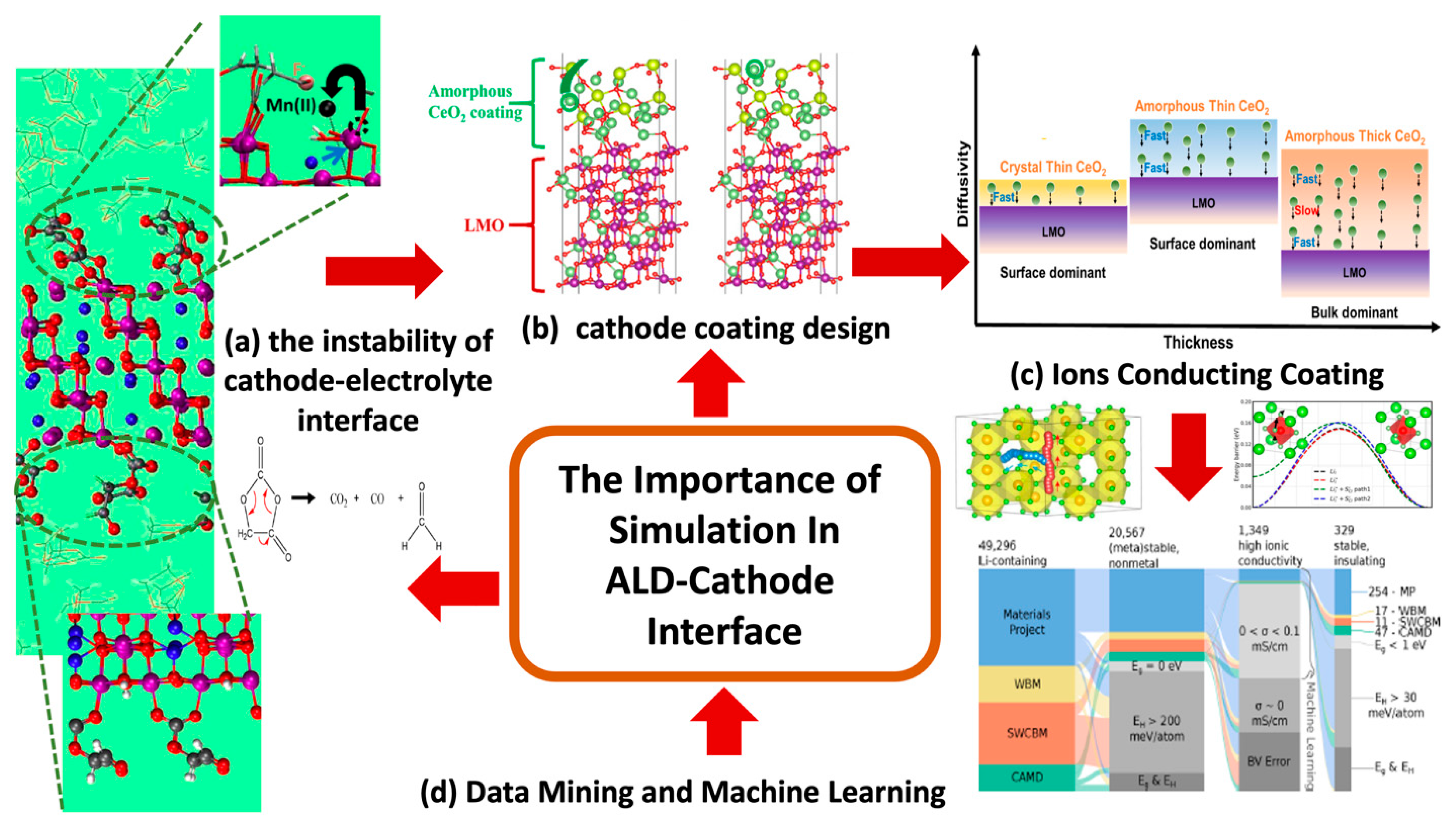
As a complement to experiments, theoretical studies based on simulation are useful for scientists in order to understand the complex science of interfaces in batteries. To aid in the basic understanding of the electrochemical stability of spinel lithium-rich oxide cathodes, early studies focused on the stability of the cathode/electrolyte interface. From an early study based on first-principles simulation [], it was found that the electrolyte decomposition was initiated by the electron transfer to the adsorbed solvent molecules (e.g., ethylene carbonate, EC) at the electrode/electrolyte interface, depending on whether or not the electrode was coated by alumina ALD. For the bare electrode, the adsorbed EC molecule decomposes within picoseconds during the reduction process, according to the ab initio molecular dynamics (AIMD) simulation []. In contrast, the oxide ALD coating provided a passivated layer and contributed significantly to reducing the rate of electron transfer (Figure 6), and this was confirmed by microgravimetric measurements, which demonstrated that the ALD coating reduced electrolyte decomposition []. To verify the theoretical prediction made by Leung et al. [], carbon films deposited onto Cu were used as electrodes to study the passivating role of the ALD alumina coatings with respect to the electrolyte (1 M LiPF6 in a 1:1 volume mixture of EC and diethyl carbonate) reductive decomposition in the experiment. Based on the voltametric and gravimetric responses of the uncoated and alumina-coated Pulsed Laser Deposition (PLD) carbon-film electrodes, they found that a higher overpotential was required to drive solvent decomposition, and a lower quantity of mass addition took place with the 0.55 nm and 1.1 nm alumina coatings present at the electrode []. A greater overpotential and reduced mass uptake were found in the 1.1 nm alumina coating compared to the thinner 0.55 nm coating. This was attributed to the thicker alumina film, which provided a more effective kinetic barrier for reducing the reductive solvent decomposition and byproduct deposition on the electrode. Thus, a thicker alumina layer was anticipated to reduce electron tunneling, thereby slowing solvent decomposition and delaying SEI formation. In addition, despite the complex solid–liquid state at the cathode/electrolyte interface, the advanced atomistic simulation method, such as AIMD modeling, was useful for understanding the mechanism behind the dissolution of transition metal (TM) ions (e.g., Mn) [,]. Based on AIMD simulation, it was possible to demonstrate that the migration of TM ions from the spinel cathode surface caused the subsequent negative effects on the graphite anode SEI passivating layers through the dissolution of TM ions into the organic liquid electrolyte (Figure 6). Thus, this indicated that applying a thin ALD coating could enhance cathode stability by forming a protective interface to stabilize the cathode surface, reducing TM dissolution, and unwanted electrolyte decomposition.
Figure 6.
A schematic diagram that highlights the importance of simulation in ALD-cathode interface: (a) mitigate the instability of cathode–electrolyte interface []; (b) improve cathode coating design; (c) search for ion conducting ALD coating based on a systematic study using (d) data mining and machine learning techniques that utilized accurate atomistic simulation data. Reprinted (adapted) with permission from Ref. [] Copyright (2017) ACS Publication.
In recent years, despite the extensive use of ALD coating in various cathodes (e.g., NMC) [], an in-depth understanding of the role of coatings in fine-tuning battery performance in terms of extended lifetime remains lacking. For batteries in operation, the task of obtaining the detailed local structural change and the electrochemistry of ALD coatings embedded at the electrode interfaces from both the simulation and experiment is not trivial and often very challenging []. For example, in the cathode study, a protective coating, such as Al2O3, can be used to improve the LiCoO2 (LCO), LiNiO2 (LNO), and LiNixMnyCo1-x-yO2 (NMC) cathodes []. As such, these alumina coatings with different film thicknesses have been exposed to different material interfaces and cell operating conditions. To optimize coating performance, it is critical to understand the role of their local structural (e.g., Al and O bonds) changes in various environments. For the Al2O3 ALD coating, the disordered four- and six-coordinated Al-O environments are generally found []; however, an accurate quantitative and qualitative study on the distribution of the different Al-O environments in different cathodes due to different synthesis methods and at various cell operating conditions remains lacking. A greater understanding of the coating’s local structure (e.g., Al-O bonding environments), in response to different ALD coating-cathode interface and cell operating conditions, is extremely useful when optimizing these ALD coatings. From the theoretical point of view, a greater basic understanding of ALD growth (Figure 2), materials properties, and their interfaces (Figure 6) is critical to optimize the roles of ALD coating. Eventually, this will help to fine-tune for area deposition, minimize excessive coating, maximize the ions’ conductive pathways across the cathode interface, thus mitigating cathode surface degradation and maintaining high-capacity retention and cyclability of batteries.
NMC811 is a well-known Ni-rich cathode material for LIBs, yet the degradation and parasitic side reactions at the cathode/electrolyte interface remain a challenge. In recent studies, there were mixed results reported for alumina ALD coatings of the NMC811 cathode. According to Huang et al. [], there were no huge differences between the alumina ALD-coated and the bare commercial-grade NMC811 cathode with regard to long-term cycling stability at different upper cutoff voltages, rate capability, stability against ambient storage, and the charge transfer kinetics. In contrast, according to Chen et al. [], an improved NMC811 surface stability coated by alumina ALD was confirmed by monitoring the gaseous degradation species via electrochemical mass spectrometry and X-ray spectroscopic (XPS) study of the electrochemically aged cathodes through examining the variations in the oxidation states of Ni and O, and local cathode structures. According to Chen et al. [], the study suggested that alumina ALD coatings exhibited an important dual role, i.e., a protective layer against electrolyte degradation, and a synthetic passivating layer that mitigated oxygen loss and inhibited phase changes in NMC811 surfaces. Thus, these two conflicting experimental studies suggest that a further understanding of the basic roles of ALD coating is necessary.
To aid in the experimental efforts, a systematic theoretical study that focuses on the ALD-cathode coating is critical. To improve the coating design, a theoretical study that focuses on the surface chemistry of ALD with solvent or salt in electrolytes, and the basic understanding of the Li-ion conductive pathways and diffusivities within ALD coatings and across cathode interfaces with different thicknesses in coating is needed (Figure 6). As reported in a recent study [], DFT calculations indicate that there are several factors that influence the Li-ion diffusivity of the CeO2 ALD coating, for example, local structures (e.g., crystal and amorphous configuration), film thickness, surface and bulk diffusion, as well as neighboring atomic species. Overall, these factors possibly contribute to the experimentally observed trade-off in Li-ion diffusivity. To optimize the Li-ion conducting in the ALD coating design from a bottom-up approach, we suggest that a high-throughput computational screening and data mining, which utilize the advanced machine learning methods (Figure 6) in data analysis and the interatomic potentials for molecular dynamics simulation that were employed in searching for robust Li-ion solid state electrolytes (SSEs), could be useful [,,,]. The identification of new Li-ion SSE candidates through an exhaustive search using data mining will provide useful insights towards the further design and fine-selection of metal precursors [] in ALD, as highlighted in Figure 2. Meanwhile, in order to conduct a high-throughput screening for new candidates for the robust Li-ion conducting coating via ALD, an exhaustive theoretical study of Li-ion diffusivity in various amorphous solids (e.g., oxides, sulfides, halides, etc.) [], instead of crystalline structures, is necessary. As inspired by He et al. and their CeO2-coated LMO study [], a good Li-ion diffusivity in a CeO2 amorphous layer with an optimum thickness, in bulk LMO, and at the CeO2-LMO interface is critically important in ALD-cathode design. Therefore, in addition to the basic understanding of Li-ion diffusivity in bulk amorphous structures, a comprehensive theoretical modeling of Li-ion diffusion pathways of any given Li-ion-conducting amorphous film with different thicknesses at the interface of the cathode (e.g., NMC811) is necessary. With this indispensable knowledge, a more robust computational design of Li-ion-conducting ALD coating at the cathode could be possible.
3.2. The ALD/Anode Interfaces
LIBs’ capacities are dictated by the capacities of cathodes and anodes. To improve batteries’ capacities, ideally, one needs to optimize the cathode and anode capacities. To couple with promising cathodes, such as NMCs, two anode materials are among the most promising choices, i.e., Si and Li, due to their extremely high capacities, 3579 and 3860 mAh g−1 at room temperature, respectively. The former is for the next-generation LIBs, while the latter is for the emerging Li-metal batteries (LMBs). However, these anode materials are still not commercialized, due to their interface instability. To address this issue, ALD and MLD have become two new surface coating techniques in the past decade to improve the stability of the interface between anodes and electrolytes. Through these techniques, the protected Si and Li anodes can achieve much better performance than traditional LIBs.
3.2.1. Si Anodes
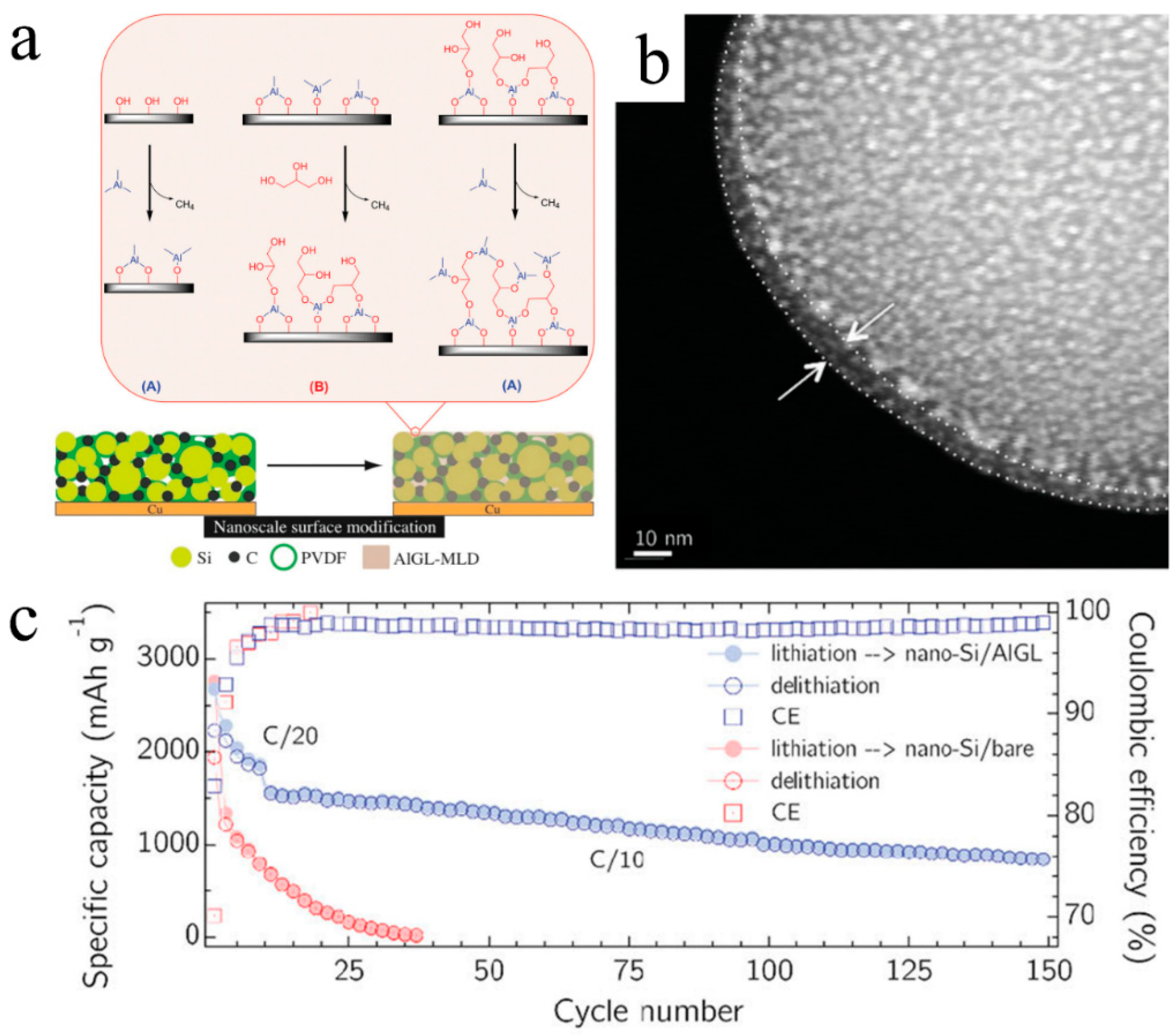
Si as anode promises a very high gravimetric energy density, ~10 times higher than that of commercial graphite anodes (372 mAh g−1). Additionally, it has a low discharge voltage of ~0.2 V versus Li/Li+. On the other hand, Si ranks second in abundance in the Earth’s crust, and this implies its cost-effectiveness. All these benefits jointly make Si an excellent anode candidate for LIBs. Unfortunately, Si experiences large volume changes up to ~300% during the charge/discharge processes in LIBs at room temperature [,]. Such large volume expansion generates many more issues, including electrochemical pulverization, continuous SEI formation, high consumption of electrolytes, and continuous increases in cell impedance. These issues are reflected by rapid cell performance fading and eventually cell failure. In order to tackle these issues, surface coating is effective and serves multifunctional roles, including maintaining the mechanical integrity of Si anodes, suppressing SEI formation, and boosting electrode performance. To this end, many inorganic coatings via ALD have been developed [], but all these attempts have been vulnerable to the weakness of the ALD coatings in terms of elasticity, which makes it impossible to tackle the large volume changes in Si. Previously, we conducted a comprehensive survey on various ALD coatings over Si electrodes, including Al2O3, TiO2, ZnO, HfO2, and TiN []. For more details, readers can refer to the original reference []. Due to their inorganic nature, these ALD coatings generally lack flexibility while having limited elasticity. As a consequence, they find it difficult to accommodate the huge volume changes in Si electrodes. Alternatively, polymeric coatings via MLD were investigated. As an alternative to ALD, Piper et al. [] reported the first attempt to apply a layer of an alucone (denoted as AlGL with a unit structure of [(CH2CHCH2)O3Al) on the prefabricated Si electrodes (Figure 7a). They reported that a 5 nm thick MLD-AlGL coating (Figure 7b) could remarkably boost the coated Si anodes’ performance (Figure 7c). They showed that the AlGL coating could maintain the Si electrode network. Specifically, the MLD-AlGL-coated Si anode only had a 17.5% volume increase after 20 electrochemical cycles, while a 50% volume increase was observed in the bare Si electrode. Thus, this suggests that the MLD-AlGL coating is exceptional in dealing with the extreme volumetric changes in the Si electrodes.
Figure 7.
The nanoscale AlGL alucone coating helps Si electrodes achieve better performance. (a) Schematic illustration of the coating procedures of the MLD AlGL film on Si electrodes. (b) STEM image of a 5 nm thick AlGL coating formed on Si particles. (c) The performance of the AlGL-coated Si electrode, compared to that of the bare Si electrode []. Reprinted with permission from Ref. []. Copyright (2014) John Wiley and Sons.
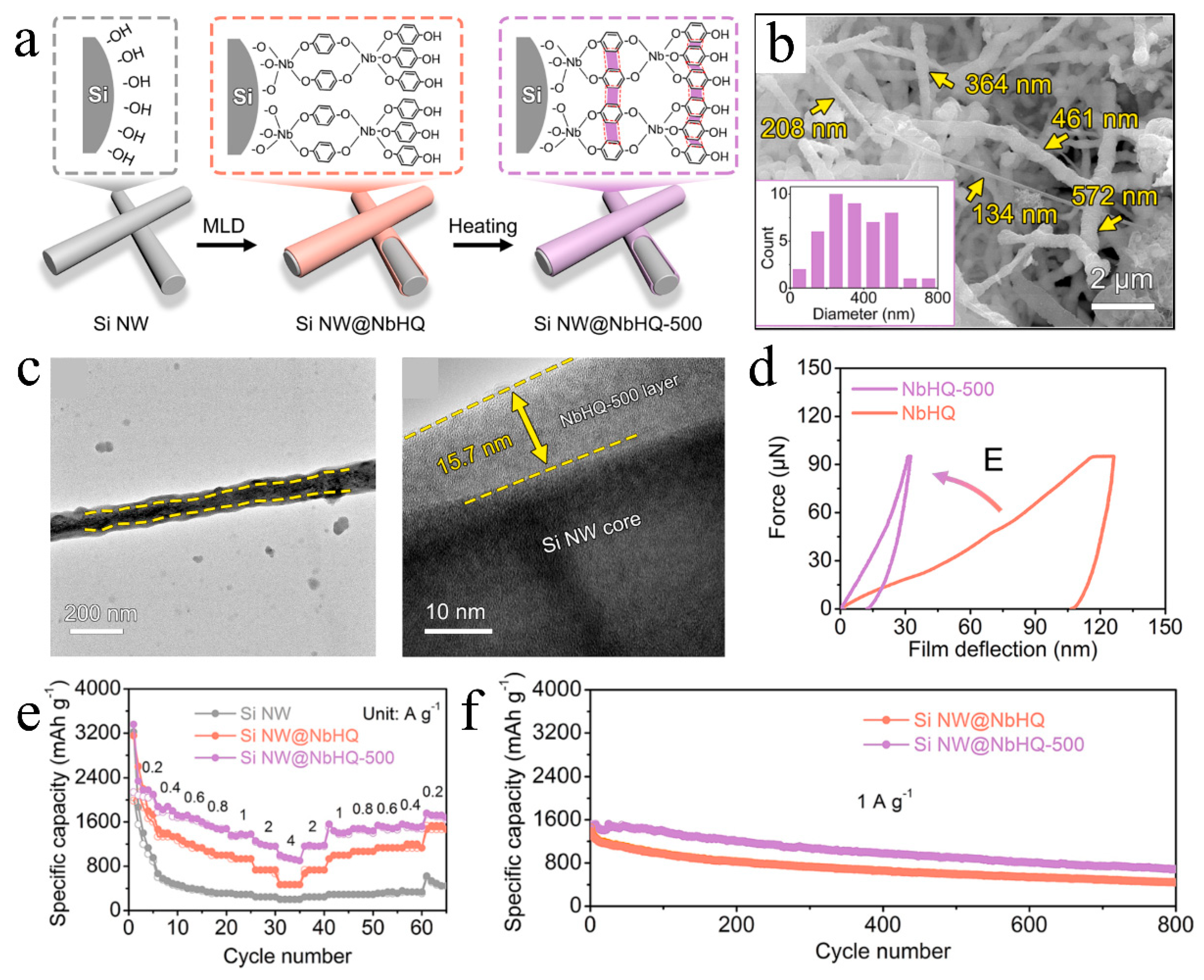
In a recent study, another metalcone, niobicone, was reported for the coating of Si nanowire (NW) electrodes to improve the cell performance []. As reported, the niobicone layer of NbHQ (having a unit structure of [OC6H4O]2Nb) was deposited on Si NW electrodes for 50 MLD cycles (~17.7 nm) (Figure 8a), and this resulted in the anode Si NW@NbHQ. In this previous study, some of the Si NW@NbHQ electrodes were further annealed at 500 °C for 2 h in N2 atmosphere, leading to the annealed electrodes, i.e., Si NW@NbHQ-500 (Figure 8b). After the thermal annealing, the NbHQ layer was verified to be ~15.7 nm (Figure 8c). The thermal annealing yielded the cross-linked NiHQ layer, and this significantly enhanced the mechanical properties of the Si NW@NiHQ-500 electrode (as witnessed in Figure 8d), accounting for the enhanced Young’s modulus of 44.2 GPa, as compared to 12.8 GPa for the non-thermally annealed Si NW@NbHQ electrode. Electrochemical tests revealed that the Si NW@NbHQ-500 performed the best, compared to Si NW@NbHQ and bare Si electrodes in rate capability (Figure 8e) and long-term cyclability (Figure 8f). Fang et al. summarized the merits of the thermally annealed NbHQ layer in several aspects: (1) enhanced tolerance of stress during volume expansion and resistance to the side reactions from the electrolyte, (2) generation of Nb4+ species from the reduction in NbHQ-500 to participate in SEI formation, (3) fast Li-ion transport kinetics and lower in stress distribution within the thin SEI [].
Figure 8.
The nanoscale NbHQ niobicone coating helps Si NW electrodes achieve high performance. (a) Schematic illustration of the coating procedures of the MLD NiHQ film on Si NW electrodes. (b) SEM image of Si NW@NbHQ-500 with the inset showing the nanowire diameter distribution. (c) TEM images of Si NW@NbHQ-500. (d) Nanoindentation tests showing load versus displacement curves for NbHQfilm and NbHQ-500 film. (e) Rate capability of the electrodes. (f) Cycling stability of Si NW@NbHQ and Si NW@NbHQ-500 at the current density of 1 A g−1 []. Reprinted with permission from Ref. []. Copyright (2024) Elsevier.
In addition to the previously discussed hybrid metalcone coatings, a polyamide (PA) coating was also used to modify a prefabricated Si electrode []. In the study, it was observed that the Si nanoparticles changed morphologically from spherical particles to irregularly shaped particles during charge/discharge processes. The scanning transmission electron microscopy (STEM) results revealed that the PA coating remained in intimate contact with the Si nanoparticles during electrochemical tests. The tests showed that the 0.5 nm PA coating had dramatically increased the coated Si electrode’s capacity sustainability, cyclability, and CE. Conversely, the 3 nm and 15 nm thick PA coatings did not help in improving the Si electrodes’ performance. Wallas et al. [] emphasized that, compared to the MLD-AlGL coating discussed above, this PA coating was an all-organic polymer and much thinner.
3.2.2. Li-Metal Anodes
In addition to Si, Li metal as anode can also achieve an extremely high capacity, 3860 mAh g−1, and has a low potential (i.e., −3.04 V versus SHE0). Thus, Li metal is another ideal anode material. Unfortunately, Li-metal anodes face two serious issues: Li dendritic growth during plating and uncontrollable growth of SEI. The former endangers cell safety by growing into the cathode side, while the latter continuously consumes electrolytes and Li inventory, thus increasing cell impedance. These two issues are reflected in the cell performance, i.e., low CE and continuous capacity fading. To address these challenges, several strategies have been investigated, such as the development of new robust liquid electrolytes, solid-state electrolytes, surface coating, separator modification, and Li-metal framework design []. Among these strategies, surface coating is facile and effective, but its effectiveness is highly related to the properties of surface coating materials. In this respect, ALD and MLD recently emerged as two new useful techniques and have been attracting more research interest.
In an earlier study, Kozen et al. [] coated Li anodes with nanoscale Al2O3 films via ALD, followed by other ALD coatings, including ZrO2 [], TiO2 [], LiF [], Li3PO4 [], and LixAlyS []. To protect the Li anodes, a coating is ideal to be electronically insulating but ionic conductive. To overcome the ionically insulating nature of Al2O3, ZrO2, and TiO2, we developed an ionically conductive coating material, LixAlyS (LAS, enabling an ionic conductivity of 2.5 × 10⁻⁷ S/cm at room temperature) by combining two individual sub-ALD processes of Li-S [] and Al-S [] in a sub-cycle ratio of 1:1. We coated the 1:1 LAS film over Li metal as a 50 nm thick protective film []. Testing in symmetric Li||Li cells, the pristine Li symmetric cell had a resistivity (RSEI) value of ~2500 Ω, around five times higher than that of the ALD LAS-coated Li symmetric cell after 68 h storage. This implied that the ALD LAS layer could protect the Li anodes from direct contact with the liquid electrolyte. We further tested 50 nm thick LAS-coated Cu foils in asymmetric Li||Cu cells. We found that the Li||LAS-coated Cu cell exhibited a very stable CE for 170 cycles, while the Li||pristine Cu cell gradually dropped in CE in the first 90 cycles and then decreased sharply after ~135 cycles. In addition, we observed that numerous long filaments formed on the pristine Cu foil, while no obvious Li dendritic structures were observed on the LAS-coated Cu foil. These results demonstrated that the ALD LAS layer can stabilize the interface between the Li-metal anode and electrolyte and can suppress Li dendritic formation, due to its decent ionic conductivity. Similar favorable effects were later verified in subsequent work reported by Harrison et al. [], in which an in situ electrochemical STEM (EC-STEM) was used to directly visualize Li deposition and stripping with and without the ALD LAS protective coating. In addition, LiF [] and Li3PO4 [] were also verified for their effectiveness as ALD coatings of Li anodes, but their layer thicknesses were limited to less than 10 nm due to their limited ionic conductivity.
Along with the ALD studies discussed above, there have been several attempts using the MLD technique in the development of novel polymeric coatings to protect Li anodes. In this respect, there are several earlier studies focused on alucone [], zircone [], and polyurea [] as the coatings for Li anodes. Compared to ALD coating, these polymeric coatings showed promising protective results and could help improve the electrochemical stability and lifetime of Li-metal anodes. Furthermore, Zhao et al. [] conducted a study investigating bilayer hybrid protective films consisting of an MLD organic layer (AlEG) and an ALD inorganic layer (Al2O3). This unique ALD-MLD combination features a high tunability in bilayered film thickness and the bilayer property through accurately adjusting the inorganic layer and the organic layer. In the study, Zhao et al. found that the combination of 50-ALD-cycle Al2O3 (50Al2O3) and 50-MLD-cycle AlEG (50AlEG) was optimal. Particularly, they demonstrated that, using Li||Li symmetric cells with a carbonate electrolyte, the 50AlEG/50Al2O3/Li performed better than 50Al2O3/50AlEG/Li and the bare Li in different testing conditions. Zhao et al. explained that the underlying mechanism lay in the better mechanical strength of the 50AlEG/50Al2O3 bilayer, which helped suppress crack formation. Using an ether electrolyte instead, the 50AlEG/50Al2O3/Li still exhibited the best performance. Furthermore, the 50AlEG/50Al2O3/Li anodes were used to couple with a sulfur cathode and an LFP cathode in the full cells. Compared to the pristine Li foil, the 50AlEG/50Al2O3/Li showed a much better performance for the full cells of Li-S and Li-LFP, in terms of sustainable capacity and cyclability, which suggests the usefulness of the ALD-MLD hybrid coating.
Different from all the Li-free polymeric coatings discussed above, we recently developed three different lithicones as surface coatings of Li anodes, i.e., LiGL [,], LiTEA [], and LiHQ [], featuring their Li-containing nature and good ionic conductivity of up to 10−4 S cm−1 at room temperature. Their unit structures are (CH2CHCH2)(OLi)3, N(CH2CH2OLi)3, and LiOCH6H4OLi, respectively. These lithicones showed very promising protection effects on Li anodes in Li||Li symmetric cells and Li||NMC811 full cells. As reported in [,,,], these lithicone surface coatings could well protect Li anodes from corrosion and achieve long-term cyclability of Li||Li cells. The lithicone-coated Li anodes could dramatically boost the Li||NMC811 cells’ performance, and it was found that coupling the lithicone-coated Li anodes via MLD with Li2S-coated NMC811 via ALD could achieve the best cell performance [,].
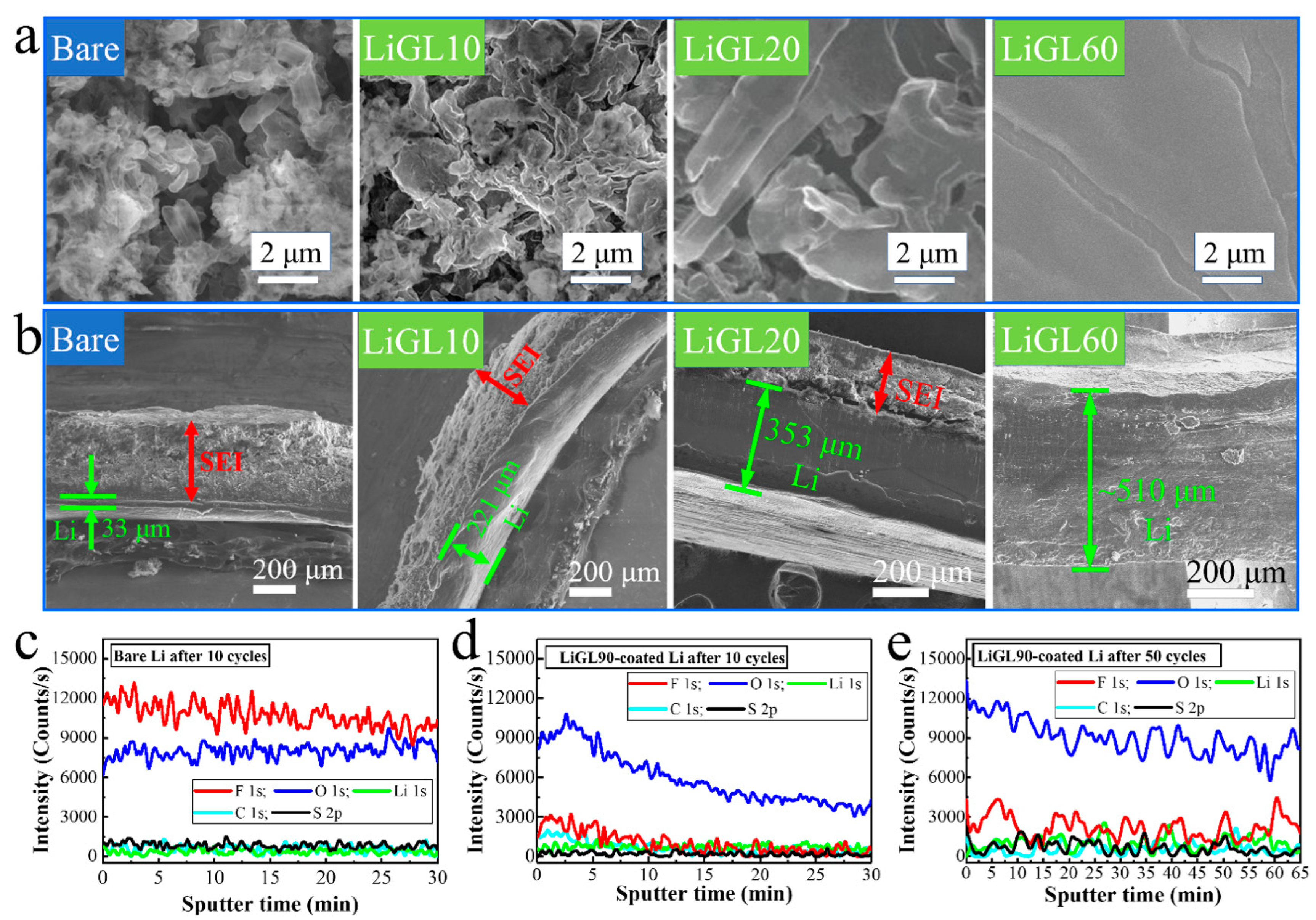
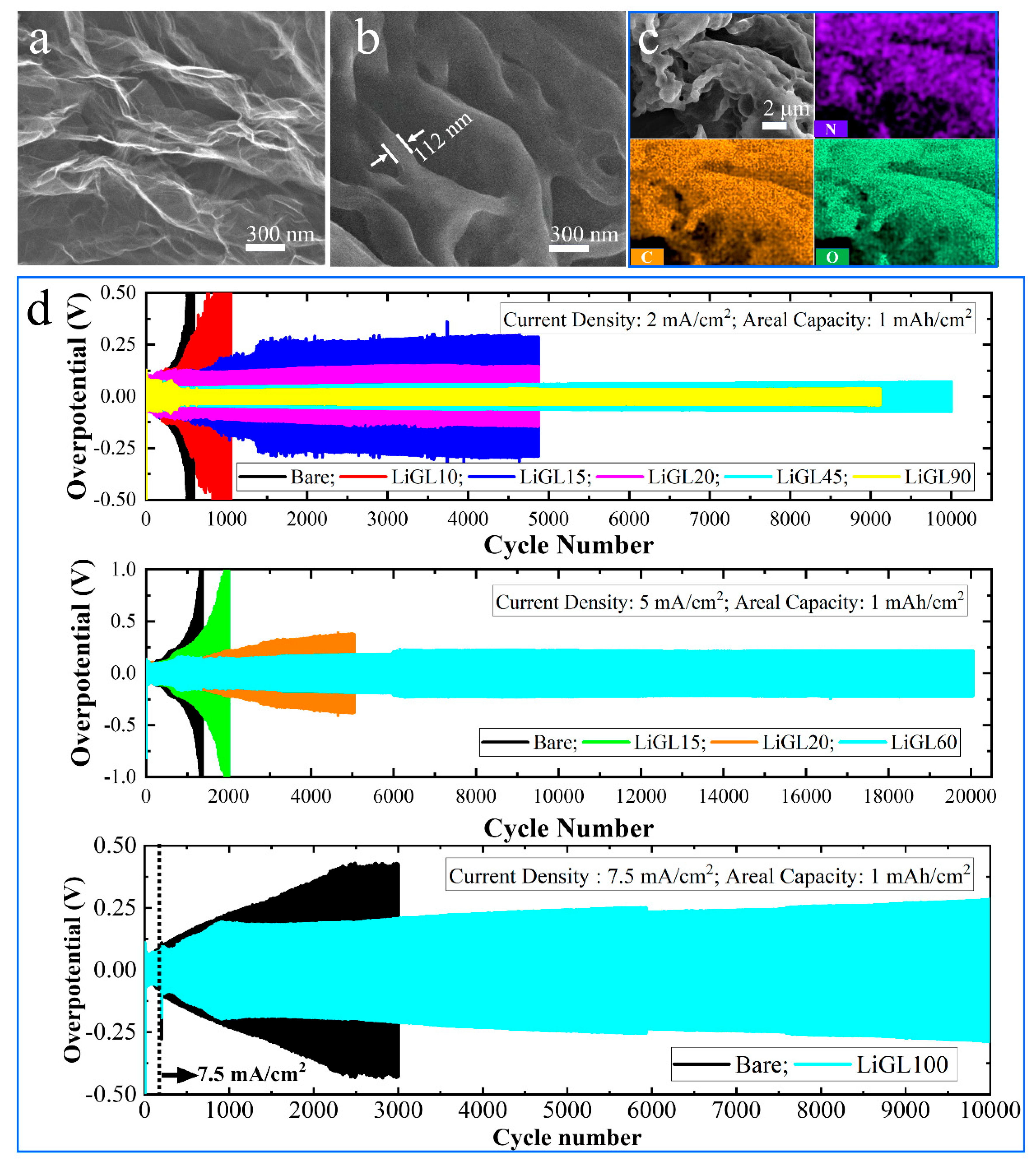
Among these lithicones, the LiGL MLD process exhibited the highest GPC of ~2.7 nm cycle−1 at 150 °C and could be coated on graphene nanosheets (GNS) conformally (Figure 9a–c) []. Similar to ALD, the LiGL coating thickness on Li-metal anodes was tunable through adjusting the LiGL MLD cycles, and the resultant Li-metal anodes were named LiGLX, where X is the MLD cycle number. For example, LiGL10 means the Li-metal anodes coated by a 10-MLD-cycle LiGL film, and so on. We particularly noted that it is desirable to coat Li anodes with a LiGL film over 200 nm, which can achieve an ultra-long cyclability of over 20,000 Li-stripping/plating cycles (over 10,000 h) without failures (Figure 9d). In addition, the LiGL coatings thicker than 200 nm could also tolerate a high areal current density, 7.5 mA cm−2 or higher. Furthermore, we verified that a sufficiently thick LiGL coating (e.g., LiGL60) could well protect Li anodes from corrosion (i.e., SEI and dendrites) (Figure 10a,b), as confirmed by SEM. Additionally, XPS analysis further confirmed that, when compared to the thick SEI layer (indicated by the thickness of fluorine (F) due to the decomposition of LiTFSI (the lithium salt used in the electrolyte)), which formed on bare Li metal after 10 Li-stripping/plating cycles (Figure 10c), the LiGL90-coated Li metal was SEI-free after 10 (Figure 10d) and 50 Li-stripping/plating cycles (Figure 10e).
Figure 9.
Effects of MLD LiGL on Li-metal anodes []. (a) Bare GNS, (b) GNS coated by 20-MLD-cycle of LiGL, (c) EDX mapping of LiGL-coated GNS, (d) effects of LiGL on Li anodes at different current densities (2, 5, and 7.5 mA/cm2) and a fixed areal capacity of 1 mAh cm−2. The electrolyte is 1M LiTFSI (lithium bis(trifluoromethanesulfonyl)imide) in 1:1 volume ratio of DOL/DME (DOL = 1,3-dioxalane and DME = 1,2-dimethoxyethane). Reprinted (adapted) with permission from Ref. [] under a Creative Commons Attribution (CC BY) license.
Figure 10.
Analyses on cycled Li||Li cells []. SEM images of (a) the surfaces and (b) the cross-sections of the cycled bare, LiGL10, LiGL20, and LiGL60 electrodes after 700 Li-stripping/plating cycles. XPS depth profiling on (c) bare and (d,e) LiGL90 electrodes after (c,d) 10 (e) 50 Li-stripping/plating cycles. The electrolyte is 1M LiTFSI in 1:1 volume ratio of DOL/DME. LiGL10, LiGL20, LiGL60, and LiGL90 indicate the LiGL coatings of 10, 20, 60, and 90 MLD cycles, respectively. Reprinted (adapted) with permission from Ref. [] under a Creative Commons Attribution (CC BY) license.
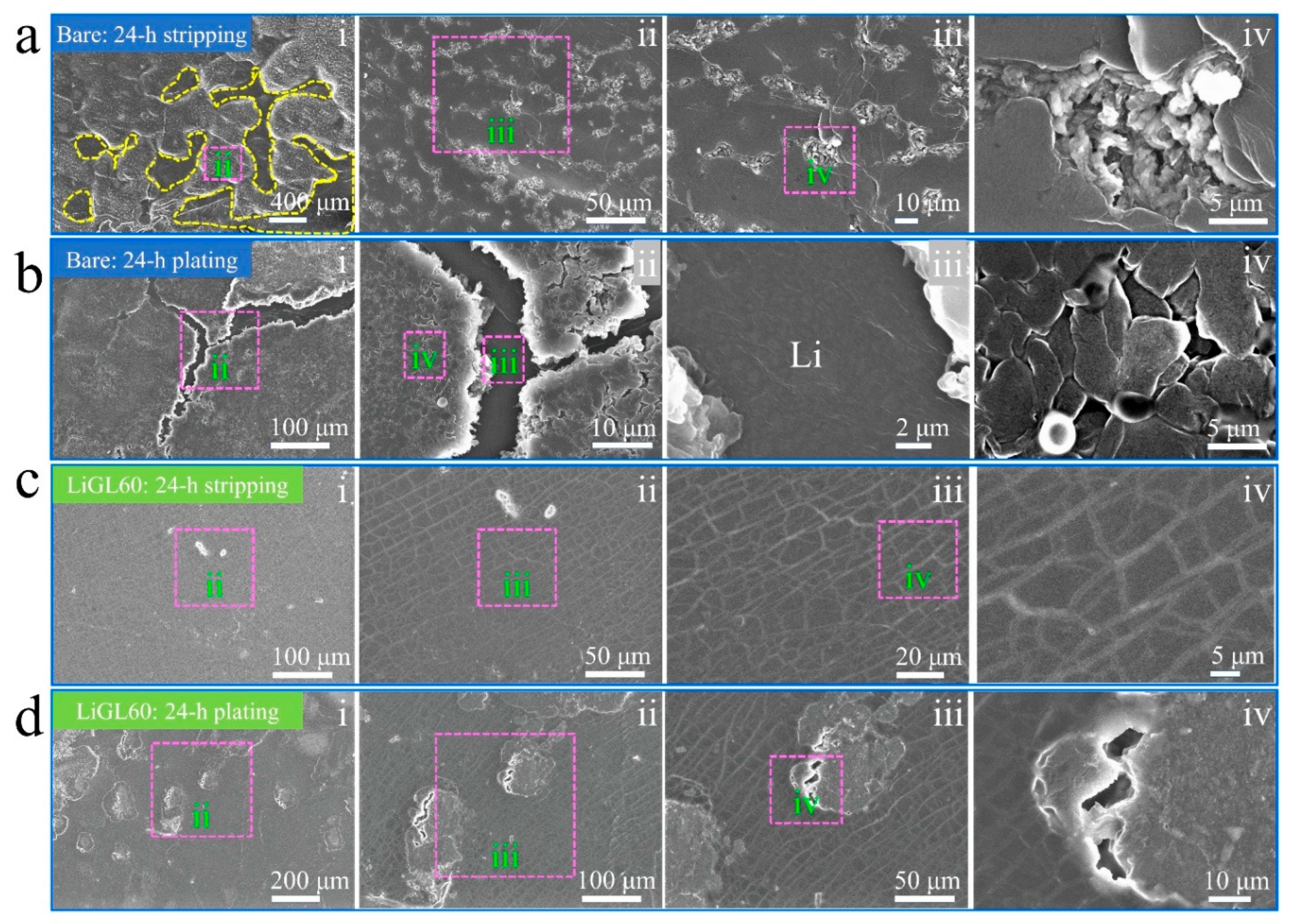
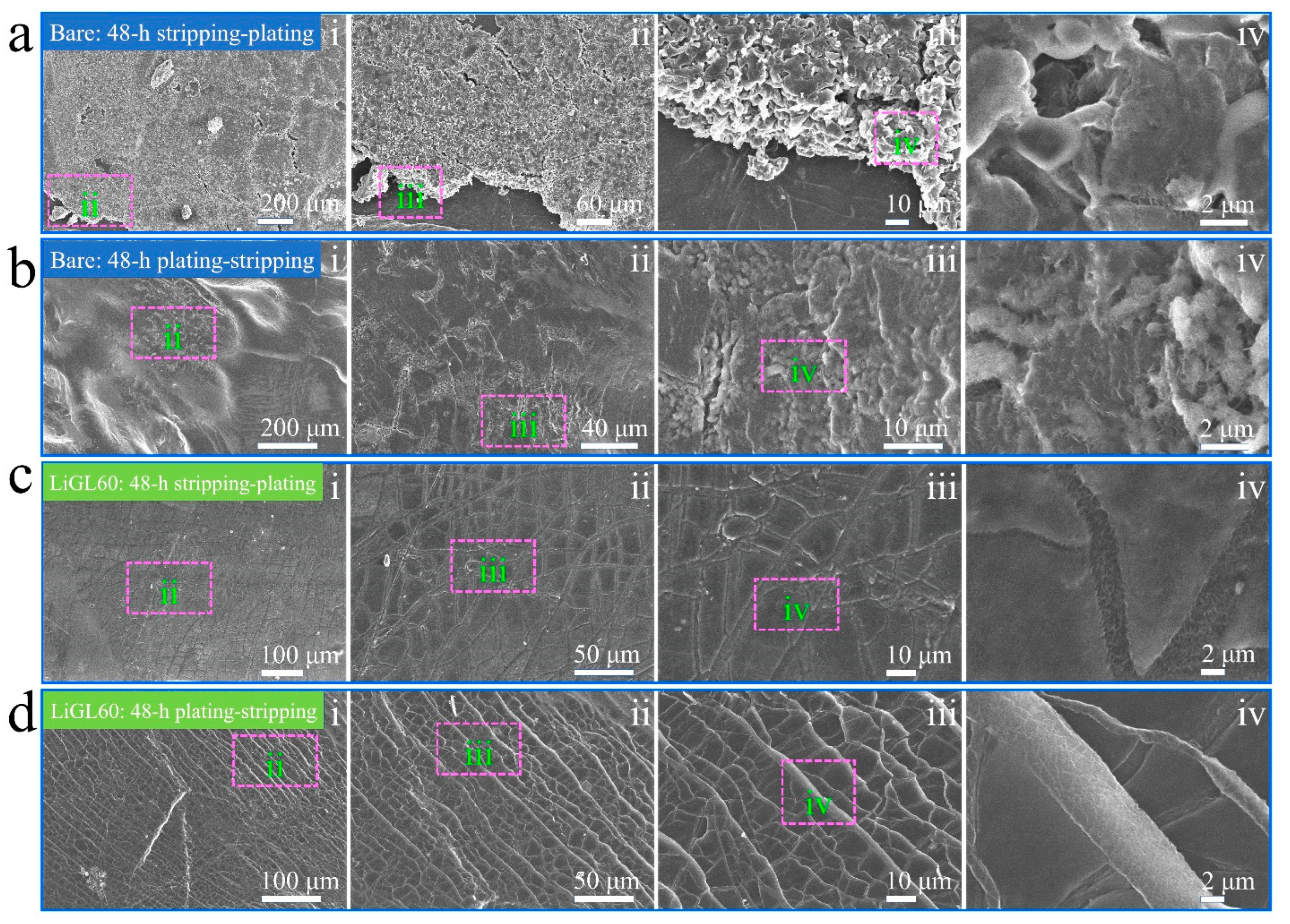
To further demonstrate the protective capability of the LiGL coating, very interestingly, we designed a novel experiment to demonstrate the compelling protective effects of the LiGL coating, in which ultra-long stripping/plating processes were performed for up to 24 h at 2 mA cm−2 in Li||Li cells. After a 24 h stripping (Figure 11a), many erupted spots on the bare Li were observed, and these erupted spots were found to be not uniformly distributed. Remarkably, on the other side, a top layer, consisting of a large number of dendritic structures, was formed after a 24 h plating (Figure 11b). Very differently, the LiGL60-coated Li metal showed a smooth surface covered by many small cracks after a 24 h stripping (Figure 11c) and plating (Figure 11d). We further verified that these cracks were due to the mechanical press during cell assembly, and not due to the stripping and plating process. These results strongly suggested that the LiGL coating can effectively protect Li metal from corrosion. To further test this hypothesis, subsequently, a reversed 24 h plating/stripping process was carried out right after the initial 24 h stripping/plating process. As highlighted in Figure 12a,b, the bare Li-metal anodes had a significant formation of SEI and uncontrolled growth of Li dendrites, while the LiGL60-coated Li metal was found nearly intact and did not show any signs of corrosion (Figure 12c,d). In a subsequent study, the excellent protection capability of LiGL has also been further verified to improve the Li||NMC622 LMB cells []. As reported, the LiGL400 (~1000 nm thick) doubled the cyclability of the Li||NMC622 cells without any capacity drop, compared to bare Li||NMC622 cells. Based on these observations, we can conclude that the LiGL MLD coating can provide an exceptional protection to the Li-metal anodes due to the following excellent properties, i.e., high ionic conductivity, outstanding electrical insulation, good mechanical flexibility, and excellent chemical compatibility and stability. However, it is important to note that the cracks present in LiGL (Figure 12c,d) could potentially be a problem, indicating that further investigation on the mechanical resilience and properties of LiGL is needed.
Figure 11.
SEM observations of the morphological changes in Li electrodes after 24 h stripping or 24 h plating []. (a,b) The bare Li electrode and (c,d) the LiGL60 electrode after one 24 h stripping (or plating) at 2 mA/cm2. LiGL60 indicates the LiGL coating of 60 MLD cycles. The electrolyte is 1M LiTFSI in 1:1 volume ratio of DOL/DME. Reprinted (adapted) with permission from Ref. [] under a Creative Commons Attribution (CC BY) license.
Figure 12.
SEM observations of the morphological changes in Li electrodes after 24 h stripping and 24 h plating (or 24 h plating and 24 h stripping) []. (a,b) The bare Li electrode and (c,d) the LiGL60 electrode after one 48 h stripping–plating at 2 mA/cm2. LiGL60 indicates the LiGL coating of 60 MLD cycles. The electrolyte is 1M LiTFSI in 1:1 volume ratio of DOL/DME. Reprinted (adapted) with permission from Ref. [] under a Creative Commons Attribution (CC BY) license.
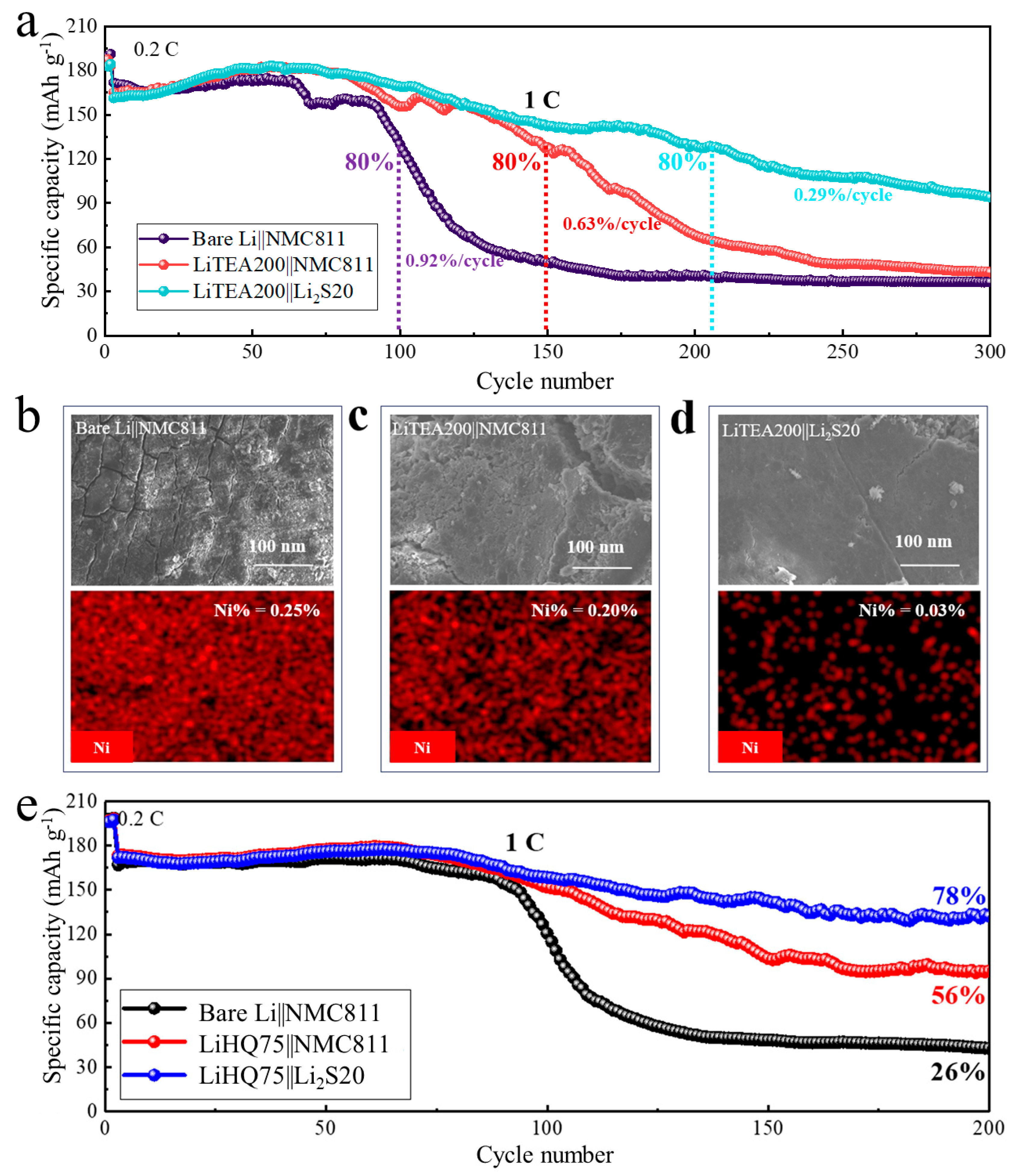
In two subsequent studies [,], LiTEA and LiHQ MLD coatings were developed and coated on Li anodes. These studies revealed that both the LiTEA and LiHQ could evidently improve Li||Li cells’ performance, accounting for ultra-long cyclability of up to 10,000 Li-stripping/plating cycles (>4000 h) without failures at 5 mA cm−2 and 1 mAh cm−2. Similarly to LiGL, it was confirmed that there was little formation of SEI and no dendritic growth under the protection of sufficiently thick LiTEA and LiHQ coatings. According to the authors [,], it was demonstrated that the Li anodes coated with 200 MLD cycles of LiTEA (i.e., LiTEA200, ~72 nm) or 75 MLD cycles of LiHQ (LiHQ75, ~30 nm) could remarkably improve the cyclability of Li||NMC811 (Figure 13). For the NMC811 cathode, which was coated by 20 cycles of ALD Li2S (i.e., Li2S20) [], the resultant LiTEA200||Li2S20 (Figure 13a) or LiHQ75||Li2S (Figure 13e) anode in LMB cells showed a significant improvement in cell cyclability. From the reported results [,], Ni content was detected on the Li anodes after 300 charge/discharge cycles based on energy-dispersive X-ray spectroscopy (EDX), and this is similar to the observation that was found on the Li anodes of bare Li||NMC811 and LiTEA200||NMC811 (Figure 13b,c). Whereas for the Li anode of LiTEA200||Li2S20-NMC811 (Figure 13d), a much lower Ni content from EDX is found. Based on these results (Figure 13), we concluded that it would be most desirable to handle the issues of both Li anodes and cathodes synergically with optimal ALD and MLD coatings.
Figure 13.
Effects of ALD Li2S and MLD LiTEA and LiHQ on the performance of Li||NMC811 LMB cells [,]. (a) Cycle performance of Li||NMC full cells due to ALD Li2S and MLD LiTEA coatings []. SEM images and EDX mapping of cycled Li electrodes disassembled from (b) bare Li||NMC811, (c) LiTEA200||NMC811, and (d) LiTEA200||Li2S20 cells []. (e) Cycle performance of Li||NMC full cells due to ALD Li2S and MLD LiHQ coatings []. NMC811 is the cathode of LiNi0.8Mn0.1Co0.1O2. LiTEA200 and LiHQ75 indicate the Li anodes coated by the LiTEA coating of 200 MLD cycles and the LiHQ coating of 75 MLD cycles, respectively, while Li2S20 signifies the NMC811 cathode coated by the Li2S coating of 20 ALD cycles. All cells were cycled at 1 C (1 C = 200 mA g−1). The electrolyte is 1.2 M LiPF6 in 3:7 weight ratio of EC/EMC. Reprinted (adapted) with permission from Ref. []. Copyright (2023) Elsevier. Reprinted (adapted) with permission from []. Copyright (2024) Elsevier.
3.3. Anode Interface Modeling
From the discussion in Section 3.2.1 and Section 3.2.2, it is noteworthy to point out that the failure in both the Si and Li anode is due to the lack of fundamental understanding and lack of control of materials properties at the interfaces [,]. During the charging process, the non-uniform lithiation process on the anode is problematic, likewise during the discharge process. At the anode, the differences in the Si or Li diffusivity and deposition rate on the surface relative to the bulk lithiation yield immense internal structural stress, and cause the pulverization. As one of the approaches to tailor the interfaces of Si or Li anode (Section 3.2), surface coating via ALD/MLD thin film turns out to be a prevailing strategy [,,,,,] in providing a uniform and homogeneous protective layer with precisely controlled thickness, which is beneficial to electrochemical performance.
3.3.1. MLD-Si Anode Modeling
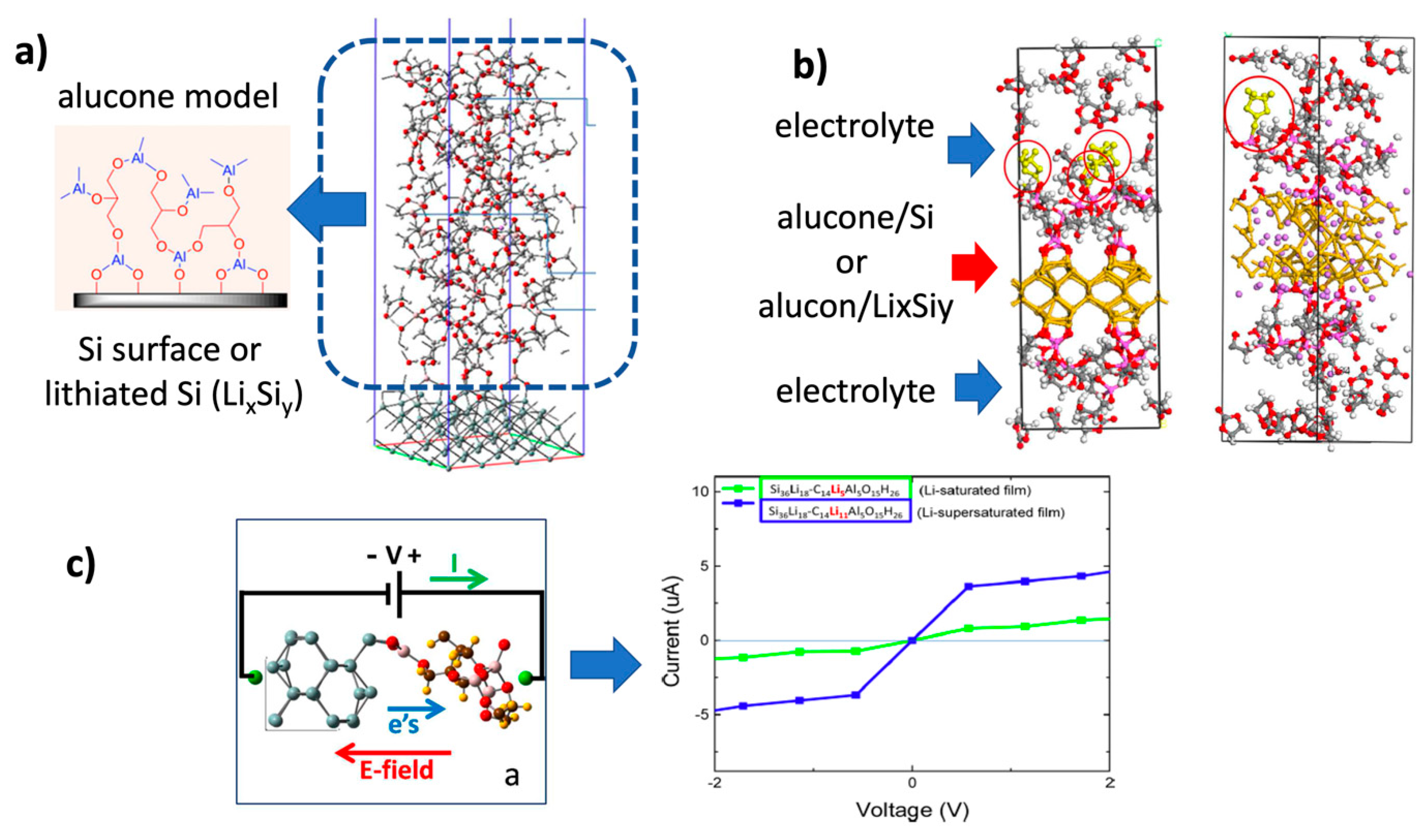
Compared to ALD, a systematic theoretical study of MLD coating on the anode is significantly lacking. For the basic computational study in the synthesis process (Figure 2) and the modulation in materials properties, the reported studies have been mostly focused on ALD, less on MLD [,]. For the pioneering theoretical study on MLD-coated films on a Si anode, the efforts were led by Balbuena et al., with the focus on aluminum alkoxide (alucone) film []. Based on DFT and AIMD simulations, the atomistic models of the alucone MLD layer in contact with the Si (001) surface and the lithiated Si surface (i.e., LixSiy) were proposed and studied (Figure 14a). From DFT calculation, the optimized alucone layer (approximately 3nm thick) exhibits multi-crosslinks and consists of Al-O complexes featuring 3-fold or 4-fold oxygen coordination, as illustrated in Figure 14a. During the lithiation process, it was found that Li atoms bind favorably to the O atoms in alucone, and less into the Si bulk. From DFT calculation [], the strong Li-O interaction in alucone suggests that the Li ions released from the alucone film were less probable. Thus, the alucone film lithiation would proceed to saturation at all favorable sites, and the volume expansion of the lithiated alucone layer would further accommodate the significant volumetric expansion of the silicon anode. Whereas for the alucone-film-coated lithiated silicone (i.e., LixSiy) surface, Li atoms were observed migrating from the lithiated LixSiy surface into the alucone layer, confirming that the alucone film is more favorable for lithiation than either Si or lithiated Si anode surface.
Figure 14.
The atomistic simulation of MLD-Si anode interface. (a) DFT model of alucone MLD coating on Si or lithiated Si (LixSiy) surface. (b) AIMD simulation of EC adsorption on alucone MLD/Si and alucone MLD/LixSiy surface when exposed to electrolyte. (c) Electron transport study of alucone MLD/Si anode during the lithiation process with different Li concentrations. Reprinted (adapted) with permission from ref. []. Copyright (2015) ACS Publication.
From DFT simulation [], the strong Li binding in alucone film implies that the reduction may have been present on the surface of lithiated alucone film, and this was confirmed by the strong adsorption of ethyl carbonate (EC) molecules in AIMD simulation (Figure 14b) when both the alucone/Si and alucone/LixSiy were exposed to electrolytes. According to the authors [], different degrees of lithiation on the alucone film changed both the structural and electronic properties significantly, and a substantial improvement in electron conductivity was observed in the Li-rich alucone film (Figure 14c). In this case, the electronic conductivity of lithiated Li-rich alucone film was studied using the DFT-Green’s function method based on the Landauer formalism []. Experimental results suggested that the lithiated alucone film exhibited both electronic and ionic conductivity. According to the authors [], the increased electronic conductivity indicated that the lithiated alucone film’s enhanced electronic conductivity capability may have promoted electrolyte molecule reduction, subsequently leading to the formation of a passivation layer on its surface.
3.3.2. MLD-Li Anode Modeling
In addition to the cathode, the anode surface plays an important role in the decomposition thermodynamics of the solid–liquid organic electrolyte interface in the Li-ion batteries. Due to the lower potential of lithium metal relative to graphite, the organic solvent (e.g., EC) decomposition on lithium metal was spontaneous and was much faster than that on the LiC6 interface []. Thus, apart from the experiments, the thermodynamic and electrochemical instability of Li-metal anode exposed to liquid electrolytes was well-studied previously based on DFT and AIMD simulation [,,,,,,]. According to the reported theoretical studies, electrolyte decomposition at the Li-metal anode depended not only on the electrode surface potential but also on the surface chemical composition and the kinetics of the chemical reactions []. These findings are useful for the basic understanding of SEI formation at the anode, and extensive efforts have been devoted to designing surface coating layers on Li-metal anodes to enable functionalized SEI formation [,,]. Since then, the theoretical exploration for a thermodynamically stable, elastic-compliant, and high-ionic-conductivity-passivation coating for the Li-metal anode that is able to mitigate lithium dendrite growth and crack formation has become evidently important.
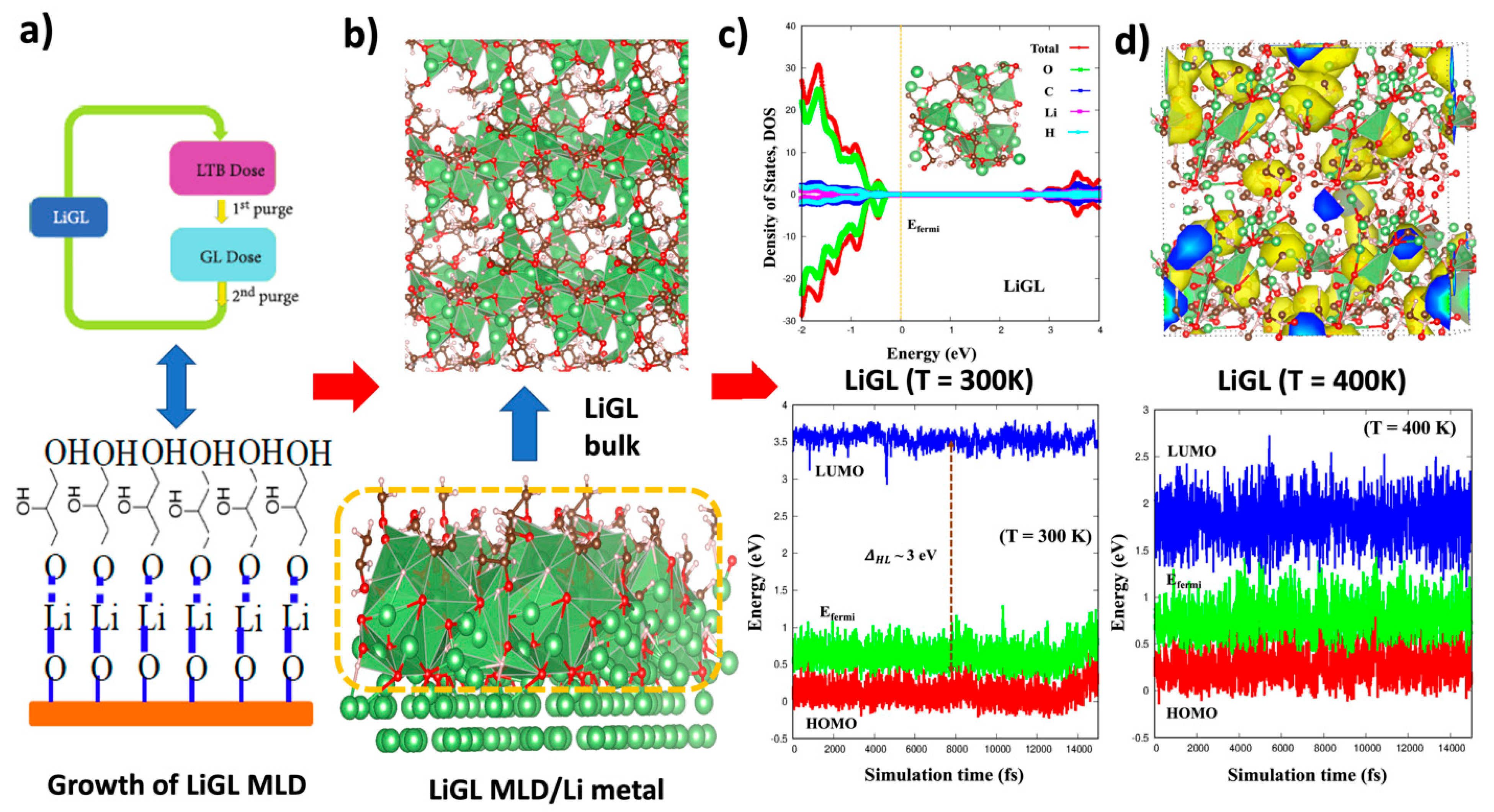
Over the years, ALD and MLD techniques have been utilized to provide a protection layer to bare Li-metal anodes (Section 3.2.2). For ALD and MLD coatings, these coating materials, whether inorganic or organic, can be classified as fully lithiated or partially/non-lithiated. Many ALD oxide (e.g., CeO2, Al2O3) coatings can be lithiated during battery operation, as the mobile Li+ ions can migrate into these oxides and be lithiated continually [,]. Once lithiated, the mechanical and electronic properties of ALD coatings become dependent on the degree of lithiation, similar to certain electrode materials []. To mitigate the mechanical failure and limited ionic conductivity of ALD-coated Li-metal anodes (Section 3.2.2), a comprehensive study (in simulation) is needed to understand the basic property changes dependent on the degree of lithiation (or Li-concentration) and film thickness of these amorphous solids. Compared to the organic polymeric films of MLD, the ALD inorganic film was found to be more vulnerable due to a lack of resilience in accommodating significant changes in stress and local structures (Section 3.1 and Section 3.2). For the MLD protective coating on the Li-metal anode, the pioneering work was first reported by Meng et al. [], based on both theoretical and experimental studies. In this work, the coating materials were based on lithicone [], i.e., LiGL in Figure 15a, which can be synthesized through a precisely controlled MLD process using lithium tert-butoxide (LTB) and glycerol (GL) as precursors. From the experiment, it is suggested that the LiGL lithicone could serve as an excellent polymeric protection film for lithium metal anodes (Section 3.2.2).
Figure 15.
The atomistic simulation of LiGL MLD-Li anode interface and properties. (a) Schematic diagram of the growth of the LiGL MLD lithicone. (b) Lithicone MLD coating on the Li-metal anode surface, and the LiGL amorphous film in the bulk phase obtained from DFT calculation. (c) The electronically insulating character of LiGL amorphous bulk, represented by the electronic density of states with band gap (~3 eV) and by the HOMO-LUMO gap (~ 3 eV) from 15 ps trajectories of AIMD simulation. (d) The unique, electronically insulating (~ 1.5 eV), and ionic-conductive feature with 3D Li+ ions diffusion paths in the LiGL amorphous bulk at the elevated temperature (T = 400 K) predicted by the AIMD simulation.
Like the MLD-coated Si anode (Section 3.2.1), the LiGL coating undergoes lithiation during battery operation. From Meng et al. [], the mobile Li+ ions will migrate into these polymeric organic films and be lithiated continually according to depth profiles of XPS. According to the AIMD simulation (Figure 15b), it was found that Li atoms tend to migrate from Li metal into the bulk LiGL polymeric network and bind very favorably to the O atoms in the lithicone film. Consequently, this facile Li+ migration leads to anticipated Li+-ion diffusion and facilitates an efficient ionic conduction within the LiGL film and across the Li-metal anode interface. Due to the unique interwoven polymeric organic network in amorphous LiGL, the three-dimensional (3D) Li+-ion diffusion paths are observed from AIMD simulation (Figure 15d). Thus, according to the authors, the high ionic conductivity of the LiGL film could therefore be particularly important to stabilize the Li-metal anode interface and thereby decrease cell impedance during the Li-stripping/plating processes (Section 3.2.2). Apart from being an ionic conductor [], the amorphous LiGL is predicted to be an electronic insulator with ~3.0 eV in band gap (Figure 15c) according to DFT calculation. According to Meng et al. [], this electronic insulating feature persists even at room temperature (T = 300 K) and elevated temperature (T = 400 K) (Figure 15c,d), as indicated by the trend of the highest occupied molecular orbital/band (HOMO), the lowest unoccupied orbital/band (LUMO) and Fermi level of the amorphous LiGL bulk based on AIMD simulation. Thus, it is believed that this electronically insulating feature of the LiGL films could be extremely useful to help in suppressing the Li dendrite growth at room temperature and even at elevated temperatures.
4. Conclusions and Outlook
In this review, we reviewed and compared ALD and MLD studies for precise surface modification of several key electrode materials, including NMC622, NMC811, Si, and Li. These materials represent the most promising electrode material candidates for enabling high-energy rechargeable batteries, but they still face some serious challenges for practical application. This work presented that ALD and MLD are two powerful methods to conduct interface engineering precisely through applying surface coatings conformally and uniformly over electrodes. It is clearly demonstrated that the performance of the coated electrodes is closely related to the coatings’ properties.
In the case of NMC cathodes, we learned that Li-conductive oxide coatings performed better than binary metal oxides, ascribed to the improved ionic conductivity. Particularly, we reported that sulfides can serve as oxygen scavengers to tackle oxygen released from layer-structured metal oxide cathodes, for example, NMCs, LCO, and others. This is very significant for oxygen released from cathode lattices, as this could bring forth more issues, such as electrolyte oxidation and the production of undesirable reaction products. All these new coatings provide new solutions to cathode materials. In addition, one should notice that, while addressing interfacial issues, these surface coatings via ALD have helped maintain the cathodes’ structure. Thus, these ALD coatings provide a robust and inert interface layer and serve as a mechanical strengthener. As a consequence, this helps to mitigate interfacial issues, protect cathodes from microcracking and dissolution of transition metals, and inhibits cathodes from oxygen release and irreversible phase transition.
In the case of Si and Li anodes, we particularly summarized the recent work of MLD coatings, which provide flexible coatings to the anodes. In the case of Si, several alucones and one polymer have been investigated and have improved the performance of silicon anodes. The main merit of these MLD coatings is their flexibility to mitigate the significant volume change in Si anodes. In the case of lithium anodes, we particularly discussed the promising applications of lithicones, which exhibited better ionic conductivity than other metalcones and polymers. Although very promising, it bears noting that improvements to the mechanical properties of lithicones are needed.
Based on these encouraging results from ALD/MLD coatings, we expect that future studies should be able to bring us more exciting findings. First, ALD/MLD coatings with superionic conductivity (>10−4 S cm−1 at room temperature) will be desirable for efficient Li-ion transport in both cathodes and anodes. Such coatings will also possibly be coated thick enough to secure sufficient mechanical strength to protect electrodes. Second, hybrid coatings, through combining ALD and MLD, may offer us an unlimited resource in the search for desirable coating materials. Such a combination will be able to deliver coatings in a tunable manner. Through adjusting ALD and MLD processes, we would be able to search for novel materials in a more controllable manner. In short, there is still plenty of room left for us to utilize ALD and MLD for seeking new solutions to high-energy rechargeable batteries. We expect to see more efforts invested in this area in future studies.
Based on the theoretical studies over the years, we found that for an ideal ALD or MLD coating on the cathode or anode, the ideal ALD/MLD coating should exhibit two key properties: high electronic insulation and efficient lithium-ion conductivity. Thus, a systematic investigation on the ionic/electronic conductivity of a wide range of ALD/MLD coatings is deemed necessary. However, for ALD and MLD films, the basic properties of these inorganic and organic coating materials are not static and can be classified into non-lithiated, partially lithiated, and fully lithiated, defined by the thermally and electrochemically driven lithium-ion migration across the electrode’s interfaces during the battery’s operation. Thus, once these ALD/MLD coatings were lithiated, the materials properties of these coatings become dependent on the degree of lithiation, like the electrodes. Meanwhile, the involvement of ALD/MLD film during the lithiation process might also affect the redox processes at the electrode and coating surface and may contribute to new types of electrode SEI when exposed to the electrolytes. To advance the design and functionalization of these ALD/MLD coatings, a basic understanding of electrolyte interaction, electron transfer, ion diffusion, materials properties changes, and interface responses are all important. Modeling these mechanisms is essentially non-trivial, as the processes involved generally occur at different spatial and temporal scales. Often, new models and understanding will be needed if the reactant materials (electrolytes and electrodes) are changing when a wide variety of material spaces are considered. To overcome the limitations and challenges of simulation models, it reminds us to envision these ALD/MLD-electrode interfaces as multifaceted, mosaic, and evolving problems. Thus, simulation techniques, ranging from electronic structures to atomistic simulation, continuum simulation to phenomenological models, high-throughput screening, data mining to machine learning studies, are all equally important and should be properly utilized to make useful predictions and to shed light on various interrelated problems.
In short, describing, understanding, and improving Li-ion batteries in operation is extremely challenging yet rewarding. Establishing a set of working structure–property relationships of ALD/MLD for various electrode designs is very challenging to both theories and experiments due to the complexities that involve wide varieties in materials, chemistries, physical processes, and device designs. Additionally, a lot of common computational studies are described by the ideal models, instead of a real complex system, which can be both a limitation and an advantage for a simulation. To fully utilize the state-of-the-art developments in big data science, a close synergy in the utilization of both experimental data and machine learning techniques could possibly be useful to help us further advance the development of ALD/MLD-electrode design to optimize Li-ion battery performance.
Funding
This study was partially supported by the U.S. National Science Foundation, award number OIA-2429581, and by the U.S. Department of Energy, Office of Science, Office of Basic Energy Sciences, award number DE-SC0023439.
Data Availability Statement
No new data were created or analyzed in this study.
Acknowledgments
X.M. also appreciates the support of Twenty-First Century Professorship from the University of Arkansas (Fayetteville, AR, USA).
Conflicts of Interest
The authors declare no conflict of interest.
References
- George, S.M. Atomic layer deposition: An overview. Chem. Rev. 2010, 110, 111–131. [Google Scholar] [CrossRef] [PubMed]
- Zhuiykov, S.; Akbari, M.K.; Hai, Z.; Xue, C.; Xu, H.; Hyde, L. Wafer-scale fabrication of conformal atomic-layered TiO2 by atomic layer deposition using tetrakis(dimethylamino)titanium and H2O precursors. Mater. Des. 2017, 120, 99–108. [Google Scholar] [CrossRef]
- Gayle, A.J.; Berquist, Z.J.; Chen, Y.; Hill, A.J.; Hoffman, J.Y.; Bielinski, A.R.; Lenert, A.; Dasgupta, N.P. Tunable Atomic Layer Deposition into Ultra-High-Aspect-Ratio (>60,000:1) Aerogel Monoliths Enabled by Transport Modeling. Chem. Mater. 2021, 33, 5572–5583. [Google Scholar] [CrossRef]
- Cai, J.; Ma, Z.; Wejinya, U.; Zou, M.; Liu, Y.; Zhou, H.; Meng, X. A revisit to atomic layer deposition of zinc oxide using diethylzinc and water as precursors. J. Mater. Sci. 2019, 54, 5236–5248. [Google Scholar] [CrossRef]
- Putkonen, M.; Niinistö, L. Atomic layer deposition of B2O3 thin films at room temperature. Thin Solid. Film. 2006, 514, 145–149. [Google Scholar] [CrossRef]
- Meng, X.; Yang, X.Q.; Sun, X.L. Emerging applications of atomic layer deposition for lithium-ion battery studies. Adv. Mater. 2012, 24, 3589–3615. [Google Scholar] [CrossRef]
- Meng, X. An overview of molecular layer deposition for organic and organic-inorganic hybrid materials: Mechanisms, growth characteristics, and promising applications. J. Mater. Chem. A 2017, 5, 18326–18378. [Google Scholar] [CrossRef]
- Zhu, C.; Han, K.; Geng, D.; Ye, H.; Meng, X. Achieving high-performance silicon anodes of lithium-ion batteries via atomic and molecular layer deposited surface coatings: An overview. Electrochim. Acta 2017, 251, 710–728. [Google Scholar] [CrossRef]
- Wang, X.; Meng, X.-B. Surface modifications of layered LiNixMnyCozO2 cathodes via atomic and molecular layer deposition. Rare Met. 2023, 42, 2121–2156. [Google Scholar] [CrossRef]
- Meng, X. Atomic layer deposition of solid-state electrolytes for next-generation lithium-ion batteries and beyond: Opportunities and challenges. Energy Storage Mater. 2020, 30, 296–328. [Google Scholar] [CrossRef]
- Wang, C.; Li, X.; Zhao, Y.; Banis, M.N.; Liang, J.; Li, X.; Sun, Y.; Adair, K.R.; Sun, Q.; Liu, Y.; et al. Manipulating Interfacial Nanostructure to Achieve High-Performance All-Solid-State Lithium-Ion Batteries. Small Methods 2019, 3, 1900261. [Google Scholar] [CrossRef]
- Hamalainen, J.; Holopainen, J.; Munnik, F.; Hatanpaa, T.; Heikkila, M.; Ritala, M.; Leskela, M. Lithium phosphate thin films grown by atomic layer deposition. J. Electrochem. Soc. 2012, 159, A259–A263. [Google Scholar] [CrossRef]
- Kim, H.; Hong, J.; Park, K.-Y.; Kim, H.; Kim, S.-W.; Kang, K. Aqueous Rechargeable Li and Na Ion Batteries. Chem. Rev. 2014, 114, 11788–11827. [Google Scholar] [CrossRef]
- Cao, Y.; Meng, X.; Elam, J.W. Atomic layer deposition of LixAlyS solid-state electrolytes for stabilizing lithium-metal anodes. ChemElectroChem 2016, 3, 858–863. [Google Scholar] [CrossRef]
- Ahmed, R.A.; Carballo, K.V.; Koirala, K.P.; Zhao, Q.; Gao, P.; Kim, J.-M.; Anderson, C.S.; Meng, X.; Wang, C.; Zhang, J.-G.; et al. Lithicone-Protected Lithium Metal Anodes for Lithium Metal Batteries with Nickel-Rich Cathode Materials. Small Struct. 2024, 5, 2400174. [Google Scholar] [CrossRef]
- Meng, X.; Lau, K.C.; Zhou, H.; Ghosh, S.K.; Benamara, M.; Zou, M. Molecular Layer Deposition of Crosslinked Polymeric Lithicone for Superior Lithium Metal Anodes. Energy Mater. Adv. 2021, 2021, 9786201. [Google Scholar] [CrossRef]
- Wang, X.; Cai, J.; Velasquez Carballo, K.; Watanabe, F.; Meng, X. Tackling issues of lithium metal anodes with a novel polymeric lithicone coating. Chem. Eng. J. 2023, 475, 146156. [Google Scholar] [CrossRef]
- Wang, X.; Velasquez Carballo, K.; Shao, A.; Cai, J.; Watanabe, F.; Meng, X. A novel polymeric lithicone coating for superior lithium metal anodes. Nano Energy 2024, 128, 109840. [Google Scholar] [CrossRef]
- Meng, X. Interface engineering of lithium metal anodes via atomic and molecular layer deposition. Inorg. Chem. Front. 2024, 11, 659–681. [Google Scholar] [CrossRef]
- Meng, X.; Chen, Z. Constituting robust interfaces for better lithium-ion batteries and beyond using atomic and molecular layer deposition. In Encyclopedia of Nanomaterials, 1st ed.; Yin, Y., Lu, Y., Xia, Y., Eds.; Elsevier: Oxford, UK, 2023; pp. 649–663. [Google Scholar]
- Miikkulainen, V.; Leskelä, M.; Ritala, M.; Puurunen, R.L. Crystallinity of inorganic films grown by atomic layer deposition: Overview and general trends. J. Appl. Phys. 2013, 113, 021301. [Google Scholar] [CrossRef]
- Puurunen, R.L. Surface chemistry of atomic layer deposition: A case study for the trimethylaluminum/water process. J. Appl. Phys. 2005, 97, 121301. [Google Scholar] [CrossRef]
- Shao, H.-I.; Umemoto, S.; Kikutani, T.; Okui, N. Layer-by-layer polycondensation of nylon 66 by alternating vapour deposition polymerization. Polymer 1997, 38, 459–462. [Google Scholar] [CrossRef]
- Du, Y.; George, S.M. Molecular layer deposition of nylon 66 films examined using in situ FTIR spectroscopy. J. Phys. Chem. C 2007, 111, 8509–8517. [Google Scholar] [CrossRef]
- Yoshimura, T.; Tatsuura, S.; Sotoyama, W.; Matsuura, A.; Hayano, T. Quantum wire and dot formation by chemical vapor deposition and molecular layer deposition of one-dimensional conjugated polymer. Appl. Phys. Lett. 1992, 60, 268–270. [Google Scholar] [CrossRef]
- Yoshimura, T.; Oshima, A.; Kim, D.-I.; Morita, Y. Quantum dot formation in polymer wires by three-molecule molecular layer deposition (MLD) and applications to electro-optic/photovoltaic devices. ECS Trans. 2009, 25, 15–25. [Google Scholar] [CrossRef]
- Yoshimura, T.; Ebihara, R.; Oshima, A. Polymer wires with quantum dots grown by molecular layer deposition of three source molecules for sensitized photovoltaics. J. Vac. Sci. Technol. A 2011, 29, 051510. [Google Scholar] [CrossRef]
- Yoshimura, T.; Ishii, S. Effect of quantum dot length on the degree of electron localization in polymer wires grown by molecular layer deposition. J. Vac. Sci. Technol. A 2013, 31, 031501. [Google Scholar] [CrossRef]
- Kim, A.; Filler, M.A.; Kim, S.; Bent, S.F. Layer-by-layer growth on Ge(100) via spontaneous urea coupling reactions. J. Am. Chem. Soc. 2005, 127, 6123–6132. [Google Scholar] [CrossRef] [PubMed]
- Loscutoff, P.W.; Zhou, H.; Clendenning, S.B.; Bent, S.F. Formation of organic nanoscale laminates and blends by molecular layer deposition. ACS Nano 2010, 4, 331–341. [Google Scholar] [CrossRef]
- Zhou, H.; Bent, S.F. Molecular layer deposition of functional thin films for advanced lithographic patterning. ACS Appl. Mater. Interfaces 2011, 3, 505–511. [Google Scholar] [CrossRef]
- Zhou, H.; Toney, M.F.; Bent, S.F. Cross-linked ultrathin polyurea films via molecular layer deposition. Macromolecules 2013, 46, 5638–5643. [Google Scholar] [CrossRef]
- Park, Y.-S.; Choi, S.-E.; Kim, H.; Lee, J.S. Fine-tunable absorption of uniformly aligned polyurea thin films for optical filters using sequentially self-limited molecular layer deposition. ACS Appl. Mater. Interfaces 2016, 8, 11788–11795. [Google Scholar] [CrossRef]
- Atanasov, S.E.; Losego, M.D.; Gong, B.; Sachet, E.; Maria, J.-P.; Williams, P.S.; Parsons, G.N. Highly conductive and conformal poly(3,4-ethylenedioxythiophene) (PEDOT) thin films via oxidative molecular layer deposition. Chem. Mater. 2014, 26, 3471–3478. [Google Scholar] [CrossRef]
- Kim, D.H.; Atanasov, S.E.; Lemaire, P.; Lee, K.; Parsons, G.N. Platinum-free cathode for dye-sensitized solar cells using poly(3,4-ethylenedioxythiophene) (PEDOT) formed via oxidative molecular layer deposition. ACS Appl. Mater. Interfaces 2015, 7, 3866–3870. [Google Scholar] [CrossRef] [PubMed]
- Miyamae, T.; Tsukagoshi, K.; Matsuoka, O.; Yamamoto, S.; Nozoye, H. Preparation of polyimide-polyamide random copolymer thin film by sequential vapor deposition polymerization. Jpn. J. Appl. Phys. 2002, 41, 746. [Google Scholar] [CrossRef]
- Loscutoff, P.W.; Lee, H.-B.-R.; Bent, S.F. Deposition of ultrathin polythiourea films by molecular layer deposition. Chem. Mater. 2010, 22, 5563–5569. [Google Scholar] [CrossRef]
- Ivanova, T.V.; Maydannik, P.S.; Cameron, D.C. Molecular layer deposition of polyethylene terephthalate thin films. J. Vac. Sci. Technol. A 2012, 30, 01A121. [Google Scholar] [CrossRef]
- Salmi, L.D.; Heikkilä, M.J.; Puukilainen, E.; Sajavaara, T.; Grosso, D.; Ritala, M. Studies on atomic layer deposition of MOF-5 thin films. Microporous Mesoporous Mater. 2013, 182, 147–154. [Google Scholar] [CrossRef]
- Snyder, M.Q.; Trebukhova, S.A.; Ravdel, B.; Wheeler, M.C.; DiCarlo, J.; Tripp, C.P.; DeSisto, W.J. Synthesis and characterization of atomic layer deposited titanium nitride thin films on lithium titanate spinel powder as a lithium-ion battery anode. J. Power Sources 2007, 165, 379–385. [Google Scholar] [CrossRef]
- Jung, Y.S.; Cavanagh, A.S.; Dillon, A.C.; Groner, M.D.; George, S.M.; Lee, S.H. Enhanced stability of LiCoO2 cathodes in lithium-ion batteries using surface modification by atomic layer deposition. J. Electrochem. Soc. 2010, 157, A75–A81. [Google Scholar] [CrossRef]
- Jung, Y.S.; Cavanagh, A.S.; Riley, L.A.; Kang, S.H.; Dillon, A.C.; Groner, M.D.; George, S.M.; Lee, S.H. Ultrathin direct atomic layer deposition on composite electrodes for highly durable and safe Li-ion batteries. Adv. Mater. 2010, 22, 2172–2176. [Google Scholar] [CrossRef]
- Li, X.; Liu, J.; Meng, X.; Tang, Y.; Banis, M.N.; Yang, J.; Hu, Y.; Li, R.; Cai, M.; Sun, X. Significant impact on cathode performance of lithium-ion batteries by precisely controlled metal oxide nanocoatings via atomic layer deposition. J. Power Sources 2014, 247, 57–69. [Google Scholar] [CrossRef]
- Meng, X. Inhibiting Sulfur Shuttle Behaviors in High-Energy Lithium-Sulfur Batteries. U.S. Patent 62/471161, 14 March 2017. [Google Scholar]
- Gao, H.; Cai, J.; Xu, G.-L.; Li, L.; Ren, Y.; Meng, X.; Amine, K.; Chen, Z. Surface modification for suppressing interfacial parasitic reactions of a nickel-rich lithium-ion cathode. Chem. Mater. 2019, 31, 2723–2730. [Google Scholar] [CrossRef]
- Xie, J.; Sendek, A.D.; Cubuk, E.D.; Zhang, X.; Lu, Z.; Gong, Y.; Wu, T.; Shi, F.; Liu, W.; Reed, E.J.; et al. Atomic layer deposition of stable LiAlF4 lithium ion conductive interfacial layer for stable cathode cycling. ACS Nano 2017, 11, 7019–7027. [Google Scholar] [CrossRef]
- Shapira, A.; Tiurin, O.; Solomatin, N.; Auinat, M.; Meitav, A.; Ein-Eli, Y. Robust AlF3 Atomic Layer Deposition Protective Coating on LiMn1.5Ni0.5O4 Particles: An Advanced Li-Ion Battery Cathode Material Powder. ACS Appl. Energy Mater. 2018, 1, 6809–6823. [Google Scholar] [CrossRef]
- Xiao, B.; Wang, B.; Liu, J.; Kaliyappan, K.; Sun, Q.; Liu, Y.; Dadheech, G.; Balogh, M.P.; Yang, L.; Sham, T.-K.; et al. Highly stable Li1.2Mn0.54Co0.13Ni0.13O2 enabled by novel atomic layer deposited AlPO4 coating. Nano Energy 2017, 34, 120–130. [Google Scholar] [CrossRef]
- Lin, C.-F.; Fan, X.; Pearse, A.; Liou, S.-C.; Gregorczyk, K.; Leskes, M.; Wang, C.; Lee, S.B.; Rubloff, G.W.; Noked, M. Highly Reversible Conversion-Type FeOF Composite Electrode with Extended Lithium Insertion by Atomic Layer Deposition LiPON Protection. Chem. Mater. 2017, 29, 8780–8791. [Google Scholar] [CrossRef]
- Kim, H.; Lee, J.T.; Lee, D.C.; Magasinski, A.; Cho, W.I.; Yushin, G. Plasma-Enhanced Atomic Layer Deposition of Ultrathin Oxide Coatings for Stabilized Lithium-Sulfur Batteries. Adv. Energy Mater. 2013, 3, 1308–1315. [Google Scholar] [CrossRef]
- Meng, X.; Comstock, D.J.; Fister, T.T.; Elam, J.W. Vapor-phase atomic-controllable growth of amorphous Li2S for high-performance lithium–sulfur batteries. ACS Nano 2014, 8, 10963–10972. [Google Scholar] [CrossRef]
- Lu, J.; Lei, Y.; Lau, K.C.; Luo, X.; Du, P.; Wen, J.; Assary, R.S.; Das, U.; Miller, D.J.; Elam, J.W.; et al. A nanostructured cathode architecture for low charge overpotential in lithium-oxygen batteries. Nat. Commun. 2013, 4, 2383. [Google Scholar] [CrossRef]
- Zhao, L.; Zhao, J.; Hu, Y.-S.; Li, H.; Zhou, Z.; Armand, M.; Chen, L. Disodium Terephthalate (Na2C8H4O4) as High Performance Anode Material for Low-Cost Room-Temperature Sodium-Ion Battery. Adv. Energy Mater. 2012, 2, 962–965. [Google Scholar] [CrossRef]
- Schuppert, N.D.; Mukherjee, S.; Bates, A.M.; Son, E.-J.; Choi, M.J.; Park, S. Ex-situ X-ray diffraction analysis of electrode strain at TiO2 atomic layer deposition/α-MoO3 interface in a novel aqueous potassium ion battery. J. Power Sources 2016, 316, 160–169. [Google Scholar] [CrossRef]
- Zhao, K.; Wang, C.; Yu, Y.; Yan, M.; Wei, Q.; He, P.; Dong, Y.; Zhang, Z.; Wang, X.; Mai, L. Ultrathin Surface Coating Enables Stabilized Zinc Metal Anode. Adv. Mater. Interfaces 2018, 5, 1800848. [Google Scholar] [CrossRef]
- Pal, D.; Mathur, A.; Singh, A.; Pakhira, S.; Singh, R.; Chattopadhyay, S. Binder-Free ZnO Cathode synthesized via ALD by Direct Growth of Hierarchical ZnO Nanostructure on Current Collector for High-Performance Rechargeable Aluminium-Ion Batteries. ChemistrySelect 2018, 3, 12512–12523. [Google Scholar] [CrossRef]
- Loebl, A.J.; Oldham, C.J.; Devine, C.K.; Gong, B.; Atanasov, S.E.; Parsons, G.N.; Fedkiw, P.S. Solid Electrolyte Interphase on Lithium-Ion Carbon Nanofiber Electrodes by Atomic and Molecular Layer Deposition. J. Electrochem. Soc. 2013, 160, A1971–A1978. [Google Scholar] [CrossRef]
- Piper, D.M.; Travis, J.J.; Young, M.; Son, S.-B.; Kim, S.C.; Oh, K.H.; George, S.M.; Ban, C.; Lee, S.-H. Reversible high-capacity Si nanocomposite anodes for lithium-ion batteries enabled by molecular layer deposition. Adv. Mater. 2014, 26, 1596–1601. [Google Scholar] [CrossRef]
- Zhao, Y.; Goncharova, L.V.; Sun, Q.; Li, X.; Lushington, A.; Wang, B.; Li, R.; Dai, F.; Cai, M.; Sun, X. Robust metallic lithium anode protection by the molecular-layer-deposition technique. Small Methods 2018, 2, 1700417. [Google Scholar] [CrossRef]
- Zhao, Y.; Goncharova, L.V.; Zhang, Q.; Kaghazchi, P.; Sun, Q.; Lushington, A.; Wang, B.; Li, R.; Sun, X. Inorganic–Organic Coating via Molecular Layer Deposition Enables Long Life Sodium Metal Anode. Nano Lett. 2017, 17, 5653–5659. [Google Scholar] [CrossRef]
- Kaliyappan, K.; Or, T.; Deng, Y.-P.; Hu, Y.; Bai, Z.; Chen, Z. Constructing Safe and Durable High-Voltage P2 Layered Cathodes for Sodium Ion Batteries Enabled by Molecular Layer Deposition of Alucone. Adv. Funct. Mater. 2020, 30, 1910251. [Google Scholar] [CrossRef]
- Multia, J.; Karppinen, M. Atomic/Molecular Layer Deposition for Designer’s Functional Metal–Organic Materials. Adv. Mater. Interfaces 2022, 9, 2200210. [Google Scholar] [CrossRef]
- Van Bui, H.; Grillo, F.; van Ommen, J.R. Atomic and molecular layer deposition: Off the beaten track. Chem. Commun. 2017, 53, 45–71. [Google Scholar] [CrossRef]
- Yun, S.; Wang, H.; Tom, M.; Ou, F.; Orkoulas, G.; Christofides, P.D. Multiscale CFD Modeling of Area-Selective Atomic Layer Deposition: Application to Reactor Design and Operating Condition Calculation. Coatings 2023, 13, 558. [Google Scholar] [CrossRef]
- Chen, Y.; Li, Z.; Dai, Z.; Yang, F.; Wen, Y.; Shan, B.; Chen, R. Multiscale CFD modelling for conformal atomic layer deposition in high aspect ratio nanostructures. Chem. Eng. J. 2023, 472, 144944. [Google Scholar] [CrossRef]
- Yun, S.; Ou, F.; Wang, H.; Tom, M.; Orkoulas, G.; Christofides, P.D. Atomistic-mesoscopic modeling of area-selective thermal atomic layer deposition. Chem. Eng. Res. Des. 2022, 188, 271–286. [Google Scholar] [CrossRef]
- Richey, N.E.; de Paula, C.; Bent, S.F. Understanding chemical and physical mechanisms in atomic layer deposition. J. Chem. Phys. 2020, 152, 040902. [Google Scholar] [CrossRef] [PubMed]
- Sibanda, D.; Oyinbo, S.T.; Jen, T.-C. A review of atomic layer deposition modelling and simulation methodologies: Density functional theory and molecular dynamics. Nanotechnol. Rev. 2022, 11, 1332–1363. [Google Scholar] [CrossRef]
- Romine, D.; Sakidja, R. Modeling atomic layer deposition of alumina using reactive force field molecular dynamics. MRS Adv. 2022, 7, 185–189. [Google Scholar] [CrossRef]
- Tezsevin, I.; Deijkers, J.H.; Merkx, M.J.M.; Kessels, W.M.M.; Sandoval, T.E.; Mackus, A.J.M. The Consequences of Random Sequential Adsorption for the Precursor Packing and Growth-Per-Cycle of Atomic Layer Deposition Processes. J. Phys. Chem. Lett. 2024, 15, 7496–7501. [Google Scholar] [CrossRef]
- Lee, Y.; Rothman, A.; Shearer, A.B.; Bent, S.F. Molecular Design in Area-Selective Atomic Layer Deposition: Understanding Inhibitors and Precursors. Chem. Mater. 2025, 37, 1741–1758. [Google Scholar] [CrossRef]
- Wang, X.; Cai, J.; Liu, Y.; Han, X.; Ren, Y.; Li, J.; Liu, Y.; Meng, X. Atomic-scale constituting stable interface for improved LiNi0.6Mn0.2Co0.2O2 cathodes of lithium-ion batteries. Nanotechnology 2021, 32, 115401. [Google Scholar] [CrossRef]
- Liu, Y.; Wang, X.; Cai, J.; Han, X.; Geng, D.; Li, J.; Meng, X. Atomic-scale tuned interface of nickel-rich cathode for enhanced electrochemical performance in lithium-ion batteries. J. Mater. Sci. Technol. 2020, 54, 77–86. [Google Scholar] [CrossRef]
- Wang, X.; Ghosh, S.K.; Afshar-Mohajer, M.; Zhou, H.; Liu, Y.; Han, X.; Cai, J.; Zou, M.; Meng, X. Atomic layer deposition of zirconium oxide thin films. J. Mater. Res. 2019, 35, 804–812. [Google Scholar] [CrossRef]
- Jackson, D.H.K.; Laskar, M.R.; Fang, S.; Xu, S.; Ellis, R.G.; Li, X.; Dreibelbis, M.; Babcock, S.E.; Mahanthappa, M.K.; Morgan, D. Optimizing AlF3 atomic layer deposition using trimethylaluminum and TaF5: Application to high voltage Li-ion battery cathodes. J. Vac. Sci. Technol. A Vac. Surf. Film. 2016, 34, 031503. [Google Scholar] [CrossRef]
- Gutierrez, A.; Choudhury, D.; Sharifi-Asl, S.; Yonemoto, B.T.; Shahbazian-Yassar, R.; Mane, A.U.; Elam, J.W.; Croy, J. Multifunctional Films Deposited by Atomic Layer Deposition for Tailored Interfaces of Electrochemical Systems. J. Electrochem. Soc. 2020, 167, 140541. [Google Scholar] [CrossRef]
- Liu, Y.; Liu, W.; Zhu, M.; Li, Y.; Li, W.; Zheng, F.; Shen, L.; Dang, M.; Zhang, J. Coating ultra-thin TiN layer onto LiNi0. 8Co0. 1Mn0. 1O2 cathode material by atomic layer deposition for high-performance lithium-ion batteries. J. Alloys Compd. 2021, 888, 161594. [Google Scholar] [CrossRef]
- Henderick, L.; Hamed, H.; Mattelaer, F.; Minjauw, M.; Meersschaut, J.; Dendooven, J.; Safari, M.; Vereecken, P.; Detavernier, C. Atomic Layer Deposition of Nitrogen-Doped Al Phosphate Coatings for Li-Ion Battery Applications. ACS Appl. Mater. Interfaces 2020, 12, 25949–25960. [Google Scholar] [CrossRef]
- Liu, Y.; Wang, X.; Ghosh, S.K.; Zou, M.; Zhou, H.; Xiao, X.; Meng, X. Atomic layer deposition of lithium zirconium oxides for the improved performance of lithium-ion batteries. Dalton Trans. 2022, 51, 2737–2749. [Google Scholar] [CrossRef] [PubMed]
- Hao, S.; Wolverton, C. Lithium Transport in Amorphous Al2O3 and AlF3 for Discovery of Battery Coatings. J. Phys. Chem. C 2013, 117, 8009–8013. [Google Scholar] [CrossRef]
- Nolan, A.M.; Wickramaratne, D.; Bernstein, N.; Mo, Y.; Johannes, M.D. Li+ Diffusion in Amorphous and Crystalline Al2O3 for Battery Electrode Coatings. Chem. Mater. 2021, 33, 7795–7804. [Google Scholar] [CrossRef]
- Yan, P.; Zheng, J.; Liu, J.; Wang, B.; Cheng, X.; Zhang, Y.; Sun, X.; Wang, C.; Zhang, J.-G. Tailoring grain boundary structures and chemistry of Ni-rich layered cathodes for enhanced cycle stability of lithium-ion batteries. Nat. Energy 2018, 3, 600–605. [Google Scholar] [CrossRef]
- Cheng, X.; Zheng, J.; Lu, J.; Li, Y.; Yan, P.; Zhang, Y. Realizing superior cycling stability of Ni-Rich layered cathode by combination of grain boundary engineering and surface coating. Nano Energy 2019, 62, 30–37. [Google Scholar] [CrossRef]
- Sun, X.; Zhou, C.G.; Xie, M.; Hu, T.; Sun, H.T.; Xin, G.Q.; Wang, G.K.; George, S.M.; Lian, J. Amorphous vanadium oxide coating on graphene by atomic layer deposition for stable high energy lithium ion anodes. Chem. Commun. 2014, 50, 10703–10706. [Google Scholar] [CrossRef]
- Nguyen, J.A.; Becker, A.; Kanhaiya, K.; Heinz, H.; Weimer, A.W. Analyzing the Li–Al–O Interphase of Atomic Layer-Deposited Al2O3 Films on Layered Oxide Cathodes Using Atomistic Simulations. ACS Appl. Mater. Interfaces 2024, 16, 1861–1875. [Google Scholar] [CrossRef] [PubMed]
- Cavanagh, A.S.; Lee, Y.; Yoon, B.; George, S.M. Atomic layer deposition of LiOH and Li2CO3 using lithium t-butoxide as the lithium source. ECS Trans. 2010, 33, 223–229. [Google Scholar] [CrossRef]
- Wang, X.; Cai, J.; Ren, Y.; Benamara, M.; Zhou, X.; Li, Y.; Chen, Z.; Zhou, H.; Xiao, X.; Liu, Y.; et al. High-performance LiNi0.8Mn0.1Co0.1O2 cathode by nanoscale lithium sulfide coating via atomic layer deposition. J. Energy Chem. 2022, 69, 531–540. [Google Scholar] [CrossRef]
- Ahaliabadeh, Z.; Miikkulainen, V.; Mäntymäki, M.; Colalongo, M.; Mousavihashemi, S.; Yao, L.; Jiang, H.; Lahtinen, J.; Kankaanpää, T.; Kallio, T. Stabilized Nickel-Rich-Layered Oxide Electrodes for High-Performance Lithium-Ion Batteries. Energy Environ. Mater. 2024, 7, e12741. [Google Scholar] [CrossRef]
- Leung, K.; Qi, Y.; Zavadil, K.R.; Jung, Y.S.; Dillon, A.C.; Cavanagh, A.S.; Lee, S.-H.; George, S.M. Using Atomic Layer Deposition to Hinder Solvent Decomposition in Lithium Ion Batteries: First-Principles Modeling and Experimental Studies. J. Am. Chem. Soc. 2011, 133, 14741–14754. [Google Scholar] [CrossRef]
- Leung, K. First-Principles Modeling of Mn(II) Migration above and Dissolution from LixMn2O4 Surfaces. Chem. Mater. 2017, 29, 2550–2562. [Google Scholar] [CrossRef]
- Haworth, A.R.; Johnston, B.I.J.; Wheatcroft, L.; McKinney, S.L.; Tapia-Ruiz, N.; Booth, S.G.; Nedoma, A.J.; Cussen, S.A.; Griffin, J.M. Structural Insight into Protective Alumina Coatings for Layered Li-Ion Cathode Materials by Solid-State NMR Spectroscopy. ACS Appl. Mater. Interfaces 2024, 16, 7171–7181. [Google Scholar] [CrossRef]
- Huang, H.; Qiao, L.; Zhou, H.; Tang, Y.; Wahila, M.J.; Liu, H.; Liu, P.; Zhou, G.; Smeu, M.; Liu, H. Efficacy of atomic layer deposition of Al2O3 on composite LiNi0.8Mn0.1Co0.1O2 electrode for Li-ion batteries. Sci. Rep. 2024, 14, 18180. [Google Scholar] [CrossRef]
- Chen, R.L.B.; Sayed, F.N.; Banerjee, H.; Temprano, I.; Wan, J.; Morris, A.J.; Grey, C.P. Identification of the dual roles of Al2O3 coatings on NMC811-cathodes via theory and experiment. Energy Environ. Sci. 2025, 18, 1879–1900. [Google Scholar] [CrossRef]
- He, Y.; Pham, H.; Liang, X.; Park, J. The role of atomic layer deposited coatings on lithium-ion transport: A comprehensive study. J. Power Sources 2023, 586, 233682. [Google Scholar] [CrossRef]
- Zhang, Y.; Luo, J.-D.; Yao, H.-B.; Jiang, B. Size dependent lithium-ion conductivity of solid electrolytes in machine learning molecular dynamics simulations. Artif. Intell. Chem. 2024, 2, 100051. [Google Scholar] [CrossRef]
- Ma, J.; Li, Z. Computational Design of Inorganic Solid-State Electrolyte Materials for Lithium-Ion Batteries. Acc. Mater. Res. 2024, 5, 523–532. [Google Scholar] [CrossRef]
- Xie, S.R.; Honrao, S.J.; Lawson, J.W. High-Throughput Screening of Li Solid-State Electrolytes with Bond Valence Methods and Machine Learning. Chem. Mater. 2024, 36, 9320–9329. [Google Scholar] [CrossRef]
- Choi, J.; Jun, B.; Jung, Y. Reliable Li-ion conductivity with efficient data generation and uncertainty estimation toward large-scale screening. Chem. Eng. J. 2025, 516, 163847. [Google Scholar] [CrossRef]
- Zamfir, M.R.; Nguyen, H.T.; Moyen, E.; Lee, Y.H.; Pribat, D. Silicon nanowires for Li-based battery anodes: A review. J. Mater. Chem. A 2013, 1, 9566–9586. [Google Scholar] [CrossRef]
- Park, C.-M.; Kim, J.-H.; Kim, H.; Sohn, H.-J. Li-alloy based anode materials for Li secondary batteries. Chem. Soc. Rev. 2010, 39, 3115–3141. [Google Scholar] [CrossRef]
- Fang, J.; Li, J.; Zhang, W.; Qin, L.; Wu, K.; Hui, L.; Gong, T.; Li, D.; Hu, Y.; Li, A.; et al. Molecular layer deposited mechanically and chemically robust niobicone interface empowering silicon nanowire anodes with competent cyclabilities. Chem. Eng. J. 2024, 484, 149387. [Google Scholar] [CrossRef]
- Wallas, J.M.; Welch, B.C.; Wang, Y.; Liu, J.; Hafner, S.E.; Qiao, R.; Yoon, T.; Cheng, Y.-T.; George, S.M.; Ban, C. Spatial Molecular Layer Deposition of Ultrathin Polyamide To Stabilize Silicon Anodes in Lithium-Ion Batteries. ACS Appl. Energy Mater. 2019, 2, 4135–4143. [Google Scholar] [CrossRef]
- Xu, W.; Wang, J.; Ding, F.; Chen, X.; Nasybulin, E.; Zhang, Y.; Zhang, J.-G. Lithium metal anodes for rechargeable batteries. Energy Environ. Sci. 2014, 7, 513–537. [Google Scholar] [CrossRef]
- Kozen, A.C.; Lin, C.-F.; Pearse, A.J.; Schroeder, M.A.; Han, X.; Hu, L.; Lee, S.-B.; Rubloff, G.W.; Noked, M. Next-generation lithium metal anode engineering via atomic layer deposition. ACS Nano 2015, 9, 5884–5892. [Google Scholar] [CrossRef] [PubMed]
- Alaboina, P.K.; Rodrigues, S.; Rottmayer, M.; Cho, S.-J. In Situ Dendrite Suppression Study of Nanolayer Encapsulated Li Metal Enabled by Zirconia Atomic Layer Deposition. ACS Appl. Mater. Interfaces 2018, 10, 32801–32808. [Google Scholar] [CrossRef]
- Wang, M.; Cheng, X.; Cao, T.; Niu, J.; Wu, R.; Liu, X.; Zhang, Y. Constructing ultrathin TiO2 protection layers via atomic layer deposition for stable lithium metal anode cycling. J. Alloys Compd. 2021, 865, 158748. [Google Scholar] [CrossRef]
- Chen, L.; Chen, K.-S.; Chen, X.; Ramirez, G.; Huang, Z.; Geise, N.R.; Steinrück, H.-G.; Fisher, B.L.; Shahbazian-Yassar, R.; Toney, M.F.; et al. Novel ALD Chemistry Enabled Low-Temperature Synthesis of Lithium Fluoride Coatings for Durable Lithium Anodes. ACS Appl. Mater. Interfaces 2018, 10, 26972–26981. [Google Scholar] [CrossRef]
- Niu, J.; Wang, M.; Cao, T.; Cheng, X.; Wu, R.; Liu, H.; Zhang, Y.; Liu, X. Li metal coated with Li3PO4 film via atomic layer deposition as battery anode. Ionics 2021, 27, 2445–2454. [Google Scholar] [CrossRef]
- Meng, X.; Cao, Y.; Libera, J.A.; Elam, J.W. Atomic layer deposition of aluminum sulfide: Growth mechanism and electrochemical evaluation in lithium-ion batteries. Chem. Mater. 2017, 29, 9043–9052. [Google Scholar] [CrossRef]
- Harrison, K.L.; Zavadil, K.R.; Hahn, N.T.; Meng, X.; Elam, J.W.; Leenheer, A.; Zhang, J.-G.; Jungjohann, K.L. Lithium self-discharge and its prevention: Direct visualization through in situ electrochemical scanning transmission electron microscopy. ACS Nano 2017, 11, 11194–11205. [Google Scholar] [CrossRef]
- Sun, Y.; Zhao, Y.; Wang, J.; Liang, J.; Wang, C.; Sun, Q.; Lin, X.; Adair, K.R.; Luo, J.; Wang, D.; et al. A novel organic “polyurea” thin film for ultralong-life lithium-metal anodes via molecular-layer deposition. Adv. Mater. 2019, 31, 1806541. [Google Scholar] [CrossRef]
- Zhao, Y.; Amirmaleki, M.; Sun, Q.; Zhao, C.; Codirenzi, A.; Goncharova, L.V.; Wang, C.; Adair, K.; Li, X.; Yang, X.; et al. Natural SEI-inspired dual-protective layers via atomic/molecular layer deposition for long-life metallic lithium anode. Matter 2019, 1, 1215–1231. [Google Scholar] [CrossRef]
- Soto, F.A.; Martinez de la Hoz, J.M.; Seminario, J.M.; Balbuena, P.B. Modeling solid-electrolyte interfacial phenomena in silicon anodes. Curr. Opin. Chem. Eng. 2016, 13, 179–185. [Google Scholar] [CrossRef]
- Benitez, L.; Cristancho, D.; Seminario, J.M.; Martinez de la Hoz, J.M.; Balbuena, P.B. Electron transfer through solid-electrolyte-interphase layers formed on Si anodes of Li-ion batteries. Electrochim. Acta 2014, 140, 250–257. [Google Scholar] [CrossRef]
- Feyzi, E.; M R, A.K.; Li, X.; Deng, S.; Nanda, J.; Zaghib, K. A comprehensive review of silicon anodes for high-energy lithium-ion batteries: Challenges, latest developments, and perspectives. Next Energy 2024, 5, 100176. [Google Scholar] [CrossRef]
- Wang, A.; Kadam, S.; Li, H.; Shi, S.; Qi, Y. Review on modeling of the anode solid electrolyte interphase (SEI) for lithium-ion batteries. npj Comput. Mater. 2018, 4, 15. [Google Scholar] [CrossRef]
- Ma, Y.; Martinez de la Hoz, J.M.; Angarita, I.; Berrio-Sanchez, J.M.; Benitez, L.; Seminario, J.M.; Son, S.-B.; Lee, S.-H.; George, S.M.; Ban, C.; et al. Structure and Reactivity of Alucone-Coated Films on Si and LixSiy Surfaces. ACS Appl. Mater. Interfaces 2015, 7, 11948–11955. [Google Scholar] [CrossRef] [PubMed]
- Yu, J.; Balbuena, P.B.; Budzien, J.; Leung, K. Hybrid DFT Functional-Based Static and Molecular Dynamics Studies of Excess Electron in Liquid Ethylene Carbonate. J. Electrochem. Soc. 2011, 158, A400. [Google Scholar] [CrossRef]
- Camacho-Forero, L.E.; Smith, T.W.; Balbuena, P.B. Effects of High and Low Salt Concentration in Electrolytes at Lithium–Metal Anode Surfaces. J. Phys. Chem. C 2017, 121, 182–194. [Google Scholar] [CrossRef]
- Leung, K.; Budzien, J.L. Ab initio molecular dynamics simulations of the initial stages of solid–electrolyte interphase formation on lithium ion battery graphitic anodes. Phys. Chem. Chem. Phys. 2010, 12, 6583–6586. [Google Scholar] [CrossRef]
- Leung, K. Two-electron reduction of ethylene carbonate: A quantum chemistry re-examination of mechanisms. Chem. Phys. Lett. 2013, 568, 1–8. [Google Scholar] [CrossRef]
- Ebadi, M.; Brandell, D.; Araujo, C.M. Electrolyte decomposition on Li-metal surfaces from first-principles theory. J. Chem. Phys. 2016, 145, 204701. [Google Scholar] [CrossRef]
- Camacho-Forero, L.E.; Smith, T.W.; Bertolini, S.; Balbuena, P.B. Reactivity at the Lithium–Metal Anode Surface of Lithium–Sulfur Batteries. J. Phys. Chem. C 2015, 119, 26828–26839. [Google Scholar] [CrossRef]
- Thackeray, M.M.; Wolverton, C.; Isaacs, E.D. Electrical energy storage for transportation—Approaching the limits of, and going beyond, lithium-ion batteries. Energy Environ. Sci. 2012, 5, 7854–7863. [Google Scholar] [CrossRef]
- Saal, J.E.; Kirklin, S.; Aykol, M.; Meredig, B.; Wolverton, C. Materials Design and Discovery with High-Throughput Density Functional Theory: The Open Quantum Materials Database (OQMD). JOM 2013, 65, 1501–1509. [Google Scholar] [CrossRef]
- Aykol, M.; Kim, S.; Hegde, V.I.; Snydacker, D.; Lu, Z.; Hao, S.; Kirklin, S.; Morgan, D.; Wolverton, C. High-throughput computational design of cathode coatings for Li-ion batteries. Nat. Commun. 2016, 7, 13779. [Google Scholar] [CrossRef] [PubMed]
- Qi, Y.; Hector, L.G.; James, C.; Kim, K.J. Lithium Concentration Dependent Elastic Properties of Battery Electrode Materials from First Principles Calculations. J. Electrochem. Soc. 2014, 161, F3010. [Google Scholar] [CrossRef]
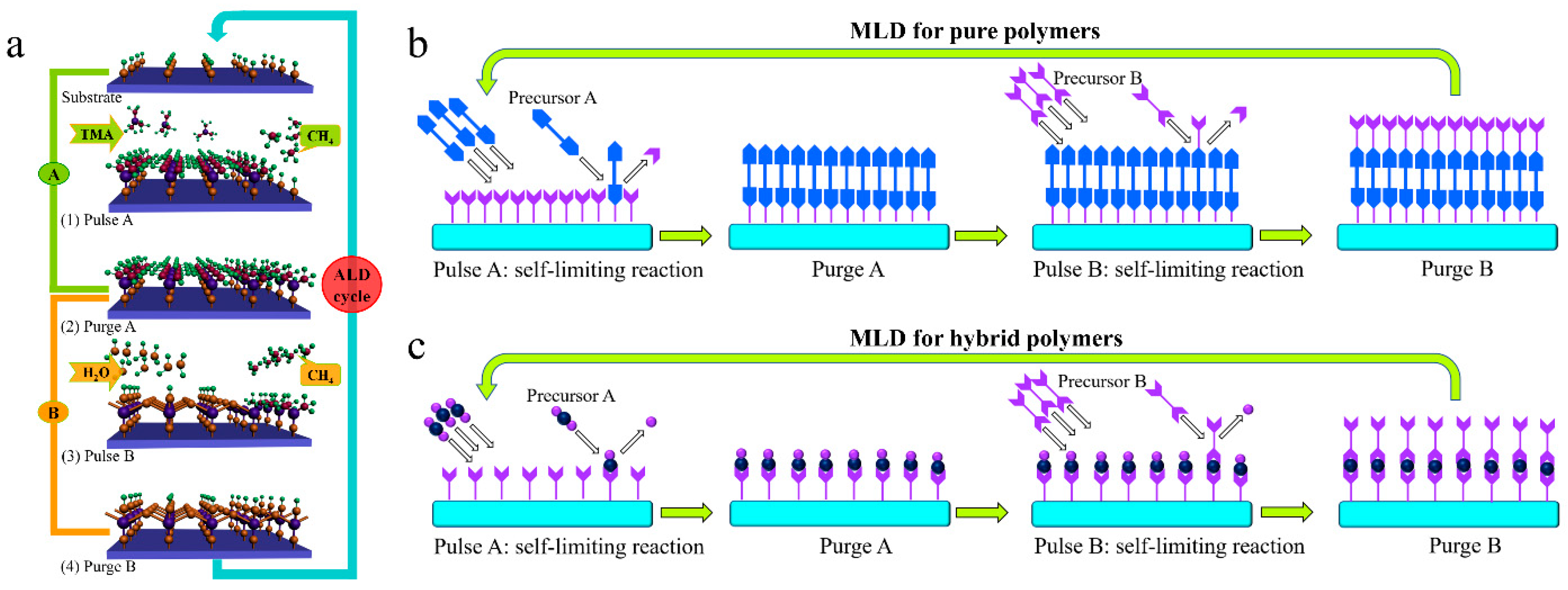
Disclaimer/Publisher’s Note: The statements, opinions and data contained in all publications are solely those of the individual author(s) and contributor(s) and not of MDPI and/or the editor(s). MDPI and/or the editor(s) disclaim responsibility for any injury to people or property resulting from any ideas, methods, instructions or products referred to in the content. |
© 2025 by the authors. Licensee MDPI, Basel, Switzerland. This article is an open access article distributed under the terms and conditions of the Creative Commons Attribution (CC BY) license (https://creativecommons.org/licenses/by/4.0/).