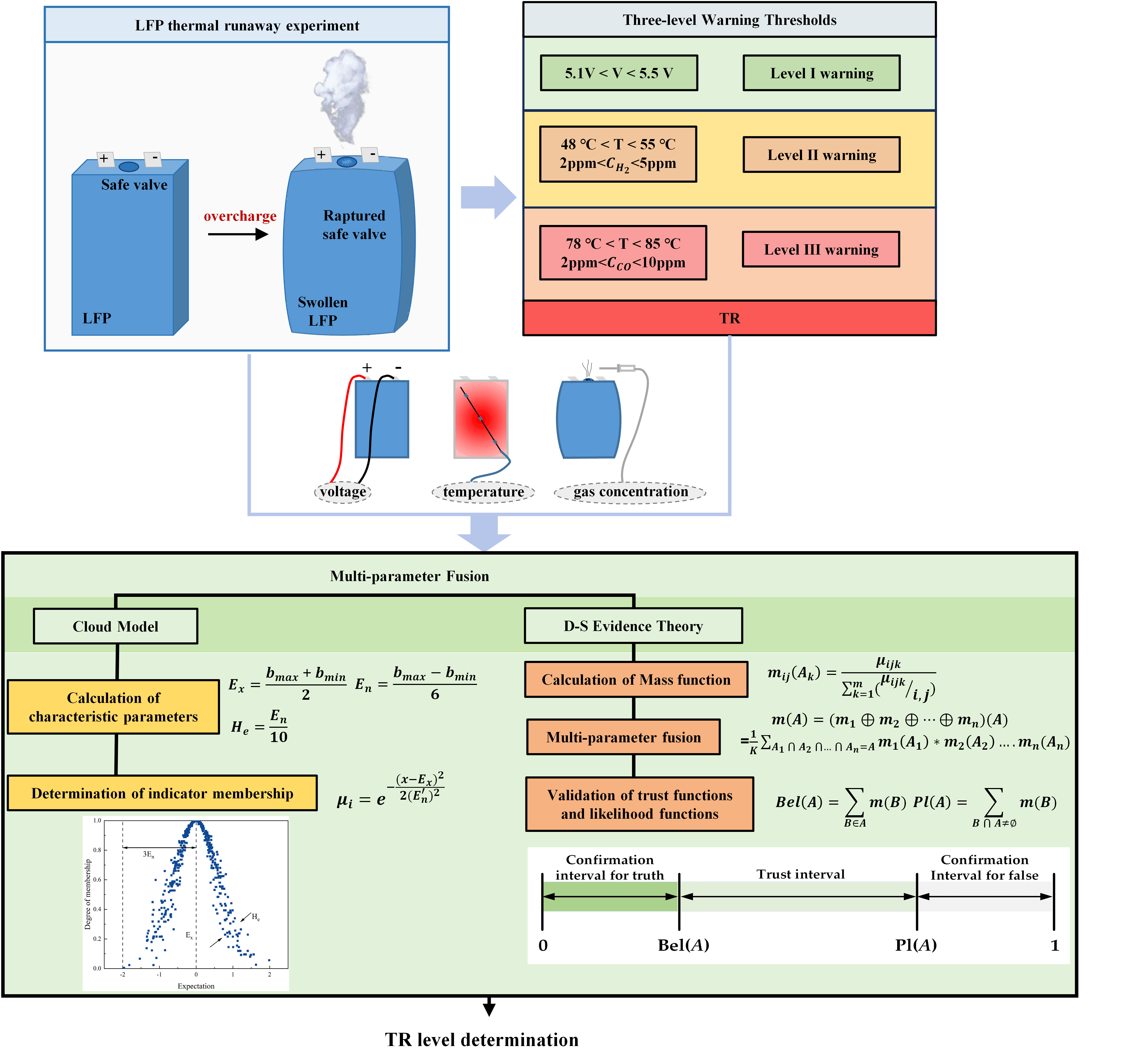


The Multi-Parameter Fusion Early Warning Method for Lithium Battery Thermal Runaway Based on Cloud Model and Dempster–Shafer Evidence Theory


 , ,
, , Abstract
Share and Cite
Xie, Z.; Zhang, Y.; Wang, H.; Li, P.; Shi, J.; Zhang, X.; Li, S. The Multi-Parameter Fusion Early Warning Method for Lithium Battery Thermal Runaway Based on Cloud Model and Dempster–Shafer Evidence Theory. Batteries 2024, 10, 325. https://doi.org/10.3390/batteries10090325
Xie Z, Zhang Y, Wang H, Li P, Shi J, Zhang X, Li S. The Multi-Parameter Fusion Early Warning Method for Lithium Battery Thermal Runaway Based on Cloud Model and Dempster–Shafer Evidence Theory. Batteries. 2024; 10(9):325. https://doi.org/10.3390/batteries10090325
Chicago/Turabian StyleXie, Ziyi, Ying Zhang, Hong Wang, Pan Li, Jingyi Shi, Xiankai Zhang, and Siyang Li. 2024. "The Multi-Parameter Fusion Early Warning Method for Lithium Battery Thermal Runaway Based on Cloud Model and Dempster–Shafer Evidence Theory" Batteries 10, no. 9: 325. https://doi.org/10.3390/batteries10090325
APA StyleXie, Z., Zhang, Y., Wang, H., Li, P., Shi, J., Zhang, X., & Li, S. (2024). The Multi-Parameter Fusion Early Warning Method for Lithium Battery Thermal Runaway Based on Cloud Model and Dempster–Shafer Evidence Theory. Batteries, 10(9), 325. https://doi.org/10.3390/batteries10090325