

A Pre-Seismic Anomaly Detection Approach Based on Earthquake Cross Partial Multi-View Data Fusion

 ,
,
Abstract
1. Introduction
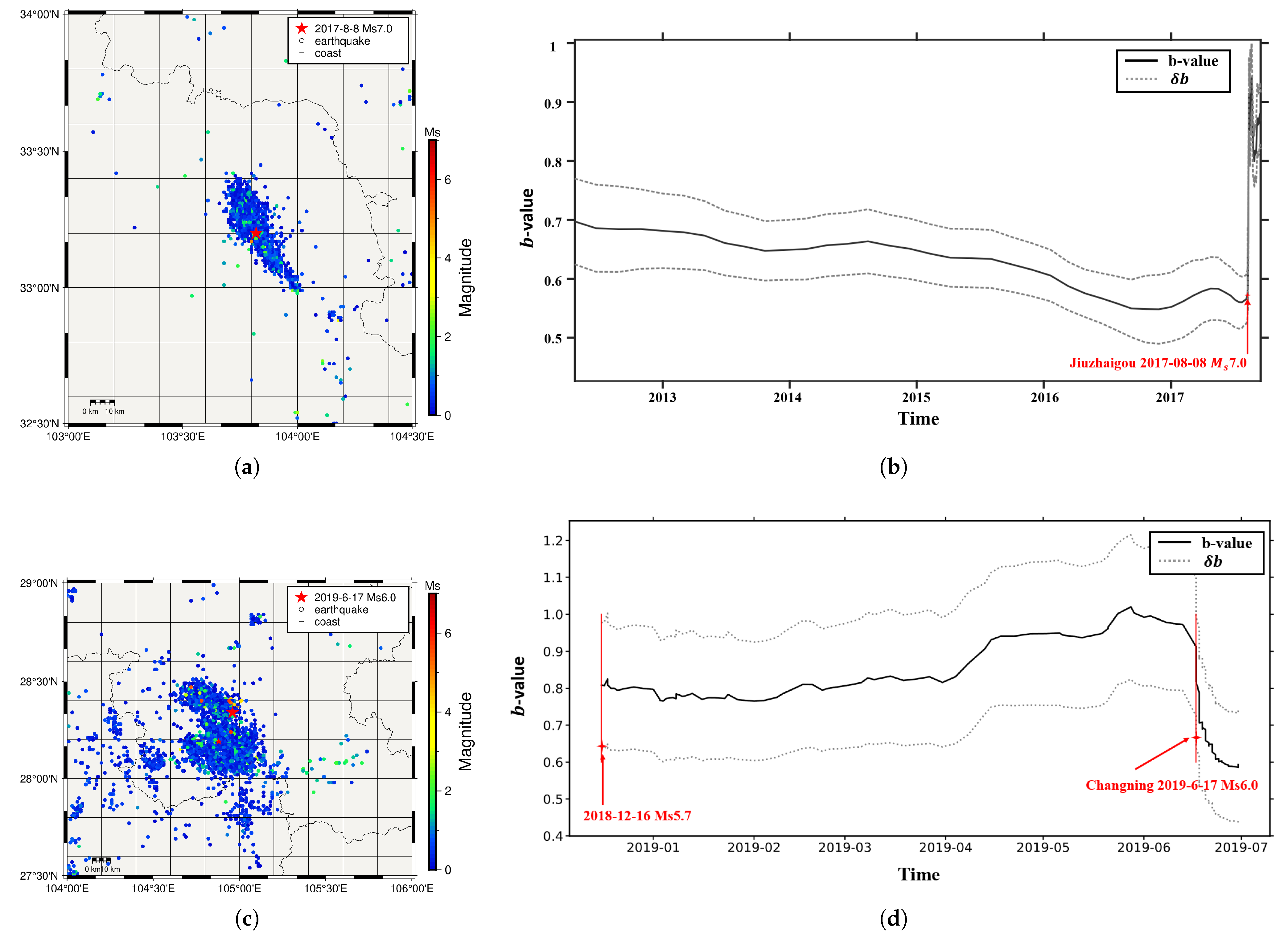
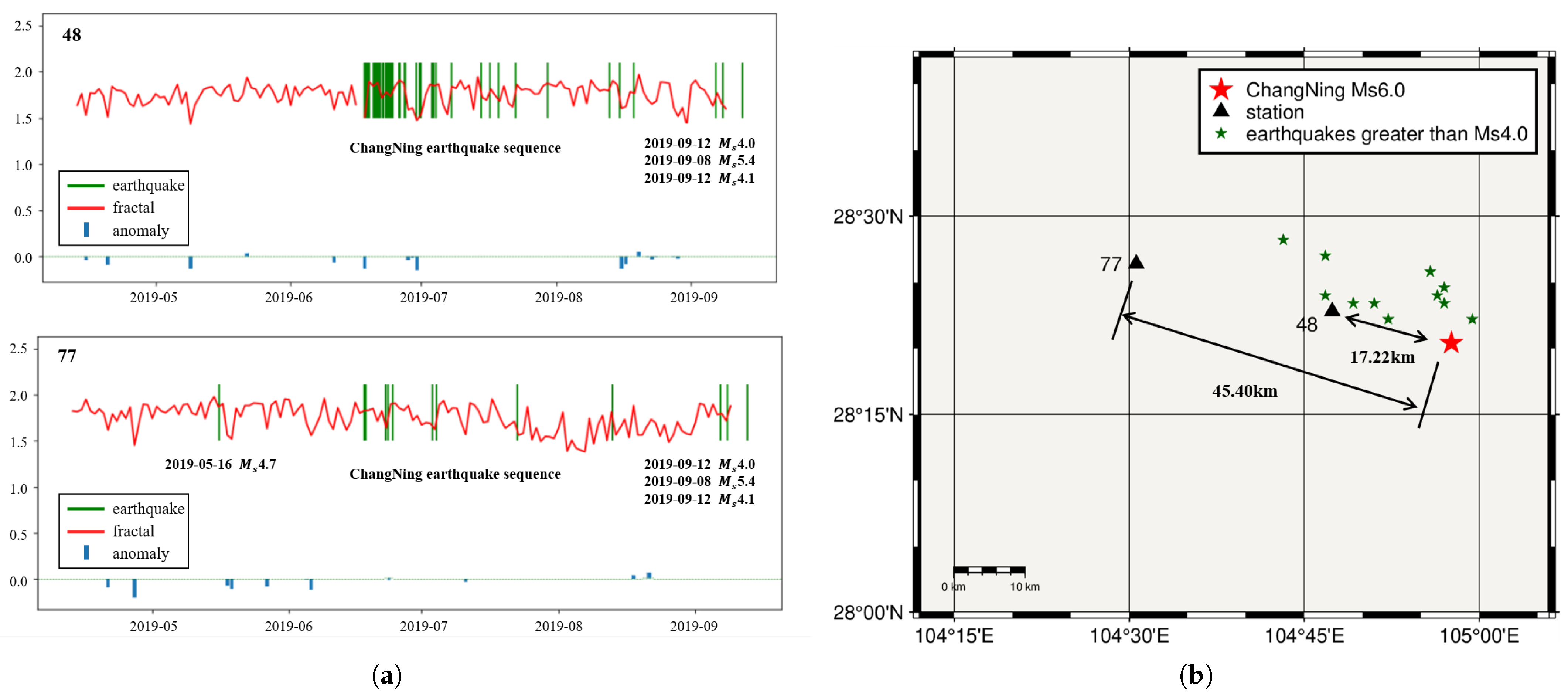
- The effectiveness of EM data and seismicity indicators was further validated in pre-seismic anomaly detection based on the 2017 Jiuzhaigou 7.0 earthquake and the 2019 Changning 6.0 earthquake in China.
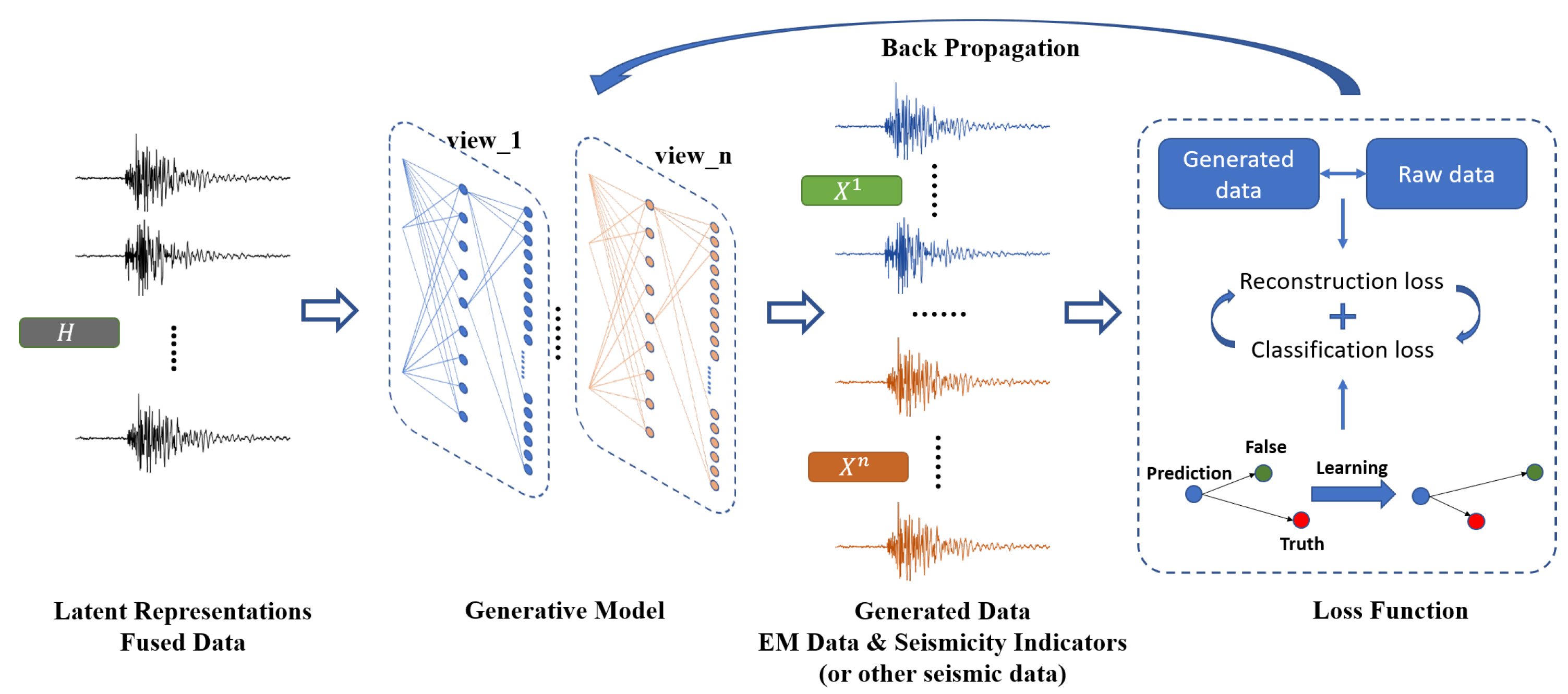
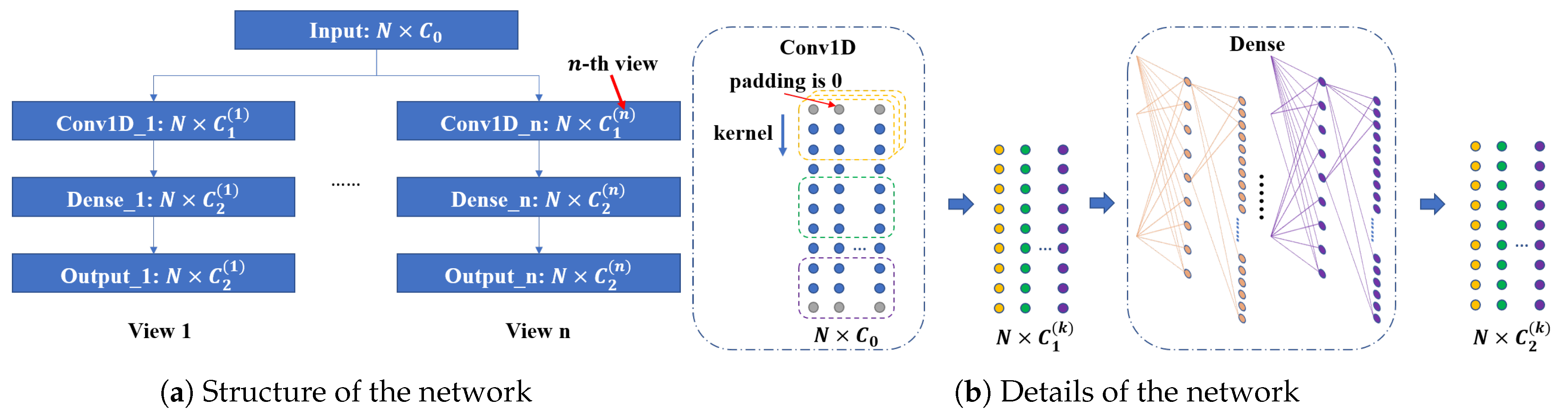
- Propose an earthquake data fusion approach that leverages the temporal characteristic of earthquake data by convolution. The proposed approach tolerates the absence of data and complements the missing part in fusion.
2. EM Data and Seismicity Indicators
2.1. EM Data
2.2. Seismicity Indicators
3. Method
3.1. Network
3.2. Loss Function
4. Results
4.1. Assessment of Seismicity Indicators
4.2. Assessment of EM Data
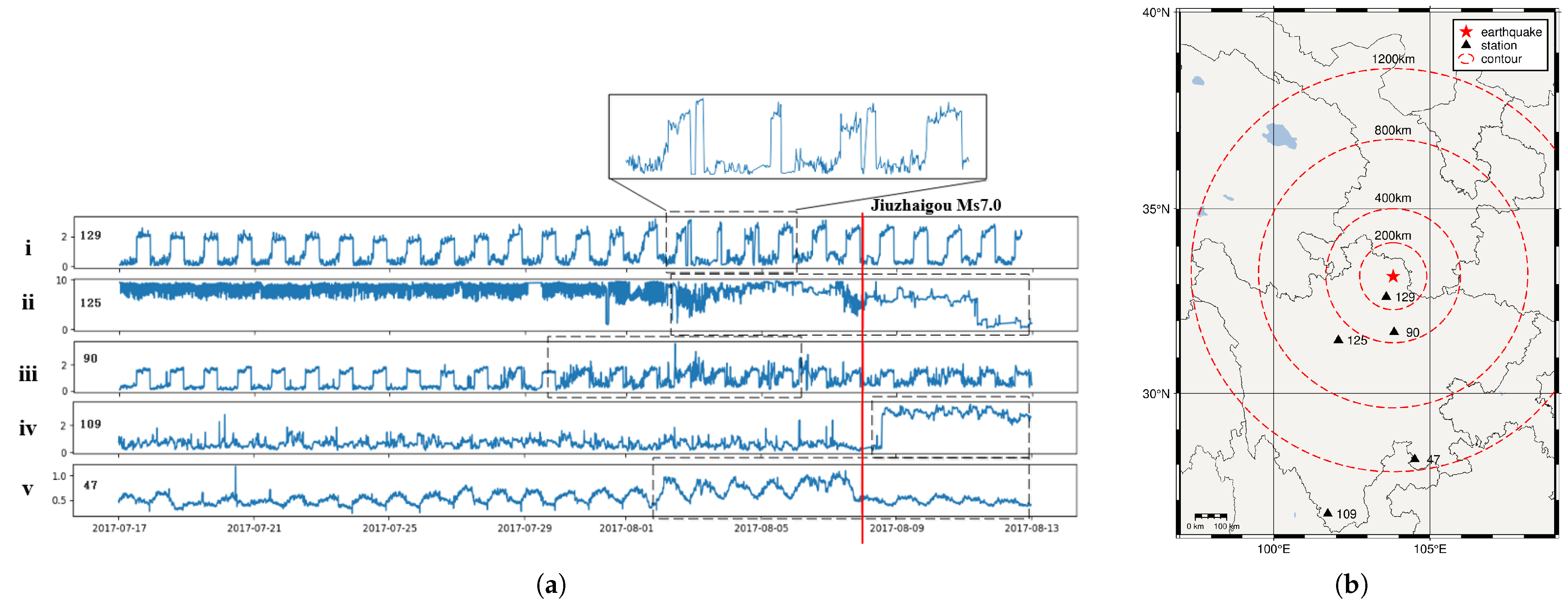
- The periodic disturbance anomalies were found when the distance between the station and the epicenter was closer than 200 km; see Figure 7(ai).
- The amplitude anomalies appeared when the distance between the station and the epicenter was about 400 km; see Figure 7(aii,aiii).
- The waveform-disturbance anomalies appeared when the distance between the station and the epicenter was farther than 1000 km; see Figure 7(aiv,av).
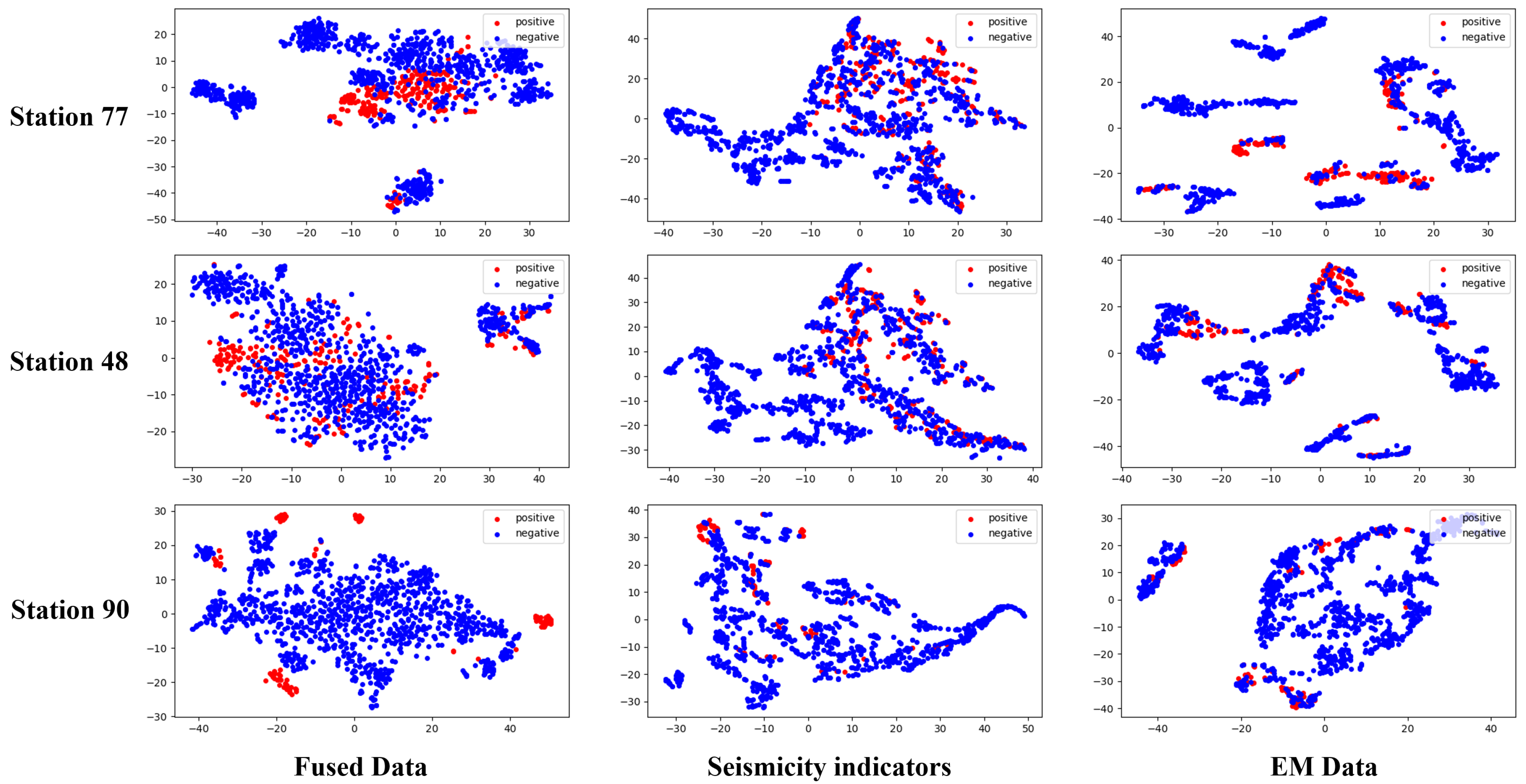
4.3. Comparison between Fused Data and Single-Modal Data
5. Conclusions
Author Contributions
Funding
Institutional Review Board Statement
Informed Consent Statement
Data Availability Statement
Conflicts of Interest
References
- Akhoondzadeh, M.; Parrot, M.; Saradjian, M.R. Electron and ion density variations before strong earthquakes (M > 6.0) using DEMETER and GPS data. Nat. Hazards Earth Syst. Sci. 2010, 10, 7–18. [Google Scholar] [CrossRef] [Scilit]
- Tsunogai, U.; Wakita, H. Precursory Chemical Changes in Ground Water: Kobe Earthquake, Japan. Science 1995, 269, 61–63. [Google Scholar] [CrossRef] [Scilit] [PubMed]
- Hayakawa, M. Earthquake prediction with electromagnetic phenomena. AIP Conf. Proc. 2016, 1709, 020002. [Google Scholar]
- Li, M.; Lu, J.; Parrot, M.; Tan, H.; Chang, Y.; Zhang, X.; Wang, Y. Review of unprecedented ULF electromagnetic anomalous emissions possibly related to theWenchuan M S = 8.0 earthquake, on 12 May 2008. Nat. Hazards Earth Syst. Sci. 2013, 13, 279–286. [Google Scholar] [CrossRef] [Scilit]
- Hayakawa, M. Seismo Electromagnetics and Earthquake Prediction: History and New directions. Int. J. Electron. Appl. Res. 2019, 6, 1–23. [Google Scholar] [CrossRef] [Scilit]
- Hayakawa, M. Earthquake precursor studies in Japan. In Pre-Earthquake Processes: A Multidisciplinary Approach to Earthquake Prediction Studies; Advancing Earth and Space Science: Washington, DC, USA, 2018; pp. 7–18. [Google Scholar]
- Schekotov, A.; Izutsu, J.; Asano, T.; Potirakis, S.M.; Hayakawa, M. Electromagnetic Precursors to the 2016 Kumamoto Earthquakes. Open J. Earthq. Res. 2017, 6, 168–179. [Google Scholar] [CrossRef]
- Wang, C.; Li, C.; Yong, S.; Wang, X.; Yang, C. Time Series and Non-Time Series Models of Earthquake Prediction Based on AETA Data: 16-Week Real Case Study. Appl. Sci. 2022, 12, 8536. [Google Scholar] [CrossRef] [Scilit]
- Rouet-Leduc, B.; Hulbert, C.; Lubbers, N.; Barros, K.; Humphreys, C.J.; Johnson, P.A. Machine Learning Predicts Laboratory Earthquakes. Geophys. Res. Lett. 2017, 44, 9276–9282. [Google Scholar] [CrossRef] [Scilit]
- Barkat, A.; Ali, A.; Siddique, N.; Alam, A.; Wasim, M.; Iqbal, T. Radon as an earthquake precursor in and around northern Pakistan: A case study. Geochem. J. 2017, 51, 337–346. [Google Scholar] [CrossRef] [Scilit]
- Barkat, A.; Ali, A.; Hayat, U.; Crowley, Q.G.; Rehman, K.; Siddique, N.; Haidar, T.; Iqbal, T. Time series analysis of soil radon in Northern Pakistan: Implications for earthquake forecasting. Appl. Geochem. 2018, 97, 197–208. [Google Scholar] [CrossRef] [Scilit]
- Alam, A.; Wang, N.; Zhao, G.; Barkat, A. Implication of Radon Monitoring for Earthquake Surveillance Using Statistical Techniques: A Case Study of Wenchuan Earthquake. Geofluids 2020, 2020, 1–14. [Google Scholar] [CrossRef] [Scilit]
- Ren, Y.; Ma, J.; Liu, P.; Chen, S. Experimental Study of Thermal Field Evolution in the Short-Impending Stage Before Earthquakes. Pure Appl. Geophys. 2017, 175, 2527–2539. [Google Scholar] [CrossRef] [Scilit]
- Reyes, J.; Morales-Esteban, A.; Martínez-Álvarez, F. Neural networks to predict earthquakes in Chile. Appl. Soft Comput. 2013, 13, 1314–1328. [Google Scholar] [CrossRef] [Scilit]
- Panakkat, A.; Adeli, H. Neural Network Models for Earthquake Magnitude Prediction Using Multiple Seismicity Indicators. Int. J. Neural Syst. 2007, 17, 13–33. [Google Scholar] [CrossRef] [Scilit]
- Gutenberg, B.; Richter, C. Seismicity of the Earth; Geological Society of America: Boulder, CO, USA, 1941. [Google Scholar]
- Wang, J.H. A mechanism causing b-value anomalies prior to a mainshock. Bull. Seismol. Soc. Am. 2016, 106, 1663–1671. [Google Scholar] [CrossRef] [Scilit]
- Lee, K.; Yang, W.S. Historical seismicity of Korea. Bull. Seismol. Soc. Am. 2006, 96, 846–855. [Google Scholar] [CrossRef] [Scilit]
- Marzocchi, W.; Spassiani, I.; Stallone, A.; Taroni, M. How to be fooled searching for significant variations of the b-value. Geophys. J. Int. 2020, 220, 1845–1856. [Google Scholar]
- Asencio-Cortés, G.; Martínez-Álvarez, F.; Troncoso, A.; Morales-Esteban, A. Medium–large earthquake magnitude prediction in Tokyo with artificial neural networks. Neural Comput. Appl. 2015, 28, 1043–1055. [Google Scholar] [CrossRef] [Scilit]
- Yousefzadeh, M.; Hosseini, S.A.; Farnaghi, M. Spatiotemporally explicit earthquake prediction using deep neural network. Soil Dyn. Earthq. Eng. 2021, 144, 106663. [Google Scholar] [CrossRef] [Scilit]
- Salam, M.A.; Ibrahim, L.; Abdelminaam, D.S. Earthquake Prediction using Hybrid Machine Learning Techniques. Int. J. Adv. Comput. Sci. Appl. 2021, 12, 654–6652021. [Google Scholar] [CrossRef] [Scilit]
- Zhang, C.; Han, Z.; Fu, H.; Zhou, J.T.; Hu, Q. CPM-Nets: Cross Partial Multi-View Networks. In Advances in Neural Information Processing Systems; Neural Information Processing Systems Foundation, Inc. (NeurIPS): La Jolla, CA, USA, 2019; p. 32. [Google Scholar]
- Li, Z.; Yang, B.; Huang, J.; Yin, H.; Yang, X.; Liu, H.; Zhang, F.; Lu, H. Analysis of Pre-Earthquake Space Electric Field Disturbance Observed by CSES. Atmosphere 2022, 13, 934. [Google Scholar] [CrossRef] [Scilit]
- Zhao, G.; Bi, Y.; Wang, L.; Han, B.; Wang, X.; Xiao, Q.; Cai, J.; Zhan, Y.; Chen, X.; Tang, J.; et al. Advances in alternating electromagnetic field data processing for earthquake monitoring in China. Sci. China Earth Sci. 2015, 58, 172–182. [Google Scholar] [CrossRef] [Scilit]
- Chen, H.; Han, P.; Hattori, K. Recent Advances and Challenges in the Seismo-Electromagnetic Study: A Brief Review. Remote. Sens. 2022, 14, 5893. [Google Scholar] [CrossRef] [Scilit]
- Chakrabarti, S.K. Propagation Effects of Very Low Frequency RadioWaves; American Institute of Physics: NewYork, NY, USA, 2010. [Google Scholar]
- Moustra, M.; Avraamides, M.; Christodoulou, C. Artificial neural networks for earthquake prediction using time series magnitude data or Seismic Electric Signals. Expert Syst. Appl. 2011, 38, 15032–15039. [Google Scholar] [CrossRef] [Scilit]
- Zhou, W.; Liang, Y.; Wang, X.; Ming, Z.; Xiao, Z.; Fan, X. Introducing macrophages to artificial immune systems for earthquake prediction. Appl. Soft Comput. 2022, 122, 108822. [Google Scholar] [CrossRef] [Scilit]
- Wiemer, S.; Wyss, M. Minimum magnitude of completeness in earthquake catalogs: Examples from Alaska, the western United States, and Japan. Bull. Seismol. Soc. Am. 2000, 90, 859–869. [Google Scholar] [CrossRef] [Scilit]
- Parrot, M.; Buzzi, A.; Santolik, O.; Berthelier, J.J.; Sauvaud, J.A.; Lebreton, J.P. New observations of electromagnetic harmonic ELF emissions in the ionosphere by the DEMETER satellite during large magnetic storms. J. Geophys. Res. Atmos. 2006, 111. [Google Scholar] [CrossRef] [Scilit]
- Utsu, T. A method for determining the value of“ b” in a formula log n= a-bM showing the magnitude-frequency relation for earthquakes. Geophys. Bull. Hokkaido Univ. 1965, 13, 99–103. [Google Scholar]
- Schroff, F.; Kalenichenko, D.; Philbin, J. Facenet: A unified embedding for face recognition and clustering. In Proceedings of the IEEE Conference on Computer Vision and Pattern Recognition, Boston, MA, USA, 7–12 June 2015; pp. 815–823. [Google Scholar]
- Gotoh, K.; Hayakawa, M.; Smirnova, N.A.; Hattori, K. Fractal analysis of seismogenic ULF emissions. Phys. Chem. Earth Parts A/B/C 2004, 29, 419–424. [Google Scholar] [CrossRef] [Scilit]
- Han, P.; Hattori, K.; Huang, Q.; Hirooka, S.; Yoshino, C. Spatiotemporal characteristics of the geomagnetic diurnal variation anomalies prior to the 2011 Tohoku earthquake (Mw 9.0) and the possible coupling of multiple pre-earthquake phenomena. J. Asian Earth Sci. 2016, 129, 13–21. [Google Scholar] [CrossRef] [Scilit]
- Van der Maaten, L.; Hinton, G. Visualizing data using t-SNE. J. Mach. Learn. Res. 2008, 9, 2579–2605. [Google Scholar]
- Yuan, R. An improved K-means clustering algorithm for global earthquake catalogs and earthquake magnitude prediction. J. Seism. 2021, 25, 1005–1020. [Google Scholar] [CrossRef] [Scilit]


| Research | Seismicity Indicators | EM Data | Consider Data Fusion | Consider Missing Data |
|---|---|---|---|---|
| [14,20,21,22,29] | √ | × | × | × |
| [11,28] | × | √ | × | × |
| This Paper | √ | √ | √ | √ |
| Method | Dataset | PPV | NPV | Recall | TNR | AVG | MCC |
|---|---|---|---|---|---|---|---|
| EM data | 0.4000 | 0.9179 | 0.5926 | 0.8367 | 0.6868 | 0.3694 | |
| Logistic Regression | seismicity indicators | 0.1522 | 0.7706 | 0.4565 | 0.4179 | 0.4493 | −0.0984 |
| fused data | 1.0000 | 0.9213 | 0.6222 | 1.0000 | 0.8859 | 0.7571 | |
| EM data | 0.0483 | 0.3103 | 0.2593 | 0.0612 | 0.1698 | −0.6602 | |
| Decision Tree | seismicity indicators | 0.1959 | 0.8200 | 0.4130 | 0.6119 | 0.5102 | 0.0199 |
| fused data | 0.3636 | 0.8550 | 0.3556 | 0.8593 | 0.6084 | 0.2167 | |
| EM data | 0.1145 | 0.7209 | 0.5556 | 0.2109 | 0.4005 | −0.1961 | |
| SGD | seismicity indicators | 0.1250 | 0.7748 | 0.2609 | 0.5821 | 0.4357 | −0.1254 |
| fused data | 1.0000 | 0.9387 | 0.7111 | 1.0000 | 0.9124 | 0.8170 | |
| EM data | 0.5200 | 0.9060 | 0.4815 | 0.9184 | 0.7065 | 0.4127 | |
| SVM | seismicity indicators | 0.1364 | 0.7862 | 0.2609 | 0.6219 | 0.4513 | −0.0953 |
| fused data | 1.0000 | 0.9522 | 0.7778 | 1.0000 | 0.9325 | 0.8606 |
| Method | Effective Stations 1 | Total Number of Stations | Ratio |
|---|---|---|---|
| Logistic Regression | 65 | 74 | 87.84% |
| Decision Tree | 51 | 74 | 68.92% |
| SGD | 57 | 74 | 77.03% |
| SVM | 73 | 74 | 98.65% |
| Used Dataset | Year | PPV | NPV | Recall | TNR | AVG | MCC | |
|---|---|---|---|---|---|---|---|---|
| ANN [23] | Seismic Electric Signals | 2011 | 0.61 | - | - | - | - | - |
| ANN [14] | seismicity indicators | 2013 | 0.63 | 0.81 | 0.48 | 0.88 | 0.70 | 0.58 |
| EQP-ANN [20] | seismicity indicators | 2017 | 1.00 | 0.69 | 0.18 | 1.00 | 0.72 | 0.35 |
| DNN [21] | seismicity indicators | 2021 | 0.88 | 0.97 | - | 0.96 | - | - |
| K-means [37] | seismicity indicators | 2021 | 0.90 | 0.85 | 0.99 | 0.07 | 0.70 | 0.22 |
| AMA [29] | seismicity indicators | 2022 | 0.73 | 0.96 | 0.98 | 0.82 | 0.87 | 0.78 |
| LSTM [8] | EM data | 2022 | 0.64 | 0.74 | 0.81 | 0.55 | 0.69 | - |
| This paper(SVM) | Fusion data | 2023 | 1.00 | 0.95 | 0.78 | 1.00 | 0.93 | 0.86 |
Disclaimer/Publisher’s Note: The statements, opinions and data contained in all publications are solely those of the individual author(s) and contributor(s) and not of MDPI and/or the editor(s). MDPI and/or the editor(s) disclaim responsibility for any injury to people or property resulting from any ideas, methods, instructions or products referred to in the content. |
© 2023 by the authors. Licensee MDPI, Basel, Switzerland. This article is an open access article distributed under the terms and conditions of the Creative Commons Attribution (CC BY) license (https://creativecommons.org/licenses/by/4.0/).
Share and Cite
Huang, Y.; Zhu, K.; Shi, W.; Lu, Y.; Liu, G.; Zhang, G.; Teng, Y. A Pre-Seismic Anomaly Detection Approach Based on Earthquake Cross Partial Multi-View Data Fusion. Magnetochemistry 2023, 9, 48. https://doi.org/10.3390/magnetochemistry9020048
Huang Y, Zhu K, Shi W, Lu Y, Liu G, Zhang G, Teng Y. A Pre-Seismic Anomaly Detection Approach Based on Earthquake Cross Partial Multi-View Data Fusion. Magnetochemistry. 2023; 9(2):48. https://doi.org/10.3390/magnetochemistry9020048
Chicago/Turabian StyleHuang, Yongming, Kun’ao Zhu, Wen Shi, Yong Lu, Gaochuan Liu, Guobao Zhang, and Yuntian Teng. 2023. "A Pre-Seismic Anomaly Detection Approach Based on Earthquake Cross Partial Multi-View Data Fusion" Magnetochemistry 9, no. 2: 48. https://doi.org/10.3390/magnetochemistry9020048
APA StyleHuang, Y., Zhu, K., Shi, W., Lu, Y., Liu, G., Zhang, G., & Teng, Y. (2023). A Pre-Seismic Anomaly Detection Approach Based on Earthquake Cross Partial Multi-View Data Fusion. Magnetochemistry, 9(2), 48. https://doi.org/10.3390/magnetochemistry9020048