1. Introduction
The subject of charge-transfer-induced spin transitions (CTISTs) has come a long way in studies. Primarily, the interest in these transitions was concentrated on solids, predominantly on Prussian blue analogs [
1,
2,
3,
4,
5,
6,
7,
8,
9,
10,
11,
12] containing iron and cobalt ions as structural elements of the lattice. However, this type of solids possesses different defects [
1,
2], which prevent clear observation and detection of the electron transfer inside the Fe-Co pair, which involves its following states:
ls-Fe
II −
ls-Co
III,
ls-Fe
III −
hs-Co
II, where the symbols
ls- and
hs- denote the low-spin and high-spin states of the ions participating in the electron transfer, for all that the initial state of the pair
ls-Fe
II −
ls-Co
III is diamagnetic, while the final state
ls-Fe
III −
hs-Co
II is a paramagnetic one.
In the desire to obtain an object of study devoid of the defects, inherent to bulk compounds, and to reveal the role of intra- and intercluster interactions in the occurrence of the electron transfer accompanied by the change of structural, magnetic and spectroscopic characteristics, the researchers switched to the synthesis and experimental study of molecular crystals, the structural element of which is definitely determined and represented by Fe-Co clusters of different nuclearity. Actually, the breakthrough in the area occurred in 2004, when K. Dunbar and her team reported the trigonal bipyramidal pentanuclear molecular [Co
3Fe
2] complex demonstrating CTIST [
13]. At present, the phenomenon of CTIST is detected in a series of binuclear, tetranuclear, pentanuclear and octanuclear clusters. The number of such type clusters with different nuclearity is permanently increasing. A description of the observed results in the field of CTIST in molecular systems can be found, for instance, in references [
14,
15,
16,
17]. The experimental study revealed that, similar to Prussian blue analogs, the above-mentioned clusters demonstrate both thermally and photoinduced electron transfer, converting a diamagnetic molecular complex into a paramagnetic one. Thus, the systems above listed belong to the class of bistable materials possessing two close-lying states, which can be interconverted by temperature, light, pressure and guest molecules. It is clear that the most interesting for the observation of charge-transfer-induced spin transitions are complexes containing a number of Fe-Co pairs larger than one because in this case when passing from the low-spin state of the complex to its high-spin one a pronounced change of the effective magnetic moment can be detected, that is important both for better understanding of the spin transformation as well as for future practical applications.
Recently the switching properties of the cyanide-bridged Fe/Co square complex {[(Tp*)Fe(CN)
3]
2[Co(bpy
Me)
2]
2}(OTf)
2·2DMF·H
2O (where Tp* = tris(3,5-dimethylpyrazol-1-yl)hydroborate, bpy
Me = 4,4′-dimethyl-2,2′-bipyridine, OTf = trifluoro-methanesulfonate anion and DMF = dimethylformamide), that was already reported in 2011 [
18], were examined in [
19] with the aid of single-crystal X-ray diffraction and X-ray absorption spectroscopy at both Fe and Co sites. These two applied techniques allowed for the restoration of the complete picture of electron transfer and elucidated the role played by the iron and cobalt ions in this transfer.
Three new cyanide-bridged molecular square complexes {[Co(bpy)
2]
2[Fe(tp′)(CN)
3]
2)}(PF
6)
2, {[Co(dmbpy)
2]
2[Fe(tp′)(CN)
3]
2)}(PF
6)(OTf)·2MeOH, {[Co(dtbbpy)
2]
2[Fe(tp′)(CN)
3]
2)}(PF
6)·2MeOH·3EtOH (tp′ = hydrotris(3-methylpyrazol-1-yl)borate, bpy = 2,2′-bipyridine, dmbpy = 4,4′-dimethyl-2,2′-bipyridine, and dtbbpy = 4,4′-di-tert-butyl-2,2′-bipyridine, OTf = trifluoromethane-sulfonate) were obtained in [
20] by systematic ligand substitution. Their tunable behavior arising from intramolecular electron transfer was examined both in solution and in the solid state. It was demonstrated that in the whole temperature range, the solid state complex {[Co(bpy)
2]
2[Fe(tp′)(CN)
3]
2)}(PF
6)
2 [
20] is in the high-spin phase with the electronic configuration [(hs-Co
II)
2(ls-Fe
III)
2]. A charge-transfer-induced spin transition under rising temperature is demonstrated by the {[Co(dmbpy)
2]
2[Fe(tp′)(CN)
3]
2)}(PF
6)(OTf)·2MeOH compound [
20]. At the same time, the characteristics of the spin transition in the {[Co(dtbbpy)
2]
2[Fe(tp′)(CN)
3]
2)}(PF
6)·2MeOH·3EtOH compound [
20] depend on the degree of desolvation of the compound in the solid state. Recently, in [
21], on the basis of cyanide-bridged molecular squares, supramolecular hybrids have been prepared. These square grids comprising cyanide-bridged tetranuclear complexes demonstrated multistep redox behavior, multistep spin crossover and single-molecule magnet(SMM)-type behavior.
In spite of the sufficiently vast experimental material on metal complexes exhibiting charge-transfer-induced spin transitions, the theoretical description of this phenomenon based on microscopic models is not presented in a large number of papers. In paper [
22], a model was developed to describe the magnetic characteristics and Mössbauer spectra of the cyano-bridged pentanuclear {[Os(CN)
6]
2[Fe(tmphen)
2]
3} cluster exhibiting CTIST. The interplay between the intracluster Co-Fe electron transfer and cooperative interactions in a model crystal containing these pairs as a structural element was analyzed in [
23]. The common feature of the models suggested in [
22,
23] as well as in earlier papers [
24,
25] is the allowance for different elasticity of intra- and intermolecular spaces and for the electron–deformational interaction as the cooperative one promoting the spin transitions induced by electron transfer between the electronic shells of one and the same ion (called traditionally as spin crossover) or the electronic shells of different ions (described by the notion “charge-transfer-induced spin transitions”, for instance, (
ls-Fe
II)(
ls-Os
III)→ (
hs-Fe
III)(
ls-Os
II) and (
ls-Fe
II)(
ls-Co
III)→ (
ls-Fe
III)(
hs-Co
II), etc.).
The magneto–electric coupling in binuclear Fe-Co cyanide clusters containing a tunneling electron gives promise since it provides access to a new type of control of the magnetic state by an electric field in spintronic devices. The latter represents an important advance in molecular spintronics and a basis for magnetic molecule-based quantum computing. Thereby, in paper [
26], the influence of the electric field on the polarizability, magnetic and spectroscopic characteristics of binuclear Fe-Co cyanide-bridged clusters was examined. The approach, which was applied in paper [
27] for examination of charge-transfer-induced spin transitions in crystals, containing a binuclear Fe-Co cluster as a structural unit, accounts for the interaction of the Co- ion with molecular (local) vibrations and the vibrations propagating along the crystal (phonons). For all that, as far as we know, a microscopic model describing the charge-transfer-induced spin transformation in tetranuclear compounds of the type of
(where
are transition metal ions) recently obtained and characterized [
19] has not been discussed yet. The aim of the present paper is to elaborate such a model for elucidation of the origin of spin transitions in a crystal composed of tetranuclear Co
2Fe
2 clusters that takes into account the specifics of the cluster structure and the intracluster electron transfer facilitating these transitions, reveals the origin of intercenter interactions responsible for cooperativity in the crystal, predicts the possible types of spin transitions in these compounds as well as the conditions for observation of their hysteretic magnetic behavior and, finally, provides a reasonable qualitative and quantitative interpretation of the available experimental data on the Co
2Fe
2 compounds.
The model suggested below will take into account the energy spectrum of each Co-Fe pair as well as two types of cooperative interactions, promoting the charge-transfer-induced spin transition, and, namely, the electron-deformational interaction and the coupling of tetranuclear clusters through the field of phonons.
2. The Model
The experimental data on the
product of the tetranuclear square Co
2Fe
2 clusters, reported in [
19], evidence electron transfer from the diamagnetic
ls- Fe
II ion to the diamagnetic
ls-Co
III ion. Under this transfer, as mentioned above, each cobalt-iron pair in this type of cluster finally transforms into the
ls- Fe
III−
hs-Co
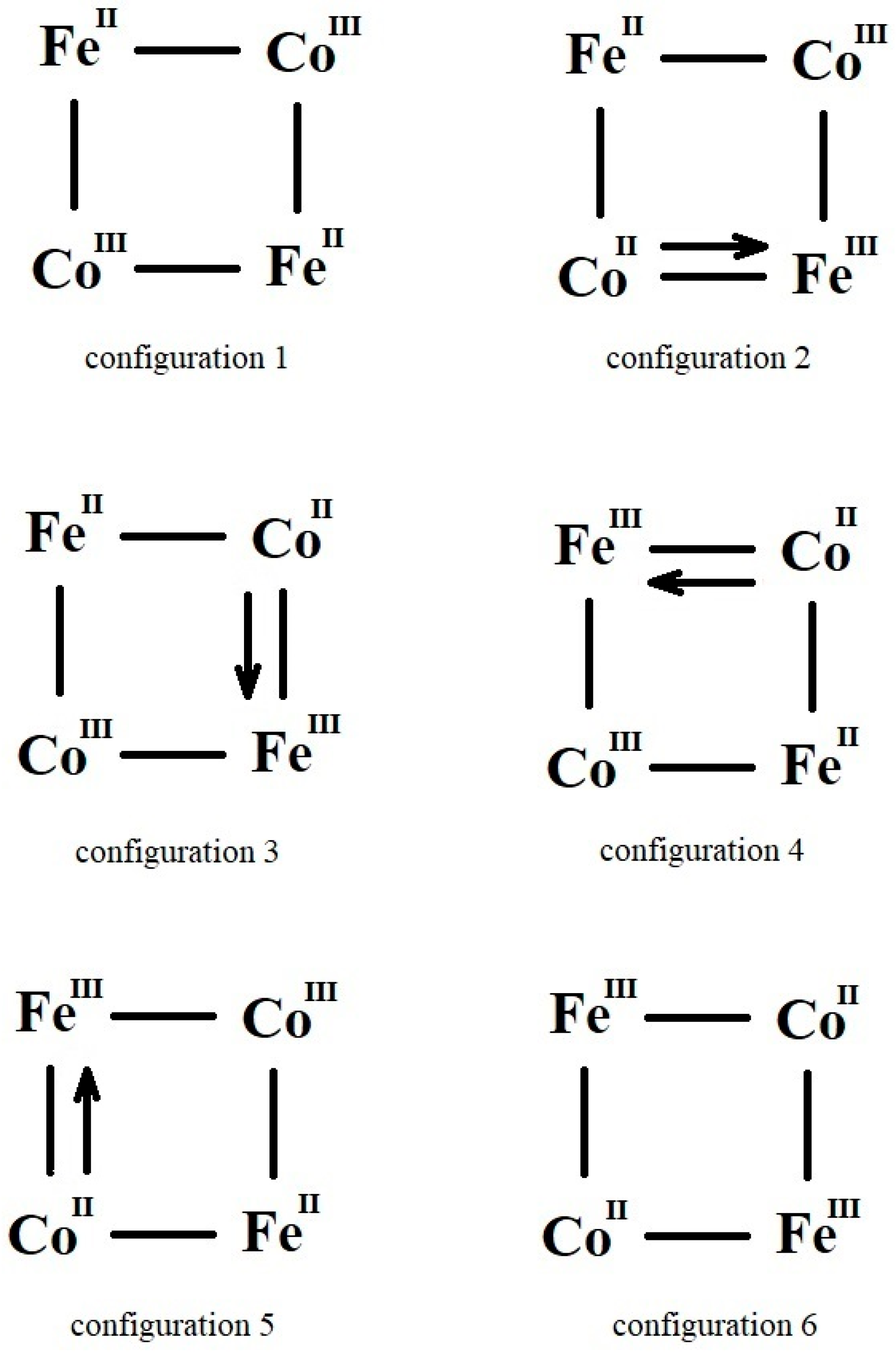
II pair. Thus, in the initial and final states of the whole square cluster, its configurations can be denoted as 2
ls-Fe
II − 2
ls- Co
III, 2
ls-Fe
III − 2
hs- Co
II (
Figure 1), respectively. For all that a tetranuclear square cluster also possesses four other configurations of the type of
ls-Fe
II −
ls- Co
III−
ls-Fe
III −
hs- Co
II, in which in one Co-Fe pair the electron transfer has occurred, while the other pair remains still diamagnetic. The schematic illustration of these configurations is given in
Figure 1. The charge-transfer-induced spin transition that takes place in the compounds under examination is accompanied by a noticeable elongation of the Co-ligand bonds. For instance, in the {[Co(dmbpy)
2]
2[Fe(tp′)(CN)
3]
2)}(PF
6)(OTf)·2MeOH compound [
19], which shows thermally induced CTIST, the average Co-N distance undergoes an increase from 1.938 to 2.107 Å, confirming thus intracluster electron transfer. The conversion of
ls-Fe
II ions, which are in the mixed nitrogen-carbon surrounding, creating a strong crystal field, into
ls-Fe
III ions, occurs without any noticeable elongation of the iron-ligand bonds (average distances are 1.9595 Å and 1.959 Å for 80 K and 240 K, respectively [
19]) because the transition from the
ls-Fe
II state to the
ls-Fe
III one is accompanied only by the decrease of the number of electrons in the
t2 shell by one. This means that the contribution of the iron ions to the deformation of the space between the tetranuclear Co
2Fe
2 clusters, which transfers the interaction between the clusters, is negligible as compared with that given by the Co-ions. Thus, for the description of CTIST in tetranuclear Co
2Fe
2 compounds as well as in binuclear CoFe and pentanuclear ones previously examined in our papers [
22,
23], the electron–deformational interaction is relevant only for the Co-ions. Since under metal–metal electron transfer, the crystal symmetry does not change, and all elements of the molecular and intermolecular volumes remain similar to themselves, the internal molecular
and external (intermolecular)
full symmetric strains are introduced in the model, bearing in mind that the intermolecular volume is far softer than that of the tetranuclear molecule itself. Otherwise, the transition
ls-Co
III hs-Co
II, accompanied by the expansion of the electronic shell of the cobalt ion, will not take place. In this case, within the framework of Kanamori’s approach [
28] (see also [
24,
25]), the operator describing the interaction with strain looks as follows:
where
and
are the volumes of the Co
2Fe
2 cluster and the intermolecular space falling per one cluster, and
and
are the elastic moduli corresponding to the above-mentioned strains.
For the
n-th cluster, the matrix of the operator
of interaction with strain, written in the basis of states arising from one configuration 2
ls-Co
III−2
ls-Fe
II, four configurations of the type of
ls-Fe
II−
ls-Co
III−
ls-Fe
III−
hs-Co
II and one configuration 2
ls-Fe
III−2
hs-Co
II (
Figure 1) of the molecule under examination, can be written as follows:
where
represent the constants of interaction of the Co-ion with the totally symmetric strain in the states
ls-Co
III and
hs-Co
II, respectively. A simple transformation allows us to represent the matrix of the operator
in the following form:
Here,
is the unit matrix determined in the accepted basis of states. Further, the second term on the right side of Equation (3) is omitted because it leads to the shift of all energy levels of the system to the same value. Applying the presentation of the operator
in the form given by Equation (3), minimizing Hamiltonian (1) over the strain
and supposing that for a uniform crystal compression (or extension) the following approximate relation holds [
24,
25]
one obtains the operator of electron-deformational interaction for the whole crystal in the following form:
where the parameter
of electron–deformational interaction is determined as
N denotes the number of tetranuclear square clusters in the crystal.
The coupling of the two cobalt ions with the vibrations of the nearest surrounding is taken into account in the model as well. Bearing in mind that the dominating localization effect is produced by the interaction of cobalt ions with the full symmetric breathing modes of the nearest surroundings of the cobalt ions, and this interaction along with the electron-deformational one is also responsible for the observed elongation of the cobalt-ligand bonds when passing from the
ls-Co
III state to the
hs-Co
II one, in the Hamiltonian the following term, written in the accepted above basis of electronic states, is introduced as follows:
here
and
are the full symmetric vibrational coordinates of the local surroundings of the Co1 and Co2 ions in the tetranuclear
n-th Co
2Fe
2 complex,
and
are the matrix elements of the operator of electron–vibrational interaction in the
ls-Co
III and
hs-Co
II states. The interaction of the iron ions with this type of vibration is not taken into account because the effect produced by this interaction is much smaller than that for Co-ions. In fact, during the transition, the configuration of the Co-ions changes from
to
, while for iron ions from
to
Introducing the collective modes of the cobalt ions
and
, which are connected with the local coordinates
and
by the relations
the operator
can be rewritten in the form
Here, the term
, which leads to an equal shift of all energy levels, is omitted, the matrix
looks as follows
the matrix
is given by Equation (3),
. The symmetrized coordinates
and
are expressed through the phonon creation
and annihilation
operators by the following relations:
where
is the phonon wave vector,
denotes the branch of the phonon mode, and the coefficients
and
perform the unitary transformation from the symmetrized displacements
,
of the nitrogen ligand surroundings of the two Co-ions in the
n-th cluster to the crystalline modes,
N is the total number of cobalt ions in the tetranuclear Co
2Fe
2 clusters in the crystal,
is the frequency of phonons. The relation (11) describing the transformation from molecular vibrations to crystalline ones was obtained with the aid of the procedure suggested in [
29,
30].
After substitution of Equation (11) into Equation (9), the Hamiltonian describing the electron-phonon interaction of the cobalt ions is obtained in the following form:
where
is the mass of the nitrogen ligand in the nearest cobalt surrounding. As to the
ls-Fe
II and
ls-Fe
III ions, the difference between the constants of electron-vibrational interaction in these states, in which the
—shell is occupied by 6 and 5 electrons, respectively, is smaller compared with that for the
ls-Co
III and
hs-Co
II ions and may lead to insignificant changes in the energies of the Co
2Fe
2 complex. Therefore, when considering CTIST in tetranuclear Co
2Fe
2 compounds, for the first step for the iron ions, the electron–phonon interaction is also omitted along with the electron-deformational one.
The total Hamiltonian of the system also includes the part describing the free phonons:
Then, the shift transformation is applied to the Hamiltonian
, and the operators
and
are replaced by the new ones
and
After this transformation, one obtains the following:
In its turn, the coefficients
and
can be presented in the form
where
is the vector connecting the cobalt ions in the cluster, and
are the so-called Van-Vleck coefficients [
29,
30], here
k enumerates the ligands of the
n-th cobalt ion,
is the vector determining the position of the
-th ligand in the crystal surrounding of the cobalt ion,
are the polarization vectors
. The Van-Vleck coefficients
perform the unitary transformation from the Cartesian displacements of the ligands, belonging to the first coordination sphere of the Co-ion, to the totally symmetric vibrational mode of its ligand surrounding [
29,
30] and obey the relation
.
It is worth noting that the transformed Hamiltonian (Equation (16)) does not contain linear in and terms. With the aid of definitions (17), one can prove that in Hamiltonian (16), the terms proportional to and cancel each other out.
Using Equation (18), one easily obtains that the second term in Equation (16), namely, the Hamiltonian
acquires a simpler form:
where
After the substitution of expressions (17) for
and
into (20) and simple transformations the parameters
and
acquire the following form:
Insofar as the parameters
and
represent real quantities and
, the expressions in (21) can be transformed to the following forms:
Since the electron transfer facilitates the redistribution of the electronic density inside each tetranuclear Co
2Fe
2 cluster, the intercluster dipole–dipole interaction is also taken into consideration in the model. The operator of dipole–dipole interaction in the general form can be written as follows:
where
is the dipole moment of the tetranuclear cluster,
,
is the distance between the
n-th and
m-th clusters in the crystal, the vector
determines the center of the
n-th tetramer. The dipole moment appears in the states arising from four intermediate configurations of the type of
ls-Fe
II −
ls-Co
III −
ls-Fe
III −
hs-Co
II (
Figure 1). In this case, the vector of the dipole moment lies in the plane of the tetranuclear square, and it is directed from the
hs-Co
II ion to the
ls-Fe
III one. This allows us to further account for only the components
and
of the cluster dipole moment. In the initial
ls-Fe
II −
ls-Co
III −
ls-Fe
II −
ls-Co
III and final
ls-Fe
III −
hs-Co
II −
ls-Fe
III −
hs-Co
II configurations, the tetranuclear cluster does not possess a dipole moment. The matrices of the components
of the dipole moment of the tetranuclear square cluster in the basis of states belonging to the six above-mentioned configurations have the form:
where
,
is the distance between the iron and cobalt ions along the edge of the tetranuclear cluster, i.e., the length of the side of the square.
Then, the Hamiltonian of dipole–dipole interaction is rewritten in the form:
where
due to the planar shape of the cluster and
Finally, the total Hamiltonian of the crystal also includes the Hamiltonian of isolated tetranuclear clusters:
where the matrix of the operator
looks as follows:
Here,
and
are the crystal field gaps between the states arising from the ground configuration
ls-Fe
II−
ls-Co
III−
ls-Fe
II−
ls-Co
III and excited
ls-Fe
II−
ls-Co
III−
ls-Fe
III−
hs-Co
II,
ls-Fe
III−
hs-Co
II−
ls-Fe
III−
hs-Co
II configurations (
Figure 1) of the tetranuclear Co
2Fe
2 cluster, respectively.
The total Hamiltonian of the system is determined as
Then, in order to examine different types of ordering facilitated by ferro- or antiferro- type cooperative interactions following the theory of magnetism [
31], the crystal is divided into equivalent interpenetrating sublattices A and B. In this case, the nearest surroundings of sublattice A clusters are sublattice B clusters and vice versa. Further on, the interaction between nearest neighbors is taken into account, and the intrasublattice interactions are neglected. Then, the Hamiltonian of cooperative interaction
including the above-mentioned three parts (Equations (5), (19) and (25)) takes on the form
The problem of interacting tetranuclear clusters is further solved in the mean-field approximation. In the framework of this approximation in Hamiltonians
, the following substitutions are made:
where the mean values
,
and
(
are determined as
In the accepted approximation, the Hamiltonian of interacting complexes
decomposes into the sum of single-cluster Hamiltonians
(
C =
A,
B):
where the parameters
and
are structural parameters, dependent on the mutual arrangement of clusters in the crystal lattice, and are determined as
The eigenvalues of the Hamiltonians
and
in the accepted approximation appear as follows:
Since the energies , , and depend on the sum of the parameters and , while in the energies of all other levels of the clusters and these parameters do not enter, in further consideration, instead of the sum , it will be considered only one parameter
The above-cited papers on tetranuclear Fe
2Co
2 compounds [
18,
19,
20,
21], exhibiting CTIST, show that the nearest surrounding of both
hs-Co
II and
ls-Fe
III differs from the perfect octahedral one. Meanwhile, the observed
product for the {[(Tp*)Fe(CN)
3]
2[Co(bpy
Me)
2]
2}(OTf)
2·2DMF·H
2O compound [
19], which serves further on as an example for application of the model under examination, demonstrates that the orbital angular momenta of both Fe- and Co-ions are not quenched. A similar situation takes place in other tetramers exhibiting this phenomenon [
18,
20,
21]. Therefore, further on, the splitting of the orbitally degenerate ground terms
4T
1g and
2T
2g of the
hs-Co
II and
ls-Fe
III ions, respectively, by the spin–orbital interaction is taken into account, and in the first approximation, the effect of the low symmetry crystal field is neglected. The operators of spin–orbital interaction for the
hs-Co
II and
ls-Fe
III ions introduced in the model look as follows:
Here,
and
are the operators of the orbital angular momentum and spin for the
hs-Co
II ion, while the designations
correspond to the operators with the same meaning for the
ls-Fe
III ion. For brevity, the indices
A and
B in the operators of the spin and angular momenta are dropped for both iron and cobalt ions. The spin–orbital interaction splits the
4T
1g ground term of the
hs-Co
II into three groups of levels, namely, into the ground doublet and the excited quadruplet and sextet, with the energy gaps between the excited terms and the ground doublet being
and
, respectively [
27,
32], where
= −180 cm
−1 is the usually accepted value for the spin–orbit coupling parameter of the
hs-Co
II ion [
32]. The
2T
2g ground term of the
ls-Fe
III ion also undergoes spin–orbital splitting, resulting in the ground doublet and the excited quadruplet separated by the energy gap
with
= −486 cm
−1 ([
32], see also [
27]). Further on, we take into consideration all energy levels of the tetranuclear clusters of the A and B types obtained in the mean field approximation (37) and corresponding to different configurations of these clusters and add to them the terms arising from the spin–orbital splittings of the
2T
2g and
4T
1g multiplets (38) of the
ls-Fe
III and
hs-Co
II ions described above. Finally, these energy levels are employed for writing down the free crystal energy, the minimization of which over the set of the order parameters
,
,
,
(
leads to the following system of self-consistent equations for the determination of these parameters:
The partition function
and the temperature-dependent factor
are determined by the following expressions:
The corresponding equations for sublattice B can be obtained from Equations (39) and (40) by substituting .
3. Results and Discussion
We start with the estimation of characteristic energies of the interactions involved in the model. First, the characteristic energy of dipole–dipole interaction is roughly estimated. Taking into account that in [
19] the mean experimental value of the length of the square side is
= 4.9 Å, the mean distance between the tetranuclear square clusters in the crystal is
and the dipole moment of the tetranuclear cluster in the states arising from the intermediate
ls-Fe
II −
ls-Co
III −
ls-Fe
III −
hs-Co
II configuration can be roughly evaluated as 2e
one obtains that the characteristic energy of dipole–dipole interaction
is of the order of 4.1 × 10
3 cm
−1. However, the expression for
(Equation (26)) contains the term
, which depends on the spherical angles
and
, determining the position of the vector
that connects tetranuclear clusters labeled by the vectors
and
, and may acquire different signs in dependence on the mutual arrangement of these clusters. Therefore, further on in numerical simulations, the magnitude of the parameters
characterizing the dipole–dipole interaction is varied within the limits −60 cm
−1 ÷ 100 cm
−1. By definition, the parameter of the electron–deformational interaction
is positive (6) and its effect will be examined by varying its value from 0 up to 410 cm
−1 [
25,
33]. As to the parameters
and
(see Equations (22) and (36)) containing the alternating function
, they can accept in general negative or positive values depending on the crystal structure and the corresponding spectrum of acoustical and optical phonons. To have an idea about the order of magnitude and signs of these parameters, further on, their rough estimation is performed under the assumption that the long-wave acoustic phonons (that can be associated with the intermolecular strain in systems with labile electronic states [
24,
25], in which the intermolecular space is much softer than that inside the molecules) mainly contribute to the values of
and
. In fact, the approximation below employed and aimed at this estimation corresponds to that well-known as the Debye model [
34], within which the difference in the coordinates and masses of the particles in the unit cell of the crystal is neglected, and the polarization vectors
in Equation (18) are represented as follows [
34]:
where
M is the mass of the crystal, and the symbol “
” was defined above. The new vectors
(42) do not depend anymore on the type
of the vibrating atom. Due to the account of (42), the expression (18) for the coefficients
takes on the following form:
where the new functions
are defined as
Further on, according to the Debye model, the difference between the longitudinal
and transversal
speeds of sound is neglected (
), and for the phonons, the dispersion law
is accepted. With these assumptions and also equating
and
to one in the expression for the parameter
(see (22) and (36)) one obtains
Then, the average of the values
in the Equation (45) over the orientation of the wave vector
and the summation over the three branches of the acoustic vibrations are performed. Retaining the terms up to (
kL)
2 (here
is the mean distance between the cobalt ion and its nearest surrounding) in the decomposition of the averaged coefficients
obtained in [
35], performing the integration over the spherical angles of the wave vector
and its magnitude in the limits {0,
}, where
is determined as
1/3 [
34] with
being the unit cell volume, one obtains the following expression for the parameter
:
For the estimation of this parameter, first, the constants of electron–vibrational interaction
and
of the Co-ion with the totally symmetric displacements of the nearest surrounding, which enter in the definition of the parameter
, were obtained by expressing the operator of interaction
of the Co-ions with these displacements through the cubic crystal field operator
[
36].
Such a presentation allows one to immediately represent the above-defined constants
and
of interaction of the
hs-Co(II) and
ls-Co(III) ions with the totally symmetric vibrations through the cubic crystal field parameters
and
:
Taking for
and
the values 1300 cm
−1 and 2240 cm
−1 [
37], respectively, for
and
, the mean lengths of the cobalt–nitrogen bonds 2.118 Å and 1.927 Å for the {[(Tp*)Fe(CN)
3]
2[Co(bpy
Me)
2]
2}(OTf)
2·2DMF·H
2O compound [
19], one obtains that the vibronic coupling constants (48) acquire the following numerical values:
= 2 × 10
−4 dyn,
= 10
−3 dyn. Due to the account of these values for the parameters
,
and experimental values
= 1.507 g/cm
3,
≈ 3 × 10
5 cm/s,
≈ 2.022 Å and
≈ 2536 Å
3 [
19], the performed approximate estimation gives that the parameter
is of the order of 1.28 × 10
3 cm
−1.
The procedure for the approximate evaluation of the parameter
(Equations (22) and (36)) in the framework of the Debye model resembles the above-described for
with the only difference that, in the expansion of the factor
this parameter over
, the terms of the order of
should be retained. Due to the account of this expansion and the approximations described above for the parameter
, the following expression is obtained:
Performing in (49), the averaging over the angle composed by the vectors
and
, i.e., substituting the square of the cosine of this angle by ½, and applying a procedure similar to that employed for the estimation of the parameter
, one obtains for the parameter
the following approximate expression:
The evaluation of the parameter
was performed with the aid of Equation (50) and the same numerical values for the parameters
,
,
and
as in the case of
, the distance
between two Co-ions inside the cluster was taken equal to
R = 7.2 Å [
19]. As a result for the
parameter, the value of about 405 cm
−1 was obtained. The values of the parameters
and
were calculated applying rather rough approximations. Meanwhile, the obtained order of magnitude of these parameters does not contradict qualitatively the experimental data, and, namely, for the {[(Tp*)Fe(CN)
3]
2[Co(bpy
Me)
2]
2}(OTf)
2·2DMF·H
2O compound noticeable growth of the
product occurs at temperatures higher than 150 K, the latter indicates that the parameters of cooperative interactions facilitating the spin transformation are in magnitude at least not lower than 100 cm
−1.
The second point to be discussed concerns the signs of the parameters
and
. In the estimation performed above, only the contribution of long-wave acoustic vibrations was taken into account, and the alternating function cos
in the expressions for these parameters was put approximately equal to one. In this approximation, both parameters
and
were shown to be positive. However, the function cos
in dependence of the magnitude and direction of the vectors
and
can accept in general positive and negative values, and lead to positive or negative signs of the parameters
and
. Therefore, from the very beginning, to have the possibility to examine in the framework of the suggested model the effects of different signs of the parameters of cooperative interaction and, respectively, different types of ordering, the crystal was subdivided into two different sublattices. As to the parameter
of cooperative electron–deformational interaction, its estimation is similar to that described in detail in papers [
24,
25] dealing with the valence tautomeric transformation
ls-Co
III-
cat hs-Co
II-
sq (where
cat and
sq are the catecholate and semiquinone ligands) in cobalt compounds and giving a value of the order of 100 cm
−1. As it was already indicated, in the present model, the parameter
enters the cluster energies in combination with the parameter
characterizing the cooperative interaction via the field of phonons. So, instead of the sum
, it will be considered only one parameter
. This parameter will be changed in the range of 200–415 cm
−1. In the sample calculations presented below, the behavior of the system is analyzed by calculation of the
hs-fraction determined as
In the subsequent consideration as well as in the figures captions, for simplicity, the superscripts AB in
,
and
parameters are omitted.
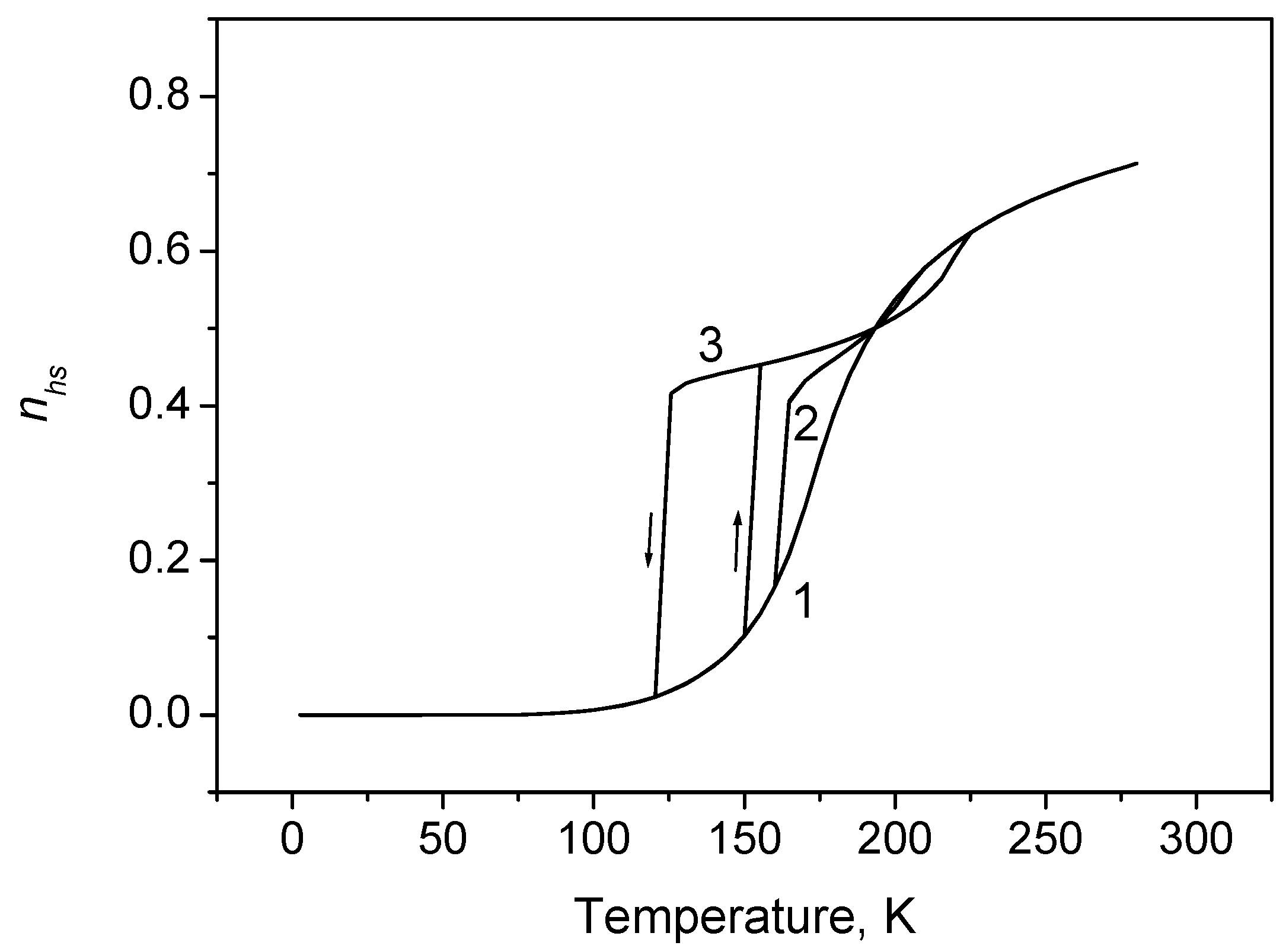
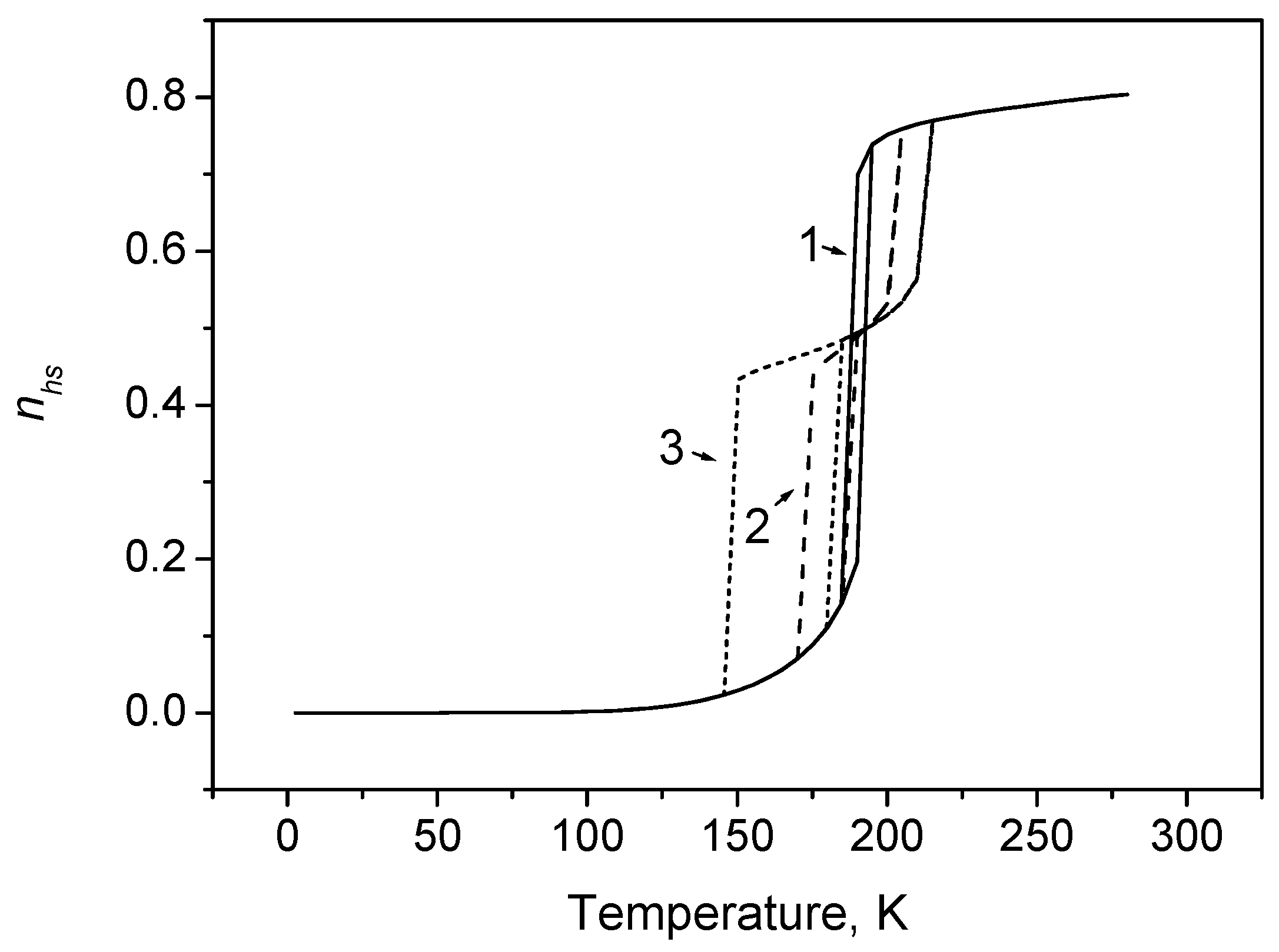
Figure 2 demonstrates the effect of the parameter
on the spin transition. It is seen that the increase of this parameter makes the transition more abrupt, and at some value of the
parameter, the hysteresis loop appears. The system demonstrates bistability.
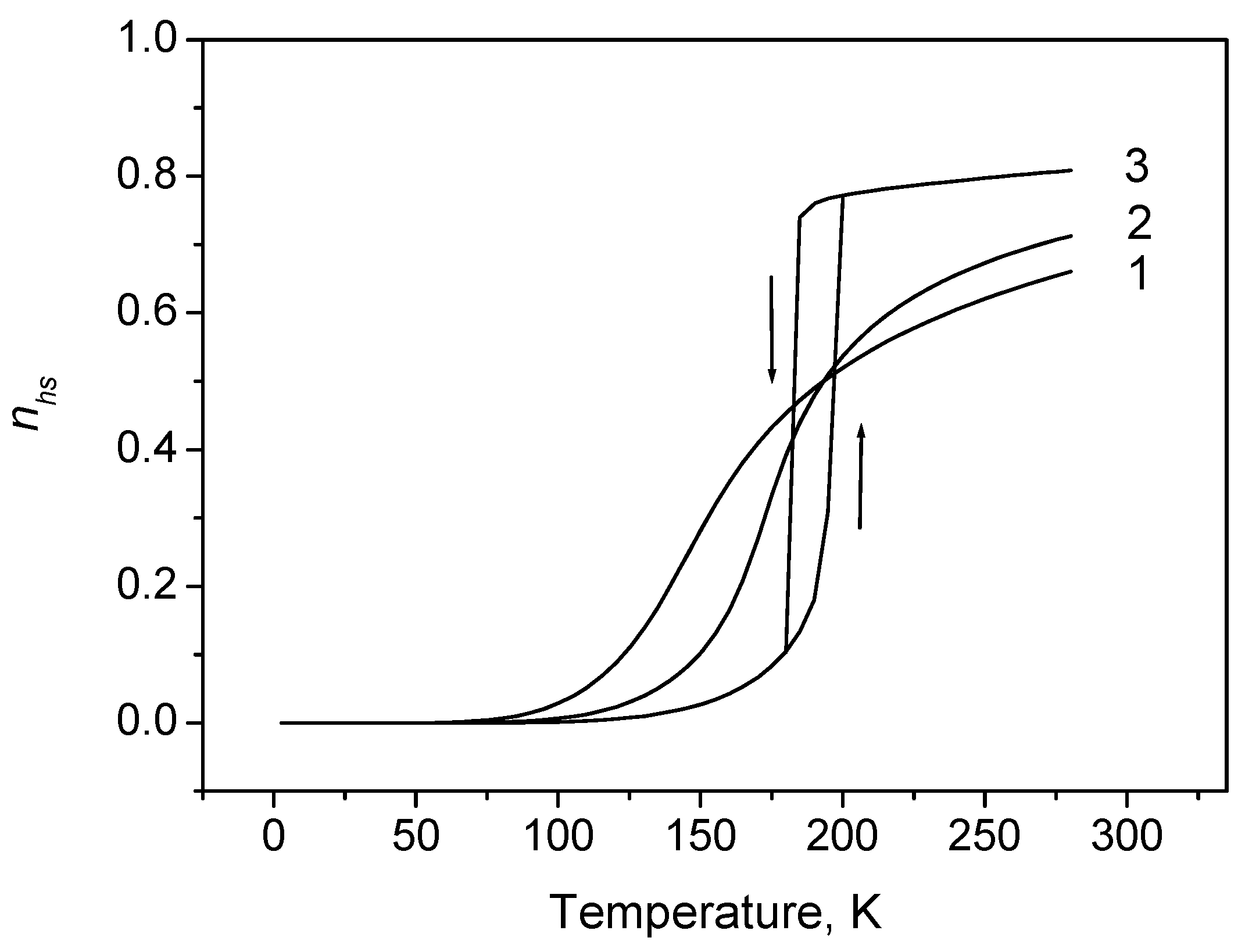
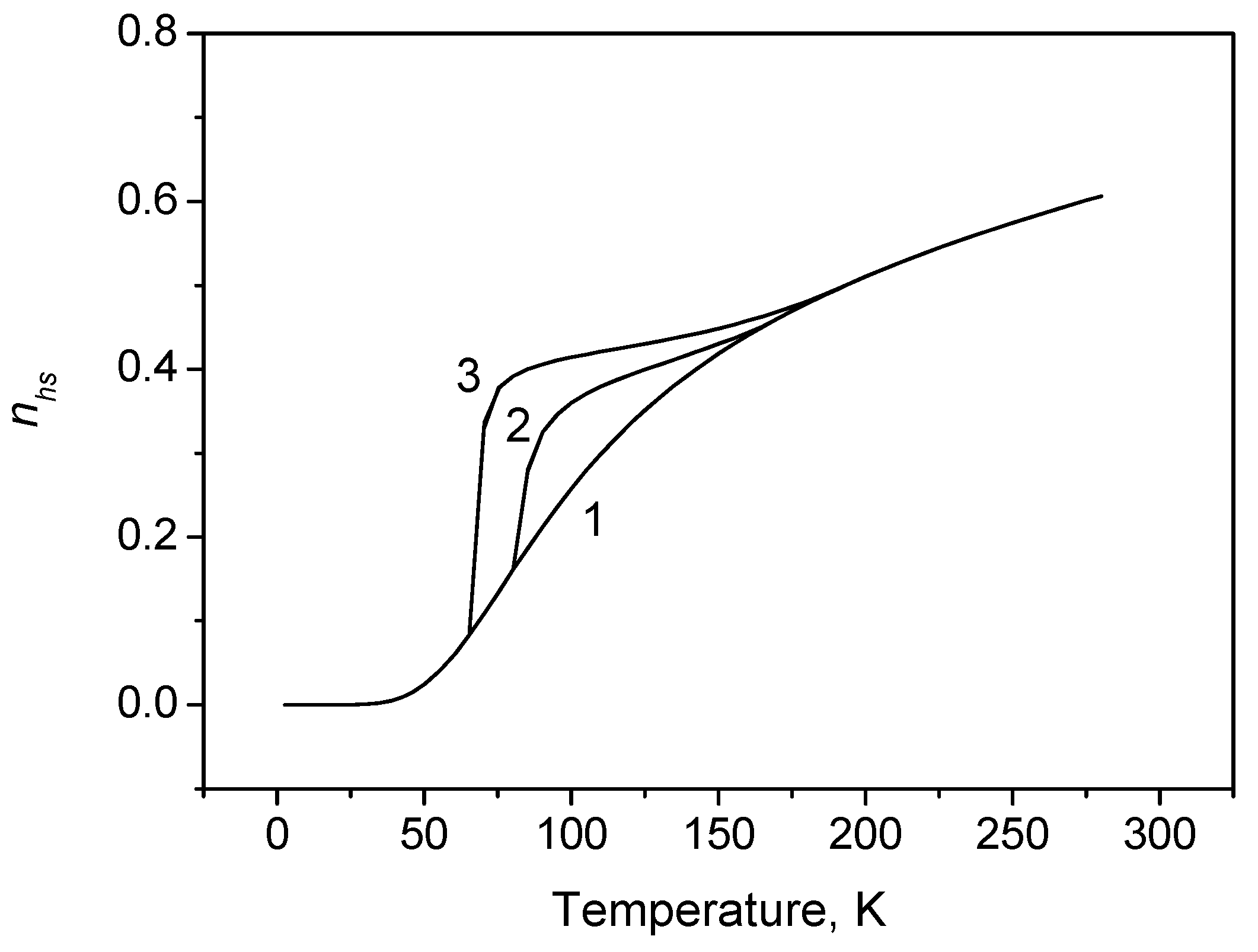
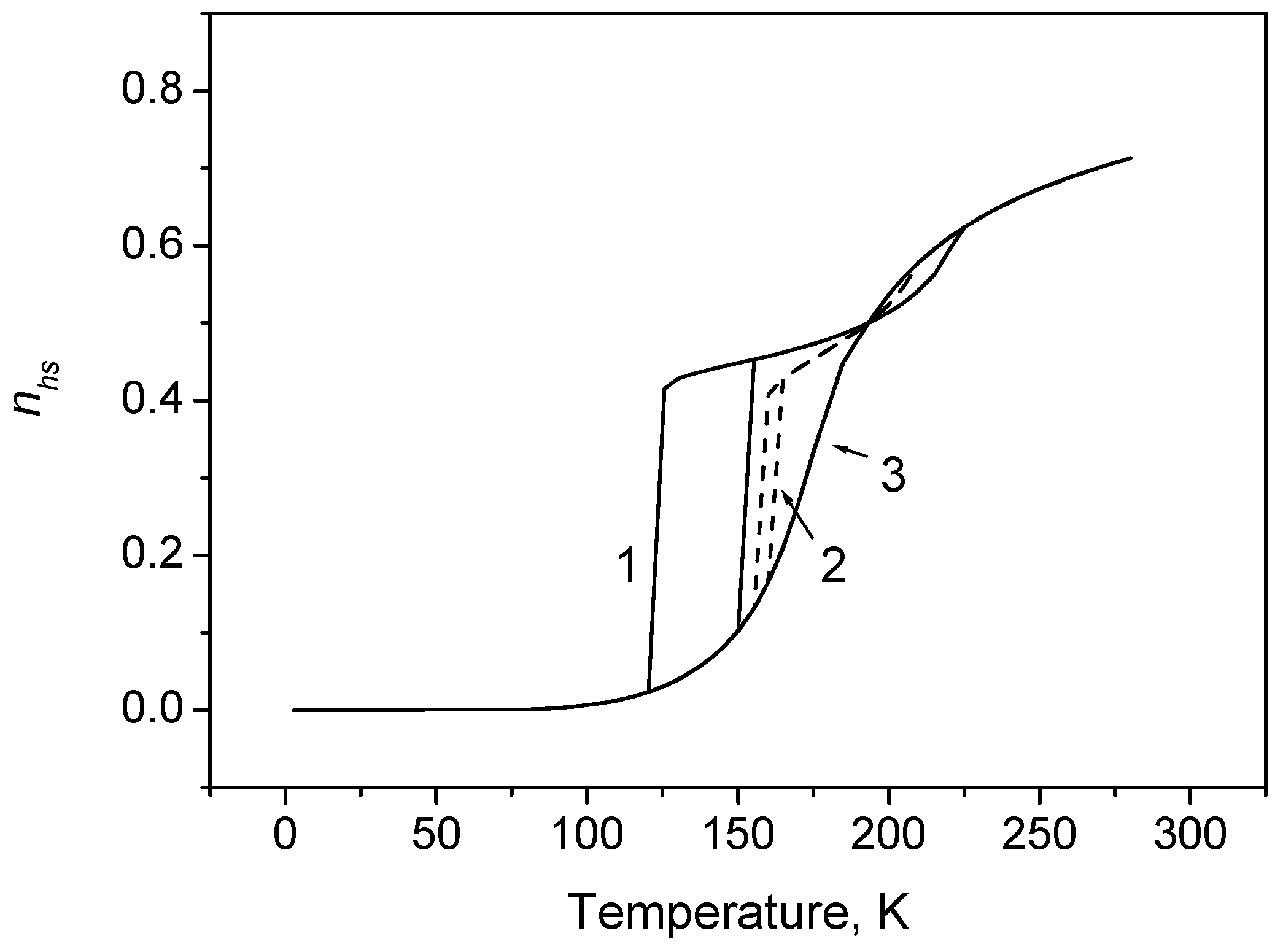
In
Figure 3,
Figure 4 and
Figure 5, the effect of
J2 on the
hs-fraction is illustrated. When the value of the parameter
is negligible, the increase in the parameter
J2 transforms the curve from a gradual one to one that demonstrates a pronounced step (
Figure 3). For non-vanishing values of
, depending on the magnitude of this parameter and the parameter
J2, various types of high-spin fraction temperature behavior can be observed with temperature growth, namely, gradual increase of this fraction, its abrupt increase, as well as the increase accompanied by a hysteresis loop with one (
Figure 4) or two (
Figure 5) steps. In the case when the characteristic energy of dipole–dipole interaction is vanishing,
change of the sign of the parameter
J2 does not lead to the change of the energy spectra of clusters of the type
and
as it is clearly seen from Equation (37). Therefore, the curves for the
hs-fraction presented in
Figure 3,
Figure 4 and
Figure 5 coincide for the same magnitudes and different signs of the parameter
J2.
The effect of dipole–dipole interaction was analyzed (
Figure 6) under the simplified condition that the characteristic energies of this interaction
and
are equal. From the analysis of Equation (37), it follows that the effect of this interaction is similar to that produced by the cooperative coupling via the field of phonons, characterized by the
J2 parameter. As a result, the dipole–dipole interaction increases (when the parameters are of the same sign) or reduces (in the case of opposite signs of the parameters) the effect of the coupling via the field of phonons.
Finally, the model above developed is applied for the explanation of the experimental data on the {[(Tp*)Fe(CN)
3]
2[Co(bpy
Me)
2]
2}(OTf)
2·2DMF·H
2O complex reported in [
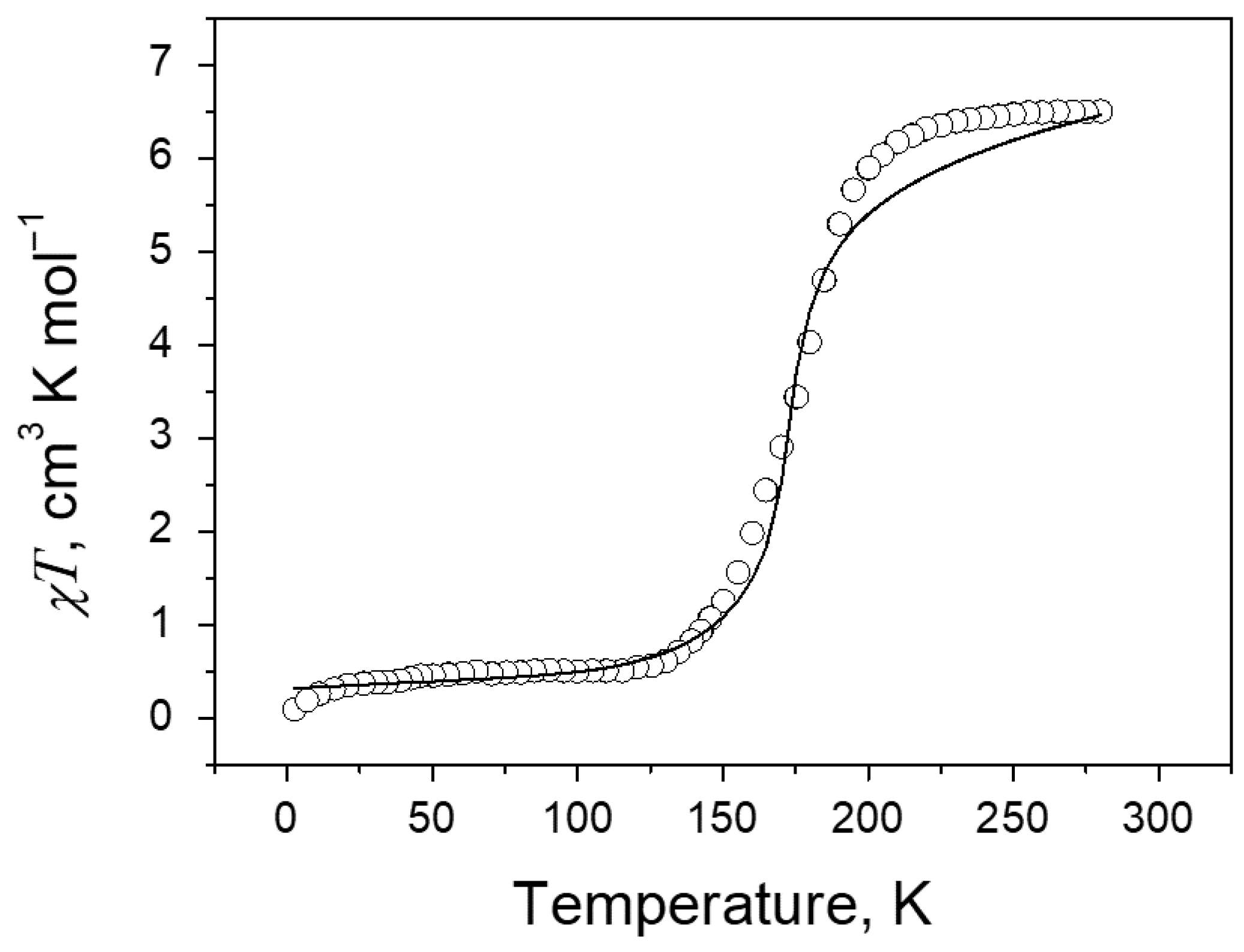
19]. The curve calculated within the framework of this model and the experimental one [
19] are shown in
Figure 7. The set of characteristic system parameters that assures the satisfactory agreement of these two curves is listed in the caption for
Figure 7. The obtained value of the gap Δ = 180 cm
−1 does not contradict the observed data because the noticeable growth in the
curve starts from 125 K, the value of the parameter
J1 accounting for the contributions coming from the cooperative electron–deformational interaction and that arising from the coupling of clusters through the field of phonons is also within the limits established for systems with labile electronic states and our estimations above described. As to the parameters
and
, to avoid overparametrization, they were roughly put equal in the simulation, taking into account the quadratic form of the tetranuclear clusters and their mutual arrangement in the crystal. Following the experimental data, which demonstrate the presence at low temperatures of a fraction of tetranuclear clusters which are in the
ls-Fe
III −
hs-Co
II −
ls-Fe
III −
hs-Co
II state, we denote this fraction as
xhs and take it into account while comparing the calculated
curve with the experimental one. The best fit value of the x
hs fraction is determined by the low temperature observed magnetic behavior of the compound under examination, when only the ground diamagnetic configuration 1 predominates.
The dipole–dipole interaction must compensate for the interaction through the phonon field, the parameter
J2 of which was estimated in the limit of long-wave acoustic phonons. Simulating the
curve for the parameter
J2, the above estimated value of 400 cm
−1 was taken. Here, it should be mentioned that at the present stage of study, the problem of the determination of the characteristic parameters of cooperative interactions of such a complicated system through DFT and ab initio calculations still remains a difficult one. Therefore, the performed estimation of these parameters expressed through characteristic parameters of the crystal, which represent measurable quantities, is reliable and gives at least the correct order of magnitude. At the same time, the developed model that accounts for all relevant interactions governing the pronounced charge-transfer-induced spin transition in a crystal of interacting tetranuclear clusters provides a reasonable explanation of the experimental data on the {[(Tp*)Fe(CN)
3]
2[Co(bpy
Me)
2]
2}(OTf)
2·2DMF·H
2O compound [
19]. The low temperature decrease of the
χT product can be explained by some small antiferromagnetic interactions between paramagnetic
ls-Fe
III and
hs-Co
II not included in the model, because it does not affect the spin transition that occurs at higher temperatures. The elaborated approach can be applied for the description of charge-transfer-induced spin transitions and in other compounds containing tetranuclear 2Fe-2Co clusters as a structural element, demonstrating charge-transfer-induced spin transitions.
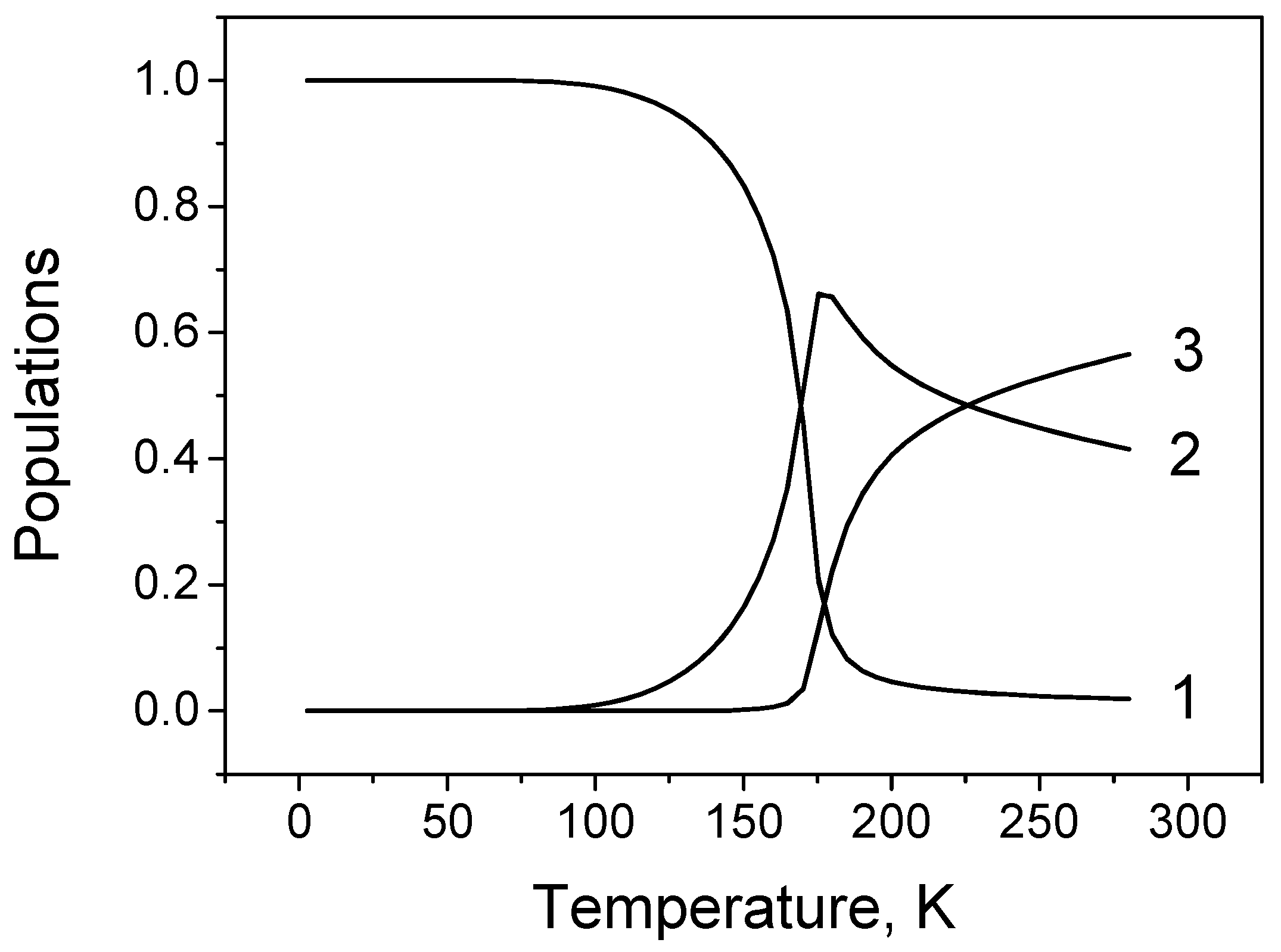
To understand the role of different cluster configurations in the spin transformation demonstrated by the crystal consisting of teranuclear Fe
2Co
2 complexes, the populations of these configurations as functions of temperature have been calculated with the set of the best fit parameters which assure the coincidence of the observed
χT product with the calculated one for the {[(Tp*)Fe(CN)
3]
2[Co(bpy
Me)
2]
2}(OTf)
2·2DMF·H
2O complex in frames of the suggested model. As can be seen from
Figure 8, four intermediate configurations cannot be excluded from consideration when consistently examining the observed phenomenon because their contribution is appreciable.