Article

Improved Corrosion Resistance of La0.8Ce0.2Fe9.2Co0.6Si1.2 Magnetocaloric Alloys for Near-Room-Temperature Applications


1
School of Materials Science and Engineering, South China University of Technology, Guangzhou 510641, China
2
Baotou Research Institute of Rare Earths, Baotou 014030, China
3
School of Materials Science and Engineering, Nanyang Technological University, Singapore 639798, Singapore
*
Author to whom correspondence should be addressed.
Magnetochemistry 2025, 11(11), 101; https://doi.org/10.3390/magnetochemistry11110101
Submission received: 17 October 2025 / Revised: 13 November 2025 / Accepted: 15 November 2025 / Published: 18 November 2025
(This article belongs to the Special Issue Advance of Magnetocaloric Effect and Materials)

Abstract

Rare earth-rich NaZn13-type La-Fe-Si-based alloys are promising candidates for near-room-temperature magnetocaloric applications. However, their poor corrosion resistance limits practical applications. The microstructure, corrosion behavior and magnetic entropy change of La0.8Ce0.2Fe9.2Co0.6Si1.2 alloys after annealing were systematically investigated. Annealing treatments were conducted at 1423 K for durations of 4–24 h. As annealing time increased, the α-Fe phase content decreased monotonically from ~7.81wt% to ~2.92wt%, accompanied by significant microstructural evolution. For the 4 h-annealed sample, extensive and large corroded spots were observed, attributed to micro-galvanic corrosion where the α-Fe phase (cathode) and 1:13 matrix phase (anode) formed active electrochemical pairs. Prolonged annealing reduced the corrosion current density by ~50%, directly correlating with the α-Fe phase reduction and improved microstructural homogeneity. Notably, corrosion exhibited a negligible effect on the magnetic entropy change of the alloys. This study confirms that optimizing annealing time to decrease α-Fe content and enhance microstructural uniformity represents an effective strategy to improve corrosion resistance without compromising magnetocaloric performance.

1. Introduction

In recent years, magnetic refrigeration has garnered significant attention owing to its energy-efficient and environmentally sustainable attributes [1,2]. Numerous magnetocaloric materials (MCMs) exhibiting a giant magnetocaloric effect (MCE) have been reported, such as Gd-Si-Ge [3,4], Mn-Fe-P-As [5], La-Fe-Si [6,7], and Ni-Mn-Ga [8] Heusler alloys. Among these promising candidates, La-Fe-Si-based alloys have gained widespread attention on account of their remarkable giant MCE, adjustable Curie temperature (TC), non-toxicity and low cost [9,10,11]. However, it is difficult to prepare La-Fe-Si-based alloys with a single NaZn13-type phase (denoted as the 1:13 phase) due to its slow and incomplete peritectic reaction [12]. Therefore, the α-Fe phase and other minority phases still exist after annealing [13,14,15,16]. The desired 1:13 phase can only be obtained after annealing at a high temperature for more than one week, followed by ice-water quenching [17,18,19]. Notably, the incorporation of rare earth elements (e.g., La and Ce) into La-Fe-Si-based alloys has been shown to promote the formation of the 1:13 phase [19,20,21]. Additionally, the introduction of Co has been demonstrated to adjust the TC of the alloys to near-room temperature [12].
As promising active magnetic regenerator (AMR) materials, La(FexSi1−x)13-based alloys are usually used in magnetic refrigeration machines [22,23,24,25,26], and deionized water is customarily employed as the heat transfer fluid [27]. However, when AMR materials work in a water-based liquid, galvanic corrosion occurs between the different constituent phases [28,29]. Actually, the practical application of La-Fe-Si-based alloys is hindered by their poor corrosion resistance, especially when in contact with water-based heat transfer fluids in magnetic refrigeration systems [22,23].
The corrosion vulnerability of La-Fe-Si-based alloys primarily stems from their inherent multiphase microstructure. Due to the slow and incomplete peritectic reaction during synthesis, these alloys typically consist of the desired NaZn13-type 1:13 matrix phase, along with minor phases such as α-Fe and La-rich phases (e.g., 1:1:1 and 5:3 phases) [12,13]. The electrochemical potential differences between these phases trigger micro-galvanic corrosion: previous studies have confirmed that the α-Fe phase acts as a cathode, while the 1:13 matrix phase and La-rich phases function as anodes in corrosive media, leading to preferential dissolution of the matrix [27,30,31,32,33]. For instance, Zhang et al. [27] observed that in stoichiometric LaFe11.6Si1.4 alloys, the La-rich phase exhibits higher corrosion susceptibility than the 1:13 phase, while the α-Fe phase accelerates matrix corrosion by forming galvanic couples.
To address the corrosion issue, extensive efforts have been devoted to developing improvement strategies, which can be categorized into three main directions: alloying modification, surface protection, and environmental regulation. In terms of alloying, doping with elements such as Mn, Ce, Co, Cr, B, and C has been explored [29,32,33,34,35,36]. Hu et al. [32] found that Mn doping in LaFe11.5−xMnxSi1.5 alloys improves corrosion resistance by reducing the electrochemical difference between the α-Fe phase and the matrix phase, though it accelerates the decrease in latent heat during thermal cycles. In contrast, Ce doping has shown synergistic effects on both corrosion resistance and magnetocaloric properties. Hu et al. [33] reported that increasing Ce content in La1−xCexFe11.5Si1.5 alloys shifts the corrosion potential (Ecorr) positively from −0.76 V to −0.59 V and reduces the corrosion current density (icorr) from 4.92 × 10⁻⁶ A/cm2 to 2.46 × 10⁻⁶ A/cm2, while simultaneously enhancing the maximum magnetic entropy change (−ΔSM)max from 21.2 J⋅kg−1⋅K−1 to 51.6 J⋅kg−1⋅K−1 under a 3 T magnetic field.
Surface protection techniques have also been widely investigated as effective corrosion mitigation strategies. Cheng et al. [37] demonstrated that plasma-sprayed Al coatings on La0.8Ce0.2Fe11.51Mn0.19Si1.3Hy plates significantly improve corrosion resistance, with Ecorr increasing from −533 mV to −334 mV and icorr decreasing from 1.19 × 10⁻⁵ A/cm2 to 4.56 × 10⁻⁶ A/cm2. Moreover, the coated plates maintained stable magnetic properties (−ΔSM)max ≈ 12.3 J·kg−1⋅K−1 even after 2 × 10⁴ magnetic field cycles. Other surface treatments, such as electroless Cu coating [38], Ni-P plating [39], and FeNi permalloy coating [40], have also shown promising results in reducing corrosion rates, though concerns remain regarding thermal barrier effects and coating adhesion under cyclic volume changes.
Environmental factors influencing corrosion behavior have been another focus of research. Gebert et al. [31] revealed that stagnant water conditions exacerbate corrosion of La-Fe-Si alloys due to local acidification near the surface, while laminar fluid flow promotes passivation by alleviating ion accumulation. Alkaline conditions (Ph ≈ 8) further stabilize the passive film by reducing the solubility of Fe and La hydroxides/oxides, whereas anion contaminants such as sulfate (SO42−) and hydrogen phosphate (HPO42−) disrupt passivity [31]. Recently, magnetic field effects on corrosion have been explored: Guo et al. [41] found that a perpendicular 1 T magnetic field inhibits corrosion of ferromagnetic LaFe13.9Si1.4Hy alloys more effectively than a parallel field, attributed to enhanced formation of protective rust layers with a higher Fe3O4/γ-FeOOH ratio. Zhang et al. [28] performed a comparative study of Na2MoO4·2H2O and Na2HPO4·12H2O as inhibitors for the magnetic refrigeration material La-Fe-Co-Si compound against corrosion in distilled water at room temperature. The results showed that both Na2MoO4·2H2O and Na2HPO4·12H2O exhibit an inhibitory effect on the corrosion of La-Fe-Co-Si alloy in distilled water. After compounding the two inhibitors, the corrosion inhibition efficiency reaches the highest value (93.9%) due to their synergistic effect. This composite corrosion inhibitor achieves long-term and stable corrosion resistance by forming a dense protective film, providing a low-cost and efficient corrosion protection solution for the practical application of magnetocaloric materials.
Typically, NaZn13-type La-Fe-Si-based alloys feature a multiphase structure comprising the 1:13 matrix phase, α-Fe phase, and La-rich phase. The coexistence of these phases results in poor corrosion resistance, degrading their overall performance [24,42]. Introducing excess La and Ce modifies phase compositions, altering electrode potentials and the intensity of galvanic corrosion [43]. While prior studies have documented the corrosion behavior of such magnetocaloric alloys [27,30,34,44], the corrosion morphologies and mechanisms driven by minor phases remain underexplored systematically.
The magnetocaloric performance of the present La0.8Ce0.2Fe9.2Co0.6Si1.2 alloy—with a maximum magnetic entropy change (−ΔSM)max of 4.65 J·kg−1·K−1 at its Curie temperature (TC = 265 K)—is competitive with that of other near-room-temperature intermetallics [45]. As observed in related systems [46], this performance is intrinsically linked to the alloy’s microstructure. Notably, critical knowledge gaps persist. Most existing research focuses on alloying elements or surface coatings, leaving the influence of microstructural evolution—particularly the quantitative correlation between minor phase content (e.g., α-Fe) and corrosion resistance—insufficiently addressed. Additionally, the impact of corrosion on magnetocaloric properties, especially after long-term service, lacks systematic investigation. Previous research has shown that corrosion can deteriorate MCE by altering phase composition [47], but whether microstructure optimization can decouple corrosion resistance from magnetic performance remains unclear.
In this work, we systematically investigate the effect of annealing time on the microstructure, corrosion behavior, and magnetic entropy change of non-stoichiometric La0.8Ce0.2Fe9.2Co0.6Si1.2 alloys. By regulating the content of α-Fe and La-rich phases through annealing, we aim to clarify the role of minor phases in micro-galvanic corrosion and develop an effective strategy to improve corrosion resistance without sacrificing magnetocaloric performance. This study differs from early research by focusing on microstructure manipulation via heat treatment rather than external alloying or coating, thereby providing a more intrinsic solution to the corrosion challenge of La-Fe-Si-based magnetocaloric materials.

2. Materials and Methods

2.1. Sample Preparation

La0.8Ce0.2Fe9.2Co0.6Si1.2 ingots were obtained via arc-melting. The starting materials (La, Ce, Fe, Co, and Si) with purities exceeding 99.9 wt% were sourced from Beijing Dream Material Technology Co., Ltd, Beijing, China. To ensure compositional homogeneity, the ingots were remelted five times. It is well known that annealing temperature and time are crucial to promote the formation of 1:13 phase in La-Fe-Si-based alloys [15,16,19]. To rapidly achieve a high content of the 1:13 matrix phase and optimal magnetic properties in La-rich La-Fe-Si alloys [20,48], an annealing temperature of 1423 K was selected. The ingots were then annealed at this temperature for 4 h, 12 h, and 24 h, followed by rapid quenching in ice water. This procedure was designed to facilitate the formation of the 1:13 phase and effectively regulate the morphology of minor phases.

2.2. Properties and Characterization

An X-ray diffractometer (XRD, X’Pert Pro MPD, Panalytical, Almelo, NLD) employing Cu-Kα1 (λ = 1.54056 Å) radiation was utilized to determine the phase constitution and crystal structure of the ingots. Phase formation and corrosion microstructure studies were carried out using a scanning electron microscope (SEM, Phenom Star, Thermo Fisher, Massachusetts, USA) equipped with an energy-dispersive spectrometer (EDS). Electrochemical tests were performed using an electrochemical workstation (PGSTAT302N, Metrohm, Herisau, Switzerland) in stagnant deionized water. A standard three-electrode setup was adopted, with a working electrode made of La0.8Ce0.2Fe9.2Co0.6Si1.2 alloys, a saturated silver chloride reference electrode, and a Pt counter electrode. Experiments were carried out at room temperature under ambient pressure. After immersing the samples under open circuit potential (OCP) conditions to establish steady-state conditions, polarization curve measurements were conducted at a sweep rate of 1 mV/s. To ensure reproducibility, each experiment was replicated a minimum of three times. A physical property measurement system (PPMS-9, Quantum Design, California, USA) was utilized to measure magnetic and magnetocaloric properties. The magnetic entropy change (−ΔSM) of the alloys before and after corrosion was calculated from magnetization data according to the Maxwell relation.

3. Results

3.1. Phase Composition and Morphology

Figure 1 shows the XRD patterns of the La0.8Ce0.2Fe9.2Co0.6Si1.2 alloys annealed at 1423 K for 4, 12 and 24 h, respectively. The XRD results indicated the presence of the cubic NaZn13-type 1:13 majority phase, α-Fe and LaFeSi (1:1:1) minority phases. The diffraction peaks of the La5Si3 (5:3) phase was not detected because of its low content. The differences in heat treatment of the alloys contributed to the formation of different phase compositions and microstructures. Upon increasing the annealing time from 4 h to 24 h at 1423 K, the contents of the α-Fe and 1:1:1 phases decreased progressively. The α-Fe phase decreased from ~7.81wt% to ~2.92wt% and the diffraction peak intensities of the 1:1:1 phase were very small (Table 1). As the annealing time was extended, the content of the La-rich phase was reduced because of the peritectic reaction [49].
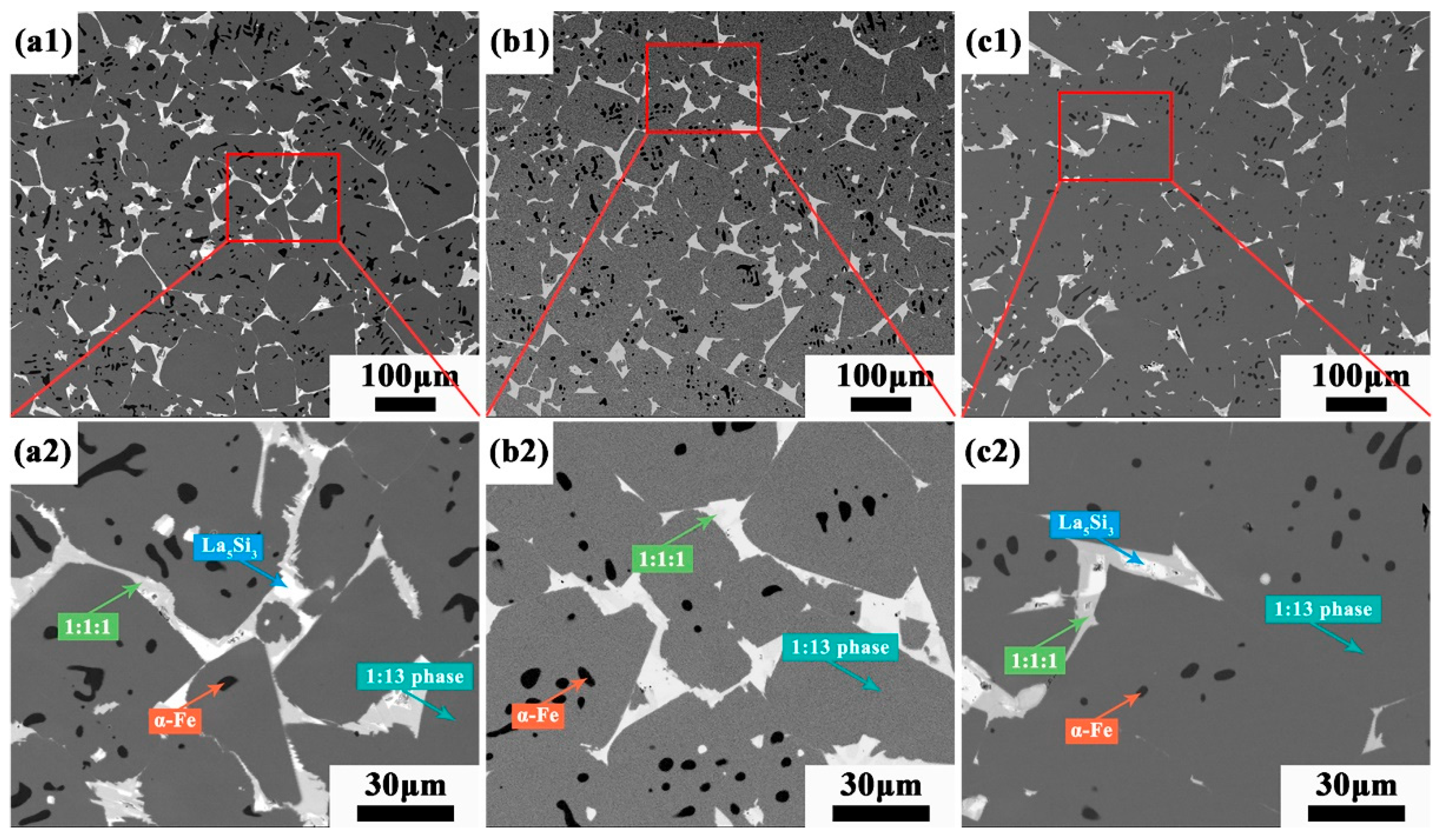
The microstructures of the annealed La0.8Ce0.2Fe9.2Co0.6Si1.2 alloys varied with the annealing time. Figure 2 presents the backscattered morphologies and local enlarged images of the annealed alloys. It was clear that there was an increase in the La-rich phase content and a small content of the α-Fe phase in the rare earth-rich La0.8Ce0.2Fe9.2Co0.6Si1.2 alloys after annealing. According to the EDS results, the gray phase in Figure 2(a2,b2,c2) was identified as the 1:13 phase. The white phase corresponded to the La-rich phase (consisting of the 1:1:1 phase and the 5:3 phase), while the dark phase was the α-Fe phase. This phase assignment is consistent with the quantitative phase analysis obtained from XRD Rietveld refinement (Table 1), which confirms that the 1:13 phase is the majority phase as well as the presence of the α-Fe and La-rich minority phases.
When the La0.8Ce0.2Fe9.2Co0.6Si1.2 alloys were annealed at 1423 K for 4 h, there existed a certain content of the α-Fe phase and the intergranular La-rich phase within the alloys. With increasing the annealing time to 12 h, the content of the α-Fe phase decreased but the La-rich phase content was almost unchanged. After annealing for 24 h, both the α-Fe phase and the La-rich phase of the alloys significantly reduced, as shown in Figure 2(c1). During the long-term annealing of as-cast alloys, elemental diffusion between the 1:1:1 phase and the α-Fe phase promoted compositional homogenization, as reported in the literature [49]. Therefore, the main effect of increasing the annealing time is to promote the peritectic reaction and elemental diffusion, leading to a more homogeneous microstructure dominated by the 1:13 phase, with a significant reduction in the minority α-Fe and La-rich phases.
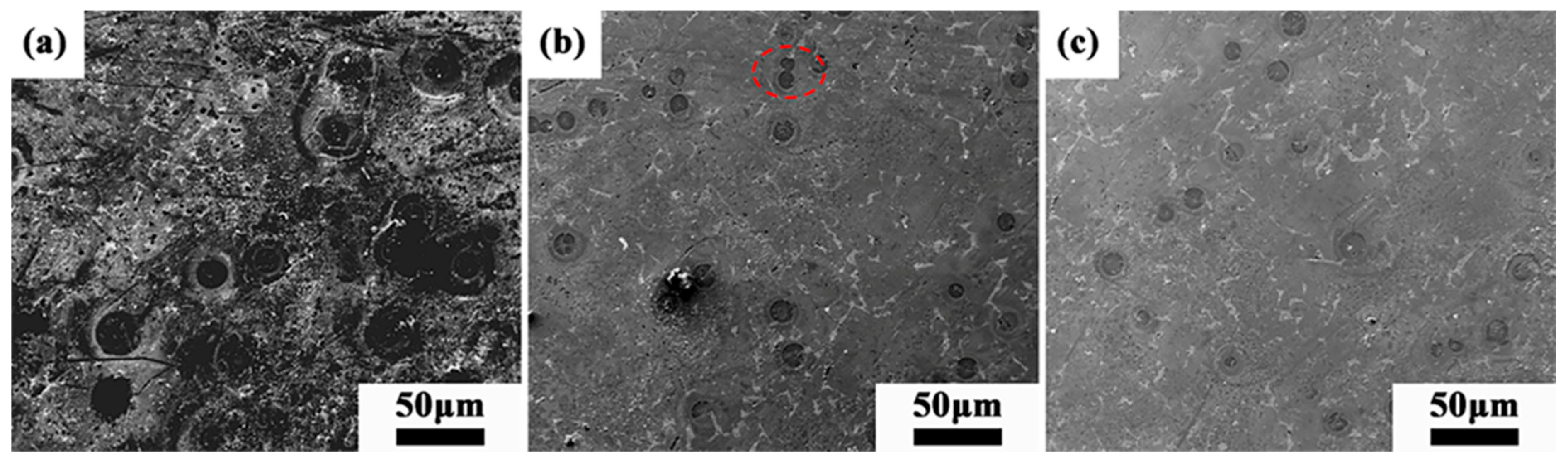
It was evident that micro-galvanic corrosion readily occurred in the multiphase alloys when they were placed in a corrosion medium. The corroded regions and corrosion product appeared on the surface of the alloys, especially at regions of inhomogeneous composition and high defect density [36]. The corroded surface of annealed La0.8Ce0.2Fe9.2Co0.6Si1.2 alloys after a 30 min immersion in deionized water is depicted in Figure 3. Upon immersion, the samples exhibited random localized micro-galvanic corrosion.
As shown in Figure 3a, the La0.8Ce0.2Fe9.2Co0.6Si1.2 alloy annealed at 1423 K for 4 h exhibited more extensive and larger corroded zones with deeper corrosion penetration. As the annealing time was extended to 12 h, corrosion areas were predominantly observed in the matrix phase, while the number and size of corrosion sites decreased significantly, reflecting improved corrosion resistance. As shown in Figure 3b, the adjacent corrosion areas merged to form larger corrosion zones, as marked by the red circle. In Figure 3a, larger corrosion areas interconnected by small corrosion sites exhibited greater corrosion severity than those in Figure 3b, attributed to the higher corrosion driving force [36]. Further extending the annealing time to 24 h yielded samples with shallower etch pits across various regions (Figure 3c).
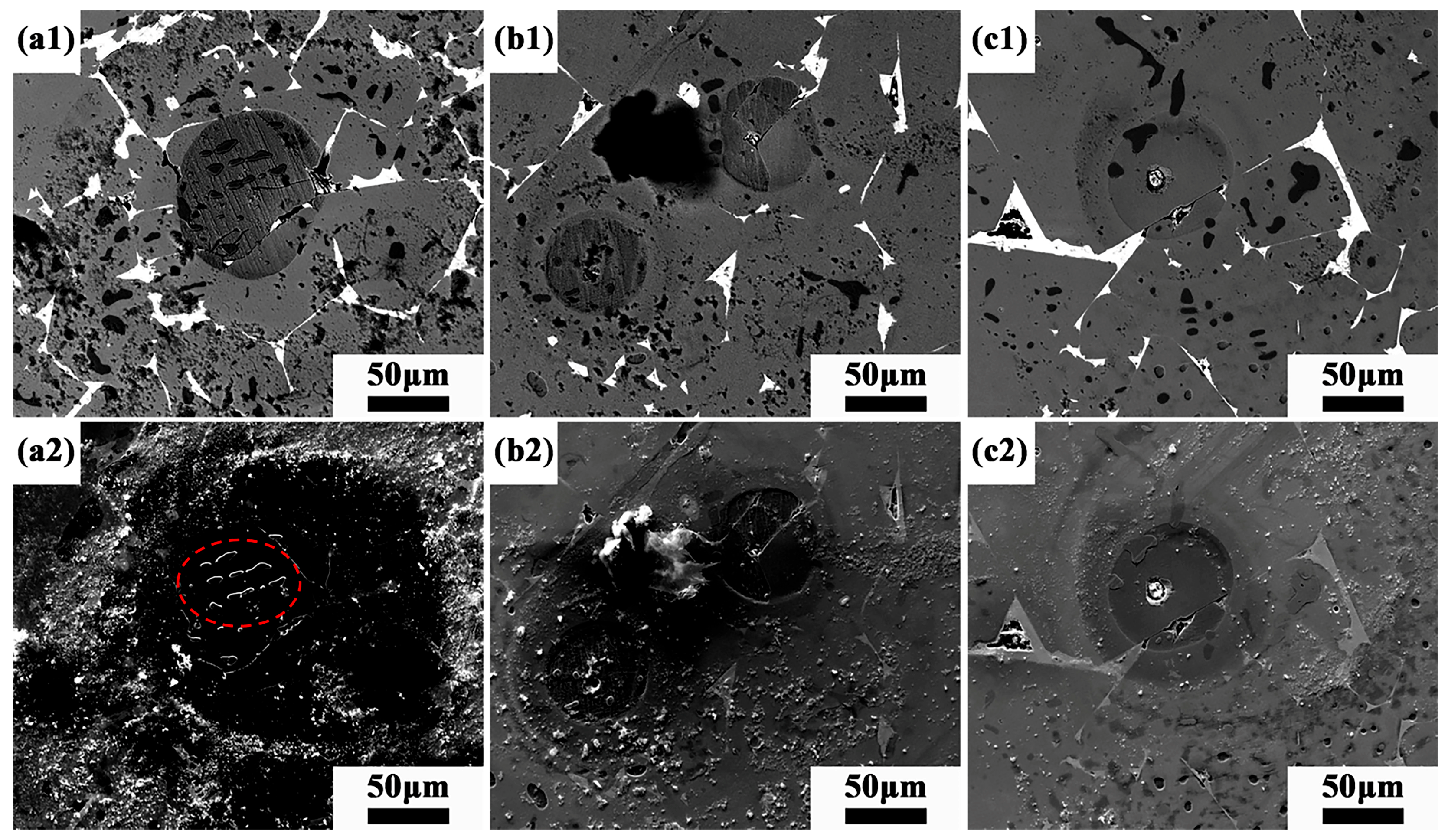
The corrosion interactions among different phases in La0.8Ce0.2Fe9.2Co0.6Si1.2 alloys were comprehensively analyzed. Figure 4 shows the magnified SEM morphologies of alloys annealed for varying durations after 30 min immersion in deionized water. The EDS results for the corroded distinct phases are tabulated in Table 2.
As illustrated in Figure 4(a2), a protruding α-Fe phase (marked by the red circle) was observed at the center of corroded regions, indicating severe corrosion of the surrounding 1:13 phase. EDS analysis (Table 2) revealed no oxygen in the protruding α-Fe phase, attributed to its higher corrosion electrode potential during micro-galvanic corrosion [27]. This confirms that the α-Fe phase acted as the cathode, while the 1:13 and La-rich phases functioned as anodes in the micro-galvanic corrosion process.
The corrosion sequence between the 1:13 phase and the La-rich phase is also a focus of interest. Zhang et al. [30] confirmed that in stoichiometric LaFe11.6Si1.4 alloys, the La-rich phase (predominantly the 1:1:1 phase) is more susceptible to corrosion than the 1:13 phase. Notably, the preferential corrosion of the La-rich phase is not arbitrary but closely related to the composition of the corroded phase. The key difference here may stem from the effect of Ce.
In our work, the average oxygen content of the 1:13 phase in corroded alloys is significantly higher than that of the 1:1:1 phase (Table 2). This indicates that the difference in oxygen absorption capacity between the two phases may be an important factor influencing their corrosion sequence.
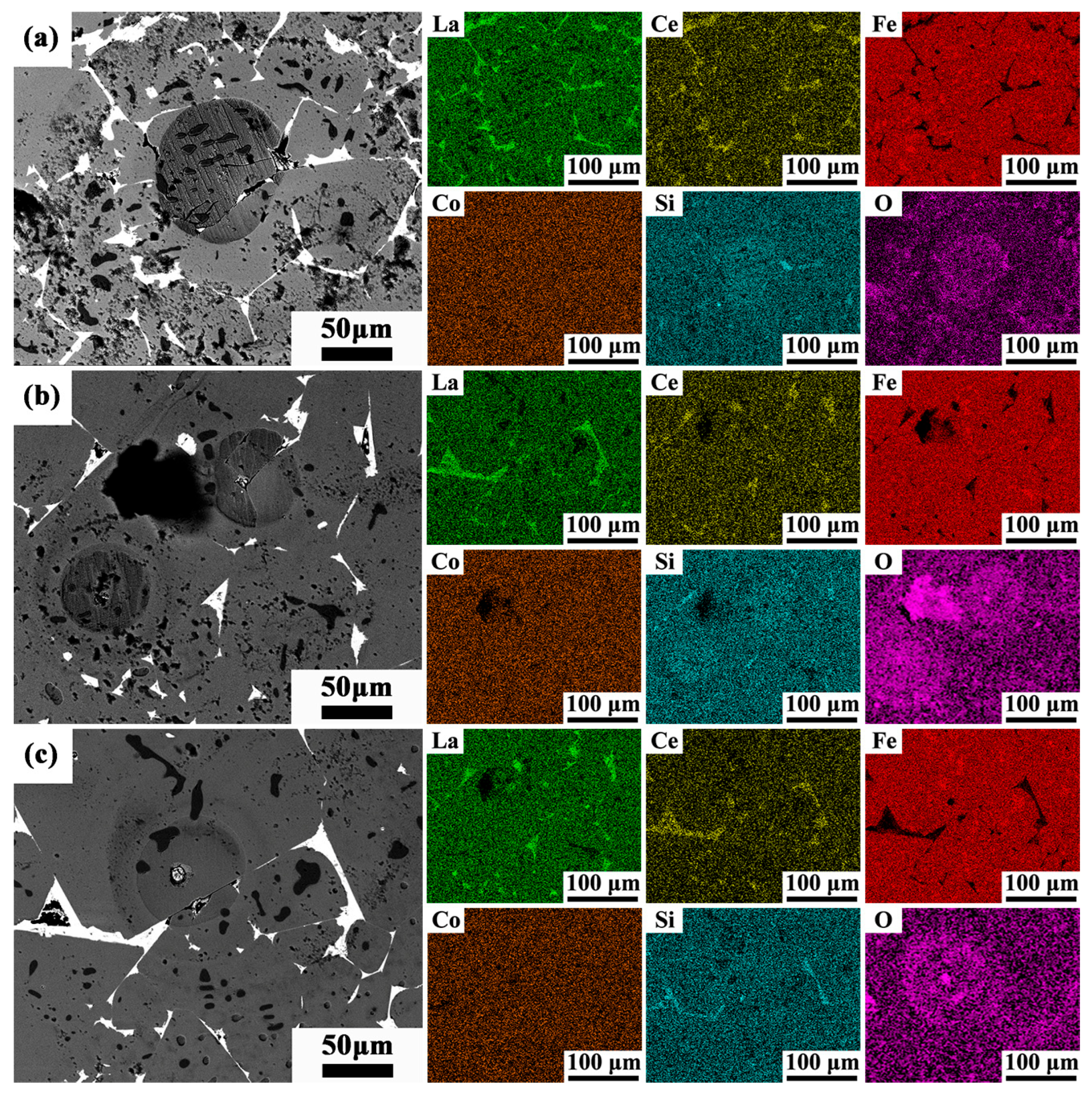
EDS mapping was further performed to analyze the elemental distribution across the scanned area (Figure 5). From the O element mapping images, it is evident that the oxygen content is the highest at the corrosion sites; as the distance from the corrosion center increases, the oxygen content in the corroded 1:13 phase exhibits a decreasing trend.
In Figure 4(b2,c2), the 1:13 phase behaved as the sacrificial anode and was corroded more seriously than the La-rich phase, and corrosion preferentially occurred on the 1:13 phase. The introduction of Ce element may play an important role in this context. The oxide film of the La-rich phase with higher Ce content was more protective than the 1:13 phase, which reduced its further corrosion during a short period of corrosion. The same protection could be also observed in Al-Zn-Mg alloys with the addition of a small amount of Ce [50]. In the micro-galvanic corrosion process, the α-Fe phase acted as the cathode, while the 1:13 phase and La-rich phase served as anodes and corroded. When the annealing time was increased to 24 h, the content of the α-Fe phase decreased remarkably, leading to a reduction in cathodic sites. This finding confirms that the α-Fe phase acts as the primary driver of micro-galvanic corrosion in this alloy system. The corrosion cell of a small cathode and a large anode led to a lower negative and anode area ratio, and it was beneficial to improve corrosion resistance [51].
Specifically, Ce improves corrosion resistance through two synergistic mechanisms:
(a) Enhanced Passivation: Ce, which is enriched in the La-rich phases (Table 2), facilitates the formation of a more stable and protective oxide film (e.g., La-Ce-O composites). This film acts as a superior barrier against further corrosion compared to the oxide on the 1:13 phase, as evidenced by the lower oxygen content in the corroded 1:1:1 phase relative to the corroded 1:13 phase (Table 2); (b) Microstructural Optimization: As part of the alloy design, Ce promotes the formation of the 1:13 phase during annealing. This process, as shown in Table 1, concurrently reduces the volume fraction of the cathodic α-Fe phase, thereby weakening the driving force for micro-galvanic corrosion.
Consequently, in the micro-galvanic corrosion process, the α-Fe phase acted as the cathode, while the 1:13 phase served as the primary anode and corroded more severely than the Ce-protected La-rich phase.
As shown in Figure 2 and Figure 4, the 1:1:1 phase is part of the La-rich phase with higher Ce content. The EDS and SEM results indicate that it acts as a less active anode in micro-galvanic corrosion: its lower oxygen content after corrosion (Table 2) and milder corrosion morphology (Figure 4) suggest that it is more corrosion-resistant than the 1:13 phase, which is attributed to the protective oxide film enhanced by Ce. The XRD results (Figure 1) show that the 5:3 phase was not detected due to its extremely low content (likely <1 wt%). Its negligible content implies that it has little influence on the overall micro-galvanic corrosion behavior in the current alloy system.
Across many Mg-, Al-, and Fe-based alloys [48,52,53,54], Ce enhances corrosion resistance through the following consistent mechanisms, which validate the proposed model for La0.8Ce0.2Fe9.2Co0.6Si1.2 alloys.
(a) Enhanced Passivation: Ce, which is enriched in the La-rich phases (Table 2), facilitates the formation of a more stable and protective oxide film (e.g., CeO2, Ce2O3, or ternary oxide composites). This film acts as a superior barrier against further corrosion compared to the oxide on the 1:13 phase, as evidenced by the lower oxygen content in the corroded 1:1:1 phase relative to the corroded 1:13 phase (Table 2).
(b) Microstructural Optimization: As part of the alloy design, Ce promotes the formation of the 1:13 phase during annealing. This process, as shown in Table 1, concurrently reduces the volume fraction of the cathodic α-Fe phase, thereby reducing the driving force for micro-galvanic corrosion.
Ce facilitates Ce3+/Ce4+ redox reactions within oxide films, which effectively scavenge free radicals and buffer aggressive ions. As a result, Ce is enriched in La-rich phases, forming a protective La-Ce-O film (mechanism a), while annealing-induced reduction in the α-Fe content weakens micro-galvanic couples (mechanism b). In the micro-galvanic corrosion process, the α-Fe phase acts as the cathode, with the 1:13 phase serving as the primary anode—exhibiting more severe corrosion compared to the Ce-protected La-rich phase.
In addition, the EDS mapping results of La0.8Ce0.2Fe9.2Co0.6Si1.2 alloys annealed at 1423 K for different durations after being immersed in deionized water for 30 min are presented in Figure 5. EDS mapping was further performed to analyze the elemental distribution across the scanned area. From the O element mapping images, it is evident that the oxygen content is the highest at the corrosion sites; as the distance from the corrosion center increases, the oxygen content in the corroded 1:13 phase exhibits a decreasing trend.

3.2. Electrochemical Corrosion Performance and Mechanism

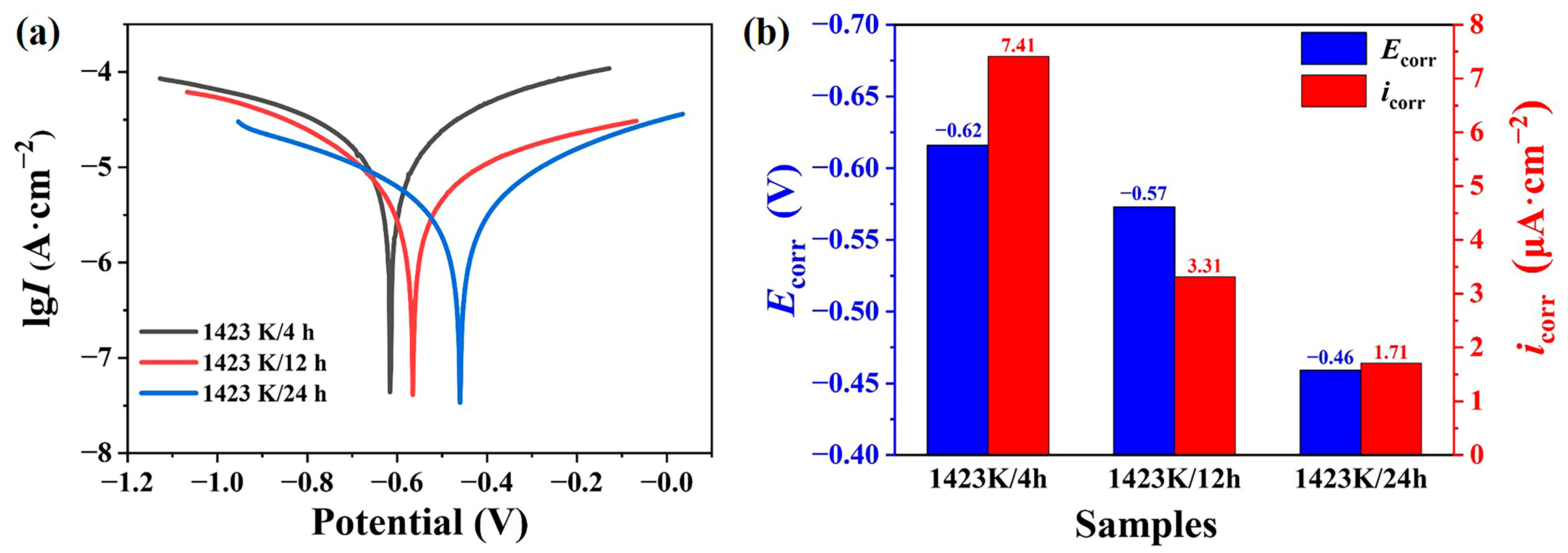
Figure 6a presents the Tafel polarization curves of annealed La0.8Ce0.2Fe9.2Co0.6Si1.2 alloys in deionized water. The corrosion potential (Ecorr) and corrosion current density (icorr) were determined via linear extrapolation of the polarization curves, with results summarized in the bar chart of Figure 6b. As annealing time increased from 4 h to 24 h, icorr decreased and Ecorr shifted to more positive values, demonstrating improved corrosion resistance. This electrochemical improvement is directly correlated with the reduction of the cathodic α-Fe phase (quantified in Table 1), which weakens the driving force for micro-galvanic corrosion.
As depicted in Figure 6b, the icorr values for La0.8Ce0.2Fe9.2Co0.6Si1.2 alloys annealed for 4 h, 12 h and 24 h were 7.41, 3.31 and 1.71 μA·cm−2, respectively. Rietveld results (Table 1) shows that the content of the minority phases decreased with increasing annealing time, reducing the number of micro-galvanic cells and leading to lower corrosion current densities.
The profound impact of microstructure on surface chemical properties, and consequently on interfacial reactions, is a universal concept in materials science. A compelling analogy can be drawn with a recent study on anatase-brookite TiO2 catalysts [55]. In that work, a specific phase composition and a highly homogeneous microstructure were shown to yield a superior density and strength of the Brønsted acid sites, which were directly responsible for high activity and selectivity in isopropanol dehydration.
Translating this principle to our corrosion system, we postulate that the annealing-induced reduction of the cathodic α-Fe phase not only weakens galvanic coupling but also creates a more uniform surface. This homogenization, akin to the optimized TiO2 surface, may promote the formation of a more stable and protective passive film by altering the distribution and reactivity of surface hydroxyl groups and adsorption sites. Although the environments differ (catalytic dehydration vs. aqueous corrosion), the underlying theme is consistent: tailoring the bulk composition and microstructure to achieve a desired surface state is a powerful strategy for controlling material performance. In our case, this strategy successfully decouples corrosion resistance from the magnetocaloric functionality.
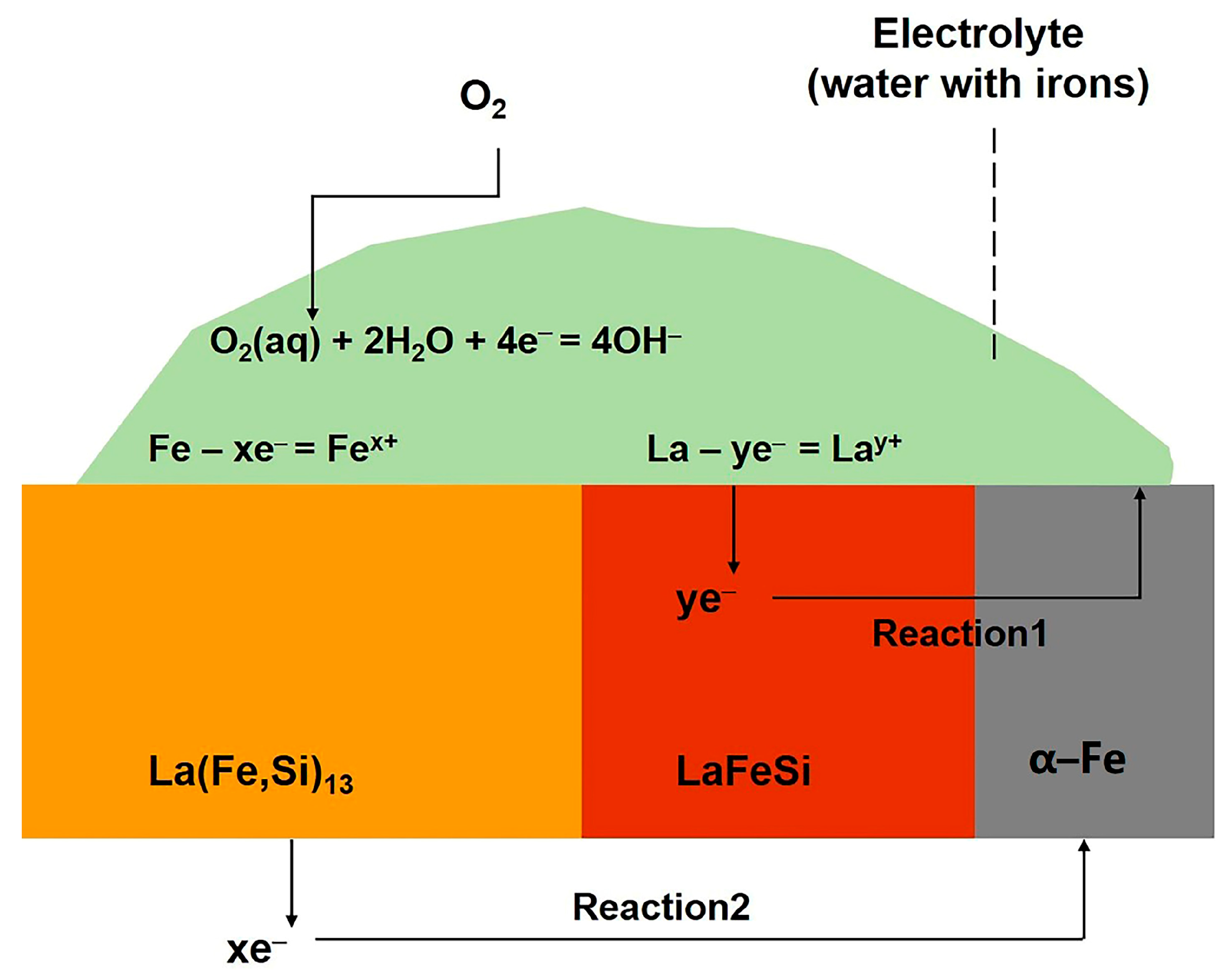
Figure 7 is a schematic diagram of micro-galvanic corrosion occurring in La0.8Ce0.2Fe9.2Co0.6Si1.2 alloys. As analyzed in Figure 4 above, the main phases involved in micro-galvanic corrosion are the α-Fe phase, the La(Fe,Si)13 phase, and the LaFeSi phase. The corrosion potential of the α-Fe phase is much higher than that of the La(Fe,Si)13 phase and the LaFeSi phase. Therefore, in the micro-galvanic corrosion system, two potential differences drive the anodic reaction: one between the α-Fe phase and the La(Fe,Si)13 phase (Reaction 1), and the other between the α-Fe phase and the LaFeSi phase (Reaction 2). Both differences cause Fe and La elements to lose electrons and form active ions. The total reaction current is the sum of the corrosion currents from Reaction 1 and Reaction 2.
On the other hand, oxygen molecules from the air dissolve in the electrolyte and gain electrons near the cathode of micro-galvanic corrosion to form OH ions. Subsequently, these cathode-generated OH ions react with the active Fe2+ and La3+ ions (produced at the anode) and are converted into the corresponding hydroxide-based corrosion products, as shown in Figure 4.
In the current study, these mechanisms converge: Ce is enriched in La-rich phases to form a protective La-Ce-O film (mechanism 1), while annealing reduces α-Fe content to weaken micro-galvanic couples (mechanism 2). The resulting corrosion resistance ensures minimal degradation of magnetocaloric properties (Δ(−ΔSM) < 10%, Figure 9), which is consistent with Ce’s ability to decouple corrosion from functional performance in other systems.

3.3. Magnetic and Magnetocaloric Properties

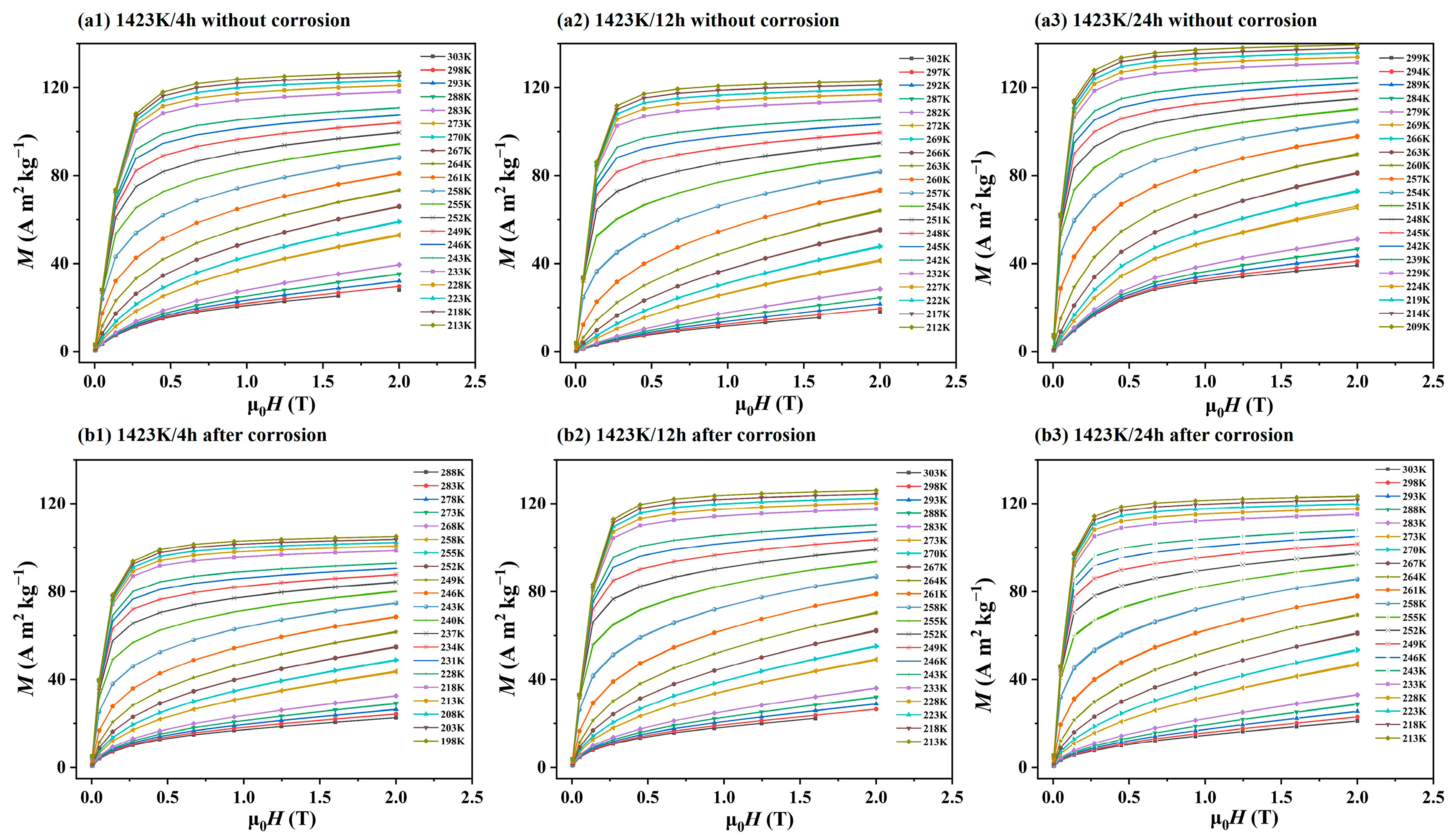
Figure 8 presents the isothermal magnetization (MH) curves of La0.8Ce0.2Fe9.2Co0.6Si1.2 alloys before and after corrosion, measured under an applied magnetic field change from 0 to 2 T. The MH curves near the TC, recorded over a temperature range of 198 to 303 K, exhibit distinct magnetization behaviors in response to the applied magnetic field and temperature, as shown in Figure 8(a1–a3,b1–b3). Under a magnetic field of 0–2 T, the residual magnetization values at or near 288 K (a temperature far above their TC) for the La0.8Ce0.2Fe9.2Co0.6Si1.2 alloys—annealed at 1423 K for 4 h, 12 h, and 24 h—are approximately ~35.53 Am2kg−1 (4 h, before corrosion), ~22.57 Am2kg−1 (4 h, after corrosion), ~24.66 Am2kg−1 (12 h, before corrosion), ~30.76 Am2kg−1 (12 h, after corrosion), ~43.53 Am2kg−1 (24 h, before corrosion), and ~30.26 Am2kg−1 (24 h, after corrosion). These values are attributed to the presence of residual α-Fe phases after heat treatment—an observation supported by Refs. [7,18] and consistent with the XRD results (Figure 1 and Table 1).
The saturation magnetization (MS) is primarily governed by the ferromagnetic 1:13 phase content. The variation in MS among the samples annealed for a range of annealing times correlates well with the increasing volume fraction of the 1:13 phase, as quantified by XRD (Table 1). Furthermore, the overall magnetic moment is influenced by the chemical composition of the 1:13 phase.
The incorporation of Ce (which has a smaller magnetic moment than La [13,21]) and the partial substitution of Fe by Co are key factors that collectively tune the saturation magnetization and, more importantly, elevate the Curie temperature (TC) to the desired near-room-temperature range [12,20]. The presence of the soft magnetic α-Fe phase also contributes to the magnetization, as is particularly evident in the non-zero moment at temperatures above TC.
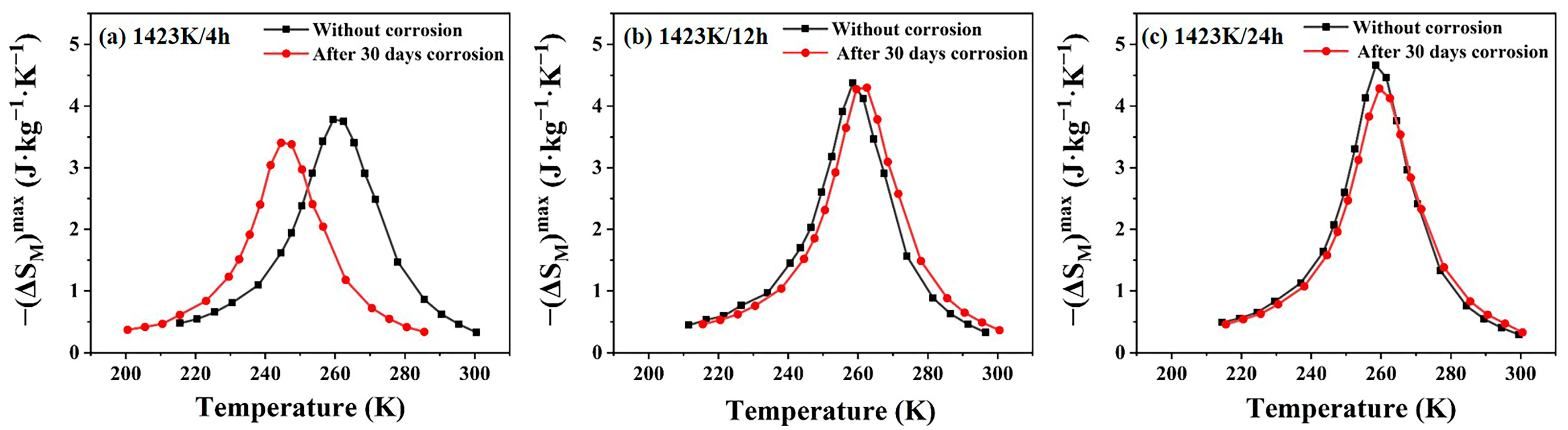
To investigate the effect of corrosion on the magnetocaloric effect, the magnetic entropy change (−ΔSM) of samples was measured before and after corrosion. Figure 9a–c depict the temperature dependence of magnetic entropy change for annealed La0.8Ce0.2Fe9.2Co0.6Si1.2 alloys in their as-annealed state and after 30 days of corrosion. For alloys annealed at 1423 K for 4 h, 12 h and 24 h (uncorroded), the maximum magnetic entropy change (−ΔSM)max values were 3.78, 4.37 and 4.65 J⋅kg−1⋅K−1, respectively. The Curie temperature (TC) of La0.8Ce0.2Fe9.2Co0.6Si1.2 alloys is ~265 K, which means that these materials are suitable for near-room-temperature magnetocaloric applications. The Curie temperature (TC) of La0.8Ce0.2Fe9.2Co0.6Si1.2 alloys is ~265 K, making them suitable for near-room-temperature magnetocaloric applications. Their magnetocaloric performance is comparable to that of some room-temperature benchmarks (e.g., Gd5Si2Ge2 [3]) and surpasses that of recently reported transition-metal high-entropy alloys [56]. A key advantage of our alloy, however, lies in its excellent corrosion resistance coupled with such competitive performance.
As the annealing time was extended from 4 h to 24 h, the magnetic entropy change increased gradually, which is attributed to the increased volume fraction of the 1:13 majority phase (Table 1). It is important to note that the reduction of the α-Fe phase does not compromise the magnetocaloric properties because the giant magnetocaloric effect originates solely from the magneto-elastic transition of the 1:13 phase. The α-Fe phase is magnetocalorically inactive near the Curie temperature. Therefore, the observed enhancement in (−ΔSM)max is a direct result of the increased volume fraction of the functional 1:13 phase, confirming that the strategy of reducing minority phases benefits both corrosion resistance and magnetocaloric performance.
After 30 days’ corrosion, the (−ΔSM)max values of the alloys annealed at 1423 K for 4 h, 12 h and 24 h were 3.41, 4.28 and 4.30 J⋅kg−1⋅K−1, respectively. After immersion in deionized water, reddish-brown corrosion products formed on the alloys, leading to a decrease in magnetic entropy change. Notably, the existing results indicate that corrosion time had a negligible effect on magnetic entropy change, especially when sample composition homogenized after prolonged annealing.
The key magnetocaloric parameters—including the Curie temperature (TC), maximum magnetic entropy change ((−ΔSM)max), and refrigerant capacity (RC)—for all samples before and after corrosion are comprehensively summarized in Table 3. The data clearly show that extending the annealing time from 4 h to 24 h leads to a systematic increase in both (−ΔSM)max and RC for the uncorroded samples. This trend is directly correlated with the increasing volume fraction of the magnetocalorically active 1:13 phase, as confirmed by XRD results (Table 1). Furthermore, Table 3 quantitatively demonstrates that corrosion exerts only a minor detrimental effect on the magnetocaloric properties, with the 24 h-annealed sample exhibiting the smallest degradation. This underscores the success of our strategy in decoupling corrosion resistance from functional performance.

4. Conclusions

Phase formation, magnetic entropy change and the influence of minority phases on corrosion behavior of a near-room-temperature magnetocaloric La0.8Ce0.2Fe9.2Co0.6Si1.2 alloys after annealing were discussed. Increasing annealing time from 4 h to 24 h resulted in a reduction in the α-Fe and 1:1:1 phase content. Specifically, the α-Fe phase content decreased from ~7.81wt% to ~2.92wt%. Due to micro-galvanic corrosion among different constituent phases, corroded areas appeared randomly on the surface of the alloys after immersion in deionized water. Extending the annealing time reduced the minority phases, especially the α-Fe phase, thereby improving corrosion resistance. Notably, corrosion had a negligible effect on the alloys’ magnetic entropy change. This study confirms that optimizing the annealing time to reduce the α-Fe content and improve microstructural uniformity is an effective strategy to enhance corrosion resistance without sacrificing magnetocaloric performance. Future studies could explore the synergistic effects of combining optimized annealing with minor alloying elements (e.g., Cr, B) or surface passivation techniques to further enhance the long-term corrosion stability in practical heat transfer fluids.

Author Contributions

Conceptualization, methodology, formal analysis, data curation, writing—original draft, Z.L.; Conceptualization, methodology, writing—original draft, writing—review and editing, supervision, funding acquisition, X.Z.; Validation, formal analysis, X.H. and D.J.; Resources, visualization. C.L. and J.H.; Writing—review and editing, R.V.R. All authors have read and agreed to the published version of the manuscript.

Funding

This work was supported by the Guangdong Basic and Applied Basic Research Foundation (Grant No.: 2024A1515011481), and the National Natural Science Foundation of China (Grant Nos.: 52561009, 52066001, 51874143).

Institutional Review Board Statement

Not applicable.

Informed Consent Statement

Not applicable.

Data Availability Statement

The data in this study are available upon request from the authors. They are not publicly available because they are part of ongoing studies.

Conflicts of Interest

The authors declare no conflicts of interest.

References

  1. Gutfleisch, O.; Willard, M.A.; Brück, E.; Chen, C.H.; Sankar, S.G.; Liu, J.P. Magnetic materials and devices for the 21st: Stronger, lighter, and more energy efficient. Adv. Mater. 2011, 23, 821–842. [Google Scholar] [CrossRef] [PubMed]
  2. Franco, V.; Blazquez, J.S.; Ipus, J.J.; Law, J.Y.; Moreno-Ramirez, L.M.; Conde, A. Magnetocaloric effect: From materials research to refrigeration devices. Prog. Mater. Sci. 2018, 93, 112–232. [Google Scholar] [CrossRef]
  3. Pecharsky, V.K.; Gschneidner, K.A., Jr. Giant magnetocaloric effect in Gd5(Si2Ge2). Phys. Rev. Lett. 1997, 78, 4494–4497. [Google Scholar] [CrossRef]
  4. Tishin, A.M. Magnetocaloric effect in strong magnetic fields. Cryogenics 1990, 30, 127–136. [Google Scholar] [CrossRef]
  5. Tegus, O.; Brück, E.; Buschow, K.H.J.; De Boer, F.R. Transition-metal-based magnetic refrigerants for room-temperature applications. Nature 2002, 415, 150–152. [Google Scholar] [CrossRef]
  6. Gutfleisch, O.; Yan, A.; Muller, K.H. Large magnetocaloric effect in melt-spun LaFe13−xSix. J. Appl. Phys. 2005, 97, 10M305. [Google Scholar] [CrossRef]
  7. Liu, J.; Krautz, M.; Skokov, K.; Woodcock, T.G.; Gutfleisch, O. Systematic study of the microstructure, entropy change and adiabatic temperature change in optimized La-Fe-Si alloys. Acta Mater. 2011, 59, 3602–3611. [Google Scholar] [CrossRef]
  8. Hu, F.X.; Shen, B.G.; Sun, J.R. Magnetic entropy change in Ni51.5Mn22.7Ga25.8 alloy. Appl. Phys. Lett. 2000, 76, 3460–3462. [Google Scholar] [CrossRef]
  9. Hu, F.X.; Shen, B.G.; Sun, J.R.; Zhang, X.X. Great magnetic entropy change in La(Fe,M)13 (M = Si, Al) with Co doping. Chin. Phys. 2000, 9, 550–553. [Google Scholar] [CrossRef]
  10. Fujita, A.; Fujieda, S.; Fukamichi, K.; Mitamura, H.; Goto, T. Itinerant-electron metamagnetic transition and large magnetovolume effects in La(FexSi1−x)13 compounds. Phys. Rev. B 2001, 65, 014410. [Google Scholar] [CrossRef]
  11. Zhong, X.C.; Wu, Y.C.; Li, Y.X.; Huang, X.; Liu, C.L.; Huang, J.H.; Liu, Z.W.; Jiao, D.L.; Qiu, W.Q.; Zhong, M.L.; et al. Transient liquid phase bonding assisted spark plasma sintering of La-Fe-Si magnetocaloric bulk materials. J. Alloys Compd. 2023, 965, 171419. [Google Scholar] [CrossRef]
  12. Fujieda, S.; Fukamichi, K.; Suzuki, S. Microstructure and isothermal magnetic entropychange of La(Fe0.89Si0.11)13 in a single-phase formation process by annealing. J. Alloys Compd. 2013, 566, 196–200. [Google Scholar] [CrossRef]
  13. Liu, Y.F.; Fu, X.Q.; Yu, Q.; Zhang, M.X.; Liu, J. Significant reduction of phase-transition hysteresis for magnetocaloric (La1−xCex)2Fe11Si2Hy alloys by microstructural manipulation. Acta Mater. 2021, 207, 116687. [Google Scholar] [CrossRef]
  14. Imaizumi, K.; Fujita, A.; Suzuki, A.; Kobashi, M.; Ozaki, K. Improvement of magnetocaloric effect in La(FexSi1−x)13 by dealing with inhibitory microstructures at high Fe concentration. Acta Mater. 2022, 227, 117726. [Google Scholar] [CrossRef]
  15. Zhong, X.C.; Feng, X.L.; Huang, J.H.; Zhang, H.; Huang, Y.L.; Liu, Z.W.; Jiao, D.L. Microstructure evolution and large magnetocaloric effect of La0.8Ce0.2(Fe0.95Co0.05)11.8Si1.2 alloy prepared by strip-casting and annealing. AIP Adv. 2018, 8, 048102. [Google Scholar] [CrossRef]
  16. Li, Y.X.; Wu, Y.C.; Zhong, X.C.; Wu, S.M.; Liu, C.L.; Huang, J.H.; Liu, J.; Zhang, H.; Yu, H.Y.; Liu, Z.W.; et al. Phase constitution, microstructure evolution and magnetocaloric properties of LaFe11.8Si1.2 strip-casting flakes. Intermetallics 2021, 139, 107373. [Google Scholar] [CrossRef]
  17. Balli, M.; Rosca, M.; Fruchart, D.; Gignoux, D. Effect of interstitial nitrogen on magnetism and entropy change of LaFe11.7Si1.3 compound. J. Magn. Magn. Mater. 2009, 321, 123–125. [Google Scholar] [CrossRef]
  18. Liu, J.; He, C.; Zhang, M.X.; Yan, A.R. A systematic study of the microstructure, phase formation and magnetocaloric properties in off-stoichiometric La-Fe-Si alloys. Acta Mater. 2016, 118, 44–53. [Google Scholar] [CrossRef]
  19. Huang, X.; Dong, X.T.; Zhong, X.C.; Yao, S.Y.; Huang, J.H.; Liu, C.L.; Liu, J.; Liu, Z.W.; Ramanujan, R.V. Rapid formation of the magnetocaloric phase in La-Fe-Co-Si magnetocaloric alloys for near room temperature applications. Intermetallics 2023, 157, 107870. [Google Scholar] [CrossRef]
  20. Zhang, H.; Zhang, M.X.; Shao, Y.Y.; Zhu, L.H.; Liu, J. Microstructure and magnetocaloric properties of non-stoichiometric La1.5Fe12.2−xCo0.8Six alloys. J. Alloys Compd. 2017, 720, 432–436. [Google Scholar] [CrossRef]
  21. Zhong, X.C.; Dong, X.T.; Peng, D.R.; Huang, J.H.; Zhang, H.; Jiao, D.L.; Zhang, H.; Liu, Z.W.; Ramanujan, R.V. Table-like magnetocaloric effect and enhanced refrigerant capacity of HPS La(Fe,Si)13-based composites by Ce-Co grain boundary diffusion. J. Mater. Sci. 2020, 55, 5908–5919. [Google Scholar] [CrossRef]
  22. Tušek, J.; Kitanovski, A.; Tomc, U.; Favero, C.; Poredoš, A. Experimental comparison of multi-layered La-Fe-Co-Si and single-layered Gd active magnetic regenerators for use in a room-temperature magnetic refrigerator. Int. J. Refrig. 2014, 37, 117–126. [Google Scholar] [CrossRef]
  23. Balli, M.; Sari, O.; Zamni, L.; Mahmed, C.; Forchelet, J. Implementation of La(Fe,Co)13−xSix materials in magnetic refrigerators: Practical aspects. Mater. Sci. Eng. B 2012, 177, 629–634. [Google Scholar] [CrossRef]
  24. Liao, Z.H.; Zhong, X.C.; Huang, X.; Hao, Z.Y.; Huang, J.H.; Liu, C.L.; Zhang, Y.D.; Ma, L.; Jiao, D.L.; Liu, Z.W.; et al. High corrosion resistance of La1.4Fe11Co0.8Si1.2 magnetocaloric alloy. Mater. Chem. Phys. 2024, 315, 129000. [Google Scholar] [CrossRef]
  25. Zhong, X.C.; Peng, D.R.; Dong, X.T.; Huang, J.H.; Zhang, H.; Jiao, D.L.; Zhang, H.; Liu, Z.W.; Ramanujan, R.V. Improvement in the magnetocaloric properties of sintered La(Fe,Si)13 based composites processed by La-Co grain boundary diffusion. J. Alloys Compd. 2019, 780, 873–880. [Google Scholar] [CrossRef]
  26. Wu, Y.C.; Li, Y.X.; Zhong, X.C.; Liu, C.L.; Huang, J.H.; Yu, H.Y.; Liu, Z.W.; Zhong, M.L.; Zhong, Z.C.; Ramanujan, R.V. The superior properties of spark plasma sintered La-Fe-Si magnetocaloric alloys. Mater. Res. Bull. 2022, 155, 111974. [Google Scholar] [CrossRef]
  27. Zhang, M.; Long, Y.; Ye, R.C.; Chang, Y.Q. Corrosion behavior of magnetic refrigeration material La-Fe-Co-Si in distilled water. J. Alloys Compd. 2011, 509, 3627–3631. [Google Scholar] [CrossRef]
  28. Zhang, M.; Ye, R.C.; Long, Y.; Chang, Y.Q. Inhibition of La-Fe-Co-Si compound corrosion in distilled water by sodium molybdate and disodium hydrogen phosphate. J. Rare Earths 2011, 29, 138–142. [Google Scholar] [CrossRef]
  29. Xue, J.N.; Long, Y.; Wang, Y.X.; Hu, J.; Zong, S.T. Corrosion behavior and phase formation of LaFe13−xSixBy alloys. Mater. Des. 2017, 129, 1–8. [Google Scholar] [CrossRef]
  30. Zhang, E.Y.; Chen, Y.G.; Tang, Y.B. Investigation on corrosion and galvanic corrosion in LaFe11.6Si1.4 alloy. Mater. Chem. Phys. 2011, 127, 1–6. [Google Scholar] [CrossRef]
  31. Gebert, A.; Krautz, M.; Waske, A. Exploring corrosion protection of La-Fe-Si magnetocaloric alloys by passivation. Intermetallics 2016, 75, 88–95. [Google Scholar] [CrossRef]
  32. Hu, J.; Guan, L.; Fu, S.; Sun, Y.; Long, Y. Corrosion and latent heat in thermal cycles for La(Fe,Mn,Si)13 magnetocaloric compounds. J. Magn. Magn. Mater. 2014, 354, 336–339. [Google Scholar] [CrossRef]
  33. Hu, J.; Liu, H.T.; Zhang, X.Y.; Wang, Z.; Yang, Z.G.; Feng, M.N.; Shi, X.P. Corrosion behavior and magnetocaloric property of pure phase La1−xCexFe11.5Si1.5 (x = 0.1, 0.2, 0.3) compounds. Heliyon 2024, 10, e25169. [Google Scholar] [CrossRef]
  34. Guo, J.N.; Li, J.L.; Ye, R.C.; Wei, C.S.; Long, Y. Researches on corrosion behavior and magnetocaloric effect of the LaFe11.7−xCoxAl1.3 alloys. J. Alloys Compd. 2020, 846, 156298. [Google Scholar] [CrossRef]
  35. Zhang, M.; Sun, W.; Long, Y.; Qiu, C.; Ye, R.C. Effect of chromium on magnetic properties and corrosion resistance of LaFe11.5Si1.5 compound. J. Rare Earths 2013, 31, 69–72. [Google Scholar] [CrossRef]
  36. Hu, J.; Zhang, M.; Long, Y.; Fu, S.; Wang, H.S.; Zhong, K.X. Corrosion behavior and ΔS-T relation of LaFe13−x−yCoxSiyCz compounds near room temperature. J. Magn. Magn. Mater. 2015, 377, 368–372. [Google Scholar] [CrossRef]
  37. Cheng, J.; You, C.Y.; Tian, N.; Gao, L.; Guo, Y.R.; Song, B.Y.; Pei, H.; Jin, P.Y. Corrosion behavior and magnetocaloric effect of La0.8Ce0.2Fe11.51Mn0.19Si1.3Hy plates with plasma-sprayed Al powder coating. J. Magn. Magn. Mater. 2025, 620, 172925. [Google Scholar] [CrossRef]
  38. Tian, N.; Zhang, N.N.; You, C.Y.; Gao, B.; He, J. Magnetic hysteresis loss and corrosion behavior of LaFe11.5Si1.5 particles coated with Cu. J. Applied. Phys. 2013, 113, 103909. [Google Scholar] [CrossRef]
  39. Sun, N.K.; Zhao, X.G.; Song, Y.W.; Liu, R.Q.; Guo, J.; Zhang, Y.; Huang, J.H.; Zhang, Z.D. Electroless plating Ni-P coatings on La(Fe,Si)13 hydride bulks for room-temperature magnetic-refrigeration application. J. Magn. Magn. Mater. 2021, 525, 167685. [Google Scholar] [CrossRef]
  40. Zhao, X.; Fang, P.; Tang, Y.B.; Chen, Y.G.; Zhou, L.T.; Guo, H.Q. Corrosion behavior and magnetocaloric effect of FeNi (1J85) coated LaFe11.6Si1.4/Sn composites. J. Rare Earths 2019, 37, 633–637. [Google Scholar] [CrossRef]
  41. Guo, L.Y.; Zhu, C.Y.; Wang, H.Y.; Miao, L.Y.; Liu, J.; Li, J.W.; Wang, S.Y.; Lovell, E.; Wilson, N.; Cohen, L.F.; et al. Magnetic field effects on the corrosion behavior of magnetocaloric alloys LaFe13.9Si1.4Hy under ferromagnetic states. J. Alloys Compd. 2025, 1017, 179002. [Google Scholar] [CrossRef]
  42. Forchelet, J.; Zamni, L.; El Maudni El Alami, S.; Hu, J.; Balli, M.; Sari, O. Corrosion behavior of gadolinium and La-Fe-Co-Si compounds in various heat conducting fluids. Int. J. Refrig. 2014, 37, 307–313. [Google Scholar] [CrossRef]
  43. Hu, J.; Dong, Z.Q.; Shen, Y.M.; Fu, B.; Zhang, B.F. Effect of excess lanthanum on corrosion and magnetocaloric property of LaFe11.5Si1.5 compounds. J. Rare Earths 2019, 37, 1116–1120. [Google Scholar] [CrossRef]
  44. Lyubina, J.; Hannemann, U.; Ryan, M.P.; Cohen, L.F. Electrolytic hydriding of LaFe13−xSix alloys for energy efficient magnetic cooling. Adv. Mater. 2012, 24, 2042–2046. [Google Scholar] [CrossRef]
  45. Kuchin, A.G.; Platonov, S.P.; Mukhachev, R.D.; Lukoyanov, A.V.; Gaviko, V.S.; Volegov, A.S.; Yakovleva, M.Y. Large magnetocaloric effect in Gd(Mn,Cr)Si at room temperature. J. Alloys Compd. 2025, 1024, 180293. [Google Scholar] [CrossRef]
  46. Beleza, A.A.; Pires, B.; Almeida, R.; Evans, J.S.O.; dos Santos, A.M.; Frontzek, M.; Lovell, E.; Beckmann, B.; Skokov, K.; Gutfleisch, O.; et al. Structural dynamics of first-order phase transition in giant magnetocaloric La(Fe,Si)13: The free energy landscape. Mater. Today Phys. 2024, 42, 101388. [Google Scholar] [CrossRef]
  47. Fujieda, S.; Fukamichi, K.; Suzuki, S. Suppression of aqueous corrosion of La(Fe0.88Si0.12)13 by reducing dissolved oxygen concentration for high-performance magnetic refrigeration. J. Alloys Compd. 2014, 600, 67–70. [Google Scholar] [CrossRef]
  48. Zhang, M.X.; Liu, J.; He, C.; Yan, A.R. Novel microstructure and large magnetocaloric effect in La2Fe11Si2 magnetic refrigerant. Mater. Lett. 2014, 134, 87–90. [Google Scholar] [CrossRef]
  49. Niitsu, K.; Kainuma, R. Phase equilibria in the Fe-La-Si ternary system. Intermetallics 2012, 20, 160–169. [Google Scholar] [CrossRef]
  50. Hu, G.Y.; Zhu, C.J.; Xu, D.F.; Dong, P.X.; Chen, K.H. Effect of cerium on microstructure, mechanical properties and corrosion properties of Al-Zn-Mg alloy. J. Rare Earths 2021, 39, 208–216. [Google Scholar] [CrossRef]
  51. Huang, G.Q.; Yu, C.J.; Li, L.S. Study on galvanic corrosion of steel couples in seawater. J. Chin. Soc. Corros. Prot. 2001, 21, 46–53. (In Chinese) [Google Scholar] [CrossRef]
  52. Liu, W.J.; Cao, F.H.; Chang, L.R.; Zhang, Z.; Zhang, J.Q. Effect of rare earth element Ce and La on corrosion behavior of AM60 magnesium alloy. Corros. Sci. 2009, 51, 1334–1343. [Google Scholar] [CrossRef]
  53. Zheng, W.; Yan, X.Q.; Xiong, S.; Wang, G.W.; Li, G.Q. Pitting corrosion behavior of cerium treated HSLA steel induced by sulfide inclusions in 3.5 wt% NaCl solution. J. Rare Earths 2021, 39, 348–356. [Google Scholar] [CrossRef]
  54. Zhang, L.R.; Yu, Y.C.; Zhang, J.L.; Mao, W.W.; Wang, S.B.; Sun, Z.H.; Wan, Y. Effect of cerium on inclusion evolution and pitting corrosion of Nb-microalloyed steel. Langmuir 2024, 40, 15001–15012. [Google Scholar] [CrossRef]
  55. Nami, N.E.; Blal, A.A.; Fallah, J.E.L.; Clet, G.; Hadjiivanov, K.; Mauge, F.; Aboulayt, A. Mesoporous anatase-brookite TiO2: Surface acidity and performance in isopropanol catalytic dehydration. Catal. Lett. 2025, 155, 290. [Google Scholar] [CrossRef]
  56. Zhang, Y.K.; Xu, P.; Zhu, J.; Yan, S.M.; Zhang, J.C.; Li, L.W. The emergence of considerable room temperature magnetocaloric performances in the transition metal high-entropy alloys. Mater Today Phys. 2023, 32, 101031. [Google Scholar] [CrossRef]
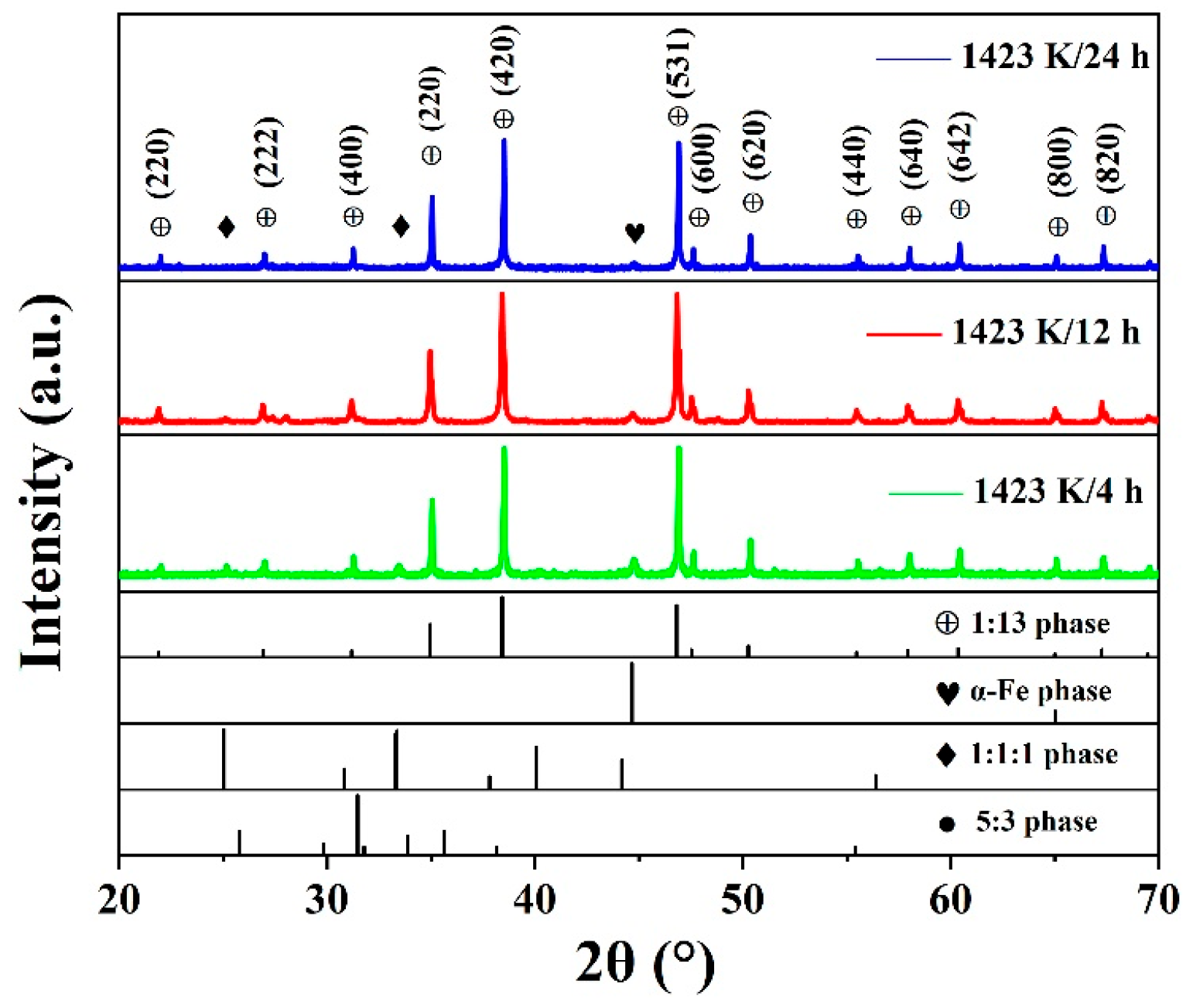
Figure 1. XRD patterns of La0.8Ce0.2Fe9.2Co0.6Si1.2 alloys with different annealing times at 1423 K.
Magnetochemistry 11 00101 g001
Figure 2. Backscattered electron morphologies of La0.8Ce0.2Fe9.2Co0.6Si1.2 alloys after annealing at 1423 K for different times. (a1,a2) 1423K/4h; (b1,b2) 1423K/12h; (c1,c2) 1423K/24h. The gray, white, and dark contrasts correspond to the 1:13 matrix phase, La-rich phase, and α-Fe phase, respectively, as identified by EDS and consistent with XRD analysis (Table 1).
Magnetochemistry 11 00101 g002
Figure 3. SEM morphologies of La0.8Ce0.2Fe9.2Co0.6Si1.2 alloys after annealing for (a) 4 h, (b) 12 h and (c) 24 h, followed by 30 min of immersion in deionized water. The red circle in (b) highlights a merged, high-corrosion zone.
Magnetochemistry 11 00101 g003
Figure 4. Enlarged SEM morphologies of La0.8Ce0.2Fe9.2Co0.6Si1.2 alloys after annealing for different durations, followed by 30 min immersion in deionized water: (a1c1) backscattered electron images for 4 h, 12 h, and 24 h, respectively; (a2c2) secondary electron images for 4 h, 12 h, and 24 h, respectively. The red circle in (a2) highlights a protruding α-Fe phase at the center of a corroded region.
Magnetochemistry 11 00101 g004
Figure 5. Elemental mappings of the La0.8Ce0.2Fe9.2Co0.6Si1.2 alloys annealed at 1423 K for different time after being immersed in deionized water for 30 min: Annealing for 4 h (a), 12 h (b) and 24 h (c). The elemental mapping images show the distribution of La (green), Ce (yellow), Fe (red), Co (brown), Si (teal), and O (purple) in the samples.
Magnetochemistry 11 00101 g005
Figure 6. Potentiodynamic polarization curves (a) and corrosion potential (Ecorr) and corrosion current density (icorr) (b) of annealed La0.8Ce0.2Fe9.2Co0.6Si1.2 alloys.
Magnetochemistry 11 00101 g006
Figure 7. Schematic diagram of the electrochemical corrosion process. In the figure, La(Fe,Si)13 phase is shown in orange, LaFeSi phase in red, α-Fe phase in gray, and the electrolyte (water with ions) in light green. These colors distinguish the different phases and components involved in the electrochemical reactions.
Magnetochemistry 11 00101 g007
Figure 8. MH curves of La0.8Ce0.2Fe9.2Co0.6Si1.2 alloys before and after corrosion, measured under a magnetic field change from 0 to 2 T.
Magnetochemistry 11 00101 g008
Figure 9. (−ΔSM)–T curves of La0.8Ce0.2Fe9.2Co0.6Si1.2 alloys before and after corrosion, measured under a magnetic field change from 0 to 2 T.
Magnetochemistry 11 00101 g009
Table 1. Mass fractions of 1:13, α-Fe and LaFeSi (1:1:1) phases of La0.8Ce0.2Fe9.2Co0.6Si1.2 alloys under different annealing conditions, along with the fit coefficients obtained from Rietveld analysis.
Samplesω1:13 (wt%)ωα-Fe (wt%)ω1:1:1 (wt%)Fit coefficient (Rp)
1423K/4h89.407.812.791.25
1423K/12h93.035.411.561.23
1423K/24h96.022.921.062.05
Table 2. The EDS results of distinct phases in corroded La0.8Ce0.2Fe9.2Co0.6Si1.2 alloys.
SamplesPhasesAtomic Content (at %)
LaCeFeCoSiO
1423K/4 h1:134.791.0059.284.028.5022.41
1423K/12 h4.961.1862.904.547.6918.73
1423K/24 h5.581.3669.824.677.2711.30
1423K/4 hα-Fe92.964.602.44
1423K/12 h92.884.262.86
1423K/24 h93.614.382.01
1423K/4 h1:1:125.087.5026.018.1824.079.16
1423K/12 h24.608.6822.8210.9522.1910.75
1423K/24 h26.308.2825.989.0624.875.51
Table 3. Curie temperature (TC), maximum magnetic entropy change ((−ΔSM)max), and refrigerant capacity (RC) of La0.8Ce0.2Fe9.2Co0.6Si1.2 alloys.
Annealing ConditionState (Before/After Corrosion)TC
(K)
(−ΔSM)max
(J·kg−1·K−1)
RC
(J·kg−1)
1423K/4 hBefore corrosion2653.78981.69
1423K/4 hAfter 30-day corrosion2443.41832.28
1423K/12 hBefore corrosion2654.371207.24
1423K/12 hAfter 30-day corrosion2654.281116.54
1423K/24 hBefore Corrosion2654.651134.15
1423K/24 hAfter 30-day corrosion2654.301131.24
Disclaimer/Publisher’s Note: The statements, opinions and data contained in all publications are solely those of the individual author(s) and contributor(s) and not of MDPI and/or the editor(s). MDPI and/or the editor(s) disclaim responsibility for any injury to people or property resulting from any ideas, methods, instructions or products referred to in the content.