
A Physics-Informed Neural Network with Hybrid Architecture for Magnetic Core Loss Prediction Under Complex Conditions


Abstract
1. Introduction
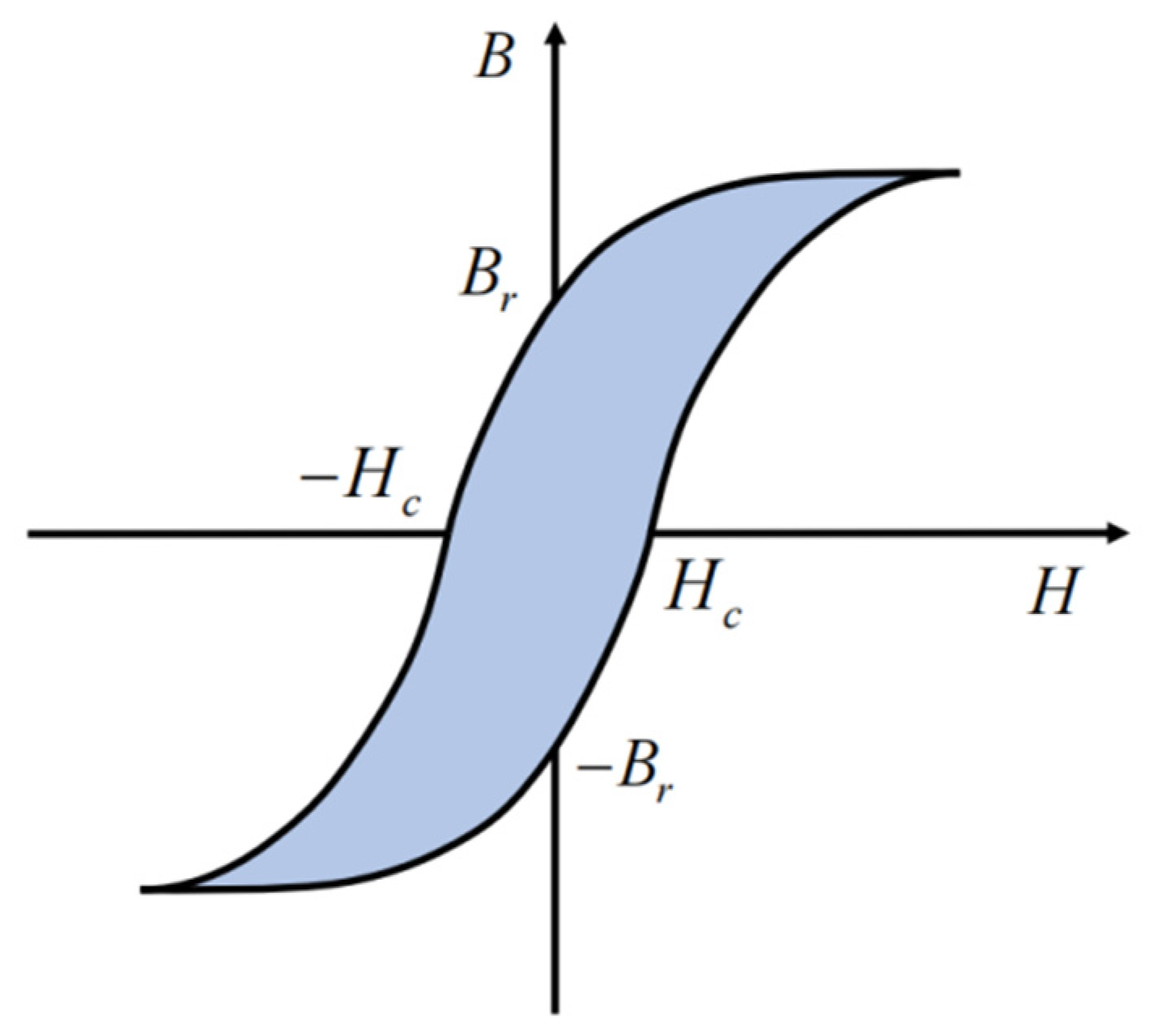
2. Magnetic Core Loss
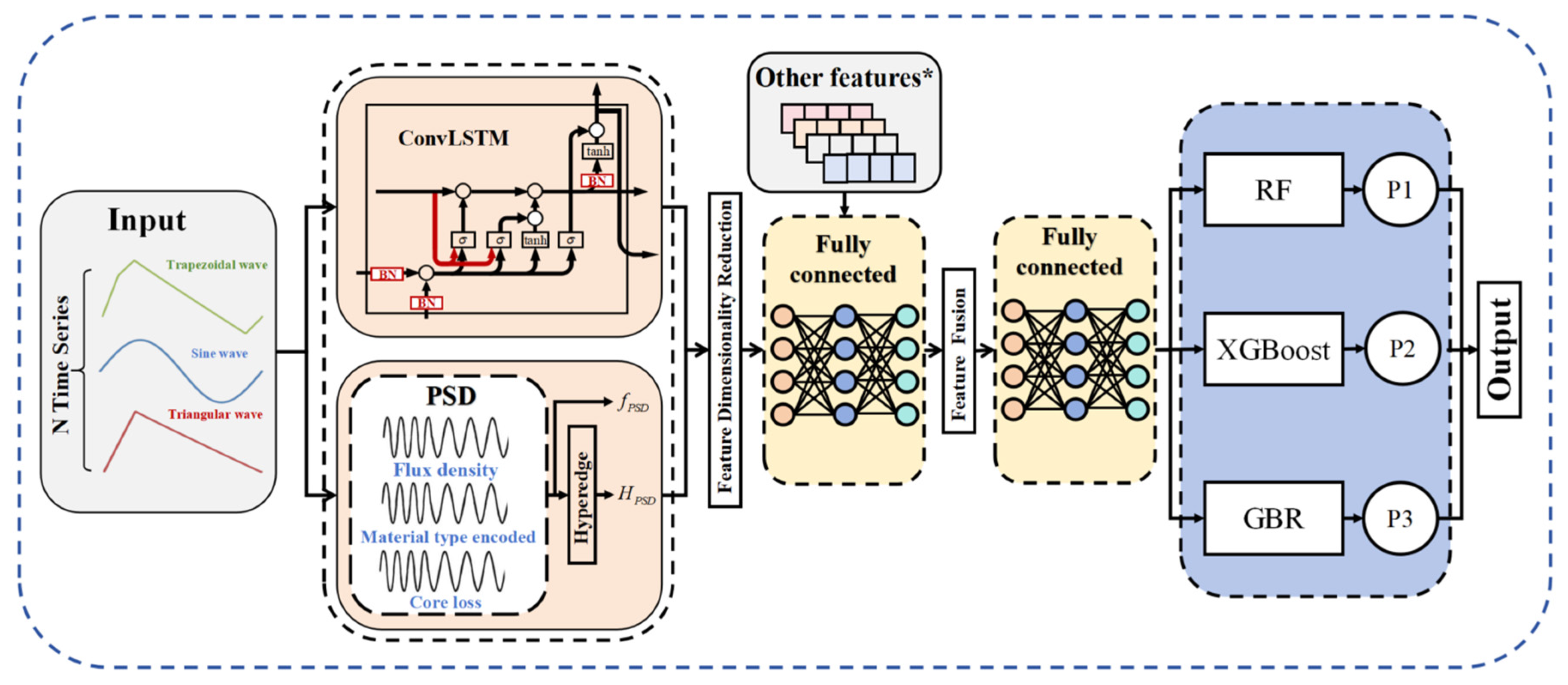
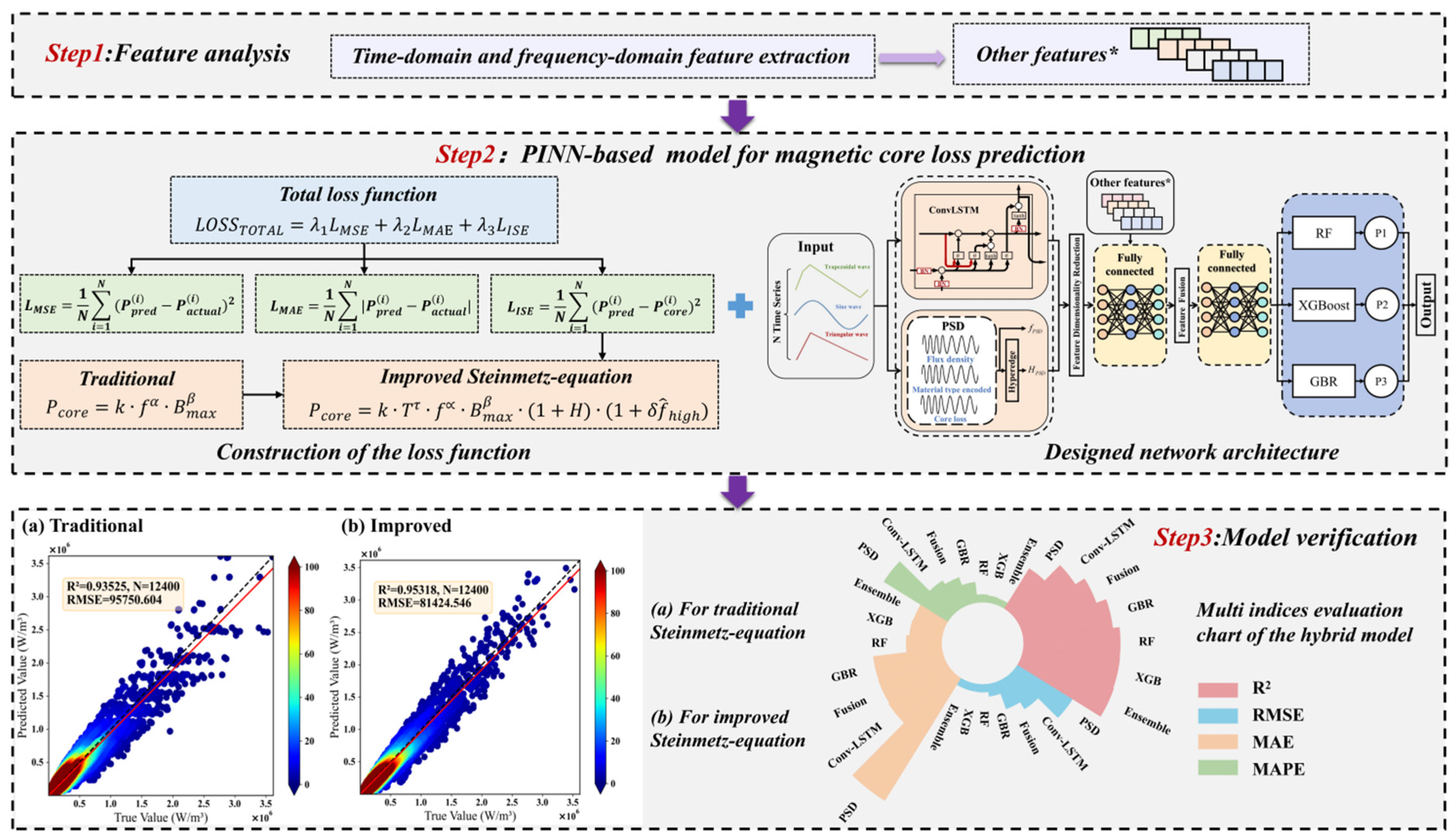
3. PINN-Based Model for Magnetic Core Loss Prediction
3.1. Designed Network Architecture
3.2. Embedding of Physical Information
4. Case Study Validation
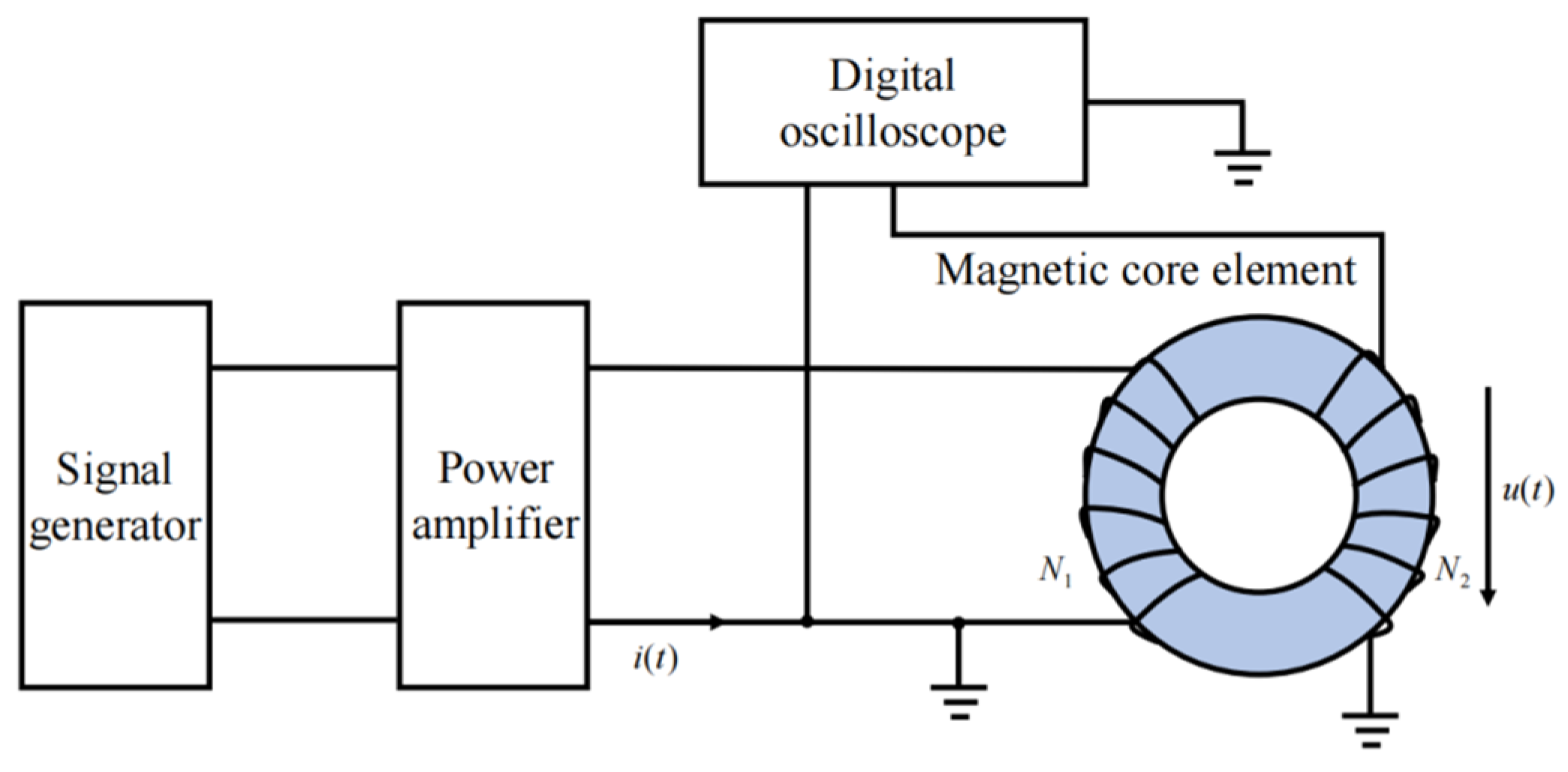
4.1. Experimental Data
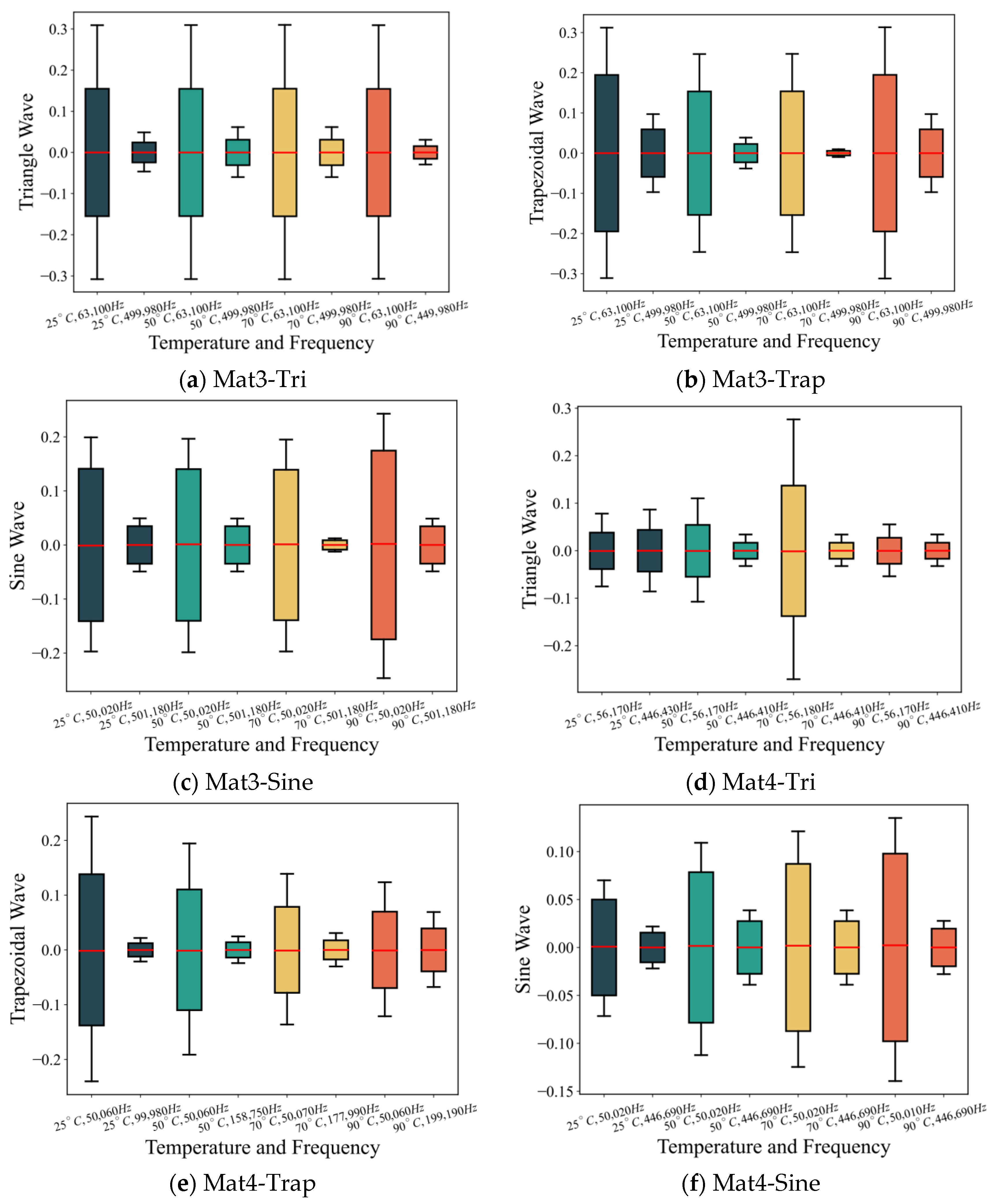
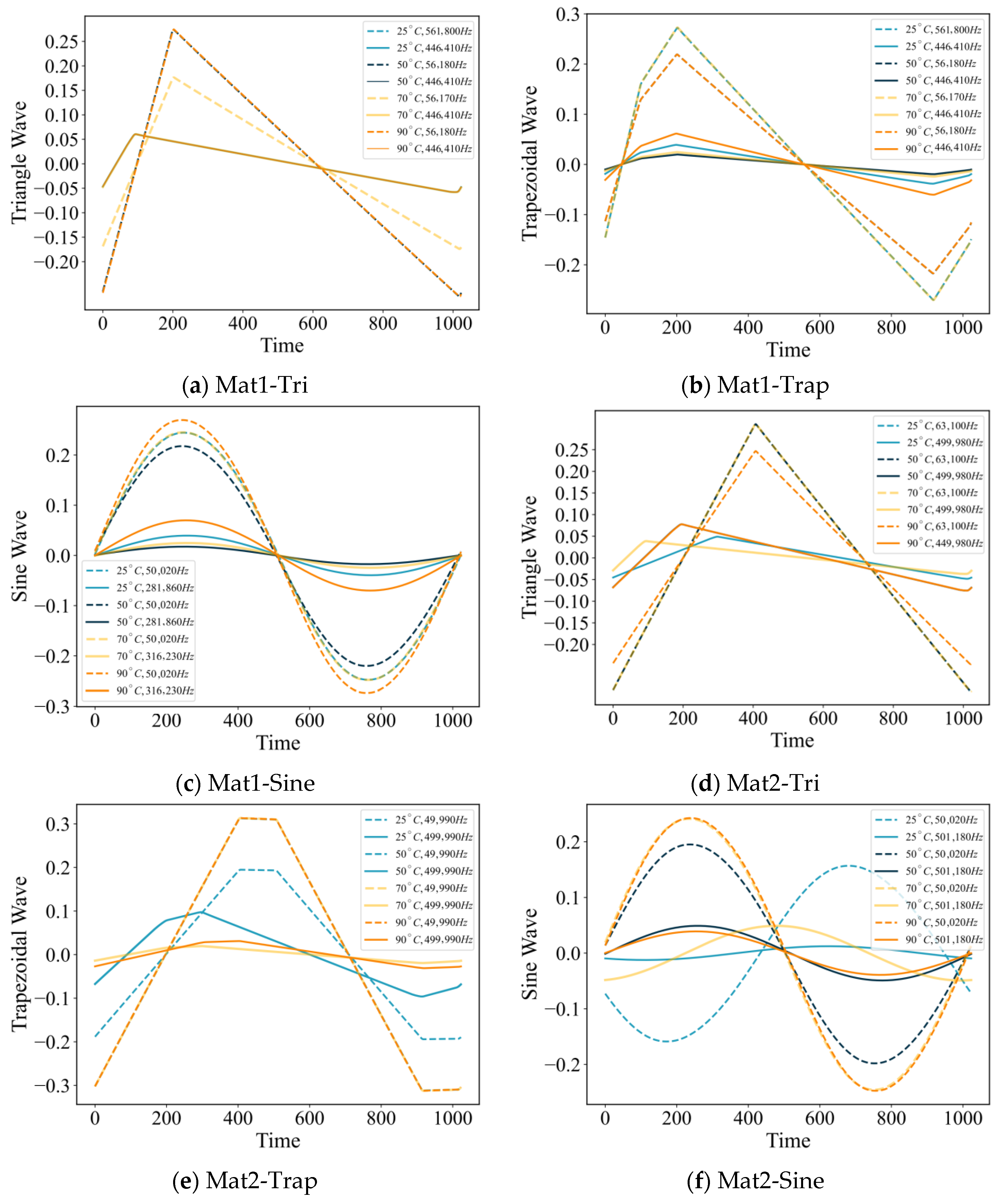
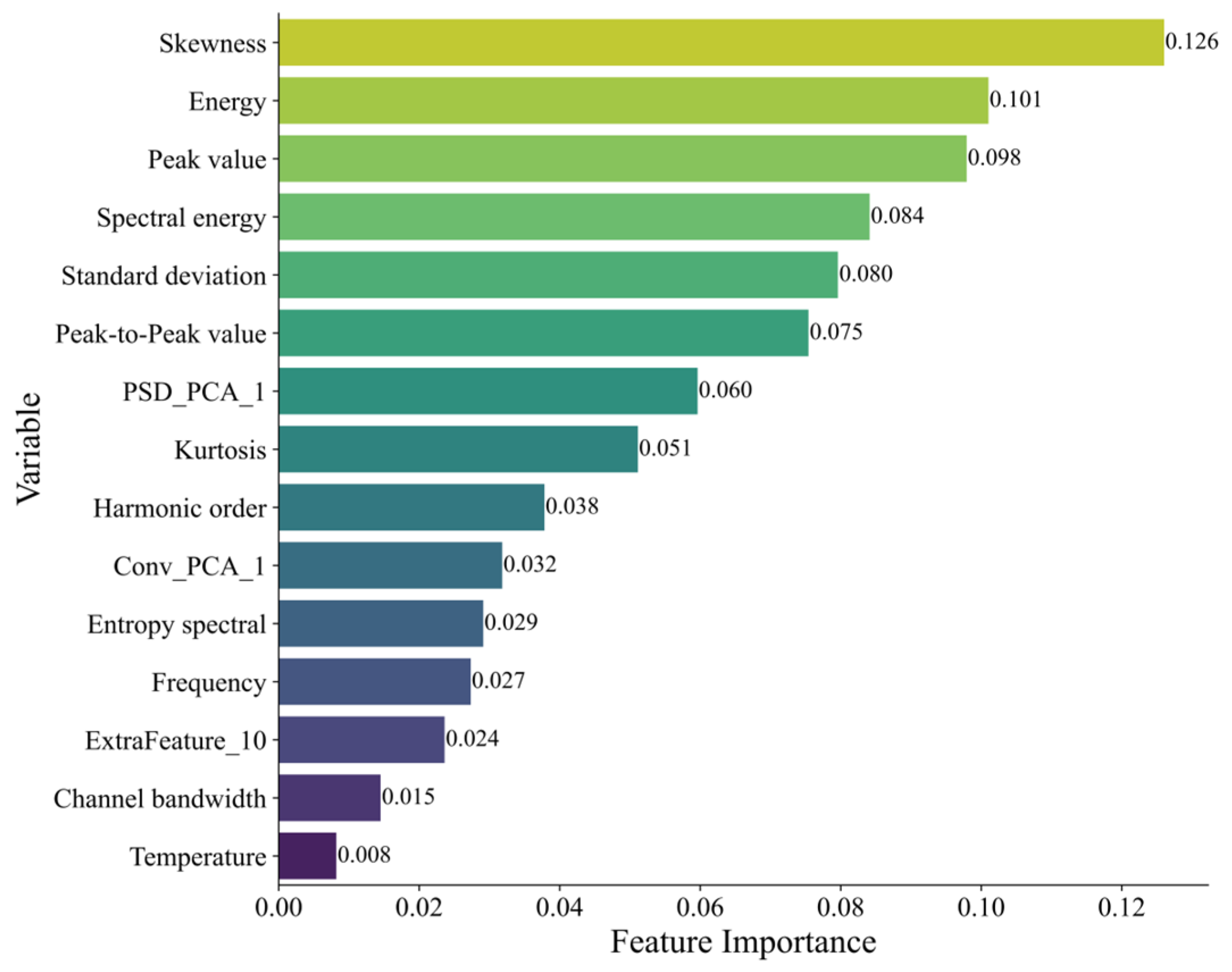
4.2. Feature Analysis
4.3. Verification of the Improved Steinmetz Equation
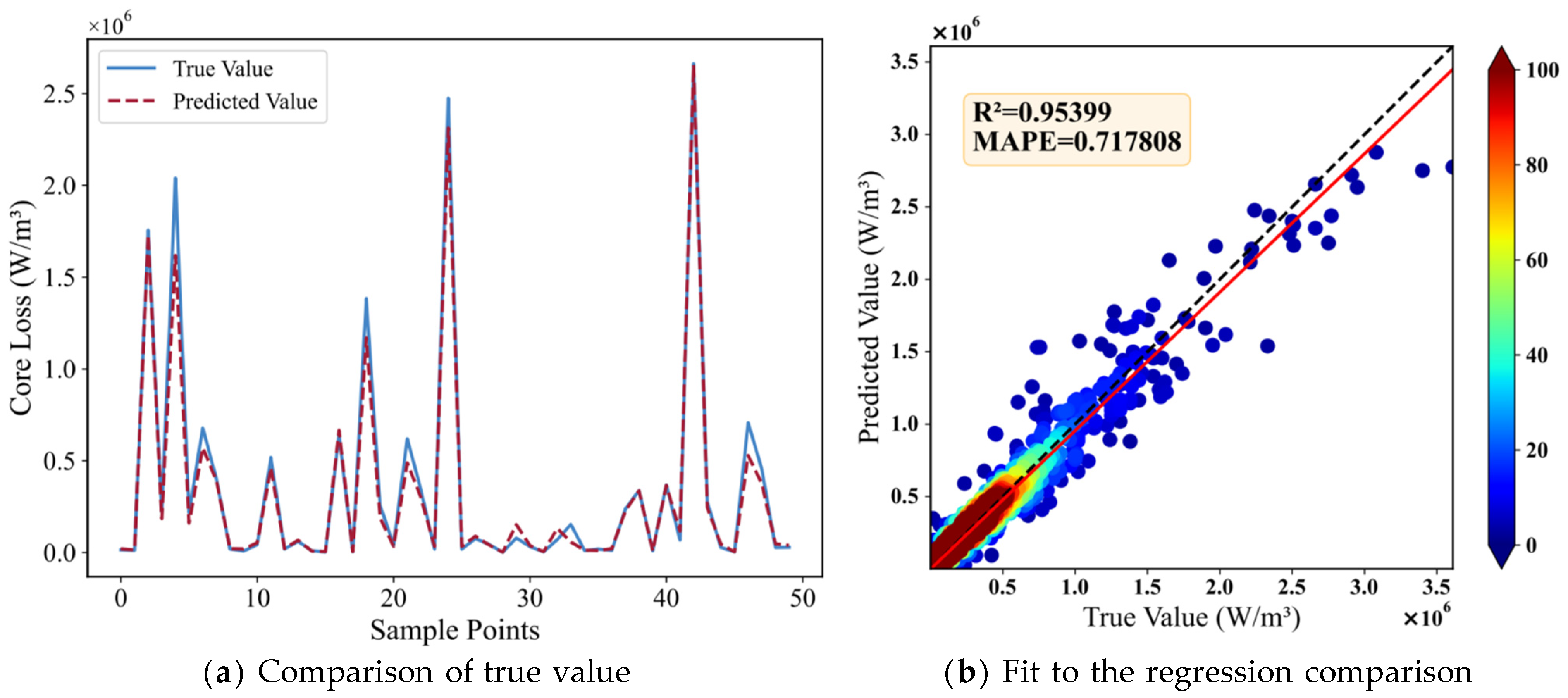
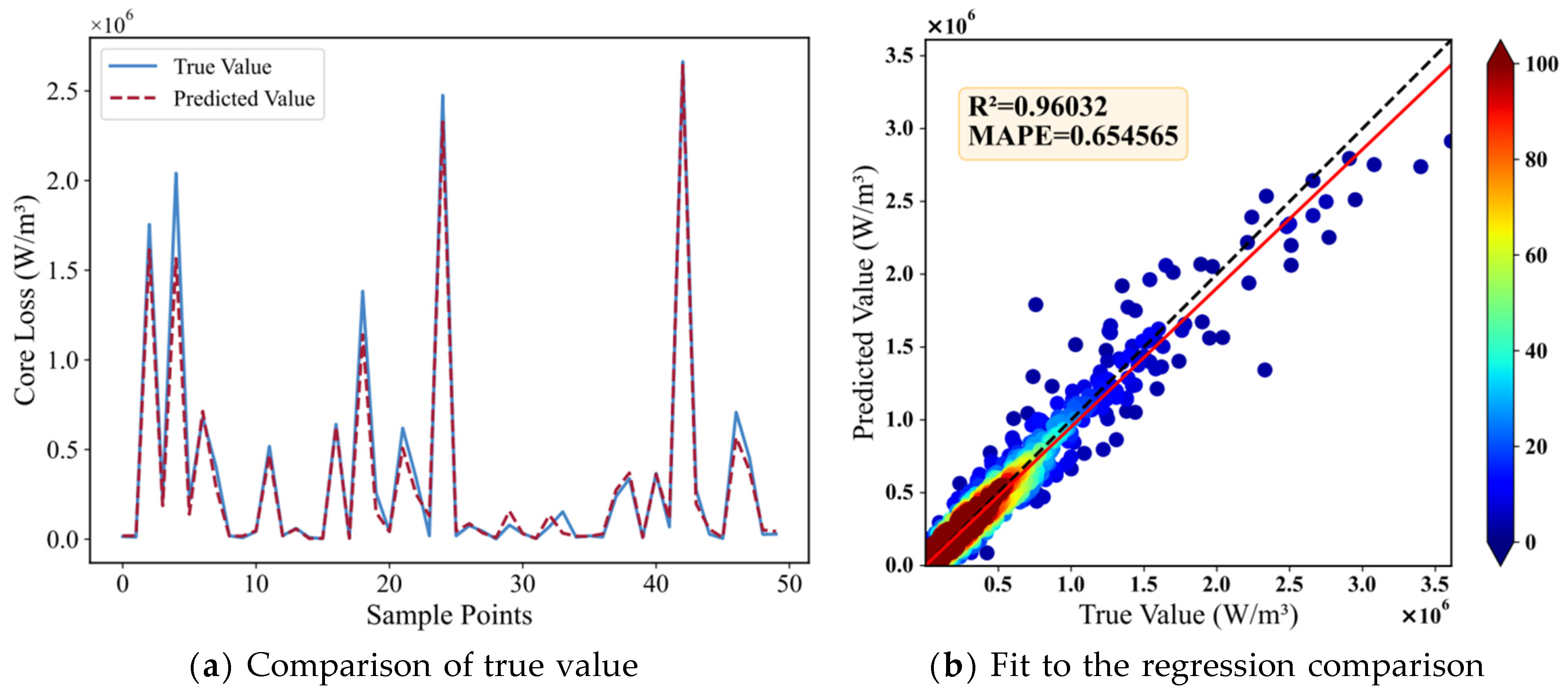
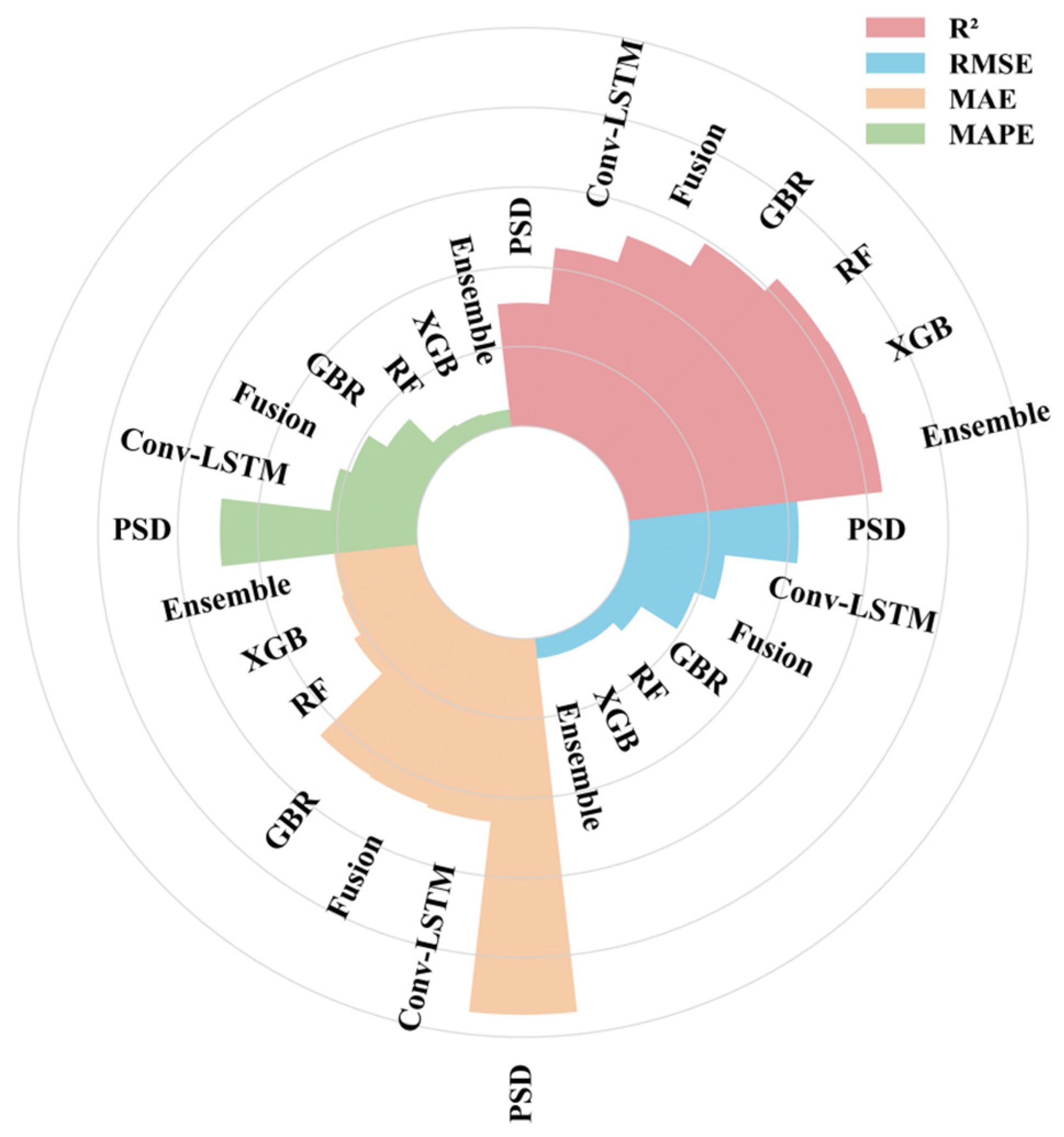
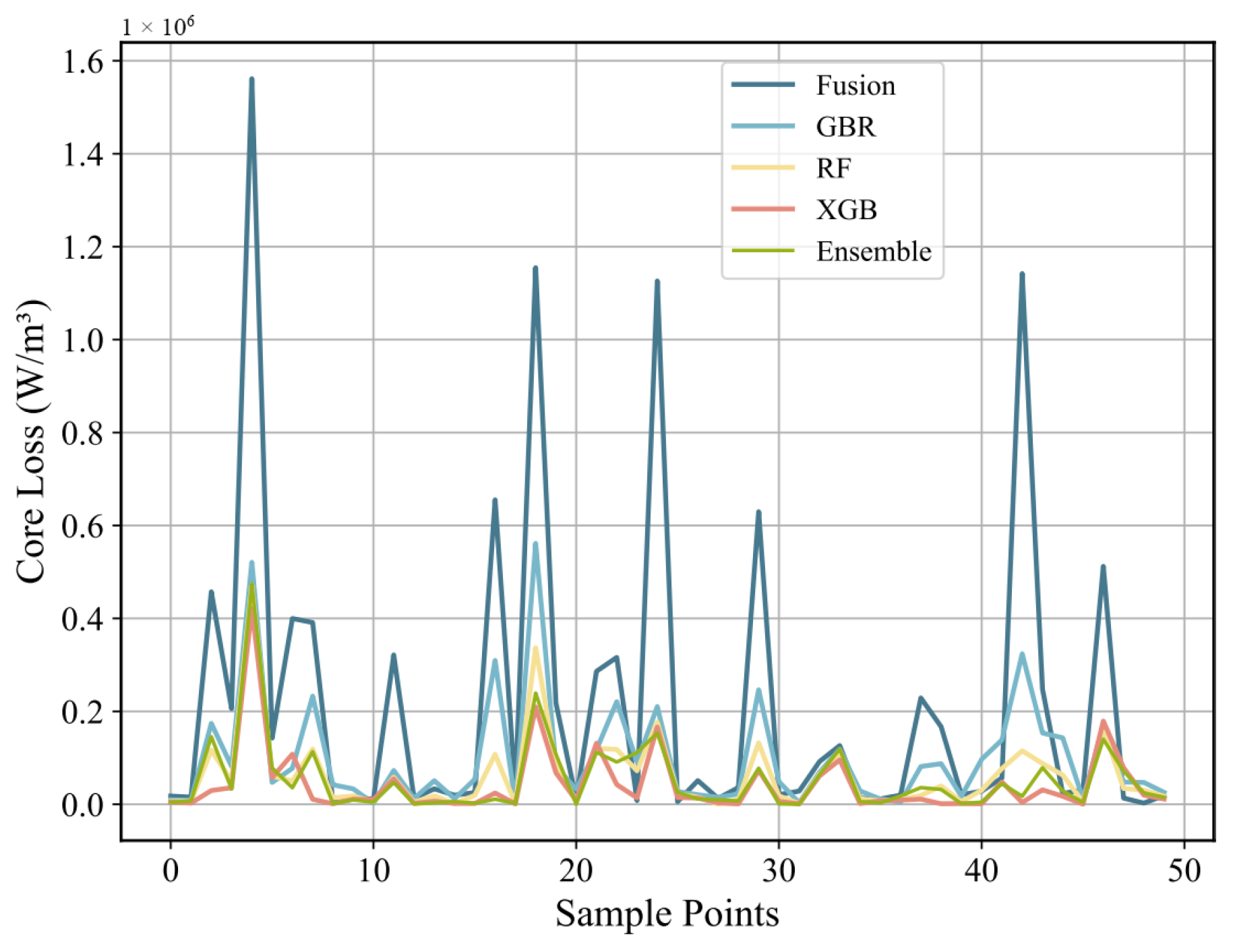
4.4. Prediction Results of Magnetic Core Loss
5. Conclusions
Author Contributions
Funding
Data Availability Statement
Conflicts of Interest
Appendix A

| Module | Parameter | Value |
|---|---|---|
| Conv-LSTM block | Input sequence length | 1024 samples |
| Input shape | (1, 1024, 1, 1) | |
| Conv-LSTM filters | 64 | |
| Conv-LSTM kernel size | 3 × 1 | |
| Dense layers | 64, 32 | |
| Activation function | ReLU | |
| Optimizer | Adam | |
| Loss (data term) | MSE | |
| Batch size/Epochs | 32/200 | |
| Loss function | MSE weight | 0.2 |
| MAE weight | 0.4 | |
| Physics term weight | 0.3 | |
| Weight search range | [0, 1] with step 0.1 | |
| RF | Number of trees | 300 |
| Max depth | 10 | |
| Min samples per split | 2 | |
| Min samples per leaf | 2 | |
| Max features | 1.0 | |
| XGB | Number of trees | 400 |
| Learning rate | 0.1 | |
| Max depth | 6 | |
| Subsample ratio | 0.6 | |
| Column subsample ratio | 0.7 | |
| regularization | 1.0 | |
| GBR | Number of boosting stages | 300 |
| Learning rate | 0.1 | |
| Max depth | 6 | |
| Subsample ratio | 0.8 | |
| Stacking meta-learner | Model type | Linear regression |
| Input features | ||
| Training data for coefficients | 5-fold CV | |
| Linear regression coefficients | , , , |
References
- Balci, S.; Akkaya, M. Reduction of the core size and power losses by using soft magnetic material for a single-phase induction motor. Measurement 2022, 198, 111421. [Google Scholar] [CrossRef]
- Cai, Z.; Zha, C.; Zhan, R.; Huang, G. Analysis and calculation of magnetic flux density distribution and core loss of nanocrystalline transformer. Energy Rep. 2022, 8, 218–225. [Google Scholar] [CrossRef]
- Nasirpour, F.; Niasar, M.G.; Popov, M. Magnetic core effects on the high-frequency behavior of transformers. Int. J. Electr. Power Energy Syst. 2024, 159, 110035. [Google Scholar] [CrossRef]
- Lotfi, A.W.; Wilkowski, M.A. Issues and advances in high-frequency magnetics for switching power supplies. Proc. IEEE 2001, 89, 833–845. [Google Scholar] [CrossRef]
- Xu, X.; Zhu, T.; Ye, F.; Liu, W.; Zhao, Z. Accurate calculation of losses in amorphous alloy cores based on a dynamic jiles-atheron model under wide frequency and variable temperature operating conditions. J. Magn. Magn. Mater. 2024, 599, 172113. [Google Scholar] [CrossRef]
- Barg, S.; Barg, S.; Bertilsson, K. A review on the empirical core loss models for symmetric flux waveforms. IEEE Trans. Power Electron. 2024, 40, 1609–1621. [Google Scholar] [CrossRef]
- Novak, G.; Kokošar, J.; Bricelj, M.; Bizjak, M.; Petrovič, D.S.; Nagode, A. Improved model based on the modified steinmetz equation for predicting the magnetic losses in non-oriented electrical steels that is valid for elevated temperatures and frequencies. IEEE Trans. Magn. 2017, 53, 1–5. [Google Scholar] [CrossRef]
- Mu, M.; Lee, F.C. A new core loss model for rectangular ac voltages. In 2014 IEEE Energy Conversion Congress and Exposition (ECCE); IEEE: New York, NY, USA, 2014; pp. 5214–5220. [Google Scholar]
- Li, J.; Abdallah, T.; Sullivan, C.R. Improved calculation of core loss with nonsinusoidal waveforms. In Conference Record of the 2001 IEEE Industry Applications Conference; 36th IAS Annual Meeting (Cat. No. 01CH37248); IEEE: New York, NY, USA, 2001; Volume 4, pp. 2203–2210. [Google Scholar]
- Venkatachalam, K.; Sullivan, C.R.; Abdallah, T.; Tacca, H. Accurate prediction of ferrite core loss with nonsinusoidal waveforms using only steinmetz parameters. In 2002 IEEE Workshop on Computers in Power Electronics; IEEE: New York, NY, USA, 2002; pp. 36–41. [Google Scholar]
- Yue, S.; Li, Y.; Yang, Q.; Yu, X.; Zhang, C. Comparative analysis of core loss calculation methods for magnetic materials under nonsinusoidal excitations. IEEE Trans. Magn. 2018, 54, 1–5. [Google Scholar] [CrossRef]
- Ducharne, B.; Sebald, G. Fractional derivatives for the core losses prediction: State of the art and beyond. J. Magn. Magn. Mater. 2022, 563, 169961. [Google Scholar] [CrossRef]
- Barg, S.; Bertilsson, K. Core loss modeling and calculation for trapezoidal magnetic flux density waveform. IEEE Trans. Ind. Electron. 2020, 68, 7975–7984. [Google Scholar] [CrossRef]
- Vo, A.-T.; Fassenet, M.; Préault, V.; Espanet, C.; Kedous-Lebouc, A. New formulation of loss-surface model for accurate iron loss modeling at extreme flux density and flux variation: Experimental analysis and test on a high-speed pmsm. J. Magn. Magn. Mater. 2022, 563, 169935. [Google Scholar]
- Gao, S.; Zhao, X.; Zhang, X.; Zhu, W.; Gao, Y.; Muramatsu, K.; Fujiwara, K. Dynamic hysteresis model for predicting hysteresis property and iron loss for various soft magnetic materials under non-sinusoidal excitation. Phys. B Condens. Matter 2024, 699, 416875. [Google Scholar] [CrossRef]
- Habib, O.; Abouhamad, M.; Bayoumi, A. Ensemble learning framework for forecasting construction costs. Autom. Constr. 2024, 170, 105903. [Google Scholar] [CrossRef]
- Al-Ghzawi, M.; El-Rayes, K. Machine learning for predicting the impact of construction activities on air traffic operations during airport expansion projects. Autom. Constr. 2023, 158, 105189. [Google Scholar] [CrossRef]
- Garcia, J.; Villavicencio, G.; Altimiras, F.; Crawford, B.; Soto, R.; Minatogawa, V.; Franco, M.; Martínez-Muñoz, D.; Yepes, V. Machine learning techniques applied to construction: A hybrid bibliometric analysis of advances and future directions. Autom. Constr. 2022, 142, 104532. [Google Scholar] [CrossRef]
- Wang, C.; Dong, T.; Chen, L.; Zhu, G.; Chen, Y. Multi-objective optimization approach for permanent magnet machine via improved soft actor–critic based on deep reinforcement learning. Expert Syst. Appl. 2024, 264, 125834. [Google Scholar] [CrossRef]
- Li, H.; Lee, S.R.; Luo, M.; Sullivan, C.R.; Chen, Y.; Chen, M. Magnet: A machine learning framework for magnetic core loss modeling. In 2020 IEEE 21st Workshop on Control and Modeling for Power Electronics (COMPEL); IEEE: New York, NY, USA, 2020; pp. 1–8. [Google Scholar]
- Li, H.; Serrano, D.; Guillod, T.; Dogariu, E.; Nadler, A.; Wang, S.; Luo, M.; Bansal, V.; Chen, Y.; Sullivan, C.R.; et al. Magnet: An open-source database for data-driven magnetic core loss modeling. In 2022 IEEE Applied Power Electronics Conference and Exposition (APEC); IEEE: New York, NY, USA, 2022; pp. 588–595. [Google Scholar]
- Li, J.; Deleu, E.; Lee, W.; Li, H.; Chen, M.; Wang, S. Investigating the mutual impact of waveform, temperature, and dcbias on magnetic core loss using neural network models. In 2024 IEEE Applied Power Electronics Conference and Exposition (APEC); IEEE: New York, NY, USA, 2024; pp. 391–395. [Google Scholar]
- Shen, X.; Wouters, H.; Martinez, W. Deep neural network for magnetic core loss estimation using the magnet experimental database. In 2022 24th European Conference on Power Electronics and Applications (EPE’22 ECCE Europe); IEEE: New York, NY, USA, 2022; pp. 1–8. [Google Scholar]
- Aslan, B.; Balci, S.; Kayabasi, A.; Yildiz, B. The core loss estimation of a single phase inverter transformer by using adaptive neuro-fuzzy inference system. Measurement 2021, 179, 109427. [Google Scholar] [CrossRef]
- Li, K.Q.; Yin, Z.Y.; Zhang, N.; Li, J. A pinn-based modelling approach for hydromechanical behaviour of unsaturated expansive soils. Comput. Geotech. 2024, 169, 106174. [Google Scholar] [CrossRef]
- Raissi, M.; Perdikaris, P.; Karniadakis, G.E. Physics-informed neural networks: A deep learning framework for solving forward and inverse problems involving nonlinear partial differential equations. J. Comput. Phys. 2019, 378, 686–707. [Google Scholar] [CrossRef]
- Fassi, Y.; Heiries, V.; Boutet, J.; Boisseau, S. Towards physics-informed machine learning based predictive maintenance for power converters—A review. IEEE Trans. Power Electron. 2023, 39, 2692–2720. [Google Scholar] [CrossRef]
- Deng, J.; Wang, W.; Ning, Z.; Venugopal, P.; Popovic, J.; Rietveld, G. High-frequency core loss modeling based on knowledge-aware artificial neural network. IEEE Trans. Power Electron. 2023, 39, 1968–1973. [Google Scholar] [CrossRef]
- Solimene, L.; Ragusa, C.S.; Giuffrida, A.; Lombardo, N.; Marmello, F.; Morra, S.; Pasquale, M. A hybrid data-driven approach in magnetic core loss modeling for power electronics applications. In 2024 IEEE 22nd Mediterranean Electrotechnical Conference (MELECON); IEEE: New York, NY, USA, 2024; pp. 1356–1361. [Google Scholar]
- Huang, Q.; Li, Y.; Zhu, J.; Li, S. Magnetization mechanism-inspired neural networks for core loss estimation. IEEE Trans. Power Electron. 2024, 39, 16382–16390. [Google Scholar] [CrossRef]
- Son, S.; Lee, H.; Jeong, D.; Oh, K.-Y.; Sun, K.H. A novel physics-informed neural network for modeling electromagnetism of a permanent magnet synchronous motor. Adv. Eng. Inform. 2023, 57, 102035. [Google Scholar] [CrossRef]
- Pu, H.; Tan, B.; Yi, J.; Yuan, S.; Zhao, J.; Bai, R.; Luo, J. A novel key performance analysis method for permanent magnet coupler using physics-informed neural networks. Eng. Comput. 2023, 40, 2259–2277. [Google Scholar] [CrossRef]
- Beltrán-Pulido, A.; Aliprantis, D.; Bilionis, I.; Munoz, A.R.; Chase, N. Physics-Informed Neural Networks for Parametric Modeling of Permanent Magnet Synchronous Machines. IEEE Trans. Energy Convers. 2025, 1–14. [Google Scholar] [CrossRef]
- Bertotti, G. General properties of power losses in soft ferromagnetic materials. IEEE Trans. Magn. 1988, 24, 621–630. [Google Scholar] [CrossRef]
- Yang, Y.; Wang, S.; Zhu, B.; Wang, R.; Lu, Y.; Jiang, L.; Zhang, M. A method to study the influence of background magnetic field on magnetic cores: Measurement, parameter identification and discussion. Measurement 2023, 220, 113329. [Google Scholar] [CrossRef]
- Gryś, S.; Najgebauer, M. An attempt of accuracy assessment of the hysteresis loop and power loss in magnetic materials during control measurements. Measurement 2021, 174, 108962. [Google Scholar] [CrossRef]
- Jin, H.; Zhang, K.; Fan, S.; Jin, H.; Wang, B. Wind power forecasting based on ensemble deep learning with surrogate-assisted evolutionary neural architecture search and many-objective federated learning. Energy 2024, 308, 133023. [Google Scholar] [CrossRef]
- Duran, O.; Turan, B.; Kaya, M. Machine-learning-based ensemble regression for vehicle-to-vehicle distance estimation using a toe-in style stereo camera. Measurement 2024, 240, 115540. [Google Scholar] [CrossRef]
- Yang, Y.; Zhang, Y.; Zeng, Q. Research on coal gangue recognition based on multi-layer time domain feature processing and recognition features cross-optimal fusion. Measurement 2022, 204, 112169. [Google Scholar] [CrossRef]
- Hua, Z.; Shi, J.; Dumond, P. Domain-invariant feature exploration for intelligent fault diagnosis under unseen and time-varying working conditions. Mech. Syst. Signal Process. 2024, 224, 112193. [Google Scholar] [CrossRef]
- Lu, Y.; Tang, J. On time-frequency domain feature extraction of wave signals for structural health monitoring. Measurement 2018, 114, 51–59. [Google Scholar] [CrossRef]
- Pang, Q.; Chen, C.; Sun, Y.; Pang, S. Empowering lithology identification with frelog Leveraging frequency domain insights in well logging signal processing. Measurement 2025, 246, 116710. [Google Scholar] [CrossRef]
- Dao, F.; Zeng, Y.; Qian, J. Fault diagnosis of hydro-turbine via the incorporation of bayesian algorithm optimized cnn-lstm neural network. Energy 2024, 290, 130326. [Google Scholar] [CrossRef]
- Wang, P.; Zhang, Y.; Linjama, M.; Zhao, L.; Yao, J. Fault identification and localization for the fast switching valve in the equal-coded digital hydraulic system based on hybrid cnn-lstm model. Mech. Syst. Signal Process. 2024, 224, 112201. [Google Scholar] [CrossRef]
- Tang, Q.; Xin, J.; Jiang, Y.; Zhou, J.; Li, S.; Chen, Z. Novel identification technique of moving loads using the random response power spectral density and deep transfer learning. Measurement 2022, 195, 111120. [Google Scholar] [CrossRef]
- Xiao, X.; Zhao, S.; Shen, W. A harmonic input method for computing time-varying response psd of linear time-invariant structures subjected to nonstationary stochastic excitations. Mech. Syst. Signal Process. 2022, 181, 109483. [Google Scholar] [CrossRef]
- Li, Z.; Yang, K.; Ye, L.; Huang, J.; Xia, F.; Sun, Z.; Chai, Y.; Chen, Z.; Guo, Z. Precise prediction of visual and non-visual parameters of white light-emitting diodes by back propagation neural networks and principal component analysis. Measurement 2025, 247, 116885. [Google Scholar] [CrossRef]
- Fan, G.-F.; Zhang, L.-Z.; Yu, M.; Hong, W.-C.; Dong, S.-Q. Applications of random forest in multivariable response surface for short-term load forecasting. Int. J. Electr. Power Energy Syst. 2022, 139, 108073. [Google Scholar] [CrossRef]
- Junior, M.Y.; Freire, R.Z.; Seman, L.O.; Stefenon, S.F.; Mariani, V.C.; Coelho, L.D.S.-T. Optimized hybrid ensemble learning approaches applied to very short-term load forecasting. Int. J. Electr. Power Energy Syst. 2023, 155, 109579. [Google Scholar] [CrossRef]
- Hou, H.; Zhang, Z.; Yu, J.; Wei, R.; Huang, Y.; Li, X. Damage prediction of 10 kv power towers in distribution network under typhoon disaster based on data-driven model. Int. J. Electr. Power Energy Syst. 2022, 142, 108307. [Google Scholar] [CrossRef]
- Karniadakis, G.E.; Kevrekidis, I.G.; Lu, L.; Perdikaris, P.; Wang, S.; Yang, L. Physics-informed machine learning. Nat. Rev. Phys. 2021, 3, 422–440. [Google Scholar] [CrossRef]
- Willard, J.; Jia, X.; Xu, S.; Steinbach, M.; Kumar, V. Integrating scientific knowledge with machine learning for engineering and environmental systems. ACM Comput. Surv. 2022, 55, 1–37. [Google Scholar] [CrossRef]
- Zhang, M.; Shao, D.; Liu, J.; Peng, S.; Tang, M.; Jia, H.; Wang, B.; Yu, M. Study on the change of the oil-paper insulation’s ac conductivity characteristics based on dielectric response in frequency domain. Measurement 2024, 243, 116346. [Google Scholar] [CrossRef]
- Luo, C.; Shou, J.; Ma, J.; Fang, Y. Comparison of critical current and ac loss of 15 mva superconducting machines with different topologies. Phys. C: Supercond. Its Appl. 2025, 630, 1354664. [Google Scholar] [CrossRef]
- Chen, M.; Li, H.; Wang, S.; Guillod, T.; Serrano, D.; Forster, N.; Kirchgassner, W.; Piepen-Brock, T.; Schweins, O.; Wallscheid, O.; et al. MagNet Challenge for Data-Driven Power Magnetics Modeling. IEEE Open J. Power Electron. 2024, 6, 883–898. [Google Scholar] [CrossRef]
- Li, H.; Serrano, D.; Wang, S.; Chen, M. Magnet-ai: Neural network as datasheet for magnetics modeling and material recommendation. IEEE Trans. Power Electron. 2023, 38, 15854–15869. [Google Scholar] [CrossRef]
- Shen, X.; Zhong, H.; Wu, H.; Mao, Y.; Han, R. Bi-objective optimization of magnetic core loss and magnetic energy transfer of magnetic element based on a hybrid model integrating gan and nsga-ii. Int. J. Electr. Power Energy Syst. 2025, 170, 11083. [Google Scholar] [CrossRef]
- Severns, R. HF-core losses for nonsinusoidal waveforms. In High Frequency Power Convertion Conference (HFPC); Intertec International: Phoenix, AZ, USA, 1991; pp. 140–148. [Google Scholar]







| Material | Manufacturer | Application | μr | Tested Core |
|---|---|---|---|---|
| N87 | TDK Electronics (Munich, Germany) | Power transformers | 2200 | R34.0X20.5X12.5 |
| N27 | TDK Electronics (Munich, Germany) | Power transformers | 2000 | R20.0X10.0X7.0 |
| 77 | Fair-Rite (Wallkill, NY, USA) | High/low flux inductive designs | 2000 | 5977001401 |
| 3C94 | Ferroxcube (New Taipei City, Taiwan) | Power and general-purpose transformers | 2300 | TX-20-10-7 |
| ID | Mean Value | Standard Deviation | Skewness | Kurtosis | Peak Value | Peak-to-Peak Value |
|---|---|---|---|---|---|---|
| 1 | −4.004 × 10⁻¹¹ | 2.040 × 10⁻² | −6.627 × 10⁻⁴ | 1.502 | 2.885 × 10⁻² | 5.769 × 10⁻² |
| 2 | −2.539 × 10⁻¹¹ | 2.223 × 10⁻² | −1.222 × 10⁻³ | 1.502 | 3.143 × 10⁻² | 6.285 × 10⁻² |
| 3 | −9.765 × 10⁻¹³ | 2.511 × 10⁻² | −4.942 × 10⁻⁴ | 1.503 | 3.554 × 10⁻² | 7.105 × 10⁻² |
| . | . | . | . | . | . | . |
| . | . | . | . | . | . | . |
| . | . | . | . | . | . | . |
| 12398 | −7.813 × 10⁻¹¹ | 2.973 × 10⁻² | 1.486 × 10⁻² | 1.671 | 4.888 × 10⁻² | 9.681 × 10⁻² |
| 12399 | 6.348 × 10⁻¹¹ | 3.338 × 10⁻² | 1.300 × 10⁻² | 1.673 | 5.489 × 10⁻² | 1.088 × 10⁻¹ |
| 12400 | −4.688 × 10⁻¹¹ | 4.203 × 10⁻² | 1.475 × 10⁻² | 1.671 | 6.914 × 10⁻² | 1.369 × 10⁻¹ |
| ID | Energy | Harmonic Order | Entropy Spectral | Channel Bandwidth | Spectral Energy |
|---|---|---|---|---|---|
| 1 | 0.427 | 1 | 5.262 × 10⁻⁵ | 3.214 | 2.182 × 10² |
| 2 | 0.506 | 1 | 6.007 × 10⁻⁵ | 3.076 | 2.589 × 10² |
| 3 | 0.645 | 1 | 7.310 × 10⁻⁵ | 2.859 | 3.305 × 10² |
| . | . | . | . | . | . |
| . | . | . | . | . | . |
| . | . | . | . | . | . |
| 12398 | 0.905 | 7 | 4.117 × 10⁻¹ | 7.7389 | 4.633 × 10² |
| 12399 | 1.141 | 7 | 4.106 × 10⁻¹ | 7.633 | 5.840 × 10² |
| 12400 | 1.809 | 7 | 4.107 × 10⁻¹ | 7.450 | 9.263 × 10² |
| k | α | β | τ | δ | |
|---|---|---|---|---|---|
| Classical SE | 2.397 | 1.366 | 2.128 | - | - |
| ISE | 4.119 | 1.402 | 2.154 | −0.257 | −3.085 |
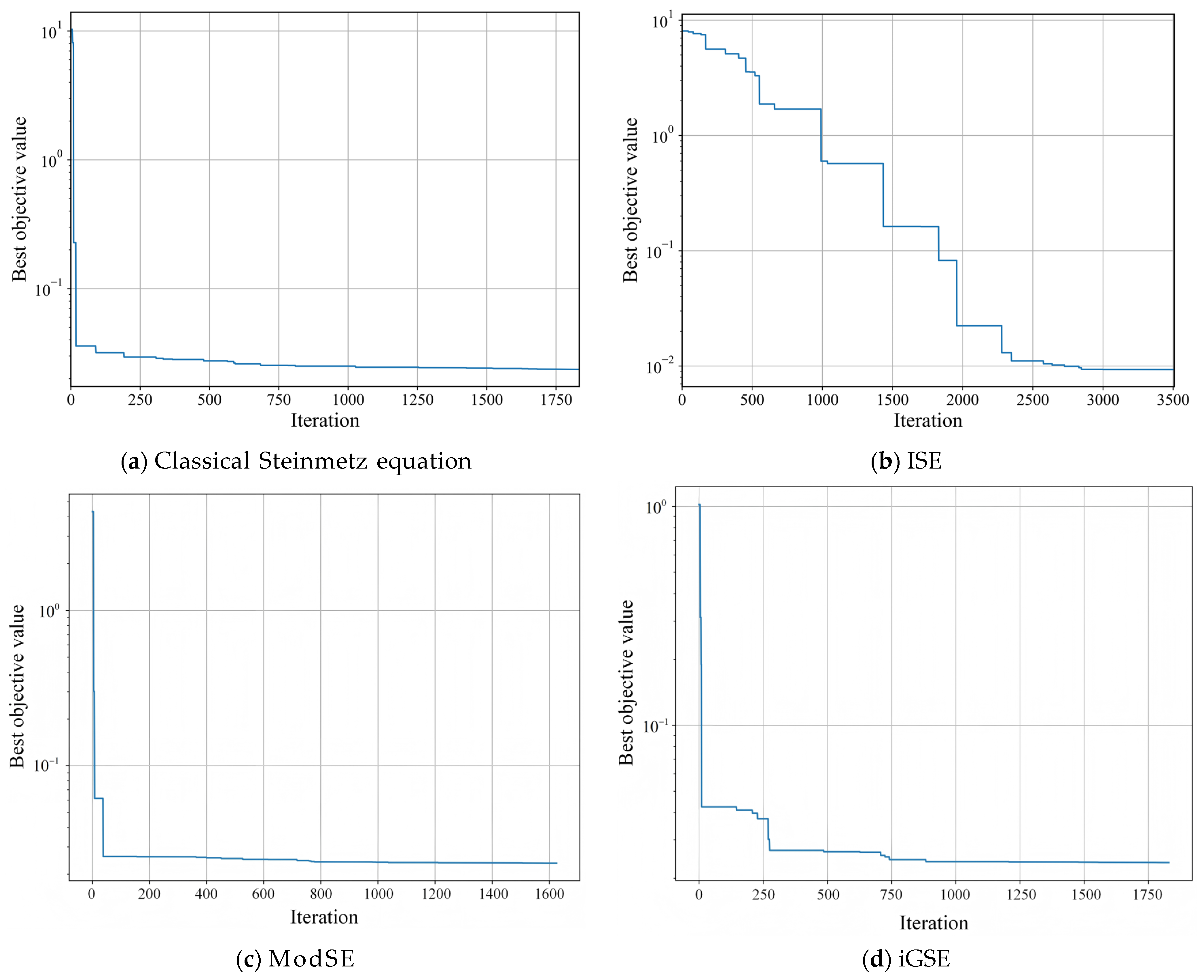
| ModSE | 0.003 | 1.913 | 2.335 | - | - |
| iGSE | 0.002 | 1.953 | 2.344 | - | - |
| Indicator | NRMSE | NMAE | MAPE | R2 | |
|---|---|---|---|---|---|
| Module | |||||
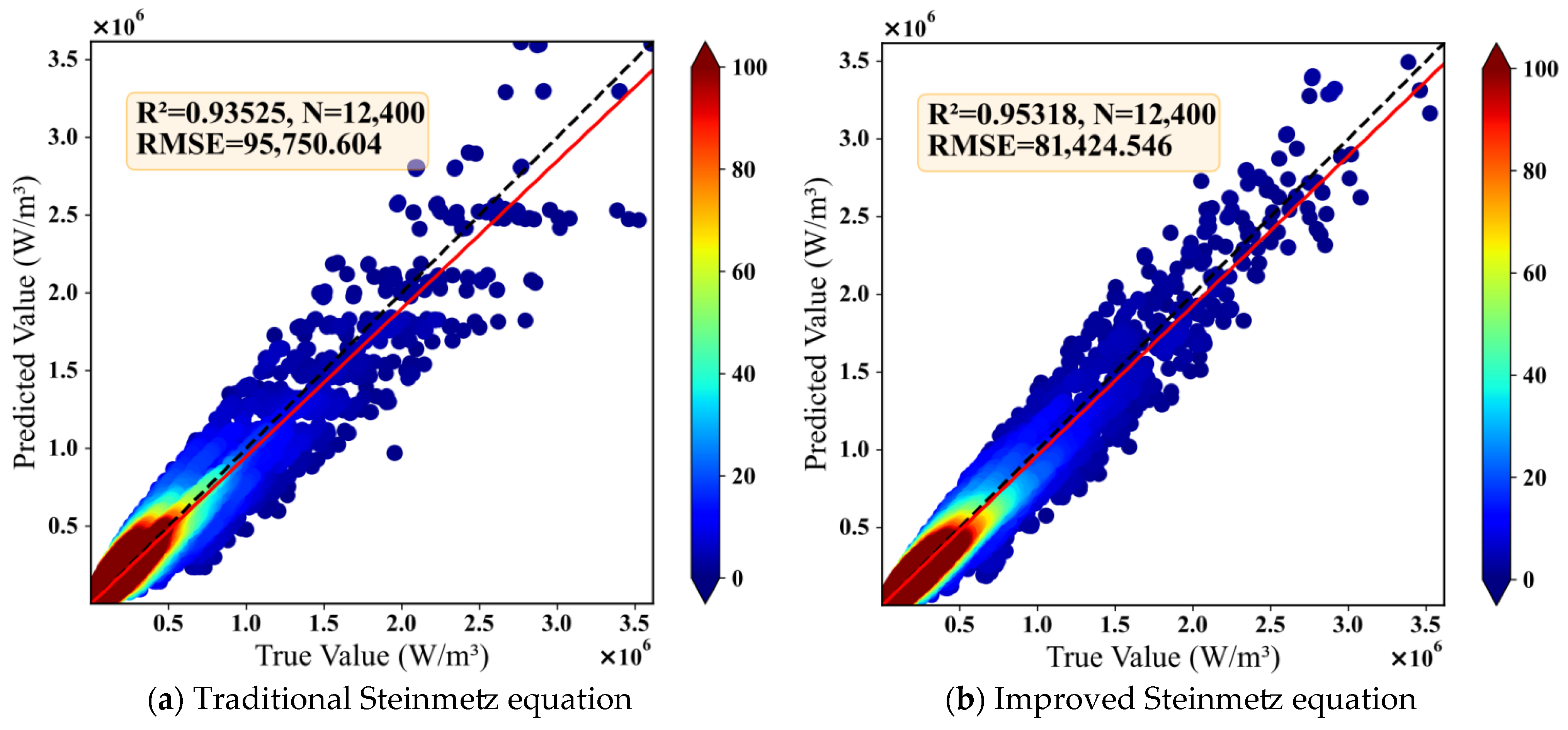
| SE | 0.0269 | 0.0139 | 0.3430 | 0.9353 | |
| ModSE | 0.0258 | 0.0133 | 0.3335 | 0.9407 | |
| iGSE | 0.0243 | 0.0125 | 0.3236 | 0.9489 | |
| ISE | 0.0231 | 0.0120 | 0.3115 | 0.9532 | |
| Indicator | NRMSE | NMAE | MAPE | R2 | |
|---|---|---|---|---|---|
| Module | |||||
| PSD | 18.0419 | 7.7501 | 7.4159 | 0.4639 | |
| Conv-LSTM | 11.2137 | 4.7953 | 3.2958 | 0.6773 | |
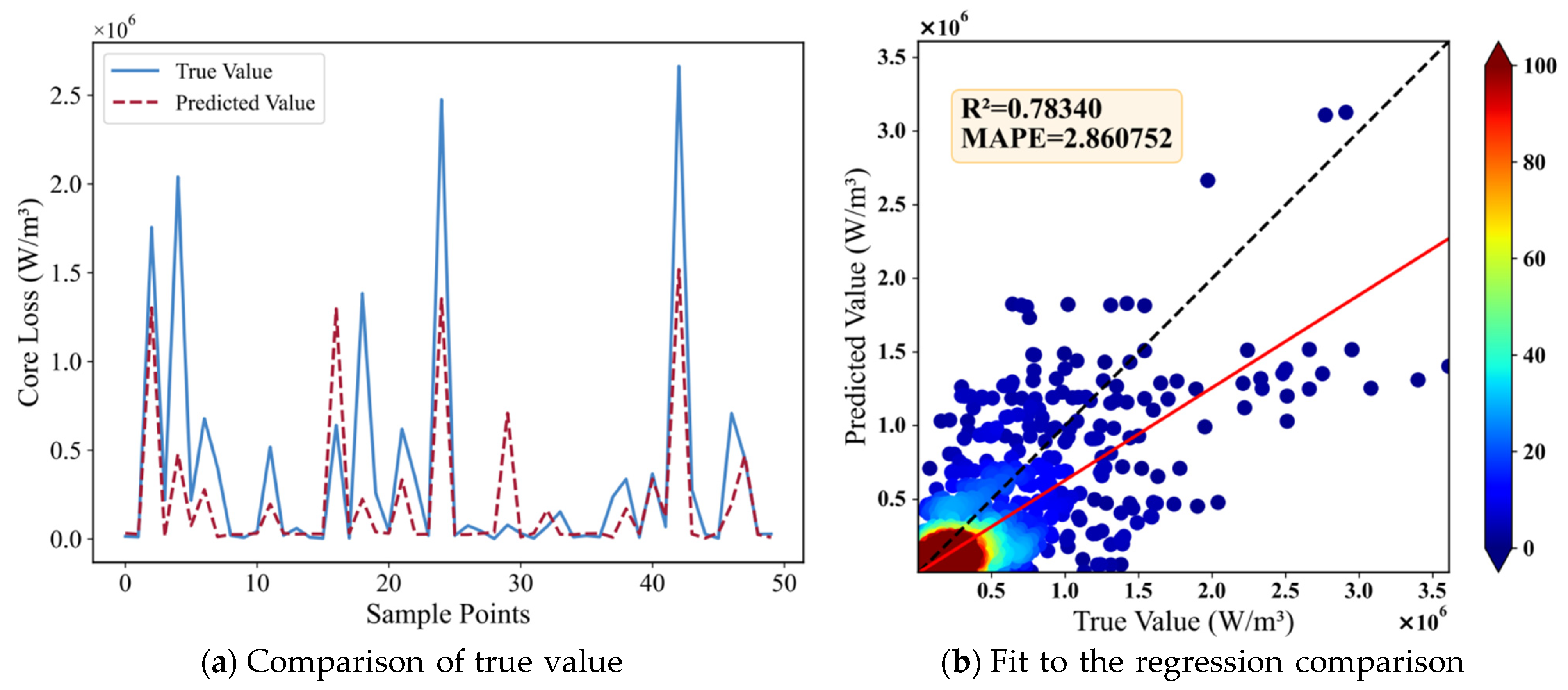
| Fusion | 7.6551 | 3.2750 | 2.8608 | 0.7834 | |
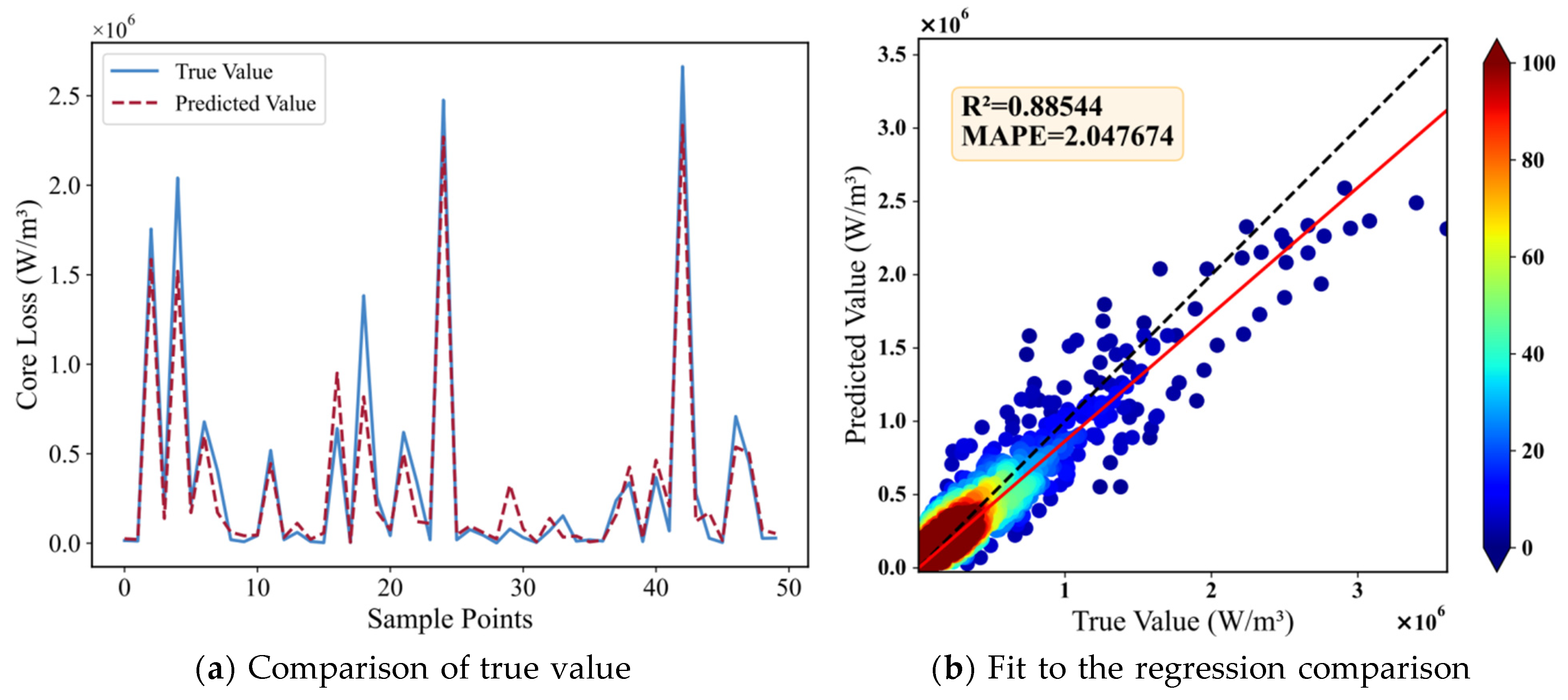
| GBR | 4.3936 | 2.0476 | 2.0477 | 0.8854 | |
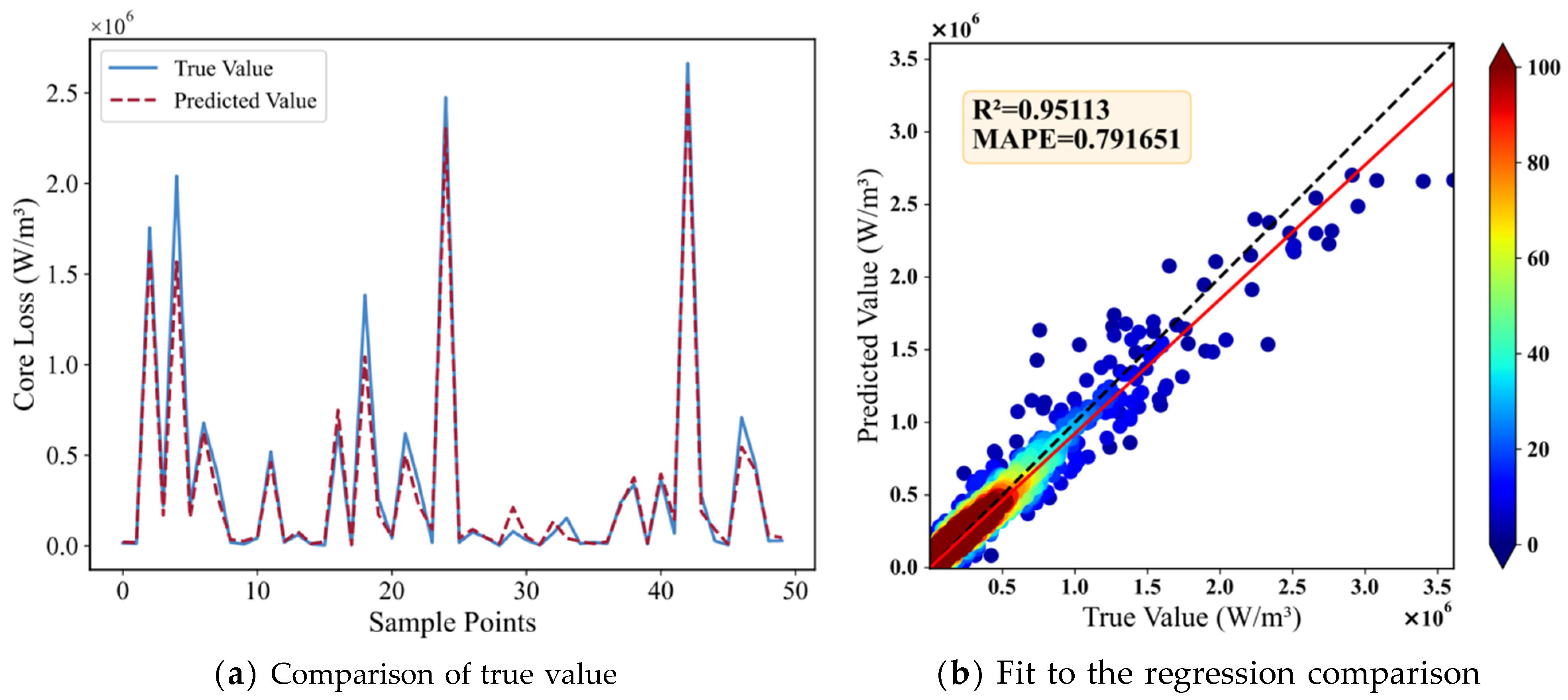
| RF | 2.1693 | 1.0170 | 0.7917 | 0.9511 | |
| XGB | 2.0803 | 0.9789 | 0.7178 | 0.9534 | |
| Ensemble (without Physical Priors) | 2.2675 | 1.0437 | 0.7831 | 0.9496 | |
| Ensemble | 1.9591 | 0.8017 | 0.6546 | 0.9603 | |
Disclaimer/Publisher’s Note: The statements, opinions and data contained in all publications are solely those of the individual author(s) and contributor(s) and not of MDPI and/or the editor(s). MDPI and/or the editor(s) disclaim responsibility for any injury to people or property resulting from any ideas, methods, instructions or products referred to in the content. |
© 2026 by the authors. Licensee MDPI, Basel, Switzerland. This article is an open access article distributed under the terms and conditions of the Creative Commons Attribution (CC BY) license.
Share and Cite
Shen, X.; Zhong, H.; Han, R. A Physics-Informed Neural Network with Hybrid Architecture for Magnetic Core Loss Prediction Under Complex Conditions. Magnetochemistry 2026, 12, 7. https://doi.org/10.3390/magnetochemistry12010007
Shen X, Zhong H, Han R. A Physics-Informed Neural Network with Hybrid Architecture for Magnetic Core Loss Prediction Under Complex Conditions. Magnetochemistry. 2026; 12(1):7. https://doi.org/10.3390/magnetochemistry12010007
Chicago/Turabian StyleShen, Xiaoyan, Hongkui Zhong, and Ruiqing Han. 2026. "A Physics-Informed Neural Network with Hybrid Architecture for Magnetic Core Loss Prediction Under Complex Conditions" Magnetochemistry 12, no. 1: 7. https://doi.org/10.3390/magnetochemistry12010007
APA StyleShen, X., Zhong, H., & Han, R. (2026). A Physics-Informed Neural Network with Hybrid Architecture for Magnetic Core Loss Prediction Under Complex Conditions. Magnetochemistry, 12(1), 7. https://doi.org/10.3390/magnetochemistry12010007