
Article

Synthesis, Structural, and Magnetic Properties of High-Entropy (Fe0.2Co0.2Cu0.2Ni0.2Mn0.2)Nb2O6
by
Maria J. S. Lima
1,2,
Fernando E. S. Silva
3,
Matheus D. Silva
1,
Kivia F. G. Araujo
1,
Marco A. Morales
4,* and
Uílame U. Gomes
1,4
1
Graduate Program in Materials Science and Engineering, Federal University of Rio Grande do Norte, Natal 59078-970, RN, Brazil
2
School of Science and Technology, Federal University of Rio Grande do Norte, Natal 59078-970, RN, Brazil
3
Graduate Program in Chemical Engineering, Federal University of Rio Grande do Norte, Natal 59078-970, RN, Brazil
4
Department of Physics, Federal University of Rio Grande do Norte, Natal 59078-970, RN, Brazil
*
Author to whom correspondence should be addressed.
Magnetochemistry 2025, 11(11), 94; https://doi.org/10.3390/magnetochemistry11110094
Submission received: 20 September 2025 / Revised: 23 October 2025 / Accepted: 27 October 2025 / Published: 28 October 2025

Abstract

In this work, we present the first report on the synthesis via the sol–gel method of a high-entropy (Fe0.2Co0.2Cu0.2Ni0.2Mn0.2)Nb2O6 with columbite–orthorhombic structure. Polyvinylpyrrolidone (PVP), ammonium niobium oxalate, and equimolar amounts of Fe, Co, Cu, Ni, and Mn ions were used. The refinement of the XRD pattern showed the presence of niobate crystallites with an average size of 48.4 nm and a fraction of 7.6 wt% of a spinel-like phase. At temperatures below 5 K, the DC and AC magnetometry results revealed the presence of a ferromagnetic-like phase due to the niobate phase. The Mössbauer spectrum at 300 K showed a paramagnetic and two magnetically ordered components corresponding to the niobate and the spinel-like phases, respectively. The spectral components were typical of Fe3+, indicating the presence of cation vacancies. The elemental mapping obtained from EDS measurements showed compositional homogeneity. The XRF measurements confirmed a composition consistent with nominal values. These results confirm the feasibility of synthesizing entropy-stabilized columbite oxides via the sol–gel route, opening new opportunities for the design of multifunctional ceramics with tunable structural and magnetic properties for high-performance thermal barrier coatings and energy conversion applications.

1. Introduction

The development of emerging technologies, ranging from renewable energy conversion to advanced electronics, requires materials that combine low cost, high efficiency, and structural stability, along with specific features such as homogeneity, morphology, and well-defined physicochemical properties. These materials generally consist of five or more metal cations in approximately equimolar proportions, providing high thermal and crystalline stability and interesting magnetic properties [1,2].
High-entropy oxides (HEO) with enhanced properties have been extensively studied, for instance the high-entropy oxide Li(Gd0.2Ho0.2Er0.2Yb0.2Lu0.2)GeO4 was explored as a microwave dielectric ceramic for low-temperature cofired ceramic technologies [3]. Due to their increased stability driven by high configurational entropy, high-entropy perovskites show great potential in energy devices, such as (electro)catalysts, solid oxide fuel cell electrodes, and anodes for lithium-ion batteries [4]. Excellent microwave dielectric properties were found in high-entropy spinel-type (Mg0.2Co0.2Ni0.2Li0.4Zn0.2)Al2O4 ceramics, making them an ideal candidate for applications in millimeter-wave communication [5]. High-entropy rare-earth niobates and tantalates were synthesized, the entropy-stabilization effect and the lattice distortions caused by multi-cation substitution were the primary factors contributing to their beneficial properties for high-performance thermal barrier coatings (TBC) for the next generation of TBCs designed for high-temperature applications [6]. High-entropy fluorite oxides can be used in a variety of applications including solid ionic conductors, high temperature coatings, and catalysts [7].
In HEO, the entropy is a thermodynamic property that quantifies the degree of cation disorder or randomness in the crystalline structure. A high entropy contains at least five different elements. The stability of the HEO is discussed in terms of the Gibbs free energy of mixing given by ΔGmixing = ΔHmixing − TΔSconfig, where ΔHmixing is the enthalpy of mixing, T is the absolute temperature, and ΔSconfig is the configurational entropy. The configurational entropy for a HEO containing five different elements can be calculated by equation: Δ S c o n f i g = R i = 1 5 x i L n ( x i ) , where R is the universal gas constant, and xi is the mole fraction of elements present in the cation sites [8]. For a HEO sample with five elements in equimolar amounts, xi = 0.2, the entropy will be Δ S c o n f i g = 1.61 R .
High-entropy ceramics with spinel, pyrochlore, fluorite, and perovskite structures have been extensively studied [8,9,10,11,12,13]; however, only two studies reported the production of high-entropy ceramics with columbite-type structure. The (Fe0.2Co0.2Cu0.2Zn0.2Mn0.2)Nb2O6 is synthesized by the solid-state reaction method [14] and the (Mg0.2Cu0.2Ni0.2Co0.2Zn0.2)Nb2O6 is obtained by a modified solution combustion method [15]. Compounds with columbite structure are described by the general formula ANb2O6 (space group Pbcn), where A is a divalent cation that could be Ca, Cd, Zn, Mg, Ni, Mn, Co, Fe, or Cu.
Niobium oxides with orthorhombic crystalline structure with chemical formula ANb2O6 were produced, aiming their use in solar cells, microwave devices, photo-catalysis, and energy storage devices among others [16,17,18,19].
High-entropy niobates-based materials also showed enhanced thermophysical properties. For instance, Zhu et al. prepared (Sr0.2Ba0.2La0.2Eu0.2Pb0.2)Nb2O6 and found ultralow thermal conductivity combined with high thermopower [20]. Furthermore, Su et al. synthesized and studied the thermoelectric properties of the high-entropy (Fe0.2Co0.2Cu0.2Zn0.2Mn0.2)Nb2O6 with columbite-type structure; their sample exhibited poor thermal conductivity and was used in thermal insulation applications [14].
Several methods have been reported for the synthesis of HEOs, namely high-energy ball milling [21,22], co-precipitation [23], combustion [17], and sol–gel [24]. In these cases, the synthesis process significantly affects the particle morphology and chemical characteristics of the samples [25].
PVP is a biocompatible polymer and a steric stabilizer widely used from the food to pharmaceutical industries [26]. PVP can be used in the synthesis of nanostructured powder via the sol–gel method. The role of PVP in the solution of metal salts is to afford a polymeric network to prevent cation mobility, ensuring homogeneous stoichiometry, homogeneous morphology, and preventing the formation of undesirable crystalline phases [27,28]. PVP has pyrrolidone rings attached to the carbon skeleton. In the resonance stage of the pyrrolidone rings, it contains (C-O) groups and nitrogen heteroatoms. Interactions between PVP molecules and metal nitrates/sulfates occur through strong ionic interactions between metal cations and the negatively charged (C-O) group, whereas the highly polar amide group interacts with the (NO3) and (SO4)2− anions, and these functional groups facilitate in the nucleation and growth of nanoparticles [29].
The aim of this work was to synthesize the high-entropy (Fe0.2Co0.2Cu0.2Ni0.2Mn0.2)Nb2O6 (HE-Nb2O6) by the sol–gel method, using PVP as a gel matrix, and study its crystalline, composition homogeneity, morphological characteristics and magnetic properties. As far as the authors are aware, it is the first report demonstrating the synthesis of HE-Nb2O6 and therefore the first report on the study on the crystallographic, morphological, and magnetic properties.

2. Experimental

2.1. Materials

Cobalt nitrate (Co(N2O6·6(H2O), 98%, (Sigma Aldrich, São Paulo, SP, Brazil), copper nitrate (Cu(NO3)2·3(H2O), 98%, (Êxodo Científica, Sumaré, SP, Brazil), iron nitrate (Fe(NO3)3·9(H2O), 98%, (Dinâmica, Indaiatuba, SP, Brazil), manganese sulfate (MnSO4)·H2O 98%, (Científica ACS, Rio de Janeiro, RJ, Brazil), nickel nitrate (Ni(NO3)2·6H2O), 98%,( Científica ACS, Rio de Janeiro, RJ, Brazil), polyvinylpyrrolidone (PVP, MW = 1.300.000 g·mol−1, Companhia das Essencias, São Paulo, SP, Brazil), ethanol (99.8%, ASC), Nb2O5 (94.55%, Sigma Aldrich, São Paulo, SP, Brazil), potassium hydrogen sulfate KHSO4, 96.55%, (Dinâmica, Indaiatuba, SP, Brazil).

2.2. Synthesis

2.2.1. Synthesis of Ammonium Niobium Oxalate

The niobium oxalate was prepared as follows: the Nb2O5 was melted in a platinum crucible containing KHSO4 in a mass proportion Nb2O5/KHSO4 of 1/7. Then, the precursor was grinded and washed several times. Afterwards, the solid was treated with oxalic acid (H2C2O4) and ammonium oxalate (C2H8N2O4) in a mass proportion of 1:3. The dispersion was thoroughly mixed at 60 °C in a magnetic stirrer (Solidsteel, Piracicaba, SP, Brazil) and then dried in the furnace (Q318M-Quimis, Diadema, SP, Brazil) at 100 °C for 12 h. This procedure was similar to the one developed by Souto et al. [30]. The resultant product was ammonium niobium oxalate, (NH4)3NbO(C2O4)3·H2O.

2.2.2. Synthesis of HE-Nb2O6

For the synthesis of HE-Nb2O6, 2 g of PVP was dissolved in 20 mL of ethanol. Then, equimolar amounts of transition metals (Co, Cu, Mn, Fe, and Ni) together with (NH4)3NbO(C2O4)3. H2O salts were then dissolved in 20 mL of ethanol for 2 h at 25 °C. The PVP and the metal salt solutions were mixed at 25 °C for 15 h. The final solution was warmed up in a furnace (Q318M-Quimis, Diadema, SP, Brazil) to 100 °C at a rate of 10 °C/min and remained for 2 h. The dried precursor was calcined in air at 1000 °C for 2 h, with a heating rate of 10 °C/min. Finally, the sample was grinded and characterized. We considered a lower calcination temperature (<1000 °C) but the sample presented a higher contribution of a spinel phase. At calcination temperatures higher than 1000 °C, the spinel contribution remained nearly constant. Therefore, the calcination temperature was set to 1000 °C.

2.3. Characterization

The chemical composition of the sample was determined using an X-ray fluorescence (XRF) spectrometer (Shimadzu XRF-1800, Kyoto, Japan). The crystalline structure of the sample was investigated by X-ray diffraction (XRD). XRD data was collected in a Miniflex II (Rigaku, Tokio, Japan) diffractometer within the angular range of 10–90° (2θ) at a step size of 0.02°, scan of 3°/min. Rietveld refinement was performed using Maud software (version 2.99993) to obtain a quantitative phase analysis and determine lattice parameters. The crystalline phase was identified using crystallographic data from the Inorganic Crystal Structure Database (ICSD). The morphological characterization of HE-Nb2O6 was conducted using a scanning electron microscope (SEM) from Carl Zeiss (Supra 35-VP, Carl Zeiss AG, Oberkochen, Germany), equipped with a Bruker energy-dispersive X-ray spectrometer (EDS) detector (Bruker Corporation, Billerica, MA, USA) and Shimadzu (SSX-550, Kyoto, Japan). The EDS was used to identify the chemical elements present in the sample. The magnetic measurements were conducted in a Physical Properties Measurement System model Dynacool from Quantum Design (San Diego, CA, USA) equipped with a vibrating sample magnetometer. The Mössbauer spectrum was recorded at 300 K using a Wissel spectrometer (Starnberg, Germany). The spectrum was fitted using the Normos95 software (version 2.0), and the isomer shift was reported in relation to α-Fe at 300 K.

3. Results and Discussion

3.1. Structural and Morphological Characterization

To confirm the presence of the elements in the prepared sample, elemental analysis was performed using X-ray fluorescence spectroscopy (XRF). The XRF results summarized in Table 1 confirmed the presence of Ni, Cu, Fe, Co, Mn, and Nb elements with concentrations in close agreement with the nominal values. The analysis revealed no impurities were detected in the sample.
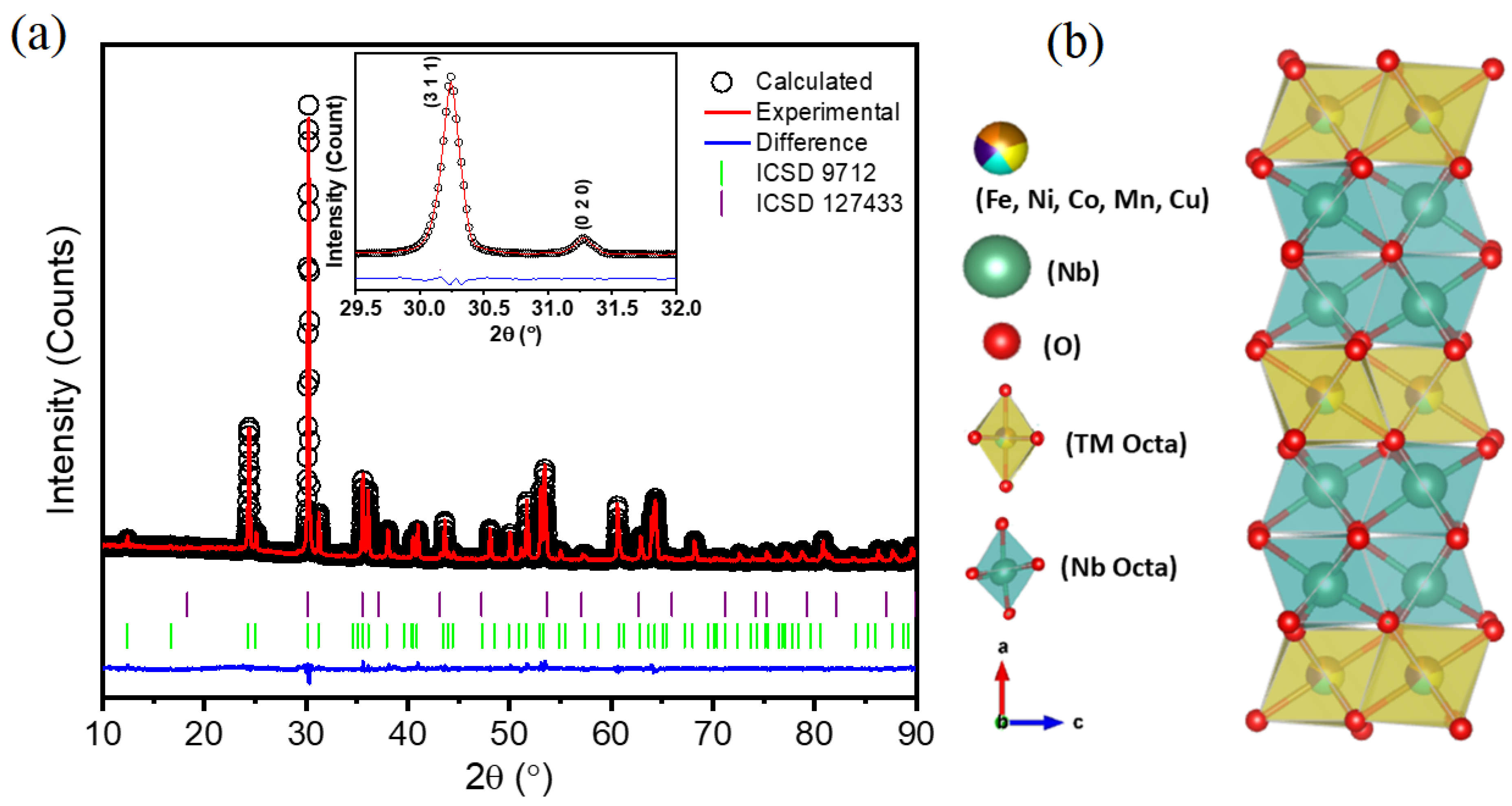
Figure 1a shows the Rietveld refinement and corresponding XRD pattern of the sample. The diffraction pattern revealed the presence of two crystalline phases. The analysis revealed the predominant presence of a columbite-type HE-Nb2O6 phase, accounting for 92.4 wt.% of the total amount, along with 7.6 wt.% of a spinel-like phase. The refinement was carried out using the ICSD-9712 card for the columbite-type structure and the ICSD-127433 for the spinel phase. The simulated curves showed excellent agreement with the experimental data.
All peaks corresponding to the main phase were indexed to an orthorhombic crystal structure with the Pbcn space group. The average crystallite size was estimated to be 48.4 nm using the Scherrer equation. In contrast, the spinel phase exhibited a crystallite size of 32.5 nm, indexed to a cubic crystal structure with the Fd-3m space group. It is acknowledged that peak broadening may also arise from additional contributions, such as microstructural strain, internal stress, possible phase overlap, and instrumental effects. Nevertheless, despite these inherent limitations, the Scherrer equation is a widely accepted and reliable method, providing values that are close to the actual dimensions of the coherent crystalline domains. Therefore, the estimated crystallite sizes reported here can be regarded as representative and meaningful for structural comparison between different phases and samples.
A magnified view of the main diffraction peaks, (311) and (020), of the niobate phase, showed in Figure 1a, did not exhibit any shoulders, suggesting the absence of a secondary niobate phase with a different lattice parameter and same orthorhombic structure with the Pbcn space group. At the angular range 30.0–30.4°, there was an overlapping of peaks from the niobate and spinel phases, where the peak of the spinel phase was very small and did not contribute significantly to the overall intensity, whereas the (311) peak of the niobate is the highest of this phase and dominated the diffractogram. The refined theoretical curve matched the experimental data well. The crystallographic results were in close agreement with the (Fe0.2Co0.2Cu0.2Zn0.2Mn0.2)Nb2O6 sample with columbite structure reported by Su et al. [14]. Figure 1b presents a schematic representation of the crystal structure composed of two octahedral units, namely (Fe0.2Ni0.2Co0.2Mn0.2Cu0.2)O6 and NbO6. The oxygen anions form corner-sharing octahedra around the TM2+ (TM is a transition metal) and Nb5+ ions, creating isolated zig-zag chains of the TM ions.
Table 2 summarizes the refinement results and quality indicators. The refinement produced β values of 90°, confirming orthorhombic symmetry. The Rietveld refinement indicators (χ2 = (Rwp/Rexp)2, Rwp, and Rexp) were within the acceptable range for complex oxide systems. High-entropy oxides with five or more elements can increase the χ2 in Rietveld refinements due to the complexity of fitting a disordered structure with multiple cations of different radii. The varied ionic radii create local distortions, microstrain, and potential site disorder, that can be difficult to model with a single crystallographic structure, leading to a relatively high χ2 value.
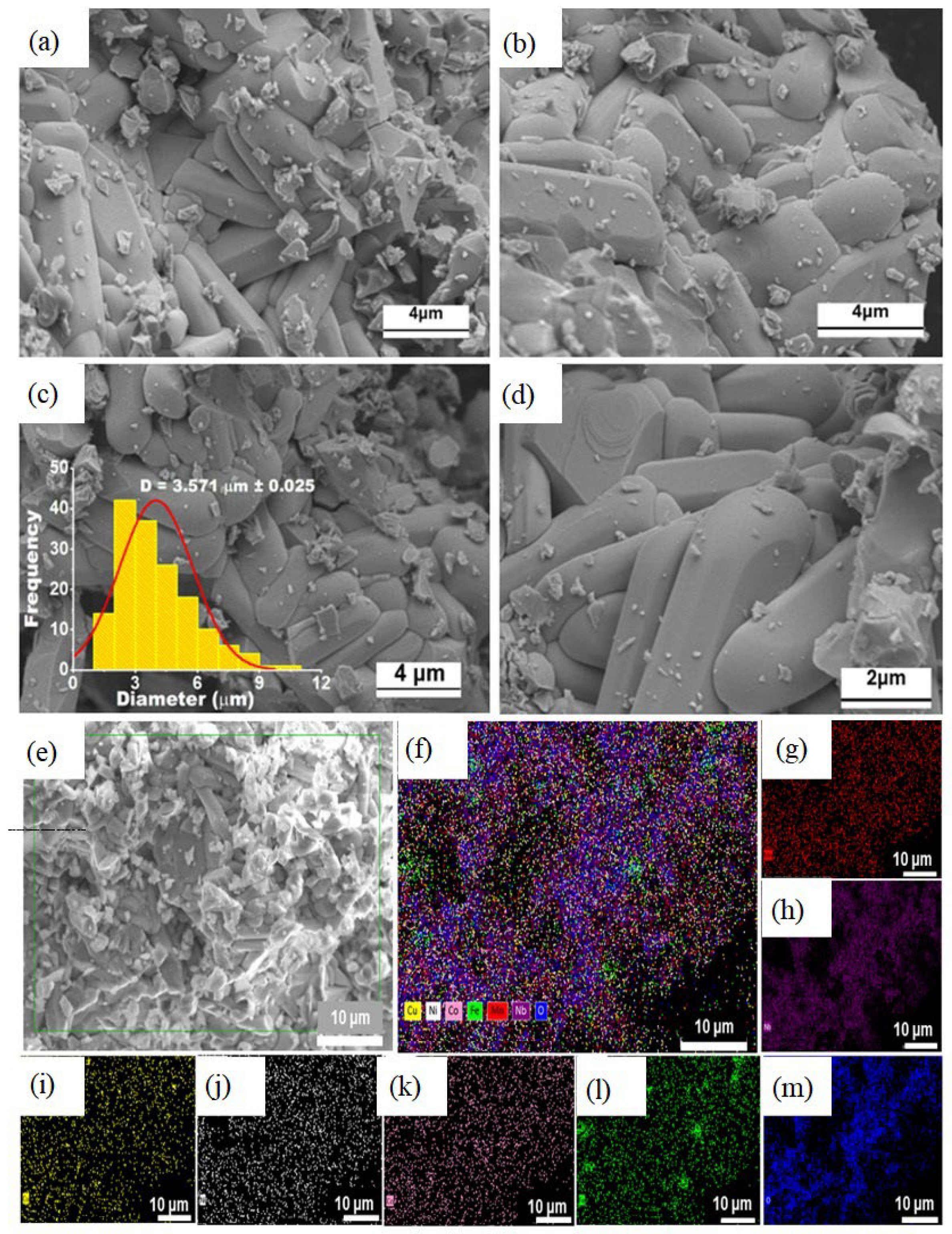
Figure 2a–d show the scanning electron microscopy (SEM) images of the sample, revealing polycrystalline particles with sizes of a few micrometers, agglomerated and with rod-like morphology. In the sol–gel synthesis, the polymer PVP may influence the shape and size of particles when the calcination temperature is below 600 °C. At 600 °C, the PVP begins to transform into carbon. At higher temperatures, the grains aggregate and coalesce, forming bigger particles and leading to micron-sized rods. These rods had an average size of 3.62 μm, as shown in the inset of Figure 2c. The elemental distribution was analyzed using energy-dispersive X-ray spectroscopy (EDS). The picture in Figure 2e shows the area that was analyzed to obtain the elemental mapping. A general view of all elements is shown in Figure 2f. The mapping of elements Mn, Nb, Cu, Ni, Co, Fe, and O is shown in pictures g, h, i, j, k, l, and m, respectively. These images show, in an approximate manner, the homogenous dispersion of elements in the particles, indicating a chemical homogeneity of elements in the HE-Nb2O6 sample.

3.2. Magnetic Properties

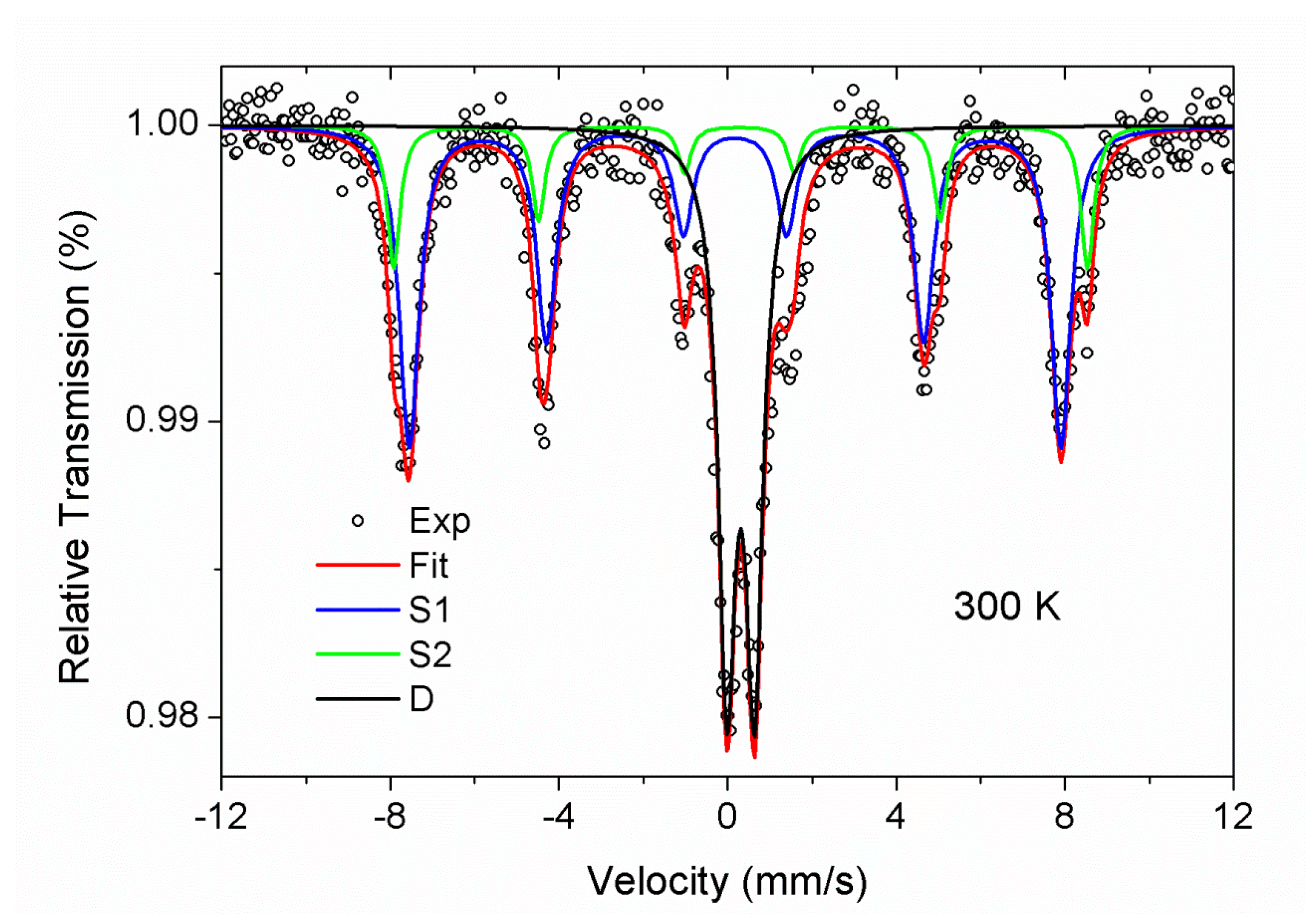
Mossbauer spectroscopy is a highly sensitive technique used to study the occupancy, magnetic ordering, and oxidation state of Fe ions among the available sites in the niobate and spinel phases. Figure 3 shows the Mossbauer spectrum recorded at 300 K.
The Mössbauer spectrum was fitted to three components, namely sextets S1 and S2 and, a doublet D. The hyperfine parameters obtained from the fit are shown in Table 3. It is important to mention that a single sextet did not adequately fit correctly the spectrum, because the magnetic spectral component is asymmetric, i.e., the first and second peaks have a higher intensity when compared with the fifth and sixth peaks. Moreover, the rightmost peak exhibited a shoulder that confirmed the presence of the second sextet. The two sextets were ascribed to Fe in the spinel crystal structure and reflected two different chemical environments. In fact, cations in the spinel structure occupy tetrahedral and octahedral oxygen coordinated sites and the sextet with the lowest isomer shift (IS) is usually ascribed to Fe at tetrahedral sites [31]. In the present case, the sextets S1 and S2 were related to Fe at tetrahedral and octahedral sites, respectively. It is known that paramagnetic Fe2+ has IS and quadrupole splitting (QS) larger than 1.0 mm/s [32]. In the present work, the sextets and the doublet had IS smaller than 0.5 mm/s. These results clearly indicated that the Fe oxidation state in the sample was Fe3+. In the niobate structure, all their cations occupy octahedral sites. Taking into account that pure phases of MNb2O6, where M = {Fe, Co, Ni}, have magnetic ordering temperatures below 10 K [33], and at 300 K, these phases are paramagnetic. Therefore, the doublet may be associated with the HE-Nb2O6 phase.
The general chemical formula for niobates is ANb2O6, which contains cations with Nb5+ and A2+ oxidation states. In the present work, the Fe2+ was substituted by Fe3+, which resulted in a charge imbalance in the HE-Nb2O6 phase. To restore charge neutrality of the crystal, the niobate may form cation vacancies at A or Nb sites. For instance, it is clear that every two Fe3+ ions will induce a single A2+ vacancy, or every five Fe3+ will induce a single Nb5+ vacancy. Regarding the magnetic behavior of the HE-Nb2O6 phase, the interaction between magnetic A ions, A = {Fe, Co, Cu, Ni, Mn}, are through a superexchange of the type A1-O-A2. Assuming that A ions have valences of Fe3+, Co2+, Cu2+, Ni2+, and Mn2+, it will provide a high-spin magnetic moment of 5.92, 3.87, 1.73, 2.83, and 5.92 μB. The wide range of magnetic moments and the presence of cationic vacancies can alter the superexchange interactions leading to changes in magnetic properties such as spin disorder and an overall reduction in magnetic moment. These vacancies disrupt the ideal A1-O-A2 path leading to a reduction in the coupling strength and potentially creating sites where magnetic interactions are absent.
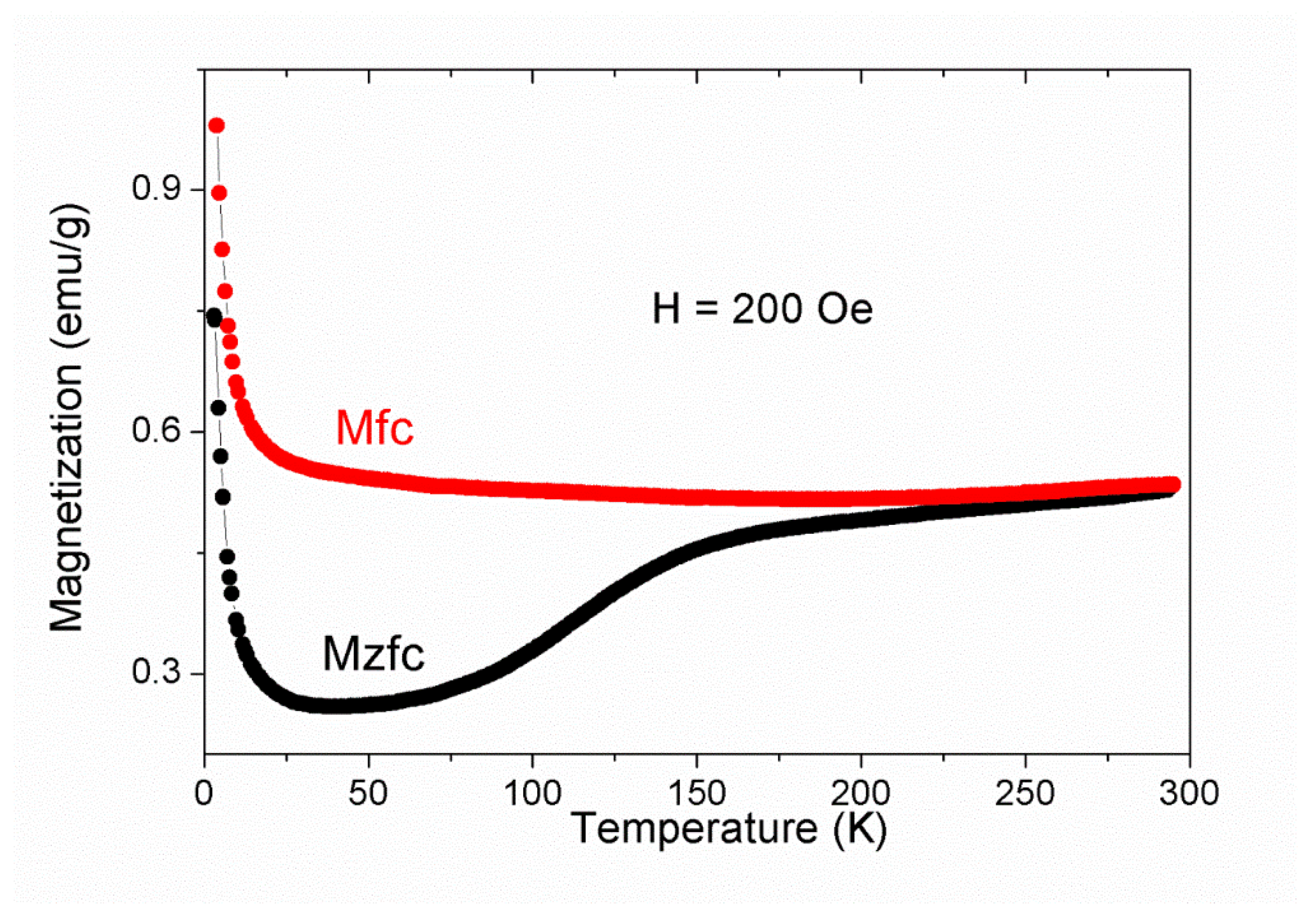
Magnetic measurements were performed to better understand the overall magnetic behavior of the sample. The zero-field-cooled (Mzfc) and field-cooled (Mfc) magnetizations were recorded under a magnetic field of 200 Oe and are shown in Figure 4. The measurements were conducted in the warming mode, i.e., they initiated at 3 K and continued up to 300 K.
Starting at 3 K, the Mzfc values decreased rapidly up to T ≈ 25 K and then increased gradually up to 140 K, where shoulder feature was observed before continuing to increase until reaching 300 K. These facts suggest that at 300 K, there is a magnetically ordered phase in the sample and its blocking temperature lies at higher temperatures. The Mfc values started at 3 K and decreased quickly until 25 K, continued decreasing slowly up to 200 K, and then slightly increased up to 300 K. At temperatures below 25 K, both Mzfc and Mfc curves seem to follow a T−1 trend that can be ascribed to paramagnetic regime. These curves merged at 300 K, indicating that the irreversibility temperature was at T > 300 K, and this reinforces the idea that at room temperature, the sample has a magnetically ordered component. It is known that spinels contain cations bearing magnetic moments and usually exhibit a ferromagnetic to paramagnetic Néel transition (TN) at temperatures well above room temperature. It confirms the conclusions of the Mössbauer study, that the spinel is related to the sextets and the doublet is related to the niobate phase.
The literature has several reports on the magnetic properties of niobates of the type ANb2O6, where A = {Co, Ni, Cu, Fe, Mn}. The comparison of earlier reports with the present results will help us to understand the magnetic behavior for the HE-Nb2O6 phase. For instance, Lei et al. studied the magnetic properties of MNb2O6 where M = {Fe, Co, Ni}, their samples had an antiferromagnetic (AFM) ordering with Tn at 1.8, 3.0, and 6.0 K, respectively, and above these temperatures the samples were paramagnetic [33]. In other work, Sarvezuk et al. studied the magnetic behavior of the NixFe1−xNb2O6 and in spite of the fact that FeNb2O6 and NiNb2O6 were magnetically ordered at low temperature, chemical disorder induces a loss of long-range magnetic order in the NixFe1−xNb2O6 series for x = {0.2, 0.4, 0.6, 0.8 }. Nevertheless, the dominant exchange interactions in the system were ferromagnetic-like, occurring inside the zig-zag chains along the c axis [34]. Ghosh et al. studied the magnetic ground state of MnNb2O6 polycrystals, and they obtained TN = 4.33 K [35].
Similarly, Liu et al. studied the magnetic properties of a Co0.1Zn0.9Nb2O6 sample. In their susceptibility data in the range of 3–300 K, they did not observe any peak related to the AFM transition, whereas the analysis of the inverse of the susceptibility χ−1 and the Curie–Weiss model χ−1 = (T − θ)/C resulted in θ = −0.165 K, indicating an AFM coupling of Co moments. Therefore, they postulated a TN smaller than 3 K [36]. Liu et al. concluded that their results agreed well with those reported by Nakajima et al., in which the commensurate AFM ground state disappeared by substituting Co by nonmagnetic Mg ions in CoNb2O6 [37]. Nakajima et al. studied the magnetic properties, by means of neutron diffraction measurements, of single crystals of Co1−xMgxNb2O6 with x = {0, 0.004, 0.008}. They found that the commensurate AFM ground state disappeared by substituting only 0.8% of magnetic Co2+ for nonmagnetic Mg2+. They concluded that the disappearance of the AFM phase was because the phase transition from the incommensurate phase to the AFM phase was strongly suppressed by pinning effects due to the impurities [37]. In light of the above references for structures of the type ANb2O6, Nakajima et al. concluded that their samples had AFM transitions at temperatures smaller than 5 K, and none of them showed ferromagnetic/ferrimagnetic behavior at room temperature. In the present work, the M-T measurements also suggested that the HE-Nb2O6 phase had a magnetic transition at temperatures below 7 K.
It is worth mentioning that the blocking temperature (TB) is relative to the measuring time (tm) of the technique used to study a given system. For instance, tm for Mössbauer spectroscopy and magnetometry techniques are 10−8 s and 1–10 s, respectively. It implies that the TB obtained by Mössbauer spectroscopy will be higher than the one obtained by magnetometry. Thus, at 300 K, a given sample can appear as thermally blocked by Mossbauer spectroscopy and superparamagnetic by magnetometry.
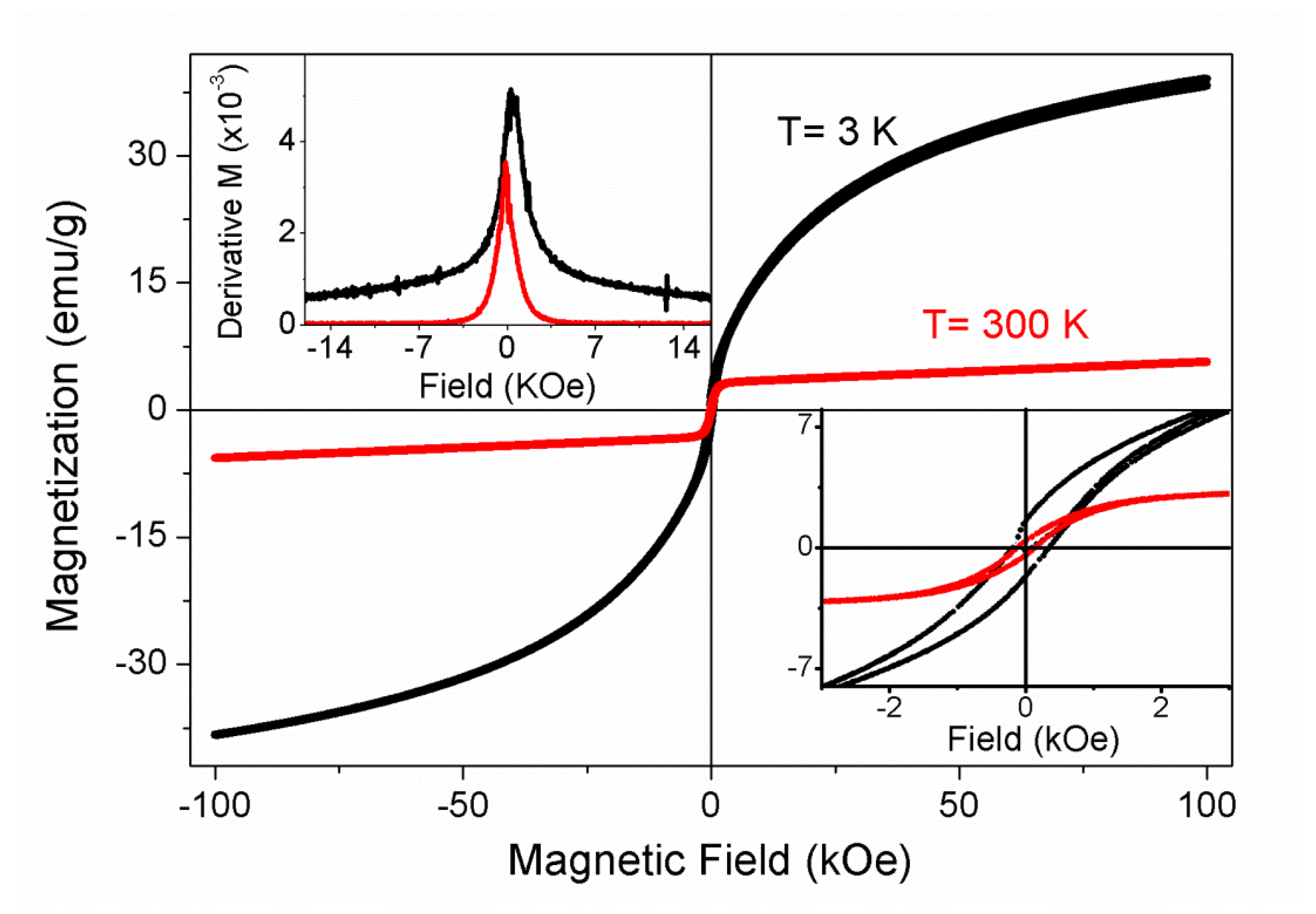
Figure 5 presents the isothermal magnetization obtained at 3 and 300 K for the sample. At 300 K, the high field (~100 kOe) did not saturate the magnetizations of the sample, indicating the superposition of paramagnetic and ferromagnetic signals. The magnetization measured at 3 K and at a field of 100 kOe was of 38.3 emu/g, the remanence magnetization was Mr = 1.59 emu/g, the coercivity field Hc = 380 Oe. Whereas, the magnetization measured at 300 K and at a field of 100 kOe was of 5.6 emu/g, Mr = 0.47 emu/g, and Hc = 110 Oe. The lower inset presents the hysteresis in a low field range; this figure clearly shows the variations of Mr and Hc values for both measurements and suggests the presence of an overall ferromagnetic-like phase for the measurement recorded at 3 K. To further show the presence of the spinel phase, the upper inset presents a zoomed-in view of the derivative of the magnetizations obtained at 3 and 300 K. Both derivatives were conducted in the ascending magnetization curves. As one can notice, the derivatives showed symmetric curves, i.e., besides the central peak, there was not any shoulder that may indicate the presence of a second ferromagnetic phase. This provides evidence that at 3 K, both phases were interacting magnetically via superexchange forces leading to a collective magnetic behavior. For the measurement recorded at 300 K, the derivative curve was centralized at a field close to the Hc = 110 Oe and was sharper when compared with the derivative of the magnetization at 3 K.
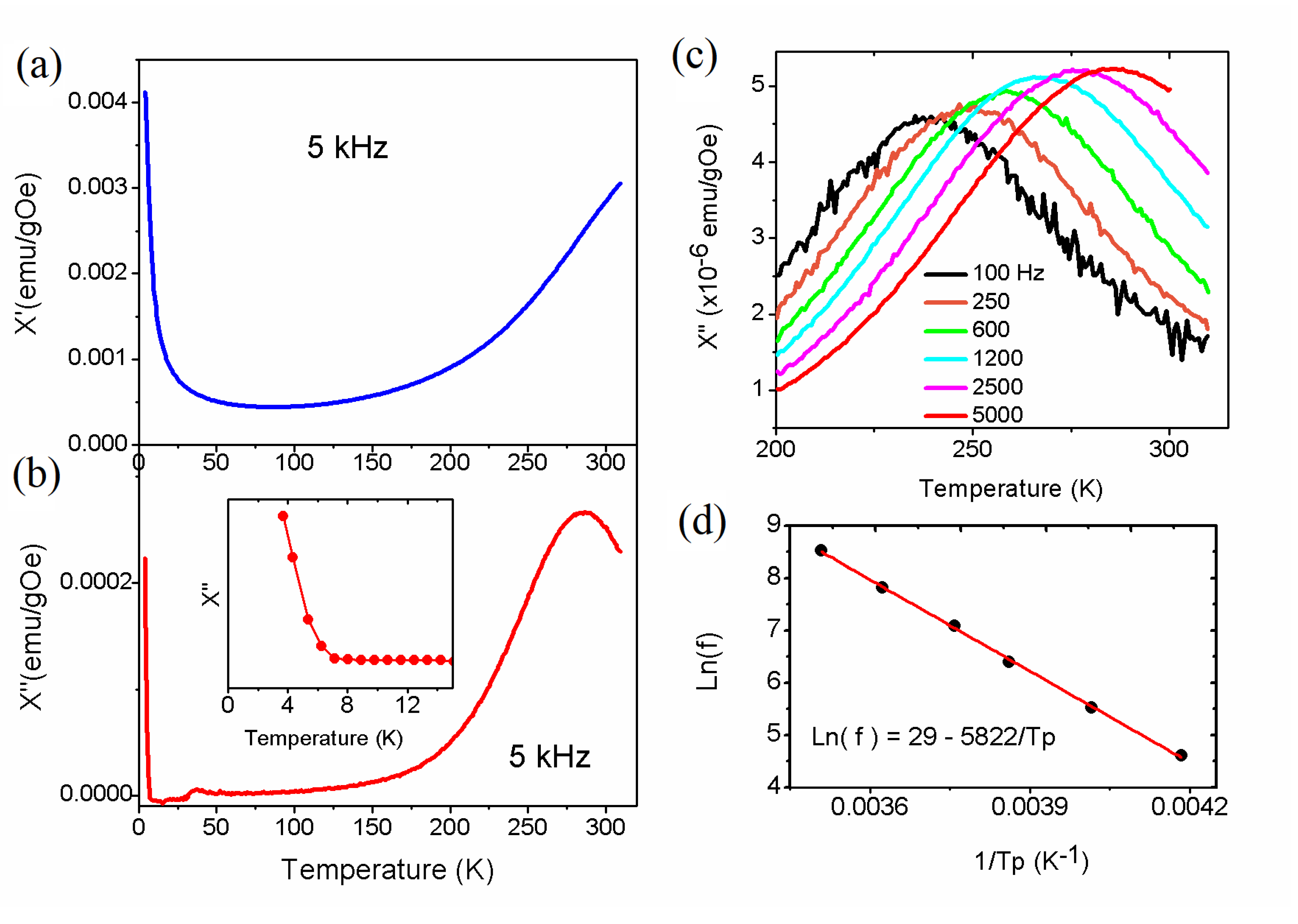
Figure 6 shows the AC susceptibility measurements recorded under frequencies from 100 to 5000 Hz. Figure 6a shows the in-phase (χ′) AC susceptibility data recorded under an AC magnetic field of 10 Oe and frequency of 5 kHz. The trend observed in the χ′ graph is approximately similar to that observed in the DC Mzfc curve shown in Figure 4. However, the out-of-phase AC susceptibility signal (χ″), presented in Figure 6b, showed interesting features. Notably, there is a strong signal below 7 K; this behavior is typical of a ferromagnetic-like phase. In fact, the absence of a net magnetic moment, e.g., as in AFM material with perfectly matched antiparallel alignment of opposing moments, should show no signal in the χ″ measurements. Meanwhile, the signal observed at T < 7 K, in χ″ data, suggested that the HE-Nb2O6 may be a ferromagnetic-like phase, therefore exhibiting a net magnetic moment. As mentioned before, earlier reports on magnetic characterization on samples of the type ANb2O6, where A = {Fe, Co, Ni, Mn} [33,35] showed AFM behavior, samples of (NixFe1−x)Nb2O6 showed ferromagnetic like behavior with ordering temperatures below 10 K [34], and samples (CoxZn1−x)Nb2O6 showed AFM properties [36,37]. In the present case, a certain amount of vacancies (Av) are expected at the A or Nb sites due to the presence of Fe3+ substituting Fe2+; thus, the linkage Av-O-A will affect the overall superexchange interaction of neighbors A cations, therefore leading to a disordered magnetic structure and to a net magnetic signal.
The small signal observed at 31–35 K was from the holder sample and did not belong to the sample. There was also a peak at TP = 285 K, and to study this signal, AC susceptibility measurements were conducted as a function of frequency for temperatures in the range 200–330 K. The AC susceptibility data is shown in Figure 6c, and as one can see, the χ″ susceptibility peak shifts to higher temperatures when the frequency increases, indicating the presence of a dynamic effect due to the magnetic moments in the presence of an AC magnetic field.
In order to study the variation of TP as a function of frequency, the Néel–Brown model was considered [38,39]. This model is indicated to study an ensemble of non-interacting single domain magnetic nanoparticles with their super-moments relaxing with a period of τ = 1/f and in an absolute temperature TP. The equation of the Néel–Brown model is given by
f = f o e E m K B T P
where fo is the attempt frequency that is of the order of 109–1012 s−1, Em is the activation anisotropy energy of each particle, KB is the Boltzmann constant, and TP is the peak temperature. Equation (1) can be presented as Ln(f) = Ln(fo) − (Em/KBTP−1. Figure 6d shows the plot of Ln(f) versus TP−1 and its fitting to a straight line; the inset shows the equation obtained from the linear fit. The obtained fitting parameters were Ln(fo) = 29 and Em/KB = 5822 K; therefore, the values of fo and Em were 3.9 1012 s−1 and 8.034 10−20 J, respectively. As noted, the fo value is within the expected for the attempt frequency, and this result suggests that the Néel–Brown model well describes the superparamagnetic regime of the spinel phase.
In order to further confirm the superparamagnetic behavior of the system, one can use the empirical φ parameter. It is known that for non-interacting superparamagnetic particles, φ takes the values of 0.1 < φ < 0.13. For systems under a spinglass regime, the φ values can be in the weak interaction regime for 0.03 < φ < 0.06, and for the strong interaction regime when 0.005 < φ < 0.02 [40]. The equation for the φ parameter is given by
φ = T P T P ( L o g ( f ) )
In the present work, the obtained value for φ was of 0.097; this value was very close to 0.1 and suggested that the AC signal at T > 230 K is related to non-interacting superparamagnetic particles. In general, spinels have ferrimagnetic (FIM) behavior with ordering temperature well above 300 K [39]. In the present work, at T > 5 K, the spinel nanoparticles are embedded in the paramagnetic HE-Nb2O6 phase and developed a superparamagnetic behavior.

4. Conclusions

The high-entropy compound (Fe0.2Co0.2Cu0.2Ni0.2Mn0.2)Nb2O6 with an orthorhombic crystal structure was synthesized for the first time, and a secondary spinel phase was also formed. The synthesis method was adjusted to minimize the amount of the spinel phase; thus, the precursor sample was thermally treated at 1000 °C for 2 h. The Rietveld refinement results indicated the formation of a niobate with orthorhombic structure with an average crystallite size of 48.4 nm, while the spinel phase exhibited a crystallite size of 32.5 nm. The SEM images showed polycrystalline particles with an average size of 3.62 μm. The elemental mapping revealed a homogeneous distribution of elements within the sample. The XRF data confirmed the nominal concentration of elements in the sample. The AC and DC magnetic measurements suggested the presence of a ferromagnetic-like phase due to HE-Nb2O6 at temperatures below 7 K. A ferromagnetic response was also observed at 300 K, originating from the spinel phase. The spinel nanoparticles were dispersed within paramagnetic niobate phase at 300 K and exhibited a superparamagnetic behavior close to room temperature as shown by the AC susceptibility measurements. The method used to prepare the sample seems to be useful to synthesize high-entropy structures with disordered chemical occupancy. This material has potential applications for high-performance thermal barrier coatings.

Author Contributions

Conceptualization, M.J.S.L., F.E.S.S., M.D.S., K.F.G.A., M.A.M. and U.U.G.; methodology, M.J.S.L., F.E.S.S., M.D.S., K.F.G.A., M.A.M. and U.U.G.; formal analysis, M.J.S.L. and F.E.S.S.; investigation, M.J.S.L., F.E.S.S., M.D.S., K.F.G.A., M.A.M. and U.U.G.; resources, M.J.S.L., F.E.S.S., M.D.S., K.F.G.A., M.A.M. and U.U.G.; data curation, M.J.S.L., M.D.S., K.F.G.A., M.A.M. and U.U.G.; writing—original draft, M.J.S.L., F.E.S.S., M.D.S., K.F.G.A., M.A.M. and U.U.G.; writing—review and editing, M.J.S.L., F.E.S.S., M.D.S., K.F.G.A., M.A.M. and U.U.G.; visualization, M.J.S.L., F.E.S.S., M.D.S., K.F.G.A., M.A.M. and U.U.G.; supervision, M.J.S.L., F.E.S.S., M.A.M. and U.U.G.; project administration, U.U.G.; funding acquisition, U.U.G. All authors have read and agreed to the published version of the manuscript.

Funding

This research received no external funding.

Institutional Review Board Statement

Not applicable.

Informed Consent Statement

Not applicable.

Data Availability Statement

The original contributions presented in this study are included in the article. Further inquiries can be directed to the corresponding author.

Acknowledgments

We thank the Brazilian agencies Capes and CNPq for the fellowships.

Conflicts of Interest

The authors declare no conflict of interest.

References

  1. Mao, A.; Quan, F.; Xiang, H.Z.; Zhang, Z.G.; Kuramoto, K.; Xia, A.L. Facile synthesis and ferrimagnetic property of spinel (CoCrFeMnNi)3O4 high-entropy oxide nanocrystalline powder. J. Mol. Struct. 2019, 1194, 11–18. [Google Scholar] [CrossRef]
  2. Mao, A.; Xiang, H.Z.; Zhang, Z.G.; Kuramoto, K.; Zhang, H.; Jia, Y. A new class of spinel high-entropy oxides with controllable magnetic properties. J. Magn. Magn. Mater. 2020, 497, 165884. [Google Scholar] [CrossRef]
  3. Xiang, H.; Yao, L.; Chen, J.; Yang, A.; Yang, H.; Fang, L. Microwave dielectric high-entropy ceramic Li(Gd0.2Ho0.2Er0.2Yb0.2Lu0.2)GeO4 with stable temperature coefficient for low-temperature cofired ceramic technologies. J. Mater. Sci. Technol. 2021, 93, 28–32. [Google Scholar] [CrossRef]
  4. Wang, Y.; Robson, M.J.; Manzotti, A.; Ciucci, F. High-entropy perovskites materials for next-generation energy applications. Joule 2023, 7, 848–854. [Google Scholar] [CrossRef]
  5. Xie, M.; Li, X.; Lai, Y.; Qi, C.; Yin, J.; Gong, W.; Li, Y.; Liu, Q.; Wu, C. Phase evolution and microware dielectric properties of high-entropy spinel-type (Mg0.2Co0.2Ni0.2Li0.4Zn0.2)Al2O4 ceramics. J. Eur. Ceram. Soc. 2024, 44, 284–292. [Google Scholar] [CrossRef]
  6. Zhao, Z.; Chen, H.; Xiang, H.; Dai, F.-Z.; Wang, X.; Xu, W.; Sun, K.; Peng, Z.; Zhou, Y. High entropy defective fluorite structured rare-earth niobates and tantalates for thermal barrier applications. J. Adv. Ceram. 2020, 9, 303–311. [Google Scholar] [CrossRef]
  7. Gild, J.; Samiee, M.; Braun, J.L.; Harrington, T.; Vega, H.; Hopkins, P.E.; Vecchio, K.; Luo, J. High-entropy fluorite oxides. J. Eur. Ceram. Soc. 2018, 38, 3578–3584. [Google Scholar] [CrossRef]
  8. Liu, C.; Li, S.; Zheng, Y.; Xu, M.; Su, H.; Miao, X.; Liu, Y.; Zhou, Z.; Qi, J.; Yang, B.; et al. Advances in high entropy oxides: Synthesis, structure, properties and beyond. Prog. Mater. Sci. 2025, 148, 101385. [Google Scholar] [CrossRef]
  9. Xu, Y.; Xu, X.; Bi, L. A high-entropy spinel ceramic oxide as the cathode for proton-conducting solid oxide fuel cells. J. Adv. Ceram. 2022, 11, 794–804. [Google Scholar] [CrossRef]
  10. Koroleva, M.S.; Krasnov, A.G.; Piir, I.V. Low-, medium-, and high-entropy pyrochlores in (Bi,Li,Na,La,Eu)1.9(Mg0.5Nb1.5)O7-δ compositions, their optical and dielectric properties. Ceram. Int. 2023, 49, 28764–28770. [Google Scholar] [CrossRef]
  11. Wang, Z.; Zhou, L.; Liu, C.; Li, Y. The irradiation resistance and mechanical properties of the high-entropy zirconate pyrochlore (La0.2Nd0.2Sm0.2Eu0.2Gd0.2)2Zr2O7. Nucl. Instrum. Methods Phys. Res. B 2024, 549, 165285. [Google Scholar] [CrossRef]
  12. Xu, L.; Niu, M.; Su, L.; He, X.; Ni, H.; Gao, H.; Zhuang, L.; Wang, H. Engineering stoichiometry of high entropy fluorite oxide to obtain optimized thermophysical property and improved corrosion resistance. Corros. Sci. 2024, 227, 111682. [Google Scholar] [CrossRef]
  13. Li, Z.; Ge, Y.; Xiao, Y.; Du, M.; Yang, F.; Ma, Y.; Li, Y.; Gao, D.; Li, H.; Wang, J.; et al. Fabrication and performance investigation of high entropy perovskite (Sr0.2Ba0.2Bi0.2La0.2Pr0.2)FeO3 IT-SOFC cathode material. J. Alloys Compd. 2024, 989, 174357. [Google Scholar] [CrossRef]
  14. Su, T.; Ma, D.; Zhu, M. Synthesis and thermoelectric properties of the high-entropy (Fe0.2Co0.2Cu0.2Zn0.2Mn0.2)Nb2O6 with columbite structure. Mater. Lett. 2025, 378, 137599. [Google Scholar] [CrossRef]
  15. Koroleva, M.S.; Maksimov, V.S.; Piir, I.V. Synthesis, Optical and Electrical Properties of High-Entropy Niobate (Mg0.2Cu0.2Ni0.2Co0.2Zn0.2)Nb2O6 with a Columbite Structure. Russ. J. Inorg. Chem. 2024, 69, 1487–1492. [Google Scholar] [CrossRef]
  16. Zhang, Y.; Yue, Z.; Gui, Z.; Li, L. Microwave dielectric properties of (Zn1−xMgx)Nb2O6 ceramics. Mater. Lett. 2003, 57, 4531–4534. [Google Scholar] [CrossRef]
  17. Kormányos, A.; Thomas, A.; Huda, M.N.; Sarker, P.; Liu, J.P.; Poudyal, N.; Janáky, C.; Rajeshwar, K. Solution Combustion Synthesis, Characterization, and Photoelectrochemistry of CuNb2O6 and ZnNb2O6 Nanoparticles. J. Phys. Chem. C 2016, 120, 16024–16034. [Google Scholar] [CrossRef]
  18. Wang, T.; Wei, X.; Hu, Q.; Jin, L.; Xu, Z.; Feng, Y. Effects of ZnNb2O6 addition on BaTiO3 ceramics for energy storage. Mater. Sci. Eng. B 2013, 178, 1081–1086. [Google Scholar] [CrossRef]
  19. Hsiao, Y.J.; Fang, T.H.; Ji, L.W. Synthesis and luminescent properties of ZnNb2O6 nanocrystals for solar cell. Mater. Lett. 2010, 64, 2563–2565. [Google Scholar] [CrossRef]
  20. Zhu, M.; Ma, D.; Zhang, N.; Zhan, F.; Zheng, Y.; La, P. Ultralow thermal conductivity and high thermopower of a novel high-entropy (Sr0.2Ba0.2La0.2Eu0.2Pb0.2)Nb2O6 with tungsten bronze structure. J. Eur. Ceram. Soc. 2024, 44, 2198–2205. [Google Scholar] [CrossRef]
  21. Zhang, Y.; Dai, W.; Zhang, P.; Lu, T.; Pan, Y. In-situ electrochemical tuning of (CoNiMnZnFe)3O3.2 high-entropy oxide for efficient oxygen evolution reactions. J. Alloys Compd. 2021, 868, 159064. [Google Scholar] [CrossRef]
  22. Balcerzak, M.; Kawamura, K.; Bobrowski, R.; Rutkowski, P.; Brylewski, T. Mechanochemical Synthesis of (Co,Cu,Mg,Ni,Zn)O High-Entropy Oxide and Its Physicochemical Properties. J. Electron. Mater. 2019, 48, 7105–7113. [Google Scholar] [CrossRef]
  23. Jimenez-Segura, M.P.; Takayama, T.; Bérardan, D.; Hoser, A.; Reehuis, M.; Takagi, H.; Dragoe, N. Long-range magnetic ordering in rocksalt-type high-entropy oxides. Appl. Phys. Lett. 2019, 114, 122401. [Google Scholar] [CrossRef]
  24. Lakshmigandhan, T.; Nithiyanantham, S.; Mahalakshmi, S.; Kogulakrishnan, K.; Mohan, R.; Gunasekaran, B.; Palaniappan, L. Structural, electrical and magnetic studies on CoFe2O4 nanoparticles with polyvinylalcohol (PVA) via Sol-Gel approach. Mater. Sci. Eng. B 2024, 307, 117494. [Google Scholar] [CrossRef]
  25. Silva, V.D.; Simões, T.A.; Grilo, J.P.F.; Medeiros, E.S.; Macedo, D.A. Impact of the NiO nanostructure morphology on the oxygen evolution reaction catalysis. J. Mater. Sci. 2020, 55, 6648–6659. [Google Scholar] [CrossRef]
  26. Nair, B. Final Report On the Safety Assessment of Polyvinylpyrrolidone (PVP). Int. J. Toxicol. 1998, 17, 95–130. [Google Scholar] [CrossRef]
  27. Koczkur, K.M.; Mourdikoudis, S.; Polavarapu, L.; Skrabalak, S.E. Polyvinylpyrrolidone (PVP) in nanoparticle synthesis. Dalton Trans. 2015, 44, 17883–17905. [Google Scholar] [CrossRef]
  28. Dantas, A.P.; Raimundo, R.A.; Neto, P.F.C.; Lopes, C.M.S.; Santos, J.R.D.; Loureiro, F.J.A.; Pereira, T.O.; Morales, M.A.; Medeiros, E.S.; Macedo, D.A. Copper oxide nanofibers obtained by solution blow spinning as catalysts for oxygen evolution reaction. Ceram. Int. 2024, 50, 13034–13045. [Google Scholar] [CrossRef]
  29. Silva, M.F.; De Oliveira, L.A.S.; Ciciliati, M.A.; Lima, M.K.; Ivashita, F.F.; De Oliveira, D.M.F.; Hechenleitner, A.A.W.; Pineda, E.A.G. The Effects and Role of Polyvinylpyrrolidone on the Size and Phase Composition of Iron Oxide Nanoparticles Prepared by a Modified Sol-Gel Method. J. Nanomater. 2017, 2017, 7939727. [Google Scholar] [CrossRef]
  30. Souto, M.V.; Lima, M.J.S.; Barbosa, C.M.; Gomes, U.U.; De Souza, C.P.; De Araújo, C.P.B. Synthesis and characterization of CuNb2O6 from an oxalic precursor via solid state reaction. Mater. Res. 2016, 19, 865–869. [Google Scholar] [CrossRef]
  31. Menil, F. Systematic trends of the 57Fe Mössbauer isomer shifts in (FeOn) and (FeFn) polyhedra. Evidence of a new correlation between the isomer shift and the inductive effect of the competing bond T-X (→ Fe) (where X is O or F and T any element with a formal positive charge). J. Phys. Chem. Solids 1985, 46, 763–789. [Google Scholar] [CrossRef]
  32. Gütlich, P.; Bill, E.; Trautwein, A.X. Mössbauer Spectroscopy and Transition Metal Chemistry; Springer: Berlin/Heidelberg, Germany, 2011. [Google Scholar] [CrossRef]
  33. Lei, S.; Wang, C.; Guo, D.; Gao, X.; Cheng, D.; Zhou, J.; Cheng, B.; Xiao, Y. Synthesis and magnetic properties of MNb2O6 (M = Fe, Co, Ni) nanoparticles. RSC Adv. 2014, 4, 52740–52748. [Google Scholar] [CrossRef]
  34. Sarvezuk, P.W.; Gusmao, M.A.; da Cunha, J.B.M.; Isnard, O. Magnetic behavior of the NixFe1−xNb2O6 quasi-one-dimensional system: Isolation of Ising chains by frustration. Phys. Rev. B 2012, 86, 054435. [Google Scholar] [CrossRef]
  35. Ghosh, S.; Seehra, M.S.; Joshi, D.C.; Chowdhury, M.R.; Medwal, R.; Rawat, R.S.; Weise, B.; Thota, S. Magnetic field-temperature phase diagram, exchange constants and specific heat exponents of the antiferromagnet MnNb2O6. J. Phys. Condens. Matter 2021, 33, 345801. [Google Scholar] [CrossRef]
  36. Liu, Y.; Xu, D.; Yu, H.; Cui, T.; Li, L. Single crystal growth and magnetic properties of Co-doped ZnNb2O6. Mod. Phys. Lett. B 2019, 33, 1950274. [Google Scholar] [CrossRef]
  37. Nakajima, T.; Mitsuda, S.; Okano, H.; Inomoto, Y.; Kobayashi, S.; Prokes, K.; Gerischer, S.; Smeibidl, P. Nonmagnetic Impurity Effect on Magnetic Phase Transitions in an Isosceles Triangular Lattice Ising Chain Antiferromagnet CoNb2O6. J. Phys. Soc. Jpn. 2014, 83, 094723. [Google Scholar] [CrossRef]
  38. Dormann, J.L.; Fiorani, D.; Tronc, E. On the models for interparticle interactions in nanoparticle assemblies: Comparison with experimental results. J. Magn. Magn. Mater. 1999, 202, 251–267. [Google Scholar] [CrossRef]
  39. Cullity, B.D.; Graham, C.D. Introduction to Magnetic Materials; Wiley: Hoboken, NJ, USA, 2008. [Google Scholar] [CrossRef]
  40. Hohenberg, P.C.; Halperin, B.I. Theory of dynamic critical phenomena. Rev. Mod. Phys. 1977, 49, 435–479. [Google Scholar] [CrossRef]
Figure 1. (a) Diffractogram and Rietveld refinement of sample HE. Inset shows the (311) and (020) peaks of the niobate phase. (b) Pictorial representation of the structure. TM = transition metal.
Magnetochemistry 11 00094 g001
Figure 2. (a,b,d) FEG-SEM images at magnifications of 5K×, 8K×, and 10K×; (c) size distribution for the sample, (e) SEM image of sample-mapped area. General view of compositional distribution of elements (f); the elements Mn, Nb, Cu, Ni, Co, Fe, and O are shown in pictures: (gm), respectively.
Magnetochemistry 11 00094 g002
Figure 3. Mössbauer spectrum recorded at 300 K for the sample.
Magnetochemistry 11 00094 g003
Figure 4. Mzfc and Mfc obtained under a magnetic field of 200 Oe.
Magnetochemistry 11 00094 g004
Figure 5. Isothermal magnetization recorded at 3 and 300 K for the sample. The inset figures have curves with colors similar to the main graphic.
Magnetochemistry 11 00094 g005
Figure 6. AC susceptibility measurements: (a) In-phase χ′ susceptibility at 5 kHz; (b) out-of-phase χ″ susceptibility at 5 kHz. Inset shows zoomed-in data for T < 15 K; (c) χ″ susceptibility recoded at several frequencies; (d) analysis of the frequency versus TP data.
Magnetochemistry 11 00094 g006
Table 1. Elemental analysis by XRF.
ElementsNominal (at.%)XRF (at.%)
Niobium66.6567.80
Nickel6.676.82
Iron6.676.92
Cobalt6.676.65
Copper6.675.16
Manganese6.676.65
Total100100
Table 2. Parameters obtained from Rietveld refinement.
PhaseCrystal Structure ParametersQuality of Fit
ICSD 9712Lattice parameter a (Å) Lattice parameter b (Å)Lattice parameter c (Å)Phase (wt.%)Cryst. Size
(nm)
Rwp Rexp χ2

3.35 1.19 2.79
14.185.725.0592.448.4
ICSD 1274338.458.45 8.457.632.5
Table 3. Hyperfine parameters from the Mössbauer spectrum. ΔQ and QS are quadrupole shift (related to the sextets) and quadrupole splitting (related to the doublet), respectively.
S1S2D
IS (mm/s)0.280.400.42
ΔQ or QS (mm/s)0.010.030.64
Width (mm/s)0.560.380.50
Bhf (T)47.951.1-
Area (%)481537O
Disclaimer/Publisher’s Note: The statements, opinions and data contained in all publications are solely those of the individual author(s) and contributor(s) and not of MDPI and/or the editor(s). MDPI and/or the editor(s) disclaim responsibility for any injury to people or property resulting from any ideas, methods, instructions or products referred to in the content.