Review

Removing English Walnut (Juglans Regia) Ready-to-Use Shelled Walnuts Consumption Barriers

by
Carlos H. Crisosto
1,*,
Irwin R. Donis-Gonzalez
2,
Selina C. Wang
3 and
Bruce D. Lampinen
1
1
Department of Plant Sciences, University of California, Davis, CA 95616, USA
2
Department of Biological and Agricultural Engineering, University of California, Davis, CA 95616, USA
3
Department of Food Science and Technology, University of California, Davis, CA 95616, USA
*
Author to whom correspondence should be addressed.
Horticulturae 2023, 9(8), 891; https://doi.org/10.3390/horticulturae9080891

Submission received: 24 June 2023 / Revised: 17 July 2023 / Accepted: 26 July 2023 / Published: 5 August 2023
(This article belongs to the Special Issue Physiological Characteristics and Postharvest Quality of Fruit)

Abstract

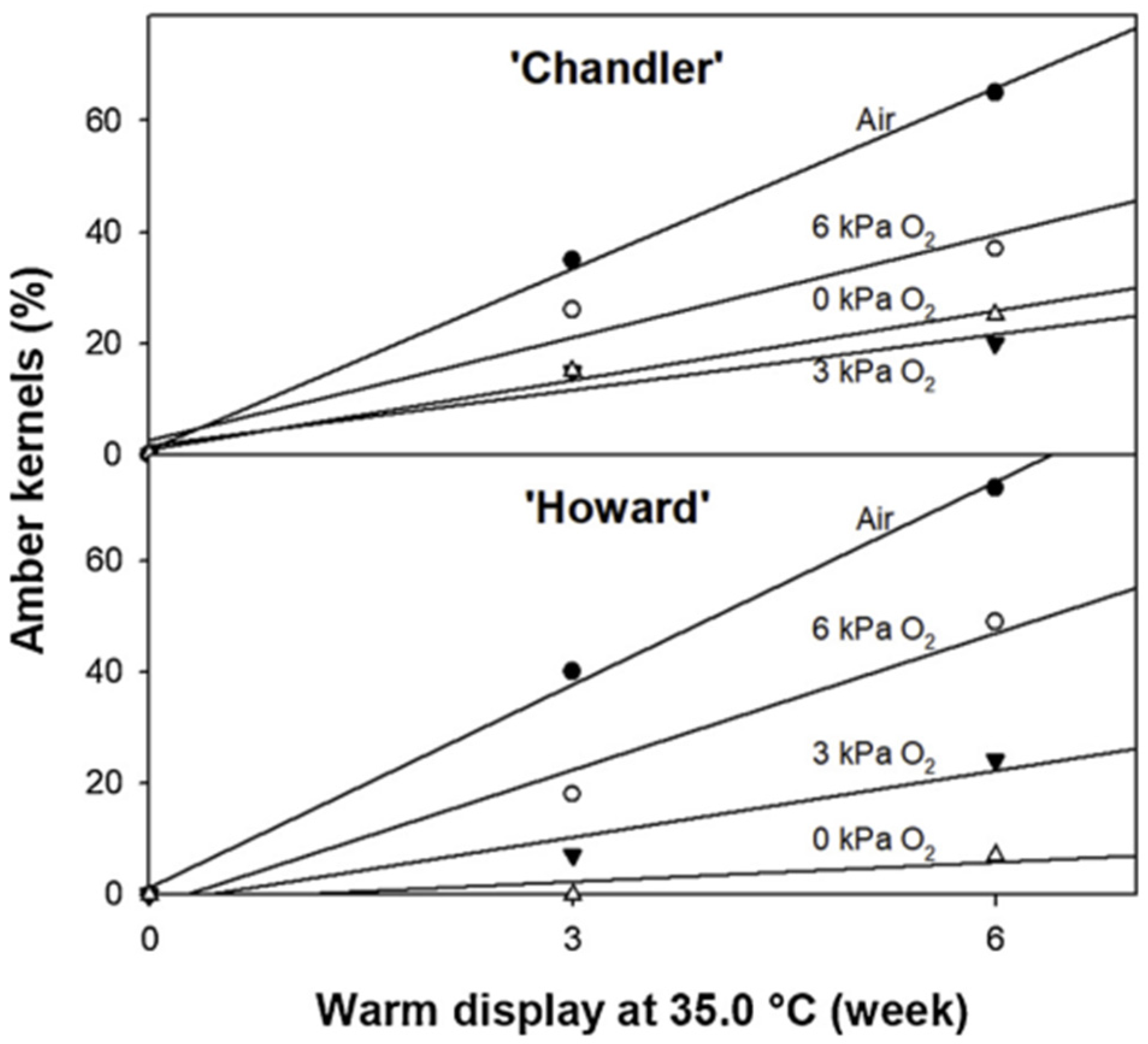
Because of the vast information on health benefits and the urbanization impact changes in eating habits, the demand for ready-to-use shelled walnuts as a convenient, healthy, and nutritious snack food is increasing all over the world. However, shelled nuts sold as halves or pieces in ‘ready-to-use’ small packages are more susceptible to pellicle darkening and rancidity than their in-shell equivalents. Currently, about two-thirds of the USA crop is exported, and ~66% of these exports are sold as shelled ‘ready to use’, and its demand is increasing. Yet, this package style is generating quality challenges due to the darkening and rancidification of the kernel pellicle. Protection against kernel color quality loss and rancidity during postharvest handling, even at warm temperatures, can be accomplished at 6 kPa (%) oxygen or less for ‘Chandler’ and 3 kPa or less for ‘Howard’ and ‘Tulare’. The application of the ‘cold chain’ principle and/or low oxygen technology is unpractical for large cropping systems. Thus, a useful quality control system to rank the lots based on their potential visual and sensory quality is important. Then, the lots can be selected based on their potential quality, match market destinations, and are subjected to proper postharvest technologies.
Keywords: consumer quality; pellicle darkening; in-shell; rancidity; health benefits; shelling damage; cold chain; quality control consumer quality; pellicle darkening; in-shell; rancidity; health benefits; shelling damage; cold chain; quality control