Article

Effect of Different Biological and Organic Fertilizer Sources on the Quantitative and Qualitative Traits of Cephalaria syriaca
1
Department of Plant Production and Genetics, Faculty of Agriculture, Urmia University, Urmia 5756151818, Iran
2
Institute of Bioproduct Development (IBD), Universiti Teknologi Malaysia (UTM), Johor Bahru 81310, Malaysia
3
School of Chemical and Energy Engineering, Universiti Teknologi Malaysia (UTM), Johor Bahru 81310, Malaysia
4
City of Scientific Research and Technology Applications (SRTA), New Borg Al Arab 21934, Egypt
5
Department of Microbiology, PSGVP Mandal’s Arts, Science, and Commerce College, Shahada 425409, India
*
Author to whom correspondence should be addressed.
Horticulturae 2021, 7(10), 397; https://doi.org/10.3390/horticulturae7100397

Submission received: 14 September 2021 / Revised: 7 October 2021 / Accepted: 10 October 2021 / Published: 13 October 2021

Abstract

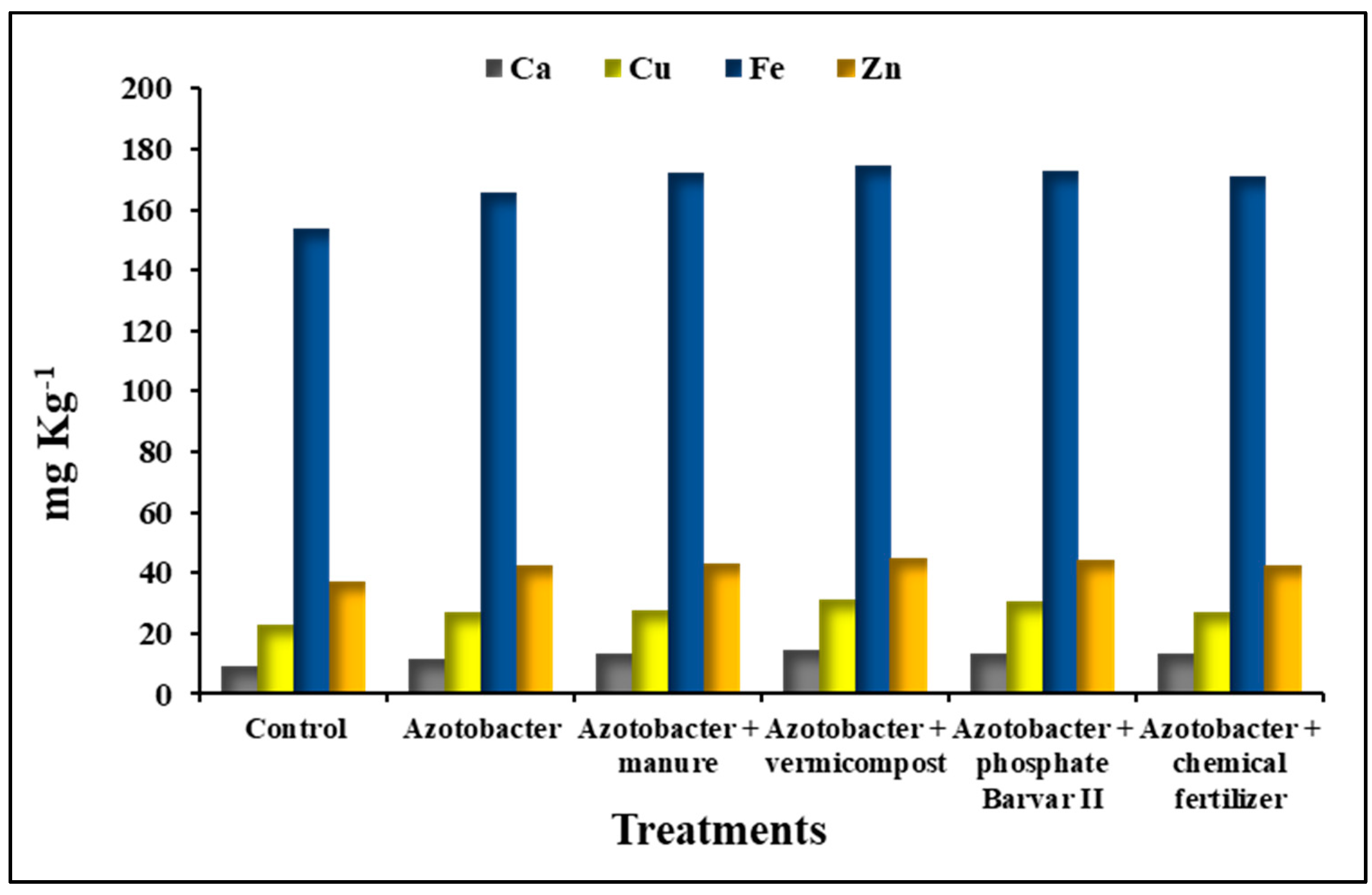
Due to the potential to enhance soil productivity and plant growth, biological fertilizers have recently been considered an alternative source for soil, water, and crop-contaminating chemical fertilizers in sustainable agriculture. The importance of different fertilizer sources on quantitative and qualitative traits of Syrian cephalaria (Cephalaria syriaca L.) was explored in an experiment based on a randomized complete block design during the 2015–2016 growing season. The maximum grain yield (9.97 g/plant) and biological yield (24.57 g/plant) were obtained from the application of Azotobacter + chemical fertilizer treatment, but the maximum oil percentage (25.23%) and oil yield (2.41 g/plant) were observed in the plants treated with Azotobacter + vermicompost. The plants treated with Azotobacter + chemical fertilizer exhibited the highest 1000 seed weight (15.03 g). Application of Azotobacter + vermicompost increased chlorophylls a, b, and total by 2.06, 1.96, and 4.02% versus Azotobacter treatment alone, respectively. The treatment of Azotobacter + manure increased total phenol, flavonoids, and DPPH antioxidant activity by 27.89, 0.56, and 53.16% versus the treatment of Azotobacter + chemical fertilizer. The integrated application of different fertilizer sources had an optimal effect on the uptake of trace elements (Cu, Fe, and Zn) so that the treatment of Azotobacter + vermicompost increased their concentrations. Due to the positive effect of integrated application of different fertilizer sources on improving the studied traits of Cephalaria, it is recommended to replace chemical fertilizers with combined fertilizers including organic and biological inputs to enhance the efficiency of crops, reduce environmental pollution, and move towards sustainable agriculture.
Keywords: antioxidant activity; biological fertilizers; Cephalaria syriaca L.; sustainable agriculture; trace elements antioxidant activity; biological fertilizers; Cephalaria syriaca L.; sustainable agriculture; trace elements