Article

Comparative GC–MS Analysis of Volatiles in Different Organs of Thymbra capitata (L.) Cav.: Effects of Analytical Method and Drying


by
Lumír Ondřej Hanuš
Institute for Drug Research, School of Pharmacy, Faculty of Medicine, Hebrew University, Ein Kerem Campus, Jerusalem 91120, Israel
Horticulturae 2026, 12(8), 952; https://doi.org/10.3390/horticulturae12080952
Submission received: 4 July 2026 / Revised: 24 July 2026 / Accepted: 27 July 2026 / Published: 2 August 2026
(This article belongs to the Section Medicinals, Herbs, and Specialty Crops)

Abstract

Thymbra capitata (L.) Cav. is an aromatic Mediterranean species widely used as a culinary herb and valued for its medicinal properties. The present study investigated the volatile composition of different plant organs (petals, sepals, leaves, and roots) collected in Jerusalem, Israel, using three complementary GC-MS approaches: solvent extraction (Liq), static headspace (HS), and solid-phase microextraction (SPME). The influence of air-drying on volatile composition was also evaluated. Among the analytical methods tested, HS provided the broadest volatile profile with 57 identified compounds, whereas Liquid extraction yielded the highest relative abundances of thymol and carvacrol. SPME proved particularly effective for the detection of sesquiterpenes, especially β-caryophyllene. The volatile profiles differed considerably among plant organs. Floral and vegetative aerial parts were characterized by high proportions of p-cymene, γ-terpinene, thymol, and carvacrol, whereas roots exhibited a distinct composition dominated by α-pinene, limonene, and β-caryophyllene. Drying modified the relative abundances of several major constituents without changing the characteristic volatile profile of the species. Multivariate analysis revealed close relationships between selected aerial organs and confirmed that phenolic monoterpenes were the principal contributors to chemical variability within the plant. The results demonstrate that HS, SPME, and solvent extraction provide complementary information and together enable a comprehensive characterization of T. capitata volatiles. These findings contribute to understanding organ-specific phytochemical variability and support the selection of appropriate analytical and processing strategies for aromatic and medicinal plants.

1. Introduction

Thymbra capitata (L.) Cav. is an aromatic perennial species of the family Lamiaceae widely distributed throughout the Mediterranean region. Owing to its characteristic aroma and long-standing use as a culinary herb, preservative, and medicinal plant, the species has attracted considerable scientific and industrial interest. Its biological properties are largely attributed to phenolic monoterpenes, particularly carvacrol and thymol, which contribute to antimicrobial, antioxidant, antifungal, and other bioactive effects. Consequently, T. capitata has been investigated as a potential source of natural products for food, pharmaceutical, cosmetic, and agricultural applications [1,2,3].
The chemical composition of T. capitata has been extensively studied in different Mediterranean countries, including Italy, Greece, Tunisia, Morocco, Cyprus, Spain, Palestine, and Israel. Comprehensive reviews of Thymbra and Thymus volatile constituents have further highlighted the remarkable chemical diversity of Mediterranean thyme species and their economic importance as sources of essential oils and bioactive compounds [4]. Previous investigations have consistently shown that the species is dominated by carvacrol, accompanied by varying proportions of thymol, p-cymene, γ-terpinene, β-caryophyllene, and other terpenoids. Nevertheless, considerable variability in the relative abundance of individual constituents has been reported among populations. Such differences have been related to geographical origin, ecological conditions, harvesting season, altitude, and population structure. Recent studies have further demonstrated that regional variability may affect not only volatile composition but also the biological activities of essential oils [5,6,7,8,9].
Most published studies on T. capitata have focused on essential oils obtained by hydrodistillation of aerial plant parts. In contrast, comparatively little attention has been devoted to naturally occurring volatile compounds released from specific plant organs. Although differences among flowers, flower buds, and leaves have occasionally been reported, comprehensive evaluations of organ-specific volatile profiles remain limited. While aerial organs of T. capitata have been repeatedly investigated because of their economic importance as sources of essential oils, roots remain largely unexplored. Root volatiles are increasingly recognized as key mediators of rhizosphere interactions, plant-microorganism communication, allelopathy, and below-ground defence mechanisms. Characterization of root volatiles may therefore reveal previously overlooked aspects of the chemical ecology and potential applications of the species [10,11]. Likewise, information concerning the effects of post-harvest drying on volatile composition is still scarce, despite the widespread use of dried plant material in commercial and traditional applications. Furthermore, the volatile profile obtained depends strongly on the analytical technique employed. Methods such as solvent extraction, static headspace (HS), and solid-phase microextraction (SPME) differ in their extraction mechanisms and selectivity towards compounds with different physicochemical properties and therefore may provide complementary rather than identical information [12,13,14,15].
Despite the extensive literature on the essential oil composition of Thymbra capitata, important gaps remain in our understanding of naturally emitted volatiles from individual plant organs and the influence of analytical methodology on volatile characterization. Most previous studies have focused on hydrodistilled essential oils obtained from aerial biomass, whereas organ-specific volatile emissions, particularly those from roots, have been largely neglected. Furthermore, direct comparisons among static headspace (HS), solid-phase microextraction (SPME), and solvent extraction approaches within the same plant material are scarce. Therefore, the aim of the present study was to characterize the volatile composition of petals, sepals, leaves, and roots of T. capitata collected in Jerusalem, Israel, using three complementary GC-MS approaches. Particular attention was paid to organ-specific differences, the influence of air-drying on volatile profiles, and the comparative performance of the analytical methods. By integrating organ-specific analysis with methodological comparison, this work provides new insights into the phytochemical diversity and ecological specialization of this important Mediterranean aromatic species.
To the best of our knowledge, this study provides one of the first detailed characterizations of root volatiles in T. capitata together with a direct comparison of three complementary analytical approaches.

2. Materials and Methods

2.1. Plant Material

Thymbra capitata (L.) Cav. samples (petals, sepals, leaves, and roots) were collected from a north-east-facing hillside near Ein Kerem, Jerusalem, Israel (31°45.5814′ N, 35°09.6240′ E; 624 m a.s.l.) during the flowering period (June–July 2020). The collection period was characterized by warm and dry weather conditions without precipitation and with maximum daily temperatures of approximately 26 °C. Plant identification was verified by the Hebrew University Herbarium, where a voucher specimen (HUJ-THY-2020-01) was deposited.
For drying experiments, plant material was spread in a single layer in a shaded and well-ventilated room (20 ± 2 °C, relative humidity 45–55%) for seven days. Dried samples were subsequently stored in airtight glass containers at 4 °C until analysis.
Extraction yields were not determined because HS and SPME represent equilibrium-based sampling techniques rather than exhaustive extraction methods, and the aim of the study was comparative volatile profiling.

2.2. Sample Preparation and GC–MS Analysis

Volatile compounds were analysed using three complementary approaches:
  • Liquid extraction (Liq) of dried sepals using n-hexane.
  • Static headspace analysis (HS) of fresh and dried petals, sepals, leaves, and roots.
  • Solid-phase microextraction (SPME) of dried sepals.
Dried sepals were selected for methodological comparison because they provided sufficient homogeneous material for all extraction procedures and contained abundant glandular trichomes known to accumulate volatile terpenoids. The objective of the comparison was to evaluate differences among analytical methodologies under identical sample conditions rather than to compare plant organs.
For solvent extraction, ground plant material was extracted with n-hexane (1 mg mL−1) for 30 min with occasional shaking. An aliquot of 1 μL was injected into the GC–MS system.
For HS analysis, 25 mg of plant material was incubated at 80 °C for 6 min prior to analysis. This temperature was selected to ensure efficient release of volatiles while minimizing thermal degradation.
For SPME analysis, 0.3 mg of plant material was equilibrated at 60 °C for 10 min and extracted using an SPME fiber for 10 min. Thermal desorption was performed directly in the GC injector.
Analyses were carried out using an Agilent 7890B gas chromatograph coupled to a 5977B mass selective detector and PAL3 autosampler (Agilent Technologies, Santa Clara, CA, USA). Separation was achieved on an HP-5MS UI capillary column (Agilent Technologies, Santa Clara, CA, USA) (30 m × 0.25 mm, 0.25 μm). The oven temperature program was 35 °C (5 min), increased to 150 °C at 5 °C min−1 and then to 250 °C at 15 °C min−1. Helium was used as carrier gas at a constant flow rate of 1 mL min−1. The injector temperature was 250 °C and mass spectra were recorded in EI mode at 70 eV over the m/z range 40–400.
Representative chromatograms are provided in the Supplementary Information.

2.3. Compound Identification and Quantification

Compounds were identified by comparison of mass spectra with authentic reference standards and with the NIST 17, Wiley 11, and FFNSC3 spectral libraries, together with comparison of calculated retention indices with published literature values. Retention indices were determined using a homologous series of n-alkanes (C8–C24) analysed under identical chromatographic conditions.
Relative abundances were calculated from GC peak areas and expressed as percentages of total ion current (% TIC) without application of correction factors. Only compounds showing spectral match quality ≥90% were considered identified.
Each sample was analysed in triplicate, and the replicate measurements demonstrated satisfactory analytical reproducibility. Triplicate analyses represented analytical rather than biological replicates and were performed to assess method reproducibility.

2.4. Multivariate Analysis

To explore relationships among plant organs, drying treatments, and major volatile constituents, principal component analysis (PCA) was performed using R software (version 4.2.2). Data were log-transformed prior to analysis. The proportions of variance explained by individual principal components and the loading values of major variables were evaluated.
Complete PCA loading matrices and supplementary plots are provided in the Supplementary Information.

3. Results

3.1. Comparison of Analytical Techniques

The three GC–MS approaches provided complementary information on the volatile composition of Thymbra capitata. Static headspace (HS) analysis yielded the broadest volatile profile, enabling the identification of 57 compounds, whereas SPME and liquid extraction (Liq) identified 39 and 27 compounds, respectively. Liq analysis gave the highest relative abundances of the phenolic monoterpenes thymol and carvacrol, while SPME showed enhanced sensitivity towards sesquiterpenes, particularly β-caryophyllene. The principal characteristics of the analytical approaches are summarized in Table 1.
Across all approaches, phenolic monoterpenes represented the dominant chemical group, with carvacrol and thymol accounting for the largest proportion of the detected volatiles. Despite differences in relative abundances among methods, the overall qualitative composition remained comparable.

3.2. Organ-Specific Volatile Composition

Substantial differences in volatile composition were observed among the analysed plant organs (Table 2). Aerial organs were dominated by p-cymene, γ-terpinene, thymol, and carvacrol, whereas roots exhibited a clearly distinct profile characterized by α-pinene, limonene, and β-caryophyllene. Carvacrol reached its highest relative abundance in fresh leaves (41.4%), while γ-terpinene was most abundant in fresh sepals (28.5%).
The root profile differed markedly from those of aerial tissues. While monoterpene hydrocarbons and phenolic monoterpenes predominated in flowers, sepals, and leaves, roots were enriched in α-pinene, limonene, and β-caryophyllene.

3.3. Effect of Drying

Drying modified the relative abundances of several major constituents (Table 2). In petals and sepals, relative amounts of thymol and carvacrol increased after drying, whereas γ-terpinene generally decreased. In contrast, dried leaves were characterized by substantially higher proportions of p-cymene and γ-terpinene than fresh leaves.
Despite these quantitative changes, the dominant compounds remained unchanged. Carvacrol, thymol, p-cymene, and γ-terpinene were the principal constituents of the aerial organs in both fresh and dried material, indicating preservation of the characteristic volatile profile of the species after air-drying.

3.4. Principal Component Analysis

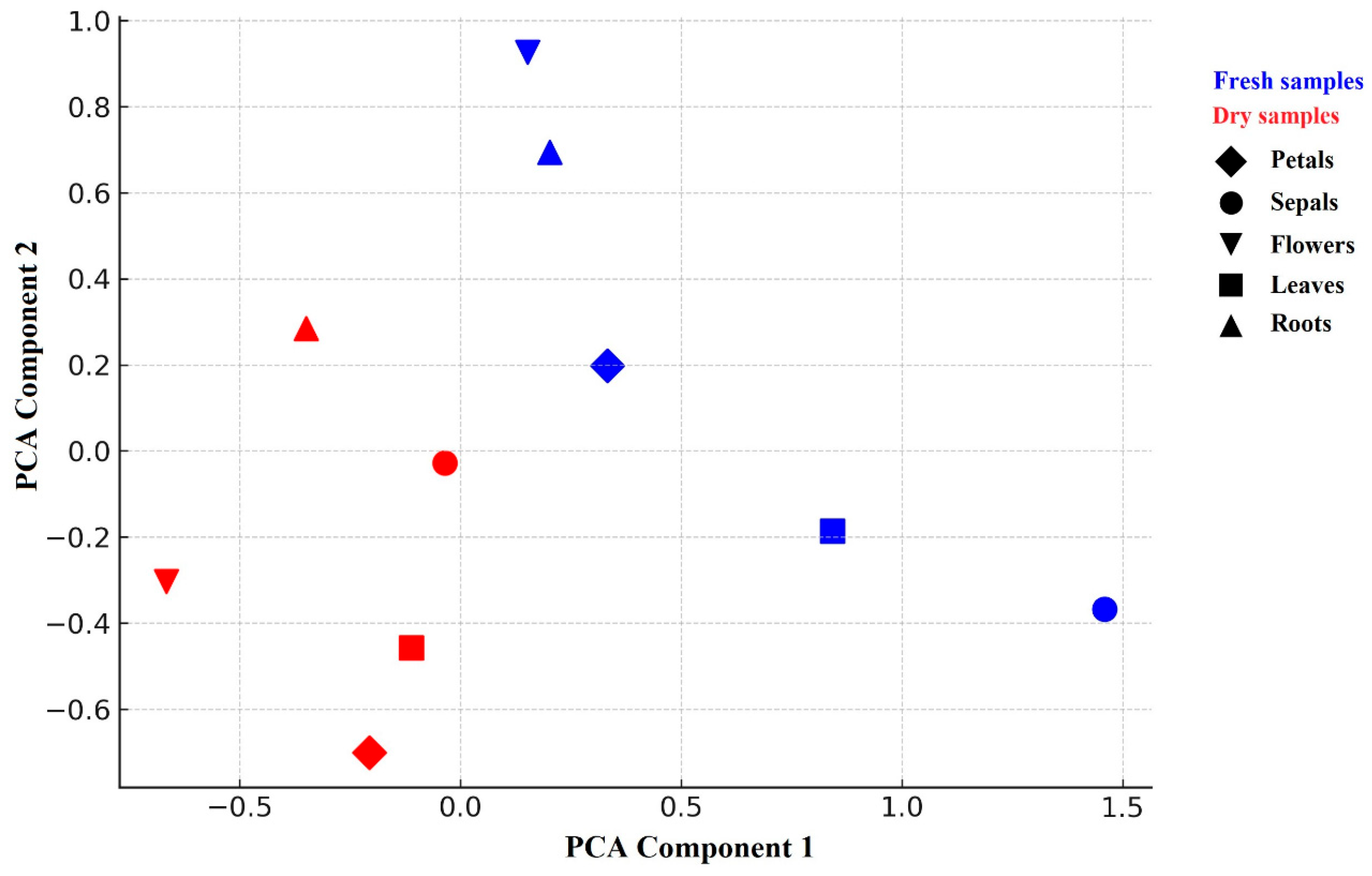
Principal component analysis (PCA) was performed to evaluate relationships among plant organs and treatments. The first two principal components explained 78.6% of the total variance, with PC1 and PC2 accounting for 55.2% and 23.4%, respectively (Figure 1).
PC1 primarily separated roots from aerial organs and was associated mainly with carvacrol, thymol, and γ-terpinene. PC2 reflected differences between fresh and dried samples and was influenced primarily by p-cymene and β-caryophyllene.
The PCA score plot revealed close relationships between dried sepals and dried leaves and between fresh petals and fresh sepals. Overall, the multivariate analysis confirmed that phenolic monoterpenes represented the major source of chemical variability within the analysed plant material.

4. Discussion

4.1. Comparison with Previous Studies

The volatile profile of Thymbra capitata observed in the present study is generally consistent with previous reports describing the species as a carvacrol-rich chemotype.
Previous studies have demonstrated substantial chemotypic variability throughout the Mediterranean region, including carvacrol-rich, thymol-rich, and mixed thymol/carvacrol chemotypes. Such variability has been reported in populations from Italy, Greece, Israel, Jordan, Tunisia, and Portugal and is generally attributed to genetic factors together with environmental influences such as habitat, altitude, climate, and developmental stage [5,6,8,12,16,17]. Reviews of Portuguese Thymbra and Thymus species further support the occurrence of marked chemical diversity among Mediterranean thyme populations [18]. The present material can be classified as belonging to a mixed thymol/carvacrol chemotype characterized by significant levels of both phenolic monoterpenes and their known biosynthetic precursors p-cymene and γ-terpinene.
Carvacrol, thymol, p-cymene, and γ-terpinene were the dominant constituents in aerial organs, in agreement with studies conducted in Italy, Tunisia, Greece, Spain, Morocco, and other Mediterranean regions. Similar compositional patterns have been reported by Miceli et al., Salas et al., Bounatirou et al., Casiglia et al., and Ben El Hadj Ali et al. [3,5,8,19,20], all of whom identified phenolic monoterpenes as the principal contributors to the volatile composition of T. capitata essential oils.
Despite the overall similarity in qualitative composition, substantial quantitative variation was observed among individual organs. Such variability has been repeatedly reported for Mediterranean populations of T. capitata and is generally attributed to differences in habitat, harvesting period, developmental stage, altitude, and population structure. The present results further demonstrate that significant differences may occur within a single plant, indicating organ-specific regulation of terpene biosynthesis and accumulation.
An important aspect of the present study is the inclusion of roots, a plant organ rarely considered in previous investigations of T. capitata. Most published studies have focused on aerial parts, flowering shoots, leaves, flowers, or essential oils obtained by hydrodistillation. In contrast, the roots analysed here exhibited a markedly different volatile profile characterized by elevated proportions of α-pinene, limonene, and β-caryophyllene and comparatively low levels of thymol and carvacrol. To the best of our knowledge, information on root volatiles of T. capitata is largely absent from the available literature. The present findings therefore extend current knowledge of organ-specific chemical specialization within the species and highlight the importance of below-ground tissues as a distinct source of volatile metabolites.

4.2. Effect of Drying on Volatile Composition

Drying is among the most frequently applied post-harvest treatments for aromatic plants and may affect volatile profiles through evaporation, oxidation, and enzymatic transformation of terpene precursors. In the present study, drying modified the relative abundances of several major constituents, particularly thymol, carvacrol, p-cymene, and γ-terpinene. Increased proportions of thymol and carvacrol in dried petals and sepals were accompanied by decreased γ-terpinene levels, a pattern that may reflect ongoing transformations within the established biosynthetic pathway linking monoterpene hydrocarbons to phenolic monoterpenes. Similar relationships have been discussed for Thymus and related Lamiaceae species.
The increase of p-cymene and γ-terpinene observed in dried leaves indicates that drying effects are organ-dependent and may be influenced by tissue organization, storage structures, and metabolic activity. Comparable drying-related shifts have been reported in studies on T. capitata and other Mediterranean aromatic plants, although the magnitude of the effect varies considerably depending on drying conditions and plant origin.
Despite these quantitative changes, the principal constituents remained unchanged. Carvacrol, thymol, p-cymene, and γ-terpinene continued to dominate the aerial organs in both fresh and dried samples, indicating preservation of the characteristic chemotype after air-drying. This observation supports the traditional use of dried T. capitata and suggests that conventional drying procedures are suitable for preserving its aromatic identity.
The observed changes in the relative abundances of p-cymene, γ-terpinene, thymol, and carvacrol are consistent with the established biosynthetic relationship among these compounds. p-Cymene and γ-terpinene are recognized intermediates in the biosynthetic pathway leading to thymol and carvacrol formation [21,22,23]. The increase in thymol and carvacrol observed in dried petals and sepals, accompanied by a decrease in γ-terpinene, may therefore reflect ongoing oxidative and enzymatic transformations during the drying process.

4.3. Methodological Considerations

The comparison of HS, SPME, and solvent extraction demonstrated that no single analytical approach fully characterizes the volatile composition of T. capitata. Instead, each technique showed a distinct selectivity towards specific groups of compounds. HS analysis provided the broadest volatile profile and the highest number of identified compounds, whereas solvent extraction enhanced the detection of less volatile phenolic monoterpenes, particularly thymol and carvacrol. In contrast, SPME showed greater sensitivity towards sesquiterpenes, especially β-caryophyllene.
These findings confirm that analytical methodology substantially influences both qualitative and quantitative representations of plant volatiles. Consequently, comparisons between published studies should always consider the extraction and sampling procedures employed. The combined application of complementary techniques therefore provides a more comprehensive characterization of volatile constituents than any single method used independently.
The present results further demonstrate that conclusions regarding volatile composition may depend strongly on the analytical approach employed. Studies based exclusively on solvent extracts or essential oils may underrepresent highly volatile constituents, whereas headspace techniques provide information more closely related to the compounds naturally emitted by living plant tissues. The combined use of complementary methods therefore offers a more comprehensive view of plant volatile chemistry.
Hydrodistillation was not included because the primary objective of this study was to characterize naturally occurring and emitted volatile compounds rather than volatile fractions generated under prolonged thermal conditions. Hydrodistillation may alter volatile composition through hydrolysis, oxidation, and thermal rearrangement reactions, whereas HS and SPME more closely reflect the compounds emitted by intact plant tissues.

4.4. Biological and Practical Implications

The predominance of carvacrol and thymol in aerial organs is consistent with the well-documented biological functions of these compounds. Phenolic monoterpenes contribute to plant defence against pathogens, herbivores, and environmental stress, while simultaneously providing the antimicrobial and antioxidant properties frequently associated with T. capitata. Their high abundance in above-ground tissues may therefore represent an adaptive advantage under Mediterranean climatic conditions.
The antimicrobial activity of thymol and carvacrol is generally attributed to disruption of microbial cell membranes, increased membrane permeability, leakage of intracellular constituents, and interference with energy metabolism. Their phenolic hydroxyl groups are considered crucial for these biological effects [2,3,24]. In addition, both compounds possess strong antioxidant activity through radical scavenging mechanisms and inhibition of oxidative chain reactions [2,23,24]. These properties explain the widespread interest in T. capitata as a source of natural preservatives, antimicrobial agents, and functional ingredients for food, pharmaceutical, and cosmetic formulations. Similar effects have been reported for Portuguese T. capitata essential oils, which exhibited strong antifungal activity against Candida, Aspergillus, and dermatophyte species. The observed fungicidal effect was associated with rapid membrane damage and increased permeability of microbial cells [17]. In addition to their antimicrobial properties, thymol and carvacrol have attracted considerable attention because of their antioxidant, anti-inflammatory, and health-promoting activities. Recent reviews have highlighted their potential applications in food preservation, functional foods, nutraceuticals, and pharmaceutical formulations, further supporting the industrial relevance of T. capitata as a rich source of bioactive phenolic monoterpenes [25].
The biological relevance of thymol and carvacrol extends beyond their ecological role in plant defence. Previous studies on Portuguese T. capitata essential oils have demonstrated significant antioxidant, anti-inflammatory, antihyperglycemic, and acetylcholinesterase inhibitory activities, supporting the pharmaceutical and functional-food potential of this species. These bioactivities have been associated primarily with phenolic monoterpenes, particularly thymol and carvacrol [26].
The marked compositional differences observed between roots and aerial organs suggest tissue-specific ecological functions and metabolic specialization. Whereas aerial tissues appear optimized for protection against environmental challenges and interactions with pollinators and herbivores, root volatiles may contribute to below-ground interactions involving microorganisms and rhizosphere processes. Further studies focusing specifically on underground tissues may therefore provide valuable insights into the ecological chemistry of T. capitata [10,11].
The clear separation of roots from aerial organs observed in the PCA suggests pronounced tissue-specific specialization of volatile metabolism. Whereas aerial organs are enriched in phenolic monoterpenes associated with protection against herbivores, pathogens, and environmental stress, root volatiles may play a role in rhizosphere interactions and below-ground ecological processes. The predominance of α-pinene, limonene, and β-caryophyllene in roots therefore points to distinct ecological functions of below-ground tissues.
Beyond food applications, thymol- and carvacrol-rich extracts have attracted increasing interest as environmentally friendly alternatives to synthetic pesticides, fungicides, and post-harvest preservatives. Their broad-spectrum antimicrobial activity may offer opportunities for crop protection and sustainable agricultural management [3,7,24].
From a practical perspective, the preservation of the characteristic volatile profile after drying is particularly important for culinary, pharmaceutical, and fragrance applications. Because air-dried material retained its dominant constituents, traditional drying methods appear suitable for maintaining the aromatic quality of the species. Furthermore, the organ-specific differences identified in this study may help guide the selection of plant material for applications requiring specific volatile compositions or biological activities.
A comprehensive comparison with previously published reports from different Mediterranean regions is provided in Table S6 of the Supplementary Information. These literature data further demonstrate the considerable chemotypic variability of Thymbra capitata across its distribution range [27,28,29,30,31,32,33,34,35,36,37,38,39,40,41,42,43,44,45,46,47,48,49,50,51,52,53,54,55,56,57,58,59].

5. Conclusions

This study provides a comprehensive characterization of volatile compounds in different organs of Thymbra capitata (L.) Cav. using three complementary GC–MS approaches: static headspace (HS), solid-phase microextraction (SPME), and solvent extraction. The results demonstrated that the analytical methods provide complementary information, with HS yielding the broadest volatile profile, solvent extraction favouring the detection of phenolic monoterpenes, and SPME enhancing the detection of sesquiterpenes.
Considerable differences in volatile composition were observed among plant organs. While petals, sepals, and leaves were dominated by p-cymene, γ-terpinene, thymol, and carvacrol, roots exhibited a distinct profile characterized mainly by α-pinene, limonene, and β-caryophyllene. To the best of our knowledge, this study provides one of the first detailed descriptions of volatile constituents in T. capitata roots, thereby extending current knowledge of organ-specific chemical specialization within the species.
Air-drying modified the relative abundances of several major constituents but did not alter the characteristic volatile profile of the species. The persistence of the dominant compounds after drying supports the suitability of traditional air-drying practices for preserving the aromatic properties of T. capitata.
Multivariate analysis confirmed clear differentiation among plant organs and identified phenolic monoterpenes as the principal contributors to chemical variability. Overall, the findings contribute to a better understanding of organ-specific phytochemical diversity in T. capitata and provide useful information for future phytochemical, ecological, and industrial applications of this important Mediterranean aromatic species.

Supplementary Materials

The following supporting information can be downloaded at: https://www.mdpi.com/article/10.3390/horticulturae12080952/s1, The Supplementary Information file includes detailed chromatograms, complete compound lists, and additional figures related to the analytical comparison of Thymbra capitata samples (Figures S1–S15 and Tables S1–S6). Figure S1: An image of the whole plant Thymbra capitata showing the parts used for analysis; Figure S2: Reaction mechanism of cyclic monoterpenes formation from geranyl diphosphate. Proposed pathway for thymol and carvacrol formation in oregano, thyme and spike lavender; Figure S3: Comparison of dry green calyxes (sepals) analysis by three GC/MS techniques—hexane extract (Liq), headspace (HS), and solid-phase microextraction (SPME); Figure S4: GC/MS chromatogram of hexane extract of dry green calyx (sepal); Figure S5: Headspace GC/MS chromatogram of dry green calyx (sepal); Figure S6: SPME GC/MS chromatogram of dry green calyx (sepal); Figure S7: Headspace GC/MS chromatogram of fresh violet flowers (petals); Figure S8: Headspace GC/MS chromatogram of dry violet flowers; Figure S9: Headspace GC/MS chromatogram of fresh calyx; Figure S10: Headspace GC/MS chromatogram of dry calyx; Figure S11: Headspace GC/MS chromatogram of fresh leaves; Figure S12: Headspace GC/MS chromatogram of dry leaves; Figure S13: Headspace GC/MS chromatogram of fresh roots; Figure S14: Comparison of major compounds in different plant parts (fresh vs. dried); Figure S15: Correlation matrix of compounds across plant parts; Table S1: Headspace analysis of fresh and dry violet flowers of Thymbra capitata; Table S2: Complete list of volatile compounds identified in dry green calyx (sepals) of Thymbra capitata; Table S3: Headspace analysis of fresh and dry green calyx (sepals) of Thymbra capitata; Table S4: Headspace analysis of fresh and dry leaves of Thymbra capitata; Table S5: Headspace analysis of the fresh roots of Thymbra capitata; Table S6: Content of the main biogenetic constituents in Thymbra capitata in Mediterranean countries.

Funding

This research received no external funding.

Institutional Review Board Statement

The author has no ethical conflicts to disclose.

Data Availability Statement

The original contributions presented in this study are included in the article and its Supplementary Materials. Further inquiries can be directed to the corresponding author.

Acknowledgments

I would like to express my deepest appreciation to Ondřej Pospíšil for his help with statistical, correlation, and principal component analysis.

Conflicts of Interest

The author has no conflicts of interest to declare.

References

  1. Tuttolomondo, T.; Dugo, G.; Leto, C.; Cicero, N.; Tropea, A.; Virga, G.; Leone, R.; Licata, M.; La Bella, S. Agronomical and chemical characterisation of Thymbra capitata (L.) Cav. biotypes from Sicily, Italy. Nat. Prod. Res. 2015, 29, 1289–1299. [Google Scholar] [PubMed]
  2. Aanniz, T.; Elouafy, Y.; Bouyahya, A.; Aguerd, O.; Chamkhi, I.; Ullah, R.; Ali, E.A.; Akhazzane, M.; Gallo, M.; Benali, T. Characterization of Volatile Compounds and Biological Effects Capacities of Moroccan Thymus capitatus L., Essential Oils: In Vitro and In Silico Approaches. Chem. Biodiv. 2025, 22, e202403501. [Google Scholar]
  3. Bounatirou, S.; Smiti, S.; Miguel, M.G.; Faleiro, L.; Rejeb, M.N.; Neffati, M.; Costa, M.M.; Figueiredo, A.C.; Barroso, J.G.; Pedro, L.G. Chemical composition, antioxidant and antibacterial activities of the essential oils isolated from Tunisian Thymus capitatus Hoff. et Link. Food Chem. 2007, 105, 146–155. [Google Scholar] [CrossRef] [Scilit]
  4. Figueiredo, A.C.; Barroso, J.G.; Pedro, L.G. Volatiles from Thymbra and Thymus species of the Western Mediterranean Basin, Portugal and Macaronesia. Nat. Prod. Commun. 2010, 5, 1465–1476. [Google Scholar] [CrossRef] [Scilit]
  5. Miceli, A.; Negro, C.; Tommasi, L. Essential oil variability in Thymbra capitata (L.) Cav. Growing wild in Southern Apulia (Italy). Biochem. Syst. Ecol. 2006, 34, 528–535. [Google Scholar] [CrossRef] [Scilit]
  6. Karousou, R.; Koureas, D.N.; Kokkini, S. Essential oil composition is related to the natural habitats: Coridothymus capitatus and Satureja thymbra in NATURA 2000 sites of Crete. Phytochemistry 2005, 66, 2668–2673. [Google Scholar] [CrossRef] [Scilit] [PubMed]
  7. Tammar, S.; Salem, N.; Rebey, I.B.; Sriti, J.; Hammami, M.; Khammassi, S.; Marzouk, B.; Ksouri, R.; Msaada, K. Regional effect on essential oil composition and antimicrobial activity of Thymus capitatus L. J. Essent. Oil Res. 2019, 31, 129–137. [Google Scholar] [CrossRef] [Scilit]
  8. Ben El Hadj Ali, I.; Arbi, G.; Mohamed, B. Variation of Volatiles in Tunisian Populations of Thymbra capitata (L.) Cav. (Lamiaceae). Chem. Biodiv. 2012, 9, 1272–1285. [Google Scholar] [CrossRef] [Scilit] [PubMed]
  9. Jaradat, N.; Barkat, A.; Khasati, A.; Abualhasan, M. Variations of the chemical components and biological activities of Thymus capitatus essential oil from three regions in Palestine. Sci. Rep. 2025, 15, 16305. [Google Scholar] [CrossRef] [Scilit] [PubMed]
  10. Wenke, K.; Kai, M.; Piechulla, B. Belowground volatiles facilitate interactions between plant roots and soil organisms. Planta 2010, 231, 499–506. [Google Scholar] [CrossRef] [Scilit] [PubMed]
  11. Delory, B.M.; Delaplace, P.; Fauconnier, M.-L.; du Jardin, P. Root-emitted volatile organic compounds: Can they mediate belowground plant-plant interactions? Plant Soil 2016, 402, 1–26. [Google Scholar] [CrossRef] [Scilit]
  12. Tawaha, K.A.; Hudaib, M.M. Chemical Composition of the Essential Oil from Flowers, Flower Buds and Leaves of Thymus capitatus Hoffmanns. & Link from Jordan. J. Essent. Oil-Bear. Plants 2012, 15, 988–996. [Google Scholar] [CrossRef] [Scilit]
  13. Moukhles, A.; Ibn Mansour, A. The effect of drying time on the yield and the chemical composition of essential oil and dissolved oil in hydrolat from aerial parts of Moroccan Thymbra capitata (L.) Cav. Mediterr. J. Chem. 2020, 10, 716–722. [Google Scholar] [CrossRef] [Scilit]
  14. Condurso, C.; Verzera, A.; Ragusa, S.; Tripodi, G.; Dima, G. Volatile composition of Italian Thymus capitatus (L.) Hoffmanns. et Link leaves. J. Essent. Oil Res. 2013, 25, 239–243. [Google Scholar] [CrossRef] [Scilit]
  15. Hedhili, L.; Romdhane, M.; Planche, H.; Abderrabba, M. Towards gas chromatography–mass spectrometry coupling protocols for both identifying and quantification essential oils of Thymus capitatus Hoff et Link. J. Chromatogr. A 2005, 1064, 129–134. [Google Scholar] [CrossRef] [Scilit] [PubMed]
  16. Fleisher, Z.; Fleisher, A. Volatiles of Coridothymus capitatus Chemotypes Growing in Israel: Aromatic Plants of the Holy Land and the Sinai. Part XV. J. Essent. Oil Res. 2002, 14, 105–106. [Google Scholar] [CrossRef] [Scilit]
  17. Salgueiro, L.R.; Pinto, E.; Gonçalves, M.J.; Pina-Vaz, C.; Cavaleiro, C.; Rodrigues, A.G.; Palmeira, A.; Tavares, C.; Costa-de-Oliveira, S.; Martinez-de-Oliveira, J. Chemical composition and antifungal activity of the essential oil of Thymbra capitata. Planta Med. 2004, 70, 572–575. [Google Scholar] [CrossRef] [Scilit] [PubMed]
  18. Figueiredo, A.C.; Barroso, J.G.; Pedro, L.G.; Salgueiro, L.; Miguel, M.G.; Faleiro, M.L. Portuguese Thymbra and Thymus species volatiles: Chemical composition and biological activities. Curr. Pharm. Des. 2008, 14, 3120–3140. [Google Scholar] [CrossRef] [Scilit] [PubMed]
  19. Salas, J.B.; Téllez, T.R.; Alonso, M.J.P.; Pardo, F.M.V.; de los Ángeles Cases Capdevila, M.; Rodríguez, C.G. Chemical composition and antioxidant activity of the essential oil of Thymbra capitata (L.) Cav. in Spain. Acta Bot. Gall. 2010, 157, 55–63. [Google Scholar] [CrossRef] [Scilit]
  20. Casiglia, S.; Bruno, M.; Scandolera, E.; Senatore, F.; Senatore, F. Influence of harvesting time on composition of the essential oil of Thymus capitatus (L.) Hoffmanns. & Link. growing wild in northern Sicily and its activity on microorganisms affecting historical art crafts. Arab. J. Chem. 2019, 12, 2704–2712. [Google Scholar] [CrossRef] [Scilit]
  21. Granger, R.; Passet, J.; Verdier, R. Le γ-terpinene, precurceur du p-cymene dans Thymus vulgaris. L. (γ-Terpinene, precursor of p-cymene in Thymus vulgaris L.). C. R. Acad. Sci. 1964, 258, 5539–5541. [Google Scholar]
  22. Crocoll, C. Biosynthesis of the Phenolic Monoterpenes, Thymol and Carvacrol, by Terpene Synthases and Cytochrome P450s in Oregano and Thyme. Doctoral Dissertation, Biological-Pharmaceutical Faculty, Friedrich Schiller University Jena, Jena, Germany, 2010; 143p. [Google Scholar]
  23. Mendoza-Poudereux, I.; Kutzner, E.; Huber, C.; Segura, J.; Arrillaga, I.; Eisenreich, W. Dynamics of Monoterpene Formation in Spike Lavender Plants. Metabolites 2017, 7, 65. [Google Scholar] [CrossRef] [Scilit] [PubMed]
  24. Faleiro, L.; Miguel, G.; Gomes, S.; Costa, L.; Venancio, F.; Teixeira, A.; Figueiredo, A.C.; Barroso, J.G.; Pedro, L.G. Antibacterial and antioxidant activities of essential oils isolated from Thymbra capitata L. (Cav.) and Origanum vulgare L. J. Agric. Food Chem. 2005, 53, 8162–8168. [Google Scholar] [CrossRef] [Scilit] [PubMed]
  25. Alves-Silva, J.M.; Pedreiro, S.; Cavaleiro, C.; Cruz, M.T.; Figueirinha, A.; Salgueiro, L. Effect of Thymbra capitata (L.) Cav. on Inflammation, Senescence and Cell Migration. Nutrients 2023, 15, 1930. [Google Scholar] [CrossRef] [Scilit] [PubMed]
  26. Aazza, S.; El-Guendouz, S.; Miguel, M.G.; Antunes, M.D.; Faleiro, M.L.; Correia, A.I.; Figueiredo, A.C. Antioxidant, Anti-inflammatory and Anti-hyperglycaemic Activities of Essential Oils from Thymbra capitata, Thymus albicans, Thymus caespititius, Thymus carnosus, Thymus lotocephalus and Thymus mastichina from Portugal. Nat. Prod. Commun. 2016, 11, 1029–1038. [Google Scholar] [CrossRef] [Scilit]
  27. Degenhardt, J.; Köllner, T.G.; Gershenzon, J. Monoterpene and sesquiterpene synthases and the origin of terpene skeletal diversity in plants. Phytochemistry 2009, 70, 1621–1637. [Google Scholar] [CrossRef] [Scilit] [PubMed]
  28. Russo, M.; Suraci, F.; Postorino, S.; Serra, D.; Roccotelli, A.; Agosteo, G.E. Essential oil chemical composition and antifungal effects on Sclerotium cepivorum of Thymus capitatus wild populations from Calabria, southern Italy. Braz. J. Pharmacogn. 2013, 23, 239–248. [Google Scholar] [CrossRef] [Scilit]
  29. Manconi, M.; Petretto, G.; D’hallewin, G.; Escribano, E.; Milia, E.; Pinna, R.; Palmieri, A.; Firoznezhad, M.; Peris, J.E.; Usach, I.; et al. Thymus essential oil extraction, characterization and incorporation in phospholipid vesicles for the antioxidant/antibacterial treatment of oral cavity diseases. Colloids Surf. B 2018, 171, 115–122. [Google Scholar] [CrossRef] [Scilit] [PubMed]
  30. Arras, G.; Grella, G.E. Wild thyme, Thymus capitatus, essential oil seasonal changes and antimycotic activity. J. Hortic. Sci. 1992, 67, 197–202. [Google Scholar] [CrossRef] [Scilit]
  31. Cosentino, S.; Tuberoso, C.I.G.; Pisano, B.; Satta, M.; Mascia, V.; Arzedi, E.; Palmas, F. In-vitro antimicrobial activity and chemical composition of Sardinian Thymus essential oils. Lett. Appl. Microbiol. 1999, 29, 130–135. [Google Scholar] [CrossRef] [Scilit] [PubMed]
  32. Napoli, E.M.; Curcuruto, G.; Ruberto, G. Screening of the essential oil composition of wild Sicilian thyme. Biochem. Syst. Ecol. 2010, 38, 816–822. [Google Scholar] [CrossRef] [Scilit]
  33. Goncalves, J.C.R.; de Meneses, D.A.; de Vasconcelos, A.P.; Piauilino, C.A.; Almeida, F.R.d.C.; Napoli, E.M.; Ruberto, G.; de Araújo, D.A.M. Essential oil composition and antinociceptive activity of Thymus capitatus. Pharm. Biol. 2017, 55, 782–786. [Google Scholar] [CrossRef] [Scilit] [PubMed]
  34. Salama, M.M.; Taher, E.E.; El-Bahy, M.M. Molluscicidal and mosquitocidal activities of the essential oils of Thymus capitatus Hoff. et Link. and Marrubium vulgare L. Rev. Inst. Med. Trop. São Paulo 2012, 54, 281–286. [Google Scholar] [CrossRef] [Scilit] [PubMed]
  35. Goren, A.C.; Bilsel, G.; Mine, M.; Demir, H.; Kocabas, E.E. Analysis of Essential Oil of Coridothymus capitatus (L.) and Its Antibacterial and Antifungal Activity. Z. Naturforsch. 2003, 58c, 687–690. [Google Scholar] [CrossRef] [Scilit] [PubMed]
  36. Hanoglu, A.; Hanoglu, D.Y.; Demirci, B.; Yavuz, D.Ö. Chemical Composition of Essential Oil of the Aerial Parts of Wild Growing Thymus capitatus (L.) Hoffm. & Link Species Collected from Three Different Locations in Northen Cyprus. J. Essent. Oil Bear. Plants 2017, 20, 546–551. [Google Scholar] [CrossRef] [Scilit]
  37. El-Jalel, L.F.A.; Elkady, W.M.; Gonaid, M.H.; El-Gareeb, K.A. Difference in chemical composition and antimicrobial activity of Thymus capitatus L. essential oil at different altitudes. Future J. Pharm. Sci. 2018, 4, 156–160. [Google Scholar] [CrossRef] [Scilit]
  38. Marin, M.; Novakovic, M.; Vuckovic, I.; Teševic, V.; Kolarevic, S.; Vukovic-Gacic, B. Wild Thymus capitatus Hoff. Et Link. Chemical Composition, Antioxidant and Antimicrobial Activities of the Essential Oil. J. Essent. Oil Bear. Plants 2018, 21, 388–399. [Google Scholar] [CrossRef] [Scilit]
  39. Tateo, F.; Mariotti, M.; Bononi, M. Essential Oil Composition and Enantiomeric Distribution of Some Monoterpenoid Components of Coridothymus capitatus (L.) Rchb. Grown on the Island of Kos (Greece). J. Essent. Oil Res. 1998, 10, 241–244. [Google Scholar] [CrossRef] [Scilit]
  40. Daferera, D.J.; Ziogas, B.S.; Polissiou, M.G. The effectiveness of plant essential oils on the growth of Botrytis cinerea, Fusarium sp. and Clavibacter michiganensis subsp. michiganensis. Crop. Prot. 2003, 22, 39–44. [Google Scholar] [CrossRef] [Scilit]
  41. Ravid, U.; Putievsky, E. Constituents of Essential Oils from Majorana syriaca, Coridothymus capitatus and Satureja thymbra. Planta Med. 1983, 49, 248–249. [Google Scholar] [CrossRef] [Scilit] [PubMed]
  42. Fleisher, A.; Fleisher, Z.; Abu-Rukun, S. Chemovarieties of Coridothymus capitatus L. Rchb. Growing in Israel. J. Sci. Food. Agric. 1984, 35, 495–499. [Google Scholar] [CrossRef] [Scilit]
  43. Delgado-Adámez, J.; Garrido, M.; Bote, M.E.; Fuentes-Pérez, M.C.; Espino, J.; Martín-Vertedor, D. Chemical composition and bioactivity of essential oils from flower and fruit of Thymbra capitata and Thymus species. J. Food Sci. 2017, 54, 1857–1865. [Google Scholar] [CrossRef] [Scilit] [PubMed]
  44. Ballester-Costa, C.; Sendra, E.; Fernández-López, J.; Pérez-Álvarez, J.A.; Viuda-Martos, M. Chemical composition and in vitro antibacterial properties of essential oils of four Thymus species from organic growth. Ind. Crops Prod. 2013, 50, 304–311. [Google Scholar] [CrossRef] [Scilit]
  45. El Ouariachi, E.M.; Paolini, J.; Bouyanzer, A.; Tomi, P.; Hammouti, B.; Salghi, R.; Majidi, L.; Costa, J. Chemical composition and antioxidant activity of essential oils and solvent extracts of Thymus capitatus (L.) Hoffmanns and link from Morocco. J. Med. Plants Res. 2011, 5, 5773–5778. [Google Scholar]
  46. Ajjouri, E.; Satrani, B.; Ghanmi, M.; Aafi, A.; Farah, A.; Rahouti, M.; Amarti, F.; Aberchane, M. Activité antifongique des huiles essentielles de Thymus bleicherianus Pomel et Thymus capitatus (L.) Hoffm. & Link contre les champignons de pourriture du bois d’oeuvre. Biotechnol. Agron. Soc. Environ. 2008, 12, 345–351. [Google Scholar]
  47. Moukhles, A.; Belcadi, H.; Raissouni, I.; Ben Driss, A.; Ibn Mansour, A. Chemical Composition, in vitro Antibacterial Activity and Corrosion Inhibition of Essential Oil and Hydrolat Extract from Aerial Parts of Thymbra capitata (L.) Cav Harvested at Northern Morocco. J. Essent. Oil Bear. Plants 2020, 23, 375–389. [Google Scholar] [CrossRef] [Scilit]
  48. Ibraliu, A.; Mi, X.; Ristić, M.; Stefanovic, Z.D.; Shehu, J. Analysis of essential oils of three wild medicinal plants in Albania. J. Med. Plants Res. 2011, 5, 58–62. [Google Scholar] [CrossRef]
  49. Achour, S.; Khelifi, E.; Attia, Y.; Ferjani, E.; Hellal, A.N. Concentration of Antioxidant Polyphenols from Thymus capitatus extracts by Membrane Process Technology. J. Food Sci. 2012, 77, C703–C709. [Google Scholar] [CrossRef] [Scilit] [PubMed]
  50. Zaïri, A.; Nouir, S.; Zarrouk, A.; Haddad, H.; Khélifa, A.; Achour, L.; Tangy, F.; Chaouachi, M.; Trabelsi, M. Chemical composition, Fatty acids profile and Biological properties of Thymus capitatus (L.) Hoffmanns, essential Oil. Sci. Rep. 2019, 9, 20134. [Google Scholar] [CrossRef] [Scilit] [PubMed]
  51. Abessi, M.; Yahyaoui, M.; Bachrouch, O.; Chihi, B.; Abderrabba, M. GC-MS identification and in vitro evaluation of antioxidant activity of bioactive molecules extracted from Mentha pulegium L. and Thymus capitatus native to Tunisia. Pharm. Chem. J. 2018, 5, 1–8. [Google Scholar]
  52. Hedhili, L.; Romdhane, M.; Abderrabba, A.; Planche, H.; Cherif, I. Variability in essential oil composition of Tunisian Thymus capitatus (L.) Hoffmanns. et Link. Flavour Fragr. J. 2002, 17, 26–28. [Google Scholar] [CrossRef] [Scilit]
  53. Bounatirou, S.; Smiti, S.; Miguel, M.; Faleiro, L.; Rejeb, M.; Neffati, M.; Costa, M.; Figueiredo, A.; Barroso, J.; Pedro, L. Thermal stability of the essential oils isolated from Tunisian Thymus capitatus Hoff. et Link.: Effect on the chemical composition and the antioxidant and antibacterial activities. Acta Aliment. 2010, 39, 299–307. [Google Scholar] [CrossRef] [Scilit]
  54. Mounira, G.M.; Mehrez, R.; Ibrahim, H.; Monia, E.; Ahmed, L.; Florence, M.; Jalloul, B. Essential Oil of Thymus capitatus Hoff. et Link. from Matmata, Tunisia: Gas Chromatography-Mass Spectrometry Analysis and Antimicrobial and Antioxidant Activities. J. Med. Food 2010, 13, 1500–1504. [Google Scholar] [CrossRef] [Scilit] [PubMed]
  55. Saoud, I.; Hamrouni, L.; Gargouri, S.; Amri, I.; Hanana, M.; Fezzani, T.; Bouzid, S.; Jamoussi, B. Chemical composition, weed killer and antifungal activities of Tunisian thyme (Thymus capitatus Hoff. et Link.) essential oils. Acta Aliment. 2013, 42, 417–427. [Google Scholar] [CrossRef] [Scilit]
  56. Aouadhi, C.; Hanene, G.; Sana, D.; Sebei, H.; Hasnaoui, B.; Maaroufi, A. Comparison of Chemical Composition, Antioxidant and Antimicrobial Activities of Thymus capitatus L. essential Oils from two Tunisian localities (Sousse and Bizerte). Intern. J. Agron. Plant Prod. 2013, 4, 1772–1781. [Google Scholar]
  57. Bouzouita, N.; Kachouri, F.; Hamdi, M.; Chaabouni, M.M. Antimicrobial activity of essential oils from Tunisian aromatic plants. Flavour Fragr. J. 2003, 18, 380–383. [Google Scholar] [CrossRef] [Scilit]
  58. Yvon, Y.; Raoelison, E.G.; Razafindrazaka, R.; Randriantsoa, A.; Romdhane, M.; Chabir, N.; Mkaddem, M.G.; Bouajila, J. Relation between chemical composition or antioxidant activity and antihypertensive activity for six essential oils. J. Food Sci. 2012, 77, H184–H191. [Google Scholar] [CrossRef] [Scilit] [PubMed]
  59. Miguel, M.G.; Figueiredo, A.C.; Costa, M.M.; Martins, D.; Duarte, J.; Barroso, J.G.; Pedro, J.L. Effect of the volatile constituents isolated from Thymus albicans, Th. mastichina, Th. carnosus and Thymbra capitata in sunflower oil. Nahrung 2003, 47, 397–402. [Google Scholar] [CrossRef] [Scilit] [PubMed]
Figure 1. PCA score plot of volatile profiles of different organs of Thymbra capitata. PC1 and PC2 explain 55.2% and 23.4% of the total variance, respectively.
Horticulturae 12 00952 g001
Table 1. Comparison of analytical methods used for volatile profiling of Thymbra capitata.
TechniqueCompounds IdentifiedMajor Compounds (% Mean)Main Characteristic
Liq 27Carvacrol (46.2), Thymol (24.3), β-Caryophyllene (6.1) Highest response for phenolic monoterpenes
HS 57p-Cymene (19.2), γ-Terpinene (16.8), Thymol (12.8) Broadest compound coverage
SPME 39Carvacrol (34.2), Thymol (19.6), β-Caryophyllene (16.9) Enhanced detection of sesquiterpenes
Table 2. Major volatile compounds (%) in different organs of Thymbra capitata. determined by HS-GC/MS.
Compound Fresh
Petals
Dry
Petals
Fresh
Sepals
Dry
Sepals
Fresh
Leaves
Dry
Leaves
Roots
α-Thujene 7.595.2710.235.061.583.27
α-Pinene 2.621.445.401.151.341.5413.13
β-Myrcene 4.953.056.093.581.803.163.24
α-Terpinene 6.883.759.944.641.463.68
p-Cymene 12.8311.9413.3319.2214.9932.020.71
γ-Terpinene 22.5517.3928.4916.815.7815.33
Linalool 0.351.890.171.010.721.35
Thymol 7.3611.172.6312.7617.388.72
Carvacrol 15.1727.194.6724.5441.4320.701.46
β-Caryophyllene 2.865.990.971.812.121.089.56
Limonene 9.80
Disclaimer/Publisher’s Note: The statements, opinions and data contained in all publications are solely those of the individual author(s) and contributor(s) and not of MDPI and/or the editor(s). MDPI and/or the editor(s) disclaim responsibility for any injury to people or property resulting from any ideas, methods, instructions or products referred to in the content.