Article

Functional Identification of Apple MdCBL5 in Improving Fruit Quality and Its Response Under Salt Stress

1
National Research Center for Apple Engineering and Technology, Shandong Collaborative Innovation Center of Fruit & Vegetable Quality and Efficient Production, College of Horticulture Science and Engineering, Shandong Agricultural University, Tai’an 271018, China
2
Haidu College, Qingdao Agricultural University, No. 11, Wenhua Road, Laiyang 265200, China
*
Authors to whom correspondence should be addressed.
These authors contributed equally to this work.
Horticulturae 2026, 12(7), 845; https://doi.org/10.3390/horticulturae12070845

Submission received: 2 June 2026 / Revised: 8 July 2026 / Accepted: 9 July 2026 / Published: 10 July 2026

Abstract

Calcineurin B-like (CBL) proteins are plant-specific calcium sensors critical for ion homeostasis and stress tolerance. Here, seven MdCBL genes were genome-wide identified in apple (Malus domestica). We conducted systematic bioinformatic profiling of their physicochemical features, subcellular localization, cis-regulatory elements, phylogeny, secondary structures, phosphorylation sites, and functional annotations and further verified the salt-stress regulatory function of MdCBL5 via transgenic tests. MdCBL proteins contain 210–246 amino acids, with molecular weights of 24,196.73–28,283.39 Da, pI values of 4.63–4.97 and instability indices of 37.12–49.20. Localization prediction placed these proteins in nuclei, cytosol and chloroplasts. Their promoter regions are rich in hormone-responsive (auxin, ABA, salicylic acid) and stress-responsive (cold, drought, salt) cis-elements. Phylogenetic clustering divided MdCBLs into five subgroups (A–E) with high homology to Arabidopsis CBLs. Random coils and α-helices dominate their secondary structures, and serine residues constitute most phosphorylation sites. Functional annotation supports their involvement in calcium signaling, ion transport and diverse stress adaptation. Salt stress experiments have confirmed that MdCBL5 may enhance apple salt resistance by promoting MdSOS gene expression. Meanwhile, transient transformation in apple fruit showed that MdCBL5 can effectively enhance fruit quality traits. Collectively, this study establishes a theoretical foundation for further elucidating the biological functions of the apple MdCBL5 gene and provides valuable insights for genetically improving stress resistance and fruit quality in apple via molecular breeding strategies.

1. Introduction

As one of the world’s leading apple-producing countries, China’s apple industry plays a pivotal role in improving people’s living standards and promoting poverty alleviation and prosperity for farmers in poverty-stricken mountainous areas. Nevertheless, diverse abiotic stresses such as drought, cold, salinity and chilling damage have emerged as primary constraints restricting apple yield and fruit quality improvement in recent years [1,2,3]. Among these abiotic stresses, soil salinization, particularly secondary salinization, is highly prevalent and exerts profound detrimental effects. In secondary salinized soils, only a small proportion of soil-applied chemical fertilizers can be absorbed and utilized by fruit trees, while the vast majority is either leached away with percolating water or immobilized in the soil [4,5]. Consequently, secondary salinization not only reduces the survival rate of fruit trees but also drives substantial declines in both yield and fruit quality, directly undermining the economic returns of fruit growers. The Bohai Rim region, one of the major apple-producing regions in China, is facing increasingly severe soil salinization. This phenomenon is primarily attributed to spring drought, rapid temperature increases, and strong evaporation, combined with excessive fertilizer application. However, the limited mechanistic understanding of plant abiotic stress responses has long hindered progress in stress-tolerant breeding. At present, optimized water management practices remain the mainstream strategy for mitigating soil salinization in orchard systems. Accordingly, dissecting the driving mechanisms of soil salinization and elucidating the salt tolerance pathways in apple trees will lay a solid theoretical foundation for alleviating salinization constraints via targeted genetic improvement and breeding strategies.
In the intricate signaling network mediating plant responses to abiotic stress, Ca2+ serve as indispensable second messengers and act as a central hub that transduces extracellular stress stimuli into intracellular defense cascades. Their intracellular homeostasis and dynamic fluctuations fulfill an indispensable role in governing plant stress tolerance [6]. Three major classes of core calcium receptor proteins have been discovered and identified in plants, namely calmodulin (CaM), calcium-dependent protein kinase (CDPK), and calcineurin B-like protein (CBL) [7,8,9]. Although all three classes of Ca2+-binding receptor proteins specifically Ca2+ and mediating signal transduction, they display pronounced divergence in structural architecture and functional mechanisms. Calmodulin (CaM) represents a family of small, acidic proteins devoid of intrinsic enzymatic activity. Upon Ca2+ binding, CaM undergoes a distinct conformational change, which allows it to interact with downstream target proteins (including protein kinases, phosphatases, transcription factors, and others) and modulate their activities [10,11,12]. By contrast, calcium-dependent protein kinases (CDPKs) harbor both a Ca2+-binding regulatory domain and a catalytic kinase domain. Upon Ca2+ binding, CDPKs undergo autoactivation and directly phosphorylate downstream substrates, enabling rapid propagation of stress signals [9,13,14]. A defining property of calcineurin B-like (CBL) proteins is the absence of intrinsic kinase activity.Instead, they depend on physical interaction with their cognate downstream partners, CBL-interacting protein kinases (CIPKs), to assemble functional CBL–CIPK complexes and trigger downstream signaling cascades [15,16,17,18].
Among the three major calcium signaling pathways, the CBL-CIPK complex-mediated pathway has emerged as a pivotal signaling module governing abiotic stress responses, owing to its high signaling specificity and broad involvement in diverse stress adaptation processes [15,17]. CBL family members harbor EF-hand Ca2+-binding domains with variable copy numbers and distinct sequence properties. These structural distinctions underpin the divergent Ca2+-binding affinity and specificity of individual CBL isoforms, laying the molecular foundation for the precise perception of stimulus-induced Ca2+ fluctuations and the initiation of distinct downstream signaling cascades [19]. The CBL gene family was first identified in Arabidopsis thaliana [20,21]. Subsequent studies have identified and characterized multiple CBL homologs across a broad range of plant species, including rice, tomato, and grape, confirming the high evolutionary conservation and widespread distribution of this gene family across the. plant kingdom [22,23,24,25,26,27]. Functional transgenic studies across diverse plant species have demonstrated that CBL genes exhibit divergent expression responses to various abiotic stresses, thereby enabling precise modulation of plant stress tolerance. Specifically, AtCBL1 from the model plant Arabidopsis thaliana displays a particularly pronounced response to low-temperature stress [20]. Ectopic expression of maize ZmCBL9 in Arabidopsis thaliana enhanced the resistance and tolerance of Arabidopsis to abscisic acid (ABA), glucose, salt stress and osmotic stress [28]. In rice, overexpression of OsCBL8 significantly improved plant resistance to high-temperature stress and pathogen infection [29]. Low-temperature treatment markedly elevated the transcription level of PsCBL in pea, whereas drought stress had no significant effect on its expression [30]. In poplar, the transcript levels of PeCBL1, PeCBL2, PeCBL4, PeCBL5 and PeCBL9 all exhibited an obvious up-regulation trend under salt stress [31].
Here, we identified MdCBL5, a novel salt stress-responsive gene from apple (Malus domestica). MdCBL5 overexpression markedly strengthens salt tolerance in apple seedlings, and transient fruit transformation assays further confirm its positive regulation on fruit quality. This work supplies a valuable gene resource and theoretical basis for molecular breeding of salt-tolerant apples with superior fruit quality.

2. Materials and Methods

2.1. Identification of the MdCBL Gene Family

Based on the amino acid sequences of Arabidopsis thaliana CBL genes, BLASTP searches were performed against the apple (Malus domestica) whole-genome database to identify homologous sequences (GDR https://www.rosaceae.org/, accessed on 1 April 2026). The sequences were further validated using the Pfam database (PF02130), and redundant sequences were removed to obtain the members of the apple MdCBL gene family [32,33].

2.2. Analysis of Basic Physicochemical Properties and Subcellular Localization

The ExPASy ProtParam tool (http://web.expasy.org/protparam/, accessed on 1 April 2026) was used to analyze the basic physicochemical properties of proteins encoded by MdCBL genes, including the number of amino acids, molecular weight, theoretical isoelectric point (pI), instability index, aliphatic index, and grand average of hydropathicity (GRAVY). Subcellular localization was predicted via the online tool Wolf PSORT (https://www.genscript.com/wolf-psort.html, accessed on 1 April 2026).

2.3. Analysis of Cis-Acting Elements and Phylogenetic Relationships

The 2000 bp sequences upstream of the start codon of MdCBL genes were extracted, and cis-acting elements were analyzed using the PlantCARE database (http://bioinformatics.psb.ugent.be/webtools/plantcare/html/, accessed on 1 April 2026). Phylogenetic analysis was conducted based on the amino acid sequences of A. thaliana CBL genes and apple MdCBL genes. A phylogenetic tree was constructed using the neighbor-joining (NJ) method in MEGA software mega11 with 1000 bootstrap replicates [34].

2.4. Protein Structure and Phosphorylation Site Analysis

The secondary structure of MdCBL proteins (including α-helix, β-turn, extended strand, and random coil) was predicted using the SOPMA tool [35]. The tertiary structure of the proteins was generated by AlphaFold [36]. Phosphorylation sites (serine, threonine, and tyrosine residues) were analyzed using the NetPhos tool [37].

2.5. Determination of Physiological Indicators

The contents of malondialdehyde (MDA), proline, hydrogen peroxide (H2O2), superoxide anion (O2) were determined using commercial assay kits (Beijing Boxbio Science & Technology Co., Ltd., Beijing, China). The contents of superoxide dismutase (SOD), and peroxidase (POD) were determined using commercial assay kits (BC5160, BC0090 Beijing Solarbio Science & Technology Co., Ltd., Beijing, China).

2.6. Determination of Chlorophyll Content

Chlorophyll content was measured using the ethanol extraction method.
(1)
Take about 1 g of plant material, add 95% ethanol, and soak overnight at room temperature in the dark
(2)
When all the tissues turn white, it indicates that chlorophyll has been completely extracted
Chlorophyll a concentration Ca = 13.95OD655 − 6.88OD649
Chlorophyll b concentration Cb = 24.96OD649 − 7.32OD665
Carotenoid concentration Cx × c = (1000OD470 − 2.05Ca − 114.8Cb)/245
Chloroplast pigment content = pigment concentration × extraction volume ×dilution factor/sample fresh weight

2.7. Determination of Relative Electrical Conductivity

Apple tissues of uniform size were rinsed with tap water and then washed three times with distilled water to remove inorganic salt ions and impurities. The surface moisture was blotted dry with filter paper, and the fresh weight of each sample was quickly recorded. Each sample was immersed in 10 mL of deionized water at room temperature for 12 h. The electrical conductivity of the extract (R1) was measured using a conductivity meter. Subsequently, the samples were heated in a boiling water bath for 30 min, cooled to room temperature, and vortexed thoroughly before measuring the electrical conductivity again (R2). The relative electrical conductivity was calculated as follows: Relative electrical conductivity = (R1/R2) × 100%.

2.8. Reactive Oxygen Species (ROS) Staining

For 3,3′-diaminobenzidine (DAB) staining, samples were incubated in a 1 mg/mL DAB reaction buffer (50 mM Tris-HCl, pH 5.5). For nitroblue tetrazolium (NBT) staining, samples were incubated in a 0.5 mg/mL NBT reaction buffer (50 mM phosphate buffer, pH 7.8) [38,39].

2.9. Determination of Anthocyanin Content

Anthocyanins were extracted with a solvent mixture consisting of 95% absolute ethanol and 5% 1.5 M concentrated hydrochloric acid. The absorbance values of the extracted samples were measured using a spectrophotometer at 530 nm, 620 nm, and 650 nm. The calculation formulas for anthocyanin content are as follows:
Anthocyanin optical density (OD) = (A530 − A620) − 0.1 × (A650 − A620)
Anthocyanin content = OD/λ × V/M × 106
λ: 4.62 × 10⁴
M: fresh weight of plant material (g)
V: volume of extraction solution (mL)

2.10. Determination of Sugar Content

The content of soluble sugars was determined using a Plant Soluble Sugar Content Assay Kit (Solarbio, Cat: BC0030) purchased from Beijing Solarbio Science & Technology Co., Ltd., Beijing, China. For the quantification of sucrose, fructose, and glucose, sugars were extracted from apple pulp with 80% ethanol, followed by detection using a capillary electrophoresis system (Beckman Instruments Inc., Palo Alto, CA, USA).

2.11. Quantitative Real-Time PCR (qPCR) Analysis

Complementary DNA (cDNA) required for quantitative PCR was synthesized using the PrimeScript First Strand cDNA Synthesis Kit (Takara, Dalian, China). These synthesized cDNA products were used as templates for quantitative real-time PCR (qRT-PCR) to detect the expression levels of selected genes. Apple 18S rRNA was used as the internal loading control. PCR reactions were performed with specific primer sequences listed in Table 1, which were designed using Primer3Plus (https://www.primer3plus.com, accessed on 1 April 2026) (Table 1). All qRT-PCR experiments were conducted in triplicate, and the relative gene expression levels were calculated using the 2−ΔΔCt method [38].

2.12. Plant Growth Conditions and Treatments

Apple (Malus domestica) seedlings were grown in the experimental nursery of Shandong Agricultural University (Taian, Shandong Province, China). To conduct NaCl stress assays, we first selected apple seedlings exhibiting identical growth vigor and homogeneous morphological features to ensure reliable experimental reproducibility. The selected seedlings were then treated by watering with 300 mM sodium chloride aqueous solution.

2.13. Obtaining the Transgenic Materials

Obtain transgenic apple seedlings and apple fruits according to the aforementioned method [38]. MdCBL5-OE: Agrobacterium-mediated leaf disc transformation was adopted to produce transgenic apple material. Specifically, leaves excised from tissue-cultured apple seedlings were subjected to Agrobacterium infection; subsequent rooting culture enabled the regeneration of whole transgenic plants. TRV/MdCBL5-TRV: Equal volumes of TRV1 and TRV2/MdCBL5-TRV2 bacterial suspensions were mixed thoroughly. Subsequently, apple leaves or fruits were immersed in the mixed bacterial solution, followed by 10 min of vacuum infiltration to facilitate Agrobacterium infection. IL60/MdCBL5-IL60: IL601 and IL602/MdCBL5-IL602 plasmid solutions were mixed at a 1:1 volume ratio. Leaf and fruit tissues were fully submerged in the resulting mixture, and vacuum infiltration was carried out for 10 min to facilitate infiltration and infection.

2.14. Data Analysis

The data are expressed as mean and standard deviation. GraphPad Prism software (GRaphPad Software, 9.0, La Jolla, CA, USA) was used for the t test. The data are expressed as mean and standard deviation. Data were analyzed by one-way analysis of variance (Welch’s ANOVA), The software we use will automatically evaluate the hypotheses of normality and homogeneity of variance. If homogeneity of variance occurs, Duncan’s method will be used for subsequent analysis. If heterogeneity of variance occurs, Games Howell’s method will be used for subsequent analysis. N is biological duplication.

3. Results

3.1. Identification of the MdCBL Gene Family

After rigorous screening, a total of seven MdCBL genes were identified in apple, which were sequentially designated as MdCBL1MdCBL7 based on their chromosomal locations (Table 2). Statistical analysis showed that the number of encoded amino acids ranged from 210 (MdCBL7) to 246 (MdCBL6), with a molecular weight spanning 24,196.73 Da to 28,283.39 Da and a theoretical isoelectric point (pI) between 4.63 and 4.97. Subcellular localization prediction indicated that most MdCBL proteins were localized in the nucleus.

3.2. Analysis of Chromosomal Localization, Gene Structure, and Cis-Acting Elements of MdCBL Genes

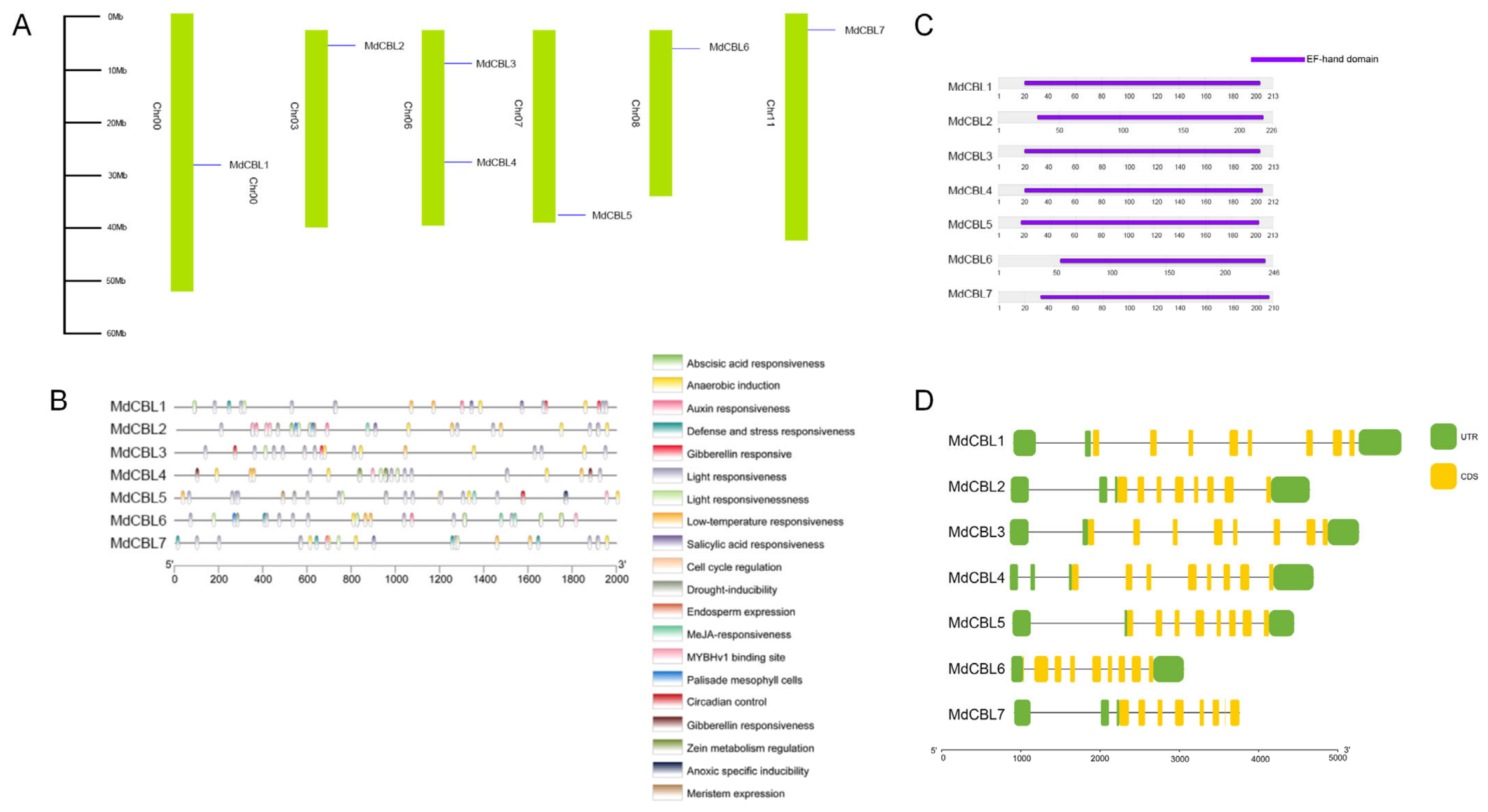
Chromosomal localization and cis-acting element analysis of MdCBL genes were performed using apple genome annotations. The results showed that MdCBL genes were mapped to chromosomes 3 (MdCBL2), 6 (MdCBL3, MdCBL4), 7 (MdCBL5), 8 (MdCBL6), and 11 (MdCBL7), whereas the chromosomal location of MdCBL1 remained undetermined due to technical limitations (Figure 1A). Subsequently, promoter analysis of the MdCBL gene family revealed a large number of hormone-responsive cis-acting elements (Figure 1B), including Abscisic acid responsiveness (ABA-responsive), Auxin responsiveness, Salicylic acid responsiveness (SA-responsive), and MeJA-responsiveness (jasmonic acid-responsive). Domain analysis showed that MdCBL1-7 all have EF hand domain (Figure 1C). The differential distribution of these domains directly reflects the structural divergence among MdCBL family members, providing a structural basis for their functional diversity. Further exploration of the apple genome demonstrated that each MdCBL gene contained eight exons (Figure 1D).

3.3. Analysis of Phosphorylation Sites, Protein Structure, and Phylogenetic Relationships of MdCBL Proteins

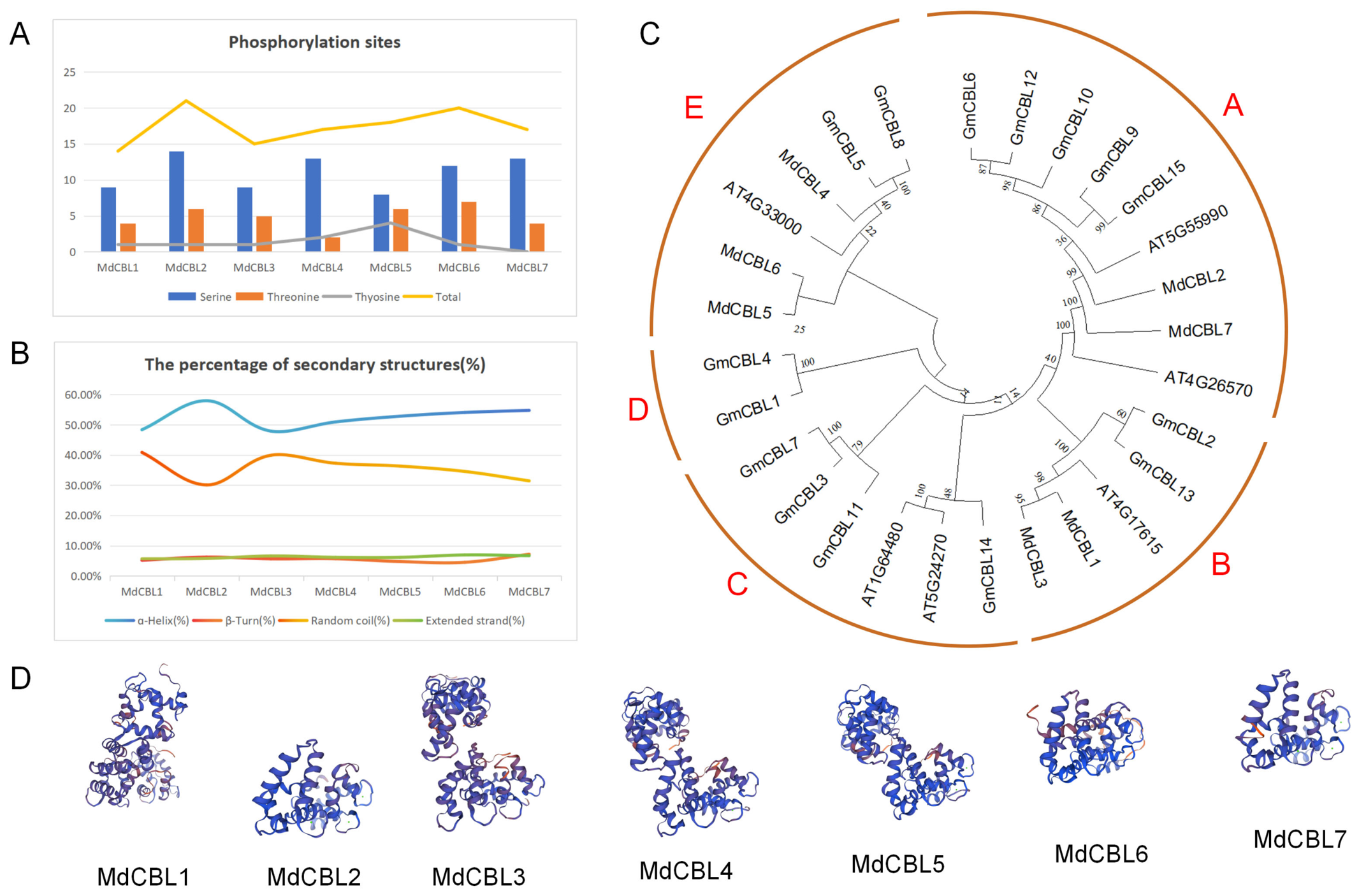
Analysis of phosphorylation sites indicated that residues phosphorylated in MdCBL proteins were primarily serine (Ser), with threonine (Thr) as the second most common type and tyrosine (Tyr) the rarest. The overall number of phosphorylation sites fell within the range of 10 to 25. (Figure 2A). Analysis of secondary structures demonstrated that the conformational elements of MdCBL proteins include α-helices, extended strands, random coils, and β-turns. Random coils and α-helices made up the highest proportions, while β-turns constituted the minimal fraction. (Figure 2B). Subsequently, a phylogenetic tree was constructed based on the full-length amino acid sequences of CBL proteins from Arabidopsis thaliana, apple and soybean (Glycine max). The results revealed that all CBL members could be classified into five evolutionary subgroups designated A to E, displaying a pattern of cross-species homologous clustering. Subgroup A contained the largest number of members, whereas subgroups C and D exclusively comprised members from soybean and Arabidopsis thaliana, indicating that these two types of CBL copies were lost during the evolutionary process of apple. (Figure 2C). This result indicates that MdCBL genes share high homology with AtCBL genes and may exert similar biological functions. Subsequently, the three-dimensional (3D) structures of all MdCBL proteins were successfully predicted using AlphaFold. The structural similarity among these MdCBL proteins was highly consistent with the phylogenetic tree results (Figure 2D).

3.4. MdCBL5 Enhances Salt Tolerance in Apple Seedlings

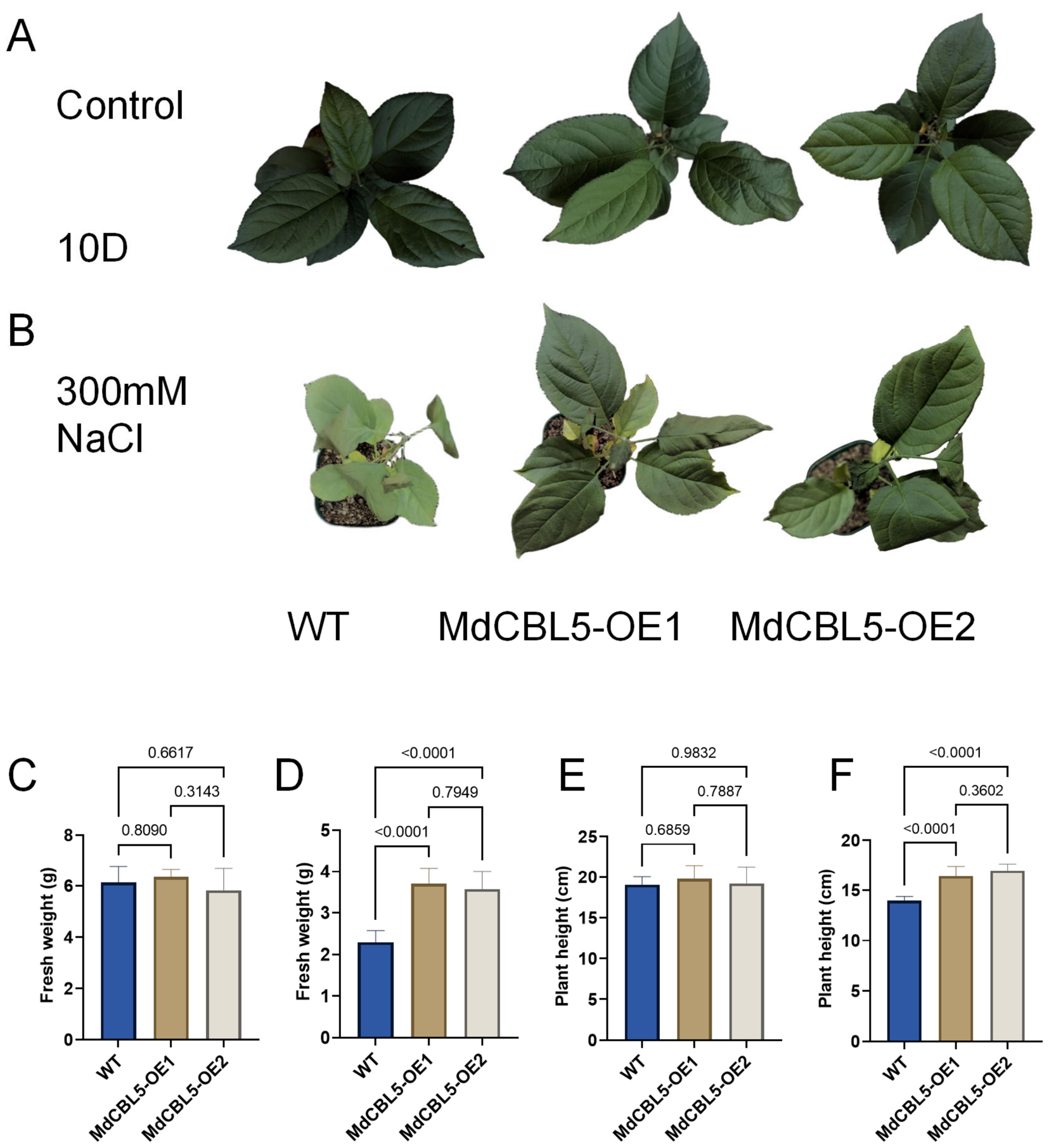
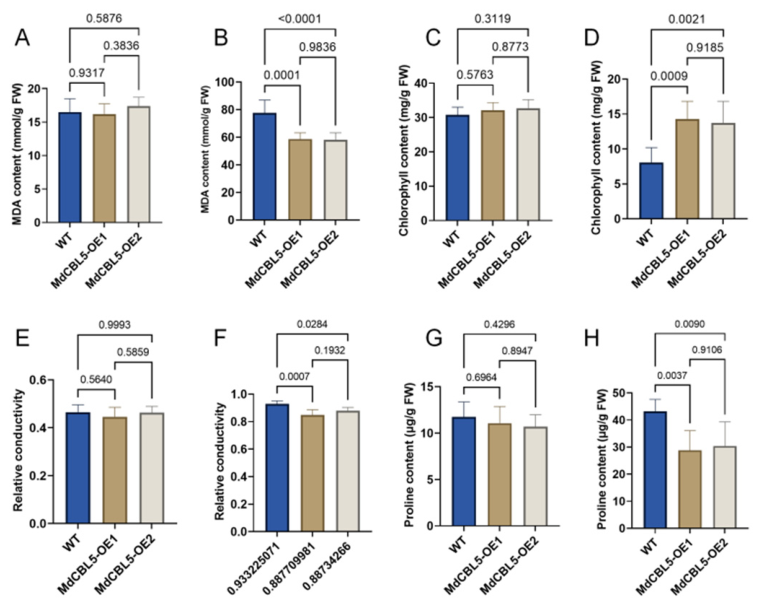
Salt stress severely suppresses the growth of apple plants. To explore the potential function of MdCBL family genes under salt stress, apple seedlings were exposed to NaCl treatment, and the transcript abundances of all MdCBL members were quantified. Quantitative analysis revealed that MdCBL1-7 were all salt-responsive, among which MdCBL5 exhibited the strongest transcriptional induction (Figure S1). To further investigate the biological function of MdCBL5, transgenic apple seedlings overexpressing MdCBL5 (MdCBL5-OE) were generated via Agrobacterium-mediated transformation (Figure S2). We further performed salt stress assays to characterize the salt tolerance of the transgenic lines. Seedlings of MdCBL5-OE and wild-type apple were treated with distilled water as the control, or 300 mM NaCl to induce salt stress. (Figure 3A,B). After 10 days of treatment, no significant differences in growth performance, fresh weight or plant height were detected between MdCBL5-OE and WT seedlings under control conditions. (Figure 3C,E). In contrast, MdCBL5-OE seedlings displayed markedly improved growth performance under salt stress, accompanied by significantly greater fresh weight and plant height relative to WT plants. (Figure 3D,F). Stress-induced lipid peroxidation produces MDA, a marker of membrane damage. MDA content was quantified to assess membrane injury. Under normal growth conditions, MdCBL5-OE and WT seedlings displayed similarly low MDA levels. Salt stress triggered a pronounced increase in MDA accumulation in both genotypes, yet MDA concentrations were significantly lower in MdCBL5-OE seedlings relative to the WT, pointing to improved stress resistance in the overexpression lines (Figure 4A,B). Chlorophyll constitutes a core component of the plant photosynthetic apparatus. Quantification of chlorophyll content showed no significant difference between MdCBL5-OE and WT seedlings under non-stress conditions. Salt stress induced a decline in leaf chlorophyll content in both genotypes, whereas MdCBL5-OE seedlings retained significantly higher chlorophyll levels than WT controls (Figure 4C,D). Additionally, relative electrical conductivity and proline content were determined to further validate salt tolerance (Figure 4E–H). Collectively, these physiological indicators consistently demonstrate that MdCBL5 positively regulates salt tolerance in apple seedlings.

3.5. MdCBL5 Suppresses Reactive Oxygen Species Burst Under Salt Stress

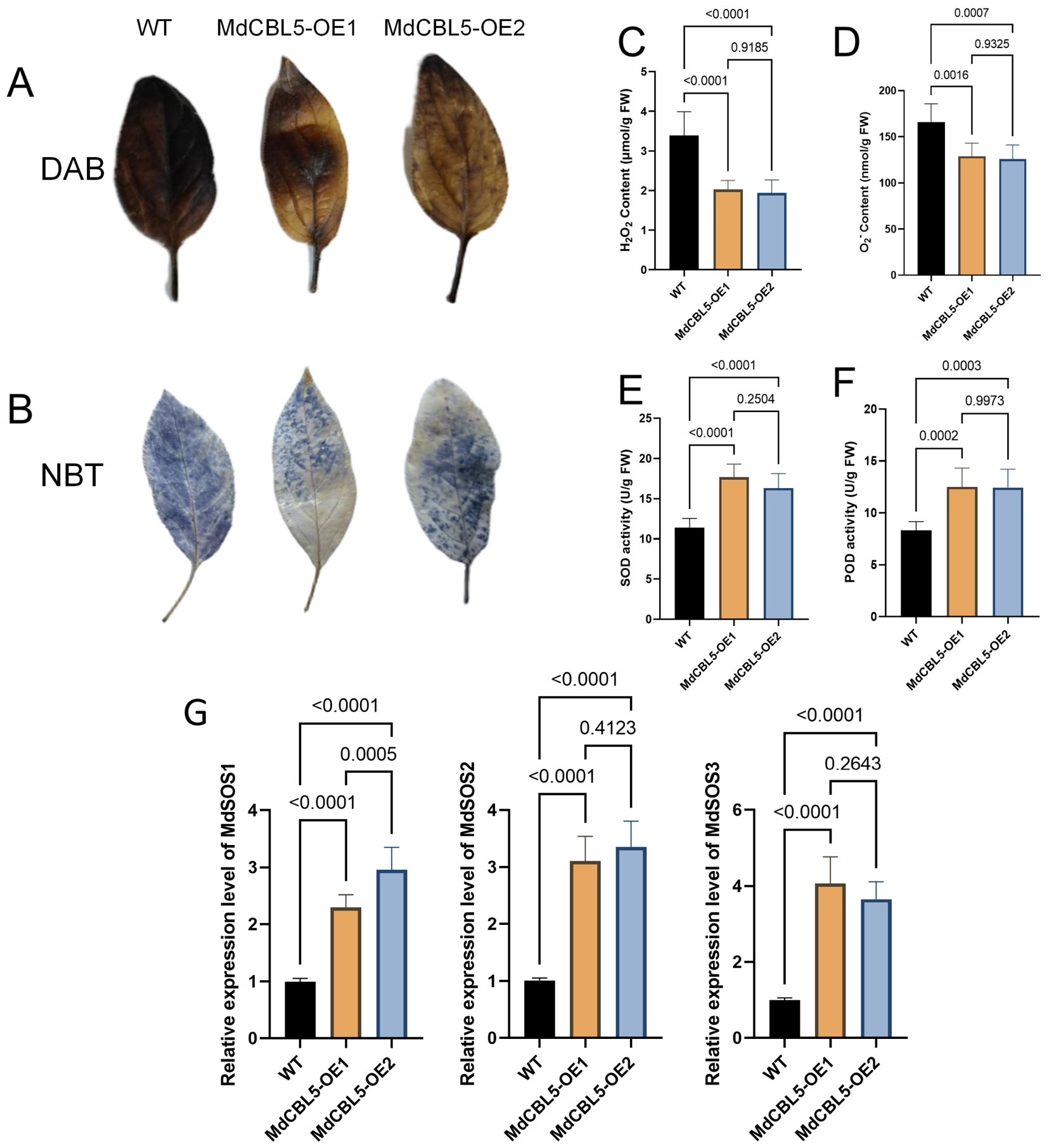
Salt stress induces the excessive accumulation of reactive oxygen species (ROS) in plants [38]. Overabundant ROS triggers membrane lipid peroxidation, protein oxidation and DNA damage, thereby restraining plant growth and even resulting in plant mortality. To qualitatively assess ROS levels in plant tissues under salt stress, DAB and NBT staining assays were conducted. The staining results showed that MdCBL5-OE seedlings displayed obviously lighter staining under salt stress, suggesting lower endogenous ROS accumulation (Figure 5A,B). Subsequently, the contents of typical ROS components, including hydrogen peroxide (H2O2) and superoxide anion (O2), were quantitatively measured in leaves. The data revealed that both H2O2 and O2 contents were significantly lower in MdCBL5-OE plants than in wild-type (WT) controls (Figure 5C,D). Furthermore, the activities of peroxidase (POD) were determined. The results demonstrated that overexpression of MdCBL5 elevated POD enzyme activity under salt stress (Figure 5E,F), which promoted the scavenging of excess intracellular ROS and helped maintain normal plant growth. As the central signaling pathway governing plant salt stress responses, the Salt Overly Sensitive (SOS) pathway is critical for salinity adaptation. Our qRT-PCR assays in salt-treated plants demonstrated pronounced transcriptional up-regulation of MdSOS1, MdSOS2, and MdSOS3 in MdCBL5-OE plants (Figure 5G), MdCBL5 may enhance plant salt tolerance by increasing MdSOS gene expression.

3.6. MdCBL5 Improves Apple Fruit Quality

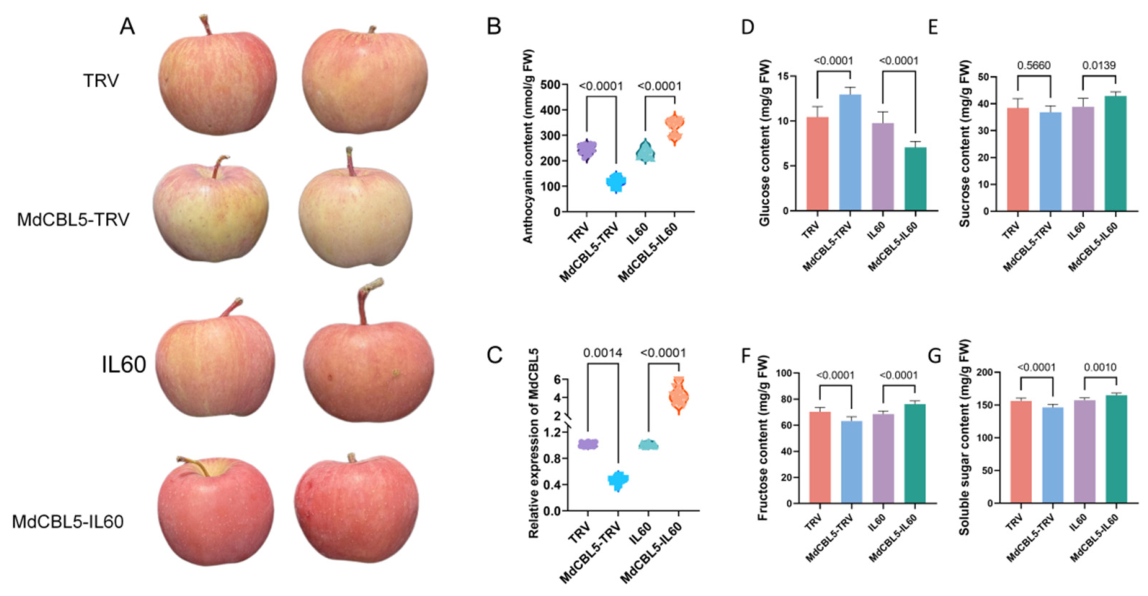
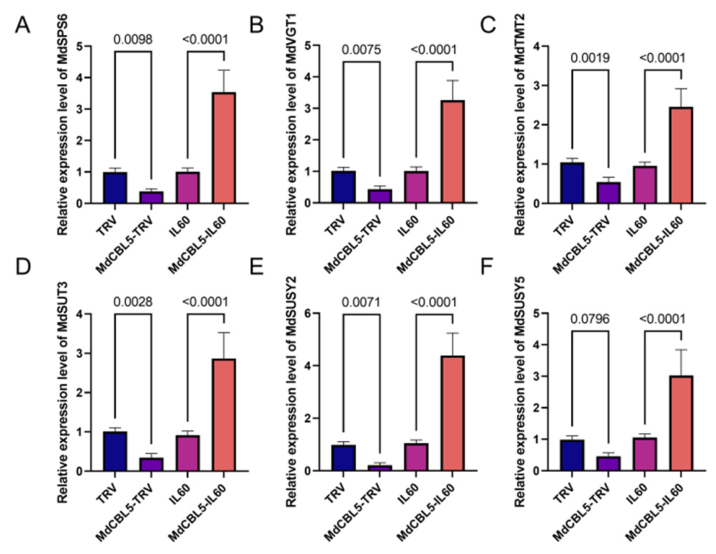
Given the crucial role of MdCBL5 in enhancing plant salt tolerance, its potential function in improving fruit quality was further investigated. To this end, MdCBL5-silencing (MdCBL5-TRV) and MdCBL5-overexpressing (MdCBL5-IL60) vectors were constructed and agroinfiltrated into apple fruits to evaluate their effects on fruit quality traits (Figure 6A,B). After incubation in a light incubator for 10 days, anthocyanin content was significantly the highest in MdCBL5-IL60 fruits, while the lowest anthocyanin content was observed in MdCBL5-TRV fruits (Figure 6C). These results indicate that MdCBL5 positively regulates anthocyanin accumulation, thereby promoting apple fruit coloration—a key indicator of fruit quality. Subsequently, the sugar composition and content in the treated fruits were quantitatively determined. The data showed that MdCBL5 overexpression significantly increased the contents of fructose, sucrose, and total soluble sugars in apple fruits, whereas it significantly decreased glucose content (Figure 6D–G). Furthermore, qRT-PCR analysis was conducted to determine the transcriptional profiles of key genes implicated in sugar metabolism and transport within apple fruit. The data revealed marked elevations in the transcript levels of MdSPS6, MdVGT1, MdTMT2, MdSUT2, MdSUSY2 and MdSUSY5. Collectively, these results support the notion that MdCBL5 facilitates sugar accumulation in fruit, at least in part, through the transcriptional activation of these sugar-related structural genes (Figure 7). Collectively, these findings demonstrate that MdCBL5 plays a vital role in promoting fruit coloring and sugar accumulation,, highlighting its potential application value in apple quality improvement breeding programs.

4. Discussion

Soil salinization, particularly secondary salinization, has emerged as a major abiotic stress constraining yield and quality improvement of apple in core apple-producing regions of China, including the Bohai Rim and the North China Plain. Apple cultivation serves as a pillar industry for boosting farmers’ incomes and advancing rural revitalization; accordingly, enhancing apple salt tolerance and fruit quality via molecular breeding has become an urgent research priority. The CBL-CIPK cascade is a core calcium-mediated signal transduction pathway in plants, which fulfills an essential role in modulating plant responses to diverse abiotic stresses [18,21]. Although CBL genes have been extensively characterized in model plants such as Arabidopsis thaliana and major crops including rice and maize, systematic identification and functional characterization of the MdCBL gene family, especially their dual roles in salt tolerance and fruit quality regulation, remain largely unclear in apple. In this study, we performed a comprehensive genome-wide characterization of the MdCBL gene family and functionally validated the biological functions of MdCBL5, providing novel insights into stress tolerance breeding and fruit quality improvement in apple.
Genome-wide identification and characterization of gene families constitute an essential foundation for the functional dissection of genes. In this study, seven MdCBL genes were identified in apple through BLASTP alignment and Pfam validation, which is fewer than the number found in poplar (10 members) [31] and rice (10 members) [22,40], suggesting potential differentiation in the CBL gene family during plant evolution. Physicochemical property analysis showed that MdCBL proteins encode 210–246 amino acids with a molecular weight of 24,196.73–28,283.39 Da and a theoretical isoelectric point of 4.63–4.97, indicating that MdCBL proteins are acidic proteins, which is consistent with the structural characteristics of CBL proteins in maize [28]. Subcellular localization prediction suggests that the MdCBL gene family lacks membrane localization, which is different from the localization of AtCBL1 and ZmCBL9 on the cell membrane. This implies that the MdCBL protein may possess unique functional characteristics. Chromosomal localization analysis revealed that MdCBL genes are unevenly distributed on chromosomes 3, 6, 7, 8, and 11, with two genes clustered on chromosome 6 (MdCBL3 and MdCBL4), suggesting that gene duplication events may have driven expansion of the MdCBL gene family. Notably, the chromosomal location of MdCBL1 was not determined due to technical limitations, which could be further clarified by improved genome assembly and mapping technologies in future studies.
Salt stress exerts severe deleterious effects on plants, manifesting as membrane lipid peroxidation, chlorophyll degradation, and ROS burst, ultimately culminating in inhibited plant growth and diminished yield. In this study, MdCBL5-OE apple seedlings showed significantly better growth performance under 300 mM NaCl stress than WT seedlings, with higher fresh weight and plant height, indicating that MdCBL5 positively regulates apple salt tolerance. Physiological imeasurements revealed that MdCBL5-OE seedlings had lower MDA content and relative electrical conductivity under salt stress than WT seedlings, suggesting that MdCBL5 can reduce membrane lipid peroxidation and maintain cell membrane integrity, thereby conferring enhanced salt tolerance. This is consistent with previous studies showing that ZmCBL9 and PeCBL4 can reduce membrane damage under stress conditions [28,41]. Chlorophyll is the core pigment governing plant photosynthesis, and salt stress-induced chlorophyll degradation substantially compromises photosynthesis performance. Our results demonstrated that MdCBL5-OE seedlings retained higher chlorophyll content under salt stress, indicating that MdCBL5 can alleviate salt stress-induced photosynthetic inhibition, which is an important mechanism for MdCBL5 to enhance salt tolerance.
ROS burst represents one of the earliest cellular responses triggered by salt stress in plants, and excessive ROS accumulation inflicts oxidative damage to cellular macromolecules including proteins, DNA, and lipids [42,43,44]. In this study, DAB and NBT staining and quantitative determination showed that MdCBL5-OE seedlings had significantly lower H2O2 and O2- contents under salt stress than WT seedlings, indicating that MdCBL5 can effectively inhibit ROS burst. Antioxidant enzymes, particularly POD play a key role in ROS scavenging. Our results demonstrated that MdCBL5 overexpression significantly elevated POD activity under salt stress, which promoted the scavenging of excess ROS in plants, thereby reducing oxidative damage. This mechanism is similar to that of AtCBL1, which enhances cold tolerance by regulating antioxidant enzyme activity, suggesting that the regulatory role of CBL genes in ROS scavenging may be a conserved mechanism across plant species [20,45]. This convergence supports that CBL-mediated regulation of ROS scavenging constitutes an evolutionarily conserved functional module across plant species. The stress-specific responsiveness of distinct CBL homologs likely stems from promoter cis-element divergence, while their downstream antioxidant regulatory module remains evolutionarily constrained—reflecting an ancient adaptive strategy for plants to cope with diverse environmental stresses.
Notably, a key novel finding of this study is that MdCBL5 exerts dual regulatory functions: it confers salt tolerance in apple seedlings while positively modulating anthocyanin accumulation and soluble sugar profiles in fruits. This functional duality distinguishes MdCBL5 from most previously characterized CBL homologs, whose roles are predominantly confined to abiotic stress responses. From a breeding perspective, this breaks the common trade-off between stress resistance and fruit quality, providing a rare genetic target for synergistic improvement of apple cultivars grown in salinized orchards. Transient transformation experiments showed that MdCBL5-IL60 significantly increased anthocyanin content in apple fruits, while MdCBL5-TRV significantly decreased anthocyanin content, indicating that MdCBL5 positively regulates apple fruit coloration. Anthocyanin is not only an important indicator of apple fruit quality but also has antioxidant properties, so MdCBL5-mediated anthocyanin accumulation may also enhance fruit nutritional value. Soluble sugar profiles represent another core trait governing apple fruit quality. Our results showed that MdCBL5 overexpression increased fructose, sucrose, and total soluble sugar contents but decreased glucose content in fruits. This specific regulation of sugar composition may be related to the role of MdCBL5 in sugar transport and metabolism. This targeted regulation indicates that MdCBL5 participates in the fine-tuning of sugar transport or subcellular compartmentalization, rather than simply enhancing overall carbon assimilation. Previous studies have shown that CBL-CIPK complexes are involved in the regulation of plant nutrient transport [46]. CBL1/CIPK23 phosphorylates tonoplast sugar transporter TST2 to enhance sugar accumulation in sweet orange [47], and our findings suggest that MdCBL5 may regulate fruit sugar accumulation through similar mechanisms, which requires further verification by analyzing the expression of sugar transport-related genes.
In conclusion, this study performed genome-wide identification and systematic characterization of the MdCBL gene family in apple, and functionally verified that MdCBL5 confers enhanced salt tolerance by mitigating membrane lipid peroxidation and suppressing ROS burst, and enhancing MdSOS gene expression, while also positively regulating apple fruit coloration and sugar composition. These findings not only advance our understanding of CBL genes function in woody plants, but also furnish a promising candidate gene and theoretical foundation for molecular breeding of apple cultivars with enhanced salt tolerance and superior fruit quality. In future studies, we will focus on identifying MdCBL5-interacting proteins and characterizing their downstream regulatory networks, and further validate the practical breeding potential of MdCBL5 in apple via field trials.

Limitations of the Study

Despite the important findings of this study, there are still several limitations that need to be addressed. First, this study only verified the function of MdCBL5 through overexpression experiments, and gene knockout experiments are needed to further confirm its essential role in salt tolerance and fruit quality regulation. Second, the molecular mechanism by which MdCBL5 regulates salt tolerance and fruit quality remains unclear. CBL proteins usually exert their functions by interacting with CIPK proteins, so identifying the CIPK proteins that interact with MdCBL5 and their downstream target genes is crucial for clarifying the regulatory pathway of MdCBL5. Third, the fruit quality analysis in this study only focused on anthocyanin and sugar content, and other important quality indicators such as fruit acidity, firmness, and aroma components were not determined. Finally, the functional verification of MdCBL5 was conducted under controlled laboratory conditions, and field experiments are needed to evaluate its practical application value in apple production.

Supplementary Materials

The following supporting information can be downloaded at https://www.mdpi.com/article/10.3390/horticulturae12070845/s1: Figure S1. Expression levels of MdCBL gene family after salt stress treatment (n = 3). Figure S2. Identification of genetically modified materials (n = 7).

Author Contributions

X.L.: Software. H.J.: Writing—review and editing, Supervision, Resources, Funding acquisition. S.-F.G.: Writing—review and editing. Z.-L.Z.: Writing—review and editing. T.L.: Validation, Methodology, Formal analysis. Y.-Y.L.: Writing—review and editing, Supervision, Funding acquisition. Y.-M.J.: Writing—review and editing, Supervision, Funding acquisition. R.-X.S.: Supervision, Software. Q.Z.: Supervision, Software. Z.L.: Supervision, Software. L.-X.L.: Supervision, Software. Y.-L.Z.: Supervision, Software. S.W.: Supervision, Software. C.-L.L.: Supervision, Software. Z.-Q.F.: Writing—original draft, Conceptualization. X.L. and T.L. made equal contributions to the article. All authors have read and agreed to the published version of the manuscript.

Funding

This work was supported by the National Natural Science Foundation of China (No. 32302513), the Shandong Provincial Key Research and Development Program (Nos. 2024CXGC010903, 2023CXPT013), the China Agriculture Research System for Apple (CARS-27), the National Key Research and Development Program of China (No. 2023YFD2301000), the Shandong Provincial Science and Technology Program for Young Scientific and Technological Talents (No. SDAST2024QTA083), and the Shandong Provincial Natural Science Foundation (Nos. ZR2022JQ14, ZR2022QC112).

Data Availability Statement

The data presented in this study are available on request from the corresponding author. (the data are not publicly available due to privacy or ethical restrictions.)

Conflicts of Interest

The authors declare no competing financial interests or personal relationships that affected the work reported in this paper.

References

  1. Wang, W.-X.; Zhang, Z.-X.; Wang, X.; Han, C.; Dong, Y.-J.; Wang, Y.-X. Functional Identification of ANR Genes in Apple (Malus Halliana) That Reduce Saline–Alkali Stress Tolerance. Plant Biol. 2023, 25, 892–901. [Google Scholar] [CrossRef] [PubMed]
  2. Zahid, G.; Iftikhar, S.; Shimira, F.; Ahmad, H.M.; Aka Kaçar, Y. An Overview and Recent Progress of Plant Growth Regulators (PGRs) in the Mitigation of Abiotic Stresses in Fruits: A Review. Sci. Hortic. 2023, 309, 111621. [Google Scholar] [CrossRef]
  3. Sîrbu, C.E.; Deșliu-Avram, M.; Cioroianu, T.M.; Constantinescu-Aruxandei, D.; Oancea, F. High-Temperature Influences Plant Bio-Stimulant-like Effects of the Combination Particle Film-Forming Materials-Foliar Fertilizers on Apple Trees. Agriculture 2023, 13, 178. [Google Scholar] [CrossRef]
  4. Cuevas, J.; Daliakopoulos, I.N.; del Moral, F.; Hueso, J.J.; Tsanis, I.K. A Review of Soil-Improving Cropping Systems for Soil Salinization. Agronomy 2019, 9, 295. [Google Scholar] [CrossRef]
  5. Perri, S.; Molini, A.; Hedin, L.O.; Porporato, A. Contrasting Effects of Aridity and Seasonality on Global Salinization. Nat. Geosci. 2022, 15, 375–381. [Google Scholar] [CrossRef]
  6. Kour, J.; Khanna, K.; Singh, A.D.; Dhiman, S.; Bhardwaj, T.; Devi, K.; Sharma, N.; Ohri, P.; Bhardwaj, R. Calcium’s Multifaceted Functions: From Nutrient to Secondary Messenger during Stress. S. Afr. J. Bot. 2023, 152, 247–263. [Google Scholar] [CrossRef]
  7. Hong-Bo, S.; Li-Ye, C.; Ming-An, S.; Shi-Qing, L.; Ji-Cheng, Y. Bioengineering Plant Resistance to Abiotic Stresses by the Global Calcium Signal System. Biotechnol. Adv. 2008, 26, 503–510. [Google Scholar] [CrossRef] [PubMed]
  8. DeFalco, T.A.; Bender, K.W.; Snedden, W.A. Breaking the Code: Ca2+ Sensors in Plant Signalling. Biochem. J. 2010, 425, 27–40. [Google Scholar] [CrossRef] [PubMed]
  9. Ormancey, M.; Thuleau, P.; Mazars, C.; Cotelle, V. CDPKs and 14-3-3 Proteins: Emerging Duo in Signaling. Trends Plant Sci. 2017, 22, 263–272. [Google Scholar] [CrossRef] [PubMed]
  10. Li, Q.; Gao, L.; Yu, F.; Lü, S.; Yang, P. Evolution and Diversification of CaM/CML Gene Family in Green Plants. Plant Physiol. Biochem. 2023, 202, 107922. [Google Scholar] [CrossRef] [PubMed]
  11. Mohanta, T.K.; Kumar, P.; Bae, H. Genomics and Evolutionary Aspect of Calcium Signaling Event in Calmodulin and Calmodulin-like Proteins in Plants. BMC Plant Biol. 2017, 17, 38. [Google Scholar] [CrossRef] [PubMed]
  12. Poovaiah, B.W. Role of Calcium and Calmodulin in Plant Growth and Development. HortScience 1985, 20, 347–352. [Google Scholar] [CrossRef]
  13. Dekomah, S.D.; Bi, Z.; Dormatey, R.; Wang, Y.; Haider, F.U.; Sun, C.; Yao, P.; Bai, J. The role of CDPKs in plant development, nutrient and stress signaling. Front. Genet. 2022, 13, 996203. [Google Scholar] [CrossRef] [PubMed]
  14. Boudsocq, M.; Sheen, J. CDPKs in Immune and Stress Signaling. Trends Plant Sci. 2013, 18, 30–40. [Google Scholar] [CrossRef] [PubMed]
  15. Ma, X.; Li, Q.-H.; Yu, Y.-N.; Qiao, Y.-M.; Haq, S.u.; Gong, Z.-H. The CBL–CIPK Pathway in Plant Response to Stress Signals. Int. J. Mol. Sci. 2020, 21, 5668. [Google Scholar] [CrossRef] [PubMed]
  16. Bihani, S.C.; Tarushi; Srivastava, A.K. Decoding the Calcium Signal: Structural Insights into CBL-CIPK Pathway in Plants. Biochim. ET Biophys. Acta (BBA)-Gen. Subj. 2025, 1869, 130819. [Google Scholar] [CrossRef] [PubMed]
  17. Mao, J.; Mo, Z.; Yuan, G.; Xiang, H.; Visser, R.G.F.; Bai, Y.; Liu, H.; Wang, Q.; van der Linden, C.G. The CBL-CIPK Network Is Involved in the Physiological Crosstalk between Plant Growth and Stress Adaptation. Plant Cell Environ. 2023, 46, 3012–3022. [Google Scholar] [CrossRef] [PubMed]
  18. Chen, J.S.; Wang, S.T.; Mei, Q.; Sun, T.; Hu, J.T.; Xiao, G.S.; Chen, H.; Xuan, Y.H. The Role of CBL–CIPK Signaling in Plant Responses to Biotic and Abiotic Stresses. Plant Mol. Biol. 2024, 114, 53. [Google Scholar] [CrossRef] [PubMed]
  19. Das, P.K.; Bhatnagar, T.; Banik, S.; Majumdar, S.; Dutta, D. Structural and Molecular Dynamics Simulation Studies of CBL-Interacting Protein Kinase CIPK and Its Complexes Related to Plant Salinity Stress. J. Mol. Model. 2024, 30, 248. [Google Scholar] [CrossRef] [PubMed]
  20. Kudla, J.; Xu, Q.; Harter, K.; Gruissem, W.; Luan, S. Genes for Calcineurin B-like Proteins in Arabidopsis Are Differentially Regulated by Stress Signals. Proc. Natl. Acad. Sci. USA 1999, 96, 4718–4723. [Google Scholar] [CrossRef] [PubMed]
  21. Mao, J.; Manik, S.; Shi, S.; Chao, J.; Jin, Y.; Wang, Q.; Liu, H. Mechanisms and Physiological Roles of the CBL-CIPK Networking System in Arabidopsis Thaliana. Genes 2016, 7, 62. [Google Scholar] [CrossRef] [PubMed]
  22. Jiang, M.; Zhao, C.; Zhao, M.; Li, Y.; Wen, G. Phylogeny and Evolution of Calcineurin B-Like (CBL) Gene Family in Grass and Functional Analyses of Rice CBLs. J. Plant Biol. 2020, 63, 117–130. [Google Scholar] [CrossRef]
  23. de la Torre, F.; Gutierrez-Beltran, E.; Pareja-Jaime, Y.; Chakravarthy, S.; Martin, G.B.; del Pozo, O. The Tomato Calcium Sensor Cbl10 and Its Interacting Protein Kinase Cipk6 Define a Signaling Pathway in Plant Immunity. Plant Cell 2013, 25, 2748–2764. [Google Scholar] [CrossRef] [PubMed]
  24. Cho, J.H.; Sim, S.-C.; Kim, K.-N. Calcium Sensor SlCBL4 Associates with SlCIPK24 Protein Kinase and Mediates Salt Tolerance in Solanum Lycopersicum. Plants 2021, 10, 2173. [Google Scholar] [CrossRef] [PubMed]
  25. Xi, Y.; Liu, J.; Dong, C.; Cheng, Z.-M. (Max) The CBL and CIPK Gene Family in Grapevine (Vitis vinifera): Genome-Wide Analysis and Expression Profiles in Response to Various Abiotic Stresses. Front. Plant Sci. 2017, 8, 00978. [Google Scholar] [CrossRef] [PubMed]
  26. Li, J.; Long, Y.; Qi, G.-N.; Li, J.; Xu, Z.-J.; Wu, W.-H.; Wang, Y. The Os-AKT1 Channel Is Critical for K + Uptake in Rice Roots and Is Modulated by the Rice CBL1-CIPK23 Complex. Plant Cell 2014, 26, 3387–3402. [Google Scholar] [CrossRef] [PubMed]
  27. Yang, Y.; Zhang, C.; Tang, R.-J.; Xu, H.-X.; Lan, W.-Z.; Zhao, F.; Luan, S. Calcineurin B-Like Proteins CBL4 and CBL10 Mediate Two Independent Salt Tolerance Pathways in Arabidopsis. Int. J. Mol. Sci. 2019, 20, 2421. [Google Scholar] [CrossRef] [PubMed]
  28. Zhang, F.; Li, L.; Jiao, Z.; Chen, Y.; Liu, H.; Chen, X.; Fu, J.; Wang, G.; Zheng, J. Characterization of the Calcineurin B-Like (CBL) Gene Family in Maize and Functional Analysis of ZmCBL9 under Abscisic Acid and Abiotic Stress Treatments. Plant Sci. 2016, 253, 118–129. [Google Scholar] [CrossRef] [PubMed]
  29. Gao, C.; Lu, S.; Zhou, R.; Wang, Z.; Li, Y.; Fang, H.; Wang, B.; Chen, M.; Cao, Y. The OsCBL8–OsCIPK17 Module Regulates Seedling Growth and Confers Resistance to Heat and Drought in Rice. Int. J. Mol. Sci. 2022, 23, 12451. [Google Scholar] [CrossRef] [PubMed]
  30. Tuteja, N.; Mahajan, S. Further Characterization of Calcineurin B-Like Protein and Its Interacting Partner CBL-Interacting Protein Kinase from Pisum sativum. Plant Signal. Behav. 2007, 2, 358–361. [Google Scholar] [CrossRef] [PubMed]
  31. Zhang, H.; Yin, W.; Xia, X. Calcineurin B-Like Family in Populus: Comparative Genome Analysis and Expression Pattern under Cold, Drought and Salt Stress Treatment. Plant Growth Regul. 2008, 56, 129–140. [Google Scholar] [CrossRef]
  32. Reiser, L.; Proia, A.; Bakker, E.; Subramaniam, S.; Khosa, K.; Sawant, S.; Chen, X.; Prithvi, T.; Berardini, T.Z. Recent Major Changes to TAIR: Updates to the Database, Website, and Arabidopsis Genome. Genetics 2026, 232, iyaf248. [Google Scholar] [CrossRef] [PubMed]
  33. Jung, S.; Staton, M.; Lee, T.; Blenda, A.; Svancara, R.; Abbott, A.; Main, D. GDR (Genome Database for Rosaceae): Integrated Web-Database for Rosaceae Genomics and Genetics Data. Nucleic Acids Res. 2007, 36, D1034–D1040. [Google Scholar] [CrossRef] [PubMed]
  34. Kumar, S.; Stecher, G.; Suleski, M.; Sanderford, M.; Sharma, S.; Tamura, K. MEGA12: Molecular Evolutionary Genetic Analysis Version 12 for Adaptive and Green Computing. Mol. Biol. Evol. 2024, 41, msae263. [Google Scholar] [CrossRef] [PubMed]
  35. Geourjon, C.; Deléage, G. SOPMA: Significant Improvements in Protein Secondary Structure Prediction by Consensus Prediction from Multiple Alignments. Bioinformatics 1995, 11, 681–684. [Google Scholar] [CrossRef] [PubMed]
  36. Abramson, J.; Adler, J.; Dunger, J.; Evans, R.; Green, T.; Pritzel, A.; Ronneberger, O.; Willmore, L.; Ballard, A.J.; Bambrick, J.; et al. Accurate Structure Prediction of Biomolecular Interactions with AlphaFold 3. Nature 2024, 630, 493–500. [Google Scholar] [CrossRef] [PubMed]
  37. Blom, N.; Sicheritz-Pontén, T.; Gupta, R.; Gammeltoft, S.; Brunak, S. Prediction of Post-translational Glycosylation and Phosphorylation of Proteins from the Amino Acid Sequence. Proteomics 2004, 4, 1633–1649. [Google Scholar] [CrossRef] [PubMed]
  38. Feng, Z.; Zhao, L.; Li, T.; Li, X.; Ma, S.; Gao, H.; Sha, R.; Tian, G.; Xu, X.; Xing, Y.; et al. Salt Stress Response Pathway and Regulatory Mechanism of the Malus Domestica G Protein-Coupled Receptor MdGPCR. Hortic. Plant J. 2025, 12, 1509–1520. [Google Scholar] [CrossRef]
  39. Feng, Z.-Q.; Li, T.; Wang, X.; Sun, W.-J.; Zhang, T.-T.; You, C.-X.; Wang, X.-F. Identification and Characterization of Apple MdNLP7 Transcription Factor in the Nitrate Response. Plant Sci. 2022, 316, 111158. [Google Scholar] [CrossRef] [PubMed]
  40. Kanwar, P.; Sanyal, S.K.; Tokas, I.; Yadav, A.K.; Pandey, A.; Kapoor, S.; Pandey, G.K. Comprehensive Structural, Interaction and Expression Analysis of CBL and CIPK Complement during Abiotic Stresses and Development in Rice. Cell Calcium 2014, 56, 81–95. [Google Scholar] [CrossRef] [PubMed]
  41. Qu, M.; Sun, Q.; Chen, N.; Chen, Z.; Zhang, H.; Lv, F.; An, Y. Functional Characterization of a New Salt Stress Response Gene, PeCBL4, in Populus Euphratica Oliv. Forests 2023, 14, 1504. [Google Scholar] [CrossRef]
  42. Yang, Y.; Guo, Y. Unraveling Salt Stress Signaling in Plants. J. Integr. Plant Biol. 2018, 60, 796–804. [Google Scholar] [CrossRef] [PubMed]
  43. Liu, J.; Fu, C.; Li, G.; Khan, M.N.; Wu, H. ROS Homeostasis and Plant Salt Tolerance: Plant Nanobiotechnology Updates. Sustainability 2021, 13, 3552. [Google Scholar] [CrossRef]
  44. Anee, T.I.; Sewelam, N.A.; Bautista, N.S.; Hirayama, T.; Suzuki, N. Roles of ROS and NO in Plant Responses to Individual and Combined Salt Stress and Waterlogging. Antioxidants 2025, 14, 1455. [Google Scholar] [CrossRef] [PubMed]
  45. Shi, S.; Chen, W.; Sun, W. Comparative Proteomic Analysis of the Arabidopsis Cbl1 Mutant in Response to Salt Stress. Proteomics 2011, 11, 4712–4725. [Google Scholar] [CrossRef] [PubMed]
  46. Dong, Q.; Bai, B.; Almutairi, B.O.; Kudla, J. Emerging Roles of the CBL-CIPK Calcium Signaling Network as Key Regulatory Hub in Plant Nutrition. J. Plant Physiol. 2021, 257, 153335. [Google Scholar] [CrossRef] [PubMed]
  47. Li, M.; Mao, Z.; Zhao, Z.; Gao, S.; Luo, Y.; Liu, Z.; Sheng, X.; Zhai, X.; Liu, J.; Li, C. CBL1/CIPK23 Phosphorylates Tonoplast Sugar Transporter TST2 to Enhance Sugar Accumulation in Sweet Orange (Citrus Sinensis). J. Integr. Plant Biol. 2025, 67, 327–344. [Google Scholar] [CrossRef] [PubMed]
Figure 1. Analysis of chromosome structure, localization, and cis-acting elements of MdCBLs. (A) Chromosomal localization of MdCBL family genes; (B) Cis-acting elements of MdCBL family promoter; (C) Analysis of MdCBL family protein domains; (D) Distribution of introns and exons within the MdCBL family.
Horticulturae 12 00845 g001
Figure 2. Analysis of active sites, structure, and evolutionary tree of MdCBLs protein. (A) Prediction of phosphorylation sites in the MdCBL family; (B) Secondary structure analysis of the MdCBL family; (C) Evolutionary tree of the Arabidopsis and apple CBL families; (D) Prediction of protein structure of the MdCBL family.
Horticulturae 12 00845 g002
Figure 3. Salt-treated MdCBL5 apple seedlings. (A) Apple seedlings in the control group; (B) Apple seedlings in the salt treatment group; (C) Fresh weight of the control group; (D) Fresh weight of the salt treatment group; (E) Plant height of the control group; (F) Plant height of the salt treatment group (n = 7).
Horticulturae 12 00845 g003
Figure 4. MdCBL5 enhances plant salt tolerance. (A) Malondialdehyde content in the control group; (B) Malondialdehyde content in the salt treatment group; (C) Chlorophyll content in the control group; (D) Chlorophyll content in the salt treatment group; (E) Relative conductivity in the control group; (F) Relative conductivity in the salt treatment group; (G) Proline content in the control group; (H) Proline content in the salt treatment group (n = 7).
Horticulturae 12 00845 g004
Figure 5. MdCBL5 leaf reactive oxygen species staining. (A) DAB staining of salt treatment group; (B) NBT staining of salt treatment group; (C) Hydrogen peroxide content of salt treatment group; (D) Superoxide anion radical content of salt treatment group; (E) SOD activity of salt treatment group; (F) POD activity of salt treatment group; (G) Expression levels of MdSOS1, MdSOS2 and MdSOS3 under salt stress (n = 7).
Horticulturae 12 00845 g005
Figure 6. MdCBL5 promotes fruit coloring. (A) Transient expression of MdCBL5 in fruits; (B) Identification of fruits with transiently expressed MdCBL5; (C) Anthocyanin content in fruits with transiently expressed MdCBL5; (D) Glucose content in fruit; (E) Sucrose content in fruit; (F) Fructose content in fruit; (G) Soluble sugar content in fruit (n = 21).
Horticulturae 12 00845 g006
Figure 7. MdCBL5 promotes the expression of sugar related genes. (AF) Expression levels of MdSPS6, MdVGT1, MdTMT2, MdSUT3, MdSUSY2, MdSUSY5 and MdCBL5 genes (n = 21).
Horticulturae 12 00845 g007
Table 1. qPCR primer used in this study.
Primer NamePrimer-FPrimer-R
MdCBL5-FTGATGACGGACTTATCCACAAGGCCGAGAGTACCAGATCAGATTCG
Md18s-FACACGGGGAGGTAGTGACAACCTCCAATGGATCCTCGTTA
MdSOS1-FAGGAAACCATGAAATTGTGTGGGATCATGTCACAAATGTAGGGC
MdSOS2-FAATCAATGGGTCTCAAGGTCCCTCCTTCGGTTTCCAAATA
MdSOS3-FGGGGTTATTGAGTTTGGAGAGGATGCTTCGACACAAATTC
MdSPS6-FCACATACCTGAATTCGTCGATGGTGACCATGAATCACATAAGGC
MdVGT1-FATGTGCTACAATCTCCGTAGAGCTACTGCTGTAACTAGAGCTCC
MdTMT2-FGATCCTCTCGTCTCTCTCTTTGGGACTCTGCAAATTGTCATCAG
MdSUT3-FTATCGCCGTTTCCGTTCTAATACTGAGTGATCCAATTGCATAGC
MdSUSY2-FGCCATTTAATGCATCATTCCCTGCGGGAACTTGGAAAGATATTC
MdSUSY5-FATACTTTCTGGAGGCAGTTGAATTGAGATGCCTTAATGTGGTCT
MdCBL1GAAATGAAGCTGGCTGATGAGACATGTAGCGATCTCATCAACCTCG
MdCBL2ACCCTGAAATTCTAGCAAGGGAGTTGGGATGAAAGACAGAGAGAGC
MdCBL3CGTTAAACGGAAGGGTGTGATTGGTCTCATCAGCCAGCTTCATTTC
MdCBL4GAAGTGGAGGCCTTGTATGAACTCAATGTAACCAGTCTGTCCGAGA
MdCBL6CTCGCCGATGAAACCAGATTTACTCATCAATAGGGGCGTAAGGATG
MdCBL7TTCTAGCAAGGGAGACAGTGTTCTTGGGATGAAAGACAGAGAGAGC
Table 2. Identification of the MdCBLs gene family in apple.
Gene NameSequence IDNumber of Amino AcidMolecular WeightTheoretical pIInstability IndexAliphatic IndexGrand Average of HydropathicitySubcellular Localization Prediction
MdCBL1MD00G113260021324,520.954.7541.5488.78−0.182Nucleus
MdCBL2MD03G103650022626,058.674.846.8393.19−0.235Nucleus
MdCBL3MD06G104610021324,515.924.7538.8290.61−0.186Nucleus
MdCBL4MD06G110920021224,418.724.7137.1294.25−0.192Nucleus
MdCBL5MD07G128880021224,387.714.6337.4785.52−0.302Cytosol
MdCBL6MD08G104310024628,283.394.7549.293.94−0.065Cytosol
MdCBL7MD11G103720021024,196.734.9748.7697.52−0.205Chloroplast
Disclaimer/Publisher’s Note: The statements, opinions and data contained in all publications are solely those of the individual author(s) and contributor(s) and not of MDPI and/or the editor(s). MDPI and/or the editor(s) disclaim responsibility for any injury to people or property resulting from any ideas, methods, instructions or products referred to in the content.