Article

Endophytic Leptobacillium sp. Sl27 Modulates Early Tomato Plant Responses to Water Stress in a Genotype-Dependent Manner

Biochemistry and Biotechnology Group, Departmentof Biology, Biochemistry and Natural Sciences, University Jaume I, 12071 Castellón de la Plana, Spain
*
Authors to whom correspondence should be addressed.
Horticulturae 2026, 12(7), 829; https://doi.org/10.3390/horticulturae12070829 (registering DOI)

Submission received: 27 May 2026 / Revised: 1 July 2026 / Accepted: 3 July 2026 / Published: 7 July 2026

Abstract

Drought-induced water stress is a major constraint on crop productivity, especially under climate change conditions. In previous work, we isolated a fungal endophyte, Leptobacillium sp. Sl27, from Solanum lycopersicum and found that its growth-promoting effects were dependent on the tomato genotype. In this study, we investigated whether Sl27 modulates early plant responses to water stress in the following two tomato genotypes with differing sensitivities to drought: ADX2 and MO-10. Seeds were inoculated with the endophyte, and 4-week-old seedlings were subjected to water stress by withholding watering for 12 days under controlled growth chamber conditions. We assessed plant performance by measuring physiological parameters (including photosynthetic rate, transpiration, and stomatal aperture) and overall stress response by leaf phenotypic traits. Under severe stress conditions, Sl27-inoculated plants, particularly in the more sensitive genotype MO-10, showed reduced early damage and partially maintained physiological activity during initial stages of stress. However, under prolonged stress, all plants reached similarly high levels of damage, indicating that the effect was transient and did not confer sustained drought tolerance. To explore plant performance under more moderate and agronomically relevant conditions, a second independent experiment was conducted in MO-10 using a controlled water deficit (40% field capacity) and plantlet-stage inoculation. In this experimental context, Sl27 primarily promoted plant growth, increasing shoot and root biomass, with a non-significant trend toward improved performance under stress. Overall, these results indicate that Sl27 does not confer classical drought tolerance but instead improves plant performance and modulates early responses to water deficit in a genotype-dependent manner, with stronger effects observed in the more sensitive genotype MO-10.

1. Introduction

Plants are constantly exposed to environmental challenges that affect their growth and development. Their ability to cope with abiotic stresses is crucial, especially in the context of global climate change, which is increasing both the frequency and intensity of these challenges. Among the different abiotic factors, drought stands out as one of the most severe and widespread, representing a major threat to agricultural productivity and global food security [1].
Water stress can be defined as an insufficient water supply to the plant. When this condition persists over an extended period or is accompanied by severely low soil moisture, it can develop into drought stress. Drought causes extensive damage to plants by disrupting their physiological and metabolic functions [2]. Limited water availability reduces root water uptake, leading to cellular dehydration and loss of turgor pressure, which, in turn, restricts cell expansion and overall plant growth. Photosynthesis is particularly affected, as stomatal closure limits carbon dioxide intake while simultaneously increasing leaf temperature and photorespiratory losses. Prolonged drought further damages the photosynthetic apparatus, resulting in reduced chlorophyll content and impaired electron transport. At the biochemical level, drought induces the excessive accumulation of reactive oxygen species (ROS), which cause oxidative damage to membranes, proteins, and nucleic acids. This oxidative stress compromises cellular integrity, accelerates leaf senescence, and can, ultimately, lead to programmed cell death if not counteracted by antioxidant defenses [3]. In addition, drought disturbs hormonal balance, particularly by elevating abscisic acid (ABA) while suppressing growth-promoting hormones, thereby exacerbating growth inhibition. Collectively, these effects compromise plant development, reduce biomass accumulation, and significantly lower crop yield potential [4,5,6].
To cope with such conditions, plants have evolved a variety of defense strategies, which can be classified into morphophysiological and biochemical processes. The morphophysiological mechanisms can be broadly categorized into drought avoidance, escape, tolerance, and recovery strategies [6,7]. Drought avoidance involves retaining sufficient water through traits such as stomatal regulation and enhanced root development, while drought tolerance is primarily achieved through osmotic adjustment and compatible solutes to maintain cellular functions under low water availability [8]. Escape strategies involve completing the life cycle before severe drought occurs, whereas recovery mechanisms allow plants to restore growth once favorable water conditions return.
Biochemical processes involve phytohormones, which are key regulators of plant growth and development. ABA is the primary hormone mediating drought responses, orchestrating stomatal closure, osmolyte accumulation, and activation of stress-responsive genes. Other hormones, including jasmonic acid (JA), auxins, cytokinins, gibberellins, ethylene, and brassinosteroids, interact synergistically or antagonistically with ABA to fine-tune stress responses and maintain growth–defense balance [9]. These hormonal networks further activate downstream biochemical pathways, enhance antioxidant defense systems, and regulate physiological processes, thereby improving plant resilience under drought conditions [9,10]. The specific morphological and physiological challenges depend on both the stress intensity and the plant’s sensitivity [11].
Improving plant resistance against drought stress can help reduce crop losses and contribute to sustainable production. To achieve this, researchers are exploring a wide range of strategies. These include the application of exogenous compounds, breeding programs that incorporate stress-tolerant genotypes, the use of beneficial microorganisms, and advanced biotechnological tools such as genome editing [12]. However, some of these approaches are time-consuming or not always well regarded by consumers and legislators.
One of the most prominent environmentally friendly approaches is the use of beneficial microorganisms. Plant-associated microorganisms, such as endophytes, can help their hosts withstand adverse environmental conditions. Numerous studies have examined plant–endophyte interactions under stress conditions. Endophytes, including both fungi and bacteria, can confer stress resistance by acting as biological triggers that induce plant defense mechanisms or by directly synthesizing compounds that mitigate the effects of stress [13]. Endophytes reduce drought stress through mechanisms such as phytohormone production, osmolyte accumulation, and exopolysaccharide secretion that aid in maintaining cellular homeostasis. Fungal endophytes improve water uptake and retention by altering root architecture and enhancing root hydraulic conductivity. Additionally, fungal endophytes modulate plant hormone levels, such as increasing ABA, which helps plants regulate stomatal closure to reduce water loss. They also improve antioxidant defense systems, mitigating oxidative damage caused by drought-induced stress [14].
Among the most extensively studied fungal endophytes against drought stress are Serendipita indica (=Piriformospora indica) and Neotyphodium coenophialum. S. indica has been shown to confer drought tolerance across a wide range of crops, including tomato (Solanum lycopersicum) [15], maize (Zea mays) [16], and trifoliate orange (Poncirus trifoliata) [17]. Its beneficial effects include stimulation of antioxidant enzymes such as superoxide dismutase (SOD) and catalase (CAT), enhancement of photosynthetic efficiency, and upregulation of drought-responsive genes and signaling pathways [17,18]. In trifoliate orange, S. indica modulates fatty acid composition and activates both enzymatic and non-enzymatic antioxidant defenses, reducing oxidative damage under drought conditions [17]. Similarly, Neotyphodium coenophialum significantly improves drought survival by promoting the accumulation of compatible solutes like proline or trehalose. This endophyte also improves host physiology by enhancing water use efficiency, inducing stomatal closure, and increasing root hair length, which collectively contribute to better water uptake and retention during drought stress [19]. In the same way, other fungal species have shown promising effects. For instance, inoculation of maize with Fusarium oxysporum and Penicillium spp. significantly improve drought tolerance by promoting root elongation, which facilitates deeper water access in the soil and enhances overall plant biomass under water-limited conditions. Other fungal endophytes such as Epichloë spp. and Curvularia spp. have been extensively studied for their roles in enhancing drought and heat tolerance [20,21]. However, the vast majority of endophytes remain unknown or uncharacterized [22].
In previous work by our group, Leptobacillium sp. Sl27, an endophytic fungal strain isolated from healthy tomato roots, demonstrated plant growth-promoting abilities. The extent of this potential varied depending on the tomato genotype. In the present study, we aimed to investigate the ability of Sl27 to enhance host plant resistance to stress caused by water deficit and to determine its potential beneficial effects for tomato crops using two different tomato genotypes.

2. Materials and Methods

2.1. Plant and Fungal Materials

Seeds from Solanum lycopersicum var. Alcalà de Xivert (ADX2) and var. Monfavet (MO-10) were obtained from Instituto de Conservacion y Mejora de la Agrodiversidad Valenciana in the Universitat Politecnica de Valencia. These genotypes were selected based on previous work from our group [23] in which the characterization of these two traditional genotypes showed distinct responses to abiotic stress, including different levels of tolerance. In particular, ADX2 has been reported to exhibit a higher tolerance to water stress conditions, whereas MO-10 displays greater sensitivity, with more pronounced physiological and stress-related responses.
The endophytic fungal strain of Leptobacillium sp. Sl27 was cryopreserved after isolation and identification by suspending spores in 20% (v/v) glycerol and storing them at –80 °C. Experiments were conducted using cultures obtained by reviving the cryopreserved spore stocks. The spores were inoculated into fresh growth medium and incubated under the appropriate conditions for fungal development.

2.2. Severe Water Stress Experiments

Tomato seeds were surface sterilized with 70% ethanol for 3 min, followed by a 4% sodium hypochlorite solution for 1 min and rinsed three times with sterile distilled water (dH2O).
Fungal conidia suspensions were obtained from 4-day-old fungal culture of Leptobacillium sp. Sl27 grown at 25 °C and 160 rpm in Potato Dextrose Broth. The suspension was filtered through cheesecloth to remove mycelia and centrifuged for 5 min at 5500 rpm and 16 °C to pellet the conidia. The conidial pellet was resuspended in 5 mL of 0.85% NaCl and centrifuged for 7 min at 5500 rpm and 16 °C. This washing step was repeated twice. The spore concentration was determined using a Neubauer hemocytometer.
Seeds were inoculated by immersion in a fungal conidia solution at a concentration of 105 spores/mL for 6 h at 26 °C and 120 rpm to ensure uniform seed colonization, while control seeds were mock-inoculated in dH2O.
After inoculation, seeds were dried on filter paper and sown in pots containing 10 g of vermiculite. After a germination period of 7 days, uniformly sized plantlets were selected for each treatment. Plants were grown under controlled conditions in a growth chamber (light/dark cycle of 16/8 h, temperature of 24/18 °C, light intensity of 200 μmol m−2 s−1, and 60% relative humidity) and watered with 10% Hoagland solution every other day. After four weeks, plants were irrigated to full soil saturation and draining excess water.
Each pot was placed on an individual collection plate and arranged according to a randomized design. For each tomato genotype, plants were assigned to the following four experimental conditions: non-stressed control (NS control), non-stressed inoculated (NS + Sl27), stressed control (WS control), and stressed inoculated (WS + Sl27). Each NS condition included 5 plants and each WS condition included 15 plants, totaling 80 plants per experiment.
Plants were subjected to a 12-day period without irrigation to impose controlled water-deficit stress, while NS plants were watered with distilled water (dH2O). After 12 days of drought, plants were watered with dH2O and recovery was monitored after 2 days (day 14). Leaf damage, photosynthetic parameters, and stomatal aperture were measured during the experiment, and leaves were sampled for hormonal analysis as described below. The entire experiment was repeated three times.
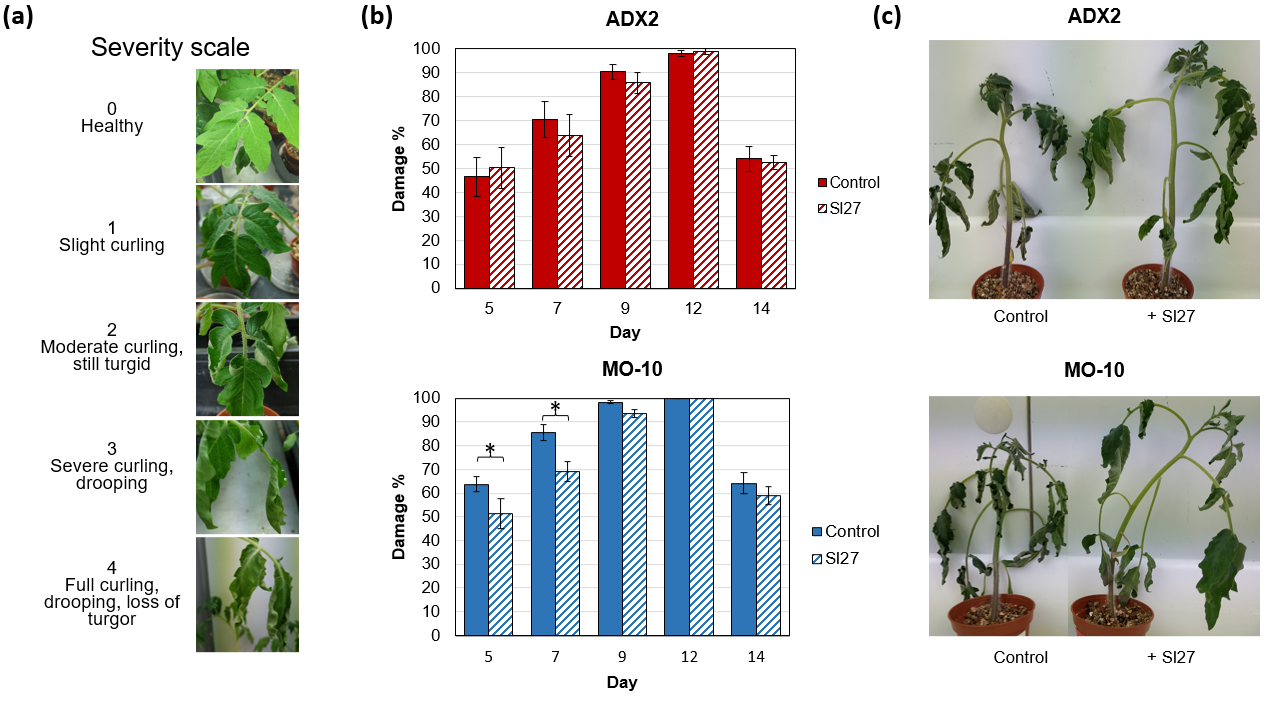
Leaf damage was evaluated at days 5, 7, 9, 12, and 14 using a five-level severity scale (0, 1, 2, 3, 4), with each level assigned a corresponding damage coefficient (0, 0.25, 0.5, 0.75, 1.0). The damage index for each plant was calculated as follows:
D a m a g e   I n d e x   % = Σ ( n °   l e a v e s   a t   e a c h   l e v e l   ×   c o e f i c i e n t ) n °   o f   l e a v e s   p e r   p l a n t × 100
where the following applies:
  • Level 0 = no visible damage;
  • Level 1 = slight curling;
  • Level 2 = moderate curling, still turgid;
  • Level 3 = severe curling, drooping;
  • Level 4 = full curling, drooping, loss of turgor.
This formula yields a percentage value representing the average leaf damage severity for each plant.
Photosynthetic parameters were assessed using a portable open-system infrared gas analyzer (LI-6800 portable photosynthesis system, LI-COR, Lincoln, NE, USA) on days 5, 7, 9, 12, and 14. Data were not collected on day 12 to avoid causing irreversible damage to the severely wilted leaves with the cuvette chamber. All measurements were conducted under ambient CO2, light intensity (150 μmol ·m−2 · s−1), and humidity, with three technical replicates per leaf for photosynthetic rate (A), transpiration rate (E), and stomatal conductance (gsw). The measurements were performed on the central region of the largest leaflet of the third and fourth true leaves of each plant.
Stomatal analysis was conducted by sampling three randomly selected plants of each treatment on day 5. In brief, leaflets were mounted on glass slides with the adaxial epidermis in contact with dental resin, following the protocol described by Scalschi et al. [24]. Images of randomly selected regions were captured using a Nikon i80 microscope (Nikon, Tokio, Japan) with a 40× objective. Stomatal apertures were measured using ImageJ software 1.53t (NIH, Bethesda, MD USA) as a dimensionless ratio of width to length. All fully visible stomata in the images were measured for the analysis. Three technical replicates were performed for each measurement, totaling 40–50 stomata per condition. Stomatal size was also assessed.
Hormone and phenolic compounds were obtained by sampling three to five plants per treatment on days 7, 12, and 14. To evaluate hormone levels associated with plant defense against drought, fresh samples of the third and fourth true leaves of each plant were frozen in liquid nitrogen, ground, and freeze-dried. A sample of 0.05 g from the freeze-dried material was homogenized in 1 mL of ultrapure water. Prior to extraction, an internal standard mix, containing deuterated abscisic acid ([2H6] ABA), deuterated salicylic acid ([2H4] SA), and dihydrojasmonic acid (dhJA) and propilparabene, was added at a concentration of 100 ng/mL to enable quantification of jasmonic acid (JA), 12-oxo-phytodienoic acid (OPDA), salicylic acid (SA), and ABA. After a partition with diethyl ether, samples were dried and resuspended in 1 mL of H2O/methanol (90/10).
A 20 μL aliquot of the extract was injected into an Acquity UPLC system equipped with an ACQUITY UPLC BEH C18 column (1.7 μm, 2.1 × 50 mm; Waters, Milford, MA, USA), coupled to a triple quadrupole mass spectrometer (TQD; Waters, Manchester, UK). Quantitative data from calibration standards and plant samples were processed using MASSLYNX NT software version 4.1 (Micromass).

2.3. Mild Water Stress Experiment

Following the initial experiment of complete water withdrawal for 12 days, the genotype that showed improved drought resistance due to endophyte inoculation, MO-10, was selected for a long-term moderate stress. In this follow-up, a more moderate and controlled water stress was applied to better simulate common field conditions, where plants often face reduced water availability rather than complete drought. Additionally, in this experiment fungal inoculation was performed at the plantlet stage instead of at the seed stage.
Seeds were surface sterilized as described above and put on sterile filter paper inside Petri plates with 2 mL dH2O to wet the paper. The seeds were kept in dark in a growth chamber to germinate for 7 days, under controlled conditions of 25/20 °C, 65% relative humidity, and a 16/8 h photoperiod. One-week-old seedlings were transplanted into pots containing 700 g of soil that was prepared and sterilized prior to use, composed of 2/4 coarse sand, ¼ fine sand, and ¼ Vermiculite by weight. The substrate was humidified before transplanting, and plantlets were inoculated with 1 mL of conidia suspension of a concentration of 1 × 10⁶ spores/mL, prepared as described in the previous section. Except for the inoculation day, plants were irrigated with 10% Hoagland solution every other day, until 3-week-old plants were prepared for water stress.
Prior to stress, pot weights were adjusted with dH2O at 80% (control) and 40% (stress) of field capacity. An 80% field capacity served as the well-watered control without excessive saturation, whereas 40%, which is half of the control, served as the water deficit treatment while maintaining plant viability. The water-retention capacity of the soil was determined by a field capacity test, based on the following calculation:
W a t e r   c o n t e n t   a t   100 %   f i e l d   c a p a c i t y = w e t   w e i g h t d r y   w e i g h t
100% field capacity: full soil saturation and no excess water draining after 1 min.
Wet weight: weight of pot + substrate at water saturation, average of 10 replicates.
Dry weight: weight of pot + substrate after being oven-dried until constant weight, average of 10 replicates.
Based on the calculations, all plants were watered twice weekly with 10 mL Hoagland solution and supplemented with distilled water as needed to compensate for the water loss. Water stress was applied for a total of 14 days.
At the end of the experiment, the following growth parameters were measured: root fresh and dry weight and stem fresh and dry weight.

2.4. Statistical Analysis

Statistical analyses were conducted using Statgraphics Centurion XVI (Statpoint Technologies, Warrenton, VA, USA). For each experiment, data were analyzed independently within each genotype and experimental setup. Comparisons between treatments (e.g., control vs. Sl27-inoculated plants under the same stress conditions). Different sets of plants were used at each time point, as sampling procedures affected plant integrity. Therefore, each time point was analyzed independently and does not represent repeated measurements on the same individual plants. For datasets with a normal distribution, a one-way ANOVA was applied, and mean comparisons were performed using a Fisher’s least significant difference (LSD) test at a 95% confidence level. For datasets that did not meet the assumptions of normality or homogeneity of variance, the non-parametric Kruskal–Wallis test was applied. All experiments were independently repeated three times. Due to biological variability between independent experimental runs, data were not pooled across repetitions, and statistical analyses were performed within each individual experiment, and representative results are shown in the figures except for hormonal analysis.

3. Results

3.1. Early Physiological Responses Under Severe Water Stress

The phenotypic responses of the two tomato genotypes, ADX2 and MO-10, to severe water stress were assessed using a visual damage severity scale over the course of the stress and recovery period (Figure 1). Data were recorded on day 5, when stress symptoms and differences started to be visually apparent, and concluded on day 12, by which time almost all plants had reached 100% on the damage scale.
Under water stress conditions, both genotypes showed a progressive increase in leaf damage. In MO-10 plants, inoculation with Leptobacillium sp. Sl27 resulted in significantly lower damage scores compared with non-inoculated controls at early stress time points (days 5 and 7; p < 0.05). In contrast, ADX2 plants exhibited a similar trend, although significant differences between inoculated and control plants were not detected at any evaluated time point. After watering and two days of recovery (day 14), most plants returned to a condition comparable to that observed on day 5. During this recovery phase, Sl27-inoculated plants showed a response pattern similar to that of the control plants.
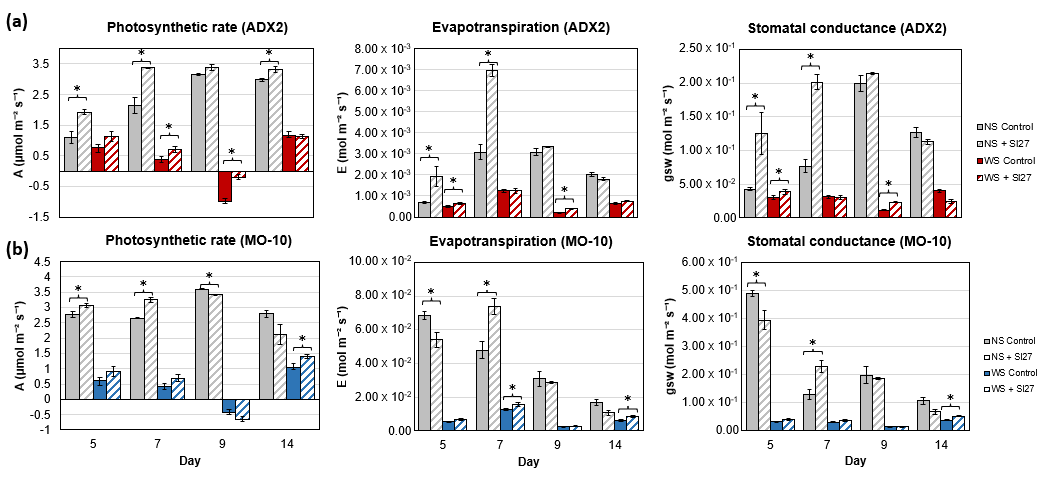
The evolution of the main photosynthetic parameters during drought stress is reflected in Figure 2. In the absence of stress, Sl27-inoculated plants of both genotypes (ADX2 and MO-10) showed higher photosynthetic activity compared to mock-treated plants. In consonance, evapotranspiration (E) and stomatal conductance (gsw) for the NS plants varied for days 5–7 with significantly different levels in control and Sl27-inoculated plants. This effect may be linked to the growth-promoting potential of Sl27 previously reported in other tomato genotypes [25]. The tendency was maintained throughout the experiment, with inoculated plants exhibiting slightly but significantly higher photosynthetic rate (A) than non-inoculated plants.
Photosynthetic rate decreased progressively with water stress. A reduction was already evident by day 5 with near halved activity in all stressed plants, and after one week, photosynthesis declined to ~0.5–1 µmol·m−2·s−1. Under stress, +Sl27 plants showed higher photosynthetic values than the mock-inoculated controls, with statistical significance for ADX2 at day 7. Regarding evapotranspiration and stomatal conductance, Sl27 induced higher levels of both at certain time points during water stress (days 5 and 9 in ADX2 and day 7 in MO-10), although these increases did not perfectly correlate with the observed phenotype or photosynthetic rate. By day 9, photosynthetic rates had become negative in some plants, which indicate a net CO2 release, reflecting respiration exceeding photosynthetic carbon fixation. Sl27-inoculation appeared to mitigate or delay the severe effects of stress at this stage for ADX2.
Two days after rewatering (day 14), plants partially recovered their photosynthetic activity, reaching levels comparable to those observed on day 5. This recovery pattern was consistent with the severity scores based on leaf appearance. At this stage, Sl27 did not produce a clear effect in ADX2 plants, with both inoculated and control plants exhibiting photosynthetic rate around 1 µmol·m−2·s−1. However, MO-10 + Sl27 showed significantly higher photosynthesis, accompanied by significantly higher transpiration and stomatal conductance. Thus, Sl27 appeared to mitigate photosynthetic damage and support recovery under mild water stress for MO-10, which may be also associated with enhanced plant vigor rather than drought-specific responses.
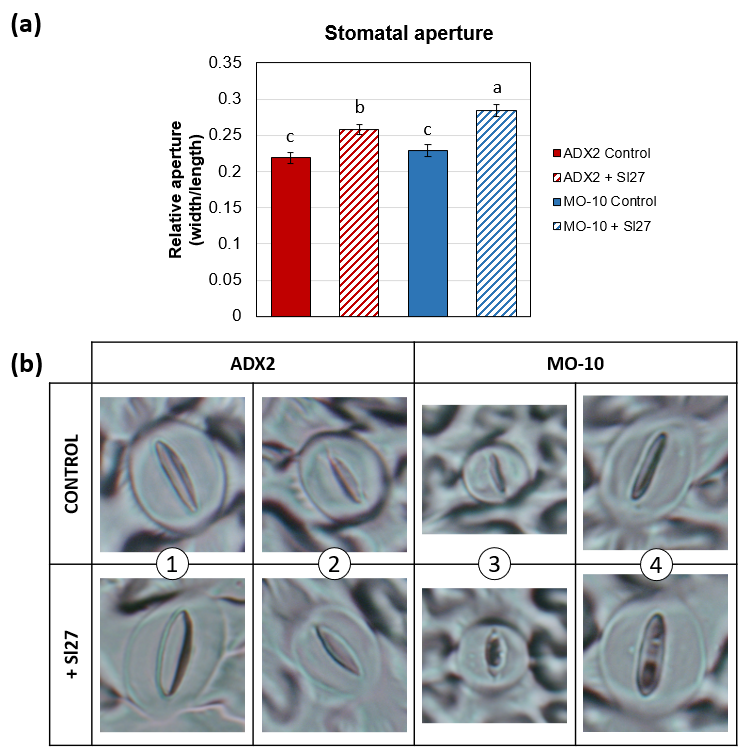
Stomatal aperture was evaluated at an early stage of water stress (day 5) to assess potential differences in stomatal regulation among treatments (Figure 3). At first glance, relative stomatal aperture appeared similar among conditions. However, the measurements indicated that inoculation with Sl27 resulted in a small but statistically significant retardation of the closure for both ADX2 (25.8%) and MO-10 (28.5%) compared to their respective controls (21.9% and 22.9%). This difference was observed at a stage when visible damage and severe physiological impairment were still limited, particularly in MO-10 plants. The maintenance of a wider stomatal aperture in Sl27-inoculated plants at day 5 may reflect a more favorable initial water status, rather than with a direct effect on stomatal response. These results suggest that Sl27-inoculated plants experienced a delayed onset of severe water stress and, consequently, showed differences in water statuses, allowing stomatal closure to occur later as drought progressed.
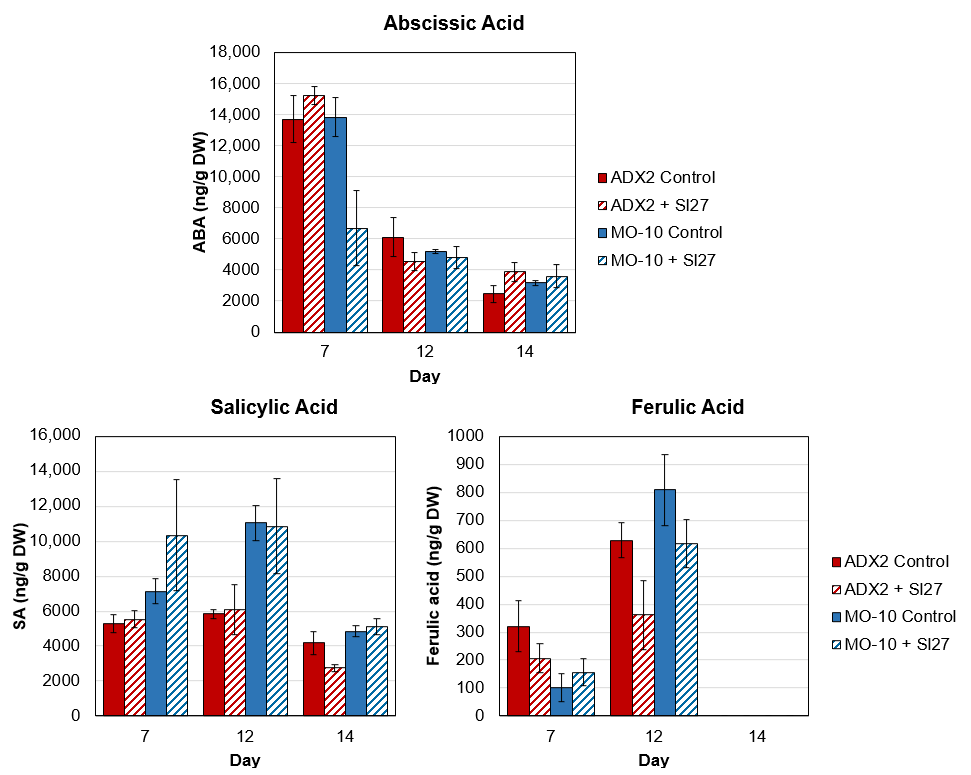
Phytohormone accumulation in the leaves was measured at days 7, 12, and 14 (recovery), which is shown in Figure 4.
The concentration of ABA, a key hormone involved in drought stress resistance, was high in all stressed plants at day 7 relative to the non-stressed controls. Sl27 did not affect ABA accumulation, although MO-10 plants showed a trend toward lower ABA that did not reach statistical significance (p < 0.05).
The concentration of SA was higher in the stressed plants compared to the controls, showing higher levels in MO-10 than in ADX2. Overall, SA levels showed similar trends in control and Sl27-inoculated plants, although at day 14 ADX2 + Sl27 plants exhibited lower SA levels. Ferulic acid likewise tended to accumulate less in Sl27-inoculated plants, although these differences were subtle, and was not detected at day 14, because it is associated with plant stress and the plants were not stressed anymore. Regarding to jasmonic acid and OPDA, the results for these molecules were under the limit of quantification.
These results may indicate that although inoculation with Sl27 resulted in a small reduction in plant response under stress, prolonged stress finally countered this difference. Thus, as supported by the phenotypic, photosynthetic, and hormonal responses of the plants, the inoculation at this study level can provide some plant resistance enhancement, which can cover for shorter term severe stress.

3.2. Growth Responses Under Moderate Water Limitation

Following the characterization of Sl27 effects under severe water stress, a second independent experimental approach was undertaken as an exploratory study. This experiment aimed to evaluate plant performance under more moderate and agronomically relevant water limitation conditions and was conducted exclusively in the more sensitive genotype MO-10. Based on the differential responses observed between the genotypes under severe water stress, MO-10, the more drought-sensitive genotype, benefited more from inoculation with Sl27 showing significantly less damage during the stress. Although severe stress finally overcame this effect, the results suggest that Sl27 may improve the response of MO-10 more effectively under milder stress conditions.
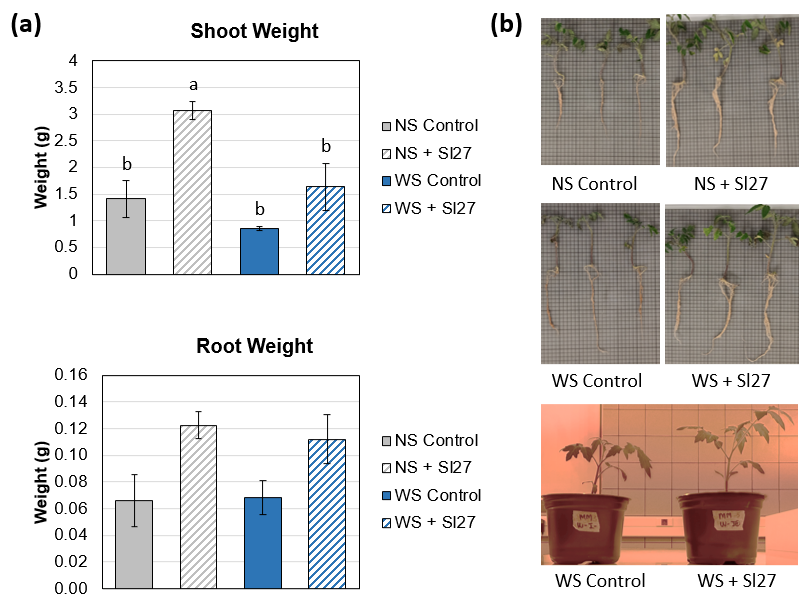
In this experiment, plants were subjected to a controlled water deficit corresponding to 40% of field capacity for 14 days, a regime intended to represent sustained but non-lethal water limitation. In contrast to the first experiment, inoculation with Leptobacillium sp. Sl27 was performed at the plantlet stage. At the end of the stress period, plant growth parameters, including shoot and root dry weight, were measured to evaluate the effects of Sl27 under moderate water stress (Figure 5).
Inoculation with Sl27 enhanced the growth of MO-10 plants under non-stressed conditions, significantly increasing shoot biomass. Water stress negatively affected plant growth, as reflected in the reduced shoot biomass. Sl27-treated plants showed a consistent trend toward greater growth under stress, but this effect fell just short of statistical significance.
Sl27 treatment improved root structure and development, as shown in the pictures of Figure 5b. This root enhancement is consistent with a contribution to the observed improvement in overall plant growth and delay in water stress progression, allowing plants to better access the limited water available in the substrate.
This observed variation could reflect differences in the effectiveness of inoculation for each plant or the individual interactions established between the plant and the endophyte.
Plant biomass in MO-10 plants was observed to increase when inoculated with Sl27, indicating that the treatment may improve growth. Under moderate water stress conditions, this increase in biomass does not necessarily reflect an improvement in stress tolerance, per se, but rather suggests that Sl27 enhances plant growth and vigor under suboptimal water availability. Although larger plants theoretically have higher water demand and could be more susceptible to water limitation, the stress conditions applied in this experiment were not severe enough to create a measurable physiological penalty at the leaf level. However, based on the better overall phenotype and photosynthetic activity in the severe water stress experiment, a potential contribution of Sl27 to water stress delay cannot be entirely excluded.

4. Discussion

4.1. Genotype-Dependent Responses to Sl27 Inoculation

Drought stress is a major constraint in food crop cultivation, negatively affecting plant growth, photosynthesis, and yield. In the context of climate change, it is necessary to find strategies to improve the resilience of crops to increasingly frequent drought events. In previous work, we isolated and characterized a new fungal endophyte, Leptobacillium sp. Sl27. This endophyte, which was isolated from traditional tomato genotypes, improved growth when inoculated in modern tomato genotypes. In this study, we investigated the role of Sl27 in mitigating water stress in two tomato genotypes, ADX2 and MO-10.
The results obtained in this study indicate that inoculation with Leptobacillium sp. Sl27 influences tomato plant performance under water-limited conditions in a genotype-dependent manner, with distinct outcomes depending on stress intensity and experimental context. Under severe water stress, Sl27 inoculation was associated with reduced early phenotypic damage and transient modulation of physiological parameters, particularly in the more drought-sensitive genotype MO-10. When water stress was applied to both tomato varieties, we observed a differential response between ADX2 and MO-10. ADX2 was phenotypically more resistant to water stress than MO-10. This contrasts with previous reports under heat stress, where ADX2 was more sensitive than MO-10 [23]. Overall, the two genotypes exhibit distinct responses to abiotic stress.
Inoculation with Sl27 improved performance under water stress in MO-10 plants, whereas no significant differences were found in ADX2. This result highlights the importance of genotype in endophyte-mediated stress delay. While both genotypes showed trends toward reduced damage, only MO-10 exhibited statistically significant improvements. The differential response observed between the two tomato genotypes highlights the central role of host genetic background in shaping endophyte-mediated effects under water limitation. The more drought-sensitive genotype, MO-10, consistently showed clearer responses to Sl27 inoculation, whereas the comparatively more resilient genotype, ADX2, displayed only marginal or non-significant effects. Such genotype-dependent outcomes have been widely reported in studies involving beneficial microorganisms and are often attributed to differences in baseline stress tolerance, growth dynamics, or plant–microbe compatibility. In this context, the limited response of ADX2 does not indicate a lack of endophyte activity but rather suggests that genotypes with higher intrinsic stress resilience may exhibit reduced responsiveness to biopriming strategies. These findings are consistent with previous reports that the effectiveness of endophytes can vary depending on host genotype. For instance, Sl27 was previously shown to promote growth in TH-30 and MO-10 genotypes but not in other commercial genotypes [25]. Similarly, it has been previously reported that one endophyte could show different results in different genotypes of the same plant species. For example, tomato genotypes have been shown to respond differently to resistance induction by rhizobacteria or silicon, with variations reflected in cell wall modifications and the activity of defense-related enzymes [26]. Furthermore, Epichloë sp. showed different degree of induction of growth and drought tolerance in different tall grass species [27]. Genotype-specific differences have also been reported in barley, where S. indica triggered distinct growth responses among genotypes [28].

4.2. Physiological Responses Under Severe Water Stress

Photosynthetic activity is one of the earliest and most sensitive indicators of water stress. In our study, Sl27-treated plants maintained higher net CO2 assimilation rates (A), transpiration (E), and stomatal conductance (gsw) under control conditions, suggesting that the presence of the endophyte may enhance general plant performance. Under drought stress, only a few of these photosynthetic parameters were improved in the presence of the endophyte, suggesting that drought protection is mediated through additional mechanisms, such as osmolyte accumulation, antioxidant activity, and improved stomatal regulation, rather than direct enhancement of photosynthesis. However, these processes were not directly assessed in the present study and, therefore, cannot be confirmed in the context. Reports on beneficial microorganisms indicate contrasting effects on photosynthesis under drought stress. For instance, S. indica and Penicillium chrysogenum [29] have been associated with enhanced photosynthetic activity and improved water-use efficiency. In contrast, arbuscular mycorrhizal fungi conferred drought protection to Cichorium intybus, but this response was accompanied by a reduction in photosynthetic efficiency [30]. These findings suggest that different microorganisms may employ distinct protective strategies, which do not always involve the direct enhancement of photosynthetic performance.
As photosynthetic rates decline under stress, stomatal closure also contributes to water conservation, thereby reducing stomatal conductance and transpiration. Less transpiration causes restriction in the capture of CO2 so the photosynthetic rate is also lowered. Interestingly, at day 7, E becomes higher than at day 5, although A and gsw are still declining, suggesting a possible decoupling between water loss and CO2 assimilation under progressing drought stress. By day 9, plants were no longer able to cope with the drought stress; despite very low evapotranspiration and stomatal conductance, net photosynthesis had become negative.
The maintenance of a wider stomatal aperture during early stress is therefore more consistent with a more favorable initial plant water status than with a direct modulation of stomatal control mechanisms. In this context, higher photosynthetic rates and transpiration observed at specific early time points likely reflect a delayed progression toward severe dehydration, rather than an enhanced tolerance of the photosynthetic machinery. As drought intensified, photosynthetic activity declined sharply in all plants, and Sl27 inoculation did not prevent the collapse of carbon assimilation under prolonged severe stress. Similar stomatal modulation has been reported in S. indica-inoculated tomato and walnut plants, where endophyte treatment promoted proline accumulation and ROS scavenging to support stomatal function [29].

4.3. Hormonal Responses and Stress Signaling

Phytohormones play a central role in drought response, with abscisic acid (ABA) being a key regulator of stomatal closure and osmotic adjustment [31,32]. In our study, ABA levels increased in all water-stressed plants, and Sl27 did not significantly alter ABA accumulation in ADX2. However, MO-10 plants showed lower ABA levels with Sl27 at 7 days, which may be associated with the wider opening of stomata and could reflect a more efficient response or reduced stress perception. Similar reductions in ABA in endophyte treated plants under drought stress have been reported in several plant species. For example, there was a strong reduction in ABA levels in wheat under drought stress treated with either Acremonium screrotigenum or Sarocladium implicatum [33].
Salicylic acid (SA) is a signaling molecule involved in processes such as stomatal closure, photosynthesis, and other mechanisms related to drought resistance [34,35]. Exogenous application of SA has been reported to enhance plant resilience under drought stress [36,37]. In our experiments, Sl27-inoculated MO-10 plants showed a non-significant tendency toward higher SA at day 7, while Sl27-inoculated ADX2 plants had slightly lower SA during recovery. These differences were not statistically significant but showed some correlation with plant phenotype and photosynthetic activity for MO-10. However, for ADX2, this difference may just reflect reduced residual stress signaling. Similarly, ferulic acid showed a non-significant tendency toward lower accumulation, suggesting that Sl27 may reduce stress-induced secondary metabolism or that plants experienced less oxidative stress and, therefore, required less antioxidant activity.

4.4. Growth Promotion and Plant Performance Under Moderate Water Stress

Based on the results of the severe drought experiments, we decided to perform a long-term water stress experiment in which mild stress was maintained. For this experiment, we focused on the genotype with a stronger response to the inoculation with the endophyte, cv. MO-10. The results showed that during a period of moderate water stress, the predominant effect of Sl27 was an enhancement of plant growth and root development, rather than a sustained protection of leaf-level physiological processes. These findings suggest that Sl27 does not confer classical drought tolerance but instead promotes improved plant performance under water limitation through mechanisms that combine early stress-response modulation and growth-related avoidance strategies. This growth-promoting effect is consistent with reports on other fungal endophytes such as Acrocalymma spp. [38], which improve root architecture and stress resilience in tomato or A. sclerotigenum, which increased wheat root growth and resistance to drought stress [33]. Importantly, enhanced plant biomass under non-stressed or moderate stress conditions should be interpreted as a growth-promoting effect rather than a direct indicator of increased drought tolerance. In this context, Sl27 appears to primarily enhance plant performance by promoting growth and root development, which may contribute indirectly to improved plant resilience under water-limited conditions. Enhanced root systems likely contribute to better water uptake, even if the primary effect is growth promotion rather than direct stress mitigation. This relationship is supported by extensive research showing that plants with deeper, more branched, or more hydraulically efficient root systems are able to access water from deeper soil layers during drought conditions. Morphological adaptations such as increased root length and biomass allow plants to maintain water uptake even when surface moisture is depleted, helping sustain physiological functions without necessarily improving photosynthesis or transpiration [39]. These traits are part of a broader drought avoidance strategy, where plants enhance water acquisition rather than directly altering leaf-level gas exchange [40]. Fungal endophytes that stimulate root development, as Sl27 showed in this study, may, therefore, confer drought resilience primarily through improved water-foraging capacity, supporting growth and survival under water-limited conditions.
Taken together, this study demonstrates that inoculating tomato plants with the fungal endophyte Sl27 can enhance water stress resilience, particularly in the MO-10 genotype. The inoculated plants exhibited improved phenotypic traits, including reduced leaf damage, larger root system, and increased stomatal aperture during early drought stages. These effects were accompanied by a trend toward altered phytohormone profiles, suggesting a modulation of stress signaling pathways.
Although Sl27 did not prevent the severe physiological collapse observed under prolonged drought, its influence was evident during early stress and recovery phases. Notably, Sl27-inoculated MO-10 plants showed significantly higher photosynthetic rates and stomatal conductance after rewatering, indicating a role in facilitating recovery. In contrast, ADX2 plants showed less pronounced responses, highlighting the importance of studying the genotype effects when applying biopriming as a resistance induction method.
Under moderate and sustained water limitation, the predominant effect of Sl27 was an enhancement of plant growth and root development, rather than a clear improvement in stress tolerance. The increase in shoot biomass and the observed trends under stress are more consistent with a growth-promoting effect. Such responses may contribute indirectly to plant performance under water limitation through drought-avoidance mechanisms, for example by improving water uptake capacity via enhanced root development These findings align with previous reports on fungal endophytes which have been shown to promote tomato growth and improve stress resilience through enhanced nutrient uptake and hormonal modulation.
Overall, our results indicate that Sl27 does not increase the intrinsic tolerance of tomato plants to severe water stress, but rather improves plant performance under water-limited conditions by delaying the progression toward critical stress thresholds. This effect is strongly dependent on the host genotype and is most evident in the more drought-sensitive genotype MO-10. By promoting growth and improving early plant water status, Sl27 allows plants to sustain physiological activity for longer during the initial stages of water deficit. Importantly, the effects observed in this study do not correspond to classical drought tolerance, as plants ultimately reached similar levels of damage under prolonged severe stress. Instead, Sl27 appears to modulate early responses to water deficit and improve plant performance during initial stages of stress. The mechanistic basis of the observed responses remains unclear. Although several processes, such as hormonal regulation, osmotic adjustment, antioxidant activity, and improved plant water status, have been described in plant–endophyte interactions, the present dataset does not allow these possibilities to be distinguished.
In particular, the hormone analyses performed in this study showed only limited or non-significant differences, and key indicators of plant water status, oxidative stress, and osmotic balance were not assessed. Therefore, the underlying mechanisms of Sl27-mediated responses cannot be determined from the current data and remain to be elucidated in future studies. Future studies should explore the molecular mechanisms underlying these interactions and assess the consistency of Sl27 colonization under field conditions. The integration of fungal endophytes into crop management strategies could contribute to climate-resilient agriculture by enhancing plant growth and improved plant performance under stress in an eco-friendly manner.

5. Conclusions

In conclusion, the fungal endophyte Leptobacillium Sl27 influences tomato plant response to water stress and can reduce the negative impacts of water stress in a genotype-dependent manner. MO-10 plants benefited from enhanced CO2 assimilation, wider stomatal aperture, and increased root and shoot growth, whereas ADX2 showed only limited responses. These findings indicate that Sl27 can modulate plant performance under water limitation, primarily through effects on growth and early stress responses rather than by conferring intrinsic drought tolerance. However, the results presented here are based on controlled conditions and a limited number of genotypes. Further studies are required to evaluate the stability of endophyte colonization, to validate the observed effects under field conditions, and to assess the consistency of responses across a wider range of tomato genotypes. Therefore, while Sl27 represents a promising candidate for improving plant performance under water limitation, its potential application in agricultural systems remains to be established.

Author Contributions

Conceptualization, L.L.-X. and E.L.; methodology, L.L.-X. and B.V.; validation, E.L., L.S. and G.C.; investigation, L.L.-X.; writing—original draft preparation, L.L.-X.; writing—review and editing, L.S. and E.L.; supervision, L.S. and E.L.; funding acquisition, B.V. and G.C. All authors have read and agreed to the published version of the manuscript.

Funding

This work was funded by Spanish Ministry of Universities, grant number: FPU18/02891; Generalitat Valenciana, grant number: GV/2019/028; and Universitat Jaume I, grant number: UJI-B2022-30.

Data Availability Statement

The raw data supporting the conclusions of this article will be made available by the authors upon request.

Acknowledgments

The authors are grateful to Serveis Centrals de Instrumentació Cientifica (SCIC) from Universitat Jaume I and Instituto de Conservación y Mejora de la Agrodiversidad Valenciana (COMAV) from Universitat Politècnica de València.

Conflicts of Interest

The authors declare no conflicts of interest.

References

  1. Bijalwan, P.; Sharma, M.; Yadav, A.; Dhanda, P.S.; Kaushik, P.; Mishra, D.S.; Kumar, P.; Tunç, Y.; Khadivi, A. A Systematic Review of Plant Responses to Drought Stress. Appl. Fruit Sci. 2025, 67, 386. [Google Scholar] [CrossRef]
  2. Anjum, S.A.; Xie, X.; Wang, L.; Saleem, M.F.; Man, C. Morphological, physiological and biochemical responses of plants to drought stress. Afr. J. Agric. Res. 2011, 6, 2026–2032. [Google Scholar]
  3. Yanqing, W.; Jiao, L.; Lu, Z.; Hao, W.; Yiming, Z.; Irshad, A.; Guisheng, Z. Abiotic stress responses in crop plants: A multi-scale approach. J. Integr. Agric. 2026, 25, 1–15. [Google Scholar] [CrossRef]
  4. Rao, D.E.; Chaitanya, K.V. Photosynthesis and antioxidative defense mechanisms in deciphering drought stress tolerance of crop plants. Biol. Plant. 2016, 60, 201–218. [Google Scholar] [CrossRef]
  5. Chaves, M.M.; Maroco, J.P.; Pereira, J.S. Understanding plant responses to drought—From genes to the whole plant. Funct. Plant Biol. 2003, 30, 239–264. [Google Scholar] [CrossRef] [PubMed]
  6. Sharma, A.; Das, N.; Pandey, P.; Shukla, P. Plant-microbiome responses under drought stress and their metabolite-mediated interactions towards enhanced crop resilience. Curr. Plant Biol. 2025, 43, 100513. [Google Scholar] [CrossRef]
  7. Fang, Y.; Xiong, L. General mechanisms of drought response and their application in drought resistance improvement in plants. Cell. Mol. Life Sci. 2015, 72, 673–689. [Google Scholar] [CrossRef] [PubMed]
  8. Ilyas, M.; Nisar, M.; Khan, N.; Hazrat, A.; Khan, A.H.; Hayat, K.; Fahad, S.; Khan, A.; Ullah, A. Drought Tolerance Strategies in Plants: A Mechanistic Approach. J. Plant Growth Regul. 2021, 40, 926–944. [Google Scholar] [CrossRef]
  9. Bari, R.; Jones, J.D.G. Role of plant hormones in plant defence responses. Plant Mol. Biol. 2009, 69, 473–488. [Google Scholar] [CrossRef] [PubMed]
  10. Franco-Navarro, J.D.; Padilla, Y.G.; Álvarez, S.; Calatayud, Á.; Colmenero-Flores, J.M.; Gómez-Bellot, M.J.; Hernández, J.A.; Martínez-Alcalá, I.; Penella, C.; Pérez-Pérez, J.G.; et al. Advancements in Water-Saving Strategies and Crop Adaptation to Drought: A Comprehensive Review. Physiol. Plant. 2025, 177, e70332. [Google Scholar] [CrossRef] [PubMed]
  11. Mukarram, M.; Choudhary, S.; Kurjak, D.; Petek, A.; Khan, M.M.A. Drought: Sensing; signalling, effects and tolerance in higher plants. Physiol. Plant. 2021, 172, 1291–1300. [Google Scholar] [CrossRef] [PubMed]
  12. Bashir, S.S.; Hussain, A.; Hussain, S.J.; Wani, O.A.; Nabi, S.Z.; Dar, N.A.; Baloch, F.S.; Mansoor, S. Plant drought stress tolerance: Understanding its physiological, biochemical and molecular mechanisms. Biotechnol. Biotechnol. Equip. 2021, 35, 1912–1925. [Google Scholar] [CrossRef]
  13. Singh, L.P.; Gill, S.S.; Tuteja, N. Unraveling the role of fungal symbionts in plant abiotic stress tolerance. Plant Signal. Behav. 2011, 6, 175–191. [Google Scholar] [CrossRef] [PubMed]
  14. Nombamba, A.; Fadiji, A.E.; Babalola, O.O. Exploring the role of endophytic fungi in the amelioration of drought stress in plants. Plant Prot. Sci. 2024, 60, 213–228. [Google Scholar] [CrossRef]
  15. Aruna, S.; Rafeekher, M.; Johnson, J.M.; Sarada, S.; Beena, R.; Soni, K.B.; Anil, A.S. Piriformospora indica Improves Drought Tolerance in Tomato Plants through Enhanced Nutrient Uptake and Antioxidant Enzymes. Int. J. Plant Soil Sci. 2023, 35, 865–875. [Google Scholar] [CrossRef]
  16. Zhang, Z.; Cao, B.; Gao, S.; Xu, K. Grafting improves tomato drought tolerance through enhancing photosynthetic capacity and reducing ROS accumulation. Protoplasma 2019, 256, 1013–1024. [Google Scholar] [CrossRef] [PubMed]
  17. Cao, J.L.; He, W.X.; Zou, Y.N.; Wu, Q.S. An endophytic fungus, Piriformospora indica, enhances drought tolerance of trifoliate orange by modulating the antioxidant defense system and composition of fatty acids. Tree Physiol. 2023, 43, 452–466. [Google Scholar] [CrossRef] [PubMed]
  18. Swetha, S.; Padmavathi, T. Mitigation of Drought Stress by Piriformospora indica in Solanum melongena L. cultivars. Proc. Natl. Acad. Sci. India Sect. B Biol. Sci. 2020, 90, 585–593. [Google Scholar] [CrossRef]
  19. Nagabhyru, P.; Dinkins, R.D.; Wood, C.L.; Bacon, C.W.; Schardl, C.L. Tall fescue endophyte effects on tolerance to water-deficit stress. BMC Plant Biol. 2013, 13, 127. [Google Scholar] [CrossRef] [PubMed]
  20. Rodriguez, R.J.; Henson, J.; Van Volkenburgh, E.; Hoy, M.; Wright, L.; Beckwith, F.; Kim, Y.O.; Redman, R.S. Stress tolerance in plants via habitat-adapted symbiosis. ISME J. 2008, 2, 404–416. [Google Scholar] [CrossRef] [PubMed]
  21. Xu, L.; Li, X.; Han, L.; Li, D.; Song, G. Epichloe endophyte infection improved drought and heat tolerance of tall fescue through altered antioxidant enzyme activity. Eur. J. Hortic. Sci. 2017, 82, 90–97. [Google Scholar] [CrossRef]
  22. Sheikh, S.; Sheikh, S.; Kumar, V.S.S.; Babu, R. Classification and Occurrence of Fungal Endophytes. In Metabolic Sustainability of Endophytes; Microorganisms for Sustainability; Springer: Singapore, 2025; Volume 52, pp. 1–11. [Google Scholar] [CrossRef]
  23. Fernández-Crespo, E.; Liu-Xu, L.; Albert-Sidro, C.; Scalschi, L.; Llorens, E.; González-Hernández, A.I.; Crespo, O.; Gonzalez-Bosch, C.; Camañes, G.; García-Agustín, P.; et al. Exploiting Tomato Genotypes to Understand Heat Stress Tolerance. Plants 2022, 11, 3170. [Google Scholar] [CrossRef] [PubMed]
  24. Scalschi, L.; Vicedo, B.; Camañes, G.; Fernandez-Crespo, E.; Lapeña, L.; González-Bosch, C.; García-Agustín, P. Hexanoic acid is a resistance inducer that protects tomato plants against Pseudomonas syringae by priming the jasmonic acid and salicylic acid pathways. Mol. Plant Pathol. 2013, 14, 342–355. [Google Scholar] [CrossRef] [PubMed]
  25. Liu-Xu, L.; Vicedo, B.; Papadopoulou, K.K.; Camañes, G.; Llorens, E. Isolation and characterization of a new Leptobacillium species promoting tomato plant growth. Sci. Rep. 2025, 15, 930. [Google Scholar] [CrossRef] [PubMed]
  26. Kurabachew, H.; Wydra, K. Induction of systemic resistance and defense-related enzymes after elicitation of resistance by rhizobacteria and silicon application against Ralstonia solanacearum in tomato (Solanum lycopersicum). Crop Prot. 2014, 57, 1–7. [Google Scholar] [CrossRef]
  27. Decunta, F.A.; Pérez, L.I.; Malinowski, D.P.; Molina-Montenegro, M.A.; Gundel, P.E. A Systematic Review on the Effects of Epichloë Fungal Endophytes on Drought Tolerance in Cool-Season Grasses. Front. Plant Sci. 2021, 12, 644731. [Google Scholar] [CrossRef] [PubMed]
  28. Waller, F.; Achatz, B.; Baltruschat, H.; Fodor, J.; Becker, K.; Fischer, M.; Heier, T.; Hückelhoven, R.; Neumann, C.; Von Wettstein, D.; et al. The endophytic fungus Piriformospora indica reprograms barley to salt-stress tolerance, disease resistance, and higher yield. Proc. Natl. Acad. Sci. USA 2005, 102, 13386–13391. [Google Scholar] [CrossRef] [PubMed]
  29. Ortega-Villaizán, A.G.; King, E.; Patel, M.K.; Rodríguez-Dobreva, E.; González-Teuber, M.; Ramos, P.; Vicente-Carbajosa, J.; Benito, B.; Pollmann, S. Identification of a drought stress response module in tomato plants commonly induced by fungal endophytes that confer increased drought tolerance. Plant Mol. Biol. 2025, 115, 7. [Google Scholar] [CrossRef] [PubMed]
  30. Langeroodi, A.R.S.; Osipitan, O.A.; Radicetti, E.; Mancinelli, R. To what extent arbuscular mycorrhiza can protect chicory (Cichorium intybus L.) against drought stress. Sci. Hortic. 2020, 263, 109109. [Google Scholar] [CrossRef]
  31. Aslam, M.M.; Waseem, M.; Jakada, B.H.; Okal, E.J.; Lei, Z.; Saqib, H.S.A.; Yuan, W.; Xu, W.; Zhang, Q. Mechanisms of Abscisic Acid-Mediated Drought Stress Responses in Plants. Int. J. Mol. Sci. 2022, 23, 1084. [Google Scholar] [CrossRef] [PubMed]
  32. Daszkowska-Golec, A. The Role of Abscisic Acid in Drought Stress: How ABA Helps Plants to Cope with Drought Stress. In Drought Stress Tolerance in Plants: Vol 2: Molecular and Genetic Perspectives; Springer: Cham, Switzerland, 2016; pp. 123–151. [Google Scholar] [CrossRef]
  33. Llorens, E.; Sharon, O.; Camañes, G.; García-Agustín, P.; Sharon, A. Endophytes from wild cereals protect wheat plants from drought by alteration of physiological responses of the plants to water stress. Environ. Microbiol. 2019, 21, 3299–3312. [Google Scholar] [CrossRef] [PubMed]
  34. Pieterse, C.M.J.; Van Der Does, D.; Zamioudis, C.; Leon-Reyes, A.; Van Wees, S.C.M. Hormonal modulation of plant immunity. Annu. Rev. Cell Dev. Biol. 2012, 28, 489–521. [Google Scholar] [CrossRef] [PubMed]
  35. Emamverdian, A.; Ding, Y.; Mokhberdoran, F. The role of salicylic acid and gibberellin signaling in plant responses to abiotic stress with an emphasis on heavy metals. Plant Signal. Behav. 2020, 15, 1777372. [Google Scholar] [CrossRef] [PubMed]
  36. Khalvandi, M.; Siosemardeh, A.; Roohi, E.; Keramati, S. Salicylic acid alleviated the effect of drought stress on photosynthetic characteristics and leaf protein pattern in winter wheat. Heliyon 2021, 7, e05908. [Google Scholar] [CrossRef] [PubMed]
  37. Shan, L.; Xu, Y.; Wu, D.; Hu, J.; Yu, T.; Dang, C.; Fang, Y.; Zhang, X.; Tian, Q.; Xue, D. Effects of salicylic acid on growth, physiology, and gene expression in rice seedlings under salt and drought stress. Plant Stress 2024, 11, 100413. [Google Scholar] [CrossRef]
  38. Feng, X.; Jin, Y.; Zhong, Z.; Zheng, Y.; Wu, H. Growth-Promoting Effects of Dark Septate Endophytes Fungus Acrocalymma on Tomato (Solanum lycopersicum). J. Fungi 2025, 11, 510. [Google Scholar] [CrossRef] [PubMed]
  39. Jan, S.; Bhat, M.A.; Kumar, A.; Wani, M.A.; Bhat, F.A.; Kanth, R.H.; Shikari, A.B.; Bano, H.; Manzoor, T.; Altaf, H.; et al. Plants Response to Different Abiotic Stresses. J. Crop Health 2025, 77, 1–27. [Google Scholar] [CrossRef]
  40. Dastogeer, K.M.G.; Wylie, S.J. Plant–Fungi Association: Role of Fungal Endophytes in Improving Plant Tolerance to Water Stress. Plant Microbe Interact. Agro-Ecol. Perspect. 2017, 1, 143–159. [Google Scholar] [CrossRef]
Figure 1. Phenotypic evaluation of tomato genotypes ADX2 and MO-10 under severe water stress with and without inoculation with Leptobacillium sp. Sl27. (a) The severity scale used for visual scoring of stress damage, corresponding to a coefficient rate ranging from healthy (0%) to complete damage (100%). (b) Time-course of damage percentage for control and Sl27-inoculated plants at days 5, 7, 9, 12 (end of stress), and 14 (recovery phase). Data show a representative experiment. Asterisks indicate statistically significant differences between treatments at each time point (p < 0.05). (c) Comparative images show water-stressed plants conditions for both genotypes at day 7.
Horticulturae 12 00829 g001
Figure 2. Net photosynthetic rate as represented by net CO2 assimilation rate (A), transpiration rate (E), and stomatal conductance to water vapor (gsw) for control and Sl27-inoculated plants in ADX2 (a) and MO-10 (b) genotypes. Values represent the mean ± SE (n = 6). Asterisks indicate statistically significant differences between treatments at each time point (p < 0.05).
Horticulturae 12 00829 g002
Figure 3. (a) Stomatal aperture expressed as the relative ratio of width to length in the tomato genotypes ADX2 and MO-10, comparing control and Sl27-inoculated plants after 5 days of drought stress. Statistical letters indicate significant differences among groups (p < 0.05) based on a Kruskal–Wallis test followed by Dunn’s multiple comparisons. (b) Representative microscopic images of 4 pairs of similar-sized stomata from control and Sl27-inoculated plants, 2 of each tomato genotype.
Horticulturae 12 00829 g003
Figure 4. Accumulation of phytohormones in tomato leaves at day 7, day 12, and day 14 (recovery) under severe water stress. Levels of abscisic acid (ABA), salicylic acid (SA), and ferulic acid were measured in stressed plants of ADX2 and MO-10 with or without Sl27. Data represent the mean ± SE of the pooled results of three repetitions.
Horticulturae 12 00829 g004
Figure 5. Physiological responses of MO-10 plants under water stress at a 40% field capacity. (a) Shoot and root dry weight of non-stressed (NS) and water-stressed (WS) plants, comparing control and Sl27-inoculated plants. Data represent the mean ± SE of five biological replicates. Statistical letters indicate significant differences among groups (p < 0.05) based on a one-way ANOVA. (b) Representative images of plants at the end of the experiment for each treatment and stress condition.
Horticulturae 12 00829 g005
Disclaimer/Publisher’s Note: The statements, opinions and data contained in all publications are solely those of the individual author(s) and contributor(s) and not of MDPI and/or the editor(s). MDPI and/or the editor(s) disclaim responsibility for any injury to people or property resulting from any ideas, methods, instructions or products referred to in the content.