Review

From Phenotyping to Supervised Agentic Decision Support: A Review of Sensing and Artificial Intelligence for Greenhouse Strawberry Cultivation

1
Department of Smart Farm Science, Kyung Hee University, Yongin 17104, Republic of Korea
2
Interdisciplinary Program in IT-Bio Convergence System, Kyung Hee University, Yongin 17104, Republic of Korea
3
Advanced Radiation Technology Institute, Korea Atomic Energy Research Institute, 29 Geumgu, Jeongeup 56212, Republic of Korea
*
Author to whom correspondence should be addressed.
Horticulturae 2026, 12(7), 765; https://doi.org/10.3390/horticulturae12070765 (registering DOI)
Submission received: 20 May 2026 / Revised: 18 June 2026 / Accepted: 20 June 2026 / Published: 23 June 2026

Abstract

Strawberry greenhouse cultivation is increasingly supported by sensing technologies, artificial intelligence (AI), and decision-support infrastructure, but their horticultural value depends on whether heterogeneous measurements can be translated into biologically meaningful crop states and practical management decisions. This review synthesizes strawberry phenotyping, multimodal sensing, AI-based crop-state interpretation, and supervised agentic coordination as a phenotyping-to-action framework for greenhouse strawberry cultivation. The reviewed studies show substantial progress in measuring and interpreting vegetative, reproductive, fruit-quality, stress-related, and environmental crop states through imaging, spectral, environmental, root-zone, and modeling approaches. However, much of the literature still emphasizes measurement accuracy, model performance, or infrastructure capability, whereas fewer studies validate whether AI-derived outputs improve crop response, management decisions, workflow, resource use, or production outcomes. The review therefore distinguishes sensing technologies for data acquisition and measurement from AI-based methods for interpretation and prediction, and examines how crop-state information can be connected to practical greenhouse decision making. It also compares established decision technologies, including expert systems, model predictive control, digital twins, and closed-loop coordination, with supervised agentic coordination as bounded decision-support concepts rather than as evidence of unrestricted autonomous control. Future work should emphasize phenotype-to-action validation, domain-aware benchmarking, and supervised deployment studies that connect model outputs with decision rules, crop outcomes, operational constraints, and grower oversight. By grounding sensing technologies and AI-based interpretation methods in crop-response validation, strawberry greenhouse systems can progress toward supervised, crop-state-driven decision support.

1. Introduction

Strawberry is a high-value horticultural crop whose marketable yield and commercial performance depend on timely harvest, fruit quality, cultivar-dependent differences in productivity, fruit chemistry, and firmness [1], as well as disease risk [2,3], labor demand during repeated harvests [4,5], postharvest performance [6], and efficient resource use in protected or controlled environments [7]. In greenhouse, hydroponic, and plant-factory systems, vegetative growth, flowering, fruit set, fruit enlargement, ripening, and repeated harvesting often overlap. This overlap makes strawberry a useful model for precision horticulture, but also a difficult crop to automate because management decisions must reflect the current biological state of the crop rather than the physical environment alone.
Smart greenhouse systems commonly monitor air temperature, relative humidity, CO2, radiation or supplemental light, substrate moisture, electrical conductivity, and pH in controlled strawberry production [7,8]. Irrigation and fertigation studies further use substrate humidity, nutrient-solution pH, EC, and threshold moisture sensing as direct control inputs [9,10]. These variables are essential control levers, but they do not fully describe crop performance. Strawberry yield can depend on environmental history as well as current setpoints [11], and root-zone or lighting treatments must ultimately be judged by crop growth, yield, and quality responses [12,13]. Crops grown under similar setpoints may still differ in canopy vigor and biomass [14], flowering and fruit load [4,15], root-zone status [9,10], disease pressure [2,3,16], or fruit quality [1,17] because of cultivar, developmental stage, substrate, season, and previous management. These findings indicate a need to complement environmental regulation with crop-response assessment.
Phenotyping provides the crop-response feedback needed for this transition. Growers already interpret canopy balance, leaf expansion, crown vigor, flower number, fruit set, fruit size and color, deformity, wilting, root symptoms, and disease incidence when adjusting irrigation, fertigation, ventilation, heating, CO2 enrichment, lighting, shading, scouting, labor, and harvest scheduling. Measurement technologies can make these observations more repeatable, spatially explicit, and temporally continuous, while AI methods can support their interpretation in relation to management objectives. Imaging, spectral, environmental, and root-zone sensing capture different dimensions of strawberry crop condition, while AI models can integrate these measurements for management interpretation. Their horticultural value depends on whether they support crop-relevant interpretation and informed management decisions.
Existing precision-agriculture, plant-phenomics, digital-twin, expert-system, and model-predictive-control (MPC) frameworks provide important foundations for measurement, state estimation, optimization, and decision support. However, strawberry production presents a distinctive challenge because management decisions often involve competing objectives, including yield, fruit quality, disease risk, harvest labor, energy use, and operational accessibility. The agronomic meaning of a phenotype can change with developmental stage, cultivar, environmental history, and production priorities. Dense canopy growth, high fruit load, or a root-zone threshold may support one objective while creating concerns about disease pressure, fruit quality, labor demand, or delayed crop response in another. Trait measurement alone is insufficient in this setting. The practical value of sensing and AI depends on whether measurements can be interpreted as crop-relevant states and linked to management decisions that account for these competing objectives.
This review synthesizes studies on strawberry phenotyping, multimodal sensing, AI-based interpretation, and greenhouse decision support, with an emphasis on how measured crop traits can inform management decisions. The specific objectives are to: (i) define the horticultural targets that should guide strawberry phenotyping; (ii) review sensing and AI methods for interpreting strawberry crop states; (iii) evaluate how AI outputs can support strawberry greenhouse decision making within controlled-environment agriculture; (iv) compare closed-loop, digital-twin, MPC, expert-system, and supervised AI coordination concepts under horticultural constraints; and (v) identify evidence gaps and future directions for reliable, responsible, and crop-relevant greenhouse decision support for strawberry cultivation.

2. Review Methodology

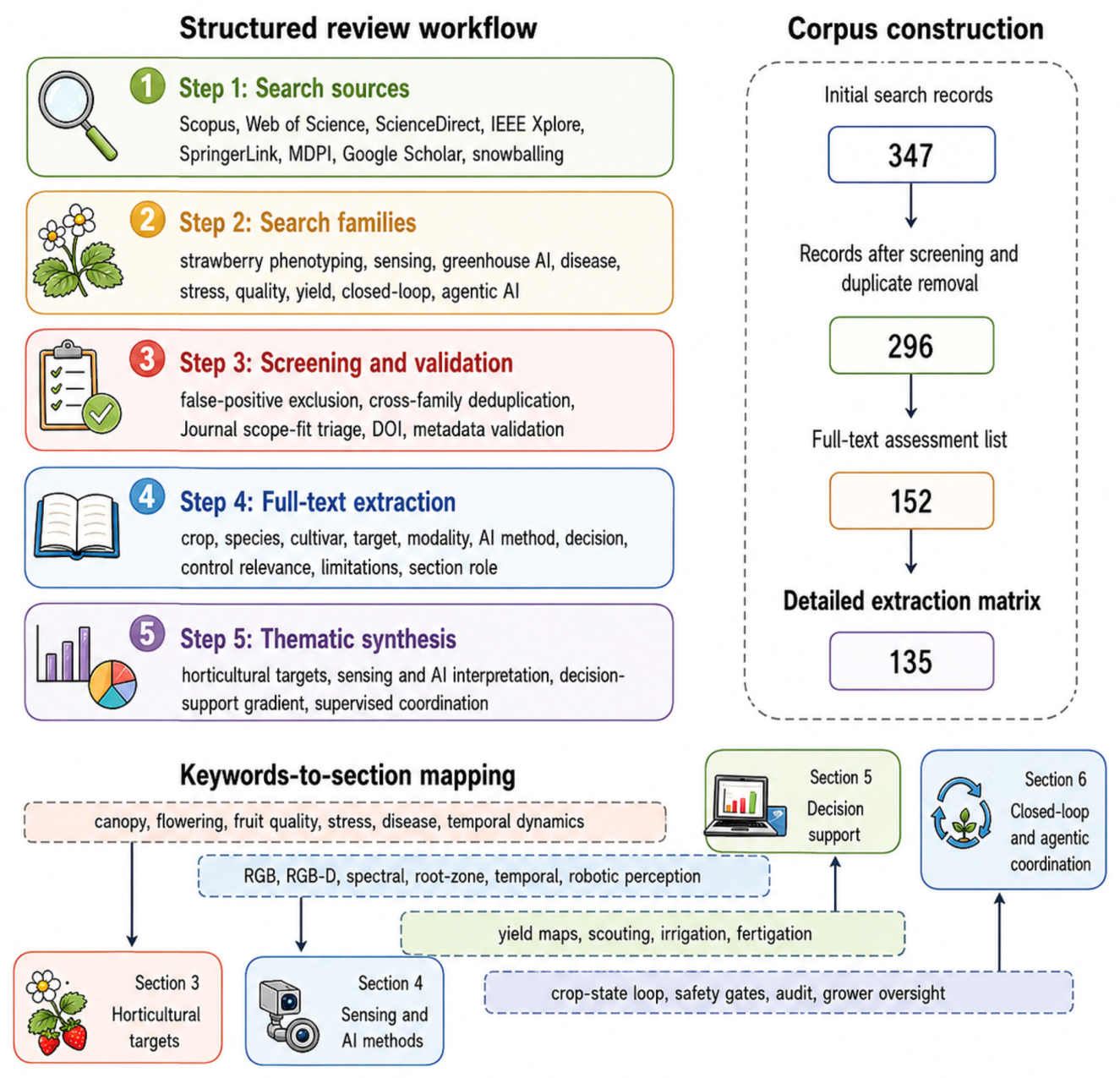
The review followed a structured integrative approach to studies on strawberry phenotyping, sensor and imaging data acquisition, AI measurement and prediction, and greenhouse decision support within controlled-environment production systems. Study selection used a crop-to-decision logic: horticultural targets were linked to measurable phenotypes or crop conditions, then to data acquisition or modeling approaches, and finally to decision or control relevance. The search sources included Scopus, Web of Science, ScienceDirect, IEEE Xplore, SpringerLink, MDPI, and Google Scholar, supplemented by backward and forward snowballing.
Search terms combined strawberry-specific terms with four thematic groups: phenotyping and AI terms, including “phenotyping”, “computer vision”, “spectral sensing”, “yield prediction”, and “growth prediction”; crop condition and stress terms, including “fruit quality”, “disease detection”, and “stress detection”; greenhouse and controlled-environment terms, including “greenhouse”, “controlled-environment agriculture”, “environmental monitoring”, “root-zone monitoring”, “irrigation control”, “fertigation control”, “lighting control”, and “climate control”; and automation-related terms, including “robotics”, “digital twins”, “supervised agents”, “large language models”, and “smart farming”. Published research articles and review papers from 2020–2026 were prioritized, while older or broader studies were retained when they provided essential horticultural, methodological, or control-system context.
Records were screened for relevance to strawberry production, strawberry fruit quality, physiology, phenology, disease or stress management, protected cultivation, plant factories, sensing/AI methods, or greenhouse decision making. Breeding, physiology, pathology, and engineering studies were included when they helped explain crop states or decision-support pathways. For retained studies, extraction focused on six synthesis dimensions: crop target, sensing modality, AI or modeling method, validation setting, decision-support role, and limitations related to robustness, transferability, practical deployment, or crop-response evidence. Citation roles were kept conservative so that perception studies, dashboard systems, or system-transfer studies were not used to support claims beyond their validation scope.
Across these search sources, the initial search identified 347 records. After relevance screening, false-positive exclusion, and duplicate removal, 296 records remained for candidate screening. Of these, 152 records were retained for full-text assessment, and 135 studies were entered into the detailed extraction matrix used for thematic synthesis.
The review workflow, record-count flow, and keyword-to-section mapping are summarized in Figure 1.

3. Horticultural Targets for Strawberry Phenotyping

Strawberry phenotyping connects quantitative trait measurement with biological interpretation, technology development, and horticultural decision making. In research contexts, phenotyping is widely used in breeding, physiology, pathology, and engineering to quantify traits, compare genotypes or treatments, detect stress or disease, and develop new sensing or modeling methods. In these contexts, quantitative trait measurement or method development may itself be the primary endpoint, rather than a direct production-management decision. Engineering advances in imaging, spectral sensing, robotics, environmental monitoring, and AI are therefore essential for solving phenotyping problems and expanding what can be measured reliably. In this review, we focus specifically on how phenotyping evidence from these contexts can define strawberry crop states, inform protected-cultivation decision support, and guide management interpretation in greenhouse production.

3.1. Vegetative Growth and Canopy Vigor

In strawberry, vegetative traits such as leaf number, leaf area, crown diameter, canopy volume, petiole length, root development, and canopy density provide indicators of canopy structure and function, reflecting source capacity, transpiration demand, light interception, air circulation, and the balance between vegetative and reproductive growth [1,12,13,14]. Their horticultural interpretation, however, depends on crop load, cultivar, season, and humidity conditions because the same level of canopy development may support different management objectives under different production contexts [1,12,13].
During early establishment, stronger vegetative growth can be desirable because it builds source capacity; during high-humidity or dense-canopy periods, the same growth may increase self-shading, reduce air movement, and raise disease risk. In this context, canopy state refers to the current structural and functional condition of the canopy, including leaf area, density, light interception, airflow restriction, source capacity, and disease-risk implications. Imaging sensors provide measurements of this state, while AI-based models can convert those measurements into estimates or predictions relevant to source capacity, reproductive demand, disease risk, and climate or root-zone decisions.
The available evidence shows that canopy phenotypes should be interpreted in relation to environmental conditions, genotype, and production objectives rather than as universal indicators of vigor. Image-based canopy delineation and biomass prediction can quantify canopy area or biomass from high-resolution images [14], but these measurements alone do not indicate whether the canopy state is beneficial or problematic. Plant-factory studies demonstrated that root-zone temperature and light intensity altered leaf production, crown diameter, flowering, fruit number, yield, and ascorbic acid content [12], while supplemental LED spectra influenced vegetative growth, chlorophyll status, nutrient uptake, early yield, and fruit quality across cultivars [13]. These findings indicate that similar canopy characteristics may arise under different environmental conditions and may be associated with different production outcomes. A commercial soilless greenhouse cultivar trial further showed that protected-cultivation performance and fruit firmness varied across genotypes and production settings [1]. Together, these studies suggest that canopy vigor should be interpreted as part of a broader crop-state and production context.

3.2. Flowering, Reproductive Development, and Crop-Load Formation

Reproductive phenotypes connect strawberry biology directly to production planning. Flower number, inflorescence number, fruit set, immature fruit count, mature fruit count, and crop load indicate whether current conditions favor canopy growth, flower initiation, fruit retention, or fruit maturation [4,18]. These traits are also operationally important because they determine expected yield, harvest timing, and labor demand.
The evidence base suggests that reproductive phenotyping should combine genetic and image-based perspectives. Pedigree-based QTL analysis identified a major perpetual-flowering QTL in the FaPFRU region and additional QTLs for fruit-quality traits such as soluble solids, fruit weight, pH, and titratable acidity, indicating that flowering habit and yield-quality traits have genotype-specific components [18]. Imaging studies then show how reproductive states can be measured repeatedly in production settings. For example, a near-ground autonomous imaging robot using RGB images and YOLOv5 detected flowers, immature fruit, and mature fruit, providing stage-specific crop-load counts relevant to yield estimation, harvest timing, and labor planning [4]. Strawberry-specific segmentation and picking-point localization studies add a more spatially explicit layer by separating reproductive organs and harvestable fruit positions, which can help describe fruit-set progression, maturity distribution, and the transition from crop-load formation to harvest readiness [19,20].
Together, these studies indicate that reproductive phenotypes should be interpreted in relation to genotype, developmental stage, and production context instead of being treated as universal indicators of crop-load formation. Model validation should account for cultivar, developmental stage, organ class, and production system.

3.3. Fruit Quality, Maturity, and Marketable Yield

Fruit traits are the most direct link between phenotyping and horticultural value. In strawberry, marketable yield is not determined by fruit number or weight alone; it also depends on whether fruit reaches acceptable maturity, appearance, texture, flavor-related chemistry, defect status, and postharvest durability [6,21,22,23]. Different sensing and postharvest studies cover complementary parts of this quality spectrum: hyperspectral sensing has been used for fruit water-content estimation and ripeness classification [24]; spectral reflectance with machine-learning models has predicted quality parameters such as color, soluble solids, and firmness [17]; 3D imaging and segmentation-based analysis have quantified fruit shape, deformity, and symmetry [21,25]; sensory and chemical profiling has shown that consumer preference depends on volatile compounds as well as sugars and acids [22]; and postharvest studies have examined quality retention under harvest maturity, cold storage, controlled-atmosphere export conditions, packaging, and melatonin treatment [6,23,26,27]. Across these studies, strawberry fruit quality is best treated as a multi-trait crop state rather than a color-based ripeness class.
This multi-dimensional nature of fruit quality also affects how AI outputs should be interpreted. Ripeness, size, shape, firmness, soluble solids, and shelf-life risk can respond differently to the same production environment. Spectral and imaging outputs are most useful when linked to quality trade-offs and storage or market endpoints.

3.4. Physiological Stress and Root-Zone or Microclimate Responses

Physiological stress traits reveal whether environmental and cultural practices are producing the desired strawberry crop response. Leaf color, chlorophyll status, wilting, growth suppression, nutrient imbalance, root-zone stress, reduced fruit set, deformity, and changes in sugar or acid content can indicate stress before final yield loss is visible [8,9,10,28,29]. The management question is therefore not only whether environmental setpoints were maintained, but whether those setpoints generated the intended crop-state and production outcomes, including canopy development, flowering, yield, stress status, and fruit quality.
Root-zone, salinity, and stress-mitigation studies illustrate this crop-response logic. Salinity affected strawberry yield and quality in a cultivar-dependent manner, producing yield reductions while changing sugar-related traits depending on cultivar and electrical conductivity level [28]. Native bacterial biostimulants increased strawberry stress resistance, growth, and productivity, showing that stress-related interventions must be evaluated through plant response rather than by treatment application alone [29]. Irrigation and fertigation studies using substrate humidity, nutrient-solution pH, EC, and moisture thresholds further show how root-zone variables can become operational control signals [9,10]. These examples indicate that root-zone and stress variables cannot be interpreted only as sensor inputs or setpoints; they must be linked to biological responses such as growth suppression or recovery, reproductive performance, stress expression, and quality formation.
Microclimate and climate-control evidence follows the same crop-state logic. Commercial controlled-environment systems already monitor temperature, relative humidity, CO2, light intensity, electrical conductivity, and pH through climate-computer infrastructure [8]. These measurements are useful when they help judge whether the current environment is producing the intended strawberry crop state. Sensors can measure both environmental conditions and plant responses, while AI models can relate these observations to crop performance through prediction, inference, and decision-support frameworks. The practical challenge is to determine whether current CO2, temperature, light, irrigation, fertigation, nutrient, humidity, and root-zone conditions are producing the intended crop state and production outcomes.

3.5. Disease, Pest, and Physiological Disorder Targets

Disease, pest, and disorder phenotypes affect marketable yield, fruit quality, labor, pesticide use, and postharvest loss [2,3,16,23,29,30]. Relevant crop states include fungal leaf diseases, gray mold, powdery mildew, angular leaf spot, fruit rot, fruit deformation, nutrient disorders, and spatial disease hotspots. Hyperspectral imaging has classified fungal strawberry leaf diseases such as leaf spot, leaf scorch, and phomopsis leaf blight under laboratory leaf-imaging conditions [2]. Hyperspectral imaging combined with deep learning has also supported early gray-mold detection in inoculated strawberry leaves before advanced symptoms were visible [3,30]. RGB-based deep learning in a commercial artificial-light vertical farm detected gray mold, leaf and fruit powdery mildew, anthracnose fruit rot, and spatial hotspots, making the output more directly relevant to scouting and targeted disease management [16]. Prevention and treatment studies connect disease detection to management action: native bacterial biocontrol reduced angular leaf spot incidence and improved strawberry productivity [29], while postharvest melatonin treatment suppressed Botrytis and helped maintain fruit quality after harvest [23].
Disease, pest, and disorder phenotypes require an even stronger crop-state interpretation. As summarized in Table 1, the relevant evidence ranges from laboratory hyperspectral disease detection to greenhouse disease scouting and postharvest-risk studies. The cross-study implication is that leaf spots, gray mold symptoms, powdery mildew, wilting, temperature stress, water stress, nutrient imbalance, and root-zone problems represent potential risk signals within the greenhouse production system. Early detection has value when it can guide prioritized scouting, microclimate adjustment, irrigation correction, sanitation, or localized intervention. Laboratory hyperspectral classification demonstrates diagnostic potential, but greenhouse use requires validation under canopy occlusion, mixed symptoms, changing humidity, cultivar differences, and production workflows.

3.6. Structural Traits for Robotic and Automated Operations

Structural traits determine whether robotic and automated operations can detect, access, and handle strawberry organs reliably. In this context, structural traits refer to the physical and spatial properties that affect machine perception or manipulation, including fruit position, flower position, visibility, occlusion, canopy density, peduncle orientation, crown location, fruit shape, and organ accessibility. These traits are shaped by cultivar, production and canopy-training systems, including raised-bed, tabletop, hanging-gutter, or other support arrangements that alter organ height, orientation, exposure, and accessibility, as well as plant spacing, pruning, and growth stage. Automated scouting, robotic harvesting, robotic sorting, and targeted operations require crop detection, physical accessibility, stable coordinates, and low risk of fruit or flower damage.
Existing studies illustrate how structural phenotypes connect biological morphology to physical operation. A near-ground mobile imaging robot detected strawberry flowers, immature fruit, and mature fruit for repeated crop-load monitoring, but also showed practical challenges such as overlap, immature-fruit confusion, and tracking limitations [4]. Objective 3D fruit-shape phenotyping converted shape uniformity into measurable point-cloud traits, while segmentation-based deformity analysis quantified fruit symmetry and abnormal shape for quality assessment [21,25]. Robotic sorting work linked fruit detection to robotic-arm coordinates, showing how visual recognition can become a physical handling input [31]. Structural phenotyping supports automation-oriented perception, although current evidence remains closer to perception, grading, or prototype-level operation than to validated safe greenhouse management.

3.7. Trait Integration, Temporal Dynamics, and Decision-Support Value of Strawberry Phenotypes

The preceding subsections show that strawberry crop-state assessment cannot be reduced to a single target category. Canopy vigor, flowering, fruit quality, physiological stress, disease or disorder status, and structural accessibility each describe a different aspect of whether the crop is developing toward the intended production outcome. These trait classes are also interdependent: canopy vigor affects light interception, humidity, fruit exposure, and disease risk; flowering and fruit set determine crop load, but crop load can alter fruit size, soluble-solids accumulation, and labor demand; irrigation and fertigation influence root-zone status, canopy growth, fruit quality, and pathogen-conducive humidity; and lighting or climate interventions can shift phenology, quality, energy cost, and stress risk simultaneously. For strawberry precision horticulture, crop-state feedback should support interpretation across yield, quality, disease pressure, resource use, and harvest workflow.
Temporal dynamics are critical for decision support because multiple crop processes, including vegetative growth, flowering, fruit development, harvest, and postharvest-quality risk, can overlap within the same strawberry production cycle. As a result, management decisions often depend not only on the current crop condition but also on whether the crop is moving toward a desirable trajectory. A single image may identify current fruit number, ripeness, or disease symptoms, but effective management requires understanding how these states change over time and respond to previous environmental and management conditions [4,11,16,24].
Time-resolved phenotyping can show whether crop load is increasing, fruit ripening matches labor availability, disease symptoms are spreading, or an environmental adjustment produced the desired crop response. Functional data analysis has linked strawberry yield to time-dependent temperature and solar-radiation histories before harvest [11], while repeated near-ground imaging has shown how flower and fruit counts can be monitored over time for crop-load and harvest planning [4]. For example, increasing flower number can be positive if canopy source capacity is sufficient, but problematic if fruit load exceeds expected assimilate supply or labor capacity [4,18]. A ripeness distribution supports harvest planning only when it is connected to expected progression over the next several days and to postharvest quality risk [6,24]. A disease symptom becomes more useful when its spatial pattern, infected area, and change over time indicate intervention urgency [3,16]. Closed-loop-oriented greenhouse-control studies extend this logic by using environmental histories and predicted crop responses as inputs for control [7]. Such work suggests that system-level integration is technically plausible.
Table 1 summarizes the reviewed horticultural targets, representative crop traits, supporting studies, and management relevance for AI-assisted strawberry interpretation. Temporal dynamics are included as an integrative dimension because time-dependent patterns determine how vegetative, reproductive, fruit-quality, physiological, disease-related, and structural traits should be interpreted in relation to management goals. These categories indicate that repeated observations should be linked to developmental stage, recent environment, and expected management windows.
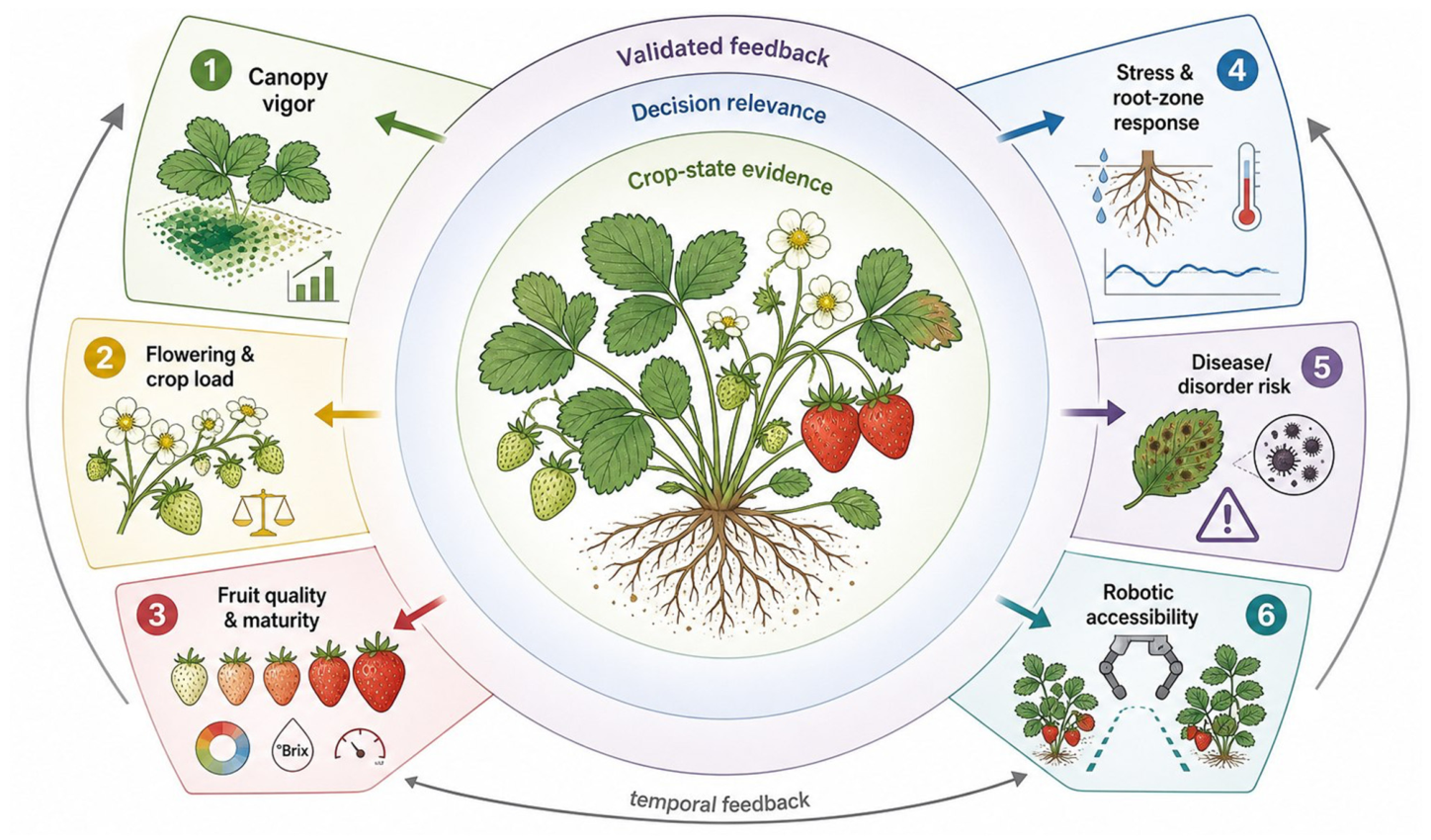
Figure 2 illustrates the concept of crop-state interpretation by positioning the strawberry crop state at the center and linking it to six management-relevant target domains. The arrows indicate how repeated crop observations can be interpreted in relation to different management objectives and updated over time.

4. Sensing Technologies and AI Interpretation Methods for Strawberry Production

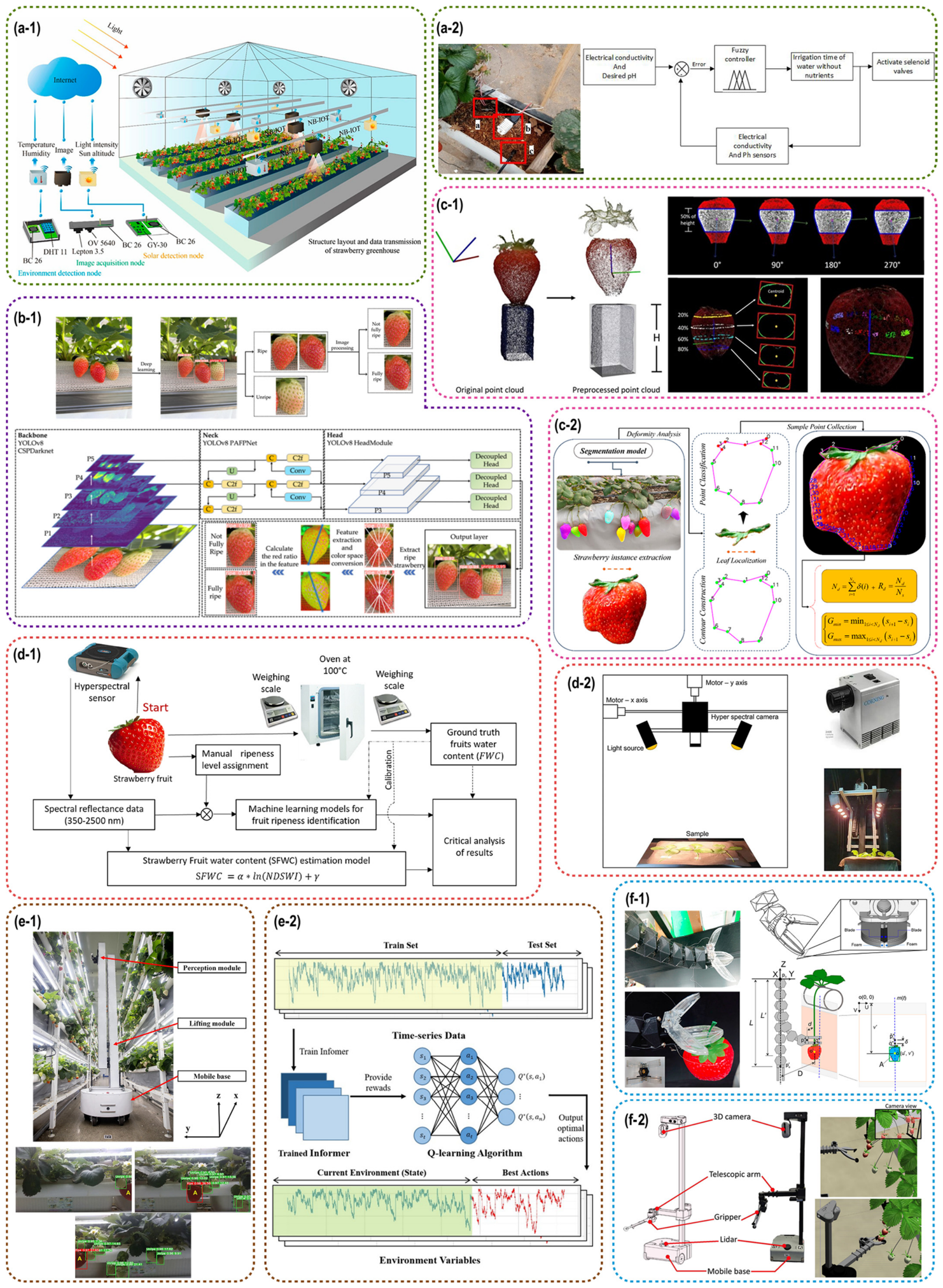
This section distinguishes method categories by data source, measurement output, and decision-support role. Table 2 summarizes the main method categories used in strawberry sensing, measurement, and AI-based interpretation. The categories are separated because some represent data-acquisition modalities, some represent quantitative feature or phenotype extraction, and some represent AI-based interpretation, integration, or operation-oriented uses. To complement this taxonomy, Figure 3 provides representative published visual examples of these categories, showing how environmental or root-zone monitoring, image-based phenotyping, 3D and geometric analysis, spectral sensing, temporal mapping, and robotic perception appear in actual strawberry studies.

4.1. Environmental, Root-Zone, and Greenhouse Sensing

Environmental and root-zone sensing provides the operating context for crop-state interpretation. Commercial controlled-environment strawberry systems monitor temperature, relative humidity, CO2, light intensity, electrical conductivity, and pH through climate-computer or dashboard infrastructure [8]. Hydroponic nutrient-sensor studies show why ion-selective electrodes, phosphate quantitation, nitrate monitoring, and EC/pH drift compensation matter for reliable root-zone interpretation [38,39,40,41,42,69]. Greenhouse climate forecasting in netted melon systems [70] and attention-LSTM emulation of expert strawberry greenhouse control [71] further show how environmental time series can support prediction or policy inference rather than remain dashboard variables.
These measurements become decision-support evidence only when they are paired with plant response. Root-zone and environmental data help explain canopy vigor, flowering, fruit quality, stress, and disease risk; by themselves, they mainly confirm that the system is measuring conditions. Root-zone temperature and light-intensity evidence from plant-factory strawberry [18] is treated as crop-response context in Section 3, while the irrigation, fertigation, and nutrient-monitoring systems in Table 2 are more direct examples of sensing methodology.
Figure 3. Representative published examples of method categories for sensing technologies and AI-based interpretation in strawberry production. The panels illustrate how the method categories summarized in Table 2 appear in prior strawberry studies: (a) environmental and root-zone monitoring or controlled-environment modeling for greenhouse context; (b) RGB or RGB-D image-based measurement for flower, fruit, or yield mapping; (c) 3D and geometric analysis for fruit shape, deformity, or structural phenotyping; (d) spectral or hyperspectral measurement for ripeness, water content, fruit quality, or disease interpretation, including wavelength-dependent information beyond visible RGB appearance; (e) temporal or spatial monitoring and modeling for yield, harvest, or production planning; and (f) robotic or automation-oriented perception for detection, localization, harvesting, or physical task support. Source attribution: (a-1) [43], (a-2) [9], (b-1) [61], (c-1) [25], (c-2) [21], (d-1) [24], (d-2) [30], (e-1) [5], (e-2) [7], (f-1) [72], and (f-2) [41]. All panels are adapted from the cited sources under the Creative Commons Attribution 4.0 International License (CC BY 4.0).
Horticulturae 12 00765 g003

4.2. Image-Based Phenotyping for Visible Crop Traits

RGB and RGB-D imaging support visible strawberry traits such as flowers, immature and mature fruit, leaves, canopy structure, disease symptoms, ripeness class, organ count, and organ position. These methods are close to current commercial scouting and labor tasks because they can translate visible crop status into yield estimation, harvest planning, maturity grading, disease scouting, and robotic task cues. For example, near-ground RGB imaging with YOLOv5 has been used to detect flowers, immature fruit, and mature fruit in strawberry production [4], while greenhouse-grown virus-free strawberry seedlings have also been detected and counted through automated image-based systems [73]. Cross-crop fruit-quality studies using RGB images and back-propagation neural networks further show how visible fruit traits can be converted into quality-oriented phenotyping variables [74].
Image-based phenotyping is most informative when the target is visible and spatially defined, although deployment performance depends on occlusion, lighting, cultivar, canopy density, camera position, and developmental stage. Overlapping leaves and fruit can obscure flowers or immature fruit; variable lighting can shift apparent color; and camera viewpoint can change organ visibility. Depth or RGB-D information can contribute geometry, fruit position, canopy structure, and robot-accessibility cues [57,58], and production-greenhouse RGB-D work on disease-resistance phenotyping shows how depth sensing can support crop-status inference under more realistic canopy conditions [75]. Although demonstrated for tomato truss identification, CycleGAN-based depth-image conversion and domain-translation approaches are relevant to strawberry phenotyping as transferable strategies for improving geometry-rich perception when direct depth acquisition is difficult or inconsistent.
These image-based studies are strongest as evidence for visible-organ detection and counting under defined camera, lighting, and canopy conditions, but weaker as evidence for general greenhouse deployment. For strawberry, robustness depends on whether models remain reliable when flowers and immature fruit are hidden by leaves, when fruit color shifts under supplemental lighting, when cultivars differ in canopy density or fruit shape, and when outputs must guide scouting, harvest planning, or robotic access rather than only image-level accuracy.

4.3. Spectral and Hyperspectral Sensing for Quality, Stress, and Disease Interpretation

Spectral, multispectral, and hyperspectral sensing extend phenotyping beyond visible morphology. In strawberry fruit, hyperspectral sensing has estimated water content and classified ripeness, supporting harvest and quality interpretation beyond color alone [24]. Spectral reflectance with machine-learning regression has predicted color, soluble solids, and firmness [17]. For disease and stress interpretation, hyperspectral imaging has classified gray mold disease in strawberry leaves [3]. Transferable crop studies using airborne hyperspectral 3D-ResNet diagnosis and hyperspectral models for metabolites or functional components add method-level evidence for stress and biochemical phenotyping. These studies support spectral sensing as a biochemical and physiological proxy when non-strawberry evidence is kept separate from strawberry-specific validation.
From a management perspective, spectral outputs are valuable because they can reveal quality, biochemical, or stress-related crop states that ordinary visual inspection may miss. Interpretation still depends on calibration, cultivar, tissue condition, sample presentation, and postharvest or greenhouse context. Multimodal optical biosensing and 3D-CNN fusion in crop water-deficit phenotyping, together with controlled-environment systems combining hyperspectral reflectance, nighttime chlorophyll fluorescence, and RGB imaging for stress tracking [76], show how spectral or optical signals can be integrated with deep learning for physiological-stress interpretation. For strawberry deployment, these signals need calibration against crop states and outcomes before they become decision-support evidence. Their value is highest when linked to harvest timing, quality sorting, storage risk, or early intervention rather than classification endpoints alone.
Spectral and hyperspectral studies provide strong evidence for latent quality, water-status, or disease-signal measurement. Practical transferability remains limited by calibration, tissue presentation, cultivar, maturity stage, and greenhouse or postharvest context. Their strawberry-specific value is highest when spectral outputs support management actions such as harvest scheduling, firmness retention, soluble-solids profiling, disease-risk assessment, or storage decisions.

4.4. Multimodal and Temporal Modeling

Multimodal and temporal modeling is needed when strawberry crop state depends on trajectory rather than a single observation. Crop-load increase, harvest-date prediction, disease spread, stress recovery, and quality deterioration all require information about change over time. Images describe visible crop appearance; spectral data indicate latent quality or stress signals; environmental data characterize exposure history; and repeated measurements show direction and rate of change. Cross-crop examples, including 3D detection with dynamic temporal phenotyping for yield prediction [77], spatio-temporal 4D phenotyping [78], and integrated 3D multispectral time-series screening for heat-stress response [79], provide methodological precedents for strawberry datasets that represent temporal change.
Different model families serve different crop-state interpretation tasks. Convolutional neural networks and YOLO-family detectors are useful for object detection, counting, and localization, as shown in flower and fruit counting, ripeness classification, and disease-scouting studies [4,16,31]. Segmentation and geometric analysis support shape, deformity, and organ-boundary interpretation when the management question concerns quality grading or robotic accessibility [21,25]. Support vector machines, partial least squares regression, random forests, gradient boosting, and LightGBM remain useful for spectral or tabular prediction targets [17]. CNN-Transformer and transformer-based segmentation models show how attention-based architectures can support high-throughput phenotyping, growth-stage recognition, or organ segmentation in transferable crop contexts [80,81]. For strawberry management, multimodal and temporal modeling is valuable when it connects repeated crop observations with environmental exposure, developmental stage, and the next decision-support window.

4.5. Robotic and Automation-Oriented Perception

Robotic and automation-oriented perception requires spatially usable crop-state outputs: organ location, visibility, occlusion, depth, graspability, navigation cues, and safe physical access. Near-ground and mobile imaging systems have been used for flower and fruit detection, temporal-spatial yield monitoring, and crop-load mapping, linking perception outputs to scouting and yield estimation [4,5,82]. Broader smart-farm robot and phenotyping work provides transferable evidence for object detection, image fusion, supervised navigation, field-robot phenotyping, robotic arm harvesting, and fruit-detection pipelines that can inform strawberry scouting or harvest-support design without serving as strawberry-specific validation [72,83,84,85,86].
The automation-oriented evidence is most mature for perception, localization, mapping, and prototype task support, but less mature for safe and repeatable physical operation across commercial strawberry canopies. Strawberry transferability depends on fruit exposure, peduncle orientation, cultivar habit, support structure, allowable contact force, and the economic tolerance for missed fruit, damaged fruit, or slowed harvest workflow.
Across these studies, progress is clearest for scouting, mapping, sorting, and manipulation support. The harder test is safe operation in a commercial crop workflow. Robotic perception should be evaluated by detection accuracy, damage risk, missed fruit, accessibility under canopy conditions, operation time, worker interaction, and effects on marketable yield. A fruit box, disease label, yield map, or grasp point is an intermediate output; its value depends on whether it becomes a reliable crop condition or task-readiness signal for a management decision or safe physical operation.

4.6. AI Model Families, Interpretability, and Evaluation Design

Model design should follow the biological structure of the problem and the output required for decision support. Detection and segmentation fit decisions that depend on object identity, count, location, or accessibility, such as flower counting, fruit load estimation, disease scouting, or harvest-oriented robotic perception [4,16,44]. Regression and spectral calibration fit continuous quality or physiological states, including soluble solids, firmness, water content, metabolite composition, or stress intensity [17,24]. Time-series models are needed when crop trajectory or environmental history matters, as in yield forecasting, climate forecasting, stress recovery, or expert control-policy emulation [49,70,71]. Generative and fusion models can help when data are incomplete or heterogeneous, as shown by root inpainting, hyperspectral-RGB pest or disease fusion, and RGB-thermal fusion for plant-organ detection [87,88,89].
Table 3 compares mainstream AI model families for strawberry phenotyping interpretation, with an emphasis on lighting, occlusion, annotation burden, transferability, and decision-support conditions.
Under greenhouse deployment conditions, Table 3 summarizes model suitability, expected limitations, and deployment considerations across task types. Model choice should be justified by the required output, the expected failure mode, and the validation context before model accuracy is compared. In this sense, classifiers, detectors, segmentation models, spectral-calibration approaches, multimodal models, and time-series models are not interchangeable alternatives; each is suitable only when its output matches the crop trait, decision-support need, and deployment constraint.
Multimodal models are justified when separate data streams answer different parts of the same management question. Images describe visible crop states such as flower number, fruit load, disease symptoms, or organ position [4,16]. Spectral data can provide hidden fruit-quality or disease-risk information such as water content, soluble solids, firmness, or early gray-mold signals [3,17,24]. Environmental and root-zone data describe imposed conditions and supply constraints, including temperature, humidity, light, EC, pH, and substrate water or nutrient status [8,9,10]. Multispectral, thermal, and UAV studies in other crops provide transferable evidence that fused dates, modalities, or thermal indexes can improve water-status, yield, or phenotyping inference when the biological target is clearly specified [85,93,94,95,96,97].
For strawberry precision horticulture, interpretability includes algorithmic explanations and horticultural explanations [92,98]. A useful model should indicate which trait changed, which crop process it represents, what uncertainty remains, and which decision-support step would be affected [91,92]. A highly accurate detector may still be difficult to use if it does not report confidence, failure modes, cultivar or lighting limits, or the management consequence of a prediction [19,20]. Conversely, a simpler model can be valuable if it gives stable and auditable information at the right time for the grower, especially when linked to environmental or root-zone context [9,71,99]. Strawberry decisions are repeated, seasonal, and risk-sensitive, so models need transparent inputs, biologically plausible outputs, documented failure cases, and validation that matches the intended management use [49,92,98].
Evaluation design should match the deployment question. For a single controlled imaging station, random image-level validation may be acceptable as an early technical test. For greenhouse deployment, evaluation should include variation in cultivar, season, growth stage, lighting, canopy density, camera angle, sensor maintenance, and operator workflow. When outputs inform decision support, validation should also include the biological or operational endpoint affected by the decision. Lightweight 3D phenotyping with weak or limited labels and VLM-assisted mapping [91], together with crop-disease prompt-optimization and LLM/VLM plant-stress phenotyping frameworks [92,100], indicate why future evaluation should report annotation burden, domain boundaries, interpretability, and decision-support value, in addition to accuracy.
Across the reviewed studies on sensing technologies, measurement outputs, and AI interpretation methods, the main bottleneck is the weak connection between acquired data, algorithmic outputs, strawberry traits, decision support, and management actions. Current evidence is strongest for crop monitoring, yield or count mapping, quality or disease screening, and limited sensor-to-actuator control. It is weaker for prospective validation, crop-response trials, economic evaluation, supervised control, and integration into daily greenhouse workflows.

5. From Measurement and AI Outputs to Strawberry Greenhouse Decision Support

The practical value of measurement and AI-derived outputs in strawberry production depends on whether outputs can be translated into decision support. Here, decision-support value refers to the extent to which a measurement or AI output can inform a management recommendation, control target, safe operational cue, or auditable decision step. A detector, classifier, or predictor is only a first step; decision support requires a link from measured signal to inferred crop state, management question, operational decision, and expected crop or workflow outcome. Decision-support value is often overstated in agricultural AI studies. Model outputs require decision rules before they can support harvest planning, treatment timing, irrigation optimization, or crop-response validation. The missing layer is the decision rule that translates a measured signal into a management option under a defined objective, time window, risk tolerance, and operational constraint.
Table 4 serves as a roadmap for this section. It organizes measurement and model outputs by the level of management use they can support, from crop monitoring to planning, infrastructure context, partial actuation, and supervised coordination that has not yet been validated for autonomous control. The table clarifies the management uses supported by each output and the remaining validation needs.

5.1. Yield Mapping, Harvest Planning, and Crop-Count Decision Support

Fruit counts and yield maps are currently among the most directly interpretable decision-support outputs. Representative examples summarized in Table 4 include mobile RGB-D yield monitoring and georeferenced fruit-count mapping systems [5,82], while repeated near-ground flower and fruit counting supports crop-load monitoring before harvest [4]. These systems may provide operational value even without direct actuation because the outputs can inform harvest windows, worker deployment, zone-level scouting, packing logistics, and production forecasts. Their limitation is that they mainly reduce uncertainty for human or semi-automated planning; they do not by themselves validate autonomous harvest, climate, or crop-load control.
Yield and harvest-related outputs illustrate the most mature pathway from phenotyping to decision support. Fruit counts, maturity classes, georeferenced yield maps, and predicted harvestable load can inform how many workers are needed, where they should be deployed, which greenhouse zones require closer scouting, and how production should be scheduled for packing or marketing. These outputs do not need to actuate equipment to be valuable; their value comes from reducing uncertainty in time-sensitive horticultural operations. The same logic applies to quality and disease scouting: spatial maps of ripeness or disease hotspots can guide selective harvest, grading, sanitation, or preventive management even when the final decision remains with the grower [16,31].

5.2. Irrigation, Fertigation, and Root-Zone Decision Support

Irrigation and fertigation are closer to direct control because root-zone measurements can trigger pumps or valves. In greenhouse strawberry nursery production, an IoT-based drip-irrigation system used capacitive soil-moisture sensors in polybags, an ESP32 microcontroller, a mobile-application/database interface, a relay, and a pump to implement scheduled watering and stop pump operation when sensor values reached the defined moisture threshold [10]. This is a concrete sensor-to-actuator loop based on schedules and thresholds, not AI optimization.
A fuzzy-control hydroponic irrigation study provides a more complex rule-based example. In that system, ambient temperature, substrate temperature, substrate humidity, nutrient-solution pH, and electrical conductivity were used as inputs to a fuzzy controller that determined irrigation duration and actuated pump or solenoid hardware [9]. This type of system illustrates how multiple root-zone and nutrient variables can be translated into an actuator command. However, low-complexity threshold control and fuzzy rule systems still require crop-response, yield-quality, and safety validation before they can support claims of AI optimization.
These irrigation and fertigation examples are valuable because they demonstrate real sensor-to-actuator pathways, but their evidence strength is mainly operational. For strawberry, a control loop should be judged by crop water status, root health, canopy balance, fruit yield, soluble solids, firmness, disease risk, and resource-use efficiency under realistic production conditions.

5.3. Microclimate and Controlled-Environment Infrastructure

Controlled-environment infrastructure studies show how greenhouse decisions can be supported by dashboards, climate computers, embedded controllers, predictive models, and closed-loop architectures. Such infrastructure indicates where decisions can be monitored, scheduled, or implemented. Biological validation remains necessary.
Microclimate and CEA control require a higher level of caution because actions such as heating, ventilation, CO2 enrichment, lighting, shading, or environmental scheduling directly change the crop environment. A dashboard, forecast, or controller can be useful when it identifies when and where intervention may be needed, but it should be evaluated against crop response rather than environmental setpoint achievement alone. Maintaining temperature, humidity, CO2, light, or EC within a predefined range differs from demonstrating better canopy balance, flowering, fruit size, firmness, soluble solids, water-use efficiency, disease suppression, or energy efficiency. Climate or lighting adjustments should therefore be judged by their effects on strawberry growth, yield, quality, and energy use, as illustrated by studies in which root-zone temperature, light intensity, and LED spectrum changed strawberry growth, yield, and quality responses [12,13]. For strawberry greenhouses, the relevant endpoint is not only environmental stability, but plant response and production outcome.

5.4. Current Boundary: Decision Support Without Validated Autonomous Control

The reviewed evidence supports a transition from sensing toward decision support, while validation of fully optimized strawberry greenhouse control remains limited. Most strawberry-specific studies provide measurement, prediction, monitoring, or operational control evidence, but few test complete decision pipelines that link sensing, AI interpretation, grower decision, implemented action, and crop outcome. Many studies still do not define the intended operator, decision timing, or decision scale for the output. As a result, it remains difficult to determine whether an AI output should support scouting, harvest planning, irrigation correction, disease intervention, climate adjustment, or longer-term crop scheduling.
To clarify these distinctions, AI outputs can be categorized according to the level of decision they are intended to support. Some outputs are strategic, such as seasonal yield forecasting, cultivar comparison, or investment planning. Others are tactical, such as weekly labor scheduling, irrigation adjustment, or disease scouting. Others are operational, such as same-day harvest routing, robot task assignment, or alarm generation. These levels require different validation standards: strategic tools should demonstrate stable prediction and economic relevance; tactical tools should demonstrate repeatability and biological interpretation; and operational tools should demonstrate reliability, timing, workflow integration, and safeguards for crop and equipment operation. This distinction prevents detection, prediction, or dashboard monitoring from being prematurely described as greenhouse optimization.

6. Supervised AI Coordination for Crop-Driven Greenhouse Decision Support

The next step beyond decision support is supervised coordination that links crop interpretation with constrained action and feedback. In this review, closed-loop coordination refers to a supervised feedback process in which measurement and model outputs provide information about crop–environment interactions, candidate actions are selected under horticultural and operational constraints, actions are executed only within safe limits, and outcomes are monitored as crop-response feedback. For strawberry, such a loop should begin with sensing, convert observations into phenotypes or crop conditions, use diagnosis and prediction to define a management question, translate this interpretation into decision support, execute actions within defined limits, and evaluate crop response after intervention.
Supervised AI coordination refers to a greenhouse-specific workflow that can decompose a management question, retrieve crop and greenhouse records, call external tools or predictive models, compare candidate actions against horticultural rules and safety limits, route high-impact decisions to the grower, and log the decision context and outcome. Its agentic component lies in tool use, task planning, context retrieval, grower approval, and auditable decision routing. In strawberry systems, such agents should operate within predefined permission boundaries and should be evaluated by whether they improve the traceability, timing, biological relevance, and outcome verification of greenhouse decisions.
This section presents closed-loop and supervised AI coordination as constrained decision architectures for greenhouse decision support. The following subsections move from rule-based control to prioritized and predictive control policies, crop-driven closed-loop coordination, digital-twin safety layers, grower oversight, supervised AI coordination, and future system requirements.

6.1. From Rule-Based Control to Prioritized and Predictive Control Policies

Existing strawberry-relevant sensor-to-actuator examples show that measurements can already be translated into greenhouse actions. In greenhouse strawberry nursery production, soil-moisture sensors and a mobile-connected controller triggered drip irrigation when substrate values reached a defined threshold [10]. In greenhouse hydroponics, a fuzzy-control system used temperature, substrate humidity, pH, and EC inputs to operate irrigation hardware [9]. These examples demonstrate physical sensor-to-actuator pathways, but they remain threshold, schedule, or rule-based, with limited evidence for adaptive AI optimization.
The next technical step is to move from simple rules toward prioritized or predictive control policies that can handle competing objectives. Transferable greenhouse-control studies provide design precedents for multi-layer or prioritized control strategies, multi-area light-environment decision support, ventilation model-predictive control, climate forecasting, and receding-horizon control under operational constraints [70,109,110,111,112,113,114]. Expert-strategy emulation with attention-LSTM in strawberry greenhouses adds a crop-relevant example of learning from human environmental-control behavior [71]. Such approaches are relevant to strawberry greenhouse production, where fruit quality, disease risk, water and nutrient use, energy demand, labor timing, and equipment constraints must be balanced simultaneously.
These distinctions are particularly relevant for strawberry because management priorities can change quickly across crop stage, harvest window, market demand, disease pressure, and labor availability. A rule that is acceptable during vegetative establishment may be inappropriate during peak harvest if it increases humidity, softens fruit, delays ripening, increases disease risk, or reduces fruit accessibility. Strawberry decision support requires control accuracy, rule adaptation, multi-objective reasoning, knowledge integration across crop, environment, labor and market information, grower-readable interaction, and auditable safety gates.
Table 5 summarizes how these decision concepts differ in their data inputs, outputs, degree of automation, grower role, and evidence requirements. Supervised AI coordination adds integration and auditable coordination to existing systems. It can connect perception models, greenhouse data, predictive tools, grower priorities, and safety constraints in one supervised workflow, but the horticultural claim still depends on crop-response validation and grower-defined action limits.

6.2. Crop-Driven Closed-Loop Coordination

Closed-loop control should be grounded in crop state rather than environmental setpoints alone. Strawberry-specific evidence already provides several components of such a system. Mobile robotic yield monitoring and georeferenced RGB-D yield mapping can provide spatial and temporal information on fruit counts, ripeness, and harvestable crop load [5,82]. Repeated near-ground imaging can monitor flowers, immature fruit, and mature fruit as crop-load indicators [4]. Disease scouting in a vertical-farm strawberry system can identify spatial disease hotspots [16], and hyperspectral or deep-learning studies can detect stress or disease signals [2,3,30]. These tools can supply perception inputs for a closed-loop system, but the loop becomes horticulturally useful only when perception changes a management decision and the resulting crop response is measured.
A closed-loop horticultural system also needs a defined crop response, response window, success measurement, and fallback rule. For example, irrigation adjustment should specify the expected change in substrate moisture, plant water status, canopy response, fruit quality, or resource-use efficiency. Climate intervention should specify whether the target is disease-risk reduction, transpiration regulation, flowering, fruit quality, or energy saving. Future closed-loop studies should specify which response is expected, how quickly it should appear, what measurement confirms success, and what fallback rule is used when the response is absent or uncertain.

6.3. Digital Twins as Scenario-Testing and Safety Layers

Digital twins and crop models can make closed-loop coordination safer before physical actuation by testing candidate actions in a model-based or synchronized representation of the greenhouse system [35,36,115]. Their main role here is scenario testing between candidate action selection and physical implementation, not proof of permission-free greenhouse control. A twin or model can help assess whether an irrigation, lighting, ventilation, CO2, labor, or robotic action is feasible, whether it conflicts with another crop objective, and what uncertainty should be presented to the grower before approval [33,71,109,116].
Digital twins can support safety and planning, while strawberry-specific crop-response validation remains necessary [98,99,115]. A strawberry greenhouse digital twin should represent crop state, environmental conditions, management rules, and candidate actions at the level needed for decision support. It need not simulate every biological process in detail to be useful. Its practical value lies in making assumptions explicit, comparing scenarios, and identifying unsafe or low-value actions before implementation [35,116]. Such twins should not replace crop evidence; they should make proposed actions more transparent for evaluation before grower approval or physical execution [33,117].
For strawberry, a useful digital twin would represent crop stage, crop load, canopy state, root-zone status, greenhouse state, actuator limits, and likely effects on fruit quality or disease risk [49,54,71,99]. It could begin as a structured representation of crop stage, canopy status, fruit load, root-zone condition, climate state, actuator availability, and recent management history. Candidate actions could then be screened for feasibility, conflict, and risk, such as whether increasing irrigation conflicts with disease risk, whether lighting changes are justified by crop load and energy cost, or whether harvest labor should be prioritized in zones with high ripe-fruit density [3,9,63,118,119,120,121,122,123]. In this role, the digital twin functions as a safety and planning layer that supports supervised decision making rather than replacing grower judgment or crop-specific validation.

6.4. Grower-Supervised AI Coordination and Safety Gates

Human oversight and supervised AI coordination belong to the same supervised-control architecture. Growers provide contextual knowledge that is difficult to encode completely, including cultivar behavior, market requirements, labor availability, disease history, equipment reliability, and risk tolerance. Transferable human-in-the-loop climate-control and responsible-automation studies support a supervised framing in which high-impact actions require approval, constraint checking, and auditability [124,125]. In strawberry greenhouses, attention-LSTM emulation of expert environmental-control strategies is especially relevant because it treats expert behavior as a learnable but supervised decision pattern [71].
Irrigation advisory agents, robotic phenotyping platforms, and AI tool systems should be evaluated for coordination quality, traceability, grower oversight, and crop-response validation. A strawberry greenhouse agent should communicate uncertainty, ask for confirmation before high-impact actions, provide evidence for recommendations, and record whether the suggested action improved the intended crop or operational outcome.
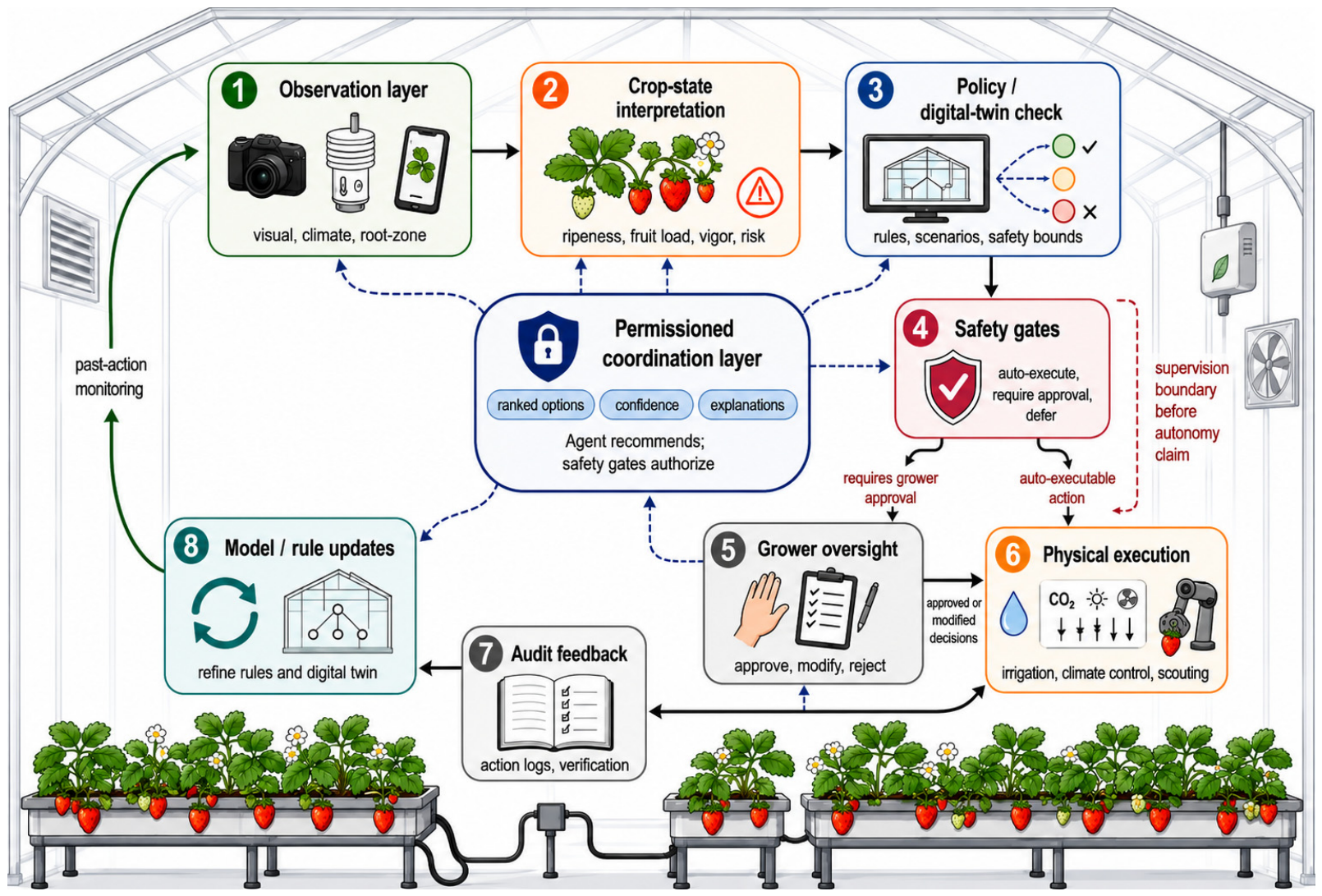
Safety gates should define which actions can be automated, which require grower approval, and how uncertainty is handled. These gates may include crop-stage limits, cultivar-specific thresholds, environmental bounds for temperature, VPD or relative humidity, CO2, EC, pH, and substrate moisture, actuator-rate limits, reversibility checks, sensor-disagreement checks, model-uncertainty thresholds, and fallback rules. Embodied-AI and robotic-AI safety work is relevant when supervised AI coordination reaches physical tasks such as navigation, manipulation, or actuator requests [117]. Every recommendation, approval, override, actuator command, and observation after intervention should be logged so that the system remains scientifically auditable and farm-accountable.

6.5. Requirements for Future Supervised AI Decision-Support Systems in Strawberry Greenhouses

A future supervised AI decision-support system for strawberry greenhouses should report at least six evidence categories: crop sensing, control policy, digital twin or simulation layer, grower oversight, coordination logic, and physical execution. Crop sensing should estimate horticulturally relevant states such as yield, ripeness, flowering, canopy vigor, root-zone status, fruit quality, and disease risk, with uncertainty, calibration, cultivar, and crop-stage metadata [5,8,9,10,82]. Control policies should translate crop condition into constrained irrigation, fertigation, lighting, climate, or labor decisions and report action limits, fallback rules, outcome monitoring, and biological endpoints [9,10,109,110,111,113,126]. Digital-twin or simulation layers should represent crop stage, greenhouse state, actuator status, and candidate interventions while validating assumptions, update frequency, and uncertainty handling [35,41,45,116,127].
The remaining categories concern governance and execution. Grower oversight should support approval, modification, rejection, or override of high-impact actions while maintaining audit trails, accountability, override logs, and permission boundaries [33,101,124,125]. Supervised AI coordination should coordinate sensing, knowledge retrieval, model calls, digital-twin evaluation, scheduling, and actuator requests while enforcing tool permissions and failure-mode handling [60,66,117,128,129,130]. Physical execution should verify actuator limits, safe paths, operation logs, fruit or plant damage, and biological outcomes, especially when robots or actuators interact directly with strawberry plants [5,31,41,116,124]. The most defensible near-term path is supervised crop-driven coordination: the coordination system should organize phenotyping, environmental histories, decision rules, crop models, robotics, records, and grower judgment without bypassing horticultural constraints, actuator limits, permission boundaries, or uncertainty checks.
Figure 4 summarizes a permissioned crop-driven coordination architecture for strawberry greenhouse decision support, linking observation, crop interpretation, policy and digital-twin checking, safety gates, grower oversight, physical execution, audit feedback, and model or rule updating.

7. Evidence Gaps and Future Directions for Strawberry Precision Horticulture

The reviewed literature shows substantial progress in strawberry perception, mapping, fruit-quality estimation, root-zone monitoring, infrastructure monitoring, and early decision-support applications. However, these developments should be interpreted as component-level advances rather than evidence that integrated intelligent decision-support systems are already mature for broad commercial strawberry production. The transition from useful measurements to reliable crop-management value remains incomplete, and the most persistent gaps concern biological validation, transfer across cultivars and production contexts, deployment economics, and prospective trials that test whether model- or sensor-informed decisions improve production outcomes.
Future research should connect measured traits, interpreted crop states, management decisions, and outcomes. This requires benchmarks with clear domain boundaries, validation designs that test phenotype-to-action pathways, and deployment studies that report production, quality, workflow, and economic endpoints. The following subsections summarize these needs.

7.1. Benchmarks Should Define Transferability and Domain Boundaries

Current strawberry and transferable phenotyping studies show that model performance and crop-response interpretation can depend on cultivar, crop stage, season, production system, canopy density, fruit load, disease pressure, lighting, substrate condition, and management history [98,131,132]. The evidence gap concerns whether datasets represent the sources of biological and production variability that determine greenhouse usefulness.
Future benchmarks should report cultivar, crop stage, season, production system, canopy density, fruit load, disease pressure, lighting, substrate condition, sensor configuration, and management history explicitly. When deployment beyond a single setting is intended, they should test cross-cultivar, cross-season, cross-farm, cross-sensor, and temporal transfer. Domain adaptation, date-fusion phenotyping, multispectral/RGB integration, and lab-to-field sensing studies provide useful methodological precedents, but transferability should be tested explicitly rather than assumed [93,94,96].

7.2. Phenotype-to-Action Validation Should Link Model Outputs, Decision Rules, and Crop Outcomes

For strawberry decision support, the physiological meaning of a phenotype is unusually context-dependent because vegetative growth, flowering, fruit set, fruit enlargement, ripening, and repeated harvest often overlap on the same plant or production bench. The crop also has a low, dense canopy in which leaves, crowns, flowers, immature fruit, and harvestable fruit interact within a humid fruit-zone microclimate. Therefore, traits such as canopy density, leaf expansion, crown vigor, flower number, fruit set, fruit-load distribution, fruit size, color development, soluble-solids accumulation, firmness, root-zone status, wilting, and disease symptoms should not be treated as independent AI recognition targets. Instead, they should be interpreted as indicators of source–sink balance, crop-load pressure, water and nutrient status, fruit-quality formation, microclimate-mediated disease susceptibility, harvest accessibility, and management timing [1,4,12,14,16,24,28].
More specifically, vegetative and reproductive phenotypes such as new-leaf emergence interval, accumulated leaf number, crown diameter, and crop-load progression can function as strawberry-specific state variables when interpreted in relation to crop stage and production objective. These traits connect vegetative establishment and source capacity with sink demand, fruit-load development, and harvest timing [12,14,15]. At the canopy scale, petiole–lamina balance and canopy openness provide additional information on whether canopy development supports light interception and organ visibility or instead increases self-shading, humidity retention, disease-conducive microclimates, fruit occlusion, and harvest difficulty [14,16,19,20]. Thus, these phenotypes should be treated as mechanism-informed crop-state indicators rather than as isolated recognition targets.
Intelligent decision-support systems should therefore move from recognition accuracy toward testable strawberry-specific decision chains. For example, canopy vigor is useful only when interpreted together with crop stage and fruiting context: it may support source capacity during establishment, but in a dense fruiting canopy it may also increase self-shading, humidity retention, gray-mold or powdery-mildew risk, fruit occlusion, and harvest difficulty [14,16]. A high flower or immature-fruit count is useful for yield forecasting only when interpreted together with canopy source capacity, crop-load pressure, expected fruit-size distribution, labor capacity, and the rolling harvest window [4,11,15]. Root-zone moisture, EC, pH, drainage rate, and nutrient-solution control become horticulturally meaningful when linked to plant water status, nutrient uptake, salinity response, fruit quality, yield stability, and resource-use efficiency [9,10,54,99]. Similarly, ripeness or fruit-quality classification should support harvest timing and postharvest-quality risk management by connecting color development with firmness, soluble solids, volatile compounds, bruising or softening risk, shelf-life potential, and market timing rather than treating color category as the final decision target [6,22,24].
Existing strawberry AI studies commonly report accuracy, precision, recall, segmentation quality, detection speed, or prediction error, but these metrics do not by themselves demonstrate horticultural benefit [44,61,67]. A detector, classifier, hyperspectral model, root-zone sensor, or yield map becomes valuable only when linked to a crop state, decision rule, and management outcome, such as marketable yield, harvest timing, fruit-size distribution, firmness, soluble solids, disease incidence, canopy balance, water-use efficiency, nutrient-use efficiency, energy use, labor demand, or economic return [99].
Future validation should report the measured variable, inferred crop state, decision output, management action, response window, fallback rule, and biological or operational endpoint. A detector should be linked to a harvest or scouting decision; a disease classifier should be linked to an intervention threshold; a yield forecast should be linked to labor or market planning; and a root-zone sensor should be linked to irrigation or fertigation outcomes. Crop models, expert thresholds, digital twins, or predictive control policies can help bridge sensing and action, but they should be validated against strawberry outcomes rather than greenhouse variables alone [115,133].

7.3. Deployment Endpoints Should Include Quality, Workflow, Economics, and Supervised Coordination

Many strawberry AI studies emphasize visible fruit detection, maturity classification, counting, yield mapping, or harvest-date prediction [61,134]. Fruit maturity and quality-estimation studies extend this evidence base by linking visible, spectral, or model-derived features to ripeness, water content, soluble solids, firmness, or appearance quality [68,134,135]. These tasks are essential, but they do not capture the full value of strawberry production. Market success also depends on fruit size and shape, firmness, color, sweetness, acidity, aroma, nutritional compounds, defect rate, shelf life, disease resistance, labor timing, and marketable yield [68,135].
Deployment studies should connect preharvest crop state to decisions that improve quality, workflow, or economic feasibility. Studies on strawberry lighting, root-zone management, irrigation, and closed-loop hydroponic nutrient dynamics show why production endpoints should include yield, quality, resource efficiency, and energy or input cost, not only model performance or setpoint achievement [50,54,99,118]. For strawberry, this means evaluating whether a decision-support tool helps growers harvest at better timing, reduce waste, maintain fruit quality, improve labor allocation, prevent disease spread, optimize irrigation or nutrient use, or reduce unnecessary intervention.
Closed-loop, LLM/VLM, and supervised AI may eventually extend crop interpretation by supporting traceable recommendations, constraint checking, grower interaction, and outcome evaluation. At present, however, these approaches should be regarded as exploratory or early translational directions rather than validated autonomous strawberry-production technologies. Prospective trials should report the observed crop condition, candidate recommendation, constraints checked, grower decision, implemented action, and outcome after intervention under commercial or semi-commercial greenhouse conditions. Agricultural agentic-AI and LLM-based decision-support studies are useful as evidence for knowledge retrieval, advisory workflows, and AI tool coordination; they do not yet demonstrate mature, broadly applicable, or autonomous strawberry greenhouse control [60,66,128].

8. Conclusions

This review synthesized evidence on strawberry phenotyping, sensing, AI interpretation, and greenhouse decision support. The literature shows that multimodal measurement and modeling approaches can describe vegetative, reproductive, fruit-quality, stress, root-zone, and environmental crop conditions, but practical value depends on whether these outputs improve management decisions and crop-response outcomes. At present, the integration of AI-based crop interpretation, closed-loop coordination, and supervised agentic decision support in strawberry greenhouses remains exploratory and has not yet been widely validated under commercial production conditions. Therefore, strawberry greenhouse AI should be developed as a cautious, grower-supervised decision-support pathway rather than as a mature or broadly deployable autonomous production system. Future work should prioritize benchmark datasets, validation across cultivars and production systems, multi-season commercial or semi-commercial trials, phenotype-to-decision evaluation, and field evidence that links AI outputs to crop performance, fruit quality, resource efficiency, labor management, and operational accountability.

Author Contributions

Conceptualization, Y.-J.J., S.J.P. and D.-H.J.; Formal analysis, Y.-J.J.; Funding acquisition, D.-H.J.; Investigation, Y.-J.J. and S.J.P.; Methodology, Y.-J.J.; Project administration, D.-H.J.; Resources, D.-H.J.; Software, Y.-J.J.; Supervision, Y.-J.J. and D.-H.J.; Validation, D.-H.J.; Visualization, Y.-J.J. and S.J.P.; Writing—original draft, Y.-J.J.; Writing—review and editing, D.-H.J. All authors have read and agreed to the published version of the manuscript.

Funding

This research is funded by the BK21 FOUR program of Graduate School, Kyung Hee University (GSX-20250508).

Data Availability Statement

The original contributions presented in this study are included in the article; further inquiries can be directed to the corresponding authors.

Acknowledgments

This research is funded by the BK21 FOUR program of Graduate School, Kyung Hee University (GSX-20250508). During the preparation of this manuscript, the authors used GPT-5.5 to assist in drafting selected conceptual schematics and visual layouts for figures. The AI-assisted outputs were used only as visual design support and were reviewed, edited, and finalized by the authors. GPT-5.5 was not used to generate research data, perform formal analyses, or determine the scientific conclusions of the review. The authors take full responsibility for the content of this publication.

Conflicts of Interest

The authors declare no conflicts of interest.

References

  1. Johnson, J.; Hoffmann, M. Evaluation of Yield, Fruit Chemistry, and Firmness of Seven Strawberry (Fragaria × ananassa) Cultivars in an Eastern North Carolina Greenhouse. HortScience 2024, 59, 1634–1643. [Google Scholar] [CrossRef]
  2. Cheshkova, A.F. Identification of fungal diseases in strawberry by analysis of hyperspectral images using machine learning methods. Vavilov J. Genet. Breed. 2025, 29, 310–319. [Google Scholar] [CrossRef] [PubMed]
  3. Ou, Y.; Yan, J.; Liang, Z.; Zhang, B. Hyperspectral Imaging Combined with Deep Learning for the Early Detection of Strawberry Leaf Gray Mold Disease. Agronomy 2024, 14, 2694. [Google Scholar] [CrossRef]
  4. Zhou, C.; Lee, W.; Peres, N.; Kim, B.; Kim, J.; Moon, H. Strawberry flower and fruit detection based on an autonomous imaging robot and deep learning. In Precision Agriculture ‘23; Wageningen Academic: Wageningen, The Netherlands, 2023; pp. 245–250. [Google Scholar] [CrossRef] [PubMed]
  5. Ren, G.; Wu, H.; Bao, A.; Lin, T.; Ting, K.C.; Ying, Y. Mobile robotics platform for strawberry temporal–spatial yield monitoring within precision indoor farming systems. Front. Plant Sci. 2023, 14, 1162435. [Google Scholar] [CrossRef] [PubMed]
  6. Eum, H.L.; Lee, J.H.; Lee, J.G.; Chang, M.S.; Do, K.R.; Yang, H.; Ku, K.M.; Kim, D.S. Impact of Harvest Maturity and Controlled Atmosphere on Strawberry Quality Under Simulated Export Conditions. Foods 2025, 14, 2959. [Google Scholar] [CrossRef] [PubMed]
  7. Lu, Y.; Gong, M.; Li, J.; Ma, J. Optimizing Controlled Environmental Agriculture for Strawberry Cultivation Using RL-Informer Model. Agronomy 2023, 13, 2057. [Google Scholar] [CrossRef]
  8. Sugiyanto, E.; Kasih, T.P. Microclimate Control in Strawberry Production with Hydroponic System in Indoor Vertical Farming. J. Syntax Admiration 2024, 5, 984–996. [Google Scholar] [CrossRef]
  9. Maya Olalla, E.; Lopez Flores, A.; Zambrano, M.; Domínguez Limaico, M.; Diaz Iza, H.; Vasquez Ayala, C. Fuzzy Control Application to an Irrigation System of Hydroponic Crops under Greenhouse: Case Cultivation of Strawberries (Fragaria Vesca). Sensors 2023, 23, 4088. [Google Scholar] [CrossRef] [PubMed]
  10. Sukarma, I.N.; Ardana, I.W.R.; Mastawan, I.G.P.; Yasa, I.M.A.; Purbhawa, I.M. Watering Strawberry (Fragaria × anannasa) Plants in a Greenhouse Using IoT-Based Drip Irrigation. J. Comput. Sci. Technol. Stud. 2022, 4, 72–79. [Google Scholar] [CrossRef]
  11. Matsui, H.; Mochida, K. Functional data analysis-based yield modeling in year-round crop cultivation. Hortic. Res. 2024, 11, uhae144. [Google Scholar] [CrossRef] [PubMed]
  12. Munirah, M.; Abdullah, S.; Kassim, R.; Masnira, M.; Sakinah, I.; Ahmad, M.; Tajidin, N. Effects of root zone temperature and light intensity on plant growth, flowering and fruit quality of plant factory ‘festival’ strawberry (Fragaria × ananassa Duch.). Food Res. 2024, 8, 72–78. [Google Scholar] [CrossRef]
  13. Roosta, H.R.; Bikdeloo, M.; Ghorbanpour, M. The growth, nutrient uptake and fruit quality in four strawberry cultivars under different Spectra of LED supplemental light. BMC Plant Biol. 2024, 24, 179. [Google Scholar] [CrossRef] [PubMed]
  14. Zheng, C.; Abd-Elrahman, A.; Whitaker, V.M.; Dalid, C. Deep Learning for Strawberry Canopy Delineation and Biomass Prediction from High-Resolution Images. Plant Phenomics 2022, 2022, 9850486. [Google Scholar] [CrossRef] [PubMed]
  15. Zheng, C.; Liu, T.; Abd-Elrahman, A.; Whitaker, V.M.; Wilkinson, B. Object-Detection from Multi-View remote sensing Images: A case study of fruit and flower detection and counting on a central Florida strawberry farm. Int. J. Appl. Earth Obs. Geoinf. 2023, 123, 103457. [Google Scholar] [CrossRef]
  16. Heo, J.W.; Baek, J.H.; Kim, T.H. Analysis of Hydroponic Strawberry (Fragaria spp.) Disease and Pest Using Deep Learning under Artificial-Light Vertical Farm Conditions. Korean J. Environ. Agric. 2025, 44, 453–461. [Google Scholar] [CrossRef]
  17. Elsayed, S.; Gala, H.; Abd El-baki, M.S.; Maher, M.; Elbeltagi, A.; Salem, A.; Elwakeel, A.E.; Elsherbiny, O.; Abd El-Fattah, N.G. Hyperspectral technology and machine learning models to estimate the fruit quality parameters of mango and strawberry crops. PLoS ONE 2025, 20, e0313397. [Google Scholar] [CrossRef] [PubMed]
  18. Verma, S.; Zurn, J.D.; Salinas, N.; Mathey, M.M.; Denoyes, B.; Hancock, J.F.; Finn, C.E.; Bassil, N.V.; Whitaker, V.M. Clarifying sub-genomic positions of QTLs for flowering habit and fruit quality in U.S. strawberry (Fragaria×ananassa) Breed. Popul. Using Pedigree-Based QTL analysis. Hortic. Res. 2017, 4, 17062. [Google Scholar] [CrossRef] [PubMed]
  19. Wang, D.; Wang, X.; Shi, Y.; Zhang, X.; Chen, Y.; Zheng, J.; Liu, N. A lightweight keypoint detection model-based method for strawberry recognition and picking point localization in multi-occlusion scenes. Artif. Intell. Agric. 2026, 16, 316–341. [Google Scholar] [CrossRef]
  20. Crespo, A.; Moncada, C.; Crespo, F.; Morocho-Cayamcela, M.E. An efficient strawberry segmentation model based on Mask R-CNN and TensorRT. Artif. Intell. Agric. 2025, 15, 327–337. [Google Scholar] [CrossRef]
  21. Jiang, L.; Wang, Y.; Yan, H.; Yin, Y.; Wu, C. Strawberry Fruit Deformity Detection and Symmetry Quantification Using Deep Learning and Geometric Feature Analysis. Horticulturae 2025, 11, 652. [Google Scholar] [CrossRef]
  22. Fan, Z.; Hasing, T.; Johnson, T.S.; Garner, D.M.; Schwieterman, M.L.; Barbey, C.R.; Colquhoun, T.A.; Sims, C.A.; Resende, M.F.; Whitaker, V.M. Strawberry sweetness and consumer preference are enhanced by specific volatile compounds. Hortic. Res. 2021, 8, 66. [Google Scholar] [CrossRef] [PubMed]
  23. Promyou, S.; Raruang, Y.; Chen, Z.Y. Melatonin Treatment of Strawberry Fruit during Storage Extends Its Post-Harvest Quality and Reduces Infection Caused by Botrytis cinerea. Foods 2023, 12, 1445. [Google Scholar] [CrossRef] [PubMed]
  24. Raj, R.; Cosgun, A.; Kulić, D. Strawberry Water Content Estimation and Ripeness Classification Using Hyperspectral Sensing. Agronomy 2022, 12, 425. [Google Scholar] [CrossRef]
  25. Li, B.; Cockerton, H.M.; Johnson, A.W.; Karlström, A.; Stavridou, E.; Deakin, G.; Harrison, R.J. Defining strawberry shape uniformity using 3D imaging and genetic mapping. Hortic. Res. 2020, 7, 115. [Google Scholar] [CrossRef] [PubMed]
  26. Koyama, R.; Ishibashi, M.; Fukuda, I.; Okino, A.; Osawa, R.; Uno, Y. Pre- and Post-Harvest Conditions Affect Polyphenol Content in Strawberry (Fragaria × ananassa). Plants 2022, 11, 2220. [Google Scholar] [CrossRef] [PubMed]
  27. Shrivastava, C.; Schudel, S.; Shoji, K.; Onwude, D.; da Silva, F.P.; Turan, D.; Paillart, M.; Defraeye, T. Digital twins for selecting the optimal ventilated strawberry packaging based on the unique hygrothermal conditions of a shipment from farm to retailer. Postharvest Biol. Technol. 2023, 199, 112283. [Google Scholar] [CrossRef]
  28. Denaxa, N.K.; Nomikou, A.; Malamos, N.; Liveri, E.; Roussos, P.A.; Papasotiropoulos, V. Salinity Effect on Plant Growth Parameters and Fruit Bioactive Compounds of Two Strawberry Cultivars, Coupled with Environmental Conditions Monitoring. Agronomy 2022, 12, 2279. [Google Scholar] [CrossRef]
  29. Sangiorgio, D.; Cellini, A.; Spinelli, F.; Donati, I. Promoting Strawberry (Fragaria × ananassa) Stress Resistance, Growth, and Yield Using Native Bacterial Biostimulants. Agronomy 2023, 13, 529. [Google Scholar] [CrossRef]
  30. Jung, D.; Kim, J.D.; Kim, H.; Lee, T.S.; Kim, H.S.; Park, S.H. A Hyperspectral Data 3D Convolutional Neural Network Classification Model for Diagnosis of Gray Mold Disease in Strawberry Leaves. Front. Plant Sci. 2022, 13, 837020. [Google Scholar] [CrossRef] [PubMed]
  31. Li, J.; Yang, X.; Qian, S.; Xu, J.; Sun, L.; Zeng, Z. Intelligent Strawberry Ripeness and Disease Detection Classification System Based on Deep Learning. In 2024 3rd International Conference on Electronics and Information Technology (EIT); IEEE: New York, NY, USA, 2024; pp. 476–482. [Google Scholar] [CrossRef]
  32. Singh, R.; Sharma, N.; Gupta, R. Strawberry Leaf Disease Detection using Transfer Learning Models. In 2023 IEEE 2nd International Conference on Industrial Electronics: Developments & Applications (ICIDeA); IEEE: New York, NY, USA, 2023; pp. 341–346. [Google Scholar] [CrossRef]
  33. Xiao, M.; Lan, J.; Yu, J.; Ma, W.; Xie, Q.; Sun, C. Grower-in-the-loop interactive reinforcement learning for greenhouse climate control. Comput. Electron. Agric. 2026, 242, 111312. [Google Scholar] [CrossRef]
  34. Parsa, S.; Debnath, B.; Khan, M.A.; E., A.G. Modular autonomous strawberry picking robotic system. J. Field Robot. 2024, 41, 2226–2246. [Google Scholar] [CrossRef]
  35. Costantino, A.; Ghiberti, A.L.; Bibbiani, C.; Barbaresi, A.; Fabrizio, E. Advancing Digital Twin development for Controlled-Environment Agriculture: Comparative evaluation of two greenhouse energy models and their readiness for digital twin implementation. Smart Agric. Technol. 2026, 14, 102009. [Google Scholar] [CrossRef]
  36. Gund, R.; Badgujar, C.M.; Samiappan, S.; Jagadamma, S. Application of Digital Twin Technology in Smart Agriculture: A Bibliometric Review. Agriculture 2025, 15, 1799. [Google Scholar] [CrossRef]
  37. Liu, Y.; Zhou, S.; Wan, Z.; Qiu, Z.; Zhao, L.; Pang, K.; Li, C.; Yin, Z. A Self-Supervised Anomaly Detector of Fruits Based on Hyperspectral Imaging. Foods 2023, 12, 2669. [Google Scholar] [CrossRef] [PubMed]
  38. Abdelaziz, M.E.; Qaryouti, M.; Al-Sahly, S.; Osman, M.; Babiker, O.; Felemban, A.; Alharbi, S.; Alrajhi, A. Effect of the Root Endophytic Fungus Piriformospora indica on Strawberry Growth, Fruit Quality and Physiological Traits Under Elevated Electrical Conductivity. Horticulturae 2024, 10, 1174. [Google Scholar] [CrossRef]
  39. Martínez-Rivas, F.J.; Blanco-Portales, R.; Moyano, E.; Alseekh, S.; Caballero, J.L.; Schwab, W.; Fernie, A.R.; Muñoz-Blanco, J.; Molina-Hidalgo, F.J. Strawberry fruit FanCXE1 carboxylesterase is involved in the catabolism of volatile esters during the ripening process. Hortic. Res. 2022, 9, uhac095. [Google Scholar] [CrossRef] [PubMed]
  40. Ries, J.; Park, Y. Far-red Light in Sole-source Lighting Can Enhance the Growth and Fruit Production of Indoor Strawberries. HortScience 2024, 59, 799–805. [Google Scholar] [CrossRef]
  41. Singh, R.; Seneviratne, L.; Hussain, I. A Deep Learning-Based Approach to Strawberry Grasping Using a Telescopic-Link Differential Drive Mobile Robot in ROS-Gazebo for Greenhouse Digital Twin Environments. IEEE Access 2025, 13, 361–381. [Google Scholar] [CrossRef]
  42. Vanti, G.L.; Leshem, Y.; Masaphy, S. Resistance response enhancement and reduction of Botrytis cinerea infection in strawberry fruit by Morchella conica mycelial extract. Postharvest Biol. Technol. 2021, 175, 111470. [Google Scholar] [CrossRef]
  43. Du, X.; Huang, J.S.; Shi, Q.; Li, T.; Wang, Y.; Liu, H.; Zhang, Z.; Yu, N.; Yang, N. A Remote Strawberry Health Monitoring System Performed with Multiple Sensors Approach. Agriculture 2025, 15, 1690. [Google Scholar] [CrossRef]
  44. Azizah, S.; Wahidin; Padang, M.; Novamizanti, L.; Sa’idah, S. Identifying the Ripeness and Quality Level of Strawberries Based on YOLOv7-EfficientNet. In 2024 International Conference on Data Science and Its Applications (ICoDSA); IEEE: New York, NY, USA, 2024; pp. 451–456. [Google Scholar] [CrossRef]
  45. Reyes Yanes, A.; Abbasi, R.; Martinez, P.; Ahmad, R. Digital Twinning of Hydroponic Grow Beds in Intelligent Aquaponic Systems. Sensors 2022, 22, 7393. [Google Scholar] [CrossRef] [PubMed]
  46. Saha, R.; Shaikh, A.; Tarafdar, A.; Majumder, P.; Baidya, A.; Bera, U.K. Deep Learning-Based Comparative Study on Multi-Disease Identification in Strawberries. In 2024 IEEE Silchar Subsection Conference (SILCON 2024); IEEE: New York, NY, USA, 2024; pp. 1–6. [Google Scholar] [CrossRef]
  47. López-Casado, G.; Sánchez-Raya, C.; Ric-Varas, P.D.; Paniagua, C.; Blanco-Portales, R.; Muñoz-Blanco, J.; Pose, S.; Matas, A.J.; Mercado, J.A. CRISPR/Cas9 editing of the polygalacturonaseFaPG1gene improves strawberry fruit firmness. Hortic. Res. 2023, 10, uhad011. [Google Scholar] [CrossRef] [PubMed]
  48. Mishra, I.; Verma, V.S. A CNN-Driven Framework for Early Detection of Strawberry Plant Disease. Int. J. Invent. Eng. Sci. Technol. 2025, 11, 51–65. [Google Scholar] [CrossRef]
  49. Lin, Z.; Liu, W.; Wang, S.; Pan, J.; Fu, R.; Chen, T.; Lin, T. Strawberry harvest date prediction using multi-feature fusion deep learning in plant factory. Comput. Electron. Agric. 2025, 234, 110174. [Google Scholar] [CrossRef]
  50. Alavi, S.M.; Hashemi Garmdareh, S.E.; Selahvarzi, Y.; Varavipour, M. Enhancing Hydroponic Strawberry Cultivation: Optimizing Water Consumption for Sustainable Yield, Quality and Resource Efficiency. Irrig. Drain. 2025, 74, 1935–1951. [Google Scholar] [CrossRef]
  51. Ntanos, E.; Kekelis, P.; Assimakopoulou, A.; Gasparatos, D.; Denaxa, N.K.; Tsafouros, A.; Roussos, P.A. Amelioration Effects against Salinity Stress in Strawberry by Bentonite–Zeolite Mixture, Glycine Betaine, and Bacillus amyloliquefaciens in Terms of Plant Growth, Nutrient Content, Soil Properties, Yield, and Fruit Quality Characteristics. Appl. Sci. 2021, 11, 8796. [Google Scholar] [CrossRef]
  52. Su, Z.; Zhang, C.; Yan, T.; Zhu, J.; Zeng, Y.; Lu, X.; Gao, P.; Feng, L.; He, L.; Fan, L. Application of Hyperspectral Imaging for Maturity and Soluble Solids Content Determination of Strawberry with Deep Learning Approaches. Front. Plant Sci. 2021, 12, 736334. [Google Scholar] [CrossRef] [PubMed]
  53. Rivero, R.; Remberg, S.F.; Heide, O.M.; Sønsteby, A. Effect of Temperature and Photoperiod Preconditioning on Flowering and Yield Performance of Three Everbearing Strawberry Cultivars. Horticulturae 2022, 8, 504. [Google Scholar] [CrossRef]
  54. Choi, S.H.; Kim, D.Y.; Lee, S.Y.; Chang, M.S. Growth and Quality of Strawberry (Fragaria ananassa Dutch. cvs. ‘Kuemsil’) Affected by Nutrient Solution Supplying Control System Using Drainage Rate in Hydroponic Systems. Horticulturae 2022, 8, 1059. [Google Scholar] [CrossRef]
  55. Lone, J.M.; Agehara, S.; Abd-Elrahman, A. Intermittent sprinkler irrigation during the establishment of strawberry (Fragaria × ananassa Duch.) bare-root transplants conserves water without loss of yield and fruit quality. Agric. Water Manag. 2024, 306, 109169. [Google Scholar] [CrossRef]
  56. Osman, M.; Qaryouti, M.; Alharbi, S.; Alghamdi, B.; Al-Soqeer, A.; Alharbi, A.; Almutairi, K.; Abdelaziz, M.E. Impact of CO2 Enrichment on Growth, Yield and Fruit Quality of F1 Hybrid Strawberry Grown under Controlled Greenhouse Condition. Horticulturae 2024, 10, 941. [Google Scholar] [CrossRef]
  57. Guan, Z.; Abd-Elrahman, A.; Whitaker, V.; Agehara, S.; Wilkinson, B.; Gastellu-Etchegorry, J.P.; Dewitt, B. Radiative Transfer Image Simulation Using L-System Modeled Strawberry Canopies. Remote Sens. 2022, 14, 548. [Google Scholar] [CrossRef]
  58. Chai, J.J.K.; Xu, J.L.; O’Sullivan, C. Real-Time Detection of Strawberry Ripeness Using Augmented Reality and Deep Learning. Sensors 2023, 23, 7639. [Google Scholar] [CrossRef] [PubMed]
  59. Sathiamoorthy, J.; Usha, M. Strawberry leaf disease detection using deep learning-based RegNet. Int. J. Data Sci. Artif. Intell. 2025, 3, 24–32. [Google Scholar] [CrossRef]
  60. Srinivasu, P.N.; Pavate, A.; JayaLakshmi, G.; Shafi, J.; Choi, J.; Ijaz, M.F. Agentic AI for smart and sustainable precision agriculture. Front. Plant Sci. 2026, 16, 1706428. [Google Scholar] [CrossRef] [PubMed]
  61. Wang, C.; Wang, H.; Han, Q.; Zhang, Z.; Kong, D.; Zou, X. Strawberry Detection and Ripeness Classification Using YOLOv8+ Model and Image Processing Method. Agriculture 2024, 14, 751. [Google Scholar] [CrossRef]
  62. Mi, Z.; Yan, W.Q. Strawberry Ripeness Detection Using Deep Learning Models. Big Data Cogn. Comput. 2024, 8, 92. [Google Scholar] [CrossRef]
  63. He, Z.; Liu, Z.; Zhou, Z.; Karkee, M.; Zhang, Q. Improving picking efficiency under occlusion: Design, development, and field evaluation of an innovative robotic strawberry harvester. Comput. Electron. Agric. 2025, 237, 110684. [Google Scholar] [CrossRef]
  64. Xu, Y.X.; Yu, X.H.; Yi, Q.; Zhang, Q.Y.; Su, W.H. Dual-Phase Severity Grading of Strawberry Angular Leaf Spot Based on Improved YOLOv11 and OpenCV. Plants 2025, 14, 1656. [Google Scholar] [CrossRef] [PubMed]
  65. Das, P.K.; Rupa, S.S. ResNet for Leaf-based Disease Classification in Strawberry Plant. Int. J. Appl. Methods Electron. Comput. 2023, 11, 151–157. [Google Scholar] [CrossRef]
  66. Swati, N.L.P.; Gupta, S.V.; Duddela, N.S.; Parvathy, L.R. Agentic AI-driven autonomous decision support system for smart agriculture. Sci. Rep. 2026, 16, 9972. [Google Scholar] [CrossRef] [PubMed]
  67. Li, Y.; Wang, J.; Wu, H.; Yu, Y.; Sun, H.; Zhang, H. Detection of powdery mildew on strawberry leaves based on DAC-YOLOv4 model. Comput. Electron. Agric. 2022, 202, 107418. [Google Scholar] [CrossRef]
  68. Li, X.; Cai, C.; Zheng, H.; Zhu, H. Recognizing strawberry appearance quality using different combinations of deep feature and classifiers. J. Food Process Eng. 2022, 45, e13982. [Google Scholar] [CrossRef]
  69. Cho, W.; Kim, D.; Kim, H.; Gang, M.; Jung, D.; Yang, S.H.; Park, S.H. Automated Drift Compensation System for Electrical Conductivity and pH Probes in Hydroponic Systems. J. Asabe 2024, 67, 1203–1215. [Google Scholar] [CrossRef]
  70. Jeon, Y.; Kim, J.Y.; Hwang, K.; Cho, W.; Kim, H.; Jung, D. Machine Learning-Powered Forecasting of Climate Conditions in Smart Greenhouse Containing Netted Melons. Agronomy 2024, 14, 1070. [Google Scholar] [CrossRef]
  71. Jeon, Y.; Park, S.J.; Lee, H.; Cui, J.; Jung, D. Emulating expert environmental control strategies in strawberry greenhouses using attention-LSTM. Inf. Process. Agric. 2025. [Google Scholar] [CrossRef]
  72. Chang, C.L.; Huang, C.C. Design and Implementation of an AI-Based Robotic Arm for Strawberry Harvesting. Agriculture 2024, 14, 2057. [Google Scholar] [CrossRef]
  73. Yuan, M.; Wang, D.; Lin, J.; Yang, S.; Ning, J. SSP-MambaNet: An automated system for detection and counting of missing seedlings in glass greenhouse-grown virus-free strawberry. Plant Phenomics 2025, 7, 100043. [Google Scholar] [CrossRef] [PubMed]
  74. Montanaro, G.; Petrozza, A.; Rustioni, L.; Cellini, F.; Nuzzo, V. Phenotyping Key Fruit Quality Traits in Olive Using RGB Images and Back Propagation Neural Networks. Plant Phenomics 2023, 5, 0061. [Google Scholar] [CrossRef] [PubMed]
  75. Shmaryahu, D.; Lehman, R.L.; Peleg, E.; Shani, G. Estimating TYLCV resistance level using RGBD sensors in production greenhouse conditions. Artif. Intell. Agric. 2024, 14, 31–42. [Google Scholar] [CrossRef]
  76. Hassan, M.A.; Chang, C.Y. PhenoGazer: A high-throughput phenotyping system to track plant stress responses using hyperspectral reflectance, nighttime chlorophyll fluorescence and RGB imaging in controlled environments. Plant Phenomics 2025, 7, 100047. [Google Scholar] [CrossRef] [PubMed]
  77. Zhou, H.; Qin, B.; Li, Q.; Su, W.; Liang, S.; Min, H.; Zang, J.; Jin, S.; Jiang, D.; Chen, J. Integrating 3D detection networks and dynamic temporal phenotyping for wheat yield classification and prediction. Artif. Intell. Agric. 2026, 16, 603–618. [Google Scholar] [CrossRef]
  78. Bömer, J.; Marks, E.; Yamati, F.R.I.; Stachniss, C.; Paulus, S.; Mahlein, A. Spatio-temporal 4D phenotyping for automated morphological genotype differentiation of sugar beet. Precis. Agric. 2026, 27, 50. [Google Scholar] [CrossRef]
  79. Jang, Y.; Schafleitner, R.; Lin, Y.; Kim, J.; Park, M.H. High-Throughput Screening of Heat Stress Response in Chinese Cabbage (Brassica rapa L. ssp. pekinensis) Seedlings Using Integrated 3D Multispectral Phenotyping and Time-Series Analysis. Plant Phenomics 2026. [Google Scholar] [CrossRef]
  80. Jeon, Y.; Hong, M.J.; Ko, C.S.; Park, S.J.; Lee, H.; Lee, W.; Jung, D. A hybrid CNN-Transformer model for identification of wheat varieties and growth stages using high-throughput phenotyping. Comput. Electron. Agric. 2025, 230, 109882. [Google Scholar] [CrossRef]
  81. Yildirim, E.; Colkesen, I.; Sefercik, U.G. Evaluating transformer- and CNN-based semantic segmentation models for sunflower inflorescence identification using a UAV RGB orthomosaic. Precis. Agric. 2026, 27, 56. [Google Scholar] [CrossRef]
  82. Pardo-Beainy, C.; Parra, C.; Solaque, L.; Lee, W.S. Deep learning and georeferenced RGB-D imaging for hydroponic strawberry yield mapping. Smart Agric. Technol. 2025, 12, 101293. [Google Scholar] [CrossRef]
  83. Cho, S.; Kim, T.; Jung, D.; Park, S.H.; Na, Y.; Ihn, Y.S.; Kim, K. Plant growth information measurement based on object detection and image fusion using a smart farm robot. Comput. Electron. Agric. 2023, 207, 107703. [Google Scholar] [CrossRef]
  84. Zhang, Z.; Li, Z.; Yang, M.; Cui, J.; Shao, Y.; Ding, Y.; Yang, W.; Qiao, W.; Song, P. An autonomous navigation method for field phenotyping robot based on ground-air collaboration. Artif. Intell. Agric. 2025, 15, 610–621. [Google Scholar] [CrossRef]
  85. Lawal, O.M. Real-time cucurbit fruit detection in greenhouse using improved YOLO series algorithm. Precis. Agric. 2024, 25, 347–359. [Google Scholar] [CrossRef]
  86. Yang, M.; Li, Z.; Cui, J.; Shao, Y.; Zhai, R.; Qiao, W.; Yang, W.; Song, P. PhenoRob-F: An autonomous ground-based robot for high-throughput phenotyping of field crops. Plant Phenomics 2025, 7, 100085. [Google Scholar] [CrossRef] [PubMed]
  87. Xie, S.; Shi, J.; Li, W.; Luo, T.; Li, W.; Duan, L.; Song, P.; Yang, X.; Li, B.; Yang, W. EU-GAN: A root inpainting network for improving 2D soil-cultivated root phenotyping. Artif. Intell. Agric. 2025, 15, 770–782. [Google Scholar] [CrossRef]
  88. Dai, M.; Dai, Y.; Sun, W.; Ji, X.; Miao, H.; Gao, Y.; Wei, X. A hyperspectral and RGB crop pests/diseases image fusion method based on SADAE-GAN with combined perceptual gradient loss. Inf. Process. Agric. 2025. [Google Scholar] [CrossRef]
  89. Gao, R.; Liu, Q.; Jin, Y.; Ma, Z.; Su, Z. A rapid maize tassel detection model based on RGB-thermal fusion and temperature features. Inf. Process. Agric. 2026. [Google Scholar] [CrossRef]
  90. Dewi, C.; Kamlasi, O.M.; Chhabra, G.; Dai, G.; Kaushik, K.; Khan, I.U. Automated Fruit Classification Based on Deep Learning Utilizing Yolov8. In 2023 10th IEEE Uttar Pradesh Section International Conference on Electrical, Electronics and Computer Engineering (UPCON); IEEE: New York, NY, USA, 2023; pp. 801–807. [Google Scholar] [CrossRef]
  91. Zhou, L.; Xu, Y.; Zhang, C.; Zhang, X.; Wu, Q.; Bian, L.; Elsherbiny, O.; Zhang, H. From pixels to points: An AI framework with weaker-and-fewer-labels for lightweight 3D phenotyping using 2D-3D coordinate mapping and VLMs. Artif. Intell. Agric. 2026. [Google Scholar] [CrossRef]
  92. Musazade, E.; Mrisho, I.I.; Gao, J.; Feng, X. Integration of LLMs and VLMs in plant stress phenotyping: From trait recognition to decision support. Plant Phenomics 2026, 8, 100161. [Google Scholar] [CrossRef] [PubMed]
  93. Heinemann, P.; Prey, L.; Hanemann, A.; Ramgraber, L.; Seidl-Schulz, J.; Noack, P.O. Enhancing model performance through date fusion in multispectral and RGB image-based field phenotyping of wheat grain yield. Precis. Agric. 2025, 26, 20. [Google Scholar] [CrossRef]
  94. Mohammadi, S.; Uhlen, A.K.; Lillemo, M.; Ergon, Å.; Shafiee, S. Enhancing phenotyping efficiency in faba bean breeding: Integrating UAV imaging and machine learning. Precis. Agric. 2024, 25, 1502–1528. [Google Scholar] [CrossRef]
  95. Ramírez-Cuesta, J.M.; Martínez-Gimeno, M.A.; Badal, E.; Tasa, M.; Bonet, L.; Pérez-Pérez, J.G. UAV-based multispectral and thermal indexes for estimating crop water status and yield on super-high-density olive orchards under deficit irrigation conditions. Precis. Agric. 2025, 26, 47. [Google Scholar] [CrossRef] [PubMed]
  96. Haagsma, M.; Hagerty, C.H.; Kroese, D.R.; Selker, J.S. Detection of soil-borne wheat mosaic virus using hyperspectral imaging: From lab to field scans and from hyperspectral to multispectral data. Precis. Agric. 2023, 24, 1030–1048. [Google Scholar] [CrossRef]
  97. Yu, X.; Liu, S.; Wang, C.; Jiao, B.; Huang, C.; Liu, B.; Liu, C.; Yin, L.; Wan, F.; Qian, W.; et al. Detection of fungal disease in citrus fruit based on hyperspectral imaging. Inf. Process. Agric. 2025, 12, 456–465. [Google Scholar] [CrossRef]
  98. Zheng, C.; Abd-Elrahman, A.; Whitaker, V. Remote Sensing and Machine Learning in Crop Phenotyping and Management, with an Emphasis on Applications in Strawberry Farming. Remote Sens. 2021, 13, 531. [Google Scholar] [CrossRef]
  99. Lim, M.Y.; Kim, S.H.; Roh, M.Y.; Choi, G.L.; Kim, D. Nutrient Dynamics and Resource-Use Efficiency in Greenhouse Strawberries: Effects of Control Variables in Closed-Loop Hydroponics. Horticulturae 2024, 10, 851. [Google Scholar] [CrossRef]
  100. Shuai, L.; Zhu, L.; Yang, Y.; Lin, T. AgriMAPO: A multimodal automatic prompt optimization approach for crop disease classification using large language models. Artif. Intell. Agric. 2026, 16, 911–925. [Google Scholar] [CrossRef]
  101. Jiang, L.; Xu, B.; Husnain, N.; Wang, Q. Overview of Agricultural Machinery Automation Technology for Sustainable Agriculture. Agronomy 2025, 15, 1471. [Google Scholar] [CrossRef]
  102. Shin, S.H.; Deb, N.C.; Arulmozhi, E.; Tamrakar, N.; Ogundele, O.M.; Kook, J.; Kim, D.H.; Kim, H.T. Prediction of Carbon Dioxide Concentrations in Strawberry Greenhouse by Using Time Series Models. Agriculture 2024, 14, 1895. [Google Scholar] [CrossRef]
  103. Kutyrev, A.I.; Filippov, R.A. Application of convolutional neural network for monitoring the condition of strawberries. Agric. Sci. Euro-North-East 2023, 24, 685–696. [Google Scholar] [CrossRef]
  104. Nergiz, M. Enhancing Strawberry Harvesting Efficiency through Yolo-v7 Object Detection Assessment. Turk. J. Sci. Technol. 2023, 18, 519–533. [Google Scholar] [CrossRef]
  105. James, K.M.F.; Sargent, D.J.; Whitehouse, A.; Cielniak, G. High-throughput phenotyping for breeding targets—Current status and future directions of strawberry trait automation. Plants People Planet 2022, 4, 432–443. [Google Scholar] [CrossRef]
  106. Venkatesh; Nagaraju, Y.; Hegde, S.U.; Stalin, S. Fine-tuned MobileNet Classifier for Classification of Strawberry and Cherry Fruit Types. In 2021 International Conference on Computer Communication and Informatics (ICCCI); IEEE: New York, NY, USA, 2021; pp. 1–8. [Google Scholar] [CrossRef]
  107. Khan, A.; Singh, R.; Khan, S.U.; Hussain, I. Towards smart farming: A real-time diagnosis system for strawberry foliar diseases using deep learning. BMC Plant Biol. 2025, 26, 135. [Google Scholar] [CrossRef] [PubMed]
  108. Indurthi, S.; Sarma, I.; Vinod, D.V. Horticultural Innovations Elevating Crop Yields and Agricultural Sustainability for a Flourishing Future. Plant Cell Biotechnol. Mol. Biol. 2024, 25, 22–44. [Google Scholar] [CrossRef]
  109. Wang, L.; Xu, M.; Zhang, Y.; Wang, B. Benefit-prioritized greenhouse environment dual-time domain multi-layered closed-loop control strategy. Comput. Electron. Agric. 2024, 225, 109284. [Google Scholar] [CrossRef]
  110. Chen, X.; Jiang, Z.; Yang, J.; Ren, J.; Rao, Y.; Zhang, W. Data-driven decision support scheme for multi-area light environment control in greenhouse. Comput. Electron. Agric. 2023, 211, 108033. [Google Scholar] [CrossRef]
  111. Singhal, R.; Kumar, R.; Neeli, S. Receding horizon control based on prioritised multi-operational ranges for greenhouse environment regulation. Comput. Electron. Agric. 2021, 180, 105840. [Google Scholar] [CrossRef]
  112. Jung, D.; Kim, H.S.; Jhin, C.; Kim, H.; Park, S.H. Time-serial analysis of deep neural network models for prediction of climatic conditions inside a greenhouse. Comput. Electron. Agric. 2020, 173, 105402. [Google Scholar] [CrossRef]
  113. Jung, D.; Kim, H.; Kim, J.Y.; Lee, T.S.; Park, S.H. Model Predictive Control via Output Feedback Neural Network for Improved Multi-Window Greenhouse Ventilation Control. Sensors 2020, 20, 1756. [Google Scholar] [CrossRef] [PubMed]
  114. Jung, D.; Lee, T.S.; Kim, K.; Park, S.H. A Deep Learning Model to Predict Evapotranspiration and Relative Humidity for Moisture Control in Tomato Greenhouses. Agronomy 2022, 12, 2169. [Google Scholar] [CrossRef]
  115. Ahsen, R.; Di Bitonto, P.; Novielli, P.; Magarelli, M.; Romano, D.; Diacono, D.; Monaco, A.; Amoroso, N.; Bellotti, R.; Tangaro, S. Harnessing Digital Twins for Sustainable Agricultural Water Management: A Systematic Review. Appl. Sci. 2025, 15, 4228. [Google Scholar] [CrossRef]
  116. Fernández, R.; Navas, E.; Rodríguez-Nieto, D.; Rodríguez-González, A.A.; Emmi, L. DigiHortiRobot: An AI-Driven Digital Twin Architecture for Hydroponic Greenhouse Horticulture with Dual-Arm Robotic Automation. Future Internet 2025, 17, 347. [Google Scholar] [CrossRef]
  117. Raza, S.; Sapkota, R.; Karkee, M.; Emmanouilidis, C. Responsible Agentic Reasoning and AI Agents: A Critical Survey: Proposal for Safe Agentic AI via Responsible Reasoning AI Agents (R2A2). Superintell.—Robot.—Saf. Alignment 2025, 2. [Google Scholar] [CrossRef]
  118. Zou, J.; Wang, Z.; Huang, H.; Huang, X.; Shi, M. A Low-Energy Lighting Strategy for High-Yield Strawberry Cultivation Under Controlled Environments. Agronomy 2025, 15, 1130. [Google Scholar] [CrossRef]
  119. Vatistas, C.; Avgoustaki, D.D.; Bartzanas, T. A Systematic Literature Review on Controlled-Environment Agriculture: How Vertical Farms and Greenhouses Can Influence the Sustainability and Footprint of Urban Microclimate with Local Food Production. Atmosphere 2022, 13, 1258. [Google Scholar] [CrossRef]
  120. Nemali, K. History of Controlled Environment Horticulture: Greenhouses. HortScience 2022, 57, 239–246. [Google Scholar] [CrossRef]
  121. Elings, A.; Righini, I.; de Zwart, H.F.; Hemming, S.; Petropoulou, A. Remote control of greenhouse cucumber production with artificial intelligence: Results from the first international autonomous challenge. Acta Hortic. 2020, 1294, 69–76. [Google Scholar] [CrossRef]
  122. Benyezza, H.; Bouhedda, M.; Kara, R.; Rebouh, S. Smart platform based on IoT and WSN for monitoring and control of a greenhouse in the context of precision agriculture. Internet Things 2023, 23, 100830. [Google Scholar] [CrossRef]
  123. Xing, C.; Sadulloeva, I.; Ruzibakieva, M.; Khamraeva, D.; Khamidova, F. Closed-loop greenhouse irrigation and nutrient reuse in Shandong’s vegetable clusters, China. E3S Web Conf. 2025, 670, 02007. [Google Scholar] [CrossRef]
  124. Almtireen, N.; Ryalat, M. Robotics in Precision Agriculture: Task-, Platform-, and Evaluation-Oriented Review. Robotics 2026, 15, 81. [Google Scholar] [CrossRef]
  125. Holzinger, A.; Saranti, A.; Angerschmid, A.; Retzlaff, C.O.; Gronauer, A.; Pejakovic, V.; Medel-Jimenez, F.; Krexner, T.; Gollob, C.; Stampfer, K. Digital Transformation in Smart Farm and Forest Operations Needs Human-Centered AI: Challenges and Future Directions. Sensors 2022, 22, 3043. [Google Scholar] [CrossRef] [PubMed]
  126. Cho, W.; Gang, M.; Kim, D.; Kim, J.; Jung, D.; Kim, H. Decision-tree-based ion-specific dosing algorithm for enhancing closed hydroponic efficiency and reducing carbon emissions. Front. Plant Sci. 2023, 14, 1301490. [Google Scholar] [CrossRef] [PubMed]
  127. Yu, G.; Zhang, S.; Li, S.; Zhang, M.; Benli, H.; Wang, Y. Numerical investigation for effects of natural light and ventilation on 3D tomato body heat distribution in a Venlo greenhouse. Inf. Process. Agric. 2023, 10, 535–546. [Google Scholar] [CrossRef]
  128. Kandamali, D.F.; Porter, W.M.; Porter, E.; McLemore, A.; Rains, G.C. CottonBot: An AI-driven cotton farming assistant and irrigation advisor using LLM-RAG and agentic AI tools. Smart Agric. Technol. 2025, 12, 101640. [Google Scholar] [CrossRef]
  129. Lisondra, M.; Benhabib, B.; Nejat, G. Embodied AI with Foundation Models for Mobile Service Robots: A Systematic Review. Robotics 2026, 15, 55. [Google Scholar] [CrossRef]
  130. Karim, H.; Gupta, D.; Sitharaman, S. Securing LLM Workloads with NIST AI RMF in the Internet of Robotic Things. IEEE Access 2025, 13, 69631–69649. [Google Scholar] [CrossRef]
  131. Junker-Frohn, L.V.; Lenz, H.; Jia, S.; Putz, A.; Wilhelm, J.; Eiteneuer, C.; Adels, S.; Mück, O.; Galinski, A.; Lentz, J.; et al. GrowScreen-Rhizo 3—Automated large-scale high throughput greenhouse phenotyping of plant root and shoot development. Plant Phenomics 2026, 8, 100213. [Google Scholar] [CrossRef] [PubMed]
  132. Rana, S.; Prasad, V.M.; Kerketta, A.; Kushwaha, A. Growth and Quality analysis of strawberry (Fragaria ananassa) cv. Chandler in two production system. Ecol. Environ. Conserv. 2023, 29, 283–290. [Google Scholar] [CrossRef]
  133. Sasikala, S.; Bharatula, S.D. Monitoring Digital Twin Framework for Controlled Environment Agriculture Using Deep Learning and Edge Computing. ITEGAM-J. Eng. Technol. Ind. Appl. 2026, 12, 918–929. [Google Scholar] [CrossRef]
  134. Ma, J.; Li, M.; Fan, W.; Liu, J. State-of-the-Art Techniques for Fruit Maturity Detection. Agronomy 2024, 14, 2783. [Google Scholar] [CrossRef]
  135. Jiménez, N.P.; Bjornson, M.; Famula, R.A.; Pincot, D.D.A.; Hardigan, M.A.; Madera, M.A.; Ramirez, C.M.L.; Cole, G.S.; Feldmann, M.J.; Knapp, S.J. Loss-of-function mutations in the fruit softening gene POLYGALACTURONASE1 doubled fruit firmness in strawberry. Hortic. Res. 2025, 12, uhae315. [Google Scholar] [CrossRef]
Figure 1. Structured integrative review workflow and keyword-to-section mapping for strawberry precision-horticulture studies.
Horticulturae 12 00765 g001
Figure 2. Crop interpretation framework. The central strawberry plant integrates evidence from vegetative, reproductive, fruit, root-zone, stress, disease, and structural traits. The surrounding panels show six management-relevant target domains. Colored arrows indicate the translation of central crop evidence into target-specific management interpretations, while the gray outer arrows indicate temporal feedback through repeated observations. The concentric rings show increasing interpretation levels from crop evidence to decision relevance and validated feedback.
Horticulturae 12 00765 g002
Figure 4. Supervised AI coordination architecture for crop-driven strawberry greenhouse decision support.
Horticulturae 12 00765 g004
Table 1. Horticultural targets, representative crop traits, supporting studies, and management relevance for AI-assisted strawberry interpretation.
Horticultural TargetRepresentative Traits or Crop StatesSupporting StudiesManagement-Use Level
Canopy vigor and vegetative growthLeaf number, leaf area, crown diameter, canopy volume, root growth, canopy density[1,12,13,14]Defines crop balance and control targets
Flowering and reproductive developmentFlowering habit, flower count, fruit set, immature and mature fruit count, crop load[4,18,19,20]Defines production targets and supports yield or harvest planning
Fruit quality and maturityFruit size, color, ripeness, shape, firmness, soluble solids, volatiles, defects, postharvest quality[6,17,21,22,23,24,25,26,27]Supports quality prediction, grading, storage, and market-risk decisions
Physiological stress and microclimate responseSalinity response, root-zone and irrigation/fertigation signals, EC, pH, CO2, temperature, humidity, stress resistance, growth suppression or recovery[8,9,10,28,29]Links environment and root-zone management to crop response
Disease, pest, and disorderFungal leaf disease, gray mold, powdery mildew, angular leaf spot, hotspots, fruit rot, fruit deformation, postharvest decay[2,3,16,23,29,31,32]Supports early warning, scouting, and targeted management
Structural automation traitsFruit position, flower position, organ visibility, occlusion, canopy architecture, fruit shape, robotic coordinates[4,21,25,31]Supports perception, grading, and prototype-level robotic operation
Temporal dynamicsGrowth trajectory, crop-load trajectory, ripening trajectory, disease spread, yield response to environmental history[3,4,6,7,11,16,18,24]Supports trajectory-based decisions and cautious feedback-control development
Table 2. Method categories for sensing technologies and AI-based interpretation in strawberry production.
Method
Category
Main Data SourceCrop-State OutputSupporting StudiesDecision or Interpretation Role
Environmental and root-zone data acquisitionTemperature, RH, CO2, radiation, EC, pH, substrate moisture, nutrientsEnvironmental status, root-zone status, irrigation/fertigation triggers, climate context[9,27,33,34,35,36,37,38,39,40,41,42,43]Provides operational environmental and root-zone context for interpreting crop responses and selecting greenhouse actions.
RGB and RGB-D image-based measurementFruit, flower, canopy, leaf, disease, depth or spatial imagesDetection, segmentation, count, ripeness class, organ location[3,7,12,13,17,28,44,45,46,47,48,49,50,51,52,53,54,55,56]Converts visible crop traits from RGB/RGB-D images into yield, maturity, disease, canopy, or automation-relevant states; spectral or hyperspectral signatures are treated separately below.
3D and geometric feature extractionPoint clouds, depth images, shape features, organ geometryFruit shape, deformity, symmetry, volume, robotic coordinates[5,57,58,59,60]Quantifies quality traits and physical-action constraints
Spectral and hyperspectral measurementReflectance, fluorescence, multispectral or hyperspectral imagesWater content, ripeness, soluble solids, firmness, disease, bruising, anomaly risk[15,23,25,31,61,62,63,64]Links hidden quality, stress, and disease states to harvest, sorting, storage, or intervention decisions
Temporal and multimodal modelingRepeated images, environmental time series, root-zone data, yield historiesYield prediction, harvest-date prediction, crop trajectory, risk forecast[8,33,34,65,66]Connects crop observations with environmental histories and planning decisions
Robotic and automation-oriented perceptionMobile-platform images, RGB-D, localization, gripper or robot stateFruit/flower localization, yield maps, grasp targets, task cues[22,32,45,52,60,67,68]Enables physical scouting, harvesting, mapping, and sorting with crop-safety limits
Table 3. Comparative suitability of mainstream AI model families for strawberry phenotyping interpretation.
Model FamilyTypical Strawberry Phenotyping UseMain StrengthsKey Limitations Under Greenhouse ConditionsMost Suitable Application ConditionsRepresentative Citations
CNN classifiersFruit, leaf, or disease image classificationEfficient and comparatively simple for controlled image classification; useful as a baseline when the target class is visually distinct.Limited localization; vulnerable to background, lighting, and domain shifts when images are collected across cultivars, camera positions, or greenhouse settings.Fixed imaging stations or curated fruit/leaf/disease image sets where the goal is classification rather than object localization.[16,30,32,59]
YOLO-family one-stage detectorsFlower, fruit, ripeness, disease, and missing-seedling detection or countingReal-time object detection with class and location outputs; practical for scouting, crop-load estimation, and robotic pre-detection.Performance can decline under occlusion, fruit overlap, small targets, cultivar-dependent morphology, and changing illumination.Greenhouse real-time detection/counting when speed and deployability are priorities and the imaging domain is explicitly validated.[4,44,61,73,90]
Two-stage detectors/precision localization modelsSmall, partially occluded, or robotically relevant target localizationOften better suited to difficult localization problems where small targets, visibility, or picking-point precision matter.Usually slower and more annotation-intensive; less attractive for high-throughput real-time deployment unless precision is prioritized over speed.Precision scouting or robotic localization where partial occlusion and target accessibility must be evaluated carefully.[34,63]
Segmentation and geometric modelsCanopy area, fruit boundary, deformity, disease-lesion, shape, and accessibility analysisProvide boundary, area, shape, and spatial-structure information that can be linked to quality grading or robotic accessibility.Pixel-level or geometric annotations are costly; overlapping organs and dense canopies can reduce boundary reliability.Deformity analysis, lesion quantification, canopy/fruit boundary extraction, and accessibility assessment.[21,25,82,91]
Vision transformers/foundation-model approachesTransferable or weak-label phenotyping across cultivars, seasons, or imaging domainsPotentially stronger representation learning, transferability, and weak-label use than narrow task-specific models.Require greenhouse-specific calibration, computational resources, and transparent domain-boundary reporting; general models may still fail under crop-specific conditions.Expanded multi-cultivar, multi-season, or cross-domain phenotyping where transferability is tested rather than assumed.[80,91,92]
Multimodal and time-series modelsYield forecasting, stress trajectory, spectral-quality inference, climate-response modeling, and control-policy emulationIntegrate images, spectra, environmental signals, and temporal history when the phenotype depends on crop trajectory or imposed conditions.Require synchronized data streams, careful missing-data handling, and validation across seasons, cultivars, and management regimes.Decision-support tasks involving crop trajectory, stress recovery, yield timing, environmental history, or expert control behavior.[49,70,71,76,79,87,88,89]
Table 4. Decision-support levels from measurement and AI outputs to strawberry greenhouse decisions.
Decision-Support LevelWhat the Output
Provides
Decision LinkSupporting StudiesHow to Interpret Safely
Monitoring or crop scoutingFruit, flower, disease, canopy, or root-zone state detectionProvides crop-state information but may not specify an actionSection 4 detection and classification studiesUseful phenotyping substrate; not automation by itself
Decision-support maps or countsTemporal-spatial yield monitoring; georeferenced fruit countsHarvest scheduling, labor planning, production management[7,11,45,66,67,101]Operational planning without direct actuation
Operational infrastructure contextClimate-computer monitoring of temperature, RH, CO2, light, EC, pHShows where decisions can be monitored or implemented[14,36,90,102,103,104,105,106,107]Infrastructure context; not biological optimization by itself
Threshold or schedule-based irrigationSoil-moisture threshold and scheduled pump operationDirect drip-irrigation actuation[41,108]Low-complexity sensor-to-actuator loop
Fuzzy or rule-based irrigation/fertigationFuzzy irrigation duration from root-zone and nutrient variablesPump or solenoid actuation from interpreted inputs[35]Partial closed-loop evidence with limited crop-response validation
Closed-loop or supervised agentic coordinationBounded multi-objective action selection with feedbackFuture coordination of climate, irrigation, lighting, labor, quality, disease, and roboticsReviewed evidence remains insufficientResearch gap rather than established commercial practice
Table 5. Comparison of established greenhouse decision technologies and supervised agentic coordination for strawberry greenhouse decision support.
Technology or ApproachMain Decision LogicStrengthsLimitationsPotential Role of Supervised Agentic Coordination
Expert systemsPredefined expert or engineering rulesTransparent recommendations; easy to audit; useful for known safety or management rulesLimited adaptation when cultivar, crop stage, market target, disease pressure, or labor availability changesRetrieve and check rules, explain conflicts, request grower approval, and log overrides
Model predictive control (MPC)Optimization over a forecast horizon using an explicit model, objective function, and constraintsStrong for climate, energy, irrigation, and resource-control problems with measurable states and constraintsDepends on model validity and predefined objectives; may underrepresent fruit quality, disease risk, labor timing, and fruit-damage riskCall MPC modules as decision tools and compare their outputs with crop-state evidence, safety limits, and grower priorities
Digital twinsState representation and scenario simulation of crop, greenhouse, or equipment systemsUseful for what-if testing, risk screening, actuator-state representation, and planning before physical executionSimulation alone does not validate crop-response benefit or safe action under occlusion, cultivar differences, or uncertain biological responseUse twins as scenario-testing and safety layers before recommending or requesting bounded actions
Decision-support dashboardsIntegration and visualization of sensor, climate, crop, and operational dataPractical monitoring interface; supports human interpretation and record keepingCan increase information load without explicit rule adaptation, multi-objective reasoning, or phenotype-to-action mappingSummarize crop state, retrieve relevant evidence, translate observations into candidate decisions, and maintain an audit trail
Supervised agentic coordinationTool-mediated orchestration of observations, models, rules, knowledge, grower interaction, and action requestsSupports knowledge integration, natural-language explanation, multi-objective comparison, workflow coordination, and explicit safety checksDoes not establish autonomous control without bounded permissions, validation, uncertainty reporting, and crop-response monitoringActs as a supervised orchestration layer across sensors, expert rules, MPC, digital twins, dashboards, and actuator interfaces
Disclaimer/Publisher’s Note: The statements, opinions and data contained in all publications are solely those of the individual author(s) and contributor(s) and not of MDPI and/or the editor(s). MDPI and/or the editor(s) disclaim responsibility for any injury to people or property resulting from any ideas, methods, instructions or products referred to in the content.