Article

Taxonomic Patterns in Euphorbiaceae Seed Tocopherol and Tocotrienol Profile: Contribution of Tocochromanols to Antioxidant Potential

Institute of Horticulture, Graudu 1, LV-3701 Dobele, Latvia
*
Author to whom correspondence should be addressed.
Horticulturae 2026, 12(7), 760; https://doi.org/10.3390/horticulturae12070760 (registering DOI)
Submission received: 11 May 2026 / Revised: 17 June 2026 / Accepted: 18 June 2026 / Published: 23 June 2026

Abstract

While the spurge (Euphorbiaceae) family has played an important role in tocotrienol, tocopherol and other tocochromanol research history, the diversity of these fat-soluble antioxidants in the family remains little-studied. Therefore, seeds of 68 species and 13 genera from the Euphorbiaceae family were investigated. Some connection to taxonomic classification could be observed, but conclusions are severely limited by the number of biological replicates per species. The main tocochromanols were γ-tocopherol and γ-tocotrienol. However, some species had elevated δ-tocopherol content, e.g., Euphorbia marginata (35.88 mg 100 g−1 dry weight–dw). The highest total tocotrienol content (50.96 mg 100 g−1 dw) was observed in γ-tocotrienol-dominated Triadica cochinchinensis. The Mallotus genus was the richest in tocochromanols (up to 100.00 mg 100 g−1 dw) and tocopherol-dominated. This demonstrates the variable dominance of tocopherols or tocotrienols across the family. Tocochromanols constitute the predominant lipophilic antioxidants within the unsaponifiable fraction of Euphorbiaceae seeds. This is consistent with a strong correlation (r = 0.975, p < 0.00001, n = 20) between tocochromanol content and 2,2-diphenyl-1-picrylhydrazyl radical-scavenging capacity. Tocochromanols contributed only a minor share of antioxidant activity in 96.2% (v/v) ethanolic extracts—below 10%, on average ~2% of the overall activity, depending on species, indicating that other ethanol-extractable phytochemicals have a higher effect on measured antioxidant potential.

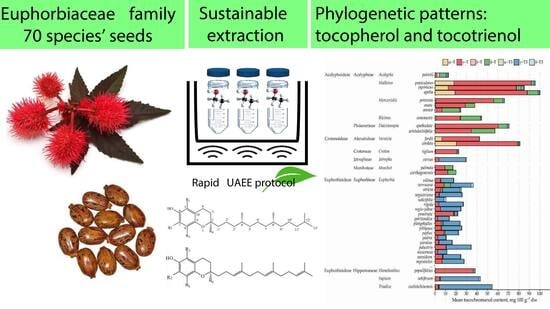
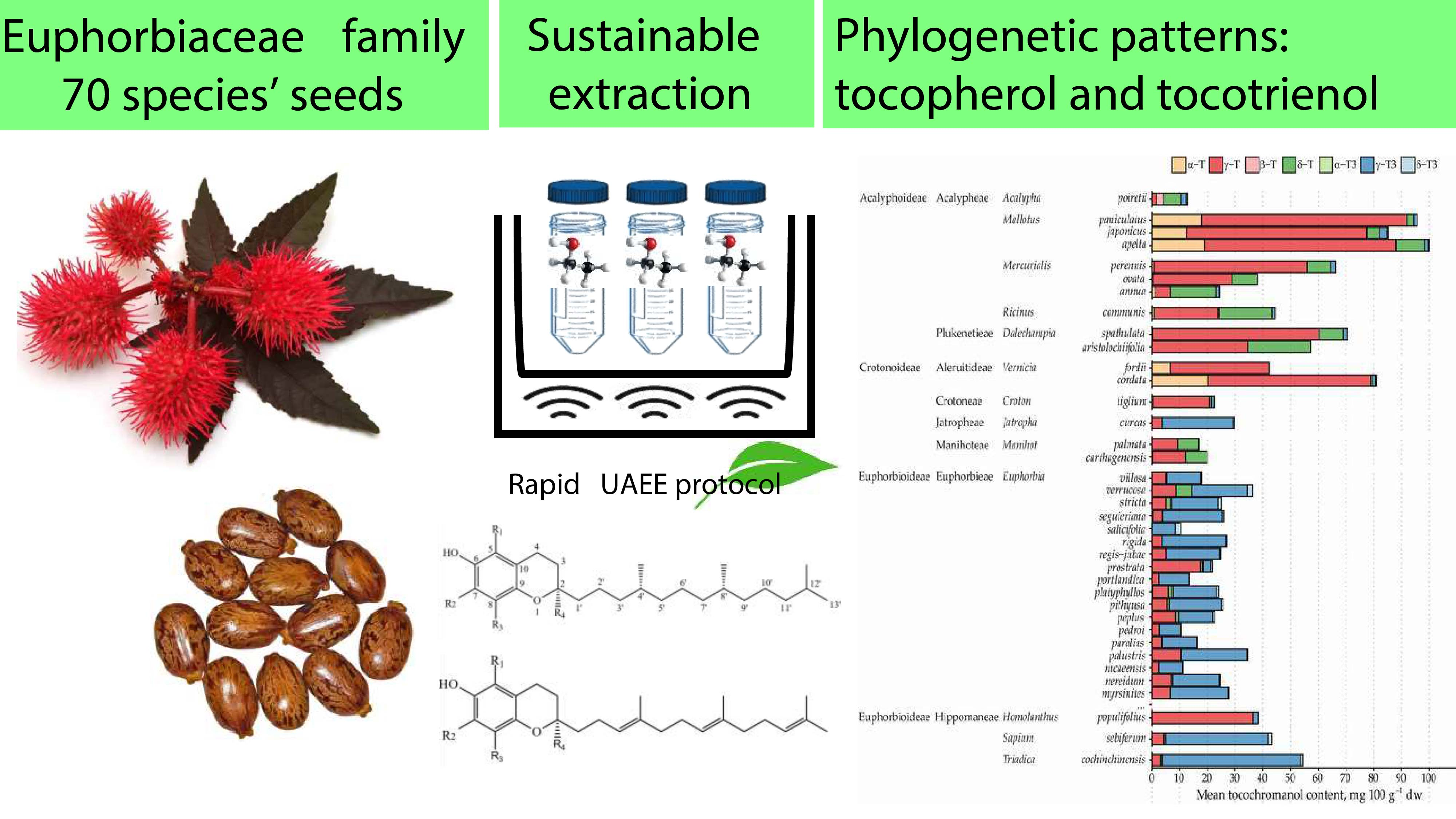
Graphical Abstract

1. Introduction

The Euphorbiaceae (spurge) family, sometimes generalized to euphorbias, is the fifth largest family of flowering plants. It belongs to the Malpighiales order (Rosid clade) and contains about 7500 species, organized into 300 genera, 37 tribes and three subfamilies (https://powo.science.kew.org/taxon/urn:lsid:ipni.org:names:30375178-2, accessed on: 10 June 2026). Owing to the size of the family, it is very diverse. The plants can be herbs, shrubs, trees, vines or cactus-like, annual, biennial or perennial, and deciduous or evergreen. Latex is present in some species, and absent in others. The fruits are usually dehiscent capsules, but can also be schizocarps, drupes or achenes (http://www.worldfloraonline.org/taxon/wfo-7000000224, accessed on: 30 December 2025). Members of the family can be found on all continents except Antarctica. While most cultivated species are used as decorative plants (indoor and outdoor), some are cultivated industrially: Hevea brasiliensis (rubber tree) for the production of latex and Ricinus communis (castor) and Jatropha curcas (Barbados nut) for the production of oil, while Manihot esculenta (cassava, manioc, yuca), a starchy root tuber, is a staple source of carbohydrates for some nations living in tropical climates, and is used to produce starch (tapioca). The use of Euphorbiaceae species is limited by their toxicity—many of the species contain toxic and irritant sap [1], ricin is a well-known and potent toxin [2], and cassava contains cyanogenic glucosides [3]. Therefore, care must be taken before use in products.
Tocopherols, tocotrienols, and plastochromanol-8 are the principal tocochromanols in higher plants, and their principal role is to act as lipophilic antioxidants. While tocopherols dominate in both green tissues and seeds, tocotrienols and plastochromanol-8 are detected far less frequently. The perception that tocotrienols are rare may be influenced as much by the scarcity of comprehensive screening studies and the infrequent use of tocotrienol standards as by their true presence in nature [4]. The Euphorbiaceae family has played an important role in tocotrienol research—the presence of free and esterified α-, γ- and δ-tocotrienol was reported in H. brasiliensis latex in 1965 [5], while just a year later, δ-tocotrienol was first isolated from the same source [6]. Research papers before 1965 mention tocotrienols isolated from wheat, rice and palm oil, the true identity of the compounds and their prevalence in nature being discussed [7,8,9], and that tocopherols were first discovered in 1922 [10]. Since their discovery, tocotrienols have been detected in and isolated from many plant species, but there are still few peer-reviewed reports on tocotrienol prevalence in the rest of the spurge family. One paper reports trace amounts of tocotrienols in castor oil [11], another reports γ-tocopherol and γ-tocotrienol in Jatropha curcas seeds [12], and tocotrienols were observed in H. brasiliensis latex, but not Euphorbia helioscopia seeds [13].
Although research on Euphorbiaceae tocochromanols has been very scarce since 1965, comprehensive reports are available on tocochromanol composition and prevalence in some other Malpighiales order members. α-tocopherol, γ-tocopherol and plastochromanol-8 have been observed in several Linum species (Linaceae family), while tocotrienols are absent in the seeds [14]. Similarly, only tocopherols have been reported in Salix viminalis, S. atrocinerea and S. fragilis (Salicaceae family) bark [15]. Although acerola (Malpighia emerginata, Malpighiaceae family) is trending as a food ingredient, its lipophilic compound content is scarcely studied—α- and β-tocopherol have been observed in Malpighia mexicana leaf acetonic extract [16], but no other reports on tocochromanol content or presence could be found. Other members of the Malpighiales order may preferentially accumulate tocotrienols, or produce genus-specific tocochromanols. For example, there are several reports on genus-specific tocochromanol derivatives, e.g., garcinoic acid, in Clusia species’ (Clusiaceae family) aerial plant parts (leaves and/or branches)—C. criuva [17], C. minor [18], C. obdetlifolia [19], C. burlemarxii [20], and C. pernecumbensis [21], but not in C. melchiorii [19]. A more recent screening observed tocotrienols in several Clusia species’ leaves, especially δ-tocotrienol, but α-tocopherol was the main tocochromanol in all specimens [22]. Like Clusia species, plants in the Garcinia genus (Clusiaceae family) also produce characteristic tocotrienol derivatives—paucinochymols in G. paucinervis [23], amplexichromaols in G. amplexicaulis [24], δ-tocotrienilic alcohol and a tocotrienol derivative similar to paucinervin D in G. multiflora [25], a tocotrienol dimer in G. oblongifolia [26], and formyl-δ-tocotrienol derivatives in G. virgata [27]. Tocotrienols were first observed in Hypericum perforatum (Hypericaceae family) leaves in 2012 [28], and recent investigations of the family have also observed tocotrienol presence in some Hypericum species [22]. Similarly, the presence of δ-tocotrienol has been well-documented in Passiflora species’ (Passifloraceae family) seeds [29]. While other families in the Malpighiales order have not been studied, tocotrienol presence appears to be common in families that have been investigated.
It is therefore the aim of this study to (i) comprehensively characterize tocochromanol composition in the Euphorbiaceae family species’ seeds, (ii) explore how these tocochromanol profiles align with the taxonomic relationships within the family, and (iii) to propose a more convenient, less hazardous and high-throughput extraction technique for analytical screening which can be applied for rapid extraction of those lipophilic molecules that is both highly efficient and safe for topical use or consumption.

2. Materials and Methods

2.1. Reagents

Sodium chloride, pyrogallol, and potassium hydroxide—all of reagent grade—the Folin–Ciocalteu reagent, formic acid (HPLC grade), ethanol, ethyl acetate, methanol and n-hexane—all of HPLC grade—and gallic acid (>99%, HPLC) were purchased by local provider from Sigma-Aldrich (Steinheim, Germany). The 2,2-diphenyl-1-picrylhydrazyl radical, named DPPH• for short, was received by local provider from Fluka (Buchs, Switzerland). The ethanol of concentration 96.2% (v/v) was obtained by local provider from Kalsnavas Elevators (Jaunkalsnava, Latvia). The four tocotrienol and four tocopherol standards α, β, γ, and δ homologues (>95%, HPLC) were obtained by local providers from LGC Standards (Teddington, Middlesex, UK) and Merck (Darmstadt, Germany).

2.2. Plant Material

The Euphorbiaceae family was one of more than one hundred plant families examined within the scope of this project. Seeds were obtained from botanical gardens across Eurasia (including Taiwan, Spain, Slovenia, Romania, Portugal, Poland, the Netherlands, Latvia, Kyrgyzstan, Italy, Hungary, Georgia, Germany, France, Denmark, the Czech Republic, Belgium, and Austria) as well as from the United States (Missouri). A comprehensive list of contributing botanical institutions is provided in the Supplementary Materials. Taxonomic verification of the supplied plant material (seeds) was conducted by qualified personnel at the respective donor botanical gardens, which provided access to their genotypic collections. In order to mitigate potential biases arising from factors such as species misidentification, hybridization, and environmental variability, particular emphasis was placed on maximizing both taxonomic diversity and the heterogeneity of source institutions. Still, only a single representative sample was available for several species, which constitutes another limitation of the dataset. Synonymy and taxonomic consistency were assessed using established online databases, including wikispecies.com (for fast classification), worldfloraonline.com (accepted species verification), and powo.science.kew.org (taxonomic and accepted species verification) with preference given to the most recent and widely accepted taxonomic frameworks. Typical growing areas of the investigated species were based on Plants of the World Online (native and introduced range) and on iNaturalist.org (accessed on: 16 March 2026); however, the latter resource does not differentiate between growing area and native range. The original species designations, together with the number of replicates assigned to each taxon by the contributing botanical gardens, are reported in the Supplementary Materials. Seed acquisition and subsequent analyses were conducted over the period 2019–2024. A limited subset of samples had been collected prior to this interval and air-dried under ambient conditions to preserve viability. Upon receipt, all seed samples were systematically cataloged and, where necessary, cleaned of residual plant material such as pericarp tissues. The samples were then subjected to rapid freezing at −80 °C for 1–3 h, followed by lyophilization using a FreeZone freeze-drying system (Labconco, Kansas City, MO, USA) operated at −51 ± 1 °C and pressures below 0.01 mbar for 24–48 h, depending on sample size and quantity. The resulting lyophilized material exhibited a residual moisture content ranging from 3% to 7%. Given the generally limited available biomass, a standardized moisture value of 5% was applied for all samples in subsequent tocochromanol quantification. Dried seeds (0.1–1 g) were homogenized using an MM 400 mixer mill (Retsch, Haan, Germany). Tocochromanols were extracted on the same day employing ultrasound-assisted extraction with 96.2% ethanol (UAEE). The detailed methodology is described in Section 2.3.2 (for all samples) and Section 2.3.1 (for a selected subset of six samples used in relative recovery experiments).

2.3. Tocochromanols Extraction

2.3.1. Saponification

The protocol of saponification and subsequent tocochromanol extraction was performed according to the method reported earlier [30]. Briefly, seed samples (0.100 ± 0.001 g) were saponified, and the residue was reconstituted in 1 mL of ethanol. The obtained extract was utilized in LC and spectrophotometric analyses without further modification.

2.3.2. UAEE Protocol

The greener method was adopted from a protocol for tocochromanol extraction from cranberry seeds [30]. Briefly, seed samples (0.100 ± 0.001 g) were extracted in 15 mL polypropylene tubes under single-extraction procedure using 5 mL of ethanol. The position of the sample in the ultrasonic bath (Sonorex RK 510 H, Bandelin Electronic, Berlin, Germany) was random. The ultrasonic bath had a nominal ultrasonic power of 160 W and an ultrasound frequency of 35 kHz, without the possibility of regulation. Samples were extracted for 15 min at 60 ± 5 °C. An external electronic thermometer controlled the temperature. Excluding the validation trials (3 replications), each seed specimen was processed as a single independent replicate. The obtained extract was centrifuged (11,000× g at 21 °C for 5 min) and utilized without further modification for LC and spectrophotometric analyses.

2.3.3. Method Validation

Because the application of UAEE for isolating tocopherols and tocotrienols from the analyzed seed samples deviates from the standard methodologies used in tocochromanol studies, the obtained results were benchmarked against those derived from a conventional saponification procedure. The relative recovery efficiency (%) compared with saponification protocol for tocopherols and tocotrienols was subsequently evaluated using seeds from six representative species spanning four genera, chosen randomly, including three species belonging to the genus Euphorbia: E. esula, E. lathyris, E. platyphyllos, and one each from Ricinus: R. communis, Mercurialis: M. annua, and Jatropha: J. curcas (6 × 3 UAEE vs. 6 × 3 saponification). The precision of the analytical procedure was evaluated by calculating the repeatability, expressed as the coefficient of variation, based on three independent determinations of a single sample performed within the same diurnal session. Similarly, the measurement error, represented by the standard deviation, was determined through the analysis of three separate replicates processed under identical conditions on the same day (Supplementary Materials).

2.4. Tocochromanol Determination

The quantification of the four tocopherol homologues and four tocotrienol homologues was performed using reverse-phase liquid chromatography (RPLC) coupled with fluorescence detection (FLD). Compound identification was achieved through comparison with authentic reference standards, while quantitative determination was based on previously established calibration curves generated for each analyte according to the validated analytical protocol reported earlier [31].

2.5. Contribution of Tocochromanols to the Antioxidant Potential of Extracted Phytochemicals of Euphorbiaceae Seeds

To quantify the extent to which tocochromanols account for antioxidant activity, we randomly (according to the accessibility of seed material and the biochemical heterogeneity of tocochromanol profiles) selected 20 Euphorbiaceae seed samples of 19 species (Croton tiglium, Dalechampia spathulata, 9 species of genus EuphorbiaE. balsamifera, E. regis-jubae, E. pedroi, E. seguieriana, E. austriaca, E. palustris, E. esula, E. lambii, Jatropha curcas, and 2 samples of E. myrsinites from different origins, 2 species of genus MallotusM. paniculatus and M. palmata, Manihot carthagenensis, 2 species of genus MercurialisM. ovata and M. annua, Ricinus communis, and Sapium sebiferum) and analyzed two matrices: (i) the unsaponifiable fraction representing the lipophilic antioxidants (Section 2.3.1) and (ii) the corresponding UAEE representing the lipophilic and hydrophilic antioxidants (Section 2.3.2). To gain insight into the putative antioxidant constituents in the UAEE, we performed a screening by RPLC system with a diode array detector (DAD) and estimated the pool of total reducing phytochemicals (phenols and other oxidation substrates and antioxidants) using the Folin–Ciocalteu reducing assay (FCR). Antioxidant activity was determined using the DPPH• assay for both matrices, and the resulting values analyzed using correlation matrices between total tocochromanols and the FCR–reactive phytochemical pool. For a valid comparison of the extracts in the DPPH• assay and the FCR assay, the post-saponification ethanol extracts were prepared by dissolving the material obtained from 0.1 g of seeds in 1 mL of ethanol. UAEE, by contrast, was generated by extracting 0.1 g of seeds with 5 mL of ethanol. For each assay, a 500 μL aliquot was taken and analyzed.

2.5.1. Analysis of Total Reducing Phytochemicals by Means of FCR

Total phenolic content, along with other oxidizable substrates and antioxidant constituents, was determined using the FCR via a colorimetric assay based on the procedure described by Singleton et al. [32]. In brief, 500 µL of the UAEE extract was combined with 2.5 mL of 10% (v/v) FCR, followed by the addition of 2 mL of 7.5% (w/v) Na2CO3. The reaction mixture was thoroughly homogenized and incubated for 30 min in the absence of light at ambient temperature. Subsequently, absorbance was measured at a wavelength of 765 nm using a UV-1800 spectrophotometer (Shimadzu, Kyoto, Japan). Results were expressed as milligrams of gallic acid equivalents per 100 g of seed dry weight. For each sample, two measurements were performed (n = 2).

2.5.2. Phytochemical Screening by RPLC-DAD

Phytochemical profiling was carried out using a Shimadzu Nexera 40 Series HPLC system (Kyoto, Japan) equipped with an SPD-M40 DAD, operating across a spectral range of 200–700 nm. Separation of constituents was achieved on an SPP Kinetex C18 column (5 μm, 250 × 4.6 mm), protected by a Synergi Fusion-RP guard cartridge (4 × 3 mm) (Phenomenex, Torrance, CA, USA). Chromatographic conditions were established as follows: the mobile phase consisted of water containing 4% formic acid (solvent A) and methanol (solvent B); the flow rate was maintained at 1.0 mL min−1; the column temperature was set to 50 °C; and the total run time was 15 min. The gradient elution program was defined as: 0.01 min—15% B, 1.00 min—25% B, 6.00 min—45% B, 9.00 min—70% B, 10.50 min—95% B, 11.00 min—15% B, and held at 15% B until 15.00 min. The resulting chromatograms were not used for qualitative identification or quantitative analysis. Instead, they were used to confirm the presence of additional phytochemical constituents in the 96.2% (v/v) ethanolic extracts beyond tocochromanols. The most prominent signals, corresponding to peaks with the largest areas, are presented as UV spectra in the Supplementary Materials.

2.5.3. Determination of Antioxidant Activity Using a Free Radical DPPH• Scavenging Activity Assay

Antioxidant capacity was assessed spectrophotometrically through the ability of the samples to quench the stable DPPH• radical. A fresh DPPH• working solution was prepared by dissolving 6 mg of DPPH• in 250 mL of 96.2% (v/v) ethanol, followed by 30 s of ultrasonication to ensure complete dissolution and uniformity. The initial absorbance of this solution was 0.930 ± 0.010. The assay was initiated by combining 500 µL of either the saponified sample or the UAEE extract with 3500 µL of the DPPH• solution. The reaction mixture was then incubated for 30 min in the absence of light, a duration previously established to allow the system to reach equilibrium. Absorbance was subsequently measured at 517 nm using a UV-1800 spectrophotometer (Shimadzu, Kyoto, Japan). Measurements were carried out in duplicate for each sample (n = 2). The radical-scavenging activity was calculated according to the following equation:
%   D P P H   s c a v e n g i n g = A b s o r b a n c e   o f   c o n t r o l A b s o r b a n c e   o f   s a m p l e A b s o r b a n c e   o f   c o n t r o l × 100
%   T o c o c h r o m a n o l s   a n t i o x i d a n t   a c t i v i t y = %   D P P H   s c a v e n g i n g   o f   s a p o n i f i e d   s a m p l e %   D P P H   s c a v e n g i n g   o f   U A E E   e x t r a c t × 100

2.6. Statistical Analysis

Tocochromanol contents are expressed as species means ± standard deviation (n = 1–10), providing the number of analyzed samples in species in parentheses. Unfortunately, only a single representative could be sourced for several species. The Kruskal–Wallis test was used to distinguish statistically significant difference between sample group (subfamily, tribe) tocochromanol contents using Fisher’s least significant difference post hoc and Bonferroni p-value adjustment. To determine main distinguishing factors, principal component analysis (PCA) was done using individual tocochromanol contents without data scaling to avoid exaggerated minor tocochromanol contribution to loadings. Base R and opensource packages were used: dplyr, MASS, factoextra and FactoMineR for PCA; forcats, GGally, ggplot2, ggpubr, ggthemes, patchwork and scales for data visualization. R version 4.3.2. and RStudio 2025.09.2 + 418 “Cucumberleaf Sunflower” Release (12f6d5e22720bd78dbd926bb344efe12d0dce83d, 20 October 2025) for windows were used. Statistical analysis and conclusions were significantly limited by the low number of representatives between groups (subfamilies, tribes), and should be regarded considering this limitation, although it is a very common issue in similar studies, most of which have a single replicate per species. The p-values of correlations were calculated by data analysis (regression) using Excel (Version 2302) Microsoft 365 Apps for Enterprise (Redmond, WA, USA) software.

3. Results and Discussion

3.1. Saponification and UAEE Relative Recovery Compared with Saponification Protocol and Measurement Repeatability

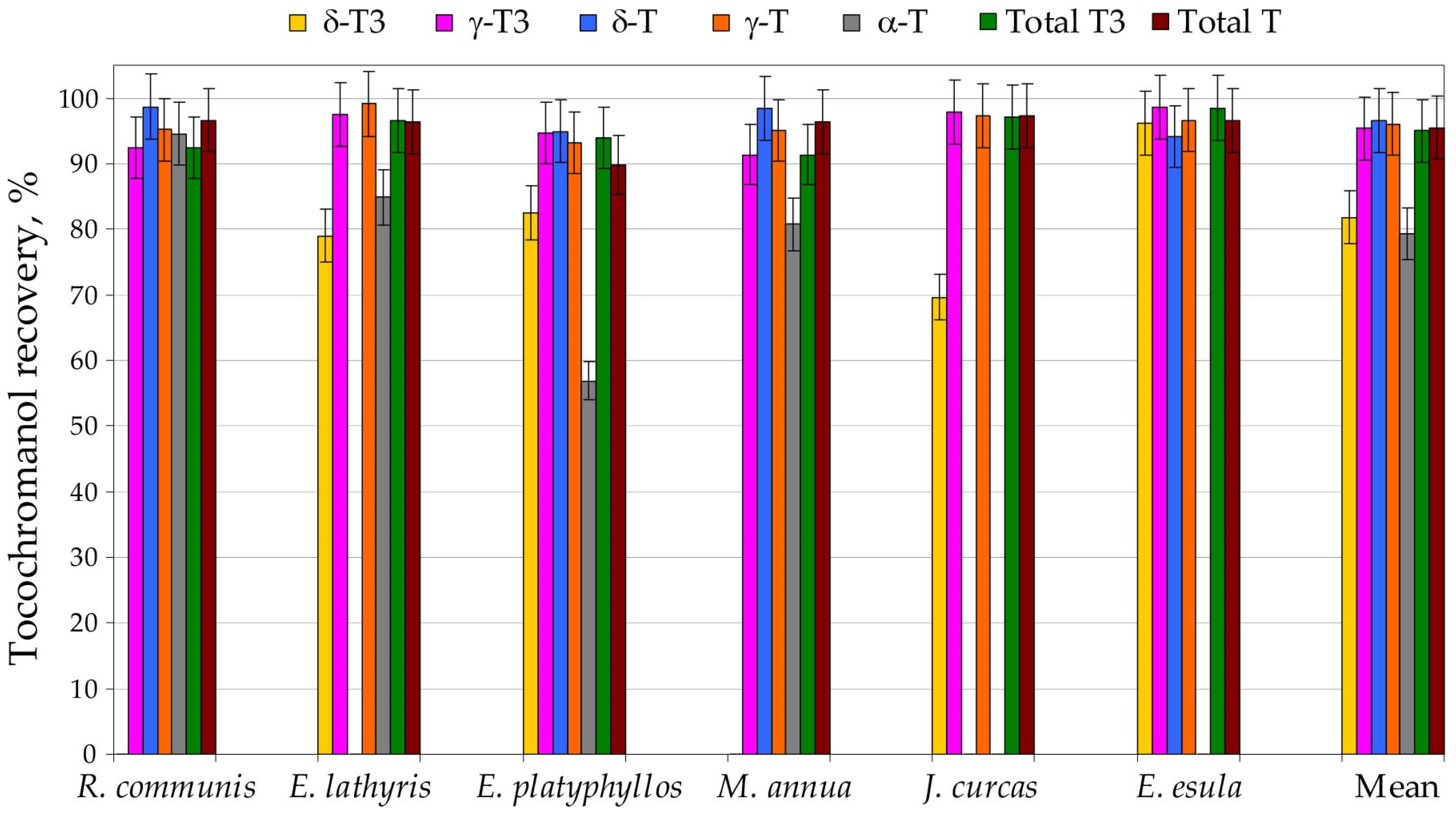
The processing of large sample sets—ranging from hundreds to thousands—necessitates extraction methodologies that are rapid, reproducible, and safe for both laboratory personnel and the environment. Alkaline saponification is widely regarded as the benchmark approach for preparing samples before tocochromanol analysis and typically provides the highest recovery of these lipophilic compounds [31]. However, this procedure is laborious and time-intensive, requires the use of hazardous organic solvents such as hexane and ethyl acetate, and yields only aggregate tocochromanol values without differentiating between free and esterified tocopherols and tocotrienols [4]. In the present study, a substantially simplified UAEE protocol is shown to significantly reduce preparation time, minimize manual handling, and limit solvent toxicity, while maintaining high relative recovery rates and satisfactory analytical repeatability. For high-throughput screening applications, this optimized approach represents a more sustainable and cost-effective alternative to conventional saponification, without meaningful compromise in analytical performance. The same UAEE strategy has previously been used for tocochromanol profiling in seeds of grape (Vitis spp.) [33] and cranberry (Vaccinium macrocarpon) [30], as well as in Aquifoliaceae [34], Berberidaceae [35], Celastraceae [36], Cornaceae [37], Passifloraceae [29], Rutaceae [38], and Vitaceae [39], where recoveries were similar to those obtained using saponification. Nonetheless, results derived from UAEE should not be considered directly interchangeable with those obtained via saponification. When investigating a new plant matrix, it remains advisable to conduct an initial comparison with the standard saponification protocol. This precaution is warranted because the proportion of esterified tocochromanols can vary widely across plant tissues, ranging from negligible contents to the entire tocochromanol profile [5]. Additionally, a fraction of these compounds may be physically entrapped within the plant matrix, potentially limiting extraction efficiency and influencing analytical interpretation [4]. Therefore, six selected species from four genera—three Euphorbia (E. esula, E. lathyris, E. platyphyllos), and one each from Ricinus (R. communis), and Mercurialis (M. annua), and Jatropha (J. curcas) seeds—were prepared using both UAEE and the saponification protocol for method validation. The extraction efficiency, expressed as recovery relative to the benchmark saponification procedure (relative recovery), exhibited significant variation across both the specific tocochromanol homologues and the plant species investigated. β-T3 was not detected in any of the validated species. α-T3 was identified exclusively in E. lathyris and β-T solely in R. communis, with recoveries of 97% and 81%, respectively. α-T, δ-T and δ-T3 were present in four of the six validated species, although their occurrence varied depending on the specific tocochromanol. Among them, α-T showed the lowest relative recovery, ranging from 57% in E. platyphyllos to 95% in R. communis, whereas δ-T3 exhibited slightly higher recoveries, between 70% in J. curcas and 96% in E. esula. The analogous tocopherol, δ-T, displayed both high and remarkably consistent recoveries, spanning 94% in E. esula and 99% in R. communis. Likewise, the γ-homologues performed very well: γ-T3 showed recoveries of 91% in M. annua and 99% in E. esula, and γ-T ranged from 93% in E. platyphyllos to 99% in E. lathyris. Despite the suboptimal relative recovery of certain individual tocochromanols, the overall relative recovery for total tocotrienols, total tocopherols, and total tocochromanols remained high and very similar, at 91% in M. annua and 99% in E. esula, 90% in E. platyphyllos and 97% in R. communis, J. curcas, and E. esula, and 93% in E. platyphyllos and 98% in E. esula, respectively. The high overall relative recovery observed can be largely explained by the fact that reduced extraction efficiencies are primarily associated with minor tocochromanol species, while the predominant constituents were recovered with high efficiency (Figure 1, Supplementary Materials).
Relative recovery (%) was calculated as an average value for three sample replications and assuming the saponification protocol as 100% recovery of tocochromanols. UAEE, ultrasound-assisted extraction in ethanol.
The modestly higher tocochromanol values recorded after saponification, compared with those from UAEE, can be attributed primarily to the alkaline hydrolysis of esterified tocochromanols and to the release of compounds physically entrapped within the seed matrix, which are inefficiently recovered by direct solvent extraction [4]. Esterified tocochromanols were not analyzed. The discrepancies between the two protocols were modest, while individual tocochromanol concentrations were often low. The detection and quantification of conjugated tocochromanols are analytically challenging and subject to measurement variability [33]. Both methods exhibited good repeatability. However, the UAEE protocol yielded, on average, demonstrated a slightly lower coefficient of variation for tocochromanols relative to saponification, thereby highlighting its practical advantages and its potential as a more sustainable extraction procedure for Euphorbiaceae seed tocochromanols. The saponification procedure should not be regarded as a quantitative reference method with complete analyte recovery. Tocochromanols can undergo degradation during alkaline hydrolysis, despite the inclusion of pyrogallol as an antioxidant safeguard. Evidence from grape seed analyses has demonstrated losses of tocotrienols following saponification, indicating that oxidative degradation may not be entirely prevented under these conditions [33]. These findings imply either limited protective efficacy of pyrogallol in certain matrices or suboptimal concentrations. Pyrogallol remains the most common antioxidant in saponification-based protocols; however, its concentration varies considerably among studies, ranging from 2% (w/v) in the present work and 2.5% (w/v) in previous reports [31] to as high as 6% (w/v) [40,41]. Importantly, the chemical behavior of pyrogallol is complex. Beyond its antioxidant properties, it has been shown to participate in both the formation and removal of H2O2 [42]. Because hydrogen peroxide is a reactive oxidizing agent, its presence may contribute to analyte oxidation and thereby affect apparent recovery values. Collectively, these observations highlight the need for systematic optimization of antioxidant selection and concentration in saponification procedures. Such optimization should be the subject of dedicated methodological investigations. Moreover, the composition of the plant matrix introduces an additional level of complexity. Plant tissues contain numerous endogenous antioxidants whose interactions may be either synergistic or antagonistic, influencing the susceptibility of tocochromanols to oxidative degradation during extraction and hydrolysis. Therefore, improving recovery cannot rely on a universal solution and requires matrix-specific methodological optimization. Moreover, the high mean relative recovery of total tocochromanols underscores the suitability of the UAEE protocol for routine, high-throughput comparative analyses of Euphorbiaceae seed material. It should, however, be noted that this validation was conducted on a limited set of six species, and taxa characterized by unusually elevated levels of esterified tocochromanols may exhibit diminished relative recovery under UAEE conditions. Nevertheless, the available literature consistently demonstrates that non-esterified (free) tocochromanols predominate in seed tissues [3] and, to date, there are no reports indicating extensive esterification of these compounds in seeds. Taken together, these observations support UAEE as a reliable and practical methodological choice for the majority of seed-based tocochromanol investigations, particularly if analytical efficiency, cost-effectiveness, and environmental considerations are of primary importance.

3.2. Tocochromanol Profile as Shaped by Taxonomy

In total, 68 species’ seed tocochromanol contents were analyzed. These belonged to 13 genera, eight tribes and three subfamilies (Table 1).
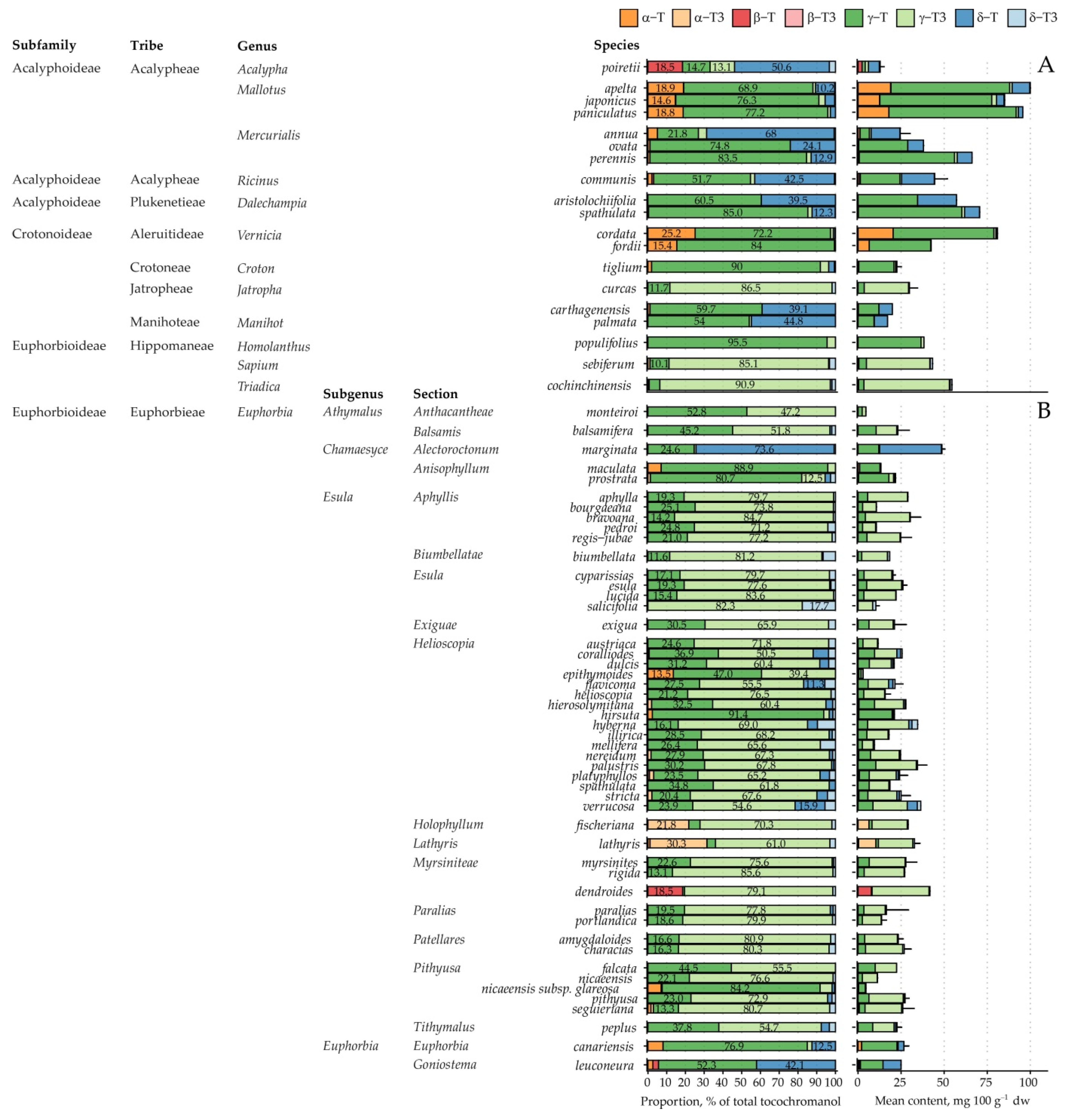
The highest number of representatives was collected in the Euphorbia genus, and R. communis was the species with the most collected and analyzed samples. None of the seeds contained β-tocotrienol, while only some contained β-tocopherol: A. poiretii, M. apelta, M. japonicus, R. communis, E. dendroides and E. leuconeura. High concentrations of β-tocotrienol can be found in bran oils of wheat (Triticum aestivum) and spelt (Triticum spelta), and black caraway (Nigella sativa) seed oil [4]. Tocochromanol composition differed between the species. In most Euphorbioideae subfamily samples (Euphorbia genus, S. sebiferum, T. cochinchinensis, and J. curcas), the main tocochromanol was γ-tocotrienol. It constituted up to 86.1% of total tocochromanols in J. curcas seeds. The other major tocochromanol was γ-tocopherol, which was dominant in most of the Acalyphoideae and Crotonoideae subfamily species, some Euphorbia species (E. canariensis, E. glareosa, E. hirsuta, E. leuconeura, E. maculata, E. prostrata), and a single representative in the Homolanthus genus (H. populifolius). Additionally, some of the species were relatively rich in δ-tocopherol, including M. annua, R. communis, D. aristolochiifolia, E. marginata and E. verrucosa. Existing research shows δ-tocopherol is the primary tocochromanol (57.3–74.5% of total tocochromanols, depending on genotype) in R. communis seed oil [43]. In the present study, seed δ-tocotrienol constituted 42.7% of total tocochromanols, and R. communis seeds contained similar or larger proportions of γ-tocopherol (47.2–83.5% of total tocochromanols, 51.6% mean) than reported previously. Contrary to the report by ref. [13], tocotrienols were present in all tested E. helioscopia seeds (12.10 ± 2.42 mg 100 g−1 dw) and γ-tocotrienol constituted 78.9% of total tocochromanols. While most of the species were tocotrienol-dominated, others contained almost exclusively tocopherols. As shown in Figure 2, the tocochromanol profile can differ slightly or significantly within and between genera in the same subfamily, tribe, and genus. Investigated species in the Acalyphoideae subfamily were tocopherol-dominated, while those in Crotonoideae and Euphorbioideae differed significantly. Most Crotonoideae species were tocopherol-dominated and only contained trace amounts of tocotrienols, except J. curcas seeds, in which the tocotrienol mean proportion was 87.9%. The results are in agreement with a previous study of J. curcas seed tocochromanols [44], where γ-tocotrienol made up 73.9–88.8% of total tocochromanols, followed by γ-tocopherol (10.3–25.5%) and small amounts of δ-tocotrienol.
Conversely, most of Euphorbioideae is tocotrienol-dominated (median mean proportion 73.7% of total tocochromanols), and most of the genera are generally tocotrienol-dominated as well with some exceptions—one sample of H. populifolius (tocopherols 95.6% of total tocochromanols), which only contained γ-tocopherol and γ-tocotrienol, and several Euphorbia species—E. leuconeura (100% tocopherols), E. marginata (98.3%), E. canariensis (97.5%), E. maculata (95.9%), E. hirsuta (95.7%), E. glareosa (92.6%), E. prostrata (83.6%), E. epithymoides (60.6%), E. monteiroi (52.8%). However, individual tocochromanol contents were similar between samples of the same species. While tocochromanol composition appears relatively consistent in most of the Euphorbia genus—high γ-tocopherol and γ-tocotrienol with other low tocochromanol compositions—there are several notable exceptions.
Standard deviations were generally low in species with several representatives, but the same should not be expected for subspecies, since γ-tocopherol is the dominant tocochromanol in Euphorbia nicaeensis, but absent in its subspecies glareosa. Only a single seed sample could be secured for each, and misidentification cannot be ruled out. Euphorbia paralias was another species with high tocochromanol content variability; however, the tocochromanol proportions were similar in the two E. paralias samples. Available phylogenetic studies placed Euphorbia species E. maculata and E. prostrata in the Chamaesyce subgenus, E. esula, E. helioscopia, E. lathyris and E. peplus were placed in the Esula subgenus [45], while E. paralias and E. portlandica were placed in the Paralias section [46]. Recent seed tocochromanol screenings have observed similar tocochromanol content and composition differences in other plant families as well—tocochromanol composition differs significantly between different branches of the citrus (Rutaceae) family, with certain branches accumulating tocopherols and others accumulating tocotrienols [38], while other plant families primarily accumulate either tocopherols, like legumes [47] or Rosaceae species [48], or tocotrienols, like grapevines [39].
Conclusions on the typical tocochromanols of other species are limited by the unknown effects of plant and environmental conditions, and natural variability—provenance was not always available, and differences between original harvesting populations are unknown, as are the effects of environmental factors during early plant development, and soil. Some species may also have higher interpopulation variability than others. Moreover, several of the investigated species were the only representatives from the genus, and genera with several representatives show high variability in terms of tocochromanol content and proportion. While antioxidants are most stable in whole seeds, the effects of storage conditions between seed harvesting and analysis, which may have been done up to nine months or a year after harvesting, cannot be estimated. Additional studies are required to determine the typical tocochromanol content and profile in any of the investigated genera and subgenera, since the dataset includes only the most common and wild and ornamental plants.
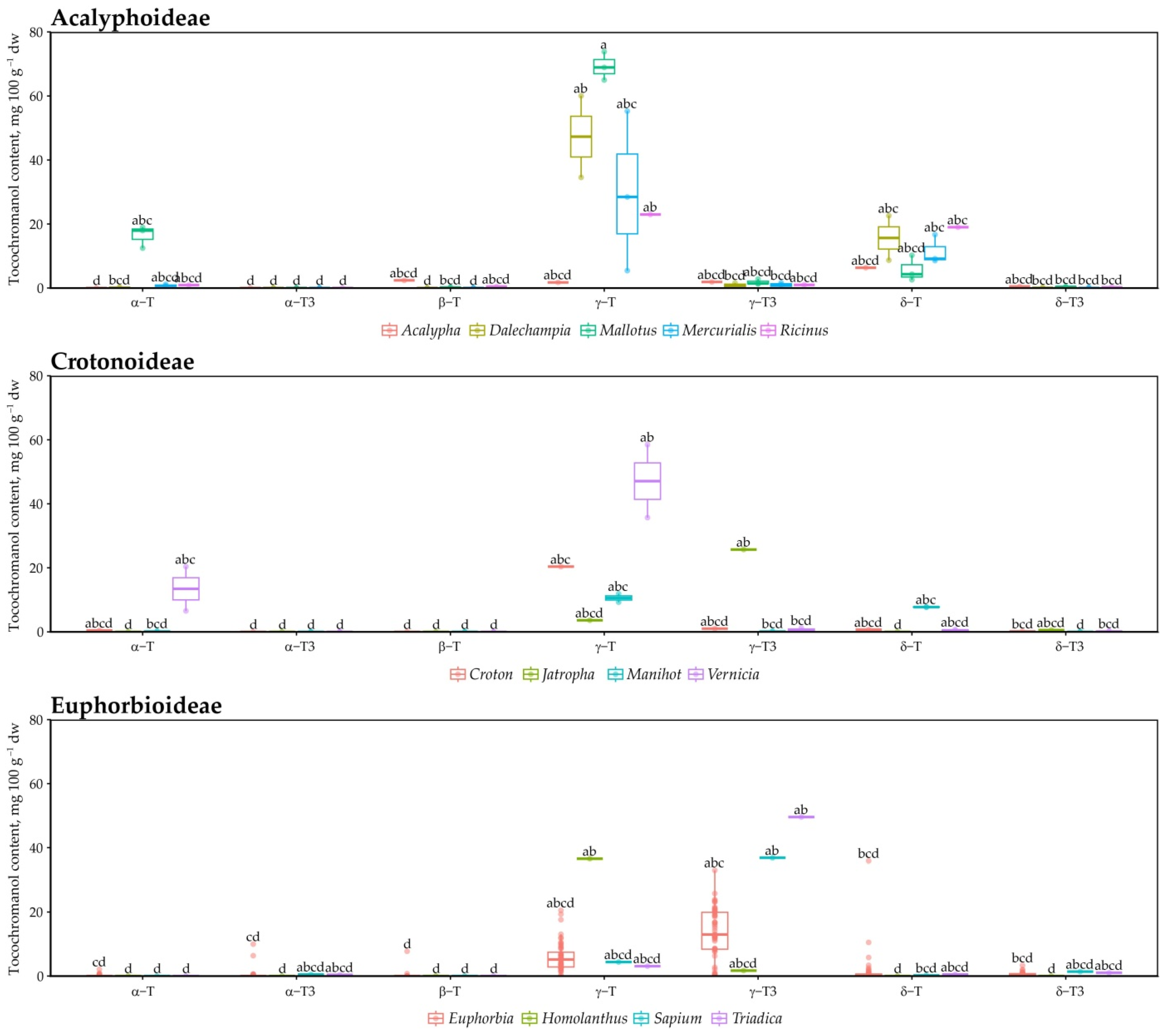
The Kruskal–Wallis test identified little difference between tocochromanol contents in different subfamilies and genera (Figure 3), possibly due to the overrepresentation of Euphorbia species in the sample set.
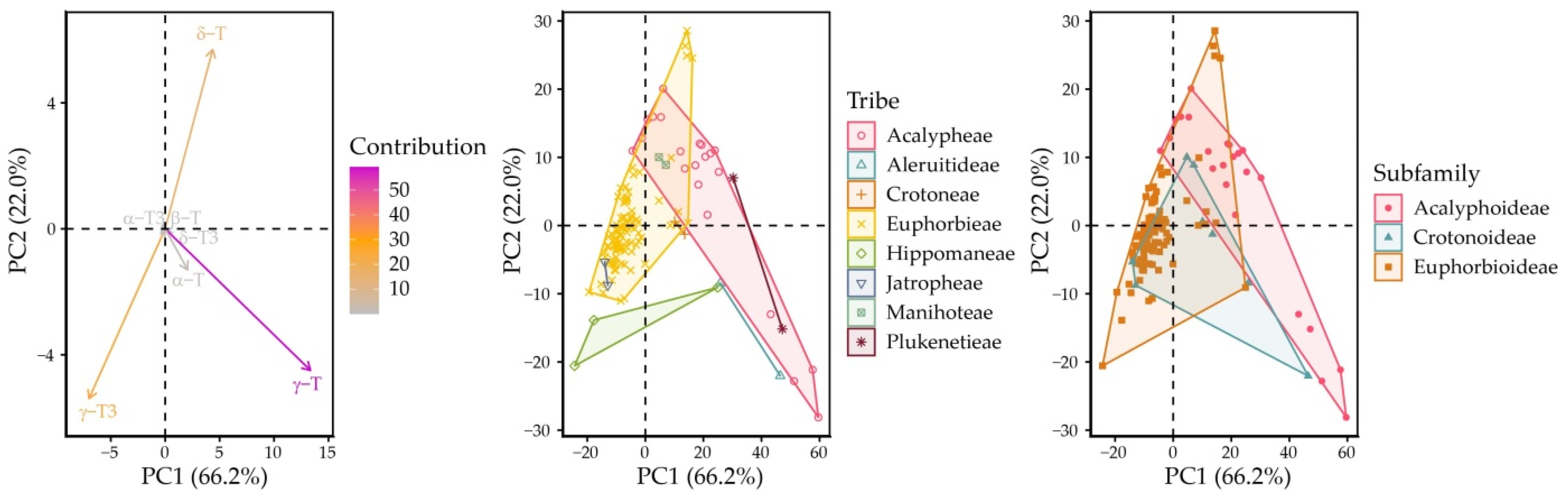
Principal component analysis identified γ-tocopherol, γ-tocotrienol and δ-tocopherol as the main components (Figure 4). Principal component 1 (PC1) explained 66.23%, and PC2 explained 22.03% of total variance, for a total of 88.27% explained variance. PC1 correlated with γ-tocopherol (0.843), γ-tocotrienol (−0.442), δ-tocotrienol (0.276) and α-tocopherol (0.131), and PC2 correlated with δ-tocopherol (0.624), γ-tocotrienol (−0.590), γ-tocopherol (−0.492) and α-tocopherol (−0.143). This is reflected when plotting individual datapoints—tribes are differentiated and clustered by their relation to PC1 and PC2, while subfamilies overlap. Acalyphoidea and Crotonoideae subfamily members follow a trend of being negatively correlated with PC1 and PC2, forming an ellipsis along the γ-tocotrienol and δ-tocopherol vectors, while Euphorbioideae subfamily members (Euphorbieae and Hippomaneae) correlated positively with PC1 and PC2, placed along the γ-tocopherol vector.
Work on J. curcas, a germplasm collection of 52 accessions, revealed a significant genotype × environment effect on total tocochromanol content, but not on the relative proportions of the main tocochromanol homologues [44], which supports the results in the present study. It is possible that other factors, beyond genotype and environment, may have a significant effect on tocochromanol profiles, like seed development stage. α-T and γ-T are detectable during the initial phases of seed development in J. curcas, while γ-T3 remains almost absent until around 66 days after pollination. Thereafter, γ-T levels rise steeply, eventually accounting for approximately 75% of total tocochromanols [44]. A comparable developmental shift in tocochromanol composition has been documented in grape (Vitis vinifera) seeds [49]. This may explain a small percentage of the variation, since only mature seeds are kept for propagation and exchange.
Investigated species may have very different native ranges in the wild, and may be grown under different abiotic conditions from those they would be subjected to in their native range. The investigated Mercurialis species are common across temperate Europe and all predominantly accumulated tocopherols, and so did the investigated Mallotus species, which are native to temperate, subtropical and tropical climates in southern and pacific Asia. On the other hand, species in the Euphorbia genus grow across subarctic, temperate, subtropical, tropical and arid climates. Distinctly tocopherol-dominated species in the sample set, like Euphorbia leuconeura (endemic to Madagascar), E. canariensis (endemic to Canary Islands), E. hirsuta (native to Mediterranean regions), E. maculata (native to North America, introduced to temperate climates) and E. prostrata (native to South America, central and temperate North America, introduced to temperate, tropical and arid climates), are not limited to a specific climate, nor are the species which contained almost exclusively tocotrienols, like Euphorbia salicifolia (native to central-eastern Europe), E. fischeriana (Northern China, Zabalkaykalsky Krai east of lake Baikal in Russia, and eastern Mongolia), and E. lathyris (native to Kirgizstan, Pakistan and the Xinjiang region, introduced to temperate and Mediterranean Europe, Pacific and Atlantic coast of North America, eastern South America and Argentina, South Africa, Tasmania and New Zealand and coastal east-southern regions of Australia). Because many of the species in the sample set are common across a variety of geographic and climatic regions, statistical analysis of tocochromanol content based on these factors was not feasible within the present study. A separate study is advisable to discern the natural variability within any given species as well.

3.3. Limitations and Future Study Directions

Misidentification of species cannot be ruled out completely, since plants in garden collections may be incorrectly identified upon their addition to the collection, before genetic testing was available. Several of the species are represented by only one biological seed sample. These cases may be less representative than results for species which could be sourced from several collections, but were not excluded from the total sample pool. Such a practice has been previously demonstrated in the families Arecaceae, Onagraceae, Boraginaceae, and Brassicaceae [50,51,52,53].
Ecological factors affect the expressed phenotype, and are a factor in plant evolution. One convergent evolution example of plant adaptation to arid climates is a modified photosynthetic pathway to conserve water. Most plants use the C3 photosynthetic pathways, while many species growing in arid regions have independently evolved the C4 pathway, including some Euphorbia species, specifically the Anisophyllum section of the Chamaesyce subgenus [54,55]. Most of the family, however, uses the C3 pathway, and some predominantly or facultatively use crassulacean acid metabolism, mostly the Athymalus and Euphorbia subgenus [55]. Although tocochromanols, carotenoids and chlorophylls use a common biosynthetic pathway (shikimate) and precursors (geranylgeranyl pyrophosphate) [56], there is no established link between tocochromanol composition and photosynthetic pathways in plants. The discussion is purely hypothetical, since the dataset did not have sufficient representatives for statistical analysis.
Metabolic differences may lie in different tocochromanol precursor preferences by involved enzymes (methyltransferase, and γ-tocopherol methyltransferase), precursor availability, or metabolic regulation [56], since common pathways and precursors are used for tocochromanol homologues. This is supported by significantly differing tocochromanol contents observed in different wheat variety grains and carrot roots [57,58], and differing metabolic regulation has been observed in different pomelo varieties [59]. Metabolic investigation and enzyme activity analysis could not be done during this study, but are advisable before conclusions can be drawn on primary factors affecting tocochromanol synthesis in the family and its individual species.
Due to sample availability, seed moisture content could not be quantified for every accession. Accordingly, data normalization was performed using a uniform moisture content value of 5%, assuming 3–7% among the evaluated samples.
An additional hypothesis is that cross-pollination with other species could have generated offspring with modified tocochromanol profiles. At present, however, there is no evidence to support this scenario.
The results indicate some taxonomy-related preference in the species for the synthesis of particular tocochromanols. Previous studies on dicotyledonous family seed tocochromanols have seen taxonomy-related variance in tocochromanol composition. In the Fabaceae family, tocopherols are consistently present at different concentrations regardless of the taxonomic group, but tocotrienols are present in specific branches of the family, albeit in small amounts, inconsistently, and with a single representative per genera [47]. In Apiaceae species, which are often reported as tocotrienol-dominated, tocotrienol proportions were consistent within the genera, while individual tocotrienol proportions differed between species [60,61,62]. Tocochromanol content can change in response to abiotic stress such as drought [63] or photooxidative stress [64], and studies on a wider selection of metabolites are warranted, including other tocochromanols and their derivatives, tocochromanol precursors and degradation products, as are metabolic analyses. Additionally, the stress-related variation in tocopherols and tocotrienols has not been widely studied, but may affect the tocochromanol profile in plant material.

3.4. Contribution of Tocochromanols to Antioxidant Potential of Unsaponifiable Fraction and Ethanolic Extracts

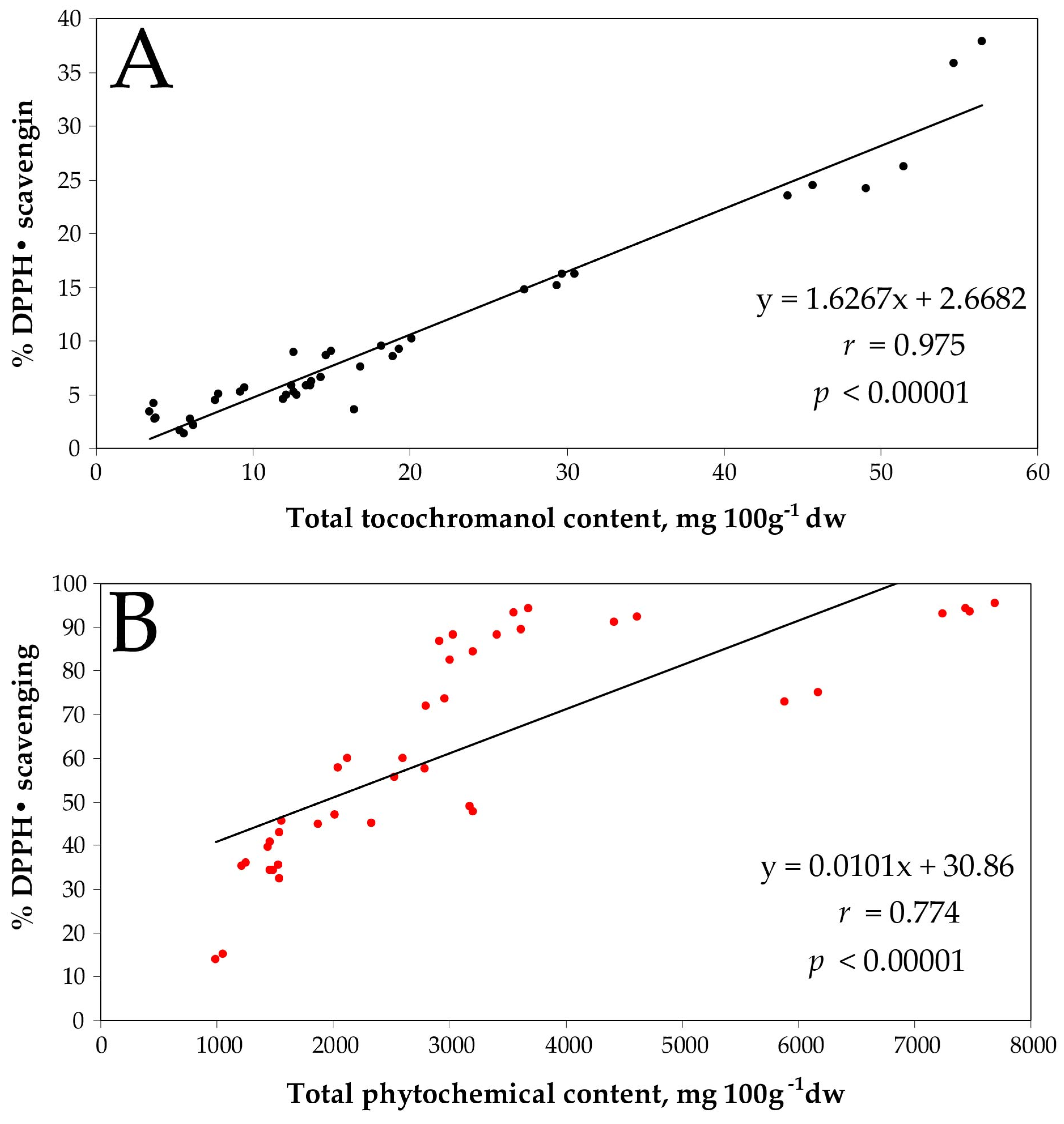
The unsaponifiable fraction comprises a chemically diverse set of lipophilic constituents, including lignans, tocopherols, tocotrienols, carotenoids, triterpenoid alcohols, sterols, and squalene, many of which exhibit antioxidant properties [65]. Previous studies of edible oils and oil agro-industrial by-products have consistently reported very strong correlations (r = 0.9–1.0) between total tocochromanol content and DPPH• radical-scavenging activity [66,67]. Such tight associations have prompted the proposal of the DPPH• assay as a rapid tool for determination of total tocochromanol content in linseed and sunflower oils [68]. Our data align with these observations. M. paniculatus, characterized by the highest total tocochromanol content, displayed the greatest DPPH• scavenging capacity, whereas species with the lowest tocochromanol content—E. pedroi, E. balsamifera, M. annua, and E. lambii—exhibited the weakest activity (Supplementary Materials). The strong total tocochromanol content–DPPH• scavenging activity correlation (r = 0.975, p < 0.00001) supports the conclusion that tocochromanols contribute to the main antioxidant response within the unsaponifiable lipophilic fraction across 20 tested Euphorbiaceae seed samples (19 species) (Figure 5A).
This pattern mirrors that observed in vegetable oils, where tocochromanols serve as the principal radical-scavenging agents [66,67]. However, in lipid-rich systems such as oils, phenolics typically play a minor quantitative role in comparison to tocochromanols [69,70]. By contrast, ethanolic extracts—particularly when assisted by ultrasonication—solubilize both lipophilic and hydrophilic phytochemicals from plant material, potentially reshaping the antioxidant landscape [71], and should not be compared to oils directly. To capture this broader phytochemical spectrum, a rapid (15 min) RPLC-DAD screening (200–700 nm) was conducted to assess the tocochromanol contribution to assay results (Supplementary Materials). Total reducing phytochemicals were further estimated using the FCR assay.
The FCR assay quantifies the pool of compounds capable of undergoing oxidation under the assay conditions. Because of its broad reactivity, the reagent interacts not only with phenolics and non-phenolic constituents like aromatic amino acids and proteins. Consequently, the assay reflects the overall reducing capacity of the extract rather than its absolute phenolic content [72]. Nevertheless, the FCR method remains widely adopted as an integrative indicator, particularly when chromatographic approaches (e.g., LC) generate complex compositional profiles that are not easily condensed into a single parameter [32,73]. In most species, high FCR values corresponded to a greater number and/or larger peak areas in the RPLC-DAD chromatograms. A notable exception was M. paniculatus, which exhibited low chromatographic peak intensity despite high FCR reactivity and strong DPPH• scavenging (Supplementary Materials). These observations illustrate that FCR and RPLC-DAD, though each limited in scope, provide complementary insights into the reducing phytochemical pool.
Pearson correlation between FCR and DPPH• values in the ethanolic extracts was statistically significant but moderate (r = 0.774, p < 0.00001)—markedly weaker than that observed for tocochromanols (Figure 5B). This divergence is commonly attributed to mechanistic differences: FCR quantifies total reducing capacity, whereas DPPH• specifically measures radical-scavenging ability [74]. Importantly, chemical complexity weakens this correlation. Comparison of DPPH• activity between the saponified and ethanolic fractions reveals that non-tocochromanol constituents in the ethanolic extracts contribute 10–12 times higher antioxidant activity in tocochromanol-rich species (R. communis, E. austriaca, M. paniculatus, D. spathulata, and M. ovata), and up to 206 times more in low-tocochromanol species such as E. lambii. Consequently, tocochromanol contribution accounted for ≤10% (species-dependent) and on average only ~2% of the total DPPH• scavenging activity in the UAEE extracts across the 20 Euphorbiaceae seed samples (19 species) examined. Similar contributions (3–8%) have been described in sea buckthorn (Hippophae rhamnoides) leaves, where lipophilic antioxidants—mainly tocochromanols—accounted for only a minor fraction of the total antioxidant capacity measured in 80% (v/v) ethanolic extracts [71]. This observation clearly indicates that other phytochemical classes—efficiently co-extracted by 96.2% (v/v) ethanol—dominate the antioxidant potential of Euphorbiaceae species seed extracts.

4. Conclusions

The Euphorbiaceae seed tocochromanol profile can be tocopherol or tocotrienol-dominated, with some relation to plant taxonomic classification. Investigated species in the Acalyphoideae and Crotonoideae subfamily were distinctly tocopherol-dominated, except J. curcas, which contained almost entirely tocotrienols. Species in the Euphorbioideae subfamily were generally tocotrienol-dominated, with some exceptions.
These results further highlight the value of UAEE high-throughput screening, provided that matrix-specific validation is performed for any new plant material. Tocochromanol recoveries were similar to the saponification protocol. Tocochromanol content correlated strongly with DPPH• radical-scavenging capacity in extracts following the saponification protocol. However, in the ethanolic extracts, tocochromanols contributed ≤10%—and only ~2% on average—to the total antioxidant activity. These data suggest that the antioxidant potential of the ethanolic extracts is largely governed by other phytochemical classes rather than by tocochromanols alone.
Although the UAEE approach has proven reliable, the potential existence of seeds dominated in tocochromanol esters cannot be excluded. Consequently, UAEE-based screening should be interpreted with appropriate caution. Any prospective applications of Euphorbiaceae species as sources of tocochromanols, particularly in functional foods, must be approached with caution due to the frequent occurrence of toxic secondary metabolites in this family, and would likely require rigorous purification and safety assessment.

Supplementary Materials

The following supporting information can be downloaded at: https://www.mdpi.com/article/10.3390/horticulturae12070760/s1. Table S1. Repeatability (%) for the determination of tocopherols and tocotrienols in the seeds of Euphorbiaceae family.

Author Contributions

D.L.: Conceptualization, Investigation, Resources, Data Curation, Validation, Software, Visualization, Writing—Original Draft, Writing—review and editing; I.M.: Resources, Formal analysis; K.D.: Resources, Formal analysis, Data Curation; P.G.: Conceptualization, Methodology, Investigation, Visualization, Supervision, Writing—Original Draft, Writing—review and editing, Funding acquisition. All authors have read and agreed to the published version of the manuscript.

Funding

This research was funded by the Latvian Council of Science project “Dicotyledonous plant families and green tools as a promising alternative approach to increase the accessibility of tocotrienols from unconventional sources”, project No. lzp-2020/1-0422.

Data Availability Statement

The data used to support the findings of this study are available in the Supplementary Materials and from the corresponding author upon request.

Acknowledgments

We would like to recognize Georgijs Baškirovs for contributing to the sample analysis and data handling, and Arturs Stalažs for support in the collection of seeds. We were able to perform this research due to the generous support from over 150 botanical gardens around the world, in the form of seed donations. A list of botanical gardens that support this project is provided in the Supplementary Materials.

Conflicts of Interest

The authors declare no conflicts of interest.

Abbreviations

RPLC, reverse-phase liquid chromatography; dw, dry weight; T, tocopherol; T3, tocotrienol; UAEE, ultrasound-assisted extraction with 96.2% ethanol; FCR, Folin–Ciocalteu reducing assay; DPPH•, 2,2-diphenyl-1-picrylhydrazyl radical; FLD, fluorescence detector; DAD, diode array detector.

References

  1. Kgosiemang, I.K.R.; Lefojane, R.; Adegoke, A.M.; Ogunyemi, O.; Mashele, S.S.; Sekhoacha, M.P. Pharmacological significance, medicinal use, and toxicity of extracted and isolated compounds from Euphorbia species found in southern Africa: A review. Plants 2025, 14, 469. [Google Scholar] [CrossRef] [PubMed]
  2. Djerra, H.; Bouchouareb, K.; Rezazgui, I.; Achira, A.Y. Distinguishing ricin extracts from north African castor bean (Ricinus communis): A metabolomics-driven study using LC-MS/HRMS and chemometrics. Forensic Chem. 2026, 49, 100747. [Google Scholar] [CrossRef]
  3. Zhong, Y.; Xu, T.; Ji, S.; Wu, X.; Zhao, T.; Li, S.; Zhang, P.; Li, K.; Lu, B. Effect of ultrasonic pretreatment on eliminating cyanogenic glycosides and hydrogen cyanide in cassava. Ultrason. Sonochem. 2021, 78, 105742. [Google Scholar] [CrossRef] [PubMed]
  4. Górnaś, P.; Baškirovs, G.; Siger, A. Free and esterified tocopherols, tocotrienols and other extractable and non-extractable tocochromanol-related molecules: Compendium of knowledge, future perspectives and recommendations for chromatographic techniques, tools, and approaches used for tocochromanol determination. Molecules 2022, 27, 6560. [Google Scholar] [CrossRef] [PubMed]
  5. Dunphy, P.J.; Whittle, K.J.; Pennock, J.F.; Morton, R.A. Identification and estimation of tocotrienols in Hevea latex. Nature 1965, 207, 521–522. [Google Scholar] [CrossRef]
  6. Whittle, K.J.; Dunphy, P.J.; Pennock, J.F. The isolation and properties of δ-tocotrienol from Hevea latex. Biochem. J. 1966, 100, 138–145. [Google Scholar] [CrossRef] [PubMed]
  7. Bunyan, J.; McHale, D.; Green, J.; Marcinkiewicz, S. Biological potencies of ε-and ζ1-tocopherol and 5-methyltocol. Br. J. Nutr. 1961, 15, 253–257. [Google Scholar] [CrossRef] [PubMed]
  8. Wilson, P.W.; Kodicek, E.; Booth, V.H. Separation of tocopherols by gas-liquid chromatography. Biochem. J. 1962, 84, 524–531. [Google Scholar] [CrossRef] [PubMed]
  9. Pennock, J.F.; Hemming, F.W.; Kerr, J.D. A reassessment of tocopherol chemistry. Biochem. Biophys. Res. Commun. 1964, 17, 542–548. [Google Scholar] [CrossRef] [PubMed]
  10. Evans, H.M.; Bishop, K.S. On the existence of a hitherto unrecognized dietary factor essential for reproduction. Science 1922, 56, 650–651. [Google Scholar] [CrossRef] [PubMed]
  11. Gruszka, J.; Kruk, J. RP-LC for determination of plastochromanol, tocotrienols and tocopherols in plant oils. Chromatographia 2007, 66, 909–913. [Google Scholar] [CrossRef]
  12. Thi, H.T.; Le, B.A.; Le, H.N.T.; Okitsu, K.; Imamura, K.; Takenaka, N.; Van Luu, B.; Maeda, Y. Screening of fatty acids, saccharides, and phytochemicals in Jatropha curcas seed kernel as their trimethylsilyl derivatives using gas chromatography/mass spectrometry. J. Chromatogr. B 2018, 1102, 66–73. [Google Scholar] [CrossRef] [PubMed]
  13. Horvath, G.; Wessjohann, L.; Bigirimana, J.; Jansen, M.; Guisez, Y.; Caubergs, R.; Horemans, N. Differential distribution of tocopherols and tocotrienols in photosynthetic and non-photosynthetic tissues. Phytochemistry 2006, 67, 1185–1195. [Google Scholar] [CrossRef] [PubMed]
  14. Velasco, L.; Goffman, F.D. Tocopherol, plastochromanol and fatty acid patterns in the genus Linum. Plant Syst. Evol. 2000, 221, 77–88. [Google Scholar] [CrossRef]
  15. Ramos, P.A.B.; Moreirinha, C.; Santos, S.A.O.; Almeida, A.; Freire, C.S.R.; Silva, A.M.S.; Silvestre, A.J.D. Valorisation of bark lipophilic fractions from three Portuguese Salix species: A systematic study of the chemical composition and inhibitory activity on Escherichia coli. Ind. Crops Prod. 2019, 132, 245–252. [Google Scholar] [CrossRef]
  16. Avilés-Montes, D.; Salinas-Sánchez, D.O.; Sotelo-Leyva, C.; Zamilpa, A.; Batalla-Martinez, F.I.; Abarca-Vargas, R.; Rivas-González, J.M.; Dorado, Ó.; Figueroa-Brito, R.; Petricevich, V.L.; et al. Neuropharmacological activity of the acetonic extract of Malpighia mexicana A. Juss. and its phytochemical profile. Sci. Pharm. 2023, 91, 47. [Google Scholar] [CrossRef]
  17. Marques, E.d.J.; Ferraz, C.G.; dos Santos, I.B.F.; dos Santos, I.I.P.; El-Bachá, R.S.; Ribeiro, P.R.; Cruz, F.G. Chemical constituents isolated from Clusia criuva subsp. Criuva and their chemophenetics significance. Biochem. Syst. Ecol. 2021, 97, 104293. [Google Scholar] [CrossRef]
  18. Noleto-Dias, C.; Farag, M.A.; Porzel, A.; Tavares, J.F.; Wessjohann, L.A. A multiplex approach of MS, 1D-, and 2D-NMR metabolomics in plant ontogeny: A case study on Clusia minor L. organs (leaf, flower, fruit, and seed). Phytochem. Anal. 2024, 35, 445–468. [Google Scholar] [PubMed]
  19. Teixeira, J.S.; Moreira, L.d.M.; Guedes, M.L.d.S.; Cruz, F.G. A new biphenyl from Clusia melchiorii and a new tocotrienol from C. obdeltifolia. J. Braz. Chem. Soc. 2006, 17, 812–815. [Google Scholar] [CrossRef]
  20. Ribeiro, P.R.; Ferraz, C.G.; Guedes, M.L.S.; Martins, D.; Cruz, F.G. A new biphenyl and antimicrobial activity of extracts and compounds from Clusia burlemarxii. Fitoterapia 2011, 82, 1237–1240. [Google Scholar] [CrossRef] [PubMed]
  21. Silva, E.M.; Araújo, R.M.; Freire-Filha, L.G.; Silveira, E.R.; Lopes, N.P.; de Paula, J.E.; Braz-Filho, R.; Espindola, L.S. Clusiaxanthone and tocotrienol series from Clusia pernambucensis and their antileishmanial activity. J. Braz. Chem. Soc. 2013, 24, 1314–1324. [Google Scholar]
  22. Mišina, I.; Lazdiņa, D.; Górnaś, P. Tocochromanols in the leaves of plants in the Hypericum and Clusia genera. Molecules 2025, 30, 709. [Google Scholar] [CrossRef] [PubMed]
  23. Tan, X.; Zhong, F.; Teng, H.; Li, Q.; Li, Y.; Mei, Z.; Chen, Y.; Yang, G. Acylphloroglucinol and tocotrienol derivatives from the fruits of Garcinia paucinervis. Fitoterapia 2020, 146, 104688. [Google Scholar] [CrossRef] [PubMed]
  24. Lavaud, A.; Richomme, P.; Litaudon, M.; Andriantsitohaina, R.; Guilet, D. Antiangiogenic tocotrienol derivatives from Garcinia amplexicaulis. J. Nat. Prod. 2013, 76, 2246–2252. [Google Scholar] [CrossRef] [PubMed]
  25. Liu, H.; Gan, F.; Jin, S.; Li, J.; Chen, Y.; Yang, G. Acylphloroglucinol and tocotrienol derivatives from the fruits of Garcinia multiflora. RSC Adv. 2017, 7, 29295–29301. [Google Scholar] [CrossRef]
  26. Wu, Z.; Dai, X.; Wang, W.; Zhang, X.; Chen, J.; Liu, J.; Huang, L.; Li, Y.; Zhang, S.; Wang, G.; et al. Polyprenylated benzophenones and tocotrienol derivatives from the edible fruits of Garcinia oblongifolia Champ. ex Benth. and their cytotoxicity activity. J. Agric. Food Chem. 2022, 70, 10506–10520. [Google Scholar] [CrossRef] [PubMed]
  27. Merza, J.; Aumond, M.-C.; Rondeau, D.; Dumontet, V.; Le Ray, A.-M.; Séraphin, D.; Richomme, P. Prenylated xanthones and tocotrienols from Garcinia virgata. Phytochemistry 2004, 65, 2915–2920. [Google Scholar] [CrossRef] [PubMed]
  28. Inoue, T.; Tatemori, S.; Muranaka, N.; Hirahara, Y.; Homma, S.; Nakane, T.; Takano, A.; Nomi, Y.; Otsuka, Y. The Identification of Vitamin E Homologues in Medicinal Plant Samples Using ESI (+)-LC-MS3. J. Agric. Food Chem. 2012, 60, 9581–9588. [Google Scholar] [CrossRef] [PubMed]
  29. Lazdiņa, D.; Mišina, I.; Dukurs, K.; Górnaś, P. Domination of tocotrienols in Passifloraceae species’ seeds and recovery using ethanolic extraction. Separations 2026, 13, 78. [Google Scholar] [CrossRef]
  30. Górnaś, P.; Lazdiņa, D.; Mišina, I.; Sipeniece, E.; Segliņa, D. Cranberry (Vaccinium macrocarpon Aiton) seeds: An exceptional source of tocotrienols. Sci. Hortic. 2024, 331, 113107. [Google Scholar] [CrossRef]
  31. Górnaś, P.; Siger, A.; Czubinski, J.; Dwiecki, K.; Segliņa, D.; Nogala-Kalucka, M. An alternative RP-HPLC method for the separation and determination of tocopherol and tocotrienol homologues as butter authenticity markers: A comparative study between two European countries. Eur. J. Lipid Sci. Technol. 2014, 116, 895–903. [Google Scholar] [CrossRef]
  32. Singleton, V.L.; Orthofer, R.; Lamuela-Raventos, R.M. Analysis of total phenols and other oxidation substrates and antioxidants by means of Folin-Ciocalteu reagent. Methods Enzymol. 1999, 299, 152–178. [Google Scholar] [CrossRef]
  33. Górnaś, P.; Mišina, I.; Waśkiewicz, A.; Perkons, I.; Pugajeva, I.; Segliņa, D. Simultaneous extraction of tocochromanols and flavan-3-ols from the grape seeds: Analytical and industrial aspects. Food Chem. 2025, 462, 140913. [Google Scholar] [CrossRef] [PubMed]
  34. Lazdiņa, D.; Mišina, I.; Dukurs, K.; Górnaś, P. Tocotrienol-dominated profiles in Ilex genus (Aquifoliaceae) seeds and their relationship to plant phylogeny. Diversity 2026, 18, 91. [Google Scholar] [CrossRef]
  35. Lazdiņa, D.; Mišina, I.; Dukurs, K.; Górnaś, P. Tocotrienol-dominated Berberidaceae species’ seed tocochromanols: Screening via ultrasound-assisted extraction in ethanol. Plants 2026, 15, 676. [Google Scholar] [CrossRef] [PubMed]
  36. Lazdiņa, D.; Mišina, I.; Dukurs, K.; Górnaś, P. Tocotrienol dominance in Celastraceae family species’ seeds: Phylogenetic patterns. Appl. Sci. 2026, 16, 1521. [Google Scholar] [CrossRef]
  37. Lazdiņa, D.; Mišina, I.; Dukurs, K.; Górnaś, P. Screening of tocopherol and tocotrienol diversity in Cornus species seeds using a sustainable extraction protocol. Molecules 2026, 31, 519. [Google Scholar] [CrossRef] [PubMed]
  38. Lazdiņa, D.; Mišina, I.; Dukurs, K.; Górnaś, P. Taxonomy—Dependent seed tocochromanol composition in the Rutaceae family: Application of sustainable approach for their extraction. Plants 2026, 15, 455. [Google Scholar] [CrossRef] [PubMed]
  39. Lazdiņa, D.; Mišina, I.; Dukurs, K.; Górnaś, P. Seed tocochromanol-based chemotaxonomy of Euroasian grapevine (Vitaceae) species. J. Food Compos. Anal. 2026, 150, 108893. [Google Scholar] [CrossRef]
  40. Peterson, D.M.; Jensen, C.M.; Hoffman, D.L.; Mannerstedt-Fogelfors, B. Oat tocols: Saponification vs. direct extraction and analysis in high-oil genotypes. Cereal Chem. 2007, 84, 56–60. [Google Scholar] [CrossRef]
  41. Shammugasamy, B.; Ramakrishnan, Y.; Ghazali, H.M.; Muhammad, K. Combination of saponification and dispersive liquid–liquid microextraction for the determination of tocopherols and tocotrienols in cereals by reversed-phase high-performance liquid chromatography. J. Chromatogr. A 2013, 1300, 31–37. [Google Scholar] [CrossRef] [PubMed]
  42. Kut, K.; Tama, A.; Furdak, P.; Bartosz, G.; Sadowska-Bartosz, I. Generation of hydrogen peroxide and phenolic content in plant-material-based beverages and spices. Processes 2024, 12, 166. [Google Scholar] [CrossRef]
  43. Sbihi, H.M.; Nehdi, I.A.; Mokbli, S.; Romdhani-Younes, M.; Al-Resayes, S.I. Hexane and ethanol extracted seed oils and leaf essential compositions from two castor plant (Ricinus communis L.) varieties. Ind. Crops Prod. 2018, 122, 174–181. [Google Scholar] [CrossRef]
  44. Corzo-Valladares, P.A.; Fernández-Martínez, J.M.; Velasco, L. Tocochromanol content and composition in Jatropha curcas seeds. Ind. Crops Prod. 2012, 36, 304–307. [Google Scholar] [CrossRef]
  45. Lee, S.-R.; Oh, A.; Son, D.C. Characterization, comparison, and phylogenetic analyses of chloroplast genomes of Euphorbia species. Sci. Rep. 2024, 14, 15352. [Google Scholar] [CrossRef] [PubMed]
  46. Peirson, J.A.; Riina, R.; Mayfield, M.H.; Ferguson, C.J.; Urbatsch, L.E.; Berry, P.E. Phylogenetics and taxonomy of the New World leafy spurges, Euphorbia section Tithymalus (Euphorbiaceae). Bot. J. Linn. Soc. 2014, 175, 191–228. [Google Scholar] [CrossRef]
  47. Fernández-Marín, B.; Míguez, F.; Méndez-Fernández, L.; Agut, A.; Becerril, J.M.; García-Plazaola, J.I.; Kranner, I.; Colville, L. Seed carotenoid and tocochromanol composition of wild Fabaceae species is shaped by phylogeny and ecological factors. Front. Plant Sci. 2017, 8, 1428. [Google Scholar] [CrossRef] [PubMed]
  48. Górnaś, P.; Symoniuk, E.; Soliven, A. Reversed phase HPLC with UHPLC benefits for the determination of tocochromanols in the seeds of edible fruits in the Rosaceae family. Food Chem. 2024, 460, 140789. [Google Scholar] [CrossRef] [PubMed]
  49. Horvath, G.; Wessjohann, L.; Bigirimana, J.; Monica, H.; Jansen, M.; Guisez, Y.; Caubergs, R.; Horemans, N. Accumulation of tocopherols and tocotrienols during seed development of grape (Vitis vinifera L. cv. Albert Lavallée). Plant Physiol. Biochem. 2006, 44, 724–731. [Google Scholar] [CrossRef] [PubMed]
  50. Velasco, L.; Goffman, F.D. Tocopherol and fatty acid composition of twenty-five species of Onagraceae Juss. Bot. J. Linn. Soc. 1999, 129, 359–366. [Google Scholar] [CrossRef][Green Version]
  51. Siles, L.; Cela, J.; Munné-Bosch, S. Vitamin E analyses in seeds reveal a dominant presence of tocotrienols over tocopherols in the Arecaceae family. Phytochemistry 2013, 95, 207–214. [Google Scholar] [CrossRef] [PubMed]
  52. Velasco, L.; Goffman, F.D. Chemotaxonomic significance of fatty acids and tocopherols in Boraginaceae. Phytochemistry 1999, 52, 423–426. [Google Scholar] [CrossRef]
  53. Goffman, F.D.; Thies, W.; Velasco, L. Chemotaxonomic value of tocopherols in Brassicaceae. Phytochemistry 1999, 50, 793–798. [Google Scholar] [CrossRef]
  54. Sage, R.F. A portrait of the C4 photosynthetic family on the 50th anniversary of its discovery: Species number, evolutionary lineages, and Hall of Fame. J. Exp. Bot. 2017, 68, e11–e28. [Google Scholar] [CrossRef] [PubMed]
  55. Horn, J.W.; Xi, Z.; Riina, R.; Peirson, J.A.; Yang, Y.; Dorsey, B.L.; Berry, P.E.; Davis, C.C.; Wurdack, K.J. Evolutionary bursts in Euphorbia (Euphorbiaceae) are linked with photosynthetic pathway. Evolution 2014, 68, 3485–3504. [Google Scholar] [CrossRef] [PubMed]
  56. Mène-Saffrané, L. Vitamin E biosynthesis and its regulation in plants. Antioxidants 2018, 7, 2. [Google Scholar]
  57. Groth, S.; Wittmann, R.; Longin, C.F.H.; Böhm, V. Influence of variety and growing location on carotenoid and vitamin E contents of 184 different durum wheat varieties (Triticum turgidum ssp. durum) in Germany. Eur. Food Res. Technol. 2020, 246, 2079–2092. [Google Scholar] [CrossRef]
  58. Luby, C.H.; Maeda, H.A.; Goldman, I.L. Genetic and phenological variation of tocochromanol (vitamin E) content in wild (Daucus carota L. var. carota) and domesticated carrot (D. carota L. var. sativa). Hortic. Res. 2014, 1, 14015. [Google Scholar] [CrossRef] [PubMed]
  59. Zhao, Y.; Li, J.; Huang, S.; Li, H.; Liu, Y.; Gu, Q.; Guo, X.; Hu, Y. Tocochromanols and chlorophylls accumulation in young pomelo (Citrus maxima) during early fruit development. Foods 2021, 10, 2022. [Google Scholar] [CrossRef] [PubMed]
  60. Górnaś, P. Domination of tocotrienols over tocopherols in seed oils of sixteen species belonging to the Apiaceae family. J. Food Compos. Anal. 2025, 142, 107535. [Google Scholar] [CrossRef]
  61. Bagci, E. Fatty acids and tocochromanol patterns of some Turkish Apiaceae (Umbelliferae) plants; a chemotaxonomic approach. Acta Bot. Gall. 2007, 154, 143–151. [Google Scholar] [CrossRef]
  62. Ivanov, S.A.; Aitzetmüller, K. Untersuchungen über die tocopherol-und tocotrienolzusammensetzung der samenöle einiger vertreter der familie Apiaceae. Lipid/Fett 1995, 97, 24–29. [Google Scholar] [CrossRef]
  63. Casadesus, A.; Arabia, A.; Pujolriu, R.; Munné-Bosch, S. Differential accumulation of tocochromanols in photosynthetic and non-photosynthetic tissues of strawberry plants subjected to reiterated water deficit. Plant Physiol. Biochem. 2020, 155, 868–876. [Google Scholar] [CrossRef] [PubMed]
  64. Kumar, A.; Prasad, A.; Sedlářová, M.; Ksas, B.; Havaux, M.; Pospíšil, P. Interplay between antioxidants in response to photooxidative stress in Arabidopsis. Free Radic. Biol. Med. 2020, 160, 894–907. [Google Scholar] [CrossRef] [PubMed]
  65. Fontanel, D. Unsaponifiable Matter in Plant Seed Oils; Springer: Berlin/Heidelberg, Germany, 2013. [Google Scholar]
  66. Rossi, M.; Alamprese, C.; Ratti, S. Tocopherols and tocotrienols as free radical-scavengers in refined vegetable oils and their stability during deep-fat frying. Food Chem. 2007, 102, 812–817. [Google Scholar] [CrossRef]
  67. Górnaś, P.; Soliven, A.; Segliņa, D. Seed oils recovered from industrial fruit by-products are a rich source of tocopherols and tocotrienols: Rapid separation of α/β/γ/δ homologues by RP-HPLC/FLD. Eur. J. Lipid Sci. Technol. 2015, 117, 773–777. [Google Scholar] [CrossRef]
  68. Prevc, T.; Levart, A.; Cigić, I.K.; Salobir, J.; Ulrih, N.P.; Cigić, B. Rapid estimation of tocopherol content in linseed and sunflower oils-reactivity and assay. Molecules 2015, 20, 14777–14790. [Google Scholar] [CrossRef] [PubMed]
  69. Tuberoso, C.I.G.; Kowalczyk, A.; Sarritzu, E.; Cabras, P. Determination of antioxidant compounds and antioxidant activity in commercial oilseeds for food use. Food Chem. 2007, 103, 1494–1501. [Google Scholar] [CrossRef]
  70. Siger, A.; Nogala-kalucka, M.; Lampart-Szczapa, E. The content and antioxidant activity of phenolic compounds in cold-pressed plant oils. J. Food Lipids 2008, 15, 137–149. [Google Scholar] [CrossRef]
  71. Górnaś, P.; Šnē, E.; Siger, A.; Segliņa, D. Sea buckthorn (Hippophae rhamnoides L.) leaves as valuable source of lipophilic antioxidants: The effect of harvest time, sex, drying and extraction methods. Ind. Crops Prod. 2014, 60, 1–7. [Google Scholar] [CrossRef]
  72. Huang, D.; Ou, B.; Prior, R.L. The chemistry behind antioxidant capacity assays. J. Agric. Food Chem. 2005, 53, 1841–1856. [Google Scholar] [CrossRef] [PubMed]
  73. Raposo, F.; Borja, R.; Gutiérrez-González, J.A. A comprehensive and critical review of the unstandardized Folin-Ciocalteu assay to determine the total content of polyphenols: The conundrum of the experimental factors and method validation. Talanta 2024, 272, 125771. [Google Scholar] [CrossRef] [PubMed]
  74. Rumpf, J.; Burger, R.; Schulze, M. Statistical evaluation of DPPH, ABTS, FRAP, and Folin-Ciocalteu assays to assess the antioxidant capacity of lignins. Int. J. Biol. Macromol. 2023, 233, 123470. [Google Scholar] [CrossRef] [PubMed]
Figure 1. Tocochromanol recovery (%) relative to saponification protocol of individual and total tocopherols (Ts) and tocotrienols (T3s) from seeds of six Euphorbiaceae species by using the UAEE protocol.
Horticulturae 12 00760 g001
Figure 2. Main tocochromanol proportions across analyzed samples, provided by (left to right) subfamily, tribe, genus, species (A). Subgenus and section are provided additionally for the Euphorbia genus (B). Data are presented as mean ± standard deviation, and percentage is provided if tocochromanol constituted more than 10% of total tocochromanol content. β-tocotrienol is included in the legend, but did not appear in any of the samples.
Horticulturae 12 00760 g002
Figure 3. Differences between Euphorbiaceae subfamily and genus tocochromanol contents based on species’ mean values. Letters denote statistically homogenous groups at p < 0.05.
Horticulturae 12 00760 g003
Figure 4. Principal component analysis plot of variable square cosines and individual points. Variable vector color is scaled to square cosine. Individual point color and shape are denoted by sample tribe.
Horticulturae 12 00760 g004
Figure 5. Correlation between (A) total tocochromanol content (mg 100 g−1 dw) in saponified fraction, and (B) total phytochemical content (mg 100 g−1 dw) in 96.2% (v/v) ethanol extracts and the radical-scavenging activity (%) of 20 tested Euphorbiaceae seed samples (19 species). The total tocochromanol content is the sum of tocopherols and tocotrienols determined by RPLC-FLD. Total phytochemical content is a value measured by the FCR assay and expressed as gallic acid equivalents.
Horticulturae 12 00760 g005
Table 1. Tocochromanol content in Euphorbiaceae species’ seeds, mg 100 g−1 dw.
GenusSpeciesδ-T3γ-T3α-T3δ-Tβ-Tγ-Tα-T
Subfamily: Acalyphoideae, Tribe: Acalypheae
Acalyphapoiretii (n = 2)0.47± 0.661.89 ± 2.67ND6.35 ± 0.512.39 ± 0.61.75 ± 1.16ND
Mallotusapelta (n = 1)0.361.42ND10.240.1968.9218.93
 japonicus (n = 1)0.392.81ND4.320.1864.9812.47
 paniculatus (n = 1)ND1.29ND2.58ND73.8317.95
Mercurialisannua (n = 4)0.16± 0.051.05 ± 0.16ND16.7 ± 4.38ND5.42 ± 1.891.16± 0.36
 ovata (n = 1)NDNDND9.15ND28.440.41
 perennis (n = 1)ND1.64ND8.56ND55.260.71
Ricinuscommunis (n = 10)0.22± 0.070.98 ± 0.27ND19 ± 3.960.42± 0.1322.99 ± 4.010.9 ± 0.25
Subfamily: Acalyphoideae, Tribe: Plukenetieae
Dalechampiaaristolochiifolia (n = 1)NDNDND22.60ND34.56ND
 spathulata (n = 1)0.121.59ND8.68ND60.030.23
Subfamily: Crotonoideae, Tribe: Aleruitideae
Verniciacordata (n = 1)0.251.19ND0.69ND58.4820.37
 fordii (n = 1)NDNDND0.24ND35.696.54
Subfamily: Crotonoideae, Tribe: Crotoneae
Crotontiglium (n = 2)0.13 ± 0.050.99 ± 0.09ND0.67 ± 0.02ND20.38 ± 2.860.42 ± 0.22
Subfamily: Crotonoideae, Tribe: Jatropheae
Jatrophacurcas (n = 2)0.55 ± 0.1825.70 ± 2.35NDNDND3.61 ± 2.13ND
Subfamily: Crotonoideae, Tribe: Manihoteae
Manihotcarthagenensis (n = 1)NDNDND7.80ND11.900.22
 palmata (n = 1)ND0.20ND7.69ND9.27ND
Subfamily: Euphorbioideae, Tribe: Euphorbieae
Euphorbiamonteiroi (n = 1)ND2.16NDNDND2.42ND
 balsamifera (n = 3)0.46 ± 011.93 ± 0ND0.25 ± 0ND10.52 ± 0ND
 marginata (n = 4)0.35 ± 00.49 ± 0ND35.88 ± 0ND12 ± 0ND
 maculata (n = 1)ND0.54NDNDND11.810.94
 prostrata (n = 1)0.572.720.290.63ND17.6ND
 aphylla (n = 1)0.2923.12NDNDND5.59ND
 bourgaeana (n = 1)0.117.9NDNDND2.69ND
 bravoana (n = 2)0.33 ± 0.225.78 ± 3.11NDNDND4.26 ± 0.94ND
 pedroi (n = 1)0.437.59NDNDND2.64ND
 regis-jubae (n = 2)0.4 ± 019.22 ± 0NDNDND5.2 ± 0ND
 biumbellata (n = 1)1.2114.94ND0.12ND2.14ND
 cyparissias (n = 4)0.65 ± 016.16 ± 0NDNDND3.48 ± 0ND
 esula (n = 2)0.62 ± 020.27 ± 0ND0.18 ± 0ND5.03 ± 0ND
 lucida (n = 1)0.2318.47NDNDND3.41ND
 salicifolia (n = 2)1.84± 0.328.51 ± 5.17NDNDNDNDND
 exigua (n = 3)0.77 ± 014.09 ± 0NDNDND6.32 ± 0ND
 austriaca (n = 1)0.428.37NDNDND2.87ND
 coralliodes (n = 1)0.9512.94ND2.1ND9.450.17
 dulcis (n = 1)0.7612.68ND1ND6.56ND
 epithymoides (n = 1)ND1.17NDNDND1.390.4
 flavicoma (n = 2)1.22 ± 011.89 ± 0ND2.51 ± 0ND5.82 ± 0ND
 helioscopia (n = 5)0.37 ± 012.1 ± 0NDNDND3.34 ± 0ND
 hierosolymitana (n = 1)0.4116.80.551ND9.03ND
 hirsuta (n = 1)0.290.62ND0.41ND19.330.49
 hyberna (n = 1)3.3223.88ND1.84ND5.58ND
 illirica (n = 1)0.3112.27ND0.3ND5.13ND
 mellifera (n = 1)0.776.27NDNDND2.52ND
 nereidum (n = 1)0.3716.610.40.43ND6.88ND
 palustris (n = 2)0.28 ± 023.54 ± 0ND0.42 ± 0ND10.31 ± 0ND
 platyphyllos (n = 2)0.73± 0.1315.62 ± 0.090.63 ± 01.26 ± 2.15ND5.74 ± 1.530.17 ± 0
 spathulata (n = 1)ND11.44ND0.62ND6.45ND
 stricta (n = 3)1.05 ± 016.8 ± 00.53 ± 01.46 ± 0ND5.18 ± 0ND
 verrucosa (n = 1)2.0419.88ND5.8ND8.7ND
 fischeriana (n = 1)0.5620.496.35NDND1.75ND
 lathyris (n = 5)0.96 ± 020.02 ± 09.97 ± 0NDND1.49 ± 00.37 ± 0
 myrsinites (n = 4)0.25± 0.0620.84 ± 5.34ND0.2 ± 0.06ND6.5 ± 0.02ND
 rigida (n = 1)0.3623.22NDNDND3.55ND
 dendroides (n = 1)0.5933.01NDND7.740.42ND
 paralias (n = 2)0.32± 0.4112.37 ± 1.51ND0.38 ± 1.13ND3.41 ± 0.98ND
 portlandica (n = 2)0.21 ± 010.95 ± 0NDNDND2.53 ± 0ND
 amygdaloides (n = 4)0.57± 0.2118.92 ± 1.88NDNDND3.88 ± 1.69ND
 characias (n = 5)0.91± 0.0121.55 ± 2.34NDNDND4.38 ± 0.39ND
 falcata (n = 1)ND12.42NDNDND9.96ND
 nicaeensis (n = 1)0.158.68NDNDND2.51ND
 nicaeensis subsp. glareosa (n = 1)0.020.30.020.06ND3.880.33
 pithyusa (n = 2)0.5 ± 0.4519.9 ± 1.48ND0.62 ± 0ND6.3 ± 0ND
 seguieriana (n = 3)0.74 ± 0.321.21 ± 6.810.32 ± 0.1NDND3.35 ± 0.750.39± 0.12
 peplus (n = 3)0.75 ± 012.35 ± 0ND1.01 ± 0ND8.56 ± 0ND
 canariensis (n = 2)ND0.67 ± 2.84ND3.35 ± 0.77ND20.52 ± 1.82.09 ± 0
 leuconeura (n = 1)NDNDND10.50.7513.060.65
Subfamily: Euphorbioideae, Tribe: Hippomaneae
Homolanthuspopulifolius (n = 1)ND1.7NDNDND36.55ND
Sapiumsebiferum (n = 1)1.3736.840.480.2ND4.38ND
Triadicacochinchinensis (n = 1)1.0249.570.370.49ND3.09ND
Data are presented as species means ± standard deviation with the number of analyzed samples provided in brackets (n = number of analyzed samples). If only one sample could be gathered, the measurement from that sample was provided without standard deviation; standard deviations of 0 represent values less than 0.005. This limitation should be interpreted with caution, as the inclusion of species represented by a single biological replicate may reduce the robustness of species-level variability assessment; therefore, future studies should prioritize increasing the number of replicates for key taxa to strengthen statistical reliability and improve the generalizability of the findings. T3, tocotrienol; T, tocopherol; ND, not detected.
Disclaimer/Publisher’s Note: The statements, opinions and data contained in all publications are solely those of the individual author(s) and contributor(s) and not of MDPI and/or the editor(s). MDPI and/or the editor(s) disclaim responsibility for any injury to people or property resulting from any ideas, methods, instructions or products referred to in the content.