Article

Functional Characterization of DsRD22a and DsRD22b Genes in Dianthus spiculifolius and Their Roles in NaCl and Drought Stress Responses

1
College of Agriculture, Yanbian University, Yanji 133002, China
2
Beijing Key Laboratory of Psychoactive Substances Detection and Control, Beijing Narcotics Control Technology Center, Beijing 100164, China
3
National Narcotics Laboratory Beijing Regional Center, Beijing 100164, China
4
Science and Technology Research Center of China Customs, Beijing 100026, China
5
College of Horticulture, Northeast Agricultural University, Harbin 150030, China
*
Authors to whom correspondence should be addressed.
These authors contributed equally to this work.
Horticulturae 2026, 12(7), 761; https://doi.org/10.3390/horticulturae12070761
Submission received: 26 May 2026 / Revised: 20 June 2026 / Accepted: 20 June 2026 / Published: 23 June 2026

Abstract

Drought stress is one of the most prevalent abiotic stressors and severely impairs plant growth and productivity. Therefore, identifying functional genes associated with drought tolerance is essential for the molecular breeding of drought-resistant crops. The RD22 (Responsive to Desiccation 22) gene family encodes conserved BURP domain-containing proteins that participate in plant responses to drought stress. In this study, two RD22 homologs, DsRD22a and DsRD22b, were isolated and characterized from the drought-tolerant ornamental species Dianthus spiculifolius. Sequence analysis showed that both proteins contain a conserved BURP domain and are typical members of the RD22 family. Tissue-specific expression analysis revealed that both genes were predominantly expressed in leaves and stems. Abiotic stress assays demonstrated that the expression levels of DsRD22a and DsRD22b were significantly induced by abscisic acid (ABA), osmotic stress, and salt stress, whereas their transcriptional responses to relatively low-temperature and oxidative stress were relatively weak. Subcellular localization analysis indicated that DsRD22a and DsRD22b proteins are localized in the cytoplasm. Heterologous overexpression assays showed that transgenic Arabidopsis thaliana lines overexpressing DsRD22a or DsRD22b exhibited significantly enhanced tolerance to salt and osmotic stresses compared with wild-type (WT) plants. Soil drought assays further confirmed that the transgenic lines had higher soluble protein contents and improved drought tolerance than WT plants. These findings suggest that DsRD22a and DsRD22b positively regulate plant responses to drought stress, potentially by promoting soluble protein accumulation. Collectively, DsRD22a and DsRD22b represent valuable candidate genes for the genetic improvement of drought tolerance in plants.

1. Introduction

Abiotic stresses, including drought, high salinity, and osmotic imbalance, are major environmental factors that limit plant growth, development, and geographical distribution. These stresses induce cellular dehydration, oxidative damage, photosynthetic impairment, and metabolic disorders, ultimately resulting in growth inhibition and even plant death [1,2,3]. During long-term evolution, plants have developed sophisticated stress perception and signal transduction networks to cope with adverse environmental conditions [4]. Abscisic acid (ABA), a key stress-responsive phytohormone, regulates the expression of numerous stress-responsive genes and plays pivotal roles in stomatal closure, osmotic adjustment, reactive oxygen species (ROS) scavenging, and maintenance of cellular homeostasis, thereby constituting a central regulatory pathway for plant adaptation to abiotic stress [5,6,7].
RD22 (Responsive to Desiccation 22) is a representative ABA-inducible gene that belongs to the BURP domain-containing protein family and is a highly conserved component in plant abiotic stress responses [8]. AtRD22 was originally identified as a dehydration-responsive gene in Arabidopsis thaliana [9,10]. Previous studies have shown that soybean RD22 enhances plant tolerance to drought and salt stresses by regulating cell wall metabolism and lignin biosynthesis [11,12]. RD22 family genes in grape exhibit differential expression patterns across tissues, developmental stages, and abiotic stress conditions, and may participate in stress resistance and plant development through modulation of cell wall metabolism and stress signaling pathways [13]. Two RD22-like genes, ZmRD22A and ZmRD22B, were identified in maize; both genes were markedly upregulated under drought stress, while only ZmRD22B was induced by exogenous ABA treatment. Additionally, drought and ABA treatments significantly increased H2O2 and malondialdehyde (MDA) accumulation in maize leaves [14]. Genome-wide characterization of RD22 genes in chickpea further clarified their gene structures, conserved domains, and chromosomal distribution patterns. Expression profiling demonstrated pronounced tissue-specific expression and extensive involvement in responses to drought and salt stresses [15]. A total of 18 BURP family members have been identified in the apple genome, among which multiple RD22-like genes exhibit obvious stress-induced expression patterns, revealing the conserved functions of this gene group in stress tolerance in woody plants [16]. Genome-wide identification of BURP genes in jujube revealed that multiple RD22 subfamily members could be significantly induced by cold, drought and salt stresses, further demonstrating the conserved roles of RD22 genes in plant abiotic stress responses [17]. Moreover, RD22 expression is tightly regulated by MYB and MYC transcription factors, suggesting that RD22 proteins function as core components that link ABA signaling to stress adaptation networks [18].
Dianthus spiculifolius exhibits strong environmental adaptability and stress tolerance, making it an ideal material for the identification of novel stress-resistant genes [19]. Compared with commonly used ornamental model plants such as Petunia hybrida and Antirrhinum majus, which are relatively sensitive to environmental stresses, D. spiculifolius possesses a more robust stress defense system that has evolved through long-term adaptation to harsh natural environments. Furthermore, as a wild relative of the economically important cut flower D. caryophyllus, D. spiculifolius serves as a valuable genetic resource for improving stress tolerance in cultivated Dianthus species through molecular breeding. To further elucidate the molecular mechanisms underlying abiotic stress tolerance in D. spiculifolius, we cloned and characterized two RD22 homologs, DsRD22a and DsRD22b. We systematically analyzed their tissue-specific expression patterns and transcriptional responses to osmotic stress, salt stress, and ABA treatment. Subcellular localization analysis was performed to determine the intracellular distribution of the encoded proteins, and heterologous overexpression in Arabidopsis was performed to validate their biological functions. This study aimed to elucidate the regulatory roles of DsRD22a and DsRD22b in abiotic stress responses, provide novel insights into the molecular mechanisms underlying stress tolerance in D. spiculifolius, and provide valuable candidate gene resources for molecular breeding of stress-resistant ornamental plants and crops.

2. Materials and Methods

2.1. Sequence Characterization of DsRD22a and DsRD22b

Multiple amino acid sequence alignment was performed using DNAMAN 8.0 software. A phylogenetic tree was constructed using the Neighbor-Joining (NJ) method in MEGA 7.0 software [20]. Conserved protein motifs were identified using MEME 5.5.9 [21].

2.2. Plant Materials and Growth Conditions

Arabidopsis thaliana ecotype Columbia-0 (Col-0) was used in this study. Seeds were surface-sterilized, stratified at 4 °C for 2–3 days, and cultured on 1/2 Murashige and Skoog (MS) medium under a 12 h light/12 h dark photoperiod at 22 °C with a light intensity of 100 μmol·m−2·s−1 [22].
Dianthus spiculifolius seeds were surface-sterilized and germinated on 1/2 MS medium. Drought, salt, and oxidative stresses were induced by supplementing 1/2 MS medium with different concentrations of sorbitol, NaCl, and H2O2, respectively. One-week-old seedlings were subjected to different abiotic stress treatments, including 250 mM sorbitol, 125 mM NaCl, 1 mM H2O2, 100 mM ABA and relatively low-temperature treatment at 18 °C. Seedlings were harvested 0, 3, 6, 12, and 24 h after treatment, immediately frozen in liquid nitrogen, and stored for subsequent RNA extraction. All samples were harvested from the same batch of seedlings subjected to uniform stress treatments [13].
Relatively low-temperature stress was simulated by growing plants on 1/2 MS medium at 18 °C. Arabidopsis thaliana seedlings were subjected to different abiotic stress treatments, including 1/2 MS medium with 250 mM or 300 mM sorbitol, 125 mM or 150 mM NaCl, 1 mM or 2 mM H2O2 and relatively low-temperature treatment at 18 °C. Seedlings were harvested 14 days after treatment, immediately frozen in liquid nitrogen, and stored for subsequent RNA extraction [23,24].

2.3. RNA Extraction and RT-qPCR Analysis

Total RNA was extracted using TRIzol™ Reagent (Thermo Fisher Scientific, Shanghai, China) according to the manufacturer’s instructions. First-strand cDNA was synthesized using the PrimeScript™ RT Reagent Kit with gDNA Eraser (Takara Bio Inc., Kusatsu, Shiga, Japan). RT-qPCR analysis was performed using SYBR® Green Mix (TaKaRa, Beijing, China) on the Mx3000P real-time PCR system (Agilent Technologies, Santa Clara, CA, USA). All RT-qPCR data was normalized to DspActin. Equal amounts of total RNA from each sample were reverse-transcribed into cDNA for uniform template input. The amplification efficiency of each primer pair was calculated from standard curves, and relative expression levels were quantified using the 2−ΔΔCt method normalized to the untreated control samples (0 h). Three independent biological replicates and three technical replicates were tested in all assays to ensure data reliability [25].

2.4. Subcellular Localization Analysis

The coding sequences of DsRD22a and DsRD22b were cloned into the pCAMBIA1300-35S-GFP vector to generate fusion constructs. The recombinant plasmids and empty GFP vector were introduced into Agrobacterium tumefaciens strain EHA105 and transiently expressed in Nicotiana benthamiana leaves via Agrobacterium-mediated infiltration. Following 24 h of dark incubation and 48 h of normal light culture, GFP fluorescence signals were observed using a laser scanning confocal microscope (Nikon Corporation, Tokyo, Japan) [26].

2.5. Soil Drought Stress Treatment

Wild-type (WT) and transgenic Arabidopsis seedlings were transplanted into pots containing a 1:1 mixture of nutrient-rich soil and vermiculite. Drought treatment was performed in 7 × 7 × 8 cm pots (4 plants per pot, one line per pot) at 22 °C, under a 16 h/8 h light/dark cycle and a light intensity of 100 μmol·m−2·s−1. After 3 weeks of normal growth, watering was withheld to impose drought stress until WT plants exhibited obvious wilting symptoms. Drought stress was imposed via seven days of water deprivation. Plant phenotypes were photographed after re-watering. The maximum photochemical efficiency of photosystem II (Fv/Fm) was measured using a chlorophyll fluorescence imaging system (FluorCam, Photon Systems Instruments, Brno, Czech Republic), and leaf samples were coll ected for the determination of relative water content (RWC).

2.6. Relative Water Content (RWC) Determination

Fully expanded leaves were collected to determine the fresh weight (FW). The leaves were immersed in distilled water at 4 °C for 4 h to obtain the turgid weight (TW), and subsequently dried at 80 °C to constant weight to measure the dry weight (DW) [27]. The relative water content was calculated using the following formula:
RWC (%) = (FW − DW)/(TW − DW) × 100%.

2.7. Determination of Soluble Protein Content

Fresh leaves from 4-week-old plants were ground in liquid nitrogen and extracted with phosphate buffer (pH 7.8). Soluble protein content was determined using the Coomassie Brilliant Blue G250 method, with bovine serum albumin (BSA) as the standard [28].

2.8. Statistical Analysis

All experiments were performed with at least three biological replicates. Data are presented as mean ± standard deviation (SD). Statistical analyses were performed using SPSS 22.0 software. Student’s t-test was used for pairwise comparisons. Differences were considered statistically significant at p < 0.05 and highly significant at p < 0.01.

3. Results

3.1. Sequence Analysis of DsRD22a and DsRD22b

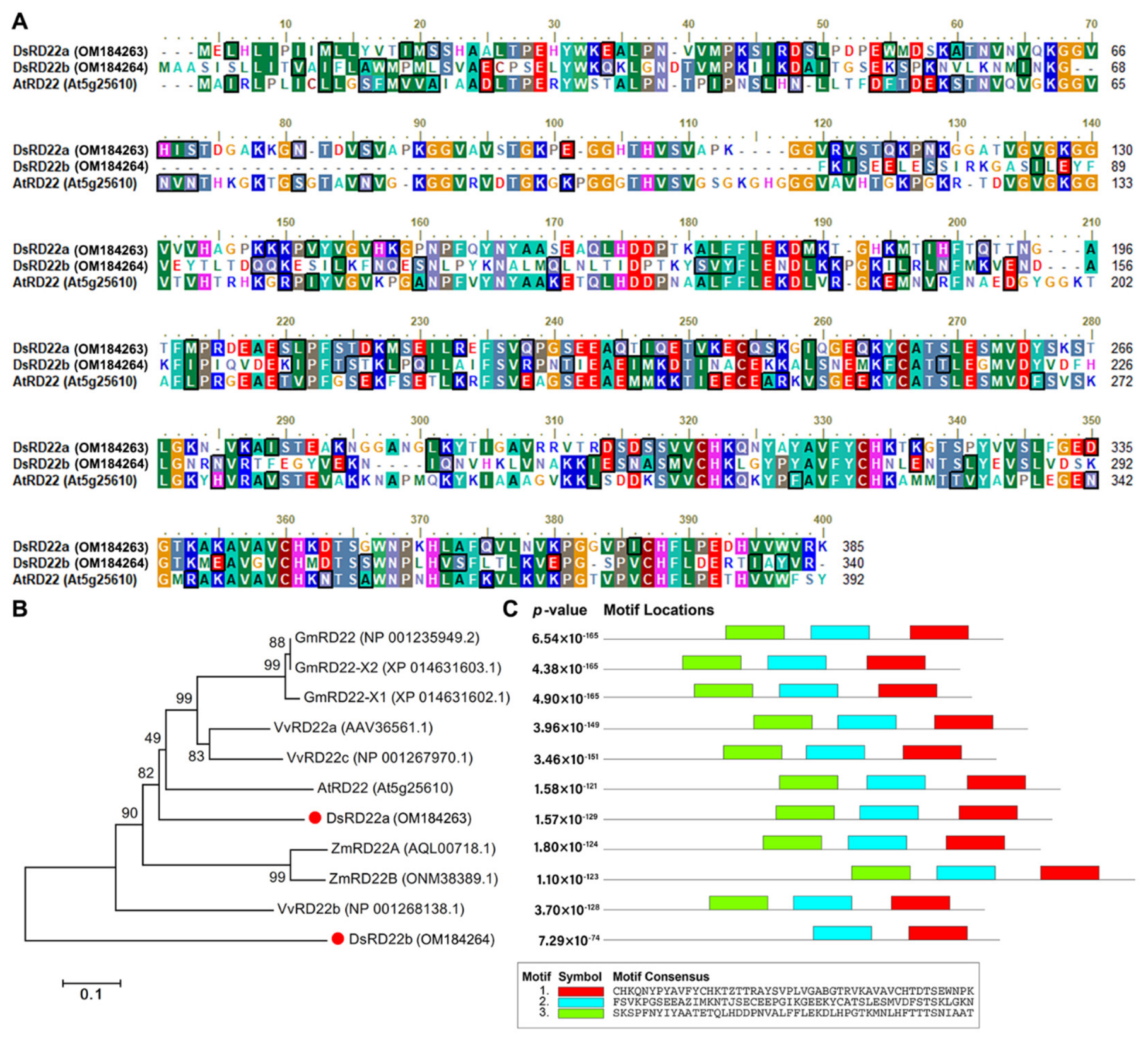
To characterize the sequence features of DsRD22a and DsRD22b, multiple amino acid sequence alignment was performed using Arabidopsis thaliana AtRD22 as a reference (Figure 1A). The results showed that DsRD22a and DsRD22b shared high sequence homology with AtRD22, indicating strong evolutionary conservation in both structure and potential function. A phylogenetic tree was subsequently constructed using RD22 homologous proteins from different plant species. The analysis revealed that DsRD22a and DsRD22b were closely clustered with RD22 members from dicotyledonous plants, further confirming that they are authentic RD22 homologs in D. spiculifolius (Figure 1B). Conserved motif analysis (Figure 1C) demonstrated that the motif compositions of DsRD22a and DsRD22b were highly conserved relative to other RD22 proteins, with only minor differences in motif number and distribution. These findings reflect both the functional conservation and species-specific diversification of the RD22 family during plant evolution.

3.2. Tissue-Specific Expression and Abiotic Stress Response of DsRD22a and DsRD22b

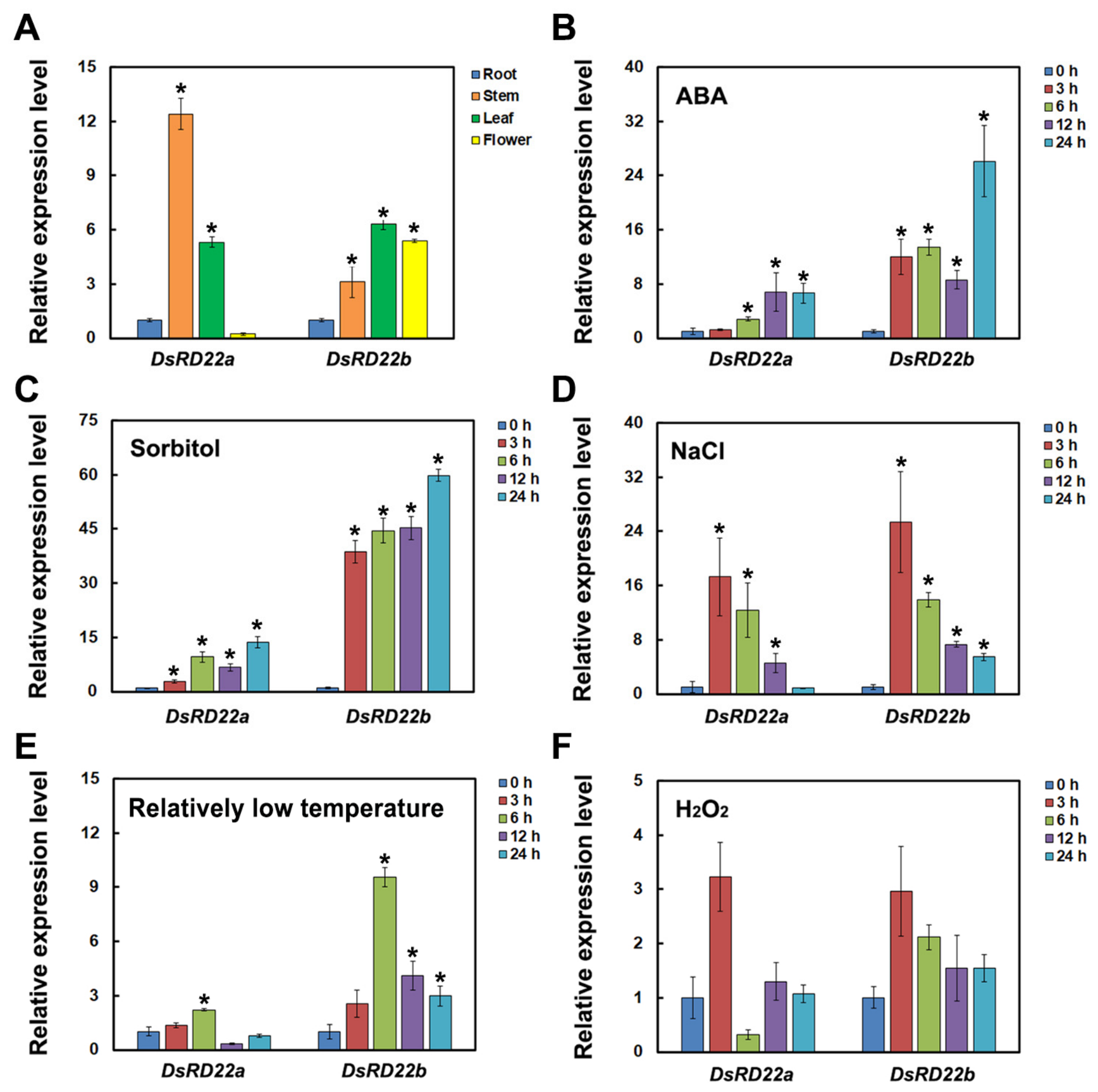
RT-qPCR was performed to examine the expression patterns of DsRD22a and DsRD22b in different tissues and under various abiotic stress treatments in D. spiculifolius. Both genes were constitutively expressed in roots, stems, leaves, and flowers, with relatively higher expression in stems and leaves and lower expression in roots and flowers. DsRD22a exhibited the highest transcript abundance in stems, followed by leaves, while DsRD22b showed predominant expression in leaves, followed by stems and flowers (Figure 2A).
Abiotic stress treatments revealed that ABA, sorbitol-induced osmotic stress, and NaCl stress significantly upregulated the expression of both genes in a time-dependent manner (Figure 2B–D). The transcript levels of DsRD22a and DsRD22b reached their maximum at 24 h after treatment, suggesting that both genes are involved in ABA-dependent stress response pathways. In contrast, relatively low-temperature treatment and H2O2-induced oxidative stress only weakly induced gene expression, with substantially lower induction amplitudes (Figure 2E,F). These findings suggest that DsRD22a and DsRD22b are primarily associated with responses to water-deficit-related abiotic stresses rather than relatively low-temperature or oxidative stress conditions.

3.3. Overexpression of DsRD22a Enhances Abiotic Stress Tolerance in Arabidopsis

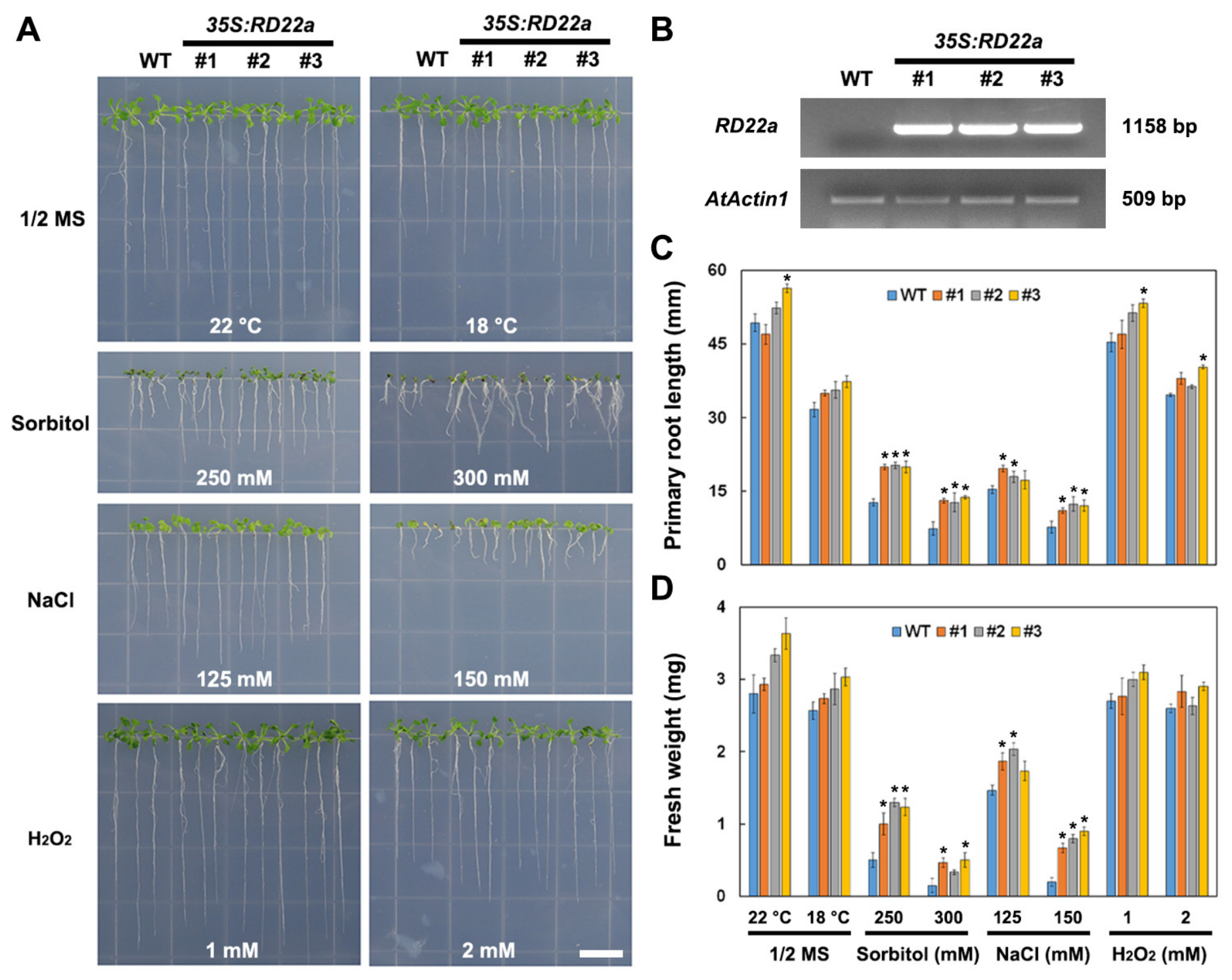
To investigate the biological function of DsRD22a in abiotic stress responses, a 35S promoter-driven overexpression vector was constructed and introduced into Arabidopsis thaliana. PCR analysis confirmed the successful generation of three independent transgenic lines (Figure 3B).
Phenotypic observation and statistical analysis showed that under normal conditions, 18 °C relativly low-temperature treatment, and 1–2 mM H2O2 exposure, no significant growth differences were observed between transgenic lines and WT plants, indicating that overexpression of DsRD22a did not markedly alter plant sensitivity to relatively low-temperature or oxidative stress. However, under 250 mM and 300 mM sorbitol treatments, as well as 125 mM and 150 mM NaCl treatments, the primary root length and fresh weight of DsRD22a-overexpressing lines were significantly greater than those of WT plants. Moreover, the phenotypic differences became increasingly pronounced with increasing stress intensity (Figure 3A,C,D). These findings indicate that DsRD22a positively contributes to plant tolerance against osmotic and salt stresses.

3.4. Overexpression of DsRD22b Enhances Abiotic Stress Tolerance in Arabidopsis

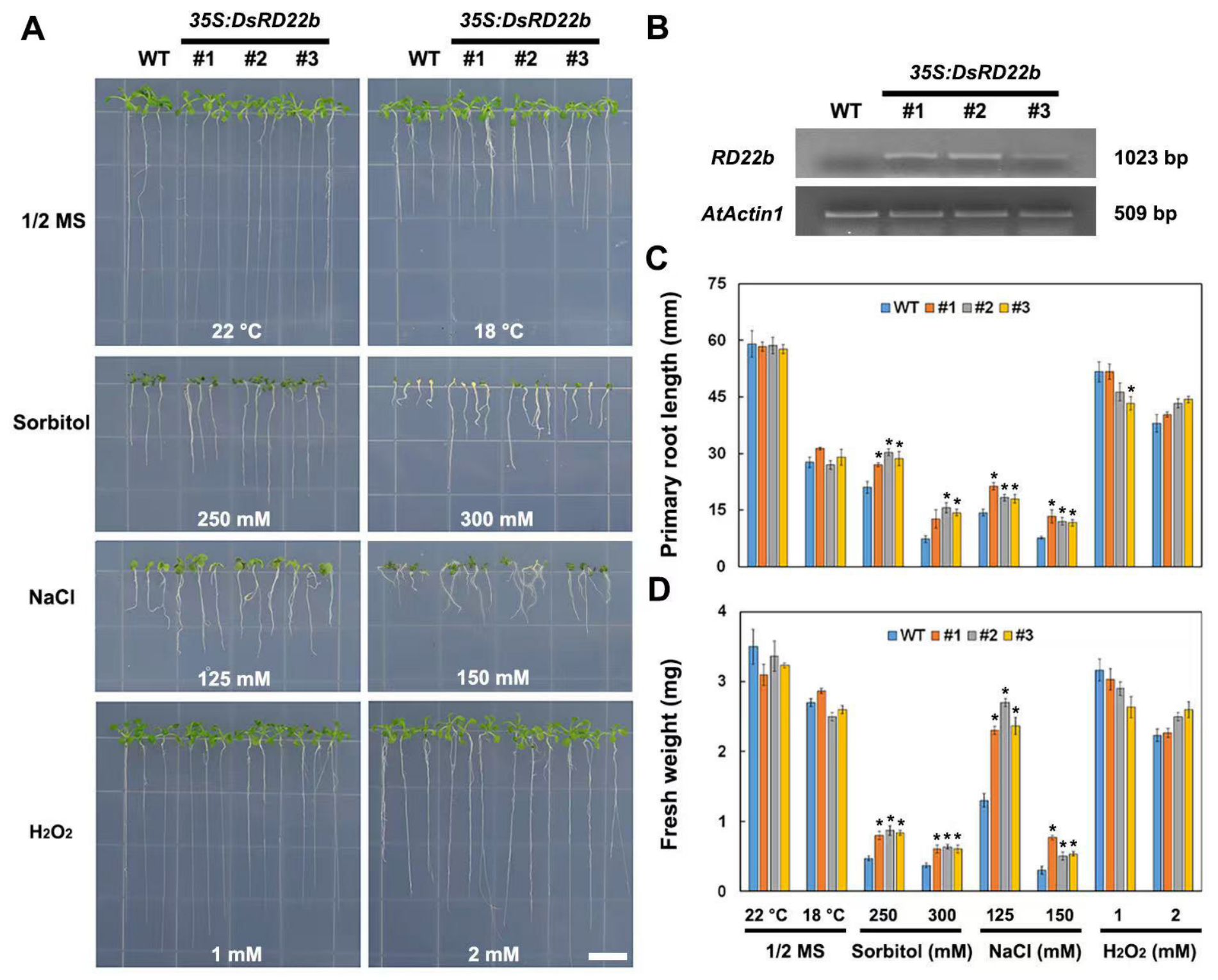
Three independent 35S:DsRD22b transgenic Arabidopsis lines were successfully obtained and verified by PCR analysis (Figure 4B). Under normal growth conditions and 18 °C relatively low-temperature treatment, no significant differences in primary root length and fresh weight were observed between WT and transgenic plants. Similarly, oxidative stress treatment did not result in obvious phenotypic differences. In contrast, under osmotic and salt stress conditions, root growth of WT plants was severely inhibited, whereas DsRD22b-overexpressing lines exhibited significantly enhanced primary root elongation and greater fresh weight accumulation. The growth advantages of the transgenic lines were more evident under higher stress concentrations. These findings demonstrate that DsRD22b positively regulates plant tolerance to osmotic and salt stresses but has limited effects on relatively low-temperature and oxidative stress tolerance (Figure 4A,C,D).

3.5. Phenotypic and Physiological Responses of DsRD22a/DsRD22b-Overexpressing Arabidopsis Under Drought Stress

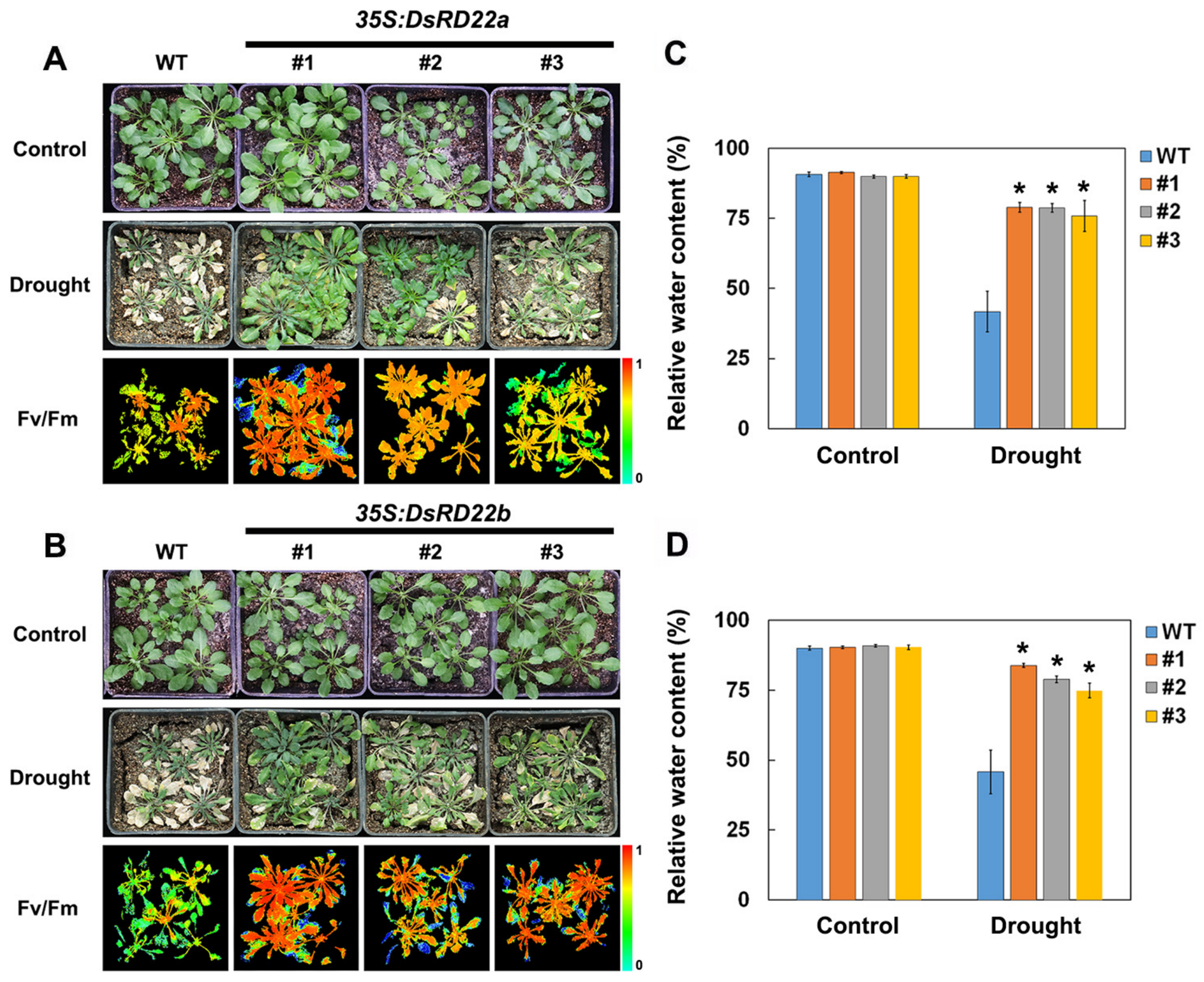
Soil drought treatment was conducted to further evaluate the drought tolerance of the transgenic lines. Under normal watering conditions, WT and transgenic lines exhibited similar growth performance. After drought stress, WT plants exhibited severe wilting, leaf yellowing, and even death, while DsRD22a and DsRD22b overexpression lines showed comparatively better growth, with only mild wilting symptoms. Chlorophyll fluorescence imaging of Fv/Fm indicated that the fluorescence intensity of WT leaves decreased sharply after drought treatment, while transgenic lines retained higher fluorescence signals and photosynthetic efficiency (Figure 5A,B).
Leaf relative water content (RWC) analysis showed no significant differences among all lines under normal conditions. After drought stress, the RWC of WT decreased to approximately 40%, whereas the RWC of DsRD22a and DsRD22b overexpression lines remained above 75%, with statistically significant differences observed (Figure 5C,D). These findings confirm that overexpression of DsRD22a and DsRD22b significantly enhances drought tolerance in Arabidopsis by improving water retention capacity and mitigating drought-induced damage to the photosynthetic system.

3.6. Subcellular Localization of DsRD22a and DsRD22b

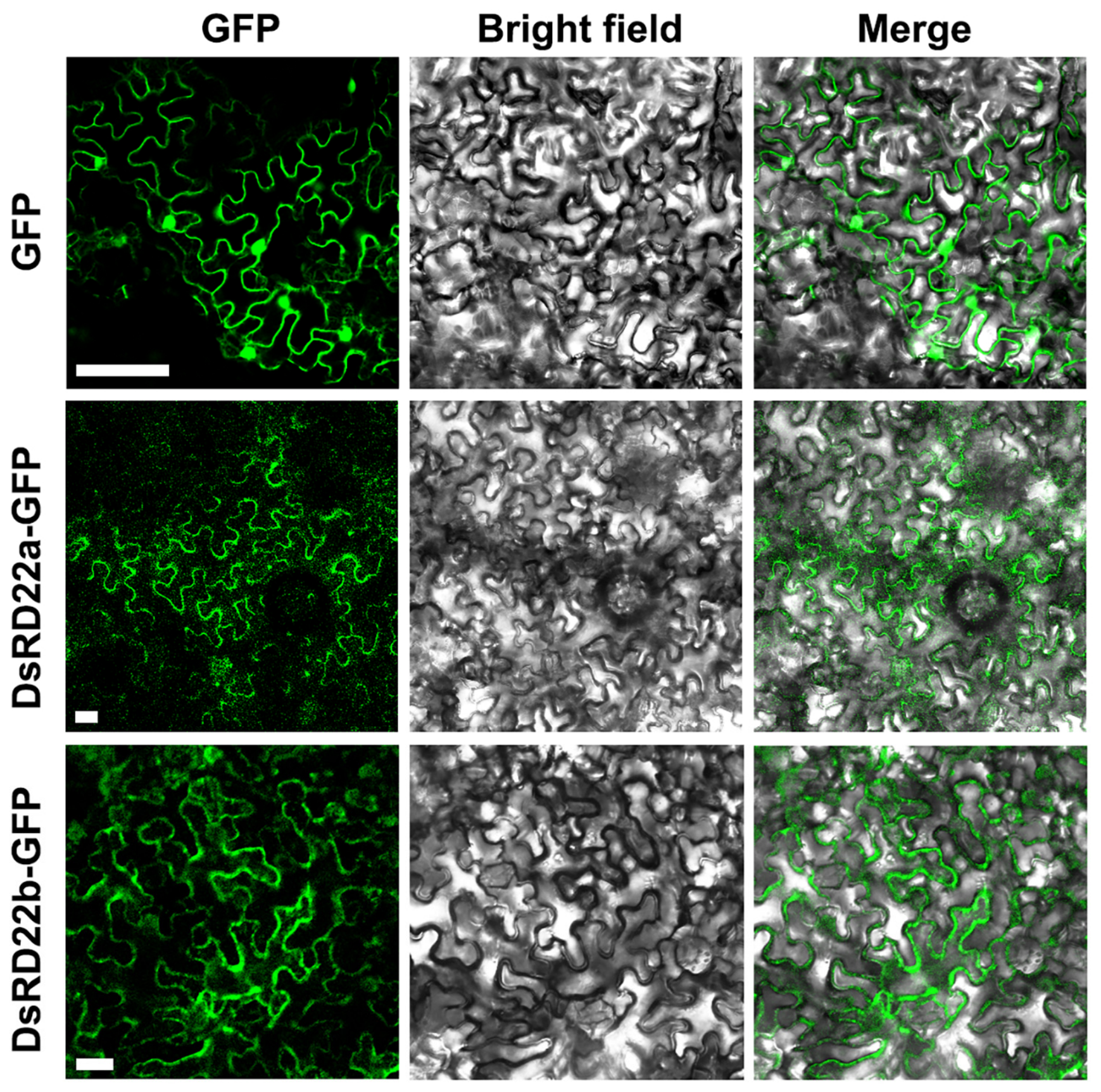
To determine the subcellular localization of DsRD22a and DsRD22b, DsRD22a-GFP and DsRD22b-GFP fusion constructs were generated and transiently expressed in Nicotiana benthamiana leaf epidermal cells, with an empty GFP vector used as a control. Laser scanning confocal microscopy revealed that fluorescence from the empty GFP control was ubiquitously distributed throughout the cell membrane, cytoplasm, and nucleus. In contrast, the fluorescence signals of DsRD22a-GFP and DsRD22b-GFP were specifically localized in the cytoplasm (Figure 6),indicating that both proteins predominantly function in the cytoplasmic compartment.

3.7. Soluble Protein Content and Proposed Stress Resistance Regulatory Model of DsRD22a/DsRD22b

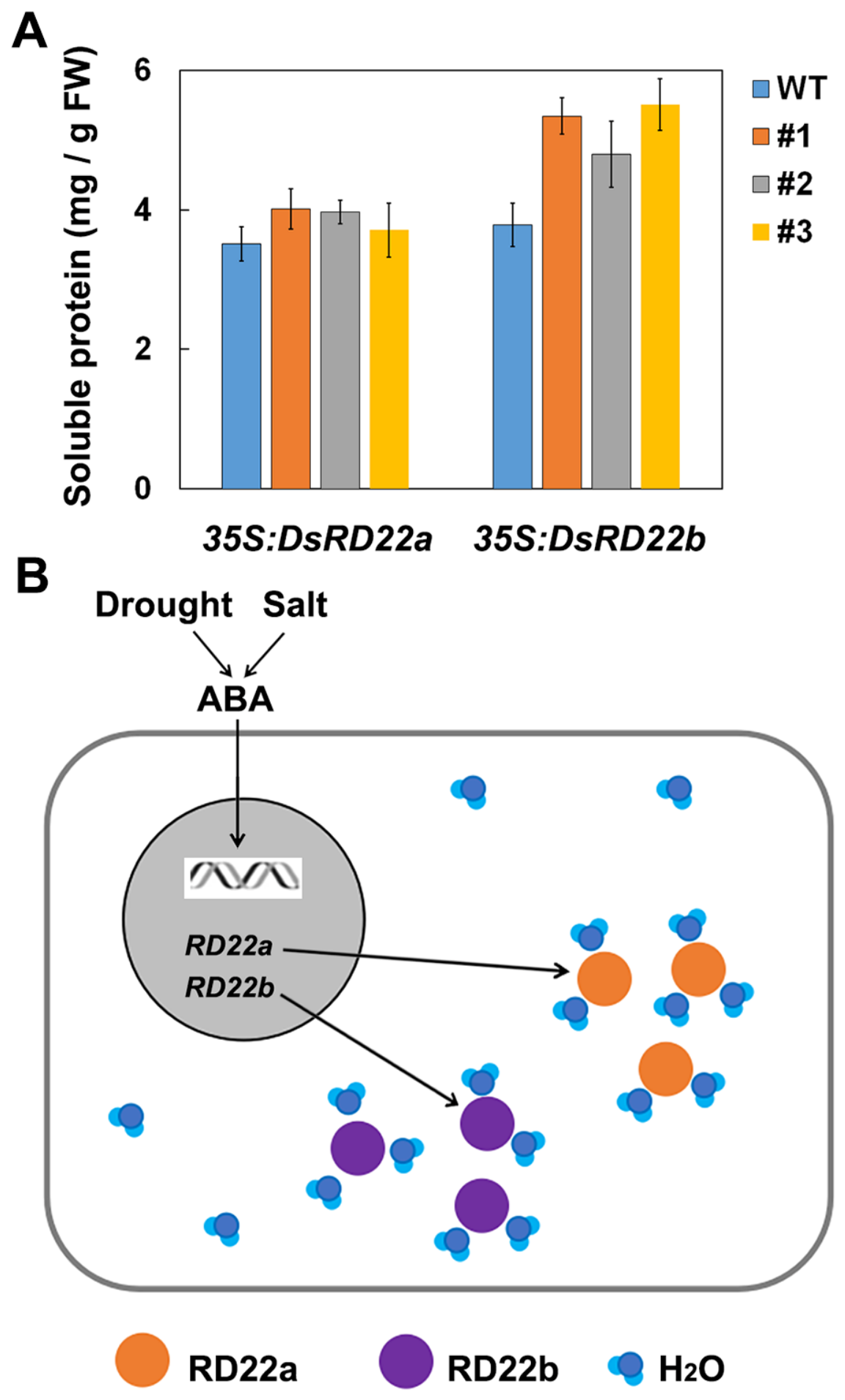
Physiological measurements (Figure 7A) showed that under normal growth conditions, soluble protein contents in DsRD22a and DsRD22b overexpression lines were significantly higher than those in WT plants. Compared with WT, soluble protein content increased by 15–20% in DsRD22a lines and 30–45% in DsRD22b lines. As key osmotic adjustment substances in plant cells, elevated soluble protein content may enhance cellular water retention capacity, maintain osmotic balance, and alleviate osmotic injury induced by drought and salt stress.
Based on gene expression profiles, subcellular localization, stress-responsive phenotypes, and physiological data, a regulatory model was proposed (Figure 7B): drought and salt stresses activate the ABA signaling pathway, which upregulates the expression of DsRD22a and DsRD22b. The cytoplasm-localized DsRD22a and DsRD22b proteins promote the accumulation of soluble proteins and other osmoprotectants, thereby maintaining cellular water and osmotic homeostasis and ultimately enhancing plant tolerance to drought, salt, and osmotic stresses.

4. Discussion

RD22 is a highly conserved gene family involved in ABA signaling and abiotic stress responses that belongs to the BURP domain-containing protein superfamily [29]. Its pivotal roles in drought and salt tolerance have been validated in Arabidopsis [8], soybean [9,10], grape [11], maize [12], and chickpea [13]. In the present study, we cloned and functionally characterized two RD22 homologs from D. spiculifolius and clarified their positive regulatory roles in osmotic, salt, and drought stress responses. The induction of DsRD22a and DsRD22b by ABA, drought and osmotic stress suggests that these two paralogous genes may act as downstream effector genes in the ABA signal transduction pathway of D. spiculifolius.
Sequence analysis demonstrated that both DsRD22a and DsRD22b contain a conserved BURP domain and cluster with RD22 proteins from dicotyledonous plants. Minor differences in conserved motifs suggested potential functional divergence between the two paralogs. RT-qPCR analysis confirmed that the expression of DsRD22a and DsRD22b was strongly induced by ABA, osmotic, and salt stresses in a time-dependent manner, while their responses to relatively low-temperature and oxidative stresses were relatively weak, indicating stress-specific expression patterns. Our findings align with previous reports on RD22 homologs in jujube [17] and RD22-like genes in apple, which also function in plant stress tolerance [16]. Subcellular localization analysis confirmed their cytoplasmic distribution, providing spatial evidence for their roles in stress regulation. Subcellular localization analysis confirmed their cytoplasmic distribution, which differs from the cell wall-localized AtRD22 in Arabidopsis, providing spatial evidence for their distinct regulatory roles in stress signaling.
Heterologous overexpression demonstrated that DsRD22a and DsRD22b significantly enhanced the Arabidopsis tolerance to salt, osmotic, and drought stresses, without affecting plant sensitivity to relatively low-temperature or oxidative stresses, consistent with their expression profiles. This observation aligns with the study by Msanne et al., which demonstrated that RD29A is significantly upregulated in response to drought and high-salinity stresses [30]. In contrast, some monocot RD22 genes such as RD22 homologous gene OsBURP05 [31] from rice and ZmRD22 [32] from maize exhibit significant cold induction, reflecting evolutionary divergence of RD22 regulatory networks between monocots and dicots. From a physiological perspective, the elevated accumulation of soluble proteins in transgenic plants is positively correlated with improved drought tolerance. Such accumulation alleviates damage to photosystems under water-deficit conditions, which offers a physiological basis for the enhanced stress resistance observed in overexpression lines.
Based on gene expression, subcellular localization, and phenotypic data, this study proposed a working model for the stress tolerance regulatory mechanisms of DsRD22a and DsRD22b. External drought and high-salt signals activate the ABA signaling pathway, which subsequently upregulates the expression of DsRD22a and DsRD22b. Consistently, several members of the BURP family have also been reported to be stress-inducible in rice [31] and maize [32]. The cytoplasm-localized DsRD22a and DsRD22b proteins may directly or indirectly promote the biosynthesis of soluble proteins and other osmoprotectants, thereby enhancing plant tolerance to multiple abiotic stresses.

5. Conclusions

In this study, two RD22 family genes, DsRD22a and DsRD22b, were cloned and identified from D. spiculifolius. Both genes contain a conserved BURP domain, are predominantly expressed in stems and leaves, and are markedly induced by ABA, osmotic, and salt stresses, while showing weak responses to relatively low-temperature and oxidative stresses. Subcellular localization analysis revealed that both DsRD22a and DsRD22b are localized in the cytoplasm. Heterologous overexpression in Arabidopsis significantly improved plant tolerance to drought, salt, and osmotic stresses, which was closely associated with increased soluble protein accumulation in transgenic plants. These findings indicate that DsRD22a and DsRD22b positively regulate plant drought and salt stress tolerance and represent valuable candidate gene resources for the molecular breeding of abiotic resistance in plants.

Author Contributions

Conceptualization, G.N. and A.Z.; investigation, B.A. and X.L.; data curation, Y.W. and M.W.; writing—original draft preparation, B.A. and X.L.; writing—review and editing, G.N. and A.Z.; funding acquisition, A.Z. All authors have read and agreed to the published version of the manuscript.

Funding

This research was funded by Longjiang Science and Technology Talent ‘Spring Goose’ Support Program of Heilongjiang Province of China (grant number CYQN24018).

Data Availability Statement

The original contributions presented in this study are included in the article. Further inquiries can be directed to the corresponding authors.

Conflicts of Interest

The authors declare no conflict of interest.

References

  1. Zhang, Y.; Xu, J.; Li, R.; Ge, Y.; Li, Y.; Li, R. Plants’ Response to Abiotic Stress: Mechanisms and Strategies. Int. J. Mol. Sci. 2023, 24, 10915. [Google Scholar] [CrossRef] [PubMed]
  2. Sahu, S.K.; Liu, P.; Chandrasekaran, U.; Waseem, M. Salinity and drought stress in plants: Understanding physiological, biochemical and molecular responses, volume II. Front. Plant Sci. 2025, 16, 1625602. [Google Scholar] [CrossRef] [PubMed]
  3. Apostolova, E.L. Molecular Mechanisms Associated with Plant Tolerance upon Abiotic Stress. Plants 2024, 13, 3532. [Google Scholar] [CrossRef] [PubMed]
  4. Zhang, H.; Lang, Z.; Zhu, J.K.; Wang, P. Tackling abiotic stress in plants: Recent insights and trends. Stress Biol. 2025, 5, 8. [Google Scholar] [CrossRef]
  5. Mo, W.; Zheng, X.; Shi, Q.; Zhao, X.; Chen, X.; Yang, Z.; Zuo, Z. Unveiling the crucial roles of abscisic acid in plant physiology: Implications for enhancing stress tolerance and productivity. Front. Plant Sci. 2024, 15, 1437184. [Google Scholar] [CrossRef] [PubMed]
  6. Makris, A.; Daloglu, B.; Gutjahr, C.; Ried-Lasi, M.K. Abscisic acid at the crossroad of abiotic stress responses and plant-microbe interactions. PLoS Pathog. 2026, 22, e1013872. [Google Scholar] [CrossRef] [PubMed]
  7. Pizzio, G.A. The role of abscisic acid (ABA) machinery in stress response. Plants 2025, 14, 935. [Google Scholar] [CrossRef] [PubMed]
  8. Harshavardhan, V.T.; Van Son, L.E.; Seiler, C.; Junker, A.; Weigelt-Fischer, K.; Klukas, C.; Thomas, A.; Nese, S.; Helmut, B.; Kuhlmann, M. AtRD22 and AtUSPL1, members of the plant-specific BURP domain family involved in Arabidopsis thaliana drought tolerance. PLoS ONE 2014, 9, e110065. [Google Scholar] [CrossRef] [PubMed]
  9. Yamaguchi-Shinozaki, K.; Shinozaki, K. A novel Arabidopsis DNA binding protein contains the conserved motif of HMG-box proteins. Nucleic Acids Res. 1992, 20, 6737. [Google Scholar] [CrossRef] [PubMed][Green Version]
  10. Yamaguchi-Shinozaki, K.; Shinozaki, K. The plant hormone abscisic acid mediates the drought-induced expression but not the seed-specific expression of rd22, a gene responsive to dehydration stress in Arabidopsis thaliana. Mol. Gen. Genet. 1993, 238, 17–25. [Google Scholar] [CrossRef] [PubMed]
  11. Xu, H.; Li, Y.; Yan, Y.; Wang, K.; Gao, Y.; Hu, Y. Genome-scale identification of soybean BURP domain-containing genes and their expression under stress treatments. BMC Plant Biol. 2010, 10, 197. [Google Scholar] [CrossRef] [PubMed]
  12. Wang, H.; Zhou, L.; Fu, Y.; Cheng, M.Y.; Wong, F.L.; Phang, T.H.; Sun, Z.; Lam, H.M. Expression of an apoplast-localized BURP-domain protein from soybean (GmRD22) enhances tolerance towards abiotic stress. Plant Cell Environ. 2012, 35, 1932–1947. [Google Scholar] [CrossRef] [PubMed]
  13. Matus, J.T.; Aquea, F.; Espinoza, C.; Vega, A.; Cavallini, E.; Santo, S.D.; Canon, P.; Guardia, A.R.; Serrano, J.; Tornielli, G.B.; et al. Inspection of the grapevine BURP superfamily highlights an expansion of RD22 genes with distinctive expression features in berry development and ABA-mediated stress responses. PLoS ONE 2014, 9, e110372. [Google Scholar] [CrossRef] [PubMed]
  14. Phillips, K.; Ludidi, N. Drought and exogenous abscisic acid alter hydrogen peroxide accumulation and differentially regulate the expression of two maize RD22-like genes. Sci. Rep. 2017, 7, 8821. [Google Scholar] [CrossRef] [PubMed]
  15. Tripathi, S.; Bharadwaj, C.; Hembram, M.; Kumar, N.; Konda, A.K.; Mondal, B.; Gupta, N.C.; Dixit, G.P.; Soren, K.R. Delving into the BURP Super family: A Comprehensive QTL-Assisted Study on RD22 genes and its Role in Salinity Stress Tolerance in Chickpea. Biochem. Genet. 2025, 63, 5083–5107. [Google Scholar] [PubMed]
  16. Ren, J.; Feng, L.; Guo, L.; Gou, H.; Lu, S.; Mao, J. Genome-wide identification and expression analysis of the BURP domain-containing genes in Malus domestica. Physiol. Mol. Plant Pathol. 2023, 29, 1717–1731. [Google Scholar] [CrossRef] [PubMed]
  17. Wang, W.; Zhang, Z.; Li, X. Identification and expression analysis of BURP domain-containing genes in jujube and their involvement in low temperature and drought response. BMC Genom. 2022, 23, 692. [Google Scholar] [CrossRef] [PubMed]
  18. Abe, H.; Urao, T.; Ito, T.; Seki, M.; Shinozaki, K.; Yamaguchi-Shinozaki, K. Arabidopsis AtMYC2 (bHLH) and AtMYB2 (MYB) function as transcriptional activators in abscisic acid signaling. Plant Cell 2003, 15, 63–78. [Google Scholar] [PubMed]
  19. Zhou, A.; Liu, E.; Liu, J.; Feng, S.; Gong, S.; Wang, J. Characterization of increased cuticular wax mutant and analysis of genes involved in wax biosynthesis in Dianthus spiculifolius. Hortic. Res. 2018, 5, 40. [Google Scholar] [CrossRef] [PubMed]
  20. Xin, J.; Liu, Y.; Li, H.; Chen, S.; Jiang, J.; Song, A.; Feng, W.; Chen, F. CmMLO17 and its partner CmKIC potentially support Alternaria alternata growth in Chrysanthemum morifolium. Hortic. Res. 2021, 8, 101. [Google Scholar] [CrossRef] [PubMed]
  21. Shi, Y.; Liu, X.; Bao, S.; Li, Y.; Shi, Y.; Liang, C.; Sha, H.; Yu, Z.; Su, Q.; Zhang, X.; et al. Comprehensive analysis of Brassica napus Glycosyl hydrolase family 1 genes and functional analysis of BnaBGLU27. C08 in clubroot resistance. BMC Genom. 2025, 26, 515. [Google Scholar] [CrossRef] [PubMed]
  22. Ceciliato, P.H.O.; Zhang, J.; Liu, Q.; Shen, X.; Hu, H.; Liu, C.; Schäffner, A.R.; Schroeder, J.I. Intact leaf gas exchange provides a robust method for measuring the kinetics of stomatal conductance responses to abscisic acid and other small molecules in Arabidopsis and grasses. Plant Methods 2019, 15, 38. [Google Scholar] [CrossRef] [PubMed]
  23. Zhou, A.; Ma, H.; Feng, S.; Gong, S.; Wang, J. DsSWEET17, a tonoplast-localized sugar transporter from Dianthus spiculifolius, affects sugar metabolism and confers multiple stress tolerance in Arabidopsis. Int. J. Mol. Sci. 2018, 19, 1564. [Google Scholar] [CrossRef] [PubMed]
  24. Zhou, A.; Ma, H.; Feng, S.; Gong, S.; Wang, J. A novel sugar transporter from Dianthus spiculifolius, DsSWEET12, affects sugar metabolism and confers osmotic and oxidative stress tolerance in Arabidopsis. Int. J. Mol. Sci. 2018, 19, 497. [Google Scholar] [CrossRef] [PubMed]
  25. Fu, S.; Chen, X.; Jiang, Y.; Dai, S.; Zhang, H.; Feng, S.; Zhou, A. Characterization of the Na+-preferential transporter HKT1. 1 from halophyte shrub Salix linearistipularis. Physiol. Mol. Plant Pathol. 2025, 31, 823–833. [Google Scholar] [CrossRef] [PubMed]
  26. Chen, Y.; Zhong, J.; Lu, M.; Yang, C. Transient Expression Vector Construction, Subcellular Localisation, and Evaluation of Antiviral Potential of Flagellin BP8-2. Molecules 2024, 29, 3876. [Google Scholar] [CrossRef] [PubMed]
  27. Chen, Z.; Chen, E.; Zhang, J.; Ying, Z. Jasmonic Acid Enhances Thermotolerance in Hybrid Pennisetum via Activation of the α-Linolenic Acid Metabolism Pathway. Front. Plant Sci. 2026, 17, 1756886. [Google Scholar] [CrossRef] [PubMed]
  28. Liu, J.X.; Feng, K.; Duan, A.Q.; Li, H.; Yang, Q.Q.; Xu, Z.S.; Xiong, A.S. Isolation, purification and characterization of an ascorbate peroxidase from celery and overexpression of the AgAPX1 gene enhanced ascorbate content and drought tolerance in Arabidopsis. BMC Plant Biol. 2019, 19, 488. [Google Scholar] [CrossRef] [PubMed]
  29. Hattori, J.; Boutilier, K.A.; Campagne, M.L.; Miki, B.L. A conserved BURP domain defines a novel group of plant proteins with unusual primary structures. Mol. Gen. Genet. 1998, 259, 424–428. [Google Scholar] [CrossRef] [PubMed]
  30. Msanne, J.; Lin, J.; Stone, J.M.; Awada, T. Characterization of abiotic stress-responsive Arabidopsis thaliana RD29A and RD29B genes and evaluation of transgenes. Planta 2011, 234, 97–107. [Google Scholar] [CrossRef] [PubMed]
  31. Ding, X.; Hou, X.; Xie, K.; Xiong, L. Genome-wide identification of BURP domain-containing genes in rice reveals a gene family with diverse structures and responses to abiotic stresses. Planta 2009, 230, 149–163. [Google Scholar] [CrossRef] [PubMed]
  32. Gan, D.; Jiang, H.; Zhang, J.; Zhao, Y.; Zhu, S.; Cheng, B. Genome-wide analysis of BURP domain-containing genes in maize and sorghum. Mol. Biol. Rep. 2011, 38, 4553–4563. [Google Scholar] [PubMed]
Figure 1. Sequence analysis of DsRD22a and DsRD22b. (A) Amino acid sequence alignment of DsRD22a, DsRD22b, and AtRD22; The numbers beside amino acid residues represent the positions of conserved amino acids; black boxes mark highly conserved amino acid motifs among different RD22 homologs; (B) phylogenetic tree analysis of RD22 homologs; Red solid circles on the phylogenetic tree indicate DsRD22a and DsRD22b identified in Dianthus spiculifolius. (C) conserved motif analysis of RD22 proteins.
Horticulturae 12 00761 g001
Figure 2. Tissue-specific expression and stress-responsive expression patterns of DsRD22a and DsRD22b. (A) Relative expression levels of DsRD22a and DsRD22b in roots, stems, leaves, and flowers of Dianthus spiculifolius, as determined by RT-qPCR; (BF) Relative expression levels of DsRD22a and DsRD22b at different time points (0, 3, 6, 12, and 24 h) under ABA (B), sorbitol (C), NaCl (D), relatively low temperature (E), and H2O2 (F) treatments. Asterisks indicate significant difference between untreated and stress-treated seedlings (* p < 0.05; Student’s t-test). Error bars show the SD of the values from three replicates.
Horticulturae 12 00761 g002
Figure 3. Growth performance of wild-type (WT) and DsRD22a-overexpressing Arabidopsis seedlings under different stress conditions. WT and three transgenic lines grown at varying temperatures (22 °C and 18 °C) or on 1/2 MS (Murashige and Skoog) medium supplemented with sorbitol (250 and 300 mM), NaCl (125 and 150 mM), or H2O2 (1 and 2 mM) for 14 days. (A) Seedling growth phenotypes; (B) semi-quantitative PCR analysis of DsRD22a expression in WT and transgenic Arabidopsis lines (OE-1, OE-2, and OE-3); (C) primary root length; (D) fresh weight. WT: wild-type control; #1, #2, #3 denote three individual positive transgenic lines. Asterisks indicate significant difference between WT and transgenic lines (* p < 0.05; Student’s t-test). Error bars show the SE of the values.
Horticulturae 12 00761 g003
Figure 4. Growth performance of wild-type (WT) and DsRD22b-overexpressing Arabidopsis seedlings under different stress conditions. WT and three transgenic lines grown at varying temperatures (22 °C and 18 °C) or on 1/2 MS (Murashige and Skoog) medium supplemented with sorbitol (250 and 300 mM), NaCl (125 and 150 mM), or H2O2 (1 and 2 mM). (A) Seedling growth phenotypes; (B) semi-quantitative PCR analysis of DsRD22b expression in WT and transgenic Arabidopsis lines (OE-1, OE-2, and OE-3); (C) primary root length; (D) fresh weight. WT: wild-type control; #1, #2, #3 denote three individual positive transgenic lines. Asterisks indicate significant difference between WT and transgenic lines (* p < 0.05; Student’s t-test). Error bars show the SE of the values.
Horticulturae 12 00761 g004
Figure 5. Drought stress tolerance of Arabidopsis plants overexpressing DsRD22a and DsRD22b. (A,B) Plant phenotypes and Fv/Fm chlorophyll fluorescence imaging under normal watering and drought stress conditions. The color gradient represents the maximum photochemical efficiency of PSII (Fv/Fm), which ranges from 0 (green) to 1 (red), with elevated values reflecting reduced impairment of the photosynthetic apparatus. Blue areas mark severely damaged leaf tissues with low fluorescence signals; (C,D) leaf relative water content (RWC) of WT and transgenic lines. WT: wild-type control; #1, #2, #3 denote three individual positive transgenic lines. Asterisks indicate significant difference between WT and transgenic lines (* p < 0.05; Student’s t-test). Error bars show the SE of the values.
Horticulturae 12 00761 g005
Figure 6. Subcellular localization of DsRD22a and DsRD22b. The empty GFP vector was used as a negative control. Free GFP (top row) was detected in both the nucleus and cytoplasm, while DsRD22a-GFP (middle row) and DsRD22b-GFP (bottom row) fusion proteins were exclusively localized in the cytoplasm. Green fluorescence (GFP channel), bright field images, and merged images are shown from left to right. Scale bars = 50 μm.
Horticulturae 12 00761 g006
Figure 7. Soluble protein content and proposed regulatory model for DsRD22a/DsRD22b. Arrows indicate regulatory relationships. Drought and salt stresses promote the biosynthesis of abscisic acid (ABA), while DsRD22a and DsRD22b may increase the abundance of soluble proteins. (A) Leaf soluble protein content in WT and transgenic lines; (B) proposed working model of DsRD22a and DsRD22b’s role in regulating abiotic stress tolerance.
Horticulturae 12 00761 g007
Disclaimer/Publisher’s Note: The statements, opinions and data contained in all publications are solely those of the individual author(s) and contributor(s) and not of MDPI and/or the editor(s). MDPI and/or the editor(s) disclaim responsibility for any injury to people or property resulting from any ideas, methods, instructions or products referred to in the content.