Article

Comparative Effects of Radiation Mutagenesis and Somaclonal Variation Breeding on the Genetics and Transcriptomic Defense Response to Fusarium Wilt of Banana

1
State Key Laboratory of Tropical Crop Breeding, Institute of Tropical Bioscience and Biotechnology, Sanya Research Institute, Chinese Academy of Tropical Agricultural Sciences, Haikou 571101, China
2
National Key Laboratory of Crop Genetic Improvement, Huazhong Agricultural University, Wuhan 430070, China
3
School of Breeding and Multiplication, Sanya Institute of Breeding and Multiplication, Hainan University, Sanya 572025, China
4
Sanya Research Institute, Nanjing Agricultural University, Sanya 572024, China
*
Authors to whom correspondence should be addressed.
These authors contributed equally to this work.
Horticulturae 2026, 12(6), 759; https://doi.org/10.3390/horticulturae12060759
Submission received: 12 May 2026 / Revised: 19 June 2026 / Accepted: 19 June 2026 / Published: 22 June 2026
(This article belongs to the Special Issue Breeding and Genetic Strategies for Bananas)

Abstract

Banana Fusarium wilt, caused by Fusarium oxysporum f. sp. cubense tropical race 4 (Foc TR4), poses a severe threat to global banana production, and breeding resistant cultivars remains the most effective control strategy. Mutation breeding, including radiation mutagenesis and somaclonal variation, has become a primary approach for developing resistant germplasm in triploid Cavendish bananas. However, whether secondary bud-sport selection from resistant somaclonal lines inadvertently compromises original resistance mechanisms at the molecular level remains poorly understood. In this study, we generated 44 mutants from Baxi jiao via 60Co γ-irradiation and selected five lines with distinct phenotypic variations. We also collected somaclonal variant lines GCTCV-218, GCTCV-119, GCTCV-105, their bud-sport derivatives (NK_No.1, NTH, RK_No.1), and the radiation-induced resistant mutant ‘Zhongre No.1’. Using whole-genome resequencing and transcriptome analysis, we systematically compared the genetic and transcriptomic outcomes of these breeding strategies. Radiation mutagenesis induced substantial genomic structural variations and generated novel expression patterns of defense-related genes. In contrast, while bud-sport derivatives of GCTCV-218 remained genetically similar to their parent, they exhibited significant downregulation or loss of key resistance gene expression, particularly PR-1 family members. Our findings reveal that phenotype-driven somaclonal selection can inadvertently erode original resistance mechanisms, and we recommend prioritizing radiation mutagenesis for developing banana cultivars with stable and durable resistance to Foc TR4.

1. Introduction

Banana (Musa spp.) is one of the most important tropical and subtropical fruit crops worldwide, playing a vital role in the global agricultural economy and serving as a significant source of income for millions of smallholder farmers. However, Fusarium wilt caused by Fusarium oxysporum f. sp. cubense (Foc), especially tropical race 4 (TR4), has become one of the most severe constraints to sustainable banana production [1,2]. Recent advances in understanding TR4 pathogenesis have shown that TR4 enhances its virulence through nitric oxide burst and identified a key virulence gene SIX4 [3], further highlighting the strong pathogenicity of this strain. Breeding resistant cultivars is an urgent need to ensure sustainable industry development.
Most cultivated banana varieties are triploid. Among them, the Cavendish subgroup (Musa acuminata AAA group), such as Baxi jiao and Williams, are highly sterile with disturbed meiosis, making traditional cross-breeding extremely difficult [4]. Under these circumstances, mutation breeding has become an important approach for creating resistant germplasm. Radiation mutagenesis is an effective means of generating new banana germplasms. Studies have shown that 60Co γ-irradiation can significantly induce trait variation in banana plantlets, with the mutation rate closely related to the irradiation dose [5]. Datta et al. [6] performed low-coverage whole-genome sequencing on irradiated bananas and found that gamma rays effectively induce copy number variations (CNVs), providing direct molecular evidence for large-scale structural variations caused by radiation mutagenesis. Costa et al. [7] screened 57 Fusarium wilt-resistant mutants from 1051 irradiated mutants (screening efficiency about 5.4%), further confirming the high efficiency of radiation mutagenesis in creating resistant germplasm. In China, this approach has proven fruitful, leading to the development of elite varieties such as ‘Zhangjiao 8’ [8] and, more recently, the highly resistant variety ‘Zhongre No.1’ (ZR_No.1), which was selected from a 60Co γ-irradiated population of Baxi jiao by our research group and exhibits strong field resistance [9].
In addition to radiation mutagenesis, somaclonal variation breeding (including somaclonal variation and bud-sport selection) is also an important pathway for banana improvement. Bud-sport selection refers to the selection of spontaneous somatic mutations arising from axillary buds, resulting in a genetically distinct shoot from the parent plant. The GCTCV series (e.g., GCTCV-218, GCTCV-119, and GCTCV-105) are resistant materials obtained through somaclonal variation of ‘Pei Chiao’ banana [10]. Notably, GCTCV-218 (also known as ‘Baodaojiao’) has been a cornerstone of resistance breeding in China. It has been directly promoted as a resistant cultivar [11] and has also served as the foundational germplasm for further selection, yielding the successful commercial cultivar ‘Nantianhuang’ (NTH) [12]. Meanwhile, somaclonal selection directly from the mainstream susceptible cultivar Baxi jiao has also been successful, leading to the development of the resistant line ‘Nongke No.1’ (NK_No.1) [13]. Subsequently, a promising bud-sport of ‘NK_No.1’ with improved agronomic traits, named ‘Reke No.1’ (RK_No.1), was identified and selected [14]. Van den Berg et al. [15] showed that GCTCV-218 responds rapidly to Foc inoculation, with early up-regulation of PR-1 and cell wall-strengthening genes, and accumulation of phenolic compounds in cell walls, indicating that GCTCV-218 activates both biochemical and structural defense mechanisms against Fusarium wilt. Although somaclonal variation breeding can generate some resistant materials, the genetic variation range may be limited under certain tissue culture conditions, and resistance stability can be easily lost [16].
Nevertheless, two prominent issues exist in mutation breeding practice. First, the genetic background of newly created mutants is difficult to evaluate rapidly; traditional field phenotyping is time-consuming and inefficient. Second, the resistance mechanisms of materials obtained through different breeding strategies are inconsistent, causing difficulties in the identification and promotion of new varieties. In particular, the practice of performing bud-sport selection from pre-existing resistant mutants or somaclonal lines (e.g., deriving NTH from GCTCV-218 [12], or RK_No.1 from NK_No.1 [14]) has become a common strategy among breeders. However, whether this somaclonal variation breeding approach affects the maintenance of disease resistance remains poorly understood. Moreover, whether different somaclonal variants share similar resistance mechanisms and whether derivative selection from them compromises resistance are questions that urgently need answers.
To address these issues, we generated 44 mutants by 60Co γ-irradiation of Baxi jiao and selected five lines with distinct phenotypic variations (RM_03, RM_15, RM_23, RM_28, and RM_39). We also collected the somaclonal variant lines GCTCV-218, GCTCV-119, GCTCV-105, their somaclonal bud-sport lines (NK_No.1, NTH, RK_No.1), and the highly resistant radiation-mutant ZR_No.1. In this study, the RM series mutants serve to demonstrate the magnitude and spectrum of phenotypic variation achievable through radiation mutagenesis, which provides the genetic diversity necessary for resistance breeding, and their Foc TR4 resistance levels will be evaluated in future work. The same applies to the bud-sport selections derived from somaclonal lines, whose resistance phenotypes also require further validation. We hypothesized that radiation mutagenesis, by inducing large-scale genomic structural variations, would generate more diverse defense-related transcriptomic responses compared to somaclonal variation. Conversely, we postulated that secondary bud-sport selection from resistant somaclonal lines, driven primarily by phenotypic improvement, may inadvertently compromise the expression of resistance-related genes present in the parental lines. Using whole-genome resequencing (SNP analysis) and transcriptome sequencing, we systematically compared the effects of radiation mutagenesis and somaclonal variation breeding on the genetic background and disease resistance of banana, with a focus on whether somaclonal variation breeding leads to the loss of resistance-related genes. Our results provide a molecular basis for selecting breeding strategies against Fusarium wilt in banana.

2. Materials and Methods

2.1. Plant Materials and Treatments

Baxi jiao (Musa acuminata L. Cavendish subgroup) was used as the parental line. The RM series mutants (RM_03, RM_15, RM_23, RM_28, and RM_39) were generated by 60Co γ-irradiation. Explant preparation and mutation screening were performed according to previously described references [17,18]. The resulting mutants were monitored over several years. Upon trait stabilization, suckers from lines with stable phenotypically distinct were clonally propagated and cultivated. Agronomic traits of these plants were subsequently assessed over two consecutive crop seasons (three plants per season). Agronomic traits of plant height, pseudostem girth, number of hands, single fruit weight, and bunch weight was measured based on the Banana Plant Descriptor method [19,20]. Plant height was measured from the ground level to the crown of the peduncle at the beginning of flowering, and pseudostem girth was measured at 0.3 m above the ground at the beginning of flowering. Somaclonal variant lines GCTCV-218, GCTCV-119, GCTCV-105, their somaclonal bud-sport lines (NK_No.1, NTH, and RK_No.1), and the radiation-induced mutant ZR_No.1 were propagated via tissue culture. All plants were grown at the Wenchang base of Institute of Tropical Bioscience and Biotechnology, Chinese Academy of Tropical Agricultural Sciences (110.7690° E, 19.5444° N).
Roots of one-month-old plantlets were dipped in a Foc TR4 spore suspension (1.0 × 10⁶ conidia/mL). The entire root system was harvested at 0 and 2 days post-infection (DPI) [21]. All samples were immediately frozen in liquid nitrogen and stored at −80 °C until RNA extraction.

2.2. Whole-Genome Resequencing and Variant Analysis

Genomic DNA was extracted from fresh young leaves of healthy, uninfected plants of Baxi jiao, RM_03, RM_15, RM_23, RM_28, RM_39, GCTCV-218, GCTCV-119, GCTCV-105, NK_No.1, NTH, RK_No.1, and ZR_No.1 using the CTAB method [22]. Paired-end libraries with a 500 bp insert size were constructed and sequenced. Clean reads were aligned to the Musa acuminata reference genome (DH-Pahang v2, available at the Banana Genome Hub, https://banana-genome-hub.southgreen.fr/, 3 June 2024) using BWA (v0.7.12) with parameters “bwa aln -t 20 -l 35” [23]. After read alignment, SNPs and InDels were identified using the Genome Analysis Toolkit (GATK, version 4.3.0.0) [24]. SNPs were filtered using the criteria “QD < 2.0 || FS > 60.0 || MQ < 40.0 || MQRankSum < −12.5 || ReadPosRankSum < −8.0”. PCA was performed using PLINK v1.9 based on the filtered SNPs. The raw resequencing data generated in this study have been deposited in the NCBI Sequence Read Archive (SRA) database under BioProject accession number PRJNA1450905.

2.3. Transcriptomic and Expression Analysis

Total RNA was extracted from root tissues of both Foc TR4-inoculated (2 DPI) and mock-inoculated (0 DPI) plants using an RNA extraction kit (Omega Bio-Tek, Shanghai, China). Five micrograms of total RNA from each sample were converted to cDNA using the RevertAid First-Strand cDNA Synthesis Kit (Fermentas, Beijing, China). cDNA libraries were constructed with the TruSeq RNA Library Preparation Kit v2 (Illumina, San Diego, CA, USA) and sequenced on the Illumina HiSeq 2000 platform. Each sample was sequenced in duplicate.
A total of 88.04 Gb of high-quality clean data were generated. Clean reads were aligned to the M. acuminata reference genome (DH-Pahang v2) using SOAPaligner/SOAP2 version 2.21 with parameters “-m 0 -x 1000 -s 40 -l 32 -v 5 -r 1 -p 3” [25]. Gene expression levels were calculated as reads per kilobase per million mapped reads (FPKM) [26]. Differentially expressed genes (DEGs) were identified by comparing Foc TR4-inoculated samples (2 DPI) with their respective mock-inoculated controls (0 DPI), using criteria of |log2 fold change| ≥ 1 and FDR (Benjamini–Hochberg corrected) < 0.05. GO and KEGG pathway enrichment analyses were performed using clusterProfiler v4.0 in R. Heatmaps were generated using the pheatmap R package (version 1.0.13) with hierarchical clustering based on Euclidean distance. All RNA-seq data have been deposited in the NCBI Sequence Read Archive (SRA) database under BioProject accession number PRJNA1451465. Heatmaps were generated using MeV 4.9 and Java Treeview (version 1.1.6) [27,28].

3. Results and Discussion

3.1. Creation and Phenotypic Evaluation of Radiation-Induced Mutants

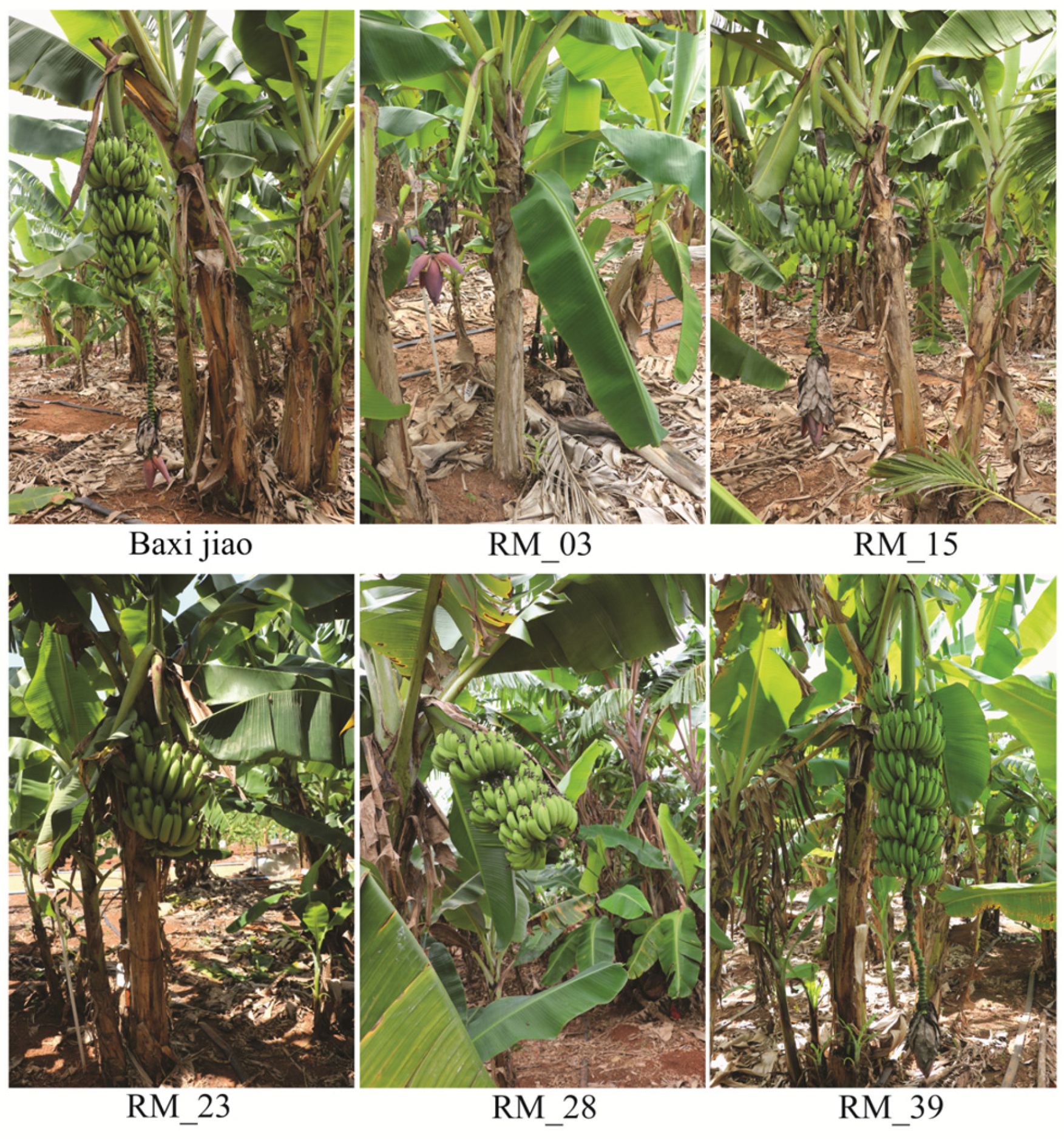
Forty-four mutants were generated by 60Co γ-irradiation and planted in the Wenchang field germplasm nursery. These mutants were monitored over several years. Upon trait stabilization, suckers from 5 lines with stable phenotypically distinct were selected for clonal propagation and cultivated over two consecutive crop seasons with three plants per line, and phenotypic differences were recorded systematically (Figure 1). Phenotypic data for these mutants and the parental control over two consecutive crop cycles are summarized in Table S1.
Compared with Baxi jiao, which exhibited a mean plant height of 234.5 cm, pseudostem girth of 58.2 cm, 9 hands per bunch, single fruit weight of 259.7 g, and bunch weight of 22.5 kg, the five mutants displayed a wide spectrum of phenotypic alterations (Figure 1, Table S1). RM_03 exhibited extreme dwarfism, with plant height reduced to 156.7 cm, pseudostem girth to 35.8 cm, hand number to 3.3, single fruit weight to 63.7 g, and bunch weight to 4.6 kg. RM_15 showed moderate variation, with reduced plant height (193.4 cm) and halved hand number (3.7) and bunch weight (12.0 kg), but maintained normal pseudostem girth and single fruit weight. RM_23 retained normal plant height, pseudostem girth, and single fruit weight, but exhibited reduced hand number (4.0) and bunch weight (13.3 kg). RM_28 displayed normal vegetative growth but produced severely stunted fingers (20.0 g) that grew transversely at ~45°, resulting in a bunch weight of 8.3 kg. In contrast, RM_39 exhibited positive agronomic variation, with increased hand number (10.3) and enhanced bunch weight (25.7 kg), while maintaining normal plant height, pseudostem girth, and single fruit weight. A statistically significant 14.4% and 14.2% increase in hand number and bunch weight was observed in RM_39 compared to the control, although the practical significance of this difference should be validated with larger sample sizes. Among the five selected mutants, RM_03, RM_23, RM_28, and RM_39 represented extreme phenotypic deviations from the parental phenotype, whereas RM_15 showed a moderate degree of variation. These results demonstrate that radiation mutagenesis can induce a broad spectrum of phenotypic variations in banana. While the consistency of phenotypes across two crop cycles suggests stability, further evaluation over additional cycles is needed to confirm the heritability and uniformity of these traits.
Radiation mutagenesis is a widely used physical mutagenesis method in banana breeding. Using 60Co γ-irradiation of Baxi jiao, we selected five phenotypically distinct mutants from 44 individuals. It should be noted that the mutant population size (n = 44) in this study is relatively small and was not intended for comprehensive resistance screening. Rather, the RM lines serve as representative examples to illustrate the broad spectrum of phenotypic and genetic variation that can be induced by radiation mutagenesis, in contrast to the more limited variation observed in somaclonal lines. The successful breeding of ZR_No.1 stands as a testament to the power of this approach, which was screened from a similar irradiated population and has shown robust resistance in field trials, with an incidence rate below 5% in heavily infested soil [9]. Future work will involve systematic resistance phenotyping of the RM mutant population.

3.2. Genetic Differentiation Analysis Based on Resequencing SNPs

A total of 87.4 million clean reads were generated per sample on average. The average mapping rate was 96.3%, ranging from 89.93% (RM_28) to 98.21% (RM_39), indicating high consistency between sequencing data and the reference genome. The average properly paired ratio was 95.5%, confirming high data integrity. The mean sequencing depth was 25.89×, with the highest depth of 32.39× (RM_15) and the lowest of 20.59× (RM_39). Genomic coverage was stable: average coverage ≥ 1× reached 87.6%, ≥5× was 83.9%, and ≥10 was 77.1%. RM_15 and GCTCV-218 exhibited superior coverage at high depths (≥20× and ≥30×) (Table S2). Overall, the resequencing data showed high quality, reliable alignment, sufficient sequencing depth, and uniform genome coverage, fully meeting the requirements for subsequent genome-wide SNP detection.
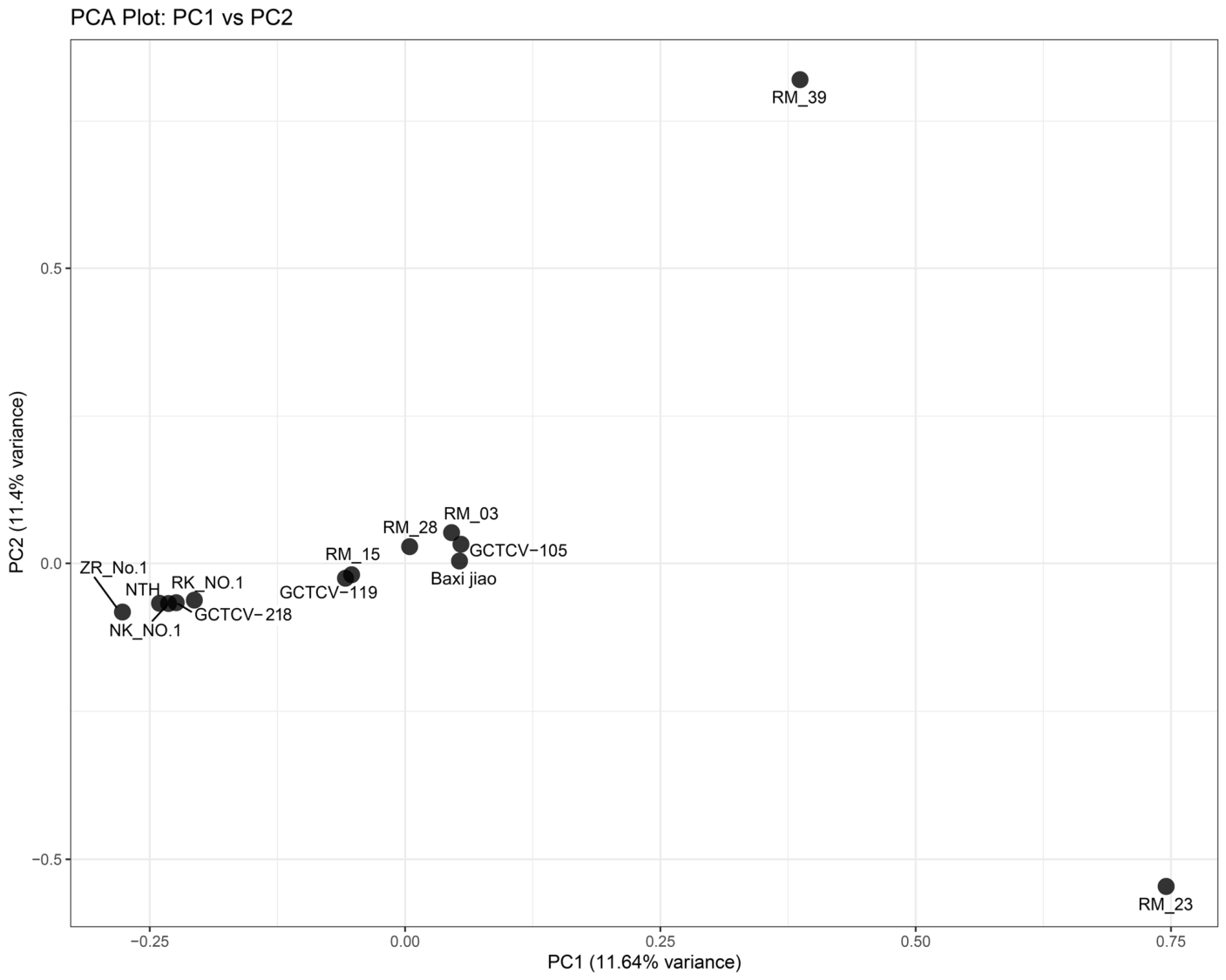
We performed SNP-based PCA on 13 banana accessions (Figure 2, Figures S1 and S2). The first three principal components (PC1, PC2, PC3) explained 11.64%, 11.40%, and 10.82% of the genetic variation, respectively, together explaining 33.9% of the total variation. PC1 and PC2 revealed that among the radiation-induced mutants, RM_23 and RM_39 clearly diverged from the parent Baxi jiao, while the other mutants (RM_03, RM_15, and RM_28) clustered closely with the parent. The somaclonal variant lines (GCTCV-218, GCTCV-119, GCTCV-105) were overall similar to the parent, showing only slight shifts. The somaclonal bud-sport lines derived from GCTCV-218 (NK_No.1, NTH, RK_No.1) grouped tightly with GCTCV-218, indicating highly consistent genetic backgrounds (Figure 2). Notably, RM_23 and RM_39 came from the same population of 44 mutants and were selected for resequencing based on extreme phenotypes (RM_23 with reduced bunch traits, RM_39 with increased growth and yield). Compared with ZR_No.1, which was also obtained through radiation mutagenesis but after multiple rounds of comprehensive selection, RM_23 and RM_39 showed more pronounced genetic divergence (Figure 2). This observation indicates that in a radiation-mutagenized population, a few individuals (e.g., RM_23, RM_39) undergo large structural variations, while most individuals (e.g., RM_03, RM_15, RM_28) are highly similar to the parent. The extreme-phenotype selection strategy actively enriched these large-effect variants. ZR_No.1, on the other hand, was obtained after further comprehensive selection and represents a line with more refined genetic variation. Overall, except for RM_23 and RM_39, the genetic backgrounds of the other 11 accessions were highly similar to that of Baxi jiao, with no obvious population differentiation.
This pattern is consistent with a long-tail distribution of genetic variation in radiation-mutagenized populations: most individuals carry only point mutations or small indels, while a few harbor large structural variants [6]. This is consistent with previous findings that 60Co γ-irradiation effectively induces trait variation and resistant mutants in banana plantlets [5,7,8] and can generate CNVs [6]. Combined with our extreme-phenotype selection strategy, the pronounced divergence of RM_23 and RM_39 is the expected outcome of actively enriching the largest-effect variants. Bado et al. [29] also pointed out that mutation breeding combined with efficient screening strategies is an effective approach to develop new germplasm for crops recalcitrant to improvement via sexual hybridization, such as banana.

3.3. Transcriptome Analysis of Banana Varieties in Response to Foc TR4

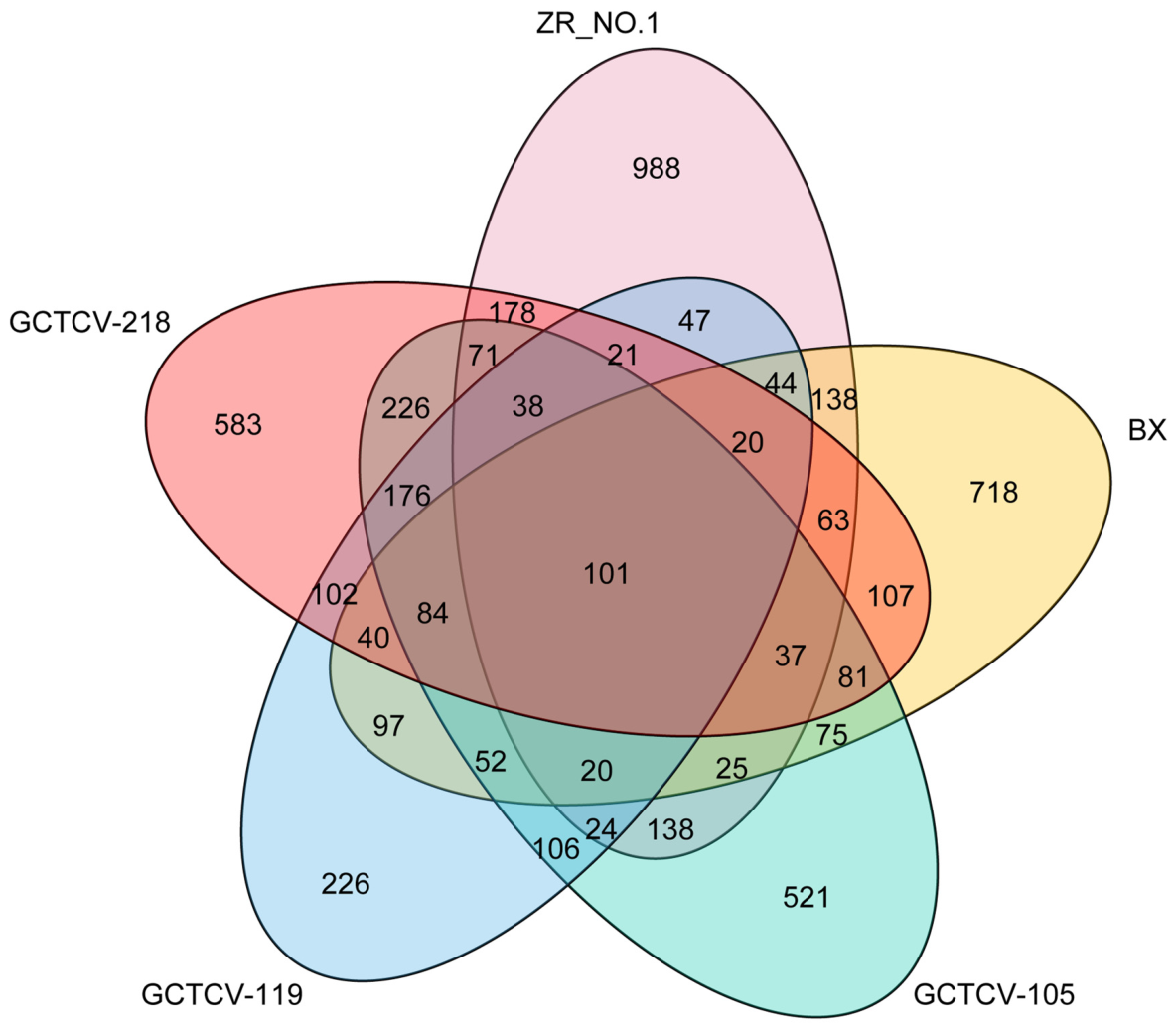
Based on PCA results, representative varieties (ZR_No.1, GCTCV-218, GCTCV-119, GCTCV-105, and Baxi jiao) were selected for transcriptome sequencing. After removing low-expression genes (FPKM < 20), Venn diagram analysis showed marked differences in the numbers of unique DEGs among the five varieties (Figure 3). ZR_No.1 had the highest number (988), GCTCV-119 the lowest (226), and Baxi jiao (718), GCTCV-218 (583), and GCTCV-105 (521) were intermediate. Among pairwise shared DEGs, ZR_NO.1 and GCTCV-218 shared the most (178), while GCTCV-119 and GCTCV-105, as well as ZR_NO.1 and Baxi jiao, shared 138 each. The five varieties shared 101 core DEGs. The number of DEGs shared by any three varieties ranged from 20 to 84, and all four varieties shared 24 DEGs, indicating that although there are partially conserved response mechanisms, transcriptomic regulation is highly variety-specific.
To more comprehensively compare the transcriptomic differences among breeding strategies, we expanded the analysis to eight varieties (including the somaclonal bud-sport lines NK_No.1, NTH, and RK_No.1). Enrichment analysis (p < 0.05) revealed a total of 194 metabolic pathways belonging to 61 distinct categories (Table S3). ZR_No.1 and NK_No.1 enriched the most pathways (36 each), while Baxi jiao and NTH enriched the fewest (15 each). Metabolic pathways, Biosynthesis of secondary metabolites, Linoleic acid metabolism, and Phenylpropanoid biosynthesis were enriched in all eight varieties, likely representing basal resistance responses. MAPK signaling pathway-plant was enriched only in GCTCV-105, ZR_No.1, GCTCV-218, Baxi jiao, and RK_No.1; Plant–pathogen interaction was enriched only in GCTCV-105, GCTCV-218, Baxi jiao, and RK_No.1. These variety-specific pathways reflect distinct defense strategies conferred by different breeding approaches. Nitrogen metabolism was enriched in most resistant varieties except NK_No.1, suggesting that this pathway may participate in resistance to Fusarium wilt. NK_No.1 uniquely enriched Ribosome and Ribosome biogenesis in eukaryotes pathways, with the Ribosome pathway containing 275 genes, accounting for 10.15% of its DEGs, implying that ribosome-related genes may be involved in resistance regulation.
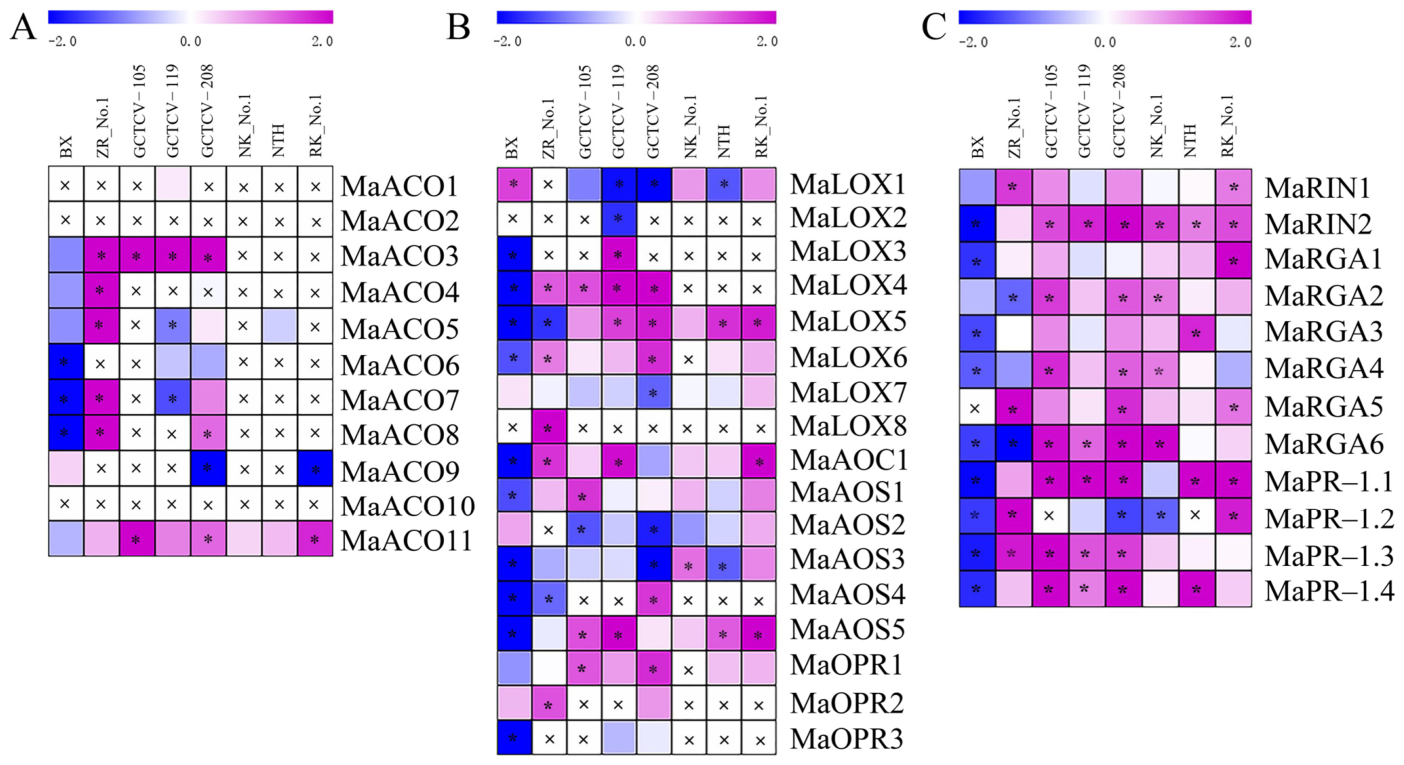
In the Biosynthesis of secondary metabolites pathway, a total of 530 DEGs were identified. Baxi jiao had only 115 DEGs (83 down-regulated, 32 up-regulated). The number of DEGs shared between resistant varieties and Baxi jiao was low (23–58), whereas the number of resistant-variety-specific DEGs was much higher (43–209), with no obvious distribution pattern (Table S4). This pathway contained eight ACO genes with divergent expression patterns: five were down-regulated in Baxi jiao, five up-regulated in ZR_No.1 (the highest number), two up-regulated in GCTCV-105, two up- and two down-regulated in GCTCV-119, three up-regulated in GCTCV-218, one up- and one down-regulated in RK_No.1, two down-regulated in NTH, and no differentially expressed ACO members in NK_No.1 (Tables S4 and S5, Figure 4A). The divergent ACO expression patterns across varieties underscore the genotype-specific nature of transcriptional responses to Foc TR4, suggesting that different resistant varieties may employ distinct molecular strategies for defense. In the jasmonic acid (JA) biosynthesis pathway, the LOX family showed four down-regulated members in Baxi jiao and four up-regulated in ZR_No.1; AOC was down-regulated in Baxi jiao but up-regulated in ZR_No.1, GCTCV-119, and RK_No.1; AOS was uniformly down-regulated in Baxi jiao, whereas up-regulated members appeared in all resistant varieties (Figure 4B, Table S5).
The Plant–pathogen interaction pathway was enriched only in GCTCV-105, GCTCV-218, Baxi jiao, and RK_No.1. We identified 31 DEGs belonging to six families. The RIN gene (Ma01_t11500.1) was up-regulated in ZR_No.1, GCTCV-105, GCTCV-218, NK_No.1, and RK_No.1. Among RGA family members, Ma05_t11770.1 was up-regulated in GCTCV-105, GCTCV-119, GCTCV-218, NTH, NK_No.1, and RK_No.1; Ma01_t03990.1 was significantly up-regulated in GCTCV-105, GCTCV-119, and NTH; Ma06_t21040.1 was significantly up-regulated in GCTCV-218 and RK_No.1. Four PR-1 family members were highly expressed across all 16 transcriptomes (average RPKM values 471.85, 31.00, 650.12, and 1328.02). They were significantly down-regulated in Baxi jiao but significantly up-regulated in ZR_No.1, GCTCV-105, GCTCV-119, and GCTCV-218 (Figure 4C, Table S5). In contrast, in the somaclonal bud-sport lines (NK_No.1, NTH, RK_No.1), PR-1 gene expression was significantly down-regulated or some members were not differentially expressed. This finding, at this early time point (2 DPI), contrasts with the PCA results, which showed that the somaclonal bud-sport lines were genetically highly similar to GCTCV-218, indicating that although these lines resemble their resistant parent at the DNA level, their expression of key defense genes has been significantly altered.
The JA pathway, a key signaling pathway in plant disease resistance [30], showed diversity in expression of its key enzyme genes (LOX, AOC, and AOS) among GCTCV lines (Figure 4B, Table S5), suggesting that variation in resistance levels may be linked to differential regulation of these pathways. Our transcriptome analysis showed that GCTCV-218, GCTCV-119, and GCTCV-105 exhibit similar expression patterns of resistance-related genes after Foc TR4 inoculation, especially PR-1 and RGA genes (Figure 4C, Table S5). This is consistent with Van den Berg et al. [15], who found that GCTCV-218 rapidly induces PR-1 and cell wall-strengthening genes. Interestingly, the plant–pathogen interaction pathway was significantly enriched in GCTCV-105 and GCTCV-218 but not in GCTCV-119 (Table S3). Rather than representing a discrepancy, this finding demonstrates that even among resistant somaclonal variants, the molecular pathways activated in response to Foc TR4 can differ substantially. This observation highlights the complexity of resistance mechanisms and suggests that GCTCV-119 may rely on alternative defense pathways not captured by this specific enrichment analysis [31,32].

3.4. Altered Expression of Resistance-Related Gene in Somaclonal Variation Breeding and Possible Mechanisms

A key finding of this study is that the somaclonal bud-sport lines derived from GCTCV-218 (NK_No.1, NTH, RK_No.1) showed poor expression of resistance-related genes at 2 DPI, especially a significant downregulation or loss of PR-1 family gene expression (Figure 4C, Table S5). It is important to note that our transcriptomic data reflect gene expression changes at the molecular level at a single early time point; whether these changes translate to reduced field resistance requires further validation through controlled inoculation experiments and multi-year field trials. Nevertheless, this observation provides a molecular indicator for the potential erosion of resistance during phenotypic selection from an already resistant parent. PR-1 proteins are hallmark molecules of systemic acquired resistance (SAR) and play critical roles in plant defense [33]. GCTCV-218, originally possessing strong resistance, rapidly induces PR-1 expression upon Foc infection [15], but this key resistance mechanism appears diminished in its somaclonal progeny at the transcriptional level.
This finding aligns with practical breeding experiences. The selection of NTH from GCTCV-218 primarily focused on distinct morphological traits such as pseudostem color, sucker type, and bunch characteristics to improve market acceptance [12]. Similarly, NK_No.1 and RK_No.1 were selected for their agronomic performance [13,14]. Field data indicate that NTH exhibits a disease incidence of 4–18% in heavily Foc TR4-infested fields [12]. For NK_No.1, the field incidence across different regions in Guangdong ranges from 3.5% to 20%, with an average of approximately 8.8% [13]. Furthermore, under the ecological conditions in Hainan, the disease incidence rates of ‘RK No. 1’ and its parent ‘NK No. 1’ are 24.5% and 24.1%, respectively [14]. While these lines still maintain a certain level of field resistance, our transcriptomic evidence suggests that the downregulation of PR-1 expression could potentially foreshadow a gradual decline in resistance levels over successive rounds of phenotypic selection. Our results suggest that such phenotype-driven selection, while improving commercial traits, may inadvertently lead to a genetic drift or negative selection of the very genes responsible for the parental line’s resistance. Tomekpé and Sadom [4] also noted that somaclonal variation in banana mainly manifests as morphological variations such as dwarfism and mosaic leaves, while resistance-related variations are often not easily identified at early stages. Therefore, somaclonal variation breeding should be based on disease resistance rather than purely on phenotypic changes. When performing somaclonal screening from pre-existing mutants or somaclonal lines, breeders must monitor and maintain resistance traits to avoid losing key defense genes.
From a mechanistic perspective, the loss of PR-1 expression in somaclonal progeny may involve several factors: (i) selection pressure focused on morphological traits, leading to genetic drift or negative selection of resistance genes; (ii) somaclonal variation may be accompanied by epigenetic modifications (e.g., DNA methylation, histone modifications) that could be transmitted during clonal propagation and affect gene expression (speculative, awaiting future validation); (iii) the resistance of GCTCV-218 may depend on the coordinated expression of multiple genes, and mutation or altered expression of key regulators during somaclonal selection could disrupt the entire defense network. Future studies using whole-genome bisulfite sequencing (WGBS) or ChIP-seq could explore the epigenetic mechanisms underlying PR-1 loss.

3.5. Comparison of Breeding Strategies: Radiation Mutagenesis vs. Somaclonal Variation Breeding

Integrating our DNA-level and transcriptome results, Baxi jiao, as a typical asexually propagated material, can generate new germplasm with both desirable agronomic traits and stable resistance through radiation mutagenesis. From a small population of 44 mutants, we obtained a detectable phenotypic variation rate of about 11.4%, demonstrating its efficiency. The successful breeding of ZR_No.1 [9] stands as a testament to the power of this approach to create a novel, highly resistant cultivar. At the transcriptome level, ZR_No.1 showed a unique activation pattern of ACO genes (Figure 4A, Table S5), indicating that radiation mutagenesis can create new resistance mechanisms distinct from the parent. A recent study also confirms that gamma irradiation combined with tissue culture can effectively generate Fusarium wilt-resistant Cavendish mutants [7].
In contrast, somaclonal variation breeding (further screening from pre-existing mutants) faces greater challenges. Our data on NK_No.1, NTH, and RK_No.1 show that while they are genetically highly similar to GCTCV-218 at the DNA level, their expression of key defense genes like PR-1 has been significantly altered or lost. This reveals two major difficulties: (i) the genetic variation within pre-existing materials is limited, making breakthrough improvements difficult; and (ii) selection for visible traits can inadvertently compromise the original resistance.
Our findings have direct and actionable implications for breeding practice. For developing new Fusarium wilt-resistant bananas, radiation mutagenesis should be prioritized as a primary strategy due to its efficiency in generating novel genetic and transcriptomic variation. When working with moderately resistant materials like the GCTCV series, if somaclonal selection is pursued, it must be anchored by a rigorous resistance screening system. Selection cannot rely on phenotype alone. Without it, the release of new varieties with compromised resistance could exacerbate the spread of Fusarium wilt, posing a significant threat to the industry. Therefore, a multi-level evaluation system integrating both DNA and transcriptome data is essential for guiding breeding strategy [29].

3.6. Limitations and Perspectives

Although this study systematically analyzed the differences in DNA variation and transcript levels among banana varieties obtained through different breeding strategies, several limitations remain. First, the number of radiation-induced mutants subjected to resequencing (five) is relatively small, and the RM mutants have not yet been evaluated for Foc TR4 resistance; systematic resistance phenotyping of a larger mutant population will be the focus of future work. Second, the functions of key genes such as ACO and PR-1 need further validation through genetic transformation or other molecular approaches [34]. Third, the mechanism of PR-1 loss in somaclonal progeny should be investigated further using epigenetic analyses such as WGBS or ChIP-seq. Fourth, our transcriptomic analysis was conducted at a single time point (2 DPI). While this captures the early defense response and was selected based on previous work demonstrating early defense activation [21], dynamic changes in gene expression over time could not be assessed. Future time-course experiments (e.g., 0, 1, 2, and 5 DPI) are needed to fully characterize the temporal regulation of defense-related genes. Fifth, future studies should also include artificial inoculation experiments to systematically evaluate field resistance performance [35], providing more direct evidence for breeding practice. Additionally, CRISPR activation (CRISPRa) systems could potentially be used to restore or enhance the expression of key defense genes, such as PR-1, in somaclonal variants that have lost their expression during phenotypic selection. Alternatively, targeted knock-in strategies could introduce strong constitutive or pathogen-inducible promoters upstream of critical resistance genes. With the continued development of precision genetic tools (e.g., CRISPR/Cas9), combining radiation mutagenesis with gene editing could offer a more efficient approach for targeted improvement of banana [36].

4. Conclusions

In conclusion, by integrating DNA-level and transcriptome analyses, this study clarifies the distinct effects of radiation mutagenesis and somaclonal variation breeding on the genetic background and transcriptomic defense responses of banana. Our work reveals a critical, previously underappreciated risk in somaclonal breeding: the potential downregulation or loss of key defense gene expression (e.g., PR-1) at the transcriptional level during the phenotypic selection of commercial cultivars (e.g., NK_No.1, NTH, and RK_No.1) from resistant parents (e.g., GCTCV-218). While field validation is needed to confirm the functional consequences of these transcriptomic changes, this finding provides a molecular explanation for the variability in resistance performance sometimes observed in such cultivars. Our results strongly advocate for prioritizing radiation mutagenesis as a more robust strategy to obtain new materials that combine desirable agronomic traits with stable and potentially novel disease resistance, thereby supporting the sustainable development of the banana industry.

Supplementary Materials

The following supporting information can be downloaded at: https://www.mdpi.com/article/10.3390/horticulturae12060759/s1, Table S1: Phenotypic characterization of five selected radiation-induced mutants derived from Baxi jiao over two consecutive crop cycles; Table S2: Statistics of the 13 banana accessions’ resequencing data; Table S3: KEGG pathway enrichment in 8 banana accessions; Table S4: Differentially expressed genes in the biosynthesis of secondary metabolites pathway in response to Foc TR4 inoculation among eight banana accessions; Table S5: Expression patterns of genes in the Biosynthesis of secondary metabolites pathway, the jasmonic acid (JA) biosynthesis pathway, and the Plant–pathogen interaction pathway in response to Foc TR4 inoculation in 8 banana accessions; Figure S1: Principal component analysis (PCA) of genome-wide SNP variation in 13 banana accessions. PCA scatter plot of PC1 vs. PC3, explaining 11.64% and 10.82% of the genetic variation, respectively; Figure S2: Principal component analysis (PCA) of genome-wide SNP variation in 13 banana accessions. PCA scatter plot of PC2 vs. PC3, explaining 11.40% and 10.82% of the genetic variation, respectively.

Author Contributions

Conceptualization, J.X. and Z.W.; Methodology, J.W., M.Z. and J.F.; Software, J.W., M.Z., J.F. and Z.Z.; Validation, J.W., M.Z. and J.F.; Formal analysis, J.W., M.Z., C.J., Z.Z., Y.Y. and W.W.; Investigation, Z.W., J.W., C.J., M.Z., Y.Y. and W.W.; Resources, Z.W., J.W., M.Z. and C.J.; Data curation, J.W., C.J., M.Z., Z.Z., Y.Y. and W.W.; Writing—original draft preparation, J.W., M.Z. and Z.W.; Writing—review and editing, J.W., M.Z., C.J., Z.Z., Y.Y., W.W., J.F., J.X. and Z.W.; Visualization, J.W., M.Z. and J.F.; Supervision, J.X. and Z.W.; Project administration, J.X. and Z.W.; Funding acquisition, J.X. and Z.W. All authors have read and agreed to the published version of the manuscript.

Funding

This work was financially supported by the Key R&D Project of Hainan Province and Yazhou Bay Joint Project (ZDYF2025GXJS138), the project of the National Key Laboratory for Tropical Crop Breeding (NKLTCBCXTD06), the Central Public-interest Scientific Institution Basal Research Fund (CATASCXTD202308 and No.1630052022002).

Data Availability Statement

The original contributions presented in this study are included in the article/Supplementary Materials. Further inquiries can be directed to the corresponding authors.

Acknowledgments

During the preparation of this manuscript, the authors used DeepSeek (DeepSeek-R1 version, DeepSeek, Beijing, China; https://www.deepseek.com/, 26 April 2026) for the purposes of language editing and manuscript refinement. All scientific content, data, analyses, interpretations, and conclusions presented in this study are the original work of the authors. The authors have thoroughly reviewed, verified, and edited all AI-generated outputs and take full responsibility for the integrity and accuracy of the entire content of this publication.

Conflicts of Interest

The authors declare no conflicts of interest. The funders had no role in the design of the study; in the collection, analyses, or interpretation of data; in the writing of the manuscript; or in the decision to publish the results.

Abbreviations

The following abbreviations are used in this manuscript:
ACO1-aminocyclo-propane-1-carboxylateoxidase
AOCAllene Oxide Cyclase
AOSAllene Oxide Synthase
ChIP-seqChromatin Immunoprecipitation sequence
CNVsCopy Number Variations
DEGDifferentially Expressed Gene
GCTCVGiant Cavendish Tissue Culture Variants
LOXLipoxygenase
NCBI SRA National Center for Biotechnology Information—Sequence Read Archive
OPR12-oxophytodienoate reductase
PCA Principal component analysis
RNA-Seq RNA-Sequence
RPKMReads Per Kilobase Million
WGBSWhole Genome Bisulfite Sequencing

References

  1. Ploetz, R.C. Fusarium wilt of banana. Phytopathology 2015, 105, 1512–1521. [Google Scholar] [CrossRef] [PubMed]
  2. Izquierdo-García, L.F.; Carmona, S.L.; Zuluaga, P.; Rodriguez, G.; Dita, M.; Betancourt, M.; Soto-Suárez, M. Efficacy of disinfectants against Fusarium oxysporum f. sp. cubense tropical race 4 isolated from La Guajira, Colombia. J. Fungi 2021, 7, 297. [Google Scholar] [CrossRef] [PubMed]
  3. Zhang, Y.; Liu, S.; Mostert, D.; Yu, H.; Zhuo, M.; Li, G.; Zuo, C.; Haridas, S.; Webster, K.; Li, M.; et al. Virulence of banana wilt-causing fungal pathogen Fusarium oxysporum tropical race 4 is mediated by nitric oxide biosynthesis and accessory genes. Nat. Microbiol. 2024, 9, 2232–2243. [Google Scholar] [CrossRef] [PubMed]
  4. Tomekpé, K.; Sadom, L. Ploidy manipulations by conventional and mutation breeding for developing new bananas. In Proceedings of the International Conference on Plant Diseases and Resistance Mechanisms, Vienna, Austria, 20–22 February 2013; p. 54. [Google Scholar]
  5. Amorim, E.P.; Pestana, R.K.N.; Silva, S.D.O.; Tulmann Neto, A. Caracterização agronômica de mutantes de bananeira obtidos por meio da radiação gama. Bragantia 2012, 71, 8–14. [Google Scholar] [CrossRef]
  6. Datta, S.; Jankowicz-Cieslak, J.; Nielen, S.; Ingelbrecht, I.; Till, B.J. Induction and recovery of copy number variation in banana through gamma irradiation and low-coverage whole-genome sequencing. Plant Biotechnol. J. 2018, 16, 1644–1653. [Google Scholar] [CrossRef] [PubMed]
  7. Costa, T.F.; Santos, M.C.; de Souza Junior, L.C.; Brito, D.A.; de Jesus Rocha, A.; Lino, L.S.M.; Faria, G.A.; Ferreira, C.F.; Haddad, F.; Amorim, E.P.; et al. Gamma radiation-induced mutagenesis in the development of Cavendish subgroup banana cultivars resistant to Fusarium oxysporum f. sp. cubense. Euphytica 2025, 221, 147. [Google Scholar] [CrossRef]
  8. Guo, J.H.; Cai, E.X.; Lin, Q.T.; Chen, L.P.; Huang, X.D.; Shen, M.S. Study on mutation breeding of banana buds in vitro IV: Biochemical analysis to ‘Zhangjiao No. 8’ strain. Subtrop. Plant Sci. 2003, 32, 11–13. (In Chinese) [Google Scholar]
  9. Zhang, J.B.; Jin, Z.Q.; Xu, B.Y.; Wang, Z.; Wang, J.Y.; Jia, C.H.; Miao, H.X.; Zheng, Y.K.; Liu, J.H. A new banana cultivar ‘Zhongre 1’ with high resistance to Fusarium wilt. Acta Hortic. Sin. 2024, 51, 63–64. (In Chinese) [Google Scholar] [CrossRef]
  10. Hwang, S.C.; Ko, W.H. Cavendish banana cultivars resistant to Fusarium wilt acquired through somaclonal variation in Taiwan. Plant Dis. 2004, 88, 580–588. [Google Scholar] [CrossRef] [PubMed]
  11. Cheng, S.M.; Zhang, X.; Zhao, M.; Su, Z.X.; Ma, Y.; Wei, S.X. A new banana cultivar ‘Baodaojiao’ with resistant to Fusarium wilt. Acta Hortic. Sin. 2023, 50, 61–62. (In Chinese) [Google Scholar] [CrossRef]
  12. Xu, L.B.; Zhang, X.Y.; Li, H.P.; Chen, B.; Huang, B.Z.; Chen, W.X.; Feng, Y.; Xiao, W.Q.; Zhou, D.B.; Gan, D.Q. Breeding of a new Fusarium wilt-resistant banana cultivar ‘Nantianhuang’. Chin. J. Trop. Crops 2017, 38, 998–1004. (In Chinese) [Google Scholar] [CrossRef]
  13. Liu, S.Q.; Liang, Z.H.; Huang, C.H.; Huang, Y.X. Breeding of a new banana line Nongke No.1 with resistance to Fusarium wilt. Guangdong Agric. Sci. 2007, 34, 30–32. (In Chinese) [Google Scholar] [CrossRef]
  14. Qi, Y.X.; Xie, Y.X.; Peng, J.; Zeng, F.Y.; Zhang, X. Main agronomic traits of new banana line ‘Reke 1’ under ecological conditions in Hainan. Chin. J. Trop. Agric. 2020, 40, 1–5. (In Chinese) [Google Scholar]
  15. Van den Berg, N.; Berger, D.K.; Hein, I.; Birch, P.R.J.; Wingfield, M.J.; Viljoen, A. Tolerance in banana to Fusarium wilt is associated with early up-regulation of cell wall-strengthening genes in the roots. Mol. Plant Pathol. 2007, 8, 333–341. [Google Scholar] [CrossRef] [PubMed]
  16. Hou, B.H.; Tsai, Y.H.; Chiang, M.H.; Tsao, S.M.; Huang, S.H.; Chao, C.P.; Chen, H.M. Cultivar-specific markers, mutations, and chimerisim of Cavendish banana somaclonal variants resistant to Fusarium oxysporum f. sp. cubense Tropical Race 4. BMC Genom. 2022, 23, 470. [Google Scholar] [CrossRef] [PubMed]
  17. Zhang, J.B.; Jia, C.H.; Liu, J.H.; Jin, Z.Q.; Xu, B.Y. Tissue culture and rapid propagation research on immature male flower of banana. Chin. J. Trop. Crops 2012, 33, 1225–1229. (In Chinese) [Google Scholar]
  18. Wang, A.B. Creating, Screening and Identification of Cold-Tolerance Germplasm in Banana (Musa AAA Cavendish cv. Brazil). Master’s Thesis, Hainan University, Haikou, China, 2013. (In Chinese) [Google Scholar]
  19. IPGRI; INIBAP; CIRAD. Descriptors for Banana (Musa spp.); International Plant Genetic Resources Institute: Rome, Italy, 1996. [Google Scholar]
  20. Huang, B.Z. Descriptors and Data Standard for Banana (Musa spp.); China Agriculture Press: Beijing, China, 2006. (In Chinese) [Google Scholar]
  21. Wang, Z.; Zhang, J.B.; Jia, C.H.; Liu, J.H.; Li, Y.Q.; Yin, X.M.; Xu, B.Y.; Jin, Z.Q. De novo characterization of the banana root transcriptome and analysis of gene expression under Fusarium oxysporum f. sp. cubense tropical race 4 infection. BMC Genom. 2012, 13, 650. [Google Scholar] [CrossRef] [PubMed]
  22. Murray, M.G.; Thompson, W.F. Rapid isolation of high molecular weight plant DNA. Nucleic Acids Res. 1980, 8, 4321–4326. [Google Scholar] [CrossRef] [PubMed]
  23. Li, H.; Durbin, R. Fast and accurate short read alignment with Burrows–Wheeler transform. Bioinformatics 2009, 25, 1754–1760. [Google Scholar] [CrossRef] [PubMed]
  24. McKenna, A.; Hanna, M.; Banks, E.; Sivachenko, A.; Cibulskis, K.; Kernytsky, A.; Garimella, K.; Altshuler, D.; Gabriel, S.; Daly, M.J.; et al. The Genome Analysis Toolkit: A MapReduce framework for analyzing next-generation DNA sequencing data. Genome Res. 2010, 20, 1297–1303. [Google Scholar] [CrossRef] [PubMed]
  25. Li, R.; Li, Y.; Kristiansen, K.; Wang, J. SOAP: Short oligonucleotide alignment program. Bioinformatics 2008, 24, 713–714. [Google Scholar] [CrossRef] [PubMed]
  26. Mortazavi, A.; Williams, B.A.; McCue, K.; Schaeffer, L.; Wold, B. Mapping and quantifying mammalian transcriptomes by RNA-Seq. Nat. Methods 2008, 5, 621–628. [Google Scholar] [CrossRef] [PubMed]
  27. Saeed, A.I.; Sharov, V.; White, J.; Li, J.; Liang, W.; Bhagabati, N.; Braisted, J.; Klapa, M.; Currier, T.; Thiagarajan, M.; et al. TM4: A free, open-source system for microarray data management and analysis. BioTechniques 2003, 34, 374–378. [Google Scholar] [CrossRef] [PubMed]
  28. Saldanha, A.J. Java Treeview—Extensible visualization of microarray data. Bioinformatics 2004, 20, 3246–3248. [Google Scholar] [CrossRef] [PubMed]
  29. Bado, S.; Yamba, N.G.G.; Sesay, J.V.; Laimer, M.; Forster, B.P. Plant mutation breeding for the improvement of vegetatively propagated crops: Successes and challenges. CAB Rev. 2017, 12, 1–21. [Google Scholar] [CrossRef]
  30. Ding, L.N.; Li, Y.T.; Wu, Y.Z.; Li, T.; Geng, R.; Cao, J.; Zhang, W.; Tan, X.L. Plant disease resistance-related signaling pathways: Recent progress and future prospects. Int. J. Mol. Sci. 2022, 23, 16200. [Google Scholar] [CrossRef] [PubMed]
  31. Kaushal, M.; Mahuku, G.; Swennen, R. Comparative transcriptome and expression profiling of resistant and susceptible banana cultivars during infection by Fusarium oxysporum. Int. J. Mol. Sci. 2021, 22, 3002. [Google Scholar] [CrossRef] [PubMed]
  32. Zeng, H.; Wu, Y.; Xu, L.; Dong, J.; Huang, B. Banana defense response against pathogens: Breeding disease-resistant cultivars. Hortic. Plant J. 2026, 12, 62–72. [Google Scholar] [CrossRef]
  33. Van Loon, L.C.; Rep, M.; Pieterse, C.M.J. Significance of inducible defense-related proteins in infected plants. Annu. Rev. Phytopathol. 2006, 44, 135–162. [Google Scholar] [CrossRef] [PubMed]
  34. Paul, J.Y.; Becker, D.K.; Dickman, M.B.; Harding, R.M.; Khanna, H.K.; Dale, J.L. Apoptosis-related genes confer resistance to Fusarium wilt in transgenic ‘Lady Finger’ bananas. Plant Biotechnol. J. 2011, 9, 1141–1148. [Google Scholar] [CrossRef] [PubMed]
  35. Dita, M.; Barquero, M.; Heck, D.; Mizubuti, E.S.; Staver, C.P. Fusarium wilt of banana: Current knowledge on epidemiology and research needs toward sustainable disease management. Front. Plant Sci. 2018, 9, 1468. [Google Scholar] [CrossRef] [PubMed]
  36. Tripathi, J.N.; Ntui, V.O.; Tripathi, L. Precision genetics tools for genetic improvement of banana. Plant Genome 2024, 17, e20416. [Google Scholar] [CrossRef] [PubMed]
Figure 1. Phenotypic variations of the selected individuals (RM_03, RM_15, RM_23, RM_28, and RM_39) with Baxi jiao.
Horticulturae 12 00759 g001
Figure 2. Principal component analysis (PCA) of genome-wide SNP variation in 13 banana accessions. PCA scatter plot of PC1 vs. PC2, explaining 11.64% and 11.40% of the genetic variation, respectively.
Horticulturae 12 00759 g002
Figure 3. Comparison of the DEGs detected in five banana varieties (ZR_No.1, GCTCV-218, GCTCV-119, GCTCV-105, and Baxi jiao) in response to Foc TR4 inoculation. DEGs were identified by comparing gene expression in Foc TR4-inoculated plants (2 DPI) versus mock-inoculated controls (0 DPI) for each variety. Venn diagram shows the numbers of unique and shared DEGs among the five varieties. The different colors represent distinct sample groups: pink for ZR_NO.1, salmon red for GCTCV-218, light blue for GCTCV-119, cyan for GCTCV-105, and yellow for BX.
Horticulturae 12 00759 g003
Figure 4. Expression patterns (Log2 based RPKM) of defense-related genes in eight banana accessions after Foc TR4 inoculation. (A) Genes in the biosynthesis of secondary metabolites pathway. (B) Genes in the jasmonic acid (JA) biosynthesis pathway. (C) Genes in the plant–pathogen interaction pathway. Each column represents one banana accession, and each row represents a gene family member. The symbol “✕” denotes genes that were not differentially expressed or had expression levels below the detection threshold (FPKM < 20), while the asterisk “∗” indicates differentially expressed genes (|Log2 fold change| ≥ 1, FDR < 0.05).
Horticulturae 12 00759 g004
Disclaimer/Publisher’s Note: The statements, opinions and data contained in all publications are solely those of the individual author(s) and contributor(s) and not of MDPI and/or the editor(s). MDPI and/or the editor(s) disclaim responsibility for any injury to people or property resulting from any ideas, methods, instructions or products referred to in the content.