Article

Identification and Cold Stress-Induced Expression Patterns of TIFY Family Genes in Sweet Orange
1
Hubei Key Laboratory of Germplasm Innovation and Utilization of Fruit Trees, Institute of Fruit and Tea, Hubei Academy of Agricultural Sciences, Wuhan 430064, China
2
Hubei Hongshan Laboratory, Wuhan 430070, China
*
Authors to whom correspondence should be addressed.
These authors contributed equally to this work.
Horticulturae 2026, 12(6), 748; https://doi.org/10.3390/horticulturae12060748
Submission received: 19 May 2026 / Revised: 16 June 2026 / Accepted: 18 June 2026 / Published: 19 June 2026

Abstract

Citrus fruits are widely cultivated all over the world. Due to climatic conditions, citrus fruits are frequently exposed to periodic low temperatures, which poses a serious threat to their yield and quality. Cold not only restricts plant growth and deteriorates fruit quality but also leads to fruit abscission and tree mortality, posing severe constraints on large-scale citrus production. The TIFY family gene plays crucial roles in plant development and stress adaptation. However, the genome-wide identification and functional analysis of TIFY genes in cold stress adaptation of citrus plants remain largely unexplored. Here, we performed a systematic genome-wide analysis of the TIFY family in sweet orange (Citrus sinensis (L.) Osbeck) and identified 14 CsTIFY members. We conducted a comprehensive study on the protein characteristics, phylogenetic relationships, gene structure, chromosome distribution, promoter cis-acting elements, and subcellular localization of these genes. Phylogenetic analysis classified the CsTIFYs into ZML (ZML1–ZML4), JAZ (JAZ1–JAZ7), PPD (JAZ8, JAZ9), and TIFY (TIFY1) subfamilies, and they are distributed on seven chromosomes. Collinearity analysis revealed that segmental duplication is the primary driver for CsTIFY family expansion. Expression profiling under cold stress identified JAZ1, JAZ2, and JAZ3 as the most cold-inducible members. All three CsTIFY proteins are targeted to the nucleus, as confirmed by subcellular localization analysis. Overexpression of JAZ1, JAZ2, or JAZ3 in citrus calli significantly enhanced cold sensibility. Collectively, this study elucidates the gene function of CsTIFYs under cold stress and provides new insight for molecular breeding of cold-tolerant citrus varieties.

1. Introduction

Citrus species are the largest economic fruit crops worldwide. Sweet orange (Citrus sinensis) is an evergreen species of the Rutaceae family, and is generally regarded as the offspring resulting from the hybridization of the pomelo (Citrus maxima) and mandarin (Citrus reticulata) [1]. Nevertheless, citrus crops are easily affected by abiotic stresses, especially cold stress. Cold affects the growth, development, and productivity of citrus plants [2,3,4].
In response to cold stress, plants activate a complex network of molecular mechanisms to mitigate the deleterious effects and enhance their cold tolerance [5,6,7,8,9,10,11]. Stress-responsive pathways rely critically on the change in some key genes [12,13,14,15,16,17,18,19]. The TIFY family has been recognized as an important regulator of stress responses in plants, including adaptation to cold stress across multiple species [20,21,22,23].
TIFY is a plant-specific protein family that usually plays multiple roles in plant development and responses to stresses [24,25,26,27,28]. The TIFY gene family features a conserved TIF[Y/F]XG motif and is categorized into four subfamilies—TIFY, ZML (zinc-finger inflorescence meristem, and ZIM-like), JAZ (Jasmonate-ZIM-domain), and PPD (PEAPOD) [29,30,31]. Members of the TIFY subfamily share a conserved TIFY domain. The ZML subfamily possesses three characteristic motifs: the TIFY domain, a CCT (CONSTANS, CO-like, TOC1) domain, and a C2C2-GATA zinc-finger domain [29]. The C-terminal region of JAZ proteins contains a Jas motif (JA-associated, CCT-2). The PPD subfamily member contains a PPD domain, a TIFY domain, and a partial Jas domain lacking the PY (proline–tyrosine) motif [30].
The TIFY gene family has been reported to contribute to plant growth, development, hormone transduction, and biotic and abiotic stresses [23,28,32,33,34,35]. JAZ3 regulates photothermal morphogenesis by inhibiting its binding ability to the promoters of downstream genes [36]. Wang et al. identified in pineapple (Ananas comosus L. Merr.) that AcJAZ2L2 directly interacts with the AcMYC2-like transcription factor to inhibit JA-responsive gene expression, while maintaining stomatal closure to block the invasion of bacterial ulcer disease in kiwifruit [37]. In pepper Capsicum annuum, JAZ1-03 CaJAZ1-03 negatively regulates drought stress via the ABA signal pathway [32]. The DT3 protein enhances drought resistance by regulating stomatal density in rice [38]. In barley (Hordeum vulgare L.), HvJAZ2 binds to transcription factors including HvMYC2, inhibiting their transcriptional activation of HvPLT2, while in the jaz2 mutant, the expression level of HvPLT2 increased sharply, thereby alleviating the negative impact of drought stress on barley root development and enhancing drought tolerance [39]. MeJA activates the expression of cold-resistant genes of (Prunus persica (L.) Batsch) PpMYC2.1 by down-regulating the expression of PpJAZ2/4, thereby relieving its inhibition of PpMYC2.1 [40]. Lin et al. utilized scRNA-seq technology to identify a new cold-resistance negative regulatory factor gene from mugwort (Artemisia argyi H. Lév. & Vaniot), AaTIFY, in leaves of different cold-resistant genotypes [41]. The rice (Oryza sativa L.) gene OsJAZ9 negatively regulates BMY, enhancing the cold tolerance of rice by inhibiting starch degradation [22]. An et al. discovered that the JAZ protein regulates cold tolerance in apples through the BBX37-ICE1-CBF pathway [20]. However, Qi et al. discovered in cucumber (Cucumis sativus L.) that CsJAZ5 is regulated by the CBF-COR signaling pathway, positively regulates low-temperature response [23]. While the comprehensive genome-wide identification and functional analysis of the TIFY gene family in citrus, particularly in response to cold stress, remains largely unexplored. Understanding the response mechanism of citrus to low-temperature stress, identifying the TIFY gene family members and analyzing their functions, and clarifying the molecular mechanism of citrus cold tolerance are significant for specified cold-resistance strategies.
Therefore, in this study, we performed a genome-wide identification of the TIFY gene family in citrus and analyzed their expression patterns in response to cold stress using both transcriptomic data and qRT-PCR. The function of the candidate TIFY genes was verified through phenotypic analysis of citrus callus under low-temperature conditions. This study shed light on the molecular mechanisms underlying cold tolerance in citrus crops and provided new insight for citrus cultivation in the northern regions of China and alleviation of the adverse effects of cold stress.

2. Materials and Methods

2.1. Plant Materials and Treatments

The cold-resistant variety, sweet orange, was used as a material in this study. The citrus seedlings we used were cultivated with a long-day photoperiod: 16 h of light/8 h of darkness, and with a light intensity of 100 μmol m−2 s−1 at 25 °C. For low temperature treatment, the three-month-old seedlings were placed in an incubator at 4 °C. The samples were collected at 0 h, 6 h, 12 h, 1 d, 3 d, 5 d, and 7 d. Each sample had three biological replicates with 10 individual plants per biological replicate. All leave samples were immediately frozen with liquid nitrogen and stored in −80 °C for RNA extraction. Callus of sweet orange was obtained from the laboratory’s existing collection. In the ultra-clean workbench, a well-grown citrus callus was inoculated from the MT solid culture medium and propagated. After approximately three weeks of growth, the callus was ready for subsequent use.

2.2. Identification of Putative TIFY Family Genes from Citrus sinensis

To identify CsTIFY genes, genomic data of sweet orange (Citrus sinensis, version 2) were downloaded from the Citrus Pan-genome to Breeding Database (http://citrus.hzau.edu.cn/index.php (accessed on 1 November 2025)). The Hidden Markov Model (HMM) profile corresponding to the TIFY domain (Pfam accession PF06200) was retrieved from the Pfam database (http://pfam.xfam.org/ (accessed on 3 November 2025), version 33.1). This profile was subsequently employed as a query to screen the Citrus sinensis genome for candidate CsTIFY family members using HMMER software (version 3.0, http://hmmer.org/ (accessed on 5 November 2025)), with an E-value threshold set to 1 × 10⁻³. All TIFY protein sequences from Arabidopsis thaliana were obtained from the TAIR repository (http://www.Arabidopsis.org/ (accessed on 5 November 2025)). These sequences subsequently served as queries for a BLAST-P of the Citrus Pan-genome to Breeding Database search against the Citrus sinensis genome, with an E-value threshold of 1 × 10⁻⁵. To verify the presence of the TIFY domain along with the Jas, CCT, ZML, and PPD motifs, all candidate CsTIFY sequences were subjected to further validation using the Simple Modular Architecture Research Tool (SMART, http://smart.embl-heidelberg.de/ (accessed on 5 November 2025)) and the Conserved Domain Database (CDD, http://www.ncbi.nlm.nih.gov/cdd/ (accessed on 8 November 2025)). The non-redundant, confirmed candidates were defined as bona fide citrus TIFY genes. Subsequently, the ExPASy ProtParam server (http://web.expasy.org/protparam/ (accessed on 8 November 2025)) was employed to compute the physicochemical characteristics of all CsTIFY proteins. Promoter regions of CsTIFY genes were examined for cis-regulatory elements using the PlantCARE web server (http://bioinformatics.psb.ugent.be/webtools/plantcare/html/ (accessed on 10 November 2025)).

2.3. Phylogenetic Analysis, Gene Structure, and Conserved Motifs of TIFY Family Genes

A multiple sequence alignment of TIFY family proteins from sweet orange and Arabidopsis was carried out with MAFFT (available at https://mafft.cbrc.jp/alignment/server/ (accessed on 10 November 2025)) employing default parameters. A maximum-likelihood phylogeny was reconstructed using MEGA X software, supported by 1000 bootstrap iterations. Visualization and esthetic refinement of the phylogenetic tree were performed on the iTOL online platform (https://itol.embl.de/ (accessed on 11 November 2025)). The TAIR database (http://www.Arabidopsis.org/) served as the source for downloading Arabidopsis thaliana protein sequences. TBtools 1.09873 was employed to display the gene structure (exon/intron patterns) of TIFY family members. The MEME program (version 5.1.1, http://meme-suite.org/tools/meme (accessed on 13 November 2025)) was utilized to analyze conserved motifs in the candidate proteins. We employed the MEME tool (zoops model; motif width: 6–50 aa; maximum motifs: 15) to discover conserved motifs. These motifs were then matched against the InterPro database (v80.0, www.ebi.ac.uk/interpro/search/sequence/ (accessed on 13 November 2025)) for functional interpretation.

2.4. Chromosomal Locations and Gene Duplication of CsTIFY Genes

The genomic loci of CsTIFY family genes were extracted from the Citrus Pan-genome to Breeding Database, and their chromosomal positions were mapped by TBtools. Duplication types of CsTIFY genes were identified following earlier protocols. Genes located within a 100 kb genomic interval and separated by fewer than five intervening genes were defined as tandem duplicates. The duplicated genes of CsTIFY were identified using the Multiple Collinearity Scan toolkit (MCScanX). The duplication events were displayed with TBtools. Syntenic relationships among TIFY orthologs from Citrus sinensis, Arabidopsis thaliana, and Oryza sativa were assessed using MCScanX with its standard parameters. Synteny diagrams were created with the Dual Synteny Plotter utility available in TBtools.

2.5. Expression Profiles of TIFY Family Genes Under Cold Stress

CsTIFY gene expression pattern under cold stress was investigated using transcriptome data of citrus plants under 4 °C for 12 h. FPKM normalization was applied to calculate gene expression profiles from three independent biological replicates. Differentially expressed genes were identified using the edgeR package. Genes with log2 fold change ≥1, and adjusted p-value ≤ 0.05 were considered statistically significant. The TBtools heatmap package was used to plot a heatmap based on log2-scaled FPKM values.

2.6. RNA Extraction, cDNA Synthesis, and qRT-PCR of TIFY Family Genes

Total RNA was extracted from various specimens using TRIzol® Reagent (Invitrogen, USA, Carlsbad, CA, USA), following the supplier’s protocol. RNA quality was evaluated by agarose gel electrophoresis. cDNA was synthesized using a 5× All-In-One RT MasterMix. Quantitative reverse transcription PCR (qRT-PCR) was conducted on a 7500 Fast Real-Time PCR System (Applied Biosystems, Foster City, CA, USA) using EvaGreen 2× qPCR MasterMix. The Actin gene served as an internal control. The relative transcript levels of CsTIFYs were determined according to the 2−ΔΔCt method. Four technical repetitions and three biological replicates (samples) were performed for each result.

2.7. Subcellular Localization Analysis

The CsJAZ1, CsJAZ2, and CsJAZ3 CDS were amplified and cloned in frame with the CaMV 35S promoter driving green fluorescent protein (GFP). The vectors were transiently transfected into Nicotiana benthamiana leaves, together with nuclear markers (FIB2: mCherry). Subcellular localization of TIFYs was observed under a confocal laser scanning microscope (TCS SP8; Leica, Wetzlar, Germany). The colocalization ratios of CsJAZ1, CsJAZ2, and CsJAZ3 were quantified through the fluorescence intensities overlap along profiles spanning the nucleus by ImageJ 1.48v software (Figure S3) [42,43].

2.8. Plasmid Construction and Transformation

Full-length CDS of CsJAZ1, CsJAZ2, and CsJAZ3 were cloned into pK7GWIWG2D under the control of the CaMV35S promoter to generate transgenic plants. Vectors transformed into the GV3101 Agrobacterium tumefaciens strain were used for the transformation of sweet orange callus [19].

2.9. Electrolyte Leakage Measurements and Histochemical Staining

Tissues in centrifuge tubes with 10 mL deionized/distilled water, and another tube with 10 mL deionized/distilled water, were shaken at 25 rpm for 1 h at room temperature. The initial electrical conductivity (C1 for samples; CK1 for control) was measured by a conductivity meter (DSS-307; SPSIC, Shanghai, China). The tubes were incubated in boiling water for 10 min, and the final electrical conductivity (C2 for samples; CK2 for control) was measured after cooling to room temperature. EL, represented by relative conductance (C), was calculated using C (%) = (C1 − CK1)/(C2 − CK2) × 100. H2O2 and O2 were examined, respectively, by histochemical staining with 3,30-diaminobenzidine (DAB) and NBT.

2.10. Statistical Analysis

Cold treatment was repeated at least three times, with three replicates for each line and time point. All the data—mean plus standard deviation—were processed using GraphPad 8. Statistical differences were analyzed using ANOVA based on Student’s t test and one-way ANOVA at the significance levels of p < 0.05 (*), p < 0.01 (**), and p < 0.001 (***).

3. Results

3.1. Identification and Analysis of CsTIFY Family Genes

Based on the conserved TIFY domain Pfam PF06200, a local search was conducted using the HMMER program, identifying a total of 14 candidate TIFY proteins. TIFY proteins were analyzed using the CDD and SMART databases to identify conserved domains and were categorized into subgroups according to the presence of JAZ, CCT, ZML, and PPD motifs. As a result, these 14 TIFY proteins were further named as ZML1 to ZML4, JAZ1 to JAZ9, and TIFY1 according to the motifs and their physical location on the chromosomes (Table 1). The lengths of CsTIFY amino acids ranged from 120 aa to 429 aa. The molecular weight of the CsTIFY protein ranged from 13.5 kDa to 45.3 kDa, and the isoelectric point (pI) value was between 4.68 and 9.49 (Table S2).

3.2. Phylogenetic Analysis of CsTIFY Genes

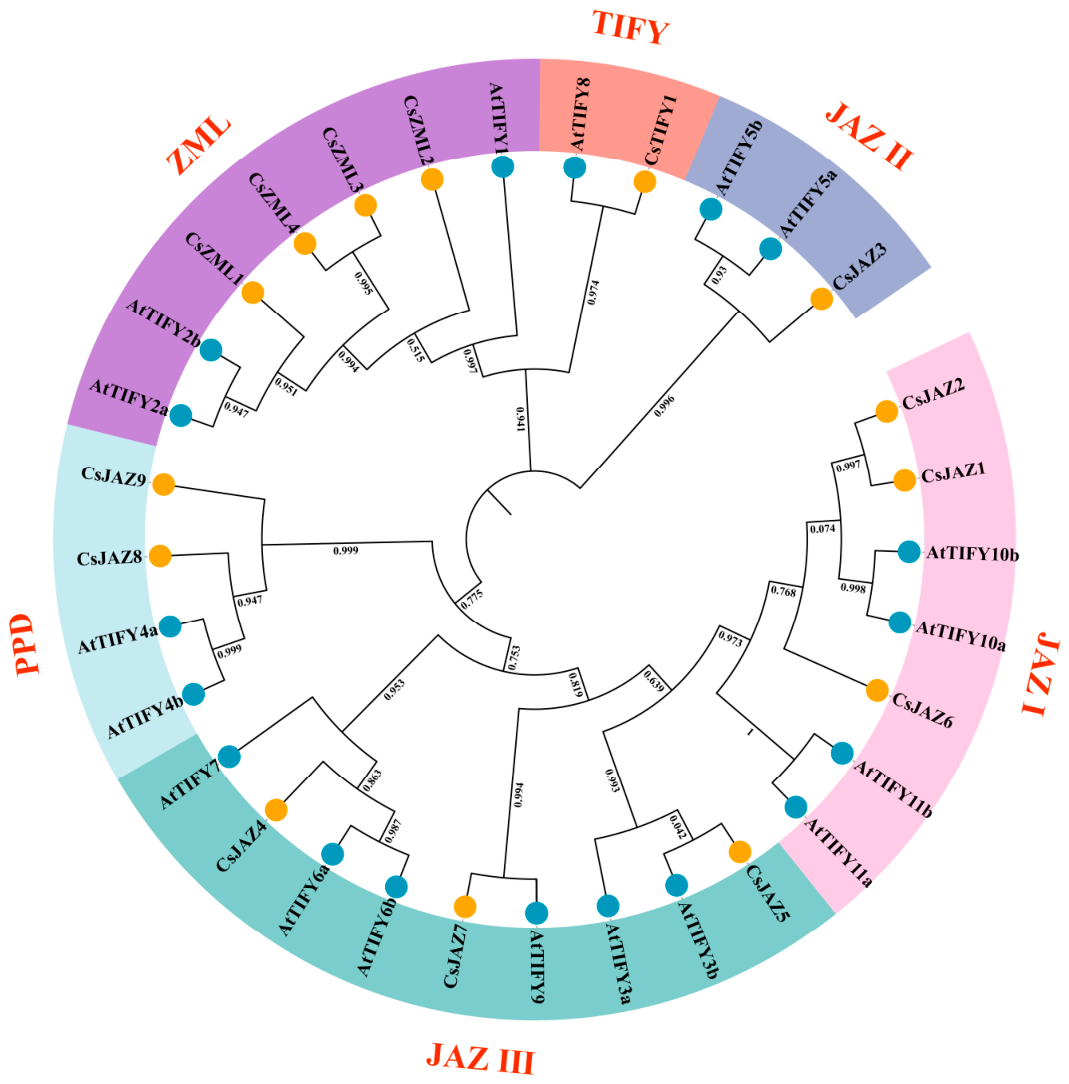
A phylogenetic tree was constructed using the amino acids of 14 CsTIFYs and 18 AtTIFYs (Figure 1). All proteins were clustered into three major subfamilies, namely ZML, JAZ, PPD, and TIFY. Among them, the ZML proteins from two species were clustered together, while the JAZ proteins were divided into three subgroups, namely JAZI, JAZII, and JAZIII. JAZ1, JAZ2, and JAZ6 were clustered into the JAZI subgroup, JAZ3 was clustered into the JAZII subgroup, and JAZ4, JAZ5, and JAZ7 were clustered into the JAZIII subgroup. The JAZ subfamily was more extensive during evolutionary history due to the majority of TIFY proteins that the JAZ subfamily contained. Additionally, the TIFY and PPD proteins were clustered into a single branch with only two members.

3.3. Conserved Motif and Gene Structure of CsTIFY Genes

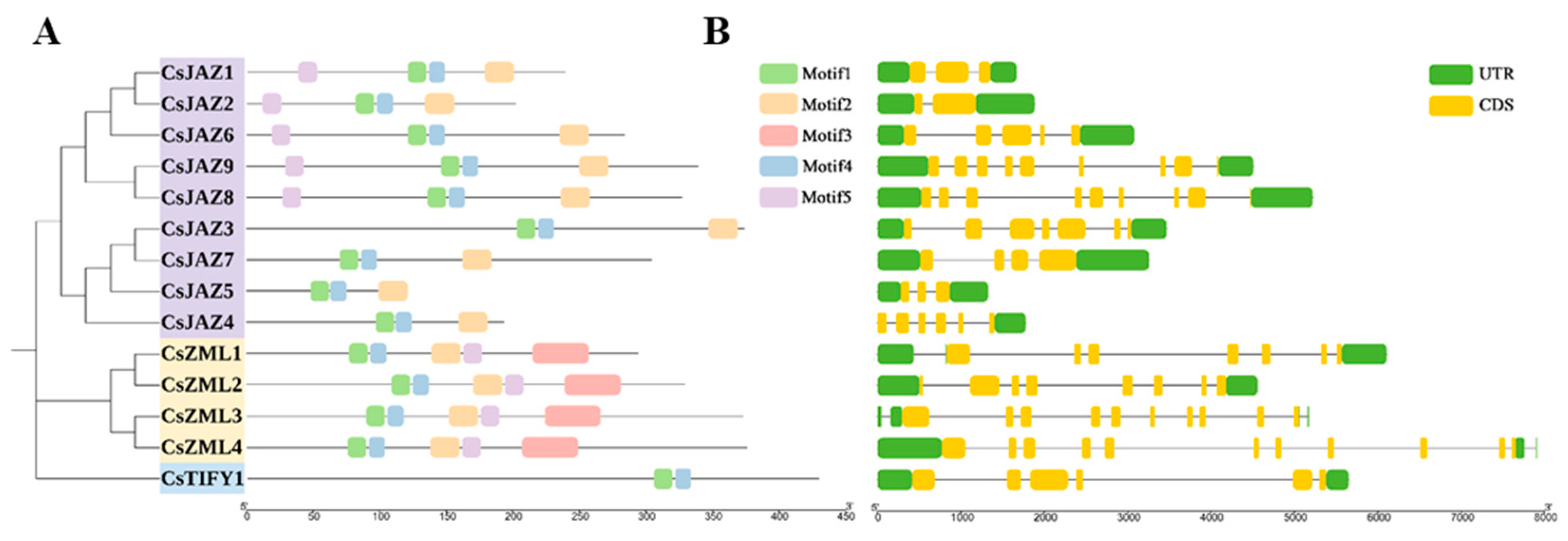
The amino acids were analyzed using MEME online software to identify the conserved motifs. Five conserved motifs were predicted (Figure 2A). Motif 1 and motif 4 were present in all TIFY family genes; motif 1 and motif 4 together formed the TIFY domain (Figure S1); motif 2 was identified as the Jas domain; motif 3 and motif 5 were annotated as the GATA domain and CCT domain. Members of the ZML subfamily contained all five motifs, including the TIFY domain (motif 1 and motif 4), GATA domain (motif 3), CCT domain (motif 5), and Jas domain (motif 2), while the TIFY subfamily only contained the TIFY domain. Additionally, the JAZ subfamily was divided into two parts; one part contained four motifs, including the TIFY domain (motif 1 and motif 4), Jas domain (motif 2), and CCT domain (motif 5), and another part contained only three motifs, except for the CCT domain. As shown in Figure 2B, the CsTIFYs exon-intron numbers were varied from 2 to 11; the CsZML4 had 11 exons, while CsJAZ2 only had two exons. Additionally, genes in the same subfamily often have similar gene structures. The exon numbers of ZML subfamily members were larger than those of other subfamilies.

3.4. Chromosomal Distribution and Synteny Analyses of CsTIFY Genes

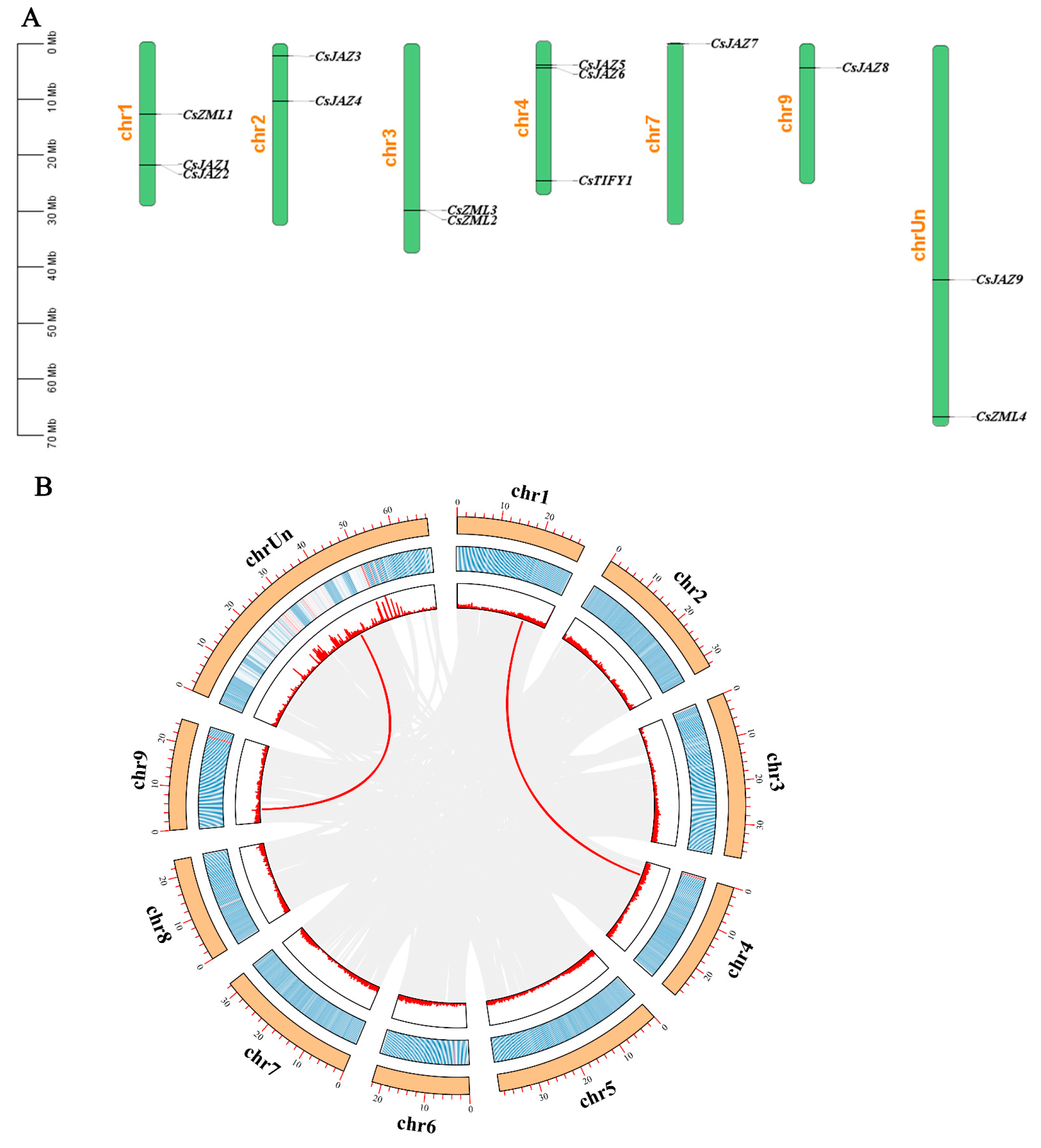
The physical locations of CsTIFY genes were mapped to the nine chromosomes of Citrus sinensis. The results revealed that 14 CsTIFYs were distributed on six chromosomes except Chr 5, 6, and 8 (Figure 3A). Most CsTIFY genes were located on Chr 1 and 4. Two CsTIFY genes failed to be localized on any of the nine chromosomes.
To classify the duplication events of CsTIFY genes during evolution, a synteny analysis was performed using MCscan X (https://github.com/wyp1125 (accessed on 19 May 2026)) and Circos software (https://usegalaxy.eu/?tool_id=circos (accessed on 19 May 2026)). As shown in Figure 3B, two segmental duplication events were identified from CsTIFY genes, which were linked between Chr 1 and Chr 4, and Chr 9 and ChrUn, respectively. That is to say, in the expansion of the CsTIFY gene family, it is the segmental duplication rather than tandem duplication that plays a significant role.

3.5. Syntenic Relationship and Protein Interaction Networks of CsTIFY

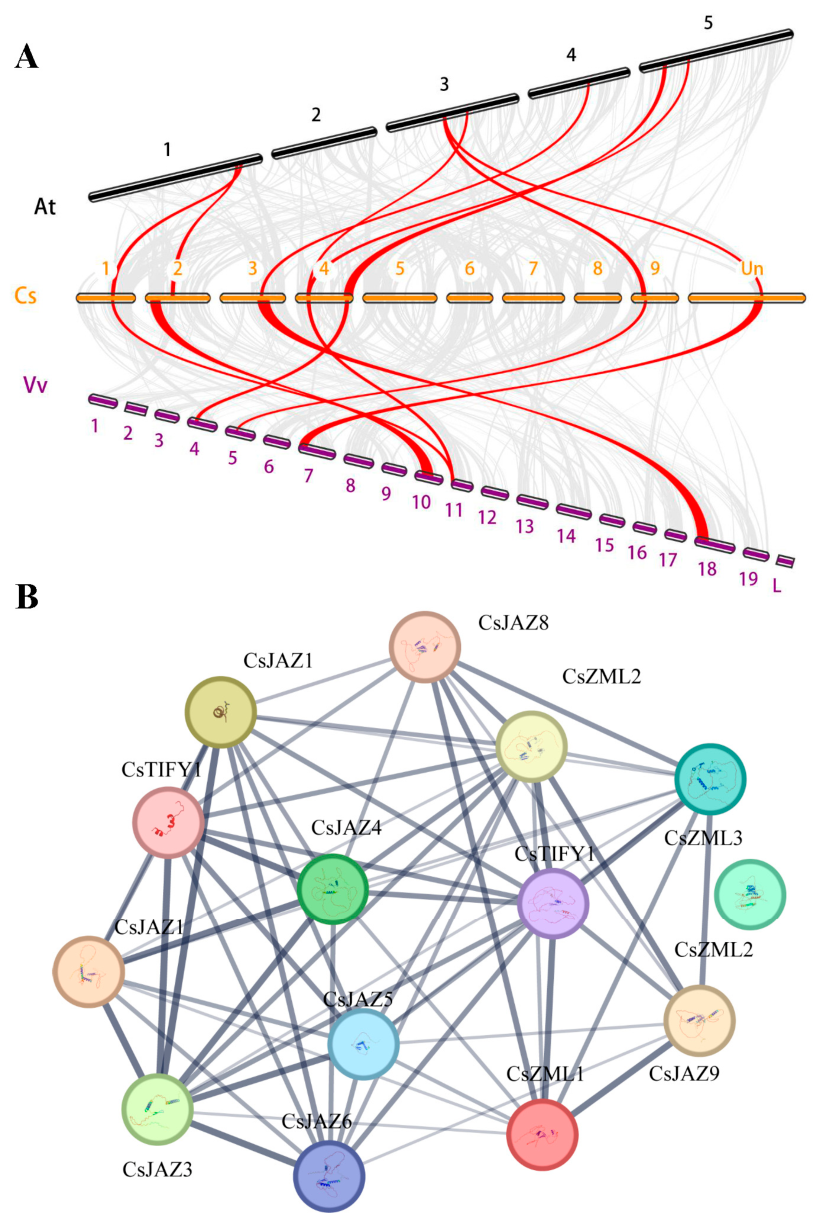
Evolutionary analysis of CsTIFY genes was carried out by tracing syntenic relationships among Citrus sinensis, the monocot model Arabidopsis thaliana, and the dicot Vitis vinifera. The TIFY genes of Citrus sinensis exhibited high homology with both A. thaliana and Vitis vinifera. Among all the 14 CsTIFY genes, eight and seven CsTIFYs showed syntenic relationships with Arabidopsis thaliana and Vitis vinifera, respectively (Figure 4A). The largest number of orthologous gene pairs of C. sinensis, A. thaliana, and V. vinifera were distributed on Chr 4, Chr 3, and Chr 11, respectively. The results indicated that CsTIFY genes were closely related to other TIFY genes of A. thaliana and V. vinifera. The STRING website was used to analyze the potential interaction relationships among the TIFY family in sweet orange (Figure 4B). The results indicated the existence of multiple complex interaction relationships among the TIFY gene family.

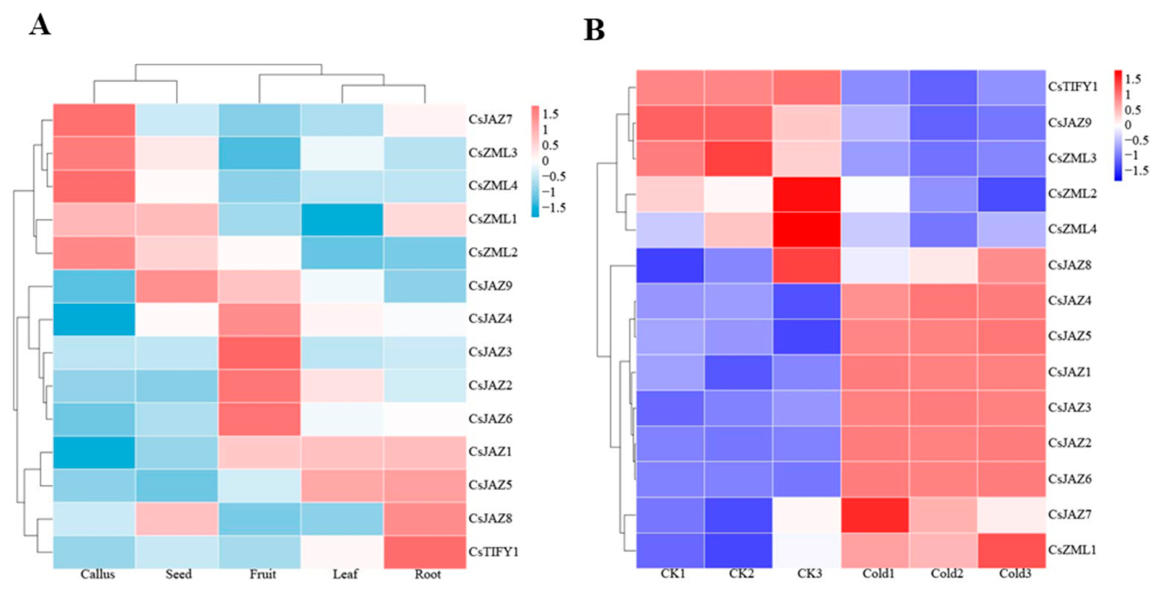
3.6. Expression Profiles of CsTIFY Genes in Different Organs of Citrus Plant

The transcript abundance of the CsTIFY genes was analyzed by high-throughput sequencing data of sweet orange callus, flower, leaf, and fruit. CsJAZ2–4 and CsJAZ6 were highly expressed in fruit, whereas CsJAZ9 was expressed in seeds. CsZML1–4 and CsJAZ7 exhibited elevated expression in callus tissue, suggesting a potential role in regulating cell regeneration processes. Distinct tissue-preferential expression was also observed in leaves and roots. Specifically, CsTIFY1 was highly and specifically expressed in roots, CsJAZ1 and CsJAZ5 were both highly expressed in leaves and roots, and CsJAZ8 was preferentially expressed in seeds and roots (Figure 5A). These results indicate that CsTIFY family members are involved in the growth and development of citrus. We further analyzed the expression patterns of the citrus TIFY gene family under low-temperature stress using RNA-seq data (Tables S3 and S4). The results revealed that CsJAZ1, CsJAZ2, CsJAZ3, CsJAZ4, CsJAZ5, CsJAZ6, CsJAZ7, and CsZML1 showed varying degrees of upregulated expression under low-temperature induction, with JAZ1, JAZ2, and JAZ3 exhibiting particularly pronounced induction (Figure 5B and Figure S2). These findings suggest that these genes, especially CsJAZ1, CsJAZ2, and CsJAZ3, may function importantly under the cold stress of sweet orange.

3.7. Expression Profiles of CsTIFY Genes in a Cold-Tolerant Satsuma Mandarin Under Cold Stress

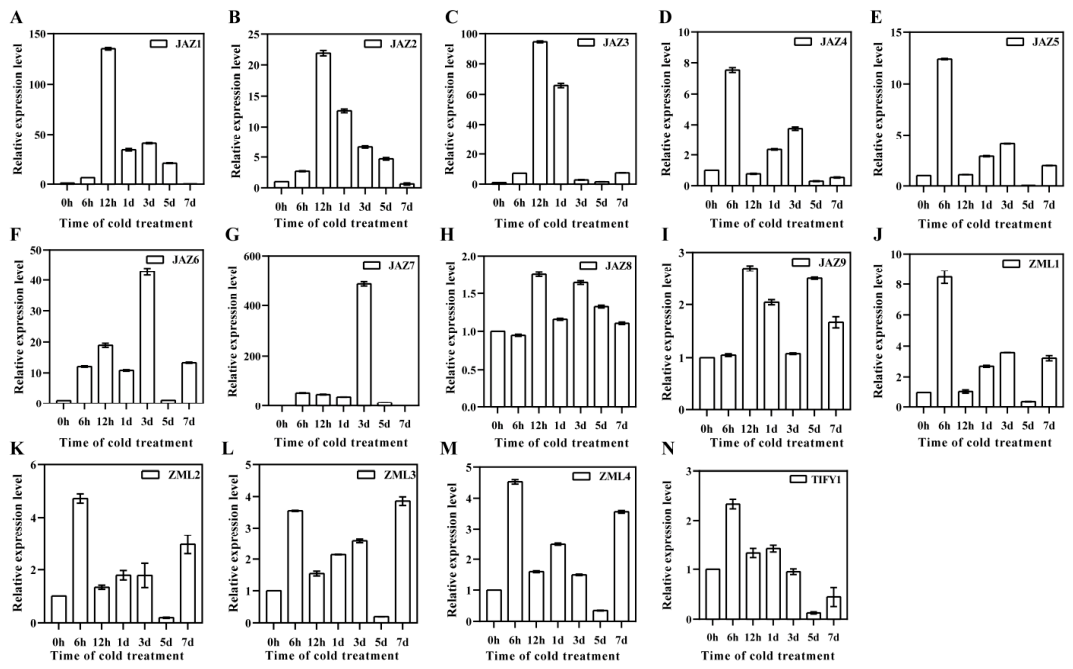
To validate the transcriptome expression profiles, we examined the expression level of the TIFY gene family in sweet orange seedlings under low-temperature treatment. qRT-PCR was performed using three-month-old seedlings under 4 °C at different time points. The results were largely the same with the RNA-seq data. Specifically, CsJAZ1, CsJAZ2, and CsJAZ3 were significantly induced by cold, peaking at 12 h with similar expression trends. CsJAZ4, CsJAZ5, and CsZML1 were also cold-induced, reaching their highest expression at 6 h. In contrast, CsJAZ6 and CsJAZ7 were markedly up-regulated after 5 days of cold treatment, implying their potential roles in long-term cold adaptation, possibly associated with epigenetic regulation or self-repair processes. CsJAZ8 and CsJAZ9 showed no expression changes under cold stress, suggesting they may have no relationship with the low temperature of sweet orange (Figure 6A–N).

3.8. CsJAZ1, CsJAZ2 and CsJAZ3 Were Localized to the Nucleus

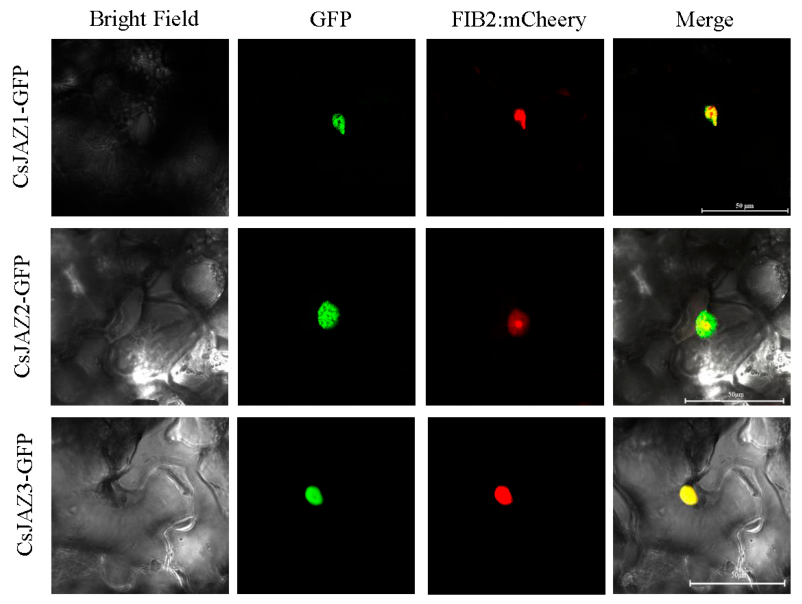
To further investigate the functions of CsJAZ1, CsJAZ2, and CsJAZ3, we cloned the full-length CDS of CsJAZ1, CsJAZ2, and CsJAZ3 fused with GFP under the control of the CaMV 35S. Agrobacterium containing these constructs was transiently infiltrated into tobacco epidermal cells. Confocal laser scanning microscopy found GFP signals were exclusively detected in the nucleus (Figure 7 and Figure S3), indicating CsJAZ1, CsJAZ2, and CsJAZ3 are localized to the nucleus.

3.9. Over-Expression of CsJAZ1, CsJAZ2 and CsJAZ3 Decreased the Cold Tolerance in Citrus Calli

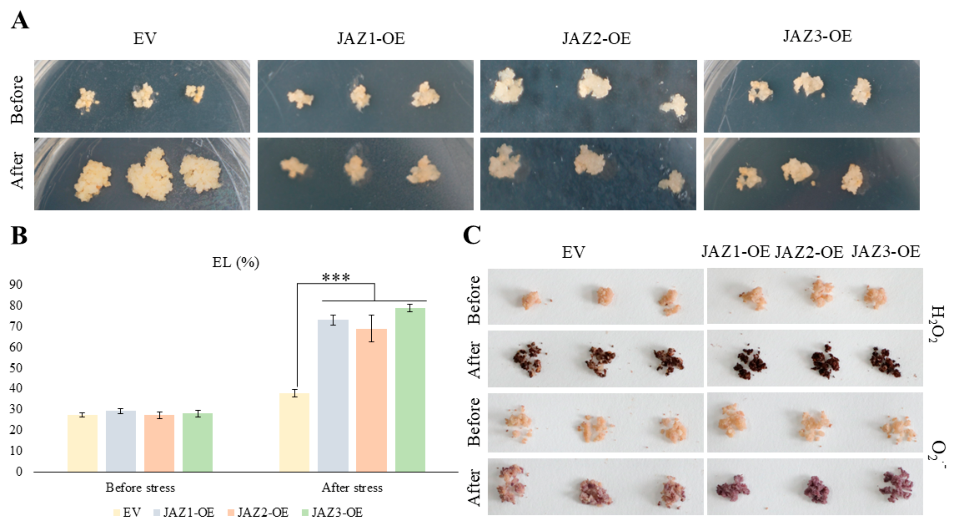
CsJAZ1, CsJAZ2, and CsJAZ3 were significantly upregulated under cold treatment, suggesting that these genes may play critical roles in cold tolerance. To test this hypothesis, we performed overexpression experiments in sweet orange calli via Agrobacterium-mediated genetic transformation. Before treatment, no phenotypic differences were observed between the empty-vector control calli and the CsJAZ1-, CsJAZ2-, or CsJAZ3-overexpressing calli. After 35 days of cold stress, empty-vector calli grew relatively normally, whereas overexpressing CsJAZ1, CsJAZ2, or CsJAZ3 inhibited calli growth (Figure 8A). These results found that overexpressing CsJAZ1, CsJAZ2, and CsJAZ3 significantly reduces cold tolerance in sweet orange calli. In addition, relative electrolyte leakage measurements and ROS accumulation showed that ion leakage and ROS content were markedly higher in the overexpressing calli after cold treatment, indicating more severe membrane damage and ROS accumulation (Figure 8B,C). It should be noted that these phenotypic observations were obtained exclusively from transgenic citrus calli. While callus systems provide a convenient platform for rapid functional screening, they do not fully recapitulate the complexity of whole-plant cold stress responses. Together, these findings demonstrate that CsJAZ1, CsJAZ2, and CsJAZ3 act as negative regulators of cold tolerance in sweet orange.

4. Discussion

Low temperature is the primary limiting factor for the geographical distribution of citrus cultivation. Currently, with continuous research advances, significant progress has been made in understanding the low-temperature stress response in citrus plants [2]. Plants alleviate chilling injury by activating the synthesis and accumulation of osmoprotectants, such as soluble sugars, glycine betaine, polyamines, and proline, as well as novel protective metabolites like chlorogenic acid and sphingolipids [5,9,11,16,17,18,19]. They also maintain membrane fluidity by increasing the proportion of unsaturated fatty acids [27] and ultimately reduce oxidative damage through an activated reactive oxygen species (ROS) scavenging system [11,18]. The expression of genes involved in the synthesis of these metabolites is regulated by upstream transcription factors. Utilizing approaches such as RNA-seq, a large number of low-temperature-induced genes have been identified to be involved in the cold response in citrus. However, systematic studies on the interactive networks and hierarchical regulatory relationships among different pathways, as well as their relative contributions to cold adaptation, are still lacking.
The TIFY family is specific to plants, is widely involved in various developmental processes and stress responses. It achieves this function mainly by regulating the JA signaling pathway [44]. While TIFY genes have been well characterized in model plants like Arabidopsis and major crops, their identification and functional analysis in citrus remain limited. This study identified 14 members of the TIFY gene family in the sweet orange genome through a genome-wide characterization. This number is smaller than that reported in soybean, tomato, and cotton, which is likely attributed to differences in genome size, lineage-specific expansion events, and the distinct evolutionary history of the citrus genus [45,46,47]. The identified CsTIFY genes were categorized into three subfamilies—ZML, JAZ, and TIFY—based on their conserved motifs and phylogenetic relationships, consistent with the established classification system in other plant species (Figure 1). The JAZ subfamily with the highest content of the TIFY gene has significantly expanded, which is consistent with its diverse functions and its crucial role in hormone signaling and stress adaptation.
Gene duplication events serve as a primary driving force for gene family expansion and functional divergence [48]. In the CsTIFY family, two segmental duplication events were identified, whereas no tandem duplications were detected. This suggests that segmental duplication has been the dominant mechanism contributing to the expansion of the CsTIFY family in Citrus sinensis (Figure 3B), a pattern commonly observed in other plant gene families. Synteny analysis further revealed collinear relationships between CsTIFY genes and their orthologs in Arabidopsis thaliana and Vitis vinifera, highlighting the evolutionary conservation of TIFY genes across eudicots (Figure 4). Variations in gene structure, particularly exon–intron organization, were evident among subfamily members (Figure 2B), which may have contributed to functional specialization during evolution.
Expression patterns often provide important clues regarding gene function. Our analysis revealed that CsTIFY members exhibited distinct and tissue-specific expression profiles (Figure 5A), indicating their potential involvement in various aspects of citrus growth and development, such as fruit ripening, seed development, and root differentiation. Importantly, several CsTIFY genes, particularly members of the JAZ subfamily, showed pronounced upregulation in response to low-temperature stress (Figure 5B). Subsequent qRT-PCR validation under controlled cold treatment confirmed that CsJAZ1, CsJAZ2, and CsJAZ3 were strongly induced at the early stage of cold stress (peaking at 12 h), whereas CsJAZ6 and CsJAZ7 were induced only after prolonged exposure (5 d) (Figure 6). The differences in the timing of the occurrence of different expression peaks indicate that different TIFY members may be involved in different stages of the cold response, achieving this through the regulation of different signaling or metabolic pathways.
Functional validation using overexpression in citrus calli demonstrated that overexpression of CsJAZ1, CsJAZ2, or CsJAZ3 significantly reduced cold tolerance, as evidenced by pronounced growth inhibition, browning, and elevated ion leakage under cold stress (Figure 8). Nevertheless, a key limitation of this study is that the functional validation of CsJAZ1, CsJAZ2, and CsJAZ3 was performed solely in transgenic citrus calli. Although callus tissues exhibit heightened sensitivity to environmental stress, which facilitates the detection of phenotypic differences, this experimental system cannot fully represent the integrated physiological responses of intact citrus plants. Thus, the conclusion that these genes act as negative regulators of cold tolerance is currently restricted to the callus system. Future studies employing stable transformation in whole citrus plants or transient assays in leaves are necessary to confirm whether these findings hold true at the whole-plant level. These results collectively indicate that CsJAZ1, CsJAZ2, and CsJAZ3 act as negative regulators of cold tolerance in sweet orange. In Arabidopsis, TIFYs were reported to modulate plant responses to abiotic stresses through the JA signaling pathway [34,39]. Our research has clarified the conserved yet specialized functions of the TIFY gene in the cold adaptation process of perennial fruit trees. The functional divergence among TIFY members—with some acting as early responders and others as late responders—suggests a sophisticated regulatory network fine-tuning the trade-off between growth and stress acclimation.

5. Conclusions

In summary, the CsTIFY gene family in Citrus sinensis was systematically characterized, with 14 members identified and classified into ZML, JAZ, PPD, and TIFY subfamilies. CsJAZ1, CsJAZ2, and CsJAZ3 were significantly induced under cold stress. These three TIFY genes are localized in the nucleus. Their overexpression calli showed increased cold sensitivity with aggravated membrane damage, acting as negative regulators of cold tolerance. However, due to the limitations of the callus-based experimental system, direct extrapolation to whole-plant cold tolerance requires further validation using intact citrus plants. These results provide new insights into the roles of CsTIFY genes in cold stress responses and highlight CsJAZ1, CsJAZ2, and CsJAZ3 as potential targets for genetic improvement of cold tolerance in citrus breeding.

Supplementary Materials

The following supporting information can be downloaded at https://www.mdpi.com/article/10.3390/horticulturae12060748/s1, Figure S1: Motif composition analysis of TIFY proteins. Conserved motif distribution across 14 TIFY proteins; Figure S2: qRT-PCR analysis of the expression pattern of TIFY genes in sweet orange under normal temperature; Figure S3: The overlap of fluorescence intensity peaks as indicated in the merged micrograph. The distributions and intensities of GFP and RFP signals along the line are shown. a.u., arbitrary units; Table S1: Basic information of the TIFY genes in Citrus sinensis; Table S2: Primers of gene expression for qRT-PCR analysis; Table S3: The expression levels and fold change in the TIFY family genes under low temperatures; Table S4: The expression levels and fold change in the TIFY family genes under normal conditions.

Author Contributions

Conceptualization, Y.Z. and F.S.; methodology, Y.Z., L.H., X.S., Y.F. and F.S.; software, Y.Z., L.H., X.S., Y.F. and F.S.; validation, Y.Z. and L.H.; formal analysis, Y.Z.; investigation, Y.Z., L.H., Z.W., C.X. and C.W.; resources, L.H., Z.W., C.W., Y.J., L.W. and F.S.; data curation, Y.Z., L.H. and F.S.; writing—original draft preparation, Y.Z. and F.S.; writing—review and editing, Y.Z., L.H., Z.W., X.S., Y.F., L.W., C.X. and F.S.; visualization, Y.Z. and L.H.; supervision, Y.J., L.W. and F.S.; project administration, Y.J. and L.W.; funding acquisition, Y.Z., Y.J., L.W. and F.S. All authors have read and agreed to the published version of the manuscript.

Funding

This study was supported by the National Key Research and Development Program of China (2024YFD2300800), the National Natural Science Foundation of China (32302475), the Provincial Technology Innovation Plan Project (2025BBB009), the Youth Foundation of Hubei Academy of Agricultural Sciences (2024NKYJJ22), the Post-doctoral Innovation Practice Project of Hubei Province (ERSH-2023-48), the Innovation Team Project of Hubei Provincial Agricultural Science and Technology Innovation Center (2026-620-000-001-023), and the Hubei Province Citrus Industry Chain Science and Technology Research Project (202501).

Data Availability Statement

The original contributions presented in this study are included in the article/Supplementary Material. Further inquiries can be directed to the corresponding authors.

Acknowledgments

The authors gratefully acknowledge Jian Zhu from the Fruit and Tea Research Institute, Hubei Academy of Agricultural Sciences, for significant contributions to the bioinformatics analysis in this study, particularly for expert guidance and assistance in the collinearity analysis and protein–protein interaction analysis. We acknowledge the use of DeepSeek, an AI language model, for language polishing assistance during the revision of this manuscript. No substantive scientific content was altered. The authors also sincerely thank the reviewers for their insightful comments and valuable suggestions on this manuscript.

Conflicts of Interest

The authors assert that the work was performed free of any commercial or financial ties that could be construed as a conflict of interest.

References

  1. Roussos, P.A. Orange (Citrus sinensis (L.) Osbeck). In Nutritional Composition of Fruit Cultivars; Academic Press: Cambridge, MA, USA, 2016; pp. 469–496. [Google Scholar]
  2. Dahro, B.; Li, C.; Liu, J.H. Overlapping responses to multiple abiotic stresses in citrus: From mechanism understanding to genetic improvement. Hortic. Adv. 2023, 1, 4. [Google Scholar] [CrossRef]
  3. Liu, Y.Z.; Deng, X.X. Citrus Breeding and Genetics in China. Asian Australas. J. Plant Sci. Biotechnol. 2007, 1, 23–28. [Google Scholar]
  4. Vives-Peris, V.; Pérez-Clemente, R.M.; Gómez-Cadenas, A.; López-Climent, M.F. Involvement of citrus shoots in response and tolerance to abiotic stress. Hortic. Adv. 2024, 2, 3. [Google Scholar] [CrossRef]
  5. Dahro, B.; Wang, Y.; Khan, M.; Zhang, Y.; Fang, T.; Ming, R.; Li, C.; Liu, J.H. Two AT-Hook proteins regulate A/NINV7 expression to modulate sucrose catabolism for cold tolerance in Poncirus trifoliata. New Phytol. 2022, 235, 2331–2349. [Google Scholar] [PubMed]
  6. Ding, Y.; Shi, Y.; Yang, S. Molecular regulation of plant responses to environmental temperatures. Mol. Plant 2020, 13, 544–564. [Google Scholar] [CrossRef] [PubMed]
  7. Guo, Q.; Li, X.; Niu, L.; Jameson, P.E.; Zhou, W. Transcription-associated metabolomic adjustments in maize occur during combined drought and cold stress. Plant Physiol. 2021, 186, 677–695. [Google Scholar] [CrossRef] [PubMed]
  8. Huang, X.S.; Zhang, Q.; Zhu, D.; Fu, X.; Wang, M.; Zhang, Q.; Moriguchi, T.; Liu, J.H. ICE1 of Poncirus trifoliata functions in cold tolerance by modulating polyamine levels through interacting with arginine decarboxylase. J. Exp. Bot. 2015, 66, 3259–3274. [Google Scholar] [CrossRef] [PubMed]
  9. Khan, M.; Hu, J.; Dahro, B.; Ming, R.; Zhang, Y.; Wang, Y.; Alhag, A.; Li, C.; Liu, J.H. ERF108 from Poncirus trifoliata (L.) Raf. functions in cold tolerance by modulating raffinose synthesis through transcriptional regulation of PtrRafS. Plant J. 2021, 108, 705–724. [Google Scholar] [CrossRef] [PubMed]
  10. Shi, Y.; Ding, Y.; Yang, S. Cold signal transduction and its interplay with phytohormones during cold acclimation. Plant Cell Physiol. 2015, 56, 7–15. [Google Scholar] [PubMed]
  11. Wang, M.; Dai, W.; Du, J.; Ming, R.; Dahro, B.; Liu, J.H. ERF109 of trifoliate orange (Poncirus trifoliata (L.) Raf.) contributes to cold tolerance by directly regulating expression of Prx1 involved in antioxidative process. Plant Biotechnol. J. 2019, 17, 1316–1332. [Google Scholar] [PubMed]
  12. Banerjee, A.; Roychoudhury, A. Abscisic-acid-dependent basic leucine zipper (bZIP) transcription factors in plant abiotic stress. Protoplasma 2017, 254, 3–16. [Google Scholar] [PubMed]
  13. Huang, G.T.; Ma, S.L.; Bai, L.P.; Zhang, L.; Ma, H.; Jia, P.; Liu, J.; Zhong, M.; Guo, Z.F. Signal transduction during cold, salt, and drought stresses in plants. Mol. Biol. Rep. 2012, 39, 969–987. [Google Scholar] [PubMed]
  14. Jan, S.; Abbas, N.; Ashraf, M.; Ahmad, P. Roles of potential plant hormones and transcription factors in controlling leaf senescence and drought tolerance. Protoplasma 2019, 256, 313–329. [Google Scholar] [PubMed]
  15. Manna, M.; Thakur, T.; Chirom, O.; Mandlik, R.; Deshmukh, R.; Salvi, P. Transcription factors as key molecular target to strengthen the drought stress tolerance in plants. Physiol. Plant 2021, 172, 847–868. [Google Scholar] [PubMed]
  16. Ming, R.; Zhang, Y.; Wang, Y.; Khan, M.; Dahro, B.; Liu, J.H. The JA-responsive MYC2-BADH-like transcriptional regulatory module in Poncirus trifoliata contributes to cold tolerance by modulation of glycine betaine biosynthesis. New Phytol. 2021, 229, 2730–2750. [Google Scholar] [PubMed]
  17. Xiao, W.; Zhang, Y.; Wang, Y.; Zeng, Y.; Shang, X.; Meng, L.; Zhang, Y.; Fang, T.; Xiao, P.; Qu, J.; et al. The transcription factor TGA2 orchestrates salicylic acid signal to regulate cold-induced proline accumulation in Citrus. Plant Cell 2024, 30, 321. [Google Scholar]
  18. Zhang, Y.; Ming, R.; Khan, M.; Wang, Y.; Dahro, B.; Xiao, W.; Li, C.; Liu, J.H. ERF9 of Poncirus trifoliata (L.) Raf. undergoes feedback regulation by ethylene and modulates cold tolerance via regulating a glutathione S-transferase U17 gene. Plant Biotechnol. J. 2022, 20, 183–200. [Google Scholar] [PubMed]
  19. Zhang, Y.; Zhu, J.; Khan, M.; Wang, Y.; Xiao, W.; Fang, T.; Qu, J.; Xiao, P.; Li, C.; Liu, J.H. Transcription factors ABF4 and ABR1 synergistically regulate amylase-mediated starch catabolism in drought tolerance. Plant Physiol. 2023, 191, 591–609. [Google Scholar] [PubMed]
  20. An, J.P.; Wang, X.F.; Zhang, X.W.; You, C.X.; Hao, Y.J. Apple B-box protein BBX37 regulates jasmonic acid mediated cold tolerance through the JAZ-BBX37-ICE1-CBF pathway and undergoes MIEL1-mediated ubiquitination and degradation. New Phytol. 2021, 229, 2707–2729. [Google Scholar] [PubMed]
  21. Huang, X.; Hu, Z.; Chen, L. CdJACG1 integrates jasmonic acid signaling and CBF pathways to confer cold tolerance in bermudagrass (Cynodon dactylon). Plant Physiol. 2026, 200, kiag129. [Google Scholar] [CrossRef] [PubMed]
  22. Lv, Y.; Yang, M.; Hu, D.; Yang, Z.; Ma, S.; Li, X.; Xiong, L. The OsMYB30 transcription factor suppresses cold tolerance by interacting with a JAZ protein and suppressing β-Amylase expression. Plant Physiol. 2017, 173, 1475–1491. [Google Scholar] [PubMed]
  23. Qi, C.; Dong, D.; Li, Y.; Wang, X.; Guo, L.; Liu, L.; Dong, X.; Li, X.; Yuan, X.; Ren, S.; et al. Heat shock-induced cold acclimation in cucumber through CsHSFA1d-activated JA biosynthesis and signaling. Plant J. 2022, 111, 85–102. [Google Scholar] [PubMed]
  24. Jia, H.; Hewitt, N.; Jordá, L.; Abramyan, T.M.; Tolliver, J.; Jones, J.L.; Nomura, K.; Yang, J.; He, S.Y.; Tropsha, A.; et al. Phosphorylation-activated G protein signaling stabilizes TCP14 and JAZ3 to repress JA signaling and enhance plant immunity. Mol. Plant 2025, 18, 1171–1192. [Google Scholar] [CrossRef] [PubMed]
  25. Huang, Y.; Wang, M.; Zhang, Z.; Liu, X.; Li, J.; Han, L.; Zhu, P.; Li, L. Genome-wide identification of the JAZ family in Quinoa and the negative regulatory role of CqJAZ1 in abiotic stress responses. Int. J. Mol. Sci. 2026, 27, 2406. [Google Scholar] [PubMed]
  26. Liu, L.; Tang, C.; Zhang, Y.; Sha, X.; Tian, S.; Luo, Z.; Wei, G.; Zhu, L.; Li, Y.; Fu, J.; et al. The SnRK2.2-ZmHsf28-JAZ14/17 module regulates drought tolerance in maize. New Phytol. 2025, 245, 1985–2003. [Google Scholar] [PubMed]
  27. Wang, Y.; Zuo, L.; Wei, T.; Zhang, Y.; Zhang, Y.; Ming, R.; Bachar, D.; Xiao, W.; Madiha, K.; Chen, C.; et al. CHH methylation of genes associated with fatty acid and jasmonate biosynthesis contributes to cold tolerance in autotetraploids of Poncirus trifoliata. J. Integr. Plant Biol. 2022, 64, 2327–2343. [Google Scholar] [CrossRef] [PubMed]
  28. Yan, Q.; Xia, H.; Huang, W.; Li, Z.; Zhang, T.; Wu, Y.; Chen, H.; Zhang, Y.; Zou, J. The OfJAZ gene family in Osmanthus fragrans: IV-OfJAZs regulate petal senescence via hormonal crosstalk. Ind. Crops Prod. 2026, 242, 122966. [Google Scholar]
  29. Tang, Y.; Meng, X.; Chen, P.; Yu, D.; Li, T.; Ma, W. Genome-wide analysis of the TIFY gene family in Litchi (Litchi chinensis Sonn.): Identification and expression profiling. Biology 2026, 15, 445. [Google Scholar] [CrossRef] [PubMed]
  30. Wang, X.; Lan, Q.; Li, X.; Zhao, Y. Genomic analysis of TIFY genes in two Medicago and insight into MsTF2-mediated abiotic stress tolerance. Plant Cell Rep. 2026, 45, 23. [Google Scholar] [PubMed]
  31. Zhang, K.; Zhou, Y.; Jiang, Y.; Zhou, Y.; Song, J.; Zhang, J.; Guo, J.; Li, L.; Zhang, X. Genome-wide identification of the TIFY gene family in Helianthus annuus and expression analysis in response to drought and salt stresses. Sci. Rep. 2025, 15, 15138. [Google Scholar] [CrossRef] [PubMed]
  32. Gayubas, B.; Castillo, M.C.; Ramos, S. Enhanced Meristem development, rolerance to oxidative stress and hyposensitivity to nitric oxide in the hypermorphic vq10-H mutant in AtVQ10 Gene. Plant Cell Environ. 2023, 46, 3445–3463. [Google Scholar] [CrossRef] [PubMed]
  33. Lv, B.; Deng, H.; Wei, J.; Feng, Q.; Liu, B.; Zuo, A.; Bai, Y.; Liu, J.; Dong, J.; Ma, P. SmJAZs-SmbHLH37/SmERF73-SmSAP4 module mediates jasmonic acid signaling to balance biosynthesis of medicinal metabolites and salt tolerance in Salvia miltiorrhiza. New Phytol. 2024, 244, 1450–1466. [Google Scholar] [PubMed]
  34. Wang, M.; Wang, T.; Kou, J.; Wu, J.; Shao, G.; Wei, J.; Liu, J.; Ma, P. SmJAZ3/4 positively and SmJAZ8 negatively regulates salt tolerance in transgenic Arabidopsis thaliana. Plant Physiol. Biochem. 2024, 216, 109151. [Google Scholar] [CrossRef] [PubMed]
  35. Zhu, D.; Bai, X.; Chen, C.; Chen, Q.; Cai, H.; Li, Y.; Ji, W.; Zhai, H.; Lv, D.; Luo, X.; et al. GsTIFY10, a novel positive regulator of plant tolerance to bicarbonate stress and a repressor of jasmonate signaling. Plant Mol. Biol. 2011, 77, 285–297. [Google Scholar] [CrossRef] [PubMed]
  36. Huai, J.; Gao, N.; Yao, Y.; Du, Y.; Guo, Q.; Lin, R. JASMONATE ZIM-domain protein 3 regulates photomorphogenesis and thermomorphogenesis through inhibiting PIF4 in Arabidopsis. Plant Physiol. 2024, 195, 2274–2288. [Google Scholar] [CrossRef] [PubMed]
  37. Wang, Z.; Sun, Z.; Pan, H.; Li, W.; Huang, L.; Wang, F.; Zhang, Q.; Yu, X.; Li, D.; Li, L.; et al. AcJAZ2L2 confers resistance to kiwifruit bacterial canker via regulation of JA signaling and stomatal immunity. Hortic. Res. 2025, 11, uhaf215. [Google Scholar]
  38. Wang, X.; Yu, Z.; Chen, H.; Lu, J.; Li, X.; Wang, B.; Li, F.; Xu, H.; Chen, W.; Xu, Q. A Jasmonate ZIM-domain subfamily protein regulates drought tolerance via modulating the stomatal density in rice. Plant J. 2025, 124, e70539. [Google Scholar] [CrossRef] [PubMed]
  39. Xiong, J.; Huang, B.; Peng, D.; Shen, Q.; Wu, D.; Zhang, G. JAZ2 negatively regulates drought tolerance in Barley by modulating PLT2 expression. Plant Cell Environ. 2025, 48, 699–710. [Google Scholar] [PubMed]
  40. Li, A.; Wang, H.; Badrunnesa, A.; Meng, J.; Gao, Y.; Sun, S.; Niu, L.; Pan, L.; Duan, W.; Cui, G.; et al. JAZ2/JAZ4-MYC2.1 module mediates MeJA-induced alleviation of chilling injury in peach fruit (Prunus persica). Hortic. Res. 2025, 13, uhaf295. [Google Scholar] [PubMed]
  41. Lin, M.; Zhang, Z.; Zhang, Q.; Sun, S.; Li, Y.; Liu, M.; Li, Y.; Li, C.; Fang, J.; Qi, X. Single-cell sequencing reveals dynamic cell development trajectories in two kiwifruit (Actinidia chinensis) genotypes with contrasting cold resistance. Hortic. Adv. 2025, 3, 24. [Google Scholar] [CrossRef]
  42. Fuchsová, B.; Novák, P.; Kafková, J.; Hozák, P. Nuclear DNA helicase II is recruited to IFN-alpha-activated transcription sites at PML nuclear bodies. J. Cell Biol. 2002, 158, 463–473. [Google Scholar] [PubMed]
  43. Guo, Y.; Bao, Z.; Shi, M.; Zheng, Q.; Huo, Y.; Hu, R.; Guan, Y.; Cao, S.; Hussey, P.J.; Deng, X.; et al. Autophagy plays a dual role in chromoplast transition and degradation and is essential for fruit coloration and ripening. Autophagy 2025, 21, 2058–2068. [Google Scholar] [CrossRef] [PubMed]
  44. Hakata, M.; Muramatsu, M.; Nakamura, H.; Hara, N.; Kishimoto, M.; Iida-Okada, K.; Kajikawa, M.; Imai-Toki, N.; Toki, S.; Nagamura, Y.; et al. Overexpression of TIFY genes promotes plant growth in rice through jasmonate signaling. Biosci. Biotechnol. Biochem. 2017, 81, 906–913. [Google Scholar] [CrossRef] [PubMed]
  45. Heidari, P.; Faraji, S.; Ahmadizadeh, M.; Ahmar, S.; Mora-Poblete, F. New insights into structure and function of TIFY genes in Zea mays and Solanum lycopersicum: A genome-side comprehensive analysis. Front. Genet. 2021, 12, 657970. [Google Scholar] [PubMed]
  46. Liu, Y.L.; Zheng, L.; Jin, L.G.; Liu, Y.X.; Kong, Y.N.; Wang, Y.X.; Yu, T.F.; Chen, J.; Zhou, Y.B.; Chen, M.; et al. Genome-wide analysis of the soybean TIFY family and identification of GmTIFY10e and GmTIFY10g response to salt stress. Front. Plant Sci. 2022, 13, 845314. [Google Scholar] [CrossRef] [PubMed]
  47. Xie, S.; Cui, L.; Lei, X.; Yang, G.; Li, J.; Nie, X.; Ji, W. The TIFY gene family in wheat and its progenitors: Genome-wide identification, evolution and expression analysis. Curr. Genom. 2019, 20, 371–388. [Google Scholar] [CrossRef]
  48. Sheridan, P.O.; Raguideau, S.; Quince, C.; Holden, J.; Zhang, L.; Consortium, T.; Williams, T.A.; Gubry-Rangin, C. Gene duplication drives genome expansion in a major lineage of Thaumarchaeota. Nat. Commun. 2020, 11, 5494. [Google Scholar] [CrossRef] [PubMed]
Figure 1. Phylogenetic tree analysis of TIFY proteins in Arabidopsis thaliana and Citrus sinensis.
Horticulturae 12 00748 g001
Figure 2. Conserved motifs and gene structure of the CsTIFY gene. (A) Conserved motifs analysis of sweet orange. (B) Structural annotation of TIFY family genes.
Horticulturae 12 00748 g002
Figure 3. Chromosome distribution and collinearity analysis of the CsTIFY gene. (A) Chromosomal distribution map showing physical positions of TIFY genes across 9 chromosomes. (B) Collinearity analysis of TIFY genes within the sweet orange genome, different color represents the chromosome distribution, gene density and GC content distribution.
Horticulturae 12 00748 g003
Figure 4. Syntenic relationship and protein interaction network of the TIFY gene family member. (A) Covariance analysis of TIFY genes in C. sinensis, A. thaliana, and Vitis vinifera, red lines represent gene pairs with high potential for collinearity (B) Interactions among TIFY family members predicted by the STRING database.
Horticulturae 12 00748 g004
Figure 5. The heatmap of tissue-specific and low-temperature expression of TIFY genes in sweet orange. (A) The heatmap showed the expression levels of TIFY genes in different tissues and developmental stages of sweet orange. (B) The heatmap of TIFY gene expression levels in sweet orange leaves before and after cold treatment. Values in all three heatmaps are represented as log2 (FPKM + 1), with rows normalized and genes with FPKM values of zero across all samples excluded. The dendrograms at the top and left side of the heatmap illustrate the similarity relationships among the samples and genes, respectively.
Horticulturae 12 00748 g005
Figure 6. qRT-PCR analysis of the expression pattern of TIFY genes in sweet orange under low temperature. (A) CsJAZ1, (B) CsJAZ2, (C) CsJAZ3, (D) CsJAZ4, (E) CsJAZ5, (F) CsJAZ6 (G) CsJAZ7, (H) CsJAZ8, (I) CsJAZ9, (J) ZML1, (K) ZML2, (L) ZML3, (M) ZML4, (N) TIFY1. The error bars represent ± SDs (n = 3).
Horticulturae 12 00748 g006
Figure 7. Subcellular localization analysis of JAZ1, JAZ2, and JAZ3.
Horticulturae 12 00748 g007
Figure 8. Overexpression of JAZ1, JAZ2, and JAZ3 reduces the cold tolerance of sweet orange callus. (A) Phenotype of EV and OE callus before and after cold treatment. (B) Electrolyte leakage of EV and OE callus before and after cold treatment. (C) In situ visualization of H2O2 and O2.− in transgenic callus and EV before and after cold treatment, as revealed by histochemical staining with DAB and NBT, respectively. Error bars indicate ± SE (n = 3). Asterisks indicate significant differences between the control and OE lines under the same growth condition (*** p < 0.001).
Horticulturae 12 00748 g008
Table 1. Physicochemical properties of C. sinensis TIFY gene family members.
Gene NameGene IDNumber of Amino Acid ResiduesMolecular WeightIsoelectric Point (pI)Grand Average of Hydropathicity (GRAVY)The Instability Index (II)
CsZML1Cs1g_pb00873029332,054.56.15−0.78734.51
CsJAZ1Cs1g_pb01624023825,864.949.1−0.53249.08
CsJAZ2Cs1g_pb01625020121,978.749.49−0.545.18
CsJAZ3Cs2g_pb00787012013,548.38.64−0.5481.64
CsJAZ4Cs2g_pb01058037339,877.199.29−0.3144.47
CsZML2Cs3g_pb02371032835,232.95.36−0.61250.42
CsZML3Cs3g_pb02372037240,633.734.68−0.77748.95
CsJAZ5Cs4g_pb00543030333,393.458.95−0.18550.35
CsJAZ6Cs4g_pb00604028330,240.958.42−0.50559.41
CsTIFY1Cs4g_pb02367042945,291.539.22−0.5557.59
CsJAZ7Cs7g_pb00503019221,637.48.91−0.72148.07
CsJAZ8Cs9g_pb00440033837,308.858.79−0.70943.58
CsJAZ9CsUn_pb03396032635,899.216.16−0.64970.82
CsZML4CsUn_pb05340037541,116.144.77−0.80649.62
Disclaimer/Publisher’s Note: The statements, opinions and data contained in all publications are solely those of the individual author(s) and contributor(s) and not of MDPI and/or the editor(s). MDPI and/or the editor(s) disclaim responsibility for any injury to people or property resulting from any ideas, methods, instructions or products referred to in the content.