Article

Soil Chemistry and Stoichiometric Responses of Male and Female Torreya grandis to Nitrogen Deposition Under Salt Stress


Jiyang College, Zhejiang A&F University, Zhuji 311800, China
*
Authors to whom correspondence should be addressed.
These authors contributed equally to this work.
Horticulturae 2026, 12(6), 723; https://doi.org/10.3390/horticulturae12060723 (registering DOI)
Submission received: 9 May 2026 / Revised: 4 June 2026 / Accepted: 10 June 2026 / Published: 12 June 2026

Abstract

Increased atmospheric nitrogen (N) deposition and soil salinization commonly co-occur in subtropical economic forests, and responses to these stressors differ between sexes in dioecious plants. In this study, we explored soil chemical and stoichiometric responses of male and female Torreya grandis to N deposition under salt stress by adopting a two-factor completely randomized design. The two factors were (1) plant sex (2-year-old grafted male and female seedlings of T. grandis) and (2) environmental treatment (four nitrogen deposition levels: low, moderate, and high N combined with salt stress, as well as a control without salt addition). We then determined the rhizosphere C, N, P, Ca, K, and Mg concentrations and their stoichiometric ratios. The results showed that all indicators were significantly affected by sex, nitrogen treatment and their interaction (p < 0.0001). Males maintained significantly higher soil C and N levels than females across all treatments, with female soil N and C contents being 5.74–25.72% and 10.78–23.64% lower than those of males, respectively, and exhibiting far more stable stoichiometry. Moderate nitrogen deposition (SMN) increased male C:N, C:P and N:P ratios by 38.76%, 59.75% and 13.84%, distinctly lower than the 85.89%, 98.20% and 16.04% increments in females. In contrast, females had higher Mg content under all salt–nitrogen-combined treatments and greater stoichiometric plasticity, showing a 37.55% higher C:N ratio than males under low nitrogen addition (SLN). Moderate N relieved salt-induced nutrient limitation and alleviated salt-induced P immobilization, while excessive N (SHN) exacerbated stoichiometric imbalance: SHN elevated the N:P ratio by 109.73% in males and only 69.59% in females, narrowing the sexual difference in C:N ratio to 10.92% and triggering severe phosphorus limitation in male rhizosphere soil. Soil–leaf nutrient relationships and correlations differed greatly between sexes, indicating divergent nutrient adaptation strategies. Males adopted a Ca-dominated stress tolerance strategy, and females depended on Mg homeostasis for reproduction. This work provides a scientific basis for sex-specific nutrient regulation and sustainable cultivation of T. grandis under global change.

1. Introduction

Global atmospheric nitrogen (N) deposition is rising steadily, while soil salinization is spreading worldwide; together, these two stressors pose major threats to terrestrial ecosystem integrity and forest tree vitality [1,2]. Excess N input from anthropogenic activities disrupts plant nutrient balance, suppresses phosphorus (P) uptake, and exacerbates the inherent P limitation in subtropical forests, thereby altering soil physicochemical traits, microbial communities, and enzyme activities, which reshape root function and nutrient cycling [3,4]. Soil salinization impairs root water uptake, triggers accumulation of toxic metabolites, and degrades soil fertility, severely constraining agricultural and forestry productivity globally [5,6]. These stresses frequently co-occur in subtropical economic forests, yet their interactive impacts on tree growth, nutrient metabolism, and stress resilience remain poorly resolved.
Salt stress inhibits soil microbial metabolic activity, reduces nutrient solubility, and disrupts rhizosphere ionic homeostasis, thereby limiting plant uptake of N and P [7,8], while N deposition alters soil N:P ratios, stimulates microbial competition for nutrients, and modifies root exudate composition, further exacerbating salt-induced nutrient imbalance [4]. The interactive effects of these two stressors are not simply additive: low-concentration N can alleviate N limitation under salt stress and promote microbial decomposition and plant growth, whereas high-concentration N synergizes with salt ions to disrupt rhizosphere stoichiometric balance and aggravate plant nutritional stress [9,10].
Dioecious plants exhibit significant sexual dimorphism in their stress responses due to the unequal allocation of reproductive resources [11]. Approximately 64% of gymnosperms are dioecious, and female plants—incurring greater reproductive costs—often differ markedly from males in their tolerance to drought, heavy metals, and other abiotic pressures [12,13]. Most research has focused on single stressors (N deposition or salinity), while integrated studies of combined stressors are scarce. Investigations into sexual differences in soil chemistry and stoichiometry under stress are especially lacking for gymnosperms with high economic value, limiting precision cultivation and soil nutrient management.
Torreya grandis is an iconic, high-value gymnosperm endemic to subtropical China, and its production areas are increasingly subjected to concurrent N deposition and soil salinization. Previous studies have shown that N deposition shapes kernel quality, biomass partitioning, and nutrient uptake in T. grandis: moderate nitrogen application improves nutritional quality, whereas excessive nitrogen imposes negative effects [14,15]. Sexual differences in stress tolerance are well documented: female T. grandis exhibits stronger drought and salinity resistance via a more effective antioxidant system, and exogenous nitric oxide can further boost salt tolerance [16,17,18]. However, three critical knowledge gaps remain: (1) existing T. grandis studies have only focused on leaf physiology and growth under a single stressor, with no reports on rhizosphere soil processes under combined N deposition and salt stress; (2) research on dioecious plants under combined stress is dominated by angiosperms (Populus, Salix), and the mechanisms of sexual differentiation in gymnosperm rhizosphere chemistry remain unknown [13]; and (3) the linkage between soil stoichiometric traits and sex-specific nutrient adaptation strategies has not been established, preventing evidence-based sex-specific cultivation. This study is the first to systematically investigate rhizosphere soil chemistry and stoichiometric responses of male and female T. grandis to combined salt stress and N deposition, filling these critical knowledge gaps.
Soil chemistry and ecological stoichiometry are pivotal indicators of nutrient availability, stress intensity, and plant–soil feedback, directly governing tree nutrient acquisition and growth [19,20]. N deposition modifies soil N and P pools and enzyme activities, whereas salinity disrupts pH, ionic balance, and nutrient bioavailability; their interaction exacerbates nutrient imbalance [4]. For male and female T. grandis, the dynamics of rhizosphere NH4+–N, NO3−–N, available P, and soil stoichiometry under combined N and salt stress remain unknown, as do the mechanisms driving sexual divergence. This knowledge gap hinders adaptive management of T. grandis plantations under global change.
We hypothesized that (1) combined salt stress and nitrogen deposition would significantly modify rhizosphere soil nutrients, cations, and C:N:P stoichiometry of T. grandis and that their interactive effects would be stronger than the additive effects of the individual stressors; (2) sexually dimorphic soil responses would occur, with males exhibiting more stable nutrient homeostasis and higher Ca levels for stress tolerance and females showing greater stoichiometric plasticity and higher Mg levels for reproduction; and (3) moderate nitrogen would alleviate salt-induced nutrient limitation, while excessive nitrogen would worsen stoichiometric imbalance. We therefore investigated the soil chemistry and stoichiometric responses of male and female T. grandis to N deposition under salt stress. We identify sexual differences in rhizosphere nutrient pools and stoichiometric ratios under dual stress, clarify the interactive effects of N deposition and salinity, and reveal sexually dimorphic adaptations in soil–nutrient relationships. Our findings provide a scientific foundation for sex-specific cultivation, soil nutrient regulation, and sustainable management of T. grandis plantations in regions affected by N deposition and soil salinization.

2. Materials and Methods

2.1. Plant Materials and Growth Conditions

We selected two-year-old grafted seedlings of male and female T. grandis with uniform and vigorous growth as the experimental materials. We cultivated the plants individually in plastic pots (20 cm in diameter × 18 cm in depth, filled with approximately 5.8 kg of soil), each with a plastic tray beneath to prevent the leaching of salts and nitrogen. We conducted the experiment in a greenhouse at Jiyang College of Zhejiang A&F University (Zhuji, Zhejiang Province, China; 29°45′ N, 120°15′ E). The greenhouse operated under natural sunlight, with a day/night temperature regime of 25–28 °C and a relative humidity of 65–75%. The greenhouse environmental conditions, as well as the soil physicochemical properties and moisture content, were consistent with those reported in a previous study [16].

2.2. Experimental Design

A randomized block design was adopted, with sex (male and female) and nitrogen × salt levels as experimental factors. Four nitrogen × salt treatments were set, with three replicates per treatment and four seedlings per replicate. The level of salt addition was set to 0.1% of the soil dry weight; for each pot with 5.8 kg of dry soil, this rate translates to 5.8 g of NaCl, which was applied as a 100 mmol L−1 solution. The setting was determined according to pre-experiments and the relevant literature on salt stress in T. grandis [21]. The background soil was acidic and characterized as the Hapludult soil type according to Chinese Soil Taxonomy, with the following physicochemical properties (0–20 cm, n = 3): 16.06 g/kg organic carbon (OC); 1.67 g/kg total N (TN); 1.56 g/kg P; 139.25 mg/kg available P (AP); and pH 6.39. The N deposition rates were defined based on the average N deposition fluxes in the central–southern Zhejiang and Hangzhou Bay areas (2005–2020) and relevant local studies [15,22]. A total of 96 seedlings were used, comprising 48 male and 48 female individuals. To simulate ambient mixed N deposition, we prepared a solution with a 1∶1 molar ratio of NO3–N to NH4+–N by mixing Fe(NO3)3 and NH4Cl. We established four N and salt treatment levels: CK (control, 20 kg N ha−1 yr−1, no salt addition), SLN (low N, 2 kg N ha−1 yr−1 + 100 mmol L−1 NaCl), SMN (moderate N, 20 kg N ha−1 yr−1 + 100 mmol L−1 NaCl), and SHN (high N, 60 kg N ha−1 yr−1 + 100 mmol L−1 NaCl).
Treatments were initiated on 2 April 2023. Mixed nitrogen solutions were applied every five days for 35 consecutive days following the designed nitrogen deposition levels, maintaining consistent treatment conditions. Plant morphological changes were observed throughout the experiment. Irrigation was performed with approximately 1 kg of solution per pot at each application, consistent with previous studies in our research group.

2.3. Chemical Analysis of Soil and Leaf Samples

Rhizosphere soil samples (5–15 cm depth) were collected after treatment. Soil samples were taken from three randomly selected T. grandis individuals in each plot and combined into composite samples. The soil samples were placed in sterile plastic bags and transported to the laboratory. Debris was removed manually, and the samples were air-dried, ground, and sieved through a 2 mm mesh for chemical analysis.
Soil organic carbon (SOC) was quantified via the K2Cr2O7 oxidation–external heating method. Total nitrogen (TN) was measured using the Kjeldahl digestion procedure. Total phosphorus (TP) was measured by Mo-Sb colorimetry following H2SO4-HClO4 digestion. Available potassium (K), calcium (Ca), and magnesium (Mg) were extracted with 1 mol L−1 NH4OAc and quantified using flame atomic absorption spectrophotometry. All chemical determinations were conducted using conventional laboratory analytical instruments: a flame atomic absorption spectrophotometer (Persee, Beijing, China), a digital digestor and colorimetric analyzer (Shanghai Jingke, Shanghai, China), and a constant-temperature drying oven (Gongyi Yuhua, Gongyi, Henan, China). All analyses followed standard protocols for soil chemical analysis described by Lu [23].
Samples were placed in a laboratory oven and dried at 120 °C for 30 min. Then, the samples were dried at 80 °C for 48 h until the quality was stable. After that, each dry sample was crushed and sieved. C, N, and P contents of T. grandis leaves were determined with three replicates (n = 3) [24].
We collected leaf samples simultaneously to soil samples (three random replicates per treatment) to analyze the correlation between leaf and soil elemental stoichiometry. We adopted the relevant leaf element results and analytical methods from our previously published article [24], as we used identical plant materials and experimental treatments. Leaf carbon was measured by the potassium dichromate-concentrated sulfuric acid oxidation method [25]; leaf nitrogen by the Nessler colorimetric method [25]; and leaf total phosphorus by the molybdenum–antimony anti-colorimetric method [25].

2.4. Data Analysis

All data were analyzed using SPSS 26.0 (SPSS Inc., Chicago, IL, USA). A two-way ANOVA was performed with sex and nitrogen deposition as fixed factors, along with their interaction (sex × N), to test for main effects on soil element contents (C, N, P, K, Ca, Mg) and stoichiometric ratios (C/N, C/P, N/P). F and p values of the interaction term were computed to quantify the compound effects of sex and N deposition on soil nutrient dynamics, thereby resolving sex-specific responses across N gradients. Where main or interaction effects were significant (p < 0.05), Tukey’s HSD test was applied for pairwise comparisons. All data are presented as the mean ± standard deviation (SD).

3. Results

3.1. Soil Element Contents: Responses of Male and Female T. grandis to Nitrogen Deposition Under Salt Stress

N treatment (B), sex (A), and their interaction (A × B) exerted extremely significant effects on soil C, N, and P contents (p < 0.0001, Table 1), indicating a robust sex-dependent interactive regulation of soil macronutrients under varying nitrogen regimes.
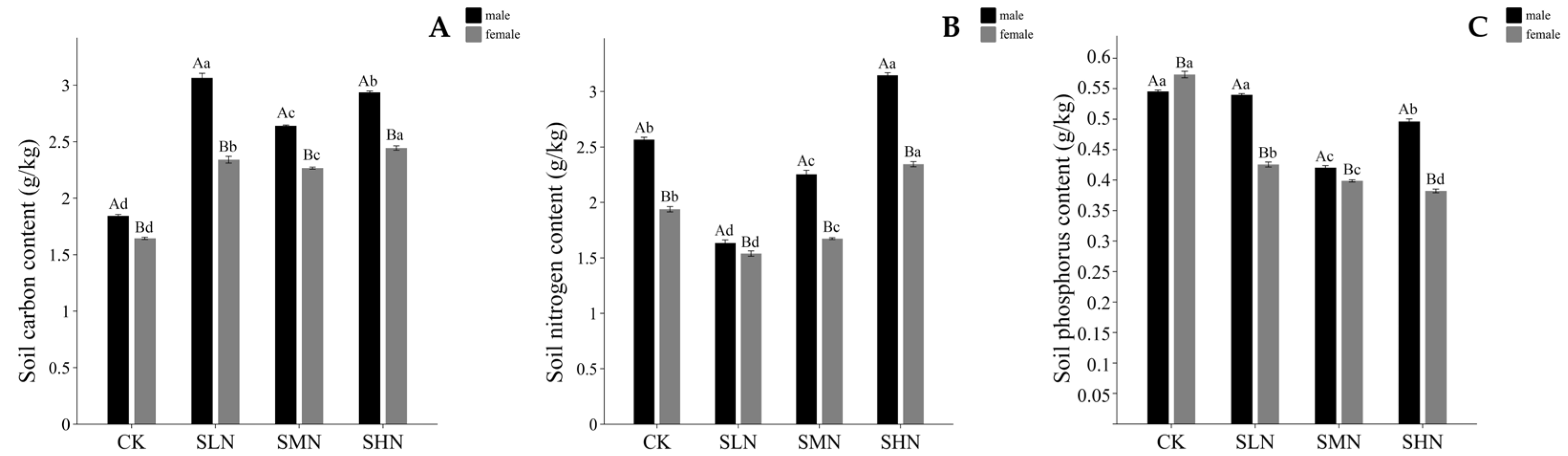
Male seedlings consistently exhibited significantly higher soil organic C and total N contents than females across all treatments (p < 0.05), with relative reductions ranging from 5.74% to 25.72% for N and 10.78% to 23.64% for C in females, confirming a robust sex-dependent nutrient partitioning pattern. For soil total P, a contrasting sex × treatment interaction was observed: females harbored 5.11% higher P than males under CK, yet this advantage was reversed under all salt-added treatments, with P in males surpassing that in females by 5.17–22.95% (p < 0.05). Notably, a significant positive correlation between soil N and P emerged only under combined salt and nitrogen stress (SLN–SHN) (Figure 1), further highlighting that nitrogen deposition partially alleviated salt-induced P immobilization in a sex-specific manner (interaction F = 629.002, p < 0.0001).

3.2. Soil C:N, C:P, and N:P Ratios: Responses of Male and Female T. grandis to Nitrogen Deposition Under Salt Stress

As shown in Table 1, N treatment (B), sex (A), and their interaction (A × B) exerted extremely significant effects on soil C:N, C:P, and N:P ratios (p < 0.0001), revealing a dose-dependent interactive regulation of soil nutrient balance by sex under nitrogen deposition gradients.
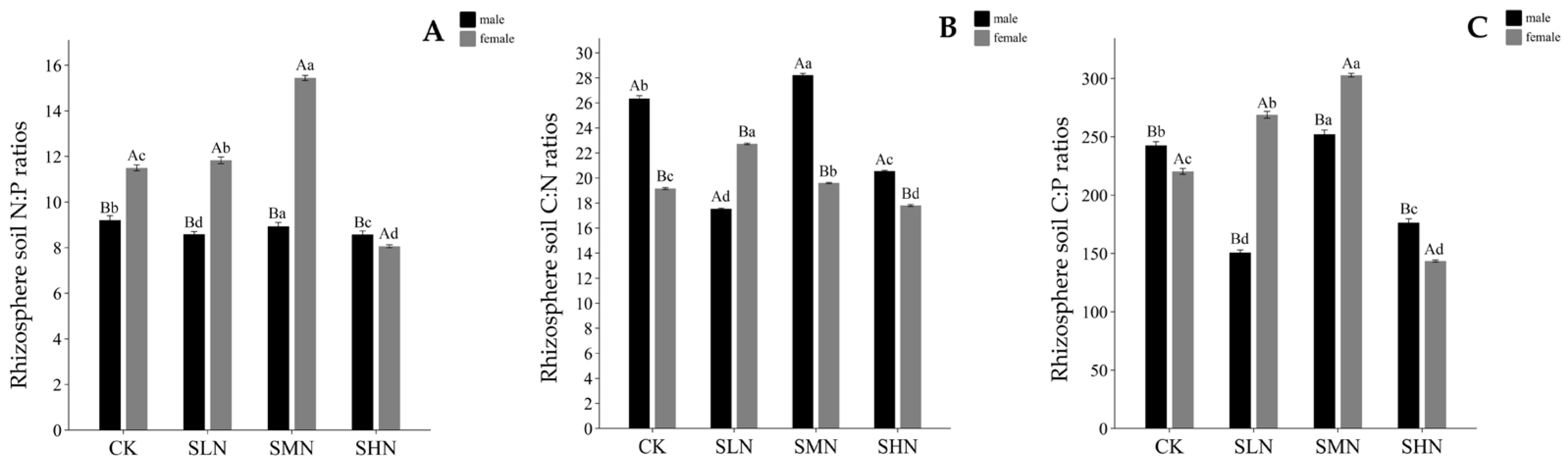
The SMN treatment markedly elevated all three stoichiometric ratios relative to CK, with the magnitude of increase being substantially greater in females (C:N: +85.89%; C:P: +98.20%; N:P: +16.04%) than in males (C:N: +38.76%; C:P: +59.75%; N:P: +13.84%), revealing that females possess inherently higher stoichiometric sensitivity to moderate N under salt stress (p < 0.05). A significant sex × N-level interaction was detected for C:N: under SLN, females showed a 37.55% higher C:N than males, whereas under SHN, this gap narrowed to 10.92% (p < 0.05), indicating that excessive N differentially compressed the stoichiometric disparity between sexes (Figure 2A–C). In contrast, N:P ratios responded asymmetrically: SHN elevated N:P by 109.73% in males versus only 69.59% in females (p < 0.05), implying more severe P limitation in males under high N deposition (interaction F = 301.671, p < 0.0001).
Figure 2. Effects of salt stress and nitrogen deposition on rhizosphere soil N∶P (A), C∶N (B), and C∶P (C) ratios in male and female T. grandis seedlings. Treatments: CK (control, 20 kg N ha−1 yr−1, no salt addition); SLN (low N, 2 kg N ha−1 yr−1 + 100 mmol L−1 NaCl); SMN (moderate N, 20 kg N ha−1 yr−1 + 100 mmol L−1 NaCl); SHN (high N, 60 kg N ha−1 yr−1 + 100 mmol L−1 NaCl). Different uppercase letters denote significant differences between sexes under the same treatment, and different lowercase letters denote significant differences among treatments within the same sex (p < 0.05).
Horticulturae 12 00723 g002

3.3. Soil Ca, K, and Mg Contents: Responses of Male and Female T. grandis to Nitrogen Deposition Under Salt Stress

Table 1 also shows that N treatment (B), sex (A), and their interaction (A × B) exerted extremely significant effects on soil Ca2+, K+, and Mg2+ contents (p < 0.0001), highlighting a strong interactive regulation of soil cation dynamics by sex under nitrogen deposition.
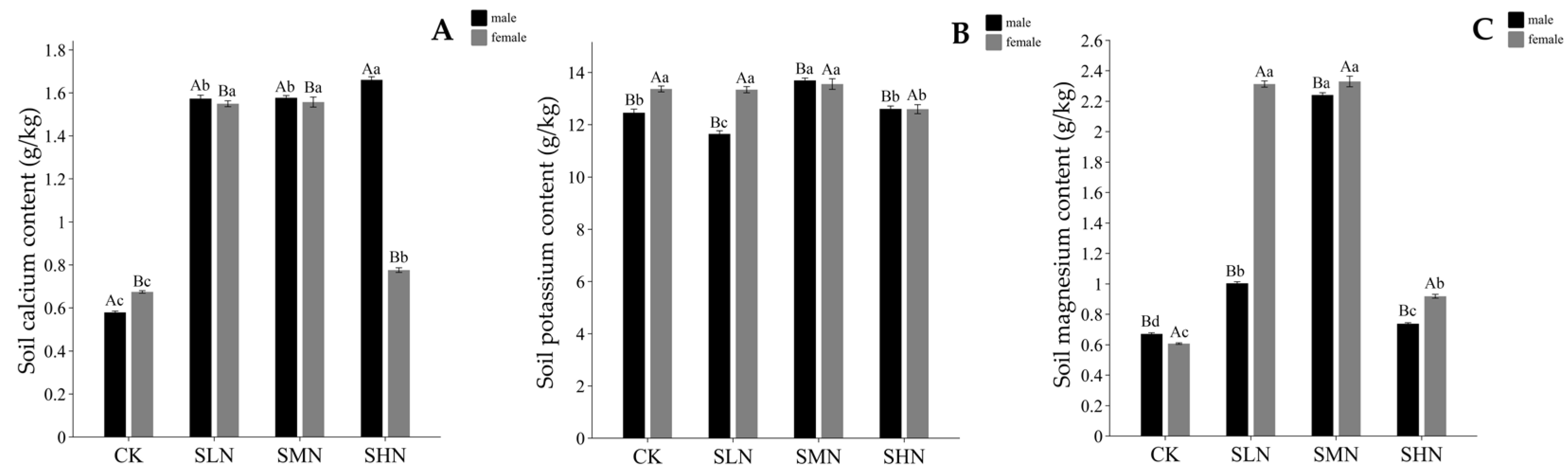
Under salt stress, nitrogen deposition significantly modified soil calcium, potassium, and magnesium concentrations in T. grandis seedlings, accompanied by obvious sexual differences (Figure 3A–C). The effects of nitrogen application on soil potassium were relatively weak; SMN treatment enhanced soil K+ more markedly in male seedlings than in females, and females presented higher K+ levels only under SLN, whereas sexual differences became minor under SMN and SHN (p < 0.05). Soil calcium content in males increased steadily with rising nitrogen input; SMN strongly elevated Ca2+ concentrations in both sexes, but by a greater magnitude in males. At the same time, females displayed consistently lower Ca2+ levels across all treatments (p < 0.05). Soil magnesium responses depended on both sex and nitrogen rate; SMN markedly increased Mg2+ concentrations in both sexes, especially in females, and females consistently maintained significantly higher soil Mg2+ than males under all combined salt and N treatments (p < 0.05).

3.4. Correlations Between Soil and Leaf Carbon, Nitrogen, and Phosphorus Concentrations in T. grandis Seedlings

Correlation structures diverged sharply between sexes, reflecting fundamentally distinct nutrient transport pathways. Following the analytical framework established in our prior study [24], we calculated Pearson correlation coefficients for soil and leaf C, N, and P concentrations, with detailed results presented in Table 2 (males) and Table 3 (females).
In males, soil C showed a strong negative coupling with leaf C (r = −0.78, p < 0.01) but a positive coupling with leaf N (r = 0.66, p < 0.05) and leaf P (r = 0.73, p < 0.01), indicating that higher rhizosphere C availability promotes nutrient translocation to leaves at the expense of leaf C storage. Conversely, in females, soil N emerged as the dominant driver of leaf nutrient status, exhibiting strong positive correlations with both leaf N (r = 0.77, p < 0.01) and leaf P (r = 0.97, p < 0.01), while soil C showed negligible linkage to any leaf variable (p > 0.05). In particular, soil C and P were strongly negatively correlated in females (r = −0.97, p < 0.01) but not in males, further confirming that females maintain a more constrained rhizosphere stoichiometric balance under combined salt and nitrogen deposition stress.

4. Discussion

4.1. Effects of Salt Stress and Nitrogen Deposition on Rhizosphere Soil Stoichiometry of T. grandis

Under salt stress alone, soil carbon (C), nitrogen (N), and phosphorus (P) contents and their stoichiometric ratios reflect the core ecological constraint that salinity imposes on soil nutrient cycling. Salt intrusion likely suppresses microbial metabolic activities and reduces nutrient solubility, thereby slowing organic matter decomposition and weakening soil organic carbon (SOC) sequestration [7,16]. Meanwhile, high salinity disrupts root ionic homeostasis and inhibits nitrogen uptake by T. grandis. Such a restriction on nitrogen acquisition constrains the synthesis of nitrogen-containing biomolecules and further regulates soil nitrogen pools [26,27,28]. In terms of phosphorus (P), salt stress generally promotes the precipitation of insoluble phosphorus fractions in alkaline soils, reduces plant-available phosphorus, and alters soil N∶P ratios [8].
Notably, the interactive effects of combined nitrogen deposition and salt stress on soil C∶N∶P stoichiometry are more pronounced than those of the individual stressors. Low-to-moderate nitrogen deposition partially mitigates the adverse impacts of salt stress on SOC mineralization. Exogenous nitrogen input supplies energy for microbial biomass and enzyme activity, thereby accelerating the decomposition of recalcitrant organic matter in soil [29]. However, excessive nitrogen deposition exacerbates salt-induced nutrient imbalance. High nitrogen loading inhibits key nitrification and denitrification processes in soil, which results in rhizosphere nitrogen accumulation and a subsequent rise in soil N∶P ratios [30,31]. The accumulated nitrogen further competes with T. grandis roots for phosphorus uptake, forming a negative feedback loop and disrupting the rhizosphere stoichiometric balance.

4.2. Effects of Salt Stress and Nitrogen Deposition on Ca, K, and Mg in the Rhizosphere Soil of Male and Female T. grandis

The coupling of salt stress and nitrogen deposition significantly altered the calcium (Ca2+), potassium (K+), and magnesium (Mg2+) contents in rhizosphere soil, with distinct sexually dimorphic effects in T. grandis [9]. Consistent with findings in the halophyte Suaeda salsa [9], the salt–N interaction emerged as a core driver of rhizosphere cation balance, closely linked to species-specific salt tolerance and N use efficiency. The sexual dimorphism in cation partitioning documented here provides direct evidence that dioecious gymnosperms deploy sex-specific ion regulation strategies in response to combined stresses under global change.
Soil K+ showed a muted response to N addition yet exhibited clear sexual divergence across N levels: under SLN, females accumulated more K+; under SMN, males showed a markedly greater K+ increase; and under SHN, the gap between sexes narrowed. This N-dependent K+ partitioning suggests that females prioritize K+ retention to counteract salt-induced ion leakage under N limitation, whereas males enhance K+ acquisition more efficiently when N is moderately available, a trade-off directly observable in our stoichiometric data. The stronger K+ accumulation in males under SMN aligns with patterns reported in salt-stressed dioecious species [32], where males exhibited enhanced K+ uptake capacity under moderate N supply, consistent with our stoichiometric evidence, though the underlying transporter-level mechanisms remain to be confirmed. Conversely, the higher K+ retention in females under SLN parallels observations in Salix matsudana [33], where females prioritized K+ homeostasis under N limitation to sustain basal metabolism, a pattern our cation data corroborate at the rhizosphere level. The N-level dependency of K+ partitioning observed here supports the view that dioecious plant nutrient allocation is environmentally plastic [34], and our data extend this principle to gymnosperm rhizosphere chemistry under combined stress.
Soil Ca2+ in males increased monotonically with N deposition; SMN elevated Ca2+ in both sexes, but males responded more strongly. Females maintained consistently lower Ca2+ across all treatments, indicating a comparatively weak capacity to mobilize Ca2+ under salt–N stress. Given Ca2+’s established role in stabilizing cell membranes and mitigating Na+ toxicity [35], the superior Ca2+ accumulation in males likely confers greater rhizosphere stability and salt tolerance, a stoichiometric advantage directly quantified in our data. Ca2+ is recognized as a key cation for salt tolerance, functioning through membrane stabilization and Na+ toxicity mitigation [35]; however, the involvement of specific signaling pathways remains to be experimentally verified in this system. The progressive Ca2+ accumulation in male rhizosphere soil confirms a Ca-dominated stress resistance strategy and directly links cation stoichiometry to sex-specific salt tolerance in T. grandis. The SMN-induced Ca2+ increase in both sexes is consistent with observations by Iqbal et al. [36], suggesting that moderate N deposition universally enhances Ca2+ availability under salt stress, a pattern our sex-resolved data further refine. Females consistently maintained lower Ca2+ than males across all treatments, contrasting with reports in female poplar [1], where females showed stronger Ca2+ activation under salt stress. This discrepancy likely reflects gymnosperm–angiosperm divergence in root exudate chemistry and mycorrhizal associations, which shape species-specific rhizosphere Ca2+ regulation—an inference drawn directly from our comparative cation data.
Soil Mg2+ dynamics reflected joint regulation by nitrogen levels and plant sex. Under all combined stress treatments, female plants had significantly higher soil Mg2+ content than males. This pattern arises because female plants allocate more resources to Mg-dependent physiological processes (e.g., photosystem maintenance and reproductive development), thereby accelerating rhizosphere Mg2+ cycling and accumulation; in contrast, male plants prioritize Ca2+ accumulation over Mg to resist stress, resulting in lower soil Mg2+ content. Wang et al. confirmed in Acer barbinerve that female plants, bearing higher reproductive costs, had significantly higher leaf Mg2+ content and photosynthesis-related Mg-dependent enzyme activity than males, which directly supports the inference in this study that female plants prioritize resource allocation to Mg2+ homeostasis [2]. Wang et al. studied the molecular mechanism of peanuts. They showed that Mg2+ protects the photosynthetic system under salt stress by regulating chloroplast membrane stability and photosynthetic electron transport, which explains the continuous accumulation of Mg2+ in female plants under combined salt and nitrogen stress [37].
In summary, male plants adopt a Ca-dominated stress resistance strategy, female plants rely on Mg-centered nutrient homeostasis, and K+ allocation is plastic and regulated by nitrogen levels. These sex-specific cation responses reshape rhizosphere nutrient availability and further mediate plant adaptability to combined salt and nitrogen stress. The results of this study, together with those reported by Yang et al. in Salix linearistipularis, confirm that dioecious plants have evolved differentiated ion homeostasis strategies under salt stress to achieve optimal resource allocation and maximum stress tolerance [38]. In contrast to previous studies that have focused on a single stressor or a single nutrient, this study is the first to reveal the sexual dimorphism in rhizosphere Ca2+, K+, and Mg2+ under salt–nitrogen coupling in T. grandis and their intrinsic correlations, providing a new perspective on the adaptive mechanisms of gymnosperms to global change.

4.3. Sexual Dimorphism in Rhizosphere Stoichiometry and Nutrient Homeostasis in T. grandis Under Combined Salt–Nitrogen Stress

Rhizosphere stoichiometric homeostasis is a core indicator of plant adaptation to combined environmental stresses. Under salt–nitrogen stress, male T. grandis maintained more stable rhizosphere carbon–nitrogen–phosphorus (C∶N∶P) ratios, while females exhibited higher stoichiometric plasticity, confirming the resource allocation trade-off hypothesis that females prioritize reproductive growth, whereas males focus on maintaining stress resistance [39,40]. The observed sexual dimorphism in stoichiometric stability directly reflects contrasting survival strategies under combined stress. Males conserve nutrient ratios to sustain baseline metabolism, whereas females tolerate greater stoichiometric fluctuation to support reproductive investment under moderate stress. Sex-specific root exudates and potentially rhizosphere microbial community assembly are key drivers of such differentiation; females can release more diverse allelochemicals to regulate nutrient mineralization processes [41].
The sex-specific ion patterns observed here integrate stoichiometric constraints with physiological function; males accumulated calcium (Ca) ions to stabilize cell membranes and likely mitigate sodium (Na) ion toxicity, while females maintained higher magnesium (Mg) ion levels to ensure photosynthetic function required for reproduction [42,]. Notably, the progressive Ca2+ accumulation in male rhizosphere soil with increasing nitrogen deposition—directly quantified in our data—indicates a dose-dependent stress resistance strategy, whereas females consistently maintain higher Mg2+ levels across all treatments, suggesting a constitutive rather than inducible nutrient homeostasis mechanism. This pattern differs from that of the angiosperm Salix matsudana, possibly due to differences in phylogeny and mycorrhizal symbiosis characteristics between gymnosperms and angiosperms [43]. Additionally, nitrogen availability affects cation uptake by regulating transporter gene expression [44].
Microbe-mediated sex-specific plant–soil feedback further shapes rhizosphere chemical characteristics. Males showed a synergistic correlation between soil carbon and leaf nitrogen–phosphorus, while females exhibited tight coupling between soil nitrogen and leaf nutrients, reflecting differentiation in nutrient transport pathways. Moderate nitrogen can alleviate salt-induced nutrient limitation by stimulating microbial decomposition, whereas excessive nitrogen exacerbates stoichiometric imbalance [10,45].
This study provides a basis for sex-specific management: males are better suited to marginal saline sites, while females require balanced nitrogen supply. Our stoichiometric and cation data together indicate that rhizosphere C:N:P ratios and Ca2+/Mg2+ partitioning jointly determine the sex-specific stress tolerance thresholds of T. grandis, a finding with direct implications for species selection in coastal afforestation under nitrogen deposition scenarios. Organic amendment combined with optimized nitrogen fertilization can stabilize rhizosphere stoichiometry and cation balance [46]. Future research should combine metabolomics and microbial sequencing to clarify the intrinsic mechanisms underlying sexual dimorphism in rhizosphere processes under global change.

4.4. Implications for Cultivation and Ecological Management of T. grandis

The results of this study provide critical insights for the sustainable cultivation of T. grandis in coastal saline areas against the background of global atmospheric nitrogen deposition. First, targeted nitrogen fertilizer application schemes require formulation based on the sex of T. grandis plants. For plantations dominated by female plants, nitrogen input should be strictly controlled to prevent excessive nitrogen accumulation in high-salinity environments, thereby avoiding rhizosphere nutrient imbalance and subsequent inhibition of reproductive growth [47]. For male plantations, nitrogen supply can be increased appropriately to support vegetative growth without causing severe stoichiometric disorders.
Implementing targeted soil improvement measures is crucial for alleviating salt stress and enhancing nutrient availability. The application of organic amendments can enhance soil organic carbon (SOC) sequestration, stimulate microbial activity, and reduce phosphorus fixation by salt ions [48]. Combined with optimized nitrogen management, these measures help maintain the stoichiometric carbon–nitrogen–phosphorus balance in the rhizosphere of T. grandis, thereby improving plant stress resistance and yield stability.
This study has some inherent limitations that need to be acknowledged. First, the experiment took place under controlled pot conditions, which may not fully simulate the complex environmental dynamics of field plantations. Future research should validate these findings under field conditions to improve the practicality of the results. Second, this study only focused on the rhizosphere soil stoichiometry of adult T. grandis plants; the responses of juvenile plants and the seasonal dynamics of stoichiometry remain unexplored. Future research investigating ontogenetic and seasonal changes in T. grandis will provide a more comprehensive understanding of its nutrient adaptation strategies. There are still limitations in relation to the selection of nitrogen sources in this study. It might be better to choose KNO3 paired with NH4Cl in future studies to avoid exogenous ion confounding effects.
In addition, future research should explore the microbial mechanisms underlying the observed stoichiometric changes. Soil microorganisms are central to nutrient cycling and plant–microbe interactions, and their responses to salt stress and nitrogen deposition may directly regulate rhizosphere carbon, nitrogen, and phosphorus dynamics [49]. Combining stoichiometric analysis with high-throughput microbial community sequencing will help clarify the key microbial taxa and functional genes involved in nutrient utilization in the rhizosphere of T. grandis. In the future, it is also necessary to conduct experiments on different gradients of dry and wet nitrogen deposition on the basis of the original nitrogen deposition simulation experiments to increase the depth of research. Furthermore, the interactions of other abiotic factors with the stoichiometry of T. grandis should be studied to better simulate natural terrestrial ecosystems.

5. Conclusions

Salt stress combined with nitrogen deposition significantly affected rhizosphere soil chemistry, stoichiometry, and cation balance in T. grandis, with obvious sexual dimorphism. Males maintained higher soil C, N, and Ca contents and more stable C∶N∶P stoichiometry, adopting a Ca-dominated stress tolerance strategy. Females had higher soil Mg content and greater stoichiometric plasticity, relying on Mg homeostasis to support reproductive growth. Moderate nitrogen addition alleviated salt-induced nutrient limitation, while excessive nitrogen aggravated stoichiometric imbalance. However, these conclusions are based on controlled pot experiments; field validation and microbial–molecular mechanism analyses remain essential. This study is the first to clarify the sex-specific rhizosphere nutrient adaptation strategies of T. grandis under combined salt–nitrogen stress, providing a preliminary scientific basis for sex-differentiated cultivation and soil nutrient management under nitrogen deposition and salinization.

Author Contributions

Resources, Y.L.; data curation and writing—original draft preparation, M.Z.; literature search and formal analysis, H.Z. and M.Y.; writing—review and editing, Y.L. and S.J. All authors have read and agreed to the published version of the manuscript.

Funding

This research was funded by the National Natural Science Foundation, China (No. 32001305); “Leading Talents” R & D Program in Universities of Zhejiang, China (2022); the Talent Project of Jiyang College of Zhejiang A & F University, China (No. RQ2020B14); and the National College Students’ Innovation Project (No. 202513283002).

Data Availability Statement

The original contributions presented in this study are included in the article. Further inquiries can be directed to the corresponding authors.

Conflicts of Interest

The authors declare no conflicts of interest.

References

  1. Rengasamy, P. World salinization with emphasis on Australia. J. Exp. Bot. 2006, 57, 1017–1023. [Google Scholar] [CrossRef]
  2. Lilleskov, A.E.; Kuyper, W.T.; Bidartondo, I.M.; Hobbie, E.A. Atmospheric nitrogen deposition impacts on the structure and function of forest mycorrhizal communities: A review. Environ. Pollut. 2018, 246, 148–162. [Google Scholar] [CrossRef]
  3. Li, X.R.; Lin, H.; Cao, P.L.; Lin, W.S.; Liu, X.F.; Zhong, X.F.; Guo, J.F. Long-Term Nitrogen Application Exacerbates Soil Phosphorus Limitation at Different Depths in Subtropical Natural Castanopsis carlesii Forest: Based on Soil Extracellular Enzymes and Their Stoichiometric Ratios. Soils 2024, 56, 963–974. (In Chinese) [Google Scholar] [CrossRef]
  4. Vance, C.P.; Uhde-Stone, C.; Allan, D.L. Phosphorus Acquisition and Use: Critical Adaptations by Plants for Securing a Nonrenewable Resource. New Phytol. 2003, 157, 423–447. [Google Scholar] [CrossRef] [PubMed]
  5. Yan, X.B.; Yuan, J.H. Effects of Salt Stress on Plant Growth. Anhui Agric. Sci. 2019, 47, 30–33. (In Chinese) [Google Scholar] [CrossRef]
  6. Hasanuzzaman, M.; Bhuyan, M.H.M.B.; Zulfiqar, F.; Raza, A.; Mohsin, S.M.; Mahmud, J.A.; Fujita, M.; Nahar, K. Reactive oxygen species and antioxidant defense in plants under abiotic stress: Revisiting the crucial role of a universal defense regulator. Antioxidants 2020, 9, 681. [Google Scholar] [CrossRef] [PubMed]
  7. Munns, R.; Tester, M. Mechanisms of salinity tolerance. Annu. Rev. Plant Biol. 2008, 59, 651–681. [Google Scholar] [CrossRef]
  8. Oduor, N.O.; Elrys, A.S.; Alnaimy, M.A.; Opande, T.; Feng, D.; Uwiragiye, Y.; Dan, X.Q.; Tang, S.R.; Zhu, T.B.; Zhang, J.B. From disruption to restoration: Global impacts of soil salinity and its mitigation strategies on ecosystem nitrogen cycling. Glob. Change Biol. 2025, 31, e70487. [Google Scholar] [CrossRef]
  9. Wang, Y.; Guo, T.; Tian, C.; Zhao, Z.; Zhang, K.; Mai, W. The curvilinear responses of biomass accumulation and root morphology to a soil salt-nitrogen environment reflect the phytodesalination capability of the euhalophyte Suaeda salsa L. Front. Plant Sci. 2024, 15, 1424766. [Google Scholar] [CrossRef] [PubMed]
  10. Cui, H.; He, C.; Zheng, W.W.; Jiang, Z.H.; Yang, J.P. Effects of nitrogen addition on rhizosphere priming: The role of stoichiometric imbalance. Sci. Total Environ. 2023, 894, 169731. [Google Scholar] [CrossRef]
  11. Zhang, C.Y.; Zhao, X.H.; Gao, L.S.; Gadow, K.V. Gender, neighboring competition and habitat effects on the stem growth in dioecious Fraxinus mandshurica trees in a northern temperate forest. Ann. For. Sci. 2009, 66, 812. [Google Scholar] [CrossRef]
  12. Wilson, W.G.; Harder, L.D. Reproductive uncertainty and the relative competitiveness of simultaneous hermaphroditism versus dioecy. Am. Nat. 2003, 162, 220–241. [Google Scholar] [CrossRef] [PubMed]
  13. Yin, C.Y.; Li, C.Y. Research advances in sexual differences related to sex ratio of dioecious plants. Chin. J. Appl. Environ. Biol. 2007, 3, 419–425. (In Chinese) [Google Scholar]
  14. Zhang, R.; Zhang, Y.L.; Song, L.L.; Song, X.Z.; Hänninen, H.K.K.; Wu, J.S. Biochar enhances nut quality of Torreya grandis and soil fertility under simulated nitrogen deposition. For. Ecol. Manag. 2017, 391, 321–329. [Google Scholar] [CrossRef]
  15. Zhang, R.; Zhang, Y.L.; Song, L.L.; Song, X.Z.; Hänninen, H.K.K.; Wu, J.S. Biochar application alleviates unbalanced nutrient uptake caused by N deposition in Torreya grandis trees and seedlings. For. Ecol. Manag. 2019, 432, 319–326. [Google Scholar] [CrossRef]
  16. Liu, Y.; Jiang, Z.K.; Ye, Y.T.; Wang, D.H.; Jin, S.H. Enhanced Salt Tolerance of Torreya grandis Genders Is Related to Nitric Oxide Level and Antioxidant Capacity. Front. Plant Sci. 2022, 8, 1148. [Google Scholar] [CrossRef]
  17. Wang, J.W. Study on Sexual Differences in Photosynthesis and Antioxidant System of Torreya grandis Seedlings Under Drought Stress. Master’s Thesis, Jiangxi Agricultural University, Nanchang, China, 2021. (In Chinese) [Google Scholar] [CrossRef]
  18. Wang, X.R.; Qiu, H.; Zhang, Q.X.; Wu, J.S.; Lou, H.Q. Differences in rooting of softwood cutting and drought response physiology between Torreya grandis and male Torreya grandis. J. Zhejiang AF Univ. 2024, 41, 478–485. (In Chinese) [Google Scholar] [CrossRef]
  19. Qu, T.B.; Li, M.X.; Zhao, X.T.; Luo, H.Y.; Zhao, L. Nitrogen Deposition May Benefit to Larix olgensis Root Soils. Forests 2023, 14, 1013. [Google Scholar] [CrossRef]
  20. Huang, J.; Kong, Y.L.; Xu, Q.S.; Zhu, C.Q.; Zhu, L.F.; Cao, X.C.; Hong, X.Z.; Zhang, J.H. Research progress on characteristics and improvement measures of saline soil. Soils 2022, 54, 18–23. (In Chinese) [Google Scholar] [CrossRef]
  21. Li, T.T. Effects of NaCl Stress on Growth and Physiological-Biochemical Characteristics of Torreya grandis Seedlings. Master’s Thesis, Zhejiang A&F University, Hangzhou, China, 2014. (In Chinese) [Google Scholar]
  22. Zhou, K.Y.; Xu, W.; Zhang, L.; Ma, M.R.; Liu, X.J.; Zhao, Y. Estimating nitrogen and sulfur deposition across China during 2005 to 2020 based on multiple statistical models. Atmos. Chem. Phys. 2023, 23, 8531–8551. [Google Scholar] [CrossRef]
  23. Lu, R. Soil Agricultural Chemical Analysis Methods; China Agricultural Science and Technology Press: Beijing, China, 2000. (In Chinese) [Google Scholar]
  24. Liu, Y.; Chen, D.Y.; Zhang, H.C.; Jin, S.H. The Combined Effects of Salt and Nitrogen Addition on the Chlorophyll Fluorescence, Antioxidant System, and Leaf Stoichiometry of Torreya Grandis Sexes. Forests 2024, 15, 2238. [Google Scholar] [CrossRef]
  25. Sun, X.; Gao, Y.; Wang, D.; Chen, J.; Zhang, F.; Zhou, J.; Yan, X.; Li, Y. Stoichiometric variation of halophytes in response to changes in soil salinity. Plant Biol. 2017, 19, 360–367. (In Chinese) [Google Scholar] [CrossRef]
  26. Rath, K.M.; Murphy, D.N.; Rousk, J. The microbial community size, structure, and process rates along natural gradients of soil salinity. Soil Biol. Biochem. 2019, 138, 107607. [Google Scholar] [CrossRef]
  27. Liu, M.; Xu, X.L.; Wanek, W.G.; Sun, J.; Bardgett, R.D.; Tian, Y.Q.; Cui, X.Y.; Jiang, L.L.; Ma, Z.Q. Nitrogen availability in soil controls uptake of different nitrogen forms by plants. New Phytol. 2024, 245, 1450–1467. [Google Scholar] [CrossRef] [PubMed]
  28. Bassett, K.R.; Hupperts, S.F.; Jämtgård, S.; Östlund, L.; Fridman, J.; Perakis, S.S.; Gundale, M.J. Rising atmospheric CO2 reduces nitrogen availability in boreal forests. Nature 2026, 650, 629–635. [Google Scholar] [CrossRef] [PubMed]
  29. Chen, J.; Luo, Y.Q.; Groenigen, K.J.V.; Hungate, B.A.; Cao, J.J.; Zhou, X.H.; Wang, R.W. A keystone microbial enzyme for nitrogen control of soil carbon storage. Sci. Adv. 2018, 4, eaaq1689. [Google Scholar] [CrossRef] [PubMed]
  30. Zhang, M.L.; Zhang, L.Y.; Li, J.; Huang, S.Y.; Wang, S.Y.; Zhao, Y.Z.; Zhou, W.; Ai, C. Nitrogen-shaped microbiotas with nutrient competition accelerate early-stage residue decomposition in agricultural soils. Nat. Commun. 2025, 16, 5793. [Google Scholar] [CrossRef]
  31. Zhang, M.D.; Gu, M.T.; Chen, J.X.; Liu, Y. Effects of Organic–Inorganic Nitrogen Deposition on Element Content and Stoichiometric Ratios in the Rhizospheric Soil of Torreya grandis. Horticulturae 2025, 11, 1463. [Google Scholar] [CrossRef]
  32. Liu, M.; Zhao, Y.; Liu, X.C.; Korpelainen, H.; Li, C. Ammonium and nitrate affect sexually different responses to salt stress in Populus cathayana. Physiol. Plant. 2022, 174, e13626. [Google Scholar] [CrossRef]
  33. Liu, G.Y.; Wang, Y.Q.; Lian, B.L.; Ma, Z.Q.; Xiang, X.T.; Wu, J.; Luo, C.Y.; Ma, D.J.; Chen, Y.H.; Yu, C.M.; et al. Molecular responses to salinity stress in Salix matsudana (Koidz) females and males. Front. Plant Sci. 2023, 14, 1122197. [Google Scholar] [CrossRef]
  34. Juvany, M.; Munné-Bosch, S. Sex-related differences in stress tolerance in dioecious plants: A critical appraisal in a physiological context. J. Exp. Bot. 2015, 66, 6083–6092. [Google Scholar] [CrossRef]
  35. Dong, X.; Gao, Y.; Bao, X.F.; Wang, R.J.; Ma, X.Y.; Zhang, H.; Liu, Y.F.; Jin, L.S.; Lin, G.L. Multi-Omics Revealed Peanut Root Metabolism Regulated by Exogenous Calcium under Salt Stress. Plants 2023, 12, 3130. [Google Scholar] [CrossRef]
  36. Mahmood, M.Z.; Odeibat, H.A.; Ahmad, R.; Gatasheh, M.K.; Shahzad, M.; Abbasi, A.M. Low apoplastic Na+ and intracellular ionic homeostasis confer salinity tolerance upon Ca2SiO4 chemigation in Zea mays L. under salt stress. Front. Plant Sci. 2024, 14, 1268750. [Google Scholar] [CrossRef]
  37. Wang, R.J.; Dong, X.; Gao, Y.; Hao, F.; Zhang, H.; Lin, G.L. Molecular Mechanism of Exogenous Magnesium in Regulating Cation Homeostasis in Roots of Peanut Seedlings under Salt Stress. Agronomy 2024, 14, 724. [Google Scholar] [CrossRef]
  38. Feng, S.; Sun, H.W.; Ma, H.P.; Zhang, X.; Ma, S.R.; Qiao, K.; Zhou, A.; Bu, Y.Y.; Liu, S.K. Sexual Differences in Physiological and Transcriptional Responses to Salinity Stress of Salix linearistipularis. Front. Plant Sci. 2020, 11, 517962. [Google Scholar] [CrossRef] [PubMed]
  39. Liu, X.C.; Wang, Y.T.; Liu, S.R.; Liu, M. Sex-specifically responsive strategies to phosphorus availability combined with different soil nitrogen forms in dioecious Popul. cathayana. J. Plant Ecol. 2021, 14, 730–748. [Google Scholar] [CrossRef]
  40. Zhao, Y.; Chen, L.L.; Chen, Y.K.; Yang, Q.H.; Liu, M. Plant sexual variation modulates rhizospheric nutrient processes through the soil microbiome response to drought and rewetting in Popul. cathayana. Biol. Fertil. Soils 2023, 59, 571–587. [Google Scholar] [CrossRef]
  41. Zhou, Y.; Pang, Z.; Yuan, Z.; Fallah, N.; Jia, H.; Ming, R. Sex-Based Metabolic and Microbiota Differences in Roots and Rhizosphere Soils of Dioecious Carica papaya L. Front. Plant Sci. 2022, 13, 991114. [Google Scholar] [CrossRef]
  42. Li, N.; Zhang, H.L.; Li, X.F.; Liu, C. The role of calcium in plant salt stress. Life Sci. 2015, 27, 504–509. (In Chinese) [Google Scholar] [CrossRef]
  43. Yang, H.S.; Wang, Q.; Guo, Y.; Xiong, Y.Q.; Xu, M.M.; Dai, Y.J. Correlation analysis between arbuscular mycorrhizal fungal community and plant phylogeny. Chin. J. Plant Ecol. 2015, 39, 383–387. (In Chinese) [Google Scholar] [CrossRef]
  44. Xu, Z.X.; Han, P.P.; Li, Y.S.; Liao, X.S.; Hu, X.J.; Xie, L.H.; Yu, C.B.; Liao, X.; Qin, L. Effects of nitrogen deficiency on nutrient uptake and expression of genes related to potassium uptake and transport in rapeseed. Chin. J. Oil Crop Sci. 2017, 39, 78–84. (In Chinese) [Google Scholar] [CrossRef]
  45. Li, J.Y.; Han, G.X.; Wang, G.M.; Liu, X.L.; Zhang, Q.Q.; Chen, Y.W.; Song, W.M.; Qu, W.D.; Chu, X.J.; Li, P.G. Imbalanced nitrogen–phosphorus input alters soil organic carbon storage and mineralisation in a salt marsh. Catena 2022, 208, 105720. [Google Scholar] [CrossRef]
  46. Wang, D.X.; Hao, Z.C.; Li, D.D.; Peng, Y.; Feng, G. Applying ammonium fertilizer reduces alkali and sodium content in rhizosphere to improve crop adaptability and yield in saline soil. Chin. J. Eco-Agric. 2025, 33, 67–79. (In Chinese) [Google Scholar] [CrossRef]
  47. Tang, X.X. Differential response characteristics and research progress of dioecious plants under environmental stress. J. Ocean Univ. China (Nat. Sci. Ed.) 2020, 50, 74–81. (In Chinese) [Google Scholar] [CrossRef]
  48. Deng, W.L.; Chen, W.Z.; Feng, G. Organic water-soluble fertilizer activates soil phosphorus turnover by stimulating indigenous microorganisms to promote cotton growth and phosphorus uptake. Chin. J. Eco-Agric. 2025, 33, 2219–2232. (In Chinese) [Google Scholar] [CrossRef]
  49. Zhang, X.P.; Liu, Q.; Wang, J.; Hu, J.; Zhou, C.Y.; La, B. Research progress on interaction mechanism between halophytes and rhizosphere soil microorganisms under saline-alkali stress. Soil Bull. 2024, 55, 1191–1200. (In Chinese) [Google Scholar] [CrossRef]
Figure 1. Effects of salt stress and nitrogen deposition on rhizosphere soil carbon (A), nitrogen (B), and phosphorus (C) contents in male and female T. grandis seedlings. Treatments: CK (control, 20 kg N ha−1 yr−1, no salt addition); SLN (low N, 2 kg N ha−1 yr−1 + 100 mmol L−1 NaCl); SMN (moderate N, 20 kg N ha−1 yr−1 + 100 mmol L−1 NaCl); SHN (high N, 60 kg N ha−1 yr−1 + 100 mmol L−1 NaCl). Different uppercase letters denote significant differences between sexes under the same treatment, and different lowercase letters denote significant differences among treatments within the same sex (p < 0.05).
Horticulturae 12 00723 g001
Figure 3. Effects of salt stress and nitrogen deposition on rhizosphere soil calcium (A), potassium (B), and magnesium (C) contents in male and female T. grandis seedlings. Treatments: CK (control, 20 kg N ha−1 yr−1, no salt addition); SLN (low N, 2 kg N ha−1 yr−1 + 100 mmol L−1 NaCl); SMN (moderate N, 20 kg N ha−1 yr−1 + 100 mmol L−1 NaCl); SHN (high N, 60 kg N ha−1 yr−1 + 100 mmol L−1 NaCl). Different uppercase letters denote significant differences between sexes under the same treatment, and different lowercase letters denote significant differences among treatments within the same sex (p < 0.05).
Horticulturae 12 00723 g003
Table 1. Significance analysis of the effects of sex, nitrogen addition, and their interaction on soil element contents in the root zone of male and female T. grandis seedlings.
Index Soil CSoil NSoil PSoil KSoil Ca
Sex (A)F2782.2522695.6941555.236120.0451387.66
p0.00010.00010.00010.00010.0001
N (B)F2825.6862335.4022135.37882.8096279.815
p0.00010.00010.00010.00010.0001
A × BF169.213224.608629.00258.8351657.012
p0.00010.00010.00010.00010.0001
Index Soil MgC/NC/PN/P
Sex (A)F3076.1882.43999.942417.83
p0.00010.13790.00010.0001
N (B)F12,481.1651472.9254862.0682353.414
p0.00010.00010.00010.0001
A × BF2114.901147.249144.386301.671
p0.00010.00010.00010.0001
Table 2. Correlation analysis of soil C, N, and P contents with their corresponding contents in leaves of male T. grandis seedlings. * Significant at p < 0.05; ** significant at p < 0.01.
Index
(Content)
Soil CSoil NSoil PLeaf CLeaf NLeaf P
Soil C1     
Soil N−0.231    
Soil P−0.21−0.131   
Leaf C −0.78 ** 0.05−0.41  
Leaf N0.66 *−0.430.58 *−0.90 **1 
Leaf P0.73 **−0.390.5−0.93 **0.99 **1
Table 3. Correlation analysis of soil C, N, and P contents with their corresponding contents in leaves of female T. grandis seedlings. * Significant at p < 0.05; ** significant at p < 0.01.
Index
(Content)
Soil CSoil NSoil PLeaf CLeaf NLeaf P
Soil C1     
Soil N0.051    
Soil P −0.97 ** −0.061   
Leaf C−0.350.280.161  
Leaf N−0.170.77 **0.030.83 **1 
Leaf P0.190.97 **−0.160.090.63 *1
Disclaimer/Publisher’s Note: The statements, opinions and data contained in all publications are solely those of the individual author(s) and contributor(s) and not of MDPI and/or the editor(s). MDPI and/or the editor(s) disclaim responsibility for any injury to people or property resulting from any ideas, methods, instructions or products referred to in the content.