Article

Organic and Conventional Management Practices That Improve Soil Quality and the Yield of Theobroma cacao in the Upper Huallaga Valley (Peru)

by
Nelino Florida Rofner
1,*,
Segismundo Casado Álvarez
2,
Alex Rengifo Rojas
3,
Jaime Encarnación Hipólito Vásquez
1,
Liliana Vega Jara
4,
Noi Patricia Rodríguez Ayala
5 and
Hugo Alfredo Huamani Yupanqui
5
1
Academic Department of Soil and Water Conservation Sciences, National Agrarian University of the Selva, Tingo María 10131, Peru
2
Academic Department of Agricultural Sciences, National Agrarian University of the Selva, Tingo María 10131, Peru
3
Academic Department of Economic Sciences, National Agrarian University of the Selva, Tingo María 10131, Peru
4
Academic Department of Agrarian Sciences, Hermilio Valdizan National University, Huánuco 10001, Peru
5
Academic Department of Agrarian Sciences, National Agrarian University of the Selva, Tingo María 10131, Peru
*
Author to whom correspondence should be addressed.
Horticulturae 2026, 12(6), 712; https://doi.org/10.3390/horticulturae12060712 (registering DOI)
Submission received: 19 May 2026 / Revised: 3 June 2026 / Accepted: 6 June 2026 / Published: 9 June 2026
(This article belongs to the Section Fruit Production Systems)

Abstract

Cocoa accounts for 5.20% of Peru’s cultivated land and is growing at a rate of 8.80% per year; however, yields remain low due to deficiencies in crop management. Therefore, this study used a multiple linear regression (MLR) model to evaluate effects of an organic agroforestry system (OAF) and conventional monocultures (CMs) on soil and production in high-yielding T. cacao plantations in the Upper Huallaga Valley, Peru. Four plantations were evaluated: organic agroforestry (Pa) and conventional monoculture (LE, Sa, and Sh). Soil physicochemical variables and cocoa production were assessed. The MLR analysis revealed that in OAF systems with mature trees, there will be slight losses of clay and silt fractions; the latter can be offset by high planting density. The OAF system showed a significant positive effect on pH. However, the CM system showed significant decreases in pH, CEC, Ca2+, and Mg2+. The interaction between OAF and CM optimized production, increasing the weight of dry beans. Planting density is associated with improvements in pH and bases, as well as fruit index and the weight of dry beans. MLR modeling suggests that integrating OAF systems with conventional management practices in high-density plantations offers valuable alternatives for the design of local agricultural policies and producer support programs, by identifying the factors that link management systems to soil quality and sustainable cocoa productivity in this valley.

1. Introduction

In the 2023/2024 season, global cocoa bean production reached 4,449,000 tons, with Ivory Coast (40.50%), Ghana (13.00%), Ecuador (9.70%), and Cameroon (6.70%) being the leading producers. Peru ranks eighth among producing countries with 160,000 tons of cocoa, making it the sixth most important crop, representing 5.20% of the country’s harvested area [1]. Furthermore, the National Institute of Statistics and Informatics [2] indicates that between 2014 and 2023, cocoa production grew by 8.8% annually, and the Huánuco region, home to the Upper Huallaga Valley, ranks fourth, accounting for 10.00% of national production. Peruvian cocoa production has increased at an annual rate of 12.60% over the last decade, with a cultivated area of 172,078 ha, based on monoculture systems with conventional management (56%) and the adoption of CCN-51 as the main variety cultivated [3]. In contrast, 44% of producers apply agroforestry systems and organic management practices, positioning Peru as the third largest exporter of organic cocoa in the world after Mexico and Indonesia [4]. However, compared to the countries with the highest yields in the world, Thailand (3000 kg ha−1) and Guatemala (2600 kg ha−1) [5,6], Peru achieves an average of 827 kg ha−1 [4,6], highlighting a significant yield gap.
Organic management is an alternative that comprehensively improves soil properties [6,7,8] and has demonstrated positive benefits when applied in agroforestry systems (AFSs), as multifunctional forms of agriculture [9] that provide additional benefits to cocoa production. An AFS includes a set of land management techniques to combine crops and forest species [10] that contribute to the system’s sustainability [11,12], serving as a mitigation [13] and resilience strategy, thus controlling the negative effects of climate change [14,15] and promoting food security [16]. The benefits of organic management and agroforestry systems have been studied by researchers who have shown that these systems improve yields in the medium and long term [14] and produce physical and chemical changes that improve the soil through greater biomass incorporation, recycling, nutrient retention, soil structuring, and erosion control [6,7,9,17]. In contrast, a significant segment of scientists currently asserts that monoculture with conventional agricultural practices and the use of agrochemicals degrades the soil [18] and reduces its productive potential [19,20]. Furthermore, this production model is attributed to environmental problems such as climate change, biodiversity loss, ecosystem fragmentation, soil degradation, water regulation problems, and social disruptions [9,21,22].
Regarding the literature, there are reports that support chemical fertilization, among which the following stand out: Ballesteros et al. [23] in Nariño, Colombia, reported higher yields with chemical fertilization (2250 kg ha−1) compared to organic fertilization (2007.80 kg ha−1); also, Armijos et al. [24] in the province of El Oro in Colombia reported higher dry weight of 100 seeds with chemical fertilization compared to organic fertilization in CCN-51 cacao; and Tuesta-Pinedo et al. [25] in San Martin, Peru, reported higher yields with inorganic fertilizer (2502.4) compared to organic fertilizer (1560.6). Conversely, there are favorable reports for organic fertilization, among them, Florida et al. [6]. In the Upper Huallaga Valley, a production model integrating an agroforestry system (T. cacao and G. crinita) with organic management demonstrated yields ranging from 2700 to 3500 kg ha−1, representing the highest yield reported in Peru. Finally, in the Ucayali region of Peru, Florida et al. [5] reported higher yields with organic fertilization (1125 kg ha−1) compared to chemical fertilization, which reached 1080 kg ha−1. These backgrounds highlight that there are divergent results, with limited analytical tools such as MLR that allow evaluations integrating production models and new variables (such as age and planting density) to find causal relationships and more suitable production models that represent an alternative for the 56% of producers who apply conventional monoculture in Peru, for agroforestry and organic management [26,27], a sustainable and productive way to guarantee food security [15,28].
In this context, Peruvian cacao exhibits low yields, 56% of farms practice conventional monoculture, and there is a limited availability of outstanding studies that highlight the benefits of different production models. Therefore, there is a gap in comprehensive research that quantifies the benefits of agroforestry systems, organic management, and the interaction between these two compared to conventional monoculture. Such research should identify changes in soil quality and yields in a specific local context, such as the Upper Huallaga Valley. Given this, this study hypothesizes that agroforestry systems and organic management, compared to monoculture systems with conventional management, have significant impacts on soil quality and production, achieving high yields in cacao plantations developed in the Upper Huallaga Valley, Huánuco region.
Therefore, the overall objective is to evaluate the effects of organically managed agroforestry systems and conventionally managed monoculture systems, as well as the integration of both through sustainable land-use planning (SLP), on soil quality and production in cacao plantations in the Upper Huallaga Valley of Peru. The aim is to generate information to guide concrete actions in decision making regarding cacao production systems that improve soils, yields, and the living conditions of farmers in the tropical Amazon.

2. Materials and Methods

2.1. Study Area

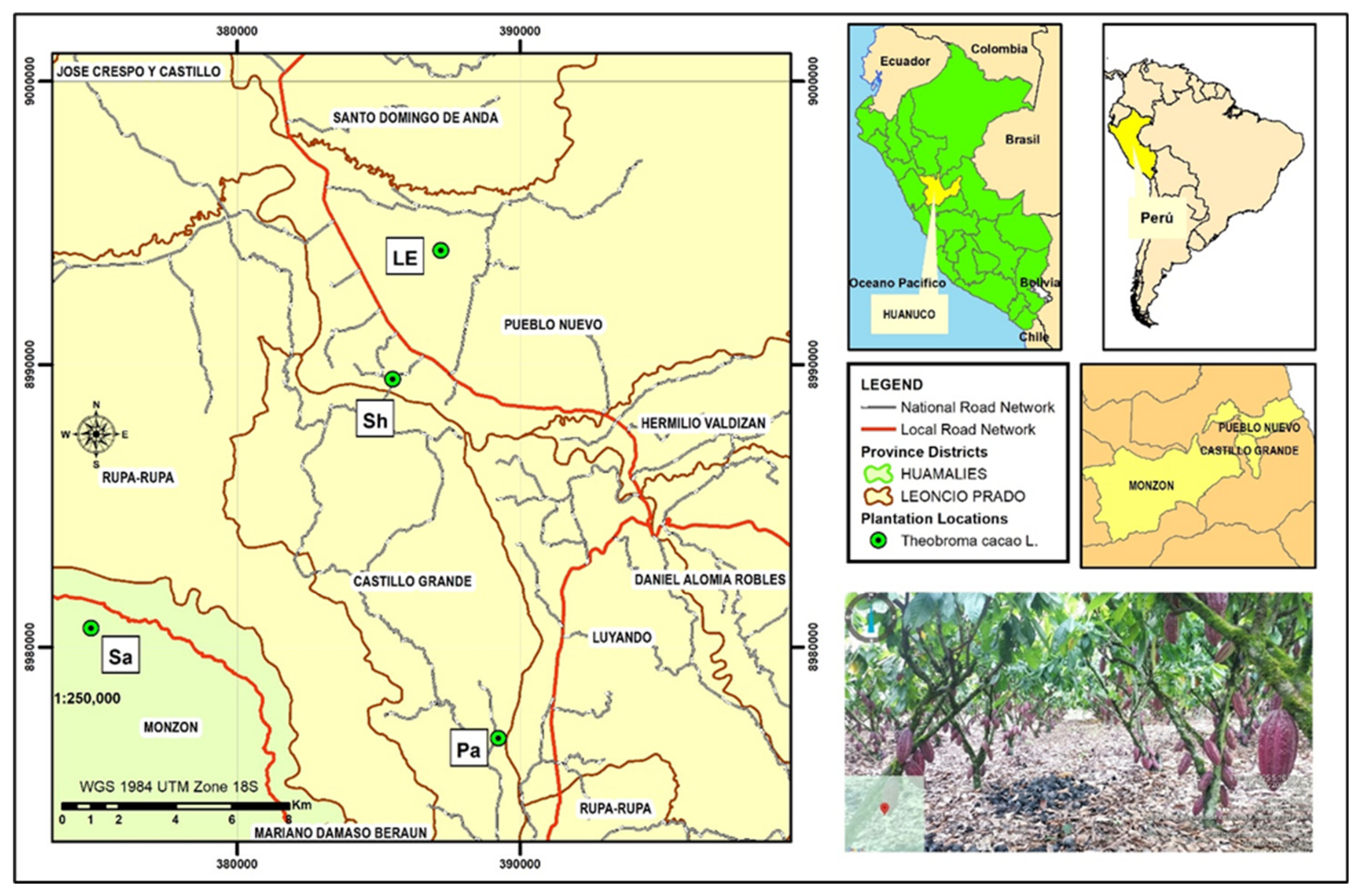
The research was conducted in the Huánuco region (Figure 1), involving four high-yield cacao plantations located in the villages of La Esperanza and Shiringal, in the Pueblo Nuevo district, and the village of Papayal, in the Castillo Grande district of Leoncio Prado province. Also included was the village of Sachavaca, in the Monzón district of Huamalíes province. All these areas are located in the Upper Huallaga Valley in the Huánuco region.

2.2. Characteristics of the Areas Evaluated

2.2.1. Plantation 01 (LE)

Plantation 01 is located in zone 18 L, UTM coordinates 387,198 E and 8,994,039 N, at 630 m above sea level. Politically, it is located in the town of La Esperanza (LE), Pueblo Nuevo district, Leoncio Prado province, in the Huánuco region. The plantation consists of a 12-year-old CCN-51 clone, with a density of 1250 plants per hectare, under a monoculture system with combined organic and chemical management. The plantation is pruned in August to maintain the appropriate shape and height of the plants; it also undergoes pruning to open up rows and shape the canopy, as well as ongoing phytosanitary pruning. Weed control is carried out manually two to three times a year with the aid of a brush cutter.
Regarding the plantation’s fertilization plan, as described in Table 1, prior to the first application of fertilizers and before pruning, organic soil fertilization is applied (agos), consisting of compost (1 kg plant−1 year−1) and potassium humate (10 L 200 L drum−1 ha−1 year−1). After pruning and before the start of flowering, foliar applications of calcium and boron, and phosphorus and potassium (P-K) as potassium sulfophosphate (2 L 200 L drum−1) are applied every 15 days, 3 times per season. During this dormant period, copper chelate (1 L 200 L drum−1) is also applied twice per season.

2.2.2. Plantation 02 (Sa)

Plantation 02 is located in zone 18 L, UTM coordinates 374,838 E and 898,0676 N at 854 m above sea level. Politically, it is located in the town of Sachavaca (Sa), Monzón district, Huamalíes province. It is a 9-year-old CCN-51 plantation with a density of 1250 plants per hectare under a monoculture system with conventional management. The owner applies the management and fertilization plan used in plantation 01, described in the previous paragraph and in Table 1. However, unlike plantation 01 (LE), the foliar applications (Ca-B), (K), and potassium sulfophosphate (3 L 200 L drum−1) are applied every 15 days, but instead of three times per season, the application is done four times. Also, copper chelate 1 L 200 L drum−1, is applied twice instead of once/campaign, and potassium humate 10 L 200 L drum−1, every 21 days, three times/campaign, instead of two applications.

2.2.3. Plantation 03 (Sh)

Plantation 03 is located in zone 18 L, UTM coordinates 385,505 E and 8,989,495 N at 627 m above sea level. Politically, it is located in the town of Shiringal (Sh), Pueblo Nuevo district, Leoncio Prado province. It is a 12-year-old CCN-51 plantation with a density of 1500 plants per hectare under a monoculture system with conventional management. The same fertilization and management plan as plantation 01 is being applied, described in item 2.2.1 and Table 1.
Table 1 describes the amendments and fertilizers applied by the farmer to the plantations in the last 6 years, with technical advice from DEVIDA.

2.2.4. Plantation 04 (Pa)

Plantation 04 is located in zone 18 L, UTM coordinates 389,235 E and 8,976,797 N at 661 m above sea level. Politically, it is located in the town of Papayal (Pa), Castillo Grande district, Leoncio Prado province. It is a 7-year-old CMP-15 aromatic cacao plantation with a planting density of 4000 plants ha−1. It applies the 100% organic technology called “MOM management”, described in Florida et al. [6], which consists of:
-
Management in an agroforestry system (T. cacao L. and G. crinita Mart.).
-
Annual drastic pruning (70% of the foliage).
-
Application of compost to the soil before drastic pruning (400 g/plant).
-
Triple foliar biofertilization (nutrients, fungicide, and insecticide), based on local inputs, 3 days after pruning and 21 days after the first application.
-
Use of the CMP-15 genotype from the Méndiz Paredes Collection.

2.3. Bioclimatic Characteristics of the Evaluated Areas

According to Holdridge’s [29] classification of the world’s life zones or vegetation formations, the districts under evaluation (Castillo Grande, Monzón, and Pueblo Nuevo) belong to a very humid subtropical forest (bmh-S). The entire province of Leoncio Prado and the district of Monzón are located in the high jungle of Peru, with varied topography including plains, slopes, and rugged hillsides. The general climatic conditions are as follows: an average annual temperature of 24.5 °C, relative humidity of 84%, and annual rainfall of 3400 mm. Therefore, according to Pulgar [30], this area belongs to the Rupa Rupa ecoregion, or high jungle.

2.4. Selection Criteria for the Evaluated Plantations

Four plantations were evaluated. They were selectively identified and chosen within the jurisdiction. Information was sought from producers using organic management practices who achieve high yields (>2000 kg ha−1) and are registered with the National Program for Life Without Drugs (DEVIDA), operating in the Upper Huallaga region. Three areas registered in the program were identified and compared with a model plantation independent of the program. This model plantation (Pa) is not part of the program but has reported the highest yield in the region and in Peru [6], and was therefore used as the reference area. Once identified, the following criteria were applied:
-
Location and collection of management information, as recorded in the traceability records of the relevant plantations.
-
The technical criterion applied was that the plantation must be in the productive stage, with active management and traceability in place at the time of the evaluation.
-
The management practices during the production cycle were characterized and described, including the timing and quantity of amendments, biofertilizers, fertilizers, etc., applied.
-
A sampling sub-area (1000 m2 of cultivated area) was delimited to randomly obtain soil and cacao production samples.

2.5. Determination of Physicochemical Indicators of the Soil

Soil samples were analyzed from T. cacao plantations under organic and organic–chemical management. A 1000 m2 sub-area was selected, and sampling was carried out at 10 random points within each subplot. These points coincided with 10 T. cacao plants selected for evaluation. Four soil subsamples were extracted from each plant to obtain a composite sample. These samples were taken at the canopy height of each selected plant, according to the Soil Taxonomy methodology, considering a stratum of 0.00–0.20 m depth. Physical and chemical soil indicators were evaluated according to Bazán [31].

2.6. Determination of Cacao Production Indicators

Ten cocoa plants were randomly selected in the 1000 m2 sampling sub-area, in which the methodological criteria proposed by Dos Santos & Midlej [32] and Orozco-Aguilar et al. [33] were used to determine performance parameters through the number of fruits (a) and the pod index (b).
(a). 
Number of fruits or ears of corn
This was obtained by counting the total number of fruits or ears of corn with dimensions ≥ 10.00 cm. The result was expressed in ears/plant.
(b). 
Ear index
These are the pods needed to obtain one kilogram of dry cocoa and are expressed with the following formula:
Im = #M/kg dry cocoa
where:
  • Im = pod index # pods/kg dry cacao;
  • #M = number of pods.
(c). 
Yield
The calculation according to the references indicated is based on a simple method that combines the ear count and the ear index, and only ears larger than 10 cm are counted as survival discount factors, since once this minimum size is reached, the fruit’s survival probability is high. The yield calculation is as follows:
R = #m*Im
where:
R = yield in kg/plant;
#m = number of ears per plant;
Im = ear index.

2.7. Design and Statistical Analysis

This research is framed within a non-experimental, cross-sectional, retrospective design with an explanatory scope. The collected data was subjected to statistical analysis to infer the significance of the parameters of the proposed models. Subsequently, an econometric analysis was performed through the estimation and interpretation of multiple linear regression models, as well as various robustness tests that support the validity of these models. Stata IC 15 software was used for this purpose.

2.8. Multiple Linear Regression (MLR) Model

The Multiple Linear Regression model is represented vectorially in Equation (1), based on Greene [34]. This methodology allows quantifying the effect of the independent variables (X) on the dependent variable (Y). The estimation of the parameters (β) was performed using the Ordinary Least Squares (OLS) method:
Y = XβOLS + μ
where the error term (μ) must follow a normal distribution with zero mean (E(μ) = 0) and constant variance (σ2μ).
To validate the model, the Jarque–Bera test [35] was used to verify whether μ follows a normal distribution. White’s test [36] was also applied to verify whether σ2μ is homoscedastic; if not, the parameters were estimated using generalized least squares (GLS). Furthermore, to evaluate the relationship between the independent variables, the variance inflation factor (VIF) was considered to detect potential multicollinearity problems, following O’Brien’s proposal [37], with the expectation that the VIF would be less than 10. Additionally, the coefficient of determination (R2) [31] was used to observe the extent to which the variability of the independent variables explains the variability of the dependent variable. The global relevance test was also performed using Fisher’s F-test [31], and the individual relevance test using Student’s t-test [38] on the parameters, to confirm their statistical significance. Finally, the root mean square error (RMSE) was used as a measure of the predictive accuracy of the model [39].

3. Results

3.1. Soil and Production Indicators

Table 2 shows the mean values and standard deviations of the individual values for each variable across the four plantations, as well as the overall mean, which allows us to determine the characteristics and levels of each variable evaluated in these plantations. Regarding soil physical properties, silt had the highest mean content (42.00%) and the lowest variability (SD = 13.56%), compared to sand (34.10% ± 15.83%) and clay (23.90% ± 13.56%).
Regarding chemical properties, higher pH (7.49 ± 0.10) and concentrations of Ca, Mg, and CEC were observed in Sh (7.49 ± 0.10, 13.65 ± 2.21, 2.24 ± 0.54 b, and 16.57 ± 2. 30 cmol+ kg−1, respectively), OM, P, and Al in Sa (2.51 ± 0.72%, 1.69 ± 0.59 ppm, and 7.77 ± 2.15 cmol+ kg−1, respectively), and K in Pa (171.54 ± 17.05 cmol+ kg−1).
Regarding production indicators, although the LE plantation did not have higher values for the different nutrients, it had the highest number of fruits and yield (38.70 ± 4.22 and 4667.03 ± 508.63 kg ha−1, respectively), and the Pa plantation had the highest fruit index (20.51 F kg−1). Regarding the characteristics of the plantation, the average age of the plants was 10.25 ± 2.07 years (median: 11 years; range: 7–12 years), and the planting density was 2400 ± 1300 plants/ha (median: 1.72; range: 1.54–4.62). Finally, Table 2 shows significant differences for most indicators, except for the means of organic matter (OM) and potassium (K+).

3.2. Modeling

3.2.1. Physical Fractions of Soil

The results of the soil physical properties modeling (sand, clay, and silt) are presented in Table 3. The high coefficients of determination (R2 = 70.41%, 97.26%, and 71.44%, respectively) indicate that the independent variables explain a substantial proportion of the variability in these properties. The overall F-test confirms that all models are statistically significant (p < 0.01). The residuals of the three models do not show significant deviations from normality (Jarque–Bera test, p > 0.05) and are homoscedastic (White’s test, p > 0.05). Although multicollinearity was detected (average VIF > 10), this is attributable to the natural interdependence among the predictor variables, a phenomenon documented in the literature (e.g., Florida et al., [12]). The low RMSE values (0.44, 0.02, 0.08) support the predictive accuracy of the models.
The results of the multiple linear regression analysis show that dimension 1—the farming system (agroforestry or monoculture)—does not have a significant causal relationship with the sand, clay, and silt fractions of the soil. Regarding dimension 2, crop management (organic and conventional) exhibits a positive and significant causal relationship (p < 0.01) with sand content (11.70%) and a negative and significant causal relationship (p < 0.01) with clay and silt content (−0.515% and −1.97%, respectively) compared to conventional management.
The interaction between “agroforestry systems and organic management” was significantly enhanced, which was positively associated (p < 0.05) with the sand fraction (3.51%) and negatively associated with the silt fraction (−0.76%). In contrast, planting density showed a negative relationship (p < 0.01) with sand and clay (−4.03% and −0.075%, respectively), and a positive relationship with silt (0.938%); however, plantation age had a significant positive relationship (p < 0.01) with sand (0.57%) and a negative relationship with the clay fraction (−0.119%).

3.2.2. Chemical Variables of the Soil

The models for the chemical properties (Table 4) showed variable fit. The models for pH, CEC, Ca2+, and Mg2+ had high R2 values (74.29% to 88.84%) and were globally significant (p < 0.01). The models for P (R2 = 56.31%) and K+ (R2 = 23.93%) were also significant (p < 0.01 and p < 0.05, respectively), while the model for OM (R2 = 9.26%) was not significant. The residuals of all models met the assumptions of normality and homoscedasticity. Multicollinearity was detected, which is justified by the nature of the variables.
The multiple linear regression analysis (Table 4) shows that Dimension 1, the farming system (agroforestry or monoculture), exhibits a positive and significant causal relationship (p < 0.05) only with pH levels (0.03%). Regarding dimension 2, crop management (organic and conventional) exhibits a negative and significant causal relationship (p < 0.01) with pH, CEC, Ca2+, and Mg2+ (−2.29, −4.955, −5.299, and −6.88%, respectively).
Cocoa planting density showed a significant positive causal relationship (p < 0.01) with pH, CEC, Ca2+, and Mg2+ values (3.05%, 5.68%, 7.22%, and 9.29%, respectively). The age of cocoa plantations showed a significant positive causal relationship (p < 0.01) with pH, CEC, Ca2+, and Mg2+ (0.889, 0.96, 2.96, and 3.42%, respectively), and a negative relationship (p < 0.01) with phosphorus (−3.99%), whereas no significant causal relationships were observed for OM and K+.

3.2.3. Cocoa Production Variables

The production and yield models (Table 5) exhibited excellent fit (R2 > 98%) and overall significance (p < 0.01). Residuals were normally distributed, but heteroscedasticity was detected, requiring the use of GLS for estimation. Multicollinearity was present but considered inherent to the design.
The multiple linear regression analysis (Table 5) shows that Dimension 1, the farming system (agroforestry or monoculture), has a positive and significant causal relationship (p < 0.01) with the number of fruits and the weight of dried cocoa beans (0.42 and 0.41%, respectively). Regarding dimension 2, crop management (organic and conventional) shows a positive and significant causal relationship (p < 0.10) with a slight increase in the number of fruits (0.13%), but with a significant (p < 0.05) decrease in dry beans (−0.28%). The interaction between the agroforestry system and organic management shows a highly significant causal correlation (p < 0.01), reducing the fruit index (−0.09%) and substantially increasing dry beans (0.62%), a very positive aspect for cocoa production.
With regard to the control variables, planting density showed a significant positive causal relationship (p < 0.01) with the fruit index and the weight of dry almonds (0.49% and 0.38%, respectively). Planting age, on the other hand, had a significant negative causal relationship (p < 0.05) with the fruit index (−0.03%), without showing significant effects on the other production variables.

4. Discussion

4.1. About Modeling

Multiple linear regression (MLR) analysis, which examines the causal relationship between the organically managed agroforestry system (OAF) and conventional monoculture (CM) and the physical and chemical properties of the soil as well as cocoa production, shows statistically robust fits. The models for the physical fractions of sand, silt, and clay in the soil (Table 3) exhibit high coefficients of determination (R2 = 70.41, 97.26, and 71.44%, respectively), indicating that the independent variables explain a substantial proportion of the variability in these properties. The overall F-test confirms that all models are statistically significant. The model residuals do not show significant deviations from normality (Jarque–Bera test) and are homoscedastic (White’s test). The low RMSE values (0.44, 0.02, and 0.08) support the predictive accuracy of the models.
The models for the chemical properties (Table 4) showed variable fit. The models for pH, CEC, Ca2+, and Mg2+ had high R2 values (74.29 to 88.84%) and were globally significant. The models for P (R2 = 56.31%) and K+ (R2 = 23.93%) were also significant, while the model for OM (R2 = 9.26%) was not significant. The residuals of all models met the assumptions of normality and homoscedasticity. Multicollinearity was detected, which is justified by the nature of the variables. Likewise, the production and yield models (Table 5) exhibited excellent fit (R2 > 98%) and overall significance. The residuals were normally distributed, but heteroscedasticity was detected, requiring the use of LCM for estimation. Multicollinearity was present but was considered inherent to the design.
In general, multicollinearity (average VIF > 10) was detected in the soil physical fractions model (Table 3), which is due to the natural interdependence among the predictor variables, a phenomenon documented in the literature (e.g., Florida et al., [12]). Furthermore, the coefficients of determination obtained in all models indicate that the variability of the dependent variables is explained by the independent variables, demonstrating a remarkable explanatory power [34,38]. Regarding the fundamental assumptions for model validity, homoscedasticity was verified using White’s test, suggesting the absence of heteroscedasticity in the residuals [36]. The normality of the errors was confirmed by the Jarque–Bera test, which validates the normal distribution of the stochastic component in all models [35]. The convergence of these global significance criteria, the fulfillment of the assumptions (homoscedasticity and normality) and the high explanatory power (R2) support the suitability of the proposed model to analyze the influence of the selected variables on the physicochemical properties of the soil and cocoa production.
In this context, MLR modeling allows for the establishment of positive or negative causal relationships between variables, and research in similar areas has demonstrated its usefulness in the Peruvian tropics for explaining the impact of rotational grazing on soil physical and chemical parameters [40], the impact of permanent Harton banana plantations on soil quality [41], and the impact of agroforestry–organic management in cacao plantations on soil properties and production [6]. The results, compared with these references, show similar statistical fit in terms of meeting assumptions, validity, and high predictive power.

4.2. Physical Indicators of the Soil

Soil texture, expressed as the proportion of sand, silt, and clay fractions, is a physical property directly or indirectly related to other physical properties that define air and water flow in the soil [42]. These aspects are important for plant development and its variations and are partly conditioned by management practices and by spatial and soil formation factors [6,43,44]. The proportion of these physical fractions was evaluated based on the requirements of T. cacao, which needs deep, permeable, loamy alluvial soils with good drainage, free from flood risk, and that allow easy penetration of the taproot. In general, balanced proportions of sand, silt, and clay are needed to allow for good root system development [6,45]. According to the FAO [46], the soils evaluated correspond to sandy loam textures for LE, clay for Sa, silty loam for Sh, and sandy loam for Pa. Therefore, the area with the least physical suitability for cacao cultivation would be Sa, due to its high average clay levels (45.20%), although this does not appear to affect production, since it is the third area evaluated with the highest yield (4406.71 kg ha−1), well above the Peruvian average of 840 kg ha−1 [47].
The results of the multiple linear regression on the fractions (Table 3) that determine texture show:
(a).
The cropping system (agroforestry and monoculture) shows a non-significant causal relationship with the sand, silt, and clay fractions. This indicates that the agroforestry system maintains soil particles in equilibrium.
(b).
Farming management (organic and conventional) shows a significant negative causal relationship with clay and silt.
(c).
The interaction between the agroforestry system and organic management is negatively associated with the silt fraction.
(d).
Planting density has a significant negative relationship with clay and a positive relationship with silt.
(e).
Plantation age has a significant negative causal relationship with the clay fraction.
These results suggest that in a cacao plantation where an agroforestry system is implemented, with organic management and older trees, there will be slight losses of clay and silt fractions. This result can be explained by the high rainfall in the study area. According to SENAMHI [48], the area ranges from 400 to 1500 m above sea level, with temperatures between 17 and 29 °C and annual rainfall ranging from 2848 to 3500 mm, with maximum rainfall intensities of up to 160 mm in 24 h; therefore, the study area is classified as very rainy. In addition to rainfall, the evaluated plantations were selected for their high yield within the Upper Huallaga Valley; consequently, they are geographically dispersed, with distances ranging from 5 to 20 km between them, resulting in spatial variability. Finally, an important consideration is the proportionality of the three fractions (which add up to 100%); the reduction in silt and clay shown in the regression clearly implies an increase in sand, due to the simple proportionality resulting from the loss of the finer fractions.
However, the modeling also shows that the losses of silt and clay can be compensated for by a high planting density. This behavior is largely due to the actions of physical weathering by abrasion [49] and chemical weathering, which determine the size of the fine particles [50] and are strongly influenced by climate and tree roots [51]. These conditions are present in an agroforestry system with organic management and high planting density in a highly rainy area such as the Upper Huallaga Valley.
In this context of high rainfall and spatial variability, the slight losses of the finer fractions (silt and clay) as evidenced by the multiple linear regression is a reasonable finding and consistent with the findings of Sainju et al. [52], who note that the relationship among physical properties including the different fractions of sand, silt, and clay in the soil is influenced by soil conditions, climate, and management practices. Furthermore, according to Sharma & Kumar [53], particle size varies significantly depending on land use and is correlated with vegetation types, vegetation cover, and crop management; these factors can promote soil erosion and/or cause the loss of primarily silt and clay in the surface layer. Finally, De Wang et al. [54] state that areas with high precipitation experience high erosion rates and, consequently, the loss of fine particles, which is largely determined by land use, as evidenced by the results of this study.
The sandy fraction is chemically inert and lacks colloidal properties [17,46] and does not pose a threat to crops; however, proportionally, its increase is due to the loss of silt and clay; these fractions are indeed important and are likely related to the soil’s low organic matter content [55] and to the aforementioned factors (climate, plant age, vegetation cover, and spatial variability). Silt and clay are the active fractions of the soil [17,19,56], and their loss from the soil, in this case, is attributable to water erosion; according to the regression analysis, this can be controlled by high planting density, which generates greater shade and root density; this can lead to differences in soil fertility levels [57], since greater shading helps reduce soil erosion and, consequently, the loss of colloidal fractions (silt and clay), which control nutrient availability.
Overall, these results suggest a slight reduction in the percentage of clay and silt attributable to management practices, as the soil tends to lose these fractions due to high rainfall (3400 mm) in the valley [6,12], in addition to the factors mentioned above. This is likely naturally associated with the evolution of the soil profile, which exhibits high spatial variability and strong spatial dependence due to variations in topographic position [58], the lithology of the parent material [55,59], and soil formation processes [43,44]. Finally, the results do not align with those of Florida et al. [6], who evaluated the Pa area with different ages, spacings, and applications of agroforestry–organic management; they concluded that no significant changes had occurred in soil fractions over 13 years. In this study, the agroforestry system with organic management is 7 years old, and the system is not yet established; therefore, the regression did not find a significant causal relationship, as these changes become more pronounced over the long term and are not visible in the short and medium term [11,19,57]. However, the regression suggests that the combination of an agroforestry system with organic management and high planting density would be the ideal planting system to maintain a balance against the loss of fine particles, attributed mainly to the high rainfall in the study area.

4.3. Chemical Indicators of the Soil

The results for soil chemical variables (Table 2), corresponding to plantations with organic agroforestry management (Pa) and conventional monoculture (Sa, LE, and Sh), show, according to FAO criteria [46], that the pH varies between 4.12 and 7.49. Based on these values, the LE and Sa areas are classified as strongly acidic (pH < 5.00), while the Sh and Pa areas are classified as moderately alkaline (pH < 8.5). Regarding organic matter content, it ranges from 1.93 to 2.51%, corresponding to a medium level (1.50–3.50%) in all evaluated areas. Soil phosphorus (P) ranges from 3.33 to 7.77 ppm, corresponding to low levels (p < 5.5 ppm) in the LE and Sh areas, and to medium levels (p < 11 ppm) in the Sa and Pa areas. Regarding potassium (K+), it ranges from 136.06 to 171.54 ppm, corresponding to medium levels (120–240 ppm) in all areas. Calcium (Ca2+) ranges from 2.64 to 13.65 cmol+ kg−1, corresponding to a low level (LE and Sa) and a high level (2.00–5.00 and >10.00 cmol+ kg−1) for Sh and Pa, respectively. Magnesium (Mg2+) ranges from 0.30 to 2.24 cmol+ kg−1, corresponding to a very low level (below 0.50 cmol+ kg−1) for areas LE and Sa, and a medium level (below 3.00 cmol+ kg−1) for areas Sh and Pa. As for aluminum (Al) levels, only the Sa area (1.69 cmol+ kg−1) shows toxic levels (above 1.00 cmol+ kg−1).
The results (Table 2) show two soil types. The first corresponds to plantations LE and Sa, with a conventionally managed monoculture system. Although a combination of organic (biofertilizers and amendments) and chemical (formulated fertilizers) practices are applied, it is still considered conventional. These soils have a strongly acidic pH, low phosphorus, calcium, and magnesium content, and high aluminum levels. This corresponds to the typical acidic residual soils of tropical Peru, classified by the Soil Taxonomy as the order Inceptisols, subgroup Typic Dystrudep [60]. The second corresponds to plantations Sh with conventional monoculture (CM) and Pa agroforestry with organic management (OAF). These soils are moderately alkaline, with medium phosphorus levels, high calcium levels, medium magnesium levels, and no aluminum. These are recent alluvial soils that correspond to the order Entisols, subgroup Typic Udifluvent [41,60].
The MLR model shows a significant positive causal relationship between organic and conventional management (OAF) and pH compared to monoculture. Organic management, compared to conventional management, shows a significant negative causal relationship with pH, Ca2+, Mg2+, and CEC levels. Conversely, the control variables of planting density and age show significant positive causal relationships with pH, Ca2+, Mg2+, and CEC levels. Furthermore, to understand the effects shown by the RML, consider that the Upper Huallaga Valley has high rainfall [48], with annual precipitation ranging from 2848 to 3500 mm, with maximum rainfall intensities of up to 160 mm in 24 h, and the distance between plantations naturally generates spatial variability in its different indicators.
In this context, the positive causal relationship shown by OAF on pH has an R2 = 0.74; that is, the difference (36%) could be influenced by variables not evaluated such as precipitation and spatial variability, although the latter would apparently be contradictory to the statements of Chinea and Rodríguez [43] and Inocencio and Florida [44], that the chemical properties of the soil present low variability and spatial dependence in specific contiguous areas; on the contrary, this research evaluated four plantations within a valley and, contrasting with the results (Table 2), it was evidently observed that variability occurs between the individual pH values among the evaluated areas. Furthermore, we must understand that MLR modeling is a statistical tool that allows us to collect this variability presented by the data of the different plantations and finds causal relationships on them [31,34], with the R2 value (74%) being fundamental; consequently, the observed effect is closely related to the characteristics of the agroforestry system, in this case, made up of the species Guazuma crinita and Calycophyllum spruceanum that provide multiple benefits such as cover, prevention of the direct impact of raindrops, and the contribution of biomass that improves recycling, OM content and soil cover [13,14,17,22]. All these benefits in a context of high rainfall reduce runoff and loss of fine particles [50,51], determinant in the retention of Ca2+ and Mg2+ that balance or improve the pH of the soil [56,61]. Therefore, the positive effect shown by OAF on pH, compared to monoculture, is reasonable and supported by references, including Florida et al. [6] and Watemberg et al. [61], among others.
The MLR analysis also found that organic management, compared to conventional management, shows a significant negative causal relationship with pH, Ca2+, Mg2+, and CEC levels. This result can be explained by the fact that organic management only includes biocides (antifungals), biofertilizers (foliar nutrients), and compost. These biofertilizers have low nutrient concentrations and are released more slowly compared to chemical fertilizers (Florida-Rofner et al. [62]; Ríos-Velasquez et al. [63]; Aguirre-Illatopa et al. [64]). Additionally, high rainfall and high intensity lead to losses of fine particles (silt and clay), as described in Section 4.2. Combined with the weak nutrient incorporation by the biofertilizers, the result is very evident when compared to conventional management, which in this case applies biofertilizers plus chemical fertilizers (Table 1) at different stages of the cocoa production process. Therefore, the results suggest the adoption of conventional management, which in this case combines biofertilizers and formulated fertilizers. This combination (organic–chemical fertilization), according to Tripathi et al. [65] and Ning et al. [66], reduces toxic effects and improves pH levels over long periods. This latter assertion is supported by Andoh-Mensah et al. [55], who suggest combined organic and chemical fertilization as an integrated soil fertility management and nutrient transfer strategy can significantly improve soil chemical properties and cocoa production.
MLR modeling also suggests older plantations with higher planting densities, as they show significant positive causal relationships with pH, Ca2+, Mg2+, and CEC levels. The plantations are between 7 and 12 years old and have a planting density of 1250 to 4000 plants ha−1. This result is reasonable because, with increasing age, the plantation not only reaches its maximum productive capacity but also stabilizes as an agroecosystem and incorporates more dry leaves from the forest species included in the system [6,9,67], as well as contributing leaves and other parts of the cacao plants. This is due to the greater number of plants, increased natural defoliation, and the resulting increase in biomass from pruning [68] and leaf fall, which contributes between 5 and 10 t ha−1 year−1 of biomass [69]. In both cases, light regulation and biomass incorporation occur [11,13,70,71], which directly influences recycling and nutrient levels. In the long term, they can increase soil carbon by up to 6% and nitrogen by up to 4% [61]. In addition, carbon incorporated through amendments based on production waste [72,73,74] provides nitrogen (N), phosphorus (P), and sulfur (S), as well as smaller amounts of calcium (Ca) and magnesium (Mg) [6,54,75]. These bases enrich the exchange complex [76] and, in acidic soils, displace Al3+. This neutralizes hydrogen ions, raises the pH, and increases nutrient availability [56,60,77], which is further enhanced by the combined application of chemical fertilizers and biofertilizers.

4.4. Cocoa Production

The results show the average yields (Figure 1) of the conventional (organic–chemical) monoculture plantations LE with 4667.03 kg ha−1, Sa with 4406.71 kg ha−1, and Sh with 3900.17 kg ha−1, and the agroforestry–organic plantation Pa with 4639.27 kg ha−1. The numbers of fruits and the fruit indexes are respectively 38.70 and 12.77 for LE, 36.50 and 13.12 for Sa, 28.80 and 14.12 for Sh, and 20.60 and 20.50 for Pa. The almond yield results are in the following order: LE > Pa > Sa > Sh, the number of fruits LE > Sa > Sh > Pa, and the fruit index Pa > Sh > Sa > LE. Additionally, it is necessary to point out that the planting density follows the order Pa > Sh> Sa and LE (4000, 1500, and 1250 plants ha−1, respectively); all areas have an average higher than the Peruvian average of 820 kg ha−1 and the averages reported for countries with the highest yields in the world (2700 and 3000 kg ha−1) for Thailand and Guatemala, respectively [1,2,3,5], and are much higher than the world average, which in the last decade remained at 450 kg ha−1 year−1 [78].
From these overall results, we can highlight that the Pa (OAF) plantation has the highest planting density but the lowest number of fruits and the highest fruit index. The latter indicates smaller fruits, which influence yield [5,6], but this effect is offset by its high density. Conversely, LE (CM) shows the highest yields, the greatest number of fruits, and the lowest fruit index, indicating that it produces larger fruits. Although it has a lower density than the other areas, its yield was higher. This behavior—a greater number of fruits and a higher fruit index, resulting in smaller ears—was reported by Florida et al. [5] when applying NPK fertilizer. Therefore, the yields achieved in these plantations through the application of combined organic and chemical fertilization are an alternative that, according to current literature, confirms significant improvements in cocoa yields [55,61,76,79].
The yield results (4667.03 kg ha−1) for LE exceed the average values (3500 kg ha−1) for CMP-15 of 2.5 × 1 m of 4 years) reported by Florida et al. [6]. This result could be related to the higher proportion of amendments (island guano) and fertilizers (diammonium phosphate, magnocal, and ulexite) applied in the first application during the dormancy and flowering phases [6], compared to the other areas. This would have generated an adequate supply of nutrients, particularly nitrogen, phosphorus, and potassium [80,81], which are the most limiting elements and have a significant impact on cacao productivity [55]. Furthermore, the application of compost in Pa and of island guano in Sa, LE and Sh contributes positively to the incorporation of these key nutrients, which allow high levels of production to be achieved [82]; this also takes into account that the areas are between 7 and 12 years old, which is the age of maximum production, and that their productive useful life varies between 20 and 30 years [82,83].
Multiple linear regression modeling revealed four aspects that deserve to be highlighted, among them:
(a). 
The agroforestry system had a positive and significant effect on the number of fruits and dried almonds.
(b). 
Organic management alone was associated with a small increase in the number of fruits but with a slight decrease in dried almonds.
(c). 
The interaction between agroforestry and organic management was highly significant, reducing the fruit index but substantially increasing dried almonds.
(d). 
Planting density showed a positive effect on the fruit index and dried almonds.
The model’s findings suggest the development of cacao plantations in agroforestry systems with organic management and high planting density. This would result in a greater number of fruits, a lower fruit index, and a higher yield of dried beans, leading to high-yield plantations with a system and management practices that protect the agroecosystem.
In this context, at the local level, Florida et al. [5] evaluated the effects of compost, NPK fertilizer, and the combination of both, and found that purely organic management reduces the pod index, meaning larger pods and, therefore, higher yield. Conversely, chemical treatment produces a greater number of pods per plant, but smaller ones. Florida et al. [6] also studied the effect of agroforestry systems (OAF) on the production of CMP-15 cacao in the Pa area under the MOM management system and found yields of 2700 kg ha−1 for CMP-15 planted at 2 × 2 m spacing and 4 years old, 3500 kg ha−1 for CMP-15 planted at 2 × 1 m spacing and 5 years old, and 3300 kg ha−1 for CMP-15 planted at 3 × 2 m spacing and 13 years old. Therefore, it is quite clear that increasing planting density is a viable alternative in cacao cultivation, since, according to its requirements, T. cacao is a species with slow nutrient absorption (Puentes-Páramo et al. [84]) and does not respond to excessive fertilization. If this limit is exceeded, it can respond negatively due to nutritional imbalances caused by stress [5,84,85], conditions that can arise in a chemical management system.
Finally, the average global cocoa yield is 485 kg/ha, while Peru reached an average of 840 kg ha−1 in 2020 [47], and the Alto Huallaga Valley in the Huánuco region has an average yield of less than 412 kg ha−1 [45,79]. Therefore, the results of Florida et al. [6] on organic management under an agroforestry system with yields between 2700 and 3500 kg ha−1 for CMP-15 represented the first report on a high-yield management alternative. However, this research identified three new areas with similar management and production characteristics, corresponding to monoculture areas with conventional management, and numerically surpassed the report by Florida et al. [6]. Yields of 4667.03 kg ha−1 were obtained for Sa (CCN-51 plantation, 12 years old, 2.70 × 2.70 m) and 4639.27 kg ha−1 for Pa (CMP-15 plantation, 7 years old, 2.50 × 1.00 m). These results are significantly higher than the regional averages and exceed the average yield recorded in Guatemala of 3000 kg ha−1 [86]. They are also much higher than those obtained with different fertilization schemes, including Álvarez-Carrillo et al. [87], who found averages of 2730 kg ha−1 for conventional agriculture and 2521.43 kg ha−1 for conventional agriculture. None of the references achieved the yields recorded in this study. Therefore, based on MLR modeling, it is recommended to adopt high-density agroforestry organic systems as a comprehensive alternative that optimizes land use, improves soil quality, increases crop yields, and promotes responsible production.

5. Conclusions

The evaluated soils exhibit physical and chemical qualities suitable for the requirements of T. cacao production and correspond to soils of the order Inceptisols, subgroup Typic Dystrudep for the LE and Sa plantations, and of the order Entisols, subgroup Typic Udifluvent for the Sh and Pa plantations.
The multiple linear regression (MLR) analysis found causal relationships that suggest the adoption of a production model based on the integration of agroforestry systems with organic–conventional management (combining biofertilizers and chemical fertilizers) in plantations with high planting densities (between 1250 and 4000 plants ha−1). This model shows a positive effect on pH, Ca2+, Mg2+, and CEC levels; it prevents the loss of fine particles (silt and clay), decreases the fruit index, and improves dry bean yields.
The evaluated plantations show yields that far exceed the averages of the references consulted; therefore, they are production alternatives that through MLR analysis identifies causal relationships that respond to the information gap regarding comprehensive studies that quantify the benefits of different cocoa production models in the Alto Huallaga valley in Peru.

Author Contributions

N.F.R.: Writing—review and editing, Writing—original draft, Supervision, Project administration, Investigation, Conceptualization. S.C.Á.: Validation, Project administration, Investigation, Conceptualization. A.R.R.: Validation, Software, Methodology, Data curation, Conceptualization. J.E.H.V.: Project administration, Investigation, Conceptualization. L.V.J.: Validation, Investigation, Data curation. N.P.R.A.: Supervision, Investigation, Data curation. H.A.H.Y.: Data curation, Writing—review. All authors participated in the development of the manuscript at different stages. All authors have read and agreed to the published version of the manuscript.

Funding

This research received no external funding.

Institutional Review Board Statement

This study was conducted using traceability data on cocoa farming practices from the past five years. Consequently, the Institutional Research Ethics Committee of the National Agrarian University of the Jungle exempted the study from a full review, in accordance with the guidelines of the Research Institute Office, the entity responsible for verifying, registering, and ensuring the originality of the research. Furthermore, compliance with the methodological design and the validity of the data collection instrument’s content were ensured. In accordance with the criteria of the Declaration of Helsinki and the Belmont Report, the committee granted an exemption from review regarding aspects related to experimentation with human subjects and the collection of biological samples, given that the research was based exclusively on retrospective data voluntarily provided from each plantation’s traceability records and field data.

Informed Consent Statement

No external permissions were required, as all rights to the content belong to the authors.

Data Availability Statement

The datasets generated and analyzed during this study are available at the following permanent web links: https://github.com/AlexRengifo20/dryad-app/blob/main/Supplementary%20material.docx and https://github.com/AlexRengifo20/dryad-app/blob/main/Modelo1.xlsx. All correspondence should be addressed to Nelino Florida Rofner [NFR], while requests for materials should be sent to Alex Rengifo Rojas [ARR].

Conflicts of Interest

There are no conflicts of interest, financial or non-financial, on the part of the authors. All the authors have contributed equally to the development of this manuscript. The authors are aware of the submission to the journal. Similarly, the authors have not received any financial support from any institution other than the one indicated.

References

  1. PRODUCE. Sectoral Research Study 2023: Cocoa and Derivatives Sector, 1st ed.; Ministry of Production: San Isidro, Peru, 2024; Available online: https://www.producempresarial.pe/wp-content/uploads/2024/09/89-Estudio-de-Investigacion-Sectorial-de-Cacao-y-sus-derivados-2023_02.09.2024-2.pdf (accessed on 10 July 2025).
  2. INEI. National Agricultural Survey 2022; National Institute of Statistics and Informatics: Lima, Peru, 2023; Available online: https://www.inei.gob.pe/media/MenuRecursivo/publicaciones_digitales/Est/Lib1912/libro.pdf (accessed on 14 July 2025).
  3. MIDAGRI. Agricultural Production. Ministry of Agrarian Development and Irrigation; Integrated Agricultural Statistics System SIEA: Lima, Peru, 2026; Available online: https://siea.midagri.gob.pe/index.php/herramientas/estadistica-agropecuarias (accessed on 18 May 2026).
  4. MIDAGRI. Cocoa Commodities Observatory. Ministry of Agrarian Development and Irrigation. Quarterly Bulletin, Enero-Marzo Nº 01 2023. 2023. Available online: https://cdn.www.gob.pe/uploads/document/file/5264502/%20Commodities%20Cacao%3A%20ene-mar%202023.pdf?v=1697059698 (accessed on 18 August 2025).
  5. Florida, N.; Levano, J.D.; Jacobo, S.; Ferrer, R. Physical-chemical indicators of soil and cocoa yield with organic and conventional management. Agroind. Sci. 2020, 10, 175–180. [Google Scholar] [CrossRef]
  6. Florida, N.; Paredes, M.; Paredes, R.M.; Navarro, L.; Rengifo, A. An organic management alternative that improves soil quality in cocoa plantations under agroforestry systems. Sci. Agropecu. 2022, 13, 335–342. [Google Scholar] [CrossRef]
  7. García, D.; Cárdenas, J.; Silva, A. Evaluation of tillage systems on physicochemical and microbiological properties in an Inceptisol. Rev.Cienc. Agric. 2018, 35, 16–25. [Google Scholar]
  8. Florida, N.; Acuña, G. Soil quality with traditional management in the Chambira native community. Plant Soil Environ. 2020, 66, 375–380. [Google Scholar] [CrossRef]
  9. Waldron, A.; Garrity, D.; Malhi, Y.; Girardin, C.; Miller, D.C.; Seddon, N. Agroforestry Can Enhance Food Security While Meeting Other Sustainable Development Goals. Trop. Conserv. Sci. 2017, 10, 194008291772066. [Google Scholar] [CrossRef]
  10. Utomo, B.; Prawoto, A.A.; Bonnet, S.; Bangviwat, A.; Gheewala, S.H. Environmental performance of cocoa production from monoculture and agroforestry systems in Indonesia. J. Clean. Prod. 2016, 134, 583–591. [Google Scholar] [CrossRef]
  11. Baptiste, J.; Abossolo, M.; Mekonnen, H.G.; Komi, K.M.; Nanga, S.; Mandah, P.V.; Essobo, J.D.; Onana, A.; Cargele, M. Influence of cocoa farm age and slope, and shade rate on cocoa soils fertility. Environ. Chall. 2025, 19, 101115. [Google Scholar] [CrossRef]
  12. Florida, N.; Rodríguez, N.P.; Rengifo, A.; Lopes, D.F. Determinants of cadmium and lead levels in coffee beans: A regression analysis from the Upper Huallaga Valley, Peru. Environ. Chall. 2025, 20, 101244. [Google Scholar] [CrossRef]
  13. Benebere, P.; Appiah, D.O.; Aabeyir, R.; Abass, K.; Guodaar, L. Climate change mitigation potential of agroforestry farms in West African Savanna. Environ. Chall. 2023, 10, 100678. [Google Scholar] [CrossRef]
  14. Duffy, C.; Toth, G.G.; Hagan, R.P.O.; McKeown, P.C.; Rahman, S.A.; Yekti Widyaningsih, Y.; Sunderland, T.C.H.; Spillane, C. Agroforestry contributions to smallholder farmer food security in Indonesia. Agroforest Syst. 2021, 95, 1109–1124. [Google Scholar] [CrossRef]
  15. Afele, J.T.; Agbenyega, O.; Barnes, V.R.; Amisah, S.; Acheampong, E.; Owusu, V.; Anokye, J.; Asante, R.; Opoku, S.; Laten, E.; et al. Understanding and addressing climate change impacts on cocoa farming in Ghana. Environ. Chall. 2024, 14, 100823. [Google Scholar] [CrossRef]
  16. Hasneen, J.; Rahman, W.; Islam, S.; Rezwan-Al-Ramim, A.; Jannat, M.; Hossain, E. Adoption of agroforestry practices in Bangladesh as a climate change mitigation option: Investment, drivers, and SWOT analysis perspectives. Environ. Chall. 2022, 7, 100509. [Google Scholar] [CrossRef]
  17. Pascual, G.; Obrador, J.J.; García, E.; Carrillo, E.; Sánchez, S.; Guerrero, A.; Ortiz, C.F. Evaluation of the cacao (Theobroma cacao L.) agroforestry system using soil quality indicators in Tabasco, Mexico. Agroproductividad 2017, 10, 36–42. [Google Scholar]
  18. Laskar, S.Y.; Sileshi, G.W.; Pathak, K.; Debnath, N.; Nath, A.J.; Laskar, K.Y.; Singnar, P.; Das, A.K. Variations in soil organic carbon content with chronosequence, soil depth and aggregate size under shifting cultivation. Sci. Total Environ. 2021, 762, 143114. [Google Scholar] [CrossRef]
  19. Navarro, M.; Florida, N.; Navarro, L. Physical attributes and organic matter of oxisols in sugarcane production systems. Rev. De Investig. Altoandinas-J. High Andean Res. 2019, 21, 89–99. [Google Scholar] [CrossRef]
  20. Puri, E.E.; Rofner, N.F.; Vásquez, L.N. Impact of erythroxylum coca cultivation on soil quality in the Aguaytia valley. Soil Environ. 2023, 42, 65–76. [Google Scholar] [CrossRef]
  21. Maxwell, S.L.; Fuller, R.A.; Brooks, T.M.; Watson, J.E. Biodiversity: The ravages of guns, nets and bulldozers. Nature 2016, 536, 143–145. [Google Scholar] [CrossRef] [PubMed]
  22. Nath, A.J.; Kumar, R.; Devi, B.; Rocky, P.; Giri, K.; Sahoo, U.K.; Bajpai, R.K.; Sahu, N.; Pandey, R. Agroforestry land suitability analysis in the Eastern Indian Himalayan region. Environ. Chall. 2021, 4, 100199. [Google Scholar] [CrossRef]
  23. Navia Estrada, J.F.; Escobar Tenorio, J.E.; Ballesteros Possú, W. Organic and Chemical Fertilization of Cacao (Theobroma cacao L.) Clones in an Agroforestry System. Cienc. Y Tecnol. Agropecu. 2022, 23, e2544. [Google Scholar] [CrossRef]
  24. Armijos Arias, A.A.; Quevedo Guerrero, J.N.; García Batista, R.M. Evaluation of the effect of applying organic and chemical fertilizers to CCN-51 cocoa. Rev. Científica Agroecosistemas 2022, 10, 72–79. [Google Scholar]
  25. Tuesta-Pinedo, A.; Trigozo-Bartra, E.; Cayotopa-Torres, J.; Arévalo-Gardini, E.; Arévalo-Hernández, C.; Zúñiga-Cernadez, L.; Leon-Ttacca, B. Optimización de la fertilización orgánica e inorgánica del cacao (Theobroma Cacao L.) con la inclusión de Trichoderma endófito y Micorrizas arbusculares. Tecnol. En. Marcha. 2017, 30, 67–78. [Google Scholar] [CrossRef]
  26. Nath, A.J.; Sahoo, U.K.; Giri, K.; Sileshi, G.W.; Das, A.K. Incentivizing Hill Farmers for Promoting Agroforestry as an Alternative to Shifting Cultivation in Northeast India. In Agroforestry for Degraded Landscapes; Dagar, J.C., Gupta, S.R., Teketay, D., Eds.; Springer: Singapore, 2020. [Google Scholar] [CrossRef]
  27. Mathur, I.; Bhattacharya, P. Transition from shifting cultivation to agroforestry: A case study of regrouped villages in Tripura, India. Environ. Chall. 2022, 7, 100471. [Google Scholar] [CrossRef]
  28. de Almeida, C.M.V.C.; Müller, M.W.; Gama-Rodrigues, A.C.; Gama-Rodrigues, E.F. Cocoa agroforests in the Brazilian Amazonia floodplains: A review. Agroforest Syst. 2025, 99, 124. [Google Scholar] [CrossRef]
  29. Holdridge, R.L. Ecology Based on Life Zones, 5th reprint ed.; Inter-American Institute for Cooperation on Agriculture (IICA): San José, CA, USA, 2000. [Google Scholar]
  30. Pulgar, V.J. The eight natural regions of Peru. Terra Bras. (Nova Série) 2014, 3, 1–20. [Google Scholar] [CrossRef]
  31. Bazan, R. Manual de Procedimientos de los Análisis de Suelos y Agua Con Fines de Riego; INIA: Lima, Peru, 2017; 89p. [Google Scholar]
  32. Dos Santos, P.L.; Midlej, R.R. Metodo de estimativa da producao de cacau no ano civil na regioao cacaueira baina. Agrotrópica 2016, 28, 247–252. [Google Scholar]
  33. Orozco-Aguilar, L.; López-Sampson, A.; Barboza, L.A.; Borda, M.J.; Leandro-Muñoz, M.E.; Bordeaux, M.; Cerda, R.H.; Villega, E.A.; Somarriba, E. Risk analysis and cacao pod survivorship curves to improve yield forecasting methods. Front. Agron. 2024, 6, 1290035. [Google Scholar] [CrossRef]
  34. Greene, W.H. Econometric Analysis, 3rd ed.; Pearson Education: Mumbai, India, 1999; 952p. [Google Scholar]
  35. Jarque, C.M.; Bera, A.K. Efficient tests for normality, homoscedasticity and serial independence of regression residuals. Econ. Lett. 1980, 6, 255–259. [Google Scholar] [CrossRef]
  36. White, H. A heteroskedasticity-consistent covariance matrix estimator and a direct test for heteroskedasticity. Econometrica 1980, 48, 817–838. [Google Scholar] [CrossRef]
  37. O’Brien, R.M. A caution regarding rules of thumb for variance inflation factors. Qual. Quant. 2007, 41, 673–690. [Google Scholar] [CrossRef]
  38. Wooldridge, J.M. Econometrics Introductory Modern Approach, 7th ed.; Cengage Learning: Boston, MA, USA, 2018; 816p, Available online: https://faculty.cengage.com/works/9780357900161 (accessed on 18 July 2025).
  39. James, G.; Witten, D.; Hastie, T.; Tibshirani, R. An Introduction to Statistical Learning; Springer Science & Business Media: Berlin/Heidelberg, Germany, 2013; 426p. [Google Scholar] [CrossRef]
  40. Florida, N.; Abad, R.M.; Rengifo, A.; Nazar, J. Long-term efects of rotational grazing in Urochloa brizantha cv. Marandú pastures on soil quality indicators. Trop. Grassl.-Forrajes Trop. 2023, 11, 131–144. [Google Scholar] [CrossRef]
  41. Florida, N.; Gozme, C.A.; Rengifo, A. Modelling of alluvial soil quality and production in permanent banana Harton plantations. Soil Water Res. 2023, 18, 192–203. [Google Scholar] [CrossRef]
  42. Camacho-Tamayo, J.; Forero-Cabrera, N.; Ramírez-López, L.; Rubiano, Y. Soil texture assessment using near-infrared spectroscopy in an Oxisol from Colombia. Colomb. For. 2017, 20, 5–18. [Google Scholar] [CrossRef]
  43. Chinea, A.; Rodríguez, L. Geospatial behavior of some soil properties in sugarcane cultivation. Rev. Ing. Agrícola 2021, 11, 3–8. [Google Scholar]
  44. Inocencio-Vasquez, E.T.; Florida-Rofner, N. Spatial behavior of physicochemical indicators and soil quality in a Theobroma cacao plantation in Padre Abad, Ucayali, Peru. Rev. U.D.C.A. Act. Div. Cient. 2022, 25, e2320. [Google Scholar] [CrossRef]
  45. MINAGRI. Agroclimatic Requirements for Cocoa Cultivation. Ministry of Agriculture and Irrigation. Technical Sheet No. 12. 2019. Available online: https://www.midagri.gob.pe/portal/informacion-agroclimatica/fichas-tecnicas-2019?download=15897:ficha-tecnica-cultivo-de-cacao (accessed on 23 August 2025).
  46. FAO. Guía Para la Descripción de Suelos, 4th ed.; Organización de las Naciones Unidas para la Alimentación y la Agricultura: Roma, Italy, 2009; Available online: http://www.fao.org/3/a-a0541s.pdf (accessed on 18 July 2025).
  47. Florida, N. Cadmium in soils and cocoa beans of Peruvian and South American origin. Rev. Fac. Nac. Agron. Medellín 2021, 74, 9499–9515. [Google Scholar] [CrossRef]
  48. SENAMHI. Climate Map of Peru. National Meteorology and Hydrology Service of Peru. 2026. Available online: https://www.senamhi.gob.pe/?&p=mapa-climatico-del-peru (accessed on 17 May 2026).
  49. Macheyeki, A.S.; Li, X.; Kafumu, D.P.; Yuan, F. Chapter 1—Elements of exploration geochemistry. In Applied Geochemistry; Elsevier: Amsterdam, The Netherlands, 2020; pp. 1–43. [Google Scholar] [CrossRef]
  50. Isaboke, J.; Osano, O.; Humphrey, O.S.; Dowell, S.M.; Njoroge, R.; Watts, M.J. Influence of Agricultural Land Use Management on Soil Particle Size Distribution and Nutrient Adsorption in Western Kenya. Chem. Afr. 2025, 8, 1599–1610. [Google Scholar] [CrossRef]
  51. Pinho, A.B.; Andrade, P.S.; Duarte, I.M.R. Physical weathering. In Encyclopedia of Engineering Geology; Bobrowsky, P., Marker, B., Eds.; Earth Science Encyclopedia Series; Springer: Cham, Switzerland, 2017. [Google Scholar] [CrossRef]
  52. Sainju, U.M.; Liptzin, D.; Jabro, J.D. Relationship between soil physical properties, other soil properties, and crop yield. Sci. Rep. 2022, 12, 22025. [Google Scholar] [CrossRef]
  53. Sharma, P.K.; Kumar, S. Soil structure and plant growth. In Physical Environment of Soil and Plant Growth; Springer: Cham, Switzerland, 2023. [Google Scholar] [CrossRef]
  54. Wang, D.; Fu, B.; Zhao, W.; Hu, H.; Wang, Y. Multifractal characteristics of soil particle size distribution under different land-use types on the Loess Plateau, China. CATENA 2008, 72, 29–36. [Google Scholar] [CrossRef]
  55. Andoh-Mensah, E.; Anthonio, C.K.; Sossah, F.L.; Fianko, D.A.; Yankey, E.N. Integrated soil fertility management using cocoa bean shells improves soil chemical properties, coconut yield and mitigates environmental pollution. J. Clean. Prod. 2023, 428, 139418. [Google Scholar] [CrossRef]
  56. Navarro, B.; Navarro, G. Química Agrícola. El Suelo y los Elementos Químicos Esenciales Para la Vida Vegetal, Segunda ed.; Ediciones Mundi–Prensa: Madrid, Spain, 2003; 487p. [Google Scholar]
  57. Asitoakor, B.K.; Ræbild, A.; Vaast, P.; Ravn, H.P.; Owusu, K.; Mensah, E.O.; Assare, R. Shade Tree Species Matter: Sustainable Cocoa-Agroforestry Management. In Agroforestry as Climate Change Adaptation; Olwig, M.F., Bosselmann, Skovmand, Owusu, A., Eds.; Palgrave Macmillan: Cham, Switzerland, 2024; pp. 59–92, Chapter 9. [Google Scholar] [CrossRef]
  58. Santos, R.O.; Franco, L.B.; Silva, S.A.; Sodré, G.A.; Menezes, A.A. Spatial variability of soil fertility and its relation with cocoa yield. Rev. Bras. De Eng. Agrícola E Ambient. 2017, 21, 88–93. [Google Scholar] [CrossRef]
  59. Olojugba, M.R.; Oguntoyinbo, D.B. Application of Dry Cocoa Bean Shell Ash and NPK 15:15:15 for Improvement of Soil Fertility and Maize Yield on a Degraded Humid Tropical Alfisol, Southwestern Nigeria. Int. J. Plant Soil Sci. 2019, 29, 1–12. [Google Scholar] [CrossRef]
  60. Lama, D.A.; Ferreira, E.; Gonçalves, C.E.; Lopes, D.; Rocha, M.; Osori, E. Soillandform interplays from the highlands of the eastern Andes Cordillera to the lowlands of the Peruvian Amazon. Catena 2024, 244, 108248. [Google Scholar] [CrossRef]
  61. Wartenberg, A.C.; Blaser, W.J.; Roshetko, J.M.; Van Noordwijk, M.; Six, J. Soil fertility and Theobroma cacao growth and productivity under commonly intercropped shade-tree species in Sulawesi, Indonesia. Plant Soil 2019, 453, 87–104. [Google Scholar] [CrossRef]
  62. Florida-Rofner, N.; Levano-Crisóstomo, J.D.; Jacobo-Salinas, S. Effect of feather compost on soil chemical indicators in CCN-51 cocoa plantation (Theobroma cacao L.). Prod. Limpia 2020, 15, 25–34. [Google Scholar] [CrossRef]
  63. Ríos-Velasquez, E.A.; Florida-Rofner, N.; Lama-Isminio, D.A. Caracterización de compost de residuos sólidos orgánicos urbanos de seis distritos de la provincia Leoncio Prado, Perú. Rev. U.D.C.A Act. Div. Cient. 2023, 26, e2371. [Google Scholar] [CrossRef]
  64. Aguirre-Illatopa, J.G.; Florida-Rofner, N.; Ríos-Velasquez, E.A.; Lévano-Crisóstomo, J.D. Producción y caracterización de compost derivado de residuos sólidos orgánicos urbanos. Rev. U.D.C.A Act. Div. Cient. 2024, 27, e2432. [Google Scholar] [CrossRef]
  65. Tripathi, A.; Pandey, M.; Sharma, P. A Review: Effects of Nitrogenous Fertilizers on Soil (pH, Microbial Community, Greenhouse Gases Emission and Carbon Pool). Environ. Contam. Rev. 2022, 5, 44–48. [Google Scholar] [CrossRef]
  66. Ning, Q.; Chen, L.; Jia, Z.; Zhang, C.; Ma, D.; Li, F.; Zhang, J.; Li, D.; Han, X.; Cai, Z.; et al. Multiple long-term observations reveal a strategy for soil pH-dependent fertilization and fungal communities in support of agricultural production. Agric. Ecosyst. Environ. 2020, 293, 106837. [Google Scholar] [CrossRef]
  67. Sánchez, F.; Pérez, J.; Obrador, J.J.; Sol Sánchez, Á.; Ruiz, O. Árboles maderables en el sistema agroforestal de cacao en Cárdenas, Tabasco, México. Rev. Mex. De Cienc. Agrícolas 2016, 14, 2711–2723. [Google Scholar]
  68. Rojas, J.; Ortiz, L.; Escobar, L.; Rojas, M.; Jaimes, Y. Descomposición y liberación de nutrientes en biomasa mediante poda de cacao (Theobroma cacao L.) en Rionegro, Santander, Colombia. Agron. Mesoam. 2021, 32, 888–900. [Google Scholar] [CrossRef]
  69. Van-Vliet, J.A.; Giller, K.E. Chapter five—Mineral nutrition of cocoa: A review. In Advances in Agronomy; Sparks, D.L., Ed.; Academic Press: Cambridge, MA, USA, 2017; Volume 141, pp. 185–270. [Google Scholar]
  70. Guzmán, G.; Levy, A. Producción de biomasa y nutrientes que genera la poda en sistemas agroforestales sucesionales y tradicionales con cacao, Alto Beni, Bolivia. Rev. Acta Nova 2009, 4, 263–280. [Google Scholar]
  71. Pandey, A.K.; Gupta, V.K.; Solanki, K.R. Productivity of neem-based agroforestry system in semi-arid region of India. Range Manag. Agrofor. 2012, 31, 144–149. [Google Scholar]
  72. Fidelis, C.; Rajashekhar Rao, B.K. Enriched cocoa pod composts and their fertilizing effects on hybrid cocoa seedlings. Int. J. Recycl. Org. Waste Agric. 2017, 6, 99–106. [Google Scholar] [CrossRef]
  73. Munongo, M.E.; Nkeng, G.E.; Njukeng, J.N. Production and characterization of compost manure and biochar from cocoa pod husks. Int. J. Adv. Sci. Res. Manag. 2017, 2, 26–31. [Google Scholar]
  74. Dachs, I.; Rülke, J.; Franz, M. Bringing a circular economy perspective into global production networks: Cocoa pod husk-based compost production in Ghana. J. Clean. Prod. 2025, 519, 145955. [Google Scholar] [CrossRef]
  75. Gan, H.Y.; Schöning, I.; Schall, P.; Ammer, C.; Schrumpf, M. Soil Organic Matter Mineralization as Driven by Nutrient Stoichiometry in Soils Under Differently Managed Forest Stands. Front. For. Glob. Change 2020, 3, 99. [Google Scholar] [CrossRef]
  76. Wood, S.A.; Tirfessa, D.; Baudron, F. Soil organic matter underlies crop nutritional quality and productivity in smallholder agriculture. Agric. Ecosyst. Environ. 2018, 266, 100–108. [Google Scholar] [CrossRef]
  77. Havlin, J.L.; Beaton, J.D.; Tisdale, S.L.; Nelson, W.L. Soil Fertility and Fertilizers; An Introduction to Nutrient Management, 6th ed.; Prentice Hall: Upper Saddle River, NJ, USA, 1999; 499p. [Google Scholar]
  78. Andres, C.; Comoé, H.; Beerli, A.; Schneider, M.; Rist, S.; Jacobi, J. Cocoa in Monoculture and Dynamic Agroforestry. In Sustainable Agriculture Reviews. Sustainable Agriculture Reviews; Lichtfouse, E., Ed.; Springer: Cham, Switzerland, 2016; Volume 19. [Google Scholar] [CrossRef]
  79. Figueiredo, M.G.; Rocha-Santos, L.; Mariano-Neto E Schroth, G.; Benchimol, M.; Morante-Filho, J.C.; Faria, D. Potencial de alto rendimiento de los agrobosques de cacao ricos en carbono y biodiversidad en Bahía, Brasil. Agroforest Syst. 2026, 100, 9. [Google Scholar] [CrossRef]
  80. Williams, A.; Börjesson, G.; Hedlund, K. The effects of 55 years of different inorganic fertiliser regimes on soil properties and microbial community composition. Soil Biol. Biochem. 2013, 67, 41–46. [Google Scholar] [CrossRef]
  81. Fang, X.; Gao, B.; Zhong, D.; Wang, L.; Borrion, A.; Huang, W.; Xu, S.; Cui, S. Closing the food waste loop: Analysis of the agronomic performance and potential of food waste disposal products. J. Clean. Prod. 2023, 382, 135174. [Google Scholar] [CrossRef]
  82. Amponsah-Doku, B.; Daymond, A.; Robinson, S.; Atuah, L.; Sizmur, T. Improving soil health and closing the yield gap of cocoa production in Ghana—A review. Sci. Afr. 2022, 15, e01075. [Google Scholar] [CrossRef]
  83. Mwafulirwa, L.; Sizmur, T.; Daymond, A.; Atuah, L.; Quaye, A.K.; Coole, S.; Robinson, S.; Hammond, J.; Awudzi, G.; Awunyo-Vitor, D.; et al. Cocoa pod husk-derived organic soil amendments differentially affect soil fertility, nutrient leaching, and greenhouse gas emissions in cocoa soils. J. Clean. Prod. 2024, 479, 44065. [Google Scholar] [CrossRef]
  84. Puentes-Páramo, Y.; Menjivar-Flores, J.; Aranzazu-Hernández, F. Efficiency in the use of nitrogen, phosphorus, and potassium in cocoa clones (Theobroma cacao L.). Bioagro 2014, 26, 99–106. [Google Scholar]
  85. Sánchez, F.D.; Medina, S.; Díaz, M.; Gorki, T.; Ramos, R.A.; Vera, J.F.; Vásquez, V.F.; Troya, F.A.; Garcés, F.R.; Onofre, R. Salud y potencial productivo de 12 clones de cacao en Ecuador. Rev. Fitotec. Mex. 2015, 38, 265–274. [Google Scholar]
  86. MINAGRI. Estudio del Cacao en el Perú y en el Mundo in Situación Actual y Perspectivas en el Mercado Nacional e Internacional al 2015; Ministerio de Agricultura y Riego; MINAGRI-DGPA-DEEIA: Lima, Peru, 2016; p. 90. Available online: https://camcafeperu.com.pe/admin/recursos/publicaciones/Estudio-cacao-Peru-y-Mundo.pdf (accessed on 12 July 2025).
  87. Álvarez-Carrillo, F.; Rojas-Molina, J.; Suárez-Salazar, J.C. Contribution of organic and conventional fertilization schemes to the growth and production of Theobroma cacao L. under agroforestry arrangements in Rivera (Huila, Colombia). Cienc. Y Tecnol. Agropecu. 2015, 16, 307–314. [Google Scholar] [CrossRef]
Figure 1. Locations of the T. cacao plantations under study.
Horticulturae 12 00712 g001
Table 1. Organic–conventional fertilization plan in cacao plantations.
Input1st Fertilization
(August)
2nd Fertilization
(November)
3rd Fertilization
(February)
LESaShLESaShLESaSh
Dolomite (kg ha−1)      1500.00  
Island guano (kg ha−1)200.00125.00125.00120.0075.0075.0080.0050.0050.00
Diammonium phosphate (kg ha−1)125.0062.50100.0075.0037.5060.0050.0025.0040.00
K sulphate (kg ha−1)10.0010.0010.0015.0015.0015.0025.0025.0025.00
Urea (kg ha−1)7.30--16.5010.95--24.7518.25 41.25
Magnocal (kg ha−1)87.5050.0075.0052.50--45.0035.00 30.00
Triple superphosphate (kg ha−1)--25.0043.75--15.0026.25--10.0017.50
Ulexite (kg ha−1)97.5087.5097.5058.5052.5058.5039.0035.0039.00
Kieserite (MgSO4)--150.00--------------
Phosphoric rock (kg ha−1)--75.00----45----30--
Copper sulfate (kg ha−1)1.502.501.13------------
Zinc Sulfate (kg ha−1)3.004.003.25------------
Mg sulfate (kg ha−1)1.00--12.50------------
Mn sulfate (kg ha−1)1.001.001.00------------
Subtotal (kg ha−1)533.80592.50485.63331.95240.00304.50247.25175.00242.75
Total, LE1113.00 kg ha−1
Total, Sa1007.50 kg ha−1
Total, Sh1032.88 kg ha−1
LE, La Esperanza plantation; Sa, Sachavaca village plantation; Sh, Shiringal village plantation; Pa, Papayal village plantation; --, data not recorded.
Table 2. Descriptive statistics on the physical and chemical properties, production, and yield in cocoa plantations managed using organic agroforestry (Pa) and in organic–conventional monoculture (Le, Sa, and Sh).
IndicatorTreatmentStatistics
LESaShPa X - Sig.
Sand (%)48.60 ± 2.63 b20.40 ± 2.84 a22.00 ± 6.48 a45.40 ± 16.80 b34.10 ± 15.83<0.01 **
Clay (%)21.40 ± 2.99 b45.20 ± 2.15 c20.00 ± 2.49 b9.00 ± 1.70 a23.90 ± 13.56<0.01 **
Silt (%)30.00 ± 2.54 a34.40 ± 2.12 a58.00 ± 5.10 c45.60 ± 15.41 b42.00 ± 13.56<0.01 **
Textureloamy textureClayeysilty loamsandy loam----
pH4.36 ± 0.26 b4.12 ± 0.17 a7.49 ± 0.10 c7.40 ± 0.18 c5.84 ± 1.64<0.01 **
MO (%)2.12 ± 0.55 a2.51 ± 0.72 a2.22 ± 0.71 a1.93 ± 1.15 a2.20 ± 0.810.472 ns
P (ppm)3.92 ± 1.61 a7.77 ± 2.15 b3.33 ± 1.38 a7.36 ± 2.81 b5.59 ± 2.82<0.01 **
K (cmol+ kg−1)140.43 ± 34.29 a141.73 ± 52.86 a136.06 ± 31.36 a171.54 ± 17.05 a147.44 ± 37.590.129 ns
Ca (cmol+ kg−1)3.91 ± 1.61 a2.64 ± 0.55 a13.65 ± 2.21 c10.31 ± 1.88 b7.63 ± 4.86<0.01 **
Mg (cmol+ kg−1)0.47 ± 0.25 a0.30 ± 0.11 a2.24 ± 0.54 b1.86 ± 0.73 b1.22 ± 0.97<0.01 **
Al (cmol+ kg−1)0.82 ± 0.44 b1.69 ± 0.59 c0.00 ± 0.00 a0.00 ± 0.00 a0.63 ± 0.79<0.01 **
CEC (cmol+ kg−1)5.95 ± 1.67 a5.72 ± 0.59 a16.57 ± 2.30 c12.95 ± 2.18 b10.30 ± 5.01<0.01 **
Fruits (N°)38.70 ± 4.22 c36.50 ± 4.90 c28.80 ± 5.71 b20.60 ± 1.89 a31.40 ± 8.30<0.01 **
FI (F kg−1)12.7713.1214.1220.5115.13 ± 3.19--
Yield (kg ha−1)4667.03 ± 508.63 b4406.71 ± 592.15 ab3900.17 ± 747.52 a4639.27 ± 427.3 b4403.29 ± 639.320.02 *
Plant age (years)12912710.25 ± 2.07--
PD (plant ha−1)1 2501 2501 5004 0002400 ± 1300--
LE, plantation in the town of La Esperanza; Sa, plantation in the town of Sachavaca; Sh, plantation in the town of Shiringal; Pa, plantation in the town of Papayal; FI, Fruit Index; PD, plant density; different letters (a, b and c) in the same row indicate differences between the evaluated areas; Sig.: significance; **: highly significant (p < 0.01); *: significant (p < 0.05); ns, not significant; --: data not reported; n = 40; data matrix = 600.
Table 3. Multiple linear regression model for soil quality based on physical properties (Dimension 1) in cocoa crops.
Independent VariableDimension 1: Physical Properties
Sand (%)Clay (%)Silt (%)
Intercept−0.81051.8086 ***−1.154 ***
Independent variable 1: High-performance organic management systems
Dimension 1: Cultivation System
Agroforestry and monocultura (kg/plant)0.0316−0.01450.0142
Dimension 2: Crop Management
Organic and Conventional (organic = 1 and conventional = 0)11.7049 ***−0.5151 ***−1.9715 ***
Interaction
Agroforestry×Organic3.5056 **---−0.7635 **
Independent variable 2: Control variables
Planting density (Plants/ha)−4.0306 ***−0.0755 *0.9384 ***
Age (Years of the plant)0.5713 ***−0.1195 ***−0.0025
Validation test
RMSE0.43900.02370.0776
Coefficient of determination (R2)0.70410.97260.7144
Test of global relevance: F-Fisher statistic (df1 = k − 1 and df2 = n − k)16.18 ***310.60 ***17.01 ***
Jarque–Bera test: Chi-square statistic (df = 2)5.707 *4.4445.071 *
White’s test: Chi-square statistic (df = 9)11.324210.410215.4901 *
Multicollinearity test: Average VIF127.08112.79127.08
*** p < 0.01, ** p < 0.05, * p < 0.10, df represents the degrees of freedom, df1 represents the degrees of freedom of the numerator, df2 represents the degrees of freedom of the denominator, k represents the number of parameters, and n represents the sample size.
Table 4. Multiple linear regression model for soil quality based on chemical properties (Dimension 2) in cocoa crops.
Independent VariableDimension 2: Chemical Properties
pHOM
(%)
P
(ppm)
K+
(cmol+ kg−1)
CEC
(cmol+ kg−1)
Ca2+
(cmol+ kg−1)
Mg2+
(cmol+ kg−1)
Intercept−23.2257 ***1.407022.093 **0.8410 **−42.248 ***−59.0933 ***−77.661 ***
Independent variable 1: High-performance organic management systems
Dimension 1: Cultivation System
Agroforestry and monoculture (kg/plant)0.0333 **0.4360−0.1614−0.0619−0.02000.00690.0298
Dimension 2: Crop Management
Organic and Conventional (organic = 1 and conventional = 0)−2.2902 ***−4.2086−0.23760.3466−4.9558 ***−5.2995 ***−6.8837 ***
Independent variable 2: Control variables
Planting density (Plants/ha)3.0521 ***1.2348−1.4219−0.13575.6768 ***7.2233 ***9.2920 ***
Age (Years of the plant)0.8897 ***−0.1994−3.990 ***−0.01020.9617 **2.9569 ***3.4150 ***
Validation test
RMSE0.16600.81500.36260.07950.17910.26250.4572
Coefficient of determination (R2)0.74290.09260.56310.23930.88840.88680.8094
Test of global relevance: F-Fisher statistic (df1 = k − 1 and df2 = n − k)1082.92 ***0.8911.28 ***2.75 **69.65 ***68.54 ***37.16 ***
Jarque–Bera test: Chi-square statistic (df = 2)0.06822.8965.609 *2.3445.849 *5.434 *5.888 *
White’s test: Chi-square statistic (df = 8)12.477211.18742.598814.6056 *10.176713.4124 *7.9672
Multicollinearity test: Average VIF636.16112.7944.38112.7944.3844.3844.38
*** p < 0.01, ** p < 0.05, * p < 0.10.
Table 5. Multiple linear regression model for cacao production based on fruit production (Dimension 1) and yield (Dimension 2).
Independent VariableDimension 1: Fruit ProductionDimension 2: Performance
Number of Fruits
(F Plant−1)
Fruit Index
(F kg−1)
Dried Almonds
(kg ha−1)
Intercept2.7462 ***−0.9721 ***4.4462 ***
Independent variable 1: High-performance organic management systems
Dimension 1: Cultivation System
Agroforestry and monoculture (kg/plant)0.4231 ***−0.00260.4110 ***
Dimension 2: Crop Management
Organic and Conventional (organic = 1 and conventional = 0)0.1349 *-−0.2774 **
Interaction
Agroforestry×Organic-−0.0924 ***0.6186 ***
Independent variable 2: Control variables
Planting density (Plants/ha)−0.02500.4911 ***0.3784 ***
Age (Years of the plant)−0.0327−0.0293 **0.0347
Validation test
RMSE0.03570.00580.0225
Coefficient of determination (R2)0.98560.99920.9812
Test of global relevance: F-Fisher statistic (df1 = k − 1 and df2 = n − k)351.85 ***6740.79 ***1411.61 ***
Jarque–Bera test: Chi-square statistic (df = 2)2.0985.308 *0.7671
White’s test: Chi-square statistic (df = 9)---
Multicollinearity test: Average VIF8771.0529.0874.13
F fruits, *** p < 0.01, ** p < 0.05, * p < 0.10.
Disclaimer/Publisher’s Note: The statements, opinions and data contained in all publications are solely those of the individual author(s) and contributor(s) and not of MDPI and/or the editor(s). MDPI and/or the editor(s) disclaim responsibility for any injury to people or property resulting from any ideas, methods, instructions or products referred to in the content.