Article

Influence of the El Niño–Southern Oscillation (ENSO) on the Harvest Date and Viticultural Bioclimatic Indices in Northern Chile


by
Gastón Gutiérrez-Gamboa
1,2,3,
Carolina Pañitrur-De la Fuente
2,
Marisol Reyes
2,
Antonio Ibacache-González
4,† and
Nicolás Verdugo-Vásquez
2,3,*
1
Instituto de Investigaciones Agropecuarias, INIA Cauquenes, Camino a Parral km 4, Región del Maule, Cauquenes 3690000, Chile
2
Instituto de Investigaciones Agropecuarias, INIA Raihuen, Av. Esperanza s/n, Estación Villa Alegre, Región del Maule, Villa Alegre 3650000, Chile
3
Centro de Investigación e Innovación VitiScience—CIA 250013, Facultad de Agronomía y Sistemas Naturales, Pontificia Universidad Católica, Santiago 7820436, Chile
4
Instituto de Investigaciones Agropecuarias, INIA Intihuasi, Colina San Joaquín s/n, La Serena 1720237, Chile
*
Author to whom correspondence should be addressed.
This work is dedicated to the memory of Antonio Ibacache-González, whose contributions to viticulture, particularly in rootstock selection and climate change adaptation, greatly advanced the industry in Chile. His dedication, knowledge, and generosity left a lasting impact on both science and those who had the privilege of working with him. His legacy will continue to inspire future generations.
Horticulturae 2026, 12(6), 691; https://doi.org/10.3390/horticulturae12060691
Submission received: 18 March 2026 / Revised: 26 May 2026 / Accepted: 29 May 2026 / Published: 4 June 2026

Abstract

El Niño–Southern Oscillation (ENSO) has been identified as a key factor influencing grapevine phenology and harvest timing in South America. Nevertheless, few long-term analyses have explored its varietal impacts in hyper-arid viticultural regions. The goal was to evaluate the effect of ENSO phases on harvest dates and bioclimatic indices in different grapevine varieties cultivated in Northern Chile. The results revealed that Muscat of Alexandria showed little variation in harvest timing across ENSO phases. In contrast, harvest time in Thompson Seedless was delayed under La Niña events, being strongly correlated with the Maximum Spring Temperature Summation (SONmax) Index. Moscatel Rosada and Flame Seedless showed non-statistical significance and high variability on harvest dates. El Niño phases were consistently warmer than La Niña events that showed markedly greater interannual variability on harvest dates and bioclimatic index values. The strength of correlations was improved when the bioclimatic indices were recalculated over adjusted seasonal windows, underscoring the need for phenology-based rather than calendar-based approaches. These results provide new evidence of the heterogeneous responses of table and Pisco grapevine varieties to ENSO events in the hyper-arid regions of Northern Chile, underscoring the varietal differences in sensitivity to early-season climatic anomalies.

1. Introduction

Harvest is a critical stage in the agricultural season [1]. Viticulturists should be able to estimate the harvest date in advance to plan for materials, labor, inputs, and transportation logistics. Typically, monitoring technological maturity and evaluating other sensory attributes by berry degustation are essential for determining the optimal harvest time [1,2]. Phenology in grapevine is significantly influenced by the climatic conditions of the season [2,3]. Temperature is considered the most critical variable affecting grapevine growth and development [4], including harvest date [5]. Different cultivars have different thermal requirements for fruit ripening, which also depend on the production goals of the winemaker [6].
To assess the thermal needs of grapevine cultivars and evaluate the feasibility of establishing vines in various agroclimatic zones, bioclimatic indices have been developed [7]. These indices use temperature data recorded during specific periods, typically corresponding to the vine’s growth cycle from budbreak to harvest or critical phases such as flowering to fruit set [8,9]. For example, Huglin [10] developed the Heliothermal Index (HI), which is based on daily temperatures during the period of the day when grapevine metabolism is most active, and incorporates a correction for day length to account for higher-latitude sites. In addition, Gladstones [11] proposed the Biologically Effective Degree-Day (BEDD) index, which enables the classification of viticultural sites ranging from cool areas with low or late ripening potential to warm areas with high or early ripening potential. On the other hand, night-time thermal conditions associated with grape maturity can be estimated using the Cold Night Index (CI), which considers the average minimum temperature during the final stage of the ripening period [8]. The purpose of this index is to enhance the evaluation of a site’s quality potential, particularly in relation to secondary metabolite development. Together, these indices provide complementary tools for characterizing climatic suitability and potential grape quality across diverse viticultural regions.
Northern Chile is known for producing grapes for four distinct purposes: table grapes, wine, Pisco, and raisins [7]. Notably, it has a significant area dedicated to the production of table and Pisco grapes, which are protected by a designation of origin. However, information about bioclimatic indices specific to Chile is limited to the central viticultural regions known for the production of wine grapes [7]. The climate of Chile is influenced by the El Niño–Southern Oscillation (ENSO) phenomenon, which drives fluctuations in temperature and rainfall patterns, making it the primary factor behind interannual climate variability across South America [12]. The ENSO has three distinct phases: the El Niño phase (generally associated with warmer conditions), the La Niña phase (linked to cooler and more variable conditions) and the Neutral phase [13]. These shifts in the climate conditions can significantly impact bioclimatic indices, thereby affecting harvest dates and the quality of the grape harvest [14]. However, scientific information in Chile and South America about the effect of the ENSO phenomenon on viticulture is still scarce [12,13].
The scientific literature has demonstrated that the El Niño event in 1997–1998 resulted in early harvests and reduced yields in Peru [15]. Similarly, recent studies in Brazil have shown that bioclimatic indices for viticulture were correlate to ENSO phases, with El Niño events leading to lower yields and sugar content [16]. In contrast, the La Niña event in 2023 in Uruguay was associated with lower yields but higher sugar content [17]. In addition, Verdugo-Vázquez et al. [7] emphasized the role of the Pacific anticyclone in influencing viticulture in Chile based on a study of a 30-year climatic analysis. These authors suggested that the trends for the decrease in minimum temperatures observed in Northern Chile deserve attention since they have a pattern contrary to the logic of the effects of global warming in many seasons [7]. The authors explained this phenomenon by the intensification of the Southeast Pacific Anticyclone and the consequent cooling of the coastal zone, which occurs especially in Northern Chile [7]. Thereby, the goal of this work was to investigate the effect of the ENSO phenomenon on bioclimatic indices and harvest dates of different grapevines varieties used for table grapes and Pisco production growing under Northern Chilean conditions.

2. Materials and Methods

2.1. Study Site and Plant Material

This study was carried out at the Vicuña Experimental Center (30°02′ S, 70°41′ W, 630 m.a.s.l.), belonging to the Agricultural Research Institute (INIA), Coquimbo Region, Chile. The study area lies within the Elqui Valley, a region renowned for the cultivation of Vitis vinifera grapevine varieties for table grapes, raisins, Pisco, and wine production. The soil in the study area is classified as alluvial clay, of the Entisol order [18]. The climate of the study area corresponds to the semi-arid subtropical Mediterranean type [19]. Different grapevine varieties were analyzed, including two table grapes (Flame Seedless and Thompson Seedless) and two Pisco grapes (Muscat of Alexandria and Moscatel Rosada). These varieties were selected due to their economic importance in viticulture in Northern Chile as was previously reported [19]. The vineyards were established between 1995 and 1998 as own-rooted vines under a pergola training system with a planting distance of 2.0 × 3.5 m [19]. The vineyards were irrigated by a drip irrigation system, ensuring consistent water supply throughout the season [19].
In this study, vineyard characteristics, data availability, and production practices were different between table grape- and Pisco-oriented viticultural systems across four varieties. Management practices varied according to production objectives: yield adjustment and the application of growth regulators were implemented exclusively in table grape production, based on market requirements for berry size and uniformity, whereas Pisco varieties were managed without these interventions. Phenological observations indicated substantial differences in growth cycle duration, with table grapes reaching harvest in 140–150 days from budburst, compared with the longer maturation periods of 200–210 days observed in the Pisco varieties.

2.2. Harvest and Classification of Seasons According to ENSO Phenomenon

Harvest timing was determined according to minimum industry standards for commercialization, as were previously defined [19]. For table grapes, harvest occurred when berries reached 17.0 °Brix, meeting market quality requirements. For Pisco varieties, harvest was carried out at 22.0 °Brix, corresponding to the minimum soluble solids concentration required for distillate production. Harvest date records were collected from the 2002–2003 to 2017–2018 growing seasons, covering up to 16 years of data collection, according to the data published by Verdugo-Vásquez et al. [19]. Harvest dates were expressed in days of the year (DOY). Seasons were classified according to the phases of the El Niño–Southern Oscillation (ENSO) phenomenon (Table 1), namely, El Niño phase (EN), La Niña phase (LN), and Neutral phase (N). The classification was based on the El Niño Oceanic Index (ONI), available on the website https://ggweather.com/enso/oni.htm (accessed on 5 November 2025). Of the seasons studied, six were classified as El Niño phase (EN), seven as La Niña phase (LN), and three as Neutral phase (N).

2.3. Meteorological Data Acquisition and Bioclimatic Indices Calculation

Daily maximum and minimum air temperatures were recorded by an automated meteorological station (Adcon Telemetric, A730, Klosterneuburg, Austria) located 300 m from the vineyards. Missing values were estimated using linear regression models derived from nearby weather stations, ensuring at least 80% data completeness across all seasons [7]. To evaluate the influence of climate on harvest variability and long-term trends, seven viticulturally relevant bioclimatic indices were computed. Each index was calculated for both standard and adjusted timeframes to better represent the specific phenological cycles of each grapevine variety, as were previously reported in different reports [7,19]. If missing data were identified, typically lasting one or two days, they were reconstructed following the methodology described by Verdugo-Vásquez et al. [7]. This procedure ensured that all bioclimatic indices were derived from complete datasets, consistent with their respective definitions. Adjustments to the calculation periods were made to account for the earlier phenological stages observed in the study area relative to traditional wine-growing regions [7,19]. For table grapes, the inclusion of July and August captures the earlier onset of vegetative growth in northern Chile, while the end of the calculation period in December or January coincides with the typical harvest window [19]. In contrast, for Pisco grape cultivars, budburst generally occurs in September and harvest extends from March to April [19]. Accordingly, each index was computed over timeframes that accurately represent the growth cycle of each production system, as was previously defined [19].

2.4. Statistical Analysis

Descriptive statistics, including the mean, standard deviation (SD), and coefficient of variation (CV), were computed for each bioclimatic index. Long-term trends in harvest dates were evaluated using linear regression models, with the coefficient of determination (R2) applied to assess model fit. Pearson’s and Spearman’s correlation coefficients were calculated to quantify the relationships between harvest dates and bioclimatic indices, following the approach of Verdugo-Vásquez et al. [7,19]. All statistical analyses were conducted using XLStat software, version 2020.3.1 (Addinsoft, Paris, France).

3. Results

3.1. Harvest Date Anomalies According to ENSO Phenomena

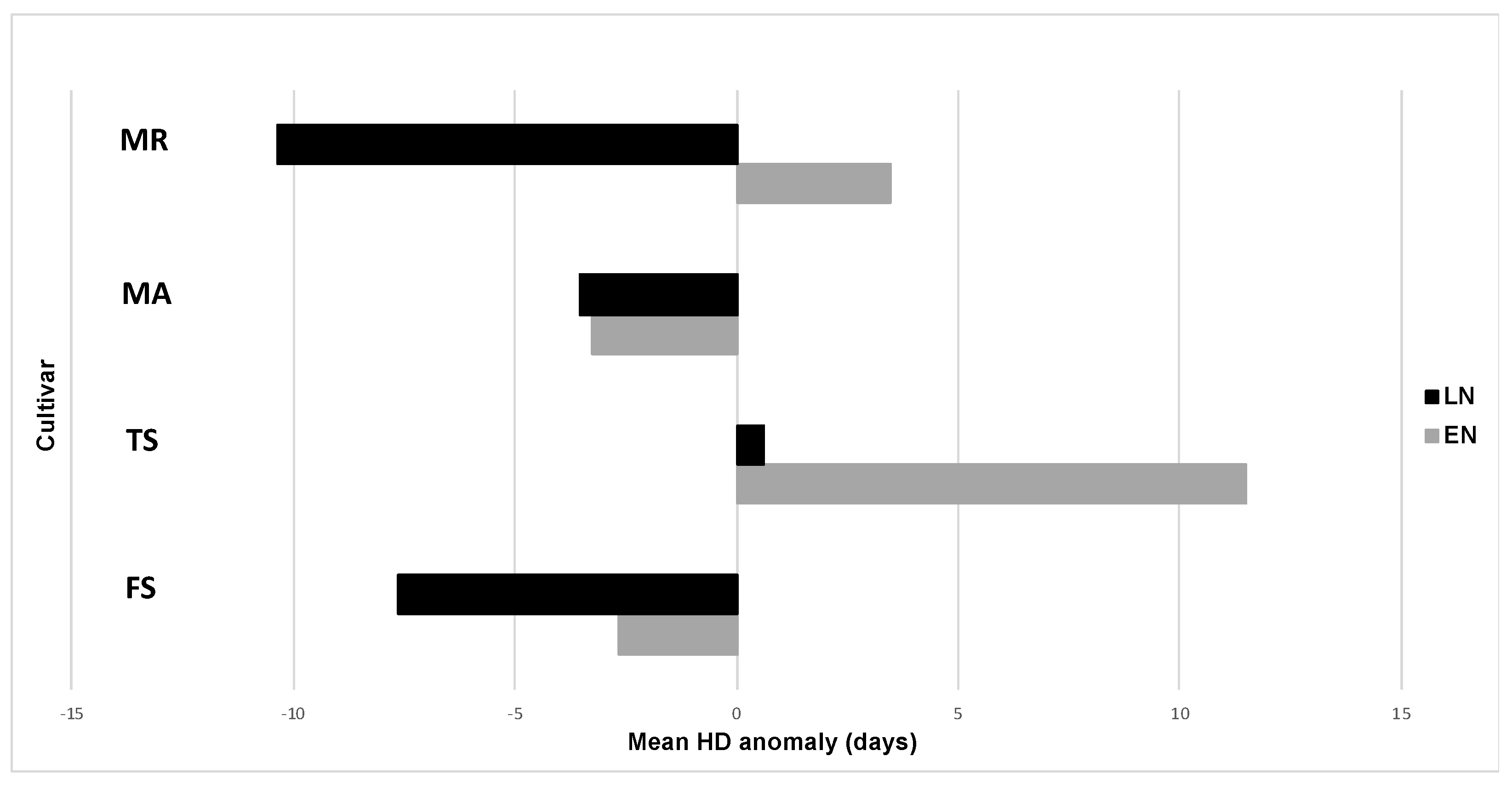
Figure 1 shows the mean harvest date (HD) anomalies, expressed in days, for each variety under El Niño (grey bars) and La Niña (black bars) conditions. The anomalies were calculated relative to the mean harvest date observed during Neutral seasons for each cultivar. Negative values indicate delayed harvest dates relative to Neutral conditions, whereas positive values indicate earlier harvests. Therefore, more negative anomaly values represent a greater harvest delay under the corresponding ENSO phase.
In Moscatel Rosada, El Niño seasons advanced harvest by approximately 3 days relative to Neutral conditions, whereas La Niña seasons delayed harvest by nearly 10 days. Muscat of Alexandria exhibited smaller anomalies than the rest of the grapevine varieties, with harvest occurring approximately 3 days later during El Niño seasons and close to 4 days later during La Niña seasons. Thompson Seedless showed the strongest response to ENSO variability, with harvest advancing by approximately 12 days during El Niño seasons, while La Niña conditions had little influence on harvest timing, advancing harvest by less than 1 day relative to Neutral seasons. Flame Seedless harvest was delayed under both ENSO phases relative to Neutral conditions, with a delay of approximately 3 days during El Niño seasons and nearly 8 days during La Niña seasons.

3.2. ENSO Phenomena Impacts on Harvest Date in Northern Chile

Table 2 shows the effects of ENSO phases on harvest date (DOY) in the different studied table and Pisco grapevine varieties. The mean harvest dates between El Niño and La Niña seasons revealed variety-specific responses to ENSO phases. Moscatel Rosada harvest dates during La Niña seasons occurred 14 days later than in El Niño seasons; however, this difference was not statistically significant (p-value = 0.549). Muscat of Alexandria showed similar mean harvest dates between ENSO phases (p-value = 0.987), suggesting a negligible influence of climatic anomalies on its ripening pattern. Contrary to this, Thompson Seedless showed a significant delay of approximately 11 days during La Niña seasons (p-value = 0.023), indicating a strong sensitivity of its harvest time to La Niña events. Flame Seedless tended to be harvested approximately five days earlier in El Niño compared to La Niña seasons without statistically significant (p-value = 0.198), probably due to the high variability, particularly under La Niña phenomena.

3.3. ENSO Phenomena Impacts on Bioclimatic Indices in Northern Chile

Table 3 shows the mean values and standard deviations of the bioclimatic indices calculated for the El Niño and La Niña seasons. The results showed that for only three bioclimatic indices were there significant differences between the values observed during the El Niño and La Niña phases. From these, two correspond to bioclimatic indices associated with thermal accumulation: (i) Spring Mean Temperature Summation (SONmean) and (ii) Growing Degree-Days (GDD). In addition, among the bioclimatic indices that directly consider temperature in their calculation, only the Mean Growing Season Temperature (MGST) exhibited significant differences between ENSO phases. For these three bioclimatic indices, significant differences were shown when they were calculated over alternative periods rather than their original definition. Non-significant differences were observed in the Heliothermal Index (HI), Cold Night Index (CI), Mean January Temperature (MJT) and the Maximum Springtime Temperature Summation (SONmax) calculated for different periods in the El Niño and La Niña seasons.
The SONmean index calculated from 1 October to 31 December was significantly higher during El Niño seasons (1634.9 heat units) compared to La Niña seasons (1571.3 heat units) (p-value = 0.042). In addition, the Growing Degree-Days (GDD) calculated from July 1 to December 31 were also significantly greater under El Niño conditions (1032.8 heat units) than in La Niña seasons (886.8 heat units) (p-value = 0.032). The Mean Growing Season Temperature (MGST) was significantly higher during El Niño seasons (15.5 °C) for the period of 1 July to 31 December than in La Niña phases (14.6 °C) (p-value = 0.038). In these bioclimatic indices, there were no statistically significant differences between the ENSO phases for the rest of the calculated periods.

3.4. Relationship Between Bioclimatic Indices and Harvest Date in Table Grapes

Table 4 presents the Pearson correlation coefficients (r) between harvest date and the calculated bioclimatic indices for table grape varieties (Flame Seedless and Thompson Seedless) analyzed across all seasons and across El Niño (EN) and La Niña (LN) phases. Most of the calculated bioclimatic indices showed significant correlations with harvest dates mostly for Flame Seedless, being the Cool Night Index (CI) and Mean January Temperature (MJT) that reached the least significant correlations. The bioclimatic indices calculated for table grapes during the El Niño seasons had no significant correlations with harvest dates, except for the Spring Maximum Temperature Summation (SONmax) index calculated during the period from 1 September to 30 November. On the other hand, the best correlations were obtained when considering only the La Niña seasons if the ENSO phenomena are segmented.
Significant correlations were observed between harvest date and bioclimatic indices in Flame Seedless such as Huglin Index (HI), Growing Degree-Days (GDD), and Growing Season Temperature (GST), with coefficients often exceeding the r = 0.60 under La Niña conditions. The best correlations in Flame Seedless were shown when GST was calculated from 1 July to 31 January for all seasons (r = 0.70, p-value < 0.01) and SONmax was calculated from 1 September to 30 November in the El Niño phase (r = 0.83, p-value < 0.01). In addition, Mean January Temperature (MJT) showed the highest correlation during La Niña seasons (r = 0.90, p-value < 0.01), suggesting a strong influence of mid-summer thermal conditions on harvest timing in this variety. In contrast, correlations with the CI were generally weak or non-significant, except for January values under La Niña seasons (r = 0.83, p-value < 0.01). Similar to Flame Seedless, none of the studied bioclimatic indices affected the harvest date in Thompson Seedless in El Niño seasons. Thompson Seedless showed weaker correlations between harvest date and bioclimatic indices compared to Flame Seedless. The highest correlations for harvest date in Thompson Seedless were found with HI and SONmax indices calculated in the period from 1 July to 31 January and from 1 September to 31 December (r = 0.58, p-value < 0.05; r = 0.68, p-value < 0.01), respectively, considering all the studied seasons. Interestingly, SONmax calculated from 1 October to 31 December in La Niña seasons was significant correlated to harvest date in Thompson Seedless (r = 0.84, p-value < 0.05).

3.5. Relationship Between Bioclimatic Indices and Harvest Date in Pisco Grapes

Table 5 presents the Pearson correlation coefficients (r) between harvest date and the calculated bioclimatic indices for Pisco grape varieties (Moscatel Rosada and Muscat of Alexandria) analyzed across all seasons, including El Niño (EN) and La Niña (LN) phases. Most of the calculated bioclimatic indices showed significant correlations with harvest dates, mostly for Muscat of Alexandria in all seasons and the La Niña phase, with the Cool Night Index (CI) and Mean January Temperature (MJT) that possessed the least significant correlations. The bioclimatic indices calculated for table grapes during the El Niño seasons had no significant correlations with harvest dates, except for the Spring Maximum Temperature Summation (SONmax) index calculated during the period from 1 September to 30 November in the Muscat of Alexandria variety. As was previously shown in table grapes, the best correlations were obtained when considering only the La Niña seasons if the ENSO phenomena is segmented, especially in Muscat de Alexandria.
Significant correlations were observed between harvest date and most of the studied bioclimatic indices in Muscat of Alexandria, with the exception of Mean January Temperature (MJT), particularly when calculated in the La Niña phase, with coefficients often exceeding r = 0.58. The best correlations for harvest date in Muscat of Alexandria corresponded to Huglin Index (HI) calculated from 1 July to 31 January and from 1 August to 30 April, including all studied seasons (r = 0.42, p-value < 0.01); SONmax calculated from 1 October to 31 December in the El Niño phase (r = 0.73, p-value < 0.05); and Spring Mean Temperature Summation (SONmean) calculated from 1 October to 31 December in the La Niña phase (r = 0.93, p-value < 0.01). In contrast, correlations with the CI were generally weak or non-significant, except for January values under La Niña and including all the studied seasons (r = 0.59, p-value < 0.05; r = 0.35, p-value < 0.05, respectively). Moscatel Rosada showed weaker correlations between harvest date and bioclimatic indices compared to Muscat of Alexandia. The best correlations for harvest date in Moscatel Rosada corresponded to Growing Season Temperature (GST) calculated from 1 July to 31 December and from 1 July to 31 January including all studied seasons (r = 0.71, p-value < 0.01), Huglin Index (HI) calculated from 1 October to 31 March in the El Niño phase (r = 0.75, p-value < 0.01) and GST calculated from 1 July to 31 December in the La Niña phase (r = 0.75, p-value < 0.01).

4. Discussion

The impact of ENSO phases on harvest date differed among the studied grapevine varieties (Table 2). Moscatel Rosada and Flame Seedless showed small differences in harvest dates between El Niño and La Niña phases, but these were not statistically significant due to the high variability in the data. Muscat of Alexandria showed similar harvest dates in both phases, suggesting that this variety might be minimally affected by the ENSO-related climatic variability. This phenomenon may be attributed to the intrinsic heat and drought tolerance of the variety, allowing it to maintain consistent performance in hot and arid environments [20]. Such physiological resilience likely minimizes its sensitivity to interannual temperature variability, even under hyper-arid conditions [21]. Recent studies revealed dynamic changes in berry hydraulics across phenological stages, with a marked increase in resistance around veraison in Muscat of Alexandria [22]. This transition coincides with the well-described shift in water transport from xylem to phloem, which effectively buffers berries from direct fluctuations in vine water status [23]. Such hydraulic buffering mechanisms can reduce the sensitivity of berries to short-term or seasonal climatic variability, since the phloem becomes the dominant pathway of water and solute supply. In addition, a recent study across grapevine varieties in Northern Chile demonstrated that Muscat of Alexandria harvest date was primarily influenced by the Huglin Index (HI) rather than others bioclimatic indices that cover the seasonal temperature fluctuations, which had more pronounced effects on other varieties like Thompson Seedless [19]. The lower correlation (57%) of Muscat of Alexandria harvest date with bioclimatic indices compared to other grapevine varieties such as Flame Seedless (96%) underscores its relative phenological stability [19].
By contrast, Thompson Seedless reported a clear and statistically significant delay in harvest date under La Niña (Table 2), indicating that this variety is more sensitive to interannual climate fluctuations. This sensitivity can be understood in relation to its short ripening cycle for table grape production and the strong influence of springtime maximum temperatures on harvest date (Table 4). In this way, the harvest date of Thompson Seedless occurred earlier during El Niño compared to La Niña, as El Niño conditions accumulated more heat units in spring than the La Niña phase. Sadras and Petrie [24] demonstrated that warmer spring conditions advance grapevine development primarily by triggering an earlier onset of the growth cycle, rather than by increasing the intrinsic rate of development. This mechanism may be particularly relevant in Thompson Seedless, as its phenological cycle for table grape production is relatively short [25]. Consequently, an earlier budburst or flowering triggered by the higher spring temperature accumulation during El Niño conditions can result in a substantially earlier harvest. The experimental evidence also highlights the sensitivity of Thompson Seedless to heat stress during early berry development stages. Matsui et al. [26] showed that exposing berries to 40 °C for four consecutive days at Stage I delayed ripening and reduced soluble solids accumulation, confirming that early-season temperature extremes can alter the phenological development in Thompson Seedless. This supports the hypothesis that springtime temperature anomalies, such as those associated with ENSO phenomena, can strongly affect berry development in this variety. Moreover, since Thompson Seedless maturity is defined operationally at ~17 °Brix for table grape production, any alteration in sugar accumulation dynamics is directly expressed in harvest timing.
Bioclimatic indices that exhibited significant differences were consistently higher during El Niño seasons compared to La Niña seasons. These results align with the thermal behavior of ENSO in central–northern Chile, where El Niño seasons are typically associated with warmer temperatures, whereas La Niña seasons are generally cooler [27]. Since some studied bioclimatic indices are linear functions of temperature, El Niño conditions translate directly into higher index values throughout the grapevine growing season. Recent studies in Chile have shown that El Niño events are associated with regionally warmer summer conditions, whereas La Niña tends to promote cooler temperatures [27]. This pattern is consistent with the directional trends observed in the bioclimatic indices, reinforcing the link between ENSO phases and viticultural thermal regimes. Most of the bioclimatic indices and calculation periods showed that La Niña seasons were more variable than El Niño phases—in some cases, even three times more variable. El Niño events tend to produce stronger, more spatially coherent climate anomalies across southern South America, especially in precipitation, through well-defined teleconnection patterns [28]. This leads to consistent warming or wetting during the El Niño phase, which may result in higher average indices with lower interannual variability [19,28]. In contrast, the La Niña phase impact is often more spatially fragmented and temporally inconsistent, resulting in greater fluctuations year-to-year within bioclimatic indicators [7,29]. This contrast mirrors findings from climate analyses that highlight ENSO teleconnection asymmetry and variability in southern South America, where La Niña yields more variable responses across regions and seasons [28,29].
The effect of ENSO phenomena on the relationship between harvest dates and bioclimatic indices revealed contrasting responses across the studied grapevine varieties (Table 4 and Table 5). The correlations improved for Muscat of Alexandria when ENSO phenomena were separated for phases, whereas, for Flame Seedless and Moscatel Rosada, it remained similar to those calculated across all seasons (Table 5). In the studied grapevine varieties, bioclimatic indices calculated during El Niño events showed no significant correlations with harvest dates, with the exception of the SONmax index calculated from 1 September to 30 November. In contrast, the strongest and most consistent correlations were obtained when considering only La Niña seasons. These findings suggest that a general harvest prediction model can be developed independently of the ENSO phase; however, if the ENSO condition of a given season is known, a more accurate model can be specifically applied for La Niña seasons. Such variety-specific predictive models would provide growers with a valuable decision-support tool for harvest planning and management during the growing season. These linear relationships can be extended beyond the current study, either to simulate variety responses in other agroclimatic zones or to project shifts in harvest timing under future climate scenarios. Such applications highlight the potential of ENSO-informed bioclimatic modeling to support adaptation strategies in viticulture. Based on this, our findings indicate that standard calendar-based indices may not fully capture the true heat requirements of grapevine varieties, which can lead to a misinterpretation of climatic responses. Since each grapevine variety follows a differentiated phenological behavior, bioclimatic indices calculated over fixed calendar windows [30,31] risk overlooking the periods of greatest climatic sensitivity [19]. Our results revealed that standard calendar-based indices may underestimate true heat requirements in Thompson Seedless, leading to a misinterpretation of its climatic responses. These adjustments suggest that a varietal-specific calibration of bioclimatic indices is essential [32,33]. Instead of applying a single index definition across all grape varieties, models should be flexible enough to account for differences in growth cycle length, phenological sensitivity, and climate-phase variability [19,32]. This approach will enhance the robustness of climate–harvest models, ensure more accurate projections under ENSO phases, and provide better guidance for vineyard management and harvest planning.

5. Conclusions

This study demonstrated that the El Niño–Southern Oscillation (ENSO) exerts a measurable but variety-specific influence on harvest dates and bioclimatic indices of grapevines cultivated in Northern Chile. Harvest date in Muscat of Alexandria did not vary across ENSO phases, but in Thompson Seedless it showed significant delay under La Niña events. Some bioclimatic indices were consistently higher during El Niño than La Niña phases. These findings emphasize that standard calendar-based indices may underestimate the true heat requirements of grapevine varieties, highlighting the need to adapt index calculation periods to phenological stages rather than fixed seasonal windows. Incorporating varietal-specific sensitivity, ENSO phase information, and extreme-event indicators into bioclimatic modeling will strengthen harvest prediction accuracy and support adaptive management strategies in viticulture, mostly under La Niña events. This study provides a framework for improving harvest prediction models under climate variability in arid viticultural regions.

Author Contributions

Conceptualization, N.V.-V., A.I.-G. and G.G.-G.; methodology, N.V.-V. and A.I.-G.; software, N.V.-V.; validation, N.V.-V. and G.G.-G.; formal analysis, N.V.-V.; investigation, G.G.-G.; data curation, N.V.-V. and A.I.-G.; writing—original draft preparation, G.G.-G. and N.V.-V.; writing—review and editing, G.G.-G., C.P.-D.l.F., M.R. and N.V.-V.; visualization, G.G.-G.; supervision, N.V.-V. and G.G.-G. All authors have read and agreed to the published version of the manuscript.

Funding

This research was funded by the Agencia Nacional de Investigación y Desarrollo (ANID), FONDECYT de Iniciación grant No. 11240152; ANID, FONDECYT de Iniciación grant No. 11261336; and ANID—VitiScience—CIA 250013.

Data Availability Statement

The original contributions presented in this study are included in the article. Further inquiries can be directed to the corresponding author.

Acknowledgments

The authors are grateful to Elizabeth Pastén and Nelson Rojas for their valuable technical support.

Conflicts of Interest

The authors declare no conflicts of interest.

References

  1. Sadras, V.O.; Petrie, P.R. Predicting the Time Course of Grape Ripening. Aust. J. Grape Wine Res. 2012, 18, 48–56. [Google Scholar] [CrossRef]
  2. Verdugo-Vásquez, N.; Acevedo-Opazo, C.; Valdés-Gómez, H.; Ingram, B.; De Cortázar-Atauri, I.G.; Tisseyre, B. Temporal Stability of Within-Field Variability of Total Soluble Solids of Grapevine under Semi-Arid Conditions: A First Step towards a Spatial Model. OENO One 2018, 52, 15–30. [Google Scholar] [CrossRef]
  3. Verdugo-Vásquez, N.; Acevedo-Opazo, C.; Valdés-Gómez, H.; Araya-Alman, M.; Ingram, B.; García de Cortázar-Atauri, I.; Tisseyre, B. Spatial Variability of Phenology in Two Irrigated Grapevine Cultivar Growing under Semi-Arid Conditions. Precis. Agric. 2016, 17, 218–245. [Google Scholar] [CrossRef]
  4. Gashu, K.; Sikron Persi, N.; Drori, E.; Harcavi, E.; Agam, N.; Bustan, A.; Fait, A. Temperature Shift Between Vineyards Modulates Berry Phenology and Primary Metabolism in a Varietal Collection of Wine Grapevine. Front. Plant Sci. 2020, 11, 588739. [Google Scholar] [CrossRef]
  5. van Leeuwen, C.; Destrac-Irvine, A.; Gowdy, M.; Farris, L.; Pieri, P.; Marolleau, L.; Gambetta, G.A. An Operational Model for Capturing Grape Ripening Dynamics to Support Harvest Decisions. OENO One 2023, 57, 505–522. [Google Scholar] [CrossRef]
  6. Travanic-Fuentes, Z.; Gutiérrez-Gamboa, G.; Moreno-Simunovic, Y. The Variability of Berry Parameters Could Be an Indicator of the Potential Quality of the Vineyard. Plants 2024, 13, 2617. [Google Scholar] [CrossRef] [PubMed]
  7. Verdugo-Vásquez, N.; Orrego, R.; Gutiérrez-Gamboa, G.; Reyes, M.; Zurita-Silva, A.; Balbontín, C.; Gaete, N.; Salazar-Parra, C. Climate Trends and Variability in the Chilean Viticultural Production Zones during 1985–2015. OENO One 2023, 57, 345–362. [Google Scholar] [CrossRef]
  8. Tonietto, J.; Carbonneau, A. A Multicriteria Climatic Classification System for Grape-Growing Regions Worldwide. Agric. For. Meteorol. 2004, 124, 81–97. [Google Scholar] [CrossRef]
  9. Jarvis, C.; Barlow, E.; Darbyshire, R.; Eckard, R.; Goodwin, I. Relationship between Viticultural Climatic Indices and Grape Maturity in Australia. Int. J. Biometeorol. 2017, 61, 1849–1862. [Google Scholar] [CrossRef]
  10. Huglin, M.P. Nouveau Mode d’évaluation Des Possibilités Héliothermiques d’un Milieu Viticole. Comptes Rendus L’académie D’agriculture Fr. 1978, 64, 1117–1126. [Google Scholar]
  11. Gladstone, J. Viticulture and Environment; Winetitles: Adelaide, Australia, 1993. [Google Scholar]
  12. Gutiérrez-Gamboa, G.; Fourment, M. Latin American Viticulture Adaptation to Climate Change; Springer International Publishing: Berlin/Heidelberg, Germany, 2024. [Google Scholar]
  13. Fourment, M.; Tachini, R.; Bonnardot, V.; Collins, C. Assessment of Albariño (Vitis vinifera sp.) Plasticity to Local Climate in the Atlantic Eastern Coastal Terroir of Uruguay. OENO One 2024, 58, 1–15. [Google Scholar] [CrossRef]
  14. Rodó, X.; Comín, F.A. Links between Large-Scale Anomalies, Rainfall and Wine Quality in the Iberian Peninsula during the Last Three Decades. Glob. Chang. Biol. 2000, 6, 267–273. [Google Scholar] [CrossRef]
  15. Yzarra, W.; Sanabria, J.; Caceres, H.; Solis, O.; Lhomme, J.P. Impact of Climate Change on Some Grapevine Varieties Grown in Peru for Pisco Production. OENO One 2015, 49, 103–112. [Google Scholar] [CrossRef]
  16. Kaltbach, P.; de Andrade Kaltbach, S.B.; Domingues, F.; Herter, F.G.; Costa, V.B. Relationship between the El Niño-Southern Oscillation and Yield and Sugar Content of Wine Grapes Grown in Santana Do Livramento, RS, Brazil. Cienc. Agrar. 2022, 43, 2031–2044. [Google Scholar] [CrossRef]
  17. Fourment, M.; Piccardo, D. What Grapes and Wines to Expect with the Drought? Agrociencia Urug. 2023, 27, e1206. [Google Scholar] [CrossRef]
  18. Verdugo-Vásquez, N.; Gutiérrez-Gamboa, G.; Díaz-Gálvez, I.; Ibacache, A.; Zurita-Silva, A. Modifications Induced by Rootstocks on Yield, Vigor and Nutritional Status on Vitis vinifera Cv Syrah under Hyper-Arid Conditions in Northern Chile. Agronomy 2021, 11, 979. [Google Scholar] [CrossRef]
  19. Verdugo-Vásquez, N.; Ibacache-González, A.; Gutiérrez-Gamboa, G. The Variability and Trend of Harvest Dates of Table and Pisco Grapes in Northern Chile Are Independently Influenced by Bioclimatic Indices. Horticulturae 2025, 11, 425. [Google Scholar] [CrossRef]
  20. Gutiérrez-Gamboa, G.; Villalobos-Soublett, E.; Garrido-Salinas, M.; Verdugo-Vásquez, N. Monofilament Shading Nets Improved Water Use Efficiency on High-Temperature Days in Grapevines Subjected to Hyperarid Conditions. Horticulturae 2024, 10, 176. [Google Scholar] [CrossRef]
  21. Villalobos-Soublett, E.; Gutiérrez-Gamboa, G.; Balbontín, C.; Zurita-Silva, A.; Ibacache, A.; Verdugo-Vásquez, N. Effect of Shading Nets on Yield, Leaf Biomass and Petiole Nutrients of a Muscat of Alexandria Vineyard Growing under Hyper-Arid Conditions. Horticulturae 2021, 7, 445. [Google Scholar] [CrossRef]
  22. Zarrouk, O.; Pinto, C.; Alarcón, M.V.; Flores-Roco, A.; Santos, L.; David, T.S.; Amancio, S.; Lopes, C.M.; Carvalho, L.C. Canopy Architecture and Sun Exposure Influence Berry Cluster–Water Relations in the Grapevine Variety Muscat of Alexandria. Plants 2024, 13, 1500. [Google Scholar] [CrossRef]
  23. Tyerman, S.D.; Tilbrook, J.; Pardo, C.; Kotula, L.; Sullivan, W.; Steudle, E. Direct Measurement of Hydraulic Properties in Developing Berries of Vitis vinifera L. Cv Shiraz and Chardonnay. Aust. J. Grape Wine Res. 2004, 10, 170–181. [Google Scholar] [CrossRef]
  24. Sadras, V.O.; Petrie, P.R. Climate Shifts in South-Eastern Australia: Early Maturity of Chardonnay, Shiraz and Cabernet Sauvignon Is Associated with Early Onset Rather than Faster Ripening. Aust. J. Grape Wine Res. 2011, 17, 199–205. [Google Scholar] [CrossRef]
  25. Fidelibus, M.W.; Christensen, L.P.; Katayama, D.G.; Ramming, D.W. Early-Ripening Grapevine Cultivars for Dry-on-Vine Raisins on an Open-Gable Trellis. Horttechnology 2008, 18, 740–745. [Google Scholar] [CrossRef]
  26. Matsui, S.; Ryugo, K.; Kliewer, W.M. Growth Inhibition of Thompson Seedless and Napa Gamay Berries by Heat Stress and Its Partial Reversibility by Applications of Growth Regulators. Am. J. Enol. Vitic. 1986, 37, 67–71. [Google Scholar] [CrossRef]
  27. Cordero, R.R.; Feron, S.; Damiani, A.; Carrasco, J.; Karas, C.; Wang, C.; Kraamwinkel, C.T.; Beaulieu, A. Extreme Fire Weather in Chile Driven by Climate Change and El Niño–Southern Oscillation (ENSO). Sci. Rep. 2024, 14, 1974. [Google Scholar] [CrossRef] [PubMed]
  28. Hernandez, D.; Mendoza, P.A.; Boisier, J.P.; Ricchetti, F. Hydrologic Sensitivities and ENSO Variability Across Hydrological Regimes in Central Chile (28–41° S). Water Resour. Res. 2022, 58, e2021WR031860. [Google Scholar] [CrossRef]
  29. Grimm, A.M.; Barros, V.R.; Doyle, M.E. Climate Variability in Southern South America Associated with El Niño and La Niña Events. J. Clim. 2000, 13, 35–58. [Google Scholar] [CrossRef]
  30. Hall, A.; Jones, G.V. Spatial Analysis of Climate in Winegrape-Growing Regions in Australia. Aust. J. Grape Wine Res. 2010, 16, 389–404. [Google Scholar] [CrossRef]
  31. Jones, G.V. Climate Change in the Western United States Grape Growing Regions. Acta Hortic. 2005, 689, 41–60. [Google Scholar] [CrossRef]
  32. Liles, C.; Verdon-Kidd, D.C. Refining the Growing Season Temperature Parameter for Use in Winegrape Suitability Analysis. Aust. J. Grape Wine Res. 2020, 26, 343–357. [Google Scholar] [CrossRef]
  33. Charalampopoulos, I.; Polychroni, I.; Droulia, F.; Nastos, P.T. The Spatiotemporal Evolution of the Growing Degree Days Agroclimatic Index for Viticulture over the Northern Mediterranean Basin. Atmosphere 2024, 15, 485. [Google Scholar] [CrossRef]
Figure 1. Mean harvest date (HD) anomalies (days) for table and Pisco grapevine varieties under El Niño (grey bars) and La Niña (black bars) conditions. Negative values indicate earlier-than-average harvest dates, while positive values indicate delays, relative to the long-term mean for each variety. Abbreviations—MR: Moscatel Rosada; MA: Muscat of Alexandria; TS: Thompson Seedless; FS: Flame Seedless. ENSO phases and intensities were classified according to the Oceanic Niño Index (ONI).
Horticulturae 12 00691 g001
Table 1. Classification of growing seasons according to ENSO phase and intensity (2002–2003 to 2017–2018) based on the Oceanic Niño Index (ONI).
SeasonEl Niño (EN)La Niña (LN)Neutral (N)
2002–2003M
2003–2004 N
2004–2005W
2005–2006 W
2006–2007W
2007–2008 S
2008–2009 W
2009–2010M
2010–2011 S
2011–2012 M
2012–2013 N
2013–2014 N
2014–2015W
2015–2016VS
2016–2017 W
2017–2018 W
Intensity of ENSO phenomena—VS: Very Strong; S: Strong; M: Moderate; W: Weak; N: Neutral—according to Oceanic Niño Index (ONI), published by the Golden Gate Weather Service. Source: Own elaboration based on publicly available Oceanic Niño Index (ONI) data obtained from GG Weather, http://ggweather.com/enso/oni.htm (accessed on 5 November 2025).
Table 2. Comparison of mean harvest dates (DOY) between El Niño (EN) and La Niña (LN) seasons for table and Pisco grapevine varieties.
VarietyEl Niño La Niña p-Value
MeanSDMeanSD
Moscatel Rosada62.311.576.616.30.549
Muscat of Alexandria101.911.6102.217.70.987
Thompson Seedless4.56.815.44.50.023
Flame Seedless350.73.5355.78.20.198
SD: Standard deviation. p-value at 0.05. Significant p-values (p ≤ 0.05) are highlighted in red.
Table 3. Descriptive analysis for the bioclimatic indices calculated in different periods in El Niño and La Niña phases in table and Pisco grapevine varieties.
Bioclimatic IndicesPeriodEl Niño SeasonsLa Niña Seasons
MeanSDMeanSDp-Value
Huglin Index
(heat units)
(1 October–31 March)2453.440.42424.4125.10.599
1 July–31 December1913.750.91759.1170.20.056
1 July–31 January2380.150.12232.3194.40.099
1 August–30 April3295.261.43222.8212.10.439
1 September–30 April3054.163.63003.2166.70.497
1 September–31 March2732.553.22685.4146.60.473
Cool Night Index
(°C)
(March)10.00.99.30.60.121
December10.00.79.71.10.613
January11.70.611.91.20.682
April6.91.46.50.70.549
MJT 1(January)20.40.420.61.00.637
SON 2 mean
(heat units)
(1 September–30 November)1472.467.81400.154.70.057
1 October–31 December1634.934.21571.359.40.042
SON 2 max
(heat units)
(1 September–30 November)2374.554.82301.3107.70.162
1 October–31 December2551.537.92461.5100.00.063
Growing Degree-Days
(heat units)
(1 October–30 April)1733.865.21692.4120.40.470
1 July–31 December1032.8104.0886.8109.90.032
1 July–31 January1355.2113.01216.2137.10.074
1 August–30 April1971.2108.61878.8163.90.265
1 September–30 April1870.495.31804.2134.40.336
1 September–31 March1706.684.81647.8121.20.341
Growing Season Temperature (°C)(1 October–30 April)18.20.318.00.60.409
1 July–31 December15.50.614.60.80.038
1 July–31 January16.20.615.40.80.069
1 August–30 April17.20.416.80.60.220
1 September–30 April17.70.417.40.60.349
1 September–31 March18.00.417.70.60.326
SD: Standard deviation. p-value at 0.05. 1 Mean January Temperature. 2 Spring Temperature Summation. Standard periods for each index are indicated in parentheses. Significant p-values (p ≤ 0.05) are highlighted in red.
Table 4. Coefficient of correlation (R2) and levels of significance of the influence of bioclimatic indices on the harvest date in different table grape varieties across all seasons and in El Niño and La Niña phases.
Flame SeedlessThompson Seedless
Bioclimatic IndicesPeriodAll SeasonsEl Niño SeasonsLa Niña SeasonsAll SeasonsEl Niño SeasonsLa Niña Seasons
Huglin Index
(heat units)
(1 October–31 March)0.38 *0.020.83 **0.110.030.08
1 July–31 December0.67 **0.340.72 *0.55 **0.810.66
1 July–31 January0.63 **0.230.79 **0.58 **0.790.58
1 August–30 April0.55 **0.0040.83 **0.240.160.05
1 September–30 April0.43 **0.010.74 *0.150.070.003
1 September–31 March0.46 **0.040.74 *0.180.210.01
Cool Night Index
(°C)
(March)0.020.070.020.060.0020.46
December0.110.0050.240.010.190.41
January0.230.100.83 **0.020.140.08
April0.020.480.140.020.730.24
MJT 1(January)0.120.060.90 **0.060.100.11
SON 2 mean
(heat units)
(1 September–30 November)0.60 **0.500.59 *0.44 *0.340.03
1 October–31 December0.68 **0.610.61 *0.46 *0.030.59
SON 2 max
(heat units)
(1 September–30 November)0.47 **0.83 *0.490.68 **0.860.67
1 October–31 December0.34 *0.070.420.46 *0.090.84 *
Growing Degree-Days
(heat units)
(1 October–30 April)0.45 **0.0010.82 **0.210.0060.03
1 July–31 December0.65 **0.220.77 **0.45 *0.370.05
1 July–31 January0.68 **0.160.84 **0.47 *0.340.06
1 August–30 April0.58 **0.0040.83 **0.250.160.001
1 September–30 April0.46 **0.020.70 *0.210.110.10
1 September–31 March0.51 **0.070.70 *0.210.130.11
Growing Season Temperature (°C)(1 October–30 April)0.48 **0.00020.84 **0.270.010.07
1 July–31 December0.68 **0.200.80 **0.48 *0.370.17
1 July–31 January0.70 **0.150.87 **0.50 *0.380.16
1 August–30 April0.61 **0.010.87 **0.280.090.02
1 September–30 April0.48 **0.020.71 *0.200.090.07
1 September–31 March0.53 **0.100.74 *0.230.130.07
SD: Standard deviation. ** p-value at 0.01. * p-value at 0.05. 1 Mean January Temperature. 2 Spring Temperature Summation. The “best” correlations are shown in dark gray (50% gray), and the “well” correlations are in gray (25% gray). Standard periods for each index are indicated in parentheses.
Table 5. Coefficient of correlation (R2) and levels of significance of the influence of bioclimatic indices on the harvest date in different Pisco grape varieties across all seasons and in El Niño and La Niña phases.
Muscat of AlexandriaMoscatel Rosada
Bioclimatic IndicesPeriodAll SeasonsEl Niño SeasonsLa Niña SeasonsAll SeasonsEl Niño SeasonsLa Niña Seasons
Huglin Index
(heat units)
(1 October–31 March)0.40 **0.030.87 **0.26 *0.250.75 *
1 July–31 December0.38 *0.270.89 **0.59 **0.360.56
1 July–31 January0.42 **0.170.88 **0.53 **0.320.56
1 August–30 April0.42 **0.080.70 *0.36 *0.020.60 *
1 September–30 April0.35 *0.0370.75 *0.32 *0.00010.62 *
1 September–31 March0.35 *0.080.72 *0.35 *0.020.60 *
Cool Night Index
(°C)
(March)0.0010.00060.020.00020.260.13
December0.170.060.220.230.060.38
January0.35 *0.100.59 *0.120.0020.52
April0.150.280.200.040.330.27
MJT 1(January)0.26 *0.130.520.040.020.36
SON 2 mean
(heat units)
(1 September–30 November)0.090.400.73 *0.64 **0.440.55
1 October–31 December0.230.520.93 **0.67 **0.350.64 *
SON 2 max
(heat units)
(1 September–30 November)0.240.73 *0.74 *0.44 **0.450.36
1 October–31 December0.28 *0.210.78 **0.32 *0.050.43
Growing Degree Days
(heat units)
(1 October–30 April)0.31 *0.010.80 **0.33 *0.010.64 *
1 July–31 December0.180.130.81 **0.66 **0.360.64 *
1 July–31 January0.230.080.78 **0.64 **0.320.60 *
1 August–30 April0.26 *0.030.66 *0.44 **0.020.56
1 September–30 April0.220.030.62 *0.39 *0.040.53
1 September–31 March0.200.070.58 *0.43 **0.110.52
Growing Season Temperature (°C)(1 October–30 April)0.33 *0.020.81 **0.36 *0.0040.65 *
1 July–31 December0.240.100.90 **0.71 **0.370.75 *
1 July–31 January0.29 *0.060.87 **0.71 **0.360.73 *
1 August–30 April0.28 *0.030.70 *0.46 **0.020.57
1 September–30 April0.230.030.64 *0.41 **0.040.57
1 September–31 March0.200.090.62 *0.44 **0.130.54
SD: Standard deviation. ** p-value at 0.01. * p-value at 0.05. 1 Mean January Temperature. 2 Spring Temperature Summation. The “best” correlations are shown in dark gray (50% gray), and the “well” correlations are in gray (25% gray). Standard periods for each index are indicated in parentheses.
Disclaimer/Publisher’s Note: The statements, opinions and data contained in all publications are solely those of the individual author(s) and contributor(s) and not of MDPI and/or the editor(s). MDPI and/or the editor(s) disclaim responsibility for any injury to people or property resulting from any ideas, methods, instructions or products referred to in the content.