Article

Combined BSA-Seq and RNA-Seq Analyses Identify Candidate Genes Associated with Self-Incompatibility in Cabbage (Brassica oleracea var. capitata)


1
State Key Laboratory of Vegetable Biobreeding, Institute of Vegetables and Flowers, Chinese Academy of Agricultural Sciences, Beijing 100081, China
2
College of Horticulture, Shenyang Agricultural University, Shenyang 110866, China
3
The Key Laboratory for Tobacco Gene Resources, Tobacco Research Institute, Chinese Academy of Agricultural Sciences, Qingdao 266101, China
4
Graduate School of Agricultural Science, Kobe University, Kobe 657-8501, Japan
5
Institute of Vegetables, Henan Academy of Agricultural Sciences, Zhengzhou 450002, China
*
Authors to whom correspondence should be addressed.
These authors contributed equally to this work.
Horticulturae 2026, 12(6), 656; https://doi.org/10.3390/horticulturae12060656
Submission received: 7 March 2026 / Revised: 4 May 2026 / Accepted: 22 May 2026 / Published: 23 May 2026
(This article belongs to the Special Issue A Decade of Research on Vegetable Crops: From Omics to Biotechnology)

Abstract

Cabbage (Brassica oleracea var. capitata), a member of the Brassicaceae family, is an important vegetable crop grown worldwide. Self-incompatibility (SI) in cabbage is a key trait that prevents self-fertilization and inbreeding, thereby maintaining genetic diversity within populations. Although several genes related to SI have been reported, its genetic control remains unclear. In this study, we developed an F2 population from the highly self-compatible (SC) cabbage line 87-534 and the highly self-incompatible (SI) line 01-20, both of which exhibit the S5 haplotype. The segregation analysis of the F2 population revealed the possible control of SI by a major gene with additional modifying genetic factors. Bulk segregant analysis sequencing (BSA-Seq) and RNA sequencing (RNA-Seq) were performed on SI and SC samples selected from the F2 population. BSA-Seq revealed a candidate region on chromosome 7 (C07: 7.45 Mb to 8.93 Mb), including 32 differentially expressed genes (DEGs). RNA-Seq identified a total of 2400 DEGs between the two pools, and Gene Ontology (GO) and Kyoto Encyclopedia of Genes and Genomes (KEGG) enrichment analyses suggested that plant hormone biosynthesis and signaling, plant immune response were significantly enriched and may be involved in SI. The combined analysis of BSA-Seq and RNA-Seq identified six candidate genes associated with SI, and their expression was confirmed using quantitative real-time PCR (qRT-PCR). Among them, Bol023956 encodes fructokinase, Bol023986 is involved in plant defense response, Bol024018 is related to pollen development, Bol024012 encodes a transport protein for phytohormones, Bol023943 encodes chorismate mutase 3, and Bol012515 is an important regulatory gene for chloroplast synthesis. These six genes, potentially linked to SI, should be targets for further validation. These findings provide insights into the molecular mechanisms of SI in cabbage and the selection of superior cabbage varieties.

1. Introduction

Self-incompatibility (SI) is a genetically regulated reproductive isolation mechanism that blocks fertilization following self-pollination, thereby reducing inbreeding depression and preserving the genetic diversity of flowering plants, which occurs in over 70 plant families and 250 genera of naturally occurring flowering plants [1,2]. In SI plants, fertilization can be blocked through multiple pathways, including the inhibition of pollen germination on the stigma, blockage of pollen tube’s entry into the stigma, blockage of tube elongation in the style, and failure of fertilized egg formation [1,3].
In Brassica species, including B. rapa, B. oleracea, and B. napus, SI is mainly controlled by the highly polymorphic S-locus, which is inherited as a single S-haplotype and contains tightly linked determinants that mediate specific pollen-pistil recognition [4,5,6]. Notably, the transition from SI to self-compatibility (SC) can be driven by multiple mechanisms, such as loss-of-function mutations in key S-locus genes, regulation by non-S-locus repressors, altered translation levels of core determinants (S-locus receptor kinase, SRK), and epigenetic modifications affecting the expression of the S-locus cysteine-rich protein (SCR) [7,8,9,10,11]. Gaude et al. reported that the stigmatic S-unit identified in a SC line of B. oleracea was highly homologous to the pollen-recessive S2 haplotype. Nevertheless, the expression of this stigmatic S-gene complex was still associated with the SI response in this line [12]. Consistent with this, Ruffio-Chable and Gaude demonstrated that while the S2 haplotype is generally associated with SC, its phenotypic expression can be modulated by genetic background, indicating that factors beyond the S-haplotype itself contribute to the strength of the SI response in B. oleracea [13]. Research by Nasrallah et al. suggested that self-compatibility in S2 is associated with a suppressor factor in the stigma that inhibits local expression of the S alleles, thereby causing the plant to transition to a SC phenotype [14]. However, in B. oleracea, research related to SI is relatively insufficient. Distinct SI/SC variations can still be observed among different lines, suggesting that besides the “S-haplotype identity”, other genetic factors may also be involved in regulating the differences in compatibility. In the breeding and seed production practices of Brassicaceae crops, SI often increases the difficulty of self-propagation and parental line purification, and may reduce seed production efficiency.
SI phenotype often involves genomic segments of multiple linked loci, making it difficult for a single technical approach to rapidly identify key regulatory factors against complex genetic backgrounds. Bulked Segregant Analysis (BSA) allows rapid mapping of candidate genomic intervals linked to target traits by constructing extreme phenotype pools from segregating populations, and has been widely employed as an efficient strategy for identifying phenotype-associated genes [15]. Meanwhile, high-throughput RNA sequencing (RNA-seq) provides a powerful tool for studying the gene regulation and molecular basis of such complex traits [16,17].
In this study, we used the highly SC cabbage (B. oleracea var. capitata) line 87-534 and the highly SI line 01-20 with the same S5 haplotype as parents to generate an F2 segregating population. By combining BSA-Seq and RNA-Seq, we identified candidate genes and related pathways involved in SI. These findings further contribute to understanding the molecular mechanisms of SI in cabbage.

2. Materials and Methods

2.1. Plant Materials and Growth Conditions

The cabbage line ‘87-534’ is a highly elite SC inbred line, with a CI greater than 10.0 during the flowering period. The elite SI cabbage inbred line ‘01-20’ exhibits a CI of less than 1.0 during the same stage. The S-haplotype for both ‘87-534’ and ‘01-20’ is S5 (class II), as identified in our previous study [18]. The F1 population, consisting of 120 plants, was generated by crossing ‘01-20’ with ‘87-534’, while the F2 population, comprising 580 plants, was obtained by selfing the F1 individuals. The highest and lowest individuals were grouped into two pools based on the following formula: CI = number of seeds/number of pollinated flowers.
All cabbage lines were provided by the Institute of Vegetables and Flowers, Chinese Academy of Agricultural Sciences (IVF-CAAS). The plants were grown to the 10-leaf stage in the greenhouse, after which they were placed in a vernalization chamber at 0–10 °C for 50 days. Finally, the plants were returned to the greenhouse for bolting and flowering.

2.2. Phenotyping

The self-compatibility during the flowering period was assessed using the traditional Compatibility Index (CI) and fluorescence microscopy. The specific procedure for calculating the CI involved selecting mature flowers that had been open for 1–2 days (post-anthesis) for self-pollination. This process was repeated three times at different intervals, with up to 30 flowers used per trial. After seed formation, the mean CI values from the three trials were calculated. In the CI method, incompatibility was defined as a CI value less than 1 [19]. A CI less than 1 was considered incompatible, whereas an index between 1 and 4 indicated moderate self-compatibility (MSC), and a CI > 4 indicated self-compatibility.
The method of pollination is as follows: on sunny mornings, flowers that had opened 1–2 days prior were selected for self-pollination during the flowering period. To account for potential loss of flowers during handling, five replicates per experimental group were pollinated. The results from three flowers with consistent outcomes were statistically analyzed, and the procedure was repeated three times at different intervals to determine the SC. The fluorescence microscopy method was performed as follows: Prior to fluorescence observation, the stigmas were removed 24 h after pollination during the flowering period, fixed in FAA solution for 24 h, and stored in 70% ethanol. Before observation, the stigmas were transferred to a 1 mol·L−1 NaOH solution and incubated in a 60 °C water bath for 1 h. The samples were then washed three times with water to remove residual NaOH. Finally, the samples were stained with aniline blue solution overnight and observed under a fluorescence microscope. According to the fluorescence microscopy standard defined by Voss Stern et al., the SC of cabbage can be categorized into three levels based on the number of pollen tubes penetrating the stigma: 0–10 tubes indicate incompatibility, 10–25 tubes indicate partial compatibility, and more than 25 tubes indicate compatibility [20].
All pollinations were conducted in the experimental greenhouse of IVF-CAAS, Beijing, China, between 9:00 and 10:00 a.m. on sunny days in late April, at a temperature range of 20–25 °C, to avoid weather conditions that were inappropriate for pollination.

2.3. Whole-Genome Resequencing and Bulked Segregant Analysis (BSA)

Genomic DNA was extracted from each individual using a modified CTAB technique [21]. A NanoPhotometer (IMPLEN, Westlake Village, CA, USA) was used to measure the DNA concentration, which was then diluted to 100 ng/μL.
In this study, a BSA library was constructed to investigate SI by randomly selecting 29 SC samples (CI > 10) and 29 SI samples (CI < 0.5) from the F2 population, forming two DNA pools, SC and SI, with each pool containing an equal amount of DNA from 29 individuals. After raw reads were obtained through sequencing using the Illumina platform, low-quality sequences and adaptor contamination were removed to produce high-quality sequences, or clean reads. The widely used alignment program BWA [22], in BWA-MEM mode, was employed to align these clean reads to the reference genome [23]. Variant calling was performed using the mutation analysis program GATK [24], employing the HaplotypeCaller mode and GVCF files for population detection. The program extracts all putative SNPs (single nucleotide polymorphisms) and InDels (insertions-deletions) across the entire genome. To obtain a high-confidence SNP/InDel dataset, further filtering was performed based on quality, depth, and reproducibility. The chromosomal distributions of the SNP indices for both pools were determined using a sliding window method with a window size of 1 Mb and a step size of 1 kb [25]. The ΔSNP index was calculated as the difference in SNP indices between the two pools. Within the 95% confidence interval, chromosomes were analyzed to identify potential locations for the SI genes. Candidate genes within the candidate regions were annotated using homologous gene analysis via the Arabidopsis (TAIR) database (http://www.arabidopsis.org/, accessed on 18 December 2025) and linear comparative analysis via BRAD (http://brassicadb.org/brad/, accessed on 18 December 2025).

2.4. RNA Extraction, Library Construction and Sequencing

To acquire more details of stigma development after pollination between the SC and SI pools, major developmental transitions of the stigmas from the aforementioned individuals (29 SC and 29 SI) were selected 0.5 h after pollination, consistent with previous studies [26]. The stigmas were collected and immediately frozen in liquid nitrogen. Each biological sample consisted of three biological replicates of stigmas.
Total RNA was extracted using TRIzol reagent (Invitrogen, Carlsbad, CA, USA). The RNA purity was assessed using a NanoPhotometer spectrophotometer (IMPLEN, Westlake Village, CA, USA), and the integrity was evaluated using the RNA Nano 6000 Assay Kit for the Agilent Bioanalyzer 2100 system (Agilent Technologies, Santa Clara, CA, USA). Each pool contained equal amounts of RNA from 29 individuals. cDNA library preparation and sequencing were performed by LC Sciences Company in Hangzhou, China. All libraries were sequenced using the Illumina HiSeq 4000TM platform (Illumina, Inc., San Diego, CA, USA).
Clean reads were obtained after raw sequence data processing, with low-quality and adapter-containing reads filtered to produce more reliable results. TopHat (v2.1.1) software was used to map the regions and density distributions of valid data to the BRAD reference genome [27]. Subsequently, StringTie (v2.1.4) software was used to compile new transcripts and known genes using mapped valid data. For differential expression analysis, raw read counts obtained from StringTie were used as input for the edgeR package [28]. Genes with |log2(fold change)| ≥ 1 and an FDR-adjusted p-value < 0.05 (Benjamini–Hochberg correction) were defined as differentially expressed genes (DEGs). Volcano plots were constructed based on the log2(fold change) and adjusted p-values of all genes to visualize the DEGs. The resulting DEGs were subjected to BLASTX (v2.12.0) similarity searches (E-value of 1 × 10⁻⁵) against the NCBI non-redundant protein databases, Swiss-Prot, and UniProtKB to ascertain the probable functions of the discovered DEGs [29].

2.5. Enrichment Analysis of DEGs

The GOseq R package was used to perform Gene Ontology (GO) enrichment analysis, correcting for gene length bias (GO, http://www.geneontology.org/, accessed on 18 December 2025). GO terms with corrected p-values ≤ 0.05 were considered significantly enriched with DEGs. The Blast2GO program was used to obtain GO annotations for all identified genes [30]. GO functional classification was performed using the WEGO online tool [31] to determine the distribution of gene functions at the macro level. The broad molecular function of the DEGs was analyzed in terms of significantly enriched GO categories for molecular function using singular enrichment analysis (SEA) [32], where the false discovery rate (FDR) was calculated to correct the p-value [33]. An FDR-adjusted p-value < 0.05 was considered significant.
KEGG is a comprehensive database designed to elucidate the high-level functions and applications of biological systems—including cells, organisms, and ecosystems—by integrating molecular-level data, particularly large-scale datasets derived from genome sequencing and other high-throughput experimental methods (http://www.genome.jp/kegg/, accessed on 18 December 2025) [34]. To identify key pathways associated with DEGs, a KEGG pathway analysis was conducted. Significant pathways were determined using Fisher’s exact test and the χ2 test, with an FDR-adjusted p-value < 0.05 considered statistically significant [29]. Additionally, the KEGG Orthology-Based Annotation System (KOBAS v3.0) software was used to assess the statistical enrichment of DEGs within KEGG pathways.

2.6. qRT–PCR Analysis

Stigma samples were collected at 0.5 h after pollination. The qRT-PCR experiment used an independent set of plants classified as SI or SC by the same criteria as the extreme samples in the RNA-seq experiment. All samples were collected from individual plants rather than pooled samples. Quantitative real-time PCR (qRT-PCR) was employed to confirm the expression levels of the transcriptome sequences. Primer Premier (v3.0) software, version 5.0 (Premier Biosoft International, Palo Alto, CA, USA), was used to design gene-specific primers based on the gene sequences from the BRAD reference genome. A PrimeScript RT Reagent Kit (TAKARA BIO, Inc., Shiga, Japan) was employed to synthesize first-strand cDNA. Following the manufacturer’s instructions, qRT-PCR was performed on an ABI Prism® 7900HT (Applied Biosystems, Carlsbad, CA, USA) using SYBR Premix Ex Taq II (Tli RNase HPlus; TAKARA). The amplification conditions were as follows: denaturation at 95 °C for 15 min, followed by 40 cycles at 95 °C for 10 s, 60 °C for 20 s, and 72 °C for 25 s. The relative changes in gene expression levels were normalized to the expression of the cabbage Actin gene (XM_013731369.1) and calculated using the 2−ΔΔCT method [35].

3. Results

3.1. Phenotype

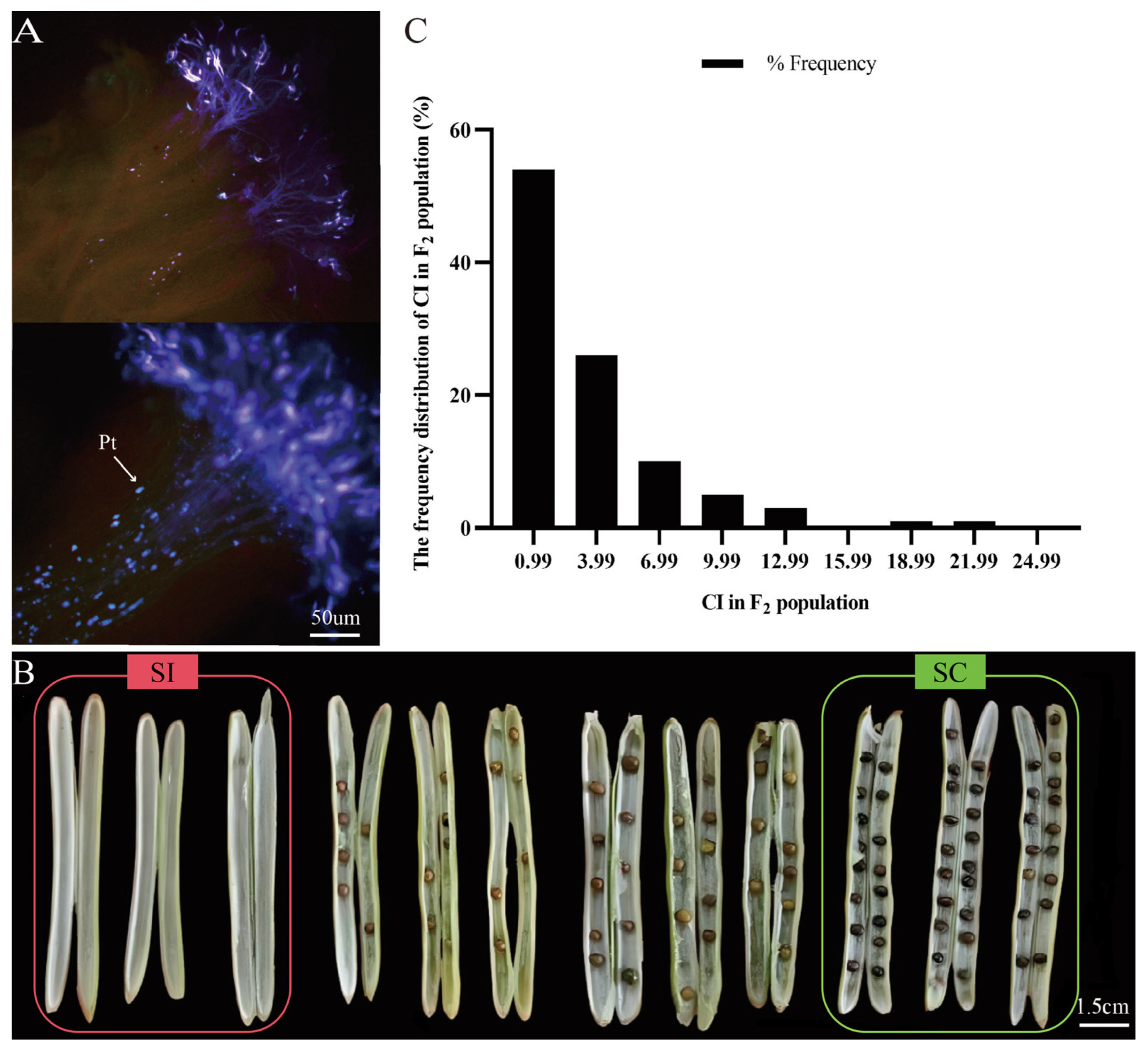
The CI for artificial pollination during the flowering period was 13.2 for 87-534 and 0.6 for 01-20. Microscopic observations of the 87-534 samples revealed that more than 25 pollen tubes clustered, germinated, and penetrated the stigma, whereas, in the 01-20 samples, most pollen tubes failed to penetrate the stigma (Figure 1A).
The SI/SC trait during the flowering period in the F2 population was investigated using the traditional CI calculation method (Figure 1B), and a frequency distribution plot was generated based on the results (Figure 1C). The distribution plot shows that the CI is continuously distributed within the F2 population. Overall, the segregating F2 population exhibited a skewed distribution, with the highest frequency of SI observed in the CI range of 0–0.99, suggesting that the trait may be controlled by a major gene with additional modifying genetic factors. According to the Mann-Whitney test, the data presented a p-value < 0.001, confirming the reliability of the results.

3.2. BSA-Seq Analysis

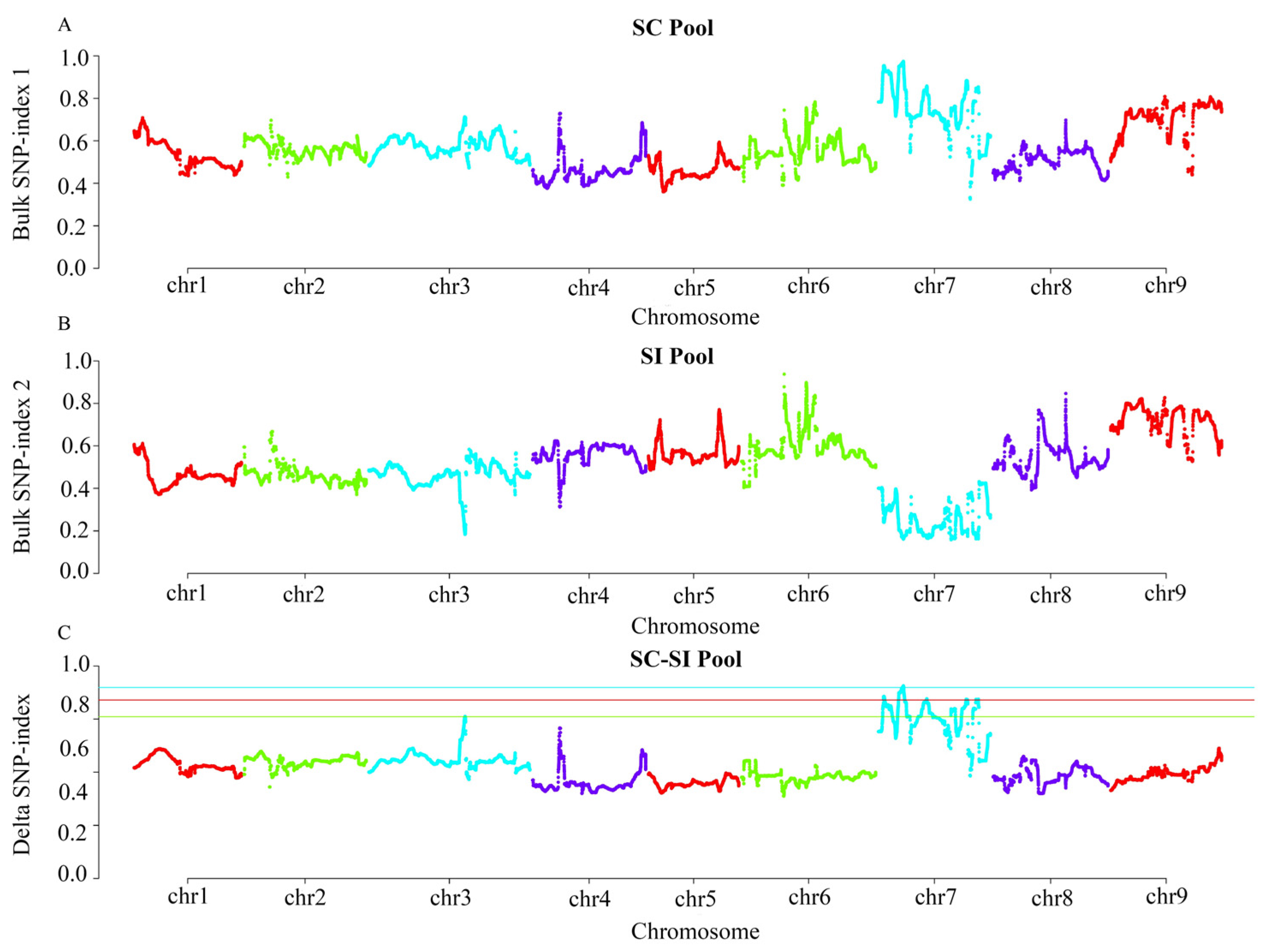
DNA from 29 SC (CI > 10) and 29 SI (CI < 0.5) plants was extracted, concentrated uniformly, and pooled to construct A and B pools, respectively. Whole-genome resequencing of these pools and the parental DNA yielded 41.79 Gb of raw data. After filtering, 38.27 Gb of clean data with a Q30 of 93.01% and a mapping efficiency of 96.61% to the reference genome were obtained, with an average depth of 32.20× and genome coverage of 86% (at least one base covered) (Table S1). A total of 5,686,539 single nucleotide polymorphisms (SNPs) and 1,266,015 insertions and deletions (InDels) were identified between the parents and the pools. Of these, 1,118,279 SNPs were nonsynonymous. The SNP index and InDel index values were calculated for each variant site, highlighting significant differences. One region was identified on chromosome C07: 7,450,000–9,830,000, covering a total of 2.38 Mb, as the likely candidate interval for SI-related genes with a 0.999 confidence level (Figure 2).

3.3. RNA-Seq Analysis

The transcriptome library was constructed from mixed RNA pools consisting of stigmas collected after pollination from high SC or high SI samples. A total of 276,391,574 raw read pairs were generated by PE150 sequencing from six cDNA libraries (‘P_SCQC_1’, ‘P_SCQC_2’, ‘P_SCQC_3’, ‘P_SIQC_1’, ‘P_SIQC_2’, and ‘P_SIQC_3’). After adaptor removal and filtering of short and low-quality reads, 274,047,290 (99.16%) valid data points remained. Furthermore, the Q20 values (i.e., reads with average quality scores > 20) were all >99%, and the Q30 values (i.e., reads with average quality scores > 30) exceeded 95%. The GC content ranged from 46% to 46.5%. A summary of the transcriptome sequencing results is shown in Table S2. These results indicate that the accuracy and quality of the sequencing data are sufficient for further analysis. Approximately 73–74% of the clean read pairs were mapped to the BRAD reference genome, yielding 35,400 transcripts, 31,128 Gene Ontology (GO)-annotated genes, and 16,153 KEGG-annotated genes.

3.4. DEG Expression Pattern Analysis

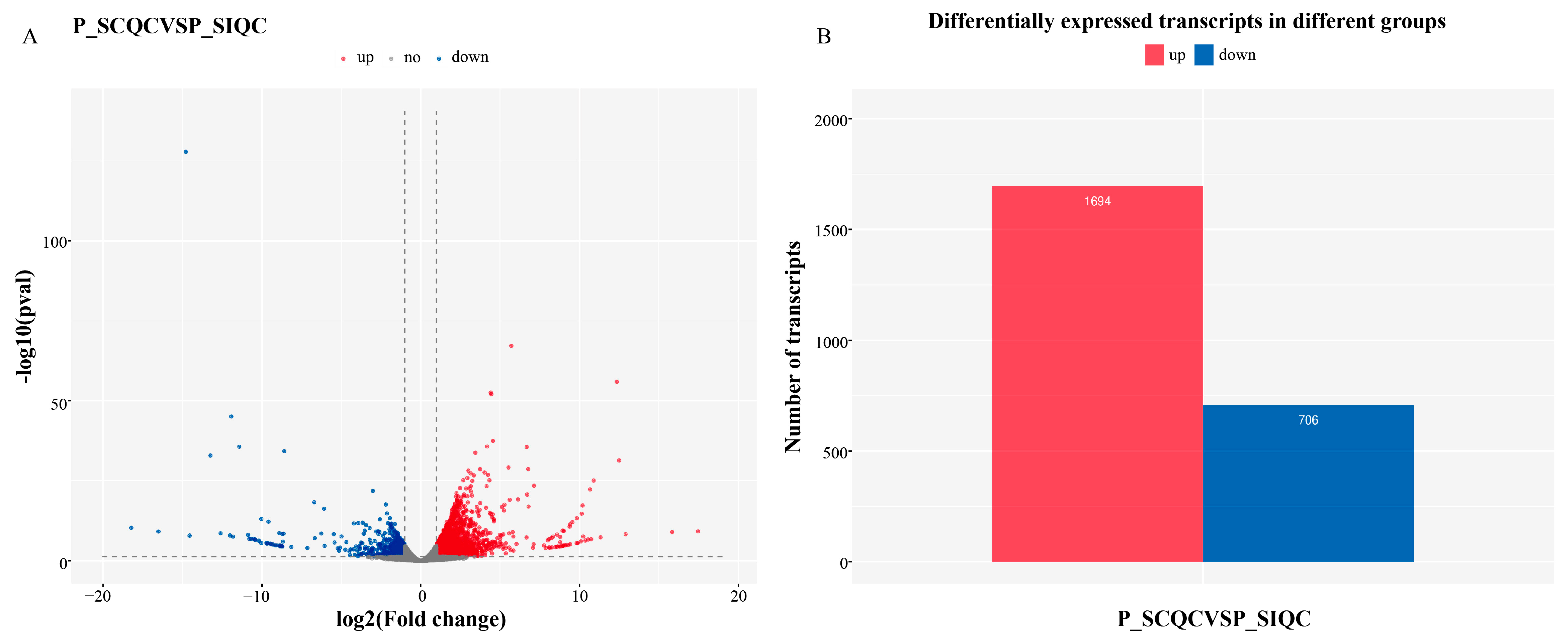
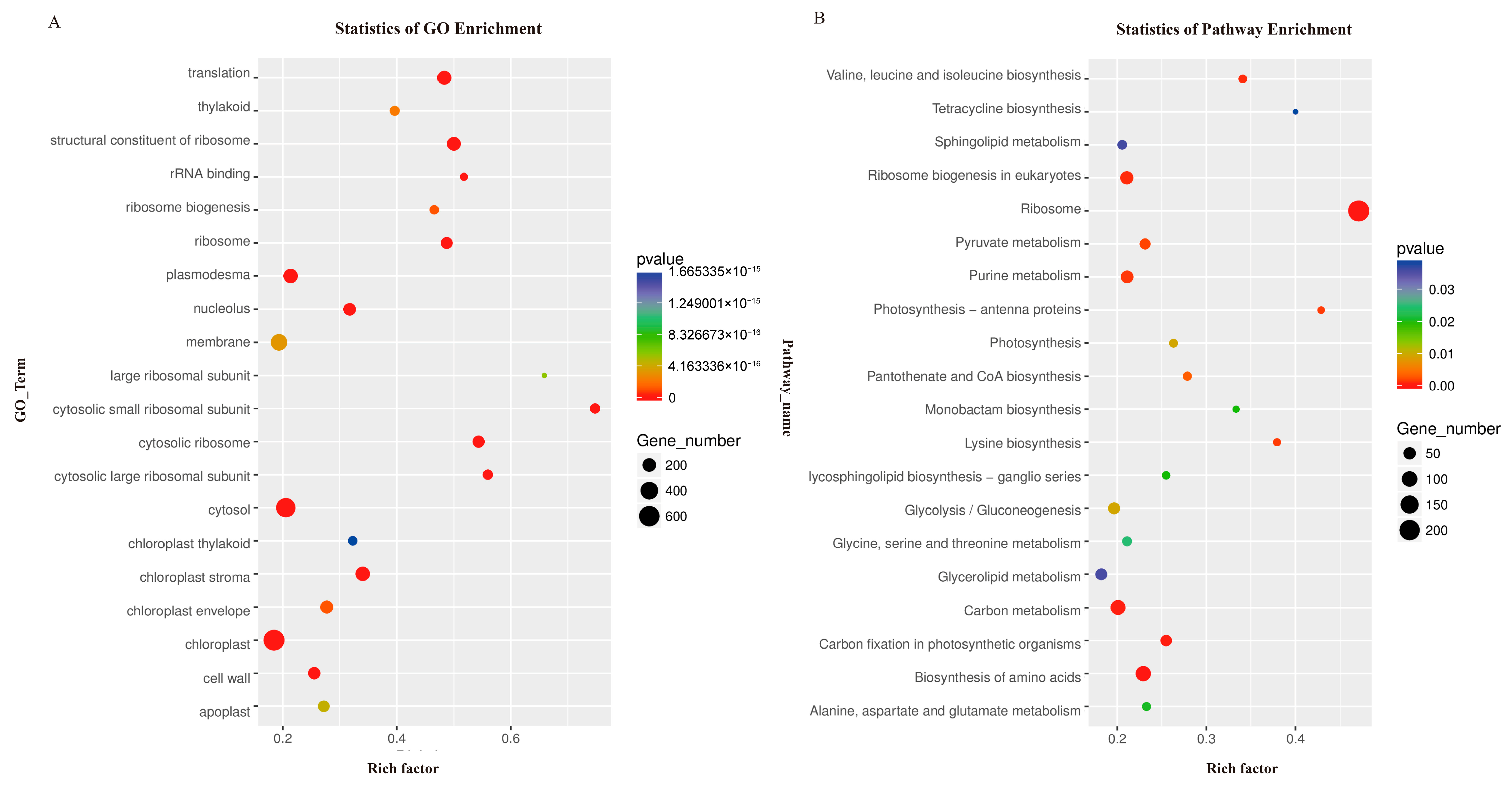
DEGs between the ‘P-SCQC’ and ‘P-SIQC’ pools were identified using the edgeR package, and 2400 DEGs were detected (Figure 3A). After self-pollination in SI plants, 1694 of these differentially expressed transcripts were upregulated, and 706 were downregulated (Figure 3B). To understand the functions of the DEGs, Gene Ontology (GO) enrichment analysis was performed. The results of the Gene Ontology (GO) functional enrichment analysis are shown in Table S3. The GO terms most frequently associated were enriched, with the greatest enrichment of DEGs observed in response to chloroplasts (GO: 0009507), followed by responses to the cytosol (GO: 0005829), plasmodesma (GO: 0009506), chloroplast stroma (GO: 0009570), and the cell wall (GO: 0005618) (Figure 4A). Furthermore, all DEGs were mapped to 129 pathways in the KEGG database (Table S4). The ‘Ribosome’ pathway was the most frequently occurring term, containing 225 DEGs, followed by ‘Biosynthesis of amino acids’ (94), ‘Carbon fixation in photosynthetic organisms’ (39), ‘Carbon metabolism’ (87), and ‘Valine, leucine, and isoleucine biosynthesis’ (15) (Figure 4B).

3.5. DEGs Related to Plant Hormone Signaling

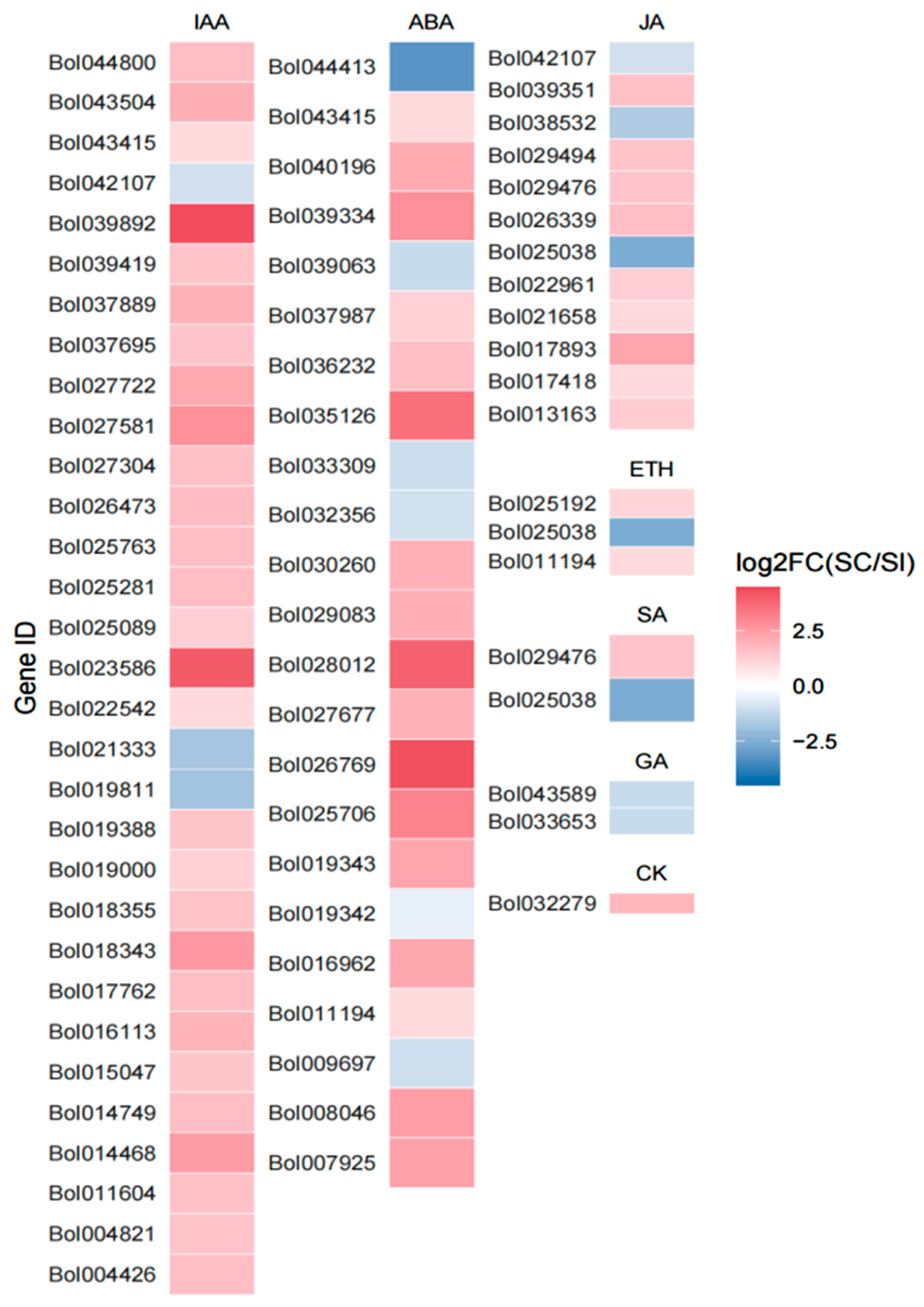
Gene Ontology (GO) and KEGG analyses revealed that DEGs related to plant hormone signaling were significantly enriched. A total of 82 DEGs associated with plant hormone signaling pathway were identified (Table S5). Among these DEGs, all eight involved in the indole-3-acetic acid (IAA) biosynthesis pathway were upregulated. Furthermore, the expression of 65 DEGs related to hormone signal transduction pathways, including IAA, abscisic acid (ABA), cytokinin (CK), gibberellins (GA), brassinosteroids (BRs), salicylic acid (SA), jasmonic acid (JA), and ethylene (ETH), was upregulated in the SI lines (Figure 5). Thirty-two DEGs were associated with the auxin signaling pathway, with three showing downregulation, encoding protein REVEILLE 1-like and protein SGT1 (suppressor of G2 allele of skp1) homolog A. Among the remaining upregulated DEGs, Bol023586 and Bol039892, encoding auxin response factor 5-like and protein WALLS ARE THIN 1, respectively, demonstrated the highest expression, with a 2.74-fold increase compared with other DEGs. Additionally, 12 DEGs involved in JA signal transduction were identified in the SI lines, with three downregulated and nine upregulated genes. The 29 DEGs related to ABA signaling were significantly differentially expressed, with six encoding protein kinases exhibiting upregulation. With respect to the ETH signaling pathway, three DEGs encoding phospholipase D alpha 1, lipase-like PAD4 (peptidyl arginine deiminase 4) isoform X1, and the ethylene-responsive transcription factor WRI1-like isoform X2 were identified, two of which were upregulated and one was downregulated. Moreover, one DEG involved in cytokinin (CK) signaling was upregulated, whereas two DEGs related to gibberellin (GA) signaling were downregulated. These results suggest a potential involvement of plant hormone signaling pathways in the SI response.

3.6. Combined BSA-Seq and RNA-Seq Analysis

To identify candidate genes associated with SI in cabbage, we performed a correlation analysis combining BSA-Seq and transcriptome data. Within the 2.38 Mb candidate region, 32 DEGs were identified (Table S7), of which 20 were upregulated in SI cabbage plants, and the remaining 12 were downregulated. Given that upregulated genes are more likely to represent positively activated components of the SI response, we focused our prioritization on the upregulated gene set. We first excluded genes with low basal expression (FPKM < 1 in both SC and SI samples) to minimize transcriptional noise. We further required differentially expressed genes to meet a significance threshold of padj < 0.05, which inherently requires consistency across biological replicates. Some of the remaining upregulated DEGs in the candidate region encode uncharacterized proteins with no clear functional annotations. While these cannot be ruled out as potential SI regulators, they were not prioritized in this study due to the lack of functional context for interpretation. Finally, considering the enrichment of chloroplast, phytohormone, and defense related pathways in our transcriptomic data, we further narrowed our focus to six DEGs associated with these functional categories. Among them, Bol023956 encodes fructokinase in the chloroplast, which is involved in chloroplast synthesis and plant growth and development. However, as noted by Casselman et al. (2000) [36], the fructokinase locus located on chromosome 7 does not contribute to SI specificity. This highlights the complexity of SI-related genes and suggests that further investigation is needed to clarify the functional role of Bol023956 in self-incompatibility [36]. Bol023986 encodes a serine/threonine kinase in the chloroplast, and Bol012515 encodes ATP-dependent Clp protease proteolytic subunit 3, a critical regulatory gene for chloroplast development [37]. Among the six candidates, Bol012515 showed the highest fold change (log2(fold change) = 1.79), suggesting that chloroplast-related processes may contribute to the SI response. Bol023943 encodes chorismate mutase 3, a key regulatory gene in chloroplast pathways, which is also enriched in the defense response pathway [38]. Additionally, Bol024012 encodes a protein from the NRT1/PTR family, members of this family were originally identified as nitrate or peptide transporters, but have since been shown to transport multiple phytohormones IAA, ABA, JA, and GA [39]. Bol024018 encodes tetraketide alpha-pyrone reductase, which catalyzes the synthesis of sporopollenin, a major component of the outer wall of pollen [40] (Table S8). All six genes were upregulated in the SI lines. In conclusion, these six genes are speculated to be potentially involved in the regulation of cabbage SI, and may serve as promising candidate targets for further functional verification.

3.7. Quantitative RT-PCR Validation of RNA-Sequencing Data

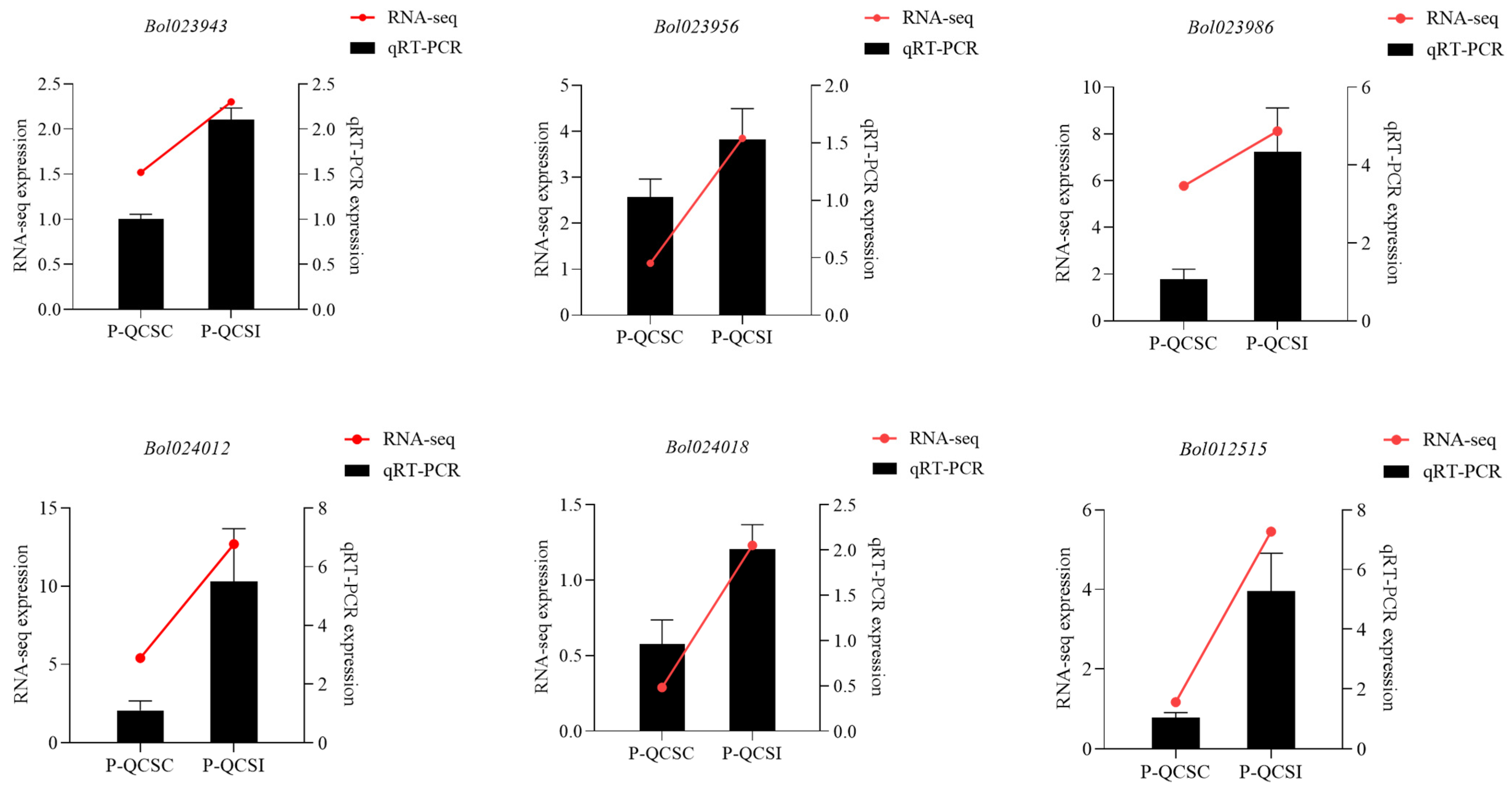
To verify the reliability of the RNA-Seq data, RNA was extracted from the stigmas of SC and SI samples at 0.5 h post-pollination. Six of the most important DEGs from the candidate regions were selected for qRT-PCR analysis (Figure 6) (Table S9). The results revealed that the relative expression levels of the selected genes were consistent with the RNA-Seq data, confirming the reliability of the findings. Further analysis revealed significant or highly significant differences in the relative expression levels of these genes across different samples. Compared with SC samples, Bol024012 exhibited the highest level of upregulation in SI samples, followed by Bol012515. Meanwhile, the expressions of Bol023986, Bol023943, Bol023956, and Bol024018 were all significantly upregulated.

4. Discussion

4.1. Self-Incompatibility in Cabbage May Be Accompanied by an Autoimmune Defense Response

In the Brassicaceae, self-incompatibility is controlled by the SRK and the SCR/SP11 protein. Pollen rejection occurs when stigma and pollen share the same S-haplotype. As both parental lines share the S5 haplotype, their SRK and SCR/SP11 genes are genetically uniform. Thus, the segregation pattern observed in the F2 population suggests that SI variation cannot be fully explained by S-locus identity alone. These findings imply that non-S-locus modifiers, epigenetic regulation, or downstream signaling components may contribute to the regulation of SI in cabbage. In the SI system of Brassicaceae, self-pollen is often rejected at the early stages of stigma interaction, including the inhibition of pollen hydration, germination, or penetration. Previous transcriptome studies on cabbage have reported that pollination with self-pollen induces extensive expression changes in genes related to signal transduction, hormone response, and defense in stigmas [41]. Consistent with these findings, our transcriptome comparison between SI and SC bulked stigmas revealed significant enrichment of biological processes linked to immune responses. It is important to note that these enrichments, while statistically robust, may reflect secondary responses to incompatible pollination rather than causal regulators of SI specificity. Although derived from transcriptomic data without functional validation, it is plausible that the early stigmatic response to SI shares certain molecular features with the plant immune response against pathogen invasion.
The plant immune system comprises several complex mechanisms, in which pathogen-associated molecular patterns (PAMPs), microbe-associated molecular patterns (MAMPs), and damage-associated molecular patterns (DAMPs) are recognized by pattern recognition receptors, triggering PAMP-triggered immunity (PTI). Pathogens secrete effector proteins to inhibit PTI, thereby triggering R gene-mediated effector-triggered immunity (ETI), where nucleotide-binding site-containing receptors recognize these effector proteins and stimulate further immune responses [42]. At the signaling level, immune responses such as PTI and ETI are usually accompanied by Ca2+ influx [43], activation of the MAPK signaling pathway, reactive oxygen species (ROS) burst, and activation of hormone signaling pathways including those of SA and JA [44]. Similarly, in our study, DEGs encoding calcium-dependent protein kinases (CPKs) and calmodulin (CaM) were upregulated in the SI lines. Notably, a study by Casselman et al. (2000) indicated that the calmodulin locus located on chromosome 7 does not contribute to SI specificity [36]. This indicates that although calcium signaling is activated during the SI response, it merely acts as a general physiological response accompanying pollen rejection, rather than a core factor determining self-recognition specificity. Additionally, genes in the MAPK signaling pathway were significantly enriched and upregulated. This pathway is one of the key signal transduction systems in plants and plays a role in activating plant defense mechanisms [45].
Hormone crosstalk may serve as a critical bridge linking “immune-like signals” and “pollination responses”. Numerous studies have shown that the SA and JA pathways are not independent of reproductive processes; instead, hormone crosstalk can reshape the local stigmatic environment and affect pollen tube behavior. Plant immune regulation depends on the synergistic and antagonistic interactions of multiple hormones, among which SA [46] and JA [44] are the core hormones mediating defense responses [47]. ETH [48], GA, IAA, cytokinins (CK), and BRs also act as modulators of plant immunity [49]. In this study, we observed significant enrichment of plant hormone-related pathways in SI lines. Specifically, 90.6% of DEGs related to IAA biosynthesis and signaling pathways were upregulated, 20 DEGs related to the SA and JA signaling pathways were upregulated (Table S6), and genes associated with abscisic acid (ABA), CK, and ETH biosynthesis were predominantly upregulated (Table S5). These findings indicate that the hormone regulatory network may be involved in mediating the inhibition of self-pollen at the stigma stage, potentially as downstream effectors or general modulators rather than core specificity determinants. Notably, among the 6 candidate genes identified by combined BSA-Seq and RNA-Seq, Bol024012, encoding a protein from the NRT1/PTR family, is capable of mediating the transport of multiple phytohormones, and may thus potentially participate in shaping the stigmatic hormonal microenvironment to regulate self-pollen inhibition at the stigma stage.
Meanwhile, we detected that all seven ROS synthesis-associated DEGs identified from the enrichment analysis were upregulated (Table S6), which is consistent with previous reports that ROS are involved in post-pollination signaling and cellular state changes. ROS play a key role in plant defense responses, as PTI activation by pathogen invasion is often accompanied by ROS bursts, and changes in ROS levels are closely related to the SI phenotype. In studies on SI in Chinese cabbage, increases and decreases in stigma ROS levels corresponded to SI and SC occurrence, respectively, with the application of ROS scavengers reducing SI symptoms [50]. In this study, KEGG analysis revealed that 74 DEGs were enriched in the plant-pathogen interaction pathway (Table S6), and GO analysis identified 409 immune defense-related DEGs. Among these, core immune genes such as the effector recognition receptor chaperone gene SGT1 (Bol042107), Mitogen-activated protein kinase (Bol026078) and the WRKY transcription factor gene (Bol044396) were all upregulated in SI lines [42,51,52]. Collectively, these results suggest that the SI response in cabbage shares some molecular features with plant immune signaling pathways. However, it remains unclear whether these shared features reflect a direct mechanistic link or represent general stress and cellular responses triggered by incompatible pollination. Future research needs to further elucidate the connection between the two at the molecular level to provide new ideas for disease resistance and efficient breeding of crops.

4.2. Possible Role of Chloroplasts in Self-Incompatibility in Plants

In addition to immune and hormone modules, Gene Ontology (GO) enrichment results revealed significant enrichment of chloroplast-related terms in SI lines, with 5 out of the top 20 enriched pathways being chloroplast-associated. We note that chloroplast-related enrichment is a common transcriptional feature in transcriptomes, and may reflect general metabolic adjustments or secondary stress responses, rather than specific regulators of SI. Although no direct evidence has confirmed that chloroplast-related genes regulate the core recognition process of SI to date, recent studies have revealed that chloroplasts are not only energy and metabolic centers, but also important sources of ROS production/scavenging, redox signals, and precursors of certain defense metabolites and signaling molecules, whose functional changes are often closely coupled with immune responses and stress adaptations. In Arabidopsis, homologous genes of atTOC159 are highly expressed in flowers and siliques, while atTOC90 is associated with anther development regulation [53]. The ABCB19 gene interacts with auxin efflux carriers PIN1 and PIN2 to collectively mediate auxin transport [54]. In this study, four differentially expressed genes (DEGs) encoding ABC transporter family members were enriched and all upregulated. Fructose-bisphosphate aldolase (FBA) genes are involved in photosynthesis in cruciferous crops [55], and also play key roles in plant development [56], signal transduction [57], secondary metabolism regulation [58], and stress responses [59], implying they may participate in immune-related signaling during the incompatible pollination response. Three indole-3-glycerol phosphate synthases (IGPS1, 2 and 3) are localized in chloroplasts, among which IGPS1 and IGPS3 are mainly involved in defense metabolite biosynthesis [60]. One IGPS-encoding DEG was upregulated in this study, suggesting its potential involvement in immune responses during incompatible pollination. The chloroplast ferredoxin/thioredoxin system is involved in photosynthesis, and previous studies have shown that thioredoxin h in this system regulates SI by affecting the activity of the S-locus receptor kinase [61,62]. Three thioredoxin-encoding DEGs were enriched and all upregulated in this study, but they do not encode thioredoxin h.
Notably, among the 6 candidate genes identified by the combined analysis of BSA-Seq and RNA-Seq, several were closely related to chloroplasts or chloroplast-associated pathways. For example, Bol012515 (encoding ATP-dependent Clp protease subunit 3 involved in chloroplast development) showed significant upregulation among candidate genes. Bol023956 (encoding chloroplast fructokinase), Bol023986 (encoding chloroplast serine/threonine kinase) and Bol023943 (encoding chorismate mutase 3, a key regulator of chloroplast metabolic pathways and associated with defense pathway enrichment) were also upregulated in SI lines. We emphasize that the association of these genes with chloroplasts does not necessarily imply a direct role in SI recognition or specificity. Rather, it is more plausible that these genes participate in chloroplast-modulated processes, such as ROS homeostasis, defense metabolite production, or energy metabolism, that may indirectly influence the strength or stability of the SI response.
In addition, Bol024018, associated with sporopollenin biosynthesis, is mainly involved in pollen wall development; its potential linkage to SI-related regulatory processes remains unclear and requires further exploration. Collectively, the six candidate genes identified here are unlikely to function as core specificity determinants of SI. Instead, they are proposed to act as downstream or parallel modulators of the stigma response, potentially tuning hormone signaling, immune activation, and chloroplast-mediated metabolism to influence the strength and robustness of pollen rejection, rather than defining the specificity of self-recognition.

5. Conclusions

In this study, we constructed an F2 segregating population using the highly SC cabbage (Brassica oleracea var. capitata) line ‘87-534’ and the highly SI line ‘01-20’, both of which belong to the same S5 haplotype. Through a comprehensive combined analysis of bulk segregant analysis sequencing (BSA-Seq) and RNA sequencing (RNA-Seq), a key candidate genomic region on chromosome 7 (C07: 7.45 Mb to 8.93 Mb) was identified, containing 32 DEGs that are likely involved in SI regulation. These candidate genes, which are distinct from the canonical S-locus genes SRK and SCR/SP11, provide new insights into the molecular control of self-incompatibility. Transcriptome enrichment analyses revealed that plant hormone-related processes (JA, SA, and ABA) and immune defense-related pathways may jointly participate in self-pollen recognition and rejection responses. Notably, the convergence of hormone signaling and immune-related pathways in the SI response suggests a potential shared regulatory mechanism connecting reproductive rejection with defense responses, which may contribute to the complex regulation of self-incompatibility. In addition, chloroplast-related functions were significantly enriched, implying their potential roles in SI.
By combining the BSA-Seq and RNA-Seq data, we prioritized six candidate genes (Bol023956, Bol023986, Bol024018, Bol024012, Bol023943, Bol012515). The significant upregulation of these candidate genes in SI lines was validated by qRT-PCR using stigmas samples collected at 0.5 h post-pollination. In conclusion, this study tentatively identified potential candidate genes associated with SI in cabbage, and suggested a possible involvement of plant hormone signaling and immune responses in regulating this complex trait. These findings provide new clues for understanding the genetic mechanisms of SI and provide essential information for the development of improved cabbage cultivars through molecular breeding approaches. Further functional studies and genetic transformation experiments will be required to validate these candidate genes and explore their potential for enhancing self-compatibility in cabbage and other Brassica crops.

Supplementary Materials

The following supporting information can be downloaded at: https://www.mdpi.com/article/10.3390/horticulturae12060656/s1, Table S1: Statistics of the BSA-seq data; Table S2: Summary of the transcriptome sequencing; Table S3: GO term analysis of the RNA-seq data; Table S4: KEGG analysis of the RNA-seq data; Table S5: DEGs involved in plant hormones; Table S6: DEGs involved in defense; Table S7: DEGs in the candidate regions; Table S8: Key candidate genes; Table S9: Primers used for qRT–PCR; Table S10: DEGs involved in chloroplasts.

Author Contributions

Conceptualization, H.L.; Data curation, Y.L.; Formal analysis, Y.L. and Y.Z. (Yulun Zhang); Investigation, Z.X.; Methodology, Z.X.; Project administration, M.Z., Y.Z. (Yangyong Zhang) and H.L.; Resources, J.J., Y.W., M.Z., L.Y., Y.Z. (Yangyong Zhang) and H.L.; Supervision, H.L.; Validation, Y.L. and Y.Z. (Yulun Zhang); Writing original draft, T.Z. and Y.L.; Writing review & editing, H.L. and X.Y.; Revision suggestion guidance, R.F. and X.W. All authors have read and agreed to the published version of the manuscript.

Funding

This work was funded by the National Natural Science Foundation of China (W2521011), the Science and Technology Innovation Program of the Chinese Academy of Agricultural Sciences (CAAS-ASTIP-IVFCAAS), and the China Agriculture Research System of MOF and MARA (CARS-23).

Data Availability Statement

The original contributions presented in this study are included in the article/Supplementary Material. Further inquiries can be directed to the corresponding authors.

Conflicts of Interest

The authors declare no conflicts of interest.

References

  1. Nettancourt, D. Incompatibility and Incongruity in Wild and Cultivated Plants; Springer: Berlin/Heidelberg, Germany, 2000. [Google Scholar]
  2. He, M.; Li, L.; Xu, Y.; Mu, J.; Xie, Z.; Gu, C.; Zhang, S. Identification of S-Genotypes and a Novel S-Rnase in 84 Native Chinese Pear Accessions. Hortic. Plant J. 2022, 8, 713–726. [Google Scholar] [CrossRef]
  3. Bateman, A.J. Self-Incompatibility Systems in Angiosperms. Heredity 1952, 6, 285–310. [Google Scholar] [CrossRef]
  4. Takayama, S.; Isogai, A. Self-Incompatibility in Plants. Annu. Rev. Plant Biol. 2005, 56, 467–489. [Google Scholar] [CrossRef]
  5. Nasrallah, J.B. Recognition and Rejection of Self in Plant Reproduction. Science 2002, 296, 305–308. [Google Scholar] [CrossRef] [PubMed]
  6. Schopfer, C.R.; Nasrallah, M.E.; Nasrallah, J.B. The Male Determinant of Self-Incompatibility in Brassica. Science 1999, 286, 1697–1700. [Google Scholar] [CrossRef]
  7. Okamoto, S.; Odashima, M.; Fujimoto, R.; Sato, Y.; Kitashiba, H.; Nishio, T. Self-Compatibility in Brassica Napus Is Caused by Independent Mutations in S-Locus Genes. Plant J. 2007, 50, 391–400. [Google Scholar] [CrossRef]
  8. Ekuere, U.U.; Parkin, I.A.P.; Bowman, C.; Marshall, D.; Lydiate, D.J. Latent S Alleles Are Widespread in Cultivated Self-Compatible Brassica napus. Genome 2004, 47, 257–265. [Google Scholar] [CrossRef]
  9. Nasrallah, J.B.; Liu, P.; Sherman-Broyles, S.; Schmidt, R.; Nasrallah, M.E. Epigenetic Mechanisms for Breakdown of Self-Incompatibility in Interspecific Hybrids. Genetics 2007, 175, 1965–1973. [Google Scholar] [CrossRef] [PubMed][Green Version]
  10. Shiba, H.; Kakizaki, T.; Iwano, M.; Tarutani, Y.; Watanabe, M.; Isogai, A.; Takayama, S. Dominance Relationships between Self-Incompatibility Alleles Controlled by DNA Methylation. Nat. Genet. 2006, 38, 297–299. [Google Scholar] [CrossRef] [PubMed]
  11. Isokawa, S.; Osaka, M.; Shirasawa, A.; Kikuta, R.; Komatsu, S.; Horisaki, A.; Niikura, S.; Takada, Y.; Shiba, H.; Isogai, A.; et al. Novel Self-Compatible Lines of Brassica Rapa L. Isolated from the Japanese Bulk-Populations. Genes Genet. Syst. 2010, 85, 87–96. [Google Scholar] [CrossRef]
  12. Gaude, T.; Friry, A.; Heizmann, P.; Mariac, C.; Rougier, M.; Fobis, I.; Dumas, C. Expression of a Self-Incompatibility Gene in a Self-Compatible Line of Brassica oleracea. Plant Cell 1993, 5, 75–86. [Google Scholar] [CrossRef] [PubMed]
  13. Ruffio-Chable, V.; Gaude, T. S-haplotype polymorphism in Brassica oleracea. Acta Hortic. 2001, 546, 257–261. [Google Scholar] [CrossRef]
  14. Nasrallah, M.E. Genetic Control of Quantitative Variation in Self-Incompatibility Proteins Detected by Immunodiffusion. Genetics 1974, 76, 45–50. [Google Scholar] [CrossRef]
  15. Zhao, P.; Zhang, L.; Zhao, L. Dissection of the Style’s Response to Pollination Using Transcriptome Profiling in Self-Compatible (Solanum pimpinellifolium) and Self-Incompatible (Solanum chilense) Tomato Species. BMC Plant Biol. 2015, 15, 119. [Google Scholar] [CrossRef]
  16. Wang, C.; Wu, J.; Gao, Y.; Dai, G.; Shang, X.; Ma, H.; Zhang, X.; Xu, W.; Qin, K. Localization of S-Locus-Related Self-Incompatibility in Lycium barbarum Based on BSA Analysis. Horticulturae 2024, 10, 190. [Google Scholar] [CrossRef]
  17. Wang, Z.; Wang, M.; Ding, Y.; Li, T.; Jiang, S.; Kang, S.; Wei, S.; Xie, J.; Huang, J.; Hu, W.; et al. The Pitaya Flower Tissue’s Gene Differential Expression Analysis between Self-Incompatible and Self-Compatible Varieties for the Identification of Genes Involved in Self-Incompatibility Regulation. Int. J. Mol. Sci. 2023, 24, 11406. [Google Scholar] [CrossRef] [PubMed]
  18. Tian, L.; Miao, W.; Liu, J.; Fang, Z.; Liu, Y.; Yang, L.; Zhang, Y.; Zhuang, M. Identification of S Haplotypes in Cabbage Inbred Lines (Brassica oleracea Var. capitata L.). Sci. Hortic. 2013, 164, 400–408. [Google Scholar] [CrossRef]
  19. Verma, V.K.; Kalia, P.; Prasanna, B.M. Genetic Characterization of Self-Incompatible Lines and Strategies for Heterosis Breeding in Cauliflower. Int. J. Veg. Sci. 2017, 23, 411–429. [Google Scholar] [CrossRef]
  20. Stern, G.A.V.; Ockendon, D.J.; Gabrielson, R.L.; Maguire, J.D. Self-Incompatibility Alleles in Broccoli1. HortScience 1982, 17, 748–749. [Google Scholar] [CrossRef]
  21. Safeena, M.I.S.; Dissanayake, Y.; Zakeel, M.C.M.; Warnakula, L.; Cooray, R.; Dayarathna, D.A.R.K. An Improved Method for Efficient Recovery of High Quality DNA from Date Palm. MethodsX 2021, 8, 101384. [Google Scholar] [CrossRef]
  22. Li, H.; Durbin, R. Fast and Accurate Short Read Alignment with Burrows–Wheeler Transform. Bioinformatics 2009, 25, 1754–1760. [Google Scholar] [CrossRef]
  23. Li, H.; Handsaker, B.; Wysoker, A.; Fennell, T.; Ruan, J.; Homer, N.; Marth, G.; Abecasis, G.; Durbin, R. The Sequence Alignment/Map Format and Samtools. Bioinformatics 2009, 25, 2078–2079. [Google Scholar] [CrossRef] [PubMed]
  24. McKenna, A.; Hanna, M.; Banks, E.; Sivachenko, A.; Cibulskis, K.; Kernytsky, A.; Garimella, K.; Altshuler, D.; Gabriel, S.; Daly, M.; et al. The Genome Analysis Toolkit: A Mapreduce Framework for Analyzing Next-Generation DNA Sequencing Data. Genome Res. 2010, 20, 1297–1303. [Google Scholar] [CrossRef] [PubMed]
  25. Huang, X.; Feng, Q.; Qian, Q.; Zhao, Q.; Wang, L.; Wang, A.; Guan, J.; Fan, D.; Weng, Q.; Huang, T.; et al. High-Throughput Genotyping by Whole-Genome Resequencing. Genome Res. 2009, 19, 1068–1076. [Google Scholar] [CrossRef]
  26. Dickinson, H.G.; Doughty, J.; Hiscock, S.J.; Elleman, C.J.; Stephenson, A.G. Pollen-Stigma Interactions in Brassica. Symp. Soc. Exp. Biol. 1998, 51, 51–57. [Google Scholar] [PubMed]
  27. Trapnell, C.; Roberts, A.; Goff, L.; Pertea, G.; Kim, D.; Kelley, D.R.; Pimentel, H.; Salzberg, S.L.; Rinn, J.L.; Pachter, L. Differential Gene and Transcript Expression Analysis of Rna-Seq Experiments with Tophat and Cufflinks. Nat. Protoc. 2012, 7, 562–578. [Google Scholar] [CrossRef]
  28. Robinson, M.D.; McCarthy, D.J.; Smyth, G.K. edgeR: A Bioconductor package for differential expression analysis of digital gene expression data. Bioinformatics 2010, 26, 139–140. [Google Scholar] [CrossRef]
  29. Kanehisa, M. Bioinformatics and Metabolome Analysis: Overview. Tanpakushitsu Kakusan Koso 2008, 53, 1697. [Google Scholar]
  30. Conesa, A.; Götz, S.; García-Gómez, J.M.; Terol, J.; Talón, M.; Robles, M. Blast2go: A Universal Tool for Annotation, Visualization and Analysis in Functional Genomics Research. Bioinformatics 2005, 21, 3674–3676. [Google Scholar] [CrossRef]
  31. Ye, J.; Fang, L.; Zheng, H.; Zhang, Y.; Chen, J.; Zhang, Z.; Wang, J.; Li, S.; Li, R.; Bolund, L.; et al. Wego: A Web Tool for Plotting Go Annotations. Nucleic Acids Res. 2006, 34, W293–W297. [Google Scholar] [CrossRef]
  32. Du, Z.; Zhou, X.; Ling, Y.; Zhang, Z.; Su, Z. Agrigo: A Go Analysis Toolkit for the Agricultural Community. Nucleic Acids Res. 2010, 38, W64–W70. [Google Scholar] [CrossRef]
  33. Pawitan, Y.; Michiels, S.; Koscielny, S.; Gusnanto, A.; Ploner, A. False Discovery Rate, Sensitivity and Sample Size for Microarray Studies. Bioinformatics 2005, 21, 3017–3024. [Google Scholar] [CrossRef]
  34. Kanehisa, M.; Furumichi, M.; Tanabe, M.; Sato, Y.; Morishima, K. Kegg: New Perspectives on Genomes, Pathways, Diseases and Drugs. Nucleic Acids Res. 2016, 45, D353–D361. [Google Scholar] [CrossRef] [PubMed]
  35. Livak, K.J.; Schmittgen, T.D. Analysis of Relative Gene Expression Data Using Real-Time Quantitative Pcr and the 2−Δδct Method. Methods 2001, 25, 402–408. [Google Scholar] [CrossRef] [PubMed]
  36. Casselman, A.L.; Vrebalov, J.; Conner, J.A.; Singhal, A.; Giovannoni, J.; Nasrallah, M.E.; Nasrallah, J.B. Determining the Physical Limits of the Brassica S Locus by Recombinational Analysis. Plant Cell 2000, 12, 23–33. [Google Scholar] [CrossRef]
  37. Shikanai, T.; Shimizu, K.; Ueda, K.; Nishimura, Y.; Kuroiwa, T.; Hashimoto, T. The Chloroplast Clpp Gene, Encoding a Proteolytic Subunit of Atp-Dependent Protease, Is Indispensable for Chloroplast Development in Tobacco. Plant Cell Physiol. 2001, 42, 264–273. [Google Scholar] [CrossRef]
  38. Rippert, P.; Puyaubert, J.; Grisollet, D.; Derrier, L.; Matringe, M. Tyrosine and Phenylalanine Are Synthesized within the Plastids in Arabidopsis. Plant Physiol. 2009, 149, 1251–1260. [Google Scholar] [CrossRef] [PubMed]
  39. Corratgé-Faillie, C.; Lacombe, B. Substrate (Un)Specificity of Arabidopsis Nrt1/Ptr Family (Npf) Proteins. J. Exp. Bot. 2017, 68, 3107–3113. [Google Scholar] [CrossRef]
  40. Zhu, L.; Zhang, T.; Teeri, T.H. Tetraketide A-Pyrone Reductases in Sporopollenin Synthesis Pathway in Gerbera hybrida: Diversification of the Minor Function. Hortic. Res. 2021, 8, 207. [Google Scholar] [CrossRef]
  41. Pu, M.; Lian, X.; Luo, S.; Zhang, H.; Wang, Y.; Bai, X.; Zeng, J.; Gao, Q.; Ren, X.; Zhu, L. Transcriptome Analysis of Stigma After Pollination in Brassica oleracea var. capitata. Acta Hortic. Sin. 2018, 45, 71–84. [Google Scholar] [CrossRef]
  42. Song, W.; Forderer, A.; Yu, D.; Chai, J. Structural Biology of Plant Defence. New Phytol. 2021, 229, 692–711. [Google Scholar] [CrossRef]
  43. Wang, J.; Liu, X.; Zhang, A.; Ren, Y.; Wu, F.; Wang, G.; Xu, Y.; Lei, C.; Zhu, S.; Pan, T.; et al. A Cyclic Nucleotide-Gated Channel Mediates Cytoplasmic Calcium Elevati on and Disease Resistance in Rice. Cell Res. 2019, 29, 820–831. [Google Scholar] [CrossRef]
  44. Couto, D.; Zipfel, C. Regulation of Pattern Recognition Receptor Signalling in Plants. Nat. Rev. Immunol. 2016, 16, 537–552. [Google Scholar] [CrossRef] [PubMed]
  45. Xu, P.; Xu, J.; Guo, Q.; Xu, Z.; Ji, W.; Yu, H.; Cai, J.; Zhao, L.; Zhao, J.; Liu, J.; et al. A Recessive LRR-RLK Gene Causes Hybrid Breakdown in Cotton. Theor. Appl. Genet. 2023, 136, 189. [Google Scholar] [CrossRef]
  46. Zheng, J.; Yang, Y.; Guo, X.; Jin, L.; Xiong, X.; Yang, X.; Li, G. Exogenous Sa Initiated Defense Response and Multi-Signaling Pathway in Tetraploid Potato Sd20. Hortic. Plant J. 2020, 6, 99–110. [Google Scholar] [CrossRef]
  47. Hou, S.; Tsuda, K. Salicylic Acid and Jasmonic Acid Crosstalk in Plant Immunity. Essays Biochem. 2022, 66, 647–656. [Google Scholar] [CrossRef]
  48. Naseem, M.; Kaltdorf, M.; Dandekar, T. The Nexus between Growth and Defence Signalling: Auxin and Cytokinin Modulate Plant Immune Response Pathways. J. Exp. Bot. 2015, 66, 4885–4896. [Google Scholar] [CrossRef]
  49. Yang, D.L.; Yang, Y.; He, Z. Roles of Plant Hormones and Their Interplay in Rice Immunity. Mol. Plant 2013, 6, 675–685. [Google Scholar] [CrossRef]
  50. Zhang, L.; Huang, J.; Su, S.; Wei, X.; Yang, L.; Zhao, H.; Yu, J.; Wang, J.; Hui, J.; Hao, S.; et al. Feronia Receptor Kinase-Regulated Reactive Oxygen Species Mediate Self-Incompatibility in Brassica rapa. Curr. Biol. 2021, 31, 3004–3016. [Google Scholar] [CrossRef]
  51. Zhang, M.; Zhang, S. Mitogen-Activated Protein Kinase Cascades in Plant Signaling. J. Integr. Plant Biol. 2022, 64, 301–341. [Google Scholar] [CrossRef] [PubMed]
  52. Wani, S.H.; Anand, S.; Singh, B.; Bohra, A.; Joshi, R. WRKY Transcription Factors and Plant Defense Responses: Latest Discove Ries and Future Prospects. Plant Cell Rep. 2021, 40, 1071–1085. [Google Scholar] [CrossRef]
  53. Liu, Y.S.; Sun, C.W. Characterization of Differential Expression and Leader Intron Function of Arabidopsis atTOC159 Homologous Genes by Transgenic Plants. Bot. Stud. 2013, 54, 40. [Google Scholar] [CrossRef][Green Version]
  54. Titapiwatanakun, B.; Blakeslee, J.J.; Bandyopadhyay, A.; Yang, H.; Mravec, J.; Sauer, M.; Cheng, Y.; Adamec, J.; Nagashima, A.; Geisler, M.; et al. ABCB19/PGP19 Stabilises PIN1 in Membrane Microdomains in Arabidopsis. Plant J. Cell Mol. Biol. 2008, 57, 27–44. [Google Scholar] [CrossRef]
  55. Zhao, W.; Liu, H.; Zhang, L.; Hu, Z.; Liu, J.; Hua, W.; Xu, S.; Liu, J. Genome-Wide Identification and Characterization of FBA Gene Family in Polyploid Crop Brassica napus. Int. J. Mol. Sci. 2019, 20, 5749. [Google Scholar] [CrossRef]
  56. Zhang, G.; Liu, Y.; Ni, Y.; Meng, Z.; Lu, T.; Li, T. Exogenous Calcium Alleviates Low Night Temperature Stress on the Photosynthetic Apparatus of Tomato Leaves. PLoS ONE 2014, 9, e97322. [Google Scholar] [CrossRef]
  57. Mohapatra, S.; Mittra, B. Protein Glutathionylation Protects Wheat (Triticum aestivum Var. sonalika) against Fusarium Induced Oxidative Stress. Plant Physiol. Biochem. 2016, 109, 319–325. [Google Scholar] [CrossRef]
  58. Zeng, Y.; Tan, X.; Zhang, L.; Jiang, N.; Cao, H. Identification and Expression of Fructose-1,6-Bisphosphate Aldolase Genes and Their Relations to Oil Content in Developing Seeds of Tea Oil Tree (Camellia oleifera). PLoS ONE 2014, 9, e107422. [Google Scholar] [CrossRef]
  59. Banerjee, A.; Mittra, B.; Das, A.B. Aluminium Induced Glutathione Is Essential for Developing Resistance against Fusarium Infection in Wheat. Proc. Natl. Acad. Sci. India Sect. B Biol. Sci. 2018, 88, 721–728. [Google Scholar] [CrossRef]
  60. Richter, A.; Powell, A.F.; Mirzaei, M.; Wang, L.J.; Movahed, N.; Miller, J.K.; Piñeros, M.A.; Jander, G. Indole-3-Glycerolphosphate Synthase, a Branchpoint for the Biosynthesis of Tryptophan, Indole, and Benzoxazinoids in Maize. Plant J. 2021, 106, 245–257. [Google Scholar] [CrossRef]
  61. Buchanan, B.B.; Schürmann, P.; Wolosiuk, R.A.; Jacquot, J.-P. The Ferredoxin/Thioredoxin System: From Discovery to Molecular Structures and Beyond. Photosynth. Res. 2002, 73, 215–222. [Google Scholar] [CrossRef]
  62. Valerio, C.; Costa, A.; Marri, L.; Issakidis-Bourguet, E.; Pupillo, P.; Trost, P.; Sparla, F. Thioredoxin-Regulated Β-Amylase (BAM1) Triggers Diurnal Starch Degradation in Guard Cells, and in Mesophyll Cells under Osmotic Stress. J. Exp. Bot. 2011, 62, 545–555. [Google Scholar] [CrossRef] [PubMed]
Figure 1. Genetic analysis of SI in cabbage. (A) Side views of 01-20 and 87-534 stigmas; (B) varying seed-setting rates among individuals in the F2 population, The red box highlights typical SI individuals with extremely low seed set (compatibility index, CI < 0.5), selected for the SI bulk. The green box highlights typical SC individuals with extremely high seed set (CI > 10), selected for the SC bulk; (C) frequency distribution of the CI for 100 randomly chosen individuals in the F2 population.
Horticulturae 12 00656 g001
Figure 2. Mapping of the B. oleracea genome region associated with SI using BSA-Seq. (A) Distribution of the SNP index in the SC pool within the F2 population. (B) Distribution of the SNP index in the SI pool within the F2 population. (C) ∆(SNP index) plot comparing the SC and SI pools. Curves in different colors (including red, green, blue, and purple) represent the Δ(SNP index) values for individual chromosomes (chr1–chr9). The blue line represents the threshold for the 99.9% confidence interval, the red line is the 99% confidence interval threshold line, and the green line is the 95% confidence interval threshold line. The threshold for the 99.9% confidence interval is 0.7980.
Horticulturae 12 00656 g002
Figure 3. Expression patterns of DEGs. (A) Volcano plot of DEGs between SC and SI cabbage lines. (B) Bar chart of differentially expressed transcripts between SC and SI cabbage lines. Red represents upregulated DEGs, whereas blue indicates downregulated DEGs.
Horticulturae 12 00656 g003
Figure 4. Functional analysis of DEGs. (A) Gene Ontology (GO) enrichment analysis results, with a scatter plot reflecting the top 20 enriched GO terms of DEGs. (B) KEGG enrichment analysis is displayed as a scatter plot, where the enrichment factor represents the ratio of DEGs to total genes in a specific KEGG pathway. A larger enrichment factor indicates a greater degree of Gene Ontology (GO) and KEGG enrichment.
Horticulturae 12 00656 g004
Figure 5. DEGs related to plant hormone signaling identified in the comparison between SC and SI cabbage plants. The heatmap illustrates the log2 (fold change) of DEGs between SC and SI plants, with color gradients ranging from red to blue indicating high to low log2 values.
Horticulturae 12 00656 g005
Figure 6. Comparison of RNA-Seq and qRT-PCR expression results. The bar chart represents the qRT-PCR results, while the line chart displays the RNA-Seq results.
Horticulturae 12 00656 g006
Disclaimer/Publisher’s Note: The statements, opinions and data contained in all publications are solely those of the individual author(s) and contributor(s) and not of MDPI and/or the editor(s). MDPI and/or the editor(s) disclaim responsibility for any injury to people or property resulting from any ideas, methods, instructions or products referred to in the content.