Article

Capsicum annuum L.: Phenological and Yield Performance of Native and Commercial Genotypes Under Open-Field and Low-Technology Greenhouse Hydroponic Systems


by
Brenda Nataly Hernández-Hernández
1,
Adriana Delgado-Alvarado
1,*,
Mario Alberto Tornero-Campante
1,
Braulio Edgar Herrera-Cabrera
1,
José Luis Jaramillo-Villanueva
1 and
Luz del Carmen Lagunes-Espinoza
2
1
Postgrado en Estrategias para el Desarrollo Agrícola Regional, Colegio de Postgraduados, Campus Puebla, Puebla 72760, Mexico
2
Postgrado en Ciencias Agrícolas en el Trópico, Colegio de Postgraduados, Campus Tabasco, Heroica Cárdenas 86500, Mexico
*
Author to whom correspondence should be addressed.
Horticulturae 2026, 12(6), 655; https://doi.org/10.3390/horticulturae12060655 (registering DOI)
Submission received: 20 April 2026 / Revised: 16 May 2026 / Accepted: 20 May 2026 / Published: 23 May 2026
(This article belongs to the Special Issue Biodiversity for Innovation and Resilience in Horticultural Crops)

Abstract

The performance of native landraces of Capsicum annuum L. under contrasting production systems remains poorly understood, limiting their evaluation under locally relevant production scenarios. This study evaluated the phenological and productive responses of five genotypes (four native landraces and one commercial cultivar) under two systems representing locally relevant production conditions: open-field (OF) and a substrate-based hydroponic system under low-technology, passively ventilated tunnel-type greenhouse conditions (GH), to describe genotype-specific responses under contrasting production conditions during the 2023 growing season in Puebla, Mexico. Agroclimatic and agronomic variables were analyzed using independent ANOVA by system and canonical correlation analysis (CCA). The GH system exhibited restrictive microclimatic conditions, with maximum temperatures exceeding 48 °C and photosynthetically active radiation reduced by approximately 53% compared to OF conditions. Environmental conditions were not standardized between systems; therefore, the results reflect the contrasting microclimates of locally relevant production systems and provide a context-specific assessment of genotype performance. Under the specific conditions evaluated, yield was lower in GH compared to OF across all genotypes. The commercial cultivar Serrano Tampico achieved the highest yield (1.118 kg per plant under OF), while Mixteco Largo and Cola de Ratón produced the highest number of fruits. The CCA identified genotype-specific associations between environmental and agronomic variables, suggesting distinct performance patterns under contrasting production conditions, with native landraces exhibiting better agronomic performance under OF conditions. Overall, the results provide a context-specific characterization of genotype performance under contrasting production conditions.

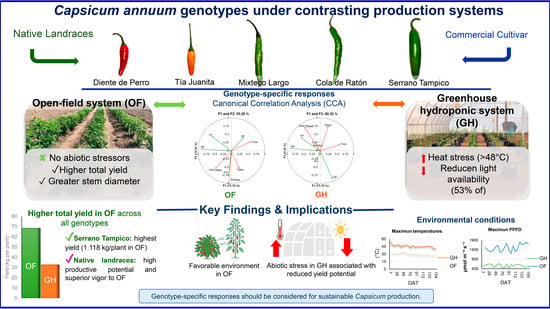
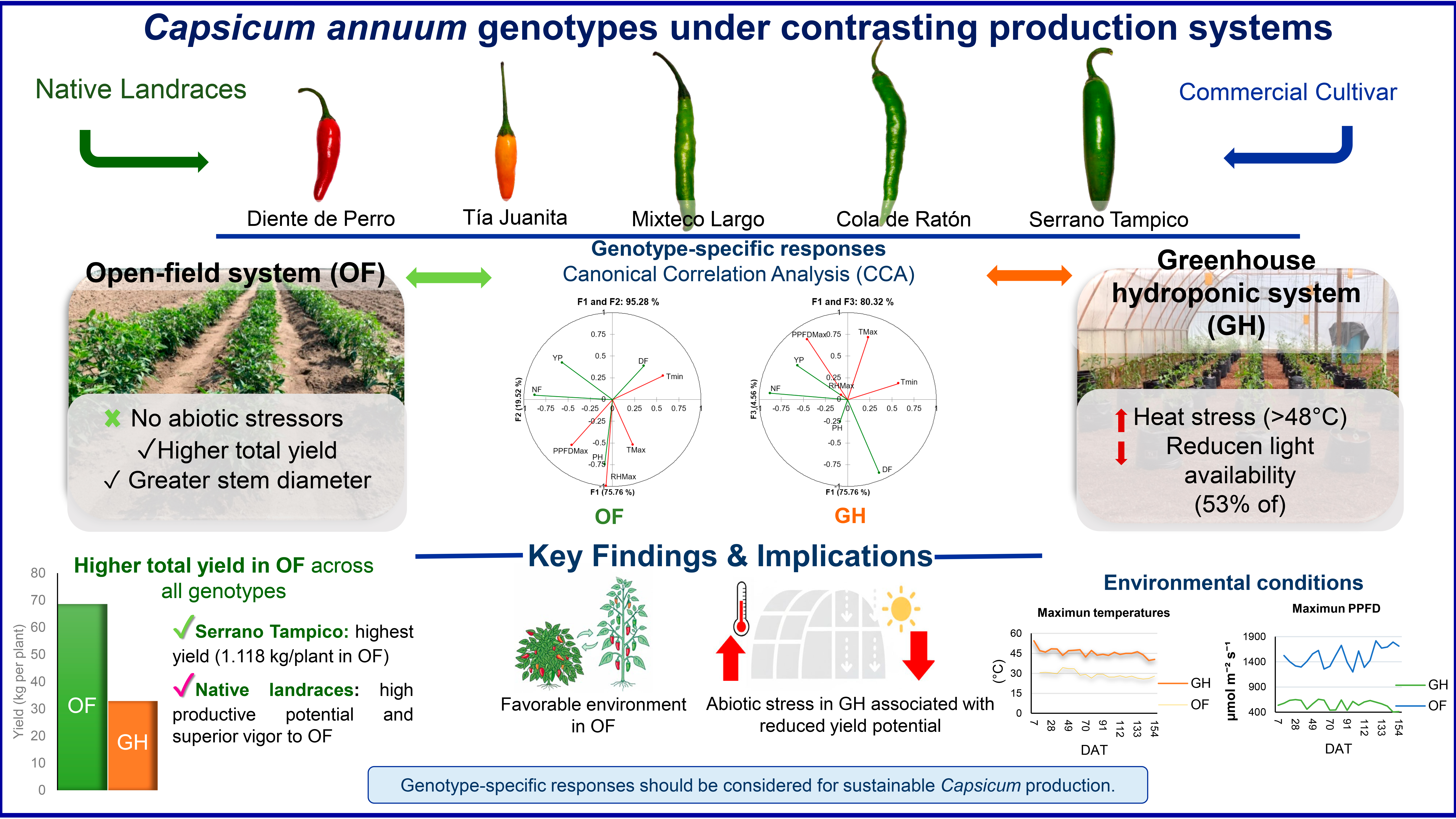
Graphical Abstract

1. Introduction

Chili pepper (Capsicum annuum L.) is a crop of global strategic importance, with significant economic, nutritional, and cultural value [1,2]. This species, belonging to the Solanaceae family, exhibits extensive genetic diversity, which confers high phenotypic plasticity and allows responses to a wide range of environmental conditions [3]. As a result, its global production exceeds 44 million tons annually, consolidating its role as a key crop in both traditional and intensive production systems [4]. This genetic diversity not only supports its broad geographic distribution but also provides a basis for the selection of genotypes with specific agronomic traits, particularly under varying environmental conditions [5].
Beyond its dietary importance, C. annuum is characterized by a complex biochemical composition that determines its commercial and functional value [6,7,8,9]. From an agronomic perspective, however, the accumulation of these compounds is closely linked to the physiological status of the plant and its response to the growing environment [10]. Therefore, current research focuses on understanding how environmental conditions influence phenotypic expression, particularly in terms of phenology, growth, and yield. In this context, evaluating crop performance under contrasting production conditions is important for understanding phenological and productive responses under locally relevant environments, as productivity is influenced by both genotype characteristics and environmental conditions [11].
Under open-field conditions, factors such as climatic variability, temperature fluctuations, water availability, and solar radiation introduce high production uncertainty and limit crop efficiency [12,13,14]. These factors are associated with changes in key physiological processes, including photosynthesis, transpiration, and assimilate partitioning, which may contribute to variation in growth and yield. In particular, high temperatures can reduce photosynthetic efficiency [15], while water deficit limits cell expansion and reproductive development [15,16].
As an alternative, protected agriculture has enabled partial control of the growing environment through the use of greenhouses, thereby modifying growing conditions and potentially reducing environmental variability [17]. In these systems, soilless cultivation, including hydroponic systems based on inert substrates, allows more precise management of water and nutrients, allowing favorable conditions for productive development [18,19]. In addition, these systems can improve resource-use efficiency, reduce the incidence of soil-borne pathogens, and facilitate more uniform crop development [20,21]. However, the performance of protected systems critically depends on environmental control [22]. Under conditions of limited ventilation and high external solar radiation, greenhouses may experience excessive heat accumulation, while plastic covers can reduce the availability of photosynthetically active radiation, creating conditions associated with abiotic stress [23,24]. In particular, stress associated with these conditions may affect key physiological processes such as photosynthesis, cellular integrity, metabolic activity, and pollen viability [25,26], potentially limiting reproductive development and yield.
In this context, the relationship between genotype and environmental conditions provides a useful framework for understanding variability in agronomic performance [27]. Genotypes may exhibit differential responses under contrasting environmental conditions, which is reflected in changes in key agronomic traits [28]. The magnitude of this interaction depends on both genetic variability and environmental heterogeneity. In particular, phenological stages such as flowering and fruiting are highly sensitive to environmental factors including temperature, radiation, and humidity [29,30], making them useful indicators for identifying response patterns and resource-use strategies among genotypes. These insights are particularly relevant for breeding programs and the conservation of native landraces, as they support the identification of genotypes with better agronomic performance to specific environmental conditions.
Mexico, as one of the main centers of origin and diversification of C. annuum, harbors extensive genetic diversity represented by native landraces that have been selected under local conditions over generations [31,32]. These materials constitute a valuable genetic resource, particularly in terms of adaptation to variable environments and resilience to abiotic stress [33,34]. However, the adoption of commercial cultivars in intensive systems has contributed to a decline in the use of these native materials [35,36], which may lead to genetic erosion and loss of agricultural diversity, creating a knowledge gap regarding their performance under different production systems.
Under this framework, genotype performance may vary significantly across production systems, reflecting the influence of environmental conditions and management practices on phenological and productive responses. This variability highlights the importance of evaluating genotype behavior under contrasting growing environments to identify response patterns and differences in agronomic performance associated with contrasting production environments. Therefore, the objective of this study was to characterize the phenological and productive responses of five C. annuum genotypes (four native landraces and one commercial cultivar) under two contrasting production systems: open-field and a substrate-based hydroponic system under low-technology greenhouse conditions, identifying genotype-specific responses under contrasting production conditions. It was hypothesized that contrasting production environments would be associated with differences in phenological and productive performance among genotypes, with the greenhouse system expected to enhance productivity. However, given that the two systems differ in multiple factors (microclimate, plant density, substrate, irrigation, and management), this study does not aim to formally compare systems but rather to characterize genotype-specific performance within each locally relevant production context [11].

2. Materials and Methods

2.1. Experimental Site

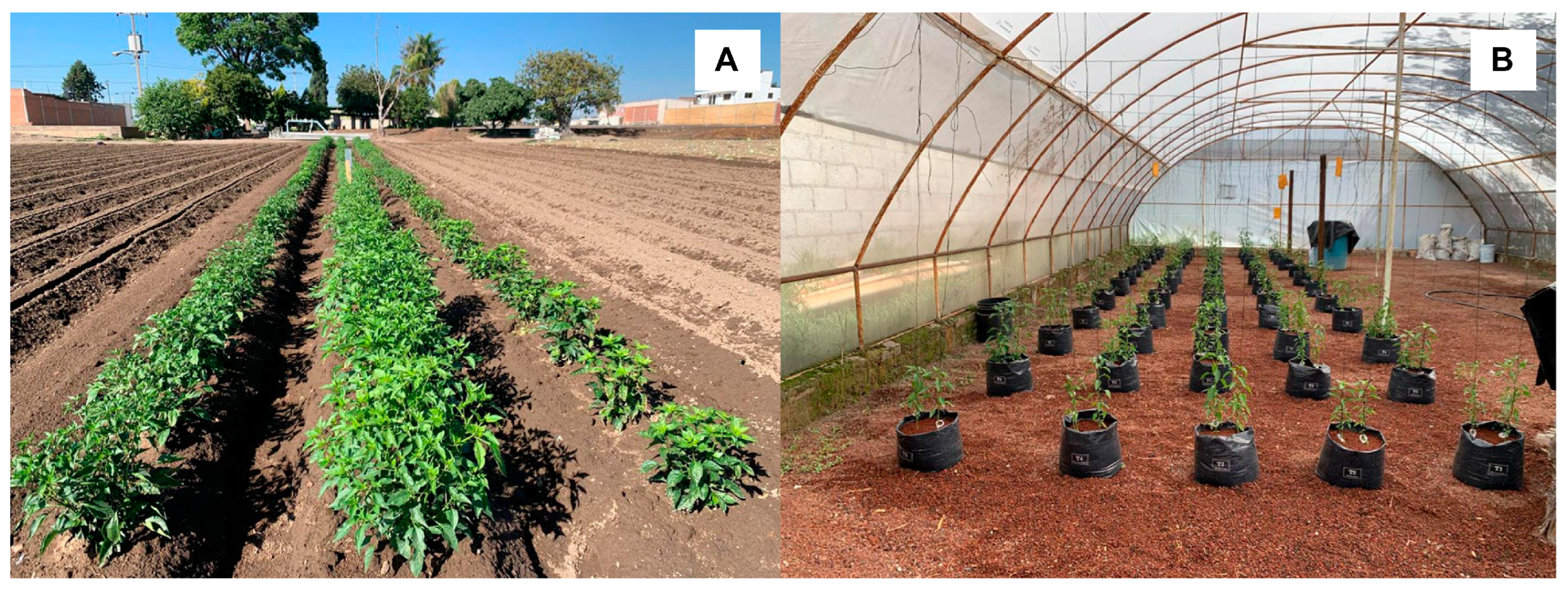
The study was conducted in San Agustín Calvario, San Pedro Cholula, Puebla, Mexico, during the 2023 growing season (January–October), under two locally relevant contrasting production conditions: open field (OF) and a substrate-based hydroponic system under low-technology greenhouse conditions (hereafter referred to as the GH) (Figure 1).
Open-field system (OF): The experiment was established in a cooperating farmer’s field managed according to local production practices located at 19°03′18″ N, 98°20′08″ W, at 2164 m a.s.l. The soil had a pH of 7.30, electrical conductivity (EC) of 0.75 dS·m−1, and organic matter content of 0.74%.
Substrate-based hydroponic system under low-technology greenhouse conditions (GH): The experiment was conducted in a low-technology tunnel-type greenhouse (100 m2), covered with polyethylene (caliber 800; 200 μm) and protected with anti-aphid mesh, located at 19°02′59″ N, 98°20′03″ W, at 2158 m a.s.l. The plastic cover reduced light transmission by approximately 15% and filtered 76% of ultraviolet radiation.

Study Design and Contextualization

This study was designed as an independent characterization of genotype performance under two contrasting production systems, each representing locally relevant growing conditions for smallholder farmers in the region [1]. The open-field and greenhouse systems differ simultaneously in multiple factors, including microclimate, plant density, substrate type, irrigation method, and crop management (Table S1, Supplementary Material). Due to the absence of system-level replication and the presence of multiple confounding variables, a formal statistical comparison between systems was not possible. Therefore, analyses were conducted independently for each system, and cross-system observations are presented descriptively. This approach follows established methodologies for evaluating crop performance under non-replicated, context-specific production conditions [11,27].

2.2. Plant Material

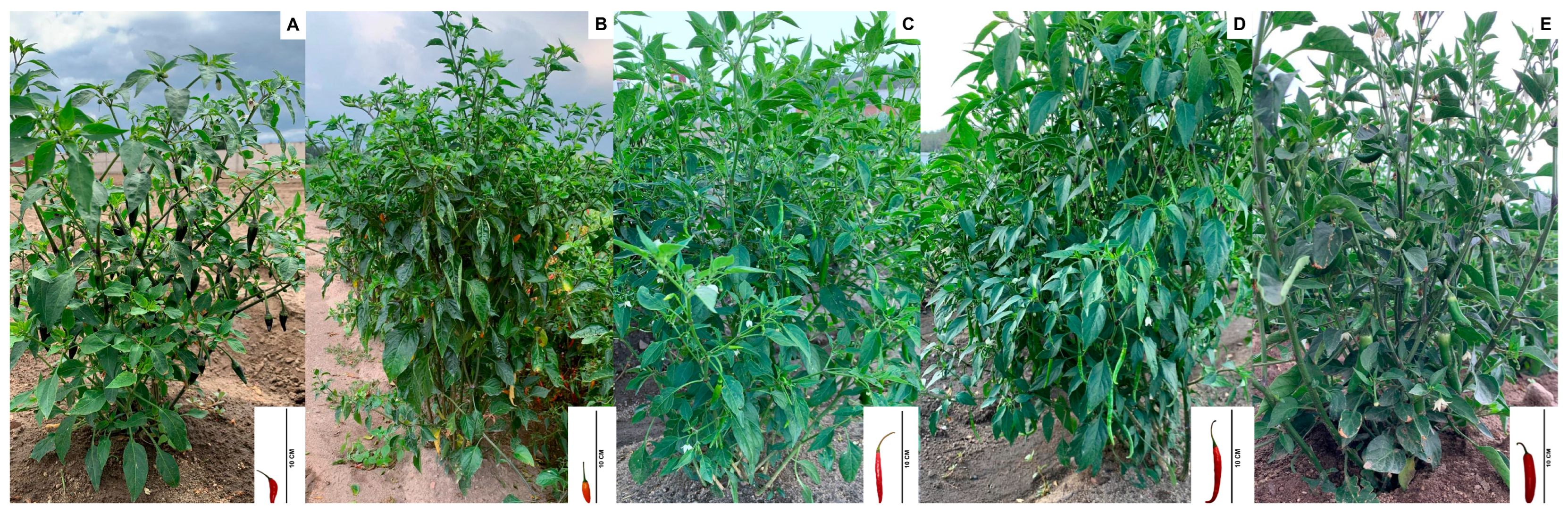
Five genotypes of C. annuum were evaluated: four native landraces (Diente de Perro, Tía Juanita, Mixteco Largo, and Cola de Ratón) and one commercial cultivar (Serrano Tampico). Taxonomic identity was confirmed by the Botanical Garden of BUAP (herbarium vouchers 88725–88729). Plant morphology is shown in Figure 2.

2.3. Seedling Production

For each genotype, 200 seeds were sown in 200-cavity polystyrene trays filled with commercial substrate Sunshine® MixNo. 3 (Sun Gro Horticulture Canada Ltd., Mississauga, ON, Canada). One seed per cavity was used; no thinning was required. Seedlings were grown under nursery conditions (25 ± 2 °C, 12 h photoperiod) for 80–89 days before transplanting, and seedlings with uniform vigor and normal morphological development were selected. To synchronize plant establishment under each system, sowing dates were adjusted: 29 January 2023 for OF and 19 February 2023 for GH. This offset was intended to compensate for differences in early growth rates and to achieve comparable seedling vigor at transplanting. Germination percentage was below 100% and is detailed in Section 3.2.1.

2.4. Crop Management

2.4.1. Open-Field System (OF)

Experimental design and transplanting: Transplanting was performed on 19 April 2023 (80 days after sowing, DAS) under a randomized complete block design (RCBD) with four replicates within the OF condition. Plants were arranged in 6.0 m long rows spaced 0.80 m apart, with 0.50 m between plants, corresponding to an estimated equivalent density of approximately 25,000 plants·ha−1. This density reflects standard regional practice for open-field chili production. Each experimental unit consisted of one row per genotype within each block (13 plants). The five central plants were evaluated to minimize border effects (20 plants per genotype).
Fertilization: A fertilization rate of 180–100–30 (N–P2O5–K2O) was applied using urea (46% N), diammonium phosphate (DAP; 18% N and 46% P2O5), and potassium chloride (60% K2O). One-third of the nitrogen and all phosphorus and potassium were applied at transplanting; the remaining nitrogen was split at 45 and 90 days after transplanting (dat).
Irrigation: Irrigation followed the farmer’s schedule, which is standard practice for smallholder production in the region. Furrow irrigation was initially applied and later replaced by sprinkler irrigation from 50 dat. Soil moisture was not monitored due to the participatory nature of the study, which aimed to reflect real-world farmer conditions [1]. This introduces uncontrolled variability that may affect yield responses and should be considered when interpreting results.
Phytosanitary management: Preventive and corrective strategies were implemented. Whitefly (Bemisia tabaci) was controlled using imidacloprid (350 g·L−1) applied at 0.75 L·ha−1. Bacterial diseases (Xanthomonas spp.) were managed using copper sulfate pentahydrate (≈25% Cu) at 1 L·ha−1. Soil-borne pathogens were controlled by alternating applications of Trichoderma harzianum (11.5 g·kg−1, 1.15%) at 15 mL·plant−1 with systemic fungicides, including propamocarb (530 g·L−1) + fosetyl-Al (310 g·L−1) applied at 6 L·ha−1, azoxystrobin (46 g·L−1) + chlorothalonil (460 g·L−1) at 3 L·ha−1, and carbendazim (500.76 g·L−1) at 2.5 L·ha−1.
Cultural practices: Periodic manual weeding and one tillage operation at 45 dat were performed to facilitate root development and weed management.

2.4.2. Substrate-Based Hydroponic System Under Low-Technology Greenhouse Conditions (GH)

This system corresponds to a substrate-based hydroponic scheme using an inert volcanic substrate (tezontle).
Experimental design and transplanting: Transplanting was carried out on 19 May 2023 (89 DAS). The experiment was conducted under a completely randomized design (CRD) with 12 replications within the GH condition. Each experimental unit was a black polyethylene bag (40 × 40 cm) filled with 11 kg of disinfected red tezontle (volcanic substrate), containing two plants, resulting in a density of 6.67 plants·m−2. This density is typical for substrate-based hydroponic systems and differs substantially from OF, representing a confounding factor in cross-system comparisons. One plant per unit was selected for measurements (12 plants per genotype).
Nutrient solution: The Steiner universal nutrient solution (1984) was used, with ionic concentrations (meq·L−1) of 12 NO3, 1 H2PO4, 7 SO42−, 7 K+, 9 Ca2+, and 4 Mg2+. The solution was prepared using KNO3, Ca(NO3)2, KH2PO4, MgSO4, K2SO4, and a micronutrient mix (Fe, Mn, B, Zn, Cu, Mo).
Irrigation and nutrient management: Solution concentration was adjusted according to phenological stage: 25% after transplanting, 50% during early vegetative growth, and 100% from 15 dat onward. Irrigation volume ranged from 250 mL to 1.5 L per plant. Electrical conductivity was maintained at 2.5 dS·m−1 and pH at 6.0 using phosphoric acid. Weekly leaching irrigation with water only was applied to reduce salt accumulation.
Phytosanitary management: Systemic insecticides included imidacloprid (350 g·L−1) applied at 0.75 L·ha−1 and a mixture of imidacloprid (210 g·L−1) + bifenthrin (72 g·L−1), applied in separate applications at 0.75 L·ha−1 during the flowering stage to control whitefly (B. tabaci), aphids (Aphididae), and thrips (Thysanoptera). Additionally, elemental sulfur (800 g·kg−1, 80% p/p) was applied at 2 g·L−1 as a preventive measure against fungal pathogens.
Cultural practices: Plants were supported using trellising with agricultural raffia.

2.5. Harvest Management

Fruits were harvested at physiological maturity, defined by size and characteristic color for each genotype. Eight harvests were performed under OF conditions and six under GH during the experimental period. In OF, harvests occurred between July and September, while in GH they were conducted from August to October 2023. This schedule was used to estimate cumulative yield per plant.

2.6. Variables Evaluated

Phenological variables. Emergence time was evaluated, defined as the number of days elapsed from sowing until 50% of the seeds of each genotype had emerged. Emergence percentage was calculated as the proportion of seedlings that successfully emerged relative to the total number of seeds sown per genotype. In addition, days to flowering (DF) were recorded, defined as the time elapsed from transplanting to the anthesis of the first flower, and days to fruiting (DFR), corresponding to the time until the appearance of the first fruit. Both variables were determined when 50% of the plants of each genotype reached each stage.
Growth variables. Plant height (PH) and stem diameter (SD) were recorded weekly from transplanting. Plant height was measured as the vertical distance (cm) from the base of the stem to the apex, and stem diameter (mm) was measured using a digital caliper (General Tools & Instruments LLC, Secaucus, NJ, USA) at 2 cm above the substrate level.
Yield variables. The number of fruits per plant (NF) was evaluated, defined as the total number of fruits developed and harvested at physiological maturity. Total yield per plant (YP) was calculated as the total fresh weight of fruits harvested per plant (kg per plant) at the end of the experimental period.
Agroclimatic variables. Agroclimatic variables were recorded continuously and simultaneously, including air temperature (°C), relative humidity (%), and photosynthetically active radiation, expressed as photosynthetic photon flux density (PPFD; μmol·m−2·s−1). Measurements were obtained using HOBO® dataloggers models MX2301A, MX2202, and MX1104 (Onset Computer Corporation, Bourne, MA, USA), configured to record data at 60-min intervals throughout the experimental period.

2.7. Statistical Analysis

Given the lack of system-level replication and the structural differences between production conditions, statistical analyses were performed independently for each system to avoid overinterpretation of genotype-specific responses across contrasting production conditions.
Phenological, growth, and yield data were analyzed separately for each production system. In OF, a randomized complete block design (RCBD) was used, while in GH a completely randomized design (CRD) was applied. In both cases, genotype effects were evaluated using analysis of variance (ANOVA), and means were compared using Tukey’s HSD test (α ≤ 0.05) with SAS Studio (SAS® OnDemand for Academics, v3.1.0).
Additionally, canonical correlation analysis (CCA) was performed as an exploratory multivariate approach to evaluate associations between agronomic variables (plant height, days to flowering, number of fruits, and yield) and agroclimatic variables (temperature, relative humidity, and PPFD) analyzed according to crop developmental stages. CCA was applied independently for each production system and genotype to identify patterns of association, without implying causality [37]. Analyses were conducted using XLSTAT (v2019.2.2) and SAS Studio.

3. Results

Significant genotype effects were detected for phenological, growth, and yield variables in both production systems, allowing characterization of genotype-specific performance within each production condition. Detailed results of the analysis of variance (ANOVA), including mean squares, coefficients of variation, and coefficients of determination, are presented in Tables S2–S4 (Supplementary Material).

3.1. Agroclimatic Conditions

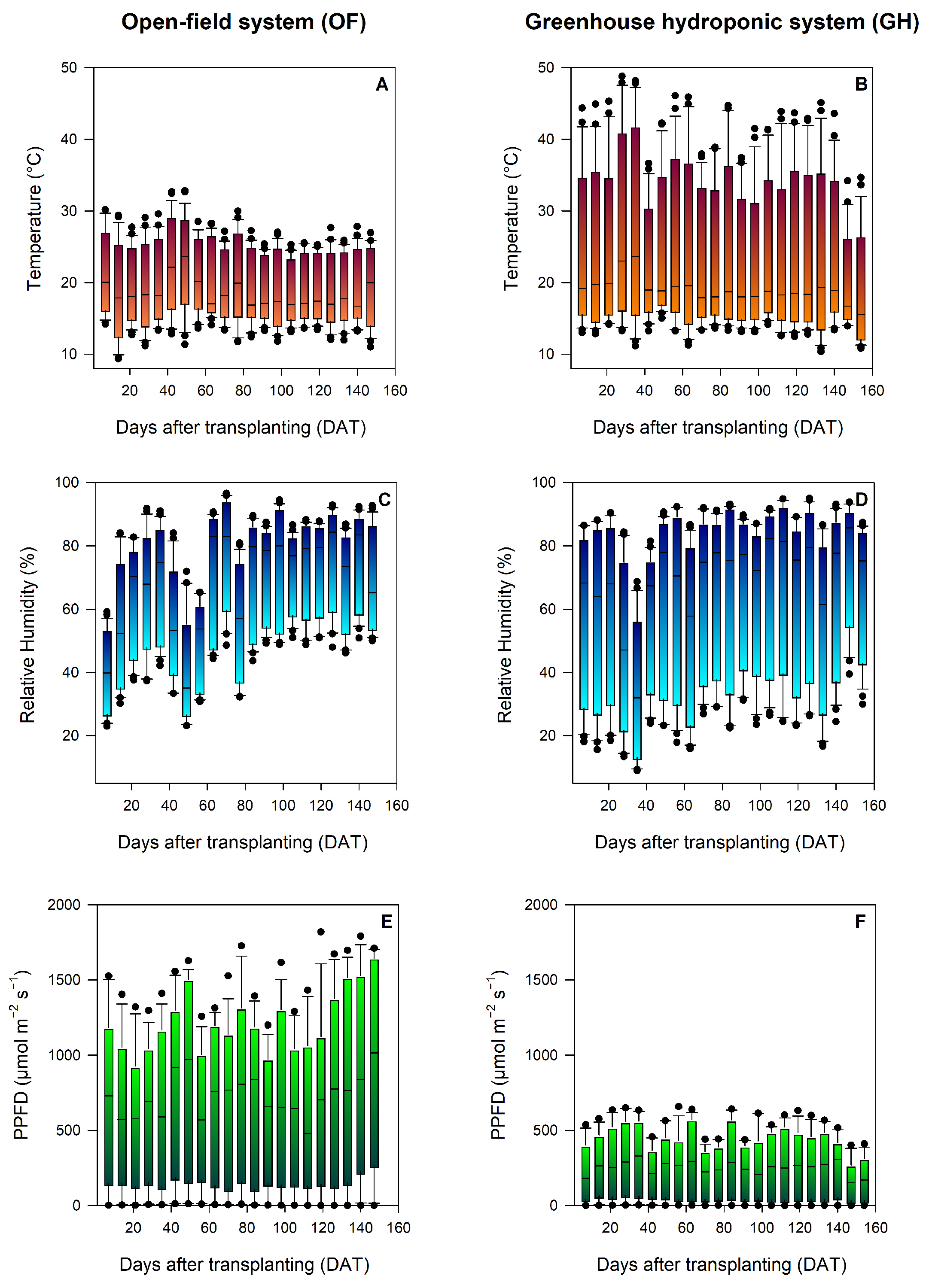
Agroclimatic variables exhibited distinct patterns within each production system, reflecting substantial differences in the crop microenvironment (Figure 3). Because the two systems differ simultaneously in multiple factors (experimental design, plant density, agronomic management, and microclimate), formal statistical comparison between systems was not possible [27]. Therefore, comparisons between systems are presented descriptively, prioritizing the independent characterization of each environment. The following presentation does not imply causal attribution of observed differences to any single factor.

3.1.1. Air Temperature

In the open field (OF), air temperature exhibited a defined seasonal pattern throughout the crop cycle. During the initial period (14–35 dat), the average temperature was 16.2 °C, with a minimum of 9.36 °C. The maximum value of the cycle (32.80 °C) occurred during the vegetative stage, followed by a progressive decrease toward the maturation stage, where an average of 17.3 °C was recorded (Figure 3A).
In the greenhouse hydroponic system (GH), temperature was characterized by higher values throughout the cycle (Figure 3B). During the initial and vegetative stages, maximum temperatures exceeded 30 °C, reaching a peak of 48.78 °C, above the temperature ranges commonly reported as favorable for the crop. Toward the final stage of the experimental period (119–154 dat), temperature stabilized, with an average of 22.3 °C, consistent with the seasonal transition toward autumn.

3.1.2. Relative Humidity

Relative humidity (RH) exhibited contrasting patterns between environments (Figure 3C,D). In OF, a marked diurnal variation was observed throughout the cycle, with maximum values during early morning (87–96%) and minimum values at midday (23–35%). During the initial period, the widest range of RH was recorded (23.85–90.88%), with an average of 72.4%. During the vegetative stage, RH decreased to 58.2%, whereas during the maturation stage it increased to 78.3%, with less pronounced daytime minima.
In GH, RH remained relatively high and more stable throughout the cycle (Figure 3D), with average values ranging from 78.2% to 83.7%. During the initial period, the widest range was observed (8.93–92.4%). During the vegetative stage, variation became more restricted, with an average of 77.8% and maximum values close to 94.8%. During reproductive and maturation stages, RH variability decreased further, with minimum values above 30% and maximum values close to 95%, reflecting comparatively higher and less variable RH conditions.

3.1.3. Photosynthetic Photon Flux Density (PPFD)

The availability of photosynthetic photon flux density (PPFD) showed contrasting patterns between production conditions (Figure 3E,F). In OF, the average PPFD during the cycle was 523.4 μmol m−2 s−1. During the initial period, the average was 458.2 μmol m−2 s−1, whereas the vegetative stage recorded the highest values (712.8 μmol m−2 s−1) and the maximum peak of the cycle (1818.8 μmol m−2 s−1). During the maturation stage, PPFD decreased to 543.6 μmol m−2 s−1, consistent with seasonal progression.
In GH, the average PPFD was 247.3 μmol m−2 s−1, representing an approximate 53% reduction relative to OF (Figure 3F). During the initial period, the average was 278.5 μmol m−2 s−1, with maximum values of 643.2 μmol m−2 s−1. During the vegetative stage, the highest average (312.8 μmol m−2 s−1) and the maximum value of the system (657.0 μmol m−2 s−1) were recorded. Toward the maturation stage, PPFD decreased to 183.6 μmol m−2 s−1. Radiation attenuation showed seasonal variation, with greater reductions during summer (56–64%) compared to autumn (40–45%), reflecting consistently lower PPFD values under GH conditions.

3.2. Phenological Development

3.2.1. Emergence Time and Percentage

Emergence parameters were evaluated under controlled nursery conditions (identical for both production systems) prior to transplanting. Therefore, the data in Table 1 represent initial emergence performance and seedling vigor for each genotype and are not specific to either the OF or GH system.
Significant differences (p ≤ 0.05) were observed in emergence time and percentage among genotypes (Table 1). Serrano Tampico showed the shortest emergence time (15.25 ± 1.26 days), followed by Diente de Perro (16.25 ± 1.26 days), whereas Tía Juanita and Cola de Ratón showed the longest emergence times (24.75 ± 0.96 and 22.75 ± 2.22 days, respectively).
Emergence percentage was highest in Serrano Tampico (98.50 ± 1.08%), Tía Juanita (97.75 ± 1.55%), and Diente de Perro (93.50 ± 5.15%), whereas Mixteco Largo and Cola de Ratón showed significantly lower values (78.63 ± 6.69% and 75.13 ± 2.66%, respectively). Detailed ANOVA results are presented in Table S2 (Supplementary Material).

3.2.2. Growth Dynamics

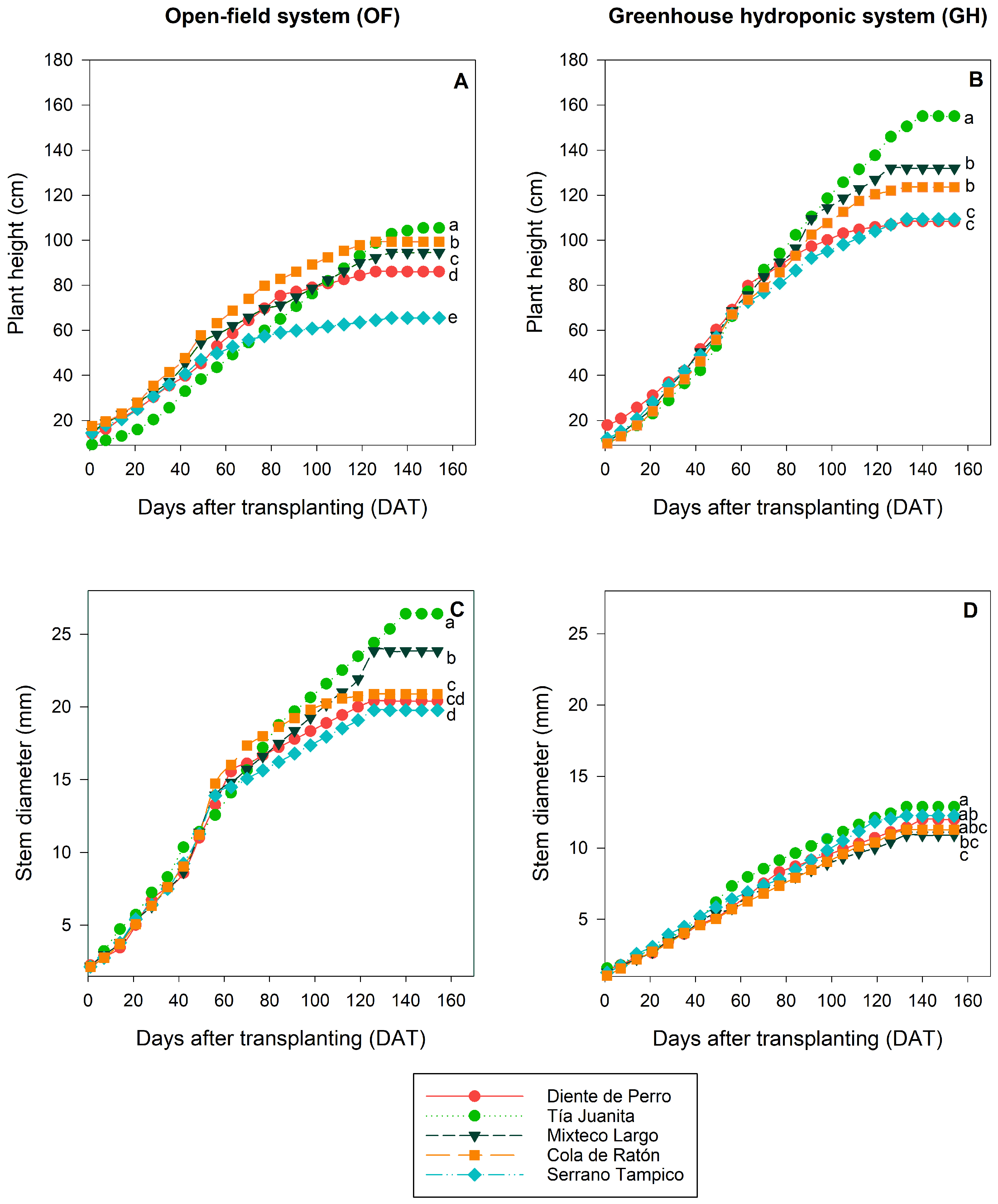
Significant differences (p ≤ 0.05) in plant height (PH) and stem diameter (SD) were observed among genotypes within each production system (Figure 4). Detailed ANOVA results are provided in Tables S3 and S4 (Supplementary Material).
In OF, final plant height ranged from 65.45 to 105.44 cm. Tía Juanita showed the highest value (105.44 cm), followed by Cola de Ratón (99.31 cm) and Mixteco Largo (94.53 cm), whereas Serrano Tampico showed the lowest value (65.45 cm). Plant height increments became less pronounced from 63 dat onward. In GH, final plant height ranged from 108.33 to 155.04 cm. Tía Juanita showed the highest value (155.04 cm), followed by Mixteco Largo (132.00 cm) and Cola de Ratón (123.57 cm), whereas Serrano Tampico and Diente de Perro showed the lowest values (109.42 and 108.33 cm, respectively).
In OF, stem diameter ranged from 19.77 to 26.41 mm. Tía Juanita showed the highest value (26.41 mm), followed by Mixteco Largo (23.85 mm) and Cola de Ratón (20.89 mm), whereas Serrano Tampico showed the lowest value (19.77 mm). Stem diameter stabilized from 63 dat onward. In GH, stem diameter ranged from 10.90 to 12.86 mm, with lower stem diameter values recorded under GH conditions throughout the crop cycle. Tía Juanita and Serrano Tampico showed the highest values (12.86 and 12.25 mm, respectively), whereas Mixteco Largo showed the lowest value (10.90 mm). Stem diameter increments became less pronounced from 119 dat onward.

3.2.3. Days to Flowering and Fruiting

Significant differences (p ≤ 0.05) in reproductive timing were observed among genotypes within each production system (Table 2). Detailed ANOVA results are presented in Tables S3 and S4 (Supplementary Material).
In OF, days to flowering ranged from 51 to 82 dat. Diente de Perro showed the lowest value (51 dat), followed by Serrano Tampico (57 dat), whereas Mixteco Largo (59 dat) and Cola de Ratón (62 dat) showed intermediate values. Tía Juanita showed the highest value (82 dat). In GH, days to flowering ranged from 45 to 77 dat. Diente de Perro (45 dat) and Serrano Tampico (50 dat) showed the shortest time to flowering, whereas Mixteco Largo (52 dat) and Cola de Ratón (57 dat) showed intermediate values. Tía Juanita showed the highest value (77 dat).
For days to fruiting, values in OF ranged from 67 to 92 dat, whereas in GH values ranged from 54 to 85 dat. Diente de Perro and Serrano Tampico showed the lowest values, while Tía Juanita showed the highest values in both systems.

3.3. Yield Components

Significant differences (p ≤ 0.05) were observed in number of fruits per plant and yield among genotypes within each production system (Table 3; Tables S3 and S4 in Supplementary Material).
In OF, fruit number ranged from 289.65 to 642.40 fruits per plant. Mixteco Largo (642.40) and Cola de Ratón (628.60) exhibited the highest values, whereas Diente de Perro showed the lowest (289.65). In GH, fruit number ranged from 130.00 to 288.33 fruits per plant. Tía Juanita (288.33) and Cola de Ratón (279.92) showed the highest values, whereas Diente de Perro showed the lowest (130.00).
Yield in OF ranged from 0.294 to 1.118 kg per plant. Serrano Tampico showed the highest value (1.118 kg), followed by Cola de Ratón (0.872 kg) and Mixteco Largo (0.759 kg), whereas Tía Juanita (0.294 kg) and Diente de Perro (0.387 kg) showed the lowest values. In GH, yield ranged from 0.181 to 0.603 kg per plant. Descriptively (not as a formal statistical comparison), yield values in GH were lower than those recorded in OF for all genotypes. The observed differences ranged from 34.1% to 64.0% across genotypes, but these values reflect the combined effect of multiple confounding factors (microclimate, plant density, irrigation, and management) rather than the isolated effect of the production system.

3.4. Canonical Correlation Analysis

The following canonical correlation results are presented as exploratory associations and not as confirmatory evidence. Canonical correlation analysis (CCA) does not imply causality, and the identified patterns should be interpreted as hypothesis generators [37]. The analysis was performed independently for each production system to explore relationships between environmental and agronomic variables.
Canonical correlation analysis (CCA) showed genotype-specific associations between environmental and agronomic variables within each production system (Table 4). Canonical correlation coefficients ranged from 0.6002 to 0.9607, indicating moderate to high levels of association.
Environmental variables, particularly temperature and radiation, were associated with growth and yield variables. The magnitude and direction of these associations varied among genotypes and production conditions. In OF, associations tended to be positive between temperature and productivity-related variables, whereas in GH more variable patterns were observed, including negative associations with yield. These patterns suggest differential genotype responses associated with the environmental conditions of each production system. Mean values and direction of associations are presented in Tables S5 and S6 (Supplementary Material).

Genotype-Specific Association Patterns

Diente de Perro showed canonical correlation coefficients of 0.8789 in OF and 0.9607 in GH. In OF, maximum (r = 0.52) and minimum temperature (r = 0.55) were associated with plant height (r = 0.76) and number of fruits (r = 0.61). In GH, minimum temperature (r = 0.59) and maximum PPFD (r = 0.46) were negatively associated with plant height (r = −0.49) and days to flowering (r = −0.67).
Tía Juanita showed coefficients of 0.9034 in OF and 0.8760 in GH. In OF, maximum PPFD (r = 0.41) was associated with number of fruits (r = 0.79) and yield (r = 0.51). In GH, maximum PPFD (r = 0.57) and maximum RH (r = 0.43) were negatively associated with yield (r = −0.29).
Mixteco Largo showed coefficients of 0.7095 in OF and 0.8421 in GH. In OF, maximum temperature (r = 0.55) was associated with yield (r = 0.36). In GH, minimum temperature (r = 0.78) was associated with plant height (r = 0.52), while negative associations were observed with yield (r = −0.53) and number of fruits (r = −0.47).
Serrano Tampico showed coefficients of 0.7699 in OF and 0.7582 in GH. In OF, maximum temperature (r = 0.64) and maximum PPFD (r = 0.50) were associated with days to flowering (r = 0.73). In GH, minimum temperature (r = 0.69) was associated with yield (r = 0.32) and number of fruits (r = 0.40), while plant height showed a negative association (r = −0.59).
Cola de Ratón showed coefficients of 0.6002 in OF and 0.8690 in GH. In OF, minimum temperature (r = 0.43) and maximum RH (r = 0.47) were negatively associated with yield (r = −0.46) and days to flowering (r = −0.42). In GH, maximum PPFD (r = 0.69) was associated with plant height (r = 0.34) and days to flowering (r = 0.69).
The structural correlation coefficients of the first three canonical factors for all the variables and genotypes are represented graphically in Figures S1–S5 of the Supplementary Material, providing a graphical representation of these multivariate associations.

4. Discussion

The results obtained showed consistent patterns in the phenological and productive performance of C. annuum across the evaluated environments, with genotype-specific response patterns observed under contrasting growing conditions. The magnitude of these differences, including yield reductions of up to 64% and an approximate 53% decrease in photosynthetic photon flux density in the GH system, highlights the association between environmental conditions and genotype performance under the evaluated production conditions. In this context, variations in temperature and radiation availability were associated with changes in phenology, plant architecture, and yield-related performance, suggesting that genotypes may differ in their phenological and productive responses under contrasting environmental conditions.
It is important to note that the evaluated system corresponded to a low-technology tunnel-type GH with limited passive ventilation, a condition commonly found in production systems in developing regions. Therefore, the results should be interpreted within this specific context and not directly extrapolated to high-technology hydroponic systems with active climate control. Likewise, due to differences in planting density, substrate type, and water management between OF and GH, the observed differences between systems reflect the combined influence of multiple factors, including both environmental and agronomic management conditions. Consequently, it is not possible to attribute the observed effects to a single variable in isolation. Under this context, although greenhouse microclimatic conditions were associated with lower yield values, this effect cannot be attributed exclusively to those factors, as other uncontrolled variables may also have influenced the observed response.

4.1. Microclimatic Characteristics of the Protected System and Their Association with Crop Performance

The microclimatic conditions recorded in the GH, characterized by maximum temperatures of up to 48.78 °C and an approximate 53% reduction in photosynthetically active radiation compared to OF, suggest a potentially restrictive environment for crop development. These conditions indicate that the observed microclimatic conditions may exceed commonly reported ranges favorable for C. annuum growth (18–30 °C) [25,38,39], suggesting environmental conditions commonly associated with thermal and low-radiation stress in C. annuum. The occurrence of these temperatures is consistent with the structural characteristics of the greenhouse, particularly its low height (3 m) and the absence of roof ventilation, conditions that may have limited heat dissipation and air renewal in the upper canopy.
From a physiological perspective, temperatures above 32 °C have been associated with alterations in physiological and reproductive processes in C. annuum, potentially affecting pollen viability and fruit development [40,41,42]. In this study, although direct physiological measurements were not performed, these mechanisms may be associated with the lower yield values observed under GH conditions. Additionally, the recorded radiation levels (247.3 μmol m−2 s−1) fall below those commonly associated with high photosynthetic activity in C. annuum, which, according to previous studies, may be associated with reduced photosynthetic activity and lower photoassimilate availability for fruit filling [43,44]. This is consistent with studies reporting changes in photosynthesis and yield under reduced radiation conditions [45]. Moreover, the wide variability in relative humidity (8.93–94.78%), outside the optimal range (65–85%) [46], reflects high variability in relative humidity conditions, consistent with potential alterations in plant water balance and transpiration processes, with possible implications for physiological performance [47]. Collectively, these microclimatic conditions suggest environmental conditions that may be associated with alterations in processes related to photosynthesis, photoassimilate partitioning, and reproductive development. In this regard, studies in C. annuum have documented reductions in growth and yield under abiotic stress conditions, particularly when water balance and resource availability are compromised [16].
In contrast, OF presented a less extreme thermal regime and greater radiation availability, conditions associated with comparatively higher productivity levels and less extreme thermal and radiation conditions. In this context, the results contrast with the general assumption that protected systems automatically improve crop performance [48], showing that under low-technology conditions and limited environmental control, the greenhouse conditions may represent a comparatively more restrictive production environment under low-technology conditions. Such conditions have been widely documented in protected production systems [49,50], in some cases being more limiting than open-field conditions. These findings suggest that, in low-technology systems, greenhouse environments do not necessarily represent an automatic improvement over open-field conditions, but rather their performance depends critically on the microclimatic conditions generated.
Since the production system was not evaluated as a replicated experimental factor, these differences should be interpreted in terms of the specific environments observed. From this perspective, although the system corresponded to a substrate-based hydroponic scheme, the results suggest that crop performance appeared to be more closely associated with the recorded microclimatic conditions than with the hydroponic technique itself. Additionally, although hydroponic systems typically offer advantages related to controlled water and nutrient supply, allowing greater precision in resource availability [51], these advantages may not have been fully expressed under conditions of thermal stress and light limitation.

4.2. Phenological and Growth Responses: Genotypic Plasticity and Adaptive Strategies

Differences observed in emergence percentage (75.13–98.50%) reflect variability in seed vigor and suggest genotype-related differences in seed performance, particularly in native materials. The greater precocity observed in Serrano Tampico and Diente de Perro was associated with earlier establishment, whereas lower percentages in Mixteco Largo and Cola de Ratón suggest lower germination uniformity. In this context, the implementation of seed priming strategies could contribute to improving germination, seedling vigor, and establishment uniformity [52,53,54].
At the phenological level, clear differences among genotypes were observed within each production system. In OF, flowering and fruiting times were longer, indicating a comparatively longer developmental cycle compared to protected systems, where shorter flowering and fruiting periods were observed [55]. This pattern is consistent with reports documenting variations in agronomic performance of C. annuum between open-field and protected conditions [11]. In contrast, the acceleration of the crop cycle observed in GH (4–13 days) is consistent with the thermal conditions recorded in this environment. However, this reduction in cycle duration was not associated with increased yield, indicating that earlier phenology does not necessarily correspond to higher yield values.
Vegetative growth showed contrasting patterns among genotypes within each production system. In OF, plants exhibited lower height but greater stem diameter, reflecting comparatively greater stem thickness relative to plant height. In GH, greater plant height combined with reduced stem diameter suggests differential allocation between vertical growth and stem thickening. This pattern is consistent with low radiation conditions, which have been associated with modifications in growth and yield in C. annuum [56], and may be associated with stem elongation responses commonly reported under low-radiation conditions to maximize light interception [57].
Under these conditions, the combination of high temperature and low radiation may be consistent with growth patterns previously associated with shade avoidance responses under low-radiation conditions, characterized by increased stem elongation relative to stem thickening [58,59]. These growth patterns could potentially influence plant structural stability and reproductive support capacity, with direct implications for yield.
Overall, the evaluated genotypes exhibited considerable diversity in their phenological and morphological behavior across both production conditions, suggesting distinct response patterns under contrasting environmental conditions. The precocity of Serrano Tampico and Diente de Perro may represent favorable characteristics under shorter production cycles, whereas the longer cycle and greater vegetative growth observed in Tía Juanita were associated with higher biomass accumulation and potentially improved performance under less restrictive production conditions.

4.3. Yield Patterns Under Contrasting Production Conditions

Differences observed in fruit number and yield reflect differences in the relationship between fruit number and total yield among genotypes. In OF, genotypes such as Mixteco Largo and Cola de Ratón produced the highest number of fruits, whereas Serrano Tampico achieved the highest yield (1.118 kg per plant), indicating that a greater number of fruits does not necessarily translate into higher productivity. This pattern may be associated with differences in fruit size, individual fruit weight, or biomass partitioning among genotypes [60,61,62]. In this sense, Serrano Tampico may exhibit a greater capacity to maintain fruit biomass accumulation relative to fruit number, allowing it to reach higher yield levels despite not producing the highest number of fruits.
In GH, a generalized reduction in yield (34–64% depending on genotype) was observed, suggesting consistent reductions in yield performance under GH conditions. Although some genotypes such as Tía Juanita and Cola de Ratón maintained relatively high fruit numbers under GH conditions, their yield remained lower, suggesting limitations in the development of reproductive structures under GH conditions. This behavior is consistent with the previously described microclimatic conditions, particularly the combination of high temperatures and low radiation availability, factors previously associated with reduced fruit set, altered pollen viability, and lower biomass accumulation during fruit filling under reduced radiation conditions in C. annuum [56,63].
Conversely, Serrano Tampico showed a smaller relative reduction in yield between production conditions, suggesting comparatively more stable yield performance. This behavior may reflect genotype-specific differences under the evaluated conditions.
Overall, these results indicate that yield in C. annuum was not exclusively associated with fruit number, but also with factors related to reproductive development and resource availability, highlighting the importance of evaluating yield performance under contrasting environmental conditions.

4.4. Multivariate Associations Between Environmental and Agronomic Variables

Canonical correlation analysis (CCA) allowed the identification of genotype-specific associations between environmental and agronomic variables, showing distinct association patterns under the evaluated environmental conditions. The high canonical correlation values observed in several genotypes suggest close associations between environmental and agronomic variables within each production condition, highlighting the relevance of environmental variation in the observed agronomic responses [37].
In OF, environmental variables, particularly temperature and radiation, showed predominantly positive associations with yield-related variables such as fruit number and yield in some genotypes, consistent with comparatively higher yield values and fruit production under conditions of greater radiation availability [64]. In contrast, in GH, more variable patterns were observed, including negative associations between environmental and agronomic variables, consistent with less favorable environmental conditions for crop performance.
At the genotypic level, distinct association patterns were observed. Diente de Perro showed negative associations between environmental variables and development in GH, suggesting less favorable associations under GH conditions. In contrast, Serrano Tampico exhibited positive associations with productive variables in both systems, suggesting more consistent agronomic performance across production conditions. In genotypes such as Mixteco Largo and Cola de Ratón, the observed associations indicate that increases in certain environmental variables were not consistently associated with higher productivity under GH conditions.
Overall, the patterns identified through CCA suggest distinct genotype-specific associations under contrasting environmental conditions, with some genotypes exhibiting comparatively more consistent yield performance and others showing stronger negative associations under specific conditions. These findings should be interpreted as exploratory associations under the evaluated production conditions and may serve as a basis for future research under replicated multi-environment designs.

4.5. Agronomic Implications and Perspectives

Varietal selection under contrasting systems: The results indicate that no single genotype showed uniformly higher performance across the evaluated production conditions, highlighting the association between environmental conditions and yield performance. Under open-field conditions, genotypes such as Mixteco Largo, Cola de Ratón, and Serrano Tampico showed favorable productive performance, suggesting favorable performance under OF conditions. However, their behavior under protected environments with limited climate control may differ; therefore, their evaluation should consider the specific microclimatic conditions.
Greenhouse management in warm climates: The conditions recorded in the GH, with temperatures exceeding 48 °C and an approximate 53% reduction in photosynthetic photon flux density, suggest that passive systems may be associated with less favorable microclimatic conditions under warm environments. In this context, strategies such as improved ventilation, shading, or evaporative cooling could contribute to moderating the microclimate and potentially contributing to more favorable crop conditions [65]. Additionally, the management of light transmission appears to be an important factor for maintaining adequate PPFD levels [66].
Agronomic value of native germplasm: The performance observed in native landraces under open-field conditions suggests favorable performance patterns under local open-field conditions, highlighting their potential value as genetic resources for future evaluation under abiotic stress and contrasting production conditions [67].
Future research perspectives: The results identify relevant research directions, including evaluation under systems with active climate control to better characterize the influence of environmental variables under controlled conditions, analysis of fruit quality under contrasting production environments, and physiological studies focusing on photosynthesis and water-use efficiency. Likewise, strategies to improve germination and early establishment could contribute to improved crop establishment and performance.

4.6. Study Limitations and Contextualization of Results

The findings of this study should be interpreted within the context of its specific experimental limitations. First, the production system (open-field vs. greenhouse) was not replicated as a formal experimental factor. Consequently, the comparison between systems is observational and descriptive rather than based on formal statistical inference. The observed differences reflect the combined influence of multiple, inseparable factors, including microclimate, plant density (25,000 plants·ha−1 in OF vs. 6.67 plants·m−2 in GH), substrate (soil vs. tezontle), irrigation method (furrow/sprinkler vs. hydroponic solution), and agronomic management. Therefore, no causal attribution of yield differences to a single variable (e.g., temperature or light alone) is possible.
Second, the greenhouse system evaluated was a specific, low-technology, passively ventilated tunnel. The recorded extreme temperatures (up to 48.8 °C) and reduced PPFD (approx. 53% reduction) are characteristic of this type of structure under the local climatic conditions of Puebla during the 2023 growing season. These findings should not be directly extrapolated to high-technology greenhouses with active climate control (e.g., fan-and-pad cooling, supplemental lighting).
Third, this study was conducted over a single growing cycle and at a single location. Inter-annual climatic variability and site-specific factors were not captured. As such, the results provide a snapshot of genotype performance under the specific conditions evaluated, and further research with multi-year and multi-location trials is necessary to validate the observed patterns and assess their broader applicability.
Despite these limitations, the independent analysis of each production condition and the use of canonical correlation analysis (CCA) allowed the identification of genotype-specific associations between environmental and agronomic variables under locally relevant production conditions. In this context, the results provide a useful basis for future studies incorporating environmental replication, multiple growing cycles, and systems with greater microclimatic control.

5. Conclusions

The results of this study suggest that, under the specific conditions evaluated, the phenological and productive performance of Capsicum annuum was associated with contrasting production conditions, as reflected in differences in cycle duration, growth, and yield performance across the evaluated production conditions.
In the greenhouse hydroponic system (GH), the recorded microclimatic conditions were descriptively associated with lower yield values, indicating that, under limited ventilation, the environment may be associated with less favorable conditions for crop performance. This observation is particularly relevant in production systems used by smallholder farmers and in developing regions, where environmental control is limited.
The patterns identified through canonical correlation analysis suggest genotype-specific associations between environmental and agronomic variables among genotypes under contrasting environmental conditions. Serrano Tampico showed comparatively more consistent yield performance, whereas native genotypes such as Mixteco Largo and Cola de Ratón exhibited comparatively favorable performance under open-field conditions.
Overall, these results suggest that yield in Capsicum annuum is closely associated with both genotype characteristics and environmental conditions, rather than solely with the production system employed, highlighting the importance of considering microclimatic conditions in the evaluation of management and genotype selection strategies.
Future research incorporating replicated system-level designs and multi-environment trials is needed to better characterize genotype-specific performance under contrasting production conditions and to separate the effects of microclimate, plant density, and management practices on yield performance.

Supplementary Materials

The following supporting information can be downloaded at: https://www.mdpi.com/article/10.3390/horticulturae12060655/s1, Table S1. Comparison of experimental conditions between open-field (OF) and greenhouse hydroponic (GH) systems. Table S2. Summary of the analysis of variance (mean squares) and goodness-of-fit statistics for germination variables in five Capsicum annuum genotypes. Table S3. Summary of the analysis of variance (mean squares) for phenological and yield variables in the open-field system (OF). Table S4. Summary of the analysis of variance (mean squares) for phenological and yield variables in the substrate-based hydroponic under low-technology greenhouse conditions (GH). Table S5. Average values of agroclimatic and agronomic variables recorded for five Capsicum annuum genotypes grown under contrasting production systems. Table S6. Summary of canonical association patterns between environmental and agronomic variables for five C. annuum genotypes under contrasting production systems. Figure S1. Graphical representation of structural correlation coefficients of the first three canonical factors (F1, F2, and F3) for environmental and agronomic variables of the Diente de Perro genotype grown under open-field and substrate-based hydroponic greenhouse systems. Variables include plant height (PH), days to flowering (DF), number of fruits per plant (NF), yield per plant (YP), maximum temperature (TMax), minimum temperature (TMin), maximum relative humidity (RHMax), and maximum photosynthetic photon flux density (PPFDMax). Figure S2. Graphical representation of structural correlation coefficients of the first three canonical factors (F1, F2, and F3) for environmental and agronomic variables of the Tía Juanita genotype grown under open-field and substrate-based hydroponic greenhouse systems. Variables include plant height (PH), days to flowering (DF), number of fruits per plant (NF), yield per plant (YP), maximum temperature (TMax), minimum temperature (TMin), maximum relative humidity (RHMax), and maximum photosynthetic photon flux density (PPFDMax). Figure S3. Graphical representation of structural correlation coefficients of the first three canonical factors (F1, F2, and F3) for environmental and agronomic variables of the Mixteco Largo genotype grown under open-field and substrate-based hydroponic greenhouse systems. Variables include plant height (PH), days to flowering (DF), number of fruits per plant (NF), yield per plant (YP), maximum temperature (TMax), minimum temperature (TMin), maximum relative humidity (RHMax), and maximum photosynthetic photon flux density (PPFDMax). Figure S4. Graphical representation of structural correlation coefficients of the first three canonical factors (F1, F2, and F3) for environmental and agronomic variables of the Cola de Ratón genotype grown under open-field and substrate-based hydroponic greenhouse systems. Variables include plant height (PH), days to flowering (DF), number of fruits per plant (NF), yield per plant (YP), maximum temperature (TMax), minimum temperature (TMin), maximum relative humidity (RHMax), and maximum photosynthetic photon flux density (PPFDMax). Figure S5. Graphical representation of structural correlation coefficients of the first three canonical factors (F1, F2, and F3) for environmental and agronomic variables of the Serrano Tampico genotype grown under open-field and substrate-based hydroponic greenhouse systems. Variables include plant height (PH), days to flowering (DF), number of fruits per plant (NF), yield per plant (YP), maximum temperature (TMax), minimum temperature (TMin), maximum relative humidity (RHMax), and maximum photosynthetic photon flux density (PPFDMax).

Author Contributions

Conceptualization, A.D.-A.; Investigation, B.N.H.-H.; methodology, A.D.-A., B.N.H.-H. and M.A.T.-C.; data curation and statistical analysis, B.N.H.-H. and B.E.H.-C.; resources, A.D.-A.; funding acquisition, A.D.-A. and B.N.H.-H.; writing—original draft preparation, B.N.H.-H.; supervision, M.A.T.-C., writing—review and editing, B.E.H.-C., M.A.T.-C., L.d.C.L.-E. and J.L.J.-V. All authors have read and agreed to the published version of the manuscript.

Funding

This research was primarily supported by Colegio de Postgraduados, Campus Puebla, through the Student Activity Support Program (AAE, Apoyo a la Actividad de Estudiantes). Additional funding was provided by Colegio de Postgraduados under Grant CONV_RGAA_2024_68 (Research and Incidence Projects for the Conservation and Sustainable Use of Genetic Resources for Food and Agriculture).

Data Availability Statement

The original contributions presented in this study are included in the article/Supplementary Materials. Further inquiries can be directed to the corresponding author.

Acknowledgments

This study is a product of the doctoral dissertation of the first author, who wishes to thank the Ministry of Science, Humanities, Technology and Innovation (Secretaría de Ciencia, Humanidades, Tecnología e Innovación, SECIHTI), for scholarship number 784576 in support of her doctoral studies. The authors express their sincere gratitude to the local farmers for providing the native variety seeds used in this study. Special thanks are extended to Tomás Cuautle for providing the farmland and logistical support for the field experiment. The authors also acknowledge Colegio de Postgraduados, Campus Puebla, for providing greenhouse facilities and technical support.

Conflicts of Interest

The authors declare no conflicts of interest.

References

  1. Bijalwan, P.; Shukla, Y.R. Bell pepper (Capsicum annuum) productivity and economics as influenced by different weed management strategies. Indian J. Weed Sci. 2024, 56, 91–94. [Google Scholar] [CrossRef]
  2. Hossain, M.M.; Azad, M.A.K.; Soren, E.B.; Alam, M.N.; Ahmed, M.S.; Islam, M.S.; Monira, S. Enhancing growth, yield, and nutritional value of Capsicum annuum: Evaluating micronutrient efficiency and varietal performance. J. Agric. Food Res. 2025, 21, 101945. [Google Scholar] [CrossRef]
  3. Organización de las Naciones Unidas para la Alimentación y la Agricultura (FAO). Estadísticas Sobre Alimentación y Agricultura. FAOSTAT. 2023. Available online: https://www.fao.org/faostat/es/#data (accessed on 15 July 2023).
  4. Penella, C.; Calatayud, A. Pepper crop under climate change: Grafting as an environmental friendly strategy. In Pepper Crops: Production and Management; Calatayud, A., Barreto, M.G., Eds.; IntechOpen: London, UK, 2018. [Google Scholar] [CrossRef]
  5. Toxqui-Tapia, R.; Peñaloza-Ramírez, J.M.; Pacheco-Olvera, A.; Albarrán-Lara, A.L.; Oyama, K. Genetic Diversity and Landscape Genetic Structure of Capsicum annuum L. from Wild, Backyard, and Cultivated Populations in a Heterogeneous Environment in Oaxaca, Mexico. Polibotánica 2022, 53, 87–103. [Google Scholar] [CrossRef]
  6. Hudáková, T.; Šuleková, M.; Tauchen, J.; Šemeláková, M.; Várady, M.; Popelka, P. Bioactive compounds and antioxidant activities of selected types of chilli peppers. Czech J. Food Sci. 2023, 41, 3. [Google Scholar] [CrossRef]
  7. Mandal, S.K.; Rath, S.K.; Logesh, R.; Mishra, S.K.; Devkota, H.P.; Das, N. Capsicum annuum L. and its bioactive constituents: A critical review of a traditional culinary spice in terms of its modern pharmacological potentials with toxicological issues. Phytother. Res. 2023, 37, 965–1002. [Google Scholar] [CrossRef] [PubMed]
  8. Akhter, M.J.; Akhter, S.; Islam, S.; Sarker, M.S.H.; Hasan, S.K. Varietal influence on bioactive compounds and antioxidant activity in chilies during development stages. Heliyon 2024, 10, e17441. [Google Scholar] [CrossRef] [PubMed]
  9. Baenas, N.; Belović, M.; Ilic, N.; Moreno, D.A.; García-Viguera, C. Industrial use of pepper (Capsicum annuum L.) derived products: Technological benefits and biological advantages. Food Chem. 2019, 274, 872–885. [Google Scholar] [CrossRef] [PubMed]
  10. Bulle, M.; Rahman, M.M.; Islam, M.R.; Abbagani, S. Strategies to develop climate-resilient chili peppers: Transcription factor optimization through genome editing. Planta 2025, 262, 30. [Google Scholar] [CrossRef]
  11. Lozano-Fernández, J.; Orozco-Orozco, L.F.; Grisales-Vásquez, N.Y. Comportamiento agronómico de cultivares de pimentón (Capsicum annuum L.) cultivados en campo abierto y en condiciones protegidas. Terra Latinoam. 2022, 40, 16. [Google Scholar] [CrossRef]
  12. Arya, M.; Kumar, G.; Giridhar, P. Serotonin-salt-stress model-induced cell growth via promoting an antioxidant system and secondary metabolites in Capsicum annuum cell suspension culture. ACS Omega 2024, 9, 37330–37342. [Google Scholar] [CrossRef]
  13. Thuy, T.L.; Kenji, M. Effect of high temperature on fruit productivity and seed-set of sweet pepper (Capsicum annuum L.) in the field condition. J. Agric. Sci. Technol. A B Hue Univ. J. Sci. 2015, 5, 515–520. [Google Scholar] [CrossRef]
  14. Park, B.; Kim, S.; Kim, S. Simulation of the impacts of high temperature stress on pepper (Capsicum annuum L.) yields. Front. Plant Sci. 2025, 16, 1590193. [Google Scholar] [CrossRef]
  15. Rajametov, S.N.; Yang, E.Y.; Cho, M.C.; Chae, S.Y.; Pae, D.H.; Lee, M.H.; Baek, H.J.; Kang, W.H. Heat-tolerant hot pepper exhibits constant photosynthesis via increased transpiration rate, high proline content and fast recovery in heat stress condition. Sci. Rep. 2021, 11, 14328. [Google Scholar] [CrossRef]
  16. Ricardez-Miranda, L.E.; Lagunes-Espinoza, L.C.; Hernández-Nataren, E.; Palma-López, D.J.; Conde-Martínez, F.V. Water Restriction during the Vegetative and Reproductive Stages of Capsicum annuum var. glabriusculum and Its Effect on Growth, Secondary Metabolites and Fruit Yield. Sci. Hortic. 2021, 287, 110129. [Google Scholar] [CrossRef]
  17. Abdelhafez, A.A.; Al Dhumri, S.A.; Shaban, M.S.; Elgeheny, O.K.; Saleh, A.S.; Metwally, A.S. Exploring future cultivation strategies in greenhouses. In Greenhouses-Cultivation Strategies for the Future; EntechOpen: London, UK, 2025. [Google Scholar] [CrossRef]
  18. Velazquez-Gonzalez, R.S.; Garcia-Garcia, A.L.; Ventura-Zapata, E.; Barceinas-Sanchez, J.D.O.; Sosa-Savedra, J.C. A review on hydroponics and the technologies associated for medium- and small-scale operations. Agriculture 2022, 12, 646. [Google Scholar] [CrossRef]
  19. Rajaseger, G.; Chan, K.L.; Tan, K.Y.; Ramasamy, S.; Khin, M.C.; Amaladoss, A.; Kadamb Haribhai, P. Hydroponics: Current trends in sustainable crop production. Bioinformation 2023, 19, 925–938. [Google Scholar] [CrossRef] [PubMed]
  20. Naresh, R.; Jadav, S.K.; Singh, M.; Patel, A.; Singh, B.; Beese, S.; Pandey, S.K. Role of hydroponics in improving water-use efficiency and food security. Int. J. Environ. Clim. Change 2024, 14, 608–633. [Google Scholar] [CrossRef]
  21. Sela Saldinger, S.; Rodov, V.; Kenigsbuch, D.; Bar-Tal, A. Hydroponic Agriculture and Microbial Safety of Vegetables: Promises, Challenges, and Solutions. Horticulturae 2023, 9, 51. [Google Scholar] [CrossRef]
  22. Sylvain, W.; Lalonde, T.; Monfet, D.; Haillot, D. Standardised Framework for Analysis of Greenhouse Performance Using Key Performance Indicators. Biosyst. Eng. 2019, 181, 59–72. [Google Scholar] [CrossRef]
  23. Shamshiri, R.R.; Jones, J.W.; Thorp, K.R.; Ahmad, D.; Man, H.C.; Taheri, S. Review of optimum temperature, humidity, and vapour pressure deficit for microclimate evaluation and control in greenhouse cultivation of tomato: A review. Int. Agrophys. 2018, 32, 287–302. [Google Scholar] [CrossRef]
  24. Gruda, N.; Tanny, J. Protected crops—Recent advances, innovative technologies and future challenges. Horticulturae 2022, 8, 1087. [Google Scholar] [CrossRef]
  25. Oh, S.Y.; Koh, S.C. Fruit development and quality of hot pepper (Capsicum annuum L.) under various temperature regimes. Hortic. Sci. Technol. 2019, 37, 313–321. [Google Scholar] [CrossRef]
  26. Jang, Y.; Schafleitner, R.; Barchenger, D.W.; Lin, Y.P.; Lee, J. Evaluation of heat stress response in pepper (Capsicum annuum L.) seedlings under controlled environmental conditions using a high-throughput 3d multispectral phenotyping. Sci. Hortic. 2025, 345, 114136. [Google Scholar] [CrossRef]
  27. Parra-Londono, S.; López-Hernández, F.; Montoya, G.; Henao-Rojas, J.C.; Ossa-Ossa, G.A.; Cortés, A.J. Merging Phenotypic Stability Analysis and Genomic Prediction for Multi-Environment Breeding in Capsicum spp. Agronomy 2025, 15, 2690. [Google Scholar] [CrossRef]
  28. Bustos-Korts, D.; Romagosa, I.; Borràs-Gelonch, G.; Casas, A.M.; Slafer, G.A.; van Eeuwijk, F. Genotype by Environment Interaction and Adaptation. In Encyclopedia of Sustainability Science and Technology; Meyers, R., Ed.; Springer: New York, NY, USA, 2018. [Google Scholar] [CrossRef]
  29. Ntanasi, T.; Karavidas, I.; Savvas, D.; Spyrou, G.P.; Giannothanasis, E.; Cosentino, B.B.; Papasotiropoulos, V.; Sabatino, L.; Ntatsi, G. Physiological and Yield Responses of Pepper (Capsicum annuum L.) Genotypes to Drought Stress. Plants 2025, 14, 1934. [Google Scholar] [CrossRef]
  30. Kim, M.K.; Jeong, H.B.; Yu, N.; Park, B.M.; Chae, W.B.; Lee, O.J.; Lee, H.E.; Kim, S. Comparative Heat Stress Responses of Three Hot Pepper (Capsicum annuum L.) Genotypes Differing in Temperature Sensitivity. Sci. Rep. 2023, 13, 14203. [Google Scholar] [CrossRef]
  31. García-Vásquez, R.; Vera-Guzmán, A.M.; Carrillo-Rodríguez, J.C.; Pérez-Ochoa, M.L.; Aquino-Bolaños, E.N.; Alba-Jiménez, J.E.; Chávez-Servia, J.L. Bioactive and nutritional compounds in fruits of pepper (Capsicum annuum L.) landraces conserved among indigenous communities from Mexico. AIMS Agric. Food 2023, 8, 3. [Google Scholar] [CrossRef]
  32. Taitano, N.; Bernau, V.; Jardón-Barbolla, L.; Leckie, B.; Mazourek, M.; Mercer, K.; McHale, L.; Michel, A.; Baumler, D.; Kantar, M.; et al. Genome-wide genotyping of a novel Mexican Chile Pepper collection illuminates the history of landrace differentiation after Capsicum annuum L. domestication. Evol. Appl. 2018, 12, 78–92. [Google Scholar] [CrossRef]
  33. Castillo-Zavala, J.L.; Martínez, J.L.; Mostacero-León, J.; De la Cruz-Castillo, A.J.; Vásquez-Boyer, C.A.; Palacios-Díaz, M.; Escobar, J.; Villacorta-Vásquez, J.A.; López-Medina, S.E.; Gil-Rivero, A.E.; et al. Estudio de la sensibilidad de Capsicum annuum al aumento de la salinidad debido al cambio climático. Bonplandia 2025, 34, 85–94. [Google Scholar] [CrossRef]
  34. Sanjuán-Martínez, J.; Ortiz-Hernández, Y.D.; Aquino-Bolaños, T.; Cruz-Izquierdo, S.; Pérez-Pacheco, R. Response of Chile Huacle (Capsicum annuum L.) to Water Stress under Greenhouse Conditions. Agric. Soc. Y Desarro. 2023, 19, 421–435. [Google Scholar] [CrossRef]
  35. Khoury, C.K.; Brush, S.; Costich, D.E.; Curry, H.A.; de Haan, S.; Engels, J.M.M.; Guarino, L.; Hoban, S.; Mercer, K.L.; Miller, A.J.; et al. Crop Genetic Erosion: Understanding and Responding to Loss of Crop Diversity. New Phytol. 2022, 233, 84–118. [Google Scholar] [CrossRef]
  36. Lazaridi, E.; Kapazoglou, A.; Gerakari, M.; Kleftogianni, K.; Passa, K.; Sarri, E.; Papasotiropoulos, V.; Tani, E.; Bebeli, P.J. Crop Landraces and Indigenous Varieties: A Valuable Source of Genes for Plant Breeding. Plants 2024, 13, 758. [Google Scholar] [CrossRef]
  37. Sahmat, S.S.; Rafii, M.Y.; Oladosu, Y.; Jusoh, M.; Hakiman, M.; Mohidin, H. Unravelling the dynamics of genotype and environment interactions on chilli (Capsicum annuum L.) yield-related attributes in soilless planting systems. Sci. Rep. 2024, 14, 1698. [Google Scholar] [CrossRef]
  38. Hawraa, I.; Khan, M.A.; Akram, M.T.; Rana, R.M.; Tipu, F.A.; Ali, I.; Nawaz, H.; Khan, M.H. Heat Stress in Chillies: Integrating Physiological Responses and Heterosis Breeding Approaches for Enhanced Resilience. Biol. Life Sci. Forum 2025, 51, 12. [Google Scholar] [CrossRef]
  39. Lopez, R.G.; Runkle, E.S.; Heins, R.D.; Blanchard, M.G. Quantifying temperature effects on plant development rates and quality of compact container-grown pepper. HortScience 2024, 59, 1293–1298. [Google Scholar] [CrossRef]
  40. Gisbert-Mullor, R.; Padilla, Y.G.; Calatayud, Á.; López-Galarza, S. Rootstock-mediated physiological and fruit set responses in pepper under heat stress. Sci. Hortic. 2022, 305, 111699. [Google Scholar] [CrossRef]
  41. Lin, S.; Lin, T.-H.; Yee, C.K.M.; Chen, J.; Wang, Y.-W.; Nalla, M.K.; Barchenger, D.W. Impedance Flow Cytometry for Selection of Pollen Traits Under High Temperature Stress in Pepper (Capsicum annuum L.). HortScience 2022, 57, 181–190. [Google Scholar] [CrossRef]
  42. Manoharan, S.; Srivastava, A.; Mangal, M.; Tomar, B.S.; Rajkumar, S.; Krishna, H.; Anand, A.; Prasad, L.; Bharti, H.; Suseelan, S.L. Temperature stress induced anatomical and histological alterations in reproductive organs of Capsicum annuum L. Protoplasma 2026, 263. [Google Scholar] [CrossRef]
  43. Goo, H.; Roh, Y.; Lee, J.; Park, K.S. Analysis of bell pepper (Capsicum annuum L.) leaf spectral properties and photosynthesis according to growth period. Horticulturae 2024, 10, 646. [Google Scholar] [CrossRef]
  44. Wittmann, S.; Wittmann, I.; Mewis, I.; Förster, N.; Asseng, S.; Mempel, H. Capsicum annuum in vertical indoor farming: Yield and capsaicinoid responses to reduced light and additional UV-A. Sci. Hortic. 2025, 350, 114364. [Google Scholar] [CrossRef]
  45. Kabir, M.Y.; Díaz-Pérez, J.C.; Nambeesan, S.U. Effect of shade levels on plant growth, physiology, and fruit yield in bell pepper (Capsicum annuum L.). Acta Hortic. 2020, 1268, 311–318. [Google Scholar] [CrossRef]
  46. López-Bravo, E.; Placeres-Remior, A.; Carbonell-Saavedra, E.; Martínez-Rodríguez, A.; González Cueto, O. Variability of Agroclimatic Factors and Irrigation Rate in Protected Cultivation of Pepper (Capsicum annuum). Rev. Cienc. Téc. Agropecu. 2023, 32, 4. [Google Scholar]
  47. Erwin, J.; Hussein, T.; Baumler, D.J. Pepper photosynthesis, stomatal conductance, transpiration, and water use efficiency differ with variety, indigenous habitat, and species of origin. HortScience 2019, 54, 1662–1666. [Google Scholar] [CrossRef]
  48. Nagarsheth, S.; Agbossou, K.; Henao, N.; Bendouma, M. The Advancements in Agricultural Greenhouse Technologies: An Energy Management Perspective. Sustainability 2025, 17, 3407. [Google Scholar] [CrossRef]
  49. Jung, W.; Kim, H. Evaluation of heat stress levels inside greenhouses during summer in Korea. Int. J. Environ. Res. Public Health 2022, 19, 12497. [Google Scholar] [CrossRef] [PubMed]
  50. Akpenpuun, T.D.; Ogunlowo, Q.; Na, W.-H.; Rabiu, A. Review of temperature management strategies and techniques in the greenhouse microenvironment. Adeleke Univ. J. Eng. Technol. 2023, 6, 126–147. [Google Scholar]
  51. Pomoni, D.I.; Koukou, M.K.; Vrachopoulos, M.G.; Vasiliadis, L. A Review of Hydroponics and Conventional Agriculture Based on Energy and Water Consumption, Environmental Impact, and Land Use. Energies 2023, 16, 1690. [Google Scholar] [CrossRef]
  52. Garruña-Hernández, R.; Latournerie-Moreno, L.; Ayala-Garay, O.; Santamaría, J.M.; Pinzón-López, L. Acondicionamiento pre-siembra: Una opción para incrementar la germinación de semillas de chile habanero (Capsicum chinense Jacq.). Agrociencia 2014, 48, 413–423. [Google Scholar]
  53. Brondo-Ricárdez, R.; Domínguez-Angulo, S.; Pérez-Hernández, I.; D’Artola-Barceló, A.L. Tratamientos pregerminativos a semillas y desarrollo inicial de plántulas de chile amashito (Capsicum annuum L. var. glabriusculum). Agro Product. 2020, 13, 53–59. [Google Scholar] [CrossRef]
  54. Antúnez-Ocampo, O.M.; Croseños-Palazin, M.I.; Espinosa-Rodríguez, M.; Vázquez-Villamar, M.; Rojas-García, A.R.; Sabino-López, J.E. Germinación de la semilla y vigor de plántula de chiles apaxtlecos en respuesta a la radiación gamma 60Co: Radiación gamma en chile. Rev. Bio Cienc. 2024, 11, e1591. [Google Scholar] [CrossRef]
  55. Vega-Alfaro, A.; Ramírez-Vargas, C.; Chávez, G.; Lacayo, F.; Bethke, P.C.; Nienhuis, J. Flowering time and productivity of interspecific grafts between pepper species in contrasting high tunnel-sheltered and open-field production environments in Costa Rica. HortTechnology 2021, 31, 828–837. [Google Scholar] [CrossRef]
  56. Maier, C.R.; Chavan, S.G.; Klause, N.; Liang, W.; Cazzonelli, C.I.; Ghannoum, O.; Chen, Z.-H.; Tissue, D.T. Light blocking film in a glasshouse impacts Capsicum annuum L. yield differentially across planting season. Front. Plant Sci. 2023, 14, 1277037. [Google Scholar] [CrossRef] [PubMed]
  57. Mao, L.; Dai, Y.; Huang, Y.; Sun, H.; Li, Z.; Yang, B.; Zhang, Z.; Chen, W.; Ou, L.; Yang, S. Effect of light intensity on gene expression in hypocotyl during elongation in a leaf-yellowing mutant of pepper (Capsicum annuum L.). Agronomy 2022, 12, 2762. [Google Scholar] [CrossRef]
  58. Bashyal, M.; Coolong, T.W.; Díaz-Pérez, J.C. Shade nets increase plant growth but not fruit yield in organic jalapeño pepper (Capsicum annuum L.). Agriculture 2025, 15, 1757. [Google Scholar] [CrossRef]
  59. Formisano, L.; Miras-Moreno, B.; Ciriello, M.; Zhang, L.; De Pascale, S.; Lucini, L.; Rouphael, Y. Between light and shading: Morphological, biochemical, and metabolomics insights into the influence of blue photoselective shading on vegetable seedlings. Front. Plant Sci. 2022, 13, 890830. [Google Scholar] [CrossRef] [PubMed]
  60. Poorter, H.; Niklas, K.J.; Reich, P.B.; Oleksyn, J.; Poot, P.; Mommer, L. Biomass allocation to leaves, stems and roots: Meta-analyses of interspecific variation and environmental control. New Phytol. 2012, 193, 30–50. [Google Scholar] [CrossRef]
  61. Cockshull, K.E.; Graves, C.J.; Cave, C.R.J. The influence of shading on yield of glasshouse tomatoes. J. Hortic. Sci. 1992, 67, 11–24. [Google Scholar] [CrossRef]
  62. Rosado-Souza, L.; Yokoyama, R.; Sonnewald, U.; Fernie, A.R. Understanding source–sink interactions: Progress in model plants and translational research to crops. Mol. Plant 2023, 16, 96–121. [Google Scholar] [CrossRef]
  63. Xu, J.; Jansma, S.Y.; Wolters-Arts, M.; de Groot, P.F.M.; Jansen, M.J.; Rieu, I. Long-term mild heat causes post-mitotic pollen abortion through a local effect on flowers. Front. Plant Sci. 2022, 13, 925754. [Google Scholar] [CrossRef]
  64. Marcelis, L.F.M.; Heuvelink, E.; Goudriaan, J. Modelling biomass production and yield of horticultural crops: A review. Sci. Hortic. 1998, 74, 83–111. [Google Scholar] [CrossRef]
  65. Allali, F.E.; Fatnassi, H.; Demrati, H.; Errais, R.; Wifaya, A.; Aharoune, A. Greenhouse cooling systems: A systematic review of research trends, challenges, and recommendations for improving sustainability. Clean. Eng. Technol. 2025, 26, 100973. [Google Scholar] [CrossRef]
  66. Bantis, F.; Koukounaras, A. Impact of Light on Horticultural Crops. Agriculture 2023, 13, 828. [Google Scholar] [CrossRef]
  67. Ix-Nahuat, J.G.; Latournerie-Moreno, L.; Pech-May, A.M.; Pérez-Gutiérrez, A.; Tun-Suárez, J.M.; Ayora-Ricalde, G.; Mijangos-Cortes, J.O.; Castañón-Nájera, G.; López-Vázquez, J.S.; Montes-Hernández, S. Valor agronómico de germoplasma de chile dulce (Capsicum annuum L.) en Yucatán, México. Univ. Y Cienc. 2013, 29, 231–242. [Google Scholar]
Figure 1. Production systems of C. annuum evaluated in San Agustín Calvario, Puebla: (A) open-field system and (B) substrate-based hydroponic system under low-technology greenhouse conditions.
Horticulturae 12 00655 g001
Figure 2. Plant morphology of five C. annuum genotypes: (A) Diente de Perro, (B) Tía Juanita, (C) Mixteco Largo, (D) Cola de Ratón, and (E) Serrano Tampico.
Horticulturae 12 00655 g002
Figure 3. Agroclimatic dynamics in (A,C,E) open-field and (B,D,F) substrate-based hydroponic greenhouse systems: (A,B) air temperature, (C,D) relative humidity, and (E,F) photosynthetic photon flux density (PPFD). Each boxplot represents 24 daily observations. The first and third quartiles indicate the interquartile range, the horizontal line represents the mean, whiskers indicate minimum and maximum values, and points represent outliers.
Horticulturae 12 00655 g003
Figure 4. Growth dynamics of plant height (A,B) and stem diameter (C,D) of five C. annuum genotypes grown in open-field (A,C) and substrate-based hydroponic greenhouse systems (B,D). Data points represent mean values. Different letters at the final point indicate significant differences among genotypes within each production system according to Tukey’s test (p ≤ 0.05).
Horticulturae 12 00655 g004
Table 1. Emergence time and percentage of five C. annuum genotypes evaluated during the pre-transplant establishment phase.
GenotypeEmergence Time
(Days)
Emergence Percentage
(%)
Diente de Perro16.25 ab ± 1.2693.50 a ± 5.15
Tía Juanita24.75 c ± 0.9697.75 a ± 1.55
Mixteco Largo19.25 b ± 1.5078.63 b ± 6.69
Cola de Ratón22.75 c ± 2.2275.13 b ± 2.66
Serrano Tampico15.25 a ± 1.2698.50 a ± 1.08
Tukey’s HSD3.288.84
Values are presented as mean ± standard deviation (SD). Means within a column followed by the same letter are not significantly different according to Tukey’s HSD test (p ≤ 0.05). HSD: honestly significant difference. For emergence time, lower values indicate earlier emergence.
Table 2. Days to flowering and fruiting of five C. annuum genotypes evaluated under contrasting production conditions.
SystemGenotypeFlowering (dat)Fruiting (dat)
Open-field (OF)Diente de Perro51 a ± 1.7667 a ± 2.24
Tía Juanita82 e ± 1.7692 d ± 1.97
Mixteco Largo59 c ± 1.7669 b ± 1.96
Cola de Ratón62 d ± 2.0174 c ± 3.50
Serrano Tampico57 b ± 2.0168 ab ± 2.16
Tukey’s HSD1.472.14
Hydroponic
Greenhouse (GH)
Diente de Perro45 a ± 3.1654 a ± 4.39
Tía Juanita77 d ± 3.0985 d ± 4.39
Mixteco Largo52 b ± 3.0961 b ± 4.39
Cola de Ratón57 c ± 1.8868 c ± 4.39
Serrano Tampico50 b ± 2.8159 ab ± 4.39
Tukey’s HSD2.533.95
Values are presented as mean ± standard deviation (SD). Means within each production system followed by the same letter are not significantly different according to Tukey’s HSD test (p ≤ 0.05). HSD: honestly significant difference. Lower values indicate earlier flowering and fruiting. In OF, n = 20 plants per genotype; in GH, n = 12 plants per genotype.
Table 3. Number of fruits per plant and yield of five C. annuum genotypes grown in open-field and substrate-based hydroponic greenhouse systems.
SystemGenotypeNumber of Fruits per PlantTotal Yield (kg per Plant)
Open-field (OF)Diente de Perro289.65 c ± 50.700.387 c ± 0.09
Tía Juanita402.00 b ± 70.610.294 c ± 0.05
Mixteco Largo642.40 a ± 152.070.759 b ± 0.14
Cola de Ratón628.60 a ± 148.030.872 b ± 0.19
Serrano Tampico371.25 bc ± 85.711.118 a ± 0.27
Tukey’s HSD93.110.141
Hydroponic
Greenhouse (GH)
Diente de Perro130.00 c ± 10.790.255 c ± 0.02
Tía Juanita288.33 a ± 39.750.181 d ± 0.03
Mixteco Largo240.25 b ± 21.680.273 c ± 0.03
Cola de Ratón279.92 a ± 46.860.332 b ± 0.05
Serrano Tampico152.42 c ± 25.230.603 a ± 0.09
Tukey’s HSD35.370.055
Values are presented as mean ± standard deviation (SD). Means within each production system followed by the same letter are not significantly different according to Tukey’s HSD test (p ≤ 0.05). HSD: honestly significant difference. Statistical analyses were conducted independently for each system. In OF, n = 20 plants per genotype; in GH, n = 12 plants per genotype.
Table 4. Key environmental factors and agronomic variables associated through canonical correlation analysis for five C. annuum genotypes under contrasting production conditions.
GenotypeSystemCanonical Correlation
(r)
Key Environmental Factors
(Correlation)
Key Agronomic Variables
(Correlation)
Diente de PerroOF0.8789TMax (+0.52), TMin (+0.55)PH (+0.76), NF (+0.61), DF (+0.50), YP (+0.44)
GH0.9607TMin (+0.59), PPFDMax (+0.46)PH (−0.49), DF (−0.67)
Tía JuanitaOF0.9034PPFDMax (+0.41)NF (+0.79), YP (+0.51)
GH0.8760RHMax (+0.43), PPFDMax (+0.57)YP (−0.29)
Mixteco LargoOF0.7095TMax (+0.55)YP (+0.36)
GH0.8421TMin (+0.78)PH (+0.52), YP (−0.53), NF (−0.47)
Cola de RatónOF0.6002TMin (+0.43), RHMax (+0.47)YP (−0.46), DF (−0.42)
GH0.8690PPFDMax (+0.69)PH (+0.34), DF (+0.69)
Serrano
Tampico
OF0.7699TMax (+0.64), PPFDMax (+0.50)DF (+0.73)
GH0.7582TMin (+0.69)PH (−0.59), YP (+0.32), NF (+0.40)
Only structural correlations ≥0.29 are presented to highlight the strongest observed associations. Canonical correlation analysis was performed independently for each production system. (+) indicates positive correlation and (−) indicates negative correlation. OF: open field; GH: substrate-based hydroponic system under low-technology greenhouse conditions; TMax: maximum temperature; TMin: minimum temperature; RHMax: maximum relative humidity; PPFDMax: photosynthetic photon flux density; PH: plant height; DF: days to flowering; YP: yield per plant; NF: number of fruits per plant.
Disclaimer/Publisher’s Note: The statements, opinions and data contained in all publications are solely those of the individual author(s) and contributor(s) and not of MDPI and/or the editor(s). MDPI and/or the editor(s) disclaim responsibility for any injury to people or property resulting from any ideas, methods, instructions or products referred to in the content.