Article

Bacillus sp. L11 Promotes Tomato (Solanum lycopersicum L.) Seedling Growth by Reshaping Rhizosphere Bacterial Communities and Enhancing Root Growth Parameters
1
College of Chemistry and Chemical Engineering, Linyi University, Linyi 276000, China
2
College of Life Sciences, Linyi University, Linyi 276000, China
*
Authors to whom correspondence should be addressed.
These authors contributed equally to this work.
Horticulturae 2026, 12(5), 627; https://doi.org/10.3390/horticulturae12050627 (registering DOI)
Submission received: 25 April 2026 / Revised: 14 May 2026 / Accepted: 15 May 2026 / Published: 19 May 2026
(This article belongs to the Topic Applications of Biotechnology in Food and Agriculture)

Abstract

Plant growth-promoting rhizobacteria (PGPR) represent a sustainable and eco-friendly strategy to enhance crop productivity and support integrated agricultural systems. Among these, members of the genus Bacillus are highly valued for their resilience and multifaceted beneficial traits. The growth-promoting effects of Bacillus sp. L11 on S. lycopersicum seedlings were investigated in soil and artificial peat-based substrates. Rhizosphere microbial diversity was subsequently analyzed to investigate the interaction between L11 and the indigenous microbiota. We evaluated plant growth parameters, root growth parameters, and rhizosphere bacterial community dynamics using 16S rRNA high-throughput sequencing. Overall, L11 inoculation was associated with significantly improved growth indices of S. lycopersicum seedlings in both cultivation systems. Notably, the phosphate-buffered saline (PBS)-resuspended L11 markedly increased shoot fresh weight and plant height, and enhanced root-associated parameters such as total root length and root surface area. While L11 did not significantly alter alpha diversity, principal coordinates analysis (PCoA) revealed that its presence was associated with substantial restructuring of the rhizosphere bacterial community. Inoculation specifically enriched beneficial genera, including Chitinophaga, Devosia, and Pseudomonas. Correlation analyses showed that these microbial shifts were positively associated with the enhancement of seedling biomass and development. In conclusion, these findings suggest that Bacillus sp. L11 may promote S. lycopersicum growth through direct stimulation and by reshaping the rhizosphere microbiome, positioning it as a promising microbial inoculant for sustainable vegetable production.

1. Introduction

Beneficial microorganisms have vast potential for supporting food production and advancing sustainable agriculture [1,2]. The rhizosphere serves as a biodiversity hotspot, hosting diverse microbial communities, particularly plant growth-promoting rhizobacteria (PGPR), which can be utilized to enhance crop yields and mitigate the environmental impacts of intensive agricultural practices [3,4]. PGPR enhance plant growth through multiple mechanisms, including improved nutrient uptake, phytohormone production, phosphate solubilization, and biocontrol activity against pathogens [5]. For example, the combined application of Bacillus subtilis and Bacillus amyloliquefaciens has been shown to substantially increase both tomato yield and quality. Specifically, yield improved by 76% in fruit number per plant and 33% in fruit weight, while quality parameters increased by 26% in total soluble solids (TSS) and 75% in ascorbic acid content [6]. Consequently, PGPR-based microbial inoculants are considered a pivotal environmentally friendly strategy for enhancing soil biodiversity and crop productivity [7,8]. This multifunctionality, which is centered on enhancing plant growth, renders PGPR particularly valuable for integrated agricultural systems. However, owing to the complexity of field conditions, the ability of PGPR to tolerate diverse abiotic stresses represents a critical prerequisite for the selection of highly adaptable and stable strains [8,9,10].
Within the PGPR spectrum, bacteria of the Bacillus genus represent a commercially significant group [11]. Their remarkable resilience—largely due to endospore formation that provides resistance to thermal extremes, desiccation, and radiation—underpins their ubiquitous distribution and superior fitness in diverse application contexts [12]. Bacillus species promote plant growth through a multitude of direct and indirect mechanisms [13]. These include the solubilization of essential nutrients such as phosphorus and potassium, biological nitrogen fixation, synthesis of the enzyme ACC deaminase, secretion of phytohormones, production of antimicrobial compounds and siderophores, and the induction of systemic resistance in plants [14,15]. For example, applications of B. Velezensis BAC03 enhanced radish biomass by producing IAA and ACC deaminase activity [16]. Studies have shown that volatile compounds produced by B. subtilis SYST2 can also directly promote plant growth by triggering growth hormone activity [17].
Beyond these direct mechanisms, microbial inoculants can regulate the structure and function of resident soil and rhizosphere communities [18]. By enriching beneficial microbial diversity, they can synergistically promote plant growth and suppress pathogens [19,20,21]. For example, inoculation with Pseudomonas sp. JBR1 increased the abundance of beneficial microorganisms such as Streptomyces and Pseudomonas, ultimately promoting plant growth and alleviating salt stress [21]. In related contexts, such as abandoned mine restoration, microbial inoculants have been shown to reshape microbiomes and improve plant performance [22]. Consequently, alterations in microbial community composition may constitute a pivotal determinant in the functional efficacy of microbial inoculants [23]. Since soil microbial communities are robust bioindicators of soil health and play pivotal roles in ecosystem functioning [24], understanding these perturbations is essential. Despite the proven efficacy of microbial inoculants in applications such as biocontrol and biofertilization, the ecological impact of their introduction on indigenous soil microbiomes remains critically underexplored [25].
Tomato (Solanum lycopersicum L.) is a major vegetable crop cultivated worldwide, valued for its economic and nutritional importance. However, its production relies heavily on high inputs of chemical fertilizers, and the crop is highly susceptible to various abiotic stresses [26,27]. To improve the sustainable development of S. lycopersicum cultivation, biological measures such as PGPR are needed to promote S. lycopersicum growth and reduce resource and environmental pressure.
Therefore, this study was conducted to investigate the effects of Bacillus sp. L11 on plant growth promotion and its ecological impact on the associated rhizosphere bacterial communities. Specifically, we evaluated its growth-promoting effects on S. lycopersicum seedlings in both soil and artificial substrate, and characterized the composition and dynamics of the bacterial communities following inoculation. The novelty of this work lies in elucidating how a single Bacillus sp. isolate may contribute to plant growth promotion through modulation of the rhizosphere microbiome, thereby providing a mechanistic basis for developing effective microbial inoculants in sustainable crop production.

2. Materials and Methods

2.1. Plant Material and Microbial Isolates

S. lycopersicum cv. Moneymaker was selected for this study. The isolate Bacillus sp. L11 (GenBankID: PZ167833) was deposited in the China General Microbiological Culture Collection Center (CGMCC 31274). It was isolated from the surface of S. lycopersicum straw. In our preliminary safety validation experiments (Figure S1), this strain showed growth-promoting effects on seed germination of Chinese cabbage (Brassica rapa subsp. Pekinensis). The starting inoculum was cultured at 28 °C in Luria–Bertani (LB) liquid medium which contained tryptone (10 g), yeast extract (5 g), and NaCl (10 g), and was adjusted to pH 7.2. For morphological characterization, bacterial culture was streaked onto LB agar plates using the quadrant streak method and incubated at 28 °C for 24 h to obtain isolated colonies and observe their characteristics. The cellular morphology and Gram-stain reaction were examined using an optical microscope (ECLIPSE E100, Nikon, Tokyo, Japan) following standard protocols. For molecular identification, the 16S rRNA gene of L11 was amplified using universal primers 27F and 1492R which target the near-full-length 16S rRNA gene [28]. The resulting sequences were analyzed via the BLASTn (2.17.0) program at the NCBI database. A phylogenetic tree was subsequently constructed using the neighbor-joining method [29] in MEGA 11 software, with 1000 bootstrap replicates to confirm the taxonomic status of the isolate.

2.2. Experimental Design

To assess the impact of L11 on S. lycopersicum growth, sterilized seeds were placed in Petri dishes and maintained at 28 °C to induce germination. Germinated seeds were sowed in square plastic pots (7 cm in length and width, 8 cm in height) using two types of growth substrates, namely, commercial seedling substrate (tb) and field soil that had been sieved through a 2 mm mesh (ts). The commercial substrate consisted of a mixture of peat, vermiculite, and perlite in a ratio of 3:1:1, was not sterilized, and the pots and seedlings were maintained under greenhouse conditions. Approximately seven days after germination, when the first true leaf expanded, seedlings were subjected to the following five microbial treatments: (1) LBJ: The L11 bacterial liquid cultured in LB liquid medium had an OD600 of 1, corresponding to a bacterial cell count of approximately 1 × 10⁹ CFU/mL. (2) SQ: The supernatant of L11 bacterial liquid cultured in LB liquid medium. Specifically, we centrifuged LBJ at 6000× g for 10 min and then filter-sterilized the supernatant through a 0.22 μm PES (polyethersulfone) membrane. (3) LB: Treatment with sterilized LB liquid medium, which served as a control for the LBJ and SQ treatments. (4) PBSJ: The L11 bacterial suspension was resuspended using PBS solution (Phosphate-Buffered Saline, pH 7.4). Specifically, the bacterial culture was centrifuged (6000× g, 10 min), and the resulting cell pellet was resuspended in sterile phosphate-buffered saline (PBS) (pH 7.4) to obtain a PBS-washed bacterial suspension. (5) PBS: Application of sterile phosphate-buffered saline (pH 7.4), which served as a control for the PBSJ treatment. Plants were irrigated once with 20 mL of the corresponding inoculum (bacterial suspension or control solution). For each treatment, 20 tomato seedlings were planted. Three seedlings were randomly selected as technical replicates and pooled to form one biological replicate, resulting in six biological replicates per treatment.

2.3. Assessment of S. lycopersicum Seedling Growth

After six weeks of cultivation, the growth parameters of tomato seedlings were measured. Seedlings biomass was determined by oven-drying plant samples at 75 °C to constant weight and measuring the dry weight. Plant height (PH) was determined using a tape measure from 1 cm below the cotyledons to the apical meristem. Stem diameter (SD) was measured approximately 1 cm above the soil surface using a vernier caliper. Leaf area (LA) was quantified by scanning leaves with a flatbed scanner (EPSON V800, Seiko Epson Inc., Tokyo, Japan) and analyzing the images with WinRHIZO software (Pro 2005, Regent Instruments Inc., Sainte-Foy, QC, Canada). Seedlings were then separated into shoots and roots to determine shoot fresh weight (SFW) and root fresh weight (RFW). Both parts were subsequently dried at 75 °C until constant weight to record shoot dry weight (SDW) and root dry weight (RDW).

2.4. Assessment of S. lycopersicum Seedling Root Growth Parameters

Root growth parameters were characterized by scanning roots with a flatbed scanner and analyzing the images with WinRHIZO software to obtain total root length (TRL), root surface area (RSA), root volume (RV), and average root diameter (RD).

2.5. Bacterial Community Composition and Diversity

Rhizosphere microbial communities represent a key biological factor modulating plant growth. To investigate whether L11 could alter the rhizosphere microbial communities of S. lycopersicum seedlings, we analyzed the rhizosphere bacterial communities of S. lycopersicum seedlings subjected to different treatments in both cultivation systems. Rhizosphere samples were collected as follows. Tomato plants were manually harvested, and large substrate aggregates were removed by gentle shaking. The total root system was placed into a 50 mL tube with 25 mL of 1× PBS buffer (pH 7.4), then vortexed for 15 min. After removing the root, the washing buffer was centrifuged at 15,871× g for 10 min at 4 °C; the pellet was taken as the rhizosphere fraction. Both fractions were immediately frozen in liquid nitrogen and stored at −80 °C [3]. Three biological replicates were collected for sequencing, each consisting of roots pooled from three tomato seedlings. Soil genomic DNA was extracted from approximately 0.5 g of frozen soil or substrate samples (stored at −80 °C) using the MoBio PowerSoil DNA Isolation Kit (MoBio Laboratories, Carlsbad, CA, USA). The V4 region of the bacterial 16S rRNA gene was amplified with the primers 515F (5′-GTGCCAGCMGCCGGTAA-3′) and 806R (5′-GGACTACHVGGGTWTCTAAT-3′). PCR was performed under the following conditions: initial denaturation at 94 °C for 5 min; 30 cycles of denaturation at 94 °C for 30 s, annealing at 55 °C for 30 s, and extension at 72 °C for 30 s; and a final extension at 72 °C for 10 min. The resulting PCR products were purified using the E.Z.N.A.® Gel Extraction Kit (Omega Bio-tek, Norcross, GA, USA) and subjected to paired-end sequencing on the Illumina MiSeq platform (Illumina Inc., San Diego, CA, USA). All high-throughput sequencing was conducted by Biomarker Technologies Corporation (Beijing, China). Raw reads were filtered with Trimmomatic v0.33, and primer sequences were removed using cutadapt v1.9.1 [30] to obtain clean reads. Clean reads were merged by overlap with Usearch v10 [31], then filtered by length. Chimeric sequences were identified and removed with UCHIME v4.2 to obtain the final effective reads [32]. All samples were rarefied to the minimum number of sequences found among samples using vegan package v.2.5-6 in R. Rarefaction analysis was performed at the Operational Taxonomic Unit (OTU) level for estimating the read coverage of each sample. The Shannon index and Chao1 index were used to characterize the α diversity of microbial communities, principal coordinates analysis (PCoA) and a non-parametric statistical test PERMANOVA (permutational multivariate analysis of variance) were used to evaluate the β diversity of microbial communities using vegan package v.2.5-6 in R.

2.6. Statistics and Analysis

SPSS 26.0 was used for analysis of variance (ANOVA). Mean values among treatments were compared using Tukey’s HSD test for multiple comparisons (p < 0.05). Pearson correlation coefficients (r) were calculated to evaluate the relationships between distinct microbial taxa and plant growth indicators.

3. Results

3.1. Morphological and Phylogenetic Tree Analysis of Bacillus sp. L11

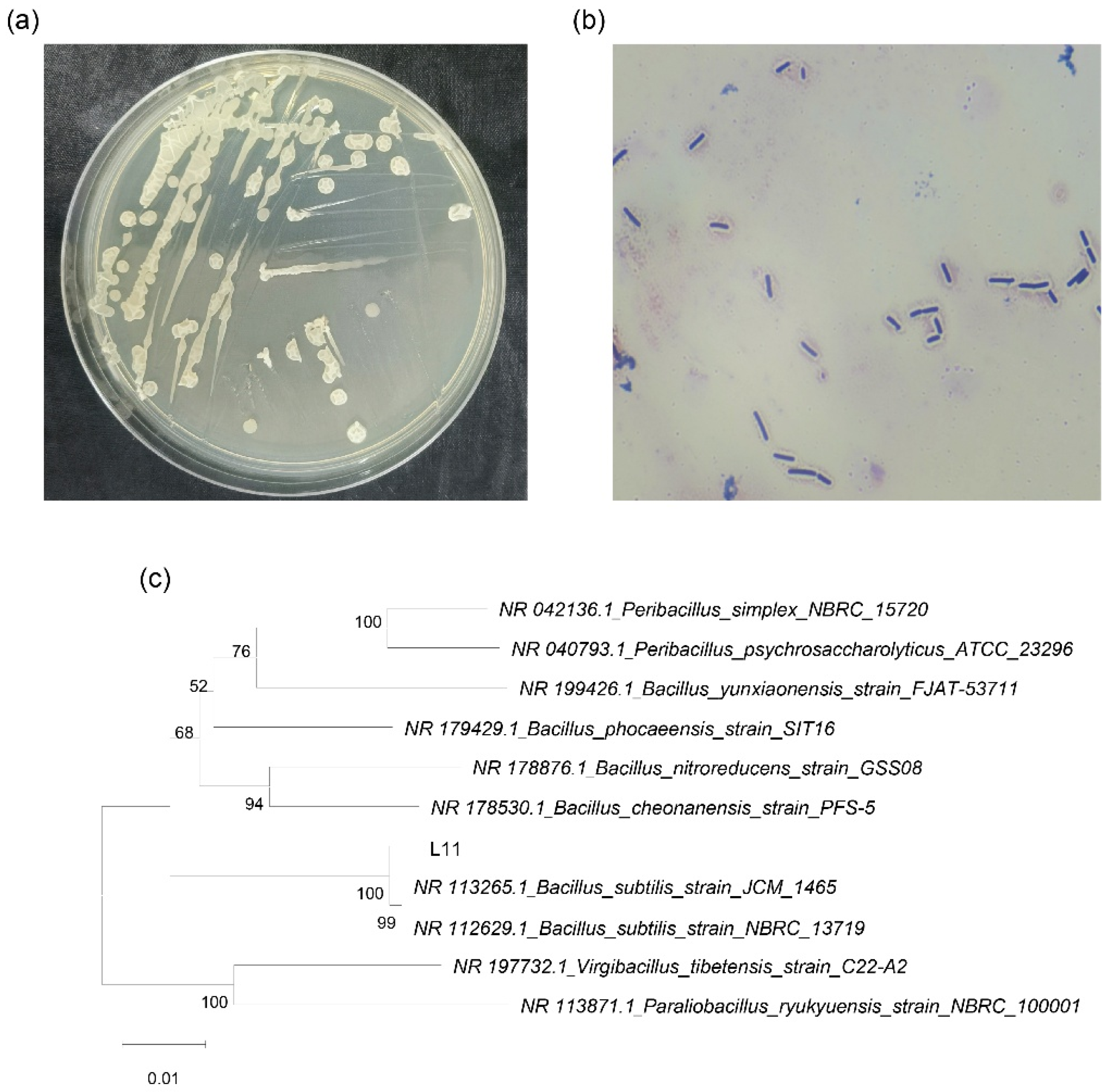
The morphological and phylogenetic characteristics of L11 were systematically evaluated to determine its taxonomic status (Figure 1). When cultured on LB agar at 28 °C for 24 h, isolate L11 exhibited typical Bacillus colonial morphology, characterized by creamy-white, opaque colonies with irregular margins and a slightly wrinkled, dry surface (Figure 1a). Microscopic examination via Gram staining revealed that the isolate is a Gram-positive, rod-shaped bacterium, with cells appearing either individually or in short chains (Figure 1b). To further clarify its phylogenetic position, the 16S rRNA gene of L11 was sequenced and compared with closely related type strains. The neighbor-joining phylogenetic tree showed that isolate L11 clustered within the Bacillus genus and shared the highest sequence homology with B. subtilis strains JCM 1465 and NBRC 13719, with a sequence similarity of 97.04%, supported by a robust bootstrap value of 100% (Figure 1c). Based on the combination of phenotypic traits and molecular evidence, isolate L11 was identified as a member of the genus Bacillus, showing the closest similarity to Bacillus subtilis based on 16S rRNA gene analysis.

3.2. L11 Inoculation Promotes S. lycopersicum Seedling Growth in Both Soil and Substrate Cultivation Systems

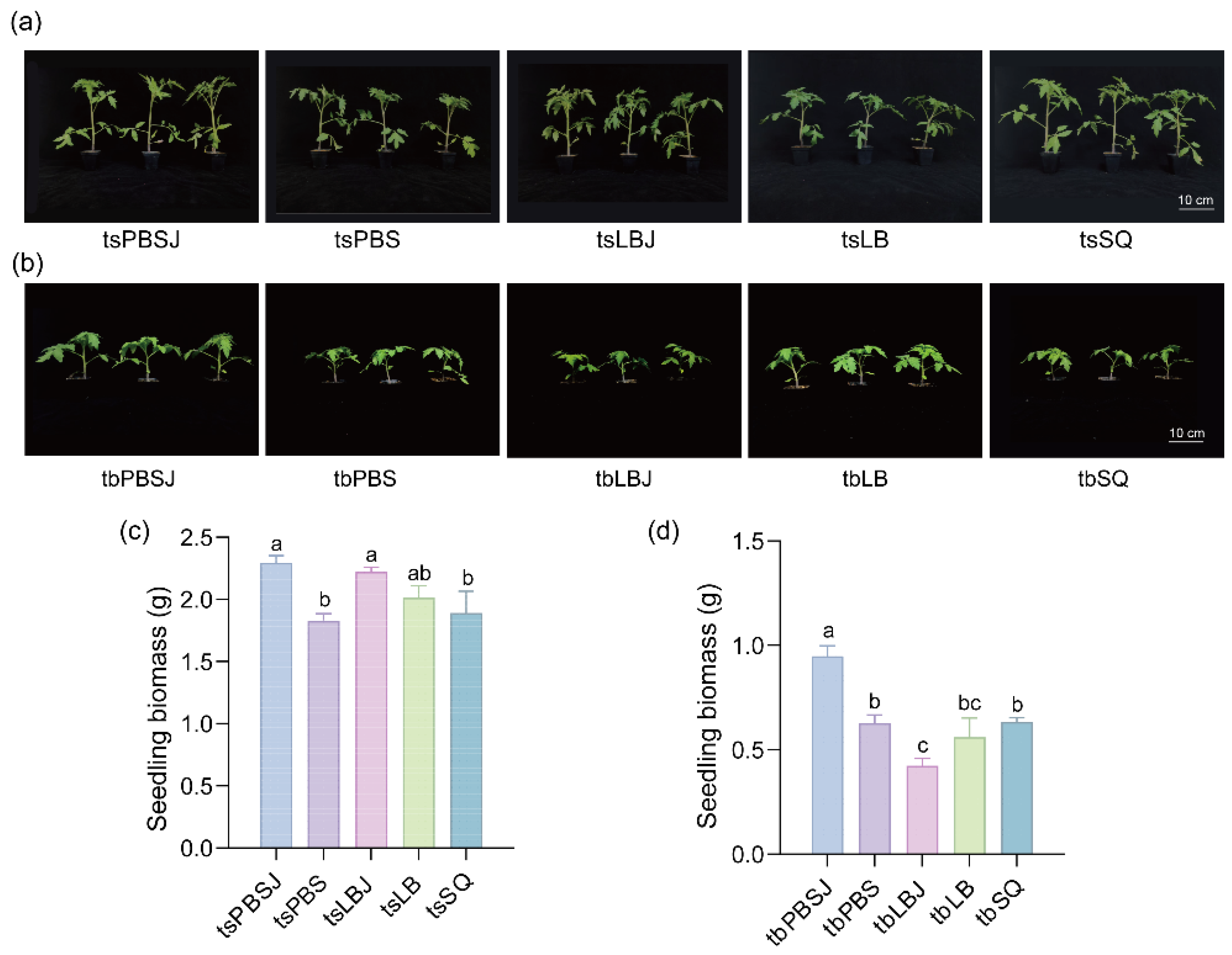
In two widely used substrates, namely, natural field soil (ts) and a peat-based artificial substrate (tb), the biomass of seedlings varied considerably among different treatments. The representative seedlings from the ts and tb groups showed different shoot phenotypes (Figure 2a,b). Among them, the PBSJ and LBJ treatments significantly enhanced the biomass accumulation of S. lycopersicum seedlings, whereas the SQ treatment did not increase S. lycopersicum biomass in soil cultivation (Figure 2a). Compared with the control PBS treatment, the PBSJ treatment resulted in a significant increase, and the biomass was also superior to that of the other treatments with the peat-based artificial substrate (Figure 2d). However, with respect to this substrate, the LB treatment, which served as a control without microbial presence, did not show the lowest biomass accumulation, indicating that different application forms of L11 can affect its ability to promote plant growth (Figure 2d).
In the soil cultivation system, the application of L11 influenced both root and shoot development (Table 1). The PBSJ treatment (tsPBS) emerged as the most effective application, consistently outperforming the PBS control and other experimental groups. Specifically, the PBSJ group exhibited a significant increase in shoot fresh weight (SFW) (16.53 ± 0.33 g) and plant height (PH) (19.67 ± 0.8 cm) compared to the PBS control (13.11 g and 15.57 cm, respectively; p < 0.05).
No significant differences were observed in either the total root length or the root volume of S. lycopersicum seedlings. Among the different treatments, root surface area (RSA) was substantially improved under the PBSJ treatment reaching 75.75 ± 2.5 cm2, which significantly higher than the 64.95 ± 2.66 cm2 recorded in the control. Although the LBJ group showed significant increases in plant height (18.05 cm) and leaf area (248.99 cm2) compared to the control, the enhancement in root biomass (RFW and RDW) did not reach statistical significance relative to the control. Overall, the L11-related treatments enhanced the aboveground growth of S. lycopersicum seedlings, and the application of LB medium bacterial culture solution significantly increased leaf area and plant height compared with the control (Table 1).
The growth-promoting effects of L11 were more pronounced in the artificial substrate system (Table 2). Consistent with the soil trials, the PBSJ treatment exhibited a clear advantage across nearly all measured growth parameters. Inoculation with PBSJ nearly doubled the root fresh weight (RFW) compared to the PBS control (1.74 ± 0.1 g vs. 1.06 ± 0.12 g). Significant increases were also observed in TRL and RV across treatments. Regarding shoot development, the PBSJ treatment resulted in the highest SDW (0.84 ± 0.05 g) and LA (192.81 ± 18.35 cm2).
Interestingly, the SQ group (culture supernatant) also displayed notable efficacy in the substrate system, particularly in promoting shoot biomass accumulation and plant height, which outperformed both the LB and PBS control groups.

3.3. The Effect of L11 on the Microbial Community in the Rhizosphere of S. lycopersicum Seedlings

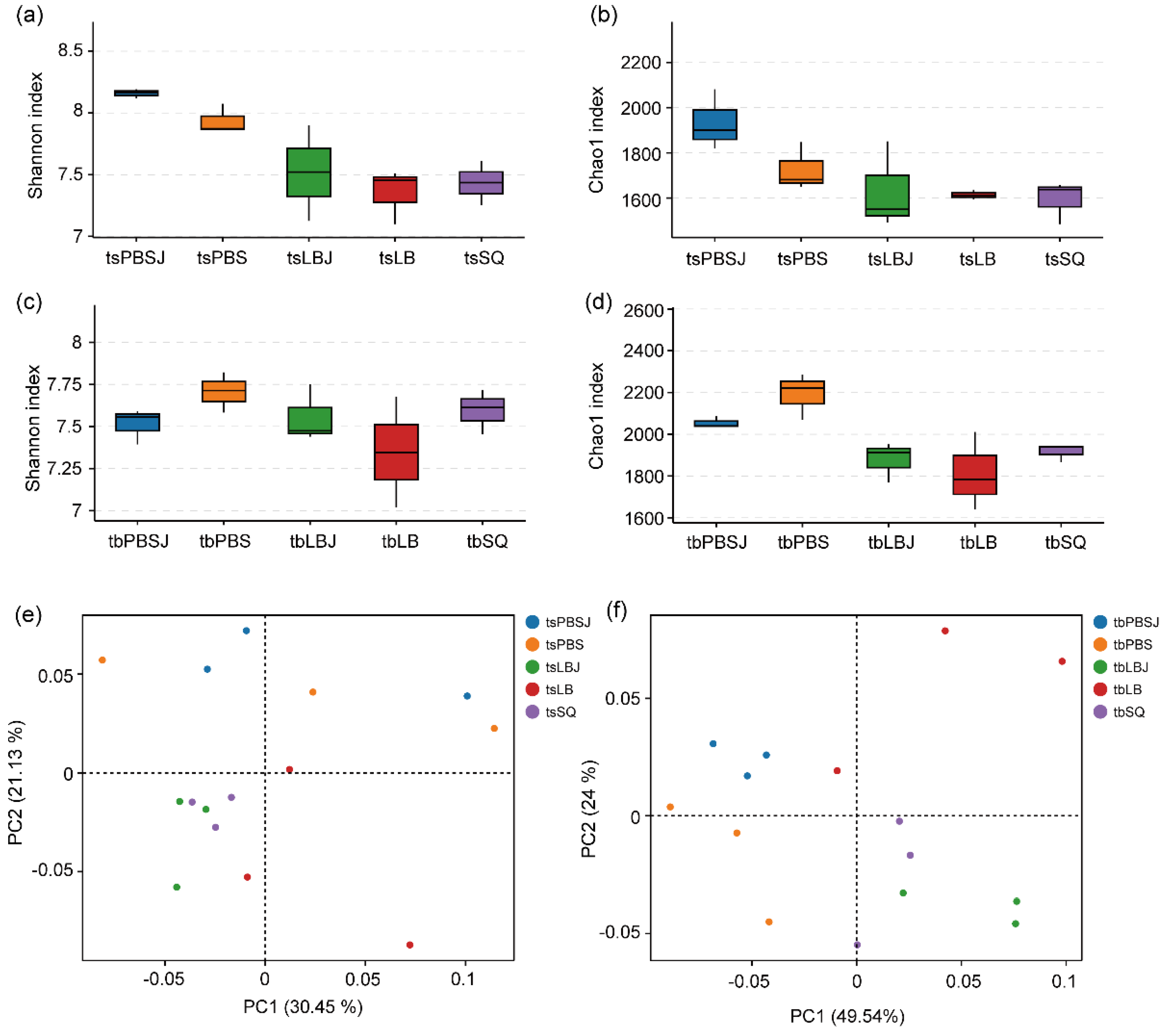
A total of 30 samples were subjected to high-throughput sequencing. The clean reads obtained from all samples ranged from 43,729 to 75,544, with an effective rate ranging from 84.16% to 84.56% (Table S1). Rarefaction curves generated from OTU abundance tables indicated that sequencing depth was adequate, as all samples approached a plateau (Figures S1 and S2). To minimize bias arising from variable sequencing depths, the OTU table was rarefied to the minimum library size (43,729 reads per sample). In the S. lycopersicum seedling growth promotion experiment, α-diversity analysis was performed on rhizosphere soil bacterial communities (Figure 3). Within the ts group, the Shannon and Chao1 indices did not differ significantly between the tsPBSJ treatment and the tsPBS control. Similarly, no statistically significant differences in these α-diversity indices were observed between the tsLBJ and tsSQ treatments relative to the tsLB control. Comparable results were found in the TB group. The Shannon and Chao1 indices showed no significant variation between the tbPBSJ treatment and the tbPBS control, nor among the tbLBJ, tbLB, and tbSQ treatments.
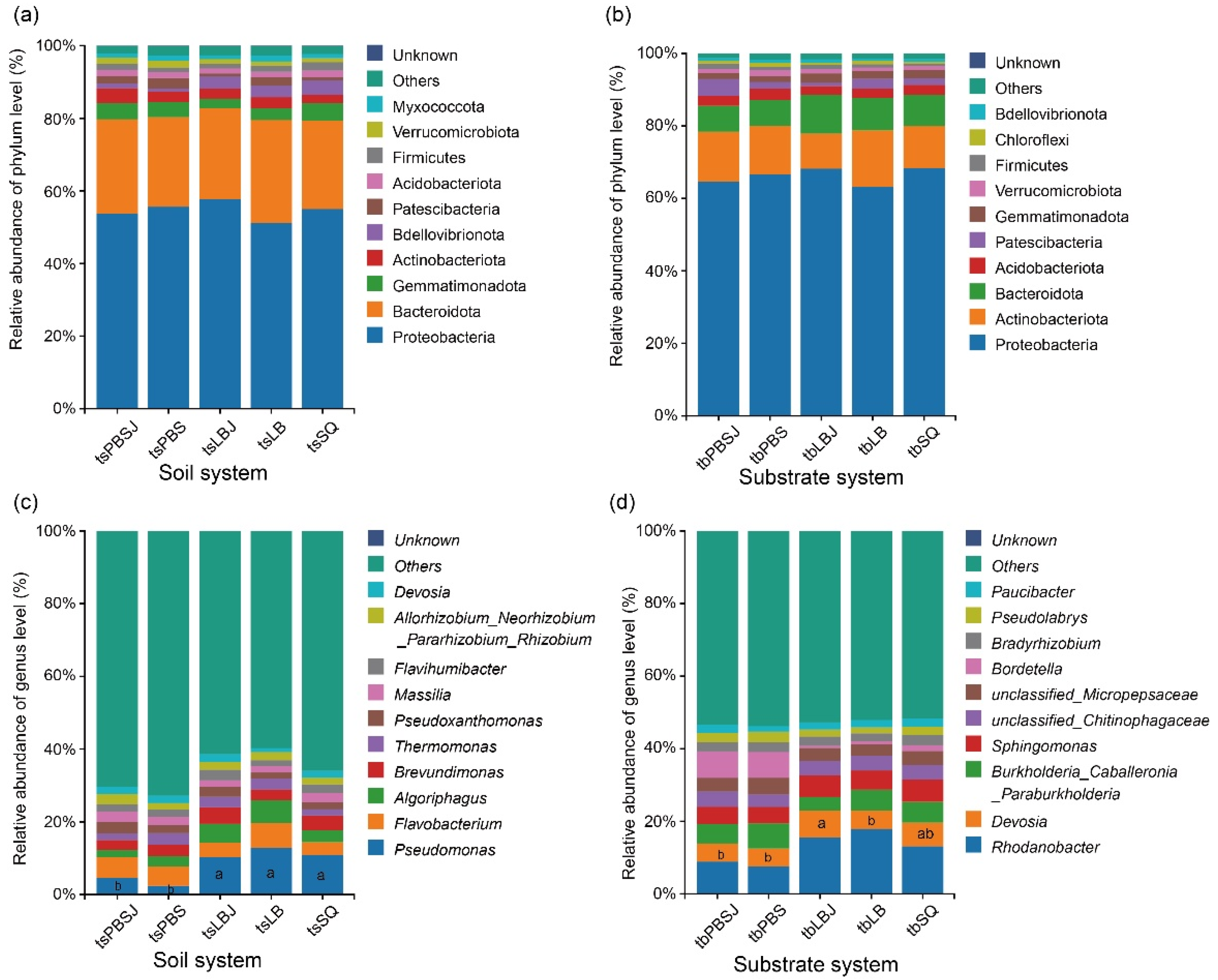
Principal coordinates analysis (PCoA) of bacterial communities in S. lycopersicum rhizosphere soil and rhizosphere substrate is presented in Figure 3. Clear separations were observed between PBSJ-treated and PBS control groups, as well as between LBJ/SQ-treated and LB control groups in both cultivation systems. Permutational multivariate analysis of variance (PERMANOVA) further confirmed that these differences were statistically significant (p < 0.05), demonstrating that inoculation with Bacillus sp. L11 significantly altered the bacterial community structure in both rhizosphere soil and rhizosphere substrate (Figure S2). The phylum-level and genus-level bacterial community structures in rhizosphere soil are presented in Figure 4a,c. The analysis of rhizosphere soil microbial composition revealed ten dominant bacterial phyla: Proteobacteria, Bacteroidota, Gemmatimonadota, Actinobacteriota, Bdellovibrionota, Patescibacteria, Acidobacteriota, Firmicutes, Verrucomicrobiota, and Myxococcota (Figure 4a). Notably, the tsLBJ and tsSQ treatment groups showed a higher relative abundance of Proteobacteria compared to the tsLB group. The ten most abundant bacterial genera at the genus level in rhizosphere soil were Pseudomonas, Flavobacterium, Algoriphagus, Brevundimonas, Thermomonas, Pseudoxanthomonas, Massilia, Flavihumibacter, Allorhizobium_Neorhizobium_Pararhizobium_Rhizobium, and Devosia (Figure 4c,d). The tsPBSJ group exhibited a higher abundance of Pseudomonas compared to the tsPBS group (p < 0.05). Meanwhile, specific enrichment of the Devosia genus was observed in both the tsLBJ and tsSQ groups.
The phylum- and genus-level bacterial community structures in the rhizosphere substrate are presented in Figure 4b,d. The ten most dominant bacterial phyla in the rhizosphere substrate were Proteobacteria, Actinobacteriota, Bacteroidota, Acidobacteriota, Patescibacteria, Gemmatimonadota, Verrucomicrobiota, Firmicutes, Chloroflexi, and Bdellovibrionota. The tbPBSJ group exhibited significantly higher abundances of Patescibacteria and Firmicutes compared to the tbPBS group, while the tbLBJ group showed a marked increase in Bdellovibrionota abundance relative to the tbLB control group. The ten most abundant bacterial genera in the rhizosphere substrate were Rhodanobacter, Devosia, Burkholderia_Caballeronia_Paraburkholderia, Sphingomonas, unclassified_Chitinophagaceae, unclassified_Micropepsaceae, Bordetella, Bradyrhizobium, Pseudolabrys, and Paucibacter. Notably, the tbLBJ and tbSQ treatment groups exhibited higher abundance of the Devosia genus compared to their respective control groups.
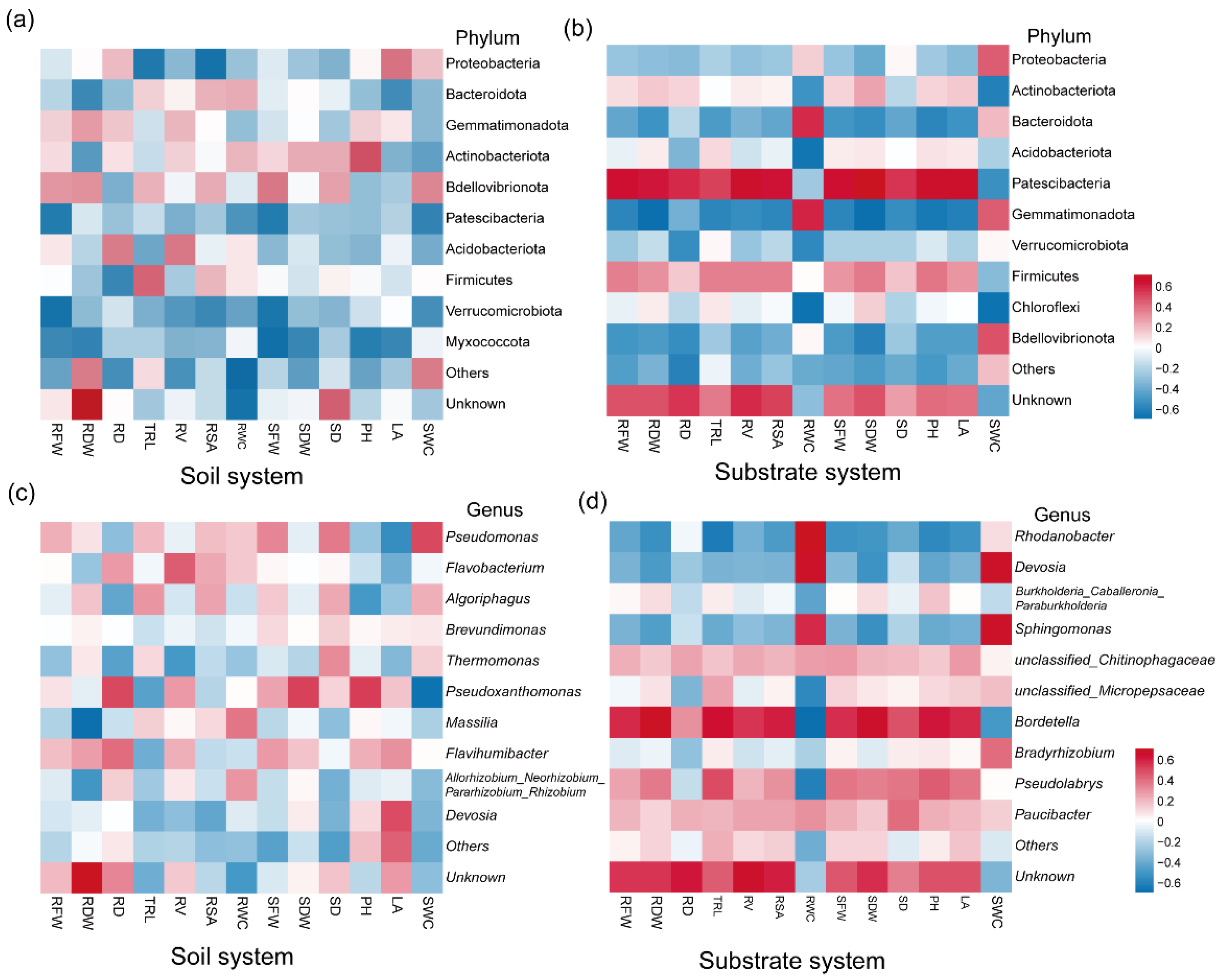
Through the analysis, we identified several statistically significant correlations (p < 0.05) between rhizobacterial abundance and S. lycopersicum growth indicators. As shown in Figure 5, in brief, the phylum-level bacterial communities in the TS group exhibited no statistically significant correlations with plant growth indicators (Figure 5a). In the ts group at the genus level of bacterial communities, Pseudoxanthomonas was positively correlated with SDW and PH, and Pseudomonas was positively correlated with SWC (Figure 5b). At the phylum level of bacterial communities in the tb group, Patescibacteria was positively correlated with PFW, RDW, RD, TRL, RV, RSA, SFW, SDW, SD, PH, and LA; Proteobacteria showed a positive association with SWC; Bacteroidota exhibited a significant correlation with RWC; Gemmatimonadota was linked to both RWC and SWC; and Bdellovibrionota was positively correlated with SWC (Figure 5c). At the genus level of bacterial communities in the tb group: Bordetella exhibited positive correlations with RFW, RDW, TRL, RV, RSA, SFW, SDW, PH, and LA; Rhodanobacter showed a significant association with RWC; and Devosia and Sphingomonas were both positively correlated with RWC and SWC (Figure 5d). These results collectively suggest that variations in rhizobacterial abundance are strongly correlated with the growth-promoting effects on S. lycopersicum seedlings.

4. Discussion

Given the increasing global scarcity of resources, utilizing PGPR to enhance plant development represents a green and sustainable agricultural practice, as it offers an eco-friendly alternative to chemical inputs by leveraging beneficial rhizobacteria such as Bacillus sp. L11 to promote plant growth, reshape rhizosphere microbiomes, and reduce the environmental footprint of crop production. Phylogenetic analysis based on 16S rRNA gene sequencing indicated that this strain is most closely related to B. subtilis; however, further characterization through additional approaches, such as whole-genome sequencing, is required for definitive taxonomic confirmation. B. subtilis is a common plant growth-promoting rhizobacterium in agriculture [33] and is also present in studies on promoting S. lycopersicum growth [34,35].
Regarding the effect on S. lycopersicum seedling biomass accumulation, although the overall biomass accumulation of S. lycopersicum seedlings grown in soil was higher than that when grown in peat-based artificial substrates, PBS-resuspended cells (PBSJ) consistently outperformed LB-cultured inocula (LBJ) in the tb group, suggesting the importance of the carrier medium and cell physiological state in PGPR efficacy. In other studies, PGPR application—often combined with organic amendments—reshaped rhizosphere microbiomes and improved crop performance, especially under conditions of higher organic matter availability [36,37].
The results suggested that inoculation with Bacillus sp. L11 significantly enhanced biomass accumulation and optimized the root surface area of S. lycopersicum seedlings. Notably, in the peat-based substrate cultivation system, the PBS-resuspended L11 (PBSJ) exhibited the highest growth-promoting potential, nearly doubling the root fresh weight (RFW) compared to the control (PBS), alongside significant increases in total root length (TRL) and root surface area (RSA). These findings corroborate previous studies suggesting that Bacillus species induce root proliferation by secreting indole-3-acetic acid (IAA) and enhancing nutrient mobilization [38,39,40]; however, the specific mechanisms underlying the enhanced efficacy of PBSJ in this study remain to be further elucidated.
In both cultivation systems, the LBJ treatment did not significantly increase biomass relative to the LB control, and the trends of the LB-based treatments (LBJ, LB, SQ) were opposite between soil and substrate, likely due to differences in buffering capacity. In the substrate system, tbSQ showed greater biomass than tbLBJ (Figure 1), which may be explained by the supernatant retaining active L11 metabolites that independently promote growth, while live cells in tbLBJ consumed residual LB nutrients (carbon and nitrogen) or engaged in transient root competition, thereby negating the nutritional benefit of the LB medium. Under better-buffered soil conditions, this localized competition was diluted, allowing the beneficial metabolites and microbiome modulation by live L11 to dominate, such that tsLBJ still significantly promoted growth (Table 1). Interestingly, the efficacy of PBSJ outperformed the LBJ treatment (direct LB culture) across multiple growth indicators. The PBS washing step removes spent culture metabolites, which may compel the bacteria to rapidly shift their physiological state to utilize root exudates upon entering the rhizosphere, potentially enhancing their colonization efficiency. In contrast, while the SQ treatment (cell-free supernatant) contained secreted metabolites, its effect on increasing root dry weight was limited, suggesting that the physical presence of live L11 cells is indispensable for root growth parameters remodeling.
Collectively, the results indicate that inoculation with Bacillus sp. L11 exerted no significant impact on the α-diversity of the bacterial community in the rhizosphere soil of S. lycopersicum seedlings. But shifts in rhizosphere microbial community structure are closely associated with the functional outcomes of plant growth promotion [41]. To decipher these changes, we employed high-throughput sequencing of bacterial 16S rRNA genes in S. lycopersicum rhizosphere samples in both cultivation systems. Principal coordinates analysis (PCoA) showed clear separations between treated and control groups, and PERMANOVA confirmed that inoculation with Bacillus sp. L11 was associated with statistically significant differences (p < 0.05) in bacterial community structure in both rhizosphere soil and substrate (Figure S2). This suggests that L11 may acts as an ecological modulator rather than a dominant colonizer, consistent with findings that microbial inoculants can alter community structure without reducing diversity [19,25].
In the rhizosphere, L11 enriched beneficial genera such as Devosia (involved in nitrogen metabolism) [42] and Pseudomonas (known for biocontrol traits) [43], which likely contributed to improved plant nutrient acquisition and pathogen resistance. In other related studies, Harting et al. confirmed that the genus Pseudomonas, as a typical PGPR, can form a strong antagonistic effect on pathogenic microorganisms by secreting siderophores, antibiotics, and secondary metabolites such as 2,4-diacetylresorcinol (DAPG) [44]. Correlation analysis further supported a strong linkage between the enrichment of these taxa and improved plant growth parameters, suggesting that L11’s plant-beneficial effects are mediated—at least in part—through rhizosphere microbiome remodeling.
The supernatant treatment (SQ) also exhibited growth-promoting effects, particularly on shoot development within the substrate system. This suggests that L11 may secrete bioactive metabolites (e.g., IAA, volatile organic compounds) that could stimulate plant growth independently of bacterial colonization. However, this still needs to be verified in subsequent research. Similar findings have been reported for other Bacillus strains, where cell-free supernatants enhanced seed germination and seedling vigor [11]. Therefore, we hypothesize that L11 may employ a dual strategy: direct stimulation via secreted metabolites and indirect modulation through restructuring the rhizosphere microbiome.
The stronger relative response in substrate-grown seedlings compared to soil-grown ones may be attributed to the lower microbial complexity and higher nutrient availability in the artificial substrate [45], allowing L11 to establish more effectively and exert its beneficial effects. This highlights the potential of L11 as a bioinoculant in soilless cultivation systems, which are increasingly used in controlled-environment agriculture. However, field validation remains necessary to assess its performance under more complex and competitive soil conditions [8].
This study has some limitations. The experiment was conducted under controlled greenhouse conditions, and the duration was limited to the seedling stage. Due to the lack of field yield and verification, future research should investigate the long-term effects of L11 inoculation on fruit yield, quality, and soil health under field conditions. Additionally, metagenomic and metabolomic approaches could provide deeper insights into the functional shifts in the rhizosphere microbiome induced by L11. Understanding the persistence and ecological impact of L11 in different soil types will be crucial for its commercial development as a sustainable agricultural bioinoculant.

5. Conclusions

In this study, Bacillus sp. L11 was identified as an effective PGPR strain in promoting S. lycopersicum seedling growth. L11 inoculation was correlated with significantly enhanced biomass accumulation and improved root growth parameters in both soil and commercial substrate, with PBS-resuspended cells (PBSJ) showing the strongest effects. High-throughput sequencing revealed that the presence of L11 was associated with changes in the rhizosphere bacterial community, including the relative enrichment of genera such as Chitinophaga, Devosia, and Pseudomonas, whose abundances were positively correlated with plant growth measures. Collectively, these findings suggest that L11 represents a promising microbial tool for improving seedling quality in sustainable vegetable production, although further studies are needed to establish causal mechanisms.

Supplementary Materials

The following supporting information can be downloaded at https://www.mdpi.com/article/10.3390/horticulturae12050627/s1, Figure S1: Seed germination phenotypes of the L11 treatment and control groups; Figure S2: Permutational multivariate analysis of variance (PERMANOVA) based on weighted unifrac distance; Figure S3: Rarefaction Curves of bacterial community in soil cultivation system; Figure S4: Rarefaction Curves of bacterial community in artificial peat-based substrates; Table S1: Sample Sequencing Data.

Author Contributions

Conceptualization, J.L. and X.Z.; formal analysis, Z.L., X.L. (Xinru Li) and X.G.; investigation, Z.L., X.G., R.L., Y.Z., H.Z. and X.L. (Xinzhe Li); writing—original draft preparation, Z.L. and X.G.; writing—review and editing, J.L. and X.Z.; visualization, Z.L. and S.Y.; supervision, Z.C.; funding acquisition, J.L. All authors have read and agreed to the published version of the manuscript.

Funding

This work was supported by the National Natural Science Foundation of China (NSFC) Youth Project (22408145) and the Natural Science Foundation of Shandong Province, China (No. ZR2025QC149).

Data Availability Statement

The accession numbers are as follows: The 16S rRNA gene sequence is GenBank PZ167833, and the raw amplicon sequencing data have been submitted to the NCBI Sequence Read Archive (SRA) database under the BioProject number PRJNA1337441.

Conflicts of Interest

The authors declare that they have no conflicts of interest.

References

  1. Jansson, J.K.; McClure, R.; Egbert, R.G. Soil Microbiome Engineering for Sustainability in a Changing Environment. Nat. Biotechnol. 2023, 41, 1716–1728. [Google Scholar] [CrossRef]
  2. Zhou, Y.; Liu, D.; Li, F.; Dong, Y.; Jin, Z.; Liao, Y.; Li, X.; Peng, S.; Delgado-Baquerizo, M.; Li, X. Superiority of Native Soil Core Microbiomes in Supporting Plant Growth. Nat. Commun. 2024, 15, 6599. [Google Scholar] [CrossRef] [PubMed]
  3. Zhu, Q.; Zhou, J.; Sun, M.; Li, H.; Han, Y.; Lv, J.; Li, Y.; Zhang, X.; George, T.S.; Liu, W.; et al. A Newly Isolated Bacillus megaterium OQ560352 Promotes Maize Growth in Saline Soils by Altering Rhizosphere Microbial Communities and Organic Phosphorus Utilization. Rhizosphere 2023, 27, 100746. [Google Scholar] [CrossRef]
  4. Bigatton, E.D.; Castillejo, M.A.; Ayoub, I.; Baldessari, J.J.; Bruno, M.; Archilla, M.V.; Dubini, L.E.; Lucini, E.; Haro, R.J. Plant Growth Promoting Rhizobacteria (PGPR): Impact on Peanut Flowering, Seed Physical Quality, and Yield Determination (Arachis hypogaea L.). Ind. Crops Prod. 2024, 219, 119024. [Google Scholar] [CrossRef]
  5. Flaviano, T.; Junior Bernardo, M.H.; Angelica, G.; Gabriele, C.; Fabrizio, L.; Walter, P.; Cristiano, P.; Clemencia, C.-L.; Fabio, S. Impact of Organic and Conventional Cropping Systems on Plant Growth-Promoting Rhizobacteria (PGPR). Biocatal. Agric. Biotechnol. 2025, 64, 103527. [Google Scholar] [CrossRef]
  6. Gashash, E.A.; Osman, N.A.; Alsahli, A.A.; Hewait, H.M.; Ashmawi, A.E.; Alshallash, K.S.; El-Taher, A.M.; Azab, E.S.; Abd El-Raouf, H.S.; Ibrahim, M.F.M. Effects of Plant-Growth-Promoting Rhizobacteria (PGPR) and Cyanobacteria on Botanical Characteristics of Tomato (Solanum lycopersicon L.) Plants. Plants 2022, 11, 2732. [Google Scholar] [CrossRef]
  7. Singh, A.; Chand Kumawat, K. Unraveling the Potential of Microbial Diversity in Pesticide Remediation: An Eco-Friendly Approach for Environmental Sustainability. J. Agric. Food Res. 2025, 21, 101832. [Google Scholar] [CrossRef]
  8. Thakur, R.; Dhar, H.; Mathew, S.; Gulati, A. PGPR Inoculants Journey from Lab to Land: Challenges and Limitations. Microbiol. Res. 2024, 289, 127910. [Google Scholar] [CrossRef]
  9. Hassani, M.A.; Durán, P.; Hacquard, S. Microbial Interactions within the Plant Holobiont. Microbiome 2018, 6, 58. [Google Scholar] [CrossRef]
  10. Ke, J.; Wang, B.; Yoshikuni, Y. Microbiome Engineering: Synthetic Biology of Plant-Associated Microbiomes in Sustainable Agriculture. Trends Biotechnol. 2021, 39, 244–261. [Google Scholar] [CrossRef]
  11. Vishwakarma, S.K.; Ilyas, T.; Shahid, M.; Malviya, D.; Kumar, S.; Singh, S.; Johri, P.; Singh, U.B.; Singh, H.V. Bacillus spp.: Nature’s Gift to Agriculture and Humankind. In Applications of Bacillus and Bacillus Derived Genera in Agriculture, Biotechnology and Beyond; Mageshwaran, V., Singh, U.B., Saxena, A.K., Singh, H.B., Eds.; Springer Nature: Singapore, 2024; pp. 1–36. [Google Scholar]
  12. Yang, X.; Mao, Y.; Chen, L.; Guan, X.; Wang, Z.; Huang, T. Structural Characteristics, Biotechnological Production and Applications of Exopolysaccharides from Bacillus sp.: A Comprehensive Review. Carbohydr. Polym. 2025, 355, 123363. [Google Scholar] [CrossRef] [PubMed]
  13. Tsotetsi, T.; Nephali, L.; Malebe, M.; Tugizimana, F. Bacillus for Plant Growth Promotion and Stress Resilience: What Have We Learned? Plants 2022, 11, 2482. [Google Scholar] [CrossRef]
  14. Etesami, H.; Jeong, B.R.; Glick, B.R. Potential Use of Bacillus spp. as an Effective Biostimulant against Abiotic Stresses in Crops—A Review. Curr. Res. Biotechnol. 2023, 5, 100128. [Google Scholar] [CrossRef]
  15. Sun, W.; Shahrajabian, M.H. Biostimulant and Beyond: Bacillus spp., the Important Plant Growth-Promoting Rhizobacteria (PGPR)-Based Biostimulant for Sustainable Agriculture. Earth Syst. Environ. 2025, 9, 1465–1498. [Google Scholar] [CrossRef]
  16. Meng, Q.; Jiang, H.; Hao, J.J. Effects of Bacillus velezensis Strain BAC03 in Promoting Plant Growth. Biol. Control 2016, 98, 18–26. [Google Scholar] [CrossRef]
  17. Tahir, H.A.S.; Gu, Q.; Wu, H.; Raza, W.; Hanif, A.; Wu, L.; Colman, M.V.; Gao, X. Plant Growth Promotion by Volatile Organic Compounds Produced by Bacillus subtilis SYST2. Front. Microbiol. 2017, 8, 171. [Google Scholar] [CrossRef] [PubMed]
  18. Trabelsi, D.; Mhamdi, R. Microbial Inoculants and Their Impact on Soil Microbial Communities: A Review. BioMed Res. Int. 2013, 2013, 863240. [Google Scholar] [CrossRef]
  19. Zhang, S.; Xia, T.; Wang, J.; Zhao, Y.; Xie, X.; Wei, Z.; Zhang, X.; Song, C.; Song, X. Role of Bacillus Inoculation in Rice Straw Composting and Bacterial Community Stability after Inoculation: Unite Resistance or Individual Collapse. Bioresour. Technol. 2021, 337, 125464. [Google Scholar] [CrossRef]
  20. Ren, P.; Zhou, B.; Bi, Y.; Chen, X.; Yao, S.; Yang, X. Bacillus subtilis Can Promote Cotton Phenotype, Yield, Nutrient Uptake and Water Use Efficiency under Drought Stress by Optimizing Rhizosphere Microbial Community in Arid Area. Ind. Crops Prod. 2025, 227, 120784. [Google Scholar] [CrossRef]
  21. Peng, Y.; Youn, C.; Seo, J.; Park, E.J.; Jang, I.-C.; Kim, C.Y.; Lee, J. The Endophytic Pseudomonas sp. JBR1 Alleviates Salt Stress through Integrated Host–Microbiome Mechanisms. Plant Physiol. 2025, 200, kiaf646. [Google Scholar] [CrossRef]
  22. Li, C.; Sun, L.; Jia, Z.; Tang, Y.; Liu, X.; Zhang, J.; Müller, C. Microbial Inoculants Drive Changes in Soil and Plant Microbiomes and Improve Plant Functions in Abandoned Mine Restoration. Plant Cell Environ. 2025, 48, 1162–1178. [Google Scholar] [CrossRef]
  23. Kong, Z.; Li, T.; Glick, B.R.; Liu, H. Priority Effects of Inoculation Timing of Plant Growth-Promoting Microbial Inoculants: Role, Mechanisms and Perspectives. Plant Soil 2025, 513, 1675–1687. [Google Scholar] [CrossRef]
  24. Zhao, Y.; Mao, X.; Zhang, M.; Yang, W.; Di, H.J.; Ma, L.; Liu, W.; Li, B. The Application of Bacillus Megaterium Alters Soil Microbial Community Composition, Bioavailability of Soil Phosphorus and Potassium, and Cucumber Growth in the Plastic Shed System of North China. Agric. Ecosyst. Environ. 2021, 307, 107236. [Google Scholar] [CrossRef]
  25. Nie, H.; Shi, Y.; Yang, X.; Zeng, J.; Tang, Y.; Liu, X.; Sun, L.; Zhou, Y.; Xu, X.; Liu, M.; et al. Microbial Inoculant-Induced Modifications of Rhizospheric Metabolites and Microbial Communities Enhance Plant Growth. Plant Soil 2025, 512, 619–637. [Google Scholar] [CrossRef]
  26. Roșca, M.; Mihalache, G.; Stoleru, V. Tomato Responses to Salinity Stress: From Morphological Traits to Genetic Changes. Front. Plant Sci. 2023, 14, 1118383. [Google Scholar] [CrossRef] [PubMed]
  27. Egea, I.; Estrada, Y.; Flores, F.B.; Bolarín, M.C. Improving Production and Fruit Quality of Tomato under Abiotic Stress: Genes for the Future of Tomato Breeding for a Sustainable Agriculture. Environ. Exp. Bot. 2022, 204, 105086. [Google Scholar] [CrossRef]
  28. Bai, Y.; Müller, D.B.; Srinivas, G.; Garrido-Oter, R.; Potthoff, E.; Rott, M.; Dombrowski, N.; Münch, P.C.; Spaepen, S.; Remus-Emsermann, M.; et al. Functional Overlap of the Arabidopsis Leaf and Root Microbiota. Nature 2015, 528, 364–369. [Google Scholar] [CrossRef]
  29. Saitou, N.; Nei, M. The Neighbor-Joining Method: A New Method for Reconstructing Phylogenetic Trees. Mol. Biol. Evol. 1987, 4, 406–425. [Google Scholar] [CrossRef]
  30. Martin, M. Cutadapt Removes Adapter Sequences from High-Throughput Sequencing Reads. EMBnet. J. 2011, 17, 10–12. [Google Scholar] [CrossRef]
  31. Farooq, M.; Siddique, I.; Nabi, A.; Naseer, M.; Younis, A.; Siddique, S. Microbiome Analyses of Metagenome Using USEARCH. In Plant Microbiome Engineering; Dharumadurai, D., Narayanan, A.S., Eds.; Springer: New York, NY, USA, 2025; pp. 299–307. [Google Scholar]
  32. Edgar, R.C.; Haas, B.J.; Clemente, J.C.; Quince, C.; Knight, R. UCHIME Improves Sensitivity and Speed of Chimera Detection. Bioinformatics 2011, 27, 2194–2200. [Google Scholar] [CrossRef]
  33. Hashem, A.; Tabassum, B.; Fathi Abd_Allah, E. Bacillus subtilis: A Plant-Growth Promoting Rhizobacterium That Also Impacts Biotic Stress. Saudi J. Biol. Sci. 2019, 26, 1291–1297. [Google Scholar] [CrossRef]
  34. Qiu, C.; Bao, Y.; Lü, D.; Yan, M.; Li, G.; Liu, K.; Wei, S.; Wu, M.; Li, Z. The Synergistic Effects of Humic Acid, Chitosan and Bacillus subtilis on Tomato Growth and against Plant Diseases. Front. Microbiol. 2025, 16, 1574765. [Google Scholar] [CrossRef]
  35. El-Gendi, H.; Al-Askar, A.A.; Király, L.; Samy, M.A.; Moawad, H.; Abdelkhalek, A. Foliar Applications of Bacillus subtilis HA1 Culture Filtrate Enhance Tomato Growth and Induce Systemic Resistance against Tobacco Mosaic Virus Infection. Horticulturae 2022, 8, 301. [Google Scholar] [CrossRef]
  36. Aeron, A.; Khare, E.; Jha, C.K.; Meena, V.S.; Aziz, S.M.A.; Islam, M.T.; Kim, K.; Meena, S.K.; Pattanayak, A.; Rajashekara, H.; et al. Revisiting the Plant Growth-Promoting Rhizobacteria: Lessons from the Past and Objectives for the Future. Arch. Microbiol. 2020, 202, 665–676. [Google Scholar] [CrossRef] [PubMed]
  37. Yan, Z.; Xing, Y.; Ma, C.; Li, X.; Duan, Y.; Wang, X.; Liu, M.; Khashi u Rahman, M.; Zhou, X. Biochar and PGPR Influence Rhizosphere Bacteria and Synergistically Regulate Tomato Seedling Biomass Under Greenhouse Conditions. J. Soil Sci. Plant Nutr. 2025, 25, 4972–4983. [Google Scholar] [CrossRef]
  38. AlHosani, M.; Kappachery, S.; Khan, T.A.; Karumannil, S.; Mundra, S.; Gururani, M.A. Mangrove-Associated Halotolerant Bacteria Augments Salinity Stress Tolerance in Solanum Lycopersicum. Plant Sci. 2025, 359, 112642. [Google Scholar] [CrossRef] [PubMed]
  39. Lu, L.; Liu, N.; Fan, Z.; Liu, M.; Zhang, X.; Tian, J.; Yu, Y.; Lin, H.; Huang, Y.; Kong, Z. A Novel PGPR Strain, Streptomyces Lasalocidi JCM 3373T, Alleviates Salt Stress and Shapes Root Architecture in Soybean by Secreting Indole-3-Carboxaldehyde. Plant Cell Environ. 2024, 47, 1941–1956. [Google Scholar] [CrossRef]
  40. Yan, N.; Wang, W.; Mi, T.; Zhang, X.; Li, X.; Du, G. Enhancing Tomato Growth and Soil Fertility under Salinity Stress Using Halotolerant Plant Growth-Promoting Rhizobacteria. Plant Stress 2024, 14, 100638. [Google Scholar] [CrossRef]
  41. Chepsergon, J.; Moleleki, L.N. Rhizosphere Bacterial Interactions and Impact on Plant Health. Curr. Opin. Microbiol. 2023, 73, 102297. [Google Scholar] [CrossRef]
  42. Chhetri, G.; Kim, I.; Kang, M.; Kim, J.; So, Y.; Seo, T. Devosia rhizoryzae sp. nov., and Devosia oryziradicis sp. nov., Novel Plant Growth Promoting Members of the Genus Devosia, Isolated from the Rhizosphere of Rice Plants. J. Microbiol. 2022, 60, 1–10. [Google Scholar] [CrossRef]
  43. Sandhya, V.; Ali, S.Z.; Grover, M.; Reddy, G.; Venkateswarlu, B. Effect of Plant Growth Promoting Pseudomonas spp. on Compatible Solutes, Antioxidant Status and Plant Growth of Maize under Drought Stress. Plant Growth Regul. 2010, 62, 21–30. [Google Scholar] [CrossRef]
  44. Harting, R.; Nagel, A.; Nesemann, K.; Höfer, A.M.; Bastakis, E.; Kusch, H.; Stanley, C.E.; Stöckli, M.; Kaever, A.; Hoff, K.J.; et al. Pseudomonas Strains Induce Transcriptional and Morphological Changes and Reduce Root Colonization of Verticillium spp. Front. Microbiol. 2021, 12, 652468. [Google Scholar] [CrossRef]
  45. Zhang, X.; Khalid, M.; Wang, R.; Chi, Y.; Zhang, D.; Chu, S.; Yang, X.; Zhou, P. Enhancing Lettuce Growth and Rhizosphere Microbial Community with Bacillus safensis YM1 Compost in Soilless Cultivation: An Agricultural Approach for Kitchen Waste Utilization. Sci. Hortic. 2023, 321, 112345. [Google Scholar] [CrossRef]
Figure 1. The morphology and Gram staining of Bacillus sp. L11: (a) colonial morphology of isolate L11 on LB plate; (b) Gram staining of isolate L11 observed under light microscopy (1000× magnification), showing Gram-positive rods; (c) neighbor-joining phylogenetic tree based on 16S rRNA gene sequences showing the relationship between isolate L11 and related taxa.
Horticulturae 12 00627 g001
Figure 2. Comparison of growth phenotypes and total biomass of S. lycopersicum seedlings: (a) phenotypes of S. lycopersicum seedlings cultivated in soil; (b) phenotypes of S. lycopersicum seedlings cultivated in peat-based artificial substrate; (c) biomass of S. lycopersicum seedlings cultivated in soil; (d) biomass of S. lycopersicum seedlings cultivated in peat-based artificial substrate. ts: soil cultivation; tb: peat-based artificial substrate cultivation. All data are shown as mean ± SEM, n = 6. Different letters above the bars in the graphs indicate a significant difference at p < 0.05 (one-way ANOVA with Tukey’s HSD test).
Horticulturae 12 00627 g002
Figure 3. Analysis of the α and β diversity of rhizosphere bacterial communities in S. lycopersicum seedlings: (a) Shannon index and (b) Chao1 index of S. lycopersicum rhizosphere (ts); (c) Shannon index and (d) Chao1 index of S. lycopersicum rhizosphere in substrate (tb); β-diversity-based principal coordinates analysis (PCoA) of bacterial communities in rhizosphere soil (e) and rhizosphere substrate (f). The treatment groups included the following: PBSJ: suspended bacterial liquid with phosphate-buffered saline; PBS: phosphate-buffered saline; LBJ: L11 bacterial liquid cultured in LB medium; LB: sterilized LB medium; and SQ: the culture supernatant collected via centrifugation and subsequently sterilized using a 0.22 μm membrane filter. The prefix “ts” indicates S. lycopersicum seedlings cultivated in soil, whereas “tb” indicates those cultivated in the substrate.
Horticulturae 12 00627 g003
Figure 4. Bar plots of bacterial community composition in the S. lycopersicum growth promotion experiment: (a) phylum-level and (c) genus-level bacterial community composition in S. lycopersicum rhizosphere soil; (b) phylum-level and (d) genus-level bacterial community composition in S. lycopersicum rhizosphere substrate. PBSJ: the group treated with PBS suspended bacterial liquid; PBS: the group treated with phosphate-buffered saline; LBJ: the group treated with L11 bacterial liquid cultured in LB medium; LB: the group treated with LB medium; SQ: the group treated with supernatant after centrifugation of LBJ. The prefix “ts” indicates S. lycopersicum seedlings cultivated in soil, whereas “tb” indicates those cultivated in the substrate. Different letters indicate a significant difference at p < 0.05 (one-way ANOVA with Tukey’s HSD test, n = 3).
Horticulturae 12 00627 g004
Figure 5. Pearson correlations between dominant bacterial phyla and genera and growth indicators of S. lycopersicum seedlings: correlation heatmaps of bacterial communities in S. lycopersicum rhizosphere soil at the phylum level (a) and genus level (b), and in S. lycopersicum rhizosphere substrate at the phylum level (c) and genus level (d). Note: RFW: root fresh weight; RDW: root dry weight; TRL: total root length; RD: average root diameter; RV: root volume; RSA: root surface area; RWC: root water content; SFW: shoot fresh weight; SDW: shoot dry weight; PH: plant height; SD: stem diameter; LA: leaf area; SWC: shoot water content. Data represent mean ± SEM of biological replicates (n = 6); different letters indicate significant differences (p < 0.05, one-way ANOVA with correction by Tukey’s HSD test).
Horticulturae 12 00627 g005
Table 1. S. lycopersicum seedling growth indicators cultivated in soil system.
ParametersPBSJPBSLBJLBSQ
RFW (g)5.83 ± 0.3 a4.62 ± 0.14 b5.64 ± 0.29 a5.46 ± 0.23 ab5.37 ± 0.39 ab
RDW (g)0.28 ± 0.010.36 ± 0.020.35 ± 0.010.33 ± 0.030.34 ± 0.04
TRL (cm)1178.59 ± 107.151044.6 ± 98.061050.66 ± 61.491291.6 ± 90.551165.99 ± 108.93
RD (mm)0.66 ± 0.050.64 ± 0.050.64 ± 0.020.6 ± 0.030.62 ± 0.04
RV (cm3)3.92 ± 0.243.24 ± 0.213.38 ± 0.183.57 ± 0.193.39 ± 0.25
RSA (cm2)75.75 ± 2.5 a64.95 ± 2.66 b67.1 ± 3.36 b76.08 ± 2.08 a70.09 ± 2.98 ab
RWC (%)95.1 ± 0.4 a92.27 ± 0.56 c93.82 ± 0.25 b93.9 ± 0.41 b93.84 ± 0.35 b
SFW (g)16.53 ± 0.33 a13.11 ± 0.34 c16.86 ± 0.52 a15.64 ± 0.67 ab14.8 ± 0.57 b
SDW (g)2.01 ± 0.07 a1.47 ± 0.05 c1.88 ± 0.03 ab1.68 ± 0.08 bc1.55 ± 0.14 c
PH (cm)19.67 ± 0.86 a15.57 ± 0.54 b18.05 ± 0.27 a15.68 ± 0.62 b16.12 ± 0.72 b
SD (mm)5.34 ± 0.19 ab5.07 ± 0.08 b5.51 ± 0.18 ab5.58 ± 0.08 a5.23 ± 0.2 ab
LA (cm2)233.42 ± 5.82 a242.96 ± 7.05 a248.99 ± 12.19 a197.11 ± 7.67 b225.02 ± 18.34 ab
SWC (%)87.82 ± 0.33 b88.77 ± 0.28 ab88.83 ± 0.28 ab89.26 ± 0.42 a89.58 ± 0.66 a
Note: RFW: root fresh weight; RDW: root dry weight; TRL: total root length; RD: average root diameter; RV: root volume; RSA: root surface area; RWC: root water content; SFW: shoot fresh weight; SDW: shoot dry weight; PH: plant height; SD: stem diameter; LA: leaf area; SWC: shoot water content. The treatment groups included the following: PBSJ: suspended bacterial liquid with phosphate-buffered saline; PBS: phosphate-buffered saline; LBJ: L11 bacterial liquid cultured in LB medium; LB: sterilized LB medium; and SQ: the culture supernatant collected via centrifugation and subsequently sterilized using a 0.22 μm membrane filter. Data represent mean ± SEM (n = 6). Different letters indicate significant differences (p < 0.05, one-way ANOVA with correction by Tukey’s HSD test).
Table 2. S. lycopersicum seedling growth indicators cultivated in substrate system.
PBSJPBSLBJLBSQ
RFW (g)1.74 ± 0.11 a1.06 ± 0.12 bc0.86 ± 0.06 c0.99 ± 0.07 bc1.23 ± 0.06 b
RDW (g)0.11 ± 0.01 a0.07 ± 0.01 b0.05 ± 0.01 c0.06 ± 0.01 bc0.07 ± 0.01 b
TRL (cm)610.9 ± 15.55 a527.97 ± 40.04 b442.72 ± 27.06 c432.44 ± 22.8 c479.27 ± 23.04 bc
RD (mm)0.47 ± 0.01 a0.4 ± 0.02 c0.4 ± 0.02 bc0.42 ± 0.02 bc0.44 ± 0.01 ab
RV (cm3)1.07 ± 0.06 a0.66 ± 0.08 b0.56 ± 0.05 b0.61 ± 0.05 b0.74 ± 0.05 b
RSA (cm2)90.51 ± 3.28 a65.74 ± 6.31 b55.65 ± 3.63 b57.28 ± 3.29 b66.57 ± 3.75 b
RWC (%)93.82 ± 0.16 b93.26 ± 0.21 c94.52 ± 0.15 a94.04 ± 0.07 b94.07 ± 0.14 b
SFW (g)8.25 ± 0.4 a5.34 ± 0.3 bc4.15 ± 0.36 cd3.86 ± 0.81 d6.26 ± 0.21 b
SDW (g)0.84 ± 0.05 a0.56 ± 0.03 b0.38 ± 0.03 c0.5 ± 0.09 bc0.56 ± 0.02 b
PH (cm)8.98 ± 0.16 a6.7 ± 0.23 bc5.75 ± 0.19 d6.32 ± 0.19 c7.1 ± 0.09 b
SD (mm)4.77 ± 0.1 a4.07 ± 0.1 bc3.9 ± 0.17 c3.88 ± 0.09 c4.34 ± 0.1 b
LA (cm2)192.81 ± 8.35 a125.31 ± 6.6 bc94.81 ± 8.66 d109.99 ± 6.78 cd143.54 ± 4.57 b
SWC (%)89.8 ± 0.29 a89.55 ± 0.34 a90.82 ± 0.34 a89.61 ± 1.57 a91.03 ± 0.1 a
Note: RFW: root fresh weight; RDW: root dry weight; TRL: total root length; RD: average root diameter; RV: root volume; RSA: root surface area; RWC: root water content; SFW: shoot fresh weight; SDW: shoot dry weight; PH: plant height; SD: stem diameter; LA: leaf area; SWC: shoot water content. The treatment groups included the following: PBSJ: suspended bacterial liquid with phosphate-buffered saline; PBS: phosphate-buffered saline; LBJ: L11 bacterial liquid cultured in LB medium; LB: sterilized LB medium; and SQ: the culture supernatant collected via centrifugation and subsequently sterilized using a 0.22 μm membrane filter. Data represent mean ± SEM (n = 6). Different letters indicate significant differences (p < 0.05, one-way ANOVA with correction by Tukey’s HSD test).
Disclaimer/Publisher’s Note: The statements, opinions and data contained in all publications are solely those of the individual author(s) and contributor(s) and not of MDPI and/or the editor(s). MDPI and/or the editor(s) disclaim responsibility for any injury to people or property resulting from any ideas, methods, instructions or products referred to in the content.