This is an early access version, the complete PDF, HTML, and XML versions will be available soon.
Article

Influence of Ecological Versus Conventional Viticulture on Physicochemical, Antioxidant, and Sensory Properties of Wines from Three Grapevine Varieties


1
Viticulture and Oenology Department, Advanced Horticultural Research Institute of Transylvania, Faculty of Horticulture and Business in Rural Development, University of Agricultural Sciences and Veterinary Medicine Cluj-Napoca, 3-5 Mănăștur Street, 400372 Cluj-Napoca, Romania
2
Laboratory of Chromatography, Advanced Horticultural Research Institute of Transylvania, Faculty of Horticulture and Business in Rural Development, University of Agricultural Sciences and Veterinary Medicine Cluj-Napoca, 3-5 Mănăștur Street, 400372 Cluj-Napoca, Romania
3
Faculty of Chemistry and Chemical Engineering, Babeș-Bolyai University, 11 Arany Janos Street, 400028 Cluj-Napoca, Romania
4
Department of Chemistry and Biochemistry, Faculty of Animal Science and Biotechnology, University of Agricultural Sciences and Veterinary Medicine Cluj-Napoca, 3-5 Manastur Street, 400372 Cluj-Napoca, Romania
5
Department of Pharmaceutical Botany, Faculty of Pharmacy, “Iuliu Hațieganu” University of Medicine and Pharmacy, 23 Gheorghe Marinescu Street, 400337 Cluj-Napoca, Romania
6
National Institute for Research and Development of Isotopic and Molecular Technologies, 67-103 Donat Street, 400293 Cluj-Napoca, Romania
*
Author to whom correspondence should be addressed.
These authors contributed equally to this work.
Horticulturae 2026, 12(5), 628; https://doi.org/10.3390/horticulturae12050628 (registering DOI)

Submission received: 8 April 2026 / Revised: 7 May 2026 / Accepted: 15 May 2026 / Published: 19 May 2026

Abstract

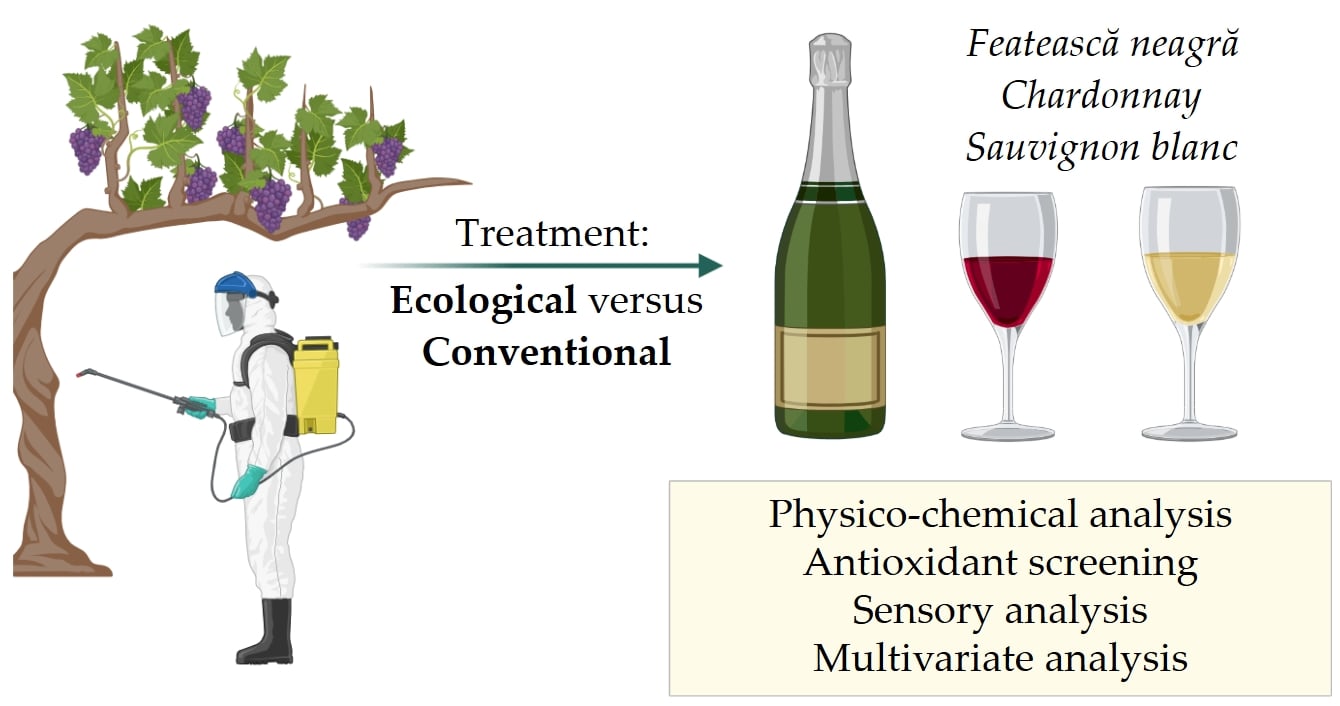
Growing consumer demand for organic products and increasing evidence that viticultural management influences wine quality have prompted renewed interest in ecological cultivation systems. This study aimed to comparatively evaluate the oenological characteristics and sensory quality of wines produced from three Vitis vinifera varieties (Chardonnay, Sauvignon blanc, and Fetească neagră) grown under ecological and conventional cultivation systems in the Dealu Mare wine region (Romania) during 2022. Wines were characterized by their physicochemical parameters (pH, total acidity, reducing sugars, and ethanol content), total anthocyanin (TAC), total phenolic (TPC), and total flavonoid content (TFC), in vitro antioxidant activity (ABTS, DPPH, FRAP), and structured sensory evaluation using a semi-naive consumer panel (n = 20). Fetească neagră wines exhibited the highest bioactive potential, with TPC values up to 2895.78 ± 152.23 mg GAE/L, TAC up to 370.98 mg MGE/L, and FRAP values reaching 5790.53 ± 143.82 mg TE/L, approximately ten-fold higher than white wines. Ecological cultivation significantly enhanced the antioxidant activity of Sauvignon blanc and Fetească neagră wines, while its effect on Chardonnay was variable across assays. Sensory evaluation revealed that ecological cultivation significantly improved olfactory scores (p = 0.011), particularly for Sauvignon blanc, and that female panelists assigned significantly higher olfactory scores than males (p < 0.001). These findings support ecological viticulture as a quality-enhancing strategy for Romanian wine production, especially for autochthonous cultivars.
Keywords: Chardonnay; Sauvignon blanc; Fetească neagră; organic viticulture; conventional viticulture; OIV sensory analysis; Dealu Mare; Romanian autochthonous varieties Chardonnay; Sauvignon blanc; Fetească neagră; organic viticulture; conventional viticulture; OIV sensory analysis; Dealu Mare; Romanian autochthonous varieties
Graphical Abstract