Article

Integrated Metabolomic and Transcriptomic Analysis Uncovers the Roles of Fructose and Mannose Metabolism-Related Metabolites and Genes in Regulating Bitter Gourd Flesh Thickness and Exogenous Sugar Responses


Fujian Key Laboratory of Vegetable Genetics and Breeding, Crops Research Institute, Fujian Academy of Agricultural Sciences, Fuzhou 350003, China
*
Authors to whom correspondence should be addressed.
Horticulturae 2026, 12(5), 518; https://doi.org/10.3390/horticulturae12050518
Submission received: 27 March 2026 / Revised: 18 April 2026 / Accepted: 21 April 2026 / Published: 23 April 2026

Abstract

Fruit flesh thickness is one of the key factors affecting the yield and quality of bitter melon, and its regulatory mechanisms remain unclear. One thick-flesh germplasm (KF) and one thin-flesh germplasm (NF) with significantly different flesh thicknesses were screened from 70 bitter melon germplasms. Through phenotypic surveys, combined metabolomic and transcriptomic analyses, and exogenous sugar treatments, the regulatory mechanisms on flesh thickness were preliminary investigated. The results showed that flesh thickness of the two germplasms remained stable during different years and seasons. Metabolomic and transcriptomic analyses revealed that fructose and mannose metabolism pathway significantly enriched in both omics datasets. The expression of key enzyme encoding genes from this pathway exhibited various expression patterns. In KF, most genes showed significantly higher expression levels than NF, with synergistic expression predominating among genes. Soluble sugar content was positively correlated with gene expression, while HXK, SDH, and TPI activities were negatively correlated with most genes, and FBP activity was positively correlated with most genes. Genes affect carbon source metabolic flux distribution by promoting sugar synthesis and inhibiting sugar respiration consumption. Exogenous sugar treatment exhibited germplasm-specific and concentration-dependent influence of gene expression, with KF primarily showing negative feedback and NF predominantly activating expression. Fruit flesh thickness was significantly positively correlated with the synergistic high expression of sugar metabolism genes and soluble sugar accumulation. This study provides a theoretical basis for molecular improvement of bitter melon fruit flesh thickness.

1. Introduction

Bitter gourd (Momordica charantia L.) is an annual climbing herbaceous plant belonging to the Cucurbitaceae family and is a member of the Momordica genus. It possesses both edible and medicinal values. Its fruits are abundant in bioactive components such as momordicin and polysaccharides and are extensively cultivated in tropical and subtropical regions [1,2]. Fruit development in Cucurbitaceae crops undergoes two critical phases: cell division followed by cell expansion, which collectively determine final fruit morphology and weight. In melon, within 10 days after pollination, cell division predominates, and fruit growth is slow. From days 10 to 20, the fruit rapidly expands, with both fruit diameter and length increasing rapidly. From days 20 to 30, the fruit length continuously and rapidly increases, but the fruit diameter slightly increases [3]. In bitter gourd, 10 days after pollination is the early stage of rapid fruit expansion, and fruit enlargement slows down by 17 days. This developmental stage is of great significance for the study of fruit growth and development [4]. Fruit flesh thickness, as one of the key traits determining the yield and quality of bitter gourd, is primarily influenced by factors such as cytological characteristics, sugar metabolism, cell wall–related enzyme activities, etc. Previous research has found that cell number and cell size are the primary cytological basis, and increased cell layers and enhanced cell expansion directly promote flesh thickening [5]. For instance, comparative studies on four cucumber varieties revealed that fruit sizes are closely associated with cell expansion capacity, and varieties with larger fruits show an approximately 30-fold increase in average cell area from 5 days after anthesis (DAA) to 16 DAA, while the variety with the smallest fruits and thinnest flesh only shows about a 3-fold increase in cell area [6]. The thickness of chili pepper flesh is regulated by cell size and number of cell layers. Cell expansion is the key driver of flesh thickening, with cell size showing a significant positive correlation with thickness [7]. Tomato fruit peel thickness demonstrates a highly significant positive correlation with cell size, where cell expansion serves as the primary force behind flesh thickening [8]. Furthermore, light signals directly influence the extent of flesh cell expansion by regulating endoreduplication, thereby determining fruit size, flesh thickness, and single fruit weight [9]. Soluble sugars serve as crucial osmotic regulatory substances, promoting cell expansion by modulating vacuolar enlargement [10]. Enzymes related to sugar metabolism such as sucrose synthase, fructokinase sucrose phosphate synthase and invertase mediate sugar accumulation and supply carbon skeletons for cell growth [3,10,11]. Meanwhile, cell wall remodeling enzymes, including polygalacturonase, β-galactosidase, and xyloglucan endotransglucosylase/hydrolase, regulate cell wall loosening and extension, thereby affecting cell morphology and flesh thickness [12,13]. These cellular and metabolic factors jointly determine the developmental pattern and final thickness of fruit flesh.
The development of fruit flesh is the result of the coordinated regulation of many physiological and biochemical processes, and the regulation mechanism of intracellular sugar metabolism is closely related to many fruit traits. Sugars in fruits not only serve as a critical material basis for taste but also directly influence the flavor quality of fruits through their species and concentrations. Additionally, as signaling molecules, sugars can participate in multiple physiological processes such as fruit growth, maturation, senescence, and resistance responses by regulating the expression of related genes [14,15,16]. For instance, sucrose, as a major photosynthetic product and transport sugar, can be converted into glucose and fructose through a series of enzymatic reactions in fruit flesh cells. The accumulation of these soluble sugars not only enhances fruit sweetness but also regulates cell osmotic pressure and affects cell turgor, thereby indirectly influencing texture characteristics such as crispness and hardness [14,16]. Furthermore, intermediate products generated during sugar metabolism serve as substrates for synthesizing cell wall components such as cellulose and hemicellulose, as well as precursors of certain plant hormones. Thus, they play a bridging role in cell wall metabolism and hormone regulation, closely linking sugar metabolism with other physiological processes to collectively shape the comprehensive quality of fruits [14,17,18]. Transcription factors participate in the abscisic acid (ABA) and sucrose signaling transduction pathways. Overexpression of ABA-stress-ripening-related genes concurrently accelerates fruit softening and ripening in both tomato and strawberry. Conversely, RNA interference-mediated silencing of these genes delays fruit ripening and modifies associated physiological traits [19]. Moreover, during strawberry development, abscisic acid coordinates sugar transport and accumulation through the FaRIPK1-FaTCP7-FaSTP13/FaSPT module, participating in cell wall degradation and indirectly regulating fruit softening [20]. In apples, cell wall metabolic enzymes play a crucial role in the synthesis and degradation of components such as cellulose, hemicellulose, and pectin during cell division and enlargement. Changes in enzyme activity are highly correlated with the progression of fruit cell division and cell increase [21]. Among these, β-galactosidase activity exhibits a negative correlation with fruit firmness and pulp thickness. Excessive enzyme activity accelerates fruit softening and reduces storage stability [22]. In late-stage pear fruit development, sorbitol serves as the primary photosynthetic product and transport sugar, and its metabolic efficiency influences fruit sweetness and stone cell formation. When sorbitol dehydrogenase (SDH) activity is high in pear fruits, sorbitol conversion efficiency increases, fructose accumulation rises, lignin synthesis decreases, and stone cell numbers decline, resulting in a finer fruit texture; conversely, inhibited SDH activity leads to increased stone cells and rougher fruit texture [23,24]. These examples show that sugar metabolism plays a key role in fruit development and fruit quality formation through its association and signal regulation with other metabolic pathways.
So far, studies on genes and molecular markers remain the key tools for elucidating the molecular regulatory mechanisms of flesh development in different crops. In tomatoes, fruit weight 2.2 (FW2.2), as a negative regulator of cell proliferation, exhibits an inverse correlation between its transcriptional level and fruit size [25]. FW3.2, previously identified as the CYP78A5/KLUH gene, regulates fruit size by increasing the number of cell layers in the pericarp tissue and enhancing pericarp thickness. Inhibition of this gene expression leads to reduced fruit weight and decreased seed number [26]. FW11.3, controls fruit shape, and exerts its effect on fruit size by regulating pericarp cell size [27]. In cucumber, melon and bitter gourd, a few of the quantitative trait loci (QTL) related to flesh thickness have also been mapped [28,29,30]. Recently, transcriptomics and metabolomics are gradually becoming mainstream methods in the molecular regulating research of flesh development, fruit morphogenesis, and quality formation. For instance, joint analysis has identified sucrose, glucose, and fructose as core determinants of tomato fruit size and flavor quality. During domestication, sugar metabolism gene expression showed a highly significant positive correlation with sugar content and single fruit weight, directly influencing fruit size and quality formation [31]. The efficient accumulation and transport of stachyose and glucose are key to pumpkin fruit enlargement. High expression of sugar metabolism genes (e.g., sucrose synthase, hexokinase) promotes the unloading of photosynthetic products and cell swelling, directly determining fruit size [32]. To date, differentially expressed genes (DEGs) encoding carbohydrate synthases, carotenoid synthases, chlorophyll synthases, and terpenoid synthases have been identified as key factors regulating the flavor, color, and nutritional traits of bitter melon [33]. The glycolysis/glycogenesis pathway, fructose and mannose metabolism pathway, and flavonoid biosynthesis pathway play significant roles in the dynamic regulation of bitter gourd fruit growth during different developmental stages [4]. However, studies on the effects of genes on flesh thickness are limited, and the regulatory effects of exogenous sugars have not been systematically reported. Hence, this study first uses fruits 17 days after hand-pollination of 70 bitter gourd germplasms as materials to observe the variation in flesh thickness. Then one thick-flesh germplasm and one thin-flesh germplasm were screened. The fruits of these germplasms were sampled at 10 days and 17 days after hand-pollination to conduct relevant research through integrated omics analysis and exogenous sugar treatment validation, providing theoretical foundations and technical references for the molecular improvement of flesh thickness in bitter melon and other crops.

2. Materials and Methods

2.1. Plant Materials, Exogenous Sugar Treatment, and Fruit Flesh Thickness Observation

Seventy high-generation inbred line materials of bitter gourd were cultivated in the greenhouses at the Fuzhou Base in Fujian Province, China. Seventeen days (17 d) after pollination, five individuals with consistent growth vigor were sampled and transversely sectioned at the 2/3 position from the pedicel to record fruit diameter and pulp cavity width. Flesh thickness was subsequently computed using the formula: 0.5 × (diameter − cavity diameter). Thick-flesh germplasm (KF) and thin-flesh germplasm (NF) were selected based on significant differences in fruit flesh thickness. The same method was applied to cultivate and observe the fruit flesh thickness of the two germplasm materials in 2023 and 2025. In the autumn of 2025, exogenous fructose (Macklin, Shanghai, China) and mannose (Aladdin, Shanghai, China) treatments were set at three concentrations: low (25 mmol/L), medium (50 mmol/L), and high (100 mmol/L). Spraying was performed once at 10 d, 13 d, and 16 d after pollination, targeting the fruit and the three leaves closest to it, until liquid dripped. The control group received double-distilled water. Samples were collected at 10 d (before spraying) and 17 d to observe the fruit flesh thickness.

2.2. Metabolome Analysis

Nine mixed fruit samples of each KF and NF germplasms were harvested 17 d after pollination in the spring of 2020, snap-frozen in liquid nitrogen, and sent to Biozeron Biotechnology Co., Ltd. (Shanghai, China) for metabolite extraction and detection via ultra-high-performance liquid chromatography–tandem mass spectrometry (UHPLC-MS/MS). The experimental procedure was as follows: First, plant tissues were lyophilized and ground into powder. In total, 200 mg of the powder was extracted with 0.6 mL 2-Chloro-L-phenylalanine (4 ppm, formulated with methanol). Second, the mixture was subjected to ultrasonic treatment and centrifugation, and 300 µL of the supernatant was filtered through a 0.22 μm membrane filter. Third, the obtained filtrate was transferred to sample vials for subsequent LC-MS analysis. Fourth, 20 µL of filtrate from each test sample was pooled to prepare quality control (QC) samples. Fifth, QC samples were interspersed throughout the detection sequence for full-process quality monitoring. The instrument was balanced with six QC samples to monitor injection pressure fluctuations and retention time shifts of major peaks in the total ion current (TIC) chromatogram, and one QC sample was inserted after every ten test samples. Chromatographic separation was achieved on an ACQUITY UPLC HSS T3 column (100 mm × 2.1 mm, 1.7 μm, Waters, Milford, CT, USA) at a column temperature of 40 °C and a flow rate of 0.35 mL/min. The mobile phase consisted of Phase A (water containing 0.1% formic acid) and Phase B (acetonitrile), with the elution gradient set as follows: 5% B at 0–1.0 min, a linear gradient to 100% B at 1.0–9.0 min, 100% B at 9.0–12.0 min, and a reversion to 5% B at 12.0–15.0 min. The injection volume for each sample was 5 μL. Mass spectrometry parameters were set as follows: primary ion scan range m/z 80–1200 with a resolution of 70,000, secondary fragmentation ion resolution of 17,500, and a collision energy gradient of 20/50/100 eV. Data acquisition was performed in both positive and negative ion modes using an Ultimate 3000 UPLC system (Dionex, Sunnyvale, CA, USA) coupled with a Q-Exactive Quadrupole-Orbitrap High-Resolution Mass Spectrometer (Thermo Fisher Scientific, Waltham, MA, USA). For positive ion mode: sheath gas flow rate 40 arb, auxiliary gas flow rate 10 arb, spray voltage 3.5 kV, ion transfer tube temperature 320 °C, ion source temperature 300 °C. For negative ion mode: sheath gas flow rate 38 arb, auxiliary gas flow rate 10 arb, spray voltage 3 kV, ion transfer tube temperature 320 °C, ion source temperature 300 °C. Primary MS scanning was conducted at m/z 80–1200 with 70,000 FWHM resolution; secondary MS scanning was at 17,500 FWHM resolution with collision energy gradients of 20, 50, and 100 eV. Metabolite data processing and annotation were performed using MetaboAnalyst 5.0 (https://www.metaboanalyst.ca/, accessed on 5 July 2023). Principal component analysis (PCA) was conducted on data normalized by par-scaling. Differentially expressed metabolites (DEMs) were identified by combining variable importance in the projection (VIP) values ≥ 1 from the PLS-DA model and p-values ≤ 0.05 from independent sample t-tests. The noise information was filtered and eliminated using orthogonal partial least squares discriminant analysis (OPLS-DA). Model quality was evaluated through 7-fold cross-validation, followed by assessment of model validity using cross-validation-derived metrics: R2Y (model explanatory power for categorical variable Y) and Q2 (model predictive power). Finally, permutation testing was conducted by randomly rearranging the order of categorical variable Y to generate multiple Q2 values, providing additional validation for model robustness. Metabolic pathways of the identified DEMs were annotated based on the Kyoto Encyclopedia of Genes and Genomes (KEGG) database.

2.3. Transcriptome Profiling

Nine bitter gourds from each of the KF and NF germplasms were sampled 17 d after pollination during the spring of 2020, and three biological replicates were used for RNA sequencing, which was performed by Vonuo Biotechnology Co., Ltd. (Fuzhou, China). Total RNA was isolated using the Trizol reagent (Invitrogen, Carlsbad, CA, USA). RNA samples meeting the quality criteria—mass concentration > 50 ng/μL, RNA integrity number > 7.0, OD260/OD280 ratio > 1.8, and total yield > 1 μg—were used for library construction with the RNA Library Prep Kit (NEB, Ipswich, MA, USA) from Illumina. Transcriptome sequencing and sequence alignment against the Momordica charantia genome (ASM199503v1) were conducted on an Illumina HiSeq2500 platform with HISAT2 v2.0.5 (genome access: https://ftp.ncbi.nlm.nih.gov/genomes/all/GCF/001/995/035/GCF_001995035.1_ASM199503v1/, accessed on 28 November 2020). Gene expression levels were quantified as FPKM (fragments per kilobase of exon per million mapped reads). Differential expression analysis was performed under the biological replication model using DESeq2 v1.16.1 with a negative binomial distribution algorithm, and differentially expressed genes (DEGs) were screened based on statistical significance (|log2FC| > 0, padj < 0.05) to include all biologically reproducible expression changes. Gene ontology (GO) annotation was completed with BLAST2GO v4.1.9, KEGG annotation was carried out using KOBAS v2.0. GO functional enrichment, and KEGG pathway enrichment analyses for the DEG set were further implemented with ClusterProfiler v3.4.4. Core DEGs for the subsequent reverse transcription and quantitative real-time PCR (RT-qPCR) analysis were identified based on |log2FC| ≥ 1 and padj < 0.05.

2.4. Sugar Content and Metabolic Enzyme Activity Detection

The first sampling was conducted 10 d after the pollination of bitter gourd germplasms KF and NF in the autumn of 2025, namely the KF-S group and the NF-S group. The second sampling was conducted at 17 d, including the control group (KF-CK and NF-CK), low, medium, and high fructose concentration treatment groups (KF-Fr-L, KF-Fr-M, KF-Fr-H, NF-Fr-L, NF-Fr-M, NF-Fr-H), and low, medium, and high mannose concentration treatment groups (KF-Ma-L, KF-Ma-M, KF-Ma-H, NF-Ma-L, NF-Ma-M, NF-Ma-H). Three gourds were taken from each group. First, they were rinsed with running tap water for 15 min. Then, they were washed three times with double-distilled water, dried with paper towels, and an appropriate amount of flesh was collected to test the sugar content and enzyme activity. The mannose content was detected using a kit (Geruisi-bio, Suzhou, China). The contents of fructose, sorbitol, and glucose, as well as the activities of sorbitol dehydrogenase (SDH), hexokinase (HXK), fructose-1,6-bisphosphatase (FBP), and triosephosphate isomerase (TPI), were extracted using kits (Solarbio, Beijing, China) and detected by a spectrophotometer (Thermo Fisher Scientific, Waltham, MA, USA).

2.5. Gene Expression Validation by RT-qPCR

Bitter gourd fruits were sampled 10 d and 17 d after the pollination in 2025 autumn and preserved in liquid nitrogen immediately. RNA extraction and RT-qPCR were performed using commercial kits (Novozymes, Nanjing, China). Gene-specific primers were designed based on transcriptome sequencing-derived gene sequences (Table S1). The 20 μL RT-qPCR reaction system contained 10 μL of 2 × ChamQ Universal SYBR qPCR Master Mix, 2 μL of cDNA template, 0.4 μL each of forward and reverse primers, and 7.2 μL of nuclease-free water. The amplification program was pre-denaturation at 95 °C for 30 s; 40 cycles of denaturation at 95 °C for 10 s and annealing/extension at 60 °C for 30 s; and a melting curve analysis stage (95 °C for 15 s, 60 °C for 1 min, 95 °C for 15 s). All experiments were performed in three technical replicates, and the relative gene expression levels were calculated using the 2−ΔΔCT method.

2.6. Data Statistics and Analysis

All data were analyzed and visualized using Original 2021, WPS Office, and OmicsShare Tools (https://www.omicshare.com/tools/Home/Soft/getsoft, accessed on 23 May 2024).

3. Results

3.1. Variation Investigation on Fruit Flesh Thickeness of Different Bitter Gourd Germplasms

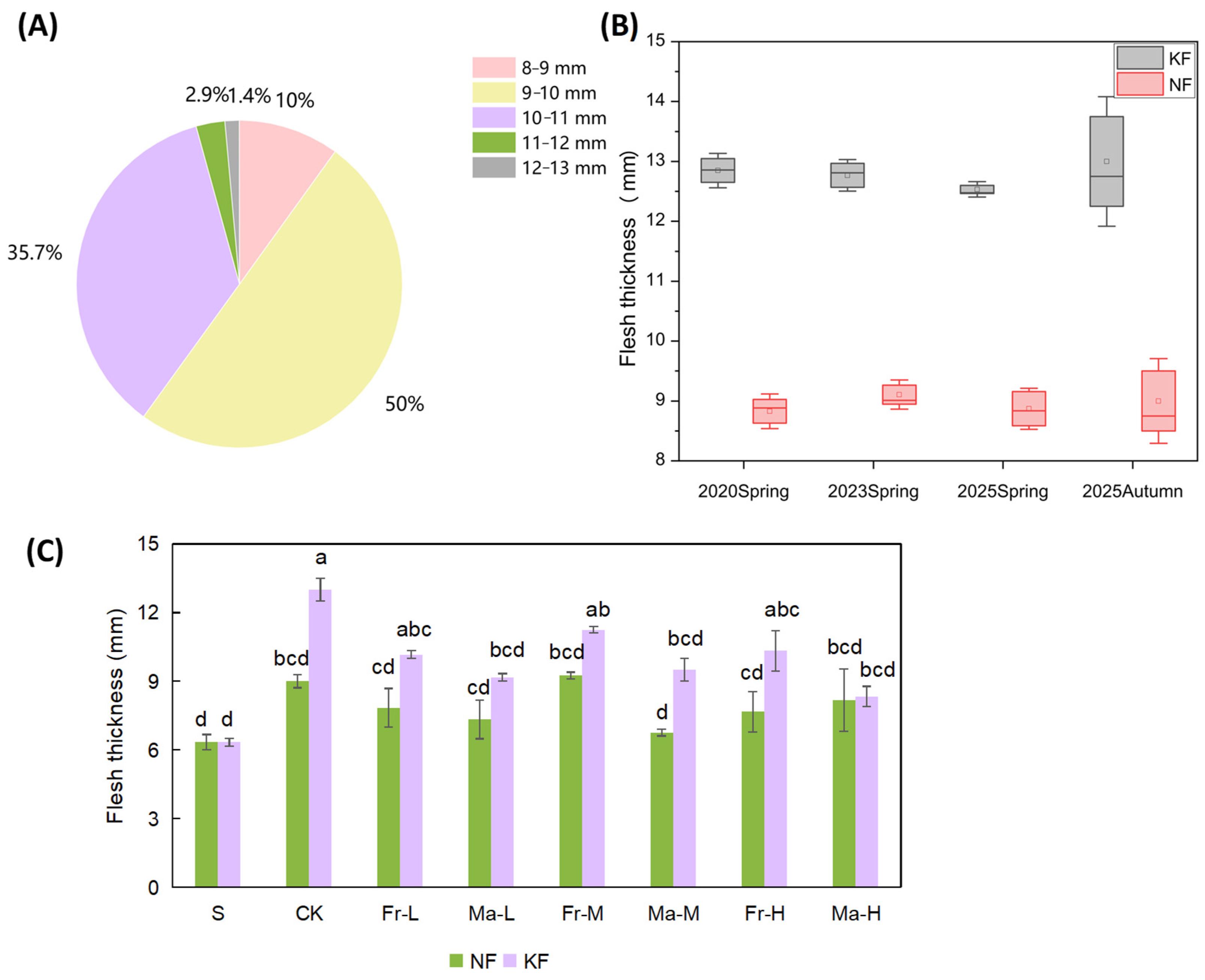
Observations of 70 bitter gourd germplasms revealed that half of the germplasms had a thickness between 9 mm and 10 mm. Then, 35.7% of the total number had a thickness greater than 10 mm and less than 11 mm. Of the total number, 10% had a thickness ranging from 8 mm to 9 mm, while the ratios of the thickness ranges of 11–12 mm and 12–13 mm were only 2.9% and 1.4%, respectively (Figure 1A). Among them, NF and KF were respectively selected from germplasms with a thickness of less than 9 mm and more than 12 mm, and then cultivated under different years and seasons. It showed that regardless of the change of years and seasons, the flesh thickness after 17 d of pollination was consistently and significantly different (Figure 1B). Among the various groups, flesh thickness exhibited distinct variations. In general, flesh thickness in the KF-CK group exceeded that of all other groups. During fruit growth and development, flesh thickness increased in both germplasms; however, the increase observed in KF was significantly greater than in NF. Between the NF-S and KF-S groups, flesh thickness showed no distinct difference, though both were less than other groups. Conversely, a significant difference existed between the NF-CK and KF-CK groups. In KF, flesh thickness across all exogenous sugar treatment groups was smaller than in the KF-CK group, with coefficients of variation (CV) ranging from −35.90% to −13.46%. Conversely, NF showed mixed results, as the CV varied from −25.00% to 2.78% (Figure 1C).

3.2. Metabolomics Analysis of Two Bitter Gourd Germplasms with Different Flesh Thickeness

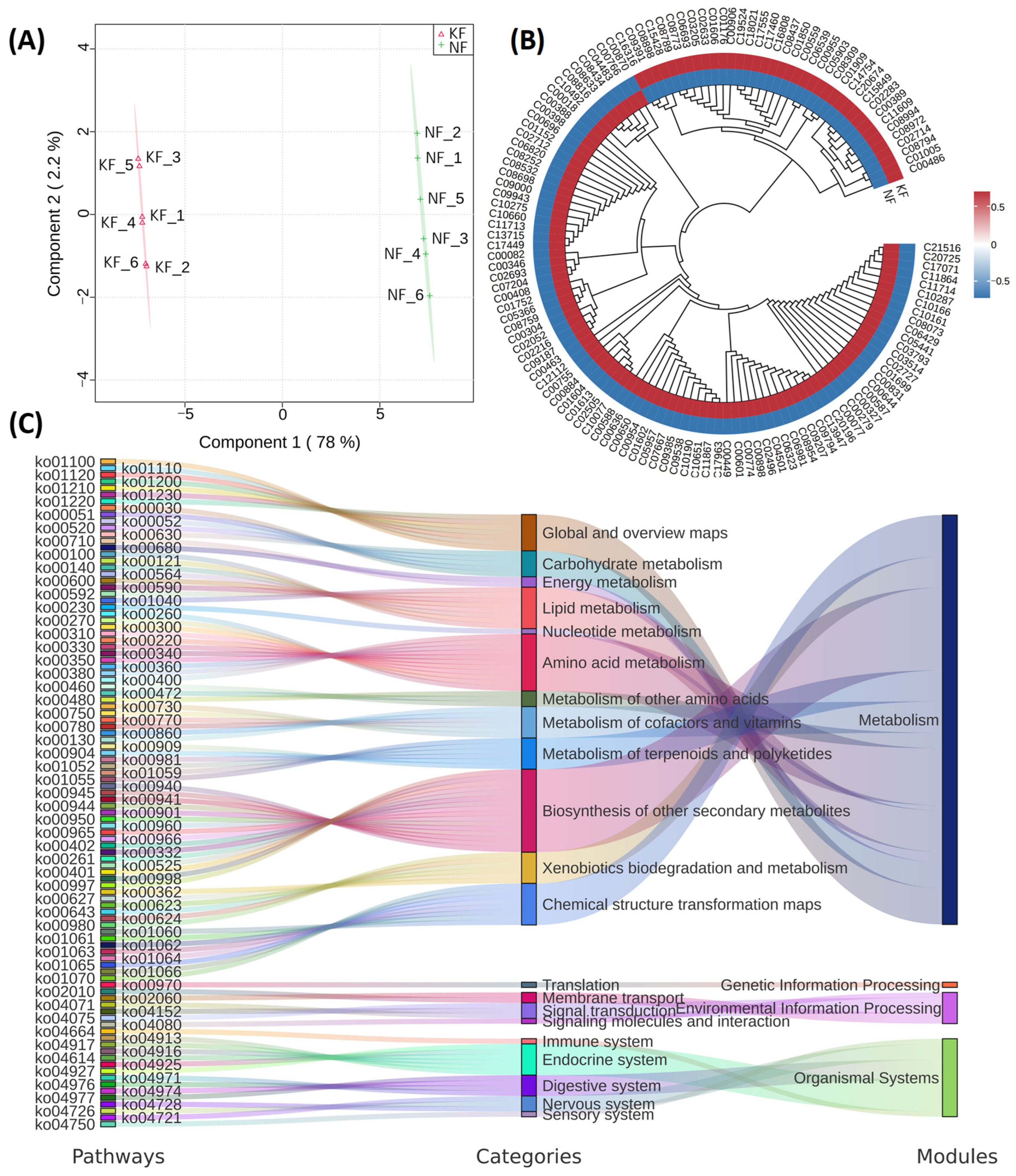
Metabolomics analysis showed that component 1 was the main component, contributing 78% of the total. The two germplasms were clearly distinguished in this component (Figure 2A). A total of 128 DEMs with function were found, including 37 upregulated and 91 downregulated (Figure 2B). KO annotation revealed that 69 DEMs were linked to 101 KEGG pathways across four modules and 21 categories, and metabolism modules dominated in terms of categories and pathways, among which the biosynthesis of other secondary metabolites category contained the highest number of 16 pathways, followed by amino acid metabolism with 11 pathways. Lipid metabolism and chemical structure transformation maps each contained eight pathways, ranking third. The genetic information processing module had the fewest categories and pathways, involving only 1 pathway within 1 category (Figure 2C).

3.3. Transcriptomics Analysis of Two Bitter Gourd Germplasms with Differen Flesh Thickeness

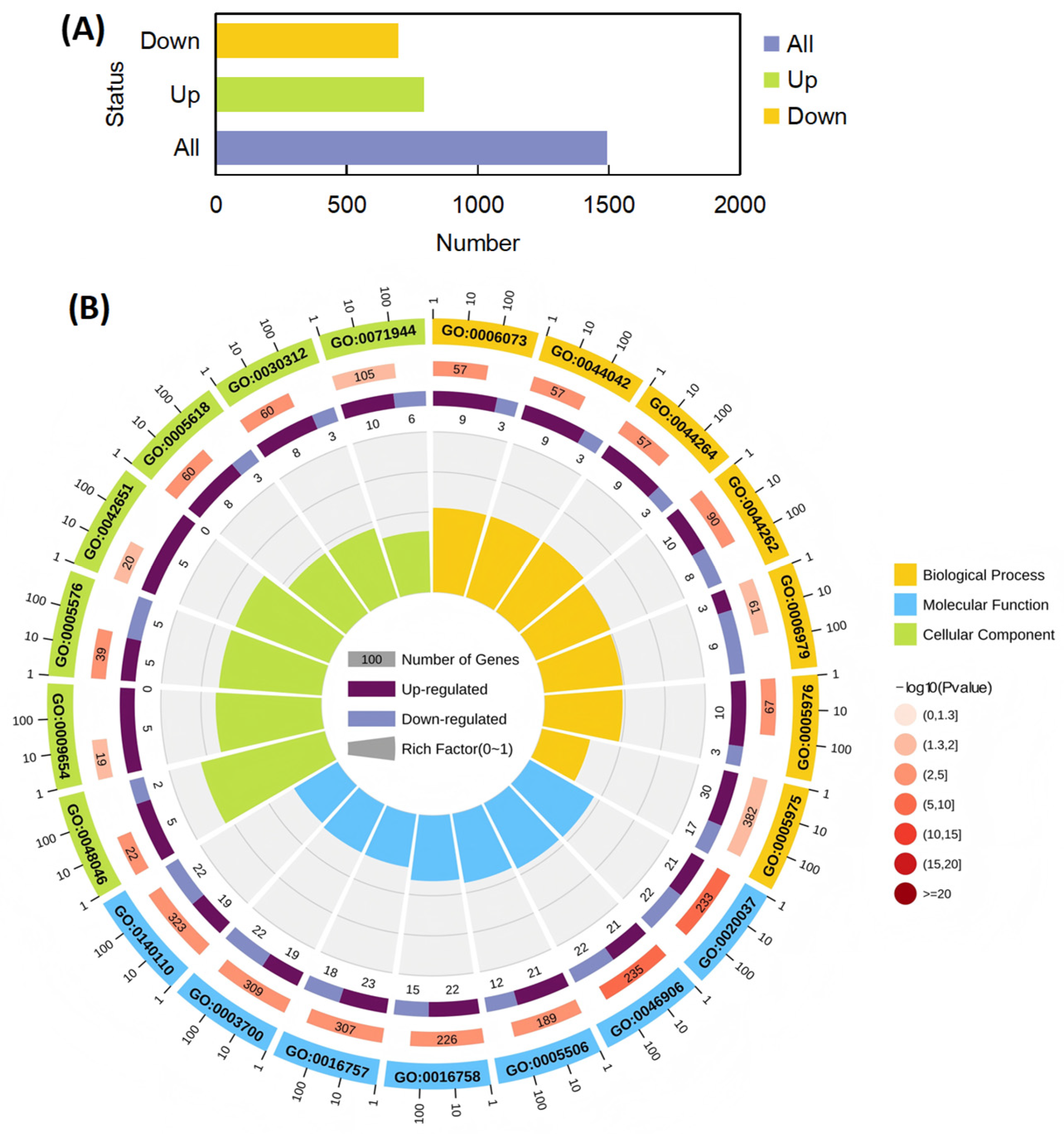
Transcriptome sequencing analysis revealed that KF yielded 234,825,400 clean reads with 17.61 G clean base pairs, exhibited an average Q30 value of 92.74% and GC content of 46.54%. NF produced 241,318,020 clean reads with 18.1 G clean base pairs, showed an average Q30 value of 92.26% and GC content of 46.75%. It totally identified 1492 DEGs, among which 1325 had a |log2 (fold change)| greater than 1, including 713 upregulated and 612 downregulated genes (Figure 3A). KO function annotations were categorized into three major types: biological processes (BP), cellular components (CC), and molecular functions (MF). Figure 3 displays significant annotations with p < 0.05 and a high number of DEGs within each category. In the BP category, terms related to carbohydrate metabolism were most significantly enriched. Specifically, carbohydrate metabolic process (GO:0005975) contained the highest number of DEGs (47), followed by cellular carbohydrate metabolic process (GO:0044262, 18 DEGs) and polysaccharide metabolic process (GO:0005976, 13 DEGs). Additionally, cellular glucan metabolic process (GO:0006073), glucan metabolic process (GO:0044042), cellular polysaccharide metabolic process (GO:0044264), and response to oxidative stress (GO:0006979) each contained 12 DEGs. Except GO: 0006979, all other entries showed more up-regulated genes than downregulated genes. Notably, GO:0006073, GO:0044042, and GO:0044264 exhibited the highest enrichment factors. In the CC category, cell periphery (GO:0071944) contained the most 16 DEGs, followed by cell wall (GO:0005618) and external encapsulating structure (GO:0030312), each with 11 DEGs. Extracellular region (GO:0005576) and apoplast (GO:0048046) contained 10 and seven DEGs, respectively, while photosystem II oxygen evolving complex (GO:0009654) and thylakoid membrane (GO:0042651) each contained five DEGs. Except GO:0005576, all other entries showed more upregulated genes than downregulated genes. Among these, GO:0048046 had the highest enrichment factor. In the MF category, heme binding (GO:0020037) and tetrapyrrole binding (GO:0046906) each contained the most 43 DEGs, followed by transferase activity, transferring glycosyl groups (GO:0016757), DNA-binding transcription factor activity (GO:0003700), and transcription regulator activity (GO:0140110), each with 41 DEGs. Additionally, transferase activity, transferring hexosyl groups (GO:0016758) and iron ion binding (GO:0005506) contained 37 and 33 DEGs, respectively. Among these, GO:0020037 exhibited the highest enrichment factor. Transferase activity, transferring glycosyl groups (GO:0016757), transferase activity, transferring hexosyl groups (GO:0016758), and iron ion binding (GO:0005506) were dominated by upregulated genes, while the remaining terms had more downregulated genes. Overall, upregulated genes were the majority among the 21 significant functional terms, illustrating that KF systematically regulates fruit development by activating the expression of genes involved in carbohydrate metabolism, cell wall construction, and related enzyme activities (Figure 3B).

3.4. Combined Analysis of KEGG Metabolic Pathway Enrichment of Two Bitter Gourd Germplasms with Different Flesh Thickness

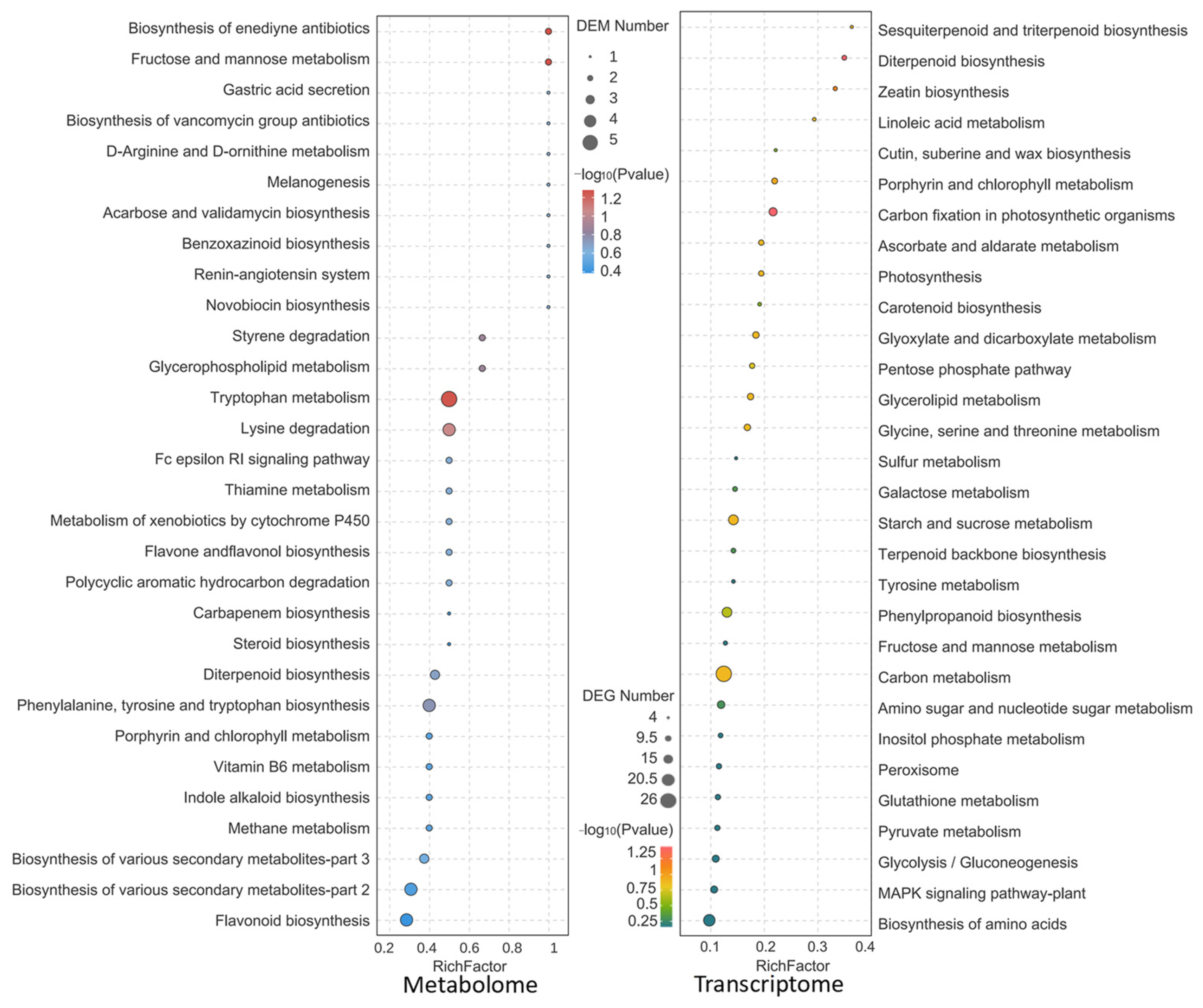
Among the 30 pathways with the lowest p-value rankings, metabolic analysis showed the highest enrichment of DEMs in tryptophan metabolism. The highest rich factors were observed in the biosynthesis of enediyne antibiotics, fructose and mannose metabolism, acarbose and validamycin biosynthesis, benzoxazinoid biosynthesis, biosynthesis of vancomycin group antibiotics, D-arginine and D-ornithine metabolism, gastric acid secretion, melanogenesis, novobiocin biosynthesis, and renin–angiotensin system. Notably, enediyne antibiotic biosynthesis and fructose and mannose metabolism exhibited the lowest p values. Transcriptome analysis showed the highest enrichment of DEGs in carbon metabolism. Sesquiterpenoid and triterpenoid biosynthesis exhibited the highest rich factor, while diterpenoid biosynthesis and Carbon fixation in photosynthetic organisms had the lowest p values. Analysis of the enrichment results from both omics datasets revealed that Diterpenoid biosynthesis, fructose and mannose metabolism, and porphyrin and chlorophyll metabolism consistently ranked in the top 30 in both analyses. This indicates that these pathways play critical roles in fruit flesh development. Furthermore, as a product of photosynthesis and closely associated with hormone signaling pathways, the metabolic dynamics of sugar may be related to the swelling and differentiation of bitter gourd flesh cells. Therefore, this study focuses on fructose and mannose metabolism for subsequent investigations (Figure 4).

3.5. Expression Characteristics of Homologous Genes Encoding Enzymes from Fructose and Mannose Metabolism Pathways and Their Response to Sugar Treatment

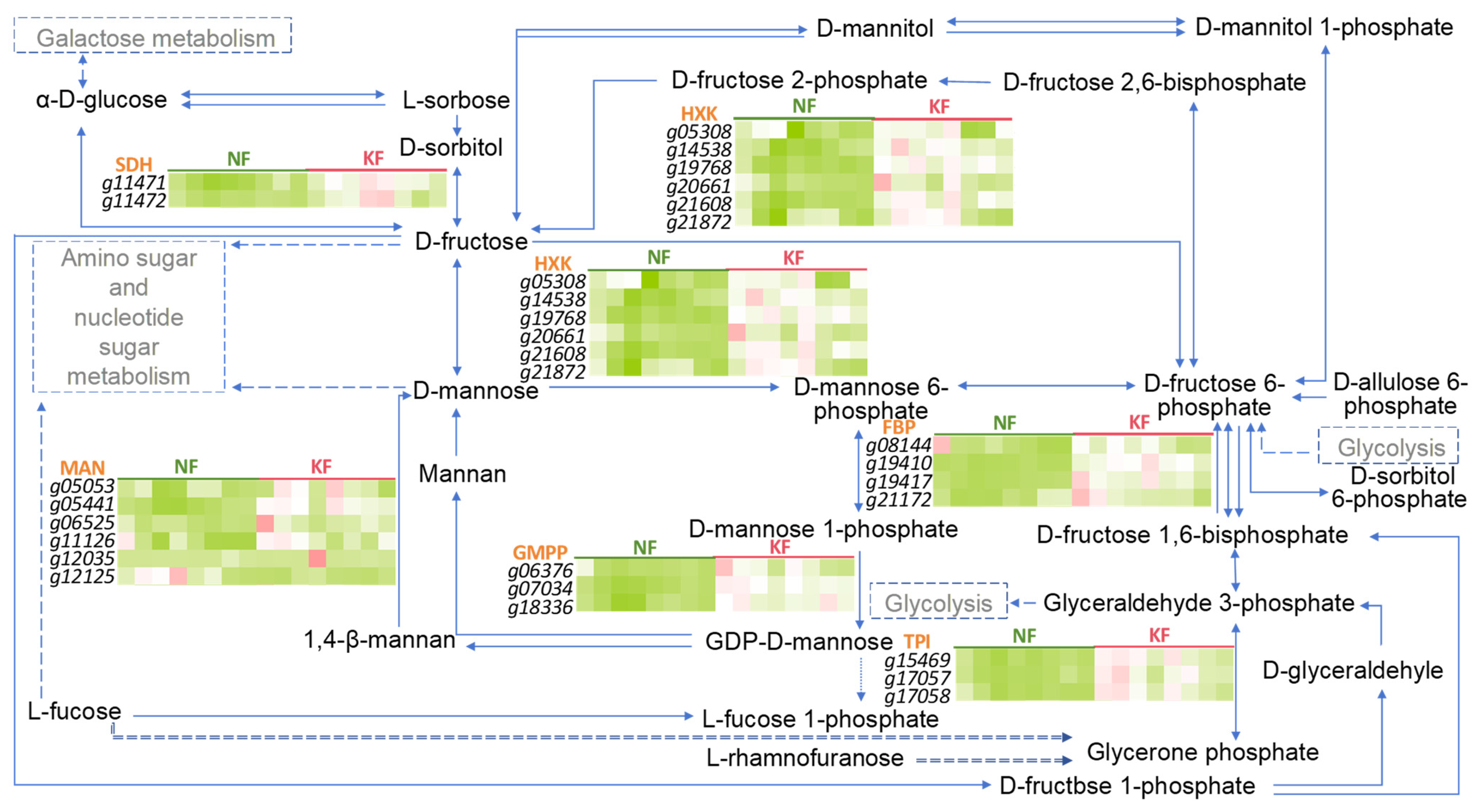
Expression analysis of all homologous genes encoding six important enzymes in the fructose and mannose metabolism pathway revealed that overall the expression levels of SDH encoding genes were generally high. The expression levels of mannan endo-1,4-beta-mannosidase (MAN) encoding genes g05053, g05411, and g12035 were significantly higher than those of the other three genes, while the expression level of the hexokinase (HXK) encoding gene g05308 was markedly lower than that of the other five genes. The expression levels of the fructose-1,6-bisphosphatase I (FBP), mannose-1-phosphate guanylyltransferase (GMPP), and triosephosphate isomerase (TPI) encoding genes were similar (Figure S1). Notable disparities in gene expression levels were detected among different germplasms. In general, genes in KF exhibited higher expression levels in comparison to those in the NF (Figure S1 and Figure 5). During developmental progression, SDH encoding genes g11471 and g11472 exhibited decreased expression in NF but increased expression in KF. HXK encoding genes g19768 and g20661 showed decreased expression in both NF and KF; g14538, g21608, and g21872 demonstrated decreased expression in NF but increased expression in KF; g05308 exhibited increased expression in NF but decreased expression in KF. FBP encoding genes g08144, g19417, and g21172 showed decreased expression in both NF and KF, while g19410 exhibited increased expression in both. MAN encoding genes g05053, g06525, and g12125 showed increased expression in NF but decreased expression in KF; g05441 and g11126 exhibited decreased expression in NF but increased expression in KF; g12035 showed no expression in NF but increased expression in KF. GMPP encoding genes g06376, g07034, and g18336 exhibited decreased expression in NF but increased expression in KF; the first two genes showed decreased expression in NF while the latter showed increased expression in KF. TPI encoding genes g15469, g17057, and g17058 showed decreased expression in NF but increased expression in KF. Exogenous fructose and mannose treatments induced distinct gene expression patterns. Overall, fructose treatment resulted in over 70% of genes in the NF-Fr-L and NF-Fr-M groups showing lower expression levels than those in the control group, NF-CK, which was sprayed with water. Over 50% of genes in the NF-Fr-H group exhibited higher expression when compared to NF-CK. Similarly, over 70% of genes in the KF-Fr-L and KF-Fr-H groups showed lower expression levels than those in the control group of KF-CK. Over 50% of genes in the KF-Fr-M group exhibited higher expression when compared to KF-CK. Mannose treatment led to over 75% of genes from the KF-Ma-L, KF-Ma-M and KF-Ma-H groups displaying lower expression levels compared to KF-CK. Meanwhile, at least 50% of genes from the NF-Ma-L, NF-Ma-M, and NF-Ma-H groups showed elevated expression compared to NF-CK. These findings demonstrate that gene responses vary across germplasms and treatment levels. Furthermore, a comprehensive analysis of the expression levels and FPKM values of the six DEGs identified in the aforementioned transcriptomes from both germplasms revealed a synchronous trend with the FPKM values, reflecting that they have a stable expression pattern (Figure S2).

3.6. Differences of Soluble Sugar Contents and Enzyme Activities of Two Bitter Gourd Germplasms with Different Flesh Thickeness

Contents of fructose, mannose, glucose, and sorbitol in the fruits was measured, and the results showed that the contents of glucose and sorbitol were significantly higher in KF than in NF (Figure S3). Among them, the content of glucose varied the most significantly between the KF-CK and NF-CK groups. The content of sorbitol was the highest in the KF-S group and showed the most significant difference compared with other groups. A similar situation occurred in NF. At different developmental stages of the fruits, the contents of fructose, mannose, glucose, and sorbitol were markedly higher in KF than in NF. The fructose content in the KF-CK and NF-CK groups increased when compared to that in the KF-S and NF-S groups, respectively. The glucose content also rose significantly as development progressed, with a greater increase in KF than in NF. Meanwhile, the sorbitol content decreased sharply in both, with a greater decrease in NF than in KF. The content of mannose increased in the KF-CK group compared to that in the KF-S group but decreased in the NF-CK group compared to that in the NF-S group; however, neither change reached a significant level. Sugar treatment led to a notable reduction in the glucose content of KF fruits, which was intermediate between the KF-S group and the KF-CK group, while the glucose content of NF fruits, except for the NF-Ma-M group, showed a significant upward trend overall. Sugar treatment also caused changes in the mannose content, but only the difference in KF reached a significant level. Additionally, sugar treatment had no significant effect on the sorbitol content in both germplasms. This experiment also measured the activity of SDH, HXK, FBP and TPI. The results showed that the activity of FBP was generally higher in KF than in NF. As the fruit grows and develops, the activity of SDH increased in the KF-CK and NF-CK groups when compared to that in the KF-S and NF-S groups, respectively. Meanwhile, the activity of FBP showed a reverse trend. The activity of HK slightly increased in the KF-CK group compared to that in the KF-S group but slightly decreased in the NF-CK group compared to that in the NF-S group. The trend of TPI activity was opposite to that of HK. When compared to the NF-CK group, SDH activity exhibited an overall upward trend after treatment of exogenous fructose and mannose. FBP activity in all treating groups of KF was significantly higher than in the KF-CK group. Sugar treatment caused varying changes in TPI levels between NF and KF, though neither variation was marked. Different germplasm, developmental stage and treatments had no significant effect on HK activity.

3.7. Correlation Analysis of Gene Expression Levels, Soluble Sugar Contents, Enzyme Activities, and Flesh Thickness of Two Bitter Gourd Germplasms

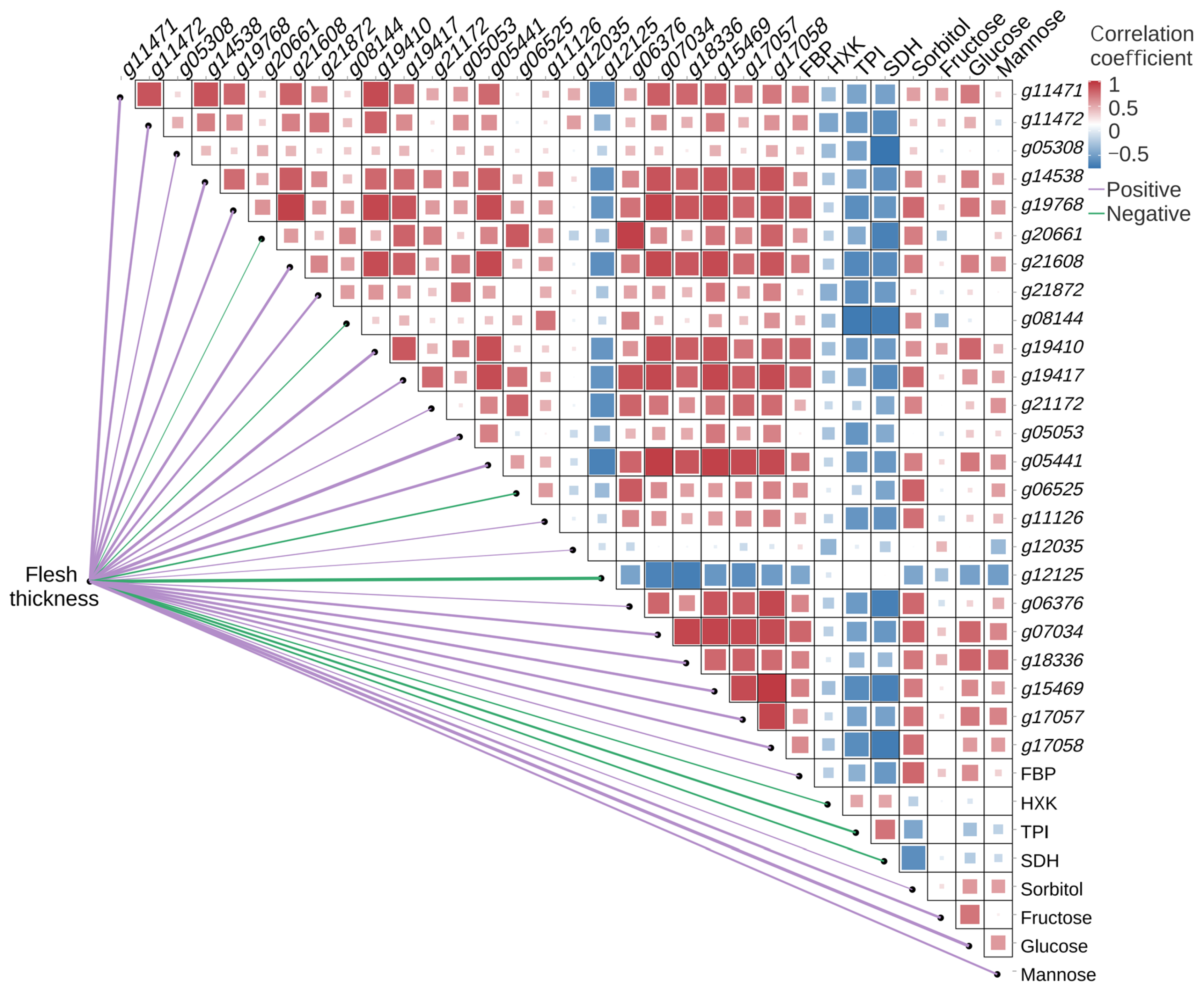
Correlation analysis was conducted on 24 target genes, generating 276 gene combinations, with over 92% reaching extremely significant levels. Among these, 128 pairs exhibited high-intensity positive correlations, 88 pairs showed moderate-intensity positive correlations, 29 pairs demonstrated low-intensity positive correlations, four pairs displayed high-intensity negative correlations, 13 pairs exhibited moderate-intensity negative correlations, and 14 pairs showed low-intensity negative correlations (Table S2, Figure 6). Correlation analysis was performed between sugar contents, enzyme activities, and gene expression levels, yielding 192 combinations, including 111 positive correlation pairs and 81 negative correlation pairs. A total of 142 pairs showed significant correlations (p < 0.05), with over 82% reaching extremely significant levels (p < 0.01). Sorbitol and glucose were positively correlated with the same 23 genes, while mannose and fructose showed positive correlations with 21 and 18 genes, respectively. HXK exhibited negative correlations with all genes, SDH and TPI showing negative correlations with 23 and 22 genes, respectively, whereas FBP demonstrated positive correlations with 23 genes (Table S3, Figure 6). The flesh thickness showed positive correlations with the expression levels of 20 genes, among which 15 genes exhibited significant medium- to high-intensity positive correlations. It was also positively correlated with the content of all sugars, including a high-intensity correlation (p < 0.001) with glucose and medium-intensity correlations (p < 0.05) with fructose and mannose. Also, it was positively correlated with FBP activity, and negatively correlated with HXK, TPI, and SDH activities, though both correlations and their significance were weak (Table S4, Figure 6). Further, among the six key genes (g11472, g19417, g05441, g06376, g15469, and g17058) selected based on transcriptomic results, 15 pairs of gene expression levels showed extremely significant positive correlations, with 13 pairs being strongly positive. The correlation coefficients between g15469 and g05441, g15469 and g06376, g15469 and g17058, g15469 and g19417, g19417 and g05441, g19417 and g06376, g19417 and g17058, g17058 and g05441, g17058 and g06376 all exceeded 0.8 and were highly extremely significant. The expression levels of these six genes exhibited significant or even higher positive correlations with the contents of sorbitol and glucose. Moreover, they demonstrated highly extremely significant positive correlations with the activity of FBP and highly extremely significant negative correlations with the activity of SDH. Except for g06376, the remaining five genes showed moderate positive correlation with flesh thickness at the level of significant or above. Except for g05441, the other five genes showed negative correlation with TPI activity at the level of extremely significant or above, with g15469 and g17058 demonstrating a high-intensity negative correlation. g11472 and g15469 exhibited moderate negative correlation with HXK activity at the level of significant or above. Except for g11472, the other five genes showed a highly extremely significant positive correlation with mannose content, albeit of moderate intensity. g11472 and g05441 displayed moderate positive correlation with fructose content at the level of significant or above. The distinct index-specific correlations observed across genes indicate that each gene participates in sugar metabolism and fruit growth through dynamic expression and regulation.

4. Discussion

4.1. Metabolic and Transcriptional Characteristics of Bitter Gourd Germplasms with Different Flesh Thickness and Key Pathways

Flesh thickness is a key determinant of yield and quality in bitter gourd. In this study, phenotypic differences between KF and NF remain stable across different years and seasons, indicating that this trait is mainly under genetic control, consistent with the genetic stability of fruit traits in cucurbit crops such as cucumber and melon [34,35]. Metabolomics analysis revealed that the number of downregulated metabolites significantly exceeded that of upregulated ones among DEMs with function, suggesting that the differences in flesh thickness may be related to the suppression of certain metabolite synthesis or accumulation. KO annotation indicated that the category of “Other secondary metabolite biosynthesis” involved the most metabolic pathways, highlighting its critical role in fruit development of horticultural crops [36,37]. Transcriptomic analysis revealed that the number of upregulated genes exceeded that of downregulated genes, signifying that the increase in flesh thickness may be associated with enhanced activation of growth-related genes. GO terms including carbohydrate metabolism, polysaccharide metabolism, cell periphery, and cell wall were significantly enriched. Previous studies showed that carbohydrate metabolism is a core pathway in plant organ development, and polysaccharide metabolism directly contributes to cell wall synthesis and modification [38,39]. Upregulation of hexose and sucrose transporters promotes cell expansion by altering cell wall structure, which is critical for fruit enlargement in cucumber and tomato [40,41]. This study reinforces the central role of cell wall polysaccharide remodeling in flesh thickening and indicates that the KF supports fruit growth by enhancing carbon metabolic flux. Heme binding and tetrapyrrole binding were the most enriched molecular function terms, reflecting strengthened chlorophyll synthesis and respiratory electron transport, which may improve energy supply and photosynthetic efficiency for fruit development. This is consistent with observations in other plant systems [42,43,44]. Earlier studies reported that fructose and mannose are important soluble sugars that act as energy substrates and signaling molecules in plant growth [45,46]. Upregulation of fructokinase, mannose isomerase, and related genes supports sugar accumulation and stress tolerance [47,48,49]. In this study, fructose and mannose metabolism was highly enriched in both omics datasets, suggesting that this pathway is closely associated with flesh thickness divergence in bitter gourd.

4.2. Gene–Enzyme–Sugar Correlations and Responses to Exogenous Fructose and Manose

Current research reveals that genes in the fructose and mannose metabolism pathway exhibited germplasm-specific expression patterns, family-level functional differentiation, and strong correlations with sugar content and enzyme activity, forming a coordinated regulatory network. As a key enzyme in sorbitol metabolism, SDH acts at the entry point of sugar alcohol conversion and supports downstream fructose and glucose metabolism. The high expression profile of SDH positions it as the “initiation switch” in the sugar metabolism pathway and provides sufficient energy and carbon source substrates for the synthesis and respiratory metabolism of fructose and glucose [50,51,52]. Some gene families showed distinct functional differentiation. For instance, MAN genes g05053, g05441, and g12035 showed markedly higher expression levels compared to their homologous genes, while the HXK gene g05308 demonstrated much lower expression levels compared to the other homologous genes. This suggests that different homologous genes may functionally assume roles as either “core” or “redundant,” providing distinct molecular strategies for processes such as plant growth and development regulation, as well as stress response [53,54]. The expression levels of the remaining enzyme encoding genes were similar, forming a co-expression pattern to ensure the orderly progression of metabolic reactions [55,56]. Most genes were significantly more highly expressed in KF than in NF: SDH and TPI genes were continuously upregulated during development in KF but downregulated in NF. FBP genes exhibited conserved expression characteristics in both germplasms, with functions more inclined to maintain basal metabolic activities [57,58]. HXK and GMPP genes showed variable patterns, with different genes adapting to the sugar metabolism requirements of distinct germplasms. Over 92% of gene–gene pairs showed highly significant positive correlations, indicating synergistic expression that stabilizes metabolic flux. Six core DEGs formed a highly synergistic expression network. The correlation coefficients between g15469, g19417, g17058 and four genes respectively all exceed 0.8, indicating that these genes may share similar regulatory functions. Gene expression was mainly positively correlated with soluble sugar contents but negatively correlated with HXK, SDH, and TPI activities, while positively correlated with FBP activity. These patterns imply directional carbon allocation toward sugar accumulation rather than respiration during fruit growth [51,59,60]. Exogenous fructose and mannose treatments induced germplasm-specific and concentration-dependent responses. KF tended to show repressed gene expression, suggesting its robust endogenous sugar synthesis and accumulation capacity to maintain intracellular sugar concentration homeostasis through negative feedback mechanisms. NF showed activation of gene expression, suggesting its lower endogenous sugar metabolism levels and reliance on external sugar signals. The six core genes expressed more refined germplasm-concentration synergistic responses to exogenous sugars. For instance, NF showed that low to medium fructose concentrations inhibit gene expression, while high concentrations activate it. KF manifested that medium fructose concentration activates gene expression, whereas low and high concentrations inhibit it. This concentration-dependent effect results from plants recognizing extracellular sugar concentration changes through sugar-sensing receptors such as HXK and SNF1, thereby precisely regulating downstream gene expression [61,62]. Furthermore, The expression trends of six core genes were consistent across samples from different years and seasons, ensuring that cellular basal metabolism or specific physiological processes remain unaffected by environmental fluctuations.

4.3. Gene–Enzyme–Sugar Associations Underlying Flesh Thickness Formation

The formation of flesh thickness is closely linked to sugar metabolism-related gene expression, soluble sugar accumulation, and enzyme activity, likely reflecting a coordinated gene–enzyme–sugar association rather than simple unidirectional regulation [34]. In this study, flesh thickness was significantly positively correlated with most sugar-related genes, supporting the idea that coordinated gene expression contributes to cell division and expansion [63]. Five of the six core genes were positively correlated with flesh thickness. Flesh thickness was also strongly positively correlated with the contents of fructose, mannose, glucose, and sorbitol, which were consistently higher in KF. It is explored that the adequate accumulation of soluble sugars provides energy and structural materials for the division and expansion of fruit flesh cells, thereby affecting formation of fruit flesh thickness [64,65]. Flesh thickness was positively correlated with FBP activity (a key enzyme in sugar synthesis) and negatively correlated with HXK, TPI, and SDH activities (enzymes involved in sugar respiration). This supports the idea that flesh thickness formation requires the directional allocation of carbon sources to fruit flesh tissues through enhanced sugar synthesis efficiency and reduced sugar respiration consumption [51,59,60]. Higher FBP activity in KF favors sugar accumulation, while higher SDH and TPI in NF may direct carbon toward respiration, limiting sugar storage [51,59,66,67]. Early exogenous fructose treatment of strawberries demonstrated that activating sugar metabolism pathways substantially increased fruit weight, soluble sugar content, and firmness. Expression levels of key sugar metabolism genes exhibited strong positive correlations with both fruit size and quality indicators [68], whereas in this research, exogenous fructose and mannose treatment yielded divergent effects on the flesh thickness of KF and NF. This indicates distinct differences exist among crops regarding their perception and response to environmental stimuli, characterized by intricate metabolic regulation and complex biochemical stress responses, thereby leading to variations in growth development and adaptability [49,69,70]. Recent studies have highlighted the integration of metabolic plasticity, stress-responsive traits, and developmental adaptation, which helps contextualize the dynamic regulation of sugar metabolism and fruit growth across environments.

5. Conclusions

This study utilized 70 bitter melon germplasms as materials to screen for thin-fleshed (NF) and thick-fleshed (KF) germplasms and analyzed the association mechanism between bitter gourd flesh thickness and sugar metabolism at multi-omics and physiological levels. The results demonstrated that two screened germplasms exhibited stable flesh thickness during different years and seasons. Metabolomics detected 128 functional DEMs, mainly enriched in secondary metabolite synthesis and amino acid metabolism categories. Transcriptomics revealed carbohydrate metabolism as the core annotation entry in biological processes, and the majority of related genes were upregulated. Joint analysis revealed that fructose and mannose metabolism pathways were significantly enriched in both multi-omics datasets, serving as key pathways for flesh development. Key enzymes encoding genes in the fructose and mannose pathway were more highly expressed overall in KF, and most genes showed germplasm-specific responses to sugar treatment. KF exhibited significantly higher soluble sugar contents (e.g., glucose, sorbitol) and FBP activity compared to NF, while SDH and TPI activities were inversely correlated. Correlation analysis confirmed that sugar metabolism-related genes were predominantly co-expressed, with flesh thickness showing positive correlations with soluble sugar content, FBP activity, and most gene expressions, and negative correlations with enzyme activities such as SDH and TPI. This indicates that the increase in bitter gourd flesh thickness is closely related to the synergistic regulation of sugar metabolism-related genes, accumulation of soluble sugars, and differential expression of sugar metabolism enzyme activities.

Supplementary Materials

The following supporting information can be downloaded at https://www.mdpi.com/article/10.3390/horticulturae12050518/s1, Figure S1: Expression differences of homologous genes encoding enzymes in the fructose and mannose metabolism pathway. The data are deviation-standardized expression levels; Figure S2: FPKM values and expression trend of 6 core genes; Figure S3: Differences in soluble sugar content and enzyme activity between different germplasm and among different treatments. (A) Differences in soluble sugar content, (B) differences in enzyme activity; Table S1: Gene primers for RT-qPCR analysis; Table S2: Correlation analysis of homologous genes encoding enzymes in the fructose and mannose metabolism pathway; Table S3: Correlation analysis between genes and soluble sugar contents, and enzyme activities; Table S4: Correlation analysis between flesh thickness and soluble sugar contents, enzyme activities and genes.

Author Contributions

Conceptualization, B.Q., Q.W. and H.Z.; methodology, B.Q. and D.L.; software, B.Q. and J.L.; validation, B.Q. and H.L.; formal analysis, B.Q.; investigation, B.Q., Q.Z., C.B. and Z.L.; resources, D.L.; data curation, B.Q.; writing—original draft preparation, B.Q.; writing—review and editing, B.Q. and H.Z.; visualization, B.Q. All authors have read and agreed to the published version of the manuscript.

Funding

This research was funded by “The National Natural Science Foundation of Fujian Provincial Natural Science Foundation Project (2023J01375); The Project for Cultivating Discipline Leaders of Fujian Academy of Agricultural Sciences: Breeding and Utilization of New Varieties of Main Vegetables in Fujian Province (YCZX202403); The Special Project for Central Government’s Guidance of Local Scientific and Technological Development: Construction and Operation of Fujian Province’s Public Service Platform for Seed Industry Research and Development (2022L3089)”.

Data Availability Statement

The original contributions presented in this study are included in the article/Supplementary Materials. Further inquiries can be directed to the corresponding authors.

Conflicts of Interest

The authors declare no conflicts of interest.

References

  1. Liao, P.C.; Tsai, C.C.; Chou, C.H.; Chiang, Y.C. Introgression between Cultivars and Wild Populations of Momordica charantia L. (Cucurbitaceae) in Taiwan. Int. J. Mol. Sci. 2012, 13, 6469–6491. [Google Scholar] [CrossRef]
  2. Zhang, Y.; Lu, P.; Jin, H.; Cui, J.; Miao, C.; He, L.; Zhang, H. Integrated Secondary Metabolomic and Antioxidant Ability Analysis Reveals the Accumulation Patterns of Metabolites in Momordica charantia L. of Different Cultivars. Int. J. Mol. Sci. 2023, 24, 14495. [Google Scholar] [CrossRef]
  3. Zhang, H.; Wang, H.; Yi, H.; Zhai, W.; Wang, G.; Fu, Q. Transcriptome Profiling of Cucumis melo Fruit Development and Ripening. Hortic. Res. 2016, 3, 16014. [Google Scholar] [CrossRef]
  4. Qiu, B.; Li, D.; Zhang, Q.; Lin, H.; Li, Y.; Wen, Q.; Zhu, H. Transcriptomic and Metabolomic Joint Analysis Revealing Different Metabolic Pathways and Genes Dynamically Regulating Bitter Gourd (Momordica charantia L.) Fruit Growth and Development in Different Stages. Plants 2025, 14, 2248. [Google Scholar] [CrossRef] [PubMed]
  5. Fu, F.Q.; Mao, W.H.; Shi, K.; Zhou, Y.H.; Yu, J.Q. Spatio-Temporal Changes in Cell Division, Endoreduplication and Expression of Cell Cycle-Related Genes in Pollinated and Plant Growth Substances-Treated Ovaries of Cucumber. Plant Biol. 2010, 12, 98–107. [Google Scholar] [CrossRef] [PubMed]
  6. Yang, X.Y.; Wang, Y.; Jiang, W.J.; Liu, X.L.; Zhang, X.M.; Yu, H.J.; Huang, S.W.; Liu, G.Q. Characterization and Expression Profiling of Cucumber Kinesin Genes During Early Fruit Development: Revealing the Roles of Kinesins in Exponential Cell Production and Enlargement in Cucumber Fruit. J. Exp. Bot. 2013, 64, 4541–4557. [Google Scholar] [CrossRef] [PubMed]
  7. Wang, Y.; Ma, S.; Cao, X.; Li, Z.; Pan, B.; Song, Y.; Wang, Q.; Shen, H.; Sun, L. Morphological, Histological and Transcriptomic Mechanisms Underlying Different Fruit Shapes in Capsicum spp. PeerJ 2024, 12, e17909. [Google Scholar] [CrossRef]
  8. Gan, L.; Song, M.; Wang, X.; Yang, N.; Li, H.; Liu, X.; Li, Y. Cytokinins is Involved in Regulation of Tomato Pericarp Thickness and Fruit Size. Hortic. Res. 2022, 9, uhab041. [Google Scholar] [CrossRef]
  9. Zhang, J.; Xu, J.; Wang, X.; Liu, Y.; Li, S.; Zhang, J.; He, L.; Guo, L.; Li, C.; Li, X.X.; et al. Light Signal Regulates Endoreduplication and Tomato Fruit Expansion Through the SlPIF1a-SlTLFP8-SlCDKB2 Module. Proc. Natl. Acad. Sci. USA 2025, 122, e2404445122. [Google Scholar] [CrossRef]
  10. Beauvoit, B.P.; Colombié, S.; Monier, A.; Andrieu, M.H.; Biais, B.; Bénard, C.; Chéniclet, C.; Dieuaide-Noubhani, M.; Nazaret, C.; Mazat, J.P.; et al. Model-Assisted Analysis of Sugar Metabolism Throughout Tomato Fruit Development Reveals Enzyme and Carrier Properties in Relation to Vacuole Expansion. Plant Cell 2014, 26, 3224–3242. [Google Scholar] [CrossRef]
  11. Schemberger, M.O.; Stroka, M.A.; Reis, L.; de Souza Los, K.K.; de Araujo, G.A.T.; Sfeir, M.Z.T.; Galvão, C.W.; Etto, R.M.; Baptistão, A.R.G.; Ayub, R.A. Transcriptome Profiling of Non-Climacteric ‘Yellow’ Melon During Ripening: Insights on Sugar Metabolism. BMC Genom. 2020, 21, 262. [Google Scholar] [CrossRef] [PubMed]
  12. Zhang, W.; Guo, M.; Yang, W.; Liu, Y.; Wang, Y.; Chen, G. The Role of Cell Wall Polysaccharides Disassembly and Enzyme Activity Changes in the Softening Process of Hami Melon (Cucumis melo L.). Foods 2022, 11, 841. [Google Scholar] [CrossRef] [PubMed]
  13. Pan, H.; Sun, Y.; Qiao, M.; Qi, H. Beta-Galactosidase Gene Family Genome-Wide Identification and Expression Analysis of Members Related to Fruit Softening in Melon (Cucumis melo L.). BMC Genom. 2022, 23, 795. [Google Scholar] [CrossRef] [PubMed]
  14. Chen, T.; Zhang, Z.; Li, B.; Qin, G.; Tian, S. Molecular Basis for Optimizing Sugar Metabolism and Transport During Fruit Development. aBIOTECH 2021, 2, 330–340. [Google Scholar] [CrossRef]
  15. Durán-Soria, S.; Pott, D.M.; Osorio, S.; Vallarino, J.G. Sugar Signaling During Fruit Ripening. Front. Plant Sci. 2020, 11, 564917. [Google Scholar] [CrossRef]
  16. Su, J.; Zhang, C.; Zhu, L.; Yang, N.; Yang, J.; Ma, B.; Ma, F.; Li, M. MdFRK2-mediated Sugar Metabolism Accelerates Cellulose Accumulation in Apple and Poplar. Biotechnol. Biofuels 2021, 14, 137. [Google Scholar] [CrossRef]
  17. Zhang, W.; Qin, W.; Li, H.; Wu, A.M. Biosynthesis and Transport of Nucleotide Sugars for Plant Hemicellulose. Front. Plant Sci. 2021, 12, 723128. [Google Scholar] [CrossRef]
  18. Choi, H.W. From the Photosynthesis to Hormone Biosynthesis in Plants. Plant Pathol. J. 2024, 40, 99–105. [Google Scholar] [CrossRef]
  19. Jia, H.; Jiu, S.; Zhang, C.; Wang, C.; Tariq, P.; Liu, Z.; Wang, B.; Cui, L.; Fang, J. Abscisic Acid and Sucrose Regulate Tomato and Strawberry Fruit Ripening Through the Abscisic Acid-stress-ripening Transcription Factor. Plant Biotechnol. J. 2016, 14, 2045–2065. [Google Scholar] [CrossRef]
  20. Chen, X.; Gao, J.; Shen, Y. Abscisic Acid Controls Sugar Accumulation Essential to Strawberry Fruit Ripening via the FaRIPK1-FaTCP7-FaSTP13/FaSPT Module. Plant J. 2024, 119, 1400–1417. [Google Scholar] [CrossRef]
  21. Su, Q.; Li, X.; Wang, L.; Wang, B.; Feng, Y.; Yang, H.; Zhao, Z. Variation in Cell Wall Metabolism and Flesh Firmness of Four Apple Cultivars during Fruit Development. Foods 2022, 11, 3518. [Google Scholar] [CrossRef] [PubMed]
  22. Yang, H.; Liu, J.; Dang, M.; Zhang, B.; Li, H.; Meng, R.; Qu, D.; Yang, Y.; Zhao, Z. Analysis of β-Galactosidase During Fruit Development and Ripening in Two Different Texture Types of Apple Cultivars. Front. Plant Sci. 2018, 9, 539. [Google Scholar] [CrossRef] [PubMed]
  23. Jiang, S.; Li, S.; Luo, J.; Wang, X.; Shi, C. QTL Mapping and Transcriptome Analysis of Sugar Content During Fruit Ripening of Pyrus pyrifolia. Front. Plant Sci. 2023, 14, 1137104. [Google Scholar] [CrossRef] [PubMed]
  24. Xue, Y.; Shan, Y.; Yao, J.L.; Wang, R.; Xu, S.; Liu, D.; Ye, Z.; Lin, J.; Li, X.; Xue, C.; et al. The Transcription Factor PbrMYB24 Regulates Lignin and Cellulose Biosynthesis in Stone Cells of Pear Fruits. Plant Physiol. 2023, 192, 1997–2014. [Google Scholar] [CrossRef]
  25. Liu, J.; Cong, B.; Tanksley, S.D. Generation and Analysis of an Artificial Gene Dosage Series in Tomato to Study the Mechanisms by which the Cloned Quantitative Trait Locus fw2.2 Controls Fruit Size. Plant Physiol. 2003, 132, 292–299. [Google Scholar] [CrossRef]
  26. Chakrabarti, M.; Zhang, N.; Sauvage, C.; Munos, S.; Blanca, J. A Cytochrome P450 Regulates a Domestication Trait in Cultivated Tomato. Proc. Natl. Acad. Sci. USA 2013, 110, 17125–17130. [Google Scholar] [CrossRef]
  27. Mu, Q.; Huang, Z.J.; Chakrabarti, M.; Illa-Berenguer, E.; Liu, X.X.; Wang, Y.P.; Rarnos, A.; van der Knaap, E. Fruit Weight is Controlled by Cell Size Regulator Encoding a Novel Protein that is Expressed in Maturing Tomato Fruits. PLoS Genet. 2017, 13, e1006930. [Google Scholar] [CrossRef]
  28. Xu, X.; Lu, L.; Zhu, B.; Xu, Q.; Qi, X.; Chen, X. QTL mapping of cucumber fruit flesh thickness by SLAF-seq. Sci. Rep. 2015, 5, 15829. [Google Scholar] [CrossRef]
  29. Chang, C.W.; Wang, Y.H.; Tung, C.W. Genome-wide Single Nucleotide Polymorphism Discovery and the Construction of a High-density Genetic Map for Melon (Cucumis melo L.) Using Genotyping-by-sequencing. Front. Plant Sci. 2017, 8, 125. [Google Scholar] [CrossRef]
  30. Wang, Z.; Xiang, C. Genetic Mapping of QTLs for Horticulture Traits in a F2-3 Population of Bitter Gourd (Momordica charantia L.). Euphytica 2013, 193, 235–250. [Google Scholar] [CrossRef]
  31. Zhu, G.; Wang, S.; Huang, Z.; Zhang, S.; Liao, Q.; Zhang, C.; Lin, T.; Qin, M.; Peng, M.; Yang, C.; et al. Rewiring of the Fruit Metabolome in Tomato Breeding. Cell 2018, 172, 249–261.e12. [Google Scholar] [CrossRef] [PubMed]
  32. Xia, W.; Chen, C.; Jin, S.; Chang, H.; Ding, X.; Fan, Q.; Zhang, Z.; Hua, B.; Miao, M.; Liu, J. Multi-Omics Analysis Reveals the Distinct Features of Metabolism Pathways Supporting the Fruit Size and Color Variation of Giant Pumpkin. Int. J. Mol. Sci. 2024, 25, 3864. [Google Scholar] [CrossRef] [PubMed]
  33. Xue, S.; Sajjad, M.; Zhou, M.; Xu, Y.; Luo, W.; Lin, Y.; Jin, Q.; Zheng, X.; Zhong, Y. Multi-omics Study Uncovered Key Differences in Taste and Nutritional Quality among Three Distinct Bitter Gourd (Momordica charantia L.) Cultivars. Food Chem. 2025, 11, 100308. [Google Scholar] [CrossRef] [PubMed]
  34. Grumet, R.; Lin, Y.C.; Rett-Cadman, S.; Malik, A. Morphological and Genetic Diversity of Cucumber (Cucumis sativus L.) Fruit Development. Plants 2022, 12, 23. [Google Scholar] [CrossRef]
  35. Wang, Y.H.; Wu, D.H.; Huang, J.H.; Tsao, S.J.; Hwu, K.K.; Lo, H.F. Mapping Quantitative Trait Loci for Fruit Traits and Powdery Mildew Resistance in Melon (Cucumis melo). Bot. Stud. 2016, 57, 19. [Google Scholar] [CrossRef]
  36. Kulczyński, B.; Gramza-Michałowska, A. The Profile of Secondary Metabolites and Other Bioactive Compounds in Cucurbita pepo L. and Cucurbita moschata Pumpkin Cultivars. Molecules 2019, 24, 2945. [Google Scholar] [CrossRef]
  37. Fang, Z.Z.; Zhou, D.R.; Ye, X.F.; Jiang, C.C.; Pan, S.L. Identification of Candidate Anthocyanin-Related Genes by Transcriptomic Analysis of ‘Furongli’ Plum (Prunus salicina Lindl.) during Fruit Ripening Using RNA-Seq. Front Plant Sci. 2016, 7, 1338. [Google Scholar] [CrossRef]
  38. Kortstee, A.J.; Appeldoorn, N.J.; Oortwijn, M.E.; Visser, R.G. Differences in Regulation of Carbohydrate Metabolism During Early Fruit Development between Domesticated Tomato and Two Wild Relatives. Planta 2007, 226, 929–939. [Google Scholar] [CrossRef]
  39. Cosgrove, D.J. Structure and Growth of Plant Cell Walls. Nat. Rev. Mol. Cell Biol. 2024, 25, 340–358. [Google Scholar] [CrossRef]
  40. Cheng, J.; Wen, S.; Bie, Z. Overexpression of Hexose Transporter CsHT3 Increases Cellulose Content in Cucumber Fruit Peduncle. Plant Physiol. Biochem. 2019, 145, 107–113. [Google Scholar] [CrossRef]
  41. Ru, L.; He, Y.; Zhu, Z.; Patrick, J.W.; Ruan, Y.L. Integrating Sugar Metabolism With Transport: Elevation of Endogenous Cell Wall Invertase Activity Up-Regulates SlHT2 and SlSWEET12c Expression for Early Fruit Development in Tomato. Front. Genet. 2020, 11, 592596. [Google Scholar] [CrossRef]
  42. Zhu, K.; Chen, H.; Mei, X.; Lu, S.; Xie, H.; Liu, J.; Chai, L.; Xu, Q.; Wurtzel, E.T.; Ye, J.; et al. Transcription Factor CsMADS3 Coordinately Regulates Chlorophyll and Carotenoid Pools in Citrus Hesperidium. Plant Physiol. 2023, 193, 519–536. [Google Scholar] [CrossRef]
  43. Rosianskey, Y.; Dahan, Y.; Yadav, S.; Freiman, Z.E.; Milo-Cochavi, S.; Kerem, Z.; Eyal, Y.; Flaishman, M.A. Chlorophyll Metabolism in Pollinated vs. Parthenocarpic Fig Fruits Throughout Development and Ripening. Planta 2016, 244, 491–504. [Google Scholar] [CrossRef]
  44. Minerdi, D.; Sabbatini, P. Impact of Cytochrome P450 Enzyme on Fruit Quality. Int. J. Mol. Sci. 2024, 25, 7181. [Google Scholar] [CrossRef] [PubMed]
  45. Wang, M.; Le Gourrierec, J.; Jiao, F.; Demotes-Mainard, S.; Perez-Garcia, M.D.; Ogé, L.; Hamama, L.; Crespel, L.; Bertheloot, J.; Chen, J.; et al. Convergence and Divergence of Sugar and Cytokinin Signaling in Plant Development. Int. J. Mol. Sci. 2021, 22, 1282. [Google Scholar] [CrossRef] [PubMed]
  46. Zhang, J.; Lyu, H.; Chen, J.; Cao, X.; Du, R.; Ma, L.; Wang, N.; Zhu, Z.; Rao, J.; Wang, J.; et al. Releasing a Sugar Brake Generates Sweeter Tomato Without Yield Penalty. Nature 2024, 635, 647–656. [Google Scholar] [CrossRef] [PubMed]
  47. Fang, X.; Wang, H.; Zhou, X.; Zhang, J.; Xiao, H. Transcriptome reveals insights into biosynthesis of ginseng polysaccharides. BMC Plant Biol. 2022, 22, 594. [Google Scholar] [CrossRef]
  48. Granot, D.; Kelly, G.; Stein, O.; David-Schwartz, R. Substantial Roles of Hexokinase and Fructokinase in the Effects of Sugars on Plant Physiology and Development. J. Exp. Bot. 2014, 65, 809–819. [Google Scholar] [CrossRef]
  49. Jiang, X.; Wang, Y.; Zhao, Y.; Korxeelor, X.; Fan, W.; Fan, X.; Li, Y.; Wu, X.; Zhou, X.; Li, F.; et al. Cytokinesis-Defective 1 (CYT1) Positively Regulates Plant Antiviral Immunity by Promoting Callose Deposition and Ascorbic Acid Biosynthesis. Mol. Plant Pathol. 2025, 26, e70126. [Google Scholar] [CrossRef]
  50. Li, L.; Li, M.; Wu, J.; Yin, H.; Dunwell, J.M.; Zhang, S. Genome-wide Identification and Comparative Evolutionary Analysis of Sorbitol Metabolism Pathway Genes in Four Rosaceae Species and Three Model Plants. BMC Plant Biol. 2022, 22, 341. [Google Scholar] [CrossRef]
  51. Yu, W.; Peng, F.; Wang, W.; Liang, J.; Xiao, Y.; Yuan, X. SnRK1 Phosphorylation of SDH Positively Regulates Sorbitol Metabolism and Promotes Sugar Accumulation in Peach Fruit. Tree Physiol. 2021, 41, 1077–1086. [Google Scholar] [CrossRef] [PubMed]
  52. Wang, Z.; Ma, B.; Yang, N.; Jin, L.; Wang, L.; Ma, S.; Ruan, Y.L.; Ma, F.; Li, M. Variation in the Promoter of the Sorbitol Dehydrogenase Gene MdSDH2 Affects Binding of the Transcription Factor MdABI3 and Alters Fructose Content in Apple Fruit. Plant J. 2022, 109, 1183–1198. [Google Scholar] [CrossRef] [PubMed]
  53. Linnenbrügger, L.; Doering, L.N.; Tägtmeyer, L.M.; Fischer, K.; von Schaewen, A. Evidence for peroxisomal redundancy among the glucose-6-phosphate dehydrogenase isoforms of Arabidopsis thaliana. Plant Cell Physiol. 2025, 66, 722–737. [Google Scholar] [CrossRef] [PubMed]
  54. Tian, X.; Wang, H.; Liu, J.; Huang, L.; Zheng, X.; Li, Y.; Sun, S.; Ma, C.; Zhao, H.; Zhao, P. Genome-Wide Identification of Luffa Sucrose Synthase Genes Reveals LaSUS1-Mediated Sugar Metabolism Boosting Drought Tolerance. Int. J. Mol. Sci. 2025, 26, 5675. [Google Scholar] [CrossRef]
  55. Huang, Y.; Jiang, K.; Liu, H.; Song, S.; Zhao, Y.; He, B.; Lan, J.; Liu, L. Transcriptome and Selected Metabolite Analyses Reveal Points of Sugar Metabolism in the Developing Leaves of Kiwifruit. Front. Plant Sci. 2025, 16, 1618801. [Google Scholar] [CrossRef]
  56. Zhou, B.; Guan, C.; Guan, M. Identification of Candidate Gene Networks Controlling Soluble Sugar Metabolism During Brassica napus L. Development by Integrated Analysis of Metabolic and Transcriptomic Analyses. Foods 2025, 14, 2874. [Google Scholar] [CrossRef]
  57. Tian, C.; Hua, X.; Zhao, P.; Li, C.; Li, X.; Liu, H.; Liu, X. Genome-Wide Identification, Evolution, and Expression Patterns of the Fructose-1,6-Bisphosphatase Gene Family in Saccharum Species. Plants 2025, 14, 2433. [Google Scholar] [CrossRef]
  58. Que, Q.; Liang, X.; Song, H.; Li, C.; Li, P.; Pian, R.; Chen, X.; Zhou, W.; Ouyang, K. Evolution and Expression Patterns of the Fructose 1,6-Bisphosptase Gene Family in a Miracle Tree (Neolamarckia cadamba). Genes 2022, 13, 2349. [Google Scholar] [CrossRef]
  59. Meng, Z.; Li, W.; Huang, G.; Li, X.; Li, R.; Chen, Y.; Luo, S.; Guo, L.; Tang, Y.; Tang, Y.; et al. Advances in the Regulatory Mechanism of Enzymes Involved in Soluble Sugar Metabolism in Fruits. Plants 2026, 15, 138. [Google Scholar] [CrossRef]
  60. Yin, Y.G.; Sanuki, A.; Goto, Y.; Suzui, N.; Kawachi, N.; Matsukura, C. ADP-glucose Pyrophosphorylase Genes are Differentially Regulated in Sugar-Dependent Or -Independent Manners in Tomato (Solanum lycopersicum L.) Fruit. Plant Biotechnol. 2023, 40, 345–351. [Google Scholar] [CrossRef]
  61. Wang, X.Q.; Li, L.M.; Yang, P.P.; Gong, C.L. The Role of Hexokinases from Grape Berries (Vitis vinifera L.) in Regulating the Expression of Cell Wall Invertase and Sucrose Synthase Genes. Plant Cell Rep. 2014, 33, 337–347. [Google Scholar] [CrossRef] [PubMed]
  62. Roessner-Tunali, U.; Hegemann, B.; Lytovchenko, A.; Carrari, F.; Bruedigam, C.; Granot, D.; Fernie, A.R. Metabolic Profiling of Transgenic Tomato Plants Overexpressing Hexokinase Reveals That the Influence of Hexose Phosphorylation Diminishes During Fruit Development. Plant Physiol. 2003, 133, 84–99. [Google Scholar] [CrossRef] [PubMed]
  63. Cai, H.; Liang, M.; Qin, X.; Dong, R.; Wang, X.; Wang, H.; Sun, S.; Cui, X.; Yang, W.; Li, R. Tonoplast Sugar Transporters Coordinately Regulate Tomato Fruit Development and Quality. Plant Commun. 2025, 6, 101314. [Google Scholar] [CrossRef] [PubMed]
  64. Walker, R.P.; Battistelli, A.; Bonghi, C.; Drincovich, M.F.; Falchi, R.; Lara, M.V.; Moscatello, S.; Vizzotto, G.; Famiani, F. Non-structural Carbohydrate Metabolism in the Flesh of Stone Fruits of the Genus Prunus (Rosaceae)—A Review. Front. Plant Sci. 2020, 11, 549921. [Google Scholar] [CrossRef]
  65. Tijero, V.; Girardi, F.; Botton, A. Fruit Development and Primary Metabolism in Apple. Agronomy 2021, 11, 1160. [Google Scholar] [CrossRef]
  66. Zhang, Z.; Li, Y.; Wen, S.; Yang, S.; Zhu, H.; Zhou, H. Metabolomics Reveals the Impact of Overexpression of Cytosolic Fructose-1,6-Bisphosphatase on Photosynthesis and Growth in Nannochloropsis gaditana. Int. J. Mol. Sci. 2024, 25, 6800. [Google Scholar] [CrossRef]
  67. Dorion, S.; Clendenning, A.; Jeukens, J.; Salas, J.J.; Parveen, N.; Haner, A.A.; Law, R.D.; Force, E.M.; Rivoal, J. A Large Decrease of Cytosolic Triosephosphate Isomerase in Transgenic Potato Roots Affects the Distribution of Carbon in Primary Metabolism. Planta 2012, 236, 1177–1190. [Google Scholar] [CrossRef]
  68. Zhang, Z.; Tian, R.; Wan, J.; Wang, Y.; Li, H. Combined Analysis of Metabolomics and Transcriptomics Reveals the Effects of Sugar Treatment on Postharvest Strawberry Fruit Quality. BMC Plant Biol. 2025, 25, 882. [Google Scholar] [CrossRef]
  69. Ait Hammou, R.; Harrouni, C.; Ben El Caid, M.; Hallouti, A.; Baroud, S.; Daoud, S. Establishment of Argan Tree Plantlets (Argania spinosa (L.) Skeels) Grown from Generative and Vegetative Propagation under Different Watering Regimes at the Nursery Stage. Biocatal. Agric. Biotechnol. 2022, 44, 102457. [Google Scholar] [CrossRef]
  70. Ait Hammou, R.; Ben El Caid, M.; Harrouni, C.; Daoud, S. Germination Enhancement, Antioxidant Enzyme Activity, and Metabolite Changes in Late Argania spinosa Kernels under Salinity. S. Afr. J. Bot. 2022, 147, 892–901. [Google Scholar] [CrossRef]
Figure 1. Variation in flesh thickness of different bitter gourd germplasms. (A) Distribution of flesh thickness across 70 germplasms; (B) differences in flesh thickness between KF and NF in 2020, 2023, and 2025; (C) differences in flesh thickness among different groups. Different letters indicate significant differences among treatments.
Horticulturae 12 00518 g001
Figure 2. Metabolomics analysis of 2 bitter gourd germplasms with varying flesh thickness: (A) PLS-DA analysis. The pink and green areas represent the 95% confidence intervals for KF and NF, respectively, (B) classification and quantitative statistics of different DEMs, (C) KO annotation dendrogram.
Horticulturae 12 00518 g002
Figure 3. Transcriptomic analysis results of germplasm with varying flesh thickness: (A) volcano plot of DEGs across different germplasm lines, (B) GO enrichment circle diagram.
Horticulturae 12 00518 g003
Figure 4. Joint analysis of metabolic combination transcriptome KEGG-enriched pathways.
Horticulturae 12 00518 g004
Figure 5. Fructose and mannose metabolism pathway and target gene expression differences. Single and double solid arrows represent irreversible and reversible reactions, respectively. Dashed arrows and boxes indicate indirect effects and involved pathways, while double-dashed arrows denote multi-step reactions. Black bold and italicized text represent metabolite and gene names, respectively. Orange bold text represent the abbreviation of enzyme. Sixteen columns in the gene expression heatmap represent 16 groups, including NF-S, NF-CK, NF-Fr-L, NF-Ma-L, NF-Fr-M, NF-Ma-M, NF-Fr-H, NF-Ma-H, KF-S, KF-CK, KF-Fr-L, KF-Ma-L, KF-Fr-M, KF-Ma-M, KF-Fr-H, and KF-Ma-H, from left to right.
Horticulturae 12 00518 g005
Figure 6. Correlation analysis between different germplasm genes, sugar content, enzyme activity, and pulp thickness.
Horticulturae 12 00518 g006
Disclaimer/Publisher’s Note: The statements, opinions and data contained in all publications are solely those of the individual author(s) and contributor(s) and not of MDPI and/or the editor(s). MDPI and/or the editor(s) disclaim responsibility for any injury to people or property resulting from any ideas, methods, instructions or products referred to in the content.