Article

Cytokinin–Ethylene Crosstalk Mediates Bottle Gourd Rootstock-Induced Vigor in Grafted Melon

1
College of Horticulture, Shanxi Agricultural University, Jinzhong 030801, China
2
Institute of Vegetables, Zhejiang Academy of Agricultural Sciences, Hangzhou 310021, China
*
Authors to whom correspondence should be addressed.
These authors contributed equally to this work.
Horticulturae 2026, 12(1), 82; https://doi.org/10.3390/horticulturae12010082 (registering DOI)

Submission received: 5 December 2025 / Revised: 6 January 2026 / Accepted: 8 January 2026 / Published: 10 January 2026

Abstract

Grafting is a pivotal horticultural technique for enhancing vegetable crop productivity; however, the specific molecular mechanisms governing rootstock-induced vigor remain insufficiently elucidated. This study deciphers how bottle gourd rootstock augments growth in melon scions through an integrated approach combining physiology, transcriptomics, phytohormone profiling, and functional genetics. Phenotypic analysis confirmed a significant increase in plant height, fresh weight, and stem diameter in heterografted scions compared to controls. Transcriptome sequencing of scion apices identified 663 core differentially expressed genes (DEGs) specifically modulated by the bottle gourd rootstock. These DEGs were prominently enriched in carbohydrate metabolism and plant hormone signal transduction pathways. Consistent with this, hormonal assays revealed a specific elevation in cytokinin and ethylene levels in the scion, accompanied by the upregulation of key pathway genes, including MELO3C016881 (LOG) and MELO3C007769 (ERF060). Crucially, virus-induced gene silencing of either gene completely abolished the rootstock-conferred growth advantage. Our findings preliminarily unveil the secret behind scion vigor, providing a foundational mechanistic framework for how rootstocks reprogram scion development. The identified genes, MELO3C016881 and MELO3C007769, offer direct molecular targets for the precision breeding of superior scions in melon.

1. Introduction

Grafting is an ancient horticultural technique that has been refined into a cornerstone of modern horticulture, particularly for high-value vegetable crops such as cucurbits and solanaceous species [1]. By combining a vigorous root system (rootstock) with a selected shoot cultivar (scion), grafting provides an effective, non-Genetically Modified Organisms (GMO) strategy to enhance crop tolerance against soil-borne pathogens and abiotic stresses, including salinity, drought, and heavy metals [2,3]. Beyond stress resilience, a primary agronomic incentive for grafting is to exploit rootstock-mediated vigor, whereby a robust rootstock significantly enhances scion growth, biomass accumulation, and yield uniformity [4,5].
Melon (Cucumis melo L.) is an economically important cucurbit crop valued for its desirable fruit quality and nutritional content. However, its cultivation is frequently limited by susceptibility to soil-borne diseases and sensitivity to various environmental stresses [6,7]. The use of heterografting with rootstocks such as bottle gourd (Lagenaria siceraria Standl.) has become a common practice to overcome these constraints [8,9]. Bottle gourd rootstocks are known for their strong compatibility with melon and their ability to promote vigorous scion growth-a phenomenon often referred to as “graft-induced vigor” [10,11]. While the phenotypic benefits of grafting are well established, the molecular mechanisms underlying this graft-induced vigor, particularly the key genetic regulators that translate rootstock influence into scion growth enhancement, remain poorly characterized [12,13].
The improved growth performance induced by vigorous rootstocks is a complex trait, likely orchestrated by systemic signals that modulate the scion’s transcriptome, phytohormone profile, and metabolic flux [14,15]. Previous studies have reported graft-induced changes in nutrient uptake, water relations, and broad transcriptional shifts [16,17,18]. However, many of these studies lack a rigorous experimental design that distinguishes general wound- or grafting-related responses from those specifically attributable to the rootstock. Consequently, the core set of genetic regulators within the scion that are directly responsible for translating rootstock-derived signals into sustained growth vigor-and the key signaling pathways through which they operate-remain unidentified [19,20]. This fundamental gap hinders a mechanistic understanding of rootstock-scion communication and limits the development of targeted breeding strategies.
To address these knowledge gaps, this study was designed to identify and characterize the rootstock-specific molecular mechanisms that drive graft-induced vigor. We hypothesized that bottle gourd rootstocks systemically reprogram the melon scion transcriptome by inducing a core set of endogenous genes, and that this reprogramming centrally involves synergistic crosstalk between carbohydrate metabolism and specific phytohormone signaling pathways. To test this hypothesis, we applied an integrated multi-omics approach, systematically comparing heterografted (melon/bottle gourd), homografted (melon/melon), and self-rooted melon plants. Using comparative transcriptomics, we identified a robust set of scion genes differentially expressed in response to the bottle gourd rootstock and uncovered key associated energy metabolism and hormone metabolism. Combined with phytohormone profiling and functional validation via virus-induced gene silencing (VIGS), we further elucidated the role of critical signaling pathways, particularly the crosstalk between cytokinin and ethylene. Collectively, our findings elucidate fundamental molecular mechanisms of rootstock-scion communication and pinpoint specific genetic targets for molecular breeding strategies aimed at enhancing the performance of grafted crops.

2. Materials and Methods

2.1. Plant Materials and Growth Conditions

Bottle gourd ‘Zhepu No. 6’ (hereafter referred to as ZP6) and melon ‘Védrantais’ (hereafter referred to as Ved) were used as rootstocks and scions, respectively. The seeds of ZP6 were provided by the Vegetable Research Institute of Zhejiang Academy of Agricultural Sciences, and Ved were a gift from Dr. Jordi Garcia-Mas (Centre for Research in Agricultural Genomics, CRAG, Spain).
To ensure sterility and promote germination, seeds were treated with warm water at 55 °C for 15 min, after which the seed coats were manually removed. Then the seeds were placed on moistened filter paper and germinated in the dark at 28 °C for 24–36 h. To synchronize the developmental stages for grafting, bottle gourd rootstock seeds were sown 3 days before the seeds of melon. Upon radicle emergence, seeds were sown in 32-cell trays filled with a growth substrate at a depth of approximately 1 cm. All plants were cultivated in a controlled greenhouse maintained at 22 °C under a 16/8 h light/dark photoperiod and 60% relative humidity.

2.2. Grafting Methodology

Grafting was performed using the insertion method when the rootstock developed its first true leaf (approximately 7 days after sowing) and the scion’s cotyledons were fully expanded (approximately 4 days after sowing). The procedure was as follows: A toothpick was sharpened with a scalpel to match the diameter of the scion hypocotyl. The true leaf and apical meristem of the rootstock were carefully excised. The prepared toothpick was inserted at a 30° angle into the center of the rootstock’s hypocotyl. The scion was severed 1–2 cm below the cotyledons with a blade cut at a 30° angle. The cut end of the scion was immediately fitted onto the toothpick embedded in the rootstock [21].
Three experimental groups were established. Heterografting (CM/LS): Ved scion grafted onto ZP6 rootstock; Homografting (CM/CM): Ved scion grafted onto Ved rootstock; Ungrafted Control (CM): Self-rooted Ved seedlings. Each group consisted of 30 independent plants, with three independent biological replicates. Plants were arranged in a completely randomized design under controlled environmental conditions in a growth chamber (23 ± 2 °C, 60 ± 5% relative humidity, 16 h light/8 h dark photoperiod). To ensure successful graft union, the following management was implemented: Day 0 (Grafting Day): Plants were transferred to a growth chamber with high humidity, maintained by transparent plastic covers. Days 0–3: Chambers were kept sealed under dark conditions to minimize transpiration and promote healing. Days 4–7: The plastic covers were partially opened to gradually reduce humidity to ~75% and reintroduce normal light conditions. Day 7 onwards: Covers were completely removed, and seedlings were managed under standard growth conditions.

2.3. Measurement of Plant Growth

Phenotypic evaluation was conducted 24 days after grafting to assess seedling growth vigor. Three independent biological replicates were performed for each treatment group (CM/LS, CM/CM, and CM), with each replicate consisting of all uniformly developed plants; the mean value per plant was calculated for subsequent analysis. The specific measurement procedures followed established plant phenotyping protocols [22]. Fresh weight was determined by excising the entire above-ground portion of the scion at the graft union immediately after harvest, gently blotting surface moisture, and weighing with a precision analytical balance. Plant height was measured using a rigid ruler from the base of the cotyledons to the apex. Stem diameter was assessed with digital calipers at the midpoint of the first fully developed internode above the cotyledons; measurements were taken perpendicular to the stem axis and repeated, with the two values averaged to account for stem circularity.

2.4. RNA Sequencing and Quantitative Real-Time PCR Analysis

At 24 days post-grafting, shoot apical tissues from scions were collected, flash-frozen in liquid nitrogen, and stored at −80 °C. Total RNA was extracted using the Plant Total RNA Kit (TIANGEN Biotech, Beijing, China) following the manufacturer’s instructions. RNA quality and concentration were assessed using a NanoDrop 2000 spectrophotometer (Thermo Fisher Scientific, Waltham, MA, USA). High-quality RNA samples (with clear 28S/18S ribosomal RNA bands and an OD 260/280 ratio ~2.0) were used for library preparation and Illumina sequencing (BIOZERON Biotech, Shanghai, China). The raw sequencing reads were filtered to obtain high-quality clean data, which were then aligned to the melon reference genome (DHL92/v4.0) [23]. Gene expression levels were quantified as FPKM (Fragments Per Kilobase of transcript per Million mapped fragments). Then, Gene Ontology (GO) and Kyoto Encyclopedia of Genes and Genomes (KEGG) pathway analysis were performed for the DEGs by the R package clusterProfiler 4.0 [24].
The accuracy of RNA-seq data was validated using RT-qPCR with selected DEGs. RT-qPCR was performed with three biological replicates for each sample. The first-strand cDNA synthesis was performed using the FastKing gDNA Dispelling RT SuperMix (Tiangen Biotech, Beijing, China) according to the manufacturer’s instructions. The primer sets for each unigene were designed with Primer Premier 6.0 (Table S1). RT-qPCR reactions were carried out on a StepOne PCR System (Thermo Fisher Scientific, Waltham, MA, USA) using Perfect-Start Green qPCR SuperMix (Transgen Biotech, Beijing, China). Transcriptional abundance was calculated using the 2–∆∆Ct method and normalized to the reference actin gene [25].

2.5. Quantification of Phytohormones with HPLC

Samples were taken from shoot apical tissues of scion melon, consisting of transcriptome samples with three biological replicates. The quantification of auxins (AUX), cytokinins (CTK), ethylene (ETH), gibberellic acid (GA), and abscisic acid (ABA) was performed using established methods with a little adjustment [26]. Approximately 5 mg of fresh tissue samples were flash-frozen in liquid nitrogen and homogenized twice for 30 s. The powdered tissue was extracted with 1 mL of ice-cold extraction solvent consisting of 50% (v/v) methanol and acetonitrile, which contained a deuterated internal standard mixture at a concentration of 2 ng/mL. After vortexing for 60 s, the samples were sonicated in an ice-water bath for 10 min and then incubated at −40 °C for 2 h. Subsequently, the extracts were centrifuged at 12,000× g for 15 min at 4 °C. A 900 µL aliquot of the supernatant was transferred to a fresh tube and dried under vacuum in a centrifugal concentrator at 4 °C.
The dried residue was reconstituted in 90 µL of 50% (v/v) methanol in water, followed by 1 min of vortex mixing and 2 min of sonication. After another 1 min vortex step, the solution was centrifuged at 12,000× g for 10 min at 4 °C. A total of 80 µL of the supernatant was transferred to a new polyethylene tube, centrifuged again under the same conditions, and 70 µL of the resulting supernatant was placed into an LC vial with an insert for analysis. Phytohormone quantification was performed using ultra-high-performance liquid chromatography coupled with tandem mass spectrometry (UHPLC-MS/MS; Micromass, Manchester, UK). External calibration standards prepared in the same extraction solvent at varying concentrations were analyzed in parallel. Data acquisition and processing were conducted using MassLynx 4.2 software (Waters, Milford, DE, USA), and phytohormone levels were quantified via the isotope dilution method based on corresponding deuterated internal standards.

2.6. VlGS Assay and Phenotypic Observation

To investigate the function of the candidate genes, we employed a Tobacco Rattle Virus (TRSV)-based VIGS system in melon, adapting established protocols [27,28]. In the following steps, unique 300 bp coding sequence (CDS) fragments corresponding to CmPDS (MELO3C017772), CmCTK (MELO3C016881), and CmETH (MELO3C007769) were amplified from melon cDNA. Each fragment was inserted into the SnaBI restriction site of the pTRSV2 vector using homologous recombination. The resulting recombinant plasmids, designated TRSV2-CmPDS, TRSV2-CmCTK, and TRSV2-CmETH, were verified by Sanger sequencing and subsequently transformed into Agrobacterium tumefaciens strain GV3101. Transformed A. tumefaciens colonies were cultured overnight at 28 °C in LB medium supplemented with 50 µg/mL rifampicin and 100 µg/mL spectinomycin, with continuous shaking at 200 rpm. When the optical density at 600 nm (OD600) reached 0.8–1.0, bacterial cells were pelleted by centrifugation at 4000× g for 10 min at 4 °C, resuspended in infiltration buffer (10 mM MES, pH 5.6, 10 mM MgCl2, and 200 µM acetosyringone), and incubated at room temperature for 3–4 h before agroinfiltration.
For agroinfiltration, pre-germinated melon seeds (approximately 24 h after imbibition) were used. A bacterial suspension containing a 1:1 mixture of the pTRSV1 and one of the recombinant pTRSV2 was prepared. Vacuum infiltration was performed by immersing the seeds in the bacterial suspension and applying a vacuum of −980 kPa for 10 min. After infiltration, the seeds were sown in plug trays containing a standard seedling substrate, and maintained under controlled growth conditions (25 ± 2 °C, 16 h light/8 h dark photoperiod). Silencing phenotypes, characterized by photobleaching in CmPDS-silenced plants and altered growth phenotypes in CmCTK- and CmETH-silenced plants, typically became visible around 12 days post-inoculation (dpi), coinciding with the expansion of the first true leaf.

2.7. Statistical Analysis

All phenotypic and hormonal data are presented as mean ± standard deviation (SD). Each treatment group (grafting and VIGS experiments) included three independent biological replicates. Student’s t test and one-way ANOVA (with Brown-Forsythe and Welch ANOVA tests) were performed to assess the statistical significance of the experiment results using the GraphPad Prism 9 software (GraphPad Software, San Diego, CA, USA) and Excel 2019 (Microsoft, Redmond, WA, USA).

3. Results

3.1. Bottle Gourd Rootstock Enhances the Growth of Melon Scions

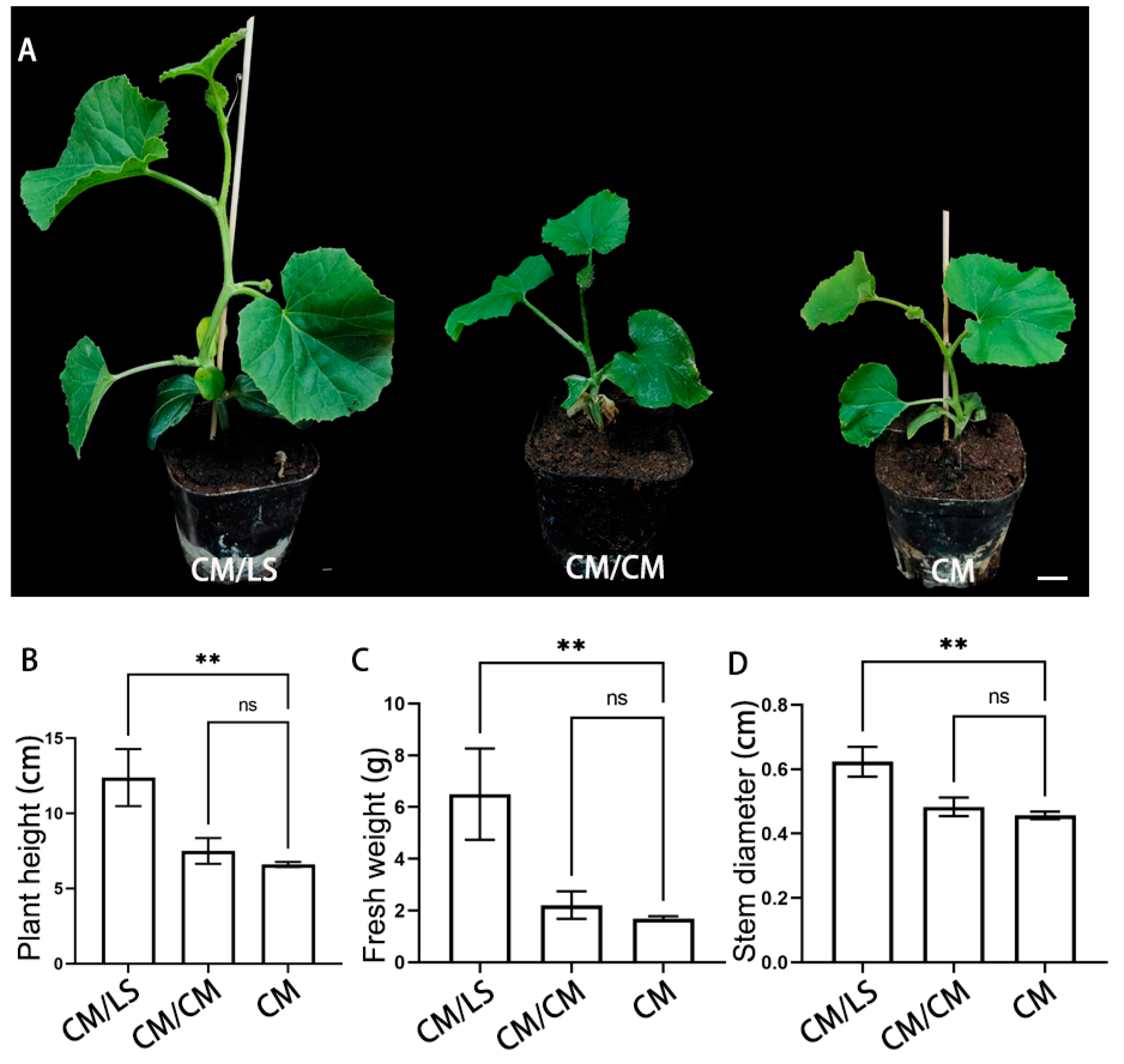
To evaluate the influence of rootstock on melon scion development, we first conducted phenotypic assessments of grafted plants. Scions grafted onto bottle gourd rootstock (CM/LS) exhibited significantly enhanced growth vigor compared to both self-grafted (CM/CM) and self-rooted (CM) controls (Figure 1A). This visual assessment was validated through quantitative measurements of key growth parameters. Specifically, scions on bottle gourd rootstocks showed significantly greater plant height (65.11% ± 19.11% increase over CM/CM, 87.62% ± 15.57% over CM), fresh weight (194.27% ± 36.25% increase over CM/CM, 284.81% ± 27.60% over CM), and stem diameter (28.97% ± 9.52% increase over CM/CM, 36.48% ± 7.83% over CM) than those grafted onto melon rootstocks or self-rooted plants (Figure 1B–D, Table S2). Notably, no significant differences in these physiological traits were observed between the self-grafted and self-rooted control groups, indicating that the grafting procedure itself did not substantially affect scion growth. These results collectively demonstrated that heterografting with bottle gourd rootstock substantially promotes growth vigor in melon scions.

3.2. Rootstock-Induced Transcriptomic Reprogramming in Melon Scions

To elucidate the molecular mechanisms underlying rootstock-induced vigor, we performed transcriptome profiling of shoot apical tissues from scions from CM/LS, CM/CM, and CM groups. High-quality RNA-seq data were obtained from all samples following stringent quality control, with Q30 scores exceeding 96.2% for all libraries. Differential expression analysis (FDR < 0.05 and |log2FC| > 1) revealed distinct transcriptomic landscapes between grafting combinations.
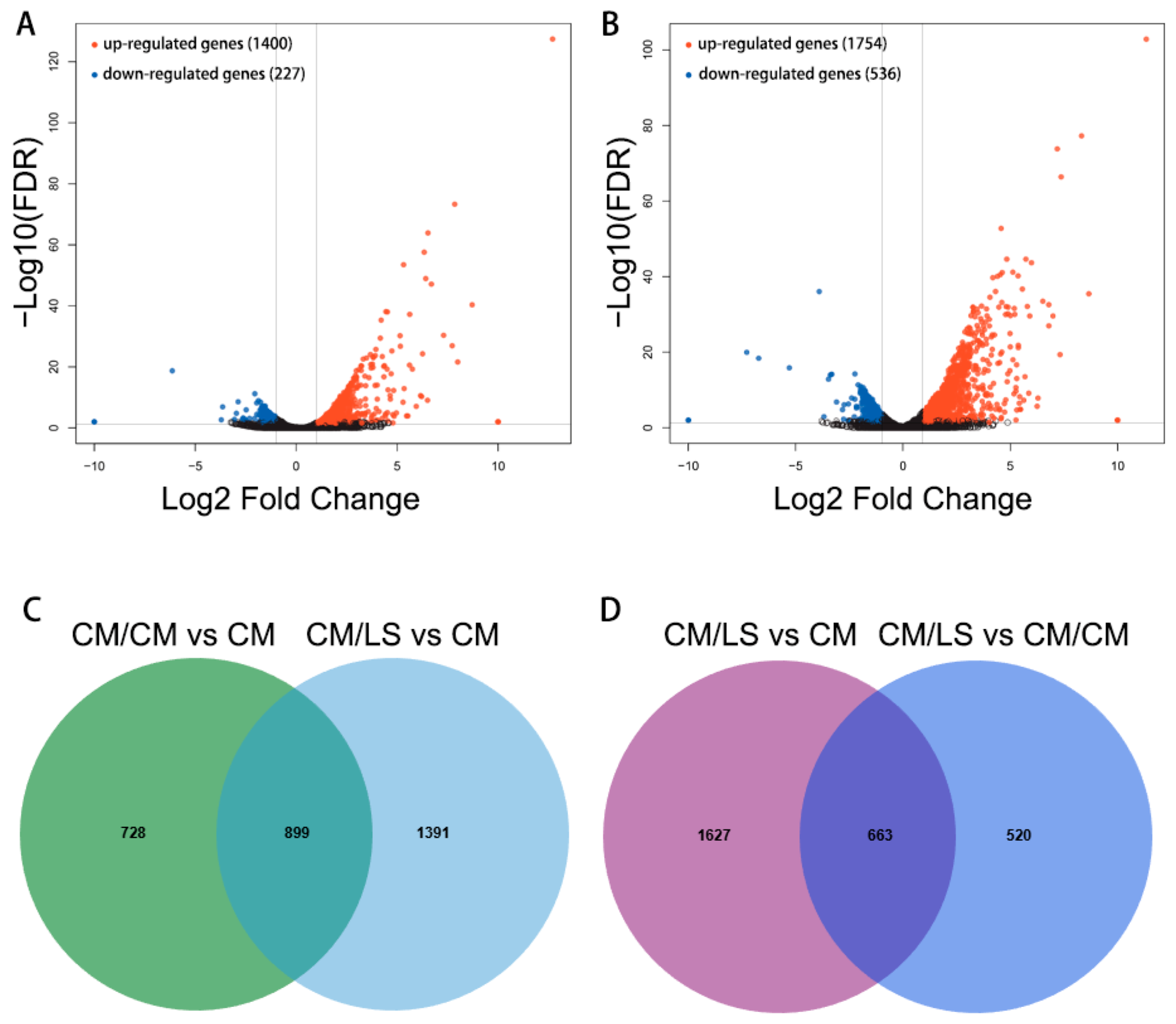
The comparison between self-grafted and self-rooted plants (CM/CM vs. CM) identified 1627 differentially expressed genes (DEGs), with strong upregulation bias (1400 genes, 86.05%; Figure 2A). In contrast, heterografting onto bottle gourd rootstock (CM/LS vs. CM) elicited more extensive transcriptomic changes, inducing 2290 DEGs (1754 upregulated, 76.59%; Figure 2B). A set of 899 DEGs common to both grafting treatments represented shared responses to grafting procedures (Figure 2C), while the substantially larger number of unique DEGs in CM/LS vs. CM (1391 genes) indicated genotype-specific transcriptional rewiring driven by the bottle gourd rootstock.
To precisely identify transcriptomic drivers specifically attributable to bottle gourd rootstock, we employed a stringent filtering strategy focusing on the intersection of DEGs from CM/LS vs. CM and CM/LS vs. CM/CM comparisons. This approach identified 663 core DEGs (524 upregulated and 139 downregulated) that consistently responded to heterografting with bottle gourd rootstock specifically (Figure 2D). To validate the transcriptomic data, we performed RT-qPCR analysis on a subset of differentially expressed genes (DEGs) identified from the RNA-seq results. 16 genes were randomly selected to represent different functional categories and expression patterns, which were amplified using gene-specific primers with CmACTIN as the internal reference. The expression trends measured by RT-qPCR closely matched the RNA-seq profiles, showing a strong positive correlation across all tested genes (R2 = 0.915; Figure S1). This high concordance confirms the reliability of our transcriptomic dataset and supports its use in subsequent functional analyses.

3.3. Functional Characterization of Growth-Promoting Genes

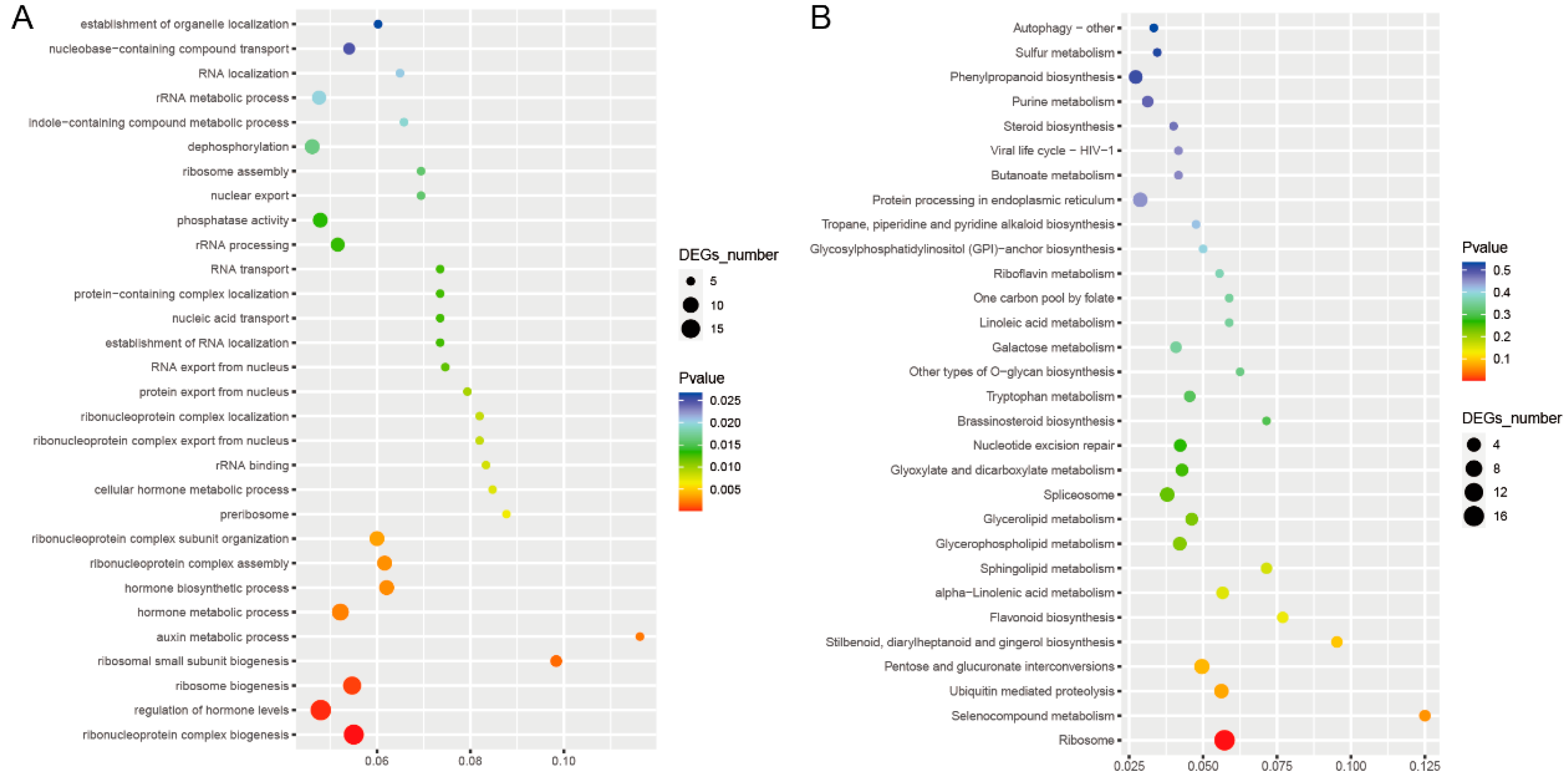
Gene Ontology (GO) enrichment analysis of the core 663 DEGs revealed their significant overrepresentation across the three major functional categories: biological process, cellular component, and molecular function (Figure 3A, Table S3). Within biological processes, the most significantly enriched terms were ribonucleoprotein complex biogenesis, regulation of hormone levels, RNA processing, and ribosome biogenesis. For the cellular component, DEGs were predominantly localized to the preribosome, underscoring the importance of ribosome assembly and nucleolar activity in the graft-induced vigor. In the molecular function category, the dominant enriched terms were phosphatase activity, phosphoric ester hydrolase activity, and ATP binding, highlighting a concerted shift in enzymatic functions related to phosphorylation dynamics, energy transfer, and signal transduction.
KEGG pathway enrichment analysis further revealed significant involvement in key metabolic pathways, including pentose and glucuronate interconversions, glycerophospholipid metabolism, phenylpropanoid biosynthesis, and starch and sucrose metabolism (Figure 3B, Table S4). These pathways are central to diverse yet interconnected physiological functions that underpin enhanced growth. The enrichment in pentose and glucuronate interconversions and starch and sucrose metabolism points to a reprogramming of carbohydrate metabolism, facilitating the provision of carbon skeletons, energy (ATP), and nucleotide sugar precursors essential for rapid cell division and cell wall biosynthesis. Concurrently, the activation of glycerophospholipid metabolism suggests modifications in membrane lipid composition and dynamics, which are critical for cellular signaling, vesicle trafficking, and maintaining membrane integrity during accelerated growth. Furthermore, the significant enrichment of the phenylpropanoid biosynthesis pathway implies an increased flux towards secondary metabolites, such as lignin and flavonoids. This not only may strengthen vascular tissues and cell walls to support greater biomass but also potentially enhances the scion’s antioxidant capacity and stress resilience. Collectively, the coordinated upregulation of these pathways indicates that the bottle gourd rootstock orchestrates a comprehensive metabolic shift in the scion, simultaneously boosting energy production, structural biosynthesis, and cellular signaling to drive the observed growth vigor. This integrated reprogramming represents a core molecular mechanism underlying rootstock-induced vigor, directly addressing the central theme of this study. Furthermore, the identified pathways and key regulator genes provide concrete targets for the functional validation of graft-mediated performance enhancement, thereby directly linking our mechanistic findings to potential applications in crop improvement.

3.4. Phytohormone Pathways Activated During Heterografting

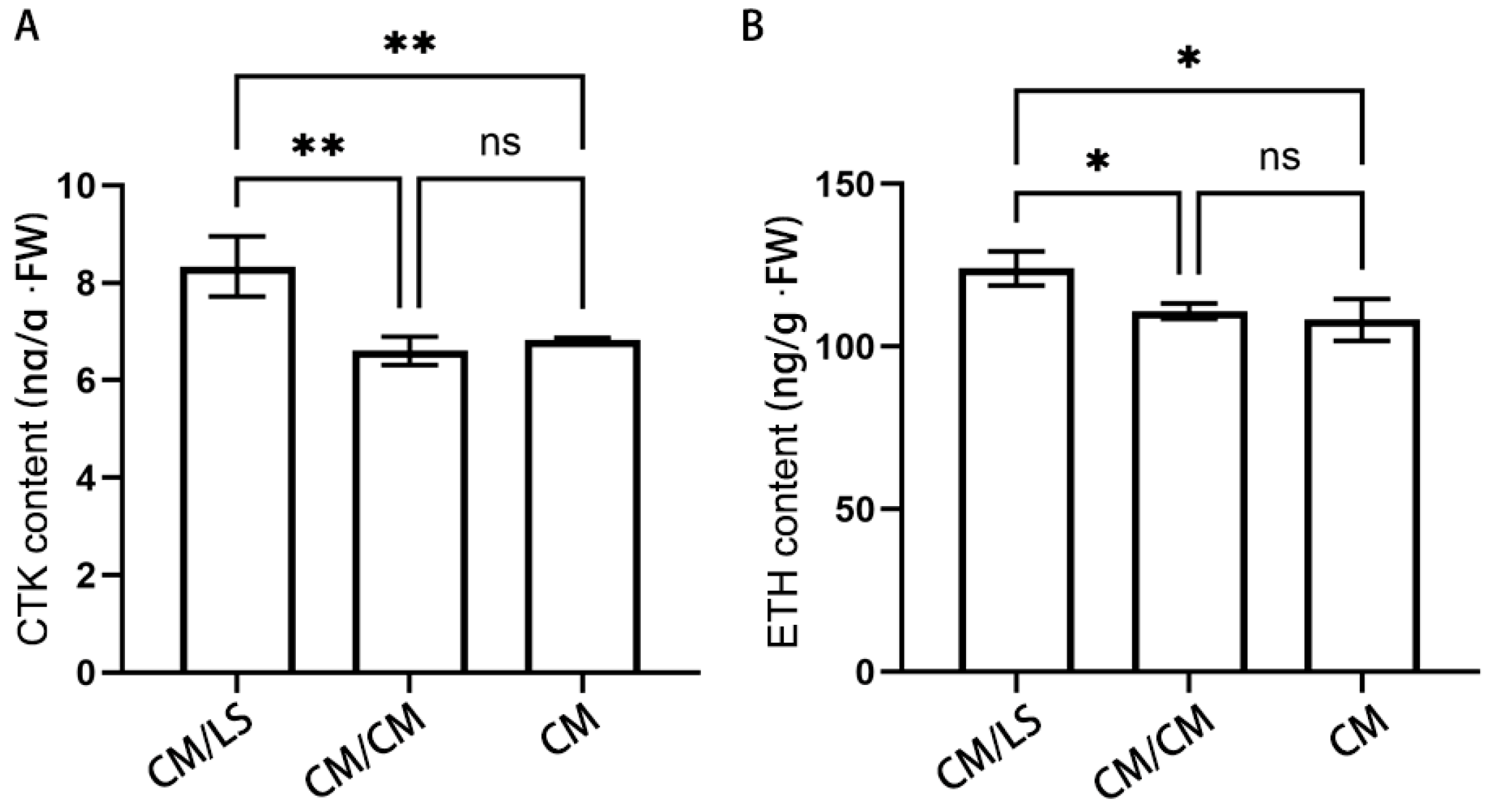
To explore whether phytohormone dynamics contribute to the observed growth vigor, we quantitatively profiled the levels of major plant hormones, including auxin (AUX), cytokinin (CTK), gibberellin (GA), ethylene (ETH), and abscisic acid (ABA), in scion tissues from the three experimental groups. While all five hormones are central regulators of growth and development [29], the analysis revealed that CTK and ETH exhibited the most statistically significant and consistent alterations specifically in the CM/LS group relative to both the homografted (CM/CM) and self-rooted (CM) controls (Figure 4A,B). Specifically, the concentration of the active CTK increased by approximately 1.3-fold in CM/LS scions compared to CM/CM (p < 0.01). Concurrently, ETH production was elevated by about 1.1-fold in CM/LS relative to CM/CM (p < 0.05). In contrast, changes in AUX, GA, and ABA levels were either less pronounced or inconsistent across comparisons (Figure S2A–C). These results highlight a selective and coordinated shift in CTK and ETH signaling, two pathways known to interact synergistically in regulating cell division and expansion [30], thereby implicating their crosstalk as a key physiological mechanism underpinning bottle gourd rootstock-induced vigor.
Consistent with the hormonal profiling, transcriptomic analysis revealed that multiple genes involved in CTK and ETH signal transduction were notably up-regulated in CM/LS scions. Key up-regulated genes included cytokinin signaling components such as the phosphoribohydrolase gene LOGs (MELO3C013644, MELO3C016881), which catalyzes the conversion of inactive cytokinin nucleotides into active free-base forms in the direct activation pathway [31], along with ethylene-responsive transcription factors (ERFs) including ERF060 (MELO3C007769), ERF1B (MELO3C013916), and ERF5 (MELO3C023458). The up-regulation of LOG is consistent with the elevated cytokinin levels detected in our assays and has been previously associated with enhanced meristem activity and shoot growth in other plant systems [32,33]. Similarly, the induction of several ERFs, particularly ERF060, a homolog reported to integrate ethylene and cytokinin signaling during cell expansion [34], provides a molecular basis for the observed hormonal crosstalk. The coordinated induction of these signaling components strongly supports our hypothesis that bottle gourd rootstock reprograms scion growth through synergistic cytokinin–ethylene interactions. Moreover, these genes correspond to precise genetic targets that advance our research objectives beyond correlative hormone measurements, helping to identify the functional regulators responsible for executing the rootstock-mediated growth promotion.

3.5. Functional Validation of Candidate Genes via VIGS

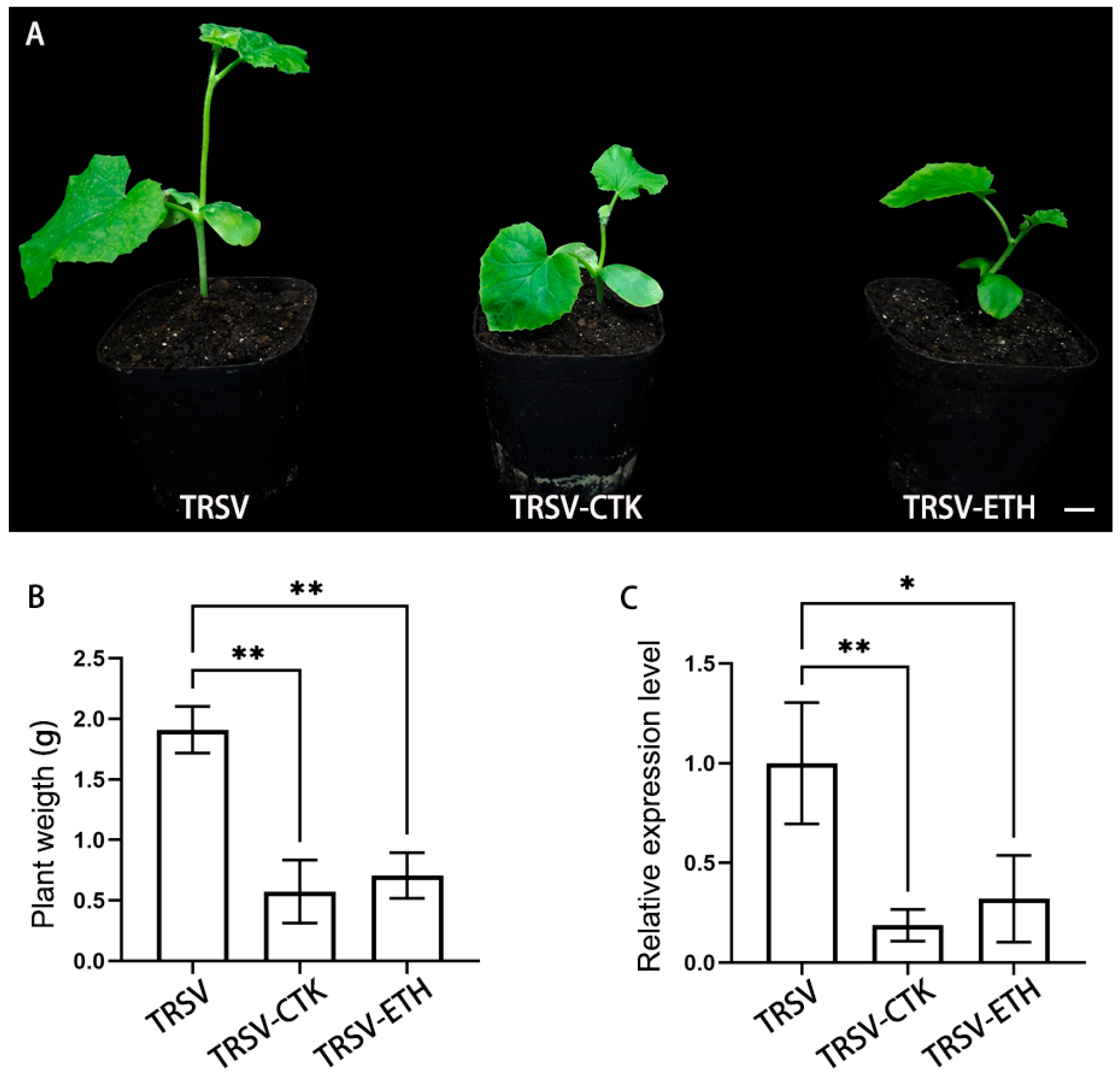
To functionally validate the roles of cytokinin and ethylene signaling in promoting scion growth, we selected two key DEGs from the core 663 gene set: MELO3C016881 (encoding cytokinin riboside 5′-monophosphate phosphoribohydrolase, a key enzyme in cytokinin activation) and MELO3C007769 (encoding ethylene-responsive transcription factor ERF060), for VIGS assays.
Using cotyledon vacuum-infiltration for Agrobacterium-mediated delivery of TRSV-based VIGS constructs, we achieved efficient silencing with early phenotype appearance. System efficacy was confirmed using TRSV-CmPDS positive control, which induced typical photobleaching in melon true leaves within 10–12 days post-inoculation (Figure S3). Within 24 days post-inoculation, plants silencing either MELO3C007769 or MELO3C016881 exhibited visibly retarded growth compared to empty vector controls (Figure 5A).
At 24 days post-inoculation, phenotypic quantification revealed that silencing either gene led to statistically significant reductions in both fresh weight (63.0–70.0% decrease, p < 0.01) compared to controls (Figure 5B). RT-qPCR confirmed significant downregulation of both target genes (68.9–81.2% reduction in transcript levels; Figure 5C). Importantly, the growth inhibition observed in silenced plants specifically negated the vigor typically imparted by bottle gourd rootstock. These results demonstrate that both genes, functioning within ethylene and cytokinin signaling pathways, respectively, play essential roles in mediating the enhanced growth vigor promoted by bottle gourd rootstock in grafted melon plants.

4. Discussion

4.1. Transcriptional and Metabolic Reprogramming: The Foundation of Vigor

The most striking molecular finding is the scale of transcriptional change induced specifically by the bottle gourd rootstock. The identification of 663 core DEGs-genes differentially expressed in CM/LS heterograft compared to both self-rooted (CM) and homografted CM/CM controls-pinpoints the precise genetic circuitry activated by heterografting combination. This comparative approach efficiently eliminates general wounding or grafting reactions while identifying the transcriptional signature attributed to the bottle gourd rootstock. This methodological improvement can enhance the accuracy of gene screening, incorporating more rigorous experimental frameworks in grafting research.
Meanwhile, the classification results show that the substantial functional enrichment of these DEGs in “catalytic activity”, “metabolic process”, and “carbohydrate metabolic pathways” provides a clear mechanistic link. The regulation of these pathways indicates that the bottle gourd rootstock reprograms the scion toward a state of heightened anabolic activity. This shift ensures a sufficient supply of carbon skeletons, energy (ATP), and cell wall precursors, thereby supporting accelerated cell division and expansion [35,36]. Such metabolic reinforcement aligns with the observed increases in vascular bundle number and stem diameter reported in other cucurbit grafting systems [37]. Collectively, these results indicate that heterografting with bottle gourd rootstock enhances scion vigor by coordinately regulating core metabolic and biosynthetic capacities. These findings not only clarify the metabolic basis of graft-induced vigor but also provide candidate genes and pathways that could be targeted in breeding programs to develop rootstocks with enhanced growth-promoting potential.

4.2. Hormonal Crosstalk: Integrating Signals for Growth

Beyond metabolism, our findings highlight the precise control of hormonal signaling, with CTK and ETH serving as crucial hormonal mediators of the observed vigor. The significant increase in active CTK levels, coupled with the upregulation of the activation enzyme genes, indicates a targeted enhancement of CTK signaling, a master regulator of cell division and shoot meristem activity [38]. Concurrently, the upregulation of ethylene-responsive transcription factors (ERFs), including the functionally validated ERF060 (MELO3C007769), points to a modulated ethylene response. The crosstalk between CTK and ETH is known to fine-tune growth processes [39], and recent work has underscored its importance in systemic signaling between grafting plants [40,41]. Our VIGS validation proves that the concurrent activity of these two pathways is functionally essential for the vigor phenotype of melon scion in our system. They likely function synergistically, with cytokinin driving cell proliferation and ethylene modulating subsequent differentiation and expansion phases [42].
In summary, the integrated physiological and transcriptomic evidence indicates that cytokinin and ethylene pathways are key components of the regulatory network through which bottle gourd rootstock enhances melon scion vigor, likely through modulating meristem activity and cell expansion processes. Therefore, we speculate that the bottle gourd rootstock may “prime” the scion with a hormone response that confers both vigor and other beneficial characteristics. However, the temporal order of hormone responses deserves further investigation.

4.3. Prospective Mechanisms of Rootstock-to-Scion Communication

While our study delineates the transcriptional and hormonal outcomes within the scion, the initiating signals from the rootstock that trigger this reprogramming need further investigation. The specific upregulation of CTK and ETH biosynthesis and signaling genes within the scion tissue itself suggests that the bottle gourd rootstock’s influence extends beyond a simple supply of hormones and likely involves the regulation of the scion’s own genetic programs. This observation aligns with an evolving understanding that shifts from a purely “hormone delivery” model toward one encompassing systemic regulation of scion gene expression [13,43].
The mechanism underlying this long-distance regulation could involve mobile molecules from the rootstock. An intriguing hypothesis is the participation of mobile RNAs. Grafting facilitates the long-distance exchange of various RNA species [44,45], which could act as signaling molecules to modulate gene expression in the recipient tissue [19,46]. For instance, rootstock-derived messenger RNAs (mRNAs) or small RNAs could be translocated to the scion, potentially influencing the transcription of key genes identified in our core DEGs, such as those in hormone pathways [47]. Furthermore, such RNA mobility might be associated with epigenetic modifications in the scion, such as changes in DNA methylation, leading to sustained transcriptional changes [48,49]. While the role of mobile RNAs remains a hypothesis beyond the direct scope of this study, future validation of such long-distance signaling mechanisms could open new avenues for molecular breeding.

4.4. Limitations and Future Perspectives

This study focused on a single, vigorous rootstock-scion combination at the seedling stage. An important future direction should investigate whether the identified core DEGs and the CTK-ETH crosstalk represent a conserved mechanism by testing other rootstock genotypes with varying vigor potentials. Furthermore, while VIGS validated two key genes, the functional characterization of other genes within the 663-core set, particularly those involved in sugar transport or cell wall modification, would provide a more complete mechanistic picture.

5. Conclusions

Although grafting onto vigorous rootstocks is widely used to improve crop productivity, the molecular mechanisms underlying this process have remained largely unresolved [14,50]. In this study, we demonstrate that bottle gourd rootstock enhances melon scion growth through a coordinated transcriptional and hormonal reprogramming. By integrating phenotypic, transcriptomic, phytohormone, and functional analyses, we show that this vigor is driven by the upregulation of core carbohydrate metabolic pathways together with synergistic cytokinin–ethylene crosstalk. Key regulatory genes, including LOG (MELO3C016881) and ERF060 (MELO3C007769), were functionally validated as essential mediators of this process. Beyond promoting growth under optimal conditions, the observed metabolic and hormonal shifts suggest that the rootstock may also prime the scion for sustained performance. Collectively, these findings elucidate a central molecular framework for rootstock-induced vigor and provide specific genetic targets that can inform breeding and biotechnology approaches aimed at developing more resilient and productive grafted crops.

Supplementary Materials

The following supporting information can be downloaded at: https://www.mdpi.com/article/10.3390/horticulturae12010082/s1, Figure S1: Validation of RNA-seq data by RT-qPCR; Figure S2: Quantification of phytohormones in melon scions; Figure S3: Efficacy validation of the VIGS system using a positive control; Table S1: The primers used in this study; Table S2: Raw phenotypic data; Table S3: Data for GO enrichment analysis; Table S4: Data for KEGG enrichment analysis.

Author Contributions

Conceptualization, W.H. and M.A.; methodology, S.S.; software, W.H.; validation, X.X. and Y.H.; formal analysis, W.H.; investigation, M.A.; resources, J.S.; data curation, Z.W.; writing—original draft preparation, W.H. and M.A.; writing—review and editing, W.H. and M.A.; visualization, Z.W.; supervision, W.S. and J.S.; project administration, J.S.; funding acquisition, J.S. All authors have read and agreed to the published version of the manuscript.

Funding

This research was supported by the “Pioneer” and “Leading Goose” R&D Program of Zhejiang, grant numbers 2023C02027; the National Natural Science Foundation of China, grant numbers 32372692; Zhejiang Provincial Natural Science Foundation of China, grant numbers LTGN23C150003; the R&D and Promotion Project for New Agricultural Productivity in Huzhou City, grant numbers 2025XZZD04 and the Major Science and Technology Project of Plant Breeding in Zhejiang Province, grant numbers 2021C02065-3.

Data Availability Statement

Data available in a publicly accessible repository. The raw sequence data reported in this paper have been deposited in the Genome Sequence Archive (Genomics, Proteomics & Bioinformatics 2025) in National Genomics Data Center (Nucleic Acids Res 2025), China National Center for Bioinformation/Beijing Institute of Genomics, Chinese Academy of Sciences (GSA: CRA034943), which are publicly accessible at https://ngdc.cncb.ac.cn/gsa (accessed on 7 January 2026).

Acknowledgments

We are grateful to Chao Geng (Shandong Agricultural University, China) for providing pTRSV1 and pTRSV2, Jordi Garcia-Mas (Centre for Research in Agricultural Genomics, Spain) for supplying the melon seeds of Ved, and Jiajing Chen for technical help with the grafting experiment.

Conflicts of Interest

The authors declare no conflicts of interest.

References

  1. Nawaz, M.A.; Imtiaz, M.; Kong, Q.; Cheng, F.; Ahmed, W.; Huang, Y.; Bie, Z. Grafting: A technique to modify ion accumulation in horticultural crops. Front. Plant Sci. 2016, 7, 1457. [Google Scholar] [CrossRef] [PubMed]
  2. Savvas, D.; Ntatsi, G.; Barouchas, P. Impact of grafting and rootstock genotype on cation uptake by cucumber (Cucumis sativus L.) exposed to Cd or Ni stress. Sci. Hortic. 2013, 149, 86–96. [Google Scholar] [CrossRef]
  3. Razi, K.; Suresh, P.; Mahapatra, P.P.; Al Murad, M.; Venkat, A.; Notaguchi, M.; Bae, D.W.; Prakash, M.A.S.; Muneer, S. Exploring the role of grafting in abiotic stress management: Contemporary insights and automation trends. Plant Direct 2024, 8, e70021. [Google Scholar] [CrossRef]
  4. Hayat, F.; Li, J.; Iqbal, S.; Khan, U.; Ali, N.A.; Peng, Y.; Hong, L.; Asghar, S.; Javed, H.U.; Li, C.; et al. Hormonal interactions underlying rootstock-induced vigor control in horticultural crops. Appl. Sci. 2023, 13, 1237. [Google Scholar] [CrossRef]
  5. Cerruti, E.; Gisbert, C.; Drost, H.-G.; Valentino, D.; Portis, E.; Barchi, L.; Prohens, J.; Lanteri, S.; Comino, C.; Catoni, M. Grafting vigour is associated with DNA de-methylation in eggplant. Hortic. Res. 2021, 8, 241. [Google Scholar] [CrossRef]
  6. Shahwar, D.; Khan, Z.; Park, Y. Molecular markers for marker-assisted breeding for biotic and abiotic stress in melon (Cucumis melo L.): A review. Int. J. Mol. Sci. 2024, 25, 6307. [Google Scholar] [CrossRef]
  7. Dhami, D.S.; Kaur, S.; Sharma, A.; Sharma, S.P.; Dhillon, N.K.; Jain, S. Characterization of multiple disease resistance in melons (Cucumis melo L.) against Meloidogyne incognita, Fusarium oxysporum and tomato leaf curl Palampur virus. Plant Genet. Resour. Charact. Util. 2024, 22, 27–36. [Google Scholar] [CrossRef]
  8. Xiong, M.; Liu, C.; Guo, L.; Wang, J.; Wu, X.; Li, L.; Bie, Z.; Huang, Y. Compatibility evaluation and anatomical observation of melon grafted onto eight Cucurbitaceae species. Front. Plant Sci. 2021, 12, 762889. [Google Scholar] [CrossRef] [PubMed]
  9. Thies, J.A. Grafting for managing vegetable crop pests. Pest Manag. Sci. 2021, 77, 4825–4835. [Google Scholar] [CrossRef]
  10. Nie, W.; Wen, D. Study on the applications and regulatory mechanisms of grafting on vegetables. Plants 2023, 12, 2822. [Google Scholar] [CrossRef] [PubMed]
  11. Bahadur, A.; Singh, P.M.; Rai, N.; Singh, A.K.; Singh, A.K.; Karkute, S.G.; Behera, T.K. Grafting in vegetables to improve abiotic stress tolerance, yield and quality. J. Hortic. Sci. Biotechnol. 2024, 99, 385–403. [Google Scholar] [CrossRef]
  12. Garcia-Lozano, M.; Dutta, S.K.; Natarajan, P.; Tomason, Y.R.; Lopez, C.; Katam, R.; Levi, A.; Nimmakayala, P.; Reddy, U.K. Transcriptome changes in reciprocal grafts involving watermelon and bottle gourd reveal molecular mechanisms involved in increase of the fruit size, rind toughness and soluble solids. Plant Mol. Biol. 2020, 102, 213–223. [Google Scholar] [CrossRef]
  13. Mauro, R.P.; Pérez-Alfocea, F.; Cookson, S.J.; Ollat, N.; Vitale, A. Editorial: Physiological and molecular aspects of plant rootstock-scion interactions. Front. Plant Sci. 2022, 13, 852518. [Google Scholar] [CrossRef] [PubMed]
  14. Williams, B.; Ahsan, M.U.; Frank, M.H. Getting to the root of grafting-induced traits. Curr. Opin. Plant Biol. 2021, 59, 101988. [Google Scholar] [CrossRef]
  15. Parvathi, M.S.; Antony, P.D.; Kutty, M.S. Multiple stressors in vegetable production: Insights for trait-based crop improvement in cucurbits. Front. Plant Sci. 2022, 13, 861637. [Google Scholar] [CrossRef]
  16. Zhang, J.; Zhang, H.; Wang, P.; Chen, J.; Cao, Y. Gene expression, hormone signaling, and nutrient uptake in the root regermination of grafted watermelon plants with different pumpkin rootstocks. J. Plant Growth Regul. 2023, 42, 1051–1066. [Google Scholar] [CrossRef]
  17. Xu, C.; Zhang, Y.; Zhao, M.; Liu, Y.; Xu, X.; Li, T. Transcriptomic analysis of melon/squash graft junction reveals molecular mechanisms potentially underlying the graft union development. PeerJ 2021, 9, e12569. [Google Scholar] [CrossRef]
  18. Hou, S.; Zhu, Y.; Wu, X.; Xin, Y.; Guo, J.; Wu, F.; Yu, H.; Sun, Z.; Xu, C. Scion-to-rootstock mobile transcription factor CmHY5 positively modulates the nitrate uptake capacity of melon scion grafted on squash rootstock. Int. J. Mol. Sci. 2023, 24, 162. [Google Scholar] [CrossRef] [PubMed]
  19. Zhang, M.; Liu, W.; Wang, C.; Lin, S.; Chen, Y.; Cui, H.; Xiang, C.; Ma, Y.; Li, X.; Lu, Y.; et al. Root-to-shoot mobile mRNA CmoKARI1 promotes JA-Ile biosynthesis to confer chilling tolerance in grafted cucumbers. Nat. Commun. 2025, 16, 7782. [Google Scholar] [CrossRef] [PubMed]
  20. Li, W.; Chu, C.; Li, H.; Zhang, H.; Sun, H.; Wang, S.; Wang, Z.; Li, Y.; Foster, T.M.; López-Girona, E.; et al. Near-gapless and haplotype-resolved apple genomes provide insights into the genetic basis of rootstock-induced dwarfing. Nat. Genet. 2024, 56, 505–516. [Google Scholar] [CrossRef]
  21. Ai, M.; Han, W.; Wang, Z.; Xu, X.; He, Y.; Shou, W.; Sun, X.; Wang, H.; Shen, J. Cucurbit crops acquired silencing: Virus-induced post-transcriptional silencing is transmitted across the graft union. Horticulturae 2024, 10, 1313. [Google Scholar] [CrossRef]
  22. Coşkun, Ö.F. The effect of grafting on morphological, physiological and molecular changes induced by drought stress in cucumber. Sustainability 2023, 15, 875. [Google Scholar] [CrossRef]
  23. Castanera, R.; Ruggieri, V.; Pujol, M.; Garcia-Mas, J.; Casacuberta, J.M. An improved melon reference genome with single-molecule sequencing uncovers a recent burst of transposable elements with potential impact on genes. Front. Plant Sci. 2019, 10, 1815. [Google Scholar] [CrossRef]
  24. Wu, T.; Hu, E.; Xu, S.; Chen, M.; Guo, P.; Dai, Z.; Feng, T.; Zhou, L.; Tang, W.; Zhan, L.; et al. clusterProfiler 4.0: A universal enrichment tool for interpreting omics data. Innovation 2021, 2, 100141. [Google Scholar] [CrossRef]
  25. Livak, K.J.; Schmittgen, T.D. Analysis of relative gene expression data using real-time quantitative PCR and the 2−ΔΔCT method. Methods 2001, 25, 402–408. [Google Scholar] [CrossRef] [PubMed]
  26. Kojima, M.; Kamada-Nobusada, T.; Komatsu, H.; Takei, K.; Kuroha, T.; Mizutani, M.; Ashikari, M.; Ueguchi-Tanaka, M.; Matsuoka, M.; Suzuki, K.; et al. Highly sensitive and high-throughput analysis of plant hormones using MS-probe modification and Liquid Chromatography–Tandem Mass Spectrometry: An application for hormone profiling in Oryza sativa. Plant Cell Physiol. 2009, 50, 1201–1214. [Google Scholar] [CrossRef] [PubMed]
  27. Wang, Z.; Cao, S.; Xu, X.; He, Y.; Shou, W.; Munaiz, E.D.; Yu, C.; Shen, J. Application and expansion of virus-induced gene silencing for functional studies in vegetables. Horticulturae 2023, 9, 934. [Google Scholar] [CrossRef]
  28. Fang, L.; Wei, X.Y.; Liu, L.Z.; Zhou, L.X.; Tian, Y.P.; Geng, C.; Li, X.D. A tobacco ringspot virus-based vector system for gene and microRNA function studies in cucurbits. Plant Physiol. 2021, 186, 853–864. [Google Scholar] [CrossRef]
  29. Sosnowski, J.; Truba, M.; Vasileva, V. The impact of auxin and cytokinin on the growth and development of selected crops. Agriculture 2023, 13, 724. [Google Scholar] [CrossRef]
  30. Tan, X.; Sha, L.; Tian, B.; Yu, M.; Xie, Z.; Chen, W.; Huangfu, Y.; Guo, J.; Liu, J.; Deng, C. Synergistic integration of light signal, hormone dynamics, and carbohydrate metabolism orchestrates rhizome bud development in Arundo donax. Planta 2025, 262, 85. [Google Scholar] [CrossRef]
  31. Zhao, J.; Wang, J.; Liu, J.; Zhang, P.; Kudoyarova, G.; Liu, C.-J.; Zhang, K. Spatially distributed cytokinins: Metabolism, signaling, and transport. Plant Commun. 2024, 5, 100936. [Google Scholar] [CrossRef]
  32. Barrera-Rojas, C.H.; Rocha, G.H.B.; Polverari, L.; Pinheiro Brito, D.A.; Batista, D.S.; Notini, M.M.; da Cruz, A.C.F.; Morea, E.G.O.; Sabatini, S.; Otoni, W.C. miR156-targeted SPL10 controls Arabidopsis root meristem activity and root-derived de novo shoot regeneration via cytokinin responses. J. Exp. Bot. 2020, 71, 934–950. [Google Scholar] [CrossRef] [PubMed]
  33. Sakakibara, H. Cytokinin biosynthesis and transport for systemic nitrogen signaling. Plant J. 2021, 105, 421–430. [Google Scholar] [CrossRef]
  34. Lakehal, A.; Dob, A.; Rahneshan, Z.; Novák, O.; Escamez, S.; Alallaq, S.; Strnad, M.; Tuominen, H.; Bellini, C. ETHYLENE RESPONSE FACTOR 115 integrates jasmonate and cytokinin signaling machineries to repress adventitious rooting in Arabidopsis. New Phytol. 2020, 228, 1611–1626. [Google Scholar] [CrossRef]
  35. Liang, L.; Tang, W.; Lian, H.; Sun, B.; Huang, Z.; Sun, G.; Li, X.; Tu, L.; Li, H.; Tang, Y. Grafting promoted antioxidant capacity and carbon and nitrogen metabolism of bitter gourd seedlings under heat stress. Front. Plant Sci. 2022, 13, 1074889. [Google Scholar] [CrossRef] [PubMed]
  36. Feng, M.; Augstein, F.; Kareem, A.; Melnyk, C.W. Plant grafting: Molecular mechanisms and applications. Mol. Plant 2024, 17, 75–91. [Google Scholar] [CrossRef]
  37. Márkus, R.; Kocsis, M.; Farkas, Á.; Nagy, D.U.; Helfrich, P.; Kutyáncsánin, D.; Nyitray, G.; Czigle, S.; Stranczinger, S. A modeling approach to studying the influence of grafting on the anatomical features and SAUR gene expression in watermelons. Agronomy 2024, 14, 1472. [Google Scholar] [CrossRef]
  38. Pokimica, N.; Ćosić, T.; Uzelac, B.; Ninković, S.; Raspor, M. Dissecting the roles of the cytokinin signaling network: The case of de novo shoot apical meristem formation. Biomolecules 2024, 14, 381. [Google Scholar] [CrossRef]
  39. Bhardwaj, S.; Sharma, D.; Jan, S.; Singh, R.; Bhardwaj, R.; Kapoor, D. Crosstalk of ethylene and other phytohormones in the regulation of plant development. In Ethylene in Plant Biology; John Wiley & Sons Ltd.: Hoboken, NJ, USA, 2022; pp. 17–31. [Google Scholar] [CrossRef]
  40. Márkus, R.; Czigle, S.; Zana, B.; Somogyi, B.A.; Urbán, P.; Kutyáncsánin, D.; Helfrich, P.; Stranczinger, S. Drought and salt stressors alter NAC and WRKY gene expression profiles in grafted Citrullus lanatus. Plant Mol. Biol. Report. 2025, 43, 1576–1587. [Google Scholar] [CrossRef]
  41. Wang, P.; Liu, F.; Sun, Y.; Liu, X.; Jin, L. Physiological and molecular insights into citrus rootstock-scion interactions: Compatibility, signaling, and impact on growth, fruit quality and stress responses. Horticulturae 2025, 11, 1110. [Google Scholar] [CrossRef]
  42. Shimotohno, A.; Aki, S.S.; Takahashi, N.; Umeda, M. Regulation of the plant cell cycle in response to hormones and the environment. Annu. Rev. Plant Biol. 2021, 72, 273–296. [Google Scholar] [CrossRef]
  43. Li, G.; Tan, M.; Liu, X.; Mao, J.; Song, C.; Li, K.; Ma, J.; Xing, L.; Zhang, D.; Shao, J. The nutrient, hormone, and antioxidant status of scion affects the rootstock activity in apple. Sci. Hortic. 2022, 302, 111157. [Google Scholar] [CrossRef]
  44. Li, W.; Chen, S.; Liu, Y.; Wang, L.; Jiang, J.; Zhao, S.; Fang, W.; Chen, F.; Guan, Z. Long-distance transport RNAs between rootstocks and scions and graft hybridization. Planta 2022, 255, 96. [Google Scholar] [CrossRef] [PubMed]
  45. Davoudi, M.; Song, M.; Zhang, M.; Chen, J.; Lou, Q. Long-distance control of the scion by the rootstock under drought stress as revealed by transcriptome sequencing and mobile mRNA identification. Hortic. Res. 2022, 9, uhab033. [Google Scholar] [CrossRef]
  46. Wang, T.; Li, X.; Zhang, X.; Wang, Q.; Liu, W.; Lu, X.; Gao, S.; Liu, Z.; Liu, M.; Gao, L. RNA motifs and modification involve in RNA long-distance transport in plants. Front. Cell Dev. Biol. 2021, 9, 651278. [Google Scholar] [CrossRef] [PubMed]
  47. Zhang, W.; Thieme, C.J.; Kollwig, G.; Apelt, F.; Yang, L.; Winter, N.; Andresen, N.; Walther, D.; Kragler, F. tRNA-related sequences trigger systemic mRNA transport in plants. Plant Cell 2016, 28, 1237–1249. [Google Scholar] [CrossRef]
  48. Carraro, P.; Naeem, Y.; Girardi, F.; Botton, A.; Varotto, S.; Ruperti, B.; Bonghi, C. A rootstock-centered perspective on the regulation of alternate bearing in fruit trees. J. Exp. Bot. 2025, eraf460. [Google Scholar] [CrossRef] [PubMed]
  49. Mahapatra, P.P.; Bae, D.W.; Notaguchi, M.; Muneer, S. Grafting enhances drought stress tolerance by regulating proteome and targeted gene regulatory networks in tomato. Front. Plant Sci. 2025, 16, 1591437. [Google Scholar] [CrossRef]
  50. Loupit, G.; Brocard, L.; Ollat, N.; Cookson, S.J. Grafting in plants: Recent discoveries and new applications. J. Exp. Bot. 2023, 74, 2433–2447. [Google Scholar] [CrossRef]
Figure 1. The phenotypes of the grafted melon plants. (A) Representative morphology of heterografted (CM/LS), homografted (CM/CM), and self-rooted (CM) plants at 24 days post-grafting. Scale bar = 3 cm. (BD) Quantitative analysis of (B) plant height, (C) fresh weight, and (D) stem diameter. Data are presented as mean ± SD (n = 3 biological replicates). Statistical significance was determined using Brown-Forsythe and Welch ANOVA tests (** p < 0.01; ns, not significant).
Horticulturae 12 00082 g001
Figure 2. Transcriptional changes induced by grafting. (A,B) Volcano plots of differentially expressed genes (DEGs) identified in (A) CM/CM vs. CM and (B) CM/LS vs. CM comparisons. Significantly up-regulated (orange) and down-regulated (blue) genes are shown. (C,D) Venn diagrams illustrating overlaps of DEGs: (C) between CM/CM vs. CM and CM/LS vs. CM; (D) between CM/LS vs. CM and CM/LS vs. CM/CM. The number of genes in each segment is indicated.
Horticulturae 12 00082 g002
Figure 3. Functional enrichment analysis of core DEGs. (A) Gene Ontology (GO) classification of the 663 core differentially expressed genes (DEGs). (B) KEGG pathway enrichment analysis of the core DEGs.
Horticulturae 12 00082 g003
Figure 4. Quantification of key phytohormones in melon scions. Endogenous levels of (A) cytokinin (CTK) and (B) ethylene (ETH) in scions from heterografted (CM/LS), homografted (CM/CM), and self-rooted (CM) plants at 24 days post-grafting. Data are presented as mean ± SD (n = 3 biological replicates). Statistical significance was determined using Brown-Forsythe and Welch ANOVA tests (* p < 0.05, ** p < 0.01; ns, not significant).
Horticulturae 12 00082 g004
Figure 5. Functional validation of candidate genes via VIGS. (A) Phenotypes of Ved plants at 24 days post-inoculation with TRSV constructs: empty vector (TRSV, control), and vectors for silencing the target genes MELO3C016881 (TRSV-CTK) and MELO3C007769 (TRSV-ERF). (B) Plant fresh weight and (C) relative expression levels of the corresponding target genes (MELO3C016881 or MELO3C007769) in the respective treatment groups. Data are presented as mean ± SD (n = 3 biological replicates). Statistical significance relative to the TRSV control was determined using Brown-Forsythe and Welch ANOVA tests (* p < 0.05, ** p < 0.01).
Horticulturae 12 00082 g005
Disclaimer/Publisher’s Note: The statements, opinions and data contained in all publications are solely those of the individual author(s) and contributor(s) and not of MDPI and/or the editor(s). MDPI and/or the editor(s) disclaim responsibility for any injury to people or property resulting from any ideas, methods, instructions or products referred to in the content.