Article

Water Retention and Evaporation Dynamics of Mineral Growing Media for Indoor Horticulture Systems


1
Faculty of Civil and Environmental Engineering, TU Wien, Karlsplatz 13, 1040 Vienna, Austria
2
Faculty of Civil Engineering, Brno University of Technology, Veveří 331/95, 602 00 Brno, Czech Republic
*
Author to whom correspondence should be addressed.
Horticulturae 2026, 12(4), 501; https://doi.org/10.3390/horticulturae12040501
Submission received: 2 March 2026 / Revised: 16 April 2026 / Accepted: 18 April 2026 / Published: 21 April 2026
(This article belongs to the Section Floriculture, Nursery and Landscape, and Turf)

Abstract

Mineral substrates for indoor horticulture systems critically determine plant water availability and irrigation demand. However, integrative assessments linking pore structure, water retention, and evaporation dynamics of commonly used mineral growing media remain scarce. A total of nine distinct mineral substrates were investigated: expanded clay, expanded slate, pumice, perlite, zeolite, vermiculite, lava granules, brick chips, and clay granules. To assess the impact of granulometry, pumice was tested in three different grain sizes (1–3 mm, 4–7 mm, 7–14 mm), resulting in a total of 11 experimental samples. Samples were characterized using scanning electron microscopy (SEM), suction experiments, and evaporation tests at 30%, 50%, and 70% relative humidity (RH) at 23 °C. Bulk density ranged from <0.12 g·cm−3 (perlite, vermiculite) to >0.99 g·cm−3 (zeolite, brick chips), while volumetric water content varied from 11.0 vol.% (expanded clay) to 46.6 vol.% (vermiculite). Plant-available water content (AWC) ranged from 2.7 vol.% (expanded clay) to 30.9 vol.% (clay granules). These results demonstrate that pore interconnectivity, rather than total porosity, is the decisive driver of hydraulic performance. Finer pumice fractions increased water retention by ~16% compared to coarser fractions. All substrates exhibited a two-phase evaporation profile, with initial rates ranging from 1.9 to 5.6 g·h−1 at 30% RH. Clay granules showed the most temporally stable evaporation, with only a 37% rate reduction over 48 h, compared to 66% for perlite. While conducted under controlled laboratory conditions, these findings provide a quantitative basis for targeted substrate selection and blending to optimize root-zone hydration, irrigation efficiency, and hygrothermal performance in permanent indoor horticulture systems.

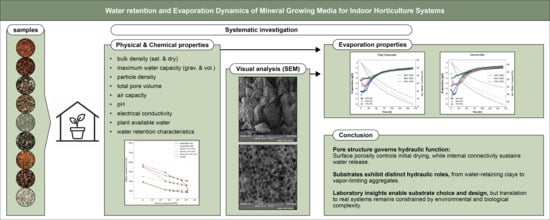
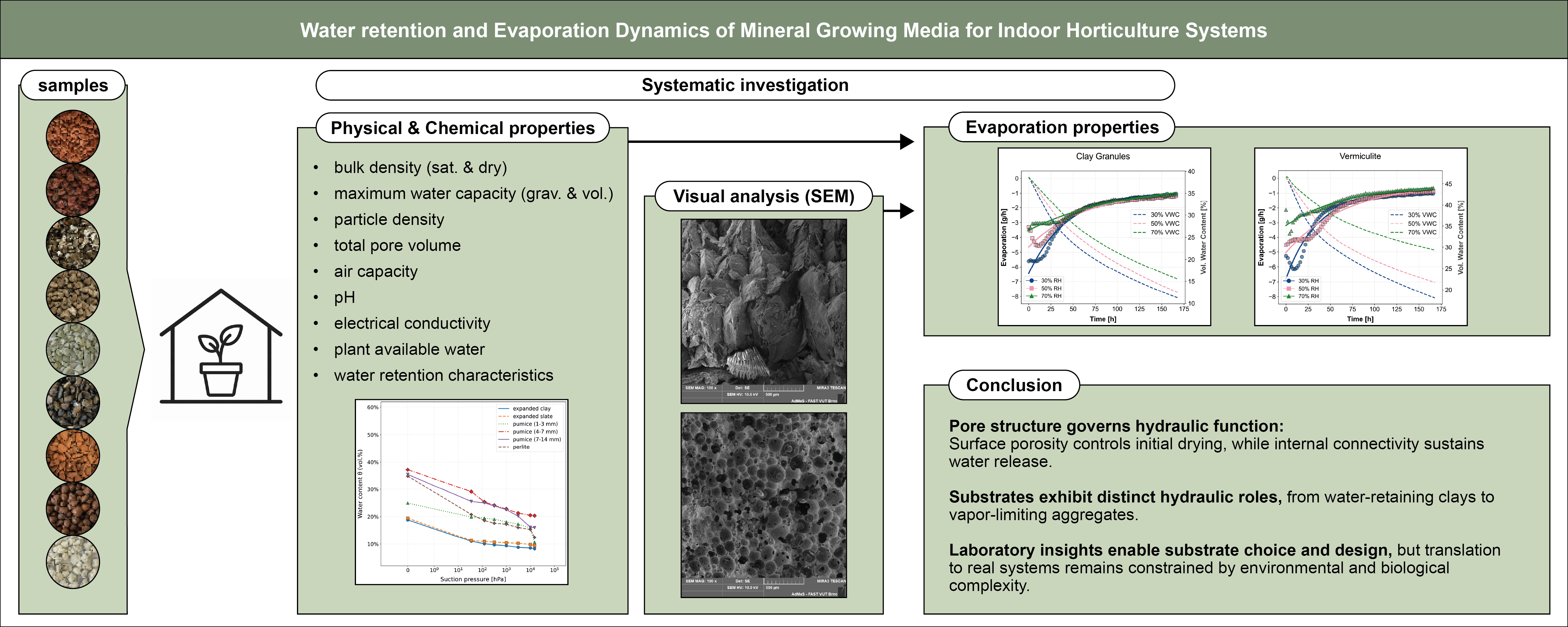
Graphical Abstract

1. Introduction

With rapid urbanization and more time spent indoors, indoor horticulture systems have become essential to modern horticulture and sustainable building design [1,2,3,4,5]. Functioning as specialized anthropogenic Technosols in built environments [6,7,8,9], these horticulture systems must operate within limited, hydraulically isolated volumes. Unlike natural soils, they lack buffering capacity and must resist structural degradation while maintaining optimal root zone conditions [10,11]. Therefore, substrate selection is the decisive factor for long-term plant vitality, influencing the availability of water, oxygen, and nutrients [12,13,14].
Furthermore, indoor substrates must meet rigorous requirements regarding fire safety and hygiene. To prevent microbial contamination in sensitive indoor areas, guidelines like the Forschungsgesellschaft Landschaftsentwicklung Landschaftsbau e.V. (FLL) restrict the use of organic matter, resulting in a strong preference for purely mineral materials [10]. While FLL guidelines establish essential minimum thresholds for parameters such as total porosity and maximum water capacity to ensure basic functional safety, these static values do not fully account for the dynamic hydraulic behavior of mineral media [10]. Total porosity fails to differentiate between hydraulically active and inactive pore spaces, which is critical for predicting long-term plant-water availability and evaporation stability [15,16,17]. The physical and hydraulic properties—specifically pore size distribution, water retention capacity, and hydraulic conductivity—are critical for maintaining the soil–plant–atmosphere continuum and preventing drought stress under high evaporative demand [17,18,19,20].
Despite their widespread use, the hydraulic behavior of mineral indoor substrates remains insufficiently characterized. Previous studies on mineral growing media focused primarily on individual physicochemical parameters (pH, bulk density, or basic water-holding capacity) often within the context of soilless container cultivation in greenhouse production systems [14,15,21,22]. However, these settings differ significantly from permanent indoor installations regarding hydraulic volume, evaporative demand and substrate longevity [10,23]. For example, Maloupa et al. [13] and Gizas and Savvas [14] investigated water retention and plant-available water of pumice fractions in hydroponic systems. Flores-Ramírez et al. [15] characterized bulk density, porosity, and water-holding capacity of lava granules, expanded clay, and perlite. Matlock and Rowe [22] analyzed physical properties of expanded slate, and Fotouhi Ghazvini et al. [21] examined zeolite under greenhouse conditions. While these studies [13,14,15,21,22,24] provide valuable baseline data on individual substrate parameters, comparative analyses of multiple mineral substrates under standardized conditions—particularly regarding uniform particle sizes—remain scarce, even though hydraulic parameters vary significantly with grain size [13,14,24].
Evaporation is a key process governing water loss and is intrinsically linked to pore structure, surface area, and moisture distribution [25,26,27]. Despite this, it is frequently treated as a secondary parameter or inferred only indirectly from plant responses [28,29]. This is a significant oversight, as a mismatch between atmospheric evaporative demand and substrate hydraulic supply capacity can lead to rapid root zone desiccation [16,30]. Quantifying substrate evaporation is essential for regulating indoor relative humidity (RH) within the optimal 40–60% range [28,29].
To address these gaps, this study presents a systematic investigation of 11 commercially available mineral substrates combined with three pumice particle size fractions. While this characterization focuses on physical properties, it provides the necessary empirical baseline for future biological validation. Specifically, we aim to:
  • Quantify the plant-available water content (AWC) and pore size distribution across substrates and particle size under standard conditions;
  • Analyze evaporation dynamics under varying atmospheric humidities (30%, 50% and 70% RH at 23 °C);
  • Determine how specific pore structural properties govern hydraulic continuity during drying cycles.
Together, these objectives provide a quantitative foundation for optimizing substrate selection and supporting irrigation management in permanent indoor horticulture systems.

2. Materials and Methods

A total of 11 commercially available mineral substrates were investigated. The selection was based on three criteria: (i) their explicit recommendation in the FLL guidelines as suitable mineral growing media for indoor horticulture systems [10]; (ii) their prevalence in commercial substrate blends within Central Europe; (iii) their usage in previous scientific literature, which ensures comparability [10,14,15,21,22,23]. To ensure comparability, the materials were sieved to a uniform particle size fraction of 4–7 mm according to DIN 4188 and ISO 565 standards [31]. The specific substrates and their origins are indicated in Table 1. All experiments were conducted between February and December 2025.

2.1. Physical and Chemical Characterization

Physical properties were determined following the FLL Green Roof Guideline [23]. A cylindrical container made of PVC (inner diameter: 15 cm; height: 12 cm) was used as a measuring vessel. Measurements were conducted in five replicates per substrate (n = 5), except for particle density, which was determined in triplicate (n = 3) due to its inherently low measurement variability. Results are reported as mean values.
  • Saturated/dry bulk density: determined in accordance with Appendix B.1 of the FLL guideline after a 24 h saturation period and subsequent drainage [23].
  • Maximum water capacity (grav. and vol.): determined in accordance with Appendix B.2 of the FLL guideline [23].
  • Particle density: determined using a pycnometer in accordance with DIN EN ISO 11508 for fine soil (<2 mm diameter) [32].
  • Porosity and air capacity: porosity was derived according to VDLUFA C 4.2 [33]. Air capacity was calculated as the difference between porosity and volumetric water content at maximum water capacity [23].
  • Chemical parameters: The pH value and electrical conductivity (EC) were measured in a 1:5 (v/v) aqueous extract according to DIN EN 13037 and DIN EN 13038 [34,35].
Water retention characteristics were determined using pressure plate extractors (Models 1600 and 1020, SoilMoisture, CA, USA) according to DIN EN ISO 11274 [36]. Samples were saturated and subjected to pressure steps: (I): 103.5 Pa; (II): 104 Pa; (III): 104.5 Pa; (IV): 105 Pa; (V): 105.5 Pa; (VI): 106 Pa; (VII): 1.5 × 10⁶ Pa. AWC was calculated as the difference between maximum water capacity and permanent wilting point (PWP), defined at 15,000 hPa [19].
Detailed measurement protocols and device specifications are provided in Supplementary Note S1.

2.2. Quantification of Evaporation Dynamics

To quantify evaporation dynamics under controlled conditions, a custom-built automated gravimetric system was employed inside a climate test chamber (model 3623-21, Feutron, Langenwetzendorf, Germany). The chamber maintained constant temperature and RH throughout the experiment via an integrated control unit. Air circulation was generated by a fan drawing air vertically from bottom to top through the chamber. A baffle plate was installed beneath the load cell array to ensure a uniform upward airflow across all sample surfaces. Air velocity was monitored 3 cm above the substrate surface using a universal climate measuring instrument (testo 400, Testo SE & Co. KGaA, Titisee-Neustadt, Germany) equipped with a turbulence intensity probe (testo 266, Testo SE & Co. KGaA, Titisee-Neustadt, Germany; Accuracy: ±0.03 m/s + 4% of reading). The average air velocity was maintained at 0.19 m·s−1.
Substrate samples (1500 mL) were fully saturated according to DIN EN 13041 [37] and placed on calibrated load cells. Evaporation rates were monitored continuously at 5 min intervals over a period of 192 h at 23 °C under three RH regimes: 30%, 50% and 70%. The resulting drying curves were analyzed by fitting a negative exponential model (f(x) = a·ebx + c) to the data.
A detailed description of the electronic setup, sensor calibration, and data processing is available in Supplementary Note S2.

2.3. Visual Analysis

The pore structure of the substrates was visualized using a TESCAN MIRA3 (Tescan, Brno, Czech Republic) scanning electron microscope (SEM). Samples were dried, fixed to conductive holders, and sputter-coated with gold to minimize charging artifacts. Imaging was performed at an acceleration voltage of 10.0 kV to capture high-resolution surface morphologies.

3. Results

3.1. Physical and Chemical Properties

The physical and chemical characteristics of the 11 experimental samples (representing nine distinct mineral materials) are summarized in Table 2. Bulk density and porosity showed a wide variation across the materials. Perlite and vermiculite exhibited the lowest dry bulk densities (<0.12 g·cm−3) and the highest porosities (>90 vol.%). Zeolite and brick chips were characterized by high densities (>0.99 g·cm−3) and comparatively low porosities (<61 vol.%), representing a more than 8-fold difference in density between these groups.
Water retention capacity was not directly proportional to total porosity. The volumetric water content varied greatly between the substrates, ranging from 11.04 vol.% (expanded clay) to 46.60 vol.% (vermiculite)—a difference of over 320%—followed by clay particles (38.79 vol.%). Within the three pumice fractions (Samples 3, 4 and 5), a clear particle size effect was observed: decreasing grain size from 7–14 mm to 1–3 mm increased the volumetric water content by approximately 16% (from 27.6 to 32.1 vol.%).
Chemically, most substrates exhibited a neutral to slightly alkaline pH (7.4–8.7), except for vermiculite, which was slightly acidic (pH 6.1). Electrical conductivity (EC) was generally low (<60 μS·cm−1), except for brick chips (293 μS·cm−1) and expanded clay (135.60 μS·cm−1), likely due to production residues.
It was further noted that vermiculite underwent significant physical change, shrinking to approximately 50% of its original volume (≈750 mL) after complete drying due to the partial collapse of its layered structure.

3.2. Water Retention Characteristics and Plant-Available Water

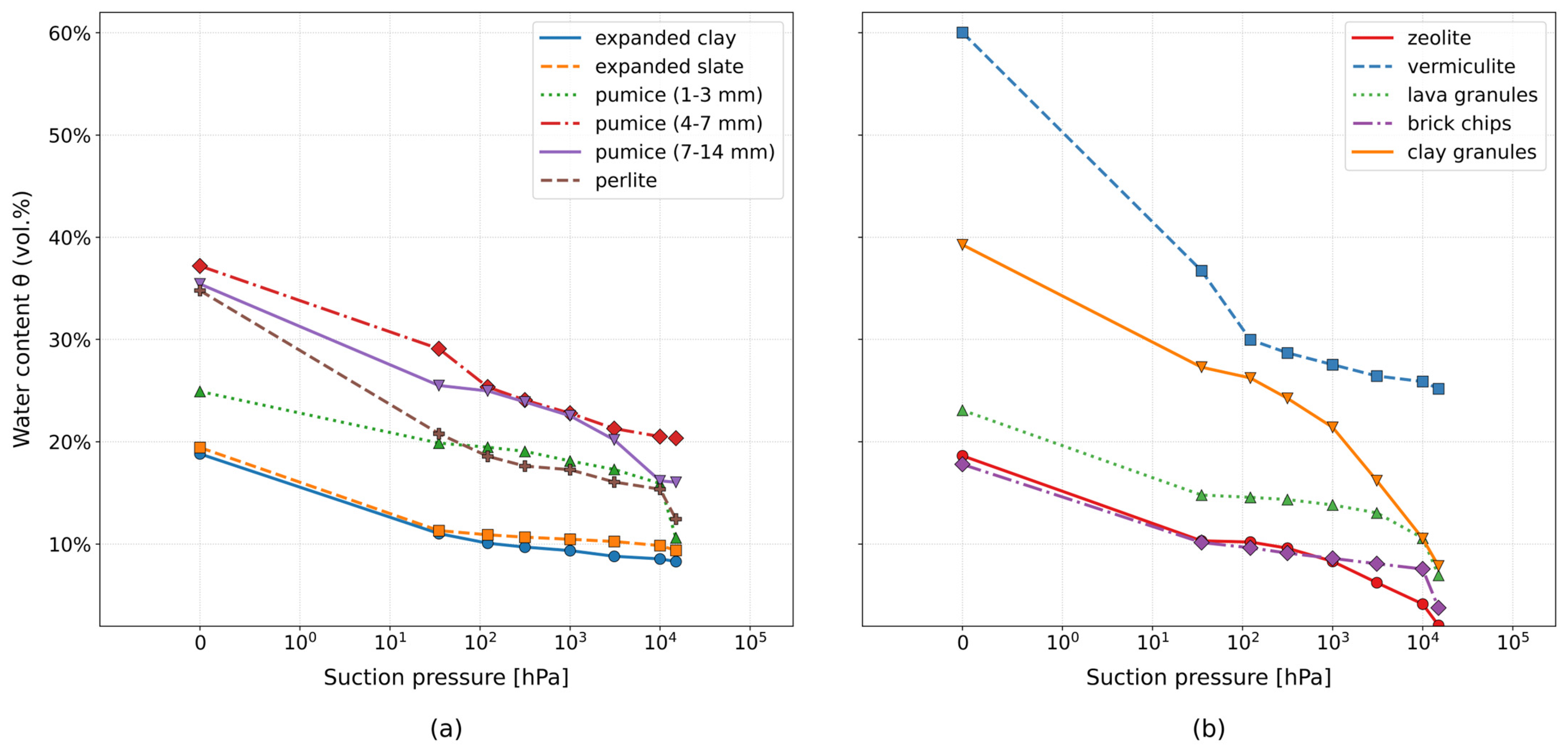
Suction tension curves (Figure 1) reveal distinct differences in pore size distribution. Based on the AWC, the 11 samples were categorized into two performance groups:
  • High AWC (>15 vol.%): Clay granules demonstrated the highest AWC (30.9 vol.%), surpassing the next substrate by more than 40% (relative). Specifically, it showed significantly higher values than fine pumice (1–3 mm, 21.5 vol.%), vermiculite (21.4 vol.%), and zeolite (18.5 vol.%). The steep slope of the clay granule curve indicates a favorable distribution of mesopores and macropores that release water gradually.
  • Low AWC (<15 vol.%): Expanded clay, expanded slate, medium and coarse pumice (4–7 mm and 7–14 mm), perlite, lava granules, and brick chips showed low AWC values ranging from 2.7 vol.% to 12.7 vol.%. These substrates are characterized by a comparatively flat suction tension curve. These substrates are characterized by flat suction tension curves, indicating a lack of mesopores active in the plant-available range.

3.3. Evaporation Properties

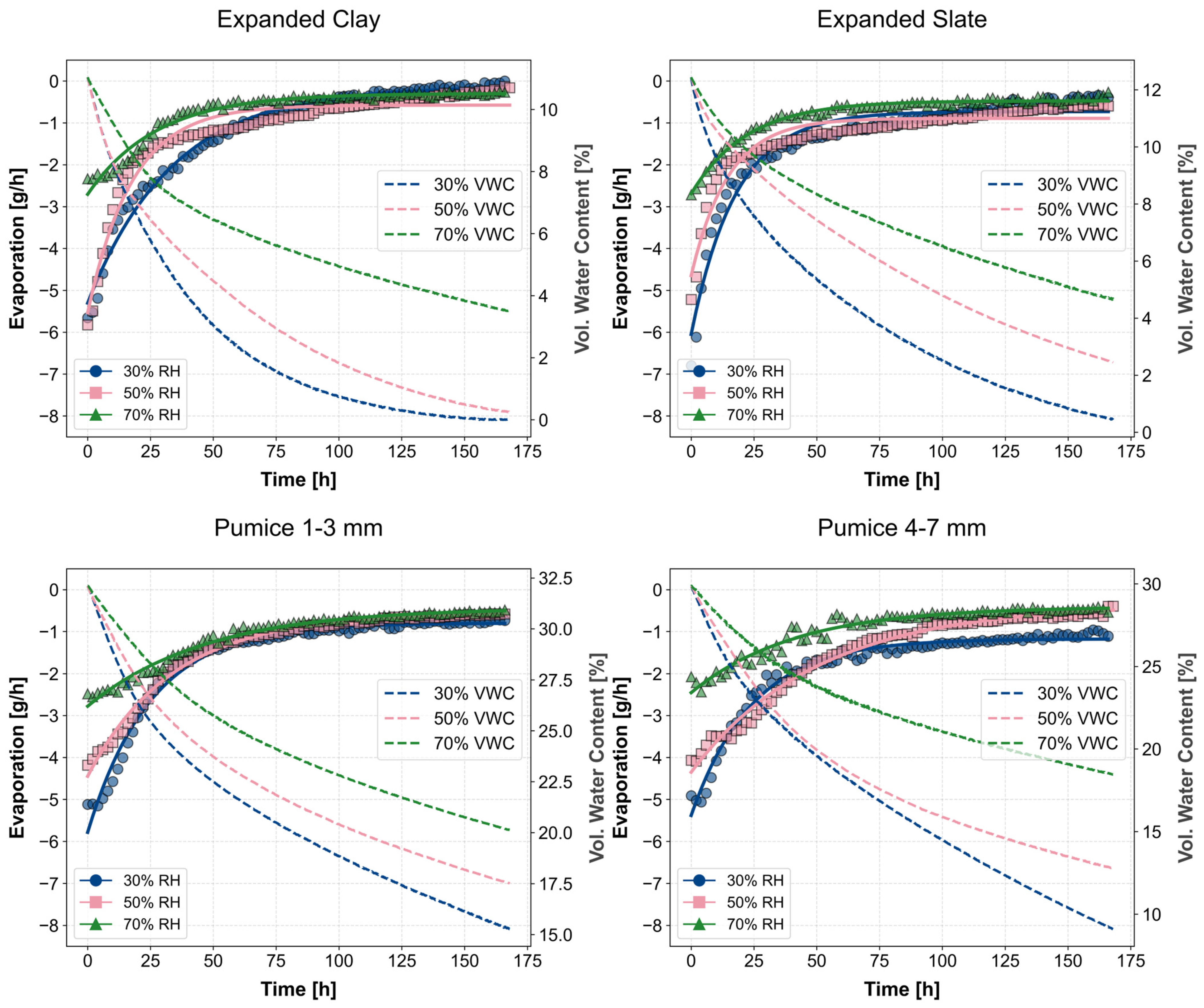
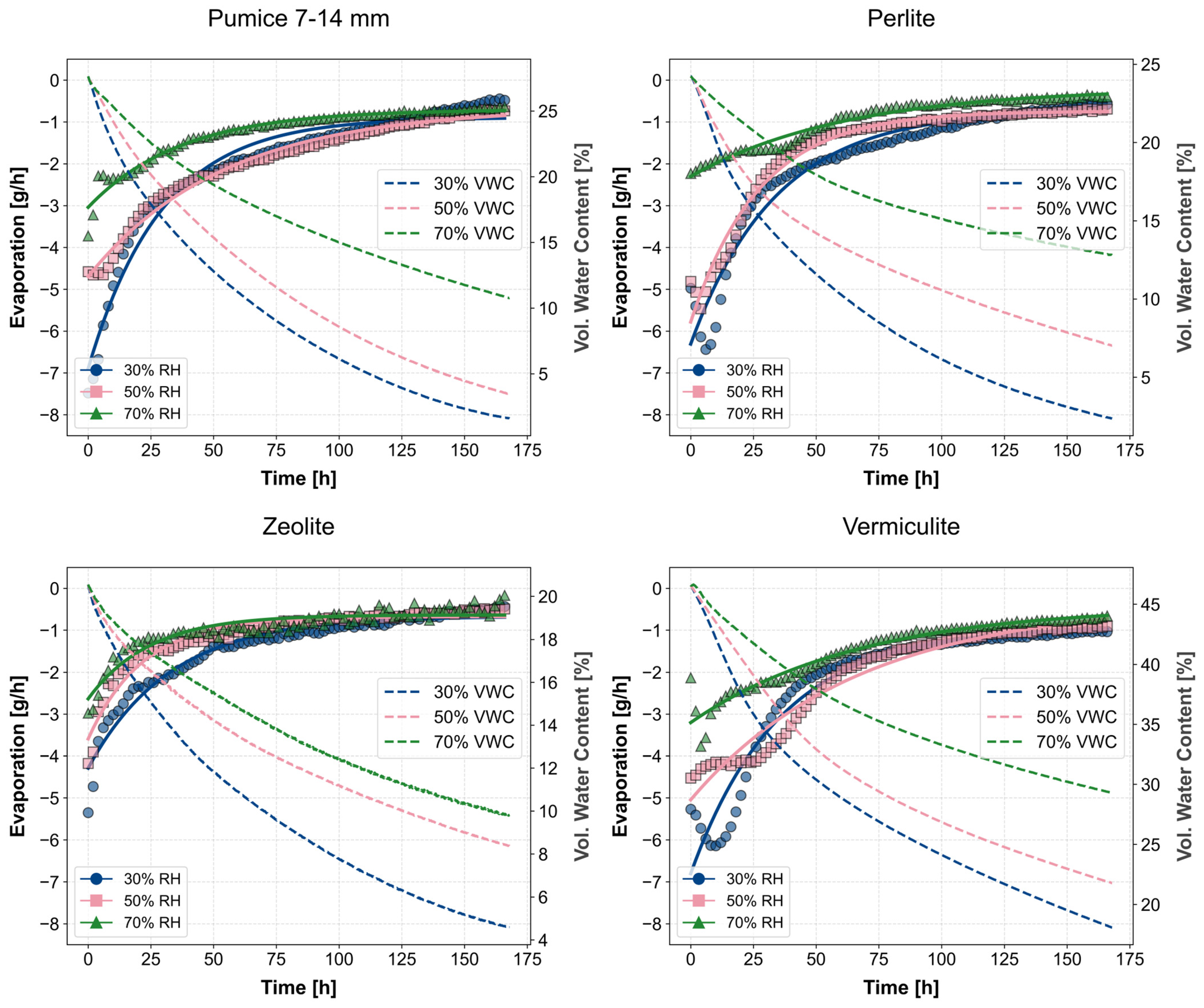
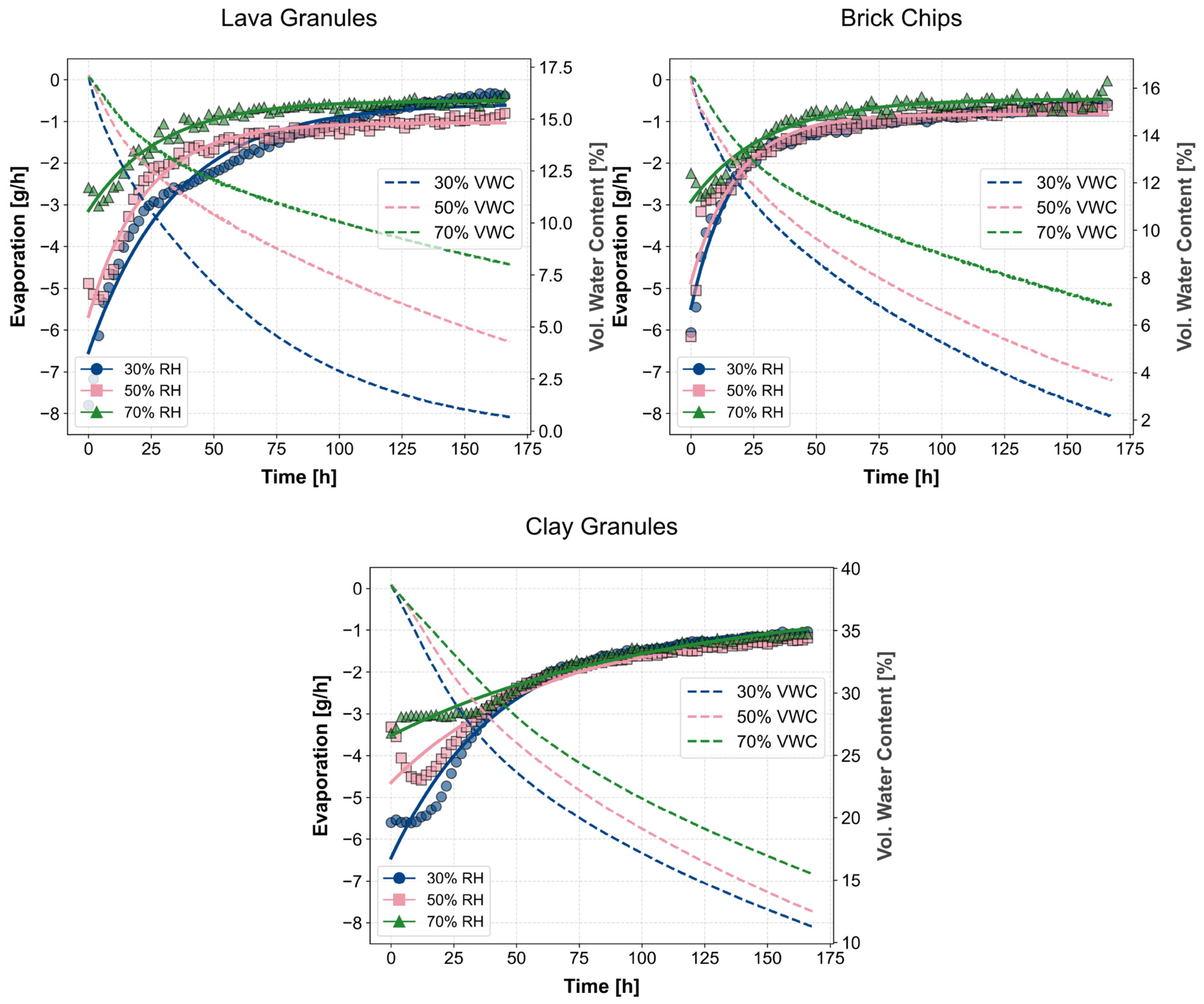
The evaporation kinetics of the examined substrates exhibited a characteristic two-phase evaporation profile: a high but short initial rate (Constant Rate Period, CRP) followed by an exponential decay (Falling Rate Period, FRP) [27,38], as shown in Figure 2, Figure 3 and Figure 4. Detailed evaporation rate data for all time intervals are provided in Appendix A (Table A1).
Highly porous substrates, such as vermiculite and clay granules, exhibited the highest initial evaporation rates (up to 5.59 g·h−1 at 30% RH in the first 24 h). In contrast, zeolite and brick chips showed significantly lower initial rates (~3.2–3.4 g·h−1), representing a difference of approximately 74% in initial performance. Clay granules and vermiculite maintained stable evaporation rates for the longest duration. For instance, clay granules showed a reduction of only ~37% in the evaporation rate during the first 48 h (at 30% RH). Conversely, the rate for perlite dropped by ~66% in the same period, indicating a rapid depletion of surface water and limited capillary replenishment from deeper layers.
As expected, evaporation was highest at 30% RH. However, the anticipated hierarchy of evaporation rates (30% RH > 50% RH > 70% RH) was not consistently observed across all substrates. For vermiculite, the evaporation rate at 50% RH exceeded that at 30% RH by 21.7% after only 24 h (3.58 vs. 2.94 g·h−1). A similar, yet more pronounced trend was observed for expanded clay, where the rate at 50% RH was more than double (+145%) the rate at 30% RH in the final interval (0.27 vs. 0.11 g·h−1).
The exponential fit parameters, decay rates, and total cumulative evaporation values for all substrates and humidity levels are summarized in Appendix A (Table A2). Fit quality was consistently high across all substrates and humidity levels (R2 = 0.87–0.99), confirming that the negative exponential model adequately captures the evaporation dynamics of purely mineral substrates. The decay rate parameter b—which describes the velocity of the evaporation decline—ranged from −0.009 (clay granules, 70% RH) to −0.068 (expanded slate, 50% RH). These values reflect substantial differences in the hydraulic conductivity and capillary transport capacity among the substrates. Total cumulative evaporation over 192 h, calculated by integrating the fitted curves, ranged from 115.3 g (expanded clay, 70% RH) to 385.3 g (clay granules, 30% RH).
A two-way ANOVA revealed that both substrate type and RH exerted highly significant effects on total cumulative evaporation (FSubstrate = 25.50, p < 0.001; FRH = 77.08, p < 0.001). Post hoc Tukey HSD tests confirmed that while total evaporation did not differ significantly between the 30% and 50% RH levels (p = 0.62), the 70% RH treatment resulted in significantly lower water loss compared to both drier conditions (p < 0.05). Regarding the decay rate b, the substrate type was identified as the primary driver (F = 5.37, p < 0.001), while the influence of RH was less pronounced but remained statistically significant (F = 3.61, p = 0.046). This suggests that while environmental humidity dictates the total magnitude of water loss, the internal pore structure and matric potential of the substrates predominantly govern the drying kinetics.
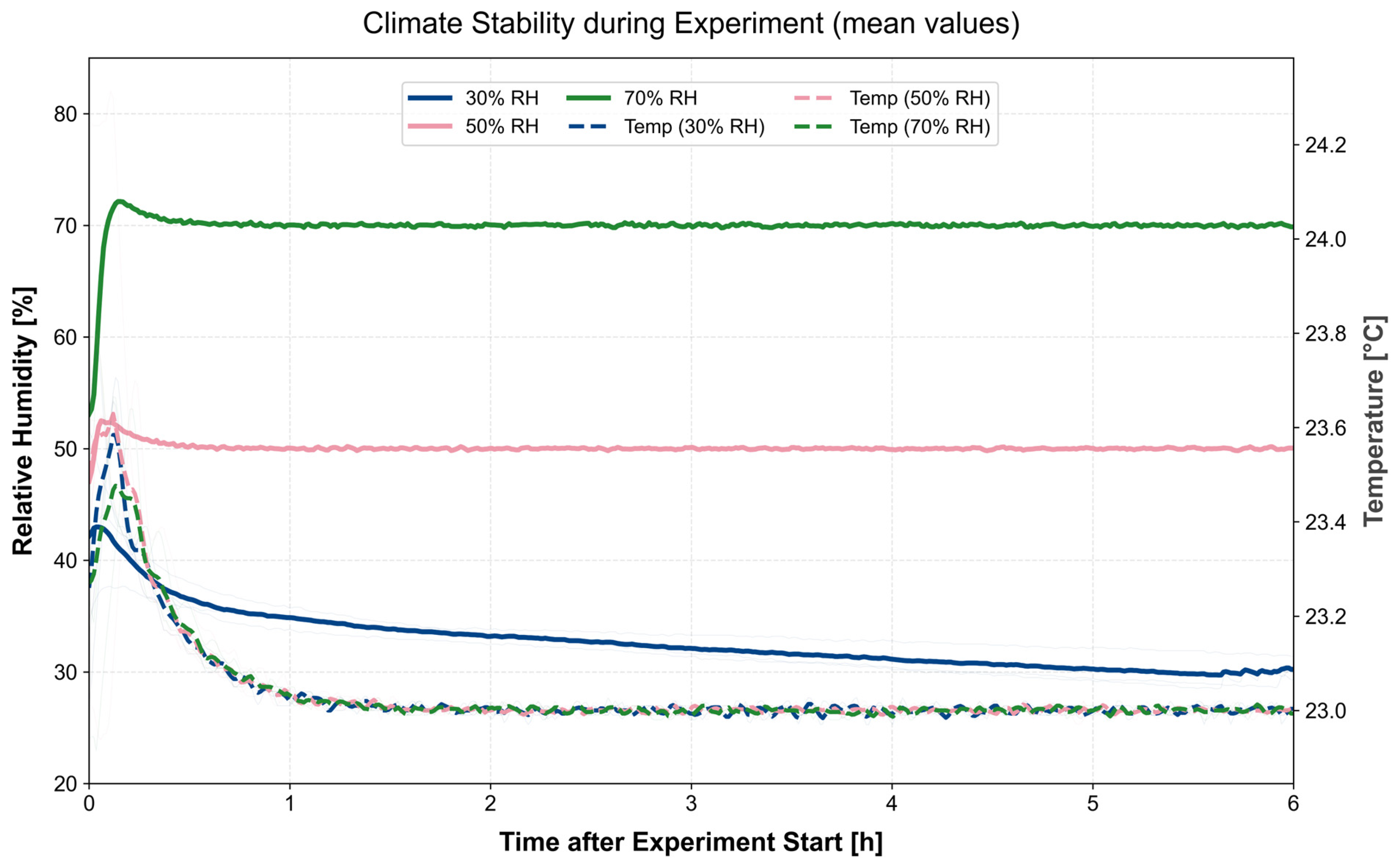
Figure 5 illustrates the temporal stability of RH and temperature during the experimental runs. While the 50% and 70% RH levels stabilized within 0.5 h, the 30% RH target required 5–6 h to reach steady-state conditions. This stabilization delay resulted from the substantial initial moisture load released by the substrates, which temporarily exceeded the dehumidification capacity of the environmental chamber.
This environmental lag accounts for the anomalous initial increase in evaporation rates observed in vermiculite, pumice (4–7 mm), and clay granules. The temporary RH spike upon opening the chamber, coupled with the immediate moisture release from the porous materials, triggered accelerated evaporation until the target conditions stabilized. Only after this initial adjustment phase did the evaporation rates follow the expected declining trend, aligning with the progressive reduction in substrate water content.

3.4. SEM Images

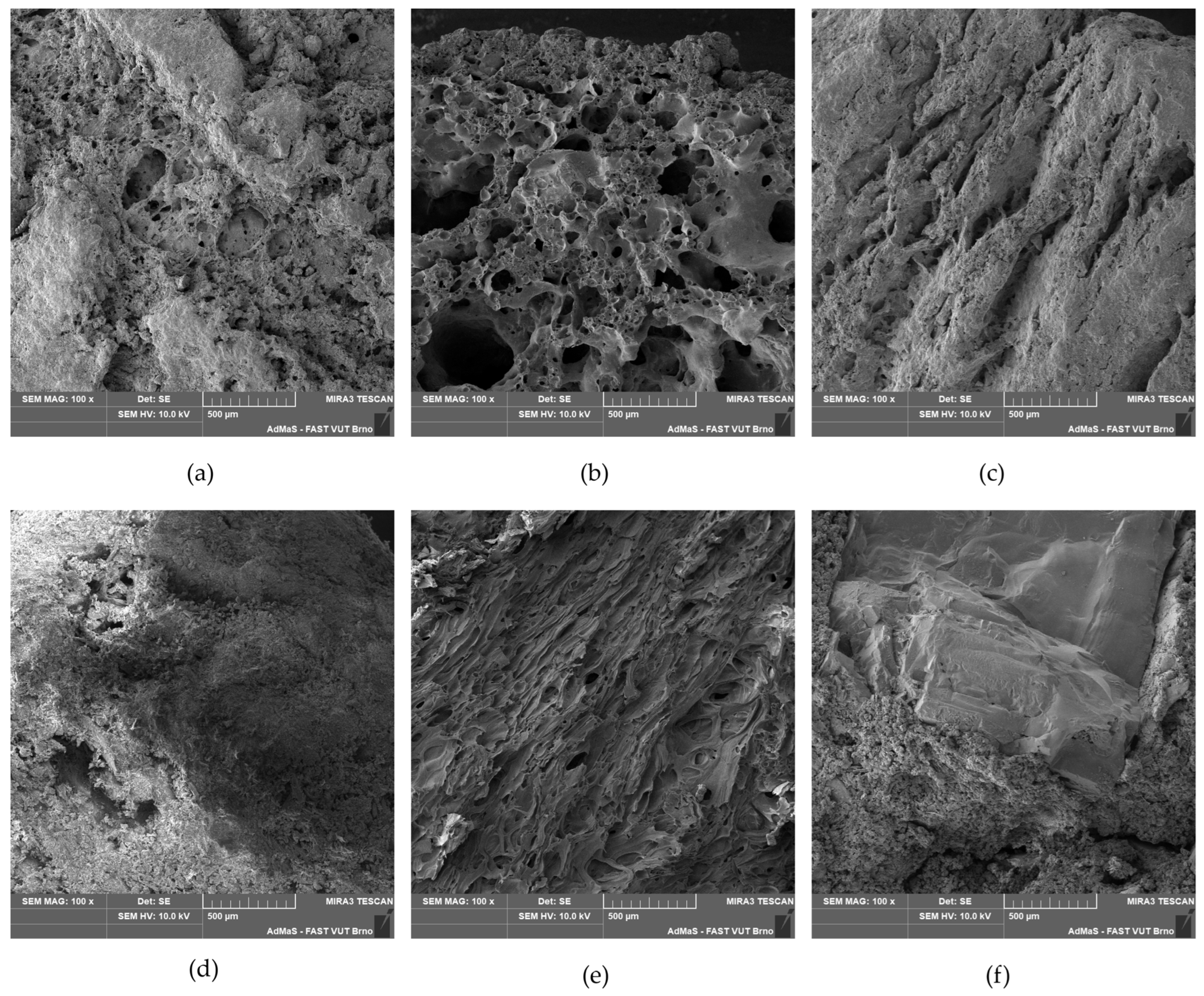
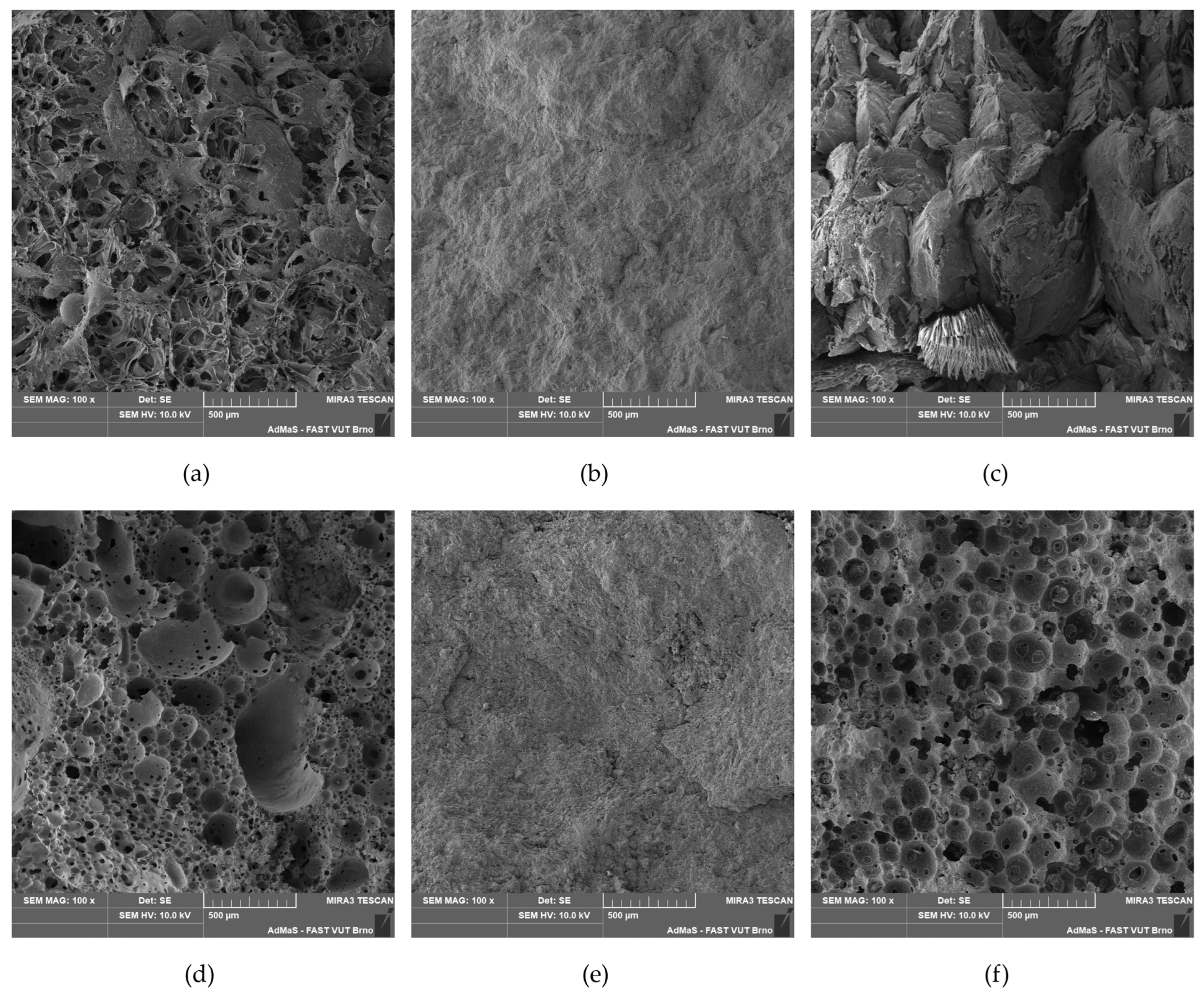
The morphological characteristics of the investigated substrates, obtained via Scanning Electron Microscopy (SEM), are displayed in Figure 6 and Figure 7. The images reveal distinct structural variations in pore geometry, surface roughness, and internal architecture among the media.
For expanded clay, the analysis included both an intact granule (Figure 6a) and a cross-sectioned specimen (Figure 6b). The surface of the intact grain is characterized by a largely closed, vitrified pore structure. In contrast, the interior of the fractured grain exhibits significantly larger, open-pored cavities, indicating a pronounced structural gradient between the outer shell and the core.
Expanded slate exhibited a distinct surface morphology characterized by elongated, parallel furrows with widths ranging from approximately 50 to 150 µm. The pumice fractions (1–3 mm and 7–14 mm) exhibited a similar pore structure at 100x magnification, with the 1–3 mm fraction appearing more finely porous. The 4–7 mm pumice fraction, however, displayed a markedly different geometry characterized by sharper edges and a more expansive, open-pored surface.
Perlite possesses a highly open-pored structure characterized by a network of interconnected cavities. A characteristic feature of this substrate is the presence of particularly narrow pore necks between the larger voids. Zeolite and brick chips showed the lowest visible surface porosity at the selected magnification; no distinct pore openings were detectable on their surfaces.
Lava and clay granules presented surfaces with numerous cavities, though their pore distribution patterns differed. In the industrially manufactured clay granules, the pores are predominantly regular in shape with diameters ranging from approximately 50 to 250 µm. Conversely, lava granules exhibit a heterogeneous pore size distribution, spanning from approximately 5 µm to over 500 µm. The SEM images of vermiculite clearly resolve the lamellar structures typical of 2:1 layer silicates, showing a high density of parallel mineral plates.

4. Discussion

4.1. General Suitability for Indoor Horticulture

The FLL [10] defines minimum physical and chemical requirements for mineral substrates in indoor applications. These standards mandate a maximum water capacity of ≥20 vol.%, an air capacity of ≥15 vol.%, and a pH value between 5.5 and 8.0. All pumice fractions, zeolite, vermiculite and clay granules fully comply with these requirements. Other investigated substrates, in their pure form, either fall below the required water capacity or slightly exceed the pH limits.
However, these standards offer only a static evaluation, as they do not account for dynamic properties such as AWC, pore size distribution, or the biological affinity of the media regarding root physiological activity [18]. Chemical constraints, such as high EC, can often be remediated through leaching [39], while pH levels can be adjusted via targeted fertilization [40]. Consequently, even materials that fail certain FLL criteria remain viable for horticultural use, particularly as components in engineered substrate blends, provided the physical matrix supports long-term root vitality [41].

4.2. Thematic Comparison of Physicochemical Properties with the Literature

The observed variations in substrate properties compared to the existing literature can be systematically attributed to three primary drivers: pore interconnectivity, particle size distribution, and geological or industrial origin.

4.2.1. The Role of Pore Interconnectivity and Morphology on Water Availability

Total porosity alone is an insufficient predictor for AWC. Instead, the interconnectivity of the pore network and the pore size distribution are the decisive factors. This is most evident when contrasting clay granules with expanded clay. Clay granules demonstrated superior hydraulic performance, offering the highest AWC among all tested substrates. SEM imaging (Figure 7) revealed a well-developed, interconnected meso- and macropore network that facilitates optimal water uptake and release. This continuous network also provides the essential architectural framework for the elongation of fine roots and the radial expansion of root hairs [42].
Conversely, expanded clay exhibited a closed-pore surface morphology. While its maximum water capacity (~11 vol.%) aligned with the literature [15], its AWC (2.74 vol.%) and porosity (~56 vol.%) were notably lower than reference values [15,43,44]. The closed surface prevents water intrusion into internal pores, rendering the theoretical pore volume hydraulically inactive. As confirmed by SEM imaging (Figure 6), open macropores are confined to the grain interior and remain inaccessible unless the grain is mechanically fractured. From a physiological perspective, these closed-pore structures act as physical barriers that inhibit root hair penetration, effectively restricting biological activity to the exterior surface and limiting the functional rooting volume [18,45].
These findings highlight a fundamental limitation in current substrate evaluation: expanded clay possesses high total porosity, yet its contribution to the soil–plant–atmosphere continuum (SPAC) is disproportionately low. In mineral Technosols, such closed-pore structures create a “dead volume” that fulfills regulatory requirements but offers no hydraulic utility [43]. Furthermore, in substrates with low interconnectivity, matric suction increases rapidly during drying, creating an energy barrier that induces plant water stress even when residual moisture is physically present [46].
Vermiculite presents a different morphological challenge. While SEM analysis confirmed a laminar structure—responsible for high total water retention—much of this water is tightly bound by strong matric forces, reducing the actual AWC. Furthermore, repeated wetting-drying cycles caused noticeable exfoliation. This structural degradation raises concerns regarding long-term stability in permanent indoor systems, as released fine fragments may migrate and occlude interparticle pores, ultimately impairing drainage and aeration [47]. In contrast, the high mechanical stability of mineral components like pumice and zeolite ensures long-term longevity, preventing the collapse of air-filled porosity over multi-year cultivation [48,49].
While SEM imaging provides qualitative evidence for the role of pore morphology in governing AWC, a fully quantitative characterization of the pore structure–hydraulic performance relationship would require additional methods such as mercury intrusion porosimetry or water retention curve fitting. These analyses represent a valuable direction for future work and would allow a more rigorous validation of the mechanistic interpretations presented here.

4.2.2. Influence of Particle Size on Hydraulic Properties

The specific particle size fraction profoundly impacts hydraulic behavior, often explaining deviations from previous studies, as it simultaneously dictates the volume of interstitial voids available for root anchoring and gas exchange [18]. Within the pumice fractions, calculated Easily Available Water (EAW) confirmed the trends reported by Maloupa et al. [13] and Gizas and Savvas [14], demonstrating that EAW decreases with increasing grain size. However, unlike the exponential decay reported by Gizas and Savvas [14], the moisture release curves in this study were flatter, mirroring the findings of Sahin et al. [24]. SEM analysis clarified this anomaly: while the 4–7 mm pumice fraction exhibited typical porous morphology [50], the other fractions contained surface impurities that likely obscured the pore network [51].
Particle size effects also explain deviations in other substrates. For lava granules, the measured AWC (10 vol.%) exceeded the reference value (<6 vol.%) reported by Flores-Ramírez et al. [15]. This improvement in water retention is directly attributed to the finer grain size used in the present study compared to the much coarser fraction (5–15 mm) analyzed in the reference. Similarly, discrepancies in density and porosity for expanded slate compared to Matlock and Rowe [22] are primarily due to their use of a significantly finer fraction (<1 mm) compared to the 4–7 mm fraction tested here.

4.2.3. Chemical Variability and Geological Origin

The geological parent rock and industrial processing methods dictate the chemical suitability of the media. The pH of expanded slate (8.3) exceeded values reported in the literature [15,22], likely reflecting regional parent rock variations [52]. Zeolite aligned closely with physical parameters from Fotouhi Ghazvini et al. [21], but its distinct differences in pH, EC, and water-holding capacity underscore the high variability of natural zeolites. Perlite exhibited a remarkably low EC (14.3 μS·cm−1) but a pH (8.73) exceeding the neutral range reported by Sahin et al. [24] and Grillas et al. [53], while its physical properties and retention curve strongly matched existing data [13,24,47,53]. Recycled materials like brick chips exhibited higher EC levels, likely due to residual impurities from the demolition and recycling process.

4.3. Evaporation Dynamics: Capillary Transport and Irrigation Management

The evaporation characteristics of a substrate determine both its contribution to indoor climate regulation and the required irrigation. Joint analysis reveals three distinct mechanisms governing water loss: initial porosity-driven evaporation, mesopore-driven capillary replenishment, and the impact of atmospheric humidity.

4.3.1. Initial Evaporation and the Dominance of Total Porosity

During the initial drying phase, evaporation rates showed a strong positive correlation with total porosity, consistent with findings by Or et al. [27]. Highly porous substrates like vermiculite (5.59 g·h−1) and clay granules (5.39 g·h−1) exhibited the highest initial rates, confirming that large pore volumes enhance surface gas exchange [27,54,55]. Notably, total porosity exerted a stronger influence on initial water loss than volumetric water content. For instance, perlite and lava granules showed high initial evaporation rates despite having only moderate water retention (24.2 and 17.0 vol.%, respectively), as their high macropore fractions promote rapid early evaporation but offer little resistance to water loss [27,54].

4.3.2. Transition to Transport-Limited Evaporation and Capillary Replenishment

As drying progresses, the substrate’s ability to maintain evaporation depends entirely on its capillary transport capacity [54,55]. Compared to studies on clay-rich soils [38,56,57], the investigated mineral substrates generally exhibit significantly shorter Constant-Rate Periods (CRPs).
Expanded clay showed an abrupt decline in evaporation, indicating insufficient capillary replenishment due to its closed-pore structure and its inherently low water retention capacity. In practical indoor horticulture, this leads to rapid desiccation of the upper substrate layer, necessitating high-frequency, low-volume irrigation scheduling to protect shallow roots. In contrast, vermiculite and clay granules maintained stable rates with only a minor reduction within 48 h. This demonstrates a critical horticultural principle: while total porosity governs initial evaporation, the proportion of capillary-active mesopores is the decisive factor for sustained moisture release [30,54].
However, an abrupt cessation of evaporation—as observed in expanded clay or coarse pumice—is not necessarily a disadvantage. When the upper substrate layer dries rapidly, capillary continuity is broken, and this dry top layer acts as an effective “evaporation barrier” (similar to a mulch layer) [26]. This mechanism is advantageous for drought-tolerant or deep-rooted plant species, which can access water in lower horizons and tolerate temporary surface desiccation without physiological impairment [58,59]. Conversely, for shallow-rooted species, sustained capillary substrates such as clay granules are preferable [59,60]. Furthermore, limiting sustained evaporation is a crucial strategy in modern sealed buildings to keep indoor RH below the critical 60% threshold, mitigating the risk of structural dampness and fungal growth. Substrate choice thus depends on whether the primary objective is stable surface hydration or moisture conservation.

4.3.3. The Influence of Grain Size on Evaporation and Aeration

The influence of grain size distribution on hydraulic behavior is particularly evident within the pumice fractions [19]. Coarse pumice (7–14 mm) showed a higher initial evaporation rate (5.03 g·h−1) than fine pumice (4.24 g·h−1), despite having a lower overall water capacity. Interestingly, the evaporation process for both fractions followed a continuous exponential decline from the onset rather than a classic Stage I constant-rate stage [61].
This behavior indicates that the evaporation is limited by the internal moisture transport (hydraulic properties) rather than atmospheric demand—a characteristic of the Falling Rate Stage (Stage II) described by Hillel [61]. In coarse-grained media, large inter-particle macropores empty rapidly, causing an almost immediate drop in unsaturated hydraulic conductivity (K). This creates a “hydraulic barrier” at the surface. Higher initial rates in the coarse fraction are attributed to larger pore diameters. These facilitate enhanced convective gas exchange and reduce the thickness of the diffusive boundary layer within the upper substrate profile [30,54].
In contrast, finer pumice fractions demonstrate a more gradual decline due to a higher density of narrow pores that maintain a more stable liquid-phase flux to the surface [16]. This ensures sustained capillary continuity, preventing the abrupt disruption of water transport typically observed in coarser materials.

4.3.4. Humidity Anomaly and Physiological Implications for Irrigation Management

The experiments reveal complex interactions between substrate hydraulics and atmospheric humidity. Occasionally, higher long-term evaporation was observed at higher humidity levels. This “humidity anomaly” is explained by the rapid breakdown of hydraulic continuity at low humidity [20,27]. At 30% RH, the extreme initial evaporation causes the capillary supply from deeper layers to dry up abruptly, severely limiting further loss. At 70% RH, slower initial evaporation keeps the capillary network intact, allowing more water to remain available for sustained evaporation over time.
From a physiological standpoint, the early disruption of capillary continuity at 30% RH represents a high-risk scenario for root hair integrity. Functional impairment and root hair shrinkage initiate at relatively high matric potentials, meaning damage occurs well before the substrate appears critically dry [58,59]. As demonstrated by Duddek et al. [58], more than 85% of the variance in root water uptake is explained by the hair-induced increase in root–soil contact—a relationship that deteriorates rapidly under dry conditions [59].
This finding identifies a critical ‘hydraulic continuity threshold’ for mineral substrates in indoor environments. The data reveal that these media exhibit an exceptionally short or virtually absent CRP, with capillary continuity collapsing within the first hours of drying regardless of humidity level [27,62]. Consequently, proactive irrigation management is essential rather than merely beneficial. For shallow-rooted species, this hydraulic vulnerability is acute, as surface desiccation directly reduces water availability at the root zone. In contrast, rapid surface desiccation is of lesser physiological consequence for deep-rooted species, which can access moisture reserves in deeper horizons. Where shallow-rooted species predominate, pulse-irrigation strategies are effectively aligned with the goal of maintaining residual capillary connectivity in the critical upper zone [63]. Beyond plant physiology, deliberate irrigation timing and volume serve as a lever for regulating indoor RH. This represents a shift from conventional volume-based methods toward a hydraulics-, root-architecture-, and climate-informed irrigation approach.

4.4. Limitations and Future Outlook

While this study provides a fundamental physical characterization of substrate hydraulics, certain limitations must be acknowledged. First, this study isolates the abiotic properties of the substrate to establish a physical baseline. Consequently, the calculated AWC and ‘hydraulic continuity threshold’ still require validation against biological drivers, such as root water uptake or transpiration. In a living system, root hairs and the secretion of mucilage could potentially modify the substrate’s capillary dynamics.
Second, the evaporation experiments were conducted under strictly controlled laboratory conditions (23 °C, constant RH, constant air velocity and no solar radiation). In real-world urban or indoor horticulture, diurnal temperature fluctuations and high vapor pressure deficits driven by lighting or direct sunlight would likely accelerate surface evaporation and increase complexity. Future research should therefore integrate plant-growth trials to quantify the evolving architecture of the root–substrate interface and its impact on moisture transport in situ.

5. Conclusions

This study provides a systematic evaluation of the hydraulic and evaporation characteristics of purely mineral substrates for indoor horticulture, addressing a significant gap in integrative growing media research. The results demonstrate that pore architecture and hydraulic connectivity—rather than total porosity alone—are the decisive determinants of water retention and evaporation kinetics. The physicochemical characterization revealed substantial variability across the 11 samples, with dry bulk density spanning more than an 8-fold range (<0.12 to >0.99 g·cm−3) and volumetric water content ranging from 11.0 vol.% (expanded clay) to 46.6 vol.% (vermiculite), confirming that substrate type and particle size fraction are primary drivers of hydraulic performance. During the initial drying stage, evaporation was primarily governed by total surface porosity. However, as drying progressed, the internal pore network and capillary replenishment capacity became the dominant factors controlling moisture release. Clay granules and vermiculite exhibited the most temporally stable evaporation behavior, maintaining sustained capillary flux. In contrast, expanded clay, zeolite, and brick chips showed an abrupt decline in evaporation rates due to their closed-pore morphology. This characteristic renders them suitable as functional “vapor barriers” or mulch-type top layers designed to conserve moisture in deeper substrate horizons. The findings confirm that while finer grain sizes generally enhance water retention, the actual AWC is primarily governed by pore interconnectivity. Furthermore, chemical properties were found to be dictated by geogenic origin and industrial processing methods rather than particle size. The resulting dataset provides a robust empirical basis for substrate selection and blend design. These results are particularly valuable for integration into hygrothermal simulation models aimed at regulating indoor RH within the optimal 40–60% range. Future research should now address the dynamic interactions between substrate hydraulics and plant-specific factors (root architecture, leaf area) under variable environmental conditions—including solar radiation and diurnal fluctuations—to refine irrigation management in real-world indoor environments.

Supplementary Materials

The following supporting information can be downloaded at: https://www.mdpi.com/article/10.3390/horticulturae12040501/s1. Supplementary Note S1: Physical and Chemical Measurement Protocols; Supplementary Note S2: Automated Evaporation Setup.

Author Contributions

Conceptualization, J.S., E.S., A.K. and J.Z.; methodology, J.S., E.S. and A.S.; formal analysis, J.S. and E.S.; investigation, J.S.; resources, J.S., J.Z. and A.K.; data curation, J.S. and A.S.; writing—original draft preparation, J.S.; writing—review and editing, J.S., E.S. and J.P.; visualization, J.S.; supervision, J.Z., E.S., J.P. and A.K.; project administration, J.Z. and A.K.; funding acquisition, J.Z. and A.K. All authors have read and agreed to the published version of the manuscript.

Funding

This paper was elaborated and funded within the bilateral research project between the Czech Republic and Austria (Czech Science Foundation: 23-06542K, Austrian Science Fund (FWF): 10.55776/I6398) “Study of the hygroaccumulative effect of natural based materials and their influence on the moisture stability of the indoor environment of buildings”. For open access purposes, the author has applied a CC BY public copyright license to any author-accepted manuscript version arising from this submission (https://creativecommons.org/licenses/by/4.0/, accessed on 8 January 2026).

Data Availability Statement

The original contributions presented in this study are included in the article/Supplementary Materials. Further inquiries can be directed to the corresponding author.

Acknowledgments

During the preparation of this work, the authors used the large language models Gemini (Google, Gemini 3 Flash) and ChatGPT (OpenAI, GPT-5.3) in order to translate the original text from German to English and improve readability. After using these tools, the authors reviewed and edited the content as needed and take full responsibility for the content of the published article. Open Access Funding by TU Wien.

Conflicts of Interest

The authors declare no conflicts of interest.

Abbreviations

The following abbreviations are used in this manuscript:
FLLForschungsgesellschaft Landschaftsentwicklung Landschaftsbau e.V.
RHRelative Humidity
SEMScanning Electron Microscopy
ECElectrical Conductivity
AWCPlant-available water content
PWPPermanent Wilting Point
CRPConstante-Rate Period

Appendix A

Table A1. Average evaporation rates (g·h−1) in 24-h intervals.
SubstrateNo. 1 No. 2 No. 3 No. 4 No. 5 No. 6
RH30%50%70%30%50%70%30%50%70%30%50%70%30%50%70%30%50%70%
0–24 h3.843.302.053.672.741.884.243.492.324.003.602.005.034.032.464.974.371.91
24–48 h2.041.420.901.701.510.941.921.901.612.112.461.332.652.601.602.442.021.57
48–72 h1.151.110.541.231.210.681.291.221.031.651.490.841.972.071.201.811.290.96
72–96 h0.630.830.430.951.050.581.050.940.801.401.060.661.521.671.001.421.040.65
96–120 h0.360.600.380.750.880.520.910.780.691.260.800.561.181.310.861.060.900.54
120–144 h0.200.410.330.560.720.450.820.660.601.170.680.500.881.010.770.800.810.46
144–168 h0.110.270.300.430.610.420.770.600.541.070.600.480.570.780.690.620.730.41
substrateNo. 7 No. 8 No. 9 N. 10 No. 11
RH30%50%70%30%50%70%30%50%70%30%50%70%30%50%70%
0–24 h3.212.421.895.594.242.774.874.052.403.413.122.295.394.163.11
24–48 h1.971.361.102.943.582.172.651.921.251.601.601.183.383.082.85
48–72 h1.331.051.001.852.091.561.941.460.791.191.150.752.162.192.15
72–96 h1.100.810.871.471.491.141.321.270.661.000.960.611.671.651.65
96–120 h0.900.700.671.281.220.960.901.140.610.850.830.571.421.41.40
120–144 h0.700.630.581.151.040.820.611.020.540.750.750.521.241.251.25
144–168 h0.510.540.451.050.950.740.400.900.480.620.660.471.111.131.13
Table A2. Exponential fit parameters and total cumulative evaporation for all substrates at three relative humidity levels. The coefficients a (pre-exponential factor; g·h−1), b (decay rate; h−1), and c (asymptotic offset; g·h−1) were derived from the negative exponential model f(x) = a·e(bx) + c. Total evaporation was determined by numerical integration of the fitted curves over a 192 h period.
No.RH (%)a (g·h−1)b (h−1)c (g·h−1)R2Total Evaporation (g)
130−5.1753−0.02974−0.12950.9853194.27
150−4.9585−0.05664−0.57530.9454184.19
170−2.4090−0.0364−0.29670.9684115.28
230−5.3222−0.05595−0.72940.9496216.2
250−3.7570−0.06792−0.89150.9138203.3
270−2.2160−0.04501−0.47410.9826127.91
330−4.9872−0.03971−0.79700.9848257.72
350−3.8668−0.02986−0.58200.9923225.23
370−2.3432−0.02134−0.43410.9819178.7
430−4.2124−0.0409−1.16940.9824297.01
450−3.9975−0.02003−0.35430.9871252.2
470−2.0452−0.02433−0.40760.9574150.25
530−6.0046−0.03412−0.89040.9653323.17
550−4.0349−0.0185−0.66110.9841317.78
570−2.3380−0.02702−0.70260.9621202.18
630−5.5886−0.02953−0.72070.9482307.5
650−5.0416−0.03646−0.74130.9791261.02
670−2.1195−0.01601−0.18390.9721153.63
730−3.6227−0.03071−0.66760.9524228.07
750−2.9143−0.0459−0.67710.9411175.87
770−1.9989−0.04115−0.63520.8681153.97
830−5.8740−0.02834−0.93160.9464360.02
850−4.7012−0.01503−0.34490.9566344.32
870−2.7868−0.01494−0.41550.9462239.86
930−5.9749−0.02913−0.56470.9622297.19
950−4.6449−0.04447−1.03050.9675275.46
970−2.6451−0.03508−0.49690.9577157.68
1030−4.6486−0.05795−0.83600.967218.99
1050−4.0414−0.05416−0.82610.9242211.73
1070−2.4698−0.03335−0.45840.9374149.87
1130−5.5247−0.02332−0.92340.9772385.26
1150−3.7629−0.01618−0.88490.9333363.62
1170−3.2189−0.00937−0.29730.9662320.34

References

  1. World Health Organization. WHO Guidelines for Indoor Air Quality: Selected Pollutants; World Health Organization, Regional Office for Europe: Copenhagen, Denmark, 2010. [Google Scholar]
  2. World Health Organisation. Combined or Multiple Exposure to Health Stressors in Indoor Built Environments; Sarigiannis, D.A., Ed.; WHO: Bonn, Germany, 2013. [Google Scholar]
  3. van den Bogerd, N.; Dijkstra, S.C.; Tanja-Dijkstra, K.; de Boer, M.R.; Seidell, J.C.; Koole, S.L.; Maas, J. Greening the Classroom: Three Field Experiments on the Effects of Indoor Nature on Students’ Attention, Well-Being, and Perceived Environmental Quality. Build. Environ. 2020, 171, 106675. [Google Scholar] [CrossRef]
  4. Fonseca, F.; Paschoalino, M.; Silva, L. Health and Well-Being Benefits of Outdoor and Indoor Vertical Greening Systems: A Review. Sustainability 2023, 15, 4107. [Google Scholar] [CrossRef]
  5. Wang, C.; Hu, Q.; Zhou, Z.; Li, D.; Wu, L. Adding Green to Architectures: Empirical Research Based on Indoor Vertical Greening of the Emotional Promotion on Adolescents. Buildings 2024, 14, 2251. [Google Scholar] [CrossRef]
  6. Yazici, K. The Effect of Indoor Ornamental Plant Groups on Spatial Perception: Expert Evaluations on Aesthetic and Functional Use. Int. J. Ecosyst. Ecol. Sci. (IJEES) 2025, 15, 201. [Google Scholar] [CrossRef]
  7. Scott, T.L.; Masser, B.M.; Pachana, N.A. Using Indoor Plants and Natural Elements to Positively Impact Occupants of Residential Aged-Care Facilities. Acta Hortic. 2016, 1121, 7–12. [Google Scholar] [CrossRef]
  8. Hollands, J.; Korjenic, A. Indirect Economic Effects of Vertical Indoor Green in the Context of Reduced Sick Leave in Offices. Sustainability 2021, 13, 2256. [Google Scholar] [CrossRef]
  9. Pichlhöfer, A.; Sesto, E.; Hollands, J.; Korjenic, A. Health-Related Benefits of Different Indoor Plant Species in a School Setting. Sustainability 2021, 13, 9566. [Google Scholar] [CrossRef]
  10. Forschungsgesellschaft Landschaftsentwicklung Landschaftsbau e. V. (FLL). Innenraumbegrünungsrichtlinien Richtlinien für Planung, Bau und Instand- Haltung von Innenraumbegrünungen; FLL: Bonn, Germany, 2024; Volume 4. [Google Scholar]
  11. Bustami, R.A.; Beecham, S.; Hopeward, J. The Influence of Plant Type, Substrate and Irrigation Regime on Living Wall Performance in a Semi-Arid Climate. Environments 2023, 10, 26. [Google Scholar] [CrossRef]
  12. Zoes, V.; Paré, T.; Dinel, H.; Dumontet, S.; Pasquale, V.; Scopa, A. Growth and Yield of Tomato Cultivated on Composted Duck Excreta Enriched Wood Shavings and Source-Separated Municipal Solid Waste. Ital. J. Agron. 2011, 6, e2. [Google Scholar] [CrossRef]
  13. Maloupa, E.; Abou Hadid, A.; Prasad, M.; Kavafakis, C.H. Response of Cucumber and Tomato Plants to Different Substrates Mixtures of Pumice in Substrate Culture. Acta Hortic. 2001, 87, 593–600. [Google Scholar] [CrossRef]
  14. Gizas, G.; Savvas, D. Particle Size and Hydraulic Properties of Pumice Affect Growth and Yield of Greenhouse Crops in Soilless Culture. HortScience 2007, 42, 1274–1280. [Google Scholar] [CrossRef]
  15. Flores-Ramírez, E.; Abel, S.; Nehls, T. Water Retention Characteristics of Coarse Porous Materials to Construct Purpose-Designed Plant Growing Media. Soil Sci. Plant Nutr. 2018, 64, 181–189. [Google Scholar] [CrossRef]
  16. Lehmann, P.; Or, D. Evaporation and Capillary Coupling across Vertical Textural Contrasts in Porous Media. Phys. Rev. E 2009, 80, 046318. [Google Scholar] [CrossRef] [PubMed]
  17. Schindler, U.; Müller, L. Hydraulic Performance of Horticultural Substrates—2. Development of an Evaluation Framework. Horticulturae 2016, 3, 6. [Google Scholar] [CrossRef]
  18. Raviv, M.; Lieth, J.H.; Bar-Tal, A. Soilless Culture: Theory and Practice; Academic Press: Cambridge, MA, USA, 2019. [Google Scholar]
  19. Hillel, D. Introduction to Environmental Soil Physics; Elsevier: Amsterdam, The Netherlands, 2003. [Google Scholar]
  20. Gardner, W.R.; Hillel, D.I. The Relation of External Evaporative Conditions to the Drying of Soils. J. Geophys. Res. 1962, 67, 4319–4325. [Google Scholar] [CrossRef]
  21. Fotouhi Ghazvini, R.; Payvast, G.; Azarian, H. Effect of Clinoptilolitic-Zeolite and Perlite Mixtures on the Yield and Quality of Strawberry in Soil-Less Culture. Int. J. Agric. Biol. 2007, 7, 885–888. [Google Scholar]
  22. Matlock, J.M.; Rowe, D.B. The Suitability of Crushed Porcelain and Foamed Glass as Alternatives to Heat-Expanded Shale in Green Roof Substrates: An Assessment of Plant Growth, Substrate Moisture, and Thermal Regulation. Ecol. Eng. 2016, 94, 244–254. [Google Scholar] [CrossRef]
  23. Forschungsgesellschaft Landschaftsentwickelung Landschaftsbau e. V. (FLL). Dachbegrünungsrichtlinien—Richtlinien für Die Planung, Bau und Instandhaltungen von Dachbegrünungen; FLL: Bonn, Germany, 2018; Volume 6. [Google Scholar]
  24. Sahin, U.; Ercisli, S.; Anapali, O.; Esitken, A. Regional Distribution and Some Physico-Chemical and Physical Properties of Some Substrates Used in Horticulture in Turkey. Acta Hortic. 2004, 21, 177–183. [Google Scholar] [CrossRef]
  25. Song, W.-K.; Cui, Y.-J.; Tang, A.M.; Ding, W.-Q.; Tran, T.D. Experimental Study on Water Evaporation from Sand Using Environmental Chamber. Can. Geotech. J. 2014, 51, 115–128. [Google Scholar] [CrossRef]
  26. Anlauf, R.; Rehrmann, P.; Bettin, A. Reduction of Evaporation from Plant Containers with Cover Layers of Pine Bark Mulch. Eur. J. Hortic. Sci. 2016, 81, 49–59. [Google Scholar] [CrossRef]
  27. Or, D.; Lehmann, P.; Shahraeeni, E.; Shokri, N. Advances in Soil Evaporation Physics—A Review. Vadose Zone J. 2013, 12, 1–16. [Google Scholar] [CrossRef]
  28. Nguyen, Y.Q.; Nguyen, V.T.; Huynh, M.-T.T. An Experimental Study on Evaporation Rate of Indoor Plants. AIP Conf. Proc. 2024, 3090, 060002. [Google Scholar] [CrossRef]
  29. Sieker, H.; Steyer, R.; Büter, B.; Leßmann, D.; von Tils, R.; Becker, C.; Hübner, S. Untersuchung der Potentiale für Die Nutzung von Regenwasser zur Verdunstungskühlung in Städten; Umweltbundesamt: Dessau-Roßlau, Germany, 2019. [Google Scholar]
  30. Shokri, N.; Lehmann, P.; Or, D. Characteristics of Evaporation from Partially Wettable Porous Media. Water Resour. Res. 2009, 45, W02415. [Google Scholar] [CrossRef]
  31. ISO 565:1990; Test sieves—Metal wire cloth, perforated metal plate and electroformed sheet—Nominal sizes of openings. International Organization for Standardization: Geneva, Switzerland, 1990.
  32. DIN EN ISO 11508; Bodenbeschaffenheit—Bestimmung der Kornrohdichte. Deutsches Institut für Normung (DIN): Berlin, Germany, 2018.
  33. VDLUFA (Verband Deutscher Landwirtschaftlicher Untersuchungs- und Forschungsanstalten). Methodenbuch Band I Böden—C 4.: Volumenanteil an Feststoffen und Poren Sowie Porengrössenverteilung; VDLUFA-Verlag: Darmstadt, Germany, 1991. [Google Scholar]
  34. DIN EN 13037; Bodenverbesserungsmittel und Kultursubstrate—Bestimmung des PH-Wertes. Deutsches Institut für Normung (DIN): Berlin, Germany, 2012.
  35. DIN EN 13038; Bodenverbesserungsmittel und Kultursubstrate—Bestimmung der Elektrischen Leitfähigkeit. Deutsches Institut für Normung (DIN): Berlin, Germany, 2012.
  36. DIN EN ISO 11274; Bodenbeschaffenheit—Bestimmung des Wasserrückhaltevermögens—Laborverfahren. Deutsches Institut für Normung (DIN): Berlin, Germany, 2012.
  37. DIN EN 13041; Bodenverbesserungsmittel und Kultursubstrate—Bestimmung der Physikalischen Eigenschaften—Rohdichte (Trocken), Luftkapazität, Wasserkapazität, Schrumpfungswert und Gesamtporenvolumen. Deutsches Institut für Normung (DIN): Berlin, Germany, 2012.
  38. Teng, J.; Zhang, X.; Zhang, S.; Zhao, C.; Sheng, D. An Analytical Model for Evaporation from Unsaturated Soil. Comput. Geotech. 2019, 108, 107–116. [Google Scholar] [CrossRef]
  39. Cretu, A.; Fisher, P.R.; Huang, J.; Argo, W.R. The Effect of Leaching on Electrical Conductivity and Nitrogen in Propagation Media. Acta Hortic. 2011, 891, 103–109. [Google Scholar] [CrossRef]
  40. Jia, S.; Yuan, D.; Li, W.; He, W.; Raza, S.; Kuzyakov, Y.; Zamanian, K.; Zhao, X. Soil Chemical Properties Depending on Fertilization and Management in China: A Meta-Analysis. Agronomy 2022, 12, 2501. [Google Scholar] [CrossRef]
  41. Bengough, A.G.; McKenzie, B.M.; Hallett, P.D.; Valentine, T.A. Root Elongation, Water Stress, and Mechanical Impedance: A Review of Limiting Stresses and Beneficial Root Tip Traits. J. Exp. Bot. 2011, 62, 59–68. [Google Scholar] [CrossRef]
  42. Nobel, P.S. Physicochemical and Environmental Plant Physiology; Academic Press: Cambridge, MA, USA, 2020. [Google Scholar]
  43. Rashad, A.M. Lightweight Expanded Clay Aggregate as a Building Material—An Overview. Constr. Build. Mater. 2018, 170, 757–775. [Google Scholar] [CrossRef]
  44. Zukri, A.; Nazir, R.; Said, K.N.M.; Moayedi, H. Physical and Mechanical Properties of Lightweight Expanded Clay Aggregate (LECA). MATEC Web Conf. 2018, 250, 01016. [Google Scholar] [CrossRef]
  45. Bengough, A.G.; Bransby, M.F.; Hans, J.; McKenna, S.J.; Roberts, T.J.; Valentine, T.A. Root Responses to Soil Physical Conditions; Growth Dynamics from Field to Cell. J. Exp. Bot. 2006, 57, 437–447. [Google Scholar] [CrossRef]
  46. Taiz, L.; Zeiger, E.; Møller, I.M.; Murphy, A.S. Plant Physiology and Development; Sinauer Associates: Sunderland, MA, USA; Oxford Univeristy Press: Oxford, UK, 2018. [Google Scholar]
  47. Lemaire, F. Physical, Chemical and Biological Properties of Growing Medium. Acta Hortic. 1995, 396, 273–284. [Google Scholar] [CrossRef]
  48. Lehmann, A. Technosols and Other Proposals on Urban Soils for the WRB (World Reference Base for Soil Resources). Int. Agrophys. 2006, 20, 129–134. [Google Scholar]
  49. Zhao, R.; Sofkova-Bobcheva, S.; Cartmill, D.L.; Hardy, D.; Zernack, A. Comparative Evaluation of Pumice as a Soilless Substrate for Indoor Rubus idaeus L. Cultivation. N. Z. J. Crop Hortic. Sci. 2024, 52, 280–297. [Google Scholar] [CrossRef]
  50. Deniz, V. Effects of Mill Speed on Kinetic Breakage Parameters of Four Different Particulate Pumices. Part. Sci. Technol. 2013, 31, 101–108. [Google Scholar] [CrossRef]
  51. Kılıçer, A. Production of Pumice-Containing Nanofibers by Electrospinning Technique. Mater. Sci.-Pol. 2022, 40, 206–213. [Google Scholar] [CrossRef]
  52. Handreck, K.; Black, N. Growing Media for Ornamental Plants and Turf; University of New South Wales: Sydney, Australia, 2010; Volume 4. [Google Scholar]
  53. Grillas, S.; Lucas, M.; Bardopoulou, E.; Sarafopoulos, S.; Voulgari, M. Perlite Based Soilless Culture Systems: Current Commercial Applications and Prospects. Acta Hortic. 2001, 548, 105–114. [Google Scholar] [CrossRef]
  54. Lehmann, P.; Assouline, S.; Or, D. Characteristic Lengths Affecting Evaporative Drying of Porous Media. Phys. Rev. E 2008, 77, 056309. [Google Scholar] [CrossRef]
  55. An, N.; Tang, C.-S.; Xu, S.-K.; Gong, X.-P.; Shi, B.; Inyang, H.I. Effects of Soil Characteristics on Moisture Evaporation. Eng. Geol. 2018, 239, 126–135. [Google Scholar] [CrossRef]
  56. Fekri, M.; Kasmaei, L.S. Effects of Windy Sand and LECA Mulches on Decreasing Evaporation from Soil Surface. Arab. J. Geosci. 2013, 6, 163–168. [Google Scholar] [CrossRef]
  57. Aydin, M.; Yang, S.L.; Kurt, N.; Yano, T. Test of a Simple Model for Estimating Evaporation from Bare Soils in Different Environments. Ecol. Modell. 2005, 182, 91–105. [Google Scholar] [CrossRef]
  58. Duddek, P.; Carminati, A.; Koebernick, N.; Ohmann, L.; Lovric, G.; Delzon, S.; Rodriguez-Dominguez, C.M.; King, A.; Ahmed, M.A. The Impact of Drought-Induced Root and Root Hair Shrinkage on Root–Soil Contact. Plant Physiol. 2022, 189, 1232–1236. [Google Scholar] [CrossRef]
  59. Cai, G.; Ahmed, M.A. The Role of Root Hairs in Water Uptake: Recent Advances and Future Perspectives. J. Exp. Bot. 2022, 73, 3330–3338. [Google Scholar] [CrossRef]
  60. Duddek, P.; Ahmed, M.A.; Javaux, M.; Vanderborght, J.; Lovric, G.; King, A.; Carminati, A. The Effect of Root Hairs on Root Water Uptake Is Determined by Root–Soil Contact and Root Hair Shrinkage. New Phytol. 2023, 240, 2484–2497. [Google Scholar] [CrossRef]
  61. Daniel, H. Environmental Soil Physics: Fundamentals, Applications, and Environmental Considerations; Elsevier Science: Amsterdam, The Netherlands, 2014. [Google Scholar]
  62. Li, Z.; Vanderborght, J.; Smits, K.M. The Effect of the Top Soil Layer on Moisture and Evaporation Dynamics. Vadose Zone J. 2020, 19, e20049. [Google Scholar] [CrossRef]
  63. Carroll, J.L.; Orr, S.T.; Benedict, C.A.; DeVetter, L.W.; Bryla, D.R. Feasibility of Using Pulse Drip Irrigation for Increasing Growth, Yield, and Water Productivity of Red Raspberry. HortScience 2024, 59, 332–339. [Google Scholar] [CrossRef]
Figure 1. Water retention characteristics: (a) expanded clay, expanded slate, pumice (1–3 mm, 4–7 mm, 7–14 mm) and perlite; (b) zeolite, vermiculite, lava granules, brick chip and clay granules.
Horticulturae 12 00501 g001
Figure 2. Evaporation (g·h−1) and water content (vol.%) of substrates at 30%, 50% and 70% relative humidity (RH) at 23 °C: expanded clay, expanded slate, pumice (1–3 mm) and pumice (4–7 mm).
Horticulturae 12 00501 g002
Figure 3. Evaporation (g·h−1) and water content (vol.%) of substrates at 30%, 50% and 70% RH at 23 °C: pumice (7–14 mm), perlite, zeolite and vermiculite.
Horticulturae 12 00501 g003
Figure 4. Evaporation (g·h−1) and water content (vol.%) of substrates at 30%, 50% and 70% RH at 23 °C: lava granules, brick chips and clay granules.
Horticulturae 12 00501 g004
Figure 5. Temporal evolution of relative humidity (solid lines) and temperature (dashed lines) during the first 6 h of the experiments. Data are grouped by target RH levels (30%, 50%, and 70%) and shown as mean values across all replicates.
Horticulturae 12 00501 g005
Figure 6. SEM images of expanded clay (whole) (a), expanded clay (broken) (b), expanded slate (c), pumice (1–3 mm) (d), pumice (4–7 mm) (e) and pumice (7–14 mm) (f). Images (af) were collected individually and arranged for comparison.
Horticulturae 12 00501 g006
Figure 7. SEM images of perlite (a), zeolite (b), vermiculite (c), lava granulate (d), brick chips (e) and clay granules (f). Images (af) were collected individually and arranged for comparison.
Horticulturae 12 00501 g007
Table 1. Overview of the substrates examined, grain size distribution and origin of the raw material. 1 (Dehner Gartencenter GmbH & Co. KG, Rain, Germany); 2 (Kakteen-Haage, Erfurt, Germany); 3 (ExoticPlants, Blumau, Austria); 4 (SYBotanica, Arnheim, Germany); 5 (Seramis, Mogendorf, Germany).
Nr.SubstrateGrain SizeOrigin
1expanded clay 14–7 mmAustria
2expanded slate 24–7 mmGermany
3pumice 31–3 mmItaly
4pumice 34–7 mmItaly
5pumice 37–14 mmItaly
6perlite 44–7 mmGreece
7zeolite 44–7 mmGermany
8Vermiculite 44–7 mmSouth Africa
9lava granules 24–7 mmIceland
10brick chips 24–7 mmunknown
11clay granules 54–7 mmGermany
Table 2. Physical and chemical properties of the investigated substrates: ρb,dry—Dry bulk density (g·cm−3); ρb,saturated—Saturated bulk density (g·cm−3); ρs—Particle density (g·cm−3); ϑg—Gravimetric water content (wt.%); ϑv—Volumetric water content (vol.%); P—Porosity (vol.%); A—Air content at maximum water holding capacity (vol.%); PWP—Permanent wilting point (vol.%); AWC—Plant-available water content (vol.%); pH—pH value (-); EC—Electrical conductivity (μS·cm−1).
No.ρb,dryρb,saturatedρsϑgϑvPAPWPAWCpHEC
10.670.781.5316.5711.0456.4145.378.302.748.40135.60
20.750.881.8016.5312.4458.2445.809.393.068.3311.33
30.480.802.0167.1432.1176.2544.1510.6021.507.7342.63
40.530.832.0755.9729.8674.1944.3320.339.527.7342.63
50.560.841.9049.1627.6470.3442.7016.0311.627.7342.63
60.100.341.15247.4624.2391.5067.2712.4311.798.7314.33
71.021.222.3420.2220.5556.5135.962.0818.477.436.63
80.110.582.33410.2146.6095.1248.5225.1721.436.109.17
90.630.802.1326.8917.0270.3053.286.9610.067.476.47
100.991.162.5216.6716.5160.7344.223.7812.738.57293.00
110.340.732.56115.0138.7986.8048.017.8630.937.9312.73
Disclaimer/Publisher’s Note: The statements, opinions and data contained in all publications are solely those of the individual author(s) and contributor(s) and not of MDPI and/or the editor(s). MDPI and/or the editor(s) disclaim responsibility for any injury to people or property resulting from any ideas, methods, instructions or products referred to in the content.