Article

Effects of Two Biostimulant Formulations on Growth, Nutritional Value, and Antioxidant Properties of Sonchus oleraceus L. Plants Grown Under Low and High Salinity


by
Nikolaos Polyzos
1,
Antonios Chrysargyris
2,
Nikolaos Tzortzakis
2 and
Spyridon A. Petropoulos
1,*
1
Laboratory of Vegetable Production, Department of Agriculture Crop Production and Rural Environment, University of Thessaly, Fytokou Street, 38446 Volos, Greece
2
Department of Agricultural Sciences, Biotechnology and Food Science, Cyprus University of Technology, 3603 Limassol, Cyprus
*
Author to whom correspondence should be addressed.
Horticulturae 2026, 12(4), 449; https://doi.org/10.3390/horticulturae12040449
Submission received: 2 March 2026 / Revised: 1 April 2026 / Accepted: 2 April 2026 / Published: 5 April 2026
(This article belongs to the Special Issue Physiology of Vegetables Under Biotic/Abiotic Stress Conditions)

Abstract

In this work, we assessed the impacts of biostimulant application on pot-grown Sonchus oleraceus L. plants under saline conditions. The biostimulant products tested were an experimental formulation based on humic and fulvic acids (HF) and the commercial product Sipfol Star® (SS), which comprises amino acids (mainly glutamic acid, alanine, and aspartic acid). Our results highlight that biostimulants mitigated the negative impacts of high salinity only on specific morphological traits, such as the dry matter of leaves. Accordingly, the HF treatment reduced the fat and protein content (under low and high salinity, respectively) and energetic value (under high salinity), while the carbohydrate content increased under high salinity for the SS treatment and the untreated plants compared to the respective treatment under low salinity. The nitrogen content of leaves was negatively affected by biostimulant application at high salinity, whereas the HF and SS treatments induced the accumulation of sodium and potassium under high salinity compared to the untreated plants. The total flavonoid content also increased in biostimulant-treated plants under high salinity, whereas no effects on total phenol content were recorded. Moreover, the plants treated with biostimulants under low salinity conditions showed higher antioxidant activity for the ferric reducing antioxidant power (FRAP) assay than the respective treatments at high salinity and the control treatment. The content of oxidative markers, such as malondialdehyde (MDA) and hydrogen peroxide (H2O2), was higher under low-salinity levels, whereas biostimulant-treated plants showed the lowest content under high salinity. Overall, the application of biostimulants showed promising results in mitigating the adverse impacts of high salinity on S. oleraceus plants. However, further research is needed on more biostimulatory products and application regimes (e.g., different doses and application times) to elucidate the mechanisms of action and bolster the positive effects of this sustainable agronomic tool.

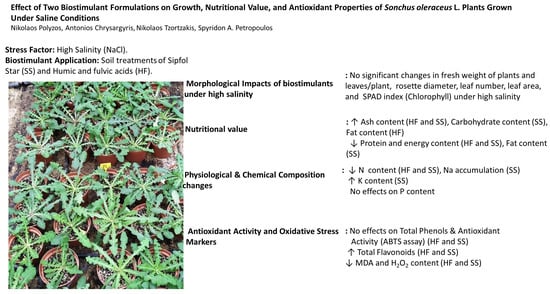
Graphical Abstract

1. Introduction

Salinity is a major abiotic stress that poses a significant threat to the agricultural sector by decreasing the available arable land and reducing crop yield and quality [1,2]. It is anticipated that by 2050, salinity will severely affect 50% of the world’s cultivated land, with an annual increase of 10% in salinized areas [3,4]. Moreover, human activities, such as the overuse of fertilizers, poor drainage systems, low-efficiency irrigation methods, insufficient and/or uneven distribution of rainfall throughout the year, and the intrusion of seawater in aquifers, aggravate the effects of salinity on agricultural lands and global crop production [5,6].
The negative effects of salinity on crop production are mainly attributed to enhanced soil osmotic pressure, toxicity of specific ions, nutritional imbalances, and/or an interaction of these factors that can severely impact the yield and quality traits of crops, particularly vegetable species, which are usually sensitive to saline conditions [7,8,9]. Osmotic stress due to high ionic concentrations in the rhizosphere, mostly Na+ and, to a lesser extent, Cl, Mg2+, SO42−, and HCO3, results in limited water uptake by plants, although these effects may vary depending on stress intensity and exposure time [10]. Moreover, each crop exhibits a varied response to increased salinity; halophytes, in particular, exhibit considerable salt tolerance owing to the genetic background associated with protective mechanisms at the cellular and tissue levels and adaptation of morphological parameters and/or physiological aspects [11]. In vegetable crops, the most common adverse impacts of high salinity refer to the photosynthetic process and transpiration, as plants attempt to respond to limited water availability due to osmotic stress through the closure of stomata, which results in reduced CO2 uptake and inhibited photosynthesis, and eventually inhibits plant growth and development [12]. Additionally, high salinity may induce hormonal imbalance due to increased biosynthesis of abscisic acid for stomatal closure regulation, as well as dysfunction in carbohydrate metabolism and protein synthesis [13,14]. Other adversities associated with saline conditions refer to the loss of turgor pressure in the leaves due to osmotic differences between the soil and plant tissues in the rhizosphere, while the increased concentration of Na+ and Cl ions in the soil can affect cation exchange capacity and reduce the absorption of essential minerals, such as potassium (K+), calcium (Ca2+), and magnesium (Mg2+) [15,16].
In recent years, the scientific community has made substantial efforts to address the challenges of high salinity in horticultural crop production through various approaches, including traditional breeding, gene cloning, and genetic engineering. However, although these strategies are promising, their effectiveness is limited or unexplored because of restricted genetic diversity and increasing genetic erosion, as well as the complexity of salinity tolerance mechanisms and plant adaptation [17,18]. Therefore, the focus has shifted to sustainable and eco-friendly agronomic practices, such as the application of biostimulants, which have shown promising results in mitigating the impacts of abiotic stressors [19,20]. The application of biostimulants can have both direct and indirect effects on plant metabolism and physiology by improving soil properties, modifying several molecular processes, improving crop water and nutrient use efficiency, improving primary and secondary metabolism, stimulating growth development, and mitigating abiotic stress [21,22].
Humic substances, including humic acids, fulvic acids, and humins, are natural components of soil organic matter derived from the decomposition of residues from plants, animals, and microbes, as well as from the metabolism of soil microbes [23]. The main benefits of the application of these substances to crops are reflected in the increased uptake of nutrients and water, as well as improved tolerance to saline conditions; however, the physiological mechanisms of action of these compounds are not fully understood because of the molecular complexity of biostimulant formulations and the diverse responses of crops [24,25]. Humic substances are also involved in the regulation of several molecular mechanisms, such as photosynthetic activity, protein synthesis, enzymatic activity, and hormone regulation [26,27]. Similarly, N-containing compounds and protein hydrolysates are mixtures of amino acids, peptides, and polypeptides, usually extracted from plants through chemical, enzymatic, and thermal processes [10]. Several reports have highlighted that proteins obtained from both animal and plant sources can significantly enhance crop performance and the overall tolerance of plants in saline environments [28,29]. Protein hydrolysates can trigger the production of primary and secondary metabolites, whereas the small peptides and amino acids included in these formulations are responsible for phytohormone activity [30,31]. Moreover, they can increase nutrient uptake because of their high content of soluble and mobile macronutrients, improve enzymatic activity through increased microbial activity in the soil, and enlarge the plant root system [32,33].
Currently, there is an increase in consumer demand for functional and healthy foods produced using sustainable practices. In this context, there is a rekindled interest in wild edible species, which, although they have been traditionally used in local cuisine throughout the countries around the Mediterranean basin for centuries, have been marginalized in recent decades by the dominance of conventional crops and the transition of modern people to an urban lifestyle [34]. Sonchus oleraceus, also known as common sowthistle, sowthistle, or milk thistle, is a member of the Asteraceae family. Along with S. asper and S. arvensis, it is considered a noxious weed of several crops worldwide [35]. It is also highly appreciated in folk medicine as a medicinal plant with several therapeutic properties [36], while its leaves are edible with a distinct taste and are commonly consumed boiled or in mixtures with other leafy vegetables in salads and pies [37,38]. According to Sadia et al. [39], S. oleraceus plants contribute to species evenness and floristic diversity in saline soil ecosystems, whereas Huang et al. [40] reported high tolerance to heavy metal pollution. Moscatelli et al. [41] also highlighted the ability of the species to survive in soils where salinity increases because of the establishment of photovoltaic panels. Therefore, these findings indicate the presence of adaptation and protective mechanisms against abiotic stressors that increase the resilience of S. oleraceus plants under arduous conditions. Recently, there has been a great effort from the scientific community to establish cultivation protocols and best practice guides for the commercialization and exploitation of wild edible species as emerging vegetable crops, including Cichorium spinosum [42], Scolymus hispanicus [43], Crithmum maritimum [44,45], Portulaca oleracea [46], and S. oleraceus [35]. Moreover, Polyzos et al. [47] evaluated the effect of biostimulant application on S. oleraceus plants grown under greenhouse conditions; however, there is a lack of information in scientific reports regarding the application of biostimulant formulations in the cultivation of wild edible species and their effects on crop performance and the mitigation of abiotic stressors.
The response of plants to biostimulant application may vary depending on the rate, method, and timing of application, as well as the composition of the biostimulant formulation [48]. Therefore, further studies are needed to better understand the mechanisms of action and molecular pathways involved and to maximize their efficiency in terms of plant productivity and the quality of the final products. In this context, the main objectives of this work were: a) to evaluate the impact of two biostimulant products, one containing humic and fulvic acids and the other consisting of amino acids, on S. oleraceus L. plants; b) to identify the response of S. oleraceus plants to saline conditions; and c) to assess the efficiency of these biostimulant formulations in alleviating salinity stress in S. oleraceus plants. As S. oleraceus is a wild species that is tolerant to arduous conditions but has not been adequately tested under conventional growing conditions, the main hypothesis of the study was to test whether the studied salinity levels had any negative effects on plant development and metabolic processes and whether the studied biostimulant formulations could mitigate such effects (if any). Our results provide valuable insights into the cultivation of an underexplored wild edible species under conditions of increased salinity, in alignment with sustainable agricultural practices driven by climate change.

2. Materials and Methods

2.1. Plant Material and Experimental Conditions

This study was performed at the experimental field of the University of Thessaly, located in the Velestino area of central Greece. Seeds of S. oleraceus L. were placed in seed trays filled with peat (Klassman-Deilmann KTS2, Geeste, Germany) on 4 November 2022, and young plants were transferred on December 1, 2022, to two-liter pots containing peat and perlite (1:1; v/v) when they had 3–4 true leaves. After transplantation, the pots were placed in an unheated glasshouse and remained there until the completion of the experiment. The temperatures (mean, maximum, and minimum) throughout the growing period are presented in Figure 1. The biostimulant treatments included two formulations: (a) humic and fulvic acids (HF) in a balanced solution (70:30 ratio) derived from a refined leonardite extract (pH: 8.53 and organic carbon: 4.83%) and (b) a commercial biostimulant product, Sipfol Star (SS; Sipcam Oxon Group, Lodi, Italy), containing 17.6% (v/v) total amino acids and 9% (v/v) free amino acids, including glutamic acid (70% of total amino acids) and alanine and aspartic acid in lesser amounts. For the first biostimulant product, the roots of S. oleraceus L. seedlings were immersed for 5 s prior to transplanting in a 0.3% (v/v) solution. Subsequently, the biostimulant solution (0.1%; v/v) was applied using 50 mL per pot via root drenching on days 5, 15, and 25 after transplantation. Sipfol Star was applied using a 0.5% (v/v) solution at a dosage of 50 mL per pot. The biostimulant formulation was applied with foliage spraying on days 5, 15, and 25 after transplantation.
Two salinity treatment solutions were prepared: 0 mM NaCl and 70 mM NaCl, respectively. The first solution (0 mM NaCl) was prepared using a 20-20-20 (N-P-K) fertilizer to achieve a concentration of 200 mg/L of N-P-K without any salt addition, while the second solution was similar to the first, except for the addition of appropriate amounts of NaCl until the desired concentration (70 mM NaCl) was achieved. After transplantation, all plants were fertigated with the first solution at a dose of 100 mL per pot until plant establishment (three weeks after transplantation). Subsequently, half of the pots were fertigated with the same solution until harvest, whereas the remaining pots were fertigated with the second solution (70 mM NaCl). Each treatment consisted of 20 pots arranged in a completely randomized design (CRD), totaling 120 pots.
The harvest took place on 7 February 2023, when the rosettes of the plants reached a marketable size [47]. Prior to harvest, the chlorophyll content index of the leaves (SPAD index) was evaluated with SPAD 502 m (Konica Minolta Optics, Osaka, Japan), whereas at harvest, the following measurements were taken: weight of plants (g), number and weight of leaves per plant (g), rosette diameter (cm), dry matter content of leaves (%), and leaf area (cm2). Leaf area was calculated in the leaves of five plants (n = 5) using a leaf area meter (Li-COR, 3100, Lincoln, NE, USA), whereas dry weight was estimated after placing the fresh leaves of the same five plants in an oven at 70 °C until the weight stabilized [47]. A pooled sample of fresh leaves for each treatment was kept at −80 °C, freeze-dried, ground into a powder, and stored at −80 °C until further analysis [47]. Additional pooled samples (four samples of fresh leaves from fifteen plants) were collected and placed in a forced-air oven to dry for mineral content analysis.

2.2. Chemical Analyses

2.2.1. Nutritional Value

The macronutrient content of leaves, such as protein, fat, carbohydrates, and ash, was determined in quadruplicate for each treatment (four replicate pooled samples from fifteen plants) according to the AOAC methods [49]. For protein, fat, and ash content determination, the Kjeldahl (N × 6.25), Soxhlet extraction with petroleum ether, and incineration (at 600 °C) protocols were implemented, respectively [47]. According to the Regulation of the European Union (European Regulation No. 1169/2011, 2011), protein and carbohydrates provide 4 kcal/g, while fat provides 9 kcal/g. Therefore, the carbohydrate content was calculated by difference, while the energy contribution of S. oleraceus leaves was calculated based on the following Formula (1):
Energy (kcal/100 g dw) = 4 × (g protein + g carbohydrate) + 9 × (g fat)

2.2.2. Mineral Content

For the assessment of mineral content, four replicate pooled samples from fifteen plants were used for each treatment after drying in a forced-air oven (see Section 2.1). The dried samples were ashed at 450 °C for 6 h, and the potassium (K+), sodium (Na+), and phosphorus (P) contents were determined according to the protocol described by Chrysargyris et al. [50]. Nitrogen content was determined using the Kjeldahl method, as described in Section 2.2.1. The K/Na ratio was also computed.

2.2.3. Total Phenols, Total Flavonoids, and Antioxidant Activity Assays

Ethanolic extracts from freeze-dried leaf samples (four replicate pooled samples from fifteen plants for each treatment) were prepared [50]. The plant material (2 g) was macerated with 5 mL of pure ethanol (1:2.5 v/v) in a shaking incubator at 160 rpm in glass bottles. After 72 h of shaking, the material was filtered, and the ethanolic extract was concentrated to dryness and used in a rotary evaporator unit. Following drying, methanolic plant extracts (4 mg dried extracts) were prepared using 50% methanol (2 mL), resulting in a final concentration of 2 mg/mL. The methanolic extracts were used to determine the total phenol content according to the Folin–Ciocalteu method after slight modifications (500 μL methanolic extract in Folin–Ciocalteu reagent) [50]. The results were presented as gallic acid equivalents per gram of extract. Total flavonoid content was determined using a modified aluminum chloride (AlCl3) colorimetric assay [50], and the results were expressed as rutin equivalents per g of extract.
Antioxidant activity was determined using the following assays: the ferric reducing antioxidant power (FRAP) assay with measurements at 593 nm; the 2,2-diphenyl-1-picrylhydrazyl (DPPH) assay with measurements at 517 nm; and the 2,2′-azinobis-(3-ethylbenzothiazoline-6-sulfonic acid) (ABTS) assay with measurements at 734 nm. For all these assays, Trolox ((±)-6-hydroxy-2,5,7,8-tetramethylchromane-2-carboxylic acid) was used as a positive control, and the results were expressed as Trolox equivalents (mg Trolox per g of extract) [50].

2.2.4. Lipid Peroxidation and Hydrogen Peroxide

Hydrogen peroxide (H2O2) and malondialdehyde (MDA) contents in S. oleraceus leaves were assessed based on the methodology previously described by Chrysargyris et al. [50] in four pooled samples per treatment.

2.3. Statistical Analysis

Prior to statistical analysis, all data were checked for normal distribution with the Shapiro–Wilk test. The data were analyzed with a two-way analysis of variance (ANOVA) using JMP v. 16.1 (SAS Institute Inc., Cary, NC, USA) software package. Mean differences were assessed with Duncan’s multiple range test (DMRT) at p = 0.05. The correlations between all the studied parameters were determined with JMP v. 16.1 (SAS Institute Inc., Cary, NC, USA) software package, taking into account the Pearson correlation coefficient (r) and significance for p < 0.05 and p < 0.01.

3. Results

3.1. Plant Growth

The growth traits of S. oleraceus L. plants are demonstrated in Table 1. According to our results, salinity significantly affected the number of leaves and rosette diameter, where a decrease at high salinity was recorded (15.6 and 22.4 cm, respectively). Similarly, the tested biostimulant formulations affected the SPAD index and the dry matter content of leaves, where, in both cases, the application of humic and fulvic acids (HF) resulted in the highest overall values (32.7 and 8.2%, respectively), being significantly different from the SS treatment. The interaction of the studied factors was also significant for the SPAD value and dry matter content of leaves, where the application of HF and untreated plants under a low salinity regime resulted in the highest overall values (35.5 and 8.7%, respectively). In contrast, the lowest values were observed for Sipfol Star (SS) under high and low salinity conditions for the SPAD index and dry matter content (24.7 and 6.5%, respectively).

3.2. Nutritional Value

The nutritional value in terms of ash, protein, carbohydrate content, and energetic value is demonstrated in Table 2. The results highlight that the impact of the salinity regime on the content of key components of proximate composition varied, with low salinity having a positive impact on protein content and energetic value (22.0% and 368 kcal/100 g dw, respectively), whereas high salinity was beneficial for ash and carbohydrate content (16.7% and 63.5%, respectively). Regarding the effect of the studied biostimulant formulations, the untreated plants recorded the highest overall values for protein content (20.1%) and energetic value (362 kcal/100 g dw), being significantly different from the HF treatment. Similarly, the fat content was the highest for the SS treatment (4.6%), being significantly different from the HF treatment. Finally, the HF treatment recorded the highest carbohydrate content (63.3%), with a significant difference from the control treatment. Moreover, a significant interaction between the two factors was observed for all nutritional value traits. In particular, the ash content showed higher values at high salinity, regardless of the biostimulant treatment (including the control treatment). A contrasting trend was recorded for protein content and energetic value, with treatments at low salinity showing higher values than the respective treatments at high salinity. For fat content, a varied response was noted, with the SS and HF treatments recording the highest and lowest overall values, respectively, under the low-salinity regime. For carbohydrate content, high salinity induced the biosynthesis of carbohydrates in the untreated plants (no biostimulants added) and those treated with the SS formulation.

3.3. Mineral Composition

The content of minerals is presented in Table 3. Our findings indicate that N and P contents were negatively affected by high-salinity conditions (a reduction of 30.4% and 8.4%, respectively), whereas the content of Na+ almost tripled (increased by 165%) under high salinity, and no effects were recorded for K+ content. Consequently, the K+/Na+ ratio was reduced from 4.3 to 1.6 under high-salinity conditions. Regarding the biostimulant effects, a varied response was noted, showing a reduction in N content when plants were treated with biostimulants, especially the HF treatment, which differed significantly from the control treatment. A contrasting trend was noted for K content, where both biostimulants increased their content compared to the control plants, whereas only the SS treatment differed significantly from the other two treatments. For Na content, the HF treatment recorded the highest overall values, which were significantly different from those of the other two treatments, whereas a contrasting trend was noted for the K+/Na+ ratio. Finally, none of the tested biostimulants had a significant effect on P content. The interaction between biostimulant application and salinity regime was significant for all macronutrients, except for P content, where no effects were recorded. In particular, high salinity reduced N content and the K/Na ratio, regardless of the applied biostimulant (including the control treatment), whereas the SS treatment increased K content under high and low salinity conditions compared to the other two treatments. Moreover, the SS treatment showed efficacy in controlling Na accumulation under high-salinity conditions compared to the control and HF treatments, where the highest overall content was recorded (24.7 g/kg).

3.4. Phytochemical Properties

The bioactive properties of S. oleraceus L. plants under the tested salinity levels and biostimulant application are presented in Table 4. None of the studied factors or their interaction significantly affected the total phenol content. In contrast, high salinity increased the total flavonoid content, whereas no significant effect was recorded for the biostimulant formulations. The interaction between biostimulant application and salinity regime had a significant impact, with the highest flavonoid content noted for the high salinity × SS treatment. These findings indicate that high salinity triggered the biosynthesis of polyphenols, especially flavonoids. However, the studied formulations were capable of mitigating salinity stress at low salinity levels, where total phenol and flavonoid contents were comparable to the respective control treatment.
The highest antioxidant activity was recorded under low-salinity conditions for all assays performed, whereas the application of biostimulants had no significant effect, regardless of the assay. In contrast, the interaction between the two factors was significant only for the DPPH and FRAP assays, where the plants treated with biostimulants under low-salinity conditions showed higher activity than the respective treatments under high-salinity and control treatments. However, these differences were significant only in the FRAP assay when compared to the respective treatments under low-salinity conditions. A similar trend was noted for the two oxidative stress markers evaluated in this study, namely hydrogen peroxide (H2O2) and malondialdehyde (MDA), with higher content levels under low-salinity conditions. Moreover, the content of oxidative stress markers was reduced with biostimulant application, regardless of the formulation. Finally, the interaction of the tested factors was significant for both oxidative stress markers, with content increasing under low-salinity conditions for all the biostimulant formulations compared with the respective treatments under high-salinity conditions.

3.5. Correlation Analysis

The results of the correlation analysis (correlation coefficients and probabilities) are presented in Supplementary Tables S1 and S2 and Figure S1. Regarding growth traits, a strong positive correlation (coefficient value > 0.8) was observed between plant weight, leaf weight, and leaf area. Moreover, energy content was positively correlated with protein and N content, whereas a negative correlation was noted between carbohydrate content and protein and N content. Sodium and ash contents were positively correlated, as were ash and Na+ with total flavonoid content. In contrast, Na+ content was negatively correlated with energy, protein, and N content, and a contrasting trend was observed for the K+/Na+ ratio. Flavonoid content was also negatively correlated with energy content, and MDA content showed a positive correlation with protein, energy, and N content, and the K+/Na+ ratio, and a negative correlation with ash, Na+, and total flavonoid content. Finally, FRAP and ABTS showed a moderate correlation (coefficient value 0.7 < r < 0.8).

4. Discussion

4.1. Plant Growth Parameters

High salinity may adversely affect plant growth traits, as evidenced by the reduced fresh biomass yield and number of leaves in other cultivated and wild edible species [51,52,53]. Moreover, biostimulant application may exert stress-mitigating effects and result in plant growth comparable to that under optimal conditions [23,54,55,56,57], although the response may vary depending on the species and biostimulant formulation, as well as on stress intensity [52,58]. The findings of this study indicate that high-salinity conditions had a negative impact only on the leaf number and the rosette diameter of S. oleraceus plants, whereas the correlation analysis indicated that the weight of the plant was positively correlated with the weight and area of the leaves, a finding that is common for species in which leaves account for the largest portion of the plant [23,54,55,56,57]. Moreover, HF treatment increased the SPAD index and dry matter content of leaves and showed a numerical increase in all growth traits compared to the SS treatment. Machado and Serralheiro [4] suggested that saline conditions significantly reduced chlorophyll content index (SPAD values) in spinach, resulting in impaired photosynthetic activity owing to reduced stomatal and mesophyll conductance and reduced light absorbance. In contrast to our study, Rouphael et al. [59] reported that protein hydrolysates and seaweed extracts significantly improved SPAD index values in spinach plants, a result that could be attributed to the optimal conditions implemented in that study compared with salinity stress in our work and/or the different species tested. According to the literature, the degree to which salinity affects leaf number may vary depending on the species or cultivar within the same species, as tolerant genotypes can maintain a leaf number comparable to that under control conditions, whereas sensitive genotypes tend to show significantly reduced leaf numbers [60]. These negative effects are associated with osmotic stress, ionic imbalance, and secondary oxidative stress [61], which disrupt nutrient and water uptake, resulting in photosynthetic impairment and allocation of resources for stress mitigation, and consequently reduced cell division and formation of new leaves [60,62,63].
Several studies have suggested that the application of humic and fulvic acid helps plants maintain chlorophyll content index and photosynthetic efficiency under high salinity, as well as induces the accumulation of antioxidant compounds, increases antioxidant enzyme activity, and improves the availability and mobilization of soil nutrients [64,65,66]. Moreover, humic and fulvic acids may stimulate the growth of shoots and roots and improve plant tolerance under saline conditions by enhancing water and nutrient uptake [24,67]. In contrast, protein hydrolysates and nitrogenous compounds, such as amino acids, may improve nutrient uptake and metabolism, induce osmotic adjustment and accumulation of secondary metabolites, and activate antioxidant defense mechanisms that help plants sustain growth and development under salinity stress [28,57,68]. Rouphael et al. [23] suggested that protein hydrolysate application in lettuce plants grown under saline conditions triggered the accumulation of phytoalexin precursors and glucosinolates, which acted as osmoregulators, whereas a significant reduction in Na+ and Cl was also observed. However, despite the beneficial effects highlighted in the literature, a varied response to biostimulant application under abiotic stress conditions should be expected owing to differences among various species in terms of mechanisms of action and the intensity of stress that underpin specific responses [69,70,71].

4.2. Nutritional Value

The nutritional value of S. oleraceus leaves grown in plants was affected by salinity, biostimulant application, and their interaction, depending on the specific macronutrient. In particular, ash and carbohydrate content increased under high salinity, whereas protein content showed the opposite trend. The application of HF treatment significantly reduced fat, protein, and energy content and increased carbohydrate content compared with the control treatment. In contrast, SS treatment was more effective in stress mitigation and allowed plants to sustain primary metabolism and retain macronutrient content comparable to that of the control treatment. Moreover, carbohydrate, protein, and N content were negatively correlated, which is in accordance with the results of Mulick et al. [72], whereas the positive correlation of energy with protein and N contents has also been reported for fenugreek [73]. The stress-alleviating effects of biostimulant formulations on nutritional composition have been well documented in several horticultural species, such as lettuce [74], common beans [75], spinach [20], and processing tomatoes [76]. The negative impact of HF treatment observed in our study is in contrast to literature reports, which highlight an increase in macronutrients due to improved nutrient uptake and growth stimulation, and consequently, enhanced biosynthesis of assimilates [66,77]. Moreover, the increased uptake of Na+ in plants treated with humic and fulvic acids under high salinity could lead to nutrient imbalance and reduced uptake of essential nutrients such as nitrogen, which affects the biosynthesis of primary metabolites and proteins [78,79]. Humic and fulvic acid application is usually associated with the mitigation of lipid peroxidation and increased membrane integrity, as evidenced by increased lipid content [80], which is in contrast to our work. Regarding the application of biostimulant formulations based on nitrogenous compounds, Ertani and Schiavon [32] noted that the application of a protein hydrolysate-based biostimulant significantly enhanced protein accumulation in Zea mays plants grown under both non-saline and saline environments by stimulating nitrogen assimilation. Moreover, Rouphael et al. [23] and Lucini et al. [28] indicated that plant-derived protein hydrolysates not only improved the tolerance of lettuce plants to saline conditions through maintaining osmotic balance and hormone-like activities but also enhanced protein accumulation and their overall nutritional value. In contrast, Pascoalino et al. [81] reported that the use of a biostimulant based on free amino acids and nitrogen did not significantly improve the proximate composition of walnuts, a finding consistent with our study. Therefore, the contradictory results could be justified because the effects of humic and fulvic acids and protein hydrolysates may vary depending on the dose, plant species, environmental conditions, and sources [65].

4.3. Mineral Composition

High salinity may result in nitrogen deficiency because of the antagonistic effects of Na+ and Cl on nitrate uptake [82], whereas biostimulant application is usually associated with a significantly increased content of minerals, such as N, K+, and Na+ [23,55,83]. In our study, high salinity induced the accumulation of Na+, whereas N and P were significantly reduced compared with lower salinity levels. Moreover, the applied biostimulants showed a contrasting response in the content of macrominerals, such as Na+ and K+, whose content clearly increased in the HF and SS treatments, respectively. However, the N content showed a significant decrease in the HF treatment. The latter finding could be associated with reduced N uptake and assimilation, as evidenced by the decreased protein content for the same treatment. The combination of the two factors also showed that salinity had a more profound effect than biostimulant application, since N and Na+ increased under low and high salinity, respectively, regardless of the biostimulant treatment, whereas K content was affected by biostimulant application, especially the SS treatment, which significantly increased its content, regardless of the salinity stress intensity. Moreover, the negative correlation of Na+ with energy, protein, and N content indicates that the accumulation of Na+ under high salinity probably interferes with N uptake and protein synthesis, as reported by El-Nakhel et al. [84] for lettuce plants grown under moderate levels of salinity.
Similar to our study, Rouphael et al. [23] suggested that protein hydrolysates may mitigate the toxic effects associated with Na+ accumulation in leaves, whereas Lucini et al. [28] noted that plant-derived protein hydrolysates can improve nitrogen uptake and metabolism. The latter authors also observed a significant interaction between salinity and biostimulant application regarding N content but did not detect a significant interaction for phosphorus content in lettuce plants, results that are in accordance with the results reported in our study [28]. In contrast, Desoky et al. [85] recorded a significant increase in N, P, and K content and the K+/Na+ ratio in lettuce plants subjected to low and high salinity when treated with two biostimulants rich in nitrogenous compounds. The increased K content in S. oleraceus leaves following SS treatment under both low and high salinity conditions could be associated with the upregulation of specific potassium transporter genes, modulation of signaling pathways, and improved root architecture that facilitates K uptake, although further evidence is needed [23,86,87]. Similar results were recorded by Zhang et al. [88], who investigated the effect of two biostimulant formulations based on protein hydrolysates and seaweed extracts in tomatoes grown under saline conditions and suggested that protein hydrolysates increased K content, especially when combined with seaweed extracts, indicating possible synergistic effects between the two formulations. Moreover, the positive impact of protein hydrolysates under high-salinity conditions, as evidenced in our study by decreased sodium accumulation in plant tissues and an increase in the K+/Na+ ratio compared to the respective control, has also been confirmed in several studies. In particular, it has been noted that biostimulants based on nitrogenous compounds were more effective than seaweed extracts, as they managed to better inhibit nutritional disorders through increased root surface area and improved nutrient uptake, as well as the maintenance of osmotic balance and protection of cellular structures [23,85,89,90].

4.4. Phytochemical Content and Antioxidant Activity

Βiostimulants comprising protein hydrolysates can improve both phenol and flavonoid content in plants by promoting glucosinolates and phytoalexin precursors, whereas humic and fulvic acid can enhance nutrient uptake and root growth by increasing their phenolic composition and overall stress tolerance [23,91]. In our study, the phytochemical content and antioxidant activities of S. oleraceus plants varied depending on the biostimulant formulation and salinity level. For example, total flavonoid content increased under high salinity and SS treatment compared with the untreated plants at the same salinity level. These results, when combined with the higher antioxidant activity at low salinity level and the application of biostimulants in the case of FRAP assay, indicate that: (a) total flavonoids probably contribute to the overall plant protective mechanisms under low-to-moderate stress conditions and are consumed as part of stress adaptation frontline, and (b) high-salinity conditions induce other adaptation mechanisms that involve the biosynthesis of other antioxidant compounds, since polyphenols are either consumed (as in the case of total phenols where no effect was recorded), or are less effective in plant protection (as in the case of total flavonoids which tend to accumulate for both biostimulant treatments without a positive effect on antioxidant activity).
According to Frary et al. [92], saline conditions may trigger the consumption of antioxidant compounds, such as flavonoids, in tomato plants, whereas the antioxidant system may be overwhelmed when the tolerance threshold is surpassed [93]. Moreover, the significant decrease in the levels of both oxidative markers under high-salinity conditions and biostimulant application, compared with the untreated plants, indicates that both formulations were effective in mitigating stress. This indicates a biphasic response in plants depending on stress levels, with salinity having a positive effect at low levels (eustress) and negative effects (distress) at high salinity levels [93]. However, this argument requires further evidence, considering that our study included only two increments of salinity (low and high salinity) and that no significant effects on morphological traits were recorded. Several studies have also suggested that the application of biostimulants, such as protein hydrolysates, seaweed, and phenolic extracts, may result in reduced flavonoid content in tomatoes under salt stress conditions, which is in contrast to the findings of this study, especially for the SS treatment [88,94]. Therefore, it can be suggested that the type and mode of application can affect the efficacy and physiological outcomes of biostimulant treatments [28,95]. Another fact to be accounted for is the low K+/Na+ ratio under high-salinity conditions, regardless of biostimulant treatment, indicating that S. oleraceus plants most likely have inherent adaptation mechanisms to cope with salinity stress, without the induction of polyphenols being involved in the overall protection system, as their effectiveness is overwhelmed at high salinity.
Biostimulants are known to enhance antioxidant activity in plants exposed to salt stress conditions by upregulating enzymatic and non-enzymatic antioxidant defenses, reducing oxidative damage, and supporting physiological and biochemical resilience [96,97]. According to Cristofano et al. [98], the antioxidant activity of lettuce leaves based on DPPH, ABTS, and FRAP assays was significantly impacted by both the salinity level and biostimulant formulation; however, no differences were recorded from the interaction of these two factors, which is in contrast to our study. Similar trends were reported by El-Nakhel et al. [52], who mentioned marked differences in the antioxidant activity of spinach leaves depending on irrigation water salinity and biostimulant application, whereas the interaction of the two factors did not significantly affect the antioxidant potential. In contrast, Di Mola et al. [99] reported that antioxidant activity was clearly impacted not only by fertilization and biostimulant formulation but also by the interaction of these two factors, whereas the same authors detected a beneficial effect of legume-derived protein hydrolysates on the biosynthesis of antioxidant molecules. Therefore, it can be suggested that the antioxidant efficacy of plant extracts depends on the antioxidant mechanism in each assay, and variable responses should be expected among different species and methods [20], as well as between different growing conditions owing to different targeted compounds in each assay and possible synergistic or antagonistic effects among antioxidant compounds and the tested crop [100,101].
Saline conditions can lead to a significant increase in reactive oxygen species (ROS), including H2O2, which can cause oxidative damage to plant cells [102,103]. Moreover, MDA content is widely recognized as a marker of lipid peroxidation and membrane damage under saline conditions [103,104]. In our study, H2O2 and MDA levels were strongly influenced by both the saline environment and biostimulant application, especially under high-salinity conditions, where a significant decrease was observed compared to the untreated plants and to the respective treatments under low salinity. Similarly, Desoky et al. [85] reported that the foliar application of fennel and Ammi visnaga seed extracts under saline irrigation resulted in a decrease in the concentration of MDA and H2O2, which was associated with enhanced crop growth and physiological traits; this finding was not observed in our study, as no significant effects on crop growth were recorded. Moreover, Ikan et al. [105] suggested that the content of MDA and H2O2 may remain unaffected or even decrease when plants are treated with biostimulant formulations, although this response depends on stress severity and the tolerance threshold of the species. Considering that in our study, H2O2 did not increase in the untreated plants subjected to high salinity compared with the untreated plants at low salinity, it indicates that S. oleraceus may have developed inherent adaptation mechanisms that allow it to cope with salinity stress. In addition, the biostimulant application resulted in a decrease in H2O2 under both salinity levels, which indicates the efficacy of the studied formulation to mitigate salinity stress, a finding that is also depicted in the fat content of leaves that showed a numerical increase or remained unaffected at high salinity for the HF and SS treatments, respectively, compared with the respective untreated plants. On the other hand, MDA content remains unaffected at low salinity and decreases at high salinity in plants treated with biostimulant formulations, which also corroborates either the efficacy of the tested biostimulants in mitigating salinity stress or the inherent tolerance of S. oleraceus to the tested salinity levels. According to the literature, a positive correlation in H2O2 and MDA content should be expected, as H2O2 shows the presence of reactive oxygen species, and MDA indicates the severity of lipid peroxidation in cell membranes [106,107,108]. This could also be owing to an interaction between nutrients and NaCl in the high salinity treatment that mitigated the negative effects of salt stress, since no NaCl was added in the low salinity treatment [109,110]. Therefore, further research is needed to elucidate this contrasting finding. Moreover, saline conditions induced flavonoid biosynthesis, which was strongly and negatively correlated with MDA content, suggesting reduced oxidative damage. This result is in accordance with literature reports that highlight the significant role of flavonoid biosynthesis in plant protection under abiotic stress conditions [111,112,113]. Overall, the integration of biostimulants could be regarded as a promising agronomic tool under high-salinity conditions for mitigating oxidative stress in plants by decreasing the content of MDA and H2O2, resulting in cellular membrane protection and crop resilience enhancement. However, further research is needed to elucidate the mechanisms of action, stress thresholds, and biostimulant application doses.

5. Conclusions

This study evaluated the mitigation effects of two biostimulant formulations comprising either humic and fulvic acids or amino acids on the growth parameters, nutritive value, and bioactive properties of S. oleraceus L. plants grown under saline conditions. Our results indicate that the tested biostimulants improved the SPAD index and dry matter content of leaves under saline conditions, whereas high salinity had a negative effect only on the number of leaves and rosette diameter. The tested factors also had a positive effect on ash and carbohydrate contents, whereas protein and energy contents were negatively affected by high salinity. The N and Na+ content in leaf tissues showed opposing trends at high salinity for the tested biostimulant treatments, whereas K+ content increased with the application of amino acids under high salinity. Finally, high salinity and biostimulant application induced flavonoid biosynthesis, resulting in reduced H2O2 and MDA levels despite the decreased antioxidant activity. In conclusion, our study showed promising results regarding the effects of the studied biostimulants on S. oleraceus plants. However, the lack of significant effects of biostimulants on crop performance at the tested salinity levels necessitates further research to comprehend the mechanisms of action of these biostimulant formulations and to further compile a best practice guide for their application. More formulations consisting of microbial communities or seaweed extracts should also be tested to maximize the efficiency of biostimulant application as a sustainable agronomic practice in horticultural crop cultivation under abiotic stress conditions. Finally, more increments of salinity levels should be included in the experimental design to better define the tolerance threshold of the species and to better evaluate the possible mitigating effects of biostimulant formulations, while the assessment of physiological measurements such as photosynthetic rate, stomatal conductance, antioxidant enzyme activities, or root traits would help towards this goal.

Supplementary Materials

The following supporting information can be downloaded at: https://www.mdpi.com/article/10.3390/horticulturae12040449/s1, Figure S1: Heatmap of correlation among the studied variables of Sonchus oleraceus grown under saline conditions and subjected to two biostimulant formulations; Table S1: Pearson correlation coefficients among the studied variables of Sonchus oleraceus grown under saline conditions and subjected to two biostimulant formulations; Table S2: Probability of Pearson correlation coefficients among the studied variables of Sonchus oleraceus grown under saline conditions and subjected to two biostimulant formulations.

Author Contributions

Conceptualization, S.A.P.; methodology, N.P., A.C., N.T., and S.A.P.; software, N.P. and A.C.; validation, N.P. and A.C.; formal analysis, N.P. and A.C.; investigation, N.P. and A.C.; resources, N.T. and S.A.P.; data curation, N.P. and S.A.P.; writing—original draft preparation, S.A.P.; writing—review and editing, S.A.P. and N.T.; visualization, S.A.P.; supervision, N.T. and S.A.P.; project administration, S.A.P.; funding acquisition, N.T. and S.A.P. All authors have read and agreed to the published version of the manuscript.

Funding

Financial support was provided by PRIMA (grant number Prima2019-11, PRIMA/0009/2019, P2P/PRIMA/1218/0006, 01DH20006, Prima2019-12, STDF Valuefarm, 18 March 2021, TUBITAK-119N494, 301/18 October 2020, PCI2020-112091), a program supported by the European Union with co-funding by the Funding Agencies RIF—Cyprus and by the General Secretariat for Research and Technology of Greece.

Data Availability Statement

The original contributions presented in this study are included in the article. Further inquiries should be directed to the corresponding author.

Conflicts of Interest

The authors declare no conflicts of interest.

References

  1. Thorslund, J.; Bierkens, M.F.P.; Essink, G.H.P.O.; Sutanudjaja, E.H.; van Vliet, M.T.H. Common irrigation drivers of freshwater salinisation in river basins worldwide. Nat. Commun. 2021, 12, 4232. [Google Scholar] [CrossRef]
  2. Hosseini, P.; Bailey, R.T. Mutual impact of salinity and climate change on crop production water footprint in a semi-arid agricultural watershed: Application of SWAT-MODFLOW-Salt. Sci. Total Environ. 2024, 955, 176973. [Google Scholar] [CrossRef]
  3. Bartels, D.; Sunkar, R.; Bartels, D.; Sunkar, R. Drought and Salt Tolerance in Plants Drought and Salt Tolerance in Plants. CRC. Crit. Rev. Plant Sci. 2005, 24, 23–58. [Google Scholar] [CrossRef]
  4. Machado, R.M.A.; Serralheiro, R.P. Soil salinity: Effect on vegetable crop growth. Management practices to prevent and mitigate soil salinization. Horticulturae 2017, 3, 30. [Google Scholar] [CrossRef]
  5. Arif, Y.; Singh, P.; Siddiqui, H.; Bajguz, A.; Hayat, S. Salinity induced physiological and biochemical changes in plants: An omic approach towards salt stress tolerance. Plant Physiol. Biochem. 2020, 156, 64–77. [Google Scholar] [CrossRef] [PubMed]
  6. Tiwari, S.; Cianflone, G.; Vespasiano, G.; Dominici, R.; Imbrogno, G.; De Rosa, R.; Polemio, M. Modelling for conceptualisation and management of coastal plain aquifers under the risks of global change and deep thermal waters. J. Hydrol. 2025, 663, 134295. [Google Scholar] [CrossRef]
  7. Rouphael, Y.; Colla, G. Editorial: Biostimulants in Agriculture. Front. Plant Sci. 2020, 11, 40. [Google Scholar] [CrossRef] [PubMed]
  8. Grattan, S.R.; Grieve, C.M. Salinity-mineral nutrient relations in horticultural crops. Sci. Hortic. 1998, 78, 127–157. [Google Scholar] [CrossRef]
  9. Läuchli, A.; Grattan, S.R. Plant Growth and Development Under Salinity Stress. In Advances in Molecular Breeding Toward Drought and Salt Tolerant Crops; Jenks, M., Hasegawa, P., Jain, S., Eds.; Springer: Dordrecht, The Netherlands, 2007; pp. 1–32. ISBN 9781402055775. [Google Scholar]
  10. Franzoni, G.; Cocetta, G.; Prinsi, B.; Ferrante, A.; Espen, L. Biostimulants on Crops: Their Impact under Abiotic Stress Conditions. Horticulturae 2022, 8, 189. [Google Scholar] [CrossRef]
  11. Ahmad, A.; Blasco, B.; Martos, V. Combating Salinity Through Natural Plant Extracts Based Biostimulants: A Review. Front. Plant Sci. 2022, 13, 862034. [Google Scholar] [CrossRef]
  12. Ait-El-Mokhtar, M.; Baslam, M.; Ben-Laouane, R.; Anli, M.; Boutasknit, A.; Mitsui, T.; Wahbi, S.; Meddich, A. Alleviation of Detrimental Effects of Salt Stress on Date Palm (Phoenix dactylifera L.) by the Application of Arbuscular Mycorrhizal Fungi and/or Compost. Front. Sustain. Food Syst. 2020, 4, 131. [Google Scholar] [CrossRef]
  13. Ashraf, M.; Harris, P.J.C. Potential biochemical indicators of salinity tolerance in plants. Plant Sci. 2004, 166, 3–16. [Google Scholar] [CrossRef]
  14. Zhang, H.; Zhu, J.; Gong, Z.; Zhu, J.-K. Abiotic stress responses in plants. Nature 2022, 23, 104–119. [Google Scholar] [CrossRef] [PubMed]
  15. Shaheen, S.; Naseer, S.; Ashraf, M.; Akram, N.A. Salt stress affects water relations, photosynthesis, and oxidative defense mechanisms in Solanum melongena L. J. Plant Interact. 2013, 1, 85–96. [Google Scholar] [CrossRef]
  16. Xu, C.; Mou, B. Responses of spinach to salinity and nutrient deficiency in growth, physiology, and nutritional value. J. Am. Soc. Hortic. Sci. 2016, 141, 12–21. [Google Scholar] [CrossRef]
  17. Vurukonda, S.S.K.P.; Vardharajula, S.; Shrivastava, M.; SkZ, A. Enhancement of drought stress tolerance in crops by plant growth promoting rhizobacteria. Microbiol. Res. 2016, 184, 13–24. [Google Scholar] [CrossRef] [PubMed]
  18. Kumawat, K.C.; Sharma, P.; Nagpal, S.; Gupta, R.K. Dual Microbial Inoculation, a Game Changer?—Bacterial Biostimulants With Multifunctional Growth Promoting Traits to Mitigate Salinity Stress in Spring Mungbean. Front. Microbiol. 2021, 11, 600576. [Google Scholar] [CrossRef]
  19. Petropoulos, S.A. Practical applications of plant biostimulants in greenhouse vegetable crop production. Agronomy 2020, 10, 1569. [Google Scholar] [CrossRef]
  20. Pereira, C.; Dias, M.I.; Petropoulos, S.A.; Plexida, S.; Chrysargyris, A.; Tzortzakis, N.; Calhelha, R.C.; Ivanov, M.; Stojković, D.; Soković, M.; et al. The effects of biostimulants, biofertilizers and water-stress on nutritional value and chemical composition of two spinach genotypes (Spinacia oleracea L.). Molecules 2019, 24, 4494. [Google Scholar] [CrossRef]
  21. Caradonia, F.; Battaglia, V.; Righi, L.; Pascali, G.; La Torre, A. Plant Biostimulant Regulatory Framework: Prospects in Europe and Current Situation at International Level. J. Plant Growth Regul. 2019, 38, 438–448. [Google Scholar] [CrossRef]
  22. Yakhin, O.I.; Lubyanov, A.A.; Yakhin, I.A.; Brown, P.H. Biostimulants in plant science: A global perspective. Front. Plant Sci. 2017, 7, 2049. [Google Scholar] [CrossRef]
  23. Rouphael, Y.; Carillo, P.; Garcia-Perez, P.; Cardarelli, M.; Senizza, B.; Miras-Moreno, B.; Colla, G.; Lucini, L. Plant biostimulants from seaweeds or vegetal proteins enhance the salinity tolerance in greenhouse lettuce by modulating plant metabolism in a distinctive manner. Sci. Hortic. 2022, 305, 111368. [Google Scholar] [CrossRef]
  24. Canellas, L.P.; Olivares, F.L.; Aguiar, N.O.; Jones, D.L.; Nebbioso, A.; Mazzei, P.; Piccolo, A. Humic and fulvic acids as biostimulants in horticulture. Sci. Hortic. 2015, 196, 15–27. [Google Scholar] [CrossRef]
  25. Nardi, S.; Ertani, A.; Francioso, O. Soil—Root cross-talking: The role of humic substances. J. Plant Nutr. Soil Sci. 2017, 180, 5–13. [Google Scholar] [CrossRef]
  26. Nardi, S.; Pizzeghello, D.; Ertani, A. Hormone-like activity of the soil organic matter. Appl. Soil Ecol. 2018, 123, 517–520. [Google Scholar] [CrossRef]
  27. Zanin, L.; Tomasi, N.; Cesco, S.; Varanini, Z.; Pinton, R. Humic Substances Contribute to Plant Iron Nutrition Acting as Chelators and Biostimulants. Front. Plant Sci. 2019, 10, 675. [Google Scholar] [CrossRef]
  28. Lucini, L.; Rouphael, Y.; Cardarelli, M.; Canaguier, R.; Kumar, P.; Colla, G. The effect of a plant-derived biostimulant on metabolic profiling and crop performance of lettuce grown under saline conditions. Sci. Hortic. 2015, 182, 124–133. [Google Scholar] [CrossRef]
  29. Schiavon, M.; Ertani, A.; Nardi, S. Effects of an alfalfa protein hydrolysate on the gene expression and activity of enzymes of the tricarboxylic acid (TCA) cycle and nitrogen metabolism in Zea mays L. J. Agric. Food Chem. 2008, 56, 11800–11808. [Google Scholar] [CrossRef] [PubMed]
  30. Colla, G.; Hoagland, L.; Ruzzi, M.; Cardarelli, M.; Bonini, P.; Canaguier, R.; Rouphael, Y. Biostimulant action of protein hydrolysates: Unraveling their effects on plant physiology and microbiome. Front. Plant Sci. 2017, 8, 2202. [Google Scholar] [CrossRef]
  31. Colla, G.; Rouphael, Y.; Canaguier, R.; Svecova, E.; Cardarelli, M. Biostimulant action of a plant-derived protein hydrolysate produced through enzymatic hydrolysis. Front. Plant Sci. 2014, 5, 448. [Google Scholar] [CrossRef]
  32. Ertani, A.; Schiavon, M. Alfalfa plant-derived biostimulant stimulate short-term growth of salt stressed Zea mays L. plants. Plant Soil 2013, 364, 145–158. [Google Scholar] [CrossRef]
  33. García-Martínez, A.M.; Díaz, A.; Tejada, M.; Bautista, J.; Rodríguez, B.; María, C.S.; Revilla, E.; Parrado, J. Enzymatic production of an organic soil biostimulant from wheat-condensed distiller solubles: Effects on soil biochemistry and biodiversity. Process Biochem. 2010, 45, 1127–1133. [Google Scholar] [CrossRef]
  34. Chatzopoulou, E.; Carocho, M.; Di Gioia, F.; Petropoulos, S.A. The beneficial health effects of vegetables and wild edible greens: The case of the mediterranean diet and its sustainability. Appl. Sci. 2020, 10, 9144. [Google Scholar] [CrossRef]
  35. Chrysargyris, A.; Tzortzakis, N. Optimising fertigation of hydroponically grown sowthistle (Sonchus oleraceus L.): The impact of the nitrogen source and supply concentration. Agric. Water Manag. 2023, 289, 108528. [Google Scholar] [CrossRef]
  36. Corrêa, R.C.G.; Di Gioia, F.; Ferreira, I.C.F.R.; Petropoulos, S.A. Wild greens used in the Mediterranean diet. In The Mediterranean Diet: An Evidence-Based Approach; Preedy, V., Watson, R., Eds.; Academic Press: London, UK, 2020; pp. 209–228. ISBN 9788578110796. [Google Scholar]
  37. Guarrera, P.M.; Savo, V. Wild food plants used in traditional vegetable mixtures in Italy. J. Ethnopharmacol. 2016, 185, 202–234. [Google Scholar] [CrossRef]
  38. Platis, D.P.; Papoui, E.; Bantis, F.; Katsiotis, A.; Koukounaras, A.; Mamolos, A.P.; Mattas, K. Underutilized Vegetable Crops in the Mediterranean Region: A Literature Review of Their Requirements and the Ecosystem Services Provided. Sustainability 2023, 15, 4921. [Google Scholar] [CrossRef]
  39. Sadia, S.; Waheed, M.; Arshad, F.; Al-Andal, A.; Munir, M.; Jabeen, A.; Aslam, S. Adaptive floristic diversity and ecological responses to environmental gradients in the saline soil ecosystem. J. Nat. Conserv. 2025, 84, 126862. [Google Scholar] [CrossRef]
  40. Huang, J.; Wang, C.; Qi, L.; Zhang, X.; Tang, G.; Li, L.; Guo, J.; Jia, Y.; Dou, X.; Lu, M. Phosphorus is more effective than nitrogen in restoring plant communities of heavy metals polluted soils. Environ. Pollut. 2020, 266, 115259. [Google Scholar] [CrossRef]
  41. Moscatelli, M.C.; Marabottini, R.; Massaccesi, L.; Marinari, S. Soil properties changes after seven years of ground mounted photovoltaic panels in Central Italy coastal area. Geoderma Reg. 2022, 29, e00500. [Google Scholar] [CrossRef]
  42. Petropoulos, S.; Fernandes, Â.; Karkanis, A.; Ntatsi, G.; Barros, L.; Ferreira, I.C.F.R. Successive harvesting affects yield, chemical composition and antioxidant activity of Cichorium spinosum L. Food Chem. 2017, 237, 83–90. [Google Scholar] [CrossRef]
  43. Polyzos, N.; Paschoalinotto, B.H.; Pires, T.C.S.P.; Añibarro-Ortega, M.; Calhelha, R.; Ferreira, I.C.F.R.; Dias, M.I.; Barros, L.; Petropoulos, S.A. The Impact of Deficit Irrigation on the Agronomic Performance and Chemical Composition of Scolymus hispanicus L. Horticulturae 2024, 10, 479. [Google Scholar] [CrossRef]
  44. Renna, M. Reviewing the prospects of sea fennel (Crithmum maritimum L.) as emerging vegetable crop. Plants 2018, 7, 92. [Google Scholar] [CrossRef]
  45. Blažević, I.; Đulović, A.; Burčul, F.; Tomaš, J.; Brzović, P.; Radman, S.; Politeo, O.; Mekinić, I.G. Adaptation of the Chasmophyte Crithmum maritimum to High-Salinity Conditions. In Growth and Development in Plants and Their Medicinal and Environmental Impact; IntechOpen: London, UK, 2025; p. 22. [Google Scholar] [CrossRef]
  46. Polyzos, N.; Chrysargyris, A.; Tzortzakis, N. Effect of Growth Substrate on Yield and Chemical Composition of Pot-Grown Portulaca oleracea. Agronomy 2026, 16, 297. [Google Scholar] [CrossRef]
  47. Polyzos, N.; Chaski, C.; Neofytou, G.; Tzortzakis, N. Biostimulatory Effects of Seaweed Extracts and Beneficial Fungi and Bacteria on Crop Performance and Chemical Profile of Sonchus oleraceus, Cichorium spinosum and Scolymus hispanicus. Horticulturae 2026, 12, 177. [Google Scholar] [CrossRef]
  48. Baltazar, M.; Correia, S.; Guinan, K.J.; Sujeeth, N.; Bragança, R.; Gonçalves, B. Recent Advances in the Molecular Effects of Biostimulants in Plants: An Overview. Biomolecules 2021, 11, 1096. [Google Scholar] [CrossRef] [PubMed]
  49. AOAC. Official Methods of Analysis of Association of Official Analytical Chemists; Horwitz, W., Latimer, G., Eds.; AOAC International: Gaithersburg, MD, USA, 2019; ISBN 0935584773. [Google Scholar]
  50. Chrysargyris, A.; Louka, S.; Petropoulos, S.A.; Tzortzakis, N. Soilless Cultivation of Portulaca oleracea Using Medicinal and Aromatic Plant Residues for Partial Peat Replacement. Horticulturae 2023, 9, 474. [Google Scholar] [CrossRef]
  51. Petropoulos, S.A.; Fernandes, Â.; Dias, M.I.; Pereira, C.; Calhelha, R.C.; Chrysargyris, A.; Tzortzakis, N.; Ivanov, M.; Sokovic, M.D.; Barros, L.; et al. Chemical composition and plant growth of Centaurea raphanina subsp. mixta plants cultivated under saline conditions. Molecules 2020, 25, 2204. [Google Scholar] [CrossRef]
  52. El-Nakhel, C.; Cozzolino, E.; Ottaiano, L.; Petropoulos, S.A.; Nocerino, S.; Pelosi, M.E.; Rouphael, Y.; Mori, M.; Mola, I. Di Effect of Biostimulant Application on Plant Growth, Chlorophylls and Hydrophilic Antioxidant Activity of Spinach (Spinacia oleracea L.) Grown under Saline Stress. Horticulturae 2022, 8, 971. [Google Scholar] [CrossRef]
  53. Petretto, G.L.; Urgeghe, P.P.; Massa, D.; Melito, S. Effect of salinity (NaCl)on plant growth, nutrient content, and glucosinolate hydrolysis products trends in rocket genotypes. Plant Physiol. Biochem. 2019, 141, 30–39. [Google Scholar] [CrossRef]
  54. Fathi, S.; Kharazmi, M.; Najafian, S. Effects of salicylic acid foliar application on morpho-physiological traits of purslane (Portulaca olaracea L.) under salinity stress conditions. J. Plant Physiol. Breed. 2019, 9, 1–9. [Google Scholar] [CrossRef]
  55. Rouphael, Y.; Cardarelli, M.; Bonini, P.; Colla, G. Synergistic action of a microbial-based biostimulant and a plant derived-protein hydrolysate enhances lettuce tolerance to alkalinity and salinity. Front. Plant Sci. 2017, 8, 131. [Google Scholar] [CrossRef]
  56. Cristofano, F.; El-Nakhel, C.; Rouphael, Y. Biostimulant substances for sustainable agriculture: Origin, operating mechanisms and effects on cucurbits, leafy greens, and nightshade vegetables species. Biomolecules 2021, 11, 1103. [Google Scholar] [CrossRef]
  57. Ikiz, B.; Dasgan, H.Y.; Balik, S.; Aldiyab, A.; Gruda, N.S. Improved salt stress resilience, growth, and quality of soilless basil through biostimulant application. Sci. Rep. 2025, 15, 35522. [Google Scholar] [CrossRef]
  58. Zuzunaga-Rosas, J.; Calone, R.; Mircea, D.M.; Shakya, R.; Ibáñez-Asensio, S.; Boscaiu, M.; Fita, A.; Moreno-Ramón, H.; Vicente, O. Mitigation of salt stress in lettuce by a biostimulant that protects the root absorption zone and improves biochemical responses. Front. Plant Sci. 2024, 15, 1341714. [Google Scholar] [CrossRef]
  59. Rouphael, Y.; Giordano, M.; Cardarelli, M.; Cozzolino, E.; Mori, M.; Kyriacou, M.C.; Bonini, P.; Colla, G. Plant-and seaweed-based extracts increase yield but differentially modulate nutritional quality of greenhouse spinach through biostimulant action. Agronomy 2018, 8, 126. [Google Scholar] [CrossRef]
  60. Lentini, M.; Ciriello, M.; Pannico, A.; Izzo, L.; Lombardi, S.; Rouphael, Y.; Vaccari, F.P.; De Pascale, S. Mitigating salt stress in “Friariello Napoletano” (Brassica rapa subsp. sylvestris L. Janch. var. esculenta Hort.): The potential of biochar for sustainable agriculture. Sci. Hortic. 2024, 338, 113713. [Google Scholar] [CrossRef]
  61. Munns, R. Comparative physiology of salt and water stress. Plant Cell Environ. 2002, 25, 239–250. [Google Scholar] [CrossRef] [PubMed]
  62. Noor, J.; Ahmad, I.; Ullah, A.; Iqbal, B.; Anwar, S.; Jalal, A.; Okla, M.K.; Alaraidh, I.A.; Abdelgawad, H.; Fahad, S. Enhancing saline stress tolerance in soybean seedlings through optimal NH4+/NO3 ratios: A coordinated regulation of ions, hormones, and antioxidant potential. BMC Plant Biol. 2024, 24, 572. [Google Scholar] [CrossRef]
  63. Carillo, P.; Raimondi, G.; Kyriacou, M.C.; Pannico, A.; El-Nakhel, C.; Cirillo, V.; Colla, G.; De Pascale, S.; Rouphael, Y. Morpho-physiological and homeostatic adaptive responses triggered by omeprazole enhance lettuce tolerance to salt stress. Sci. Hortic. 2019, 249, 22–30. [Google Scholar] [CrossRef]
  64. JomehNezhad, F.; Saadati, S.; Saffari, V.R. Synergistic effects of fulvic acid and salicylic acid on mitigating salinity stress in Calendula officinalis: Physiological and biochemical responses. Sci. Hortic. 2026, 357, 114602. [Google Scholar] [CrossRef]
  65. Zhang, P.; Zhang, H.; Wu, G.; Chen, X.; Gruda, N.; Li, X.; Dong, J.; Duan, Z. Dose-Dependent Application of Straw-Derived Fulvic Acid on Yield and Quality of Tomato Plants Grown in a Greenhouse. Front. Plant Sci. 2021, 12, 7366313. [Google Scholar] [CrossRef]
  66. Nikoogoftar-Sedghi, M.; Rabiei, V.; Razavi, F.; Molaei, S.; Khadivi, A. Fulvic acid foliar application: A novel approach enhancing antioxidant capacity and nutritional quality of pistachio (Pistacia vera L.). BMC Plant Biol. 2024, 24, 241. [Google Scholar] [CrossRef]
  67. Aydin, A.; Kant, C.; Turan, M. Humic acid application alleviate salinity stress of bean (Phaseolus vulgaris L.) plants decreasing membrane leakage. Afr. J. Agric. Res. 2012, 7, 1073–1086. [Google Scholar] [CrossRef]
  68. Kaya, G. A plant-derived biostimulant Aminolom Enzimatico® application stimulates chlorophyll content, electrolyte leakage, stomata density and root yield of radishes under salinity stress. PeerJ 2025, 13, e18804. [Google Scholar] [CrossRef] [PubMed]
  69. Ciriello, M.; Fusco, G.M.; Colla, G.; Kyriacou, M.C.; Sabatino, L.; De Pascale, S.; Rouphael, Y.; Carillo, P. Adaptation of basil to salt stress: Molecular mechanism and physiological regulation. Plant Stress 2024, 11, 100431. [Google Scholar] [CrossRef]
  70. Montesinos, C.; Benito, P.; Porcel, R.; Bellón, J.; González-Guzmán, M.; Arbona, V.; Yenush, L.; Mulet, J.M. Field evaluation and characterization of a novel biostimulant for broccoli (Brassica oleracea var. italica) cultivation under drought and salt stress which increases antioxidant, glucosinolate and phytohormone content. Sci. Hortic. 2024, 338, 113584. [Google Scholar] [CrossRef]
  71. Santos, J.; Nunes da Silva, M.; Santos, C.S. Mechanistic insights into bio-based fertilisers, biostimulants, and novel delivery systems in plant physiology. J. Plant Physiol. 2026, 316, 154665. [Google Scholar] [CrossRef]
  72. Moulick, S.P.; Hasan, M.M.; Al Bashera, M.; Saha, T.; Jubyda, F.T.; Al Mamun, M.Z.U.; Kibria, M.G.; Islam, S.; Hossain, M.I.S.; Ahmed, K.S.; et al. Nutritional profiling and comparative analysis of four indigenous leafy vegetables from Bangladesh: Insights into their dietary and health potential. Food Chem. Adv. 2026, 10, 101232. [Google Scholar] [CrossRef]
  73. Bakhtiar, Z.; Hassandokht, M.; Naghavi, M.R.; Mirjalili, M.H. Variability in proximate composition, phytochemical traits and antioxidant properties of Iranian agro-ecotypic populations of fenugreek (Trigonella foenum-graecum L.). Sci. Rep. 2024, 14, 87. [Google Scholar] [CrossRef]
  74. Ertani, A.; Pizzeghello, D.; Francioso, O.; Tinti, A.; Nardi, S. Biological activity of vegetal extracts containing phenols on plant metabolism. Molecules 2016, 21, 205. [Google Scholar] [CrossRef]
  75. Fernandes, Â.; Figueiredo, S.; Finimundy, T.C.; Pinela, J.; Tzortzakis, N.; Ivanov, M.; Sokovi, M.; Ferreira, I.C.F.R.; Petropoulos, S.A. Chemical Composition and Bioactive Properties of Purple French Bean (Phaseolus vulgaris L.) as Affected by Water Deficit Irrigation and Biostimulants Application. Sustainability 2021, 13, 6869. [Google Scholar] [CrossRef]
  76. Liava, V.; Chaski, C.; Añibarro-Ortega, M.; Pereira, A.; Pinela, J.; Barros, L.; Petropoulos, S.A. The Effect of Biostimulants on Fruit Quality of Processing Tomato Grown under Deficit Irrigation. Horticulturae 2023, 9, 1184. [Google Scholar] [CrossRef]
  77. Garg, S.; Nain, P.; Kumar, A.; Joshi, S.; Punetha, H.; Sharma, P.K.; Siddiqui, S.; Alshaharni, M.O.; Algopishi, U.B.; Mittal, A. Next generation plant biostimulants & genome sequencing strategies for sustainable agriculture development. Front. Microbiol. 2024, 15, 1439561. [Google Scholar] [CrossRef]
  78. EL Arroussi, H.; Benhima, R.; Elbaouchi, A.; Sijilmassi, B.; Mernissi, N.E.L.; Aafsar, A. Dunaliella salina exopolysaccharides: A promising biostimulant for salt stress tolerance in tomato (Solanum lycopersicum). J. Appl. Phycol. 2018, 30, 2929–2941. [Google Scholar] [CrossRef]
  79. Meloni, D.A.; Gulotta, M.R.; Martínez, C.A.; Oliva, M.A. The effects of salt stress on growth, nitrate reduction and proline and glycinebetaine accumulation in Prosopis alba. Braz. J. Plant Physiol. 2004, 16, 39–46. [Google Scholar] [CrossRef]
  80. Wang, X.; Luo, S.W.; Luo, W.; Yang, W.D.; Liu, J.S.; Li, H.Y. Adaptive evolution of microalgal strains empowered by fulvic acid for enhanced polyunsaturated fatty acid production. Bioresour. Technol. 2019, 277, 204–210. [Google Scholar] [CrossRef] [PubMed]
  81. Pascoalino, L.A.; Pires, C.S.P.; Pinela, J.; Rodrigues, M.Â.; Ferreira, I.C.F.R.; Barros, L. Foliar application of biostimulants improves nutritional and bioactive quality of walnuts. J. Sci. Food Agric. 2024, 105, 1138–1146. [Google Scholar] [CrossRef] [PubMed]
  82. Camalle, M.; Standing, D.; Jitan, M.; Muhaisen, R.; Bader, N.; Bsoul, M.; Ventura, Y.; Soltabayeva, A.; Sagi, M. Effect of salinity and nitrogen sources on the leaf quality, biomass, and metabolic responses of two ecotypes of Portulaca oleracea. Agronomy 2020, 10, 656. [Google Scholar] [CrossRef]
  83. Szparaga, A.; Kocira, S.; Kapusta, I.; Zaguła, G. Exploring the agro-potential of extract from Levisticum officinale WDJ Koch in soybean cultivation. Ind. Crops Prod. 2023, 203, 117235. [Google Scholar] [CrossRef]
  84. El-Nakhel, C.; Cristofano, F.; Colla, G.; Pii, Y.; Lucini, L. A Graminaceae-derived protein hydrolysate and its fractions provide differential growth and modulate qualitative traits of lettuce grown under non-saline and mild salinity conditions. Sci. Hortic. 2023, 319, 112130. [Google Scholar] [CrossRef]
  85. Desoky, E.M.; El-maghraby, L.M.M.; Awad, A.E.; Abdo, A.I.; Rady, M.M.; Semida, W.M. Fennel and ammi seed extracts modulate antioxidant defence system and alleviate salinity stress in cowpea (Vigna unguiculata). Sci. Hortic. 2020, 272, 109576. [Google Scholar] [CrossRef]
  86. Jing, X.; Song, X.; Cai, S.; Wang, P.; Lu, G.; Yu, L.; Zhang, C.; Wu, Z. Overexpression of OsHAK5 potassium transporter enhances virus resistance in rice (Oryza sativa). Mol. Plant Pathol. 2022, 23, 1107–1121. [Google Scholar] [CrossRef]
  87. Rathore, S.S.; Chaudhary, D.R.; Boricha, G.N.; Ghosh, A.; Bhatt, B.P.; Zodape, S.T.; Patolia, J.S. Effect of seaweed extract on the growth, yield and nutrient uptake of soybean (Glycine max) under rainfed conditions. S. Afr. J. Bot. 2009, 75, 351–355. [Google Scholar] [CrossRef]
  88. Zhang, L.; Freschi, G.; Rouphael, Y.; De Pascale, S.; Lucini, L. The differential modulation of secondary metabolism induced by a protein hydrolysate and a seaweed extract in tomato plants under salinity. Front. Plant Sci. 2023, 13, 1072782. [Google Scholar] [CrossRef] [PubMed]
  89. Zhang, X.; Yin, J.; Ma, Y.; Peng, Y.; Fenton, O.; Wang, W.; Zhang, W.; Chen, Q. Unlocking the potential of biostimulants derived from organic waste and by-product sources: Improving plant growth and tolerance to abiotic stresses in agriculture. Environ. Technol. Innov. 2024, 34, 103571. [Google Scholar] [CrossRef]
  90. Zhou, W.; Zheng, W.; Wang, W.; Lv, H.; Liang, B.; Li, J. Exogenous pig blood-derived protein hydrolysates as a promising method for alleviation of salt stress in tomato (Solanum lycopersicum L.). Sci. Hortic. 2022, 294, 110779. [Google Scholar] [CrossRef]
  91. Benito, P.; Ligorio, D.; Bellón, J.; Yenush, L.; Mulet, J.M. A fast method to evaluate in a combinatorial manner the synergistic effect of different biostimulants for promoting growth or tolerance against abiotic stress. Plant Methods 2022, 18, 111. [Google Scholar] [CrossRef]
  92. Frary, A.; Göl, D.; Keleş, D.; Ökmen, B.; Pinar, H.; Şiǧva, H.T.; Yemenicioǧlu, A.; Doǧanlar, S. Salt tolerance in Solanum pennellii: Antioxidant response and related QTL. BMC Plant Biol. 2010, 10, 58. [Google Scholar] [CrossRef]
  93. Esan, A.M.; Masisi, K.; Dada, F.A.; Olaiya, C.O. Comparative effects of indole acetic acid and salicylic acid on oxidative stress marker and antioxidant potential of okra (Abelmoschus esculentus) fruit under salinity stress. Sci. Hortic. 2017, 216, 278–283. [Google Scholar] [CrossRef]
  94. Patanè, C.; Pellegrino, A.; Saita, A.; Calcagno, S.; Cosentino, S.L.; Scandurra, A.; Cafaro, V. Heliyon A study on the effect of biostimulant application on yield and quality of tomato under long-lasting water stress conditions. Heliyon 2025, 11, e41187. [Google Scholar] [CrossRef]
  95. Kutlu, I.; Gulmezoglu, N. Suitable Humic Acid Application Methods to Maintain Physiological and Enzymatic Properties of Bean Plants Under Salt Stress. Gesunde Pflanz. 2023, 75, 1075–1086. [Google Scholar] [CrossRef]
  96. Cintesun, S.; Damla, H.; Marakli, S. Foliar application of chitosan nanoparticles loaded with Shilajit modulates biochemical response in wheat under salinity stress. Int. J. Biol. Macromol. 2025, 331, 148443. [Google Scholar] [CrossRef]
  97. El-Nakhel, C.; Petropoulos, S.A.; Di Mola, I.; Ottaiano, L.; Cozzolino, E.; Rouphael, Y.; Mori, M. Biostimulants of Different Origins Increase Mineral Content and Yield of Wild Rocket While Reducing Nitrate Content through Successive Harvests. Horticulturae 2023, 9, 580. [Google Scholar] [CrossRef]
  98. Cristofano, F.; El-Nakhel, C.; Colla, G.; Cardarelli, M.; Pii, Y.; Lucini, L.; Rouphael, Y. Modulation of Morpho-Physiological and Metabolic Profiles of Lettuce Subjected to Salt Stress and Treated with Two Vegetal-Derived Biostimulants. Plants 2023, 12, 709. [Google Scholar] [CrossRef] [PubMed]
  99. Di Mola, I.; Cozzolino, E.; Ottaiano, L.; Giordano, M.; Rouphael, Y.; Colla, G.; Mori, M. Effect of Vegetal- and Seaweed Extract-Based Biostimulants on Agronomical and Leaf Quality Traits of Plastic Tunnel-Grown Baby Lettuce under Four Regimes of Nitrogen Fertilization. Agronomy 2019, 9, 571. [Google Scholar] [CrossRef]
  100. Chen, X.; Li, H.; Zhang, B.; Deng, Z. The synergistic and antagonistic antioxidant interactions of dietary phytochemical combinations. Crit. Rev. Food Sci. Nutr. 2022, 62, 5658–5677. [Google Scholar] [CrossRef] [PubMed]
  101. Fleming, E.; Luo, Y. Co-delivery of synergistic antioxidants from food sources for the prevention of oxidative stress. J. Agric. Food Res. 2021, 3, 100107. [Google Scholar] [CrossRef]
  102. Boutahiri, S.; Benrkia, R.; Tembeni, B.; Idowu, O.E.; Olatunji, O.J. Current Plant Biology Effect of biostimulants on the chemical profile of food crops under normal and abiotic stress conditions. Curr. Plant Biol. 2024, 40, 100410. [Google Scholar] [CrossRef]
  103. Zou, P.; Yang, X.; Yuan, Y.; Jing, C.; Cao, J.; Wang, Y.; Zhang, L.; Zhang, C.; Li, Y. Purification and characterization of a fucoidan from the brown algae Macrocystis pyrifera and the activity of enhancing salt-stress tolerance of wheat seedlings. Int. J. Biol. Macromol. 2021, 180, 547–558. [Google Scholar] [CrossRef]
  104. Abboud, S.; Ammar, N.; Ouni, A.; Jellali, M.; Tlili, D.; Ben, S.; Bchir, A.; Dbara, S. Multilevel agro-physiological and biochemical alleviation of salt stress in Olea europaea via phenolic-rich extracts from olive mill waste. J. Biotechnol. 2026, 411, 116–129. [Google Scholar] [CrossRef]
  105. Ikan, C.; Ben-Laouane, R.; Ouhaddou, R.; Anli, M.; Boutasknit, A.; Lahbouki, S.; Benchakour, A.; Jaouad, A.; Bouchdoug, M.; El Moatasime, A.; et al. Interactions between arbuscular mycorrhizal fungus and indigenous compost improve salt stress tolerance in wheat (Triticum durum). S. Afr. J. Bot. 2023, 158, 417–428. [Google Scholar] [CrossRef]
  106. Ahsan, M.; Younis, A.; Jamal, A.; Alshaharni, M.O.; Algopishi, U.B.; Al-Andal, A.; Sajid, M.; Naeem, M.; Khan, J.A.; Radicetti, E.; et al. Melatonin induces drought stress tolerance by regulating the physiological mechanisms, antioxidant enzymes, and leaf structural modifications in Rosa centifolia L. Heliyon 2025, 11, e41236. [Google Scholar] [CrossRef]
  107. Belal, H.E.E.; Elkelish, A.; Zaid, M.M.; Alhudhaibi, A.; El-Roby, M.S.A.; Abd Elmohsen, Y.H.; Abeed, A.H.A.; Ukozehasi, C.; Rady, M.M.; Sayed, A.A.S. Novel biostimulants-mediate tolerance to drought stress in Phaseolus vulgaris plants by optimizing osmoprotectants and antioxidant defense systems. Bot. Stud. 2025, 66, 36. [Google Scholar] [CrossRef]
  108. Mestre, T.C.; Garcia-Sanchez, F.; Rubio, F.; Martinez, V.; Rivero, R.M. Glutathione homeostasis as an important and novel factor controlling blossom-end rot development in calcium-deficient tomato fruits. J. Plant Physiol. 2012, 169, 1719–1727. [Google Scholar] [CrossRef]
  109. Tomlin, M.; Bridges, W.; Su, Q.; Karthikeyan, R.; Jeong, B.R.; Liu, H.; Amy, G.L.; Adelberg, J. Combining Diluted Seawater and Fertilizer in an Ion-Based Multivariate Approach as an Effective Assay of Salt Tolerance in Brassica juncea Seedlings. Horticulturae 2025, 11, 820. [Google Scholar] [CrossRef]
  110. Gallardo, M.; Thompson, R.B.; Lorenzo, P. Effects of salinity on fruit yield and quality of tomato grown in soil-less culture in greenhouses in Mediterranean climatic conditions. Agric. Water Manag. 2008, 95, 1041–1055. [Google Scholar] [CrossRef]
  111. Jameel, J.; Anwar, T.; Majeed, S.; Qureshi, H.; Siddiqi, E.H.; Sana, S.; Zaman, W.; Ali, H.M. Effect of salinity on growth and biochemical responses of brinjal varieties: Implications for salt tolerance and antioxidant mechanisms. BMC Plant Biol. 2024, 24, 128. [Google Scholar] [CrossRef] [PubMed]
  112. Gaude, A.A.; Jalmi, S.K. Environmental stress induced biosynthesis of plant secondary metabolites- transcriptional regulation as a key. Crop. Des. 2025, 4, 100100. [Google Scholar] [CrossRef]
  113. Rouphael, Y.; Petropoulos, S.A.; Cardarelli, M.; Colla, G. Salinity as eustressor for enhancing quality of vegetables. Sci. Hortic. 2018, 234, 361–369. [Google Scholar] [CrossRef]
Figure 1. Meteorological conditions (mean, maximum, and minimum temperature; °C) throughout the growing period.
Horticulturae 12 00449 g001
Table 1. Effect of biostimulant application (B) on fresh weight of plant (g), number of leaves, weight of leaves (g), rosette diameter (cm), chlorophyll content index of leaves (SPAD index), leaf area (cm2), and dry matter of leaves (%) of Sonchus oleraceus L. plants under different salinity levels (S) (mean ± SD; n = 20, except for leaf area and dry matter content, where n = 5).
Treatments Weight of Plant (g)Number of LeavesWeight of Leaves/Plant (g)Rosette Diameter (cm)SPADLeaf Area (cm2)Dry Matter of Leaves (%)
Salinity (S)Low25.5 ± 6.5 (a)17.2 ± 3.4 (a)21.2 ± 5.6 (a)24.2 ± 4.2 (a)33.1 ± 5.4 (a)517 ± 120 (a)8.0 ± 1.2 (a)
High23.6 ± 9.3 (a)15.6 ± 3.3 (b)20.3 ± 8.6 (a)22.4 ± 4.6 (b)28.1 ± 5.9 (a)439 ± 105 (a)7.4 ± 0.9 (a)
Biostimulant (B)None26.7 ± 7.1 (a)16.7 ± 3.4 (a)23.1 ± 6.4 (a)23.2 ± 3.6 (a)30.6 ± 4.6 (ab)472 ± 143 (a)7.8 ± 1.2 (a)
HF25.3 ± 8.8 (a)16.9 ± 3.5 (a)21.6 ± 8.1 (a)24.9 ± 4.9 (a)32.7 ± 6.3 (a)492 ± 98 (a)8.2 ± 0.8 (a)
SS21.7 ± 7.4 (a)15.7 ± 3.4 (a)17.5 ± 6.0 (a)21.9 ± 4.4 (a)28.8 ± 6.8 (b)471 ± 119 (a)6.9 ± 0.7 (b)
S × BLow × None25.5 ± 5.3 (a)16.7 ± 3.8 (a)21.7 ± 4.8 (a)24.4 ± 3.1 (a)30.9 ± 3.8 (ab)475 ± 173 (a)8.7 ± 0.7 (a)
Low × HF26.0 ± 6.6 (a)17.7 ± 3.5 (a)22.2 ± 5.8 (a)25.7 ± 4.2 (a)35.5 ± 5.1 (a)561 ± 74 (a)8.6 ± 0.8 (ab)
Low × SS24.8 ± 7.6 (a)17.4 ± 3.5 (a)19.6 ± 6.2 (a)22.3 ± 4.7 (a)32.9 ± 6.1 (ab)516 ± 101 (a)6.5 ± 0.5 (c)
High × None28.0 ± 8.6 (a)16.8 ± 3.0 (a)24.5 ± 7.6 (a)22.0 ± 3.7 (a)30.3 ± 5.3 (ab)469 ± 126 (a)7.0 ± 1.0 (bc)
High × HF24.5 ± 10.9 (a)16.1 ± 4.0 (a)21.0 ± 10.2 (a)23.9 ± 5.6 (a)29.5 ± 6.0 (ab)423 ± 64 (a)7.9 ± 0.8 (abc)
High × SS18.5 ± 5.7 (a)14.0 ± 2.4 (a)15.4 ± 5.2 (a)21.5 ± 4.2 (a)24.7 ± 4.8 (b)425 ± 129 (a)7.2 ± 0.8 (abc)
Different lowercase Latin letters within the same column indicate significant differences (p < 0.05) between salinity and biostimulant treatments and their interaction, according to Duncan’s multiple range test (DMRT).
Table 2. Effect of biostimulant application on ash (%), fat (%), protein (%), carbohydrate (%), and energy content (Kcal/100 g; n = 3) of Sonchus oleraceus L. plants under different salinity levels (mean ± SD; n = 4).
Treatments Ash (%)Fat (%)Protein (%)Carbohydrates (%)Energy (Kcal/100 g)
Salinity (S)Low13.3 ± 0.5 (b)4.2 ± 0.8 (a)22.0 ± 2.4 (a)60.5 ± 3.2 (b)368 ± 3 (a)
High16.7 ± 0.4 (a)4.2 ± 0.3 (a)15.6 ± 0.8 (b)63.5 ± 0.9 (a)354 ± 2 (b)
Biostimulant (B)None14.8 ± 1.5 (a)4.2 ± 0.2 (a)20.1 ± 4.9 (a)60.8 ± 3.7 (b)363 ± 7 (a)
HF14.9 ± 2.3 (a)3.8 ± 0.7 (b)17.9 ± 2.0 (b)63.3 ± 1.3 (a)359 ± 6 (b)
SS15.2 ± 1.8 (a)4.5 ± 0.5 (a)18.4 ± 3.9 (ab)61.8 ± 2.6 (ab)362 ± 10 (ab)
S × BLow × None13.5 ± 0.1 (b)4.4 ± 0.1 (ab)24.4 ± 2.3 (a)57.7 ± 2.3 (c)368 ± 1 (ab)
Low × HF12.8 ± 0.6 (b)3.2 ± 0.3 (c)19.7 ± 0.4 (b)64.3 ± 1.1 (a)365 ± 2 (b)
Low × SS13.5 ± 0.1 (b)5.0 ± 0.1 (a)22.0 ± 0.3 (ab)59.4 ± 0.1 (bc)371 ± 1 (a)
High × None16.2 ± 0.4 (a)4.1 ± 0.1 (b)15.8 ± 0.8 (c)63.8 ± 0.5 (a)356 ± 2 (c)
High × HF17.0 ± 0.1 (a)4.4 ±0.4 (ab)16.1 ± 0.9 (c)62.4 ± 0.8 (ab)355 ± 2 (c)
High × SS16.9 ± 0.2 (a)4.1 ± 0.1 (b)14.9 ± 0.2 (c)64.2 ± 0.2 (a)353 ± 1 (c)
Different lowercase Latin letters within the same column indicate significant differences (p < 0.05) between salinity and biostimulant treatments and their interaction, according to Duncan’s multiple range test (DMRT).
Table 3. Effect of biostimulant application on nitrogen (N; g/kg), phosphorus (P; g/kg), potassium (K; g/kg), and sodium content (Na; g/kg), and K/Na ratio in the leaves of Sonchus oleraceus L. plants under different salinity levels (mean ± SD; n = 4).
Treatments N (g/kg)P (g/kg)K (g/kg)Na (g/kg)K/Na
Salinity (S)Low35.2 ± 3.8 (a)6.6 ± 0.6 (a)36.7 ± 3.9 (a)8.6 ± 1.0 (b)4.3 ± 0.6 (a)
High25.0 ± 1.3 (b)6.0 ± 0.4 (b)36.3 ± 4.0 (a)22.8 ± 1.8 (a)1.6 ± 0.3 (b)
Biostimulant (B)None32.2 ± 7.9 (a)6.4 ± 0.7 (a)33.8 ± 2.1 (b)15.1 ± 1.5 (b)3.1 ± 1.9 (a)
HF28.6 ± 3.2 (b)6.2 ± 0.5 (a)34.61 ± 2.6 (b)17.0 ± 1.4 (a)2.5 ± 1.2 (b)
SS29.5 ± 6.2 (ab)6.2 ± 0.6 (a)41.1 ± 1.5 (a)15.0 ± 1.4 (b)3.2 ± 1.4 (a)
S × BLow × None39.0 ± 3.7 (a)7.0 ± 0.2 (a)35.6 ± 0.8 (b)7.3 ± 0.2 (e)4.8 ± 0.1 (a)
Low × HF31.5 ± 0.6 (b)6.1 ± 0.7 (a)33.7 ± 3.7 (b)9.3 ± 0.2 (d)3.6 ± 0.5 (b)
Low × SS35.2 ± 0.4 (ab)6.5 ± 0.5 (a)41.0 ± 2.0 (a)9.2 ± 0.1 (d)4.5 ± 0.3 (a)
High × None25.3 ± 1.3 (c)5.8 ± 0.2 (a)32.1 ± 0.9 (b)22.8 ± 1.3 (b)1.4 ± 0.1 (c)
High × HF25.8 ± 1.5 (c)6.3 ± 0.3 (a)35.6 ± 0.3 (b)24.7 ± 0.9 (a)1.4 ± 0.1 (c)
High × SS23.8 ± 0.4 (c)5.9 ± 0.6 (a)41.2 ± 1.1 (a)20.9 ± 0.3 (c)2.0 ± 0.1 (c)
Different lowercase Latin letters within the same column indicate significant differences (p < 0.05) between salinity and biostimulant treatments and their interaction, according to Duncan’s multiple range test (DMRT).
Table 4. The effect of biostimulant application on total phenols (mg GAE/g), total flavonoids (mg rutin/g), DPPH (mg Trolox/g), FRAP (mg trolox/g), ABTS (mg trolox/g), H2O2 (μmol/g), and MDA (nmol/g) content of Sonchus oleraceus L. plants under different salinity levels (mean ± SD; n = 4).
Treatments Total Phenols (mg GAE/g)Total Flavonoids (mg rutin/g)DPPH (mg Trolox/g)FRAP (mg Trolox/g)ABTS (mg Trolox/g)H2O2 (μmol/g)MDA (nmol/g)
Salinity (S)Low17.5 ± 2.3 (a)11.9 ± 1.3 (b)20.1 ± 3.0 (a)31.9 ± 5.2 (a)22.7 ± 3.2 (a)2.0 ± 0.1 (a)108 ± 3 (a)
High16.2 ± 3.2 (a)15.9 ± 1.3 (a)17.00 ± 2.9 (b)26.3 ± 4.6 (b)18.9 ± 4.8 (b)1.7 ± 0.2 (b)87 ± 5 (b)
Biostimulant (B)None16.8 ± 2.5 (a)13.5 ± 1.5 (a)17.5 ± 2.7 (a)27.9 ± 3.9 (a)21.4 ± 3.6 (a)2.1 ± 0.1 (a)100 ± 8 (a)
HF17.2 ± 3.9 (a)13.7 ± 2.8 (a)18.4 ± 3.4 (a)30.0 ± 6.2 (a)21.1 ± 5.6 (a)1.7 ± 0.2 (b)96 ± 14 (b)
SS16.5 ± 2.0 (a)14.5 ± 3.0 (a)19.7 ± 3.7 (a)29.4 ± 6.7 (a)19.9 ± 4.2 (a)1.8 ± 0.2 (b)97 ± 12 (b)
S × BLow × None16.0 ± 2.1 (a)12.6 ± 1.5 (cd)17.0 ± 1.9 (ab)25.6 ± 2.9 (b)20.2 ± 4.0 (a)2.1 ± 0.1 (a)108 ± 3 (a)
Low × HF19.0 ± 1.7 (a)11.2 ± 1.0 (d)20.8 ± 2.2 (ab)35.0 ± 0.7 (a)24.8 ± 1.9 (a)1.9 ± 0.1 (b)109 ± 3 (a)
Low × SS17.5 ± 2.5 (a)11.9 ± 1.5 (d)22.5 ± 1.4 (a)35.1 ± 2.9 (a)23.1 ± 1.7 (a)1.9 ± 0.1 (b)108 ± 2 (a)
High × None17.6 ± 2.8 (a)14.5 ± 0.7 (bc)18.0 ± 3.5 (ab)30.3 ± 3.5 (ab)22.6 ± 3.3 (a)2.0 ± 0.1 (ab)93 ± 2 (b)
High × HF15.4 ± 4.9 (a)16.2 ± 0.8 (ab)16.1 ± 2.8 (b)24.9 ± 4.7 (b)17.4 ± 5.9 (a)1.6 ± 0.1 (c)83 ± 2 (c)
High × SS15.6 ± 1.1 (a)17.1 ± 0.6 (a)16.9 ± 2.9 (ab)23.7 ± 3.3 (b)16.7 ± 3.3 (a)1.6 ± 0.1 (c)85 ± 1 (c)
Different lowercase Latin letters within the same column indicate significant differences (p < 0.05) between salinity and biostimulant treatments and their interaction, according to Duncan’s multiple range test (DMRT).
Disclaimer/Publisher’s Note: The statements, opinions and data contained in all publications are solely those of the individual author(s) and contributor(s) and not of MDPI and/or the editor(s). MDPI and/or the editor(s) disclaim responsibility for any injury to people or property resulting from any ideas, methods, instructions or products referred to in the content.