Article

Tomato Cultivar and Rootstock Evaluation Under Mg Deficiency: Growth, Mg Uptake, and Leaf Gas Exchange


by
Branimir Urlić
1,*,
Karmen Radovani
1,
Marko Runjić
1,
Maja Veršić Bratinčević
1,
Marijana Popović
1,
Ivana Generalić Mekinić
2,
Zed Rengel
1 and
Gvozden Dumičić
1
1
Institute for Adriatic Crops and Karst Reclamation, 21000 Split, Croatia
2
Faculty of Chemistry and Technology, University of Split, 21000 Split, Croatia
*
Author to whom correspondence should be addressed.
Horticulturae 2026, 12(2), 179; https://doi.org/10.3390/horticulturae12020179

Submission received: 24 December 2025 / Revised: 27 January 2026 / Accepted: 28 January 2026 / Published: 31 January 2026
(This article belongs to the Special Issue Physiology of Vegetables Under Biotic/Abiotic Stress Conditions)

Abstract

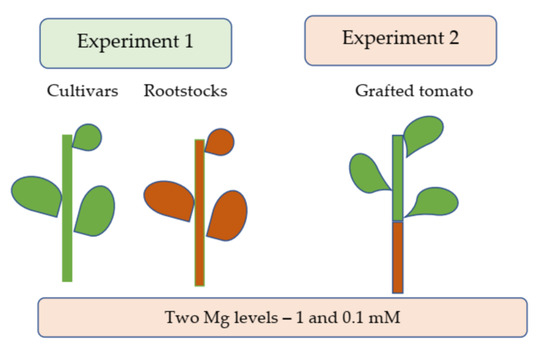
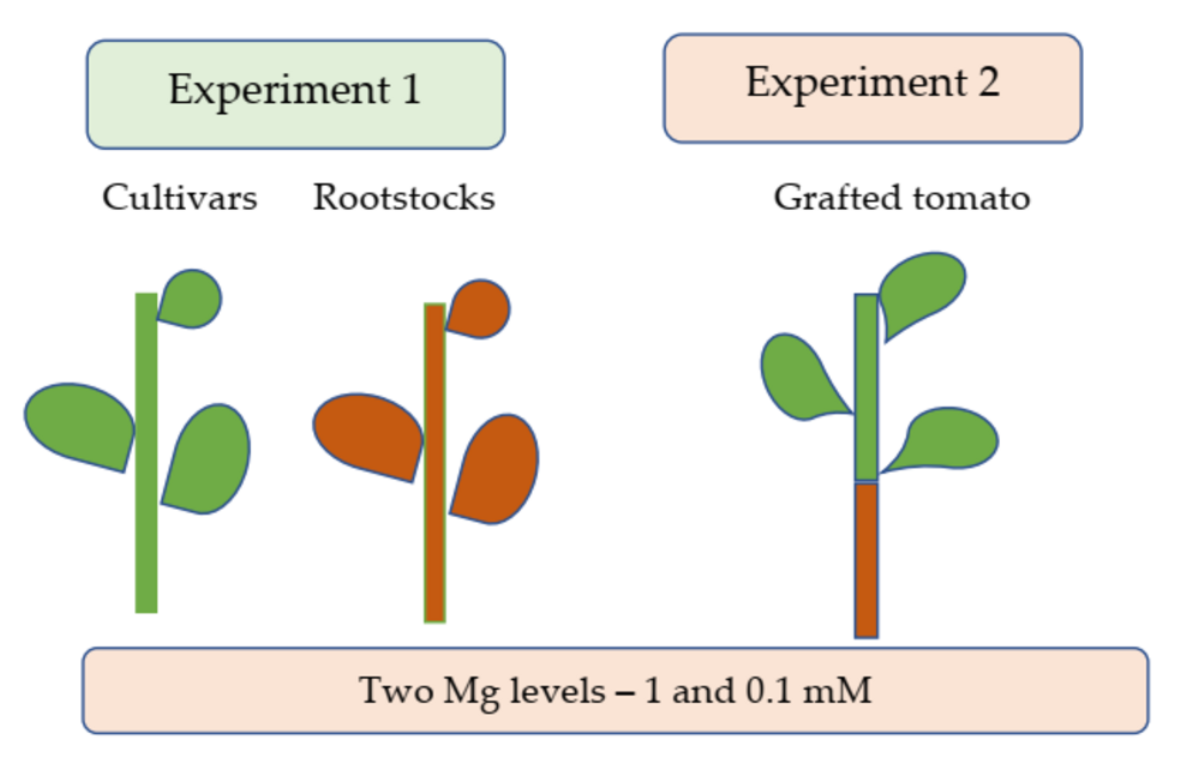
The importance of magnesium (Mg) is often overlooked in modern crop production. Tomato (Solanum lycopersicum L.) is commonly grafted onto appropriate rootstock to improve the nutrient uptake, which may have a negative effect on the tomato Mg leaf concentration and possibly influence the carbohydrate partitioning required for optimal crop yield and quality. The aim of this study was to screen tomato cultivars and rootstocks under Mg deficiency using two experiments. The first experiment included a panel of 14 tomato cultivars and 10 rootstocks grown with 1 or 0.1 mM Mg in nutrient solution. The second experiment consisted of four cultivars either self-grafted or grafted onto four rootstocks chosen from the first experiment. In both experiments, most of the plants grown under low-Mg conditions, on average, had a higher biomass production. The magnesium concentrations in the leaves and stems (but not in the roots) of both cultivars and rootstocks, non-grafted or grafted, were significantly higher under optimal Mg supply. Regarding the Mg content, the differences between the Mg supplies were up to three-fold for cultivars, up to two-fold for the rootstocks, and up to five-fold for the combinations of grafted plants. Our results showed that genotypic differences between used tomato cultivars and rootstocks in response to Mg can be observed at early developmental stages and can possibly serve as a tool in screening programs, but further research is needed to assess their relationship with long-term cultivation.

Graphical Abstract

1. Introduction

Magnesium (Mg) is the eighth most abundant element in the Earth’s crust, the third most abundant cation in plants, and the second in cytosol. In recent years, Mg has been defined as the “forgotten element”, as its importance has often been overlooked in modern crop production [1]. Hence, Mg deficiency in crops should be addressed as an urgent problem [2]. On average, 20% of the total Mg in plants is in chloroplasts, but this proportion can exceed 50% with Mg deficiency and in low-light conditions, suggesting the preferential allocation of Mg to photosynthesis over other plant processes. Magnesium deficiency can cause a severe decrease in chlorophyll concentration and can exacerbate the generation of reactive oxygen species [3]; it is closely related to the inhibition of leaf photosynthetic capacity [4]. Studies on various plants, including tomato, have shown that Mg deficiency reduces the photosynthetic capacity [5].
Tomato is one of the most important horticultural crops and a leading vegetable crop grown in protected areas. The world production of tomato is second only to potato, with an estimated annual production of 190 million tons [6]. Furthermore, as a consequence of monoculture or narrow crop rotations, abiotic and biotic stressors seriously limit tomato production. To avoid or reduce the tomato production losses caused by adverse conditions, tomato plants are grafted onto rootstocks that are relatively resistant to abiotic and/or biotic stresses. Grafted tomatoes currently account for a substantial proportion (30–40%) of the total commercial tomato production in Europe [7]. The widespread use of grafting may improve the crop response to different abiotic stresses, including drought, salt, nutrient deficiency, and low/high temperatures, which could be associated with improved fruit quality [8].
Grafted plants show a better uptake of water and nutrients compared with self-rooted plants due to the vigorous root growth of the rootstock. The graft union does not seem to be a barrier to water or nutrient passage in the proper scion–rootstock combinations, but the nutrient uptake does depend on the rootstock–scion combination [9]. Compatibility between the rootstock and scion is important for the normal flow of water, mineral nutrients, assimilates, etc., from roots to scion and vice versa. Regarding the divalent cations Ca2+ and Mg2+, a significant increase in tomato Ca leaf concentration was associated with grafting [10,11]. High concentrations of Ca and K in the nutrient solutions used for tomato cultivation are antagonistic to Mg uptake; importantly, the mechanisms governing these antagonistic interactions are poorly understood, although they could be related to specific transport systems [12]. Reports on tomato plants grafted onto commercial rootstocks and grown under salt stress conditions or in recirculating nutrient solution mostly noted decreased Mg leaf concentrations, although differences between cultivars were found [13,14,15]. The cultivation of a small number of tomato cultivars under reduced irrigation showed that grafted and self-grafted plants had less Mg in the leaves than non-grafted plants [16,17]. A positive effect of grafting on the Mg content in tomato was found only for the Mg level in tomato fruits after their foliar fertilization with Mg solution, which was not found in ungrafted plants [18]. Decreased Mg leaf content could possibly lead to latent Mg deficiency, influencing the carbohydrate production required for obtaining the maximum yield and ensuring optimal crop quality. There is a clear need for additional studies to determine the effects of grafting, rootstock/scion combinations, and different Mg supplies on tomato growth.
In this study, for the first time, a diversity panel comprising tomato cultivars and rootstocks was screened to identify Mg-tolerant and Mg-sensitive tomato genotypes through phenotyping at the early growth (seedling) stage. The results obtained, including measurements of the biomass production, leaf area, nutrient concentrations, Mg uptake efficiency, and leaf gas exchange traits at two Mg supply levels, were used to assess whether the prior knowledge of Mg tolerance can reduce the number of screenings required in future evaluations of tomato cultivars and rootstocks. This approach may enable a more efficient identification of superior genotypes and optimal graft combinations, thereby improving selection strategies in breeding and rootstock evaluation programs.

2. Materials and Methods

2.1. Screening of Tomato Cultivars and Rootstocks Under Optimal and Deficient Mg Supply: Own Rooted Seedlings (Experiment 1)

Plant Materials and Growth Conditions

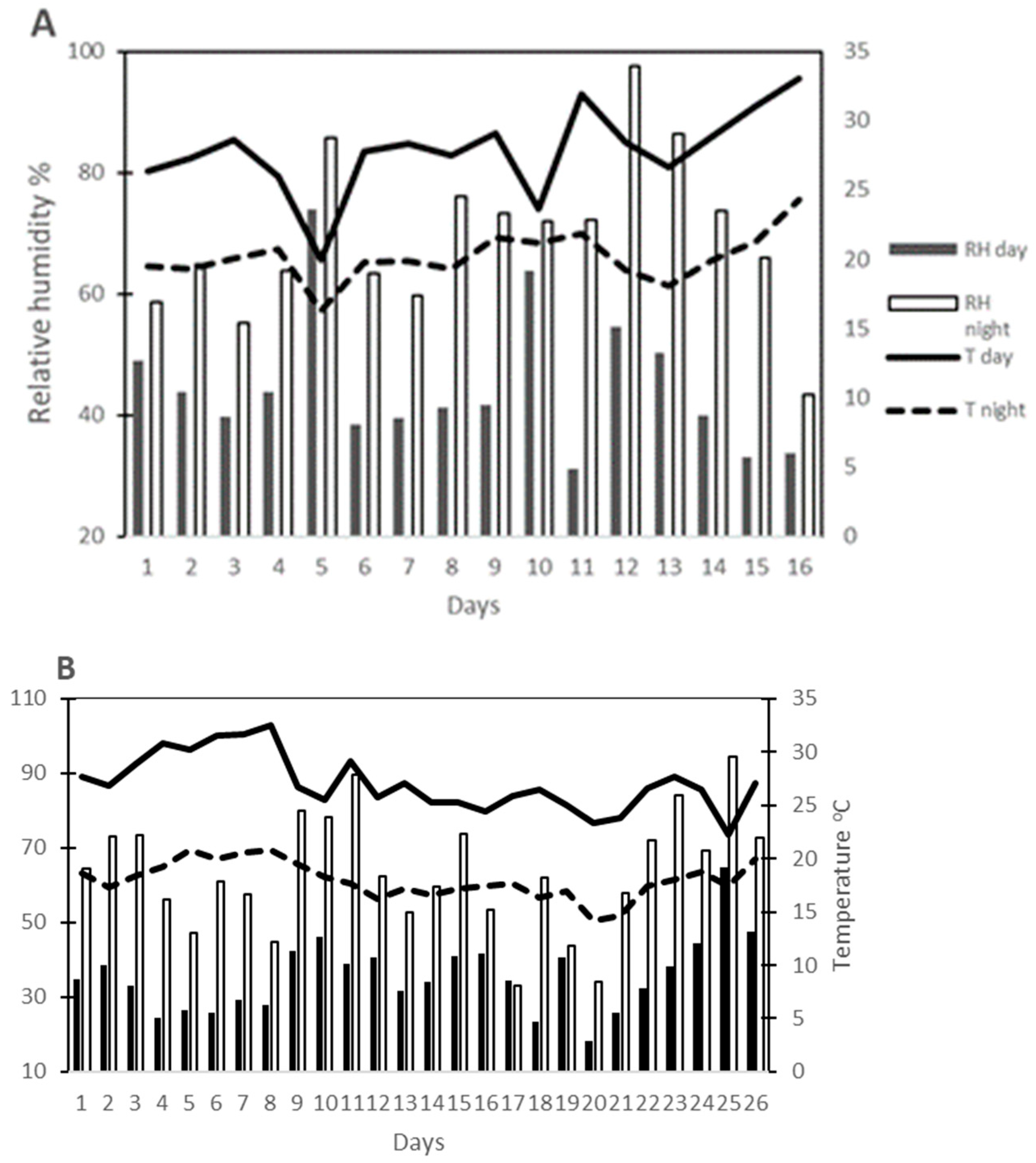
All the experiments were carried out at the Institute for Adriatic Crops and Karst Reclamation in Split, Croatia (43°30′17.17″ N, 16°29′49.71″ E), in an experimental greenhouse, in vegetative chambers of 50 m2. The average greenhouse temperature and relative humidity in the first experiment (2024, Exp1) were 24 °C and 57%; in the second experiment (2025, Exp2), they were 26.5 °C and 52%. Specific data for both years are shown in Figure 1.
A diversity panel consisting of different indeterminate tomato cultivars representing major morphotypes grown in European greenhouses was chosen and sourced from companies that commonly provide seeds to European farmers. Commercial rootstocks from the same suppliers were used (Table 1 and Table 2).
Before the experiment, a preliminary germination test was conducted to determine the seed viability and only seeds with a germination rate higher than 90% were used.
The tomato cultivar seeds were sown in rockwool plugs on 5 May, whereas the rootstock seeds were sown one day later, as rootstocks have faster germination and primary growth. The plugs were irrigated with water and placed in climate chambers maintained at 25 °C, with a relative humidity of ~90%.
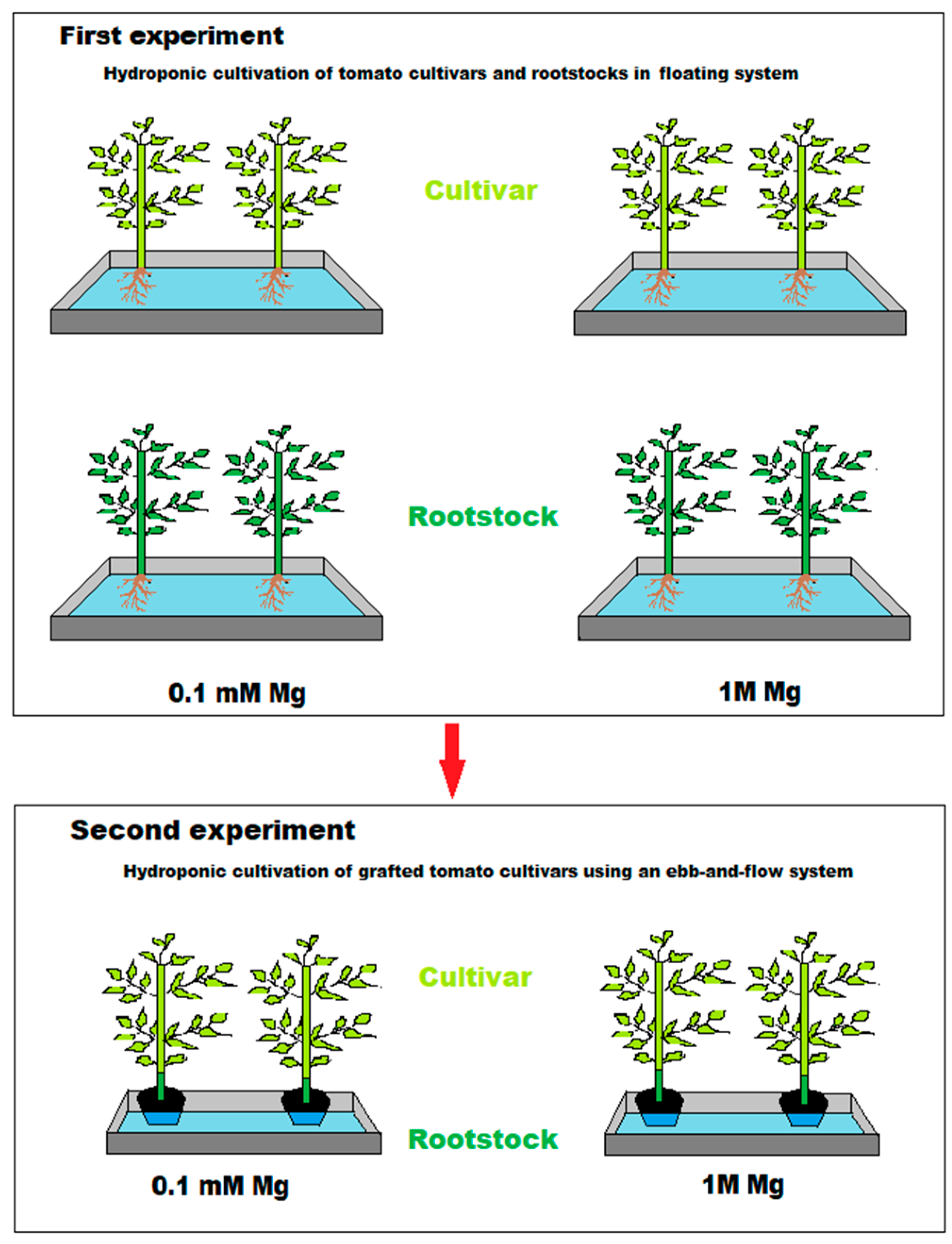
Fifteen days after sowing, the seedings were placed in styrofoam holders and transferred to polyethylene tanks of 30 L filled with modified half-strength Hoagland nutrient solution with different Mg concentrations (1 and 0.1 mM) supplied as MgSO4 and Mg(NO3)2 [18]—Figure 2. All other macro- and micro-elements had the same concentrations in both treatments: K, 4 mM; P, 0.5 mM; N, 6 mM; Ca, 2 mM; S, 1 mM; Fe, 20 µM; Mn, 3 µM; Zn, 3 µM; B, 15 µM; Cu, 0.75 µM; and Mo, 0.5 µM.
The nutrient solutions were aerated with an air pump and changed every 5 days; the pH was always adjusted to 6.5 ± 0.3 with H2SO4, and the electrical conductivity was 2 ± 0.2 mS/cm.

2.2. Screening of Grafted Tomato Seedlings Under Optimal and Deficient Mg Supply (Experiment 2)

The cultivar and rootstock seeds were chosen from genotypes after the evaluation of the growth and Mg uptake traits in Exp1. The two cultivars chosen as tolerant to Mg deficiency were Rossano and Big Beef, and the two chosen as sensitive were Cappuccino and Hayet. For rootstocks, the tolerant ones were Suzuka and Enpower, and the sensitive ones were Vigoterra and Secureforce.
The scion/cultivar seeds were sown on 15 March 2025 and the rootstock seeds on 22 March 2025 in polystyrene plug trays with a cell volume of 21 mL in an organic substrate (Brill Type 4, Brill Substrate, Georgsdorf, Germany) at the Institute for Adriatic Crops (Split, Croatia). The scion seeds were sown 7 days earlier than the rootstock, because the scion and rootstocks have variable growth vigor, and this ensured an optimum stem diameter between the scion and rootstock seedlings at grafting time. The trays with sown seeds were placed in a greenhouse on growing tables covered with polyethylene transparent film, at a constant temperature of 27 ± 3 °C.
The cultivars were self-grafted, as well as grafted onto four rootstocks, to obtain 20 different grafting combinations. Grafting was performed 30 days after the sowing of cultivars using the “splice-grafting” method. The grafted seedlings were maintained under reduced light conditions (10% of the daily light intensity) at a relative humidity above 95% and a temperature from 22 to 25 °C until callus formation. After callus formation, the seedlings (one per pot) were transferred to polyethylene pots (0.8 L, 13 cm diameter) filled with perlite and quartz sand, mixed in a 1:3 ratio (v:v). The pots were placed on irrigation tables and were irrigated using an ebb-and-flow closed hydroponic system, flooding pots once a day in the first half of the experiment (10 days) and twice in the second. Half of the plants were irrigated with Mg-supplemented nutrient solution (1 mM Mg), while the other half did not have added Mg (Figure 2). The nutrient solutions in the irrigation tanks were changed every week. All other nutrients were added in the same concentrations as in Exp1. The solutions were checked weekly for the Mg concentration using ion chromatography, as the used organic substrate, perlite, and sand contained some Mg, resulting in a solution with 0.1–0.15 mM Mg.

2.3. Plant Measurements and Nutrient Determination

In first experiment, the plants were harvested 30 days after sowing, when they reached a height of approximately 40 cm. The plants were divided into leaves, stems, and roots, weighed for the fresh biomass (FM), washed, and dried at 70 °C to a constant weight to obtain the dry plant material (DM). The leaf area was calculated using the method of Carmassi et al. [19]. The roots were scanned using an Epson scanner, and the images were processed using WinRhizo software (Pro version, Regent instruments, Quebec City, QC, Canada) to determine the root traits based on the line intersect method [20]. The determination of the biomass traits in Exp 2 was performed 3 weeks after transplantation (65 days after cultivar sowing). The plants were divided as in Exp1, and measurements of the fresh and dry mass were conducted.
The grafting incompatibility (GI) between the rootstock and scion was determined as follows [19]:
GI = 0.5 × (RSD − GD) + (GPD − GD) + (GPD − RSD))/2)
where GI is the grafting incompatibility, GD is the scion stem diameter, RSD is the rootstock stem diameter, and GPD is the grafted point diameter measuring stem transversely and longitudinally to the planting line with a digital caliper (mm) at ±1 cm above and below the grafting point.
The determination of the Mg and Ca concentrations in the dried plant samples was performed after digestion in 1 mL of 30% H2O2 and 9 mL of 65% HNO3 in a closed-vessel microwave system (Ethos X, Millestone Srl, Sorisole, Italy). The magnesium and calcium concentrations in the digestate were determined using atomic absorption spectrometry (Spectra 220, Varian, Palo Alto, CA, USA), while the K concentration was measured using a flame photometer (Model 410, Sherwood Scientific, Cambridge, UK).
The magnesium uptake efficiency (MUpE) was calculated using the following formula:
MUpE = [(Mhigh × Bhigh) − (Mlow × Blow)]/ΔM,
where Mhigh or Mlow is the Mg concentration in plant tissue under high or low Mg supply, respectively; Bhigh or Blow is total plant dry biomass under high or low Mg supply, respectively; and ΔM is the difference in mM of the Mg treatments applied in the nutrient solution.

2.4. Gas Exchange Measurements

The leaf gas exchange parameters were measured on three plants per treatment (Mg × rootstock or scion) in both experiments. The gas exchange parameters (net photosynthesis (A), stomatal conductance (gsw), intercellular CO2 (Ci), and transpiration (E)) were determined using a portable photosynthesis system (LI-6400, LI-COR Inc., Lincoln, NE, USA). The gas exchange parameters were measured in a shaded greenhouse at PARout >1200 µmol m−2 s−1. The PAR inside the greenhouse was 30% of outside light. The measurement was performed using a red/blue light source (LI-6400-02B, LI-COR, Inc.) under constant light (PAR 700 in Exp1 and 750 μmolm−2 s−1 in Exp2) and CO2 (370 in Exp1 and 400 μmol mol−1 in Exp2), at 9:30–11:00 AM. On average, the air temperature and relative humidity (%) were 33.7 °C and 49.2% in Exp1 and 28.4 °C and 49.4% in Exp2. The flow rate was 350 µmol s−1 for both experiments. Instantaneous water use efficiency (iWUE) was calculated as ratio between A and E (A/E) and intrinsic water use efficiency (WUEi) as ratio A/gsw.
The measurements were performed on 5 June 2024 (30 days after sowing) for Exp1 and on 20 May 2025 for Exp2 (60 days after sowing).

2.5. Statistical Analyses

Exp1 was set up in a randomized block design, consisting of three replications. Each treatment (Mg level × rootstock or cultivar) comprised 15 plants. The data were evaluated using two-way analysis of variance (ANOVA), and when the F-tests were significant, the means of the main factors (rootstock or cultivar and Mg supply) and their interactions were compared using the least significant difference test at p ≤ 0.05.
Exp2 was also set up in a randomized block design, consisting of four replications. Each treatment (Mg supply × rootstock × cultivar) included 16 plants. The data were evaluated using three-way ANOVA, and when the F-tests were significant, the means of the main factors (rootstock/cultivar combinations and Mg supply) and their interactions were compared using the least significant difference test at p ≤ 0.05. The data were statistically analyzed using StatView ver. 5.0 (SAS Institute, Cary, CA, USA).

3. Results

3.1. Screening for Tolerant and Sensitive Tomato Cultivars and Rootstocks: Exp 1

The tomato cultivars and rootstocks differed in their leaf and plant dry weight, as well as in their leaf area, but on average, these traits had higher values under a low Mg supply (Table 3). The interactive effect showed that nine cultivars had a higher leaf DW under low Mg supply, with one under the optimal Mg, and four cultivars did not have significant differences between the two Mg supplies. The results for the stem and root DW showed that the differences were less pronounced. Four rootstocks had a higher leaf DW with a low Mg supply, one (LA 1777) was lower, and the others did not differ. Most of the cultivars had a lower root length under deficient Mg, except for Matissimo, Mei Shuai, Hayet, and Signora (Table 3). The rootstocks results were mostly opposite; six rootstocks had longer roots in deficient conditions (Table 4). Rootstock LA 1223 had very slow growth that resulted in a biomass production several times lower than other rootstocks.
Taking into account the Mg concentrations, significant differences were found for the cultivars, Mg level, and their interactions for all the measured traits (Table 5). At an optimal Mg supply, the highest leaf Mg was found in Hayet and Araldino and the lowest in Matissismo and Mei Shuai. The stem had the highest Mg in Rossano and Capuccino and the lowest in Rosamei and Araladino. The highest root Mg concentrations were determined to be in Big Beef and Matissimo, and Araldino and Byelsa had the lowest root Mg. At the deficient Mg level, the leaf Mg was highest in Big Beef and Araldino and the lowest in Rosamei and Rosanno. The differences between the root Mg concentrations for both Mg supplies were not as pronounced as those for the leaf or stem. The interaction showed that the cultivars differed in the obtained Mg concentrations under different Mg supplies, and the same cultivars at both Mg levels did not have either the highest or lowest Mg concentration in all plant parts.
The rootstocks also showed significant differences for the main factors and interaction in the measured Mg concentration (Table 6). At an optimal Mg supply, the rootstocks LA 1777 and Enpower had the highest leaf Mg, while the lowest was found in LA 1223 and SGT 0005. The stem had the highest Mg values for LA 1777 and Suzuka, and the lowest were LA 1223 and SGT 0005. The root Mg concentrations were the highest in Auroch and Enpower, and the lowest were determined in Secureforce and TOR 23901. A deficient Mg supply affected the rootstock plant parts’ Mg concentrations variably, similar to the optimal supply, although the interactive effect can be explained by a higher variability under optimal Mg compared with the Mg-deficient growing conditions.
After calculating the Mg content, multiplying the Mg concentrations and biomass for each plant part, and adding all to obtain the total plant Mg content, highly significant differences were found for the cultivars/rootstocks, Mg levels, and their interaction (Tables S1 and S2). The interactive effect was expressed as the different variability of Mg uptake in the plant parts, depending on the conditions (Mg in the nutrient solution) under which the cultivars and rootstocks were grown. The total Mg plant contents at the optimal Mg level were the highest in the cultivars Mei Shuai, Rossano, and Big Beef and the lowest in Hayet and Capuccino. The highest Mg was taken by the cultivars Mei Shuai and Rossano at a deficient Mg level and the lowest in Eyre and Capuccino. The rootstocks grown under an optimal Mg level accumulated the most Mg in Suzuka and Auroch and the least in LA 1777 and SGT0005.
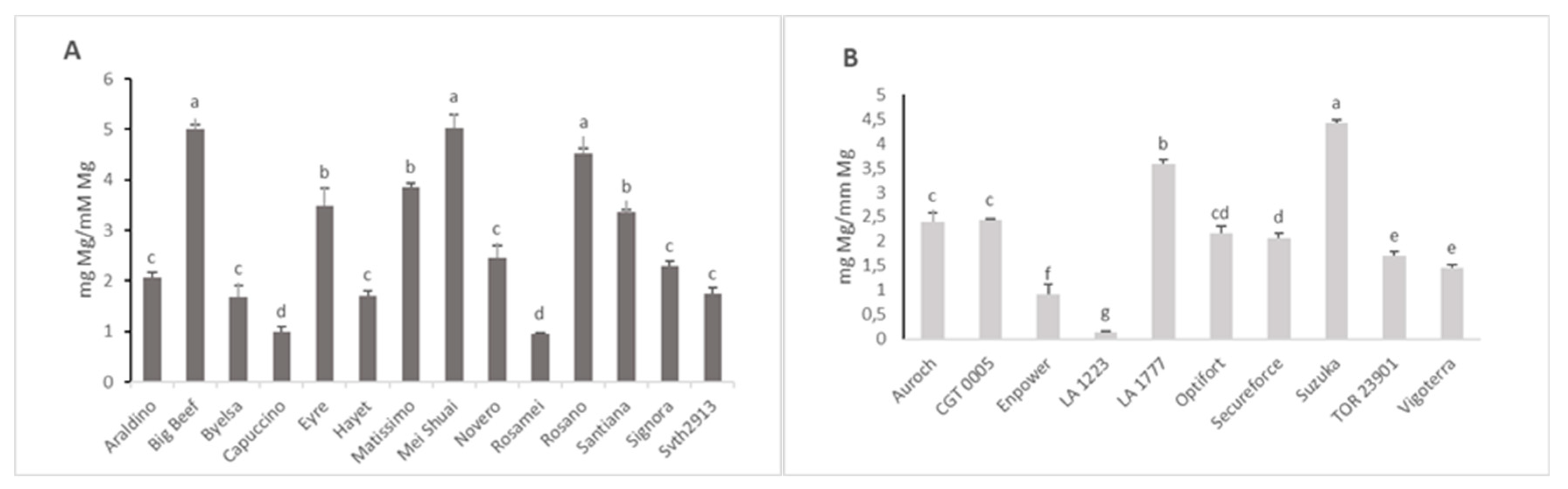
The MUpE calculation for the cultivars showed that the highest MUpE was determined in Big Beef, Mei Shuai, and Rossano, with the lowest in Capuccino, Rosamei, Byelsa, and Hayet (Figure 3A). The calculated MUpE for rootstocks showed that the highest values were calculated in Suzuka and LA 1777 and the lowest in Enpower and LA 1223 (Figure 3B).
The results of the measured leaf gas exchange parameters showed that the cultivars significantly differed for all the measured properties except A (Table S3). The cultivars grown with standard Mg had a higher A, gsw, and E, while the cultivars in deficient Mg conditions had a higher Ci. Differences between the rootstocks were found for all the measured properties, and significant differences between Mg treatments were noted for the gsw, Ci, and E. The rootstock seedlings grown with deficient Mg had a higher gsw and Ci, while the rootstock seedlings in optimal Mg conditions had a higher E (Table S4). A significant interaction of factors was recorded on all the cultivars’ and rootstocks’ measured properties except gsw. Cultivars had significant differences for main factors and interaction for iWUE, but interaction was not found for WUEi. Both traits were lower under Mg deficiency, while variability was more pronounced for cultivars at optimal Mg supply. Rootstocks did not show differences for any factors regarding iWUE and WUEi ().
Regarding all the measurements and calculations from Exp1, for the experiments with grafting, the following rootstocks and cultivars were chosen: tolerant cultivars Big Beef and Rossano, sensitive cultivars Capuccino and Hayet, tolerant rootstocks Suzuka and Enpower, and sensitive rootstocks Vigoterra and Secureforce.

3.2. Evaluation of Grafted Tomato Seedlings: Experiment 2

The plant morphological measurements showed that in most of the measured traits, the main factors (Mg, rootstock, cultivar) were significantly different, while the interactions were not (Table 7). For the shoot, the stem, leaf, and root had a higher fresh weight under Mg deficiency, as well as the total plant dry weight, total root length, and leaf area. The root-to-shoot ratio on average was not influenced by the Mg supply but was influenced by cultivars and rootstocks. The grafting incompatibility (GI) was also significantly influenced by all the major factors, when the grafted tomato seedlings were grown in pots with quartz sand substrate. Regarding the rootstocks, the most vigorous shoot growth was determined in Vigottera and Suzuka, while the significantly lowest root DW was found for Enpower. All the determined traits (Table 7) were significantly different between the used cultivars. The lowest root growth (fresh and dry weight and root length) was noted for the cultivars Hayet and Cappuccino, while significant differences in the shoot performance (leaf + stem FW and DW) and total plant measurements were determined in Cappucino, with the lowest values. The lowest root-to-shoot ratio was found in Hayet. The results indicate that all the major factors had a significant impact on the GI of the grafted tomato seedlings grown in pots with quartz sand substrate.
The plant organs’ Mg concentrations are shown in Table 8. As expected, on average, the Mg concentrations were lower under cultivation in deficient conditions, and significant differences were found for rootstocks and cultivars, which were more pronounced for the root and leaf values than for the stem. Both the cultivars and rootstocks had an interactive effect with the Mg supply on the leaf and roots. The average leaf Mg concentrations were 1.29 g/kg and stem 1.49 g/kg under deficient conditions, while with an optimal supply, they were 5.0 in leaves and 3.49 g/kg in stems. An interactive effect of the Mg supply and both cultivars and rootstocks was determined for the leaf Mg concentration, while for the root Mg, the interaction of all three main factors was determined. Potassium and calcium had significant higher leaf concentrations when the seedlings were grown in Mg-deficient conditions. The Mg content, as the multiplication of the Mg concentration and the plant parts’ dry weight, showed a similar pattern (Table S5). The total plant Mg content was significant for all main factors and interactions. Plants grown under an optimal Mg supply had three-fold higher values of Mg content on average.
The results of the gas exchange parameters showed that the net photosynthesis was significantly higher under Mg-deficient conditions, while the stomatal conductance and transpiration were lower in the same conditions (Table 9). The rootstocks showed differences for all measured traits, while the cultivars were significantly different regarding the photosynthesis and intercellular CO2. The interactive effect of the magnesium level and rootstock was noted for the photosynthetic rate, stomatal conductance, and intercellular CO2, while the same was determined for the rootstock and cultivars, with an additional effect on the transpiration rate.
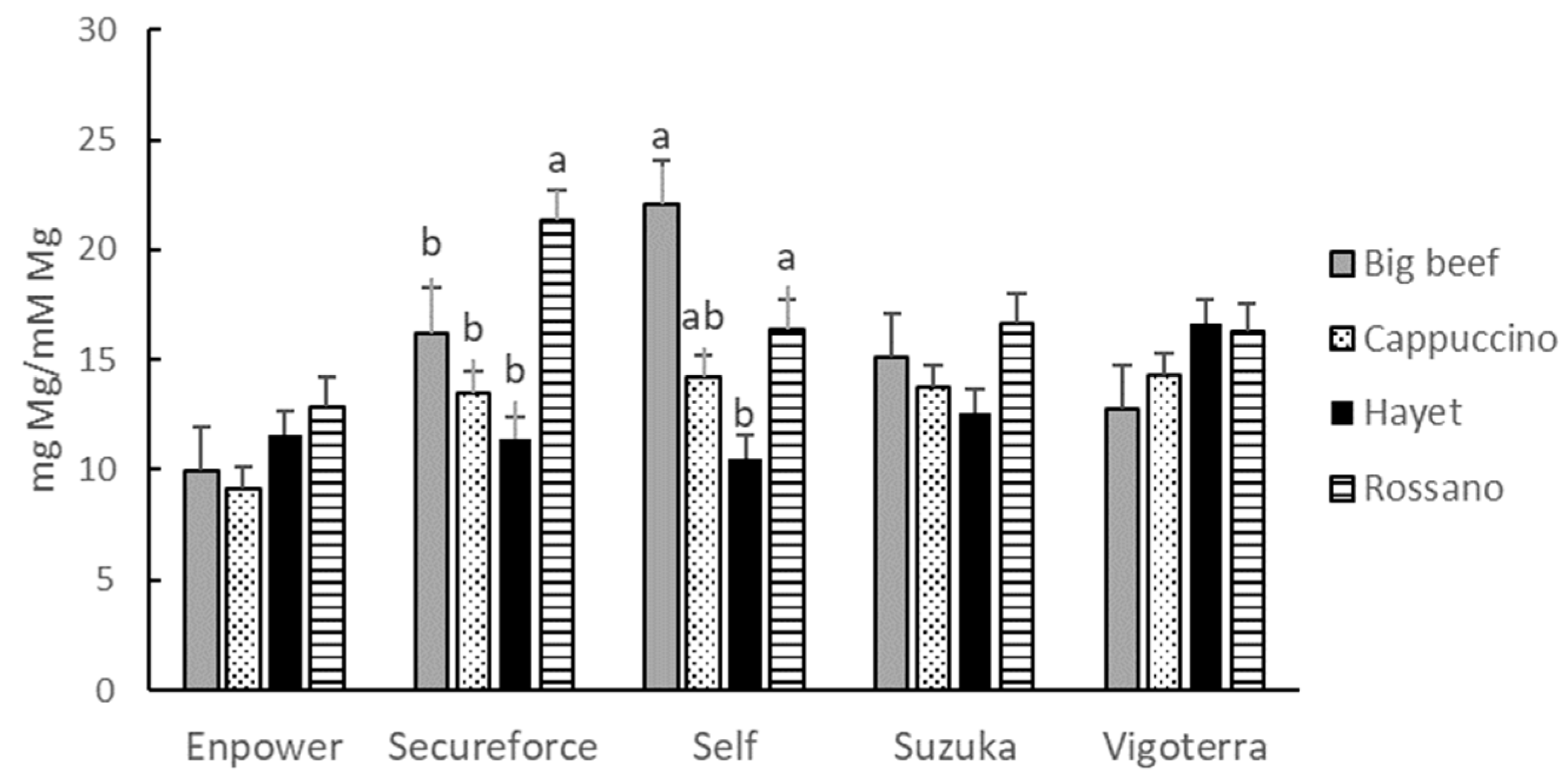
The grafted tomatoes showed significant differences in MUpE values for rootstocks and cultivars and their interaction (Figure 4). The significantly lowest uptake efficiency was calculated for the Enpower rootstock and differed for the other rootstocks. For cultivars, the highest MUpE was noted for Big Beef and Rossano, which differed from Cappuccino and Hayet. Interactions with significant differences were most pronounced in the self-grafted and Secureforce-grafted cultivars compared with other combinations.

4. Discussion

Many studies have tried to determine the phenotypic and physiological effects on different agricultural species from Mg deficiency, based on the plant biomass production, critical Mg concentration, or gas exchange parameters. Mg plays an important role in regulating the crop production and quality, and Mg deficiency is noted as an increasing agricultural and nutritional issue in world agrosystems [21].
Our two studies on tomato cultivars and rootstocks grown alone (Exp1) or grafted in chosen combinations (Exp2) showed that the whole plant fresh and dry weight or plant organs’ morphological measurements differed between genotypes, and in most, they were higher in cultivation with a deficient Mg supply. The few studies that aimed to determine critical Mg concentrations for the growth of tomato plants determined that the plant dry weight decreased with increasing Mg concentrations with the highest growth at 0.125 mM Mg in solution, decreasing to 1 mM [22]. Opposite results were found for the short-cycle cultivation of tomato seedlings (similarly to our studies), where the plant biomass was higher with an increasing Mg supply from 0.2 to 2 mM Mg in nutrient solution [23]. The seedlings grown in Exp1 (floating system) did not show any chlorosis symptoms typical for Mg deficiency, while in the sand-grown grafted tomatoes, symptoms occurred in only few grafting combinations, a few days before the end of the experiment/harvest. In contrast, the critical Mg supply concentration for cucumber seedlings was 0.2 mM, below which the leaves exhibited symptoms of severe chlorosis and necrosis, although this not expressed as decreasing biomass production [24]. A lower shoot and root growth was determined in tomato seedlings when grown at very low Mg levels (0.02 mM) in nutrient solution, which was much lower than our Mg-deficient level [25]. When comparing the total root length, average cultivars grown in nutrient solution had a lower root length in deficient conditions, but the opposite was found for rootstocks. These findings were confirmed in grafted plants grown in sand culture, where the total root length was higher under low Mg supply; therefore, it appears that rootstocks maintain vigorous root growth, which is one of the reasons why grafting is important for improving the total growth and nutrient uptake in the cultivation of fruiting vegetables. In addition, the root DW showed a significant interaction between the Mg level and rootstocks in grafted seedlings, which indicates that, in some genotypes, the root length responds by thickening the primary roots and investing biomass in both lateral roots and root hairs under low Mg availability. Other studies determined that the root growth was reduced in faba bean [26], Arabidopsis thaliana [27], and potato [28], while the opposite was determined, with no effect on the root growth, in Arabidopsis and Chinese cabbage [29]. On the other hand, a work on Arabidopsis showed that the development of root hairs decreased progressively with an increasing Mg supply [30]. These findings show that there is expected variability between species, but the threshold level of Mg in a nutrient solution has a high influence on visible Mg deficiency symptoms and additionally on the decrease in growth traits. Differences between rootstocks and cultivars were significant in most growth traits, which was expected, when the comprehensive screening of tomato gene and seed banks was conducted through these studies. Even studies with few tomato cultivars showed differences in the determined growth traits and Mg absorption [31]. The results indicate that all major factors had a significant impact on the grafting incompatibility (Table 7) of the grafted tomato seedlings grown in pots with a quartz sand substrate. The reduced GI observed was attributed to the use of selected tomato rootstocks, as reported by Zeist et al. [32]. Conversely, Saman et al. [33] found that the GI tends to increase with the age of the plant.
It is suggested that the critical Mg plant concentration for the growth of tomato is <2 mg/g [24], and we determined in our experiments that, on average, rootstocks, cultivars, and grafted plants had lower Mg leaf concentrations in Mg-deficient conditions than the threshold, although the low leaf Mg concentrations did not limit biomass production. Our experiments included seedlings; therefore, a limited biomass or yield can be expected over a longer tomato cultivation period for the used Mg level. However, genotype variability can be an important factor for the threshold determination. Mg-deficient conditions affected the increased leaf K and Ca concentration, nutrients which are antagonistic to Mg; so, there was an expected negative correlation between the K and Ca and Mg contents, as found in most crops [34].
The MUpE was calculated in both experiments and also showed high variability in cultivars and rootstocks, alone or grafted. On average, the cultivars with the lowest MUpE, chosen in Exp1 as the sensitive ones, also had the lowest efficiency when grafted onto rootstocks or self-grafted. The same was found for tolerant cultivars, which suggests that the cultivars have more influence on the Mg uptake in this phase of growth. Grafting onto rootstocks can enhance the absorption of nutrients by using nutrient-efficient absorption rootstocks and improving the efficiency of fertilizer [12]. Grafting in our experiment did not affect the Mg uptake at both Mg levels.
Regarding the gas exchange parameters, in the first experiment, both cultivars and rootstocks under low Mg supply had higher intercellular CO2, while the grafted plants did not show differences between the two Mg levels. The magnesium deficiency was found to negatively affect the ribulose-1,5-bisphosphate carboxylase/oxygenase (Rubisco) involved in CO2 fixation deficiency, resulting in reduced CO2 assimilation, which consequently leads to an increase in the intercellular CO2 concentration [35]. On average, the grafted plants grown in sand had a higher photosynthetic rate under Mg-deficient conditions, although this trait was highly variable and differed between grafting combinations. Zhu et al. [5] also reported an inhibitory effect of magnesium deficiency on the photosynthesis, stomatal conductance, and transpiration, while the intercellular CO2 concentration increased. These findings indicate that changes in plant physiology can be negatively altered, even when the Mg supply is not limiting the biomass.
In conclusion, this study provides the first systematic screening of tomato cultivars and rootstocks under Mg-deficient conditions and identifies genotypes and grafted seedling combinations that partially confirm the tolerance or sensitivity to low Mg supply. These responses were characterized based on their biomass accumulation, Mg uptake, and leaf gas exchange traits. The results demonstrate that genotypic differences in the Mg response may be detected at early developmental stages.
Further studies are required to determine whether such early-stage screening approaches can serve as reliable tools for identifying traits that are predictive of plant performance under long-term cultivation conditions, including fruit production and harvest. If validated, this strategy could substantially reduce the workload associated with intensive screening programs for selecting suitable tomato cultivars and rootstocks. To achieve this, the current phenotypic data should be integrated with additional biological and biochemical analyses and subsequently correlated with generative development and fruit quality parameters. This integrated approach will be essential for elucidating the mechanisms underlying the genotypic differences in Mg uptake in grafted tomatoes and for determining whether these differences have a direct impact on the fruit quality.

Supplementary Materials

The following supporting information can be downloaded at https://www.mdpi.com/article/10.3390/horticulturae12020179/s1. Table S1. Magnesium content/uptake in parts of tomato cultivars grown under two Mg supplies—Exp1. Table S2. Magnesium content/uptake in parts of tomato rootstocks grown under two Mg supplies—Exp1. Table S3. The influence of two Mg supply and 14 tomato cultivars on leaf gas exchange traits: photosynthesis intensity (A), stomatal conductance (gsw), intercellular CO2 (Ci), transpiration rate (E), instantaneous and instrinsic water use efficiency (WUE)—Exp1. Table S4. The influence of two Mg supply and 10 tomato rootstocks on leaf gas exchange traits: photosynthesis intensity (A), stomatal conductance (gsw), intercellular CO2 (Ci), transpiration rate (E), instantaneous and instrinsic water use efficiency (WUE)—Exp1. Table S5. Magnesium content/uptake in parts of grafted tomato cultivars and rootstocks grown under two Mg supplies (Exp 1).

Author Contributions

Conceptualization, B.U. and G.D.; Methodology, B.U., M.V.B., M.P. and G.D.; Validation, I.G.M. and Z.R.; Formal Analysis, K.R., M.V.B., M.P. and M.R.; Investigation, B.U., M.R., K.R., M.V.B. and M.P.; Resources, B.U. and G.D.; Data Curation, B.U., G.D. and K.R.; Writing—Original Draft Preparation, B.U. and K.R.; Writing—Review and Editing, G.D. and Z.R.; Visualization, K.R. and M.P.; Supervision, B.U. and I.G.M.; Project Administration, B.U. and M.R.; Funding Acquisition, B.U. All authors have read and agreed to the published version of the manuscript.

Funding

This work was supported by the Croatian Science Foundation under the program Research Projects in the project: “Role of magnesium in tomato nutrition: integrative approach” (IP-2022-10-7260). https://intomag.krs.hr/en/ (assessed on 22 December 2025).

Data Availability Statement

The raw data supporting the conclusions of this article will be made available by the authors on request.

Acknowledgments

The authors are also thankful for the use of scientific-research equipment financed by the project INOMED-2I (09-207/1-23) granted by the European Union—“NextGenerationEU”. The authors acknowledge the laboratory technical support by Silvia Milišić and Josip Tomaš.

Conflicts of Interest

The authors declare that they have no known competing financial interests or personal relationships that could have appeared to influence the work reported in this paper.

Abbreviations

The following abbreviations are used in this manuscript:
MgMagnesium
Exp Experiment
MUpEMagnesium uptake efficiency
FMFresh biomass
DMDry plant material
ANet Photosynthetic Rate
gswStomatal conductance
CiIntercellular CO2
ETranspiration
iWUE Instantaneous water use efficiency
WUEiIntrinsic water use efficiency
GIGrafting incompatibility
GDScion stem diameter
RSDRootstock stem diameter
GPDGrafted point diameter
ANOVAAnalysis of variance

References

  1. Cakmak, I.; Yazici, A.M. Magnesium: A forgotten element in crop production. Better Crops 2010, 94, 23–25. [Google Scholar]
  2. Guo, W.; Nazim, H.; Liang, Z.; Yang, D. Magnesium deficiency in plants: An urgent problem. Crop J. 2016, 4, 83–91. [Google Scholar] [CrossRef]
  3. Peng, Y.Y.; Liao, L.L.; Liu, S.; Nie, M.M.; Li, J.; Zhang, L.D.; Chen, Z.C. Magnesium deficiency triggers SGR-mediated chlorophyll degradation for magnesium remobilization. Plant Physiol. 2019, 181, 262–275. [Google Scholar] [CrossRef]
  4. Samborska, I.; Kalaji, H.; Sieczko, L.; Goltsev, V.; Borucki, W.; Jajoo, A. Structural and functional disorder in the photosynthetic apparatus of radish plants under magnesium deficiency. Funct. Plant Biol. 2018, 45, 668–679. [Google Scholar] [CrossRef]
  5. Zhu, Z.; Zhang, H.; Tian, H.; Chai, G.; Muhammad, R.; Wang, Q.; Wu, X. Comprehensive analysis of magnesium deficiency effects on photosynthesis and energy balance in tomato leaves. Plant Physiol. Biochem. 2025, 222, 109671. [Google Scholar] [CrossRef] [PubMed]
  6. FAOSTAT. Food and Agriculture Organization of the United Nations. FAOSTAT Statistical Database. Available online: https://www.fao.org/faostat/ (accessed on 12 November 2025).
  7. Grieneisen, M.L.; Aegerter, B.J.; Scott Stoddard, C.; Zhang, M. Yield and fruit quality of grafted tomatoes, and their potential for soil fumigant use reduction: A meta-analysis. Agron. Sustain. Dev. 2018, 38, 29. [Google Scholar] [CrossRef]
  8. Kyriacou, M.C.; Rouphael, Y.; Colla, G.; Zrenner, R.; Schwarz, D. Vegetable grafting: The implications of a growing agronomic imperative for vegetable fruit quality and nutritive value. Front. Plant Sci. 2017, 8, 741. [Google Scholar] [CrossRef] [PubMed]
  9. Martínez-Andújar, C.; Albacete, A.; Martínez-Pérez, A.; Pérez-Pérez, J.M.; Asins, M.J.; Pérez-Alfocea, F. Root-to-shoot hormonal communication in contrasting rootstocks suggests an important role for the ethylene precursor aminocyclopropane-1-carboxylic acid in mediating plant growth under low-potassium nutrition in tomato. Front. Plant Sci. 2016, 7, 1782. [Google Scholar] [CrossRef]
  10. Leonardi, C.; Giuffrida, F. Variation of plant growth and macronutrient uptake in grafted tomatoes and eggplants on three different rootstocks. Eur. J. Hort. Sci. 2006, 71, 97–101. [Google Scholar] [CrossRef]
  11. Schwarz, D.; Öztekin, G.B.; Tüzel, Y.; Brückner, B.; Krumbein, A. Rootstocks can enhance tomato growth and quality characteristics at low potassium supply. Sci. Hortic. 2013, 149, 70–79. [Google Scholar] [CrossRef]
  12. Gransee, A.; Führs, H. Magnesium mobility in soils as a challenge for soil and plant analysis, magnesium fertilization and root uptake under adverse growth conditions. Plant Soil 2013, 368, 5–21. [Google Scholar] [CrossRef]
  13. Savvas, D.; Ntatsi, G.; Barouchas, P. Impact of grafting and rootstock genotype on cation uptake by cucumber (Cucumis sativus L.) exposed to Cd or Ni stress. Sci. Hortic. 2013, 149, 86–96. [Google Scholar] [CrossRef]
  14. Savvas, D.; Öztekin, G.B.; Tepecik, M.; Ropokis, A.; Tüzel, Y.; Ntatsi, G.; Schwarz, D. Impact of grafting and rootstock on nutrient-to-water uptake ratios during the first month after planting of hydroponically grown tomato. J. Hortic. Sci. Biotechnol. 2017, 92, 294–302. [Google Scholar] [CrossRef]
  15. Fernández-García, N.; Martínez, V.; Carvajal, M. Effect of salinity on growth, mineral composition, and water relations of grafted tomato plants. J. Plant Nutr. Soil Sci. 2004, 167, 616–622. [Google Scholar] [CrossRef]
  16. Urlić, B.; Runjić, M.; Žanić, K.; Mandušić, M.; Selak, G.V.; Pasković, I.; Dumičić, G. Effect of partial root-zone drying on grafted tomato in commercial greenhouse. Hortic. Sci. 2020, 47, 36–44. [Google Scholar] [CrossRef]
  17. Urlić, B.; Runjić, M.; Mandušić, M.; Žanić, K.; Vuletin Selak, G.; Matešković, A.; Dumičić, G. Partial root-zone drying and deficit irrigation effect on growth, yield, water use and quality of greenhouse grown grafted tomato. Agronomy 2020, 10, 1297. [Google Scholar] [CrossRef]
  18. Hoagland, D.R.; Aron, D.I. The water-culture method for growing plants without soil. Circ. Calif. Agric. Exp. Stn. 1938, 347, 1–39. [Google Scholar]
  19. Carmassi, G.; Incrocci, L.; Maggini, R.; Malorgio, F.; Tognoni, F.; Pardossi, A. An aggregated model for water requirements of greenhouse tomato grown in closed rockwool culture with saline water. Agric. Water Manag. 2007, 88, 73–82. [Google Scholar] [CrossRef]
  20. Tennant, D. A test of a modified line intersect method of estimating root length. J. Ecol. 1975, 63, 995–1001. [Google Scholar] [CrossRef]
  21. Zeist, A.R.; Resende, J.T.V.; Silva, I.F.L.; Zanin, D.S.; Faria, C.M.D.R.; Giacobbo, C.L. Survival and compatibility of tomato grafted on solanaceous plants and by different grafting methods. Cientifica 2017, 45, 278–283. [Google Scholar] [CrossRef]
  22. Wang, Z.; Ul Hassan, M.; Nadeem, F.; Wu, L.; Zhang, F.; Li, X. Magnesium fertilization improves crop yield in most production systems: A meta-analysis. Front. Plant Sci. 2020, 10, 1727. [Google Scholar] [CrossRef] [PubMed]
  23. Gunes, A.; Alpaslan, M.; Inal, A. Critical nutrient concentrations and antagonistic and synergistic relationships among the nutrients of NFT-grown young tomato plants. J. Plant Nutr. 1998, 21, 2035–2047. [Google Scholar] [CrossRef]
  24. Qu, S.; Li, H.; Zhang, X.; Gao, J.; Ma, R.; Ma, L.; Ma, J. Effects of magnesium imbalance on root growth and nutrient absorption in different genotypes of vegetable crops. Plants 2023, 12, 3518. [Google Scholar] [CrossRef]
  25. Xie, K.; Pan, Y.; Meng, X.; Wang, M.; Guo, S. Critical leaf magnesium thresholds for growth, chlorophyll, leaf area, and photosynthesis in rice (Oryza sativa L.) and cucumber (Cucumis sativus L.). Agronomy 2024, 14, 1508. [Google Scholar] [CrossRef]
  26. Ishfaq, M.; Zhong, Y.; Wang, Y.; Li, X. Magnesium limitation leads to transcriptional down-tuning of auxin synthesis, transport, and signaling in the tomato root. Front. Plant Sci. 2021, 12, 802399. [Google Scholar] [CrossRef] [PubMed]
  27. Neuhaus, C.; Geilfus, C.-M.; Mühling, K.-H. Increasing root and leaf growth and yield in Mg-deficient faba beans (Vicia faba) by MgSO4 foliar fertilization. J. Plant Nutr. 2014, 177, 741–747. [Google Scholar] [CrossRef]
  28. Li, D.; Ma, W.; Wei, J.; Mao, Y.; Peng, Z.; Zhang, J.; Chen, Q. Magnesium promotes root growth and increases aluminum tolerance via modulation of nitric oxide production in Arabidopsis. Plant Soil 2020, 457, 83–95. [Google Scholar] [CrossRef]
  29. Koch, M.; Winkelmann, M.K.; Hasler, M.; Pawelzik, E.; Naumann, M. Root growth in light of changing magnesium distribution and transport between source and sink tissues in potato (Solanum tuberosum L.). Sci. Rep. 2020, 10, 8796. [Google Scholar] [CrossRef]
  30. Verbruggen, N.; Hermans, C. Physiological and molecular responses to magnesium nutritional imbalance in plants. Plant Soil 2013, 368, 87–99. [Google Scholar] [CrossRef]
  31. Niu, Y.; Chai, R.; Liu, L.; Jin, G.; Liu, M.; Tang, C.; Zhang, Y. Magnesium availability regulates the development of root hairs in Arabidopsis thaliana (L.) Heynh. Plant Cell Environ. 2014, 37, 2795–2813. [Google Scholar] [CrossRef]
  32. Zeist, A.R.; Giacobbo, C.L.; Silva Neto, G.F.; Zeist, R.A.; Dorneles, K.R.; Resende, J.T.V. Compatibility of tomato cultivar Santa Cruz Kada grafted on different Solanaceae species and control of bacterial wilt. Hortic. Bras. 2018, 36, 377–381. [Google Scholar] [CrossRef]
  33. Saman, P.; Kawicha, P.; Sangdee, A.; Wongpakdee, S.; Rattanapolsan, L.; Thanyasiriwat, T. Evaluation of intraspecific grafted tomato on Fusarium wilt disease protection, tomato scion growth, and grafting compatibility. Acta Hortic. 2023, 1384, 355–365. [Google Scholar] [CrossRef]
  34. Singh, H.; Kumar, P.; Chaudhari, S.; Edelstein, M. Tomato grafting: A global perspective. HortScience 2017, 52, 1328–1336. [Google Scholar] [CrossRef]
  35. Ishfaq, M.; Wang, Y.; Yan, M.; Wang, Z.; Wu, L.; Li, C.; Li, X. Physiological essence of magnesium in plants and its widespread deficiency in the farming system of China. Front. Plant Sci. 2022, 13, 802274. [Google Scholar] [CrossRef] [PubMed]
Figure 1. Greenhouse temperature and relative humidity (day and night) for Exp1 (A) and Exp2 (B).
Horticulturae 12 00179 g001
Figure 2. A schematic overview of the experimental design. Experiments were conducted in two consecutive steps. First, a screening of Mg deficiency tolerance was conducted to identify tolerant and sensitive tomato cultivars and rootstocks. Second, chosen genotypes were selected for grafting (each cultivar on 4 rootstocks and self-grafted).
Horticulturae 12 00179 g002
Figure 3. Magnesium uptake efficiency in tomato cultivars (A) and rootstocks (B) grown under two Mg supplies (1 and 0.1 mM) in Exp1. Bars with the same letter are not significantly different according to the LSD test. Error bars represent standard error (±1 SE).
Horticulturae 12 00179 g003
Figure 4. Magnesium uptake efficiency in grafted tomato cultivars and rootstocks grown under two Mg supplies (1 and 0.1 mM) in Exp2. Bars with the same letter are not significantly different according to the LSD test for each cultivar grafted on specific rootstock. Error bars represent standard error (±1 SE).
Horticulturae 12 00179 g004
Table 1. List of tomato cultivars used in experiments.
CultivarMorphotypeProducerCountry of Origin
HayetbeefSakataJapan
Capuccinobeef heart SAISItaly
RossanoplumEssasem Italy
SignorabeefEssasem Italy
RosameibeefSemillas FitoSpain
ByelsabeefSemillas FitoSpain
NoverobeefDeRuiterGermany
EyrebeefRijk ZwaanThe Netherlands
Araldinobeef heartRijk ZwaanThe Netherlands
SantianagrappoloRijk ZwaanThe Netherlands
SVTH 2913beefSeminisGermany
Big BeefbeefSeminisGermany
Mei Shuaibeef pinkSeminisGermany
MatissimobeefSeminisGermany
Table 2. List of tomato rootstocks used in experiments.
RootstockProducer Country of Origin
VigoterraTakiiJapan
CGT 0005Capgen seedsSpain
TOR 23901EssasemItaly
SecureforceFenix seedsItaly
SuzukaRijk ZwaanThe Netherlands
AurochSakataJapan
EnpowerNunhemsThe Netherlands
OptifortDeRuiterThe Netherlands
LA 1777TGRC *USA
LA 1223TGRCUSA
* TGRC—Tomato genetics resource center UC Davis.
Table 3. Plant organs dry weight (DW), leaf area and root length of tomato cultivars grown under two Mg supplies (1 and 0.1 mM)—Exp 1.
LeafStemRootLeaf AreaRoot Lenght
Cultivar (K)Mg levelg plant−1cm2 plant−1cm plant−1
Araldino1 mM 0.42b *0.87b0.04 780b2435a
Big Beef0.64 0.99 0.07 1391 2857a
Byelsa0.46b0.58 0.05 965 3302a
Capuccino0.27b0.47 0.04b571b1789
Eyre0.49a0.76a0.03 906a2392a
Hayet0.35b0.48b0.03b503b1297b
Matissimo0.66 0.76a0.06b1108 2086b
Mei Shuai1.01b1.17 0.05b1604 2248b
Novero0.50b0.83 0.04b665b2959a
Rosamei0.56b0.88a0.06b1131 3281
Rossano0.96 1.15a0.09 1613 3161a
Santiana0.52 0.79 0.04b878 2904a
Signora0.54b0.60b0.05 925 1594b
Svth29130.40b0.73b0.04b671b3064a
Araldino0.1 mM 0.73a1.02a0.05 1222a1868b
Big Beef0.67 0.92 0.07 1370 2174b
Byelsa0.58a0.65 0.06 946 1579b
Capuccino0.54a0.55 0.06a909a1589
Eyre0.36b0.61b0.04 497b1269b
Hayet0.75a0.81a0.08a979a2546a
Matissimo0.70 0.62b0.12a1033 3495a
Mei Shuai1.49a1.20 0.11a1771 3409a
Novero0.74a0.88 0.08a984a2250b
Rosamei0.89a0.95 0.09a1264 3083
Rossano1.04 0.99b0.09 1514 2452b
Santiana0.60 0.76 0.06a1058 1584b
Signora0.74a0.81a0.06 818 2178a
Svth29130.88a1.20a0.06a1183a1924b
Significance F-valuep-valueF-valuep-valueF-valuep-valueF-valuep-valueF-valuep-value
Cultivar (C) 20.81<0.0001105<0.00019.23<0.000119.9<0.00016.01<0.0001
Mg level 62.7<0.0001156<0.00011690.000111.30.00118.510.0069
C × Mg 5.15<0.000130.1<0.00016.37<0.00013.550.00017.72<0.0001
* The significant differences between the cultivars in two Mg supplies are indicated with different letters within columns (LSD test at p ≤ 0.05).
Table 4. Plant organs dry weight (DW), leaf area and root length of tomato rootstocks grown under two Mg supplies (1 and 0.1 mM)—Exp 1.
LeafStemRootLeaf AreaRoot Lenght
Rootstock Mg levelg plant−1cm2 plant−1cm plant−1
Auroch1 mM 0.81b *1.04 bb0.11b932b3526b
CGT 00050.71 0.87 0.10 1194 3390
Enpower0.65b1.11b0.06b906b2208b
LA 12230.14b0.26 0.02 249 553
LA 17770.46a0.75a0.08a1099a1577a
Optifort0.92 0.8b0.10b1484 2721b
Secureforce0.58 0.82a0.06 1097a1527b
Suzuka1.06b1.43 0.18 1401b5974b
TOR 239010.61 0.58b0.10 1033 2490
Vigoterra0.45 0.62 0.11 925 2752b
Auroch0.1 mM 0.96a1.3a0.16a2162a4996a
CGT 00050.81 0.8 0.08 1299 3464
Enpower1.07a1.28a0.24a1549a6070a
LA 12230.29a0.21 0.02 336 860
LA 17770.73b0.63b0.03b465b703b
Optifort1.06 0.93a0.17a1288 4609a
Secureforce0.6 0.61b0.07 716b2038a
Suzuka1.2a1.43 0.21 1894a8050a
TOR 239010.67 0.73a0.12 1244 2971
Vigoterra0.53 0.66 0.11 803 3550a
Significance F-valuep-valueF-valuep-valueF-valuep-valueF-valuep-valueF-valuep-value
Rootstock (R) 73.6<0.0001110<0.0001149<0.000128.7<0.000127.3<0.0001
Mg level 38.5<0.000120.5<0.0001121<0.00019.060.003523.30.0001
R × Mg 3.90.00124.810.00255.5<0.000112.8<0.00013.60.0078
* The significant differences between the cultivars in two Mg supplies are indicated with different letters within columns (LSD test at p ≤ 0.05).
Table 5. Magnesium concentrations in leaves, stems and roots in tomato cultivars cultivated at two Mg supplies (1 and 0.1 mM)—Exp1.
Mg Concentration
LeafStemRoot
Cultivar (K)Mg levelmg g−1
Araldino1 mM 3.49±0.16 *1.61±0.033.84±0.16
Big Beef3.22±0.051.80±0.176.35±0.17
Byelsa3.13±0.092.04±0.193.81±0.34
Capuccino2.92±0.052.19±0.064.38±0.15
Eyre2.99±0.11.77±0.064.89±0.79
Hayet3.51±0.241.85±0.015.93±0.38
Matissimo2.34±0.091.87±0.026.51±0.15
Mei Shuai2.78±0.051.91±0.135.88±0.45
Novero3.07±0.311.93±0.114.57±0.74
Rosamei2.97±0.031.45±0.024.81±0.06
Rossano2.97±0.022.18±0.094.67±0.13
Santiana3.10±0.061.71±0.075.23±0.14
Signora2.90±0.091.67±0.055.59±0.16
Svth29133.30±0.12.11±0.135.46±0.15
Araldino0.1 mM 2.04±0.10.89±0.023.32±0.07
Big Beef2.12±0.041.25±0.044.21±0.12
Byelsa1.67±0.071.02±0.223.74±0.04
Capuccino1.63±0.181.34±0.033.25±0.05
Eyre1.77±0.040.98±0.013.33±0.02
Hayet1.45±0.041.11±0.023.19±0.04
Matissimo1.52±0.061.28±0.013.83±0.24
Mei Shuai1.52±0.11.18±0.044.57±0.24
Novero1.72±0.031.25±0.083.71±0.08
Rosamei1.36±0.011.03±0.054.3±0.30
Rosano1.35±0.031.57±0.034.4±0.30
Santiana1.85±0.040.93±0.013.8±0.02
Signora1.63±0.041.2±0.033.72±0.54
Svth29131.94±0.161.21±0.035.12±0.02
Significance F-valuep-valueF-valuep-valueF-valuep-value
Cultivar (C) 1112<0.0001515<0.0001382<0.0001
Mg level 9.03<0.00019.91<0.000123.7<0.0001
C × Mg 3.460.00062.050.033113.5<0.0001
* ±SE—standard error.
Table 6. Magnesium concentrations in leaves, stems and roots in tomato rootstocks cultivated at two Mg supplies (1 and 0.1 mM)—Exp1.
Mg Concentration
LeafStemRoot
RootstockMg levelmg g−1
Auroch1 mM 3.62±0.10 *2.22±0.077.26±0.49
Enpower4.02±0.292.30±0.087.16±0.48
LA 12232.86±0.041.66±0.15.48±0.21
LA 17775.08±0.372.72±0.125.98±0.83
Optifort3.32±0.122.16±0.036.27±0.43
Secureforce3.12±0.112.12±0.113.84±0.48
SGT 00052.97±0.082.05±0.054.46±0.15
Suzuka3.85±0.172.41±0.067.00±0.27
TOR 239013.83±0.062.38±0.13.61±0.02
Vigoterra3.22±0.192.13±0.084.89±0.2
Auroch0.1 mM 1.79±0.091.14±0.054.38±0.04
Enpower1.96±0.091.34±0.024.11±0.01
LA 12231.69±0.081.20±0.034.20±0.47
LA 17771.49±0.040.84±0.011.76±0.02
Optifort1.60±0.081.13±0.063.95±0.17
Secureforce1.33±0.111.35±0.033.72±0.01
SGT 00051.21±0.041.16±0.023.38±0.02
Suzuka1.68±0.041.29±0.024.25±0.09
TOR 239011.78±0.061.24±0.063.67±0.23
Vigoterra1.44±0.041.31±0.033.51±0.02
Significance F-valuep-valueF-valuep-valueF-valuep-value
Rootstock (R) 105<0.00011215<0.0001528<0.0001
Mg 15.2<0.00017.44<0.000143.3<0.0001
R × Mg 102<0.000115.8<0.000127.4<0.0001
* ±SE—standard error.
Table 7. Plant growth traits of grafted tomato rootstocks and cultivars when grown under two Mg supplies (1 and 0.1 mM)—Exp2.
Root DWLeaf DWTotal DWR/SRoot LenghtLeaf AreaGI
Mg Levelg plant−1 cm plant−1cm2 plant−1
0.1 mM0.54 2.59 5.41b0.11 2259b1036b1.02a
1 mM0.57 2.64 5.72a0.11 3418a1178a0.89b
Rootstock
Enpower0.46b *2.52bc5.27b0.1c2748ab1125b0.98b
Secureforce0.6a2.45c5.35b0.13a2729ab1053b1.17a
Self-grafted0.58a2.56ab5.52ab0.12ab2584b1035b0.93ab
Suzuka0.56a2.75ab5.73a0.11b3049a1113b0.94b
Vigoterra0.58a2.81a5.95a0.11b3082a1209a0.76c
Cultivar
Big Beef0.58b2.79a5.85a0.11b2998b1199a0.9b
Cappuccino0.46c2.3b4.78b0.11b2449c1052b0.89b
Hayet0.47c2.63a5.76a0.09c2368c974c0.75b
Rossano0.72a2.77a5.87a0.14a3538a1204a1.29a
SignificanceF-valuep-valueF-valuep-valueF-valuep-valueF-value-valueF-valuep-valueF-valuep-valueF-valuep-value
Mg2.610.10820.40.52625.270.02300.0340.854472.2<0.000132.2<0.00017.460.0266
Rootstock-R5.780.00022.830.26403.370.01137.330<0.00012.020.10946.150.00014.090.0005
Cultivar-C38.4<0.00017.82<0.000114.5<0.000142.499<0.000115.9<0.00012.02<0.000132.4<0.0001
Mg × R3.230.0141.840.12451.30.27072.0300.09281.520.21580.770.54550.310.5458
Mg × C0.410.74460.440.72650.480.69821.5640.20031.550.21680.130.93961.960.742
R × C11.50.32741.220.274320.08231.1680.31020.860.58841.730.06321.220.9027
Mg × R × C11.10.3530.940.50511.070.39190.6310.48820.450.93030.70.74682030.9875
* Significant differences between the main factors are indicated with different letters within columns (LSD test at p ≤ 0.05).
Table 8. Magnesium concentrations in leaves, stems and roots of grafted tomato cultivars and rootstocks grown under two Mg supplies (1 and 0.1 mM)—Exp2.
Mg Concentrations
LeafStemRoot
Mg Levelmg g−1
0.1 mM5a *3.486a7.089a
1 mM1.29b1.489b0.983b
Rootstock
Enpower2.945b2.58 2.983c
Secureforce3.309a2.597 3.089b
Self-grafted3.479a2.519 4.034a
Suzuka2.95b2.402 3.009b
Vigoterra3.045b2.428 2.652d
Cultivar
Big Beef2.981c2.516b3.98b
Cappuccino3.356a2.755a3.954b
Hayet3.234ab2.221c3.964b
Rossano3.012bc2.481b4.239a
SignificanceF-valuep-valueF-valuep-valueF-valuep-value
Mg2070<0.0001663<0.000110,757<0.0001
Rootstock-R6.80<0.00010.830.5194.8<0.0001
Cultivar-C4.860.00378.090.000111.1<0.0001
Mg × R7.75<0.00010.260.901963.8<0.0001
Mg × C2.800.04513.430.021132.5<0.0001
R × C0.870.57240.790.65111.930.0441
Mg × R × C0.510.90360.500.91042.640.0053
* Significant differences between the main factors are indicated with different letters within columns (LSD test at p ≤ 0.05).
Table 9. Leaf gas exchange parameters of grafted tomato cultivars and rootstocks grown under two Mg supplies (1 and 0.1 mM)—Exp2.
Mg LevelPhotosynthetic Rate (A)
(µmol CO2 m−2 s−1)
Stomatal Conductance (gsw)
(mol H2O m−2 s−1)
Intercellular CO2 (Ci)
(µmol CO2 mol−1)
Transpiration Rate (E)
(mmol H2O m−2 s−1)
0.1 mM6.3b *0.345a344 9.49a
1 mM7.4a0.204b345 6.62b
Rootstock
Enpower5.9cd0.232b343b5.6b
Secureforce8.7a0.366a343b6.41a
Self-grafted7.9ab0.29b341b6.37a
Suzuka5d0.25b353a6.25a
Vigoterra6.8bc0.235b340b5.64b
Cultivar
Big Beef6.3b0.265 346a5.97
Cappuccino6.7ab0.281 347a6.15
Hayet7.6a0.289 341b6.14
Rossano6.9ab0.263 341b5.96
SignificanceF-valuep-valueF-valuep-valueF-valuep-valueF-valuep-value
Mg13.190.0073169<0.00010.360.55231616<0.0001
Rootstock-R18.7<0.000121.7<0.00018.96<0.00014.430.0047
Cultivar-C3.210.00221.340.27593.680.01970.350.7927
Mg × R13.2<0.000118.2<0.00018.46<0.00012.130.0951
Mg × C1.290.52870.530.66481.970.13360.390.7582
R × C3.06<0.00013.620.00112.940.00524.130.0003
Mg × R × C0.750.94721.720.09841.390.21051.860.0713
* Significant differences between the main factors are indicated with different letters within columns (LSD test at p ≤ 0.05).
Disclaimer/Publisher’s Note: The statements, opinions and data contained in all publications are solely those of the individual author(s) and contributor(s) and not of MDPI and/or the editor(s). MDPI and/or the editor(s) disclaim responsibility for any injury to people or property resulting from any ideas, methods, instructions or products referred to in the content.