Article

Combined Effects of Cultivar, Vintage, and Vinification Practices on the Physicochemical, Phenolic, and Elemental Composition of Red and White Wines from Murfatlar (Romania)


by
Traian Ciprian Stroe
1,*,
Ana-Maria Stoenescu
2,*,
Anamaria Tănase
3,
Ionica Dina
3,
Victoria Artem
3,
Traian Ștefan Cosma
3,
Mihaela Cioată
3,
Aurora Ranca
3,
Anca Becze
4,
Claudiu Tănăselia
4,
Daniela Doloris Cichi
5,
Constantin Băducă Cîmpeanu
5,
Gabriela Ianculescu
6 and
Mihai Botu
5
1
Department of Natural Sciences, Faculty of Natural and Agricultural Sciences, Ovidius University of Constanța, 1 Aleea Universității, Campus Building B, 900470 Constanța, Romania
2
Dăbuleni Research and Development Station for Plant Cultivation on Sandy Soils, 217 Petre Baniță Str., 207170 Călărași, Romania
3
Research Station for Viticulture and Oenology Murfatlar, 2 Calea București Str., 905100 Murfatlar, Romania
4
Research Institute for Analytical Instrumentation Subsidiary, National Institute for Research and Development of Optoelectronics Bucharest INOE 2000, 67 Donath Str., 400293 Cluj-Napoca, Romania
5
Department of Horticulture & Food Science, Faculty of Horticulture, University of Craiova, 13 A.I. Cuza Str., 200585 Craiova, Romania
6
Faculty of Mechanical, Industrial and Maritime Engineering, Ovidius University of Constanța, 124 Mamaia Boulevard, 900527 Constanța, Romania
*
Authors to whom correspondence should be addressed.
Horticulturae 2026, 12(4), 434; https://doi.org/10.3390/horticulturae12040434

Submission received: 4 March 2026 / Revised: 27 March 2026 / Accepted: 31 March 2026 / Published: 2 April 2026

Abstract

Grapevine cultivar, climatic variability, and vinification practices are key determinants of wine composition. This study evaluated the physicochemical, phenolic, and elemental profiles of six wines produced from distinct cultivars cultivated in the Murfatlar Research Station (Romania) over three consecutive growing seasons (2022–2025). Red wines were obtained using differentiated maceration regimes, while white wines were produced with controlled lees contact. Total phenolic content was determined by the Folin–Ciocâlteu method, resveratrol by UHPLC-DAD, and mineral composition by ICP-MS. Linear mixed-effects models were applied to assess the effects of cultivar, vinification method, and vintage year. As expected, red wines exhibited significantly higher total phenolic and resveratrol concentrations than white wines, and maceration duration enhanced phenolic extraction. Cultivar exerted the strongest influence on physicochemical parameters and elemental composition, whereas climatic differences among vintages induced moderate but significant variations. Rare-earth elements and selected macro- and microelements exhibited consistent varietal patterns, supporting their potential as compositional markers. Toxic element concentrations remained within established regulatory limits. These findings highlight the combined influence of genetic, environmental, and technological factors on wine composition and support the integration of phenolic and mineral profiling for varietal differentiation and quality assessment.

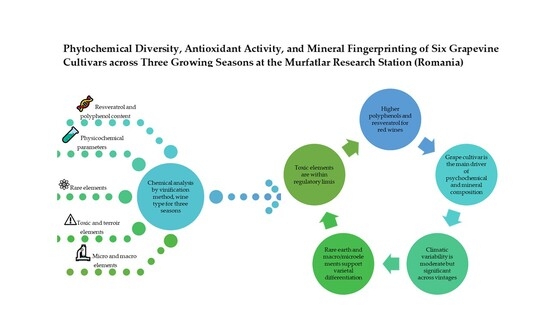
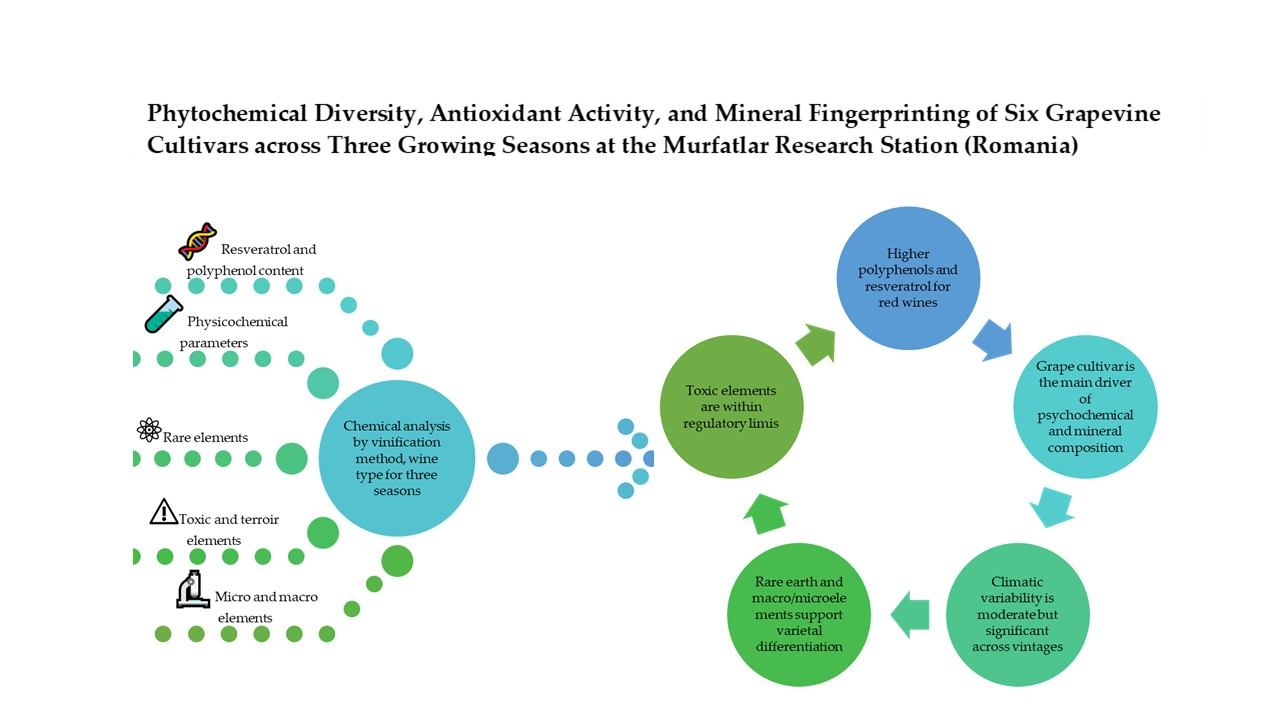
Graphical Abstract

1. Introduction

Grapevine (Vitis vinifera L.) is one of the most important horticultural crops worldwide and represents the basis of wine production, a product of major economic and cultural relevance. Beyond their traditional role, wine and grape-derived products have attracted growing scientific interest due to their high levels of bioactive phytochemicals. Grapes, must, wine, and winemaking by-products, particularly grape pomace, are important sources of polyphenols, including flavonoids, anthocyanins, tannins, and stilbenes, compounds associated with antioxidant, anti-inflammatory, and potential cardioprotective effects [1,2,3]. Numerous studies have demonstrated that the antioxidant capacity of grape and pomace extracts is strongly correlated with their phenolic composition, supporting the importance of detailed phytochemical characterization for wine quality and authenticity [4,5,6,7,8].
The phytochemical composition of grapes and wines is largely determined by grapevine cultivar, reflecting genetic regulation of secondary metabolite biosynthesis. Comparative investigations have reported significant varietal differences in phenolic potential, anthocyanin accumulation, and flavonoid dynamics during ripening [9,10,11], while biochemical changes throughout berry development further influence the final phenolic profile of wines [12,13].
In addition to genetic control, environmental conditions play a crucial role in shaping grape and wine composition within the framework of terroir, which integrates climatic, edaphic, and viticultural influences [14,15]. Temperature, solar radiation, and water availability significantly affect phenolic accumulation and can lead to marked differences among regions and vintages [16,17]. Interannual climatic variability is particularly relevant under ongoing climate change, as shifts in temperature and precipitation patterns influence grape ripening and compositional traits, highlighting the importance of multi-year assessments for understanding genotype × environment interactions [18,19,20]. In recent years, numerous studies have investigated the relationships between wine composition and terroir-related factors using statistical and multivariate approaches. These studies have demonstrated that pedological, climatic, and genetic variables can be correlated with wine chemical parameters, enabling the differentiation of cultivars, regions, and production conditions. Techniques such as principal component analysis (PCA), linear discriminant analysis (LDA), and mixed-effects models have been widely applied to identify compositional patterns and evaluate the relative contributions of underlying factors.
In this context, integrating phenolic and elemental data within statistical frameworks is an important approach for understanding the complex interactions among soil, climate, and plant material, contributing to the characterization of wine typicity and the development of authenticity assessment tools.
Beyond organic constituents, wines contain a range of mineral elements derived from soil, water, and technological inputs, contributing to their chemical identity. Elemental composition has increasingly been used for geographical characterization and authenticity assessment due to its close association with pedoclimatic specificity [21,22]. When combined with multivariate statistical approaches, mineral profiling enhances the discrimination of cultivars, vintages, and production conditions.
Winemaking practices represent an additional factor influencing wine composition. Technological steps such as maceration, fermentation, and management of grape solids modulate phenolic extraction, transformation, and stability [23,24], and may significantly alter polyphenol levels even within the same cultivar and vintage [25,26].
Romanian viticulture provides a relevant context for integrated compositional studies, given the diversity of cultivated grapevine cultivars and pronounced regional variability. The Murfatlar viticultural area in southeastern Romania is characterized by a temperate continental climate with maritime influences and high solar radiation, conditions favorable for phenolic accumulation and the production of wines with distinctive characteristics [15,21]. In addition to established cultivars, this region includes relatively recent Romanian varieties such as ‘Columna’ and ‘Mamaia’, developed through national breeding programs and cultivated for approximately three decades, offering valuable material for comparative evaluation.
Within this framework, the present study aimed to compare the physicochemical, phenolic, and mineral profiles of wines produced from six grapevine cultivars cultivated at the Murfatlar Research Station (Romania) over three consecutive growing seasons. Particular emphasis was placed on the effects of vinification practices (maceration duration in red wines and lees management in white wines), interannual climatic variability (vintage), and elemental signatures associated with regional specificity.
This study adopts an integrated approach combining phenolic profiling with elemental analysis, including rare earth elements (REEs), which remain relatively underexplored in oenological research. While these components have been investigated separately, their integration within a factorial experimental design enables the simultaneous evaluation of cultivar, climatic variability, and technological practices.
This approach provides a more comprehensive framework for wine characterization, allowing the identification of more robust compositional patterns and a better understanding of the interactions between phenolic profiles and mineral signatures, as well as their potential relevance for wine typicity assessment.

2. Materials and Methods

2.1. Experimental Site, Plant Material, and Vineyard Management

The study was conducted at the Murfatlar Research and Development Station for Viticulture and Winemaking (SCDVV Murfatlar), located in the Murfatlar wine-growing center within the Dobrogea Hills viticultural region, southeastern Romania. The area is characterized by a temperate continental climate with Pontic influences, warm and dry summers, relatively mild winters, and high solar radiation, all of which are favorable for high-quality wine production. The vineyards are established on cambic chernozem (endocalcaric), according to the Romanian Soil Taxonomy System (SRTS 2012+), with a loam-to-clay-loam texture and carbonate accumulation in deeper horizons. The vineyard was non-irrigated, and the vine water supply relied exclusively on natural precipitation.
The experiment was carried out over three consecutive growing seasons (2022–2023, 2023–2024, and 2024–2025). All experimental plots were located within the same viticultural area under comparable pedoclimatic conditions.
Six Vitis vinifera L. cultivars were included, comprising three white cultivars (‘Columna’ (VIVC 2787), ‘Sauvignon blanc’ (VIVC 10790), and ‘Fetească regală’ (VIVC 4121)) and three red cultivars (‘Mamaia’ (VIVC 21348), ‘Merlot’ (VIVC 7657), and ‘Băbească neagră’ (VIVC 843)). The selected cultivars represent both internationally recognized varieties and Romanian-bred cultivars adapted to the Murfatlar region.
Vineyards were established between 2015 and 2016 at a spacing of 2.2 m × 1.1 m (approximately 4132 vines ha−1). All vines were trained using a semi-high Guyot system on vertical monoplane trellis and managed under uniform pruning and canopy practices. Winter pruning maintained approximately 36 buds per vine (three fruiting units per vine, each consisting of one two-bud spur and one ten-bud cane).
Soil management and fertilization practices were applied uniformly across all years and cultivars. Autumn plowing (16–18 cm depth) and spring shallow cultivation were performed annually. Organic fertilization (30 t ha−1 semi-fermented manure) was applied in 2022, while foliar fertilization based on commercial seaweed extracts (Chlorella sp.) was applied in all experimental years. Phytosanitary treatments were conducted in accordance with regional warning systems to control downy mildew (Plasmopara viticola), powdery mildew (Uncinula necator), gray mold (Botrytis cinerea), and grape moths, using copper- and sulphur-based products, biological formulations, and pheromone traps as appropriate.
Meteorological data (daily air temperature and precipitation) were obtained from the on-site meteorological station located adjacent to the experimental vineyard. For each growing season, minimum, maximum, and mean temperatures, as well as cumulative precipitation, were calculated and used to characterize inter-annual climatic variability. These data were subsequently incorporated into correlation and multivariate analyses to evaluate relationships between climatic parameters and wine composition.

2.2. Experimental Design and Vinification Treatments

The experiment followed a factorial design, with grapevine cultivar and vinification treatment as fixed factors, and was evaluated over three consecutive growing seasons (vintages). Six Vitis vinifera L. cultivars were included: three white cultivars (‘Columna’, ‘Sauvignon blanc’, and ‘Fetească regală’) and three red cultivars (‘Mamaia’, ‘Merlot’, and ‘Băbească neagră’).
Grapes were harvested manually at technological maturity to ensure berry integrity and appropriate selection of the raw material (approximately 100 kg per replicate for each cultivar) and were processed under standardized cellar conditions. Technological maturity was assessed based on total soluble solids (TSS), pH, and titratable acidity, which were monitored during ripening. Harvesting was performed when these parameters reached values considered optimal for the Murfatlar wine-growing area (approximately 190–230 g L−1 sugars, pH 3.2–3.5, and titratable acidity 3.0–6.0 g L−1 tartaric acid), with grapes sampled at regular intervals (every 3 days).
For each cultivar × vinification treatment combination, the vinification process was performed in triplicate, resulting in independent fermentation batches. All grapes were processed under identical technological conditions for all experimental treatments. Alcoholic fermentation was carried out in food-grade stainless steel vessels made of austenitic stainless steel AISI 304 (EN 1.4301), with an approximate volume of 150 L, using must volumes corresponding to approximately 100 kg of grapes per replicate.
Fermentation occurred spontaneously, without inoculation with selected yeast strains, allowing the development of the natural grape microbiota. Fermentation temperature was monitored daily throughout the process. In white wines, fermentation was conducted at temperatures ranging between 20 and 23 °C (average approximately 22 °C), while in red wines, fermentation occurred at higher temperatures, between 24 and 28 °C (average approximately 26 °C).
For each cultivar, a common base vinification protocol was applied, with maceration duration (red wines) or post-fermentation lees contact (white wines) representing the experimental technological variable. The control variant (M) followed the standard winery protocol, consisting of approximately 15 days of lees contact for white wines and 10 days of skin maceration for red wines.
Red wines were produced using five vinification variants differing in skin maceration time during alcoholic fermentation: standard protocol (control, M), no maceration (V1), 7 days (V2), 14 days (V3), and 21 days of maceration (V4). Fermentation temperature, vessel type, and post-fermentation handling were maintained constant across treatments. Malolactic fermentation was allowed to occur naturally under cellar conditions, without controlled inoculation.
White wines were produced using four variants based on the duration of lees contact following alcoholic fermentation: standard protocol (control, M), 10 days (V1), 20 days (V2), and 30 days of lees contact (V3). Lees aging was conducted on fine lees under controlled cellar conditions, with manual bâtonnage performed once per day to ensure homogenization and interaction between phases.
Cellar conditions were maintained relatively constant throughout the process, with a controlled temperature (approximately 18–22 °C) and typical winemaking facility humidity (approximately 60–65%). Sulphur dioxide (SO2) was added after completion of alcoholic fermentation to ensure wine stabilization. The end of fermentation was determined based on density stabilization and the absence of fermentable sugars. Fermentation duration ranged from 10 to 20 days, depending on wine type and treatment.
Each cultivar × vinification treatment combination was produced in each of the three vintages (2022–2023, 2023–2024, and 2024–2025), ensuring consistent experimental conditions across seasons. Identical vinification protocols and analytical procedures were applied throughout the study period to ensure comparability among years.

2.3. Physicochemical Analyses of Grape Must

At harvest, the basic physicochemical parameters of the grape must were determined, including Total Soluble Solids (TSS), pH, total titratable acidity, and must density. TSS were measured using a digital refractometer and expressed as g L−1 sugars. The pH was determined using a calibrated pH meter, while total titratable acidity was measured by titration with NaOH and expressed as g L−1 tartaric acid equivalent. All determinations were performed according to the standard analytical methods recommended by the IOV (International Organisation of Vine and Wine). The reported values represent the mean ± standard deviation of three vintages.

2.4. Physicochemical Analyses of Wines

Physicochemical analyses were performed at the Laboratory of Grape Processing Technologies and Wine Chemistry of the Murfatlar Research and Development Station for Viticulture and Winemaking, using internationally recognized standard methods commonly applied in oenological quality control (IOV reference methods).
The following parameters were determined for all wine samples: alcoholic strength (% v/v), free and total sulfur dioxide (SO2), total acidity, volatile acidity, pH, total extract, sugar-free extract, and reducing sugars.
Alcoholic strength was determined after simple distillation, followed by density measurement of the distillate using an electronic densimeter (Anton Paar DMA 5000 Melectronic densimeter, Anton Paar GmbH, Graz, Austria). Free and total SO2 were quantified by iodometric titration under acidic conditions, with prior alkaline hydrolysis for total SO2 determination. Total acidity was determined by titration with standardized sodium hydroxide solution after removal of dissolved carbon dioxide and expressed as g L−1 tartaric acid. Volatile acidity was measured by steam distillation followed by titration and expressed as g L−1 acetic acid.
The pH and concentrations of organic acids (tartaric, malic, and gluconic) were determined using an automated wine analyser (OenoFoss™, Foss, Hillerød, Denmark) based on Fourier-transform infrared (FTIR) spectroscopy, following standard oenological methods. The total extract was calculated from relative density measurements, and the sugar-free extract was obtained by subtracting reducing sugars from the total extract. Reducing sugars were determined iodometrically after appropriate sample clarification.
All analytical determinations were performed in triplicate, and results are expressed as mean values. These parameters were used to characterize the wines’ basic oenological profile and to support subsequent phytochemical and elemental analyses.

2.5. Mineralization and Elemental Analysis (ICP-MS)

Elemental composition of wine samples was determined by inductively coupled plasma mass spectrometry (ICP-MS). Prior to instrumental analysis, samples were subjected to acid digestion.
Wine samples were homogenized, and a 50 mL aliquot was transferred to a glass beaker. 10 mL of concentrated nitric acid (65%, Merck, Darmstadt, Germany) was added, and the mixture was heated on a sand bath under gentle boiling for 2 h. After cooling, 5 mL of 30% hydrogen peroxide (Merck) was added, followed by an additional 1 h of heating to ensure complete oxidation of organic matter. The digested solutions were filtered and quantitatively transferred to 50 mL volumetric flasks, then diluted to volume with ultrapure water.
Elemental concentrations were measured using an ICP-MS system (ELAN DRC II, PerkinElmer, Norwalk, CT, USA). The instrument was operated under standard conditions, using argon as the plasma, auxiliary, and nebulizer gas. Calibration was performed using multi-element standard solutions prepared in the same acid matrix as the samples. Procedural blanks were analyzed in parallel to correct for background signals.
The analytical performance of the ICP-MS method was evaluated with respect to sensitivity, precision, accuracy, and linearity. The limit of detection (LOD) was 0.001 mg L−1, and the limit of quantification (LOQ) was 0.005 mg L−1. Method accuracy was verified using certified reference materials (CRMs), with recovery values ranging from 96.7% to 98.2%. Repeatability, expressed as the relative standard deviation (RSD), ranged from 5.2% to 7.9%. Calibration curves showed excellent linearity, with determination coefficients (R2) ranging from 0.9989 to 0.9999.
The quantified elements included macro- and microelements (Ca, Mg, Na, B, Fe, Mn, Zn, Cu, Ni, Co), terroir-related elements (Sr, Rb, Ba, Cs, Li), trace and potentially toxic elements (Pb, Cd, As, Tl), and rare-earth elements (REEs: La, Ce, Nd, Sm, Eu, Gd, Dy). These elements were selected for their relevance to compositional characterization and their potential use in wine differentiation. All measurements were performed in triplicate, and mean concentrations were used for statistical analysis.

2.6. Determination of Total Phenolic Content

Total phenolic content (TPC) was determined using the Folin–Ciocâlteu colorimetric method [27]. The assay is based on the reduction of the Folin–Ciocâlteu reagent by phenolic compounds under alkaline conditions, forming a blue chromophore measured spectrophotometrically at 765 nm.
For analysis, 0.5 mL of the wine sample was mixed with 5 mL of distilled water, 0.5 mL of Folin–Ciocâlteu reagent, and 1.5 mL of 10% sodium carbonate solution. The reaction mixture was incubated for 45 min at room temperature in the dark. Absorbance was measured at 765 nm using a UV–Vis spectrophotometer (Lambda 25, PerkinElmer, Shelton, CT, USA) against a blank reagent.
Quantification was performed using an external calibration curve prepared with gallic acid standard solutions (25–250 mg L−1). Method validation parameters were assessed to ensure analytical reliability. The limit of detection (LOD) was 0.05 mg L−1, and the limit of quantification (LOQ) was 0.5 mg L−1. Recovery was 87.2%, and method precision, expressed as relative standard deviation (RSD), was 9.2%. The calibration curve exhibited high linearity, with a determination coefficient (R2) of 0.9992.
Results were expressed as mg gallic acid equivalents per liter (mg GAE L−1). All measurements were carried out in triplicate, and mean values were used for statistical analysis.

2.7. Resveratrol Analysis by UHPLC-DAD

Trans-resveratrol was quantified by ultra-high-performance liquid chromatography coupled with diode array detection (UHPLC-DAD), following established procedures for wine analysis [28,29].
Analyses were performed using a Vanquish™ H UHPLC system (Thermo Fisher Scientific, Darmstadt, Hessen, Germany) equipped with a diode array detector. Chromatographic separation was achieved on an Accucore™ aQ column (100 × 2.1 mm, 2.6 μm; Thermo Fisher Scientific) maintained at 25 °C.
The mobile phase consisted of water containing 1% acetic acid (solvent A) and methanol (solvent B). Gradient elution was applied at a flow rate of 0.3 mL min−1 as follows: 70% A/30% B at 0 min, linearly decreasing to 10% A/90% B over 10 min, held for 2 min, then returned to initial conditions within 3 min, followed by a 3 min re-equilibration. The injection volume was 10 μL. Detection was carried out at 360 nm.
Quantification was performed using external calibration with trans-resveratrol standard solutions, and results were expressed as mg L−1. The UHPLC-DAD method demonstrated high sensitivity and accuracy. The limit of detection (LOD) was 0.0002 µg mL−1, and the limit of quantification (LOQ) was 0.001 µg mL−1. Recovery was 91.9%, and precision expressed as relative standard deviation (RSD) was 7.4%. The calibration curve showed excellent linearity, with a determination coefficient (R2) of 0.9998.
All analyses were performed in triplicate, and mean values were used for statistical evaluation.

2.8. Chemicals and Reagents

All chemicals and reagents were of analytical or chromatographic grade and were used without further purification.
Reagents employed for physicochemical analyses, including sodium hydroxide, sulfuric acid, iodine solution, starch indicator, phenolphthalein, copper–tartrate reagents, potassium iodide, and sodium thiosulfate, were obtained from Merck (Darmstadt, Germany). Nitric acid (65%) and hydrogen peroxide (30%) used for sample mineralization were also supplied by Merck. Ultrapure water was used for all dilution and digestion procedures.
For total phenolic content determination, Folin–Ciocâlteu reagent, sodium carbonate, and gallic acid standard were purchased from Sigma-Aldrich (St. Louis, MO, USA). For UHPLC-DAD analysis of resveratrol, trans-resveratrol analytical standard, HPLC-grade methanol, and acetic acid were obtained from Sigma-Aldrich.
Multi-element standard solutions used for ICP-MS calibration were obtained from certified commercial suppliers and prepared in the same acid matrix as the samples.
The physicochemical, phenolic, and elemental analyses of the wines were performed approximately three weeks after bottling, after the wines had passed the stabilization period associated with the so-called “bottle shock”, a phenomenon that may temporarily influence wine structure and compositional balance. Until the time of analysis, the wines were stored under controlled temperature conditions.

2.9. Statistical Analysis

Statistical analysis was performed to evaluate the effects of grapevine cultivar, vinification method, and vintage on wine composition, and to explore relationships among physicochemical, phenolic, and elemental parameters.
For each cultivar × treatment × production year combination, the vinification process was performed in triplicate, resulting in independent fermentation batches. For each batch, chemical analyses were performed in triplicate using samples collected from three bottles of the same wine lot. These analytical replicates were used exclusively to ensure measurement precision.
Prior to statistical analysis, analytical replicates were averaged to avoid pseudo-replication. The resulting mean value for each vinification replicate was included in the dataset, and the final experimental unit was defined as the mean for each cultivar × treatment × production year combination.
The experiment followed a factorial design including three fixed factors: cultivar, vinification method, and vintage (2022–2023, 2023–2024, and 2024–2025). Biological replication was represented by the production years (n = 3).
Linear mixed-effects models (LMMs) were applied to evaluate the main effects and interactions among factors. Estimated marginal means were calculated to support the interpretation of significant effects. Statistical significance was established at p < 0.05.
Descriptive statistics are presented as mean ± standard deviation (n = 3 vintages), and different letters indicate significant differences between cultivars (Dunn’s test with Bonferroni correction, p < 0.05). Data were organized in Microsoft® Excel® 2019 MSO, and statistical analyses were conducted using JASP (version 0.95.4).

3. Results

3.1. Basic Physicochemical Characteristics of Grapes at Harvest

The basic physicochemical characteristics of grape must at harvest are presented in Table 1. The results show variability among cultivars in terms of sugar accumulation, acidity, and must density. Overall, the analyzed parameters fall within the typical range reported for grapes harvested at technological maturity. Higher sugar accumulation and must density were generally observed in red cultivars, while the white cultivars showed slightly lower values. Differences in titratable acidity were also observed among cultivars, reflecting their specific physiological and compositional characteristics.

3.2. Climatic Characterization of the Three Consecutive Growing Seasons

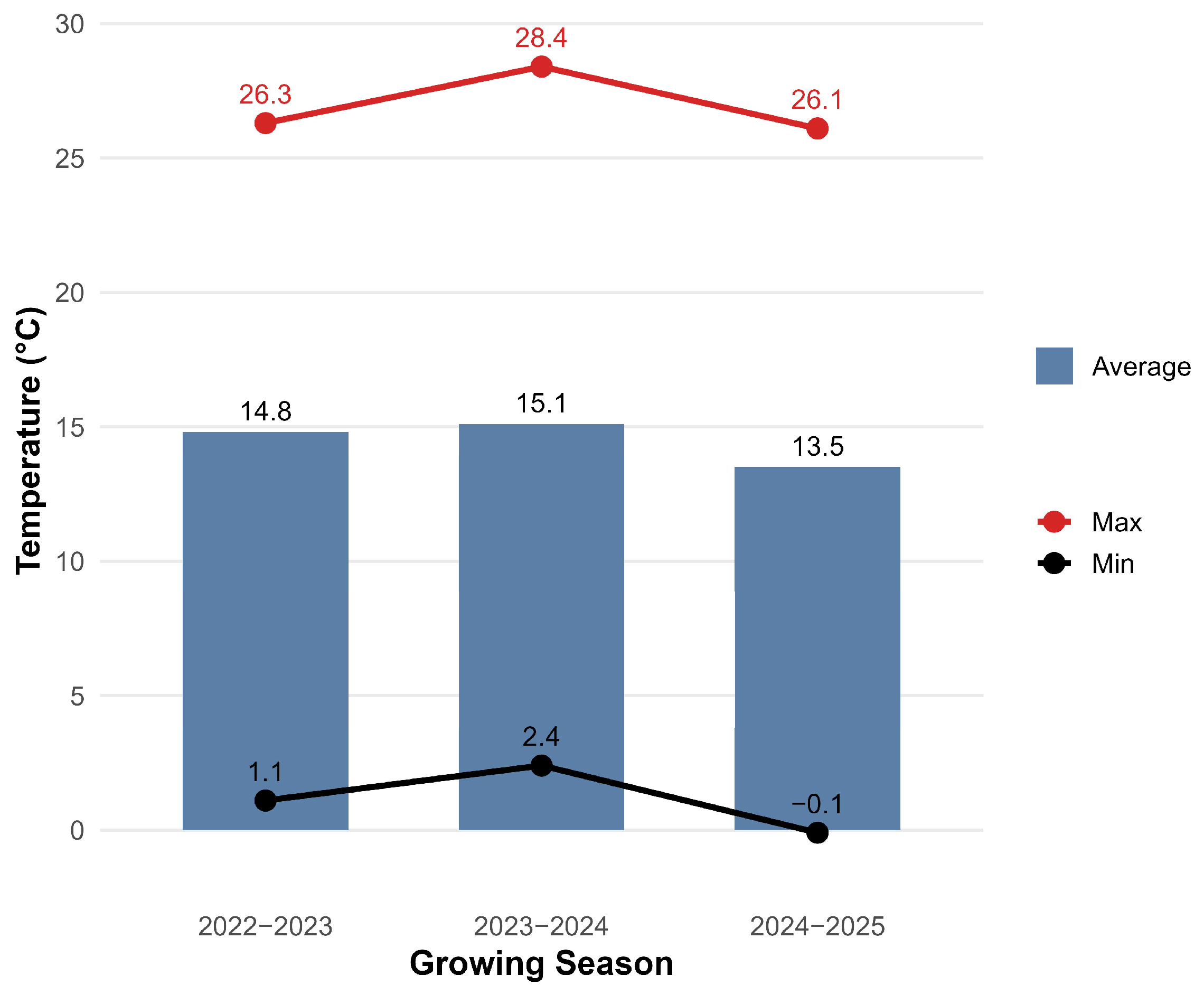
The main climate parameters describing the three studied growing seasons are presented in Figure 1 and Figure 2. Mean growing-season temperature showed moderate variation (Figure 1), ranging from 13.5 °C in 2024–2025 to 15.1 °C in 2023–2024, with 2022–2023 at 14.8 °C. Thermal variability was less pronounced than rainfall variability, with a maximum difference of 1.6 °C between seasons. Compared to the long-term average, mean temperature during the monitored period was significantly higher (p < 0.01; Cohen’s d = 1.42).
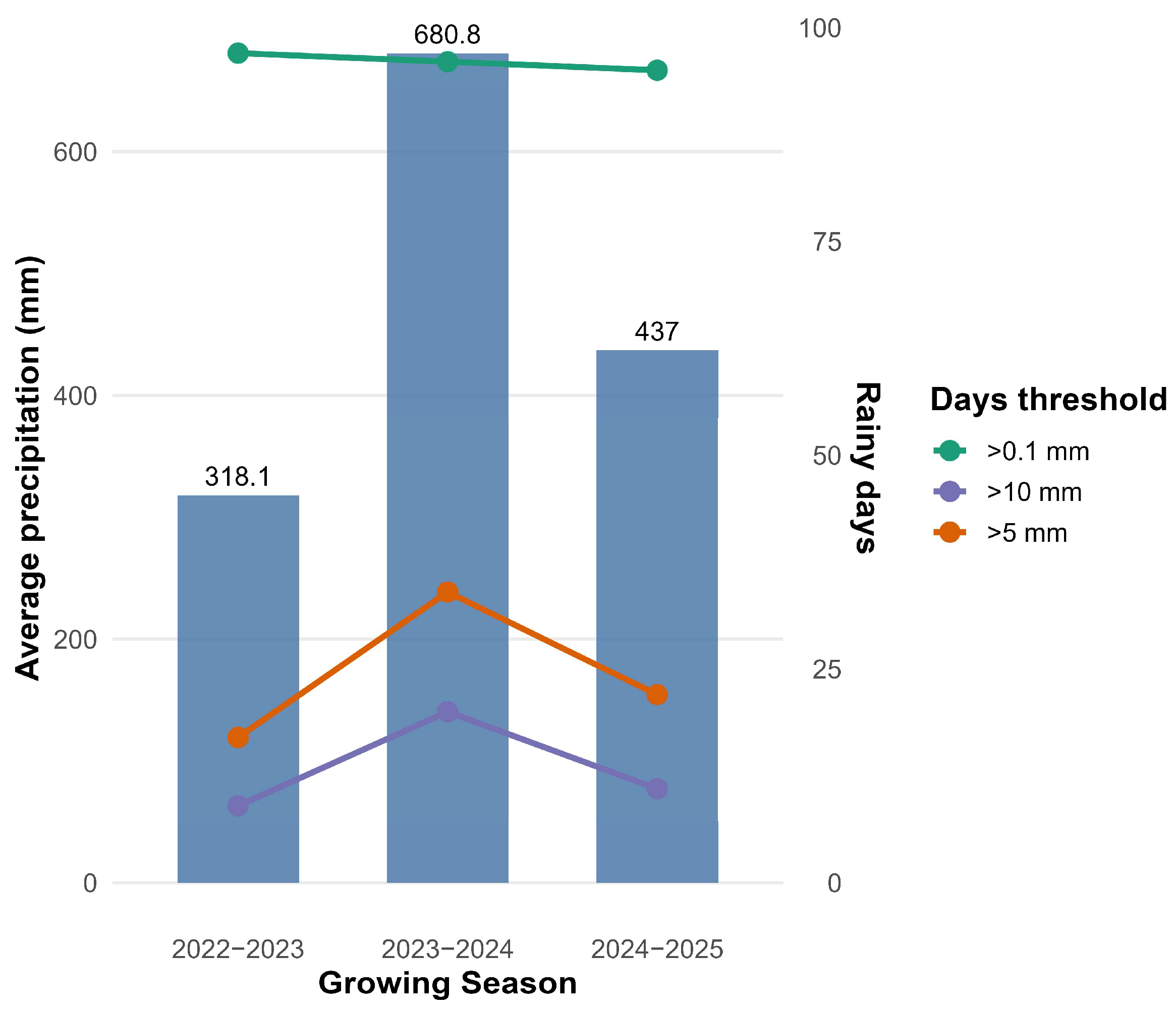
Total precipitation differed markedly among the three growing seasons (Figure 2). The 2022–2023 season was the driest, with 318.1 mm, whereas the 2023–2024 season recorded 680.8 mm, nearly double the previous season’s rainfall. In 2024–2025, precipitation decreased to 437.0 mm, corresponding to intermediate conditions. Despite this inter-annual variability, total precipitation did not differ significantly from the 40-year historical average (p = 0.80). Although the total number of rainy days (>0.1 mm) remained relatively stable (95–97 days per season), rainfall intensity differed substantially (Figure 2). The number of days with precipitation > 5 mm increased from 17 in 2022–2023 to 34 in 2023–2024, then decreased to 22 in 2024–2025. A similar pattern was observed for heavy rainfall events (>10 mm), which doubled in 2023–2024 compared to the driest season.
Overall, the study period was characterized by pronounced variability in the precipitation regime, particularly in rainfall intensity, while thermal conditions exhibited moderate fluctuations. These climatic differences provide a relevant framework for interpreting vintage-related variability in wine composition.

3.3. Physicochemical Parameters

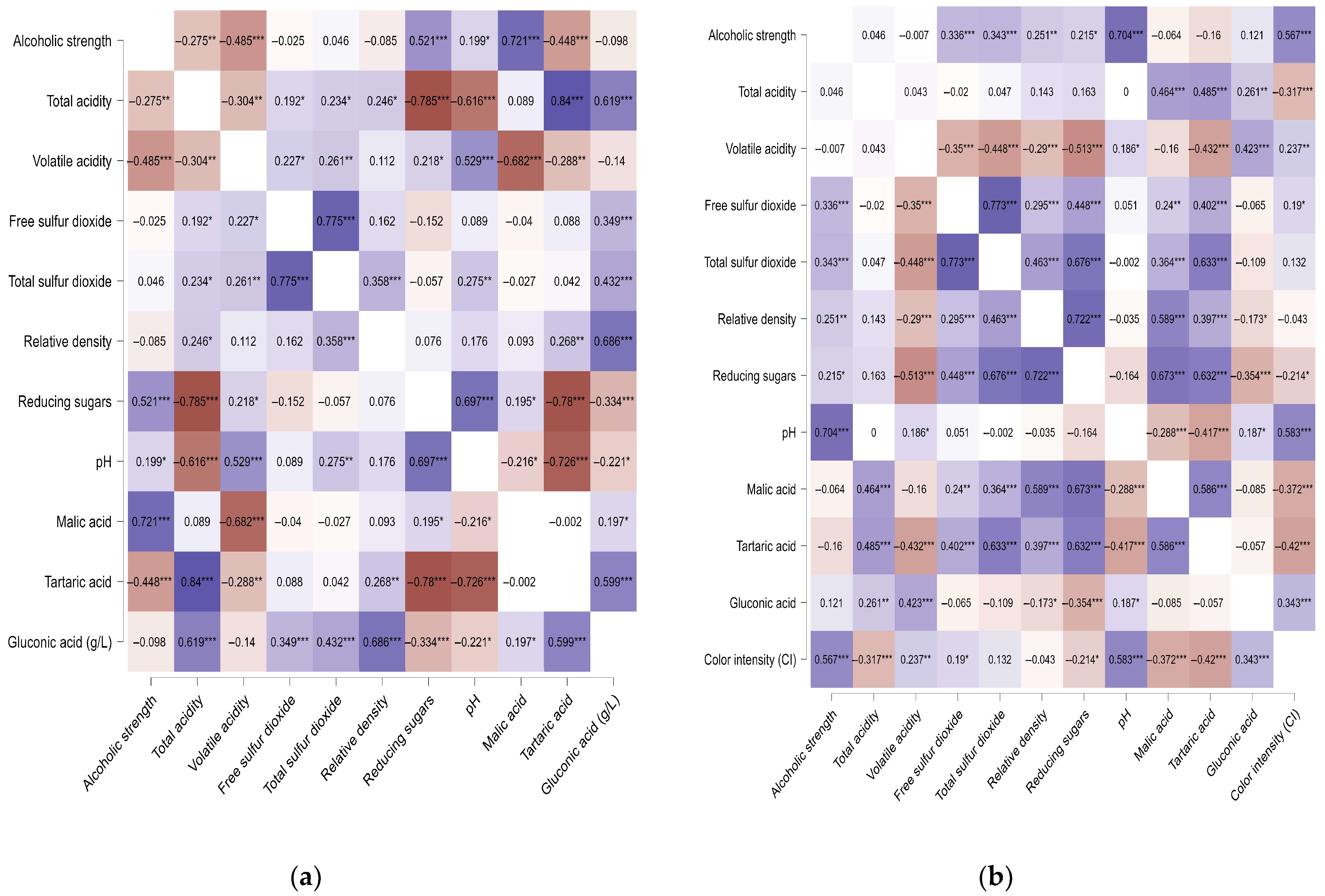
Correlation analysis (Figure 3) highlighted clear relationships among key physicochemical parameters. Strong positive associations were observed between total acidity and tartaric acid, and between reducing sugars and relative density, reflecting their shared compositional basis. Free and total sulphur dioxide were also closely related. In contrast, reducing sugars showed an inverse relationship with total acidity, whereas pH followed the expected pattern, being negatively associated with tartaric acid and positively associated with sugar content. In red wines, alcoholic strength was positively associated with both pH and colour intensity, suggesting a link between grape maturity and phenolic extraction.
Linear mixed-effects modelling confirmed that grape cultivar was a major determinant of physicochemical composition in both white and red wines (Table 2 and Table 3). In white wines, cultivar-driven differences were particularly evident for acidity-related parameters, sugar content, and alcohol levels. Specifically, ‘Columna’ was associated with higher acidity and lower pH, while ‘Sauvignon blanc’ showed a tendency toward higher sugar accumulation and alcohol content. ‘Fetească regală’ was distinguished by relatively higher volatile acidity and lower malic acid levels. The relatively higher volatile acidity values observed in some white wine variants may be associated with the characteristics of spontaneous fermentation, which involves a more diverse indigenous microbiota than controlled fermentations. The presence of variable yeast and bacterial populations may lead to increased production of volatile compounds, including acetic acid. In the context of the experimental design, these variations reflect realistic winemaking conditions and allow evaluation of the influence of cultivar and technological treatments, particularly lees-contact duration. Although some values slightly exceed the typical range reported for young white wines, they remain within acceptable limits for product stability and safety. Therefore, volatile acidity should be interpreted in relation to the experimental conditions rather than as an indicator of technological deficiency.
In red wines, cultivar effects were most pronounced for colour intensity, alcohol content, and total acidity. ‘Merlot’ was characterized by higher colour intensity and alcohol levels, whereas ‘Băbească neagră’ showed comparatively higher acidity. Differences in pH were also observed among cultivars, with higher values generally associated with wines exhibiting greater maturity. The relatively higher levels of reducing sugars observed in some red wine variants (particularly ‘Mamaia’ and ‘Merlot’) suggest differences in fermentation kinetics under spontaneous fermentation conditions, which may be associated with the variability of indigenous microbiota. Such variability is commonly observed in non-inoculated fermentations and can lead to differences in sugar consumption dynamics. In the context of the present study, these variations reflect realistic fermentation conditions and do not affect the comparative evaluation of the effects of cultivar and technological treatments. Regarding malolactic fermentation, malic acid levels indicate that the process did not proceed to the same extent across all variants. However, malolactic fermentation was not intentionally induced, as the experimental design aimed to evaluate compositional responses under spontaneous fermentation conditions.
Therefore, the observed differences in fermentation progression should be interpreted as part of the experimental variability associated with non-inoculated systems, rather than as technological deficiencies, reflecting the influence of microbiological and compositional factors on fermentation dynamics.
Overall, grape cultivar emerged as the dominant factor shaping physicochemical composition, while vintage-related variability played a secondary but noticeable role, particularly in modulating acidity and sugar-related parameters.

3.4. Phenolic Profile and Resveratrol Content

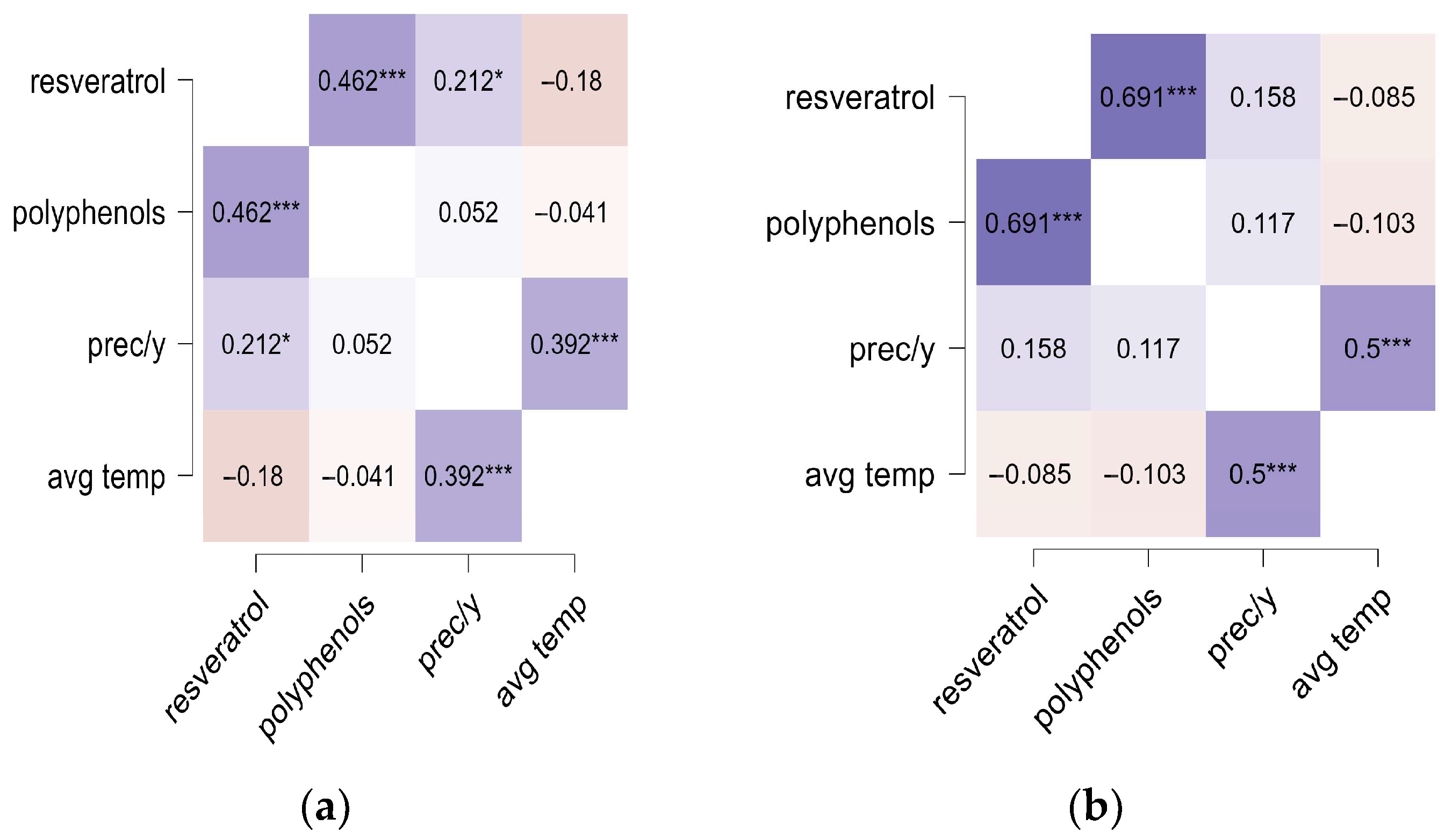
Correlation analysis (Figure 4) indicated a positive association between resveratrol and total polyphenols in both white (r = 0.462, p < 0.001) and red wines (r = 0.691, p < 0.001), the relationship being markedly stronger in red wines. Climatic variables exhibited weaker associations with phenolic parameters. In white wines, precipitation showed a modest positive correlation with resveratrol (r = 0.212, p < 0.05), whereas temperature displayed weak negative correlations with both resveratrol and total polyphenols. Similar but weaker trends were observed in red wines, suggesting that cultivar and technological factors exerted a stronger influence on phenolic composition than inter-annual climatic variability.
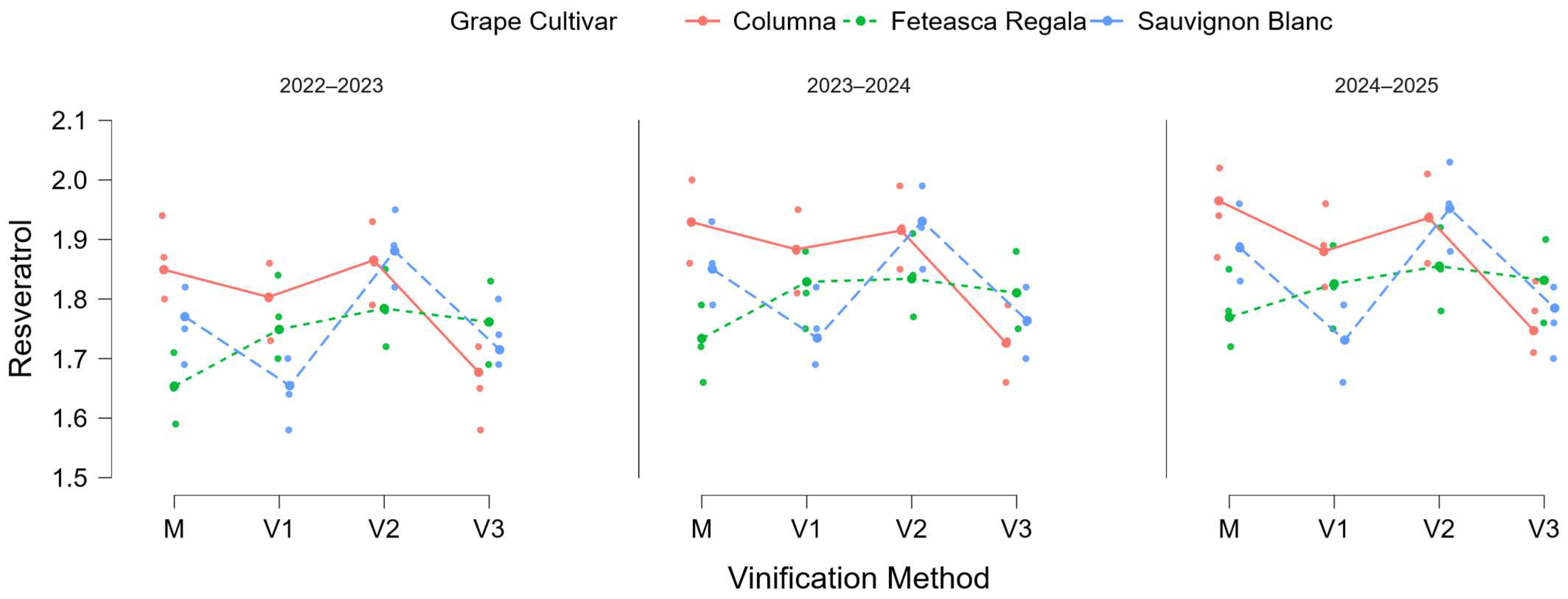
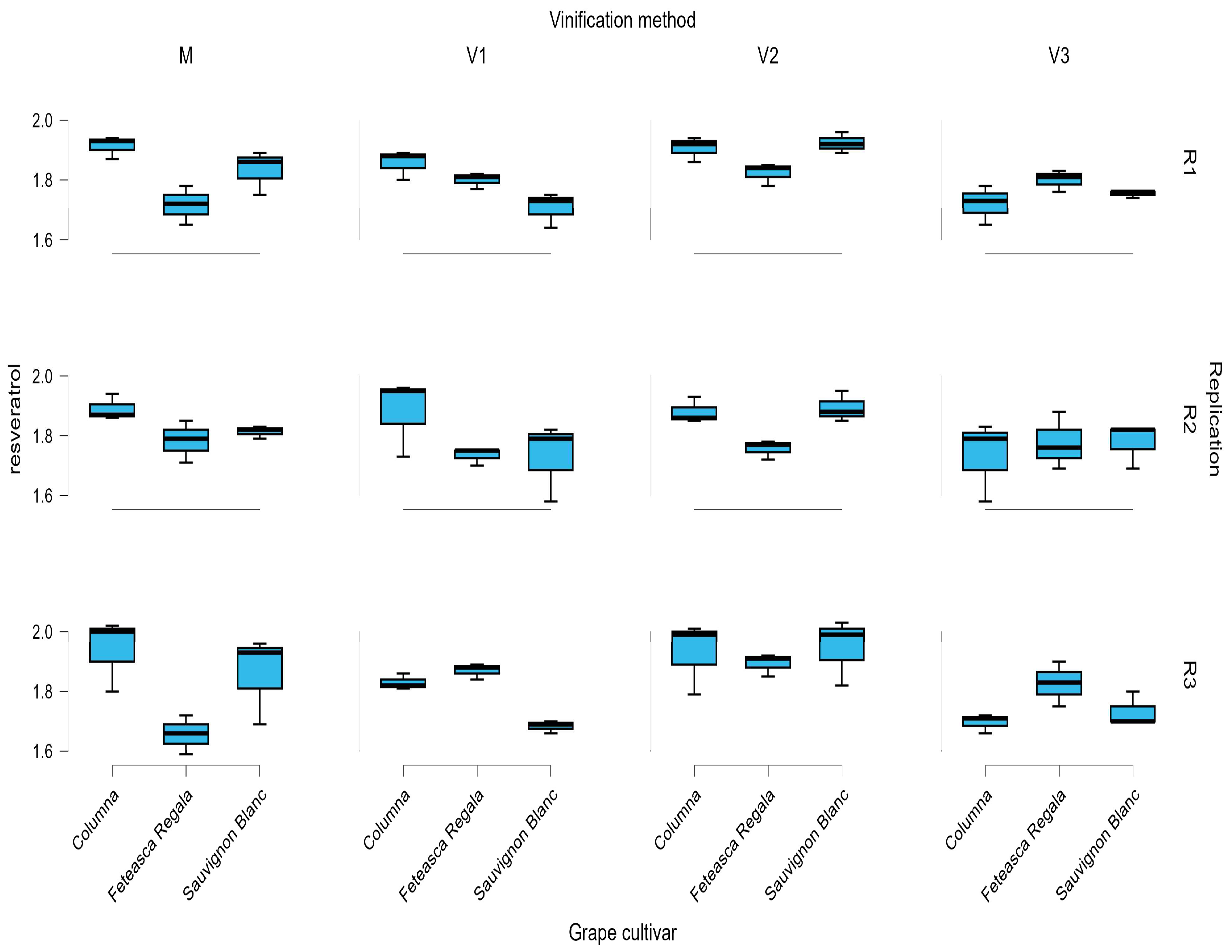
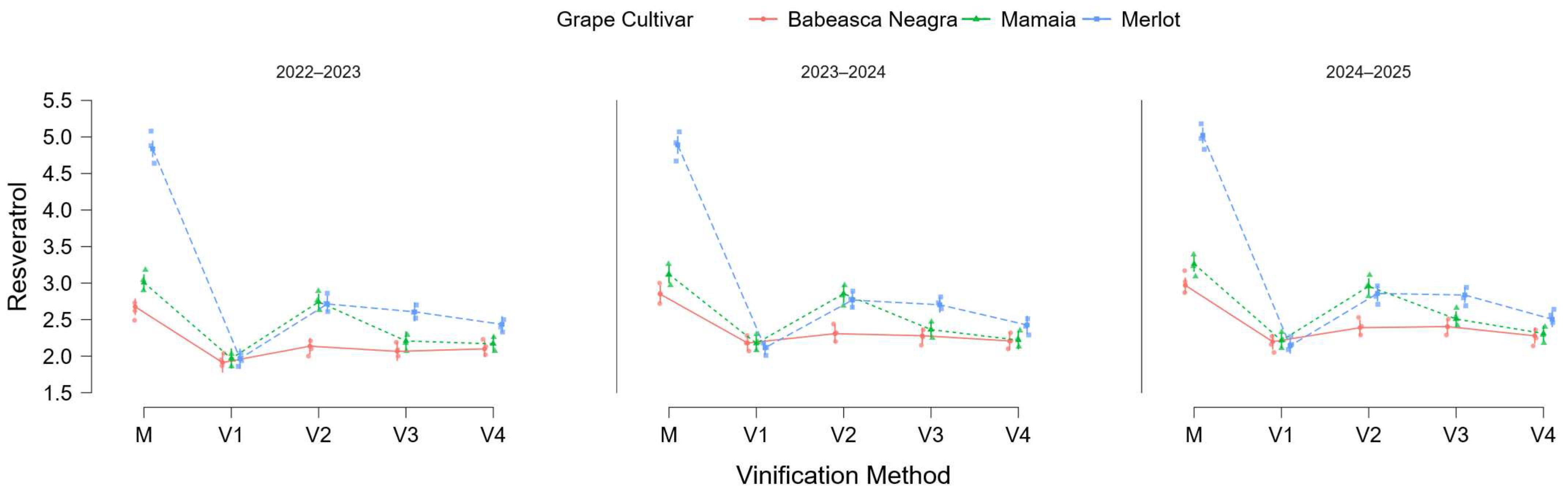
The distribution of resveratrol concentrations and the estimated marginal means derived from the linear mixed-effects model are presented in Figure 5. In white wines, resveratrol ranged between 1.58 and 2.03 µg mL−1, with significant effects of vinification treatment, cultivar, and vintage. The detailed distribution across cultivars and vinification variants is illustrated in Figure 6. ‘Columna’ exhibited slightly higher mean values compared to ‘Sauvignon blanc’ and ‘Fetească regală’, while variant V2 showed the highest average concentration. A gradual increase in mean resveratrol values across the three seasons was observed, consistent with the climatic differences described in Section 3.1.
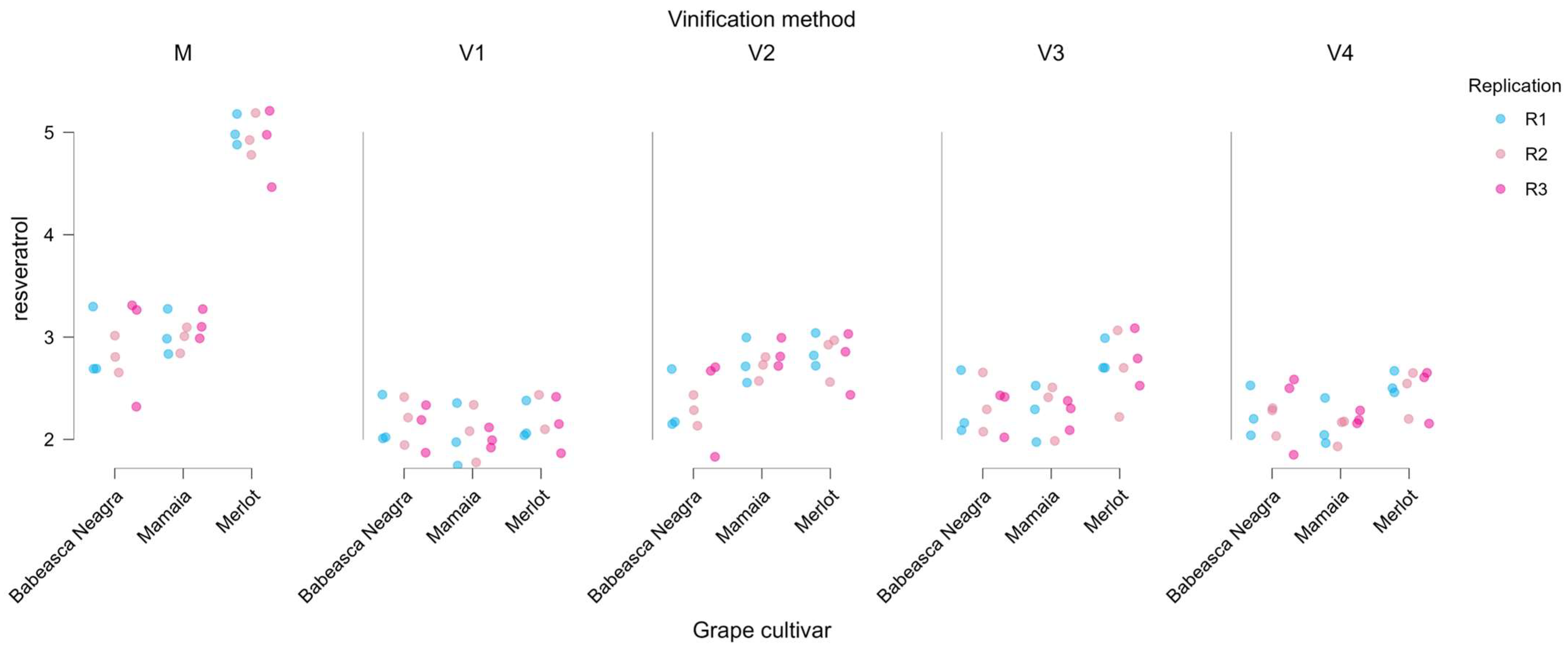
In red wines, treatment-specific responses and cultivar interactions are shown in Figure 7. Resveratrol concentrations were substantially higher than in white wines (1.86–5.18 µg mL−1) and showed pronounced differences among vinification treatments and cultivars. ‘Merlot’ displayed the highest mean levels, followed by ‘Mamaia’ and ‘Băbească neagră’. A direct comparison between white and red wines (Figure 8) highlights the overall higher stilbene concentration in red wines, with values approximately 40–60% greater than in white wines. The higher concentrations of resveratrol in red wines are closely related to its localization in grape skins. Its extraction is strongly dependent on the duration of solid–liquid contact and is enhanced by prolonged maceration and by increasing ethanol levels during fermentation. In white wines, where skin contact is limited, the extraction of this compound remains low, explaining the significant differences observed between wine types.
Overall, the observed variations in phenolic composition reflect not only quantitative differences among technological variants but also the underlying physicochemical mechanisms governing extraction, transformation, and stabilization during winemaking.
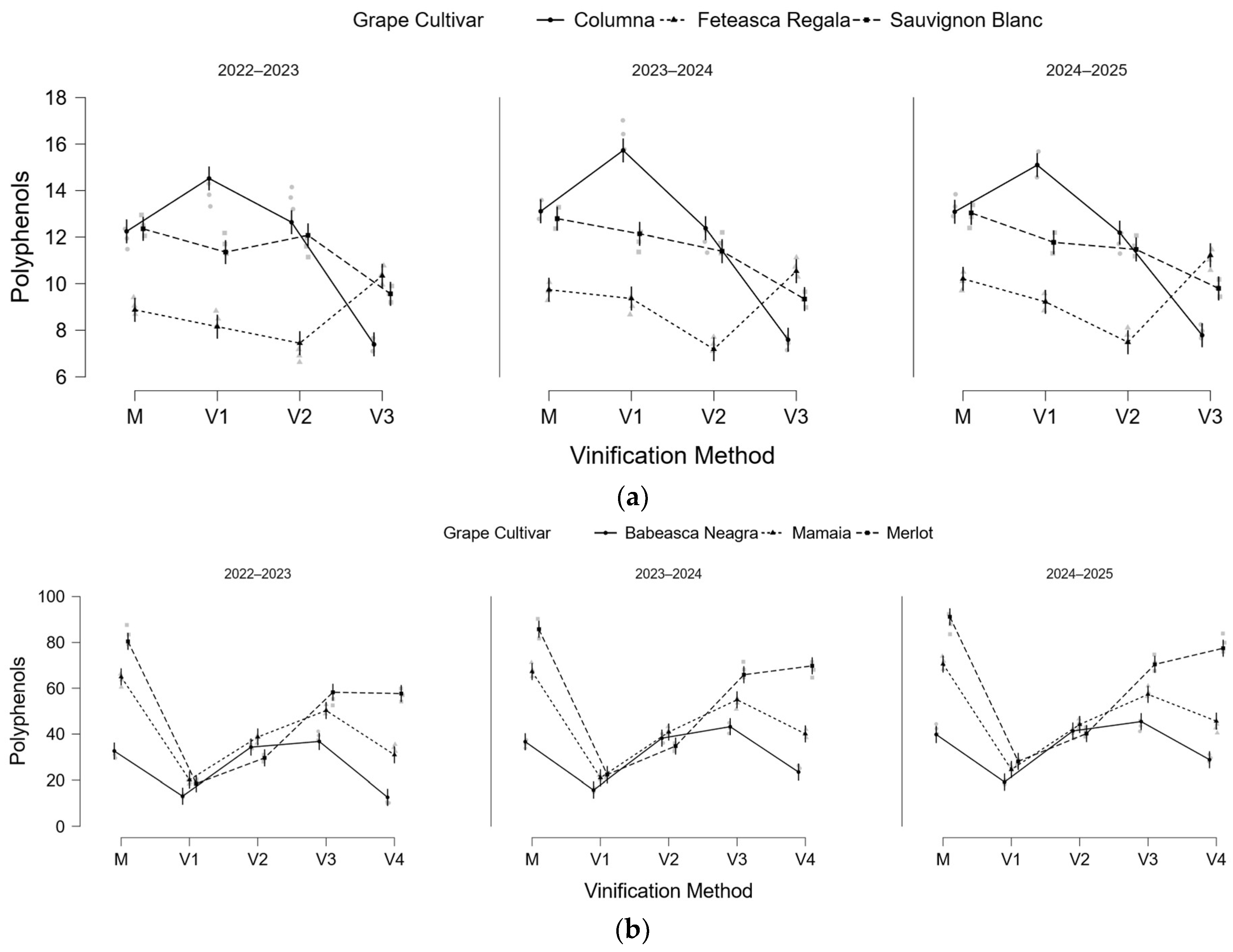
Total polyphenol content exhibited clear technological and varietal patterns (Table 4). In red wines, extended maceration treatments (V3 and V4) consistently produced the highest polyphenol concentrations, confirming the strong effect of skin contact duration on phenolic extraction. ‘Merlot’ and ‘Mamaia’ showed greater phenolic potential than ‘Băbească neagră’ under comparable conditions. A more detailed comparison with the control vinification (M) highlights the magnitude and direction of technological effects on phenolic composition.
In white wines, total polyphenol content did not increase consistently relative to the control, indicating a non-linear response to lees-contact duration. Short lees contact resulted in values comparable to the control, while extended ageing led to a decrease. The non-linear behavior observed in lees-contact treatments can be explained by yeast autolysis, which leads to the release of polysaccharides and mannoproteins into the wine matrix. These compounds can interact weakly with phenolic molecules, influencing both their stability and analytical availability. Depending on the duration of lees contact, these interactions may either stabilize phenolic compounds or reduce their measurable concentration, explaining the variations observed among technological variants. However, resveratrol concentrations were highest under intermediate lees contact, suggesting that moderate ageing may enhance the levels of specific phenolic fractions despite no overall increase in total polyphenols. In contrast, red wines exhibited a variable response relative to the control. While short maceration resulted in substantially lower phenolic content, extended maceration treatments led to progressively higher values, approaching the control under longer maceration regimes. These results indicate that prolonged skin contact enhances phenolic extraction compared to short maceration, although the control variant still maintained the highest overall values. This effect can be explained by physicochemical mechanisms governing the extraction of phenolic compounds from grape skins and seeds. As maceration progresses, partial degradation of cell walls and the increasing ethanol concentration during fermentation enhance the diffusion of phenolic compounds into the liquid phase. Ethanol acts as a solvent for less-polar phenolic compounds, such as resveratrol, thereby increasing their extraction efficiency over time. In addition, temperature increase and enzymatic activity contribute to the progressive release of these compounds from the cellular matrix.
Overall, white wine variants showed moderate, non-linear responses relative to the control, whereas red wines showed a clear dependence on maceration duration, with extended treatments leading to improved phenolic extraction.
Interaction analysis (Figure 9) highlighted cultivar-specific responses to maceration in red wines. ‘Merlot’ showed a progressive increase in polyphenol concentration with extended maceration across vintages, while ‘Băbească neagră’ exhibited a more moderate response. These results emphasize the dominant role of technological intervention in modulating phenolic extraction, superimposed on inherent varietal differences.
In contrast, white wines exhibited lower variability and a non-linear response to lees contact duration, with no clear proportional relationship between treatment intensity and total polyphenol content. This behavior likely reflects the absence of skin contact and the more complex mechanisms associated with lees ageing, involving both extraction and transformation processes.

3.5. Elemental Composition of Wines

3.5.1. Macro- and Micro-Elements

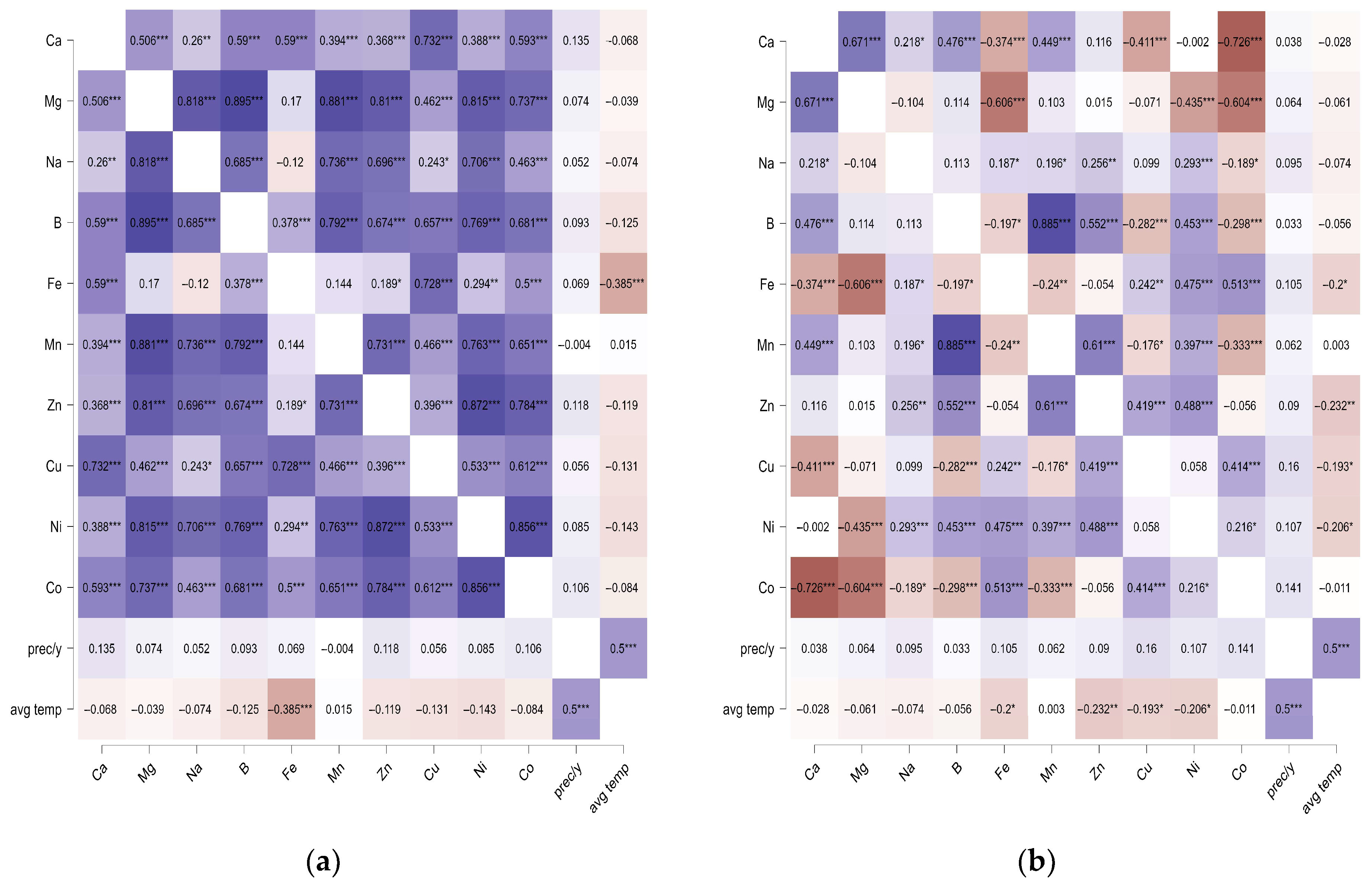
Correlation patterns among macro- and micro-elements are presented in Figure 10a (white wines) and Figure 10b (red wines). Although potassium (K+) is typically the most abundant cation in wines, it was not included in the present dataset. Ion K+ is typically present at relatively high concentrations and tends to exhibit lower variability among samples than trace elements, thereby limiting its contribution to multivariate differentiation. Therefore, it was not considered within the scope of the present elemental profiling approach. However, its potential relevance in broader compositional studies is acknowledged. The quantification of potassium by ICP-MS presents certain analytical limitations due to spectral interferences, particularly from 38Ar1H+ overlapping with 39K. In addition, the relatively high concentration of K+ in wine matrices may exceed the technique’s optimal working range, necessitating specific dilution strategies or alternative analytical approaches.
In white wines, strong positive associations were observed between Mg and B (r = 0.90), Mg and Mn (r = 0.88), Na and Zn (r = 0.87), and Ni and Co (r = 0.86), indicating coordinated accumulation of several mineral elements. Multiple correlations with r > 0.70 were detected among Mg, Na, B, Mn, Zn, Ni, and Co, suggesting a common geochemical or physiological origin. Climatic variables exerted minimal influence, with only a weak association between temperature and Fe (r = −0.39).
In red wines, the correlation structure differed partially from that observed in white wines. Strong positive associations were identified between Mn and B (r = 0.89) and between Ca and Mg (r = 0.67), while moderate negative relationships were observed between Ca and Co (r = −0.73) and between Mg and Fe (r = −0.60). Climatic variables exhibited weak or non-significant correlations with elemental concentrations, indicating that varietal factors predominated over vintage-related variability in shaping macro- and micro-element profiles.
Varietal differences were more pronounced in white wines (Table 5). ‘Columna’ consistently showed higher concentrations of Ca, Mg, Na, Zn, Cu, Ni, and Co compared with ‘Fetească regală’ and ‘Sauvignon blanc’. In contrast, ‘Fetească regală’ exhibited generally lower levels of Mg, Zn, Cu, Ni, and Co. ‘Sauvignon blanc’ was distinguished by relatively elevated Fe concentrations.
In red wines (Table 6), elemental distribution was comparatively more homogeneous among cultivars. ‘Merlot’ displayed higher Ca, Na, Zn, and Ni concentrations, while ‘Mamaia’ showed the highest Fe and Co values. ‘Băbească neagră’ was characterized by elevated B and Mn levels. Compared with white wines, red wines generally exhibited lower Ca and Mg concentrations but similar Na levels.
Overall, macro- and micro-element composition was primarily driven by grapevine cultivar, whereas climatic variability exerted limited influence. The coordinated behavior of several elements suggests that soil-derived mineral signatures were preserved across vintages under uniform vineyard management conditions.

3.5.2. Trace and Rare-Earth Elements (REEs)

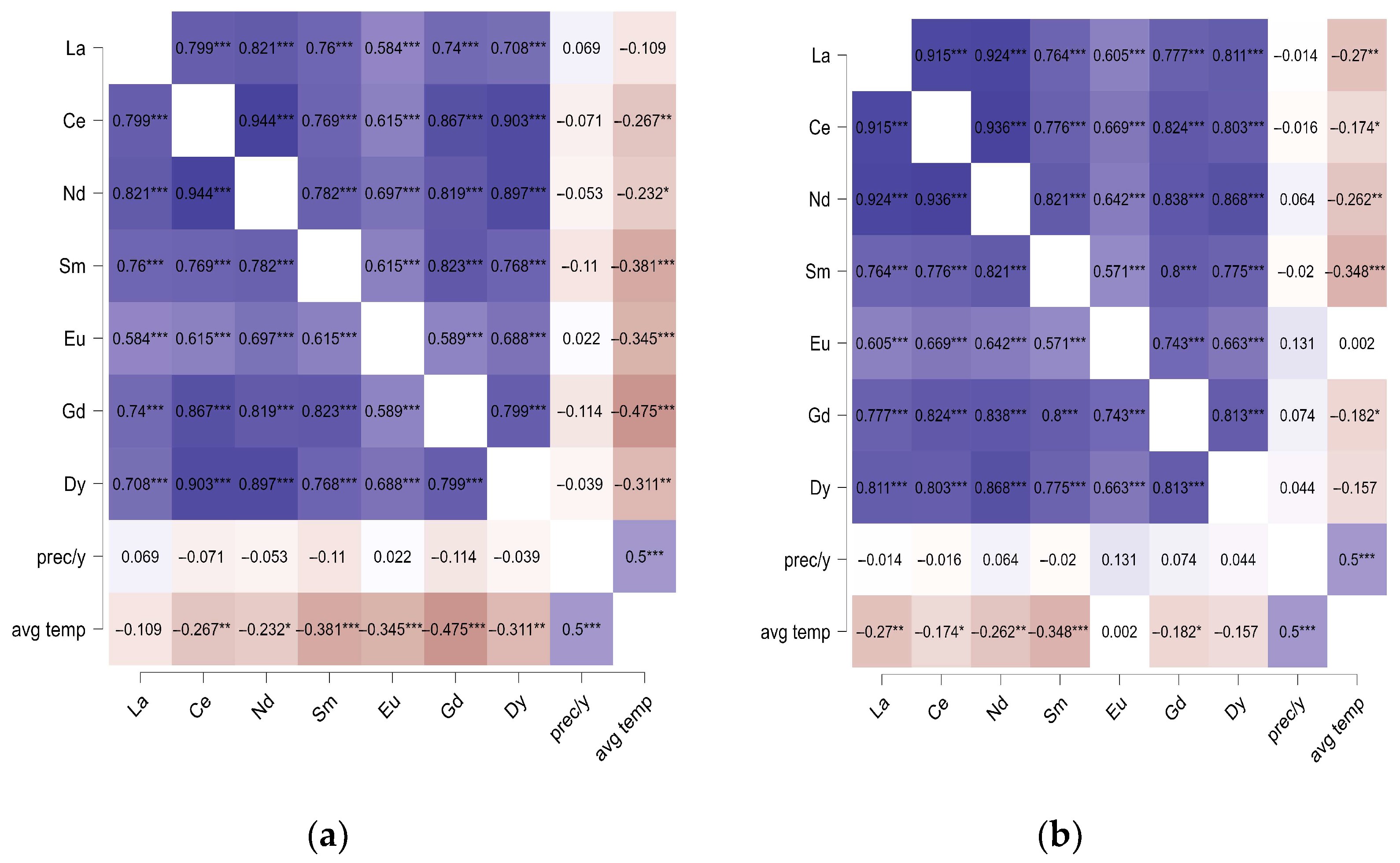
Spearman correlation analysis revealed very strong, consistent positive intercorrelations among the rare earth elements (La, Ce, Nd, Sm, Eu, Gd, Dy), with most coefficients ranging from 0.75 to 0.94 (p < 0.001) (Figure 11). This coordinated behavior suggests a common geochemical origin and similar mobility patterns within the vineyard soil–plant system. Climatic variables exhibited limited influence, with precipitation primarily correlated with average temperature (r = 0.50, p < 0.001). Moderate negative correlations between temperature and several REEs were observed in both white and red wines, although their magnitudes remained relatively low, suggesting that vintage effects were secondary to varietal and technological factors.
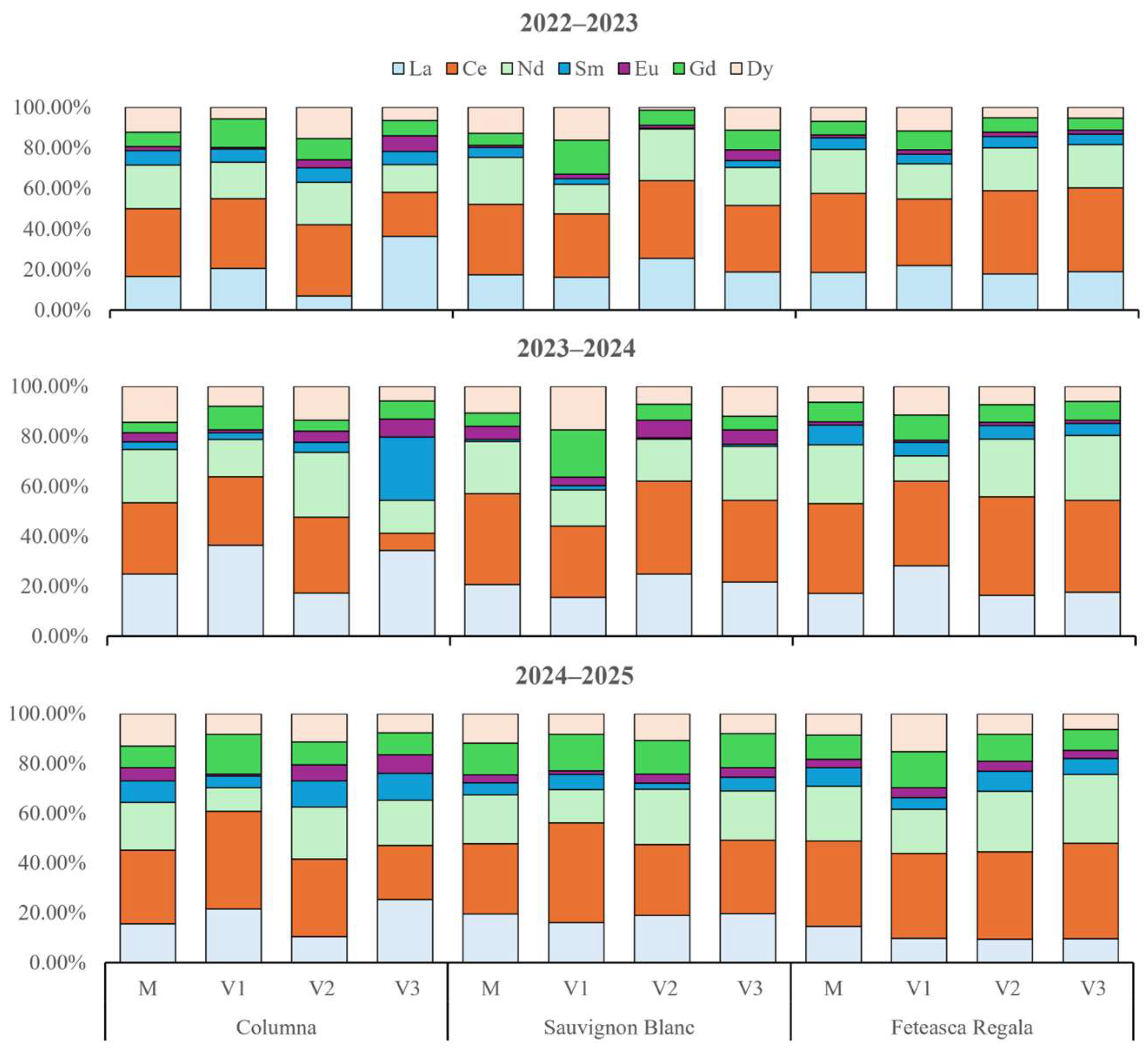
The relative distribution of REEs in white wines is presented in Figure 12. Cerium (Ce) consistently represented the dominant fraction, followed by neodymium (Nd) and lanthanum (La), while Sm, Eu, Gd, and Dy occurred at lower proportions. Although minor vintage-dependent fluctuations were observed, the overall proportional pattern remained stable across cultivars and vinification treatments.
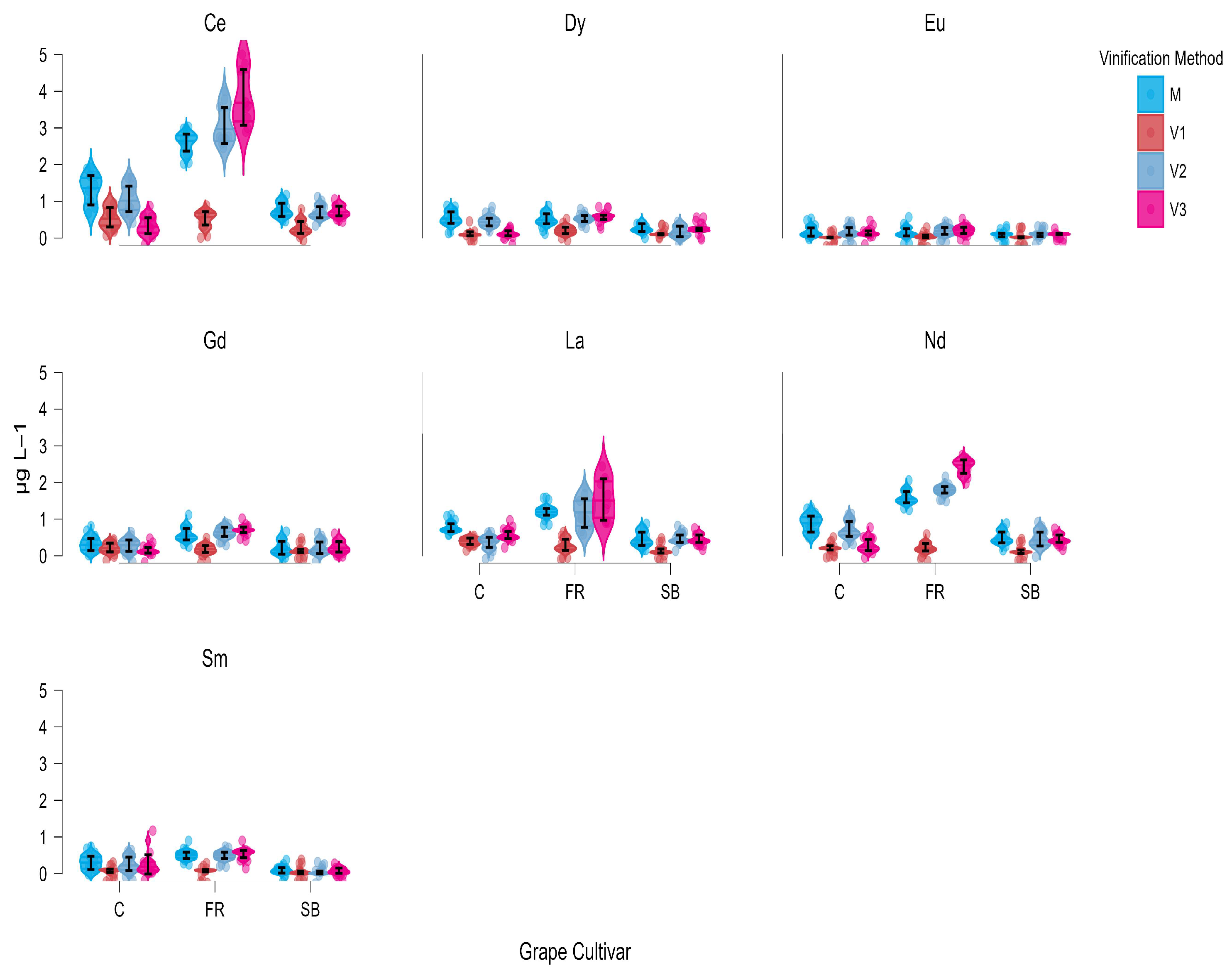
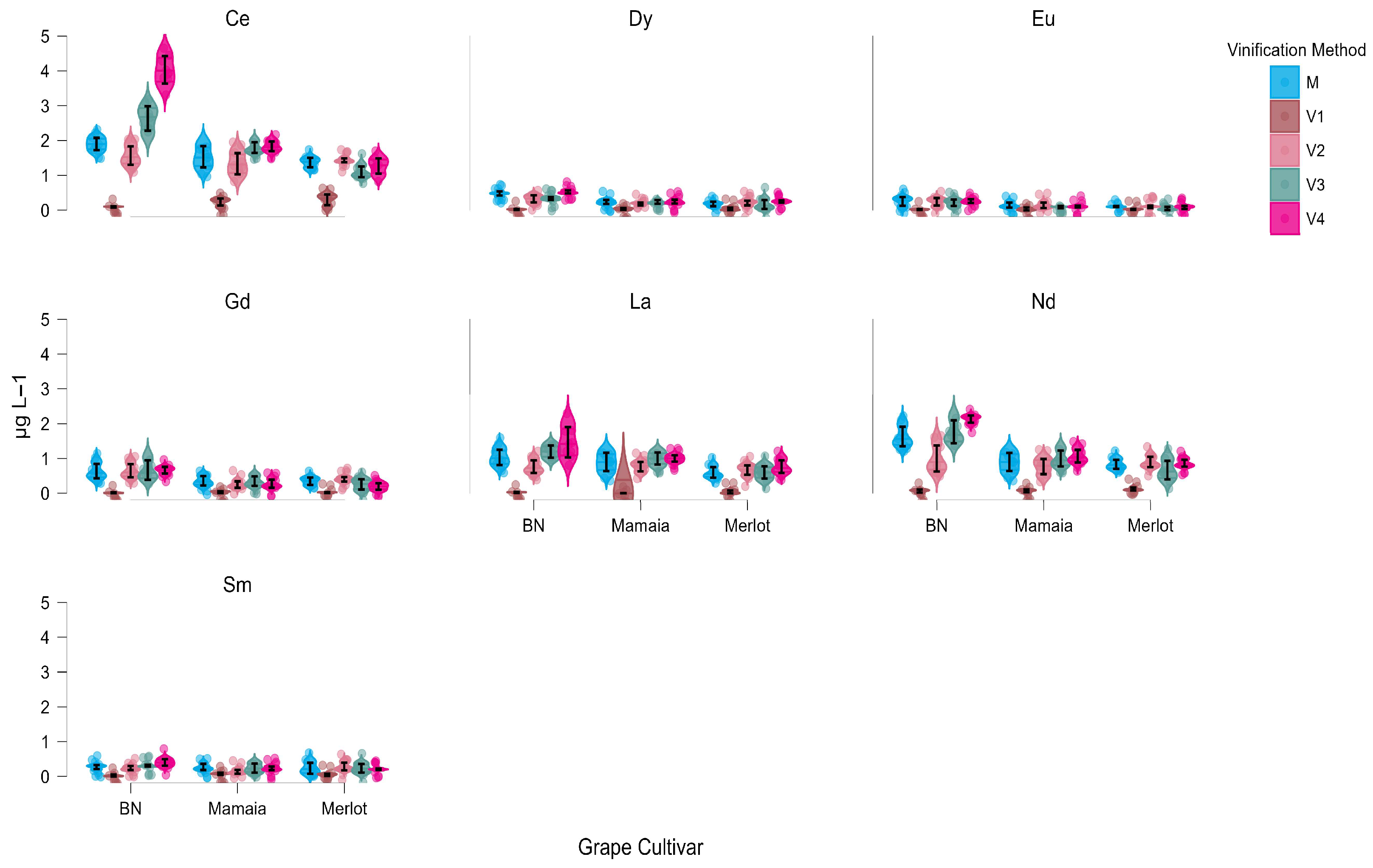
Linear mixed-effects modeling (Figure 13) indicated significant effects of grape cultivar and vinification method for several REEs. Cerium showed the strongest differentiation among cultivars (p < 0.001) and vinification treatments (p < 0.01), displaying greater variability compared with the other REEs. Lanthanum and neodymium also differed significantly among cultivars, with ‘Fetească regală’ generally exhibiting higher concentrations under extended technological treatments.
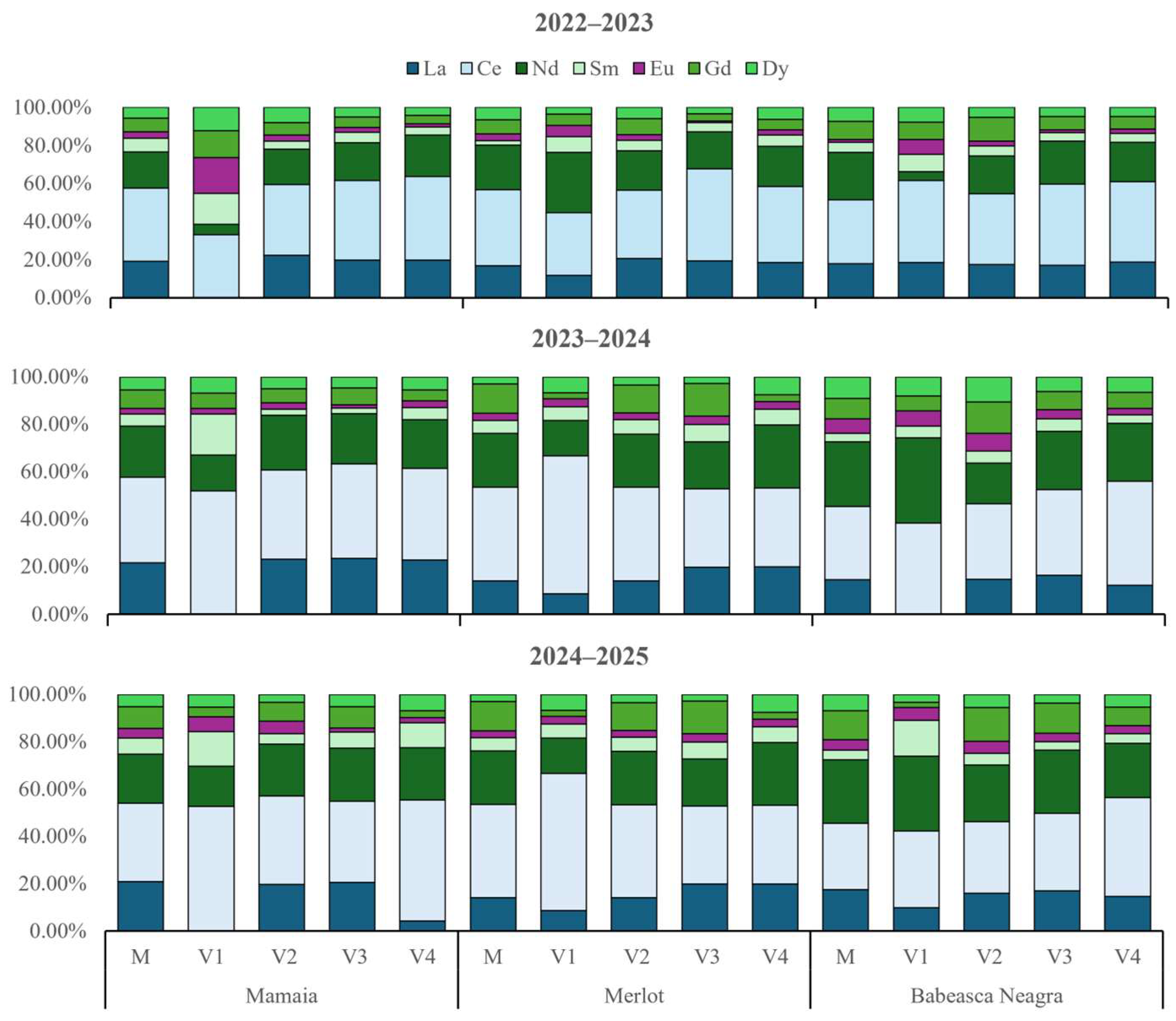
In red wines, the proportional distribution of REEs (Figure 14) followed a similar pattern, with Ce as the predominant element, although greater variability was observed across vinification treatments. The LMM results (Figure 15) confirmed significant effects of both cultivar and vinification method for Ce and La (p < 0.001), and for Nd and Sm at lower significance levels. Compared with white wines, red wines showed a stronger technological influence, particularly for Ce redistribution under specific maceration regimes.
Overall, REE profiles exhibited high internal coherence and relative stability across vintages, supporting their potential as compositional markers. However, technological modulation, especially in red wines, suggests that vinification practices may partially influence the relative distribution of certain REEs, superimposed on the underlying varietal- and soil-derived signatures.

3.5.3. Potentially Toxic Elements and Geographical Markers

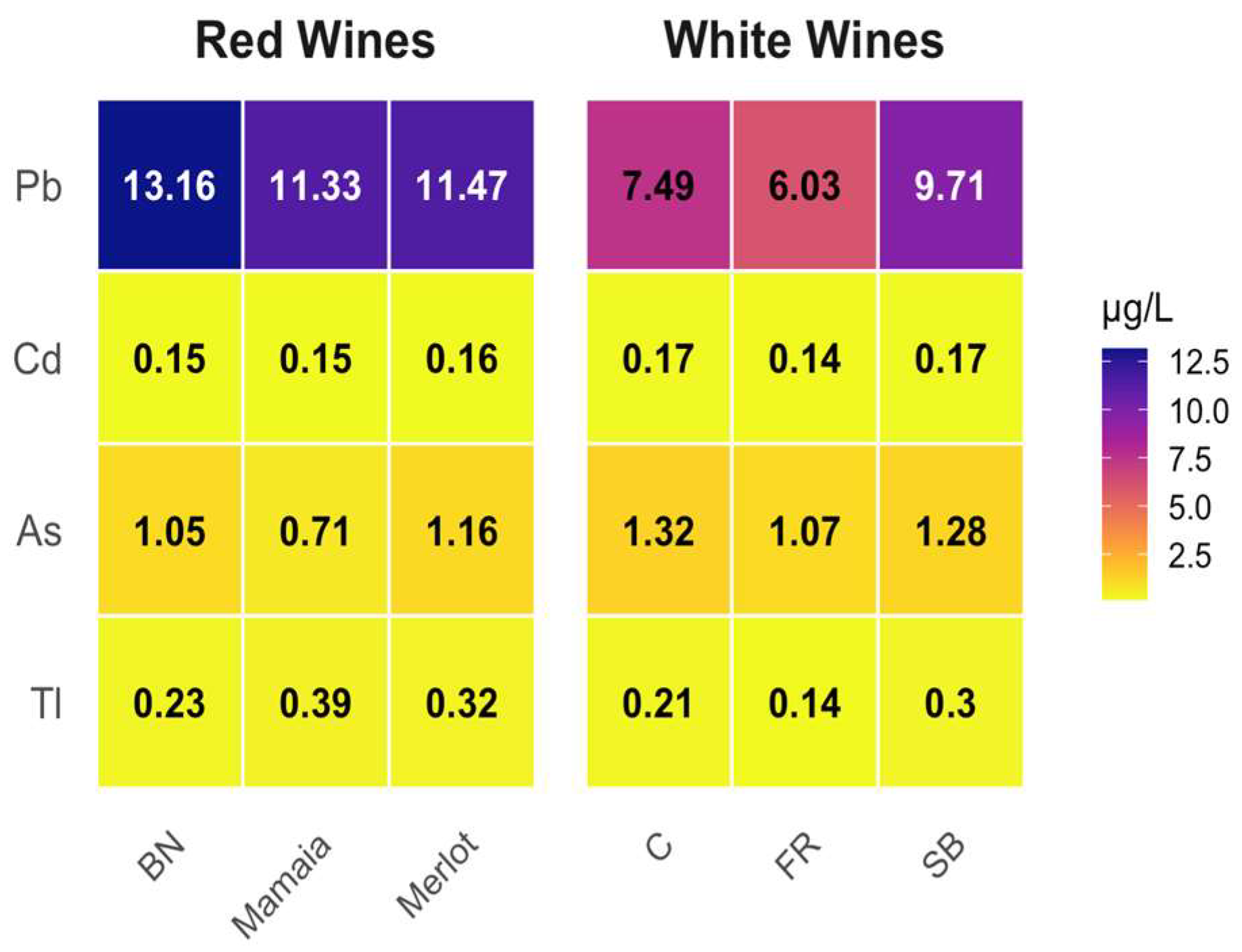
The distribution of potentially toxic elements (Pb, Cd, As, Tl) is illustrated in Figure 16. In white wines, significant main effects were observed primarily for grape cultivar and, to a lesser extent, vinification method. Lead (Pb) was predominantly cultivar-driven, with consistently higher levels in ‘Sauvignon blanc’, whereas ‘Fetească regală’ showed lower concentrations. Cadmium (Cd) varied significantly among cultivars and vintages, with higher values recorded in the wetter 2023–2024 season, suggesting a partial climatic influence. Arsenic (As) and thallium (Tl) also showed significant treatment effects, with Tl displaying clear differentiation among vinification variants.
In red wines, the hierarchy of influencing factors differed. Thallium exhibited strong effects of the vinification method and cultivar, with treatment V1 consistently producing higher concentrations. In contrast, Pb was primarily associated with cultivar, while Cd showed significant dependence on vinification method and vintage. Overall, technological factors exerted a more pronounced influence on Cd variability in red wines compared with white wines.
Importantly, all measured concentrations of Pb, Cd, and As remained within internationally accepted safety limits for wines, indicating no food safety concerns.

3.5.4. Geographical and Terroir-Related Markers

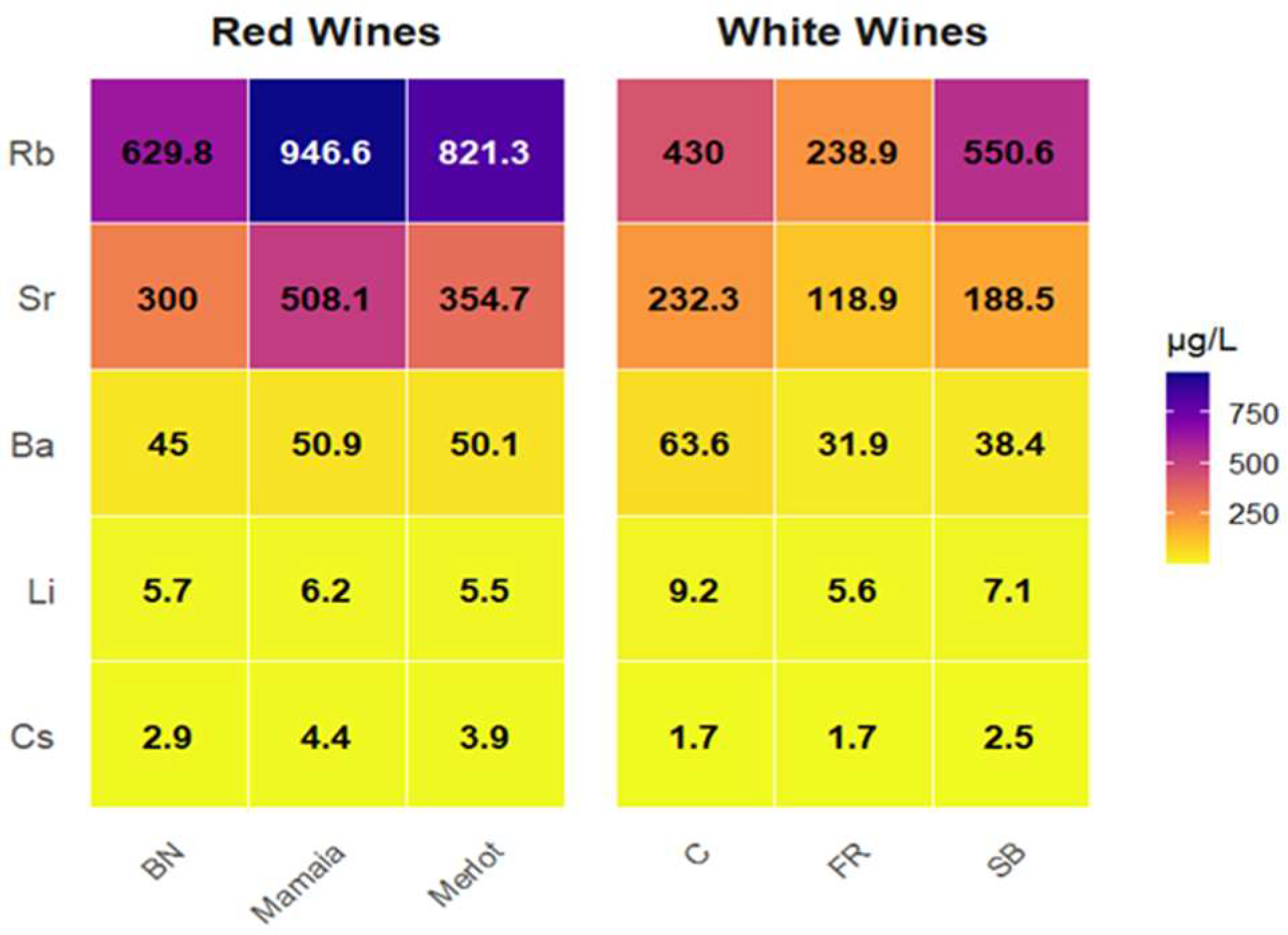
Elements commonly associated with geographical origin (Sr, Rb, Ba, Li, Cs) showed clearer varietal structuring (Figure 17). In white wines, Sr and Rb were strongly cultivar-dependent, with ‘Columna’ generally exhibiting higher concentrations. Ba and Li also showed significant cultivar effects, whereas Cs was more influenced by vinification treatment. A clear differentiation between red and white wines was observed for Sr and Rb, with red wines presenting higher overall concentrations. Within red cultivars, ‘Mamaia’ displayed the highest Rb and Sr levels, whereas in white wines, ‘Sauvignon blanc’ and ‘Columna’ showed comparatively elevated values depending on the element considered. Ba and Li were relatively more abundant in white wines, while Cs concentrations were generally higher in red wines.
These patterns suggest that Sr and Rb represent the most consistent markers of varietal and wine-type differentiation within the studied vineyard, while Ba, Li, and Cs contribute additional but less pronounced discriminatory power. The predominance of cultivar effects over vintage influence supports the stability of elemental signatures under uniform pedoclimatic conditions.

4. Discussion

The present study confirms that grape cultivar represents the primary determinant of phenolic composition, while vinification practices modulate the quantitative expression of this intrinsic metabolic potential. Such dual control, genetic and technological, has been consistently reported in viticultural research, where cultivar-specific biosynthetic capacity defines the upper limit of phenolic accumulation [30,31,32,33,34,35]. The differentiation observed among ‘Merlot’, ‘Mamaia’, and ‘Băbească neagră’ aligns with previously documented variability in anthocyanin and polyphenolic potential under Romanian conditions [36,37].
Resveratrol accumulation followed the same pattern. Its higher concentration in red wines reflects its localization in grape skins and preferential extraction during maceration [38,39,40]. The strong technological effect observed for extended maceration treatments confirms that extraction kinetics remain a dominant factor in red wine phenolic enrichment [41,42,43,44,45]. In white wines, technological modulation was more moderate, consistent with the limited role of skin contact and the subtler influence of lees ageing [46,47,48].
Climatic variability contributed to measurable interannual differences but did not override the structuring by cultivar. Although a moderate warming pattern was observed during the study period, thermal differences remained within physiological tolerance ranges and did not induce disruptive phenolic shifts. The progressive increase in resveratrol across vintages may reflect mild abiotic stress stimulation of the phenylpropanoid pathway [38], yet correlations with precipitation and temperature were generally weak. These findings support previous observations that genotype and technological intervention exert stronger influence than short-term climatic fluctuation under stable pedoclimatic conditions [49,50,51,52,53,54,55,56,57,58,59].
In contrast to phenolic compounds, mineral composition exhibited greater internal stability. The strong coherence among rare earth elements (La, Ce, Nd, Sm, Eu, Gd, Dy) suggests a common geochemical origin and limited biological fractionation [60,61]. Their consistent behavior across vintages reinforces their potential as compositional tracers. However, partial modulation by vinification practices, particularly in red wines, indicates that mineral signatures are not entirely independent of technological factors.
Elements associated with geographical differentiation (Sr and Rb) showed clear structuring by wine type and cultivar, supporting their applicability as complementary markers in authenticity assessment [60,61,62]. The differentiation between red and white wines likely reflects both vineyard-level soil interactions and differences in maceration intensity.
Phenolic composition is one of the main factors that determine the sensory characteristics, colour stability, and antioxidant potential of wines, contributing to structure, colour, astringency, and aging capacity [39,63,64]. The concentration and distribution of these compounds are influenced by complex interactions among cultivar genetics, climatic conditions during the growing season, and vinification practices [60,65,66,67]. Numerous studies have shown that the evolution of phenolic compounds in grapes and wines is strongly dependent on pedoclimatic conditions and grape maturity at harvest [68,69]. To better contextualize the technological effects, a direct comparison with the control vinification (M) was conducted. The control variants followed the standard winery protocol, consisting of approximately 15 days of lees contact for white wines and 10 days of maceration for red wines.
In white wines, lees-contact treatments did not consistently exceed the control, indicating a moderate, non-linear influence of this technological factor. In contrast, red wines showed a strong dependence on maceration duration, with extended maceration leading to progressively higher phenolic levels, approaching the control variant, which maintained the highest overall values.
In particular, interannual climatic variability may influence phenolic accumulation by affecting plant metabolism and berry ripening processes [70,71]. Factors such as temperature, solar radiation, and water availability can modify flavonoid biosynthesis and other phenolic pathways, leading to differences between harvests [67,72]. These effects, together with genetic characteristics and technological practices, contribute to the observed differences among cultivars and vintages [73,74]. Additionally, winemaking technologies, particularly maceration duration and fermentation conditions, can influence the extraction and stability of phenolic compounds [75,76].
Regarding mineral composition, the distribution of elements in wines is generally closely correlated with the geological and pedological characteristics of the vineyard area. Mineral elements are taken up from the soil and transferred into grapes and wine, contributing to the formation of an elemental fingerprint characteristic of the region of origin [77,78]. This elemental signature can provide valuable information regarding wine typicity and can be used in authentication and traceability studies [79]. Studies have shown that mineral distribution is influenced by both soil composition and ecoclimatic conditions [60,80], while certain elements may also be affected by technological interventions during winemaking [78].
Rare earth elements (REEs) are of particular interest in an oenological context due to their conservative geochemical behavior and low biological mobility. These characteristics confer relatively high stability within the soil–plant–wine system, making them potential indicators of geographical origin and pedological specificity [77,80].
Compared to conventional macro- and microelements, REEs are less influenced by technological interventions and winemaking variability, thus providing complementary information for wine characterization. Their integration into compositional analysis may improve the capacity to differentiate between cultivars and production conditions, particularly when combined with other chemical parameters.
The transfer of REEs from soil to wine can be explained by root uptake, followed by transport through the plant vascular system and accumulation in grape tissues, with subsequent transfer into must and wine during vinification. Due to their low mobility and limited metabolic interactions, their distribution may partially reflect the soil’s geochemical composition.
In this context, REEs may be considered complementary markers in studies of wine typicity and authenticity, particularly when interpreted within an integrated compositional framework.
In addition to rare earth elements, certain mineral elements associated with terroir, such as Sr, Rb, Ba, Li, and Cs, reflect the relationship between soil characteristics, environmental conditions, and wine composition [69,79]. These elements are absorbed from the soil and transferred into grapes and wine, contributing to the mineral profile of the final product. Their distribution may highlight differences between vineyard areas or wine regions [81,82], and integrating mineral and phenolic composition provides a more comprehensive understanding of the influence of terroir [66,80].
In addition to soil-related factors, vineyard management practices may also contribute to mineral variability. The application of organic fertilization and foliar treatments based on seaweed extracts may represent an additional factor influencing the mineral composition of grapes and, consequently, of wines. These products can contain macro- and microelements, as well as bioactive compounds that may affect nutrient availability and uptake at the plant level. In the present study, these practices were applied uniformly across all experimental variants and cultivars; therefore, their influence does not affect the relative comparisons among treatments. The detailed macro-, micro-, and rare earth element composition of these products was not specifically analyzed, as it was beyond the scope of the present study. Consequently, although fertilization and foliar treatments may contribute to compositional variability, the main effects observed can be attributed to the investigated factors (cultivar, vinification, and climatic conditions) under uniform vineyard management practices.
Furthermore, winemaking technologies and fermentation conditions can significantly influence the chemical composition and phenolic profile of wines, affecting both bioactive compounds and sensory characteristics [75,76]. Factors such as skin contact, enzymatic treatments, and fermentation parameters can modify phenolic content and secondary metabolites. Increasing attention has also been given to bioactive compounds such as stilbenes and other polyphenols due to their antioxidant properties and potential health benefits [64,83]. These compounds contribute not only to wine quality but also to its functional value [63,84]. Interest in optimizing the extraction and stabilization of resveratrol and other phenolic compounds has increased considerably in recent years [85,86,87].
Overall, the results highlight the combined influence of cultivar, climatic conditions, and technological practices on wine composition [66,88]. Differences observed among cultivars and vintages reflect the complex interaction between genetic and environmental factors specific to the studied wine region [60,68]. The integration of phenolic and elemental analyses provides a broader perspective on the characterization of wine composition and contributes to a better understanding of terroir influence [77]. Such multidisciplinary approaches can provide valuable tools for the characterization and authentication of regional wines [89].
At the same time, the influence of climatic conditions specific to the Dobrogea region should be considered. This region is frequently characterized by aridity and drought, which can affect vine development and grape ripening [90,91]. Water stress may influence plant metabolism, phenolic accumulation, and mineral uptake [74]. Studies conducted in other Romanian wine regions, such as Oltenia, have shown that climatic variability can significantly influence grape maturation and wine composition [71,72]. Dobrogea is characterized by increasing aridity trends and climatic risks for viticulture [91], while changes in precipitation patterns typical of semi-arid environments may affect water availability and grape development [92]. Moreover, drought conditions can influence plant physiological processes and mineral uptake dynamics [90]. In a broader climatic context, projections for southeastern Europe indicate increasing aridity trends, with potential implications for viticulture and wine composition [93]. Under these conditions, the pedoclimatic characteristics of Dobrogea likely contribute to shaping the phenolic and elemental profiles of wines, reinforcing their terroir-specific identity.
The results highlight the importance of distinguishing between intrinsic (genotype-driven) effects and process-driven (technological) effects. The grapevine cultivar defines the biochemical potential of the grapes, including the capacity for synthesis and accumulation of phenolic compounds and the distribution of mineral elements, reflecting genetic control of secondary metabolism.
In contrast, vinification practices, such as maceration duration or lees contact, act upon this intrinsic potential by modifying extraction efficiency and subsequent transformations of compounds. Thus, technological factors do not generate composition per se but modulate its expression in the final wine.
The interaction between these factors can be interpreted as a relationship between “potential” and “expression”, where the cultivar establishes the biochemical framework, and vinification determines the extent to which this potential is expressed. Although cultivar remains the dominant structural factor, technological interventions can amplify or attenuate varietal differences depending on the conditions under which they are applied. The use of spontaneous fermentation represents an additional source of variability in wine composition due to the diversity of natural microbiota involved in the process. Different yeast and bacterial populations can influence both fermentation dynamics and the transformation of phenolic compounds and other constituents. However, in the present study, all experimental variants were conducted under identical technological conditions, allowing the observed differences to be primarily attributed to the investigated factors (cultivar, vinification practices, and vintage). Although spontaneous fermentation may contribute to compositional variability, its relative impact is considered secondary compared to the main effects analysed. At the same time, the use of spontaneous fermentation reflects realistic production conditions, thereby increasing the practical relevance of the results obtained.
Future research should extend monitoring over longer climatic cycles to evaluate the long-term stability of phenolic and mineral signatures under progressive warming. Mechanistic studies focusing on cultivar-specific regulation of the phenylpropanoid pathway may further clarify the genetic control of stilbene accumulation. In addition, targeted investigations into the interactions between vinification parameters and mineral solubilization, particularly in extended maceration systems, would refine our understanding of technological modulation. Integrative approaches combining phenolic and elemental profiling with advanced multivariate tools may further strengthen authenticity assessment frameworks for Romanian wines.

5. Conclusions

This study provides an integrated assessment of phenolic composition, resveratrol concentration, physicochemical parameters, and elemental fingerprinting in six grapevine cultivars grown in Murfatlar over three consecutive growing seasons. The results demonstrate that grape cultivar represents the primary structural determinant of wine composition, governing phenolic potential, physicochemical balance, and mineral signature.
Vinification practices significantly modulated this intrinsic biochemical framework. In red wines, maceration duration strongly enhanced polyphenol and resveratrol extraction, whereas in white wines, lees contact produced moderate but significant compositional adjustments. Compared to the control vinification protocol, extended maceration in red wines led to improved phenolic extraction, whereas lees contact in white wines resulted in subtler, non-linear effects.
Climatic variability induced measurable interannual differences but did not override cultivar-driven structuring, indicating compositional resilience under moderate warming conditions.
Elemental profiling, particularly the consistent behavior of rare-earth elements and selected macro- and microelements, supported varietal differentiation and highlighted compositional patterns associated with the studied wines. However, in the absence of detailed soil mineralogical data and information on element bioavailability, the use of elemental signatures as indicators of geographical origin should be interpreted with caution.
Overall, wine composition emerged from a multilayered interplay among genotype, climate, terroir, and technological intervention. The combined phenolic and elemental approach provides a robust framework for compositional characterization and quality-oriented wine production under Romanian viticultural conditions.

Author Contributions

Conceptualization, T.C.S. and A.-M.S.; methodology, T.C.S., V.A. and T.Ș.C.; software, T.C.S.; validation, T.C.S., A.-M.S., A.R., A.B. and M.B.; formal analysis, T.C.S., A.B., C.T., V.A., I.D. and A.T.; investigation, T.C.S., A.T., I.D., V.A., M.C., A.R. and C.B.C.; resources, T.C.S., T.Ș.C., A.T., I.D., M.C. and G.I.; data curation, T.C.S., A.-M.S., D.D.C., C.B.C. and G.I.; writing—original draft preparation, T.C.S.; writing—review and editing, T.C.S. and A.-M.S.; visualization, T.C.S., A.R., D.D.C., C.B.C., M.B. and G.I.; supervision, T.C.S., A.-M.S., M.B. and A.R.; project administration, T.C.S. and M.B. All authors have read and agreed to the published version of the manuscript.

Funding

This research received no external funding.

Data Availability Statement

The original contributions presented in this study are included in the article. Further inquiries can be directed to the corresponding authors.

Conflicts of Interest

The authors declare no conflicts of interest.

Abbreviations

The following abbreviations are used in this manuscript:
LMMLinear Mixed Model
TPCTotal Phenolic Content
GAEGallic Acid Equivalents
UHPLC-DADUltra-High-Performance Liquid Chromatography with Diode Array Detection
ICP-MSInductively Coupled Plasma Mass Spectrometry
BN‘Băbească neagră’
C‘Columna’
FR‘Fetească regală’
SB‘Sauvignon blanc’
SO2Sulphur Dioxide
MControl vinification variant
V1–V4Experimental vinification variants
REEsRare-Earth Elements
LaLanthanum
CeCerium
NdNeodymium
SmSamarium
EuEuropium
GdGadolinium
DyDysprosium
PbLead
CdCadmium
AsArsenic
TlThallium
SrStrontium
RbRubidium
BaBarium
CsCesium
LiLithium

References

  1. Nassiri-Asl, M.; Hosseinzadeh, H. Review of the pharmacological effects of Vitis vinifera (grape) and its bioactive constituents: An update. Phytother. Res. 2016, 30, 1392–1403. [Google Scholar] [CrossRef]
  2. Šikuten, I.; Štambuk, P.; Andabaka, Ž.; Tomaz, I.; Marković, Z.; Stupić, D.; Maletić, E.; Kontić, J.K.; Preiner, D. Grapevine as a rich source of polyphenolic compounds. Molecules 2020, 25, 5604. [Google Scholar] [CrossRef] [PubMed]
  3. Almanza-Oliveros, A.; Bautista-Hernández, I.; Castro-López, C.; Aguilar-Zárate, P.; Meza-Carranco, Z.; Rojas, R.; Michel, M.R.; Martínez-Ávila, G.C.G. Grape pomace—Advances in its bioactivity, health benefits, and food applications. Foods 2024, 13, 580. [Google Scholar] [CrossRef]
  4. Ky, I.; Teissedre, P.-L. Characterisation of Mediterranean grape pomace seed and skin extracts: Polyphenolic content and antioxidant activity. Molecules 2015, 20, 2190–2207. [Google Scholar] [CrossRef]
  5. Balea, S.S.; Pârvu, A.E.; Pop, N.; Marín, F.Z.; Pârvu, M. Polyphenolic compounds, antioxidant, and cardioprotective effects of pomace extracts from Fetească neagră cultivar. Oxidative Med. Cell. Longev. 2018, 2018, 8194721. [Google Scholar] [CrossRef]
  6. Balea, Ş.; Pârvu, A.E.; Pârvu, M.; Vlase, L.; Dehelean, C.A.; Pop, T.I. Antioxidant, anti-inflammatory and antiproliferative effects of the Vitis vinifera L. var. Fetească neagră and Pinot Noir pomace extracts. Front. Pharmacol. 2020, 11, 990. [Google Scholar] [CrossRef]
  7. Banc, R.; Loghin, F.; Miere, D.; Ranga, F.; Socaciu, C. Phenolic composition and antioxidant activity of red, rosé and white wines originating from Romanian grape cultivars. Not. Bot. Horti Agrobot. 2020, 48, 716–734. [Google Scholar] [CrossRef]
  8. Prakash, O.; Supriya, A.; Kudachikar, V.B. Physicochemical changes, phenolic profile and antioxidant capacities of colored and white grape (Vitis vinifera L.) varieties during berry development and maturity. Int. J. Fruit Sci. 2020, 20, 1773–1783. [Google Scholar] [CrossRef]
  9. Rajha, H.N.; Darra, N.E.; Kantar, S.E.; Hobaika, Z.; Louka, N.; Maroun, R.G. A comparative study of the phenolic and technological maturities of red grapes grown in Lebanon. Antioxidants 2017, 6, 8. [Google Scholar] [CrossRef]
  10. Jediyi, H.; Naamani, K.; Ait Elkoch, A.; Dihazi, A.; El Alaoui El Fels, A.; Arkize, W. First study on technological maturity and phenols composition during the ripeness of five Vitis vinifera L grape varieties in Morocco. Sci. Hortic. 2019, 246, 390–397. [Google Scholar] [CrossRef]
  11. Benbouguerra, N.; Richard, T.; Saucier, C.; Garcia, F. Voltammetric behavior, flavanol and anthocyanin contents, and antioxidant capacity of grape skins and seeds during ripening (Vitis vinifera var. Merlot, Tannat, and Syrah). Antioxidants 2020, 9, 800. [Google Scholar] [CrossRef]
  12. Niu, S.; Hao, F.; Mo, H.; Jiang, J.; Wang, H.; Liu, C.; Fan, X.; Zhang, Y. Phenol profiles and antioxidant properties of white skinned grapes and their colored genotypes during growth. Biotech. Biotechnol. Equip. 2017, 31, 58–67. [Google Scholar] [CrossRef]
  13. Shen, L.; Chen, S.; Mi, Z.W.; Su, J.Y.; Huang, R.; Song, Y.Y.; Fang, Y.L.; Su, B.F. Identifying veraison process of colored wine grapes in field conditions combining deep learning and image analysis. Comput. Electron. Agric. 2022, 200, 107268. [Google Scholar] [CrossRef]
  14. Lucini, L.; Rocchetti, G.; Trevisan, M. Extending the concept of terroir from grapes to other agricultural commodities: An overview. Curr. Opin. Food Sci. 2020, 31, 88–95. [Google Scholar] [CrossRef]
  15. van Leeuwen, C. Terroir: The effect of the physical environment on vine growth, grape ripening and wine sensory attributes. In Managing Wine Quality; Elsevier: Amsterdam, The Netherlands, 2010; pp. 273–315. [Google Scholar] [CrossRef]
  16. Blancquaert, E.H.; Oberholster, A.; Ricardo-da-Silva, J.M.; Deloire, A.J. Grape flavonoid evolution and composition under altered light and temperature conditions in Cabernet Sauvignon (Vitis vinifera L.). Front. Plant Sci. 2019, 10, 1062. [Google Scholar] [CrossRef]
  17. Gambetta, G.A.; Herrera, J.C.; Dayer, S.; Feng, Q.; Hochberg, U.; Castellarin, S.D. The physiology of drought stress in grapevine: Towards an integrative definition of drought tolerance. J. Exp. Bot. 2020, 71, 4658–4676. [Google Scholar] [CrossRef] [PubMed]
  18. Droulia, F.; Charalampopoulos, I. Future climate change impacts on European viticulture: A review on recent scientific advances. Atmosphere 2021, 12, 495. [Google Scholar] [CrossRef]
  19. Rogiers, S.Y.; Greer, D.H.; Liu, Y.; Baby, T.; Xiao, Z. Impact of climate change on grape berry ripening: An assessment of adaptation strategies for the Australian vineyard. Front Plant Sci. 2022, 13, 1094633. [Google Scholar] [CrossRef] [PubMed]
  20. Filimon, R.M.; Bunea, C.I.; Filimon, R.V.; Bora, F.D.; Damian, D. Long-term evolution of the climatic factors and its influence on grape quality in Northeastern Romania. Horticulturae 2024, 10, 705. [Google Scholar] [CrossRef]
  21. Sîrbu, R.; Negreanu-Pîrjol, T.; Negreanu-Pîrjol, B.S.; Cadar, E. Important properties of grapes and wine from Dobrogea area. Eur. J. Nat. Sci. Med. 2021, 4, 59–69. [Google Scholar] [CrossRef]
  22. Wagner, M.; Stanbury, P.; Dietrich, T.; Döring, J.; Ewert, J.; Foerster, C.; Freund, M.; Friedel, M.; Kammann, C.; Koch, M.; et al. Developing a sustainability vision for the global wine industry. Sustainability 2023, 15, 10487. [Google Scholar] [CrossRef]
  23. Maicas, S.; Mateo, J.J. Sustainability of wine production. Sustainability 2020, 12, 559. [Google Scholar] [CrossRef]
  24. Medina-Plaza, C.; Meade, H.; Dokoozlian, N.; Ponangi, R.; Blair, T.; Block, D.E.; Oberholster, A. Investigating the relation between skin cell wall composition and phenolic extractability in Cabernet Sauvignon wines. Fermentation 2022, 8, 401. [Google Scholar] [CrossRef]
  25. Hasanaliyeva, G.; Chatzidimitrou, E.; Wang, J.; Baranski, M.; Volakakis, N.; Seal, C.; Rosa, E.A.S.; Iversen, P.O.; Vigar, V.; Barkla, B.; et al. Effects of production region, production systems, and grape type/variety on nutritional quality parameters of table grapes; Results from a UK retail survey. Foods 2020, 9, 1874. [Google Scholar] [CrossRef]
  26. González-Neves, G.; Charamelo, D.; Balado, J.; Barreiro, L.; Bochicchio, R.; Gatto, G.; Gil, G.; Tessore, A.; Carbonneau, A.; Moutounet, M. Phenolic potential of Tannat, Cabernet Sauvignon and Merlot grapes and their correspondence with wine composition. Anal. Chim. Acta 2004, 513, 191–196. [Google Scholar] [CrossRef]
  27. Artem, V.; Antoce, A.O.; Geana, E.I.; Ranca, A. Effect of grape yield and maceration time on phenolic composition of ‘Fetească neagră’ organic wine. Not. Bot. Horti Agrobot. Cluj-Napoca 2021, 49, 12345. [Google Scholar] [CrossRef]
  28. Geana, E.I.; Costinel, D.; Marinescu, A.; Ionete, R.E.; Bala, C. Characterization of wines by trans -resveratrol concentration: A case study of Romanian varieties. Anal. Lett. 2014, 47, 1737–1746. [Google Scholar] [CrossRef]
  29. Zhang, L.; Liu, Q.; Li, Y.; Liu, S.; Tu, Q.; Yuan, C. Characterization of wine volatile compounds from different regions and varieties by HS-SPME/GC-MS coupled with chemometrics. Curr. Res. Food Sci. 2023, 6, 100418. [Google Scholar] [CrossRef]
  30. Urcan, D.E.; Lung, M.L.; Giacosa, S.; Torchio, F.; Ferrandino, A.; Vincenzi, S.; Rió Segade, S.; Pop, N.; Rolle, L. Phenolic substances, flavor compounds, and textural properties of three native romanian wine grape varieties. Int. J. Food Prop. 2015, 19, 76–98. [Google Scholar] [CrossRef]
  31. Onache, P.A.; Sumedrea, D.I.; Florea, A.; Tănase, A. The influence of climatic conditions on oenological parameters of some wine cultivars from different Romanian vineyard. Romanian J. Hortic. 2020, 1, 103–110. [Google Scholar] [CrossRef]
  32. Du, Y.; Li, X.; Xiong, X.; Cai, X.; Ren, X.; Kong, Q. An investigation on polyphenol composition and content in the skin of the grape (Vitis vinifera L. cv. Hutai No. 8) fruit during ripening by UHPLC-MS2 technology combined with multivariate statistical analysis. Food Biosci. 2021, 43, 101276. [Google Scholar] [CrossRef]
  33. Bora, F.D.; Donici, A.; Oșlobanu, A.; Fițiu, A.; Babeș, A.C.; Bunea, C.I. Qualitative assessment of the white wine varieties grown in Dealu Bujorului vineyard, Romania. Not. Bot. Horti Agrobot. 2016, 44, 593–602. [Google Scholar] [CrossRef]
  34. Muntean, C.; Stoica, F.; Cîmpeanu, C.B.; Rotaru, I. Relationship between the main quality parameters and antocyanic content during grapes ripening in Drănic viticultural area. Ann. Univ. Craiova Agric. 2018, 47, 181–188. [Google Scholar]
  35. Cherviak, S.; Boiko, V.; Levchenko, S.; Oleinikova, V.; Romanov, A.; Belash, D. Changes in the carbohydrate-acid and phenolic complexes of grapes in the dynamics of ripening. E3S Web Conf. 2024, 595, 02013. [Google Scholar] [CrossRef]
  36. Coarfă, E.; Popa, M.E. Some relevant quality indicators of red wine from three grapes cultivars—A minireview. Sci. Bull. Ser. F Biotechnol. 2018, 22, 70–80. [Google Scholar]
  37. Postolache, E.; Bora, F.D.; Ciubucă, A.; Donici, A. Research on the evaluation of the phenolic compounds of red wines from Dealul Bujorului vineyard. Dezvoltarea Econ.-Soc. Durabilă Euroregiunilor Zonelor Transfront. 2017, 30, 426–433. [Google Scholar]
  38. Căpruciu, R.; Cichi, D.D.; Mărăcineanu, L.C.; Costea, D.C. The resveratrol content in black grapes skins at different development stages. Sci. Pap. Ser. B Hortic. 2022, 66, 245–252. [Google Scholar]
  39. Tița, O.; Onache, P.A.; Geana, E.-I.; Ciucure, C.T.; Sumedrea, D.I.; Florea, A. Phytochemical screening and antioxidant activities of white and red wines from different varieties and wine regions in Romania. Antioxidants 2025, 14, 564. [Google Scholar] [CrossRef] [PubMed]
  40. Petrović, A.; Živković, N.; Torović, L.; Bukarica, A.; Nikolić, V.; Cvejić, J.; Gojković-Bukarica, L. The influence of innovative and traditional Cabernet Sauvignon winemaking technology and wine aging on stilbenes and other polyphenolic compounds. Preprints 2024. [Google Scholar] [CrossRef]
  41. Rădulescu, A. Cercetări Privind Optimizarea Tehnologiei de Obţinere a Vinurilor Roşii în Podgoria Drăgăşani. Ph.D. Thesis, Craiova University, Craiova, Romania, 2012. Available online: http://digital-library.ulbsibiu.ro/jspui/handle/123456789/2568 (accessed on 26 February 2026).
  42. Stroe, T.C.; Botu, M.; Băducă Cîmpeanu, C. The influence of maceration duration on the quality of red wines from the Murfatlar vineyard. Ann. Univ. Craiova Agric. 2020, 50, 225–229. [Google Scholar]
  43. Bălănescu, I.G.; Antoce, A.O.; Pîrcălabu, L.; Tudor, G.; Barbu, S.P. The influence of maceration techniques on the polyphenolic content of the wines from Negru aromat grape variety. Sci. Pap. Ser. B Hortic. 2023, 67, 221–226. [Google Scholar]
  44. Lisov, N.; Čakar, U.; Milenković, D.; Čebela, M.; Vuković, G.; Despotović, S.; Petrović, A. The influence of Cabernet Sauvignon ripeness, healthy state and maceration time on wine and fermented pomace phenolic profile. Fermentation 2023, 9, 695. [Google Scholar] [CrossRef]
  45. Casassa, L.F.; Sari, S.E.; Bolcato, E.A.; Fanzone, M.L. Microwave-assisted extraction applied to merlot grapes with contrasting maturity levels: Effects on phenolic chemistry and wine color. Fermentation 2019, 5, 15. [Google Scholar] [CrossRef]
  46. Cojocaru, G.A.; Ilie, B.E.; Antoce, A.O. The effect of the pre-fermentative skin contact on the colour characteristics and total phenols of white wines. Sci. Pap. Ser. B Hortic. 2022, 66, 253–259. [Google Scholar]
  47. Stroe, T.C.; Băducă Cîmpeanu, C.; Botu, M. The influence of ageing on lees on the quality of white wines from the Murfatlar vineyard. Ann. Univ. Craiova Agric. 2020, 50, 220–224. [Google Scholar]
  48. Itu, N.L. Biotehnologii Moderne de Obținere a Vinurilor albe Aromate în Podgoria Murfatlar. Ph.D. Thesis, Universitatea “Dunărea de Jos”, Galați, Romania, 2011. [Google Scholar]
  49. Stoenescu, A.M.; Coșmulescu, S.N.; Gheorghiu, N. The influence of interannual climate variation on the phenology of some wild fruit species and their relation with avifauna. Sci. Pap. Ser. B Hortic. 2024, 68, 173–181. [Google Scholar]
  50. Stroe, T.C.; Botu, M.; Băducă Cîmpeanu, C.; Dina, I.; Negraru (Tănase), A. The behavior of the ‘Columna’ and ‘Mamaia’ varieties, cultivated in ecological and conventional system at Murfatlar, in the specific climatic conditions of the wine year 2019–2020. J. Hortic. For. Biotehnol. 2020, 24, 50–57. [Google Scholar]
  51. Dobrei, A.; Nistor, E.; Sala, F.; Dobrei, A. Tillage practices in the context of climate change and a sustainable viticulture. Not. Sci. Biol. 2015, 7, 500–504. [Google Scholar] [CrossRef]
  52. Nistor, E.; Dobrei, A.G.; Dobrei, A.; Camen, D.; Sala, F.; Prundeanu, H. N2O, CO2, Production, and C sequestration in vineyards: A review. Water Air Soil Pollut. 2018, 229, 299. [Google Scholar] [CrossRef]
  53. Stroe, T.C.; Botu, M.; Băducă Cîmpeanu, C. The favorability of the viticol year 2018 for the culture of wine in the ecological system in the Murfatlar viticultural area. Ann. Univ. Craiova Agric. 2019, 49, 223–228. [Google Scholar]
  54. Bora, F.D.; Ciubucă, A.; Enache, V.; Postolache, E. Research regarding the phenolic maturity of the red wine varieties in the Dealu Bujorului vineyard. Ann. Univ. Dunarea de Jos Galati Fasc. VI Food Technol. 2018, 42, 77–95. [Google Scholar]
  55. Costea, D.C.; Căpruciu, R.; Cichi, D.D.; Băducă Cîmpeanu, C. Research concerning the reaction of vines to variable climatic conditions. Sci. Pap. Ser. B Hortic. 2023, 67, 222–227. [Google Scholar]
  56. Muntean, C.; Stoica, F.; Băducă Cîmpeanu, C.; Cichi, D.D. Anthocyanic potential of grape varieties for red wines in Drănic wine center. Sci. Pap. Ser. B Hortic. 2018, 62, 255–260. [Google Scholar]
  57. Macoviciuc, S.; Cioroiu, B.I.; Niculaua, M.; Nechita, C.-B.; Cotea, V.V. Anthocyanin level modification in wines without sulfur dioxide. Sci. Pap. Ser. B Hortic. 2023, 67, 249–254. [Google Scholar]
  58. Dobrei, A.; Dobrei, A.G.; Nistor, E.; Poșta, G.; Mălăescu, M.; Balint, M. Characterization of grape and wine quality influenced by terroir in different ecosystems from romania cultivated with Feteasca Neagra. Sci. Pap. Ser. B Hortic. 2018, 62, 247–253. [Google Scholar]
  59. Constantinescu, G.; Dușa, D.; Heizer, R.; Heizer, M.; Dobrei, A.; Nistor, E.; Dobrei, A. Feteasca neagră: A successful Romanian wine—Tradition and future perspectives. J. Hortic. For. Biotechnol. 2024, 28, 309–317. [Google Scholar]
  60. Bora, F.D.; Pop, T.I.; Bunea, C.I.; Urcan, D.E.; Babeș, A.; Mihaly-Cozmuta, L.; Mihaly-Cozmuta, A.; Pop, N. Influence of ecoclimatic and ecopedological conditions on quality of white wine grape varieties from north-west of Romania. Bull. Univ. Agric. Sci. Vet. Med. Cluj-Napoca Hortic. 2014, 71, 218–225. [Google Scholar] [CrossRef][Green Version]
  61. Temerdashev, Z.; Bolshov, M.; Abakumov, A.; Khalafyan, A.; Kaunova, A.; Vasilyev, A.; Sheludko, O.; Ramazanov, A. Can rare earth elements be considered as markers of the varietal and geographical origin of wines? Molecules 2023, 28, 4319. [Google Scholar] [CrossRef]
  62. Sádecká, J.; Jakubíková, M. Varietal classification of white wines by fluorescence spectroscopy. J. Food Sci. Technol. 2020, 57, 2545–2553. [Google Scholar] [CrossRef] [PubMed]
  63. Onache, P.A.; Sumedrea, D.I.; Tița, O.; Nicolescu, E.; Florea, A. Study of the chemical composition and antioxidant activity of young red wines. Sci. Pap. Ser. B Hortic. 2020, 64, 307–315. [Google Scholar]
  64. Căpruciu, R. Resveratrol in grapevine components, products and by-products—A review. Horticulturae 2025, 11, 111. [Google Scholar] [CrossRef]
  65. Stoenescu, A.-M.; Stănică, F. Comparative characterization of phenolic profile and antioxidant activity in homemade and commercial jujube vinegar. Beverages 2025, 11, 83. [Google Scholar] [CrossRef]
  66. Artem, V.; Antoce, A.O.; Ranca, A.; Nechita, A.; Enache, L.; Postolache, E. The influence of terroir on phenolic composition of red grapes. Bull. Univ. Agric. Sci. Vet. Med. Cluj-Napoca Hortic. 2016, 73, 109. [Google Scholar] [CrossRef] [PubMed][Green Version]
  67. Cheng, E.; Martiniuk, J.T.; Hamilton, J.; McCarthy, G.; Castellarin, S.D.; Measday, V. Characterization of sub-regional variation in Saccharomyces populations and grape phenolic composition in Pinot Noir vineyards of a Canadian wine region. Front. Genet. 2020, 11, 908. [Google Scholar] [CrossRef] [PubMed]
  68. Mogildea, O. The particularities of the growth and development of the Fetească neagră wine variety depending on the terroir. Bull. Univ. Agric. Sci. Vet. Med. Cluj-Napoca Hortic. 2024, 81, 44. [Google Scholar] [CrossRef]
  69. Crețescu, I.; Horhat, R.; Velicevici, G.; Mălăescu, M.; Munteanu, O. Physical and chemical parameters of Sauvignon Blanc dry white wines from different areas in Romania. J. Hortic. For. Biotechnol. 2024, 28, 164–169. [Google Scholar]
  70. Stroe, T.C.; Băducă Cîmpeanu, C.; Botu, M. Research on the phenology of the varieties cultivated in ecological and conventional system in the growing seasons 2018 in the Murfatlar viticultural area. Ann. Univ. Craiova Agric. 2019, 49, 201–207. [Google Scholar]
  71. Bucur, G.M.; Stroe, M.V. Study on the impact of climate changes on the phenology and adaptability of some varieties intended to production quality red wines. Sci. Pap. Ser. B Hortic. 2023, 67, 252–259. [Google Scholar]
  72. Băducă Cîmpeanu, C.; Beleniuc, G.; Simionescu, V.; Panaitescu, L.; Grigorica, L. Climate change effects on ripening process and wine composition in Oltenia’s vineyards from Romania. Acta Hortic. 2012, 931, 47–54. [Google Scholar] [CrossRef]
  73. Donici, A.; Bora, F.; Ciubucă, A.; Enache, V.; Tăbăran, G. New vine varieties for high quality white wine production at RDSVV Bujoru. Bull. Bull. Univ. Agric. Sci. Vet. Med. Cluj-Napoca Hortic. 2016, 73, 234–236. [Google Scholar] [CrossRef][Green Version]
  74. Stroe, T.C. Cercetări Privind Comportarea în Sisteme Ecologic și Convențional a Soiurilor ‘Columna’ și ‘Mamaia’ în Podgoria Murfatlar în Vederea Extinderii în Cultură și Diversificării Ofertei de Vinuri de Înaltă Calitate. Ph.D. Thesis, Editura Sitech, Craiova, Romania, 2022. [Google Scholar]
  75. Călugăr, A.; Coldea, T.E.; Pop, C.R.; Pop, T.I.; Babeș, A.C.; Bunea, C.I.; Manolache, M.; Gal, E. Evaluation of volatile compounds during ageing with oak chips and oak barrel of Muscat Ottonel Wine. Processes 2020, 8, 1000. [Google Scholar] [CrossRef]
  76. Madžgalj, V.; Petrović, A.; Čakar, U.; Maraš, V.; Sofrenić, I.; Tešević, V. The influence of different enzymatic preparations and skin contact time on the aromatic profile of wines produced from autochthonous grape varieties Krstač and Žižak. J. Serb. Chem. Soc. 2022, 88, 11–23. [Google Scholar] [CrossRef]
  77. Geana, E.I.; Marinescu, A.; Iordache, A.M.; Sandru, C.; Ionete, R.E.; Bala, C. Differentiation of Romanian wines on geographical origin and wine variety by elemental composition and phenolic components. Food Anal. Methods 2014, 7, 2064–2074. [Google Scholar] [CrossRef]
  78. Tudoreanu, L.; Goran, G.V.; Crivineanu, V.; Niculae, A.G. Mineral and metal contaminants in red wines. Bull. Univ. Agric. Sci. Vet. Med. Cluj-Napoca, Food Sci. Technol. Agric. 2012, 69, 528–529. [Google Scholar]
  79. Popîrdă, A.; Luchian, C.E.; Cotea, V.V.; Colibaba, L.C.; Scutarașu, E.C.; Toader, A.M. A Review of representative methods used in wine authentication. Agriculture 2021, 11, 225. [Google Scholar] [CrossRef]
  80. Popescu, D.I.; Botoran, O.R.; Ionete, R.E.; Sandru, D.; Sutan, N.A.; Niculescu, V.-C. Highlighting the terroir influence on the aromatic profile of two Romanian white wines. Appl. Sci. 2024, 14, 19. [Google Scholar] [CrossRef]
  81. Aceto, M.; Bonello, F.; Musso, D.; Tsolakis, C.; Cassino, C.; Osella, D. Wine traceability with rare earth elements. Beverages 2018, 4, 23. [Google Scholar] [CrossRef]
  82. Geana, I.; Iordache, A.; Ionete, R.; Marinescu, A.; Ranca, A.; Culea, M. Geographical origin identification of Romanian wines by ICP-MS elemental analysis. Food Chem. 2013, 138, 1125–1134. [Google Scholar] [CrossRef]
  83. Champ, C.E.; Kundu-Champ, A. Maximizing polyphenol content to uncork the relationship between wine and cancer. Front. Nutr. 2019, 6, 44. [Google Scholar] [CrossRef]
  84. Rodríguez-Pérez, M.; García-Béjar, B.; Burgos-Ramos, E.; Silva, P. Valorization of olive oil and wine industry byproducts: Challenges and opportunities in sustainable food applications. Foods 2025, 14, 2475. [Google Scholar] [CrossRef]
  85. Puranik, N.; Kumari, M.; Tiwari, S.; Dhakal, T.; Song, M. Resveratrol as a therapeutic agent in Alzheimer’s Disease: Evidence from clinical studies. Nutrients 2025, 17, 2557. [Google Scholar] [CrossRef]
  86. Radeva, L.; Yoncheva, K. Resveratrol—A promising therapeutic agent with problematic properties. Pharmaceutics 2025, 17, 134. [Google Scholar] [CrossRef]
  87. Trombino, S.; Cassano, R.; Di Gioia, M.L.; Aiello, F. Emerging trends in green extraction techniques, chemical modifications, and drug delivery systems for resveratrol. Antioxidants 2025, 14, 654. [Google Scholar] [CrossRef]
  88. Băducă, C.; Stoica, F.; Muntean, C. The influence of grapevine pruning on the level crop and quality in Cabernet Sauvignon clones. Sci. Tech. Bull. Ser. Chem. Food Sci. Eng. 2020, 17, 29–32. [Google Scholar]
  89. Mian, G.; Nassivera, F.; Sillani, S.; Iseppi, L. Grapevine resistant cultivars: A story review and the importance on the related wine consumption inclination. Sustainability 2023, 15, 390. [Google Scholar] [CrossRef]
  90. Lungu, M.; Panaitescu, L.; Albu, A.N.; Cracu, G.M.; Niţă, S. Drought impacts on agricultural productivity in Dobrudja. Res. J. Agric. Sci. 2010, 42, 668–672. [Google Scholar]
  91. Lungu, M.; Panaitescu, L.; Niţă, S. Aridity, Climatic Risk Phenomenon in Dobrudja. Present Environ. Sustain. Dev. 2011, 5, 179–190. [Google Scholar]
  92. Saliba, Y.; Bărbulescu, A. A multi-method approach to analyzing precipitation series and their change points in semi-arid climates: The case of Dobrogea. Water 2025, 17, 391. [Google Scholar] [CrossRef]
  93. Charalampopoulos, I.; Droulia, F.; Tsiros, I.X. Projecting bioclimatic change over the south-eastern European agricultural and natural areas via ultrahigh-resolution analysis of the de Martonne index. Atmosphere 2023, 14, 858. [Google Scholar] [CrossRef]
Figure 1. Seasonal variability of minimum and maximum air temperatures (°C) across the 2022–2025 growing seasons in the Murfatlar wine region, together with multiannual averages.
Horticulturae 12 00434 g001
Figure 2. Seasonal variability in precipitation (mm) and number of rainy days across the 2022–2025 growing seasons in the Murfatlar wine region.
Horticulturae 12 00434 g002
Figure 3. Spearman correlation matrix of physicochemical parameters in white wines (a) and red wines (b). (* p < 0.05; ** p < 0.01; *** p < 0.001).
Horticulturae 12 00434 g003
Figure 4. Spearman correlation matrix for resveratrol and polyphenol in white (a) and red wines (b). (* p < 0.05; *** p < 0.001).
Horticulturae 12 00434 g004
Figure 5. Interaction between grape cultivar and vinification method for resveratrol concentration (µg mL−1) in white wines across the three vintages.
Horticulturae 12 00434 g005
Figure 6. Resveratrol concentration (µg mL−1) in white wines according to grape cultivar and vinification method across the three vintages; data represent analytical replicates (n = 3).
Horticulturae 12 00434 g006
Figure 7. Interaction between grape cultivar and vinification method for resveratrol concentration (µg mL−1) in red wines across the three vintages.
Horticulturae 12 00434 g007
Figure 8. Resveratrol concentration (µg mL−1) in red wines, by grape cultivar and vinification method, across three vintages; data points represent analytical replicates (n = 3).
Horticulturae 12 00434 g008
Figure 9. Interaction between grape cultivar and vinification method for total polyphenol content (mg GAE L−1) in white (a) and red wines (b).
Horticulturae 12 00434 g009
Figure 10. Spearman correlation heatmaps of macro- and micro-elements in white (a) and red (b) wines. (* p < 0.05; ** p < 0.01; *** p < 0.001).
Horticulturae 12 00434 g010
Figure 11. Spearman correlation heatmaps of rare-earth elements and climatic variables in white (a) and red (b) wines. (* p < 0.05; ** p < 0.01; *** p < 0.001).
Horticulturae 12 00434 g011
Figure 12. Relative distribution (%) of rare-earth elements in white wines across cultivars and vinification methods.
Horticulturae 12 00434 g012
Figure 13. Linear mixed-effects model estimates for rare-earth element concentrations (µg L−1) in white wines as influenced by grape cultivar and vinification method. (REEs: Ce—Cerium; Dy—Dysprosium; Eu—Europium; Gd—Gadolinium; La—Lanthanum; Nd—Neodymium; Sm—Samarium; Grape cultivars: C—‘Columna’; FR—‘Fetească regală’; SB—‘Sauvignon blanc’).
Horticulturae 12 00434 g013
Figure 14. Relative distribution (%) of rare-earth elements in red wines across cultivars and vinification methods.
Horticulturae 12 00434 g014
Figure 15. Linear mixed-effects model estimates for rare-earth element concentrations (µg L−1) in red wines as influenced by grape cultivar and vinification method. (REEs: Ce—Cerium; Dy—Dysprosium; Eu—Europium; Gd—Gadolinium; La—Lanthanum; Nd—Neodymium; Sm—Samarium; Grape cultivar: BN—‘Băbească neagră’).
Horticulturae 12 00434 g015
Figure 16. Mean concentrations of potentially toxic elements (Pb, Cd, As, Tl) in red and white wines (µg L−1) according to grape cultivar.
Horticulturae 12 00434 g016
Figure 17. Concentrations of terroir-related elements (Rb, Sr, Ba, Li, Cs) in red and white wines (µg L−1) according to grape cultivar.
Horticulturae 12 00434 g017
Table 1. Basic physicochemical parameters of grape must at harvest (mean values over the three years of study).
CultivarTotal Soluble Solids
(g L−1)
pHTotal Titratable Acidity
(g L−1 Tartaric Acid)
Must Density
‘Columna’199.31 ± 2.29 c3.28 ± 0.12 b4.90 ± 0.14 b1.084 ± 0.03 c
‘Sauvignon blanc’214.74 ± 1.38 b3.24 ± 0.11 c2.90 ± 0.20 c1.090 ± 0.02 b
‘Fetească regală’199.31 ± 2.56 c3.27 ± 0.14 b3.30 ± 0.23 c1.084 ± 0.04 c
‘Mamaia’217.16 ± 1.43 b3.31 ± 0.13 b3.68 ± 0.10 c1.091 ± 0.07 b
‘Merlot’227.70 ± 2.12 a3.42 ± 0.09 a4.74 ± 0.16 b1.095 ± 0.01 a
‘Băbească neagră’205.02 ± 3.52 c3.36 ± 0.10 a5.53 ± 0.30 a1.086 ± 0.05 c
Values represent mean ± standard deviation (n = 3 vintages). Different letters indicate significant differences between cultivars (Dunn’s test with Bonferroni correction, p < 0.05).
Table 2. Physicochemical parameters of white wines according to grape cultivar.
Parameter‘Columna’‘Fetească Regală’‘Sauvignon Blanc’
Alcoholic strength (% v/v)11.92 ± 0.05 b11.72 ± 0.13 c12.93 ± 0.16 a
Total acidity (g L−1 tartaric acid)6.27 ± 0.06 a4.92 ± 0.12 b4.76 ± 0.07 c
Volatile acidity (g L−1 acetic acid)0.58 ± 0.03 c0.79 ± 0.05 a0.62 ± 0.03 b
Free SO2 (mg L−1)25.60 ± 0.87 a25.76 ± 0.61 a25.44 ± 0.41 a
Total SO2 (mg L−1)66.45 ± 4.51 a68.06 ± 3.62 a66.52 ± 3.59 a
Relative density (20 °C)0.99 ± 2.85 a0.99 ± 7.42 ab0.99 ± 8.65 b
Reducing sugars (g L−1)1.28 ± 0.21 c2.67 ± 0.99 b5.50 ± 0.98 a
pH3.17 ± 0.05 b3.48 ± 0.18 a3.47 ± 0.03 a
Malic acid (g L−1)1.67 ± 0.04 a0.97 ± 0.17 b1.66 ± 0.12 a
Tartaric acid (g L−1)3.57 ± 0.03 a2.37 ± 0.18 b1.84 ± 0.09 c
Gluconic acid (g L−1)0.32 ± 0.02 a0.29 ± 0.04 b0.26 ± 0.04 c
Values represent mean ± standard deviation (n = 3 vintages). Different letters indicate significant differences between cultivars (Dunn’s test with Bonferroni correction, p < 0.05).
Table 3. Physicochemical parameters of red wines according to grape cultivar.
Parameter‘Băbească Neagră’‘Mamaia’ ‘Merlot’
Alcoholic strength (% v/v)12.10 ± 0.21 c12.49 ± 0.49 b12.97 ± 0.52 a
Total acidity (g L−1 tartaric acid)6.03 ± 0.19 a5.96 ± 0.24 a5.62 ± 0.25 b
Volatile acidity (g L−1 acetic acid)0.73 ± 0.05 a0.65 ± 0.05 c0.70 ± 0.05 b
Free SO2 (mg L−1)24.20 ± 0.84 c26.01 ± 1.03 a25.36 ± 1.69 b
Total SO2 (mg L−1)52.49 ± 1.40 c63.99 ± 3.39 a56.81 ± 3.36 b
Relative density (20 °C)0.99 ± 7.90 b1.00 ± 8.23 a0.99 ± 7.69 b
Reducing sugars (g L−1)3.40 ± 3.06 c8.98 ± 2.64 a6.57 ± 2.92 b
pH3.34 ± 0.06 b3.33 ± 0.11 b3.49 ± 0.15 a
Malic acid (g L−1)1.52 ± 0.15 b1.74 ± 0.33 a1.45 ± 0.20 b
Tartaric acid (g L−1)2.29 ± 0.11 b2.60 ± 0.10 a2.17 ± 0.12 c
Gluconic acid (g L−1)0.26 ± 0.04 a0.24 ± 0.03 ab0.22 ± 0.06 b
Values represent mean ± standard deviation (n = 3 vintages). Different letters indicate significant differences between cultivars (Dunn’s test with Bonferroni correction, p < 0.05).
Table 4. Total polyphenol content (mg GAE L−1) in white and red wines according to vinification method and grape cultivar.
CategoryWhite WinesRed Wines
M11.72 ± 1.63 a63.26 ± 21.25 a
V111.93 ± 2.69 a20.30 ± 4.33 c
V210.47 ± 2.35 ab38.03 ± 4.58 b
V39.28 ± 1.36 b53.61 ± 10.85 a
V4n.a.42.95 ± 21.15 b
‘Columna’11.98 ± 2.91 an.a.
‘Fetească regală’9.14 ± 1.31 bn.a.
‘Sauvignon blanc’11.42 ± 1.23 an.a.
‘Băbească neagră’n.a.30.76 ± 11.24 b
‘Mamaia’n.a.44.77 ± 15.94 a
‘Merlot’n.a.55.36 ± 24.16 a
Values represent mean ± standard deviation (n = 3 vintages). n.a.—not applicable. Different letters indicate significant differences between vinification methods (Dunn’s test with Bonferroni correction, p < 0.05).
Table 5. Macro- and micro-element concentrations in white wines (µg L−1) according to grape cultivar.
Parameter‘Columna’‘Fetească Regală’‘Sauvignon Blanc’
Ca43,280.31 ± 847.13 a38,594.72 ± 669.18 b35,977.11 ± 821.42 c
Mg47,888.36 ± 587.10 a32,136.06 ± 803.72 c36,209.67 ± 953.41 b
Na12,916.58 ± 513.28 a10,018.17 ± 822.64 c10,299.41 ± 927.38 b
B2562.17 ± 32.84 a2266.22 ± 23.55 b2367.86 ± 44.62 b
Fe1686.64 ± 43.44 a1358.36 ± 28.22 a1280.25 ± 97.54 b
Mn409.44 ± 29.78 a375.61 ± 23.33 b370.00 ± 19.87 c
Zn123.32 ± 19.05 a64.23 ± 7.43 c95.38 ± 11.08 b
Cu92.69 ± 13.31 a38.15 ± 14.78 b19.63 ± 2.13 c
Ni18.52 ± 2.96 a8.71 ± 0.87 c10.23 ± 0.78 b
Co3.20 ± 0.16 a1.61 ± 0.15 c1.86 ± 0.29 b
Values represent mean ± standard deviation (n = 3 vintages). Different letters indicate significant differences between cultivars (Dunn’s test with Bonferroni correction, p < 0.05).
Table 6. Macro- and micro-element concentrations in red wines (µg L−1) according to grape cultivar.
Parameter‘Băbească Neagră’‘Mamaia’‘Merlot’
Ca39,092.78 ± 785.64 b39,545.41 ± 913.80 b40,925.22 ± 777.01 a
Mg39,545.41 ± 913.80 a36,980.19 ± 192.01 b37,527.96 ± 936.24 b
Na11,293.22 ± 820.03 a9262.37 ± 275.08 b11,871.74 ± 462.58 a
B2420.56 ± 44.95 a2325.33 ± 12.43 b2370.89 ± 29.72 b
Fe1433.30 ± 87.37 a1646.15 ± 42.56 a1407.89 ± 88.44 a
Mn392.52 ± 41.93 a376.74 ± 35.04 b385.81 ± 24.36 c
Zn88.75 ± 22.76 b96.16 ± 26.51 b104.10 ± 34.59 a
Cu45.56 ± 31.49 b59.51 ± 30.50 a49.18 ± 37.14 b
Ni12.86 ± 4.53 a11.38 ± 2.68 b13.16 ± 6.59 a
Co2.27 ± 0.82 b2.41 ± 0.68 b2.12 ± 0.72 a
Values represent mean ± standard deviation (n = 3 vintages). Different letters indicate significant differences between cultivars (Dunn’s test with Bonferroni correction, p < 0.05).
Disclaimer/Publisher’s Note: The statements, opinions and data contained in all publications are solely those of the individual author(s) and contributor(s) and not of MDPI and/or the editor(s). MDPI and/or the editor(s) disclaim responsibility for any injury to people or property resulting from any ideas, methods, instructions or products referred to in the content.