Climate-Driven Pest and Disease Dynamics in Greenhouse Vegetables: A Review

 , ,
, ,  , , and
Abstract
1. Introduction
2. Species Differences in Pest Susceptibility

| Parameter | Tomato | Cucumber | Sweet Pepper | Key References |
|---|---|---|---|---|
| Optimal T (°C) | 22–26 | 24–28 | 24–28 | [17,19,23] |
| Optimal RH (%) | 60–70 | 70–85 | 60–75 | [18,23,24] |
| Optimal VPD (kPa) | 0.7–1.0 | 0.5–0.8 | 0.6–0.9 | [19,25,26] |
| Canopy structure | Dense, compact, self-shading | Open canopy, fast-growing vines | Semi-open, bushy | [10,27,28] |
| Leaf surface traits | Pubescent, moderate wax layer | Smooth surface, low wax, high stomatal density | Waxy, thick cuticle | [10,16,29] |
| Water relation sensitivity | Moderate; prone to condensation in dense canopy | Very high; sensitive to drought and excess RH | Moderate; tolerates transient dryness | [30,31,32] |
| Dominant pathogen groups | Viruses: TYLCV, TSWV, ToBRFV; Bacteria: Clavibacter, Pseudomonas; Fungi: Botrytis, Phytophthora, Cladosporium | Fungi: Pseudoperonospora, Oidium; Bacteria: Pseudomonas; Nematodes: Meloidogyne | Viruses: TSWV, ToMV, PMMoV; Fungi: Leveillula taurica; Bacteria: Pectobacterium, Dickeya | [13,14,20,33,34] |
| Key insect/mite pests and vectors | Whiteflies, thrips, aphids | Whiteflies, aphids, mites | Thrips, whiteflies, aphids, mites | [13,14,34] |
| Primary infection routes | Wounds and pruning injuries; high canopy RH | Leaf wetness, soil saturation | Mechanical contact; prolonged exposure | [12,13,20] |
| Typical microclimatic challenge | Internal canopy condensation | Prolonged surface wetness | T fluctuations during long cycles | [19,20,26,28] |
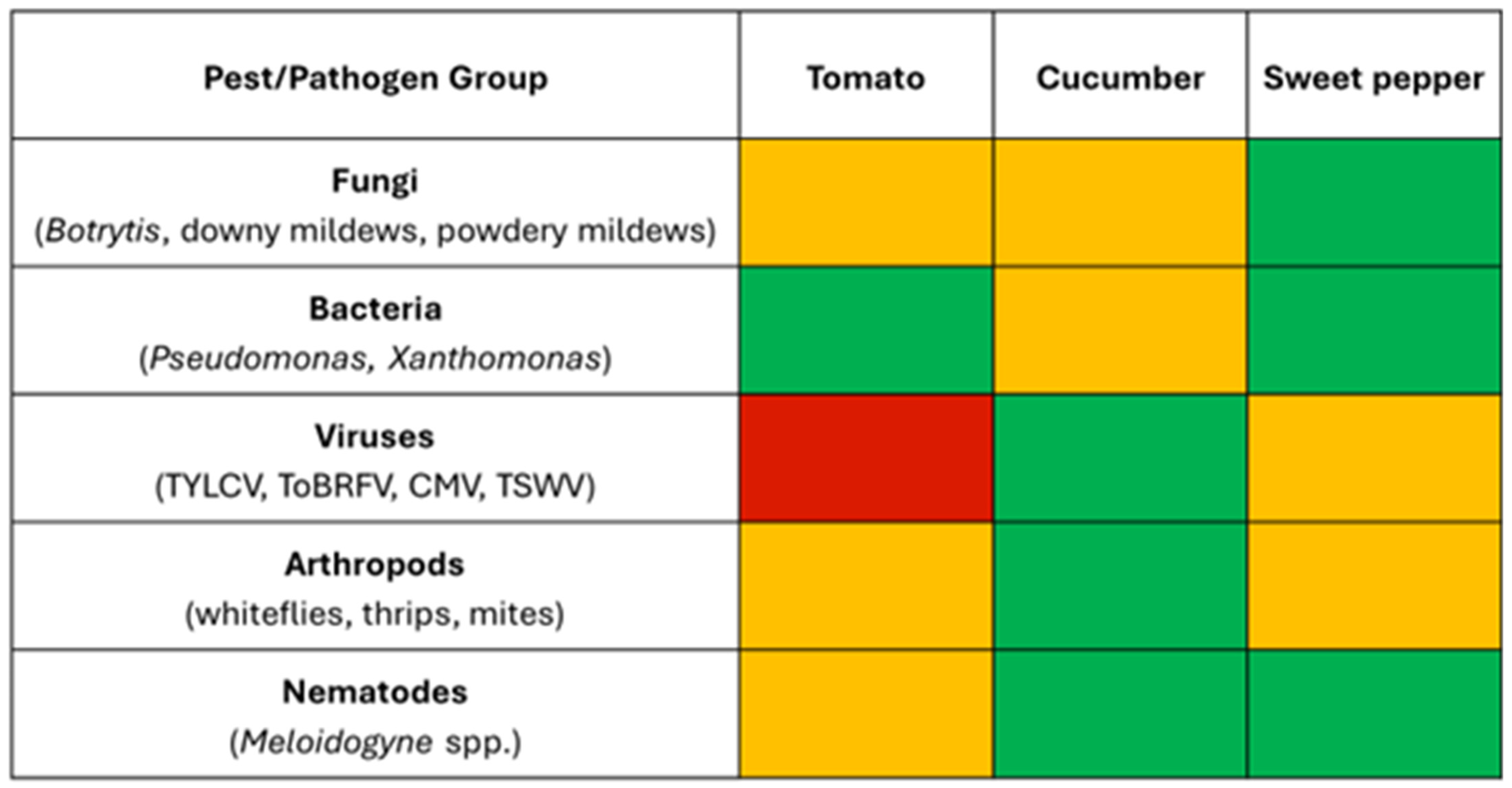
| Overall pest sensitivity | High susceptibility to viral, bacterial infections and foliar/stem fungal pathogens | High susceptibility to phytopathogenic fungal and nematode pests | Moderate but long-term accumulation of pest pressure | [14,33,34] |
3. Major Fungal Pathogens
4. Major Bacterial Pathogens
5. Major Viral Diseases
6. Insects, Mites and Nematodes
7. Interactions Among Pest Groups
| Interaction Type | Involved Organisms | Mechanistic Basis | Favorable Climatic Conditions | Agronomic Outcome | Indicative Management Approach | Key References |
|---|---|---|---|---|---|---|
| Synergistic (soilborne) | Meloidogyne spp. (root-knot nematodes) × Fusarium oxysporum, Verticillium dahliae | Nematode-induced root wounding facilitates fungal penetration and vascular colonization | Warm (25–30 °C), moist root zone | Accelerated wilt development, reduced water and nutrient uptake | Crop rotation, soil solarization, grafted resistant rootstocks, moderate soil moisture | [176,177,178,179] |
| Sequential (fungus → bacterium) | Botrytis cinerea, Alternaria alternata × Pseudomonas syringae, Xanthomonas spp. | Fungal lesions create entry points for bacterial colonization; high RH enhances both | RH > 90%, low air movement | Mixed infections, extended tissue necrosis | Reduce leaf wetness, improve ventilation, stagger fungicide/bactericide timing | [20,184,185,187] |
| Vector-mediated (insect–virus) | Bemisia tabaci, Frankliniella occidentalis × TYLCV, TSWV | Insect feeding transmits viruses; infected plants emit volatiles that attract more vectors | 25–30 °C, RH < 60%, high light | Rapid virus spread, epidemic outbreaks | Maintain RH 60–75%, use insect-proof screens, UV-transmitting films, vector control | [81,85,87,89,95,115] |
| Facilitative (insect–fungus) | Whiteflies × Capnodium spp. (sooty molds); thrips × Botrytis cinerea | Honeydew supports fungal growth; insect movement disperses spores | Warm, humid, high canopy density | Reduced photosynthesis, secondary fungal growth | Manage vector populations; wash foliage; enhance airflow | [20,79,88,170,188,192] |
| Antagonistic (pest–pathogen) | Tetranychus urticae (spider mite) × Botrytis spp. | Mite feeding increases transpiration and local dryness, reducing fungal infection probability | Hot, dry, VPD > 1.2 kPa | Decrease in foliar pathogens but pest proliferation | Maintain RH 60–70%, balance VPD; promote predatory mites | [20,40,189,190,191] |
| Climate-mediated (competition–facilitation shift) | Multiple pest–pathogen groups | Microclimate shifts (ΔT ± 2–3 °C, ΔRH ± 5–10%) alter dominance between organisms | Transitional seasons, variable ventilation | Sudden epidemic or pest outbreak following climatic fluctuation | Dynamic climate control (RH, T, VPD); continuous monitoring and adaptive IPM | [73,193,194,195] |
| Mechanical–Biotic synergy | ToMV/PMMoV × handling tools or workers × Pseudomonas spp. | Human-mediated spread of stable viruses combined with secondary bacterial invasion of damaged tissue | Warm (25–28 °C), high RH | Rapid within-crop spread, compounded damage | Disinfect tools and gloves, avoid handling wet plants, sanitation of benches and lines | [92,196,197,198,199] |
8. Microclimatic Regulation of Pest–Pathogen Dynamics
9. Seasonal Variability and Integrated Climate–Pest Management Framework
10. Decision Support Systems (DSSs) for Climate-Informed Pest and Disease Management
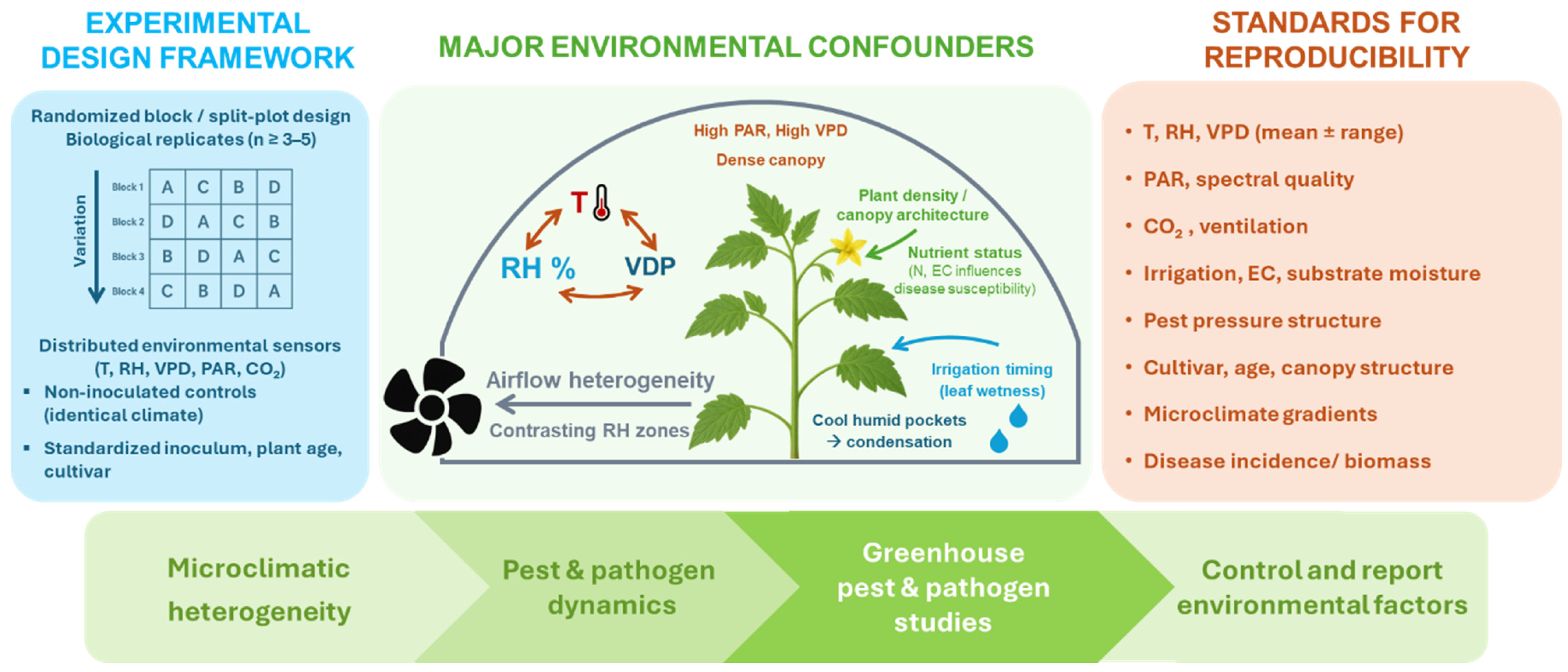
11. Methodological Notes: Experimental Design, Confounders, and Reporting Standards
12. Knowledge Gaps and Research Priorities
13. Conclusions
Supplementary Materials
Author Contributions
Funding
Data Availability Statement
Acknowledgments
Conflicts of Interest
Abbreviations
| Δ | Change (difference between two values) |
| AI | Artificial Intelligence |
| CMV | cucumber mosaic virus |
| CO2 | Carbon dioxide |
| CVYV | Cucumber vein yellowing virus |
| DD | Degree-days |
| DSSs | Decision Support Systems |
| EC | Electrical conductivity |
| FC | Field capacity |
| IPM | Integrated Pest Management |
| N | Nitrogen |
| PAR | Photosynthetically active radiation |
| PMMoV | Pepper mild mottle virus |
| RH | Relative air humidity |
| T | Temperature |
| ToBRFV | Tomato brown rugose fruit virus |
| ToMV | Tobacco mosaic virus |
| TSWV | Tomato spotted wilt virus |
| TYLCV | Tomato yellow leaf curl virus |
| UV | Ultraviolet |
| VPD | Vapor Pressure Deficit |
References
- Fernández, J.A.; Orsini, F.; Baeza, E.; Oztekin, G.B.; Muñoz, P.; Contreras, J.; Montero, J.I. Current Trends in Protected Cultivation in Mediterranean Climates. Eur. J. Hortic. Sci. 2018, 83, 294–305. [Google Scholar] [CrossRef]
- Stanghellini, C.; van’t Ooster, B.; Heuvelink, E. Greenhouse Horticulture; Brill Wageningen Academic: Wageningen, The Netherlands, 2024. [Google Scholar]
- Fanourakis, D.; Tsaniklidis, G.; Makraki, T.; Nikoloudakis, N.; Bartzanas, T.; Sabatino, L.; Fatnassi, H.; Ntatsi, G. Climate Change Impacts on Greenhouse Horticulture in the Mediterranean Basin: Challenges and Adaptation Strategies. Plants 2025, 14, 3390. [Google Scholar] [CrossRef] [PubMed]
- Yusuf, A.G.; Al-Yahya, F.A.; Saleh, A.A.; Abdel-Ghany, A.M. Optimizing Greenhouse Microclimate for Plant Pathology: Challenges and Cooling Solutions for Pathogen Control in Arid Regions. Front. Plant Sci. 2025, 16, 1492760. [Google Scholar] [CrossRef] [PubMed]
- Jarvis, W.R. Managing Diseases in Greenhouse Crops; APS Press: Philadelphia, PA, USA, 1992. [Google Scholar]
- European Parliament and Council of the European Union. Regulation (EU) 2016/2031 on protective measures against pests of plants. Off. J. Eur. Union 2016, L317, 4–104. [Google Scholar]
- Oerke, E.-C. Crop Losses to Pests. J. Agric. Sci. 2006, 144, 31–43. [Google Scholar] [CrossRef]
- van Lenteren, J.C. A Greenhouse without Pesticides: Fact or Fantasy? Crop Prot. 2000, 19, 375–384. [Google Scholar] [CrossRef]
- Heeb, A.; Lundegårdh, B.; Ericsson, T.; Savage, G.P. Effects of Nitrate-, Ammonium-, and Organic-nitrogen-based Fertilizers on Growth and Yield of Tomatoes. Z. Pflanzenernähr. Bodenk. 2005, 168, 123–129. [Google Scholar] [CrossRef]
- Heuvelink, E. Tomatoes; CABI Publishing: Wallingford, UK, 2005. [Google Scholar]
- Dorais, M. Advances in greenhouses and other protected structures used for cultivation of vegetables. In Achieving Sustainable Greenhouse Cultivation; Heuvelink, E., Ed.; Burleigh Dodds Science Publishing: Cambridge, UK, 2019; pp. 167–210. [Google Scholar]
- Black, L.L.; Green, S.K.; Hartman, G.L.; Poulos, J.M. Pepper Diseases: A Field Guide; Asian Vegetable Research and Development Center: Tainan City, Taiwan, 1991. [Google Scholar]
- Jones, J.B. Compendium of Tomato Diseases and Pests, 2nd ed.; APS Press/The American Phytopathological Society: St. Paul, MN, USA, 2016. [Google Scholar]
- Keinath, A.P.; Wintermantel, W.M.; Zitter, T.A. Compendium of Cucurbit Diseases and Pests; APS Press: St. Paul, MN, USA, 2017. [Google Scholar]
- Gullino, M.L.; Albajes, R.; Nicot, P.C. Integrated Pest and Disease Management in Greenhouse Crops; Springer: Cham, Switzerland, 2020. [Google Scholar]
- Weryszko-Chmielewska, E.; Michałojć, Z. Anatomical features of leaves of sweet pepper (Capsicum annuum L.) fed with calcium using foliar nutrition. Acta Agrobot. 2009, 62, 155–164. [Google Scholar] [CrossRef][Green Version]
- Zhang, Y.; Henke, M.; Li, Y.; Xu, D.; Liu, A.; Liu, X.; Li, T. Analyzing the Impact of Greenhouse Planting Strategy and Plant Architecture on Tomato Plant Physiology and Estimated Dry Matter. Front. Plant Sci. 2022, 13, 828252. [Google Scholar] [CrossRef]
- Harel, D.; Fadida, H.; Slepoy, A.; Gantz, S.; Shilo, K. The Effect of Mean Daily Temperature and Relative Humidity on Pollen, Fruit Set and Yield of Tomato Grown in Commercial Protected Cultivation. Agronomy 2014, 4, 167–177. [Google Scholar] [CrossRef]
- Shamshiri, R.R.; Jones, J.W.; Thorp, K.R.; Ahmad, D.; Man, H.C.; Taheri, S. Review of Optimum Temperature, Humidity, and Vapour Pressure Deficit for Microclimate Evaluation and Control in Greenhouse Cultivation of Tomato: A Review. Int. Agrophys. 2018, 32, 287–302. [Google Scholar] [CrossRef]
- Oliver, R. Agrios’ Plant Pathology, 6th ed.; Elsevier Academic Press: Amsterdam, The Netherlands, 2024. [Google Scholar]
- Salem, N.M.; Jewehan, A.; Aranda, M.A.; Fox, A. Tomato Brown Rugose Fruit Virus Pandemic. Annu. Rev. Phytopathol. 2023, 61, 137–164. [Google Scholar] [CrossRef] [PubMed]
- Luria, N.; Smith, E.; Reingold, V.; Bekelman, I.; Lapidot, M.; Levin, I.; Elad, N.; Tam, Y.; Sela, N.; Abu-Ras, A.; et al. A New Israeli Tobamovirus Isolate Infects Tomato Plants Harboring Tm-22 Resistance Genes. PLoS ONE 2017, 12, e0170429. [Google Scholar] [CrossRef]
- Pal, A. Cultivation of cucumber in greenhouse. In Protected Cultivation and Smart Agriculture; New Delhi Publishers: New Delhi, India, 2020. [Google Scholar] [CrossRef]
- Abd-El-Baky, H.; Ali, S.; Haddad, Z.E.; Ansary, Z.E. Some Environmental Parameters Affecting Sweet Pepper Growth and Productivity under Different Greenhouse Forms in Hot and Humid Climatic Conditions. J. Soil Sci. Agric. Eng. 2010, 1, 225–247. [Google Scholar] [CrossRef][Green Version]
- Aladenola, O.; Madramootoo, C. Response of Greenhouse-Grown Bell Pepper (Capsicum annuum L.) to Variable Irrigation. Can. J. Plant Sci. 2014, 94, 303–310. [Google Scholar] [CrossRef]
- Al-Mulla, Y.A.; Al-Balushi, M.I.; Al-Busaidi, H.A.; Al-Mahdouri, A.A.; Kittas, C.; Katsoulas, N. Analysis of Microclimate and Cucumber Fruit Yield in a Screenhouse and an Evaporatively Cooled Greenhouse in a Semi-Arid Location. Trans. ASABE 2018, 61, 619–629. [Google Scholar] [CrossRef]
- Kumar, P.; Khapte, P.S.; Singh, A.; Saxena, A. Optimization of Low-Tech Protected Structure and Irrigation Regime for Cucumber Production under Hot Arid Regions of India. Plants 2024, 13, 146. [Google Scholar] [CrossRef]
- Katsoulas, N.; Kittas, C. Impact of greenhouse microclimate on plant growth and development with special reference to the Solanaceae. Eur. J. Plant Sci. Biotechnol. 2008, 2, 31–44. [Google Scholar]
- Sun, W.; Ma, N.; Huang, H.; Wei, J.; Ma, S.; Liu, H.; Zhang, S.; Zhang, Z.; Sui, X.; Li, X. Photosynthetic Contribution and Characteristics of Cucumber Stems and Petioles. BMC Plant Biol. 2021, 21, 454. [Google Scholar] [CrossRef]
- Jaimez, R.; Rada, F. Gas Exchange in Sweet Pepper (Capsicum chinense Jacq) under Different Light Conditions. J. Agric. Sci. 2011, 3, 134. [Google Scholar] [CrossRef]
- Patanè, C. Leaf Area Index, Leaf Transpiration and Stomatal Conductance as Affected by Soil Water Deficit and VPD in Processing Tomato in Semi Arid Mediterranean Climate. J. Agron. Crop Sci. 2011, 197, 165–176. [Google Scholar] [CrossRef]
- Zhang, D.; Liu, Y.; Li, Y.; Qin, L.; Li, J.; Xu, F. Reducing the Excessive Evaporative Demand Improved the Water-Use Efficiency of Greenhouse Cucumber by Regulating the Trade-off between Irrigation Demand and Plant Productivity. HortScience 2018, 53, 1784–1790. [Google Scholar] [CrossRef]
- Hanssen, I.M.; Lapidot, M.; Thomma, B.P.H.J. Emerging Viral Diseases of Tomato Crops. Mol. Plant-Microbe Interact. 2010, 23, 539–548. [Google Scholar] [CrossRef] [PubMed]
- Tsitsigiannis, D.I.; Antoniou, P.P.; Tjamos, S.E.; Paplomatas, E.J. Major Diseases of Tomato, Pepper and Egg Plant in Green Houses. Eur. J. Plant Sci. Biotechnol. 2008, 2, 106–124. [Google Scholar]
- Patil, J.A.; Yadav, S.; Kumar, A. Management of Root-Knot Nematode, Meloidogyne Incognita and Soil Borne Fungus, Fusarium oxysporum in Cucumber Using Three Bioagents under Polyhouse Conditions. Saudi J. Biol. Sci. 2021, 28, 7006–7011. [Google Scholar] [CrossRef] [PubMed]
- Calvo, F.J.; Bolckmans, K.; Belda, J.E. Biological Control-Based IPM in Sweet Pepper Greenhouses Using Amblyseius swirskii (Acari: Phytoseiidae). Biocontrol Sci. Technol. 2012, 22, 1398–1416. [Google Scholar] [CrossRef]
- Weintraub, P.G.; Recht, E.; Mondaca, L.L.; Harari, A.R.; Diaz, B.M.; Bennison, J. Arthropod Pest Management in Organic Vegetable Greenhouses. J. Integr. Pest Manag. 2017, 8, 29. [Google Scholar] [CrossRef]
- Elad, Y.; Shtienberg, D. Botrytis cinerea in Greenhouse Vegetables: Chemical, Cultural, Physiological and Biological Controls and Their Integration. Integr. Pest Manag. Rev. 1995, 1, 15–29. [Google Scholar] [CrossRef]
- Dik, A.J.; Elad, Y. Comparison of Antagonists of Botrytis cinerea in Greenhouse-Grown Cucumber and Tomato under Different Climatic Conditions. Eur. J. Plant Pathol. 1999, 105, 123–137. [Google Scholar] [CrossRef]
- Dik, A.J.; Wubben, J.P. Epidemiology of Botrytis cinerea diseases in greenhouses. In Botrytis: Biology, Pathology and Control; Elad, Y., Williamson, B., Tudzynski, P., Delen, N., Eds.; Springer: Dordrecht, The Netherlands, 2007; pp. 319–333. [Google Scholar]
- Cerkauskas, R.F.; Ferguson, G.; Banik, M. Powdery Mildew (Leveillula taurica) on Greenhouse and Field Peppers in Ontario–Host Range, Cultivar Response and Disease Management Strategies. Can. J. Plant Pathol. 2011, 33, 485–498. [Google Scholar] [CrossRef]
- Guzman-Plazola, R.A.; Davis, R.M.; Marois, J.J. Effects of Relative Humidity and High Temperature on Spore Germination and Development of Tomato Powdery Mildew (Leveillula taurica). Crop Prot. 2003, 22, 1157–1168. [Google Scholar] [CrossRef]
- Sletova, M.E.; Korottseva, I.B.; Kameneva, A.V.; Engalycheva, I.A.; Belov, S.N. Study of Morphobiological Characteristics of the Pathogen Causing True Powdery Mildew in the Family cucurbitaceae L. Crops. Russ. Agric. Sci. 2024, 50, 694–701. [Google Scholar] [CrossRef]
- Bélanger, R.R. The Powdery Mildews: A Comprehensive Treatise; APS Press: St. Paul, MN, USA, 2002. [Google Scholar]
- Lebeda, A.; Cohen, Y. Cucurbit Downy Mildew (Pseudoperonospora cubensis)—Biology, Ecology, Epidemiology, Host-Pathogen Interaction and Control. Eur. J. Plant Pathol. 2011, 129, 157–192. [Google Scholar] [CrossRef]
- Savory, E.A.; Granke, L.L.; Quesada-Ocampo, L.M.; Varbavova, M.; Hausbeck, M.K.; Day, B. The Cucurbit Downy Mildew Pathogen Pseudoperonospora cubensis. Mol. Plant Pathol. 2011, 12, 217–226. [Google Scholar] [CrossRef]
- Babadoost, M. Oomycete diseases of cucurbits: History, significance, and management. In Horticultural Reviews; John Wiley & Sons: Hoboken, NJ, USA, 2016; pp. 279–314. [Google Scholar] [CrossRef]
- Rivas, S.; Thomas, C.M. Molecular Interactions Between Tomato and the Leaf Mold Pathogen Cladosporium fulvum. Annu. Rev. Phytopathol. 2005, 43, 395–436. [Google Scholar] [CrossRef] [PubMed]
- Srinivas, C.; Devi, D.N.; Murthy, K.N.; Mohan, C.D.; Lakshmeesha, T.R.; Singh, B.; Kalagatur, N.K.; Niranjana, S.R.; Hashem, A.; Alqarawi, A.A.; et al. Fusarium oxysporum F. sp. lycopersici Causal Agent of Vascular Wilt Disease of Tomato: Biology to Diversity—A Review. Saudi J. Biol. Sci. 2019, 26, 1315–1324. [Google Scholar] [CrossRef]
- Velarde-Félix, S.; Garzón-Tiznado, J.A.; Hernández-Verdugo, S.; López-Orona, C.A.; Retes-Manjarrez, J.E. Occurrence of Fusarium oxysporum Causing Wilt on Pepper in Mexico. Can. J. Plant Pathol. 2018, 40, 238–247. [Google Scholar] [CrossRef]
- Gordon, T.R. Fusarium oxysporum and the Fusarium Wilt Syndrome. Annu. Rev. Phytopathol. 2017, 55, 23–39. [Google Scholar] [CrossRef] [PubMed]
- Arora, H.; Sharma, A.; Sharma, S.; Haron, F.F.; Gafur, A.; Sayyed, R.Z.; Datta, R. Pythium Damping-Off and Root Rot of Capsicum annuum L.: Impacts, Diagnosis, and Management. Microorganisms 2021, 9, 823. [Google Scholar] [CrossRef]
- Herrero, M.L.; Hermansen, A.; Elen, O.N. Occurrence of Pythium spp. and Phytophthora spp. in Norwegian Greenhouses and Their Pathogenicity on Cucumber Seedlings. J. Phytopathol. 2003, 151, 36–41. [Google Scholar] [CrossRef]
- Saltos, L.A.; Monteros-Altamirano, Á.; Reis, A.; Garcés-Fiallos, F.R. Phytophthora capsici: The Diseases It Causes and Management Strategies to Produce Healthier Vegetable Crops. Hortic. Bras. 2022, 40, 5–17. [Google Scholar] [CrossRef]
- Rai, M.; Abd-Elsalam, K.A.; Ingle, A.P. Pythium: Diagnosis, Diseases and Management; CRC Press: Boca Raton, FL, USA, 2020. [Google Scholar]
- Al-Masri, M.I.; Ali-Shtayeh, M.S.; Elad, Y.; Sharon, A.; Tudzynski, P.; Barakat, R. Effect of Plant Growth Regulators on White Mould (Sclerotinia sclerotiorum) on Bean and Cucumber. J. Phytopathol. 2002, 150, 481–487. [Google Scholar] [CrossRef]
- Mazumdar, P. Sclerotinia Stem Rot in Tomato: A Review on Biology, Pathogenicity, Disease Management and Future Research Priorities. J. Plant Dis. Prot. 2021, 128, 1403–1431. [Google Scholar] [CrossRef]
- Bolton, M.D.; Thomma, B.P.H.J.; Nelson, B.D. Sclerotinia sclerotiorum (Lib.) de Bary: Biology and Molecular Traits of a Cosmopolitan Pathogen. Mol. Plant Pathol. 2006, 7, 1–16. [Google Scholar] [CrossRef]
- Massimi, M.; Kabashi, B. Integrated Management of Alternaria alternata in Tomato and Pepper: Leaf-Environment, and Cultivar Interactions. Jordan J. Appl. Sci.-Nat. Sci. Ser. 2025, 19, 34–38. [Google Scholar] [CrossRef]
- Maurya, S.; Regar, R.; Kumar, S.; Dubey, S. Management Tactics for Early Blight of Tomato Caused by Alternaria solani: A Review. J. Plant Biol. Crop Res. 2022, 5, 1062. [Google Scholar]
- Schmey, T.; Tominello-Ramirez, C.S.; Brune, C.; Stam, R. Alternaria Diseases on Potato and Tomato. Mol. Plant Pathol. 2024, 25, e13435. [Google Scholar] [CrossRef] [PubMed]
- Mansfield, J.; Genin, S.; Magori, S.; Citovsky, V.; Sriariyanum, M.; Ronald, P.; Dow, M.; Verdier, V.; Beer, S.V.; Machado, M.A.; et al. Top 10 Plant Pathogenic Bacteria in Molecular Plant Pathology. Mol. Plant Pathol. 2012, 13, 614–629. [Google Scholar] [CrossRef]
- Preston, G.M. Pseudomonas syringae pv. tomato: The Right Pathogen, of the Right Plant, at the Right Time. Mol. Plant Pathol. 2000, 1, 263–275. [Google Scholar] [CrossRef]
- Potnis, N.; Timilsina, S.; Strayer, A.; Shantharaj, D.; Barak, J.D.; Paret, M.L.; Vallad, G.E.; Jones, J.B. Bacterial spot of tomato and pepper: Diverse Xanthomonas species with a wide variety of virulence factors posing a worldwide challenge. Mol. Plant Pathol. 2015, 16, 907–920. [Google Scholar] [CrossRef] [PubMed]
- Stall, R.E.; Jones, J.B.; Minsavage, G.V. Durability of Resistance in Tomato and Pepper to Xanthomonads Causing Bacterial Spot. Annu. Rev. Phytopathol. 2009, 47, 265–284. [Google Scholar] [CrossRef]
- Osdaghi, E.; Jones, J.B.; Sharma, A.; Goss, E.M.; Abrahamian, P.; Newberry, E.A.; Potnis, N.; Carvalho, R.; Choudhary, M.; Paret, M.L.; et al. A Centenary for Bacterial Spot of Tomato and Pepper. Mol. Plant Pathol. 2021, 22, 1500–1519. [Google Scholar] [CrossRef] [PubMed]
- Gartemann, K.-H.; Kirchner, O.; Engemann, J.; Gräfen, I.; Eichenlaub, R.; Burger, A. Clavibacter michiganensis subsp. michiganensis: First Steps in the Understanding of Virulence of a Gram-Positive Phytopathogenic Bacterium. J. Biotechnol. 2003, 106, 179–191. [Google Scholar] [CrossRef]
- Milijašević, S.; Todorović, B.; Rekanović, E.; Potočnik, I.; Balaž, J. Clavibacter michiganensis subsp. michiganensis, bacterial canker of tomato: 2. Comparison of the effectiveness of extraction procedures and sensitivity of methods for detection in tomato seeds. Pestic. Fitomed. 2007, 22, 121–130. [Google Scholar]
- Peritore-Galve, F.C.; Tancos, M.A.; Smart, C.D. Bacterial Canker of Tomato: Revisiting a Global and Economically Damaging Seedborne Pathogen. Plant Dis. 2021, 105, 1581–1595. [Google Scholar] [CrossRef]
- Charkowski, A.O. The Changing Face of Bacterial Soft-Rot Diseases. Annu. Rev. Phytopathol. 2018, 56, 269–288. [Google Scholar] [CrossRef] [PubMed]
- Newberry, E.A.; Jardini, T.M.; Rubio, I.; Roberts, P.D.; Babu, B.; Koike, S.T.; Bouzar, H.; Goss, E.M.; Jones, J.B.; Bull, C.T.; et al. Angular Leaf Spot of Cucurbits Is Associated With Genetically Diverse Pseudomonas syringae Strains. Plant Dis. 2016, 100, 1397–1404. [Google Scholar] [CrossRef] [PubMed]
- Olczak-Woltman, H.; Schollenberger, M.; Mądry, W.; Niemirowicz-Szczytt, K. Evaluation of Cucumber (Cucumis sativus) Cultivars Grown in Eastern Europe and Progress in Breeding for Resistance to Angular Leaf Spot (Pseudomonas syringae pv. lachrymans). Eur. J. Plant Pathol. 2008, 122, 385–393. [Google Scholar] [CrossRef]
- Hossain, M.F.; Hasan, S.Z.; Zaoti, Z.F.; Hasan, M.F.; Acharjee, U.K.; Islam, M.A.; Khalekuzzaman, M.; Sikdar, B. Isolation and characterization of Pseudomonas syringae pv. lachrymans from angular leaf spot disease of cucumber (Cucumis sativus L.) and evaluation of its antibiotic sensitivity. J. Pharmacogn. Phytochem. 2017, 6, 233–238. [Google Scholar]
- van der Wolf, J.M.; Acuña, I.; De Boer, S.H.; Brurberg, M.B.; Cahill, G.; Charkowski, A.O.; Coutinho, T.; Davey, T.; Dees, M.W.; Degefu, Y.; et al. Diseases caused by Pectobacterium and Dickeya species around the world. In Plant Diseases Caused by Dickeya and Pectobacterium Species; Van der Wolf, J.M., De Boer, S.H., Czajkowski, R., Eds.; Springer: Cham, Switzerland, 2021; pp. 215–261. [Google Scholar] [CrossRef]
- Czajkowski, R.; Grabe, G.J.; van der Wolf, J.M. Distribution of Dickeya spp. and Pectobacterium carotovorum subsp. carotovorum in Naturally Infected Seed Potatoes. Eur. J. Plant Pathol. 2009, 125, 263–275. [Google Scholar] [CrossRef]
- Navas-Castillo, J.; Fiallo-Olivé, E.; Sánchez-Campos, S. Emerging Virus Diseases Transmitted by Whiteflies. Annu. Rev. Phytopathol. 2011, 49, 219–248. [Google Scholar] [CrossRef] [PubMed]
- Sastry, K.S.; Mandal, B.; Hammond, J.; Scott, S.W.; Briddon, R.W. Encyclopedia of Plant Viruses and Viroids; Springer: New Delhi, India, 2019. [Google Scholar]
- Bonsignore, C.P. Effect of Environmental Factors on the Flight Activity Trialeurodes vaporariorum (Westwood) under Greenhouse Conditions. Entomol. Sci. 2015, 18, 207–216. [Google Scholar] [CrossRef]
- Jones, D.R. Plant Viruses Transmitted by Whiteflies. Eur. J. Plant Pathol. 2003, 109, 195–219. [Google Scholar] [CrossRef]
- Kumar, P.; Poehling, H.-M. Uv-Blocking Plastic Films and Nets Influence Vectors and Virus Transmission on Greenhouse Tomatoes in the Humid Tropics. Environ. Entomol. 2006, 35, 1069–1082. [Google Scholar] [CrossRef]
- Moriones, E.; Navas-Castillo, J. Tomato Yellow Leaf Curl Virus, an Emerging Virus Complex Causing Epidemics Worldwide. Virus Res. 2000, 71, 123–134. [Google Scholar] [CrossRef]
- Lapidot, M.; Friedmann, M. Breeding for Resistance to Whitefly-transmitted Geminiviruses. Ann. Appl. Biol. 2002, 140, 109–127. [Google Scholar] [CrossRef]
- Prasad, A.; Sharma, N.; Hari-Gowthem, G.; Muthamilarasan, M.; Prasad, M. Tomato Yellow Leaf Curl Virus: Impact, Challenges, and Management. Trends Plant Sci. 2020, 25, 897–911. [Google Scholar] [CrossRef]
- Aregbesola, O.Z.; Legg, J.P.; Sigsgaard, L.; Lund, O.S.; Rapisarda, C. Potential Impact of Climate Change on Whiteflies and Implications for the Spread of Vectored Viruses. J. Pest Sci. 2019, 92, 381–392. [Google Scholar] [CrossRef]
- Pappu, H.R.; Jones, R.A.C.; Jain, R.K. Global Status of Tospovirus Epidemics in Diverse Cropping Systems: Successes Achieved and Challenges Ahead. Virus Res. 2009, 141, 219–236. [Google Scholar] [CrossRef]
- Rotenberg, D.; Jacobson, A.L.; Schneweis, D.J.; Whitfield, A.E. Thrips Transmission of Tospoviruses. Curr. Opin. Virol. 2015, 15, 80–89. [Google Scholar] [CrossRef]
- Reitz, S.R. Biology and Ecology of the Western Flower Thrips (Thysanoptera: Thripidae): The Making of a Pest. Fla. Entomol. 2009, 92, 7–13. [Google Scholar] [CrossRef]
- Lewis, T. Thrips as Crop Pests; CABI Publishing: Wallingford, UK, 1998. [Google Scholar]
- Shipp, J.L.; Gillespie, T.J. Influence of Temperature and Water Vapor Pressure Deficit on Survival of Frankliniella occidentalis (Thysanoptera: Thripidae). Environ. Entomol. 1993, 22, 726–732. [Google Scholar] [CrossRef]
- Hanssen, I.M.; Thomma, B.P.H.J. Pepino Mosaic Virus: A Successful Pathogen That Rapidly Evolved from Emerging to Endemic in Tomato Crops. Mol. Plant Pathol. 2010, 11, 179–189. [Google Scholar] [CrossRef]
- Hanssen, I.M.; Paeleman, A.; Vandewoestijne, E.; Bergen, L.V.; Bragard, C.; Lievens, B.; Vanachter, A.C.R.C.; Thomma, B.P.H.J. Pepino Mosaic Virus Isolates and Differential Symptomatology in Tomato. Plant Pathol. 2009, 58, 450–460. [Google Scholar] [CrossRef]
- Nowakowska, M.; Minicka, J.; Nowicki, M.; Szczechura, W.; Hasiów-Jaroszewska, B. Pepino Mosaic Virus in Tomato: Challenges, Control Strategies, and Future Prospects for Resistance Breeding. Int. J. Mol. Sci. 2025, 26, 11749. [Google Scholar] [CrossRef]
- Ontiveros, I.; López-Moya, J.J.; Díaz-Pendón, J.A. Coinfection of Tomato Plants with Tomato Yellow Leaf Curl Virus and Tomato Chlorosis Virus Affects the Interaction with Host and Whiteflies. Phytopathology 2022, 112, 944–952. [Google Scholar] [CrossRef]
- Liu, S.; Yu, H.; Vlasenko, V.A. Effect of Different Temperature and Humidity on Bemisia tabaci. J. Bot. Res. 2020, 2, 21–24. [Google Scholar] [CrossRef]
- Wang, F.; Liu, J.; Dong, Y.; Chen, P.; Zhu, X.; Liu, Y.; Ma, J. Insect-Proof Netting Technique: Effective Control of Bemisia tabaci and Tomato Chlorosis Virus (ToCV) in Protected Cultivations in China. Chil. J. Agric. Res. 2018, 78, 48–58. [Google Scholar] [CrossRef]
- Duffus, J.E.; Liu, H.-Y.; Wisler, G.C. Tomato Infectious Chlorosis Virus—A New Clostero-like Virus Transmitted by Trialeurodes vaporariorum. Eur. J. Plant Pathol. 1996, 102, 219–226. [Google Scholar] [CrossRef]
- Fiallo-Olivé, E.; Navas-Castillo, J. Tomato Chlorosis Virus, an Emergent Plant Virus Still Expanding Its Geographical and Host Ranges. Mol. Plant Pathol. 2019, 20, 1307–1320. [Google Scholar] [CrossRef] [PubMed]
- Hartono, S.; Natsuaki, T.; Sayama, H.; Atarashi, H.; Okuda, S. Yellowing Disease of Tomatoes Caused by Tomato Infectious Chlorosis Virus Newly Recognized in Japan. J. Gen. Plant Pathol. 2003, 69, 61–64. [Google Scholar] [CrossRef]
- Akhtar, K.P.; Saleem, M.Y.; Asghar, M.; Ahmad, M.; Sarwar, N. Resistance of Solanum Species to Cucumber Mosaic Virus Subgroup IA and Its Vector Myzus persicae. Eur. J. Plant Pathol. 2010, 128, 435–450. [Google Scholar] [CrossRef]
- Jones, R.A.C. Global plant virus disease pandemics and epidemics. Plants 2021, 10, 233. [Google Scholar] [CrossRef] [PubMed]
- Moya-Ruiz, C.D.; Gómez, P.; Juárez, M. Occurrence, Distribution, and Management of Aphid-Transmitted Viruses in Cucurbits in Spain. Pathogens 2023, 12, 422. [Google Scholar] [CrossRef] [PubMed]
- Khaled-Gasmi, W.; Souissi, R.; Boukhris-Bouhachem, S. Cucumber Mosaic Virus Epidemiology in Pepper: Aphid Dispersal, Transmission Efficiency and Vector Pressure. Ann. Appl. Biol. 2023, 182, 101–111. [Google Scholar] [CrossRef]
- Rathee, M.; Singh, N.V.; Dalal, P.K.; Mehra, S. Integrated Pest Management under Protected Cultivation: A Review. J. Entomol. Zool. Stud. 2018, 6, 1201–1208. [Google Scholar]
- Curnutte, L.B.; Simmons, A.M.; Abd-Rabou, S. Climate Change and Bemisia tabaci (Hemiptera: Aleyrodidae): Impacts of Temperature and Carbon Dioxide on Life History. Ann. Entomol. Soc. Am. 2014, 107, 933–943. [Google Scholar] [CrossRef]
- Horowitz, A.R.; Antignus, Y.; Gerling, D. Management of Bemisia tabaci whiteflies. In The Whitefly, Bemisia tabaci (Homoptera: Aleyrodidae) Interaction with Geminivirus-Infected Host Plants; Thompson, W.M.O., Ed.; Springer: Dordrecht, The Netherlands, 2011; pp. 293–322. [Google Scholar]
- Ruiz, L.; Janssen, D.; Martín, G.; Velasco, L.; Segundo, E.; Cuadrado, I.M. Analysis of the Temporal and Spatial Disease Progress of Bemisia tabaci-transmitted Cucurbit Yellow Stunting Disorder Virus and Cucumber Vein Yellowing Virus in Cucumber. Plant Pathol. 2006, 55, 264–275. [Google Scholar] [CrossRef]
- Yin, Z.; Zieniuk, B.; Pawełkowicz, M. Climate Change Effects on Cucumber Viruses and Their Management. Agriculture 2024, 14, 1999. [Google Scholar] [CrossRef]
- Ahamedemujtaba, V.; Atheena, P.V.; Bhat, A.I.; Krishnamurthy, K.S.; Srinivasan, V. Symptoms of Piper Yellow Mottle Virus in Black Pepper as Influenced by Temperature and Relative Humidity. VirusDisease 2021, 32, 305–313. [Google Scholar] [CrossRef]
- Kumari, N.; Sharma, V.; Patel, P.; Sharma, P.N. Pepper Mild Mottle Virus: A Formidable Foe of Capsicum Production—A Review. Front. Virol. 2023, 3, 1208853. [Google Scholar] [CrossRef]
- Kumar, S.; Shankar, A.C.U.; Nayaka, S.C.; Lund, O.S.; Prakash, H.S. Detection of Tobacco Mosaic Virus and Tomato Mosaic Virus in Pepper and Tomato by Multiplex RT-PCR. Lett. Appl. Microbiol. 2011, 53, 359–363. [Google Scholar] [CrossRef] [PubMed]
- Caruso, A.G.; Bertacca, S.; Parrella, G.; Rizzo, R.; Davino, S.; Panno, S. Tomato Brown Rugose Fruit Virus: A Pathogen That Is Changing the Tomato Production Worldwide. Ann. Appl. Biol. 2022, 181, 258–274. [Google Scholar] [CrossRef]
- Parrella, G.; Elbeaino, T.; Guy, P.L. Emerging and Reemerging Plant Viruses in a Context of Global Change. Front. Plant Sci. 2022, 13, 1108211. [Google Scholar] [CrossRef]
- Zhang, S.; Griffiths, J.S.; Marchand, G.; Bernards, M.A.; Wang, A. Tomato brown rugose fruit virus: An emerging and rapidly spreading plant RNA virus that threatens tomato production worldwide. Mol. Plant Pathol. 2022, 23, 1262–1277. [Google Scholar] [CrossRef]
- Fidan, H.; Ulusoy, D.; Albezirgan, H.N. Exploring Effective Strategies for ToBRFV Management in Tomato Production: Insights into Seed Transmission Dynamics and Innovative Control Approaches. Agriculture 2024, 14, 108. [Google Scholar] [CrossRef]
- Polston, J.E.; Lapidot, M. Management of tomato yellow leaf curl virus: U.S. and Israel perspectives. In Tomato Yellow Leaf Curl Virus Disease; Czosnek, H., Ed.; Springer: Dordrecht, The Netherlands, 2007; pp. 251–262. [Google Scholar] [CrossRef]
- European and Mediterranean Plant Protection Organization (EPPO). Tomato chlorosis virus and tomato infectious chlorosis virus. EPPO Bull. 2013, 43, 462–470. [Google Scholar] [CrossRef]
- Wintermantel, W.M.; Wisler, G.C. Vector Specificity, Host Range, and Genetic Diversity of Tomato Chlorosis Virus. Plant Dis. 2006, 90, 814–819. [Google Scholar] [CrossRef]
- Orfanidou, C.G.; Pappi, P.G.; Efthimiou, K.E.; Katis, N.I.; Maliogka, V.I. Transmission of Tomato Chlorosis Virus (ToCV) by Bemisia tabaci Biotype Q and Evaluation of Four Weed Species as Viral Sources. Plant Dis. 2016, 100, 2043–2049. [Google Scholar] [CrossRef]
- Sánchez-Tovar, M.R.; Rivera-Bustamante, R.F.; Saavedra-Trejo, D.L.; Guevara-González, R.G.; Torres-Pacheco, I. Mixed Plant Viral Infections: Complementation, Interference and Their Effects, a Review. Agronomy 2025, 15, 620. [Google Scholar] [CrossRef]
- Syller, J. Facilitative and Antagonistic Interactions between Plant Viruses in Mixed Infections. Mol. Plant Pathol. 2012, 13, 204–216. [Google Scholar] [CrossRef]
- Mutwiwa, U.N.; Borgemeister, C.; Von Elsner, B.; Tantau, H. Effects of UV-Absorbing Plastic Films on Greenhouse Whitefly (Homoptera: Aleyrodidae). J. Econ. Entomol. 2005, 98, 1221–1228. [Google Scholar] [CrossRef]
- Dáder, B.; Gwynn-Jones, D.; Moreno, A.; Winters, A.; Fereres, A. Impact of UV-A Radiation on the Performance of Aphids and Whiteflies and on the Leaf Chemistry of Their Host Plants. J. Photochem. Photobiol. B Biol. 2014, 138, 307–316. [Google Scholar] [CrossRef] [PubMed]
- Meijer, D. The Effects of Far-Red Light on Plant–Arthropod Interactions and the Implications for Greenhouse Tomato Cultivation. Ph.D. Thesis, Wageningen University, Wageningen, The Netherlands, 2023. [Google Scholar]
- Tileubayeva, Z.; Avdeenko, A.; Avdeenko, S.; Stroiteleva, N.; Kondrashev, S. Plant-Parasitic Nematodes Affecting Vegetable Crops in Greenhouses. Saudi J. Biol. Sci. 2021, 28, 5428–5433. [Google Scholar] [CrossRef] [PubMed]
- Klowden, M.J.; Palli, S.R. Physiological Systems in Insects; Academic Press: Cambridge, MA, USA, 2023. [Google Scholar]
- Pan, H.; Liang, G.; Lu, Y. Response of Different Insect Groups to Various Wavelengths of Light under Field Conditions. Insects 2021, 12, 427. [Google Scholar] [CrossRef]
- Khan, M.M.H. Effect of temperature and relative humidity on the population dynamics of brinjal- and tomato-infested whitefly, Bemisia tabaci. Bangladesh J. Agric. Res. 2019, 44, 83–86. [Google Scholar]
- Li, Y.; Mbata, G.N.; Punnuri, S.; Simmons, A.M.; Shapiro-Ilan, D.I. Bemisia tabaci on Vegetables in the Southern United States: Incidence, Impact, and Management. Insects 2021, 12, 198. [Google Scholar] [CrossRef]
- Stansly, P.A.; Sánchez, P.A.; Rodríguez, J.M.; Cañizares, F.; Nieto, A.; Leyva, M.J.L.; Fajardo, M.; Suárez, V.; Urbaneja, A. Prospects for Biological Control of Bemisia tabaci (Homoptera, Aleyrodidae) in Greenhouse Tomatoes of Southern Spain. Crop Prot. 2004, 23, 701–712. [Google Scholar] [CrossRef]
- Teitel, M.; Tanny, J.; Ben-Yakir, D.; Barak, M. Airflow Patterns through Roof Openings of a Naturally Ventilated Greenhouse and Their Effect on Insect Penetration. Biosyst. Eng. 2005, 92, 341–353. [Google Scholar] [CrossRef]
- Xie, M.; Wan, F.-H.; Chen, Y.-H.; Wu, G. Effects of Temperature on the Growth and Reproduction Characteristics of Bemisia tabaci B-Biotype and Trialeurodes vaporariorum. J. Appl. Entomol. 2011, 135, 252–257. [Google Scholar] [CrossRef]
- Simmons, A.M.; Mahroof, R.M. Response of Bemisia tabaci (Hemiptera: Aleyrodidae) to Vapor Pressure Deficit: Oviposition, Immature Survival, and Body Size. Ann. Entomol. Soc. Am. 2011, 104, 928–934. [Google Scholar] [CrossRef]
- White, P.J. The Ecophysiology of Plant-Phosphorus Interactions; Springer: Dordrecht, The Netherlands, 2008. [Google Scholar]
- Krechemer, F.D.S.; Foerster, L.A. Tuta absoluta (Lepidoptera: Gelechiidae): Thermal Requirements and Effect of Temperature on Development, Survival, Reproduction and Longevity. Eur. J. Entomol. 2015, 112, 658–663. [Google Scholar] [CrossRef]
- Shiberu, T.; Getu, E. Biology of Tuta absoluta (Meyrick) (Lepidoptera: Gelechiidae) under Different Temperature and Relative Humidity. J. Hortic. For. 2017, 9, 66–73. [Google Scholar] [CrossRef][Green Version]
- Roditakis, E.; Papachristos, D.; Roditakis, N.E. Current Status of the Tomato Leafminer Tuta absoluta in Greece. EPPO Bull. 2010, 40, 163–166. [Google Scholar] [CrossRef]
- Terzidis, A.N.; Wilcockson, S.; Leifert, C. The Tomato Leaf Miner (Tuta absoluta): Conventional Pest Problem, Organic Management Solutions? Org. Agric. 2014, 4, 43–61. [Google Scholar] [CrossRef]
- Arnó, J.; Gabarra, R. Side Effects of Selected Insecticides on the Tuta absoluta (Lepidoptera: Gelechiidae) Predators Macrolophus pygmaeus and Nesidiocoris tenuis (Hemiptera: Miridae). J. Pest Sci. 2011, 84, 513–520. [Google Scholar] [CrossRef]
- Park, Y.; Lee, J.-H. Life History Characteristics of the Western Flower Thrips, Frankliniella occidentalis (Pergande) (Thysanoptera: Thripidae), under Fluctuating Conditions of Temperature or Relative Humidity. J. Asia-Pac. Entomol. 2020, 23, 606–611. [Google Scholar] [CrossRef]
- Healey, M.A.; Senior, L.J.; Brown, P.H.; Duff, J. Relative Abundance and Temporal Distribution of Adult Frankliniella occidentalis (Pergande) and Frankliniella schultzei (Trybom) on French Bean, Lettuce, Tomato and Zucchini Crops in Relation to Crop Age. J. Asia-Pac. Entomol. 2017, 20, 859–865. [Google Scholar] [CrossRef]
- Mcdonald, J.R.; Bale, J.S.; Walters, K.F.A. Effect of Temperature on Development of the Western Flower Thrips, Frankliniella occidentalis (Thysanoptera: Thripidae). Eur. J. Entomol. 1998, 95, 301–306. [Google Scholar]
- Jung, C.-R.; Yoon, J.-B.; Kim, K.-H.; Lee, G.-J.; Heo, J.-W.; Kim, H.-H. Colors and Sizes of Insect Screen Net Influence Physical Control of Bemisia tabaci and Frankliniella occidentalis under Controlled Environments. Korean J. Environ. Agric. 2016, 35, 46–54. [Google Scholar] [CrossRef]
- Steiner, M.Y.; Spohr, L.J.; Goodwin, S. Relative Humidity Controls Pupation Success and Dropping Behaviour of Western Flower Thrips, Frankliniella occidentalis (Pergande) (Thysanoptera: Thripidae). Aust. J. Entomol. 2011, 50, 179–186. [Google Scholar] [CrossRef]
- Ebert, T.A.; Cartwright, B. Biology and ecology of Aphis gossypii Glover (Homoptera: Aphididae). Southwest. Entomol. 1997, 22, 116–153. [Google Scholar]
- Zamani, A.A.; Talebi, A.A.; Fathipour, Y.; Baniameri, V. Effect of Temperature on Biology and Population Growth Parameters of Aphis gossypii Glover (Hom., Aphididae) on Greenhouse Cucumber. J. Appl. Entomol. 2006, 130, 453–460. [Google Scholar] [CrossRef]
- Katsoulas, N.; Bartzanas, T.; Boulard, T.; Mermier, M.; Kittas, C. Effect of Vent Openings and Insect Screens on Greenhouse Ventilation. Biosyst. Eng. 2006, 93, 427–436. [Google Scholar] [CrossRef]
- Asasi, R.; Hassanpour, M.; Golizadeh, A.; Dastjerdi, H.R.; Kalkhoran, M.G. Effect of Some Cucumber Cultivars on Biological and Population Growth Parameters of Aphis gossypii (Glover) and Functional Response of Chrysoperla carnea (Stephens). J. Veg. Sci. 2022, 6, 17–32. [Google Scholar] [CrossRef]
- Prado, S.; Jandricic, S.; Frank, S. Ecological Interactions Affecting the Efficacy of Aphidius colemani in Greenhouse Crops. Insects 2015, 6, 538–575. [Google Scholar] [CrossRef]
- Ali, J.; Bayram, A.; Mukarram, M.; Zhou, F.; Karim, M.F.; Hafez, M.M.A.; Mahamood, M.; Yusuf, A.A.; King, P.J.H.; Adil, M.F.; et al. Peach–Potato Aphid Myzus persicae: Current Management Strategies, Challenges, and Proposed Solutions. Sustainability 2023, 15, 11150. [Google Scholar] [CrossRef]
- Vuong, P.T.; Kim, J.; Song, Y. The Seasonal Occurrence of the Two Aphid Species, Myzus persicae and Aphis gossypii, and Their Natural Enemies on Vegetable Crops in Chinju, Korea. J. Asia-Pac. Entomol. 2001, 4, 41–44. [Google Scholar] [CrossRef]
- Holtzer, T.O.; Norman, J.M.; Perring, T.M.; Berry, J.S.; Heintz, J.C. Effects of Microenvironment on the Dynamics of Spider-Mite Populations. Exp. Appl. Acarol. 1988, 4, 247–264. [Google Scholar] [CrossRef]
- Riahi, E.; Shishehbor, P.; Nemati, A.R.; Saeidi, Z. Temperature effects on development and life table parameters of Tetranychus urticae (Acari: Tetranychidae). Acarologia 2013, 53, 661–672. [Google Scholar]
- Gotoh, T.; Bruin, J.; Sabelis, M.W.; Menken, S.B.J. Host Race Formation in Tetranychus urticae: Genetic Differentiation, Host Plant Preference, and Mate Choice in a Tomato and a Cucumber Strain. Entomol. Exp. Appl. 1993, 68, 171–178. [Google Scholar] [CrossRef]
- Attia, S.; Grissa, K.L.; Lognay, G.; Bitume, E.; Hance, T.; Mailleux, A.C. A Review of the Major Biological Approaches to Control the Worldwide Pest Tetranychus urticae (Acari: Tetranychidae) with Special Reference to Natural Pesticides. J. Pest Sci. 2013, 86, 361–386. [Google Scholar] [CrossRef]
- Shibuya, T.; Itagaki, K.; Ueyama, S.; Hirai, N.; Endo, R. Atmospheric Humidity Influences Oviposition Rate of Tetranychus urticae (Acari: Tetranychidae) Through Morphological Responses of Host Cucumis sativus Leaves. J. Econ. Entomol. 2016, 109, 255–258. [Google Scholar] [CrossRef]
- Weintraub, P.G.; Scheffer, S.J.; Visser, D.; Valladares, G.; Correa, A.S.; Shepard, B.M.; Rauf, A.; Murphy, S.T.; Mujica, N.; MacVean, C.; et al. The Invasive Liriomyza huidobrensis (Diptera: Agromyzidae): Understanding Its Pest Status and Management Globally. J. Insect Sci. 2017, 17, 28. [Google Scholar] [CrossRef]
- Keularts, J.L.W.; Lindquist, R.K. Increase in Mortality of Prepupae and Pupae of Liriomyza trifolii (Diptera: Agromyzidae) by Manipulation of Relative Humidity and Substrate. Environ. Entomol. 1989, 18, 499–503. [Google Scholar] [CrossRef]
- Lanzoni, A.; Bazzocchi, G.G.; Burgio, G.; Fiacconi, M.R. Comparative Life History of Liriomyza trifolii and Liriomyza huidobrensis (Diptera: Agromyzidae) on Beans: Effect of Temperature on Development. Environ. Entomol. 2002, 31, 797–803. [Google Scholar] [CrossRef]
- Elkhouly, A.R. Effect of mean temperature and relative humidity on the population abundance of the serpentine leaf miner Liriomyza trifolii (Diptera: Agromyzidae) and its parasitoids Diglyphus isaea (Hymenoptera: Eulophidae) and Opius pallipes (Hymenoptera: Braconidae). Egypt. J. Plant Prot. Res. Inst. 2024, 7, 31–42. [Google Scholar]
- Ridland, P.M.; Umina, P.A.; Pirtle, E.I.; Hoffmann, A.A. Potential for Biological Control of the Vegetable Leafminer, Liriomyza sativae (Diptera: Agromyzidae), in Australia with Parasitoid Wasps. Austral Entomol. 2020, 59, 16–36. [Google Scholar] [CrossRef]
- Williams, E.C.; Walters, K.F.A. Foliar Application of the Entomopathogenic Nematode Steinernema feltiae Against Leafminers on Vegetables. Biocontrol Sci. Technol. 2000, 10, 61–70. [Google Scholar] [CrossRef]
- Collange, B.; Navarrete, M.; Peyre, G.; Mateille, T.; Tchamitchian, M. Root-Knot Nematode (Meloidogyne) Management in Vegetable Crop Production: The Challenge of an Agronomic System Analysis. Crop Prot. 2011, 30, 1251–1262. [Google Scholar] [CrossRef]
- Walia, R.K.; Khan, M.R. Root-knot nematodes (Meloidogyne spp.). In Root-Galling Disease of Vegetable Plants; Khan, M.R., Walia, R.K., Eds.; Springer: Singapore, 2023; pp. 1–60. [Google Scholar] [CrossRef]
- Expósito, A.; Pujolà, M.; Achaerandio, I.; Giné, A.; Escudero, N.; Fullana, A.M.; Cunquero, M.; Loza-Alvarez, P.; Sorribas, F.J. Tomato and Melon Meloidogyne Resistant Rootstocks Improve Crop Yield but Melon Fruit Quality Is Influenced by the Cropping Season. Front. Plant Sci. 2020, 11, 560024. [Google Scholar] [CrossRef] [PubMed]
- Sasanelli, N.; Konrat, A.; Migunova, V.; Toderas, I.; Iurcu-Straistaru, E.; Rusu, S.; Bivol, A.; Andoni, C.; Veronico, P. Review on Control Methods against Plant Parasitic Nematodes Applied in Southern Member States (C Zone) of the European Union. Agriculture 2021, 11, 602. [Google Scholar] [CrossRef]
- Masoodi, K.Z.; Khan, A.A.; Hussain, Z.; Wani, W.M.; Rashid, H.; Naik, A.; Nazir, N. Population dynamics of whitefly (Bemisia tabaci) on tomato (Solanum esculentum Mill.) under protected conditions. J. Entomol. Zool. Stud. 2019, 7, 804–807. [Google Scholar]
- Birhan, A. Tomato Leafminer [(Tuta absoluta Meyrick) (Lepidoptera: Gelechiidae)] and Its Current Ecofriendly Management Strategies: A Review. J. Agric. Biotechnol. Sustain. Dev. 2018, 10, 11–24. [Google Scholar] [CrossRef]
- Monnot, S.; Ravineau, A.; Coindre, E.; Mistral, P.; Leyre, K.; Chadœuf, J.; Cantet, M.; Boissot, N. Genome-Wide Association Studies to Assess Genetic Factors Controlling Cucumber Resistance to CABYV and CMV in Crop Fields and the Attractiveness for Their Aphis gossypii Vector. Hortic. Res. 2025, 12, uhaf016. [Google Scholar] [CrossRef]
- Cloyd, R. Ecology of Fungus Gnats (Bradysia spp.) in Greenhouse Production Systems Associated with Disease-Interactions and Alternative Management Strategies. Insects 2015, 6, 325–332. [Google Scholar] [CrossRef]
- Sani, I.; Ismail, S.I.; Abdullah, S.; Jalinas, J.; Jamian, S.; Saad, N. A Review of the Biology and Control of Whitefly, Bemisia tabaci (Hemiptera: Aleyrodidae), with Special Reference to Biological Control Using Entomopathogenic Fungi. Insects 2020, 11, 619. [Google Scholar] [CrossRef] [PubMed]
- Soha, N.Z.; Shishehbor, P.; Kocheili, F. Thermal Effect on the Biology and Life Tables of Bemisia tabaci Gennadius (Homoptera: Aleyrodidae). Pak. J. Biol. Sci. 2007, 10, 4057–4062. [Google Scholar] [CrossRef] [PubMed]
- Döring, T.F. How Aphids Find Their Host Plants, and How They Don’t. Ann. Appl. Biol. 2014, 165, 3–26. [Google Scholar] [CrossRef]
- Lopez-Reyes, K.; Armstrong, K.F.; van Tol, R.W.H.M.; Teulon, D.A.J.; Bok, M.J. Colour Vision in Thrips (Thysanoptera). Philos. Trans. R. Soc. B Biol. Sci. 2022, 377, 20210282. [Google Scholar] [CrossRef]
- Gomez, M.L.; Montoya, J.A.; García-Jaramillo, D.J.; Cardenas, I. Photo-Selective Covers and Light Quality: Impact on Crop Physiology and Integrated Pest Management. Rev. Colomb. Cienc. Hortícolas 2024, 18, e18075. [Google Scholar] [CrossRef]
- Messelink, G.J.; Lambion, J.; Janssen, A.; van Rijn, P.C.J. Biodiversity in and around greenhouses: Benefits and potential risks for pest management. Insects 2021, 12, 933. [Google Scholar] [CrossRef]
- Geboloğlu, N.; Yanar, Y.; Yanar, D.; Akyazı, F.; Çakmak, P. Role of Different Rootstocks on Yield and Resistance for Fusarium oxysporium, Verticillium dahliae and Meloidogyne incognita in Grafted Peppers. Eur. J. Hortic. Sci. 2011, 76, 41–44. [Google Scholar] [CrossRef]
- Sikandar, A.; Mo, Y.; Chen, B.; Nishat, Y.; Wu, H. Influence of Meloidogyne incognita and Fusarium oxysporum on Growth, Physiological, Biochemical, and Root Morphology in Tomato Hybrids Cultivars. Agronomy 2025, 15, 890. [Google Scholar] [CrossRef]
- Jain, V.; Pal, M.; Raj, A.; Khetarpal, S. Photosynthesis and nutrient composition of spinach and fenugreek grown under elevated carbon dioxide concentration. Indian J. Plant Physiol. 2007, 12, 559–562. [Google Scholar] [CrossRef]
- Siddique, W.; Hasan, M.U.; Shah, M.S.; Ali, M.M.; Hayat, F.; Mehmood, A. Impact of Blanching and Packaging Materials on Postharvest Quality and Storability of Fresh Spinach. J. Hortic. Sci. Technol. 2021, 4, 7–12. [Google Scholar] [CrossRef]
- Eigenbrode, S.D.; Bosque-Pérez, N.A.; Davis, T.S. Insect-Borne Plant Pathogens and Their Vectors: Ecology, Evolution, and Complex Interactions. Annu. Rev. Entomol. 2018, 63, 169–191. [Google Scholar] [CrossRef]
- Mauck, K.; Bosque-Pérez, N.A.; Eigenbrode, S.D.; De Moraes, C.M.; Mescher, M.C. Transmission Mechanisms Shape Pathogen Effects on Host–Vector Interactions: Evidence from Plant Viruses. Funct. Ecol. 2012, 26, 1162–1175. [Google Scholar] [CrossRef]
- Stiling, P.; Cornelissen, T. How Does Elevated Carbon Dioxide (CO2) Affect Plant–Herbivore Interactions? A Field Experiment and Meta-analysis of CO2-mediated Changes on Plant Chemistry and Herbivore Performance. Glob. Change Biol. 2007, 13, 1823–1842. [Google Scholar] [CrossRef]
- Johnson, S.N.; Waterman, J.M.; Hall, C.R. Increased Insect Herbivore Performance under Elevated CO2 Is Associated with Lower Plant Defence Signalling and Minimal Declines in Nutritional Quality. Sci. Rep. 2020, 10, 14553. [Google Scholar] [CrossRef]
- Lamichhane, J.R.; Venturi, V. Synergisms between Microbial Pathogens in Plant Disease Complexes: A Growing Trend. Front. Plant Sci. 2015, 6, 385. [Google Scholar] [CrossRef]
- Prusky, D.; Alkan, N.; Mengiste, T.; Fluhr, R. Quiescent and Necrotrophic Lifestyle Choice During Postharvest Disease Development. Annu. Rev. Phytopathol. 2013, 51, 155–176. [Google Scholar] [CrossRef]
- Lindow, S.E.; Brandl, M.T. Microbiology of the Phyllosphere. Appl. Environ. Microbiol. 2003, 69, 1875–1883. [Google Scholar] [CrossRef] [PubMed]
- Romero, F.; Cazzato, S.; Walder, F.; Vogelgsang, S.; Bender, S.F.; van der Heijden, M.G.A. Humidity and high temperature are important for predicting fungal disease outbreaks worldwide. New Phytol. 2022, 234, 1553–1556. [Google Scholar] [CrossRef] [PubMed]
- Chomnunti, P.; Hongsanan, S.; Aguirre-Hudson, B.; Tian, Q.; Peršoh, D.; Dhami, M.K.; Alias, A.S.; Xu, J.; Liu, X.; Stadler, M.; et al. The Sooty Moulds. Fungal Divers. 2014, 66, 1–36. [Google Scholar] [CrossRef]
- Ferree, D.C.; Hall, F.R. Effects of Soil Water Stress and Two-spotted Spider Mites on Net Photosynthesis and Transpiration of Apple Leaves. Photosynth Res. 1980, 1, 189–197. [Google Scholar] [CrossRef] [PubMed]
- Glazebrook, J. Contrasting Mechanisms of Defense against Biotrophic and Necrotrophic Pathogens. Annu. Rev. Phytopathol. 2005, 43, 205–227. [Google Scholar] [CrossRef]
- Sances, F.V.; Wyman, J.A.; Ting, I.P.; Steenwyk, R.A.V.; Oatman, E.R. Spider Mite Interactions with Photosynthesis, Transpiration and Productivity of Strawberry 2. Environ. Entomol. 1981, 10, 442–448. [Google Scholar] [CrossRef]
- Elad, Y.; Pertot, I. Climate Change Impacts on Plant Pathogens and Plant Diseases. J. Crop Improv. 2014, 28, 99–139. [Google Scholar] [CrossRef]
- Boulard, T.; Fatnassi, H.; Roy, J.C.; Lagier, J.; Fargues, J.; Smits, N.; Rougier, M.; Jeannequin, B. Effect of Greenhouse Ventilation on Humidity of inside Air and in Leaf Boundary-Layer. Agric. For. Meteorol. 2004, 125, 225–239. [Google Scholar] [CrossRef]
- Garrett, K.A.; Dendy, S.P.; Frank, E.E.; Rouse, M.N.; Travers, S.E. Climate Change Effects on Plant Disease: Genomes to Ecosystems. Annu. Rev. Phytopathol. 2006, 44, 489–509. [Google Scholar] [CrossRef]
- Legein, M.; Smets, W.; Vandenheuvel, D.; Eilers, T.; Muyshondt, B.; Prinsen, E.; Samson, R.; Lebeer, S. Modes of Action of Microbial Biocontrol in the Phyllosphere. Front. Microbiol. 2020, 11, 1619. [Google Scholar] [CrossRef]
- Broadbent, L. Epidemiology and Control of Tomato Mosaic Virus. Annu. Rev. Phytopathol. 1976, 14, 75–96. [Google Scholar] [CrossRef]
- Dombrovsky, A.; Mor, N.; Gantz, S.; Lachman, O.; Smith, E. Disinfection Efficacy of Tobamovirus-Contaminated Soil in Greenhouse-Grown Crops. Horticulturae 2022, 8, 563. [Google Scholar] [CrossRef]
- Losenge, T.; Faust, J.E.; Scott, S.W. The Transmission and Management of Tobacco Mosaic Virus in a Greenhouse Environment. Acta Hortic. 2012, 937, 85–90. [Google Scholar] [CrossRef]
- Pfeufer, E.; Gauthier, N. Managing Tobamoviruses in Greenhouse Production; University of Kentucky College of Agriculture, Food and Environment: Lexington, KY, USA, 2020. [Google Scholar]
- Wang, H.; Li, J.; Cheng, M.; Zhang, F.; Wang, X.; Fan, J.; Wu, L.; Fang, D.; Zou, H.; Xiang, Y. Optimal Drip Fertigation Management Improves Yield, Quality, Water and Nitrogen Use Efficiency of Greenhouse Cucumber. Sci. Hortic. 2019, 243, 357–366. [Google Scholar] [CrossRef]
- Aloni, B.; Karni, L.; Rylski, I.; Cohen, Y.; Lee, Y.; Fuchs, M.; Moreshet, S.; Yao, C. Cuticular Cracking in Pepper Fruit. I. Effects of Night Temperature and Humidity. J. Hortic. Sci. Biotechnol. 1998, 73, 743–749. [Google Scholar] [CrossRef]
- Rylski, I.; Spigelman, M. Effect of Shading on Plant Development, Yield and Fruit Quality of Sweet Pepper Grown under Conditions of High Temperature and Radlation. Sci. Hortic. 1986, 29, 31–35. [Google Scholar] [CrossRef]
- Devaney, E. Thermoregulation in the Life Cycle of Nematodes. Int. J. Parasitol. 2006, 36, 641–649. [Google Scholar] [CrossRef]
- Hua, J. Modulation of Plant Immunity by Light, Circadian Rhythm, and Temperature. Curr. Opin. Plant Biol. 2013, 16, 406–413. [Google Scholar] [CrossRef]
- Amari, K.; Huang, C.; Heinlein, M. Potential Impact of Global Warming on Virus Propagation in Infected Plants and Agricultural Productivity. Front. Plant Sci. 2021, 12, 649768. [Google Scholar] [CrossRef]
- de Koning, A.N.M. Long-Term Temperature Integration of Tomato. Growth and Development under Alternating Temperature Regimes. Sci. Hortic. 1990, 45, 117–127. [Google Scholar] [CrossRef]
- Thomidis, T.; Prodromou, I.; Paresidou, M.; Damos, P. Effects of Temperature and Leaf Wetness Duration on Pathogens Causing Preharvest Fruit Rots on Tomato. J. Plant Pathol. 2023, 105, 1431–1448. [Google Scholar] [CrossRef]
- Seo, T.C.; Kim, J.H.; Kim, S.Y.; Cho, M.W.; Choi, M.K.; Ryu, H.R.; Shin, H.H.; Lee, C.K. Ventilation at Supra-Optimal Temperature Leading High Relative Humidity Controls Powdery Mildew, Silverleaf Whitefly, Mite and Inhibits the Flowering of Korean Melon in a Greenhouse Cultivation. J. Bio-Environ. Control 2022, 31, 43–51. [Google Scholar] [CrossRef]
- O’Neill, T.M.; Shtienberg, D.; Elad, Y. Effect of some host and microclimate factors on infection of tomato stems by Botrytis cinerea. Plant Dis. 1997, 81, 36–40. [Google Scholar] [CrossRef]
- Şen, B.; Asan, A. Airborne Fungi in Vegetable Growing Areas of Edirne, Turkey. Aerobiologia 2001, 17, 69–75. [Google Scholar] [CrossRef]
- Mieslerová, B.; Cook, R.T.A.; Wheater, C.P.; Lebeda, A. Ecology of Powdery Mildews–Influence of Abiotic Factors on Their Development and Epidemiology. Crit. Rev. Plant Sci. 2022, 41, 365–390. [Google Scholar] [CrossRef]
- Choab, N.; Allouhi, A.; Maakoul, A.E.; Kousksou, T.; Saadeddine, S.; Jamil, A. Review on Greenhouse Microclimate and Application: Design Parameters, Thermal Modeling and Simulation, Climate Controlling Technologies. Sol. Energy 2019, 191, 109–137. [Google Scholar] [CrossRef]
- Fourtouni, A.; Manetas, Y.; Christias, C. Effects of UV-B Radiation on Growth, Pigmentation, and Spore Production in the Phytopathogenic Fungus Alternaria solani. Can. J. Bot. 1998, 76, 2093–2099. [Google Scholar] [CrossRef]
- Raviv, M.; Antigus, Y. UV Radiation Effects on Pathogens and Insect Pests of Greenhouse-Grown Crops. Photochem. Photobiol. 2004, 79, 219–226. [Google Scholar] [CrossRef]
- Ulevičius, V.; Pečiulytė, D.; Lugauskas, A.; Andriejauskienė, J. Field Study on Changes in Viability of Airborne Fungal Propagules Exposed to UV Radiation. Environ. Toxicol. 2004, 19, 437–441. [Google Scholar] [CrossRef]
- Jeon, Y.; Cho, L.; Park, S.; Kim, S.; Lee, C.; Kim, D. Canopy Temperature and Heat Flux Prediction by Leaf Area Index of Bell Pepper in a Greenhouse Environment: Experimental Verification and Application. Agronomy 2022, 12, 1807. [Google Scholar] [CrossRef]
- Kobayashi, M.; Kanto, T.; Fujikawa, T.; Yamada, M.; Ishiwata, M.; Satou, M.; Hisamatu, T. Supplemental UV Radiation Controls Rose Powdery Mildew Disease under the Greenhouse Conditions. Environ. Control Biol. 2014, 51, 157–163. [Google Scholar] [CrossRef]
- Ainsworth, E.A.; Long, S.P. What Have We Learned from 15 Years of Free-air CO2 Enrichment (FACE)? A Meta-analytic Review of the Responses of Photosynthesis, Canopy Properties and Plant Production to Rising CO2. New Phytol. 2005, 165, 351–372. [Google Scholar] [CrossRef] [PubMed]
- Kirschbaum, M.U.F. Does Enhanced Photosynthesis Enhance Growth? Lessons Learned from CO2 Enrichment Studies. Plant Physiol. 2011, 155, 117–124. [Google Scholar] [CrossRef]
- Leakey, A.D.B.; Ainsworth, E.A.; Bernacchi, C.J.; Rogers, A.; Long, S.P.; Ort, D.R. Elevated CO2 Effects on Plant Carbon, Nitrogen, and Water Relations: Six Important Lessons from FACE. J. Exp. Bot. 2009, 60, 2859–2876. [Google Scholar] [CrossRef]
- Berlinger, M.J.; Jarvis, W.R.; Jewett, T.J.; Lebiush-Mordechi, S. Managing the greenhouse crop and crop environment. In Greenhouse Ecosystems; Stanhill, G., Enoch, H.Z., Eds.; Elsevier: Amsterdam, The Netherlands, 1999; pp. 97–123. [Google Scholar] [CrossRef]
- Pangga, I.B.; Hanan, J.; Chakraborty, S. Climate Change Impacts on Plant Canopy Architecture: Implications for Pest and Pathogen Management. Eur. J. Plant Pathol. 2013, 135, 595–610. [Google Scholar] [CrossRef]
- Majdoubi, H.; Boulard, T.; Fatnassi, H.; Bouirden, L. Airflow and Microclimate Patterns in a One-Hectare Canary Type Greenhouse: An Experimental and CFD Assisted Study. Agric. For. Meteorol. 2009, 149, 1050–1062. [Google Scholar] [CrossRef]
- Lake, J.A.; Wade, R.N. Plant-Pathogen Interactions and Elevated CO2: Morphological Changes in Favour of Pathogens. J. Exp. Bot. 2009, 60, 3123–3131. [Google Scholar] [CrossRef] [PubMed]
- Panchal, S.; Chitrakar, R.; Thompson, B.K.; Obulareddy, N.; Roy, D.; Hambright, W.S.; Melotto, M. Regulation of Stomatal Defense by Air Relative Humidity. Plant Physiol. 2016, 172, 2021–2032. [Google Scholar] [CrossRef] [PubMed]
- Abawi, G.S.; Widmer, T.L. Impact of Soil Health Management Practices on Soilborne Pathogens, Nematodes and Root Diseases of Vegetable Crops. Appl. Soil Ecol. 2000, 15, 37–47. [Google Scholar] [CrossRef]
- Dixon, G.R. Water, Irrigation and Plant Diseases. CABI Rev. 2015, 1–18. [Google Scholar] [CrossRef]
- Jones, H.G. Plants and Microclimate: A Quantitative Approach to Environmental Plant Physiology; Cambridge University Press: Cambridge, UK, 1992. [Google Scholar]
- Bonato, O.; Lurette, A.; Vidal, C.; Fargues, J. Modelling Temperature-dependent Bionomics of Bemisia tabaci (Q-biotype). Physiol. Entomol. 2007, 32, 50–55. [Google Scholar] [CrossRef]
- Yunis, H.; Elad, Y.; Mahrer, Y. Effects of Air Temperature, Relative Humidity and Canopy Wetness on Gray Mold of Cucumbers in Unheated Greenhouses. Phytoparasitica 1990, 18, 203–215. [Google Scholar] [CrossRef]
- Suthaparan, A.; Solhaug, K.A.; Stensvand, A.; Gislerød, H.R. Determination of UV Action Spectra Affecting the Infection Process of Oidium neolycopersici, the Cause of Tomato Powdery Mildew. J. Photochem. Photobiol. B Biol. 2016, 156, 41–49. [Google Scholar] [CrossRef] [PubMed]
- Eastburn, D.M.; McElrone, A.J.; Bilgin, D.D. Influence of Atmospheric and Climatic Change on Plant–Pathogen Interactions. Plant Pathol. 2011, 60, 54–69. [Google Scholar] [CrossRef]
- Morris, K.A.; Langston, D.B.; Dutta, B.; Davis, R.F.; Timper, P.; Noe, J.P.; Dickson, D.W. Evidence for a Disease Complex Between Pythium aphanidermatum and Root-Knot Nematodes in Cucumber. Plant Health Prog. 2016, 17, 200–201. [Google Scholar] [CrossRef]
- Körner, O.; Holst, N. Model-based humidity control of Botrytis in greenhouse cultivation. Acta Hortic. 2005, 691, 141–148. [Google Scholar] [CrossRef]
- Czosnek, H.; Ghanim, M.; Ghanim, M. The Circulative Pathway of Begomoviruses in the Whitefly Vector Bemisia tabaci—Insights from Studies with Tomato Yellow Leaf Curl Virus. Ann. Appl. Biol. 2002, 140, 215–231. [Google Scholar] [CrossRef]
- Yıldız, İ. Greenhouse Engineering; CRC Press: Boca Raton, FL, USA, 2021. [Google Scholar]
- Sharma, R.; Verma, S. Environment-Pathogen Interaction in Plant Diseases. Agric. Rev. 2019, 40, 192. [Google Scholar] [CrossRef]
- Ahmed, Z.; Gui, D.; Qi, Z.; Liu, Y.; Liu, Y.; Azmat, M. Agricultural System Modeling: Current Achievements, Innovations, and Future Roadmap. Arab. J. Geosci. 2022, 15, 363. [Google Scholar] [CrossRef]
- Kaur, J.; Bala, R.; Singh, P. Forecasting of wheat diseases: Insights, methods and challenges. In New Horizons in Wheat and Barley Research; Gupta, O.P., Pandey, G.C., Singh, G.P., Eds.; Springer: Singapore, 2022; pp. 21–75. [Google Scholar] [CrossRef]
- Fountas, S.; Carli, G.; Sørensen, C.G.; Tsiropoulos, Z.; Cavalaris, C.; Vatsanidou, A.; Liakos, B.; Canavari, M.; Wiebensohn, J.; Tisserye, B. Farm Management Information Systems: Current Situation and Future Perspectives. Comput. Electron. Agric. 2015, 115, 40–50. [Google Scholar] [CrossRef]
- Messelink, G.; Leman, A. Are low humidity levels a limiting factor for spider mite control by phytoseiid predators under fluctuating climatic conditions? Acta Hortic. 2020, 1271, 101–102. [Google Scholar]
- Shtienberg, D. Will Decision-Support Systems Be Widely Used for the Management of Plant Diseases? Annu. Rev. Phytopathol. 2013, 51, 1–16. [Google Scholar] [CrossRef]
- Small, I.M.; Joseph, L.; Fry, W.E. Development and Implementation of the BlightPro Decision Support System for Potato and Tomato Late Blight Management. Comput. Electron. Agric. 2015, 115, 57–65. [Google Scholar] [CrossRef]
- Basit, A.; Ullah, F.; Akhtar, M.R.; Humza, M.; Ghafar, M.A.; Hyder, M.; Haq, I.U.; Hou, Y. Transforming Tuta absoluta Management: A Synergistic Approach Integrating Sustainability, Biological Control, and Biotechnological Innovations. Insects 2025, 16, 1173. [Google Scholar] [CrossRef]
- Giakoumoglou, N.; Pechlivani, E.-M.; Frangakis, N.; Tzovaras, D. Enhancing Tuta absoluta Detection on Tomato Plants: Ensemble Techniques and Deep Learning. AI 2023, 4, 996–1009. [Google Scholar] [CrossRef]
- Chan, K.H.; Moerkens, R.; Brenard, N.; Huysmans, M.; Leirs, H.; Sluydts, V. Data-driven Approach to Weekly Forecast of the Western Flower Thrips Frankliniella occidentalis (Pergande) Population in a Pepper Greenhouse with an Ensemble Model. Pest Manag. Sci. 2025, 81, 3378–3390. [Google Scholar] [CrossRef]
- Körner, O.; Jakobsen, L. A Thrips Pest Pressure Model for Greenhouse Climate Control. Acta Hortic. 2006, 407–414. [Google Scholar] [CrossRef]
- Rose, D.C.; Sutherland, W.J.; Parker, C.; Lobley, M.; Winter, M.; Morris, C.; Twining, S.; Ffoulkes, C.; Amano, T.; Dicks, L.V. Decision Support Tools for Agriculture: Towards Effective Design and Delivery. Agric. Syst. 2016, 149, 165–174. [Google Scholar] [CrossRef]
- Magarey, R.D.; Sutton, T.B.; Thayer, C.L. A Simple Generic Infection Model for Foliar Fungal Plant Pathogens. Phytopathology 2005, 95, 92–100. [Google Scholar] [CrossRef]
- Rossi, V.; Caffi, T.; Salinari, F. Helping Farmers Face the Increasing Complexity of Decision-Making for Crop Protection. Phytopathol. Mediterr. 2012, 51, 457–479. [Google Scholar]
- Ferentinos, K.P. Deep Learning Models for Plant Disease Detection and Diagnosis. Comput. Electron. Agric. 2018, 145, 311–318. [Google Scholar] [CrossRef]
- Jeger, M.J.; Pautasso, M. Plant Disease and Global Change–the Importance of Long-term Data Sets. New Phytol. 2008, 177, 8–11. [Google Scholar] [CrossRef]
- Fanourakis, D.; Makraki, T.; Spyrou, G.P.; Karavidas, I.; Tsaniklidis, G.; Ntatsi, G. Environmental Drivers of Fruit Quality and Shelf Life in Greenhouse Vegetables: Species-Specific Insights. Agronomy 2026, 16, 48. [Google Scholar]
- Bale, J.S.; Van Lenteren, J.C.; Bigler, F. Biological Control and Sustainable Food Production. Phil. Trans. R. Soc. B 2008, 363, 761–776. [Google Scholar] [CrossRef] [PubMed]
- Van Lenteren, J.C. The State of Commercial Augmentative Biological Control: Plenty of Natural Enemies, but a Frustrating Lack of Uptake. BioControl 2012, 57, 1–20. [Google Scholar] [CrossRef]
- Wraight, S.P.; Ugine, T.A.; Ramos, M.E.; Sanderson, J.P. Efficacy of Spray Applications of Entomopathogenic Fungi against Western Flower Thrips Infesting Greenhouse Impatiens under Variable Moisture Conditions. Biol. Control 2016, 97, 31–47. [Google Scholar] [CrossRef]
- Lobell, D.B.; Asseng, S. Comparing Estimates of Climate Change Impacts from Process-Based and Statistical Crop Models. Environ. Res. Lett. 2017, 12, 015001. [Google Scholar] [CrossRef]
- Bardin, M.; Gullino, M.L. Fungal diseases. In Integrated Pest and Disease Management in Greenhouse Crops; Gullino, M.L., Albajes, R., Nicot, P.C., Eds.; Springer: Cham, Switzerland, 2020; pp. 55–100. [Google Scholar] [CrossRef]
- Liakos, K.; Busato, P.; Moshou, D.; Pearson, S.; Bochtis, D. Machine Learning in Agriculture: A Review. Sensors 2018, 18, 2674. [Google Scholar] [CrossRef]
- Mahlein, A.-K. Plant Disease Detection by Imaging Sensors–Parallels and Specific Demands for Precision Agriculture and Plant Phenotyping. Plant Dis. 2016, 100, 241–251. [Google Scholar] [CrossRef]
- Zhang, N.; Yang, G.; Pan, Y.; Yang, X.; Chen, L.; Zhao, C. A Review of Advanced Technologies and Development for Hyperspectral-Based Plant Disease Detection in the Past Three Decades. Remote Sens. 2020, 12, 3188. [Google Scholar] [CrossRef]
- Ariesen-Verschuur, N.; Verdouw, C.; Tekinerdogan, B. Digital Twins in Greenhouse Horticulture: A Review. Comput. Electron. Agric. 2022, 199, 107183. [Google Scholar] [CrossRef]
- Jones, J.W.; Antle, J.M.; Basso, B.; Boote, K.J.; Conant, R.T.; Foster, I.; Godfray, H.C.J.; Herrero, M.; Howitt, R.E.; Janssen, S.; et al. Toward a New Generation of Agricultural System Data, Models, and Knowledge Products: State of Agricultural Systems Science. Agric. Syst. 2017, 155, 269–288. [Google Scholar] [CrossRef] [PubMed]
- Kim, B.S.; Cho, H.J.; Hwang, H.S.; Cha, Y.S. Gray Leaf Spot of Tomato Caused by Stemphylium solani. Plant Pathol. J. 1999, 6, 348–350. [Google Scholar]
- Lin, S.; Fan, H. The Occurrence and Mechanism of Field Resistance to Boscalid and Pyraclostrobin in Stemphylium solani, the Causal Agent of Tomato Gray Leaf Spot in China. Pestic. Biochem. Physiol. 2024, 204, 106028. [Google Scholar] [CrossRef]
- Su, X.; Zhu, G.; Huang, Z.; Wang, X.; Guo, Y.; Li, B.; Du, Y.; Yang, W.; Gao, J. Fine Mapping and Molecular Marker Development of the Sm Gene Conferring Resistance to Gray Leaf Spot (Stemphylium spp.) in Tomato. Theor. Appl. Genet. 2019, 132, 871–882. [Google Scholar] [CrossRef] [PubMed]
- Oliver, R.P.; Henricot, B.; Segers, G. Cladosporium fulvum, cause of leaf mould of tomato. In Fungal Pathology; Kronstad, J.W., Ed.; Springer: Dordrecht, The Netherlands, 2000; pp. 65–91. [Google Scholar] [CrossRef]
- Colmán, A.A.; Alves, J.L.; da Silva, M.; Barreto, R.W. Phoma destructiva Causing Blight of Tomato Plants: A New Fungal Threat for Tomato Plantations in Brazil? Trop. Plant Pathol. 2018, 43, 257–262. [Google Scholar] [CrossRef]
- Deb, D.; Khan, A.; Dey, N. Phoma Diseases: Epidemiology and Control. Plant Pathol. 2020, 69, 1203–1217. [Google Scholar] [CrossRef]
- Rashid, T.S.; Sijam, K.; Nasehi, A.; Kadir, J.; Saud, H.M.; Awla, H.K. Occurrence of Phoma Blight Caused by Phoma destructiva on Tomato (Solanum lycopersicum) in Malaysia. Plant Dis. 2016, 100, 1241. [Google Scholar] [CrossRef]
- Beltran, M.; Delgado, J.C.; Valdivia, A.G.; Hernandez, A.; Garcia, A.M. First Report of Fusarium equiseti Causing Root and Crown Rot in Tomato in Mexico. Plant Dis. 2023, 107, 2542. [Google Scholar] [CrossRef]
- Horinouchi, H.; Watanabe, H.; Taguchi, Y.; Muslim, A.; Hyakumachi, M. Biological Control of Fusarium Wilt of Tomato with Fusarium equiseti GF191 in Both Rock Wool and Soil Systems. BioControl 2011, 56, 915–923. [Google Scholar] [CrossRef]
- Olsen, M.W. Mycosphaerella melonis on Greenhouse Cucumber. Plant Dis. 1981, 65, 157. [Google Scholar] [CrossRef]
- Pharis, V.L.; Kemp, T.R.; Knavel, D.E. Host Plant-Emitted Volatiles as a Factor in Susceptibility in Vitro of Cucumis and Cucurbita spp. to the Fungus Mycosphaerella melonis. Sci. Hortic. 1982, 17, 311–317. [Google Scholar] [CrossRef]
- Fu, J.; Wu, Y.; Yan, X.; Wang, L.; Zhang, S.; Luo, Y. Isolation and Identification of the Endophytic Fungus J2-3 and Its Disease-Preventive and Growth-Promoting Effects on Cucumber. Braz. J. Microbiol. 2023, 54, 1115–1125. [Google Scholar] [CrossRef]
- Imran, M.; Khalifa, H.A.; Sun, Z.; Bilal, M.S.; El-Wahed, M.H.A.; Abo-Elyousr, K.A.M.; Ali, E.F.; Li, C. Insights into the Dynamics of Biochemical Profile and Relative Gene Expression of Cucumber Fruits Associated with Fusarium Spoilage. J. Plant Dis. Prot. 2025, 132, 36. [Google Scholar] [CrossRef]
- Braun, U.; Ale-Agha, N.; Bolay, A.; Boyle, H.; Brielmaier-Liebetanz, U.; Emgenbroich, D.; Kruse, J.; Kummer, V. New records of powdery mildew fungi (Erysiphaceae). Schlechtendalia 2009, 19, 39–46. [Google Scholar] [CrossRef]
- Hossain, M.M.; Sultana, F.; Mostafa, M.; Ferdus, H.; Rahman, M.; Rana, J.A.; Islam, S.S.; Adhikary, S.; Sannal, A.; Al Emran Hosen, M.; et al. Plant Disease Dynamics in a Changing Climate: Impacts, Molecular Mechanisms, and Climate-Informed Strategies for Sustainable Management. Discov. Agric. 2024, 2, 132. [Google Scholar] [CrossRef]
- Kim, M.-J.; Kim, Y.-K.; Park, S.-H.; Park, J.-H.; Hong, S.-J.; Shim, C.-K. Control of Cucumber Powdery Mildew Using Resistant Cultivars and Organic Agricultural Materials. J. Microbiol. Biotechnol. 2024, 35, e2409030. [Google Scholar] [CrossRef] [PubMed]
- Peng, X.; Zhang, H.; Bai, Z.; Li, B. Induced resistance to Cladosporium cucumerinum in cucumber by pectinases extracted from Penicillium oxalicum. Phytoparasitica 2004, 32, 377–387. [Google Scholar] [CrossRef]
- Zhao, H.; Wang, B.-C.; Zhao, H.-C.; Wang, J.-B. Stress stimulus-induced resistance to Cladosporium cucumerinum in cucumber seedlings. Colloids Surf. B Biointerfaces 2005, 44, 36–40. [Google Scholar] [CrossRef]
- Kazerooni, E.A.; Maharachchikumbura, S.S.N.; Al-Sadi, A.M.; Kang, S.-M.; Yun, B.-W.; Lee, I.-J. Biocontrol Potential of Bacillus amyloliquefaciens against Botrytis pelargonii and Alternaria alternata on Capsicum annuum. J. Fungi 2021, 7, 472. [Google Scholar] [CrossRef]
- Sid, A.; Ezziyyani, M.; Egea-Gilabert, C.; Candela, M.E. Selecting Bacterial Strains for Use in the Biocontrol of Diseases Caused by Phytophthora capsici and Alternaria alternata in Sweet Pepper Plants. Biol. Plant. 2003, 46, 569–574. [Google Scholar] [CrossRef]
- Harp, T.; Kuhn, P.; Roberts, P.D.; Pernezny, K.L. Management and cross-infectivity potential of Colletotrichum acutatum causing anthracnose on bell pepper in Florida. Phytoparasitica 2014, 42, 31–39. [Google Scholar] [CrossRef]
- Dunn, A.R.; Lange, H.W.; Smart, C.D. Evaluation of Commercial Bell Pepper Cultivars for Resistance to Phytophthora Blight (Phytophthora capsici). Plant Health Prog. 2014, 15, 19–24. [Google Scholar] [CrossRef]
- Mohammadbagheri, L.; Nasr-Esfahani, M.; Abdossi, V.; Naderi, D. Genetic Diversity and Biochemical Analysis of Capsicum annuum (Bell Pepper) in Response to Root and Basal Rot Disease, Phytophthora capsici. Phytochemistry 2021, 190, 112884. [Google Scholar] [CrossRef]
- Parra, G.; Ristaino, J.B. Resistance to Mefenoxam and Metalaxyl Among Field Isolates of Phytophthora capsici Causing Phytophthora Blight of Bell Pepper. Plant Dis. 2001, 85, 1069–1075. [Google Scholar] [CrossRef]
- Massire, A.; Cussonneau, F.; Elbelt, S.; Constant, C.; Bardin, M.; Moury, B.; Lefebvre, V. Powdery mildew caused by Leveillula taurica (synonym: Phyllactinia taurica): A global challenge for pepper production. Mol. Plant Pathol. 2025, 26, e70128. [Google Scholar] [CrossRef]
- Catara, V. Pseudomonas corrugata: Plant Pathogen and/or Biological Resource? Mol. Plant Pathol. 2007, 8, 233–244. [Google Scholar] [CrossRef]
- Lai, M. Occurrence of Pseudomonas corrugata on Tomato in California. Plant Dis. 1983, 67, 110. [Google Scholar] [CrossRef]
- Powell, M.; Gundersen, B.; Miles, C.A.; Humann, J.L.; Schroeder, B.K.; Inglis, D.A. First Report of Tomato Pith Necrosis (Pseudomonas corrugata) on Tomato (Solanum lycopersicum) in Washington. Plant Dis. 2013, 97, 1381. [Google Scholar] [CrossRef]
- Alippi, A.M.; Bo, E.D.; Ronco, L.B.; López, M.V.; López, A.C.; Aguilar, O.M. Pseudomonas Populations Causing Pith Necrosis of Tomato and Pepper in Argentina Are Highly Diverse. Plant Pathol. 2003, 52, 287–302. [Google Scholar] [CrossRef]
- Lee, Y.J.; Luo, H.; Kim, W.G.; Yu, J.M. First report of tomato pith necrosis caused by Pseudomonas mediterranea in South Korea. Plant Dis. 2022, 106, 2985. [Google Scholar] [CrossRef]
- Xu, H.-L.; Xu, L.; Qin, F.; Ma, G.; Yu, Y.; Shah, S.K. Biological Pest and Disease Control in Greenhouse Vegetable Production. Acta Hortic. 2008, 767, 229–238. [Google Scholar] [CrossRef]
- Trantas, E.A.; Sarris, P.F.; Pentari, M.G.; Mpalantinaki, E.E.; Ververidis, F.N.; Goumas, D.E. Diversity among Pseudomonas corrugata and Pseudomonas mediterranea isolated from tomato and pepper showing symptoms of pith necrosis in Greece. Plant Pathol. 2015, 64, 307–318. [Google Scholar] [CrossRef]
- Chang, R.J. Dissemination of Clavibacter michiganensis subsp. michiganensis by Practices Used to Produce Tomato Transplants. Phytopathology 1991, 81, 1276. [Google Scholar] [CrossRef]
- Nandi, M.; Macdonald, J.; Liu, P.; Weselowski, B.; Yuan, Z.-C. Clavibacter michiganensis ssp. michiganensis: Bacterial Canker of Tomato, Molecular Interactions and Disease Management. Mol. Plant Pathol. 2018, 19, 2036–2050. [Google Scholar] [CrossRef]
- Tancos, M.A.; Chalupowicz, L.; Barash, I.; Manulis-Sasson, S.; Smart, C.D. Tomato Fruit and Seed Colonization by Clavibacter michiganensis subsp. michiganensis through External and Internal Routes. Appl. Environ. Microbiol. 2013, 79, 6948–6957. [Google Scholar] [CrossRef] [PubMed]
- Kolomiiets, Y.; Grygoryuk, I.; Butsenko, L.; Bohoslavets, V.; Blume, Y.; Yemets, A. Identification and Biological Properties of the Pathogen of Soft Rot of Tomatoes in the Greenhouse. Open Agric. J. 2020, 14, 290–298. [Google Scholar] [CrossRef]
- Perfileva, A.I.; Strekalovskaya, E.I.; Klushina, N.V.; Gorbenko, I.V.; Krutovsky, K.V. The Causative Agent of Soft Rot in Plants, the Phytopathogenic Bacterium Pectobacterium carotovorum subsp. carotovorum: A Brief Description and an Overview of Methods to Control It. Agronomy 2025, 15, 1578. [Google Scholar] [CrossRef]
- Hernandez, M.N.; Lindow, S.E. Pseudomonas syringae Increases Water Availability in Leaf Microenvironments via Production of Hygroscopic Syringafactin. Appl. Environ. Microbiol. 2019, 85, e01014-19. [Google Scholar] [CrossRef]
- Burdman, S.; Walcott, R.O.N. Acidovorax citrulli: Generating Basic and Applied Knowledge to Tackle a Global Threat to the Cucurbit Industry. Mol. Plant Pathol. 2012, 13, 805–815. [Google Scholar] [CrossRef]
- Elhalag, K.M.; Ahmad, A.A.; Elsharkawy, M.M.; Huang, Q.; Nasr-Eldin, M.A. A novel Pectobacterium brasiliense-infecting phage from Egypt with biocontrol potential against soft rot in vegetables. Front. Microbiol. 2025, 16, 1621267. [Google Scholar] [CrossRef]
- Hong, S.-M.; Park, K.-T.; Ten, L.N.; Back, C.-G.; Kang, I.-K.; Lee, S.-Y.; Jung, H.-Y. First Report of Soft Rot Caused by Pectobacterium brasiliense on Cucumber in Korea. Res. Plant Dis. 2023, 29, 304–309. [Google Scholar] [CrossRef]
- Meng, X.; Chai, A.; Shi, Y.; Xie, X.; Ma, Z.; Li, B. Emergence of Bacterial Soft Rot in Cucumber Caused by Pectobacterium carotovorum subsp. brasiliense in China. Plant Dis. 2017, 101, 279–287. [Google Scholar] [CrossRef]
- Dhakal, U.; Dobhal, S.; Alvarez, A.M.; Arif, M. Phylogenetic analyses of xanthomonads causing bacterial leaf spot of tomato and pepper: Xanthomonas euvesicatoria revealed homologous populations despite distant geographical distribution. Microorganisms 2019, 7, 462. [Google Scholar] [CrossRef] [PubMed]
- Utami, D.; Meale, S.J.; Young, A.J. A Pan-Global Study of Bacterial Leaf Spot of Chilli Caused by Xanthomonas spp. Plants 2022, 11, 2291. [Google Scholar] [CrossRef]
- Liao, C.-H. Control of Foodborne Pathogens and Soft-Rot Bacteria on Bell Pepper by Three Strains of Bacterial Antagonists. J. Food Prot. 2009, 72, 85–92. [Google Scholar] [CrossRef] [PubMed]
- Perombelon, M.C.M.; Kelman, A. Ecology of the Soft Rot Erwinias. Annu. Rev. Phytopathol. 1980, 18, 361–387. [Google Scholar] [CrossRef]
- Kaplan, I.B.; Zhang, L.; Palukaitis, P. Characterization of Cucumber Mosaic Virus. Virology 1998, 246, 221–231. [Google Scholar] [CrossRef] [PubMed]
- Kobori, T.; Ryang, B.-S.; Natsuaki, T.; Kosaka, Y. A New Technique to Select Mild Strains of Cucumber Mosaic Virus. Plant Dis. 2005, 89, 879–882. [Google Scholar] [CrossRef] [PubMed]
- Ahsan, M.; Ashfaq, M.; Amer, M.A.; Shakeel, M.T.; Mehmood, M.A.; Umar, M.; Al-Saleh, M.A. Zucchini Yellow Mosaic Virus (ZYMV) as a Serious Biotic Stress to Cucurbits: Prevalence, Diversity, and Its Implications for Crop Sustainability. Plants 2023, 12, 3503. [Google Scholar] [CrossRef]
- Desbiez, C.; Lecoq, H. Zucchini Yellow Mosaic Virus. Plant Pathol. 1997, 46, 809–829. [Google Scholar] [CrossRef]
- Wong, S.M.; Chng, C.G.; Chng, C.Y.; Chong, P.L. Characterization of an Isolate of Zucchini Yellow Mosaic Virus Form Cucumber in Singapore. J. Phytopathol. 1994, 141, 355–368. [Google Scholar] [CrossRef]
- Grumet, R.; Kabelka, E.; McQueen, S.; Wai, T.; Humphrey, R. Characterization of Sources of Resistance to the Watermelon Strain of Papaya Ringspot Virus in Cucumber: Allelism and Co-Segregation with Other Potyvirus Resistances. Theor. Appl. Genet. 2000, 101, 463–472. [Google Scholar] [CrossRef]
- Kramer, L.D. Complexity of Virus–Vector Interactions. Curr. Opin. Virol. 2016, 21, 81–86. [Google Scholar] [CrossRef]
- Širca, S.; Stare, B.G.; Pleško, I.M.; Marn, M.V.; Urek, G.; Javornik, B. Xiphinema rivesi from Slovania Transmit Tobacco Ringspot Virus and Tomato Ringspot Virus to Cucumber Bait Plants. Plant Dis. 2007, 91, 770. [Google Scholar] [CrossRef]
- Douthit, L.B. Some Effects of Temperature on Xiphinema americanum and Infection of Cucumber by Tobacco Ringspot Virus. Phytopathology 1975, 65, 134. [Google Scholar] [CrossRef]
- Wang, X.; Zhou, C.; Gao, X.; Luo, J.; He, Y.; Wang, L.; Xu, Z.; Zhu, Z.; Xu, Y. A Real-Time Visualized TRSV-Based Gene Silencing Method Using Trichome as a Selected Marker in Cucumber. Plant Sci. 2025, 360, 112728. [Google Scholar] [CrossRef] [PubMed]
- Li, N.; Yu, C.; Yin, Y.; Gao, S.; Wang, F.; Jiao, C.; Yao, M. Pepper Crop Improvement Against Cucumber Mosaic Virus (CMV): A Review. Front. Plant Sci. 2020, 11, 598798. [Google Scholar] [CrossRef] [PubMed]
- Ormeño, J.; Sepúlveda, P.; Rojas, R.; Araya, J.E. Datura genus weeds as an epidemiological factor of Alfalfa Mosaic Virus (AMV), Cucumber Mosaic Virus (CMV), and Potato Virus Y (PVY) on Solanaceous crops. Agric. Téc. 2006, 66, 3–13. [Google Scholar] [CrossRef]
- de Moraes Echer, M.; da Costa, C.P. Reaction of Sweet Pepper to the Potato Virus Y (PVYm). Sci. Agric. 2002, 59, 309–314. [Google Scholar] [CrossRef]
- Moodley, V.; Naidoo, R.; Gubba, A. Screening of Pepper (Capsicum annuum L.) Lines for Resistance to an Isolate of Potato Virus Y (PVY) Occurring in KwaZulu-Natal (KZN), Republic of South Africa. Crop Prot. 2015, 68, 36–40. [Google Scholar] [CrossRef]
- Radcliffe, E.B.; Ragsdale, D.W. Aphid-Transmitted Potato Viruses: The Importance of Understanding Vector Biology. Am. J. Potato Res. 2002, 79, 353–386. [Google Scholar] [CrossRef]
- Abdalla, O.A.; Ali, A. First Report of Alfalfa Mosaic Virus Associated with Severe Mosaic and Mottling of Pepper (Capsicum annuum) and White Clover (Trifolium repens) in Oklahoma. Plant Dis. 2012, 96, 1705. [Google Scholar] [CrossRef]
- Amiri-Kazaz, L.M.; Nachappa, P.; Szczepaniec, A. Evaluation of Host Plant Resistance to Alfalfa Mosaic Virus in Peppers in Greenhouse and Field. Front. Agron. 2025, 7, 1679604. [Google Scholar] [CrossRef]
- Elbeshehy, E.K.F.; Hassan, W.M.; Baeshen, A.A. Controlling Pepper Mild Mottle Virus (PMMoV) Infection in Pepper Seedlings by Use of Chemically Synthetic Silver Nanoparticles. Molecules 2022, 28, 139. [Google Scholar] [CrossRef]
- Ochar, K.; Ko, H.-C.; Woo, H.-J.; Hahn, B.-S.; Hur, O. Pepper Mild Mottle Virus: An Infectious Pathogen in Pepper Production and a Potential Indicator of Domestic Water Quality. Viruses 2023, 15, 282. [Google Scholar] [CrossRef]
- van Houten, Y.M.; van Rijn, P.C.J.; Tanigoshi, L.K.; van Stratum, P.; Bruin, J. Preselection of Predatory Mites to Improve Year-round Biological Control of Western Flower Thrips in Greenhouse Crops. Entomol. Exp. Appl. 1995, 74, 225–234. [Google Scholar] [CrossRef]
- Reitz, S.R. Biology and ecology of flower thrips in relation to Tomato Spotted Wilt Virus. Acta Hortic. 2004, 659, 129–137. [Google Scholar] [CrossRef]
- Reitz, S.R.; Gao, Y.; Kirk, W.D.J.; Hoddle, M.S.; Leiss, K.A.; Funderburk, J.E. Invasion Biology, Ecology, and Management of Western Flower Thrips. Annu. Rev. Entomol. 2020, 65, 17–37. [Google Scholar] [CrossRef]
- Ullah, M.S.; Lim, U.T. Life History Characteristics of Frankliniella occidentalis and Frankliniella intonsa (Thysanoptera: Thripidae) in Constant and Fluctuating Temperatures. J. Econ. Entomol. 2015, 108, 1000–1009. [Google Scholar] [CrossRef]
- Boughton, A.J.; Hoover, K.; Felton, G.W. Impact of Chemical Elicitor Applications on Greenhouse Tomato Plants and Population Growth of the Green Peach Aphid, Myzus persicae. Entomol. Exp. Appl. 2006, 120, 175–188. [Google Scholar] [CrossRef]
- Dedryver, C.-A.; Le Ralec, A.; Fabre, F. The Conflicting Relationships between Aphids and Men: A Review of Aphid Damage and Control Strategies. Comptes Rendus. Biol. 2010, 333, 539–553. [Google Scholar] [CrossRef]
- Bhagyasree, S.N.; Baradevanal, G.; Hussain, Z.; Singh, P.K.; Suroshe, S. Weather-Based Forewarning Model for the Incidence of Mite, Tetranychus urticae Koch (Acari: Tetranychidae) in Tomato. J. Hortic. Sci. 2024, 19, 146–152. [Google Scholar] [CrossRef]
- Pokle, P.P.; Shukla, A. Population dynamics of two-spotted spider mite, Tetranychus urticae (Koch) (Acari: Tetranychidae) on tomato under polyhouse condition. Ecoscan 2015, 9, 859–862. [Google Scholar]
- Schnitzler, W.H. Pest and Disease Management of Soilless Culture. Acta Hortic. 2004, 648, 191–203. [Google Scholar] [CrossRef]
- Seid, A.; Fininsa, C.; Mekete, T.; Decraemer, W.; Wesemael, W.M.L. Tomato (Solanum lycopersicum) and Root-Knot Nematodes (Meloidogyne spp.)—A Century-Old Battle. Nematology 2015, 17, 995–1009. [Google Scholar] [CrossRef]
- Perry, K.L.; Zhang, L.; Shintaku, M.H.; Palukaitis, P. Mapping Determinants in Cucumber Mosaic Virus for Transmission by Aphis gossypii. Virology 1994, 205, 591–595. [Google Scholar] [CrossRef]
- Rodríguez, D.; Coy-Barrera, E. Overview of Updated Control Tactics for Western Flower Thrips. Insects 2023, 14, 649. [Google Scholar] [CrossRef]
- Ehara, S. Revision of the Spider Mite Family Tetranychidae of Japan (Acari, Prostigmata). Species Divers. 1999, 4, 63–141. [Google Scholar] [CrossRef]
- Reddy, G.V.P.; Baskaran, P. Damage Potential of the Spider Mite Tetranychus ludeni (Acari: Tetranychidae) on Four Varieties of Eggplant. Int. J. Trop. Insect Sci. 2006, 26, 48–56. [Google Scholar] [CrossRef]
- Stephan, Z.A.; Trudgill, D.L. Development of four populations of Meloidogyne hapla on two cultivars of cucumber at different temperatures. Nematologica 1982, 28, 144–152. [Google Scholar]
- Satar, S.; Kersting, U.; Uygun, N. Effect of Temperature on Population Parameters of Aphis gossypii Glover and Myzus persicae (Sulzer) (Homoptera: Aphididae) on Pepper. J. Plant Dis. Prot. 2008, 115, 69–74. [Google Scholar] [CrossRef]
- Fadaei, E.; Mehrabadi, M.; Bagheri, A.; Rashed, A.; Fathipour, Y. Unraveling the Impact of Greenhouse Pepper Resistance on Biological Performance of the Broad Mite Polyphagotarsonemus latus (Acari: Tarsonemidae). Crop Prot. 2024, 186, 106899. [Google Scholar] [CrossRef]
- Jovicich, E.; Cantliffe, D.J.; Osborne, L.S.; Stoffella, P.J. Mite Population and Damage Caused by Broad Mites (Polyphagotarsonemus latus [Banks]) Infesting Bell Pepper (Capsicum annuum L.) at Different Seedling Developmental Stages. Acta Hortic. 2004, 659, 339–344. [Google Scholar] [CrossRef]
- Weintraub, P.G.; Kleitman, S.; Mori, R.; Shapira, N.; Palevsky, E. Control of the Broad Mite (Polyphagotarsonemus latus (Banks)) on Organic Greenhouse Sweet Peppers (Capsicum annuum L.) with the Predatory Mite, Neoseiulus cucumeris (Oudemans). Biol. Control 2003, 27, 300–309. [Google Scholar] [CrossRef]
- Bergant, K.; Trdan, S.; Žnidarčič, D.; Črepinšek, Z.; Kajfež-Bogataj, L. Impact of Climate Change on Developmental Dynamics of Thrips tabaci (Thysanoptera: Thripidae): Can It Be Quantified? Environ. Entomol. 2005, 34, 755–766. [Google Scholar] [CrossRef]
- van Lenteren, J.C.; Alomar, O.; Ravensberg, W.J.; Urbaneja, A. Biological control agents for control of pests in greenhouses. In Integrated Pest and Disease Management in Greenhouse Crops; Gullino, M.L., Albajes, R., Nicot, P.C., Eds.; Springer: Cham, Switzerland, 2020; pp. 409–439. [Google Scholar] [CrossRef]
- Bhatt, B.D.; Rohde, R.A. The influence of environmental factors on the respiration of plant-parasitic nematodes. J. Nematol. 1970, 2, 204–212. [Google Scholar]
- Thies, J.A.; Fery, R.L. Characterization of resistance conferred by the N gene to Meloidogyne arenaria races 1 and 2, M. hapla, and M. javanica in two sets of isogenic lines of Capsicum annuum L. J. Am. Soc. Hortic. Sci. 2000, 125, 71–75. [Google Scholar] [CrossRef]
- Gamarra, H.; Carhuapoma, P.; Cumapa, L.; González, G.; Muñoz, J.; Sporleder, M.; Kreuze, J. A temperature-driven model for potato yellow vein virus transmission efficacy by Trialeurodes vaporariorum (Hemiptera: Aleyrodidae). Virus Res. 2016, 289, 198109. [Google Scholar] [CrossRef]
- Kapil, J.; Tomar, M. Fertility Lifetables of Glasshouse Whitefly Trialeurodes vaporariorum (Westwood) on French Bean Cv. Contender at Different Temperatures. Int. J. Econ. Plants 2020, 7, 001–005. [Google Scholar] [CrossRef]
- Nielsen, M.-C.; Teulon, D.A.J.; Chapman, R.B.; Butler, R.C.; Drayton, G.M.; Phillipsen, H. Effects of Temperature on Survival, Oviposition, and Development Rate of ‘Greenhouse’ and ‘Lupin’ Strains of Western Flower Thrips, Frankliniella occidentalis. Entomol. Exp. Appl. 2021, 169, 480–490. [Google Scholar] [CrossRef]
- Edde, P.A. Arthropod pests of cotton (Gossypium hirsutum L.). In Field Crop Arthropod Pests of Economic Importance; Elsevier: Amsterdam, The Netherlands, 2022; pp. 208–274. [Google Scholar]
- Parajulee, M.N. Influence of constant temperatures on life history parameters of the cotton aphid, Aphis gossypii, infesting cotton. Environ. Entomol. 2007, 36, 666–672. [Google Scholar] [CrossRef]
- Ali, A.H.; Abo-El-Maged, T.M.; Abdel-Rahman, M.A.A.; Ali, A.M. Temperature Effects on Some Life Table Parameters of Tetranychus urticae Koch (Acari: Tetranychidae). Assiut J. Agric. Sci. 2017, 48, 163–172. [Google Scholar] [CrossRef][Green Version]
- Ganjisaffar, F.; Fathipour, Y.; Kamali, K. Temperature-Dependent Development and Life Table Parameters of Typhlodromus bagdasarjani (Phytoseiidae) Fed on Two-Spotted Spider Mite. Exp. Appl. Acarol. 2011, 55, 259–272. [Google Scholar] [CrossRef]
- Parrella, M.P. Effect of Temperature on Oviposition, Feeding, and Longevity of Liriomyza trifolii (Diptera: Agromyzidae). Can. Entomol. 1984, 116, 85–92. [Google Scholar] [CrossRef]
- Chang, Y.-W.; Zhao, J.-Y.; Wang, Y.-C.; Du, Y.-Z. Thermal Adaptation in Liriomyza trifolii (Diptera: Agromyzidae): From Interspecific Competition to Mechanisms. Insects 2025, 16, 957. [Google Scholar] [CrossRef]
- Soares, M.A.; Campos, M.R. Phthorimaea absoluta (tomato leafminer). In Invasive Species—Introduction Pathways, Economic Impact, and Possible Management Options; IntechOpen: London, UK, 2020. [Google Scholar] [CrossRef]
- Bavithra, C.M.M.L.; Murugan, M.; Balasubramani, V.; Harish, S.; Prakash, K. Baseline Susceptibility of an A1 Quarantine Pest-the South American Tomato Pinworm Tuta absoluta (Lepidoptera: Gelechiidae) to Insecticides: Past Incidents and Future Probabilities in Line to Implementing Successful Pest Management. Front. Plant Sci. 2024, 15, 1404250. [Google Scholar] [CrossRef]
- Ferracini, C.; Bueno, V.H.P.; Dindo, M.L.; Ingegno, B.L.; Luna, M.G.; Gervassio, N.G.S.; Sánchez, N.E.; Siscaro, G.; van Lenteren, J.C.; Zappalà, L.; et al. Natural Enemies of Tuta absoluta in the Mediterranean Basin, Europe and South America. Biocontrol Sci. Technol. 2019, 29, 578–609. [Google Scholar] [CrossRef]
- Tarusikirwa, V.L.; Machekano, H.; Mutamiswa, R.; Chidawanyika, F.; Nyamukondiwa, C. Tuta absoluta (Meyrick) (Lepidoptera: Gelechiidae) on the “Offensive” in Africa: Prospects for Integrated Management Initiatives. Insects 2020, 11, 764. [Google Scholar] [CrossRef]
- Louws, F.J.; Rivard, C.L.; Kubota, C. Grafting Fruiting Vegetables to Manage Soilborne Pathogens, Foliar Pathogens, Arthropods and Weeds. Sci. Hortic. 2010, 127, 127–146. [Google Scholar] [CrossRef]
- Mai, W.F.; Abawi, G.S. Interactions Among Root-Knot Nematodes and Fusarium Wilt Fungi on Host Plants. Annu. Rev. Phytopathol. 1987, 2, 317–338. [Google Scholar] [CrossRef]
- Manjunatha, L.; Chowdappa, A.; Madhu, G.S.; Venkataravanappa, V.; Ravikumara, B.M.; Ambika, D.S.; Keerthi, M.C.; Mahadevaiah, C.; Dhanushree, H.K. Tomato spotted wilt virus. In Compendium of Phytopathogenic Microbes in Agro-Ecology; Singh, B.P., Gupta, V.K., Upadhyay, R.S., Eds.; Springer: Cham, Switzerland, 2025; pp. 349–378. [Google Scholar] [CrossRef]


| Pathogen | Crops Affected | Occurrence | Control Difficulty | Critical Microclimatic Threshold (T °C/RH %/VPD kPa) | Indicative Climate-Based Control Measures | Key References |
|---|---|---|---|---|---|---|
| Botrytis cinerea (gray mold) | Tomato, cucumber, pepper | Very frequent (winter–spring) | High | Optimum 15–22 °C; RH > 90%; VPD < 0.5 | Maintain RH < 85%; VPD 0.6–0.8; night ventilation; remove infected tissues | [5,38,39,40] |
| Leveillula taurica, Podosphaera xanthii (powdery mildew) | Tomato, cucumber, pepper | Frequent (spring–autumn) | Moderate–high | 20–28 °C; RH 60–80%; VPD 0.6–1.0 | Avoid abrupt RH fluctuations; increase light or UV-B; prevent excessive shading | [12,13,41,42,43,44] |
| Pseudoperonospora cubensis (downy mildew) | Cucumber | Frequent in cool–humid seasons | High | 15–20 °C; RH > 95%; VPD < 0.4 | Maintain T > 22 °C; RH < 90%; irrigate early; promote rapid leaf drying | [29,45,46,47] |
| Phytophthora infestans | Tomato | Frequent in cool–humid seasons (spring–autumn) | Moderate–high | 18–24 °C; RH > 90%; VPD < 0.4 | Maintain T > 25 °C; RH < 90%; irrigate early; promote rapid leaf drying | [13,20,34] |
| Cladosporium fulvum (leaf mold) | Tomato | Periodic (warm–humid) | Moderate | 25–30 °C; RH > 90%; VPD < 0.5 | Enhance ventilation; reduce canopy density; maintain RH < 85% | [13,20,48] |
| Fusarium oxysporum (fusarium wilt) | Tomato, pepper | Common (warm months) | High | 24–28 °C (root zone); RH 70–80% | Keep root-zone < 25 °C; improve drainage; maintain moderate EC; use resistant rootstocks | [20,49,50,51] |
| Pythium spp., Phytophthora spp. (root and stem rots) | Cucumber, tomato, pepper (seedlings) | Frequent under waterlogging | High | 15–20 °C (root zone); RH > 90%; substrate saturation | Ensure drainage; heat substrate to 20–24 °C; avoid over-irrigation; disinfect between crops | [52,53,54,55] |
| Sclerotinia sclerotiorum (white mold) | Tomato, cucumber, pepper | Frequent | High | 18–22 °C; RH > 90%; VPD < 0.5 | Maintain RH < 85%; remove plant debris; ventilate to dry lower canopy | [56,57,58] |
| Alternaria alternata, A. solani (Alternaria leaf spots) | Tomato, pepper | Moderate | Moderate | 24–28 °C; RH > 85%; VPD < 0.6 | Improve air circulation; avoid leaf wetness; prune lower leaves timely | [59,60,61] |
| Pathogen | Crops Affected | Occurrence | Control Difficulty | Critical Microclimatic Threshold (T °C/RH %/VPD kPa) | Indicative Climate-Based Control Measures | Key References |
|---|---|---|---|---|---|---|
| Pseudomonas syringae pv. tomato (bacterial speck) | Tomato | Moderate–frequent (cool–humid periods) | Medium | 18–24 °C; RH > 85%; VPD < 0.6 | Maintain RH < 85%; improve air circulation; avoid leaf wetness; ventilate at dusk | [13,20,63] |
| Xanthomonas spp. (bacterial spot) | Tomato, pepper | Frequent (warm–humid periods) | High | 25–30 °C; RH > 85%; VPD < 0.6 | Maintain RH < 85%; keep T < 26 °C; enhance airflow; avoid overhead irrigation | [13,64,65,66] |
| Clavibacter michiganensis subsp. michiganensis (bacterial canker) | Tomato, pepper | Occasional but severe | Very high | 24–28 °C; RH > 80%; VPD < 0.7 | Keep RH < 80%; avoid handling wet plants; disinfect tools; remove symptomatic plants | [33,67,68,69] |
| Pseudomonas syringae pv. lachrymans (angular leaf spot) | Cucumber | Common in cool–humid conditions | Medium | 18–22 °C; RH > 90%; VPD < 0.5 | Irrigate early in the day; ensure air movement; avoid condensation; RH < 85% | [33,70,71,72,73] |
| Pectobacterium carotovorum, Dickeya chrysanthemi, Pseudomonas spp. (soft rot and pith necrosis) | Tomato, cucumber, pepper | Occasional | Medium | >25 °C; RH > 90%; free surface water | Prevent free water on tissues; avoid wounding; maintain T < 28 °C; promote rapid drying | [70,74,75] |
| Virus | Primary Vector (s) | Crops Affected | Occurrence | Control Difficulty | Critical Microclimatic Threshold (T °C/RH %/VPD kPa) | Indicative Climate-Based Control Measures | Key References |
|---|---|---|---|---|---|---|---|
| TYLCV | Bemisia tabaci (whitefly) | Tomato Pepper | Frequent (warm seasons) | Very high | 25–30 °C; RH 50–70%; VPD 0.8–1.2 | Maintain T < 28 °C; improve air circulation; use UV-transmitting films; install insect-proof screens. | [81,82,83,84] |
| TSWV | Frankliniella occidentalis (thrips) | Tomato, Pepper | Frequent (spring–summer) | High | 20–26 °C; RH < 60% favors vector flight; VPD > 1.0 | Maintain RH 60–75%; reduce VPD; fine-mesh screens; remove weed hosts. | [85,86,87,88,89] |
| PepMV | Mechanical (tools, hands) | Tomato Pepper | Frequent (autumn–winter) | Very high | Vector-/spread-favouring climate (18–26 °C, RH 60–75%); Symptom-exacerbating stress climate (leaf: 15–20 °C + low light; fruit: >30 °C + RH > 75%) | Maintain stable moderate climate (20–26 °C; RH 60–70%); avoid prolonged cold–low light stress in winter and heat–high RH stress in summer | [20,90,91,92] |
| ToCV | Bemisia tabaci, Trialeurodes abutilonea (whiteflies) | Tomato Pepper | Moderate | Very high | 22–28 °C; RH 60–80%; VPD 0.8–1.2 (vector activity) | Maintain VPD 0.7–0.9; limit whitefly hotspots; reduce lower-canopy RH | [93,94,95] |
| TICV | T. vaporariorum (whitefly) | Tomato | Moderate (cool–humid periods) | Very high | 15–22 °C; RH 65–85%; VPD 0.6–1.0 | Increase T slightly to reduce vector efficiency; canopy airflow | [96,97,98] |
| CMV | Aphids (Myzus persicae) | Cucumber, tomato, pepper | Moderate | Medium | 18–24 °C; RH 60–80%; VPD 0.6–0.9 | Use insect-proof vents; remove infected plants; ventilate during periods of low aphid activity. | [99,100,101,102,103] |
| CVYV | Bemisia tabaci (whitefly) | Cucumber | Increasing in warm cycles | High | >25 °C; RH 55–75%; VPD 0.8–1.1 | Keep T < 30 °C; enhance ventilation; apply reflective or photo-selective films. | [76,104,105,106,107] |
| PMMoV, ToMV | Mechanical (tools, hands) | Pepper, tomato | Frequent in reused substrates | Medium | 25–28 °C; RH > 80%; stable on moist surfaces | Disinfect tools and gloves; avoid handling wet plants; maintain hygiene in irrigation/substrate systems. | [108,109,110] |
| ToBRFV | Mechanical (tools, hands, gloves, surfaces); seed transmission possible | Tomato (main), occasionally pepper | Increasing rapidly in greenhouse systems | Very high | 20–30 °C; RH > 70% prolongs survival; stable at high RH | Strict sanitation; tool/glove disinfection; avoid handling wet plants; remove infected plants immediately; use certified seed lots. | [111,112,113,114] |
| Insect/Mite /Nematode | Crops Affected | Occurrence | Control Difficulty | Critical Microclimatic Threshold (T °C/RH %/VPD kPa) | Indicative Climate-Based Control Measures | Key References |
|---|---|---|---|---|---|---|
| Bemisia tabaci, Trialeurodes vaporariorum (whiteflies) | Tomato, cucumber, pepper | Very frequent (warm periods) | High | 25–32 °C; RH 50–70%; VPD 0.8–1.2 | Maintain T < 28 °C; ensure continuous airflow; use UV-transmitting films and insect-proof screens; integrate biological control (Encarsia formosa, Eretmocerus eremicus). | [104,127,128,129,130,131,132,133] |
| Tuta absoluta (tomato leaf miner) | Tomato | Frequent (warm, dry conditions) | Very high | 24–30 °C; RH < 60%; VPD > 1.0 | Maintain moderate RH (60–70%); ventilate to reduce heat peaks; employ pheromone and light traps; integrate biological control (Nesidiocoris tenuis, Trichogramma achaeae). | [134,135,136,137,138] |
| Frankliniella occidentalis (western flower thrips) | Tomato, pepper | Frequent (spring–summer) | High | 22–30 °C; RH < 60%; VPD > 1.0 | Maintain RH > 60%; avoid excessive dryness; use fine-mesh screens and blue/yellow sticky traps; regulate VPD to 0.6–1.0. | [89,139,140,141,142,143] |
| Myzus persicae, Aphis gossypii (aphids) | Tomato, cucumber, pepper | Common (mild–humid conditions) | Moderate | 18–24 °C; RH 60–80%; VPD 0.6–0.9 | Maintain good ventilation; exclude winged aphids using screened vents; avoid excessive N; promote biological control (Aphidius colemani, Chrysoperla carnea). | [144,145,146,147,148,149,150] |
| Tetranychus urticae (two-spotted spider mite) | Tomato, cucumber | Frequent (hot–dry periods) | High | 28–35 °C; RH < 50%; VPD > 1.2 | Maintain moderate RH (60–70%); reduce leaf T; encourage predatory mites (Phytoseiulus persimilis, Amblyseius swirskii). | [151,152,153,154,155] |
| Liriomyza trifolii, L. huidobrensis (leafminers) | Tomato, cucumber, pepper | Occasional | Moderate | 22–28 °C; RH 65–80%; VPD 0.6–1.0 | Maintain balanced RH; avoid waterlogging; introduce parasitoids (Diglyphus isaea) or entomopathogenic nematodes (Steinernema feltiae). | [156,157,158,159,160,161] |
| Meloidogyne incognita, M. javanica (root-knot nematodes) | Tomato, cucumber, pepper | Frequent in soil-grown crops | High | 25–30 °C (root zone); soil moisture near FC | Maintain root-zone T < 25 °C; improve drainage; apply solarization; use resistant or grafted rootstocks. | [162,163,164,165] |
| Microclimate Factor | Biological Group Most Affected | Typical Response to Change | Optimal Range for Crop Growth (Minimized Pest Pressure) | Key Management Implications | Key References |
|---|---|---|---|---|---|
| T (°C) | Fungi, oomycetes, bacteria, viruses, insects, nematodes | +3–5 °C accelerates pest development; >33 °C reduces insect longevity | 22–28 °C | Maintain thermal stability via ventilation and shading; avoid high night T that favors bacterial and viral multiplication. | [20,192,203,204] |
| RH (%) | Fungi, oomycetes, bacteria, mites, thrips | RH > 85% favors fungal, oomycete and bacterial diseases; RH < 55% favors mites and thrips | 60–75% | Balance RH to suppress both fungal sporulation and arthropod mobility; use dehumidification cycles at dawn. | [207,208,209,211,225] |
| VPD (kPa) | Insects, mites, fungi | High VPD (>1.2 kPa) promotes mite and thrips activity; low VPD (<0.4 kPa) promotes Botrytis, Phytophthora and Cladosporium infection | 0.6–1.0 kPa | Control air circulation and irrigation timing to maintain stable VPD within moderate range. | [87,207,208,210] |
| Light intensity (µmol m−2 s−1) | Insects, powdery mildews | High light raises leaf T and VPD; UV deficiency favors mildew; strong UV deters vectors | 300–600 µmol m−2 s−1 (PAR) | Use photo-selective or UV-transmitting covers to balance pathogen and vector control. | [121,213,214,215,217] |
| Spectral composition (UV range) | Whiteflies, aphids, powdery and downy mildews | UV-blocking films reduce insect attraction but increase powdery and downy mildew incidence | Moderate UV transmission | Select covering materials according to dominant pest/pathogen pressure. | [212,213,214,216,217] |
| CO2 concentration (µmol mol−1) | Virus vectors, foliar pathogens | Elevated CO2 (≥800 µmol mol−1) increases canopy density, RH, and leaf turgor | 700–900 µmol mol−1 | Couple CO2 enrichment with ventilation to prevent excessive RH and vector proliferation. | [218,219,220,221,222,224] |
| Air circulation/ventilation | All groups | Enhances T and RH uniformity; reduces condensation and insect aggregation, reduces foliar fungal and oomycete pathogens | Moderate, continuous airflow (0.2–0.5 m s−1) | Continuous fan operation prevents microhabitats conducive to disease and pest buildup. | [193,211,221,223] |
| Irrigation timing and method | Fungi, oomycetes, bacteria, nematodes | Night irrigation increases leaf wetness and pathogen risk; over-irrigation promotes root diseases | Morning drip irrigation; controlled moisture | Avoid nocturnal wetting; optimize irrigation frequency for substrate aeration. | [226,227,228] |
| Environmental Factor | Optimal Range for Yield | Optimal Range for Pest/Disease Suppression | Typical Trade-Off/Conflict | Example Crop or Pathogen | Key References |
|---|---|---|---|---|---|
| T (°C) | 24–28 | <25 for fungal suppression | Higher T accelerates growth but increases whitefly and mite activity | Tomato—Bemisia tabaci | [94,211,229] |
| RH (%) | 70–85 | <80 for Botrytis control | High RH improves transpiration but favors condensation and fungal sporulation | Cucumber—Botrytis cinerea | [5,40,230] |
| VPD (kPa) | 0.4–0.8 | 0.8–1.2 | Low VPD supports gas exchange but promotes leaf wetness | Tomato—Cladosporium fulvum | [19,33,210] |
| Light intensity (µmol m−2 s−1) | 400–600 | >500 suppresses powdery mildew via UV | Higher PAR boosts yield but increases canopy T | Pepper—Leveillula taurica | [42,211,217,231] |
| CO2 concentration (µmol mol−1) | 800–1000 | Neutral | Elevated CO2 enhances photosynthesis but may thicken canopy, trapping RH | Tomato—mixed fungal flora | [15,218,232] |
| Air Circulation | Moderate | High | Increased airflow reduces RH but can cool canopy and increase evapotranspiration | All crops | [146,193,221,223] |
| Root-zone Moisture | Near FC | Slight deficit | Excess moisture favors growth but promotes Pythium and nematodes | Cucumber—Pythium spp. | [53,55,233] |
| Season/Cycle | Dominant Climatic Characteristics | Major Pest Groups | Typical Disease/Pest Examples | Primary IPM Priorities | Key references |
|---|---|---|---|---|---|
| Winter—Early Spring | Low T, high RH, frequent condensation, low light | Fungal, oomycete and bacterial pathogens | Botrytis cinerea, downy mildews, Cladosporium fulvum, Pseudomonas syringae | Dehumidification, heating/ventilation cycles, morning irrigation, RH sensors, biological control and preventive fungicides | [5,20,221,236] |
| Late Spring—Summer | High T, low RH, high VPD, intense light | Insect vectors, mites, nematodes, powdery mildews | Bemisia tabaci, Frankliniella occidentalis, Tetranychus urticae, Meloidogyne spp., powdery mildews | Vector exclusion, biological control, shading, airflow management, avoid over-dehumidification | [8,18,103,139,171,184] |
| Autumn | Moderate T, variable RH, day–night fluctuations | Mixed infections (fungi–oomycetes–bacteria–viruses) | Botrytis–Xanthomonas complexes, TYLCV–Bemisia complexes, downy mildews | Adaptive climate control, alternating RH and vector management, continuous monitoring | [221,229,234] |
| All seasons (constant greenhouse cycles) | Controlled environment with human intervention | Opportunistic or cross-group interactions | Root–wilt complexes, sooty molds, viral co-infections | Continuous monitoring, data-driven IPM, integration of climate and biological models | [93,119,237] |
Disclaimer/Publisher’s Note: The statements, opinions and data contained in all publications are solely those of the individual author(s) and contributor(s) and not of MDPI and/or the editor(s). MDPI and/or the editor(s) disclaim responsibility for any injury to people or property resulting from any ideas, methods, instructions or products referred to in the content. |
© 2026 by the authors. Licensee MDPI, Basel, Switzerland. This article is an open access article distributed under the terms and conditions of the Creative Commons Attribution (CC BY) license.
Share and Cite
Fanourakis, D.; Makraki, T.; Ntanasi, T.; Giannothanasis, E.; Tsaniklidis, G.; Tsitsigiannis, D.I.; Ntatsi, G. Climate-Driven Pest and Disease Dynamics in Greenhouse Vegetables: A Review. Horticulturae 2026, 12, 415. https://doi.org/10.3390/horticulturae12040415
Fanourakis D, Makraki T, Ntanasi T, Giannothanasis E, Tsaniklidis G, Tsitsigiannis DI, Ntatsi G. Climate-Driven Pest and Disease Dynamics in Greenhouse Vegetables: A Review. Horticulturae. 2026; 12(4):415. https://doi.org/10.3390/horticulturae12040415
Chicago/Turabian StyleFanourakis, Dimitrios, Theodora Makraki, Theodora Ntanasi, Evangelos Giannothanasis, Georgios Tsaniklidis, Dimitrios I. Tsitsigiannis, and Georgia Ntatsi. 2026. "Climate-Driven Pest and Disease Dynamics in Greenhouse Vegetables: A Review" Horticulturae 12, no. 4: 415. https://doi.org/10.3390/horticulturae12040415
APA StyleFanourakis, D., Makraki, T., Ntanasi, T., Giannothanasis, E., Tsaniklidis, G., Tsitsigiannis, D. I., & Ntatsi, G. (2026). Climate-Driven Pest and Disease Dynamics in Greenhouse Vegetables: A Review. Horticulturae, 12(4), 415. https://doi.org/10.3390/horticulturae12040415