Article

Exogenous Abscisic Acid Alleviated the PEG-Induced Drought Stress of Malus sieversii by Regulating the Metabolic Pathway of Starch and Sucrose

1
Department of Horticulture, Agricultural College, Shihezi University, Shihezi 832003, China
2
Key Laboratory of Special Fruits and Vegetables Cultivation Physiology and Germplasm Resources Utilization, Xinjiang Production and Construction Corps, Shihezi 832003, China
*
Authors to whom correspondence should be addressed.
Horticulturae 2026, 12(4), 399; https://doi.org/10.3390/horticulturae12040399
Submission received: 4 February 2026 / Revised: 18 March 2026 / Accepted: 20 March 2026 / Published: 24 March 2026
(This article belongs to the Special Issue Genome Alignment and Regulatory Genomics in Horticultural Crops)

Abstract

Drought is a major limiting factor for apple growth and development. Abscisic acid (ABA) is a key hormone in plant abiotic stress responses, playing a vital role in mediating adaptation to drought. Malus sieversii, the wild ancestor of cultivated apple, exhibits superior drought tolerance. However, the specific ABA-dependent regulatory module underlying its exceptional drought tolerance remains to be elucidated. In this study, we investigated the role of ABA in the drought response of M. sieversii seedlings using a combination of exogenous ABA and the ABA biosynthesis inhibitor fluridone. Plants were subjected to four treatments: CK, PEG (20% PEG-6000), PEG+ABA (100 μM ABA) and PEG+FLU (100 μM fluridone). The results showed that ABA application significantly reduced the wilting rate by 45.53% and electrolyte leakage by 20.50% compared to the PEG treatment. Furthermore, it alleviated the decline in fresh weight and relative water content while reducing the accumulation of starch, sucrose, glucose, and fructose after seven days of stress. Conversely, FLU application intensified the adverse effects of drought. RNA-Seq analysis of the PEG+ABA vs. PEG comparison identified 5642 differentially expressed genes (DEGs), with significant enrichment in the starch and sucrose metabolism pathway, photosynthesis, carbon fixation, and MAPK signaling pathways. Exogenous ABA up-regulated BGLU23 while down-regulating BAM1. In contrast, no significant changes in their expression were observed under FLU treatment, suggesting their likely regulation in an ABA-dependent manner. In summary, ABA enhances osmotic-stress tolerance in M. sieversii through multiple pathways, among which starch and sucrose metabolism may represent a core and highly responsive regulatory pathway. Functional validation of key candidate genes BAM1 and BGLU23 remains an important direction for future investigation. These findings provide a theoretical basis for breeding drought-resistant apple rootstocks and for understanding ABA-mediated osmotic-stress tolerance mechanisms.

1. Introduction

Malus sieversii (Ledeb.) M.Roem, a deciduous perennial tree belonging to the genus Malus in Rosaceae, serves as the ancestral species of cultivated apples worldwide and a Tertiary relict plant in China [1,2]. Its natural populations are exclusively distributed in arid and semi-arid regions, such as the Yili River Valley in Xinjiang, China, making it a core carrier for researching the stress-resistant evolution, genetic diversity, and germplasm innovation of apple plants [3]. Through long-term adaptation to extreme drought, salinity, and temperature fluctuations, this species has thereby evolved robust resistance to these specific abiotic stresses [4,5,6]. It not only acts as a key species for maintaining regional ecological balance but also provides irreplaceable rootstock resources and gene pools for modern stress-resistant apple breeding [7].
However, with the intensification of global climatic aridification, drought has become a primary abiotic stress factor threatening the survival of natural populations and the artificial domestication of M. sieversii [8]. Drought disrupts plant water balance, triggering a cascade of physiological responses that inhibit growth and development. Initial symptoms typically manifest as stunted shoot growth, an increased root-to-shoot ratio, decreased leaf relative water content, and leaf wilting [9]. At the cellular level, dehydration impairs membrane integrity, leading to a significant increase in relative electrical conductivity, a process directly linked to the accumulation of membrane lipid peroxidation products [10,11]. To counteract dehydration damage, plants activate osmotic adjustment mechanisms, characterized by the continuous accumulation of osmoprotectants such as soluble sugars and proline, thereby maintaining cell turgor and water uptake capacity [12,13,14]. However, the interconversion of starch and sugars in plants is a complex process regulated by hormones and various environmental factors, with plant hormones playing a dominant role [15,16,17,18]. To effectively mitigate drought stress, the application of exogenous plant hormones has become a significant strategy in plant production and breeding [19,20].
Plants adapt to osmotic stress primarily through two major signaling pathways: the ABA-dependent and ABA-independent pathways [21,22]. Among these pathways, ABA, as the core drought-signaling molecule, has been a major research focus over the past decade because of its spatiotemporal dynamics and regulatory mechanisms in drought tolerance responses [17,18,19]. Studies have shown that the application of exogenous ABA can effectively enhance plant drought resistance [23,24,25]. When plants are subjected to drought stress, spraying exogenous ABA promotes the synthesis of endogenous ABA. This accumulated endogenous ABA can then reduce transpirational water loss by regulating stomatal aperture and modulate osmotic potential to combat drought [26,27]. Soluble sugars (such as sucrose, glucose, and fructose) serve as important osmoprotectants. ABA alters the carbohydrate composition in drought-stressed plants and facilitates the conversion of starch to soluble sugars, increasing their intracellular concentration. This process lowers cellular water potential, promoting water absorption and maintaining cell turgor [28,29]. For example, exogenous ABA has been shown to induce stomatal closure, regulate osmotic adjustment, enhance antioxidant enzyme activities, and thereby improve drought tolerance in tomato, spring wheat, and poplar [30,31,32].
Transcriptome sequencing, a high-throughput mRNA sequencing method based on species-specific restriction enzyme sites, can comprehensively and rapidly reflect dynamic changes in gene transcription levels. It provides a convenient approach for studying the mechanisms and regulatory networks of plant responses to abiotic stress [33]. Based on transcriptomic analysis, Hu et al. [34] reported that ABA regulates drought tolerance in the stress-resistant species Salix matsudana. This regulation involves key pathways related to plant hormone signal transduction, carotenoid biosynthesis, and starch and sucrose metabolism. The ABA signaling pathway is initiated when core components such as PYR/PYL/RCAR receptors perceive the ABA signal. This perception triggers a cascade involving PP2C phosphatases and SnRK2 kinases, which subsequently activates downstream responses. Among these responses is the regulation of genes associated with starch and sucrose metabolism [35,36]. Research has found that in vetch, transcriptome sequencing results indicate that ABA can regulate starch amylase genes BAM1 and AMY3 through the AREB/ABF-SnRK2 kinase signaling pathway, promoting starch degradation to maintain cellular osmotic balance [37,38]. Furthermore, ABA enables precise control of carbon allocation by modulating sucrose transporters. In maize, ABA pretreatment can improve photosynthesis, up-regulate genes encoding sucrose transporters, enhance sucrose transport efficiency between source and sink tissues, and consequently improve drought tolerance [39]. However, how exogenous ABA regulates carbohydrate composition, and the partitioning patterns in plants under drought stress remains insufficiently explored.
Previous studies have confirmed that M. sieversii possesses inherent drought tolerance [40]. The regulatory mechanism of ABA has been well elucidated in model plants, though key gaps remain in research on this species. It remains unclear whether the ABA-mediated drought resistance regulatory network of M. sieversii, which has long adapted to extreme arid environments, exhibits unique molecular characteristics. Based on this, the present study used M. sieversii as the experimental material and compared morphological indices, physiological parameters, and transcriptomic data under normal water supply, PEG stress, and exogenous ABA application to dissect the molecular mechanisms underlying ABA-regulated osmotic resistance. The results of this study not only provide theoretical support for clarifying the stress-resistance evolutionary strategies of M. sieversii but also offer novel gene targets and germplasm utilization directions for stress-resistant apple breeding.

2. Materials and Methods

2.1. Plant Materials, Growth Conditions, and Treatments

The seeds of M. sieversii were collected from a natural wild population in Gongliu County, lli, Xinjiang, China (43°27′16.93″ N, 82°88′27.02″ E). The seeds were stratified in sand at 4 °C. After germination, the seedlings were grown in a plug tray with substrate. When they had developed 8 to 10 leaves, shoot tips were excised and used as explants for micropropagation on Murashige and Skoog (MS) medium supplemented with 30 g·L−1 sucrose and solidified with 7 g·L−1 agar [41]. Well-rooted plantlets were acclimatized and subsequently cultivated hydroponically in a Japanese garden nutrient solution (Table S1) in a dedicated hydroponic room under controlled environmental conditions: a 16/8 h (light/dark) photoperiod at 25/23 °C, 40% humidity, and a light intensity of 4000 lx, with continuous aeration. Plants with 8–10 leaves and a height of approximately 12 cm after 15–20 days of hydroponic culture were used for subsequent treatments [42].
Based on preliminary experiments, uniform 7–8-week-old plants were selected for treatment. Two days before drought treatment, plants designated for hormone treatments were sprayed with either 100 μM ABA (abscisic acid; Coolaber, Beijing, China) or 100 μM fluridone (FLU, an ABA biosynthesis inhibitor; Coolaber, Beijing, China) twice daily (at 9:00 and 16:00) until the solution on the leaf surface could drip [43,44,45,46]. Subsequently, four treatment groups were established: (1) CK (control, sprayed with water), (2) PEG (supplied with Japanese garden formula nutrient solution containing 20% PEG-6000; polyethylene glycol; Solarbio, Beijing, China), (3) PEG+ABA (20% PEG-6000 + 100 μM ABA), and (4) PEG+FLU (20% PEG-6000 + 100 μM FLU) [47].
A total of 480 plants were used in this study and divided into four treatment groups (120 plants per group). Sampling was conducted at 1, 3, 5, and 7 days after treatment initiation. At each point, 30 plants per group were randomly assigned to three biological replicates (10 plants per replicate). Of these 10 plants, seven were used for destructive collection for morphological, physiological, and RNA-seq analyses, and three were used for continuous wilting rate assessment. The 4th to 6th functional leaves from the top of each plant were harvested for analysis. Based on the physiological data, the leaves of M. sieversii plants in each treatment group were taken on day 5, wrapped in tin foil, quickly frozen in liquid nitrogen, and stored at −80 °C for RNA-seq.

2.2. Determination of Leaf Wilting Rate, RWC, and REL

The calculation of the leaf wilting rate of M. sieversii followed the method described by Wang [48]. Throughout the treatment period, plant wilting was monitored. The number of wilted leaves and the total leaf number per plant were recorded, and the wilting rate was calculated as: Wilting rate = (Number of wilted leaves/Total number of leaves) × 100%.
The relative water content (RWC) was measured according to Wang [49]. Sampled leaves were immediately weighed to obtain the fresh weight (FW). Leaves were then fully hydrated by immersion in distilled water for 12 h, gently blotted dry, and weighed to determine the turgid weight (TW). Finally, leaves were oven-dried at 80 °C to constant weight to obtain the dry weight (DW). RWC was calculated using the following formula:
RWC (%) = [(FW − DW)/(TW − DW)] × 100%
Relative electrolyte leakage was determined according to a previously described method, with minor modifications [10]. Fresh leaves were collected, rinsed three times with distilled water, and gently blotted dry with filter paper. After removing the main vein, leaf discs (0.1 g) were excised and placed in a 25 mL glass tube containing 10 mL of distilled water (with three replicates per treatment). The tubes were sealed and incubated at room temperature for 24 h. The initial conductivity (R1) of the leachate was measured using a DDSJ-308A conductivity meter (INESA Scientific Instrument Co., Ltd., Shanghai, China). Subsequently, the samples were boiled in a water bath for 30 min and cooled to room temperature, and the final conductivity (R2) was measured. Relative electrolyte leakage was calculated as follows: Relative electrolyte leakage (%) = R1/R2 × 100%.

2.3. Sugar and Starch Content Measurement

The contents of glucose, fructose, sucrose, soluble sugars, total sugars, and starch were measured using commercial assay kits (Comin Biotechnology, Suzhou, China) according to the manufacturer’s instructions [50]. Approximately 0.1 g of fresh leaf tissue was homogenized in 1 mL of distilled water, incubated in a 95 °C water bath for 10 min, and centrifuged at 8000× g at 25 °C for 10 min. For the assay, 20 µL of the supernatant was mixed with the kit reagents (Reagent II and Reagent III combined at a 1:1 ratio) and incubated at 25 °C for 15 min. Absorbance was then measured at 505 nm for glucose, sucrose, and starch, or at 480 nm for fructose, using a microplate reader. The concentration of each carbohydrate was determined based on a standard curve and calculated according to the kit’s protocol. Results are expressed as mg per gram of fresh weight (mg·g−1 FW).

2.4. Transcriptome Sequencing and Analysis

Fresh leaves of M. sieversii sampled after 5 days of treatment were immediately flash-frozen in liquid nitrogen, stored at −80 °C, and submitted to Novogene Bioinformatics Technology Co., Ltd. (Beijing, China) for RNA extraction, library construction, and sequencing. Total RNA was extracted by the company using the RNA Pure Polysaccharide/Polyphenol Plant Total RNA Extraction Kit (spin column type, Tiangen, Beijing, China) with on-column DNase I digestion to eliminate genomic DNA contamination. RNA concentration and purity were determined by the company using a NanoDrop 2000 spectrophotometer (Thermo Fisher Scientific, Wilmington, DE, USA), and RNA integrity was verified with an Agilent 2100 Bioanalyzer (Agilent Technologies, Santa Clara, CA, USA), requiring a minimum RNA Integrity Number (RIN) of 8.0 [51].
Qualified RNA samples were processed by the company for strand-specific complementary DNA (cDNA) library construction using the NEBNext Ultra II RNA Library Prep Kit (New England Biolabs, Ipswich, MA, USA). Sequencing was performed on the Illumina NovaSeq 6000 platform with 150 bp paired-end (PE150) reads [52,53].
Raw reads were subjected to quality control using fastp v0.19, where adaptor-contaminated reads were removed, reads containing more than 5% ambiguous (N) bases were discarded, and low-quality reads (with >20% of bases having a Q-score < 15) were eliminated. High-quality clean reads were aligned to the M. sieversii reference genome (GDR; Malus sieversii Diploid Consensus Whole Genome v1.0 Assembly & Annotation | GDR) using HISAT2 v2.0.5 [54]. Gene expression levels were quantified as fragments per kilobase of transcript per million mapped fragments (FPKM) using feature Counts (subread suite v1.5.0-p3). Differentially expressed genes (DEGs) were identified using DESeq2 v1.30.1 with the thresholds of adjusted p-value (padj) < 0.05 and |log2(foldchange)| > 1 [55].

2.5. Transcriptome Enrichment Analyses

Enrichment analysis for gene ontology (GO) and the Kyoto Encyclopedia of Genes and Genomes (KEGG) was carried out based on the cluster Profiler R language analysis tool. The corrected p value < 0.05 was set as the threshold of significant enrichment of differential genes in GO terminology.

2.6. qRT-PCR

Quantitative real-time PCR (qPCR) was performed using the TransStart Tip Green qPCR SuperMix (TransGen Biotech, Beijing, China) on a CFX Connect Real-time PCR Detection System (Bio-Rad, Hercules, CA, USA) [56]. The MsUBQ gene, previously identified by our group as a stable reference [57], was used for normalization. Gene-specific primers were designed using Primer Premier 5.0 software, and their sequences are provided in Table S2. Each qPCR reaction included three biological replicates (derived from independent RNA samples) and three technical replicates. Relative gene expression levels were calculated using the 2−ΔΔCT method [58].

2.7. Statistical Analysis of the Data

Figures were created by GraphPad Prism 10.1.2 (GraphPad Software, La Jolla, CA, USA). The GO/KEGG functional enrichment of the DEGs was drawn using ChiPlot (https://www.chiplot.online/, accessed on 28 November 2025). Statistical analysis was performed using SPSS software. (version 20.0; SPSS Inc., Chicago, IL, USA). One-way and two-way analysis of variance (ANOVA) was used to analyze significant differences in physiological parameters and qRT-PCR, followed by Duncan’s multiple comparison test for subsequent comparisons, wherein p < 0.05 was considered statistically significant.

3. Results

3.1. Effects of Exogenous ABA on the Morphology of M. sieversii Plants Under PEG-Induced Osmotic Stress

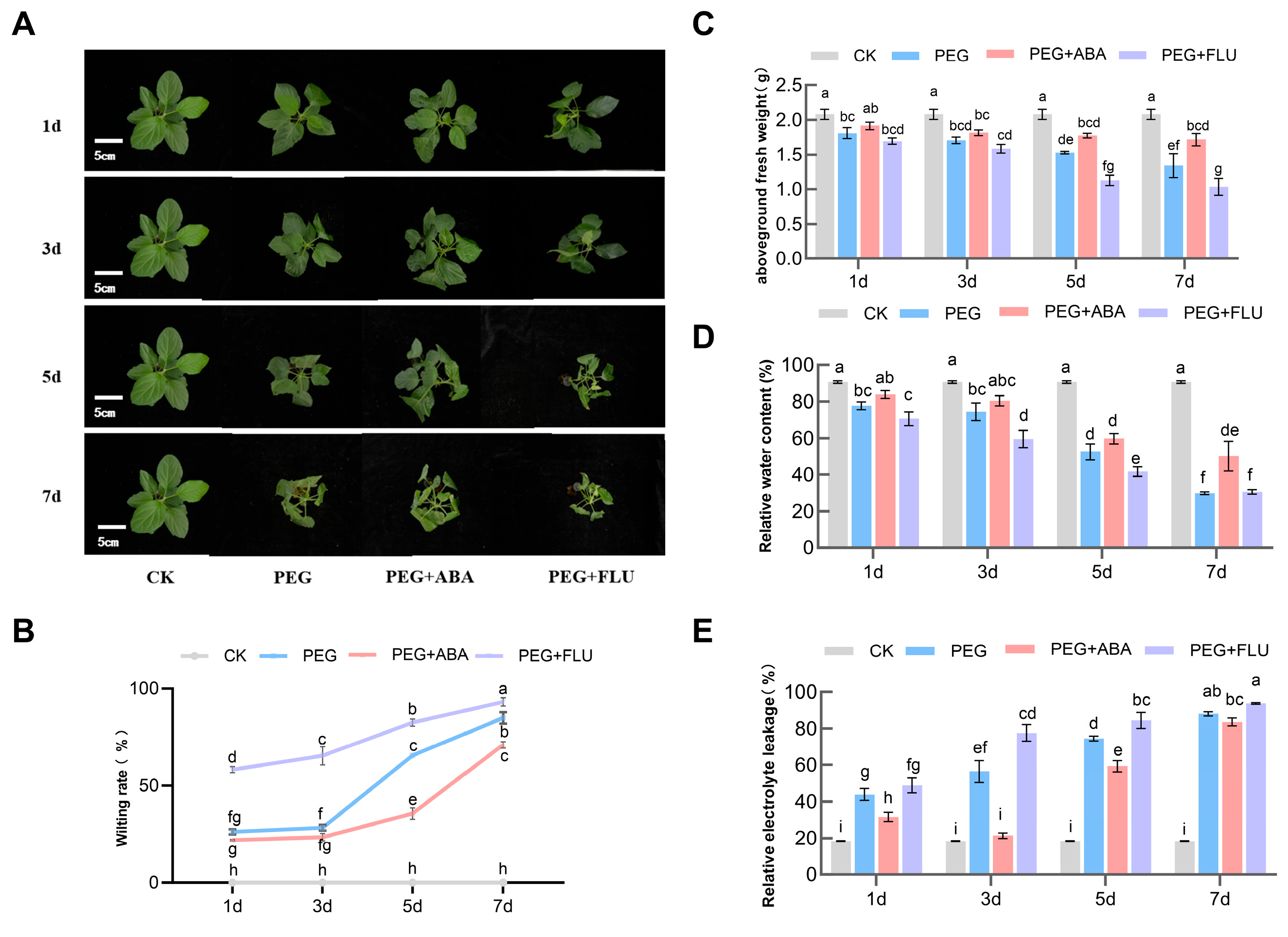
To verify the effect of exogenous ABA on M. sieversii plants under osmotic stress, four treatment groups were established. Morphological observations showed that, compared with the control group, plants subjected to PEG treatment exhibited significant wilting over time. ABA significantly alleviated the wilting rate of M. sieversii plants on the 5th day. In contrast, the FLU exacerbated plant wilting. Compared with the PEG treatment, ABA reduced the wilting rate by 45.53% on the 5th day, while the FLU increased the wilting rate by 26.0% (Figure 1A,B).
On the 5th and 7th day, PEG treatment significantly reduced aboveground fresh weight and RWC compared to CK, with reductions of 26.45%, 35.5% and 42.13%, 67.12%, respectively (Figure 1C,D). ABA significantly alleviated these declines, with corresponding values of 14.74%, 17.56% for fresh weight and 34.12%, 44.74% for RWC. In comparison to the PEG treatment, ABA increased the fresh weight and RWC by 15.91%, 27.82% and 13.83%, 68.09%, respectively. Conversely, FLU caused a further decrease relative to PEG, reducing the fresh weight and RWC by an additional 26.45%, 23.00% and 9.08%, 20.08%, respectively. These results indicate that exogenous ABA mitigates drought-induced wilting in M. sieversii, whereas inhibiting ABA biosynthesis exacerbates it.
Compared with CK, the relative electrical leakage of M. sieversii plants increased significantly by 133.57%, 206.53%, 304.91%, and 378.92% at 1, 3, 5, and 7 days under PEG treatment, and by 57.88%, 16.09%, 221.87%, and 354.59% under ABA treatment, respectively. Compared with PEG treatment, application of ABA at 1, 3, and 5 days significantly reduced the relative electrical leakage by 32.4%, 62.12%, and 20.50%, respectively. In contrast, application of FLU at 3 and 5 days increased it by 37.66% and 13.39%, respectively, compared to the PEG treatment (Figure 1E).

3.2. Effects of Exogenous ABA on Carbohydrate Content of M. sieversii Under PEG-Induced Osmotic Stress

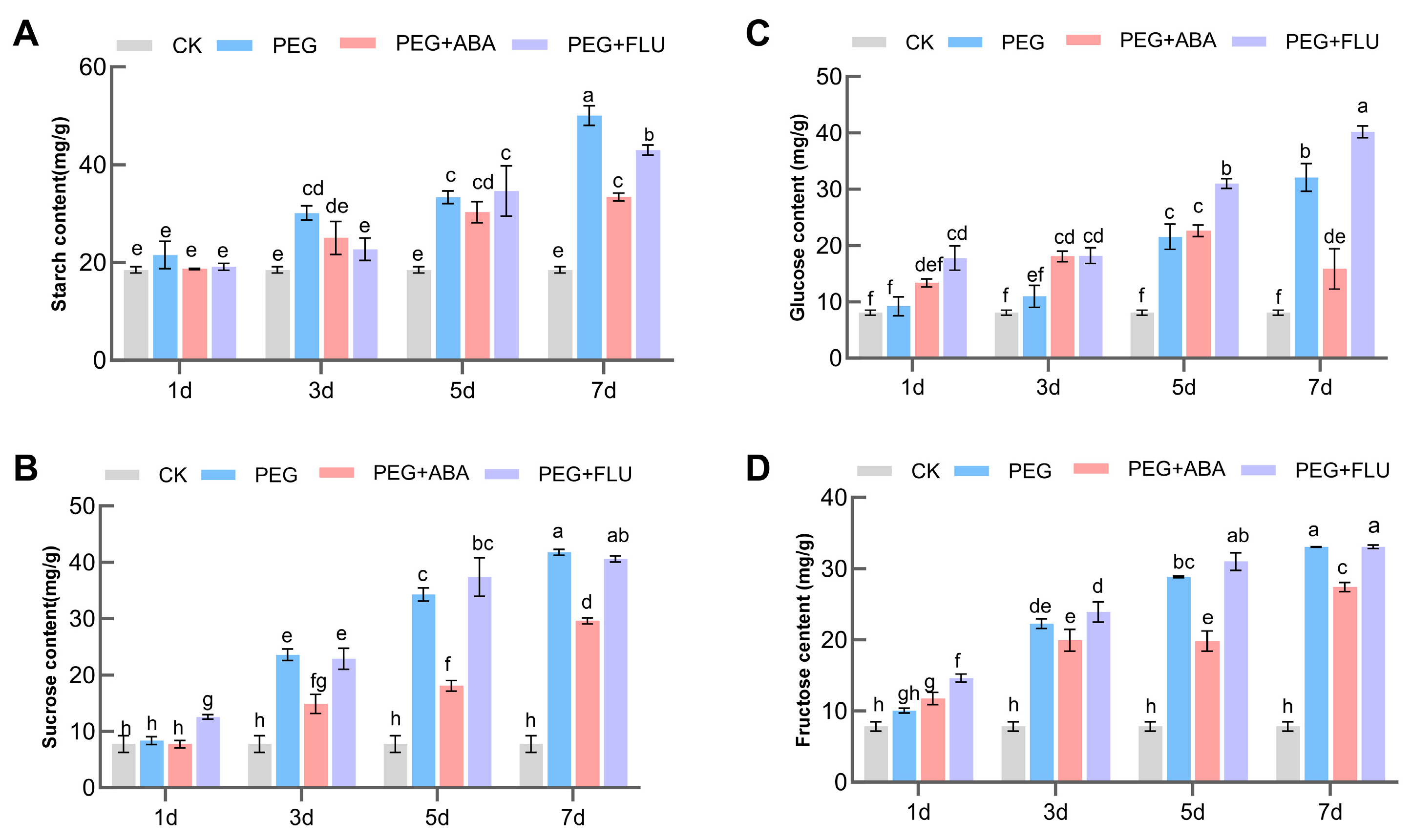
To explore how exogenous ABA affects starch and sugar content under osmotic stress, we determined the contents of starch, glucose, fructose, and sucrose in M. sieversii plants treated for 1, 3, 5, and 7 days (Figure 2). Compared with CK, PEG treatment caused significant accumulation of these substances as the treatment duration increased. Compared with CK, there was no significant change in starch content in the three treatments on the 1st day. On the 3rd day, the starch content of the PEG treatment began to increase significantly, while there was no significant difference with the ABA treatment, and it significantly decreased in the FLU treatment. On the 5th day, compared with CK, the starch content of the three treatments increased significantly. However, there was no significant difference among the treatments. Interestingly, on the 7th day, compared with the PEG treatment, the ABA treatment resulted in a significant decrease of 33.24%, and the FLU treatment saw a significantly decrease of 14.08% (Figure 2A).
Under PEG-induced osmotic stress, leaf sucrose content increased over time in all treatments. However, compared to the PEG treatment, exogenous ABA application significantly reduced the sucrose content by 36.95%, 47.28%, and 29.15% on the 3rd, 5th, and 7th day, respectively. In contrast, the FLU treatment showed no significant difference relative to the PEG treatment (Figure 2B).
Glucose content in the ABA treatment was elevated by 64.53% compared to PEG treatment on 3rd day but was reduced by 50.54% on 7th day. The FLU treatment, however, produced glucose levels significantly above those of the PEG treatment at both time points (Figure 2C).
Fructose content in all three stress treatments was significantly higher than for CK. Compared to the PEG treatment, the ABA treatment showed a reduction in fructose content by 18.9% and 17.08% on the 5th day and 7th day, respectively. The FLU treatment showed no significant difference in fructose content relative to the PEG treatment on 5th day and 7th day (Figure 2D).

3.3. Identification of DEGs in Response to Exogenous ABA in Drought-Stressed M. sieversii

Understanding the molecular mechanisms by which ABA regulates drought adaptation in M. sieversii is crucial. Based on the morphological and physiological changes observed in M. sieversii, we selected the 5th day of treatment for transcriptome sequencing analysis because the differences between the exogenous ABA application and the PEG treatment were most pronounced. A total of 12 samples were sequenced, corresponding to three biological replicates. Therefore, transcriptome sequencing and analysis were performed on the CK, PEG, PEG+ABA, and PEG+FLU groups. The high-quality sequencing data were indicated by a Q30 base percentage exceeding 94.01% and GC content ranging from 46.92% to 47.32%, suggesting balanced base composition (Table S3). Correlation analysis revealed that the coefficients among the three biological replicates within each treatment group were all above 0.9, demonstrating significant similarity (Figure S1).
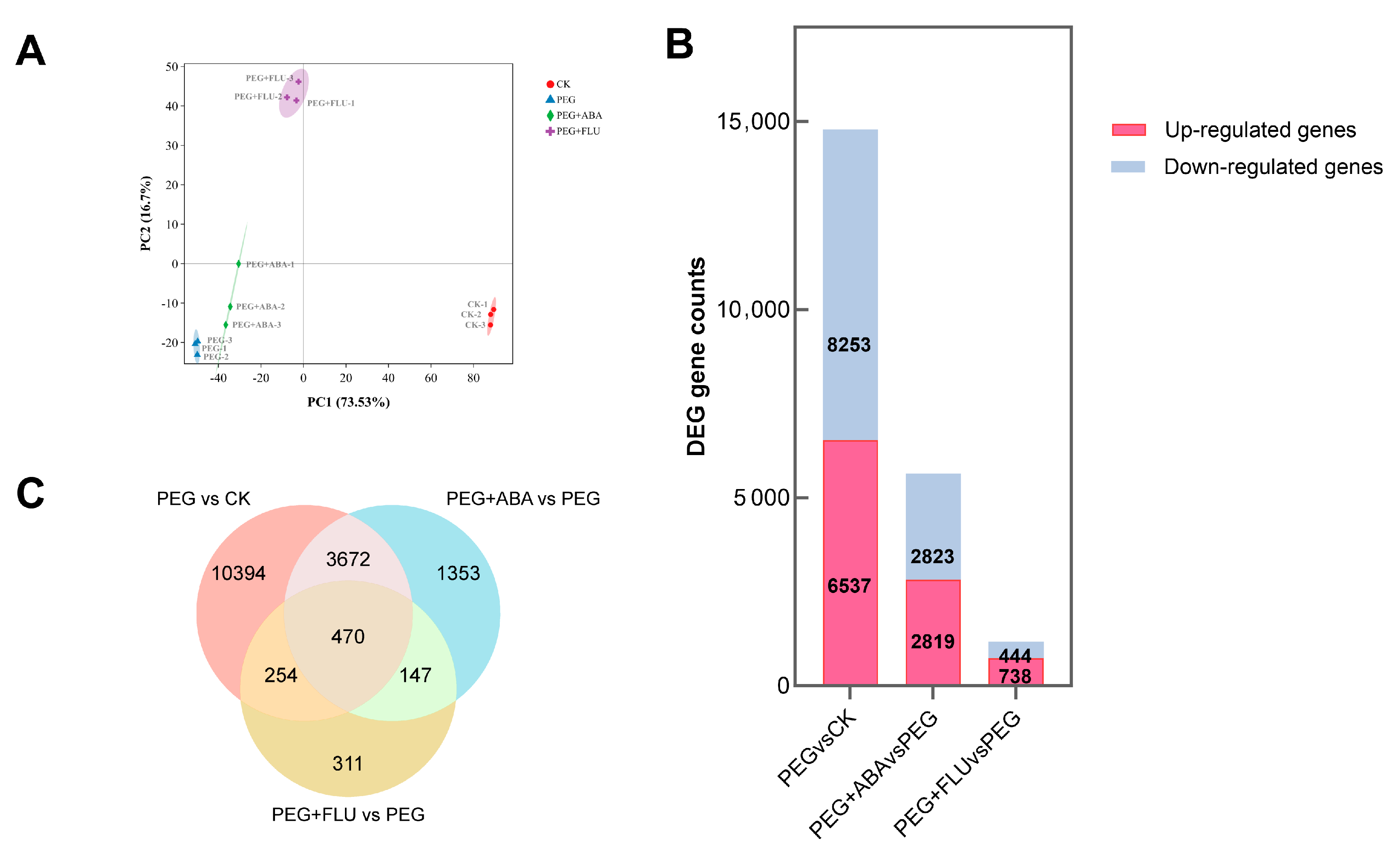
Principal component analysis (PCA) indicated significant differences in gene expression among the four treatment groups, as evidenced by their clear separation. PC1 and PC2 explained 73.53% and 16.7% of the total variance, respectively, together accounting for 90.23% (Figure 3A). In order to explore the basic regulation mode of exogenous spraying of ABA on the leaves of M. sieversii plants under PEG-induced osmotic stress, the gene expression changes of PEG+ABA, PEG and PEG+FLU were studied by differential expression analysis. Based on |log2(Foldchange)| > 1 and padj < 0.05, the number of DEGs among different treatments of M. sieversii was different. In leaves, there were 14790 differential genes between CK and PEG. There were 5642 differential genes between PEG+ABA and PEG. There were 1182 differential genes between PEG and PEG+FLU. They up-regulated 6537, 2819, and 738 genes and down-regulated 8253, 2823, and 444 genes, respectively (Figure 3B). The Venn diagram showed that 4142 DEGs were affected by both ABA and PEG treatment (the intersection of “PEG+ABA vs. PEG” and “PEG vs. CK”). FLU and PEG treatment affected 724 DEGs (the intersection of “PEG+FLU vs. PEG” and “PEG vs. CK”). Additionally, 470 DEGs were found in the intersection of “PEG+ABA vs. PEG,” “PEG vs. CK,” and “PEG+FLU vs. PEG” (Figure 3C), indicating that these genes may be involved in the ABA-induced osmotic stress response.

3.4. GO and KEGG Functional Enrichment Reveals Multiple Pathways Regulated by ABA, with Starch and Sucrose Metabolism Being Most Highly Enriched

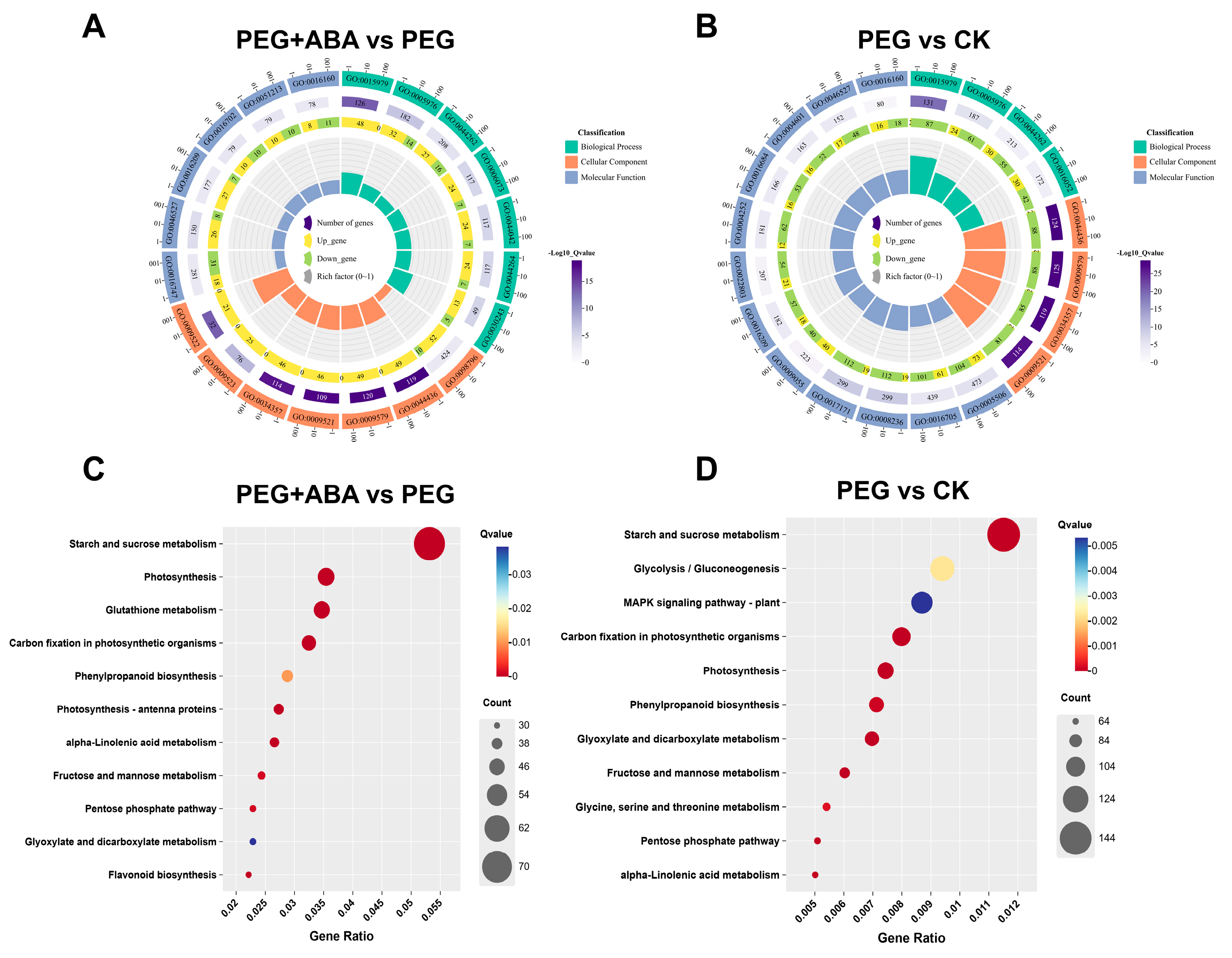
The GO analysis of the DEGs mentioned above revealed that the highly enriched terms in the biological process category included “cell components”, “molecular function”, and “biological process” (Figures S2–S4). In the biological process of the two comparison groups PEG+ABA vs. PEG and PEG vs. CK, the GO annotation subcategories with higher gene frequency in the different gene bodies include polysaccharide metabolic process (GO:0005976), photosynthesis (GO:0015979), and cellular carbohydrate metabolic process (GO:0044262). In the cell components, the GO annotation subcategories with higher gene frequency include thylakoid part (GO:0044436), thylakoid (GO:0009579), and photosynthetic membrane (GO:0034357). In molecular function, GO annotation subcategories with high gene frequency include glucosyltransferase activity (GO:0046527), amylase activity (GO:0016160) and antioxidant activity (GO:0016209) (Figure 4A,B and Tables S8 and S9).
Subsequently, the KEGG pathway enrichment analysis showed that the PEG+ABA vs. PEG treatment was enriched in starch and sucrose metabolism, photosynthesis, and carbon fixation in photosynthetic organisms (Figure 4C and Table S5). The PEG vs. CK group was enriched in starch and sucrose metabolism, glycolysis/gluconeogenesis, the MAPK signaling pathway and carbon fixation in photosynthetic organisms (Figure 4D and Table S6). In the PEG+FLU vs. PEG treatment, no significant genes were significantly enriched in carbon fixation in photosynthetic organisms, photosynthesis, and glyoxylate and dicarboxylate metabolism pathways (Figure S6 and Table S7).

3.5. The Effect of Exogenous ABA on Genes Related to Starch and Sucrose Synthesis Pathways of M. sieversii Under PEG-Induced Drought Stress

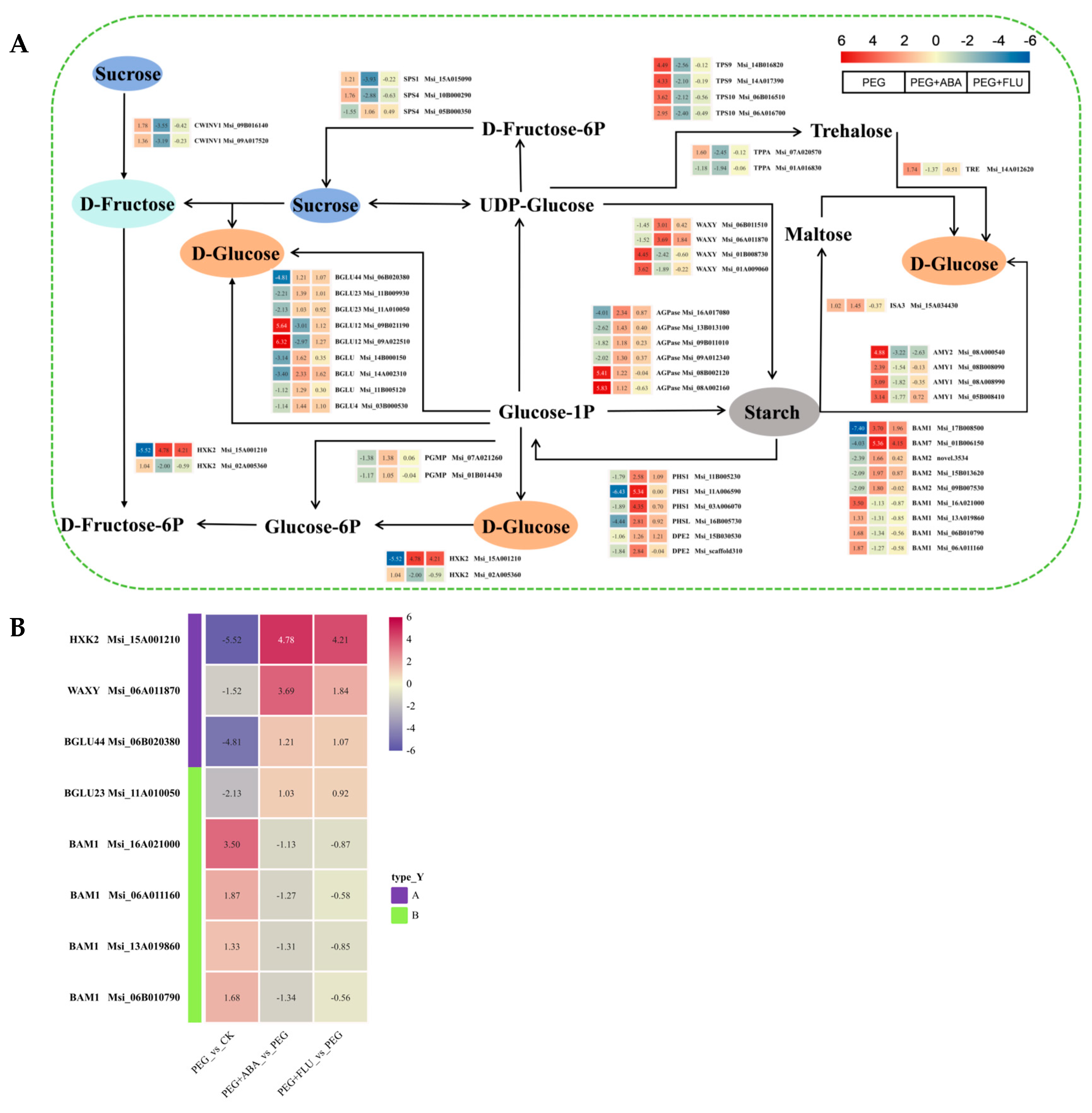
To investigate how exogenous ABA regulates this pathway under osmotic-stress conditions, we analyzed the DEGs within it. The results showed that under PEG treatment (PEG vs. CK), a total of 147 DEGs were identified in the starch and sucrose metabolism pathways, among which 51 genes were up-regulated and 96 were down-regulated (Table S6). Specifically, 52 genes involved in starch degradation (e.g., BAM, AMY, ISA, PHSL, glucanase) were identified, with 15 up-regulated and 37 down-regulated. Twenty genes associated with starch synthesis (e.g., AGPS, AD2, WAXY) were found, of which eight were up-regulated and 12 were down-regulated. In sucrose metabolism, genes involved in degradation (e.g., CWINV, SUC) showed two up-regulated and two down-regulated, while among synthesis-related genes (e.g., SPS, SPP), six were up-regulated and five were down-regulated.
In the PEG+ABA vs. PEG comparison, a total of 72 DEGs were identified in the starch and sucrose metabolism pathway, with 44 genes up-regulated and 28 down-regulated (Table S5). This included 18 genes promoting starch degradation that were up-regulated and eight that were down-regulated. For starch synthesis, nine genes were up-regulated and two were down-regulated. Five genes were associated with sucrose metabolism. Among those promoting sucrose degradation, two CWINV genes were down-regulated; among synthesis-related genes, three SPS genes were identified, with one up-regulated and two down-regulated.
Forty-nine DEGs were shared between the PEG vs. CK and PEG+ABA vs. PEG comparisons (Table S4), and their expression patterns are presented in a heatmap of the starch and sucrose metabolic pathways (Figure 5A). Eight genes were common to the PEG vs. CK, PEG+ABA vs. PEG, and PEG+FLU vs. PEG comparisons (Figure 5B). We observed that under FLU treatment, the expression of BAM1 and BGLU23 no longer showed statistical significance, indicating a loss of regulatory function and suggesting that these genes depend on ABA for their regulation. In contrast, the expression levels of WAXY, BGLU44, and HXK2 decreased relative to PEG+ABA vs. PEG but remained significantly up-regulated, indicating that their regulation involves ABA-independent mechanisms.

3.6. Validation of Key Starch and Sucrose Metabolism DEGs by qRT-PCR

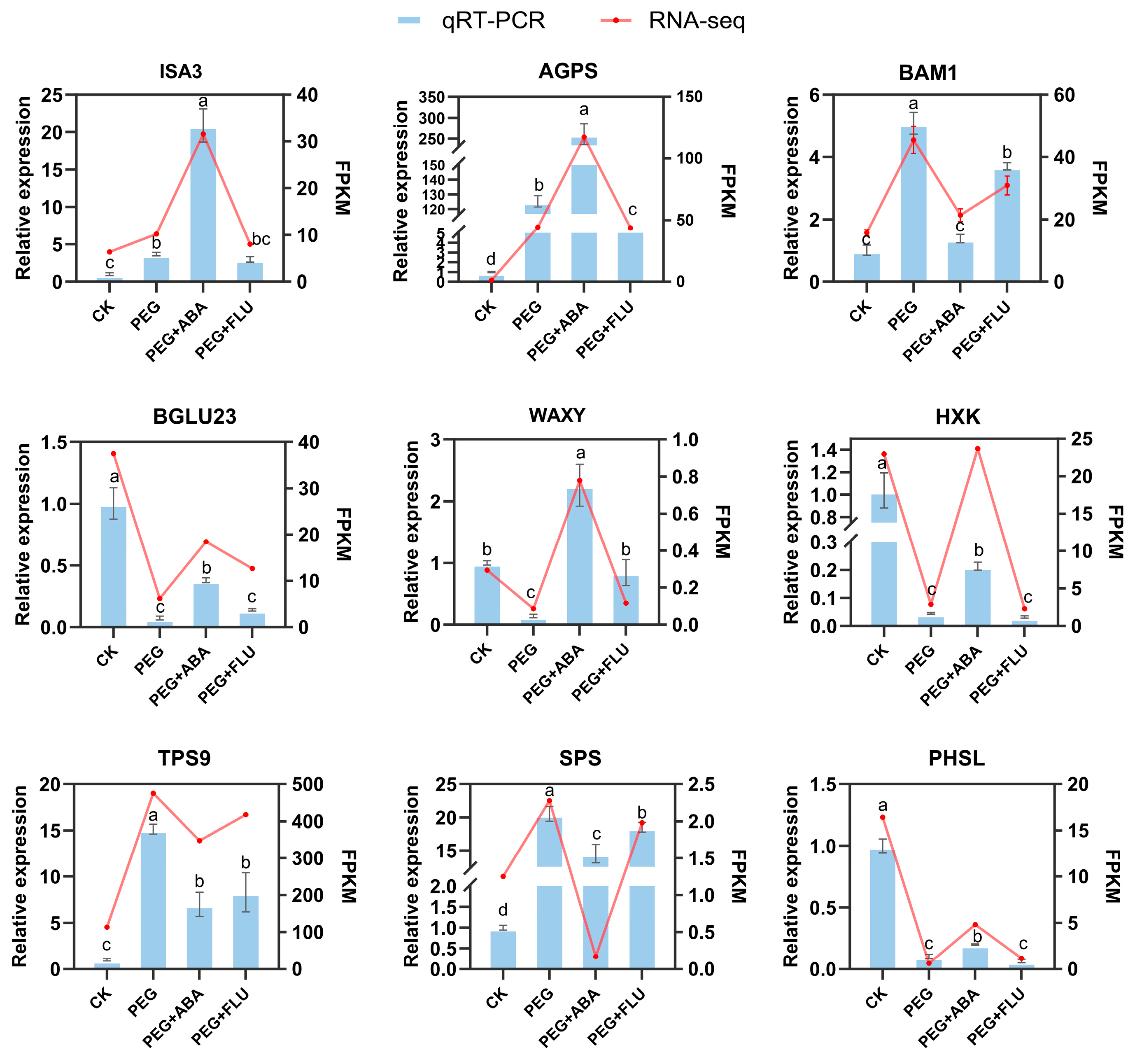
To validate the RNA-seq results, we randomly selected nine DEGs involved in starch and sucrose metabolism for qRT-PCR analysis. The selection was based on two criteria. First, we considered their significant expression differences and distinct response patterns to ABA and PEG treatments in the RNA-seq data. Second, we ensured that the selected genes represent diverse functional roles covering different nodes of the starch and sucrose metabolic pathway, including starch synthesis (WAXY, AGPs), starch degradation (ISA3, BAM1, BMY1), and sugar metabolism/signaling (BGLU23, HXK, SPS, TPS9). The candidate genes included Msi_15A034430 (ISA3), Msi_08B002120 (AGPs), Msi_11A010050 (BGLU23), Msi_06A011160 (BAM1), Msi_01B008730 (WAXY), Msi_02A005360 (HXK), Msi_14A017390 (TPS9), Msi_10B000290 (SPS), and Msi_16B005730 (PHSL). The relative expression trends determined by qRT-PCR were highly consistent with the RNA-seq data (Figure 6). Specifically, ISA3, AGPs, WAXY, and BGLU23 were significantly up-regulated by ABA treatment but down-regulated by PEG treatment alone. Conversely, BMY1, SPS, and TPS9 showed the opposite expression pattern. These qPCR results confirm the reproducibility and reliability of our transcriptomic data.

4. Discussion

The inability of PEG with a molecular weight of 6000 or greater to penetrate the cell wall has been confirmed. This makes high molecular weight PEG a suitable choice for regulating water potential in experimental setups designed to simulate soil drought [59]. It should be noted that PEG-induced osmotic stress, while widely used as a proxy for drought, does not fully recapitulate the complex dynamics of soil drying [60]. While our PEG-based approach provides valuable insights into the osmotic component of drought, the results should ideally be validated under soil drought conditions in future studies.
Our results indicate that PEG treatment caused physiological damage in M. sieversii plants, manifested as significant leaf wilting, decreased plant fresh weight and RWC, and a substantial increase in REL, reflecting the degree of cell membrane damage. These findings are consistent with reports in various plants, including Camellia oleifera [61] and grape [62]. In contrast, exogenous ABA application significantly alleviated these stress symptoms. Conversely, PEG+FLU treatment exacerbated drought-induced wilting, water loss, and electrolyte leakage, along with excessive carbohydrate accumulation, directly confirming the critical role of ABA in maintaining membrane integrity. Exogenous ABA application effectively mitigated membrane damage [31,63]. FLU, as an ABA biosynthesis inhibitor, was used in this study to inversely verify ABA function [64]. Notably, even with exogenous ABA application, the leaf relative water content of the PEG+ABA group remained significantly lower than the control by day 7. This suggests that under sustained and severe osmotic stress, ABA primarily functions to slow the rate of water loss rather than completely reverse the water deficit state, consistent with observations in other plants [44,46].
Starch and soluble sugars serve as important osmotic regulators in plant defense against environmental stress [65,66]. Studies have shown that stored starch and soluble sugars can enhance plant stress resistance and survival, acting as a buffer to temporarily supply growth and metabolism when carbon supply is insufficient during drought [67]. However, as stress duration increases, leaves accumulating excessive carbon may experience carbon starvation due to insufficient hydraulic transport from source to sink (e.g., roots), eventually leading to root death [68]. This study found that under PEG-simulated osmotic stress, the contents of starch, sucrose, glucose, and fructose in M. sieversii leaves increased significantly over time, which has been reported in other stress-tolerant plant varieties [69,70]. However, exogenous ABA application triggered a different pattern of sugar metabolism. We found that on the fifth day of stress, sucrose and fructose accumulation in leaves was significantly reduced, while starch and glucose content showed no significant change. By the seventh day, the contents of starch and soluble sugars were significantly lower. This is consistent with findings in rice, where exogenous ABA reduced starch content changes in leaf sheaths [71], and the carbohydrate levels on both day 5 and day 7 remained higher than in the CK treatment. This indicates that ABA may promote the utilization or conversion of certain sugars in the short term while generally maintaining sugar levels above non-stress conditions to cope with osmotic stress. This aligns with reports in Lindera megaphylla, where ABA prevented excessive carbon resource accumulation while maintaining osmotic homeostasis [72]. However, it differs from studies on Nitraria tangutorum [73] and Camellia oleifera [61], where exogenous ABA spraying increased the starch and soluble sugar content to alleviate drought damage. This discrepancy may reveal species-specific drought resistance mechanisms in M. sieversii [74] or stage-specific regulation during stress. Our results are similar to Auler’s finding that the ABA promotive effect on sugar accumulation dynamically changes with stress duration, and the decline in sugar content in later stages may be related to carbon transport to other organs or photosynthetic redistribution [75]. Explanations for the reduction of soluble sugars after ABA treatment include adaptive regulation, reduced photosynthesis, increased respiration and altered transport to roots. Future studies could utilize methods such as 13C isotopic tracing, tissue-specific sugar measurement, and photosynthetic system analysis to elucidate the precise mechanism through which ABA modulates sugar levels.
GO enrichment analysis of the PEG vs. CK and PEG+ABA vs. PEG comparisons revealed that ABA-regulated DEGs were significantly enriched in biological process categories such as “polysaccharide metabolic process”, “photosynthesis”, “glucosyltransferase activity”, and “cellular carbohydrate metabolic process” (Figure 4A,B). This suggests the possibility that carbon metabolism- and photosynthesis-related processes are important targets of ABA regulation. It is noteworthy that KEGG enrichment analysis revealed that photosynthesis, carbon fixation, and MAPK signaling pathways were also significantly enriched, indicating that ABA orchestrates a broad and multi-pathway transcriptional response to osmotic stress. Among these, starch and sucrose metabolism contained the highest number of DEGs along with the observation of related physiological changes, making it the focus of subsequent analysis. However, we note that existing reports show exogenous ABA affects different pathways in different species. For example, in alfalfa seedlings, the most critical pathways are plant hormone signal transduction and ascorbate-aldehyde metabolism [76]. In tea plants, exogenous ABA significantly influences the expression of genes related to lipid metabolism and flavonoid biosynthesis [77]. Qian et al. [78] found that exogenous ABA significantly improved pomegranate drought resistance by enhancing metabolic pathways such as brassinosteroid synthesis, peroxisome biogenesis, photosynthesis, and hemicellulose synthesis.
Our findings revealed that ABA significantly influences the accumulation and synthesis of starch and sucrose in the leaves of M. sieversii. Under PEG-induced drought stress, the highest number of genes involved were related to starch metabolism, with most amylase genes being down-regulated to inhibit starch breakdown, thereby promoting its accumulation. In contrast, the application of exogenous ABA up-regulated amylase genes while also up-regulating some starch synthase genes, potentially leading to a dynamic balance of starch levels, consistent with the changes in starch content we detected. Under PEG-induced drought stress, the regulatory patterns of key genes in the starch and sucrose metabolism pathways in M. sieversii leaves exhibited unique and complex characteristics under ABA regulation. For example, the expression of genes such as HXK2, WAXY, and BGLU44 were suppressed under PEG-induced drought but significantly up-regulated upon exogenous ABA application. Under FLU treatment, their expression decreased but remained significantly up-regulated compared to the drought treatment. The HXK gene is an important glucose signaling protein and an essential enzyme in carbohydrate metabolism, participating in starch breakdown [79,80]. Starch synthase is synthesized by AGPase and WAXY [81]. β-Glucosidases are involved in processes such as cell wall degradation and phytohormone signaling, regulating plant growth and environmental adaptation [82]. Previous studies have shown that β-glucosidase 44 can increase glucose levels in soybean under waterlogging stress [83]. Up-regulation of BGLU23 is involved in cell wall modification or signal generation, enhancing cellular homeostasis and promoting glucose production [84]. However, our results on day 5 showed no significant change in glucose content. We speculate that although HXK and BGLU genes may promote glucose production, glucose serves as an intermediate in starch and sucrose metabolism and as a direct substrate for respiration [85]. Since ABA induces starch degradation and reduces sucrose content in M. sieversii, the resulting glucose output may correspondingly decrease. Furthermore, exogenous ABA treatment specifically and strongly up-regulated genes related to both starch degradation and synthesis, such as the β-amylase gene BAM2 and starch synthase WAXY, while down-regulating genes like α-amylase AMY1 and BAM1. This suggests that ABA may regulate starch degradation by inhibiting excessive breakdown, thereby maintaining a stable starch supply and preventing its rapid depletion [86], consistent with our observed non-significant change in starch content.
Transcriptome data showed the highest number of DEGs in the PEG vs. CK comparison and the fewest in the PEG+FLU vs. PEG comparison. The lack of expression of many genes in the FLU-treated group may be due to the inhibition of ABA synthesis, resulting in the loss of a primary regulatory signal. Similar results were observed in tomato, where the absence of endogenous ABA signals reduced drought-induced expression of related genes [87]. Additionally, Shinozaki et al.’s [88] research indicates that the induction of some osmotic stress response genes is completely ABA-independent, some are fully ABA-dependent, and others are partially ABA-dependent. This aligns with our observation of these gene situations. Therefore, BAM1 and BGLU23, whose expression was lost in the FLU group but significantly induced in the ABA group, are proposed as candidate “ABA-dependent regulatory genes”. This expression pattern suggests that endogenous ABA synthesis may play an important role in the drought resistance of M. sieversii.
Future research may focus on the specific functional roles of key candidate genes BGLU23 and BAM1 in drought tolerance. This will require genetic transformation approaches, including gene overexpression, CRISPR-mediated knockout, and enzymatic activity assays. Since our RNA-seq analysis was conducted only at day 5, it provides a snapshot of gene expression that likely misses both the initial signaling phases and subsequent adaptive processes. To obtain a more comprehensive understanding, future studies should include transcriptional profiling at multiple time points, which would help elucidate the ABA-mediated regulatory network and further clarify the molecular mechanisms underlying osmotic-stress tolerance in M. sieversii.

5. Conclusions

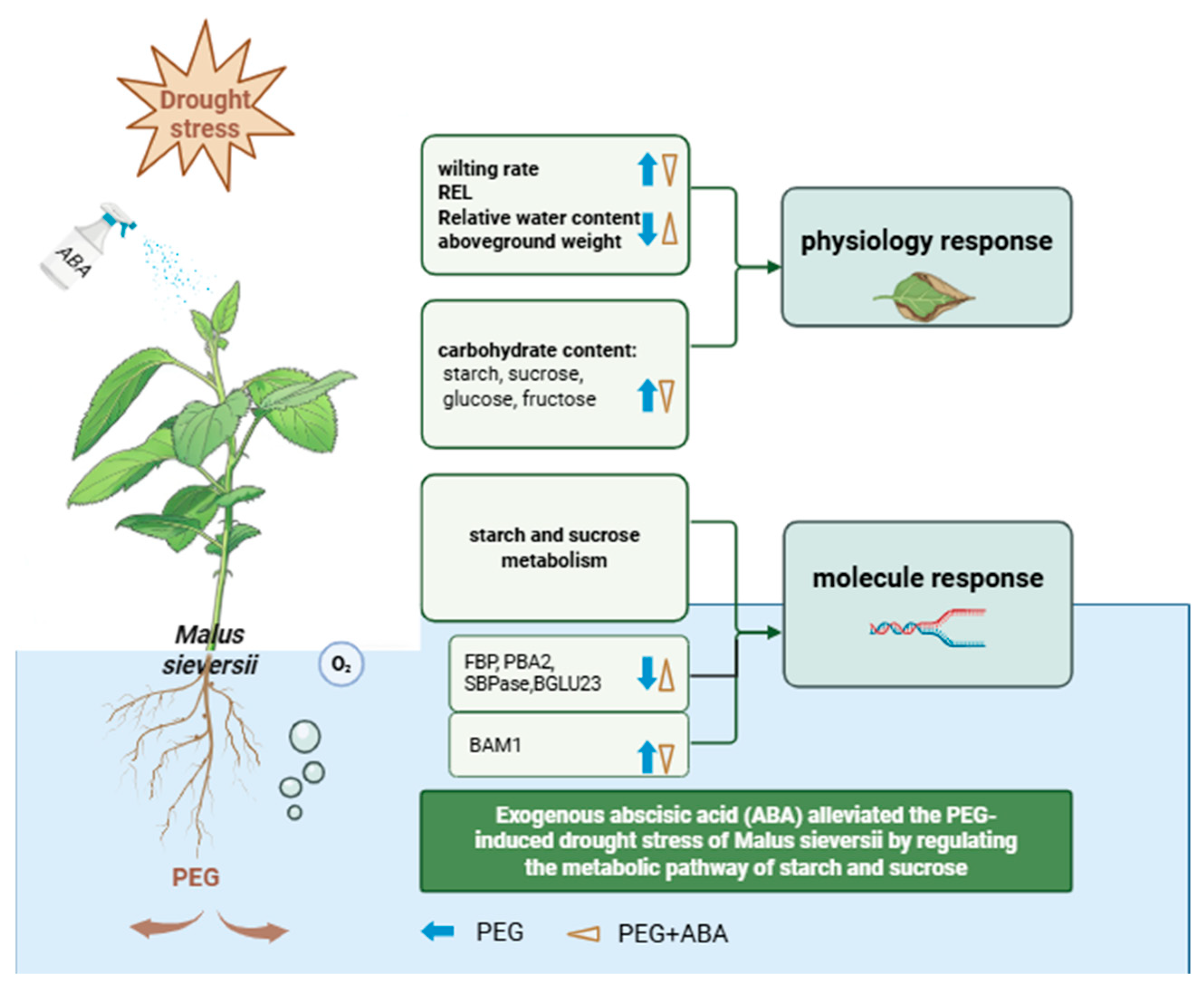
Under PEG treatment, which simulates osmotic stress rather than full soil drought conditions, exogenous ABA effectively mitigated stress-induced damage in M. sieversii. It reduced leaf wilting and electrolyte leakage, improved aboveground fresh weight and leaf relative water content, and modulated the accumulation of starch and soluble sugars. KEGG analyses revealed that ABA enhanced the osmotic-stress adaptability of M. sieversii through multiple regulatory pathways, among which starch and sucrose metabolism was most significantly enriched. Specifically, ABA up-regulated key gene BGLU23 while down-regulating gene expression that promotes starch decomposition, BAM1. The candidate genes BAM1 and BGLU23 have emerged as potential targets likely involved in the ABA-dependent regulatory pathway, warranting further functional validation. FLU treatment counteracted the alleviative effects of ABA, thereby confirming the ABA dependence of these responses. It should be noted that the findings of this study are based on measurements of metabolite content (starch, sucrose, glucose, and fructose) and did not include assays of related enzyme activities (e.g., invertases, SPS, amylases). This study provides new insight into the mechanisms by which ABA enhances osmotic-stress tolerance in M. sieversii (Figure 7).

Supplementary Materials

The following supporting information can be downloaded at: https://www.mdpi.com/article/10.3390/horticulturae12040399/s1.

Author Contributions

L.L.: Writing—original draft, Software, Visualization, Investigation, Methodology, Formal analysis, Data curation. H.M.: Visualization, Software, Data curation. D.Z.: Investigation, Methodology, Data curation. X.Z.: Writing—review and editing. Supervision, Project administration. X.L.: Writing—review and editing, Supervision, Methodology, Investigation, Project administration, Funding acquisition. All authors have read and agreed to the published version of the manuscript.

Funding

We are grateful for grants support from the Tianchi Talents Project of Xinjiang provinces (CZ006045), the NSFC-Xinjiang Joint Fund of the National Natural Science Foundation of China (U1703116), the National Natural Science Foundation of China (32402533) and the High-level Talent Initiation Project of Shihezi University (RCZK202462).

Data Availability Statement

All data generated or analyzed during this study are included in this published article. Further inquiries can be addressed to the corresponding authors.

Acknowledgments

We thank Biorender (https://BioRender.com) for providing the graphical tools to create model diagrams during the preparation of this manuscript. All authors have reviewed and edited the output and take full responsibility for the content of this publication.

Conflicts of Interest

The authors declare no conflicts of interest.

Abbreviations

The following abbreviations are used in this manuscript:
ABAAbscisic Acid
FLUfluridone
qRT-PCRQuantitative Real-Time Polymerase Chain Reaction
DEGsdifferentially expressed genes
MSMurashige and Skoog
RWCrelative water content
FWfresh weight
GOgene ontology
KEGGKyoto Encyclopedia of Genes and Genomes
PCAPrincipal component analysis

References

  1. Wang, N.; Jiang, S.; Zhang, Z.; Fang, H.; Xu, H.; Wang, Y.; Chen, X. Malus sieversii: The Origin, Flavonoid Synthesis Mechanism, and Breeding of Red-Skinned and Red-Fleshed Apples. Hortic. Res. 2018, 5, 70. [Google Scholar] [CrossRef] [PubMed]
  2. Tegtmeier, R.; Švara, A.; Gritsenko, D.; Khan, A. Malus sieversii: A Historical, Genetic, and Conservational Perspective of the Primary Progenitor Species of Domesticated Apples. Hortic. Res. 2025, 12, uhae244. [Google Scholar] [CrossRef] [PubMed]
  3. Chen, X.; Feng, T.; Zhang, Y.; He, T.; Feng, J.; Zhang, C. Genetic Diversity of Volatile Components in Xinjiang Wild Apple (Malus sieversii). J. Genet. Genom. 2007, 34, 171–179. [Google Scholar] [CrossRef] [PubMed]
  4. Geng, D.; Lu, L.; Yan, M.; Shen, X.; Jiang, L.; Li, H.; Wang, L.; Yan, Y.; Xu, J.; Li, C.; et al. Physiological and Transcriptomic Analyses of Roots from Malus sieversii under Drought Stress. J. Integr. Agric. 2019, 18, 1280–1294. [Google Scholar] [CrossRef]
  5. Zhou, P.; Li, X.; Liu, X.; Wen, X.; Zhang, Y.; Zhang, D. Transcriptome Profiling of Malus sieversii under Freezing Stress after Being Cold-Acclimated. BMC Genom. 2021, 22, 681. [Google Scholar] [CrossRef]
  6. Wang, D.; Gao, Y.; Sun, S.; Lu, X.; Li, Q.; Li, L.; Wang, K.; Liu, J. Effects of Salt Stress on the Antioxidant Activity and Malondialdehyde, Solution Protein, Proline, and Chlorophyll Contents of Three Malus Species. Life 2022, 12, 1929. [Google Scholar] [CrossRef]
  7. Richards, C.M.; Volk, G.M.; Reilley, A.A.; Henk, A.D.; Lockwood, D.R.; Reeves, P.A.; Forsline, P.L. Genetic Diversity and Population Structure in Malus sieversii, a Wild Progenitor Species of Domesticated Apple. Tree Genet. Genomes 2009, 5, 339–347. [Google Scholar] [CrossRef]
  8. Shan, Q.; Ling, H.; Zhao, H.; Li, M.; Wang, Z.; Zhang, G. Do Extreme Climate Events Cause the Degradation of Malus sieversii Forests in China? Front. Plant Sci. 2021, 12, 608211. [Google Scholar] [CrossRef]
  9. Claeys, H.; Inzé, D. The Agony of Choice: How Plants Balance Growth and Survival under Water-Limiting Conditions. Plant Physiol. 2013, 162, 1768–1779. [Google Scholar] [CrossRef]
  10. Wang, Y.; Shi, J.; Ren, Z.; Fan, X.; Li, R.; Yu, C.; Peng, Z.; Gao, Y.; Liu, Z.; Duan, L. Physiological and Transcriptomic Analyses of the Effects of Coronatine on Drought Tolerance in Carex Leucochlora. Environ. Exp. Bot. 2023, 206, 105184. [Google Scholar] [CrossRef]
  11. Jia, D.; Jiang, Q.; van Nocker, S.; Gong, X.; Ma, F. An Apple (Malus domestica) NAC Transcription Factor Enhances Drought Tolerance in Transgenic Apple Plants. Plant Physiol. Biochem. 2019, 139, 504–512. [Google Scholar] [CrossRef] [PubMed]
  12. Maghsoudi, E.; Yadavi, A.; Balouchi, H.; Dehnavi, M.M.; Piri, R.; Mastinu, A. Improving the Physiological Properties and Yield of Safflower by Combining Organic and Chemical Nitrogen in Different Irrigation Cut-off Conditions. Ind. Crops Prod. 2024, 222, 119601. [Google Scholar] [CrossRef]
  13. Nadeem, M.; Li, J.; Yahya, M.; Sher, A.; Ma, C.; Wang, X.; Qiu, L. Research Progress and Perspective on Drought Stress in Legumes: A Review. Int. J. Mol. Sci. 2019, 20, 2541. [Google Scholar] [CrossRef] [PubMed]
  14. V, P.; Ali, K.; Singh, A.; Vishwakarma, C.; Krishnan, V.; Chinnusamy, V.; Tyagi, A. Starch Accumulation in Rice Grains Subjected to Drought during Grain Filling Stage. Plant Physiol. Biochem. 2019, 142, 440–451. [Google Scholar] [CrossRef]
  15. Li, T.; Xue, J.; Wang, S.; Xue, Y.; Hu, F.; Zhang, X. Research Advances in the Metabolism and Transport of Non-Structural Carbohydrates in Plants. Plant Physiol. J. 2018, 54, 25–35. [Google Scholar] [CrossRef]
  16. Iqbal, S.; Wang, X.; Mubeen, I.; Kamran, M.; Kanwal, I.; Díaz, G.A.; Abbas, A.; Parveen, A.; Atiq, M.N.; Alshaya, H.; et al. Phytohormones Trigger Drought Tolerance in Crop Plants: Outlook and Future Perspectives. Front. Plant Sci. 2022, 12, 799318. [Google Scholar] [CrossRef]
  17. Zhang, T.; Zeng, X.; Liang, B.; Yan, R.; Ding, X.; Qi, G.; Jia, P. Analysis of the IPT Gene Family Reveals the Critical Role of the JrERF113-JrIPT1 Module in Cold Resistance of Walnut (Juglans regia). BMC Plant Biol. 2025, 25, 1616. [Google Scholar] [CrossRef]
  18. Yan, R.; Zhang, T.; Wang, Y.; Wang, W.; Sharif, R.; Liu, J.; Dong, Q.; Luan, H.; Zhang, X.; Li, H.; et al. The Apple MdGA2ox7 Modulates the Balance between Growth and Stress Tolerance in an Anthocyanin-Dependent Manner. Plant Physiol. Biochem. 2024, 212, 108707. [Google Scholar] [CrossRef]
  19. Swain, R.; Sahoo, S.; Behera, M.; Rout, G.R. Instigating Prevalent Abiotic Stress Resilience in Crop by Exogenous Application of Phytohormones and Nutrient. Front. Plant Sci. 2023, 14, 1104874. [Google Scholar] [CrossRef]
  20. Ullah, A.; Manghwar, H.; Shaban, M.; Khan, A.H.; Akbar, A.; Ali, U.; Ali, E.; Fahad, S. Phytohormones Enhanced Drought Tolerance in Plants: A Coping Strategy. Environ. Sci. Pollut. Res. 2018, 25, 33103–33118. [Google Scholar] [CrossRef]
  21. Waadt, R.; Seller, C.A.; Hsu, P.-K.; Takahashi, Y.; Munemasa, S.; Schroeder, J.I. Plant Hormone Regulation of Abiotic Stress Responses. Nat. Rev. Mol. Cell Biol. 2022, 23, 680–694. [Google Scholar] [CrossRef] [PubMed]
  22. Yoshida, T.; Mogami, J.; Yamaguchi-Shinozaki, K. ABA-Dependent and ABA-Independent Signaling in Response to Osmotic Stress in Plants. Curr. Opin. Plant Biol. 2014, 21, 133–139. [Google Scholar] [CrossRef] [PubMed]
  23. Zhu, J.-K. Abiotic Stress Signaling and Responses in Plants. Cell 2016, 167, 313–324. [Google Scholar] [CrossRef]
  24. Zhu, J.-K. Salt and Drought Stress Signal Transduction in Plants. Annu. Rev. Plant Biol. 2002, 53, 247–273. [Google Scholar] [CrossRef] [PubMed]
  25. Sharma, A.; Gupta, A.; Ramakrishnan, M.; Ha, C.V.; Zheng, B.; Bhardwaj, M.; Tran, L.-S.P. Roles of Abscisic Acid and Auxin in Plants during Drought: A Molecular Point of View. Plant Physiol. Biochem. 2023, 204, 108129. [Google Scholar] [CrossRef]
  26. Daszkowska-Golec, A. The Role of Abscisic Acid in Drought Stress: How ABA Helps Plants to Cope with Drought Stress. In Drought Stress Tolerance in Plants; Hossain, M.A., Wani, S.H., Bhattacharjee, S., Burritt, D.J., Tran, L.-S.P., Eds.; Springer International Publishing: Cham, Switzerland, 2016; Volume 2, pp. 123–151. [Google Scholar]
  27. Krasensky, J.; Jonak, C. Drought, Salt, and Temperature Stress-Induced Metabolic Rearrangements and Regulatory Networks. J. Exp. Bot. 2012, 63, 1593–1608. [Google Scholar] [CrossRef]
  28. Trouverie, J.; Thévenot, C.; Rocher, J.; Sotta, B.; Prioul, J. The Role of Abscisic Acid in the Response of a Specific Vacuolar Invertase to Water Stress in the Adult Maize Leaf. J. Exp. Bot. 2003, 54, 2177–2186. [Google Scholar] [CrossRef]
  29. Muhammad Aslam, M.; Waseem, M.; Jakada, B.H.; Okal, E.J.; Lei, Z.; Saqib, H.S.A.; Yuan, W.; Xu, W.; Zhang, Q. Mechanisms of Abscisic Acid-Mediated Drought Stress Responses in Plants. Int. J. Mol. Sci. 2022, 23, 1084. [Google Scholar] [CrossRef]
  30. Aroca, R.; Del Mar Alguacil, M.; Vernieri, P.; Ruiz-Lozano, J.M. Plant Responses to Drought Stress and Exogenous ABA Application Are Modulated Differently by Mycorrhization in Tomato and an ABA-Deficient Mutant (Sitiens). Microb. Ecol. 2008, 56, 704–719. [Google Scholar] [CrossRef]
  31. Du, Y.-L.; Wang, Z.-Y.; Fan, J.-W.; Turner, N.C.; He, J.; Wang, T.; Li, F.-M. Exogenous Abscisic Acid Reduces Water Loss and Improves Antioxidant Defence, Desiccation Tolerance and Transpiration Efficiency in Two Spring Wheat Cultivars Subjected to a Soil Water Deficit. Funct. Plant Biol. 2013, 40, 494–506. [Google Scholar] [CrossRef]
  32. Li, C.; Yin, C.; Liu, S. Different Responses of Two Contrasting Populus Davidiana Populations to Exogenous Abscisic Acid Application. Environ. Exp. Bot. 2004, 51, 237–246. [Google Scholar] [CrossRef]
  33. Ozturk, Z.N.; Talamé, V.; Deyholos, M.; Michalowski, C.B.; Galbraith, D.W.; Gozukirmizi, N.; Tuberosa, R.; Bohnert, H.J. Monitoring Large-Scale Changes in Transcript Abundance in Drought- and Salt-Stressed Barley. Plant Mol. Biol. 2002, 48, 551–573. [Google Scholar] [CrossRef]
  34. Hu, Y.; Li, A.; Yin, J.; Wang, Y.; Zou, J.; Ju, G.; Liu, J.; Sun, Z. Transcriptome based ABA mediated dehydration response of Salix matsudana branches. J. Beijing For. Univ. 2025, 47, 19–27. [Google Scholar] [CrossRef]
  35. Fujita, Y.; Fujita, M.; Shinozaki, K.; Yamaguchi-Shinozaki, K. ABA-Mediated Transcriptional Regulation in Response to Osmotic Stress in Plants. J. Plant Res. 2011, 124, 509–525. [Google Scholar] [CrossRef] [PubMed]
  36. Yoshida, T.; Anjos, L.D.; Medeiros, D.B.; Araújo, W.L.; Fernie, A.R.; Daloso, D.M. Insights into ABA-Mediated Regulation of Guard Cell Primary Metabolism Revealed by Systems Biology Approaches. Prog. Biophys. Mol. Biol. 2019, 146, 37–49. [Google Scholar] [CrossRef] [PubMed]
  37. Min, X.; Lin, X.; Ndayambaza, B.; Wang, Y.; Liu, W. Coordinated Mechanisms of Leaves and Roots in Response to Drought Stress Underlying Full-Length Transcriptome Profiling in Vicia sativa L. BMC Plant Biol. 2020, 20, 165. [Google Scholar] [CrossRef] [PubMed]
  38. Thalmann, M.; Pazmino, D.; Seung, D.; Horrer, D.; Nigro, A.; Meier, T.; Kölling, K.; Pfeifhofer, H.W.; Zeeman, S.C.; Santelia, D. Regulation of Leaf Starch Degradation by Abscisic Acid Is Important for Osmotic Stress Tolerance in Plants. Plant Cell 2016, 28, 1860–1878. [Google Scholar] [CrossRef]
  39. Jiang, Z.; Li, Y.P.; Gai, P.Z.; Gao, J.; Xu, L. Exogenously Applied ABA Alleviates Dysplasia of Maize (L.) Ear under Drought Stress by Altering Photosynthesis and Sucrose Transport. Plant Signal. Behav. 2025, 20, 2462497. [Google Scholar] [CrossRef]
  40. Liao, X.; Guo, X.; Wang, Q.; Wang, Y.; Zhao, D.; Yao, L.; Wang, S.; Liu, G.; Li, T. Overexpression of MsDREB6.2 Results in Cytokinin-deficient Developmental Phenotypes and Enhances Drought Tolerance in Transgenic Apple Plants. Plant J. 2016, 89, 510–526. [Google Scholar] [CrossRef]
  41. Zhang, Y.; Bozorov, T.A.; Li, D.X.; Zhou, P.; Wen, X.J.; Ding, Y.; Zhang, D.Y. An Efficient in Vitro Regeneration System from Different Wild Apple (Malus sieversii) Explants. Plant Methods 2020, 16, 56. [Google Scholar] [CrossRef]
  42. Zhang, X.; Li, S.; Tang, T.; Liu, Y.; Mobeen Tahir, M.; Wang, C.; Meng, Z.; Niu, J.; Yang, W.; Ma, J.; et al. Comparison of Morphological, Physiological, and Related-Gene Expression Responses to Saline-Alkali Stress in Eight Apple Rootstock Genotypes. Sci. Hortic. 2022, 306, 111455. [Google Scholar] [CrossRef]
  43. Tian, J.; Song, C.; Gao, X.; Gong, J.; Yu, L.; Tian, X.; Zhang, K.; Jiao, J.; Wang, M.; Hao, P.; et al. MhNF-YA1-Like-MhDnaJC76-MhAAO3 Transcriptional Cascade Enhances ABA Biosynthesis and Drought Tolerance in Apple. Plant Cell Environ. 2025, 48, 7440–7454. [Google Scholar] [CrossRef] [PubMed]
  44. Li, W.-F.; Mao, J.; Su, J.; Li, X.-W.; Dawuda, M.M.; Ma, Z.-H.; Zuo, C.-W.; An, Z.-S.; Chen, B.-H. Exogenous ABA and Its Inhibitor Regulate Flower Bud Induction of Apple Cv. ‘Nagafu No. 2′ Grafted on Different Rootstocks. Trees 2021, 35, 609–620. [Google Scholar] [CrossRef]
  45. Nong, Q.; Malviya, M.K.; Lin, L.; Xie, J.; Mo, Z.; Solanki, M.K.; Solanki, A.C.; Wang, Z.; Song, X.; Li, Y.; et al. Enhancing Sugarcane Seedling Resilience to Water Stress through Exogenous Abscisic Acid: A Study on Antioxidant Enzymes and Phytohormone Dynamics. ACS Omega 2024, 9, 31684–31693. [Google Scholar] [CrossRef] [PubMed]
  46. Hu, W.; Zhang, J.; Wu, Z.; Loka, D.A.; Zhao, W.; Chen, B.; Wang, Y.; Meng, Y.; Zhou, Z.; Gao, L. Effects of Single and Combined Exogenous Application of Abscisic Acid and Melatonin on Cotton Carbohydrate Metabolism and Yield under Drought Stress. Ind. Crops Prod. 2022, 176, 114302. [Google Scholar] [CrossRef]
  47. Xie, Y.; Bao, C.; Chen, P.; Cao, F.; Liu, X.; Geng, D.; Li, Z.; Li, X.; Hou, N.; Zhi, F.; et al. Abscisic Acid Homeostasis Is Mediated by Feedback Regulation of MdMYB88 and MdMYB124. J. Exp. Bot. 2021, 72, 592–607. [Google Scholar] [CrossRef]
  48. Wang, X.; Lu, X.; Xu, W.; Bai, R. Effect of Exogenous CaCl2 on the Nitrogen Metabolism of Sour Jujube Seedlings under NaCl Stress. Acta Bot. Boreali-Occident. Sin. 2018, 38, 1683–1691. [Google Scholar] [CrossRef]
  49. Wang, S.; Liang, D.; Li, C.; Hao, Y.; Ma, F.; Shu, H. Influence of Drought Stress on the Cellular Ultrastructure and Antioxidant System in Leaves of Drought-Tolerant and Drought-Sensitive Apple Rootstocks. Plant Physiol. Biochem. 2012, 51, 81–89. [Google Scholar] [CrossRef]
  50. Yu, L.; Chen, Y.; Zeng, X.; Lou, Y.; Baldwin, I.T.; Li, R. Brown Planthoppers Manipulate Rice Sugar Transporters to Benefit Their Own Feeding. Curr. Biol. 2024, 34, 2990–2996.e4. [Google Scholar] [CrossRef]
  51. Mao, J.; Li, W.; Mi, B.; Dawuda, M.M.; Calderón-Urrea, A.; Ma, Z.; Zhang, Y.; Chen, B. Different Exogenous Sugars Affect the Hormone Signal Pathway and Sugar Metabolism in “Red Globe” (Vitis vinifera L.) Plantlets Grown in Vitro as Shown by Transcriptomic Analysis. Planta 2017, 246, 537–552. [Google Scholar] [CrossRef]
  52. Modi, A.; Vai, S.; Caramelli, D.; Lari, M. The Illumina Sequencing Protocol and the NovaSeq 6000 System. In Bacterial Pangenomics; Mengoni, A., Bacci, G., Fondi, M., Eds.; Methods in Molecular Biology; Springer: New York, NY, USA, 2021; Volume 2242, pp. 15–42. [Google Scholar]
  53. Borodina, T.; Adjaye, J.; Sultan, M. A Strand-Specific Library Preparation Protocol for RNA Sequencing. In Methods in Enzymology; Elsevier: Amsterdam, The Netherlands, 2011; Volume 500, pp. 79–98. [Google Scholar]
  54. Kim, D.; Paggi, J.M.; Park, C.; Bennett, C.; Salzberg, S.L. Graph-Based Genome Alignment and Genotyping with HISAT2 and HISAT-Genotype. Nat. Biotechnol. 2019, 37, 907–915. [Google Scholar] [CrossRef] [PubMed]
  55. Anders, S.; Huber, W. Differential Expression Analysis for Sequence Count Data. Genome Biol. 2010, 11, R106. [Google Scholar] [CrossRef] [PubMed]
  56. Jia, P.; Sharif, R.; Li, Y.; Sun, T.; Li, S.; Zhang, X.; Dong, Q.; Luan, H.; Guo, S.; Ren, X.; et al. The BELL1-like Homeobox Gene MdBLH14 from Apple Controls Flowering and Plant Height via Repression of MdGA20ox3. Int. J. Biol. Macromol. 2023, 242, 124790. [Google Scholar] [CrossRef] [PubMed]
  57. He, C.; Liu, L.; Lu, X. Analysis of Genes Related to Glycolysis in the Leaves and Roots of Malus sieversii under NaCl Stress Based on Transcriptome Sequencing. J. Fruit Sci. 2020, 37, 951–961. [Google Scholar] [CrossRef]
  58. Livak, K.J.; Schmittgen, T.D. Analysis of Relative Gene Expression Data Using Real-Time Quantitative PCR and the 2−ΔΔCT Method. Methods 2001, 25, 402–408. [Google Scholar] [CrossRef]
  59. Verslues, P.E.; Agarwal, M.; Katiyar-Agarwal, S.; Zhu, J.; Zhu, J. Methods and Concepts in Quantifying Resistance to Drought, Salt and Freezing, Abiotic Stresses That Affect Plant Water Status. Plant J. 2006, 45, 523–539. [Google Scholar] [CrossRef]
  60. Elizabeth Mustamu, N.; Tampubolon, K.; Alridiwirsah; Basyuni, M.; AL-Taey, D.K.A.; Jawad Kadhim AL Janabi, H.; Mehdizadeh, M. Drought Stress Induced by Polyethylene Glycol (PEG) in Local Maize at the Early Seedling Stage. Heliyon 2023, 9, e20209. [Google Scholar] [CrossRef]
  61. Yang, D.; Chen, Y.; Wang, R.; He, Y.; Ma, X.; Shen, J.; He, Z.; Lai, H. Effects of Exogenous Abscisic Acid on the Physiological and Biochemical Responses of Camellia Oleifera Seedlings Under Drought Stress. Plants 2024, 13, 225. [Google Scholar] [CrossRef]
  62. Gambetta, G.A.; Herrera, J.C.; Dayer, S.; Feng, Q.; Hochberg, U.; Castellarin, S.D. The Physiology of Drought Stress in Grapevine: Towards an Integrative Definition of Drought Tolerance. J. Exp. Bot. 2020, 71, 4658–4676. [Google Scholar] [CrossRef]
  63. Kim, M.-H.; Cho, J.-S.; Park, E.-J.; Lee, H.; Choi, Y.-I.; Bae, E.-K.; Han, K.-H.; Ko, J.-H. Overexpression of a Poplar RING-H2 Zinc Finger, Ptxerico, Confers Enhanced Drought Tolerance via Reduced Water Loss and Ion Leakage in Populus. Int. J. Mol. Sci. 2020, 21, 9454. [Google Scholar] [CrossRef]
  64. Zhang, X.; Wang, X.; Zhuang, L.; Gao, Y.; Huang, B. Abscisic Acid Mediation of Drought Priming-Enhanced Heat Tolerance in Tall Fescue (Festuca arundinacea) and Arabidopsis. Physiol. Plant. 2019, 167, 488–501. [Google Scholar] [CrossRef]
  65. Asad, M.A.U.; Yan, Z.; Zhou, L.; Guan, X.; Cheng, F. How Abiotic Stresses Trigger Sugar Signaling to Modulate Leaf Senescence? Plant Physiol. Biochem. 2024, 210, 108650. [Google Scholar] [CrossRef]
  66. Li, T.H.; Li, S.H. Leaf Responses of Micropropagated Apple Plants to Water Stress: Nonstructural Carbohydrate Composition and Regulatory Role of Metabolic Enzymes. Tree Physiol. 2005, 25, 495–504. [Google Scholar] [CrossRef] [PubMed]
  67. O’Brien, M.J.; Leuzinger, S.; Philipson, C.D.; Tay, J.; Hector, A. Drought Survival of Tropical Tree Seedlings Enhanced by Non-Structural Carbohydrate Levels. Nat. Clim. Change 2014, 4, 710–714. [Google Scholar] [CrossRef]
  68. McDowell, N.; Pockman, W.T.; Allen, C.D.; Breshears, D.D.; Cobb, N.; Kolb, T.; Plaut, J.; Sperry, J.; West, A.; Williams, D.G.; et al. Mechanisms of Plant Survival and Mortality during Drought: Why Do Some Plants Survive While Others Succumb to Drought? New Phytol. 2008, 178, 719–739. [Google Scholar] [CrossRef] [PubMed]
  69. Brunetti, C.; Savi, T.; Nardini, A.; Loreto, F.; Gori, A.; Centritto, M. Changes in Abscisic Acid Content during and after Drought Are Related to Carbohydrate Mobilization and Hydraulic Recovery in Poplar Stems. Tree Physiol. 2020, 40, 1043–1057. [Google Scholar] [CrossRef]
  70. Ullah, A.; Tariq, A.; Zeng, F.; Asghar, M.A.; Sardans, J.; Peñuelas, J. Insights into Alhagi Sparsifolia Seedlings Adaptations to Drought Stress under Nitrogen Addition: Regulation of Sugar Metabolism, Hormones, and Anti-Oxidant Potential. J. Soil Sci. Plant Nutr. 2024, 24, 4145–4166. [Google Scholar] [CrossRef]
  71. Chen, H.-J.; Wang, S.-J. Abscisic Acid Enhances Starch Degradation and Sugar Transport in Rice Upper Leaf Sheaths at the Post-Heading Stage. Acta Physiol. Plant. 2012, 34, 1493–1500. [Google Scholar] [CrossRef]
  72. Xu, Y.; Yu, Y.; Niu, X.; Zhao, Y.; Jiang, J.; Lu, J.; Li, Y.; Chen, P.; Liu, H. Exogenous Abscisic Acid Enhances Waterlogging Tolerance in Lindera Megaphylla. Horticulturae 2025, 11, 1433. [Google Scholar] [CrossRef]
  73. Zhang, J.; Cheng, K.; Liu, X.; Dai, Z.; Zheng, L.; Wang, Y. Exogenous Abscisic Acid and Sodium Nitroprusside Regulate Flavonoid Biosynthesis and Photosynthesis of Nitraria Tangutorum Bobr in Alkali Stress. Front. Plant Sci. 2023, 14, 1118984. [Google Scholar] [CrossRef]
  74. McAdam, S.A.M.; Brodribb, T.J.; Ross, J.J.; Jordan, G.J. Augmentation of Abscisic Acid (ABA) Levels by Drought Does Not Induce Short-Term Stomatal Sensitivity to CO2 in Two Divergent Conifer Species. J. Exp. Bot. 2011, 62, 195–203. [Google Scholar] [CrossRef] [PubMed]
  75. Auler, P.A.; Lemos, M.D.S.; Porto, N.P.; Mendes, K.D.R.; Bret, R.S.C.; Daloso, D.M. Abscisic Acid-Mediated Guard Cell Metabolism Regulation. Plant Physiol. Biochem. 2024, 214, 108889. [Google Scholar] [CrossRef] [PubMed]
  76. Lu, X.; Peng, S.; Yin, Y.; Sun, M.; Wu, Z.; Wu, X.; Niu, Z.; Li, Z.; Wu, L. Mechanisms of Exogenous ABA-Induced Drought Tolerance in Idesia Polycarpa Seedlings Revealed by Integrated Physiological, Transcriptomic, and Metabolomic Analyses. Ind. Crops Prod. 2025, 236, 122030. [Google Scholar] [CrossRef]
  77. Gai, Z.; Wang, Y.; Ding, Y.; Qian, W.; Qiu, C.; Xie, H.; Sun, L.; Jiang, Z.; Ma, Q.; Wang, L.; et al. Exogenous Abscisic Acid Induces the Lipid and Flavonoid Metabolism of Tea Plants under Drought Stress. Sci. Rep. 2020, 10, 12275. [Google Scholar] [CrossRef]
  78. Qian, J.; Zhang, X.; Yan, Y.; Wang, N.; Ge, W.; Zhou, Q.; Yang, Y. Unravelling the Molecular Mechanisms of Abscisic Acid-Mediated Drought-Stress Alleviation in Pomegranate (Punica granatum L.). Plant Physiol. Biochem. 2020, 157, 211–218. [Google Scholar] [CrossRef]
  79. Moore, B.; Zhou, L.; Rolland, F.; Hall, Q.; Cheng, W.-H.; Liu, Y.-X.; Hwang, I.; Jones, T.; Sheen, J. Role of the Arabidopsis Glucose Sensor HXK1 in Nutrient, Light, and Hormonal Signaling. Science 2003, 300, 332–336. [Google Scholar] [CrossRef]
  80. Giese, J.-O.; Herbers, K.; Hoffmann, M.; Klösgen, R.B.; Sonnewald, U. Isolation and Functional Characterization of a Novel Plastidic Hexokinase from Nicotiana tabacum. FEBS Lett. 2005, 579, 827–831. [Google Scholar] [CrossRef]
  81. Lu, H.; Hu, Y.; Wang, C.; Liu, W.; Ma, G.; Han, Q.; Ma, D. Effects of High Temperature and Drought Stress on the Expression of Gene Encoding Enzymes and the Activity of Key Enzymes Involved in Starch Biosynthesis in Wheat Grains. Front. Plant Sci. 2019, 10, 1414. [Google Scholar] [CrossRef]
  82. Ketudat Cairns, J.R.; Esen, A. β-Glucosidases. Cell. Mol. Life Sci. 2010, 67, 3389–3405. [Google Scholar] [CrossRef]
  83. Wang, X.; Li, F.; Zhou, S.; Komatsu, S.; Yan, L.; Xu, R.; Sun, L. Protein Homeostasis and Cell Wall Remodeling in Response to Jasmonate and Gibberellin Signals Improve Flood Tolerance in Soybean (Glycine max L.). Environ. Exp. Bot. 2024, 226, 105902. [Google Scholar] [CrossRef]
  84. Zhao, Y.; Liu, S.; Zha, L.; Zhang, Y.; Li, Z.; Yu, C.; Chen, M. Influence of Cellulase Gene Expression and Cellulolytic Activity on Cellulose Utilization in Different Volvariella Volvacea Strains. Sci. Hortic. 2020, 261, 108956. [Google Scholar] [CrossRef]
  85. Wang, C.; Lu, C.; Wang, J.; Liu, X.; Wei, Z.; Qin, Y.; Zhang, H.; Wang, X.; Wei, B.; Lv, W.; et al. Molecular Mechanisms Regulating Glucose Metabolism in Quinoa (Chenopodium quinoa Willd.) Seeds under Drought Stress. BMC Plant Biol. 2024, 24, 796. [Google Scholar] [CrossRef]
  86. Li, F.H.; Yu, P.; Song, C.H.; Wu, J.J.; Tian, Y.; Wu, X.F.; Zhang, X.W.; Liu, Y.M. Differential Protein Analysis of Heracleum Moellendorffii Hance Seeds during Stratification. Plant Physiol. Biochem. 2019, 145, 10–20. [Google Scholar] [CrossRef]
  87. Yan, M.; Yao, Y.; Mou, K.; Dan, Y.; Li, W.; Wang, C.; Liao, W. The Involvement of Abscisic Acid in Hydrogen Gas-Enhanced Drought Resistance in Tomato Seedlings. Sci. Hortic. 2022, 292, 110631. [Google Scholar] [CrossRef]
  88. Shinozaki, K.; Yamaguchi-Shinozaki, K. Gene Expression and Signal Transduction in Water-Stress Response. Plant Physiol. 1997, 115, 327–334. [Google Scholar] [CrossRef]
Figure 1. Alleviating effects of foliar spraying of ABA on M. sieversii plants under PEG-induced osmotic stress: (A) plant morphology; (B) wilting rate; (C) the fresh weight of aboveground parts; (D) the relative water content of leaves; (E) relative leakage of electrolytes. Notes: Statistical analysis was performed using Duncan’s multiple range test to compare treatments. Data are presented as the mean (±standard deviation) of three biological replicates (n = 10). Different lowercase letters indicate significant differences (p < 0.05) among treatments within each respective time point.
Horticulturae 12 00399 g001
Figure 2. Exogenous ABA affects starch and soluble sugar contents of M. sieversii leaves under PEG-induced osmotic stress. (A) Starch content. (B) Sucrose content. (C) Glucose content. (D) Fructose content. Bars sharing a common letter are not significantly different (p  <  0.05). Notes: Statistical analysis was performed using Duncan’s multiple range test to compare treatments. Data are presented as the mean (±standard deviation) of three biological replicates (n = 10). Different lowercase letters indicate significant differences (p < 0.05) among treatments within each respective time point.
Horticulturae 12 00399 g002
Figure 3. Analysis of DEGs of M. sieversii screened by exogenous ABA and FLU under PEG-induced drought stress across the transcriptome. (A) PCA analysis. (B) Number of DEGs in the PEG vs. CK, PEG+ABA vs. PEG, and PEG+FLU vs. PEG analyses. Up-regulated (red) and down-regulated (blue) DEGs were quantified. (C) Venn diagrams of overlapping DEGs in the transcriptome data.
Horticulturae 12 00399 g003
Figure 4. GO functional enrichment of the DEGs and KEGG pathway enrichment of DEGs. (A) GO term enrichment for PEG+ABA vs. PEG; (B) GO term enrichment for PEG vs. CK; (C) KEGG pathway enrichment for PEG+ABA vs. PEG; (D) KEGG pathway enrichment for PEG vs. CK. The greater the enrichment factor, the greater the degree of pathway enrichment. Count indicates enriched differentially expressed gene numbers; color scale indicates q value.
Horticulturae 12 00399 g004
Figure 5. The heatmap of genes related to starch and sucrose metabolism in M. sieversii plants under four treatments. (A) Starch and sucrose metabolism pathway; (B) expression heatmap of the shared genes involved in starch and sucrose metabolism across the three groups. AGPase: Glucose-1-phosphate adenylyltransferase large subunit; AMY: Alpha-amylase; BAM: Beta-amylase; BGLU: Beta-glucosidase; CWINV1: Beta-fructofuranosidase 1; DPE2: 4-alpha-glucanotransferase; HXK2: Hexokinase 2; ISA3: Isoamylase 3; PGMP: Phosphoglucomutase; PHS1: Alpha-glucan phosphorylase; PHSL: Alpha-1,4 glucan phosphorylase L-2 isozyme; SPS: sucrose-phosphate synthase; TPPA: Trehalose-phosphate phosphatase A; TPS: trehalose-phosphate synthase; TRE: Probable trehalase; WAXY: Granule-bound starch synthase 1.
Horticulturae 12 00399 g005
Figure 6. Relative expression levels of genes involved in starch and sucrose metabolism pathway of M. sieversii. Values are presented as mean ± standard error (SE) of three replicates (n = 3). Different lowercase letters indicate significant differences among groups (Duncan’s multiple range test, p < 0.05).
Horticulturae 12 00399 g006
Figure 7. Model diagram of the effect of exogenous ABA on M. sieversii under PEG-induced drought stress. The upwards arrow represents the up-regulated gene, and the downward one represents the down-regulated gene.
Horticulturae 12 00399 g007
Disclaimer/Publisher’s Note: The statements, opinions and data contained in all publications are solely those of the individual author(s) and contributor(s) and not of MDPI and/or the editor(s). MDPI and/or the editor(s) disclaim responsibility for any injury to people or property resulting from any ideas, methods, instructions or products referred to in the content.