


Abstract
Myo-inositol (MI) is recognized as a potential stress regulator capable of alleviating abiotic stress. The objective of this study is to analyze the role of MI in the salt stress response of Daucus carota L. and its potential mechanisms. “Hongxin Qicun” carrot seedlings were subjected to five treatments: control; salt stress (50 mM NaCl); and salt stress combined with 50, 100, or 200 μM of MI. Through an integrated approach combining physiological assays, non-invasive micro-test technology (NMT), and gene expression profiling, we found that salt stress severely inhibited seedling growth, disrupted K+/Na+ homeostasis, and triggered excessive H2O2 accumulation. Exogenous MI application mitigated these salt-induced damages, with 100 μM MI exerting the optimal effect. MI enhanced Na+ efflux and reduced K+ efflux in carrot roots under salt stress. Inhibitor experiments indicated that MI-promoted Na+ efflux relies on active transport via the plasma membrane (PM) Na+/H+ antiporter system, and qRT-PCR analysis showed that this response was accompanied by the upregulation of DcSOS1. Furthermore, MI contributes to K+ homeostasis by synergistically modulating PM H+-ATPase and high-affinity potassium transporters. The established proton gradient helps reduce salt-induced K+ loss through depolarization-activated potassium channels and non-selective cation channels. MI treatment decreased electrolyte leakage, malondialdehyde content, and H2O2 accumulation by enhancing the activities of the plant antioxidant defense system. Meanwhile, MI upregulated the expression of myo-inositol oxygenase (DcMIOXs) genes, which may contribute to osmotic balance maintenance and facilitate ROS scavenging. In conclusion, exogenous MI alleviates salt-induced physiological disorders in Daucus carota L. by coordinately regulating K+/Na+ and ROS homeostasis, with 100 μM identified as the optimal concentration for this effect.
1. Introduction
In natural and agricultural ecosystems, soil salinization and secondary salinization are prominent issues that cause substantial economic losses to agriculture and forestry [1,2,3]. In particular, salt stress exerts pronounced inhibitory effects on plant growth and crop productivity, thereby constraining agricultural output and even jeopardizing regional food security [4,5]. Mechanistically, salt stress elicits a cascade of phytotoxic effects in plants, including water deficit, ion toxicity, and ultimately oxidative damage at the cellular level [6,7]. Notably, maintaining potassium/sodium homeostasis at both cellular and whole-plant levels is widely recognized as the core determinant of plant salt tolerance, as disruption of this balance can lead to impaired enzyme activity and metabolic disturbances [8,9,10,11]. The ability of plant root systems and their cells to expel Na+ is derived from the activity of Na+/H+ antiporters in the plasma membrane [12,13,14]. Under salt stress, plasma membrane H+-ATPase pumps H+ out of the cell to maintain the transmembrane proton electrochemical gradient, which facilitates Na+/H+ antiport [15,16]. Salt-tolerant plants can sustain the activity of plasma membrane H+-ATPase under long-term salt stress, thus possessing robust Na+/H+ antiport capacity [17,18]. Moreover, the proton gradient maintained by H+-pumps can prevent the opening of depolarization-activated outward rectifying K+ channels (DA-KORCs) and non-selective cation channels (NSCCs), thereby inhibiting K+ efflux induced by salt stress, and restricting the entry of Na+ through NSCCs into plant cells [19,20]. Beyond restricting K+ efflux, active K+ uptake mediated by K+ transporters is equally critical for maintaining K+/Na+ homeostasis under salt stress [21,22,23,24]. The coordinated action of K+ retention (via H+-pumps and channels) and active K+ uptake (via transporters) ensures the stable intracellular K+ levels required for normal physiological processes, forming a comprehensive regulatory network for plant salt tolerance.
Salt stress induces the generation of reactive oxygen species (ROS) in plant cells, and these molecules operate in a dual capacity: while they inflict oxidative damage as unavoidable metabolic by-products, they simultaneously serve as indispensable secondary messengers that transduce stress signals and orchestrate adaptive responses [25,26,27]. Under normal physiological conditions, ROS homeostasis is strictly regulated to maintain cellular redox balance, relying on a complex ROS clearance network composed of non-enzymatic and enzymatic systems [28]. Plants have evolved sophisticated ROS-scavenging mechanisms involving both non-enzymatic and enzymatic systems for this purpose. In non-enzymatic pathways, glutathione and ascorbic acid, along with secondary metabolites such as flavonoids, carotenoids, alkaloids, and tocopherols, can scavenge reactive oxygen species [29]. The enzyme-mediated scavenging mechanism of reactive oxygen species (ROS) is composed of superoxide dismutase (SOD), ascorbic peroxidase (APX), catalase (CAT), peroxidase (POD), and glutathione reductase (GR) [30]. Hydrogen peroxide (H2O2) is an active oxygen molecule that can cause oxidative damage to plant cells and destroy proteins, DNA and lipid structures, and it is characterized by increased malondialdehyde (MDA) content and elevated electrolyte leakage, ultimately impairing membrane integrity and disrupting normal physiological processes [31].
Myo-inositol (MI) is a polyol commonly found in plants and acts as a key regulatory molecule to mediate various physiological processes in plants [32]. MI and its phosphate derivatives regulate signal transduction [33], hypocotyl growth [34], and cell wall synthesis [35], all of which are crucial for the normal growth and development of plants. Studies have confirmed that MI mediates the adaptive responses of plants to various abiotic stresses, including drought [36,37,38], heat [39], and salinity [40,41,42,43]. Under salt stress, exogenous MI elevates the K+/Na+ ratio in the leaves of Malus hupehensis seedlings [40], mitigates oxidative damage in maize [43], and upregulates stress-related gene expression in Chenopodium quinoa [41]. Furthermore, the salt-alleviating effects of MI are closely associated with its metabolic pathway: myo-inositol oxygenase (MIOX), a key enzyme in MI metabolism, catalyzes MI conversion to D-glucuronic acid, a critical precursor for ascorbate biosynthesis (a core component of the antioxidant system) [40,44]. Despite these advances, the physiological mechanisms by which MI influences K+/Na+ homeostasis and oxidative equilibrium in horticultural vegetables remain unclear.
Carrot (Daucus carota L.) is an important horticultural vegetable widely cultivated across the globe. However, NaCl can inhibit root elongation and shoot growth, thereby reducing the quality and yield of carrot taproots [45]. Therefore, exploring effective strategies to enhance salt tolerance in carrot seedlings is crucial for sustainable carrot production in saline soils. This study employed a hydroponic system and subjected experimental subjects to salt treatments with varying concentrations of myo-inositol (50 μM–200 μM) to elucidate its effects on salt tolerance in carrots. Non-invasive micro-test technology (NMT) was utilized to measure sodium chloride-induced potassium, sodium, and hydrogen ions flux curves in the presence and absence of inositol. Furthermore, we investigated the effect of salt stress on the inositol antioxidant system and screened the transcriptional changes in genes related to inositol synthesis, as well as those involved in various salt signaling pathways. This was done to reveal the potential mechanism by which inositol functions in the antioxidant balance and ionic homeostasis under salt stress.
2. Materials and Methods
2.1. Plant Material and Growth Conditions
Carrot seeds (Hongxin Qicun) were purchased from Shouguang Jinpeng Seed Industry (Shouguang, China). We selected full and healthy seeds, soaked and disinfected them in 10% hydrogen peroxide solution for 15 min, followed by three rinses with sterile distilled water, and then incubated them in a light culture box under conditions of 28 °C, 14 h of light and 10 h of darkness for 3 days on filter paper for germination. Subsequently, we sowed them in flower pots, with the nutrient soil consisting of a nutrient matrix: vermiculite = 1:1. They were then transferred to a plant growth room and cultivated under the same conditions. After 20 days of pot culture, uniformly grown seedlings were transplanted into hydroponic containers containing fresh 1/4-strength Hoagland nutrient solution. All hydroponic containers are wrapped in black plastic film to minimize the penetration of light into the roots and then placed in the growth room. The nutrient solution was continuously aerated using an air pump. The pH was adjusted to 6.0, and the nutrient solution was renewed every two days.
2.2. Stress Treatments and Experimental Design
Five treatments were arranged in a completely randomized design, with three biological replicates per treatment. One hydroponic container served as one biological replicate, with ten seedlings per container: (1) control (CK), quarter-strength Hoagland solution; (2) salt stress (S), quarter-strength Hoagland solution plus 50 mM NaCl (a concentration that, in preliminary trials, inhibited root elongation without inducing mortality and was thus selected to impose moderate but non-lethal salt stress); (3–5) SI1, SI2 and SI3, consisting of salt-stressed medium supplemented with 50, 100, or 200 µmol L−1 of myo-inositol (MI, ≥99% purity, Sigma-Aldrich, St. Louis, MO, USA), respectively. MI was dissolved in ultrapure water, filter-sterilized (0.22 µm) and was added simultaneously with NaCl. The nutrient solution was renewed every two days, and MI was synchronously supplemented with each renewal to maintain its nominal concentration. After 10 d of continuous treatment, seedlings were harvested for integrated physiological analyses.
2.3. Determination of Growth Parameters and Root Activity
For each biological replicate, three uniformly grown seedlings were selected and thoroughly rinsed with deionized water to remove residual nutrient solution. The height of the plant and the length of the main root were measured with vernier calipers, and the precision was 0.1 mm. Plant height is defined as the vertical distance from the base of the hypocotyl to the tip of the fully expanded upper leaf, while main root length was defined as the maximum linear distance from the root tip to the junction of the main root and hypocotyl. Three technical replicates were performed for each seedling to ensure measurement accuracy. For the determination of root activity, the triphenyl tetrazolium chloride (TTC) method was employed as described previously [46,47]. TTC, a chromogenic reagent, undergoes reduction via dehydrogenases—with succinate dehydrogenase identified as the primary isoform involved—when incubated with plant tissues, and such dehydrogenase activity is widely acknowledged as a reliable surrogate for root vitality.
2.4. Ion Flux Recordings
2.4.1. Microelectrodes Preparation and Calibration
Using an NMT system (model NMT-YG-100, Younger USA LLC, Amherst, MA 01002, USA), the net flux of K+, Na+ and H+ in carrot root tip (100–3000 μm) was determined. The preparation method using glass microelectrodes draws lessons from the previously established procedures [10,11,48]. Before ion flux measurement, a series of standard solutions was used to calibrate microelectrodes with different ion specificities, and the specific steps are as follows:
- (i)
- H+: Standard solutions with pH values of 4.5, 5.5, and 6.5;
- (ii)
- Na+: NaCl solutions at concentrations of 0.1, 0.5, and 1.0 mM;
- (iii)
- K+: KCl solutions at concentrations of 0.1, 0.5, and 1.0 mM.
Following calibration, only microelectrodes exhibiting Nernstian slopes within the range of 52–64 mV per decade for Na+, K+, and H+ were selected for subsequent NMT measurements.
2.4.2. Steady-State Ion Flux Recordings
Root segments from 24 h treated seedlings were collected, rinsed with distilled water and equilibrated for 30 min in the following measurement solutions:
K+, Na+ and H+ measuring solutions: 0.1 NaCl, 0.5 KCl, 0.1 CaCl2 and 0.1 MgCl2 (concentrations in mM, pH 6.0).
Prior to the test, carrot roots were balanced in the above solution, and then, the ion flux was measured at the root tip of 100–3000 microns. For NMT flux profiles across this range, we first averaged all detection points for a single seedling and then averaged the values of 3 selected seedlings to obtain one biological replicate, with variance calculation and statistical analysis based on 3 biological replicates per treatment (each from a separate hydroponic container, consistent with other assays).
2.5. Inhibitor Treatment Experiment
Three specific inhibitors were used to clarify the pathway by which MI regulates ion flux. These agents were: amiloride (Na+/H+ antiporter inhibitor, Sigma-Aldrich, St. Louis, MO, USA), tetraethylammonium chloride (TEA, K+ channel inhibitor, Sigma-Aldrich, St. Louis, MO, USA), and sodium orthovanadate (plasma membrane H+-ATPase inhibitor, Sigma-Aldrich, St. Louis, MO, USA). Daucus carota roots were treated with or without inhibitors for 30 min (concentrations in mM) [10]: (1) 0.1 amiloride; (2) 20 TEA; (3) 0.5 sodium orthovanadate; (4) measuring solutions (inhibitor-free control). As described in Section 2.4.2, the steady-state fluxes of K+ and Na+ in roots pretreated with or without inhibitors (300 µm from the root tip) were measured by the NMT system.
2.6. Determination of Electrolyte Leakage Rate, MDA Content, and H2O2 Content
Electrolyte leakage rate (ELR) was determined using fresh leaves sampled from Daucus carota seedlings. Fresh leaf tissue (0.5 g) was pooled from 5 seedlings per biological replicate, excised into 0.5 cm × 0.5 cm fragments, rinsed thoroughly with deionized water for three cycles, and blotted gently with filter paper to remove surface moisture. The processed samples were immersed in 10 mL of deionized water at room temperature for 30 min, and the initial electrical conductivity (EC1) was measured. Subsequently, the samples were heated in a boiling water bath for 15 min and allowed to cool down to ambient temperature naturally, and the final conductivity (EC2) was recorded. The ELR value was calculated using the formula ELR (%) = (EC1/EC2) × 100 [49,50].
The thiobarbituric acid (TBA) method was employed for malondialdehyde (MDA) content quantification. The determination method follows the approach described by Deng et al. (2015) [50], using a 0.5% TBA solution as the blank control to measure the absorbance values at 532 nm, 600 nm, and 450 nm. The MDA concentration (nmol L−1) was calculated as 6.45 × (D532–D600) − 0.56 × D450 [50].
The absorbance was measured at 410 nm by ultraviolet spectrophotometry. Leaf samples were homogenized in cold acetone and centrifuged, and the supernatant was reacted with Ti(SO4)2 and concentrated ammonia water to form a titanium–peroxide complex. The precipitate was washed and dissolved in 2 M H2SO4, and absorbance was measured at 410 nm (2 M H2SO4 as blank). The H2O2 content was calculated according to the standard curve generated by H2O2 solution with known concentration, with results expressed as μmol g−1 FW.
2.7. Antioxidant Enzyme Activity Assay
Commercialized reagent kits (provided by Nanjing Jiancheng Bioengineering Institute, Nanjing, China) were used to measure antioxidant enzyme activity. The activities of superoxide dismutase (SOD), peroxidase (POD), ascorbate peroxidase (APX), and glutathione reductase (GR) were determined in strict accordance with the standardized operating procedures of the corresponding kit manufacturers. Fresh carrot leaf samples (0.5 g) were homogenized in pre-cooled phosphate buffer solution (50 mM, pH 7.8) containing 0.1 mM EDTA and 2% polyvinylpyrrolidone (PVP) and then centrifuged at 12,000× g for 20 min at 4 °C. The supernatant obtained served as the crude enzyme extract for subsequent enzyme activity measurements. The activity of superoxide dismutase (SOD) and peroxidase (POD) was expressed as U/g, while the activity of ascorbate peroxidase (APX) and glutathione reductase (GR) was expressed as nmol min−1 g−1.
2.8. Quantitative Real-Time PCR Analysis
After treating carrot seedlings with NaCl (0 or 50 mM) and NaCl (50 mM) in combination with MI (50, 100 and 200 μM) for 24 h, root samples were collected. Total RNA was extracted using the Plant RNA Kit R6827 (Omega Bio-Tek, Norcross, GA, USA). The quantity and purity of the isolated RNA were determined using spectrophotometry with a Nano Drop 2000 (Thermo Fisher Scientific Inc., Wilmington, DE, USA). Oligo (dT) primer (Promega, Madison, WI, USA) and M-MLV reverse transcriptase were used to reverse transcribe the RNA (1 μg). The cDNA product was used for real-time quantitative PCR. RT-qPCR amplification was performed according to the method described by Sa et al. (2019), with three biological replicates for each treatment and three experimental replicates [51]. The specificity of PCR amplification was verified by melt curve analysis, which showed a single peak for all target and reference gene amplicons, indicating no non-specific amplification or primer-dimer formation. The PCR amplification efficiency for all primer pairs was validated to range from 95% to 105%. The expression levels of DcSOS1, DcHAK6, DcHA1, DcHA4, DcMIOX1, DcMIOX2, and the reference gene actin were calculated using the 2−ΔΔCt method. Statistical analysis of gene expression data was performed on the raw ΔCt values, in accordance with the standard practice for RT-qPCR data analysis [52]. The sequences of forward and reverse primers are listed in Supplementary Table S1.
2.9. Data Analysis
The ion flux data were calculated by the JCal V3.2.2 program provided by Xuyue (Beijing) Science and Technology Co., Ltd., Beijing, China (available online: http://www.xuyue.net/). All experimental data, including NMT ion flux, growth traits, biochemical indices, and qRT-PCR data, were subjected to a normality test and a homogeneity of variances test using SPSS version 19.0 (IBM Corporation, Armonk, NY, USA). One-way ANOVA followed by Tukey’s HSD post hoc test (p < 0.05) was used to compare the mean differences among different treatments for all the above-mentioned indices. An independent-samples t-test (p < 0.05) was adopted for the inhibitor experiments to compare the mean differences between inhibitor-treated and non-inhibitor-treated groups for each pre-treatment (CK, S, SI1, SI2, SI3). All statistical analyses were based on three biological replicates per treatment, with each biological replicate originating from a separate hydroponic container as the unified statistical unit for all assays. All experimental data are presented as mean ± standard deviation (SD), and differences between means are considered statistically significant at p < 0.05.
3. Results
3.1. Effects of Exogenous MI on Growth Parameters and Root Activity of Salt-Stressed Carrot Seedlings
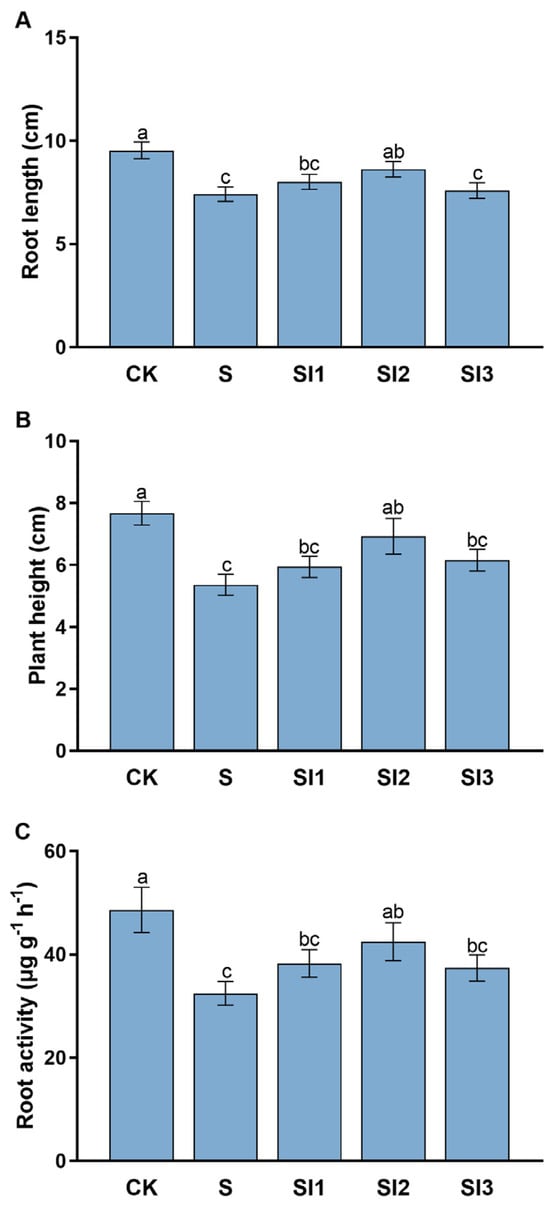
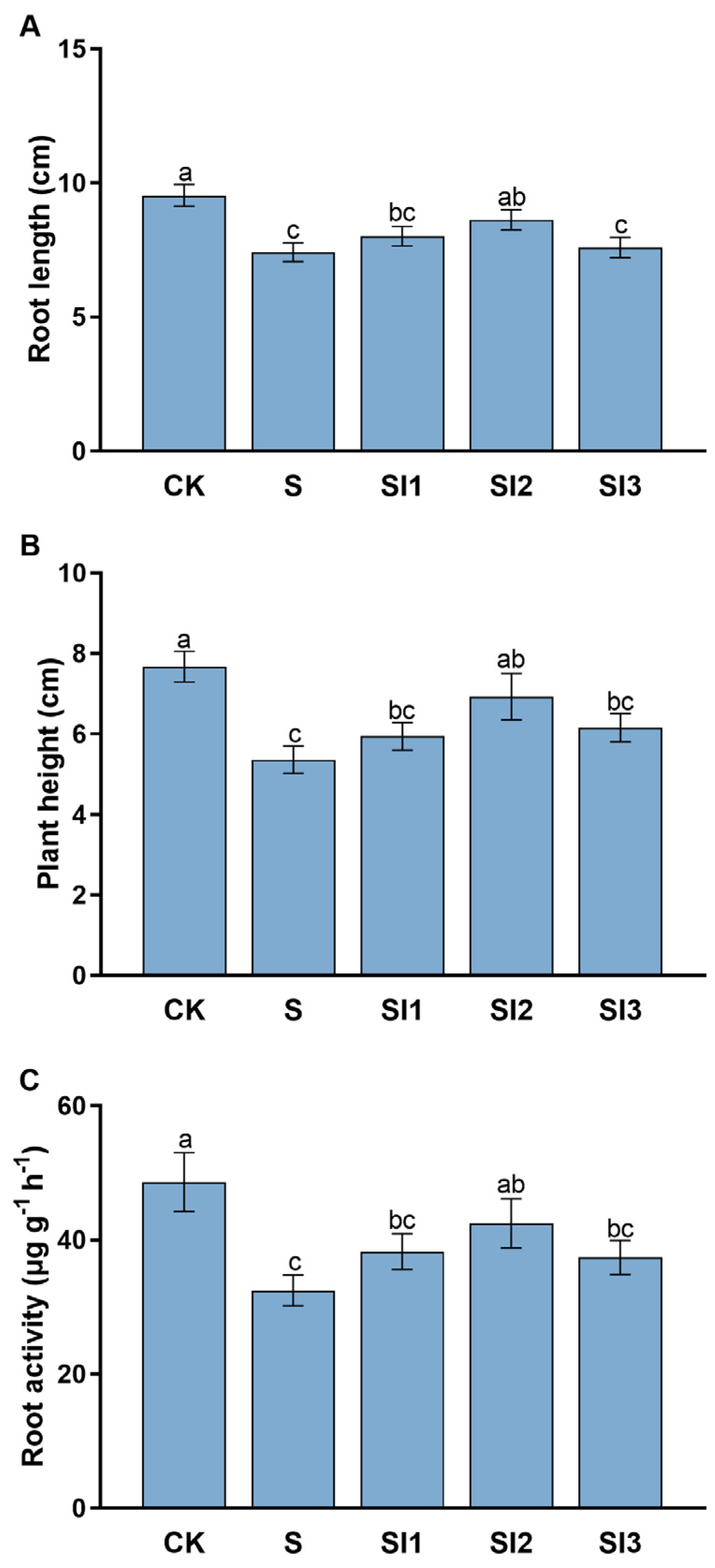
Growth performance and root activity are key indicators reflecting plant tolerance to salt stress. Compared with the control (CK), salt stress (S) significantly inhibited the growth of carrot seedlings and impaired root physiological activity (p < 0.05) (Figure 1). Exogenous MI application mitigated the salt-induced growth inhibition in a concentration-dependent manner, with varying mitigating effects across different tested concentrations (Figure 1). Among the three MI concentrations (50, 100, and 200 μM), the 100 μM MI treatment (SI2) exhibited the most pronounced mitigating effect. Compared with group S, the plant height, root activity and length of group SI2 increased significantly (p < 0.05) (Figure 1). In contrast, the 50 μM MI treatment (SI1) and 200 μM MI treatment (SI3) had relatively weak relieving effects, which did not reach statistical significance (p > 0.05) (Figure 1). These results showed that exogenous MI had the potential to alleviate the growth inhibition caused by salt stress in carrot seedlings, and its alleviating effect was closely related to the application concentration.
Figure 1.
Effects of exogenous myo-inositol (MI) on the growth and root activity of Daucus carota seedlings under salt stress. Carrot seedlings were subjected to five treatments for 10 days in Hoagland nutrient solution, including: CK (control), S (salt stress, 50 mM NaCl), SI1 (50 mM NaCl + 50 μM myo-inositol), SI2 (50 mM NaCl + 100 μM myo-inositol), and SI3 (50 mM NaCl + 200 μM myo-inositol). Data are expressed as mean ± standard deviation of three biological replicates. Statistical analysis was performed using one-way analysis of variance (ANOVA) followed by Tukey’s HSD post hoc test. Different lowercase letters represent statistically significant differences among treatments (p < 0.05). (A) Root length; (B) plant height; (C) root activity.
3.2. Effect of Exogenous MI on Steady-State Na+, K+ and H+ Fluxes in Carrot Roots Under Salt Stress
3.2.1. Na+ Flux
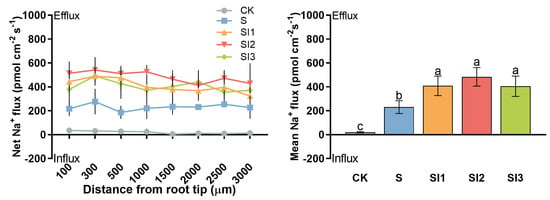
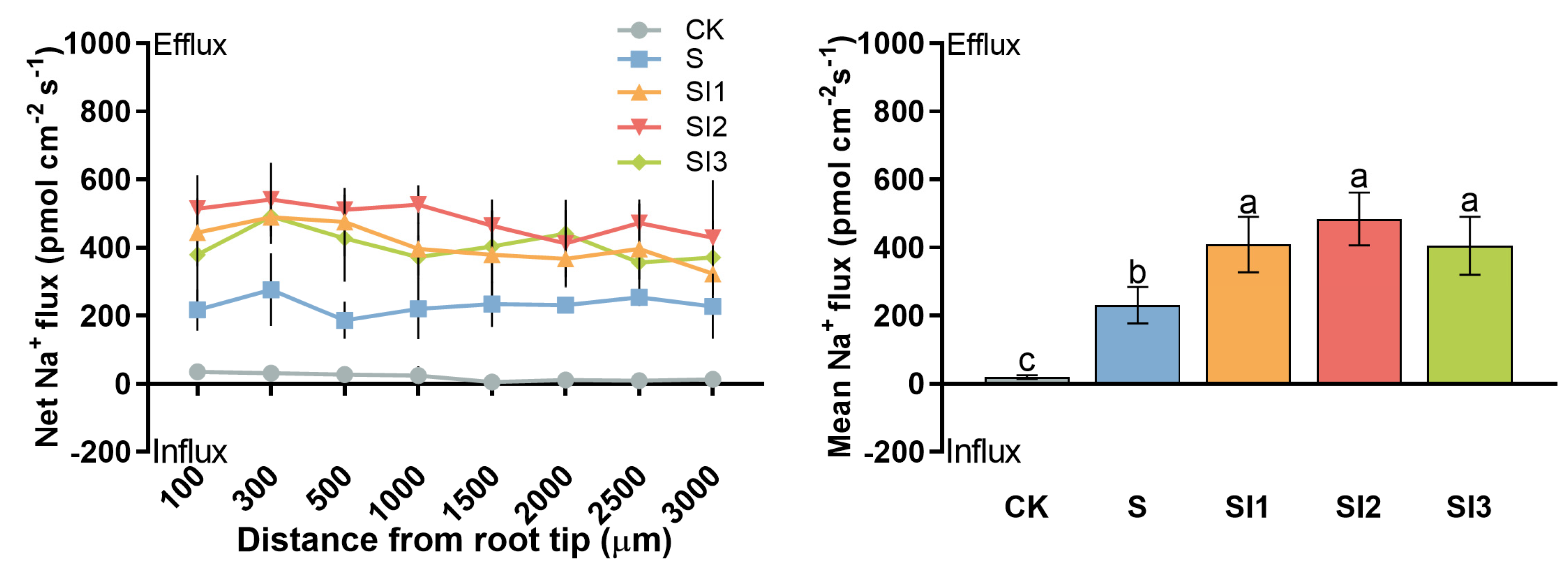
Carrot roots showed an evident Na+ efflux after 24 h of salt treatment, with an average flux of 231.3 pmol·cm−2·s−1 (Figure 2). Exogenous MI application further elevated root Na+ efflux relative to the S group. Among the three tested MI concentrations, the 100 μM MI treatment (SI2 group) achieved the strongest enhancing effect, with the average Na+ efflux rate increased to 484.0 pmol·cm−2·s−1. The 50 μM MI (SI1 group) and 200 μM MI (SI3 group) treatments also promoted root Na+ efflux, with their average rates reaching 409.1 pmol·cm−2·s−1 and 405.6 pmol·cm−2·s−1, respectively. The average Na+ efflux rate of SI3 was slightly lower than that of SI1, but the difference between these two treatments was minimal. These results demonstrate that exogenous MI can effectively boost root Na+ efflux to mitigate salt-induced Na+ accumulation.
Figure 2.
Effects of exogenous MI on root Na+ flux of Daucus carota seedlings under salt stress. Carrot seedlings were subjected to five treatments for 24 h in Hoagland nutrient solution, including: CK (control), S (salt stress, 50 mM NaCl), SI1 (50 mM NaCl + 50 μM myo-inositol), SI2 (50 mM NaCl + 100 μM myo-inositol), and SI3 (50 mM NaCl + 200 μM myo-inositol). Root segments were cut from carrot seedlings. These segments were equilibrated in the measurement solution for 30 min, and net Na+ flux was detected along the root apex (100–3000 μm) at 200 to 500 μm intervals. Data are expressed as mean ± standard deviation of three biological replicates. Each column represents the mean rates of Na+ fluxes, and bars represent the SD of the mean. Statistical analysis was performed using one-way analysis of variance (ANOVA) followed by Tukey’s HSD post hoc test. Different lowercase letters represent statistically significant differences among treatments (p < 0.05).
3.2.2. K+ Flux
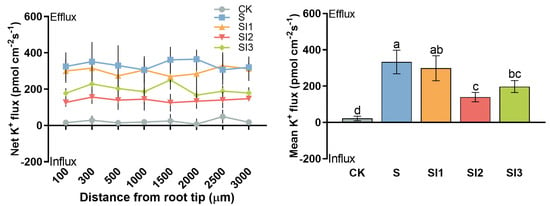
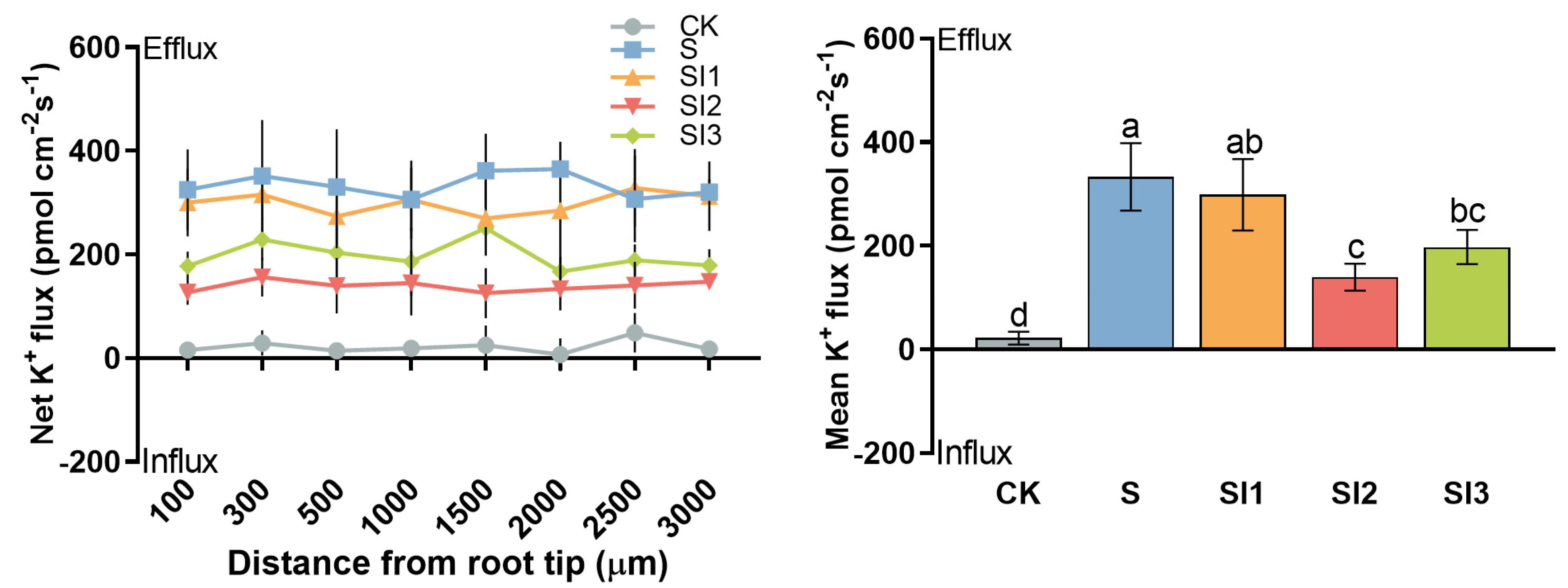
Under normal growth conditions (CK group), carrot roots exhibited a weak K+ efflux trend with an average rate of 22.1 pmol·cm−2·s−1 (Figure 3). Salt stress drastically enhanced root K+ efflux, with the average rate in the S group increasing to 333.5 pmol·cm−2·s−1, confirming that salt stress impairs root K+ retention mechanisms, triggers massive K+ loss, and disrupts K+/Na+ homeostasis. Exogenous myo-inositol (MI) treatments significantly suppressed K+ efflux in salt-stressed carrot roots, with the inhibitory effect showing concentration dependence. Notably, the 100 μM MI treatment (SI2 group) exerted the most pronounced inhibitory effect, as its average K+ efflux rate was markedly reduced to 139.4 pmol·cm−2·s−1. The 50 μM MI treatment (SI1 group) and 200 μM MI treatment (SI3 group) also significantly suppressed K+ efflux, though their inhibitory effects were weaker than that of the SI2 group. Their average K+ efflux rates were reduced to 299.0 pmol·cm−2·s−1 and 197.8 pmol·cm−2·s−1, respectively. These findings demonstrate that exogenous MI can effectively mitigate salt-induced K+ loss in carrot roots, maintain intracellular K+ content, and optimize K+/Na+ homeostasis, with distinct differences in regulatory efficacy among the tested concentrations.
Figure 3.
Effects of exogenous MI on root K+ flux of Daucus carota seedlings under salt stress. Carrot seedlings were subjected to five treatments for 24 h in Hoagland nutrient solution, including: CK (control), S (salt stress, 50 mM NaCl), SI1 (50 mM NaCl + 50 μM myo-inositol), SI2 (50 mM NaCl + 100 μM myo-inositol), and SI3 (50 mM NaCl + 200 μM myo-inositol). Root segments were cut from carrot seedlings. These segments were equilibrated in the measurement solution for 30 min, and net K+ flux was detected along the root apex (100–3000 μm) at 200 to 500 μm intervals. Data are expressed as mean ± standard deviation of three biological replicates. Each column represents the mean rates of K+ fluxes, and bars represent the SD of the mean. Statistical analysis was performed using one-way analysis of variance (ANOVA) followed by Tukey’s HSD post hoc test. Different lowercase letters represent statistically significant differences among treatments (p < 0.05).
3.2.3. H+ Flux
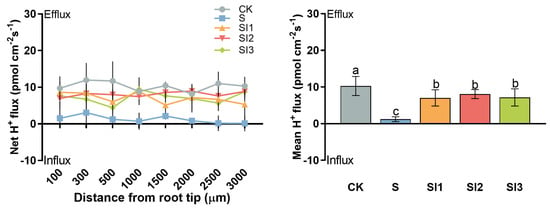
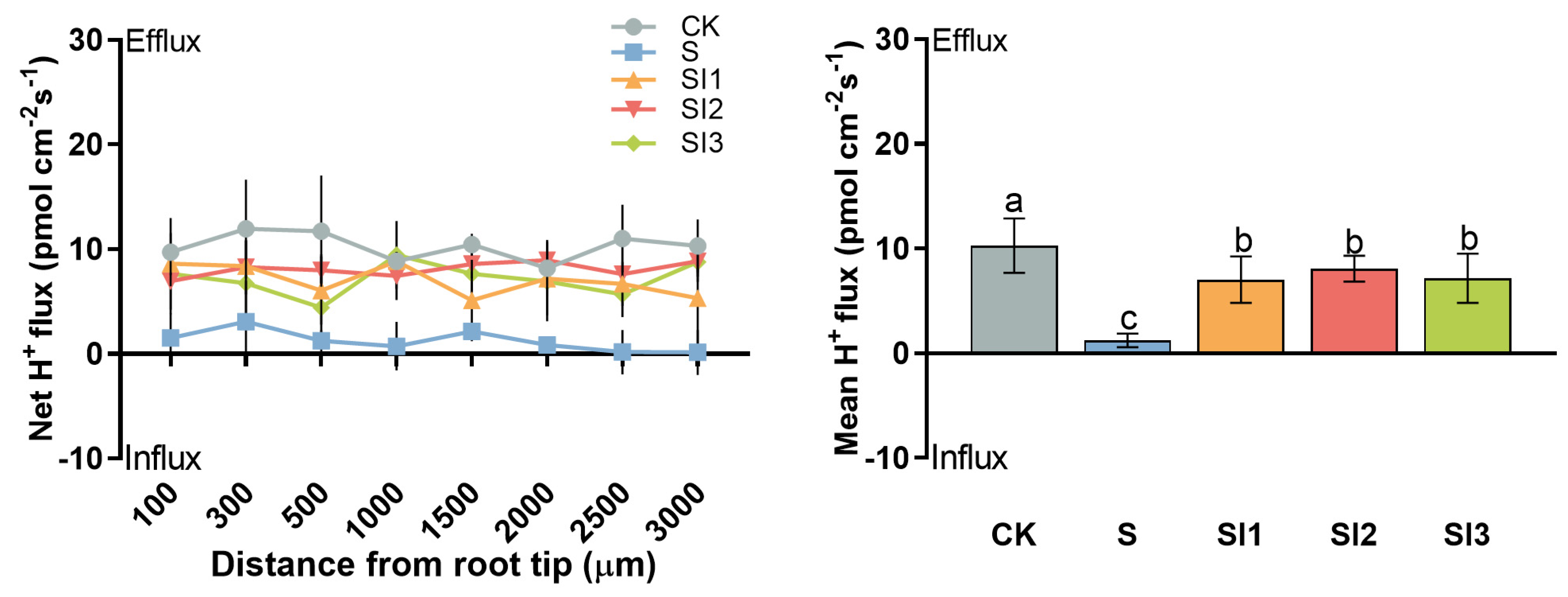
Root H+ flux is a direct reflection of plasma membrane H+-ATPase activity, which is critical for maintaining the proton gradient (Figure 4). In the non-stressed control (CK group), carrot roots maintained a stable H+ efflux rate of 10.3 pmol·cm−2·s−1, indicating functional H+-ATPase and a steady proton gradient under normal growth conditions. Salt stress (S group) significantly compromised H+ efflux capacity, with the average rate declining to 1.2 pmol·cm−2·s−1. This result suggests that salt stress impairs H+-ATPase activity and disrupts the proton gradient homeostasis in carrot roots. Exogenous myo-inositol (MI) application effectively alleviated the salt-mediated reduction in H+ efflux, as all three tested MI concentrations resulted in higher efflux rates compared to the S group. The promotional effect of MI on H+ efflux exhibited concentration dependence, with varying degrees of enhancement across treatments. The 100 μM MI treatment (SI2 group) achieved an H+ efflux rate of 8.1 pmol·cm−2·s−1. Meanwhile, the 50 μM MI (SI1 group) and 200 μM MI (SI3 group) treatments increased the average H+ efflux rates to 7.0 pmol·cm−2·s−1 and 7.2 pmol·cm−2·s−1, respectively. These findings indicate that exogenous MI can enhance H+-ATPase activity and restore the proton gradient in salt-stressed carrot roots, with all tested concentrations exerting a positive regulatory effect in a concentration-dependent manner.
Figure 4.
Effects of exogenous MI on root H+ flux of Daucus carota seedlings under salt stress. Carrot seedlings were subjected to five treatments for 24 h in Hoagland nutrient solution, including: CK (control), S (salt stress, 50 mM NaCl), SI1 (50 mM NaCl + 50 μM myo-inositol), SI2 (50 mM NaCl + 100 μM myo-inositol), and SI3 (50 mM NaCl + 200 μM myo-inositol). Root segments were cut from carrot seedlings. These segments were equilibrated in the measurement solution for 30 min, and net H+ flux was detected along the root apex (100–3000 μm) at 200 to 500 μm intervals. Data are expressed as mean ± standard deviation of three biological replicates. Each column represents the mean rates of H+ fluxes, and bars represent the SD of the mean. Statistical analysis was performed using one-way analysis of variance (ANOVA) followed by Tukey’s HSD post hoc test. Different lowercase letters represent statistically significant differences among treatments (p < 0.05).
3.3. Effects of Inhibitors on MI-Regulated Root Ion Fluxes in Carrots Under Salt Stress
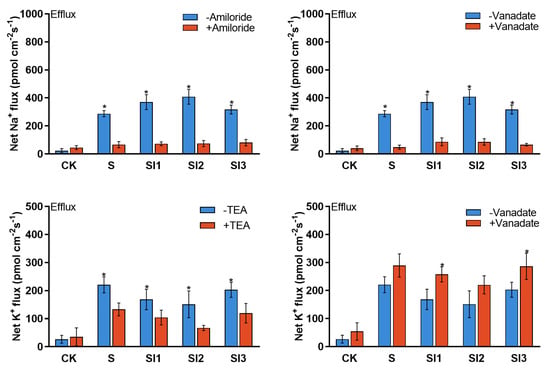
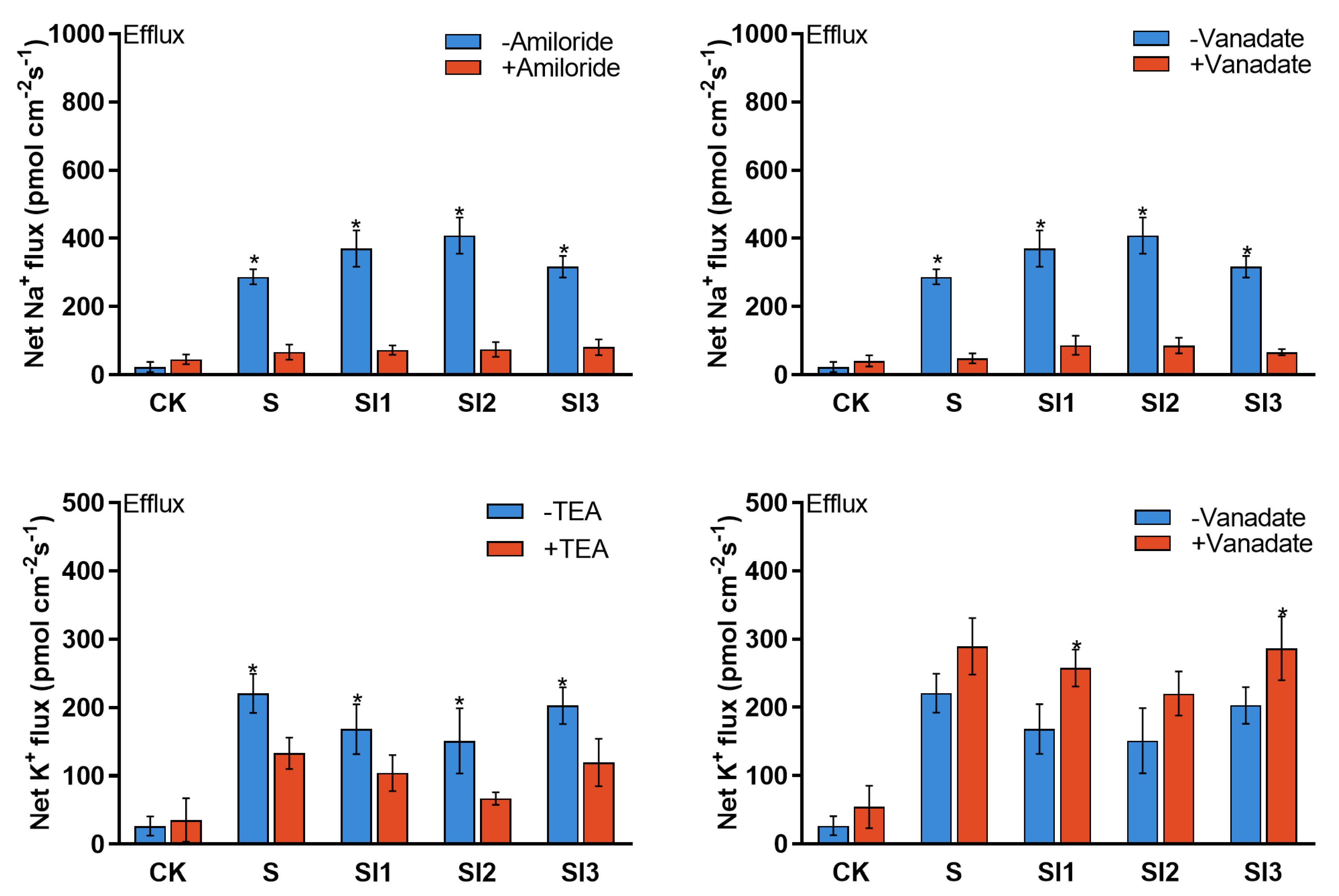
Pharmacological experiments were conducted to clarify the pathways underlying MI-regulated Na+ and K+ fluxes (Figure 5). Exogenous MI can enhance Na+ efflux and inhibit K+ efflux of carrot roots under salt stress. However, this regulatory effect can be significantly changed by specific inhibitors. Whether MI is applied or not, amiloride (Na+/H+ antiporter inhibitor) and sodium orthovanadate (plasma membrane H+-ATPase inhibitor) can significantly inhibit the Na+ efflux of roots under salt stress, thus reversing the enhancement effect of Na+ efflux induced by MI. In terms of K+ flux, tetraethylammonium chloride (TEA, a K+ channel blocker) can specifically inhibit K+ efflux in root samples treated by MI. Conversely, sodium orthovanadate will have the opposite effect, which can aggravate the loss of K+ caused by salt stress and further offset the K+-preserving effect of MI. These results indicate that the enhancement of Na+ efflux by MI depends on the synergistic effect of Na+/H+ antiporter and plasma membrane H+-ATPase, while MI can reduce K+ efflux by activating plasma membrane H+-ATPase and then limit the loss of K+ by inhibiting depolarization-activated outward-rectifying K+ channels (KORCs).
Figure 5.
Effects of different inhibitors on MI-regulated root Na+ and K+ fluxes in Daucus carota seedlings under salt stress. Carrot seedlings were subjected to five 24 h treatments: CK (control, Hoagland solution), S (salt stress, 50 mM NaCl), SI1 (50 mM NaCl + 50 μM myo-inositol), SI2 (50 mM NaCl + 100 μM myo-inositol), and SI3 (50 mM NaCl + 200 μM myo-inositol). Root segments were pretreated with three specific inhibitors for 30 min before measurement: 100 μM amiloride (Na+/H+ antiporter inhibitor), 20 mM TEA (K+ channel inhibitor), 500 μM sodium orthovanadate (plasma membrane H+-ATPase inhibitor). Steady-state Na+ and K+ fluxes were measured at 300 μm from the root tip. Data are expressed as mean ± standard deviation of three biological replicates. * indicates a statistically significant difference between the inhibitor-treated group and the non-inhibitor-treated group for the same pre-treatment (CK, S, SI1, SI2, SI3) at p < 0.05 (independent-samples t-test).
3.4. Effect of Exogenous MI on Electrolyte Leakage, MDA and H2O2 Contents and Membrane Lipid Peroxidation in Carrots Under Salt Stress
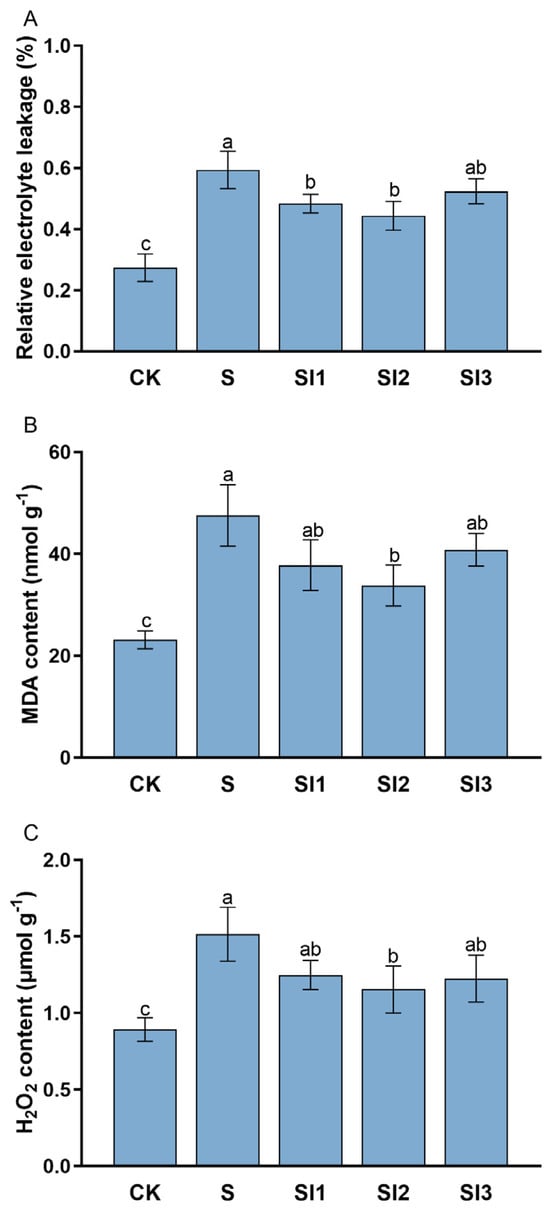
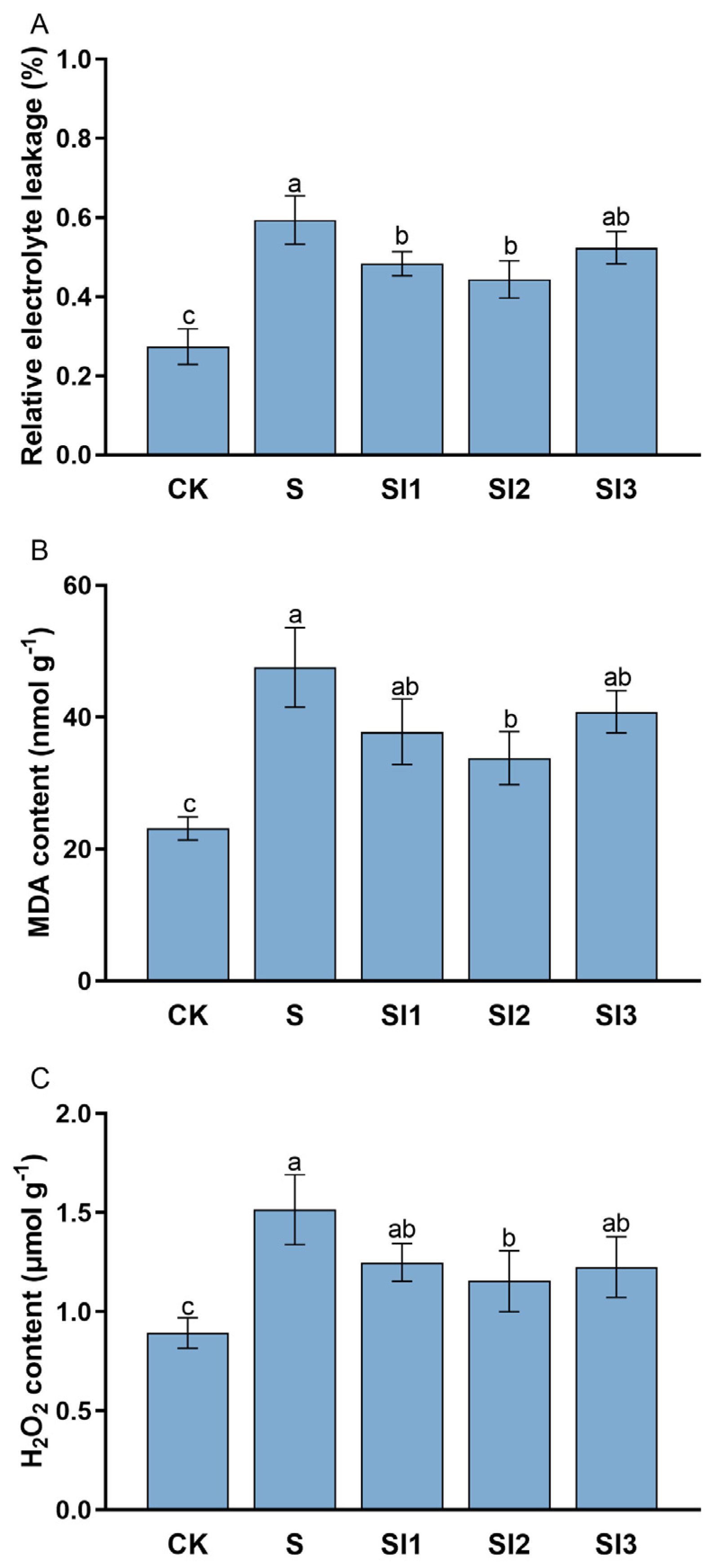
In order to evaluate the degree of damage from salt stress to cell membrane integrity, we measured the relative electrolyte leakage rate (EL) of control plants and salt-stressed plants. EL is usually the result of membrane peroxidation under salt stress [33]. As shown in Figure 6A, salt stress (S group) significantly elevated EL in carrot leaves compared with the control (CK group) (p < 0.05), indicating severe impairment of cell membrane integrity caused by salt-induced peroxidation. Exogenous myo-inositol (MI) alleviated this damage to varying degrees. The SI2 group (100 μM MI) induced a significant decrease in EL compared with the group S (p < 0.05). The group of SI1 (50 μM MI) and SI3 (200 μM MI) also exhibited slightly lower EL than the group S.
Figure 6.
Effects of exogenous MI on relative electrolyte leakage rate, MDA content, and H2O2 content of Daucus carota seedlings under salt stress. Carrot seedlings were subjected to five treatments for 10 days in Hoagland nutrient solution, including: CK (control), S (salt stress, 50 mM NaCl), SI1 (50 mM NaCl + 50 μM myo-inositol), SI2 (50 mM NaCl + 100 μM myo-inositol), and SI3 (50 mM NaCl + 200 μM myo-inositol). Data are expressed as mean ± standard deviation of three biological replicates. Statistical analysis was performed using one-way analysis of variance (ANOVA) followed by Tukey’s HSD post hoc test. Different lowercase letters represent statistically significant differences among treatments (p < 0.05). (A) Relative electrolyte leakage rate; (B) MDA content; (C) H2O2 content.
To quantify membrane lipid peroxidation, we measured malondialdehyde (MDA) content—the end-product of this process (Figure 6B). Consistent with EL results, salt stress (S group) significantly increased leaf MDA content versus the CK group (p < 0.05), confirming enhanced peroxidation under salinity. Exogenous MI mitigated salt-induced MDA accumulation, but efficacy differed by concentration. The 100 μM MI (SI2 group) exerted the most significant effect, reducing MDA content markedly compared to the S group (p < 0.05). The 50 μM (SI1) and 200 μM (SI3) MI treatments also decreased MDA content relative to the S group, with no statistical significance (p > 0.05), and their MDA levels remained higher than those of the SI2 group.
Under salt stress, reactive oxygen species (ROS) can induce membrane peroxidation and electrolyte leakage [49]. Therefore, we quantitatively analyzed H2O2 as a representative ROS to clarify its role in salt-induced membrane damage (Figure 6C). Compared with the CK group, salt stress (S group) resulted in significant accumulation of H2O2 in leaves (p < 0.05), indicating that there was an excessive ROS outbreak. Exogenous MI can inhibit the excessive accumulation of H2O2, and its effect is concentration-dependent: compared with group S, the H2O2 content in group SI2 is significantly reduced (p < 0.05); However, compared with group S, the H2O2 level in group SI1 and group SI3 also decreased, but the decreasing extent did not reach the statistically significant level (p > 0.05).
3.5. Effects of Exogenous MI on Antioxidant Enzyme Activities in Carrots Under Salt Stress
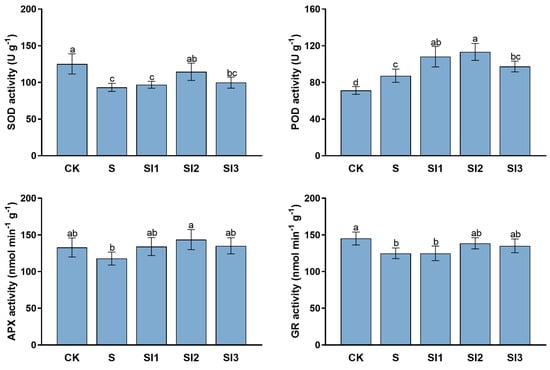
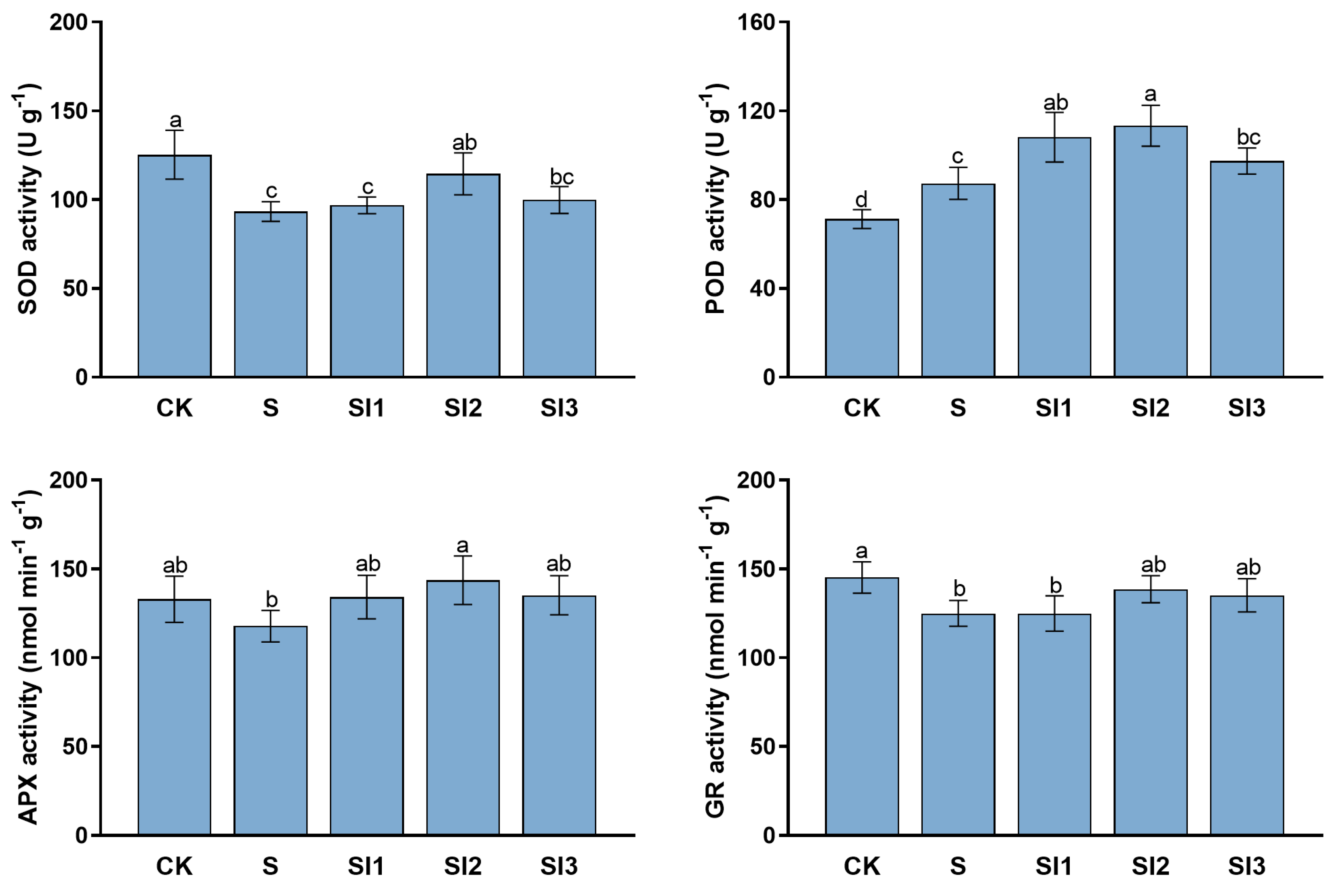
Salt stress altered the activities of antioxidant enzymes in carrot leaves (Figure 7). Compared with the CK group, the activities of superoxide dismutase (SOD), ascorbate peroxidase (APX), and glutathione reductase (GR) in the salt stress group (S group) decreased, while the activity of peroxidase (POD) increased. Exogenous MI could enhance the activities of these four antioxidant enzymes in salt-stressed carrots. Among the three tested MI concentrations, the 100 μM MI treatment (SI2 group) showed the most obvious promoting effect on antioxidant enzyme activities. Compared with the S group, the activities of SOD, POD, APX, and GR in the SI2 group were all elevated, with the activities of SOD, APX, and GR being closer to those in the CK group and POD activity exceeding that in the CK group. Compared with group S, the 50 μmol inositol treatment group (group SI1) and 200 μmol inositol treatment group (group SI3) can also promote the activities of these four antioxidant enzymes, but the promotion effect is weaker than that of group SI2.
Figure 7.
Effects of exogenous MI on antioxidant enzyme activities of Daucus carota seedlings under salt stress. Carrot seedlings were subjected to five treatments for 10 days in Hoagland nutrient solution, including: CK (control), S (salt stress, 50 mM NaCl), SI1 (50 mM NaCl + 50 μM myo-inositol), SI2 (50 mM NaCl + 100 μM myo-inositol), and SI3 (50 mM NaCl + 200 μM myo-inositol). Data are expressed as mean ± standard deviation of three biological replicates. Statistical analysis was performed using one-way analysis of variance (ANOVA) followed by Tukey’s HSD post hoc test. Different lowercase letters represent statistically significant differences among treatments (p < 0.05).
3.6. Effects of Exogenous MI on the Expression of Ion Transport and MI Metabolism-Related Genes in Carrots Under Salt Stress
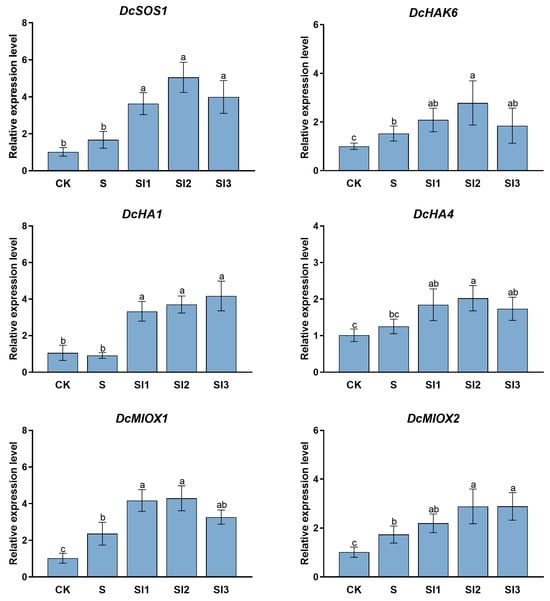
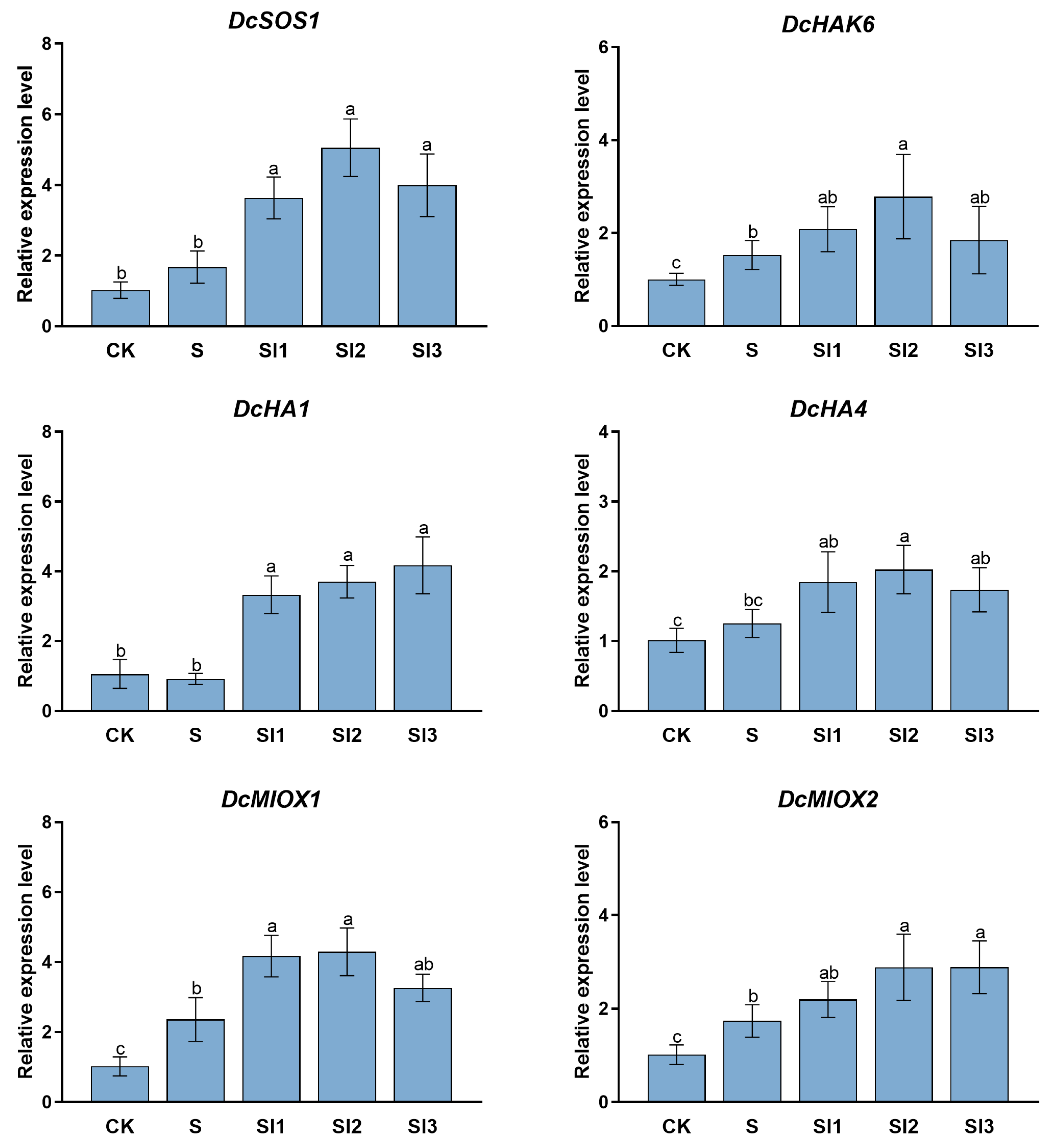
We analyzed the expression of ion transport-related genes (DcSOS1, DcHAK6, DcHA1, and DcHA4) closely associated with K+/Na+ homeostasis (Figure 8). Salt stress exerted distinct effects on the expression of these four genes: DcHAK6 and DcHA4 were upregulated under salinity, while DcSOS1 expression remained comparable to that of the CK group with no obvious upregulation; similarly, DcHA1 maintained a stable baseline level consistent with the CK group under salt stress. Exogenous MI effectively enhanced the expression of all these ion transport-related genes.
Figure 8.
Effects of exogenous MI on the expression of ion homeostasis and myo-inositol metabolism-related genes in Daucus carota seedlings under salt stress. Roots were harvested from carrot seedlings after 24 h of treatment and used for total RNA isolation and RT-qPCR. Actin was used as a reference gene. Specific primers designed to target DcSOS1, DcHAK6, DcHA1, DcHA4, DcMIOX1, and DcMIOX2 are shown in Table S1. Mean values of the relative transcript levels of these genes in control (CK), salt stress (S), and salt stress combined with 50, 100, 200 μM myo-inositol (SI1–SI3) are shown. Each column is mean ± standard deviation (SD) obtained from 3 independent experiments. Statistical analysis was performed using one-way analysis of variance (ANOVA) followed by Tukey’s HSD post hoc test. Statistically significant differences (p < 0.05) among treatments are indicated with different lowercase letters.
To decipher the regulatory mechanism of exogenous MI in salt-stressed carrots, we quantified the expression of myo-inositol metabolism-related genes (DcMIOX1 and DcMIOX2, encoding myo-inositol oxygenase, MIOX) via qRT-PCR (Figure 8). As a key enzyme in MI catabolism, MIOX mediates the rate-limiting step of MI degradation, and its expression is mainly reflected by the DcMIOX1 and DcMIOX2 in carrots. Salt stress (S group) significantly induced the transcription of DcMIOX1 and DcMIOX2 compared with the control (CK group), and exogenous MI supplementation further upregulated the expression levels of these two DcMIOX subtypes, enhancing their transcriptional levels relative to the salt-stressed group without MI.
4. Discussion
4.1. Exogenous MI Enhances Salt Tolerance in Carrot Seedlings
Soil salinization poses a severe threat to horticultural production, as it disrupts multiple physiological processes in plants, including osmotic adjustment, ion homeostasis, and redox balance. Carrot (Daucus carota L.), a typical root vegetable with high economic value, is at a critical developmental stage during seedling growth, where exposure to salt stress (50 mM NaCl) exerts adverse effects on growth dynamics and key physiological processes, ultimately impairing subsequent yield formation and quality traits. Our study systematically reveals that exogenous MI exerts a concentration-dependent mitigating effect on these salt-induced impairments in carrot seedlings, with 100 μM MI being the optimal concentration—this finding fills the knowledge gap regarding MI application parameters for carrot salt stress management.
Salt stress significantly inhibited carrot seedling growth, as evidenced by reduced plant height, root length, and root vitality (Figure 1), which is consistent with the universal growth suppression induced by NaCl in root crops such as Solanum tuberosum L. and Beta vulgaris L. [53,54]. The marked reduction in root activity under salt stress indicates impaired root metabolic capacity, which compromises nutrient uptake and stress signal transduction [55]. Notably, exogenous MI at all tested concentrations alleviated salt-induced inhibition of root vitality and growth performance, with 100 μM MI demonstrating the most prominent protective effect. This concentration-dependent pattern is not unique to carrot; similar observations have been reported in Malus hupehensis Rehd. [40] and Zea mays L. [43]. Our data showed that MI increases salt tolerance by regulating K+/Na+ and ROS homeostasis in carrots.
4.2. Exogenous MI Mediates Na+ Homeostasis
Exogenous MI application significantly enhanced root Na+ efflux in salt-stressed carrots (Figure 2). This result is consistent with previous findings that MI reduces Na+ accumulation in leaves to alleviate salt stress in Malus hupehensis Rehd. and Mesembryanthemum crystallinum L. seedlings [40,42]. The upregulated transcription of DcSOS1 in MI-treated roots (Figure 8) presumably contributed to Na+ efflux through the SOS signaling pathway, which is a conserved mechanism for plant Na+ homeostasis regulation [10,11]. Our results further suggest that MI strengthens the SOS pathway by upregulating DcSOS1 expression, thereby potentially contributing to Na+ extrusion to reduce cytoplasmic Na+ accumulation (Figure 2). This observation is supported by inhibitor experiments, where amiloride (Na+/H+ antiporter inhibitor) blocked MI-induced Na+ efflux enhancement (Figure 5), which is consistent with the notion that DcSOS1-mediated Na+/H+ exchange is an important component of the MI-mediated ion transport regulatory module for Na+ homeostasis.
In contrast, salt stress alone (S group) induced a moderate Na+ efflux response (Figure 2), which is an inherent adaptive mechanism of carrots to eliminate excess Na+, but this response was insufficient to prevent Na+ cytotoxicity. The weak Na+ efflux capacity in the S group was associated with relatively low DcSOS1 transcript levels compared to MI-treated roots (Figure 8). MI effectively reinforces the inherent Na+ efflux adaptive response by upregulating DcSOS1, which may strengthen the SOS pathway and thus contribute to increased Na+ extrusion, thereby mitigating salt-induced Na+ cytotoxicity. The MI effects on the SOS proteins need to be further investigated since SOS1 is post-transcriptionally regulated by PP2C phosphatases [56] and VPS 23A, a component of the endosomal sorting complex required for transport [57].
Beyond the SOS pathway, MI may also contribute to increased Na+ efflux by modulating PM H+-ATPase-related processes at the transcriptional level. PM H+-ATPase establishes a proton electrochemical gradient across the membrane [58], providing the driving force for DcSOS1-mediated Na+/H+ exchange (Figure 4) [13,14]. MI-treated carrot roots exhibited higher transcript abundances of DcHA1 and DcHA4 (PM H+-ATPase genes) under salt stress compared to the S group (Figure 8). The upregulation of these genes corresponded to enhanced H+ efflux (Figure 4), implying enhanced H+-pumping potential. Notably, the expression patterns of DcHAs resembled those of DcSOS1 in MI-treated roots (Figure 8), suggesting a synergistic regulation of these two gene families by MI to support Na+ efflux. Sodium orthovanadate (PM H+-ATPase inhibitor) completely abolished MI-induced Na+ efflux enhancement (Figure 5), indicating that the proton gradient acts as a key factor for MI-mediated Na+ extrusion. Collectively, MI maintains Na+ homeostasis in salt-stressed carrots by synergistically modulating the SOS pathway and PM H+-ATPase-related proton transport at the transcriptional level, with 100 μM of MI exerting the optimal regulatory effect. However, it is also worth exploring the impacts of MI on post-transcriptional regulation of H+-ATPase, which is modified by a complicated protein-interaction network [59,60,61].
4.3. Exogenous MI Mediates K+ Homeostasis
K+ is an essential cation for plants, involved in osmotic adjustment, enzyme activation, and photosynthate translocation, and maintaining high cellular K+ levels is critical for salt tolerance [62,63]. Salt stress caused a significant net K+ efflux in carrot roots (Figure 3), which is attributed to salt-induced membrane depolarization that accelerates K+ loss through depolarization-activated outward rectifying K+ channels (KORCs) and non-selective cation channels (NSCCs) [19,20]. Exogenous MI effectively suppressed salt-induced K+ efflux, with the SI2 group exhibiting the weakest K+ efflux rate (Figure 3), indicating that MI enhances K+ retention capacity to stabilize K+ homeostasis.
The positive effect of MI on K+ retention is closely associated with its regulation of high-affinity K+ transporters and PM H+-ATPase. DcHAK6, a key high-affinity K+ transporter gene [22,24], was significantly upregulated in the SI2 group compared to the S group (Figure 8), which may support active K+ uptake to compensate for salt-induced K+ loss. This is consistent with findings in tomato, where MI upregulates K+ transporter genes to maintain K+ levels under salt stress [8]. Additionally, MI-modulated PM H+-ATPase (Figure 4) is hypothesized to help maintain membrane potential homeostasis by re-establishing the proton gradient, thereby inhibiting K+ loss through KORCs and NSCCs [21,26]. This link between H+-ATPase and K+ retention is further supported by sodium orthovanadate experiments: as a specific PM H+-ATPase inhibitor, sodium orthovanadate disrupted the proton gradient, which in turn reversed MI’s K+-retaining effect and increased K+ efflux (Figure 5). Meanwhile, TEA (K+ channel inhibitor) experiments are consistent with the direct role of K+ channels: TEA suppressed K+ efflux in MI-treated roots (Figure 5), indicating that MI reduces K+ loss by inhibiting depolarization-activated K+ channels. MI not only inhibits K+ efflux but also supports K+ uptake via DcHAK6, forming a dual regulatory network to maintain K+ homeostasis.
The synergistic regulation of Na+ efflux and K+ retention by MI ultimately optimizes the K+/Na+ ratio in salt-stressed carrots, which is a core determinant of salt tolerance [8,9,10,11]. Our results further suggest that MI contributes to carrot salt tolerance by improving K+/Na+ homeostasis, and this mechanism is associated with the coordinated regulation of ion transporters (DcSOS1, DcHAK6) and PM H+-ATPase. Future studies should focus on the interaction between MI and K+ channel proteins (e.g., KORCs) to clarify the post-translational regulatory mechanisms of K+ retention.
4.4. Myo-Inositol Mediates ROS Homeostasis
Salt-stress-induced ROS overaccumulation triggers membrane lipid peroxidation, protein oxidation, and nucleic acid damage, which is a major secondary stress factor alongside ion toxicity [25,26,27]. Our results showed that salt stress significantly increased electrolyte leakage, MDA content, and H2O2 levels while disrupting antioxidant enzyme balance (Figure 6 and Figure 7)—these are typical characteristics of ROS-induced cellular damage. Exogenous MI (100 μM) effectively mitigated this oxidative damage by enhancing the activities of all four antioxidant enzymes. The SI2 group exhibited significantly higher activities of SOD, POD, APX, and GR than the S group (Figure 7), indicating that suboptimal or excessive MI concentrations fail to elicit a robust ROS homeostasis regulatory response.
The mechanism by which MI maintains ROS homeostasis involves the coordinated regulation of enzymatic and non-enzymatic antioxidant pathways. At the molecular level, salt stress induced the transcription of myo-inositol oxygenase genes (DcMIOX1,2), and exogenous MI further upregulated their expression in the SI2 group (Figure 8). MIOX is a rate-limiting enzyme in MI catabolism, catalyzing the conversion of MI to D-glucuronic acid—a critical precursor for AsA biosynthesis, the core non-enzymatic antioxidant in plants [44,64]. This suggests that MI not only supports enzymatic ROS scavenging but also may be involved in AsA biosynthesis by upregulating DcMIOX1 and DcMIOX2, reinforcing the plant’s potential non-enzymatic antioxidant defense capacity (Figure 8). The synergism between these two pathways ensures efficient ROS scavenging: enzymatic systems directly eliminate ROS, while AsA not only scavenges H2O2 but also maintains the activity of APX—a key enzyme dependent on reduced AsA, forming a positive regulatory loop.
Notably, the regulatory effect of MI on ROS homeostasis is closely linked to its protection of root function and regulation of ion balance. The SI2 group, with optimal K+/Na+ homeostasis (Figure 2 and Figure 3), also exhibited the most stable ROS balance, indicating that ion homeostasis and oxidative homeostasis are possibly mutually coordinated in MI-mediated salt tolerance (Figure 7). Impaired ion balance under salt stress can trigger ROS burst by disrupting mitochondrial function and electron transport chains, while excessive ROS can further damage ion transporters and proton pumps [65,66]. MI breaks this vicious cycle by simultaneously stabilizing ion transport and enhancing ROS scavenging, thereby comprehensively alleviating salt stress. However, the crosstalk between MI-regulated ion transport pathways and ROS signaling remains to be further clarified.
5. Conclusions
Our data indicate that exogenous myo-inositol (MI), with 100 μM as the optimal concentration, mitigates salt-induced growth inhibition, membrane lipid peroxidation, and ion imbalance in Daucus carota L. seedlings under hydroponic conditions by regulating ion transport, MI metabolism, and antioxidant defense systems. MI maintains K+/Na+ homeostasis through a plasma membrane H+-ATPase-ion transporter regulatory network: it upregulates DcHA1 and DcHA4, which supports the involvement of PM H+-ATPase-related proton transport, helps restore H+ efflux, and re-establishes the proton gradient. This gradient is consistent with driving DcSOS1-mediated Na+ efflux, may help maintain membrane potential to reduce K+ loss via depolarization-activated channels, and cooperates with upregulated DcHAK6 to support active K+ uptake. For ROS homeostasis, MI upregulates DcMIOX1 and DcMIOX2, which suggests a potential role in ascorbate biosynthesis-related processes while enhancing the activities of SOD, POD, APX, and GR. This forms a synergistic enzymatic and non-enzymatic ROS-scavenging system, effectively reducing H2O2 accumulation and membrane peroxidation. This study provides insights into the role of exogenous MI in modulating the expression of ion transport and MI metabolism-related genes to coordinate ion and ROS homeostasis, thereby improving the salt tolerance of carrot seedlings and laying a physiological and molecular foundation for the application of MI in carrot cultivation in saline-alkali areas and the genetic improvement of carrot salt tolerance. Nevertheless, the present study was performed only under hydroponic conditions with a single carrot cultivar, and most mechanistic interpretations were based on transcriptional and phenotypic data without direct biochemical measurements. Further studies are needed to verify the effects of MI in soil and field environments, optimize application strategies such as foliar spraying, and explore the post-transcriptional and post-translational regulatory mechanisms of MI-mediated salt tolerance through direct biochemical and proteomic analyses.
Supplementary Materials
The following supporting information can be downloaded at https://www.mdpi.com/article/10.3390/horticulturae12030397/s1. Table S1: Gene-specific primers used for real-time (RT) quantitative PCR in Daucus carota.
Author Contributions
X.F.: Investigation, Data Curation, Visualization, Writing—Original Draft Preparation. Z.Z.: Investigation, Data Curation, Visualization, Writing—Original Draft Preparation. C.D.: Conceptualization, Supervision, Writing—Reviewing and Editing, Project Administration, Funding Acquisition. All authors have read and agreed to the published version of the manuscript.
Funding
This research was funded by the Science Research Project of Hebei Education Department (grant number BJK2024187) and the Hebei Province Capacity Enhancement Construction Project for Edible and Medicinal Fungi Science Popularization Demonstration Base (grant number 24452901K).
Data Availability Statement
The original contributions presented in this study are included in the article/Supplementary Material. Further inquiries can be directed to the corresponding author.
Conflicts of Interest
The authors declare no conflicts of interest. The funders had no role in the design of the study; in the collection, analyses, or interpretation of the data; in the writing of the manuscript; or in the decision to publish the results.
Abbreviations
The following abbreviations are used in this manuscript:
| MI | Myo-inositol |
| NMT | Non-invasive micro-test technology |
| PM | Plasma membrane |
| KORCs | Outward-rectifying K+ channels |
| NSCCs | Mon-selective cation channels |
| MIOX | Myo-inositol oxygenase |
References
- Polle, A.; Chen, S. On the salty side of life: Molecular, physiological and anatomical adaptation and acclimation of trees to extreme habitats. Plant Cell Environ. 2015, 38, 1794–1816. [Google Scholar] [CrossRef] [Scilit]
- Chen, S.; Polle, A. Salinity tolerance of Populus. Plant Biol. 2010, 12, 317–333. [Google Scholar] [CrossRef] [Scilit] [PubMed]
- Chen, S.; Hawighorst, P.; Sun, J.; Polle, A. Salt tolerance in Populus: Significance of stress signaling networks, mycorrhization, and soil amendments for cellular and whole-plant nutrition. Environ. Exp. Bot. 2014, 107, 113–124. [Google Scholar] [CrossRef] [Scilit]
- Munns, R.; Tester, M. Mechanisms of salinity tolerance. Annu. Rev. Plant Biol. 2008, 59, 651–681. [Google Scholar] [CrossRef] [Scilit]
- Zhao, R.; Yin, K.; Chen, S. Hydrogen sulphide signalling in plant response to abiotic stress. Plant Biol. 2022, 24, 523–531. [Google Scholar] [CrossRef] [Scilit]
- Li, J.; Yao, J.; Ma, S.; Liu, J.; Zhao, Z.; Liu, Z.; Yin, K.; Yan, C.; Dong, K.; Shi, R.; et al. Populus euphratica PeMAX2 counteracts PeGRP2 to stabilize target mRNAs relating to salt tolerance. Plant Sci. 2025, 360, 112736. [Google Scholar] [CrossRef] [Scilit]
- Mirrani, H.M.; Noreen, Z.; Usman, S.; Shah, A.A.; Mahmoud, E.A.; Elansary, H.O.; Aslam, M.; Waqas, A.; Javed, T. Magnesium nanoparticles extirpate salt stress in carrots (Daucus carota L.) through metabolomics regulations. Plant Physiol. Biochem. 2024, 207, 108383. [Google Scholar] [CrossRef] [Scilit]
- Li, J.; Shen, L.; Han, X.; He, G.; Fan, W.; Li, Y.; Yang, S.; Zhang, Z.; Yang, Y.; Jin, W.; et al. Phosphatidic acid-regulated SOS2 controls sodium and potassium homeostasis in Arabidopsis under salt stress. EMBO J. 2023, 42, e112401. [Google Scholar] [CrossRef] [Scilit]
- Sun, J.; Wang, M.J.; Ding, M.Q.; Deng, S.R.; Liu, M.Q.; Lu, C.F.; Zhou, X.Y.; Shen, X.; Zheng, X.J.; Zhang, Z.K.; et al. H2O2 and cytosolic Ca2+ signals triggered by the PM H+-coupled transport system mediate K+/Na+ homeostasis in NaCl-stressed Populus euphratica cells. Plant Cell Environ. 2010, 33, 943–958. [Google Scholar] [CrossRef] [Scilit] [PubMed]
- Sun, J.; Chen, S.L.; Dai, S.X.; Wang, R.G.; Li, N.Y.; Shen, X.; Zhou, X.Y.; Lu, C.F.; Zheng, X.J.; Hu, Z.M.; et al. NaCl-induced alternations of cellular and tissue ion fluxes in roots of salt-resistant and salt-sensitive poplar species. Plant Physiol. 2009, 149, 1141–1153. [Google Scholar] [CrossRef] [Scilit] [PubMed]
- Sun, J.; Dai, S.X.; Wang, R.G.; Chen, S.L.; Li, N.Y.; Zhou, X.Y.; Lu, C.F.; Shen, X.; Zheng, X.J.; Hu, Z.M.; et al. Calcium mediates root K+/Na+ homeostasis in poplar species differing in salt tolerance. Tree Physiol. 2009, 29, 1175–1186. [Google Scholar] [CrossRef] [Scilit]
- Zhu, J.K. Abiotic stress signaling and responses in plants. Cell 2016, 167, 313–324. [Google Scholar] [CrossRef] [Scilit]
- Shi, H.; Ishitani, M.; Kim, C.; Zhu, J.K. The Arabidopsis thaliana salt tolerance gene SOS1 encodes a putative Na+/H+ antiporter. Proc. Natl. Acad. Sci. USA 2000, 97, 6896–6901. [Google Scholar] [CrossRef] [Scilit]
- Shi, H.; Quintero, F.J.; Pardo, J.M.; Zhu, J.K. The putative plasma membrane Na+/H+ antiporter SOS1 controls long distance Na+ transport in plants. Plant Cell 2002, 14, 465–477. [Google Scholar] [CrossRef] [Scilit]
- Zhang, H.M.; Zhu, J.H.; Gong, Z.Z.; Zhu, J.K. Abiotic stress responses in plants. Nat. Rev. Genet. 2022, 23, 104–119. [Google Scholar] [CrossRef] [Scilit]
- Cuin, T.A.; Bose, J.; Stefano, G.; Jha, D.; Tester, M.; Mancuso, S.; Shabala, S. Assessing the role of root plasma membrane and tonoplast Na+/H+ exchangers in salinity tolerance in wheat: In planta quantification methods. Plant Cell Environ. 2011, 34, 947–961. [Google Scholar] [CrossRef] [Scilit]
- Yao, J.; Shen, Z.D.; Zhang, Y.L.; Wu, X.; Wang, J.H.; Sa, G.; Zhang, Y.H.; Zhang, H.L.; Deng, C.; Liu, J.; et al. Populus euphratica WRKY1 binds the promoter of H+-ATPase gene to enhance gene expression and salt tolerance. J. Exp. Bot. 2020, 71, 1527–1539. [Google Scholar] [CrossRef] [Scilit] [PubMed]
- Zhang, H.L.; Deng, C.; Wu, X.; Yao, J.; Zhang, Y.L.; Zhang, Y.N.; Deng, S.R.; Zhao, N.; Zhao, R.; Zhou, X.Y.; et al. Populus euphratica remorin 6.5 activates plasma membrane H+-ATPases to mediate salt tolerance. Tree Physiol. 2020, 40, 731–745. [Google Scholar] [CrossRef] [Scilit] [PubMed]
- Rubio, F.; Nieves-Cordones, M.; Horie, T.; Shabala, S. Doing ‘business as usual’ comes with a cost: Evaluating energy cost of maintaining plant intracellular K+ homeostasis under saline conditions. New Phytol. 2020, 225, 1097–1104. [Google Scholar] [CrossRef] [Scilit]
- Demidchik, V.; Maathuis, F.J. Physiological roles of nonselective cation channels in plants: From salt stress to signalling and development. New Phytol. 2007, 175, 387–404. [Google Scholar] [CrossRef] [Scilit] [PubMed]
- Shabala, S.; Pottosin, I. Regulation of potassium transport in plants under hostile conditions: Implications for abiotic and biotic stress tolerance. Physiol. Plant. 2014, 151, 257–279. [Google Scholar] [CrossRef] [Scilit]
- Maierhofer, T.; Scherzer, S.; Carpaneto, A.; Müller, T.D.; Pardo, J.M.; Hänelt, I.; Geiger, D.; Hedrich, R. Arabidopsis HAK5 under low K+ availability operates as PMF powered high-affinity K+ transporter. Nat. Commun. 2024, 15, 8558. [Google Scholar] [CrossRef] [Scilit]
- Rodríguez-Navarro, A.; Rubio, F. High-affinity potassium and sodium transport systems in plants. J. Exp. Bot. 2006, 57, 1149–1160. [Google Scholar] [CrossRef] [Scilit] [PubMed]
- Nieves-Cordones, M.; Alemán, F.; Martínez, V.; Rubio, F. The Arabidopsis thaliana HAK5 K+ transporter is required for plant growth and K+ acquisition from low K+ solutions under saline conditions. Mol. Plant 2010, 3, 326–333. [Google Scholar] [CrossRef] [Scilit] [PubMed]
- Choudhury, F.K.; Rivero, R.M.; Blumwald, E.; Mittler, R. Reactive oxygen species, abiotic stress and stress combination. Plant J. 2017, 90, 856–867. [Google Scholar] [CrossRef] [Scilit] [PubMed]
- Yang, Y.; Guo, Y. Unraveling salt stress signaling in plants. J. Integr. Plant Biol. 2018, 60, 796–804. [Google Scholar] [CrossRef] [Scilit]
- Hasanuzzaman, M.; Raihan, M.R.H.; Masud, A.A.C.; Rahman, K.; Nowroz, F.; Rahman, M.; Nahar, K.; Fujita, M. Regulation of Reactive Oxygen Species and Antioxidant Defense in Plants under Salinity. Int. J. Mol. Sci. 2021, 22, 9326. [Google Scholar] [CrossRef] [Scilit]
- Jiménez, A.; Sevilla, F.; Martí, M.C. Reactive oxygen species homeostasis and circadian rhythms in plants. J. Exp. Bot. 2021, 72, 5825–5840. [Google Scholar] [CrossRef] [Scilit]
- Mishra, N.; Jiang, C.; Chen, L.; Paul, A.; Chatterjee, A.; Shen, G. Achieving abiotic stress tolerance in plants through antioxidative defense mechanisms. Front. Plant Sci. 2023, 14, 1110622. [Google Scholar] [CrossRef] [Scilit]
- Wang, P.; Liu, W.C.; Han, C.; Wang, S.; Bai, M.Y.; Song, C.P. Reactive oxygen species: Multidimensional regulators of plant adaptation to abiotic stress and development. J. Integr. Plant Biol. 2024, 66, 330–367. [Google Scholar] [CrossRef] [Scilit]
- Abogadallah, G.M. Antioxidative defense under salt stress. Plant Signal. Behav. 2010, 5, 369–374. [Google Scholar] [CrossRef] [Scilit]
- Valluru, R.; Van den Ende, W. Myo-inositol and beyond–emerging networks under stress. Plant Sci. 2011, 181, 387–400. [Google Scholar] [CrossRef] [Scilit]
- Stevenson, J.M.; Perera, I.Y.; Heilmann, I.; Persson, S.; Boss, W.F. Inositol signaling and plant growth. Trends Plant Sci. 2000, 5, 252–258. [Google Scholar] [CrossRef] [Scilit]
- Sharma, N.; Chaudhary, C.; Khurana, P. Role of myo-inositol during skotomorphogenesis in Arabidopsis. Sci. Rep. 2020, 10, 17329. [Google Scholar] [CrossRef] [Scilit] [PubMed]
- Loewus, F.A. Inositol and plant cell wall polysaccharide biogenesis. Subcell. Biochem. 2006, 39, 21–45. [Google Scholar]
- Yildizli, A.; Çevik, S.; Ünyayar, S. Effects of exogenous myo-inositol on leaf water status and oxidative stress of Capsicum annuum under drought stress. Acta Physiol. Plant. 2018, 40, 122. [Google Scholar] [CrossRef] [Scilit]
- Liu, Y.; Sun, H.; Guo, X.; Song, T.; Yu, Z.; Li, W.; Lin, Y.; Zhou, Y.; Yang, D. Exogenous myo-inositol enhances drought tolerance in maize seedlings by antioxidant defense, and photosynthetic efficiency. Front. Plant Sci. 2025, 16, 1609338. [Google Scholar] [CrossRef] [Scilit]
- Patel, T.B.B.; Khushboo; Saroj, P.K.; Negi, N.P.; Raina, M.; Pandey, P.; Rajwanshi, R.; Kumar, D. Myo-inositol Reduces Drought-Induced Oxidative Damage and Improves Mungbean Photosynthetic Efficiency and Antioxidant Machinery. J. Plant Growth Regul. 2025, 44, 6150–6165. [Google Scholar] [CrossRef] [Scilit]
- Alshammari, A.A.; Abu-Elsaoud, A.M.; AlShammari, W.; Abdulmajeed, A.M.; Aysh ALrashidi, A.; Alghanem, S.M.; Rudayni, H.; Al-Zharani, M.; Alnusaire, T.S.; Soliman, M.H. Myoinositol enhances heat tolerance in Chenopodium quinoa through integrated physiological, biochemical, and molecular responses. Funct. Plant Biol. 2025, 52, FP25281. [Google Scholar] [CrossRef] [Scilit]
- Hu, L.; Zhou, K.; Li, Y.; Chen, X.; Liu, B.; Li, C.; Gong, X.; Ma, F. Exogenous myo-inositol alleviates salinity-induced stress in Malus hupehensis Rehd. Plant Physiol. Biochem. 2018, 133, 116–126. [Google Scholar] [CrossRef] [Scilit] [PubMed]
- Al-Mushhin, A.A.M.; Qari, S.H.; Fakhr, M.A.; Alnusairi, G.S.H.; Alnusaire, T.S.; ALrashidi, A.A.; Latef, A.A.H.A.; Ali, O.M.; Khan, A.A.; Soliman, M.H. Exogenous Myo-Inositol Alleviates Salt Stress by Enhancing Antioxidants and Membrane Stability via the Upregulation of Stress Responsive Genes in Chenopodium quinoa L. Plants 2021, 10, 2416. [Google Scholar] [CrossRef] [Scilit]
- Li, C.H.; Tu, Y.C.; Wen, M.F.; Tien, H.J.; Yen, H.E. Exogenous myo-inositol increases salt tolerance and accelerates CAM induction in the early juvenile stage of the facultative halophyte Mesembryanthemum crystallinum but not in the late juvenile stage. Funct. Plant Biol. 2023, 50, 363–377. [Google Scholar] [CrossRef] [Scilit]
- Fatima, N.; Ashraf, M.A.; Rasheed, R.; Shad, M.I.; Ali, S. Exogenous Myo-inositol weakens salinity effects by improving photosynthesis, ROS homeostasis, osmotic adjustment, and nutrient acquisition in maize (Zea mays L.). J. Plant Growth Regul. 2024, 43, 4556–4576. [Google Scholar] [CrossRef] [Scilit]
- Thakur, N.; Chaturvedi, S.; Tiwari, S. Connecting the dots: Role of myo-inositol oxygenase pathway in cell wall, phytic acid, and ascorbic acid biosynthesis pathways, and its potential for future crop development. Plant Sci. 2025, 360, 112729. [Google Scholar] [CrossRef] [Scilit]
- Paparella, A.; Kongala, P.R.; Serio, A.; Rossi, C.; Shaltiel-Harpaza, L.; Husaini, A.M.; Ibdah, M. Challenges and Opportunities in the Sustainable Improvement of Carrot Production. Plants 2024, 13, 2092. [Google Scholar] [CrossRef] [Scilit]
- Zhou, C.; Zhang, Y.; Liu, W.; Zha, L.; Shao, M.; Li, B. Light Quality Affected the Growth and Root Organic Carbon and Autotoxin Secretions of Hydroponic Lettuce. Plants 2020, 9, 1542. [Google Scholar] [CrossRef] [Scilit]
- Liu, C.; Wang, X.; Tu, B.; Li, Y.; Chen, H.; Zhang, Q.; Liu, X. Root K Affinity Drivers and Photosynthetic Characteristics in Response to Low Potassium Stress in K High-Efficiency Vegetable Soybean. Front. Plant Sci. 2021, 12, 732164. [Google Scholar] [CrossRef] [Scilit] [PubMed]
- Deng, C.; Zhu, Z.; Liu, J.; Zhang, Y.; Zhang, Y.; Yu, D.; Hou, S.; Zhang, Y.; Yao, J.; Zhang, H.; et al. Ectomycorrhizal fungal strains facilitate Cd2+ enrichment in a woody hyperaccumulator under co-existing stress of cadmium and salt. Int. J. Mol. Sci. 2021, 22, 11651. [Google Scholar] [CrossRef] [Scilit] [PubMed]
- Zhang, H.; Deng, C.; Yao, J.; Zhang, Y.; Zhang, Y.; Deng, S.; Zhao, N.; Sa, G.; Zhou, X.; Lu, C.; et al. Populus euphratica JRL mediates ABA response, ionic and ROS homeostasis in Arabidopsis under salt stress. Int. J. Mol. Sci. 2019, 20, 815. [Google Scholar] [CrossRef] [Scilit] [PubMed]
- Deng, S.; Sun, J.; Zhao, R.; Ding, M.; Zhang, Y.; Sun, Y.; Wang, W.; Tan, Y.; Liu, D.; Ma, X.; et al. Populus euphratica APYRASE2 enhances cold tolerance by modulating vesicular trafficking and extracellular ATP in Arabidopsis plants. Plant Physiol. 2015, 169, 530–548. [Google Scholar] [CrossRef] [Scilit]
- Sa, G.; Yao, J.; Deng, C.; Liu, J.; Zhang, Y.N.; Zhu, Z.M.; Zhang, Y.H.; Ma, X.J.; Zhao, R.; Lin, S.Z.; et al. Amelioration of nitrate uptake under salt stress by ectomycorrhiza with and without a Hartig net. New Phytol. 2019, 222, 1951–1964. [Google Scholar] [CrossRef] [Scilit]
- Livak, K.J.; Schmittgen, T.D. Analysis of relative gene expression data using real-time quantitative PCR and the 2−ΔΔCT method. Methods 2001, 25, 402–408. [Google Scholar] [CrossRef] [Scilit]
- Grossi, C.E.M.; Santin, F.; Quintana, S.A.; Fantino, E.; Ulloa, R.M. Calcium-dependent protein kinase 2 plays a positive role in the salt stress response in potato. Plant Cell Rep. 2022, 41, 535–548. [Google Scholar] [CrossRef] [Scilit]
- Alavilli, H.; Yolcu, S.; Skorupa, M.; Aciksoz, S.B.; Asif, M. Salt and drought stress-mitigating approaches in sugar beet (Beta vulgaris L.) to improve its performance and yield. Planta 2023, 258, 30. [Google Scholar] [CrossRef] [Scilit] [PubMed]
- Karlova, R.; Boer, D.; Hayes, S.; Testerink, C. Root plasticity under abiotic stress. Plant Physiol. 2021, 187, 1057–1070. [Google Scholar] [CrossRef] [Scilit]
- Fu, H.; Yu, X.; Jiang, Y.; Wang, Y.; Yang, Y.; Chen, S.; Chen, Q.; Guo, Y. SALT OVERLY SENSITIVE 1 is inhibited by clade D Protein phosphatase 2C D6 and D7 in Arabidopsis thaliana. Plant Cell 2023, 35, 279–297. [Google Scholar] [CrossRef] [Scilit]
- Lou, L.; Yu, F.; Tian, M.; Liu, G.; Wu, Y.; Wu, Y.; Xia, R.; Pardo, J.M.; Guo, Y.; Xie, Q. ESCRT-I Component VPS23A Sustains Salt Tolerance by Strengthening the SOS Module in Arabidopsis. Mol. Plant 2020, 13, 1134–1148. [Google Scholar] [CrossRef] [Scilit]
- Ma, X.; Deng, L.; Li, J.; Zhou, X.; Li, N.; Zhang, D.; Lu, Y.; Wang, R.; Sun, J.; Lu, C.; et al. Effect of NaCl on leaf H+-ATPase and the relevance to salt tolerance in two contrasting poplar species. Trees 2010, 24, 597–607. [Google Scholar] [CrossRef] [Scilit]
- Fuglsang, A.T.; Guo, Y.; Cuin, T.A.; Qiu, Q.; Song, C.; Kristiansen, K.A.; Bych, K.; Schulz, A.; Shabala, S.; Schumaker, K.S.; et al. Arabidopsis protein kinase PKS5 inhibits the plasma membrane H+-ATPase by preventing interaction with 14-3-3 protein. Plant Cell 2007, 19, 1617–1634. [Google Scholar] [CrossRef] [Scilit] [PubMed]
- Duby, G.; Poreba, W.; Piotrowiak, D.; Bobik, K.; Derua, R.; Waelkens, E.; Boutry, M. Activation of plant plasma membrane H+-ATPase by 14-3-3 proteins is negatively controlled by two phosphorylation sites within the H+-ATPase C-terminal region. J. Biol. Chem. 2009, 284, 4213–4221. [Google Scholar] [CrossRef] [Scilit] [PubMed]
- Yang, Y.; Qin, Y.; Xie, C.; Zhao, F.; Zhao, J.; Liu, D.; Chen, S.; Fuglsang, A.T.; Palmgren, M.G.; Schumaker, K.S.; et al. The Arabidopsis chaperone J3 regulates the plasma membrane H+-ATPase through interaction with the PKS5 kinase. Plant Cell 2010, 22, 1313–1332. [Google Scholar] [CrossRef] [Scilit] [PubMed]
- Shabala, S.; Cuin, T.A. Potassium transport and plant salt tolerance. Physiol. Plant. 2008, 133, 651–669. [Google Scholar] [CrossRef] [Scilit] [PubMed]
- Wang, M.; Zheng, Q.; Shen, Q.; Guo, S. The critical role of potassium in plant stress response. Int. J. Mol. Sci. 2013, 14, 7370–7390. [Google Scholar] [CrossRef] [Scilit] [PubMed]
- Pieslinger, A.M.; Hoepflinger, M.C.; Tenhaken, R. Cloning of Glucuronokinase from Arabidopsis thaliana, the last missing enzyme of the myo-inositol oxygenase pathway to nucleotide sugars. J. Biol. Chem. 2010, 285, 2902–2910. [Google Scholar] [CrossRef] [Scilit]
- Desikan, R.A.; Mackerness, S.; Hancock, J.T.; Neill, S.J. Regulation of the Arabidopsis transcriptome by oxidative stress. Plant Physiol. 2001, 127, 159–172. [Google Scholar] [CrossRef] [Scilit]
- Vranová, E.; Inzé, D.; Breusegem, F. Signal transduction during oxidative stress. J. Exp. Bot. 2002, 53, 1227–1236. [Google Scholar] [CrossRef] [Scilit]
Disclaimer/Publisher’s Note: The statements, opinions and data contained in all publications are solely those of the individual author(s) and contributor(s) and not of MDPI and/or the editor(s). MDPI and/or the editor(s) disclaim responsibility for any injury to people or property resulting from any ideas, methods, instructions or products referred to in the content. |
© 2026 by the authors. Licensee MDPI, Basel, Switzerland. This article is an open access article distributed under the terms and conditions of the Creative Commons Attribution (CC BY) license.