Article

Response of Diverse Pea (Pisum sativum L.) Genotypes to Drought Stress in Controlled Vertical Farming Systems


by
Nevena Stevanović
1,*,
Tamara Popović
1,
Vanja Vuković
2,
Aleksandra Stankov Petreš
1,
Sreten Terzić
1,
Tijana Barošević
1 and
Nataša Ljubičić
1,*
1
BioSense Institute, University of Novi Sad, 21000 Novi Sad, Serbia
2
Faculty of Agriculture, University of Belgrade, 11080 Belgrade, Serbia
*
Authors to whom correspondence should be addressed.
Horticulturae 2026, 12(3), 382; https://doi.org/10.3390/horticulturae12030382
Submission received: 13 February 2026 / Revised: 16 March 2026 / Accepted: 18 March 2026 / Published: 19 March 2026

Abstract

Pea (Pisum sativum L.) is an important source of food and feed and contributes to soil improvement through its association with nitrogen-fixing bacteria. By enabling higher yields and selection of tolerant genotypes, controlled environment agriculture (CEA) could meet increasing nutritional needs despite adverse conditions. The main objective of this study was to investigate the effects of drought stress on the development of vegetable pea genotypes under controlled vertical farming conditions. Plants were grown in CEA and exposed to drought stress at different developmental stages, after flowering and after pod formation. Drought significantly reduced pod and seed numbers, showing a stronger effect than genotype. For example, genotype Favorit produced 7.67 and 9.00 seeds per plant under control conditions, compared with only 2.00 and 2.67 seeds per plant under drought treatments. Pod length, seed number, and seed weight were also lower under stress, highlighting the importance of water availability during seed setting and filling. Fresh and dry biomass were mainly influenced by genotype, indicating differences in stress adaptability. The results also demonstrate that CEA can be used for reproducible abiotic stress experiments relevant to plant breeding and crop production.

1. Introduction

Pea (Pisum sativum L.), one of the oldest domesticated legumes, is now cultivated worldwide across temperate and subtropical regions, contributing to soil fertility through its association with nitrogen-fixing bacteria [1]. Beyond its role in soil enrichment, pea also plays an important part as both a rotational and commercial crop [2]. As an annual legume, pea is widely grown and consumed for its high nutritional value, representing an excellent source of vegetable proteins (20–30%) and carbohydrates [3], and providing essential minerals such as iron and phosphorus [4], serving as an important source of food and feed. In addition to being consumed as seeds, edible-pod peas, such as snow peas and sugar snap peas, are grown specifically for their whole pods, which can be eaten raw or cooked. These varieties are popular in several European countries, including Spain, Portugal, France, Italy, the United Kingdom, and the Netherlands, and are also consumed in East Asia, the United States, and parts of Latin America [5,6,7,8,9]. Given its agronomic and nutritional importance, ensuring stable pea production requires careful management of environmental factors, among which water availability plays a central role.
Recent studies indicate that environmental factors are increasingly compromised under climate change, with reductions in legume crop productivity becoming a widespread concern [10]. In particular, high temperatures and water deficits pose a significant threat to pea cultivation, especially in arid and semi-arid regions [10,11,12,13,14]. Therefore, understanding plant responses to drought stress, one of the major factors that significantly restricts plant growth and development [15], is essential for improving crop management and water use efficiency. Water deficits at any growth stage can reduce yield, with stress during the generative phase causing major seed yield losses, while stress during the vegetative stage limits growth and shortens the growing period [3]. Legumes typically have low water requirements early in development, but become highly sensitive to water stress during flowering and pod filling due to increased evapotranspiration demand [16,17]. Crop response to drought stress depends on both the duration and severity of water deficit, as well as genotype, and the specific growth stage at which the stress occurs [18]. Understanding these responses is essential for effective crop and water management, and a clear knowledge of water–yield relationships is crucial for managing limited water resources. Improved knowledge of drought tolerance is necessary to develop targeted strategies that enhance crop resilience and support sustainable agricultural practices under water-limited conditions [15]. Declining freshwater resources highlight the need for efficient water management, such as advanced irrigation systems and deficit irrigation, to maximize yield while minimizing water use [19]. Deficit irrigation, which involves applying controlled water deficit either throughout the entire growing season or only during specific growth stages, can provide substantial water savings [20].
Given these challenges in managing water and environmental variability, and the increasing concentration of consumers in growing urban populations, alternative production systems that provide precise control over growth conditions are becoming increasingly important for ensuring an efficient food supply [21]. Traditional open-field agriculture and food distribution systems are associated with high levels of food loss, while most of the arable land is already in use. In this context, vertical farming, a form of controlled environment agriculture (CEA), offers a promising alternative by enabling intensive plant production in indoor conditions, where key growth factors such as temperature, light, relative humidity, CO2 concentration, water and nutrient availability are precisely controlled [22]. It can reduce water consumption and land degradation, lower pesticide/fertilizer use, and shorten the food supply chain [23]. By removing the seasonality of growing fresh vegetables, vertical farming can not only increase yield and profits [24] but also reduce expenses related to transportation and storage [25]. Several studies have shown that, in addition to leafy vegetables, other crops can grow well in vertical cultivation under controlled environmental conditions, including strawberry [26], potato [27], and bean [28]. Several studies have demonstrated that peas can be successfully grown as microgreens under hydroponically managed conditions [29,30], while initial studies also indicate the potential for cultivating legumes, including sugar and forage peas, in other CEA systems, such as growth chambers and greenhouses [31,32].
Together, these findings and the potential for further research underscore that vertical farming is not only suitable for commonly cultivated vegetables but also provides a flexible platform to study crop responses under precisely controlled conditions. Unlike open-field trials, where environmental variability can mask genotype-specific reactions, controlled systems such as vertical farms allow for targeted investigations of factors like water deficit. Building upon these advantages, the main objective of this study was to investigate the effects of drought stress on the growth and development of five different pea genotypes under controlled vertical farming conditions. This approach also aimed to demonstrate the potential of a vertical farming system for conducting reproducible experiments on abiotic stress to identify genotypes with enhanced resilience to water deficit, which could be valuable for future breeding programs.

2. Materials and Methods

2.1. Plant Materials and Growth Conditions

The study was conducted using five pea (Pisum sativum L.) genotypes, namely, Favorit, Korvin, Mali provansalac, Villo and Virtus. Seeds were initially germinated in plastic containers. Once the seedlings reached a height of 5 cm, they were transplanted into 2 L pots. The growing medium consisted of white peat (0–5 mm fraction) characterized by a fine structure and a pH of 6.0 (Klasmann-Deilmann GmbH, Geeste, Germany). The substrate was pre-fertilized with 1.5 kg m−3 of compound fertilizer (NPK 14:10:18). According to the specifications, its nutrient content was 210 mg L−1 N (CaCl2 extractable), 150 mg L−1 P2O5 (CAL extractable), 270 mg L−1 K2O (CAL extractable), 100 mg L−1 Mg (CaCl2 extractable), and 150 mg L−1 S (total), while concentrations of heavy metals were below the maximum permissible limits.
The experiment was conducted in two consecutive growing cycles under controlled conditions in a vertical farming system (Meta-Plast d.o.o., Pitomača, Croatia). Plants were exposed to a 14 h light: 10 h dark photoperiod provided by LED lighting, with a temperature of 22 ± 2 °C and relative air humidity of 75 ± 5%. Environmental conditions were continuously monitored using sensors installed within the growth chamber.

2.2. Experimental Design

The plants were arranged in a completely randomized design to avoid positional bias. Two successive growing cycles were conducted in the period of 9 January to 4 March, and another from 17 March to 12 May. During both growing cycles, identical growth conditions and treatments were maintained.
Drought stress was imposed through three different irrigation regimes: (T1) irrigation until the flowering stage, (T2) irrigation until pod formation and (C) as a control treatment with irrigation maintained until the end of the growing period. The flowering stage was defined as the point at which at least 50% of plants per genotype exhibited an open flower, while the pod formation stage corresponded to the presence of pods in more than 50% of plants. Since genotypes did not reach these stages simultaneously, pots belonging to genotypes that had reached the defined stage were transferred to another shelf within the vertical farming system, ensuring that temperature, light intensity and air humidity remained unchanged, while only the irrigation regime was different.
Irrigation was performed automatically from a central reservoir located in the growth chamber, which was supplied with potable water meeting the drinking water standards for Novi Sad, Vojvodina. Upon system activation, each cultivation shelf was filled with water twice for 5 min, allowing plants to absorb moisture through drainage openings at the base of the pots. Excess water subsequently drained back into the reservoir through return pipes, ensuring a consistent and controlled water supply across treatments.
For each genotype and treatment, three replicate pots were established, each containing two plants.

2.3. Indicator Measurements

At the end of the growing period at the maturity stage of plants, the following plant traits were recorded: number of pods per plant, pod length, number of seeds per plant, seed weight per plant, and fresh and dry vegetative biomass, expressed as the average per plant. Dry biomass was determined by drying the plant material at 50 °C until a constant weight was achieved.

2.4. Data Analysis

Statistical analyses were conducted in Python (3.13.0) using pandas, NumPy and stats models in libraries. After data cleaning and organization, descriptive statistics were calculated, followed by two-way Analysis of Variance (ANOVA) and Tukey’s HSD test to evaluate differences among genotypes, treatments and their interactions, with Tukey’s test performed on data pooled across the two growing cycles.

3. Results

The presented results revealed significant differences among the five pea genotypes under different treatments and across growing cycles. The analysis of variance indicated significant and highly significant effects of growing cycles, treatment, genotype and interactions for most studied traits (Table 1).

3.1. Number of Pods per Plant

ANOVA results showed that irrigation significantly affected the number of pods per plant in both growing cycles, with a stronger effect on the second cycle (F = 8.18, p < 0.01). Genotype effects were significant only in the first growing cycle, while the G × T interaction was not significant in either cycle, indicating a largely uniform genotypic response to irrigation (Table 1).
Post hoc Tukey HSD test indicated that the number of pods per plant is significantly different between irrigation until flowering (T1) and irrigation throughout the entire growing cycle (C), whereas differences between irrigation until pod formation (T2) and the other treatments were not statistically significant (Table 2).
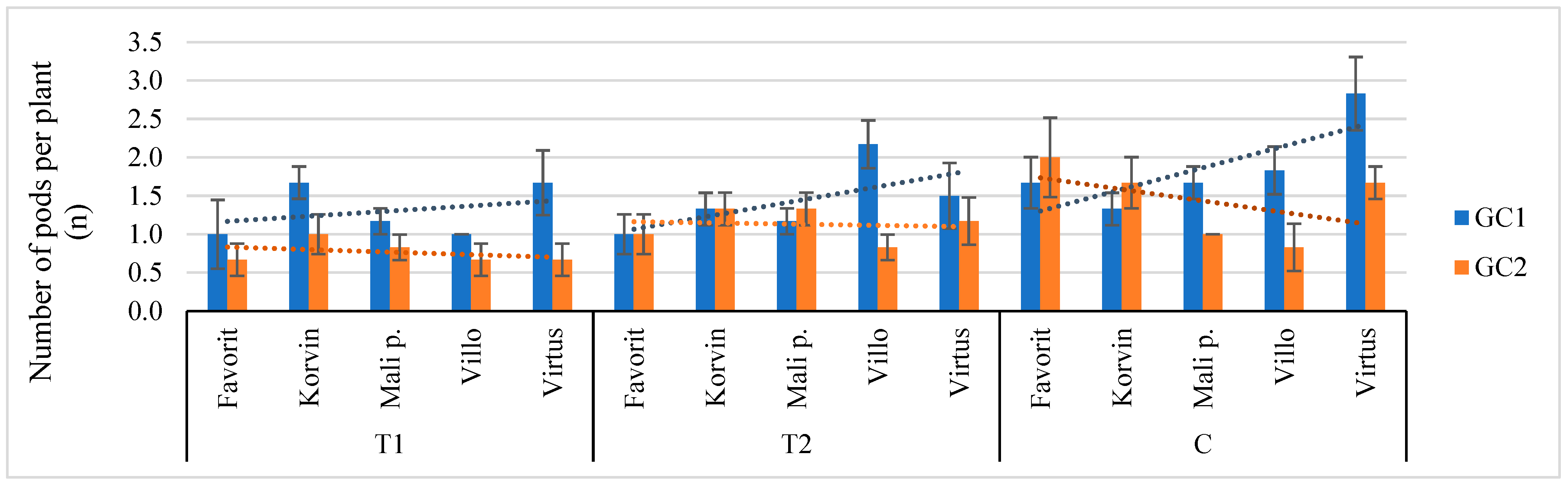
The control treatment resulted in higher mean pod numbers in both cycles compared to treatments T1 and T2. The most pronounced difference was observed for the genotype Virtus in GC1, where the control treatment reached 2.83 pods per plant, compared with 1.67 in T1 and 1.50 in T2 (Figure 1).
Clear genotypic differences were detected under optimal water supply. In the first growing cycle, genotypes Virtus and Villo showed higher pod numbers (2.83 and 1.83, respectively) compared with genotypes Korvin (1.33) and Mali provansalac (1.67), indicating a higher reproductive potential of these genotypes under non-stress conditions (C). Differences between growing cycles were also evident. In most cases, GC1 exhibited higher values than GC2.
Overall, Figure 1 indicates variations in pod numbers across irrigation regimes, especially in GC1 and in high-yielding genotypes such as Virtus, reflecting the interactive effects of irrigation regime, genotype, and growing cycle on pod formation.

3.2. Pod Length

Analysis of variance showed that pod length was significantly affected by irrigation in both growing cycles (p < 0.01). In GC1, genotypes also had a significant effect, while the G × T interaction was not significant. In GC2, neither genotype nor interaction showed a significant effect (Table 1). This indicates that, unlike in the first growing cycle, where pod length exhibited a highly significant genotypic effect, the differences among genotypes for pod length were not expressed under the conditions of the second cycle, despite the controlled growth conditions. Differences between cycles may be attributed to minor microclimatic inconsistencies, as well as subtle variations in seed emergence and early plant development.
The Tukey HSD post hoc test showed that pod length differed significantly between C and T1 and significantly between C and T2, while the differences between T1 and T2 were not significant (Table 2).
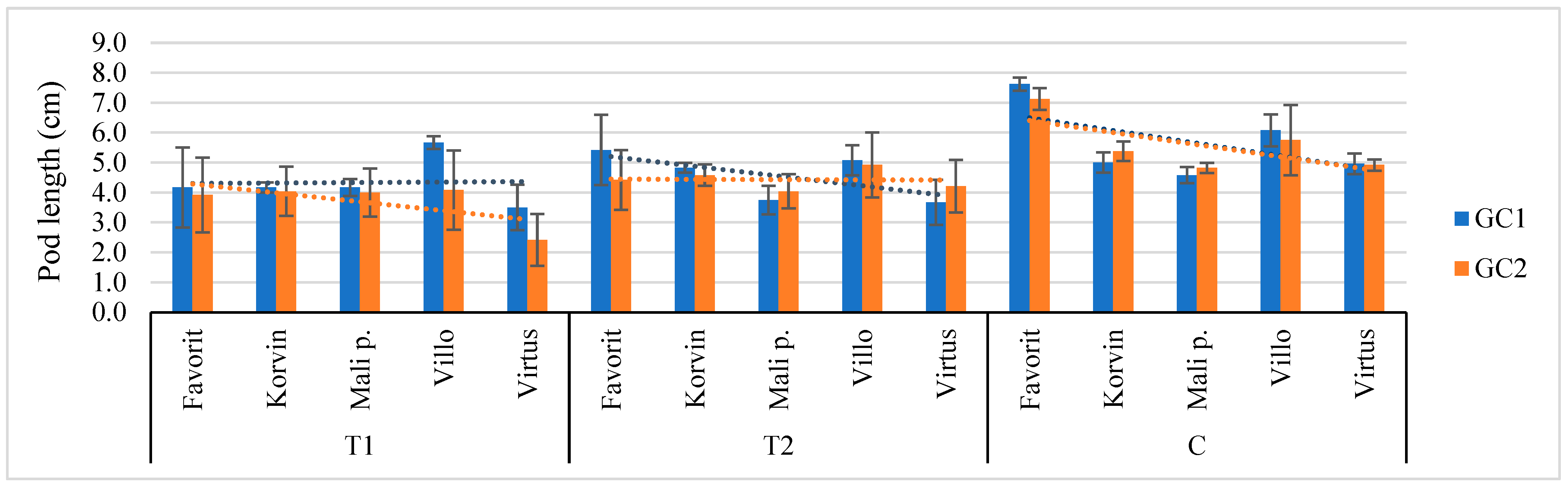
The longest pods were recorded under control treatment in both growing cycles, while reduced irrigation (T1 and T2) resulted in shorter pod lengths. The most pronounced differences were observed for the genotype Favorit, which achieved the greatest pod length under control conditions, reaching 7.62 cm in GC1 and 7.12 cm in GC2, compared with 4.17–5.42 cm under deficit irrigation treatments (Figure 2).
A similar but less pronounced trend was recorded for genotype Villo, with pod length increasing 6.08 cm (GC1) under C treatment, compared with values mostly below 5.7 cm under T1 and T2. Genotype Mali provansalac maintained intermediate pod length under control conditions (4.58 cm), with only small differences compared to deficit irrigation treatments. Genotype Virtus exhibited generally shorter pods regardless of irrigation regime, with a maximum mean value of 4.96 cm under the full-irrigation regime and noticeable fluctuations between growing cycles (Figure 2).

3.3. Number of Seeds per Plant

The number of seeds per plant was significantly affected by the irrigation regime and genotype in both growing cycles. A significant G × T interaction was observed, indicating genotype-specific responses to water availability and different genotype performance across environments. In the GC2, the effects of irrigation were particularly pronounced (F = 11.43, p < 0.01) (Table 1).
The Tukey HSD post hoc test showed that the number of seeds per plant differed significantly between T1 and C, while no significant differences were observed between other treatments (Table 2).
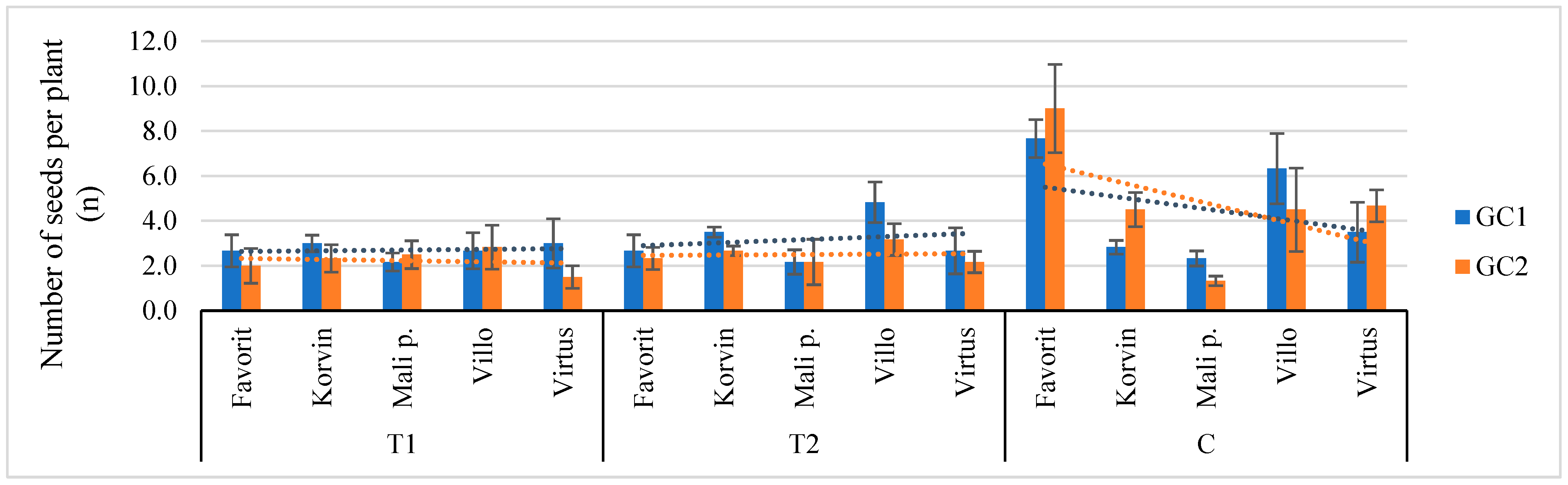
Variations in the number of seeds per plant were observed for the genotype Favorit, which showed a substantial increase in seed number under control conditions, reaching 7.67 seeds per plant in GC1 and 9.00 in GC2, compared with values ranging between 2.00 and 2.67 seeds under T1 and T2. A similar, although less pronounced, response was recorded for genotype Villo, where the control treatment resulted in 6.33 seeds in GC1, compared with 2.67–4.83 under deficit irrigation (Figure 3).
Regarding seed number per plant, genotypes Favorit and Villo showed the highest performance in C, outperforming the other genotypes. In contrast, genotype Korvin maintained relatively stable seed numbers under both water deficit (T1 and T2) and optimal irrigation conditions, indicating higher resilience to varying water availability.

3.4. Seed Weight per Plant

Seed weight per plant showed similar trends to the traits of pod and seed numbers, having significant effects for both irrigation regimes and genotypes. The significant G × T interaction indicated differential genotypic responses to water availability. ANOVA showed that the effects of treatment and genotype, as well as their interaction on seed weight per plant, were highly significant (p < 0.01) in both growing cycles (Table 1).
The post hoc Tukey HSD comparison demonstrated that the seed weight per plant differed significantly between C and T1 and C and T2, whereas the differences between T1 and T2 were not significant (Table 2).
Variations in seed weight per plant highlighted a strong effect of irrigation regime, genotype and growing cycle. Overall, the highest values were recorded under the control treatment, particularly in GC2.
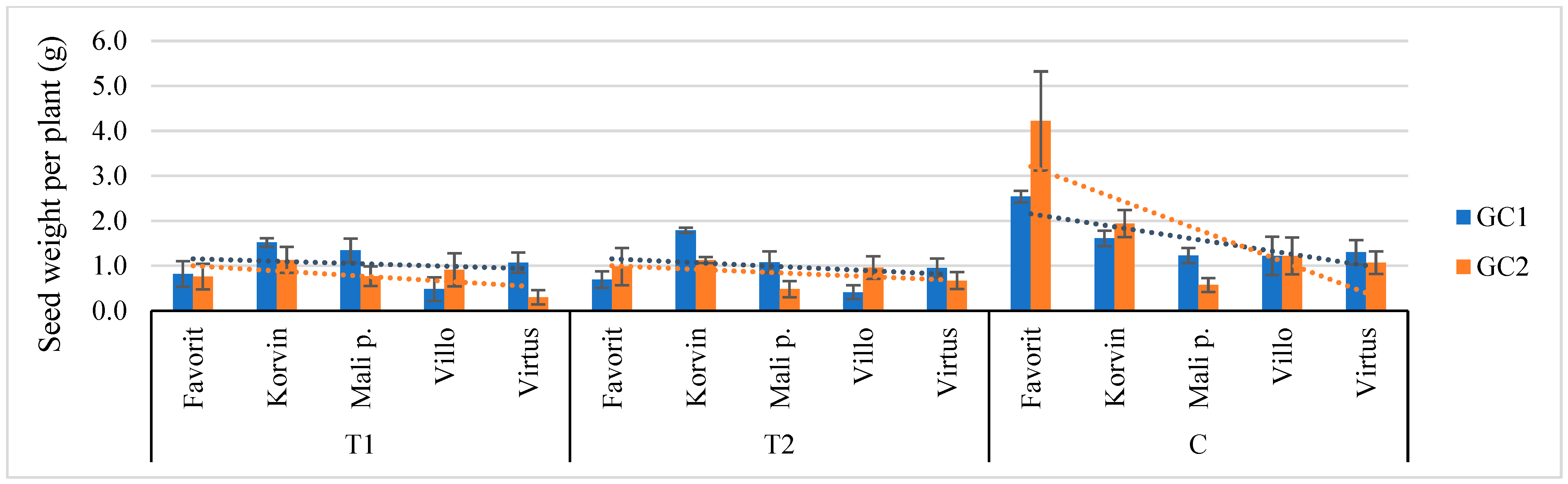
The most pronounced response was observed for the genotype Favorit, which showed a substantial increase in seed weight under optimal water supply, reaching 2.54 g per plant in GC1 and 4.22 g per plant in GC2, compared with markedly lower values under T1 and T2 (mostly below 1.0 g per plant). This indicates that seed weight in this genotype is highly sensitive to improved water availability. In contrast, genotype Korvin exhibited a more stable seed weight across irrigation treatments and cycles, with values ranging from 1.13 to 1.94 g per plant. (Figure 4).
The effects of growing cycles were genotype dependent. For genotypes Favorit and Villo, seed weight tended to be higher in GC2, particularly under control conditions. In contrast, genotype Mali provansalac showed a clear reduction in seed weight in GC2 across all treatments, with the lowest values recorded under T2 (0.48 g).

3.5. Fresh Biomass

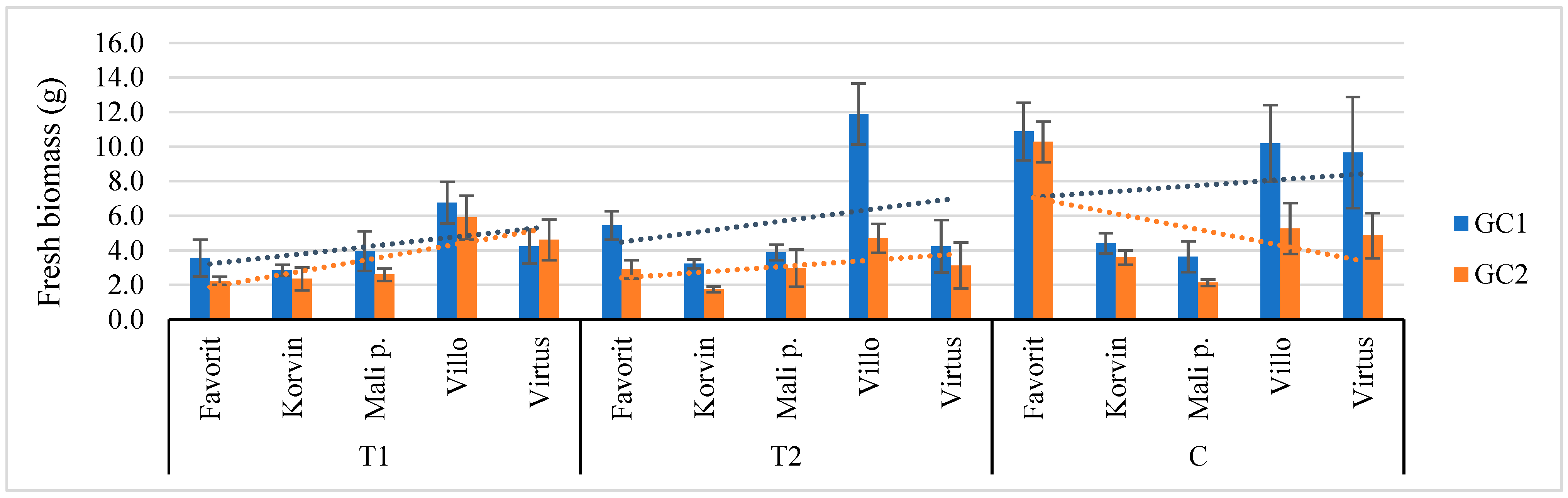
The results of ANOVA showed that fresh biomass was significantly influenced by both treatment and genotype in both growing cycles (p < 0.01), indicating that the applied irrigation treatments altered plant growth and that the tested genotypes differed in their biomass accumulation. The interaction between treatment and genotype was not significant in GC1, suggesting a similar response of all genotypes to the treatments during the first cycle, whereas in GC2 the interaction was significant (p < 0.01), showing that the effect of treatment varied among genotypes in the second cycle (Table 1). Differences between cycles may be attributed to minor microclimatic inconsistencies within the growth chamber, as well as subtle variations in seed emergence and early plant development, which may have influenced biomass accumulation.
The downward-oriented trendline for GC2 in C treatment reveals a highly significant G × T interaction in comparison to otherwise similar patterns between GC1 and GC2 in T1 and T2 (Figure 5).
The Tukey HSD post hoc showed that fresh biomass per plant differed significantly only between C and T1, while no significant differences were observed between C and T2 or between T1 and T2 (Table 2).
These results, namely the finding that only the G × T interaction was not significant in GC1, highlight the importance of repeated growing cycles for accurately capturing variability in fresh biomass responses across irrigation treatments, as the magnitude and consistency of treatment effects differed between cycles.
Fresh biomass accumulation differed markedly among genotypes and irrigation regimes, with distinct response patterns across cycles. While genotypes Favorit and Villo consistently achieved the highest biomass values under improved water supply, the remaining genotypes exhibited more restrained and genotype-specific responses (Figure 5). Genotype Korvin exhibited moderate biomass across treatments, with a slight increase under the C treatment (4.41 g in GC1 and 3.58 g in GC2) compared with T1 and T2. Mali provansalac showed relatively uniform biomass (3.64 g in GC1, 2.13 g in GC2) with minimal differences between control and deficit irrigation. Genotype Virtus also achieved higher biomass under control conditions in GC1 (9.67 g) but showed a pronounced decline in GC2 (4.86 g) and only moderate gains compared with T1 and T2 (Figure 5).

3.6. Dry Biomass

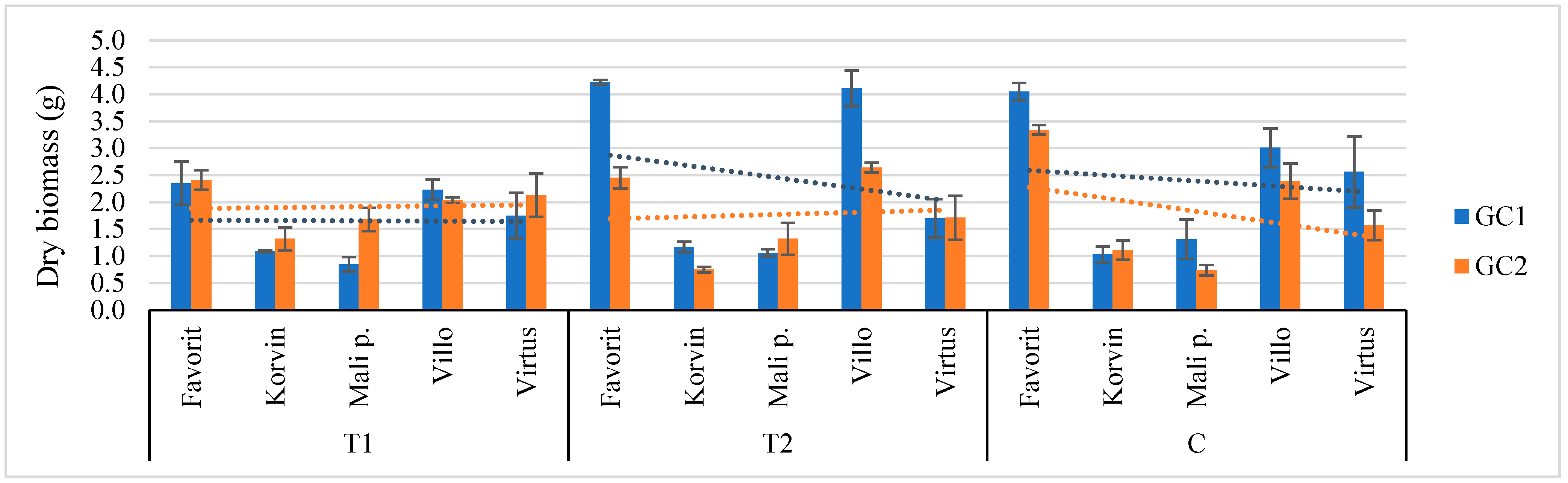
Genotypes had a highly significant effect on dry biomass in both growing cycles, while interaction was non-significant. The evaluated cultivars expressed high variation for water tolerance, indicating significant genetic diversity. Lack of significant G × T interaction indicated that the effects of irrigation on dry biomass were generally consistent across genotypes. Treatments were only significant in GC1, confirming that genetic differences largely determined dry biomass (Table 1).
The Tukey HSD post hoc test showed that dry biomass per plant did not differ significantly among any of the irrigation treatments (Table 2).
These results indicated that the timing of the duration of irrigation had no measurable effect on dry biomass accumulation under the conditions in this study.
Dry biomass varied among genotypes, irrigation treatments, and growing seasons (Figure 6). Genotypes Favorit and Villo consistently produced the highest biomass, with Favorit reaching 4.05 g in GC1 under C and 4.22 g under T2, while the T1 values were slightly lower (2.35 g), indicating that reduced irrigation limited biomass accumulation. Similarly, Villo achieved its highest values in GC1 under control (3.01 g) and T2 (4.11 g), with a clear reduction in T1 (2.23 g). Korvin maintained low biomass across all treatments (0.75–1.32 g), showing only minor differences between T1, T2 and control. Mali provansalac had moderate biomass (0.74–1.68 g), with small variations between growing cycles and treatments. Virtus exhibited intermediate values, peaking at 2.56 g in GC1 under control conditions, while T1 and T2 produced slightly lower biomass and notable variability between growing cycles (Figure 6).
Overall, Figure 6 shows that genotypes Favorit and Villo respond strongly to improved water availability, while genotypes Korvin, Mali provansalac and Virtus display more conservative growth patterns, with smaller differences among treatments.

4. Discussion

The results of this study indicate that pea is a promising crop for cultivation in controlled environment vertical farming systems, primarily due to its short growing season and potential for optimized production. However, water availability played a crucial role in determining plant performance, as water deficit reduced key yield components. This reduction was likely associated with decreased leaf area and photosynthetic activity, which limited assimilate availability for the formation of reproductive organs, consistent with earlier studies on pea performance under water stress [33]. These overall responses underscore the critical role of irrigation management in controlled environments and provide a basis for a more comprehensive examination of individual yield components, which collectively determine final productivity.
The number of pods was markedly reduced when irrigation was terminated after flowering, whereas maintaining irrigation until pod formation did not significantly differ from the control, indicating that water supply during and immediately after flowering is crucial for pod formation. This aligns with previous reports showing that adequate water availability during flowering and early pod development is essential for maintaining reproductive performance in pea and related legumes [34,35]. Water deficit during pod development strongly affects pea yield and reproductive traits, weakening the link between yield and structural or functional traits [36]. Specifically, water-stress treatments produced fewer flowering nodes and pods while inducing earlier pod formation [37]. Such water restriction likely disrupts key physiological processes, leading to flower abortion and reduced assimilation availability, ultimately resulting in fewer pods and lower yield.
Genotypic differences in pod numbers were evident primarily under optimal water supply, suggesting that favorable conditions allow the expression of genetic yield potential, while water stress reduces variability among genotypes and limits phenotypic differentiation. These observations agree with previous studies showing that water deficit reduces pod number, whereas well-watered conditions enhance yield component relationships and genotypic variability [38]. Differences among genotypes likely reflect their inherent growth patterns and ability to maintain pod sets under stress.
Finally, the relatively low number of pods per plant observed in this study should be interpreted in the context of controlled environmental conditions. Previous studies reported wide variation among genotypes, ranging from 2.50 to 16.17 pods per plant in greenhouse experiments, and averaging 5.26 pods per plant under field conditions [32,39], highlighting the strong influence of environment and genotype on pod formation.
Pod length was similarly affected by water availability, with reduced irrigation consistently resulting in shorter pods, while optimal soil moisture promoted maximum elongation, indicating that adequate soil moisture is particularly important during pod development. Maintaining optimal soil moisture through higher irrigation frequency improves nutrient uptake, photosynthetic activity and therefore the efficient translocation of assimilates to reproductive organs, leading to improved pod length [40]. These physiological mechanisms explain why pod length, as a reproductive trait, is particularly sensitive to water availability compared with vegetative traits. Lower irrigation during germination and early growth stages, followed by 1–2 applications of 30–40 mm during flowering and pod formation, has also been shown to increase pod length, seed number, and improve pea seed quality [41]. These results suggest that pod length is particularly sensitive to water stress, reflecting the impact of limited water on pod growth processes.
Genotypic differences were more evident under optimal water supply, with high-performing genotypes such as Favorit achieving longer pods, likely reflecting greater intrinsic growth potential and more efficient assimilate allocation, whereas genotypes like Virtus, with inherently shorter pods or conservative growth strategies, showed limited responsiveness. These results align with previous research, where pod length varied from 3.57 to 9.87 cm among genotypes [42]. The absence of a significant genotype effect in the second growing cycle suggests that less favorable or more variable environmental conditions limited phenotypic differentiation among genotypes, leading to a more uniform response. Together with the effects on pod number, these findings emphasize that reproductive traits in peas are highly sensitive to water stress and that optimal irrigation is crucial for maximizing both pod quantity and quality.
Seed number per plant was strongly influenced by the irrigation regime in both growing cycles, building on the effects observed for pod number and pod length. This indicates that seed development, as a key reproductive trait, is highly sensitive to water availability during flowering and pod development. The significant G × T interaction shows that genotypes differed in their sensitivity to irrigation duration, with reduced irrigation leading to a decline in seed number, whereas continuous irrigation allowed a fuller expression of genotypic variability, indicating that this trait also depends on genotype. Similar effects of irrigation timing on reproductive performance in pea and other legumes have been reported [35,43].
In our study, the genotypes Favorit and Villo tended to perform strongly under favorable conditions, whereas Korvin exhibited a more stable and resilient response across varying water availability. These observations highlight that seed number per plant is particularly influenced by environmental conditions and water availability, whereas traits such as seed number per pod are more strongly determined by genotype [38].
Although the average number of seeds per plant in this study was relatively low, greenhouse studies have reported a wide range of values (5.33–44.50 seeds per plant), indicating considerable differences among pea genotypes [32]. These findings highlight that seed number is particularly sensitive to water stress during flowering, and can decrease by up to 53%, making it the primary driver of seed biomass reduction [44]. Plants exposed to water deficit during the reproductive period reduced the number of seeds per pod by 0.8 seeds and the number of seeds per plant by 315 seeds, resulting in 89% seed per plant reduction in comparison with the control [45]. These findings align with our results, as reduced irrigation markedly decreased seed number per plant, likely reflecting the high sensitivity of this trait to water deficit due to increased flower abortion and reduced reproductive success. Therefore, optimizing irrigation timing is crucial not only for improving seed number per plant but also for exploiting genotypic differences in reproductive capacity under contrasting water regimes.
Water availability and genotype played a key role in determining seed weight per plant, reflecting the sensitivity of this reproductive trait to irrigation conditions. Short-term and moderate water stress during flowering in pea did not significantly affect seed yield or total plant biomass, although it slightly reduced individual seed weight and the number of reproductive nodes [46], while water deficit during flowering did not result in a significant decrease in the seed weight of the pea cultivars [47]. Pea grain yield under 75% water supply did not differ significantly from full irrigation (100%), indicating that moderate deficit irrigation may be sufficient to sustain yield [35]. These literature observations align with our findings, supporting the idea that seed weight is sensitive to water availability but can be maintained under moderate stress in some genotypes.
High-yielding genotypes exhibited plasticity in seed weight under optimal conditions, whereas stress-tolerant genotypes maintained relatively stable seed weight despite lower values under limited irrigation. Among the genotypes evaluated, Favorit showed a pronounced increase in seed weight under optimal irrigation, reflecting a strong dependence of seed filling on favorable water conditions. In contrast, the genotype Korvin exhibited relatively stable seed weight across irrigation regimes and growing cycles, indicating a more conservative and stable performance under variable water supply. It has been shown that the average weight and size of pea seeds vary significantly among cultivars, with genotype having a significant influence on seed weight [48,49]. These results highlight that reduced water supply limits assimilate transfer to developing seeds, while genotypes differ in their strategies for maintaining seed weight under stress.
Water availability and genotype strongly influenced fresh biomass accumulation, with response patterns varying between growing cycles. Fresh biomass was primarily governed by an irrigation regime, highlighting the sensitivity of vegetative traits to water availability, like patterns observed for reproductive traits. Improved water supply generally promoted higher biomass production, although the magnitude and consistency of this response differed among genotypes and between cycles, indicating strong environmental modulation of growth.
Previous studies in legumes have reported decreases in biomass under drought, with species- and genotype-specific differences [50]. Partial irrigation (50–75% of field capacity) did not significantly reduce grain yield or leaf water status compared to full irrigation, while contributing to water savings [35]. Drip irrigation, especially under regulated deficit strategies, improved fresh pea biomass, whereas water stress during mid-growth reduced accumulation [51]. These findings are consistent with our results, as deficit irrigation reduced biomass production, while the relative differences among genotypes remained similar across different growing systems, including controlled-environment vertical farming, highlighting the impact of water limitation on vegetative growth.
Apart from the overall irrigation effect, genotype-specific responses played a significant role in determining biomass accumulation. High-yielding genotypes such as Favorit and Villo showed pronounced responsiveness under optimal water supply, whereas Korvin and Mali provansalac maintained more conservative and stable growth across irrigation regimes. From a practical perspective, these results indicate that efficient irrigation management combined with appropriate genotype selection can support biomass accumulation and maximize genotypic potential under both optimal and water-limited conditions.
Genotypes were the main factor influencing dry vegetative biomass, showing that this trait is largely under genetic control. Its relative stability reflects that dry matter accumulates gradually over time, depending on overall plant growth rather than short-term water changes. As a result, dry biomass appears to be less sensitive to the irrigation regime compared with more plastic traits such as pod and seed development. The most consistent response across genotypes indicates that structural growth is maintained even when water is limited for short periods.
In our study, high-performing genotypes such as Favorit and Villo consistently produced greater dry biomass, particularly under optimal water supply, whereas Korvin, Mali provansalac, and Virtus maintained lower and more stable biomass across irrigation regimes, reflecting reduced plasticity in dry matter production. Previous studies reported that water stress significantly reduced dry weight and nitrogen accumulation in pea, with stress during flowering having a greater effect than stress during pod filling [52]. Aboveground dry biomass was significantly affected by genotype and treatment, highlighting that although dry matter accumulation is largely under genetic control, it remains responsive to environmental factors such as water availability [38]. These genotypic differences highlight the potential to select for strong vegetative growth in breeding programs, while maintaining flexibility in more responsive traits to improve overall yield under variable water conditions.
Overall, the responses of reproductive and vegetative traits illustrate how genotype and water availability jointly shape pea performance, emphasizing the importance of genotype × environment interactions. Drought tolerance mechanisms, such as osmotic adjustment and stomatal regulation, influenced genotype performance, but their expression depended on the vertical farming environment, including gradients in light, airflow, and humidity. These context-dependent, genotype-specific responses contributed to reductions in pods, seeds, and seed weight under water deficit, linking physiological traits to final productivity. Reducing irrigation rates rather than interrupting watering could preserve both seed formation and reserve accumulation, maintain yield potential and quality, and provide guidance for optimized irrigation management.

5. Conclusions

This study demonstrated that pea plants exposed to water deficit during critical reproductive stages in a vertical farming system exhibited genotype-specific responses. Compared with fully irrigated control plants, seed number and seed weight were reduced, with more tolerant genotypes showing moderate decreases (around 6–15%) and less tolerant genotypes experiencing substantially larger reductions (up to 65–73%). Fresh biomass exhibited high phenotypic plasticity, whereas dry biomass was largely genetically determined and less responsive to water supply. Importantly, the vertical farming system provided a reliable platform for reproducible abiotic stress experiments, allowing precise control of water supply and environmental conditions while minimizing external variability. Based on these findings, pea producers are advised to manage irrigation carefully during flowering and pod formation and to select genotypes according to their tolerance to maintain yield stability under water-limited conditions. Overall, this work contributes to the field by providing quantitative evidence of genotype-specific reproductive responses to water deficit and highlights the potential of controlled environment systems for supporting trait-based selection in modern breeding programs.

Author Contributions

Conceptualization, N.S. and N.L.; methodology, N.S., A.S.P., N.L. and S.T.; investigation, N.S., T.P., A.S.P. and T.B.; data curation, V.V.; writing—original draft preparation, N.S.; writing—review and editing, T.P., A.S.P., T.B., S.T. and N.L.; visualization, N.S., V.V. and S.T.; supervision, S.T. and N.L. All authors have read and agreed to the published version of the manuscript.

Funding

This research was supported by the Provincial Secretariat for Higher Education and Scientific Research, Autonomous Province of Vojvodina, Republic of Serbia, Grant Number: 003871583 2025 09418 003 000 000 001 04 004.

Data Availability Statement

The raw data supporting the conclusions of this article will be made available by the authors on request.

Acknowledgments

The financial support mentioned above is gratefully acknowledged.

Conflicts of Interest

The authors declare no conflicts of interest.

References

  1. Azmat, M.; Haider, S.; Mahmood, M.H.; Siddiqa, F.; Farwa; Ammara, G.; Rehman, A.U.; Inqalabi, T.E.I. Evaluation of Yield, Growth Potential and Adaptability of Ten Pea Lines under Semi-Arid Conditions. Planta Anim. 2024, 3, 97–106. [Google Scholar]
  2. Daba, S.D.; McGee, R.J.; Finnie, S.M. Physicochemical, Morphological, and Digestibility Properties of Round and Wrinkled Pea Starches. Cereal Chem. 2025, 102, 611–627. [Google Scholar] [CrossRef]
  3. Kırnak, H.; Uzun, S.; İrik, H.A.; Özaktan, H.; Arslan, M. Water–Yield Relations of Drip-Irrigated Peas Under Semi-Arid Climate Condition. Int. J. Agric. Nat. Sci. 2021, 14, 85–95. [Google Scholar]
  4. Moore, K.L.; Rodríguez-Ramiro, I.; Jones, E.R.; Jones, E.J.; Rodríguez-Celma, J.; Halsey, K.; Domoney, C.; Shewry, P.R.; Fairweather-Tait, S.; Balk, J. The Stage of Seed Development Influences Iron Bioavailability in Pea (Pisum sativum L.). Sci. Rep. 2018, 8, 6865. [Google Scholar] [CrossRef] [PubMed]
  5. Ron, A.M.D.; Magallanes, J.J.; Martínez, Ó.; Rodiño, P.; Santalla, M. Identifying Superior Snow Pea Breeding Lines. HortScience 2005, 40, 1216–1220. [Google Scholar] [CrossRef]
  6. Ram, H.; Hedau, N.K.; Chaudhari, G.V.; Kant, L. Peas with Zero Shelling Edible Pods: A Review. Sci. Hortic. 2021, 288, 110333. [Google Scholar] [CrossRef]
  7. Swamy, K.R.M. Origin, Domestication, Taxonomy, Botanical Description, Genetics and Cytogenetics, Genetc Diversity and Breeding of Beans. Int. J. Curr. Res. 2023, 15, 24769–24795. [Google Scholar]
  8. Ferrarezi, R.S.; Weiss, S.A.; Geiger, T.C.; Beamer, K.P. Edible-Pod Peas as High-Value Crops in the U.S. Virgin Islands. HortTechnology 2016, 26, 683–689. [Google Scholar] [CrossRef]
  9. Mera, M.; Kehr, E.; Mejías, J.; Ihl, M.; Bifani, V. Arvejas (Pisum sativum) de Vaina Comestible Sugar Snap: Antecedentes y Comportamiento en el Sur de Chile. Agric. Téc. 2007, 67, 343–352. [Google Scholar] [CrossRef]
  10. Gudko, V.; Usatov, A.; Minkina, T.; Duplii, N.; Azarin, K.; Tatarinova, T.V.; Sushkova, S.; Garg, A.; Denisenko, Y. Dependence of the Pea Grain Yield on Climatic Factors under Semi-Arid Conditions. Agronomy 2024, 14, 133. [Google Scholar] [CrossRef]
  11. Larmure, A.; Munier-Jolain, N.G. High Temperatures During the Seed-Filling Period Decrease Seed Nitrogen Amount in Pea (Pisum sativum L.): Evidence for a Sink Limitation. Front. Plant Sci. 2019, 10, 1608. [Google Scholar] [CrossRef]
  12. Sita, K.; Sehgal, A.; HanumanthaRao, B.; Nair, R.M.; Vara Prasad, P.V.; Kumar, S.; Gaur, P.M.; Farooq, M.; Siddique, K.H.M.; Varshney, R.K.; et al. Food Legumes and Rising Temperatures: Effects, Adaptive Functional Mechanisms Specific to Reproductive Growth Stage and Strategies to Improve Heat Tolerance. Front. Plant Sci. 2017, 8, 1658. [Google Scholar] [CrossRef]
  13. Kuznetsov, I.; Davletov, F.; Anokhina, N.; Akhmadullina, I.; Safin, F. Influence of Weather Condtion on the Field Peas (Pisum sativum L. ssp. Sativum) Vegetation Period and Yield. Agron. Res. 2020, 18, 472–482. [Google Scholar] [CrossRef]
  14. Parihar, A.K.; Hazra, K.K.; Lamichaney, A.; Dixit, G.P.; Singh, D.; Singh, A.K.; Singh, N.P. Characterizing Plant Trait(s) for Improved Heat Tolerance in Field Pea (Pisum sativum L.) under Subtropical Climate. Int. J. Biometeorol. 2022, 66, 1267–1281. [Google Scholar] [CrossRef]
  15. Haghpanah, M.; Hashemipetroudi, S.; Arzani, A.; Araniti, F. Drought Tolerance in Plants: Physiological and Molecular Responses. Plants 2024, 13, 2962. [Google Scholar] [CrossRef] [PubMed]
  16. Nemeskéri, E.; Molnár, K.; Vígh, R.; Nagy, J.; Dobos, A. Relationships between Stomatal Behaviour, Spectral Traits and Water Use and Productivity of Green Peas (Pisum sativum L.) in Dry Seasons. Acta Physiol. Plant. 2015, 37, 34. [Google Scholar] [CrossRef]
  17. Wang, Z.; Yung, W.-S.; Gao, Y.; Huang, C.; Zhao, X.; Chen, Y.; Li, M.-W.; Lam, H.-M. From Phenotyping to Genetic Mapping: Identifying Water-Stress Adaptations in Legume Root Traits. BMC Plant Biol. 2024, 24, 749. [Google Scholar] [CrossRef] [PubMed]
  18. Seleiman, M.F.; Al-Suhaibani, N.; Ali, N.; Akmal, M.; Alotaibi, M.; Refay, Y.; Dindaroglu, T.; Abdul-Wajid, H.H.; Battaglia, M.L. Drought Stress Impacts on Plants and Different Approaches to Alleviate Its Adverse Effects. Plants 2021, 10, 259. [Google Scholar] [CrossRef]
  19. Hassan, A.M.; Alzoheiry, A.M.; Mansour, N.E. Optimize Irrigation Water Use of Green Peas Under Deficit Irrigation in Semi-Arid Regions. Misr J. Agric. Eng. 2020, 37, 285–296. [Google Scholar] [CrossRef]
  20. Pereira, L.S.; Oweis, T.; Zairi, A. Irrigation Management under Water Scarcity. Agric. Water Manag. 2002, 57, 175–206. [Google Scholar] [CrossRef]
  21. Kalantari, F.; Tahir, O.M.; Joni, R.A.; Fatemi, E. Opportunities and Challenges in Sustainability of Vertical Farming: A Review. J. Landsc. Ecol. 2018, 11, 35–60. [Google Scholar] [CrossRef]
  22. Vatistas, C.; Avgoustaki, D.D.; Bartzanas, T. A Systematic Literature Review on Controlled-Environment Agriculture: How Vertical Farms and Greenhouses Can Influence the Sustainability and Footprint of Urban Microclimate with Local Food Production. Atmosphere 2022, 13, 1258. [Google Scholar] [CrossRef]
  23. Oh, S.; Lu, C. Vertical Farming-Smart Urban Agriculture for Enhancing Resilience and Sustainability in Food Security. J. Hortic. Sci. Biotechnol. 2023, 98, 133–140. [Google Scholar] [CrossRef]
  24. Beacham, A.M.; Vickers, L.H.; Monaghan, J.M. Vertical Farming: A Summary of Approaches to Growing Skywards. J. Hortic. Sci. Biotechnol. 2019, 94, 277–283. [Google Scholar] [CrossRef]
  25. Gerrewey, T.V.; Boon, N.; Geelen, D. Vertical Farming: The Only Way Is Up? Agronomy 2021, 12, 2. [Google Scholar] [CrossRef]
  26. Wortman, S.E.; Douglass, M.S.; Kindhart, J.D. Cultivar, Growing Media, and Nutrient Source Influence Strawberry Yield in a Vertical, Hydroponic, High Tunnel System. HortTechnology 2016, 26, 466–473. [Google Scholar] [CrossRef]
  27. Čížek, M.; Komárková, Z. Comparison of Aeroponics and Conventional System of Production of Potato Mini-Tubers in the Conditions of the Czech Republic. Plant Soil Environ. 2022, 68, 366–374. [Google Scholar] [CrossRef]
  28. Stoochnoff, J.; Johnston, M.; Hoogenboom, J.; Graham, T.; Dixon, M. Intracanopy Lighting Strategies to Improve Green Bush Bean (Phaseolus vulgaris) Compatibility with Vertical Farming. Front. Agron. 2022, 4, 905286. [Google Scholar] [CrossRef]
  29. Balázs, L.; Kovács, G.P.; Gyuricza, C.; Piroska, P.; Tarnawa, Á.; Kende, Z. Quantifying the Effect of Light Intensity Uniformity on the Crop Yield by Pea Microgreens Growth Experiments. Horticulturae 2023, 9, 1187. [Google Scholar] [CrossRef]
  30. Pérez-Leal, R.; Rodríguez-Roque, M.J.; Acevedo-Barrera, A.A.; Villa-Martínez, A.; Guerrero, B.I.; Gutiérrez-Chávez, A.; Hernández-Huerta, J. Bacillus thuringiensis and Trichoderma asperellum as Biostimulants in Hydroponic Tendril Pea (Pisum sativum) Microgreens. Horticulturae 2025, 11, 39. [Google Scholar] [CrossRef]
  31. Brazaitytė, A.; Sutulienė, R.; Samuolienė, G.; Viršilė, A.; Pukalskas, A.; Laužikė, K.; Raginskis, J.; Mäkelä, P.; Ishihara, H.; Martin, M. Potential for Cultivating Various Legume Species in Controlled Environment Agriculture. Horticulturae 2026, 12, 308. [Google Scholar] [CrossRef]
  32. Şenbek, G.; Duran, S.T.; İpek, A.; Uzun, A. Selection of Parental Forage Pea [Pisum sativum (L.)] Genotypes Based on Morphological Characterization and SSR Markers for Crossbreeding. Genet. Resour. Crop Evol. 2025, 72, 7517–7530. [Google Scholar] [CrossRef]
  33. Guilioni, L.; Wéry, J.; Lecoeur, J. High Temperature and Water Deficit May Reduce Seed Number in Field Pea Purely by Decreasing Plant Growth Rate. Funct. Plant Biol. 2003, 30, 1151–1164. [Google Scholar] [CrossRef]
  34. Duzdemir, O.; Kurunc, A.; Unlukara, A. Response of Pea (Pisum sativum) to Salinity and Irrigation Water Regime. Bulg. J. Agric. Sci. 2009, 15, 400–409. [Google Scholar]
  35. Ghodsi, A.; Honar, T.; Heidari, B.; Salarpour, M.; Etemadi, M. The Interacting Effects of Irrigation, Sowing Date and Nitrogen on Water Status, Protein and Yield in Pea (Pisum sativum L.). Sci. Rep. 2022, 12, 15978. [Google Scholar] [CrossRef]
  36. Gutiérrez-Villamil, D.A.; Alvarado-Sanabria, O.H.; Álvarez-Herrera, J.G. Water Deficit During Pod Development Affects Eco-Physiological Traits, Growth, and Yield in Pea Varieties Under Greenhouse Conditions in Tropical Highlands. Crops 2025, 5, 65. [Google Scholar] [CrossRef]
  37. Martin, R.J.; Wilson, D.R.; Riddle, M.U.; Gillespie, R.N. Response of Pea Seed Yield to Water Deficit. Agronomy 2006, 36, 36–43. [Google Scholar]
  38. Vinarao, G.B.; Ghimire, K.; Harris, D.K. Pilot Evaluation of Field Pea Accessions Under Water Deficit Conditions. Int. J. Plant Biol. 2024, 15, 1162–1175. [Google Scholar] [CrossRef]
  39. Prusiński, J.; Borowska, M. Effect of Planting Density and Row Spacing on the Yielding and Morphological Features of Pea (Pisum sativum L.). Agronomy 2022, 12, 715. [Google Scholar] [CrossRef]
  40. Rajak, P.; Rajput, A.; Mirjha, P.; Verma, C.; Khusro, D.S.; Karwar, M.; Sahu, A. Effect of Water and Nutrient Management Practices on the Yield Attributes and Yield of Field Pea (Pisum sativum L.). Int. J. Res. Agron. 2025, 8, 865–869. [Google Scholar] [CrossRef]
  41. Červenski, J.; Medić-Pap, S.; Ignjatov, M. Proizvodnja konzumnog graška. In Proceedings of the Zbornik Referata 55. Savetovanja Agronoma i Poljoprivrednika Srbije, Zlatibor, Serbia, 31 January–3 February 2021; 3101-03022021; Institute of Field and Vegetable Crops: Novi Sad, Serbia, 2021; pp. 23–32. [Google Scholar]
  42. Aman, F.; Ara, N.; Shah, S.M.A. Genetic Diversity Among Pea (Pisum sativum L.) Genotypes for Maturity and Yield Traits. Sarhad J. Agric. 2021, 37, 331–713. [Google Scholar] [CrossRef]
  43. Rasaei, A. Effect of Supplemental Irrigation and Plant Density on Yield and Yield Components of Peas (Pisum sativum L.) in Kermanshah Region. Afr. J. Agric. Res. 2012, 7, 2353–2358. [Google Scholar] [CrossRef]
  44. Prudent, M.; Vernoud, V.; Girodet, S.; Salon, C. How Nitrogen Fixation Is Modulated in Response to Different Water Availability Levels and during Recovery: A Structural and Functional Study at the Whole Plant Level. Plant Soil 2016, 399, 1–12. [Google Scholar] [CrossRef]
  45. Gusmao, M.; Siddique, K.H.M.; Flower, K.; Nesbitt, H.; Veneklaas, E.J. Water Deficit during the Reproductive Period of Grass Pea (Lathyrus sativus L.) Reduced Grain Yield but Maintained Seed Size. J. Agron. Crop Sci. 2012, 198, 430–441. [Google Scholar] [CrossRef]
  46. Henriet, C.; Aimé, D.; Térézol, M.; Kilandamoko, A.; Rossin, N.; Combes-Soia, L.; Labas, V.; Serre, R.-F.; Prudent, M.; Kreplak, J.; et al. Water Stress Combined with Sulfur Deficiency in Pea Affects Yield Components but Mitigates the Effect of Deficiency on Seed Globulin Composition. J. Exp. Bot. 2019, 70, 4287–4304. [Google Scholar] [CrossRef]
  47. Pszczółkowska, A.; Olszewski, J.; Płodzień, K.; Kulik, T.; Fordoński, G. Effect of the Water Stress on the Productivity of Selected Genotypes of pea (Pisum sativum L.) and yellow lupin (Lupinus luteus L.). Electron. J. Pol. Agric. Univ. 2003, 6, 2. [Google Scholar]
  48. Basu, S.; Gustafsson, S.; Kumar, P.; Chakraborty, S.K.; Andersson, R. Mechanical Attributes of Swedish Pea Cultivars. Future Foods 2025, 12, 100711. [Google Scholar] [CrossRef]
  49. Lakić, Ž.; Stanković, S.; Pavlović, S.; Krnjajić, S.; Popović, V. Genetic Variability in Quantitative Traits of Field Pea (Pisum sativum L.) Genotypes. Czech J. Genet. Plant Breed. 2019, 55, 1–7. [Google Scholar] [CrossRef]
  50. Komainda, M.; Küchenmeister, K.; Küchenmeister, F.; Breitsameter, L.; Wrage-Mönnig, N.; Kayser, M.; Isselstein, J. Forage Legumes for Future Dry Climates: Lower Relative Biomass Losses of Minor Forage Legumes Compared to Trifolium repens under Conditions of Periodic Drought Stress. J. Agron. Crop Sci. 2019, 205, 460–469. [Google Scholar] [CrossRef]
  51. Sharma, V.; Choudhary, U.; Changade, N.M.; Kumar, A.; Singh, M.; Yadav, K.K.; Lakhawat, S.S. Growth and Yield Response of Pea (Pisum sativum L.) Crop to Classical and Regulated Deficit Irrigation along with Nitrogen Fertilization under Drip Irrigation. Legume Res.-Int. J. 2024, 48, 1513–1520. [Google Scholar] [CrossRef]
  52. Mahieu, S.; Germon, F.; Aveline, A.; Hauggaard-Nielsen, H.; Ambus, P.; Jensen, E.S. The Influence of Water Stress on Biomass and N Accumulation, N Partitioning between above and below Ground Parts and on N Rhizodeposition during Reproductive Growth of Pea (Pisum sativum L.). Soil Biol. Biochem. 2009, 41, 380–387. [Google Scholar] [CrossRef]
Figure 1. Mean values of the number of pods per plant (n) for five genotypes under T1, T2 and C in two growing cycles (GC1 and GC2).
Horticulturae 12 00382 g001
Figure 2. Mean values of the pod length (cm) for five genotypes under T1, T2 and C in two growing cycles (GC1 and GC2).
Horticulturae 12 00382 g002
Figure 3. Mean values of the number of seeds per plant (n) for five genotypes under T1, T2 and C in two growing cycles (GC1 and GC2).
Horticulturae 12 00382 g003
Figure 4. Mean values of the seed weight per plant (g) for five genotypes under T1, T2 and C in two growing cycles (GC1 and GC2).
Horticulturae 12 00382 g004
Figure 5. Mean values of the fresh biomass (g) for five genotypes under T1, T2 and C in two cycles (GC1 and GC2).
Horticulturae 12 00382 g005
Figure 6. Mean values of the dry biomass (g) for five genotypes under T1, T2 and C in two growing cycles (GC1 and GC2).
Horticulturae 12 00382 g006
Table 1. ANOVA results show the significance of treatment, genotype, and their interaction for the number of pods per plant, number of seeds per plant, seed weight per plant, pod length, fresh biomass and dry biomass.
TraitTreatmentGenotypeTreatment × Genotype
GC1GC2GC1GC2GC1GC2
Number of pods per plant (n)F4.748.183.081.971.941.32
p****nsnsns
Pod length (cm)F6.686.605.061.151.230.49
p******nsnsns
Number of seeds per plant (n)F6.4711.434.182.802.673.13
p**********
Seed weight per plant (g)F10.4511.016.816.483.914.21
p************
Fresh biomass (g)F7.547.279.026.152.034.59
p********ns**
Dry biomass (g)F5.330.2320.7813.841.701.66
p*ns****nsns
* p-value < 0.05; ** p-value < 0.01; ns—non-significant; GC1 The first growing cycle; GC2 The second growing cycle.
Table 2. Results of the Tukey HSD test showing significant differences among treatments T1, T2 and control (C) for the evaluated traits.
Traits T1T2C
Number of pods per plant (n)T1-ns*
T2ns-ns
C*ns-
Pod length (cm)T1-ns**
T2ns-*
C *-
Number of seeds per plant (n)T1-ns**
T2ns-ns
C**ns-
Seed weight per plant (g)T1-ns**
T2ns-**
C****-
Fresh biomass (g)T1-ns**
T2ns-ns
C**ns-
Dry biomass (g)T1-nsns
T2ns-ns
Cnsns-
* p-value < 0.05; ** p-value < 0.01; ns—non-significant; T1 irrigation until the flowering stage; T2 irrigation until pod formation; C control with irrigation until the end of the growing period.
Disclaimer/Publisher’s Note: The statements, opinions and data contained in all publications are solely those of the individual author(s) and contributor(s) and not of MDPI and/or the editor(s). MDPI and/or the editor(s) disclaim responsibility for any injury to people or property resulting from any ideas, methods, instructions or products referred to in the content.