Article

Functional Characterization of Chrysanthemum Transcription Factor CmbHLH112 in Flowering and Drought Response

1
College of Landscape and Horticulture, Yunnan Agricultural University, Kunming 650021, China
2
Faculty of Architecture and City Planning, Kunming University of Science and Technology, Kunming 650021, China
*
Authors to whom correspondence should be addressed.
These authors contributed equally to this work.
Horticulturae 2026, 12(3), 383; https://doi.org/10.3390/horticulturae12030383
Submission received: 20 January 2026 / Revised: 11 March 2026 / Accepted: 12 March 2026 / Published: 20 March 2026

Abstract

(1) Background: The bHLH (basic helix-loop-helix) transcription factor family is one of the most abundant in plants and is involved in plant growth, development, and abiotic stress responses. Notably, the functions of most bHLH family members remain poorly characterized. (2) Results: CmbHLH112, a nuclear-localized bHLH transcription factor from chrysanthemum, exhibits transcriptional activation activity. Overexpression of CmbHLH112 in Arabidopsis significantly promotes flowering and enhances drought resistance. qRT-PCR analysis revealed that CmbHLH112 regulates flowering time by affecting the expression of key flowering genes, including FT, SOC1, LFY, and FLC. Under drought stress, CmbHLH112 overexpression plants showed reduced ROS accumulation compared with wild-type plants, accompanied by elevated activities of key antioxidant enzymes and increased proline content. Moreover, transgenic plants exhibited lower MDA concentrations and reduced water loss rates under drought conditions, further indicating enhanced stress resilience. Overexpression of CmbHLH112 also upregulates ABA levels under drought stress, while simultaneously promoting the expression of genes involved in ABA biosynthesis and ABA signaling pathways. (3) Conclusions: Our results demonstrate that heterologous overexpression of CmbHLH112 in Arabidopsis enhances drought tolerance and promotes flowering. Thus, CmbHLH112 is proposed to play a dual role in modulating flowering time and drought tolerance, at least partly by regulating ABA biosynthesis.

1. Introduction

Chrysanthemum (Chrysanthemum morifolium) is a globally significant horticultural crop, yet its ornamental value and landscape applications are severely restricted by drought stress, while its annual production is further constrained by its flowering time [1]. Transcription factors (TFs) are key regulatory proteins that modulate target gene expression. Consequently, identifying and characterizing drought and flowering responsive TFs is essential for unraveling the molecular mechanisms underlying drought response and flowering regulation.
Among these transcription factors, the basic helix–loop–helix (bHLH) family of transcription factors represents one of the most extensive regulatory systems in plants [2]. Genome-wide analyses have revealed at least 162 bHLH members in Arabidopsis, which are phylogenetically grouped into 25 subfamilies based on domain homology [3]. Structurally, the bHLH domain comprises two conserved functional modules, a basic region mediating sequence-specific DNA binding to E-box motifs (5′-CANNTG-3′) and an HLH region facilitating protein dimerization [2,4]. Interestingly, HLH-only variants deficient in the basic domain can form inhibitory heterodimers with functional bHLHs, thereby suppressing transcriptional activity [5]. This dimeric plasticity enables bHLH proteins to exert both positive and negative regulatory roles in plant developmental processes.
The bHLH transcription factor family has been extensively documented to regulate drought stress responses across model plants and crops. In Arabidopsis, AtMYC2, a bHLH transcription factor, acts as a transcriptional activator involved in ABA signaling pathways [6]. Drought-induced AtbHLH122 binds to the G/E-box region of AtCYP707A3, repressing its transcription to enhance drought tolerance [7]. AtbHLH6/AtMYC2 activates AtERD1 expression by binding to its promoter, conferring jasmonic acid (JA)-mediated dehydration resistance [8]. Beyond Arabidopsis, orthologous bHLHs exhibit conserved roles. In wheat, TabHLH49 positively regulates drought responses by binding the TaWZY2 promoter [9]. In potato, StbHLH47 negatively modulates drought tolerance [10]. The IbPYL8-IbbHLH66-IbbHLH118 complex participates in ABA-dependent drought signal transduction in sweet potato [11]. In maize, ZmbHLH124T-ORG binds to ZmDREB2A promoter cis-elements, activating its expression and improving drought tolerance in recombinant inbred lines [12]. Peanut AhbHLH112 improves drought tolerance via ABA-dependent signaling pathways [13].
Recent studies have expanded the functional characterization of bHLH transcription factors beyond model plants and staple crops, revealing their pivotal roles in drought resistance across horticultural species. In apple (Malus domestica), MdbHLH160 directly binds to E-box elements in the promoters of MdDREB2A-like and MdSOD1, activating their expression to enhance drought tolerance [14]. Similarly, grapevine VviMYC4 modulates drought tolerance by regulating flavanol biosynthesis [15], and tomato SlbHLH96 confers drought resistance through transcriptional activation of stress-responsive genes [16]. Notably, MdbHLH93 also activates MdTyDC expression by binding to its promoter E-box, further underscoring the functional diversity of bHLH proteins in stress adaptation [17]. Despite extensive research on bHLH transcription factors in model plants and crops, their physiological and regulatory functions in chrysanthemum remain largely unexplored. While atypical bHLH proteins like CmHLB have been implicated in lignin biosynthesis and stem mechanical strength [18], CmbHLH2 variants regulate anthocyanin accumulation [19], and the CmbHLH1L-CmmbHLH63-CmNLP6/7L core transcription complex affects leaf senescence by regulating the expression of nitrate receptor CmNLP6/7L [20], the majority of bHLH family members in chrysanthemum lack functional characterization.
Flowering timing is a critical agronomic trait for ornamental plants, directly impacting commercial production. This process is coordinately regulated by endogenous programs (physiological maturity, hormone signaling) and environmental cues (temperature, photoperiod). In Arabidopsis, a facultative long-day (LD) plant, five major pathways (autonomous, vernalization, photoperiod, age, and gibberellin) integrate to control flowering, with the photoperiod being the dominant signal [21]. These pathways converge on floral meristem identity genes (FT, SOC1, LFY) to initiate floral transition [22].
In contrast to Arabidopsis, chrysanthemum is an obligate short-day (SD) plant for flowering [23]. Three FT homologs (CsFTL1-3) mediate the SD response, with CsFTL3 playing the principal role in floral induction [24,25]. Recent studies reveal bHLH proteins as flowering regulators; in Arabidopsis, FBH1-4 proteins activate CO expression for LD flowering [26]. NFL/bHLH093 promotes flowering via GA signaling under SDs [27]. Rice OsbHLH119 delays flowering by repressing Hd1 [28]. Our previous research also found that CmbHLH110 demonstrates bHLH-mediated acceleration of chrysanthemum flowering [29]. Research gaps remain despite these advances; typical bHLH regulation of chrysanthemum flowering remains largely unexplored, highlighting a key area for future investigation.
The bHLH transcription factor AtbHLH112 in Arabidopsis has been well-documented to regulate the flowering time and stress responses [30,31]. Given its functional conservation across species, we hypothesized that its ortholog CmbHLH112 in chrysanthemum may play similar pleiotropic roles. Here, we isolated and characterized CmbHLH112, with its functional significance assessed in Arabidopsis via constitutive expression. Our findings not only validate its dual regulatory functions but also provide mechanistic insights, serving as a foundation for future molecular studies in chrysanthemum.

2. Materials and Methods

2.1. Plant Materials and Growth Conditions

The wild-type chrysanthemum variety ‘Jinba’ was obtained from Yunnan Agricultural University, China. Cuttings with three leaves were rooted in flowerpots under long-day (LD) photoperiod conditions (16 h light/8 h dark). The plants were cultivated in a photoperiod-regulated incubator under controlled environmental conditions, including 40% relative humidity and a temperature cycle of 25 °C during the day and 20 °C at night. These conditions were applied under both LD and short-day (SD, 8 h light/16 h dark) photoperiod regimes.
The Arabidopsis used in this study was Columbia-0 (Col-0) ecotype. Seeds underwent surface sterilization and were then germinated on half-strength Murashige and Skoog (MS) agar medium [32]. After germination, the seedlings were transplanted into substrate and cultivated under LD conditions at 22 °C.

2.2. Drought Treatment

To assess the drought tolerance of Col-0, mutant and transgenic Arabidopsis plants, seeds of each genotype were cultivated in pots under standard growth conditions (22 °C, 40% relative humidity, LD condition). At the one-month developmental stage, uniform plantlets were subjected to controlled drought stress by the complete cessation of irrigation for 15 days, followed by phenotypic imaging [33].

2.3. Bioinformatics Analysis of CmbHLH112

Comprehensive bioinformatics analysis was performed on the CmbHLH112 protein. ProtParam was used to predict its molecular weight (Mw) and isoelectric point (pI). CDD-Search was employed for conserved domain analysis. SOPMA and I-TASSER were applied to predict the secondary and tertiary structures, respectively. SignalP-5.0, TMHMM-2.0, and NetPhos-3.1 were used to predict signal peptides, transmembrane domains, and phosphorylation sites.

2.4. Isolation of CmbHLH112 and Analysis of Its Structure

The complete open reading frame (ORF) of CmbHLH112 was amplified from the wild-type chrysanthemum ‘Jinba’ using gene-specific primers CmbHLH112-F and CmbHLH112-R (Supplementary Table S1). The NCBI Conserved Domain Database (CDD) tool was employed to analyze the conserved domains of CmbHLH112 (www.ncbi.nlm.nih.gov/Structure/cdd/wrpsb.cgi, accessed on 5 June 2024). Homologous sequences with the closest genetic relationship to CmbHLH112 were retrieved using NCBI Blastx, and Arabidopsis bHLH112 sequences were sourced from the TAIR database (https://www.arabidopsis.org/, accessed on 5 June 2024). Phylogenetic analysis was performed using MEGA7.0 with the neighbor-joining method, and bootstrap analysis was conducted with 1000 replicates to evaluate the reliability of the phylogenetic tree.

2.5. Subcellular Localization Assay of CmbHLH112 Protein

The coding sequence (CDS) of CmbHLH112 (excluding the stop codon) was cloned into the pORE-R4 vector to construct the 35S::CmbHLH112-GFP recombinant plasmid. Subsequently, both the recombinant plasmid and the empty vector were independently transformed into Agrobacterium tumefaciens strain GV3101. Tobacco leaves (4-week-old Nicotiana benthamiana) were infiltrated with transformed strains. Forty-eight hours later, the leaves were excised and stained with DAPI (4′,6-diamidine-2-phenylindole) for 10 min. Following staining, the DAPI solution was thoroughly removed by washing the leaves three times with phosphate-buffered saline (PBS), with each wash lasting 3–5 min. Finally, the GFP fluorescence signals were visualized using an ultra-high-resolution laser confocal microscope (LSM800, Zeiss, Oberkochen, Germany).

2.6. Transcriptional Activity Analysis

The CmbHLH112 amplicon and pGBKT7 vector were digested with BamH I and Sal I restriction enzymes (primers listed in Supplementary Table S1) and then ligated using T4 DNA ligase (TaKaRa, Tokyo, Japan), yielding the pGBKT7-CmbHLH112 construct. Following the same protocol, five CmbHLH112 fragments were amplified, double-digested and ligated into the pGBKT7 vector, including pGBKT7-CmbHLH112-1 (1–283 aa), pGBKT7-CmbHLH112-2 (284–335 aa), pGBKT7-CmbHLH112-3 (336–400 aa), pGBKT7-CmbHLH112-4 (1–335 aa), and pGBKT7-CmbHLH112-5 (284–400 aa). The resulting constructs were then transformed into yeast strain Y2H. Yeast transformants carrying pGBKT7-CmbHLH112 or the empty pGBKT7 vector (negative control) were incubated on SD/-Trp medium at 30 °C for 3 days, whereas those expressing pCL1 (positive control) were grown on SD/-Leu medium. The transformed yeast cells were subsequently plated onto SD/-His-Ade medium supplemented with X-α-gal to assess transcriptional activation activity.

2.7. Heterologous Expression of CmbHLH112 in Arabidopsis

The wild-type Arabidopsis used in this study was the Columbia-0 (Col-0) ecotype. The T-DNA insertion mutant SALK_148540 for bhlh112 was obtained from AraShare, a scientific resource sharing platform. Seeds were germinated on ½ Murashige and Skoog (MS) medium and grown in culture rooms under long-day (LD) conditions (16 h light/8 h dark) at 22 °C. Seven-day-old seedlings were transplanted to pots and grown further in growth chambers at 22 °C under the same light conditions. For genetic transformation, the p35S::CmbHLH112-GFP (pORE-R4-CmbHLH112) vector was transferred into Agrobacterium tumefaciens GV3101, and the floral dip method was performed as described previously [34]. Transgenic plants were selected on ½ MS medium containing 35 mg/mL kanamycin. Homozygous transgenic lines were obtained after self-pollination to the T3 generation. Transcriptional levels were measured by semi-quantitative RT-PCR using primers 35S-F and CmbHLH112-ORF-R. AtActin2-F/R (AT3G18780) was used as the reference gene. Primer sequences are provided in the Supplementary Table S1.

2.8. Quantitative Real-Time PCR Analysis

Total RNA was extracted, followed by reverse transcription and quantitative real-time PCR (qRT-PCR) analysis, all conducted in accordance with the manufacturer’s protocols. The relative expression levels were determined using the 2−ΔΔCT method, with AtActin2 or chrysanthemum EF1α (KF305681.1) as the reference gene [35]. For each selected gene, three independent biological replicates were analyzed. The primer sequences utilized in this study are provided in the Supplementary Table S1.

2.9. Determination of Antioxidant Enzyme Activity and ABA Content

Biochemical analyses were performed as follows. The activities of antioxidant enzymes (SOD, POD, CAT) and malondialdehyde (MDA) content were determined using established protocols [36]. ABA content was quantified by HPLC-electrospray ionization tandem mass spectrometry, with peak areas compared to standard ABA calibration curves [37]. H2O2 and proline contents were measured using commercial assay kits (Jiancheng Bioengineering Institute, Nanjing, China). The water loss rate was calculated as the percentage reduction from the initial fresh weight according to a previous method [7]. All experiments were performed with three biological replicates, and all procedures strictly followed the referenced protocols.

3. Results

3.1. Prediction of Secondary and Tertiary Structure of CmbHLH112

OPMA analysis shows that the secondary structure of the CmbHLH112 protein is mainly composed of random coils, accounting for 80.00% (of the total 320 amino acids). In addition, the protein also contains 16.00% α-helices (64 residues) and 4.00% extended strands (16 residues). The tertiary structure model of CmbHLH112 predicted using the Swiss-Model server is shown in Figure S1. Based on SignalP-5.0 and TMHMM-2.0 analyses, no signal peptide was identified in the CmbHLH112 protein. All amino acids from positions 1 to 400 are predicted to be located outside the cell membrane, and no transmembrane domain was detected. NetPhos-3.1 prediction revealed that the protein contains 46 potential phosphorylation sites (score ≥ 0.5), including 23 serine (S), 15 threonine (T), and 8 tyrosine (Y) sites (Figure S1).

3.2. Characterization and Subcellular Localization of CmbHLH112

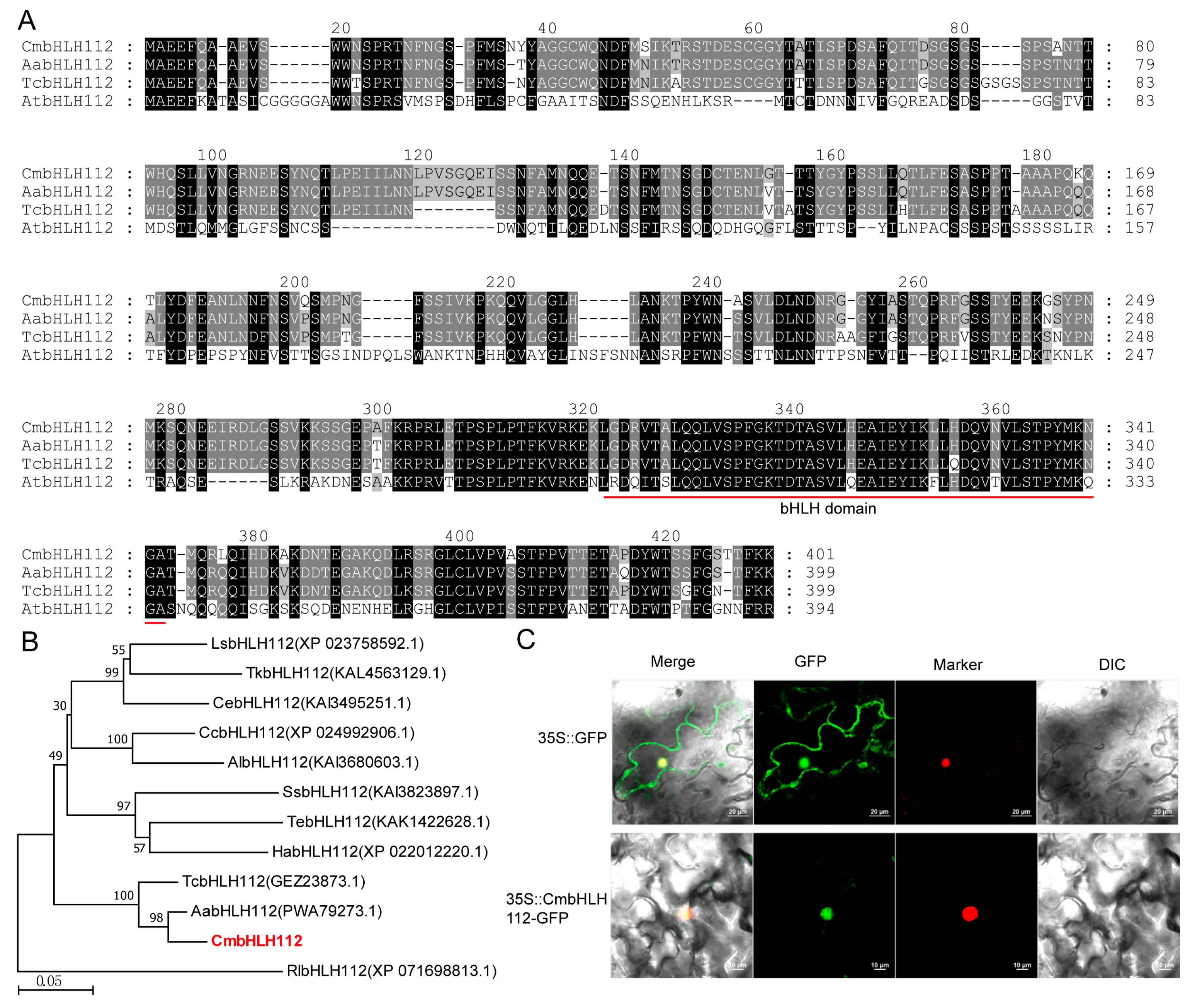
The full-length CmbHLH112 gene was amplified from the leaf cDNA of chrysanthemum cultivar ‘Jinba’, encoding a 400-amino-acid protein with an open reading frame (ORF) of 1203 bp. Bioinformatics analysis revealed that the CmbHLH112 protein contains a highly conserved bHLH domain (Figure 1A). Multiple sequence alignment demonstrated 36.63% amino acid sequence identity with Arabidopsis bHLH112, suggesting functional conservation (Figure 1A). Phylogenetic analysis indicated that CmbHLH112 shares the closest evolutionary relationship with AabHLH112 (Figure 1B).
To investigate the subcellular localization of CmbHLH112, the gene was fused with green fluorescent protein (GFP) and transiently expressed in tobacco (Nicotiana benthamiana) leaf epidermal cells via Agrobacterium tumefaciens-mediated transformation. Confocal microscopy revealed distinct subcellular localization patterns: GFP alone (driven by the CaMV 35S promoter) showed diffuse fluorescence in both the cytoplasm and nucleus. In contrast, the CmbHLH112-GFP fusion protein was exclusively localized to the nucleus, indicating its potential role in nuclear transcriptional regulation (Figure 1C).

3.3. Expression Pattern and Transcriptional Activation Analysis of CmbHLH112

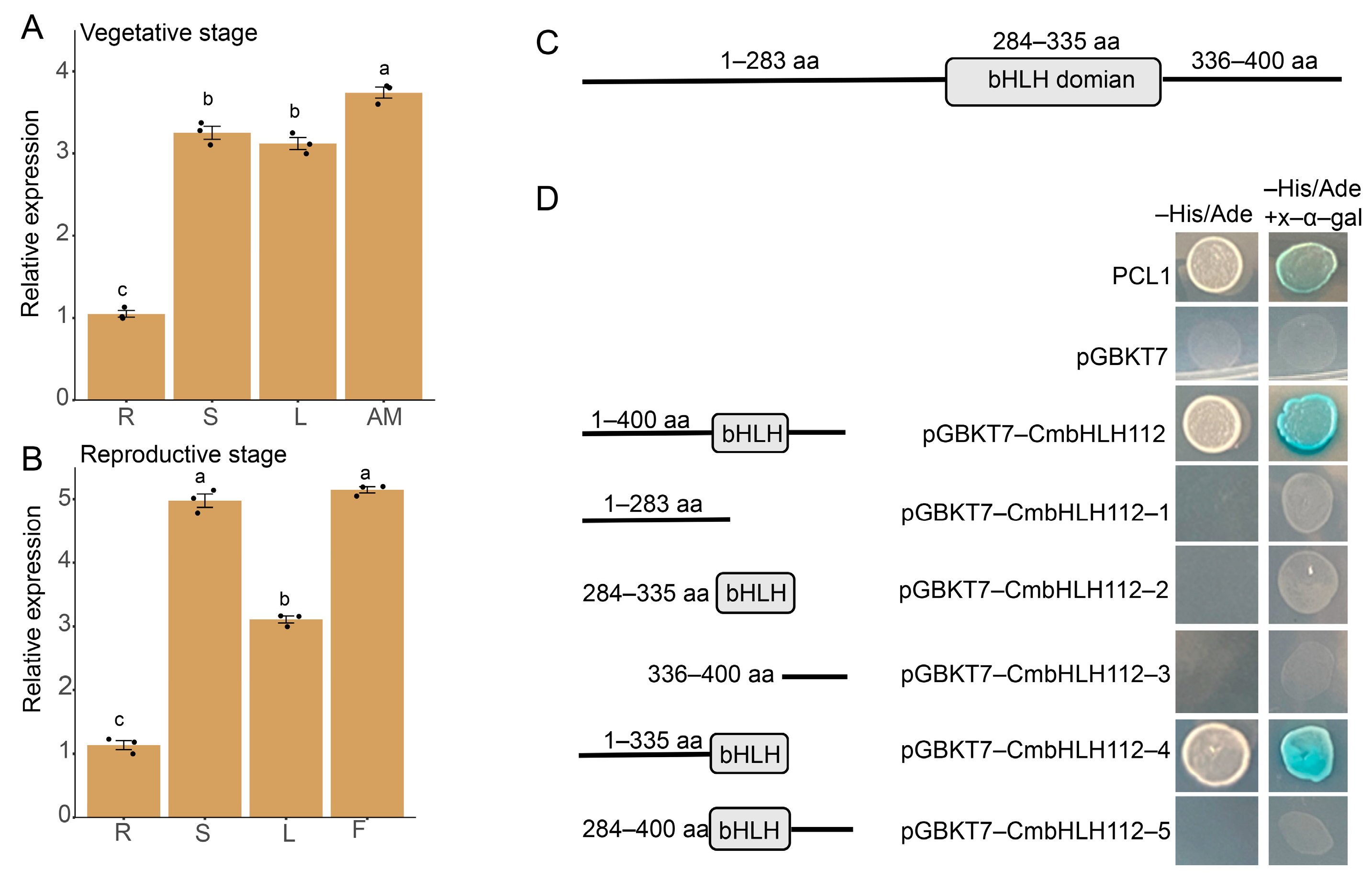
qRT-PCR analysis revealed that, during the vegetative growth period, the expression level of CmbHLH112 was highest in the apical meristem, followed by the stem and leaves (Figure 2A). During the reproductive growth period, its expression was most abundant in stems and flowers, followed by leaves, and lowest in roots (Figure 2B). These findings suggest that CmbHLH112 may be involved in the regulation of floral development in chrysanthemum.
To investigate the transcriptional activation activity of CmbHLH112, yeast two-hybrid (Y2H) assays were performed using the pGBKT7-CmbHLH112 plasmid, along with positive (pCL1) and negative (pGBKT7 empty vector) controls. The results demonstrated that yeast of pCL1 grew on SD/-Ade/-His selective medium and turned blue with X-α-gal staining. No growth or blue coloration was observed for yeast carrying the pGBKT7 plasmid on the selective medium, while yeast of pGBKT7-CmbHLH112 grew on selective medium and exhibited X-α-gal-dependent blue coloration, confirming transcriptional activation activity (Figure 2D).
To localize the transcriptional activation domain, CmbHLH112 was first truncated into three segments based on its conserved domains (Figure 2C): pGBKT7-CmbHLH112-1 (1–283 aa, N-terminal), pGBKT7-CmbHLH112-2 (284–335 aa, bHLH conserved domain), and pGBKT7-CmbHLH112-3 (336–400 aa, C-terminal). None of these fragments exhibited transcriptional activation activity. We further dissected CmbHLH112 into two additional segments: pGBKT7-CmbHLH112-4 (1–335 aa, encompassing the N-terminal and bHLH domain) and pGBKT7-CmbHLH112-5 (284–400 aa, including the bHLH domain and C-terminal). Only pGBKT7-CmbHLH112-4 retained transcriptional activation activity, indicating that the transcriptional activation function of CmbHLH112 relies on a composite interdomain-dependent mechanism rather than a single linear activation motif (Figure 2D).

3.4. Overexpression of CmbHLH112 Promoted Flowering in Arabidopsis

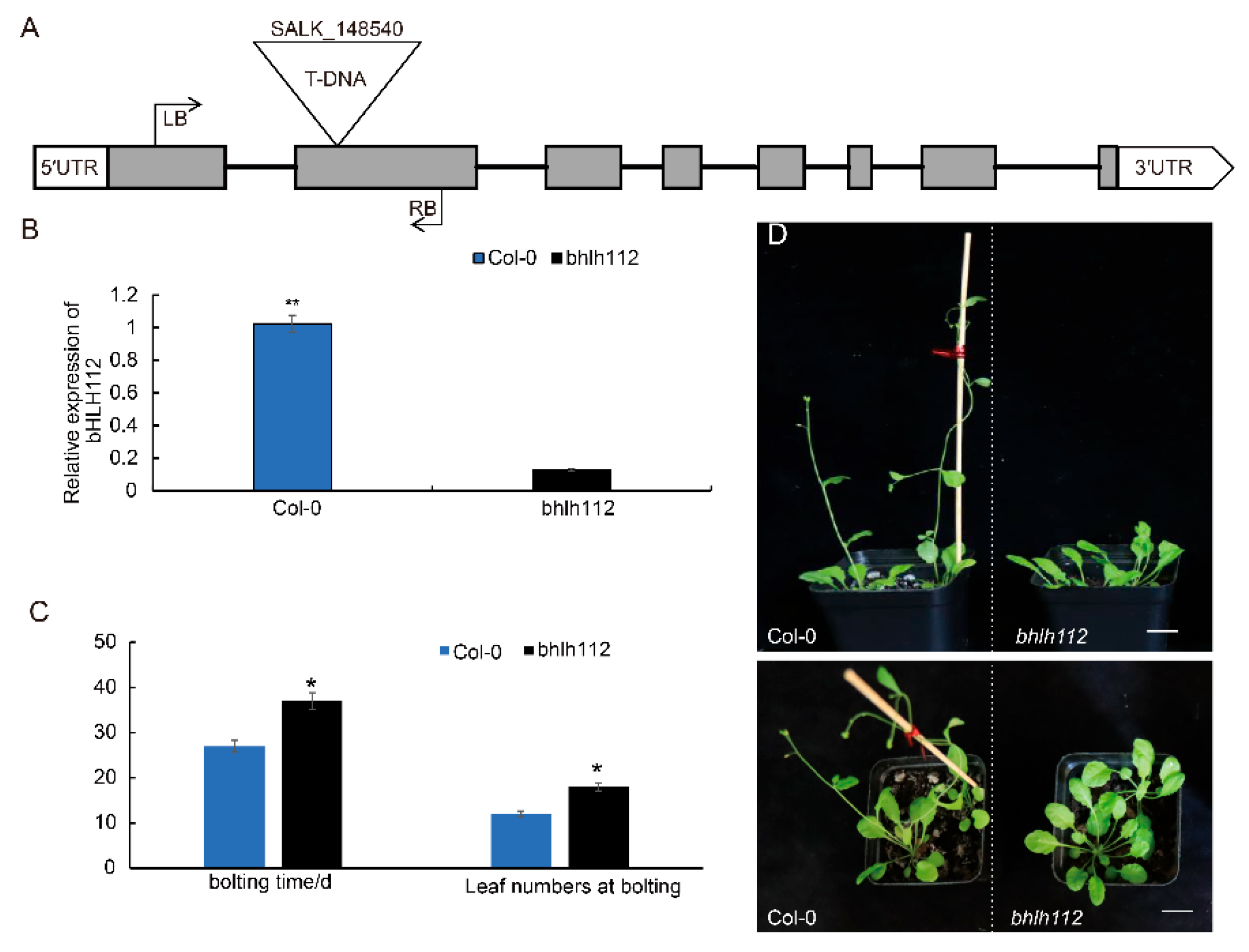
To further characterize the function of CmbHLH112, we obtained a homozygous T-DNA insertion mutant (SALK_148540, Columbia background) of its Arabidopsis homolog AtbHLH112, as previously reported by Chen et al. [30] (Figure 3A). qRT-PCR analysis showed that bHLH112 transcripts were almost absent in the T-DNA mutant line designated bhlh112 (Figure 3B). Phenotypic characterization demonstrated that the bhlh112 mutant (SALK) exhibited a loss-of-function phenotype, with flowering significantly delayed by 10 days relative to Col-0 under long-day conditions (Figure 3C,D).
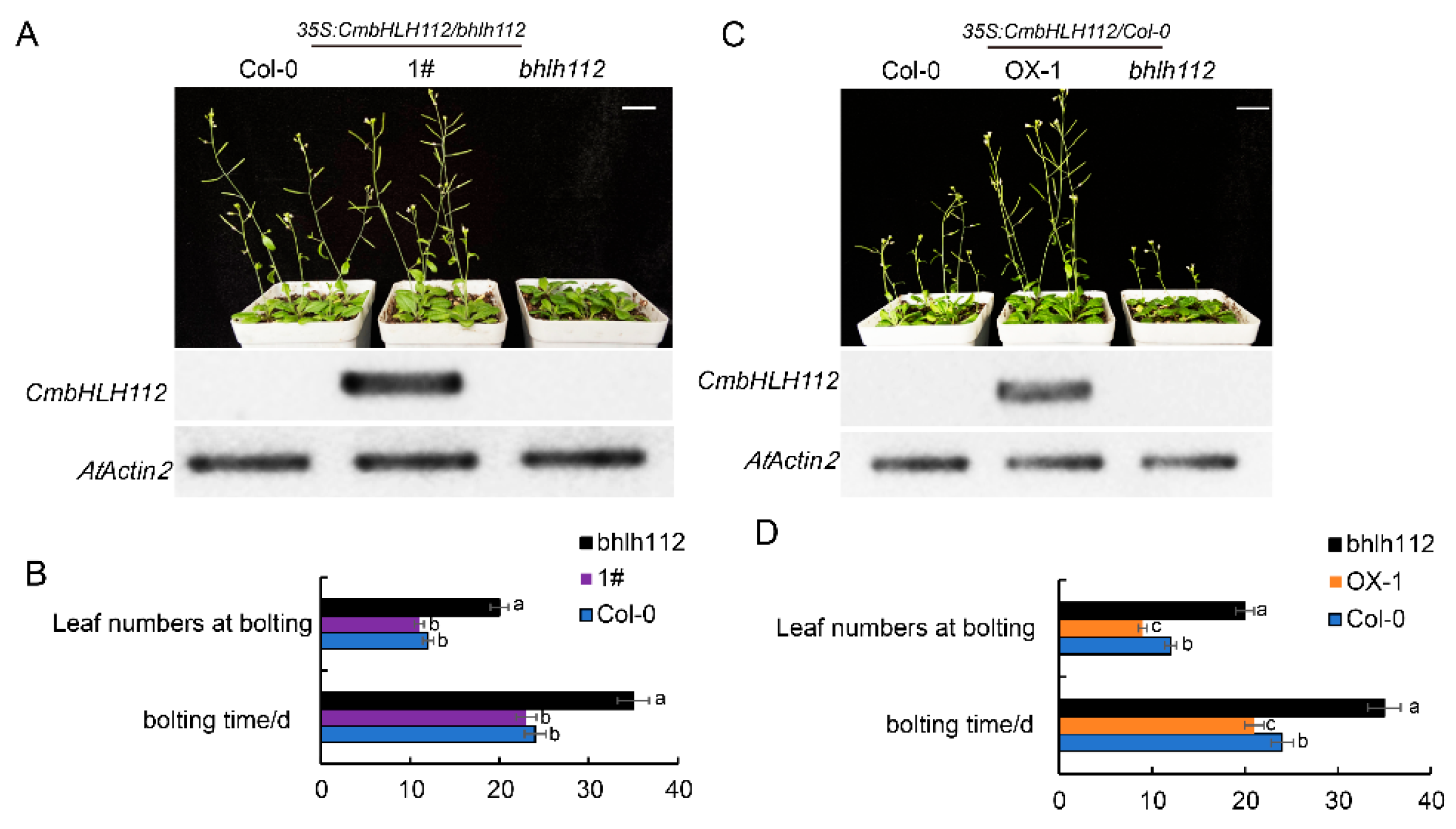
We further constructed an overexpression vector (pORE-R4-CmbHLH112) and introduced it into Arabidopsis. Transformants were successfully selected based on kanamycin resistance and confirmed by PCR amplification. RT-PCR analysis revealed a specific band in the transgenic lines that was absent in Col-0 (Figure 4), validating stable CmbHLH112 expression. Under LD conditions, the flowering time was quantified by measuring the days to flowering and leaf number at flowering. Intriguingly, overexpression of CmbHLH112 in the Arabidopsis bhlh112 mutant (1#) fully rescued the late-flowering phenotype, with the transgenic plants showing no statistically significant difference in the flowering time or leaf number compared to Col-0 (Figure 4A,B). Overexpression of CmbHLH112 in the Col-0 background (OX) consistently induced early flowering across all transgenic lines (Figure 4C,D). Collectively, these results demonstrate that CmbHLH112 functions as a positive regulator of flowering, with its role highly conserved between chrysanthemum and Arabidopsis. The ability to rescue the bhlh112 mutant phenotype further underscores its functional equivalence to the Arabidopsis ortholog.
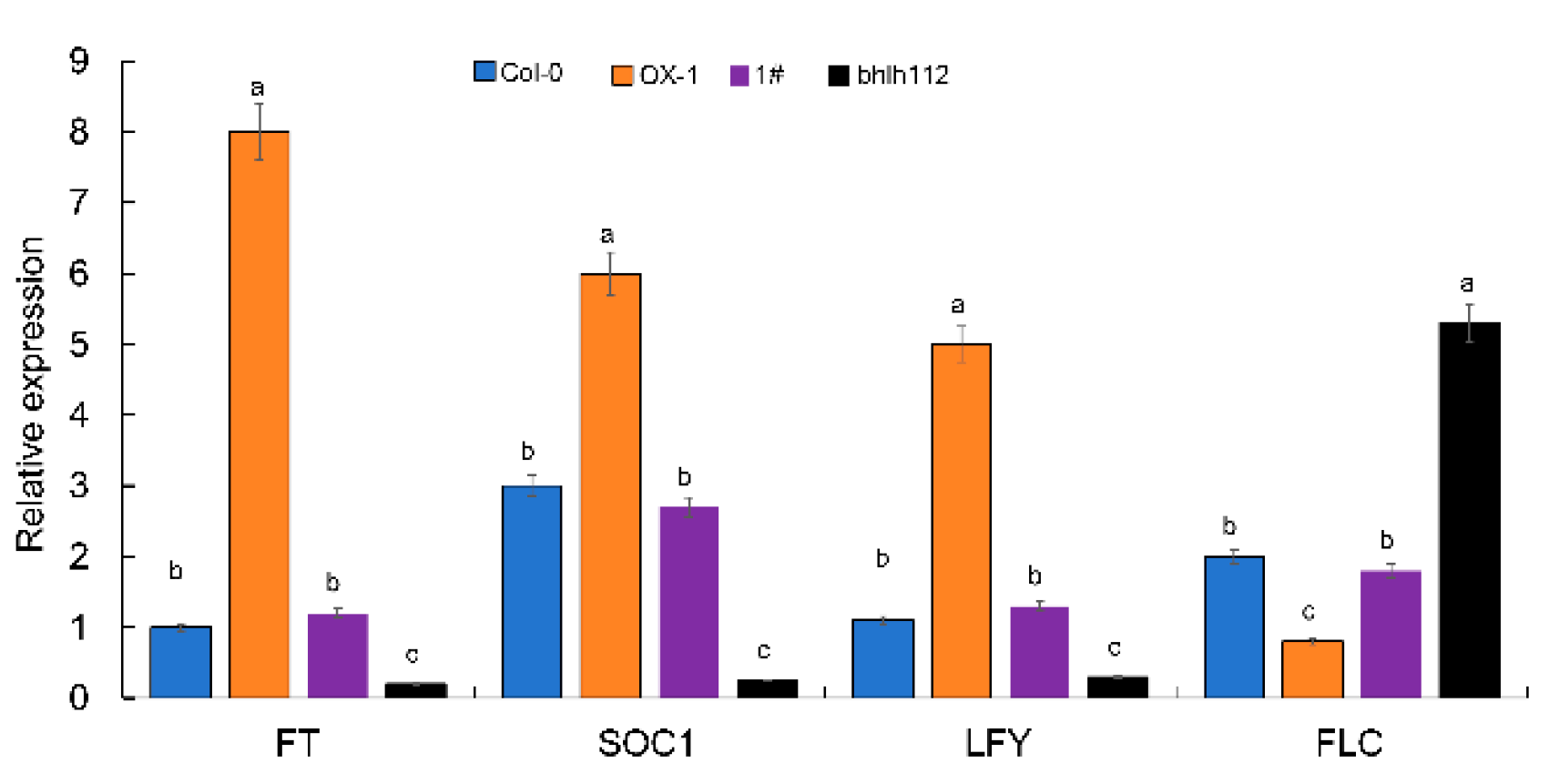
qRT-PCR analysis revealed distinct expression patterns of flowering-related genes in transgenic Arabidopsis lines compared to Col-0. The floral integrators FT (Flowering Locus T), CO (Constans), SOC1 (Suppressor of Constans 1), and LFY (Leafy) exhibited significant transcriptional upregulation in CmbHLH112-overexpressing lines in the Col-0 background. By contrast, their expression levels were lower in the bhlh112 mutant than in Col-0. The floral repressor FLC (Flowering Locus C) was markedly downregulated in CmbHLH112-overexpressing lines in the Col-0 background, whereas its expression level was the highest in the bhlh112 mutant. The expression levels of these flowering genes showed no significant differences between Col-0 and the bhlh112 mutant complementation lines (Figure 5). These results collectively demonstrate that CmbHLH112 modulates flowering time in Arabidopsis by affecting the expression of key floral transition genes.

3.5. Overexpression of CmbHLH112 Enhances Drought Resistance in Arabidopsis

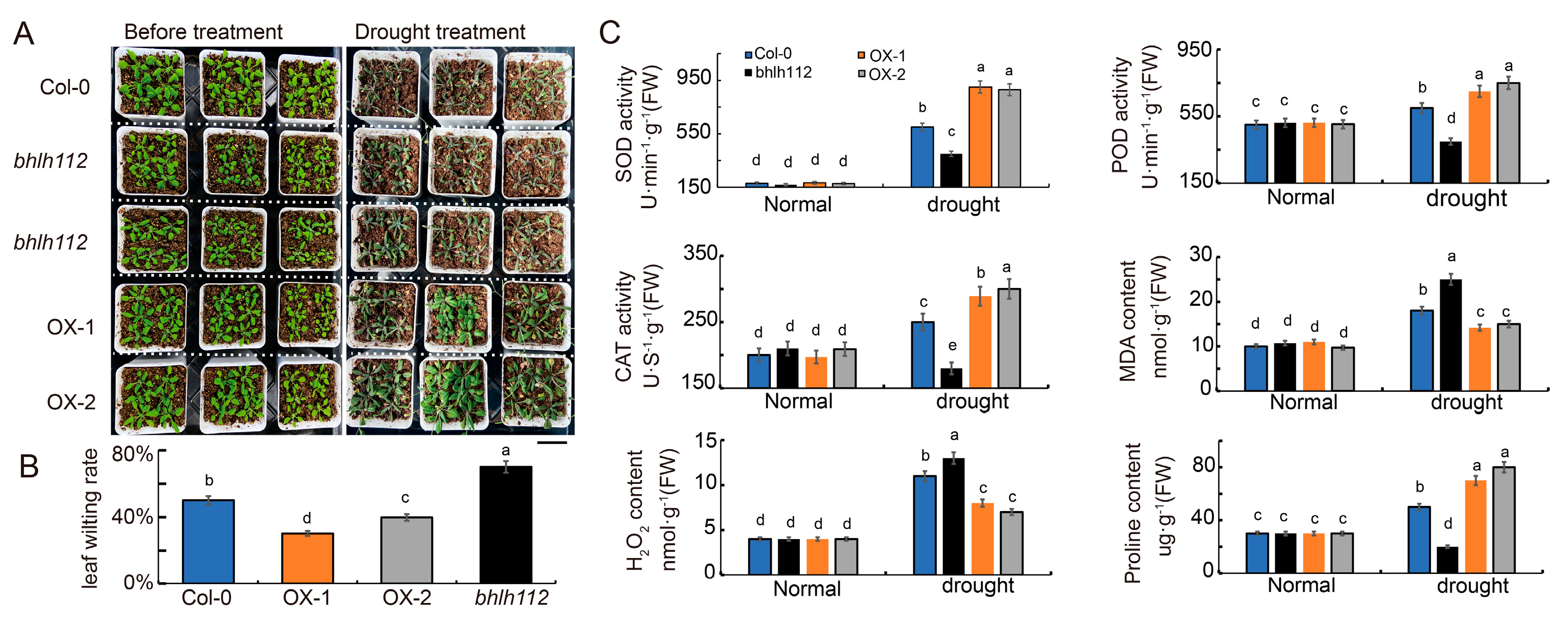
Under normal conditions, no phenotypic differences were observed between the Col-0, bhlh112 mutant (SALK), and two overexpression (OX) transgenic plants (Col-0 background). However, upon drought stress, OX plants exhibited significantly less wilting than Col-0, whereas wilting was significantly increased in SALK plants (Figure 6A). The leaf wilting rates of transgenic lines OX-1 and OX-2 were 30.24% and 39.85%, respectively, while those of Col-0 and SALK plants were 50.12% and 70.11%, respectively (Figure 6B), confirming that CmbHLH112 enhances drought tolerance.
Drought treatment triggered higher activities of antioxidant enzymes (CAT, POD, SOD) in OX plants than in Col-0, accompanied by lower hydrogen peroxide (H2O2) accumulation. Notably, OX plants maintained lower malondialdehyde (MDA) levels under drought stress. Under normal growth conditions, no significant differences in proline content were observed among OX, Col-0, and bhlh112 mutant plants. However, under drought stress, the proline levels varied significantly (p < 0.05), with OX-1 and OX-2 plants exhibiting the highest accumulation and bhlh112 mutant plants showing the lowest levels (Figure 6C).
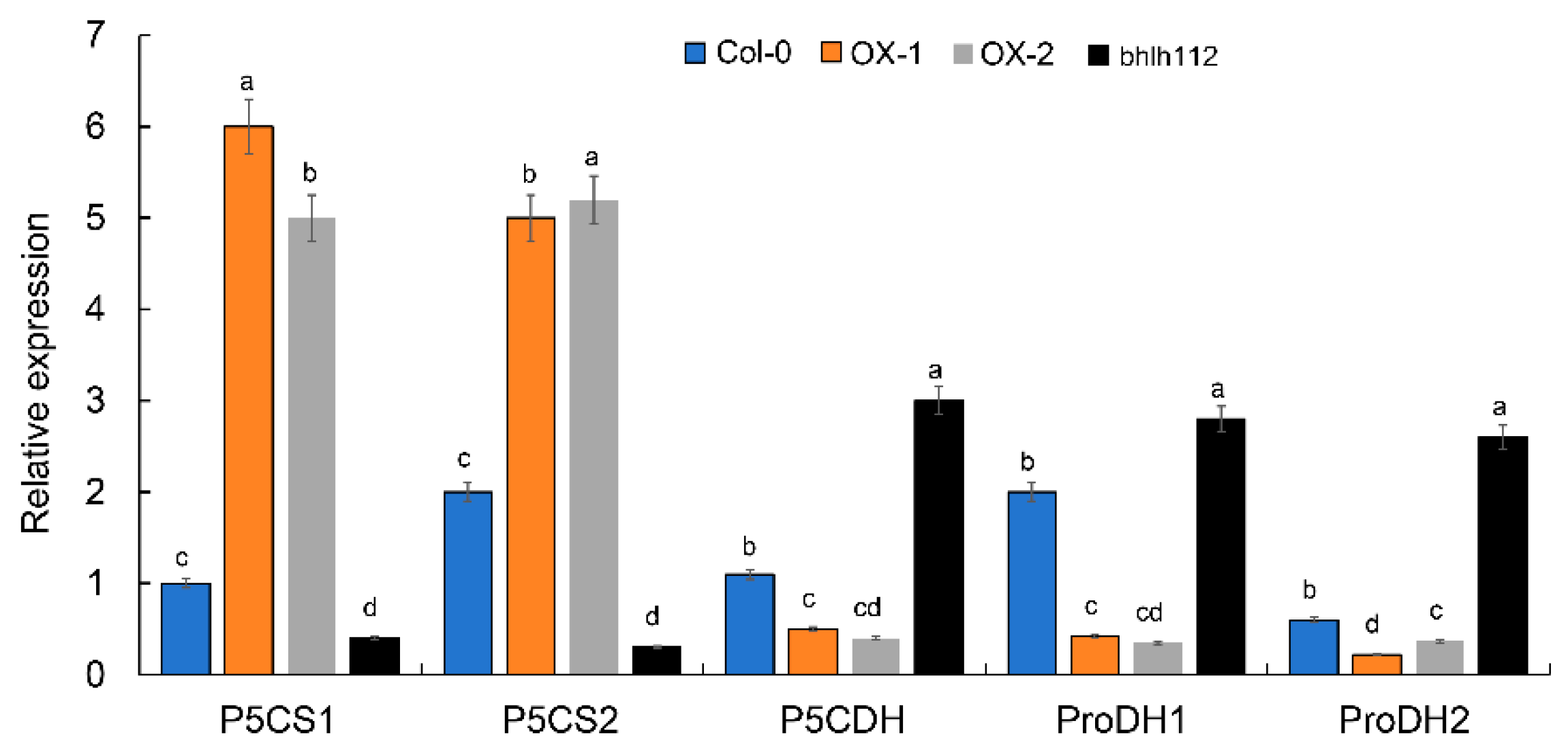
We analyzed the expression of key proline metabolism genes, including two P5CS genes, one P5CDH gene, and two ProDH genes. Under drought stress, their expression exhibited significant differences (p < 0.05) (Figure 7). P5CS1 transcripts were most abundant in OX-1 and OX-2 plants, followed by Col-0 and SALK lines. Conversely, ProDH1 and ProDH2 expression was lowest in OX plants, intermediate in Col-0 plants, and highest in bhlh112 mutant plants under drought conditions. Similarly, P5CDH expression was highest in bhlh112 mutant plants, followed by Col-0 and OX lines (Figure 7). Collectively, these results demonstrate that CmbHLH112 overexpression enhances drought resistance by elevating the antioxidant capacity.
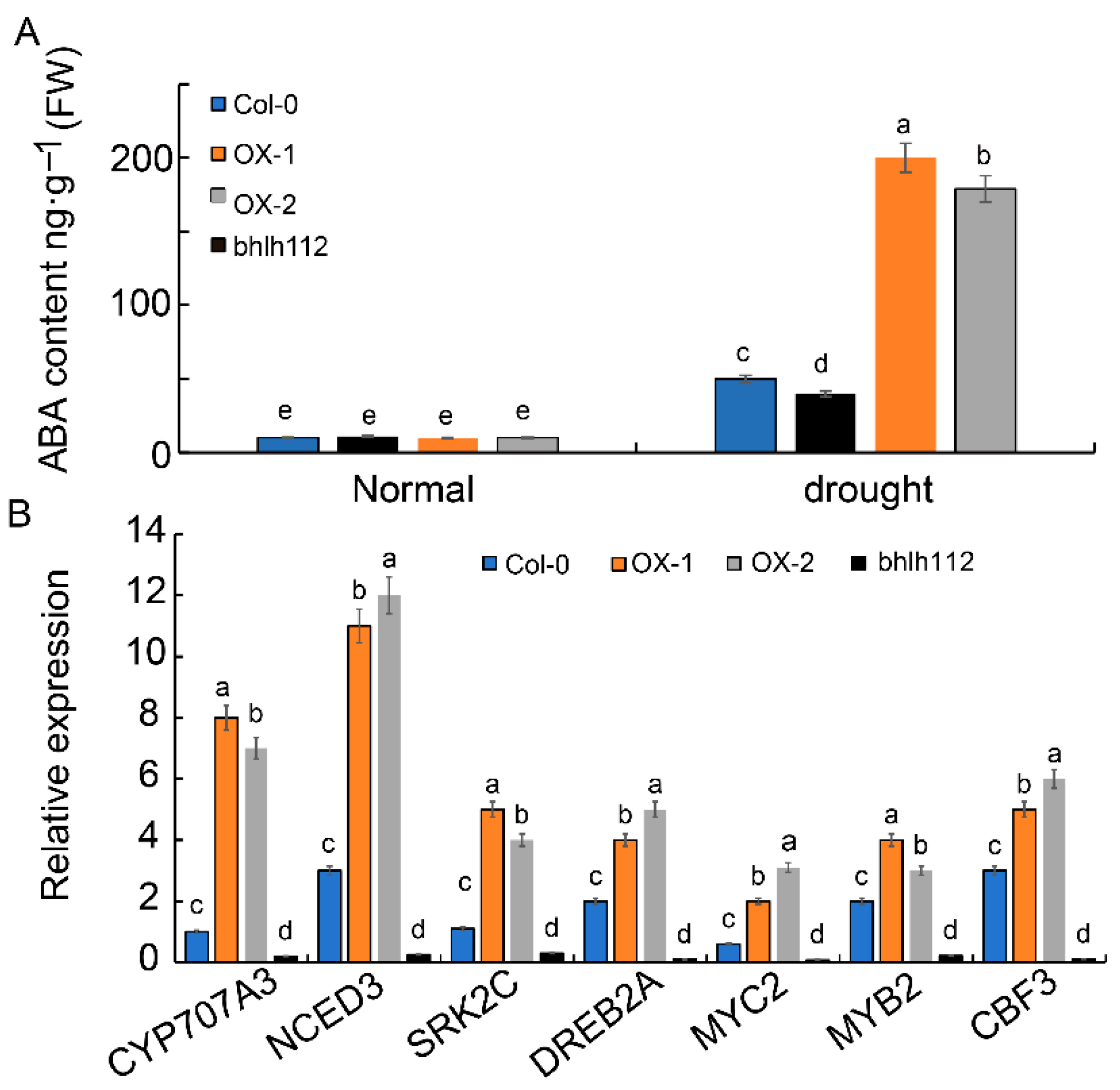
ABA is also a key hormone in plant responses to drought stress, and its synthesis, transport, and signaling pathways directly affect plant drought resistance [38]. Based on this, we determined the ABA content and found that under normal conditions, the ABA content remained at a low baseline level in all genotypes (Col-0, OX-1, OX-2, and bhlh112), with no significant differences observed among them (Figure 8A). Upon exposure to drought stress, ABA levels were markedly elevated in all plants. Notably, the two overexpression lines (OX-1 and OX-2) accumulated significantly higher ABA content compared with Col-0. In contrast, the bhlh112 mutant exhibited the lowest ABA content under drought stress, which was significantly lower than that in Col-0. These results indicate that CmbHLH112 positively regulates ABA accumulation under drought stress (Figure 8A).
The relative expression levels of key genes involved in ABA catabolism (CYP707A3) and ABA-dependent stress signaling (NCED3, SRK2C, DREB2A, MYC2, MYB2, CBF3) were significantly altered under drought stress (Figure 8B). Specifically, the expression of CYP707A3, which encodes a major ABA 8′-hydroxylase, was significantly higher in the OX-1 and OX-2 than in Col-0, while it was markedly suppressed in the bhlh112 mutant. The expression of NCED3, a rate-limiting enzyme in ABA biosynthesis, as well as downstream signaling components including SRK2C, DREB2A, MYC2, MYB2, and CBF3, was significantly upregulated in the overexpression lines but remained at very low levels in the bhlh112 mutant. These findings suggest that CmbHLH112 modulates ABA homeostasis by coordinately regulating ABA biosynthesis and catabolism, thereby activating ABA-dependent stress signaling pathways to enhance drought tolerance in Arabidopsis.

4. Discussion

The regulation of the flowering time and abiotic stress tolerance are critical determinants of agricultural productivity and plant fitness. Extensive studies have revealed that bHLH transcription factors function as molecular switches integrating environmental signals with developmental programs, playing a dual role in plant stress adaptation and development [39]. The functional versatility of bHLH proteins underscores their evolutionary importance as central regulators of plant–environment interactions.
AtbHLH112 and its homolog from Oryza sativa (OsbHLH68) have been documented to function in abiotic stress responses and flowering regulation [30]. AabHLH112, isolated from Artemisia annua, is responsive to low-temperature induction, and its overexpression significantly enhances the expression of AaERF1 while promoting artemisinin biosynthesis [40]. In peanut, the bHLH transcription factor AhbHLH112 improves drought tolerance [13]. These findings suggest that bHLH112 proteins have undergone subfunctionalization during plant evolution, acquiring species-specific roles in stress adaptation, development, and specialized metabolism.
To investigate the function of bHLH112 in chrysanthemum, we cloned CmbHLH112, a homolog of AtbHLH112. This gene is 1204 bp in length, encodes 400 amino acids, and contains a typical bHLH domain. The conserved domains of CmbHLH112 and AtbHLH112 share high sequence similarity (Figure 1). Furthermore, AtbHLH112 is expressed in the upper true leaves of transgenic Arabidopsis seedlings, with a spatial distribution that overlaps closely during the juvenile-to-adult transition [30]. qRT-PCR analysis showed that CmbHLH112 was expressed in all tissues of chrysanthemum ‘Jinba’. During vegetative growth, its expression level was highest in the apical meristem, whereas during reproductive growth, the expression was highest in stems and flowers, followed by leaves, and lowest in roots. CmbHLH112 and AtbHLH112 exhibit overlapping expression patterns, suggesting that these proteins may play analogous roles in regulating plant growth and development, particularly during phase transitions (Figure 2A,B).
The subcellular localization and functional characterization of CmbHLH112 revealed that it localizes to the nucleus and exhibits transcriptional activation activity, which is consistent with the reported properties of its Arabidopsis homolog AtbHLH112 [31]. Similar to AtbHLH112, which acts as a transcriptional activator by binding to GCG and E-box motifs, we hypothesize that CmbHLH112 may perform similar regulatory functions in chrysanthemum, although further experimental verification is required.
Notably, to further identify its activation domain, we found that neither the N-terminus, bHLH domain, nor the C-terminus alone exhibited transcriptional activity, whereas the N-terminus and bHLH domain combined fragments conferred transcriptional activation. This indicates that the transcriptional activation function of CmbHLH112 relies on a composite interdomain-dependent mechanism rather than a single linear activation motif. Full transcriptional activity requires the cooperation of multiple regions, consistent with a composite activation domain. CmbHLH112 has evolved an extended composite activation architecture, which may have facilitated the functional expansion of bHLH112 proteins. These features may be critical for the environmental adaptation of chrysanthemum as a short-day ornamental crop—highlighting a potential molecular switch mechanism within this transcription factor family that needs further research (Figure 2C,D).
Transcription factors are pivotal regulators of plant growth, development, and stress adaptation. While their pleiotropic functions have been extensively documented in model species, comprehensive studies in chrysanthemum remain limited. For instance, CmNF-YB8 modulates the flowering time by directly regulating cmo-MIR156 in the aging pathway and enhances drought resistance through stomatal regulation and cuticle modification [41]. Similarly, CmBBX24, a zinc finger protein, plays dual roles in abiotic stress tolerance and flowering time control [1]. However, the pleiotropic effects of typical bHLH family members in chrysanthemum on stress responses and floral transition remain understudied. This study found that CmbHLH112 may also have multifunctionality and play a role in regulating flowering and drought resistance.

4.1. Involvement of CmbHLH112 in the Regulation of Flowering Time

Flowering time is essential for plants to complete their life cycle [42].After identifying the homozygous bhlh112 mutant, we characterized its phenotype and found that it flowered later under LD conditions compared with Col-0 (Figure 3). Furthermore, the heterologous expression of CmbHLH112 in the Arabidopsis bhlh112 mutant rescued the late-flowering phenotype under LD conditions. The data revealed no significant difference in flowering time or leaf number at flowering between Col-0 and the transgenic plants that overexpressed CmbHLH112 in the mutant background (Figure 4A,B). Under LD conditions, the flowering time was assessed by scoring the days to flowering and leaf number at flowering, and all CmbHLH112 overexpression lines in the Col-0 background exhibited an early-flowering phenotype (Figure 4 C,D). These findings indicate that CmbHLH112 and AtbHLH112 act as positive regulators of flowering and are functionally conserved between chrysanthemum and Arabidopsis. Flowering time is a critical trait in ornamental plant breeding [43]. In Arabidopsis, flowering is regulated by six major pathways: photoperiod, autonomous, vernalization, gibberellin (GA), temperature, and aging pathways [44]. These pathways converge on the floral integrators FT (FLOWERING LOCUS T) and SOC1 (SUPPRESSOR OF OVEREXPRESSION OF CONSTANS 1), which activate floral meristem identity genes such as LFY (LEAFY) and AP1 (APETALA1) [45,46].
qRT-PCR analysis was performed to detect the relative expression levels of key flowering genes in CmbHLH112 overexpression lines and wild-type plants. The flowering promoters FT, SOC1, and LFY were significantly upregulated, whereas the flowering repressor FLC was significantly downregulated. These results indicate that CmbHLH112 regulates the flowering time in Arabidopsis by affecting the expression of key flowering genes (Figure 5). We therefore propose that CmbHLH112 and AtbHLH112 function redundantly in flowering control. However, since chrysanthemum is a typical short-day plant that differs substantially from Arabidopsis, our current conclusions are preliminary and require further functional verification in chrysanthemum.

4.2. Involvement of CmbHLH112 in the Regulation of Drought Stress Tolerance

While plants utilize various defense mechanisms—such as morphological adaptations [47], physiological responses [48], and molecular pathways [49]—to withstand drought stress, this environmental factor continues to significantly hinder the growth and productivity of chrysanthemum. Consequently, a key challenge for the future is to maintain or even enhance chrysanthemum production under increasingly unfavorable conditions, thereby meeting rising global demands. To accomplish this, it is essential to identify and understand drought-resistant genes. However, research focused on drought resistance in chrysanthemum remains limited compared to other plant species.
Our findings revealed that overexpressing CmbHLH112 in Arabidopsis significantly enhanced their drought resistance. To elucidate the underlying mechanism, we measured the activities of antioxidant enzymes—CAT, POD, and SOD—after drought stress. All three enzymes exhibited significantly higher activity in transgenic plants compared to Col-0 plants. However, under control conditions, no notable differences were observed between the two plant types (Figure 6). Given the superior drought tolerance of transgenic plants, we also examined hydrogen peroxide (H2O2) accumulation, which was lower in overexpressing plants than in Col-0 plants (Figure 6C). Additionally, we analyzed the levels of malondialdehyde (MDA) and proline, key drought resistance indicators, in both wild-type (WT) and transgenic plants. Under normal conditions, MDA and proline levels were similar in both plant types. After drought treatment, the Col-0 plants displayed higher MDA and lower proline levels compared to transgenic plants (Figure 6C). Consistent with these biochemical findings, the leaf wilting rate of transgenic plants was significantly lower than that of Col-0 plants under drought stress.
Proline, a critical osmolyte in plant abiotic stress responses, serves dual roles as an ROS scavenger and a macromolecular stabilizer that prevents denaturation [50]. As we observed that overexpression lines accumulated higher proline content under drought stress, we examined the expression of genes involved in proline biosynthesis and degradation pathways. Like many other plant species, Arabidopsis possesses two genes encoding P5CS isoforms—P5CS1 (At2g39800) and P5CS2 (At3g55610)—that function in proline biosynthesis [51]. Proline degradation is catalyzed by two enzymes, ProDH and P5CDH [52]. A previous study showed that overexpression of a bHLH gene not only elevates proline levels in transgenic Arabidopsis but also regulates genes associated with proline metabolism [53]. AtbHLH112 transcript levels exhibited a positive correlation with P5CS genes and a negative correlation with ProDH and P5CDH under drought stress. Similarly, in our study, proline accumulation was positively correlated with P5CS expression and inversely correlated with ProDH and P5CDH expression (Figure 7). Collectively, these findings indicate that CmbHLH112 enhances proline accumulation by upregulating proline biosynthesis genes (P5CS) and downregulating proline degradation genes (ProDH/P5CDH), thereby improving plant stress tolerance.
In recent reports, plant bHLH proteins may be involved in plant drought tolerance response from several aspects, including stomatal development, leaf and root hair development, and sensitivity to ABA [54]. Drought stress induces the synthesis of the phytohormone ABA, which subsequently triggers stomatal closure and activates the expression of drought-responsive genes. Through microarray technology and other methods, researchers have identified hundreds of genes that exhibit transcriptional responses to drought stress. Many of these drought-inducible genes are activated by external ABA application, while others remain unaffected. Molecular studies have revealed that the transcriptional regulatory network under drought stress comprises both ABA-dependent and ABA-independent pathways [54]. In Arabidopsis, the CYP707A gene family comprises four members (CYP707A1-A4), among which CYP707A3 is the dominant gene responsible for ABA catabolism under drought stress [55]. The present study revealed a synchronous increase in ABA content and CYP707A3 gene expression in Arabidopsis under drought stress. This phenomenon is likely attributed to a dynamic feedback balance. It not only ensures the rapid initiation of stress response but also avoids the side effects of ABA excess through negative feedback regulation, serving as an elaborate regulatory mechanism for Arabidopsis to adapt to drought. Furthermore, this observation indicates that ABA regulation is a complex dynamic network, and the current detection results most probably represent a snapshot of a nonlinear regulatory system rather than a simple unidirectional pathway. Overexpressing the gene for 9-cis-epoxycarotenoid dioxygenase (NCED), an essential enzyme in ABA biosynthesis, boosts drought stress resistance in transgenic Arabidopsis plants [56].In this study, NCED3 increased by more than 11-fold in the overexpression lines, with significant changes in expression levels. The SnRK2 protein kinase (OST1/SRK2E), activated by ABA, plays a pivotal role in the ABA signal transduction pathway by regulating stomatal closure [57,58]. SnRK2s are activated by drought, salinity, and ABA [59]. In this study, SRK2C increased by more than four-fold in the overexpression lines. The overexpression of CmbHLH112 also significantly upregulated the expression of downstream drought responsive transcription factors (DREB2A, MYC2, MYB2, CBF3), while the expression of these genes was significantly inhibited in the mutant. This indicates that CmbHLH112 activates the ABA signaling cascade, amplifies drought signals, and comprehensively activates plant drought resistance defense mechanisms (Figure 8). However, the observed changes in gene expression likely represent indirect or combined effects, and our data only support a role for CmbHLH112 in modulating the relevant transcriptional landscape; deeper regulatory mechanisms require further research.

5. Conclusions

In this study, our data reveal that heterologous overexpression of CmbHLH112 in Arabidopsis leads to enhanced drought tolerance and promotes flowering. Collectively, these results suggest that chrysanthemum CmbHLH112 may serve a dual function in regulating both flowering time and abiotic stress tolerance, which may be mediated at least partially by affecting ABA biosynthesis.

Supplementary Materials

The following supporting information can be downloaded at https://www.mdpi.com/article/10.3390/horticulturae12030383/s1, Figure S1: Prediction of secondary and tertiary structure of CmbHLH112; Table S1: Primers used in the present study.

Author Contributions

Y.H., M.D. and Y.Z. designed the experiments; Y.H. and M.Y. performed the experiments. J.L., K.Z. and J.W. analyzed the data. Y.H. wrote the manuscript. All authors discussed the results and commented on the manuscript. All authors have read and agreed to the published version of the manuscript.

Funding

This research was funded by the Yunnan Agricultural Joint Project (grant NO.202301BD070001-164) and the National Natural Science Foundation of China (grant NO.32460774).

Institutional Review Board Statement

Not applicable.

Informed Consent Statement

Not applicable.

Data Availability Statement

The original contributions presented in this study are included in the article/Supplementary Materials. Further inquiries can be directed to the corresponding authors.

Conflicts of Interest

The authors declare no competing interests.

References

  1. Yang, Y.; Ma, C.; Xu, Y.; Wei, Q.; Imtiaz, M.; Lan, H.; Gao, S.; Cheng, L.; Wang, M.; Fei, Z.; et al. A zinc finger protein regulates flowering time and abiotic stress tolerance in chrysanthemum by modulating gibberellin biosynthesis. Plant Cell 2014, 26, 2038–2054. [Google Scholar] [CrossRef] [PubMed]
  2. Feller, A.; Machemer, K.; Braun, E.L.; Grotewold, E. Evolutionary and comparative analysis of MYB and bHLH plant transcription factors. Plant J. 2011, 66, 94–116. [Google Scholar] [CrossRef] [PubMed]
  3. Toledo-Ortiz, G.; Huq, E.; Quail, P.H. The Arabidopsis Basic/Helix-Loop-Helix Transcription Factor Family. Plant Cell 2003, 15, 1749–1770. [Google Scholar] [CrossRef] [PubMed]
  4. Pires, N.; Dolan, L. Origin and diversification of basic-helix-loop-helix proteins in plants. Mol. Biol. Evol. 2010, 27, 862–874. [Google Scholar] [CrossRef]
  5. Heim, M.A. The Basic Helix-Loop-Helix Transcription Factor Family in Plants: A Genome-Wide Study of Protein Structure and Functional Diversity. Mol. Biol. Evol. 2003, 20, 735–747. [Google Scholar] [CrossRef]
  6. Abe, H.; Urao, T.; Ito, T.; Seki, M.; Shinozaki, K.; Yamaguchi-Shinozaki, K. Arabidopsis AtMYC2 (bHLH) and AtMYB2 (MYB) function as transcriptional activators in abscisic acid signaling. Plant Cell 2003, 15, 63–78. [Google Scholar] [CrossRef]
  7. Liu, W.; Tai, H.; Li, S.; Gao, W.; Zhao, M.; Xie, C.; Li, W.X. bHLH122 is important for drought and osmotic stress resistance in Arabidopsis and in the repression of ABA catabolism. New Phytol. 2013, 201, 1192–1204. [Google Scholar] [CrossRef]
  8. Li, Y.; Yang, X.; Li, X. Role of jasmonate signaling pathway in resistance to dehydration stress in Arabidopsis. Acta Physiol. Plant. 2019, 41, 100. [Google Scholar] [CrossRef]
  9. Liu, H.; Yang, Y.; Liu, D.; Wang, X.; Zhang, L. Transcription factor TabHLH49 positively regulates dehydrin WZY2 gene expression and enhances drought stress tolerance in wheat. BMC Plant Biol. 2020, 20, 259. [Google Scholar] [CrossRef]
  10. Wang, P.; Wu, X.; Li, N.; Nie, H.; Ma, Y.; Wu, J.; Zhang, Z.; Ma, Y. The StbHLH47 transcription factor negatively regulates drought tolerance in potato (Solanum tuberosum L.). BMC Plant Biol. 2025, 25, 14. [Google Scholar] [CrossRef]
  11. Ma, X.; Pan, J.; Ju, Z.; Jia, Z.; Li, Z.; Yang, R.; Yang, P. Functional characterization of AsGRAS24 in Avena sativa reveals its role in enhancing salt tolerance via antioxidant and hormonal regulation in transgenic Arabidopsis thaliana. BMC Plant Biol. 2025, 25, 1102. [Google Scholar] [CrossRef] [PubMed]
  12. Wei, S.; Xia, R.; Chen, C.; Shang, X.; Ge, F.; Wei, H.; Chen, H.; Wu, Y.; Xie, Q. ZmbHLH124 identified in maize recombinant inbred lines contributes to drought tolerance in crops. Plant Biotechnol. J. 2021, 19, 2069–2081. [Google Scholar] [CrossRef] [PubMed]
  13. Li, C.; Yan, C.; Sun, Q.; Wang, J.; Yuan, C.; Mou, Y.; Shan, S.; Zhao, X. The bHLH transcription factor AhbHLH112 improves the drought tolerance of peanut. BMC Plant Biol. 2021, 21, 540. [Google Scholar] [CrossRef] [PubMed]
  14. Mao, K.; Yang, J.; Sun, Y.; Guo, X.; Qiu, L.; Mei, Q.; Li, N.; Ma, F. MdbHLH160 is stabilized via reduced MdBT2-mediated degradation to promote MdSOD1 and MdDREB2A-like expression for apple drought tolerance. Plant Physiol. 2024, 194, 1181–1203. [Google Scholar] [CrossRef]
  15. Tan, Y.; Wang, W.; Tian, W.; Wang, B.; Zhao, Q.; Liang, J.; Zhao, W.; Wen, P. Functional Characterization of Grapevine VviMYC4 in Regulating Drought Tolerance by Mediating Flavonol Biosynthesis. Plants 2025, 14, 1409. [Google Scholar] [CrossRef]
  16. Lian, Y.M.F.; Li, B.; Guo, C.; Hu, T.; Zhang, M.; Liang, Y.; Zhu, J.; Zhang, X. A bHLH transcription factor, SlbHLH96, promotes drought tolerance in tomato. Hortic. Res. 2022, 9, uhac198. [Google Scholar] [CrossRef]
  17. Liu, X.; Wang, Y.; Ma, X.; Zhang, H.; Zhou, Y.; Ma, F.; Li, C. MdbHLH93 confers drought tolerance by activating MdTyDC expression and promoting dopamine biosynthesis. Int. J. Biol. Macromol. 2024, 258, 129003. [Google Scholar] [CrossRef]
  18. Zhao, W.; Ding, L.; Liu, J.; Zhang, X.; Li, S.; Zhao, K.; Guan, Y.; Song, A.; Wang, H.; Chen, S.; et al. Regulation of lignin biosynthesis by an atypical bHLH protein CmHLB in Chrysanthemum. J. Exp. Bot. 2022, 73, 2403–2419. [Google Scholar] [CrossRef]
  19. Lim, S.-H.; Kim, D.-H.; Jung, J.-A.; Lee, J.-Y. Alternative Splicing of the Basic Helix–Loop–Helix Transcription Factor Gene CmbHLH2 Affects Anthocyanin Biosynthesis in Ray Florets of Chrysanthemum (Chrysanthemum morifolium). Front. Plant Sci. 2021, 12, 669315. [Google Scholar] [CrossRef]
  20. Yang, Y.; Qian, Z.; Li, Y.; Liu, R.; Qiao, H.; Shao, Z.; Huang, D.; Jiang, J.; Chen, F.; Chen, S.; et al. Competition Binding of CmbHLH1L and CmNLP6/7L to CmbHLH63 Modulates Leaf Senescence in Chrysanthemum. Plant Biotechnol. J. 2025, 3, 5456–5473. [Google Scholar] [CrossRef]
  21. Song, Y.H.; Shim, J.S.; Kinmonth-Schultz, H.A.; Imaizumi, T. Photoperiodic Flowering: Time Measurement Mechanisms in Leaves. Annu. Rev. Plant Biol. 2015, 66, 441–464. [Google Scholar] [CrossRef] [PubMed]
  22. Wigge, P.A.; Kim, M.C.; Jaeger, K.E.; Busch, W.; Schmid, M.; Lohmann, J.U.; Weigel, D. Integration of Spatial and Temporal Information During Floral Induction in Arabidopsis. Science 2005, 309, 1056–1059. [Google Scholar] [CrossRef] [PubMed]
  23. Hayama, R.; Coupland, G. The molecular basis of diversity in the photoperiodic flowering responses of Arabidopsis and Rice. Plant Physiol. 2004, 135, 677–684. [Google Scholar] [CrossRef] [PubMed]
  24. Oda, A.; Narumi, T.; Li, T.; Kando, T.; Higuchi, Y.; Sumitomo, K.; Fukai, S.; Hisamatsu, T. CsFTL3, a chrysanthemum FLOWERING LOCUS T-like gene, is a key regulator of photoperiodic flowering in chrysanthemums. J. Exp. Bot. 2012, 63, 1461–1477. [Google Scholar] [CrossRef]
  25. Sun, J.; Wang, H.; Ren, L.; Chen, S.; Chen, F.; Jiang, J. CmFTL2 is involved in the photoperiod- and sucrose-mediated control of flowering time in chrysanthemum. Hortic. Res. 2017, 4, 17001. [Google Scholar] [CrossRef]
  26. Ito, S.; Song, Y.H.; Josephson-Day, A.R.; Miller, R.J.; Breton, G.; Olmstead, R.G.; Imaizumi, T. FLOWERING BHLH transcriptional activators control expression of the photoperiodic flowering regulator CONSTANS in Arabidopsis. Proc. Natl. Acad. Sci. USA 2012, 109, 3582–3587. [Google Scholar] [CrossRef]
  27. Sharma, N.; Xin, R.; Kim, D.H.; Sung, S.; Lange, T.; Huq, E. NO FLOWERING IN SHORT DAY (NFL) is a bHLH transcription factor that promotes flowering specifically under short-day conditions in Arabidopsis. Development 2016, 143, 682–690. [Google Scholar]
  28. Wang, J.; Hu, J.; Qian, Q.; Xue, H.-W. LC2 and OsVIL2 Promote Rice Flowering by Photoperoid-Induced Epigenetic Silencing of OsLF. Mol. Plant 2013, 6, 514–527. [Google Scholar] [CrossRef]
  29. Huang, Y.; Xing, X.; Jin, J.; Tang, Y.; Ding, L.; Song, A.; Chen, S.; Chen, F.; Jiang, J.; Fang, W. CmbHLH110, a novel bHLH transcription factor, accelerates flowering in chrysanthemum. Hortic. Plant J. 2024, 10, 1437–1448. [Google Scholar] [CrossRef]
  30. Chen, H.C.; Hsieh-Feng, V.; Liao, P.C.; Cheng, W.H.; Liu, L.Y.; Yang, Y.W.; Lai, M.H.; Chang, M.C. The function of OsbHLH068 is partially redundant with its homolog, AtbHLH112, in the regulation of the salt stress response but has opposite functions to control flowering in Arabidopsis. Plant Mol. Biol. 2017, 94, 531–548. [Google Scholar] [CrossRef]
  31. Liu, Y.; Ji, X.; Nie, X.; Qu, M.; Zheng, L.; Tan, Z.; Zhao, H.; Huo, L.; Liu, S.; Zhang, B.; et al. Arabidopsis AtbHLH112 regulates the expression of genes involved in abiotic stress tolerance by binding to their E-box and GCG-box motifs. New Phytol. 2015, 207, 692–709. [Google Scholar] [CrossRef] [PubMed]
  32. Murashige, T.; Skoog, F. A revised medium for rapid growth and bio agsays with tohaoco tissue cultures. Physiol. Plant. 1962, 15, 473–479. [Google Scholar] [CrossRef]
  33. Wang, N.-N.; Xu, S.-W.; Sun, Y.-L.; Liu, D.; Zhou, L.; Li, Y.; Li, X.-B. The cotton WRKY transcription factor (GhWRKY33) reduces transgenic Arabidopsis resistance to drought stress. Sci. Rep. 2019, 9, 724. [Google Scholar] [CrossRef] [PubMed]
  34. Clough, S.J.; Bent, A.F. Floral dip: A simplified method for Agrobacterium-mediated transformation of Arabidopsis thaliana. Plant J. 1998, 16, 735–743. [Google Scholar] [CrossRef]
  35. Livak, K.J.; Schmittgen, T.D. Analysis of relative gene expression data using real-time quantitative PCR and the 2(-Delta Delta C(T)) Method. Methods 2001, 25, 402–408. [Google Scholar] [CrossRef]
  36. Hui, Z.; Tian, F.-X.; Wang, G.-k.; Wang, G.-P.; Wang, W. The antioxidative defense system is involved in the delayed senescence in a wheat mutant tasg1. Plant Cell Rep. 2012, 31, 1073–1084. [Google Scholar] [CrossRef]
  37. Li, B.; Li, Q.; Xiong, L.; Kronzucker, H.J.; Krämer, U.; Shi, W. Arabidopsis Plastid AMOS1/EGY1 Integrates Abscisic Acid Signaling to Regulate Global Gene Expression Response to Ammonium Stress. Plant Physiol. 2012, 160, 2040–2051. [Google Scholar] [CrossRef]
  38. Wei, L.; Wang, L.; Yang, Y.; Wang, P.; Guo, T.; Kang, G. Abscisic acid enhances tolerance of wheat seedlings to drought and regulates transcript levels of genes encoding ascorbate-glutathione biosynthesis. Front. Plant Sci. 2015, 6, 458. [Google Scholar] [CrossRef]
  39. Lei, P.; Jiang, Y.; Zhao, Y.; Jiang, M.; Ji, X.; Ma, L.; Jin, G.; Li, J.; Zhang, S.; Kong, D.; et al. Functions of Basic Helix–Loop–Helix (bHLH) Proteins in the Regulation of Plant Responses to Cold, Drought, Salt, and Iron Deficiency: A Comprehensive Review. J. Agric. Food Chem. 2024, 72, 10692–10709. [Google Scholar] [CrossRef]
  40. Xiang, L.; Jian, D.; Zhang, F.; Yang, C.; Bai, G.; Lan, X.; Chen, M.; Tang, K.; Liao, Z. The cold-induced transcription factor bHLH112 promotes artemisinin biosynthesis indirectly via ERF1 in Artemisia annua. J. Exp. Bot. 2019, 70, 4835–4848. [Google Scholar] [CrossRef]
  41. Wei, Q.; Ma, C.; Xu, Y.; Wang, T.; Chen, Y.; Lu, J.; Zhang, L.; Jiang, C.Z.; Hong, B.; Gao, J. Control of chrysanthemum flowering through integration with an aging pathway. Nat. Commun. 2017, 8, 829. [Google Scholar] [CrossRef] [PubMed]
  42. Blümel, M.; Dally, N.; Jung, C. Flowering time regulation in crops-what did we learn from Arabidopsis? Curr. Opin. Biotechnol. 2015, 32, 121–129. [Google Scholar] [CrossRef] [PubMed]
  43. Jung, C.; Müller, A.E. Flowering time control and applications in plant breeding. Trends Plant Sci. 2009, 14, 563–573. [Google Scholar] [CrossRef]
  44. Fornara, F.; de Montaigu, A.; Coupland, G. SnapShot: Control of Flowering in Arabidopsis. Cell 2010, 141, 550–550.e2. [Google Scholar] [CrossRef] [PubMed]
  45. Simpson, G.G.; Dean, C. Arabidopsis, the rosetta stone of flowering time? Science 2002, 296, 285–289. [Google Scholar] [CrossRef]
  46. Song, Y.H.; Ito, S.; Imaizumi, T. Flowering time regulation: Photoperiod- and temperature-sensing in leaves. Trends Plant Sci. 2013, 18, 575–583. [Google Scholar] [CrossRef]
  47. DaMatta, F.M. Exploring drought tolerance in coffee: A physiological approach with some insights for plant breeding. Plant Physiol. 2024, 16, 1–6. [Google Scholar] [CrossRef]
  48. Ramon, M.; Rolland, F.; Thevelein, J.M.; Van Dijck, P.; Leyman, B. ABI4 mediates the effects of exogenous trehalose on Arabidopsis growth and starch breakdown. Plant Mol. Biol. 2006, 63, 195–206. [Google Scholar] [CrossRef]
  49. Cattivelli, L.; Rizza, F.; Badeck, F.-W.; Mazzucotelli, E.; Mastrangelo, A.M.; Francia, E.; Marè, C.; Tondelli, A.; Stanca, A.M. Drought tolerance improvement in crop plants: An integrated view from breeding to genomics. Field Crops Res. 2008, 105, 1–14. [Google Scholar] [CrossRef]
  50. Kim, G.-B.; Nam, Y.-W. A novel Δ1-pyrroline-5-carboxylate synthetase gene of Medicago truncatula plays a predominant role in stress-induced proline accumulation during symbiotic nitrogen fixation. J. Plant Physiol. 2013, 170, 291–302. [Google Scholar] [CrossRef]
  51. Funck, D.W.G.; Baumgarten, L.; Forlani, G. Requirement of proline synthesis during Arabidopsis reproductive development. BMC Plant Biol. 2012, 12, 191. [Google Scholar] [CrossRef]
  52. Cecchini, N.M.M.; Alvarez, M. Proline Dehydrogenase Contributes to Pathogen Defense in Arabidopsis. Plant Physiol. 2011, 155, 1947–1959. [Google Scholar] [CrossRef]
  53. Zhang, J.-S.; Xu, W.; Jiao, Y.; Li, R.; Zhang, N.; Xiao, D.; Ding, X.; Wang, Z. Chinese Wild-Growing Vitis amurensis ICE1 and ICE2 Encode MYC-Type bHLH Transcription Activators that Regulate Cold Tolerance in Arabidopsis. PLoS ONE 2014, 9, e102303. [Google Scholar]
  54. Cutler, S.R.; Rodriguez, P.L.; Finkelstein, R.R.; Abrams, S.R. Abscisic Acid: Emergence of a Core Signaling Network. Annu. Rev. Plant Biol. 2010, 61, 651–679. [Google Scholar] [CrossRef] [PubMed]
  55. Kushiro, T.; Okamoto, M.; Nakabayashi, K.; Kitamura, S.; Nambara, E. The Arabidopsis cytochrome P450 CYP707A encodes ABA 8 -hydroxylases: Key enzymes in ABA. EMBO J. 2004, 23, 1647. [Google Scholar] [CrossRef] [PubMed]
  56. Iuchi, S.K.M.; Taji, T.; Naramoto, M.; Seki, M.; Kato, T. Regulation of drought tolerance by gene manipulation of 9-cis-epoxycarotenoid dioxygenase, a key enzyme in abscisic acid biosynthesis in Arabidopsis. Plant J. 2021, 27, 325–333. [Google Scholar] [CrossRef]
  57. Mustilli, A.-C.; Merlot, S.; Vavasseur, A.; Fenzi, F.; Giraudat, J. Arabidopsis OST1 Protein Kinase Mediates the Regulation of Stomatal Aperture by Abscisic Acid and Acts Upstream of Reactive Oxygen Species Production. Plant Cell 2002, 14, 3089–3099. [Google Scholar] [CrossRef]
  58. Umezawa, T.Y.R.; Maruyama, K.; Yamaguchi-Shinozaki, K.; Shinozaki, K. SRK2C.A SNF1-related protein kinase 2, improves drought tolerance by controlling stress-responsive gene expression in Arabidopsis thaliana. Proc. Natl. Acad. Sci. USA 2004, 101, 17306–17311. [Google Scholar] [CrossRef]
  59. Yoshida, R.H.T.; Ichimura, K.; Mizoguchi, T.; Takahashi, F.; Aronso, J.; Ecker, J.R.; Shinozaki, K. ABA-Activated SnRK2 Protein Kinase is Required for Dehydration Stress Signaling in Arabidopsis. Plant Cell Physiol. 2002, 43, 1473–1483. [Google Scholar] [CrossRef]
Figure 1. Sequence and subcellular localization analysis of CmbHLH112. (A) The predicted peptide sequence of CmbHLH112 was aligned with bHLH112 sequences from other plant species. The conserved bHLH domain is highlighted in red. (B) A phylogenetic tree was constructed using the CmbHLH112 sequence and bHLH112 homologs from various species. The bHLH112 family proteins included the following: AabHLH112 (Artemisia annua PWA79273.1), TcbHLH112 (Tanacetum cinerariifolium GEZ23873.1), LsbHLH112 (Lactuca sativa XP_023758592.1), CebHLH112 (Cichorium endivia KAI3495251.1), CcbHLH112 (Cynara cardunculus XP_024992906.1), AlbHLH112 (Arctium lappa KAI3680603.1), TkbHLH112 (Taraxacum kok-saghyz KAI3680603.1), TebHLH112 (Tagetes erecta KAK1422628.1), HsbHLH112 (Helianthus annuus XP_022012220.1). (C) Subcellular localization of CmbHLH112 in cells of tobacco leaves. Bars = 20 µm.
Horticulturae 12 00383 g001
Figure 2. Transcriptional activation and expression patterns of CmbHLH112. (A) Expression pattern of CmbHLH112 in wild-type chrysanthemum ‘Jinba’ during the vegetative developmental stage. (B) Expression pattern of CmbHLH112 in wild-type chrysanthemum ‘Jinba’ during the reproductive developmental stage. R: root, S: stem, L: leaf, F: flower, AM: apical meristem. Transcript abundance estimates were based on the 2−ΔΔCt method, and the reference gene was CmEF1α. Error bars represent standard errors (SEs) (n = 3). Significant differences are indicated by letters above the bars (Tukey’s HSD test, p < 0.05). (C) Schematic diagram showing the CmbHLH112 protein conserved domain. (D) Validation of transcriptional activation activity (full-length and segmented) of CmbHLH112 protein.
Horticulturae 12 00383 g002
Figure 3. Identification and phenotypic observation of Arabidopsis bhlh112 mutants. (A) A schematic diagram of bhlh112 mutant T-DNA insertion sites. (B) qRT-PCR validation of bHLH112 expression levels in Col-0 and mutants. (C) Data statistics of bolting time/d and leaf number of bhlh112 mutants under LD conditions. (D) Flowering phenotype of bhlh112 mutants under LD conditions. Bars = 2 cm. * Indicates significant differences between treatments (p < 0.05), ** indicates extremely significant differences between treatments (p < 0.01).
Horticulturae 12 00383 g003
Figure 4. Overexpression of CmbHLH112 accelerates flowering in Arabidopsis. (A) Phenotype of CmbHLH112 overexpression in the bhlh112 mutant background. (B) Bolting time and total leaf number at bolting of Col-0, 1# (overexpression of CmbHLH112 in the bhlh112 mutant background) and bhlh112 mutant. (C) Phenotype of CmbHLH112 overexpression in the Col-0 background. (D) Bolting time and total leaf number at bolting of Col-0, OX-1 (overexpression of CmbHLH112 in the Col-0 background) and bhlh112 mutant. Data are presented as mean ± SE (n = 3). Means with different letters are significantly different (p < 0.05). Bars = 2 cm.
Horticulturae 12 00383 g004
Figure 5. Detection of expression levels of key flowering genes. Transcript abundance estimates were based on the 2−ΔΔCt method, and the reference gene was AtActin2. The error bars indicate SEs (n = 3). Letters above the bars indicate significant differences as determined by Tukey’s HSD test (p < 0.05).
Horticulturae 12 00383 g005
Figure 6. Heterologous expression of CmbHLH112 in Arabidopsis affects drought resistance. (A) Analysis of drought tolerance in the one-month stage. (B) Leaf wilting rate of Col-0, overexpression plants and bhlh112 mutants. (C) Assessment of antioxidant enzyme activity, MDA, H2O2 and proline concentrations under control and drought stress. Col-0: wild-type plants; OX-1 and OX-2: CmbHLH112 overexpression lines in the Col-0 background; bhlh112: mutant plants. Transcript abundance estimates were based on the 2−ΔΔCt method, and the reference gene was AtActin2. Error bars represent standard deviations (SDs) for three independent replicates. Bars = 5 cm. The means for each gene, followed by distinct letters, differ significantly from one another (p < 0.05).
Horticulturae 12 00383 g006
Figure 7. Analysis of the expression of proline biosynthesis and degradation-related genes in Col-0, OX and mutant plants. Col-0: wild-type plants; OX-1 and OX-2: CmbHLH112 overexpression lines in the Col-0 background; bhlh112: mutant plants. Transcript abundance estimates were based on the 2−ΔΔCt method, and the reference gene was AtActin2. The values are shown as the mean ± SE (n = 3). The means for each gene, followed by distinct letters, differ significantly from one another (p < 0.05).
Horticulturae 12 00383 g007
Figure 8. Determination of ABA content and key genes involved in ABA catabolism and ABA-dependent stress signaling. (A) Determination of ABA content. (B) qRT-PCR analysis key genes involved in ABA catabolism and ABA-dependent stress signaling. Col-0: wild-type plants; OX-1 and OX-2: CmbHLH112 overexpression lines in the Col-0 background; bhlh112: mutant plants. Transcript abundance estimates were based on the 2−ΔΔCt method, and the reference gene was AtActin2. The values are shown as the mean ± SE (n = 3). The means for each gene followed by the different letters differ significantly from one another (p < 0.05).
Horticulturae 12 00383 g008
Disclaimer/Publisher’s Note: The statements, opinions and data contained in all publications are solely those of the individual author(s) and contributor(s) and not of MDPI and/or the editor(s). MDPI and/or the editor(s) disclaim responsibility for any injury to people or property resulting from any ideas, methods, instructions or products referred to in the content.