Article

Effects of Long-Term Nitrogen Fertilization on Soil Respiration in Acidic Tea (Camellia sinensis L.) Plantation Soils


1
Tea Research Institute, Fujian Academy of Agricultural Sciences, Fuzhou 350013, China
2
Key Laboratory of Biology, Genetics and Breeding of Special Economic Animals and Plants, Tea Research Institute, Chinese Academy of Agriculture Sciences, Ministry of Agriculture and Rural Affairs, Hangzhou 310008, China
*
Authors to whom correspondence should be addressed.
Horticulturae 2026, 12(3), 372; https://doi.org/10.3390/horticulturae12030372
Submission received: 15 January 2026 / Revised: 13 March 2026 / Accepted: 17 March 2026 / Published: 18 March 2026
(This article belongs to the Special Issue Sustainable Soil Management for Tea Plantations)

Abstract

Soil respiration (Rs) plays an important role in the carbon (C) dynamics of terrestrial ecosystems and is strongly regulated by nitrogen (N) inputs. While the impact of N fertilization on Rs has been widely documented in conventional farmland ecosystems, its patterns and influencing factors in perennial tea plantation systems are still poorly understood. In the study, we conducted a 15-year field experiment in a representative tea plantation to investigate the effects of different N rates (0, 112.5, 225, and 450 kg N ha−1 yr−1) on Rs. Compared to the control (N0), soil pH decreased significantly (p < 0.05) by 6.07%, 11.82%, and 16.12% under N112.5, N225, and N450, respectively. Concurrently, cation exchange capacity (CEC), ammonium (NH4+-N), nitrate (NO3-N), and available phosphorus (AP) increased with increasing N rates, whereas available potassium (AK) decreased. Soil microbial biomass carbon (MBC) initially increased and then decreased with increasing N rates, while dissolved organic carbon (DOC) content increased consistently. The Rs rate exhibited a distinct seasonal pattern with a single peak in August. The annual mean Rs rates were 2.79, 3.15, 4.06, and 3.85 μmol·m−2·s−1 for the N0, N112.5, N225, and N450 treatments, respectively. Soil temperature explained 55.41% to 61.08% of the variation in Rs rates across N treatments, and a composite model incorporating both soil temperature and moisture further improved the prediction of Rs dynamics. Cumulative soil CO2 emissions (CCEs) over the study period ranged from 10,427 to 14,221 kg CO2-C ha−1 across treatments and were significantly negatively correlated with soil pH, and positively correlated with DOC, MBC, and NO3-N content. A non-linear relationship between N application rate and CCEs was observed, highlighting the complexity of optimizing N management for balancing productivity and climate mitigation in tea plantation systems. These findings provide a theoretical basis for developing rational N fertilization strategies and improving the predictive capacity of C cycle models in agroecosystems.

1. Introduction

Tea (Camellia sinensis L.) is one of the most widely consumed beverages globally, and tea plantations (particularly those under intensive management) represent economically and ecologically significant agricultural ecosystems [1]. Nitrogen (N) is the most critical nutrient for tea plant growth and a primary limiting factor in plantation productivity [2]. Tea yield and its quality, particularly amino acid content, generally increase with higher N application rates [3]. However, approximately 30% of tea plantations in China currently receive excessive N fertilizer [4]. This over-application poses serious environmental risks, including soil acidification and disruption of biogeochemical cycles [5].
Soil respiration (Rs), the flux of carbon dioxide (CO2) from soil to the atmosphere, is a central process in the terrestrial carbon (C) cycle. It comprises two main components: autotrophic respiration from plant roots and heterotrophic respiration from microbial decomposition of organic matter [6]. It is generally accepted that even minor changes in Rs can significantly feed back to atmospheric CO2 concentrations and, consequently, global climate dynamics [7]. Therefore, understanding how agricultural practices, such as fertilization, influence Rs is essential for predicting ecosystem C balance.
The response of Rs to N addition has been extensively studied, but the results remain inconsistent and appear highly context-dependent. For example, N addition suppressed Rs in a subtropical forest of China but stimulated it in a semi-arid agricultural ecosystem [8,9]. In degraded alpine grasslands, the effect of N addition on Rs varied with slope aspect, reducing Rs on gentle slopes but showing no effect on steep slopes [10]. These contrasting findings suggest that the impact of N fertilization on Rs is ecosystem-specific, modulated by factors such as soil properties, N application rate, and experimental duration. Notably, most previous studies have focused on relatively short-term responses, potentially overlooking the cumulative effects of chronic N input.
Tea plantations present a unique case for studying long-term N effects. Tea plants are acid-tolerant and accumulate aluminum, thriving optimally at soil pH 4.5–5.5 [11]. However, long-term and excessive application of chemical N fertilizers progressively acidifies tea plantation soils, altering aluminum speciation, base cation availability, and microbial habitat [12]. This long-term, cumulative acidification may push soils beyond critical pH thresholds, below which microbial communities and biogeochemical processes shift fundamentally [13]. Such threshold effects could lead to non-linear responses in Rs that are not predictable from short-term experiments. For instance, studies in subtropical forests have shown that acidification inhibits Rs [14], and in a winter wheat–soybean rotation, acidification reduced the temperature sensitivity of Rs [15]. Despite this, how long-term N-induced acidification specifically modifies the relationships between Rs and its primary environmental drivers (soil temperature and moisture) in tea plantation ecosystems remains poorly understood.
To address this gap, we analyzed data from a long-term (15-year) field experiment in an acidic tea plantation. We measured soil respiration, soil temperature, soil water content, and key physicochemical properties under different long-term N application rates. Our objectives were to: (1) quantify the effects of long-term N fertilization on Rs rates and their seasonal dynamics; (2) assess how N-induced changes in soil physicochemical properties alter the apparent temperature sensitivity (Q10) and soil water content response of Rs; and (3) identify the dominant environmental factors controlling Rs in this acidified system. Specifically, we tested two hypotheses: (1) long-term N fertilization would exhibit a non-linear effect on soil respiration in tea plantations, with Rs initially increasing and then declining at higher N application rates; and (2) soil respiration would be significantly regulated by variations in soil temperature and moisture content, with their relative importance potentially shifting under different N fertilization regimes.

2. Materials and Methods

2.1. Description of Site

The field trial was located in Shekou town, Fu’an City, Fujian Province, China (27°22′ N, 119°57′ E, altitude of 46 m) (Figure S1), affiliated with the Tea Research Institute of Fujian Academy of Agricultural Sciences. The site features a subtropical monsoon climate, with a mean annual precipitation (MAP) and temperature (MAT) of 1894 mm and of 16.9 °C from 2013 to 2022. The above 10-year data were obtained from WorldClim (https://www.worldclim.org), a global weather and climate data database with high spatial resolution. In addition, meteorological data for the experimental period (January to December 2023) were monitored using a WS-MC01 compact automatic weather station installed on-site where the height above the ground is 2 m. During 2023, daily mean temperatures varied from 2.65 °C to 31.74 °C, with MAT of 19.72 °C. The MAP for 2023 was 1550.7 mm. The soil at the site is classified as Alisol (IUSS, 2015; developed from the Quaternary eolian red deposit) and has a loamy clay texture [16].
In 2009, cement ponds (200 cm × 90 cm × 90 cm) with open bottoms were installed between adjacent plots to minimize nutrient flow across treatments (Figure S1). The 90 cm depth was designed to exceed the typical rooting depth of the clonal tea cultivar used in this study, which predominantly develops a fibrous root system within the upper 60 cm of soil, thereby preventing root competition and nutrient interference between adjacent plots. The original soil properties were pH 4.85 (1:2.5, soil/water), 3.69 g kg−1 organic carbon, 0.30 g kg−1 total N, 26.4 mg kg−1 alkaline hydrolyzed N, 4.8 mg kg−1 available phosphorus, and 60.3 mg kg−1 available potassium. In March 2010, seedlings of the local tea cultivar “Yucui #4” were planted at five plants per plot with an intra-row spacing of 0.33 m.

2.2. Experimental Design

The experiment followed a randomized design with four N fertilizer rates (N0, N112.5, N225, and N450; 0, 112.5, 225, and 450 kg N ha−1 yr−1). Each treatment was replicated three times, with each plot covering 1.8 m2, resulting in 12 plots total (Figure S1c). All treatments received P and K fertilizers at rates of 150 kg P2O5 ha−1 and 300 kg K2O ha−1, respectively. The N (urea) and K (potassium sulfate) fertilizers were applied in three splits: 30% in March, 30% in August, and 40% in November. The P (superphosphate) fertilizer was applied in November as the base fertilizer. All fertilizers were broadcast evenly on the soil surface and incorporated to approximately 5 cm depth through tillage; soil respiration (Rs) measurements commenced the day following tillage. Fertilization began in winter 2011, with rates maintained consistently each year. Plot management followed conventional tea plantation practices without irrigation. In 2022, base fertilizer was applied on 8 December. In 2023, spring topdressing was performed on 7 March, autumn topdressing on 10 August, and base fertilization on 7 November.

2.3. Soil Sampling and Analysis

Soil samples were collected in December 2022 before basal fertilization to assess the cumulative effects of long-term N application on soil properties. For each plot, five soil cores (2 cm diameter) were randomly collected to 20 cm depth using an auger sampler and then composited as one sample. Each composite sample was passed through a 2 mm sieve and divided into two subsamples. One subsample was analyzed immediately (within 24 h) as fresh soil stored at 4 °C for the ammonium (NH4+-N), nitrate (NO3-N), microbial biomass carbon (MBC) and dissolved organic carbon (DOC), while the other was air-dried for chemical property analysis.
Soil pH was measured in a 1:2.5 (w/v) soil-to-water suspension using a benchtop pH meter (ORION 3 STAR, Thermo Fisher Scientific, Waltham, MA, USA). Soil total C (TC) and total N (TN) concentrations were determined using a Vario Max CN Analyzer (Elementar Analysensysteme GmbH, Hanau, Germany). The NH4+-N and NO3-N were extracted by mixing soil with 2 M KCl at a 1:10 (w/v) soil-to-solvent ratio for 1 h, and concentrations were determined using a SAN++ Flow Injection Analyzer (SKALAR Ltd., Breda, The Netherlands). Available phosphorus (AP) was determined using the molybdenum–antimony colorimetric method, and available potassium (AK) was determined by flame photometry. Cation exchange capacity (CEC) was determined using the ammonium acetate (NH4OAc) method at pH 7.0 [17]. The DOC was determined by persulfate oxidation, and MBC was determined using a TOC-TN Autoanalyzer (Elementar Analysensysteme GmbH, Hanau, Germany) following the chloroform fumigation extraction method [18].

2.4. Measurement of Soil Respiration and Environmental Factors

Soil respiration (Rs) was monitored monthly from January to December 2023 to comprehensively analyze the impacts of different fertilization strategies. Monitoring frequency was increased following fertilization and precipitation events. Rs was measured in situ using an automated soil respiration system (LI-8100A, LI-COR, Lincoln, NE, USA) [19]. Twelve PVC soil collars were installed 4–5 cm into the soil one month before the first measurement. Each measurement required at least two minutes per plot, with an interval of approximately 60 s between consecutive measurements based on observed changes in gas concentration. All measurements were conducted between 9:00 and 11:00 am. Throughout the study period, vegetation growing inside the collars was regularly clipped at the soil surface to exclude aboveground plant respiration.
Soil temperature (°C) was recorded during respiration measurements adjacent to the collars at 10 cm depth using LI-8100 temperature probes. Concurrently, destructive soil samples were collected from 0 to 10 cm depth using a stainless-steel corer (inner diameter 2 cm), with triplicates collected from each plot. Samples were oven-dried at 105 °C for 48 h to determine gravimetric soil water content (SWC), as this method provided more accurate measurements than sensor-based approaches.

2.5. Statistical Analysis

One-way analysis of variance (ANOVA) with Tukey’s post hoc test was used to compare differences in soil properties (pH, CEC, TC, TN, C/N, NH4+-N, NO3-N, AP, AK, MBC, and DOC) and cumulative carbon emissions (CCEs) among treatments. Pearson correlation analysis was performed to assess relationships between CCEs and soil properties. All statistical analyses were conducted in R (version 4.1.2) using the “stats” package.
An exponential function was used to explore the relationship between soil respiration rate (Rs) and soil temperature (ST) at a 10 cm depth:
Rs = α × eβ×ST
where α, β are coefficients fitted by the least-square method.
The temperature sensitivity Q10, described as a proportional change in Rs with a 10 °C increase in temperature, was calculated by
Q10 = e10×β
Similarly, a linear function was used to detect the relationship between Rs and soil water content (SWC):
Rs = a + b × SWC
where a, b are coefficients fitted by the least-square method.
Establish a two-factor composite model to fit and analyze the combined effects of soil temperature (ST) and soil water content (SWC) on soil respiration rate (Rs).
Rs = g + a × SWC2 + b × SWC + c × ST2 + d × ST
where g, a, b, c, d are coefficients fitted by the least-square method.

3. Results

3.1. Changes in Soil Physicochemical Properties, Soil Temperature and Soil Water Content

In the study, most soil properties showed significant changes under long-term N application except for TC, TN and C/N ratio (Table 1). Compared to N0, soil pH in N112.5, N225 and N450 significantly decreased (p < 0.05) by 6.07%, 11.82%, and 16.12%, respectively, with the decline becoming more pronounced as the N rate increased. CEC significantly increased only at the highest N rate (N450), showing a 19.93% increase compared to N0. The NH4+-N, NO3-N, and AP contents increased with increasing N rate, with NH4+-N showing a 6.2-fold increase and NO3-N showing a 7.3-fold increase at N450 compared to N0. In contrast, AK significantly decreased with increasing N rates, declining by 27.38% at N450 compared to N0. MBC initially increased at low-to-moderate N rates (N112.5 and N225) but showed no significant difference between N0 and N450, while DOC continuously increased with higher N rates, reaching a 3.2-fold increase at N450.
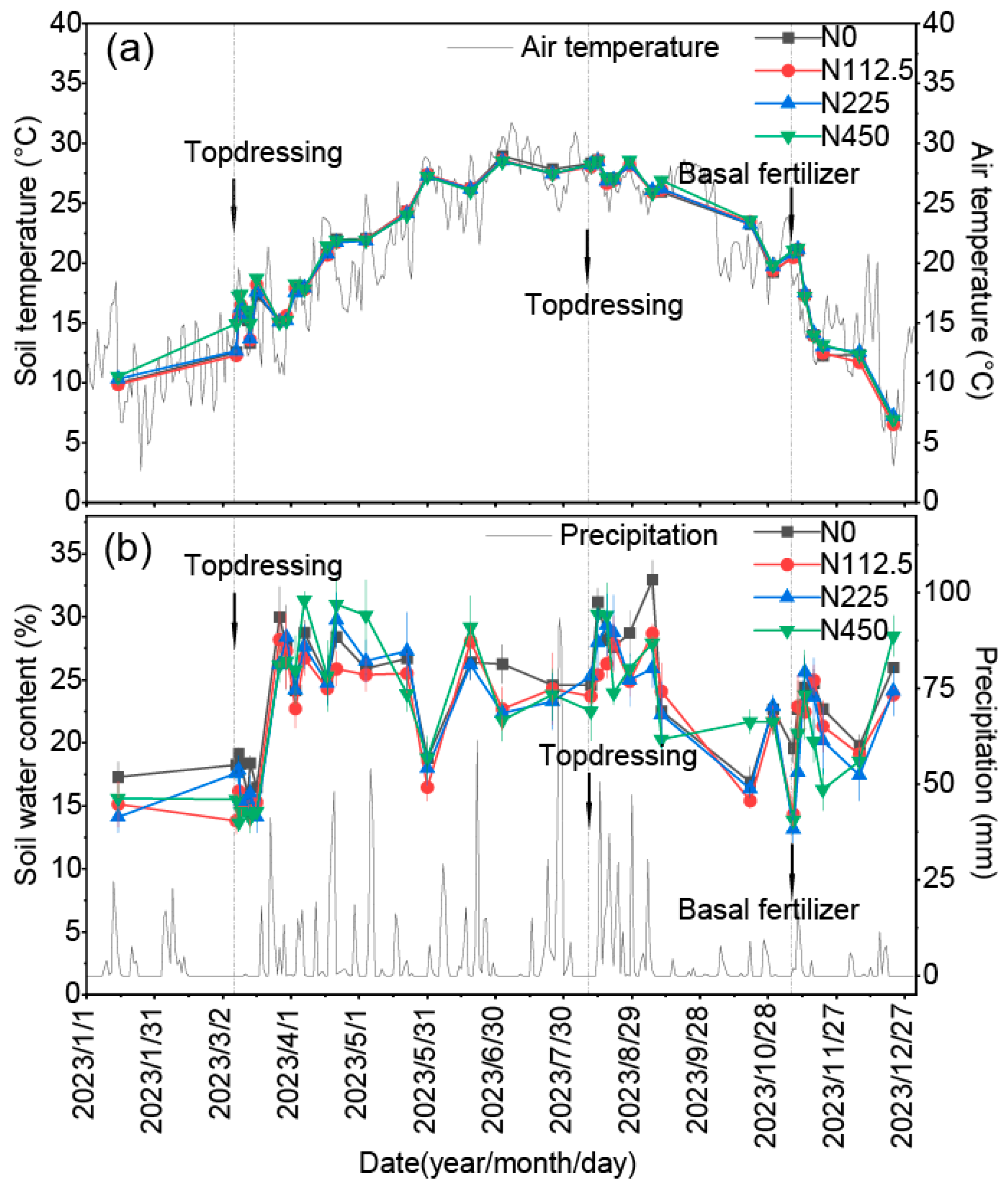
The seasonal variation patterns of soil temperature under different N application rates were similar, all exhibiting a single-peak curve with an initial increase followed by a decrease throughout the year (Figure 1a). The average soil temperatures for N0, N112.5, N225, and N450 were 20.09, 20.09, 20.16, and 20.46 °C, respectively, with no significant differences among treatments. The seasonal dynamics of soil temperature in the tea plantation closely tracked air temperature variations, indicating that soil temperature was primarily driven by atmospheric temperature rather than the N fertilization regime. Pearson correlation analysis revealed that the average daytime temperature was strongly positively associated with soil temperature across all treatments (r = 0.95–0.96, p < 0.001) (Table S1).
The variation in soil water content (SWC) was greater during spring and summer than in autumn and winter, primarily influenced by precipitation patterns (Figure 1b). The SWC showed rapid responses to rainfall events, with notable increases following precipitation peaks throughout the growing season. Pearson correlation analysis showed that SWC was significantly positively correlated with cumulative rainfall during the preceding 3 days (r = 0.46–0.52, p < 0.01) (Table S2). The average SWC was 23.75%, 21.97%, 22.30%, and 22.19% for N0, N112.5, N225, and N450, respectively. The SWC in N0 was significantly higher than in the N-fertilized treatments, while no significant differences were observed among the three N rates.

3.2. Soil Respiration Rate in Tea Plantation

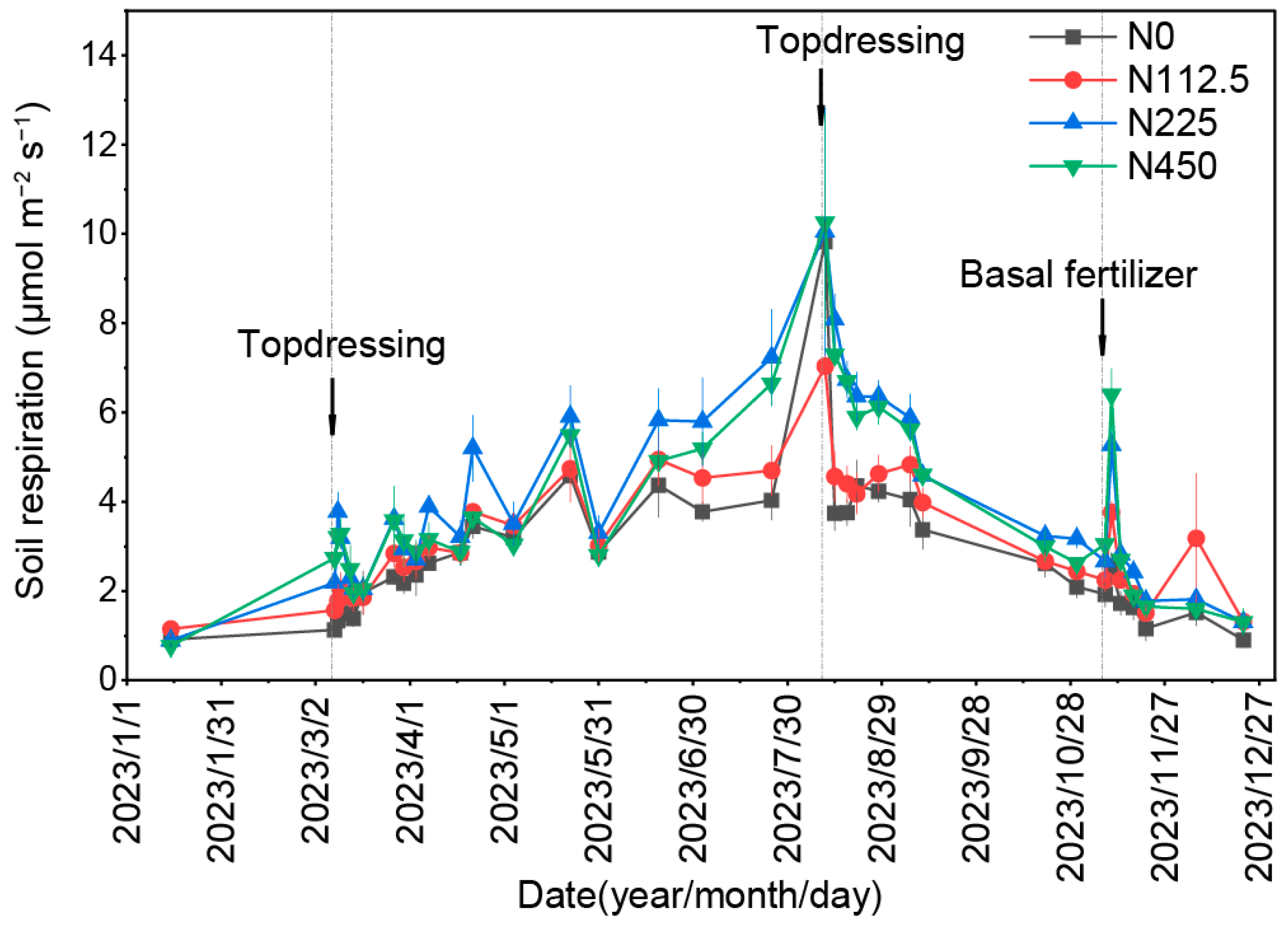
The seasonal pattern of soil respiration rate (Rs) was similar across all treatments, showing an initial increase followed by a decline (Figure 2). From January to August, Rs generally increased and peaked on 11 August, reaching 9.83, 7.04, 10.05, and 10.26 μmol m−2 s−1 for N0, N112.5, N225, and N450, respectively. Rs subsequently decreased from August through December. The N application rate significantly affected Rs. The annual mean Rs was 2.79, 3.15, 4.06, and 3.85 μmol m−2 s−1 for N0, N112.5, N225, and N450, respectively (Figure S2). The N225 treatment exhibited the highest annual mean Rs, which was significantly higher than N0 and N112.5 (p < 0.05), while N450 showed no significant difference from N225.
Soil disturbance during fertilization induced pronounced Rs pulses, with peak values occurring 1–4 days post-application (Figure 2). Following spring tea topdressing (7 March), Rs peaked on 11 March, increasing by 1.67-, 1.77-, 3.56-, and 4.25-fold relative to pre-fertilization levels for N0, N112.5, N225, and N450, respectively. After autumn tea topdressing (10 August), Rs peaked on 11 August, with increases of 2.25-, 1.42-, 1.73-, and 2.09-fold. Following basal fertilization (7 November), Rs peaked on 10 November, showing increases of 1.20-, 1.54-, 1.66-, and 2.44-fold relative to pre-fertilization values.
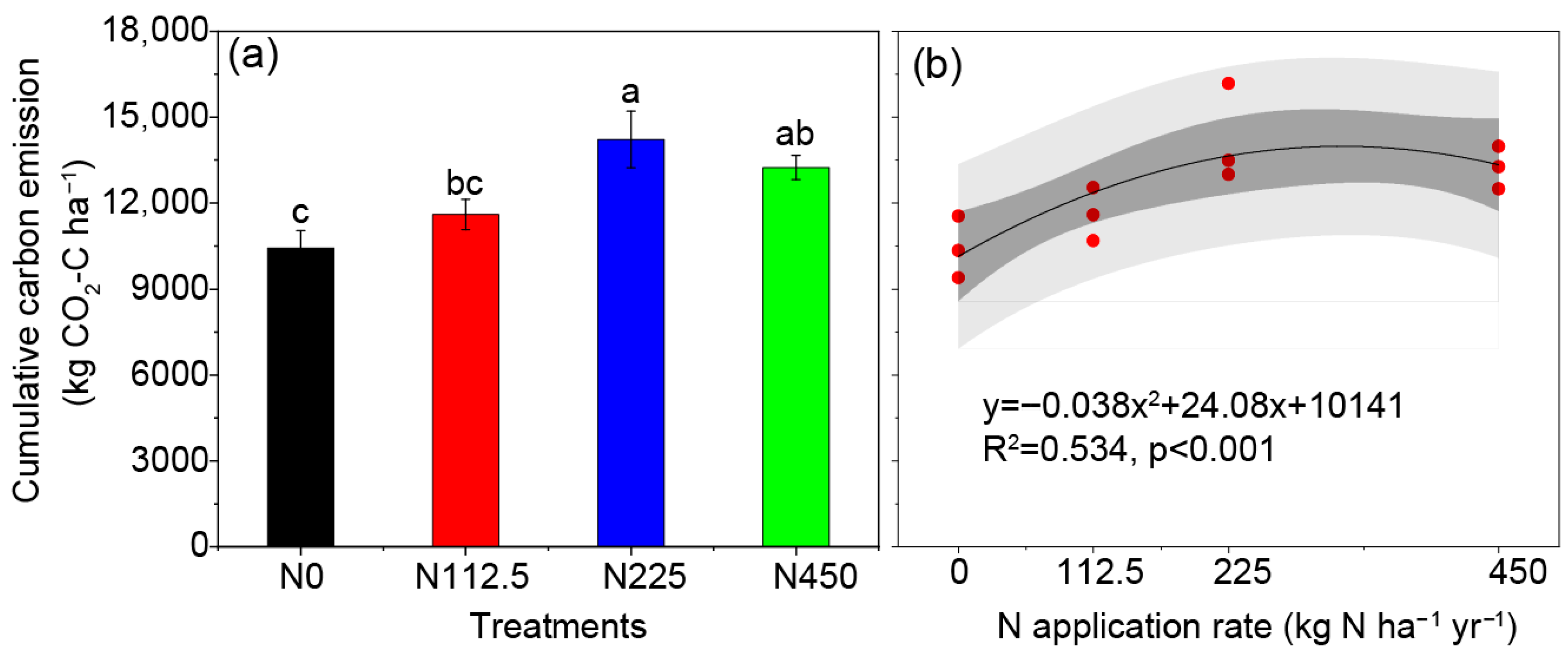
Cumulative soil CO2 emissions (CCEs) ranged from 10,427.03 to 14,221.11 kg CO2-C ha−1 across treatments, exhibiting a non-linear response to N fertilizer application rate (Figure 3a). The N225 treatment showed the highest CCE (14,221.11 kg CO2-C ha−1), followed by N450 (13,241.96 kg CO2-C ha−1) and N112.5 (11,609.12 kg CO2-C ha−1), while N0 had the lowest emission (10,427.03 kg CO2-C ha−1). Statistical analysis revealed significant differences among treatments (p < 0.05), with N225 and N450 showing significantly higher emissions than N0. A quadratic relationship was observed between CCEs and the N application rate (R2 = 0.534, p < 0.001) (Figure 3b), indicating that CCEs initially increased with N application but declined at higher rates.

3.3. The Relationship Between Soil Respiration Rate and the Environmental Factors

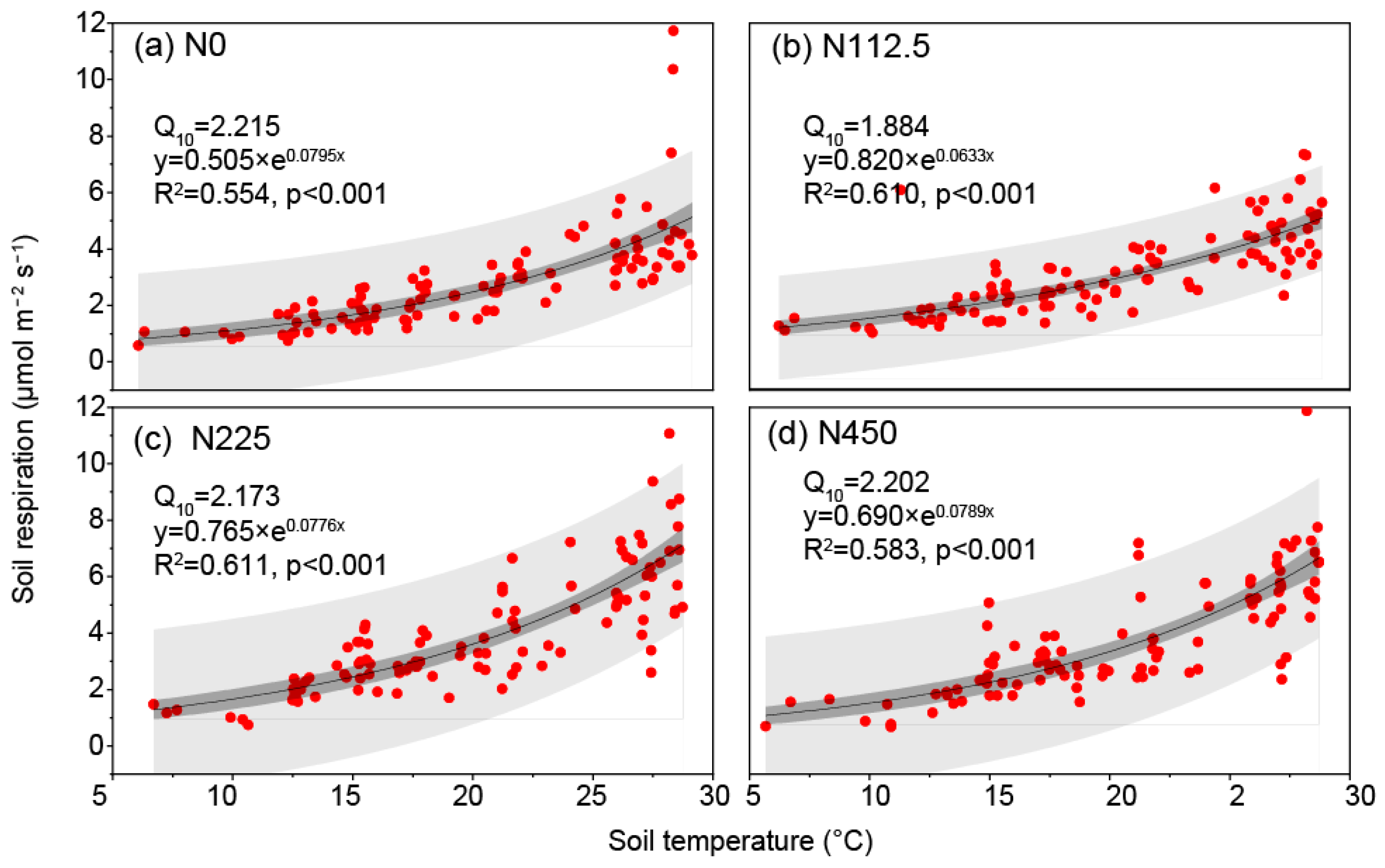
The relationship between soil temperature (ST) and soil respiration rate (Rs) was fitted using exponential equations (Rs = α × eβ×ST) (Figure 4). All exponential regression models were highly significant (p < 0.001) across treatments. Soil temperature explained 55.4% to 61.1% of the variation in Rs under different N application rates (R2 = 0.554, 0.610, 0.611, and 0.583 for N0, N112.5, N225, and N450, respectively). The temperature sensitivity coefficient (Q10) exhibited a non-linear response to the N fertilizer application rate, with values of 2.215, 1.884, 2.173, and 2.202 for N0, N112.5, N225, and N450, respectively (Figure 4). The Q10 initially decreased from N0 to N112.5, then increased progressively with higher N application rates. This pattern suggests that moderate N fertilization (112.5 kg N ha−1 yr−1) reduces the temperature sensitivity of soil respiration, while higher N application rates (225–450 kg N ha−1 yr−1) progressively enhance this sensitivity, approaching or exceeding the control level.
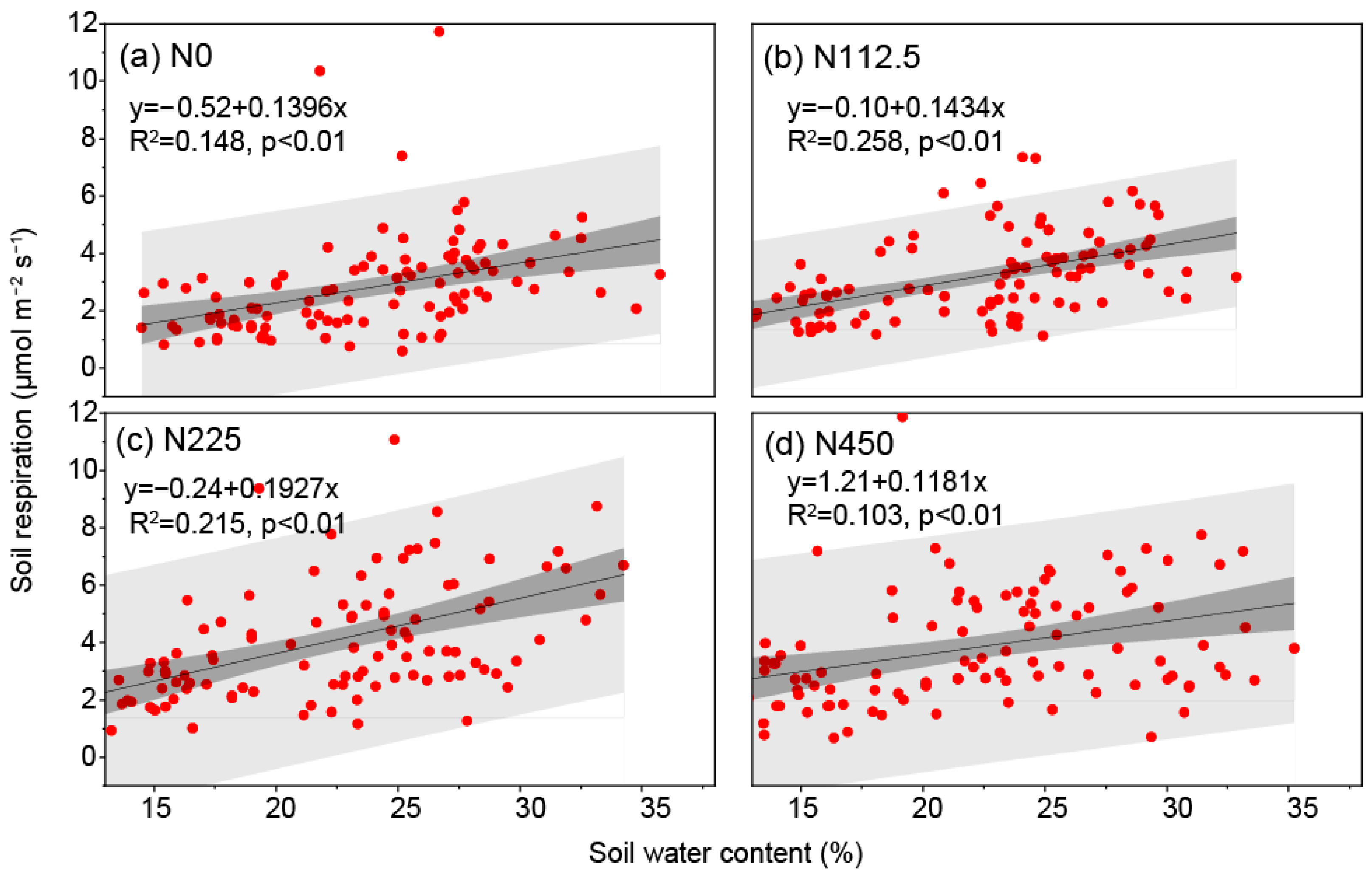
The relationship between soil water content (SWC) and soil respiration rate (Rs) under different N application treatments was fitted using a linear regression equation (Rs = a + b × SWC) (Figure 5). All fitting equations showed significant positive correlations (p < 0.01) across treatments. The explanatory power of SWC for Rs variation differed among treatments, with R2 values ranging from 0.103 to 0.258. Specifically, soil water content explained 14.8%, 25.8%, 21.5%, and 10.3% of the variation in Rs for N0, N112.5, N225, and N450 treatments, respectively. Among these, the N112.5 treatment showed the strongest correlation (R2 = 0.258), while N450 exhibited the weakest (R2 = 0.103). Overall, the predictive capacity of soil water content for Rs was considerably lower than that of soil temperature (R2 = 0.554–0.611).
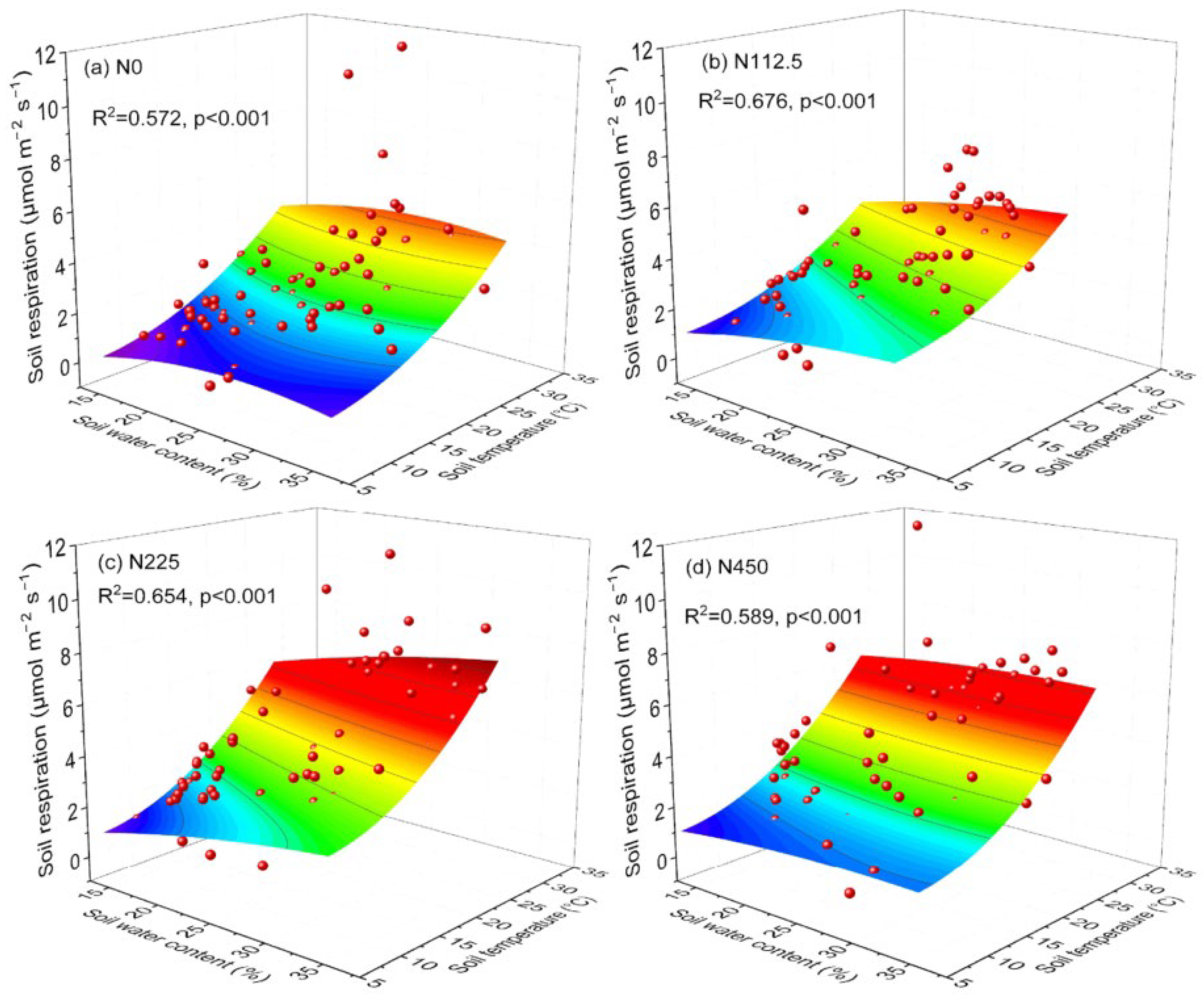
In this experiment, the relationship between soil water content, soil temperature, and soil respiration rate under different N rates was examined using a two-factor composite model (Rs = g + a × SWC2 + b × SWC + c × ST2 + d × ST, p < 0.001) (Table 2, Figure 6). The dual-factor model showed significant fitting results across all N application treatments (p < 0.001). The R2 values ranged from 0.572 to 0.676 under different N application levels (0.572 for N0, 0.676 for N112.5, 0.654 for N225, and 0.589 for N450), indicating a substantially higher degree of fit compared to the single-factor models for soil temperature (R2 = 0.554–0.611) and soil water content (R2 = 0.103–0.258). Notably, the N112.5 treatment exhibited the highest explanatory power (R2 = 0.676), suggesting optimal model performance at moderate N application rates. These results demonstrate that the two-factor composite model integrating both soil water content and temperature more effectively explains the variation in soil respiration rate in the tea plantation than either environmental factor alone.
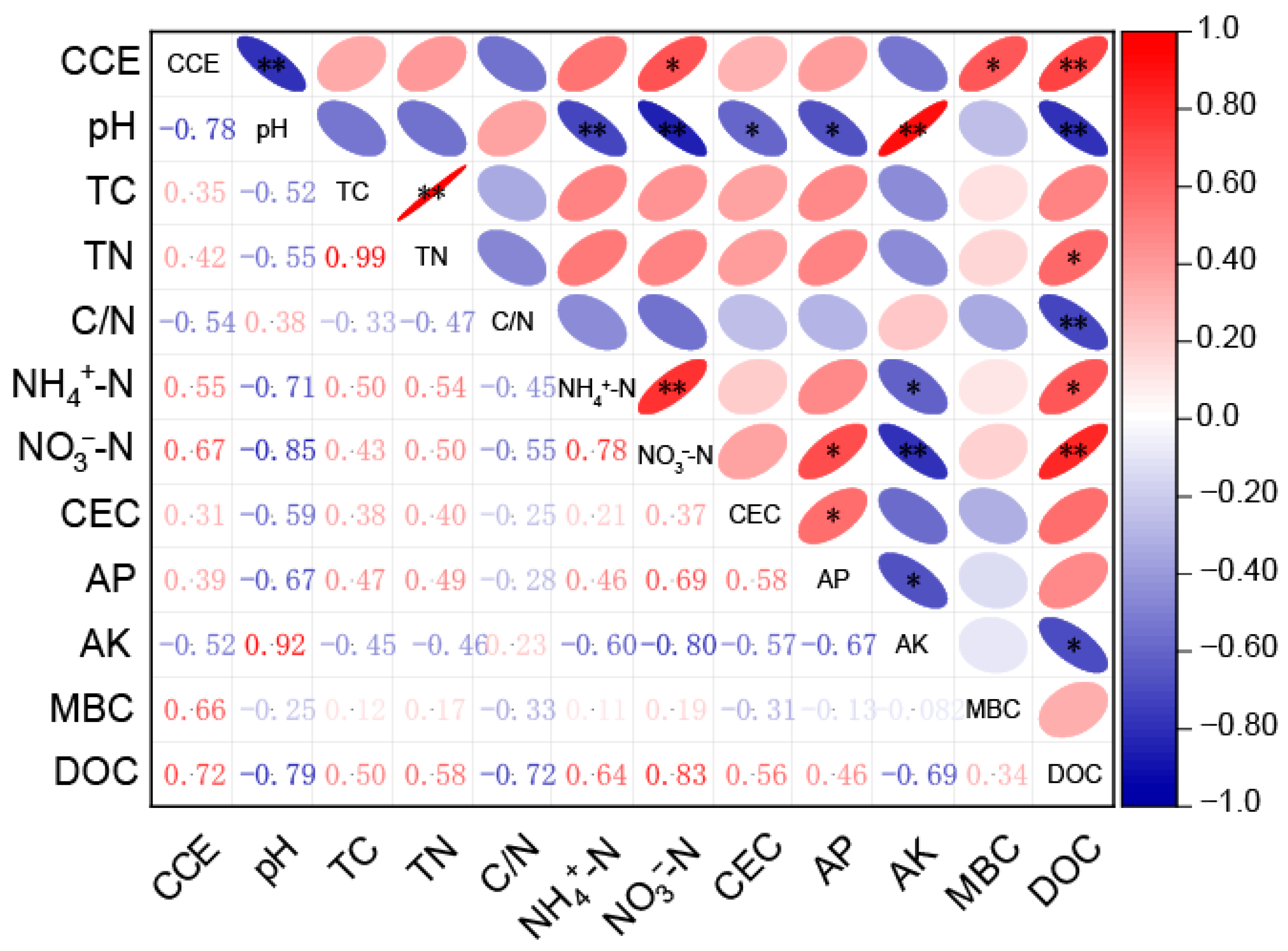
Pearson correlation analysis was performed on the CCEs and the soil properties (Figure 7). There was a significant negative correlation between CCEs and soil pH, with a correlation coefficient of −0.78 (p < 0.05). Soil CCEs showed significant positive correlations with DOC (r = 0.72, p < 0.05), NO3-N (r = 0.67, p < 0.05), and MBC (r = 0.66, p < 0.05). Additionally, moderate positive correlations were observed between CCEs and NH4+-N (r = 0.58), CEC (r = 0.57), and TN (r = 0.52), though these were not statistically significant at the p < 0.05 level. These results indicate close relationships between soil CCEs and multiple soil chemical and biological properties, particularly soil acidity, labile organic C pools, and N availability.

4. Discussion

4.1. Long-Term Nitrogen Fertilization Affects Soil Properties and Their Regulatory Effects on Soil Respiration

Long-term N application significantly altered soil properties in tea plantation systems (Table 1), with dose-dependent effects that directly or indirectly shaped soil respiration dynamics. The most pronounced change was progressive soil acidification, with pH decreases of 6–16% relative to N0 across all N treatments. This acidification trend aligns with previous studies in intensively managed tea plantations [20,21]. The main cause of soil acidification is the application of chemical N fertilizer, which has been confirmed by many studies [5,22], for example, Yang et al. (2018) [5], based on long-term field experiments that long-term N application led to a soil acidification rate of 0.083 units per year. Evidence showed that soil acidification caused by N fertilization is related to the soil nitrification process [23,24]. In our study, the higher content of soil NH4+-N compared to NO3-N serves as evidence that there is strong nitrification in tea plantation soil, and this increases with increasing N rates, with NH4+-N increasing up to 6.20-fold and NO3-N up to 7.31-fold in N450. In the nitrification process, it directly releases H+, which then replaces and carries away base cations such as Ca2+ and Mg2+ in the soil, leading to the enrichment of H+ and thus soil acidification. In addition, the produced protons will further activate more Al3+ in the soil; this phenomenon has been confirmed by numerous studies [5,22], although our study did not measure exchangeable H+ and Al3+.
The application of N fertilizer resulted in divergent responses between DOC and MBC. Specifically, MBC exhibited a hump-shaped relationship, increasing at low-to-moderate N rates but declining sharply at the highest rate, whereas DOC accumulated progressively and maximized under high N fertilization (Table 1). The initial increase in MBC at moderate N levels (225 kg·ha−1) may be attributed to the alleviation of microbial N limitation, which stimulated microbial growth and metabolic activity [25,26]. However, the subsequent decline in MBC at the highest N rate (450 kg·ha−1) was likely driven by severe soil acidification (pH dropped from 5.27 to 4.42). This increased acidity, coupled with potential Al toxicity, may suppress microbial activity and reduce the overall biomass [27,28]. In contrast, DOC continued to accumulate with increasing N rates. While enhanced plant growth and root exudation under N fertilization provided a greater supply of organic substrates, as reflected in the increase in tea yield [29], the simultaneous decline in microbial activity at high N rates likely constrained the microbial utilization of these available C sources [30]. This created a bottleneck where C inputs exceeded microbial consumption, leading to the passive accumulation of DOC in the soil solution. Thus, the observed patterns suggest that while moderate N inputs can stimulate the microbial loop, excessive N inputs decouple the C cycle by inhibiting microbial decomposers and promoting the buildup of labile organic C.
The CCE exhibited a significant non-linear response to increasing N rates (Figure 3). While N fertilization consistently stimulated soil respiration compared to the control, the incremental effect diminished markedly at the highest N rate. The data were best fit by a quadratic model (R2 = 0.534, p < 0.001), indicating an initial positive response that plateaued and showed signs of saturation or decline under excessive N input.
The stimulation of soil CO2 emissions at low-to-moderate N levels (0–225 kg·ha−1) may be primarily attributed to the alleviation of microbial metabolic constraints [31]. Evidence showed that N is a critical element for microbial growth and enzyme synthesis [32]. Its addition, within an optimal range, enhances microbial activity and accelerates the decomposition of organic matter, thereby increasing heterotrophic respiration [33]. This aligns with the observed increase in MBC at moderate N rates (Table 1), where a larger and more active microbial community would drive higher respiratory losses.
However, the diminished response and potential saturation at the highest N rate (450 kg·ha−1) suggest that microbial activity became suppressed by the negative consequences of chronic, high-dose N application. As previously noted, excessive N fertilization led to severe soil acidification (pH dropping to 4.42). This increased acidity, along with potential osmotic stress or Al toxicity, likely inhibited key soil enzymes and suppressed the activity of the microbial community [27,28], even though substrates (organic C) may have been available [29]. This interpretation is consistent with the observed decline in MBC at the highest N level, where microbial biomass collapsed despite the high N availability (Table 1). Consequently, the deceleration of cumulative emissions under high N reflects a shift from substrate-stimulated respiration to biologically inhibited respiration, where the microbial decomposer community is constrained by the hostile chemical environment it helped create. The quadratic relationship thus captures the transition from N-limited to N-inhibited conditions in the soil system. The temperature sensitivity of soil respiration (Q10) also showed a non-linear response, initially declining with moderate N addition (N rates at 112.5 and 225 kg N ha−1 yr−1) but increasing at high N rates (450 kg N ha−1 yr−1) (Figure 4), suggesting a possible transition from substrate-driven to stress-driven regulation of microbial metabolism across the N gradient [34].

4.2. Temporal Dynamics of Soil Respiration: Interactive Effects of N Fertilization and Environmental Factors

Soil respiration (Rs) showed a prominent variability over time that was caused by the influence of environmental factors and the N fertilization regime (Figure 2). In all treatments, Rs was unimodal with peaks occurring in August (5.77–11.05 μmol m−2 s−1), which closely followed the oscillations of soil temperature. The single-factor correlation analyses revealed that soil temperature explained 55–61% of Rs variance (Figure 4), thus demonstrating that temperature is the major environmental driving force of the seasonal dynamics. Although a temperature-controlled baseline was observed in the surveys, sharp transient increases immediately after fertilizer applications, especially spring topdressing (Figure 1), illustrated the management did significantly affect the baseline temperature-driven pattern.
These fertilization pulse effects, which represented the strongest temporal dynamics recorded, were superimposed on the seasonal patterns (Figure 2). Topdressing in spring gave rise to the maximum Rs increases, with rates rising 1.67- to 4.25-fold above pre-fertilization baselines, and pulse magnitude scaling positively with the N application rate. There were simultaneous phenomena of physical disturbance causing the release of protected organic matter, a rapid increase in root respiration when N became available to plants [35,36], microbial activation due to the alleviation of N limitation [37], and further priming when fresh N inputs promoted the decomposition of organic matter already present in the soil by stimulating enzyme production [38].
In our study, soil temperature had a significant positive correlation with Rs, explaining 55.4% to 61.1% of the variation in Rs under different N rates (Figure 4). In general, rising soil temperatures increase metabolic rates, stronger demand for N by plants during the active growth period increases activity in the rhizosphere, and optimal moisture and temperature conditions make substrates more available [39,40]. The Rs variability was mainly regulated by temperature but not only. Soil water content (SWC) also played an important secondary modulating role. Single-factor moisture models accounted for only 10 to 26% of Rs variability (Figure 5). Moisture affects Rs by regulating gas diffusion, affecting substrate transport and modulating microbial activity through the impact on water potential [30,41,42]. The weak positive linear relationships across treatments revealed that the soil moisture was within the non-limiting range for most of the experiment.
The temperature, moisture, and management do not operate independently (Figure 6). Fertilization pulse magnitude depended not only on N quantity but on the environmental conditions at the application time. The non-linear cumulative emissions response to increasing N rates (quadratic fit, R2 = 0.534, p < 0.001) further emphasizes that management effects must be considered within the environmental context mediating microbial responses. These tea-specific dynamics, particularly the amplified pulse responses reflecting high N application rates and perennial root systems, highlight the need for management strategies that account for both seasonal environmental drivers and pronounced short-term fertilization responses when optimizing N application timing to balance productivity with greenhouse gas mitigation.

4.3. Research Limitations

This study analyzed the impact of N fertilization on soil respiration within a perennial tea plantation system. However, several limitations constrain our findings. First, we measured only total soil respiration without partitioning autotrophic (root) and heterotrophic (microbial) components. Future studies employing trenching or isotopic labeling are essential to mechanistically understand the observed responses. Second, the study was conducted on a single tea cultivar in a specific climatic zone using one soil type. Multi-site studies are needed to develop generalizable recommendations. Third, we assessed Rs over one year within a long-term experiment, potentially missing inter-annual variability driven by climate fluctuations. Fourth, the semi-closed chamber method, while widely used, creates an isolated measurement environment that may alter natural CO2 diffusion gradients and microclimate conditions compared to open field conditions, potentially affecting absolute rate estimates. Fifth, we did not measure plant productivity or complete C budgets including photosynthetic C fixation, preventing evaluation of the net ecosystem C balance. Sixth, while we observed strong correlations between soil properties and emissions, causality remains ambiguous, and controlled experiments manipulating individual factors would help disentangle the mechanisms. Finally, we did not characterize microbial community composition, which could reveal functional guilds driving the observed Rs patterns.

5. Conclusions

This 15-year study demonstrates that long-term N fertilization in tea plantations significantly alters soil respiration (Rs) by modifying the soil properties. We observed a non-linear response, with cumulative CO2 emissions peaking at 225 kg N ha−1 yr−1 before declining at higher rates. Soil temperature was the primary driver of Rs seasonal dynamics, though a dual-factor model incorporating soil moisture improved the predictive power. Crucially, N-induced acidification and its strong correlation with increased emissions highlight that optimizing N application rates is essential for balancing tea productivity with climate mitigation in these economically vital ecosystems.

Supplementary Materials

The following supporting information can be downloaded at https://www.mdpi.com/article/10.3390/horticulturae12030372/s1, Figure S1. Geographic coordinates of the study area and experimental design. Figure S2. Changes in the mean soil respiration rates in response to long-term N fertilization. Error bars represent the standard errors (n = 3). Lowercase letters above the bars in the bar graph indicate significant differences in the mean soil respiration rates among different levels of N application based on Tukey’s post hoc test (p < 0.05). Table S1. Fitting parameters of soil temperature and air temperature models under different levels of N application. Table S2. Fitting parameters of soil water content and rainfall during the first 3 days of observation under different levels of N application.

Author Contributions

Z.W.: experimental design, investigation, writing—original draft; Y.C.: investigation, data curation; X.Y.: supervision, writing—review and editing; F.J.: supervision, funding acquisition, writing—review and editing. All authors have read and agreed to the published version of the manuscript.

Funding

This research was supported by the Technology Plan Project of Fujian Province (2023R1027001), the Technology Plan Project of Ningde City Fujian Province (ND2024J001), the China Agriculture Research System of MOF and MARA (CARS-19), and the National Natural Science Foundation of China (42407459).

Data Availability Statement

The original contributions presented in this study are included in the article. Further inquiries can be directed to the corresponding authors.

Conflicts of Interest

The authors declare no conflicts of interest.

References

  1. Bao, J.L.; Li, W.; Zhu, J.R.; Fan, S.S.; Mao, L.Y. Impacts of land use structures on ecosystem services relationships within specialized tea planting regions: A case study of Anxi County. Front. Environ. Sci. 2024, 12, 1464490. [Google Scholar] [CrossRef]
  2. Li, K.; Liu, D.N.; Li, L.Y.; Gao, Y.; Gao, W.J.; Chen, B.W.; Luo, F.; Yao, Y. Effects of nitrogen application amount on nitrogen distribution and photosynthesis in tea leaves. Front. Plant Sci. 2025, 16, 1575317. [Google Scholar] [CrossRef]
  3. Chen, Y.Z.; Wang, F.; Wu, Z.D.; Jiang, F.Y.; Yu, W.Q.; Yang, J.; Chen, J.M.; Jian, G.T.; You, Z.M.; Zeng, L.T. Effects of long-term nitrogen fertilization on the formation of metabolites related to tea quality in subtropical China. Metabolites 2021, 11, 146. [Google Scholar] [CrossRef]
  4. Ni, K.; Liao, W.Y.; Yi, X.Y.; Niu, S.Y.; Ma, L.F.; Shi, Y.Z.; Zhang, Q.F.; Liu, M.Y.; Ruan, J.Y. Fertilization status and reduction potential in tea plantations of China. J. Plant Nutr. 2019, 25, 421–432. [Google Scholar]
  5. Yang, X.D.; Ni, K.; Shi, Y.Z.; Yi, X.Y.; Zhang, Q.F.; Fang, L.; Ma, L.F.; Ruan, J.Y. Effects of long-term nitrogen application on soil acidification and solution chemistry of a tea plantation in China. Agric. Ecosyst. Environ. 2018, 252, 74–82. [Google Scholar] [CrossRef]
  6. Kudeyarov, V.N. Soil respiration and carbon sequestration: A review. Eurasian Soil Sci. 2023, 56, 1191–1200. [Google Scholar] [CrossRef]
  7. Hogan, J.A.; Domke, G.M.; Zhu, K.; Johnson, D.J.; Lichstein, J.W. Climate change determines the sign of productivity trends in US forests. Proc. Natl. Acad. Sci. USA 2024, 121, e2311132121. [Google Scholar] [CrossRef]
  8. Liang, L.Z.; Chen, F.; Han, H.R.; Zhang, Y.R.; Zhu, J.; Niu, S.K. Pathways regulating decreased soil respiration with nitrogen addition in a subtropical forest in China. Water Air Soil Pollut. 2019, 230, 91. [Google Scholar] [CrossRef]
  9. Wang, R.; Hu, Y.X.; Wang, Y.; Ali, S.; Liu, Q.F.; Guo, S.L. Nitrogen application increases soil respiration but decreases temperature sensitivity: Combined effects of crop and soil properties in a semiarid agroecosystem. Geoderma 2019, 353, 320–330. [Google Scholar] [CrossRef]
  10. Dong, X.P.; Li, X.L.; Hu, X.S.; Li, C.Y.; Zhang, Y.P. Effects of Nitrogen Addition on Soil Respiration Rate on Different Slopes of a Degraded Alpine Meadow. Eurasian Soil Sc. 2025, 58, 125. [Google Scholar] [CrossRef]
  11. Ding, Z.J.; Shi, Y.Z.; Li, G.X.; Harberd, N.P.; Zheng, S.J. Tease out the future: How tea research might enable crop breeding for acid soil tolerance. Plant Commun. 2021, 2, 100182. [Google Scholar] [CrossRef]
  12. Ma, L.F.; Yang, X.D.; Shi, Y.Z.; Yi, X.Y.; Ji, L.F.; Cheng, Y.; Ni, K.; Ruan, J.Y. Response of tea yield, quality and soil bacterial characteristics to long-term nitrogen fertilization in an eleven-year field experiment. Appl. Soil Ecol. 2021, 166, 103976. [Google Scholar] [CrossRef]
  13. Yang, X.D.; Tang, S.; Ni, K.; Shi, Y.Z.; Yi, X.Y.; Ma, Q.X.; Cai, Y.J.; Ma, L.F.; Ruan, J.Y. Long-term nitrogen addition increases denitrification potential and functional gene abundance and changes denitrifying communities in acidic tea plantation soil. Environ. Res. 2023, 216, 114679. [Google Scholar] [CrossRef] [PubMed]
  14. Li, Y.; Sun, J.; Tian, D.S.; Wang, J.S.; Ha, D.L.; Qu, Y.X.; Jing, G.W.; Niu, S.L. Soil acid cations induced reduction in soil respiration under nitrogen enrichment and soil acidification. Sci. Total Environ. 2018, 615, 1535–1546. [Google Scholar] [CrossRef]
  15. Jin, L.; Hua, K.K.; Zhan, L.C.; He, C.L.; Wang, D.Z.; Nagano, H.; Cheng, W.G.; Inubushi, K.; Guo, Z.B. Effect of soil acidification on temperature sensitivity of soil respiration. Agronomy 2024, 14, 1056. [Google Scholar] [CrossRef]
  16. IUSS Working Group WRB. World Reference Base for Soil Resources 2014, Update 2015 International Soil Classification System for Naming Soils and Creating Legends for Soil Maps; World Soil Resources Reports No. 106; FAO: Rome, Italy, 2015. [Google Scholar]
  17. Chapman, H.D. Cation-Exchange Capacity. In Methods of Soil Analysis: Part 2 Chemical and Microbiological Properties; American Society of Agronomy: Madison, WI, USA, 1965; Chapter 9, pp. 891–901. [Google Scholar]
  18. Duan, P.P.; Zhang, Q.Q.; Zhang, X.; Xiong, Z.Q. Mechanisms of mitigating nitrous oxide emissions from vegetable soil varied with manure, biochar and nitrification inhibitors. Agric. For. Meteorol. 2019, 278, 107672. [Google Scholar] [CrossRef]
  19. Agusto, L.E.; Qin, G.M.; Thibodeau, B.; Tang, J.W.; Zhang, J.F.; Zhou, J.G.; Wu, J.T.; Zhang, L.L.; Thapa, P.; Wang, F.M.; et al. Fiddling with the blue carbon: Fiddler crab burrows enhance CO2 and CH4 efflux in saltmarsh. Ecol. Indic. 2022, 144, 109538. [Google Scholar] [CrossRef]
  20. Yan, P.; Wu, L.Q.; Wang, D.H.; Fu, J.Y.; Shen, C.; Li, X.; Zhang, L.P.; Zhang, L.; Fan, L.C.; Han, W.Y. Soil acidification in Chinese tea plantations. Sci. Total Environ. 2020, 715, 136963. [Google Scholar] [CrossRef]
  21. Xi, S.; Cao, H.J.; Ma, N.; Li, T.; Zhou, Z.J.; Liu, X.J.; Wang, G.Y.; Zhang, S.R.; Xu, X.X.; Pu, Y.L.; et al. Acidification Alert: Understanding the Dynamics of Soil Acidity in Chinese Tea Plantations. Land Degrad. Dev. 2025, 0, 1–12. [Google Scholar] [CrossRef]
  22. Raza, S.; Miao, N.; Wang, P.Z.; Ju, X.T.; Chen, Z.J.; Zhou, J.B.; Kuzyakov, Y. Dramatic loss of inorganic carbon by nitrogen-induced soil acidification in Chinese croplands. Glob. Change Biol. 2020, 26, 3738–3751. [Google Scholar] [CrossRef]
  23. Zebarth, B.J.; Forge, T.A.; Goyer, C.; Brin, L.D. Effect of soil acidification on nitrification in soil. Can. J. Soil Sci. 2015, 95, 359–363. [Google Scholar] [CrossRef]
  24. Cai, Z.J.; Wang, B.R.; Xu, M.G.; Zhang, H.M.; Zhang, L.; Gao, S.D. Nitrification and acidification from urea application in red soil (Ferralic Cambisol) after different long-term fertilization treatments. J. Soils Sediments 2014, 14, 1526–1536. [Google Scholar] [CrossRef]
  25. Jia, X.Y.; Zhong, Y.Q.W.; Liu, J.; Zhu, G.Y.; Shangguan, Z.P.; Yan, W.M. Effects of nitrogen enrichment on soil microbial characteristics: From biomass to enzyme activities. Geoderma 2020, 366, 114256. [Google Scholar] [CrossRef]
  26. Yang, R.Z.; Yang, Z.; Yang, S.L.; Chen, L.L.; Xin, J.; Xu, L.Y.; Zhang, X.C.; Zhai, B.N.; Wang, Z.H.; Zheng, W.; et al. Nitrogen inhibitors improve soil ecosystem multifunctionality by enhancing soil quality and alleviating microbial nitrogen limitation. Sci. Total Environ. 2023, 880, 163238. [Google Scholar] [CrossRef]
  27. Li, S.C.; Tang, S.M.; Ju, X.T.; Zhu, Z.H.; Zhang, Y.J.; Chen, H.Y.; Jin, K. Soil acidification drives the negative effects of nitrogen enrichment on soil microbial biomass at the global scale. Plant Soil 2024, 503, 517–528. [Google Scholar] [CrossRef]
  28. Piña, R.G.; Cervantes, C. Microbial interactions with aluminium. Biometals 1996, 9, 311–316. [Google Scholar] [CrossRef] [PubMed]
  29. Jiang, F.Y.; Chang, Y.N.; Han, J.B.; Yang, X.D.; Wu, Z.D. Effects of long-term nitrogen fertilization on nitrous oxide emission and yield in acidic tea (Camellia sinensis L.) plantation soils. Agronomy 2024, 15, 7. [Google Scholar] [CrossRef]
  30. Domeignoz-Horta, L.A.; Pold, G.; Liu, X.J.A.; Frey, S.D.; Melillo, J.M.; DeAngelis, K.M. Microbial diversity drives carbon use efficiency in a model soil. Nat. Commun. 2020, 11, 3684. [Google Scholar] [CrossRef] [PubMed]
  31. Fang, Z.; Yu, H.L.; Jiao, F.; Huang, J.Y. Microbial Metabolic Limitation in Response to Phosphorus Enrichment: Implications for Carbon Sequestration in a Nitrogen-Enriched Desert Steppe. Land Degrad. Dev. 2025, 36, 2405–2419. [Google Scholar] [CrossRef]
  32. Stein, L.Y.; Klotz, M.G. The nitrogen cycle. Curr. Biol. 2016, 26, R94. [Google Scholar] [CrossRef]
  33. Fog, K. The effect of added nitrogen on the rate of decomposition of organic matter. Biol. Rev. 1988, 63, 433–462. [Google Scholar] [CrossRef]
  34. Tan, Y.S.; Zhang, R.K.; Liu, Z.H.; Li, B.Z.; Yuan, Y.J. Microbial adaptation to enhance stress tolerance. Front. Microbiol. 2022, 13, 888746. [Google Scholar] [CrossRef]
  35. Concilio, A.; Ma, S.; Ryu, S.R.; North, M.; Chen, J. Soil respiration response to experimental disturbances over 3 years. For. Ecol. Manag. 2006, 228, 82–90. [Google Scholar] [CrossRef]
  36. Bond-Lamberty, B.; Ballantyne, A.; Berryman, E.; Fluet-Chouinard, E.; Jian, J.; Morris, K.A.; Rey, A.; Vargas, R. Twenty years of progress, challenges, and opportunities in measuring and understanding soil respiration. J. Geophys. Res. Biogeosci. 2024, 129, e2023JG007637. [Google Scholar] [CrossRef]
  37. Sun, Z.Z.; Liu, L.L.; Ma, Y.C.; Yin, G.D.; Zhao, C.; Zhang, Y.; Piao, S.L. The effect of nitrogen addition on soil respiration from a nitrogen-limited forest soil. Agric. For. Meteorol. 2014, 197, 103–110. [Google Scholar] [CrossRef]
  38. Zhu, B.; Gutknecht, J.L.; Herman, D.J.; Keck, D.C.; Firestone, M.K.; Cheng, W.X. Rhizosphere priming effects on soil carbon and nitrogen mineralization. Soil Biol. Biochem. 2014, 76, 183–192. [Google Scholar] [CrossRef]
  39. Johnston, A.S.; Sibly, R.M. The influence of soil communities on the temperature sensitivity of soil respiration. Nat. Ecol. Evol. 2018, 2, 1597–1602. [Google Scholar] [CrossRef]
  40. Bradford, M.A.; Davies, C.A.; Frey, S.D.; Maddox, T.R.; Melillo, J.M.; Mohan, J.E.; Reynolds, J.F.; Treseder, K.K.; Wallenstein, M.D. Thermal adaptation of soil microbial respiration to elevated temperature. Ecol. Lett. 2008, 11, 1316–1327. [Google Scholar] [CrossRef] [PubMed]
  41. Cruz-Paredes, C.; Tájmel, D.; Rousk, J. Can moisture affect temperature dependences of microbial growth and respiration? Soil Biol. Biochem. 2021, 156, 108223. [Google Scholar] [CrossRef]
  42. Reay, M.K.; Loick, N.; Evershed, R.P.; Müller, C.; Cardenas, L. Moisture effects on microbial protein biosynthesis from ammonium and nitrate in an unfertilised grassland. Soil Biol. Biochem. 2023, 184, 109114. [Google Scholar] [CrossRef]
Figure 1. Seasonal variations in soil temperature and soil water content in tea plantation under different levels of N application during the experimental period. (a) Seasonal variations in soil temperature under different N application levels, with air temperature shown on the secondary y-axis; (b) Seasonal variations in soil water content under different N application levels, with precipitation shown on the secondary y-axis. Error bars represent the standard errors (n = 3). The vertical arrows indicate the timing of basal fertilizer and topdressing application.
Horticulturae 12 00372 g001
Figure 2. Seasonal changes in soil respiration rate under different levels of N application during the experimental period. Error bars represent the standard errors (n = 3). The vertical arrows indicate the timing of fertilizer application.
Horticulturae 12 00372 g002
Figure 3. Cumulative carbon emissions under different N applications during the experimental period. (a) Bar plots show ANOVA results of the effect of N rates on cumulative CO2 emissions. The data shown are mean ± standard error (SE; n = 3); lowercase letters above the bars indicate significant differences (p < 0.05). (b) Trend lines show the linear regressions of cumulative CO2 emissions against N rates. Gray shading represents 95% confidence intervals.
Horticulturae 12 00372 g003
Figure 4. Correlation analysis between soil temperature and soil respiration rate under different levels of N application.
Horticulturae 12 00372 g004
Figure 5. Correlation analysis between soil water content and soil respiration rate under different levels of N application.
Horticulturae 12 00372 g005
Figure 6. Fitting of dual-factor models of soil respiration with soil temperature and soil water content under different levels of N application.
Horticulturae 12 00372 g006
Figure 7. Correlation analysis of soil CO2 cumulative emissions and soil physicochemical properties. Here, * and ** indicate significance at p < 0.05 and p < 0.01. CCE: cumulative soil CO2 emission; TC: total carbon; TN: total nitrogen; C/N: the ratio of total carbon to total nitrogen; NH4+-N: ammonium; NO3-N: nitrate; CEC: cation exchange capacity; AP: available phosphorus; AK: available potassium; MBC: microbial biomass carbon; DOC: dissolved organic carbon.
Horticulturae 12 00372 g007
Table 1. Changes in soil properties in response to long-term N fertilization.
Soil ParametersUnitsN Application Rates (kg N ha−1 yr−1)
0112.5225450
pH 5.27 ± 0.07 a4.95 ± 0.02 b4.65 ± 0.03 c4.42 ± 0.04 d
CECcmol kg−15.77 ± 0.19 b5.70 ± 0.15 b5.93 ± 0.18 b6.92 ± 0.45 a
TCg kg−110.79 ± 1.48 a10.48 ± 0.17 a12.33 ± 0.26 a12.95 ± 0.17 a
TNg kg−11.11 ± 0.15 a1.07 ± 0.01 a1.29 ± 0.03 a1.35 ± 0.03 a
C/N/9.74 ± 0.01 a9.78 ± 0.13 a9.53 ± 0.17 a9.61 ± 0.11 a
NH4+-Nmg kg−13.91 ± 0.50 b5.45 ± 0.44 b13.84 ± 3.70 ab24.26 ± 10.30 a
NO3--Nmg kg−13.59 ± 0.28 b14.78 ± 3.79 ab19.61 ± 5.25 a26.24 ± 3.54 a
APmg kg−1170.25 ± 9.74 b177.07 ± 6.50 ab182.03 ± 12.60 ab205.31 ± 5.81 a
AKmg kg−1343.92 ± 3.71 a294.18 ± 5.65 b288.78 ± 6.63 b249.78 ± 9.62 c
MBCmg kg−1444.37 ± 24.52 b510.51 ± 34.35 a613.63 ± 17.19 a451.96 ± 14.88 a
DOCmg kg−19.75 ± 2.68 c18.11 ± 3.14 bc27.57 ± 2.70 ab31.25 ± 5.88 a
Values indicate mean ± standard errors (n = 3). Significant differences (p < 0.05) in the same row are denoted by different letters between corresponding treatments. TC: total carbon; TN, total nitrogen; C/N: the ratio of total carbon to total nitrogen; NH4+-N: ammonium; NO3-N: nitrate; CEC: cation exchange capacity; AP: available phosphorus; AK: available potassium; MBC: microbial biomass carbon; DOC: dissolved organic carbon.
Table 2. Fitting parameters of soil temperature and soil water content composite model under different levels of N application.
TreatmentsgabcdR2
N0−2.397−0.0040.2500.006−0.0360.572
N112.5−0.661−0.0020.1540.005−0.0510.676
N225−0.899−0.0020.1640.009−0.0840.654
N4500.072−0.0020.0990.008−0.0710.589
The fitting equation is Rs = g + a × SWC2 + b × SWC + c × ST2 + d × ST; Rs: Soil respiration rate; SWC: Soil water content; ST: Soil temperature.
Disclaimer/Publisher’s Note: The statements, opinions and data contained in all publications are solely those of the individual author(s) and contributor(s) and not of MDPI and/or the editor(s). MDPI and/or the editor(s) disclaim responsibility for any injury to people or property resulting from any ideas, methods, instructions or products referred to in the content.