Article

NH4+-N Promotes Fluoride Transport and NO3-N Increases Fluoride Fixation in Roots of Camellia sinensis

1
College of Horticulture, Nanjing Agricultural University, Nanjing 210095, China
2
Wenzhou Key Laboratory of Early Sprouting Tea Tree Breeding, Wenzhou Academy of Agricultural Sciences, Wenzhou 325006, China
3
College of Landscape Architecture, Jiangsu Vocational College of Agriculture and Forestry, Jurong 212400, China
4
Tea Industry Development Service Center of Wen County, Longnan 746400, China
*
Author to whom correspondence should be addressed.
Horticulturae 2026, 12(1), 94; https://doi.org/10.3390/horticulturae12010094
Submission received: 25 November 2025 / Revised: 2 January 2026 / Accepted: 14 January 2026 / Published: 16 January 2026
(This article belongs to the Special Issue Sustainable Soil Management for Tea Plantations)

Abstract

Tea plants (Camellia sinensis) uniquely hyperaccumulate fluoride (F) and concurrently exhibit a preference for ammonium nitrogen (NH4+-N) over nitrate nitrogen (NO3-N). However, the mechanistic basis for co-existence of NH4+-N preference and F hyperaccumulation in C. sinensis remains unexplored. Here, we investigated F accumulation and translocation with varying N supplies (0 mM and 2.854 mM N with NH4+-N:NO3-N ratios of 3:1, 4:0 and 0:4) and F concentrations (0, 8 and 16 mg·L−1 NaF) to reveal the mechanism driving NH4+-N preference and F hyperaccumulation in C. sinensis. Results show that NH4+-N supply enhanced H+ efflux, mobilizing aluminum (Al) to form mobile Al-F complexes for translocation to shoots, thereby alleviating F toxicity in roots. This process was facilitated by transporters including CsCLCd, CsCLCe, CsCLCf2 and CsFEX. In contrast, NO3-N promoted root sequestration of F as immobile calcium (Ca)-F complexes, exacerbating damage. Under NO3-N supply, CsCLCb primarily mediated NO3 transport, while CsCLCc, CsCLCe, CsCLCf1, CsCLCf2 and CsFEX were involved in F transport. In leaves, CsCLCd, CsCLCe, CsCLCf1, CsCLCf2, CsCLCg and CsFEX mediated vacuolar sequestration under both N conditions. These findings elucidate that NH4+-N preference is mechanistically linked to F hyperaccumulation through an Al-assisted translocation pathway, which confers tolerance by exporting F from roots.

1. Introduction

Fluoride (F) is a non-essential element for growth of tea plants (Camellia sinensis (L.) O. Kuntze), yet this species accumulates F to concentrations far exceeding the tolerance limits of most other plants [1]. Although C. sinensis is considered a F hyperaccumulator, high F levels still impair its root development, and even in adapted species, F stress first damages root systems [2,3]. Subsequently, when F is translocated to shoots, it adversely affects shoots physiology, including reduced biomass accumulation and significant suppression of photosynthetic activity in leaves [4,5]. Current understanding of F tolerance mechanisms in C. sinensis involves F transport, chelation with metal ions, vacuolar sequestration and associated molecular regulations [6]. Among these, calcium (Ca)-F complexes precipitate in roots, limiting F translocation, whereas aluminum (Al)-F complexes facilitate F mobility via xylem to leaves, where F is fixed in cell walls or compartmentalized in vacuoles [7,8]. Key genes contributing to F detoxification have been identified, including pH-regulated, F-responsive fluoride exporter CsFEX and CsCLCe, an F-sensitive member of voltage-gated chloride channel (CLC) superfamily [9,10,11]. Within the CLC family, CLCF-like genes have been identified as more sensitive to F, while other members are primarily associated with transport of anions such as nitrate and chloride ions [12,13,14]. For example, AtCLCd in Arabidopsis has been shown to contribute to pH homeostasis and chloride level regulation [13].
Nitrate nitrogen (NO3-N) and ammonium nitrogen (NH4+-N) are the primary forms of inorganic nitrogen (N) absorbed by plants, with species often exhibiting different preferences between these two sources. C. sinensis displays a marked preference for NH4+-N over NO3-N, which actively promotes its growth and metabolic processes [15]. This preference is closely linked to its natural and cultivated habitat [16,17]. Tea plants predominantly thrive in acidic soils (pH 4.0–6.5). Long-term adaptation to such environments has likely shaped the physiological and molecular mechanisms in C. sinensis favoring efficient NH4+ acquisition and utilization. Unlike many other plant species that are sensitive to high NH4+-N levels, C. sinensis maintains a strong capacity for NH4+-N uptake even at concentrations as high as 5 mM, without exhibiting symptoms of NH4+-N toxicity [18,19,20]. The absorption of NH4+-N enhances transmembrane H+ flow, stimulates H+-ATPase activity, and acidifies rhizosphere pH, thereby influencing root uptake of other ions [21,22]. Importantly, in acidified soils typical of tea gardens, this rhizosphere acidification can markedly increase the solubility and bioavailability of Al3+ [23], a prevalent element that readily forms complexes with F. Despite the strong preference for NH4+-N, NO3-N still contributes to N nutrition of C. sinensis. For example, the NO3-N has been shown to promote development of adventitious and lateral roots in C. sinensis [24].
Although appropriate supplies of NH4+-N or NO3-N can enhance plant stress tolerance [25,26,27,28], their specific mechanisms in regulating F accumulation and translocation in C. sinensis remain poorly understood. More importantly, the mechanistic basis for the co-occurrence of its preferential NH4+-N uptake and F hyperaccumulation remains unclear. We hypothesized that the form of N nutrition fundamentally modulates F dynamics in C. sinensis not only by influencing molecular responses but also, critically, by activating a key chemical pathway: NH4+-induced rhizosphere acidification promotes Al mobilization, which in turn may alter F speciation, transport and distribution through Al-F interactions. To address these, this study aimed to (1) systematically compare the effects of different NH4+-N:NO3-N ratios of 3:1 (2.14 mM:0.714 mM, IN), 4:0 (2.854 mM:0 mM, AMN), and 0:4 (0 mM:2.854 mM, NN) as well as F concentrations (0, 8 and 16 mg·L−1 NaF) on the physiological status and F distribution patterns in C. sinensis; (2) elucidate the underlying ion-related adaptation mechanisms by analyzing multi-element translocation (including F, Al, Ca and other elements), root ion (NH4+, NO3, H+) fluxes, and membrane potential under N and F co-treatment; and (3) investigate the functional involvement of F-associated genes (CsFEX and CsCLCs) in this regulation. Through an integrated approach combining physiological, ionomic, and molecular analyses, this work seeks to provide a comprehensive mechanistic understanding of how N forms regulate F accumulation and translocation, with a particular focus on the role of Al-mediated chemistry, thereby offering novel insights into the co-occurrence of NH4+-N preference and F hyperaccumulation in C. sinensis.

2. Materials and Methods

2.1. Plant Materials and Treatments

This experiment was conducted in an intelligent greenhouse at Nanjing Agricultural University, China. Annual cutting seedlings of C. sinensis cv. ‘Longjing 43’ were purchased from Ya Run Tea Co., Ltd. (Nanjing, China). The roots of tea seedlings were cleaned, after which they were cultured sequentially for 5d each in water and 1/8, 1/4 and 1/2 concentration nutrient solution (Table S1), until they were transferred to full nutrient solution for 10d. Nutrient solution was renewed every 5d and its pH was adjusted to pH 5.5 ± 0.1 using 1.0 mM HCl or NaOH. The plants were maintained under controlled environmental conditions, a day/night temperature of 25 °C/22 °C, a 16 h/8 h photoperiod, a light intensity of 30,000 lx, and 75% relative humidity.
The plants were first pre-cultured in a nitrogen (N)-free nutrient solution for 5d. Subsequently, treatments were initiated by supplementing solution with ammonium nitrogen (AMN, NH4+-N), nitrate nitrogen (NN, NO3-N), and fluoride (F) using (NH4)2SO4, NaNO3 and NaF, respectively. Tea seedlings were subjected to four N conditions: three with a total N concentration of 2.854 mM at different NH4+-N:NO3-N ratios, specifically 3:1 (2.14 mM:0.714 mM, IN), 4:0 (2.854 mM:0 mM, AMN), and 0:4 (0 mM:2.854 mM, NN), and a nitrogen starvation treatment (0 mM N, NS) [29]. These N treatments were combined with F treatments at concentrations of 0, 8 and 16 mg·L−1 [30], as shown in Table 1.

2.2. Determination of Root Activity

Root activity was measured using the 2,3,5-tripheyl tetrazolium chloride (TTC) reduction method [31]. For each treatment, 0.5000 g of fresh root samples was weighed and transferred into conical flasks containing 5.0 mL of 1% TTC solution and 5.0 mL 0.1 mol·L−1 phosphate buffer. The roots were fully immersed in the mixture and incubated in the dark at 37.0 °C for 1 h. The reaction was then immediately terminated by adding 2.0 mL of 1.0 mol·L−1 H2SO4. Following acidification, root samples were removed, dried, and ground into a fine powder. The resulting powder was extracted with ethyl acetate, and the final volume was adjusted to 10.0 mL with the same solvent. The absorbance of extracts was measured at 485 nm using a microporous plate detecting instrument (Cytation3, BioTek, Winooski, VT, USA), with three biological replicates analyzed per treatment.

2.3. Determination of Photosynthetic Parameters

Photosynthetic parameters of mature leaves were measured using an LI-6400XT portable photosynthesis system (Li-Cor Biosciences, Lincoln, NE, USA) on a sunny day. The measured parameters included net photosynthetic rate (Pn), stomatal conductance (Gs), transpiration rate (Tr) and intercellular CO2 concentration (Ci). During measurements, the lamp of the instrument was set to 1000.0 μmol·m−2·s−1 and the flow rate was set to 500.0 μmol·s−1 to ensure stable gas exchange conditions. Data were collected from at least four biological replicates per treatment.

2.4. Determination of Fluoride (F) Content, Total Nitrogen (N) Content, Potassium (K) Content, Phosphorus (P) Content, Calcium (Ca) Content and Other Elements

After treatments, the roots, stems, young leaves (YL, one bud and two leaves) and mature leaves (ML) of C. sinensis were collected immediately. The plant materials were first oven-dried at 105 °C for 30 min, followed by further drying at 80 °C until constant weight was achieved. The recorded dry weight (DW) data are provided in Table S2. Each tissue sample was then ground into a fine powder for subsequent elemental analysis. All elemental content measurements were performed with three biological replicates.
F content was determined using a fluoride ion selective electrode (Thermo Orion 9609BNWP; 096019 stirrer probe, Thermo Fisher Scientific, Waltham, MA, USA) by the following method [32]. Approximately 0.15 g of each powdered sample was weighed into a 15 mL centrifuge tube, to which 9 mL of ultrapure water was added. The mixture was then incubated in a boiling water bath at 100 °C for 30 m. After cooling to room temperature, the extract was centrifuged at 4000 rpm for 15 m. Subsequently, 8 mL of the resulting supernatant was combined with an equal volume (8 mL) of total ionic strength adjustment buffer (TISAB II with CDTA, Thermo Orion 940909, Thermo Fisher Scientific, Waltham, MA, USA) prior to measurement.
Total N content was determined following the H2SO4 H2O2 digestion method [33]. Approximately 0.2 g of each tissue sample was weighed into a Kjeldahl flask, followed by addition of 5 mL concentrated H2SO4. After gentle shaking, a bent-neck funnel was placed on the flask, which was then heated at 280 °C for 10 m on a digestion block. When white fumes appeared, indicating active digestion, flask was removed and allowed to cool slightly before adding 1 mL of 30% H2O2. The mixture was reheated for 20 m. After cooling, addition of 1 mL of 30% H2O2 and subsequent reheating were repeated three times until the digest became colorless or fully clarified. Finally, digested solution was heated for an additional 30 m to remove residual H2O2. The cooled digest was diluted to a final volume of 100 mL with ultrapure water, and total N content was measured using an automated continuous flow analyzer (Seal Auto Analyzer AA3, SEAL Analytical GmbH, Norderstedt, Germany).
The concentrations of potassium (K), phosphorus (P), aluminum (Al), calcium (Ca), magnesium (Mg), iron (Fe), zinc (Zn), copper (Cu) and manganese (Mn) were determined by inductively coupled plasma optical emission spectrometry (ICP-OES; Optima 8000, PerkinElmer Corporation, Shelton, CT, USA). For analysis, approximately 0.2000 g of each powdered sample was digested in a closed-vessel microwave digestion system (MARS 6, CEM Corporation, Charlotte, NC, USA) using a 4:1 (v/v) mixture of concentrated HNO3 and HClO4.
The translocation factor (TF) reflects the efficiency of an element’s transfer from the roots to shoots of a plant. A higher TF value indicates a greater capacity for upward translocation of the element within plant. TF was calculated according to the following equation [34]:
Elemental concentration in shoots was calculated as
C shoot = m YL   ×   C YL + m ML   ×   C ML + m S   ×   C S   m YL + m ML + m S
Elemental concentration in roots was taken as
C root = m R   ×   C R   m R  
The TF was then determined by
T F = C shoot C root
where Cshoot and Croot represent weighted mean elemental concentrations (mg·kg−1) of the element in shoot and root tissues, respectively; mYL, mML, mS and mR are dry weights (g) of young leaves, mature leaves, stems and roots, respectively; CYL, CML, CS and CR denote measured elemental concentrations (mg·kg−1) in young leaves, mature leaves, stems and roots, respectively.

2.5. Measurement of Microelectrode H+, NO3, NH4+ Fluxes and Membrane Potential

The plants were initially pre-cultured in a N-free nutrient solution for 5d, after which they were subjected to the following treatments for another 5d: NS, IN, AMN, NN, 16NS, 16IN, 16AMN and 16NN. Roots from each treatment group were then immersed in a stabilizing solution (Table S3), and ion fluxes (H+, NO3, NH4+) as well as membrane potential were measured at a position 5000 μm from the root apex using Non-invasive Micro-test Technology (NMT Physiolyzer®, YoungerUSA LLC, Amherst, MA, USA; Xuyue Company, Beijing, China). Measurements were performed with at least four biological replicates per treatment.

2.6. Sequence Correlation Analysis of CsCLCs Proteins

The protein sequences of CsCLCs were obtained from the Tea plant Genome Database (TPIA; http://tpia.teaplant.org/index.html, accessed on 12 May 2025). Sequence similarity analysis among identified CsCLCs proteins was subsequently performed using TBtools software (version 2.340, https://github.com/CJ-Chen/TBtools/releases, accessed on 13 September 2025).

2.7. RNA Extraction and Quantitative Real-Time PCR Expression Analysis

Total RNA was extracted from treated roots, stems, YL and ML using the EASYspin Plus Complex Plant RNA Kit (Aidlab, Beijing, China). cDNA was synthesized from extracted RNA through reverse transcription using HiScript II Q RT SuperMix for qPCR (+gDNA wiper) (Vazyme Biotech, Nanjing, China). Gene-specific primers for all CsCLCs and CsFEX were designed with Primer Premier 5 software (PREMER Biosoft International), with CsGAPDH serving as the internal reference gene [11,30]. All primer sequences are listed in Table S4. Quantitative PCR was performed using ChamQ SYBR qPCR Master Mix (Vazyme Biotech, Nanjing, China) on a Bio-Rad CFX96 Real-Time PCR System (Bio-Rad C1000 TouchTM Thermal Cycler, BioRad, Hercules, CA, USA) under the following thermal cycling conditions: initial denaturation at 95 °C for 30 s, followed by 40 cycles of 95 °C for 10 s and 60 °C for 30 s, then 95 °C for 15 s, 60 °C for 60 s and 95 °C for 15 s. Gene expression levels were calculated using the 2−ΔΔCT method [35].

2.8. Data Statistics and Analysis

Ion flux and membrane potential data were exported using imFluxes V2.0 software (Xuyue Company, Beijing, China). Subsequent statistical analysis and graphing were performed with Excel 2016 (Microsoft Corporation, Redmond, WA, USA) and GraphPad Prism 10 (GraphPad Software, San Diego, CA, USA). One-way ANOVA followed by Tukey’s test (p < 0.05) was conducted using IBM SPSS Statistics 20.0 (SPSS Inc., Chicago, IL, USA) to determine significant differences among treatments, which are indicated by different letters in figures.

3. Results

3.1. Phenotype and Activity of Root System

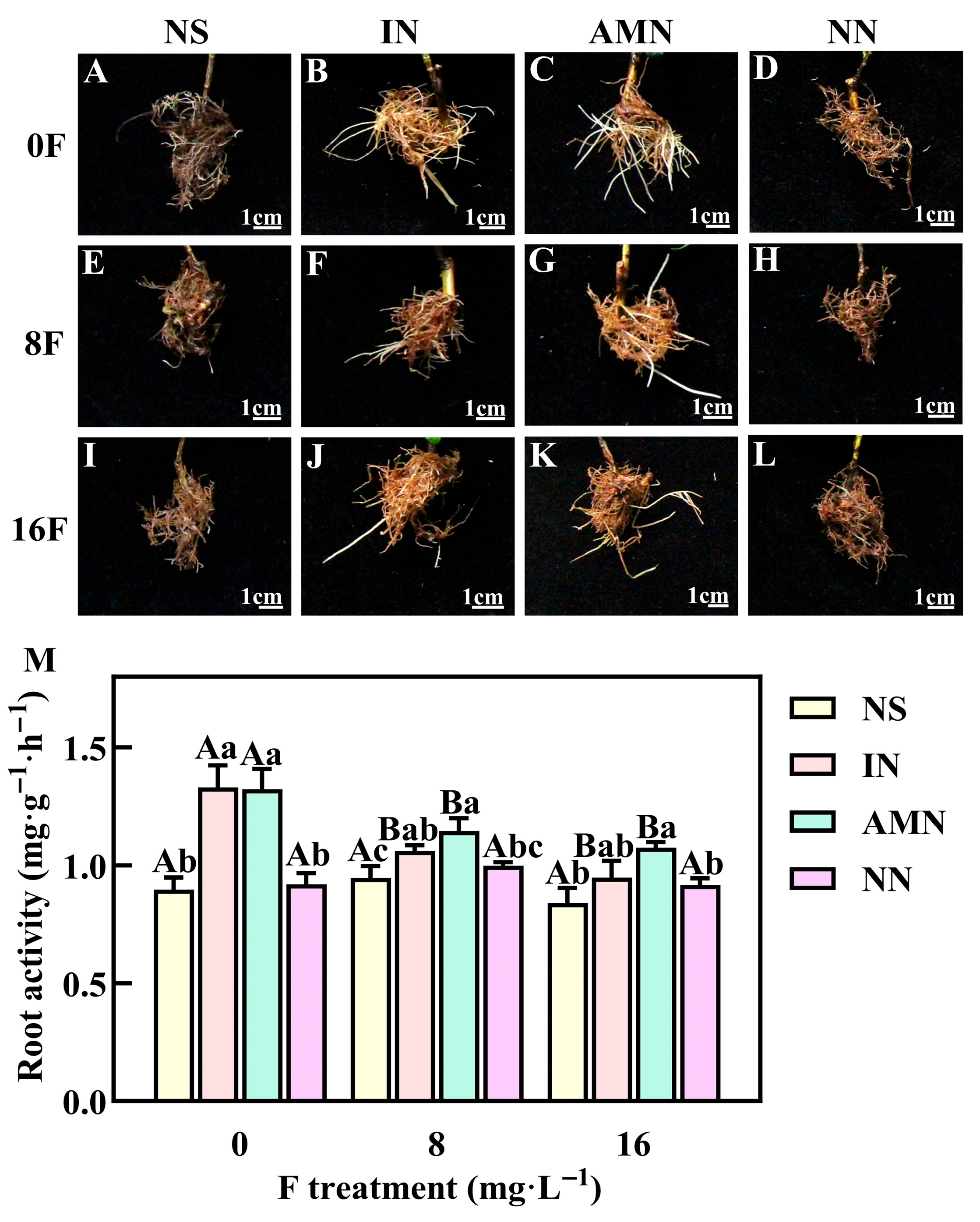
The growth of tea seedling roots was significantly influenced by the intertreatment of different nitrogen (N) forms and fluoride (F) concentrations. Under the same F concentration, new root emergence was observed in root systems following IN (2.14 mM NH4+-N:0.714 mM NO3-N) and AMN (2.854 mM NH4+-N:0 mM NO3-N) treatments, demonstrating better growth compared to those under NS (nitrogen starvation) and NN (0 mM NH4+-N:2.854 mM NO3-N) treatments (Figure 1A–L). Moreover, root development was increasingly inhibited with increasing F concentrations under the same N treatment (Figure 1A–L). Consistent with these phenotype observations, root activity was also higher in IN and AMN treatments than in NS and NN treatments at equivalent F levels (Figure 1M). Although exogenous F significantly suppressed root activity in both IN and AMN treatments, AMN treatment maintained the highest activity among all treatments (Figure 1M). Compared to NS and NN, treatments with8NS (NS + 8 mg·L−1 NaF) and 8NN (NN + 8 mg·L−1 NaF)) slightly increased root activity by 8.48% and 5.53%, respectively. In contrast, 16NS (NS + 16 mg·L−1 NaF) and 16NN (NN + 16 mg·L−1 NaF) conditions suppressed this activity, with reductions of 0.22% and 6.41% (Figure 1M).

3.2. Response of Photosynthetic System to F and N Treatment

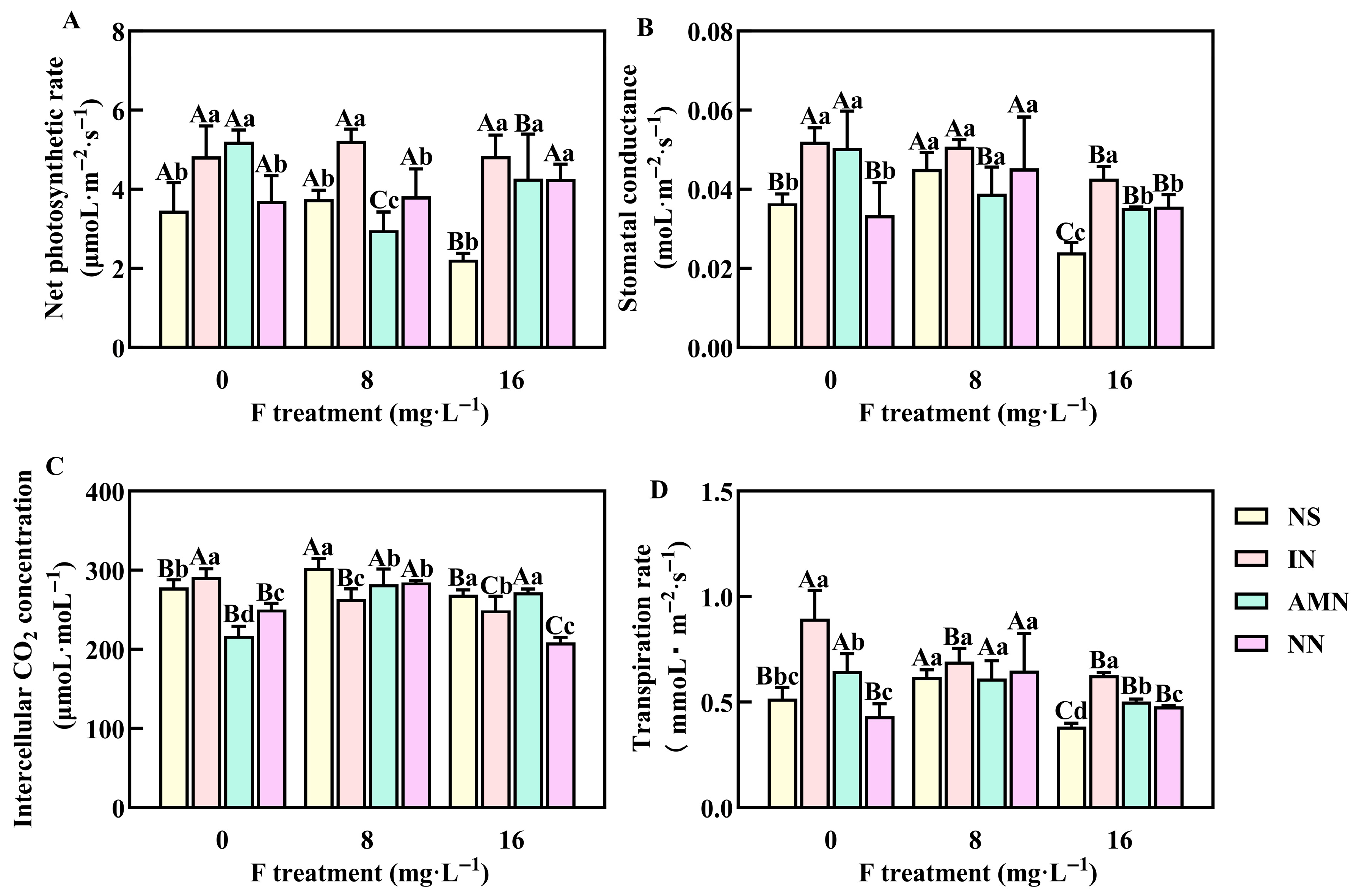
The photosynthetic response of C. sinensis to varying N forms and F levels was assessed by measuring key parameters in mature leaves (ML). With the exception of 8AMN (AMN + 8 mg·L−1 NaF), net photosynthetic rate (Pn) was generally higher under IN and AMN treatments than under NS and NN, even under F exposure (Figure 2A). Stomatal conductance (Gs), transpiration rate (Tr) and Pn displayed broadly consistent trends across the experimental treatments, with the strongest photosynthetic performance observed in plants supplied with IN (Figure 2A,B,D). In contrast, Gs and Tr were markedly suppressed in the high-F treatments 16NS, 16IN (IN + 16 mg·L−1 NaF) and 16AMN (AMN + 16 mg·L−1 NaF) compared to NS, IN and AMN, respectively, whereas 16NN exhibited a different response (Figure 2B,D). The intercellular CO2 concentration (Ci) in NS, AMN and NN treatments showed an initial increase (8.80%, 2.99% and 1.37%) followed by a decrease (1.11%, 0.35% and 2.67%) with increasing F concentration (Figure 2C). Additionally, Ci in 8NS and 8NN treatments were higher than those in 8IN (IN + 8 mg·L−1 NaF) and 8AMN (Figure 2C).

3.3. Effect of F and N Treatment on Accumulation and Translocation of F, N, K and Other Mineral Elements

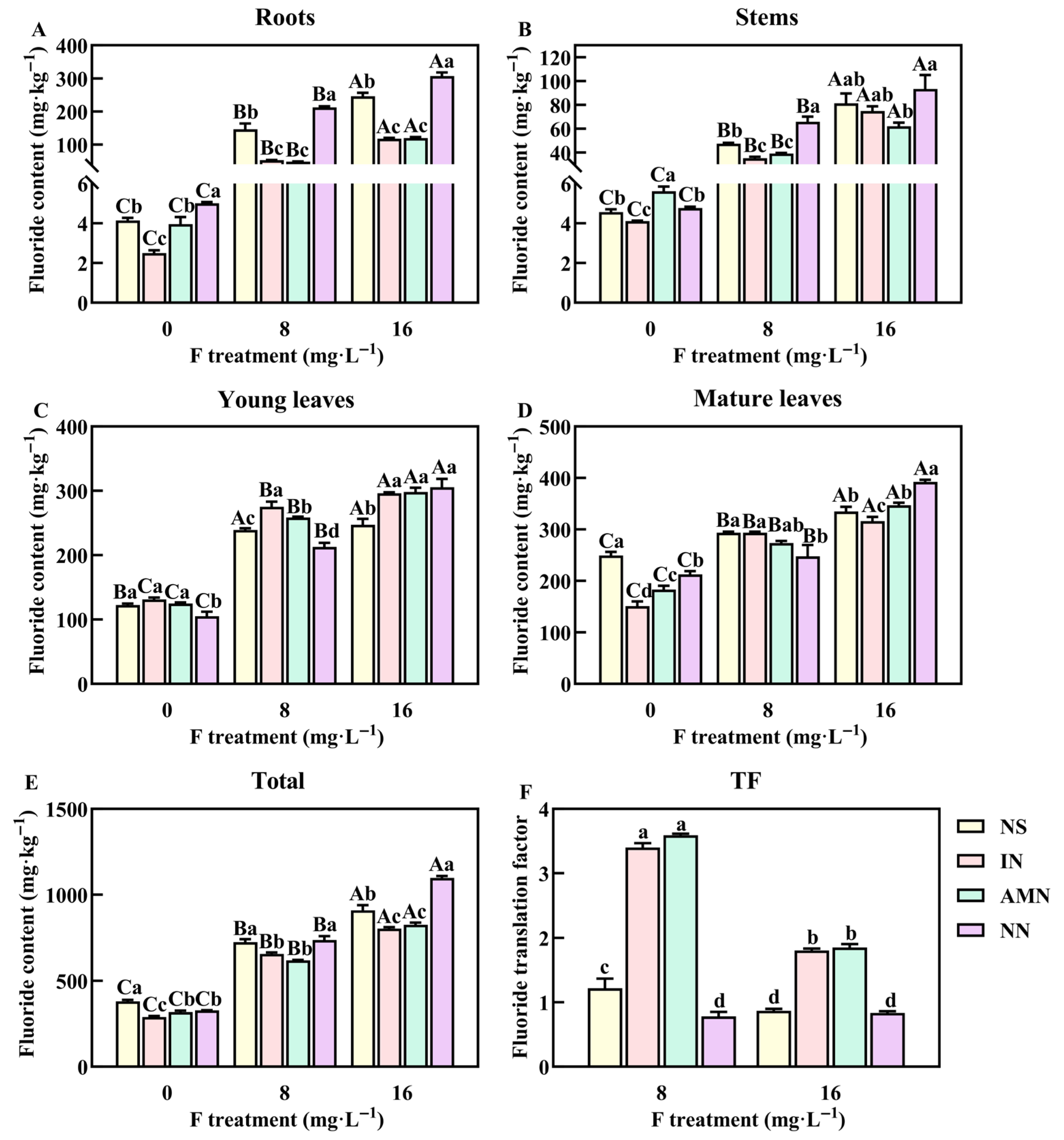
The distribution and translocation of F, N and other mineral elements in the different tissues of C. sinensis are clearly regulated by N forms and F levels. Exogenous F application resulted in significantly lower F accumulation in roots and stems of IN and AMN treatments compared to NS and NN (Figure 3A,B). In young leaves (YL) and ML, the F content under 8 mg·L−1 F treatment was 21.42% and 10.33% higher in 8AMN than in 8NN, respectively. Conversely, under high F stress (16 mg·L−1), 16AMN contained a lower F content than 16NN (Figure 3C,D). Correspondingly, the F translocation factor (TF) was significantly higher in IN and AMN treatments than in NS and NN (Figure 3F). Regarding total F accumulation, NN generally accumulated more F than AMN (Figure 3E). A similar pattern of total F accumulation was observed between IN and AMN across F levels, with one exception: at 8 mg·L−1 F, the total F content in 8IN was 6.06% higher than that in 8AMN (Figure 3E).
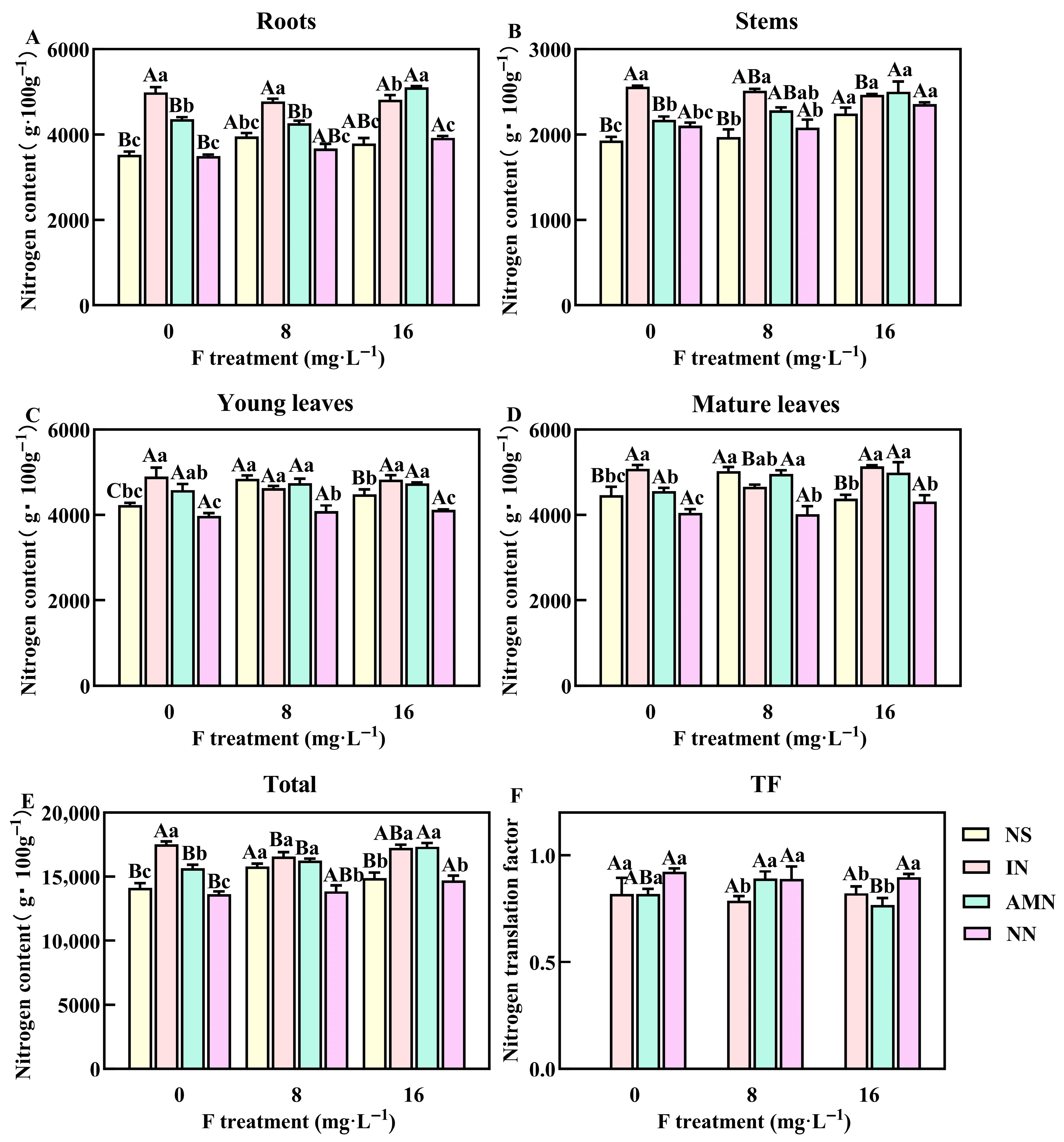
The distribution of N and F in C. sinensis tissues, as well as their corresponding TF, exhibited different patterns under treatments. IN and AMN treatments resulted in higher N accumulation in roots and stems compared to NS and NN, and the same pattern was observed with fluoride application (Figure 4A,B). In both YL and ML, 8NN treatment showed a lower N content than 8NS, 8IN and 8AMN (Figure 4C,D). Total N content followed a similar trend to that observed in YL and ML (Figure 4E). Furthermore, IN-treated C. sinensis accumulated the highest total N content among all treatments, even under F exposure (Figure 4E). In contrast, NN promoted a higher N TF than either IN or AMN, a trend that remained consistent in F-treated C. sinensis (Figure 4F).
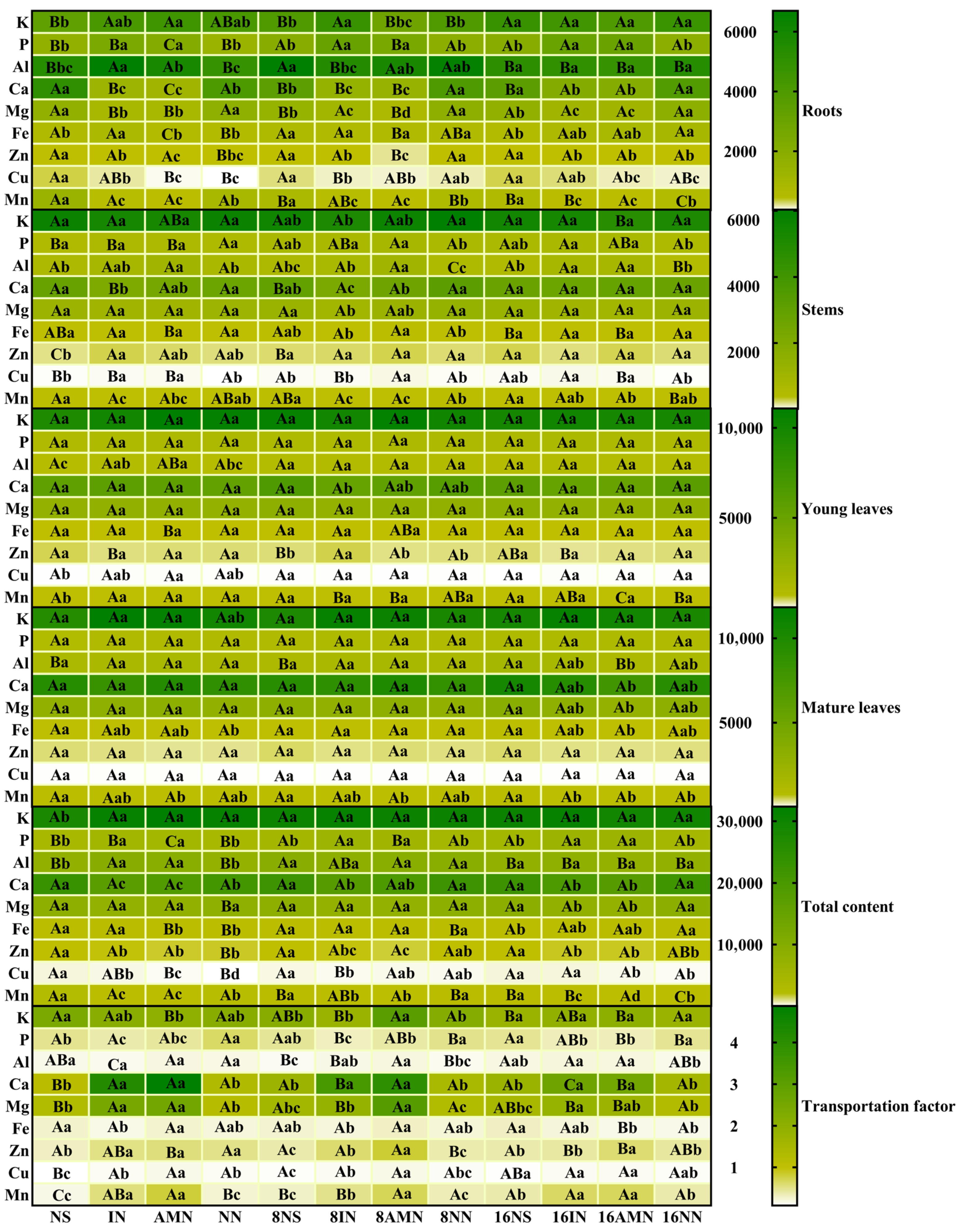
N forms and F concentrations significantly altered the distribution and translocation of multiple mineral elements, including potassium (K), phosphorus (P), aluminum (Al), calcium (Ca), magnesium (Mg), iron (Fe), zinc (Zn), copper (Cu) and manganese (Mn), in C. sinensis (Figure 5). Regarding P, plant roots in IN and AMN treatments accumulated significantly more P than those of NS and NN under F treatment. In contrast, the P TF was lower in IN and AMN treatments, indicating that NS and NN were more effective in translocating P to the shoots. For other mineral elements (K, Al, Ca, Mg, Fe, Zn, Cu and Mn), a distinct pattern was observed. While NN treatment generally resulted in higher root concentrations of K, Al, Ca, Mg, Fe, Zn and Mn compared to AMN under F exposure, the TFs for these elements were consistently higher in AMN plants. This suggests that AMN treatment favors the mobilization of these nutrients from roots to aerial parts despite their lower root accumulation.

3.4. Effect of F and N Treatment on Root H+, NH4+, NO3 Fluxes and Membrane Potential

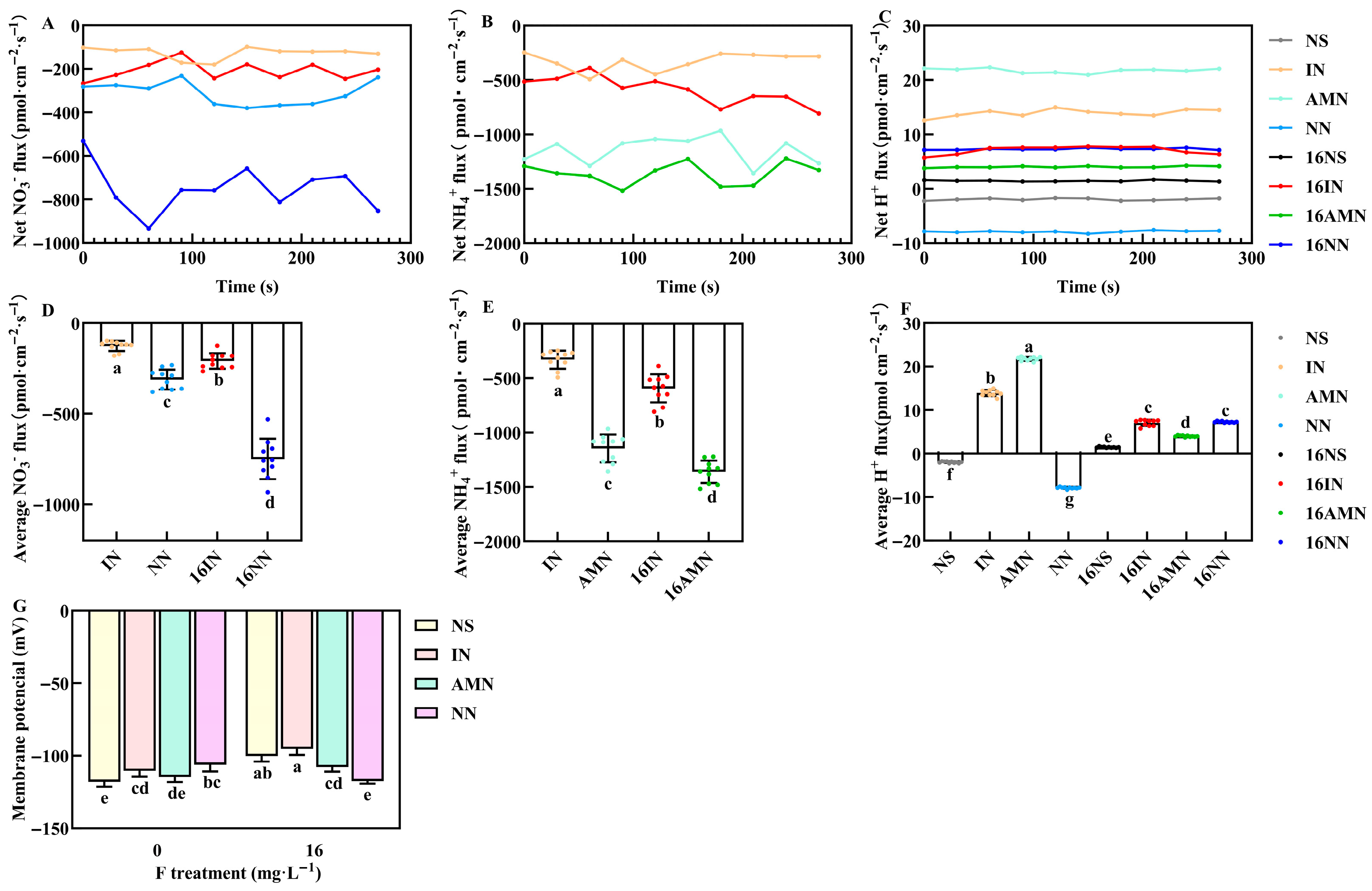
Root ion flux dynamics were characterized under varying N and F conditions using Non-invasive Micro-test Technology. NO3 influx was detected in IN, 16IN, NN and 16NN treatments, with 16IN showing a 65.4% higher influx rate than IN, and 16NN exhibiting a 2.4-fold greater NO3 influx compared to NN (Figure 6A,D). NH4+ was absorbed by roots in IN, 16IN, AMN and 16AMN treatments (Figure 6B). After 90 s of measurement, 16IN promoted NH4+ uptake by 80.47% relative to IN, while 16AMN increased the NH4+ influx rate by 18.73% compared to AMN (Figure 6B,E). H+ influx was observed only in NS and NN treatments, whereas 16NS and 16NN induced H+ efflux (Figure 6C). Furthermore, 16IN and 16AMN compared to IN and AMN suppressed H+ efflux by 50.93% and 18.46%, respectively (Figure 6F).
The membrane potential of root tips was systematically modulated by combined effects of F and N forms (Figure 6G). Under the same F condition, membrane potential varied with N forms, reaching the lowest value (−106.18 mV) in NN treatment. 16NS, 16IN and 16AMN treatments compared to NS, IN and AMN induced membrane depolarization, increasing their potentials to −100.22 mV, −95.25 mV and −107.86 mV, respectively. In contrast, 16NN was uniquely exhibited membrane hyperpolarization, with the potential decreasing to −117.55 mV compared to NN, consistent with enhanced H+ efflux.

3.5. Sequence Analysis of CsCLCs

We determined level of similarity sequences between CsCLCs (Figure S1 and Table 2). The results demonstrated 70.61%, 65.61%, 66.98% and 86.69% homology between CsCLCb and CsCLCc, CsCLCb and CsCLCg, CsCLCc and CsCLCg, and CsCLCf1 and CsCLCf2, respectively. In addition, the correlation values between CsCLCd and CsCLCb, CsCLCd and CsCLCc, and CsCLCd and CsCLCg were all greater than 50%, and the low level of identity among the remaining CsCLCs suggests that there are differences in the evolutionary process of CsCLCs.

3.6. Expression of CsCLCs in Various Tissues of C. sinensis

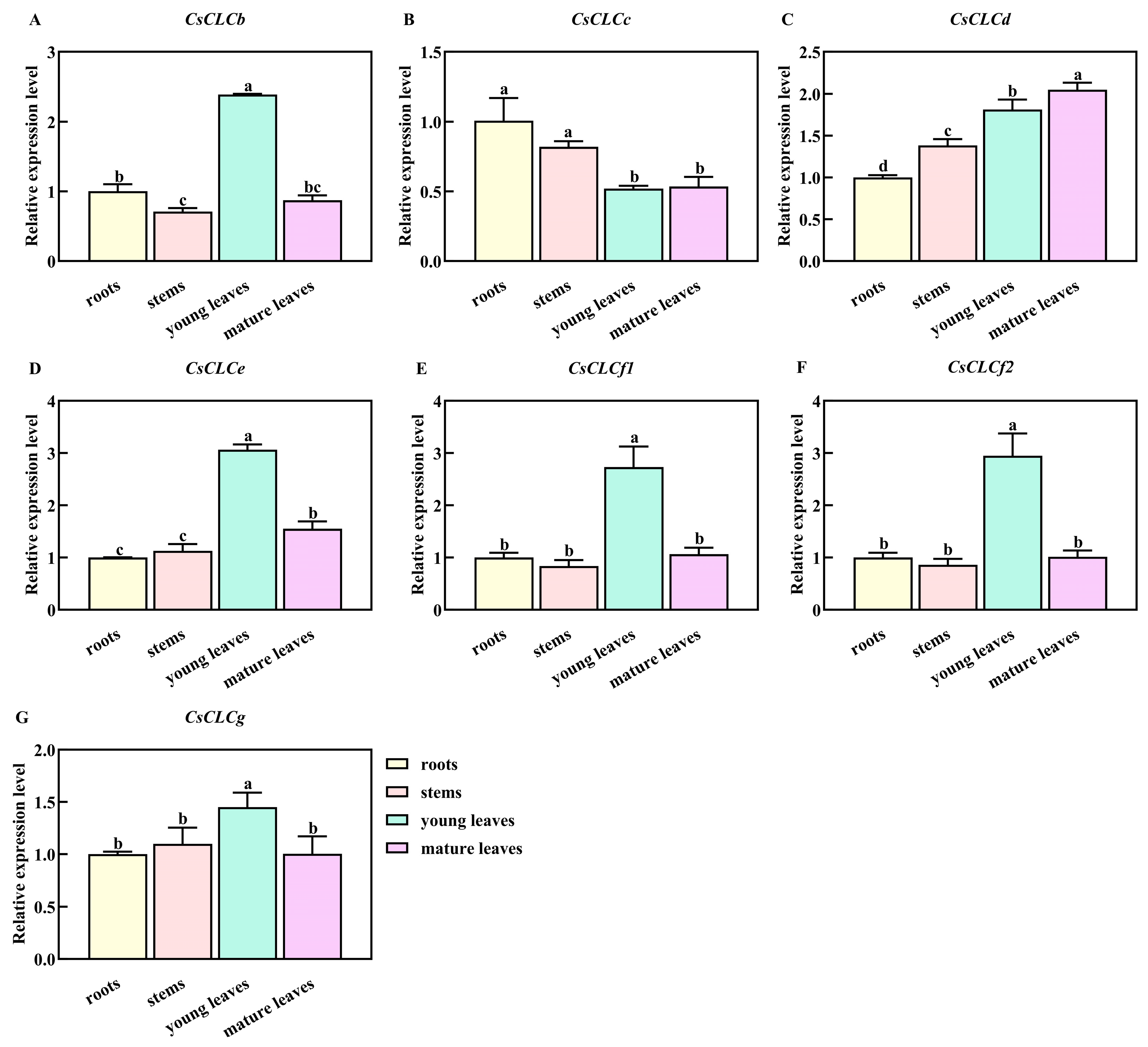
All CsCLCs were expressed in roots, stems, YL and ML of C. sinensis with regular expression levels (Figure 7). CsCLCb, CsCLCe, CsCLCf1, CsCLCf2 and CsCLCg all exhibited the highest expression in YL. The expression of CsCLCd was significantly higher in both YL and ML than in roots and stems, whereas CsCLCc had the highest expression level in roots.

3.7. CsCLCs and CsFEX Expression Analysis Under F and N Treatment

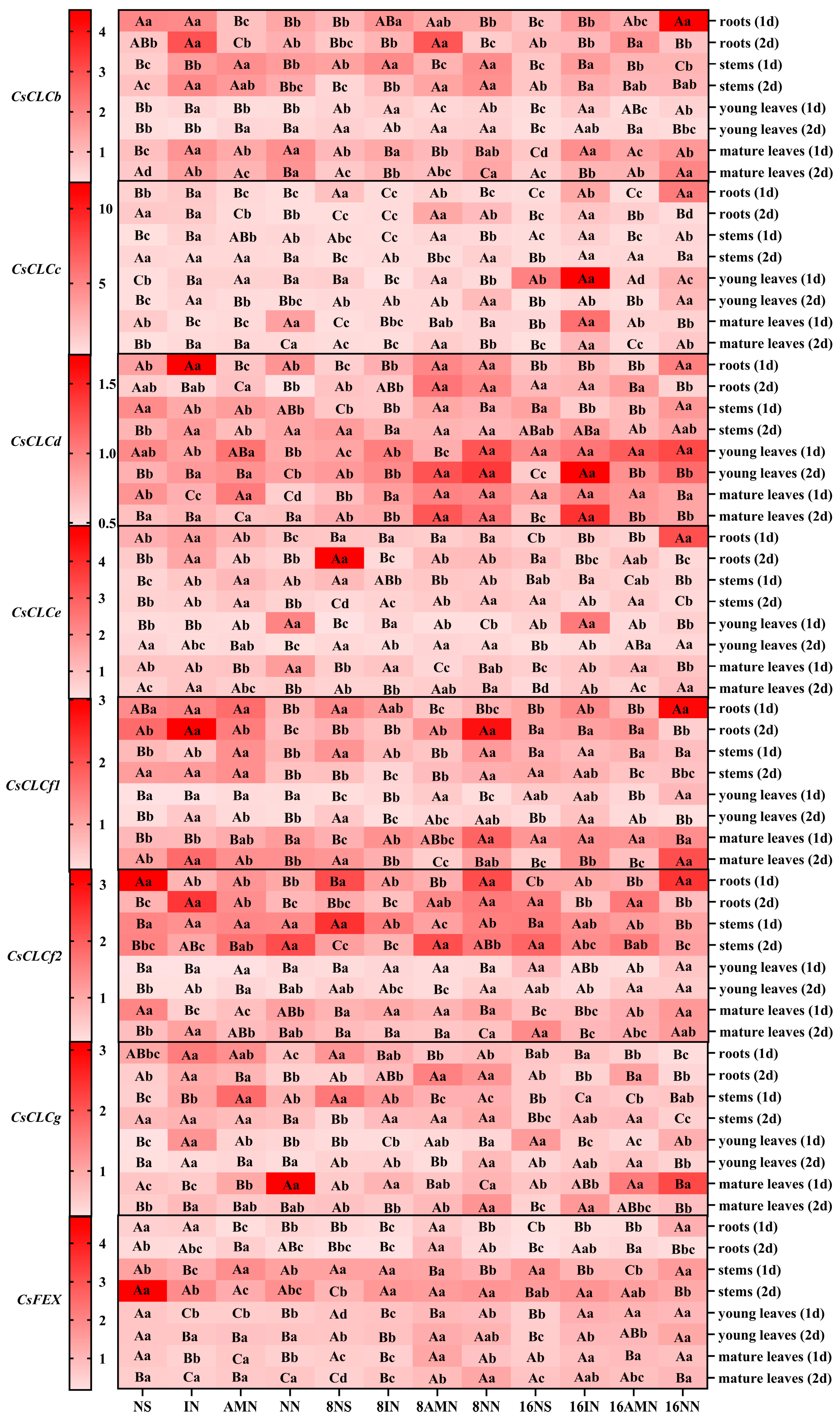
The expression patterns of CsCLCs genes exhibited spatiotemporal specificity under varying treatment conditions (Figure 8). After 1d, CsCLCc expression in roots peaked under 16NN compared to other treatments. While CsCLCc in 16NN also maintained higher expression than 16AMN in other tissues at 1d, the maximum levels were observed in 16IN treatment. 16NN-induced upregulation of CsCLCc occurred in all tissues except roots at 2d. In contrast to the root-specific expression of CsCLCc, other CsCLCs members were predominantly expressed in leaves (Figure 7). Among these, with the exception of the 16AMN treatment which promoted CsCLCg expression in roots, high F levels generally suppressed its expression in roots and stems while stimulating it in leaves at 2d (Figure 8). CsCLCb showed stronger induction by IN and NN than by AMN in roots and leaves at 1d, a pattern unaffected by F. Conversely, CsCLCd expression was promoted in roots when treated with F and AMN for 2d.
Expression analysis revealed different modes of regulation of the F-related CLCF members CsCLCe/f1/f2 and fluoride export protein CsFEX under combined N-F treatments (Figure 8). The expression of CsCLCe, CsCLCf1, CsCLCf2 and CsFEX peaked in roots at 1d under 16NN treatment. At 2d, expression of CsCLCe and CsCLCf2 promoted progressively with F concentration under AMN supply in roots. Compared with AMN, 8AMN significantly up-regulated CsFEX expression in roots for 2d, while simultaneous treatment with F and AMN inhibited the expression of CsCLCf1. A similar suppression of CsCLCf1 expression was observed under NS and IN treatments when combined with F. In contrast, 8NN stimulated expression of CsCLCf1 in roots, stems and YL more than NN treatment. Similarly, CsCLCe and CsFEX expression levels were elevated under 8NN compared to NN at 2d, whereas CsCLCf2 was suppressed in stems and ML. Notably, 16AMN treatment up-regulated CsCLCf2 expression compared to AMN after 2d.

4. Discussion

4.1. N Mitigated Inhibition of F on Growth of C. sinensis

F stress primarily impairs root systems, leading to suppressed root growth and development [2,5]. Although C. sinensis is a recognized F hyperaccumulator, excessive F still negatively impacts its growth. Prolonged exposure to F stress inhibits root system development, thereby compromising overall plant growth [3]. Consistent with this, 16 mg·L−1 inhibited root activity and growth in C. sinensis regardless of N forms (Figure 1). F absorbed by roots is predominantly translocated to shoots, resulting in higher F accumulation in leaves than in roots [36]. However, excessive F in leaves impairs photosynthetic function [4]. In this study, with the exception of NN, 16 mg·L−1 F suppressed Pn, Gs and Tr under other N forms (Figure 2). These findings collectively demonstrate that photosynthesis in C. sinensis is severely affected by F stress, even in this F-tolerant species.
Usually, NH4+-N and NO3-N typically coexist as primary N sources [37]. C. sinensis, which exhibits a marked preference for NH4+-N nutrition, primarily absorbs N in NH4+-N form [15]. Accordingly, this study observed more new root formation under AMN than under NN treatments (Figure 1A–L and Figure 9), confirming that NH4+-N enhances root system development in tea seedlings [24]. Both IN and AMN alleviated F-induced root growth inhibition (Figure 1A–L). Moreover, photosynthetic parameters were superior under AMN compared to NN, whereas IN conferred the strongest photosynthetic capacity under F stress while still supporting new root development (Figure 1A–L and Figure 2). These findings demonstrate that IN treatment optimized C. sinensis growth and enhanced resilience to F stress. Between the two single-source N forms, AMN was more effective than NN in mitigating F-induced suppression of root activity and growth while improving photosynthetic function.

4.2. NN Immobilized F Accumulation in Roots, While AMN Increased F Translocation via an Al-Mediated Pathway

Under 16NS treatment, enhanced H+ efflux and subsequent root depolarization were observed (Figure 6G). Moreover, N deficiency led to reduced energy production in plant [38]. To survive under such stress, plants allocated more energy to absorb and transport other essential ions [39,40], thereby diverting energy away from the translocation of previously absorbed F. As a result, F accumulated in roots (Figure 3). Consequently, root growth was most severely inhibited under 16NS conditions (Figure 1A–L). In contrast, AMN and NN adopted different methods of F absorption and accumulation in C. sinensis (Figure 9). Different N forms appear to regulate ion homeostasis by modulating H+ fluxes along with key ion transport and fixation processes, thereby maintaining ionic balance in C. sinensis. This fundamental divergence in ion regulation strategy sets the stage for the distinct chemical pathway that dominates under AMN treatment.
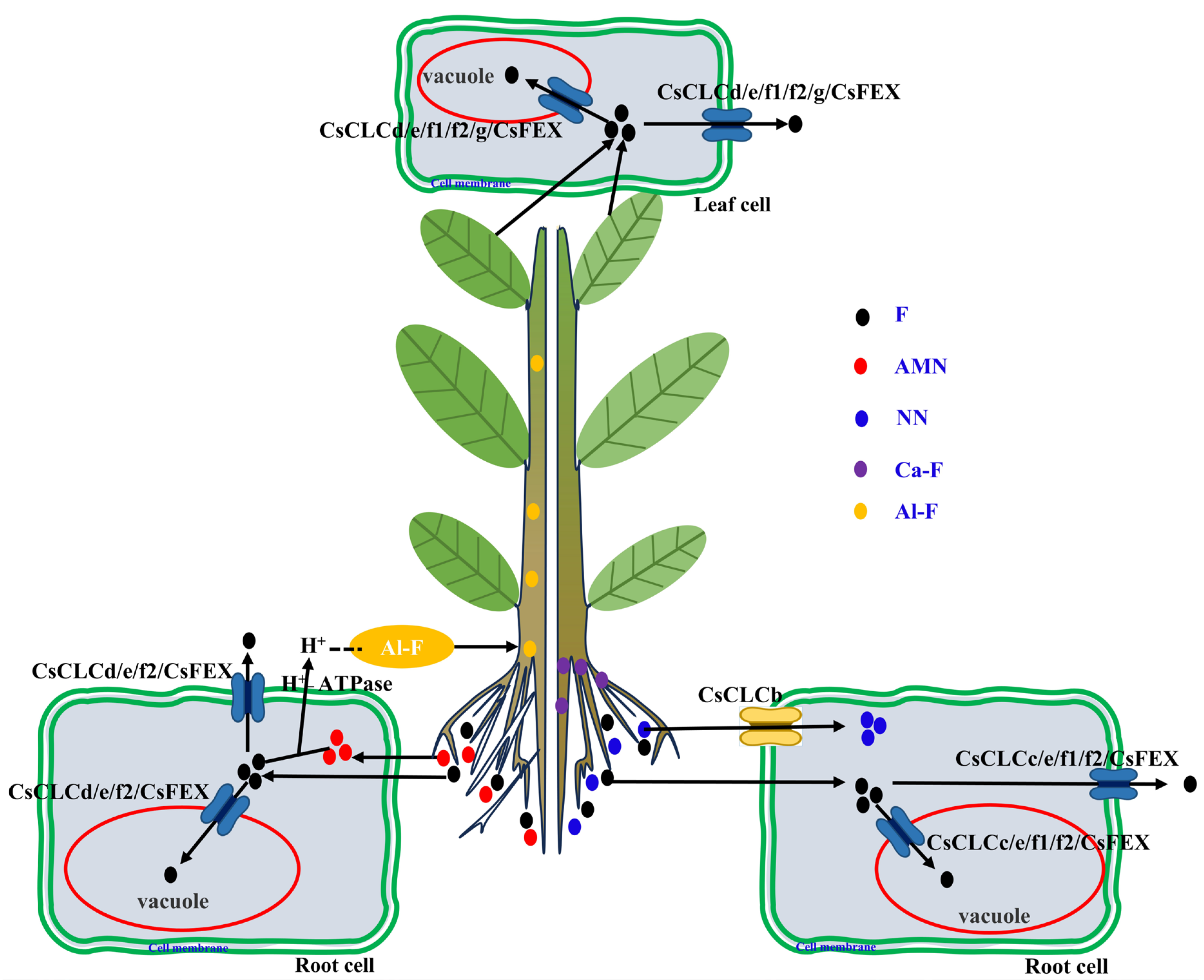
Under AMN supply, F translocation is predominantly governed by a well-characterized chemical cascade initiated by NH4+ uptake. Central to this cascade is the pronounced H+ efflux, a physiological hallmark of tea plant’s adaptation to NH4+ and acidic soils [16]. Unlike other plants such as Arabidopsis, wheat and tomato, which are sensitive to NH4+-N [18,19,41], C. sinensis effectively utilized NH4+-N without exhibiting symptoms of ammonium toxicity [22]. Compared to NN, AMN increased N content in C. sinensis, even under simultaneous treatment with F (Figure 4), and increased P content and K translocation (Figure 5). This overall improvement in nutrient status contributed to enhanced F tolerance in C. sinensis. Furthermore, the uptake of NH4+-N has been linked to improved stress resistance through promotion of amino acid synthesis [42]. Following AMN treatment, the characteristic H+ efflux led to rhizosphere acidification (Figure 6C,F and Figure 9), which in turn increased the solubility and bioavailability of Al3+. The mobilized Al3+ then competes with Ca2+ and Mg2+ for uptake [22,43]. Under 16AMN conditions, NH4+ influx similarly competed with K+, Ca2+ and Mg2+ for absorption [18]. Collectively, these processes reduce the fixation of F through chelation with Ca2+ and Mg2+ in the roots. The observed decrease in H+ efflux under 16AMN may be attributed to root absorption of HF, composed of F−- and H+ (Figure 6C,F) [44]. Inside the cell, HF rapidly dissociates into F- and H+, establishing a balance with the AMN-stimulated H+ efflux and resulting in a more stable root membrane potential under both AMN and 16AMN treatments (Figure 6G). Critically, the increased Al3+ availability facilitates the formation of soluble Al-F complexes [45]. These complexes are readily co-transported within C. sinensis, which explains the lower Al content in roots under 16AMN treatment compared to 16NN (Figure 5) and, more importantly, provides a direct chemical mechanism for F translocation (Figure 9). The distribution of F to various plant tissues via this Al-mediated pathway, thereby diluting its accumulation in any single tissue, represents a key protective mechanism in C. sinensis. Thus, under AMN supply, F translocation is predominantly governed by the NH4+-induced acidification and subsequent Al-F complexation pathway.
Under NN treatment, NO3 uptake was accompanied by H+ influx (Figure 6C,F), whereas H+ efflux induced by 16NN treatment enhanced the bioavailability of F, Ca and Mg. Among these, Ca was more stably immobilized in roots than Mg and facilitated the formation of insoluble precipitates with F, thereby reducing upward F translocation [7]. Additionally, more energy was allocated to the uptake and transport of other essential ions to mitigate F stress, which further compromised F translocation capacity. Consequently, NN treatment resulted in higher F accumulation and weaker root activity compared to AMN (Figure 1M and Figure 3). In summary, under NN conditions, F tends to bind with Ca and accumulate in the roots.

4.3. CsCLCs and CsFEX Play a Role in Different N and F Treatments of C. sinensis

The uptake and transport of F in C. sinensis are modulated by different N forms through complex interactions, involving regulatory roles of CsCLCs and CsFEX (Figure 9). Among these transporters, both CsCLCe and CsFEX have been demonstrated to contribute significantly to F tolerance [9,10,46]. Compared with NN, 16NN treatment stimulated the expression of CsCLCe and CsFEX in roots at 1d (Figure 8). Under sudden short-term F stress, these transporters likely mediate F- efflux [11,47]. In ML, the H+ dynamics induced by AMN enhanced CsFEX expression more strongly than NN after 1d (Figure 6 and Figure 8). However, by 2d, 16NN resulted in higher CsFEX expression than any other N forms (Figure 8), suggesting that CsFEX may mitigate F toxicity by sequestering F into vacuoles during its transfer and accumulation, or by participating in F redistribution [6]. Similarly, at 2d, the combined treatment of F and NN induced increased CsCLCe expression in ML relative to other N treatments (Figure 8), indicating that CsCLCe may also be involved in vacuolar compartmentalization of F. In summary, under NN conditions, the early induction of CsCLCe and CsFEX facilitates short-term F efflux in roots, which is subsequently accompanied by activation of a vacuolar sequestration mechanism in leaves.
CsCLCf1, CsCLCf2 and CsCLCe belong to the CLCF group and exhibit higher sensitivity to F than to other halogen elements [48]. CsCLCf1 and CsCLCf2 are evolutionarily closely related [47], sharing high sequence homology (Table 2; Figure S1). Their tissue expression patterns are also highly congruent, with both genes being highly expressed in YL (Figure 7). At 1d of 16NN treatment, CsCLCf1 expression increased in roots (Figure 8). Furthermore, NN treatment promoted CsCLCf1 expression more strongly than AMN, particularly under concurrent F exposure (Figure 8). Both CsCLCf1 and CsCLCe may perform similar functions that contribute to regulation of F in roots under NN conditions, and also participate in modulating F accumulation in ML. In rice, two F-responsive CLC genes have been identified with varying response levels [49]. Similarly, in C. sinensis, CsCLCf1 and CsCLCf2 are not functionally redundant under N and F treatments and exhibit distinct response patterns. Under NS and AMN treatments for 2d, CsCLCf2 expression showed an up-regulation trend with increasing F concentration (Figure 8). In addition, combined F and NN treatment for 1d stimulated CsCLCf2 expression in both roots and leaves (Figure 8). These findings suggest that CsCLCf2 plays a broader role in regulating both N and F responses, whereas CsCLCf1 appears to function more specifically in F regulation under NN conditions.
The remaining CsCLCs members may be more involved in the transport of other anions, such as NO3 and Cl [13,14]. In other plant species, CLCb and CLCa often share similar functions, yet functional redundancy exists, with CLCa primarily responsible for NO3 transport [13]. In C. sinensis, only CsCLCb was identified. Its expression in roots was up-regulated by F after 1d of 16NN and 16AMN treatments compared with the corresponding treatments without F (NN and AMN) (Figure 8). However, F suppressed CsCLCb expression under 16IN and 16NN conditions at 2d (Figure 8). Under these conditions, CsCLCb primarily facilitates nitrate transport. However, since F and NO3 compete for uptake, C. sinensis appears to suppress CsCLCb expression to minimize F- influx. This downregulation, in turn, may impair both nitrate transport and the perception or transduction of nitrate signals.
The CLC family, known for its crucial role in membrane anion transport [13], includes members like AtCLCc, which functions in nitrate storage and salt stress tolerance [50,51]. In C. sinensis, CsCLCc exhibited root-specific expression (Figure 7), suggesting a primary role in root anion homeostasis. Its expression was rapidly induced by N and F treatments, showing a pronounced response to F stress under 16NN at 1d (Figure 8). In contrast, CsCLCg expression was suppressed in roots under high F and different N forms at 1d (Figure 8), which may directly contribute to reduced F uptake and translocation. This functional divergence is particularly notable given that their Arabidopsis homologs, AtCLCc and AtCLCg, are known to cooperate in regulating chloride homeostasis [52]. While CsCLCg was predominantly expressed in YL (Figure 7), its expression in YL was promoted by high F treatment with different N forms at 2d (Figure 8), suggesting a potential role in sequestering F- into leaf vacuoles. CsCLCd also responded to N and F treatments. In Arabidopsis, AtCLCd is highly expressed in the root elongation zone and supports cell expansion under slightly acidic conditions [53]. Correspondingly, in C. sinensis, AMN enhanced CsCLCd expression in roots compared to other N forms at 2d (Figure 8), potentially as a response to NH4+ uptake and associated H+ fluxes. This response may contribute to the improved root development observed under AMN conditions. In ML, CsCLCd expression was also higher under AMN than NN (Figure 8), suggesting an additional role in vacuolar compartmentalization for detoxification. Collectively, these results suggest that the H+ dynamics induced by AMN treatment coordinate the distinct regulatory functions of CsCLCd, CsCLCc and CsCLCg in roots and leaves, respectively, fine-tuning ion homeostasis and F detoxification in C. sinensis.

5. Conclusions

In summary, C. sinensis employs N-form-dependent strategies to mitigate F stress. Under AMN treatment, root H+ efflux acidifies the rhizosphere, mobilizing Al3+ and facilitating F uptake and transport primarily as Al-F complexes. This process is mediated by a suite of F-responsive transporters, including CsCLCd, CsCLCe, CsCLCf2 and CsFEX. In contrast, under NN treatment, initial H+ uptake alleviates rhizosphere acidity. Under 16NN treatment, enhanced H+ efflux promotes F uptake, leading to its immobilization within roots as insoluble Ca-F precipitates. Under NN conditions, F transport involves a set of transporters, with CsCLCb, CsCLCc, CsCLCe, CsCLCf1, CsCLCf2 and CsFEX implicated in F handling. Notably, regardless of the N source, F that translocates to the leaves is ultimately sequestered into vacuoles for detoxification by a common set of transporters, including CsCLCd, CsCLCe, CsCLCf1, CsCLCf2, CsCLCg and CsFEX.

Supplementary Materials

The following supporting information can be downloaded at https://www.mdpi.com/article/10.3390/horticulturae12010094/s1: Figure S1: Heatmap shows the similarity of CsCLCs protein sequences; Table S1: Composition of nutrient solution for tea seedling cultivation; Table S2: Tea seedling tissues’ dry weight and total dry weight; Table S3: Non-invasive micro-test of stabilized solutions and detection indicators; Table S4: Primer sequences for quantitative RT-PCR.

Author Contributions

Conceptualization, A.X. and Y.W.; validation, Z.W.; formal analysis, Y.S., R.C. and S.M.; investigation, A.X. and C.W.; resources, X.L. and Y.W.; data curation, A.X.; writing—original draft preparation, A.X.; writing—review and editing, S.L., J.Z., X.C. and Y.W.; visualization, X.X.; supervision, C.P. and Y.T.; project administration, Y.T.; funding acquisition, C.P., X.L., R.C., S.M. and Y.W. All authors have read and agreed to the published version of the manuscript.

Funding

This research was funded by the Jiangsu Province Modern Agriculture Key Technology Integration and Promotion Project (JCTG [2025]11), the National Natural Science Foundation of China (32272772, 32172628), the Project for Longnan Tea Industry Safety, High Quality, and Efficient Production Technology Innovation Team (LKF [2025]6), the Wenxian Science and Technology Plan Project (2023-X.QKJ-02), the Nanjing Agricultural Major Technology Collaborative Promotion Plan Project (2025NJXTTG 07), the Modern Agriculture Industry Enhancement Project of Cangnan County (2024CNYJY07), the Wenzhou Science and Technology Program on Agricultural New Variety Breeding Collaboration (ZX2024004-2), the Wenzhou Agricultural Harvest Plan Project (FSJH2024050), the Wenzhou Academy of Agricultural Science of Doctoral Research Launch Project (FSJH2024050) and the Key Research and Development Program of Jiangsu province (BE2023364).

Data Availability Statement

The original contributions presented in this study are included in the article/Supplementary Materials. Further inquiries can be directed to the corresponding author.

Conflicts of Interest

The authors declare no conflicts of interest.

References

  1. Ghanati, F.; Morita, A.; Yokota, H. Effects of aluminum on the growth of tea plant and activation of antioxidant system. Plant Soil 2025, 276, 133–141. [Google Scholar] [CrossRef]
  2. Ghassemi-Golezani, K.; Farhangi-Abriz, S. Biochar alleviates fluoride toxicity and oxidative stress in safflower (Carthamus tinctorius L.) seedlings. Chemosphere 2019, 223, 406–415. [Google Scholar] [CrossRef] [PubMed]
  3. Pan, J.; Li, D.; Zhu, J.; Shu, Z.; Ye, X.; Xing, A.; Wen, N.; Ma, Y.; Zhu, X.; Fang, W.; et al. Aluminum relieves fluoride stress through stimulation of organic acid production in Camellia sinensis. Physiol. Mol. Biol. Plants 2020, 26, 1127–1137. [Google Scholar] [CrossRef] [PubMed]
  4. Cai, H.; Dong, Y.; Li, Y.; Li, D.; Peng, C.; Zhang, Z.; Wan, X. Physiological and cellular responses to fluoride stress in tea (Camellia sinensis) leaves. Acta Physiol. Plant. 2016, 38, 144. [Google Scholar] [CrossRef]
  5. Ghassemi-Golezani, K.; Farhangi-Abriz, S. Biochar related treatments improved physiological performance, growth and productivity of Mentha crispa L. plants under fluoride and cadmium toxicities. Ind. Crop. Prod. 2023, 194, 1169278. [Google Scholar] [CrossRef]
  6. Xing, A.; Wu, Z.; Xu, X.; Sun, Y.; Wang, G.; Wang, Y. Research advances of fluoride accumulation mechanisms in tea plants (Camellia sinensis). J. Tea Sci. 2022, 42, 301–315. [Google Scholar] [CrossRef]
  7. Makete, N.; Rizzu, M.; Seddaiu, G.; Gohole, L.; Otinga, A. Fluoride toxicity in cropping systems: Mitigation, adaptation strategies and related mechanisms. A review. Sci. Total Environ. 2022, 833, 155129. [Google Scholar] [CrossRef] [PubMed]
  8. Peng, C.; Xu, X.; Ren, Y.; Niu, H.; Yang, Y.; Hou, R.; Wan, X.; Cai, H. Fluoride absorption, transportation and tolerance mechanism in Camellia sinensis, and its bioavailability and health risk assessment: A systematic review. J. Sci. Food Agric. 2021, 101, 379–387. [Google Scholar] [CrossRef] [PubMed]
  9. Zhu, J.; Xing, A.; Wu, Z.; Tao, J.; Ma, Y.; Wen, B.; Zhu, X.; Fang, W.; Wang, Y. CsFEX, a fluoride export protein gene from Camellia sinensis, alleviates fluoride toxicity in transgenic Escherichia coli and Arabidopsis thaliana. J. Agric. Food Chem. 2019, 67, 5997–6006. [Google Scholar] [CrossRef] [PubMed]
  10. Xing, A. Identification of CLC in Camellia sinensis and functional verification of CsCLCe. Master's Thesis, Nanjing Agricultural University, Nanjing, China, 2020. [Google Scholar]
  11. Wu, Z.; Xing, A.; Chu, R.; Xu, X.; Sun, Y.; Zhu, J.; Yang, Y.; Yin, J.; Wang, Y. The fluoride exporter (CsFEX) regulates fluoride uptake/accumulation in Camellia sinensis under different pH. Ecotoxicol. Environ. Saf. 2024, 278, 116407. [Google Scholar] [CrossRef] [PubMed]
  12. Stockbridge, R.B.; Lim, H.; Otten, R.; Williams, C.; Shane, T.; Weinberg, Z.; Miller, C. Fluoride resistance and transport by riboswitch-controlled CLC antiporters. Proc. Natl. Acad. Sci. USA 2012, 109, 15289–15294. [Google Scholar] [CrossRef] [PubMed]
  13. Nedelyaeva, O.I.; Shuvalov, A.V.; Balnokin, Y.V. Chloride channels and transporters of the CLC family in plants. Russ. J. Plant Physiol. 2020, 67, 767–784. [Google Scholar] [CrossRef]
  14. Silva-Herrera, H.; Wege, S.; Franzisky, B.L.; Ahmad, N.; Roelfsema, M.R.G.; Geilfus, C.M. Chloride transport and homeostasis in plants. Quant. Plant Biol. 2025, 6, e20. [Google Scholar] [CrossRef] [PubMed]
  15. Tang, D.; Liu, M.; Zhang, Q.; Ma, L.; Shi, Y.; Ruan, J. Preferential assimilation of NH4+ over NO3- in tea plant associated with genes involved in nitrogen transportation, utilization and catechins biosynthesis. Plant Sci. 2020, 291, 110369. [Google Scholar] [CrossRef] [PubMed]
  16. Ruan, J.; Gerendás, J.; Härdter, R.; Sattelmacher, B. Effect of nitrogen form and root-zone pH on growth and nitrogen uptake of tea (Camellia sinensis) plants. Ann. Bot. 2007, 99, 301–310. [Google Scholar] [CrossRef] [PubMed]
  17. Rivero-Marcos, M.; Lasa, B.; Neves, T.; Zamarreño, A.; García-Mina, J.; García-Olaverri, C.; Aparicio-Tejo, P.; Cruz, C.; Ariz, I. Plant ammonium sensitivity is associated with external pH adaptation, repertoire of nitrogen transporters, and nitrogen requirement. J. Exp. Bot. 2024, 75, 3557–3578. [Google Scholar] [CrossRef] [PubMed]
  18. Li, B.; Li, G.; Kronzucker, H.J.; Baluška, F.; Shi, W. Ammonium stress in Arabidopsis signaling, genetic loci, and physiological targets. Trends Plant Sci. 2014, 19, 107–114. [Google Scholar] [CrossRef] [PubMed]
  19. Britto, D.T.; Kronzucker, H.J. NH4+ toxicity in higher plants: A critical review. J. Plant Physiol. 2002, 159, 567–584. [Google Scholar] [CrossRef]
  20. Su, J.; Ruan, L.; Wang, L.; Wei, K.; Wu, L.; Bai, P.; Cheng, H. Early Identification of Nitrogen Absorption Efficiency in Tea Plants. J. Tea Sci. 2020, 40, 576–587. [Google Scholar] [CrossRef]
  21. Chen, L.; Chen, J.; Wang, N.; Zhang, X. The role of plasma membrane H+-ATPase on nitrogen-regulated phosphorus uptake in tea plants. J. Tea Sci. 2019, 39, 723–730. [Google Scholar] [CrossRef]
  22. Ruan, J.; Zhang, F.; Wong, M.H. Effect of nitrogen form and phosphorus source on the growth, nutrient uptake and rhizosphere soil property of Camellia sinensis L. Plant Soil 2000, 223, 63–71. [Google Scholar] [CrossRef]
  23. Ma, J.; Ryan, P.; Delhaize, E. Aluminium tolerance in plants and the complexing role of organic acids. Trends Plant Sci. 2001, 6, 273−278. [Google Scholar] [CrossRef] [PubMed]
  24. Huang, S.; Li, M.; Luo, J.; Chang, Y.; Zhang, Y.; Guo, G. Response of Root Development and Auxin in Tea Plants to Different Nitrogen Forms. J. Hennan Agric. Sci. 2024, 53, 54–65. [Google Scholar] [CrossRef]
  25. Wang, P.; Cao, H.; Quan, S.; Wang, Y.; Li, M.; Wei, P.; Zhang, M.; Wang, H.; Ma, H.; Li, X.; et al. Nitrate improves aluminium resistance through SLAH-mediated citrate exudation from roots. Plant Cell Environ. 2023, 46, 3518–3541. [Google Scholar] [CrossRef] [PubMed]
  26. Wang, Y.; Di, B.; Sun, Z.; Sonali; Donovan-Mak, M.; Chen, Z.; Wang, M. Multi-omics and physiological analysis reveal crosstalk between aphid resistance and nitrogen fertilization in wheat. Plant Cell Environ. 2024, 48, 2024–2039. [Google Scholar] [CrossRef] [PubMed]
  27. Tavakoli, F.; Hajiboland, R.; Haeili, M.; Sadeghzadeh, N.; Nikolic, M. Effect of elevated ammonium on biotic and abiotic stress defense responses and expression of related genes in cucumber (Cucumis sativus L.) plants. Plant Physiol. Biochem. 2025, 218, 109310. [Google Scholar] [CrossRef] [PubMed]
  28. Ye, L.; Zhang, D.; Yang, Q.; Pan, C.; Xie, Y.; Liu, K.; Wang, K.; Liu, M. Plant sex influences cadmium detoxification via mediating cadmium transport and cell wall modification under different nitrogen forms. Plant Cell Environ. 2025, 48, 7517–7532. [Google Scholar] [CrossRef] [PubMed]
  29. Enomoto, T.; Tone, N.; Ishii, T.; Hirono, H.; Oi, A.; Hirono, Y.; Ikka, T.; Yamashita, H. Effect of ammonium: Nitrate application ratios on growth and nitrogen metabolism of tea plants (Camellia sinensis L.). Plant Direct 2025, 9, e70084. [Google Scholar] [CrossRef] [PubMed]
  30. Sun, Y.; Wu, Z.; Xing, A.; Zhang, H.; Xu, X.; Gong, Z.; Zhao, Z.; Liu, S.; Chen, X.; Li, X.; et al. Potassium alleviates fluoride accumulation and enhances fluoride tolerance in Camellia sinensis. Ind Crop Prod. 2024, 219, 119026. [Google Scholar] [CrossRef]
  31. Ruf, M.; Brunner, I. Vitality of tree fine roots: Reevaluation of the tetrazolium test. Tree Physiol. 2003, 23, 257–263. [Google Scholar] [CrossRef] [PubMed]
  32. Gao, H.; Zhang, Z.; Wan, X. Influences of charcoal and bamboo charcoal amendment on soil-fluoride fractions and bioaccumulation of fluoride in tea plants. Environ. Geochem. Health 2012, 34, 551–562. [Google Scholar] [CrossRef] [PubMed]
  33. Lu, R. Analytical Methods for Soil and Agricultural Chemistrys; China Agricultural Science and Technology Press: Beijing, China, 2000. [Google Scholar]
  34. Nie, F. New comprehensions of hyperaccumulator. Ecol. Environ. 2005, 14, 136–138. [Google Scholar] [CrossRef]
  35. Livak, K.J.; Schmittgen, T.D. Analysis of relative gene expression data using real-time quantitative PCR and the 2(-Delta Delta C(T)) Method. Methods 2001, 25, 402–408. [Google Scholar] [CrossRef] [PubMed]
  36. Jayasingha, H.; Amarasooriya, G.; Rajapaksha, N.; Senavirathna, L.; Weragoda, S.; Kawakami, T.; Kuroda, K. Fluoride in tea: Accumulation, dietary exposure, and future strategies for risk mitigation in food safety; a scoping review. Crit. Rev. Food Sci. Nutr. 2025, 65, 8990–9003. [Google Scholar] [CrossRef] [PubMed]
  37. Xu, S.; Wei, Y.; Zhao, P.; Sun, Y.; Gao, K.; Yin, C.; Wang, C.; Fang, R.; Ye, J. A nitrate transporter OsNPF6.1 promotes nitric oxide signaling and virus resistance. Plant Cell Environ. 2025, 48, 6493–6508. [Google Scholar] [CrossRef] [PubMed]
  38. Govta, N.; Govta, L.; Sela, H.; Peleg, G.; Distelfeld, A.; Fahima, T.; Beckles, D.M.; Krugman, T. Plasticity of root system architecture and whole transcriptome responses underlying nitrogen deficiency tolerance conferred by a wild emmer wheat qtl. Plant Cell Environ. 2025, 48, 2835–2855. [Google Scholar] [CrossRef] [PubMed]
  39. Farhan, M.; Sathish, M.; Kiran, R.; Mushtaq, A.; Baazeem, A.; Hasnain, A.; Hakim, F.; Naqvi, S.A.; Mubeen, M.; Iftikhar, Y.; et al. Plant nitrogen metabolism: Balancing resilience to nutritional stress and abiotic challenges. Phyton-Int. J. Exp. Bot. 2024, 93, 581–609. [Google Scholar] [CrossRef]
  40. Li, M.; You, H.; Jiang, W.; Lu, S.; Hou, Y.; Xiao, J.; Zeng, W.; Xu, P.; Ding, X.; Wu, X.; et al. GsSnRK1.1 kinase positively regulates the Glycine soja nitrate transporter GsNRT2.4a in response to nitrogen starvation. Plant Cell Environ 2025. [Google Scholar] [CrossRef] [PubMed]
  41. Du, W.; Zhang, Y.; Si, J.; Zhang, Y.; Fan, S.; Xia, H.; Kong, L. Nitrate alleviates ammonium toxicity in wheat (Triticum aestivum L.) by regulating tricarboxylic acid cycle and reducing rhizospheric acidification and oxidative damage. Plant Signal. Behav. 2021, 16, 1991687. [Google Scholar] [CrossRef] [PubMed]
  42. Wang, Z.; Wu, Z. Insights into fluorine stabilization by biological approaches: Mechanisms, toxicity regulatory, application feasibility, and new challenges. Bioresour. Technol. 2025, 434, 132846. [Google Scholar] [CrossRef] [PubMed]
  43. Blamey, F.P.C.; Edmeades, D.C.; Wheeler, D.M. Empirical models to approximate calcium and magnesium ameliorative effects and genetic differences in aluminium tolerance in wheat. Plant Soil 1992, 144. [Google Scholar] [CrossRef]
  44. Ji, C.; Stockbridge, R.B.; Miller, C. Bacterial fluoride resistance, Fluc channels, and the weak acid accumulation effect. J. Gen. Physiol. 2014, 144, 257–261. [Google Scholar] [CrossRef] [PubMed]
  45. Gao, H.; Zhao, Q.; Zhang, X.; Wan, X.; Mao, J. Localization of fluoride and aluminum in subcellular fractions of tea leaves and roots. J. Agric. Food Chem. 2014, 62, 2313–2319. [Google Scholar] [CrossRef] [PubMed]
  46. Tausta, S.L.; Berbasova, T.; Peverelli, M.; Strobel, S.A. The fluoride transporter FLUORIDE EXPORTER (FEX) is the major mechanism of tolerance to fluoride toxicity in plants. Plant Physiol. 2021, 186, 1143–1158. [Google Scholar] [CrossRef] [PubMed]
  47. Xing, A.; Ma, Y.; Wu, Z.; Nong, S.; Zhu, J.; Sun, H.; Tao, J.; Wen, B.; Zhu, X.; Fang, W.; et al. Genome-wide identification and expression analysis of the CLC superfamily genes in tea plants (Camellia sinensis). Funct. Integr. Genom. 2020, 20, 497–508. [Google Scholar] [CrossRef] [PubMed]
  48. Brammer, A.E.; Stockbridge, R.B.; Miller, C. F/Cl selectivity in CLCF-type F-/H+ antiporters. J. Gen. Physiol. 2014, 144, 129–136. [Google Scholar] [CrossRef] [PubMed]
  49. Banerjee, A.; Roychoudhury, A.; Ghosh, P. Differential fluoride uptake induces variable physiological damage in a non-aromatic and an aromatic indica rice cultivar. Plant Physiol. Biochem. 2019, 142, 143–150. [Google Scholar] [CrossRef] [PubMed]
  50. Harada, H.; Kuromori, T.; Hirayama, T.; Shinozaki, K.; Leigh, R.A. Quantitative trait loci analysis of nitrate storage in Arabidopsis leading to an investigation of the contribution of the anion channel gene, AtCLC-c, to variation in nitrate levels. J. Exp. Bot. 2004, 55, 2005–2014. [Google Scholar] [CrossRef] [PubMed]
  51. Jossier, M.; Kroniewicz, L.; Dalmas, F.; Thiec, D.L.; Ephritikhine, G.; Thomine, S.; Barbier-Brygoo, H.; Vavasseur, A.; Filleur, S.; Leonhardt, N. The Arabidopsis vacuolar anion transporter, AtCLCc, is involved in the regulation of stomatal movements and contributes to salt tolerance. Plant J. 2010, 64, 563–576. [Google Scholar] [CrossRef] [PubMed]
  52. Nguyen, C.T.; Agorio, A.; Jossier, M.; Depre, S.; Thomine, S.; Filleur, S. Characterization of the chloride channel-like, AtCLCg, involved in chloride tolerance in Arabidopsis thaliana. Plant Cell Physiol. 2016, 57, 764–775. [Google Scholar] [CrossRef] [PubMed]
  53. Moradi, H.; Elzenga, T.; Lanfermeijer, F. Role of the AtClC genes in regulation of root elongation in Arabidopsis. Iran. J. Genet. Plant Breed. 2015, 4, 8. [Google Scholar]
Figure 1. Effect of different nitrogen (N) and fluoride (F) treatments on root system of tea seedlings. N treatments included N starvation (0 mM N, NS), ammonium nutrition (NH4+-N:NO3-N = 4:0, AMN), nitrate nutrition (NH4+-N:NO3-N = 0:4, NN) and interaction of different N forms (NH4+-N:NO3-N = 3:1, IN). F treatments were supplied as 0, 8 and 16 mg·L−1 NaF. Root phenotypes after (A) NS, (B) IN, (C) AMN, (D) NN, (E) 8NS, (F) 8IN, (G) 8AMN, (H) 8NN, (I) 16NS, (J) 16IN, (K) 16AMN, and (L) 16NN treatments and (M) root activity. Bars represent 1 cm in panels. In (M) data are the means  ±  SD of three biological replicates (p < 0.05). Different lowercase letters indicate significant differences among N treatments under the same F level, while different uppercase letters denote significant differences among F treatments within the same N group.
Horticulturae 12 00094 g001
Figure 2. Photosynthetic parameters of C. sinensis under different concentrations of N-F treatment. (A) Net photosynthetic rate; (B) stomatal conductance; (C) intercellular CO2 concentration; (D) transpiration rate. All data are the means  ±  SD of at least four biological replicates (p < 0.05). Different lowercase letters indicate significant differences among N treatments under the same F level, while different uppercase letters denote significant differences among F treatments within the same N group.
Horticulturae 12 00094 g002
Figure 3. Accumulation and transport efficiency of F in C. sinensis under N-F treatments. The F content of (A) roots, (B) stems, (C) young leaves, (D) mature leaves, (E) total and (F) F translocation factor (TF). All data are the means  ±  SD of three biological replicates (p < 0.05). Different lowercase letters indicate significant differences among N treatments under the same F level, while different uppercase letters denote significant differences among F treatments within the same N group.
Horticulturae 12 00094 g003
Figure 4. Accumulation and transport efficiency of nitrogen in C. sinensis under N-F treatments. The N content of (A) roots, (B) stems, (C) young leaves, (D) mature leaves, (E) total N and (F) N TF. All data are the means  ±  SD of three biological replicates (p < 0.05). Different lowercase letters indicate significant differences among N treatments under the same F level, while different uppercase letters denote significant differences among F treatments within the same N group.
Horticulturae 12 00094 g004
Figure 5. K, P, Al, Ca, Mg, Fe, Zn, Cu, and Mn content and TF in different tissues of C. sinensis under N-F treatments. All data are the means  ±  SD of three biological replicates (p < 0.05). The color bar indicates the value, with green indicating a high value and yellow indicating a low value. Different lowercase letters indicate significant differences among N treatments under the same F level, while different uppercase letters denote significant differences among F treatments within the same N group.
Horticulturae 12 00094 g005
Figure 6. Net fluxes and average flow rates of NO3, NH4+ and H+ and membrane potentials in C. sinensis roots under F (0 and 16 mg·L−1 NaF) and different N (NS, IN, AMN, NN) treatments. (A,D) Net fluxes and average flow rates of NO3 in roots under F (0 and 16 mg·L−1 NaF) and different N (IN, NN) treatments. (B,E) Net fluxes and average flow rates of NH4+ in roots under F (0 and 16 mg·L−1 NaF) and different N (IN, AMN) treatments. (C,F) Net fluxes and average flow rates of H+ in roots under F (0 and 16 mg·L−1 NaF) and different N (NS, IN, AMN, NN) treatments. (G) Membrane potential of C. sinensis roots under F (0 and 16 mg·L−1 NaF) and different N (NS, IN, AMN, NN) treatments. All data are the means  ±  SD of at least four biological replicates (p < 0.05). Different lowercase letters indicate significant differences between treatments.
Horticulturae 12 00094 g006
Figure 7. Expression of CsCLCs members in roots, stems, young leaves and mature leaves of C. sinensis. (A) Expression of CsCLCb in different tissues of C. sinensis. (B) Expression of CsCLCc in different tissues of v. (C) Expression of CsCLCd in different tissues of v. (D) Expression of CsCLCe in different tissues of C. sinensis. (E) Expression of CsCLCf1 in different tissues of C. sinensis. (F) Expression of CsCLCf2 in different tissues of C. sinensis. (G) Expression of CsCLCg in different tissues of C. sinensis. All data are the means  ±  SD of three biological replicates (p < 0.05). Different lowercase letters indicate significant differences in gene expression in different tissues.
Horticulturae 12 00094 g007
Figure 8. The expression of CsCLCs and CsFEX in different tissues of C. sinensis after treatment with N-F treatments for 1d and 2d. All data are the means  ±  SD of three biological replicates (p < 0.05). The color bar indicates the expression value, with a darker red color indicating a higher expression. Different lowercase letters indicate significant differences among N treatments under the same F level, while different uppercase letters denote significant differences among F treatments within the same N group.
Horticulturae 12 00094 g008
Figure 9. NH4+-N promotes the efflux of H+ and activates effectiveness of Al, and more Al-F is bound and transported to shoots, alleviating inhibition of F on growth of roots. Roots accumulated more Ca during NO3-N treatments, and Ca-F binding accumulated in roots, resulting in poor development of their root systems. In addition, CsFEX and CsCLCe were more sensitive to F, CsCLCf1 was stimulated by both NO3-N and F, CsCLCf2 responded to F transport in both N forms, CsCLCb was more responsive to NO3-N, and NH4+-N-induced changes in H+ stimulated CsCLCd, CsCLCc and CsCLCg to function in roots and leaves, respectively. Red circle: vacuole; Red dots: NH4+; blue dots: NO3; black dots: F; blue cylinders: F transporter proteins (CsFEX, CsCLCc/d/e/f1/f2/g); yellow cylinders: nitrate nitrogen transporter protein CsCLCb.
Horticulturae 12 00094 g009
Table 1. Description of 12 experimental treatments.
TreatmentsDay 5Day 30
NSNitrogen-free nutrient solution0 mg·L−1 F + nitrogen-free nutrient solution
INNitrogen-free nutrient solution0 mg·L−1 F + 2.14 mM NH4+-N + 0.714 mM NO3-N + nitrogen-free nutrient solution
AMNNitrogen-free nutrient solution0 mg·L−1 F + 2.854 mM NH4+-N + nitrogen-free nutrient solution
NNNitrogen-free nutrient solution0 mg·L−1 F + 2.854 mM NO3-N + nitrogen-free nutrient solution
8NSNitrogen-free nutrient solution8 mg·L−1 F + nitrogen-free nutrient solution
8INNitrogen-free nutrient solution8 mg·L−1 F + 2.14 mM NH4+-N + 0.714 mM NO3-N + nitrogen-free nutrient solution
8AMNNitrogen-free nutrient solution8 mg·L−1 F + 2.854 mM NH4+-N + nitrogen-free nutrient solution
8NNNitrogen-free nutrient solution8 mg·L−1 F + 2.854 mM NO3-N + nitrogen-free nutrient solution
16NSNitrogen-free nutrient solution16 mg·L−1 F + nitrogen-free nutrient solution
16INNitrogen-free nutrient solution16 mg·L−1 F + 2.14 mM NH4+-N + 0.714 mM NO3-N + nitrogen-free nutrient solution
16AMNNitrogen-free nutrient solution16 mg·L−1 F + 2.854 mM NH4+-N + nitrogen-free nutrient solution
16NNNitrogen-free nutrient solution16 mg·L−1 F + 2.854 mM NO3-N + nitrogen-free nutrient solution
Table 2. The detailed values of the protein sequence correlations among the CsCLCs.
Gene IDGene NameCsCLCbCsCLCcCsCLCdCsCLCeCsCLCf1CsCLCf2CsCLCg
GWHPACFB030913CsCLCb10070.6157.1625.4830.2731.4365.61
GWHPACFB012236CsCLCc70.6110059.7625.0030.6629.1166.98
GWHTACFB017730CsCLCd57.1659.7610022.5632.3333.1956.21
GWHTACFB012967CsCLCe25.4825.0022.5610042.5941.5123.95
GWHPACFB019110CsCLCf130.2730.6632.3342.5910086.8931.44
GWHPACFB024674CsCLCf231.4329.1133.1941.5186.8910031.64
GWHPACFB009760CsCLCg65.6166.9856.2123.9531.4431.64100
Disclaimer/Publisher’s Note: The statements, opinions and data contained in all publications are solely those of the individual author(s) and contributor(s) and not of MDPI and/or the editor(s). MDPI and/or the editor(s) disclaim responsibility for any injury to people or property resulting from any ideas, methods, instructions or products referred to in the content.